ORIGO Private Subscription
A Quarterly Magazine from Genesis Publications
Summer 2026
Regular Features In Conversation Excerpts & Essays Behind the Picture The Art of a Genesis Book From the Archives Collector Spotlight Soundtrack to Your Life
Author Interviews Michael Lang Bruce Johnston Ronnie Wood Jeri Heiden
genesis-publications.com 1
CONTENTS
Art, books & music
AUTHOR INTERVIEWS Interview 08 MICHAEL LANG
In Conversation 14 BRUCE JOHNSTON
Soundtrack to Your Life 50 RONNIE WOOD
Collector Spotlight 54 CHARLES LEDIGO
Letter from the Publisher 06 NICK ROYLANCE Genesis receives its second award this year
Behind the Picture 22
The Art of a Genesis Book 32
VAN HALEN BY ALEX VAN HALEN Polaroids of Van Halen on tour, shared for the first time
An interview with the designer of WILDFLOWERS, Jeri Heiden
Excerpts & Essays: Music History 16
Behind the Scenes 24
Photography Spotlight 40
Excerpts from LOVE THE ONE YOU’RE WITH & BLINDS & SHUTTERS
The creative process behind FEARLESS: THE ANTHOLOGY BY RONNIE WOOD
LIVE IN JAPAN BY GEORGE HARRISON A look back at this historic edition, featuring photos of Eric Clapton, George Harrison and Genesis director, Nick Roylance
From the Archives 46 A spotlight on the historical edition, THE RELIC OF THE MARY ROSE, and a feature on Chrissie Hynde’s portraits of Nick and Catherine Roylance
Round-Up 62 Subscriber comments, photographs, the quarterly staff pick, member offer and a preview to the next issue
03
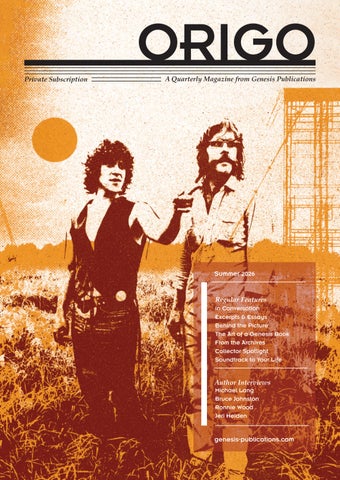
Cover photo features Michael Lang and Chip Monk on the site of Woodstock. Artwork by Shepard Fairey
With thanks to our authors & contributors BRUCE JOHNSTON CHARLES LEDIGO JERI HEIDEN RONNIE WOOD
Discover More genesis-publications.com
Next Issue Autumn 2026
Comments origo@genesis-publications.com
Follow fb.com/genesis.publications @genesis_publications @genesiseditions
Publishers: Catherine Roylance, Nick Roylance Editor: Katy Baker Design: Catherine Roylance Copyright © 2026 Genesis Publications Ltd All rights reserved. No part of this publication may be reproduced, stored in a retrieval system, or transmitted in any form, or by any means, electronic, mechanical, photocopying, recording or otherwise, without the prior permission of the publishers. ISBN:978-1-917734-06-6
Genesis Publications
Enquiries: info@genesis-publications.com Comments: origo@genesis-publications.com UK & International: +44 (0) 1483 540 970 USA Toll Free: 1 866 939 6913
genesis-publications.com 05
Letter From the Publisher NICK ROYLANCE
Welcome to the Summer issue of Origo. Before looking ahead to what you'll find in this issue, I'd like to share some wonderful news from the Genesis team. In the last edition of Origo, we were delighted to announce that Bon Jovi: Forever had received the IBPA Award for Best Book Finishing, recognising the craftsmanship that goes into every Genesis publication. It's therefore especially rewarding to begin this issue with another celebration, as Night Divides the Day by The Doors has now been named Outstanding Book of the Year at the Independent Publisher Book Awards (IPPY Awards). The recognition is a tremendous honour and a testament to everyone involved in bringing the project to life – from Robby Krieger and John Densmore, whose generosity and enthusiasm shaped the book, to our editorial, design and production teams, who spent years creating what we hoped would be the definitive celebration of The Doors. Awards are never the reason we publish books, but it is enormously encouraging to see the dedication, research and craftsmanship that go into these editions recognised by the wider publishing industry. Most importantly, we'd like to thank our subscribers, whose continued support makes ambitious projects like this possible. We begin this issue with an archive interview with Woodstock co-founder Michael Lang. As festival season closes, it seemed the perfect moment to revisit his reflections on organising one of the most influential cultural events of the twentieth century. Looking back more than 15 years after the interview was first recorded, it's striking how many of the questions he raises about community, creativity and optimism still feel remarkably relevant today. From there, Bruce Johnston joins us for the latest instalment of In Conversation, sharing memories, musical influences and the recordings that have stayed with him throughout his remarkable career. As we put this issue together, a theme of music history seemed to emerge naturally from those opening features. Building on Bruce's reflections and Michael Lang's recollections of Woodstock, we've chosen extracts from Love the One You're With and Blinds & Shutters that celebrate some of the defining moments mentioned by both authors.
06 LETTER FROM THE PUBLISHER
We have a brilliant interview with designer Jeri Heiden, whose work on Wildflowers offers a fascinating insight into the relationship between music, design and storytelling. One of the pleasures of producing Origo is being able to share the creative process behind our books, and Jeri's interview perfectly illustrates just how much thought, collaboration and attention to detail go into every edition. We also continue our Photography Spotlight series with a look back at Live in Japan, revisiting memories from George Harrison's final tour and the photographs my father captured while travelling alongside the band Alongside these features, we explore another corner of the Genesis archive with The Relic of the Mary Rose, one of our earliest historical editions, before hearing from collector Charles Ledigo about the passion behind building a collection of more than 40 Genesis books. It's always a pleasure to hear from our subscribers, not only about their Genesis collections but about the wider passions for music, books, photography and memorabilia that we know so many of you share. That sense of collecting, preserving and celebrating history has always been important at Genesis, and we hope Origo expands on that tradition. As ever, we hope you enjoy this issue as much as we've enjoyed putting it together.
THE IPPY AWARDS The IPPY Awards began in 1996 with a simple mission: to recognise and promote independently published books. Over 30 years later, that mission is still going strong. While the publishing landscape has changed dramatically, the IPPY Award is still dedicated to shining a spotlight on the best indie titles each year.
WINNER OF ‘OUTSTANDING BOOK OF THE YEAR’
LETTER FROM THE PUBLISHER 07
Interview with MICHAEL LANG
In 2009, Woodstock co-organiser Michael Lang opened The Big Chill Festival in the UK, appearing as a special guest to discuss the 40th anniversary of his iconic 1969 festival. With festival season now in full swing, we share his archive interview here.
Woodstock took 10 months to plan, and we wanted to make sure that a lot of things that caused problems at other festivals wouldn’t exist at ours. It was created as a paid event, and we expected people to buy tickets. They were fairly cheap – six bucks a day but my partner, John Roberts, put up a lot of money to put on the festival and he was expecting to make a profit, or at least his money back and that didn’t happen. We expected around 200,000 people and when half a million people showed up, it put a lot of pressure on everyone to keep the services running. Just like at other festivals we were building a temporary city for three days – people had to survive the weekend. We needed toilets, power, water, medical, all those facilities and we had to stretch it to a huge crowd. I think it was Arlo Guthrie that said one of the reasons the festival was so special was because a young generation had to step up to the plate. With an original plan of 200,000 people there was the potential for a disaster but it didn’t happen because people stepped up. You had Abbie Hoffman who was there to preach counter-cultural politics but he ended up working in the medical tent for example. Abbie bought a printing press and put out a survival paper for us over the weekend and then he ran the hospital tents. There was Movement City that we created for all the political groups to distribute their literature. Our feeling was always that Woodstock should not be political and the biggest political statement we could make was to have it be a success because it was being put on by the counterculture. Soon after the festival started, Movement City became deserted because everybody said [this festival] is what we’re moving towards and they wanted to become a part of it. For Carlos Santana it was one of the first times they played and he said he looked out and saw a sea of flesh, hair, arms, legs. Really, the bands were more in awe of the audience than the audience were of them. I think the whole world was awed by the audience. It was such an amazing coming together, this community, and it shocked everybody. 8 INTERVIEW WITH MICHAEL LANG
To be fair, Carlos Santana also admits to being absolutely off his head on mushrooms at the time. That too. In true festival style, it poured with rain and there was a 40mph wind blowing. The press described it as a disaster zone. Well, as Wavy Gravy said, ‘There’s always a little bit of heaven in a disaster area.’ So we stuck to that but it was tough to get through. The heavy storm came on the Sunday and I think after being there for two days it presented a real potential disaster but everybody pulled together. It was no longer, ‘I’ll get my things and then I’ll see about helping you with yours.’ Whatever we had, we shared. Janis Joplin said from the stage, ‘Look to your left. That’s your brother. Look to your right. That’s your sister.’ Everybody felt that in a really visceral way. They also had to close the New York Thruway. It was a 90 mile traffic jam. That meant some of the bands couldn’t get there on time. Richie Havens was supposed to open the festival at 5pm. What was it like for those artists? Did any of them bottle it or refuse to go on stage? Everybody was afraid to open, including Richie, and I hounded him for hours before I finally convinced him to go on. The bands were incredibly cooperative. The music in those days was very much part of the counterculture. They were singing about what we were trying to accomplish so we were all of a similar mindset about a lot of issues regarding the law, human rights, things like that. For all of us, this was as good as it gets. A band would come on stage and look at the sea of people and just be completely shocked and moved by it. I think you see that in a lot of the performances in the Woodstock film. There are those moments when there is a communication going on with the audience that’s completely sincere. Then there was Country Joe McDonald who ended up playing twice. He was asked to go on and fill a gap on the Saturday as an acoustic artist on his own so he walked up on stage, borrowed an acoustic guitar and started playing. Absolutely no one was listening – he said it was like a picnic atmosphere, with people
Henry Diltz proof sheet of Crosby, Stills and Nash performing at Woodstock, 1969
drinking beers, no one really paying attention. So he walks to the back of the stage and asks sound engineer, Bill Hanley, ‘What should I do, shall I play the “Fuck Cheer?”’ Bill Hanley says, ‘You can do what you want, no one’s listening to you.’ So he walked back and it starts off with, ‘Give me an F, give you a U!’ Suddenly the crowd sit up and listen. A few months later this moment becomes a centrepiece of the film. It probably made his career. It made a lot of careers actually.
Pete Townshend apparently told the other musicians not to take anything with the cap broken or to eat anything because everything was being spiked. What do you know about that? Well The Grateful Dead sound manager was known for two things: being The Grateful Dead sound manager and being the biggest producer of LSD in America. That was an interesting combination. Everything that was open was probably dosed.
The film spread Woodstock around the world. I’ve travelled extensively all my life and every place I go, people know about the festival, I think because of the film. Would The Who for example have been as big in America without Woodstock? I’m not sure. Originally The Who didn’t want to come. John Morris who was one of the guys on my staff, spent the night getting Pete Townshend drunk. And finally at about five in the morning, he agreed to play. They had been touring America and they wanted to go home. They had nothing to do with the American counterculture. They were not interested in political change. It felt like they were just focused on their career and Pete was horrible the whole day. He wound up bashing Abbie Hoffman in the head and sent him flying off the stage – but he played an amazing set and it changed their career.
Is there one performance that stands out for you? There were lots of them. There were the surprise acts that nobody had seen before like Joe Cocker and Crosby, Stills, Nash & Young and Santana who hadn’t even recorded by then and those moments were very special. Then there were amazing performances by Alvin Lee and his band Ten Years After, and the Jimi Hendrix rendition of ‘Star Spangled Banner’ that I think changed everything for all of us, even though there were very few people left by that point. In what way did it change things? The song spoke so eloquently about what we’d been going through for that whole decade, and the things that were wrong and needed to be fixed. It brought to mind the war and the civil rights marches and all of the things that we were trying, the ideas that we were trying to get INTERVIEW WITH MICHAEL LANG 9
across to people in a nonverbal but powerful way. And it was all about America. It was our national anthem. It said everything we were trying to say for that weekend. Were there any bands that you tried to get that you couldn’t? John Lennon was somebody we really wanted but we couldn’t get him into the country. He’d been busted back in England and was spending some time in Canada. The Nixon administration didn’t want him in because he had a very vocal stance against war. We also wanted Led Zeppelin but they didn’t come because they didn’t want to be just another act on the bill. The Moody Blues wanted to come but they were trying to make an album and were having trouble in the studio. And then there was Roy Rogers, a singing cowboy who used to be on television Saturday mornings. We all grew up with him. At the end of his show, he would sing a song called ‘Happy Trails’ and that’s the way I wanted to end the festival but we couldn’t make it happen. We had this moment in history, an amazing happening. And then a few months later in December there was the Altamont Concert and suddenly it seemed that the bubble had burst. You were brought in last minute to help organise Altamont as well. Do you think that was the end of the dream there? Was Woodstock just a brief moment in time that could happen then and there? No, I think Woodstock was the culmination of a whole era. It started during the civil rights movements in America, and then when John F Kennedy became president suddenly the youth of America felt empowered because he reached out to them, not just in America, but by sending them around the world in the Peace Corps. It gave us the incentive and the belief that we could make a change. I think that’s when the whole thing started to roll. Woodstock was the culmination of all that, of the whole decade. Altamont was just a very badly produced show. No thought went into it at all. There was no planning, it was just thrown together. There was no preparation for a crowd of that size. The Hells Angels were their security and they were stuck between the stage and the audience, defending the stage, and that was a really idiotic thing to do. I think their security was one of their biggest problems. Musicians were beaten up. The audience members were beaten up. And then there was a guy who had been insulted by one of the Angels who went home, got a gun, came back to the festival, pulled his gun and one of the Angels stabbed him. People have often viewed Woodstock as being a bit of a ramshackle but it was really well thought out. The lengths we went to for our security. We had a guy called Wes Pomeroy involved. This guy was about as high as
10 INTERVIEW WITH MICHAEL LANG
you could get in American policing as far as I understand. He was part of a three-man commission under Nixon and he’d been in Chicago and tried to convince Daley to stand down and not create the problems that he did. He really understood crowds and kids and was not political at all. Our thinking was that we were a bunch of young people trying to put something together and we didn’t want the police involved in what we were doing. We didn’t want to have that kind of threat to the audience. We didn’t want them to feel pressured or for them to have any confrontation so we hired Wes because he was able to talk to the state police and government to tell them that we’d handle things inside and they’d handle them outside. We needed that kind of weight. And of course, where Altamont had Hells Angels you had the hog farmers. We had the hog farmers. We also had a lot of off-duty New York City cops who were the peace force. They weren’t in uniform and they weren’t armed. They were just there to help people. That was what I told them from the beginning and that’s what they did. The hog farmers were there to help people settle into the campsites. While there is a tradition in the UK of camping at festivals, there was no tradition in America at the time. These were a lot of city kids who were coming up the country for the first time and they needed to understand how to get through the weekend and find the things they needed. The hog farm was a commune from New Mexico and that’s what they did. They organised large outdoor events. They’d been involved in all the acid tests in San Francisco with Ken Kesey so they understood how to deal with people who were having a bad experience on drugs. And their solution to a fire was to throw a pie in your face. They were perfect for what we had in mind. When people first started arriving, they could welcome them, help them set up, talk to them about what the festival would be like and then get them to help the next group coming in. They started this cooperative thing and a community grew throughout the whole weekend. The other thing to point out is that you were 24 when you organised this. Do you think there was an element of having no fear in youth that meant you could put on a festival? Stupidity is probably what it was. But yes, I had no fear at all. Did you have any prior experience? Yes, I’d done a festival in Miami a year before called the Miami Pop Festival. The inspiration was Monterey which I thought was an incredible event with incredible music. So I, along with a friend of mine, Rico Barry, had
Hogfarm meeting, Woodstock 1969
this idea to do a Miami Pop Festival. Hendrix actually closed that festival too and it rained like hell on the second day. Then I moved to Woodstock and during the summer that I got there, there were these concerts called Sound Outs and they would take place on a farm just outside of town. I thought it was the perfect way to listen to music. People like Van Morrison and Richie Havens would play. It was a beautiful area out under the stars. The stage was only a few inches off the ground. It led my thinking towards how Woodstock would come together. Do you think that idea crossed the pond to the UK? Definitely. I think everybody took notice. Many of us connected to the festival through the film. What did you make of it? Is it an accurate representation of the festival? I thought the film was amazing. Michael Wadley did an incredible job because he gave you a sense of all aspects of the festival. Even the songs he selected to be in the film had more to do with their lyrics than the best performance of each act. It gave you a picture of what was going on in America at the time.
INTERVIEW WITH MICHAEL LANG 11
When we talk about Woodstock now, do you think it has left a legacy? Does it play a part in movements across sustainability and women’s rights for example? Yes, I think Woodstock started a lot of movements. The green movement certainly started during the Sixties. There was a move towards growing organic food – I think Woodstock was probably the first time anybody had ever eaten granola! We all thought when we got back to the city on Tuesday the world would be different but it wasn’t. But I think we planted a lot of seeds and through the generations and the decades that followed some have come to fruition. Unfortunately some were ignored and we’re now facing global warming.
people out to ball games and bus stations and have them time people in the bathroom and we just multiplied it. We did that with everything.
What was your part in the Woodstock anniversary concerts? I did the 1994 and 1999 festivals. The 1994 anniversary was wonderful. We had about 350,000 kids and it was a bridge, musically, between the legacy acts who were at Woodstock ’69 like Santana, Joe Cocker, Crosby, Stills, Nash & Young and acts like the Red Hot Chili Peppers, Green Day, Metallica and Aerosmith. A lot of people who had come to the original Woodstock came back with their families and it was a wonderful event. Those Michael Wadley says that it went way beyond being a commemorative events can’t repeat a moment but they festival. It’s the only music festival that’s had an entire can mark them. The one we did in 1999 was much generation named after it. When Barack Obama was edgier and it felt much more like an MTV event than a inaugurated the press repeatedly called it ‘Obama’s Woodstock event because it was reflective of what was Woodstock’. It’s become a byword for a kind of going on in the country and in music at the time. A lot of peaceful gathering of hope. And the situations are very the bands were very edgy and so there was this edgy similar now with a divisive war in the Middle East. feel to the weekend. For the most part people had a Now there is an explosion of festivals. Do you think great time but it wasn’t really what a Woodstock event we’re living in similar times? should be for me. We do in some ways. We’ve moved on in a lot of ways but I think we’re in pretty desperate straits in a lot of other ways. There are violent movements on this planet. In America we had eight terrible years with Bush and it seemed like we were heading off a cliff. We couldn’t do anything right. Then, all of a sudden through movements like MoveOn.org and Rock the Vote, young people started getting involved in the political process. Obama was elected and at his inauguration you could see the feeling in the crowd. It was inspiring. How do festivals today compare? They’re much neater. Festivals carry on the tradition of more than just music. Many of them are about music and art which is how we planned Woodstock. Glastonbury is a prime example of how well festivals can be organised. The technology today is of course a lot better and there is much more information about what you have to do. There are tremendous festivals around the planet now. We have a dearth of them in America too. We had a lot of fun trying to plan the festival. We had to think, how many toilets do you need? How much water do you need? How much garbage are we going to produce? So we decided to go to the Army Corps of Engineers. They were the only ones we knew that had ever done anything like a temporary city. We made an appointment with them at the Pentagon and somehow word got out that we weren’t planning a temporary city but that we were doing a big rock festival so they cancelled the day before the meeting. We were left wondering how we would do it? So I would send 12 INTERVIEW WITH MICHAEL LANG
Wavy Gravy at Woodstock ‘94
Richie Havens performs at Woodstock ‘69
Were there any plans for a 40th anniversary? We were trying to put on an event to coincide with Climate Week in New York at the end of September. It’s a week when the UN brings in a bunch of leaders from around the world to talk about what will happen in Copenhagen which is the next step to the Kyoto Protocol. It sets the standard for climate control over the next decade. It’s an important issue and we were hoping to promote it through a festival in Prospect Park in New York. Being in the city, there would be a lower carbon footprint without the need for mass transportation. But it was a tough year economically and we needed green sponsors but they couldn’t afford to put up the kind of money we needed. Woodstock ’69 was funded by two city guys. Did they take a big hit in terms of financing? It was John Roberts’ money. He was one of my three partners – Artie Kornfeld, Joel Rosenman and John. We had sold about 125,000 tickets in advance but because of everything that we had to do the ticket booths weren’t established. We had allowed for some people to come who wouldn’t pay so we had free campgrounds, free kitchens, free stages so everybody was going to be welcome but we certainly hoped to sell some tickets. Then when that many people showed up, suddenly our
squad of helicopters had to go from five to 50 and everything sort of rolled out from there. So on the Monday or Tuesday after the event and you sat down and went through it was there a sort of visible blanching of John? There was a visual blanching of a lot of people. I remember leaving the festival site Monday afternoon and one of the helicopter pilots flew me to Wall Street. I walked into the bank, into the president’s office and there was John, his family and Joel, all looking really glum. John’s family hated the idea of Woodstock and the idea that their son was involved. They thought he was an idiot for doing it. There was a lot of tension in the room. I knew we were in big trouble. It was a very difficult thing for us to handle. What is your most cherished moment? When Richie Haven started to sing and the sound system worked. That was my favourite moment.
INTERVIEW WITH MICHAEL LANG 13
In Conversation with BRUCE JOHNSTON
The Genesis team has created a collection of 20 thought-provoking questions, inviting our authors, photographers, and contributors to choose the ones that resonate most with them. In this issue of ORIGO, singer, songwriter, and Beach Boy Bruce Johnston shares his personal selections, offering fascinating stories with fantastic recommendations.
Photos courtesy of Bruce Johnston
What was your first concert? Back in the 1950s when ‘pop music’ in the USA was Peggy Lee, Tony Bennett, Perry Como, Doris Day, Frank Sinatra, Ella Fitzgerald, Dean Martin, etc., my friend’s parents took the two of us to see Nat King Cole at the Hollywood Bowl. Up to that point, I had only been to symphony performances with my family, so this was a huge eye-opener for me as my first pop music concert! Do you live by a particular mantra? ‘Surf’s Up’ has been my mantra since the mid-fifties. To me it means having the ‘freedom’ to be powered by the natural energy of the earth as I surf and sail. I continue to experience this brilliant feeling to this day, alongside my joy of writing songs. Do you have a favourite book? Hawaii by Pulitzer Prize-winning author, James A. Michener. It is historical fiction at its best and reading through the book allowed me to experience many lifetimes in depth. At over 1,000 pages, it brings to life the epic history of Hawaii, spanning thousands of years from its geological formation and early human migration to the cultural development of its people, ending in the modern day. I first read it in 1959 when I was 17, then happily again 67 years later in 2026. 14 IN CONVERSATION
If you could have any guest – dead, alive, fictional – at a dinner party, who would you invite and why? As a composer and pianist, I would choose Sergei Rachmaninoff. I have always loved his Rhapsody on a Theme of Paganini and his piano concertos, but his life story is also fascinating, beginning in Tsarist Russia and ending in Beverly Hills (and still alive when I was born). I highly recommend the modern reprint of his 1956 biography, Sergei Rachmaninoff: A Lifetime in Music, by Sergei Bertensson and Jay Leyda. What work are you most proud of? At 23 years of age, I had a fantastic opportunity to sing on all the group vocal tracks Brian Wilson created for his Pet Sounds album during the first four months of 1966. To this day, over 60 years later it is the highlight of my vocal recording career. What project would you love to do, but haven’t yet? I would love to one day orchestrally enhance (for example, with the Royal Philharmonic Orchestra) some of the original recordings of the greatest rock & roll instrumentals. I would begin with ‘Honky Tonk’ (Parts 1 & 2), recorded by Bill Doggett (released by King Records and reaching the #2 spot on Billboard’s Top 100, October 3, 1956). Is AI a friend or foe? The tech results from AI are fascinating and can offer huge benefits, but we must always protect and promote what humans create organically. For further information please check with Robert Francis Prevost. If you could have been present for one concert or recording session, where would you go and why? I would like to have been at the 1956 Capitol Records Frank Sinatra recording session in Hollywood for ‘I’ve Got You Under My Skin’. Nelson Riddle would have been conducting his brilliant arrangement for Sinatra and Milt Bernhart would have been ad-libbing the greatest jazz trombone solo ever recorded...Amen! Is there anything you don’t like about working in music? Being around artists who become overnight political experts instead of growing daily in their musical knowledge. What music are you listening to at the moment? ‘She’s Leaving Home’, written and sung by Paul McCartney & John Lennon (from the Beatles’ 1967 album Sgt. Pepper’s Lonely Hearts Club Band) – Song on repeat since 1967!
What luxury item would you take to a desert island and why? Two items: a solar-powered satellite phone to get rescued(!) and a recording playing in the background of Fontella Bass singing her biggest hit. What is your first musical memory? When I was seven (1949), I remember singing an improvised harmony line to ‘Home on the Range’ in school and then being punished for disrupting the class. That’s when I first realised the power of music! What are some of your musical influences? Erroll Garner, Oscar Peterson, Frank Sinatra’s impeccable vocal phrasing on ‘I’ve Got You Under My Skin’, Nelson Riddle's beyond-perfect big band/orchestral arrangements, Diana Krall’s sultry vocals, plus her own keyboard chord voicing brilliance, and Little Richard’s 1955 recording of ‘Tutti Frutti’ (recorded at Cosimo Matassa's J & M Recording Studio in New Orleans), singing so enthusiastically into his microphone that his distorted vocal brilliantly highlights the recording’s overall intensity and sense of urgency. Have you ever met someone you were truly starstuck by? If so, who? In the mid-fifties, my father took me along to pick up my sister from her friend’s house and introduced me to her father, Gary Cooper! I was not quite 12 years old at the time and speechless! What is your favourite album of all time? The Genius of Ray Charles (1959, Atlantic Records). IN CONVERSATION 15
Excerpts & Essays: Music History LOVE THE ONE YOU’RE WITH BY HENRY DILTZ
16 EXCERPTS & ESSAYS
EXCERPTS & ESSAYS 17
18 EXCERPTS & ESSAYS
EXCERPTS & ESSAYS 19
Excerpts & Essays: Music History BLINDS & SHUTTERS BY MICHAEL COOPER
20 EXCERPTS & ESSAYS
EXCERPTS & ESSAYS 21
Behind the Picture VAN HALEN BY ALEX VAN HALEN
Written and signed by Alex Van Halen, VAN HALEN is the definitive inside story of one of the world's biggest rock bands. From the brothers' childhood in Pasadena, California, and the band's early days playing backyard parties to the release and global tour of their chart-topping album 1984, the book traces an extraordinary musical journey. Here, editor Megan Lily Large shares two previously unseen Polaroids from the book, sent directly by Alex.
Taken during Van Halen’s 1979 World Vacation tour, this Polaroid print comes from Alex Van Halen’s personal collection. His camera appears to have gone everywhere with the band that year, as shown by the remarkable number of Polaroids we received for the book. These images are significant not because they are polished or posed, but because they are the opposite: intimate, immediate and full of life backstage. For me, they were among the real treasures of his archive, and a chance to see Van Halen not only as one of the most electrifying bands of the era, but as four people living through it in real time.
22 BEHIND THE PICTURE
BEHIND THE PICTURE 23
Behind the Scenes FEARLESS BY RONNIE WOOD
The making of FEARLESS: THE ANTHOLOGY, including design inspiration, the production process and a preview of the book on press.
In our fifth collaboration with Ronnie Wood, we were thrilled to embark on our most ambitious project yet – creating the definitive chronicle of his extraordinary life in music. Fearless: The Anthology is a comprehensive exploration of Ronnie's career, opening his personal archive for the first time to reveal an unparalleled collection of guitars, stage-worn clothing, set lists and other treasured memorabilia. As we developed the limited edition, every element was carefully considered. For subscribers, we curated an eclectic collection of exclusive keepsakes, including replica guitar picks, a set of postcards showcasing his guitars and equipment – photographed exclusively for this edition – and a reproduction tour pass. The Deluxe edition, pictured above, expands on these exclusives with an even more personal selection of artefacts. Alongside the items included in the Collector edition, it includes a bespoke guitar strap, two prints of
24 BEHIND THE SCENES
Ronnie's handwritten lyrics, and a rare one-of-one Polaroid taken at one of the book’s photoshoots. Every aspect of the limited edition was designed with purpose. The rich red of the Deluxe cover was colour-matched to Ronnie's iconic Voodoo Lounge velvet coat, while the detailing on the spine takes its inspiration from one of his own guitar straps (both shown opposite). To complete the design, we incorporated rhinestone embellishments into the cover, adding the unmistakable touch of rock-and-roll glamour the edition deserved. The Collector edition received the same meticulous attention to detail, featuring a quarter-bound design with a motif inspired by another of Ronnie’s favourite guitar straps. It is housed in a bespoke clamshell box, finished with metallic detailing drawn from the intricate engravings on Ronnie Wood's iconic Zemaitis Disc Front guitar.
BEHIND THE SCENES 25
ALTERNATIVE COVER AND BOX DESIGNS
Previously unseen by the public, these early cover concepts also drew inspiration from Ronnie's guitars and iconic stagewear. Along with a number of other design proposals, they were presented to Ronnie at an early stage of the creative process, giving him the opportunity to select his favourite direction and refine the details. In the end, he was drawn to the vibrant reds of the final design – a choice we feel perfectly captures the energy of a true rock-and-roll anthology. Opposite, the practical side of the design process is highlighted. Working closely with our printers, we explored the best way to house the many components within a single clamshell box, ensuring each item was both beautifully presented and securely protected. In the top image, our Art Director’s initial sketch maps out how each element would be arranged inside the box before being sent to our printer in Milan. Drawing on decades of craftsmanship, they transformed these concepts into reality, first through detailed 2D mock-ups and then with blank prototype copies for review.
26 BEHIND THE SCENES
RONNIE WOOD CLAMSHELL COLLECTOR
CLAMSHELL DELUXE
postcards envelope
guitar strap + guitar picks
postcards + pass
postcards + guitar picks + pass A4 + 2 Polaroid envelope
OD WO NIE N RO
BEHIND THE SCENES 27
28 THE ART OF A GENESIS BOOK
THE ART OF A GENESIS BOOK 29
30 BEHIND THE SCENES
ON PRESS
These photos capture the final stages of production, with all files now in the hands of our printer. At this stage, the colour balance of each page can be fine-tuned if necessary before the edition is created using offset printing and then professionally bound. The finishing touches are completed by hand, with every copy carefully inspected for quality. Each individual element is then meticulously assembled and placed into the boxed set, ready to be shipped to customers and enjoyed.
BEHIND THE SCENES 31
The Art of a Genesis Book WILDFLOWERS BY TOM PETTY
In this interview, acclaimed art director and designer Jeri Heiden discusses her early creative influences, her journey into the music industry, collaborative relationship with Tom Petty, and the design process behind WILDFLOWERS.
Could you tell us a bit about yourself and your background? What first drew you to graphic design? I was drawn to the arts – music, writing and fine art – from an early age and started pursuing all three avenues passionately in high school. I later studied graphic design and packaging at Pepperdine University and at Art Center College of Design. I left college early to move to New York and started working in graphic design at age 19.
into all eras and styles, ranging from Edward Steichen, Paul Strand and Man Ray to Robert Frank, Irving Penn, Avedon, Helmut Newton and Guy Bourdin. Album covers that helped to shape my vision and inspire me to become a designer included Horses by Patti Smith, Another Green World by Brian Eno, Captain Fantastic and the Brown Dirt Cowboy by Elton John, Talking Heads: 77, Marquee Moon by Television and Station To Station by David Bowie, among others.
Were there particular artists, designers, photographers, or album covers that influenced you when you were just starting out? It’s a very long list! I was inspired by designers like Saul Bass, Herb Lubalin, Alexy Brodovitch, Seymour Chwast & Milton Glaser at Push Pin Studios. Artists like Andy Warhol, Robert Rauschenberg, Jasper Johns, Ed Ruscha, Barbara Kruger and Jenny Holzer. Photography has always been a particular interest of mine and I dug deep
What was your first professional design job, and what did it teach you? My first job in design was in 1979 at a small studio in NYC that did catalogues for Brooks Brothers and ads for Brides Magazine. I practiced all of the basics of production there – typesetting, paste-up, marker comps, photo editing, print production, etc… It was a grunt job, but it taught me to be serious about work and to learn as much as I could from my colleagues.
32 THE ART OF A GENESIS BOOK
How did you first enter the music industry? Serendipity. In 1983 a good friend of mine, photographer George Holz, told me that Warner Bros. Records was looking for freelance help due to a recent spate of layoffs. He was shooting for them a lot at the time and had friends in the creative department. I thought, ‘Sure, they’ll never pick me but why not give it a shot.’ I called to arrange a meeting to show my portfolio and got through because the VP mistook me for an artist signed to the label at the time (our names sounded very similar). Once I got my foot in the door, everything connected. Walking into the lobby at 3300 Warner Blvd. for the first time I just knew – I had found my people! I ended up working there for thirteen and a half years becoming the VP and Chief Art Director in 1987. It was a wonderful time to be in the music business.
THE ART OF A GENESIS BOOK 33
What makes designing for musicians different from designing for other clients? Musicians are generally coming from a place rooted in creativity and artistic expression, vs. a corporate or institutional client who may be motivated more by marketing needs and brand directives. There is often a symbiotic relationship between designers and musicians, I think. What was Tom Petty like as a collaborator? How involved was he in visual decisions? Tom was a really fun and funny collaborator. He had a wicked sense of humour and our conversations about artwork were always lively. Sometimes Tom would wax poetic about what he was envisioning, and other times we’d get just a few well-chosen words. How did you first become involved with the Wildflowers book project? Adria Petty asked that we work on the book – myself and co-designer Nick Steinhardt – as we had designed the massive Wildflowers & All The Rest vinyl and CD box sets in 2020. We had a very intimate knowledge of all of
34 THE ART OF A GENESIS BOOK
the materials involved, and the stories behind Wildflowers, as a result of that work. What conversations with Adria Petty, the estate, or Genesis helped shape your direction? For the Wildflowers book there was a strong desire by both the Estate and Genesis to add new and unseen elements to the story. The manuscript and guest essays added greater depth editorially, and we also spent a few fun days photographing Tom’s wardrobe, guitars, drums, amps and lots of ephemera in the band’s legendary ‘Clubhouse’ with photographer Jason Ware. These photos gave a rare behind-the-scenes look at the elements surrounding the writing, recording and performing of Wildflowers. Were there archival discoveries that surprised you or changed your understanding of the album? It was great to be able to see all of Tom’s handwritten lyrics for Wildflowers, including his notes, strikethroughs, re-writes and doodles. It really offered insight into Tom’s genius as a songwriter.
THE ART OF A GENESIS BOOK 35
36 THE ART OF A GENESIS BOOK
THE ART OF A GENESIS BOOK 37
‘Honey Bee’ handwritten lyrics
38 THE ART OF A GENESIS BOOK
What do you think made Wildflowers such a pivotal moment in Petty's career? Freedom. Tom talks about that a lot in the manuscript. He felt free to write and record for himself, rather than for a label he was unhappy with, or for a band that was showing signs of coming apart. It seems to have just flowed out – like a gusher that had been waiting to burst open. Did the finished book end up looking different from your earliest concepts? We certainly explored a lot of options for the cover and interior of the book layout. Ultimately we circled back to a few familiar and steady icons from the project – the beaded Wildflower emblem, and the photograph of Tom in his backyard looking so peaceful and happy – adding new treatments and finishes befitting this special edition. Is there a project you still dream of doing? I feel pretty fortunate to have worked with many of my musical heroes over the last 40+ years. I’m working on a dream project right now, but it’s top secret!
Wildflowers emblem
What advice would you give to someone entering the field today? If you’re not passionate about what you’re doing and who you’re doing it with, choose something else. This is the kind of work that will keep you up at night bursting with ideas! THE ART OF A GENESIS BOOK 39
Photography Spotlight LIVE IN JAPAN
At the end of 1991, George Harrison joined forces with Eric Clapton and his band for a 12-date tour of Japan. It was Harrison’s first tour since 1974 and the first time he and Clapton had performed together in a full concert setting since the historic The Concert for Bangladesh in 1971. A close friend of both Harrison and Clapton, Genesis founder Brian Roylance had the privilege of accompanying the tour with his young son, Nick. While on the road, Brian documented the performances and captured the photographs that would later provide the imagery for Live in Japan. Now, Nick shares his memories of this landmark tour and reveals the stories behind these rare and remarkable photographs.
More than thirty years after its publication, Live in Japan remains one of the most distinctive books Genesis has ever produced. Bound in black leather with Japanese characters blocked in red and finished with gilt page edges, each of the 3,500 numbered copies was signed by George Harrison and accompanied by a double CD of nineteen live recordings from the tour. Tucked inside an envelope were replica guitar picks used by George Harrison and Eric Clapton, together with a laminated after-show pass, creating what was, for its time, a remarkably ambitious collector's edition. The book also marked an important milestone for Genesis. Designed and typeset by my father, Brian Roylance, it became the first Genesis publication to be
40 PHOTOGRAPHY SPOTLIGHT
printed and hand-bound in Milan, beginning a relationship with Italian craftsmen that continues to this day. George Harrison and Eric Clapton's Rock Legends Tour of Japan took place in December 1991. My father joined the travelling party as an accredited photographer, carrying both 35mm and medium-format cameras to document not only the performances but also life behind the scenes. Alongside his own photographs, he later licensed selected images by fellow tour photographer Carl Studna before interviewing virtually every member of the touring party – musicians, management and crew alike – to build the book's narrative.
PHOTOGRAPHY SPOTLIGHT 41
42 PHOTOGRAPHY SPOTLIGHT
PHOTOGRAPHY SPOTLIGHT 43
Photography Spotlight LIVE IN JAPAN
A few weeks before the tour began, I accompanied my father to rehearsals at Bray Film Studios. Between us we photographed rehearsals, equipment and backstage life, and, to my enormous pride, one or two of my photographs ultimately found their way into the finished book. The following month I flew to Tokyo to join my father for the tour's final concerts at the Tokyo Dome. For the next few days I experienced life on one of the world's biggest concert tours from a perspective very few fourteen-year-olds could imagine. I watched guitar technicians Alan Rogan and Lee Dickson at work, helped lay out guitar picks and other small items before the show, and spent many happy hours with George's son, Dhani, whom I had known since early childhood. Then, on the morning of the final concert, George decided that Dhani would join the band on stage for the final song of the final encore, Chuck Berry's ‘Roll Over Beethoven’. Eric's response was wonderfully generous. ‘If George is having Dhani on,’ he said, ‘then I'm having Nick come on.’ During the afternoon soundcheck, Lee Dickson patiently walked me through exactly what would happen that evening. Before the musicians arrived, he even invited me to plug into Eric's amplifier and I was 44 PHOTOGRAPHY SPOTLIGHT
able to play a few bars of Jimi Hendrix's ‘Voodoo Chile’ across an empty Tokyo Dome – a moment that felt almost surreal. By the time the encore arrived that evening, my nerves had somehow disappeared. Eric glanced across reassuringly as we played, even lowering his microphone towards me to encourage me to sing, an invitation I wisely declined. As the final chord rang out and the audience erupted in applause, I found myself standing rather uncertainly until Eric leaned across,and shouted over the noise, ‘Wave, Nick… wave!’ Back in England, my father's work was only just beginning. He edited hundreds of photographs, completed interviews with everyone from musicians to crew members, and brought together one of Genesis' most ambitious publications. More than three decades later, Live in Japan acquired one final chapter of its own. When our long-standing hand bookbinder, Paul, retired and cleared his workshop, a handful of forgotten components came to light, allowing Genesis to complete the very last copies of the edition. After assigning their edition numbers and inserting George Harrison's signed limitation pages, a project that had begun in Tokyo in 1991 was finally complete.
PHOTOGRAPHY SPOTLIGHT 45
From the Archives THE RELIC OF THE MARY ROSE
In this feature, we present THE RELIC OF THE MARY ROSE, a historic work from the Genesis Archives, alongside two portraits of Genesis directors Nick and Catherine Roylance by Chrissie Hynde.
Beyond the celebrated music-based, large-format limited editions that have defined Genesis for decades, the archive contains a wealth of unique collectible works. Among them is this remarkable miniature volume, which recounts one of the most dramatic events in Tudor naval history: the sinking of the Mary Rose, the second-largest ship in the fleet of King Henry VIII. On 19 July 1545, the warship sailed from Spithead to confront an invading French force, only to capsize before the eyes of the King and his assembled army, taking almost 700 men to their deaths. More than four centuries later, the wreck was recovered from the seabed and painstakingly conserved, becoming one of Britain's most important archaeological discoveries. A facsimile of the 1842 edition, THE RELIC OF THE MARY ROSE is a delightful book, devoted to the story of the sinking of the Tudor ship. It contained an 46 FROM THE ARCHIVES
eye-witness account of the tragedy by Sir Peter Carew, a near relation of the Mary Rose's ill-fated captain. The firsthand testimony offers readers an intimate connection to one of the most significant maritime tragedies of the Tudor age. What makes this edition especially significant within the Genesis archives is its extraordinary physical connection to the historic vessel itself. Limited to just 750 numbered copies and signed by Margaret Rule, the Archaeological Director of the Mary Rose Trust, each book is bound in full leather and features an inset piece of beautifully polished and lacquered English oak recovered from the Mary Rose. As a result, every copy is not only a finely crafted publication but also a genuine historical artefact containing material from the ship it commemorates.
FROM THE ARCHIVES 47
From the Archives A VISIT TO SÉTE
In May 2018, Catherine and I travelled to Chrissie Hynde's home in the south of France to spend a few days with her as we worked on Adding the Blue, her first book of paintings published later that year. Published by Genesis in 2018, Adding the Blue brought together a selection of Chrissie’s oil paintings alongside her own commentary on art, music and the experiences behind the work. Although best known as the founder and frontwoman of The Pretenders, painting had become an increasingly important part of Chrissie’s creative life. Our visit came during the later stages of preparing the book. We had travelled to Sète to photograph paintings created in Chrissie's French home studio and to continue our recorded interviews as we finalised the book's manuscript.
48 FROM THE ARCHIVES
It’s fantastic painting in Séte. My man, Van Gogh, was just down the road.– CHRISSIE HYNDE
The Mediterranean port, sometimes called the ‘Venice of France’ for its network of canals, has an inspiring artistic atmosphere. Chrissie also introduced us to another side of the town’s fame – at the time, it featured prominently in two popular French television series, attracting increasing numbers of visitors from within France. One of the unexpected pleasures of the visit was seeing the surroundings that had found their way into Chrissie’s paintings. Looking from an upstairs window, I suddenly recognised a view I had already seen many times while reviewing the book's layouts. There it was in real life: the unmistakable green cedar among the palms and terracotta-tiled roofs, with the blue of the Mediterranean beyond.
We spent much of our time working through the remaining paintings and talking about the book, but on our final day Chrissie turned the tables on us. Catherine sat for a portrait first, followed by me. Both were painted with remarkable speed. Mine was still unfinished when we left Sète, but Chrissie continued to email me progress updates, sending a final photograph of the completed canvas by noon the next day. Last year, we met up with Chrissie again for lunch in London. Having moved out of her home in Sète, she had brought with her the two portraits that had remained in her studio in France. She very kindly gifted them to us, and for Catherine and me they have become wonderful, personal souvenirs of a very special project – and of the few days in Sète that helped bring Adding the Blue towards completion
FROM THE ARCHIVES 49
Soundtrack to Your Life RONNIE WOOD
Photo by Paul Natkin
Celebrating his 50th year as a Rolling Stone Genesis is honoured to be working with Ronnie Wood on his latest Genesis edition, FEARLESS: THE ANTHOLOGY. Its release marks the fifth collaboration between Ronnie and Genesis. His new career-spanning edition follows the success of his bestselling titles WOOD ON CANVAS, FACES, 1969–’75, HOW CAN IT BE?, and THE ROLLING STONES SET LISTS, as well as his valued contributions to recent publications such as BUDDY HOLLY: WORDS OF LOVE. An ORIGO exclusive, this archive interview delves deeper into Ronnie Wood’s creative journey, where a song and two seminal albums spark fascinating stories that illuminate both his personal and professional life.
50 SOUNDTRACK TO YOUR LIFE
Jimi Hendrix gave me my first copy of B.B. King's Live at the Regal. It's a great album; I wish I still had it today. Jimi turned me on to B.B. King, and it came full circle because the Stones did a couple of tracks with B.B. in Los Angeles. We did one for his album and got one for us to use. He gave me a couple of great guitar albums. He'd tell me, ‘Listen to this, pick up some tips.’ Jimi Hendrix was one of Seattle's great finds. He was the most alarmingly good player I'd seen because he took me by surprise. He could play equally well right or left-handed, Chuck Berry had an influence on which meant switching the guitar everybody. ‘Havana Moon’ is one of around, turning it upside down, and my favourite Chuck songs. I did a he could still play just as well. It version of it in Seattle with Eddie blew my mind. Vedder. Keith and I and, in fact, I used to share a flat with him in Charlie and Mick, all did a lot of Holland Park, along with Pat research on Chuck because we Arnold. She used to be in the Ike & played ‘Little Queenie’ as part of our Tina Turner Revue. She was one of set, and we went into the finer points the Ikettes. She's still got a good of the intro and its amazing voice. We had good fun, but it's all a construction. We tried to keep it as bit of a blur now. I ended up getting true to the original as possible. It's thrown out of the flat because Jimi amazing – you wouldn't think we'd gave me a basset hound, and the dog still be swotting up on Chuck Berry used to shit everywhere and Pat after all those years. didn't like that at all. Jimi was such a When I first met Chuck, I nice, gentle person, although maybe thought, ‘He's a filthy swine!’ He a little too stoned. He was always a blows hot and cold. He's very tough, little bit sleepy. but he had to hack it through the I saw him the night he died when colour barrier too. I think he had a he left Ronnie Scott's. He had his bit of a chip on his shoulder about arm around this girl and he was the way he used to get treated. I got leaving. And I said, ‘Hey, Jimi!’ And on with him very well. He liked the he was very slow. ‘Jimi,’ I said, way I played. We did a lot of gigs ‘aren't you going to say goodnight?’ together. One time, I think at the And he turned around and said, Ritz, Keith went to see him play. ‘Goodnight.’ I was in tears the next And Chuck, as usual, arrived in a day because that's when I found out taxi minutes before the gig and had he'd died. to get the money before he went on, otherwise he wouldn't play. He'd just take his guitar out on stage, play, whether it was in tune or out, jump off the stage after the set, go through the audience, out into a cab again and off. Keith ran up behind him and wanted to say, ‘Nice gig, Chuck!’ So he tapped him on the shoulder. Chuck turned round, BANG, and decked Keith. The next day Keith said to me, ‘Chuck Berry gave me this black eye!’ He was very proud of it.
I did an album with Scotty Moore and DJ Fontana, All the King's Men. They were Elvis's guitarist and drummer, and I wanted to do an album as a tribute to them because they were overlooked. Elvis got all the acclaim, but it was when there was a guitar solo backed by DJ Fontana that the audience went crazy and tore all the cinema seats out. Scotty Moore was responsible for the early trademark Elvis sound, but they were on $100 a week for 14 years when they were with Elvis. It was terrible, but they were lovely people and didn't want to complain. I think ‘Treat Me Nice’ was one of the first Elvis records I heard. My cousin Dougie played it – he was the rock and roll rebel, a Teddy Boy. I would have loved to have met Elvis, but I did see him live in Vegas once when I was with the Faces. I did try to visit him in hospital in Memphis shortly before he died. I tried to get up there, but they threw me out. I was trying to get to him and tell him to stick to the rock and roll instead of that horrible ‘Polk Salad Annie’ stuff. He lost it a bit towards the end when he was surrounded by karate-type security guards who kept him from the outside world, kept him in his little cage where no one could see him, kept him in isolation and, in my opinion, they're the ones who contributed most to his ultimate downfall.
SOUNDTRACK TO YOUR LIFE 51
52 SOUNDTRACK TO YOUR LIFE
An extract taken from Ronnie Wood’s latest book, Fearless: The Anthology, on playing with Chuck Berry
SOUNDTRACK TO YOUR LIFE 53
Collector Spotlight CHARLES LEDIGO
Producer and businessman Charles Ledigo shares the story behind his passion for collecting – from his first Genesis book to a collection of more than 40 signed limited editions.
Music has been a constant throughout my life, and it's naturally become a huge part of my career. Today I work as a theatre, film and music producer, but that all comes from a lifelong passion for the artists and stories that have inspired me. For the past ten years I've worked alongside actress and screenwriter Carol Harrison through Rock 'n' Roll Productions, producing All or Nothing The Mod Musical and All or Nothing – The Experience, celebrating Sixties Mod culture and the legacy of the Small Faces. We're now developing a major feature film about the wonderful Steve Marriott to be released next year. The Beatles have also played an important part in my work. As a partner in Initial Film Services, we produced the documentary and theatre production, No Hamburg No Beatles, exploring those formative years in Hamburg that shaped the band's future. One of the real highlights of making that film was using Klaus Voormann's wonderful illustrations from his Genesis Publications book, Hamburg Days. With Klaus's permission, we animated the artwork, and it became one of the defining visual elements of the documentary. It was a lovely reminder that these books aren't simply beautiful collector's pieces – they're living archives that continue to inspire new creative work. That connection with Genesis Publications has grown over many years. Today I have more than 40 Genesis books in my collection, and each one reminds me why I started collecting in the first place. The very first Genesis title I ordered was Wood on Canvas by Ronnie Wood. It was an easy decision because I'd followed both Ronnie Wood and Rod Stewart from the very beginning of their careers. Owning a book that celebrated that period felt like owning a small piece of music history. Of course, Genesis books are only part of what I collect. I've always loved art and have been fortunate enough to build a collection that includes works by Ronnie Wood, Jack Vettriano, Robert Lenkiewicz and Charlie Sheils. I also have a substantial collection of CDs and DVDs. I simply enjoy surrounding myself with creativity in all its different forms.
54 COLLECTOR SPOTLIGHT
The book that stands out as a personal favourite is Postcards from the Boys by Ringo Starr. The reason has less to do with rarity and more to do with the story behind it. I was too late ordering the book and discovered it had already sold out. I thought I'd missed my chance, but Genesis very kindly contacted Ringo Starr, who agreed that I could have one of his Artist's Proof copies. He even signed it for me. Moments like that are unforgettable and are part of what makes collecting such a rewarding experience. I don't think my collection will ever be complete. I'm always discovering something new that catches my eye, whether it's another Genesis edition, a piece of artwork or something connected to the music I've loved all my life.
COLLECTOR SPOTLIGHT 55
Titles Coming Soon
The latest Genesis titles currently in production including two Anniversary releases – HELLO, GOODBYE and BEATLES IN GERMANY
HELLO, GOODBYE: THE ANNIVERSARY COPIES To mark the 60th anniversary of The Beatles' arrival in Tokyo, each remaining Collector copy of Hello, Goodbye now includes an exclusive 10" × 8" photographic print signed by Shimpei Asai. Reproducing one of Asai's rare photographs taken during The Beatles' performances at the Nippon Budokan on 1 July 1966, the second day of their three-day Tokyo engagement, the print captures the energy and spectacle of the band's historic Japanese concerts. Individually signed by Asai using his Japanese signature and suitable for framing, the archival giclée print has been created exclusively to mark the 60th anniversary of The Beatles' arrival in Tokyo and accompanies the final copies of the edition available from Genesis.
56 TITLES COMING SOON
BIG: BEATLES IN GERMANY THE ANNIVERSARY COPIES From 1960 to 1962, the group honed their craft in Hamburg's clubs, an experience so fundamental that John Lennon later claimed he had ‘grown up in Hamburg, not Liverpool’. It was in Germany that The Beatles made their first commercial recording, where John Lennon returned to film How I Won the War in 1966, and where the group staged their triumphant BravoBeatles-Blitztournee during their final tour in June that same year. First published by Genesis Publications in 1997, BIG: Beatles in Germany documents this extraordinary relationship across 138 pages, nearly 200 photographs,
and words from the Beatles’ friends and German collaborators, tracing the band's story from their early nightclub residencies to their final tour. To mark the 60th anniversary of that tour – and nearly three decades since the book's original publication – Genesis Publications has assembled just 100 Anniversary Copies. Presented in a newly designed commemorative slipcase, each set includes one original archive darkroom print selected from the Genesis archive, together with rare memorabilia and facsimiles inspired by the Beatles' German years. These specially created sets offer a unique new presentation of one of Genesis's early Beatles publications. TITLES COMING SOON 57
Origo Members’ Offer REVOLVER 50: SIGNED POSTER
Released in August 1966, The Beatles’ Revolver transformed the possibilities of popular music. Its groundbreaking songs were accompanied by one of the most celebrated album covers of all time, created by Klaus Voormann. Voormann’s extraordinary pen-and-ink collage captured the experimentation and originality of the record, earning him the 1967 Grammy Award for Best Album Cover, Graphic Arts. To commemorate the artwork’s 50th anniversary, Genesis Publications presented a special celebration with Klaus Voormann at the GRAMMY Museum in Los Angeles on 7th March 2017. Produced for this landmark event, the Revolver 50 poster combines elements from Klaus’s original artwork with drawings of the pens, brushes and ink he used to create it. A small number were signed by Klaus in Los Angeles at the time and have remained in the Genesis Publications archive ever since. Now, to mark the 60th anniversary of Revolver’s release in the summer of 1966, a handful of these signed posters are being released from the Genesis Publications archive, exclusively for Origo Members. Printed by offset lithography in black and gold Pantone inks on heavyweight, uncoated 300gsm art paper, each poster was personally signed by Klaus Voormann in Los Angeles in 2017, in either gold or black ink. His generous signature runs vertically along the lower righthand side, becoming an integral part of the composition. Preserved in the Genesis Publications archive since the anniversary event, each poster is now accompanied by a Genesis Certificate of Authenticity. Measuring A2, the poster is offered unframed or presented in a black wood frame with a white acid-free mount and UVprotective acrylic glazing. This strictly limited allocation is available only through this password-protected page and is reserved exclusively for Origo Members.
58
:
To access, enter the PASSWORD REVOLVER when visiting the webpage: genesis-publications.com/prints/revolver • Artist: Klaus Voormann • Title: Revolver 50 • Availability: Fewer than 15 signed posters • Poster size: 42 × 59.4 cm (16½ × 23½ in) • Method: Black and metallic gold ink offset lithograph • Paper: Heavyweight, uncoated 300gsm art paper • Signature: Personally signed by Klaus Voormann, in either gold or black ink • Certificate of Authenticity: Issued by Genesis Publications • Frame: Black wood frame with white acid-free mount and UV-protective acrylic glazing • Framed size: 57 × 74.5 cm (22½ × 29⅓ in)
Featured in this Issue
LOVE THE ONE YOU’RE WITH BLINDS & SHUTTERS BY HENRY DILTZ Introduced by Graham Nash and Stephen Stills, CSN&Y: Love the One You're With is a celebration of the supergroup and its individual members, documented through over 800 photographs by Henry Diltz and 58,000 words from 20 contributors. The book's photographic journey starts at the roots of CSN&Y, centred on the 'sylvan place' that was Laurel Canyon in the late Sixties. Diltz photographed Graham Nash, David Crosby, Stephen Stills and Neil Young in their previous incarnations in the Hollies, the Byrds and Buffalo Springfield. He was then witness to musical alchemy as CSN discovered their astonishing vocal dynamic, first performing to fellow musicians and friends.
Edition: 2,000 Signed by: Henry Diltz, Graham Nash and Stephen Stills Binding: Dark red quarter binding with coloured foils and gold page edging Box: Handcrafted box covered with colour foiling Page size: 235mm x 310mm Extent: 272 pages ISBN: 9781905662838 Price: £325
Blinds & Shutters is the story of the Sixties, a cult classic and a publishing benchmark. It is quite simply our most famous book and widely regarded as the cornerstone of any rock'n'roll library. With over 600 photographs and a 30,000-word text from 93 legendary contributors, Blinds & Shutters is not only a unique insider’s view of the Sixties through the lens of photographer Michael Cooper, it is the defining record of an era, as told by those who were at its centre. From musicians such as Eric Clapton and George Harrison, to artists Andy Warhol and David Hockney, to writers William Burroughs and Allen Ginsberg, the list of contributors to Blinds & Shutters is nothing short of awe-inspiring.
Edition: 5,000 copies Signed by: At least 9 icons of the sixties, including Francis Bacon/Bridget Riley/Sir Peter Blake Page size: 260mm x 370mm Extent: 368 pages Binding: Quarter bound in leather ISBN: 0904351378 Fully subscribed
VAN HALEN BY ALEX VAN HALEN Written and signed by Alex Van Halen, Van Halen is the official chronicle of the band, published in a limited edition of 1,500 signed and numbered copies worldwide. The book traces the brothers’ journey from their childhood in Pasadena, California, and the band’s early days playing backyard parties, to the release and world tour of their charttopping album 1984. Featuring a dynamic blend of iconic photography alongside rare and neverbefore-seen images, and with exclusive access to Alex Van Halen’s private archives, Van Halen offers a personally guided tour through the band’s legendary rise.
Edition: 1,500 copies Signed by: Alex Van Halen Binding: Quarter-bound in black vegan leather with silver page edging Box: Black clamshell featuring silver foiling Extras: Van Halen Productions keychain, three replica Eddie Van Halen stage-used guitar picks, six 6" × 4" art postcards and a 7" vinyl record' Page size: 240mm x 340mm Extent: 312 pages ISBN: 9781917734080 Price: £345
FEATURED TITLES 59
FEARLESS: THE ANTHOLOGY LIVE IN JAPAN BY GEORGE HARRISON BY RONNIE WOOD
NIGHT DIVIDES THE DAY BY THE DOORS
Told in his own words, Fearless: The Anthology is Ronnie Wood’s definitive chronicle of a life in music. Written and signed by Ronnie Wood, the book traces his journey from the clubs of Sixties London with The Birds, through his time as bassist with the Jeff Beck Group and co-founder of the Faces, to more than 50 years as a member of the Rolling Stones, the most legendary band on the planet. Fearless: The Anthology opens Ronnie Wood’s personal archive for the first time in book form. The collection spans legendary guitars and rare instruments, custom-made straps, vintage pedals and amps, designer stage wear, concert set lists, and historic ephemera – all specially photographed for the making of this limited edition publication.
Live in Japan is a large format, full colour book featuring almost 500 previously unpublished photographs. The foreword by Eric Clapton explains how George was persuaded to return to touring after a break of 17 years. The first (and longest) chapter is written by George himself and details his thoughts and feelings on taking to the road after such a long absence. It includes George's personal recollections of the tour and memories of times on the road with The Beatles. Subsequent chapters are written by each member of Eric Clapton's band and reveal private moments behind the scenes, during sound checks, on stage and in transit. The final chapter by John Harris (who engineered the LIVE IN JAPAN CD) provides a revealing account of working with George Harrison in the studio.
Created in celebration of the band’s upcoming 60th anniversary, Night Divides the Day opens up The Doors archives like never before. The band’s most definitive book yet presents rare photography, intimate interviews with Robby Krieger and John Densmore, and meticulously sourced archival text from Jim Morrison and Ray Manzarek. Joining them are a host of contributors, a foreword by Nirvana bassist Krist Novoselic, and an afterword by maestro Gustavo Dudamel. The Collector copies are presented in a limited edition of only 1,650 numbered editions, signed by John Densmore and Robby Krieger. Each set includes the 344- page signed edition, a 7” vinyl record with rare demos of "Hello, I Love You” and "Moonlight Drive,” and assorted historical memorabilia.
Anniversary Edition: 1,000 Signed by: Ronnie Wood Binding: Quarter-bound in faux red leather with silver screen-printed covers Box: Black clamshell case with metallic detailing and silver foiling ISBN: 97819177340509 Price: £325
Edition: 3,500 copies Signed by: George Harrison Binding: Black leather with gold and red tooling and gilt edged pages Page size: 320mm x 250mm Extent: 274 pages ISBN: 0904351432 Fully subscribed
Collector Copies: 1,650 Signed by: John Densmore and Robby Krieger Binding: Quarter-bound in apple leather with hand-marbled cover artwork Box: Solander (clamshell) box inspired by one of The Doors’ official flight cases Page size: 225mm x 300mm Extent: 344 pages Extras: 24-page replica programme from The Doors’ 1968 tour, Original masters booklet, 7" Vinyl featuring rare recordings ISBN: 9781905662883 Price: £345
60 FEATURED TITLES
HELLO, GOODBYE: THE ANNIVERSARY COPIES
WILDFLOWERS BY TOM PETTY
BIG: BEATLES IN GERMANY ANNIVERSARY COPIES
To mark the 60th anniversary of The Beatles' arrival in Tokyo, each remaining Collector copy of Hello, Goodbye now includes an exclusive 10" × 8" photographic print signed by Shimpei Asai. Reproducing one of Asai's rare photographs taken during The Beatles' performances at the Nippon Budokan on 1 July 1966, the second day of their three-day Tokyo engagement, the print captures the energy and spectacle of the band's historic Japanese concerts. Individually signed by Asai using his Japanese signature and suitable for framing, the archival giclée print has been created exclusively to mark the 60th anniversary of The Beatles' arrival in Tokyo and accompanies the final copies of the edition available from Genesis.
Created in collaboration with the Tom Petty Estate, Genesis Publications presents Wildflowers, a landmark publication celebrating the creation of one of Tom Petty’s most beloved and enduring albums. Limited to just 1,500 numbered copies worldwide, every copy is signed by Heartbreakers Mike Campbell and Benmont Tench. Published in the year of Tom Petty’s 75th birthday, Wildflowers invites readers into the studio, the songwriting process, and the mind of an artist at the peak of his creative powers.
First published by Genesis Publications in 1997, BIG: Beatles in Germany documents this extraordinary relationship across 138 pages, nearly 200 photographs, and words from the Beatles’ friends and German collaborators, tracing the band's story from their early nightclub residencies to their final tour. To mark the 60th anniversary of that tour – and nearly three decades since the book's original publication – Genesis Publications has assembled just 100 Anniversary Copies. Presented in a newly designed commemorative slipcase, each set includes one original archive darkroom print selected from the Genesis archive, together with rare memorabilia and facsimiles inspired by the Beatles' German years.
Edition: 1616 copies Signed by: Shimpei Asai Page size: 250mm x 320mm Extent: 224 pages Box: Each copy comes in a slipcase printed with a traditional Japanese kimono pattern, and a logo type design inspired by the tickets from The Beatles 1966 shows ISBN: 9781905662463 Price: £350
Edition: 1,500 copies Signed by: Mike Campbell, Belmont Tench Page size: 220mm x 280mm Extent: 240 pages Binding: Quarter-bound in red vegan leather with gold page edging Box: Handcrafted red clamshell box, diestamped with gold foiling Extras: ‘A Dogs With Wings’ bandana, enamel pin badge, guitar sticker, three guitar picks, one satin pass, one laminate pass, and three archival prints (8” x 10”) ISBN: 9781917734011 Price: £495 Deluxe/£295 Collector
Anniversary Edition: 100 copies Signed by: Tony Sheridan, Günter Zint, Ulf Kruger Page size: 300mm x 245mm Extent: 138 pages Binding: Quarter-bound with blind embossing Box: Presented in a new archival slipcase ISBN: 0904351572 Price: £495
FEATURED TITLES 61
Round-Up Subscriber Comments
We love to hear from you. Keep sending your questions, musings and reviews to origo@genesis-publications.com
This is late coming but I have purchased about 18 books from Genesis and have a couple more on order. Quality is top tier, I love them all. Jim May Fearless arrived and is just beautiful!!! I didn’t realize it was shipped from the binder in Milan so I thought it was spam! Excellent book. R. Mondell I received Thin Wild Mercury today and I am overwhelmed. This is the most beautiful book I possess. It is not placed in the bookshelf. I am keeping it in the original box. Thank you, Genesis Publications for releasing such a beauty. B. Skarsem
as if they were printed and signed yesterday. They are beautiful, and definitely more beautiful than in the photos. 'Piggies' made the biggest impression on me. It's incredible to have this print signed by Mr. George Harrison himself, 40 years ago, an outstanding man, musician, artist, and silent Beatle. I'm very happy. It's incredible to have this work in my collection and to look at it, knowing that he placed his hand on this print when he signed. I think I'm probably the only person in Poland who has this series. Thank you! Thank you, Genesis Publications Team, for all your works, because each book or print is an outstanding work, created by you in collaboration with the world's most outstanding artists. I hope that my collection, built with you over many years, will endure for decades to come. I still dream of autographs from Sir Mick Jagger and Sir Paul McCartney...maybe someday...maybe again thanks to Genesis Publications. R. Lasecki
Quarterly Staff Pick
We hear from editor Megan Lily Large about her favourite Genesis title.
Of all the books Genesis has published, Thin Wild Mercury might be my favourite, though I’m not exactly impartial. Bob Dylan is my favourite artist, Blonde on Blonde is my favourite album, and I do have a Dylan tattoo, so this book was always going to appeal to I wanted to let Genesis Publications me. know that I absolutely love the books on Putting that aside, it’s a very special musicians/bands, as I have ordered edition. Jerry Schatzberg is a brilliant several over the last few years. The photographer, and his images of Dylan quality of the books are just so fantastic! have that rare quality where they feel I also wanted to find out if there are any both iconic and strangely intimate. The plans to produce books on the following: Blonde on Blonde cover is obviously part The musical artist, Prince, The musical of music history – that gatefold! – but I just finished reading Tom Petty's band, Journey. Keep up the fantastic what I love about this book is seeing the Wildflowers. A fan of Tom and the work and continued success to Genesis wider world around that image: the Heartbreakers since the 1970's, I found Publications. studio, the portraits, the in-between this to be an amazing tribute to one of P. Sethi moments, and the creative partnership Tom's prized albums. I very much behind it all. enjoyed the collection of photos, personal Yesterday, the UPS courier delivered For me, Thin Wild Mercury captures memorabilia, and insight into the this package to me.It was very securely Dylan at exactly the point I find him writing and production of each of the packed for transport, and there were no most fascinating – mercurial, funny, tracks. Thank you and the Petty Legacy sharp, impossible to pin down – and problems with delivery or shipping, for which I am very grateful. When I opened for making this available. I'll treasure it! Schatzberg somehow caught all of that D. Piatelli this large wooden box, I was captivated without flattening the mystery. by these three prints. It's amazing that , they have survived in such intact, perfect condition for 40 years. They look
62 ROUND UP
Genesis Quiz
What was the name of the first Muddy Waters single for Chess Records in 1950? How many years had George Harrison been away from touring before the 1991 Live in Japan tour? Which famous blues guitarist did Jimi Hendrix introduce Ronnie Wood to through his recordings? Which American city was home to Alex and Eddie Van Halen before they found international success? Which iconic venue hosted The Beatles during their only Japanese tour? Spring issue answers: Best Book Finishing, the way of the intercepting fist, Summer Days (And Summer Nights!!), Bromley, acorn
ORIGO PLAYLIST Soundtrack ORIGO with a specially curated playlist featuring the artists and songs from this issue. Scan the QR code or click on the cassette below!
Next Issue
In the next issue of Origo,we’ll dig deeper into the history of Genesis, revealing the early logo concepts designed by Storm Thorgerson, and also look forward to what is next on the horizon for Genesis.
genesis-publications.com