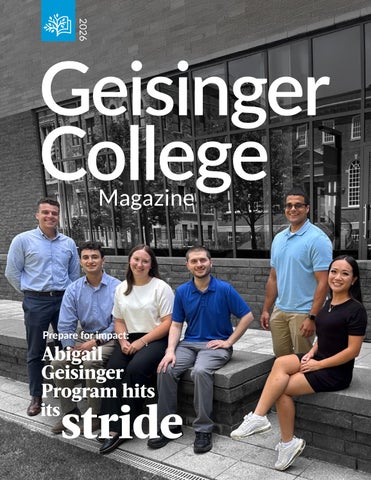
Geisinger College Magazine 2026

Page 1


Geisinger College Magazine

Abigail

Geisinger Program hits

Prepare for impact: its

stride

Well-being begins with a choice — let’s empower people to choose health

Every day, patients face critical decisions about their health. But without strong, accessible primary care, those choices become harder and sometimes out of reach. At the same time, the next generation of doctors, nurses and clinicians face their own decisions: where to train, what to specialize in, and how to manage the weight of student debt.

So how do we make it possible for talented young professionals to stay rooted in their communities — to care for their neighbors and practice medicine the way they’ve dreamed of doing?

At Geisinger, we didn’t just ask the question. We built a solution.

The Abigail Geisinger Scholars Program is transforming the future of care in our region — tackling access, affordability and workforce development in one bold move. In this issue, we celebrate the success and rapid growth of the program as it hits its full stride, admitting one of the largest incoming cohorts of Scholars to date.

Who are the changemakers? What drives them? And how are they reshaping the healthcare landscape from the inside out? Turn the page and meet the future of medicine.

A message from Julie Byerley,

MD, MPH

Geisinger, its college and our medical school have a shared history of grassroots concern for community. Where most advanced academic medical centers were established by health systems or universities, ours grew organically from citizens who wanted to see their neighbors thrive in every possible way.

In this edition of our magazine, we explore how one program is achieving that multifaceted goal. We describe care and education here as “uniquely Geisinger.” That means addressing complex, multidimensional issues with bold, brilliant and deceptively simple plans that get right to the heart of problems. The Abigail Geisinger Scholars Program embodies that approach with a single program that addresses problems with access to care, the high cost of medical school and the need to make our region’s young people stay and build careers here at home — and even attract newcomers!

The program has now hit its stride and is enrolling up to 45 students per class. In just a few short years, we’ll greet returning doctors by the hundreds. It’s an amazing story that opens the doors to primary care for our communities, inspires our young people to meaningful careers and even has economic benefits for our entire region.

As our college expands and grows, these Scholars — and alumni of our Graduate Education and Nursing schools — will care for our communities the Geisinger way, where outcomes matter more than activity and medicine has a vision broad enough to consider entire populations but precise enough to tailor care to an individual genome.

That’s uniquely Geisinger!

Sincerely,

A publication by the Department of Marketing and Communications

Elizabeth Zygmunt

Marketing and Communications Strategist and Geisinger College Magazine Editor

Heather M. Davis, MFA Manager of Marketing and Communications for Education and Research

Erich Lenz

Marketing and Communications Strategist

Kaytlyn Wolfe

Marketing and Communications Consultant

Beth Kaszuba Senior Editor

Brian Foelsch

Senior Graphic Designer

Board of Directors

Virginia McGregor, Chair

Bettina M. Beech, DrPh, MPH

John C. Bravman, PhD

Benjamin K. Chu, MD, MPH

Pedro J. Greer Jr., MD

David B. Nash, MD, MBA

Claire Pomeroy, MD, MBA

Terry Gilliland, MD, Geisinger President and CEO (Ex-Officio)

Julie Byerley, MD, MPH, Geisinger College President and Dean (Ex-Officio)

Geisinger Health Foundation

Nancy Lawton-Kluck Chief Philanthropy Officer

Robin Endicott, CFRE Vice President, Philanthropy

Chris Boland Director of Alumni Relations

On the cover:

Prepare for impact:

Abigail Geisinger Program hits its stride

Nephrologist recognized for research, clinical skill

Alexander Chang, MD, associate professor in the departments of Nephrology and Population Health Sciences and co-director of the Center for Kidney Health Research, received the 2025 Henry Hood Award for Clinical and Research Excellence at a ceremony that capped off the Geisinger Research Symposium in April.

Dr. Chang has dedicated his career to preventing and decreasing the burden of chronic kidney disease and cardiometabolic complications. He has received funding from the National Institutes of Health and the Centers for Disease Control and Prevention, among others, and he has contributed to more than 150 peer-reviewed publications on kidney disease and cardiometabolic health.

During the past several years, he has become a leader in defining the genetic causes of kidney disease, and since 2019 has served as co-director of Geisinger’s Polycystic Kidney Disease Center of Excellence, the first institution in Pennsylvania to achieve this recognition for adult patients.

“Receiving this award is the greatest honor of my career and reaffirms my commitment to fighting kidney disease,” Dr. Chang says.

The Henry Hood Award was established by Geisinger’s board of directors in honor of Henry L. Hood, MD, who founded Geisinger’s Department of Neurosurgery and served as president and chief executive officer of Geisinger Medical Center from 1974 until his retirement in 1991.

1,184

Alexander Chang, MD, MS (center), with (left to right) Christa Martin, PhD, chief scientific officer; Kenric Maynor, MD, chair of the Medicine Institute; Julie Byerley, MD, MPH, president of Geisinger College of Health Sciences and dean of Geisinger School of Medicine; and Terry Gilliand, MD, president and chief executive officer.

New department fosters collaboration, support for clinician investigators

As part of the Drive to THRIVE strategic plan, the College has established a new department within the Research Institute to support clinician investigators.

The four current departments provide resources and support for researchers whose work is focused on genomic health, population health sciences, bioethics and decision sciences and developmental medicine. However, many clinician researchers throughout the Geisinger system do work that doesn’t fit neatly into one of those areas.

“These faculty members now have a home within the Research Institute in the newly created Department of Investigational Medicine,” says Christa Martin, PhD, chief scientific officer and vice dean for Research.

Scott LeMaire, MD, associate chief scientific officer and chair of the new department, has focused on learning about the experiences of clinician investigators since he joined Geisinger in 2023. Many shared that there is a need for the type of support a home department within the Research Institute can provide.

“There are a lot of benefits, including mentorship, career development opportunities and a community that facilitates collaboration and shared resources,” Dr. LeMaire says. “This new department will support physicians, pharmacists, advanced practice providers and others who take care of our patients and also conduct research as part of their work, providing a structured framework to help them achieve their research goals.”

Because the clinician investigators and faculty who make up the department come from a wide array of clinical and scientific backgrounds, the focus of their research varies as well; studies within the department include improving understanding of drug-related side effects, using artificial intelligence to better identify cancer risk, evaluating methods of care for dementia and preventing medication errors in children, to name just a few.

The new department also benefits Geisinger’s medical students and other learners, who often seek out clinician investigators to work with as they develop their own careers.

Scott LeMaire, MD Associate chief scientific officer Chair, Investigational Medicine
Christa Martin, PhD Chief scientific officer Vice dean for Research

Research highlights

Bridging relationships across our clinical and research enterprises is central to the Drive to THRIVE strategic plan. A new Center for Women’s and Children’s Research, led by Lisa Bailey-Davis, DEd, RD, will emphasize research related to maternal health, women’s health, children’s health, intergenerational health and nutrition. The center will also address the underrepresentation of women in health research. In addition, Thomas Challman, MD, was appointed as the inaugural Director of Pediatric Research for the Department of Pediatrics. He’ll work with investigators throughout Geisinger to enhance pediatric healthcare through innovative and meaningful research.

Promotions

Adam Buchanan, MS, MPH

– Promoted to professor

Annemarie Hirsch, PhD, MPH

– Promoted to professor

Matthew Oetjens, PhD

– Promoted to associate professor

Anthony Olson, PharmD, PhD

– Promoted to associate professor

New faculty members

Max Kramer, PhD

– Department of Bioethics and Decision Sciences

Lin Mirshahi, PhD

– Department of Genomic Health

Anthony Olson, PharmD, PhD

– Department of Investigational Medicine

B. Todd Webb, PhD

– Department of Population Health Sciences

New awards

Advancing Perinatal Genomic Discoveries through Patient Engagement and Data Sharing

Erin Riggs, MS, and Juliann Savatt, MS

NIH R01 – 4-year grant, total anticipated funding ~$2.9M

Comprehensive Analysis, Surveillance, and Statistics Initiative for Diabetes in the Young

Annemarie Hirsch, PhD, MPH

CDC – 4-year grant, total anticipated funding ~$2M

Characterizing Relations of Extreme Heat with Cardiovascular and Pulmonary Outcomes and Identifying Intervention Points for Health System Action to Protect Health in the Context of Climate Change

Melissa Poulsen, PhD

NIH R01 – 4-year grant, total anticipated funding ~$2.6M

Increasing Lung Cancer Screening Equity and Adoption Through Regional Networks

Matthew Facktor, MD, and Lisa Bailey-Davis, DEd

NIH UG3/UH3 – 6-year grant, total anticipated funding ~$1.6M

Collaboration with New York University (Prime) and University of Pennsylvania

Pediatric Acute Respiratory Tract Infections

Keith Boell, DO, and Swathi Gowtham, MD

PCORI Health Systems Implementation Initiative (HSII) –3.5-year grant, total anticipated funding ~$1.9M

Monitoring Electronic Patient-Reported Outcomes During Cancer Treatment

Christian Adonizio, MD, and H. Lester Kirchner, PhD

PCORI Health Systems Implementation Initiative – 4-year grant, total anticipated funding ~$2M

System Interventions to Achieve Early and Equitable Transplants Study-Long Term

Jamie Green, MD

PCORI Subaward via Wake Forest – 5-year grant, total anticipated funding ~$365K

The SCRiBE Study: Stratification of Cancer Risk in Patients with Non-Dysplastic Barrett’s Esophagus Using TissueCypher®

Harshit Khara, MD

NIH, Baylor Scott & White Research Institute – 3-year contract, total anticipated funding ~$986K

For more information about any of Geisinger’s research focus areas, visit geisinger.edu/research.

Lisa Bailey-Davis, DEd, RD

Faculty and professional development

Reshaping medical education:

Dr. Bill Jeffries announces retirement

After decades of reshaping medical education from the inside out, Bill Jeffries, PhD, is stepping down as provost of Geisinger College of Health Sciences. His departure marks the close of a career defined by curiosity and a commitment to doing things differently.

Earlier in his career, at the University of Vermont, Dr. Jeffries made headlines as senior associate dean as he took on a curriculum overhaul, marked by the bold move of eliminating lectures in favor of active learning. The audacious move contributed to national momentum among medical schools to examine their methods and landed him in The New York Times and The Washington Post, as well as on NPR.

“Active learning is about creating new knowledge through experience,” he says. “Experience is what creates knowledge a learner can easily recall and integrate into skill development.”

Geisinger: A new kind of classroom

In 2019, Dr. Jeffries joined Geisinger, drawn by its unique integration of clinical and educational systems. “It was the chance to contribute to a true learning health

system — where students and faculty contribute to better patient outcomes even while they’re still learning.”

He directed the launch of the Total Health Curriculum, built on a dynamic, self-improving framework that evolves annually. “My goal is that the medical school never needs a curriculum renewal again,” he says. “We built in continuous quality improvement, so the curriculum grows with us.”

He counts the Total Health Curriculum and its measurable success among the achievements he values most. “Seeing the first class graduate from the Total Health Curriculum — that was powerful,” he says. “And knowing we’ve made measurable improvements in medical student learning outcomes? That’s been extremely satisfying.”

In his 40-year career, Dr. Jeffries has contributed to the education of over 13,000 health professionals, including physicians, nurses, dentists, pharmacists and scientists. Now he will return to Omaha, Neb., to be closer to his children and grandchildren. He may take on adjunct faculty work, but for now, he’s content to consult and reflect.

“I see Geisinger College evolving into a health sciences university deeply aligned with clinical care,” he says. “We’re not just educating students. We’re contributing to improving the lives of our patients.”

Geisinger leaders unite to inspire and transform

Teams explore new ways to lead and learn — together

That belief was at the heart of Inspire and Transform: Empowering Leadership, a day-long summer conference that invited participants to explore how purposeful leadership can strengthen Geisinger College of Health Sciences, the broader healthcare system and the learners who define its future.

Hosted by the Center for Faculty and Professional Development and Organizational Development and Learning, the conference had more than 140 leaders on-site in Danville for an impactful event that went beyond typical professional development.

For Nicole Woll, PhD, vice dean for Faculty and Professional Development, the significance of the conference will be seen in the ripple effect of its themes. “Leadership is a journey and a mindset,” says Dr. Woll. “When faculty embrace their role as leaders in the classroom and beyond, they inspire students to do the same. Empowered faculty create empowered learners.”

The morning reflected that mindset in action. Dr. Woll opened the day with a message about leading with intention, followed by Terry Gilliland, MD, Geisinger’s president and CEO, who shared reflections on guiding teams through change. Megan Brosious, MHA, executive vice president and chief operating officer, continued the theme with insights on driving transformation effectively, while Denise Torres, MD, chair of the Surgical Institute, challenged attendees to define and shape their own leadership vision. Rounding out the morning, Bruce Levy,

MD, associate chief medical informatics officer, explored how data-driven decision-making empowers leaders to turn insight into impact.

Participants embodied one of the College’s core beliefs: that healthcare education is best advanced through partnership. By reaching across departments and professions, faculty and leaders designed learning experiences that reflect the realities of modern healthcare while fostering innovation and inclusivity.

Collaboration wasn’t just discussed, it was demonstrated through sessions like a leadership panel moderated by April Morgan, EdD, assistant dean of professional development, and Mark Dunn, vice president of talent management. Executive vice presidents Megan Brosious, MHA, Julie Byerley, MD, MPH, and Ilene Wolf Moore, Esq., explored how teamwork and shared vision shape Geisinger’s culture. Their conversation highlighted a common truth that leadership flourishes through connection, adaptability and purpose.

Ultimately, the event demonstrated that leadership is an active, ongoing process that can impact every aspect of the Geisinger experience.

Geisinger pharmacologist and educator wins lifetime achievement award

John L. Szarek, PhD, professor of pharmacology and vice chair of curriculum at Geisinger School of Medicine, has been awarded the Edward Patrick Finnerty Lifetime Achievement Award from the International Association of Medical Science Educators (IAMSE). He accepted the award at the 29th annual IAMSE Conference in Calgary in June. This prestigious recognition is awarded to someone who has demonstrated sustained involvement in and commitment to the advancement of the IAMSE through outstanding service. The special nature of the award means members can’t apply for it. Rather, according to IAMSE, “It represents the superlative level of recognition that the organization, through selection by its board of directors, can provide to a most worthy individual whose work on behalf of IAMSE has shown a consistent history of distinguished accomplishments.”

Dr. Szarek says, “I am truly honored to receive this recognition from an organization that has been such an important part of my professional journey. This recognition from IAMSE represents the collaborative spirit that drives medical education forward. The supportive environment at Geisinger Commonwealth School of Medicine has enabled me to pursue innovations in medical education and simulation, making this achievement possible through our shared commitment to excellence in teaching.”

Rose Barham, MD, named Undergraduate Medical Education lead and assistant chair of education for Internal Medicine with Geisinger’s Medicine Institute

Dr. Barham serves as course director for the IM clerkship, with responsibility for course delivery across the regional campuses in cooperation with regional clerkship directors and regional associate deans. She also works with the Critical Care Medicine selective director and Internal Medicine sub-internship director to provide feedback to students, faculty and mentors throughout the students’ longitudinal clinical experience.

In her previous role, Dr. Barham served as the clerkship director in Internal Medicine for Geisinger’s Central Region. Additional leadership roles have included service as the associate program director for the Internal Medicine and Pediatrics Residency Program.

College includes ‘shining star’

The Association of American Medical Colleges this year honored Lisa Holtz, MD, Geisinger School of Medicine’s regional associate dean for the Northeast, as recipient of its Group on Regional Medical Campuses (GRMC) Shining Star Award for Educational Innovation.

Dr. Holtz received the award on June 2 at the GRMC Regional Conference in Kansas City.

GRMC “star” awards recognize the efforts of regional medical campuses to develop programs that help students and strengthen ties with the communities they serve. The award goes to the recipient who has demonstrated consistent positive impact for their program with possible replication by other campuses.

Medical society honors College leaders

The Northeast Counties Medical Society, representing Lackawanna and Luzerne counties, honored Julie Byerley, MD, MPH, president and dean of Geisinger College of Health Sciences, and Jason Woloski, MD, academic chair of Geisinger College’s Family Medicine Department, at its Presidential Reception on March 1. They were recognized for their contributions to regional health and well-being.

Center for Community Engagement and College Culture

Pathway Programs:

Opening doors to the future for students

Since their launch in 2010, Geisinger College’s REACH-HEI Pathway Programs have achieved an impressive track record of success for young people across central and northeastern Pennsylvania.

These programs have served more than 10,000 middle school, high school and undergraduate students, many of whom face significant challenges to attending college and having careers in health and STEM.

Partnerships with more than 20 schools and community organizations have been vital to this success. Informed by feedback from students, educators and community advocates, every REACH-HEI program offers exceptional experiences tailored to each step of a student’s academic journey.

For example, middle school students learn anatomy through hands-on dissections, and high school students participate in immersive experiences that teach them about healthcare specialties. Students fully embrace the motto, “If you can see it, you can be it!”

Every month, REACH-HEI programs invest more than 10 hours on each student through in-person sessions, virtual advising, shadowing opportunities and research mentoring. The individualized attention allows students to build lasting relationships, develop academic confidence and gain clarity on their career goals. Monthly college and career planning sessions, along with required research projects and poster presentations, help prepare students for the rigors of higher education.

skills and engaging with inspiring professionals.

The outstanding results prove this commitment matters. For the last three consecutive years, REACH-HEI high school participants have achieved a 100% graduation rate and a 100% college-going rate, surpassing local and state statistics. More than half of participants have pursued premed career pathways, while others have entered fields such as nursing, behavioral health, bioengineering and physical therapy.

Programs for students in middle school include the Nativity Future Healers and Health Explorers. They teach human biology, personal health and community wellness through experiments, group projects and mentorship. Programs for high school students, such as the Physician-Ready, Future Nurses and Biomedical Science tracks, provide career exposure. Students dive deep into areas like cardiology, genetic counseling and neonatology, learning relevant

With awards from state and national organizations, the REACH-HEI model is a proven gateway to greatness. By walking with students every step of the way, these pathway programs help shape the next generation of healthcare leaders. What matters most, though, is supporting the heart and future of our community — the students.

On Jan. 18, Geisinger School of Medicine hosted the Region VIII Student National Medical Association’s annual regional medical education conference. More than 90 medical, pre-med and high school students from Pennsylvania, West Virginia and Delaware gathered at the Medical Sciences Building in Scranton to attend workshops, network and take part in a research symposium.

Graduate Medical Education

Getting to know the neighborhood

For the third year, Geisinger Graduate Medical Education (GME), in partnership with the Danville Business Alliance, hosted a summer New Resident Welcome Fair in Danville.

New and current residents and their families, faculty, GME staff and community members enjoyed a night downtown where more than 60 local businesses, organizations and restaurants greeted the residents and introduced them to life in Danville.

Geisinger’s President and CEO Terry Gilliland, MD, offered greetings, along with Chief Academic Officer and Geisinger College President Julie Byerley, MD, and Vice Dean for Graduate Medical Education and Chief Education Officer Michelle Thompson, MD.

The celebration capped the first day of resident and fellow orientation. The two-week-long orientation includes discussions on professionalism, quality and safety and well-being. Specialty-specific lectures were also featured, along with opportunities for residents to meet with various Geisinger exhibitors, such as Resident Auxiliary, Geisinger Provider Recruitment, Geisinger Employee Resource Groups and more.

Fast track to impact: 3+3 program builds a new generation of primary care leaders

At Geisinger School of Medicine, a bold initiative is reshaping the path to primary care. The Abigail Geisinger Scholars program’s 3+3 track — three years of medical school followed by three years of residency — is accelerating the journey for students who are certain about their calling in primary care.

For Alison Ross, the first 3+3 scholar in Danville, the program is more than a fast track — it’s a deeply personal mission.

“I’ve had GI issues since I was 4,” Ms. Ross says. “I grew up seeing doctors regularly, and I always thought, ‘I’m going to be you when I grow up.’”

Early exposure to medicine, coupled with family experiences with cancer, sparked a lasting interest in prevention and early detection.

“I realized through my medical humanities courses that treating disease is important but preventing it is even better. I knew I wanted internal medicine,” she says. “The 3+3 program lets me dive in earlier and build relationships with residents and faculty from day one.”

Lauren DiMarino, DO, Internal Medicine program director in Danville, sees the program as a strategic solution to a national crisis. “We’re facing a massive shortage in primary care,” she explains. “The 3+3 model gets committed students into the workforce faster, with less debt and with deep mentorship from the start.”

Loss of the traditional fourth year, Dr. DiMarino says, does not mean loss of learning. “Our 3+3 students still complete all core clerkships and foundational science. What’s reduced is elective time and career exploration — because these students already know where they’re headed.”

Mandy Maneval, MD, Family Medicine program director in Lewistown, echoes the sentiment. “Shelley St. Omer Roy, MD ’25, is our first 3+3 resident. She entered medical school knowing that she wanted family medicine.

She’s completed everything her peers have — just in a compressed timeline.”

Most residents step in to their first day as a new doctor in unfamiliar surroundings, knowing no one. Dr. St. Omer Roy says the 3+3 program’s clinical exposure gave her a head start in Lewistown. “It helped me to build relationships with clinic staff and understand the way the clinic functioned,” she said. “My transition to residency was pretty seamless.”

In rural communities like Lewistown, the impact of the 3+3 program is tangible. “Some of my patients travel over an hour to see me,” Dr. Maneval says. “We don’t have endocrinologists or dermatologists nearby. Our residents learn to manage more, do more procedures and provide care that would otherwise be inaccessible.”

That broader scope is part of the appeal for students like Ms. Ross. “I’ve already started doing physical exams in clinic, just months into med school,” she says. “It’s not just about speed — it’s about depth and continuity.”

The program also fosters long-term commitment. Scholars agree to serve at Geisinger after residency, helping to build a sustainable pipeline of care. “We’re not just training doctors,” Dr. DiMarino says. “We’re cultivating leaders who understand our communities and want to stay.”

For Ms. Ross, the future is clear. “I want to help patients stay healthy, not just treat them when they’re sick. Quality of life matters. And Geisinger gives me the tools to make that difference.”

Cover story

Abigail Geisinger Scholars shaping the future of community care

In 2018, Geisinger launched the Abigail Geisinger Scholars Program — a transformative initiative offering debt-free medical education and living support to students who commit to practicing primary care in the Geisinger system after residency. The program was designed to tackle two pressing challenges: improving access to care and countering the trend of rising medical school costs steering students away from primary care careers.

“There is no better way to care for our communities than by growing our own physician workforce and cultivating talent right here in our backyard,” Geisinger leaders said at the time. That vision quickly gained national traction. The program has since been recognized as a pioneering model for strengthening the primary care and psychiatry workforce. As noted in the Journal of Medical Education and Curricular Development, the Abigail Geisinger Scholars Program “educates future physicians while addressing their financial worries… and provides a model for health systems to address their physician shortage needs, decrease recruitment expenses, and foster an engaged workforce.”

Now, less than a decade later, the program has reached a major milestone — expanding from an inaugural class of just 10 students to admitting 45 per year. “We are proud of the program, its growth and impact,” says Julie Byerley, MD, MPH, president of Geisinger College of Health Sciences. “Since the program’s launch through today, 275 students have enrolled, and 107 graduates in residency are set to return to Geisinger between fall 2025 and 2030.”

Dr. Byerley also emphasized a third, often overlooked benefit: economic development. “Our investment is close to $13.3 million annually — but the true impact goes far beyond that. Local students get to stay in the communities they love, and students from across the country are drawn to Geisinger’s unique approach to research and clinical care.”

Steven Picozzo, MD ’22, one of the first Abigail Geisinger Scholars to return to Geisinger to practice, agrees. “Whenever I think about the program, it’s always in a positive light, it’s always with gratitude. I’m humbled that Geisinger freely gives to people who want to pursue primary care.”

Caroline Varone: Building bridges through mentorship

Growing up in Rutherford, N.J., Caroline Varone didn’t have family in healthcare, but she saw firsthand how lack of access and health literacy could devastate communities.

“One of the most important stories for me is a family friend who struggled with mental health and substance abuse,” she says. “She didn’t feel like she had access to care… and I saw how that impacted her family and her children.”

Ms. Varone’s introduction to Geisinger came early, through a volunteer event before college. Later, she joined the PreMedical Mentoring and Advising Program, where she was mentored by Geisinger medical student Laura Christman.

“She had a similar background and interests, and she helped me through the whole process of applying to med school,” Ms. Varone says.

Now a third-year medical student pursuing family medicine, Ms. Varone has found her clinical experiences affirming.

“I felt really comfortable and supported during my rotation in south WilkesBarre,” she says. “It confirmed for me that I could see myself long-term in that kind of environment.”

She’s also passionate about teaching and mentorship.

“I want to work in an outpatient clinic — bonus points if it’s a free clinic for uninsured patients — and also mentor pre-med students. That’s something I lacked, and I want to give others the chance to connect with physicians early.”

James Ng: Finding purpose in service

James Ng grew up in Bayside, Queens, and was drawn to medicine through volunteer work at Bellevue Hospital.

“I saw people at their lowest, most vulnerable states,” he says. “Even though I didn’t do much as a volunteer, just talking to them helped. That’s when I realized how rewarding this career could be.”

Mr. Ng discovered the Abigail Geisinger Scholars Program during his application process.

“They asked if I was interested, and once I looked into it, I thought, ‘This is a great program.’ Not having to worry about loans was a huge factor — it let me focus on becoming a doctor.”

Now in his third year, Mr. Ng is exploring internal medicine, family medicine and psychiatry, while also conducting machine learning research in Danville.

Mariia Gurevich: Driven by compassion

Mariia Gurevich’s journey to medicine began in Ukraine, where she started medical school before financial hardship forced her to leave. She immigrated to the U.S. alone at 19, working as a restaurant server and later in construction to support herself and her family back home.

Her passion for medicine reignited during the pandemic, when she helped a sick friend access care at a free clinic.

“The friendly demeanor of the physicians inspired me,” she says. “It felt natural to be in that setting.”

Now living in Mount Pocono with her husband and two children, Ms. Gurevich is part of the Primary Care 3+3 Accelerated Program in family medicine.

“It’s perfect for someone who wants to stay local and help the community,” she says. “You get early clinical exposure and build relationships with everyone — from physicians to pharmacists to front desk staff.”

Nia Long: A first-gen trailblazer with a rural vision

Nia Long, a third-year medical student originally from northeastern Pennsylvania, always felt a connection to Geisinger.

“I appreciated all the work they did in the community,” she says.

“Geisinger wasn’t just a school in an area — it was part of the area.”

As a first-generation college student, Ms. Long found the Abigail Geisinger Scholars Program to be a lifeline.

“It allowed me to go to medical school without being a total burden on my family,” she explains. “It also gave me the freedom to pursue primary care without the fear of not making enough to cover my debt.”

Ms. Long is drawn to rural medicine and procedural care, and she sees family medicine as the ideal path.

“In rural communities, the primary care physician is often the go-to for even minor procedures,” she says. “I want to be that person — accessible, skilled and deeply connected to the community.”

A shared mission

Together, these students embody the spirit of the Abigail Geisinger Scholars Program: commitment to community, resilience in the face of adversity and a passion for primary care. Their stories reflect the program’s broader impact — not just on individual careers, but on the health and well-being of Pennsylvania’s communities.

As Ms. Long puts it, “Abigail opens doors that many of us didn’t think we could walk through. It’s not just about becoming a doctor — it’s about becoming the kind of doctor your community needs.”

School of Medicine

Transforming global health education — the Geisinger way

In the summer of 2024, a small team from Geisinger College’s School of Medicine celebrated a profound first. The team of nine led Geisinger’s first global health education mission to Guatemala.

Geisinger medical students and physicians have a long history of joining medical mission trips, but this was the first — powered by the Jennifer A. Sidari, MD ’13 Global Health Awards and the United Nations Association of Northeastern Pennsylvania — whose curriculum and overall student experience were completely shaped by the School of Medicine.

What began as a conversation in 2022 between Sonia Lobo, PhD, and Wasique Mirza, MD, about expanding global health opportunities evolved into the fully realized trip. “We wanted to create something that was our own — something the school could stand behind and say, ‘This is a Geisinger experience,’” says Dr. Lobo.

Amanda Caleb, PhD, MPH, who helped shape the program, adds, “There’s a kind of assurance when we design it ourselves. It’s a uniquely Geisinger experience. We know our students are getting the full benefit — clinical exposure, mentorship and a structured curriculum.”

The program was built with intention. Phase 1 students (rising M2s) participated in a summer immersion, while Phase 3 students (rising M4s) earned elective credit. Students worked in pairs under the supervision of Geisinger’s Mandy Maneval, MD, PhD, director of the Family Medicine residency at Geisinger Lewistown, and Sunmeet Singh, MD, chief resident. The team delivered care in clinics across four rural villages, treating more than 100 patients.

For Diego Santos, a second-year medical student, the experience was transformative. “It was adjacent to what I wanted to do — actually provide care to people who need it,” he says. “Sometimes we were seeing a mom and her three kids who hadn’t seen a doctor in years. We didn’t just treat one complaint — we went through everything they’d been dealing with for years.”

The mentorship model was a standout. “Without this program, I don’t think I would’ve met any of the M4s,” Mr. Santos says. “We got advice on physical exams, how to spot symptoms and even tips about Geisinger.”

Students were empowered to lead. “They presented patients, managed the pharmacy table and made realtime decisions,” says Dr. Caleb. “It was immersive and hands-on.”

They also had to adapt to practicing medicine without the usual safety nets. “They couldn’t just order an MRI or a full panel of labs,” she adds. “They had to rely on their clinical skills and think critically.”

Beyond clinical care, students taught dental hygiene in schools, explored medicinal gardens and engaged with traditional healing practices. “It was a lesson in humility and cultural respect,” says Dr. Caleb.

The trip was made possible through the Jennifer Sidari Global Health Award, the Sidari Global Health and Global Enrichment Awards and a grant from the United Nations Association of Northeastern Pennsylvania. “For some of these students, they could only go if they got the funds,” says Dr. Lobo. “This was a critical piece.”

As the program looks ahead, interest is growing. “There’s interest in bringing residents, even surgical teams,” says Dr. Caleb. “We’re exploring how to make that sustainable through funding, partnerships and infrastructure.”

For Mr. Santos, the experience solidified his mission. “It taught me that care can still be delivered with empathy and compassion, even across language barriers,” he says. “The people of Guatemala are incredibly resilient. That drives my mission to increase access to healthcare — whether in rural or urban areas.”

“This trip checked so many boxes,” Dr. Caleb reflects. “It’s not just about going abroad. It’s about learning to deliver better care — anywhere, for anyone.”

Meeting their match

On March 21, soon-to-be School of Medicine graduates took part in Match Day at the Scranton Cultural Center.

“Today is not only your dream come true. It is our dream too,” says Julie Byerley, MD, MPH, president of Geisinger College of Health Sciences, dean of the School of Medicine and executive vice president and chief academic officer, Geisinger. “It is the dream of each of your faculty and staff that you will become physicians who use your amazing skills, talents and teachings to be in service to others.”

Geisinger students matched into excellent local residency programs, as well as some of the most competitive and prestigious programs and specialties in the nation.

Sixteen students matched at Geisinger, making it more likely that they will practice in the region. And more than a third of the Class of 2025 — 43 students — are Abigail Geisinger Scholars. “While many will go elsewhere for residency, all will eventually return to work at Geisinger caring for our neighbors,” Dr. Byerley explains.

Geisinger hospitals also learned who will arrive this summer to begin residencies across the system. Dr. Byerley notes that Geisinger hospitals successfully matched 152 new physicians into 29 residency programs.

In addition, Geisinger offered 27 pharmacy resident positions to pharmacy school graduates in this year’s pharmacy residency match. These positions are spread across the Geisinger service region, with some in specialty practice areas such as critical care, hematologyoncology, emergency medicine and health system leadership. The pharmacy residency program matched 23 pharmacy school graduates in phase I of the pharmacy residency match and will be in phase II to identify four additional trainees for the next academic year.

Lucky 13 13th MD commencement sees first full complement of Abigail Geisinger Scholars

Geisinger College’s School of Medicine held its 13th commencement ceremony on Saturday, May 10, conferring medical doctorates upon 116 members of the Class of 2025. School of Medicine Dean and Geisinger College of Health Sciences President Julie Byerley, MD, MPH, noted with pride that the school’s MD alumni are particularly dedicated to primary care, which impacts healthcare access and population well-being.

This year, that dedication has even greater significance for communities in northeastern and central Pennsylvania: The

Class of 2025 is the first to have a full complement of Abigail Geisinger Scholars.

“The 43 Abigail Geisinger Scholars in the class of 2025 have promised to return to Geisinger following their residencies,” Dr. Byerley said. “They will care for our neighbors in specialties like internal medicine, family medicine, medicine-pediatrics and psychiatry. From this point forward, we’ll add 40-plus new physicians each year, expanding access to care exponentially throughout our region. It’s an exciting time for our school and for our communities.”

This class has yet another distinction. It’s the first MD class to complete all four years of Total Health Curriculum, a point of pride for retiring provost, Bill Jeffries, PhD.

The highlight of the ceremony was the keynote address delivered by Geisinger board member Claire Pomeroy, MD, president and chief executive officer of the Albert and Mary Lasker Foundation and professor emeritus at the University of California Davis.

17th annual White Coat Ceremony welcomes largest class to date

There were 126 reasons to be at the School of Medicine’s 17th annual White Coat Ceremony, held for the class of 2029 on Aug. 1 in Scranton.

“The ceremony is a highlight of the academic year at our medical school,” says Geisinger College President and School of Medicine Dean Julie Byerley, MD, MPH. “Our medical school was launched by visionary leaders who wanted to boost the number of doctors in our region. And we’re doing just that. This class has one of the largest incoming cohorts of Abigail Geisinger Scholars, who will add to the 88 alumni already working at Geisinger. Our vision is to inspire local young people to pursue medicine as a career, then educate them well and keep them serving our communities.”

The ceremony is a rite of passage meant to elevate the value of humanism as the core of healthcare and emphasize compassion in combination with scientific excellence. This was reflected in every speakers’ remarks, including some moving words from Michael Sulzinski, PhD, who delivered the Dr. Lester Saidman Memorial Lecture.

Dr. Sulzinski noted the class of 2029 is called “to see each human being not just as a case or a condition, but as a person with a story, a context and a future… You are called to extend that same care inward — to yourselves, to one another and to our communities.”

Following his remarks, the students were cloaked in their new white coats by School of Medicine leadership and took their oath, led by Valencia Walker, MD, MPH, vice dean for community engagement and college culture.

White coats are provided by The Stanley J. Dudrick, MD, FACS and Alan G. Goldstein Endowed Fund. The Arnold P. Gold Foundation gifted the students with Humanism in Medicine lapel pins.

A heartwarming thank you reception

On May 7, volunteers and members of the MD class of 2028 gathered at the Family and Community Centered Experience (FCCE) program’s thank you reception. This event, now in its second year, brought together 31 volunteer family members and the 114 medical students who have been working with and learning from them.

The FCCE program is a cornerstone of the school’s curriculum, designed to immerse students in the real-life stories of community members facing chronic illnesses, disabilities, food insecurity and other social drivers of health. These volunteers open their homes and share their personal stories and experiences to help future physicians develop narrative humility — the ability to listen to and understand patients’ stories without judgment.

One particularly touching moment occurred when one family, a chronically ill child and her mother, arrived. “The child’s face just lit up when she saw her students,” says Amanda Caleb, PhD, professor of medical humanities and director of the FCCE program. “It was touching to see the students take her hand and guide her around the Medical Sciences Building.”

Dr. Caleb adds, “The students learn how to listen. It’s been said that a patient will tell you everything you need to know if you take the time to listen. One of the most important things our students hear are stories about doctors the families loved and maybe some who didn’t make such a good impression. It helps our students determine how to be the kind of a doctor they want to be.”

The FCCE program continues to be a model of hope and learning, shaping compassionate and empathetic future physicians. The reception was not just a thank you — it was a celebration of the powerful connections and life-changing lessons that define the FCCE.

A healing lens: New Center for Medical Humanities is rehumanizing medicine

In an era when artificial intelligence threatens to outpace human touch, Geisinger College is making a bold statement: Medicine is more than data — it’s deeply human.

At the heart of this movement is the newly founded Center for Medical Humanities, a multidisciplinary initiative that’s reshaping how future physicians understand health, illness and care. Led by Amanda Caleb, PhD, MPH, the Center is not just an academic endeavor — it’s a cultural shift.

“Clinical reasoning isn’t just scientific,” says Dr. Caleb. “It’s humane. It’s about meeting patients where they are, understanding their values and listening deeply. That’s what the humanities teach us.”

A curriculum that listens

The Center’s roots stretch into Geisinger’s MD curriculum, where medical humanities are integrated into themes like community immersion, professional development and health access and accessibility. Students explore ethical reasoning through historical case studies — such as the Holocaust’s impact on research ethics — and grapple with philosophical questions about knowledge and truth.

About the Center for Medical Humanities

The Center:

• Fosters a multidisciplinary approach to understanding health, illness and healthcare

• Integrates perspectives from the humanities, arts and social sciences

• Promotes a socioecological model of humility that values patients, providers, learners and faculty

In a standalone course within the Master of Biomedical Sciences program and genetic counseling training, students learn to reconcile evidence-based medicine with patients’ lived experiences. “It’s not about choosing one over the other,” Dr. Caleb explains. “It’s about honoring both.”

Research that crosses borders

Beyond education, the Center is a hub for interdisciplinary research. One project, “Witnessing Sounding,” places impartial observers in pediatric rounds to study communication dynamics among care teams. Another explores indigenous psychology, asking how traditional practices like Chinese medicine might complement Western approaches.

Faculty are also collaborating internationally to understand how medical professionals can better tolerate uncertainty — a reality often masked by the rigidity of multiple-choice exams.

“Medicine is full of ambiguity,” Dr. Caleb notes. “But we train students for certainty. That’s a disconnect we need to address.”

Care that connects

Perhaps the most ambitious arm of the Center is its emerging focus on patient and provider care. Narrative medicine workshops are being developed to help oncology patients and clinicians process emotions through writing and art. Already, medical students engage in “parallel charts,” reflecting on their hopes and fears for patients in a safe, nonclinical format.

These exercises help future doctors recognize the emotional undercurrents that shape their decisions — an essential skill in a profession where burnout is rampant and empathy is often the first casualty.

The Center also teaches learners to:

• Approach patients with compassion and humility

• Develop a tolerance of ambiguity that supports a culture of trust

The field of medical humanities encourages engagement with structural and epistemic challenges in accessing healthcare and pursuing health. This ultimately helps to improve access for all communities.

New program launches

In August, Geisinger College of Health Sciences welcomed the first two learners in its new oral maxillofacial surgery MD (OMSMD) program. The program allows dental school graduates, who hold a DDS degree, to earn an MD degree and immediately begin their OMS residency.

Summer Research Immersion Program (SRIP) Symposium 2025

The SRIP symposium featured 78 academic research poster presentations by participants of the 2025 Summer Research Immersion Program. Out of more than 80 student abstracts submitted, three were selected for awards of distinction.

Also participating in the SRIP symposium this year were the Pathway to Medicine undergraduate students. They showcased seven oral presentations.

Best SRIP Student Abstract awardees

Title: Understanding Barriers to Asthma Control in the Family Medicine Outpatient Clinic

Student Author: Aislin Silver

Title: High Dose Rate Brachytherapy (HDR-BT) for Treatment of Non-Melanoma Skin Cancers Among a Community Oncology Practice

Student Author: Damain D. Morris

Title: Predictors of Successful Reperfusion in Large Vessel Occlusion Stroke Patients Undergoing Mechanical Thrombectomy

Student authors: Cade V. Neal, George G. James, Julia C. Kocherzat, Minhtrinh Cao, Suzanne E. Kozlosk

Geisinger College Day

On Sept. 29, Geisinger College once again honored its past and embraced its future at Geisinger College Day. Held in the Medical Sciences Building auditorium, the College celebrated new and promoted faculty and noted several milestones achieved in 2025, including:

• New research initiatives including a new Department of Investigational Medicine and a Center for Women’s and Children’s Research

• A new Master of Science in Genetic Counseling program

• A new OMS/MD pathway

• Expanding residencies and fellowships, including a new psychiatry residency and new or developing fellowships in hematology/oncology, palliative care and pulmonary critical care

School of Nursing

Seal of approval:

School of Nursing granted ACEN accreditation

On May 8, the Accreditation Commission for Education in Nursing (ACEN) awarded initial accreditation to Geisinger School of Nursing. The accreditation signals that the school has met or exceeded standards and criteria for educational quality set by ACEN.

Encouraging research

Academic excellence was on display April 15 at a research poster presentation at Geisinger School of Nursing in Lewistown.

School leadership noted that Geisinger College prioritizes enhancing the research experience for every learner. One way the School of Nursing does this is through an evidence-based practice project involving a literature review of a practice area interesting to the student and a PICO (population, intervention, comparison, outcome) question on that area.

“We are delighted to receive this accreditation from ACEN,” says Rebecca Stoudt, DNP, PhD, CRNA, associate dean of nursing student education. “Our program was thoroughly evaluated by a panel of our peers who visited our school, reviewed our curriculum and met with faculty, staff and students. The accreditation means our school adheres to the highest standards and can be trusted to deliver quality education.”

The ACEN is recognized as an accrediting body by the U.S. Department of Education and by the Council for Higher Education Accreditation. The ACEN is one of the largest specialized accrediting agencies, accrediting nursing programs throughout the United States, its territories and internationally.

Nurse graduates celebrated at spring, summer commencements

76% will stay at Geisinger to practice

Twenty-nine students graduated from Geisinger College’s School of Nursing on May 3. They are the second class to receive an associate degree in nursing from the school.

Twenty students graduated from Geisinger School of Nursing on Saturday, Aug. 9. They’re the third cohort to receive an associate degree in nursing from the school.

Rebecca Stoudt, DNP, PhD, associate dean of nursing student education, noted with pride that more than half of the fall class of 2025 will stay at Geisinger to practice. And 76% of the May class of 2025 are already practicing at Geisinger.

Congressman Joyce applauds growth, opportunities at School of Nursing

U.S. Rep. John Joyce, MD (Pa. 13), visited Geisinger School of Nursing in Lewistown in July

According to Geisinger College’s associate dean of nursing student education, Rebecca Stoudt, DNP, PhD, the brief visit gave Rep. Joyce the opportunity to learn about the school’s progress and growth.

“He was interested in learning how the school is doing and was pleased to hear about our solid enrollment numbers and our growing faculty,” Dr. Stoudt says. “He spoke to members of our senior class about their specialization plans after graduation. He was also curious to know what barriers are present for nursing education, and what he can do to help.”

Rep. Joyce also discussed his support for the Dr. Lorna Breen Health Care Provider Protection Act, which he is sponsoring.

This bill will make assault on anyone in healthcare — nurses, physicians, security, EVS, foodservice — a felony.

It was Rep. Joyce’s second visit to the school. He previously met with leadership, faculty and staff in June 2024.

School of Graduate Education

New genetic counseling program fills every seat on first Match Day

The School of Graduate Education successfully matched 12 students into its new Master of Science in Genetic Counseling program.

With every seat taken, Program Director Lindsay Payne, MS, said she’s looking forward to the next step — educating the students in a high-demand field.

“With the ever-expanding need for testing and rapid advancements in genomic medicine, we hope to provide the instruction and experience our learners need to excel in their studies and perhaps even join us as colleagues,” she says, noting that obtaining a master’s degree in genetic counseling is quite competitive. “Overall, there were 62 genetic counseling programs participating in the match with 662 available positions, and just 60% of all applicants match. It will be an exciting journey for our new students.”

Of the 12 students who matched, half are from Pennsylvania and the rest are from Rhode Island, New Jersey, Iowa and North Carolina.

School of Graduate Education celebrates MBS commencement

In July, the School of Graduate Education conferred 49 Master of Biomedical Sciences (MBS) degrees upon students in its class of 2025.

“We were thrilled to celebrate our first in-person MBS commencement ceremony since the pandemic,” says Jennifer Boardman, PhD, associate dean for graduate education. “The ceremony marks the many ways our school has grown since 2019. We’ve added new programs, like our Master of Genetic Counseling degree, and expanded online learning in the MBS program. It was a great delight to invite many of our remote students to meet their colleagues and faculty and to celebrate with their families on campus.”

During her remarks, College President Dr. Julie Byerley told the graduates, “Whether you go on to a health profession as a physician, advanced care provider, pharmacist, other health profession, go into research or even pursue a career in the healthcare business, your work will touch the lives of real human beings. I know your education at Geisinger has challenged you to reflect on that. Professional identity formation, which teaches the fundamental ability to understand and connect with people, is a great strength of our MBS program.”

Alumni Michael Pheasant, MD ’22, MBS ’17, delivered the keynote speech. Dr. Pheasant is an orthopaedic surgery resident at Geisinger.

Alumni

Student. Doctor. Teacher.

Dr. Gina Baiamonte chooses Geisinger for every career step.

Five years have passed since Gina Baiamonte, MD ’20, graduated from medical school. Given the chance, she says, she would choose Geisinger again.

Her education at Geisinger College’s medical school was marked by a strong foundation in clinical knowledge coupled with early hands-on learning. “I felt really prepared,” Dr. Baiamonte says. “The teachers were amazing, and the electives in emergency medicine helped me feel ready for rotations.”

The ability to pursue several EM rotations led her to the career path she loves. It began with a spark of fascination during her first rotation. “That’s when I fell in love,” she recalls. “I thought I wanted to be a surgeon, but everything changed. EM lets me think through problems, use my hands and solve puzzles under pressure.”

Now an EM physician at Geisinger Wyoming Valley, Dr. Baiamonte thrives in a fast-paced environment where every day is different. “You never know what to expect,” she says, noting the Geisinger Wyoming Valley emergency department handles everything from trauma and stroke cases to allergic reactions and broken bones.

One of the best perks of working at Geisinger, however, is the opportunity to teach. Newly appointed as assistant professor of emergency medicine, Dr. Baiamonte is now able to inspire medical students by her example. “The best part of teaching is seeing students get excited about medicine,” she says. “When we have rare or unusual cases, it’s fun to see the students light up and say, ‘I read about this, and it looks just like the textbook!’”

One more thing Dr. Baiamonte is looking forward to? When her brother, Giovanni Baiamonte, MD ’23, becomes her EM colleague. Adding a uniquely Geisinger twist to the story, the younger Dr. Baiamonte is now completing his EM residency at Geisinger Medical Center and will become an attending physician — and most likely a future faculty member — at Geisinger Wyoming Valley when he graduates.

Alumni notes Recognition

Peter Jang, MD ’17, was named an assistant professor in radiology at Columbia University in New York, N.Y.

Dr. Jang completed his pediatric residency at Robert Wood Johnson at Rutgers, then completed a diagnostic radiology residency from 2020-2024 at Cooper. He then completed an abdominal imaging subspecialty fellowship at Columbia, where he is now a faculty member.

Special event

A special event was held to honor Jennifer Sidari, MD ’13, and to raise money for the Sidari Global Health Fund.

A beautiful wedding celebration for Nina Cohen and Nathan Terault was made even more special by reuniting lifelong friends. The photo features eight classmates, including two Geisinger School of Medicine couples.

Celebrations

Left to right: Patrick Courtright, MD ’15, Jenni Xu, MD ’15, Scott Moffat, Jill Berlin, MD ’15, Todd Ellison, Cassie Ellison, MD ’15, Nina Cohen, MD ’15, Nathan Terault, Nicole Pumariega, MD ’15, Andrew Wroblewski, MD ’15, Colleen Dempsy, MD ’15, Steve D’Elia, Suma Chandrasekaran, MD ’15, and James Menard

Logan SanCraint wedding brings together College grads from recent years

Kate Paterson weds surrounded by fellow alumni

Front row: Lexi Notarianni, MD ’24, Kate Paterson, MD ’25, Kat Clegg, MD ’25

Back row: TJ Zlupko, MD ’25, Pat Kowalski, MD ’25, Joey Harmon, MD ’25, Adam Sunday, MD ’23, Marena Casey, MD ’26, and Tyler Schubert, MD ’25

Paterson, MD ’25, married Dillon Alderfer in September.

Left to right: Jessica Becker, MD ’21, Paul Bastian, MD ’23, Sarah DiBenedetto, MD ’23, Luis Devia, MD ’23, Logan SanCraint, MD ’23 (groom), Aimee Devia, Amanda Bogaczyk, Tyler Bogaczyk, MD ’23, Jessica Parry, Matthew Parry, MD ’23, Sheiva Fenstermacher, MD ’24, and Brian Fenstermacher

A tribute to Jonathan Behrman:

Never give up. Never stop caring.

Jonathan Behrman, MD ’21, always inspired others with his humility, compassion and an inner strength that helped him complete a master’s degree, medical school and most of his internal medicine residency while battling an aggressive cancer.

his return to the MBS program looming, the Behrmans were prepared to gently tell their son it was OK to take a break from academics. “He was not in great shape,” Joe Behrman recalls. “I remember saying to him, ‘You know, when you feel a little better, I guess you can try to catch up with what you’ve missed.’ And his reply was, “Oh, I’m all caught up.’ He was back in three weeks.”

That tenacity defined Dr. Behrman’s medical school and residency as well. Despite undergoing five major surgeries and radiation and chemotherapy, he pressed forward, completing his studies and entering a residency in internal medicine at Stony Brook University Hospital.

His parents — both dentists — encouraged their son to follow his dream of practicing medicine. He aspired to become a physician not for prestige, but to serve others with compassion and integrity. During his residency, he even pondered palliative care, believing his personal experience would help him bond more deeply with patients.

After graduating from Cornell, Dr. Behrman worked at the University of Rochester Medical Center, compounding chemotherapy drugs. During that time, his mother, Jeni, heard about Geisinger’s MBS program and how it helped students with medical school ambitions. And so his journey began.

“He loved the program,” Jeni Behrman says. “It brought out the qualities he already had — the compassion, the humanism. Jon just soaked that up.” His father, Joe, adds, “The time he spent at Geisinger were the years that he figured out who he was. He came out of that time as a very welldefined physician who knew what his calling was.”

Although Dr. Behrman was thriving as a scholar, during his master’s program he was diagnosed with a rare abdominal sarcoma. After 11 days in the hospital and with

In his third year of residency, he fought his final battle with recurrence — all while studying for his licensure exam. “He was sick as a dog, but he was still doing board questions,” his mother says. “He enjoyed learning, even when he didn’t feel well.”

The Behrmans know their son would have been an excellent physician. “Because of his experiences, he understood the fears patients have — questions that even compassionate physicians might not fully grasp unless they’ve lived it,” says Dr. Behrman’s father.

Though Dr. Behrman passed away in 2023 at the age of 31, his impact endures. His story continues to inspire future physicians — those who, like him, are driven by compassion, resilience and a desire to serve.

“Losing Jon is a personal tragedy for us,” says Joe Behrman. “But it’s also a great tragedy for all those patients he didn’t get to treat.”

To honor his legacy, the Behrman family established the Jonathan R. Behrman, MD ’21, Memorial Endowed Scholarship at Geisinger Commonwealth. The scholarship reflects the values Dr. Behrman held dear: addressing financial need, a commitment to service, a path through the MBS program and academic dedication.

The Edward R Leahy Jr. Center Clinic for the Uninsured

Thanks to a partnership between Geisinger’s School of Medicine and The University of Scranton, the Edward R Leahy Jr. Center Clinic for the Uninsured was re-opened in 2024 with enhanced medical care for people in need and learning opportunities for area undergraduate and medical students. The student-run clinic, overseen by Geisinger physicians, provides longitudinal care to patients, including routine physical examinations, primary care, pre-work physical examinations, adult preeducation physical examinations and sick visits.

“I’ve had the unique opportunity to participate in the reimagining of the Leahy Clinic,” said Olivia Zehel, an Abigail Geisinger Scholar. “I felt how passionate my classmates were about serving in such a capacity — and shared in their disappointment when the clinic was forced to close due to the pandemic. Also, as a resident of the broader community, I recognized how access to quality care has become even more of a privilege. I am thrilled that our work has allowed us to reinvent and reinforce medical learning and healing in our region.”

“Among the things that make our education a uniquely Geisinger experience is our emphasis on accountability to community and on the importance of interdisciplinary care,” said Geisinger College President Julie Byerley, MD, MPH. “The Leahy Clinic incorporates both.”

Geisinger College hosts Regional Rural Health Summit in Danville

More than 100 healthcare professionals, administrators and community leaders gathered in Danville Oct. 24 for the Susquehanna Valley Regional Rural Health Summit, hosted by Geisinger College of Health Sciences in partnership with the Pennsylvania Department of Health. The summit spotlighted the urgent challenges and emerging solutions shaping the future of rural healthcare.

The summit brought together elected officials, nonprofit leaders and stakeholders from across the region to address persistent health concerns — particularly elevated rates of obesity, smoking and suicide — that continue to impact life expectancy and well-being in rural communities.

Discussions were framed around the concept of “7 vital conditions,” a holistic approach to health that includes workforce development, mobile care delivery, integrated behavioral health, transportation access, nutrition, health literacy, civic engagement and the built environment. George Garrow, CEO of the Primary Health Network, captured the idea succinctly, saying, “You can’t expect wellness where the conditions for wellness do not exist.”

One of the most pressing issues raised was the shortage of healthcare professionals in rural areas. While Geisinger Medical Center in Danville serves as a regional anchor, surrounding communities face critical gaps in primary care, psychiatry and maternity services.

Summit participants explored strategies to build a sustainable workforce pipeline, including rapid-entry pathways and career ladders for local youth.

Behavioral health, healthy aging and maternal care were also key topics, with attendees contributing ideas aligned with the Pennsylvania Rural Health Association’s newly published 2025 – 2030 Rural Health Plan to Guide Equitable, Community-Driven Rural Improvements Across the Commonwealth.

Geisinger College of Health Sciences is committed to nondiscrimination in all employment and educational programs or activities. Concerns or questions may be directed to the Title IX coordinator whose contact information is available at geisinger.edu/titleix.

525 Pine St., Scranton, PA 18509

geisinger.edu/gchs

Turn static files into dynamic content formats.
Create a flipbook
Issuu converts static files into: digital portfolios, online yearbooks, online catalogs, digital photo albums and more. Sign up and create your flipbook.