AGM MINUTES 2024
Sunday, 20 October 2024 at 11:00 am
Meeting held at the Royal South Yarra Lawn Tennis Club
The meeting opened at 11:02 am.
WELCOME
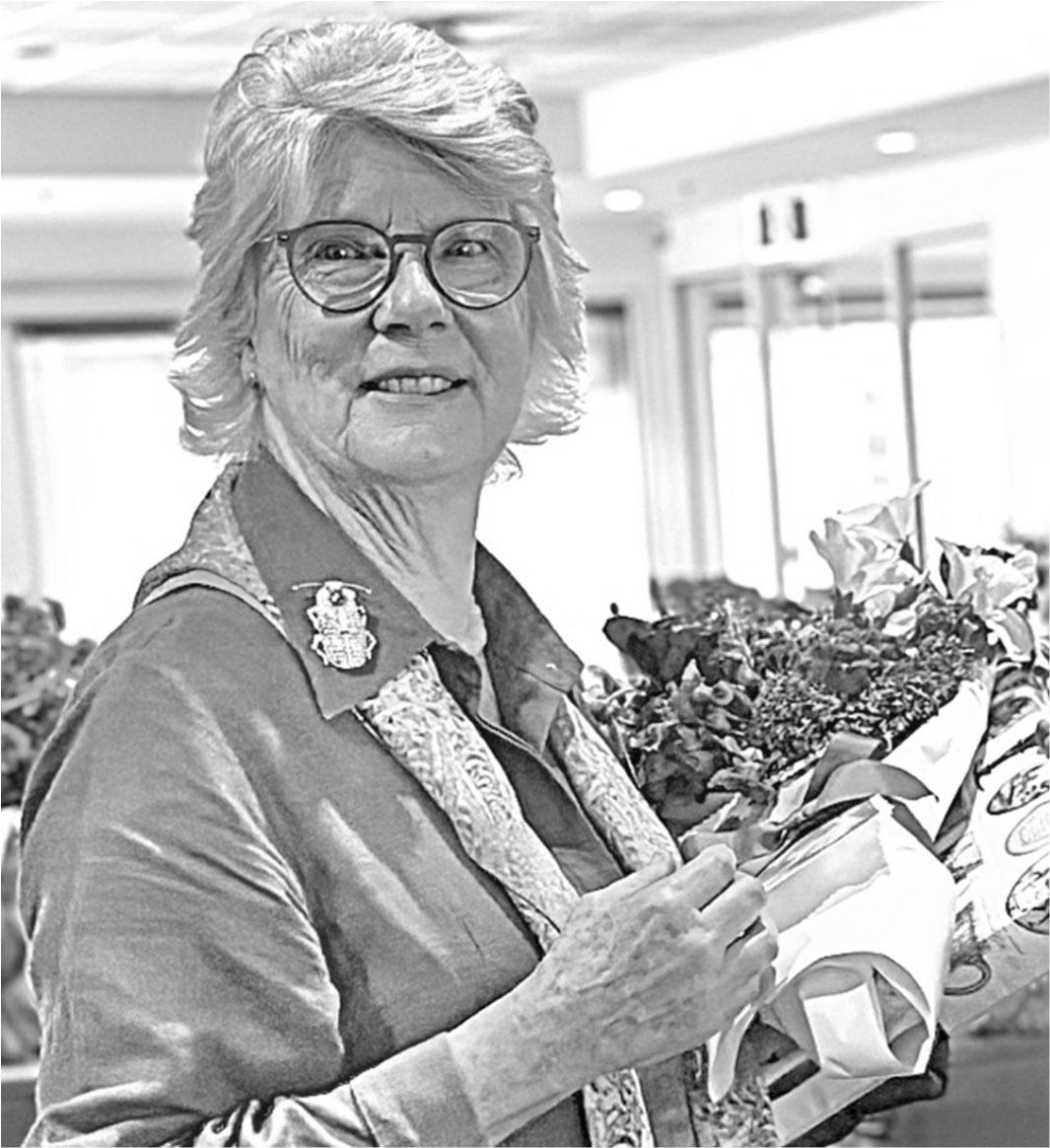
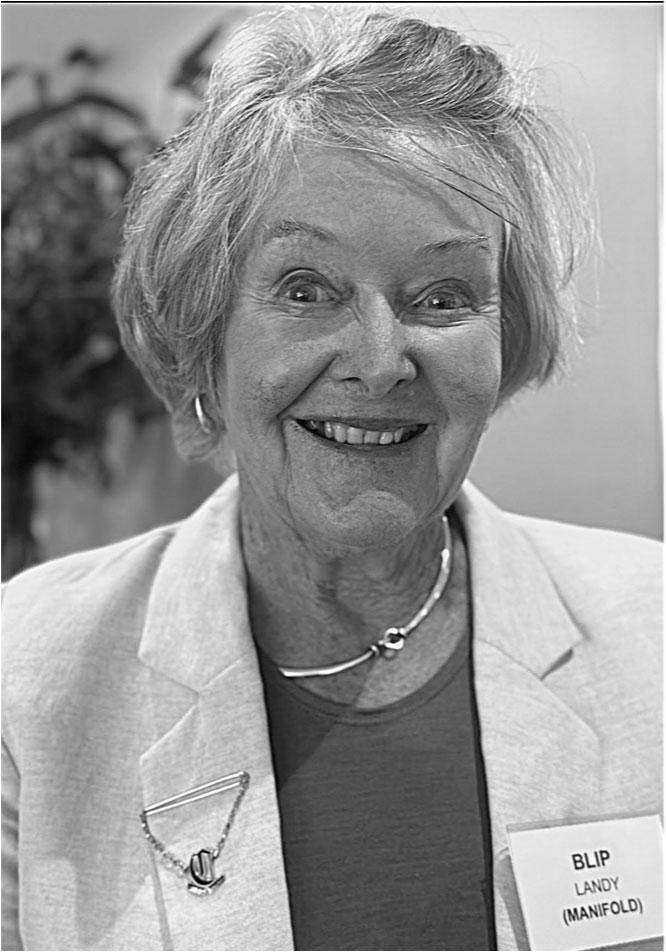
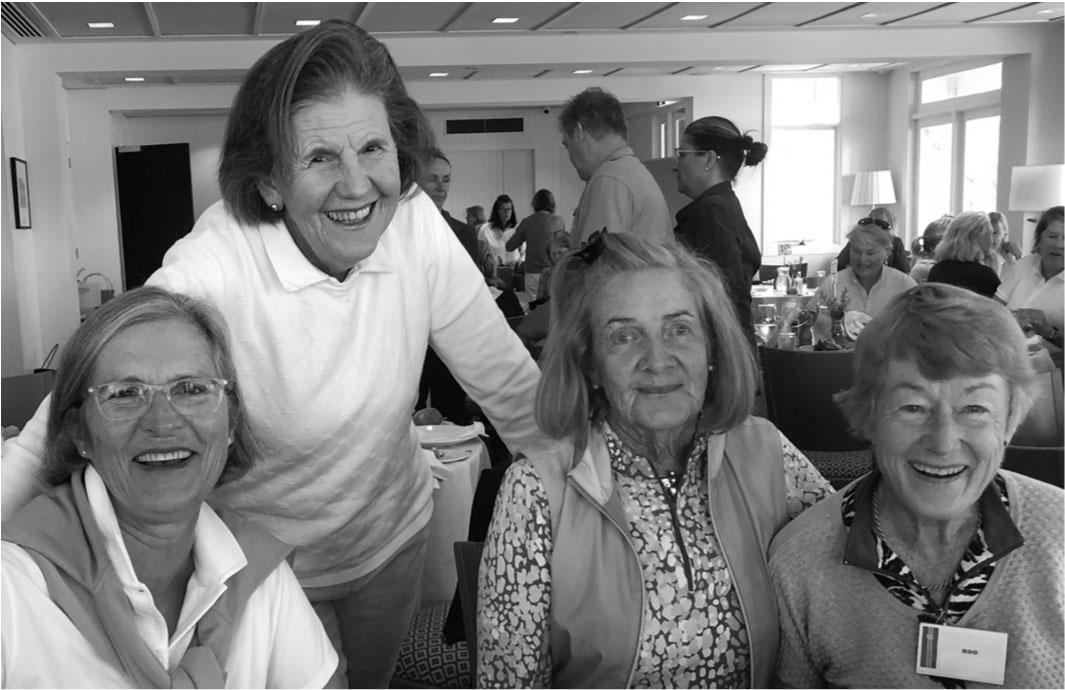
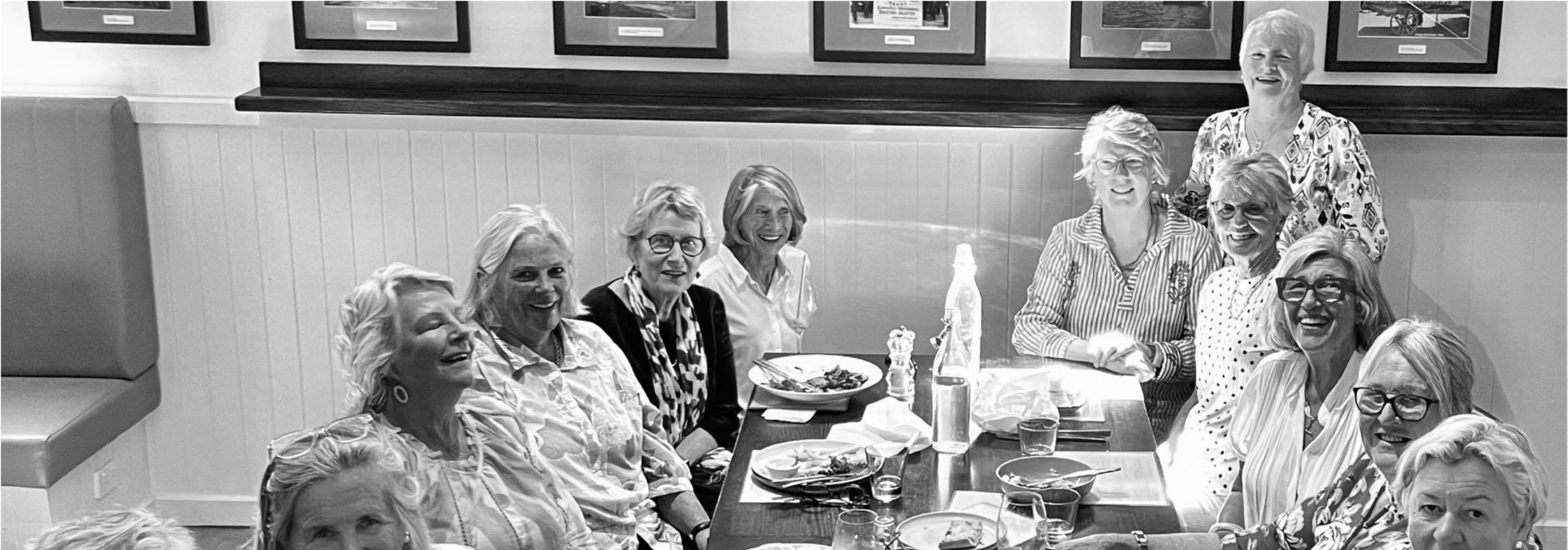
Vice President, Elizabeth Landy welcomed everyone, including guest speaker Anna Affleck and Sophie Holloway who was Anna’s guest.
PRESENT
All present (list below) were confirmed as having signed the historic Attendance Book.
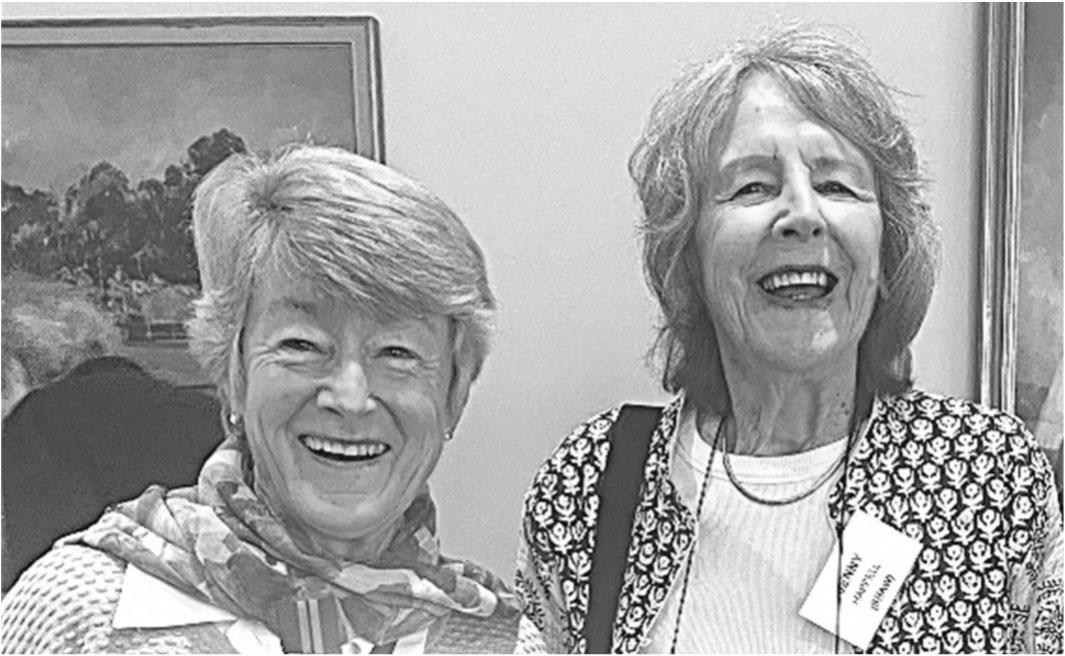
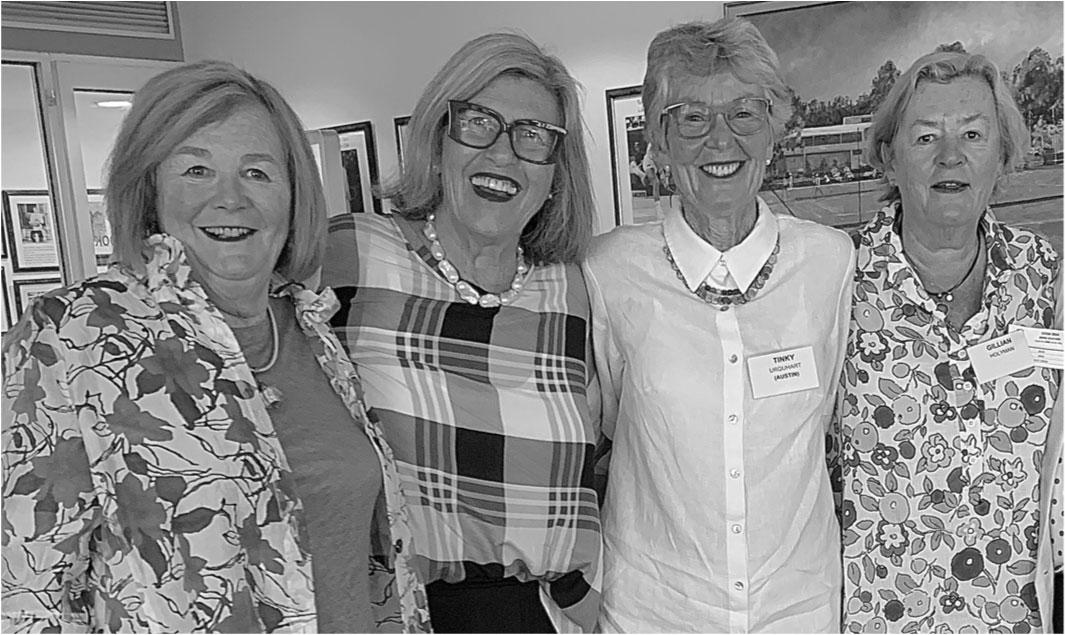
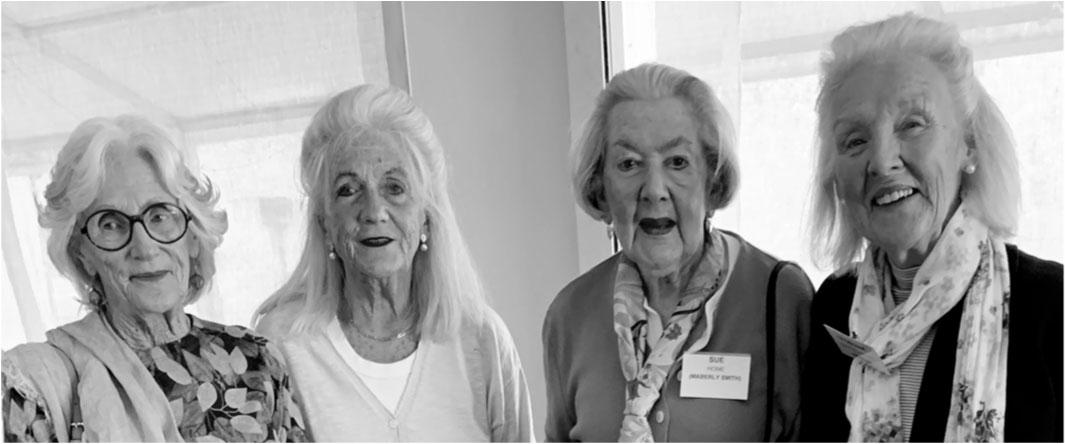
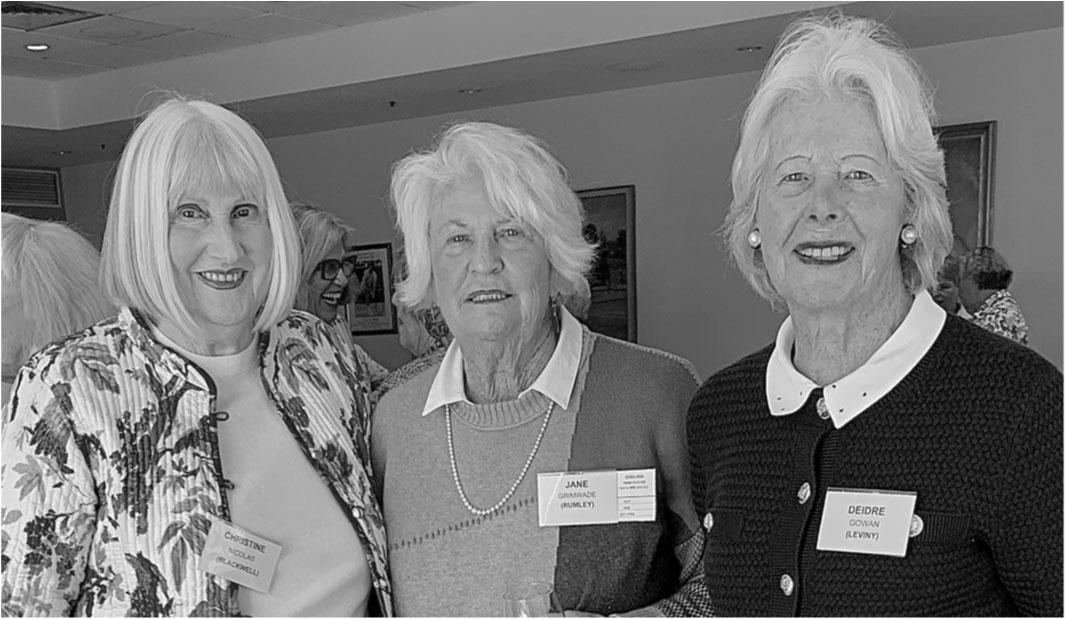
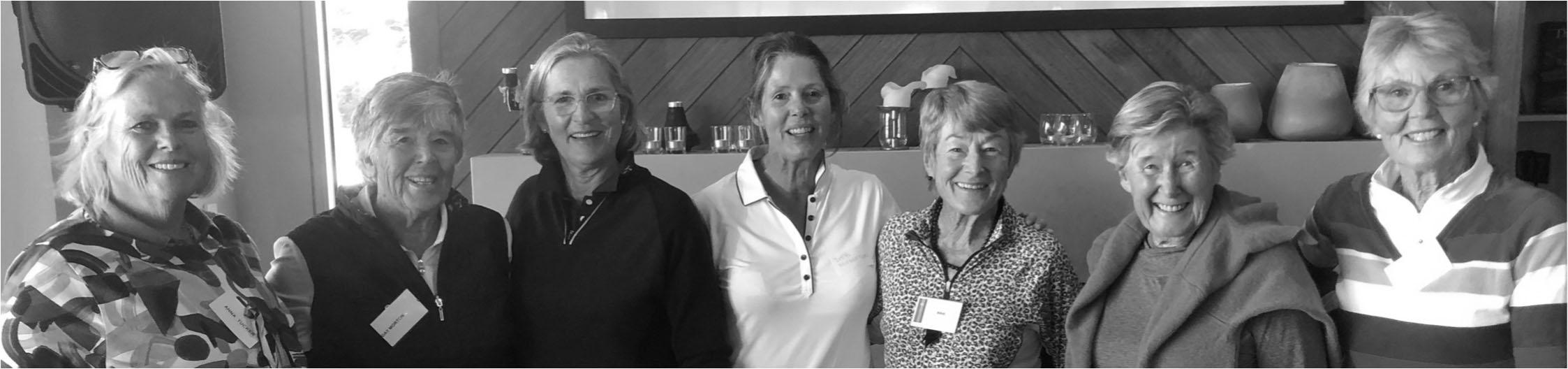
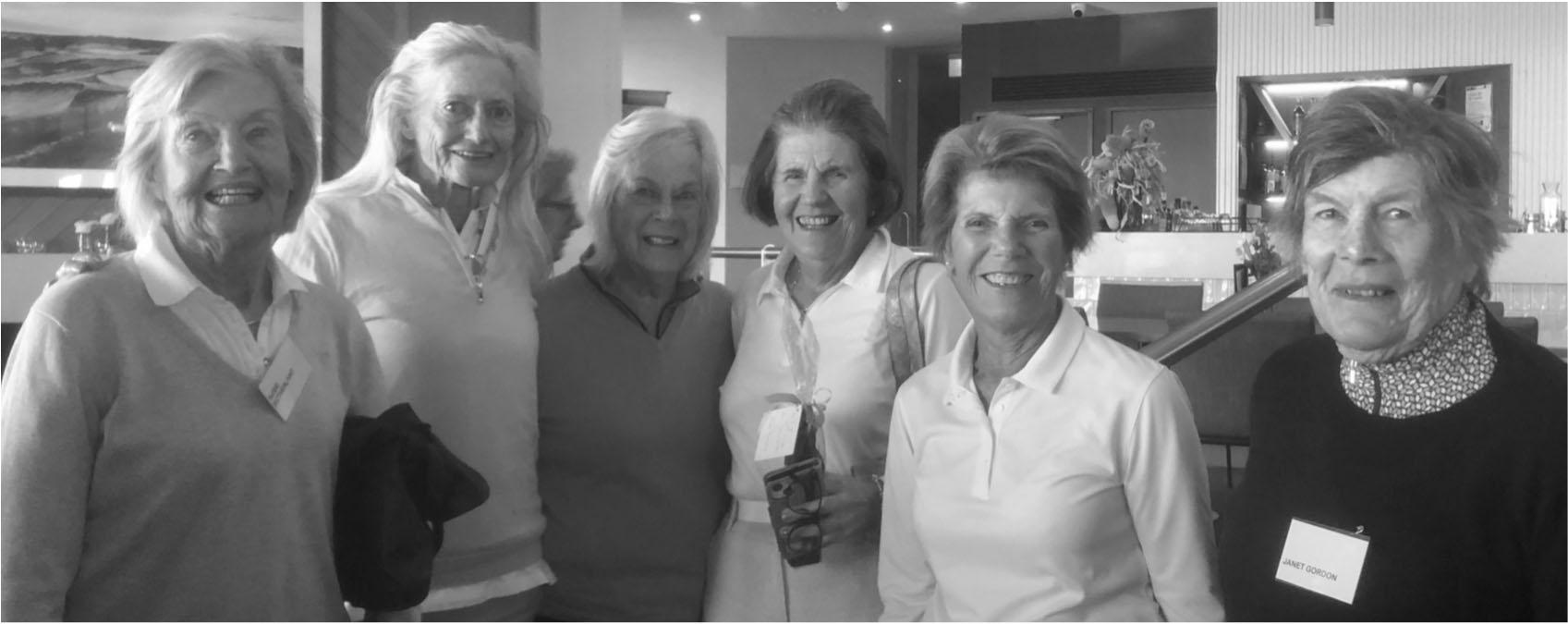
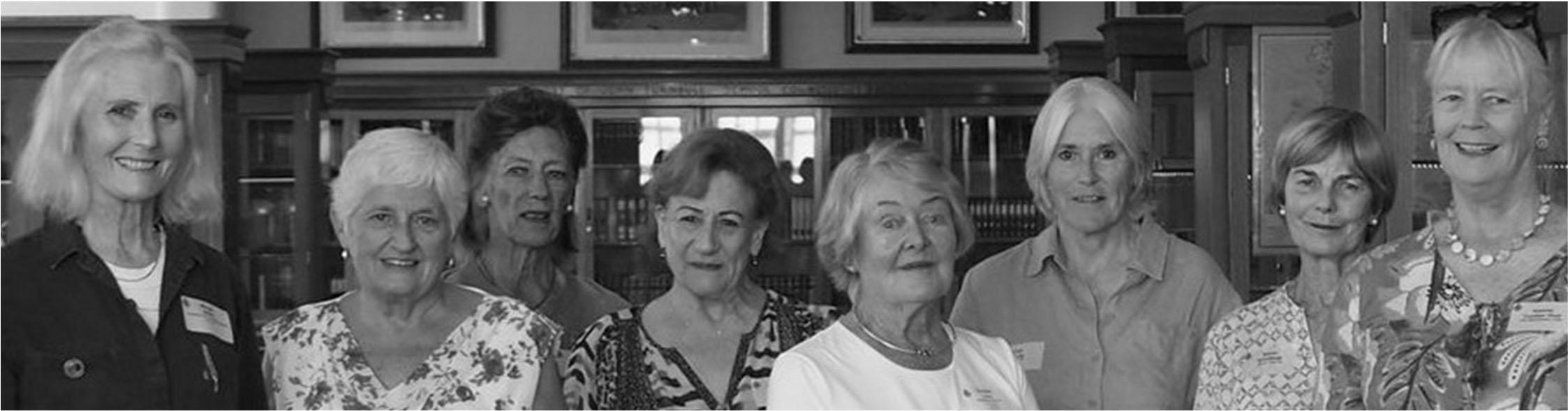
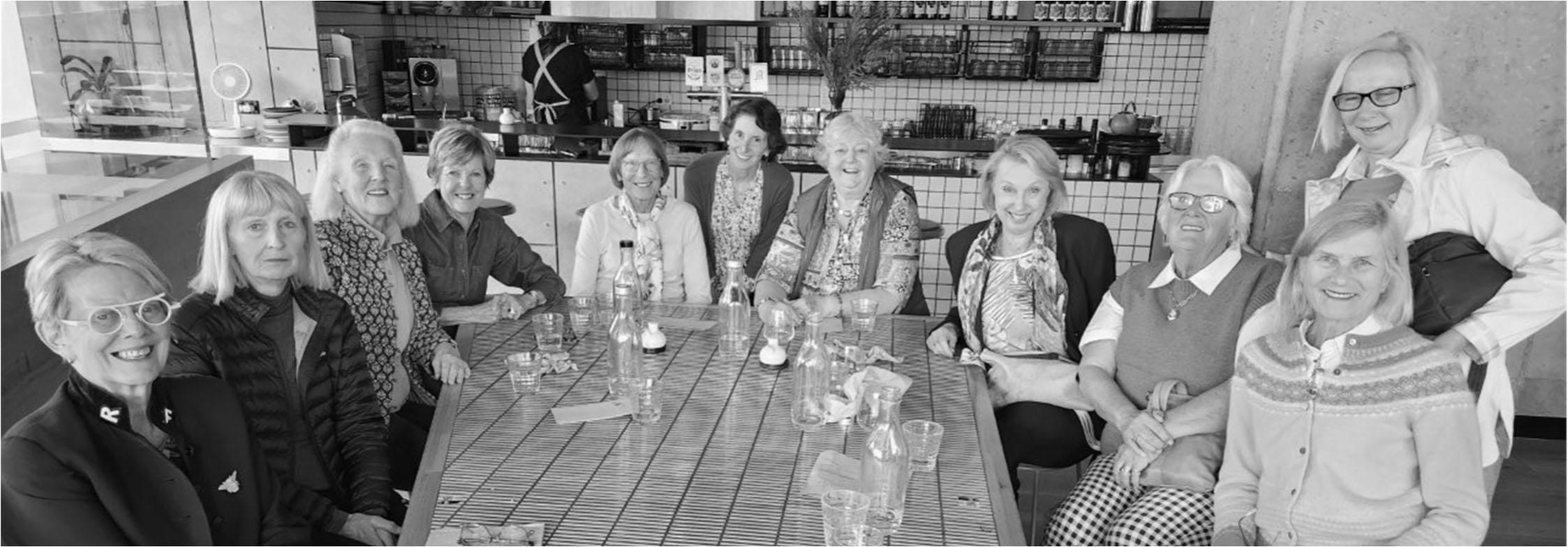
Anna Affleck (Durham), Georgina Barraclough (Moran), Jenny Blencowe (Hogg), Susie Brookes (Lowing), Ann Carlyon (Clapham), Caroline Consett (Burston), Peta Gillespie, Tim Gillespie (Street), Janet Gordon (Affleck), Deirdre Gowan (Leviny), Jane Grimwade (Rumley), Annie Hamilton (Coy), Jenny Happell (Shaw), Clem Hawker (Davies), Pip Heard (Lawrence), Mary Hildebrandt (Downie), Sophie Holloway, Gillian Holyman, Sue Home (Maberly Smith), Anne Hood, Meg Hornabrook, Sally Hudson (Mercer), Elizabeth Landy (Manifold), Sue Leask (VarcoeCocks), Penny Lewisohn (Weatherly), Angela Lyon (Rouse), Jackie Mackinnon (Kelly), Sally Mckay (Pearce), Jill Meredith-Smith (Coy), Louise Morris (Clarke), Christine Nicolas (Blackwell), Rosemary Parker (Holt), Annabelle Pobjoy (D’Antoine), Julia Ponder, Ann Rawlins (Hornabrook), Lou Robinson (McMillan), Ann Spiden (Ross), Anna Tucker (Kimpton), Helen Urquhart (Austin), Elizabeth Wilkinson (Aickin).
APOLOGIES
The apologies received by mail, phone, email or on the day were accepted as per the list below.
Judy Allen, Ros Allen (Wilkins), Sybil Baillieu (Barr Smith), Ros Bromell (Gardner), Katrina Carr (Moore), Kammy Cordner Hunt (Cordner), Felicity Dalgleish (Gardner), Priscilla Donald (Boaden), Judith Emerson (Shaw), Mimi Forwood (Osborne), Margie Gillett (Cordner), Jayne Heard (Thomson), Dallas Kinnear (Heath), Sara Lysaght (Bellair), Joan Mackenzie (Bloomfield), Janie Mackinnon (Ayers), Sue Monger (Crooke), Gay Morton (Howard), Libby Peck (McPherson), Prue Plowman (Manifold), Sally Powe (Douglas), Sue Richardson (Hawkes), Bindy Roper (Manifold), Sue Schudmak (Sproat), Allison Scott Young (Bant), Kate Senko (Whiting), Di Short (Little), Deb Skues (McMillan), Liz Smart (Goode), Alison Smith (Pyper), Gillian Storey (Kimpton), Angela Wawn, Annette Webb, Di Whittakers (Moore), Trish Young.
Motion: To accept the apologies as read, as received by phone, email and on the day .
Moved: Deirdre Gowan
Seconded: Angela Lyon
All in favour: Carried
MINUTES OF THE PREVIOUS AGM
Having been printed in The Cluthan, these were taken as read.
Motion: To accept the minutes of the 2023 COGA AGM as printed in the October 2024 Cluthan as a true and accurate record.
Moved: Jackie Mackinnon
Seconded: Lou Robinson
All in favour: Carried
BUSINESS ARISING FROM THE MINUTES OF THE LAST AGM
There was no business arising.
PRESIDENT’S REPORT
In the absence of President Margie Gillett, Elizabeth Landy read Margie’s report which is printed at the end of the minutes.
Motion: To accept the President’s Report for 20232024.
Moved: Helen Urquhart
Seconded: Gillian Holyman
All in favour: Carried
TREASURER’S REPORT
Having been printed in The Cluthan, this was taken as read.
Peta Gillespie thanked GGS and the OGGs for their continued support of The Cluthan.
Motion: To accept the Treasurer’s report as printed in the October 2024 Cluthan.
Moved: Peta Gillespie
Seconded: Pip Heard
All in favour: Carried
ELECTION OF 2024-2025 COGA COMMITTEE
Pip Heard declared all positions vacant and read out the nominations for the 2024-2025 COGA Committee.
President Margie Gillett
Vice President Elizabeth Landy
Secretary Trish Young
Treasurer
Peta Gillespie
The following have nominated for membership of the committee: Katrina Carr, Jackie Mackinnon,
Sally Powe, Kammy Cordner Hunt, Julia Ponder and Di Whittakers .
There were no further nominations from the floor.
Motion: To accept the Committee nominations as received.
Moved: Anna Tucker
Seconded: Jenny Happell
All in favour: Carried GENERAL BUSINESS
Anna Tucker thanked COGA for the continued support of the Interschool Golf days, which is greatly appreciated by all the players.
CLOSE MEETING
The meeting closed at 11.34 am.
COGA PRESIDENT’S REPORT 2024
Royal South Yarra Lawn Tennis Club
Sunday 20 October 2024
Written 14 October 2024 and read out by Vice President Elizabeth Landy (Manifold).
On behalf of the COGA Committee, welcome to the Royal South Yarra Lawn Tennis Club for our COGA AGM and Old Girls’ Lunch.
We also welcome a guest, Sophie Holloway who is attending with our AGM guest speaker, Anna Affleck. A special welcome to Anna and Sophie.
Thank you all for coming along today, especially to those who have travelled a long way to be here. To those who added a donation to your lunch money, and to the Old Girls who sent apologies with a donation, thank you, this is greatly appreciated by the COGA Committee.
Thank you to Jackie Mackinnon for being our host member at the club today, handling the catering and other arrangements for our AGM, guest speaker and lunch. There are several committee members absent for the AGM, including our President and Secretary who are overseas, so please accept our apologies for diminished representation. Many thanks to our quorum of four members who have efficiently managed preparation and thank you to Vice President Elizabeth Landy for delivering the President’s Report and chairing the AGM.
We are grateful to COGA Treasurer Peta Gillespie for handling the AGM replies and payments, name tags, door lists, and the meeting Agenda, along with all the administrative tasks she manages throughout the year, not only for COGA. Peta continues to balance her demanding role with Legacy (Ballarat) and all the other commitments she handles. Peta has taken on a few extra responsibilities today, thank you so much Peta.
We are delighted that former COGA Committee
member Anna Affleck will be our guest speaker today, after the AGM.
Anna is a passionate gardener whose knowledge has developed through travel, enquiry and experience. From 1976, Anna and her husband James ‘Bim’ Affleck spent over 30 years restoring and maintaining their historic family homestead Minjah and its garden, near Hawkesdale in the Western District. Encouraged by neighbours, friends and garden designers, including Catherine ‘Tid’ Alston, Anna developed the idea of private garden tours to raise funds for charitable and educational purposes, with visits to private properties which are rarely open to the public. Funds raised over the years have benefitted GGS Clyde House, COGA Scholarship funds and bursaries, Biddlecombe Avenue trees, and the Isabel Henderson Kindergarten in Fitzroy. Anna and Bim’s four daughters all attended Clyde House and were the fourth generation of their combined families to attend GGS and/or Clyde School. We look forward to hearing her stories of remarkable gardens in many different places.
As an alumni association, COGA’s objectives are to unite former students of Clyde School, to support approved educational projects and to maintain the spirit of Clyde School at Clyde House, GGS. Many Clyde girls keep in touch via social media including Facebook and Instagram, sharing photos and family or travel news.
During the year, our COGA editorial team coordinates to collate, write and proofread The Cluthan. The Cluthan was first published in 1914, so 2024 was its 110th anniversary of production. Thank you to Julia Ponder for her expertise in compiling and formatting the finalised draft for despatch to the Alumni Relations Department at GGS. Julia provided an excellent summary and photos of her talk given at the COGA AGM 2023 and kept us to a rigorous copy deadline of 30 June. Thank you to Julia for her many years of dedicated work. Thank you so much to everyone who contributed regular reports and articles, news and photos of Clyde reunions. Anna Tucker’s golf report and Jackie Mackinnon’s archives report were excellent, and appreciated. Kate Coulter (Crowther) and Mary Lou Ashton-Jones (Nielsen) were among others who provided reunion reports and photos, thank you both. Many thanks also to friends and family of Clyde Old Girls who provided information for obituaries. Information like this may sometimes be shared with GGS for publication in Light Blue magazine.
Many thanks to Elizabeth Landy and Sally Powe who assisted in final proofreading, and to Sue Schudmak for helping the new OGG office staff at GGS to sort their way through the steps of Cluthan production. After printing in Geelong, Sue organised the envelopes and address stickers, the boxes of 600 new Cluthans, the yellow reply slips, sorted the different mail categories and destinations, followed up numerous
Clyde Old Girls who were happy to be found. A busy day at her house saw Lesley deMeyrick and Margie joining Sue to get the Cluthans and envelopes prepared for postal despatch and delivery. Thank you to Lesley, a non-Clydie, for kindly giving her time to do this, and to Sue for her generous efficiency.
Statistics for distribution of The Cluthan reflect the profile of COGA’s membership. There were 2,066 students enrolled at Clyde School between 1910-76. In 2024 there were around 580 Cluthans posted throughout Australia and overseas, including the UK and Europe, the USA and Canada, New Zealand and Singapore.
Please always remember to inform Sue of any address or contact changes. With the retirement of Dougal Morrison, GGS Data Analyst, it will be more important than ever if Clyde membership records are to be maintained. COGA is very grateful to Dougal for years of reliable and proactive management of our membership database at GGS. He has always been warmly interested in finding new connections, responding to enquiries in a diligent, friendly, supportive and helpful way. His interest in sourcing accurate information has been much appreciated. Thank you Dougal.
There are two new staff members at GGS who have taken over Katie Rafferty’s role in the Alumni Relations Department. OGG Alex Hocking, Alumni and Community Relations Manager, and Rylie Jabornik, Community Events Manager, started at the OGG office during 2024. We thank them both for their willingness to learn more about COGA in their early months at GGS. They are getting to know the entire OGG community in Australia and abroad, and that will take some time.
As usual a comprehensive list of current Clyde House students who are related to Clyde Old Girls, was compiled by COGA committee member Katrina Carr (with the help of Dougal Morrison). COGA’s liaison with Clyde House ensures that a spirit of tradition and history is maintained for future generations of Clyde House students. Thank you Treen for sustaining that connection, in addition to arranging the Clyde House report, all the way from Queensland, it’s very much appreciated by students and Clyde Old Girls alike. In the Clyde House report, it’s always gratifying to read about the friendships, fun, adventures and achievements that current Clyde House students enjoy during their time at GGS.
The GGS Girls School Captain for 2024 was Olivia Mann, who has just completed Year 12 at Clyde House and is now facing her final school exams. Olivia is the granddaughter of Katrina ‘Trina’ Weatherly (Kelly) and directly related to at least eight Clyde Old Girls, as a granddaughter, 2 x greatgrand-daughter, great-great granddaughter, greatgreat-niece, and 4 x great-niece. Plus she has numer-
ous OGG relations. It’s wonderful to have these generational connections at the school and we wish Olivia every success in her future endeavours.
Thank you to the OGG Association and GGS for their continuing support of COGA which is included in the school website, with reunion and event news in Light Blue magazine and the OGG Update enewsletter. The Clyde School Archives are officially managed at GGS by Archivist Darren Watson, formerly from the National Library of Australia. We are grateful to the OGG Committee (President Andrew Burgess); GGS Community Relations staff and Principal Rebecca Cody for including COGA in the GGS alumni community.
Volunteers and visitors to GGS now require a Working with Children card. They should sign a Code of Conduct, wear a visitor’s pass, expect to be supervised by a GGS staff member and will not be left alone with a GGS student.
COGA members can support educational objectives through donations to the Clyde Old Girls’ Scholarship Fund and Clyde Bursary Fund at GGS. Individuals can join the GGS Biddlecombe Society for bequests to the school if they wish to pledge support for educational objectives in that way.
COGA donates an annual prize to Year 12 students at Braemar College for service to the school and community, (in addition to the Dame Elisabeth Murdoch Trophy donated by the Handbury Foundation, which also commemorates the school’s connection with Clyde).
At GGS the COGA prize for English is awarded on Leavers’ Celebration Day each year in October.
COGA’s commitment to the Isabel Henderson Kindergarten (IHK) in North Fitzroy will be maintained by the COGA committee while it is financially possible. Donations to IHK continue to be welcome. Thank you to Jane Loughnan for her loyalty and inspiration in supporting the kindergarten.
Donations from Clyde Old Girls to scholarship funds at GGS are always welcome. At the recent Biddlecombe Society lunch at the Glasshouse, on the Yarra River, past ‘general excellence’ scholarship recipient OGG Easton Wood from Camperdown (AFL Bulldogs premiership captain 2016) eloquently expressed his gratitude, describing the profound way in which the scholarship had transformed his life, outlook and prospects and thus his ability to become an effective leader. He emphasised the importance of mental health, emotional balance, and ‘being yourself’. It was another great illustration of the life changing potential of scholarships. Not only for the individual student recipients, but in Easton’s case, he transformed the prospects of school teams in cricket and football! COGA representatives are often invited to meet scholarship recipients at events during the year at GGS.
Thank you to all COGA Committee members for
their support and friendship during a very busy year in 2024. To Elizabeth Landy, COGA Vice President; Peta Gillespie as Treasurer; to Trish Young as Secretary; to Julia Ponder, Katrina Carr, Sally Powe, Di Whittakers; and to Kammy Cordner Hunt. Everyone is willing to help and contribute ideas for COGA activities and our committee meetings are happy events, like all Clyde get-togethers. There are plans afoot to organise a COGA Garden Tour to Tasmania, a sub-committee has been formed and details will be shared during 2025.
If you haven’t read through your Cluthan 2024 yet, please note that there is an Invite to Write your Clyde memories and recollections. Kammy Cordner Hunt and Sandy Fairthorne have organised an online Writers’ Workshop to provide inspiration and develop ideas to write about your Clyde schooldays, or about a Clyde relative. The Workshop is scheduled for Wednesday 20 November 2024, 10.30am3pm with a break for lunch. Please contact Kammy, Sandy or a committee member for further details about joining this fun activity. The idea is to publish your memories in The Cluthan 2025 and to hold them in the Clyde School Archives.
Long live COGA. SPECTEMUR AGENDO.
Margie Gillett (Cordner) COGA President
COGA AGM 2024 GUEST SPEAKER
Anna Affleck (Durham) Cl’71 and her guest Sophie Holloway were welcomed by COGA Vice President Elizabeth Landy (Manifold).
Anna will tell us how her love of gardening grew from childhood experiences. Generations of her family, have embraced varying styles of horticulture. Her botanical education has evolved as travel has broadened her knowledge of plant varieties and climate adaptation, particularly in Greece, Italy and Morocco. She has created numerous group travel itineraries for garden enthusiasts, and is always open to new ideas and adventures.
From Minjah to Morocco.
I grew up on my grandparents’ property, Urara near Lismore in the Western District of Victoria.
My mother Rosemary ‘Posy’ Durham (Grimwade) was the eldest of three daughters, followed by Virginia ‘Bardie’ Mercer (Grimwade) then Deborah ‘Debo’ McNab (Grimwade) Tim ‘Tammy’ Gillespie (Street) was like a fourth sister, her family lived nearby at Eildon, Lismore. The Grimwade and Street families shared governesses and socialised before the girls set off to Clyde for their years of boarding school together.
My parents were married in 1952 and dad (Michael Crozier Durham), a city boy, was asked to manage Urara for my grandfather. My brother Tim and sister
Cara grew up at Poplar Farm, Lismore, a lovely house our parents built on top of a hill in 1952. It was windswept in those early years, but lots of eucalypts planted around the house formed an effective windbreak. Nowadays the seventy-year-old trees look beautiful and the garden is thriving in their shelter.
Our childhood seemed idyllic, we loved playing in our grandparents’ garden at Urara. Also at Talindert near Camperdown owned by our great Aunt Gwenda and Uncle Chettie Manifold, and at Marathon, Mt Eliza which was built by my mother’s grandfather Harold Grimwade, surrounded by garden rooms, stone walls, arches, perched high on the cliff top overlooking Davey’s Bay. In the 1960s, Gillian Holyman would stay overnight with us at Marathon on her way back to Clyde from Bahrain. Our Mercer cousins lived at Elephant North, Derrinallum, with its lovely big house and garden, sweeping lawns, perennial borders, hedges and trees to climb, and a lake to swim in. We visited often and I am sure my love of gardening was influenced by so much beauty and freedom in these special family environs.
Minjah
In 1976 James ‘Bim’ Affleck and I were married. I moved to Minjah, near Warrnambool, where he and his sister Janet Gordon (Affleck) grew up. Minjah was built by Joseph Ware in 1867, then bought by Janet and Bim’s grandparents Alby and Constance Affleck in 1896. Luckily I wasn’t too daunted by the size of the homestead, nor its rambling old garden which had gone a bit wild by the time I arrived, 13 years after Bim’s mother died.
The garden at Minjah was designed for the Ware family by Charles Scoborio a former curator of the Warrnambool Botanic Gardens. There were fully established trees including elms, oaks, cedars, kurrajong, leucoxylon, Aurecaria, plus the old shrubberies of lilac, box, hawthorn, cotoneaster, berberis, acanthus, melianthus major, japonica, and viburnums. Thousands of bulbs gave valuable framework for my enthusiasm. My mother-in-law, Euphemia ‘Betty’ Affleck (Ramsay) was a keen and competent gardener, she had grown up with a beautiful garden designed by Guilfoyle for the Ramsay family at Turkeith, Birregurra, and was a great admirer of Edna Walling. Minjah benefited from these influences.
Janet was very supportive about the garden and I was lucky to inherit the good bones of its design. We bought new roses at Treloars in Portland as the old ones had become all woody in the circular lawn at the front of the house. One wedding present was a fabulous Wedding Day rose which we planted by the front verandah and it quickly scrambled up to the second storey. My grandmother had Alistair Clark ‘Sunny South’ roses in her Urara garden – traditionally when a baby was born in our family a Sunny South rose was planted. We planted four, each in honour of our daughters Celia, Pin, Sophie and Ed-
wina. Albertine was espaliered along a north facing blue stone wall (once pruned by the late David Wilkinson, husband of Elizabeth ‘Bibi’ Wilkinson (Aickin), who wrote a brief note in our visitor’s book: “OUCH!”). Other favourites planted in my borders were Perle d’Or, Cecile Brunner, Iceberg, AnnaLouise and Green Ice to name a few, joining other little treasures from friends.
The pine trees and oaks I underplanted with aloes, cotyledons, pelargonium, hellebores, euphorbias, echiums, clivias, all hardy plants from the gorgeous old Turkeith garden, home of Janet (Affleck) and Lachie Gordon and their four children. The plants rambled and spread creating a lovely soft effect, needing no water and embracing whatever the elements. I had an avenue of ioensus crab apple, underplanted with crocus, belladonnas, blue bells etc and we mowed a strip to the dam below the haha, creating a gorgeous vista over the lake to the paddocks. This was inspired by a visit to Cruden Farm and loving what Dame Elisabeth Murdoch (Greene) had created. We built stone walls and seats, and edged the lawns all from stone lying about in the old stock yards, and enjoyed creating and learning during our nearly 30 years at Minjah. The local volcanic soil and relatively reliable rainfall made everything grow easily.
We opened the garden for charity days, fundraising for local schools, historical societies, and garden groups from near and far. In November 1993, one of our first Open Days was a fundraiser lunch for the Marjory Allen Millear Bursary Fund which Catherine ‘Tid’ Alston encouraged us to consider. After nearly 17 years at Minjah renovating the house and restoring the garden, we felt we could share our slice of Australian history, hopefully making a profit for a well-deserved cause, and giving back to our old schools.
Garden visits and the Open Garden Scheme were gaining popularity. We welcomed private groups organised by Julie Keegan from Sydney, Caroline Davies from Melbourne, Trisha Dixon from near Canberra, the Australian Garden History Society and local botanic garden groups, all of which enabled us to make long lasting friends and to enjoy some special trips interstate and overseas.
Garden tours
With Clyde and GGS now amalgamated, being grateful for the education we were given, and having sent our daughters to Geelong Grammar, Bim and I felt inspired to support our old schools. As I enjoyed welcoming visitors to Minjah, I volunteered to organise garden tours and put the proceeds towards Clyde House, or COGA and particularly the new Clyde and GGS scholarship funds. During the early 2000s, we visited many properties throughout the Western District with busloads of Clyde Old Girls and friends. In 2003 Prue Plowman (Manifold) and Susie Sutherland (Finlay) organised a garden tour
to the North East of Victoria and later on Ann ‘Dizzy’ Carlyon (Clapham) and Fern Henderson (Welsh) organised trips to the Mornington Peninsula. Overall we covered quite a bit of Victoria. Thanks to the generous garden owners, who charged so little for entry, a healthy profit could be donated to causes which needed it most at the time. In 2016, OGG Sophie Holloway (Mann) and I joined OGG Neil Robertson, son of Loris Caddy (Yencken), in supporting the newly founded Michael Collins Persse Scholarship Fund. We organised a day trip for the GGS community to visit private gardens around the Bellarine Peninsula, including the Boomaroo Nursery at Lara, with a picnic lunch at historic Coriyule near Drysdale.
These tours could not have happened without the support of dedicated committees and the generous spirit of property owners. Big thanks to Louise Robinson (McMillan) who mustered our groups after every garden stop and never lost any stragglers! On board the tour bus, Aunt Bardie Mercer provided historic information about local architecture, church gargoyles, you name it she knew the facts, being a prominent National Trust member and a keen historian. We had much fun and laughter from all ages and stages, reminiscing about our old school days, making new friends and embracing old ones.
As an Alexandra Club committee member in Melbourne, I helped to organise garden tours for club members, with Tid Alston once again at the helm. Our garden travels ranged from day outings to longer trips, such as 12 days in Western Australia. Also, while on the Australian Open Garden Scheme committee for a couple of years, I enjoyed organising a three-day garden tour to the Western District with Richard Barley before he went to work at Kew Gardens in England.
Peterborough
In 2005 we sold Minjah, at the same time my darling mother Posy died. We moved into her house at Peterborough, perched on the cliff top at the tip of the great southern ocean and decided this is where we would like to live. We had a bolt hole in Melbourne as well, so spent half our time between the city and the seaside.
After renovating Mum’s house, I started to create a garden in Peterborough. The antithesis of Minjah! High above the shoreline, only 400 meters from the crashing waves, working with the elements inspired the creation of a Mediterranean garden. Caprosma reapens (shiny leaf), native to New Zealand sea shores, grows like a weed (and is regarded as a weed), so I decided to embrace it by hedging it around the garden to develop a little micro climate, and espalier it in places. I also hedged Eleagnus which was a beautiful backdrop to my clothesline. Salt bush, helichrysum, senecio, podalyria, westringia, correa, yucca filamentosa, arthropodium, teuchrium, erimophila, sage, kangaroo paw, agave, and va-
riety of succulents all thrived in the gravelled area. I smuggled pale pink and lemon flowering gazania and ice pink pig face from the sand dunes which I planted along the front fence, softening the house and streetscape. Sculpture throughout the garden fills important gaps, giving diversity to plants. I adore the Marlborough daisy (pacystegia) from New Zealand which I mixed with aeoniums – inspired by a walk along the Kaikoura coast and gardens in Christchurch while travelling with Julie Keegan. Trees that thrive are banksia integrifolia which were clipped, creating ‘lolllipop’ canopies. Fiona Brockhoff stimulated my thought process for this garden as her knowledge and experience of coastal plantings resonated completely.
Travels in Greece
During a trip with Trisha Dixon to Greece, we visited Sparoza, headquarters of the Mediterranean Garden Society (MGS) outside Athens. It was enlightening to see what grew on that exposed, hot, arid, treeless and windy hillside. Planted alongside local species was an array of plants from other arid regions in the world. Eucalyptus globulus is planted widely in Greece, cypresses (for wind breaks) Judas, pomegranates, jacaranda, pines, Chinese elm were all added when the garden was started in the early 1960s. The terracing and stonework is beautifully crafted: the challenge of water is met by pumping water to a tank from a well below the garden then supplemented with municipal water when necessary. Drip irrigation has been installed more recently.
Approaching the island of Hydra from the sea it looks like a galaxy of marble palaces, the city’s houses are excessively white, with a harbour lined with store houses and shops. Hydra is like a literary stepping stone into the bohemian past of the 195060s. It inspired the creative lives of George Johnston and Charmian Clift, Sidney Nolan, Leonard Cohen and Marianne Jensen. Hydra featured strongly in Charmian’s writing, with her second memoir ‘Peel Me a Lotus’ describing their intoxicating time on the island. George Johnston wrote his classic ‘My Brother Jack’; soon after it was published, Charmian took her own life, and a year later George died of TB. We had the good fortune to visit the house where Charmian and George once lived.
Visiting the Peloponnese was wonderful, especially the exceptional house and garden of the writer Patrick ‘Paddy’ and Joan Leigh Fermor. Paddy Leigh Fermor began his travels in 1933. Taking only a sleeping bag, the Oxford book of English verse, and a volume of Horace, he walked up the Rhine and down the Danube sleeping in barns and shepherds’ huts along the way, finally arriving in Istanbul in 1935. Known as a modern-day Byron, Paddy became famous for capturing the German General Kreipe during WWII and hiding him on Crete, in a cave near Patsos in the foothills of Mount Ida. In a tempestuous relationship, they bonded over a mutual appreciation of Homer’s ‘The Iliad’.
While I was on the Peloponnese, Bim was on the isle of Crete, celebrating the 75th anniversary of The Battle of Crete where his relation Jim Carstairs was involved. While on the run from the Germans, Carstairs hid in the same cave that was used to hide General Kreipe. Coincidentally, Bim rang me from the cave and asked where we were. I said “we are sitting in the beautiful courtyard of the Leigh Fermors” and he said “well I’m sitting in the cave where Paddy hid the General!”. That trip to Crete for Bim was so moving he invited friends and family back two years later. Sophie Holloway who is also a Carstairs relative, came with us for another fascinating trip.
On the Island of Antiparos we saw house and landscape designs by Thomas Doxiados, landscape architect from Athens. He allows indigenous plant varieties to disperse across the landscape, interweaving patterns of existing vegetation with introduced plants nearer to the dwelling, then beyond a certain distance no plants are introduced, allowing for a natural re-vegetation over the years. From local topography to traditional stone walls and terraces, from vegetation to new roads and buildings, his overall structure aspires to reflect existing characteristics of the landscape.
On a trip to Corfu we met Thomas’s aunt, Callie Doxiados at the launch of Rachel Weaving’s book ‘Gardens of Corfu’. We visited the White House which once belonged to the Durrells and travelled to Old Perithia, Corfu’s oldest village which nestles beneath Mount Pantokrator, the highest point on the island. Scabiosa, fig, and olives thrive here.
In Italy
The Castello di Potentino is an 11th century castle in the rugged terrain of Mount Amiata in Tuscany. In 2000, the Castello was acquired by author Graham Greene, his second wife Sally, and their family of British bohemians. In 2005, our second daughter Virginia ‘Pin’ Affleck met Graham’s stepdaughter, Sally’s daughter Charlotte Horton in London. Charlotte had been entrusted to live at the Castello in Italy, oversee its restoration and make it financially viable. The restoration process revealed ancient Etruscan ruins on site, and a couple of times during summer Pin travelled to Potentino to help paint interior walls, remove debris and breathe life into dilapidated rooms. Charlotte had planted grapes which formed a biodynamic vineyard. Long days were spent under the Tuscan sun clipping the vines with traditional scythes in time for a September harvest, and painting inside during the hottest hours. Potentino is now an award-winning winery and retreat and Charlotte (Horton) still credits her team of early ‘little slaves’ as an integral part of its success.
In Morocco
In 2019 Pin moved to Tangier after studying at the Sorbonne in Paris for a year. She first went to Tangier to visit a family friend Jonathan ‘Jono’
Dawson in 2018. She fell in love with the city, found a flat and has been renting and renovating ever since. Now she runs a business supplying textiles made by weavers in her local kasbah; she organises bespoke travel in Tangier and calls North Africa home. We had a marvellous Christmas with her in 2022. Having not seen her since 2019, we met all her fabulous friends, and we were welcomed into some remarkable historic houses and gardens that have been restored and maintained.
El Foolk – This beautiful place in Tangier is owned by the Gibbs family. One of our COGA Western district tours included Fleur and David Gibbs’ property Toolang near Coleraine. David’s brother Christopher Gibbs was a British antiques dealer and collector who retired to Tangier in 2006 and died there in 2018. He bought El Foolk, a substantial property on the Old Mountain, from James and Marguerite McBey, both celebrated artists. Pin met Christopher in Tangier in 2018, not long before he died. They got on famously. After Christopher died, the Gibbs family needed somebody to oversee the staff and care for the house and garden at El Foolk. Pin stepped in to help, especially during Covid-19 when the family could not fly in from London. When we visited for Christmas in 2022 it was the first time El Foolk had blossomed since Covid. We joined the happy throng and met Peter Hinwood, Christopher’s dear friend, who had returned for the first time since Christopher died.
There are 36 steps linking the late Christopher Gibbs’ house El Foolk with Veere Grenney’s house, Gazebo, another fabulous place which once belonged to artist Marguerite McBey’s mother. Veere acquired the property, loving its superb vista, and created an elegant terraced ‘garden-on-a-cliff’. He is a keen collector of McBey paintings. Originally from New Zealand, Veere Grenney has worked his way from Australian mines in the 1970s to become a globally acclaimed designer and decorator, frequently featured in Architectural Digest and other international publications. He took Pin under his wing, encouraging her to establish her business in Tangier. He often donates proceeds from Gazebo’s open garden days to support community aid programs at the local St Andrew’s Church.
St Andrew’s Church was built on land granted by Sultan Hassan I to Queen Victoria in 1881. Construction started in 1894 and the church was consecrated in 1905. It is unusual for its amalgam of Andalusian and European style of architecture, built by Moroccan Fassi craftsmen. It is the only Anglican church with the Lord’s Prayer carved in Arabic around the chancel arch; the bell tower is shaped like a minaret; and green Fassi tiles decorate the rooftop. Today St Andrew’s Church is a reminder of the harmony between the three Abrahamic religions, which is the very essence of Tangier’s unique social and cultural fabric. Pin served as Warden of the Church for three years, and now shares the role with
her friend Veere Grenney.
Rohuna – Originally from Milan, Italian writer and horticulturist Umberto Pasti arrived in Morocco in 1995. Always drawn to nature, especially wild flowers, he created a city garden in Tangier, then bought some land in the countryside 40 miles south of Tangier along the seascape near Rohuna. Working with a team of men from nearby villages, Umberto carved a garden and home out of the dusty hillside. For centuries this was a charcoal making area, so all the trees had disappeared to leave a hostile environment. Hundreds of tons of topsoil and manure were transported in to establish a garden of shady trees, lush tangled greenery and jewel-like flowers, jostling together on the terraces linked by meandering stone walls. The same stone, painstakingly dug out of the earth by hand has been used to build the modest house that Umberto lives in while visiting Morocco. Water, a precious resource, has been brought to the garden by means of a 90 metre bore. As a benefit to the local community, this water source is accessible to the women in Rohuna village, who no longer have to carry it on foot from three miles away.
It’s worth mentioning a connection with GGS. In Tangier we saw the distinctive arch where Australian artist Hilda Rix Nicholas created her famous oil painting of an Arab sheep market in 1914. Hilda’s first husband Captain George Masson Nicholas died at Flers on the Western Front in 1916. She married secondly Edgar Wright in 1928. They settled at Knockalong near Delegate in the Snowy Mountains. Their son Rix Wright (born 1930) attended Geelong Grammar where he was inspired to become a sculptor. He later created the two sculpted figures on the GGS Art School gates, representing the scholar (John Gubbins), and the sportsman (Race Winton).
In 2022, our final stopover in Morocco was Marrakech. Le Jardin Secret is totally enclosed, almost invisible from the Medina of Marrakech beyond its 30ft high walls. One of the largest riads in the Medina, Le Jardin Secret forms the centrepiece of a palace and comprises two separate courtyards, one being a large Islamic garden and the other a smaller Exotic garden. From 2013-16 the English landscape designer Tom Stuart Smith oversaw restoration of the courtyards. The Islamic garden was restored as a traditional Moroccan garden. The Exotic garden retains traditional features, but in contrast to the Islamic garden it is planted in a contemporary romantic style with plants from all around the world. In both gardens water is a central focus of the design composition. Water has a symbolic value in Islam as the divine essence of life and is an essential part of all Islamic gardens.
From 1923, the Majorelle Gardens in Marrakech were created over 40 years by the French Orientalist artist Jacques Majorelle. Fashion designer Yves St Laurent bought the property in the 1980s with his
business partner Pierre Berge. Marrakech became the second home for Yves and Pierre. St Laurent did his fashion sketches here then would return to Paris to create and present his next collection. Majorelle is now owned by the Fondation Pierre Berge-YSL, a charitable organisation of which Berge was the director until his death in 2017. Madison Cox is an American garden designer who married Berge in 2017 and then, following Berge’s death, became President of the Foundation. He controversially removed lawns from the Marjorelle garden because of the water required to maintain them. The garden is in a desert environment. The garden’s most famous feature is the striking shade of cobalt blue which appears at various points. Jacques Majorelle felt this blue had a magical power, that white was too blinding because of the sun’s glare, and that Marrakech pink wasn’t a strong enough contrast against the green of the cactus.
Gardens are a blessing in life, and I’m grateful for the opportunities I have had to explore so many different places in the world. In our family it is a multigenerational interest, with our daughters all cultivating their own special places. Celia is passionately interested in the propagation of Australia’s diverse native plants in Western Victoria; Sophie has a more traditional combined garden of English and Australian influences in historic rural Oatlands, Tasmania; while Edwina has embraced a Mediterranean style of garden to complement her rammed earth home in the coastal clime of Port Fairy, Victoria. And now? Our grandchildren are sometimes found in gumboots, wielding little trowels and happily digging in their home patches …
Thank you so much to Anna, who allowed the COGA president to persuade her to be our guest speaker, it was hugely appreciated by those attending.
On behalf of the COGA Committee, we look forward to the treats in store for us when we join her next adventure, the 2026 COGA Garden and Cultural Tour to Tasmania, organised by Anna in collaboration with local COGs and scheduled for November 2026. Many thanks to Anna for her diligent itinerary preparation and research so far, and to Peta Gillespie who will handle finance and bookings.
Ed: Please see the back page for further information, dates and expression of interest plus contact details for the 2026 COGA Garden and Cultural Tour.
TREASURER’S REPORT 2024-2025
ANNUAL GENERAL MEETING
19 October 2025
This report refers to the Financial Statement of the Clyde Old Girls Association Inc. for the year ending 30th June 2025
It is with pleasure that I again present the Treasurer’s Report to the members of the Clyde Old Girls Association.
NOTES TO THE 2025 BALANCE SHEET
A reasonably quiet year again this year, with interest rates trending downward once more.
I continue to be amazed at the generosity of our Old Girls, with over $3,000 in donations during the year, but particularly at the time of our AGM. This is really appreciated and helps us to maintain a reasonable amount of capital.
We have managed to return a small surplus at the end of this financial year, which is always a pleasing sight when I am doing the June report and it also means we have not had to dip into our reserves this year.
AGM 2025
Unfortunately, we have had to increase the price this year. However, you will again receive a drinks token with lunch and morning tea/coffee. Please ensure you reply by the RSVP date; it makes our life much easier when providing numbers to the venue.
CLUTHAN
GGS and the OGGs are still supporting us with printing and postage of the Cluthan. This does save us an enormous amount of money and means we can continue to provide you with all the news of COGA happenings over the past 12 months.
IHK DONATION
For the 70th consecutive year, COGA has made a donation to the Isabel Henderson Kindergarten. Working on a rough estimate, this totals approximately $88,000 at an average of $1,200 p.a! I think this is something of which we can all be very proud and I am sure those who were originally involved with the Jumble Sale (thinking of Flo Grimwade, Mary de Crespigny, Anne Cordner and so many more) are smiling down on us.
SCHOOL PRIZES
We have again donated $300 to both Braemar College and Geelong Grammar for the annual prizes presented to students in the name of COGA. We regularly hear from the recipients who are very grateful for our support.
Peta Gillespie Honorary Treasurer, June 2025
BALANCE SHEET AS AT 30 JUNE 2025
ARCHIVES REPORT
The vital work of maintaining the Clyde school archives
Archives are important as a vital primary source for preserving historical records. They provide evidence of past events, support research, foster a sense of identity and ensure accountability; they are a crucial resource for individuals, organisations and society as a whole. Preserving archives ensures that future generations have access to the information and evidence needed to understand the past (and make informed decisions about the future); most of all they provide a legacy for those who come after us. Archives are used by researchers, scholars, writers, teachers and students; they can support education by providing materials for exhibitions, educational programs and public requests.
Primary sources and records (or data) might be in the form of letters, reports, notes, meeting minutes, foundation documents and certificates, maps, newspapers, photographs, films, CDs and videos, clothing and uniform, even personal memorabilia which might be preserved in analogue or digital form. An archive collection stores and manages such material so it can be discovered, accessed and used by current and future generations. Melanie Guile essentially wrote our Clyde history book from our wonderful Archive Collection.
A typical list of the archival work I have done over 40 years includes: answering enquiries about history of Clyde or lives of Clyde Old Girls; researching relevant history and recording the findings; cataloguing all memorabilia; following up provenance and identity of items; filing and categorising updated address lists; collecting and filing publicly available information and articles relevant to Clyde Old Girls; providing relevant material for obituaries to be published in The Cluthan or GGS Light Blue; lots of photocopying and cross referencing; using vintage Clyde summer uniform fabric to create sofa cushions for the Clyde House student common room; maintaining correct labelling and titles for files; mending and maintaining fragile historic memorabilia for storage, filing or display; monitoring and promoting sales of the Clyde history book (Clyde School 1910-1975, An Uncommon History by Melanie Guile, 2006); collecting and cataloguing music scores or literary works by Clyde Old Girls; liaison to ensure that Clyde archives are regarded with appropriate distinction and respect by relevant departments.
Many thanks to Sue Schudmak who has returned to assist in the Archives, to staff in the Fisher Library and of course to Darren Watson, the GGS Archivist, who has to be our ‘guardian’ when we are on the school premises and who is of much help.
I look forward to another year of very productive work and lots more visits from young and old to the
Clyde Archive Collection. If you would like to know more detail about working in the archives, please let me know. It’s valuable work experience and many universities employ students, graduates and retirees in that capacity. I am always in need of help with COGA and Clyde archive research projects.
Jackie Mackinnon (Kelly) Archives Coordinator (M) 0417 371 496 (E) baftaj@gmail.com
100 YEARS AGO – 1925 CLUTHAN
(Synopsis by Jackie Mackinnon)
At last year’s Speech Day of 1924 the President of the Clyde Council Sir Arthur Robinson had to announce the Council’s regret in accepting the resignation of Miss Isabel Henderson, the founding owner and Headmistress of Clyde School, due to further failing health ... and yet I read the various snippets about or from her in the 1925 June Cluthan, of how she and Miss Danielle are still, after six months on The Continent (mainly Venice), “wallowing in its abundance of sights and feasts of treasures and pleasures”.
Miss Tucker therefore continued to run Clyde at Mt Macedon, supported by Miss Brown as Senior Mistress and Tiffie Hay as School Captain. At Clyde the Prefects, House Captains and Form Captains, besides all the Committees, were chosen by the girls, from the girls – serious thought was put into these appointments, and those who accepted these positions of authority learnt that they must be used not for personal ends to satisfy ambition and vanity, but as “opportunities for service”.
Since 1919 every ‘Cluthan Editorial’ has struck me with the “dogged” appreciation, if not emphatic admiration of ‘Clyde-on-the-Mount’ ... “Its quiet bush surrounds – its perfume of blue gum leaves, its ideals, strengths, excitements, our own mountain top rising so ...”. Although the Bush had become their daily salvation there was strict adherence to tradition such as the Sunday sermons: the Rev. Mr Legge was to replace the Rev. Mr Hadley in Woodend, however, in the interim several visitors “gave most interesting sermons” in the Nursery on Presbyterian Sundays. They were: Dr Uren, Mr Balfour, Mr Jervis and Mr Tolhurst (who would become Meriedie Graham’s father, sending her to Clyde in the years 1948-55). All the girls would walk down the Mount to attend a service in Woodend taken by the visiting Bishop of Bendigo. Canon Poulton held a special Service in recognition of Anzac Day, a weekend after Miss Tucker had read the King’s Message, explaining the significance of the day in Australasian history.
On April 4th the glorious weather on Old Girls’ Day drew in “an exceptionally large gathering” of 50 –all madly visiting old haunts before a basketball
match was played, won by the present girls. Old Girls who visited this day and stayed at the school were: ‘Molly’ Turner-Shaw, Kathleen Cooch and Marjorie Wreford.
The Children’s Hospital Auxiliary has a larger membership than ever, and everyone is working with usual keen interest. The Fancy Dress Dance on Feb 28th was a great success, particularly due to the Nursery having been enlarged. Another great improvement was a new dormitory that replaced the old Sleep-out.
Gifts were important in those early Mount Macedon days: an Interhouse Baseball Cup was presented to the School by Dr J.B. Hay and Mrs Bullivant has promised an Inter-house Hockey Cup much to the joy of the very enthusiastic hockey players. Only a few months later an Honour Board for baseball and running was presented by Dr and Mrs NewmanMorris. Further donations to the ‘Prize Fund’ were given by Mr Bowden, Canon Poulton, Mrs Champion, Lady Robinson (Reading Prize), Mrs Hay, Mrs Manning and Mrs Bryant. Mr T. McKellar gifted a delightful Sonora gramophone – all so generous.
This year magazines and books (collected through the School and families) were no longer sent to the Seamen’s Mission, instead they were sent to the Victoria League for distribution to women and children of the back-blocks ... Social Service funds (£14/5/in first term) were distributed to: The Children’s Hospital Auxiliary, the Kyneton Hospital, the Eye and Ear Hospital and the ‘usual’ £5/5/- to the Queen Victoria Hospital for the support of the Clyde Cot.
Madame Liet died in May; she had been a staff member at Old Clyde since 1910 and was known for her warm nature. She was described as a sincere friend to Miss Hay and many others.
There was a COGA General Meeting held in April, where Acting Head Miss Tucker gave a very satisfactory report on the progress of the School and on the good work of the prefects looking after the new girls; there were new photos of Miss Henderson, which she’d had done in London. Miss Tucker was elected a life patron of the Clyde Old Girls Association. A motion was passed “That the Old Girls have more representatives on the School Council – the final decision to be left to the Committee.”
In mid-November Margaret Cunningham managed to visit Clyde from a very busy job in Sydney, working as a Welfare Superintendent at Anthony Hordern’s; she talked about being responsible for the welfare and morale, physical and intellectual, of 3,000 girls and made us realise that the work presented many unexpected difficulties that could eventually be diverted through the complete co-operation between employers and employees.
In the June Cluthan, the Vb H. class had a memorable and eventful journey to see a performance of Shakespear’s Twelfth Night. The trip began with
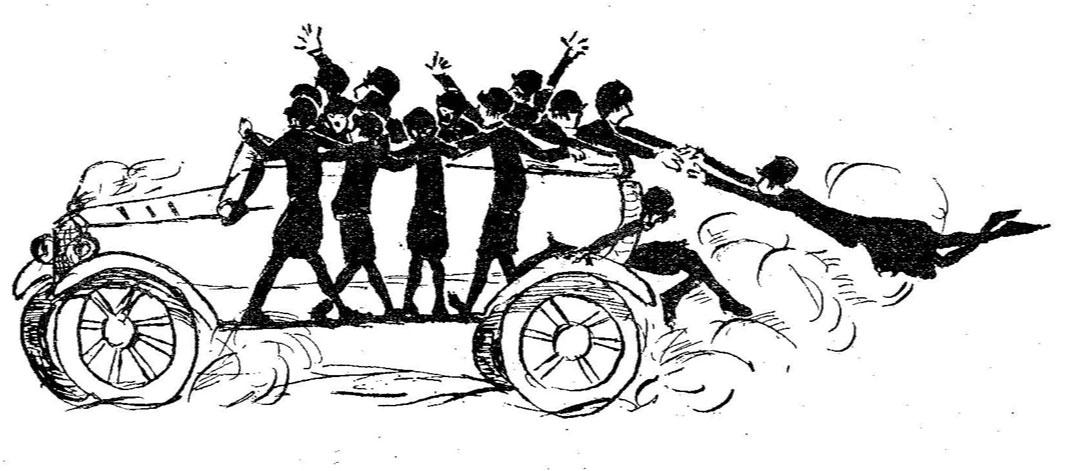
great anticipation, but the car, a “perilous vehicle indeed”, quickly ran into trouble. The group started off strong but their confidence was short-lived. They first smelled burning, which turned out to be a heated gearbox and then had to stop to fix a puncture.
As they neared town, they picked up the occupants of a car that had also suffered a puncture, squeezing fourteen people into their already cramped vehicle.
After finally arriving at the theatre, they enjoyed the play. The journey home proved just as challenging. Their car broke down in the middle of a busy intersection, requiring a policeman to help move it. After a final mishap in which a box of grapes was lost on the road, they made it home, tired but happy. The car, no longer in a bad mood, delivered them to their front door. They were welcomed with soup and toast and they went to bed, with the day’s events and the play still on their minds.
“But that’s all one, our play is done, ...”
There was an amusing letter in the June Cluthan from Molly Turner Shaw from Oxford in response to friends asking her to ‘write something’ about Oxford ... “There said our guide, is your Lady Margaret Hall – some have mistaken it for a brewery, some for an orphan asylum! That was one of my first impressions of the buzzing Undergraduate life and from a window seat in Fuller’s gazing wistfully down into the turmoil of Cornmarket Street ... The air was loud with the tingling of bicycle bells and ... on the narrow pavement hatless, plus-foured young men disputed their lordly right of way with an occasional self-assertive perambulator – being the only things to stand up against the Under-graduate on what he considers his own ground; the humble citizen and the even humbler ‘Undergraduette’ bob patiently in and out of the gutter where they are thrust ... black gown flying out behind, strange fourcornered cap wobbling with the interweaving stream of bicycles that make Oxford’s traffic the world’s worst and most depressing. Academic garb does not dehumanise a man ... History invariably lives up to its monotonous reputation, crunching up paper and hopelessly looking over the surrounding sea of faces, some earnest, some smug, most of them bored, all surmounting their little draggled white bows, and where, oh where, I have groaned within myself, is the flower of England’s youth, the clean-limbed athletes who throng the playing fields of Oxford? Where the deep-eyed thinkers, whose names gathering light in Oxford, will one day dazzle the world? I see before me a collection of chubby-faced school-
boys ... rather the worse for ink”.
Mary ‘Molly’ Turner Shaw, Cl’1916-22, became a well-known and respected Australian architect and author.
REUNIONS
1968
Ann Willcock (Thomson) has been organising a lunch every April and October for over fifteen or more years now she guesses! It seems to be a real institution and is all very casual. She sends out an email giving the date and place and whoever can make it turns up. She never really has a good idea who is coming as she doesn’t want to hassle people with heaps of emails. She says that everyone really seems to enjoy it and it can vary from 8 to 16 people roughly.
Every now and then they go somewhere outrageous; they had a weekend, with partners in Tassie for the Tassie girls once and a superb weekend at Sue Duncan’s on Pittwater also with partners, with a scrumptious lunch cooked by her – she was a fabulous cook – and they are so glad they did that now of course because Sue died in November 2024. They are now planning to go to Sydney to their Sydney girls for next October. They mostly meet now at Chocolate Buddha on Federation Square as it is so central and it is all very pleasant. Sometimes they go to someone’s home to make a change.
The last lunch, Friday 4th April, was ambushed a little by Victoria Railways who decided to close the trains down for the day from Geelong and left three people stranded! They would have had fifteen if they had been able to come but as it was, they had two from Tassie and three from Sydney.
The 1968 Geelong chapter
L-R: Susan Perchey (Russell), Penelope Cash and Julie Cole (Baird)
1974 – 50 YEAR REUNION
Date: 26 and 27 October 2024
Venue: Cruden Farm and Albert Park, Victoria Carol ‘Cas’ Bennetto wrote: Almost 50 years to the day that we left our schooldays behind, sixteen girls from the class of 1974 reunited. Our significant reunion took place on 26 October 2024. A very decent 75% of us accepted the invitation organised by Judy Paterson (Handbury), Jane Dumbrell (Selleck) and Cas Bennetto. We had two from Sydney, two from regional NSW, one from Queensland and, notably, one from Florida, USA. They were respectively, Elaine Baker and Deb Noyce (Baxter), Caro Adams (Blakiston) and Deb Houghton, Caroline Thomson (Kemp) and Graham Maxwell-Russell (Maxwell) all the way from the USA. The rest of us live in Melbourne, Geelong and regional Victoria. There were two late scratchings; Cathy Faulkner (Herd) was ill and Debbie Barnes (Brack) had an accident a day earlier. Four girls couldn’t attend because they were overseas.
The venue was Cruden Farm, Langwarrin, the beloved former home of Dame Elisabeth Murdoch (Greene) – our most famous old girl – offered to us by her granddaughter and current Chair of the Trustees, Judy Paterson (Handbury). To get there, Jane Selleck ordered a minibus to collect us from (you guessed it) The Windsor Hotel. Half of us took up the offer and we met an hour earlier in the Spring Street coffee shop for a serious gasbag before boarding the bus. Greeting old friends who’ve shared so much more than just a classroom, is a momentous experience. The delight and laughter were palpable.
The other half drove independently to Cruden Farm. On arrival, on what was a gorgeous, warm spring day, Judy met us with Delatite sparkling (thank you Ros Adams (Ritchie), who was one year below us and now has her own label Ros Ritchie Wines).
We chatted and hooted with laughter over champagne, wine, olives and homemade cheese biscuits for an hour or so until Judy announced she would
1968 reunion, L-R: Rosie Fairbairn, Jillianne Smith, Georgie Barraclough (Moran), Margie TempleSmith (Bond), Sarah Bullen (Lobban), Ann Willcock (Thomson), Andrea Wilkinson (Clarke), Jo Rankin (Mirams), Jill Wilkinson (Gunn), Bambi Hanson (Brown) and Susie Ryan (Boynton)
host the garden tour. Captivated by stories of her granny and the history of the garden Dame Elisabeth created lovingly over eight decades, we didn’t start walking for another half hour. The garden, in all its Spring glory, was spectacular. All of us were mesmerised by its beauty. We fell into twosomes, threesomes, and small groups and shared stories and memories and listened to Judy’s informative talk about the garden, plantings, and buildings and the future plans for Cruden Farm.
Eventually we sat down to a stunning cold buffet lunch beautifully prepared for us by Peta Kelly and Heather Curigliano (staff members of the Trust). The long table inside the family dining room (we were treated like royalty) was decorated with nine large bowls of roses, with some sweet peas, alstroemeria and clematis. Their heady scent blended with our own heady spirits. The general effect, infused with wines donated by Judy, led to a somewhat heady atmosphere! Cas gave a short toast and rather than thanking the heavens for the bounty, we burst into Sing a song in praise of happy school days.
Perhaps the most moving and memorable moment, shortly thereafter, was when Graham Maxwell (all the way from USA) got up spontaneously, and spoke: “I’ve waited so long to be here. If you knew how ingrained my three years at Clyde, in particular, are in my DNA. I mean it is so much of who I am, and what I do, and how I think, how I behave. I’m so grateful for that time. I came at a time when a lot of you had already been there, together, and I felt so welcomed, so loved, so appreciated. We had sooo much fun! I really have not one single bad memory. I have to say thank you. There are no friends like my Clyde friends ... it’s so important to me. It makes me
so feel so happy that we are together …” Graham continued for a little bit more and there was barely a dry eye at the table.
Eventually the minibus returned to take the city group back to The Windsor. The good humour prevailed as we enjoyed singing and yelling along with the ‘70s soundtrack we had prepared. Goodbyes were joyous, not sad. Friendships have been rekindled, and we have all since spoken or texted about the lovely sense of connection and shared history between us that is so special. As Graham alluded, the bond established between us could never be erased.
The next day (Sunday) twelve of us gathered at Cas’s place in Albert Park for champagne and oysters and then we walked to Riccardo’s Trattoria in Albert Park village for lunch. We had a long table outside in the sun and the restaurant looked after us superbly. Everyone was grateful for the extra day to chat to friends we felt we hadn’t spent enough time with the day before and the opportunity to chat more deeply with one-on-one conversations. It was fantastic. Brilliant! Bring on the 60th!
FUTURE REUNION
1975 & 50th anniversary of Clyde School closure Saturday 25 October 2025
The reunion will be held at Braemar College. There will be a tour of the school at 10:30 followed by a Picnic at Hanging Rock at 12:30. The organisers will book a space depending on numbers and will cater a light lunch / byo picnic. 1975 leavers will mostly be there but all COGs are welcome.
For queries and bookings please email Trish Young trish.young@iinet.net.au
Front
1974 reunion, Back L-R: Patricia Kearney, Elaine Baker, Elizabeth McDonald (Balharrie), Jane Dumbrell (Selleck) and Caroline Adams (Blakiston)
Middle L-R: Deborah Noyce (Baxter), Carol ‘Cas’ Bennetto, Graham Maxwell-Russell (Maxwell) and Deborah Houghton, Tina Gooding and Caroline Thomson (Kemp)
L-R: Diana Reed (Diggle), Michelle Cook (Chalmers), Judy Paterson (Handbury) and Lynette Moore (Stevens)
OLD GIRLS’ NEWS
Wendy Anthony (Brotherstone) lived in Sydney as a child and was enrolled at Abbotsleigh in Wahroonga from first year primary school. The family moved to Victoria when she was eight and she arrived at Clyde in 1971 shortly before her 11th birthday. She boarded at Clyde for a couple of years before moving to Toorak College as a weekly boarder, closer to home at Portsea on the Mornington Peninsula.
After leaving school, Wendy studied Law and was recruited by Honeywell for a career in Information Technology, starting in 1984. Wendy says IT is a pretty dry subject. She married in 1990 and, in 1998, she and her husband started their own company GA Systems, specialising in Cyber Security protection services and education, with offices in Sydney, the Philippines, Canada and India. Her husband is English, they have three daughters, two grandchildren and live in Cremorne, NSW. Wendy really enjoys skiing, fly fishing and ‘globe hopping’.
She would like to reconnect with old Clyde friends from 1971-72 and has provided contact details: PO box 632, Neutral Bay Junction, NSW 2089. Home: 15/38 Sutherland Street, Cremorne 2090 Mobile: 0418 273 227
Email: wenda924@gmail.com wendy.anthony@gasystems.com.au
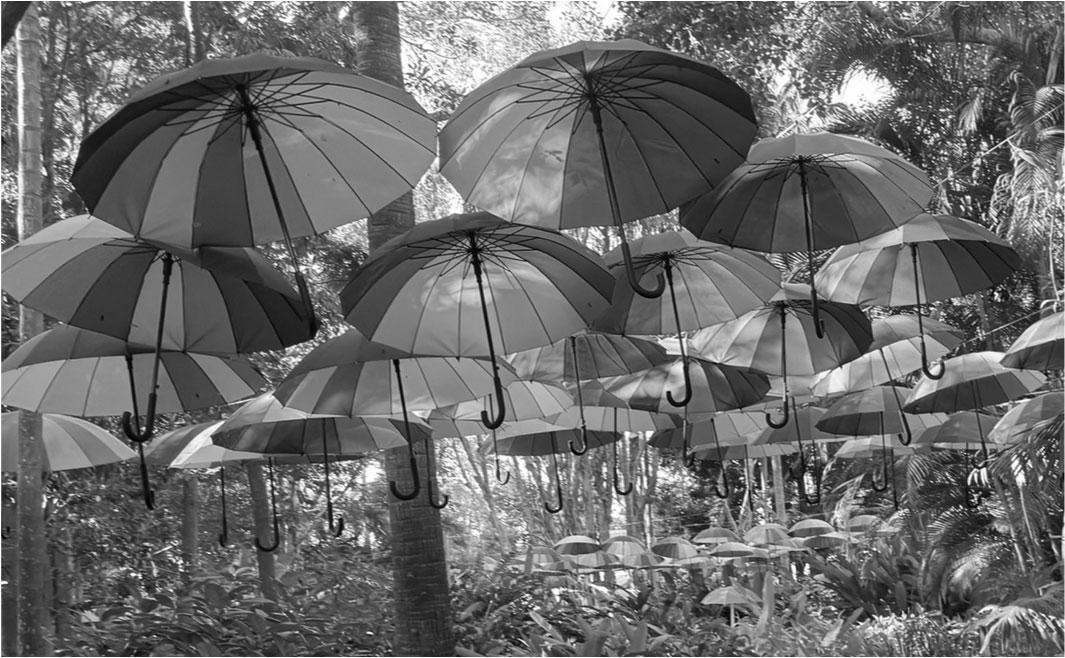
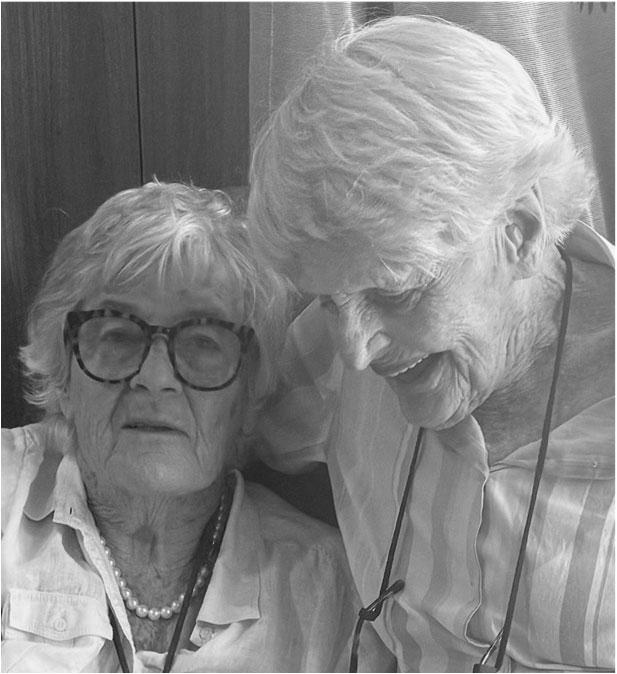
In August 2024, Julia Ponder met up with classmate Peta Gillespie and her mother Tim ‘Tammy’ Gillespie (Street) in Noosa, Queensland. They visited the Ginger Factory in Yandina and saw the Rainbrella Project curated by Sophy Blake who is the daughter of Deborah ‘Debo’ McNab (Grimwade). Tammy and Peta later visited Debo who had moved from Victoria to Queensland to be near her daughter.
IMPROMPTU LUNCH AT BARWON HEADS, 13 MARCH 2025
L-R: Deborah McNab (Grimwade) and Tim Gillespie (Street)
L-R: Alice Austin Cl’70, Susie Perchey (Russell) Cl’69, Julie Cole (Baird) Cl’68, Anna Tucker (Kimpton) Cl’71, Margi Gunn Cl’70, Jane Loughnan (Weatherly) Cl’70, Anna Affleck (Durham) Cl’71, Cathie Mahar Cl’70, ‘Tinks’ Urquhart (Austin) Cl’71, Angie Lyon (Rouse) Cl’71, Tina Taylor (Creswick) Cl’70 and Gillian Holyman Cl’71
In August 2025, Julia Ponder again met up with Peta and Tammy Gillespie in Noosa. They all had coffee with Jane Armytage (Bird) and Susan Buller (Sargood); Sue told us about her family’s new venture. Buller wines, the family winery, was sold in 2012. After this our business was selling wine into China and my husband had been going backwards and forwards to China for about 15 years which worked really well. However, we went to bed one night with a great business and woke up the next without one because of the 2020 trade dispute over wine between China and Australia. This effectively crippled a lucrative export market for us and other Australian producers.
We had to decide what we were going to do and eventually decided that we would open the cellar door in the Rutherglen region, which is where we were. We had our own vineyard out towards Chiltern so we looked for a block of land, preferably with a vineyard. We found it in Wahgunyah, between Pfeiffer and Cofield Wines, two of the bigger wineries in the area. So stupidly, when all our friends were retiring, we built a new cellar door and opened Dinah Wines with our daughter Kate on 30 June 2024. (www.dinahwines.com.au)
The Buller family’s history in the Australian winemaking industry began in 1921 when Reginald Buller located himself in the Rutherglen region and, with hard work and determination, he quickly became a leader in the rapidly growing wine industry. Reginald’s passion for the industry has now been handed down through five generations of the Buller family; Reginald, Richard (Dick) Snr., Richard, Kate and Kate’s three children; Rippon, Ivy and Archer.
It’s really just the three of us at this stage, with Richard and I working seven days a week. Kate’s got young children so she has Saturdays and Sundays off for sport and spending time with the children. My husband is the actual winemaker – he’s been wine making since 1973, Kate looks after the production and packaging and we all look after the cellar door.
At the moment, our specialty is aged wine; the Chinese like a bit of age in their wines. We’ve got quite a lot of aged wines that are still sitting in the warehouse from when we had the hiatus of not selling anything. We’re still finding our feet though, eventually, we’re going to do catering within the cellar door. We’ve done a few catering events to date and we are going to do pizzas and coffees and light lunches. So that’ll come – it’s just trying to work out how we staff and still make money. The three grandkids are pretty good at doing all sorts of things. Rippon can’t wait till he’s old enough to get his RSA so he can serve behind the counter; the youngest, Archer, is now learning to navigate the vineyard on the old Grey Fergi tractor and helping with the hand picking. 13-year-old Ivy prefers to spend time with her friends! It’s a real family business.
Beverley McArthur (Murch) Cl’65 has made a staunch contribution to her almost lifelong passion for politics, by joining the State Parliament of Victoria (after her husband Stewart retired some years ago from Federal politics). She’s been making her mark in the ‘raw game’ of politics and is to be admired for her determination and grit to make a difference. (Joan Mackenzie (Bloomfield) Cl’52 admired Beverley so much that she asked her to speak at the launch (Nov 2023) of Joan’s book on her family history: ‘WILLIAM TAYLOR OF OVERNEWTON AND BEYOND’.
BOOK REVIEW
Joan Lindsay (Weigall) Cl’14, is having a moment. Acclaimed biographer and literary critic Brenda Niall has written Joan Lindsay: The Hidden Life of the Woman Who Wrote ‘Picnic at Hanging Rock’, whilst the Sydney Theatre Company has staged a new adaptation of Lindsay’s Australian gothic masterpiece. Niall is one of Australia’s most distinguished literary historians and her biography of Lindsay has been widely praised as “fascinating” and “engrossing” for the way it explores Lindsay’s life, frustrated creative endeavours (as both a painter and an author) and ultimate success with a Picnic at Hanging Rock (F. W. Cheshire, 1967), which was published when she was 71 years old. Lindsay’s story about a group of female boarding school students who vanish at Hanging Rock while on a Valentine’s Day picnic is regarded as one of Australia’s greatest novels. The boarding school, Appleyard College, was based on Clyde School, which was located in St Kilda when Lindsay was a student there from 191114, before it relocated to Woodend near Hanging Rock in 1919. After graduating from Clyde, Lindsay studied art at the National Gallery of Victoria (NGV) Art School, where she met her future husband, fellow artist Daryl Lindsay, who would become director of the NGV from 1942 to 1956 (and whose brother Norman wrote another Australian classic, The Magic Pudding). Joan Lindsay published her first novel, Through Darkest Pondelayo, under a pseudonym in 1936, and Niall’s biography illuminates Lindsay’s “hidden life” of balancing her creative ambitions with her husband’s career.
2025 marks the 50th anniversary of Peter Weir’s 1975 film adaptation of Picnic at Hanging Rock, which was both a commercial and critical success, and played a significant role in the resurgence of Australian cinema in the early 1970s, referred to as the Australian New Wave. Lindsay’s book was also adapted as a stage play in 1987, a BBC radio play in 1996, a musical in 2007 and a six-part TV miniseries in 2017. Australian theatre writer Tom Wright created a new adaptation in 2016 for a production at the Malthouse Theatre in Melbourne that was later staged at the Royal Lyceum Theatre in Edinburgh. Wright’s play was staged by the Sydney Theatre Company (STC), from February 17 to April 5. Di-
rected by award-winning Noongar director, Ian Michael, the STC production has been described as an “eerie, beautiful and visionary take on the gothic tale that changed Australian storytelling forever”
Ed: This review originally appeared in the Geelong Grammer School magazine ‘Light Blue’.
Joan Lindsay had many Clyde connections throughout her life. Her membership of the Lyceum Club reunited her with Marion Wanliss who, according to Niall, appears as the mathematically gifted Marion Quade in Picnic at Hanging Rock. Her home, Mulberry Hill was near Cruden Farm, the home of Keith and Elisabeth Murdoch (Greene). Daryl Lindsay was asked to be the godfather of Keith and Elisabeth’s son, Rupert.
CONGRATULATIONS TO THE FOLLOWING AWARD WINNERS
CLYDE OLD GIRLS’ ASSOCIATION PRIZE FOR ENGLISH 2024
The Clyde Old Girls’ Association Prize for English was awarded to two students at the 2024 Geelong Grammar School Leavers’ Celebration Ceremony held at Corio on Sunday 13 October 2024:
William Chi Bach Francis of Hanoi, Vietnam (Cu’24), attended Timbertop in 2021 and Cuthbertson House 2022-24. He achieved a Service Distinction and eight academic Distinctions with a Certificate of General Academic Excellence. William was awarded the COGA Prize for English (shared) and the Geelong Grammar Foundation Prize for Service (as a school prefect). He earned Colours for Academic Work and Football; Half Colours for Football, Cricket and Swimming. He was an IB candidate in 2024.
Sara Christine Salter of Hawthorn, Victoria (EM’24) attended Timbertop in 2021 and Elisabeth Murdoch House in 2022-24. She achieved four academic Distinctions and was awarded the COGA Prize for English (shared). Sara earned Half Colours for Academic Work, Badminton, Netball, Football, Tennis; Guitar and Piano. She was a VCE candidate in 2024.
Congratulations to William and Sara on their fine achievements and we wish them every success and good luck for their future endeavours.
THE CLYDE OLD GIRLS’ PRIZE FOR SERVICE
Braemar College 2024 Prizegiving
This prize is awarded to a Year 11 or Year 12 student for service to the local community.
Lauren Barake was recognised for her commitment to community service and her leadership throughout her time at the College. Her pursuit of excellence was consistently demonstrated in both her academic
achievements and sporting endeavours. A standout example of Lauren’s dedication to service was her role in establishing and leading a student initiative to support the Kit2Play Foundation, a charity that collects used sports kits and equipment and distributes them to underprivileged children in Ghana. Under Lauren’s leadership, students came together to contribute to this worthy cause, making a significant impact on communities and schools across the globe, helping children to thrive physically, mentally and socially.
THE DAME ELISABETH MURDOCH AWARD (DONATED BY THE HANDBURY FOUNDATION)
Dame Elisabeth Murdoch (Greene) Cl’26 who passed away in 2012, was a valued patron of Braemar College. In recognition of her outstanding service to the community and ongoing support of Braemar College, this award has special significance and has been endorsed by the Clyde Old Girls’ Association. The award carries the Clyde School motto Spectemur Agendo – By our acts, we are judged.
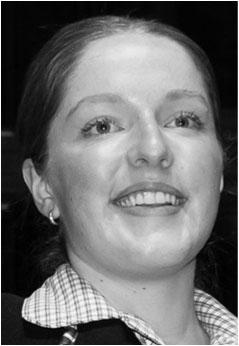
Emily Miles was recognised for her outstanding service, exemplary leadership and consistently positive attitude throughout her time at the College. As College Captain, Emily led with integrity and purpose, demonstrating a strong commitment to serving others and fostering a genuine sense of community. She actively worked to include all students and was instrumental in strengthening the spirit and cohesion of the College. Emily’s ability to balance her leadership responsibilities with a high level of sporting commitment at a state level is a testament to her dedication, discipline and exceptional time management. Her passion for both service and sport, along with her unwavering support for those around her, truly reflects the spirit of this prestigious award. Emily has embodied the College values in every aspect of her school life.
Congratulations to Lauren and Emily on their fine achievements and we wish them every success and good luck for their future endeavours.
CLYDE HOUSE REPORT 2024
In 2024, the captain of Clyde House was Henrietta Bradley. Head of House was Emily Tuechler and, during her absence in Term Two, Acting Heads of House were Katherine Barton and Peter Sherwin.
Clyde House report 2024 by Henrietta Bradley
It has been a fantastic year for Clyde! Clyde has been filled with a sense of community, fun and achievement with everyone bringing their best to the House competitions. Clyde won the House Rowing, with five Clyde House girls in the GGS Girls First VIII which won the 2024 Head of the River.
Year 12 leadership has shone brightly in the House and across the School. Our girls have featured prominently in leadership roles, with five Clyde girls among the School Prefects and several with new portfolio roles. The Year 12s have led with passion, integrity and a sincere care for the wellbeing of every student in Clyde. Their efforts have set a benchmark for the Year 10s, encouraging them to embrace leadership opportunities in the future and serve their community.
The contribution of our staff has also been invaluable. We have been fortunate to have Peter Sherwin and Katherine Barton fill the big shoes of Emily Tuechler as Heads of House during her long service leave in Term Two. Clyde has been lucky to have each of their individual styles of leadership to steer us in the right direction. Their guidance and wisdom, coupled with the dedication of our House tutors has ensured each student feels supported and empowered to thrive. The tutors’ commitment to each girl’s personal and academic growth has fostered the tightknit supportive environment that Clyde is known for.
Above all Clyde is defined by its ‘have a go’ attitude. Whether it’s sport, arts or academic competition, Clyde girls consistently put their hands up for every opportunity. This enthusiasm is infectious. Clyde is a fun, encouraging and dynamic place to be, where everyone feels like part of a family. Our Year 12 cohort has ensured that Clyde will continue to be a place of joy, camaraderie and great opportunities long after our time at GGS ends.
And moreover … During Term One 2025, Clyde hit the ground running by winning the House Music competition. Light Blue, April 2025, reported thus: “The trophy cabinet in Clyde House is overflowing after an outstanding performance at the 2025 Senior School House Music Competition. The crowd in the David Darling Playhouse was treated to a glorious afternoon of music from our 10 senior school boarding and day houses, with Clyde rising above a quality field to take home the overall prize, along with best conductor, best solo and duet and best house choir.” Special mention must go to Sarah Singh (Y12), our Clyde Scholarship student, who was described as singing the popular anthem song “Chandelier” even better than its original artist, Sia. Praise indeed! The song uses the imagery of swinging from a chandelier as a metaphor for reckless behaviour and a desperate attempt to escape reality.
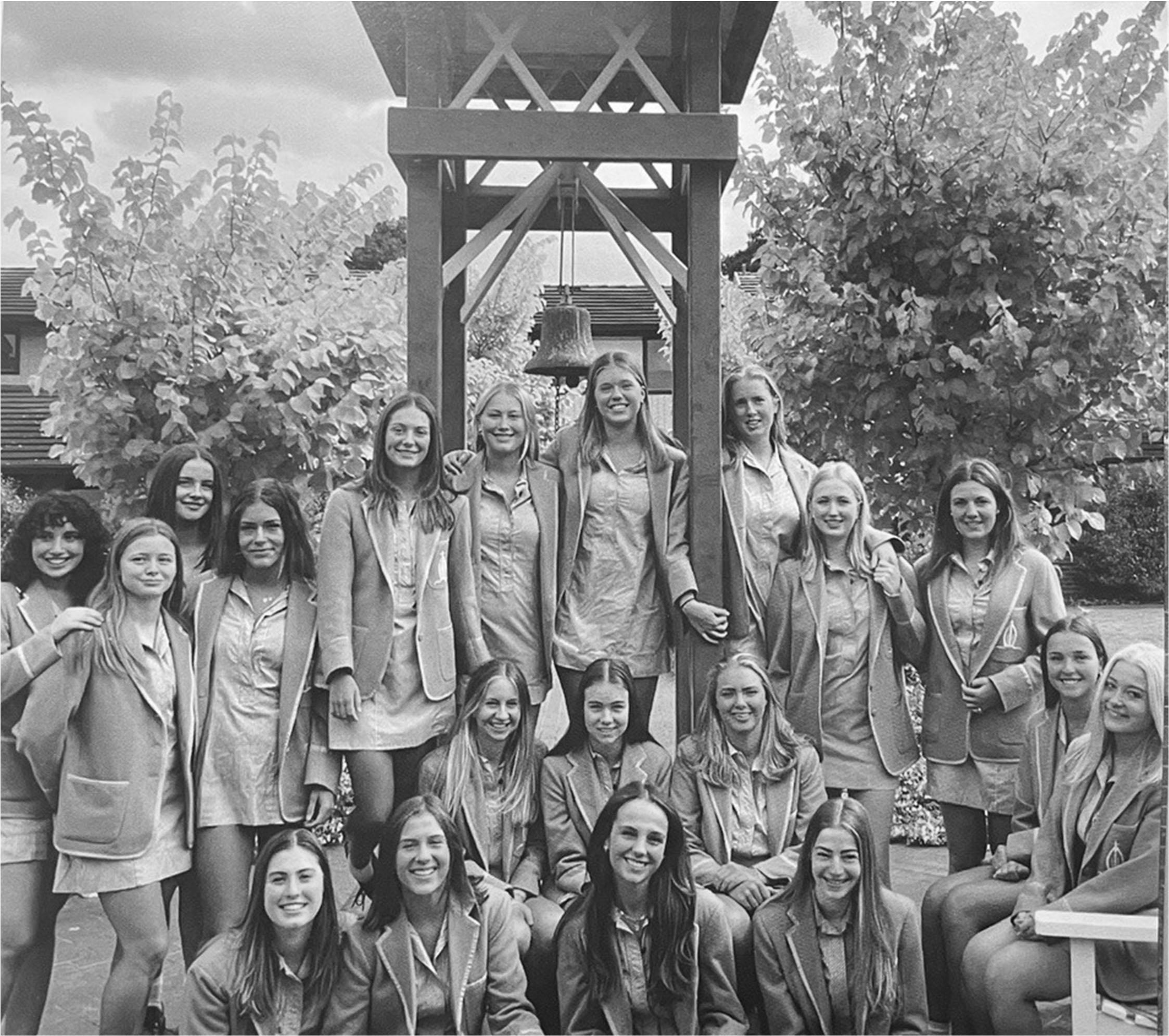
On 26 February, the COGA Committee visited Clyde House and met with Head of House Emily Tuechler and a number of Year 12 students. On 12 March, there was further contact between Clyde House students and COGA with the Clyde history presentation. See reports in this Cluthan.
It is fifty years since the closure of Clyde School. Since Clyde House was opened in 1976, at least one third of all Clyde House students have been close relatives or descendants of girls who attended Clyde School.
Ed: This article was adapted from The Corian 2024; Light Blue April 2025 and COGA Committee news.
CLYDE HOUSE GIRLS WITH A CLYDE SCHOOL CONNECTION – 2025
Student
Florence Baillieu (Yr10) Grand-daughter
Great-niece
Great-niece
Great-niece
Great-niece
Lucy Danckert (Yr11) Granddaughter
Great-niece
Lucy de Steiger (Yr12) Granddaughter Grand-niece
Erm Hope (Yr12) Great-niece
Sybil Barr Smith
Joanna Baillieu
Rhoda Barr Smith
Anne Barr Smith
Joanna Barr Smith
Diana Moore
Deborah Moore
Baillieu
Handyside Cochran Armytage
Whittakers Calvert
Primrose Bright Georgina Bright de Steiger Matyear
Alice Knox BrettinghamMoore
Charlotte Langdon (Yr11) Great-granddaughter Winifred Bakewell Langdon
Charlotte Lehman (Yr10) Grand-daughter
Great-niece
Great-niece
Poppy Maling (Yr12) Great-niece
Great-niece
Charlotte Nikakis (Yr11 Granddaughter
Great-niece
Susan Harrison
Louise Harrison
Philippa ‘Pip’ Harrison
Janet Maling
Trethewie Gatenby Leake
Jacquelyn Maling Fowles
Clementina Davies
Pamela Hawker Hawker Prowse
Cl’1962-68
Cl’1958-64
Cl’1958-63
Cl’1959-65
Cl’1963-69
Cl’1958-63
Cl’1960-65
Cl’1957-63
Cl’1951-59
Cl’1965-70
Cl’1918-19
Cl’1964-68
Cl’1966-69
Cl’1962-67
Cl’1943-47
Cl’1958-63
Cl’1958-64
Cl’1964-65
Margie Gillett (Cordner), Sarah Singh and Kammy Cordner Hunt (Cordner)
Peta Gillespie
Clyde House girls
WE RECORD WITH REGRET THE FOLLOWING DEATHS
Judith Camden Allen
20 November 1938 – 12 February 2025
Clyde 1949-56
Joan Patricia Audette (Hume)
31 July 1927 – 3 August 2024
Clyde 1938-44
Juliet ‘Julie / Kimmy’ Ann Avery (Kimpton)
18 August 1951 – 1 June 2025
Clyde 1963-69
Virginia Lindsay ‘Mitzi’ Begg (Wilkins)
4 February 1933 – 4 November 2024
Clyde 1943-50
Nina Bovill (Laycock)
25 June 1951 – 21 May 2025
Clyde 1962-68
Amanda ‘Mandy’ June Cunliffe (Rogers)
8 August 1946 – 11 February 2025
Clyde 1958-63
Audrey Jane Dickenson
23 May 1943 – 8 May 2020
Clyde 1956-60
Susan Elizabeth Duncan
22 July 1951 – 30 November 2024
Clyde 1963-68
Wendy Favaloro (McLaurin)
23 September 1936 – 16 September 2022
Clyde 1948-53
Norma Florence Fivash (Miller)
22 July 1922 – 22 October 2023
Clyde 1937-39
Janet Mary Coverley Fowles (Maling)
29 May 1930 – 29 June 2025
Clyde 1943-47
Davina Mary Hanson
21 September 1944 – 14 October 2024
Clyde 1956-62
Louise Lewis (Simpson)
30 May 1933 – 5 December 2024
Clyde 1948
Joan Mackenzie (Bloomfield)
20 October 1935 – 12 August 2025
Clyde 1944-52
Gillian Mallinder (Piesse)
28 May 1938 – 6 October 2024
Clyde 1950-55
Deborah Rutherford McNab (Grimwade)
12 May 1936 – 1 July 2025
Clyde 1948-54
Ruth Miller 19 June 1924 – 19 April 2021
Clyde 1937-42
Susan Mary Patterson (Strachan)
13 December 1932 – 9 December 2018
Clyde 1945-50
Susan Margaret Pender (Rymill)
1 January 1942 – 10 June 2024
Clyde 1952-58
Judith Anne Reid (Everitt) 21 December 1927 – 7 October 2021.
Clyde 1943-44
Judith Heather Reindl (Stirling) 10 November 1928 – 18 August 2024
Clyde 1941-46
Vivienne Stuart Ritchie (Knox Knight) AM 15 February 1938 – 10 July 2024
Clyde 1951-53
Lady Peggy Vane Scott (Lansell)
26 March 1920 – 19 July 2022
Clyde 1933-37
Elisabeth Irene Taylor (Hoddinott) 16 January 1931 – 22 July 2023
Clyde 1947-48
Elizabeth Jane Turnbill
13 June 1926 – 7 June 2024
Clyde 1941-44
Helen Jane ‘Jane’ Wilkinson
29 December 1946 – 26 February 2024
Clyde 1956-62
Vivienne Stuart RITCHIE (Knox-Knight) AM 15 February 1938 – 10 July 2024
Clyde 1951-53
Vivienne Stuart Knox-Knight was born 15 February 1938, the eldest child of Air Commodore Ernest Edward Gipps Knox-Knight CBE (known as Mickey, b. 25/02/1904) and his wife Dr Monica Frega Stuart Knox-Knight (Donnelly, 19/07/1907 – 26/10/1983). Her parents were married in 1935, in Sydney NSW. They were characterised by a ‘steely determination and strict adherence to principles not always shared by others’. Her mother Monica was raised among 12 siblings, Irish graziers from NSW, a blend of Anglican and Catholic families. Monica qualified as a doctor of medicine at university, continuing her medical career into her married life. Ernest KnoxKnight did not attend university, but joined the defence forces after his father Lt Colonel Ernest KnoxKnight was killed in action aged 36 on 10/08/1918.
As a result, Vivienne’s childhood was nomadic, moving from place to place occasionally, with her father’s placements. Ernest, as a pilot, served in or was seconded to the Australian military, and also the Royal Navy. From 1938-45, during Vivienne’s childhood, he rose through the ranks of the RAF and RAAF, serving in England, the Middle East, Greece, Crete, Scotland, Canada, the United States, New South Wales, Darwin and Queensland. The family did not follow him during this period, but after the war Vivienne and Monica accompanied him back to England in a diplomatic posting, which included active service away from home such as the Berlin airlift. Later the family returned to Victoria, while Ernest went to Korea and Vietnam before South Australia and several final posts in Victoria. Vivienne had a younger brother John Gipps Knox-Knight (GGS 1954-64) who was born after the war, and died aged 32 in 1979.
The early nomadic period meant that Vivienne as a young girl had limited parenting from her father, a fractured education, but also a broad range of life experiences. The most formative schools Vivienne attended were Sherborne in England, and Clyde where she boarded from 1951-53. As a teenager, Vivienne’s friends described her as ‘sophisticated and somewhat intimidating’, she was approached ‘gingerly’ by many who met her. Vivienne apparently retained those attributes into adulthood; she was often described as ‘formidable’. At Clyde Vivienne gained her Leaving certificate, and joined the Dramatic Club. She featured in the 1953 school play “Little Ladyship” by Ian Hay, which was performed at Wesley Hall in Melbourne, raising the record sum of 480 pounds in support of the Isabel Henderson Kindergarten. After leaving school, Vivienne chose to study law, but her mother enrolled her at Emily McPherson College for the domestic sciences, to learn the fine art of social entertaining and running a household.
After an entertaining couple of years, with her father
imposing a curfew to control his fairly strong-willed daughter, Vivienne met Robert Ritchie, a promising young Mansfield footballer and third generation beef and primary lamb farmer of Delatite Station and Beolite. They were married in 1957 when Vivienne was 19 and Robert was 26. They were happily married for 54 years, welcoming five children into their growing family. Stuart in 1958, Rosalind in 1959, David in 1963, Andrew in 1965 and Charles in 1969. Her daughter – Rosalind Adams (Ritchie) Clyde 1971-75, GGS 1976 – attended Clyde in its last years at Mt. Macedon, and was the first house captain of Clyde House, GGS in 1976. Vivienne was a consummate hostess. At Emily McPherson College she had learned to cook and cater for 50 people at once. Her son Stuart noted that ‘no matter who arrived on the doorstep, no matter their provenance, their advance notice (or lack of), their invitation status or their numbers, they would be seated and generously fed. Vivienne enjoyed doing hospitality her own way. She did ‘wonderful crepe cakes and towering croque-en-bouches. Oyster spreads. Easter and Christmas lunches were spectacular’. She embraced the latest kitchen technology for the era, but always had trouble with the dishwashing machine. It would overflow in a bubbly torrent, across the dining room floor during dinner, causing much drama. Vivienne maintained a beautiful garden, with flowers, vegetables and fruit trees. It kept expanding over the years to cover a few extra acres, as her family (not always patiently) erected new fences, mowed expansive lawns, and helped to maintain a growing menagerie. In addition to station horses and dogs, there were numerous chooks, geese, peacocks, pheasants, donkeys, goats, orphan lambs and calves, plus antisnake ducks and cats who all called Beolite home. The children were expected to feed and care for their
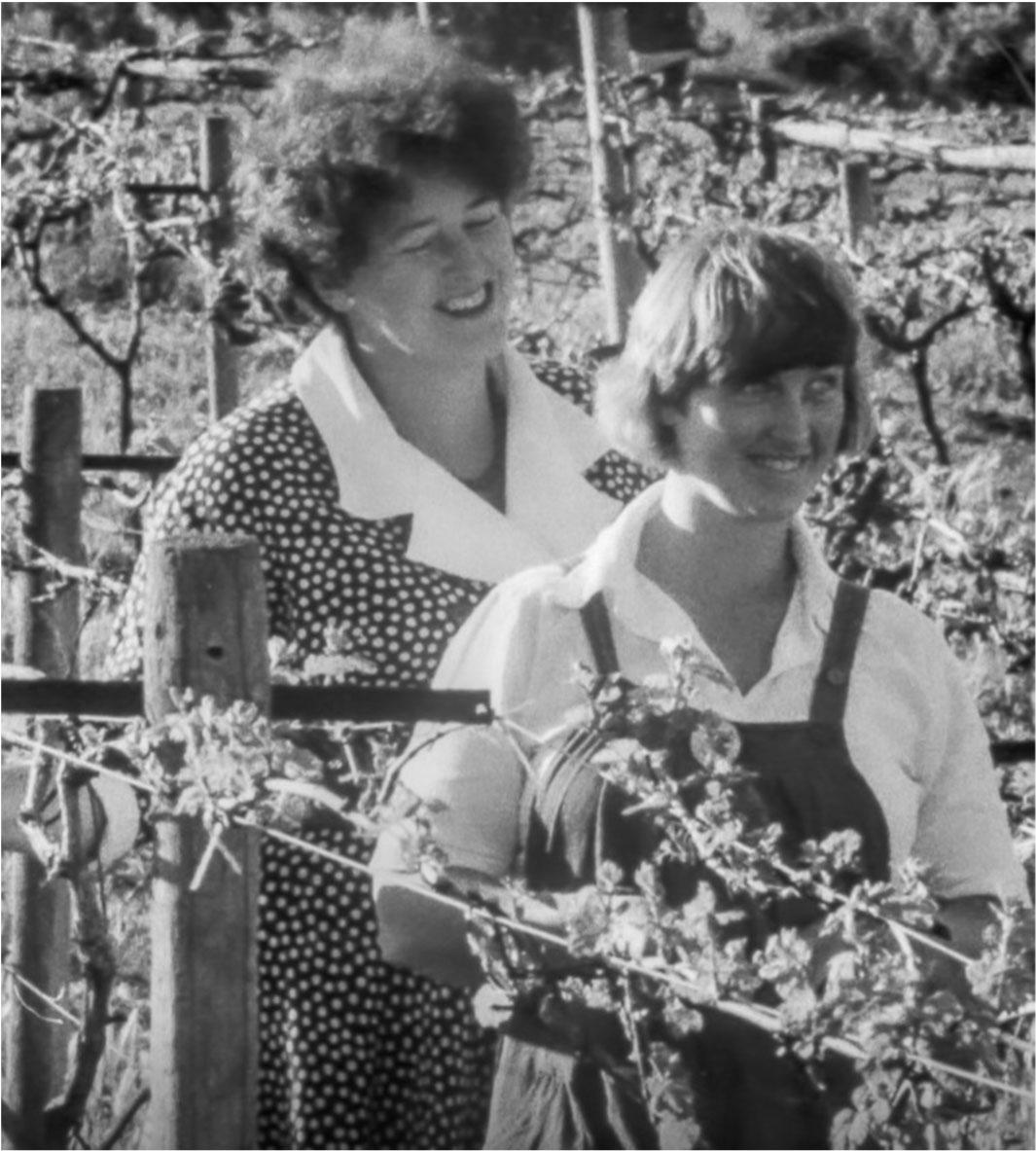
mum’s ‘zoo’. Meanwhile, a visit to the Mansfield Show might mean Vivienne returned home with bantam hens, six other chooks and eight geese. Stuart described his parents as devoted to each other, but when they were apart, both were ‘fiercely autonomous, capable of solving any immediate issue’.
A tragic family event in 1966, the death of their fourth child baby Andrew in a car accident, when Vivienne was 28, was a pivotal moment in her life. Vivienne was badly injured (seatbelts were a new invention and doctors didn’t quite understand seatbelt injuries) but she recovered after a long period in hospital. She sought additional life purpose in helping people outside her family. She became a passionate contributor to community life through involvement in the Church, Red Cross, probation work in the justice system; with troubled children; Cub Scouts; fundraisers for charity; with music and the arts. Her work was diverse and her efforts persistent. The family recalls that three young wards of the state joined them for school holidays each year, along with students from Timbertop, young friends from England, and a young soldier suffering PTSD. She took over as Akela of the local cub scouts and styled herself as ‘Leader of the Mansfield Pack’.
Vivienne and Robert Ritchie were pioneers of the Australian wine industry. Together they founded the now famous Delatite Winery which has flourished over the years with the exceptional wine making skills of firstly their daughter Rosalind, and later son David Ritchie and wife Catherine who have developed the family’s successful restaurant and winery business. Delatite Winery is a favourite destination for visitors to Mansfield from all over the world. In a tribute posted online, Lucy Clemenger, the architect designer of Delatite’s restaurant, described Vivienne as ‘a pioneer and champion of the wine industry, larger than life. Her generosity to many was well known, her work ethic and drive inspirational and her love for her family and friends boundless’.
Delatite Winery’s website tells some of the history. In 1967 Robert Ritchie had a skiing weekend at Mount Buller with Jim Irvine, a legendary winemaker from the Barossa Valley, South Australia. A year later, Jim delivered 500 Riesling vine sticks to the Ritchies’ gateway. Vivienne planted them in her vegetable garden, and in spring 1968, with the help of friends, they planted their first vineyard. Four years later Robert and Vivienne made their first wine, using a small press and a baby’s bath. For the next ten years they worked in collaboration with Peter and John Brown from Brown Brothers, growing varieties and developing wine styles suited to their climate. In 1982 they built their own winery and cellar door. Vivienne took on the marketing and selling, Robert and son David worked the vineyard, and they employed their daughter Rosalind as the winemaker. Ros’s first Riesling won three gold medals at its first three shows, as well as a few silver and bronze med-
als. Later she developed the Late Harvest and VS (Reserve ‘Vivienne’s Block’) Rieslings that are still sold today. Vivienne attributed the success of their Riesling to the climate, soil and altitude of the Mansfield district, as well as growing the grapes biodynamically. David now runs the winery with winemaker Andy Browning, producing exciting new Gewurztraminer, Spanish and Portuguese varieties. Locally, Rosalind has expanded the family tradition with her own highly regarded independent wine label, Ros Ritchie Wines.
Robert and Vivienne remained devoted to each other. Vivienne nursed Robert through the final year of his illness. After he died, Vivienne’s own health deteriorated. In 2022 she suffered a stroke, was moved to Buckland House, Mansfield and died peacefully on 10 July 2024. Son Stuart said that Vivienne would want her family to remember all the wonderful times and experiences they shared with her. Her energy, initiatives, strength of character and vibrant personality, her occasionally eccentric approach to life. Her tendency to be seen as ‘formidable’, to expect a lot from other people, was based on a desire to get things right, to help others, especially children, to overcome obstacles in life. She was the much-loved grandmother of nine, and great grandmother of two.
Vivienne was honoured with an AM, which reflected her exceptional contribution to community life.
Ed: With thanks to Stuart Ritchie for sharing the eulogy he delivered at Vivienne’s funeral on 18 July 2024; Delatite Winery website; Cluthans 1951-53.
Audrey Jane DICKENSON
23 May 1943 – 8 May 2020
Clyde 1956-60
At Clyde, representing Faireleight, Audrey was the Prep. and Junior Running champion in 1956-57-58, the Senior Running champion in 1959-60, and a member of Clyde’s Senior Athletics Team in 195859. She served on the Debating Club committee, and as Secretary then President of the Art Club committee in 1959-60. Audrey’s interest and talent for fine arts was evident at Clyde. The Art Club was active under her leadership; senior art students visited the Turner Exhibition at the National Gallery, and the Royal Industrial Exhibition of Art at the new Argus Gallery where they admired fashion drawing, furniture design, television stages, coat and fabric designs. They saw works by Australian artists Drysdale, Roberts and Hans Heysen at Kyneton, with lectures from the director of the National Gallery. Beyond the classroom, they watched films on modern art and sculpture and visited Henry Moore’s controversial figure on display in Melbourne. On Speech Day 1959-60, Audrey was awarded the Maude Weigall Memorial Prize for Art, and in 1960, she was awarded Dux of the School.
After leaving school, from 1961-63 Audrey lived in
Toorak and studied art, initially at Melbourne Technical College for six months, and then at the National Gallery of Victoria Art School (now the Victorian College of the Arts) where she was tutored by artist John Brack. In July 1961 she travelled to Japan to further her studies by taking an active interest in Oriental art. The year after finishing art school in 1964 she exhibited at the Munster Arms Gallery in Melbourne and won the Dandenong Art Prize. From 1965-67 she travelled to France, England and Israel, sharing a flat in Paris in 1966, doing secretarial work, improving her French language and art skills. Back in Melbourne 1967-73 she started a small art gallery. In the USA from 1973-76 she studied and graduated in Lithography and Etching at the University of California, Santa Barbera. In 1976 she moved to Sydney and started the Tamarind Print Workshop where she did editions for artists, painting and lithography. One print for a Canadian artist was bought by the Alberta Art Foundation. In 1984 she won the Faber Castell Drawing Prize (amateur section). Also during the 80s Audrey studied for a Fine Arts degree at the University of Sydney.
In 1985 Audrey had her second and final exhibition at the Robin Gibson Gallery in Sydney. Robin really liked Audrey’s artwork but felt that given her reticence about exhibiting her works, an ongoing relationship with her would be difficult. He has kept a file of all correspondence and sales for Audrey’s pieces from that show in 1985.
In 1988 Audrey was represented in a collection of works by significant Australian printmakers. The project was called 100 x 100, initiated by the Australian Council of Printmakers. It was a simple but ambitious idea. A Portfolio of 100 Prints representing artists from all over Australia, working with the printmaking medium. The Portfolio coordinator was Leslie Duxbury, sponsored by Dr MS Lefebvre, and the Portfolio was launched in December 1988 at 70 Arden Street Gallery, North Melbourne. The selected work by Audrey Dickenson (East Sydney Tech)
was a lithograph, printed by Neil Emmerson at the Print Workshop, Sydney.
By this time, Audrey had opened her own gallery in Jersey Road, Paddington, and had fitted out a wellequipped print workshop at the rear of the property. Later she moved the gallery and workshop to Petersham, and in 1994, seeking more space for the printing equipment, moved to Summer Hill.
Audrey was a keen traveller, visiting South America, Morocco, Cambodia, India, China, Japan, Indonesia, Papua New Guinea, New Zealand and many of the Pacific Islands, always gathering material and ideas often reflected in her later prints and paintings. Having lived in Paris for some time she was fluent in French, also spoke Italian and was learning Chinese in order to read Chinese poetry.
Audrey was regarded as a talented and educated artist who read avidly and worked at her craft consistently and single-mindedly throughout her life. She was also a very private person who did not always communicate well, and felt no need to promote her work. It appears she only had two exhibitions, one straight after art school in 1964, the other with the Robin Gibson Gallery in the 1980s. Robin sold two of her works to Artbank, two to Parliament House and one to a private collector.
When Audrey died in Sydney in 2020, she left no instructions for the distribution or disposal of her sizeable collection of artworks. Her house in Edgecliff was sold by her executor with her life’s accumulation of paintings, prints and drawings left stacked and rolled up in the garage. With no arrangements in place, her artworks had to be purchased, donated, or destroyed. In February 2023, her executor Stephen Andrews, and a fellow artist who was an estate beneficiary, Gina Bruce contacted Geelong Grammar archivist Darren Watson and asked if GGS or the Clyde Old Girls Association would be interested in accepting one or more of Audrey’s works as
a donation, as a matter of urgency before they were removed and possibly destroyed. They attached some examples of Audrey’s works, including unframed works on paper; some single jpeg images on canvas. Also attached was a screenshot of the paintings held by Artbank; a photo of Audrey at work in her studio, and her handwritten CV, along with a bio sheet from her 1985 exhibition. These items and her whole collection had to be removed from her house within a few weeks and sadly there was insufficient time to advise COGA members of the chance to accept one of her paintings. GGS Principal Rebecca Cody chose two of Audrey’s paintings for display at Corio campus.
Ed: Information from Cluthans 1959-66; letters from the Executor Stephen Andrews (stephenda@ozemail. com.au; 02 9363 9038); and artist Gina Bruce (gina bruce@gmail.co; 0415 980 105). Stephen and Gina can be contacted for further information about the dispersal of Audrey’s art collection; also Clyde Archives at GGS.
Davina Mary HANSON
21 September 1944 – 14 October 2024 Clyde 1956-62
Davina was raised in the Macedon Ranges, on a farm in Cobaw with her siblings Rod Hanson and Virginia Hope (Hanson) Clyde 1954-60. They lived close to Hanging Rock and enjoyed a happy childhood with freedom and memorable adventures. Virginia recalled one adventure that almost went awry, when she put two-year-old Davina in a fruit box ready to set her sailing across the dam. Luckily dad stepped in on time! Another memory of a playtime tea party: Virginia gave her little sister a cup of kerosene ‘tea’, with disaster averted by their mother and a quick-thinking doctor. The Hanson children first attended Cobaw Primary school, and when it closed, rode their ponies four miles to Newham State School. They rode to school in the snow, hail and rain, with a change of clothes when they arrived at school. At times local boys would toss stones at their horses hoping to see someone fall off. Virginia says the Hansons were not ‘helicopter parents’ and the children were never driven to school.
Davina’s sister Virginia has shared the following memories:
At Clyde we learned a lot about charity. We knitted little singlets and earned house points for doing things to help other people. We learned the important thing was ‘doing’.
After leaving Clyde Davina enrolled at Monash University, completed her degree and made many lasting friends. During these years Davina and I lived together until I was married. There were lots of knocks on the door for Davina and they weren’t just girls! After her degree Davina was employed by the Department of Defence. She was the first female desk officer in the department, responsible for a country or region rather than being in a secretarial role. She was involved with the Vietnam War, and was seconded by the Government to serve in Whitehall, London. She worked for three years, travelling widely in Europe and UK and making more friends. Upon returning to Australia, she continued working with the Defence Department for many years.
Back home in Melbourne her social life included serving on the Wool Ball Committee. Davina’s work was confidential. She was sworn to secrecy about her years in Defence, but over the decades she mentioned that she knew ‘a little bit about spying’. When the department moved to Canberra, Davina retired from Defence and enrolled in a Master of Business Administration (MBA) course at Melbourne University.
After finishing her MBA, Davina continued her volunteering life. She was Secretary or Treasurer of the Clyde Old Girls Association between 1988, when the Clyde Old Girls Association resumed, until 1997 and enjoyed supporting the Clyde Old Girls’ annual jumble sale in support of the Isabel Henderson Kindergarten. She volunteered tirelessly for the Murdoch Children’s Institute, helping to raise many thousands of dollars. Davina received a lovely citation in appreciation of her volunteering.
She then became involved at Trinity College, Parkville, where she was fundamental in the development of their Foundation. Always interested in young people’s education, she was interested in the education of her young relatives and always encouraging. The deputy warden of Trinity College and a good friend of my sons, said about Davina’s contribution to Trinity:
Davina started at Clyde in 1956 and was a great contributor to school community life. She was good at sport, made lots of friends and did well academically. In 1961 she was co-editor of The Cluthan and was her house representative on the Clyde Social Services (CSS) committee. In her final year 1962 she was elected a School Prefect and Clutha House Captain; she served on the Cluthan Committee, the Sports Committee, played in Senior Firsts Hockey XI and she was awarded Colours for Hockey and Athletics. She matriculated and qualified for university entrance.
“She was one of the first members of the Trinity College Foundation, one of the six founding signatures on the Trust Deed. She served on the Executive Committee for the Foundation for 14 years – from its establishment in 1983 through to 1997. She has been very generous with her gifts to the College –just shy of Benefactor status but being one of the early Governors of the Foundation. In 2022 Davina was honoured by the College with an Oak Leaf award, a significant honour only bestowed on 150 people among the 60,000 strong Trinity College
community. The Oak Leaf citation states: ‘For services to community and education through philanthropy and voluntary work.’ Trinity College will miss Davina who enjoyed Evensong by the chapel choir, the dinners and events, and she was appreciated for her great sense of humour.”
Davina was generous not only to Trinity College but also to the Epworth Hospital, Blaze Aid, Christ Church, the Barwon Heads CFA and to Melbourne Grammar School.
Davina worshipped at Christ Church South Yarra and chose to attend the 8 a.m. service because ‘it was short and sharp!’
My sister was called Aunt D by her family and this name was adopted by her nephews’ friends from the MGS boarding house. The boys would join her regularly for Sunday night dinners where she was Aunt D to them all. Davina was responsible for my sons on exeat weekends and would take good care of them. I learned later that there were times when their behaviour was not acceptable but she never told me about it, she was very loyal to them.
Over the years, Davina was a member of the Lyceum club, the Barwon Heads Golf Club and the Alexandra Club. Through the Lyceum Club she started to play Bridge, which she loved, and she enjoyed the people with whom she played. Through playing Bridge in recent years, she reconnected with a lot of people she knew in Barwon Heads.
Davina hosted a Christmas party that was generous and good fun, it brought together people I hadn’t seen for 60 years. She enjoyed classical music, ballet and Opera. We subscribed for season tickets and went together for over 40 years.
She was very kind and helpful when it was needed, often driving people to appointments and lectures. Once, when visiting an aged care home, she found Helen Sage Clyde 1911-17, a former COGA President, who enjoyed knitting. Helen had run out of wool at the time, so Davina bought some wool and made sure she had a supply for the rest of her life.
Davina was very generous with presents which were always thoughtful, especially for young relatives like her great niece Matilda who was in Germany. Davina put a little package together for Matilda which consisted of a special bag she could wear on her E-scooter. It contained a warm scarf, woollen gloves, merino socks and I suspect a little money as well. At Easter time, she would bring big Haigs chocolate Easter eggs for the family. Milk chocolate for this one, a dark one for another, even a white chocolate egg and a few spares just in case! Recently we celebrated Davina’s 80th birthday. She loved a party, she enjoyed weddings, 21st birthdays, picnics in the paddock and always made a generous contribution.
Davina/Aunt D leaves behind many memories for colleagues, friends and family, she was thoughtful,
generous, had a huge capacity for enjoyment, a dry sense of humour, she was fun and valued her privacy. Above all, she loved her family and she was oh so loyal. I will miss all the little packages of chocolate ginger, I will miss my sister D, may she rest in peace.”
Ed: Our grateful thanks to Davina’s sister Virginia Hope (Hanson) for sharing her eulogy for Davina; additional information from The Cluthan 1962.
Gillian ‘Jill’ MALLINDER (Piesse)
28th May 1938 – 6th October 2024
Clyde 1950-55
Gillian ‘Jill’ Piesse was born in Derbyshire UK to Evelyn (Ben) and Arnold Piesse (GGS 1924-26). They lived at Heyfield, a village 17 miles east of Manchester. Her father worked for Tootles as Chief Textile Chemist developing new materials including synthetic parachute fabrics. WWII broke out soon after Jill was born. The war years in England were very difficult with severe food and petrol rationing, bombs being dropped nearby and long freezing winters. Jill remembers the joy of playing in fields of wild flowers which started her love and appreciation of nature and the outdoors. Her brother, Robert (GGS 1951-57) was born in 1940 and her sister Jessica Scarff (Piesse) Clyde 1956-62, was born in 1944.
After the war the family came to Australia via New York. Jill was nine years old and very impressed by the abundance and wealth on display at Christmas. They flew to Sydney arriving January 1948 after island hopping across the Pacific. Jill was, for a long time, homesick for England and Welsh family particularly her favourite aunt Viv.
Their new life started in Wangaratta where Jill attended Chisholm Street Primary School. Always an industrious and clever student she was put up a grade when she commenced her secondary schooling at Clyde in 1950. Jill was a quiet, reserved girl but did settle in to life away from home, making many lifelong friends who all called her ‘Sausage’. This nickname stuck until after she left school. Jill did not like ball games and hated the cold winters which heralded dreaded chilblains. However she did enjoy other activities such as school plays, house entertainments and fun pranks with her friends. At Clyde, she played in the Senior Basketball VII team, and served as a committee member for the Camera Club, the Senior Library, Clyde Social Services (CSS), as Treasurer for Clyde Country Women’s Association (CWA) and Secretary for the Dramatic Club. Jill excelled academically gaining first class honours in her first year Matriculation aged 16, earning a Commonwealth Scholarship in 1954. She returned to Clyde for another year as she was too young for university, gaining an Honours Prize and the Science Prize in 1955. In later years, Jill stayed connected with her Clyde friends and enjoyed the many fabulous reunions organised by her school
year cohort.
After leaving school Jill embarked on a law degree at Melbourne University living in at Janet Clarke Hall where more close friendships were made. This was followed by a year at law firm Mallison and Stewart where she was taken on as their first female articled clerk. Declining an offer of a permanent position at that prestigious firm, Jill returned to Wangaratta where she was invited to work in private practice. It was in this role that Jill flourished and became an accomplished, impressive and confident Barrister and Solicitor making her family proud.
Early in 1968 Jill married Brian Mallinder, dairy farmer and fellow emigre from the UK. The wedding took place at Holy Trinity Cathedral, Wangaratta. The happy couple lived on the dairy farm amongst the rolling hills of Greta South. A year later their daughter Jennifer was born. The family moved to Brunswick for a few years while Brian completed a Commerce Degree and Dip. Ed. and Jill worked part time in a suburban practice. While in Melbourne, their second daughter Victoria was born, completing the family unit.
On returning to Greta South, Jill took up a position as Librarian at Benalla. Having always been an avid and prolific reader from an early age, she had always thought this would be a dream job but after two years was looking for a more challenging role. Brian continued to run the dairy farm while teaching in Wangaratta. In 1978 the farm was sold and they moved into Wangaratta. For a few years Jill practised from home gaining an enviable reputation. In 1987 she became a partner in the fledgling law practice Compagne, Gray and Mallinder. Soon after Jill qualified as a Family Law and Mediator Specialist. She flourished in this role and gained a reputation for being a tough negotiator and achieving fair settlements. Jill continued to work until a stroke at 70 brought forward her retirement.
Besides her legal profession, Jill was in demand to join many worthy organisations. She was very generous with her time and expertise (sister Jessica noted that Miss Hay’s scripture lessons, weekly compulsory threepences and knitting baby singlets for CSS helped encourage us to become community volunteers). Some of the committees Jill served on for many years were the Citizen’s Advice Bureau, the Wangaratta Arts Council, the Business and Professional Women’s Association (Jill called it ‘The Dragons’), Upper Murray Family Care and the St. John’s Retirement Village board. Jill took on senior positions for most of these community organisations. As Jill’s Christian faith developed during these years, so did her involvement in the life of the Anglican Cathedral in Wangaratta. At various times, Jill served on the Parish Council, Bishop in Council, was a Diocesan Trustee and became a lay Canon. Jill continued with her involvement with St. John’s Retirement Village until its recent sale. She was instru-
mental in the early development of Cathedral College, a successful church-run day school on the edge of Wangaratta. She became second Chair of the school council. Pastoral care and high-quality education were a real passion. Despite this very busy and giving life, Jill spent much time and energy gardening accompanied by one or other of her adored Italian Greyhounds.
Jill was very devoted to and supportive of her parents’ needs, both enduring very difficult last years. Sadly, her husband, Brian, suffered from Motor Neurone Disease requiring much care, time and empathy. After a long and difficult time, he died in 2003. On a happier note, also in 2003 Victoria married Jamie McCaffrey at Trinity College Chapel and Jen gave birth to Harry. More grandchildren – Eva, Patrick, Fleur and Celeste – followed, all giving Jill much joy.
Soon after her stroke Jill moved to The Close behind the Cathedral where she formed close friendships with clergy and their families. At 83, Jill spent seven months in hospital very seriously ill. Unbelievably she made a good recovery but needed some care so she moved in to St. Catherine’s Nursing Home where she made friends and contributed to that community.
Two days before she died Jill was told she would be receiving Palliative Care rather than the orthopaedic surgery she was expecting. Her response was ‘Well, you only get one go at this life, so I’d better not muck up the ending’. Thankfully Jill died peacefully with family by her side. Jill left detailed instructions for her funeral which is so like her. A beautiful service was held at Holy Trinity Cathedral, Wangaratta. Victoria delivered an appreciative eulogy which has provided welcome context for this tribute.
Jill was always kind, generous and supportive in every aspect of her life. A high achiever, loved and respected by so many who now miss her presence in their lives.
Ed: Our sincere thanks to Jill’s family, especially her sister Jessica M. Scarff (Piesse) who has shared this wonderful tribute to Jill; with information added from Cluthans 1955-56.
Susan Elizabeth DUNCAN
22 July 1951 – 30 November 2024 Clyde 1963-68
Susan Duncan was a much loved, bestselling author and journalist, well known as a feature writer and former editor of the Australian Women’s Weekly and New Idea magazines. She spent her childhood in country Victoria. Her father was a supply officer at the Bonegilla Migrant Camp, and her parents later owned a country pub in Melton. Susan boarded at Clyde from 1963-68. She was our COGA AGM guest speaker in 2014, recounting stories from her
life-affirming memoir Salvation Creek and its sequels, including the Briny Cafe series. Susan’s novels and memoirs were based on her life in the secluded water bound communities of Sydney’s Pittwater region. Susan escaped to Pittwater after the death of her first husband and her brother in the same week. Settling in a shack called The Tin Shed, she later married a widowed neighbour, Bob Story, and moved with him to a home called Tarrangaua, built in 1925 for the poet Dorothea Mackellar. She used the house – with its magnificent front deck, spacious rooms and large garden – as a venue for fundraisers, parties, community events, and to host reunions with her old Clyde school friends. The annual Tin Shed Dinner which she started, raised more than $2,000 in 2024 for the rural fire service, which later had the honour of repatriating her remains. She also started ‘Christmas carols afloat’ for an audience of neighbours in boats, off the local wharf. Susan was first diagnosed with breast cancer in 1999. She fought mightily, continuing to write even through brutal treatment. Having explored grief, loss and renewal in her two memoirs (Salvation Creek and The House at Salvation Creek) she turned to the themes of community and belonging. In recent years she and Bob have been raising cattle at Wherrol Flat, NSW. Her final novel, Finding Joy in Oyster Bay, the last in her Briny Cafe series, was published in November 2024.
After her peaceful death at age 73, she was fondly farewelled by a flotilla of boats carrying friends and neighbours, accompanying her as she was laid for her final trip aboard a Rural Fire Service vessel to the wharf at Sydney.
Speech by Susan Duncan at the COGA AGM and Old Girls’ Day, Sunday October 19, 2014
Changed faces and yet still familiar in a shadowy sort of way. And so many memories triggered by those faces. Midnight feasts. Running up and down the front terrace when we were caught talking after lights out. Mrs Hurle’s magic cinnamon tea cakes. The thrill of meat pies on a Saturday night. Those black velvet jackets and navy-blue knickers. Posture Girdles – dreadful word – for deportment.
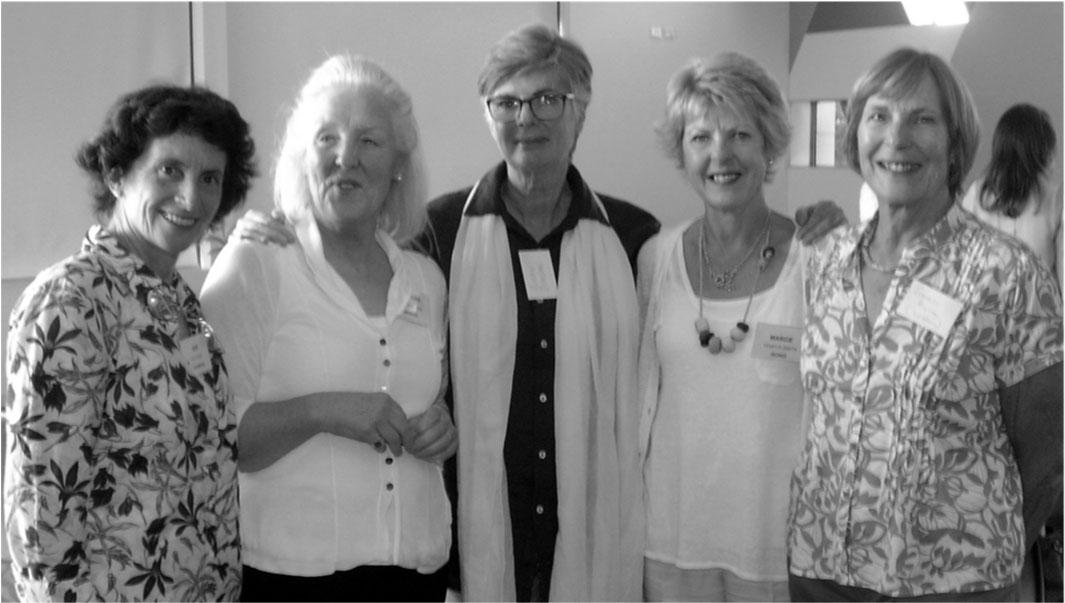
Will any of us ever forget the final day at school as we drove down that amazingly beautiful bush driveway and looked back one last time: the eclectic collection of semi-gothic and post-modern buildings that had been our home for most of our formative years, the hedge where we laid our eiderdowns and greedily sunbaked as soon as the sun came out, the hall where I learned the words of so many hymns, I am still never lost at weddings or funerals on one side of the world or the other. And the music rooms. Mrs Fox never really understood that I was never going to hit the centre of high G with any accuracy. But she never gave up on me and I am not aware of a single mistress who gave up on any of us. Even if we deserved it.
Importantly I will always be grateful for the strong sense of right and wrong that was hammered into us from our first scary day as a new girl to the nervous but euphoric last. Our primary instincts thus reminded us to be decent, polite, honest and to step up to take the blame if you were the culprit. A moral compass imbedded so deeply that even when I behaved badly long after I left school – it guided me often without me even realising it.
Looking back, I am slightly ashamed I took all that privilege for granted – without understanding how those wonderful teachers were gently and sometimes not so gently, laying the grit, stamina, knowledge and basic social essentials, into the foundations that would carry us through whatever life saw fit to deal.
I’m not sure how many of the class of 1968 knew exactly what they wanted to do after leaving school. I’m sure we all wondered what lay ahead, how we’d find a place in a world that was suddenly so much bigger and more complex than the genteel and structured one we were leaving. In many ways, we were a generation on the cusp. Women’s liberation had begun to rock traditional ideas of where we fitted in. Stereotypical roles were dissolving like ice on a hot day. We were suddenly aware of how many male writers wrote about women – as objects – and we began to see how it had influenced the way we saw ourselves. And to reject it. Suddenly, we wanted more out of life. Mostly, we wanted freedom to choose instead of being slotted into a niche because of our gender.
As a result, we became part of a generation that blindly ripped into the old ways without a clue where it would lead but protected – always – by that thick padding of impermeable Clyde values. I now realise it gave me a cool-headed barometer to suss out the sharpsters, grafters and charlatans one inevitably meets when stepping out of the inner circle of family and friends to scrabble for a place in the wider world.
And that’s why – in a louche manner – I decided to become a writer. I wanted to see and understand more. I wanted to live in places until I understood them. I didn’t want to casually skip through coun-
1968 classmates at the 2014 AGM: Ann Willcock (Thomson), Georgina Barraclough (Moran), Susan Duncan, Margaret Temple-Smith (Bond) and Sarah Bullen (Lobban)
tries on a mission to fill a passport with weird and wonderful country border stamps. I could always file a story from somewhere exotic that would help to pay expenses. Later, I cottoned on to the fact that journalists usually travelled at someone else’s expense, that they were thrust into the thick of events in a flash and that they were deeply immersed in strange cultures within the hour. It was the fast track to … The Inside Story. And it was addictive. In the course of 25 years, I jumped ice flows in Newfoundland to bring the baby seal hunt to an end. I became part of polar bear relocations in Churchill, Manitoba, where bears were transported in an old DC 3 to an abandoned wartime airstrip on an empty white expanse of snow and ice. When the cages and the plane door were opened, we journos ran for our lives to climb on the roof of the sole remaining tin shelter before the bears realised, they were free and probably very hungry. Polar bear breath stinks like rotten kippers – it’s hard to write while it’s breathing down your neck in the cabin of a plane so decrepit we all prayed it had enough grunt to fly us there. And back. Freezing hands, holding cameras close to our body to keep the batteries warm and functioning. Tummy churning with a dose of fear, not just for our lives but terrified of returning to the office without the shots and the story. The pressure was always there. Get the pictures. Get the story. Go the extra mile to make it as good as you could. The extra mile – it always paid off for me.
As it happened, it was the modern plane returning to NY from that assignment, that had the major hiccup. Not the rattly DC 3. A hole blew out of the back door of a scheduled Air Canada flight on our descent into Halifax and we barely made it. There were about 12 international journos on board and we formed a club. Once a year we met at the top of the Pan Am building on Manhattan to celebrate our survival. Until a helicopter crashed there, not once but twice, and we wisely stopped meeting there.
It’s impossible to describe the adrenalin rush of turning up in a foreign country and hitting the front line within minutes. I loved it. Even when I was covering a story on Australian troops in Somalia and we later found out a trio of terrorists had tried to mortar the truck I was in. Nothing makes you feel more alive than when you are closest to death.
In earlier years I had completed a cadetship with the Melbourne Sun. I moved to Cape Town for a year, working as a feature writer for the Cape Times, and then on to London for another year, where I worked for United Press International, a wire service, as a receptionist. I returned to Australia and the Melbourne Sun until an opportunity came to move to New York and I grabbed it. There, I cracked a job in the NY bureau of Australian Consolidated Press, then owned by Kerry Packer. I wrote for most of the magazines, the now defunct Bulletin, racy Cleo, style leader Mode, even a yachting publication when we were fighting to win the America’s Cup away
from the snooty, rule-bending NY Yacht Club. But mostly, I wrote for the Women’s Weekly. Not so different to today’s magazine, but back then it was known as ‘the Bible’. Read by politicians, decisionmakers, housewives, the rich, the famous, the aspirational and anyone who wanted to fathom the current psyche of Australian women. Ita Buttrose was the editor. It was a time when magazines had never been more powerful.
We operated out of an office on the 22nd floor of the Newsweek Building on Madison Avenue. We were a small group of reporters, headed by a character called George McGann, who loved a martini and played a mean piano. We had fun. We also worked hard but I was aware I was living a dream life. Traipsing downtown to a joint called The Cookery to listen to jazz great Alberta Hunter, hearing crazy Kinky Friedman in the Lone Star Café, swanning off to Haiti for the weekend in search of a French millionaire who’d been kidnapped (with my photography teacher, who worked for Paris Match), and hitting all the casinos looking for a bloke who’d had his little finger removed. We never found him but we managed to hit the jackpot and win a small fortune.
During a ten-year tenure, I danced at the White House when an Australian Prime Minister visited the US. Took Billy Snedden to an opera in Central Park: “Who’s this Pavlotti anyway,” he wanted to know. I could explain in detail because only the day before I’d interviewed Pavarotti, the world’s greatest tenor at the time, and been bounced off his tummy when he reached up to kiss my cheek – Italian style.
I interviewed Richard Burton in Canada, when he was married to Susie Hunt and allegedly off the booze. He had the bluest eyes I’ve ever seen and enough charm to fill the huge caravan where we sat and chatted. He offered me a drink … the fridge was full of beer. “Mr Burton,” I said, “I thought you were off the booze.” “Beer isn’t alcohol,” he replied drily.
I interviewed Darryl Hannah on a film set on the banks of the Amazon River, near Belem in Brazil. She was lovely. Kind of coy and smart and unearthly. The bigger the star, the better the manners. Looking back, there were many celebrities. Patrick Swayze, Demi Moore, Charlie Sheen. I learned that most celebrities eventually fade into nothing. Which taught me a lot about fame. It doesn’t pay to take fame too seriously. I’ve interviewed many people who defined themselves by what the media said about them – Australians and Americans. Socialites and actors. Sportsmen and women. Once the media lost interest, they had no idea who they were or where they fitted in. Not everyone, but enough to make it a pattern, not a rare event. Charlie Sheen had nowhere to go after our interview and hung around in the doorway waiting for someone to say let’s go. Swayze went to the bathroom so many times I lost count. And it had nothing to do with a weak bladder. Demi Moore, beautiful skin, beautiful eyes. And so
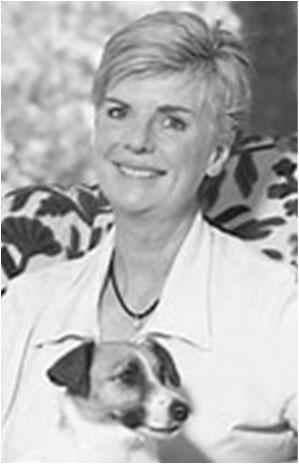
disciplined, she ate only half a petit four. Not enough to satisfy an ant. Beauty like fame, fades and it’s as well to have something to fall back on. A strong family, a rich intellectual life, a coterie of close friends who aren’t afraid to tell you if you’re messing up. Or in my case, a wonderful education that instilled practical values. For a while, I was just like all those people I’m talking about. I thought my life in the fast lane would go on forever and none of the pitfalls could possibly happen to me.
Then my wonderful, larrikin brother died and three days later my husband. I was 44 years old. I’d spent a lifetime recording other people’s stories as well as covering droughts, floods, famines, the victims of crime, child abuse and the big news stories, such as Lindy Chamberlain’s release from prison, and in the later years, putting those stories together as an editor. Then poof. All vanished. Suddenly, I had no idea where I belonged anymore. Nothing would ever be the same. What I thought was an unassailable status quo, had fallen apart. I spent the next two years in a blur. Goose-stepping onwards and unaware I was quite mad with grief.
The thing about the death of someone very close to you, is that it forces you to reconfigure your life. I chose to do it in a self-destructive way. I gave up working: I didn’t care about other people’s stories any more. I sold my house: I didn’t want to stay in a place with all those echoes of my former life. I had an affair with an unsuitable man, and I looked for solace in the bottom of a wine glass. But somewhere along the way, I found the courage to take a huge risk. I bought a tin shed in a funny little place called Pittwater, about 45 minutes from Sydney’s CBD. And I turned every notion of civilised life on its head. Because the place I’d bought was accessible only by boat. Naturally, I didn’t own a boat. Certainly had no idea how to drive one. There were no roads, no streetlights, no cafes, definitely no restaurants. The men weren’t the lounge lizard charmers I was used to, either. They were blunt-speaking shipwrights, sailors, artists, musicians and knock-abouts, seduced by the romance of the sea, but they’d never see anyone do it hard if they could make a difference. Even the smattering of doctors, lawyers and architects had a different view of what really mattered. So Pittwater with its ragged red escarpments, a magical waterfall that I could see through the kitchen window, and gently pulsating tawny green waters, cast what I can only call a spell. Heedlessly I threw myself into a new world to begin again without any familiar support systems.
But hey I was an old Clyde girl. Fallen by the wayside for a while, perhaps, but I’d picked bracken on the golf course in the middle of a freezing mountain winter. I’d walked to the Cross through snow until my hands and feet were so numb with cold I thought
they’d fallen off. I’d run the rough track to Clyde Corner to get fit for basketball, taken the steps to the art room three at a time – going up as well as down – and I’d weathered Madame Ten Brink’s stern eye when I’d failed to complete a French assignment. Thinking back, that was probably the toughest rite of all!
As it happened, lifestyle wasn’t the real challenge. Three weeks after moving into the tin shed, I was diagnosed with breast cancer. It is one thing to live and even thrive on risky edges by choice. Quite another to be told you have a life-threatening disease and to feel the disorienting sensation that goes with understanding that suddenly, you’re not like other people any more. You dare not make plans for the future. Dreams are out of the question. And hope is a foolish indulgence. It was like walking down a long narrow corridor and having every open door slammed shut in my face. It was the worst of all wake-up calls.
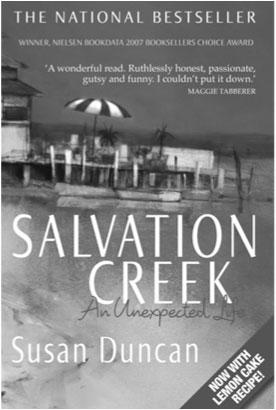
I stepped on the treadmill of surgery –a mastectomy – and chemotherapy. Bizarrely, I discovered a neighbour, Barbara, up the hill in a beautiful home built for Dorothea Mackellar in 1925, was also having treatment for cancer and we sat often, on the wide verandah with its muscular columns, drinking tea and eating lemon cake while the colours of the bay changed with the shifting light. Talking always about life, not death.
For me it was a time of many questions. Who chooses who lives or dies? Does everyone fight her way out of the mire? Or only the toughest people? And what does it take to be tough? When the boys died, I watched videos when I woke in fright in the night, panicked and bereft. I couldn’t cope with any more grief, even fictional grief.
After the cancer diagnosis, I read cook books. Especially Stephanie Alexander. I lost myself in studying recipes, learning about different vegetables and how to prepare them correctly, marking particularly complex dishes to cook when I felt better.
I settled into life in Lovett Bay. Nurtured by our strong offshore community. There was always someone who offered help. Someone to talk to. Always life to watch unfolding at the boat shed next door. There was much laughter. My hair fell out and no one gave a toss. I slept through winter, with a ridiculous woollen cap on my head. I bought two Jack Russell puppies that created havoc in the bays. But people were kind and supportive. No one complained.
Soon, I found that another offshorer, gorgeous friend Caroline Adams (Blakiston), who was at Clyde a few years behind me, was also having treatment for breast cancer. We began walking our dogs together on the tracks that wound around the bays, stopping often to breathe in the wonder of the Australian bush
and the glorious water views with beautiful yachts under sail. Another old Clyde friend also turned up, lovely Deborah Eastwood (Llewellyn-Jones). In a while, we all began meeting each afternoon for the dog walk. And we continued to do so.
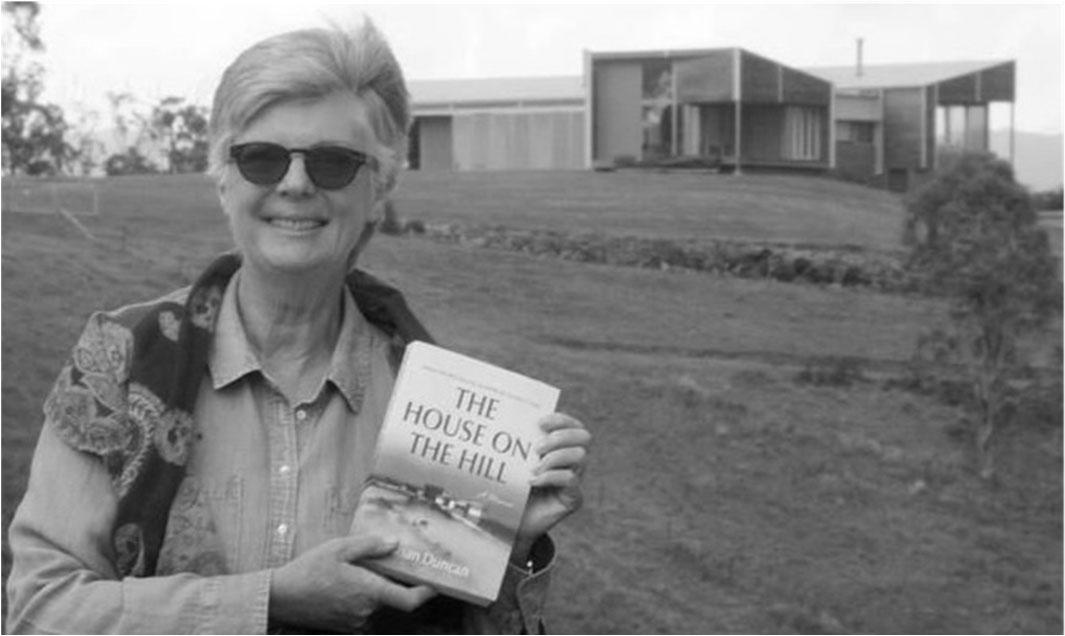
When Barbara, my neighbour up the hill in the beautiful cream-coloured house died, her husband, Bob Story, started coming down to the tin shed for dinner. He brought the wine. I cooked. It gave us both something to do in the empty hours between nightfall and bed. We talked on the foreshore while we held fishing lines. Sometimes in front of a roaring fire. Sometimes over a cuppa and a slice of cake. We had both experienced death up close and personal. I still had no idea if I would live a year, two years or ten. When you have a very clear understanding that life is finite, you grab happiness when it comes your way. Bob and I fell in love and married. As Barbara knew we would long before Bob and I. Suddenly, at a time of life when I thought there were only diminishing possibilities ahead, I found that I was happier than I’d ever been.
After a year or two and a lot of false starts, I penned Salvation Creek. When it was done, I threw it at my publishing guide and mentor Caroline Adams: “See if anyone wants it,” I said. “I’m not an agent,” she squealed. “You are now,” I said.
It was the beginning of a roller coaster, a new career for me. The book became a best seller – no idea why. Perhaps it was the stories of Pittwater and the description of how a strong community creates strong individuals. We all need to love and be loved in return. For so long, I held onto memories because I was afraid I’d forget. When it’s written, you never forget. No one escapes difficulties. What truly matters is how you deal with them.
The trick is to keep breathing.
Ed: Reprinting Susan’s COGA AGM 2014 talk (edited) seemed the best way to convey the story of her life; obituary published in The Australian, November 2024; The Cluthan 1969; Australian Country Houses magazine 2025.
Judith ‘Judy’ Camden ALLEN
20 November 1938 – 12 February 2025
Clyde 1949-56
Judy Allen was the first-born child of Keith and Shirley Allen. She had two brothers Jim and John. Jim Allen (P’61) attended Geelong Grammar as a student in Perry House. Sadly, John was killed in a car accident as a teenager in 1964. Judy’s ancestor, the first Richard Allen, came to Australia from Ireland in the 1850s. He founded a family company Richard Allen & Sons Pty Ltd, beginning as a manufacturers’ agent in Flinders Street in 1880 and expanding to build the largest warehouse in Flinders Lane, Melbourne. Richard Allen lived at a house called Kooyong in Gladstone Parade, Elsternwick. He enjoyed golf and hosted an archery club at home, he was a generous supporter of the YMCA, of the Presbyterian Church, and was a city councillor for twelve years as representative of LaTrobe Ward. He was survived by his sons Stanley Anketell Allen, Henry ‘Harry’ George Allen and a daughter Rose Kathleen Smibert. Their original home is now part of Methodist Ladies College, and Kooyong Road leads to it.
Richard Allen’s second son, Harry Allen was Judy’s grandfather. He was an early member of the Metropolitan Golf Club, featuring on its honour boards of 1913. Judy’s father Keith Allen played pennant golf in the 1940-50s on a handicap of four.
After doing her primary schooling at St Catherine’s, Judy boarded at Clyde from 1949-56. Her brother Jim remembers the egg and spoon and sack races on sports day; Visiting Sundays to see his big sister, barbecues on Mt Macedon and lunch at the legendary Log Cabin. On one visit, Jim offered a jar of tadpoles from the Clyde reservoir to the head mistress, Judy was so embarrassed she asked her mother not to bring him again!
Judy inherited her family’s love of golf. At Clyde she was the Junior Golf champion in 1953, and also played in the Junior Baseball team. She served on the Library and Golf Committees in 1955-56, and was Senior Golf champion in her final year 1956. Later in life, during 65 years as a member, she was Women’s Captain at Metropolitan Golf Club, extending a family tradition of golf club membership and treating it almost like a home from home . At Royal Melbourne Golf Club, the annual putting competition is named after her great uncle Stanley Allen, their grandfather’s brother. In turn his son Richard Stanley Allen belonged to several golf clubs, while his next generation, Judy’s cousin Richard Robert Allen has been captain at Royal Melbourne, Director of the Australian Golf Foundation, is known as a golf writer and journalist, and still plays off low single figures. In recent years Judy retired from playing golf, but continued to enjoy card games at Metropolitan every week. It was a special place for her.
After leaving Clyde, Judy worked at an upmarket bookshop in Collins Street called The Literature, followed by four years in Sydney working in secretarial roles. Back in Melbourne, she worked for a number of charitable organisations including the Braille Library in Prahran; 25 years for Meals on Wheels in the City of Camberwell; 30 years for MECWA Care in Malvern, a premium aged care residence offering a range of social and recreational activities, respite care or palliative care tailored to individual needs.
Dame Elisabeth Murdoch (Greene) once mentioned to Jim that Judy was a life member and governor of the Royal Children’s Hospital, after volunteering in the kiosk and florist for over 20 years. Judy’s many years of quiet achievement and steadfast service to support charitable organisations and social causes were remarkable. She has earned sincere community gratitude and acknowledgment for her efforts.
Jackie Mackinnon (Kelly) remembers Judy as ‘a great supporter of Clyde. She helped with the archives for many years, attended committee meetings, Clyde fund raisers and who could forget her as chief bean-counter at the Jumble Sales. She was always reliable and efficient but didn’t suffer fools’. In the 1980s, not many knew that Judy was to become engaged to a merchant seaman called Captain Ian Harry North, who was Master of the Atlantic Conveyor, a British merchant ship sent with cargo to the Falklands War. It left Britain on 25 April 1982 carrying military helicopters, munitions and stores for British forces. The ship was struck by two Exocet missiles and 57yo Captain North, who had been at sea for 40 years and served in WWII, was one of 12 casualties amongst the crew of 33. Captain North was posthumously awarded the Distinguished Service Cross. Jim said that at the time, he thought Judy was very stoic in facing this personal tragedy.
Jim says that he and Judy became increasingly close in the latter 40 years of her life, spending more time together especially at Christmas. Instead of Judy attending a charity function while Jim went trout fishing in Tasmania, they recently joined either the deSteiger family at Point Lonsdale or Mary Jane Joscelyne and her family at the Melbourne Cricket Club for Christmas together. Jim thanked the Metropolitan Golf Club for welcoming him in hosting a celebration of Judy’s life at the club on 1 April. He said many will miss his ‘very special sister, with her forthright approach and sense of humour’. She will be greatly missed by many Clyde Old Girls who have enjoyed a lifetime of friendship with her. Judy’s generous and kindly spirit will bear a long-lasting legacy among those she has so thoughtfully supported.
Ed: Our sincere thanks to Jim Allen for sharing his personal tribute to Judy; other references include Cluthans 1956-57; the Imperial War Museum, Volunteer London Blog (25 May 2022, by Richard Maddox); Victorian History Collections; MECWA website.
Juliet ‘Julie / Kimmy’ Ann AVERY (Kimpton) 18 August 1951 – 1 June 2025
Clyde 1963-69
Her mother was Moira Alice Kimpton (Creswick) Clyde 1935-40; her sister, Gillian Storey (Kimpton) Clyde 1954-59. Moira’s sister, Sheila Marjorie Kimpton (Creswick), also went to Clyde, 1930-33.
In 1963 and 1964 she was in the Under 13 Baseball and Tennis teams. In 1964 she also started First Grade Music. In 1965 she was in the Junior Tennis and Baseball teams plus the Under 13 Hockey team. She also completed Second Grade Piano. In 1966 she was in the Junior Baseball, Tennis and Hockey teams plus the Choir. In 1967 she was in the Firsts Tennis, Seconds Baseball and Hockey teams and she continued in the Choir. In 1968 she was in the Firsts Tennis, Seconds Baseball and Hockey teams plus the Choir. She also received a credit for Fifth Grade Singing. In 1969 she was in the Firsts Tennis, Seconds Baseball and Hockey teams.
In 1970, soon after leaving school, Julie and Diana Jane Rouse headed for Europe, hoping for lots of skiing in Switzerland and Austria. Later that year Julie studied at Holmes Commercial College. In 1973 she married Anthony ‘Jack’ Avery and had three children; Mark, Nick and Ginny.
Julie was a unique and sometimes unconventional mother who worked hard to instil values in her children. She provided them with an amazing platform to pursue their own interests and dreams, and her goal, as a parent, was for her children not to feel pressured to do things they weren’t interested in. She was known to be strong, independent, and adventurous, even after her husband passed away.
Recollections of Julie often start with the family’s hobby farm in Shoreham, where they spent many weekends, school holidays and long summers. It was a time filled with days at Flinders back beach and tennis games, which were generally fun despite Julie’s occasional competitiveness. Christmas days with the Kimpton family at various locations are also cherished memories. It was at Shoreham that her children realised Julie had a ‘breaking point’ and was ‘no pushover’. When their collective sibling relationship was ‘worn out,’ she would intervene. She
would issue directives for them to spend time outdoors, no matter the weather, and sometimes things would escalate if they hadn’t settled down upon their return. While Julie was ‘diminutive in stature,’ she had a ‘scare factor’ and could administer ‘stern discipline’; a ‘graveyard of broken wooden spoons’ stood testament to this each summer.
Julie was also resourceful. For many years in late January, she would take her children to the Australian Open Tennis, sometimes for several days in a row. This allowed her to entertain the children while also getting to watch grand slam tennis, something she truly enjoyed. She encouraged her children to hunt for players’ autographs, justifying it as providing them with independence and responsibility however her children knew that she enjoyed the ‘blissful peace and quiet’ of their absence.
Music was another one of Julie’s passions. She loved listening to EON FM with her children in the Datsun, singing along to artists like The Police. On longer road trips, she was in charge of the cassette player, and the family would listen to whole albums from artists like Phil Collins and Chris de Burgh. Her love for music even influenced major purchasing decisions, such as the time she bought a bright red Volvo 850 after being impressed by its stereo sound. The family’s first concert was a John Farnham concert at Flinders Park, which Julie booked for the whole family, much to their father’s amusement. The evening ended with everyone singing along to a rendition of ‘Sadie’.
After her husband’s passing in 2008, Julie’s strength was astounding. She sought a new adventure and purchased a unit in Port Melbourne, a place where she had no family or friends nearby. She liked the feel of the area and the view over the water; she felt the area had a vibrancy that Toorak was missing. She later shared that it reminded her of happy memories with her father, Roger, visiting Princess Pier.
Julie had a bold sense of fashion that set her apart; from bright pink hats to leather pants worn to oncology appointments. She kept up with (and sometimes went beyond) contemporary fashion, with sunglasses, handbags, jackets, and shoes being her signature. Julie was also active, playing in a weekly tennis group and later playing golf at Royal Melbourne. She was fortunate to do personal training for over fifteen years and her level of fitness was so amazing that she continued her weekly appointments even while undergoing chemotherapy.
When diagnosed with pancreatic cancer, Julie’s commitment to treatment and her optimistic attitude were remarkable, especially given that her mother and cousin had passed away from the same disease. Throughout her battle with cancer, which included major surgery and multiple rounds of chemotherapy and radiation, she showed ‘an immense amount of gratitude’. She was appreciative of the support from her family and friends and marvelled at the compas-
sion shown to her by everyone at Cabrini. She defied all the timeframes given to her, driven by a desire to see more of her loved ones and a ‘massive amount of resilience’.
Julie was also nostalgic, often recalling happy times spent at Bokatarra and Christmases with her family. She would talk about her husband and tell funny stories about them as a couple. She was a cat person, an avid reader, a crossworder, a moviegoer, a singer, a tapestry enthusiast, and a puzzle solver. She was a friend to many, an aunt, a godmother, a sister to Gillian, Geoff, and James, a mother-in-law, a grandmother (though she preferred her grandchildren to call her Jules), a wife, and a mother. Anthony loved her deeply and they now rest together in a quiet corner of the Flinders cemetery, as she always wanted.
Ed: Information from Cluthans 1963-70; Mark Avery’s eulogy with the assistance of Gemini AI.
Reflections from her classmates
Anne Austin and her husband Leigh were living in Port Melbourne when Jack Avery died and Kimmy moved to Beacon Cove, Port Melbourne. Kimmy loved living there with the view of the sea and she was very busy with her children and golf. Anne and Leigh caught up with them a couple of times when they happened to rent a weekender in Flinders. Anne wrote “Always lovely to see her and her lovely smile. At Clyde we were good mates in the early years and spent holiday time with each other’s families. Visiting ‘old Mrs Creswick’ (Kimmy and Sally’s grandmother Ishbel) in Flinders (when they were about 12) gave me some insight into the Old World – ‘Do you ride side-saddle or astride?’ In our later years at Clyde, we were still good friends but our paths diverged a bit – she more into sport, me more into art and music. After school we both did a bit of fundraising party time with the Wool Ball Committee at the TokH. Then for her it was Jack and the children and I was back at work, Uni and other things so we lost touch during the years she was focussed on raising her family.
Sally Bayles (Creswick) and Kimmy were first cousins, both starting at Clyde in 1963, there for seven years together. Sally and Diana Jane (Rouse) Griffin and cousin Carol Batty (Kimpton) were all bridesmaids for Kimmy at her beautiful wedding in the family home and garden in Whernside Avenue. Sally wrote “Apart from school days with Kimmy, I remember our summer holidays at Flinders when we were little girls. Lots of swimming, snorkelling and tennis; she was always a very down to earth, straight forward lovely girl.
Penny Bennetts (Vine) wrote “Kimmy was such a kind and gentle Clyde Girl; I was in the School Choir with her and really enjoyed hearing her voice. It’s so sad she had to go the way she did.”
Vickie D’Antoine (Hughes) wrote “I have very fond memories of her. During our school days I
would stay with her and the family, more particularly down at Shoreham during the summer holidays. After leaving school we continued to meet up and play golf together, including representing Clyde in the interschool golf
Amanda Elliott (Bayles) wrote “Often shy; she had a beautiful singing voice and was in the School Choir. She was an excellent sportswoman – we were in the Senior Tennis Team (8) together; we also competed against each other in the school golf comps. Everyone respected Kimmy and you definitely did not cross her but I’m sure I remember that she was a fairly common ‘bracken-puller’ (with many of us!). When we left school, we pretty much led different lives except if our families met up during summer holidays in Flinders and during Race Week, Australian Tennis or a friend’s wedding.”
Wendy Forwood (Lipman) wrote “I got to know Kimmy from my first day at Clyde, in 1969; we sat next door to each other every morning and she chatted about herself and filled me in about the do’s and don’ts; we had an easy going, peaceful friendship and enjoyed our partnership in the Senior First’s Tennis Team we also partnered again at the School Tennis Championships (both of which we won very convincingly). It was the same for the Senior Golf Competition, winning strokes ahead of our competition to become the 1969 Senior Champion Golf Pair. Later we caught up a lot down at Corio as we both had daughters in the same year so of course there were lots of chats. However there was always one thing that really bugged Kimmy deeply which was that that new principal of Clyde had never acknowledged or awarded either of us for our Senior Golf Championship wins – even with the traditional cup trophies, nor were these very admirable golf wins ever written up in that year’s Cluthan. It incensed Kimmy so much and quite understandably so.”
Peta Gillespie wrote “I was good friends with Kimmy at school; I remember being invited to a weekend at the family house and finding a button under the table. Being a very naïve country girl, I had no idea it was to summon the butler! I had never seen anything like it before, nor the formality which at the time I found quite intimidating but I was grateful for the education of how to behave in polite society!”
Jane Grimwade, as House Captain of Clutha, remembers Kimmy being a solid, dependable member of Clutha and of Kimmy playing interhouse and interschool championship tennis and golf, admirably winning everything in 1969.
Prue Hunter regards her as a great sportswoman, gorgeous singer, general all-round contributor. After leaving school four or five of them kept up with her, mainly for birthday lunches around Melbourne.
Jackie Mackinnon (Kelly) wrote “Kimmy started at Clyde a year earlier than me and was confidently
connected with the school routine – our bond began strongly over music and sporting interests, as well as the years of bus or train travel to the same orthodontist clinic and afterwards our main reason to get to the famous Hilliers for their signature marshmallow and chocolate drinks; Kimmy was my partner-incrime. Anytime I had a trip to Melbourne, I would organise to see Kimmy and Jack (in Denbigh Road and Yarranabbe Avenue) and their young kids. The Avery and Kimpton families’ Memorial Service for Kimmy at the Toorak Presbyterian Church was quietly uplifting and truly memorable.
Julia Ponder wrote “Kimmy was sporty and I always had my head in a book however we both loved singing in the choir. I shared a dormitory with her –the Mildew room in Iceberg corridor. Kimmy was a good sharer and fun to be with during midnight feasts and when we ate our ice-cream birthday cakes in the Nursery by the fire. I remember an early reunion we had at her place and her dramatic recounting of the hours before the birth of her first child.”
Mandy Snaddon (White) wrote “Janie Grimwade, Kimmy and I shared quite a bond because we were the only City girls in the class of 1969 Leavers. I remember going to Kimmy’s 21st birthday party at the family home in Whernside Avenue, where a band called the Strangers were playing – a fun bunch of boys. I, plus many of Kimmy’s other friends, remember it being a great party.”
Sue Strachan (Skene) remembers Kimmy having a very strong singing voice, out-singing everyone else during choir rehearsals. She also recalls having lunch at the Kimpton’s during the school holidays, Kimmy at one end of the formal dining room and she at the other, where a butler in a black suit served their lunch – all rather formal even without parents or siblings present. Sue celebrated her own 21st party at Cliff House, Mt Eliza and invited many friends, including Kimmy and Jack; to this day she can remember Kimmy wearing the most beautiful green and blue check Thai-silk dress; she was the belle of the ball. This was the start of their romance as it didn’t go unnoticed that Jack and Kimmy danced together all night long. Many of us attended their wedding, drinking champagne in the beautiful family home and garden.
Obituary notice in the Age sent in by Margie Gillett (Cordner).
Everyone knew each other well at Clyde and Julie was a popular fun friendly person who was involved in all aspects of sport and recreation. Sincere condolences to her family on the loss of a lovely mum and long-time friend to many.
With very best wishes from the Clyde Old Girls Association, President and Committee.
Spectemur Agendo xxx
Susan Margaret PENDER (Rymill)
1 January 1942 – 10 June 2024
Clyde 1952-58
Susan was born on New Year’s Day 1942 in the old Penola Hospital, the daughter of Robert Riddoch Rymill (1904-90) and Gladys Edith (Hood), graziers of Penola Station, South Australia. Susan’s parents had married in a secret celebration in 1938 and had three children; Susan and her brothers Robert and Tom Rymill.
Susan’s family had owned Penola Station since her grandfather, Robert Rymill, acquired the property in 1900. He married Mary Edith Riddoch of Yallum Park in 1902 and there is a photo collection of their marriage and the early homestead at Penola Station in the South Australian State Library. Their oldest son, born in 1903, was John Rymill the Antarctic explorer. Sadly, Susan’s grandfather, who was proud of his horse carriages and new motor car, was killed in a road accident close to Penola Station on a stormy night in 1905, leaving her grandmother widowed with two young boys.
Susan’s father took over the running of Penola Station but, during his war service, she and her brothers rarely saw him at home. He served as Captain Robert Rymill in WWII, discharged from military service in 1946 and thereafter continued his significant service to the local community. He was a councillor and the Chair of Penola District Council for many years, the third generation of Susan’s family in this role. He held leadership positions in the Institute Committee, the Firefighting Association, Penola Park, the Returned Soldiers Association, the Penola District Hospital, the Committee of Primary Producers plus the local football and cycling clubs. At the homestead, Susan’s much loved maternal grandmother Mrs M Hood of Narracoorte, known as ‘Muddie’ helped to run the household.
Susan attended Penola State School for her primary education and, in 1952 aged ten, she was sent to board at “the coldest place on earth”. Although not always enamoured of boarding school life at Clyde, Susan remained lifelong friends with her classmates. At school she played in the Junior Hockey team in the years 1953-56 and was a member of the Junior Athletics team. In 1954 she won the Lady Robinson Reading Prize; she was Secretary of the Junior Debating club 1955; Treasurer of the Birthday League Committee 1957; Secretary of the Dramatic Club, passed her Matriculation and won the Henderson Prize for English in her final year 1958.
After leaving Clyde at seventeen, Susan was sent to finishing school in Switzerland for a year, which she loved. She spent six months travelling with her parents through Europe and Russia before they dropped her off in Switzerland to start the school year in August 1959. On returning to Australia, Susan enrolled to study Law at the University of Adelaide, living at St Ann’s College, a university residential college for
girls – now co-ed. She found the law course ‘disingenuous’ and lost interest in her studies. After some negotiation between her parents and the university she decided not to pursue a law degree. Her real interest lay in journalism and fashion and she gained a cadetship at Vogue (Australia) magazine. The first issue of Vogue Australia was published in August 1959. By mid-1964, Susan was fashion editor of the magazine which has become an institution. She was offered work by the formidable Sheila Scotter who was then editor-in-chief. Prue Manifold and Ros Wilkins were also working in Vogue’s small Melbourne office on the fashion and advertising staff at the time. In a 2012 interview, Susan said “The fun we had in that office, it was crazy”. Vogue’s June/July 1964 issue featured Chanel fashion and a new popular music group called The Beatles. There were advertisements for Balenciaga, Hermes, David Jones, cleaning products to ‘keep the house clean and the husband happy’ and a new fibre called Lycra.” Susan felt that she was living through an era of revolution, shaking off misogynistic attitudes.
In 1964, at age 22, Susan married Patrick Ian Berkeley Pender in St Mary’s Anglican Church, Penola, where she was christened years earlier. Patrick was a barrister and they lived in Toorak throughout their married life. First in St Georges Court and then from 1965 at 74 Clendon Road. After years of hoping for a child, Susan and Patrick’s son Sam was born in 1971. Susan’s brother Tom was his godfather and Sam was described as a ‘loving gentle soul who worked as a chemist for RMIT in Melbourne. He never married or had children and sadly predeceased his mother in 2023’. The Penders’ daughter Skye was born in 1974 and attended boarding school in Adelaide at 15. She works as a community Occupational Therapist and, through Skye, Susan enjoyed “the three most beloved grandchildren known in history. Henry (21), Edward, known as Ted (20) and Lucia (18). They live in the Barossa, SA, with their beloved dog Ada”. Skye says that Susan and Patrick separated in 1991, but they all celebrated Christmas together in Penola each year as an extended family until Patrick’s death in 1995.
When her children were young, Susan wanted to work from home so she started creating jewellery, “making all kinds of crazy things. It was the 70s and 80s, it wasn’t about high value, it was about colour and fun.” Before using pearls, she made little pink pig earrings and Noah’s Ark necklaces at home. She was always engaged in some creative endeavour. Around 1982, she and Lany Lawson from Padthaway began Lawson and Pender Jewellery. Sadly, Lany was unable to commit her time so, in 1984, Susan Pender Jewellery (SPJ) was formed as her own business. SPJ developed out of the back room in the family
home at 80 Caroline Street, South Yarra, Victoria. Skye fondly remembers growing up with “animal based Fimo and wax creations and often being warned not to touch the drying hand-painted creations”. In 1987 Susan opened her first office in Toorak Village, Victoria. In 1988 she took a leap and accepted a lease at the exciting new Marina Mirage on the Gold Coast in Queensland. During this time her business grew and she moved from a small office to a showroom in Toorak Village. In 1998 Susan opened Deep Sea Moonlight Pearls in Broome, Western Australia; in 2002 a shop in Sawtell, New South Wales and, in 2010, a shop in Kingscliff New South Wales. Susan found a relaxing and peaceful lifestyle in Kingscliff, making stunning jewellery with pearls. Nowadays her vintage pieces are highly valued and sought after on various online marketplaces.
In 2019, Susan decided to move back to her original stomping ground in south east South Australia. She bought a home in seaside Robe, where many happy family holidays were enjoyed both as a child and with her children. Susan was diagnosed with dementia in recent years, spending her final days at a nursing home in Millicent, South Australia where she was well cared for and enjoyed a constant flow of visitors.
Throughout her life Susan’s family, friends and travel were a constant source of joy. She was extremely kind, intelligent, stylish, witty and humorous. She adored pottering in her garden, socialising with friends and treasured the time spent with her grandchildren. She died peacefully on 10 June 2024 and her memorial service was held in St Mary’s Church, Penola where she had been christened and married. In Melbourne her beloved friends attended a fantastic memorial lunch in her honour, all wearing a creative piece of SPJ and sharing happy memories.
Ed: Information from Cluthans 1958-59, 1965; Article 25.06.2012 Tweed Heads Daily News (interview); the South Australian State Library (history collection, Rymill family and Penola); online images (SPJ jewellery); our grateful thanks to Skye Rymill for sharing her wonderful tribute, eulogy notes and order of service.
Amanda ‘Mandy’ June CUNLIFFE (Rogers) 8 August 1946 – 11 February 2025
Clyde 1958-63
Amanda Rogers was the daughter of Welding Samuel ‘Sam’ Rogers (1917-89; GGS 1929-34) and June Alice Rogers (Chirnside) (1922-2017; Clyde 193439) who were married in 1942. She had two brothers Lockyer Sam ‘Lock’ Rogers (GGS 1963-67) and Timothy ‘Tim’ Welding Rogers (GGS 1967-70). Her
mother June was the daughter of Robert Gordon Chirnside OBE and Mavis Chirnside (Thiel) Clyde 1910-13, and the sister of Judith Roma Rosalind ‘Judy’ Bey-Muftyzade (Chirnside) Clyde 1934-36, Robert Andrew Gordon Chirnside (GGS 1933-43) and Russell Kenneth Neville Chirnside (GGS 193744). Her grandparents’ family home was the Chirnside property at Carranballac, Skipton in the Western District of Victoria. Generations of the Chirnside and Rogers families have been loyal supporters of GGS, Clyde School and Clyde House at GGS.
Sam and June Rogers moved house a couple of times when Amanda was a child, from Mount Widderin near Skipton, to Walkerville on Waratah Bay in Gippsland, when Amanda was two. Some of her first memories were collecting flowers and shells on the beach. They lived in a timber ‘shack’ in undeveloped bush country, before moving to Blue Meadows at Sandy Point, where Amanda started school at the local Fish Creek State Primary. There was another move to Hidden Springs in Leongatha South, and by this time her brothers Lockie and Tim had joined the family.
At age eleven, in 1958, Amanda was sent to board at Clyde, the school her mother, aunt and grandmother had attended in earlier years. She was not fond of boarding school life, describing it with typical humour as ‘an internment camp’. At Clyde she won class Honours prizes; was a member of the Junior Athletics Team 1958, Senior Athletics Team from 1961; served on the School Dance Committee, was President of the Art Committee, and passed her Matriculation in her final year 1963. Her favourite subject was art; she was creatively talented and became a successful self-taught artist in later years. She was very popular, forming lifelong close friendships at Clyde and staying in touch with many Clyde Old Girls over the years.
After leaving Clyde, Amanda enrolled in an Art course at RMIT in Melbourne, which she enjoyed, but she soon rejoined her family in Mooloolaba, before they settled at Sunnyside in Armidale NSW in 1964. Amanda’s mother June cheerfully overcame any difficulties in rustic country living; she always welcomed friends and created a happy generous family home. In July 1972 Sunnyside was sold and according to brother Tim, their parents ‘bought a paddock at Ebor called One Tree. It was perfect, no house, no water, no power, no fences, no yards. They borrowed a caravan and put it beside the creek for water and moved in’. Their rural lifestyle developed resourcefulness, good humour and a can-do attitude in their children. Despite attempting to become ‘a jillaroo in RMs and a cowboy hat’, Amanda did not take to farming life at that stage, and returned to study at university. She enrolled at the University of New England in Armidale, doing history, English and, Tim says, “boys”. He notes that her “beehive hair, dark eyeshadow and miniskirts were a shock to Armidale”.
In 1966, aged twenty, Amanda met and married Andrew Stewart-Mitchell and moved to a farm at Inverell about an hour from Armidale. Also in 1966, English designer the Hon. Merlin Cunliffe aged 31 was married to Deborah ‘Debo’ (Grimwade, later McNab) and living in Armadale, Melbourne with their two small daughters Tamsin and Sophy. Inspired by stores like Habitat and Abacus in London, Merlin and Debo opened one of Melbourne’s most influential and beloved stores, Thesaurus, in 1965. It inspired profound cultural change in design and home styling, with colourful contemporary merchandise and fabrics from Italy, France, Sweden and Finland. Thesaurus represented style, panache, humour and cutting-edge design, and in 1966 they introduced Marimekko, founded by Finnish woman Armi Ratia. Merlin was described in the Melbourne Herald (1967) as a ‘furniture designer, art decorator, second son of a merchant banker the late Lord Cunliffe, brother of the present baron and grandson of a former Governor of the Bank of England’.
In 1967 Amanda discovered the Thesaurus store in Malvern and bought rugs, furnishings and curtains for her home. Having introduced the striking new design patterns of Marimekko to Inverell, her marriage did not last. In 1968 Amanda wrote to Merlin Cunliffe enquiring about a job at Thesaurus, and after starting in Malvern, she became the manager of its Carlton store in Faraday Street where her display and design talents were put to good use. Amanda’s friends were excited to visit her at work, where a record player pumped out the Beatles, the Rolling Stones, Pink Floyd, Eric Clapton and The Band. In September 1968, Amanda was pictured in a Sun newspaper article, floating on a plastic Thesaurus ‘armchair’ in the shallows at Middle Park beach. Their merchandise was appearing everywhere, from society mansions to country homesteads, new developments and student digs in Carlton.
In the early 1970s Amanda married Peter Foster and lived in Miegunyah, Toorak, a Grimwade estate left to Melbourne University where her husband worked.
Here her precious son, the late Sam ‘Sammy’ Jack Foster (GGS 1992-93), was born in May 1975. Also in 1975, Merlin and Debo legally parted ways. Debo later married Merlin’s close friend Duncan McNab who had helped with the development of Thesaurus and made furniture to his designs.
In 1978 Amanda and Merlin were married in Melbourne. Brother Tim remembers them driving off in Merlin’s XUI Torana with Sammy waving from the child seat in the back. Merlin and Amanda settled in the Yarra Valley, at Dixons Creek. Featured in Country Style magazine, the Cunliffe’s home had a large living space with an open fireplace, scattered rugs and Marimekko fabrics. They added extra bedrooms and a studio overlooking the garden. Their 12hectare property had a dam covered in water lilies; they planted over 1,000 trees; they had five sheep, two dogs, a cat and a white cockatoo.
In their sunny studio, the Cunliffes painted exquisitely detailed works of flora and fauna, many of which decorated the walls of their home, or were sold to collectors and connoisseurs. Merlin’s intricate paintings of freshwater fish reflected his lifelong passion for his ‘piscean friends’ and fish farming. In a carefully managed enterprise, he bred 60,000 goldfish every year in the 85 ponds he maintained across their property, selling them when six months old to wholesalers and pet shops across Australia. Amanda would help out, when necessary, dressed in a wetsuit, weeding the larger ponds and caring for the fish if Merlin was away.
Amanda’s love of flowers developed into a professional interest. With her characteristic work ethic, she continued painting watercolours every day, whatever the season and always from real life. In winter the subtle colours of hellebores or the early sasanqua camellia, sometimes with insects or raindrops on a petal. Her painting had the precision and delicacy of 18th century botanical art, with the specimen in full flower along with the bud, leaf and stem, illustrating its growth stages. She sold her first paintings to a small gallery in Yarra Glen, and later through Libby Edwards Gallery in South Yarra, selected country galleries, several exhibitions and she also worked on private commission. Her finely painted botanical works were collected by connoisseurs across Australia. A major project was to complete all the exquisite illustrations for The Illustrated Language of Flowers by Frances Kelly, illustrated by Amanda Cunliffe (Viking O’Neill, 1992).
A huge bookcase filled with cookbooks reflected Amanda’s culinary talents. There was always delicious food and wine on the table at the Cunliffes and yes, she really did read all those cookbooks. Amanda ran a gourmet cooking school from the house, and later in 1996 she established her own brand (with Joh Waters), Cunliffe & Waters Condiments & Sauces, producing some of the finest handmade preserves, chutneys and jams in Australia. Their philos-
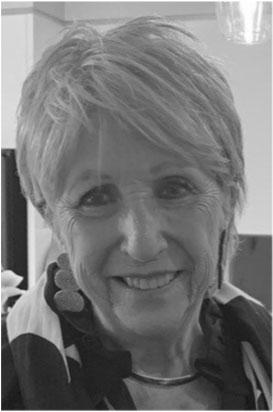
ophy was to create each batch as if making some jars for themselves and friends, preserving vibrant flavours and using locally sourced produce from the Yarra Valley. It took hard work, imagination and vision to kickstart this enterprise from a small shopfront in Coldstream. The business flourished through various phases, marketing their products nationally, while the pots and cauldrons bubbled on the home front and colourful jars filled their shelves, with a range of Merlin’s meringues. A friend and fellow C&W worker, Caroline Gray, recalls that they took the business from ‘the top of a cow paddock in Dixons Creek to being an award-winning national brand’. In 2017 Simone and Joshua O’Dea took over Cunliffe & Waters after working alongside Amanda for 20 years. She provided inspiration, support and advice to younger people wanting to start up a business
Amanda was an integral part of developing the local food scene in the Yarra Valley. Suzanne Halliday enlisted the Cunliffes to be founding members of the Yarra Valley Food Group (YVFG) in 1998. Along with a few nascent and established food businesses, they created one of the first Farmers’ Markets in Australia, galvanising a broad group of passionate growers and producers into a marketing model that was much admired and imitated in other regions. Amanda also worked part-time at the Healesville Wildlife Sanctuary, helping with displays and bringing her inimitable style to the exhibits and visitor centre.
In 1998 the Cunliffes moved to 45 St Margaret’s Road, Healesville, which became known as The
Sausage House because they bought it when Amanda went to buy sausages in Healesville one morning. She was a tireless contributor to the social and community network in the Yarra Valley. Many locals have mentioned her inspiration, friendship, her morality and honesty, the generous way she would welcome newcomers with an invitation to lunch, her ability to create beauty and style in different ways. The warmth of her personality radiated far and wide through the friendships she created, and held over a lifetime. She was always focussed on the needs and interests of other people.
Family was always the most important thing for Amanda and that is where her true devotion lay. Merlin was the love of her life and his Valentine’s Day cards were legendary. Her brothers Lock and Tim meant the world to her. She adored her son Sam (dec.) and always loved to talk about how funny, kind and unique he was. Her grandson Timmy was a source of great joy and she would have loved to see him grow up. She was devoted to Merlin’s children Tamsin (dec.) and Sophy Blake, and a loving grandmother to Lizey, Finn and Banjo. They valued her timeless advice ... “Just always be kind”.
For everyone who met and loved Amanda, including her many Clyde friends, it was a privilege to know her.
Ed: With grateful thanks to Tim and Jane Rogers; Caroline Gray; for their eulogies and memories; other information from The Cluthan 1964; Country Style (1992) article and interview by Lynne Landy; The Lord, the Lady & the Reject by Peter Wilmoth (Hardie Grant 2022); newspaper articles and online re Thesaurus, Marimekko.
Ed: Deaths are recorded when notice is received from a variety of sources. Please note that obituaries are published when information for a tribute is made available or when circumstances permit and this may not be in the year of death. We are very grateful for any information, tributes or photos provided at any time.
Please send your eulogies or other information to: coganews@gmail.com