Dark Skies Program Annual Report
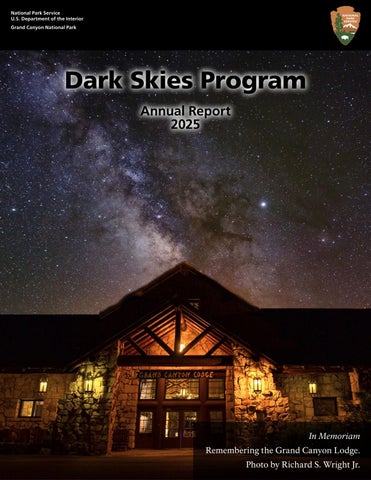
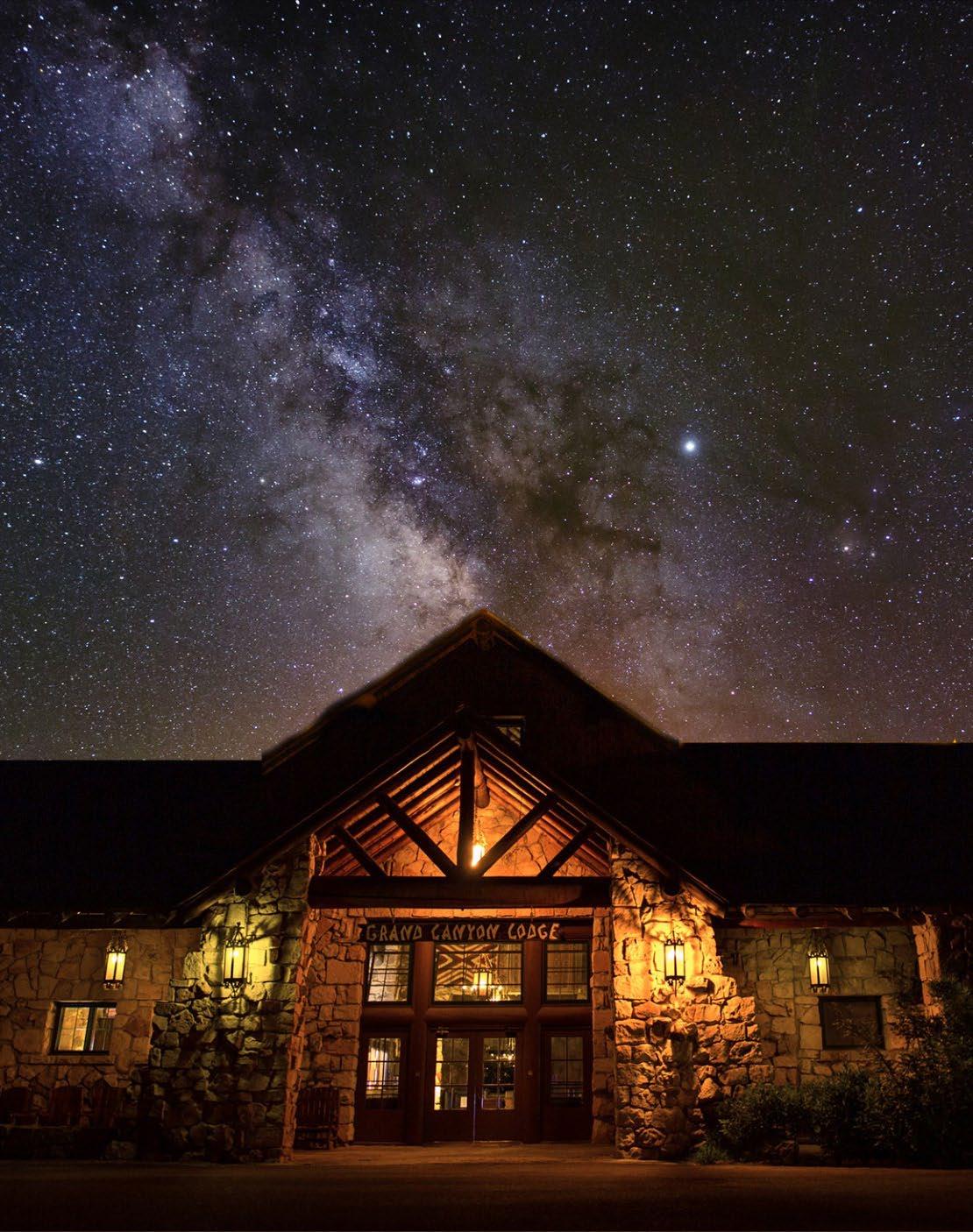
In Memoriam Remembering the Grand Canyon Lodge.
Photo by Richard S. Wright Jr.
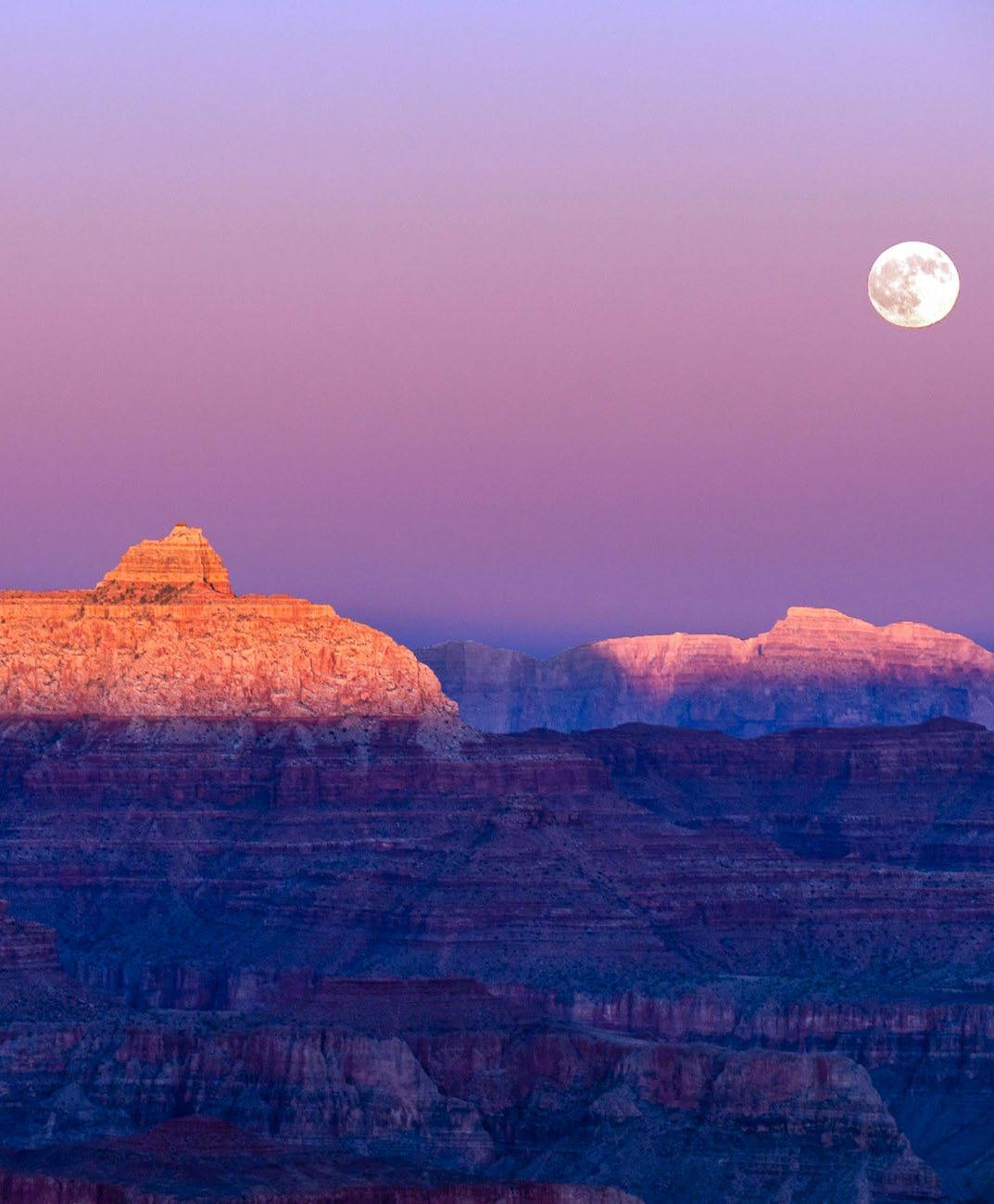
Toho’osmuya
“The Hopi people have a traditional calendar that speaks to our connection to Mother Nature, and the changes in seasons through ceremony. Each moon cycle is named in Hopi to coincide with the life ways and the time of year.
Here, Toho’osmuya, the October Wind Moon, rises over Ongtupqa (Grand Canyon).” - Bertram Tsavadawa
Introduction to the Dark Skies Program
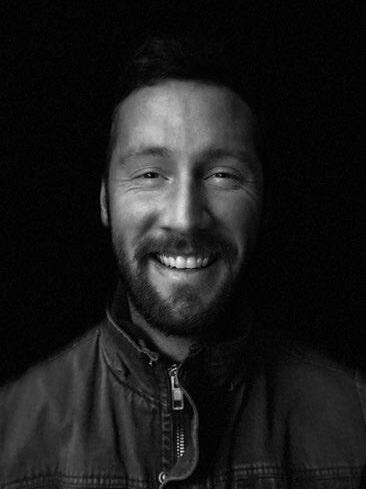
Rader Lane
Park Ranger—Dark Skies Program Manager
Interpretation and Resource Education
Grand Canyon National Park
Hi all, my name is Rader Lane, I am a park ranger in the Division of Interpretation and Resource Education. I also serve as our park’s Dark Skies Program Manager. Among the many resources we interpret, Dark Skies continues to be one of the most sought-after resources of our park visitors.
There are two main pillars to this program. First, our Dark Skies Team works to keep the park dark. We were certified an International Dark-Sky Park in 2019. During our initial pursuit, we inventoried over 5,000 lights parkwide—and we have a plan to retrofit every single one of them to be “dark-sky-friendly.”
Second, we maintain the park’s dark skies outreach programs. There are several programs upon this pillar: The Grand Canyon Star Party, the Astronomer in Residence Program, the Astronomy Volunteer Program, and more.
2025 was a difficult year for Grand Canyon National Park and beyond, full of unique challenges and tragedies. But the stars still abide. An evening of stargazing can be healing, offer perspective, and remind us why we all protect this living landscape. As we enter 2026, consider going out on a moonless night, and taking in the nourishment of one of the darkest places on Earth. I hope this report offers some perspective of our work this year. And remember, “Half the Park is After Dark!”
NPS Photo by Michael Quinn
Meet the Dark Skies Team
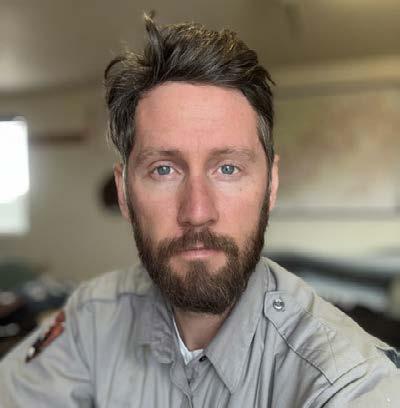
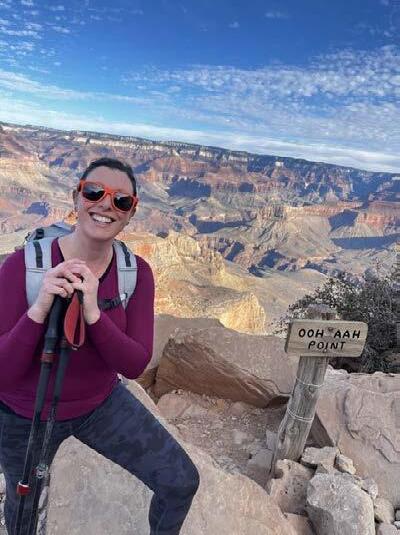
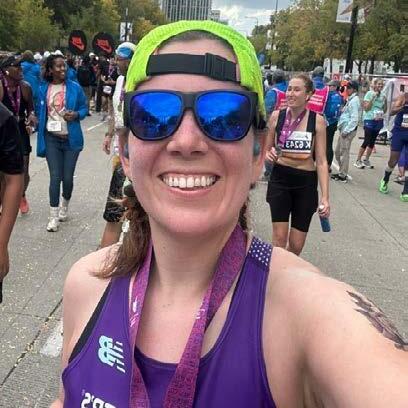
“Hi, I'm Rader. My focus is on managing our public night sky programs in the park. I like to say I am a park ranger by day, and a DARK ranger by night. But when I am holding my green laser up to the stars, people around here know me as Darth Rader!”
Rader Lane - Dark Skies Program Manager Division of Interpretation and Resource Education
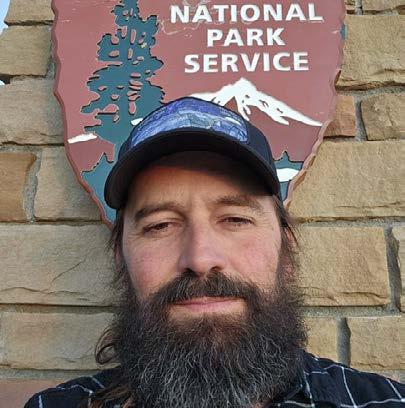
“Hi, I’m Matt. I help coordinate the retrofitting of the park’s lighting fixtures. Keeping the park sky dark brings a great sense of purpose. It is protecting something that I truly love. Seeing the milky way from here is a powerful experience that I hope all can enjoy.”
Matt Young - Construction Control Representative Division of Planning, Environment, and Projects
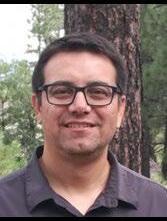
“Hola, I’m Santiago, helping lead data efforts at Grand Canyon. Being a part of the Dark Sky Team to help preserve night sky is one of the most rewarding projects I’ve participated in.”
Santiago Garcia - Data Management Science and Resource Management
“Hello! I’m Clover, Residency Program Manager with Grand Canyon Conservancy. I have the honor of running the Astronomer in Residence program. It’s been an incredible inspiration to work with dark sky experts in this magical place where we can see and treasure our place in the universe. Astronomers are really far out!”
Clover Morell - Residency Program Manager Grand Canyon Conservancy
“Hey there! I’m Lauren—a photographer, dark sky advocate, and the voice behind Grand Canyon Conservancy’s social media. I love helping visitors discover the magic of dark skies at Grand Canyon and why protecting it matters. Basically, I’m totally star-struck and here to share the view!”
Lauren Cisneros - Marketing Coordinator
Grand Canyon Conservancy
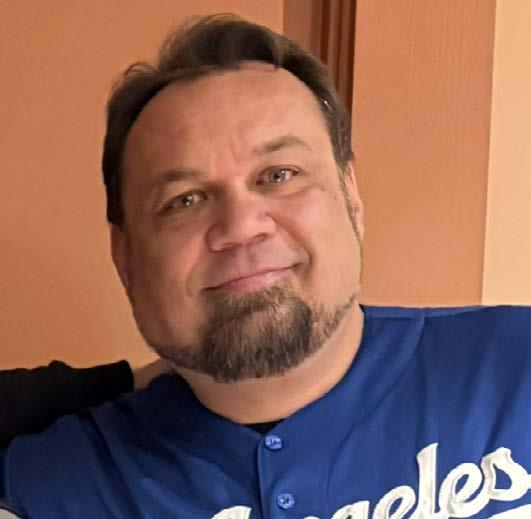
“Hi, I’m Dennis. I assist our visiting astronomers in residence with programming support, as well as any other support they might need while they are on-site. I have loved the canyon and its dark skies from my first visit over 25 years ago. I feel so lucky to be able to support Grand Canyon and our NPS partners.”
Dennis Alvarez - Residency Program Coordinator Grand Canyon Conservancy
Employee Spotlight
Dennis Alvarez was born in Southern California. He fell in love with dark skies upon moving to Tollhouse California in the Sierra Nevada foothills where he saw the Milky Way for the first time at the age of twelve. Dennis received a Bachelors in Theater, Film, and Television – Writing for the Performing Arts from the University of California Riverside. After a short independent film career, he needed a change. Dennis and his family moved to Williams Arizona in 2018 and then to Grand Canyon in Fall of 2022. He began attending residency programs with his wife shortly after moving to Grand Canyon and fell in love with the program and the organization. “After attending my first program, I told my wife, ‘This is what I want to do.’ Meeting and working with our astronomers and our NPS Rangers has been everything I hoped for and beyond. I get to support some of the most intelligent people on the planet in educating the public about the value of dark skies.”
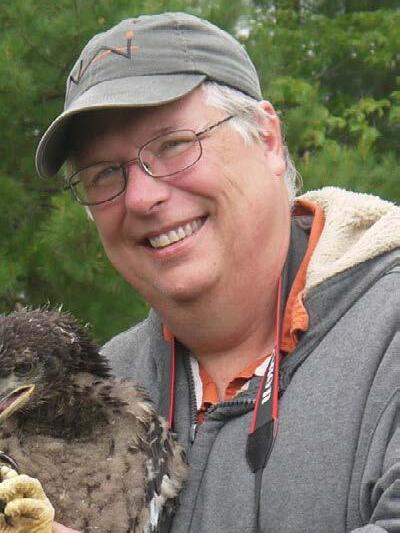
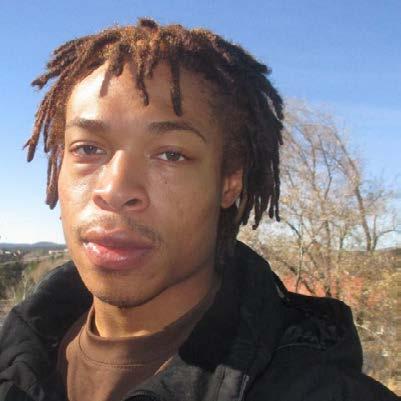
“I'm Steve, a retired Florida State Park Ranger and 10 year volunteer for NPS, USFWS, USFS, and BLM. There aren't many things in today's world people can agree on, but the majesty of a dark sky is one and that is why I love sharing it with visitors.”
Steve Dimse - Astronomy Volunteer Division of Interpretation and Resource Education
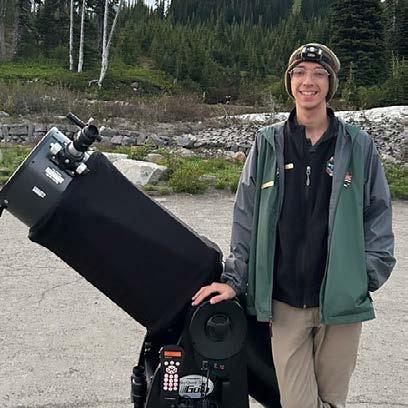
“Hi there, I’m Tyler, an astronomy enthusiast from Texas. I enjoy advocacy work, and having the opportunity to participate in astronomy outreach is especially gratifying. It has been a pleasure working with you all.”
Tyler Cherry - Astronomy Volunteer Division of Interpretation and Resource Education
“Hey there, I am Joey! I’m an Arizonan who is passionate about exploring cultural connections with the night sky. I am fortunate to be a part of such an amazing program early on in my career in Night Skies Interpretation.”
Joey Green - Astronomy Volunteer Division of Interpretation and Resource Education
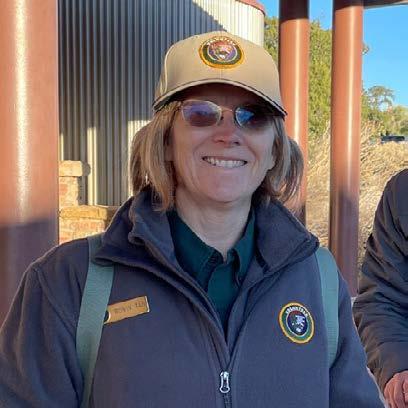
“I am a retired chemical engineer and a long time National Park junkie. Joining the astronomy team here at Grand Canyon has been a tremendous opportunity to learn new things about the night sky and to share that knowledge with our visitors.”
Robyn Tan - Astronomy Volunteer Division of Interpretation and Resource Education
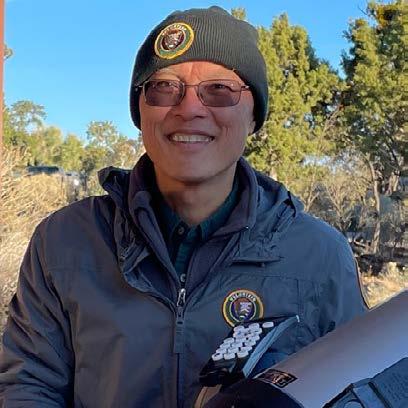
“I am a retired scientist/engineer from 3M. Making the night sky a highlight of visitors’ trips to GRCA has been an extremely rewarding experience.”
Lian Tan - Astronomy Volunteer Division of Interpretation and Resource Education
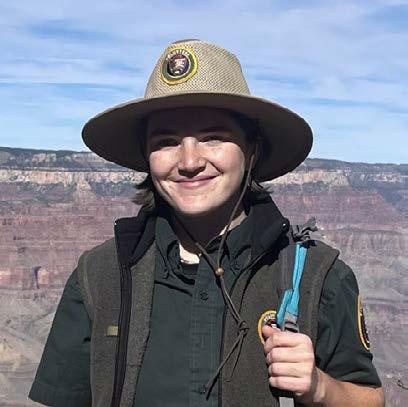
“Hi I’m CC! I am so grateful to be a part of the Dark Skies Team. Getting to witness the joy that our program brings visitors each night makes me feel like the luckiest person in the galaxy (and probably Andromeda galaxy too)!”
CC Cogswell - Astronomy Volunteer Division of Interpretation and Resource Education
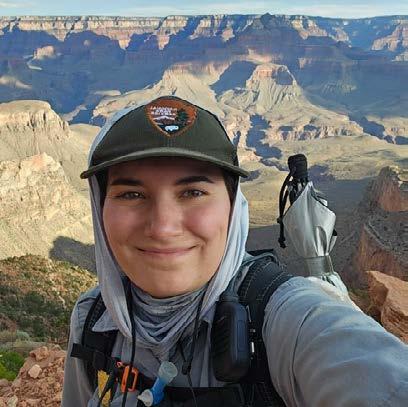
“I’m Kate, and I’m part of Canyon District Interpretation. I love being able to connect with people below the rim of the canyon, looking up at the night sky while surrounded by ancient rock! I’m a permanent ranger at Grand Canyon now, but my night sky interpretation journey began at Death Valley.”
Kate Hensel - Park Ranger (Inner Canyon) Division of Interpretation and Resource Education
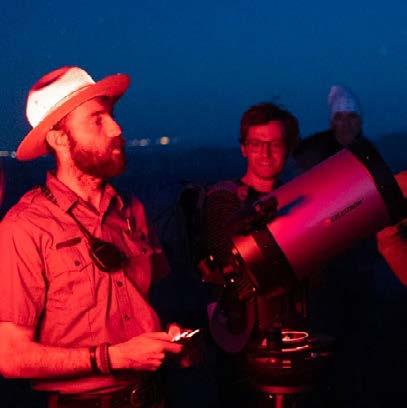
“Hi, I’m Ranger Dave, I have been working in the park service for over ten years, in a few Dark Sky Parks. I currently work on the North Rim under some of the Darkest Skies in the country. I’m passionate about creating special experiences for our visitors to experience the night skies.”
Dave Kent - North Rim Interpretation Lead Division of Interpretation and Resource Education
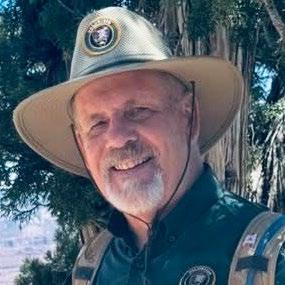
“Hi, I’m John. I consider myself fortunate to have participated in the night sky program. Not only did I get to share my love for the night sky with others, I learned a great deal from the rest of our team as well as from the visitors I met. What a great experience!”
John Hallet - Astronomy Volunteer Division of Interpretation and Resource Education
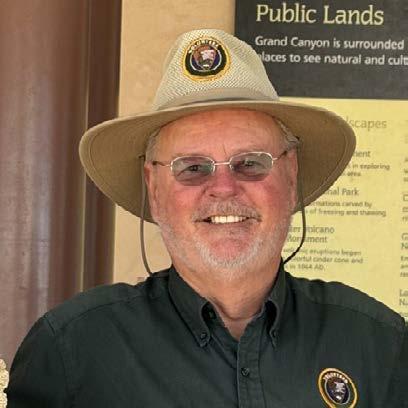
“I am Dave Hagarty. I am a NASA/JPL Solar System Ambassador and was able to pass on some knowledge that I have gained through this program. Doing daytime solar viewing as well as nighttime stargazing for over 17,000 people was an incredible experience!”
Dave Hagarty - Astronomy Volunteer Division of Interpretation and Resource Education
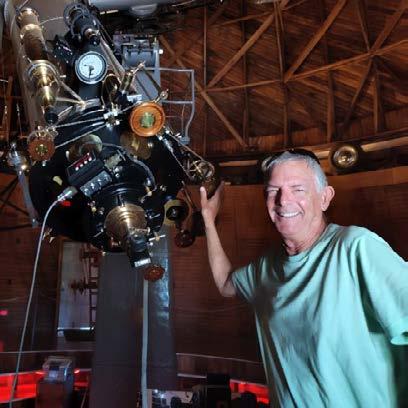
"I am Rob, a retired science teacher and VIP volunteer for the 2024 season. I am continually amazed when people are introduced to Dark Skies as some have never experienced the wonders of the sky before.”
Rob Cochran - Astronomy Volunteer Division of Interpretation and Resource Education
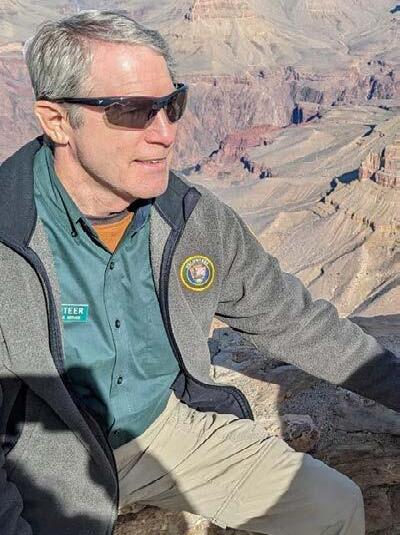
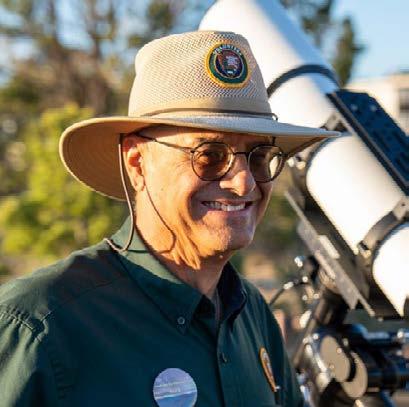
"I'm Bernie, a retired engineer. I have the privilege to share the night sky as an Astro VIP under one of the country's darkest locations. My goal is for every person I meet to experience a celestial wonder through my telescope under the majestic arc of our Milky Way. I expect this to take a while."
Bernie Sanden - Astronomy Volunteer Division of Interpretation and Resource Education
“Hello, Paul here! Former math teacher, planetarian, volunteer with the USFS, amateur astronomer since childhood. It was an honor every night sharing all I could about the order and majesty of our universe and the importance of preserving our dark skies so all may look up and wonder...”
Paul Braiman - Astronomy Volunteer Division of Interpretation and Resource Education
Dark Skies Program 2025 at a Glance...
250 astronomy programs
73,080 visitor attendance
178 astronomy volunteers
6,103 volunteer hours
3 Astronomers in Residence
35th Annual Grand Canyon Star Party
95% of lights in park are dark-sky friendly
4% increase of retrofitted lights from FY 24
Measuring Darkness
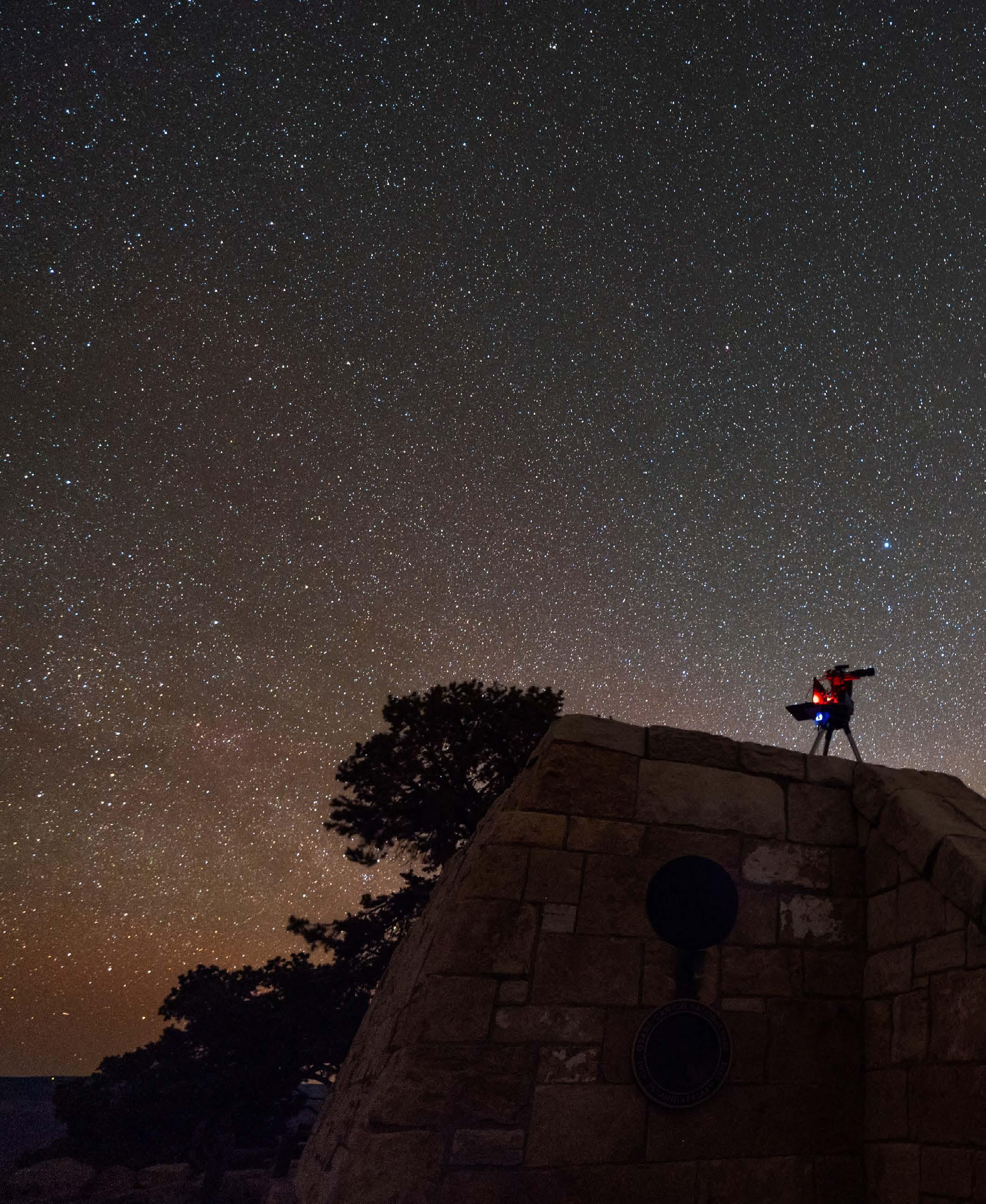
Thanks to Stephen Hummel and the Grand Canyon Conservancy’s Astronomer in Residence Program, the park collected extensive data on the quality of our night skies this year. Here, Hummel sets up his monitoring equipment at Powell Memorial, where the last extensive study of our night skies was initiated in 2015. This data is crucial to understand how light pollution has changed in and around the park over the last decade.
by Stephen Hummel
International Dark-Sky Park Certification Progress
In 2013, Grand Canyon Conservancy hired a specialist to map out all the lights in the park. She inventoried 5,000 lights! In order to become an International Dark-Sky Park, an initial 67% of the lights had to be retrofitted as “dark-skyfriendly.” That meant shielding fixtures, using warm bulbs, adding timers, or removing some all together. We achieved 67% compliance in June 2019.
The park has until June 2029 to become 100% compliant. We are happy to report that the park as of October 2025 is 95% compliant!
Shifting Perspectives
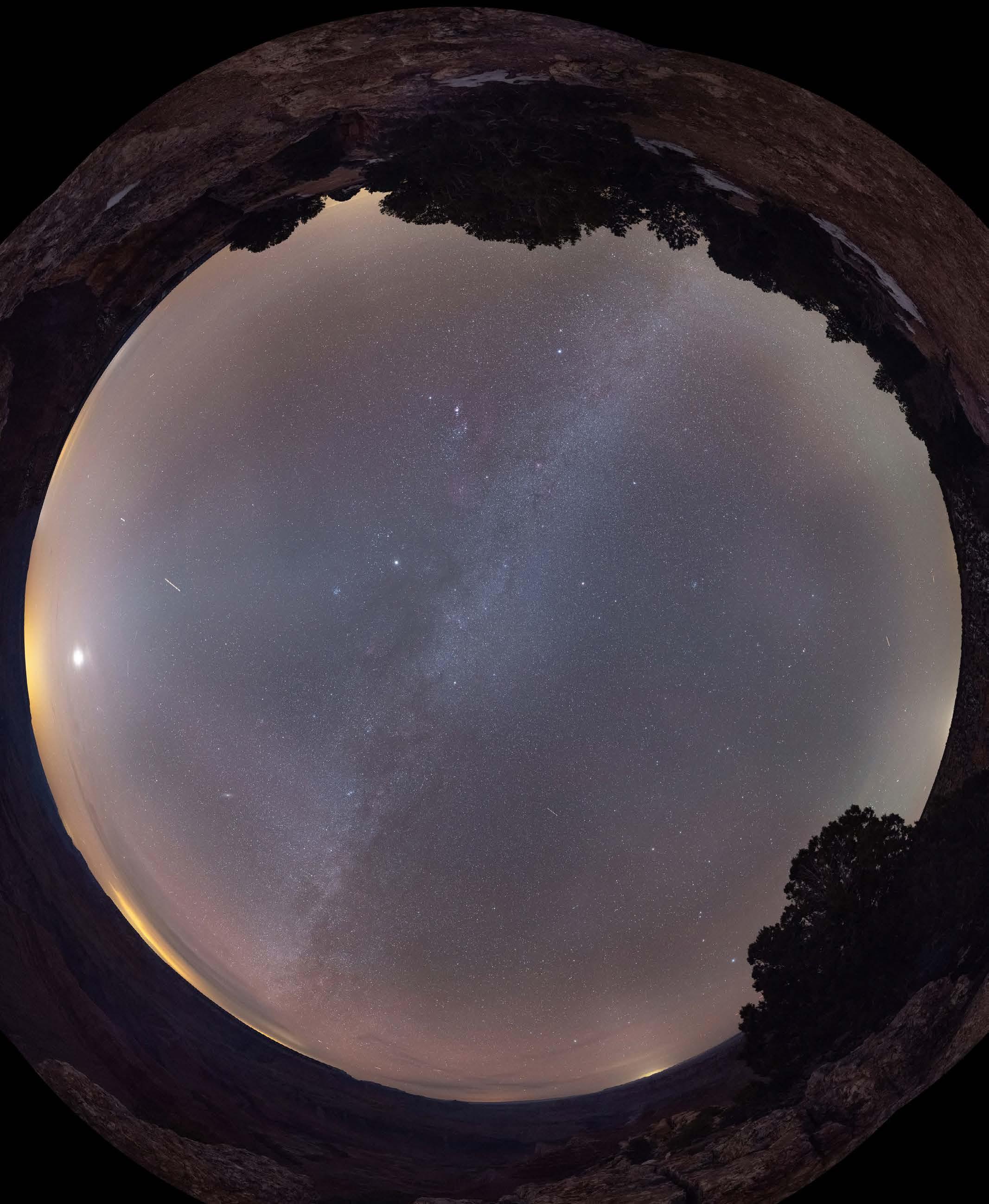
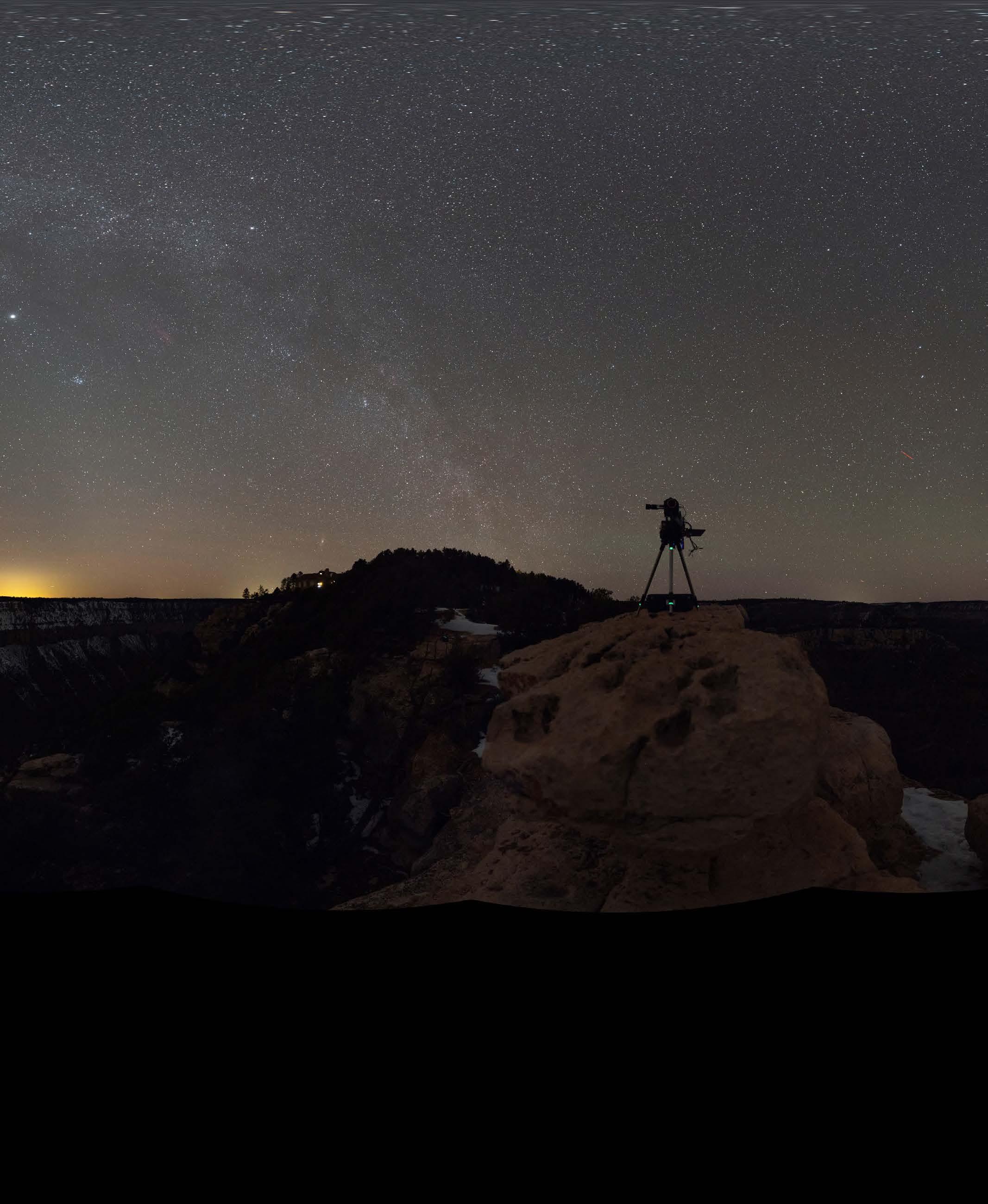
A 360 degree fisheye-lens photo from Lipan Point. Astronomer in Residence Stephen Hummel took several of these shots from around the park. These photos provide visual understanding of light pollution along the horizons.
by Stephen Hummel
Photo
Photo
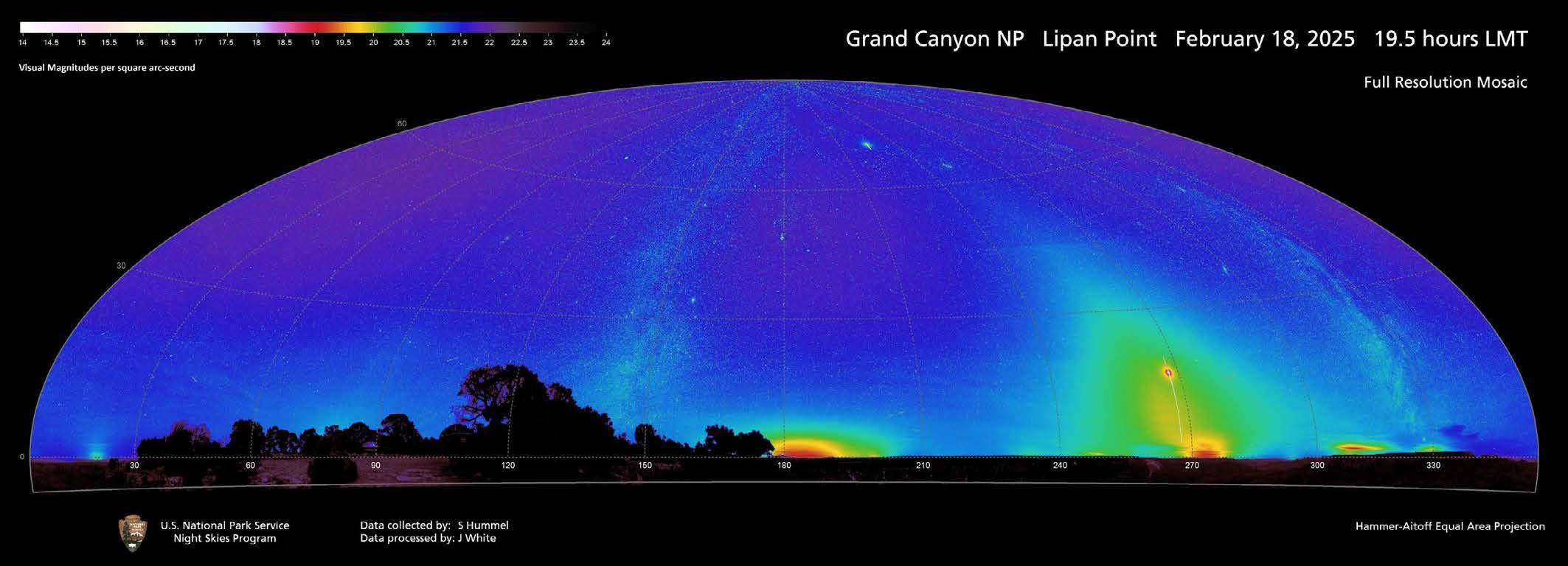
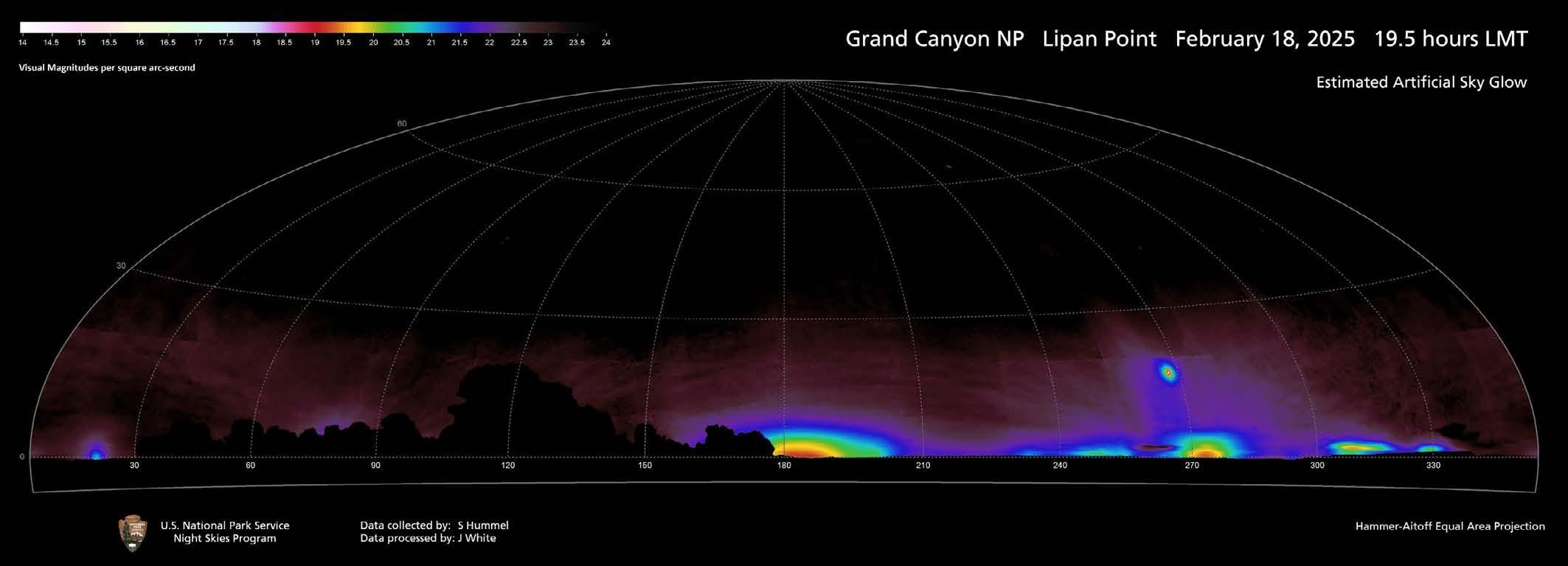
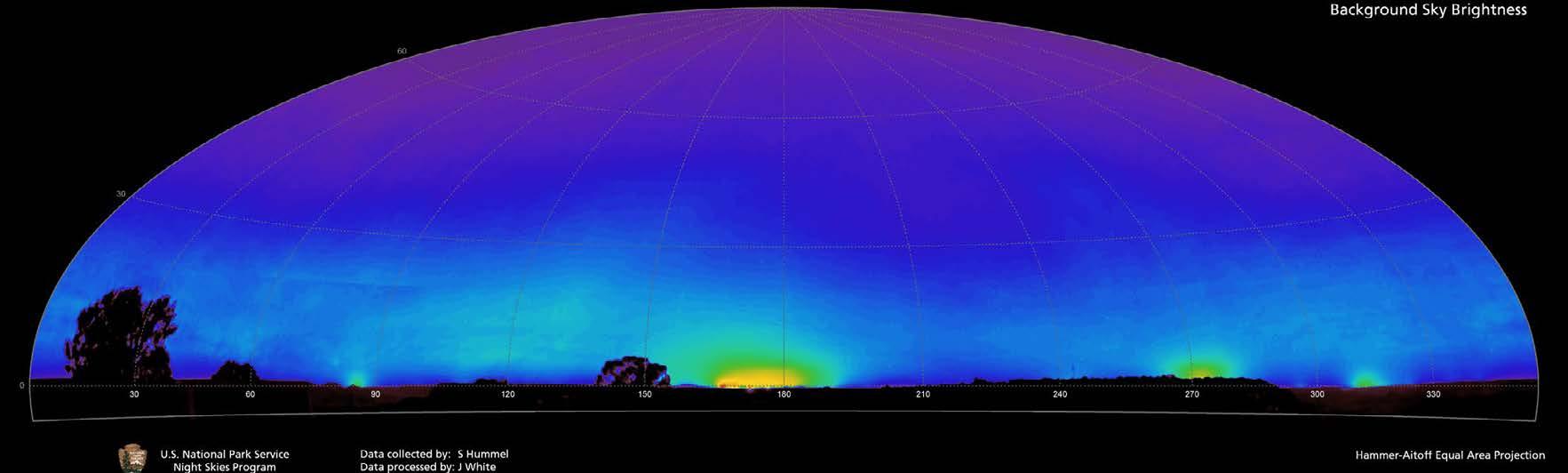
Grand Canyon Conservancy Astronomer in Residence Stephen Hummel conducted an extensive night-sky-quality study this year in partnership with the NPS’ Natural Sounds and Night Skies Division, the results of which have informed park leadership on how to mitigate light pollution from outside of the park’s boundaries. Below, the first image shows both natural and artificial sources of light at Lipan Point. The second image extracts the natural light, leaving behind only the artificial light sources from nearby cities.
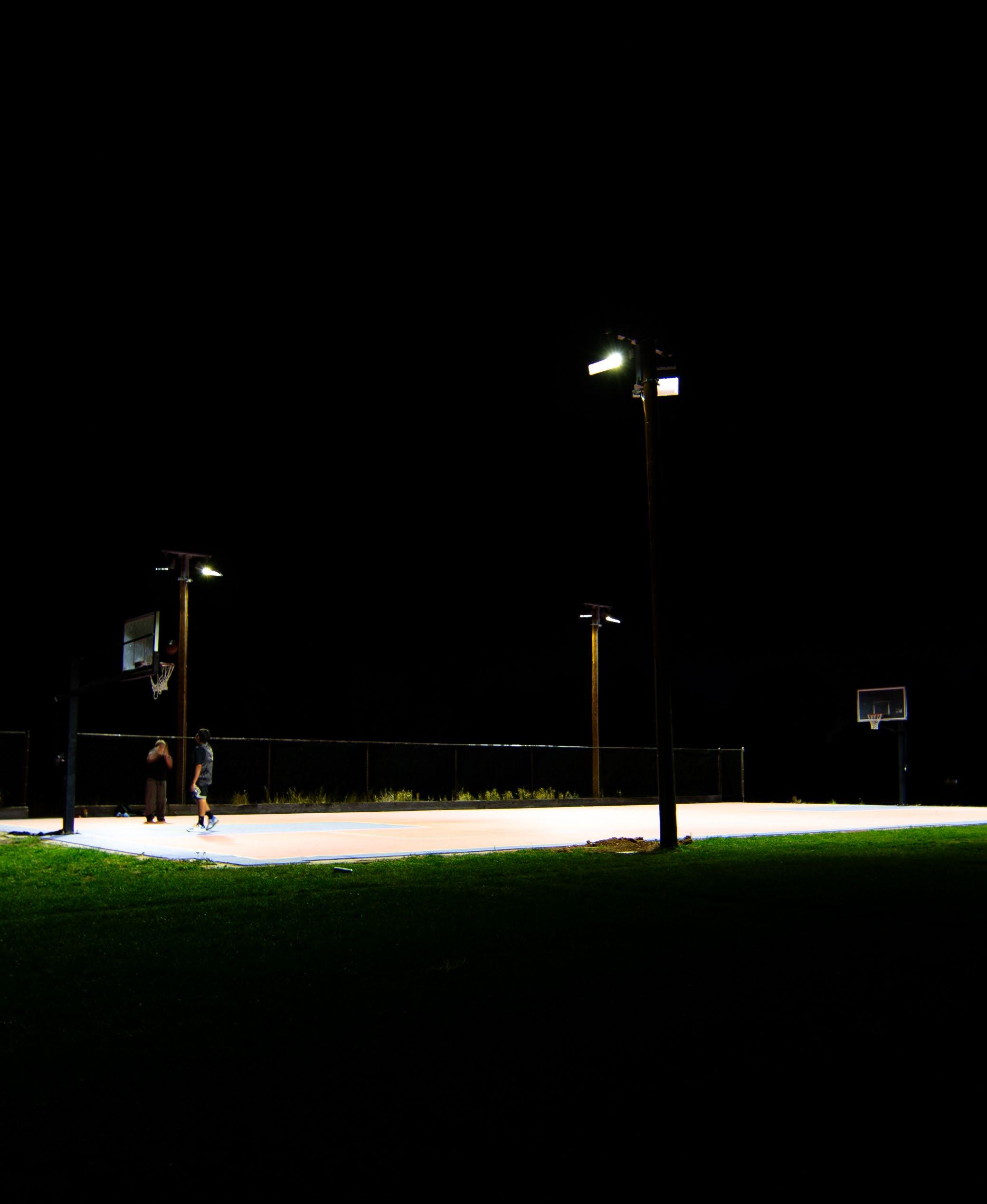
In FY 25, we replaced over 200 fixtures, including the outdoor basketball court at Grand Canyon School. These new fixtures both protect the night sky and provide sufficient lighting for evening games. They are on a manual timer, so they turn off when not in use. This is a great example of the Dark Skies Program providing for the community while also protecting the night sky. It’s not about getting rid of all the lights, it’s about smarter lighting. These lights hadn’t worked in years. Unlike basketball, it’s a win-win!
Completed in 2025:
• 207 lights replaced
• 95% compliant
• Retrofitted areas: Clinic, HQ, Yavapai Geology Museum, Supai Camp, Museum Collections, Paiute stairwells, Albright, Xanterra Purchasing, and more!
Next Up in 2026:
• Desert View fixtures
• Remaining Village fixtures
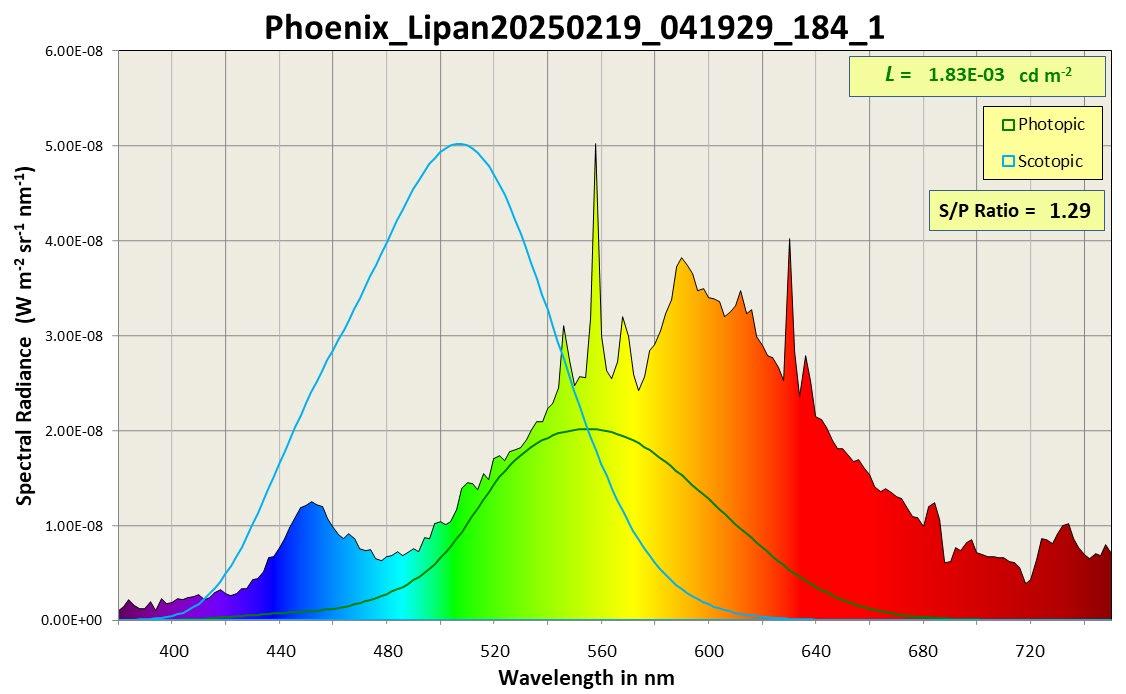
Stephen Hummel also analyzed the kind of light intruding into the park from surrounding cities. Below, a spectral radiance graph shows the wavelength of light emanating from Phoenix as seen from Lipan Point. Shorter wavelenghts (the blue end) are much more harmful to night skies than the longer wavelengths (the red end).
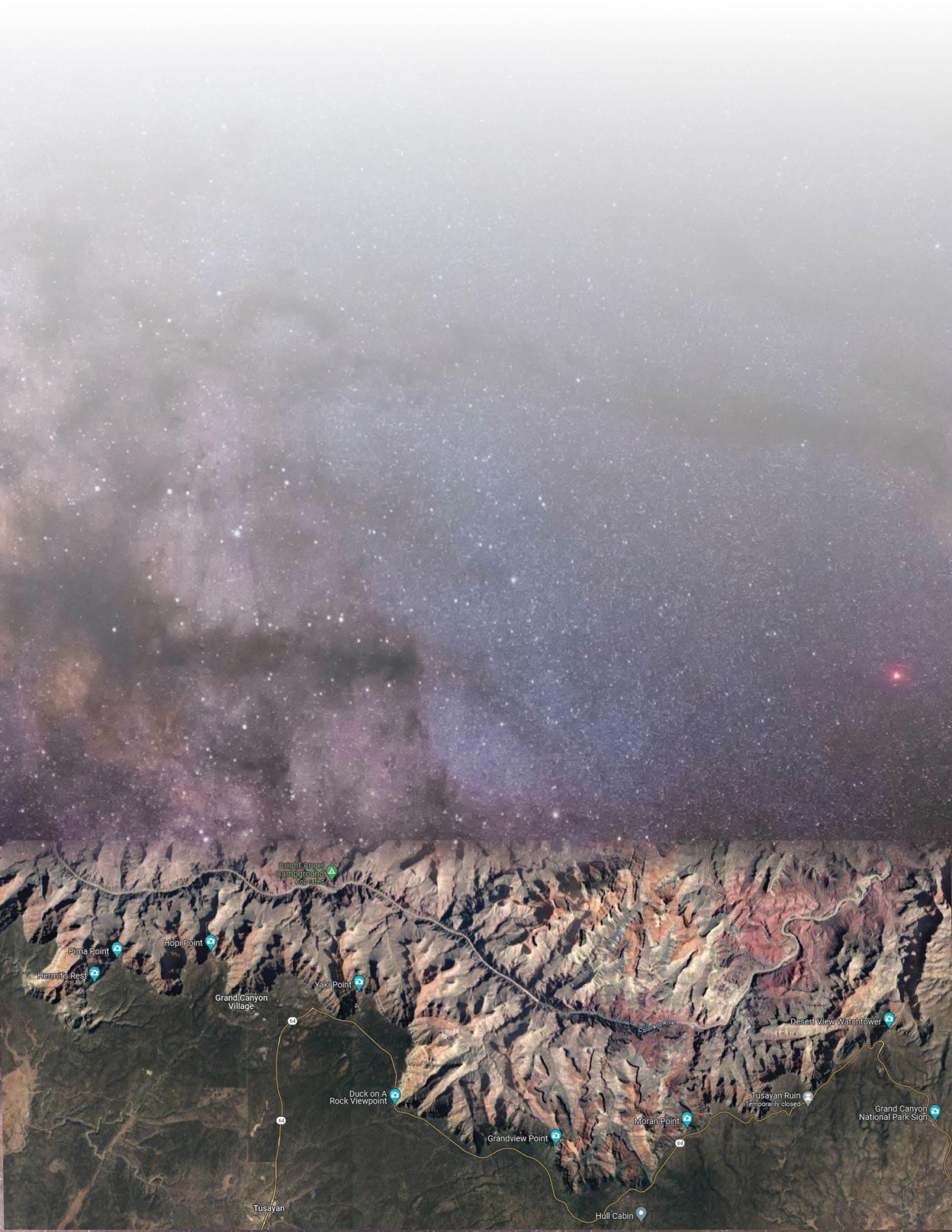
2025 Sky Quality Data
These data are required to be collected annually for the park’s International Dark-Sky-Certification.
Locations of Sky Quality Measurements

35th Grand Canyon Star Party
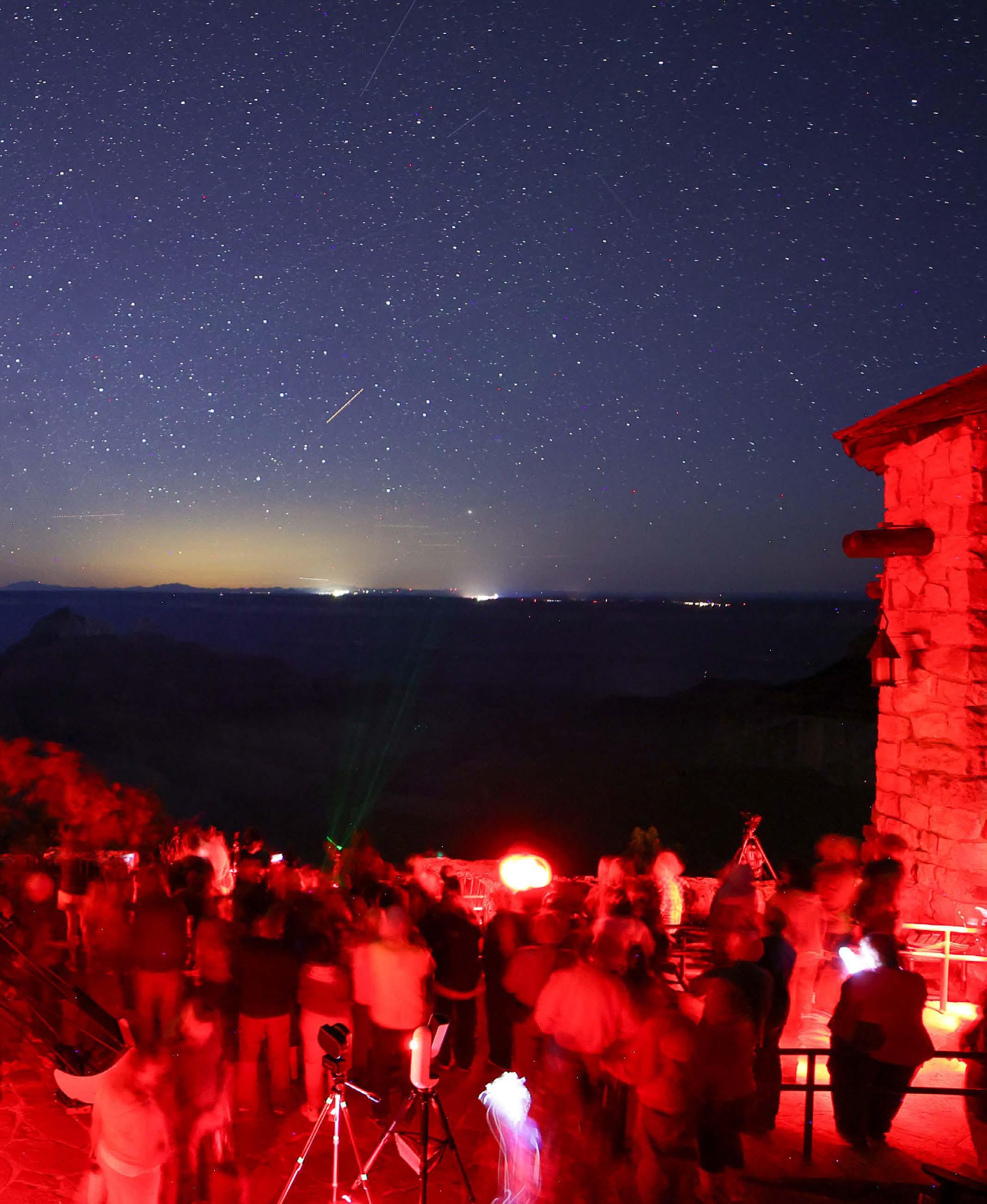
What started as a few astronomers in the Yavapai Geology Museum Parking Lot in 1991, has turned into the largest night sky festival in the country. For eight nights in June, we celebrate the night skies with over one hundred volunteer astronomers, 60-70 telescopes every night, special guest speakers, constellation talks, and more. Nearly 10,000 visitors attended this year. Learn more about Star Party.
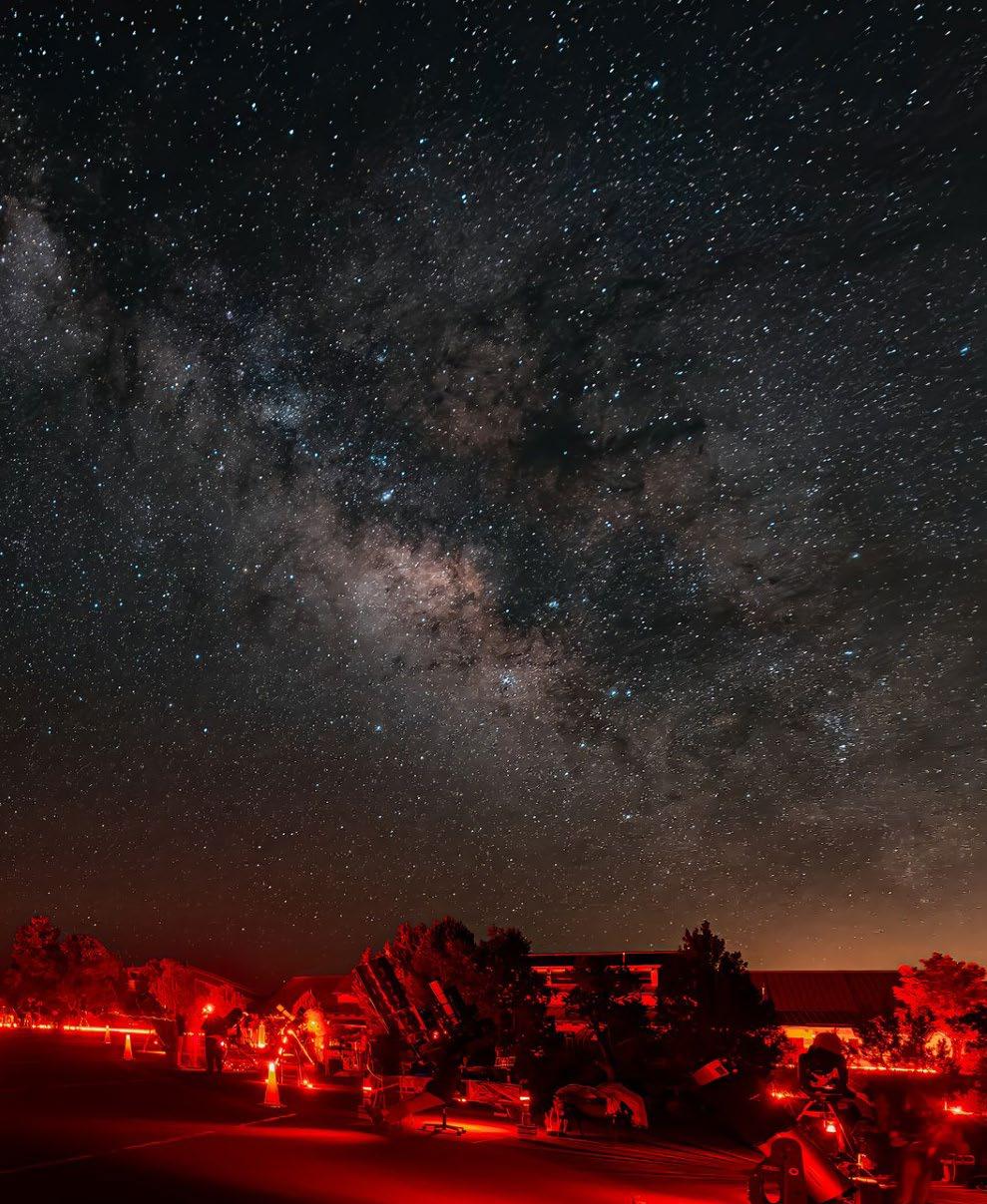
35th Grand Canyon Star Party at a Glance...
9,616 visitor attendance
108,861 visitor telescope views
8,471 solar telescope contacts
5,109 theater talk attendance
162 astronomy volunteers
2,358 constellation talk attendance
77 average number of telescopes per night
Grand Canyon Star Party - North Rim
Photo by GCC Marketing Coordinator Lauren Cisneros
Grand Canyon Star Party - South Rim
Photo by Astronomy VIP John Hallett
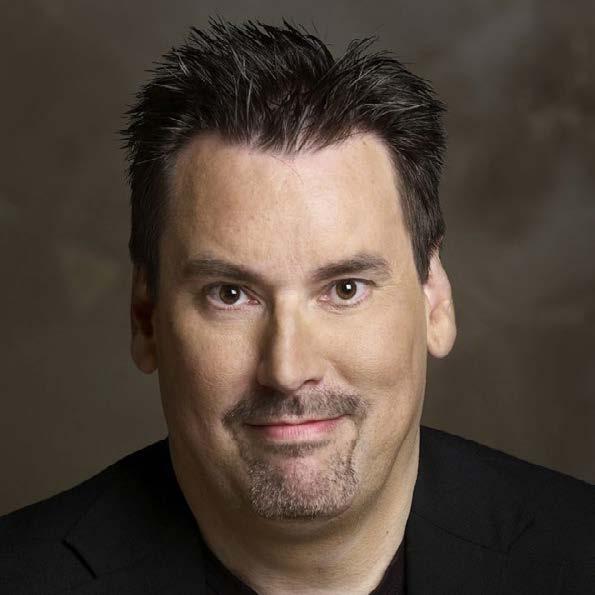
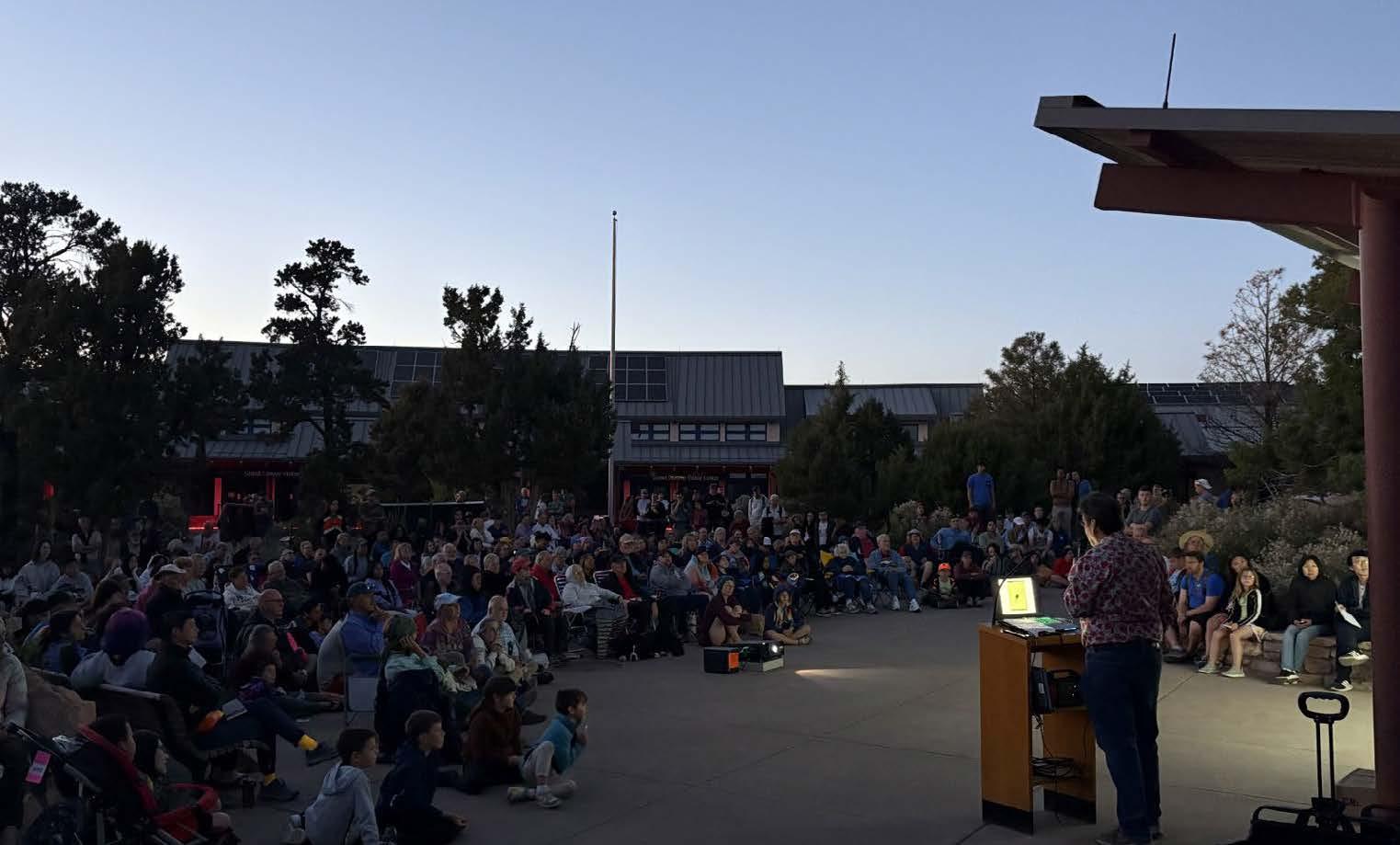
The Dark Skies Program is proud to welcome a diverse range of guest speakers every year for Grand Canyon Star Party. This year, we were honored to welcome David Eicher, Editor in Chief of Astronomy Magazine. David presented a fantastic talk on galaxies. After the event, he wrote a nice article about Grand Canyon Star Party for Astronomy Magazine.
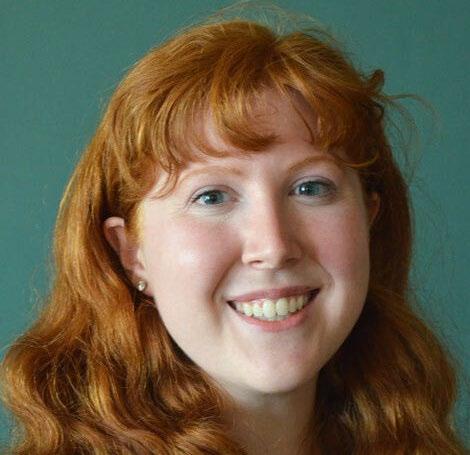
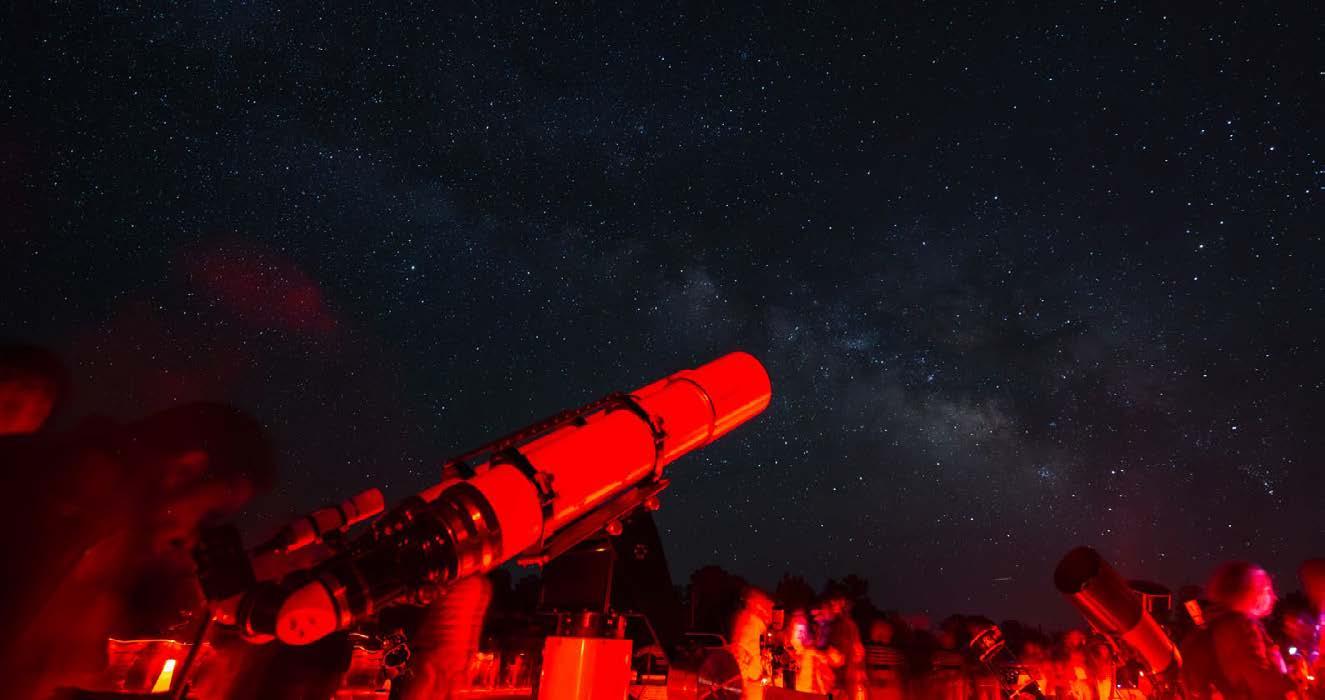
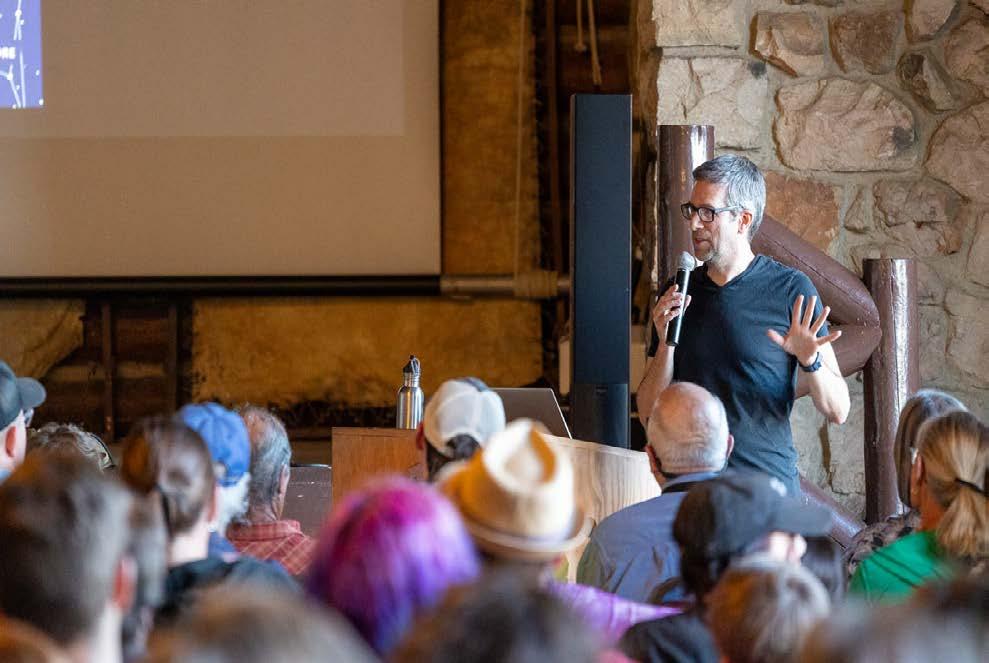
(Left) Dr. Tyler Richey-Yowell, an astronomer at Lowell Observatory, presented a fascinating talk about space-weather environments around stars. (Right) Afterwards, visitors enjoyed hours of telescope viewing through a variety of telescopic instruments, such as this large binocular telescope (Photo by Matt Young).
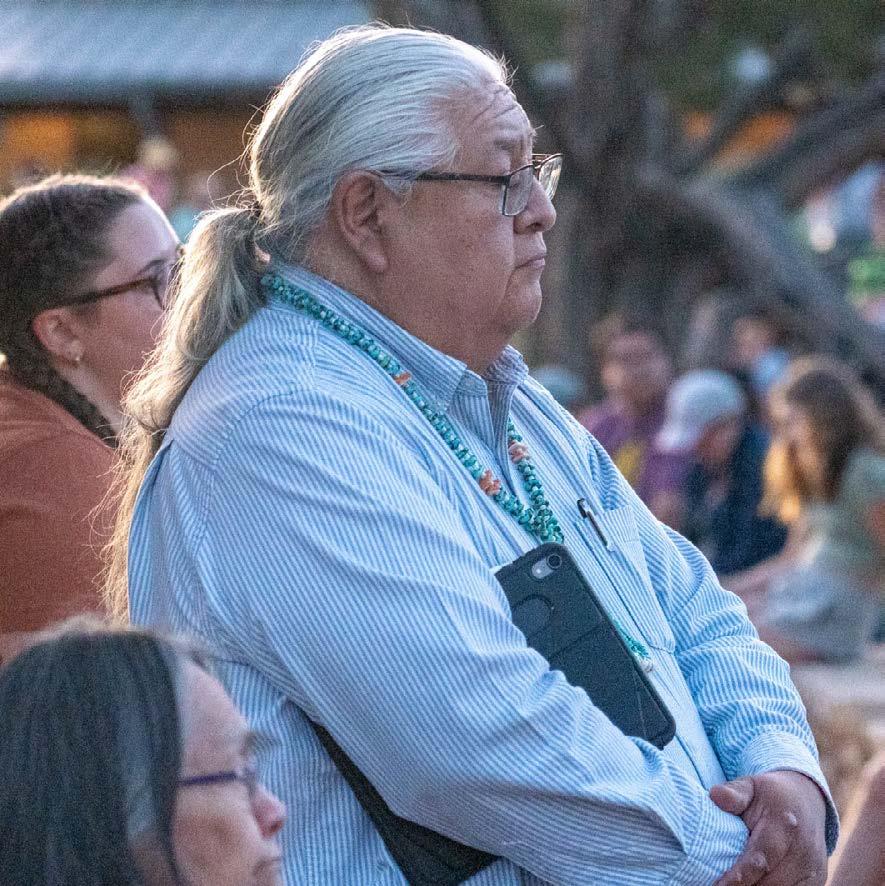
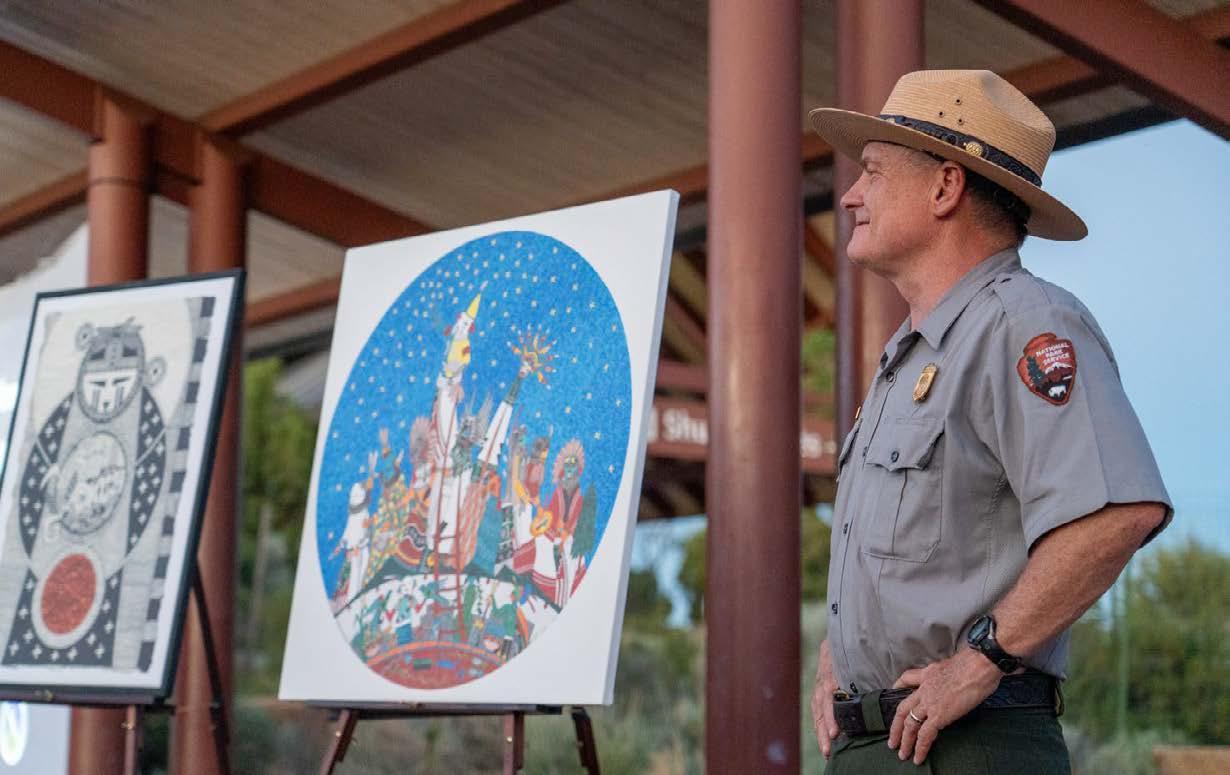
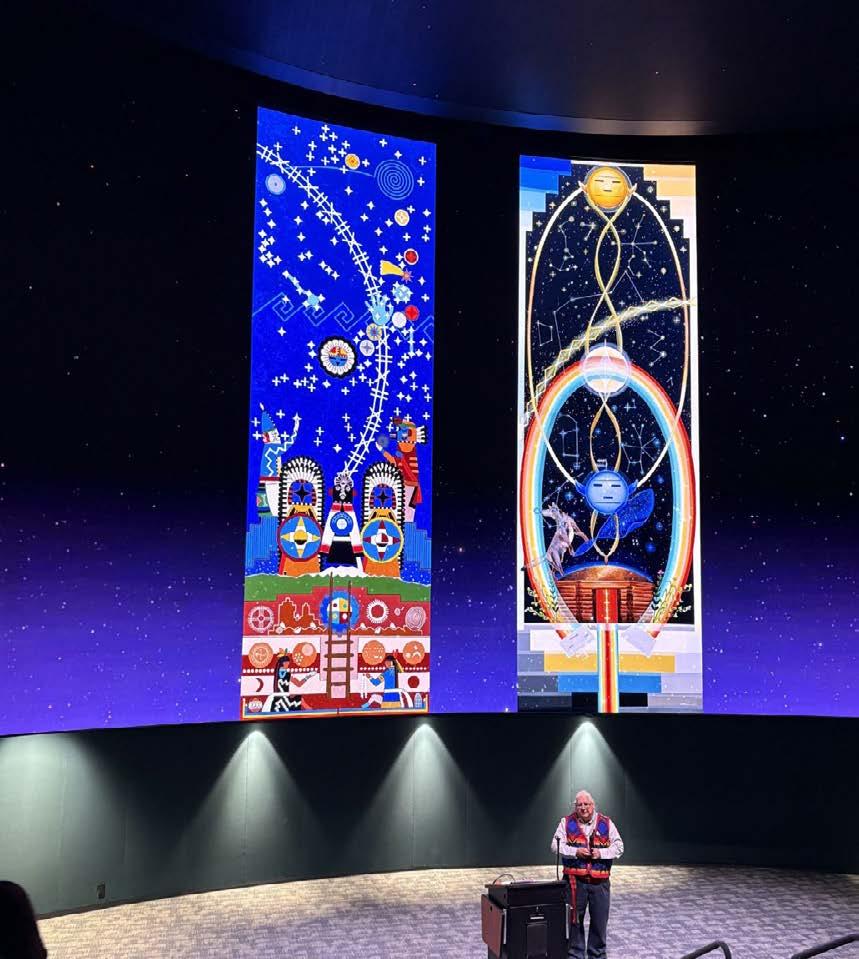
Gerald Dawavendewa presented a talk about the Hopi cosmos as expressed through his new mural, which is now displayed at Lowell Observatory.
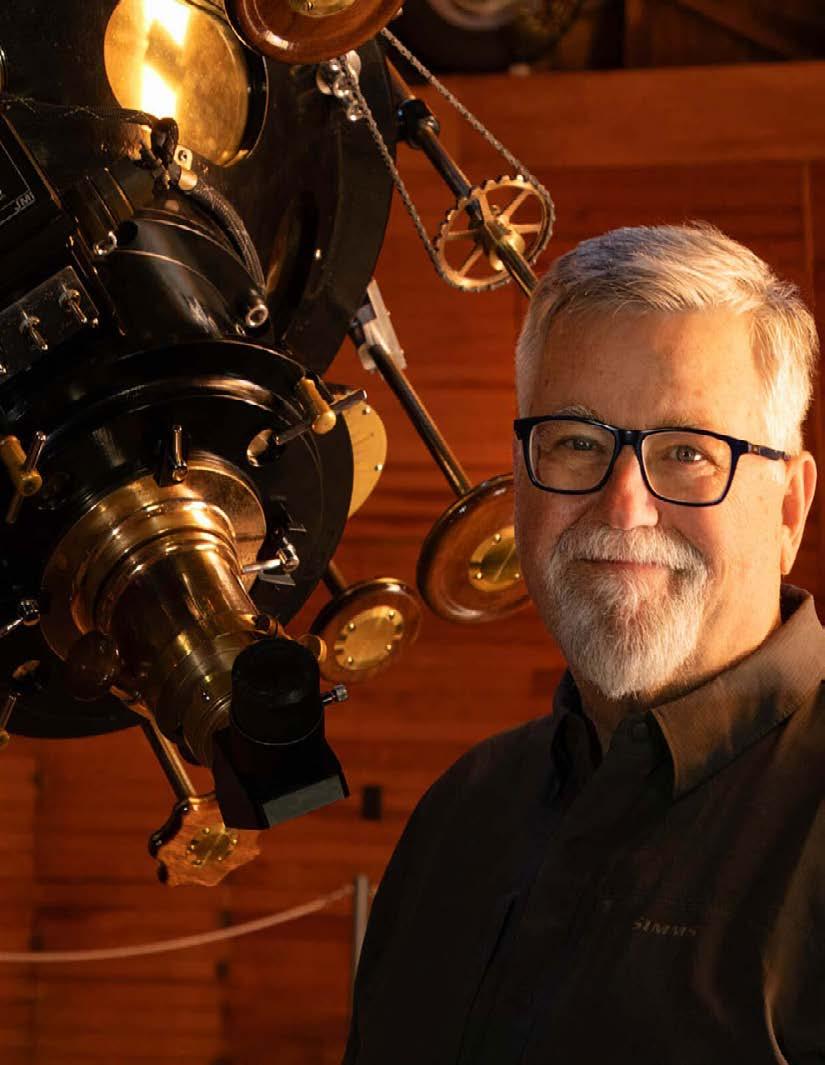
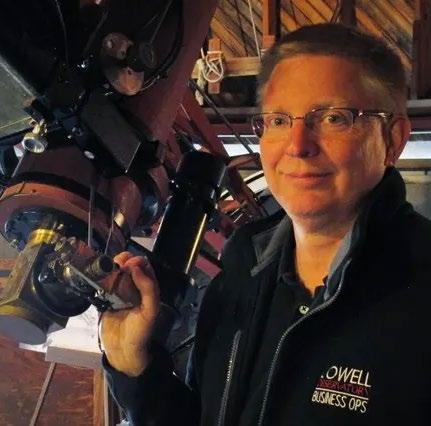
Kevin Schindler, historian at Lowell Observatory, gave talks on both rims this year! Thanks for your dedication to Grand Canyon Star Party, Kevin!
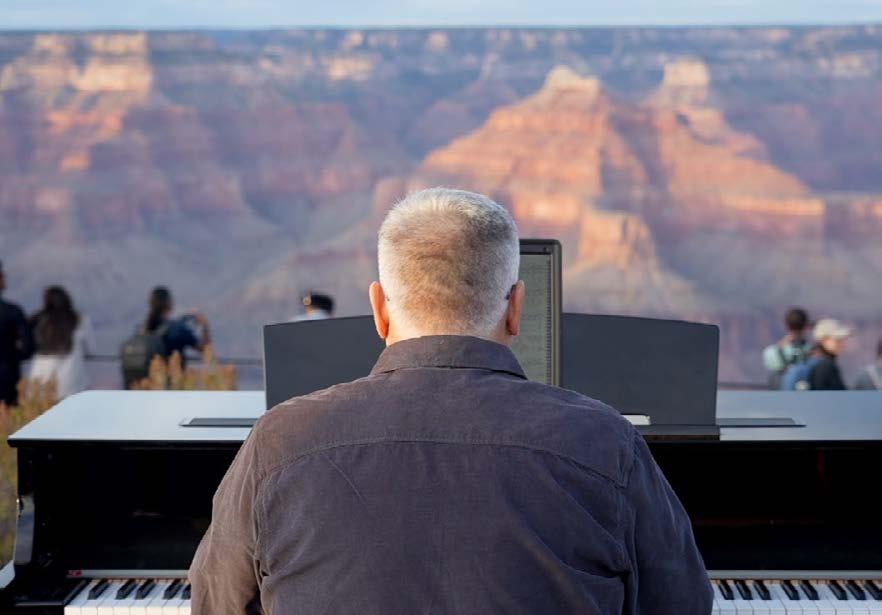
Dr. David Koerner presented a night-skythemed piano recital for visitors at Star Party. He also presented a fascinating talk on the history of our understanding of the cosmos.
Dr. Koerner is a Grand Canyon Conservancy Astronomer in Residence alum.
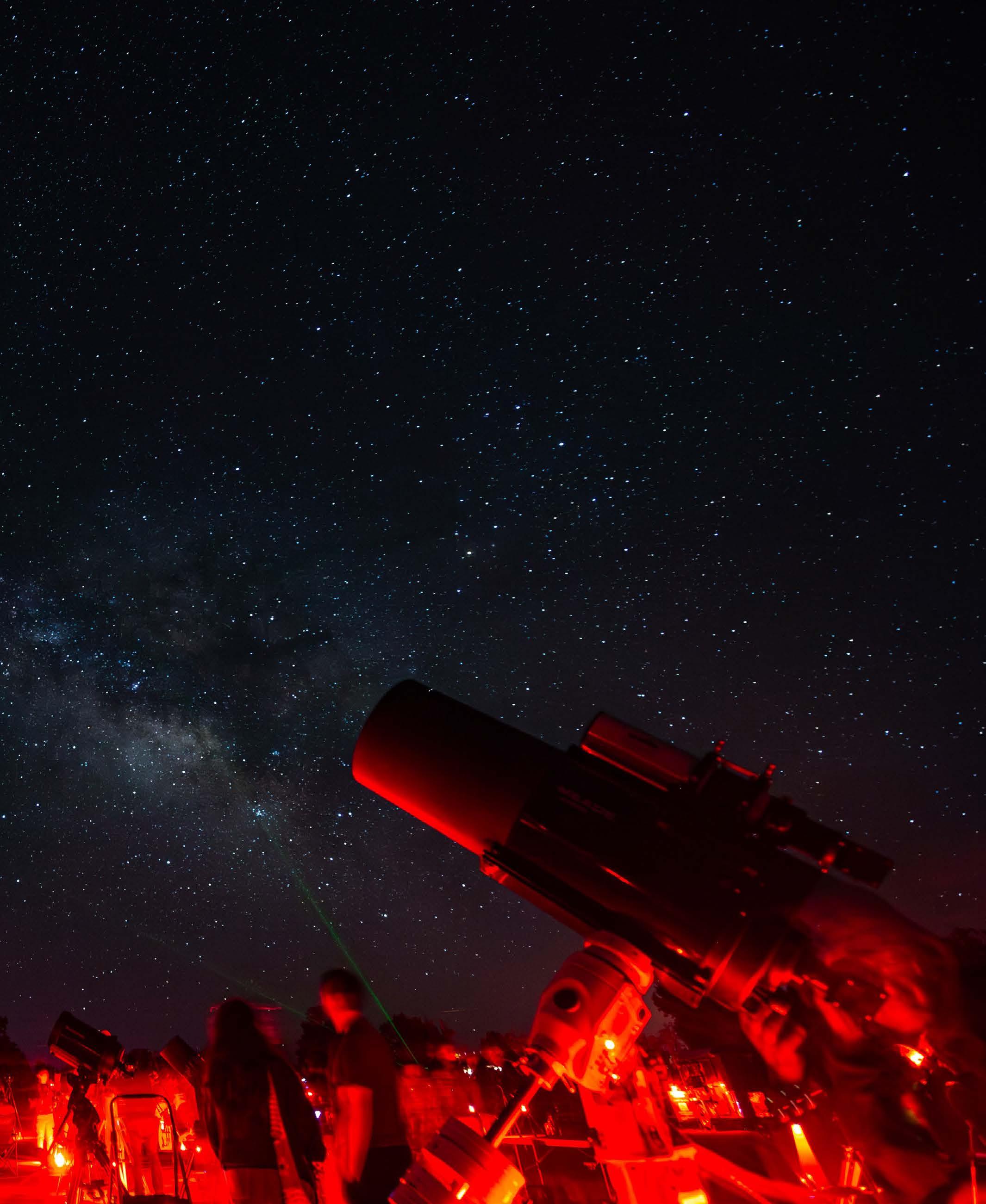
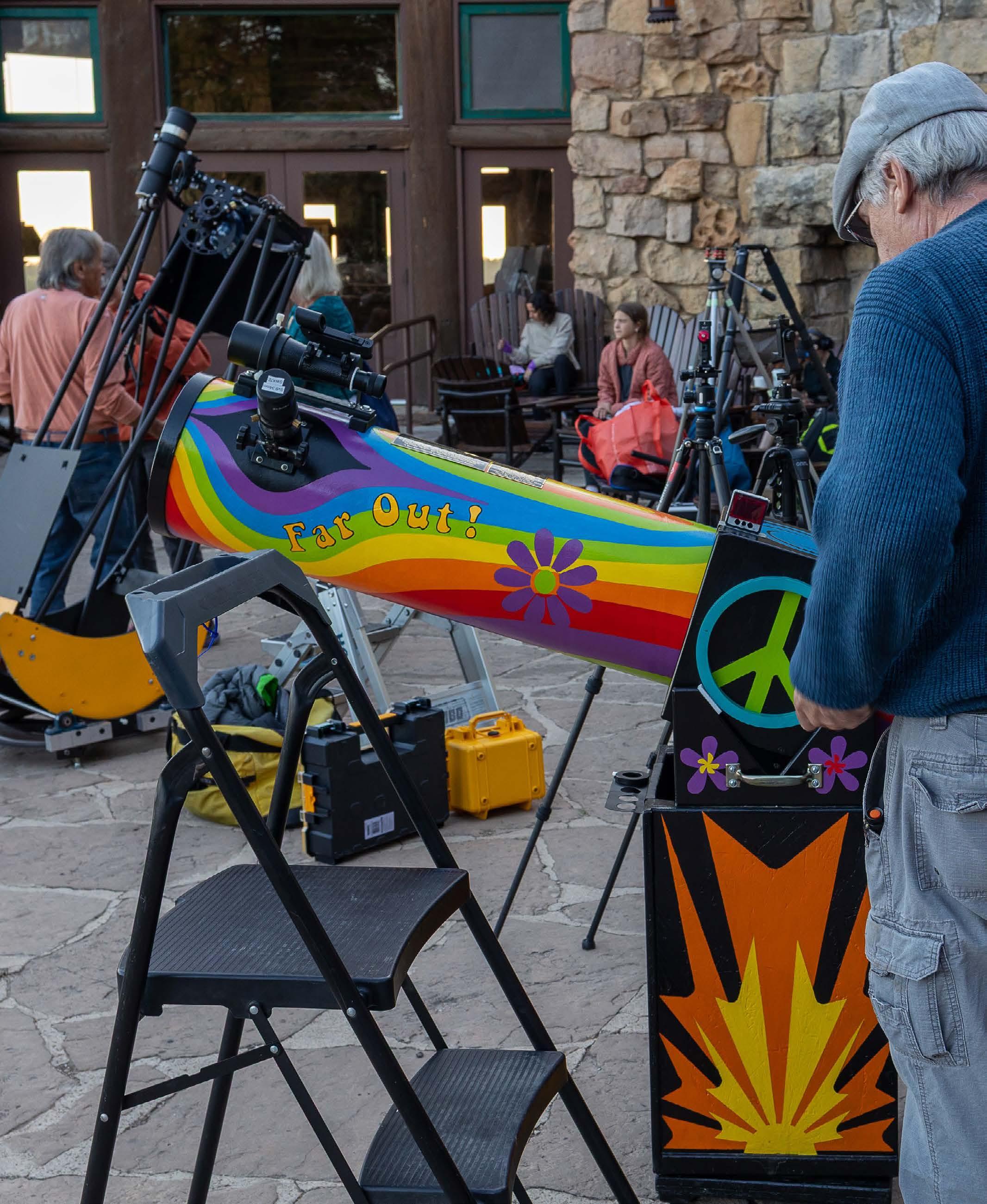
The 35th annual Grand Canyon Star Party saw a record number of telescopes and volunteers, averaging 77 telescopes per night. An incredible 162 volunteers donated their time and equipment to the event this year. With this turnout, Grand Canyon Star Party has become, as David Eicher of Astronomy Magazine puts it, “The largest star party in the country.”
35th Grand Canyon Star Party
Photo by Matt Young
35th Grand Canyon Star Party
The North Rim volunteers put the “party” into Grand Canyon Star Party!
Photo by Lauren Cisneros
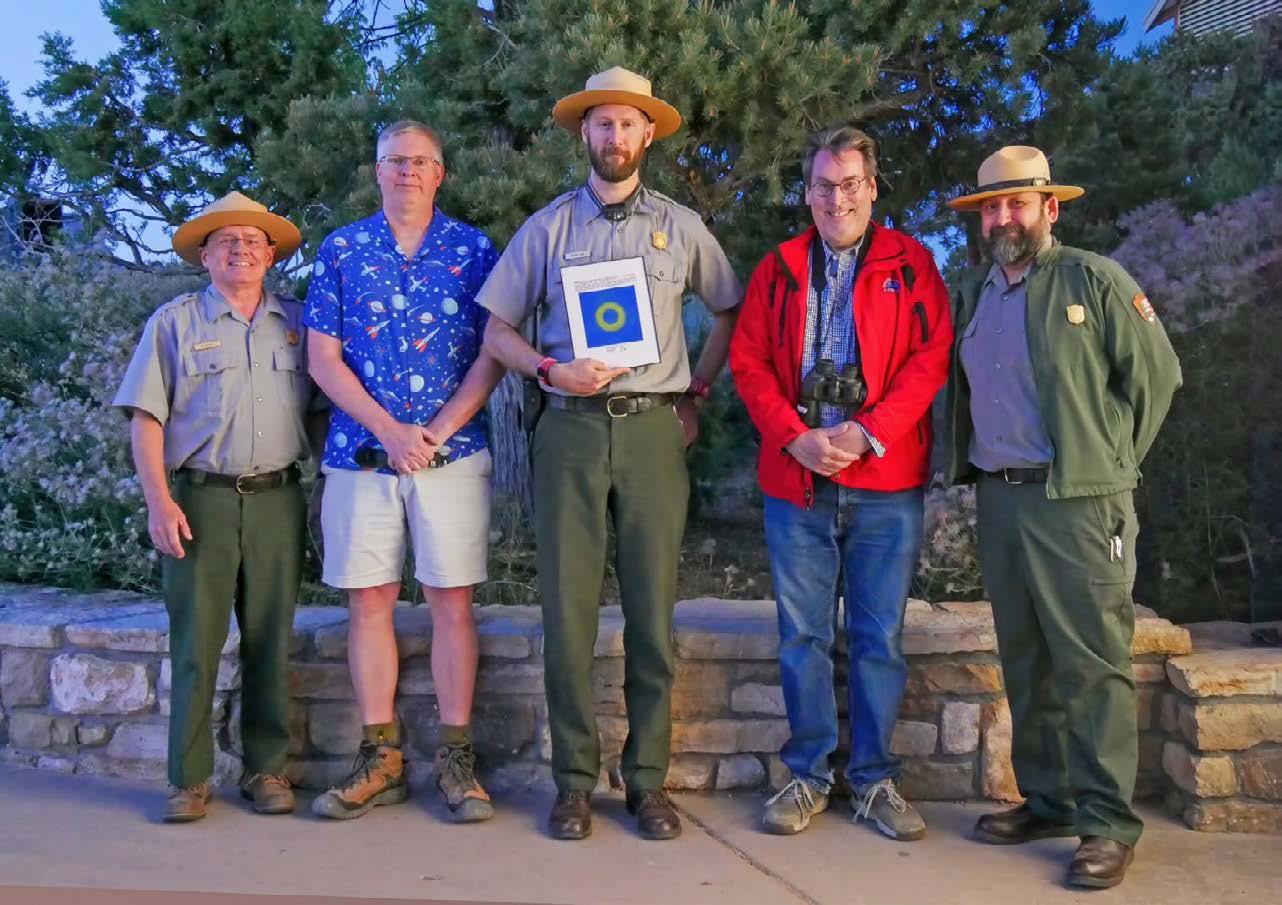
(Right) Superintendent Keable attended several nights of the event, thanking the speakers and volunteers for their service, and enjoying views through telescopes. Thanks for your support, Ed!
(Left) Ranger Rader Lane was honored by Lowell Observatory with his very own asteroid—see “30280 RaderLane” in skies near you! Pictured Left to right: Ed Keable, Kevin Schindler, Rader Lane, David Eicher, and AJ Lapre.
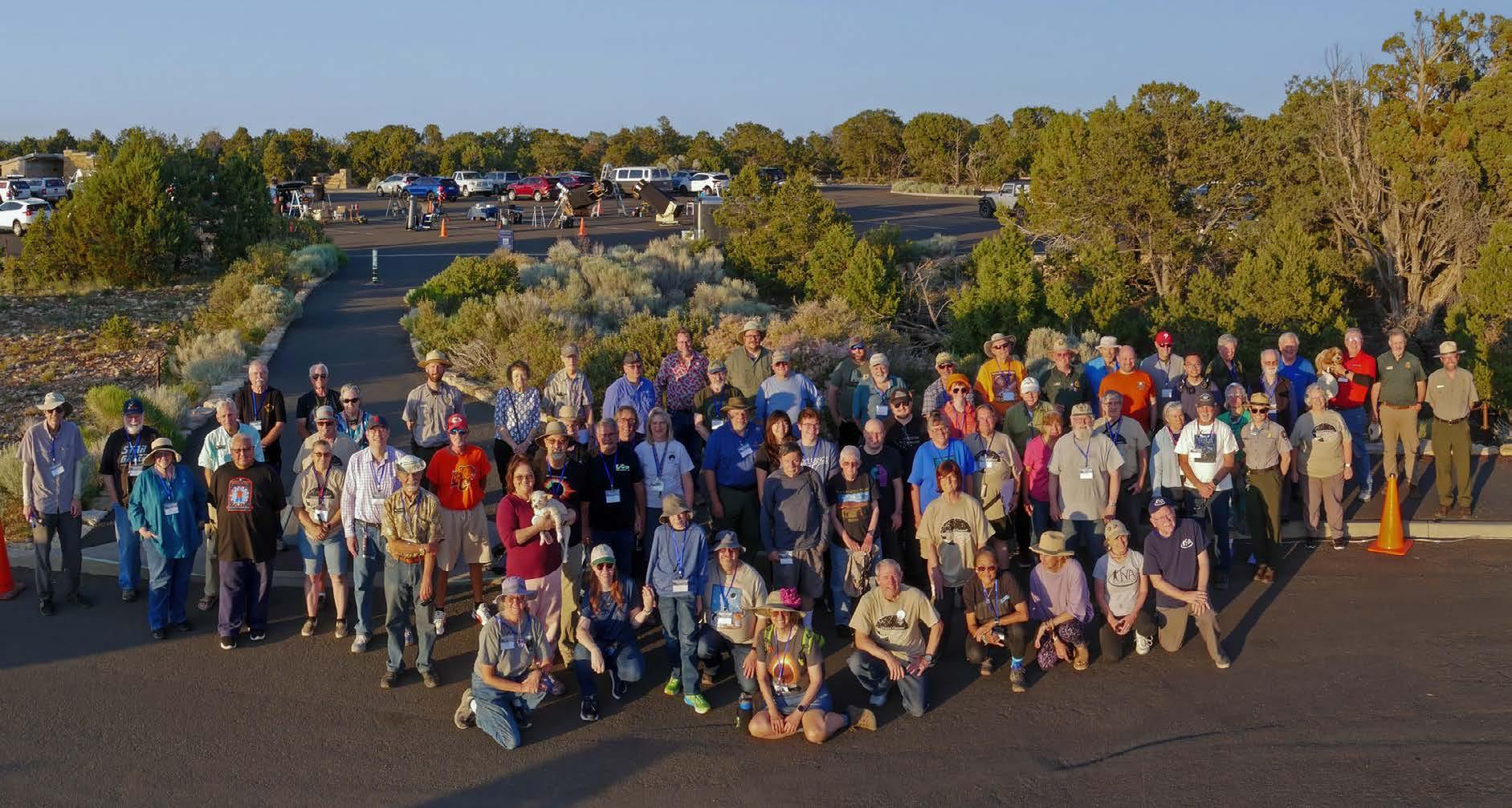
Not even half of the volunteer astronomers for the 2025 Star Party. This year, we had 162 volunteer astronomers attend from around the world! This event is not possible without them, or the support of the Tucson Amateur Astronomy Association. THANK YOU ALL!
(Left) Astronomer Dean Regas gave talks on both rims this year. He is the host of the Looking Up Podcast and the author of several astronomy books. Dean is a fanfavorite around here!
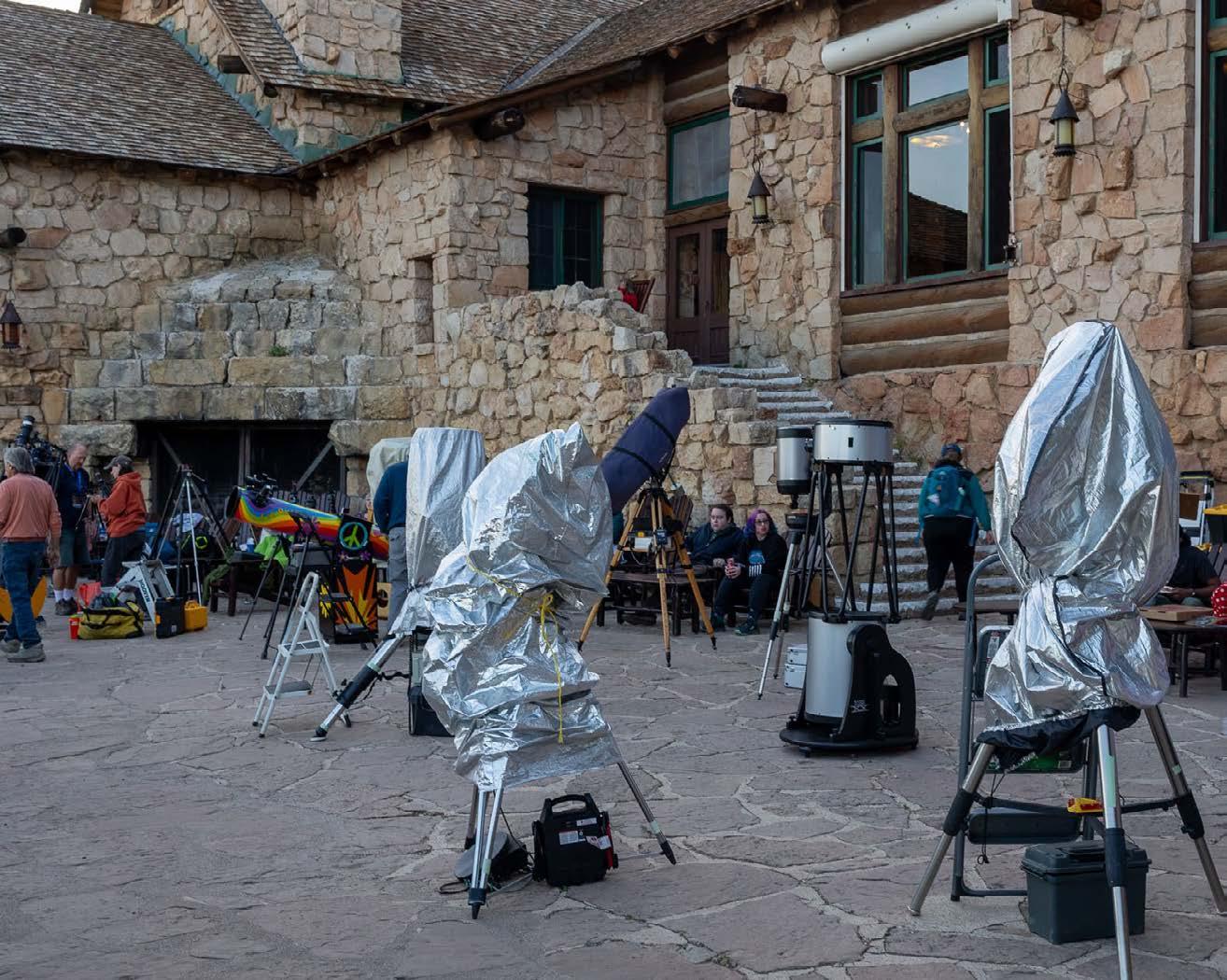
(Left) The volunteers for the North Rim portion of Star Party set up. Thanks to our longtime partners, the Saguaro Astronomy Club, for being such dedicated educators for the North Rim every year!
See you next year at the 36th annual Grand Canyon Star Party June 6 - 13, 2026!
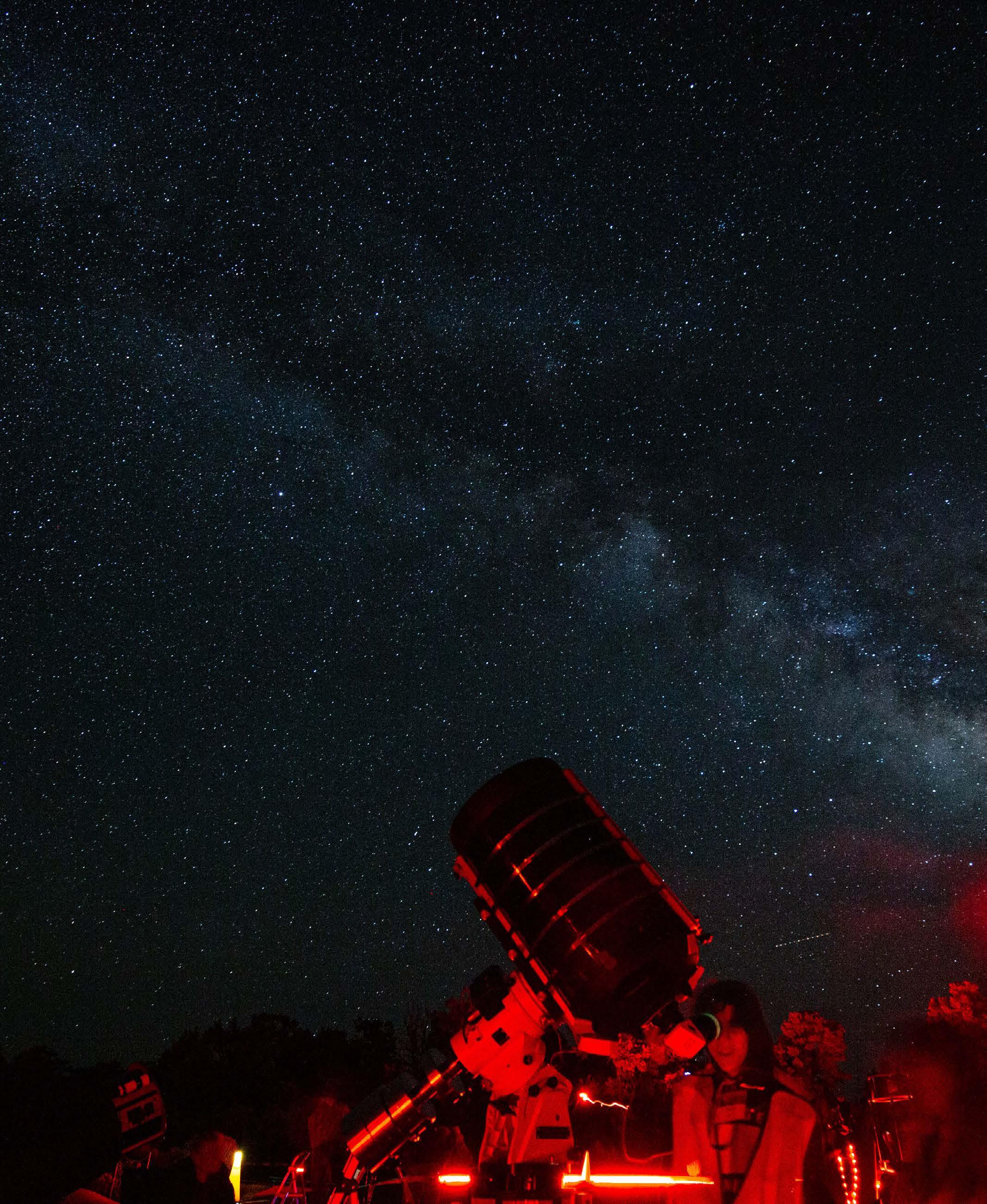
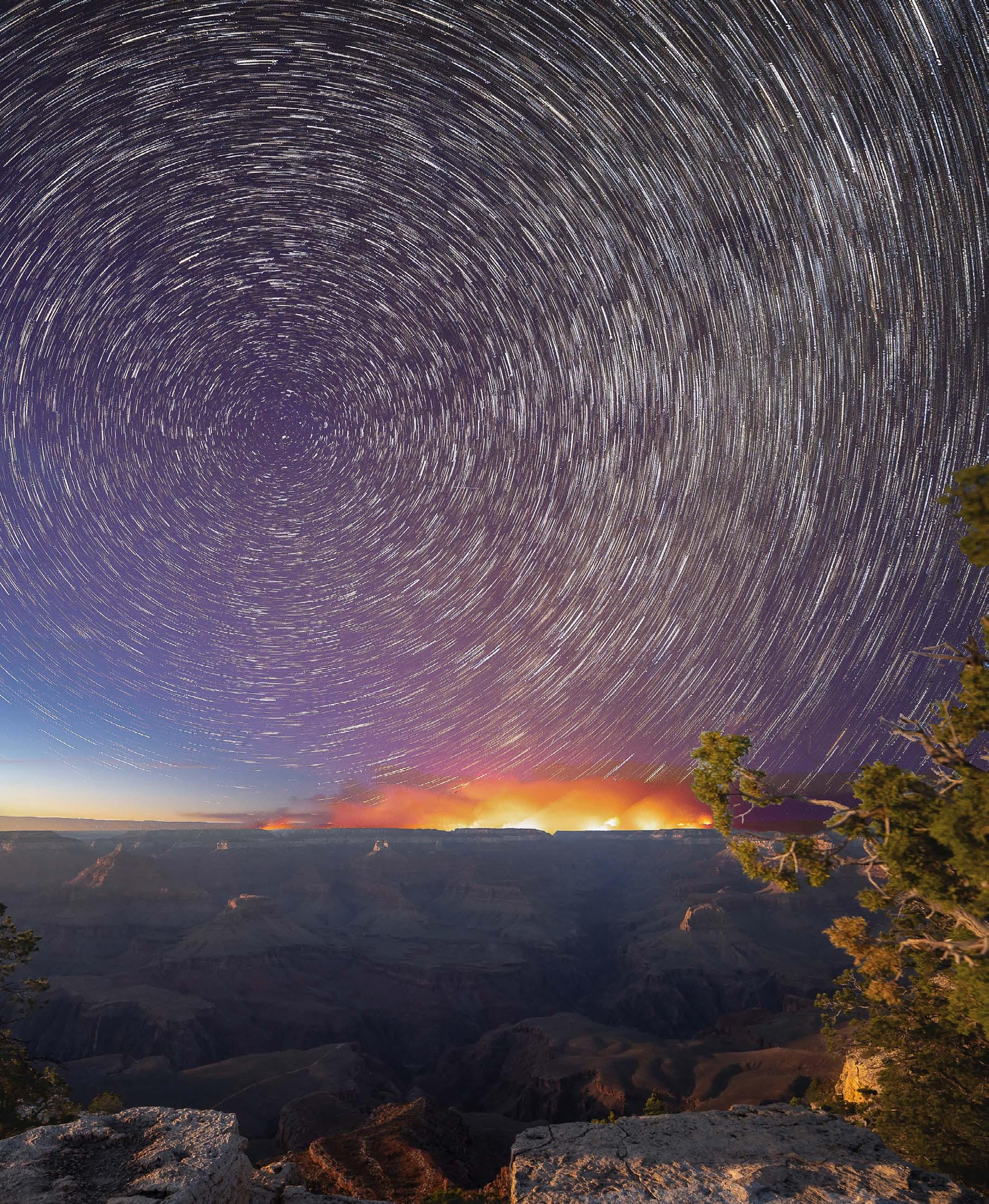
Beauty and the Beast
GCC Marketing Coordinator Lauren Cisneros captured this extraordinary shot of the Dragon Bravo fire, which occurred shortly after the end of the Grand Canyon Star Party. The stars appear to rotate around the north polar axis while the fire rages below, making for a powerful juxtaposition.
35th Grand Canyon Star Party
Photo by Matt Young
Astronomer in Residence Program
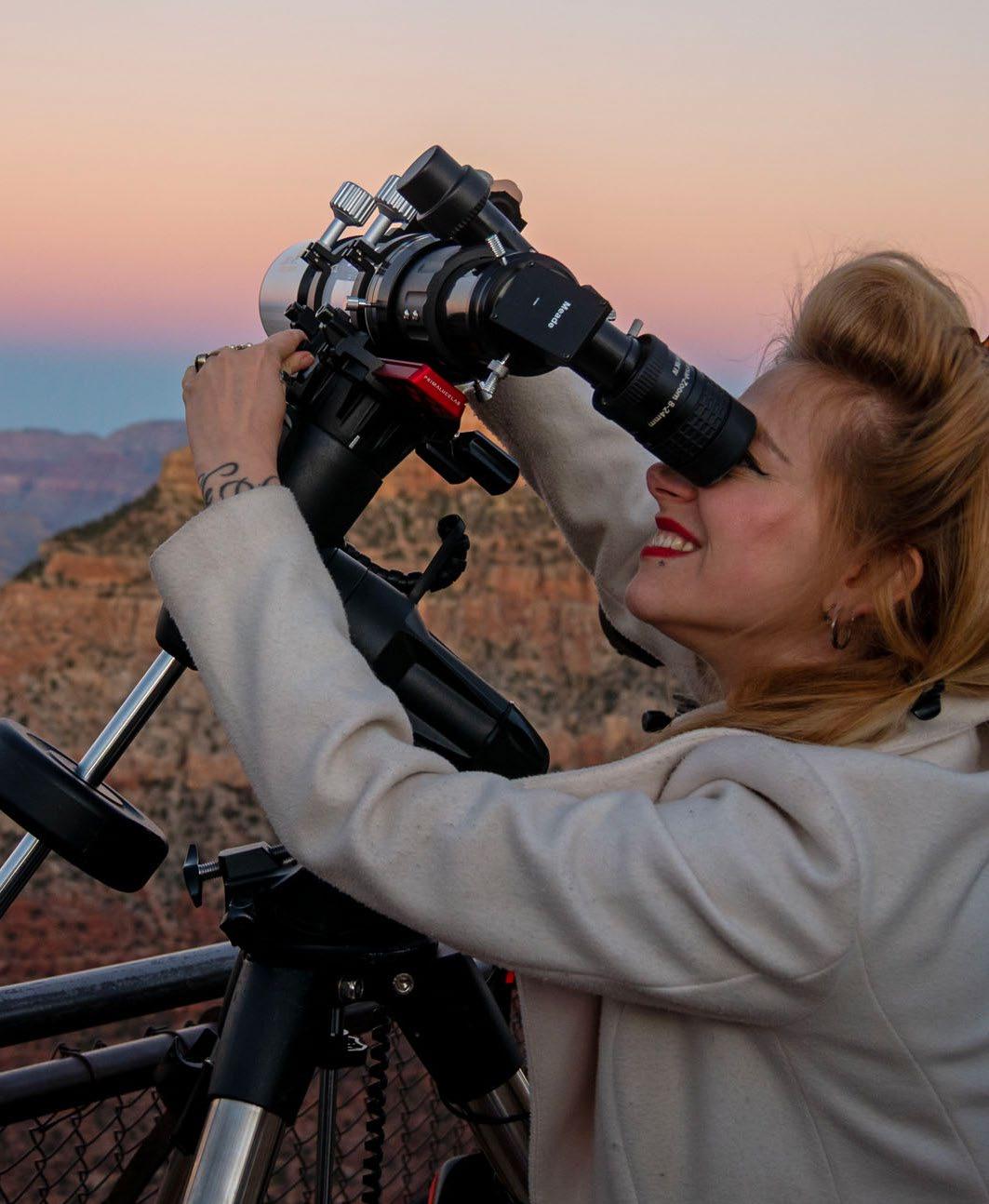
Astronomer in Residence 2025 at a Glance...
3 Astronomers in Residence
Grand Canyon Conservancy’s award-winning Astronomer in Residence Program started in 2021. Modeled after the Artist in Residence Program, it offers astronomers, scientists, visual and performing artists, and writers, the opportunity to practice and share their discipline under one of the most pristine night skies in the United States. Through artwork and educational outreach, the ASTiR inspires visitors to see the values of dark skies, spreads awareness about the threats of light pollution, and explores society’s complex relationships with natural darkness. Learn more about the Astronomer in Residence program here.
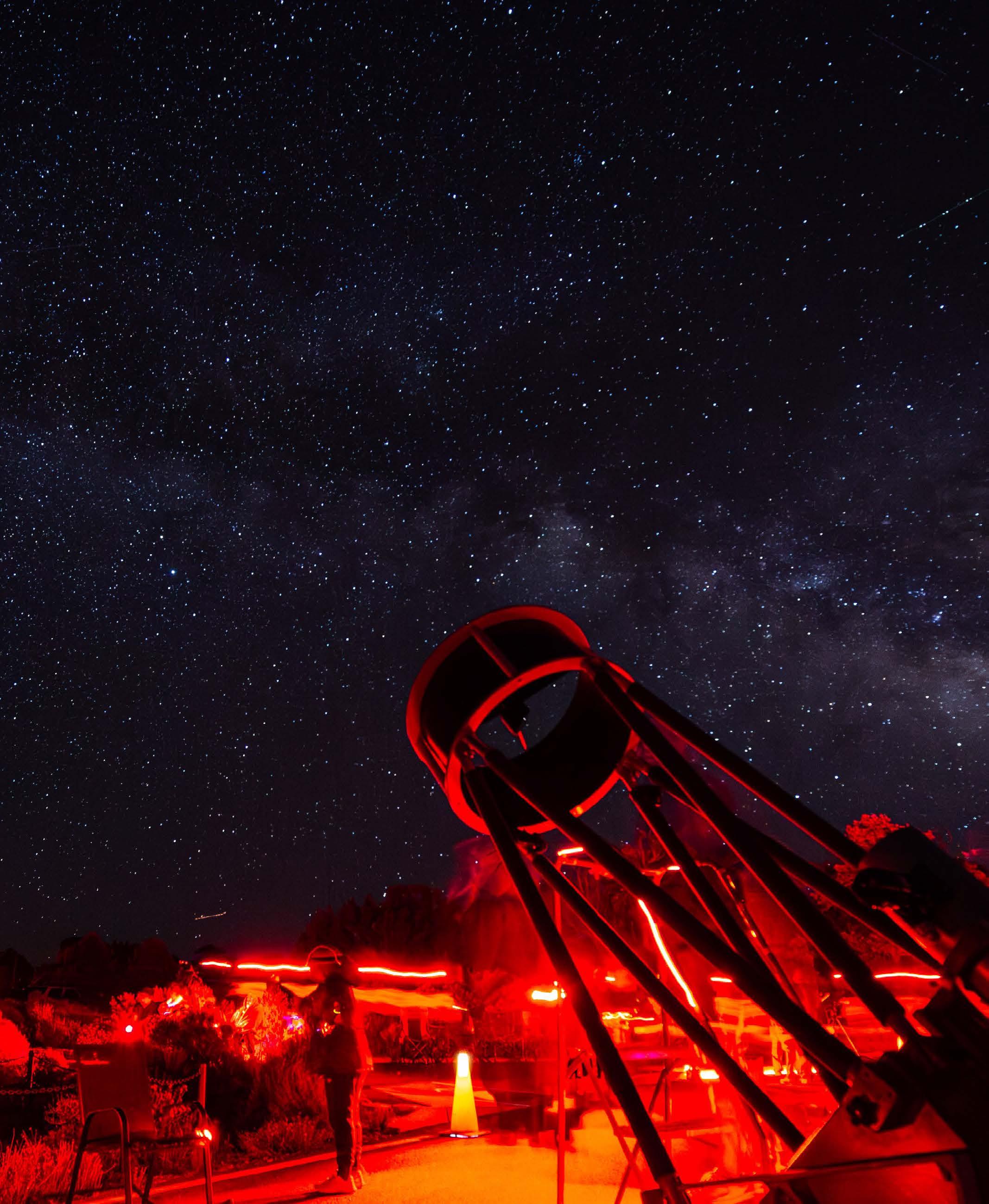
37 astronomy programs
4,998 visitor attendance
101 Grand Canyon School students reached
4 full moon events
Completed extensive night-sky-quality study
Photo by Matt Young
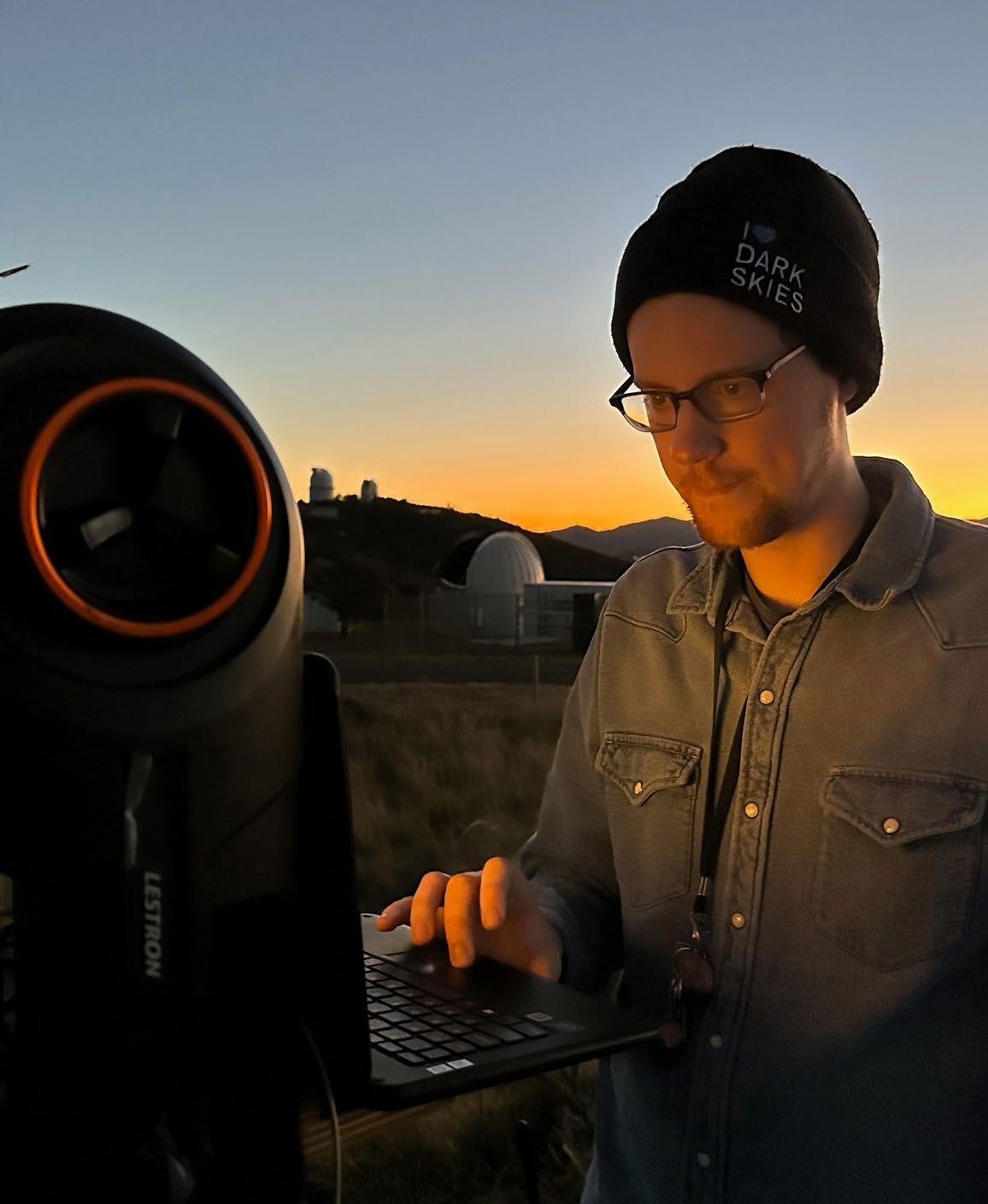
Stephen’s Residency at a Glance:
• 12 astronomy presentations
• 2,600 visitor attendance
• Completed extensive night-skyquality report for the park
• Visit to Grand Canyon School
• Special Guest Speaker at I HEART Pluto Festival
• Light pollution demonstrations
• Solar Viewing Sessions
Stephen Hummel
February 1 - March 14, 2025
Stephen Hummel is the Dark Skies Initiative Coordinator for McDonald Observatory, part of the University of Texas at Austin. His work has focused on preserving dark skies in the Big Bend region of Texas and Mexico. An experienced astronomy and dark sky educator, Hummel works with industrial facilities, hotels, businesses, and local governments on lighting design to preserve dark skies. In his spare time, he is an award winning astrophotographer with a specialty in rare electrical phenomena above nighttime thunderstorms.
During his time in residence, Hummel offered several public programs in addition to constellation tours. He offered pop-up interpretive sessions on light pollution using a unique diorama of a house that displays various lighting practices. He also completed an extensive night-sky-quality study for the park, taking sky quality measurements from key locations. He compiled the data and compared it with the last big qualitative study from 2015.
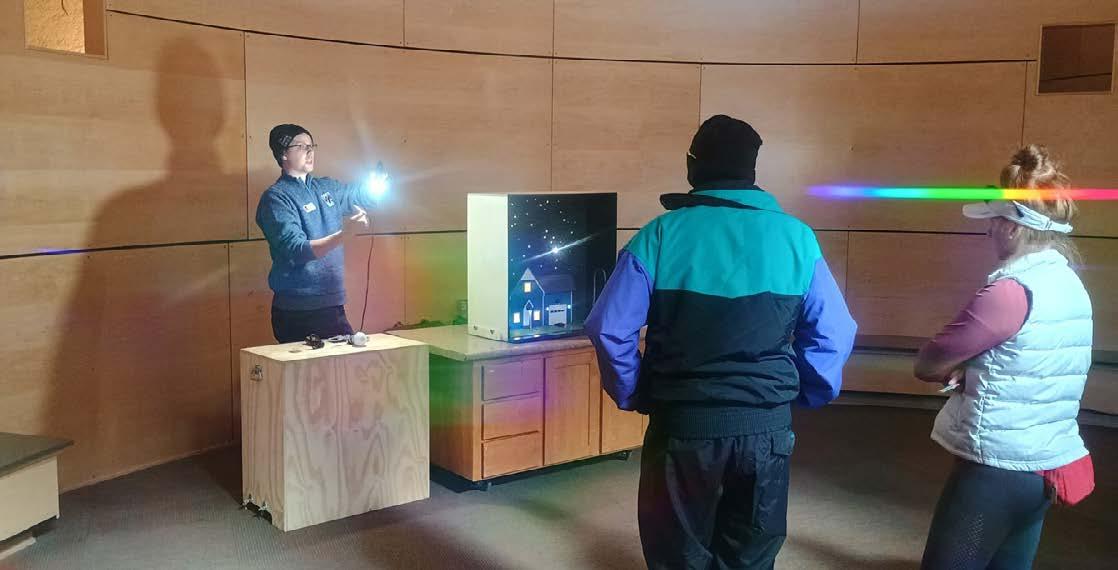
(Left) Astronomer in Residence
Stephen Hummel conducted pop-up light pollution demonstrations for visitors using a model house. (Below) He also visited the Grand Canyon School to talk about astronomy careers!
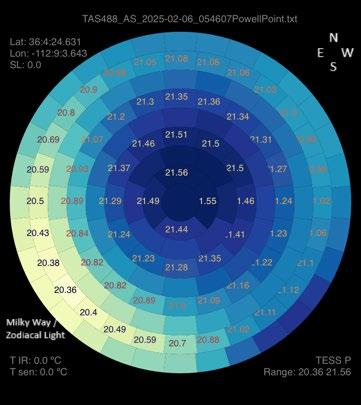
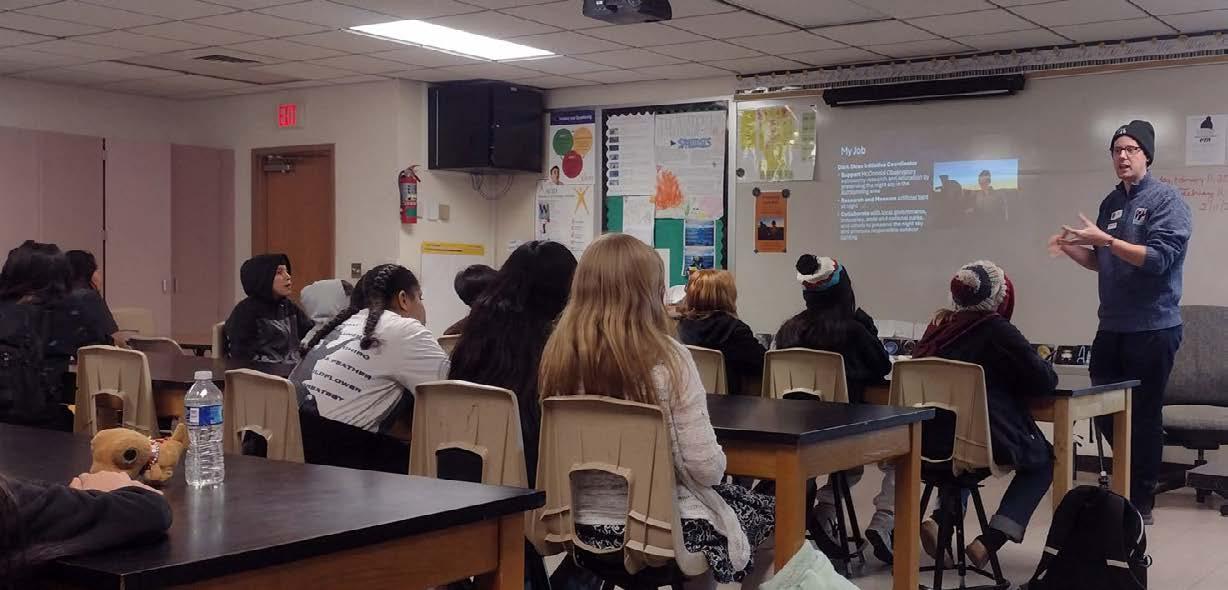
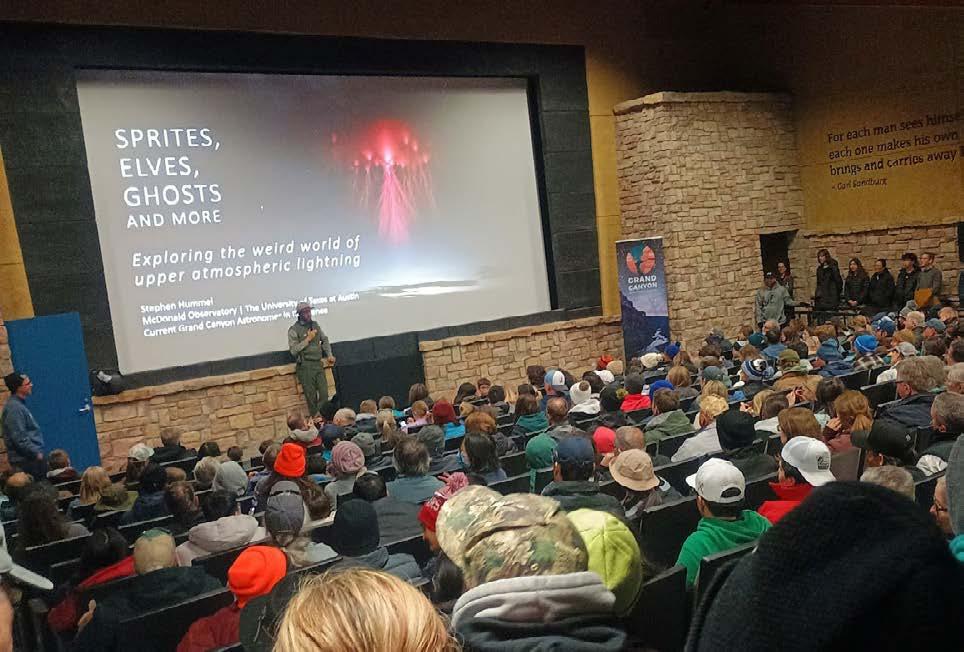
(Above and below) Hummel collected extensive night-sky-quality data for the park, from photometry to spectroscopy and more! (Right) He presented several astronomy talks to packed theaters.
Laura-May’s Residency at a Glance:
• 15 public programs
• 2 full moon gathering events
• Star Party for public school
• In situ paintings
• All Space Considered episode
• H-Alpha solar viewing
• Pop-up constellation talks
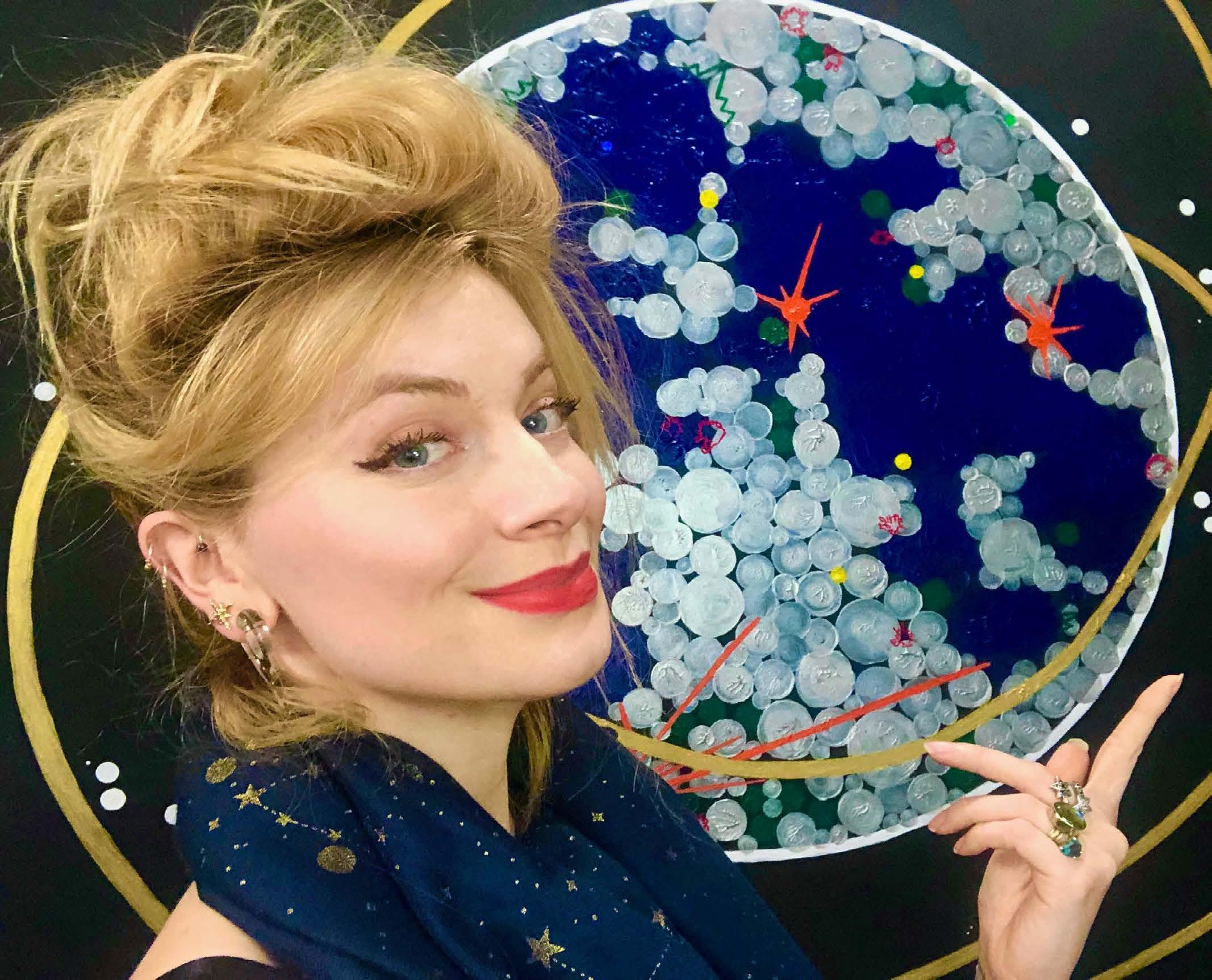
Laura-May Abron
August 24 - October 23, 2025
Born in France from an American mother and a French father, Laura-May grew up bilingual and in an artistic and multicultural environment, spending her summers in Washington DC and the rest of the year in Paris. She moved to Madrid to pursue her career in art and journalism, before enrolling at the Paris Observatory (OBSPM), to study astronomy and astrophysics, and graduating in 2016. She then moved to Los Angeles, California where she has translated her early passion for multiple fields into a multidisciplinary career in science, music, and the arts. She works at Griffith Observatory.
During her residency, Laura-May offered several public programs, from theater lectures to constellation talks, solar viewing to full moon gatherings. She also spent time creating in-situ paintings of the Canyon at night, as well as filming night-sky-themed music videos. Laura-May is the co-host of “All Space Considered,” and included Grand Canyon’s night skies initiatives in the September 2025 episode, which she recorded during her time in the park.
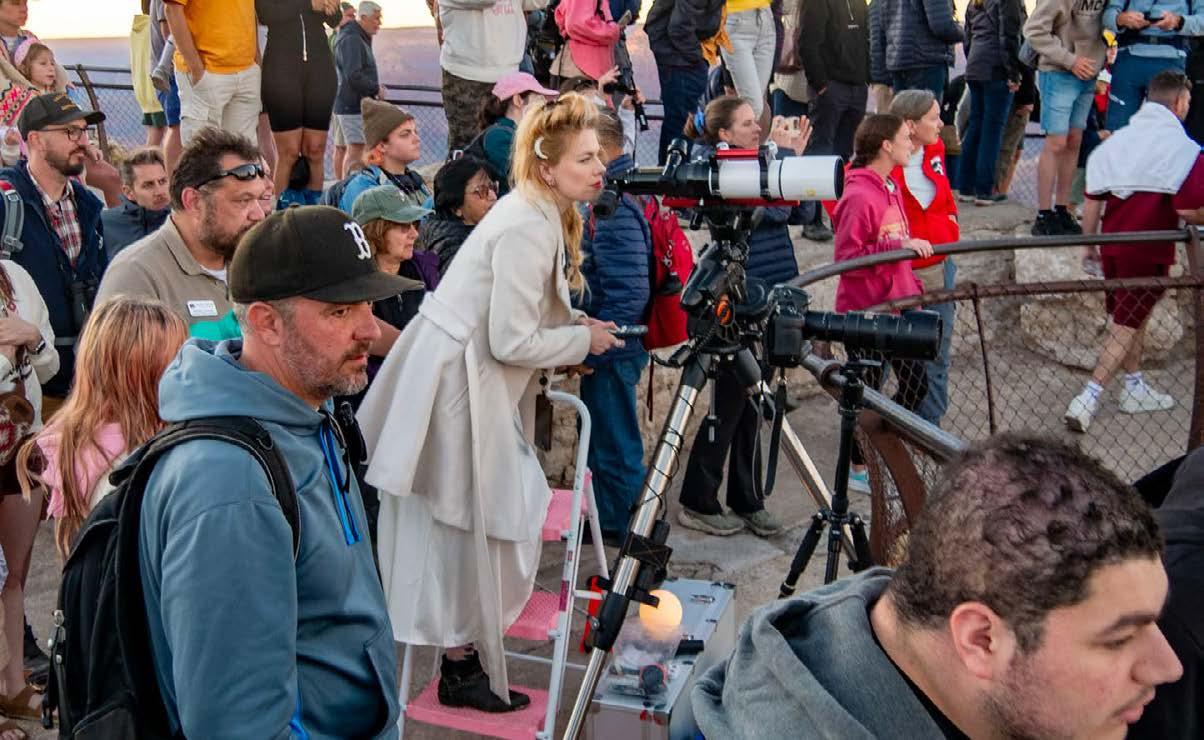
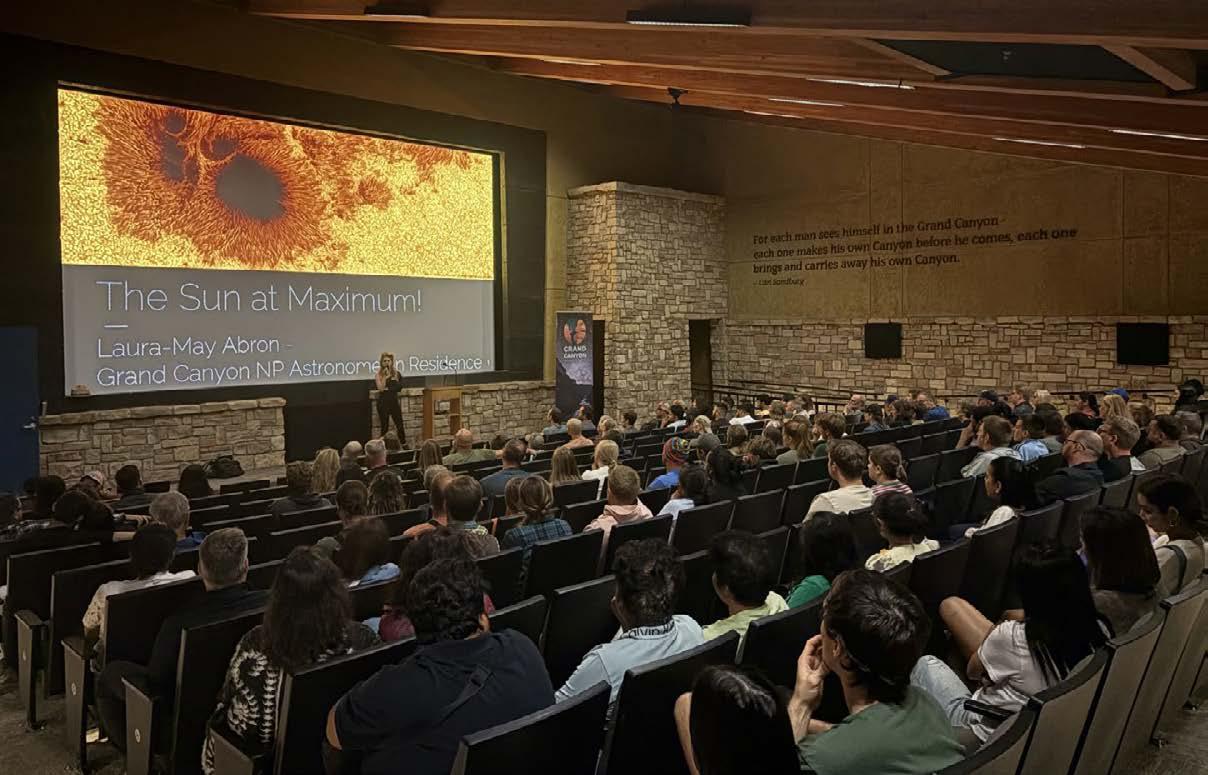
Laura-May presented 15 public programs during her time here. She presented talks like “The Sun at Maximum” to full theaters. After, she would take visitors outside to experience laser-guided constellation talks.
Laura-May Abron hosting a full moon event at Mather Point. Hundreds of visitors gathered to watch the moon rise, while Laura-May dazzled them with views through telescopes and talks about the moon.
Photo by Michael Quinn.
Laura -May is a co-host for Griffith Observatory’s monthly show, “All Space Considered.” In September, the episode featured a section on her time as Astronomer in Residence at Grand Canyon. Click to watch!
Aomawa’s Residency at a Glance:
• 3 Yoga Nidra sessions for the Grand Canyon community
• Theater presentations
• Constellation Talks
• Writing a book about rest
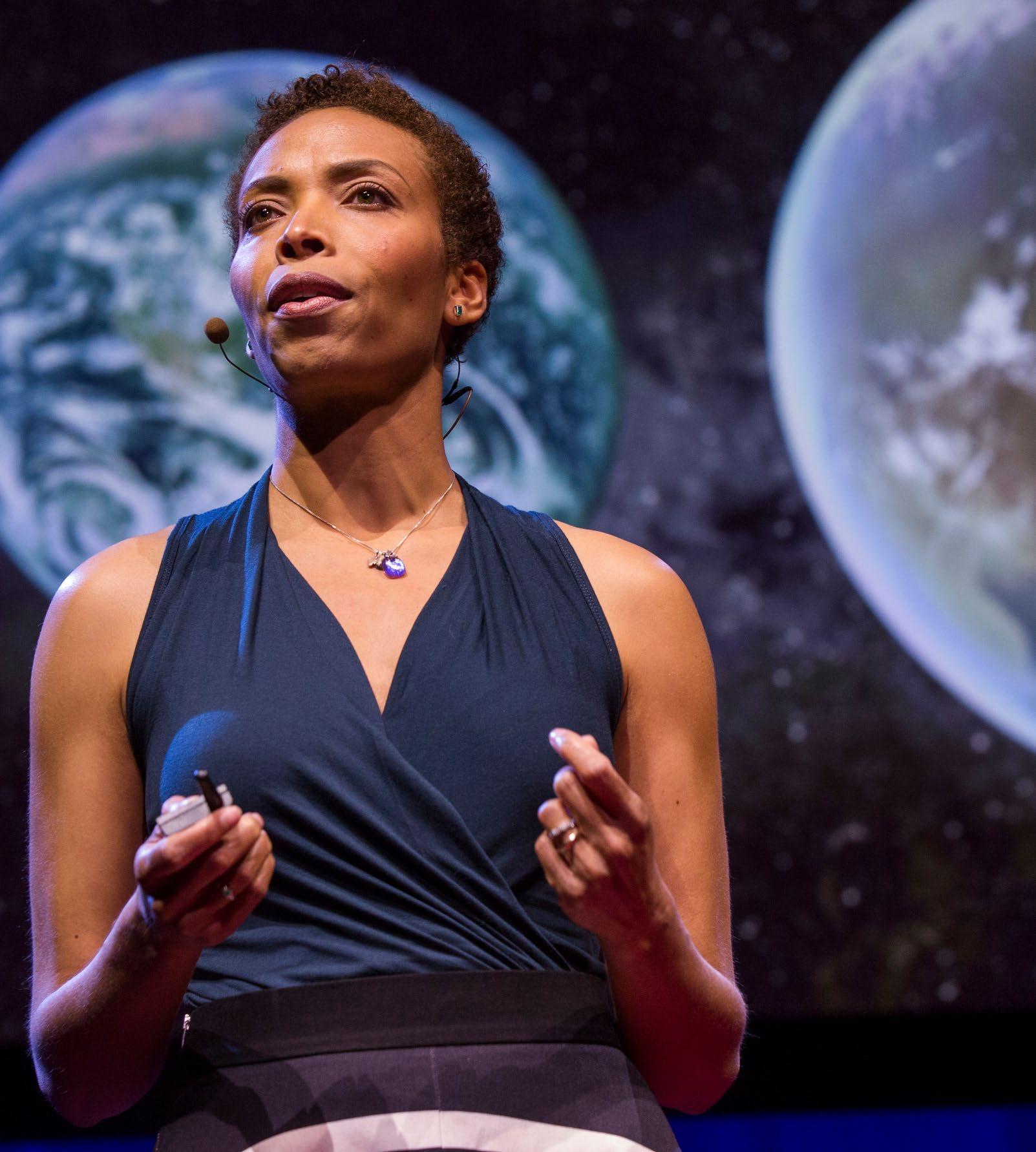
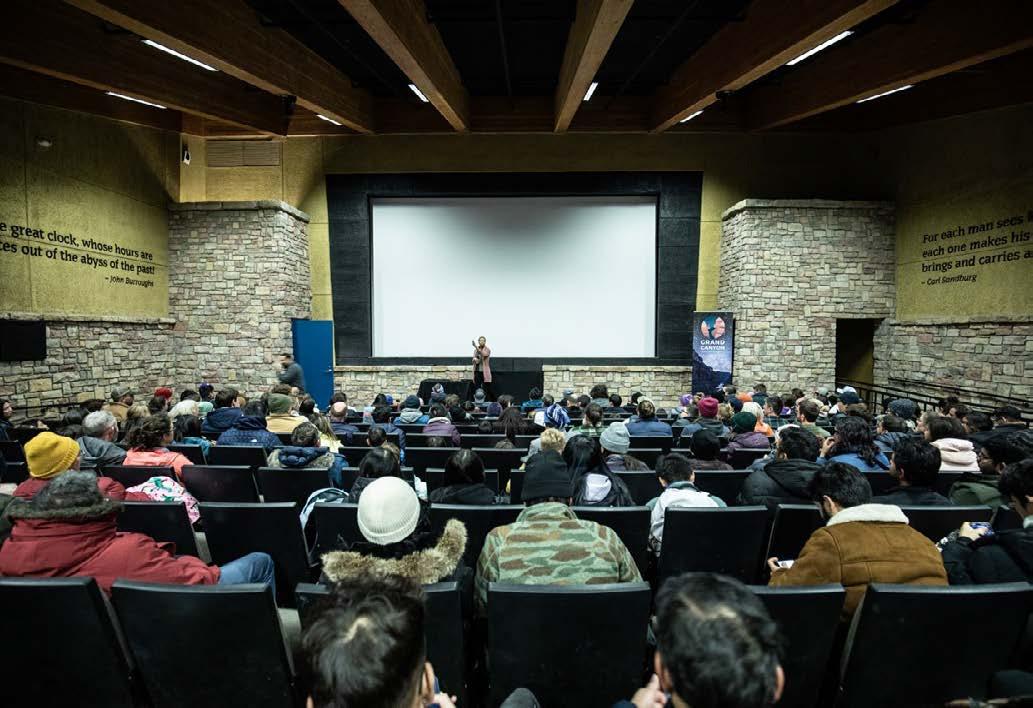
(Right) Dr. Shields provided some theater lectures on her astronomy research as well.
Dr. Aomawa Shields
November 18 - December 3, 2025
Dr. Aomawa Shields is an astronomer, an astrobiologist, the Clare Boothe Luce Associate Professor in the Department of Physics and Astronomy at the University of California, Irvine, and a classically-trained actor. Dr. Shields received her Ph.D. in Astronomy and Astrobiology from the University of Washington in 2014, an MFA in Acting from UCLA in 2001, and an Sc.B. in Earth, Atmospheric, and Planetary Sciences from MIT in 1997. As a 2015 TED Fellow, Dr. Shields uses her theater background to communicate science to the public in engaging, innovative ways.
During her residency, Dr. Shields provided several programs to park visitors, which blended science together with the healing qualities of the night. She introduced the practice of yoga nidra to both visitors and community members, a crucial practice for finding rest. She also worked daily on a book about many of these subjects, drawing inspiration from her quiet time living on the rim.
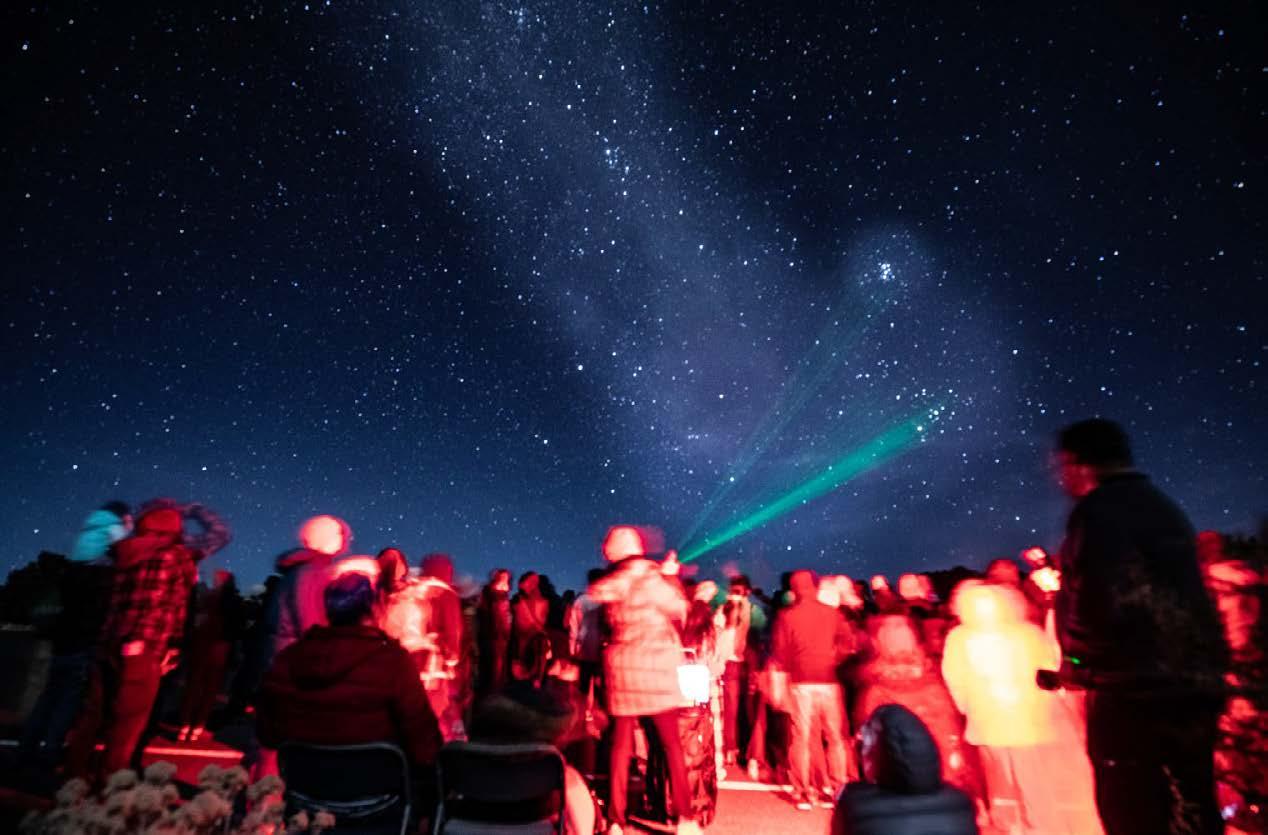
(Right) Dr. Shields dazzling visitors with her vast knowledge of the stars, and her even deeper wisdom about the values of pristine night skies. Photos by John Segesta.
(Left) Dr. Shields presented a few laserguided constellation talks to hundreds of visitors. She followed the talks with an introduction into yoga nidra, and the healing qualities of the night.
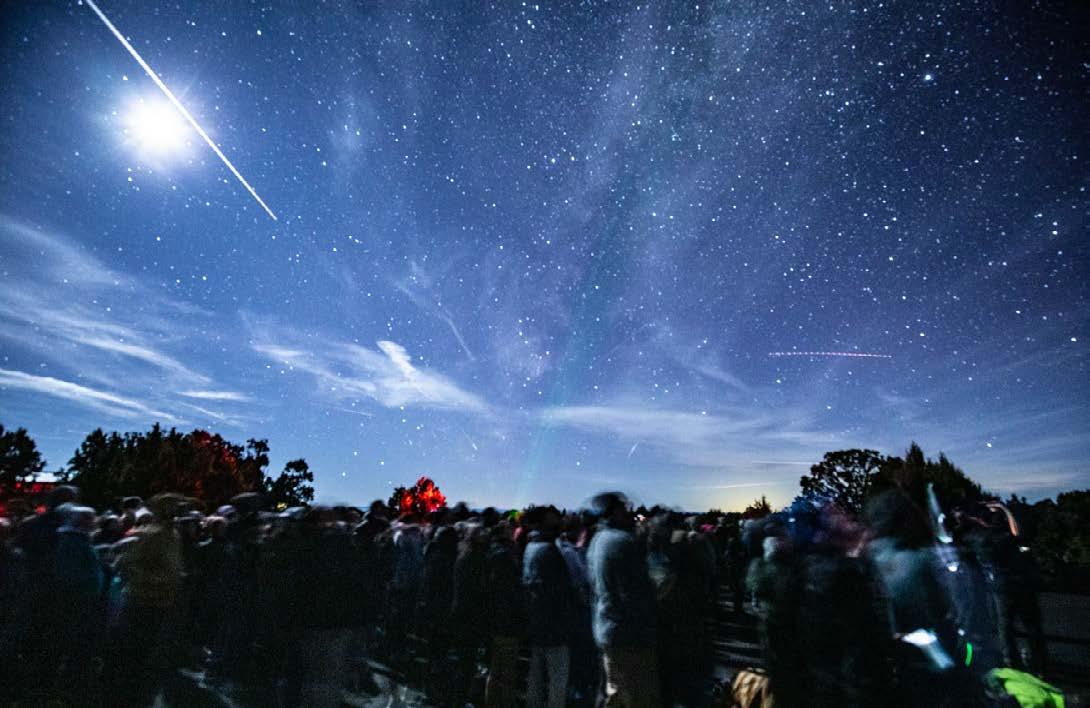
(Left) The moon even came out to see her programs!
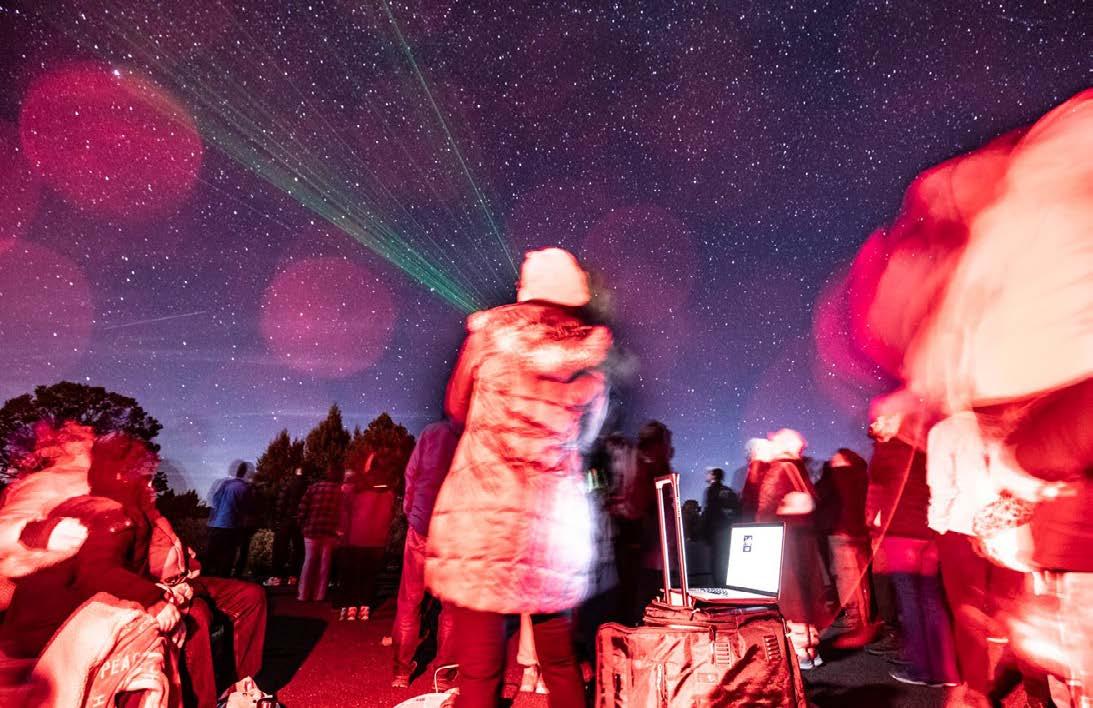
Astronomy VIP Program
Astronomy VIP Program 2025 at a Glance...

12 Astronomy Volunteers
160 astronomy programs
41,046 visitor attendance
17,152 solar astronomy contacts
13,221 spotting scope contacts
5,861 constellation talk attendance
2,000 volunteer hours
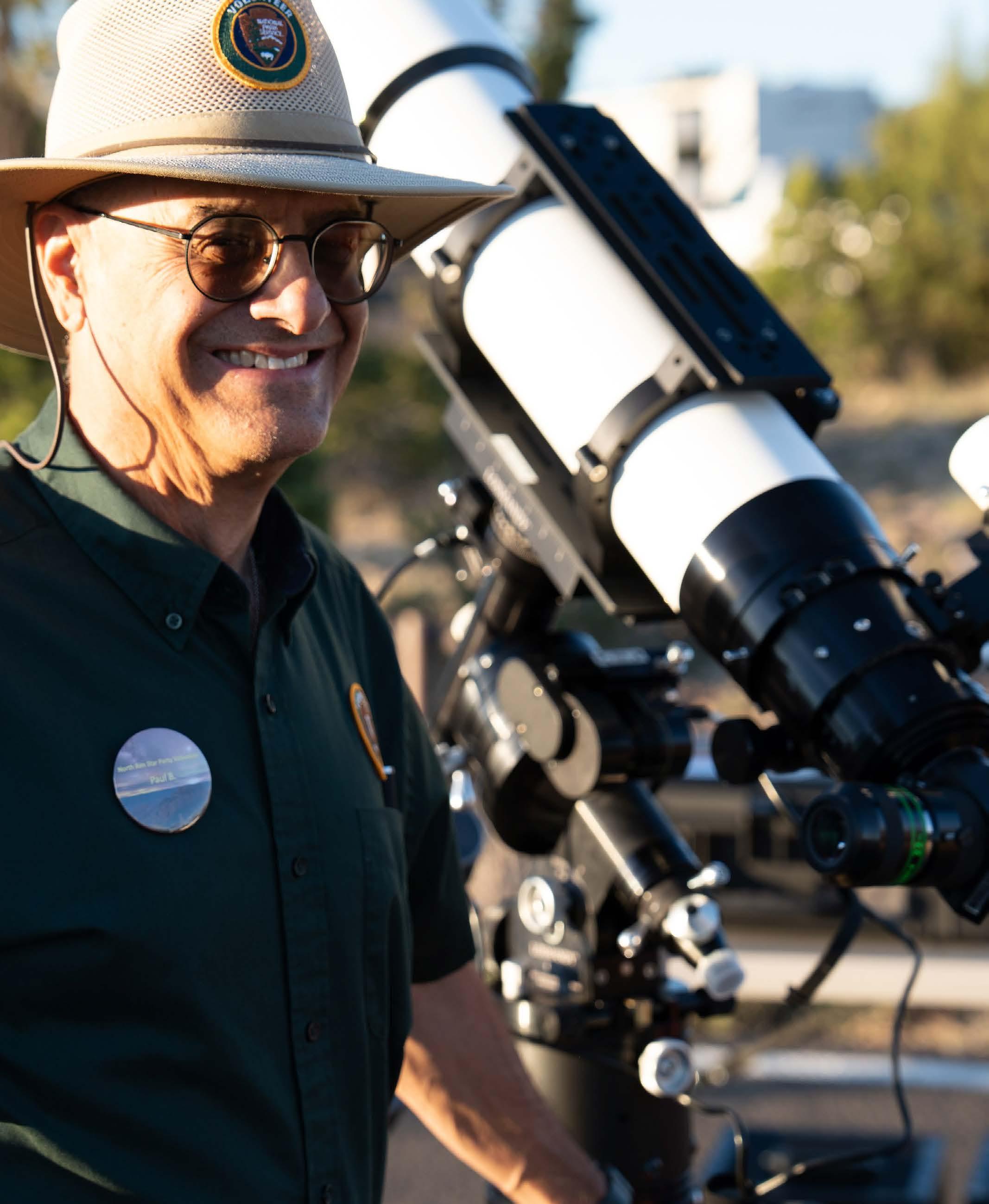
The Astronomy Volunteer Program began in the fall of 2023. The goal of the program is to provide opportunities for telescope viewing and constellation talks on a more consistent basis throughout the park. Our Astro VIP team was made up of a great mix of amateur astronomers, retired rangers, and seasonal interpreters this year. We’re excited to expand the program into 2026 and beyond! Learn more about the Astronomy VIP Program here.
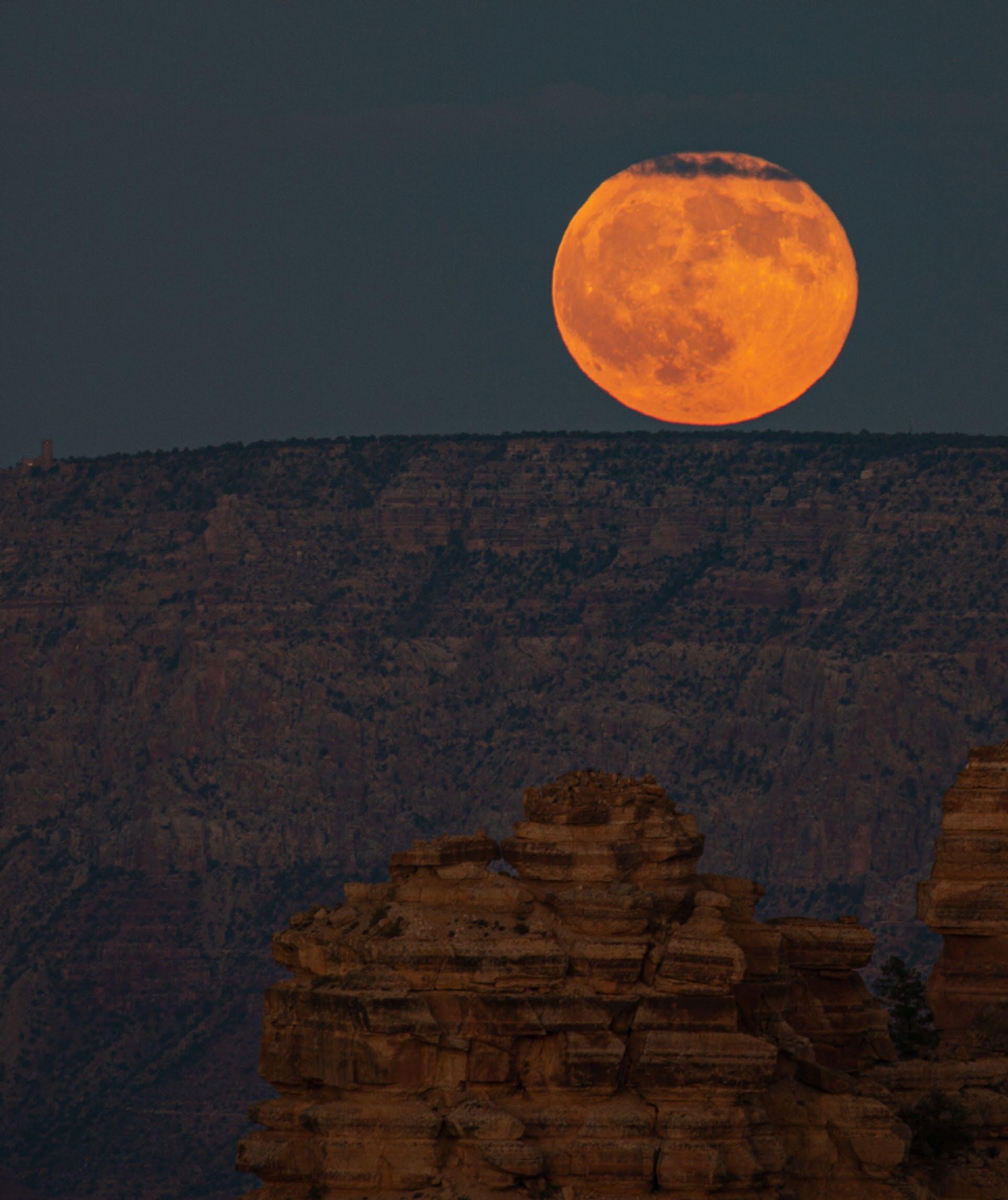
Moonrise over Desert View
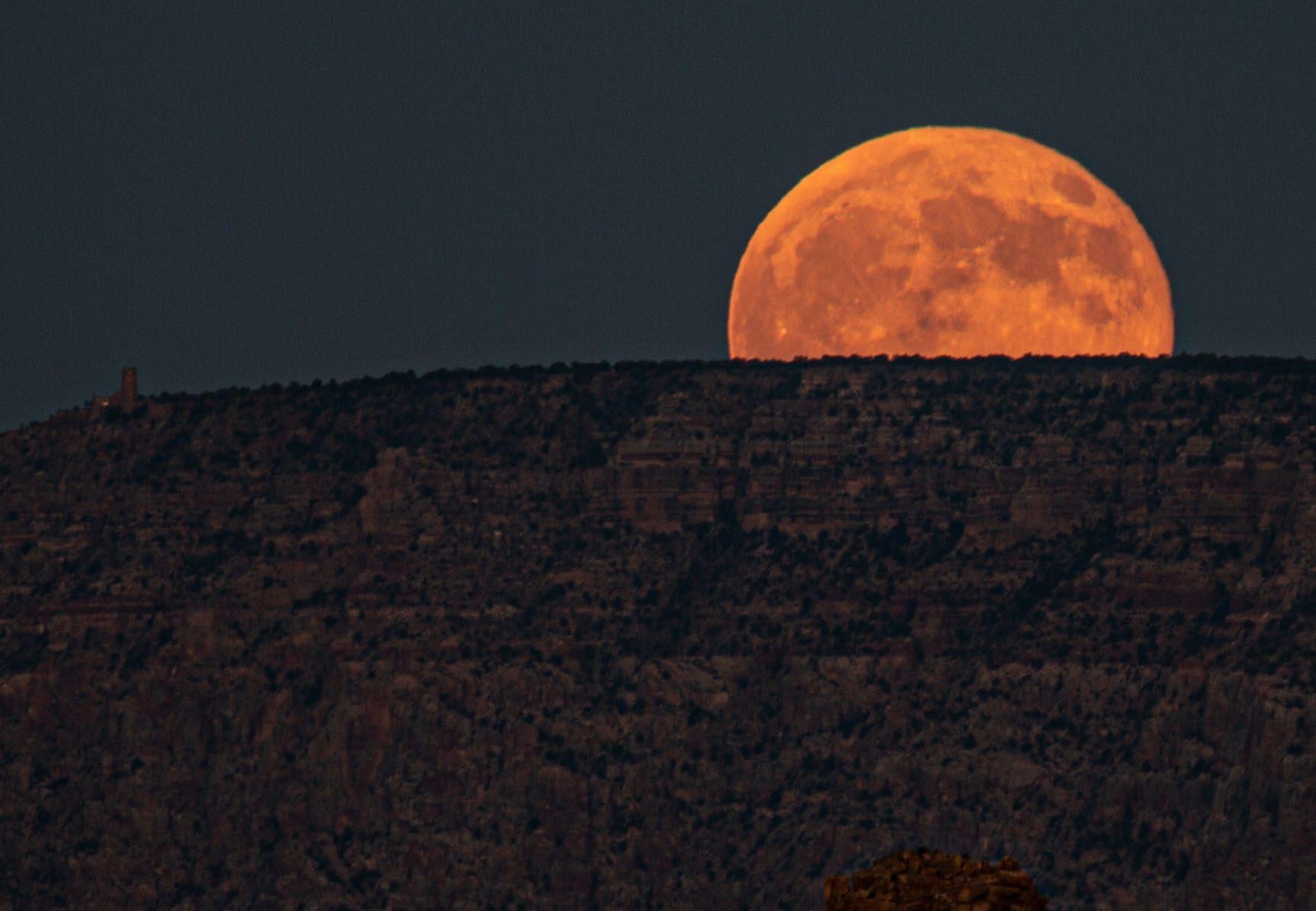
NPS’ Matt Young captured this photo of the full moon rising near Desert View Watchtower. Full Moon events were some of the most well-attended programs this year. Visitors gather at Mather Point while the Astronomy VIPs show early evening objects with telescopes.
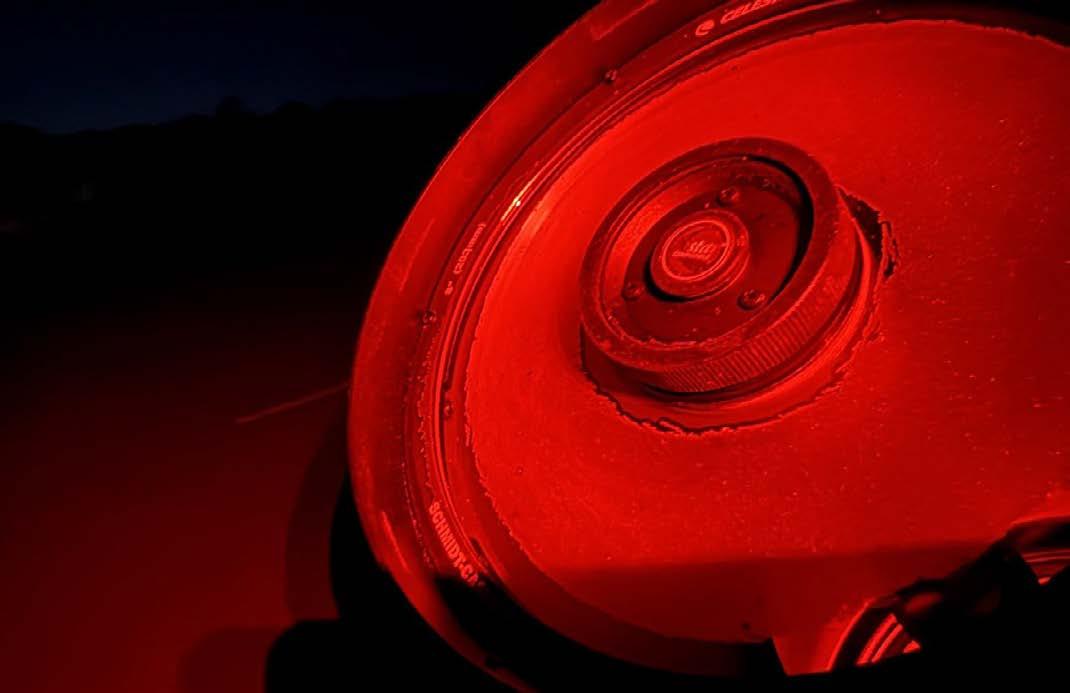
(Top) Astro VIP Steve connected with thousands of people this year with the park’s telescopes. Great work, Steve! (Below) The Astro VIP Program extends as far into winter as temperatures allow--last December, frozen condensation on the mirrors of our telescopes gave us a clue that it might be time to wrap it up for the season! Photo by Steve Dimse.
Astro VIP Kevin Legore joined us for a weekend of Astro Nights in May. Kevin brings decades of astronomy outreach experience, and has been a longtime Grand Canyon Star Party astronomer. Thanks for coming out, Kevin!
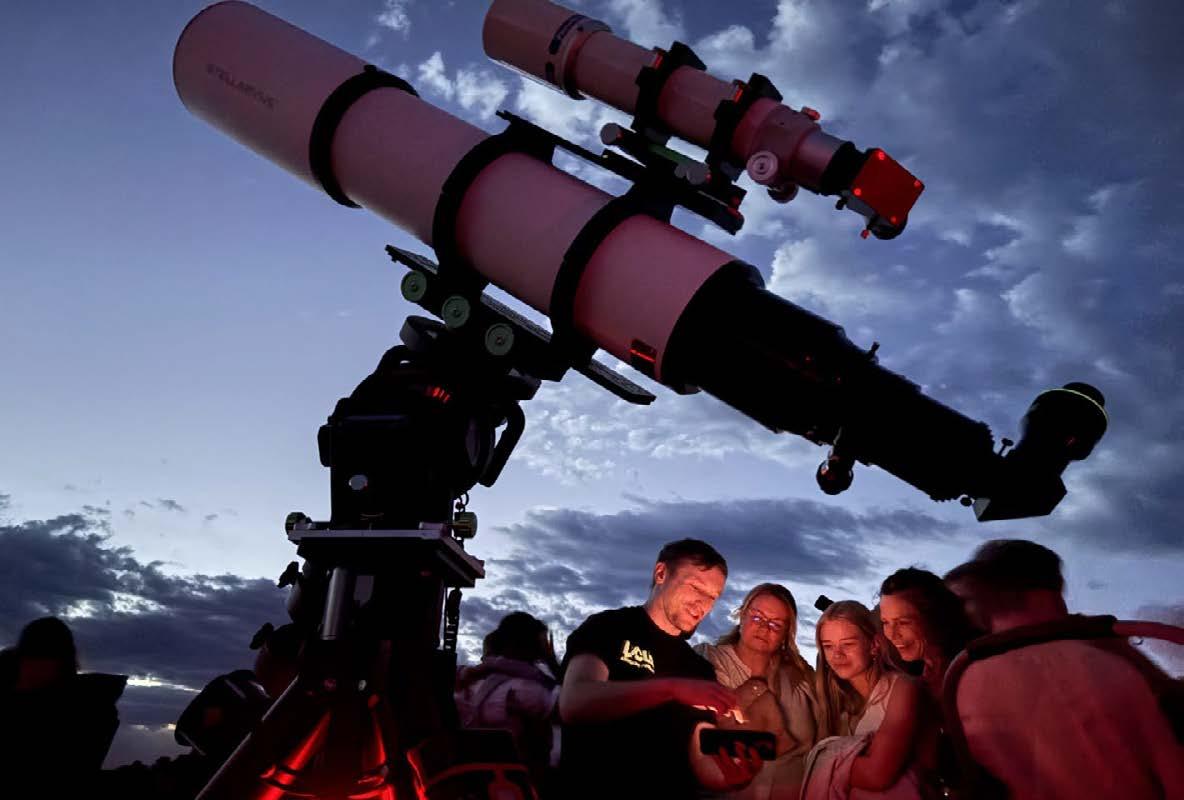
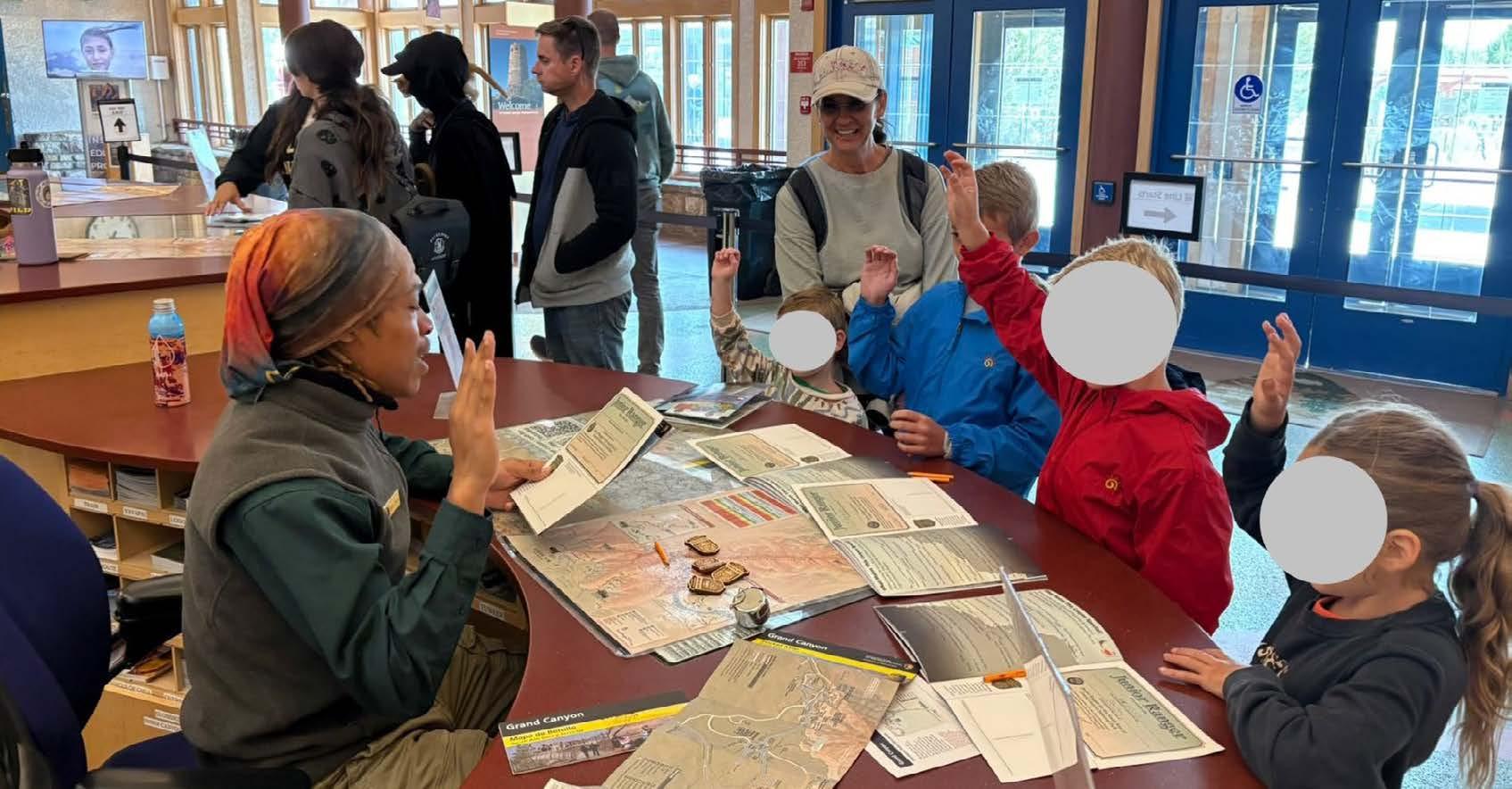
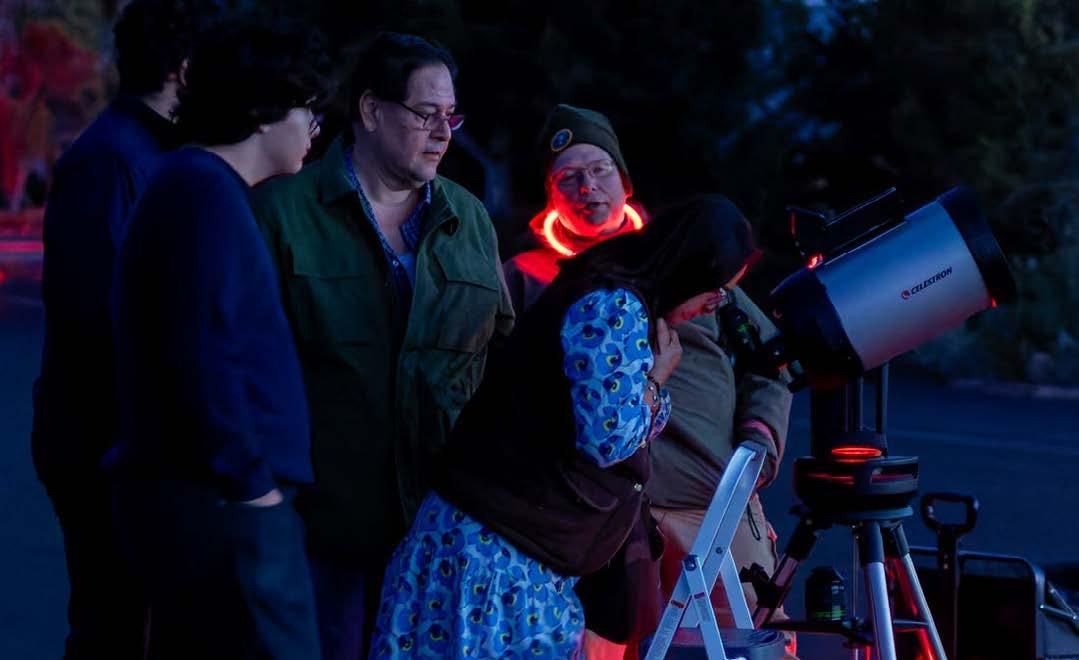
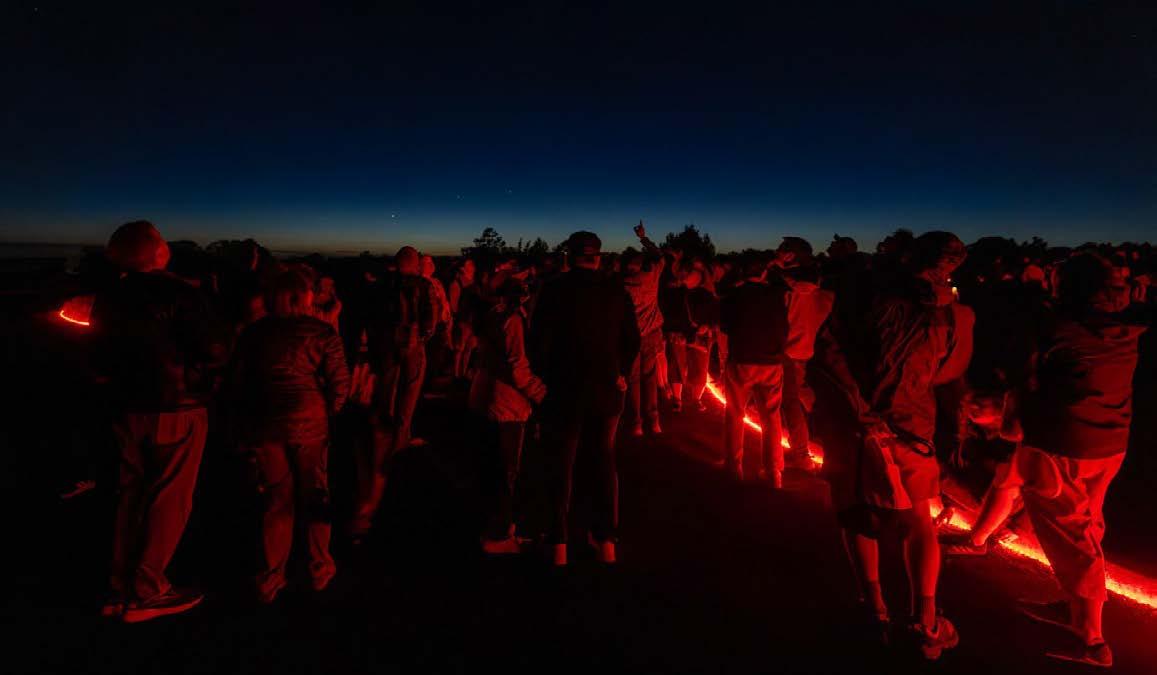
(Above) Astro VIP Tyler swears in his first group of junior rangers ever! This is a moment many-a-ranger wish they could have captured! Great work, Tyler! (Right) Visitors line up to look through telescopes at one of our many busy Astro Nights. Photo by Matt Young.
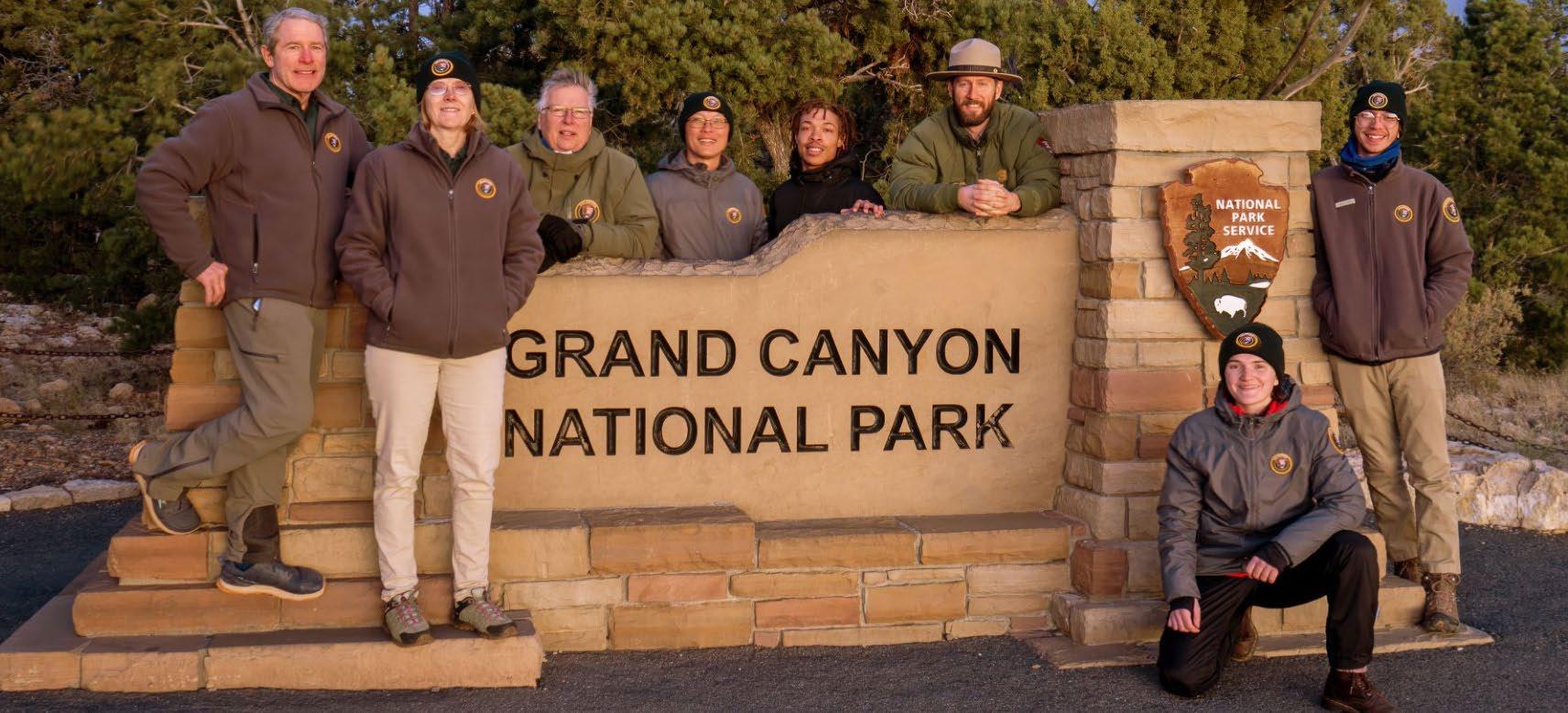
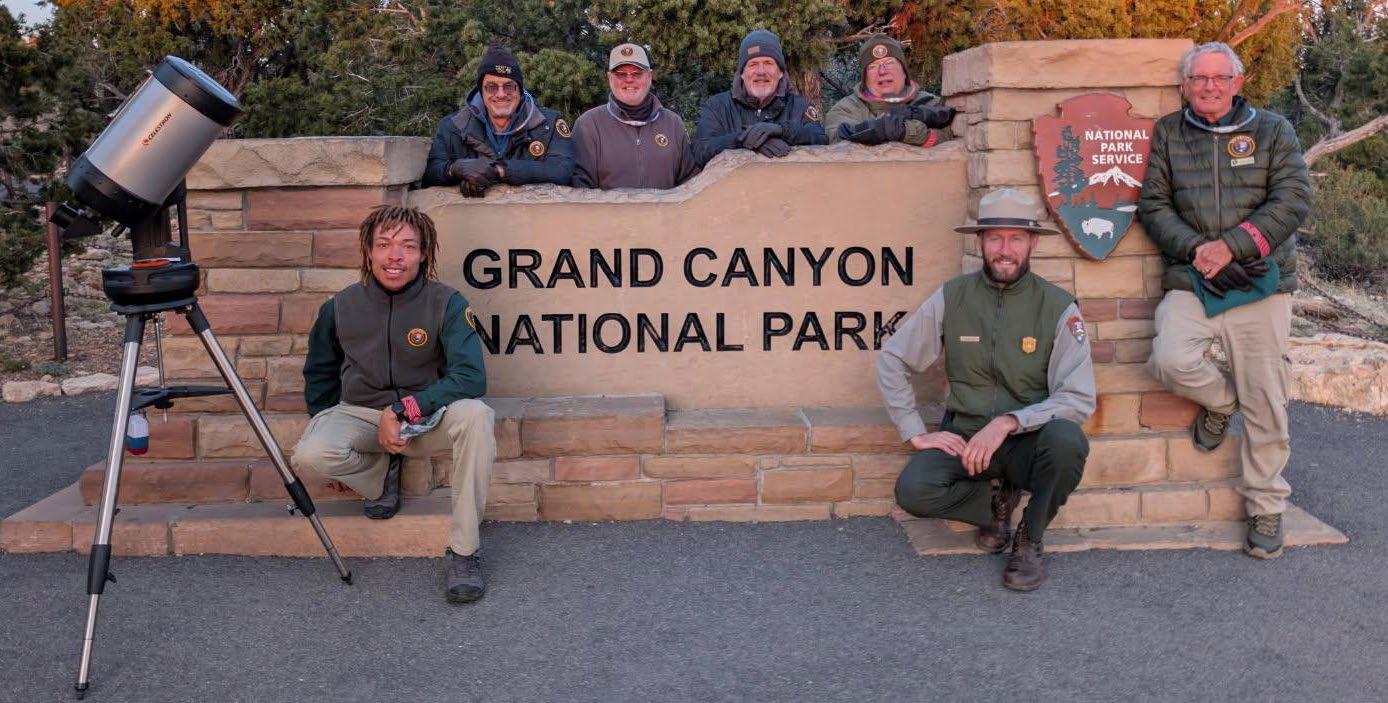
(Above) Our 2024 Fall Astronomy VIP Team. Left to Right: Bernie Sanden, Robyn Tan, Steve Dimse, Lian Tan, Tyler Cherry, Rader Lane, CC Cogswell, Joey Green.
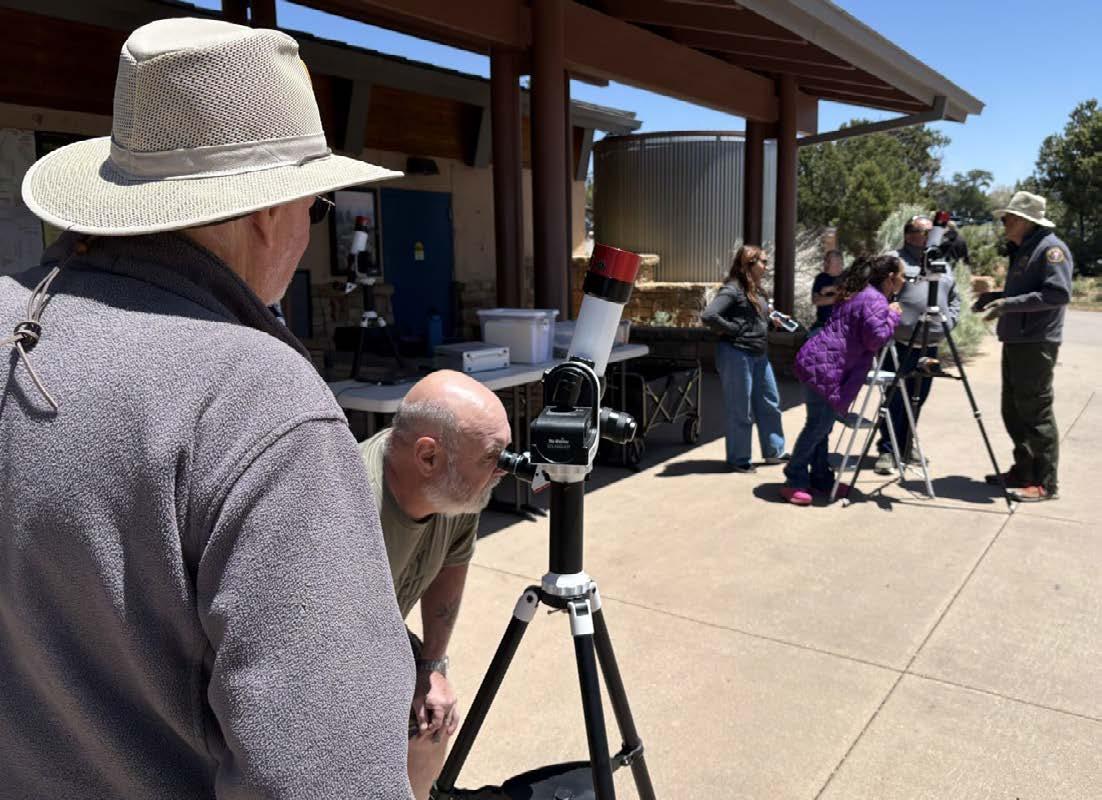
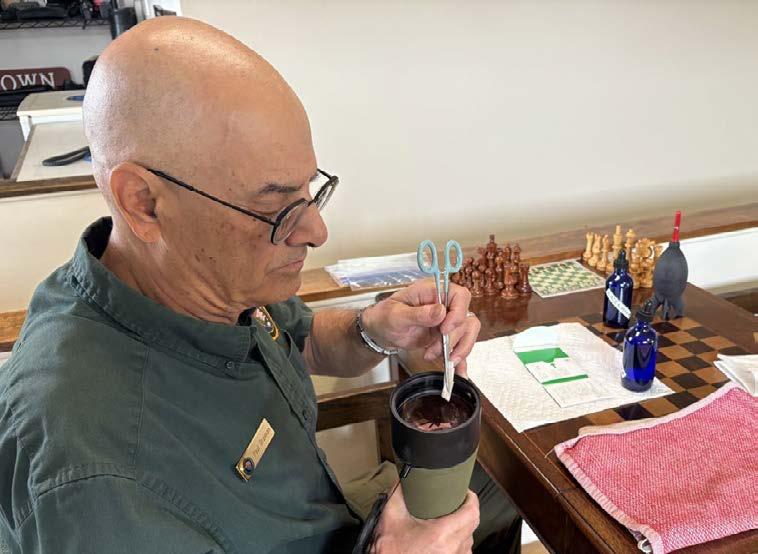
(Left) Astro VIPs Dave and Paul conduct outreach with the park’s brand new H-Alpha solar telescopes. (Right) Astro VIP Paul professionally cleans the spotting scopes. Thanks, Paul!
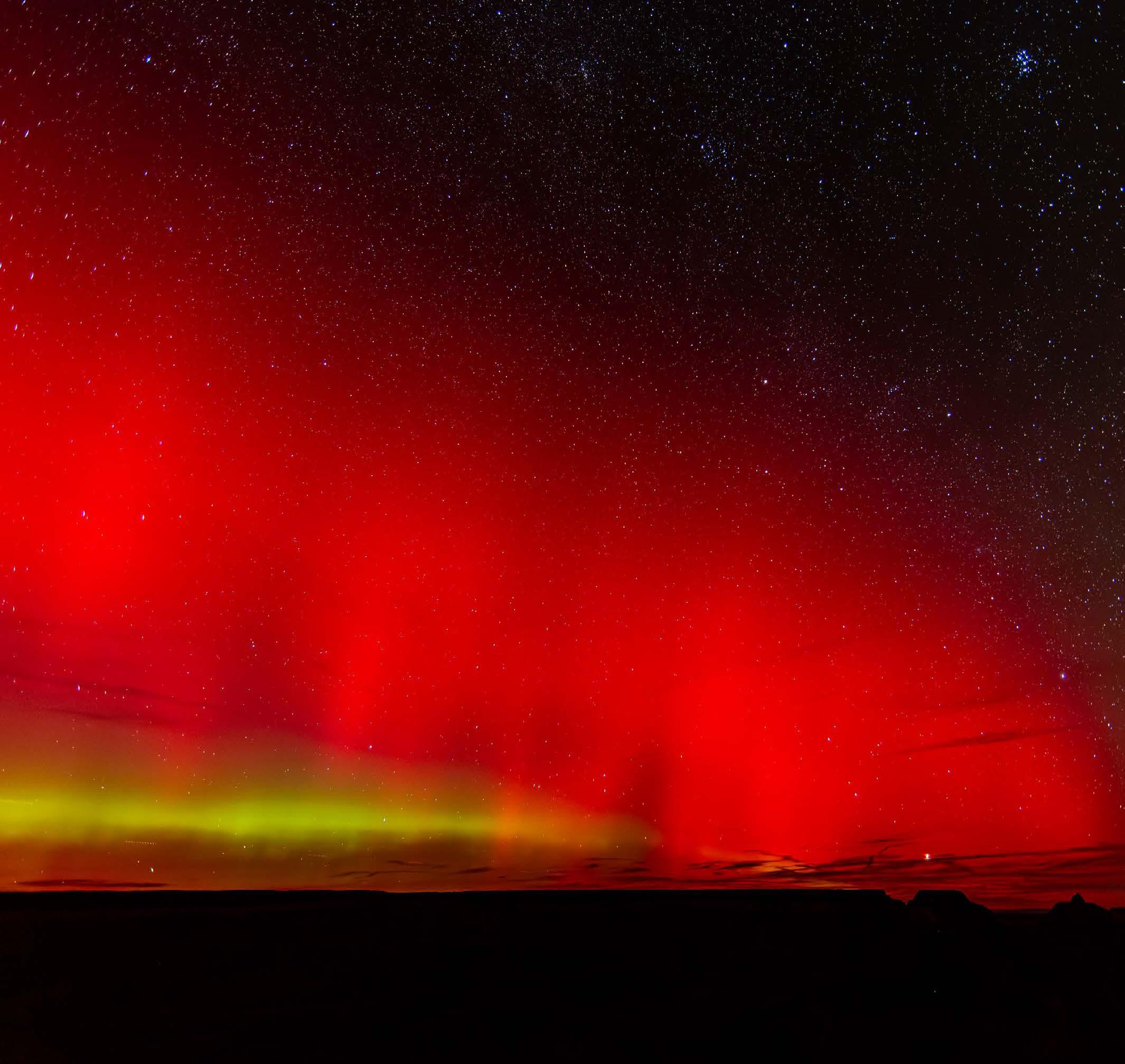
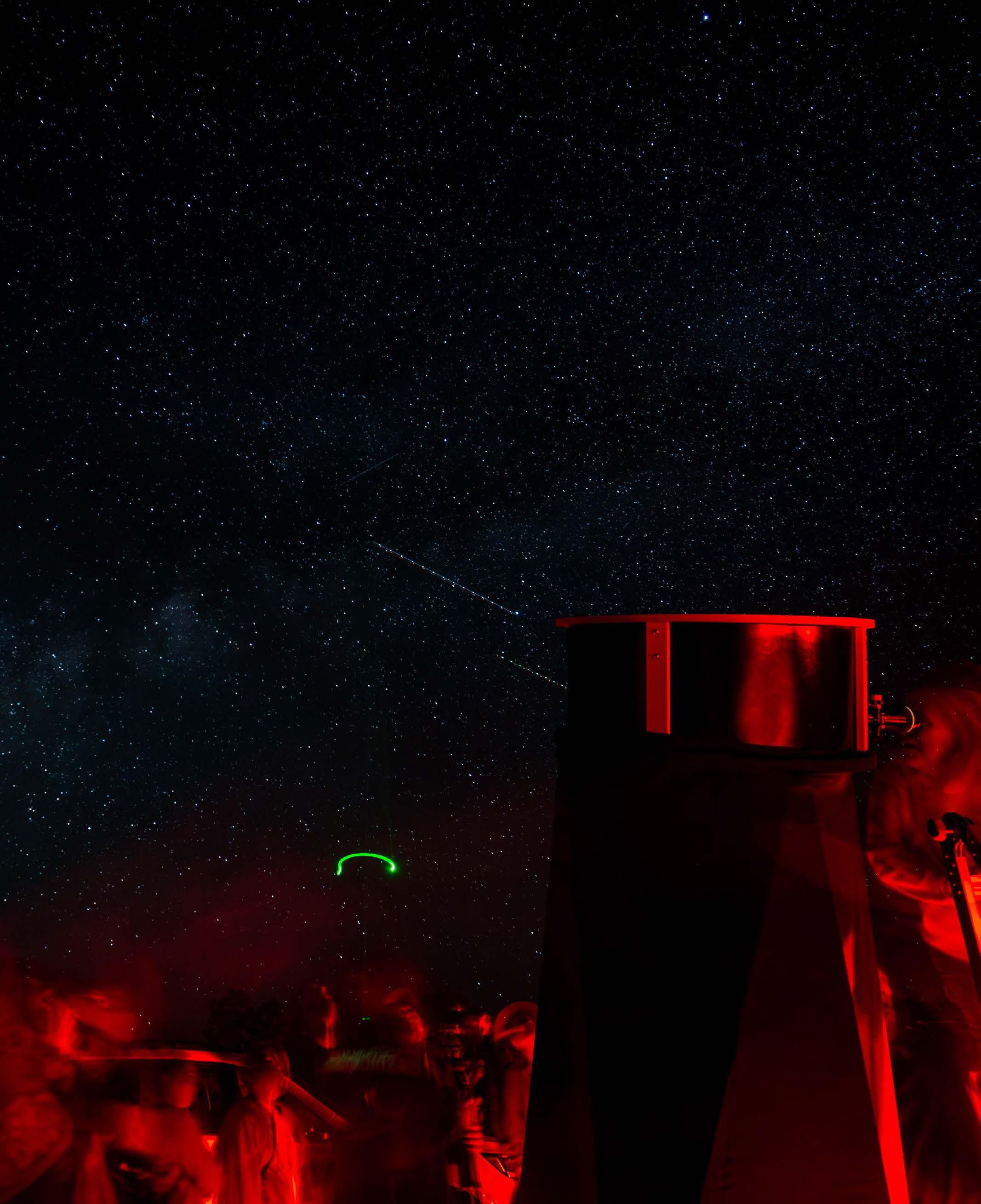
You never know what you’ll see at our Astronomy Nights!
Among all the meteors, fireballs, bolides, comets, airglow, gegenschein, zodiacal light, eclipses, and other fascinating astronomical phenomena one can see at any given Grand Canyon Astronomy Night, we sometimes see aurora borealis! Aurora occurs when solar particles collide with gases in Earth’s upper atmosphere. They are best seen in higher latitudes, but occasionally make it down to 36 degrees north and below! The more astronomy nights you attend, the more you’ll see the diversity of wonder in the night skies! Photo by Matt Young.
(Above) Our Spring 2025 Astronomy VIP Team. Left to Right: Tyler Cherry, Paul Braiman, Dave Hagarty, John Hallett, Steve Dimse, Rader Lane, Rob Cochran.
Again, you never know what you’ll see at our Astronomy Nights!
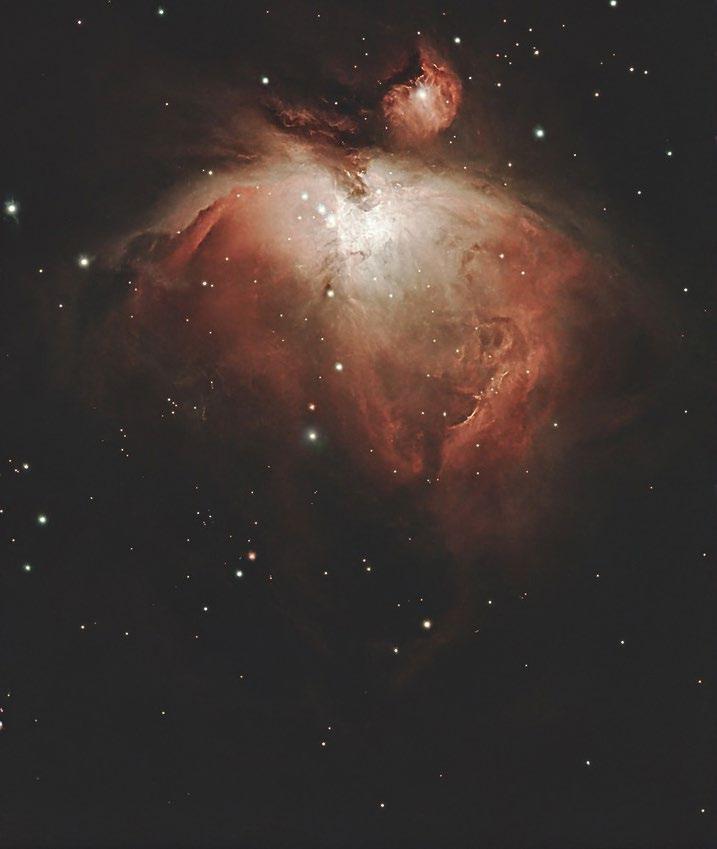
Astronomy volunteer Dave Hagarty focused on Electronically Assisted Astronomy (EAA) outreach this year. This is a method of developing faint celestial objects in real-time using sensitive cameras. Here, Dave captured M42, the Orion Nebula, and was able to develop this image before visitor’s eyes, offering a fascinating supplement as they viewed the object through telescopes. EAA is also a helpful technique to use for accessibility purposes, allowing everyone to enjoy the night skies! Awesome work, Dave! Photo by Dave Hagarty.
NPS Night Sky Programs
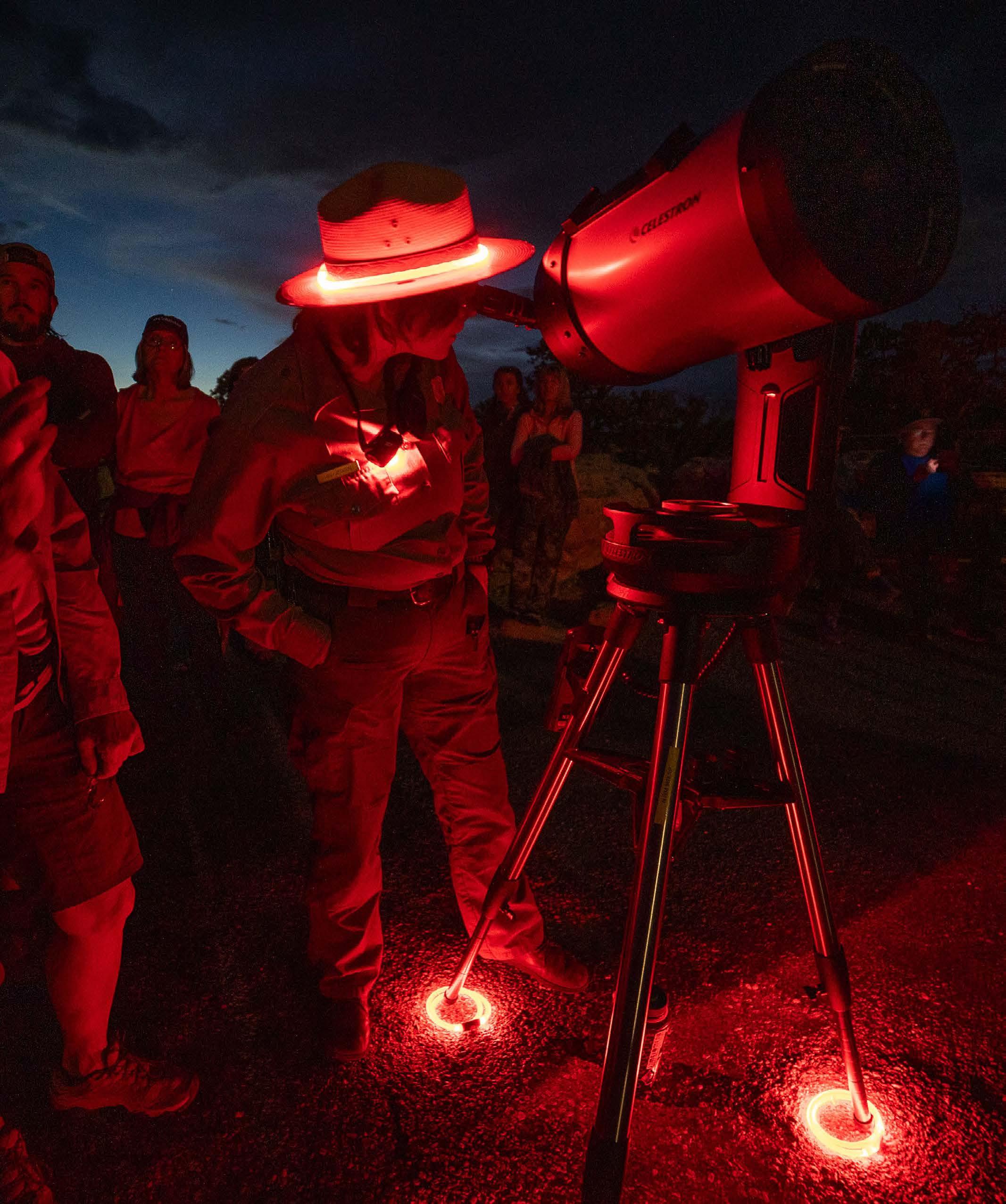
Weaved throughout every month, NPS park rangers provide public programming on various topics related to night skies, from nocturnal ecology, to cultural astronomy, from constellation talks to light pollution talks. They also create digital media about night skies. The NPS has a long tradition of DARK rangers interpreting the vanishing resource of the stars to thousands of visitors per year.
Photo by Lauren Cisneros. Learn more about NPS Night Sky Programs here.
NPS Night Sky Programs 2025 At a Glance...
28 astronomy programs
4,791 visitor attendance
3 districts of the park
3 digital products
1 online talk
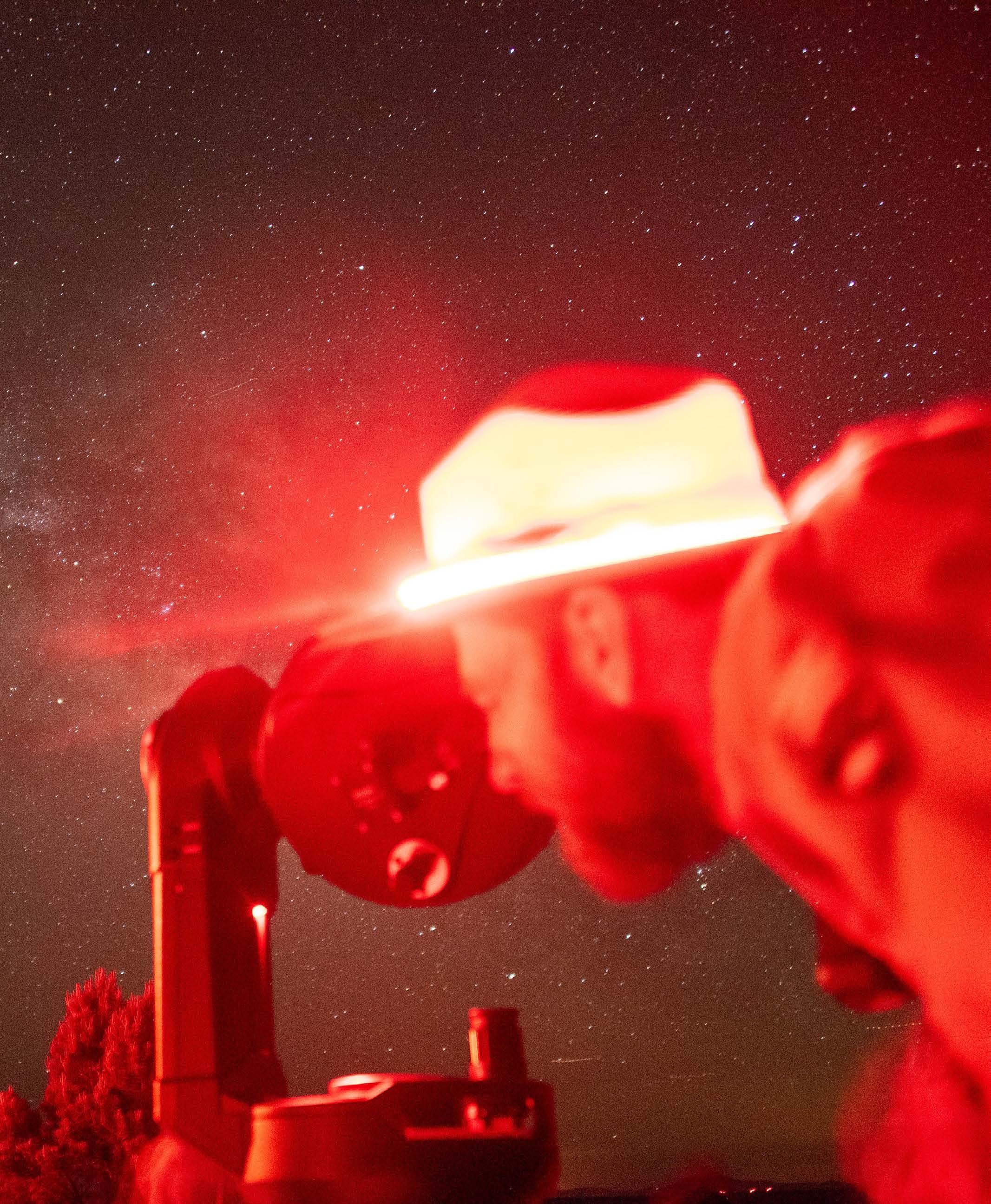
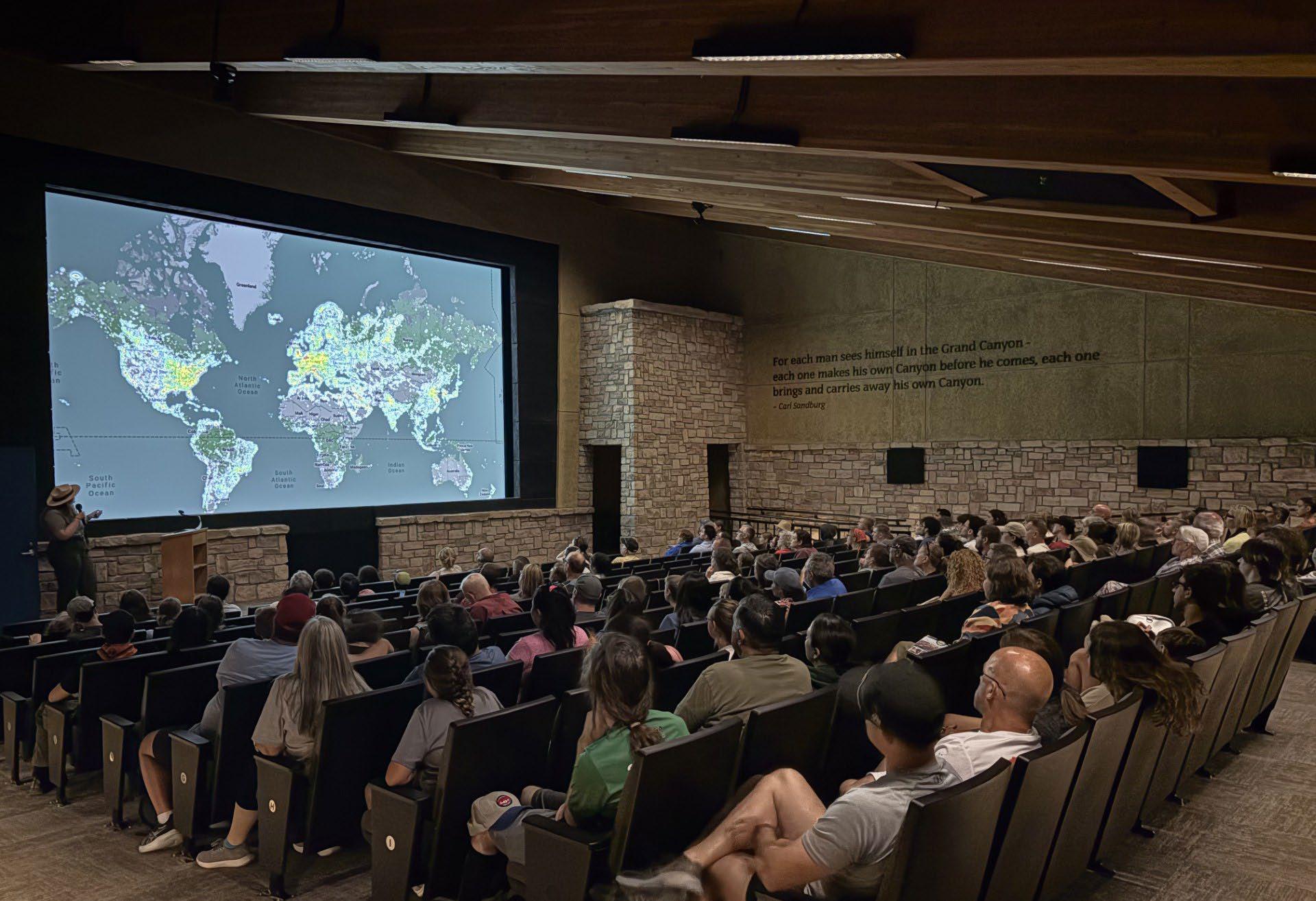
Rangers Kate Esten (above) and Maggie Mcguffie (below) present a night sky program they developed over their summer season which explored the various harms of light pollution as well as the many benefits of pristine night skies--from human health to ecology, from inspiration to economics! Awesome program, Kate and Maggie!
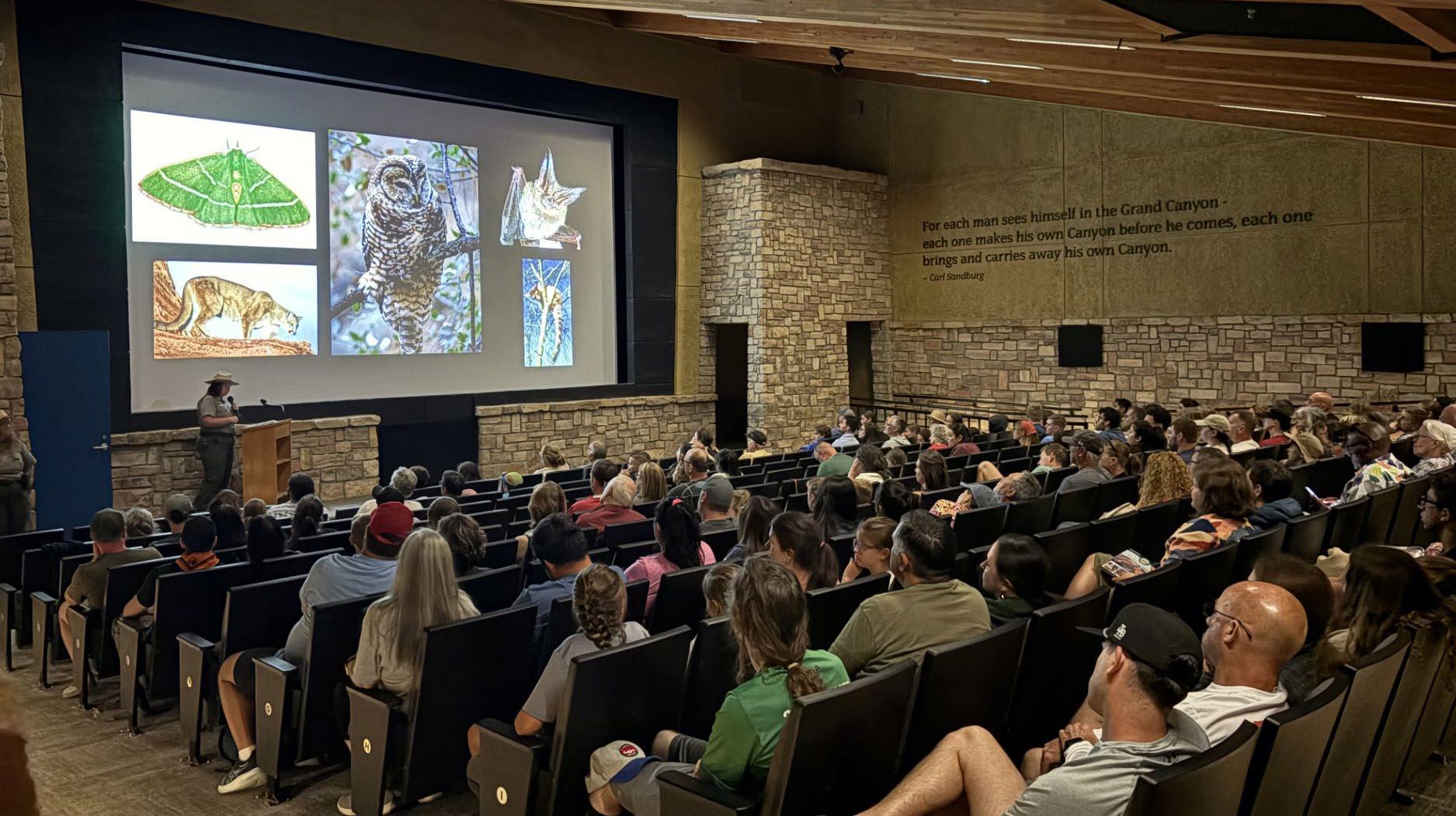
Photo by Lauren Cisneros
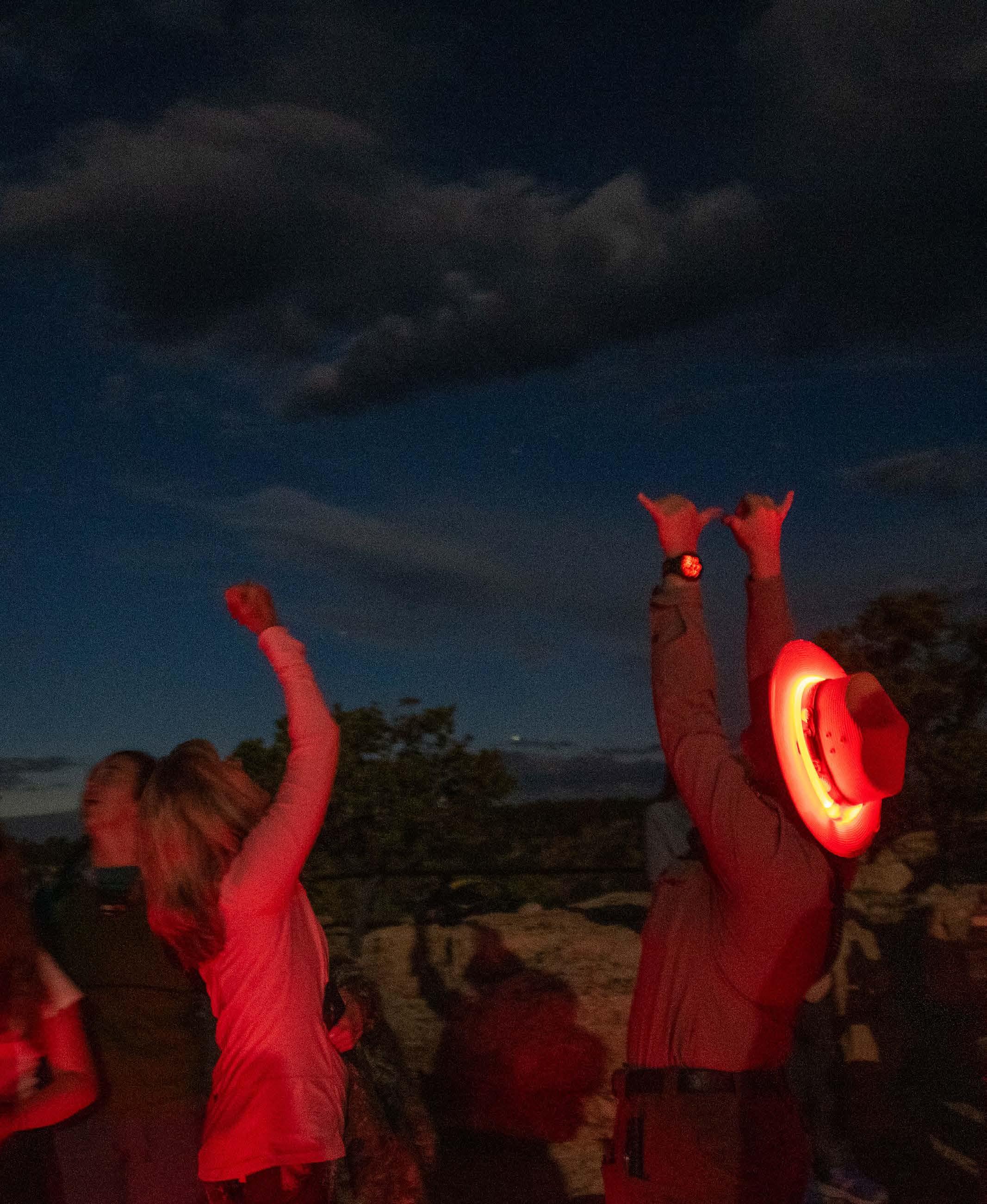
Ranger Han demonstrates for a visitor how to measure distance in the sky using your hands. Held at arm’s length, your pinky to your thumb is about 25 degrees. Hang loose, Han!
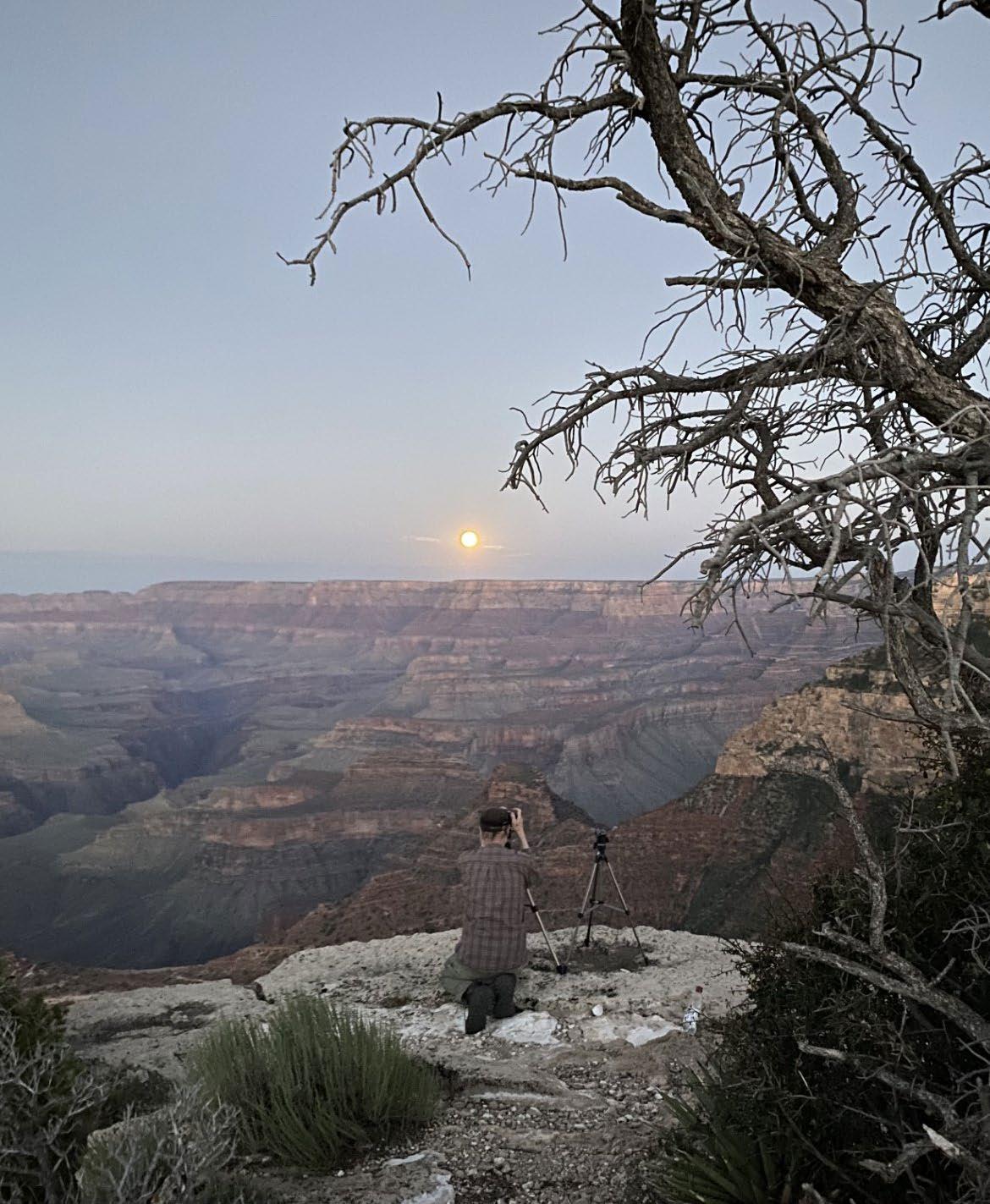
A special thank you and farewell to Michael Quinn, who is retiring after decades of service to Grand Canyon National Park. Michael began his career at the Grand Canyon with the Fred Harvey Company in the 1970s and eventually joined the National Park Service in 1992 as the park’s museum photographer and photo archivist. Since then, Michael has photographed and filmed countless historic moments and events for the park. Some of his most beloved photographs are of the full moon rise over the Canyon, which he attempts to photograph nearly every month. Pictured here is Michael doing what he does best-capturing the Canyon’s beauty to share it with others. Thank you Michael, for your extraordinary work over the years. You are a Grand Canyon living legend.
Photo by Lauren Cisneros
Photo by Rader Lane
Special Events
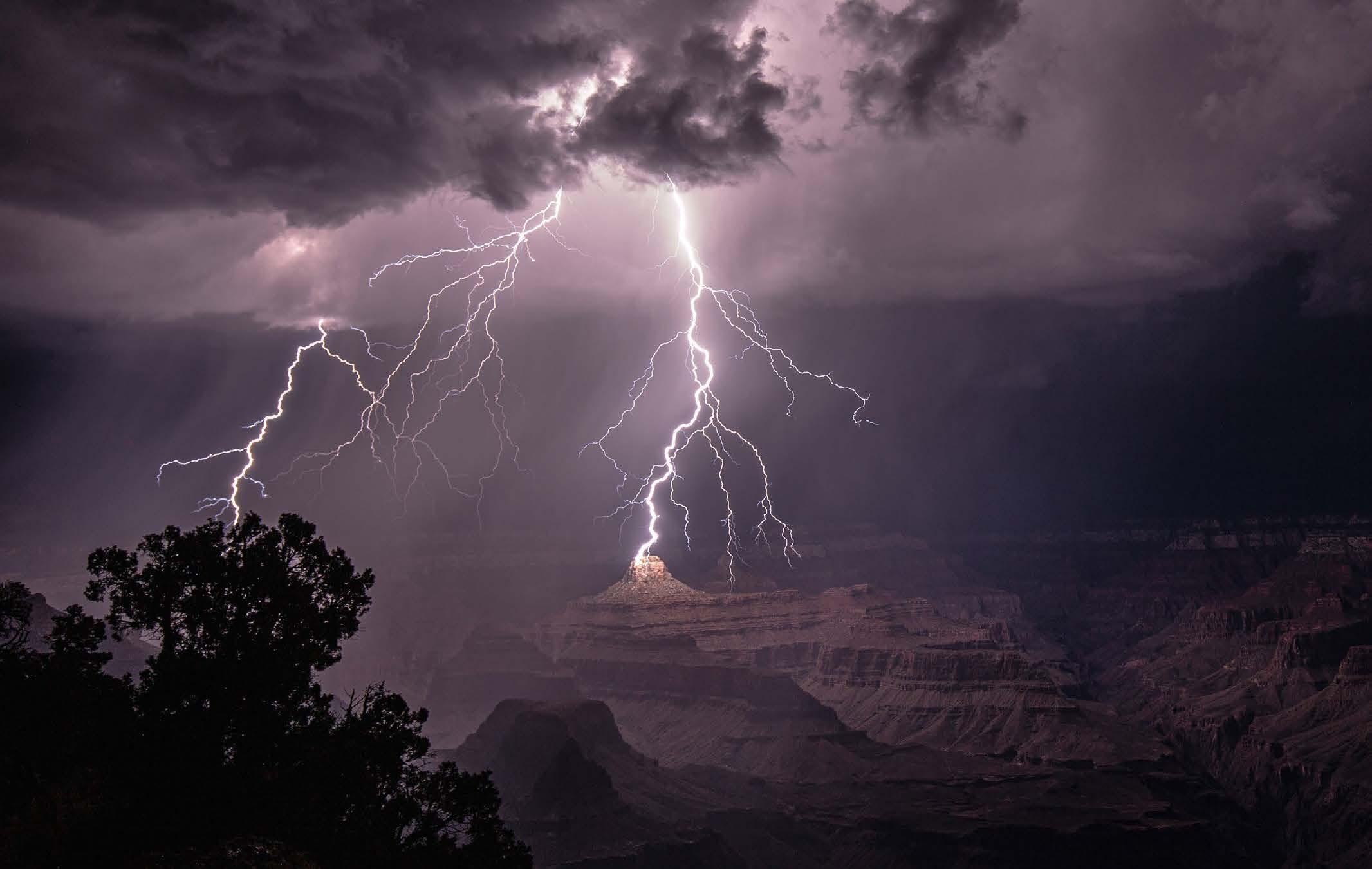
Night photography doesn’t always have to be about the stars! Ranger Matt Young of the Dark Skies Team takes amazing photographs of the Grand Canyon which focus on all the beauty found in the dark. (Above) Lightning strikes over the distant Canyon at night, their flash illuminating the surrounding temples. (Below), A full moonrise over Desert View Watchtower.
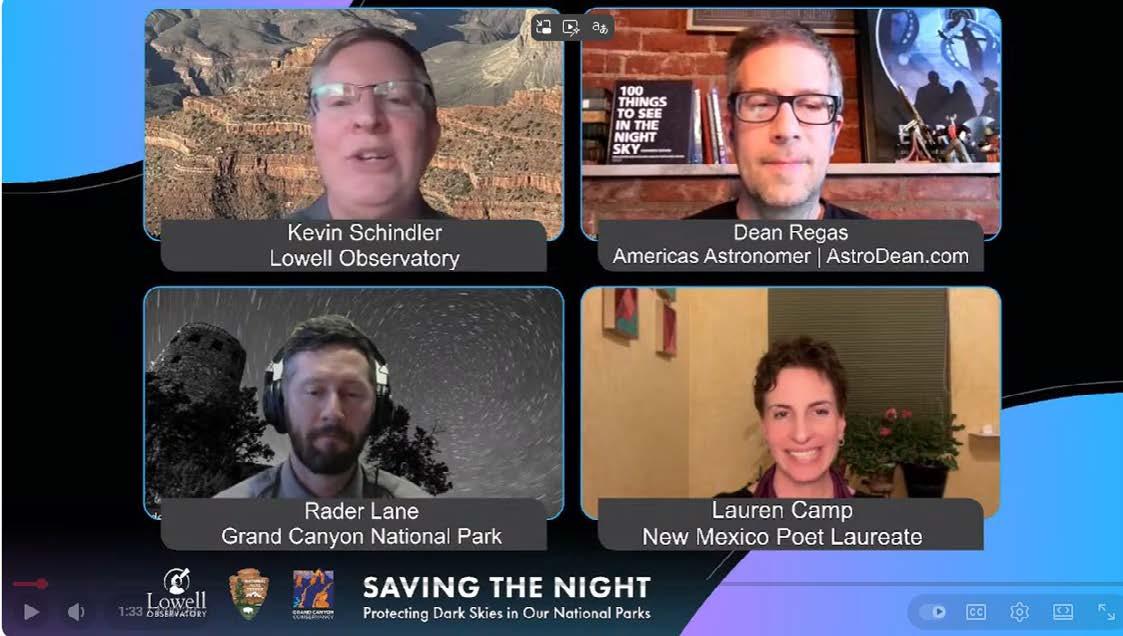
Grand Canyon Conservancy, in partnership with Lowell Observatory, hosted a “Saving the Night” livestream event for International Dark-Sky Week in April. Here, Astronomer in Residence alumni Kevin Schindler, Dean Regas, and Lauren Camp, together with Ranger Rader Lane, discuss the importance of natural darkness. Watch the recording here.
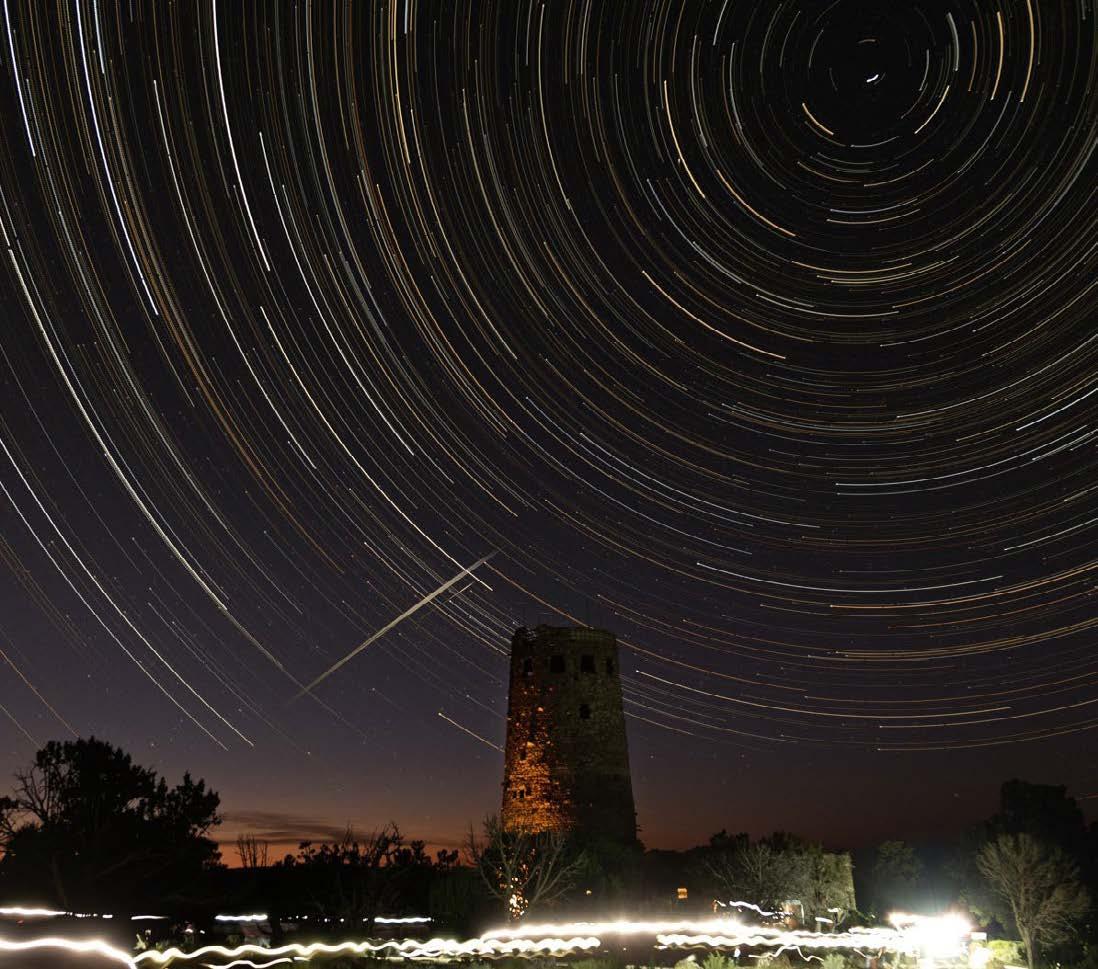
The Interpretation team at Desert View hosted a special night sky event this summer at the amphitheater near the Watchtower. They invited Gerald Dawavendewa to speak about the Hopi cosmos and to point out a few of the Hopi constellations. With approximately 100 visitors attending, the team is excited to expand dark sky programming at Desert View into the future!
Photo by Richard S. Wright Jr.
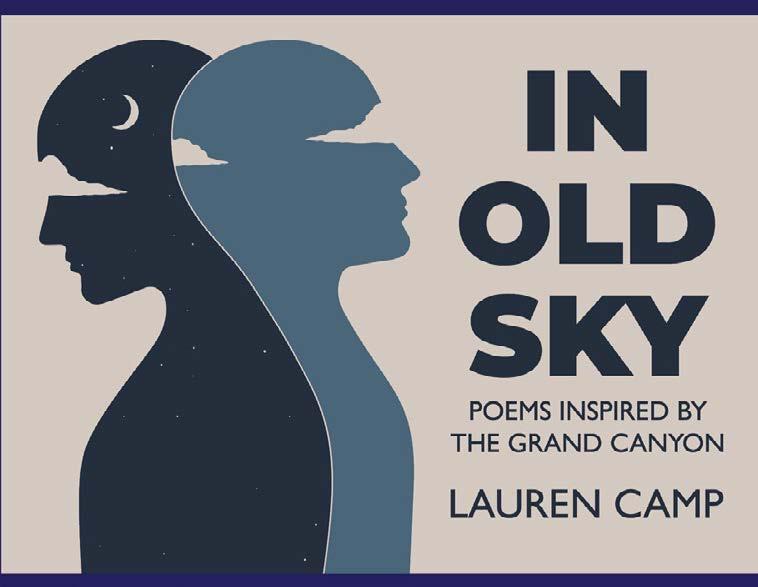
Astronomer in Residence alumna Lauren Camp’s book, In Old Sky, published by Grand Canyon Conservancy, features poems about Grand Canyon’s stars, thoughts on natural darkness, and Lauren’s personal journey discovering both during her residency! This year, the book won the New Mexico Book Award for poetry! Congratulations, Lauren and Grand Canyon Conservancy!
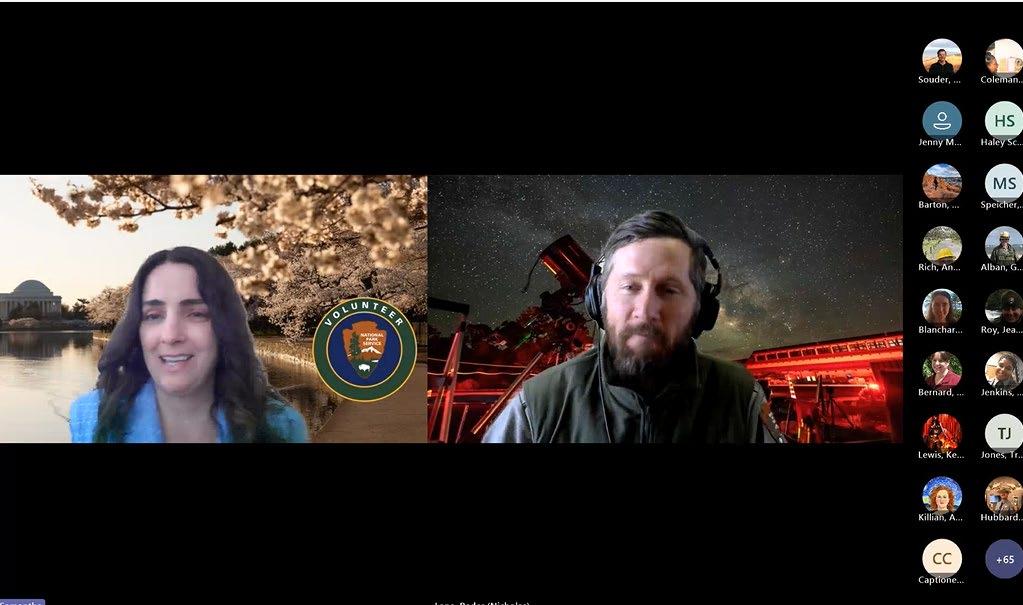
Our team was invited to speak about Grand Canyon’s various astronomy volunteer programs at the 2025 NPS Volunteer Management Summit. Thanks to the great work of Sam Zurbuch and team for hosting this summit for NPS volunteer managers!
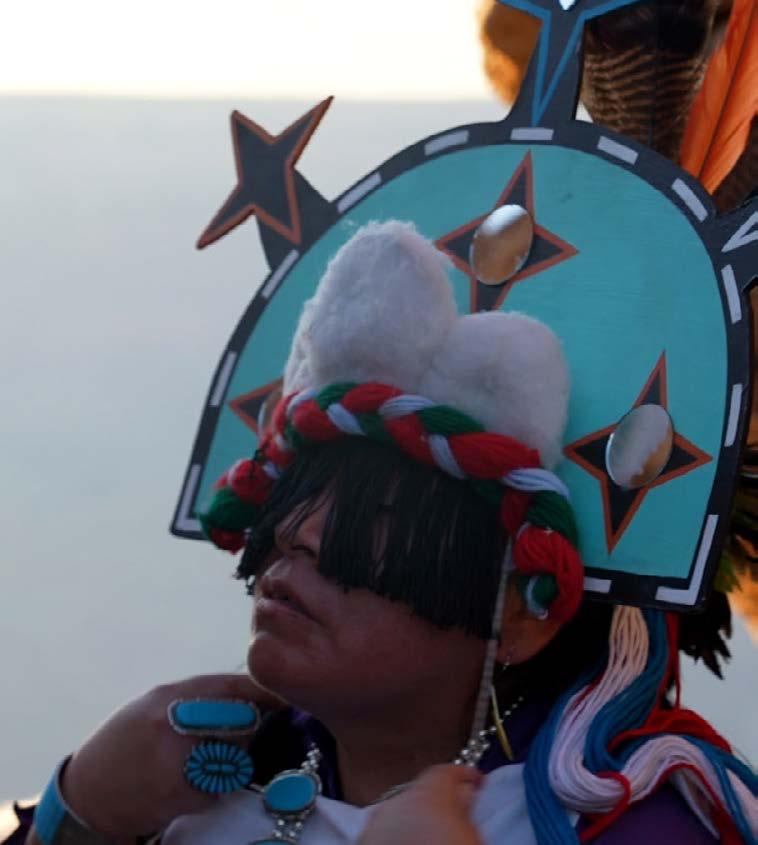
The Cellicion Zuni Dancers are world renowned for their performances of traditional Zuni Pueblo social songs & dances. They performed at Desert View this year. Here, they prepare for the Star Dance: “Within this headdress, most of the heavenly beings are represented. The blue represents the sky, the black is the night, the white line along the edge is the Milky Way. The three stars on top are the morning, evening, and north stars.” Click here to watch the Minute Out In It film of their performance!
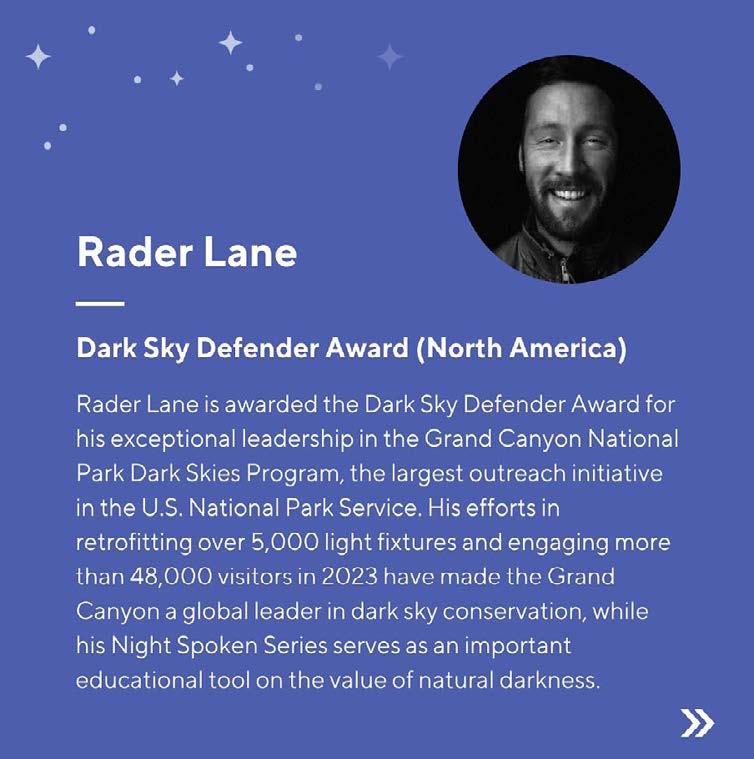
Ranger Rader Lane won the 2024 DarkSky International Dark Sky Defender of the Year Award for the continent of North America. It is “given to individuals and organizations in appreciation and recognition of their exceptional efforts to promote and advance the mission of DarkSky to preserve night skies by promoting quality outdoor nighttime lighting to reduce light pollution and its environmental impacts.”
The Dark Skies Team and the Cultural Demonstration Team were invited to Lowell Observatory in September to support the unveiling of Gerald Dawavendewa’s new mural for Lowell’s Astronomy Discovery Center. The mural depicts complex stories and symbols from the Hopi cosmos. Gerald is a frequent collaborator with Grand Canyon’s programs. Congratulations, Gerald!
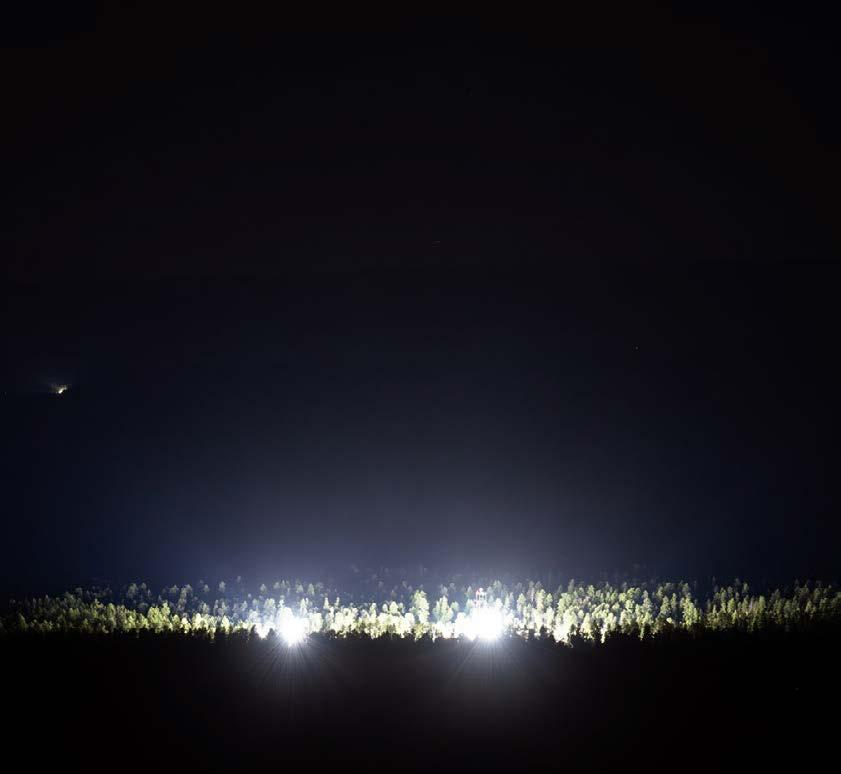
The park made great progress this year in mitigating light pollution around the park’s boundaries. Thanks to the reports produced by Astronomer in Residence Stephen Hummel, the park had several meetings with the Town of Tusayan, The Tusayan Airport, ADOT, and the Pinyon Plain Mine about the issues. Here, we can see the affect of light pollution from the Pinyon Plain Mine.
In the Media
News Articles
Grand Canyon Night Skies
• Astronomy Magazine - A Visit to the Grand Canyon Star Party GCC Astronomer in Residence Program
• About Place Journal - On the Purpose of Connection: An interview with New Mexico State Poet Laureate Lauren Camp
• Santa Fe Magazine - Not Resting on Laurels
• Grand Canyon Conservancy - Former GCC Astronomer in Residence on the Importance of Public Lands
• Poetry and Tea - A Perfect Pairing (In Old Sky book review)
• Arizona Highways - Grand Canyon’s New Astronomer in Residence
• Big Bend Times - Stephen Hummel Named 2025 Astronomer in Residence by Grand Canyon Conservancy
• Montana Public Radio - ‘In Old Sky’: New Mexico Poet Laureate Lauren Camp is making a case for darkness
• Williams News - Grand Canyon Announces new Astronomer in Residence
• USA Today - Music and the Stars: A Grand Canyon Astronomer’s Guide to Awe
• Psaltery and Lyre Book Review - In Old Sky
• Rhino Book Review - In Old Sky
Podcasts
• WVXU - Looking Up Podcast - Do Lights Really Make People Safer?
Digital Media
• Lowell Observatory - Saving the Night: Protecting Night Skies in our National Parks
• Minute Out In It - Star Dance
• Griffith Observatory - All Space Considered: September 2025
• COLORES! - New Mexico Poet Laureate, Lauren Camp
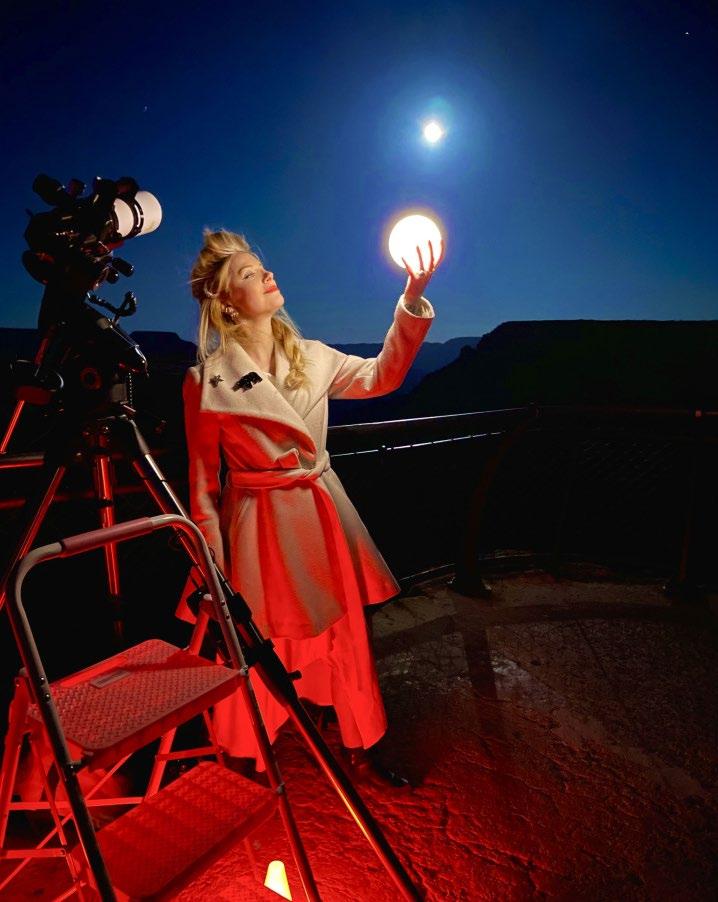
The world loves talking about Grand Canyon’s dark skies! The following are a collection of media coverage from this year, from news articles to podcasts, television to other digital media. Here, Grand Canyon Conservancy Astronomer in Residence Laura-May Abron poses with the Moon. She is a co-host of “All Space Considered”—check out the episode she did talking about her experience as Grand Canyon Astronomer in Residence!
Photo by Dennis Alvarez
In the Community
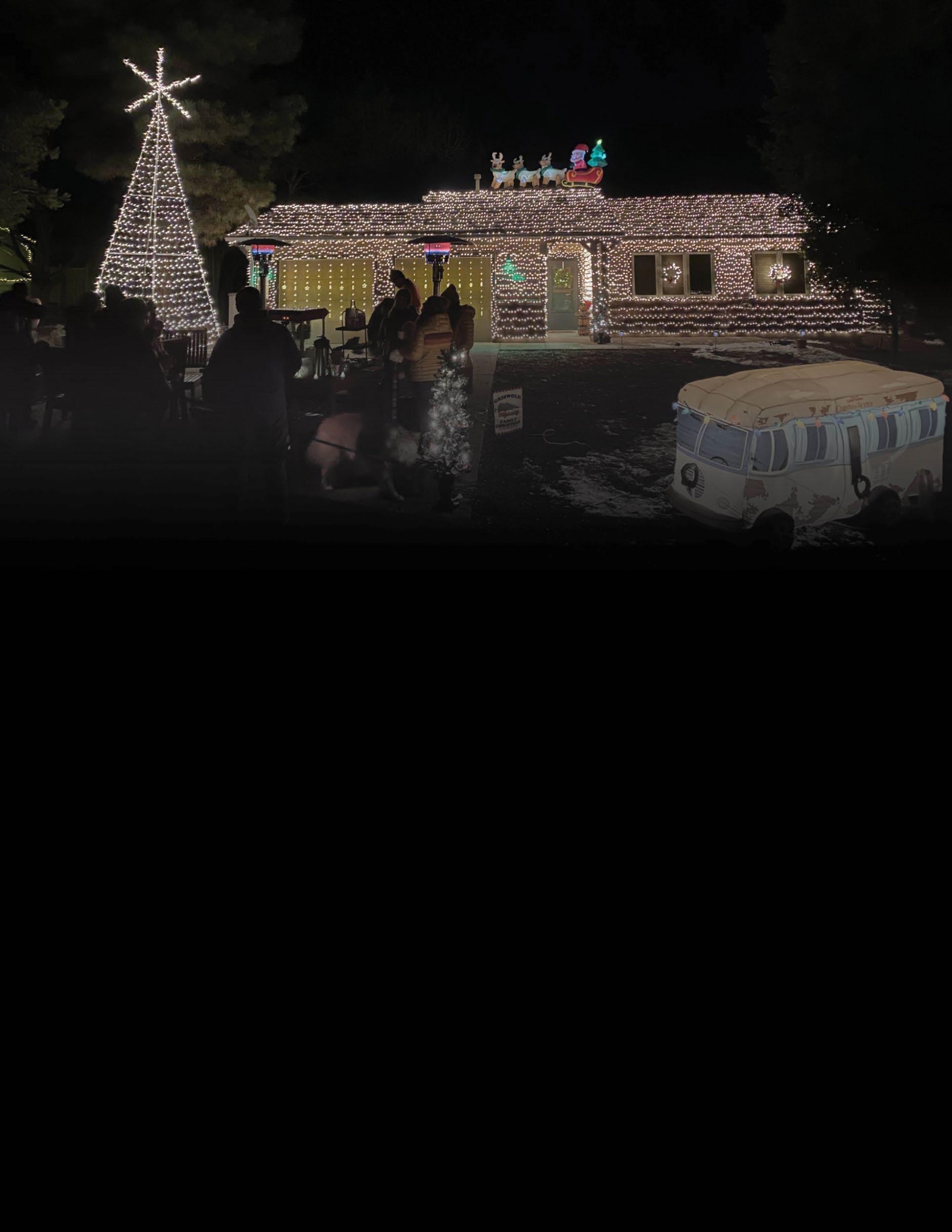
Holiday Lights
Oh no! Is the Dark-Sky Grinch coming for your HOLIDAY LIGHTS!?!
One of the themes we explore through our dark-sky programming is our complex relationships with darkness. A great example is to look at the cultural practice of holiday lights. Let me start by saying, the Dark Skies Team is not opposed to holiday lights! I personally love this time of year. Holiday lights are a celebration of the triumph of light over darkness—physically, emotionally, spiritually. If you think about it, we preserve darkness so that we may enjoy the light of the stars. We need darkness when we sleep to appreciate the coming day. Do seasons of emotional or spiritual darkness make us appreciate times of lightness and joy? Again, our relationships with darkness is complex. This time of year, reflect on your personal relationship with the dark. The nights are longer, it’s colder outside—some feel holiday lights are a way to bring warmth and connection to a community. What do you think?
The park’s Lightscape Management Plan allows holiday lights from November 15th through January 15th. That should give juuust enough time to start planning for next year. So, no, we are NOT coming for your holiday lights. But the DarkSky Grinch does wake up January 15th! In the meantime, Happy Holidays!
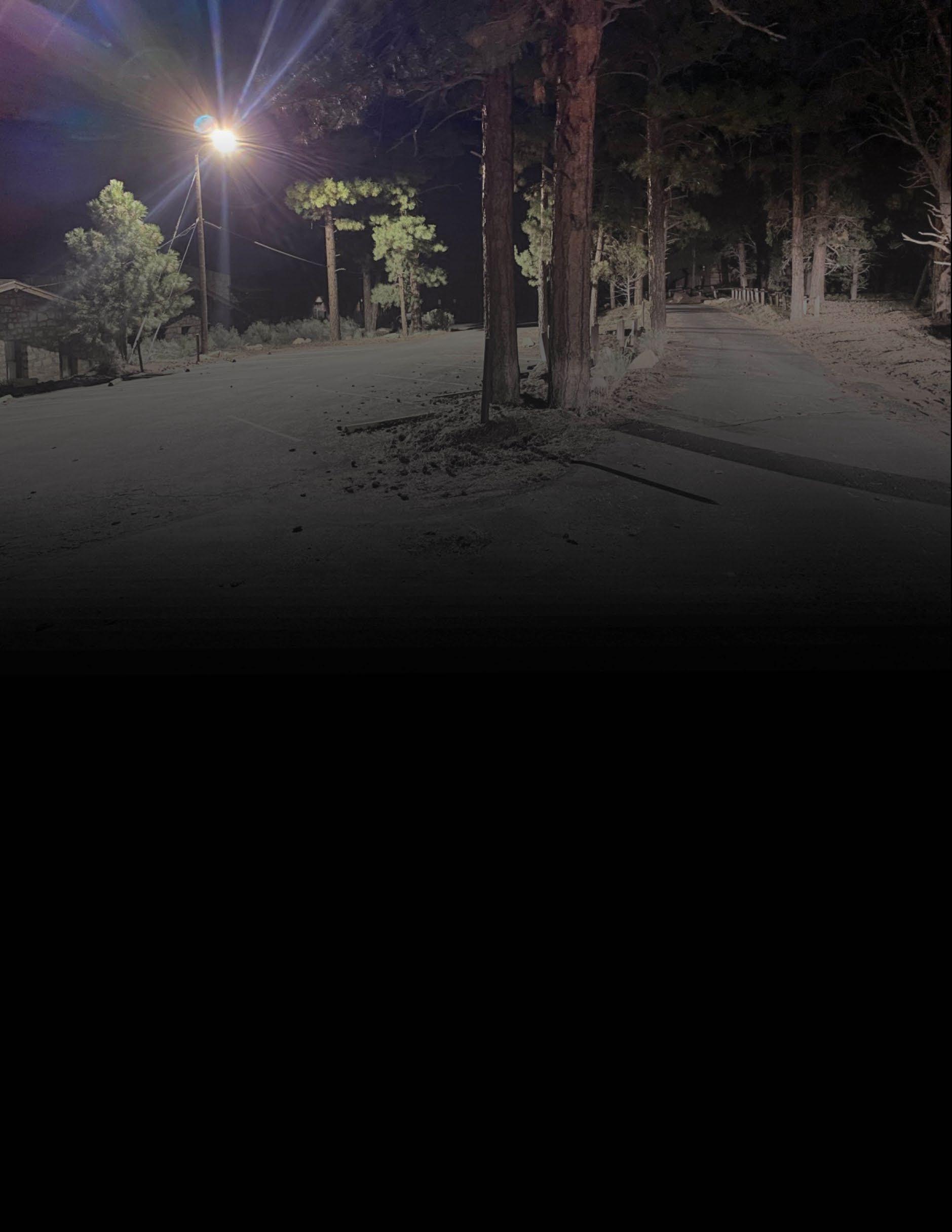
Light Fixtures
One of the big challenges of protecting our pristine night skies is to ensure that the lights we have spent years making dark-sky-friendly, stay dark-sky-friendly.
We have already noticed that some residences have begun changing out their dark-sky-friendly light fixtures with non-compliant lights. A good explanation for this, no doubt, is simply a lack of awareness for our dark-sky park certification.
In the coming year, the DST will work with Park Housing to ensure the continued compliance of our dark-sky-friendly lighting codes. If you have changed out your fixture, you may be contacted with an explanation as to why the new fixture is out of compliance, then kindly asked to return the dark-sky fixture. We are still developing best methods for this. But in the meantime, ask yourself the following:
• Have I changed out my exterior lights?
• Is my light bulb above 2700K?
• Does my light shine onto my neighbor’s house or out into the street? Can I see the light bulb from the street?
• Do I have lights on all night?
• Do I have decorative lights up? Do I leave them on past 10 pm?
If you answered “yes” to any of these, reach out to us so we can help you get back into compliance. Thanks for your support! It really takes a Village to protect the skies!
GRCA’s Dark Skies Team:
• Rader Lane—Dark Skies Program Manager (rader_lane@nps.gov)
• Matt Young—Construction Control Rep. (matthew_young@nps.gov)
• Santiago Garcia—Data Manager (santiago_garcia@nps.gov)
• Kate Hensel—Inner Canyon Park Ranger (katherine_hensel@nps.gov)
• Clover Morell—GCC Residency Program Manager (cmorrel@grandcanyon.org)
• Dennis Alvarez—GCC Residency Coordinator (dalvarez@grandcanyon.org)
• Lauren Cisneros—GCC Marketing Coordinator (lcisneros@grandcanyon.org)