Summer 2026 | www.guilford.edu
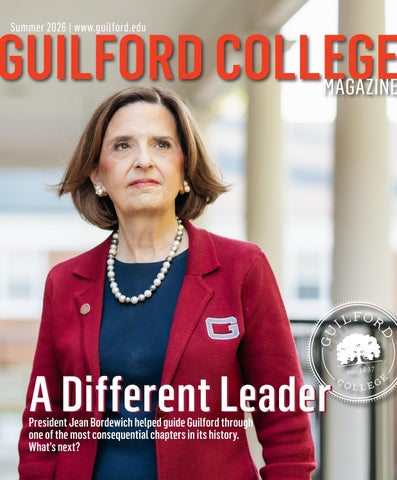
GUILFORD COLLEGE MAGAZINE
A Different Leader
A Different Leader
President Jean Bordewich helped guide Guilford through one of the most consequential chapters in its history. What’s next?
A FUTURE TAKING SHAPE
Behind the scenes the College is reimagining liberal arts education, strengthening its foundation and preparing for what’s next.
If you drove past Guilford College on an early summer afternoon after graduation and before summer camps and music workshops begin, you might think not much is happening.
From the road, our postcard campus can look almost still. Our bricked sidewalks are quieter than they are in October. Students aren’t rushing out of residence halls to class. The parking lots have more empty spaces than full ones.
Except the thing about colleges is that some of their most important work happens when nobody is watching. Spend a little time here and you’ll discover a different story.
Behind office doors, in committee meetings and planning sessions, across campus and throughout Greensboro, people are doing the work of imagining what Guilford can become — and then setting about the business of building it.
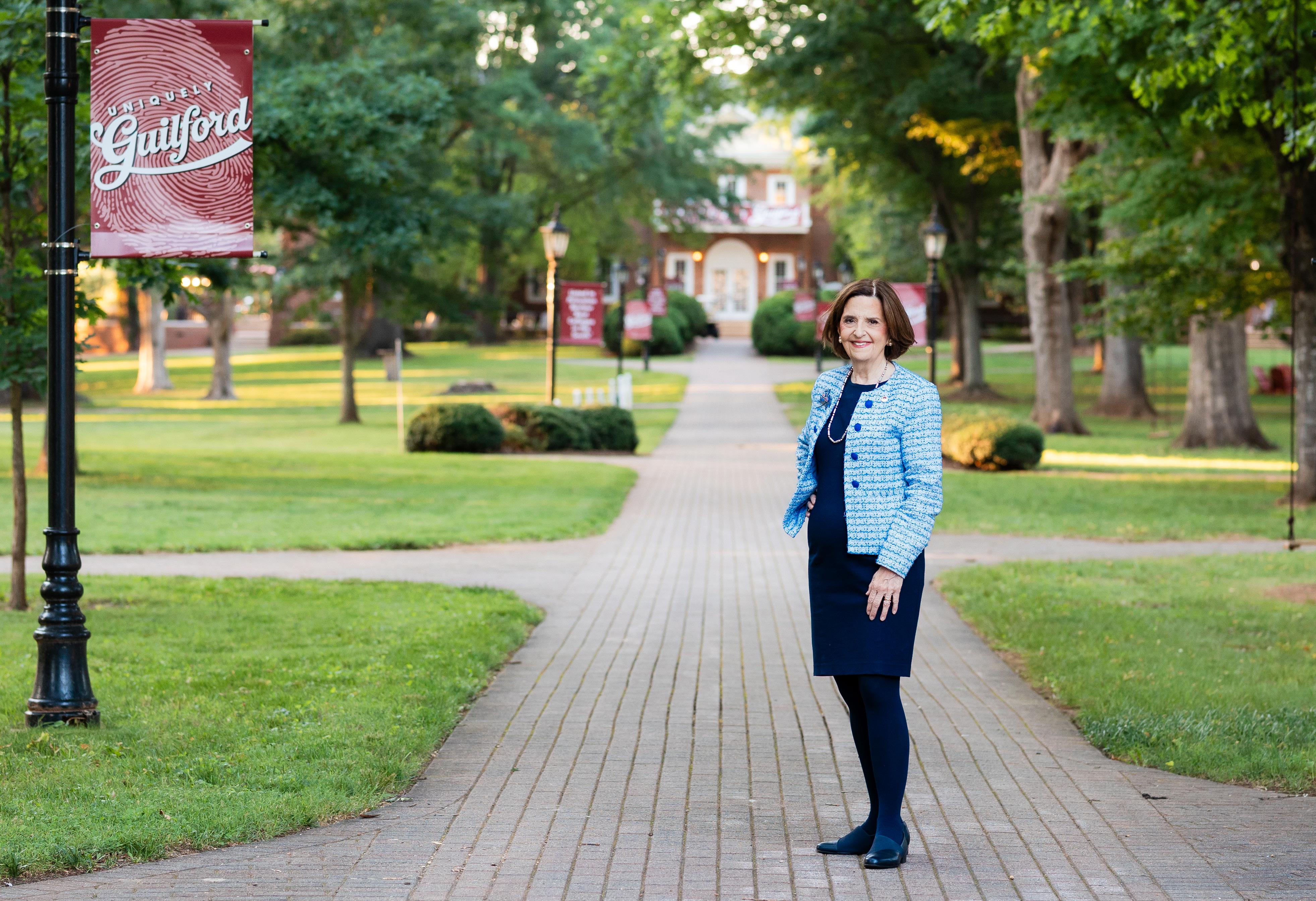
This is the second issue of Guilford College Magazine since I became president last year, and I’m grateful for the opportunity to share some of that work with you.
Last December, when Guilford secured its accreditation, there was understandable relief. But relief only gets you so far. The more interesting question remains: how do you take a college with nearly 190 years of history and make sure it prepares students for a world changing faster than any generation before them?
And just as important: how do we do this while preserving the values that have made Guilford distinctive for nearly two centuries?
The answers are taking shape in ways both practical and ambitious.
Later this summer, we will begin to implement a new strategic plan that will guide Guilford through 2030. The plan emerged from months of conversations with faculty, staff, students, alumni, trustees, friends and community partners. It reflects a shared belief that Guilford’s future depends not on becoming something different, but on becoming more fully itself.
PHOTO: BETSY BLAKE ’99
We’re also developing new ways to tell Guilford’s story, refining how we present ourselves to prospective students and families, and making our website more compelling and easier to navigate. Those efforts may sound modest, but they are important. In a crowded higher education landscape, institutions must clearly communicate who they are and why they matter.
And Guilford has a powerful story to tell.
One sign of that story arrives in July when the sounds of classical music once again drift across campus this summer as the Eastern Festival of Music brings some of the nation’s most talented young musicians to Guilford for five weeks of study, rehearsal and performance.
Every evening, Dana Auditorium fills with music.
If you’ve attended one of the music festival concerts in the past, you know the experience. The lights dim. An orchestra or ensemble settles. Then something remarkable happens. For a few hours, people from across the Triad gather in a shared space to listen, reflect and be moved.
I would love to see more of that at Guilford.
In the years ahead, I envision our campus becoming an even stronger destination for the performing arts and cultural experiences of all kinds, a place where people from throughout the region come together to learn and connect.
Guilford has always possessed extraordinary strengths. Our commitment to an education that is both “civil and useful.”
Our Quaker-inspired values. Our highly personal approach to teaching and learning. Our belief that every person carries an inner Light worth discovering and nurturing.
Those qualities remain as relevant today as they were generations ago.
I often find myself returning to a simple truth the late Professor Cyril Harvey shared: Human beings learn from other human beings how to be human.
That truth sits at the heart of liberal arts education. It sits at the heart of community. And it sits at the heart of democracy itself.
At Guilford, we intentionally create spaces where people from different backgrounds, experiences and perspectives learn alongside one another. We make room for everyone. In a fractured world, that work matters.
“ Your support, encouragement, advocacy and generosity have helped bring us to this moment.”
— JEAN P. BORDEWICH, PRESIDENT
None of it would be possible without the extraordinary commitment of Guilford’s faculty and staff. Over the past several years, they have navigated financial challenges with resilience, creativity and unwavering dedication to our students. Because of their efforts, generations of Guilford students have continued to receive the meaningful, transformative experience they came here seeking.
Meanwhile, our faculty members are nearing the completion of an important yearlong effort to rethink Guilford’s core curriculum. Their recommendations, scheduled to take effect in Fall 2027, are grounded in a simple but increasingly urgent question: How do we educate students to live meaningful lives in a world filled with constant distraction?
Technology offers extraordinary opportunities. It also competes relentlessly for our attention.
A Guilford education should help students navigate that reality. It should create opportunities for reflection, curiosity, wonder, discovery and genuine human connection. It should prepare students not simply for their first job — or even their eventual career — but for lives marked by purpose, adaptability and engagement with the world around them. That vision is not new.
In many ways, it reaches back to the very foundations of this College.
I am equally grateful to our alumni and friends. Your support, encouragement, advocacy and generosity have helped bring us to this moment.
Together, we are creating the conditions not simply for Guilford to endure, but to flourish.
The campus may look quiet from the road.
But look a little closer.
There is music returning to Dana. There are faculty members imagining new possibilities for teaching and learning. There are first-year students preparing to arrive and upperclass students eager to return. There are alumni investing in the future. There is a community doing the patient work of renewal.
And there is every reason to be hopeful about what comes next.
EDITOR
Robert Bell ’11, Director of Communications
DESIGN
Michael Crouch ’10 & ’12, Director of Brand & Marketing Operations
PHOTOGRAPHY
Robert Bell ’11
Betsy Blake ’99
Michael V. Crouch ’10 & ’12
COMMUNICATIONS & MARKETING TEAM
Ty Buckner, Chief Communications & External Relations Officer
Robert Bell ’11, Director of Communications
Brantleigh Bradshaw, Assistant Director of Marketing
Michael V. Crouch ’10 & ’12, Director of Brand & Marketing Operations
FUNDRAISING TEAM
Elizabeth Freeze, Chief Philanthropy Officer
Rick Lancaster ’88, Major and Planned Giving Officer
Lauren Reinking , Director of Alumni Relations & Engagement
D. Summers ’00, Director of Annual Giving & Donor Relations
A NEW SEASON for GUILFORD
There’s a certain kind of leadership that mistakes noise for progress. The louder the declaration, the stronger the conviction, the faster the motion, the more it feels like change must surely be happening.
And then there’s the quieter kind. The kind rooted in listening first.
CONTACT US Office of Communications & Marketing Hendricks Hall
Guilford College
5800 West Friendly Avenue
Greensboro, NC 27410
P / 336.316.2239 E / magazine@guilford.edu
FOLLOW US ON SOCIAL MEDIA! facebook.com/guilfordalumni instagram.com/guilfordalum linkedin.com/school/guilford-college-alumni
GuilfordCollegeMagazine is published by the Office of Communications & Marketing. The views expressed within these pages do not necessarily reflect the opinions of the College.
Guilford College does not discriminate on the basis of sex/gender, age, race, color, creed, religion, national origin, sexual orientation, gender identity, disability, genetic information, military status, veteran status or any other protected category under applicable local, state or federal law, ordinance or regulation. For our complete statement, please visit www.guilford.edu/nondiscrimination
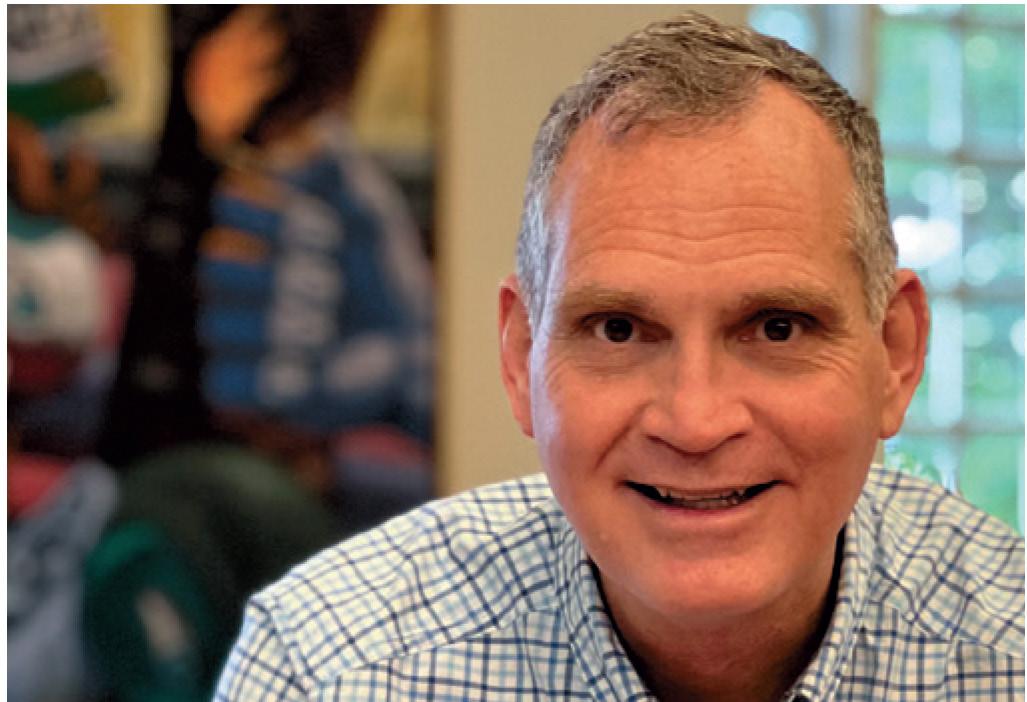
Our cover story profiles Guilford President Jean Bordewich, whose leadership style feels especially suited to this moment in the College’s trajectory. One of the first things you notice about Jean is that she doesn’t rush into words. She listens carefully, deliberately. In a culture that rewards immediacy, listening can sometimes be mistaken for hesitation. At Guilford, it has become something else entirely: a way of building trust before building momentum. And momentum is building.
The work ahead remains substantial. But there is a growing sense on campus that the College is no longer simply reacting to crisis. It is beginning to shape its future again — thoughtfully, strategically and with a clearer sense of purpose.
What struck me most while working on this issue is how often progress here looks less like spectacle and more like stewardship. It’s found in long conversations, difficult decisions, renewed partnerships and the steady work of people who care deeply about this institution and what it can become.
We hope you enjoy this issue of Guilford College Magazine and all the stories and profiles of Guilfordians who, in their own quiet ways, make this place the gem it is.
Robert Bell ’11, Editor

IN THIS ISSUE
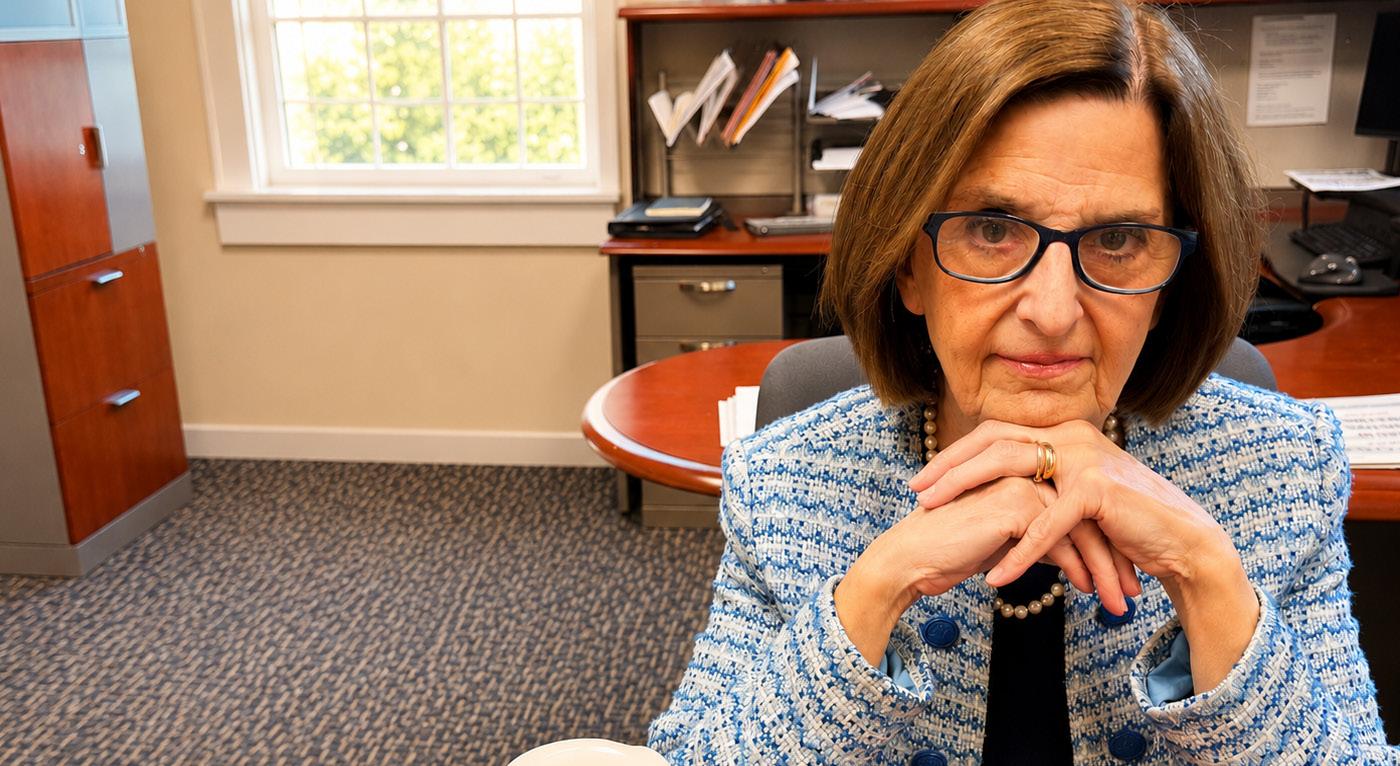
1 His presence lingers
Beloved Sociology professor Paul Zopf died last fall, but pieces of his life can be found across campus.
5 The leader who listens
The Quaker discipline of listening guides most of President Jean Bordewich’s decisions.
11 Founders at 50
Younger Guilfordians might think Guilford’s campus centerpiece has always been here. A tale of two buildings.
15 The bee whisperer
Kaira Wagoner ’06 is giving bees –and a world that counts on them – a fighting chance.
19 Blending care with compassion
Guilford showed oncologist Claire Lanier ’12 that some patients face more medical barriers than others. She wants to change that.
27 Raised to witness
Tom Clement’s ’14 documentary on protestors using light to get their message across has won an Emmy.
29 The power of presence
The latest chapter of Annie Jonas’ ’90 life finds her advocating for school children across western North Carolina.
35 A life shaped by welcome
Fred Katz ’52 was 11 when he escaped Nazi Germany in 1939. He found a community that saved him at Guilford.
37 Reaching new heights
Guitarist Emmett Edwards ’22 climbed Mount Kilimanjaro. Then he composed a solo about his adventure.
Summer 2026
On the Cover
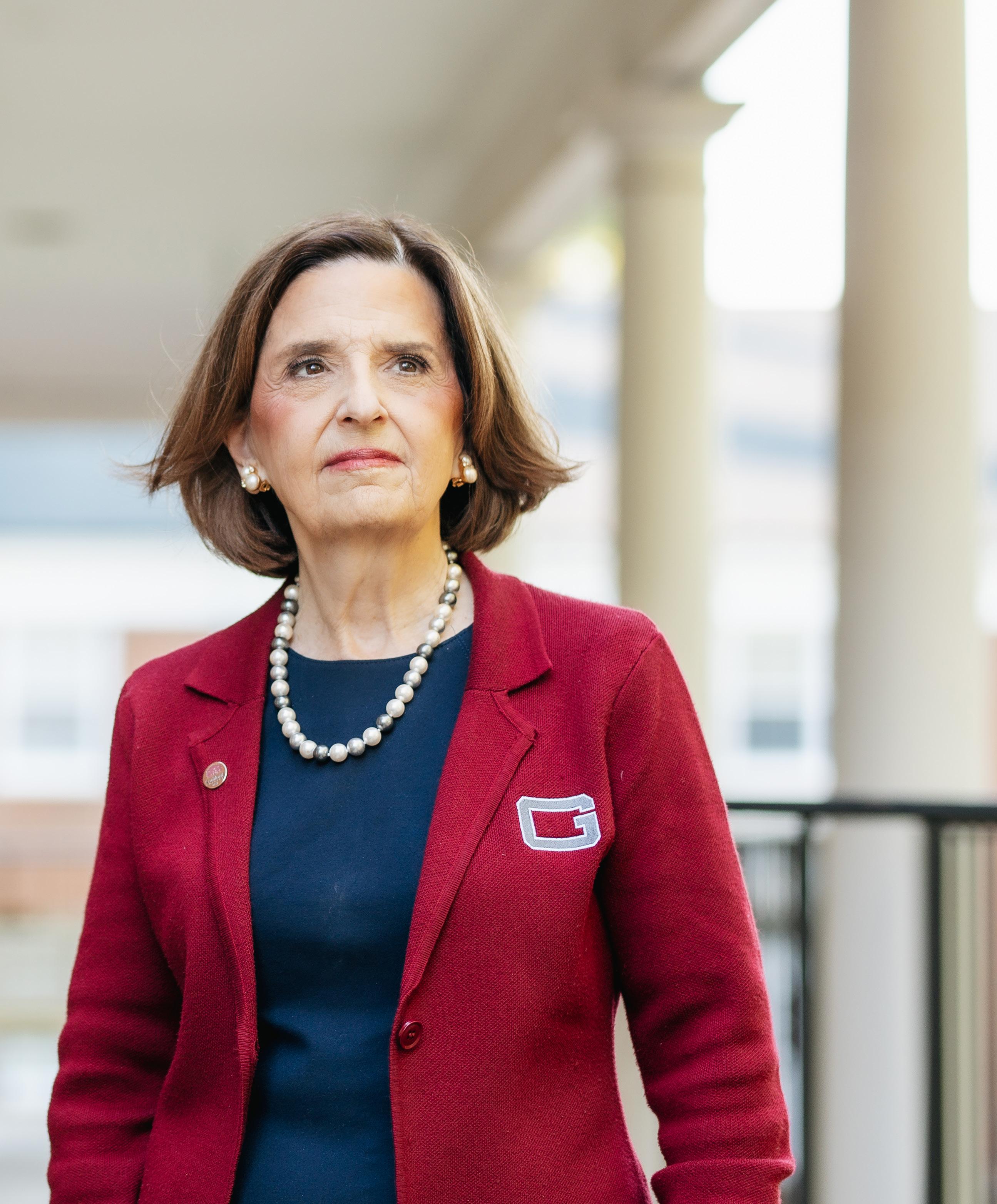
Guilford President Jean Bordewich is guiding the College forward with steady, intentional leadership.
’99
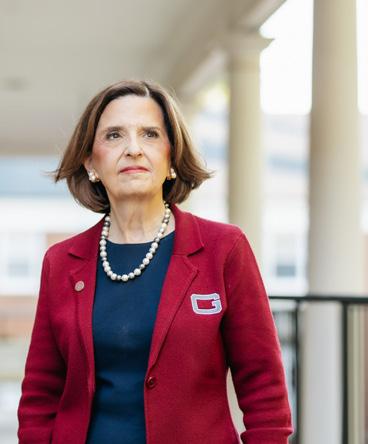
Photo: Betsy Blake
PHOTO: MICHAEL V. CROUCH ’10, ’12
STILL PRESENT GUILFORD at CAMPUS
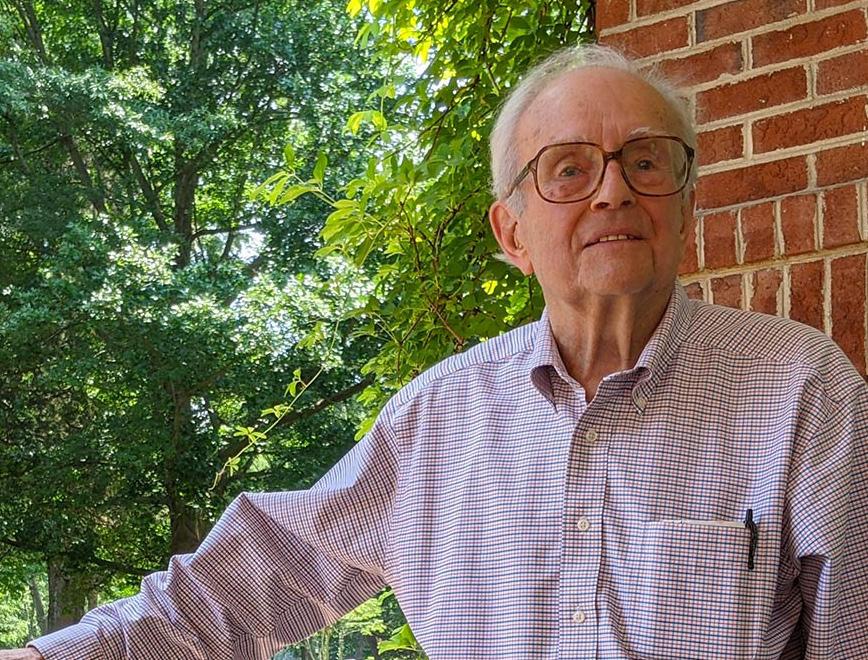
Items from the late Paul Zopf’s estate have found a new home at Guilford.
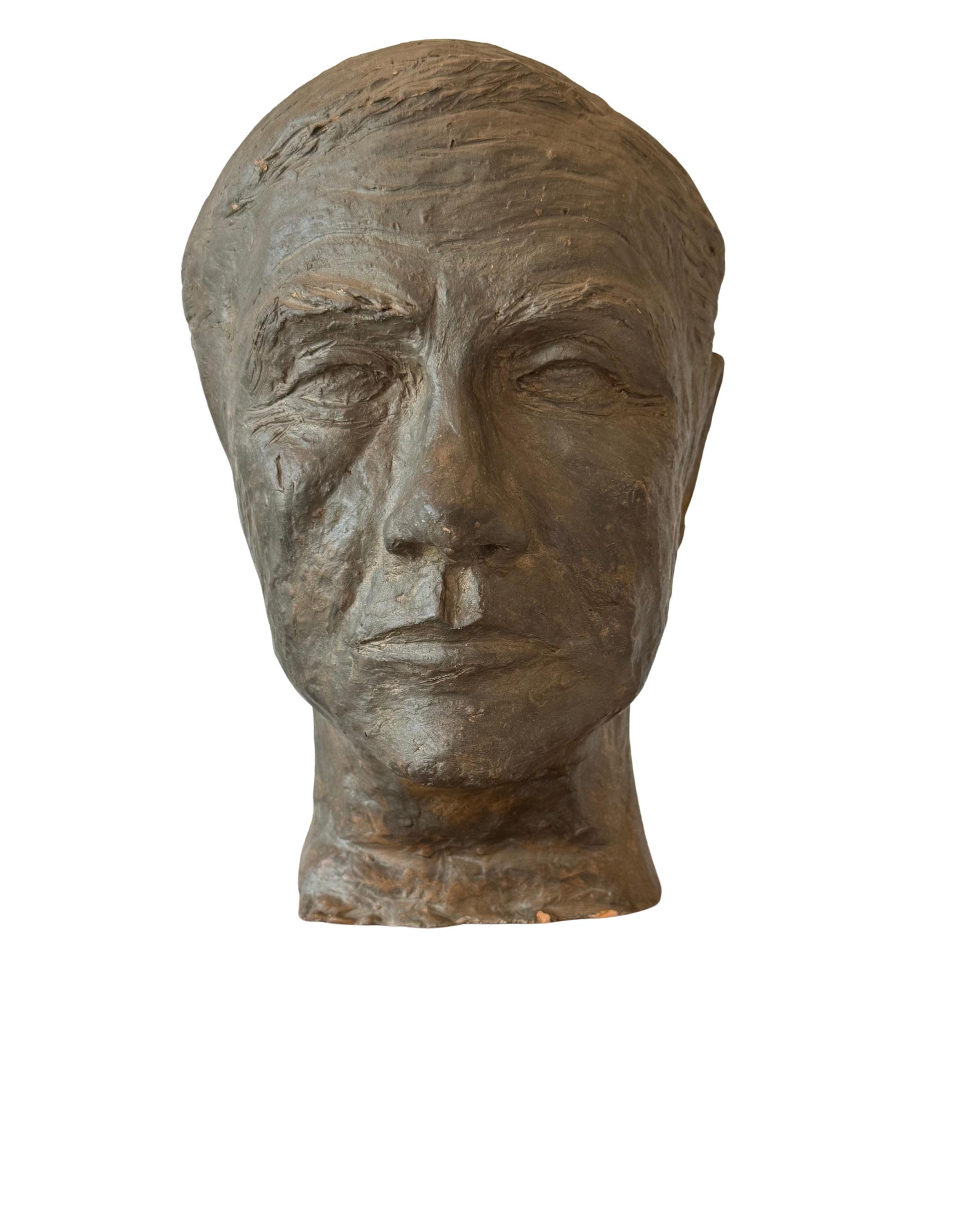
One of the first things visitors notice in Ragsdale House isn’t a plaque or a portrait. It’s a clay bust of Paul Zopf, Guilford’s late, beloved Sociology professor. The piece, sculpted more than 50 years ago by Paul’s wife Evelyn, resides where Guilford President Jean Bordewich and her husband, Fergus, now live, its quiet gaze carrying the same steady attention Paul once brought to everything – and everyone – he encountered.
Across campus, another piece carries a different kind of history. In New Garden Hall, a cabinet – tall, layered, and unmistakably handmade – greets prospective students and their families. Paul made it a half-century ago from reclaimed wood. Its narrow drawers, a chest-like base, and glass-paneled doors seem to resist easy categorization. It’s the kind of object
that makes people pause, trying to decide if it belongs to furniture, sculpture or both. Paul likely would have relished just such a conversation in one of his classrooms.
Months after his death last fall, Paul remains scattered across campus in pieces both ordinary and deeply personal. A chair Paul rescued and refurbished from King Hall before it was renovated in 1969 now has a new home in the Quaker Archives in the library. Even some reclaimed walnut from Paul’s garage was repurposed this spring for Parker O’Keefe’s ’26 Senior Art Thesis project in Founders Hall.
It feels less like an estate being divided than a man continuing to inhabit the place he spent much of his life serving, says Bill Pleasants ’65, a former student of Paul’s.
PHOTO: TY BUCKNER
“You go through somebody’s house, you go through somebody’s life,” says Bill, one of a select few former students Paul entrusted to help manage his affairs after he died.
About 15 years ago, Paul and Evelyn, who died in 2016, approached Bill and his wife, Clarajo ’67, with the request. It was practical, understated and delivered without ceremony. Bill and Clarajo agreed immediately.
“It was an honor,” Bill says. “But it was also payback. Just a small token for all they did for us while we were students and afterwards.”
On the first day in Paul’s house after his death, Bill says he found not clutter but accumulation with intent. More than 500 books lined shelves and walls in the house on George White Road — sociology, anthropology, demographics, religion, history. Filing cabinets held letters from former students and colleagues, often clipped together with Zopf’s typed or handwritten replies. Attendance books from the late 1950s sat stacked neatly in drawers. Nothing seemed accidental. Nothing seemed forgotten.
Most people on campus knew Paul as “Dr. Zopf,” the longtime Sociology professor with exacting standards and encyclopedic knowledge. Close friends knew another version of him: engineer, artist, tinkerer.
Tools lined the low-slung walls in his attic. There were coffee cans and boxes for every size nail and screw. “He was more than just a master woodcrafter and gardener,” Bill says. “He made unbelievable things out of metal and tin that I didn’t realize he could do.”
shared habits accumulated over decades.
That history could have disappeared quietly after Paul’s death. Instead, Guilford made a deliberate choice to absorb pieces of it into campus life.
When Jean visited the house after Paul’s death, the conversations centered not simply on where objects should go, but on what they represented. The goal was preservation without embalming. These were not museum relics. They were pieces meant to continue being lived with.
Outside, the garden carried its own memories. Tomatoes once grew there in quantities large enough for hundreds of quarts of canning. Amaryllis bloomed seasonally in honor of Evelyn. The property felt less like a residence than a living record of
For all his meticulousness, Paul was never interested in drawing attention to himself. His influence worked more quietly than that, says Bill. Through decades of teaching, advising, fixing, building and preserving, he established a kind of ethic at Guilford — one grounded in patience, usefulness and care for the community around him.
What remains now is not simply what Paul Zopf left behind. It is evidence of how thoroughly he invested himself in a place — and how, in return, that place decided not to let him go.
“It’s nice – particularly for some of us older Guilfordians – to know that he’s still a part of our campus,” says Bill.
Students crossing campus may not know the origin of the chair they use in the archives. Visitors may admire the cabinet without realizing it resists categorization because its maker resisted it too. Even the bust in Ragsdale House may be seen as decoration before memory.
But that, too, feels appropriate, says Bill.
“Paul was never a loud presence,” he says. “His influence was (built) over decades of teaching, advising, repairing, saving and returning things to usefulness.”
A CLAY BUST CREATED MORE THAN 50 YEARS AGO BY EVELYN ZOPF OF HER LATE HUSBAND NOW RESIDES IN RAGDALE HOUSE.
GUILFORDIANS CONTRIBUTE $1.28 MILLION
Guilford Madness drew support from all generations of Guilfordians.
What began as an ambitious fundraising goal became something larger – a campuswide and alumni-driven show of confidence in the future of Guilford College.
During Guilford Madness in March 2026, 616 donors contributed a combined $1.28 million, surpassing the College’s $1 million goal by 28 percent and setting a new benchmark for giving in the annual spring campaign.
President Jean Bordewich said the campaign’s success was about far more than dollars raised.
“This was not just a campaign,” Jean says. “This was a collective act of belief in Guilford and in our students. People gave because they believe this institution changes lives and because they want students to have every opportunity to succeed here.”
The fundraising effort drew support from across generations of Guilfordians, from recent graduates making first-time gifts to alumni celebrating milestone reunion years.
The unrestricted and flexible nature of many gifts will allow the College to direct resources where they are most
HANDS-ON PROJECT
urgently needed, including financial aid and student support initiatives designed to help students remain enrolled and fully engaged in campus life.
“For many students, financial aid is the difference between continuing their education and stepping away from it,” Jean says. “The generosity we saw during Guilford Madness directly supports students in practical, immediate ways. It helps them stay here, thrive academically and participate fully in the Guilford experience.”
Its a pivotal time for higher education nationally, as colleges across the country face financial pressures, shifting enrollment trends and increasing concerns about affordability. Guilford leaders said the strong response from alumni and supporters sends a message that the College’s community remains deeply invested in its future.
“It says something powerful when hundreds of people come together like this,” Jean says. “Guilfordians believe in this place and in one another. That spirit of connection and shared responsibility is one of the defining characteristics of the College.”
AS PART OF THEIR GUILFORD UNDERGRADUATE SYMPOSIUM PROJECT EXAMINING THE HISTORY OF WQFS, BEC CORMACK ’26 CREATED A MURAL FEATURING THE PAINTED HANDPRINTS OF STUDENTS AND STATION CONTRIBUTORS ON A WALL INSIDE THE CAMPUS’ RADIO STATION.
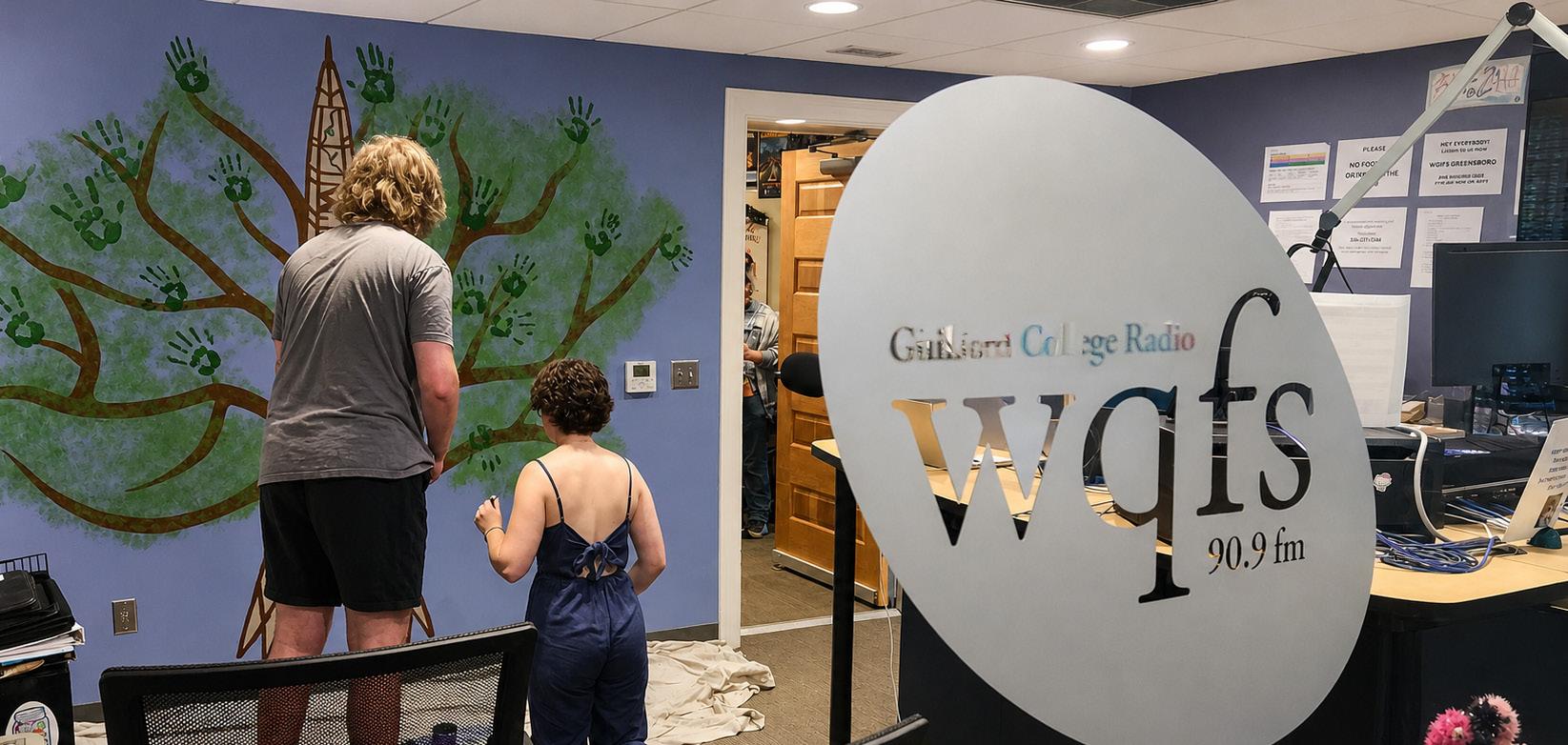
PHOTO: MICHAEL V.
GUILFORD LAUNCHES FLAG FOOTBALL
New coach Derrick Walker is busy recruiting the Quakers’
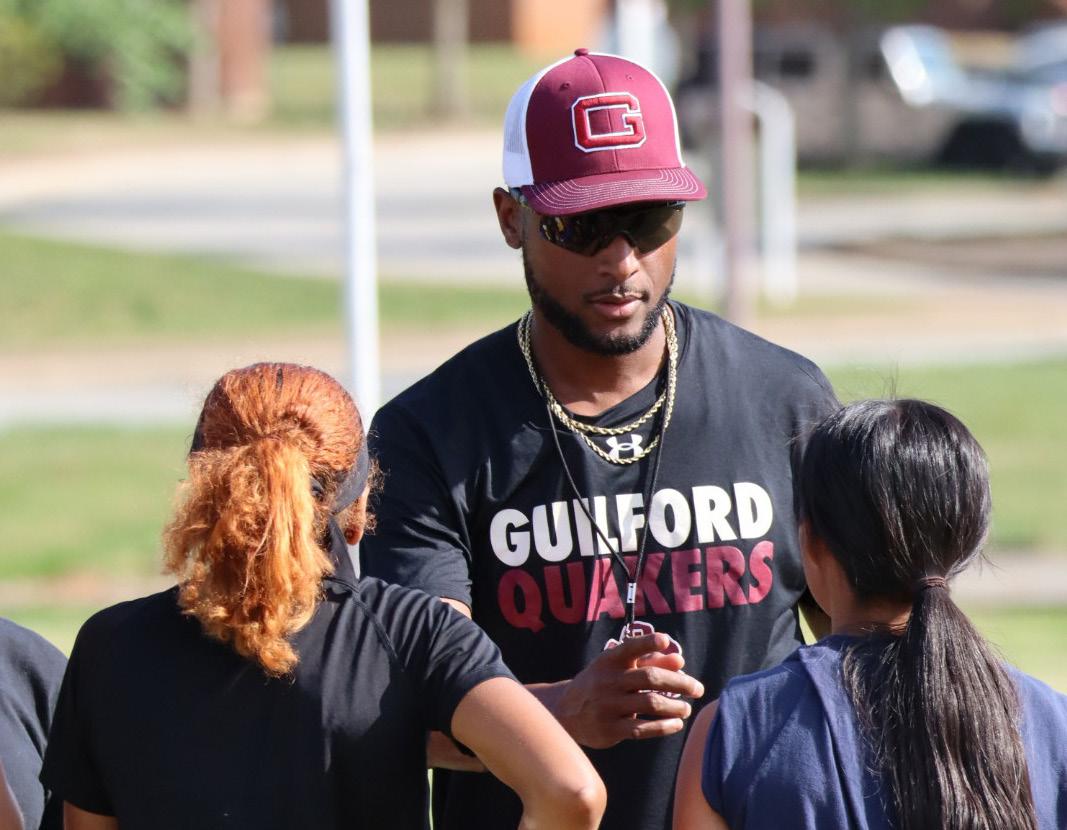
The recruiting pitch starts with the obvious: a chance to help build something from scratch.
But when prospective players ask why they should come to Guilford College to play women’s flag football,
new coach Derrick Walker offers something else, too: experiencing in a sport still trying to catch up with its own growth.
Derrick was hired earlier this year to launch Guilford’s women’s flag football program ahead of its debut in spring 2027. He has spent more than two decades around the game. He played college football at Western Carolina University before gravitating toward intramural flag football, then adult leagues and eventually national travel tournaments. Along the way, he’s coached high school teams and built a travel organization that now gives him a recruiting pipeline few
first team for next spring.
college coaches can match.
According to Derrick, the College has 17 students committed for the inaugural season – six current Guilford students and 11 incoming players or transfers.
Women’s flag football has exploded nationally in recent years, fueled by high school participation, NFL investment and NCAA support. Athletics Director Bill Foti says Guilford will be one of five Old Dominion Athletic Conference schools that plan to sponsor the sport in its early stages. Bill says a conference tournament is hoped for in the 2028 season.
Derrick says he’s using the newness of the program to attract recruits. “They’ll be making history at Guilford because we’re starting something from scratch,” he says. “And that doesn’t mean we’re starting slow. We’re going to win, too.”
The Quakers will play on the school’s football field, though the dimensions differ from tackle football: an 80-yard field instead of 100, and 40 yards wide instead of 53. NCAA rules require at least 12 games.
Derrick believes the program’s edge with recruits lies in his experience as a head coach. “You want to become a great flag football player?” he says. “You get a good value here. The players want to win and I’ve done that everywhere I’ve been. That’s a good match”
POOLE RETURNS TO GUILFORD
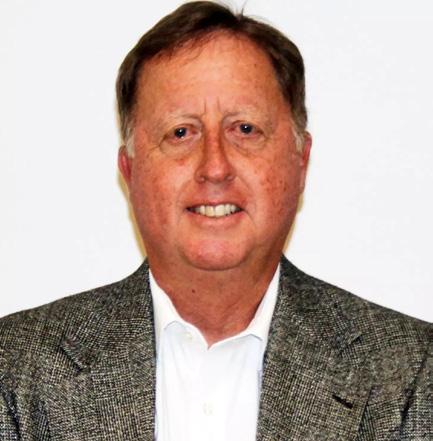
Standing on the blue-and-green surface of the Dorothy Ragsdale McMichael ’37 Centennial Class Courts, Bert Poole sees more than tennis courts. He sees a beginning.
Nearly 20 years ago, Guilford gave Bert his first opportunity to lead a collegiate tennis program.
The Quakers were coming off a winless season. One year later, under Bert, the team reached the Old Dominion Athletic Conference playoffs. Now, after two decades of coaching success across the South, Bert is returning to the place where it all started.
“I really enjoyed my experience here during my first term and feel very comfortable in this environment,” he says. A lot has happened since he last paced the courts in Greensboro.
Poole went on to coach at the University of Mount Olive
where he earned Division II Regional Assistant Coach of the Year honors.
He coached 11 years at Averett University leading the program to eight conference tournament finals and one championship.
But trophies and records tell only part of the story. Bert says that success at Guilford will begin with the student-athlete experience.
“My hope for Guilford is that our players have a great experience here,” he says. “Winning is a big part of having a great experience, and I will be working hard to develop our current players while recruiting players capable of competing in one of the toughest Division III conferences in the country. I’m excited to get going.”
by
LEADING LISTENING
By making room for every voice, President Jean Bordewich is leading Guilford’s renewal.
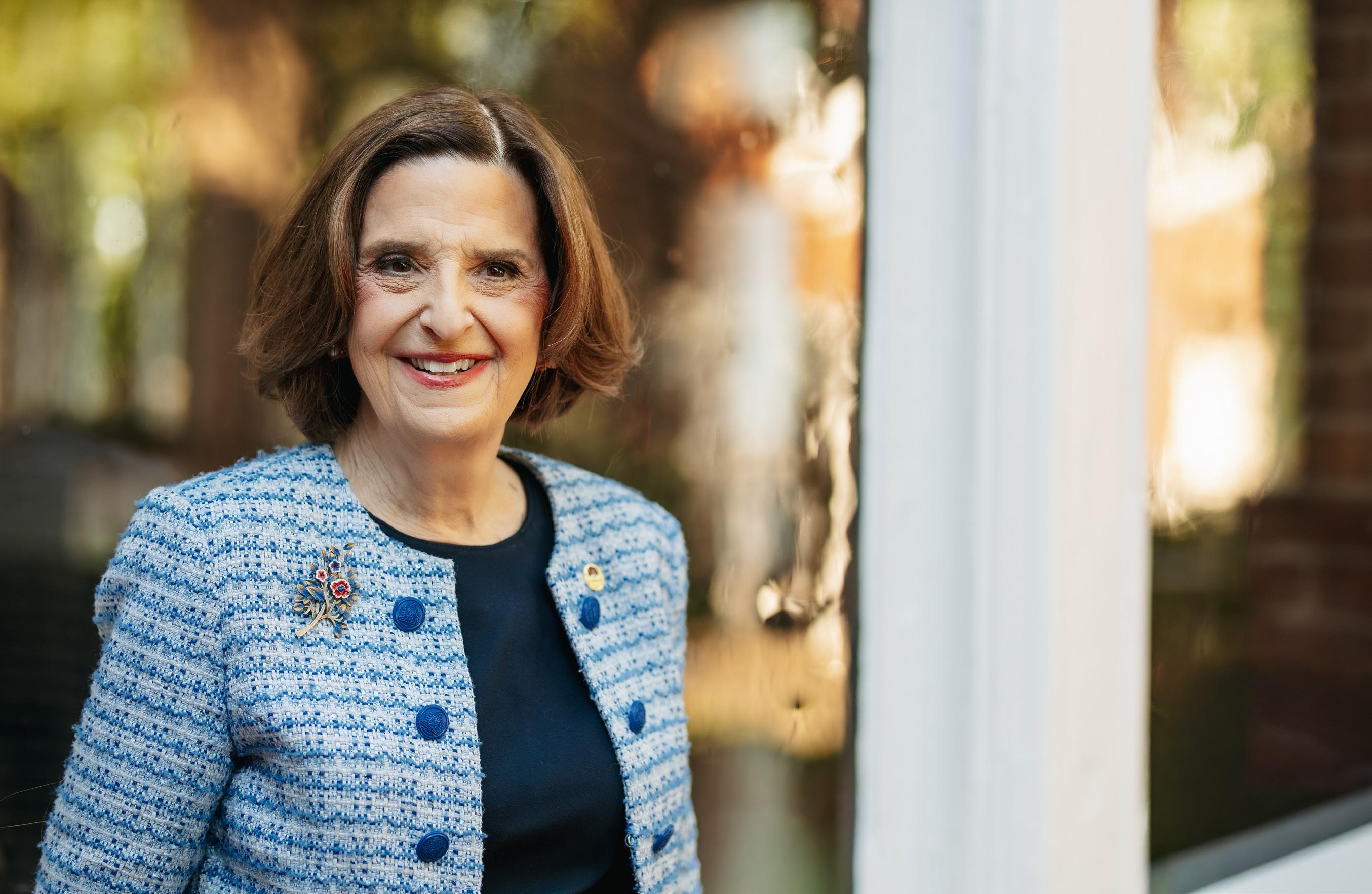
The desk in Jean Bordewich’s corner office in Hendricks Hall looks exactly as you’d expect a college president’s desk to look like. Solid. Imposing. The kind of desk that suggests decisions of great importance are made here. A closed laptop awaits. Files fan outward across the surface like maps of imagined futures. All that’s missing is someone to use the desk because Jean never does.
On days when she’s not out in the community raising money and building relationships for the College, Jean meets people at a round table on the other side of the room – faculty, staff members, trustees, alums. If three people show up, she makes it four. If there’s a party of five, she pulls up a chair and makes room for six. No one sits “across” from Jean in an adversarial sense. They sit with her.
That is not an aesthetic preference as much as it is a philosophy. Guilford’s 11th president feels a disconnect sitting behind a desk.
“There’s a space between us that wasn’t there when they walked in,” she says. “There’s a barrier before we’ve even started talking.”
So every day Jean brews a cup of her favorite herbal tea –chamomile or ginger in the morning, licorice root in the afternoon – and goes to work rebuilding Guilford College from a round table.
It seems a small choice – imposing desk or welcoming table –but Guilfordians working with Jean are convinced that choice is the quiet thesis of her first 18 months as president.
What makes that choice striking is not the symbolism, but instead its context. The table is where she invites people in. The desk is where, in another kind of presidency, she might have issued orders. And when Jean Bordewich stepped into the role, there were moments when issuing orders might have been easier. Or faster. Or, at least, more familiar to institutions in crisis.
In a moment when the College needed swift decisions to survive, colleagues, friends and family say Jean leaned instead on the Quaker instincts that shaped her: listening first, deciding together and trusting that leadership need not stand apart to be firm.
PHOTO: BETSY BLAKE ’99
Paula Sours ’76, a retired attorney and vice chair of the College’s board of trustees, is convinced Jean’s Quaker traits displayed from the start helped rescue Guilford, the only Quaker college in the southeast.
“Her consensus building, active listening and discernment skills are Jean’s best attributes,” says Paula. “You can talk about those skills in a business or MBA class, but putting them into practice is another story.”
As Jean tells it, the circle matters to Quakers. In meeting houses on Sunday mornings and, just as important, at work the next day. No one stands above the congregation because no one is presumed to own the Light. Authority is discovered through listening.
“Consensus,” says Jean, “is not the absence of leadership. I think it’s leadership exercised with patience.”
A born leader
Those Quaker skills of listening and inclusivity were never strategic in Jean’s case. They were inherited.
She grew up amid the palm trees and postcard sunsets of Clearwater, Fla., but the deeper currents of her life ran north among the red-clay roads of Cane Creek, a Quaker community in Snow Camp, N.C., less than an hour’s drive from campus.
Jean remembers being drawn to Cane Creek from an early age – not in a dramatic conversion way, but in the quiet, persistent way something feels true before you can explain why.
Her mother talked about Cane Creek constantly, and Jean listened. The place became real to her through stories. Stories like the aunt who helped Black teachers integrate North Carolina’s schools. And her mother who, years later, never debated or theorized over the emerging gay and lesbian movement. Instead Marjorie shrugged, almost bemused by the controversy.
“My mother figured if that’s the way God made someone, who was she to object?” Jean recalls. “Mom said, ‘I’m just here to love them.’”
“These weren’t radical ideas I learned,” Jean says. “They were normal ways of acceptance and tolerance of others.”
Jean’s family returned to Cane Creek in the summers. It was farm country and kin country: a cluster of aunts and uncles, two older sisters on the farm, relatives across the road, the whole family stitched into the landscape. Cane Creek Monthly Meeting anchored that world. Generations of her family – many of them Guilfordians – are buried there.
Back in Florida, the bookshelves in Jean’s home held Quaker books by Douglas Steere, Elton Trueblood and George Fox. She read them all, but what stayed with her was the posture behind them: the assumption that every person mattered, that volume was not a prerequisite for being heard, that the point of a community was to make room.
By high school, Jean didn’t apply to a dozen colleges – just Guilford. She came to campus after her junior year of high school and, by her telling, essentially asked to start early. Guilford took her.
Once she was a student, Snow Camp didn’t disappear. It became her weekend refuge. A family member would pick her up on weekends and she’d stay with an uncle and aunt, the latter a schoolteacher who made most of her clothes. They sewed together: Jean cutting out patterns, her aunt at the machine and doing the finishing. There was homemade pound cake waiting when she walked in the door, sometimes chess pie, jars of canned vegetables in the pantry, smoked ham kept the old way – in a closet.
Summers at Snow Camp were where Jean’s Quaker roots grew wider and deeper.
“I didn’t think of it then as theology,” Jean says. “It was just how we lived. That everyone carries a measure of Light, that you listen before you speak, that you don’t … put yourself above other people. You sit at the table. You do your part. You trust the rest will come.”
Steep hill
Those roots guide her now in ways both subtle and structural.
When Jean became acting President early last year, there were no ceremonies or celebrations. Just a ledger full of red ink and a ticking clock.
Guilford had been on probation with its accrediting agency, the Southern Association of Colleges and Schools Commission on Colleges (SACSCOC), because of long-running financial issues, including years of operating deficits and sagging enrollment. Accreditation is a college’s oxygen: without it, federal student aid dries up, degrees lose value and a small liberal arts institution can quickly become unsustainable.
Just months earlier, the College faced a stark ultimatum: balance the budget by December 2025 or risk losing accreditation altogether. The structural deficit – more than $5.2 million – was not new. What was new was the timeline. Roughly six months to make ends meet.
Inside Guilford, even senior leadership questioned whether
survival was realistic. “About 25 percent,” Chief Operating Officer Keith Millner ’82 recalled telling staff when he was asked in early 2025 the chances of maintaining accreditation. The number traveled fast, an unvarnished assessment that rattled a campus already on edge.
The pressure wasn’t just financial – it was existential. Without accreditation, Guilford would effectively cease to operate. That reality sharpened every decision and stripped away any illusion of optionality.
Jean knew she didn’t have all the answers so she surrounded herself with a core of alumni who could help. Paula, a retired lawyer, offered legal advice where she could. Keith, a former All-American football player and successful businessman in Atlanta, pinched every penny as COO. Carla Brenner ’73, who spent years working for the National Gallery of Art, gave a long overdue assessment of the College’s art collection, helping determine what pieces to consider selling. Dan Mosca, the board chair whose two children and granddaughter attended Guilford, brought his business acumen and years of service as a board member to the team.
“I don’t think any of us came in here saying we knew what to do,” says Jean. “We just knew that if something didn’t change, the school wasn’t going to survive.”
There were conversations about cuts, about rethinking programs and overhead, about rallying alumni to open their wallets again in a crisis. Trustees and administrators worked “at rocket speed,” Jean recalls, overhauling financial processes and fundraising with urgency.
Even the solutions carried risk. Efforts to collect overdue payments clashed with long-standing institutional norms. Adjustments to tuition discounting threatened enrollment. Staffing reductions raised hard questions about who would do the work — and how the community would respond. Nearly every fix introduced a new uncertainty.
”We’re about human beings learning from other human beings how to be human ... That isn’t just taking place in our classrooms. It takes place across the campus.”
— JEAN BORDEWICH
What they discovered, quickly, was that the crisis ran deeper than the balance sheet. Years of prior decisions – debt without matching revenue, inconsistent financial oversight – had accumulated into what Keith described as “an anchor around our neck.” This wasn’t a sudden collapse. It was a slow one, finally reaching its breaking point.
Then came the daily reminders of just how deep a hole the College had dug itself into. Millions in unpaid student accounts receivable. Vendors – many of them small, local businesses – were owed significant sums and, in some cases, refusing to continue work. In one early flashpoint, students began classes without access to textbooks because the College had not paid its provider. The bill was settled within hours once identified, but the episode exposed just how fragile operations had become.
“Every day felt like peeling back another layer,” says Keith. “And every layer had consequences.”
At the same time, leadership wrestled with a question that cut to the core of Guilford’s identity: should the College declare financial exigency? The move would allow cuts to tenured faculty positions, but risk fracturing trust across campus. For nearly two months, trustees and administrators debated the path forward, weighing financial necessity against institutional culture. All of it unfolded with accreditation in mind. Early guidance helped define the path forward, but by the fall, a visiting SACSCOC committee left unconvinced. Though not immediately public, the message inside leadership circles was clear: the margin for error had vanished. What followed was a month of near-constant preparation, refining financial models, correcting errors, rehearsing every detail of the College’s case. “It was like a courtroom,” Keith says. “We had to prove it.”
Community effort
By now Guilford’s success story has been well documented. The College erased its structural deficit, presented a sound operating budget for the 2026 fiscal year and maintained its accreditation.
In August the Board of Trustees rewarded Jean for her work by offering her a two-year contract as President through the 2026-27 academic and fiscal year.
Jean is quick to remind you this was not a solo rescue but rather a community achievement, one that set the tone for how she will lead over the next two years: not as a lone figure who ventured out on her own but as someone who brought together others to face the hard truths together.
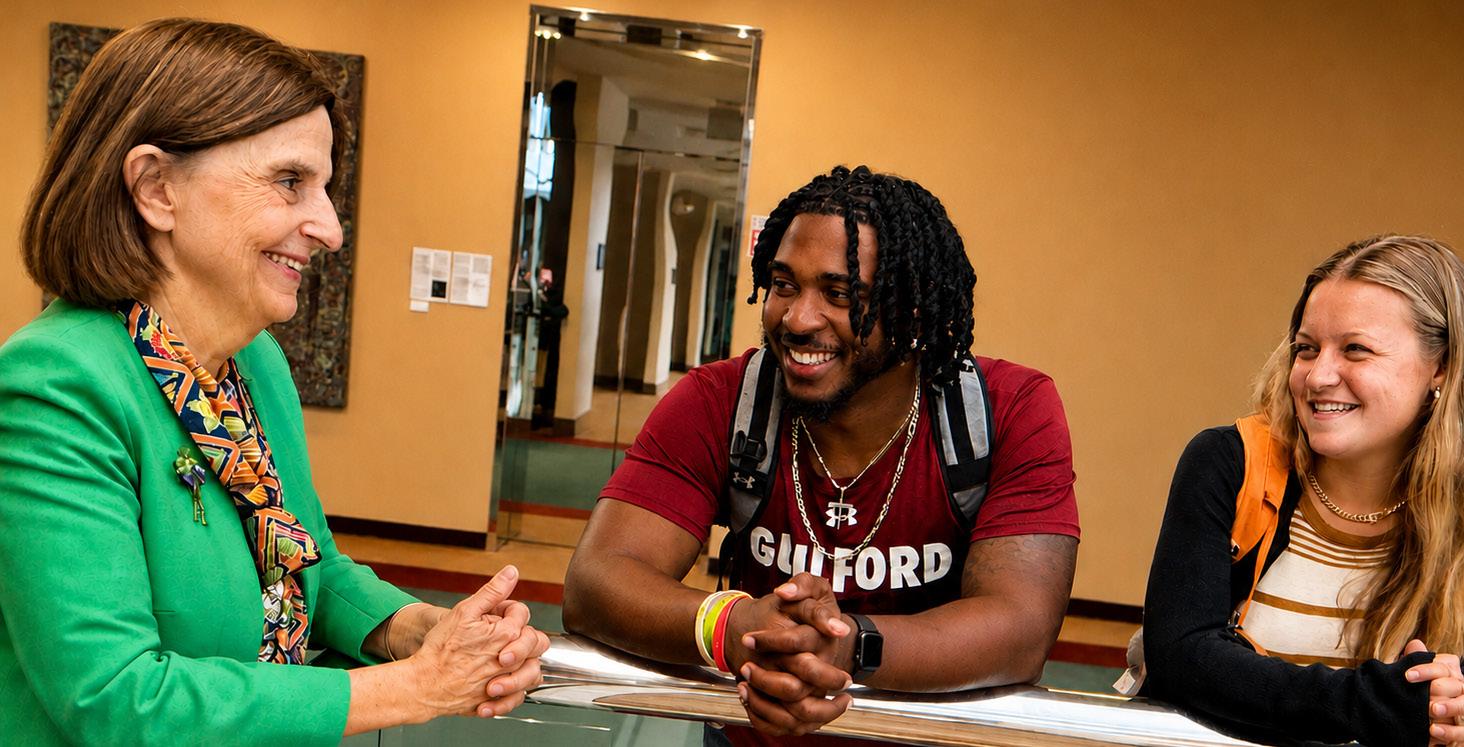
Consensus, she insists, is not indecision.
“There’s this idea that Quakers just talk and never move forward,” she says. “But discernment is making decisions.”
Jean’s husband, writer and historian Fergus Bordewich, describes her leadership style as a rare combination.
“She has a deeply empathetic temperament that’s paired with an engineer’s approach to a problem,” he says. “She listens long to others, she thinks deeply on what she’s learned and then she acts.”
That balance – patience and urgency, listening and action –was tested almost immediately. The crisis did not pause for consensus. It demanded it work under pressure.
“It truly was a team effort,” says Provost Kami Rowan, who compiled the final report the College presented to SACSCOC.
“Everyone knew their role and did it, but it was Jean who guided, who trusted us. It would have been easy to give marching orders. That’s not Jean.”
That instinct — to gather others around a table, to let them speak, to find unity and then move — shapes everything from budget conversations to campus strategy.
Jean believes Guilford’s future depends not on chasing trends but on becoming “more of itself” — leveraging strengths already here: The Early College at Guilford, Friends Center, the Quaker Archives, the Center for Principled Problem Solving, the Guilford Woods. Rather than impose a new
identity, she looks for the light already present.
While other schools chase the latest trend in higher education, Jean says Guilford’s flag is firmly planted as a liberal arts institution.
“I see Guilford 10 years from now as being more of exactly what it is today,” she says. “We just have to find the people who want a home like Guilford and convince them, ‘This is the home for you.’”
“So many schools are trying to produce graduates for the hot jobs at the moment. Four years later, by the time people graduate, those jobs are going to be something different. We’re not here just to teach a trade.”
Around a table, she believes, people see one another. And when they see one another, decisions – even hard ones – carry legitimacy.
”We’re about human beings learning from other human beings how to be human,” says Jean, a line she borrows from the late Guilford Geology professor Cyril Harvey. “That isn’t just taking place in our classrooms. It takes place across the campus.”
Including in moments when the answers are unclear, the stakes are high and the outcome is not guaranteed — like in a Hendricks Hall corner office, where an imposing desk sits empty and a community of Guilfordians gathers instead around a nearby table.
JEAN SPENDS TIME WITH MALAKIE HARRIS ’26 AND SADIE CYR ’29 IN HEGE ACADEMIC COMMONS.
EXECUTE. THEN WIN.
Keith Millner once led Guilford on the football field. Now, as Chief Operating Officer, he’s helping lead it through one of the most pivotal chapters in its history — and making the case for what comes next.
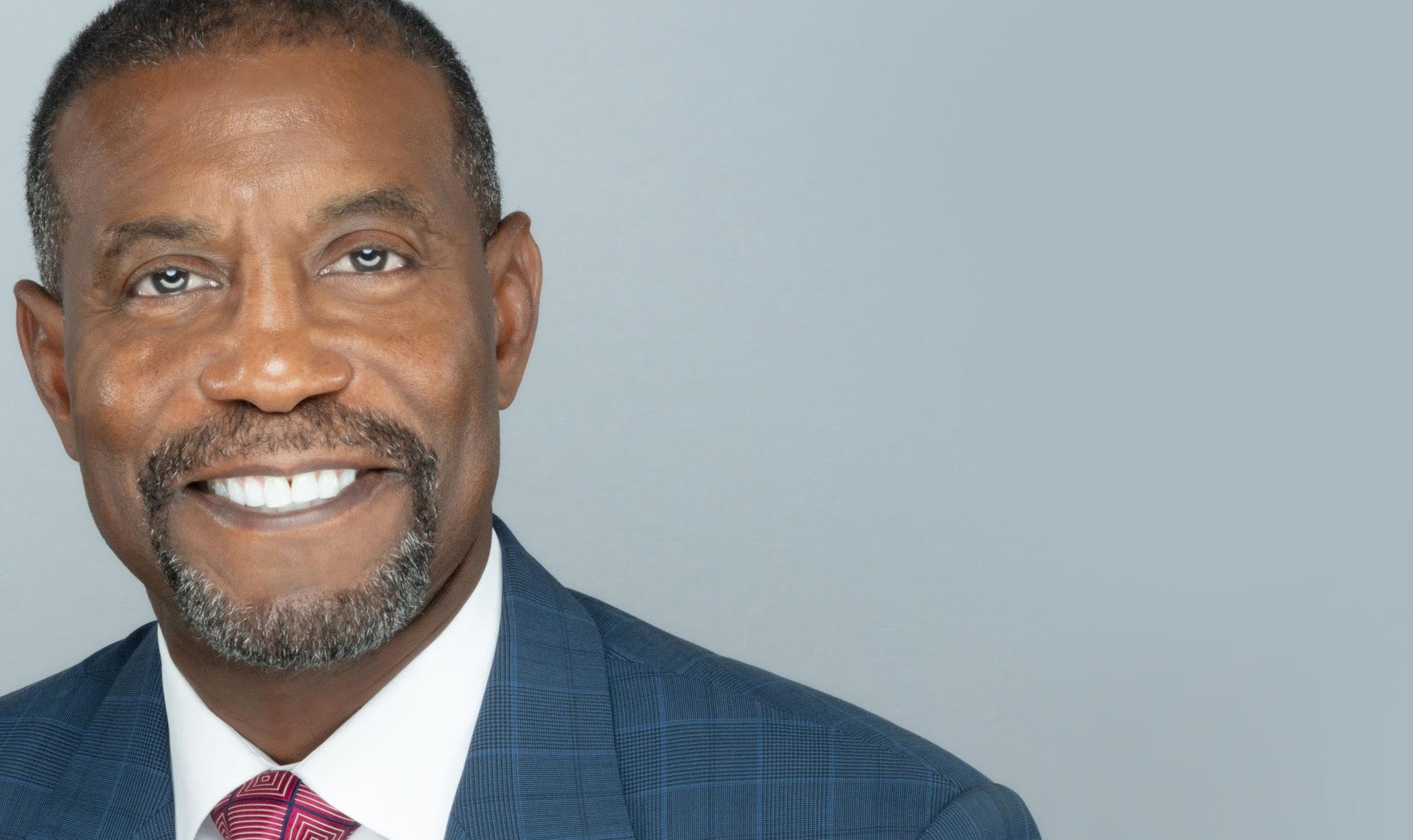
It was never a given that one of Guilford’s best studentathletes would end up at Guilford.
Keith Millner ’82 was headed to a liberal arts school. It just wasn’t Guilford. Wake Forest University was the plan – until an eleventh-hour visit to Guilford shifted something. Back in Eden, N.C., conversations with coaches and counselors began to point him elsewhere.
“I came to find out that Guilford had a phenomenal reputation – high academic excellence, a terrific liberal arts school rooted in Quaker principles,” he says. “It was highly regarded not just in North Carolina, but across the Southeast.”
An Economics major, Keith quarterbacked the Quakers to a top-10 NAIA national ranking in 1981. After Guilford, he built a three-decade career in senior executive roles as president of Nationwide Financial Network, president of CertusBank Georgia and Chief Operating Officer of InvestAtlanta, before moving into entrepreneurship. Today, he co-owns Social Capital, LLC, which operates multiple Jersey Mike’s submarine sandwich shop franchises in the Atlanta area and Coaching Catalyst, LLC, an executive coaching and business advisory firm.
But the through line, even now, is Guilford.
These days, Keith splits his time between Atlanta and Greensboro. As COO of Guilford since January 2025, he’s helping steer the College to a strong operational and financial future.
Guilford College Magazine caught up with Keith, who reflects on why he continues to invest his time – and his belief – in a place that once, almost by accident, became his foundation; the place that shaped his trajectory and, in many ways, still anchors it today.
Let’s start with the question everyone’s asking: Is Guilford going to be OK?
I believe it is — but not by accident. We’ve come through a period that forced us to confront some hard truths about how we operate and how we sustain ourselves. The work now is about building a high-performing,thriving organization with a business model that is sustainable, scalable and resilient.
What feels different right now compared to a year ago?
The culture is completely different. Everyone, including faculty, staff and the administration are all aligned and committed. There is genuine confidence and belief. A year ago, we were reacting. Now we are proactive and creating our
future — making data-informed decisions with a longer view — how we allocate resources, how we think about enrollment, how we align what we offer with what students and families are looking for.
If you had to describe Guilford’s path forward in one sentence, what is it?
Execute with excellence while continuing to focus on the mission.
Where is Guilford already winning — and where do we need to get better, fast?
We’re winning in the classroom. The faculty/staff-student relationships, the mentorship and the sense of community — once students get here and experience our magic. The transformation is felt and seen by students and their parents. This is evidenced by our roughly 88% retention.
Where we need to improve quickly is recruiting; how we tell that story and how we connect it to outcomes. Students and families want to know not just what the experience feels like, but where it leads.
What does financial sustainability look like for Guilford?
It means a balanced budget every year; it means deleveraging our balance sheet; it means a three-fold increase in the endowment; it means investing in programs and experiences that students value to drive enrollment, and it means investing in our faculty and staff.
So where should alumni support be directed right now?
Recruiting new students. Partnering and collaborating with our Enrollment team to market and promote the College across the nation and internationally. Our alumni are Guilford’s best commercial. Our alumni can also offer internships and employment to Guilford students and graduates. Every college and university that is highly ranked and growing has an active, engaged and powerful alumni network. Also, continue to donate to the Loyalty Fund, the Quaker Club or your favorite professor, department or activity.
There are a lot of small colleges competing right now. What makes Guilford distinct in 2030?
It’s still the people. But we have to pair that with relevance. A Guilford education has to prepare students not just to think critically, but to navigate a world that’s changing quickly — technologically, economically, globally.
How is the College preparing students for that future?
By leaning into what we do well — preparing young adults to be critical thinkers, effective communicators, agile change-agents and capable, competent leaders. Making the connection to real-world experience. Internships, partnerships, applied learning and employability. Those are no longer add-ons; they’re essential.
Where does Guilford need to take a risk right now?
In being willing to try new approaches — whether that’s new programs, new delivery models or new partnerships. Not every idea will work, but standing still is not an option. We need to change.
What do Guilfordians misunderstand about the College at this moment?
That we’re not out of the woods just yet. Not by a long shot. I think some still see the College as it was, not as it is becoming. This is a moment of change, and with that comes both challenge and opportunity.
As an alumnus, how does this moment feel to you personally?
It’s personal. This place shaped me. That comes with a sense of responsibility — to make sure the next generation has that same opportunity, even if it looks a little different.
What
gives you confidence right now?
Guilford College has been in existence for 189 years, since 1837. We have survived many crises over that span and survived. There is a resilience, a grit and a sense of destiny that is part of our DNA. At the end of the day, all championship teams, all great organizations are as they are, not because their product, service or marketing — rather it’s because of leadership and the people. Our faculty, staff, administration and alumni are our “secret sauce.”
What
does
a thriving Guilford College look like?
We are winning! The scoreboard reads: enrollment 1,200; higher retention; a capital campaign to grow our endowment; long-term debt substantially trimmed; recognition nationally as one of the best small liberal arts colleges. Our values are consistently on display and the mission is seen and felt everyday by everyone who touches Guilford. Today we are a college where students come not just for an education, but for a sense of purpose — and leave prepared to make a difference. That only grows in the coming years.
FOUNDERS at 50
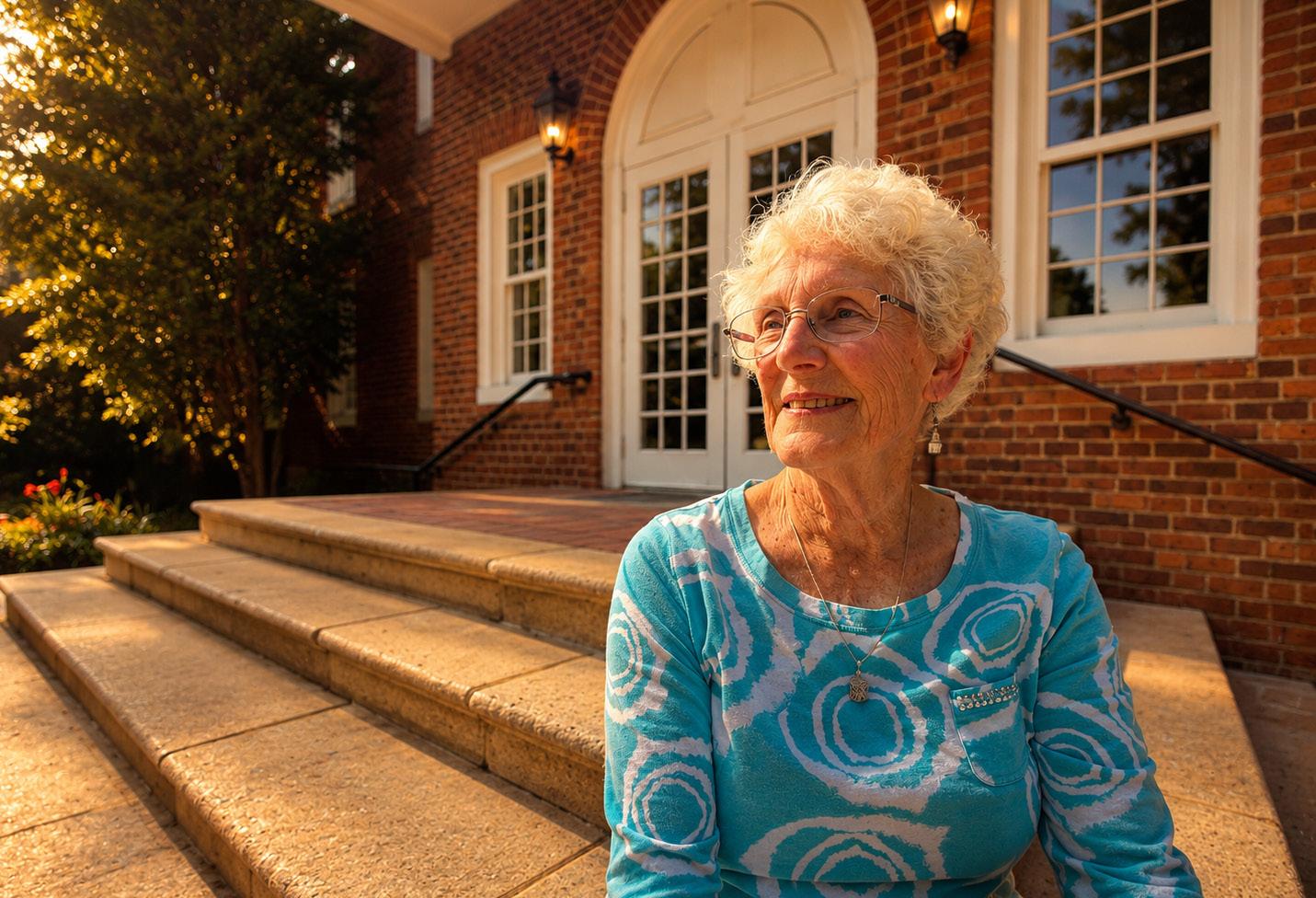
Before it was a student center, Founders Hall was a home where thousands of encounters turned strangers into stories.
Judith Vail Reece ’64 first saw the man she would marry for the next 62 years from a third-floor window of the old Founders Hall.
No, not that, Founders Hall. The original Founders, the one with the soft brick, the soft-spoken rules, and the not-so-soft curfews. Another student leaned beside her, pointed down at Carey Reece ’62 shuffling up the red-brick walk with another student and announced, with the confidence only a 21-yearold matchmaker can muster: You’re going on a blind date with him
Judy, to her credit, did not faint or flee. “And now I’ve been married all these years later,” she says with a laugh that suggests she’s still pleasantly stunned by the efficiency of that moment.
Back then, women in their first year were required to doubledate with an upperclasswoman. “They helped you,” Judy says,
“whether you asked for help or not”—and Founders was where all that helping, nudging, colliding, and occasionally rulebending happened.
The building was a women’s dormitory then, a warren of rooms and rituals, where Dean of Women Mildred Marlette ’35 lived just downstairs and a German house mother guarded the first-floor entrance like a sentry with a kind heart and an early bedtime.
“It felt like home,” Judy says. “A real home.”
Founders Hall — or rather, the Founders that stood before 1974 — has been gone now for 50 years. Last fall, the 2.0 version turned 50 itself, marking five decades as the student center, the campus crossroads, the hum-and-buzz place where Guilfordians gather to eat, flirt, debate, perform, organize, nap, fall in love, and basically stare into the refrigerator of life at 1 a.m.
JUDY REECE ’64 SAYS THE ORIGINAL VERSION OF FOUNDERS HALL AS A DORMITORY “FELT LIKE HOME.”
If Gwen Gosney Erickson, the College’s Quaker Archivist, is the chief interpreter of Founders’ past, Judy is one of its great witnesses. “It’s the centerpiece of the College,” Gwen says. “If you graduated from Guilford, you spent a lot of time in Founders.” And Judy did — though hers had creaky wood floors, rocking chairs on the porch, and a single pay phone on the second floor that turned its nearest resident into an involuntary receptionist.
“If you lived near that phone,” Judy says, “you were doomed.”
She pauses. “That was my second year.”
But the story of Founders, strangely enough, is also a story about letting go.
In 1973, Guilford leaders made what must have felt like a heretical decision: to tear down the College’s first and oldest building, the one that had stood since the 1830s with its handmade brick and pine beams and its knack for holding more memories than structural integrity. They didn’t demolish it because they valued it too little, Gwen says, but because they valued it too much to let it collapse.
The 1960s had been an era of action on campus, not sentimentality.
still bewildered) — and reinvented it as a true student center. WQFS finally got a permanent home. Student government found its seat. Plays, protests, and makers fairs moved in. Founders’ heart kept beating; the building just learned a new rhythm.
Judy didn’t see the demolition. She and her husband were living in Maryland, long gone from the porch with the rocking chairs where she used to find him waiting before dinner. “It was sad when we came back later and saw the new building,” she says. “Not because it wasn’t nice — but because it was different.”
“Founders was never just a building, it’s always been where Guilford comes together.”
— GWEN GOSNEY ERICKSON, QUAKER ARCHIVIST
Duke Hall, once the site of a grand auditorium, had been gutted to create classrooms; New Garden Hall transitioned from Quaker worship space to offices. Everywhere, higher education was being rewired, replumbed, reimagined. Founders, with its 1830s bones and 1920s wiring, had simply run out of runway.
“You start tampering with a 19th-century structure,” Gwen says, “and 20th-century building codes come calling.”
So in 1974, they took Founders down, brick by brick — except for the back kitchen and dining area, added much later and sturdy enough to stay. That choice kept the dining hall open during construction and created a beautiful oddity still visible today: old brick meeting 1970s brick, a literal seam between centuries.
When the new Founders opened in 1975, it was not a replacement but a reboot. It took the spirit of the original — the place where students slept, gossiped, studied, snuck back in after curfew, and occasionally weathered a panty raid (“I didn’t even know what a panty raid was,” Judy says,
Even so, she bridged the old and new in the same way Founders itself does. The old dorm held memories of late-night knocks on the house mother’s window, skirts required for walking with a boy, and the rule that no men ever crossed the boundary of the second floor. The new building would come to hold the memories of generations who never knew any of that — but who found their people, their place, their Guilford, all the same.
When Gwen organized the 50th reunion last fall, she brought together residents of the old dormitory and the students who made the new Founders their headquarters. “It felt important to bridge those generations,” she says.
And it was fitting. Because Founders — whether the 1830s original, the 1975 rebuild, or the freshly renovated, plazaframed, gazebo-accompanied version of today — has always been a convergence point.
It’s where Judy first saw her future husband.
Where students dashed for dinner jobs without stepping outside.
Where the pay phone rang endlessly.
Where the College has gathered for nearly 190 years in one form or another.
Founders hasn’t fallen or vanished. It’s morphed. It’s adapted. And yet it has stayed stubbornly itself in every version along the way.
“Founders was never just a building,” Gwen says. “It’s always been where Guilford comes together.”
THE GIFT OF PERSPECTIVE
Study abroad programs create life-changing experiences that endure long after students return home.
The most important thing Guilford College students often bring home from a study abroad experience isn’t a souvenir. It’s a different way of seeing.
A mountain becomes more than a mountain. A game becomes more than a game. A border is no longer just a line on a map. The world, once flattened by screens and textbooks, suddenly acquires depth.
That is what Guilford’s Global & Off-Campus Initiatives programs do so well. They do not simply take students to another country. They teach them how to see things differently.
In May, that learning unfolded across three continents and countless moments that could never fit neatly into a syllabus.
In northern Italy, Honors students studied sustainable living at Brunnenburg Castle, perched high above vineyards and valleys shaped over centuries. They examined food systems, environmental stewardship and human relationships with the land while standing in the middle of those very systems. The classroom wasn’t separate from the lesson. It was the lesson.
In South Africa, students found something harder to put on a transcript. They wandered through the lingering shadows of apartheid, sat in classrooms with children whose stories complicated their assumptions, studied the uneasy parallels between South Africa and America, and discovered that the world is always larger — and more human — than the version we carry around in our heads.
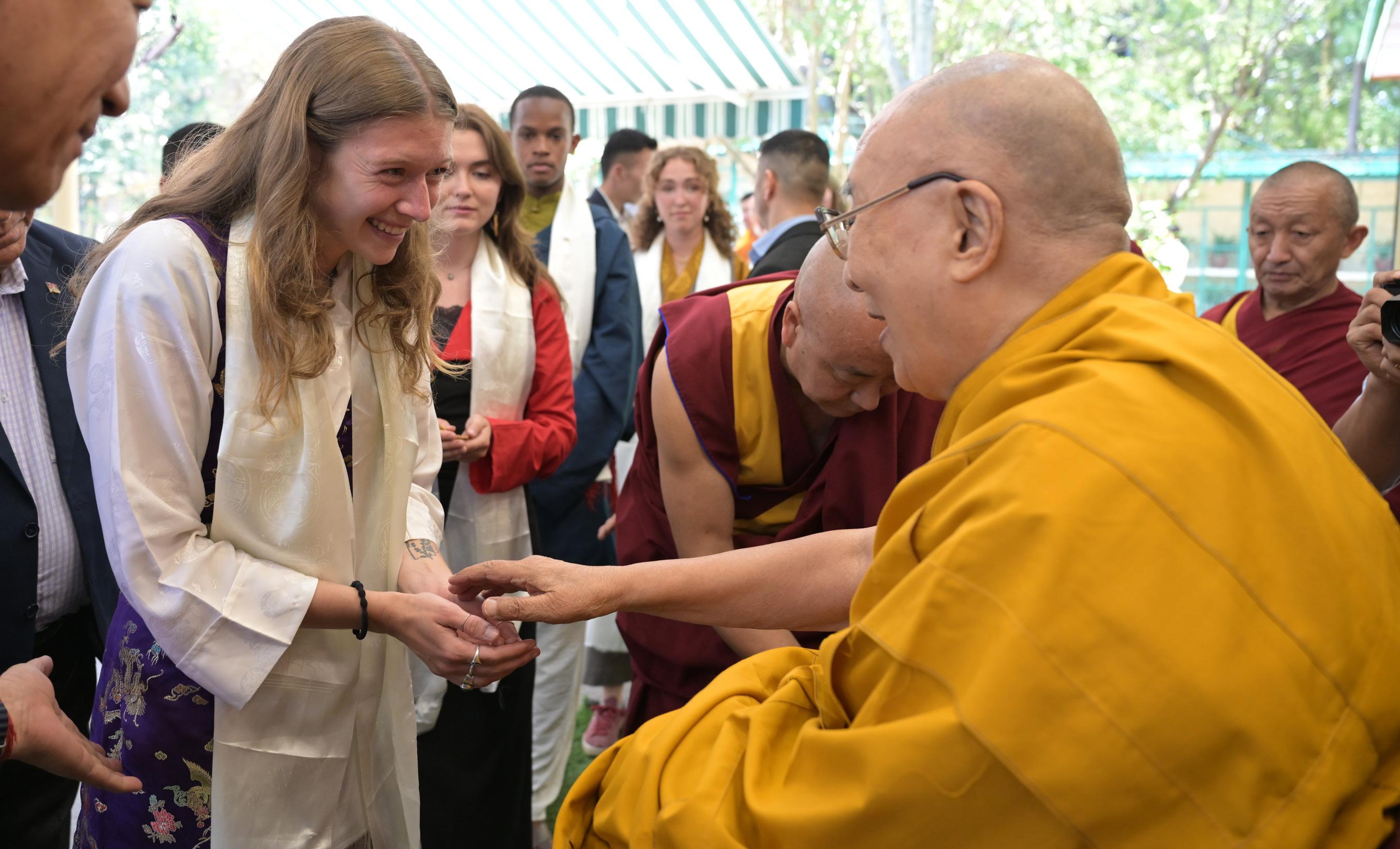
LILY BROWN ‘26 MEETS WITH THE DALAI LAMA, THE SPIRITUAL LEADER OF THE TIBETAN PEOPLE, DURING A SPRING GUILFORD STUDY ABROAD TRIP.
Another group traveled through Europe exploring the global business of sport. They visited Olympic venues, met industry leaders and saw firsthand how athletics can shape economies, cities and national identity. The trip wasn’t really about sports. It was about understanding the forces that bring people together, and sometimes pull them apart.
For three weeks, Guilford students traveled across India through Delhi, Agra, Dharamshala and Bir as part of a course examining Tibetan communities living in exile. They stood thousands of miles from Greensboro and wrestled with questions that have no easy answers: What does it mean to lose a homeland? How do people preserve culture when they are scattered from the place that gave it life? What responsibilities do nations and individuals have to displaced communities?
Those questions cannot be fully understood from a lecture hall.
You have to hear the stories. Share meals. Walk the streets. Sit with people whose lives have been shaped by decisions made generations ago.
That is the enduring value of study abroad. It transforms
abstract ideas into human encounters.
And those encounters have a way of lingering.
Years from now, most students will forget a quiz grade or a textbook chapter. But they will remember standing in the shadow of the Himalayas meeting with the Dalai Lama. They will remember looking out from a castle in Italy. They will remember the feeling of realizing that the world is far larger, more complicated and more interconnected than they once imagined.
A college education should expand a student’s horizons. The best study abroad programs make sure those horizons are real.
Experiences like these do not happen by accident. They happen because generations of Guilfordians have believed that education should extend beyond the boundaries of campus and beyond the limits of what students already know.
If you share that vision, consider supporting Guilford’s study abroad programs. Click HERE to help ensure that future students have the opportunity to see more of the world – and, in the process, discover more about themselves.
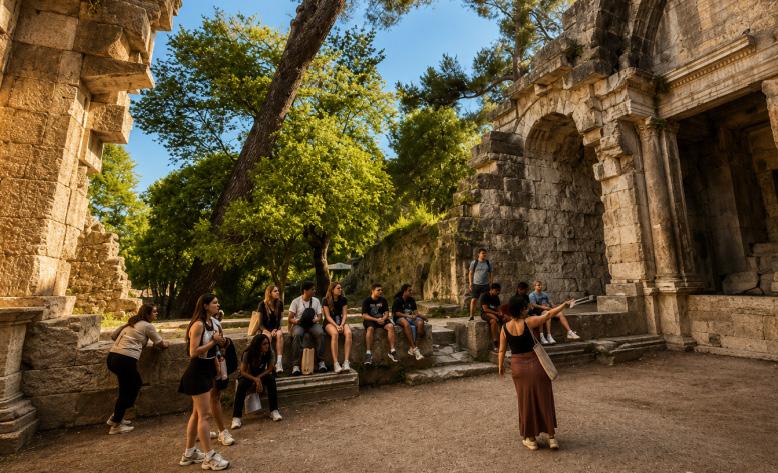
A GROUP OF GUILFORD SPORT MANAGEMENT STUDENTS TAKE A BREAK IN FRANCE FROM THEIR STUDY ABROAD TRIP ACROSS EUROPE.
BEE
THE WHISPERER
Through patience, chemistry, and a little intuition, Kaira Wagoner is giving bees –and the humans who depend on them –a fighting chance.
When Kaira Wagoner ’06 talks about bees, the air seems to hum. Her sentences move – dare we say? – like bees in flight.
They dart and double back, making connections that at first feel unpredictable but somehow land precisely where they should. One moment she’s explaining how compounds emitted by a sick bee can trigger an entire colony’s defense response; the next, she’s talking fondly of the childhood garden she once roamed and where she began to pay attention to the natural world around all of us.
“I’ve always been interested in animals, from the biggest
PHOTOS COURTESY OF KAIRA WAGONER
down to the tiniest – that includes insects,” says Kaira, who graduated from Guilford as a Biology and Health Sciences double major. “I’m doing what I love.”
That foundation – equal parts curiosity, empathy, and a refusal to accept easy answers – has carried Kaira from the Biology Department at Guilford to one of the world’s most complex creatures: the honey bee.
Today, she’s a leading researcher on honey bee behavior and
health, and the founder and CEO of a company that helps beekeepers breed stronger colonies. If you’ve ever wondered how a liberal arts education can pollinate a scientific career, Kaira is your answer.
She didn’t start out chasing bees. After Guilford, she spent three years working with ceramic water filters in developing countries in Latin America and Eastern and Southern Africa. When a close friend and mentor died from malaria in West
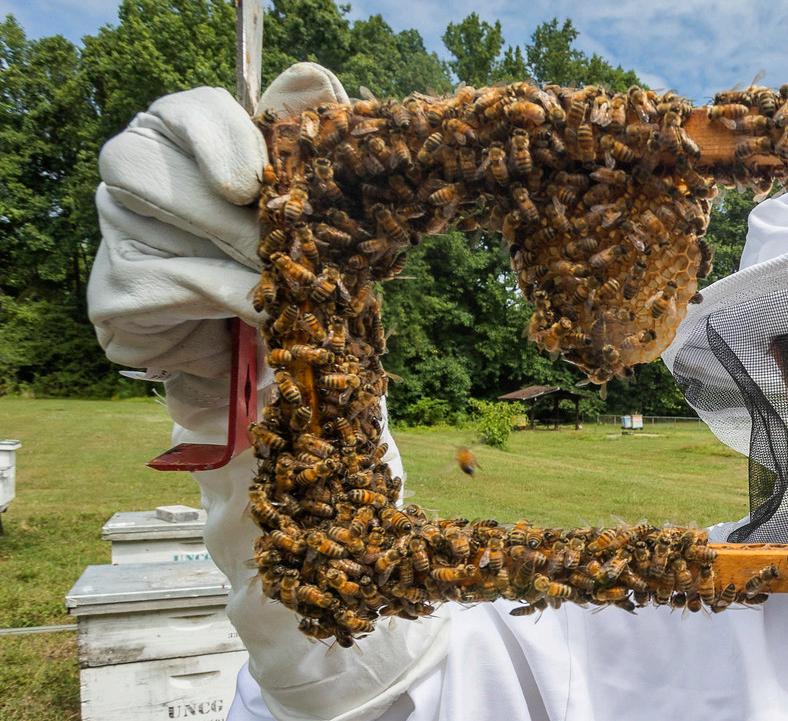
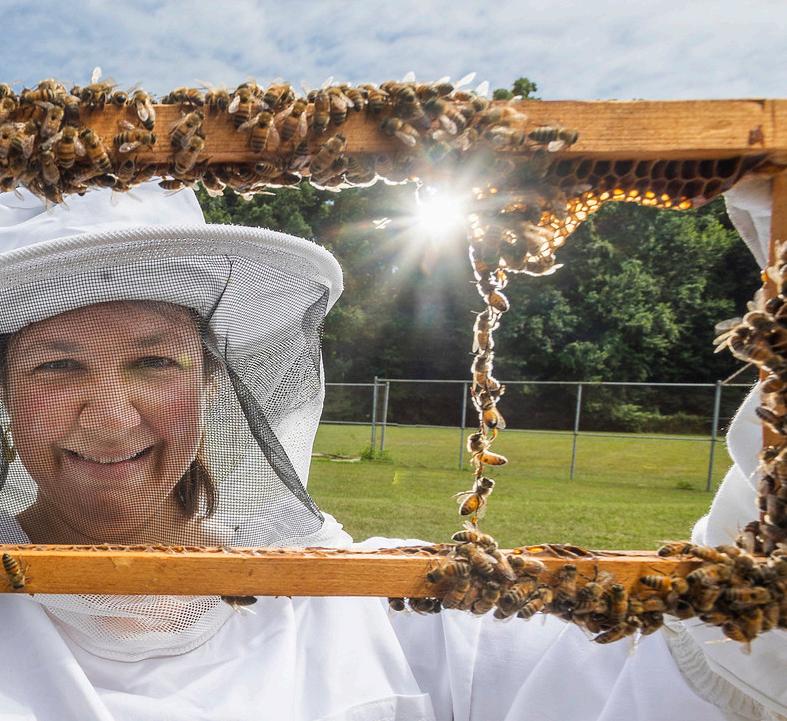
KAIRA WAGONER MAINTAINS ABOUT 25 COLONIES AT GUILFORD COLLEGE’S FARM.
Africa, Kaira decided to return to Greensboro and begin her master’s work at UNCG studying mosquitos. After two years, she focused on bees.
Kaira says she wanted her work to matter, to connect to life rather than death, and that meant turning away from the world of mosquitoes — creatures that could only ever be studied through killing. “I didn’t want to continue to always try and kill my subject matter,” she says.
So she began to look elsewhere, toward a different kind of insect — one that builds instead of destroys, one that lives for the colony. Bees, she realized, were not just fascinating but essential, the small machinery behind much of what humans eat and grow. Though most people fear the winged, golden insects with their stingers (though they rarely attack), honeybees play a pivotal role in the production of about 100 crops Americans consume. “We’ve become so reliant on bees for crop production that they really are a very important species in this country,” she says.
She earned her master’s and Ph.D. at UNCG, where, armed with her expertise in gas chromatographymass spectrometry, she started investigating the chemical communication that governs honey bee colonies.
Sensing these pheromones, adult bees remove those unhealthy bees from the colony so the colony can thrive.
After her discovery of these pheromones, Kaira set out to create a practical tool for beekeepers. Her solution, UBeeO – short for Unhealthy Brood Odor – is a test that measures a colony’s hygienic response using a mixture of synthetic pheromones which mimic those emitted by stressed bees.
A beekeeper applies the mixture to a small section of capped brood, waits two hours, and scores the colony’s responsiveness. A high score signals a strong, hygienic colony; a low score indicates vulnerability. It’s a way to select for disease-resistant colonies, potentially reducing the need for chemicals that, while lifesaving, can impair bee health in subtle but significant ways.
To get this technology into the hands of beekeepers, Kaira and a labmate created Optera. Through Optera, Kaira has turned that fundamental science discovery into a practical tool that beekeepers can use to manage their hives and improve colony pest and disease resistance.
“I’ve always been interested in animals, from the biggest down to the tiniest –that includes insects”
— KAIRA WAGONER ’06
Kaira focused on a phenomenon known as hygienic behavior, the colony’s innate ability to detect and remove sick or dying brood to protect the colony. It’s a complex process involving chemical signals, wax caps and the precise timing of intervention.
The stakes have never been higher for bees and U.S. crops. Parasites, loss of habitat, climate change and pesticides threaten to wipe out as much as 70 percent or more of the nation’s honeybee colonies this year, according to the USDA’s Agricultural Research Service. The varroa mite, a parasite that attacks and feeds on the insects, has been a major contributor to bee deaths over the years. It weakens their immune systems and spreads viruses.
The USDA believes the pests played a role in a major colony collapse 20 years ago when large numbers of bees unexpectedly disappeared.
That’s where Kaira’s research comes in. She discovered that unhealthy honey bee larvae release a higher amount of certain pheromones, including those that are carrying parasites such as the varroa mite.
“Compared to other livestock, the honey bee industry is a little behind in breeding for pest and disease resistance. ” Kaira says. “But with this finding, we thought, maybe we can turn this into a tool for beekeepers to actually measure how hygienic a colony is and then make management and breeding decisions based on those results.”
Kaira’s research isn’t just about commercial agriculture. It’s about ecosystem health. Unhealthy honey bees can transmit diseases to native bees through shared floral resources, creating a cascade of risk across pollinator populations. For Kaira, educating the public is as critical as the science itself. She emphasizes planting pollinator-friendly flowers, especially late-season blooms, to sustain bees through the lean months, and reducing the use of chemical pesticides that threaten both honey bees and native species.
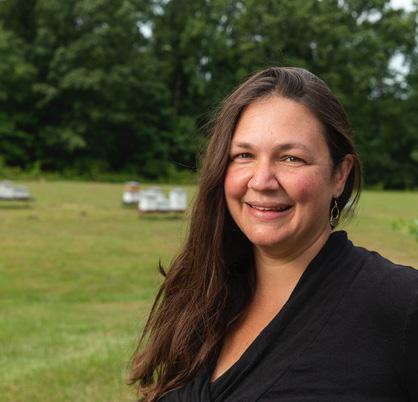
Kaira’s work bridges science and public engagement. She maintains about 25 colonies at Guilford’s farm, smaller hives in her community, and dozens of colonies at UNCG’s apiaries off Spring Garden Street and at the Plant and Pollinator Center in Browns Summit, about 20 miles north of Greensboro. Occasionally, she’ll install observation hives on her rooftop for her three boys to watch over breakfast.
All of that honey has to go somewhere and a large amount finds its way into the College’s community-supported
agriculture programs, connecting her research to the local food system.
Kaira also sells honey through her business, Optera, which launched the UBeeO product in January 2024. Optera, named after Hymenoptera – the scientific order including bees, ants, and wasps – serves as a bridge between research and practical application. Kaira’s website, opterabees.com, features open-access publications, instructional videos, and information about bee hygiene and pollinator health. Through it, she hopes to reach a broad audience, from backyard beekeepers to commercial operators.
The life of a bee, Kaira reminds us, is brief yet vital. Spring and summer workers live for weeks, winter bees endure months to carry the colony through cold, and queens, ideally, may live two to three years, though contemporary pressures often shorten this dramatically. Maintaining healthy colonies, she emphasizes, benefits not only honey production but also the wider web of pollinators in an area.
KAIRA’S
RESEARCH HAS PRODUCED A TOOL TO HELP BEEKEEPERS PROTECT VULNERABLE COLONIES.
that would eventually inform her approach to bees: patient observation, careful experimentation, and a focus on communication within species.
Her commitment to pollinator health traces back to her childhood in Charlotte, where she lived just down the street from Wing Haven, a garden and bird sanctuary. The owners of the land, her neighbors, cultivated a lush garden, gifting each other plants instead of conventional presents every year, and teaching young Kaira to feed wild birds and respect the rhythms of nature.
“I just kind of grew up loving nature,” she recalls. That love of nature guided her to Guilford College. Kaira is not Quaker, but she grew up around many Friends, who suggested she look into Guilford when she began her college search as a teen.
“I fell in love with the place the first time I saw it,” she says. “The trees, the lake, the woods – all of it spoke to me.”
Kaira studied Chemistry but pivoted to Biology her junior year after a transformative semester in Kenya studying human-wildlife conflict in the Maasai Mara National Reserve. Among the Maasai denizens of lions, leopards, crocodiles and wildebeests, she discovered animal behavior, an interest
Even her personal life is intertwined with these formative spaces. She first met her future husband, Reynaldo Diaz ’06, during a chemistry lab. Nature, bees and human connection seem to follow Kaira wherever she goes – a thread running from childhood to Kenya, from Guilford to UNCG.
For Kaira, research is never purely academic. It is applied, ethical and forward-thinking. By decoding the chemical cues that signal stress in bees, she is helping beekeepers breed resilient colonies, reduce chemical exposure, and protect native pollinators. By opening her labs and fields to the public, she is fostering awareness of the invisible work that underpins ecosystems and food systems alike. And by running a business dedicated to translating science into practical tools, she ensures that the benefits of her research reach far beyond the ivory tower.
“Bees are absolutely fascinating,” she says, her voice tinged with wonder. “The more I work with them, the less I feel like I know, which is incredibly inspiring as a scientist.”

PAINTING RADIANCE, PRACTICING HEALING
With brush and beam, Claire Lanier blends art, science and compassion in her care for patients.
When Claire Massagee Lanier ’12 walks into a treatment room, she brings more than her medical training. She brings perspective – on illness, on inequity and on what it means to stand with someone else at a vulnerable point in their life.
Claire is a radiation oncologist at Cone Health Wesley Long Hospital in Greensboro. Despite her father being a doctor, she didn’t grow up dreaming of working alongside linear accelerators and Gamma Knives. Shortly before her
first year at Guilford, Claire’s father Terry Massagee, an anesthesiologist, told her to explore all of her options.
Being a physician is incredibly hard, he warned Claire when she was 18 and just starting college. “He told me if I wasn’t 100 percent sure, don’t do it,” she says.
At first, Claire listened. She imagined other paths, looking outward. But when her father suffered a heart attack a
few years later, long hours in his hospital room changed everything. She hung on to every detail of his prognosis and the procedures being used to stabilize him.
She realized then what she had always known but never admitted: medicine was her calling. “I wanted to be in those conversations,” she remembers. “It felt important. It felt like where I belonged.”
PHOTO COURTESY OF CLAIRE LANIER ’12
If her father’s heart attack gave her urgency, Guilford gave her shape. Claire grew up in Greensboro and hadn’t planned to attend a small liberal arts college close to home.
“I explored the campus, met faculty and just felt like it would be a good fit,” she says. “It turned out to be perspectiveshifting in ways I couldn’t have predicted.” She remembers one English class where a reading forced her to grapple with race and poverty in ways she hadn’t considered before.
At first she resisted. Her father had grown up with little; his parents had limited financial means. He worked hard and overcame barriers. Didn’t that prove obstacles could be overcome with effort alone?
Over time she began to see the distinction. At Guilford she learned that marginalized groups and people of color face additional barriers her father never had to confront. Hard work matters, she says, but it is often not enough in the face of entrenched, systemic inequities.
“(Dad) might have been poor, but he was also white,” she
says. “That meant he was starting on a different playing field altogether. It was a turning point for me.”
Guilford continued to challenge her perspective. As a Principled Problem Solving scholar, she worked on projects exploring Quaker values in action. For one, she placed a globe in the middle of a classroom and asked everyone to describe what they saw. Each perspective was different, partial and valid.
“It was simple but powerful,” Claire says. “We literally all had different views of the world, and they were all real.”
Years later, in a cancer clinic, she would recall those lessons. Every patient arrived with a story shaped by family, hardship or gratitude. Each view mattered.
Claire first learned about radiation oncology while applying to medical schools. The field intrigued her because it was deeply technical and deeply human. She loved the precision, the evolving technology and the chance to see concrete results — whether curing disease or easing pain.
Guilford Gives.
Gives.
“It felt like the right balance between technology and human connection,” she says. “You get to work closely with patients at such an important moment in their lives.”
She also knew the specialty was competitive. Rather than discourage her, it pushed her to dive deeper. “The more I learned, the more I fell in love with it,” she says. Claire wrapped up her residency last summer and is now practicing independently. During that time, she learned what many doctors eventually do: medicine does not always live up to its ideals.
Time is scarce. Systems are built for efficiency, not empathy. “You go in wanting to take care of people, and then you find you’re not given the time to be the best caretaker you can be,” she says.
She also sees daily how socioeconomic status affects prognosis. Patients with fewer resources often arrive later in their disease course or face barriers that complicate treatment. “These are things we can’t fix just by treating the disease,” she says.
Through it all, her patients keep her grounded. Some arrive filled with gratitude; others with anger or fear. “And if they are angry or scared, that’s absolutely understandable,” she says.
Either way, Claire says she’s privileged to walk alongside them. “People think oncology is only sad,” she says, “but there’s also so much joy. Patients carry a perspective on life that’s inspiring.”
creates collages and vision boards, and finds joy in patterns and fabrics.
To mark the 25th year of the Gamma Knife at her hospital, Claire didn’t reach for statistics or plaques.
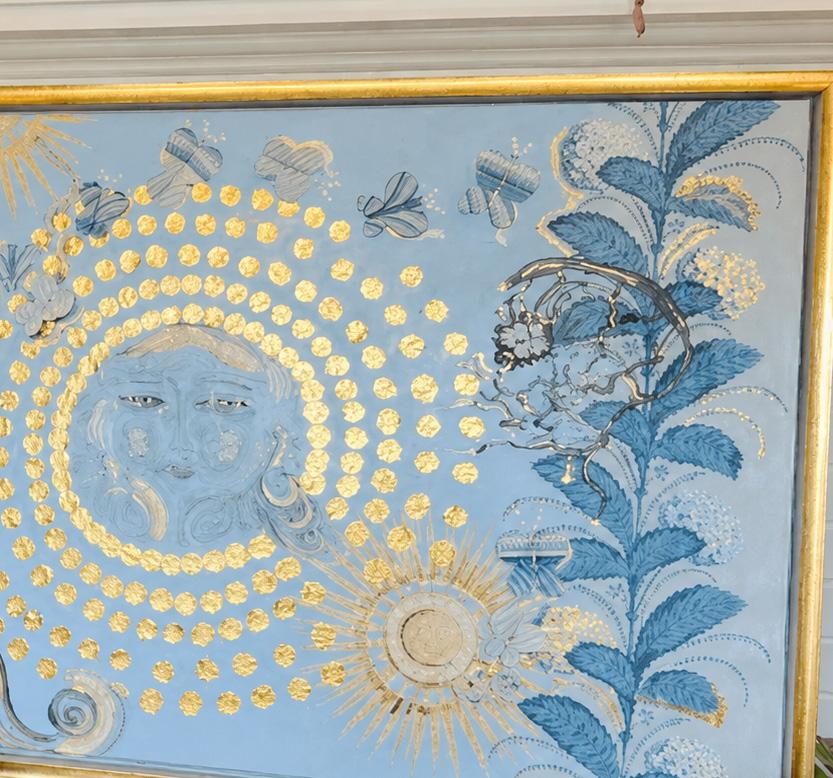
She painted. The canvas, Radiance, hangs in the Radiation Oncology Department at Atrium Health Wake Forest Baptist in Winston-Salem, where she completed her residency.
“People think oncology is only sad,” she says, “but there’s also so much joy. Patients carry a perspective on life that’s inspiring.”
— Claire Massagee Lanier ’12
At home in Greensboro, Claire and her husband Patrick Lanier ’12 are raising three boys. Between work and family, she makes space for creativity. She laughs off the label of artist, preferring to call herself “crafty.” Still, her creative streak is real. She decorates rooms,
The painting carries both the weight of medical physics and the small, stubborn hopes of patients who have lain under the machine’s crown. Cranial nerves and blood vessels curve across the surface, joined by butterflies catching a suggestion of light. Transformation, fragility and strength share the canvas.
Claire dreams of designing cancer centers that feel as calming and supportive as the care delivered inside them.
“You can’t just go crazy with wallpaper and fabric,” she says. “The goal is to make people feel at peace.” She traces that philosophy back to Guilford, where she learned disciplines need not be siloed and creativity can intersect with science.
“Things are interconnected,” she says. “There isn’t just one path.”
Claire’s life today is busy, demanding and joyful. When she reflects on what sustains her — the patience to listen, the imagination to design healing spaces, the conviction that inequities must be acknowledged — she returns to Guilford.
“My education there was so important,” she says. “It gave me critical thinking skills and pushed me to see perspectives I might never have considered.”
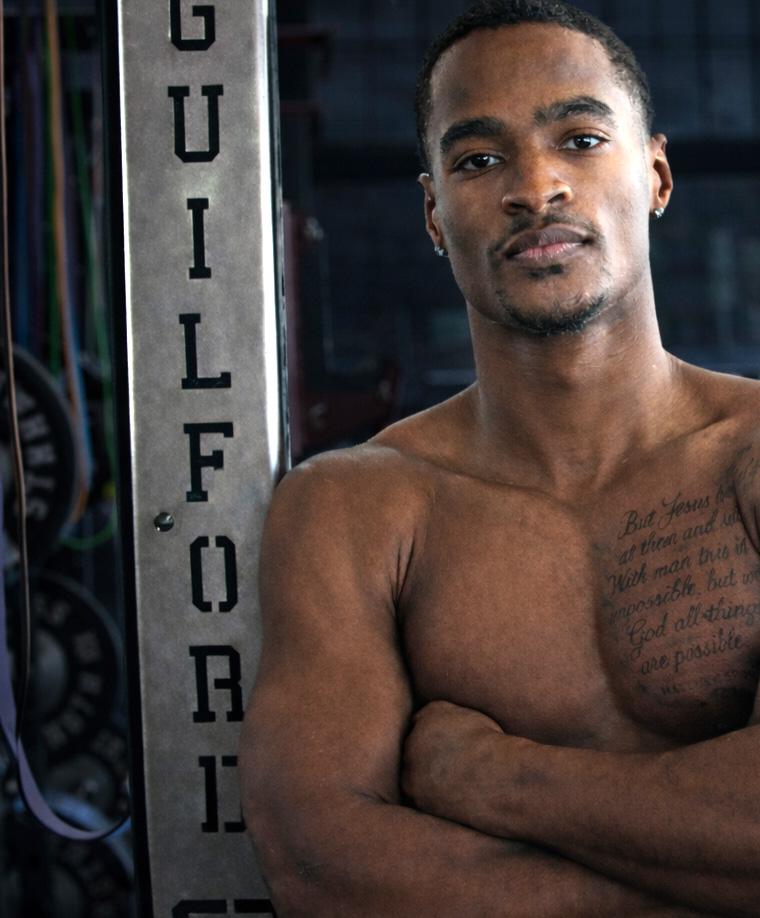
PHOTO: DAVID MARTIN ’26
HEAVY LIFTING
Three degrees. Zero shortcuts.
Dawson Edwards would love to coast if he had the time.

To the list of questions that have nagged mankind through the ages, add this one: Which version of Dawson Edwards ’24, MBA ’25, MISM ’26 was harder to keep up with — the basketball player or the Presidential Fellow?
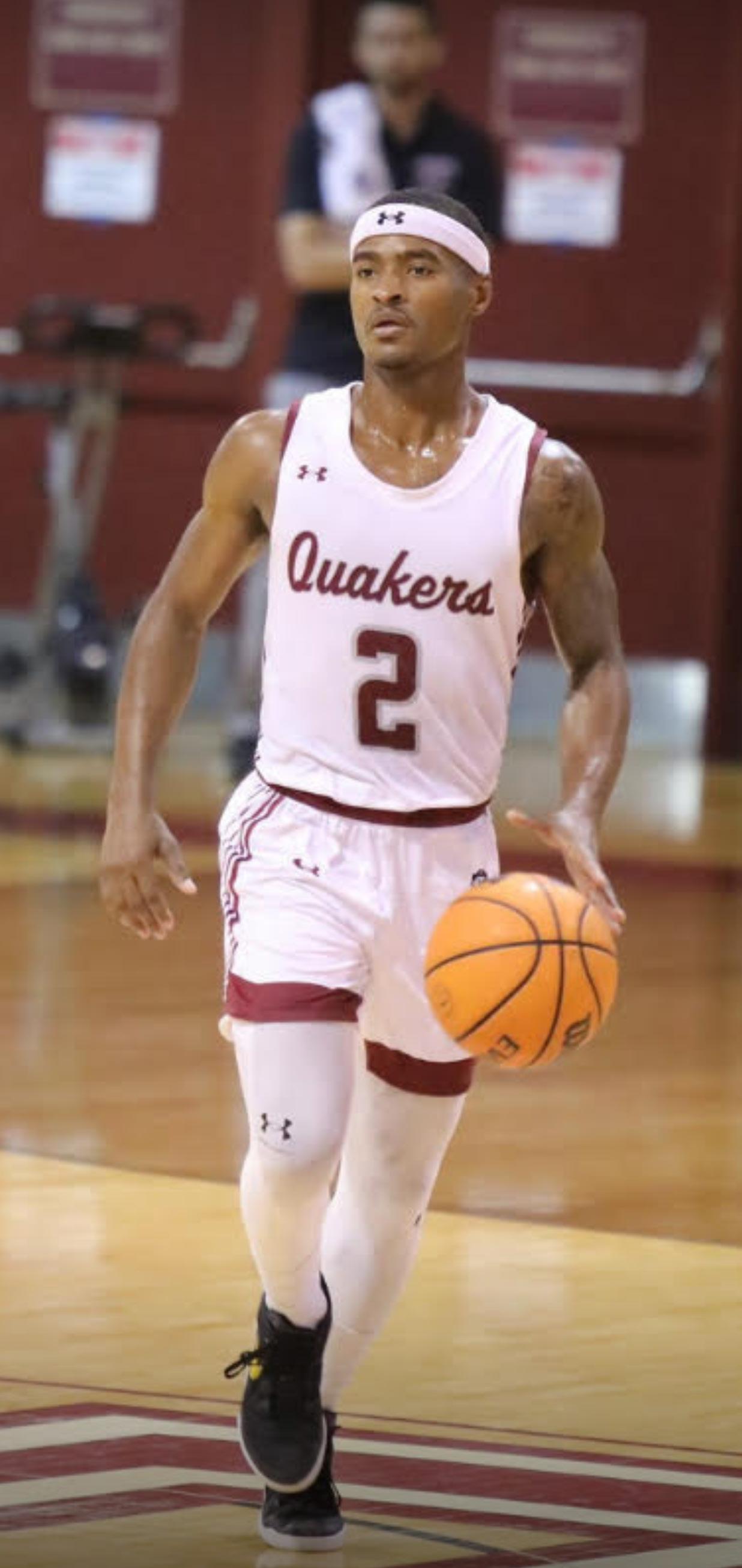
On the court, Dawson was as quick as he was elusive, slicing through defenses in his final season with the Guilford Quakers in a transition between head coaches, leading in ways that don’t always show up in a box score.
Off the court, he was just as difficult to pin down — running tours for prospective students, printing materials in the Admission Office before most of campus had its coffee, wrapping up a second master’s degree to stack neatly atop his undergraduate diploma.
He is, in short, a study in motion.
Spend five minutes with him – if he has that time to spare – and you begin to understand that motion is not restlessness. It’s purposeful. He has a dream, one sketched out on a piece of paper at his kitchen table last year. Every move he makes, every breath he takes is designed to realize the dream.
“I truly want to build my own business one day,” Dawson says, leaning forward as if already pitching it to a roomful of investors.
He wants to build a gym – only it’s not just a gym. He wants that gym to have a library. You read that right. And offices and a maker’s space. His target audience is mid-career people and retirees, the ones with the most disposable income. But also elementary, middle and high school students. In short, everybody.
“It’s going to incorporate a little bit of sport, a lot of the operational stuff I
learned during my MBA — but really it’s going to incorporate relationships and community.”
Relationships and community. When Dawson speaks, the phrase returns again and again, like a drumbeat.
It is, he admits with a grin, the very reason he chose Guilford in the first place.
He grew up in Durham, N.C., in a world textured by Sunday mornings and public school hallways. “First thing I think about is church,” he says about growing up. “My parents always made sure we were up and there every Sunday. Sunday school — that’s where I made my first friends.”
Those friendships often stretched beyond school boundaries. Many of the children he knew from church attended private schools or different public schools. The diversity of his early education left an imprint. “We were learning about Black history, Hispanic history — in fifth grade,” he says. “In college I’d hear people say they barely learned about that in middle school or high school.”
In eighth grade, he completed a community service project that quietly altered his trajectory. He chose to interview members of Durham’s homeless community. One man stood out — a military veteran whom everyone assumed was living on the streets.
“He wasn’t,” Dawson says. “He lived with his sister. He had family. He just walked the streets every day picking up trash.”
“His leadership on the floor is what I noticed first,” says Tom, now the associate head coach at Longwood University. “That’s not always something you can teach a player, but Dawson had it in him in high school.”
By the time Dawson visited campus, basketball was only part of the equation.
“Relationships and community, that’s all I heard about Guilford,” Dawson says. “So I thought, let me just go to campus and see what it’s about. After visiting, I was convinced.”
At Guilford, he found not just a roster spot, but a runway.
He completed his undergraduate degree in Business Administration. He added an MBA and, in 2026, a Master’s in International Sport Management. Along the way, he became one of four Presidential Fellows for 2025-26 – recent graduates who work in a department on campus while earning a master’s degree at Guilford.
The Presidential Fellowship is a “win-win” program fostering leadership and providing practical experience in higher ed for students. For Dawson, it was a role that places him in the room where decisions are made.
“Whenever I’m thinking about my idea, I’m thinking about providing value in the best way possible for as many people as possible”
— DAWSON EDWARDS ’24, MBA ’25, MISM ’26
The man had been shot multiple times in war. He had been diagnosed with PTSD and paranoia. And yet he rose each morning to clean highways running through and around Durham.
“He felt a duty to make the planet look better,” Dawson says. “People thought he was homeless, and he was just living his best life.”
That lesson — that purpose is not always glamorous, that fulfillment is not synonymous with applause — stayed with him.
So when colleges began circling during his senior year of high school, he weighed more than playing time. An assistant coach from Guilford watched him compete in a game crowded with recruiters. UNC Greensboro, a Division I program, deemed him undersized. Former Guilford head coach Tom Palombo saw something else.
“One of the biggest things I made clear on my (Presidential Fellowship) application was how much I love Guilford College, and I want to be a part of its direction,” he says. “As a student you can have input. But when you have a staff position, you can really be in the room when decisions are made. Your perspective is more considered.”
If that sounds ambitious, it is. But it is also disciplined.
His typical Monday was like a time-management case study.
He woke at 7:30 a.m., walked his Golden Retriever Maximous before reporting to work in Hendricks Hall. He printed materials for morning tours, fielded calls and shepherded prospective families across campus. Around 11 a.m., he squeezed in a workout if practice loomed. The last tour wraps at 2:30; he headed straight to practice. After practice, the team lifted. Then home to Maximous. Then homework. Then, perhaps, a late-night conversation with Natalie Moore ’26, his girlfriend who graduated from Guilford in May with a Biology degree.
The arithmetic of his days required some heavy lifting of discipline and time management until, he says, the darting
around campus, weight lifting, studying and basketball becoming less a chore and more routine.
“Sometimes you hit a wall and say to yourself, “‘man, I need some personal space.’ But after doing so much and wanting to be involved in so much, it becomes your life. I’d rather be a part of change than watch change happen and have no input.”
Basketball provided the crucible.
“You can’t show up to practice five minutes before and expect to be ready,” he says. “There’s preparation.”
He laughs as he recalls his high school coach’s mantra: proper planning and preparation prevent poor performance — the “six P’s.” At the time the line, to keep the alliteration going, piqued Dawson.
In college, it made sense.
“A failure to plan is planning to fail,” he says. “Once you’re thrown in the fire, you understand and my time at Guilford has been one big fire. A good kind of fire. It’s made me stronger and ready for what comes next.”
Not surprisingly, Dawson was one of the basketball team’s captains. Leadership, he believes, is less about speeches and more about stamina. “Being a team captain, you feel responsible for the direction of the team. And once you
start working, it’s the same thing. You’re going to feel responsibility if the project succeeds or fails.”
Back to Dawson’s dream. The idea sparked at 2:30 a.m. at a kitchen table, before a predawn shift at Target. Dawson and a roommate began sketching what downtown Greensboro could become if they had the land.
“I thought, everyone builds athletic facilities,” he says. “What would I want to build? A place where community and ambition collide.”
The concept has since grown into something like a hybrid of a YMCA, a co-working space, a library, and a civic commons. There would be fitness facilities, yes, but also career fairs, speaker series, food spaces, professional learning areas. “It’s like reinventing the college experience without classes,” he says. “Open to all ages.”
He has mapped it down to phased construction. He has run feasibility scenarios. It’s all right there in a Google Doc.
He’s convinced his Guilford MBA will give him the edge he needs when it’s time.
“I got an ethical education here at Guilford,” he says. “That’s going to be huge. Whenever I’m thinking about my idea, I’m thinking about providing value in the best way possible for as many people as possible.”
Guilford professors emphasize ethics and feasibility. But perhaps the most important lesson Dawson has absorbed at Guilford is persistence.
“If you have a dream, you can do it,” he says. “It might not happen in a year or two. But who’s to say it won’t happen in the third?”
For now, his path is practical. He’s working in Admissions, but he plans to pursue work in real estate or as a sports agent, careers adjacent to his interests that will allow him to build capital and connections.
“It’s a starting point,” he says. “I still get to have relationships with people. I still get to impact the next generation.”
And one day, when the timing is right, perhaps that sketch from 2:30 a.m. will become brick and steel and glass — a place where community and ambition collide.
Guilford didn’t hand him the dream.
It gave him the space — and the discipline — to refine it.
“This place taught me to be okay with the process,” Dawson says. “Finding your dream isn’t quick. But if you keep preparing, you’ll be ready when it’s time.”
DAWSON EDWARDS WAS A TWO-YEAR STARTER FOR THE QUAKERS’ BASKETBALL TEAM
WHO GETS HEARD?
That’s the question at the center of Tom Clement’s work — from Guilford classrooms to an Emmy-winning film about protest in the digital age.
Ten years ago, Tom Clement ’14 was a production assistant hoping to break into documentary filmmaking.
This spring, he stood on a stage in Los Angeles accepting a National Emmy.
The path between those two moments wasn’t straight, predictable or particularly easy. It wound through newsrooms, film festivals, early-morning White House assignments and countless hours spent editing footage when most people would have been asleep.
It also began, in many ways, at Guilford College.
Tom won the Emmy for Outstanding Short Documentary for “Projecting Protest,” a 22-minute film that explores how activists use light projections to transform buildings into temporary billboards for political messages. The documentary examines a tactic used by groups across the ideological spectrum, from progressive activists protesting economic inequality to white nationalist organizations spreading hate.
For Tom, the project began the way many of his stories do: with curiosity.
While covering a Senate debate in Pennsylvania as a video journalist, he noticed a message projected onto a nearby building.
Tax the ultra rich.
The projection lasted only a short time, but it captured his attention.
“I just thought it was fascinating,” Tom says.
Most journalists would have treated the projection as an interesting moment in a larger story. Tom wanted to know more. Who was behind it? How did it work? Why was it so effective?
Those questions eventually became a documentary.
“Light projection as a protest tactic is a uniquely impactful tool for dissent,” Tom says. “Anyone with the right technology can make a splash, disrupt powerful organizations using the facade of a building.”
The finished film explores something larger than the technology itself. It asks who gets heard in modern society
and what happens when ordinary people discover a way to command attention.
“Following all different kinds of people using the same tactic – that’s what makes this story so interesting to me,” Tom says. “The ability to project a message means almost any message – good or bad – can be put out there.”
The documentary earned critical acclaim, premiering at Doc NYC, one of the nation’s leading documentary film festivals. Still, Tom didn’t expect to hear his name called at the Emmy Awards.
“I was definitely surprised,” he says. “I was not expecting to win. I was shocked, and I was elated.”
He remembers sitting among teams that seemed much larger than his own.
“When they announced the category, every team was cheering,” he says. “It sounded like there were 15 people on each team.”
Then came the announcement.
“I basically just said, ‘Oh, (expletive),’ stood up and walked to the stage,” he says with a laugh. “It’s remarkable. It’s such an honor.”
The win carried special meaning because of everything that came before it.
In late 2024, Tom was among the journalists laid off during downsizing at Scripps News. Around the same time, “Projecting Protest” premiered at Doc NYC. For months, he didn’t know whether the film would ultimately air nationally, a requirement for Emmy consideration.
The uncertainty could have ended the project’s awards run before it began.
Instead, the documentary eventually aired and qualified for national competition.
Today, Tom works as a freelance cinematographer and filmmaker, producing documentaries and documentary-style content for advocacy groups, labor organizations and other clients.
The move has brought new challenges, but also new freedom.
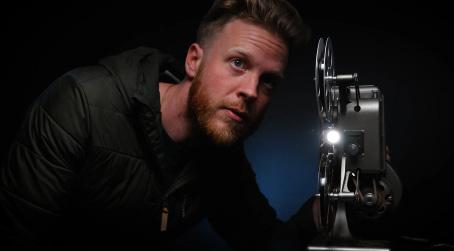
“It gives me more conviction that I should listen to my gut and pursue the ideas that I think are interesting and worthwhile,” he says. “It gives me confidence in my own tastes.”
That confidence can be traced back to Guilford.
As a student, Tom served as a video editor for The Guilfordian and began developing the skills that would define his career. He credits professors like the late Jeff Jeske and retired Economics professor Robert G. Williams with helping shape his thinking about storytelling, ethics and the role journalism can play in society.
More importantly, Guilford helped him discover the kinds of stories he wanted to tell.
One of his first documentaries, “Swine Country,” examined industrial hog farming in eastern North Carolina and its impact on nearby communities.
“The neighbors of these farms basically get sprayed with fecal mist routinely,” he says. “They’ve been speaking out about it for a long time, but their concerns have not really been addressed.”
The subject matter was different, but the instinct was familiar.
Tom has always been drawn to stories about people confronting larger systems — individuals trying to be heard by institutions that may not be listening.
“The power of observing people righteously standing up to
“People looking out for each other,” he says. “When you see something that’s wrong, you do something about it.”
Listening to Tom talk about his work, a pattern emerges.
Whether he’s documenting environmental concerns in eastern North Carolina, activists projecting messages onto skyscrapers or men searching for belonging in a changing culture, he is ultimately interested in people trying to make themselves heard.
That theme continues in his newest project, a documentary exploring masculinity through a community of male dancers. The film examines friendship, vulnerability and the search for connection among men.
The subject is different. The questions are familiar.
Who belongs?
Who has a voice?
How do people find the courage to use it?
The Emmy sitting on Tom’s shelf offers one answer. It is recognition from peers that his work matters.
But the award itself feels less significant than the path that led there.
A curious student at Guilford College picked up a camera and started asking questions. A decade later, Tom is still asking them.
Only now, the rest of the country is paying attention.
GUILFORD HELPED TOM DISCOVER THE KINDS OF STORIES HE WANTED TO TELL: PEOPLE CONFRONTING LARGER SYSTEMS WHO ONLY WANT TO BE HEARD.
PHOTO COURTESY OF TOM CLEMENT’14
AWESOME ALUMNI
BEING THERE
A Guilford education taught Annie Jonas the power of presence. These days, she’s showing up for the young people across Western North Carolina.
Annie Jonas’ 90 story starts, as these things often do, with a feeling that won’t quite go away — though, in Annie’s case, the feeling arrived while she was already where most people assume the searching ends: a longstanding professor at Warren Wilson College, settled into the kind of role that signals you’ve made it.
Not a grand declaration. Not a lightning bolt. Just a quiet tug that lingers in the background of a life that, by most measures, is already going well.
For Annie, the feeling showed up anyway, a desire to reconnect to youth work and community work that’s been important to her for most of her career. “I’ve always had this connection with youth, but I wanted something deeper,” she says. “Something where I was a little more engaged with them.”
So, after 20 years at Warren Wilson, she left.
Left the security, the title, the version of success that reads cleanly on a CV and quietly impresses at dinner parties.
Because somewhere underneath all of it was something older, steadier, and far more insistent: a belief that young people matter. Not in the abstract, not in the language of mission statements, but in the lived, ordinary stretch of time between the last school bell and dinner.
These days Annie is the program manager for the WNC After 3PM Collaborative, part of the North Carolina Center for Afterschool Programs. It’s the kind of work that doesn’t always draw attention, but matters deeply.
The Hours That Decide Everything
By the time the last school bell rings across western North Carolina, the day is far from over for many kids. The buses pull away, the classrooms go quiet, and what comes next can look very different depending on what’s waiting on the other side of the afternoon. For some, it’s a warm room, a steady snack, a familiar adult who knows their name and notices when something feels off.
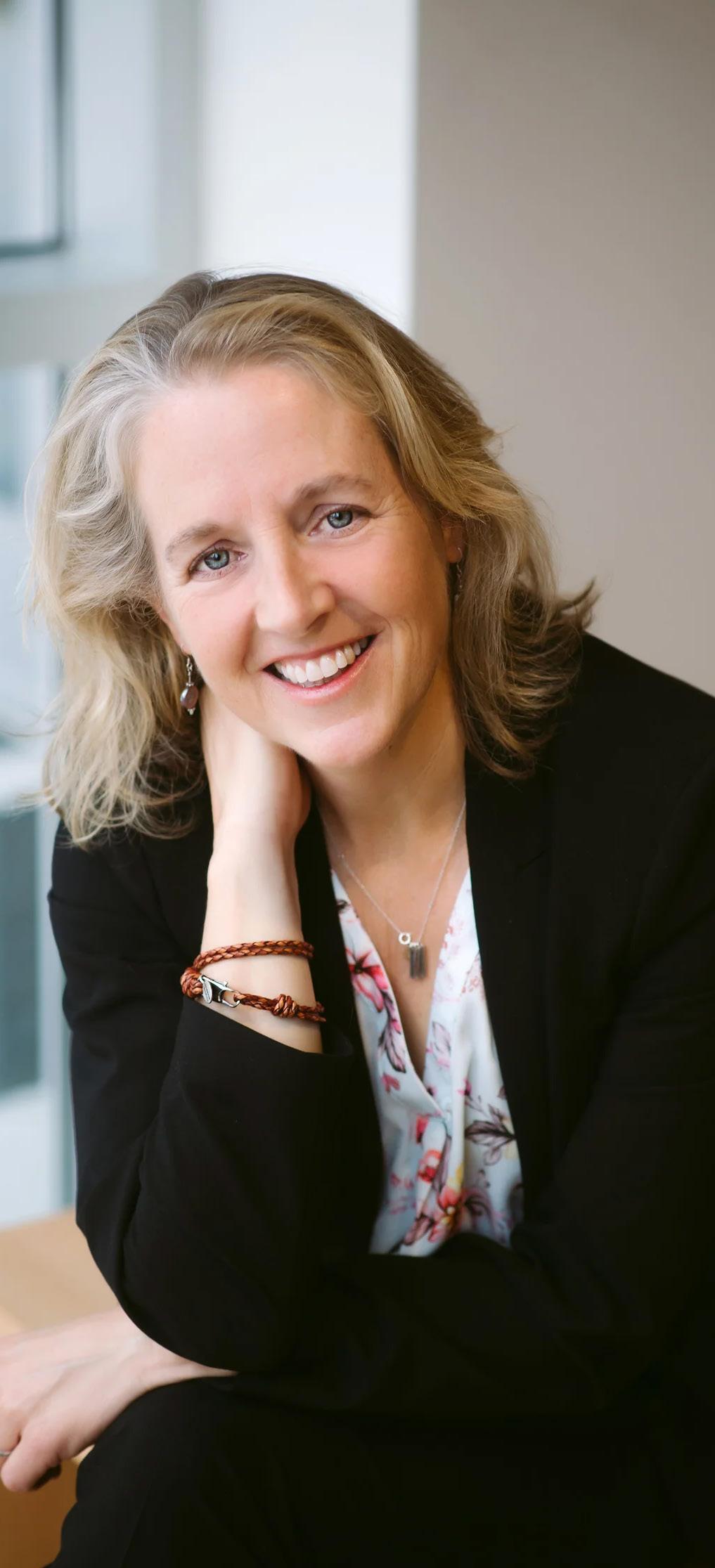
ANNIE JONAS IS THE PROGRAM MANAGER FOR WNC 3PM COLLABORATIVE, WHICH OFFERS STUDENTS AFTER-SCHOOL SERVICES IN WESTERN NORTH CAROLINA.
For others, it’s a long stretch of hours to fill, hunger that hums in the background, homework that might as well be written in another language. Afterschool programs, in these places, are not enrichment in the abstract. They are a kind of soft landing – part classroom, part kitchen, part refuge – where learning continues, yes, but so does something more fundamental: the quiet, daily assurance that someone is paying attention.
Annie overlooks programs many might take for granted. A math problem explained one more time. A second helping of something warm. A place where the lights stay on long enough for a child to finish what they started.
In a region where distance can be isolating and resources uneven, Annie says consistency becomes its own form of stability. “Studies after studies show that kids perform better when they feel safe,” she says. “They show up differently when they aren’t worried about their next meal or whether anyone will notice if they don’t understand.”
And so the stakes, while rarely framed this way, are enormous. Because in the small, steady rhythm of those afterschool hours – snack, study, conversation, care – entire futures are being quietly, persistently shaped.
Holding It All Together
these safe spaces of resilience for families and youth that we had not even imagined,” she says.
Food. Batteries. Basic supplies like water and toilet paper. But also something harder to measure — a place to land.
“Sometimes it’s as simple as kids just need somewhere to go,” Annie says.
That sounds small until you imagine the alternative.
Why Young People
Ask Annie why she keeps circling back to young people, and she pauses — not because she doesn’t know, but because the answer feels almost too plain to dress up.
“I think … they are the ones inheriting the earth and our society,” she says.
“And that sounds pretty simplistic.”
But then:
“They’re learning from us all the time about how the world works and the kind of world that they want to live in,” Annie says.
“I’ve always enjoyed kids, but it wasn’t like, oh, that’s going to be a career.”
— ANNIE JONAS ’90
The collaborative stretches across 18 counties – rural, spread out, the kind of geography where distance isn’t just measured in miles but in access. Annie’s new position is about a year old, but she already sees her role as equal parts convener, coach and translator, bringing together after-school providers who might otherwise feel like they’re working alone.
This is where she works now.
“Just bringing folks together in these widely dispersed geographic areas has been really powerful,” Annie says.
And then the hurricane came.
In 2024, Hurricane Helene didn’t just knock out power lines or flood roads. It scrambled routines. It stretched already thin systems. It left families looking for anything stable.
And in that gap, after-school programs – the ones that rarely make it into glossy reports – became something else. Second homes.
“After the hurricane, after school providers ended up being
This is where her work lives — in that quiet exchange. The modeling. The watching. The slow accumulation of what it means to be a person in the world.
“I’ve really tried to center their voice and center their perspectives and help them gain skills and a sense that they matter,” she says.
Not just helping young people.
Believing them into themselves.
Guilford’s impact
Before the programs and the advocacy and the long drives between counties, there was Guilford College, where brothers Eric ’85 and Jim ’88 also graduated.
And before that, a version of Annie who liked kids but hadn’t yet built a life around them.
“I’ve always enjoyed kids, but it wasn’t like, oh, that’s going to be a career,” she says.
Guilford changed that – not loudly, but steadily.
“I found Guilford to be much more … relational and community-minded than my own experiences in school,” she says.
“I felt like I was in a community that seemed to want to know
AWESOME ALUMNI
who I was and asked me to contribute my gifts and skills.”
She uses the word agency.
“A strong sense of agency,” she says.
It showed up in working at WQFS and spending a semester abroad in Munich.
And then it sharpened.
Annie had several internship opportunities through the Psychology Department that included working at the juvenile detention center and working on a ropes course for first years that once ran through the College’s woods.
“I started to see in myself that I wanted to do that, to be involved in their lives. Guilford brought that out of me or,
Richie and Annie remain good friends. He says he was initially surprised when he learned Annie had given up so much security at Warren Wilson to pursue working with young students. At least at first.
“The more I thought about it. Annie has never shied away from doing anything,” he says. “She’s always been open to doing interesting things and different things. This is more of that plus it’s such important work.”
The Long Way Around
After Guilford, the path wasn’t straight, but it was consistent. Outward Bound. Wilderness trips. Students learning more than how to read a map.
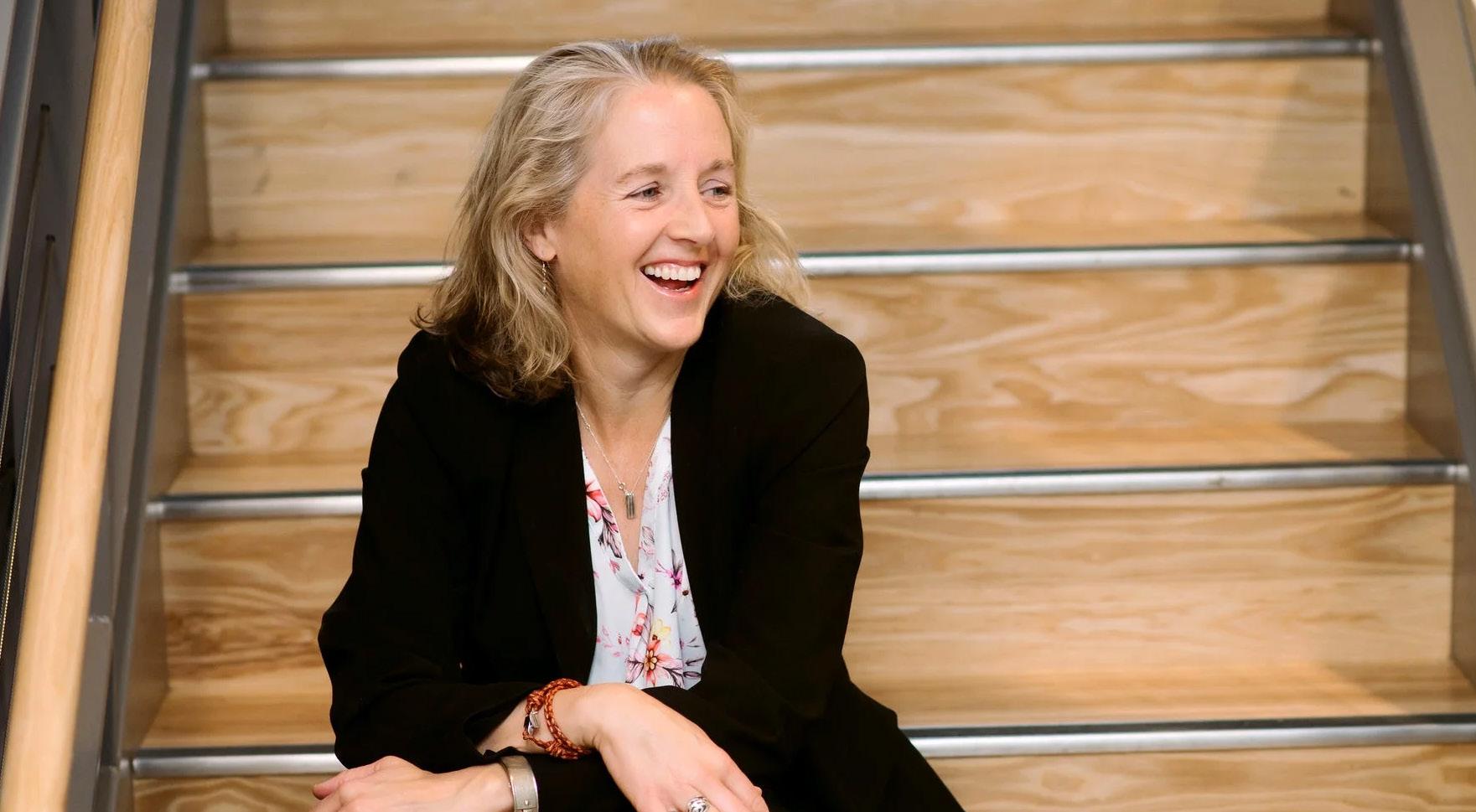
maybe, helped me find that in me.”
So many Guilfordians share similar stories of finding their passion during their time at the College. Often that passion is nurtured here eventually — with professors who don’t quite leave.
For Annie, two names come quickly: Psychology professors Richie Zweigenhaft and the late Claire Morse.
“I think I knew when I was at Guilford how important they were,” she says. “What I didn’t see – gosh, how could I? – was how they would continue to be lifelong … inspiring mentors.”
“It was a great launching point … to learn about best practices for working with young people,” Annie says.
The South Bronx. North Carolina wilderness programs. A master’s degree at Harvard. Teaching. Nonprofits. Leadership. A deanship back at Warren Wilson.
On paper, it reads like a climb. In hindsight it now appears to have always been a loop.
“I wanted to return to some of the work that made me the most passionate at the beginning of my career,” she says.
ANNIE JONAS BELIEVES IT’S IMPORTANT FOR STUDENTS TO BE SUPPORTED BEYOND THEIR FAMILIES.
So she did.
Spend enough time listening to Annie, and you realize her work isn’t really about programs. It’s about presence.
After-school spaces, she says, aren’t just extensions of the school day. They’re something looser, more human.
Homework help. Snacks. Structure.
But also woodworking. River sampling. Robotics. Music.
“They’re engaged in really meaningful experiential activities,” she says.
“It’s really exciting to see kids flourish in these programs where they … have not had opportunities like that.”
Years later, she’s doing the same thing — just in different rooms, across more miles.
“I think [Claire and Richie’s] mentorship showed me it’s important you challenge people, but at the same time, you’re offering that support and guidance,” she says.
“I started to see in myself that I wanted to do that, to be involved in their lives.
Guilford brought that out of me or, maybe, helped me find that in me.”
— ANNIE JONAS ’90
At Guilford, Annie learned what it felt like to be noticed. To be challenged and supported in the same breath.
And now, somewhere in western North Carolina, a student is finishing homework. Another is picking up a tool for the first time. Someone else is learning how to speak in a room full of adults.
And nearby, there’s an adult paying attention. Not announcing it. Not branding it.
Just showing up. The kind of attention that lasts. Maybe even a lifetime.
“At the end of the day, it’s just about making sure young people know they matter,” says Annie, “and then showing up in ways that prove it.”

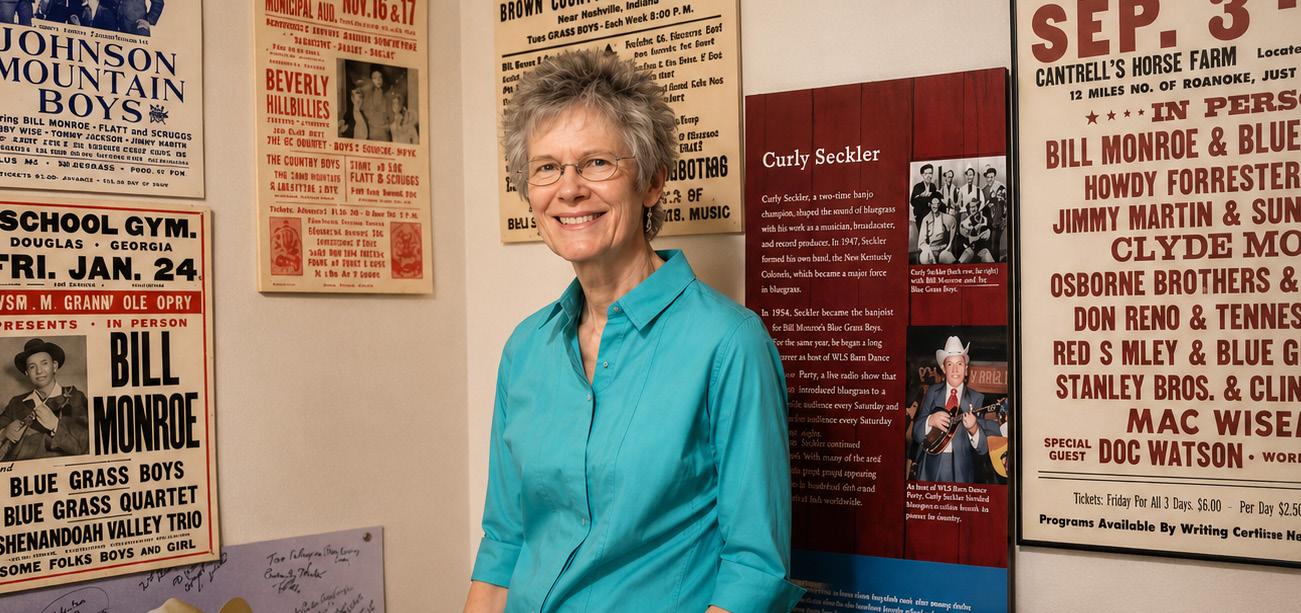
FINDING HER VOICE
Penny Parsons was a Guilford student searching for her place in the world. Guilford and Bluegrass helped her find it.
The funny thing about life-changing moments is that they rarely announce themselves. No spotlights or trumpets or thunder claps from above insisting you pay attention because this one matters. Usually, they’re just another Saturday night.
For Penny Parsons ’75, it was Sept. 16, 1972.
Even now, all these years later, Penny remembers the date. She was a first year at Guilford when she saw the flyer on campus that Lester Flatt and the Nashville Grass were playing Dana Auditorium. She’d seen Lester perform on television and liked the music.
That was it. Nothing remarkable. Except it changed everything.
“That was the night my life changed,” Penny says. “That’s when I became infatuated with Bluegrass, obsessed with it.”
Last year, more than five decades later, the International Bluegrass Music Association (IBMA) recognized that obsession with a Distinguished Achievement Award, one of the organization’s highest honors. The award isn’t reserved only for performers. It honors people whose work has strengthened Bluegrass music itself – the writers, historians, producers, promoters and advocates who keep the culture alive.
Which is why it fits Penny perfectly.
Because while she never became the person standing in the spotlight, she has spent most of her life helping shine it on everyone else.
The story starts at Guilford.
Actually, it starts before Guilford.
Penny’s father, David Parsons, was the College’s business manager for more than 30 years. Her mother, Cora Worth Penny ’39, was a Guilford graduate. Penny grew up on campus, long before she enrolled as a student.
She remembers the woods.
Always the woods.
“Those woods were my home,” she says. “My dog and I would wander all through all the paths in the woods.”
She fished in the lake and swam in the lake with her father.
Rode her bicycle around campus.
“That was where I grew up.”
Like many Guilford students, she arrived without a perfectly plotted future. She majored in Psychology and Religion. At home she listened to Led Zeppelin and Neil Young. She loved
PHOTO: PENNY PARSONS ‘75
Johnny Cash. Bluegrass wasn’t some inherited calling. It was simply one of many sounds competing for her attention. Then Lester Flatt walked onto a stage in Dana Auditorium.
The music hit her differently. Maybe it was the intensity. Maybe it was the emotion. Maybe it was something she couldn’t quite explain.”I still can’t put into words how I fell for the music and the energy it produced,” she says. “I was hooked.”
She followed Lester to other performances around North Carolina. She attended festivals. She subscribed to Bluegrass Unlimited magazine and read every issue. She worked parttime at Greensboro’s Music Barn. The music stopped being entertainment and started becoming a community.
Then came one of those moments that seems accidental until you look back years later.
Barry Poss, a pioneer in the world of Bluegrass, old-time, roots and Americana music, of Sugar Hill Records in Durham, N.C., needed an employee and he asked Penny if she was interested.
“He did not have to ask twice,” she says. That one opportunity led to another. Then another.
She worked in publicity and marketing. She became involved with MerleFest, the renowned music festival in Wilkesboro, N.C., serving as the festival’s publicist for nine years. She worked in record distribution. She launched her own company. She wrote articles. She built relationships throughout the industry.
Looking back, she sounds a little surprised by all of it.
“I certainly didn’t expect it to take me as far as it did,” she says. “I didn’t expect so many of the opportunities that came to me.”
Maybe that’s because Penny never seems to have approached Bluegrass as a career ladder.
She approached it more like a fan who kept finding ways to stay close to the music.
One of the best examples arrived in 2003.
Someone suggested she visit Curly Seckler, one of Bluegrass music’s pioneers and a longtime mandolinist for Flatt and Scruggs.
Penny figured she might write a magazine article. Instead, she found herself sitting with an 82-year-old legend who had preserved decades of photographs, correspondence and memories.
“I realized that there could be a book there and I really wanted to be the one to tell his story,” she says.
The project eventually became a biography published by the University of Illinois Press.
Guilford prepared her for exactly this sort of life. Not a specific profession. A way of moving through the world.
“I learned to write when I was at Guilford,” she says. “Not just write but write well, and that has served me ever since.”
Writing became one of her most important tools, allowing her to tell stories, preserve history and connect generations of musicians who might otherwise never know one another.
In many ways, her hall of fame recognition acknowledges that work as much as anything else.
The award celebrates a lifetime spent documenting a musical tradition and helping sustain it.
These days Penny describes herself as “mostly retired” though the evidence suggests otherwise. She still serves on IBMA committees. She still attends festivals. She still travels to places like Jerusalem Ridge in Kentucky, Bill Monroe’s old homeplace, because the music continues to matter.
And recently, something else happened.
The Flat Creek Ramblers, a Bluegrass group Penny helped form with fellow Guilford students in the 1970s, got back together.
For decades the band mostly existed in memories and old photographs.
Then the musicians reunited.
“It was really cool,” Penny says.
That understated assessment feels appropriate.
Because the reunion wasn’t really about performing.
It was about returning to where the story began.
A campus. A group of friends. A shared love of music.
And a reminder that the most important journeys often start in places that feel ordinary at the time.
Fifty-three years later, Penny is being honored by the people who know Bluegrass best.
But the roots of that achievement still trace back to Guilford College and a September night when a freshman took her seat, listened carefully and discovered the thing she would spend the rest of her life pursuing.
“I wouldn’t change anything,” she says. “Somedays I feel like the luckiest person on earth – maybe I am.”
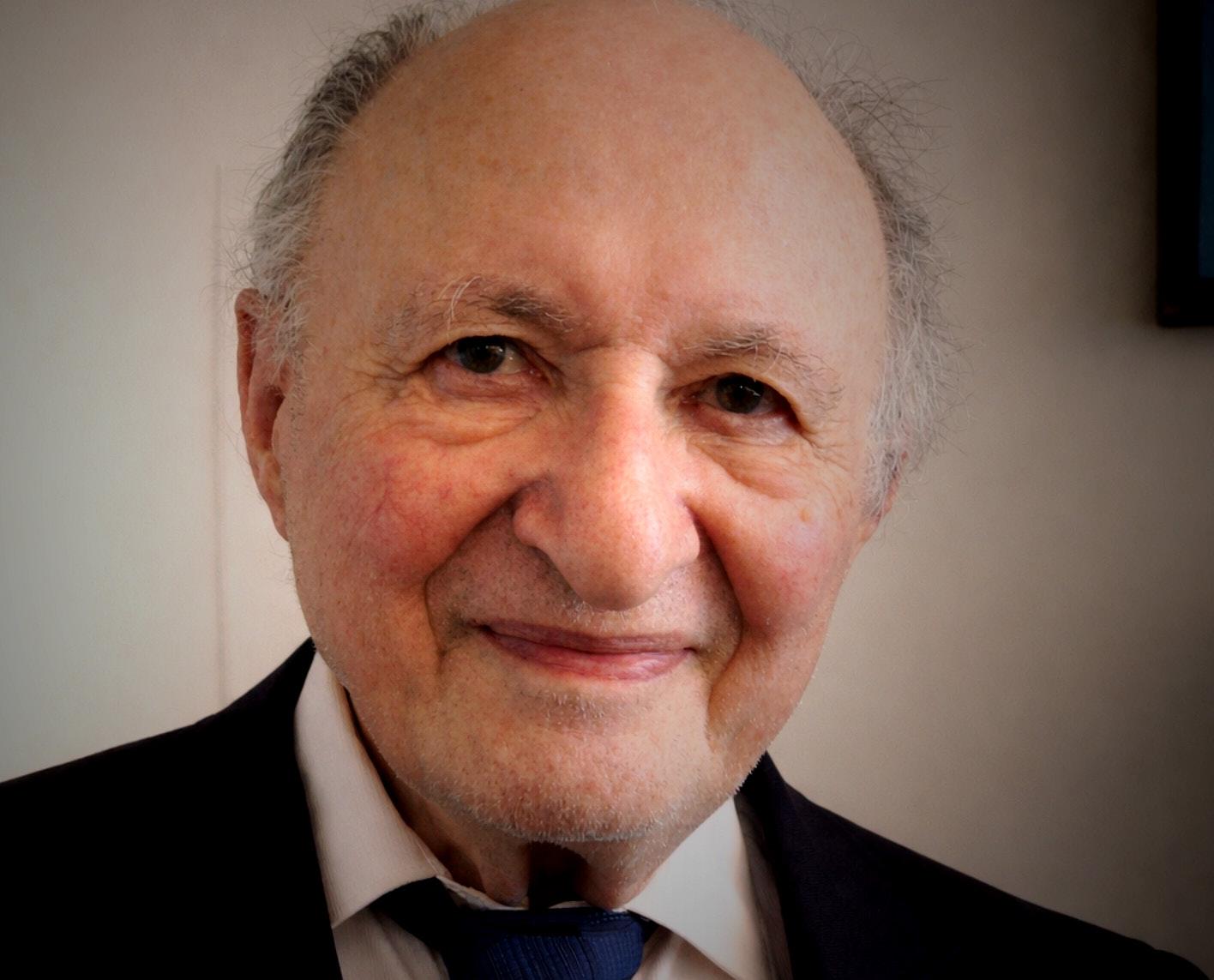
A LIFE SHAPED BY WELCOME
Guilford became a s anctuary for Fred Katz, launching a journey from loss to learning, and lasting purpose.
Even now, all these years later, Fred Katz ’52 can summon the scene as if it were this morning: the long bus ride from his family’s farmhouse to the crowded train station in Frankfurt… his mother pulling him close on the platform, kissing his cheek. All around them, other mothers clutching other children.
It was 1939. Germany had just invaded Poland. War was beginning.
From the rail car, he watched her wave through a window filmed with soot. Watched her become smaller as the train gathered speed. Smaller still, until she was only a dark speck, and then nothing at all.
AFTER FLEEING NAZI GERMANY AS A CHILD, FRED KATZ FOUND HIS WAY TO GUILFORD. “IT WAS A GODSEND,” HE SAYS.
Fred was 11, one of thousands boarding the Kindertransport, the Quaker-organized rescue that ferried mostly Jewish children to England and beyond. He never saw his family again. Years later, he would learn they were killed at Sobibor.
Even now, he says, the memory is sharp. “I had a sense of what was going on and who I was leaving,” he says. “But I also had a sense of what I was getting — a chance to survive.”
From Survival to Scholarship
Fred survived. More than that, he built a life. That train ride began a path from farmhand and factory worker to Ph.D. student, sociology professor, author of several books. At the center of it all was a Guilford College degree.
And yet it isn’t the diploma he remembers most. Even at 98, he thinks of Guilford as more than a college. It was a sanctuary, “a safe nest,” he calls it, lined by professors, administrators, classmates.
Those years, he says, saved him. “Maybe not at the time, but years later I understood what Guilford was to me,” he says. “It was a godsend.”
Guilford that gave me a sense that my life could have purpose — that I could do meaningful, creative work. It opened up a new life for me.”
Facing the Past
Every Holocaust story is a dormant volcano. Disturb it and the past erupts. For years, Fred kept his past contained. Survivors’ guilt, he says, is “guilt without perceived wrongdoing.”
“It’s not because we did something wrong,” he says. “It’s because we lived and loved ones didn’t.”
After Guilford came a master’s and Ph.D. in Sociology from the University of North Carolina at Chapel Hill, and teaching posts at Texas Tech, the University of Missouri, SUNY Buffalo, and Tel Aviv University. At first he avoided the Holocaust entirely. “I told colleagues it wasn’t interesting,” he says. “But I was in denial. Of course it was. Eventually, I woke up.”
“They saw something in me. Quakers talk about a light we all have within ourselves. I like to think maybe Guilford saw my light.”
— Fred Katz ’52
There are many words Fred uses to describe Guilford. Safe, nurturing and home, sure. But enjoyable is not one. “You’re talking to a refugee who lost his parents and his family,” he says. “Being able to enjoy life is not part of my vocabulary. That was destroyed for me in childhood by Germany.”
But the College was patient. Religious Studies professor Fred Crownfield knew his story. Classmates welcomed him. He arrived as a 22-year-old freshman, urged by a Quaker colleague in New York.
No high school diploma. No money. The admissions director didn’t flinch.
“We can help with that too,” the director told him.
“No papers, no credentials, no high school diploma, and no money — but none of that mattered at Guilford,” Fred says. “They saw something in me. Quakers talk about a Light we all have within ourselves. I like to think maybe Guilford saw my Light.”
Class by class, conversation by conversation, the College gave him something few others could: hope. “I had friends who tried to give me a sense of belonging,” he says. “But it was
When he did, he wanted to understand how ordinary people commit the unthinkable.
He wrote Ordinary People and Extraordinary Evil and Confronting Evil: Two Journeys, exploring how average, “decent” people can be drawn into atrocity. One chapter examines Rudolf Hoess, the Auschwitz commandant who had once been expected to become a priest — a man initially shaken by what he saw, yet who came to oversee a death factory.
A New Lens: Social Space
Fred’s latest book, We Live in Social Space: A Window to a New Science, takes a wider view.
He defines social space as the invisible rules, expectations, and power currents that shape behavior. Not a physical place, but a mental and relational environment that steers how people act, often without realizing it.
“In this space,” he says, “people aren’t acting freely. Culture, institutions, language — they all guide us. We don’t even see it.”
But once understood, he argues, it can be challenged. Maybe even changed.
Even a small liberal arts college, he says, is its own kind of social space. “For four wonderful years, I was part of one at Guilford,” Fred says. “It shaped me for the better.”
AWESOME ALUMNI
REACHING NEW HEIGHTS
Before leaving for the Yale School of Music, Emmett Edwards climbed Mount Kilimanjaro, the inspiration for a composition that is headed for publication.
The guitar solo begins in the dark.
Not metaphorically. Literally.
At midnight on Mount Kilimanjaro, Emmett Edwards ’22 was climbing by headlamp, breathing air that felt rationed, trying to keep his legs moving while altitude sickness pressed against his ribs. Somewhere between base camp and the summit, in that long, unbroken stretch of night hiking, the shape of a guitar composition began to settle into him.
Today, that seven-plus minute composition that has its roots in Tanzania is called “Kilimanjaro.”
Three years later, the piece stands as Emmett’s capstone work as a master’s student at the Yale School of Music. It premiered last year at the Saigon International Guitar Festival in Vietnam. Earlier this spring, it was published by Les Productions d’Oz, a publishing house and label dedicated to classical and contemporary music.
But we’re getting ahead of ourselves. At the start, “Killimanjaro” was nothing more than a few chords bouncing around in Emmett’s head. “I had been starting to write this piece before the trip,” he says. “Something programmatic — something that follows a story.”
The mountain gave him the story.
In the summer of 2023, before leaving for Yale, Emmett and his father, Will, traveled to Tanzania to climb Kilimanjaro. They had never left the country together. They’d hiked and camped plenty in the U.S., but this felt different. A line of demarcation before graduate school, before the next life chapter.
Emmett, a Music major at Guilford who grew up playing a guitar, packed a travel guitar for the trip. “I’m the sort of person who couldn’t foresee a world where I don’t play for eight days,” he says.
He didn’t carry it to the summit — that would have bordered on delusion — but he brought it to base camp. At night, over six days in the cold, he wrote fragments. He recorded voice memos into his phone so he wouldn’t forget melodic ideas. He
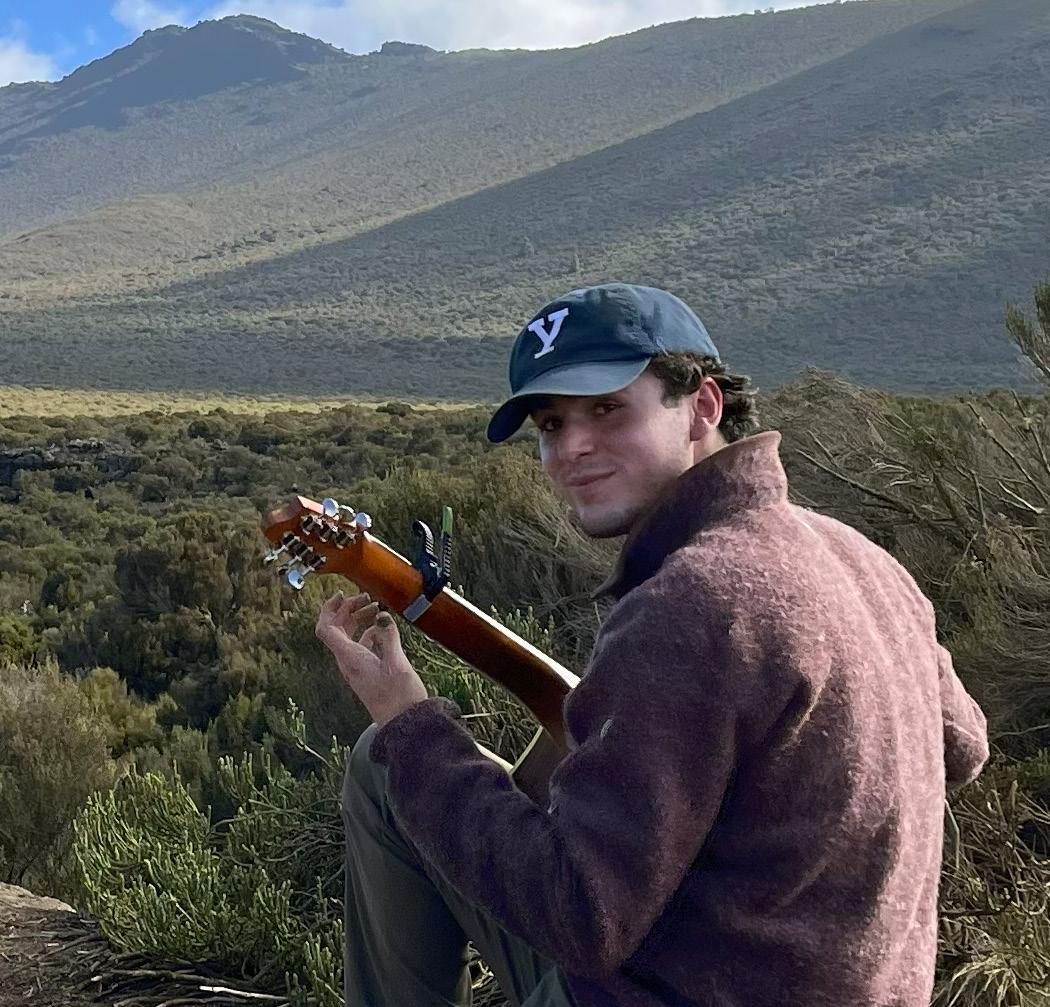
paid attention to what the mountain was doing.
Kilimanjaro unfolds in biomes. You begin in a jungle –monkeys in trees, humidity pressing in. You climb into heath and moorland, sparse and wind-brushed. Near the top, the earth becomes almost Arctic: rock, ice, thin air.
That progression from lush to spare to stark becomes an emotional arc of the piece.
“The landscapes were really inspiring,” he says. “And also just the spirituality of the mountain.”
That surprised him most.
In Tanzanian culture, Kilimanjaro is sacred ground. Respected. Revered. Hallowed.
“It felt like being at a church,” Emmett says.
That feeling – not the hiking, not the photo at the top, but the reverence – makes its way into the music.
“Kilimanjaro” does not charge forward like a victory march. It builds. It ascends gradually. The harmonies shift the way terrain shifts. Tension accumulates. Space opens. The summit section widens instead of explodes, a musical horizon rather than a fanfare.
ONE OF THE FIRST THINGS EMMETT EDWARDS PACKED FOR HIS ASCENT OF MOUNT KILIMANJARO WAS HIS GUITAR.
Emmett and Will reached the top after nearly 24 hours of climbing on summit night.
“You’re above the clouds on land,” Emmett says. “You’re only ever seeing that from a plane. It’s surreal.”
They stayed maybe 20 minutes. At 19,335 feet, the summit –Uhuru Peak – has less than half the oxygen than there is at sea level. They also needed every minute of daylight to begin their descent.
Just like in the piece, the summit does not last long either.
Emmett wrote “Kilimanjaro” as part of his master’s degree recital at Yale. The mountain sketches became manuscript paper and hours of disciplined refinement in practice rooms in New Haven, Conn.
If Guilford gave him foundation, Yale gave him acceleration.
“At Guilford, what I expected to learn in a semester,” he says, “I needed to learn in two weeks.”
The adjustment was jarring. The first semester felt like being thrown into the deep end with no floaties — expectations rising exponentially, output required at a pace that left little room for doubt.
“I don’t think anything really could have prepared me for that,” he says.
But then he pauses.
“I had wonderful teachers at Guilford,” he adds. “They gave me tools. They gave me direction that felt personal.”
Guilford, he says, prepared him not by simulating Yale’s intensity, but by helping him develop a voice — one that didn’t evaporate under pressure. Study abroad in Spain. Recitals. Faculty mentorship. A campus culture where music is not a sideshow but a conversation.
“Kilimanjaro” is not just a travel piece. It’s the product of someone trained to think about context – about landscape, spirituality, story. Guilford’s liberal arts lens is embedded in the composition. The mountain is not a backdrop. Emmett says, it is narrative.
The piece traveled farther than its origin.
Emmett premiered “Kilimanjaro” at the Saigon International Guitar Festival in Vietnam as part of a Yale guitar studio tour through Thailand and Vietnam. The performance landed on his birthday. That global arc feels fitting for a work about elevation and perspective..
The setting mattered.
A piece born on an African mountain, written in New Haven,
first publicly performed in Southeast Asia – that global arc feels fitting for a work about elevation and perspective.
While refining “Kilimanjaro,” Emmett was teaching at Yale as a secondary lessons instructor. Students enroll for credit or as an elective. Some arrive wanting classical repertoire — Bach’s “Lute Suite No. 3.” Others want blues improvisation. One student wanted Emmett to teach him all things Metallica.
“It keeps me on my toes,” he says. “Completely different skill sets.”
He also taught privately in New Haven, working with students of varying ages and backgrounds. Teaching, for him, is not fallback; it is vocation. He speaks about it with the same energy he brings to performance.
And then there is Dogboy. The band began in New Haven with other Yale students and alumni. They perform mostly in New York and will soon record a debut album.
The sound? Neo-soul with rock influences — think D’Angelo and Lauryn Hill with a sharper edge, says Emmett.
If “Kilimanjaro” represents discipline and reflection, Dog Boy represents groove and collaboration. Emmett moves between the two worlds comfortably. Bach one day, blues the next. Classical recital hall one week, club stage the next.
It is less a contradiction than a range.
Emmett received his master’s from Yale this spring and now lives in New York City.
For now, the focus is simpler: Build. Teach. Play. Collaborate.
“In New York,” he says, “for music, somebody of the highest caliber of whatever instrument you want to collaborate with is there. That’s where I want to be.”
The opportunity is dense. The expectations are high. It sounds, in its own way, like another mountain.
Which brings us back to midnight.
On summit night in 2023, Edwards was exhausted. His father, he jokes, handled it far better. He battled altitude sickness. The climb was “very, very, very taxing.”
But he kept going.
That persistence — the willingness to stay with tension, to climb without spectacle — is what makes “Kilimanjaro” resonate. It is not flashy. It is not self-congratulatory. It unfolds with patience, moves through terrain, and understands that the summit is brief.
They stayed at the top for maybe 20 minutes.
He laughs. “I hope,” he says, “this piece lasts a little longer.”
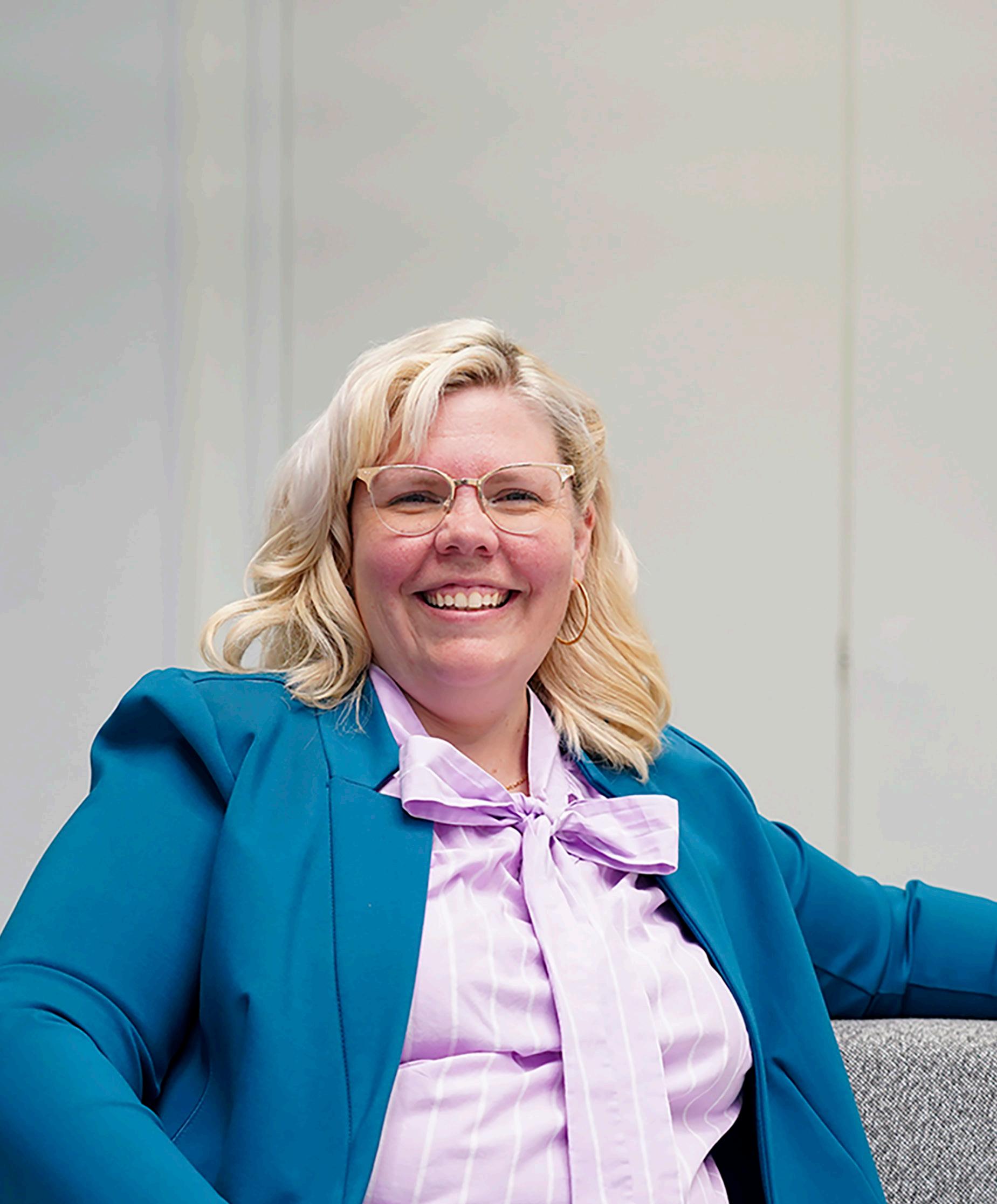
THE SKILL that STICKS
Elizabeth Meinhart didn’t plan for a career in global manufacturing. Guilford’s liberal arts education prepared her for one anyway.
PHOTOS COURTESY OF ELIZABETH MINEHART ’05

Guilford College has a way of making big claims sound small. The College talks about preparing students for a changing world, about the elasticity of a liberal arts education, about how you can major in one thing and end up somewhere else entirely.
It’s all true, of course. But if you’re looking for a cleaner, more convincing example, you could skip the messaging altogether and just bring Elizabeth Minehart ’05 back to campus.
No, really. Give her a chair, an hour and let her talk. She’d probably start with a shrug.
Elizabeth, now the marketing manager for Ziehl-Abegg – a German company that produces industrial fans and motors — oversees strategy across North and South America. It’s a job that requires fluency not just in marketing, but in people: cultures, expectations, ways of thinking that don’t always line up neatly. It’s also not the job she imagined when she was a student at Guilford.
It was the kind of realization that doesn’t announce itself loudly, but once it arrives, everything that followed starts to make a little more sense.
What Guilford gave her — what she would later lean on in rooms far from Greensboro — wasn’t a straight line. It was something closer to a reflex. The ability to adjust. To take in new information without panicking. To sit in the discomfort of not knowing and work forward anyway.
That mattered, though not always in obvious ways.
Elizabeth didn’t arrive at that understanding all at once. In fact, one of the most important realizations came quietly, almost sideways, when she was diagnosed at Guilford with dyslexia.
Looking back, she didn’t see it coming. “I was an honors student in high school, good grades, right? There was that thought that those two things don’t go together. But in
hindsight, sure, that answered a lot of questions for me about me.”
The result wasn’t a setback. It was a kind of alignment.
“Life makes a lot more sense,” she says.
The diagnosis didn’t change who Elizabeth was. It explained it. The way her mind moved. The way she connected ideas. The way she could hold something abstract in one hand and something structured in the other and not feel a need to choose between them.
That tendency – to move between worlds – would define what came next.
It started with a yes Elizabeth’s start in marketing wasn’t strategic. It wasn’t even particularly intentional.
It was, like so many things at Guilford, relational.
She got a job at the YMCA on the recommendation of hall director Thayle Jackson ’97 — the kind of person who notices students and takes notes. It didn’t take long to begin her climb. She was quickly put in charge of marketing and fundraising for one of Greensboro’s YMCA sites.
That was it. No long deliberation. No five-year plan. Just yes.
“The Y really gave me a shot,” she says. “And that was all because of knowing her from Guilford and maybe her knowing a little about me.”
What followed was a decade of learning in public. She worked her way up, eventually becoming director of annual campaigns and communication for the YMCA of Greensboro.
The work was less about theory and more about feel — understanding what resonates, what matters, how to reach people without talking past them.
“When I left Guilford, I knew I wanted to do something that made an impact,” she says. “But I kind of didn’t know what that looked like.”
So she figured it out. Slowly. Imperfectly. The way most people do, though not everyone admits it.
The path widens
Eventually Elizabeth moved into healthcare, into the B2B side of a system that would become one of the largest in the country. It was a different environment — bigger, more complex, less forgiving of improvisation. But it taught her something she didn’t expect.
“I got really comfortable in manufacturing environments,” she says.
It’s a detail that doesn’t seem important until it is.
Because when she decides to leave healthcare – “it was just too big for me,” she says – she carries that comfort with her.
“I mean, you don’t go to a place like Guilford and then go to a place that has 150,000 employees,” she says. “That just wasn’t the right fit for me.”
What she wanted was something smaller. Closer. Something that felt, in some way, familiar.
She found it at Ziehl-Abegg.
“I didn’t have any connection with the company,” she says. “But luckily, they were willing to take a shot with me.”
Two and a half years later, she’s still there, overseeing all the marketing strategy for North and South America.
If the job sounds expansive, that’s because it is. It demands Elizabeth think beyond borders, beyond assumptions, skills, she says, she picked up at Guilford.
“I’ve never marketed in Colombia,” she says. “And so having the skill set that allows me to say, yeah, let me go on and think about this … think about it rationally.”
That’s where her Guilford education shows up. Not in the specifics, but in the approach.
“The critical thinking skills that come with a liberal arts education are critical to what I do every day,” she says. “Without those … I wouldn’t be this far.”
Work without borders
how business gets done.
“There are very different cultural references and ways to work through,” she says. “I don’t know how to market on WhatsApp — that’s actually something we’re working on this year, but I’m adapting and learning.”
There’s a moment in that line that feels telling. Not the uncertainty, but the acceptance of it.
She doesn’t pretend to know everything. She builds around what she doesn’t know.
“We have fabulous sales guys in each one of those areas,” she says. “I’ve built solid relationships with them … they help me with that.”
“That allows me to be open to new opportunities,” she says. “To thinking through things with them, instead of telling others how to do it.”
— Elizabeth Minehart ’05
The challenges Elizabeth faces on a daily basis at Ziehl-Abegg aren’t abstract. They’re practical.
She works with teams in Mexico, Colombia, Brazil. She navigates differences in language, but also in expectation. In
It’s not a top-down approach. It’s collaborative. It requires listening.
That’s not always easy, especially across cultures. Ziehl-Abegg is a family-owned company based in Germany, and she says there is more than time zones to manage.
“As Americans, we have a tendency to kind of jump in and figure it out as we go,” she says. “And Germans are much more thoughtful and process (oriented).”
The difference can create friction.
“So sometimes that very opposite way of working can cause some hiccups that you have to work through.”
At Guilford, she studied abroad in London. She learned early that her way wasn’t the only way.
“That allows me to be open to new opportunities,” she says. “To thinking through things with them, instead of telling others how to do it.”
Then she adds, more pointedly: “That American exceptionalism can easily come through. And so the liberal
arts education has really helped me minimize that.”
Impact still matters
There’s another layer to her work, one that runs parallel to the professional.
She spent years in the nonprofit world. That doesn’t disappear just because the job title changes.
She served on the board of Dance Project in Greensboro, a nonprofit focused on making dance accessible to everyone.
She’s spent eight years with the group, including two as president, bringing much-needed structure to the organization’s finances.
But what she talks about most isn’t the structure. It’s the people.
“One of our regular sayings is everybody dances,” she says. “Meaning that no matter who you are, you can be dancing.”
She mentions programs for the hearing impaired, ways to expand who gets to participate.
“Regardless of who they are, they can find joy in movement and dance.”
It sounds simple.
It isn’t.
No neat ending
This spring, Elizabeth was recognized by a local publication as one of 25 women making an impact in business in the Piedmont Triad.
If you ask her now whether she could have predicted any of this, she doesn’t hesitate.
“No, not at all,” she says.
Her father visited her plant recently, walked through the facility, took in the scale of it. She asked him if he could have imagined his art-major daughter working in marketing for a global manufacturing company.
“He said, ‘No’ — and he said it very fast,” Elizabeth says, laughing. “That’s OK, because I didn’t see this coming either.”
There’s no punchline after that. No neat resolution.
Just the understanding that the path doesn’t have to make sense at the beginning to make sense later.
Guilford can explain that to its students, current and future.
Or it can just bring Elizabeth Minehart back to campus, let her tell a few stories, and let students connect the dots.
WHEN SCRIPTURE MEETS SYNTAX
A double major in Computer Science and Religious Studies, Nick Opie found common ground between faith and technology.
In the beginning, Nick Opie ’26 did not set out to build a digital hymnal for the age of artificial intelligence. He set out not to fail his Operating Systems class.
That’s the honest start to this story, which already tells you something about him. The project that became an AI-powered Christian music generator – complete with lyrics, music, and cover art rooted in Bible verses – started as a practical act of academic self-preservation. Guilford College’s Operating Systems 321 course carries a final project that looms like weather on the horizon. It counts for most of the grade. It does not forgive procrastinators. Nick knew that, so in August, long before panic season, he began building.
“I wanted something unique,” he says, leaning back into the memory. “This was kind of a make-or-break assignment.”
Uniqueness matters to Nick. At the start of his senior year at Guilford, he listened as classmates pitched robotics projects and camera-based security systems. Smart, impressive, not his lane. Robotics wasn’t his language. Filters and doorbells weren’t his curiosity. He needed a project that fit his hands, his head and, maybe most important of all, his heart.
Nick graduated this spring as a double major in Computer Science and Religious Studies, the kind of academic pairing that makes people pause politely and then ask follow-up questions they don’t quite know how to phrase. Faith and code? Scripture and syntax? He hears the surprise often enough to smile through it.
But that tension – real or imagined – is exactly where his project lives.
What Nick built is essentially a hymn generator. The program selects from a bank of roughly 100 Bible verses he coded into the system. From there, it generates lyrics inspired by those verses, produces original music on his laptop, and creates cover art that visually matches the tone of the music.
This isn’t ChatGPT spitting out a few pious stanzas. Nick is quick to draw that line. Text generators can write lyrics, sure, but music is another animal entirely. His system actually composes songs.
That distinction matters, especially to Nick.
Part of the project’s backbone is an open-source AI music generator called ACE-Step, which allows users to create music locally rather than on a server owned by a company. That local detail is not just technical trivia — it’s philosophical. Serverside AI often means you don’t own what’s created. Local generation gives you the rights.
“You actually own the music,” Nick explains. “It might not be as high quality as server-side stuff, but you can do whatever you want with it.”
Ownership, agency, responsibility – these are themes that run quietly through everything he says.
Nick didn’t walk into the semester knowing this was the project. The idea crystallized a few weeks in, after conversations with Chafic Bou-Saba, Professor for Computing Technology and Information Systems, who floated the general concept of an AI music generator. Nick’s instinct was not to
PHOTO: ROBERT BELL ’11
chase novelty for novelty’s sake, but to personalize it. Christian music wasn’t a gimmick. It is his home turf.
“I listen to Christian music more than anything else,” he says simply.
Music has always been there. He played drums in Guilford’s jazz ensemble for three years, absorbing rhythm and collaboration, learning how sound moves people when it’s performed right. Faith has always been there too. Nick is active in Cru, the campus Christian organization formerly known as Campus Crusade for Christ, part of a national network of college ministries. His Religious Studies coursework sharpened that faith rather than sanding it down.
If you want to understand why Nick doesn’t see science and belief as opposing forces, talk to him about his classes. He lights up describing Guilford’s Religious Studies faculty and the way they teach students to think. Not what to think, but how to interrogate ideas, including their own. He mentions a three-week Title IX course taught by Jill Peterfeso, Eli Franklin Craven and Minnie Phipps Craven Professor of Religious Studies, and the way it reshaped his understanding of women’s experiences and institutional power.
“I learned so much,” he says. “By the end, I felt like I could actually have a real conversation about it.”
That, to Nick, is the point. Faith without thought is thin. Thought without humility is brittle. He doesn’t feel torn between his majors; he feels expanded by them.
His AI hymnal project sits squarely in that overlap. It’s technical and devotional. Rigid and interpretive. Built on logic, aimed at mystery.
That doesn’t mean he’s naïve about the implications.
Ask Nick whether AI threatens artists, and he doesn’t duck the question. He plays music himself. He understands the anxiety. If a system can mimic a singer’s voice or style, he believes artists have every right to feel unsettled.
“It depends on whether it’s copying someone’s likeness,” he says. “If it sounds exactly like a real person, that’s a problem.”
His own project avoids that by design. The voices are not replicas. The music isn’t trying to impersonate Chris Tomlin or Phil Wickham or Brandon Lake. Still, he’s realistic about where this technology could go, and how easily lines could blur.
What he doesn’t believe is that AI automatically cheapens art.
Could someone someday use a tool like his to generate music for personal reflection? Absolutely. Could that music help
someone explore faith privately, tentatively, without the pressure of a worship space or a polished sermon? He thinks so. The tools are already there. They’re open-source. They’re accessible.
Music, he insists, is in the ear of the listener. Whether the final piece feels shallow or profound, he argues, depends on the person listening and the prompts guiding the machine. Depth is subjective. Faith is personal. AI, at least right now, mirrors what we bring to it, he says.
He’s candid about the limits, too. Locally generated AI music isn’t yet capable of the kind of deeply probing, soul-wrestling theology that critics of Christian pop music often crave. That kind of complexity may come with time, computing power, and better models. Or it may always require human hands and voices.
Nick isn’t trying to replace anyone.
In fact, he doesn’t want to monetize the project at all.
By the end, the thing nearly broke him. He laughs about it now, but there’s still exhaustion under the humor. He used another AI tool — Claude — to help generate code, and it repeatedly deleted critical sections. Fix one thing, another breaks. Music but no image. Image but no music. Late nights. Head-meetsbrick-wall frustration.
“When I submitted it, I was like, ‘That was awesome,’” he says. “‘I never want to look at this again.’”
And that’s okay. Not every meaningful project needs to become a startup.
Nick has an internship lined up in Raleigh in IT. It’s a path that might raise eyebrows, but makes sense to him. He worked on Guilford’s IT help desk, seeing how something as simple as patience can cut through frustration. Some people expect to be rushed, talked down to, dismissed. When that doesn’t happen, it lingers.
In that sense, the AI hymnal feels less like a one-off class project and more like a quiet throughline in his life: take what you know, apply it thoughtfully, and leave things a little better than you found them. Whether that’s code that finally compiles or a person who feels heard, the outcome matters less than the care.
Nick shrugs when he talks about it, as if it’s obvious. Maybe it is. “People are so used to bad service,” he says. “If you can just be kind and do your job well, that actually stands out. That’s how I think about representing my faith — just doing the work right, wherever I am.”
AWESOME ALUMNI FROM PITCH to APP
Isaac Garbia’s app helps soccer fans from around the world navigate their way through the World Cup.
The story of Isaac Garbia’s ’26 app starts, as a lot of good stories do, with something he loves. Soccer.
Not likes. Loves.
The Guilford College student has been playing the game since he was two years old. Back then, the shin guards were almost as tall as he was. He was nervous. Sometimes he would sit on the sideline and cry rather than take the field.
That phase didn’t last long.
Soon he was playing every day. Then coaching. Then refereeing. Today, when he’s not in class, there’s a good chance you’ll find him officiating youth matches at Bryan Park or another local soccer complex.
“When I say it’s part of my life, it’s the center of my life,” Isaac says. “Everything rotates around it.”
That passion recently led him somewhere he never expected to go: the Apple App Store.
As part of his senior seminar capstone project, Isaac developed Plan Play Go, a travel-planning app designed to help visitors navigate major sporting events, beginning with the 2026 FIFA World Cup.
What’s remarkable isn’t just the app itself.
It’s that a few months before he started building it, Isaac barely knew how to code.
“I started from zero,” he says with a laugh.
The idea for the project came naturally enough. Isaac knew he wanted his capstone to focus on something he genuinely enjoyed.
“If I’m doing something I care about, I’ll put everything into it,” he says. “If I don’t care about it, it feels like a task.”
Soccer certainly wasn’t a task.
The inspiration came from his own experiences living overseas and traveling. Visitors arriving in a new city often struggle with basic questions: Where should I stay? What’s the easiest way to get to an event? What attractions are nearby? How do I get around without a car?
While reading an article about fans planning trips to the World Cup, Isaac learned that many visitors were booking hotels in downtown Dallas without realizing the matches would actually be played nearly 40 minutes away in Arlington.
That got him thinking.
“What if everything was in one place?” he says.
Instead of opening multiple websites and conducting endless searches, users could simply open an app and find transportation options, hotels, attractions, maps and recommendations tailored to their destination.
The idea sounded simple.
Building it wasn’t.
Isaac admits there were moments when the project felt intimidating. Many of his classmates had years of programming experience. He had almost none.
His father offered advice that would become something of a guiding principle.
“Everybody starts not knowing anything,” Isaac recalls him saying. “The only way you’re going to learn is by putting yourself out there and doing it.”
So he did.
Over four to five months, the project grew. What began as a simple website evolved into something much larger.
Maybe, he began to think, this could become something real.
That confidence was reinforced by one of his biggest supporters on campus: Computing Technology and Information Systems professor Chafic Bou-Saba.
Isaac transferred to Guilford from Saint Leo University in Florida midway through his sophomore year. He arrived looking for more playing time on the soccer field and quickly found something else: faculty members invested in his success.
Chafic became especially influential.
“He kept telling me my bar was too low,” Isaac says. “You don’t hear that very often from professors.”
When Isaac doubted himself, Chafic pushed him.
When he questioned whether the project was worth presenting at the Guilford Undergraduate Symposium, Chafic encouraged him to share it.
“He believed in me before I believed in myself,” Isaac says. Then came another challenge: getting the app approved by Apple.
The first submission was rejected. Then another.
Then another.
Eventually, after months of work, Isaac received an email while attending a business dinner with his father.
His app had been approved.
Today, Isaac has bigger ambitions.
He hopes to expand the concept beyond the World Cup and into broader travel planning. He envisions partnerships with hotels, tourism organizations and attractions. One day, he’d like users to book tickets and reservations directly through the platform.
For now, he’s focused on taking the next step. His advice to others is simple.
“Start small,” he says. “Nobody is born with superhero powers. Everyone’s starting out the same. You learn something and build on that. And you keep on building.”
FROM GUILFORD to the WORLD CUP
The FIFA World Cup being held in the U.S. this summer is a spectacle measured in goals, flags and television ratings. But every event of that size runs on something less glamorous: people in matching shirts who arrive early, stay late and make sure the experience feels effortless.
This summer, Guilford College student Katia Shammas ’27 is one of those people.
The Sport Management major is spending the tournament in New Jersey, working with Career Group Events, a company supporting FIFA World Cup operations. Her assignment is hospitality, which sounds simple until you consider the scale. She welcomes fans, scans tickets, distributes wristbands and gift cards, answers questions and helps steer thousands of visitors toward food, entertainment and, eventually, the stadium gates.
In other words, she is helping manage the controlled chaos that accompanies one of the largest sporting events on the planet.
For Katia, a native of Palestine who came to Guilford after her sisters Kristy ’19 and Kareen ’21 graduated from the College, the experience is equal parts education and audition. The lessons have little to do with textbooks.
They involve patience, communication and maintaining a smile when long lines form and expectations from demanding spectators run high.
The opportunity grew out of classes taught by Assistant Professor of Sport Management Michael White, who shared information about the internship with students in Sports Communication and Sports Marketing.
“Studying at Guilford opened this path for me,” Katia says. “I want to make the most of it.”
FANTASTIC FACULTY
MORE THAN A GAME
Michael White turns students’ passion for sports into meaningful careers.
Michael White’s office does not whisper. It talks. Loudly. It tells stories in full color, in framed photographs and media credentials, in the visual shorthand of a life spent orbiting sports. There’s a scarf for the Sydney Swans, an Australian rules football team, hanging from a wall, a photograph from Manchester City F.C.’s locker room resting on his desk. A Masters flag signed by Fred Couples next to his phone. Guilford students standing on the turf at the Sydney Cricket Ground. At St. Andrews. In every photo, they are wide-eyed, jet-lagged, permanently changed.
This is not décor as ego. It is a vision board, syllabus and curriculum blended as one.
Michael, an Assistant Professor for Sport Studies and director of Guilford’s International Sport Management master’s program, understands something essential about sports — and about teaching — that has nothing to do with box scores or championships. Games are a conduit: For connection. For memory. For moments that linger long after the final whistle. His job, as he sees it, is to help students learn how to build lives and careers around that truth.
That philosophy did not emerge in a classroom. It began decades earlier in the eastern Tennessee community of Elizabethton. Michael grew up in a house where sports were not background noise but a shared language. His father, Gary White, was a postal employee and a devoted sports fan who didn’t simply watch games — he inhabited them. He learned fight songs. He took his children to stadiums. He turned his fandom into family glue.
Michael laughs remembering how his mother used to say the only way he would fall asleep as a baby was if Gary rocked him and sang the Washington NFL team’s fight song — “Hail to the Redskins” — as a lullaby. That kind of childhood does not fade. It shapes you.
Michael played everything. He read everything. Like countless kids, he dreamed of going pro. Baseball became his sport, the one that earned him a scholarship to Milligan College (now University). When the playing days ended — as they do for almost everyone — the sport did not disappear. It simply changed shape.
What followed was a career that zigged and zagged through nearly every corner of the sports ecosystem: journalism, athletic administration, communications, Division I athletics. He is courtside at Duke basketball games and sits in a booth high above Bank of America Stadium for Carolina Panthers games handling stats for both. Each position adds another layer of not only skills, but perspective. Seeing how decisions are made behind the curtain did not diminish his love of sports, it refined it.
“I always saw the business as a means to an end,” Michael says. “The end was people — families, friends, communities — coming together.”
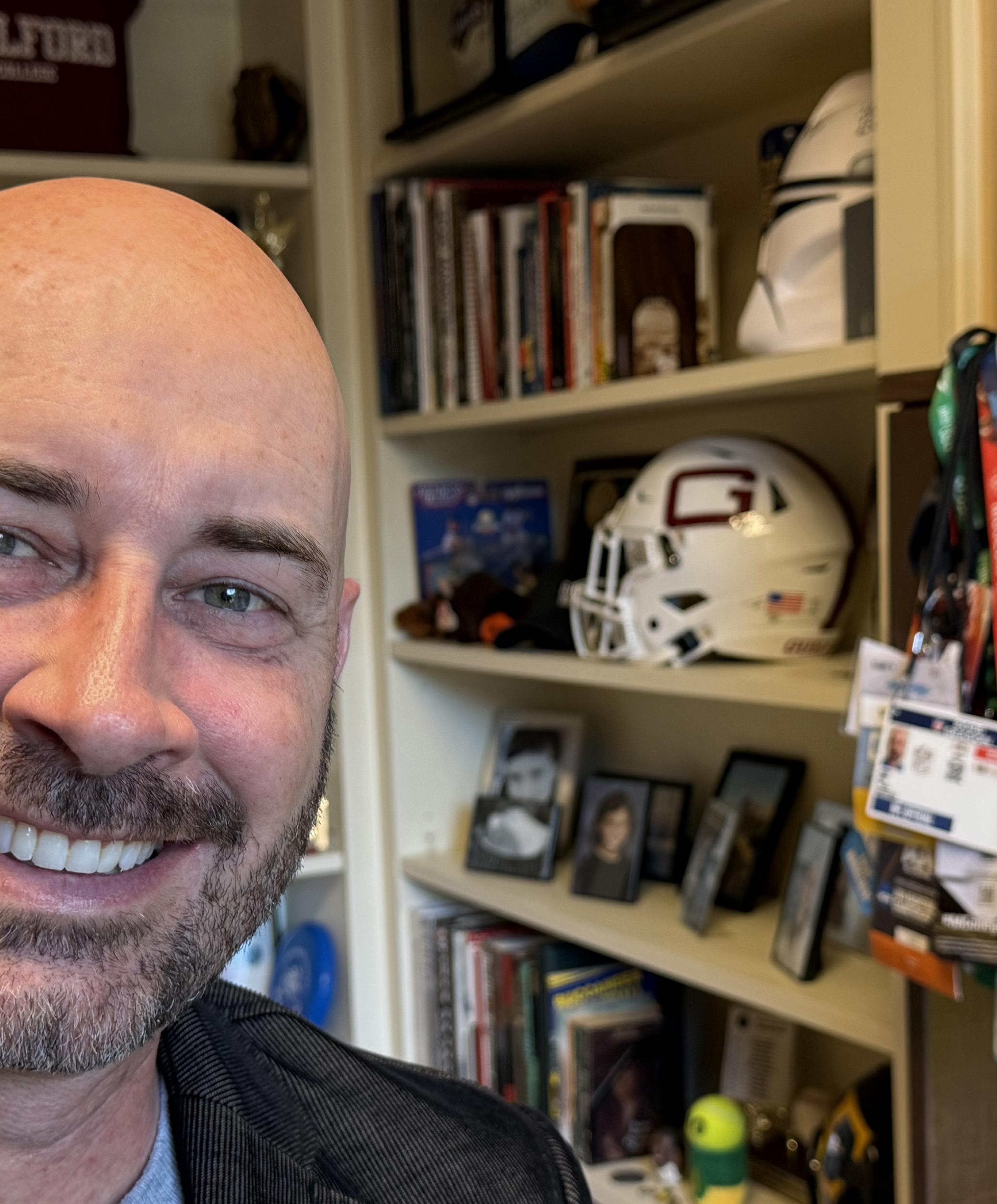
MICHAEL WHITE, ASSISTANT PROFESSOR FOR SPORT STUDIES, TELLS HIS STUDENTS THEY CAN’T CHANGE THE OUTCOME OF A CONTEST, BUT THEY CAN IMPACT THE FAN EXPERIENCE.
PHOTO: ROBERT BELL ’11
FANTASTIC FACULTY
That belief sits at the center of his teaching. On the first day of class, Michael tells students that Sport Management is not a “fun major.” It is a serious one. The U.S. sports industry generates roughly $1.06 trillion in revenue annually, more than the gross domestic product of many countries. The stakes are real. The competition is fierce. And unlike most businesses, the product itself is beyond your control.
“You never control whether your team wins or loses,” Michael says. “What you control is the experience.”
Experience over outcome is a refrain in his classroom. Sports are ephemeral by nature. Fans do not leave with something they can hold in their hands. They leave with stories, emotions and memories. That reality places enormous responsibility on the people who design, market and manage those moments.
Guilford’s Sport Management program prepares students for more than just game days and event operations. The same customer-first mindset applies whether graduates are shaping the fan experience at a stadium, developing
products for companies like Nike in the equipment and apparel industry, creating immersive environments for sport entertainment businesses like Topgolf, or building client strategies at major sports agencies such as Creative Artists Agency. “The setting may change, but the core work remains the same,” says Michael. “You need to understand the audience, anticipate their needs and deliver moments that make them want to come back.”
Michael’s classes blend the mechanics of marketing, administration, law and communication with something harder to quantify: ethics, empathy and self-awareness.
Guilford’s Quaker roots shape that approach. Classes begin with centering silence. Disagreement is encouraged, but always with respect. Debate is welcomed. Ego is not.
“I tell them, push me,” Michael says. “We can disagree. But we
IN A 2025 STUDY ABROAD TRIP TO EUROPE, GUILFORD STUDENTS VISITED THE OLD COURSE AT ST ANDREWS, STOPPING LONG ENOUGH FOR A PHOTO ON THE GOLF COURSE’S FAMOUS SWILCAN BRIDGE.
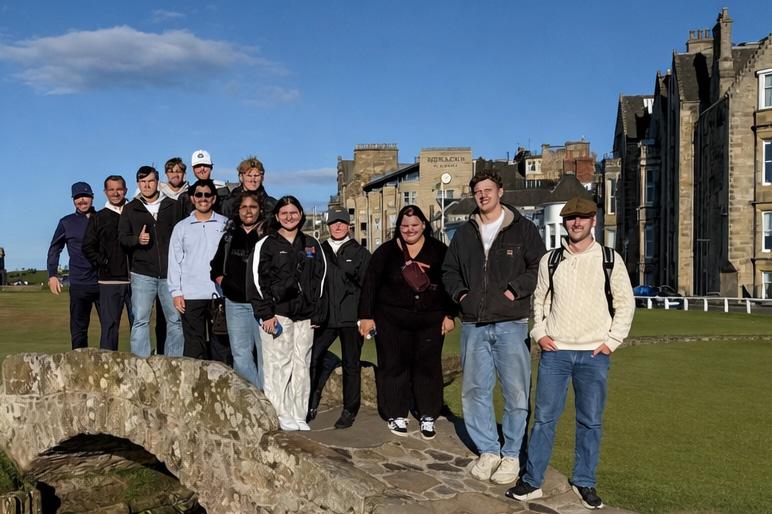
PHOTO: MICHAEL WHITE
do it as humans first.”
Vivian Cavataio ’28, a double major in Sport Management and English & Media Studies and a member of the volleyball team, says those discussions are what make Michael’s classes distinctive. He frames lectures around questions rather than conclusions, inviting students to engage with the material rather than absorb it passively. The classroom becomes a conversation, anchored in real experiences rather than abstract theory. Seeing the path Michael has taken, she says, makes a future in sports feel attainable.
Michael is equally candid about the less glamorous realities of the industry. He talks openly about layoffs, burnout, long hours and instability. He wants students prepared not just to succeed, but to recover — to know who to call and how to recalibrate when careers veer off course.
That honesty extends to how he uses his professional network. Michael’s connections stretch across the sports world: ACC offices, Duke Athletics, USA Baseball, the NBA, Formula One, local parks and recreation departments and, of course, Guilford alumni in the industry. He treats that network not as personal capital, but as a shared resource.
“I don’t want it for myself,” he says. “I want it for them.”
principles transfer. The stakes simply feel louder. He assigns books like The Power of Moments and Building a StoryBrand not just to teach marketing frameworks, but to reorient perspective.
“Put the customer at the center,” he tells them. “You’re not the hero. You’re the guide.”
It is a philosophy he practices daily. Students drift in and out of his office to talk about internships, résumés, graduate school and life. Some come seeking direction. Others just need reassurance. Michael listens more than he speaks. When he does speak, it is often to nudge rather than instruct.
This is the part of teaching that never appears on a syllabus: the late-night recommendation letters, the follow-up emails months after graduation, the quiet pride of watching former students working court side at Duke’s Cameron Indoor Stadium or carving out careers they once thought unreachable.
“You never control whether your team wins or loses, what you control is the experience.”
— MICHAEL WHITE, ASSISTANT PROFESSOR FOR SPORT STUDIES
The results are tangible. Guilford Sport Management students work for MLB, NBA and NFL teams, athletic conferences and international organizations. Some move directly into the industry. Others pursue graduate school, carrying with them résumés shaped by immersion rather than abstraction.
Michael believes sports offer one of the clearest windows into culture — how communities organize themselves, what they value, how they celebrate and grieve. That belief drives the program’s emphasis on international study. Travel is not an add-on, it is a cornerstone.
When students travel abroad, Michael insists on places that carry historical weight. St. Andrews is non-negotiable when the itinerary includes the United Kingdom. Students may not play the Old Course, but they stand on the Swilcan Bridge. They walk the grounds. They feel the gravity of tradition. Those moments accumulate. They shift how students understand both sports and themselves.
Michael often reminds students that the business of sports is not fundamentally different from any other business. The
Michael did not set out to become a professor. At various points, he imagined himself as a Major League Baseball player, a Sports Illustrated columnist, an athletic director. Life intervened. His wife took a job at Duke University, bringing them to North Carolina. He completed his doctorate. A teaching opportunity appeared.
“I didn’t see this coming,” he says. “But I learned to pay attention to where the path was leading.”
That lesson now sits beneath everything he teaches. Careers evolve. Identities shift. Success is not about clinging to a single version of yourself, but about fully inhabiting the role you are given — and remaining open to what comes next.
These days, Michael is firmly rooted at Guilford. He talks about the College the way coaches talk about programs they are building — with urgency, pride and a restless eye toward the future. Alumni engagement. Expanded international partnerships. Conversations around name, image and likeness. Bigger questions about where sports and higher education intersect in a changing world.
His competitiveness remains. It always has. But it is no longer measured in wins or rankings.
It is measured in impact.
“If we do this right,” Michael says, “we create better human beings. And better human beings tend to do pretty well in life.”
A DIFFERENT CLASSROOM
At a Greensboro trivia night, Chad Phillips turns trivia into connection, creating the kind of belonging Guilford fosters every day.
On a Thursday night in Greensboro, the crowd at Twist Lounge is already leaning forward before the first question even lands.
A dozen teams, give or take. Same as most weeks. They come early, claim their tables, settle into small rituals that make familiarity feel like belonging. A few teams huddle over drinks. Others spread out pens and scratch paper like they are preparing for something more formal than what this is supposed to be.
At the front of the room, Chad Phillips glances up from his laptop and scans the crowd. He does this every week, taking inventory not just of numbers, but of faces, of energy, of who’s new and who’s back. The buzz in this LGBTQ-friendly bar is peaking and Chad knows it. He picks up a microphone.
“Okay,” he says, “who’s ready for some trivia!” The room erupts.
What follows is trivia, technically. But that word doesn’t quite hold it.
Chad, a longtime Theatre Studies Visiting Professor at Guilford with a focus on documentary filmmaking, didn’t set out to build one of Greensboro’s most popular trivia nights. He arrived there sideways, the way many Guilford stories begin, with curiosity, community and a willingness to try something new.
“I was a player,” Chad says, recalling his early days moving through the city’s trivia circuit with a team that knew its way around pop culture.
Back then, he played at a spot called Breakers, winning often enough to notice the rhythm and flow of the game. What he liked and didn’t like. When the host quit, Chad saw an opening. He offered to run a month of games for free. That was 2018.
He hasn’t stopped.
These days Chad is Greensboro’s version of Alex Trebek. He’s
been coming up with trivia questions for eight years, two bars and one pandemic. The work begins Wednesday mornings and stretches toward Thursday evening, a slow accumulation of ideas that eventually becomes a night. Chad spends three to five hours building each game, shaping categories, editing music, designing slides, testing the arc of difficulty so that everyone in the room has a way in.
But what distinguishes Chad’s trivia isn’t just the preparation. It’s the attention.
He studies the room.
“He judges the audience,” says Lynn Irwin ’87, who has been following Chad’s trivia nights since those early days at Breakers. “He understands, like, okay, this is a new group. I need to hone in on what they might be interested in.”
Lynn laughs a little when asked whether she’s a trivia fan or a Chad fan.
“Both,” Lynn says.
She and her group have followed Chad from venue to venue over the years, drawn not just by the game, but by the way he runs it. They knew him before trivia, through mutual friends.
But it’s the trivia that has kept them coming back—week after week, year after year.
“Chad does really great trivia. It’s fun,” Lynn says. “And he doesn’t let it get stale.”
At some point, the recognition caught up to what the room already understood. A local publication nominated Chad as one of Greensboro’s best trivia emcees, a small, tidy line that tries to name something much less tidy — the way people keep showing up, the way they follow him from one place to the next, the way a night built on questions has quietly become something they count on.
That’s by design.
Chad resists what he calls “normal trivia”—the predictable mix of sports stats and niche knowledge that can leave parts
of a room behind. Instead, he builds something more elastic, more responsive.
Each week, teams choose categories, and Chad interprets them. A prompt like “quarterbacks” might become something entirely different in his hands — once, a round about the backs of state quarters. A category like “the Constitution” becomes a music round built around songs with “right” in the title.
The point is not to trick people. It’s to include them.
“I make it to where you can’t prepare,” Chad says.
Which means the only way to succeed is together.
At one table, a player recognizes a melody but can’t place it. Across the table, someone else knows the artist. At another, a generational gap becomes an advantage — one person recalling a reference from the 1970s, another filling in the present.
“That’s what’s fun to watch,” Chad says.
Over time, those small exchanges have added up to something larger.
Lynn has watched it happen.
EVERY THURSDAY, THEATRE STUDIES PROFESSOR CHAD PHILLIPS TAKES TO THE STAGE AS ONE OF GREENSBORO’S MOST POPULAR TRIVIA EMCEES.
PHOTO: ROBERT BELL ’11
FANTASTIC FACULTY
“When it first started, it was only a few teams,” Lynn says. “And people, word of mouth, keep coming.”
Now, the room is full—one of the largest regular trivia crowds in Greensboro, she says—and notably diverse. Different ages. Different backgrounds. People who might not otherwise share space.
“It’s a very diverse group here,” Lynn says. “And he caters to that.”
She pauses, searching for the right way to describe it.
“Some places you go, it’s like, ‘Well, I don’t know anything. This is all one kind of trivia,’” Lynn says. “He keeps it a good variety.”
That variety shows up in the details.
A music round might pull from the 1960s through the present. A visual category might obscure familiar images just enough to require collaboration. A wordplay round might hide clues in plain sight.
There are recurring features — like a category called “Jellyfish,” where actors’ faces are covered and teams must identify movies without them — but even those evolve.
“He’ll introduce something new,” Lynn says. “We’re getting ready to have a new little minigame category.”
The night, in other words, is always in motion.
But the foundation is stable.
generations to strengthen their chances.
The result is more than competitive. It’s communal.
“That’s what I’m proud of,” Chad says. “The community of all of this.”
At Guilford College, that word carries particular meaning. Community is not an abstraction here; it’s a practice — something built intentionally, through shared experience and mutual care.
What Chad has created at Twist feels like an extension of that philosophy, translated into a different setting.
“That’s what I’m proud of. The community of all of this.”
— CHAD PHILLIPS , VISITING PROFESSOR OF THEATRE STUDIES
There are regulars now — teams that return week after week, forming a kind of informal network. Among them is the Carolina Aging Alliance, a group that provides social connection for older members of Greensboro’s LGBTQ community. They come in numbers large enough to form multiple teams, sometimes blending
Here, the classroom becomes a bar. The lesson becomes a question. The outcome is not a grade, but a moment — someone remembering something, someone else adding to it, the two arriving at an answer neither could have reached alone.
Chad sees the connection.
“I get just as much fulfillment from trivia as I do teaching,” he says.
There are other touches that reinforce the feeling.
At halftime, when the room loosens a little and people turn back toward their drinks, a dog appears on the screen — quietly, almost without announcement. A name. A face.
A small biography written in the plain language of waiting. It began, as many things here do, with a group of players — volunteers from the Friends of the Guilford County Animal Shelter — who showed up to compete and, over time, brought something of their work with them. Now the image travels beyond this room, surfacing in bars across Greensboro on trivia nights, the same dog, the same hope, carried from one gathering to the next.
There are Pride-themed events, tied to Greensboro’s LGBTQ calendar. There are inside jokes, running categories, familiar rhythms.
And there is the way the night ends.
After the final round, after the scores are tallied and the winners announced, there is a pause. People gather their things slowly. Conversations linger. Plans for next week begin to take shape almost immediately.
And then, almost without prompting, the room responds. Applause.
Lynn has heard it countless times now. She’s even come to expect it. Still, it lands.
“It’s fun,” Lynn says again, but this time it sounds like something fuller, something closer to why she keeps coming back, why she followed Chad from one bar to another, why she and so many others have made this part of their weekly routine.
For the questions, sure. But just as important, for everything that builds in between them. which, through the years, has proven to be anything but trivial.

1. Guilford College is Greensboro’s only college to house a course for which hybrid sport?
Which campus organization’s slogan is “Your Only Alternative”?
In a 2025 Guilfordian story about changing the“Quaker Man”mascot, which two animals were most discussed to replace him?

A look at some of the Guilfordians who have died in the past year.
A LIFE THAT REFUSED BOXES REMEMBERING GUILFORDIANS
Amita Jyoti Hanagud Kaneria ’98 had a way of standing at the center of a room without announcing herself. You could miss her if you weren’t paying attention. You could never miss what she left behind.
“She was always kind of a collector of different viewpoints,” her husband, Rishi Kaneria, says. “She swam in lots of different lanes. She was dipping her fingers into lots of different things.” It’s a gentle phrase for a life spent insisting that no one gets erased just because they don’t fit neatly into a category. She died Dec. 21.
Jyoti was born into contradiction – South Indian and white, Atlanta and Montana, science-minded father and deeply progressive mother — and she never tried to resolve those tensions. She moved freely between them. “She grew up feeling like she was part of two different cultures, but maybe didn’t completely fit into either,” Rishi says. In high school, she floated between social groups, never landing fully in one. “You could say she was an outsider,” he says, then corrects himself. “Actually, she was a collector. I like that better.”
That instinct — to gather, to translate, to notice who wasn’t being served — became the through line of her life. Jyoti was a Sociology and Anthropology major with a minor in Spanish, becoming fluent through immersion after a study abroad in Mexico. She advocated for vulnerable immigrants at San Diego’s Casa Cornelia Law Center, translating for unaccompanied children, then earned a master’s in Applied Linguistics and taught English as a second language. After completing her doctorate in language and literacy education at Georgia State University she served as a postdoctoral research fellow at Georgia Tech, advancing inclusive, justicecentered education for Latinx and global communities.
Rishi recalls a story a friend told after her death, about a young woman detained by immigration authorities who didn’t speak English. “Jyoti was there to comfort her and translate for her,” he says. “All the education in the world means nothing if you don’t have empathy and a heart for others.”
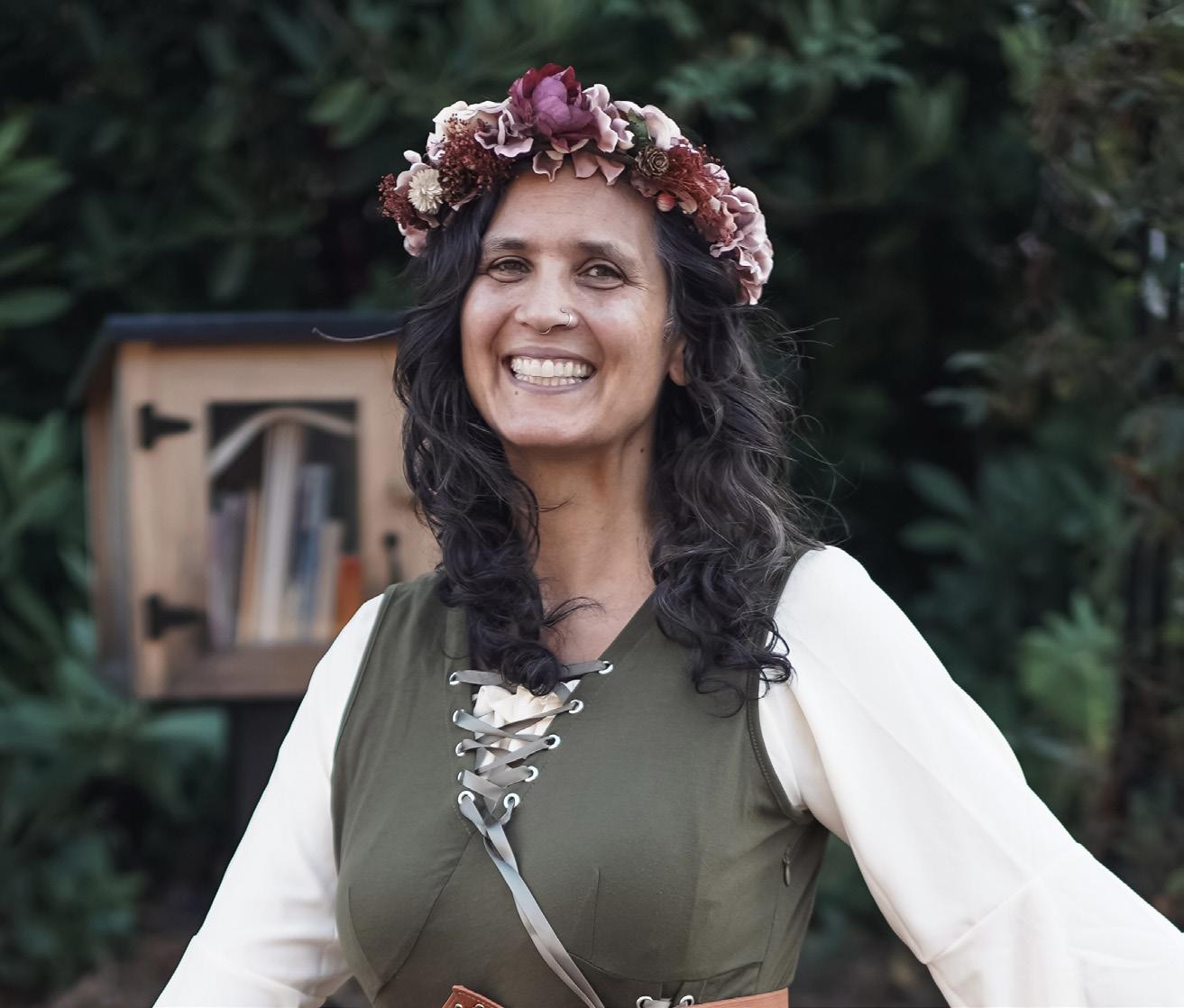
Jyoti found that intellectual and moral footing at Guilford, a place Rishi believes didn’t change her so much as clarify her. “Her going to Guilford kind of summarizes who she was,” he says. “She followed her soul and found her community — her people.”
Against expectations and easier paths, she chose a small liberal arts college rooted in conscience and social responsibility. “I really feel like when she went to Guilford, that’s when she became who she was truly meant to be,” Rishi says.
Those values stayed with her. Later, as a mother, she fought for dual-language immersion programs in public schools — not as an abstract policy position, but because she believed children deserved to live in more than one language, more than one worldview. The politics followed naturally. “She was very left,” Rishi says, without hesitation. “One of the most liberal people I could think of.” But it wasn’t ideology that drove her — it was proximity. “She was always speaking out for the underrepresented, the marginalized,” he says. “People of color. Immigrants. Anyone who wasn’t getting served.”
That worldview changed him, too. “She opened my eyes,” Rishi says. “I didn’t grow up thinking about social justice. She really reshaped the way I see the world.”
CYRIL HARVEY BUILT MINDS & COMMUNITY
Cyril Harvey Shaped Guilford Classrooms for Six Decades
Cyril Harvey, Jefferson-Pilot Professor of Geology emeritus and former Academic Dean, died June 28, 2025.
A cherished member of the Guilford community for nearly 60 years, Cyril began teaching at the College in 1966 and founded the Geology Department. He developed an innovative teaching approach known as the “Quaker Quadrangle,” emphasizing discoverybased learning, collaboration, critical thinking, and student-led research, principles that continue to shape the Guilford experience.
Educated at Quaker schools, Harvey and his wife, Judith Weller Harvey, founding director of Friends Center, shared a deep commitment to Friends values of equality, diversity and
Virginia Campbell ’44, whose father penned the words to Guilford’s alma mater, died Dec. 23 at 103. Raised in Greensboro after her father, Russell Pope, joined the College’s faculty, Virginia lived a century defined by faith, curiosity and service. Ginny served as a deacon in her church, helped manage rummage sales, played in the bell choir and withing a short time of her death participated in preparing weekly meals for the homeless.
community. Both were instrumental in the founding of New Garden Friends School in the 1970s.
Before retiring in 1999, Cyril taught at Guilford for 33 years, served twice
Louise Beasley Beamer ’59, an Education Studies major who spent more than 30 years teaching at Franklin Elementary School in her hometown of Mount Airy, N.C., died Jan. 2. Her passion for teaching extended beyond school. She was also a lifelong Sunday School teacher.
as Academic Dean, and was Director of Institutional Research for nearly two decades. He recruited outstanding faculty across disciplines and remained a devoted mentor long after retirement.
Charles S. Austin III ’54, a U.S. Marine who taught combat swimming to thousands of other Marines, died Jan. 1. Charles graduated from Guilford with a degree in History. He served as an Ocean City (Md.) lifeguard, rose to captain in the Braddock Heights (Md.) Volunteer Fire Company, and devoted decades to the Rotary Club of Frederick, Md., where the Club’s Rotary Fellow Award was renamed in his honor.
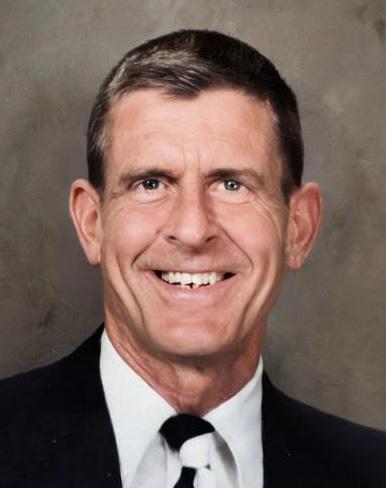
IN MEMORIAM
j Mary Murrow Hamilton ’52, an English major who found comfort in words and numbers, died Dec 8. A Greensboro native, Mary took her English degree and promptly went to work as a bookkeeper for the next 40 years, most recently with the Children’s Museum of Greensboro, where she worked until 2018 when she retired at age 90.
k Larry Chriscoe ’68, an Air Force veteran who became a corporate audit manager for IBM, died Dec. 6. Larry received a Business Administration degree and worked for IBM for more than 30 years. His job took him around the world before his retirement in 1992. He spent his retirement as a licensed chauffeur.
l Max Dewey Ballinger ’54, a Greensboro attorney and fierce advocate for the Guilford College community who devoted much of his legal career to pro bono work representing underdogs and working families, died Feb. 9 at 93 on his family’s Horsepen Creek farm in Greensboro.
m Molly W. Miller ’82, who enrolled at Guilford College shortly after moving to Greensboro and earned a Criminal Justice degree, died Nov. 29. Molly built a long career as a District
Counselor with the U.S. Bankruptcy Administrator, providing credit counseling and financial management education while also serving her community through teaching and mentoring.
n Samuel Russell Scott ’65, a longtime physician and medical professor at the University of Kentucky, died July 5, 2025. After graduating from Guilford, Sam received a medical degree from Wake Forest University. He was a member of the American College of Physicians and the Kentucky Medical Association. The Dr. Samuel R. Scott Endowed Fellowship was created at Guilford through the generosity of Sam.
o Charles Gaddy ’53, a beloved journalist and broadcaster who anchored WRAL-TV news in Raleigh, for 24 years, died June 12, 2025. Charlie, as loyal viewers came to call him, connected North Carolina to the world with integrity, warmth, and
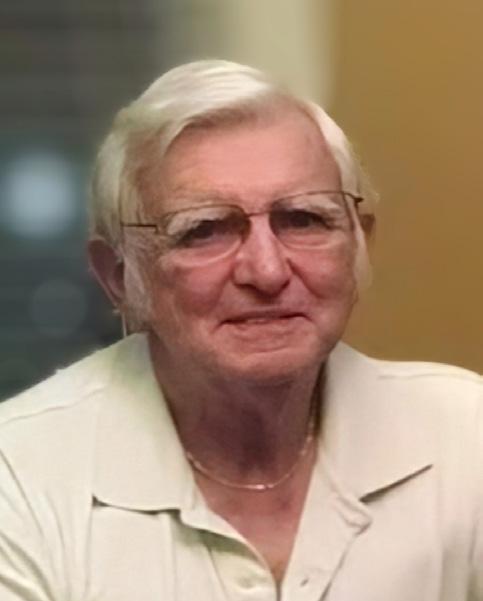
Southern charm — all through his distinguished and trusted storytelling skills.
p Gary York ’65, a lifelong public servant, died May 18, 2025. A former student body president, Gary played football at Guilford and was later inducted into the College’s Athletics Hall of Fame. He served as a Guilford trustee, earned multiple “Citizen of the Year” honors by communities he helped, and received North Carolina’s distinguished Order of the Long Leaf Pine for civic leadership.
q Howard McCoy Braxton Jr. ’63, who spent 36 years in education as a teacher and principal in Greensboro, died May 4, 2025. After retiring from Guilford County Schools, Howard picked up politics. He spent four years on the town board in Topsail Beach, N.C., followed by 16 years as mayor. He also led numerous civic and environmental organizations.
CHARLIE WHITE and the ART OF HELPING
There are colleges that do not simply educate people so much as absorb them into their grain. Colleges that seep into your bloodstream slowly – through late-night conversations in dorm rooms, through faculty meetings that stretch too long, through friendships that somehow survive marriages and careers and geography and time.
That is certainly true of Guilford.
And sometimes a person becomes so stitched into the fabric of the place that it becomes difficult to tell where the institution ends and the person begins.
This was certainly true of longtime Guilford employee Charlie White ’66, who died May 16.
Charlie arrived at Guilford in 1962, a Quaker kid who lived in Rock Hill, S.C., and attended Westtown School in Pennsylvania. After that, he never lived more than five miles from the College over the next 64 years.
Not physically, anyway.
His obituary notes the formal landmarks: graduate of the Class of 1966, conscientious objector service worker, a staff member for more than 43 years who helped oversee purchasing and technology and, at one point, the College’s first mainframe computer. But the official titles and suits can only explain so much. Friends like Rudy Gordh ’66 talk less about what Charlie did and more about how he moved through the world doing it. Quietly. Competently. Generously.
“Not that many people in the world are that generous,” says Rudy, who met Charlie when they both arrived at Guilford as freshmen in 1962. “If he could help you out, he did. If he couldn’t help you out, he’d still find a way to.”
Charlie and Rudy became Physics lab partners in a class on electricity and magnetism. Rudy went on to become a Math professor and spent 42 years teaching at Guilford. Charlie stayed close, too, building a life that seemed inseparable from the College itself.
When Rudy returned to Greensboro from a trip to Yugoslavia in 1974 with no house and no real plan, Charlie immediately told him to stay with him and his wife, the late Sara Schoonover White ’69, until they figured things out. So they did. It was, Rudy says, classic Charlie behavior.
Over the decades, Charlie became the sort of person every campus quietly depends on: the one who knows how systems work, who to call, how to fix the problem nobody else notices
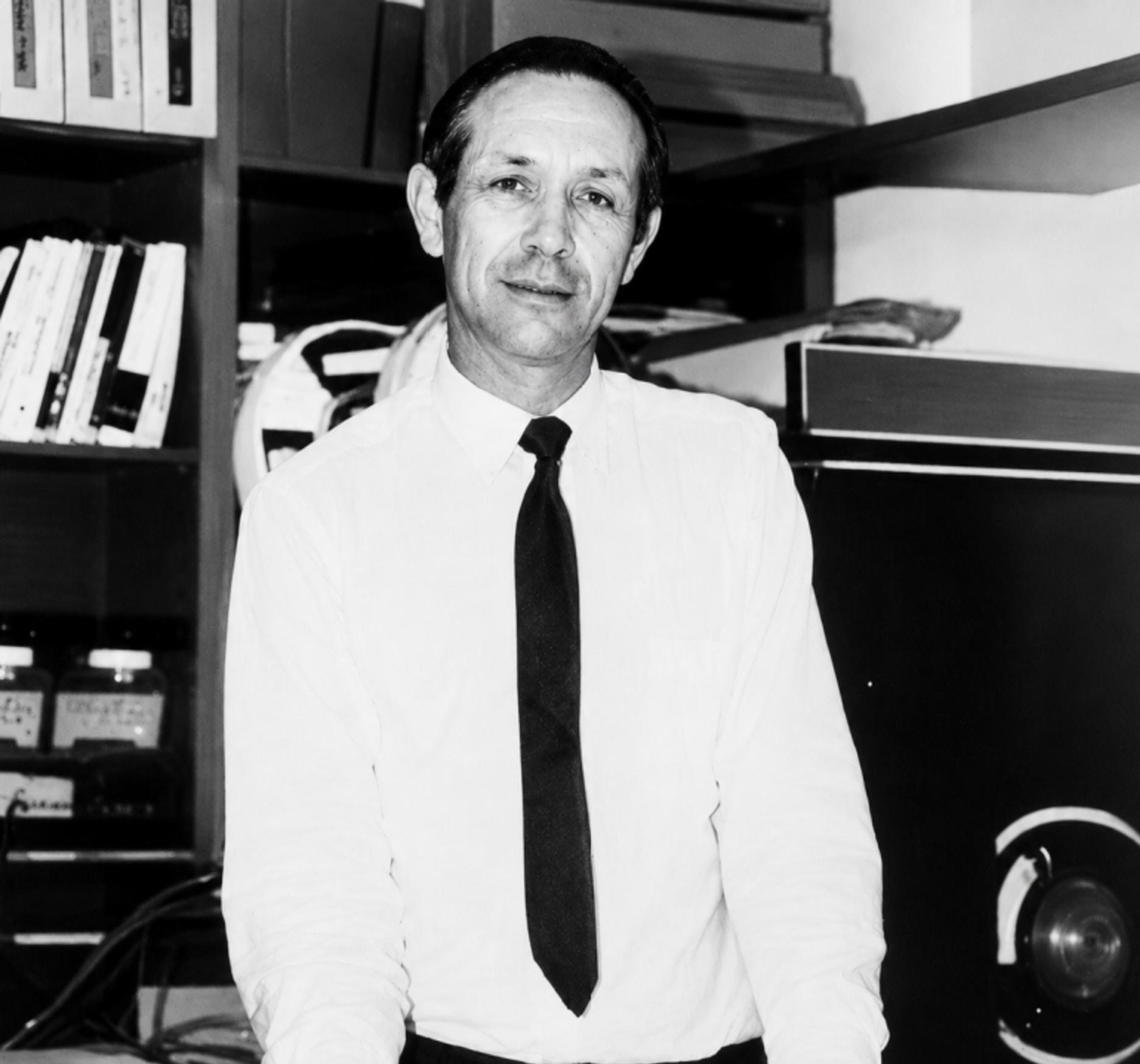
until it breaks, where things are “buried.” Rudy and other friends recall him teaching people photography in basement darkrooms, helping colleagues inspect houses before they bought them, finding ways to make life easier without ever making a performance of it.
Once, when Rudy had been asked to perform old protest songs at a faculty gathering, Charlie secretly arranged for a decades-old photograph of him playing guitar to be projected on the wall before he walked in.
“He never admitted he did it,” Rudy says now, “but I know he did.”
That detail feels important somehow. Charlie appears repeatedly in people’s stories not as the center of attention but standing just off to the side, making something better for someone else.
His death came as a shock, even to those who knew his health had declined. Parkinson’s disease had slowed him physically, but friends say his mind remained sharp and his instincts unchanged. Days before he died, visitors found him asking questions about their lives instead of talking about his own ailments.
“Typical Charlie,” says Rudy. “Always thinking of others. ”
CLASS NOTES
DAISY ARGUELLO DOES THE QUIET WORK that HOLDS FAMILIES TOGETHER
For Daisy Arguello ’20, the work does not arrive with ceremony. It arrives quietly, in apartments and borrowed rooms across Greensboro and Guilford County, in kitchens where the lights work but the future feels uncertain. It arrives in questions about hot water and electricity, about doors that lock, about where a child sleeps at night.
Daisy is a case worker with the U.S. Committee for Refugees and Immigrants. Her days are shaped by careful attention. She supports unaccompanied refugee and immigrant children — many of them survivors of trafficking, persecution, or violence — and the families or sponsors who take them in. She conducts safety assessments. She connects families to medical and mental health care. She advocates for education. She documents cases that can mean the difference between instability and the fragile beginnings of permanence. The language used to describe the people she works with shifts constantly — migrant, immigrant, refugee — but the needs don’t. Safety. Stability. Someone who notices.
Much of Daisy’s work unfolds far from public view. She steps into homes to assess whether they are safe, whether there is heat, water, food. She asks questions that sound simple but carry weight. With children who arrived alone, she moves deliberately, letting trust build at its own pace. With parents and sponsors, she explains complicated systems in plain language, translating fear into steps, uncertainty into something that looks like a plan. Progress is rarely dramatic. It is measured instead by consistency: showing up, following through, making sure no one disappears quietly between systems.
The habits that shape Daisy’s work were refined at Guilford College — habits of listening closely, asking the right questions, and acting with intention once the answers begin to surface. But they were formed even earlier.
Daisy grew up in an immigrant family. Her parents came to the United States from Mexico nearly three decades ago. By the time she was eight years old, Daisy had become the family interpreter — in doctors’ offices, grocery stores, fast-food counters. It was responsibility that arrived early. “You’re really doing grown-up work,” she says. “It gave me a lot of anxiety when I was a kid.”
She arrived at Guilford in 2016 intending to major in
Criminal Justice. A required course introduced her to Peace and Conflict Studies — and to professors who emphasized mediation, community-based problem-solving, and the discipline of listening. She added the second major.
“The mediation part of peace and conflict — how to help communities and how to help with peace — that interested me,” she says.
Learning extended beyond the classroom. Through community work in Greensboro’s Oakwood neighborhood, Daisy helped children learn English and complete homework after school. The work felt familiar. It also clarified her path.
“That’s where it started to click,” she says. “I realized I needed
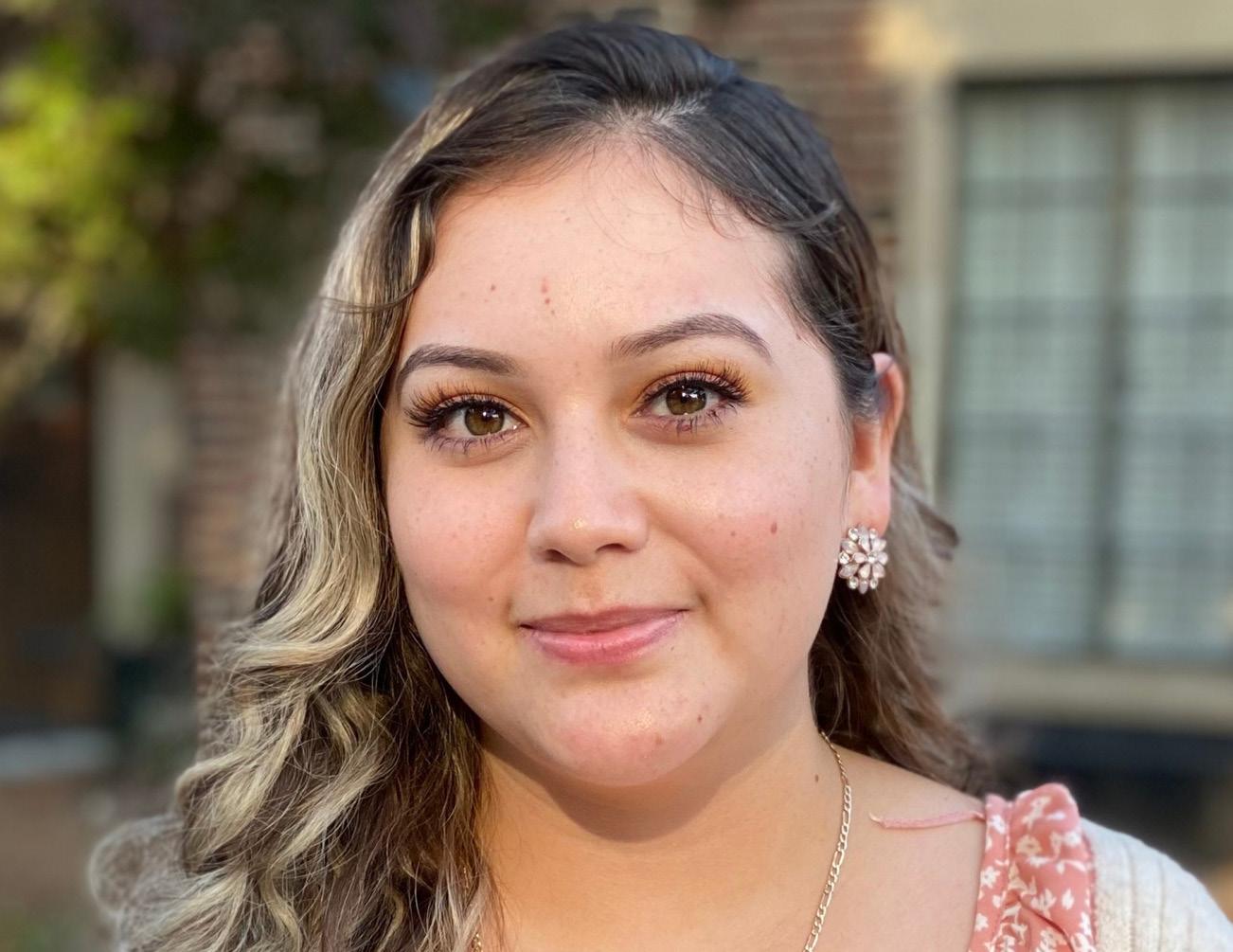
to stick with helping immigrant and refugee communities.”
After graduating, Daisy moved directly into that work, first at FaithAction International House in Greensboro, and now in her current role. The work remains demanding, especially for children navigating systems not built with them in mind. “They’re the ones who keep me going,” she says.
Guilford, Daisy believes, did not prepare her by offering easy answers. It prepared her by teaching her how to pay attention — to systems, to people, to what is at stake when no one is watching. The work she does now reflects that education, carried forward quietly, one careful visit at a time.
j Stephanie Quad ’13, MBA ’23 was named Lead Quality Manager for Reynolds American in Tobaccoville, N.C., where she was previously a Lead Compliance Manager. Stephanie earned a Business Administration degree at Guilford and later her MBA. Before working at Reynolds America, she was a Research and Development Scientist and Innovation Manager at Smurfit Westrock, in WinstonSalem, N.C.
k Leke Ademoyero ’18 accepted a new position as a Federal Analyst at the Federal Reserve Bank of Richmond. Prior to that, Leke, who played soccer at Guilford, held a similar position at Live Oak Bank in Wilmington, N.C.
l Calyn Davis Brown ’21 was named Senior Accountant at fundraising consultant Golden Aster Advisors in Chapel Hill, N.C. Calyn, an Accounting major, previously held a similar position at Bernard Robinson & Company.
Exel A Valle Estrada ’21, is pursuing an MBA at Louisiana State University. A Biology and Health Sciences

double major, Exel is working as a Bilingual Patient Navigator at United Therapeutics Corporation in Durham, N.C..
m Hunter Neal ’22, MISM ’23 joined the Special Olympics of North Carolina as the Inclusive Schools Specialist for Guilford County. Previously, Hunter served as the Director of Events and Volunteer Services for the Greensboro Sports Foundation.
n Andriquez Brooks ’23 started a new position as a Probation Officer at the North Carolina Department of Adult Correction. Previously Andriquez served as a student intern in the Iredell County (N.C.) Sheriff’s Department and later for the Department of Adult Correction.
o Dominik Pocrnja ’23, MISM ’24 was promoted to Director of Athletics Communications at Averett University in Danville, Va., after serving as Assistant Director. Domink earned a bachelor’s degree in Sport Management and also completed a master’s in International Sport Management at Guilford.
p Robert Reidy-Bialobok ’23 is pursuing a Master’s of Science in Management at Wake Forest University. Robert, who majored in Exercise Science and Health Science at the College, was a Physical Therapy Technician at EmergeOrtho.
q Jair Ballesteros Delgado ’24 accepted a position with Wells Fargo as an Associate Operations Processor in Miami. Jair, an Economics major at Guilford, is pursuing an MBA in Business Intelligence and Analytics from Nova Southeastern University.
r Adyson Franken ’24, MBA ’25 was promoted to General Manager at O2 Fitness Clubs in Winston-Salem, N.C. Before that, Adyson, a Presidential Fellow at Guilford, was the Member Experience Team Supervisor for an O2 branch in High Point, N.C.
s Mitchell Griffin ’25 accepted a position as Retail Banker for Woodforest National Bank in Greensboro, a bank with more than 750 branches in 17 states. Mitchell, an Accounting major, was a Resident Advisor while a student at the College.
LAST LOOK
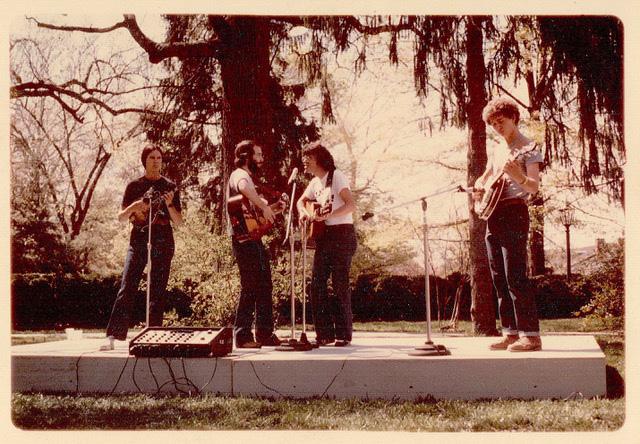
In 1977, Ted Edgerton ’75, Melissa Meyer ’76, Penny Parsons ’76, and I found ourselves still around campus and we continued playing the Bluegrass music we loved playing informally as students. We called ourselves the Flatt Creek Ramblers, inspired by the groups of the day and the iconic album, “Will the Circle Be Unbroken.” We had a lot of fun but were missing the key ingredient for a REAL Bluegrass band, a banjo player. Enter Bill Terrell ’80, and the group was solidified.
The high point for us was a performance at the 1978 Alumni Day, a long-standing tradition at the College at the time. Even
though we’ve remained friends, it was 47 years before we played again. That came when we jammed at the 1975 Golden Circle reunion.
That reunion inspired us to get together when possible, including in April when we performed on the patio at Hendricks Hall for the 1976 Golden Circle. I hope this particular “Circle of Friends” remains unbroken for years to come.
– Steve Taylor ’75
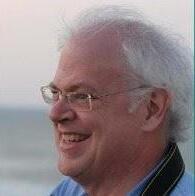

Some days remind you exactly why a place like Guilford matters. Last month, 237 graduates became alumni, and if you missed the smiles, hugs and hard-earned moments, click here to see some of our favorite photos from Commencement.
PHOTO: MICHAEL V. CROUCH ’10, ’12