VOL. 67 ISSUE 9 SEPTEMBER 2026 • GUAM CONTRACTORSʼ ASSOCIATION
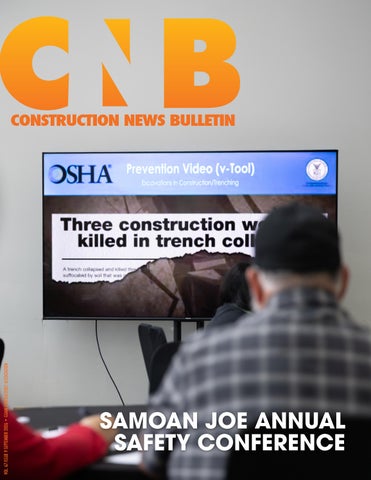
SAMOAN JOE ANNUAL SAFETY CONFERENCE
PROTECT YOUR PROGRESS Keep It Rolling with Cat® Utility Compactors
When the job can’t slow down, neither can your compactor. You need performance that holds up through long days, changing conditions and tight schedules. Controls and tech that make it easy for any operator to step in and deliver consistent results. And support that’s ready when it counts — so small issues don’t turn into bigger delays. Roll through your day. Pass after pass, keep moving forward with Cat® Utility Compactors.
671.649.4228 EXPLORE YOUR OPTIONS AT HAWTHORNECAT.COM
2026 SUBMIT YOUR ENTRIES! Now accepting entries for the GCA 2026 Excellence in Construction Awards. Please submit your entries no later than Friday, October 9, 2026 Send submissions to: adztech@teleguam.net (671) 477-1239
TABLE OF CONTENTS
TABLE OF CONTENTS 6 PRESIDENT’S LETTER 8 APPRENTICESHIP CORNER 10 MEMBER BENEFITS 12 CMMC READINESS 16 FEATURE 22 PHOTO HIGHLIGHTS 24 MONTHLY RECAP 26 PHOTO HIGHLIGHTS 28 SAFETY BRIEF 30 BUILDING PERMITS 32 REPORTS/INFORMATION
FEATURE
16
SAFETY BRIEF
28
GCA OCTOBER CALENDAR
2
10/01/26
Thursday
GCA Membership Committee Meeting
Meeting
10/07/26
Wednesday
GCA Board Meeting
Meeting
10/09/26
Friday
2026 Excellence in Construction Entry Submission Deadline
Deadline
10/10/26
Saturday
Construction Warriors
GCA Event
10/12/26
Monday
Columbus Day
Holiday
10/16/26
Friday
2026 Contractor of Year Entry Submission Deadline
Deadline
10/15/26
Thursday
GCA Social Mixer - Celebrating GCA Trades Academy 20 years!
GCA Event
10/21/26
Wednesday
GCA General Membership Luncheon Meeting
Luncheon
10/27/26
Tuesday
GCA Small Business Committee Meeting
Meeting
10/29/26
Thursday
GCA Safety Committee Meeting
Meeting
September 2026
CONSTRUCTION NEWS BULLETIN
www.guamcontractors.org
WE DELIVER OVER
23
HEAVY EQUIPMENT MANUFACTURERS
for Sales, Rental, Parts & Service
□ TRASHCO GUAM □ DIESEL DELIVERY □ HEAVY EQUIPMENT
Largest Rental Fleet in Micronesia!
Book online or request for a quote today.
EXCLUSIVE GUAM DEALER 197 Ypao Road, Tamuning Guam 96913 671.649.1946 671.649.1947 morricoequipment.com
EDITORIALS
THE DIRECTORS
THE EDITORIALS
THE TEAM
PRESIDENT Desiree Lizama, Guam Contractors Association
Guam Contractor’s Association (GCA) in conjunction with Adztech and Public Relations, Inc. publishes the Construction News Bulletin (CNB) monthly. Reproduction of materials appearing in this publication is strictly forbidden without written permission by GCA.
PUBLISHER: Desiree Lizama
CHAIRMAN Matthew Hunter, Dylan Mechanical Construction Services VICE CHAIRMAN Soraya Vongjalorn, Vertex Guam SECRETARY / TREASURER Brian Holm, Hensel Phelps CONTRACTOR DIRECTORS: Dean Bates, Black Construction Corp. Alan Bell, SmithBridge Guam Charles Hazzard, DZSP21 John Limtiaco, Pacific Trucking Collin Thompson, Pacific Rim Constructors Inc. Mark Thornton, Granite ASSOCIATE DIRECTORS: Mark Cruz, Mid Pac Far East Jose Garcia, First Hawaiian Bank Stephen Gatewood, Matson Navigation Geraldine Leon Guerrero, Adztech Advertising and PR
While we always strive for accuracy, we will from time to time overlook mistakes. In order to help us improve the quality and accuracy of this publication, we ask that you take the time to look at the information provided and notify GCA or Adztech of any corrections as needed. Opinions and editorial content of this publication may not necessarily be those of the publisher, production team, staff, GCA members, GCA Board of Directors and advertisers For more information about advertising in the GCA Construction News Bulletin contact the advertising department at (671) 477-1239/2239 or email at adztech@teleguam.net. Distributed to GCA members or can be obtained by stopping by the Guam Contractors’ Association office located at 506 Mariner Ave., Barrigada, Guam 96913 To find out more about how you can become a GCA member contact Guam Contractors’ Association at Tel: (671) 647-4840/41 or Email: info@guamcontractors.org www.guamcontractors.org Postmaster: Send address changes to Guam Contractors’ Association, located at 506 Mariner Ave., Barrigada, Guam 96913
JOIN ONE OF OUR MANY COMMITTEES!
4
September 2026
CONSTRUCTION NEWS BULLETIN
PRODUCTION TEAM LEAD: Geri Leon Guerrero AD SALES: Alyssa Roces Jason Davis Katee Arceo PRODUCTION: Jason Davis Christopher “Taco” Rowland Katee Arceo PHOTOGRAPHY: Eric Rosario Christopher “Taco” Rowland EDITOR: Adztech CONTRIBUTING WRITERS: Austen Cook Francine Taitague Myracle S. Mugol Nadia Holm, CIH, CSP, CHST Patricia “Patti” L. Diego, MPA Rodney “RJ” Ricarte Terence Tang GCA STAFF: Francine Taitague Trevor Cruz Rosielyn Holgado Peter Finona COVER: Contractors, safety professionals and government partners show up for GCA’s “Samoan Joe” Annual Safety Conference.
www.guamcontractors.org
PRESIDENT’S LETTER
PRESIDENT’S LETTER By Desiree Lizama President Guam Contractors Association
Safety, Quality and Honoring Our Industry Thank you to everyone who joined us for the Samoan Joe Annual Safety Conference and the GCA Industry Trade Fair & Expo, held August 27 and 28 at the Dusit Thani Guam Resort. These two days reminded me that this industry works best when we show up for each other and share what keeps our people safe and showcasing the innovations shaping construction in Guam. Now we look ahead to October and November, when GCA turns its attention to three programs that honor the progress our members have made this year. First, STEP. The Associated Builders and Contractors' Safety Training Evaluation Process remains one of the most respected benchmarking tools in our industry. I encourage every member to involve as many employees as possible in the evaluation. A safety committee or a broad, diverse sample gives the truest picture of where your program stands. Deadlines for submission are October 23, 2026. Second, the Accredited Quality Contractor certification. AQC recognizes contractors who deliver quality work while investing in their people, their safety programs,
6
September 2026
and their integrity, with excellence measured across five areas: Quality, Safety, Craft and Management Education, Community Relations, and Talent Management. Applications go to ABC National and are due Friday, October 23, with a $475 fee for new applicants. If your company has earned this recognition, please apply. Third, our Excellence in Construction & Contractor of the Year Event. Each year, EIC / COY gives us the chance to celebrate Guam's most outstanding projects and name our Contractor of the Year, recognizing leadership, safety, innovation, craftsmanship, and service to our community. GCA's deadline to receive award submissions is October 9. I hope you'll take part in all three. Our industry is only as strong as the members who step forward to be measured, certified, and recognized. For more information, contact the GCA office at (671) 647-4840 or info@guamcontractors.org. Together, we build Guam.
CONSTRUCTION NEWS BULLETIN
www.guamcontractors.org
475 Mendioka Street Dededo, Guam 96929 Tel: (671) 632-5160
SALES
Mid Pac Far East represents the most extensive line of heavy equipment on Guam, including a full line of trucks, generators, forklifts and construction equipment. sales@midpacfareast.com
PARTS
We maintain the largest inventory of OEM and aftermarket parts in the region and have highly experienced parts experts to help you source the part you need. parts@midpacfareast.com
SERVICE
MPFE is the authorized warranty service provider for all of the lines we carry. Our ASE and Factory certified technicians service both our own brands as well as most other major equipment lines. service@midpacfareast.com
POWER GENERATION
MPFE’s Cummins Power Generation Support Team provides 24x7 Emergency Repair Call Out Services as well as comprehensive Preventative Maintenance Contracts. power@cumminsmpfe.com
FUEL DELIVERY
Fuel Delivery at Competitive Pricing starting at Pump Price. Mobile 24/7: (671) 888-5160
APPRENTICESHIP CORNER
APPRENTICESHIP CORNER
By Francine Taitague Education Director Guam Contractors Association
Don't Wait for Talent — Build It: 5 Ways to End 2026 Strong As 2026 winds down, there's no better time to invest in your company's future than by launching an apprenticeship program. Here's a roadmap for building one that strengthens your team and sharpens your edge in the year ahead.
5. Keep talking, keep improving. Check in often, give feedback apprentices can actually use, and keep the door open between mentors, apprentices, and management. Use what you learn along the way to sharpen the program year after year.
1. Take an honest look at where you stand. Start by asking what your workforce needs right now, and where it's headed. Which skill gaps are slowing your company down? Set a few clear goals for your program, whether that's lower turnover, higher productivity, or deeper expertise on your crew. Those goals become your yardstick for measuring how the program is working.
Ensure your apprenticeship program complies with relevant labor laws and regulations. Be prepared to invest time, resources, and effort into the program, as it can take time to yield the desired results.
2. Cast a wide net for the right people. Look inside your company and outside it when you're filling apprentice slots. Skills tests, interviews, career fairs, referrals from your own team: use whatever mix helps you spot people with real drive and the right fit.
Join the growing community of companies that have, or are in the process of, creating an apprenticeship program to enhance the skills of its workforce.
3. Map out a clear path for learning. Build a program that pairs hands-on work with classroom learning. Decide how long it runs, what milestones apprentices need to hit, and what skills they'll walk away with. Match each apprentice with a mentor who'll coach them through the work, day by day.
A well-structured apprenticeship program can contribute significantly to employee development, skills enhancement, and overall organizational success.
I can help you! Interested in learning more? Please contact me at (671) 647-4841 or francine.taitague@guamcontractors.org.
4. Team up with people who've done this before. Give me a call at the Guam Contractors Association so your program lines up with industry standards from day one. GCA tracks apprentice hours and coursework progress for you, which takes one more thing off your plate.
8
September 2026
CONSTRUCTION NEWS BULLETIN
www.guamcontractors.org
SATURDAY, SEPTEMBER 19, 2026 Show Time: 6:30 am for most sites
Over 23 cleanup locations across the Island to choose from! SCAN HERE
Register Now!
• Register Now at: https://bsp.guam.gov/gicc2026/ • Trash Bags and Gloves are provided • Service Learning Credits Available for Students! TO REGISTER
Need More Information? Interested in Becoming a Sponsor?
Contact Steven Dierking at the Guam Coastal Management Program: steven.dierking@bsp.guam.gov or visit: bsp.guam.gov/gicc2026/ ADA Compliance: Should you or interested parties require assistance or special accommodations to fully participate in this event, please contact BSP ADA Coordinator, Raymond Dungca at raymond.dungca@bsp.guam.gov or by calling (671) 475-9683.
MEMBER BENEFITS
Don't Wait on Your Mammogram By Rodney “RJ” Ricarte Coming up fast is October, Breast Cancer Awareness Month. There's one message worth repeating. “Early detection can save your life.” Breast cancer remains one of the most common cancers affecting women today, but when caught early, it's highly treatable. The key is making screening a routine part of your healthcare. Please do not make it something you put off. Know the Guidelines Breast cancer is being diagnosed more often in younger women, making it important to know your personal risk and when you should begin screening. For most women, routine mammograms should begin at age 40. How often you need one may depend on your age, health, and your healthcare provider’s recommendations. Some women at higher risk for breast cancer may need to begin screening earlier, often around age 30. This can include women with a strong family history of breast cancer, certain genetic risk factors, or other personal risk factors. Additional screening, such as a breast MRI, may also be recommended. The American College of Radiology recommends that women have their breast cancer risk assessed by age 25 to help determine when screening should begin. What Screening Involves A mammogram is a quick X-ray of the breast that can find breast cancer before you may be able to see or feel any changes. The exam may cause brief pressure or discomfort, but it only lasts a short time. Breast cancer may not cause any noticeable symptoms in its early stages. A mammogram can help find cancer before a lump or other changes can be felt or seen. When breast cancer is detected early, treatment is often more effective and may be less invasive.
10
September 2026
Don't Wait If you're 40 or older and haven't had a mammogram in the past two years, schedule one now. If you don't have a regular provider, the FHP Health Center and local clinics offer screening services, and some programs provide free or low-cost mammograms for qualifying members. Talk to the women in your life about screening, too. If you're younger than 40, learn about your family history and personal risk factors. If breast cancer runs in your family or you have other concerns about your risk, talk with your healthcare provider about whether earlier screening may be right for you. No matter your age, report any unusual breast changes to your healthcare provider. If you're 75 or older, talk with your healthcare provider about whether continuing mammograms is right for you. Your Health Is Worth the Investment Maintaining a healthy weight, staying physically active, limiting alcohol intake, and avoiding smoking all support your overall health and may help lower your risk of breast cancer. Even with healthy habits, breast cancer can still occur. Regular screening is an important part of staying proactive about your health. TakeCare encourages GCA members to make preventive care, including breast cancer screening, part of their routine. This Breast Cancer Awareness Month, make that call. Schedule your mammogram. It's a simple step that could change everything. Rodney "RJ" Ricarte is the TakeCare account executive for GCA. He can be contacted at (671) 487-7121 or rodney.ricarte@takecareasia.com.
CONSTRUCTION NEWS BULLETIN
www.guamcontractors.org
e r a C e Taokf you.
C A M PA I G N
GET SCREENED. IT MATTERS. KNOW WHEN TO GET SCREENED
Screening recommendations and coverage may vary based on your age and risk factors.
AGES 35-39
AGES 40-74
One baseline mammogram
Mammogram every 2 Years
HIGHER RISK?
If you have a family history of breast cancer, certain genertic risk factors, or other personal risk factors, talk with your healthcare provider about whether earlier or more frequent screening is right for you.
GET SCREENED. GET REWARDED.
EARN UP TO in Wellness Incentives when eligible preventive screenings are completed.*
$
*Eligible requirements apply. Please refer to your HR representative of contact TakeCare Customer Service for details.
SCHEDULE YOUR MAMMOGRAM TODAY.
75
PROVIDER DIRECTORY Looking for a specific provider? Visit our Provider Directory
Customer Service (671) 647-3526
75 OR OLDER
Talk with your healthcare provider
CMMC READINESS
CMMC READINESS
The 3 Systems That Usually Store DoD Project Data By Terence Tang If your construction company works on Department of Defense (DoD) projects, sensitive project information is probably not sitting in one isolated, secure system. Instead, Controlled Unclassified Information (CUI) often shows up in the exact same everyday tools your teams use to build.
• •
When evaluating compliance, the key question is simply whether a system stores, processes, or transmits that covered information.
3. Project Management Platforms
Here are the three most common places where CUI lives: 1. Email Email is usually the first place CUI appears because it is the primary way daily work gets done. Even if a message feels like "just communication," it is still legally storing and transmitting CUI. It is also the easiest place to accidentally forward sensitive data to unauthorized subcontractors. Watch out for: • Bid clarifications • RFIs and submittals • Drawings and schedules • Meeting notes and contract attachments 2. Shared Drives and Cloud Storage Shared drives and cloud storage environments are where CUI typically sits at rest. If DoD project information is stored here, these file locations need strict access controls and the same security attention as any other system holding CUI. Common files include: • Plan sets and specifications • Site photos 12
September 2026
Submittal packages and change orders Saved correspondence
Note: If an outside cloud provider handles covered defense information or CUI, DFARS 252.204-7012 requires FedRAMP Moderate-equivalent protections.
Construction project management platforms are highly collaborative, meaning they can easily become untracked CUI systems. What matters is how the information is handled, not the brand name of the software. CUI frequently lives in: • Uploaded documents and linked files • In-app comments and workflows • Submittal logs and drawing markups • Approvals The Takeaway Start by mapping out exactly where your DoD project information lives. If CUI touches your email, shared storage, or project management platform, those three core systems should be your first focus for compliance and security. Terence Tang is vice president of client strategy at Intech Hawaii. A Certified CMMC Professional (CCP) and CISSP, he advises defense contractors in Guam, Hawaii, and the U.S. mainland.
CONSTRUCTION NEWS BULLETIN
www.guamcontractors.org
2026 SEND US YOUR NOMINATION! 2026
CONTRACTOR OF THE
YEAR
Do you have what it takes to become the GCA 2026 Contractor of the Year? Please submit your entries no later than Friday, October 16, 2026 Send your nominations to: adztech@teleguam.net (671) 477-1239
GCA Safety Conference Brings Guam’s Industry Back to the Basics: Protecting People By: Myracle S. Mugol
16
September 2026
CONSTRUCTION NEWS BULLETIN
www.guamcontractors.org
FEATURE STORY
For the Guam Contractors Association, workplace safety should not be something companies think about only when an inspection is coming, a requirement changes or something goes wrong. It must be built into the way people work every day. That message carried throughout this year’s Joseph P. Leasiolagi “Samoan Joe” Annual Safety Conference, where contractors, safety professionals and government partners came together to talk about the risks workers face on the job and, more importantly, what companies can do about them. The conference covered a wide range of topics, including electrical and transportation safety, fatigue, confined spaces, heat stress, ethical leadership and OSHA requirements. But despite the variety of sessions, many of the conversations came back to the same point: safety works best when it is part of a company’s culture and not just a compliance exercise. Francine Taitague, administrative manager and education director for GCA, said the conference gives industry professionals an opportunity to learn from one another and take information back to their workplaces. “We are grateful for the opportunity to bring our industry partners and professionals together to learn, share, and strengthen our commitment to creating safer workplaces,” Taitague said. She added that the sessions are meant to provide practical information that can be used in both construction and general industry. Building a stronger safety culture Safety remains a major priority for GCA because of the risks that come with construction work. Taitague said GCA supports safety training throughout the year, while the annual conference creates a larger space for safety officers, employers and partners such as Federal OSHA, facebook.com/GuamContractors
CONSTRUCTION NEWS BULLETIN
NAVFAC Marianas and OSHA On-Site Consultation to come together. One of the biggest challenges on Guam, she said, is the lack of certified safety officers. That makes continued training and professional development even more important. The GCA Safety Committee, made up of certified safety officers and government workers, meets every month to discuss safety incidents, training needs and ways the association can help connect companies with quality safety education. Those partnerships are a major part of the effort. “They provide much needed insight and they use the partnership with the association to support our members and their safety teams,” Taitague said. She has also seen attitudes toward workplace safety change over time. Taitague, who has been with GCA since 2009, said more employers are investing in their safety teams, participating in training and making sure safety officers keep their certifications current. “I have seen our industry progress with fewer injuries on the job sites and more importantly, fewer deaths,” she said. “I believe that has everything to do with changing our mindset to adopt safety as part of the company’s culture.” Leadership matters That idea was also at the center of Nadia Holm’s presentation on ethical leadership and lessons learned from major workplace and industrial disasters. For Holm, ethical leadership starts with treating worker safety and well-being as a core value, rather than simply a legal requirement. “Ethical leaders are committed to doing the right thing, even when it requires additional time, effort, or financial cost,” Holm said. Leadership also has to be visible. Holm said employees are more likely to embrace safety when September 2026
17
FEATURE STORY
managers actively participate in safety practices, model the behavior they expect from workers and make it clear that employees can report hazards or raise concerns without fear of retaliation. That becomes especially important when projects are under pressure. Deadlines, production goals and concerns about cost can lead people to cut corners or accept risks that would normally be considered unacceptable. Those pressures can hit differently on Guam, where contractors also deal with workforce shortages, limited resources and long lead times for materials and supplies. Holm said because companies already know these challenges exist, they should be built into project planning from the beginning. Realistic schedules, budgets and safety measures can help prevent the pressure to rush later. She also offered leaders a simple way to look at risk: would they accept the same conditions if they were the person performing the work, or if that worker were their friend or child? If the answer is no, the task should be stopped and reassessed before moving forward. The danger of getting too comfortable Johnny Cruz, CSP, also focused on a problem that can happen in almost any workplace: complacency. Cruz spoke about electrical awareness, transportation safety and ways to make safety training more effective for workers. One issue he sees is workers not using ground-fault circuit interrupters, or GFCIs, because the device trips and stops work. Instead of investigating why it tripped, workers can begin to see the protection itself as an inconvenience. “They don’t investigate the problem and also don’t realize the GFCI will keep you alive,” Cruz said.
18
September 2026
His advice with electrical work is to assume everything is live until it has been personally verified otherwise. Workers should confirm there is zero energy and make sure the electrical source has been properly isolated rather than relying only on someone else saying lockout/tagout was completed. The same issue of complacency carries onto the road. “Driving many years without an accident gives you the confidence to drive with bad habits,” Cruz said. That can include something as common as using a cellphone while driving. Someone may do it repeatedly without an accident and eventually begin to believe the behavior is safe simply because nothing has happened yet. “Complacency drives people to continue performing the negative attitudes and will constitute to a negative result like an accident,” Cruz said. The point, he added, is that years of getting away with an unsafe behavior do not make that behavior safe. Making training actually stick Cruz also challenged companies to look at how safety information is being delivered. Simply reading slides or handouts might cover the material, but it does not always mean employees understand how to apply it once they return to the jobsite. That is especially important on Guam, Cruz said, because many construction workers do not use English as their primary language. Hands-on exercises, peer interaction and question-and-answer sessions can help bridge that gap. For example, fire extinguisher training becomes much more memorable when employees actually handle the equipment and practice putting out a fire instead of only hearing someone explain how it works. “With the visual aid and equipment at trainings, the workers will relate and use the information at their project site,” Cruz said.
CONSTRUCTION NEWS BULLETIN
But training can only go so far if company leadership does not support it. “If the company wanted to improve safety at their establishment then the Owner and Management team have to value safety,” Cruz said. That means investing in qualified safety officers, supporting training, holding supervisors and employees accountable and making sure management follows the same expectations it sets for everyone else. “Safety has to start from the top management to be effective and followed by all,” he said. Turning lessons into action For Taitague, the real value of the conference will be seen in what happens after attendees leave. “I would like the attendees to turn what they learned into action,” she said. “I want our attendees to go back to their workplaces with at least one thing they learned at our conference that they can implement in their day-to-day operations.” That message also ties back to the man whose name the conference carries. Joseph P. Leasiolagi, known throughout the industry as “Samoan Joe,” dedicated years of his time, knowledge and passion to Guam’s construction community. Taitague said continuing the conference in his name is about keeping that commitment alive. “Samoan Joe understood that safety wasn’t just about rules and regulations and enforcement,” she said. “Yes, they’re important, but he knew that protecting people, looking out for one another, and ensuring everyone goes home safely to their families at the end of a work day is what matters the most.” That may be the simplest takeaway from the conference. Safety rules matter. Training matters. Compliance matters. But behind every requirement is a person doing the work. And at the end of the day, the goal is still the same: making sure they get home safely.
www.guamcontractors.org
facebook.com/GuamContractors
CONSTRUCTION NEWS BULLETIN
September 2026
19
20
September 2026
CONSTRUCTION NEWS BULLETIN
www.guamcontractors.org
facebook.com/GuamContractors
CONSTRUCTION NEWS BULLETIN
September 2026
21
PHOTO HIGHLIGHTS
PHOTO HIGHLIGHTS
GCA Membership Luncheon August 19th, 2026 Westin Resort Guam
22
September 2026
CONSTRUCTION NEWS BULLETIN
www.guamcontractors.org
PHOTO HIGHLIGHTS
GCA Committees Meetings
Small Business Meeting
Membership Committee Meeting
Activities Committee Meeting
Safety Committee Meeting
Executive Committee Meeting
facebook.com/GuamContractors
CONSTRUCTION NEWS BULLETIN
September 2026
23
MONTHLY RECAP
MONTHLY RECAP August 2026 GCA General Membership Luncheon Recap By Patricia L. Diego, MPA The Guam Contractors Association brought members and guests together for its General Membership Luncheon on August 19, 2026, at the Westin Resort Guam for an afternoon focused on safety, maintenance, emerging technology and upcoming industry activities. The monthly gathering followed GCA’s familiar program of practical information for members, with the featured presentation turning attention to artificial intelligence and the rapidly changing ways businesses are beginning to use it. Jesse Pangelinan of the Guam Department of Labor OSHA On-Site Consultation Program opened the luncheon’s presentations with the monthly Safety Brief, reminding employers that workplace safety depends on continuous training. He encouraged companies to strengthen the skills of experienced employees while giving others opportunities to develop safety knowledge and leadership. Repeated training, he noted, reinforces good practices, can uncover what may have been overlooked, and helps prepare the next generation of workplace safety leaders. Pangelinan also reminded employers that OSHA On-Site Consultation provides free and confidential assistance to small businesses seeking to identify hazards, improve workplace safety and strengthen employee training. The GCA Maintenance Corner followed with Charles B. Blaz III addressing corrosion and the maintenance challenges created by Guam’s tropical, salt-laden environment. He emphasized that corrosion control requires continuous attention, including routine inspection and cleaning, fresh-water washing, protective treatments and coatings, and particular attention to areas where salt and moisture accumulate. For contractors and facility owners, the takeaway was practical. Preventive maintenance can extend the life of equipment and infrastructure and help avoid more costly repairs after corrosion has taken hold. What can artificial intelligence actually do for your business, and where should you be careful? Featured speaker Corey A. Ross, Ph.D., Assistant Professor of Marketing at the University of Guam School of Business & Public Administration, addressed both sides 24
September 2026
of that question in his presentation, “Emerging Technologies: Artificial Intelligence (AI).” Ross described how quickly AI has advanced from conversational tools such as ChatGPT to systems capable of handling increasingly complex tasks. For contractors and other businesses, applications can include drafting and reviewing documents, preparing meeting summaries, scheduling, estimating, training, detecting risks, and analyzing jobsite images and safety conditions. Ross also emphasized that AI should remain a tool, not the final decision-maker. Businesses must protect proprietary, confidential and sensitive information, verify AI-generated information, and maintain professional judgment and human oversight. He encouraged businesses to begin with lower-risk uses, determine where AI can provide real value, establish appropriate safeguards, and develop policies as its use expands. During the Q&A, Ross offered another practical suggestion for getting better results from AI. He advised users to clearly define the role they want AI to perform and the task they want accomplished. Rather than immediately asking for an answer, users can also instruct AI to ask questions first so it better understands what they are trying to accomplish. The takeaway for GCA members was clear. AI is already here, and the opportunity, as well as the responsibility, is learning how to use it effectively, responsibly and safely. Members were also encouraged to complete GCA’s brief two-question surveys to help shape future luncheon topics and speakers. The luncheon concluded with Association announcements and raffle drawings, with members reminded they must be present to win. GCA’s monthly luncheons continue to offer members something worth coming back for. Timely information, knowledgeable speakers, practical takeaways and opportunities to connect with the people shaping Guam’s construction industry remain at the heart of these gatherings. Each month brings a new conversation and another opportunity for members to stay informed, connected and ready for what comes next.
CONSTRUCTION NEWS BULLETIN
www.guamcontractors.org
THANK YOU! TO ALL THE SPONSORS, PRESENTERS, VENDORS AND ATTENDEES of our Annual “Samoan Joe” Safety Conference and Industry Trade Fair event.
Sponsored by:
Tel: (671) 647-4840/41 www.guamcontractors.org
PHOTO HIGHLIGHTS
PHOTO HIGHLIGHTS
GCA 2026 SOFTBALL TOURNAMENT September 5th & 6th, 2026 Dededo Sports Complex
26
September 2026
CONSTRUCTION NEWS BULLETIN
www.guamcontractors.org
PHOTO HIGHLIGHTS
facebook.com/GuamContractors
CONSTRUCTION NEWS BULLETIN
September 2026
27
SAFETY BRIEF
SAFETY BRIEF WATER. REST. SHADE.
Can protect workers from extreme heat. By Austen Cook, Compliance Assistance Specialist Occupational Safety and Health Administration, U.S. Department of Labor Late summer is approaching in the islands, and like recent years, September and October can be especially hot and humid. This is a great time for employees and employers to review and train on the signs and symptoms of heat illness. Heat-Related Illness Symptoms and Signs Heat stroke • Confusion • Slurred speech • Unconsciousness • Seizures • Heavy sweating or hot, dry skin • Very high body temperature • Rapid heart rate Heat exhaustion
• Fatigue • Irritability • Thirst • Nausea or vomiting • Dizziness or lightheadedness • Heavy sweating • Elevated body temperature or fast heart rate
Heat-Related Illness Symptoms and Signs Heat cramps • Muscle spasms or pain • Usually in legs, arms, or trunk Heat syncope
• Fainting • Dizziness
Heat rash
• Clusters of red bumps on skin • Often appears on neck, upper chest, and skin folds
Rhabdomyolysis (muscle breakdown)
• Muscle pain • Dark urine or reduced urine output • Weakness
osha.gov/heat-exposure/illness-first-aid
For Heat Illness First Aid, • Take the affected worker to a cooler area (e.g., shade or air conditioning). • Cool the worker immediately. Use active cooling techniques such as: - Immerse the worker in cold water or an ice bath. Create the ice bath by placing all of the available ice into a large container with water, standard practice in sports. This is the best method to cool workers rapidly in an emergency. - Remove outer layers of clothing, especially heavy protective clothing. - Place ice or cold wet towels on the head, neck, trunk, armpits, and groin. - Use fans to circulate air around the worker. • Never leave a worker with heat-related illness alone. The illness can rapidly become worse. Stay with the worker. • When in doubt, call 911! It is vitally important for supervisors to note that: Confusion, slurred speech, or unconsciousness are signs of heat stroke. When these types of symptoms are present, call 911 immediately and cool the worker with ice or cold water until help arrives. So, whether we’re working or enjoying time outdoors, let’s remember to drink plenty of water, take breaks, find shade, and pay attention to how the heat is affecting us. Some fun ways that I have seen an employer in American Samoa respond to the heat are by having a popsicle or freezer-pop party and providing frozen treats to workers during a break. Stay cool out there!
28
September 2026
CONSTRUCTION NEWS BULLETIN
www.guamcontractors.org
SAFETY BRIEF
Beyond the Focus Four: Mental Health and Guam’s Construction Workforce By Nadia Holm, CIH, CSP, CHST
Guam is experiencing a significant construction boom driven largely by the ongoing U.S. military buildup. Billions of dollars in military construction are projected in the coming years, creating tremendous demand for construction workers. With this growth comes an equally important responsibility: protecting the workers building Guam’s future.
Guam itself continues to face significant suicide concerns. In 2023, Guam recorded 31 suicide deaths. Although reliable statistics specifically measuring suicide among Guam construction workers are not currently available, the combination of construction-industry risk factors and Guam’s suicide burden should not be ignored.
Construction remains one of the most hazardous industries in the United States. In 2024, 1,034 workers in private construction suffered fatal occupational injuries, with a fatal injury rate of 9.2 deaths per 100,000 full-time-equivalent workers. Construction recorded more workplace fatalities than any other private industry.
OSHA recognizes September 14-18 as Construction Suicide Prevention Week. The observance encourages employers and workers to discuss mental health, reduce stigma, recognize warning signs, and connect individuals with resources.
OSHA has traditionally focused on four major construction hazards: falls, struck-by incidents, electrocutions, and caught-in or between incidents. Known as the “Focus Four,” these hazards collectively account for approximately 60 percent of construction fatalities. However, another serious hazard often receives far less attention: mental health and suicide. According to the Centers for Disease Control and Prevention (CDC), the suicide rate among men working in the construction industry was 56.0 deaths per 100,000 workers in 2021. Among men specifically employed in construction and extraction occupations, the rate was even higher at 65.6 per 100,000. These figures illustrate a serious mental-health risk within the construction workforce. The issue is especially relevant on Guam where the construction workforce includes local employees as well as thousands of temporary foreign workers, many of whom are separated from their families and traditional support systems for extended periods. Construction workers may also experience long hours, physical exhaustion, dangerous working conditions, chronic pain, sleep disruption, financial pressure, and job-related stress.
facebook.com/GuamContractors
Employers do not need to turn supervisors into mental-health professionals. They can, however, make mental health part of their safety culture. Toolbox talks, supervisor awareness training, employee-assistance programs, peer support, and information about available resources can help workers recognize when a coworker may be struggling. Construction safety programs must continue addressing falls, electrocutions, struck-by hazards, and caught-in or between incidents. But protecting workers also means recognizing hazards that cannot be seen during a jobsite inspection. As Guam continues its historic construction buildup, safety programs must protect both the body and the mind. Workers experiencing emotional distress or suicidal thoughts can call or text the 988 Suicide & Crisis Lifeline 24 hours a day. Additional construction-specific resources are available through OSHA at osha.gov/preventingsuicides. Nadia Holm CIH, CSP, CHST is the President of Oceania Safety and Environmental, providing comprehensive industrial hygiene, safety, environmental, and regulatory compliance solutions tailored to the unique needs of Guam and the broader Pacific region.
CONSTRUCTION NEWS BULLETIN
September 2026
29
BUILDING PERMITS
BUILDING PERMITS FOR MARCH 2026 PERMIT TYPE
CONSTRUCTION COST
BUILDING PERMIT FEES
Residential
NEW ADD RENO
$27,105,795.43 $21,000 $156,000
$127,833.16 $253.88 $943.50
Commercial
NEW ADD RENO
$16,425,495.75 $578,710.54 $1,964,480.64
$78,278.48 $6,418.50 $18,951.49
$3,067,620.29
$13,736.25
Warehouse/Storage
$0
$0
Utility / Infrastructure
$0
$0
$170,896
$1,641.01
Cannibis Permits
$0
$0
Operating Permits
$467,178
$2,634.81
Signage
$0
$0
Demolition
$0
$0
Clearing / Grading
$314,056
$12,743.37
Boring / Testing
$57,500
$1,039.50
$0
$180
$50,328,732.65
$264,653.95
Government
Solar / Photovoltaic
Miscellaneous TOTALS PERMITS ISSUED Residential Commercial Government Warehouse/Storage Utility / Infrastructure
18 11 3 0 0
Solar / Photovoltaic Cannibis Permits Installation Permits Signage Demolition
6 0 4 0 0
Clearing / Grading Boring / Testing Miscellaneous
TOTAL 30
September 2026
CONSTRUCTION NEWS BULLETIN
4 1 7
54
www.guamcontractors.org
TYPE 2 LENTON FORM SAVERS
STRAIGHT STOCK #3 - 11
“Having our home windows tinted by East Island Tinting was an excellent decision. Our power bill dropped enough to pay for the work in less than a year. Even better, our home is much cooler and more comfortable when we walk in after a long, hard day.” 2 AUTOMATED STIRRUPS MACHINES UP TO #6
2 AUTOMATED SHEAR LINES UP TO #14
Kelly and Maria Fitzpatrick Home Owner
• FOR ALL YOUR REINFORCING NEEDS •
• FOR CONTRACTORS AND PUBLIC SALES • CUTTING • BENDING • STRAIGHT STOCK • TIRE WIRE • BAR SUPPORT • DETAILING
LOCATED ON ROUTE 15 ACROSS HAWAIIAN ROCK
Tel: 653-4701 | E-mail: timw@rmpguam.com
East Hagåtña 477-TINT (8468) / 472-TINT eastislandtinting@guam.net
32
September 2026
Common Construction Occupations
CONSTRUCTION NEWS BULLETIN
Grand Total Construction Occupations
Occupational Health & Safety Tech. Occupational Health & Safety Tech. Supervisor Precast Concrete Laboratory Technician Quality Control Inspector Service Technician Total Other Const. Occupations
Mechanic Supervisor
HVAC & Refrigeration Technician HVAC Technician Heavy Equipment Mechanic Heavy & Trailer Truck Driver Landscape Gardener Machinery Maintenance and Repair Worker
5633
1 5 1 264
1
5 1 1
1 2 80 3 93
2 3 27 1 3 9 23 2
58 82 5369
Other Construction Occupations Air Conditioning Technician Bookkeeper (Construction Ind.) Construction Supervisor Crane Operator Crane Operator Supervisor Equipment Technician Field Supervisor Foreman
126
Structural Steel Worker Welder Total Common Const. Occup.
39 1608 1198 508 110 32 358 682 240 61 267
Sheet Metal Worker
Camp Cook Carpenter Cement Mason Electrician HVAC & Refrigeration Mechanic Construction Equipment Mechanic Heavy Equipment Operator Reinforcing Metal Worker Painter Pipefitter Plumber
Ultrasound Technician Welder/Fitter Total Non-Const. H-2B Workers
1
Total H-2B Workers by Nationality
5901
3 5844 1 43 6
Korea New Zealand Philippines UK - Scotland Thailand Turkey
2 1
Australia Japan
H-2B Workers by Nationality
2 7 268
Landscape Gardener Lead Transportation Equipment Painter MRI Technologist Maintenance Engineer Maintenance Technician Marine Mechanic Medical Assistant Painter Blaster Personal Care Aide Pipefitter Planning Clerk Quality Control Inspector Shipwright Carpenter
3
12 19 55 1 2 11 1 1 1 7 1 17 20 1 1 48 18 6 4 7 5 4 2 4 8
Heavy & Tractor Trailer Truck Driver
General Maintenance & Repair Worker
Dental Auxiliary Dental Ceramist/Technician Drilling Assistant Drilling Supervisor Electric Motor Rewinder Expanded Functions Dental Assistant
Automotive Mechanic Baker Camp Cook Cardiac Sonographer Crane Operator
Other Non-Construction Occupations
0
1000
2000
3000
4000
5000
6000
7000
3697
5901
GRAND TOTAL H-2B Workers
Total U.S. Workers in H-2B Companies
US Construction Workers
3667
US Workers vs. H-2B
5901
3697
Total U.S. Workers in H-2B Companies GRAND TOTAL H-2B Workers
9300 5633 3667
4143
65 19 84
CES US Workforce (as of March 2026) less H-2B US Construction Workers
Total Occupations
DPRI Authorized
Construction Non-Construction Total H-2B Employers
H-2B Employers By Industry
Employers Workplace Monthly Report Statistics
Pipefitter 1.14%
Painter 4.47%
Korea 0.02%
New Zealand 0.05%
Philippines 99.03%
Japan 0.02%
UK - Scotland 0.02%
Turkey 0.10%
Thailand 0.73% Australia 0.03%
Construction Equipment Mechanic 0.60%
HVAC & Refrigeration Mechanic 2.05%
Electrician 9.46%
Prepared By: J. Cruz, J. Lumba, J. Young, G. Sablan, and C. Montoya CONTACT INFORMATION: Greg Massey, ALPCD Administrator P.O. Box 9970 Tamuning, GU 96931 (671) 475-8005/8003
Heavy Reinforcing Equipment Metal Worker Operator 6.67% 12.70%
Mason 22.31%
H-2B Workers by Nationality
Plumber 4.97%
Sheet Metal Worker 2.35%
Welder 1.53% Structural Steel Worker 1.08%
Camp Cook 0.73%
Carpenter 29.95%
Common Construction Occupations Cement
JULY 2026
MONTH ENDING:
REPORTS/INFORMATION
www.guamcontractors.org
C.O.R.E.
CONTACTS • OPPORTUNITIES • RESOURCES • EDUCATION DIAMOND SPONSORS
PLATINUM SPONSORS
GOLD SPONSORS
SILVER SPONSORS
First Hawaiian Bank BRONZE SPONSORS
Isla Coatings and Roofing Supply Island Equipment Company Phoenix Pacific (Guam), Inc. SUPPORTER
America's Best Electricmart Inc. www.guamcontractors.org