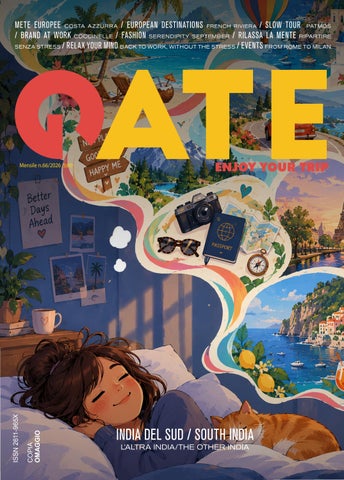
METE EUROPEE COSTA AZZURR A / EUROPEAN DESTINATIONS FRENCH RIVIER A / SLOW TOUR PATMOS / BRAND AT WORK COCCINELLE / FASHION SERENDIPITY SEPTEMBER / RILASSA LA MENTE RIPARTIRE SENZA STRESS / RELAX YOUR MIND BACK TO WORK, WITHOUT THE STRESS / EVENTS FROM ROME TO MILAN
COPIA OMAGGIO
ISSN 2611-965X
Mensile n.66/2026 5,00
INDIA DEL SUD / SOUTH INDIA L’ALTRA INDIA/THE OTHER INDIA
www.brettjohnson.co
QUESTO MESE
www.gatemag.it N. 66 - 2026 – PERIODICITÀ MENSILE/MONTHLY PERIODICITY DIREZIONE E AMMINISTRAZIONE/DIRECTION AND ADMINISTRATION Piazza G. Grandi 3, 20129Milano, Italia direzione@gatemag.it amministrazione@gatemag.it DIRETTORE RESPONSABILE/EDITOR IN CHIEF Francesca Noto REALIZZAZIONE GRAFICA/GRAPHIC DESIGNER Rachele Tonioni grafica@gatemag.it Tel +39 340 783 3557 COVER AI generated HANNO COLLABORATO A QUESTO NUMERO/ COLLABORATORS OF THIS ISSUE Lucilla Biffi, Syusy Blady, Alessandro Cecchi Paone, Idra Editing, Cristiana Gentileschi, Rajan Gualtieri, Rodolfo Mangiagalli, Enza Pietrangelo, Vanna Greggio, Asia Mangione, Chiara Viti, Virginia Merlini, Patrizio Roversi, Ilaria Santi, Chiara Valle, Bianca Humoceanu CONSULENTE MODA/FASHION CONSULTANT Paolo Gelmi EDITORE/PUBLISHING COMPANY GATE s.r.l. Piazza G.Grandi 3 20129 Milano AMMINISTRATORE UNICO Sabina Premoli PUBBLICITA’ DIRETTA/DIRECT ADVERTISING GATE s.r.l. Piazza G.Grandi 3 20129 Milano Tel + 39 347 277 5347 info@gatemag.it TRAFFICO/ADVERTISING TRAFFIC traffico@gatemag.it BUSINESS PARTNER EQUIPE INTERNATIONAL SRL Corso Sempione,30 - Milano Responsabile del trattamento dei dati personali (D.L. 196/2003) Francesca Noto Contenuto pubblicitario non superiore al 45% Tutti i diritti sono riservati. Nessuna parte della rivista può essere in alcun modo riprodotta senza autorizzazione scritta da Gate s.r.l. Registration at the Court of Milan n. 5 of 1/4/2018. Responsible for processing personal data (Legislative Decree 196/2003) Francesca Noto. Advertising content not exceeding 45%. All rights reserved. No part of the magazine can be reproduced in any way without written authorization from Gate s.r.l. COMUNICATI STAMPA E INFO VANNO INVIATI A/PRESS RELEASES AND INFO MUST BE SENT TO direzione@gatemag.it
THIS MONTH
IL BELLO DI RICOMINCIARE Settembre è un mese particolare. Non è più pienamente estate, ma non è ancora autunno. È il momento del ritorno, ma anche quello in cui spesso nasce la voglia di ripartire. In questo numero di Gate abbiamo provato a raccontare proprio queste due anime. Continuiamo a viaggiare, andando lontano nell’India del Sud e molto più vicino lungo la Costa Azzurra, che a settembre regala forse uno dei suoi momenti migliori. Restiamo in Italia per scoprire cosa succede a Milano, Torino, Bologna e Bari, città che in questo mese tornano a riempirsi di appuntamenti, cultura e vita. Ma settembre significa anche riprendere ritmi, lavoro e abitudini. Per questo parliamo di mindfulness e di come affrontare con maggiore consapevolezza lo stress del rientro, oltre a scegliere cinque novità tecnologiche capaci di rendere il lavoro più semplice, soprattutto quando siamo in movimento. Perché tornare non significa necessariamente fermarsi. A volte è proprio il momento migliore per decidere dove andare dopo. Buon viaggio e buona lettura.
THE BEAUTY OF STARTING AGAIN September is a particular month. It is no longer quite summer, but not yet autumn. It is the season of returning — and often the moment when we start wanting to leave again. In this issue of Gate, we explore both sides of September. We travel far away to South India and much closer to home along the French Riviera, perhaps at its very best at this time of year. Back in Italy, we discover what is happening in Milan, Turin, Bologna and Bari as culture, events and city life return at full speed. September also means returning to work and everyday routines. So we look at how mindfulness can help manage post-holiday stress, alongside five new technologies designed to make working easier, particularly while travelling. Because coming back does not necessarily mean standing still. Sometimes it is the perfect moment to decide where to go next. Enjoy the journey — and the read.
SOMMARIO
METE EUROPEE EUROPEAN DESTINATIONS
DESTINAZIONI DA SOGNO DREAMING DESTINATIONS
VIAGGI SLOW SLOW TOUR
DOVE E COME WHERE AND HOW
BRAND AT WORK BRAND AT WORK
TUTTO QUANTO FA TENDENZA EVERYTHING THAT IS TRENDING
FASHION FASHION
SUMMARY
8 16 22 26 30 36 40
92
BOLOGNA
ARTE ART
HI-TECH PER VIAGGIATORI SYMI, GREECE
HI-TECH FOR TRAVELERS
EVENTI E MOSTRE EVENTS AND EXHIBITIONS
BELLEZZA IN VIAGGIO BEAUTY ON THE GO
CONSIGLI DI BENESSERE WELLNESS TIPS
RILASSA LA MENTE RELAX YOUR MIND
ACCENDIAMO I MOTORI LIGHT UP THE MOTORS
6|
52 56 60 66 70 74 80
METE EUROPEE | EUROPEAN DESTINATIONS
French Riviera
COSTA AZZURRA La seconda estate FRENCH RIVIERA | The Second Summer di Rajan Gualtieri
METE EUROPEE | EUROPEAN DESTINATIONS
Il mare è ancora caldo, le spiagge respirano e la luce cambia. Da Nizza a Saint-Tropez, settembre è uno dei momenti migliori per scoprire una Costa Azzurra più autentica, elegante e sorprendentemente mediterranea. Agosto se ne va, la Costa Azzurra rimane. E forse settembre è proprio il mese in cui la Riviera francese mostra il suo volto migliore. Le grandi folle dell’estate cominciano a diminuire, sulle strade torna possibile muoversi senza programmare ogni spostamento come un’operazione militare e sulle terrazze affacciate sul Mediterraneo ricompaiono tavoli liberi. Il mare conserva buona parte del calore accumulato durante l’estate e le giornate sono ancora sufficientemente lunghe per alternare spiaggia, piccoli borghi, mercati e cene all’aperto. Soprattutto cambia la luce. Quella luce della Côte d’Azur che, molto prima dell’arrivo degli influencer, attirò pittori come Picasso, Matisse, Chagall e Renoir. Settembre permette di capire perché.
EN. The sea is still warm, the beaches can breathe again and the light begins to change. From Nice to Saint-Tropez, September is one of the best times to discover a more authentic, elegant and surprisingly Mediterranean French Riviera. August leaves, but the French Riviera remains. And September may well be the month when the Côte d’Azur reveals its best side. The great summer crowds begin to thin, travelling along the coast no longer requires military-level planning, and empty tables start reappearing on terraces overlooking the Mediterranean. The sea retains much of the heat accumulated throughout the summer, while the days remain long enough to combine beaches, hilltop villages, markets and dinners outdoors. Above all, the light changes. That famous Côte d’Azur light which, long before influencers arrived, attracted artists including Picasso, Matisse, Chagall and Renoir. September makes it easy to understand why.
Nizza, molto più della Promenade
Nice, far beyond the Promenade
Il viaggio può cominciare da Nizza, città che spesso viene utilizzata semplicemente come porta d’ingresso della Riviera e che invece merita almeno un paio di giorni. La Promenade des Anglais è inevitabile: sette chilometri circa di lungomare che raccontano già nel nome la storia della città. Furono infatti i ricchi inglesi che trascorrevano qui l’inverno, nell’Ottocento, a contribuire alla realizzazione della passeggiata. Ma la Nizza più interessante si trova qualche strada più indietro. La Vieille Ville è un piccolo labirinto mediterraneo di facciate color ocra, persiane, piazzette, chiese barocche e negozi. Al mattino il Cours Saleya ospita il celebre mercato dei fiori e dei prodotti alimentari, mentre pochi metri più in là si può provare uno dei piatti più semplici e identitari della città: la socca, una grande e sottile focaccia di farina di ceci cotta ad altissima temperatura e servita caldissima, con abbondante pepe. Un indirizzo da conoscere è la Colline du Château. Del castello che dava il nome alla collina rimane ben poco, ma dalla sommità si apre una delle viste più belle sulla Baie des Anges, sui tetti della città vecchia e sul porto. C’è poi una Nizza completamente diversa, quella dei musei. Henri Matisse trascorse in città buona parte della propria vita e il Musée Matisse conserva una delle collezioni più importanti dedicate all’artista. Anche Marc Chagall ha qui un museo che custodisce il grande ciclo di opere ispirate alla Bibbia. Dal 2021 Nizza è inoltre patrimonio mondiale UNESCO come “Winter Resort Town of the Riviera”, riconoscimento legato proprio alla storia della città come destinazione climatica internazionale frequentata dalle élite europee.
Villefranche, il bagno a pochi minuti dalla città
Uno dei vantaggi di Nizza è che basta percorrere pochi chilometri per cambiare completamente scenario. Villefranche-sur-Mer è incastonata in una delle baie naturali più profonde del Mediterraneo. Le case colorate scendono verso il piccolo porto e la spiaggia principale, Plage des Marinières, ha un vantaggio non trascurabile rispetto a molte spiagge di Nizza: qui non dominano i grandi ciottoli. A settembre è un luogo perfetto per una giornata di mare senza allontanarsi troppo dalla città. Vale la pena però entrare anche nel centro storico e cercare la Rue Obscure, una strada coperta lunga circa 130 metri che risale al Medioevo. Originariamente correva lungo le fortificazioni e serviva anche come passaggio militare. Oggi attraversarla significa entrare per qualche minuto in una Villefranche completamente diversa da quella luminosa delle cartoline.
Cap Ferrat, la Riviera delle grandi ville
Proseguendo lungo la costa si arriva a Saint-Jean-Cap-Ferrat, una penisola che per oltre un secolo ha rappresentato uno degli indirizzi più esclusivi del Mediterraneo. Qui si trovano alcune delle ville più costose d’Europa, spesso nascoste dietro muri, cancelli e vegetazione. Ma uno dei modi migliori per scopriNice 10 |
A journey can begin in Nice, a city too often treated simply as the gateway to the Riviera when it deserves at least a couple of days in its own right. The Promenade des Anglais is unavoidable: approximately seven kilometres of seafront whose very name tells part of the city’s history. Wealthy English visitors who spent their winters here during the nineteenth century helped finance the original promenade. But some of the most interesting parts of Nice lie a few streets inland. The Vieille Ville is a Mediterranean maze of ochre façades, shutters, small squares, Baroque churches and shops. In the morning, Cours Saleya hosts its famous flower and food market, while just a few metres away visitors can try one of the city’s simplest and most distinctive foods: socca, a thin chickpea-flour pancake baked at very high temperatures and served piping hot with plenty of pepper.
Landscape of Saint Jean Cap Ferrat in France
re Cap Ferrat è completamente gratuito: camminare. Il sentier du littoral segue buona parte della costa della penisola attraversando rocce, calette e tratti di macchia mediterranea. Settembre, con temperature generalmente più miti rispetto a luglio e agosto, è uno dei periodi più piacevoli per percorrerlo. Una sosta quasi obbligatoria è Villa Ephrussi de Rothschild, costruita all’inizio del Novecento dalla baronessa Béatrice de Rothschild. La villa, rosa e bianca, domina il promontorio ed è circondata da nove giardini tematici. C’è una curiosità: Béatrice volle che il giardino principale fosse concepito come il ponte di una nave. Dalla loggia della villa lo osservava come se si trovasse a bordo di un transatlantico, con il Mediterraneo sullo sfondo.
Èze, il paese sospeso sul mare
Pochi chilometri più avanti, Èze sembra aggrappato alla montagna a oltre 400 metri sopra il Mediterraneo. È uno dei borghi più fotografati della Costa Azzurra e nelle ore centrali di agosto può essere difficile apprezzarne realmente il fascino. A settembre la situazione cambia, soprattutto arrivando al mattino presto o nel tardo pomeriggio. La parte medievale è interamente pedonale. Piccoli passaggi di pietra salgono fra atelier, cortili e vecchie case fino al Jardin Exotique, realizzato sulle rovine dell’antica fortezza.
Da lassù la vista sulla costa è spettacolare.
Chi vuole conquistarsela può utilizzare il Sentier Nietzsche, il percorso che collega Èze-sur-Mer al villaggio. Il nome deriva dal filosofo Friedrich Nietzsche, che soggiornò sulla Riviera negli anni Ottanta dell’Ottocento e raccontò di aver trovato proprio durante le sue lunghe camminate in questa zona l’ispirazione per una parte
One place worth knowing is the Colline du Château. Little remains of the castle that gave the hill its name, but the top offers one of the finest views across the Baie des Anges, the rooftops of the old town and the harbour. Then there is another Nice altogether: the city of museums. Henri Matisse spent much of his life here, and the Musée Matisse holds an important collection devoted to his work. Marc Chagall also has a museum in the city housing his major cycle of Biblical paintings. Since 2021, Nice has also been listed as a UNESCO World Heritage Site as the “Winter Resort Town of the Riviera”, recognising its history as an international climatic resort for European elites.
Villefranche, swimming minutes from the city One of Nice’s advantages is how quickly the scenery changes once you leave the city. Villefranche-sur-Mer sits around one of the Mediterranean’s deep natural bays. Colourful houses descend towards the small harbour and Plage des Marinières offers one advantage over many beaches in Nice: large pebbles do not dominate the shoreline. September makes it an excellent place for a day beside the sea without travelling far. But step into the old town and look for the Rue Obscure, a covered street approximately 130 metres long dating back to medieval times. Originally running along the fortifications, it also served defensive purposes. Walking through it today offers a glimpse of a Villefranche entirely different from the bright waterfront of the postcards.
ENJOY YOUR TRIP | 11
METE EUROPEE | EUROPEAN DESTINATIONS
Cap Ferrat, the Riviera of great villas
Cannes
di Così parlò Zarathustra. Il sentiero è ripido: meglio affrontarlo con scarpe adatte e, in settembre, evitando comunque le ore più calde.
Antibes, Picasso e il mercato provenzale
Procedendo verso ovest si incontra Antibes, che riesce ancora a conservare una dimensione più raccolta rispetto alla vicina Cannes. Il centro storico è circondato in parte dalle antiche mura e al mattino ruota intorno al Marché Provençal, dove i banchi espongono verdure, formaggi, olive, spezie, tapenade e prodotti provenzali. Ma il nome più importante legato alla città è quello di Pablo Picasso. Nel 1946 l’artista lavorò per alcuni mesi nel Château Grimaldi. Quando se ne andò lasciò alla città numerose opere realizzate durante il soggiorno. Il castello divenne successivamente il Musée Picasso, uno dei primi musei al mondo dedicati all’artista mentre era ancora in vita. Fu un periodo particolarmente felice della sua produzione e molte opere riflettono proprio il Mediterraneo, il mare e la luminosità di Antibes. Per chi ama camminare, un altro indirizzo da annotare è Cap d’Antibes. Il sentiero costiero, conosciuto anche come Sentier de Tirepoil, attraversa uno dei tratti più belli della penisola, fra scogliere chiare, piccole insenature e grandi proprietà nascoste dalla vegetazione.
Cannes oltre il tappeto rosso
Cannes vive inevitabilmente nell’ombra — o nella luce — del suo Festival del Cinema. Ma arrivare in città fuori dai giorni del festival permette di guardarla in maniera diversa. La Croisette rimane il suo grande palcoscenico: hotel storici, boutique, stabilimenti balneari e il Palais des Festivals. Per trovare una Cannes meno scintillante bisogna però salire verso Le Suquet, il quartiere più antico della città. Le strade si stringono, compaiono piccole case e ristoranti e dalla parte alta si guarda il porto dall’alto. Ancora più interessante è ciò che si trova di fronte alla città. Dal porto partono i traghetti per le Îles de Lérins, raggiungibili in pochi minuti. Sainte-Marguerite, la più grande, è coperta da pini ed eucalipti e attraversata da sentieri. Nel Fort Royal fu detenuto per anni uno dei prigionieri più misteriosi della storia francese: l’uomo passato alla storia come la Maschera di Ferro, la cui identità non è mai stata stabilita con certezza. La vicina Saint-Honorat racconta invece una storia completamente diversa. L’isola ospita da secoli una comunità monastica. I mona-
12 |
Continue along the coast to Saint-Jean-Cap-Ferrat, a peninsula that for more than a century has ranked among the Mediterranean’s most exclusive addresses. Some of Europe’s most valuable villas are hidden here behind walls, gates and vegetation. Yet one of the best ways to discover Cap Ferrat costs nothing at all: walk. The sentier du littoral follows much of the peninsula’s coastline through rocky landscapes, small coves and Mediterranean vegetation. With temperatures generally milder than in July and August, September is an ideal time to explore it. An essential stop is Villa Ephrussi de Rothschild, built in the early twentieth century by Baroness Béatrice de Rothschild. The pink-and-white villa dominates the promontory and is surrounded by nine themed gardens. One curious detail: Béatrice wanted the main garden designed to resemble the deck of a ship. From the villa’s loggia, she could look across it as though travelling aboard an ocean liner, with the Mediterranean beyond.
Èze, suspended above the Mediterranean A few kilometres further along the coast, Èze appears to cling to the mountainside more than 400 metres above the sea. It is one of the Riviera’s most photographed villages and can be difficult to appreciate during the busiest hours of August. September changes the experience, particularly early in the morning and late in the afternoon. The medieval village is entirely pedestrianised. Stone passageways climb between studios, courtyards and old houses towards the Jardin Exotique, created among the ruins of the ancient fortress.
The view from the top is spectacular. Those who want to earn it can take the Nietzsche Path, connecting Èze-sur-Mer with the hilltop village. It is named after philosopher Friedrich Nietzsche, who stayed on the Riviera during the 1880s and found inspiration for part of Thus Spoke Zarathustra during his long walks in the area.The path is steep, so proper footwear is essential and even in September the hottest hours of the day are best avoided.
Antibes, Picasso and the Provençal market Continue west to Antibes, which still manages to feel more intimate than neighbouring Cannes. The old town remains partly enclosed by its historic walls and comes alive each morning around the Marché Provençal, with stalls selling vegetables, cheeses, olives, spices, tapenade and Provençal produce. But the most important artistic name associated with Antibes is Pablo Picasso. In 1946 the artist spent several months working inside the Château Grimaldi. When he left, he gave the town numerous works created during his stay.
ci dell’abbazia di Lérins coltivano ancora oggi vigneti sull’isola e producono vino. A pochi minuti dagli yacht e dalle boutique della Croisette esiste quindi un’isola dove si produce vino all’interno di un monastero affacciato sul Mediterraneo.
Saint-Paul-de-Vence, quando l’arte entrava al ristorante
Per capire davvero il rapporto fra Costa Azzurra e arte bisogna lasciare il mare per qualche ora. Saint-Paul-de-Vence è uno dei borghi più celebri dell’entroterra. Le mura racchiudono stradine di pietra, gallerie e atelier, ma una parte della sua fama nasce da un albergo-ristorante: La Colombe d’Or. Nel Novecento divenne luogo d’incontro di artisti come Picasso, Matisse, Braque, Léger e Miró. Alcuni di loro, secondo la storia ormai diventata leggenda della Riviera, pagavano soggiorni e pasti con le proprie opere. Il risultato è che ancora oggi all’interno della Colombe d’Or si trova una straordinaria collezione d’arte. Poco fuori dal paese sorge invece la Fondation Maeght, aperta nel 1964. Non è semplicemente un museo, ma uno spazio pensato fin dall’origine come dialogo fra architettura, arte e natura, con opere di Giacometti, Miró, Calder, Chagall e numerosi altri protagonisti dell’arte moderna.
Saint-Tropez prima e dopo Brigitte Bardot
Il nome più mitologico della Costa Azzurra rimane Saint-Tropez. Prima di diventare sinonimo internazionale di yacht, beach club e vita notturna, era un piccolo porto di pescatori. Poi arrivarono gli artisti, gli scrittori e infine il cinema. Nel 1956 Roger Vadim girò qui Et Dieu… créa la femme, con una giovanissima Brigitte Bardot. Il film trasformò contemporaneamente Bardot in un’icona e Saint-Tropez in una destinazione conosciuta in tutto il mondo. A settembre il paese comincia lentamente a recuperare qualcosa della propria dimensione originaria. Il momento migliore per vederlo è la mattina. Prima che il porto si riempia, si può camminare fra le case colorate della città vecchia, raggiungere Place des Lices e salire verso la Citadelle. Anche qui esiste una specialità nata quasi per caso. La Tarte Tropézienne, brioche farcita con una crema la cui ricetta completa rimane segreta, fu creata negli anni Cinquanta dal pasticcere Alexandre Micka. Fu proprio Brigitte Bardot, durante le riprese del film di Vadim, a suggerire — secondo la storia più accreditata — il nome con cui sarebbe diventata famosa.
The château subsequently became the Musée Picasso, one of the first museums in the world dedicated to the artist during his lifetime. For walkers, Cap d’Antibes is another address to remember. The coastal route known as the Sentier de Tirepoil crosses one of the peninsula’s most beautiful sections, between pale rocks, tiny coves and large estates hidden behind Mediterranean vegetation.
Cannes beyond the red carpet Cannes inevitably lives in the shadow — or perhaps the light — of its film festival. Visiting outside festival season reveals a different city. The Croisette remains its great stage, lined with historic hotels, boutiques, beach clubs and the Palais des Festivals. For a less glittering Cannes, climb towards Le Suquet, the city’s oldest district, where streets narrow between small houses and restaurants and the upper neighbourhood offers views across the harbour. More surprising still is what lies offshore. Boats from Cannes reach the Îles de Lérins in just a few minutes. SainteMarguerite, the larger island, is covered with pine and eucalyptus trees and crossed by walking trails. The Fort Royal once held one of the most mysterious prisoners in French history: the man remembered as the Man in the Iron Mask, whose identity has never been conclusively established. Neighbouring SaintHonorat tells a completely different story. The island has been home to a monastic community for centuries. The monks of Lérins Abbey still cultivate vineyards here and produce wine. So only minutes from the yachts and boutiques of the Croisette lies an island where wine is still made inside a Mediterranean monastery.
Saint-Paul-de-Vence, when artists paid for dinner To understand the Riviera’s relationship with art, leave the coast for a few hours. Saint-Paul-de-Vence is one of the most celebrated villages of the hinterland. Its walls enclose stone lanes, galleries and studios, but part of its fame comes from a hotel and restaurant: La Colombe d’Or. During the twentieth century it became a meeting place for artists including Picasso, Matisse, Braque, Léger and Miró. According to one of the Riviera’s most enduring stories, some paid for meals and
Antibes
ENJOY YOUR TRIP | 13
METE EUROPEE | EUROPEAN DESTINATIONS
accommodation with their works. As a result, an extraordinary art collection can still be found inside the Colombe d’Or today. Just outside the village stands the Fondation Maeght, opened in 1964. More than simply a museum, it was conceived from the beginning as a dialogue between architecture, art and nature, with works by Giacometti, Miró, Calder, Chagall and many other masters of modern art.
Saint-Tropez before and after Brigitte Bardot The most mythical name on the Côte d’Azur remains SaintTropez. Before becoming an international synonym for yachts, beach clubs and nightlife, it was a small fishing port. Then came artists, writers and finally cinema. In 1956, Roger Vadim filmed And God Created Woman here with a young Brigitte Bardot. The film simultaneously transformed Bardot into an icon and Saint-Tropez into a destination recognised around the world. By September, the town slowly begins to recover something of its original character. Morning is the best time to see it. Before the harbour fills, wander between the colourful houses of the old town, cross Place des Lices and climb towards the Citadelle. The town also has a speciality born almost by accident. The Tarte Tropézienne, a brioche filled with a cream whose complete recipe remains secret, was created in the 1950s by pastry chef Alexandre Micka. According to the most widely accepted version of the story, it was Brigitte Bardot who suggested the name during the filming of Vadim’s movie. Saint-Tropez
Pampelonne, cinque chilometri di mito
Saint-Tropez non possiede in realtà la spiaggia che più di ogni altra viene associata al suo nome. La celebre Pampelonne si trova nel territorio del vicino comune di Ramatuelle e si estende per circa cinque chilometri. Fu qui che nacque il mito dei beach club tropéziens. Il più celebre, Club 55, deve la propria origine proprio alle riprese di Et Dieu… créa la femme: quella che inizialmente era una semplice struttura sulla spiaggia cominciò a preparare da mangiare per la troupe cinematografica. A settembre Pampelonne cambia atmosfera. Molti stabilimenti sono ancora aperti, ma la pressione dell’altissima stagione diminuisce e diventa più facile alternare una giornata in spiaggia a una passeggiata lungo i tratti liberi del litorale. Poco distante, Ramatuelle merita una deviazione. Il borgo è disposto a spirale sulla collina, con vicoli stretti e case dai colori chiari, e permette di osservare dall’alto i vigneti che scendono verso il mare.
Un bicchiere di rosé, ma quello giusto
Il vino della Riviera è soprattutto rosé, ma non tutto ciò che viene servito lungo la costa nasce vicino al mare. Una denominazione da ricordare è Côtes de Provence, il grande territorio vinicolo che comprende una vasta parte della Provenza e che ha fatto del rosé il proprio simbolo internazionale. Intorno a Saint-Tropez e nella penisola si trovano diverse tenute visitabili. Settembre coincide inoltre con il periodo della vendemmia, rendendo particolarmente interessante una deviazione nell’entroterra. Ancora più particolare è il Bellet, vino prodotto sulle colline alle spalle di Nizza. È una delle denominazioni più piccole di Francia e una rarità per una grande città europea: pochi minuti separano la Promenade des Anglais da veri vigneti. Le vigne crescono sulle colline fra circa 200 e 400 metri di altitudine, spesso su terreni composti da ciottoli e sabbia. Fra i vitigni più caratteristici c’è il Braquet, utilizzato soprattutto per rosati e rossi. È uno di quei dettagli che difficilmente si scoprono rimanendo soltanto sul lungomare: dietro gli hotel, le spiagge e i palazzi della Riviera esiste ancora una Costa Azzurra agricola. E settembre è esattamente il momento in cui la si vede lavorare.
14 |
Pampelonne, five kilometres of legend Saint-Tropez does not actually contain the beach most closely associated with its name. The famous Pampelonne lies within neighbouring Ramatuelle and stretches for approximately five kilometres. This is where the legend of the Saint-Tropez beach club was born. The most famous, Club 55, traces its origins to the filming of And God Created Woman: what had been a simple beachside structure began preparing meals for the film crew. In September, Pampelonne’s atmosphere changes. Many beach establishments remain open, but peak-season pressure subsides, making it easier to alternate a day at a beach club with walks along the public sections of the shore. Nearby Ramatuelle is worth the detour. The village curls around its hilltop in a spiral of narrow lanes and pale houses, overlooking vineyards descending towards the sea.
A glass of rosé — but the right one Wine on the Riviera means rosé, although not everything served along the coast is produced beside the sea. One name to remember is Côtes de Provence, the vast wine appellation covering a large part of Provence that has turned rosé into an international symbol. Several estates around Saint-Tropez and its peninsula welcome visitors. September also coincides with the grape harvest, making a journey inland particularly interesting. Even more unusual is Bellet, produced on the hills behind Nice. It is one of France’s smallest appellations and something of a rarity for a major European city: only a few minutes separate the Promenade des Anglais from working vineyards. The vines grow on hills generally between approximately 200 and 400 metres above sea level, often rooted in soils of pebbles and sand. One of the area’s distinctive grape varieties is Braquet, used particularly for rosé and red wines. It is the kind of detail easily missed by anyone who never ventures beyond the waterfront: behind the hotels, beaches and palaces of the Riviera, there is still an agricultural Côte d’Azur. And September is when you can see it at work.
ENJOY YOUR TRIP | 15
DESTINAZIONI DA SOGNO | DREAMING DESTINATIONS
INDIA DEL SUD L’altra India SOUTH INDIA | The other India di Rajan Gualtieri
Murugan Temple, Kerala located in Cochin city 16 |
Templi millenari, backwaters, piantagioni di tè, città coloniali e spiagge tropicali. Un viaggio nell’India più verde, lenta e sorprendente, dove il Paese sembra raccontare una storia completamente diversa. Ci sono almeno due Indie. C’è quella che quasi tutti immaginiamo prima ancora di esserci stati: il Taj Mahal, il Rajasthan, i palazzi dei maharaja, Delhi, Jaipur, il deserto, i colori accesi dei sari e il traffico apparentemente impossibile delle grandi città. E poi, scendendo verso sud, ce n’è un’altra. È un’India più tropicale e verde, affacciata per migliaia di chilometri sull’Oceano Indiano, attraversata da montagne ricoperte di tè e spezie, punteggiata da templi giganteschi e percorsa da una rete di lagune e canali dove la vita sembra avere conservato un ritmo antico. Un territorio enorme che comprende mondi molto diversi tra loro: il Kerala, il Tamil Nadu, il Karnataka, l’Andhra Pradesh e il Telangana. Volerlo vedere tutto in un solo viaggio sarebbe probabilmente il primo errore. L’India del Sud va affrontata lentamente. Anche perché qui le distanze si misurano più in ore che in chilometri.
EN. Ancient temples, backwaters, tea plantations, colonial towns and tropical beaches. A journey through India’s greener, slower and more surprising side, where the country seems to tell an entirely different story. There are at least two Indias. There is the India almost everyone pictures before ever setting foot in the country: the Taj Mahal, Rajasthan, maharajas’ palaces, Delhi, Jaipur, the desert, brightly coloured saris and the seemingly impossible traffic of its great cities. And then, as you travel south, there is another India altogether. It is greener and more tropical, facing the Indian Ocean along thousands of kilometres of coastline, crossed by mountains covered in tea and spices, dotted with enormous temples and threaded with lagoons and canals where life appears to have retained an ancient rhythm. It is a vast region encompassing very different worlds: Kerala, Tamil Nadu, Karnataka, Andhra Pradesh and Telangana. Trying to see everything in a single trip would probably be the first mistake. South India should be explored slowly. Not least because distances here are often measured in hours rather than kilometres.
Kerala, dove l’acqua diventa strada
Kerala, where water becomes a road
Il Kerala è forse la porta d’ingresso più morbida all’India meridionale. Una sottile striscia di terra stretta fra il Mar Arabico e i Western Ghats, le montagne che corrono parallele alla costa e che l’UNESCO considera uno degli ecosistemi più importanti del pianeta. La sua immagine più celebre sono le backwaters, una rete di lagune, fiumi e canali che attraversa palmeti, risaie e piccoli villaggi. Qui la strada, in alcuni punti, è letteralmente l’acqua. La zona più famosa è quella di Alleppey, oggi Alappuzha, da cui partono le tradizionali kettuvallam: antiche imbarcazioni utilizzate un tempo per trasportare riso e merci e trasformate oggi in houseboat. Dormire una notte a bordo, navigando lentamente fra palme da cocco e case affacciate sui canali, rimane una delle esperienze più suggestive del Kerala. Ma c’è un modo meno conosciuto per scoprire questo paesaggio: Kumarakom, sul lago Vembanad. È uno dei luoghi in cui il Kerala ha sperimentato con maggiore successo il cosiddetto Responsible Tourism, coinvolgendo direttamente le comunità locali. Esistono esperienze che permettono di entrare nella vita quotidiana dei villaggi: piccoli spostamenti in barca, pesca tradizionale, lavorazione delle fibre di cocco, intreccio delle foglie di palma, coltivazioni e incontri con gli artigiani. Non una ricostruzione folkloristica per turisti, ma un tentativo di fare in modo che una parte del valore economico generato dai visitatori rimanga nelle comunità locali. È uno dei piccoli segreti
Kerala is perhaps the gentlest introduction to southern India. It is a narrow strip of land squeezed between the Arabian Sea and the Western Ghats, the mountain range running parallel to the coast and recognised by UNESCO as one of the world’s most important ecosystems. Its most iconic landscape is that of the backwaters, an intricate network of lagoons, rivers and canals flowing through palm groves, rice paddies and small villages. In some places, water literally replaces the road. The best-known area is around Alleppey, now officially Alappuzha, where traditional kettuvallam boats depart. Once used to carry rice and other goods, many have been converted into houseboats. Spending a night aboard one, drifting slowly past coconut palms and houses overlooking the canals, remains one of Kerala’s most memorable experiences. There is, however, a less obvious way to explore this landscape: Kumarakom, on the shores of Lake Vembanad. It is one of the places where Kerala has most successfully experimented with Responsible Tourism, directly involving local communities. Visitors can take part in experiences connected with everyday village life: travelling in small boats, traditional fishing, coconut-fibre production, palm-leaf weaving, farming and meeting local artisans. Rather than creating folklore specifically for visitors, the idea is to ensure that some of the economic value generated by tourism remains within the community. It is a useful secret to remember
ENJOY YOUR TRIP | 17
DESTINAZIONI DA SOGNO | DREAMING DESTINATIONS Pondicherry, India
da ricordare quando si organizza il viaggio: invece di limitarsi alla classica notte in houseboat, vale la pena dedicare qualche ora alla terraferma. È lì che spesso si incontra il Kerala più autentico.
when planning a trip: instead of limiting the experience to the classic overnight houseboat cruise, spend a few hours on land. That is often where the most authentic Kerala can be found.
La città delle spezie
The city of spices
Più a nord c’è Kochi, o Cochin, porto commerciale che per secoli ha collegato India, Arabia, Cina ed Europa. Fort Kochi conserva ancora le tracce di questa straordinaria sovrapposizione culturale. Ci sono edifici coloniali portoghesi e olandesi, chiese cristiane, moschee, antiche comunità ebraiche e le celebri reti da pesca cinesi, enormi strutture di legno che vengono abbassate nell’acqua con un sistema di contrappesi. A Mattancherry si trova la Paradesi Synagogue, costruita nel XVI secolo, testimonianza di una presenza ebraica nel Kerala che ha origini molto più antiche. Poco distante, nei vecchi magazzini e nelle strade intorno a Jew Town, il profumo delle spezie ricorda quale fosse la vera ricchezza di queste coste. Pepe, cardamomo, cannella, zenzero e chiodi di garofano hanno portato qui mercanti da mezzo mondo. E in qualche modo hanno contribuito anche a cambiare la storia europea: per secoli trovare una via marittima diretta verso le spezie dell’India fu una delle grandi ossessioni commerciali dell’Occidente.
Above the clouds, among the tea plantations
Sopra le nuvole, nelle piantagioni di tè Bastano poche ore di strada dalla costa perché il paesaggio cambi completamente. A Munnar, sui Western Ghats, il caldo tropicale lascia spazio all’aria fresca delle montagne. Le colline sono ricoperte da immense piantagioni di tè che sembrano disegnate a mano: onde verdi perfettamente ordinate che scompaiono nella nebbia. È uno dei paesaggi più fotografati dell’India meridionale, ma vale la pena andare oltre i viewpoint più frequentati. Alcune tenute e musei permettono di capire come le foglie vengano raccolte e lavorate e quanto profondamente la coltivazione del tè abbia trasformato l’economia e il paesaggio di queste montagne. I Western Ghats sono inoltre molto più antichi dell’Himalaya e costituiscono uno dei grandi hotspot mondiali della biodiversità. La catena, lunga circa 1.600 chilometri, intercetta i venti carichi di umidità provenienti dal Mar Arabico e svolge un ruolo fondamentale nel sistema dei mon18 |
Further north lies Kochi, or Cochin, a trading port that for centuries connected India with Arabia, China and Europe. Fort Kochi still bears the traces of this extraordinary cultural overlap. Portuguese and Dutch colonial buildings stand alongside Christian churches, mosques and reminders of ancient Jewish communities, while the famous Chinese fishing nets — huge wooden structures lowered into the water using an ingenious system of counterweights — line the shore. In Mattancherry stands the sixteenth-century Paradesi Synagogue, evidence of a Jewish presence in Kerala whose origins reach much further back in history. Nearby, among the old warehouses and streets around Jew Town, the scent of spices recalls the true source of this coastline’s wealth. Pepper, cardamom, cinnamon, ginger and cloves brought merchants here from across the world. In a way, they also helped change European history: for centuries, finding a direct maritime route to India’s spices was one of the great commercial obsessions of the West. Just a few hours inland, the landscape changes completely. In Munnar, high in the Western Ghats, tropical heat gives way to cool mountain air. The hills are covered with immense tea plantations that look almost hand-drawn: perfectly ordered waves of green disappearing into the mist. It is one of southern India’s most photographed landscapes, but it is worth going beyond the busiest viewpoints. Some estates and museums reveal how tea leaves are harvested and processed, and how profoundly tea cultivation has shaped both the economy and the landscape of these mountains. The Western Ghats themselves are far older than the Himalayas and form one of the world’s major biodiversity hotspots. Stretching for approximately 1,600 kilometres, they intercept moisture-laden winds coming from the Arabian Sea and play a fundamental role in the monsoon system of the Indian peninsula. Here, one of South India’s extraordinary characteristics becomes obvious: within a few hours you can travel from a tropical beach to an altitude of more than 1,500 metres.
soni dell’intera penisola indiana. Qui si capisce una cosa importante dell’India del Sud: in poche ore si può passare dalla spiaggia tropicale a oltre 1.500 metri di altitudine.
Tamil Nadu, l’India dei grandi templi Attraversando le montagne verso est si entra nel Tamil Nadu e cambia nuovamente tutto. Se il Kerala è acqua e vegetazione, il Tamil Nadu è soprattutto pietra, spiritualità e architettura. A Madurai, il tempio di Meenakshi Amman appare quasi irreale. Le sue gigantesche torri d’ingresso, i gopuram, sono ricoperte da migliaia di figure colorate: divinità, animali, demoni ed esseri mitologici che sembrano sovrapporsi senza lasciare libero neppure un centimetro. Ma il dettaglio più importante è un altro: questi non sono monumenti trasformati in musei. Sono luoghi vivi. Ed è proprio questo che rende molti templi dell’India meridionale così affascinanti. Il visitatore entra in uno spazio dove architettura, religione e quotidianità continuano a convivere. Il concetto raggiunge una delle sue massime espressioni nei Great Living Chola Temples, patrimonio mondiale UNESCO: il Brihadisvara di Thanjavur, quello di Gangaikondacholapuram e l’Airavatesvara di Darasuram. Furono costruiti fra l’XI e il XII secolo durante la potenza della dinastia Chola e ancora oggi vi si svolgono rituali secondo tradizioni che hanno più di mille anni. A Thanjavur il grande vimana del Brihadisvara sfiora i sessanta metri. A Darasuram, invece, l’Airavatesvara sorprende per la raffinatezza delle sculture e per un mandapa progettato come un carro di pietra. Sono luoghi meno conosciuti dal turismo internazionale rispetto al Taj Mahal, ma raccontano uno dei momenti più straordinari della storia artistica indiana.
Pondicherry: un piccolo pezzo di Francia Poi c’è un luogo che sembra quasi un errore geografico. Puducherry, ancora chiamata quasi da tutti Pondicherry, fu una colonia francese e conserva un centro storico fatto di edifici color pastello, vecchie ville, bouganville, caffè e strade dai nomi francesi. Al mattino si può passeggiare sul lungomare, fare colazione con una baguette e, pochi minuti dopo, trovarsi davanti a un tempio hindu. Ma Pondicherry è conosciuta anche per un’altra storia. Poco distante si trova Auroville, la comunità internazionale fondata nel 1968 ispirandosi alla visione spirituale di Sri Aurobindo e di Mirra Alfassa, conosciuta come “The Mother”. Al centro sorge il Matrimandir, una gigantesca sfera dorata immersa nel verde, concepita come spazio per la concentrazione e il silenzio. Non è un’attrazione turistica nel senso tradizionale e l’accesso agli spazi interni richiede organizzazione e prenotazione. Proprio per questo rappresenta una delle deviazioni più insolite di un viaggio nel Sud dell’India.
Hampi, una città perduta tra le rocce Se si ha qualche giorno in più, il viaggio può spingersi verso nord, nel Karnataka. Hampi è uno di quei luoghi difficili da paragonare a qualsiasi altro. Enormi massi di granito sembrano essere stati disseminati nel paesaggio da una mano gigantesca. Fra queste rocce emergono templi, padiglioni, stalle reali, mercati, vasche e rovine. Fra il XIV e il XVI secolo qui sorgeva Vijayanagara, capitale di uno dei più potenti imperi dell’India. Oggi il sito archeologico comprende più di 1.600 resti e monumenti distribuiti in un paesaggio vastissimo. Il consiglio è di non viverlo come una semplice sequenza di rovine. Bisogna concedergli tempo. Noleggiare una bicicletta o spostarsi lentamente fra i templi, fermarsi lungo il fiume Tungabhadra e salire su una delle alture quando il sole comincia a scendere. Al tramonto, quando il granito diventa arancione e le sagome dei templi emergono fra le palme, Hampi mostra probabilmente il suo volto migliore.
Tamil Nadu, land of the great temples
Cross the mountains eastwards and everything changes once again. If Kerala is defined by water and vegetation, Tamil Nadu is a land of stone, spirituality and architecture. In Madurai, the Meenakshi Amman Temple looks almost unreal. Its enormous entrance towers, or gopurams, are covered with thousands of brightly coloured figures: gods, animals, demons and mythical creatures packed together until almost no empty space remains. But the most important detail is another one: these are not monuments turned into museums. They are living places. And that is precisely what makes many South Indian temples so fascinating. Visitors enter spaces where architecture, religion and everyday life continue to coexist. The idea reaches one of its highest expressions in the UNESCO-listed Great Living Chola Temples: the Brihadisvara Temple at Thanjavur, the Brihadisvara at Gangaikondacholapuram and the Airavatesvara Temple at Darasuram. Built between the eleventh and twelfth centuries under the powerful Chola dynasty, they still host rituals rooted in traditions more than a thousand years old. At Thanjavur, the great vimana of Brihadisvara rises to almost sixty metres. At Darasuram, meanwhile, Airavatesvara astonishes visitors with the refinement of its sculpture and a mandapa conceived as a stone chariot. They are far less famous internationally than the Taj Mahal, yet they tell the story of one of the most extraordinary periods in Indian artistic history.
Pondicherry: a little piece of France
Then there is a place that almost feels like a geographical mistake. Puducherry, still known to most people as Pondicherry, was a French colony and retains a historic centre of pastel-coloured buildings, old villas, bougainvillea-covered walls, cafés and streets with French names. In the morning you can stroll along the seafront, have a baguette for breakfast and, just minutes later, find yourself standing in front of a Hindu temple. Pondicherry is also associated with another remarkable story. Nearby lies Auroville, the international community founded in 1968 and inspired by the spiritual vision of Sri Aurobindo and Mirra Alfassa, known as “The Mother”. At its centre stands the Matrimandir, an enormous golden sphere surrounded by greenery and conceived as a place for concentration and silence. It is not a conventional tourist attraction and access to its inner spaces requires advance organisation and booking. That is precisely why it remains one of the most unusual detours on a journey through South India. Virupaksha Temple at sunset, Hampi, Karnataka, India
DESTINAZIONI DA SOGNO | DREAMING DESTINATIONS
Temple of Sri Ranganathaswamy in Trichy
Hampi, a lost city among the rocks
With a few extra days, the journey can continue north into Karnataka. Hampi is one of those places that is difficult to compare with anywhere else. Enormous granite boulders appear to have been scattered across the landscape by a giant hand. Between them stand temples, pavilions, royal stables, marketplaces, water tanks and ruins. From the fourteenth to the sixteenth century, this was Vijayanagara, capital of one of India’s most powerful empires. Today its archaeological landscape contains more than 1,600 surviving structures and remains. The best approach is not to treat Hampi as a checklist of ruins. Give it time. Explore by bicycle or move slowly between the temples, stop beside the Tungabhadra River and climb one of the surrounding hills as the sun begins to set. At sunset, when the granite turns orange and temple silhouettes emerge between the palm trees, Hampi reveals perhaps its most unforgettable face.
HAPPY TRAVELS!
BUON VIAGGIO! Il Sud si scopre anche a tavola C’è infine un viaggio parallelo, quello gastronomico. Dimenticate per un momento il concetto occidentale di “cucina indiana”. Nel Sud cambiano ingredienti, spezie e preparazioni. La colazione può iniziare con idli, piccoli tortini di riso e lenticchie fermentati e cotti al vapore, oppure con una dosa, grande sfoglia croccante preparata con una pastella fermentata. Si accompagnano a sambar e chutney di cocco. In Kerala il cocco entra continuamente nella cucina e sulla costa il pesce è protagonista. Nel Tamil Nadu il pasto tradizionale può essere servito direttamente su una foglia di banano. C’è anche una piccola regola da conoscere: tradizionalmente si mangia con la mano destra, non con la sinistra. E in molti ristoranti locali le posate arrivano soltanto se vengono richieste. Il caffè merita un capitolo a parte. Il celebre South Indian filter coffee viene preparato con un piccolo filtro metallico e servito spesso in un bicchiere inserito in una ciotolina d’acciaio. Il gesto di versarlo ripetutamente dall’uno all’altra non serve soltanto a raffreddarlo: crea la caratteristica schiuma.
Quando partire Il periodo generalmente più semplice per un primo viaggio va da novembre a febbraio, quando le temperature sono più piacevoli e in molte zone le precipitazioni diminuiscono. Ma il Sud dell’India non segue un unico calendario climatico. I Western Ghats creano differenze notevoli fra la costa occidentale e quella orientale e il Tamil Nadu riceve una parte importante delle proprie piogge più tardi rispetto al Kerala. Per questo, prima di costruire un itinerario, conviene ragionare per singole regioni e non semplicemente per “India”. E forse è proprio questa la chiave per comprenderla. L’India del Sud non è una destinazione sola. È un viaggio che cambia continuamente: una mattina si naviga fra le palme del Kerala, il giorno dopo si cammina dentro una piantagione di tè avvolta dalla nebbia; poi si entra in un tempio dove gli stessi rituali vengono ripetuti da secoli, si beve un caffè in una vecchia città francese e infine si guarda il sole tramontare sulle rovine di un impero dimenticato. È un’India meno immediata di quella delle grandi icone del Nord. E forse proprio per questo, una volta scoperta, è quella che viene più voglia di continuare a esplorare. 20 |
Discovering the South through food
There is another journey taking place alongside the geographical one: a culinary journey. Forget, for a moment, the Western idea of “Indian food”. In the South, ingredients, spices and cooking techniques change dramatically. Breakfast may begin with idli, small steamed cakes made from fermented rice and lentil batter, or with a dosa, a large, thin and crisp pancake made from fermented batter. They are usually accompanied by sambar and coconut chutney. In Kerala, coconut appears constantly in local cooking and fish dominates along the coast. In Tamil Nadu, a traditional meal may be served directly on a banana leaf. There is also a small rule worth knowing: traditionally, food is eaten with the right hand, never the left. And in many local restaurants, cutlery will only appear if you ask for it. Coffee deserves a chapter of its own. Famous South Indian filter coffee is brewed through a small metal filter and often served in a metal tumbler resting inside a shallow steel bowl. Pouring the coffee repeatedly from one to the other is not merely a way to cool it down: it also produces its characteristic frothy top.
When to go
For a first journey, November to February is generally the easiest period, with more comfortable temperatures and reduced rainfall in many areas. But South India does not follow a single climatic calendar. The Western Ghats create substantial differences between the western and eastern coasts, while Tamil Nadu receives a significant proportion of its rainfall later in the year than Kerala. It therefore makes sense to plan according to individual regions rather than simply thinking in terms of “India”. And perhaps that is the key to understanding the South. South India is not one destination. It is a journey that keeps changing. One morning you may be sailing between the palms of Kerala; the next, walking through a tea plantation wrapped in mountain mist. Then you step into a temple where rituals have been repeated for centuries, drink coffee in an old French town and finally watch the sun set over the ruins of a forgotten empire. It is an India less immediate than the land of the great northern icons. And perhaps for that very reason, once discovered, it is the India you most want to keep exploring.
Officina BV Milano
Eleganza Quotidiana Officina BV Milano - Via Rovello, 18 - 20121 - Milano
21 |
ENJOY YOUR TRIP | 21
VIAGGI SLOW | SLOW TOUR
PATMOS: VIAGGIO TRA I SENSI di Amanda Pulega
Partiamo da Bologna diretti a Kos dove pernottiamo, per raggiungere con il traghetto la mattina successiva la mitica Patmos, conosciuta anche come “l’isola dell’Apocalisse”. Imperdibile, oltre il monastero con le campane a più livelli, la suggestiva grotta dove san Giovanni da una fenditura della roccia udì la voce di Dio che gli predisse l’Apocalisse. Abbiamo scelto un piccolo appartamento nella campagna appena fuori Chora, Caterina ci accoglie festosa tra gallinelle e un bellissimo gattone. Di fronte a casa c’è un artigiano del legno che ogni mattina ci saluta con il tipico “kalimera”. Consumiamo la colazione sul nostro terrazzino, a volte ci arriva il profumo del legno lavorato, a volte grandi sacchi di juta emanano l’aroma delle cipolle appena raccolte dalla famiglia che ci ospita, oppure l’indimenticabile profumo del grano greco. Un trekking di circa 40 minuti ci porta alla spiaggia per me più bella, Psili Ammos, dove a farci da guida sia all’andata che al ritorno sono simpaticissime caprette. Quando arrivo non posso non accarezzare le morbidissime tamerici, ombrelloni naturali per le ore più calde. Le acque limpidissime di un’altra spiaggia, Lampi, con il loro sciabordio
22 |
PATMOS: A JOURNEY THROUGH THE SENSES EN. We leave Bologna, heading for Kos, where we spend the night before taking the ferry the following morning to legendary Patmos, also known as “the Island of the Apocalypse.” A must-see, besides the monastery with its tiered bell tower, is the evocative cave where St. John, through a crack in the rock, heard the voice of God foretelling the Apocalypse. We have chosen a small apartment in the countryside just outside Chora. Caterina gives us a cheerful welcome, surrounded by little hens and a beautiful, big cat. Right across from our house is a woodworker who greets us every morning with the typical “kalimera.” We have breakfast on our little terrace. Sometimes the scent of freshly worked wood reaches us; at other times, large jute sacks give off the aroma of onions freshly picked by the family who hosts us. Or there is the unforgettable scent of Greek wheat.
ci regalano sassolini colorati che la mia guida turistica specializzata mi depone sulla mano vicino a un osso di seppia. Dobbiamo poi scegliere tra ancora una spiaggia o una visita guidata in una vigna presidio slow food. Naturalmente optiamo per la seconda: vuoi mai perdere qualche calice di sano vinello greco? Accarezzo le viti dalle radici su verso il cielo, fino a circa un metro e mezzo. Poi si incurvano e ricadono dolcemente a terra prolungandosi sul terreno, perché non sono legate a filari come siamo abituati a vedere i nostri vigneti di solito. Le galline razzolano libere tra le viti e sono sicuramente le prime assaggiatrici di questi succosi chicchi. Io mi fermo al secondo calice, dopo il bianco il rosè, la mia mitica guida prosegue con il rosso e anche il liquorino; il vignaiolo è scalzo, pare non sentire sassi, radici e arbusti, ma ci garantisce che le gallinelle moriranno di vecchiaia. Non possiamo sfuggire a un po’ di sano e gratificante shopping, ma rigorosamente da artisti dell’isola. Nella stupenda Chora, patrimonio UNE-
A hike of about forty minutes takes us to what, for me, is the most beautiful beach, Psili Ammos. On both the way there and the way back, our guides are some wonderfully friendly little goats. When I arrive, I cannot resist stroking the incredibly soft tamarisk trees, nature’s own umbrellas providing shade during the hottest hours. The crystal-clear waters of another beach, Lampi, gently lapping against the shore, give us colourful pebbles, which my very special tour guide places in my hand next to a cuttlefish bone. We then have to choose between yet another beach and a guided visit to a Slow Food vineyard. Naturally, we choose the latter: surely we wouldn’t want to miss a few glasses of good Greek wine! I run my hands along the vines, from their roots upwards towards the sky, reaching about a metre and a half. Then they curve and gently fall back to the ground, spreading across the soil, because they are not tied to rows as we are usually accustomed to seeing in our vineyards. The hens roam freely among the vines and are surely the first to taste these juicy grapes. I stop after the second glass – white followed by rosé – while my legendary guide continues with the red and even a little
ENJOY YOUR TRIP | 23
VIAGGI SLOW | SLOW TOUR
Inquadrando il QR Code avete accesso a Per Caso TV, con 100 ore di intrattenimento e di viaggi. Scan the QR Code to dive into Per Caso TV, with 100 hours of travel and entertainment waiting for you.
SCAN ME
SCO, troviamo fra gli altri la bravissima Katerina – pare che questo nome vada parecchio – con le sue creazioni di perle intrecciate a corde dipinte a mano, che mi spiega con passione ogni colore e sfumatura. Con la più brava degli artisti, un tramonto che ci dona madre natura, il cuore colmo di gratitudine verso le persone che hanno reso possibile questa mia vacanza, lo avrete compreso ormai, sono non vedente, lasciamo la bellissima e sensoriale Patmos.
liqueur. The winemaker is barefoot; he seems not to feel the stones, roots or shrubs beneath his feet, but he assures us that the little hens will die of old age. We cannot resist a little healthy and rewarding shopping, but strictly from the island’s artists. In beautiful Chora, a UNESCO World Heritage Site, we discover, among others, the wonderfully talented Katerina – it seems to be quite a popular name here – with her creations of beads intertwined with hand-painted cords. She passionately explains every colour and shade to me. With the most talented of the island’s artists, a sunset gifted to us by Mother Nature, and our hearts filled with gratitude towards the people who made this holiday possible – by now, you will have understood that I am blind – we leave beautiful, sensory Patmos. The diary you have just read took part in the Per Caso TV Literary Prize, created to celebrate our digital travel TV channel, which you can watch on the Rakuten TV, Plex TV, Samsung TV Plus (channel 4526), Xiaomi, Whale TV+ and Titan OS apps on your Smart TVs or smartphones.
Il diario che avete appena letto ha partecipato al Premio Letterario per Caso TV, pensato per celebrare la nostra tv digitale dedicata ai viaggi, che potete vedere sulle applicazioni Rakuten TV, Plex TV, Samsung TV Plus (canale 4526), Xiaomi, Whale TV +, Titan Os delle vostre smart tv o dei vostri smartphone.
Collana dell’artista Caterina
24 |
italycarrent.com
DOVE E COME | WHERE AND HOW
In collaborazione con/In collaboration with
IL PARADISO DELLE TARTARUGHE (E DEGLI UMANI) DELLE MALDIVE di Ilaria Santi
SCAN ME
Prima ancora che nascesse un resort, quest’isola era stata scelta come luogo ideale dalle tartarughe marine che, ogni anno, ancora oggi, percorrono migliaia di chilometri per venire a deporvi le uova. La zona protetta dell’isola di Kanifushi, nell’atollo di Lhaviyani, alle Maldive, una delle poche isole resort abitate di questo magnifico anello corallino, si trova sulla punta opposta a dove atterrano gli idrovolanti in arrivo dalla capitale Malè e non è accessibile agli ospiti, proprio perché deve restare intatta e intoccabile. Non organizzano neppure attività quando è il momento della schiusa delle uova e ciò significa rispetto nei confronti di un habitat che si sta lentamente riprendendo il proprio spazio. Ma è anche il paradiso delle mante, che arrivano spesso a fare bella mostra di sé nelle acque su cui s’affacciano le water villa e che si possono ammirare stando tranquillamente sul jetty. Su questa isola lunga 2 chilometri e stretta meno di cento metri, 13 anni fa è stato aperto una struttura che a malapena si nota tra la vegetazione, gestita dal gruppo Atmosphere Hotels & Resorts e che mette la sostenibilità al primo posto. Sull’isola si gira a piedi, in bicicletta (ogni ospite ha diritto a una due ruote color Tiffany, che poi è il colore dell’acqua che circonda Kanifushi) o con i caddy elettrici che fanno avanti e indietro lungo il viale principale, una lunga striscia di sabbia bianca all’ombra di palme, banani, piante di frangipane i cui fiori, quando cadono a 26 |
THE MALDIVES: A PARADISE FOR TURTLES (AND HUMANS) EN. Even before a resort was ever built here, this island had already been chosen as the perfect place by sea turtles, which still travel thousands of kilometres every year to lay their eggs on its shores. The protected area of Kanifushi Island, in the Maldives’ Lhaviyani Atoll – one of the few resort islands in this magnificent coral ring – lies at the opposite end of the island from where seaplanes arriving from the capital, Malé, land. Guests are not allowed to access it, precisely because it must remain pristine and untouched. No activities are organised even when the eggs begin to hatch, a policy that demonstrates genuine respect for a habitat that is slowly reclaiming its natural space. But Kanifushi is also a paradise for manta rays. They can often be seen gliding through the waters in front of the overwater villas, sometimes putting on a spectacular show that guests can enjoy simply by standing on the jetty. The island is two kilometres long and less than a hundred metres wide. Thirteen years ago, a resort opened here that remains remarkably discreet among the vegetation. Managed
terra, formano un tappeto bianco dal profumo inconfondibile. In mezzo al verde che ricopre tutta l’isola si nascondono le beach villa, con o senza piscina privata (su tutta l’isola, tra grandi – una adults only - e piccole, ce ne sono ben 102), che piacciono tanto agli stranieri, mentre noi italiani, appena vediamo il mare (e che mare!), non pensiamo ad altro, e il famoso bagno maldiviano ovvero tutto all’aperto dove si fa la doccia in compagnia di simpatici e innocui gechi. Chi viene alle Maldive lo fa per godersi il mare e le attività legate all’acqua. A Kanifushi c’è un centro diving, Oceanix, super professionale che organizza non soltanto escursioni per snorkeling due volte al giorno gratuite, ma anche spettacolari immersioni per tutti coloro che scelgono questo arcipelago per i suoi celebri fondali marini. Tra gli spot più incredibili, c’è Hanifaru Bay Manta and Whale Shark Point, dove l’avvistamento di mante ma soprattutto di squali è garantito (oltre agli squali balena e a una miriade di altri pesci colorati). Inoltre, si occupa anche di alcuni programmi di conservazione marina, come la raccolta delle plastiche nel mare, causa numero uno dell’inquinamento dell’Oceano Indiano. Nonostante sia una piccola isola, sulla spiaggia di Kanifushi si ha la sensazione
di essere soli al mondo. Solo se si frequentano gli spazi comuni (i sette ristoranti, la mega spa, il pontile dove ogni sera, dopo cena, arrivano gli squali attratti dalla luce) ci si rende conto che sull’isola c’è altra gente. Se non uscite a colazione - tra le esperienze tipiche che si possono fare alle Maldive e quindi anche qui c’è il floating breakfast in piscina – in patica non s’incontra mai nessuno. Se però si viene per una vacanza in famiglia, ci sono tanti luoghi di aggregazione, dalla Club House per i ragazzi al kids club con servizio baby-sitting, dal Sunset Bar – dove si ammirano tramonti spettacolari – al Pier Six dove si sta a piedi nudi sul sabbia, dalla zona dei water sport al cinema sotto le stelle. Un paradiso vero per chi lo sta ancora cercando.
by Atmosphere Hotels & Resorts, sustainability is one of its key priorities. Getting around the island is easy: on foot, by bicycle – every guest is provided with a Tiffany-blue bike, almost the same colour as the water surrounding Kanifushi – or aboard the electric buggies that travel back and forth along the main path. This long ribbon of white sand runs beneath palms, banana trees and frangipani plants, whose fallen flowers create a fragrant white carpet on the ground. Hidden among the lush vegetation are the beach villas, available with or without private pools. There are 102 pools across the island, both large and small, including one reserved for adults only. Pools tend to be particularly popular with international guests, while Italians, once they see the sea – and what a sea it is – often have eyes for little else. Then there is another Maldivian classic: the open-air bathroom, where you can shower beneath the sky, occasionally in the company of friendly and completely harmless geckos. People come to the Maldives primarily to enjoy the sea and everything connected with it. Kanifushi has an extremely professional diving centre, Oceanix, which not only organises two complimentary snorkelling trips every day, but also spectacular dives for those who choose this archipelago for its legendary underwater world. Among the most remarkable sites is Hanifaru Bay Manta and Whale Shark Point, where encounters with manta rays and sharks are frequent, alongside whale sharks and an extraordinary variety of colourful marine life. Oceanix is also involved in marine conservation programmes, including the collection of plastic waste from the sea, one of the major causes of pollution in the Indian Ocean. Despite its relatively small size, standing on Kanifushi’s beaches often creates the impression of being completely alone. It is only when you visit the communal areas – the seven restaurants, the large spa or the jetty, where sharks are attracted by the lights every evening after dinner – that you realise there are actually other guests on the island. And if you don’t even leave your villa for breakfast – a floating breakfast served in your private pool is, of course, one of the quintessential Maldivian experiences available here – you may hardly meet anyone at all. Families, however, will find plenty of opportunities to spend time together and meet other guests. There is a Club House for teenagers, a kids’ club with babysitting services, the Sunset Bar for spectacular sunsets, Pier Six where you can dine barefoot in the sand, a water sports area and even an open-air cinema beneath the stars. A genuine paradise for anyone still searching for one.
Info: https://atmosphere-kanifushi.com/en SiViaggia: https://siviaggia.it/idee-di-viaggio/kanifushi-maldive-paradiso-tartarughe-marine/598815/
Info: atmosphere-kanifushi.com/en SiViaggia: siviaggia.it/idee-di-viaggio/kanifushi-maldiveparadiso-tartarughe-marine/598815/ ENJOY YOUR TRIP | 27
ITINERARI D’AUTORE SUI TRENI STORICI
La proposta dei treni storici della Fondazione FS si amplia con due nuovi itinerari speciali che, nell’autunno 2026, accompagneranno alla scoperta di alcuni dei territori più rappresentativi del Piemonte e della Lombardia. Si tratta del collegamento Milano-Alba e del Torino-Canelli, entrambi pensati per offrire una giornata alla scoperta delle Langhe, del Monferrato e delle loro produzioni tipiche. A bordo dei vagoni d’epoca sono previste degustazioni e momenti di approfondimento dedicati ai prodotti del territorio, con l’obiettivo di far vivere il viaggio come parte integrante dell’esperienza turistica. Info: https://www.fondazionefs.it/ SiViaggia: https://siviaggia.it/notizie/treni-storici-piemonte-lombardia-autunno-2026/598563/
CURATED JOURNEYS ABOARD HISTORIC TRAINS
Fondazione FS is expanding its historic train programme with two new special routes which, in autumn 2026, will take passengers through some of the most representative landscapes of Piedmont and Lombardy. The new services will connect Milan with Alba and Turin with Canelli, both designed as day trips offering travellers the opportunity to discover the Langhe and Monferrato areas and their celebrated local produce. Aboard the vintage carriages, passengers will be able to enjoy tastings and special presentations dedicated to regional products, transforming the train journey itself into an integral part of the travel experience. Info: fondazionefs.it SiViaggia: siviaggia.it/notizie/treni-storici-piemonte-lombardia-autunno-2026/598563/
LA CICLABILE PIÙ BELLA DELLE DOLOMITI
Ai piedi delle Dolomiti, c’è una pista ciclabile che collega due dei più famosi laghi del Veneto: In bici tra i due laghi, il lago di Auronzo a quello di Misurina. Un percorso spettacolare di poco meno di 22 km. con un dislivello di circa 923 m., da percorrere anche in ebike. L’itinerario parte dal ponte di Transacqua sul lago di Auronzo. La pista ciclabile è ben segnalata con cartelli indicanti il luogo in cui ci si trova, il dislivello già affrontato e la distanza dall’arrivo. Lungo il percorso si trovano diverse aree di sosta, tutte in legno, con la rastrelliera per le bici, panchine e tavoli, anche coperti da tettoie, per godersi uno spuntino o riposarsi un po’. In autunno, poi, con lo spettacolo del foliage, è una meraviglia. Info: www.auronzomisurina.it SiViaggia: https://siviaggia.it/posti-incredibili/ leggenda-lago-misurina/162674/
28 |
THE MOST BEAUTIFUL CYCLE ROUTE IN THE DOLOMITES
At the foot of the Dolomites, a spectacular cycle path connects two of Veneto’s most famous lakes: Lake Auronzo and Lake Misurina. The route covers just under 22 kilometres, with an elevation gain of approximately 923 metres, and can also be tackled by e-bike. The itinerary begins at the Transacqua bridge on Lake Auronzo. The cycle path is well signposted, with information panels indicating your current location, the elevation already covered and the remaining distance to the destination. Several wooden rest areas can be found along the way, equipped with bicycle racks, benches and tables, some sheltered by roofs – ideal places to stop for a snack or simply take a break. And in autumn, when the surrounding landscape explodes into the colours of the foliage, the route becomes even more spectacular. Info: auronzomisurina.it SiViaggia: siviaggia.it/posti-incredibili/leggenda-lago-misurina/162674/
CASTEL RONCOLO, L’AFFRESCO PIÙ BELLO DELLE ALPI
Uno dei castelli più famosi della provincia di Bolzano è Castel Roncolo o Schloss Runkelstein, situato su una roccia sopra il Capoluogo altoatesino. Fu costruito nel XIII secolo ed è conosciuto soprattutto per il suo straordinario ciclo di affreschi profani medievali, tra i meglio conservati d’Europa. E non soltanto sulle pareti interne alle sale, ma anche sulle facciate esterne. Le pitture raffigurano scene di vita cortese, tornei, cacce e leggende cavalleresche e offrono uno sguardo unico sulla cultura nobiliare del Medioevo. Oggi, il castello è una meta culturale molto apprezzata grazie alla sua storia, all’architettura e alla vista panoramica sulla valle. È aperto tutto l’anno, tranne il mese di gennaio, dopo l’Epifania. Info: https:\//www.runkelstein.info/it/ SiViaggia: https://siviaggia.it/idee-di-viaggio/castelli-bolzano-e-dintorni/594225/
RUNKELSTEIN CASTLE, THE FINEST FRESCOES IN THE ALPS
One of the most famous castles in the province of Bolzano is Runkelstein Castle, or Schloss Runkelstein, dramatically positioned on a rocky outcrop above the South Tyrolean capital. Built in the 13th century, the castle is particularly famous for its extraordinary cycle of medieval secular frescoes, considered among the best preserved in Europe. And the paintings are not limited to the interior walls: they can also be found on the castle’s external façades. The frescoes depict scenes of courtly life, tournaments, hunting and chivalric legends, offering a remarkable insight into the culture and lifestyle of the medieval nobility. Today, Runkelstein is a highly regarded cultural destination, combining history and architecture with panoramic views across the surrounding valley. The castle is open throughout the year, with the exception of January after the Epiphany. Info: runkelstein.info SiViaggia: siviaggia.it/idee-di-viaggio/castelli-bolzano-e-dintorni/594225/ a.it/notizie/treni-storici-piemonte-lombardia-autunno-2026/598563/
ENJOY YOUR TRIP | 29
In collaborazione con/In collaboration with
BRAND AT WORK
COCCINELLE,
IL MADE IN ITALY CHE VESTE IL PRESENTE Un marchio capace di fare della propria storia un codice contemporaneo
di Paolo Gelmi
Ci sono storie di moda che nascono lontano dai riflettori e che, proprio per questo, riescono a costruire nel tempo un’identità autentica, questo è il caso di Coccinelle, nata nel 1978 a Sala Baganza, sulle colline di Parma, fin dai suoi esordi il brand sceglie la pelletteria come linguaggio privilegiato e mette al centro una donna contemporanea, dinamica, attenta allo stile ma anche alla funzionalità, una filosofia che negli anni accompagnerà la crescita dell’azienda, trasformando una realtà italiana in un marchio riconosciuto a livello internazionale. Il rapporto con il territorio non è soltanto una pagina della storia di Coccinelle è parte del suo modo di progettare, nel cuore dell’identità del brand convivono la cultura artigianale e la ricerca dei migliori pellami italiani, nella sede di Parma gli accessori prendono forma attraverso un processo nel quale creatività e competenza manuale continuano a dialogare, un approccio che permette alla tradizione di non rimanere immobile, ma di accompagnare l’evoluzione dello stile, il Made in Italy quindi, non viene interpretato come semplice appartenenza geografica ma diventa una sensibilità fatta di materiali, proporzioni, attenzione al dettaglio e conoscenza della materia, ed è anche per questa coerenza che Coccinelle è riuscita ad ampliare progressivamente il proprio orizzonte. Nel 2000 arriva il primo showroom milanese nella splendida cornice del Palazzo Valerio, nel quartiere di Brera, oggi lo showroom è in via Forcella 5 nel distretto meneghino dedicato al design, nel 2018 il brand inaugura invece un nuovo concept nel flagship di Corso Vittorio Emanuele: “La Pasticceria Coccinelle”, uno spazio concepito per trasformare l’esperienza di acquisto in qualcosa di più immersivo. Se c’è un elemento rimasto costante lungo quasi cinquant’anni, l’attenzione verso l’universo femminile, Coccinelle ha costruito la propria identità attorno a una femminilità autentica, lontana dagli stereotipi e capace di cambiare insieme alla società, oggi il brand racconta una filiera nella quale hanno un ruolo importante i team declinati al femminile, dall’ufficio stile alla prototipazione, fino alla supply chain e al retail, le borse diventano così più di un accessorio, sono oggetti destinati ad accompagnare giornate diverse, occasioni diverse, personalità diverse, proprio nella capacità di essere riconoscibile senza essere rigida si trova uno dei 30 |
COCCINELLE: MADE IN ITALY FOR THE MODERN WOMAN | A brand that has turned its heritage into a contemporary language passion EN. There are fashion stories that begin far from the spotlight and, perhaps precisely for that reason, are able to build an authentic identity over time. Coccinelle is one of them. Founded in 1978 in Sala Baganza, among the hills of Parma, the brand chose leather goods as its defining language from the very beginning, placing the contemporary woman at the heart of its vision: dynamic, style-conscious, yet equally attentive to functionality. A philosophy that has accompanied the company’s growth over the years, transforming an Italian business into an internationally recognised brand. Coccinelle’s relationship with its homeland is more than a chapter in its history: it is an integral part of the way the brand designs and creates. At the heart of its identity, artisanal culture exists alongside a constant search for the finest Italian leathers. At the company’s Parma headquarters, accessories take shape through a process in which creativity and craftsmanship remain in continuous dialogue, allowing tradition not to stand still, but to evolve together with style. Made in Italy, therefore, is not simply interpreted as a geographical designation, but as a sensibility expressed through materials, proportions, attention to detail and an intimate knowledge of leather. It is also this consistency that has enabled Coccinelle to gradually broaden its horizons. In 2000, the brand opened its first Milan showroom in the beautiful setting of Palazzo Valerio, in the Brera district. Today, the showroom is located at Via Forcella 5, in Milan’s design district. In 2018, the brand also introduced a new concept at its flagship store on Corso Vittorio Emanuele: La Pasticceria Coccinelle, a space conceived to transform the shopping experience into something more immersive. If there is one element that has remained constant throughout almost fifty years, it is Coccinelle’s focus on women. The brand has built its identity around an authentic vision of femininity, far removed from
ENJOY YOUR TRIP | 31
BRAND AT WORK
tratti distintivi di Coccinelle. Nel tempo il marchio ha costruito un vero vocabolario di modelli riconoscibili, tra questi c’è Arlettis, nata nel 2015 sulle colline parmensi diventando immediatamente una delle icone della maison, per celebrare il suo decimo anniversario il brand ha scelto di reinterpretarla con una limited edition numerata di 750 esemplari, oro, argento e nero liquido incontrano superfici metallizzate e dettagli dal carattere scultoreo trasformando la borsa in un oggetto prezioso, quasi
un gioiello, una scelta che racconta bene l’evoluzione del brand, le icone non vengono semplicemente conservate, ma rilette e reinterpretate attraverso nuove sensibilità estetiche. Per la Primavera/Estate 2026 Coccinelle ha scelto una narrazione più evocativa, la campagna #HerDeepness porta il racconto della donna Coccinelle in un universo sospeso tra terra e mare, prendendo ispirazione dalle AMA, le tradizionali “donne del mare” giapponesi conosciute per la loro attività di immersione in apnea alla ricerca di perle e tesori sommersi, come protagonista viene scelta la modella famosa a livello internazionale Emmi Freeman, fotografata da Alessandro Burzigotti, il paesaggio diventa parte integrante della storia, luce, scogliere, superfici marine e architetture costruiscono uno scenario nel quale forza e delicatezza convivono, una campagna che suggerisce un’idea di femminilità più profonda e consapevole, affidata non soltanto alla silhouette della borsa, ma all’atmosfera che la circonda, tra i protagonisti della nuova stagione c’è anche Coccinelle Shell, proposta in tonalità come Pearl e Natural Noir: una silhouette sinuosa che si inserisce perfettamente nel linguaggio estetico della nuova collezione. La trasformazione di Coccinelle non riguarda soltanto le collezioni, negli ultimi anni il brand ha sviluppato progetti capaci di portare il proprio universo in luoghi e
32 |
stereotypes and capable of evolving alongside society. Today, Coccinelle tells the story of a supply chain in which female-led teams play an important role, from the design studio and prototyping departments to supply chain management and retail. Bags thus become more than accessories: they are objects designed to accompany different days, different occasions and different personalities. One of Coccinelle’s most distinctive qualities lies precisely in its ability to remain recognisable without ever becoming rigid. Over time, the brand has developed a true vocabulary of signature designs. Among them is Arlettis, created in 2015 in the hills surrounding Parma and immediately becoming one of the maison’s icons. To celebrate its tenth anniversary, the brand chose to reinterpret it through a numbered limited edition of 750 pieces. Gold, silver and liquid black meet metallic surfaces and sculptural details, transforming the bag into a precious object, almost a piece of jewellery. It is a choice that perfectly reflects the evolution of the brand: its icons are not simply preserved, but revisited and reinterpreted through new aesthetic perspectives. For Spring/Summer 2026, Coccinelle embraced a more evocative form of storytelling. The #HerDeepness campaign transports the Coccinelle woman into a world suspended between land and sea, drawing inspiration from the Ama, Japan’s traditional “women of the sea”, known for free-diving in search of pearls and treasures beneath the surface. Internationally renowned model Emmi Freeman, photographed by Alessandro Burzigotti, takes centre stage. The landscape becomes an integral part of the story: light, cliffs, marine surfaces and
contesti differenti: dalla montagna di Cortina all’isola greca di Milos, dalle collaborazioni creative agli appuntamenti legati allo sport e alla cultura, nel 2026 questo approccio arriva nel cuore di Milano con Coccinelle at Tommasi, progetto estivo nato dall’incontro con Bar Tommasi, dal 15 giugno, lo storico locale milanese viene reinterpretato attraverso i codici estetici del brand, creando un punto d’incontro tra moda, città e ritualità italiana, è un passaggio significativo, Coccinelle non si limita più a raccontare ciò che si indossa, ma entra nei luoghi e nei momenti che definiscono uno stile di vita. Anche il tema della responsabilità trova spazio nel percorso di evoluzione del brand, uno degli esempi più interessanti è Roundabout, progetto realizzato insieme a ACBC, B Corp azienda italiana specializzata in calzature responsabili, la collaborazione ha dato vita a una collezione di sneakers sviluppata attraverso l’utilizzo di materiali alternativi e riciclati, tra questi ci sono rPET ottenuto da bottiglie post-consumo, FreeBio rPU prodotto con fibre di poliuterano riciclato e Rice Husk, derivato dal recupero degli scarti della lolla di riso, anche i lacci sono realizzati in cotone organico, mentre le suole utilizzano materiale riciclato, un progetto che mostra una direzione precisa quella affrontare il tema della sostenibilità anche attraverso la ricerca sui materiali e la progettazione. Per l’autunno/inverno 26 Coccinelle presenta “The Gardener’s Studio”, un racconto di fem-
architecture create a setting in which strength and delicacy coexist. The campaign suggests a deeper, more self-aware vision of femininity, expressed not only through the silhouette of the bag itself, but through the atmosphere surrounding it. Among the protagonists of the new season is also Coccinelle Shell, presented in shades such as Pearl and Natural Noir: a sinuous silhouette that fits seamlessly into the aesthetic language of the new collection. Coccinelle’s transformation extends well beyond its collections. In recent years, the brand has developed projects capable of bringing its universe into different places and contexts: from the mountains of Cortina to the Greek island of Milos, from creative collaborations to initiatives linked to sport and culture. In 2026, this approach reaches the heart of Milan with Coccinelle at Tommasi, a summer project born from the encounter with Bar Tommasi. From 15 June, the historic Milanese venue is reinterpreted through the brand’s aesthetic codes, creating a meeting point between fashion, the city and Italian rituals. It marks a significant step in the brand’s evolution: Coccinelle is no longer simply telling the story of what we wear, but entering the places and moments that define a lifestyle. Responsibility also plays a part in the brand’s ongoing evolution. One of the most interesting examples is Roundabout, a project
ENJOY YOUR TRIP | 33
BRAND AT WORK
minilità contemporanea che nasce in un angolo appartato della campagna inglese, dove il tempo rallenta e la natura diventa complice discreta di gesti quotidiani, eleganti, essenziali, la collezione celebra la bellezza quieta dell’inverno: una stagione solo in apparenza immobile, che custodisce invece un’energia silenziosa e vibrante. Le hellebori, i bucaneve, le violette, il porpora dei tronchi di corniolo, il grigio denso della nebbia, il giardino invernale si trasforma in una tavolozza sofisticata, rivelando la forza che vive nella delicatezza. La collezione si ispira a figure femminili che hanno trovato nella natura il proprio atelier: dall’armonia poetica di Edith Holden allo sguardo visionario di Gertrude Jekyll, fino all’energia delle moderne garden designer, donne che hanno fatto del giardino la loro prima opera d’arte: un luogo in cui osservare le metamorfosi del tempo, scoprire la bellezza nascosta della stagione fredda e ascoltare la terra mentre si prepara lentamente alla rinascita. Dopo quasi cinquant’anni la sua nascita, Coccinelle conserva il legame con il territorio da cui tutto è partito, continua a costruire nuove occasioni per raccontarsi, Parma rimane il luogo dell’artigianalità e della cultura della pelle, Milano rappresenta invece uno dei palcoscenici privilegiati per la sua evoluzione, il mondo è la dimensione naturale di un brand che ha fatto dell’eleganza italiana uno dei propri codici più riconoscibili, la forza del brand sta proprio in questo equilibrio, avere radici precise senza smettere di cambiare, dalla pelle lavorata nell’atelier alle nuove campagne, dalle icone alle collaborazioni, dalla ricerca sui materiali ai progetti lifestyle, il brand continua a trasformare la propria storia in qualcosa di contemporaneo, un’eleganza italiana che non ha bisogno di proclami per farsi riconoscere, un marchio che silenziosamente ed elegantemente ha conquistato le donne e i mercati di tutto il mondo.
34 |
developed in collaboration with ACBC, the Italian B Corp specialising in responsible footwear. The partnership resulted in a sneaker collection developed using alternative and recycled materials. These include rPET made from post-consumer bottles, FreeBio rPU produced using recycled polyurethane fibres, and Rice Husk, derived from the recovery of rice-husk waste. The laces are also made from organic cotton, while recycled materials are incorporated into the soles. The project points towards a clear direction: addressing sustainability through material research and design as well as through broader environmental awareness. For Autumn/Winter 2026, Coccinelle presents The Gardener’s Studio, a story of contemporary femininity set in a secluded corner of the English countryside, where time slows down and nature becomes the discreet companion to everyday gestures that are elegant, essential and instinctive. The collection celebrates the quiet beauty of winter: a season that only appears still, while concealing a silent yet vibrant energy beneath the surface. Hellebores, snowdrops and violets, the deep purple of dogwood stems and the dense grey of mist transform he winter garden into a sophisticated palette, revealing the strength that can exist within delicacy. The collection draws inspiration from women who found their own atelier in nature: from the poetic harmony of Edith Holden to the visionary eye of Gertrude Jekyll, and on to the energy of contemporary garden designers. Women who have made the garden their first work of art: a place in which to observe the transformations of time, discover the hidden beauty of the colder season and listen to the earth as it slowly prepares for rebirth. Almost fifty years after its foundation, Coccinelle continues to preserve its connection with the territory where its story began, while constantly finding new ways to express itself. Parma remains the home of craftsmanship and leather culture; Milan represents one of the key stages on which its evolution continues to unfold; the world has become the natural dimension of a brand that has made Italian elegance one of its most recognisable signatures. Coccinelle’s strength lies precisely in this balance: having clearly defined roots without ever ceasing to evolve. From leather crafted in the atelier to new campaigns, from iconic bags to collaborations, from material research to lifestyle projects, the brand continues to transform its heritage into something contemporary. An expression of Italian elegance that needs no grand declarations to be recognised; a brand that, quietly and gracefully, has won over women and markets around the world.
TUTTO QUANTO FA TENDENZA | EVERYTHING THAT IS TRENDING
In collaborazione con/In collaboration with
KAPITAL
E IL DENIM CHE HA CAMBIATO IL GIAPPONE di Andrea Bertolucci
Per interi decenni Kojima è stata una città che difficilmente sarebbe finita sulle mappe della moda internazionale. Affacciata sul Mare Interno di Seto, nella prefettura di Okayama, era conosciuta soprattutto per la produzione tessile e per una tradizione manifatturiera che affondava le proprie radici ben prima dell’arrivo del denim. Quando, nel secondo dopoguerra, il Giappone inizia a guardare con crescente interesse alla cultura americana, alcune delle prime aziende locali iniziano a studiare i jeans provenienti dagli Stati Uniti cercando di comprenderne la costruzione, i filati e le tecniche di tintura. Da semplice centro produttivo, Kojima si trasforma lentamente nella capitale giapponese del denim, un luogo in cui la ricerca sui materiali avrebbe presto guadagnato la stessa importanza del prodotto finale. È in questo contesto che si sviluppa il percorso di Toshikiyo Hirata, sarto e imprenditore che negli anni Ottanta fonda Kapital, scegliendo un nome che rende omaggio proprio a Kojima, considerata la “capitale” del denim giapponese. Fin dall’inizio il progetto prende una direzione diversa rispetto a quella di molti altri marchi dell’epoca: l’obiettivo non è quello di riprodurre fedelmente il jeans americano, ma comprenderne la costruzione per poi reinterpretarla attraverso la sensibilità artigianale giapponese. Ogni tessuto, cucitura e trattamento diventano parte di un lavoro di ricerca destinato a evolversi stagione dopo stagione. Il vero cambio di passo arriva però con l’ingresso del figlio Kiro Hirata, che dopo un periodo di formazione negli Stati Uniti amplia ulteriormente l’immaginario del marchio. Al denim si affiancano riferimenti al folk americano, al patchwork, alla cultura hippie, oltre che ai kimono e alla tradizione rurale giapponese. Le collezioni iniziano a mettere insieme elementi che, sulla carta,
36 |
KAPITAL AND THE DENIM THAT CHANGED JAPAN EN. For decades, Kojima was a city unlikely to appear on the international fashion map. Overlooking Japan’s Seto Inland Sea in Okayama Prefecture, it was known primarily for textile production and a manufacturing tradition whose roots went back long before denim arrived. After the Second World War, as Japan became increasingly fascinated by American culture, some of the first local companies began studying jeans imported from the United States, analysing their construction, yarns and dyeing techniques. From a simple manufacturing centre, Kojima gradually evolved into the Japanese capital of denim, a place where research into fabrics and materials would soon become as important as the finished product itself. It was in this environment that Toshikiyo Hirata, a tailor and entrepreneur, developed his vision. In the 1980s, he founded Kapital, choosing a name that paid tribute to Kojima itself, regarded as the “capital” of Japanese denim. From the very beginning, the project took a different direction from many other brands of the period. The aim was not simply to reproduce American jeans as faithfully as possible, but to understand how they were made and then reinterpret them through the sensibility and craftsmanship of Japan. Every fabric, seam and treatment became part of an ongoing process of research that would continue to evolve season after season. The real turning point, however, came when his son Kiro Hirata joined the company. After spending time studying
sembrerebbero incompatibili, ma che riescono a convivere grazie a un equilibrio costruito lentamente, senza seguire le logiche dei trend e delle mode stagionali. Negli anni Duemila Kapital diventa progressivamente un punto di riferimento per gli appassionati, i collezionisti e i designer di tutto il mondo. Molti dei suoi capi vengono realizzati ancora oggi attraverso lavorazioni tradizionali, tinture all’indaco naturale, tessiture su telai d’epoca e tecniche di ricamo come il sashiko, che trasformano ogni collezione in un esercizio di sperimentazione più che in una semplice proposta commerciale. È una filosofia produttiva che privilegia il tempo della manifattura alla velocità del mercato, rendendo ogni capo il risultato di un processo tutt’altro che strategico. Anche quando lo streetwear conquista definitivamente il lusso e molti marchi iniziano ad adottare il denim come semplice elemento estetico, Kapital continua a trattarlo come un linguaggio culturale. Le celebri felpe “Bone”, il motivo Smile e le continue reinterpretazioni del workwear americano contribuiscono ad ampliare la notorietà del marchio anche tra le nuove generazioni, senza alterarne però l’identità originaria. Oggi Kapital rappresenta uno dei casi più unici e rari della moda contempo-
and training in the United States, he expanded the brand’s creative universe even further. Denim was combined with references to American folk culture, patchwork and the hippie movement, alongside Japanese kimonos and the country’s rural traditions. The collections began bringing together elements that might appear incompatible on paper, yet somehow coexisted through a balance developed gradually, without following the conventional logic of trends or seasonal fashion. During the 2000s, Kapital progressively became a cult name among fashion enthusiasts, collectors and designers around the world. Many of its garments are still produced using traditional processes, including natural indigo dyeing, weaving on vintage looms and embroidery techniques such as sashiko, turning each collection into an exercise in experimentation rather than simply a commercial proposition. It is a manufacturing philosophy that prioritises the time required by craftsmanship over the speed demanded by the market, making every garment the result of an organic creative process rather than a purely strategic one. Even when streetwear definitively entered the world of luxury and many brands began adopting denim simply as an aesthetic element, Kapital continued to treat
ENJOY YOUR TRIP | 37
TUTTO QUANTO FA TENDENZA | EVERYTHING THAT IS TRENDING
KAPITAL SS25: The Vintage Year
A land of kairos tree - AW26
38 |
ranea. Pur essendo diventato un punto di riferimento per designer, musicisti e collezionisti di tutto il mondo, continua a produrre gran parte delle proprie collezioni mantenendo il legame con Kojima e con quella cultura manifatturiera da cui tutto ha avuto inizio. In un settore sempre più orientato alla velocità e alla standardizzazione, il marchio Kapital continua a dimostrare che innovazione e tradizione non sono necessariamente concetti opposti, ma possono convivere all’interno dello stesso capo, cucitura dopo cucitura. it as a cultural language. Its famous “Bone” pieces, the Smile motif and its constant reinterpretations of American workwear helped introduce the brand to new generations without fundamentally altering its original identity. Today, Kapital represents one of the most distinctive and unusual stories in contemporary fashion. Despite becoming a reference point for designers, musicians and collectors around the world, it continues to produce much of its collection while maintaining a close connection with Kojima and the manufacturing culture where everything began. In an industry increasingly driven by speed and standardisation, Kapital continues to demonstrate that innovation and tradition do not necessarily have to be opposites. They can coexist within the same garment, stitch by stitch.
A land of kairos tree - AW26
ENJOY YOUR TRIP | 39
SERENDIPITY SEPTEMBER PHOTOGRAPHER ANDREA BENEDETTI STYLIST ILARIA DAL PIVA MAKEUP CARLA CURIONE
40 |
IN THE PREVIOUS PAGE ON THE LEFT MAGLIONE MANICHE CORTE MLO MALLONI GONNA CAMICE MLO MALLONI JEANS GAS PEDULETTO MARSÈLL ON THE RIGHT MAGLIA MANICHE LUNGHE KAPPA PANTALONE EDWIN SCARPE IN GOMMA SUPERGA
ON THIS PAGE PULLOVER HUF PANTALONE OBEY SCIARPA TOMBOLINI PEDULETTO MARSÈLL
INDICE | INDEX
CAMICIA PECORE OBEY GIACCA OLOW PANTALONE OLOW SCARPONCINI AUTRY TAZZA YETI 42 |
ABITO HENRI PARIS SCARPE MARSÈLL OCCHIALI ROMEO GIGLI
GONNA ECOALF CAMICIA ECOALF STIVALE ECOALF CAPPA ECOALF GILET PYRENEX T-SHIRT FALCONERI ENJOY YOUR TRIP | 43
INDICE | INDEX CARDIGAN OBEY CAMICIA HUF MAGLIA MANICHE LUNGHE OBEY JEANS OBEY BALACLAVA TOMBOLINI SNEAKERS AUTRY FRIGO YETI
FELPA NUDE PROJECT CULOTTE NUDE PROJECT SCARPETTE DA CALCIO PANTOFOLA D’ORO CALZINI MOTHER 44 |
MAGLIONE TOMBOLINI JEANS TRUSSARDI COPPOLA STETSON ZAINO KIMONORAIN GUANTI STETSON OCCHIALI CONTEMPORARY HEROES SCARPE MARSÈLL
ENJOY YOUR TRIP | 45
MAGLIONE TOTAL LOOK K-WAY ANDRÉ MAURICE BORSA GANDHARA BOXER BARINDELLI & TREZZI SCARPE MARSÈLL CAPPELLO DA PESCATORE STETSON SCIARPA K-WAY STIVALE DI GOMMA HUNTER - archivio stylist CALZE BIANCHE CALZEDONIA - archivio stylist
46 |
ON THE LEFT FELPINA IN MAGLIA FALCONERI GILET WOOLRICH GONNA WOOLRICH SCARPE MARSÈLL ON THE RIGHT SMANICATO FALCONERI PANTALONE TOMBOLINI COLBACCO STETSON SCARPE DA MONTAGNA SUPERGA
STYLIST ASSISTANT AURORA GIUFFRIDA PHOTO ASSISTANT DANILO FUSETTI MODELS MALANA DE FREITAS AND IURI DALLA VECHIA FROM ROW MODEL MANAGEMENT
ARTE | ART
the movie
SANTIAGO, UN CAMMINO PER RICOMINCIARE di Enza Pietrangelo
Fred è un’insegnante sospesa dal lavoro per aver dato uno schiaffo a una studentessa, il cui marito medico le ha chiesto il divorzio e la cui figlia Nina è sempre più distante. Grazie a un’amica scopre l’esistenza dell’associazione “Seuil”, che si occupa di ragazzi con gravi disagi, che organizza cammini di transizione. Nonostante i timori della dirigenza, Fred ottiene l’autorizzazione ad accompagnare il pluridenunciato Adam in un viaggio di tre mesi sul cammino per Santiago, scelto dal ragazzo in alternativa alla detenzione. Il rapporto tra i due si presenta subito complesso e non sarà facile. Il regista Yann Samuell prende spunto da questi reali progetti di reinserimento attivi in Francia per raccontare una vicenda con due protagonisti capaci di tenersi reciprocamente testa. L’opera, mostra come i figli possano confermare, portandone le tracce, gli errori dei genitori oppure trasformarli con fatica in positività. In una prospettiva laica, questo viaggio verso la meta diventa un cammino di introspezione, conoscenza e revisione critica dei propri comportamenti. È esattamente la sfida affrontata da Fred e dal quasi maggiorenne Adam, entrambi segnati da problemi che nel ragazzo si manifestano con aggressività e rifiuto delle regole. Il regista, grazie alle più che efficaci interpretazioni della rodata Alexandra Lamy e del giovane Julien Le Berre, riesce ad offrire, con grande aderenza alla realtà, l’alternarsi di fasi di avvicinamento tra le due personalità con altre in cui ogni possibile tentativo di rapporto sembra destinato già in partenza al fallimento.
50 |
EN. Fred is a teacher who has been suspended from work after slapping a female student. Her doctor husband has asked her for a divorce, while her daughter Nina is becoming increasingly distant. Through a friend, she discovers Seuil, an organisation that works with troubled young people by arranging long-distance transitional journeys. Despite the management’s initial concerns, Fred is given permission to accompany Adam, a young repeat offender, on a three-month journey along the Camino de Santiago. Adam has chosen the pilgrimage as an alternative to detention. Their relationship is complicated from the very beginning, and the journey will be anything but easy. Director Yann Samuell draws inspiration from real rehabilitation programmes operating in France to tell the story of two strong personalities who constantly challenge one another. The film explores how children can repeat their parents’ mistakes, carrying their consequences with them, or struggle to transform that legacy into something positive. Seen from a secular perspective, the journey towards Santiago becomes a path of introspection and self-discovery, as well as an opportunity to critically reassess past behaviour. This is precisely the challenge faced by Fred and Adam, who is approaching adulthood. Both carry unresolved problems, although in Adam’s case they emerge through aggression and a rejection of rules. Thanks to the highly effective performances of the experienced Alexandra Lamy and young Julien Le Berre, Samuell portrays their evolving relationship with a strong sense of realism. Moments in which the two gradually begin to understand and approach one another alternate with others when every attempt to establish a connection seems destined to fail before it has even begun.
EXPERIENCE PURE LUXURY
A haven of delight, overlooking natural wonders. Where the majesty of nature combines with a traditional hospitality.
DOLOMITI SPA HOTEL FANES · ALTA BADIA · DOLOMITES
w w w. h o t e l f a n e s . i t ENJOY YOUR TRIP | 51
ARTE | ART
the artist
NESTORE DEL BOCCIO di Enza Pietrangelo
Nestore del Boccio
Nestore Del Boccio è una figura poliedrica dell’arte italiana, capace di far dialogare il linguaggio del fumetto con l’impegno profondo della pittura. Nato a Raiano (L’Aquila) da una famiglia segnata da forti storie di esilio e di guerra, ha diviso la sua vita tra Roma, Milano e la Francia. La sua matita ha spaziato dall’avventura all’horror, fino all’erotismo d’autore, collaborando con riviste storiche come L’Intrepido e Comic Art (per cui firmò un celebre omaggio a Frank Zappa) e creando personaggi come Tony Cif, Alleluja e Slim Panzana. Negli anni ‘80 ha espresso la sua vena graffiante anche come vignettista di satira politica per il quotidiano Il Centro. Il suo stile fumettistico, pur partendo da una struttura realistica, si apre a squarci onirici vicini al linguaggio del cinema. Parallelamente, Del Boccio ha eletto la pittura a strumento di pura denuncia sociale. Già dagli anni ‘70, con il ciclo “Razionalità mostruosa” esposto a Bologna, ha anticipato i mali della contemporaneità, criticando il consumismo selvaggio, la mercificazione dell’uomo e l’isolamento esistenziale. Questa ricerca è evoluta tra gli anni
52 |
EN. Nestore Del Boccio is a multifaceted figure in Italian art, capable of creating a dialogue between the language of comics and the deeper social commitment of painting. Born in Raiano, in the province of L’Aquila, into a family whose history was marked by exile and war, he has divided his life between Rome, Milan and France. His drawing has ranged from adventure and horror to sophisticated erotic comics. He collaborated with historic publications such as L’Intrepido and Comic Art – for which he created a celebrated tribute to Frank Zappa – and created characters including Tony Cif, Alleluja and Slim Panzana. During the 1980s, his sharp and irreverent style also found expression in political satire, producing cartoons for the Italian newspaper Il Centro. Although rooted in a realistic approach, his comic-book style frequently opens into dreamlike sequences reminiscent of the visual language of cinema. Alongside his work as an illustrator and cartoonist, Del Boccio has made painting a powerful instrument of social criticism. As early as the 1970s, with his “Monstrous Rationality” (Razionalità mostruosa) series exhibited in Bologna, he anticipated many of the issues that would come to define contemporary society, criticising uncontrolled consumerism, the commodification of
‘80 e ‘90 nel filone del “Materialismo siliconato”, culminato nel 2001 con una prestigiosa mostra in Lussemburgo durante l’anno come Capitale europea della cultura. In quell’occasione internazionale l’artista fu presentato da Viviane Reding, allora Commissaria europea alla Cultura, con una prefazione scritta dalla celebre poetessa Maria Luisa Spaziani. Da molti anni Del Boccio risiede stabilmente in Francia, un Paese di cui loda il forte nazionalismo culturale e la capacità di incentivare i progetti artistici, elementi che purtroppo vede mancare in Italia e nel suo Abruzzo. Questa distanza critica lo ha sempre reso scettico verso le grandi parate istituzionali patrie, preferendo una visione dell’arte concreta, che ancora oggi lo rende un solido punto di riferimento e un ponte culturale tra la sua terra d’origine e l’Europa.
human beings and existential isolation. During the 1980s and 1990s, this artistic exploration developed into what he called “Siliconised Materialism”(Materialismo siliconato), culminating in 2001 with a prestigious exhibition in Luxembourg during its year as European Capital of Culture. On that international occasion, Del Boccio was presented by Viviane Reding, then European Commissioner for Culture, while the exhibition featured a foreword by the renowned Italian poet Maria Luisa Spaziani. For many years Del Boccio has lived permanently in France, a country he praises for its strong sense of cultural identity and its ability to encourage and support artistic projects – qualities he feels are unfortunately less evident in Italy and in his native Abruzzo. This critical distance has also made him sceptical of major institutional celebrations in his homeland. Instead, he has always favoured a more concrete vision of art: art as a means of expression, reflection and social engagement. It is an approach that continues to make Nestore Del Boccio a distinctive figure on the artistic scene and a cultural bridge between his native land and Europe.
ENJOY YOUR TRIP | 53
HI-TECH PER VIAGGIATORI | HI-TECH FOR TRAVELERS
TECH PER LAVORARE MEGLIO Le 5 novità da conoscere
di Rodolfo Mangiagalli
Computer sempre più intelligenti, smartphone che diventano assistenti personali e cuffie capaci di creare un piccolo ufficio anche in aeroporto. Cinque novità tech del 2026 pensate per lavorare meglio, soprattutto quando si viaggia. La tecnologia per il lavoro sta cambiando obiettivo. Non si tratta più soltanto di avere dispositivi più potenti, veloci o con batterie più grandi. Nel 2026 la parola chiave è assistenza. L’intelligenza artificiale entra direttamente nei computer e negli smartphone, automatizza piccole attività, organizza informazioni e permette di utilizzare il linguaggio naturale per ottenere operazioni che fino a poco tempo fa richiedevano diversi passaggi. Per chi lavora fra ufficio, casa, aeroporti, treni e hotel significa soprattutto risparmiare tempo. Abbiamo scelto cinque delle novità più interessanti dell’anno.
1. APPLE MACBOOK AIR M5 - da 1.249 € Per chi cerca un computer potente ma abbastanza leggero da portare ogni giorno in viaggio, il nuovo MacBook Air M5 è probabilmente una delle novità più interessanti del 2026. La versione da 13 pollici parte ufficialmente da 1.249 euro, mentre quella da 15 pollici da 1.549 euro. La dotazione base comprende ora 512 GB di memoria SSD, Wi-Fi 7 e Bluetooth 6. Apple dichiara fino a 18 ore di autonomia. Il vero cambiamento, però, è dentro il computer. Il chip M5 è stato progettato anche per gestire operazioni di intelligenza artificiale direttamente sul dispositivo. Apple Intelligence può intervenire nella gestione dei testi, nelle traduzioni e nell’organizzazione delle informazioni, mentre attraverso Comandi Rapidi è possibile costruire automazioni per attività ripetitive. Un esempio? Estrarre automaticamente alcune informazioni da un PDF e trasferirle in un foglio di calcolo. Piccole operazioni che, sommate durante una giornata di lavoro, possono significare molto tempo recuperato. 2. LENOVO THINKPAD X1 CARBON GEN 14 AURA EDITION - da 2.439,20 € Se il MacBook Air rappresenta una delle scelte più interessanti nell’universo Apple, nel mondo Windows il ThinkPad X1 Carbon Gen 14 Aura Edition porta avanti uno dei nomi storici del computer professionale. Il prezzo sul sito Lenovo Italia parte da 2.439,20 euro. È un notebook da 14 pollici pensato specificamente per l’utilizzo business, con processori Intel Core Ultra, Intel vPro e funzionalità Copilot+ PC. Particolarmente
54 |
TECH FOR BETTER WORK | 5 new products worth knowing EN. Smarter computers, smartphones becoming personal assistants and headphones capable of creating a small office even inside an airport. Five of 2026’s most interesting tech products for working better — especially while travelling. Work technology is changing its objective. It is no longer simply about faster processors, greater power or bigger batteries. In 2026 the key word is assistance. Artificial intelligence is moving directly into computers and smartphones, automating small tasks, organising information and allowing natural language to replace complicated sequences of commands. For anyone working between offices, homes, airports, trains and hotels, the real benefit is simple: saving time.
1. APPLE MACBOOK AIR M5 - from €1,249 The new MacBook Air M5 is one of 2026’s most interesting options for professionals who need power without carrying a heavy computer. The 13-inch model starts at €1,249, with the 15-inch version starting at €1,549. Standard storage is now 512GB, while Apple claims up to 18 hours of battery life. The M5 chip is also designed for on-device AI. Apple Intelligence can assist with
interessanti sono le funzioni Aura Edition, che utilizzano software e AI per adattare il computer alle diverse situazioni di lavoro: concentrazione, collaborazione, privacy e gestione delle prestazioni. È una filosofia diversa dal semplice aumento della potenza. Il computer cerca di capire come lo stiamo utilizzando e modifica alcune impostazioni di conseguenza. Per chi passa continuamente dalla scrivania alla sala riunioni e poi all’aeroporto, può essere molto più utile di qualche punto percentuale di prestazioni in più.
3. SAMSUNG GALAXY S26 ULTRA - da 1.499 € Lo smartphone sta diventando il vero computer che abbiamo sempre con noi. Il Samsung Galaxy S26 Ultra, disponibile in Italia a partire da 1.499 euro, porta questa idea ancora più avanti grazie soprattutto all’integrazione dell’intelligenza artificiale. Galaxy AI e Gemini possono intervenire in attività che coinvolgono applicazioni differenti, mentre la S Pen rimane particolarmente utile per prendere appunti, annotare documenti e lavorare direttamente sul display da 6,9 pollici. Ma una delle novità più intelligenti per chi viaggia per lavoro è apparentemente molto semplice: il Privacy Display. La tecnologia permette di limitare la visibilità laterale dello schermo, rendendo più difficile a chi è seduto accanto leggere ciò che stiamo guardando. Una funzione che acquista improvvisamente molto senso quando si lavora su un’email riservata seduti in aereo, in treno o in una lounge aeroportuale.
4. APPLE IPAD AIR M4 - da 669 euro Il tablet potrebbe essere il dispositivo più sottovalutato da chi viaggia per lavoro. Il nuovo iPad Air M4 parte da 669 euro nella versione da 11 pollici e da 869 euro
writing, translations and information management, while Shortcuts can automate repetitive processes. A simple example is extracting selected information from a PDF and automatically transferring it into a spreadsheet. Small tasks, perhaps, but ones that can collectively save considerable time.
2. LENOVO THINKPAD X1 CARBON GEN 14 AURA EDITION - from €2,439.20 For Windows users, the ThinkPad X1 Carbon Gen 14 Aura Edition continues one of the most established names in professional laptops. Prices in Italy start at €2,439.20. This 14-inch business notebook combines Intel Core Ultra processors, Intel vPro and Copilot+ PC capabilities. Its Aura Edition functions are particularly interesting, using software and AI to adapt settings according to different working situations, including concentration, collaboration, privacy and performance. The idea is no longer simply to make the computer faster. It is to make it understand how it is being used.
3. SAMSUNG GALAXY S26 ULTRA - from €1,499 The smartphone is increasingly becoming the computer we always have with us. Samsung’s Galaxy S26 Ultra, starting at €1,499 in Italy, pushes that idea further through Galaxy AI, Gemini and an integrated S Pen. One particularly clever feature for business travellers is the Privacy Display, designed to reduce lateral visibility of the screen. It makes considerable sense when reading confidential emails or documents while sitting on a plane, train or inside an airport lounge.
4. APPLE IPAD AIR M4 - from €669 The tablet may be one of the most underestimated devices for business travel. The new iPad Air M4 starts at €669 for the 11inch model and €869 for the 13-inch version. Its advantage is not necessarily replacing a laptop. It is about those moments in
ENJOY YOUR TRIP | 55
HI-TECH PER VIAGGIATORI | HI-TECH FOR TRAVELERS
in quella da 13 pollici. Il punto non è necessariamente utilizzarlo per sostituire completamente il computer. È quello che succede negli spazi intermedi della giornata: venti minuti prima dell’imbarco, un’ora di treno, una riunione in cui bisogna soltanto prendere appunti, un PDF da correggere o una presentazione da controllare. In queste situazioni aprire un tablet invece del notebook può essere molto più semplice. Il nuovo chip M4 aumenta notevolmente la potenza disponibile e permette di utilizzare anche applicazioni creative e funzioni AI avanzate. Abbinato a una tastiera può avvicinarsi a un piccolo notebook; con Apple Pencil diventa invece un taccuino digitale per annotazioni e documenti. Per chi viaggia spesso, la sua qualità principale rimane probabilmente la più semplice: fa molte delle cose di un computer occupando molto meno spazio.
5. SONY WH-1000XM6 - 449 euro L’ultimo strumento non serve a scrivere, calcolare o creare presentazioni. Serve a togliere qualcosa: il rumore. Le Sony WH-1000XM6, vendute a 449 euro, rappresentano l’ultima generazione delle cuffie over-ear Sony dedicate alla cancellazione attiva del rumore. Per chi lavora in movimento è una tecnologia molto più importante di quanto possa sembrare. Aeroporti, aerei, treni e open space hanno una caratteristica comune: non possiamo controllare ciò che succede intorno a noi. Un sistema evoluto di noise cancelling permette invece di creare una sorta di bolla di concentrazione personale. Sony ha lavorato anche sulla qualità delle telefonate e sulla capacità dei microfoni di distinguere la voce dai rumori circostanti, dettaglio particolarmente utile durante call effettuate fuori dall’ufficio. Forse è il dispositivo tecnologicamente meno spettacolare dei cinque. Ma dopo due ore trascorse a lavorare in un aeroporto affollato potrebbe diventare quello che si apprezza di più.
56 |
between: twenty minutes before boarding, an hour on a train, taking notes during a meeting, reviewing a PDF or making final changes to a presentation. Add a keyboard and it approaches the functionality of a compact notebook. Add Apple Pencil and it becomes a digital notebook. Its simplest advantage may still be its best: it can perform many computer tasks while taking up far less space.
5. SONY WH-1000XM6 - €449 The final device does not help you write, calculate or create a presentation. It removes something: noise. The Sony WH-1000XM6, priced at €449, are Sony’s latest over-ear headphones with advanced active noise cancellation. For mobile workers, that matters. Airports, aircraft, trains and open-plan offices all have one thing in common: we cannot control what is happening around us. Effective noise cancelling creates a kind of personal concentration zone. Sony has also improved call quality and the microphones’ ability to separate your voice from surrounding noise. They may be the least visually spectacular device on this list. After two hours of work inside a crowded airport, however, they might be the one you appreciate most.
INDICE | INDEX
FAI VOLARE IL TUO BUSINESS IN AEROPORTO 58 |
GATE srl è la prima società italiana specializzata
nella consulenza alle aziende all'interno degli aeroporti italiani.
I NOSTRI SERVIZI IN AEROPORTO • CONSULENZA COMUNICAZIONE: ADV in aeroporto (Magazine cartaceo aeroporto, Affissioni digitali, digital adv, comunicazione video in lounge) • CONSULENZA MARKETING: operazioni (anche targettizzate) di engagement con i passeggeri presenti aeroporto. • EVENTI: in spazi comuni aeroportuali o in lounge (degustazioni, esposizione prodotto, presentazioni, etc.)
ENJOY YOUR TRIP | 59
EVENTI E MOSTRE | EVENTS AND EXHIBITIONS
FROM ROME TO MILAN | Music, art and cinema
DA ROMA A MILANO Musica, arte e cinema
MILANO BEAUTY WEEK
Milano si trasforma per cinque giorni nella capitale della bellezza con la quinta edizione di Milano Beauty Week. L’iniziativa, promossa da Cosmetica Italia in collaborazione con Cosmoprof ed Esxence, porta in città un fitto calendario di eventi gratuiti e aperti al pubblico. Il tema scelto per il 2026 è l’essenzialità: un invito a riscoprire il valore quotidiano del cosmetico come alleato di igiene, prevenzione, benessere e qualità della vita. Milano Beauty Week 2026 conferma i tre hub principali dell’evento: Palazzo Giureconsulti sarà il punto di riferimento dedicato alla formazione e all’esperienza, dove troveranno spazio gli attesi Beauty corner e, nella giornata di mercoledì 16 settembre, le attività a cura dell’Accademia Teatro alla Scala (sessioni di trucco ispirato al mondo della danza e dimostrazioni dal vivo di special make-up); Palazzo Castiglioni ospiterà le raccolte fondi Beauty Gives Back e Love is in the Hair, le Intimate Masterclass curate da Cosmoprof, la mostra fotografica ANSA e sarà sede di DERMOCOSM, congresso di Dermatologia Rigenerativa; Palazzo Bovara sarà invece dedicato ai temi della sostenibilità, della cultura olfattiva e del dialogo con il pubblico, con Never Ending, i Beauty Talk e la prima edizione di Esxence Boutique (19-20 settembre), organizzato da Esxence - The Art Perfumery Event, la manifestazione di riferimento a livello mondiale dedicata alla profumeria artistica, che darà la possibilità ai fragrance lover di scoprire da vicino questo affascinante mondo. Palazzo Bovara accoglierà anche Sogni di Natura, percorso olfattivo nato dall’incontro tra arte, natura e profumeria, realizzato da Cosmoprof Worldwide Bologna, Musei Civici d’Arte Antica e Italian Perfumery Institute. Anche quest’anno Milano Beauty Week si estenderà ben oltre i suoi hub principali grazie ai Beauty Cube, ai Beauty Tram e, per la prima volta, alle Edicole del circuito Civic, trasformando l’intera città in un’esperienza diffusa dedicata alla bellezza. Milano Beauty Week rinnova la sua apertura anche oltre il perimetro cittadino, aprendosi a ulteriori realtà territoriali, come Crema, Lodi e Rho, che valorizzeranno il proprio legame con il mondo della cosmetica attraverso iniziative ad hoc. Dove: Palazzo Giureconsulti, Palazzo Castiglioni, Palazzo Bovara, e altre sedi diffuse a Milano Quando: 16-20 settembre 2026 Orari: variabili a seconda della sede e dell’evento; consultare il programma online Info: Il programma, in costante aggiornamento, è sempre consultabile sul sito della manifestazione (milanobeautyweek. it). L’app ufficiale di Milano Beauty Week (disponibile su App Store e Play Store) sarà lo strumento fondamentale per registrarsi e partecipare agli appuntamenti in programma.
60 |
MILAN BEAUTY WEEK For five days, Milan transforms into the capital of beauty with the fifth edition of Milano Beauty Week. The initiative, promoted by Cosmetica Italia in collaboration with Cosmoprof and Esxence, brings an extensive calendar of free, public events to the city. The theme chosen for 2026 is essentiality: an invitation to rediscover the everyday value of cosmetics as allies of hygiene, prevention, wellbeing and quality of life. Milano Beauty Week 2026 confirms the event’s three main hubs: Palazzo Giureconsulti will be the reference point for training and experience, home to the Beauty Corners and, on Wednesday, September 16, to activities curated by the Accademia Teatro alla Scala (dance-inspired make-up sessions and live special-effects make-up demonstrations). Palazzo Castiglioni will host the Beauty Gives Back and Love is in the Hair charity initiatives, the Intimate Masterclasses curated by Cosmoprof, the ANSA photography exhibition, and will be the venue for DERMOCOSM, a congress on regenerative dermatology. Palazzo Bovara will be dedicated to sustainability, olfactory culture and dialogue, featuring Never Ending, the Beauty Talks and the first edition of Esxence Boutique (September 19-20), organised by Esxence -The Art Perfumery Event, the world’s leading event dedicated to artistic perfumery, giving fragrance lovers the chance to explore this fascinating world. Palazzo Bovara will also host Sogni di Natura, an olfactory journey born from the meeting of art, nature and perfumery, produced by Cosmoprof Worldwide Bologna, Musei Civici d’Arte Antica and the Italian Perfumery Institute. Once again, Milano Beauty
Week will extend beyond its main hubs thanks to the Beauty Cubes, the Beauty Trams and, for the first time, the newsstands of the Civic circuit, turning the whole city into a widespread experience dedicated to beauty. Milano Beauty Week is also renewing its reach beyond the city limits, extending to further local areas such as Crema, Lodi and Rho, which will celebrate their ties to the world of cosmetics through dedicated initiatives. Where: Palazzo Giureconsulti, Palazzo Castiglioni, Palazzo Bovara, and other venues across Milan When: 16-20 September 2026 Opening hours: depending on the venue and event; please check the programme online Info: the programme, constantly updated, is available on the event’s website milanobeautyweek. it. The official Milano Beauty Week app (available on the App Store and Play Store) will be the key tool for registering and taking part in the scheduled events.
ENJOY YOUR TRIP | 61
EVENTI E MOSTRE | EVENTS AND EXHIBITIONS
BIENNALE CINEMA 2026 - VENICE INTERNATIONAL FILM FESTIVAL Il Lido di Venezia torna a essere per undici giorni il centro del cinema mondiale con l’83ª Mostra Internazionale d’Arte Cinematografica, diretta da Alberto Barbera nell’ambito della Biennale di Venezia. Il festival, tra i più prestigiosi al mondo, presenta la propria selezione ufficiale suddivisa in sezioni come Venezia 83 (il concorso principale per il Leone d’Oro), Orizzonti, la nuova Venezia Spotlight, Open - Fuori Concorso, Venezia Classici e Venice Immersive, quest’ultima ospitata sull’isola del Lazzaretto Vecchio. Le proiezioni si tengono principalmente al Palazzo del Cinema, al Palazzo del Casinò e nelle sale del PalaBiennale, con un ritmo che va dalla mattina presto fino a tarda serata. Il pubblico può assistere ad alcune proiezioni tramite biglietto singolo o abbonamento, mentre altre restano riservate agli accreditati. È un appuntamento capace di richiamare a Venezia registi, attori, critici e cinefili da tutto il mondo, tra red carpet, dibattiti e anteprime mondiali. Dove: Lido di Venezia (Palazzo del Cinema, Palazzo del Casinò, PalaBiennale) Quando: 2-12 settembre 2026 Orari: proiezioni indicativamente dalle 9:00 fino a tarda serata (ultimo spettacolo intorno alle 22:00-22:30) Info e biglietti: labiennale.org
Where: Lido di Venezia (Palazzo del Cinema, Palazzo del Casinò, PalaBiennale) When: 2 - 12 September 2026 Opening hours: Screenings are scheduled from approximately 9.00 am until late in the evening (the last screening is around 10.00–10.30 pm) Info: labiennale.org
HOMO FABER BIENNIAL 2026 - AN ISLAND OF LIGHT Sull’Isola di San Giorgio Maggiore, la Fondazione Giorgio Cini ospita per tutto il mese di settembre la quarta edizione di Homo Faber, la biennale internazionale dedicata all’alto artigianato contemporaneo curata dalla Michelangelo Foundation for Creativity and Craftsmanship in collaborazione con la Fondazione Giorgio Cini e la Fondazione Cologni dei Mestieri d’Arte. L’edizione 2026, dal titolo “An Island of Light”, ha come direttrice artistica Es Devlin, artista e scenografa britannica, che ha sviluppato un concept che valorizza le competenze e il talento di maestri d’arte e artisti del craft selezionati in tutto il mondo. Per dare risalto alle loro creazioni, Es Devlin le ha avvolte nella luce, forza primordiale al centro delle opere dell’artista britannica nonché elemento essenziale per la nostra stessa vita. Ispirandosi al patrimonio artistico e culturale di Venezia, Es Devlin ha concepito per l’isola di San Giorgio Maggiore un racconto che riunisce il lavoro di centinaia di creativi da decine di Paesi, ciascuno dei quali è un’isola di eccellenza nell’arcipelago della bellezza fatta a mano. Le loro opere, individuate e selezionate dalla Michelangelo Foundation, trovano posto in una serie di installazioni immersive. Parallelamente alla mostra principale torna “Homo Faber in Città”, un programma diffuso che apre al pubblico botteghe e laboratori artigiani veneziani per l’intero mese, creando un ponte tra la tradizione lagunare e l’eccellenza artigiana internazionale. Un’occasione unica per scoprire Venezia da una prospettiva insolita. Dove: Fondazione Giorgio Cini, Isola di San Giorgio Maggiore, Venezia (+ botteghe artigiane in città) Quando: 1-30 settembre 2026 Orari: dalle ore 10:00 alle ore 19:00. Ultimo ingresso ore 17:00 Sito: homofaber.com
BIENNALE CINEMA 2026 - VENICE INTERNATIONAL FILM FESTIVAL For eleven days, the Venice Lido once again becomes the centre of world cinema with the 83rd International Film Festival, directed by Alberto Barbera as part of the Venice Biennale. One of the most prestigious festivals in the world, it presents its official selection across sections including Venezia 83 (the main competition for the Golden Lion), Orizzonti, the new Venezia Spotlight, Open -Out of Competition, Venezia Classici, and Venice Immersive, the latter hosted on the island of Lazzaretto Vecchio. Screenings take place mainly at the Palazzo del Cinema, the Palazzo del Casinò and the PalaBiennale halls, running from early morning into late evening. The public can attend select screenings with single tickets or a pass, while others remain reserved for accredited guests. It’s an event that draws directors, actors, critics and film lovers from around the world to Venice, amid red carpets, panel discussions and world premieres. 62 |
HOMO FABER BIENNIAL 2026 - AN ISLAND OF LIGHT On the island of San Giorgio Maggiore, the Fondazione Giorgio Cini hosts the fourth edition of Homo Faber throughout September, the international biennial dedicated to contemporary fine craftsmanship, curated by the Michelangelo Foundation for Creativity and Craftsmanship in collaboration with the Fondazione Giorgio Cini and the Fondazione Cologni dei Mestieri d’Arte. The 2026 edition, titled “An Island of Light,” is artistically directed by Es Devlin, the British artist and stage designer, who has developed a concept that showcases the skills and talent of master craftspeople and craft artists selected from around the world. To bring their creations into focus, Es Devlin has wrapped them in light, a primordial force at the heart of the British artist’s work and an essential element of life itself. Drawing on Venice’s artistic and cultural heritage, Es Devlin has conceived a narrative for the island of San Giorgio Maggiore that brings together the work of hundreds of creatives from dozens of countries, each one an island of excellence within the archipelago of handmade beauty. Their works, identified and selected by the Michelangelo Foundation, are set within a series of immersive installations. Running alongside the main exhibition, “Homo Faber in the City” returns for the whole month, opening Venetian artisan workshops to the public and building a bridge between the lagoon’s craft traditions and international craft excellence. A unique opportunity to discover Venice from an unusual perspective.
KANDINSKY Twenty-five years after Rome’s last major retrospective dedicated to the artist, Palazzo Bonaparte opens a monographic exhibition on Wassily Kandinsky in mid-September, one of the founding fathers of abstract art. The exhibition brings together around seventy works from the Centre Pompidou in Paris and traces the Russian painter’s full artistic and spiritual journey: from his early, still-figurative work, shaped by his discovery of Monet’s painting and Wagner’s music, to his full embrace of an abstract language able to translate the deepest emotions into form and colour. Staged in the palazzo’s eighteenth-century rooms overlooking Piazza Venezia, the exhibition path follows, step by step, the evolution of one of the artists who most transformed how painting was understood in the twentieth century. Where: Palazzo Bonaparte, Piazza Venezia 5, Rome When: from 15 September 2026 to 14 February 2027 Opening hours: Mon-Thu 9.00-19.30; Fri-Sun 9.00-21.00 (ticket office closes one hour earlier) Information and ticketing: mostrepalazzobonaparte.it / ticket. it / ticketone.it. An audio guide is included with the ticket, and the visit typically takes an hour and a half to two hours. Online booking is strongly recommended.
Where: Fondazione Giorgio Cini, Isola di San Giorgio Maggiore, Venezia (+ artisan workshops in the city) When: 1-30 September 2026 Opening hours: 10am-7pm daily. Last entrance is at 5pm.Website: homofaber.com
KANDINSKY A venticinque anni dall’ultima grande retrospettiva romana dedicata all’artista, Palazzo Bonaparte apre a metà settembre una mostra monografica su Vasilij Kandinskij, tra i padri fondatori dell’astrattismo. L’esposizione riunisce circa settanta opere provenienti dal Centre Pompidou di Parigi e ripercorre l’intero percorso artistico e spirituale del pittore russo: dagli esordi ancora legati alla figurazione, influenzati dalla scoperta della pittura di Monet e dalla musica di Wagner, fino alla piena conquista di un linguaggio astratto capace di tradurre in forme e colori le emozioni più profonde. Il percorso espositivo, allestito nelle sale settecentesche del palazzo affacciato su Piazza Venezia, permette di seguire passo dopo passo l’evoluzione di uno degli artisti che più ha cambiato il modo di intendere la pittura nel Novecento. Dove: Palazzo Bonaparte, Piazza Venezia 5, Roma Quando: dal 15 settembre 2026 al 14 febbraio 20 Orari: lun-gio 9:00-19:30; ven-dom 9:00-21:00 (la biglietteria chiude un’ora prima) Info e biglietti: mostrepalazzobonaparte.it / ticket.it / ticketone.it. L’audioguida è inclusa nel biglietto e la visita richiede in media un’ora e mezza-due ore. La prenotazione online è fortemente consigliata.
ENJOY YOUR TRIP | 63
LEONARDO HOMO NOVO DEL PROF. GIORGIO CEGNA di Roberto Tomassetti AKT
LEONARDO HOMO NOVO BY PROF. GIORGIO CEGNA
Così Dio, fermò il tempo. Dopo il tormentato medioevo e il buio gotico, decise che dagli antichi greci, doveva sorgere, da un figlio illegittimo, il Nuovo Mondo e l’Homo, al centro dell’Universo. Nascono l’Umanesimo e il Rinascimento, con il grande protagonista, Leonardo Fruosino da Anchiano, frazione di Vinci. Analizza il presente, scrive e disegna ciò che madre natura ha in sé, dalla terra alle acque, dall’aria alle stelle. La Divina Proporzione, è l’unità di misura dell’armonia, riscrive la Vita. L’ingegno cresce come la sensibilità, già dall’adolescenza nella bottega di Andrea del Verrocchio. Dal perfetto corpo umano, trae macchine che sfruttano gli elementi naturali, che proteggono, difendono e offendono. Sfida la gravità, emula il volo degli uccelli. Nascono il futuro deltaplano, la vite aerea, genesi dell’elicottero, e il paracadute piramidale. Dal mare, plasma l’uomo-pesce e il sottomarino meccanico. Ma il genio vinciano non realizzò mai le sue Macchine. Oggi vivono grazie alla sapiente realizzazione di allievi da Assisi, che seguono le originali tecniche costruttive, con legni recuperati da guerre e materiali d’epoca. Non sono più l’archetipo di strumenti e oggetti funzionali del 500, bensì metamorfosi e fonti d’ispirazione per nuove forme e simboli di Pace. Grazie all’ingegno unica estensione del messaggio leonardesco, possiamo oggi nel mondo, ammirare la collezione “Uomo del terzo Millennio” di Giorgio Cegna, già Emerito Direttore dell’Accademia dI Belle Arti di Macerata e titolare della prima Cattedra di Decorazione presso l’Accademia di Belle Arti di Roma.Crea esposizioni itineranti delle Macchine di Leonardo per celebrare i 500 anni dalla morte. In Italia, Svizzera, Perù, Messico, Cina, Slovacchia, Francia, Israele, Austria, Spagna, Germania. La prossima esposizione si terrà in Italia a Bologna dal 24 settembre 2026 al gennaio 2027, presso Palazzo Pallavicini.
And so God stopped time. After the turmoil of the Middle Ages and the darkness of the Gothic era, He decided that from the legacy of the ancient Greeks a New World should arise, through an illegitimate son, with Man — Homo — at the centre of the Universe. Humanism and the Renaissance were born, with their great protagonist: Leonardo Fruosino da Vinci, from Anchiano, a small village near Vinci. He analysed the present, writing and drawing everything that Mother Nature held within herself: from earth to water, from air to the stars. The Divine Proportion became the measure of harmony, rewriting Life itself. His genius grew alongside his sensitivity, beginning in adolescence in the workshop of Andrea del Verrocchio. From the perfection of the human body, Leonardo conceived machines that harnessed the forces of nature — machines designed to protect, defend and attack. He challenged gravity and sought to imitate the flight of birds. From his studies emerged the forerunners of the hang glider, the aerial screw — an ancestor of the helicopter — and the pyramidal parachute. From the sea, he imagined the fish-man and a mechanical submarine. Yet the genius from Vinci never actually built his Machines.Today, they have been brought to life through the skilled craftsmanship of artisans from Assisi, who follow the original construction techniques, using wood recovered from war-torn areas and period materials. No longer simply archetypes of the functional tools and devices imagined in the sixteenth century, these machines have undergone a metamorphosis, becoming sources of inspiration for new forms and symbols of Peace. Through creativity — the natural extension of Leonardo’s message — we can now admire around the world the “Man of the Third Millennium” collection by Giorgio Cegna, former Emeritus Director of the Academy of Fine Arts of Macerata and holder of the first Chair of Decoration at the Academy of Fine Arts in Rome. Cegna has created travelling exhibitions of Leonardo’s Machines to commemorate the 500th anniversary of the master’s death. The exhibitions have travelled to Italy, Switzerland, Peru, Mexico, China, Slovakia, France, Israel, Austria, Spain and Germany. The next exhibition will take place in Bologna, Italy, from 24 September 2026 to January 2027, at Palazzo Pallavicini.
Tutto ciò che desideri da una vacanza in Salento.
Per info e prenotazioni • www.salentomilleeunanotte.it • info@salentomilleeunanotte.it • +39 388 1166806 Salento mille e una notte PROCEDIAMO ITALIA Srl
DIMORE E RESORT: VIENI A EMOZIONARTI.
BELLEZZA IN VIAGGIO | BEAUTY ON THE GO
SETTEMBRE: IL MOMENTO PERFETTO PER RIGENERARSI di Vanna Greggio
L’estate lascia ricordi meravigliosi, giornate all’aria aperta e una piacevole abbronzatura. Ma al rientro dalle vacanze, la pelle e i capelli mostrano spesso i segni dell’esposizione prolungata al sole, del vento, della salsedine e del cloro. Settembre diventa così il mese ideale per dedicarsi a un vero percorso di rigenerazione e prepararsi ad affrontare l’autunno con un aspetto fresco e luminoso.
La pelle dopo l’estate: idratazione prima di tutto Le maschere NACIFIC in tessuto setoso di cellulosa idratano e nutrono la pelle in un solo minuto. La mattina non hai più scuse, mentre ti vesti, prepari la colazione o anche solo metti le scarpe… et voilà! La maschera ha già fatto il suo dovere Una beauty routine efficace dovrebbe prevedere la Vitamina C, che illumina la pelle con Glow Energie, la linea skincare di Yves Rocher La Vitamina C è uno degli attivi più apprezzati nella skincare per la sua azione illuminante e antiossidante,
66 |
SEPTEMBER: THE PERFECT TIME TO RECHARGE EN. Summer leaves us with wonderful memories, days spent outdoors and a beautiful tan. But once the holidays are over, our skin and hair often show the effects of prolonged exposure to the sun, wind, salt water and chlorine. September is therefore the ideal month to embark on a real regeneration routine and prepare for autumn looking fresh and radiant.
Post-summer skin: hydration comes first NACIFIC’s silky cellulose sheet masks hydrate and nourish the skin in just one minute. So there are no more excuses in the morning: while you’re getting dressed, preparing breakfast or even simply putting on your shoes… et voilà! The mask has already done its job. Vitamin C for a radiant complexion. An effective beauty routine should include Vitamin C, which helps brighten the skin. One option is Glow Energie, the skincare range by Yves Rocher. Vitamin C is one of the most popular skincare ingredients thanks to its brightening and antioxidant properties, making it ideal for restoring radiance to the complexion and helping to reduce the appearance of visible signs of ageing. Yves Rocher harnesses its benefits in the Glow Energie range, a selection of treatments designed to revive the skin’s natural glow and promote a more even-looking complexion.
A boost of freshness September days can still be warm, so why not stock up on freshness? Wycon Milano invites us to rediscover the pleasure of a more spontaneous approach to beauty with Chalet de Beauté, its new capsule collection designed to transform the daily beauty routine into a fresh, sensorial and contemporary experience. Inspired by the relaxed atmosphere of a chalet surrounded by nature, where time slows down and every gesture takes on a new meaning, the collection expresses an essential and authentic vision of beauty. It is an imaginary retreat where skincare and make-up work harmoniously together through versatile, comfortable formulas designed to care for the skin as we say goodbye to the brightest season of the year.
ideale per restituire luminosità all’incarnato e contrastare i segni. Yves Rocher ne valorizza l’efficacia nella linea Glow Energie, una gamma di trattamenti studiata per ravvivare la naturale radiosità della pelle e uniformare l’incarnato. Le giornate di settembre possono essere ancora calde, riforniamoci di freschezza con Wycon Milano, che invita a riscoprire il piacere di una bellezza vissuta con spontaneità attraverso Chalet de Beauté, la nuova capsule collection che trasforma la beauty routine in un’esperienza fresca, sensoriale e contemporanea. Ispirata all’atmosfera rilassata di uno chalet immerso nella natura, dove il tempo rallenta e ogni gesto acquista un nuovo significato, la collezione racconta una visione della bellezza essenziale e autentica. Un rifugio immaginario in cui skincare e make-up dialogano armoniosamente, dando vita a formule versatili e confortevoli pensate per accompagnare la pelle e salutare la stagione più luminosa dell’anno.
Restoring elasticity and radiance After summer, the skin needs to regain the elasticity and radiance it deserves. NACIFIC offers a natural skincare range formulated without irritating ingredients, featuring hydrating, soothing and brightening collagenbased products. The range includes a serum, cream, mask, toner and cleanser, focusing on hydration, elasticity, radiance and overall skin care. Innovative formulas and lightweight textures combine effectiveness with a pleasant sensorial experience. Keep that sun-kissed glow For anyone already missing their deep summer tan, a touch of colour can help prolong that sun-kissed look. The new Cheeks & Lips Blush by Yves Rocher is a 2-in-1 hybrid product designed to instantly enhance the natural colour of both
La pelle ha bisogno di tornare all’elasticità e la luminosità che merita, per questo Nacific propone una linea di skincare naturale e priva di irritanti, con prodotti idratanti, lenitivi e illuminanti a base di collagene. Include siero, crema, maschera, tonico e detergente focalizzandosi su idratazione, elasticità, luminosità e cura, con formule innovative e texture leggere per risultati efficaci e sensoriali E per chi sente la mancanza dell’abbronzatura intensa, diamo un boost al colorito con il nuovo Blush Cheeks & Lips di Yves Rocher: un prodotto ibrido 2 in 1 che esalta istantaneamente il colore naturale di guance e labbra in un solo gesto.
ENJOY YOUR TRIP | 67
BELLEZZA IN VIAGGIO | BEAUTY ON THE GO
Grazie alla sua texture cremosa, fine e morbida, con formula skin-fusion, si fonde perfettamente con l’incarnato per un finish luminoso e uniforme, modulabile a piacere. Ideato per semplificare la tua routine di trucco quotidiana, il nuovo blush per guance e labbra di Yves Rocher offre colore, comfort e luminosità in un unico prodotto.
Rimettiamo la testa a posto? Ci viene in soccorso la nuova ghd Sculpt, la prima styler interattiva di ghd dotata dell’innovativa tecnologia ghd heatadapt™. Grazie all’intelligenza artificiale, ghd sculpt è in grado di rilevare, apprendere e adattarsi in tempo reale alle esigenze di ogni ciocca, offrendo uno styling personalizzato e risultati ancora più precisi. Attraverso quattro sistemi di rilevamento che effettuano ben 2.900 misurazioni al secondo, ghd Sculpt™ analizza la temperatura del capello, lo spessore della ciocca e la velocità di movimento, regolando automaticamente il calore. A differenza degli strumenti tradizionali, che monitorano esclusivamente la temperatura delle piastre, questa tecnologia interviene direttamente sul capello, garantendo performance elevate e una maggiore protezione dal calore. Perché settembre non è solo il mese della ripartenza: è anche il momento migliore per investire nel proprio benessere e ritrovare una bellezza autentica, sana e naturale.
cheeks and lips in a single gesture. Its fine, soft and creamy texture features a skin-fusion formula that blends seamlessly into the complexion, creating an even, luminous finish that can be built up to achieve the desired intensity. Designed to simplify the everyday make-up routine, Yves Rocher’s new cheek and lip blush combines colour, comfort and radiance in a single product.
Time to get your hair back in shape? The new ghd Sculpt comes to the rescue: ghd’s first interactive styler, featuring the innovative ghd heat-adapt™ technology. Thanks to artificial intelligence, ghd Sculpt can detect, learn and adapt in real time to the needs of each individual section of hair, providing personalised styling and even more precise results. Four sensing systems take an impressive 2,900 measurements per second, allowing ghd Sculpt™ to analyse hair temperature, section thickness and styling speed, automatically adjusting the heat accordingly. Unlike conventional styling tools, which monitor only the temperature of the plates, this technology responds directly to the hair itself, delivering high performance while providing greater protection from heat. September is not simply the month when everything starts again: it is also the perfect time to invest in our wellbeing and rediscover an authentic, healthy and natural sense of beauty.
68 |
EFFICIENZA E FLESSIBILITÀ PER OGNI LAVORAZIONE IN LAMIERA EFFICIENCY AND FLEXIBILITY FOR EVERY SHEET METAL PROCESSING NEED Dalla produzione di semplici componenti alla realizzazione di strutture complesse, l’approccio di Casta Srl alla lavorazione della lamiera si distingue per efficienza, versatilità e attenzione al cliente. Nata nel 2005 a Lecce come azienda familiare, Casta ha saputo ritagliarsi un ruolo da protagonista nel panorama europeo della carpenteria meccanica, operando oggi in settori strategici come il ferroviario, l’agricolo e il movimentazione terra. Con circa 300 dipendenti e un parco macchine in costante evoluzione, l’azienda si è dotata di tecnologie all’avanguardia, anche grazie alla collaborazione con TRUMPF, partner nella fornitura di sistemi di taglio e piegatura e nella gestione automatizzata del magazzino. La produzione è fortemente verticalizzata: ogni fase, dal taglio alla piega fino all’assemblaggio, avviene internamente, con vantaggi tangibili in termini di qualità, tempi e controllo. Tutti i componenti sono realizzati secondo le specifiche del cliente, utilizzando materiali certificati e rifiniti con cura, pronti per l’inserimento immediato nelle linee di montaggio. Innovazione, formazione interna e un servizio post-vendita rapido e affidabile completano il profilo di un’azienda che ha fatto della reattività e della precisione i propri tratti distintivi.
From the production of simple components to the creation of complex structures, Casta Srl stands out for its efficient, versatile and customer-focused approach to sheet metal processing. Founded in 2005 in Lecce as a family-run business, Casta has quickly carved out a key role in the European mechanical carpentry market. Today it operates in several strategic sectors, including railways, agriculture and earth-moving machinery. With around 300 employees and a constantly evolving machine fleet, the company has equipped itself with cutting-edge technologies, also thanks to its partnership with TRUMPF, supplier of advanced cutting and bending systems and automated warehouse management solutions. Production is highly verticalized: every phase — from cutting to bending and assembly — is handled in-house, ensuring advantages in terms of quality, lead times and process control. All components are manufactured according to customer specifications, using certified materials and finished with great care, ready to be integrated directly into assembly lines. Innovation, internal training and a fast, reliable after-sales service complete the profile of a company that has made responsiveness and precision its defining traits.
CONSIGLI DI BENESSERE | WELLNESS TIPS
70 |
PROLUNGARE L’EFFETTO VACANZA Il corpo è più rilassato, si dorme meglio e la mente sembra finalmente aver rallentato. Poi si torna alla vita di sempre. Dai massaggi all’acqua, dal floating ai rituali del sonno, alcuni trattamenti possono aiutarci a non disperdere subito il benessere conquistato durante le ferie di Rajan Gualtieri
Quanto dura l’effetto di una vacanza?
MAKING THE HOLIDAY FEELING LAST |
Your body feels more relaxed, you sleep better and your mind has finally slowed down. Then everyday life begins again. From massage and water to floating and sleep rituals, certain treatments can help preserve the wellbeing gained during your holiday
A volte sorprendentemente poco. Bastano qualche giorno di sveglie, traffico, riunioni, notifiche e ore trascorse davanti al computer perché quella sensazione di leggerezza costruita lentamente durante le ferie sembri già lontana. Il problema è che tendiamo a considerare il benessere come qualcosa da recuperare quando siamo stanchi. Arriviamo alle vacanze scarichi, cerchiamo di ricaricarci e poi torniamo alla normalità fino alla prossima pausa. Settembre può essere invece il momento giusto per cambiare strategia: non recuperare il benessere perduto, ma provare a conservare quello che abbiamo già. Non servono necessariamente weekend in resort o programmi complicati. Alcuni trattamenti possono diventare piccoli appuntamenti periodici capaci di prolungare la sensazione di recupero.
EN. How long does the effect of a holiday last? Sometimes surprisingly little. A few days of alarm clocks, traffic, meetings, notifications and hours in front of a computer can be enough to make that feeling of lightness disappear. We tend to think of wellness as something we need to recover once we are already tired. September offers another strategy: instead of recovering lost wellbeing, try to preserve what you already have.
Massaggio: il grande classico, ma con regolarità
Massage: don’t wait until you need it
È probabilmente il trattamento benessere più conosciuto e proprio per questo viene spesso sottovalutato. Un massaggio rilassante può aiutare a ridurre la tensione muscolare e favorire una sensazione generale di rilassamento. Ma il vero errore è aspettare di avere collo e spalle completamente contratti prima di prenotarlo. Per chi trascorre molte ore davanti al computer, un trattamento periodico può concentrarsi proprio sulle aree che accumulano maggiormente tensione: cervicale, trapezi, schiena e zona lombare. Non è necessario scegliere sempre massaggi particolarmente intensi. Se l’obiettivo è mantenere il relax delle vacanze, possono essere più adatti trattamenti dolci e distensivi. Una buona idea per settembre? Programmare subito due appuntamenti, invece di aspettare di sentire nuovamente il bisogno di farlo. Trasformare il massaggio da “cura d’emergenza” a rituale di mantenimento cambia completamente il modo in cui lo utilizziamo.
Massage is probably the most familiar wellness treatment, which may be exactly why we underestimate it. A relaxing massage can help reduce muscular tension and encourage a general feeling of relaxation. For people spending long hours at a computer, treatments can focus particularly on the neck, shoulders and back. The mistake is waiting until tension has already become uncomfortable. One idea for September is simple: book two appointments in advance. Turning massage from an emergency measure into a maintenance ritual changes the way we use it.
Acqua calda: il trattamento più semplice C’è una ragione per cui terme e spa utilizzano l’acqua da millenni. Immergersi in acqua calda favorisce il rilassamento muscolare e crea una sensazione di riduzione del carico sul corpo. Il calore può inoltre rendere particolarmente piacevole il passaggio da una giornata attiva a una condizione di riposo. Non è indispensabile trascorrere un intero weekend alle terme. Molti centri permettono ingressi di poche ore a piscine termali,
Warm water: the simplest treatment There is a reason spas have used water for thousands of years. Warm water can encourage muscular relaxation and create a pleasant transition from activity to rest. There is no need to spend an entire weekend at a thermal resort. Many spas offer short admissions to thermal pools, hydromassage facilities and wellness circuits. And don’t turn the spa itself into another race. Sauna, steam room, pool, shower, another sauna: trying everything can paradoxically become another checklist. Choose less and stay longer.
Floating: an hour without weight One of the more unusual treatments is floating. You enter a tank containing water with a high concentration of Epsom salts, alENJOY YOUR TRIP | 71
CONSIGLI DI BENESSERE | WELLNESS TIPS
vasche idromassaggio e percorsi benessere. Una sera infrasettimanale può quindi diventare una piccola parentesi capace di interrompere la sequenza casa-lavoro-casa. L’errore da evitare è trasformare anche la spa in una corsa. Sauna, bagno turco, vasca, doccia emozionale, altra sauna: voler provare tutto può diventare paradossalmente un’altra attività da completare. Meglio scegliere pochi passaggi e concedersi tempo.
Floating: un’ora senza peso Fra i trattamenti più particolari c’è il floating, o galleggiamento. Si entra in una vasca contenente acqua con un’elevata concentrazione di sali di Epsom, che permette al corpo di galleggiare con estrema facilità. L’ambiente è generalmente silenzioso, con luce molto ridotta o completamente assente. L’obiettivo è diminuire drasticamente gli stimoli esterni. Per circa un’ora non ci sono schermi, telefonate, conversazioni o informazioni da elaborare. Il corpo non deve neppure compiere lo sforzo normalmente necessario per sostenersi. Per chi trascorre la giornata immerso in notifiche e informazioni può essere un’esperienza insolita proprio perché non c’è quasi nulla da fare. Le prime volte, paradossalmente, può essere difficile. La mente continua a produrre pensieri e può nascere l’impulso di controllare quanto tempo sia passato. Poi, gradualmente, la percezione del tempo può cambiare. Più che un trattamento spettacolare, il floating è una sottrazione. E nel 2026 sottrarre stimoli potrebbe essere una delle forme di lusso più interessanti.
Massaggio ayurvedico: lentamente Chi durante le vacanze ha riscoperto ritmi più lenti può provare a conservarli attraverso un trattamento di tradizione ayurvedica. Uno dei più conosciuti è l’Abhyanga, massaggio generalmente eseguito utilizzando oli tiepidi e movimenti continui e avvolgenti. Nella tradizione dell’Ayurveda viene inserito all’interno di un sistema molto più ampio di pratiche e concezioni del benessere. Senza attribuirgli proprietà mediche non dimostrate, può essere apprezzato semplicemente per ciò che offre sul piano dell’esperienza: calore, contatto, lentezza e una lunga interruzione degli stimoli esterni.
72 |
lowing the body to float effortlessly. The environment is usually silent and dark or very dimly lit. For approximately an hour there are no screens, calls, conversations or information to process. For anyone spending the day surrounded by notifications, it can initially feel strange precisely because there is almost nothing to do. Floating is essentially about subtraction. And in 2026, reducing stimulation may be one of the most interesting forms of luxury.
Ayurvedic massage: slowly One of the best-known Ayurvedic treatments is Abhyanga, generally performed using warm oils and long, continuous movements. Ayurveda places it within a much broader traditional system. Without attributing unproven medical properties to the treatment, it can simply be appreciated for what the experience provides: warmth, touch, slowness and an extended break from external stimulation. One simple rule applies to almost every wellness treatment: don’t schedule an important meeting fifteen minutes afterwards. Relaxation needs space after the treatment too.
Cryotherapy: cold recovery At the opposite extreme from warm water is cold. Whole-body cryotherapy has become increasingly popular in wellness centres and sports recovery. It involves very brief exposure to extremely low temperatures inside specialised chambers. Scientific evidence for many of its advertised benefits remains limited, and the treatment is not suitable for everyone. People with cardiovascular or other medical conditions should seek medical advice first. For those able to use it safely, one interesting aspect is sensory. Intense cold brings attention immediately back to the body. It is difficult to think about emails when standing at temperatures far below zero.
Sound bath: a bath without water An increasingly common experience in spas and wellness retreats is the sound bath. Participants lie down while gongs, Tibetan bowls, crystal bowls and other instruments produce
È particolarmente indicato per chi non cerca un massaggio sportivo o molto energico, ma vuole dedicare un’ora al rilassamento. E c’è una regola semplice che vale per quasi tutti i trattamenti: evitare di fissare una riunione importante quindici minuti dopo. Il relax ha bisogno anche di uno spazio successivo.
Crioterapia: il freddo che piace agli sportivi All’estremo opposto rispetto all’acqua calda troviamo il freddo. La crioterapia whole-body è diventata negli ultimi anni molto popolare nei centri wellness e nel mondo dello sport. Prevede brevi esposizioni a temperature estremamente basse all’interno di cabine apposite. Viene proposta soprattutto per il recupero fisico e la sensazione di benessere successiva al trattamento. Va però distinta da sauna e massaggio: non è un trattamento adatto indistintamente a tutti e le evidenze scientifiche sui diversi benefici pubblicizzati sono ancora limitate. In presenza di patologie cardiovascolari o altri problemi di salute è opportuno parlarne prima con il proprio medico. Per chi può praticarla in sicurezza, l’aspetto interessante è anche sensoriale. Pochi minuti di freddo intenso obbligano l’attenzione a tornare immediatamente al corpo. Difficile pensare alle email mentre ci si trova a molti gradi sotto zero.
Sound bath: il bagno senza acqua Un trattamento sempre più presente in spa, retreat e centri wellness è il sound bath, letteralmente “bagno sonoro”. Ci si sdraia mentre campane tibetane, gong, campane di cristallo e altri strumenti producono suoni e vibrazioni prolungate. Non bisogna seguire una melodia né fare qualcosa di particolare. L’esperienza consiste semplicemente nell’ascoltare. Le affermazioni sui suoi eventuali effetti terapeutici vanno considerate con prudenza: la ricerca scientifica è ancora limitata. Ma come esperienza di rilassamento può offrire qualcosa che nella vita quotidiana manca sempre più spesso: un lungo periodo in cui l’attenzione viene occupata da un solo tipo di stimolo. Per chi non riesce a meditare in silenzio può essere anche un modo più semplice per fermarsi.
extended sounds and vibrations. Claims regarding therapeutic effects should be treated cautiously because scientific evidence remains limited. As a relaxation experience, however, it offers something increasingly rare: a prolonged period in which attention is occupied by just one kind of stimulus. For people who struggle to meditate in silence, it may also offer an easier way to stop.
The treatment we forget: sleep The most important wellness treatment may not be found inside a spa. It is sleep. During holidays, many people naturally begin sleeping more. Then they return home and evenings once again fill with laptops, television, messages and phones beside the bed. A small evening ritual can help preserve the habit. Gradually lower the lights. Take a warm shower. Leave the phone outside the bedroom, or at least away from the bed. Avoid turning the final minutes of the day into one last email check. Some spas now offer dedicated sleep programmes combining evening massage, relaxation techniques and environments designed to reduce stimulation. But perhaps the most useful part can be recreated at home for free. Choose a time when your digital day ends. Not when you are finally exhausted. A little earlier.
Un trattamento che dimentichiamo: dormire Il trattamento benessere più importante potrebbe non trovarsi in una spa. È il sonno. Durante le vacanze molte persone ricominciano spontaneamente a dormire di più. Poi tornano a casa e la sera ricompaiono computer, serie televisive, messaggi e telefono accanto al letto. Un piccolo rituale serale può aiutare a non perdere immediatamente l’abitudine acquisita. Abbassare progressivamente le luci. Fare una doccia calda. Lasciare il telefono fuori dalla camera o almeno lontano dal letto. Evitare di trasformare gli ultimi minuti della giornata in un ultimo controllo delle email. Alcune spa propongono oggi veri e propri programmi dedicati al sonno, con massaggi serali, tecniche di rilassamento e ambienti progettati per ridurre gli stimoli. Ma la parte più interessante può essere replicata gratuitamente a casa. Scegliere un’ora della sera in cui la giornata digitale finisce. Non quando abbiamo finalmente sonno. Un po’ prima.
ENJOY YOUR TRIP | 73
RILASSA LA MENTE | RELAX YOUR MIND
RIPARTIRE SENZA STRESS Il ritorno dalle vacanze può trasformarsi in una corsa fra email, appuntamenti e nuove scadenze. La mindfulness può aiutarci a gestire meglio il passaggio, recuperando attenzione e spazio mentale. Anche in pochi minuti.
di Rajan Gualtieri
C’è un momento particolare delle vacanze che molti conoscono bene. Non è la partenza e neppure l’ultimo giorno al mare. È quando riaccendiamo il computer. Email da leggere, messaggi accumulati, appuntamenti da fissare, problemi rimasti in sospeso. Nel giro di poche ore la distanza che avevamo creato durante le ferie sembra scomparire. Il rientro può produrre una sensazione quasi paradossale: siamo appena tornati da un periodo dedicato al riposo e ci sentiamo già stanchi. Non è necessariamente il lavoro in sé a creare questa sensazione. Una parte del problema deriva dalla velocità con cui cerchiamo di passare da una condizione all’altra. Durante le vacanze cambiano orari, abitudini e quantità di stimoli. Al rientro pretendiamo invece che mente e corpo tornino immediatamente alla massima efficienza. Ed è proprio in questa fase di transizione che la mindfulness può diventare uno strumento particolarmente utile.
Non significa svuotare la mente Uno degli equivoci più comuni sulla mindfulness è pensare che significhi non avere pensieri. È praticamente impossibile. La mente produce continuamente pensieri, ricordi, anticipazioni, giudizi e associazioni. Cercare di bloccarli rischia di ottenere l’effetto opposto. La pratica della mindfulness consiste piuttosto nell’allenare la capacità di accorgersi di ciò che sta accadendo mentre sta accadendo, riportando intenzionalmente l’attenzione all’esperienza presente senza reagire automaticamente a ogni stimolo. Una differenza apparentemente piccola, ma importante. Quando torniamo al lavoro dopo le vacanze, per esempio, possiamo avere davanti una sola email e contemporaneamente pensare alle altre cinquanta che dobbiamo ancora leggere, alla riunione del pomeriggio e a ciò che avremmo dovuto fare prima di partire. Fisicamente siamo davanti alla prima email. Mentalmente stiamo già affrontando l’intera settimana.
Lo stress spesso vive nel futuro Una parte significativa dello stress quotidiano nasce dall’anticipazione. “Non riuscirò a fare tutto.” “Chissà quante cose troverò al rientro.” “Domani sarà una giornata impossibile.” L’evento non è ancora accaduto, ma il nostro organismo può iniziare a reagire come se stesse già accadendo. 74 |
BACK TO WORK, WITHOUT THE STRESS | Returning from holiday can quickly turn into a race through emails, meetings and new deadlines. Mindfulness can help make the transition easier by restoring attention and mental space — even in just a few minutes.ness and learn how to truly experience every moment EN. There is one particular moment at the end of a holiday that many people know very well. It is not the journey home or the last day at the beach. It is the moment we switch the computer back on. Emails to read, accumulated messages, meetings to schedule and problems left unresolved. Within a few hours, the distance we created during our break seems to disappear. The result can feel paradoxical: we have just returned from a period devoted to rest and already feel tired. The problem is not necessarily work itself. Part of it comes from the speed at which we try to move from one state to another. During a holiday, schedules, habits and the amount of stimulation we receive change. On returning, we expect our mind and body to immediately perform at maximum efficiency. This transition is precisely where mindfulness can become particularly useful.
It doesn’t mean emptying your mind One of the most common misconceptions about mindfulness is that it means having no thoughts. That is virtually impossible. The mind continuously produces thoughts, memories, predictions, judgements and associations. Trying to stop them can have the opposite effect. Mindfulness is instead about training ourselves to notice what is happening while it is happening, intentionally bringing attention back to present experience without automatically reacting to every stimulus. Imagine returning to work and opening your first email while simultaneously thinking about the other fifty waiting in the inbox, the afternoon meeting and everything you should have completed before going away. Physically, you are reading one email. Mentally, you are already dealing with the entire week.
SCOPRI I PROSSIMI APPUNTAMENTI SU DISCOVER THE NEXT APPOINTMENTS ON
@rajan_mindfulness
Stress often lives in the future
La mindfulness interviene esattamente su questo spazio: non eliminando gli impegni, ma aiutandoci a distinguere ciò che sta realmente succedendo adesso da ciò che stiamo anticipando mentalmente. È un allenamento dell’attenzione. E l’attenzione, soprattutto dopo una pausa, ha bisogno di essere recuperata gradualmente.
A significant part of everyday stress comes from anticipation. “I’ll never get everything done.” “I wonder what will be waiting for me.” “Tomorrow is going to be impossible.” The event has not happened yet, but our body may already begin responding as though it has. Mindfulness works within this space, helping us distinguish what is actually happening now from what our mind is anticipating.
ESERCIZIO 1 — Tre minuti prima di iniziare
EXERCISE 1 — Three minutes before starting
Il primo esercizio può essere fatto la mattina del rientro, prima di aprire email e messaggi. Servono soltanto tre minuti. Sedetevi e appoggiate bene i piedi a terra. Per il primo minuto osservate semplicemente ciò che è presente: pensieri, sensazioni fisiche, eventuale agitazione. Non cercate di cambiare nulla. Nel secondo minuto spostate l’attenzione sul respiro. Non serve respirare in modo particolare. Seguite semplicemente alcune inspirazioni ed espirazioni, percependo l’aria che entra e che esce oppure il movimento dell’addome. Nel terzo minuto allargate nuovamente l’attenzione al corpo intero. Poi aprite il computer. Tre minuti non modificano la quantità di lavoro che vi aspetta. Possono però modificare lo stato mentale con cui iniziate ad affrontarlo.
Try this on your first morning back, before opening your emails or messages. You only need three minutes. Sit down with both feet firmly on the floor. For the first minute, simply notice what is present: thoughts, physical sensations, perhaps some agitation. Do not try to change anything. During the second minute, bring your attention to your breathing. There is no need to breathe differently. Simply follow several inhalations and exhalations, noticing the air moving or the abdomen rising and falling. For the final minute, expand your awareness to include the whole body. Then open your computer. Three minutes will not change the amount of work waiting for you. They may change the mental state in which you begin dealing with it.
Il problema delle 47 finestre aperte
The problem with 47 open windows
Il multitasking è diventato quasi un simbolo di efficienza. Scriviamo un’email mentre arriva un messaggio, controlliamo una notifica durante una telefonata e pensiamo alla riunione successiva mentre qualcuno ci sta parlando. La sensazione è quella di fare molte cose contemporaneamente. In realtà, quando le attività richiedono attenzione, il cervello tende soprattutto a spostarsi rapidamente da un compito all’altro. Ogni passaggio ha un costo cognitivo. Al rientro dalle ferie il fenomeno può diventare ancora più evidente perché cerchiamo
Multitasking has almost become a symbol of efficiency. We write an email while receiving a message, check a notification during a phone call and think about the next meeting while someone is talking to us. It feels as though we are doing several things simultaneously. In reality, when tasks require attention, the brain is largely switching rapidly from one task to another. Each switch carries a cognitive cost. Mindfulness proposes an almost countercultural alternative: do one thing while you are doing that thing. ENJOY YOUR TRIP | 75
RILASSA LA MENTE | RELAX YOUR MIND
di recuperare rapidamente tutto ciò che si è accumulato. La mindfulness propone una strategia quasi controculturale: fare una cosa mentre si sta facendo quella cosa. Leggere un’email mentre si legge un’email. Ascoltare qualcuno mentre parla. Camminare mentre si cammina. Sembra banale. Provate a farlo per dieci minuti e vi accorgerete di quanto raramente accada davvero.
ESERCIZIO 2 — Una cosa alla volta Scegliete un’attività semplice della giornata: bere il caffè, percorrere un corridoio, salire in ascensore o andare dalla scrivania alla sala riunioni. Per quella breve attività non guardate il telefono. Portate invece l’attenzione alle sensazioni. Se state bevendo un caffè, percepite la temperatura della tazza, il profumo, il gusto. Se state camminando, sentite il contatto dei piedi con il pavimento e osservate ciò che avete intorno. Non è necessario rallentare teatralmente o trasformare il momento in una meditazione formale. L’obiettivo è molto più semplice: interrompere per qualche minuto la frammentazione continua dell’attenzione.
Se vuoi maggiori informazioni, puoi contattarmi If you want more information you can contact me
Intagram
Sito
YouTube
@rajan_mindfulness
rilassacorpoemente.it
rajan mindfulness
Non dobbiamo rispondere subito a tutto Il rientro dalle ferie porta con sé un altro automatismo: la sensazione che ogni cosa richieda una risposta immediata. Una notifica compare sullo schermo e la mano va automaticamente verso il telefono. Arriva un’email e interrompiamo ciò che stiamo facendo. Qualcuno scrive “hai un minuto?” e improvvisamente cambia il programma della mezz’ora successiva. Uno degli effetti più interessanti dell’allenamento mindfulness è imparare a creare un piccolo intervallo fra stimolo e risposta. Notare una notifica non significa necessariamente aprirla. Ricevere un messaggio non significa dover rispondere nello stesso istante. Avere un pensiero non significa doverlo seguire. Questo piccolo spazio permette di recuperare una parte importante della nostra capacità di scelta.
Read an email while reading an email. Listen while somebody is speaking. Walk while you are walking. It sounds obvious. Try doing it consistently for ten minutes and you may discover how rarely it actually happens.
EXERCISE 2 — One thing at a time Choose one simple activity during the day: drinking coffee, walking along a corridor, taking the lift or moving from your desk to a meeting room. For that short period, do not look at your phone. Bring your attention to physical sensations instead. If you are drinking coffee, notice the warmth of the cup, the aroma and the taste. If you are walking, feel your feet touching the floor and notice your surroundings. There is no need to move theatrically slowly or turn the moment into a formal meditation. The objective is simpler: interrupt the constant fragmentation of attention for a few minutes.
We don’t have to respond to everything immediately
SCAN ME AND RELAX
Returning from holiday often brings another automatic reaction: the feeling that everything requires an immediate response. A notification appears and our hand automatically reaches for the phone. An email arrives and we interrupt what we are doing. Someone writes “Have you got a minute?” and suddenly the next half hour changes. Mindfulness training can help create a small interval between stimulus and response. Seeing a notification does not mean you have to open it. Receiving a message does not mean you have to reply immediately. Having a thought does not mean you have to follow it. That small space gives us back an important degree of choice.
A break that is actually a break Many people spend their work breaks looking at their phones. Technically they have stopped working, but their attention continues to receive stimuli: messages, videos, news, images and notifications. A mindful break can be 76 |
La pausa che non sembra una pausa Molte persone trascorrono le pause lavorative guardando il telefono. Tecnicamente hanno smesso di lavorare, ma dal punto di vista dell’attenzione continuano a ricevere stimoli: messaggi, video, notizie, immagini, notifiche. Una pausa mindfulness può essere molto più semplice. Per cinque minuti si può uscire dall’ufficio senza telefono oppure lasciarlo in tasca e camminare. Non bisogna “meditare”. Bisogna osservare. La temperatura dell’aria. I rumori. Il movimento del corpo. Le persone che passano. La luce. Ogni volta che la mente torna al lavoro, basta riconoscerlo e riportare l’attenzione a ciò che si sta vedendo o ascoltando. Cinque minuti possono diventare una vera interruzione del flusso di stimoli.
ESERCIZIO 3 — STOP Esiste un esercizio particolarmente utile quando durante la giornata ci accorgiamo che la tensione sta aumentando. Si ricorda facilmente attraverso quattro lettere: S — Stop. Fermatevi per qualche secondo. T — Take a breath. Portate l’attenzione a un respiro, senza bisogno di modificarlo. O — Observe. Osservate cosa sta accadendo. C’è tensione nelle spalle? Il respiro è corto? Quali pensieri stanno attraversando la mente? P — Proceed. Riprendete ciò che stavate facendo scegliendo consapevolmente quale sia la prossima azione. L’intero esercizio può durare meno di un minuto. Può essere fatto prima di entrare in una riunione, dopo una telefonata difficile, in aeroporto, in automobile prima di partire o semplicemente davanti al computer.
much simpler. For five minutes, step outside without your phone, or leave it in your pocket, and walk. There is no need to “meditate”. Just notice. The temperature of the air. Sounds. The movement of your body. People passing. The light. Whenever your mind returns to work, simply notice it and bring your attention back to what you can see or hear.
EXERCISE 3 — STOP This exercise is particularly useful when you notice tension increasing during the day. Four letters make it easy to remember: S — Stop. Pause for a few seconds. T — Take a breath. Bring your attention to one breath without trying to change it. O — Observe. Notice what is happening. Are your shoulders tense? Is your breathing shallow? What thoughts are moving through your mind? P — Proceed. Return to what you were doing, consciously choosing your next action. The entire exercise can take less than a minute. Use it before entering a meeting, after a difficult phone call, at the airport, sitting in your car before driving away or simply at your desk.
Going back begins before Monday One common mistake is using every available minute of a holiday and then expecting the body to change pace instantly. Whenever possible, create a small buffer day between travelling and returning to work. Not to fill with errands, but to gradually restore normal sleeping patterns, schedules and habits. Even the evening before returning can become a small practice. Prepare what you need for the following day. Write down three priorities for the morning. Leave your phone away from the bed and spend a few minutes without screens before going to sleep. Three priorities, not fifteen. The following morning, before opening the first email, put your feet on the floor, take three conscious breaths and begin with the first task. One thing at a time. Then the second.
Il rientro comincia prima del lunedì C’è infine un errore molto comune: utilizzare ogni minuto disponibile di vacanza e chiedere poi al nostro organismo un cambio di ritmo istantaneo. Quando possibile, può essere utile creare un piccolo giorno cuscinetto fra viaggio e ritorno al lavoro. Non per riempirlo di commissioni, ma per recuperare gradualmente orari, sonno e abitudini. Anche la sera precedente al rientro può diventare una piccola pratica. Preparare ciò che serve per il giorno dopo. Scrivere su un foglio le tre priorità della mattina. Mettere il telefono lontano dal letto e concedersi qualche minuto senza schermi prima di dormire. Tre priorità, non quindici. La mattina successiva, prima di aprire la prima email, appoggiare i piedi a terra, fare tre respiri consapevoli e iniziare dalla prima. Una sola cosa. Poi la seconda.
ENJOY YOUR TRIP | 77
GENERAZIONE FUORI ROTTA: PERCHÉ NON C’È PIÙ TEMPO DA PERDERE di Roberto Del Conte
A GENERATION OFF COURSE: WHY THERE IS NO MORE TIME TO WASTE
Ci sono milioni di ragazzi fantastici là fuori. Studiano, viaggiano, sognano il loro futuro al gate di un aeroporto. Eppure, per colpa di qualche migliaio di delinquenti, le nostre strade si stanno riempiendo di rabbia. Non si può non poter vivere ed essere costretti ad avere paura. Il tempo delle analisi infinite e delle scuse è finito: non c’è più tempo, bisogna intervenire subito. Cosa scatta nella testa di chi aggredisce per strada senza motivo? I giovani e la violenza sembrano oggi legati da un filo di ghiaccio: parliamo di ragazzi spesso incapaci di provare empatia, letteralmente non provano nulla. Sono emotivamente anestetizzati. Dietro questo vuoto c’è quasi sempre l’ombra ingombrante della droga e, ammettiamolo senza ipocrisie, la latitanza della famiglia. A questo mix tossico si aggiunge la miccia letale del web. Come ha sottolineato di recente il Questore di Milano, viviamo una totale mancanza di rispetto verso le persone e le Forze dell’Ordine, e l’emulazione in rete fa letteralmente paura. Un video violento sui social genera mostri nella vita reale, in una gara a chi fa peggio. Tutto questo ha un prezzo, e non è solo morale. I problemi gravi che arrecano all’economia sono sotto gli occhi di tutti. Negozi devastati, problemi di sicurezza continui, bar e ristoranti costretti a chiudere i battenti o a pagare costi insostenibili per riparare i danni. Una città insicura è una città che muore. Come si inverte la rotta? Servono prima di tutto le regole, ma soprattutto servono pene certe ed esemplari. Bisogna dimostrare concretamente cosa succede a chi sbaglia. La certezza che a un’azione criminale corrisponda una conseguenza ineluttabile è l’unica vera barriera iniziale. Ma punire non basta, bisogna ricostruire. Dobbiamo ripartire dalle agenzie educative sane: gli oratori, che da sempre tolgono i ragazzi dalla strada, e lo sport, che servirebbe come maestro insostituibile didisciplina. E per chi è già andato oltre il limite? Perché non pensare a un servizio militare sperimentale con possibilità di recupero? Un periodo formativo in cui imparare la fatica, il rispetto e il senso dello Stato, per raddrizzare chi sta deragliando. Abbiamo una maggioranza silenziosa di giovani corretti che merita di decollare verso un futuro sicuro. Per tutelare loro, dobbiamo avere il coraggio di fermare chi distrugge il presente. Allacciamo le cinture: è ora di agire.
There are millions of wonderful young people out there. They study, travel and dream about their future while waiting at an airport gate. And yet, because of a few thousand offenders, our streets are increasingly filled with anger. We cannot accept a society in which people feel unable to live freely and are forced to be afraid. The time for endless analysis and excuses is over: there is no more time to waste. Action is needed now. What goes through the mind of someone who attacks another person in the street for no apparent reason? Young people and violence today seem connected by a thread of ice: we are often talking about individuals who appear incapable of empathy, who literally seem to feel nothing. They are emotionally numb. Behind this emptiness there is almost always the looming shadow of drugs and, let us admit it without hypocrisy, the absence of the family. Added to this toxic mix is the potentially explosive influence of the web. As Milan’s Police Commissioner recently pointed out, we are witnessing a profound lack of respect for both individuals and law enforcement, while online imitation is genuinely alarming. A violent video posted on social media can inspire real-life violence, creating a disturbing competition to see who can go further. All of this comes at a price, and not merely a moral one. The serious consequences for the economy are there for everyone to see. Shops are vandalised, security problems become a constant concern, and bars and restaurants may be forced to close or face unsustainable costs to repair the damage. An unsafe city is a city that slowly dies. How do we change direction? First of all, we need rules, but above all we need the certainty that offences will have real and meaningful consequences. Society must demonstrate concretely what happens when someone breaks the law. Knowing that a criminal act will inevitably have consequences is the first real barrier against offending. But punishment alone is not enough. We also need to rebuild. We should start again from healthy educational institutions and environments: community youth centres, which have traditionally helped keep young people off the streets, and sport, an irreplaceable teacher of discipline, commitment and respect. And what about those who have already crossed the line? Why not consider an experimental form of military service offering an opportunity for rehabilitation? A structured period in which young people could learn about effort, respect and civic responsibility, providing a possible route back for those who are going off course. There is a silent majority of responsible young people who deserve the opportunity to take off towards a safe future. To protect them, we need the courage to stop those who are destroying the present. Fasten your seat belts: it is time to act.
INDICE | INDEX I MOTORI | START UP YOUR ENGINES ACCENDIAMO
FIAT 500 HYBRID Ritorno al futuro
Da quasi settant’anni la piccola Fiat è qualcosa di più di una city car: è uno degli oggetti italiani più riconoscibili al mondo. Per questo l’arrivo della nuova 500 Hybrid è più importante di quanto possano suggerire i suoi 3,63 metri di lunghezza. La storia è particolare. La generazione attuale della 500 era nata esclusivamente elettrica. Una scelta coraggiosa che però aveva ristretto il pubblico potenziale di un modello storicamente popolare. Fiat ha quindi fatto un percorso quasi inverso rispetto a quello dell’intera industria: ha preso un’auto progettata per essere elettrica e l’ha adattata per ospitare nuovamente un motore termico. Il risultato è questa 500 Hybrid, prodotta nello storico stabilimento di Mirafiori, a Torino.
FIAT 500 HYBRID | Back to the Future
È sempre lei, ed è una buona notizia
Still unmistakably a 500
Esteticamente la nuova Hybrid conserva quasi integralmente l’impostazione della 500e. Ed è probabilmente la scelta giusta. I fari anteriori sdoppiati, le superfici pulite e le proporzioni immediatamente riconoscibili riescono a modernizzare la 500 senza trasformarla in qualcosa di diverso. È uno di quei casi in cui non serve guardare il logo per capire quale automobile stia arrivando. Con 3.631 mm di lunghezza, rimane una vera cittadina. Il bagagliaio offre 185 litri, espandibili abbattendo i sedili posteriori. Non è certamente l’auto da scegliere per una famiglia con molti bagagli, ma non è quello il suo mestiere. La 500 continua a giocare soprattutto su agilità e dimensioni compatte, qualità che nelle città europee stanno diventando 80 |
EN. It has the design of the electric-born 500, but a mild-hybrid petrol engine is back under the bonnet. The new Fiat 500 Hybrid brings one of Italy’s greatest automotive symbols back to Mirafiori — and aims to become a car for a much wider audience again. Some cars are bought by comparing horsepower, boot space and fuel consumption. Then there is the 500. For almost seventy years, Fiat’s little car has been more than a city car: it is one of the most recognisable Italian objects in the world. The story behind the new 500 Hybrid is unusual. The current-generation 500 was originally designed as an electric-only car. Fiat has now effectively reversed the industry’s usual direction, adapting an electric-born platform to accommodate a combustion engine again. And production takes place at the historic Mirafiori plant in Turin.
Visually, the Hybrid retains most of the 500e’s design. That is good news. Split headlights, clean surfaces and familiar proportions modernise the formula without changing its identity. At 3,631 mm long, it remains a genuine city car. Boot capacity is 185 litres, increasing to 550 litres with the rear seats folded. At a time when almost every new car seems to become larger, the 500’s compact dimensions are increasingly one of its greatest advantages.
A more grown-up interior Inside, the difference compared with the previous 500 Hybrid becomes much clearer. Higher specifications offer a 10.25-inch touchscreen, with wireless Apple CarPlay and Android Auto. Front-seat space is comfortable for such a compact car and the relatively high driving position provides
paradossalmente sempre più preziose mentre molte automobili continuano a crescere.
Dentro è diventata adulta È nell’abitacolo che si percepisce maggiormente il salto rispetto alla vecchia 500 Hybrid. La plancia mantiene un’impostazione minimalista e sulle versioni più accessoriate il centro dell’abitacolo è dominato dal touchscreen da 10,25 pollici, con Apple CarPlay e Android Auto wireless. La posizione di guida è abbastanza alta per una vettura così piccola e la visibilità è buona, elemento particolarmente utile nell’uso urbano. Davanti si sta comodi. Dietro, invece, bisogna ricordarsi che siamo sempre all’interno di una 500. Due adulti possono viaggiare, ma spazio per le gambe e accessibilità non sono certamente i suoi punti di forza. La qualità percepita è migliorata, anche se qualche plastica ricorda che non siamo davanti a una piccola premium, nonostante alcune configurazioni possano avvicinarsi a quel territorio per prezzo.
Il motore: qui bisogna essere realistici Sotto il cofano troviamo il 1.0 FireFly tre cilindri mild hybrid 12V, abbinato a un cambio manuale a sei rapporti. La potenza massima è di 65 CV. Non sono molti. Ed è probabilmente questo il punto sul quale bisogna essere più chiari: chi cerca prestazioni brillanti non troverà nella 500 Hybrid la propria automobile. In città, però, la situazione cambia. Il motore è adeguato agli spostamenti urbani, le dimensioni contenute rendono semplice infilarsi nel traffico e parcheggiare e il cambio manuale contribuisce a mantenere un rapporto molto tradizionale con la guida. Il sistema mild hybrid recupera energia nelle fasi di decelerazione e assiste il motore termico, ma non permette di utilizzare la 500 come una vera full hybrid capace di percorrere lunghi tratti in modalità elettrica. Il consumo combinato dichiarato per la 500 Hybrid 65 CV è di circa 5,3 l/100 km nel ciclo WLTP, con emissioni intorno ai 120 g/km di CO₂ nella versione Pop.
good visibility. Rear space remains limited, however. Two adults can fit, but access and legroom are not among the 500’s strongest qualities .
65 horsepower: manage your expectations
Under the bonnet is a 1.0-litre three-cylinder FireFly 12V mild-hybrid engine, combined with a six-speed manual gearbox. Maximum power is 65 hp. That is not much, and buyers looking for genuinely lively performance should look elsewhere. In the city, however, the equation changes. The engine is adequate, the car is easy to place in traffic and the manual gearbox gives it a pleasantly traditional driving character. This is a mild hybrid rather than a full hybrid, so it should not be expected to travel significant distances using electric power alone. Official combined fuel consumption is around 5.3 l/100 km WLTP for the 65 hp version, with the Pop producing around 120 g/km of CO. Where the 500 makes sense
Narrow streets bring out the best in it Light steering, compact dimensions and easy-to-judge proportions make city driving effortless. The 500 can obviously handle motorways, but 65 hp means overtaking requires more planning, particularly when the car is fully loaded. Milan, Rome, Turin, Bologna, Paris: tight parking spaces, narrow streets and everyday journeys remain its natural environment. The 500 Hybrid does not pretend to be a miniature SUV. That is almost refreshing.
La città è ancora il suo habitat naturale È quando le strade si stringono che la 500 ritrova il proprio senso. Lo sterzo leggero, le dimensioni ridotte e la facilità con cui si percepiscono gli ingombri permettono di muoversi con naturalezza nei centri urbani. In autostrada può naturalmente viaggiare senza problemi, ma a velocità elevate i 65 CV
ENJOY YOUR TRIP | 81
ACCENDIAMO I MOTORI | START UP YOUR ENGINES
richiedono qualche programmazione in più nei sorpassi e a pieno carico il piccolo tre cilindri deve lavorare. È una macchina che dice chiaramente dove preferisce stare. Milano, Roma, Torino, Bologna, Parigi. Parcheggi stretti, rampe, vie del centro e tragitti quotidiani. La 500 Hybrid non cerca di fingere di essere un SUV in miniatura. Ed è quasi una qualità.
Technology without excess
Tecnologia senza esagerare
The price
Uno degli aspetti più riusciti è il compromesso fra digitalizzazione e semplicità. Il display centrale permette di gestire navigazione, smartphone e servizi connessi, ma l’abitacolo non dà la sensazione di essere stato costruito intorno a un enorme tablet. Apple CarPlay e Android Auto wireless consentono di entrare in auto e ritrovare rapidamente mappe, musica e applicazioni senza collegare ogni volta il telefono. È una tecnologia ormai comune su molte vetture, ma su un’auto destinata soprattutto agli spostamenti quotidiani è probabilmente molto più utile di funzioni spettacolari che vengono utilizzate due volte nella vita della macchina.
One of the better aspects of the interior is the balance between digital technology and simplicity. The central screen manages navigation, connected services and smartphones, but the cabin does not feel as though it has been designed around a giant tablet. Wireless Apple CarPlay and Android Auto make it easy to get in and immediately access maps, music and apps.
The new Fiat 500 Hybrid currently starts at €19,900 in Pop specification, excluding registration-related charges specified by Fiat.
Quanto costa Qui arriva uno dei punti più delicati. Il listino della nuova Fiat 500 Hybrid parte da 19.900 euro per la Pop, esclusi IPT e contributo PFU. Non è più, quindi, la piccola automobile economica che il nome 500 potrebbe evocare nella memoria collettiva. È però necessario considerare quanto sia cambiato il mercato delle city car e soprattutto il fatto che la nuova Hybrid utilizza piattaforma, design e gran parte della tecnologia sviluppata per la più costosa 500 elettrica. La gamma permette inoltre di salire verso versioni più ricche e la 500 continua a offrire quella componente di personalità che da sempre costituisce una parte importante del suo valore.
Il dettaglio più importante è scritto sulla fabbrica C’è infine qualcosa che non compare nella scheda tecnica. La nuova 500 Hybrid viene costruita a Mirafiori. È un ritorno significativo per un modello che porta nel proprio nome una parte della storia industriale italiana. Fiat ha scelto anche di celebrare questo legame con la versione speciale Torino, caratterizzata da dettagli dedicati e dalla scritta “Fabbrica Italiana Automobili Torino” sui sedili. In un mercato automobilistico sempre più globale, nel quale piattaforme e modelli vengono condivisi fra continenti, sapere esattamente dove nasce un’automobile sta diventando quasi una curiosità. Sulla nuova 500, invece, è parte della sua identità.
82 |
It is therefore no longer the inexpensive little car that the 500 name may evoke in collective memory. But the city-car market itself has changed considerably, and the Hybrid benefits from the platform, design and much of the technology originally developed for the more expensive electric 500.
Made in Mirafiori One of the most significant details cannot be found in the performance figures. The new 500 Hybrid is built at Mirafiori. Fiat has even celebrated the connection with the special Torino edition, featuring dedicated details including “Fabbrica Italiana Automobili Torino” branding on the seats. In an increasingly global car industry, where platforms and models cross continents, knowing exactly where a car comes from is becoming almost unusual. For the new 500, it is part of the story.
ENJOY YOUR TRIP | 83
HEINEMANN ITALIA Il duty free del futuro tra esperienza, innovazione e nuove abitudini di viaggio
Negli ultimi anni il mondo del travel retail sta vivendo una trasformazione profonda. Gli aeroporti non sono più soltanto luoghi di passaggio, ma spazi sempre più orientati all’esperienza, al lifestyle e alla relazione con il viaggiatore. In questo scenario, Heinemann Italia rappresenta uno dei protagonisti più interessanti del settore, grazie a una visione che unisce retail internazionale, attenzione al consumatore e sviluppo di nuovi format commerciali. Abbiamo incontrato Fulvio Fassone, Managing Director di Heinemann Italia, per parlare dell’evoluzione del duty free, delle nuove abitudini dei viaggiatori e delle sfide che attendono il settore nei prossimi anni. Negli ultimi anni il travel retail è cambiato profondamente. Quali sono oggi le principali trasformazioni che state osservando nel comportamento dei viaggiatori? Il cambiamento nella nostra Industry è una caratteristica peculiare ; un business model dinamico, legato alle nazionalità, al viaggio, alle destinazioni e ai luoghi di provenienza dei nostri potenziali clienti. Questo modello implica avere sempre una visione aggiornata del mercato e migliorarsi continuamente per soddisfare le aspettative dei nostri partner e dei viaggiatori. Essere in grado di cogliere e intercettare i cambiamenti sociali e le loro ricadute nel contesto del nostro mercato è fondamentale per non perdere velocità nelle soluzioni commerciali da presentare ai passeggeri dei nostri aeroporti . In questo momento il contesto di analisi è, da una parte, generazionale ,con la transizione tra quello che è stato per decenni lo zoccolo duro dei nostri principali clienti e le nuove generazioni , una transizione in volumi e nelle modalità con cui i nostri clienti si approcciano ai punti vendita e alla nostra offerta commerciale , dall’altra , capire bene come si sta evolvendo l’interazione tra retail fisico e digitale e trovare
il giusto equilibrio tra i vari fattori , non dimenticando le altre variabili del marketing mix. Gli aeroporti stanno diventando sempre più luoghi di esperienza oltre che di transito. Quanto conta oggi l’aspetto emozionale all’interno di uno store duty free? Uscendo dagli schemi di commento tradizionali che prevedono un tipo di risposta business-standard devo dire che mi è sempre piaciuto, fin da quando ho “incontrato” questo mondo 35 anni fa , pensare e paragonare il travel retail a un mercato , certamente un luogo , dove similmente ad un oasi si “incontrano” carovane di viaggiatori che provengono da tutto il mondo. Incontrarsi è una parola che ha molti significati ma nel caso specifico del Travel retail e delle sue caratteristiche di format ,più che in altri contesti commerciali, è la capacità di aiutare i viaggiatori a “incontrare” nelle nostre “oasi” (oasi indica un luogo, un ambiente o un momento di grande tranquillità e sollievo rispetto a un contesto caotico o difficile), un oggetto che realizza un piccolo o grande desiderio e genera una emozione. Proporre questo scambio nel migliore dei modi passa però attraverso la conoscenza culturale dei nostri viaggiatori che si acquisisce con le analisi e i dati oltre che capitalizzando l’esperienza global e regional di chi , come il nostro Gruppo, esercita questo lavoro in tutto il mondo. Questi fattori: analisi dei dati, competenza dei processi, professionalità dell’interazione e certamente un po’ di passione se ben sintetizzati in format, prodotti, esperienze generano sensazioni ed emozioni. Quanto più questo luogo, questa oasi, riesce ad essere incantata tanto più rende l’esperienza emotiva del passeggero, nel frame di tempo passato in aeroporto, positiva e soddisfacente. Oggi il viaggiatore è sempre più internazionale ma anche molto più esigente. Come stanno cambiando le aspettative del cliente aeroportuale? Direi che assistiamo sempre di più ad una richiesta di esclusività
intesa come proposta commerciale volta a soddisfare l’unicità cioè a diventare parte integrante dell’esperienza personale del cliente. Questo avviene con una modalità che si contestualizza o come fidelizzazione, cioè ritrovare un prodotto che è già parte del mio background o come innovazione , cioè trovare e conoscere un nuovo prodotto che soddisfi una mia curiosità , stimolata anche dalla interazione digitale. Questa seconda modalità è oggi molto più vicina alle nuove generazioni che vivono l’innovazione come un fenomeno dinamico, quotidiano, sorprendente. Questa modalità implica avere una capacità continua di lettura dei trend e dei fenomeni di mercato e mettere in pratica un processo “time to market” molto rapido. Avendo a che fare con clienti / passeggeri con mindset culturali molto diversi, contrariamente al retail tradizionale , è chiaro che gli strumenti di analisi devono essere in grado di intercettare i cambiamenti molto più rapidamente. In che modo Heinemann Italia sta lavorando per differenziarsi rispetto ai tradizionali modelli di retail aeroportuale? L’utilizzo dell’AI sta rapidamente diventando un must perché consente di avere ,per le aziende che operano a livello globale , risposte in tempo reale molto più puntuali e geolocalizzate, veloci e nel contempo in grado di modificare e migliorare i processi di backoffice, della supply chain, del dynamic pricing in maniera più efficiente ed efficace. Oltre a questo che si sta affermando sotto i nostri occhi non dimentichiamo la “centralità della persona”, l’attenzione e il rispetto che i nostri staff, i veri ambasciatori della nostra policy commerciale, devono mostrare ai passeggeri. Può sembrare scontato ma in una azienda che da 147 anni è guidata da una famiglia questo aspetto è parte integrante del nostro DNA e si riflette nella gestione e nei rapporti all’interno della nostra organizzazione e verso i clienti . In questo senso facciamo davvero la differenza. Il settore del food & beverage premium e degli spirits sta vivendo una forte evoluzione. Quali tendenze vede emergere nei prossimi anni? Questo settore , in particolare quello dei vini e degli spirits ,è quello che oggi sta facendo più fatica a leggere i cambiamenti
Fulvio Fassone, Managing Director di Heinemann Italia
delle nuove generazioni. Banalizzando si può dire che ci sia una tendenza a diminuire il consumo di prodotti alcolici verso bevande low alchol anche se in realtà non c’è un vero e proprio effetto sostitutivo probabilmente perché le aziende produttrici stesse stanno cercando di capire quale tipologia, quale posizionamento di prezzo etc devono assumere i nuovi prodotti. Anche sulla qualità il lavoro è da completare. Il vero cambiamento in questo momento è nei volumi di consumo ed è dovuto soprattutto alla diminuzione del numero di consumatori considerando anche che molte nazionalità di passeggeri emergenti culturalmente non consumano prodotti alcolici. Su questo probabilmente siamo partiti un po’ in ritardo nell’intercettare le nuove tendenze e dobbiamo recuperare in fretta. Per quanto riguarda i prodotti food sono in grande crescita e sempre di più parte fondamentale del nostro settore e dell’esperienza del passeggero di cui abbiamo parlato. Nel nostro caso unire alta qualità, made in Italy e regionalità, far conoscere la storia delle aziende e delle persone è la chiave vincente. La sostenibilità è ormai centrale anche nel travel retail. Come si traduce concretamente questo tema nelle strategie di Heinemann Italia? Ho un rapporto controverso con questa parola che spesso sento essere utilizzata più come strumento di “self marketing” che come azioni concrete e misurabili. Per quanto ci riguarda il punto è focalizzarsi da una parte sulle misure che limitano i consumi e gli sprechi a tutti i livelli ,supply chain: dai prodotti a km zero ai trasporti , energia, materiali ecosostenibili, dall’altra sempre di più mettere in atto progetti di collaborazione con i nostri partner aeroportuali condividendo traiettorie di miglioramento possibilmente anche… a costi sostenibili. È un tema molto importante, non a costo zero, su cui tutte le aziende si concentrano ma il modello di miglioramento continuo passa a mio avviso soprattutto dall’efficientamento di diversi processi e dalla interazione con i nostri partner: produttori da una parte , società di gestione dall’altra. Guardando ai prossimi cinque anni, come immagina l’evoluzione degli aeroporti e del duty free? Credo che condividere con i nostri partner l’outlook dei prossimi 10 anni sia fondamentale. Il rapporto tra retailers e landlords ma anche con brand e produttori probabilmente ha bisogno di un colpo di reni , un nuovo business model che esca dai canoni tradizionali della monopolistica burocraticità della subconcessione e si avvii di più in un contesto di analisi condivise, scambio ,confronto, fast decision making .Non c’è una ricetta migliore in assoluto ma l’interazione tra le varie parti della nostra industry deve essere più efficace ed essere sostenibile per tutti. La marginalità già molto compressa per non dover ricorrere al cost saving e quindi ad interventi sulla qualità del nostro lavoro, deve svilupparsi grazie al miglioramento continuo (che è un approccio mentale ma anche un investimento) e al raggiungimento dell’ottimale in termini di spesa per passeggero .Per fare questo serve, non solo una lettura del mercato in tempo reale e le conseguenti azioni commerciali, ma a monte di questo informazioni più puntuali su passeggeri, network dei voli , pianificazione degli spazi condivisa, lavorare sui progetti infrastrutturali che negli aeroporti richiedono anni, e a valle sistemi logistici molto più efficienti di quanto non siano oggi. Per fare questo ci vuole innanzitutto tempo, progetti condivisi ed è fondamentale passare da un rapporto orientato agli economics intesi come royalties e minimi garantiti a economics intesi come sviluppo della redditività in senso assoluto .
Founded in Lecce in 2005, Casta SRL has carved out a space in the European market over the past 15 years, establishing itself as one of the most dynamic companies in the mechanical carpentry sector. Led by siblings Andrea and Chiara Cazzolla, this family-run business in steel sheet machining has grown into a compact multinational with nearly 200 employees. Today, Casta plays a key role in sectors such as forklift manufacturing, agricultural machinery, earthmoving, and railway equipment.
A Cutting-Edge Company Casta prioritizes flexibility and rapid adaptation to market conditions. It meets European quality standards (UNI EN ISO 9001:2008, ISO 3834-2:2006) and holds Quality Certification, reflecting its commitment to continuous improvement and customer satisfaction. Its IATF 16949-based Quality Management System promotes risk-based thinking and lean manufacturing practices like kaizen and proactive problem-solving to support ongoing growth.
Casta Lab Casta Lab, founded by Casta srl, is a research and development hub focused on innovative metal perforation designs. Inspired by Renaissance workshop methods, it oZers customizable solutions for ventilated and decorative facades—enhancing both new architecture and the regeneration of existing buildings. These facades act as thermal "skins," improving energy eZiciency through natural airflow. Casta Lab’s initial catalogue includes metal sheets for cladding, shading, and architectural elements like verandas and porches, aimed at combining functionality with aesthetic design. Casta SRL Lecce, Italy info@castasrl.it castasrl.it 0832332376
B
DESTINAZIONI / DESTINATIONS
MILANO BARI
BOLOGNA
TORINO
MILANO E BARI: SETTEMBRE IN CITTÀ / MILAN AND BARI: SEPTEMBER IN THE CITY / TORINO E BOLOGNA: IL MESE IDEALE PER RISCOPRIRLE È SETTEMBRE / TURIN AND BOLOGNA: SEPTEMBER IS AN IDEAL TIME TO REDISCOVER THEM
ENJOY YOUR TRIP | 87
ITALIA DA SCOPRIRE | DISCOVERING ITALY
MILANO E BARI: SETTEMBRE IN CITTÀ Moda, musica, design, mare e sapori di strada. A settembre Milano riparte a tutta velocità mentre Bari continua a vivere all’aperto, fra il lungomare e le strade della città vecchia. MILAN AND BARI: SEPTEMBER IN THE CITY | Fashion, music, design, sea and street food. In September Milan accelerates back to full speed, while Bari continues to live outdoors between its waterfront and the streets of the old town.
Settembre cambia il ritmo delle città italiane. A Milano significa ritorno, ripartenza, appuntamenti che si sovrappongono e una città che dopo agosto sembra improvvisamente premere l’acceleratore. A Bari accade quasi il contrario: l’estate non è ancora finita e il mare continua a essere parte della giornata, ma il calendario culturale ricomincia a riempirsi. Due città molto diverse e due ottimi motivi per trascorrervi qualche giorno.
Milano, il mese della ripartenza
A Milano settembre è quasi un secondo Capodanno. Riaprono gli uffici, tornano gli appuntamenti culturali, ricominciano mostre e concerti e soprattutto la città si prepara al momento che più di ogni altro la trasforma in una capitale internazionale: la Milano Fashion Week. Nel 2026 la settimana dedicata alle collezioni donna Primavera/Estate 2027 è in programma dal 22 al 28 settembre, con 54 sfilate fisiche e sei digitali. Per partecipare alla Fashion Week, però, non serve necessariamente avere un invito in prima fila. Nei giorni delle sfilate Milano cambia atmosfera. Brera, il Quadrilatero della Moda, Tortona, Porta Venezia e le zone intorno agli showroom si riempiono di eventi, installazioni, pop-up e presentazioni. Molte iniziative collaterali sono aperte al pubblico e anche semplicemente passeggiare fra via Montenapoleone, via della Spiga e corso Venezia permette di osservare quella particolare fauna urbana che per una settimana trasforma le strade in una passerella. Il 22 settembre arriva inoltre a Milano Vogue World, l’evento internazionale di Vogue che nel 2026 sceglie per la prima volta la città italiana, dedicando l’edizione al rapporto fra moda, artigianato, creatività e tecnologia.
Brera, ma guardando nei cortili
Brera è uno dei quartieri più frequentati dai visitatori, ma vale la pena cambiare prospettiva. Oltre alla Pinacoteca e alle strade più conosciute, bisogna iniziare a guardare dentro i cortili milanesi. Molti palazzi del centro nascondono giardini, logge e corti interne invisibili dalla strada. Fra le visite più interessanti c’è la Casa Museo Poldi Pezzoli, nata dalla collezione privata 88 |
EN. September changes the rhythm of Italian cities. In Milan it means returning, restarting and a sudden concentration of events after the August break. In Bari almost the opposite happens: summer has not really ended, the sea remains part of everyday life, yet the cultural calendar begins to fill again. Two very different cities and two excellent reasons for spending a few days away.
Milan, the month of the restart
September in Milan is almost a second New Year’s Day. Offices reopen, the cultural season resumes and the city prepares for the event that more than any other transforms it into an international capital: Milan Fashion Week. In 2026, the Spring/Summer 2027 women’s collections will be presented from September 22 to 28, with 54 physical runway shows and six digital presentations. You do not, however, need a front-row invitation to experience Fashion Week. During those days Milan’s atmosphere changes. Brera, the Fashion District, Tortona, Porta Venezia and the areas around the showrooms fill with events, installations, pop-ups and presentations. Many collateral initiatives are open to the public, while simply walking through Via Montenapoleone, Via della Spiga and Corso Venezia offers a view of the extraordinary urban theatre created by fashion week. On September 22, Milan will also host Vogue World for the
di Gian Giacomo Poldi Pezzoli. È una delle case museo più raffinate d’Europa e permette di entrare nell’atmosfera della Milano aristocratica dell’Ottocento. Poco distante si trova un luogo ancora più insolito: l’Orto Botanico di Brera. Nascosto dietro i palazzi, occupa circa 5.000 metri quadrati e venne istituito nel XVIII secolo sotto Maria Teresa d’Austria per gli studenti di medicina e farmacia. Una piccola oasi che molti milanesi attraversano per anni senza sapere che esista.
Milano ascolta
Prima ancora della moda, settembre porta la musica. Dal 6 al 20 settembre 2026 torna MITO SettembreMusica, condiviso con Torino, con più di sessanta appuntamenti nelle due città. A Milano i concerti vengono distribuiti fra teatri, auditorium e spazi culturali, con biglietti volutamente accessibili per avvicinare un pubblico più ampio alla musica classica. È anche una buona occasione per entrare in luoghi che normalmente non rientrano negli itinerari più classici. Milano è una città in cui il contenuto interessante spesso si trova dietro una facciata apparentemente anonima.
La città vista da un tetto
Il Duomo è inevitabile, ma a settembre vale soprattutto la pena salire sulle terrazze. Camminare praticamente sul tetto della cattedrale consente di osservare da vicino guglie, sta-
first time, with the 2026 edition celebrating Italian fashion, craftsmanship, creativity and their relationship with technology.
Brera, beyond the obvious
Brera is already one of Milan’s best-known districts, but it rewards a different way of looking. Beyond the Pinacoteca and its famous streets, look inside the city’s hidden courtyards. Many central palazzi conceal gardens, loggias and internal spaces invisible from the pavement. The Poldi Pezzoli Museum is particularly worth visiting. Created from Gian Giacomo Poldi Pezzoli’s private collection, it is one of Europe’s most refined historic house museums. Nearby is an even less expected place: the Brera Botanical Garden. Hidden behind the surrounding buildings, it occupies around 5,000 square metres and was established in the eighteenth century under Maria Theresa of Austria for students of medicine and pharmacy.
Milan listens
Before fashion takes over, September brings music. From September 6 to 20, 2026, MITO SettembreMusica returns to Milan and Turin, with more than sixty events across the two cities. Milanese concerts take place in theatres, auditoriums and cultural spaces, with deliberately accessible ticket prices. It is also an opportunity to enter buildings that ENJOY YOUR TRIP | 89
ITALIA DA SCOPRIRE | DISCOVERING ITALY
tue e archi rampanti che dal basso sembrano semplici elementi decorativi. Sul Duomo ci sono migliaia di statue e fra le figure scolpite si nascondono personaggi, animali e creature bizzarre. Una delle più curiose è una figura che sembra incredibilmente simile alla Statua della Libertà, scolpita sulla facciata alcuni decenni prima che il monumento di New York venisse inaugurato. Non significa che Bartholdi l’abbia necessariamente copiata, ma il particolare continua ad alimentare una delle curiosità più divertenti del Duomo.
Un aperitivo fuori dai Navigli
I Navigli restano un classico, ma chi vuole vedere una Milano diversa può spostarsi verso Porta Venezia, Isola oppure NoLo. Isola è uno degli esempi più evidenti della trasformazione recente della città. Vecchie case di ringhiera convivono con ristoranti, cocktail bar e con le torri verdi del Bosco Verticale. Da qui, in pochi minuti, si arriva a Piazza Gae Aulenti e poi alla Biblioteca degli Alberi, uno dei nuovi grandi spazi verdi cittadini. Per un aperitivo più tradizionale rimane invece valida la zona delle Cinque Vie, nel cuore più antico di Milano, fra via Santa Marta, via Santa Maria Podone e piccole strade dove compaiono botteghe, gallerie e cortili quasi nascosti. È uno dei pochi punti del centro in cui, girato un angolo, Milano può ancora sembrare improvvisamente molto piccola.
Bari, settembre è ancora estate
A Bari settembre non ha ancora davvero il sapore dell’autunno. Le temperature permettono di continuare a stare sul mare, cenare fuori e passeggiare sul lungomare fino a tardi. Per chi arriva dal Nord, la sensazione è quasi quella di aver guadagnato qualche settimana d’estate. Il primo appuntamento da segnare nel 2026 è il 5 settembre, quando l’Arena del Levante ospita la prima edizione di SONO Metropolitan Fest, festival dedicato alla musica elettronica e alla cultura urbana, con Paul Kalkbrenner fra i protagonisti annunciati. Un motivo in più per vedere Bari anche nella sua veste più contemporanea.
La città vecchia, ma al mattino presto
Bari Vecchia è uno di quei luoghi in cui vale la pena arrivare prima che le strade si riempiano. Il percorso può iniziare dalla Basilica di San Nicola, attraversare le piccole strade del quartiere e arrivare a Strada Arco Basso, ormai conosciuta come la “via delle orecchiette”. Davanti alle case, diverse donne preparano ancora la pasta a mano su tavoli affacciati direttamente sulla strada. La forma delle orecchiette non è soltanto estetica: la parte centrale più sottile cuoce diversamente dal bordo più spesso e la superficie rugosa riesce a trattenere meglio il condimento. Poco distante si incontra il Castello Svevo, mentre procedendo verso il mare si raggiunge il Fortino di Sant’Antonio, uno dei punti migliori per guardare il lungomare dall’alto.
Il mare dentro la città
Uno dei grandi vantaggi di Bari è poter decidere di andare in spiaggia senza realmente lasciare la città. Pane e Pomodoro è la spiaggia urbana più conosciuta e si raggiunge facilmente dal centro anche a piedi percorrendo il lungomare. Ma il rapporto fra Bari e il mare si capisce ancora meglio la mattina al Molo San Nicola, conosciuto dai baresi come ’Nderr’a la Lanz. Qui i pescatori vendono spesso il pescato direttamente dalle barche e si può assistere a una delle abitudini gastronomiche più radicate della città: mangiare i frutti di mare crudi. Ricci, cozze, seppioline, polpi e altri molluschi fanno parte di una cultura del crudo di mare che a Bari non è una moda recente da ristorante gourmet, ma una tradizione popolare. Il polpo viene tradizionalmente “arricciato”: sbattuto e lavorato per rendere la 90 |
rarely feature on a conventional sightseeing itinerary. In Milan, some of the most interesting things are hidden behind remarkably discreet façades.
Walking on the Cathedral
The Duomo is unavoidable, but in September the experience worth having is the climb to its rooftop terraces. Visitors can walk almost directly among the cathedral’s spires, statues and flying buttresses. Thousands of sculpted figures decorate the Duomo, including unusual characters, animals and strange creatures. One of the most curious resembles the Statue of Liberty, despite having been created decades before New York’s famous monument was inaugurated.
Aperitivo beyond the Navigli
The Navigli remain a classic, but for a different Milan head towards Porta Venezia, Isola or NoLo. Isola provides one of the clearest examples of the city’s recent transformation. Traditional case di ringhiera now coexist with restaurants, cocktail bars and the towers of the Bosco Verticale. For something more intimate, explore the Cinque Vie, in the ancient heart of Milan. Around Via Santa Marta and Via Santa Maria Podone, galleries, workshops and hidden courtyards occupy a network of narrow streets where the city suddenly feels much smaller.
Bari, where September is still summer
In Bari, September does not yet feel like autumn. Temperatures still allow for days by the sea, outdoor dinners and late walks along the waterfront. For visitors arriving from northern Europe — or even northern Italy — it can feel as though summer has been extended by several weeks. The first date to remember in 2026 is September 5, when the Arena del Levante hosts the inaugural SONO Metropolitan Fest, dedicated to electronic music and urban culture, with Paul Kalkbrenner among the announced names.
The old town before everyone arrives
Bari Vecchia is particularly rewarding early in the morning. Begin at the Basilica of Saint Nicholas, move through the narrow streets and find Strada Arco Basso, now widely known as the “street of the orecchiette”. Women still make pasta by hand on tables directly outside their homes. The shape of orecchiette is functional as well as beautiful: the thinner centre and thicker rim cook slightly differently, while the rough surface holds the sauce. Nearby stands the Swa-
carne più tenera e far assumere ai tentacoli la tipica forma ricciuta.
bian Castle, while towards the sea the Fortino di Sant’Antonio offers one of the best viewpoints over the waterfront.
La focaccia non è una pizza
The sea inside the city
Un’altra esperienza apparentemente semplice è entrare in un panificio e chiedere una focaccia barese. Alta ma non troppo, morbida all’interno e leggermente croccante sotto, viene preparata tradizionalmente con pomodorini, olive e olio. In alcuni impasti compare anche la patata lessa, utilizzata per aumentare morbidezza e umidità. Si mangia a qualsiasi ora. A metà mattina può essere uno spuntino, a pranzo sostituire un pasto e nel pomeriggio diventare la scusa per fermarsi in un panificio. E uno dei modi più baresi di mangiarla è semplicemente camminando.
Il lungomare più scenografico
Il Lungomare Nazario Sauro è uno dei simboli della città e a settembre offre probabilmente uno dei momenti migliori della giornata poco prima del tramonto. Guardando Bari dal mare, si nota la successione degli edifici monumentali costruiti soprattutto durante il Novecento, quando la città iniziò a svilupparsi verso il litorale. Una passeggiata può proseguire fino al Teatro Margherita, edificio particolare perché costruito letteralmente sul mare, poggiato su pilastri. Oggi è uno spazio dedicato all’arte contemporanea, ma originariamente nacque come teatro. La scelta di costruirlo sull’acqua servì anche ad aggirare un accordo che limitava la costruzione di altri teatri sulla terraferma in concorrenza con il Petruzzelli. Una soluzione urbanistica decisamente creativa.
Una sera a Madonnella
Per la sera non è obbligatorio rimanere a Bari Vecchia. Il quartiere Madonnella, tra il centro murattiano e il mare, è uno dei luoghi più piacevoli da vivere a piedi. Negli ultimi anni sono arrivati piccoli ristoranti, enoteche e locali, ma il quartiere conserva ancora una forte dimensione residenziale. Un’altra possibilità è iniziare da Largo Albicocca, piccola piazza di Bari Vecchia diventata uno dei luoghi più frequentati nelle serate estive, e poi uscire dal dedalo della città antica verso il lungomare. A settembre si può ancora farlo in maniche corte.
One of Bari’s great advantages is being able to decide to go to the beach without truly leaving town. Pane e Pomodoro is the best-known urban beach and can even be reached on foot along the seafront. But Bari’s relationship with the sea is perhaps best understood in the morning at Molo San Nicola, known locally as ’Nderr’a la Lanz. Fishermen sell their catch and the area reveals one of Bari’s strongest food traditions: eating seafood raw. Sea urchins, mussels, small cuttlefish and octopus belong to a culture of raw seafood that existed long before the practice became fashionable in gourmet restaurants.
Focaccia is not pizza
Another essential experience is deceptively simple: walk into a bakery and order focaccia barese. Soft inside and lightly crisp underneath, it is traditionally topped with tomatoes, olives and olive oil. Some dough recipes also include boiled potato to retain additional moisture and softness. In Bari it can be eaten at almost any time of day. And one of the most authentic ways to eat it requires no table at all.
The waterfront
The Lungomare Nazario Sauro is one of Bari’s defining spaces, and September makes the hour before sunset particularly enjoyable. Continue towards the Teatro Margherita, an unusual building constructed directly above the sea on pillars. It was originally a theatre and its position over the water was also a clever way of circumventing an agreement restricting the construction of competing theatres on dry land. Today it is used as a contemporary art space.
An evening in Madonnella
For the evening, Bari Vecchia is not the only choice. Madonnella, between the Murat district and the waterfront, is particularly pleasant to explore on foot. Small restaurants, wine bars and contemporary venues have appeared while the neighbourhood has retained a strong residential character. Another possibility is to begin in Largo Albicocca, one of Bari Vecchia’s most atmospheric small squares, before walking out of the maze of the old town towards the sea. In September, you can usually still do it in a T-shirt.
ITALIA DA SCOPRIRE | DISCOVERING ITALY
TORINO E BOLOGNA A SETTEMBRE
Musica, mercati, grandi tavole, musei e serate ancora all’aperto. Settembre è il mese ideale per riscoprire Torino e Bologna, due città che dopo l’estate tornano a vivere a pieno ritmo. TURIN AND BOLOGNA IN SEPTEMBER | Music, markets, great food, museums and evenings still made for being outdoors. September is an ideal time to rediscover Turin and Bologna, two cities returning to full speed after summer.
Settembre è uno dei mesi migliori per concedersi un city break italiano. Il caldo comincia a perdere intensità, le città si riempiono nuovamente di vita e il calendario culturale riparte. Torino e Bologna, diverse quasi in tutto, hanno però una caratteristica in comune: sono città che funzionano particolarmente bene quando si decide di viverle senza fretta. Una è elegante, geometrica, sabauda. L’altra è irregolare, universitaria, rumorosa. Torino invita a camminare sotto i portici guardando le Alpi in fondo ai viali; Bologna porta quasi inevitabilmente verso una tavola, una piazza o un piccolo locale. A settembre entrambe hanno qualcosa in più.
Torino, quando la città torna a suonare
A Torino settembre significa innanzitutto MITO SettembreMusica, il festival condiviso con Milano che porta la musica classica fuori dai luoghi più prevedibili. Nel programma 2026 i concerti tornano dal 7 settembre in diversi spazi cittadini, dall’Auditorium Rai Arturo Toscanini alle sale storiche del centro. È una buona occasione per scoprire una Torino che non coincide soltanto con Mole Antonelliana e Museo Egizio. La giornata può iniziare in Piazza Castello, entrare nei Musei Reali e poi proseguire attraverso i portici di via Po fino a Piazza Vittorio Veneto. Torino possiede oltre 18 chilometri di portici nel centro cittadino: non nacquero soltanto per ripararsi dalla pioggia. La tradizione vuole che Vittorio Emanuele I desiderasse poter attraversare parte della città a cavallo senza bagnarsi. Da Piazza Vittorio basta attraversare il Po per raggiungere la Chiesa della
EN. September is one of Italy’s best months for a city break. The heat begins to soften, city life returns and the cultural calendar starts again. Turin and Bologna are different in almost every way, but they share one quality: both reward travellers who explore without rushing. One is elegant, geometric and Savoyard. The other is irregular, university-driven and noisy. Turin invites you to walk beneath its arcades with the Alps appearing at the end of the avenues; Bologna almost inevitably leads towards a table, a square or a tiny bar. In September, both offer something extra.
Turin, when the city starts playing again In Turin, September means MITO SettembreMusica, the festival shared with Milan, bringing classical music to venues throughout the city. The 2026 Turin programme begins on September 7, with concerts in spaces including the Rai Arturo Toscanini Auditorium and historic venues in the centre.
92 |
ENJOY YOUR TRIP | 93
UNA VISITA DA NON PERDERE | A VISIT NOT TO BE MISSED
Gran Madre di Dio e poi salire verso Monte dei Cappuccini. È uno dei punti migliori per osservare la città dall’alto, soprattutto nelle giornate limpide di settembre, quando dietro i tetti compare l’arco delle Alpi.
Torino sotterranea e verticale
Una città apparentemente molto ordinata nasconde anche un volto meno evidente. Sotto Torino esistono gallerie, ghiacciaie, infernotti e rifugi antiaerei. Alcuni percorsi guidati permettono di scendere diversi metri sotto il livello stradale e raccontano la città attraverso passaggi militari e strutture utilizzate nei secoli. All’estremo opposto c’è la Torino vista dall’alto. L’ascensore panoramico della Mole Antonelliana sale all’interno della grande cupola fino al punto panoramico, mentre ai piani inferiori il Museo Nazionale del Cinema rimane uno dei musei italiani più originali da visitare anche per chi non è particolarmente appassionato di cinema. Pochi sanno che la Mole non era stata progettata per diventare il simbolo della città: Alessandro Antonelli iniziò a costruirla nel XIX secolo come sinagoga per la comunità ebraica torinese.
Aperitivo, ma alla maniera di Torino
L’aperitivo italiano ha uno dei suoi luoghi d’origine proprio qui. Nel 1786 Antonio Benedetto Carpano iniziò a produrre a Torino un vino aromatizzato che sarebbe diventato il vermouth. Da quel momento la città sviluppò una cultura dell’aperitivo che ancora oggi sopravvive nei caffè storici e nei cocktail bar contemporanei. Un percorso può iniziare in Piazza San Carlo, passare dal Quadrilatero Romano e terminare a San Salvario, quartiere che la sera concentra ristoranti, cocktail bar e piccoli locali. Vale la pena assaggiare anche il bicerin, bevanda torinese preparata tradizionalmente con caffè, cioccolato e crema di latte. Il nome significa semplicemente “bicchierino” in piemontese. A settembre c’è poi un appuntamento particolarmente importante per chi ama il cibo: dal 24 al 28 settembre 2026 Torino ospita Terra Madre Salone del Gusto, l’evento internazionale di Slow Food dedicato a biodiversità, produzioni alimentari e culture gastronomiche, nell’anno in cui Slow
94 |
It is also an excellent opportunity to discover a Turin that goes well beyond the Mole Antonelliana and the Egyptian Museum. Begin in Piazza Castello, explore the Royal Museums and then follow the arcades of Via Po towards Piazza Vittorio Veneto. Turin has more than 18 kilometres of arcades in its central districts, a distinctive feature of the city’s urban identity. Cross the River Po from Piazza Vittorio to reach the Gran Madre di Dio church before climbing towards Monte dei Cappuccini. On a clear September day this is one of the best places to see Turin from above, with the Alps rising behind its rooftops.
Turin below ground and from above Beneath Turin lies another city of tunnels, ice houses, underground chambers and wartime shelters. Guided visits reveal passages and spaces several metres below street level. At the opposite extreme, the panoramic lift inside the Mole Antonelliana rises through its extraordinary dome. Below it, the National Cinema Museum remains one of Italy’s most original museums. A detail many visitors do not know: the Mole was originally designed in the nineteenth century as a synagogue for Turin’s Jewish community.
Aperitivo, Turin style One of the birthplaces of the Italian aperitivo is Turin. In 1786 Antonio Benedetto Carpano began producing an aromatised wine here that would become known as vermouth, helping create an aperitivo culture still visible in Turin’s historic cafés and modern cocktail bars. An evening might begin around Piazza San Carlo, continue through the Quadrilatero Romano and end in San Salvario, one of the city’s liveliest neighbourhoods for restaurants and bars. Another Turin speciality is bicerin, traditionally combining coffee, chocolate and milk cream. For food lovers, September 2026 also offers a major international event. From September 24 to 28, Turin hosts Terra Madre Salone del Gusto, Slow Food’s global
Food Italia celebra quarant’anni. È uno di quei momenti in cui il rapporto fra Torino e gastronomia diventa particolarmente evidente.
Un quartiere che non ti aspetti
Per vedere invece la Torino contemporanea bisogna spostarsi verso Barriera di Milano e l’area di Aurora. Qui si trova il Mercato Centrale di Porta Palazzo, inserito nel grande sistema di mercati di Piazza della Repubblica. Porta Palazzo viene spesso indicato come uno dei maggiori mercati all’aperto d’Europa e rimane uno dei luoghi migliori per osservare la dimensione multiculturale della città. A pochi minuti si raggiunge il Balon, storico mercato delle pulci torinese, particolarmente interessante il sabato mattina fra mobili, vinili, oggetti vintage e pezzi di modernariato. Più a nord, gli ex spazi industriali raccontano un’altra trasformazione della città, quella che negli ultimi decenni ha progressivamente affiancato cultura, design e creatività alla tradizione automobilistica.
Bologna, l’ultima estate sotto i portici
A Bologna settembre ha ancora qualcosa dell’estate. Il programma Bologna Estate 2026 continua fino al 27 settembre con concerti, cinema, spettacoli, incontri e iniziative diffuse nel centro e nei quartieri.È il momento ideale per vivere la città soprattutto a piedi. Si può partire da Piazza Maggiore, entrare nella Basilica di San Petronio e cercare sul pavimento la grande meridiana realizzata da Giovanni Domenico Cassini nel Seicento. Con i suoi circa 67 metri è una delle meridiane più grandi esistenti all’interno di un edificio. Un piccolo foro nella parete lascia entrare un raggio di sole che, a mezzogiorno solare, permette di osservare il passaggio del Sole lungo la linea tracciata sul pavimento. Fu uno strumento scientifico estremamente preciso, nascosto dentro uno dei monumenti più visitati della città.
Vedere Bologna dall’alto
Per secoli Bologna fu una città di torri. Nel Medioevo ne esistevano probabilmente decine e decine, costruite dalle famiglie più potenti anche come simbolo di prestigio. Le Due Torri, Asinelli e Garisenda, restano il simbolo di quell’epoca, ma la città può essere osservata dall’alto anche da un altro luogo. Il Santuario della Madonna di San Luca domina Bologna dal Colle della Guardia. Per raggiungerlo si può percorrere il lunghissimo portico che parte dalla città e sale fino al santuario. Il sistema dei portici bolognesi è patrimonio mondiale UNESCO dal 2021 e supera complessivamente i 60 chilometri. Il tratto che conduce a San Luca è formato da oltre 600 arcate ed è considerato il portico più lungo del mondo. A settembre percorrerlo a piedi, soprattutto nelle prime ore del mattino, è decisamente più piacevole che nel pieno dell’estate.
Jazz fra tortellini e botteghe
Il 12 e 13 settembre 2026 il centro storico ospita nuovamente La Strada del Jazz. Concerti ed eventi animano l’area del Quadrilatero e ogni edizione rende omaggio a uno dei grandi musicisti passati da Bologna negli anni d’oro del jazz cittadino. Il luogo non potrebbe essere più bolognese. Via Orefici, via Pescherie Vecchie e via Clavature costituiscono il cuore del Quadrilatero, l’antico mercato cittadino. Fra salumerie, pastifici, banchi di frutta, formaggi e piccole osterie si può costruire una delle passeggiate gastronomiche più sempli-
gathering dedicated to biodiversity, food production and gastronomic cultures.
A different side of Turin For a more contemporary view of the city, head towards Aurora and Barriera di Milano. Porta Palazzo, in Piazza della Repubblica, is home to an enormous market whose stalls reflect Turin’s increasingly multicultural identity. Nearby is the Balon, Turin’s historic flea market, particularly lively on Saturdays with vintage objects, furniture, records and design pieces.
Bologna, the last days of summer September in Bologna still feels partly like summer. The city’s Bologna Estate 2026 programme continues until September 27, with concerts, cinema, theatre, talks and cultural events spread across the centre and surrounding neighbourhoods. Start at Piazza Maggiore, enter the Basilica of San Petronio and look for the enormous meridian line created by Giovanni Domenico Cassini in the seventeenth century. Approximately 67 metres long, it is one of the largest instruments of its kind inside a building. Sunlight enters through a small opening and projects onto the floor, turning one of Bologna’s most visited churches into a giant astronomical instrument.
Bologna from above Medieval Bologna was once filled with towers built by its most powerful families. The Asinelli and Garisenda towers remain the most famous survivors, but another way to look across the city is from the Sanctuary of San Luca. The sanctuary stands on the Colle della Guardia and can be reached beneath a remarkable covered walkway. Bologna’s arcades have been a UNESCO World Heritage Site since 2021 and extend for more than 60 kilometres across the city. The route towards San Luca contains more than 600 arches and is considered the longest portico in the world.September is an excellent month to walk it.
Jazz among markets and pasta shops On September 12 and 13, 2026, La Strada del Jazz returns to the historic centre, with music and events around the streets ENJOY YOUR TRIP | 95
UNA VISITA DA NON PERDERE | A VISIT NOT TO BE MISSED
ci d’Italia. Bisogna soltanto ricordare una cosa: a Bologna gli spaghetti alla bolognese appartengono soprattutto all’immaginario internazionale. Il ragù tradizionale viene accompagnato molto più naturalmente dalle tagliatelle, mentre fra i piatti da cercare ci sono tortellini, lasagne verdi, gramigna e cotoletta alla bolognese.
Il mercato che diventa salotto
Per una Bologna meno monumentale si può attraversare il quartiere universitario e raggiungere il Mercato delle Erbe. Nato come mercato coperto, negli ultimi anni è diventato anche uno dei luoghi più piacevoli per bere qualcosa e mangiare senza la formalità del ristorante. Un’altra zona interessante è quella del Pratello, lunga strada di osterie, birrerie e piccoli locali che la sera cambia completamente volto. Chi preferisce qualcosa di più tranquillo può invece raggiungere Piazza Santo Stefano, una delle piazze più scenografiche della città, e visitare il complesso delle Sette Chiese.
Un settembre dedicato anche alla musica
Nella seconda parte del mese Bologna cambia nuovamente ritmo con il Festival Respighi, dedicato al compositore Ottorino Respighi, nato proprio in città. L’edizione 2026 prende il via il 21 settembre al Teatro Auditorium Manzoni con l’Orchestra del Teatro Comunale di Bologna diretta da Gianandrea Noseda e prosegue con diversi appuntamenti fino alla fine del mese. C’è infine un modo molto bolognese di terminare una giornata senza avere bisogno di un programma. Acquistare qualcosa da mangiare nel Quadrilatero, ordinare un bicchiere di vino, camminare fino a Piazza Santo Stefano e poi continuare sotto i portici quando le strade iniziano a svuotarsi. A settembre si può ancora stare fuori fino a tardi.
of Bologna’s Quadrilatero. The location could hardly be more appropriate. Via Orefici, Via Pescherie Vecchie and Via Clavature form the heart of Bologna’s historic food market, lined with delicatessens, pasta makers, fruit stalls and traditional shops. And one useful detail for visitors: spaghetti Bolognese belong largely to the international imagination. Traditional ragù is much more naturally served with tagliatelle, while tortellini, green lasagne, gramigna and cotoletta alla bolognese are among the dishes worth seeking out.
When a market becomes a living room For a less monumental Bologna, cross the university district and head towards the Mercato delle Erbe. Originally a covered food market, it has evolved into one of the city’s most enjoyable informal places to eat and drink. Another evening district is Via del Pratello, a long street filled with osterias, beer bars and small venues. Those looking for something quieter can head instead towards Piazza Santo Stefano, one of Bologna’s most atmospheric squares, and explore the extraordinary complex traditionally known as the Seven Churches.
September music Later in the month, Bologna changes rhythm again with the Respighi Festival, celebrating composer Ottorino Respighi, who was born in the city. The 2026 edition opens on September 21 at the Teatro Auditorium Manzoni, with the Orchestra of the Teatro Comunale di Bologna conducted by Gianandrea Noseda, followed by further events later in the month. There is also a simpler way to spend a September evening in Bologna: pick up something to eat in the Quadrilatero, order a glass of wine, walk towards Piazza Santo Stefano and continue beneath the arcades after the streets begin to empty. In September, Bologna is still a city made for staying outside late.
96 |
Guida Monaci dal 1870 il punto di riferimento del Sistema Italia
Il nostro purpose è “Generare valore”. I servizi knowledge intensive che forniamo alle Imprese Pubbliche e Private contribuiscono a creare fiducia e reputazione nei confronti del Sistema Italia. Grazie alle competenze dei nostri consulenti garantiamo il raggiungimento degli obiettivi richiesti dai nostri stakeholder. Verifiche documentali, Report reputazionali, Audit ed analisi investigative per guidare il cambiamento.
guidamonaci.it
Dynamic business solutions. Since 1870
CONSIGLI DI LETTURA | READING TIPS
libro
UN DA LEGGERE / A BOOK TO READ di Enza Pietrangelo
sino si distingue per una straordinaria duttilità espressiva, capace di oscillare tra la gravità del dramma e la leggerezza dello spirito. I temi complessi vengono infatti alleggeriti da un uso sapiente dell’ironia, che permette all’autore di essere pungente ed elegante al tempo stesso, spingendosi fino al puro divertimento goliardico. I versi rifiutano gli schemi metrici rigidi, affidandosi a un linguaggio autentico, a tratti forte, crudo e privo di filtri. Il nucleo filosofico più affascinante di “Carte sparse” risiede infine nel suo superamento del pessimismo novecentesco: Petrosino sceglie deliberatamente di mostrarsi nudo, privo di finzioni e autentico; la sua visione si dichiara apertamente ottimista e speranzosa, non limitandosi a denunciare le gabbie dell’esistenza, ma spingendosi oltre, fino a svelare con disarmante verità il segreto della felicità.
Francesco Petrosino, Carte sparse, Il Saggio (€12)
Francesco Petrosino, Carte sparse, Il saggio (€12) Carte sparse è l’opera che consacra la maturità artistica e intellettuale di Francesco Petrosino, rivelandosi un vero e proprio manifesto etico, filosofico e terapeutico. Raccolti in momenti diversi della vita dell’autore, questi testi compongono un mosaico apparentemente frammentato ma unito in realtà da un profondo e lucido filo conduttore, incentrato sulla ricerca della verità umana al di là di ogni sovrastruttura. La lettura rivela un disegno organico e una precisa visione del mondo reale; in questo contesto, la poesia per Petrosino non è un mero esercizio estetico, ma assume una chiara funzione terapeutica, diventando lo strumento eletto per elaborare le emozioni, ordinare il caos interiore e guarire le ferite del vissuto. L’autore affronta a viso aperto i drammi della contemporaneità, come la brutalità della guerra, le sperequazioni socio-economiche e le sofferenze diffuse della collettività, mantenendo al contempo una forte curiosità intellettuale verso i grandi nodi concettuali, quali la connessione tra scienza e religione, il legame speculare tra micro e macrocosmo, e la continua transizione tra il mondo fisico e la sfera non fisica. La cifra stilistica di Petro98 |
Carte sparse is the work that marks Francesco Petrosino’s artistic and intellectual maturity, emerging as a genuine ethical, philosophical and therapeutic manifesto. Written at different moments in the author’s life, these texts form a mosaic that may initially appear fragmented, yet is in fact held together by a profound and lucid common thread: the search for human truth beyond every form of convention and superstructure. As the reader progresses, an organic design and a clearly defined vision of the real world begin to emerge. In this context, poetry for Petrosino is far more than a purely aesthetic exercise. It takes on a distinctly therapeutic function, becoming his chosen means of processing emotions, bringing order to inner chaos and healing the wounds left by experience. The author directly confronts some of the great dramas of contemporary life, including the brutality of war, socio-economic inequality and the widespread suffering within society. At the same time, he maintains a strong intellectual curiosity towards major conceptual questions: the relationship between science and religion, the mirrored connection between microcosm and macrocosm, and the continuous transition between the physical world and the non-physical realm. Petrosino’s distinctive style is characterised by remarkable expressive flexibility, moving effortlessly between dramatic intensity and a lighter, more playful spirit. Complex subjects are often softened through a skilful use of irony, allowing the author to be sharp and elegant at the same time, occasionally venturing into moments of pure, irreverent humour. His verses reject rigid metrical structures in favour of an authentic language that can at times be powerful, raw and deliberately unfiltered. Perhaps the most fascinating philosophical element of Carte sparse lies in its ability to move beyond the pessimism that characterised much of twentieth-century thought. Petrosino deliberately chooses to reveal himself without disguises or pretence, embracing authenticity. His outlook is openly optimistic and hopeful. Rather than simply exposing the constraints and limitations of existence, he attempts to move beyond them, ultimately revealing, with disarming honesty, what he sees as the secret of happiness.
PASSION SUCCESS
Leadership Forum
spaventati. Li accogliamo, li curia fiducia. Non riceviamo fondi pu e alle persone che decidono di c piena, ogni cuccia pulita e ogni 29-30 piccola Settembre grande donazione. TEATRO DEGLI ARCIMBOLDI MILANO E ONLINE
Il tuo aiuto può diventare cibo Può diventare una nuova vita.
Yuval Noah Harari
Storico e filosofo, tra i più influenti pensatori contemporanei
sostieni ua
Dona, adotta, racconta l
Amy Cuddy
Alex CODICE FISCALE: 970611601 Osterwalder
CODICE Ideatore delIBAN: Business Model Canvas IT92C0623001627000044664
Riferimento globale nella psicologia sociale
U.A.I. RIFUGIO ANIMALI ABBA
©Strategyzer/Barbara Hess
Charles Conn
Giovanni Allevi
©Photo CERN
©Monograph Capital
Presidente del Board di Patagonia
BANCA CARIPARMA CREDIT VIA ARMORARI 4 - 20123 MIL
Andrea Pontremoli
CEO di Dallara
Fabiola Gianotti
Compositore, scrittore e filosofo
Già direttrice generale del CERN
Non subire il cambiamento. Guidalo. Il Leadership Forum è l’evento dove migliaia di C-level, decision maker e imprenditori si incontrano ogni anno per definire le strategie del futuro.
SCOPRI TUTTI I PROTAGONISTI
Scansiona il QR Code oppure vai su roigroup.it Main Sponsor
Sponsor
Official Green Carrier
Official Airline
Official Hotel
Official Bag
Supporting Partner
Official Coffee
Main Media Partner
Academic Partner
Communications Partner
Official Radio
Official Lounge