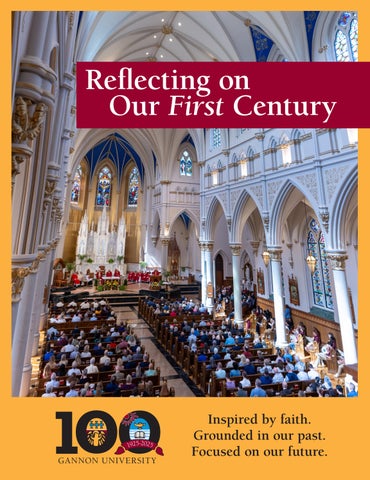
Reflecting on Our First Century
Inspired by faith. Grounded in our past. Focused on our future.
Dear Gannon family, As we reflect on this remarkable year in Gannon University’s history, it has truly been an honor to share in the celebration of our Centennial. We have celebrated 100 years of academic excellence, service, faith and community. For a century, Gannon has stood as a place where students of all backgrounds discover their potential, where curiosity is nurtured, and where lives are changed through education grounded in purpose and compassion. We celebrate Archbishop John Mark Gannon, whose bold vision established an institution committed to accessible and transformative learning. We celebrate the dedicated faculty and staff whose tireless work continues to shape our students and strengthen our mission. We celebrate the thousands of alumni and friends whose Gannon experiences—rooted in faith, leadership and service—have left lasting impressions on our campuses and our world. We celebrate and extend our heartfelt gratitude to our incredible donors, whose generosity fuels opportunities, enhances our learning environments and empowers students to thrive. Their belief in our mission strengthens Gannon today and helps secure its next 100 years. Throughout this Centennial year, we have honored our rich past, elevated the stories of the people who built and sustained this University, and embraced the future that lies ahead. From opening and blessing our beautiful newly renovated Highmark Events Center to celebrating an unforgettable Centennial Homecoming and Family weekend and welcoming His Eminence Cardinal Christophe Pierre, the Apostolic Nuncio to the United States, to celebrate our Centennial Mass, I have been blown away by the year that has marked this important milestone. It has been a time for reflection on Gannon’s history, and renewed commitment to our values, our mission and the communities we serve. We cannot forget a nod to our incredible donors, who have so generously given to the university to ensure that Gannon is here to stay for another century. On behalf of the Iwanenko family, we extend heartfelt wishes for peace, love and abundant blessings as we embark into our 101st year. I would like to thank you for being an essential member of this extraordinary community. Together, we have built something remarkable, and together, we will propel Gannon into its next century with optimism, innovation and purpose. Here’s to the next chapter in our shared story. May it be filled with growth, inspiration and joy. Thank you for an amazing Centennial Year of Gannon University. Walter and Mary Iwanenko President and First Lady, Gannon University
Contents GANNON’S NEXT CENTURY
Since the launch of Gannon University’s “Believe. Inspire. Transform.” campaign in 2017, the university has experienced remarkable growth and transformation across its campuses. More than 100 new endowments have strengthened scholarships and academic excellence, while spaces like the modernized Nash Library and Student Learning Commons have become hubs for innovation, collaboration and student support through the STEM Center and Writing and Research Center. The new Mary, Seat of Wisdom Chapel and Kraus Hall now serve as spiritual and community anchors on campus, complemented by the creative expression showcased through public art installations such as Triangulum and the Greenhouse Fence Art Project. Gannon’s expansion in advanced healthcare education continues to thrive, with more than a decade of success at the Ruskin, Florida campus, home to the Mobility Garden generously donated by Frank and Marie Haas. Transformative projects like I-HACK and the Pierre McCormick Cyber Learning Center, the revitalized Highmark Events Center, South Hall and the welcoming Alumni House have all enriched the Gannon experience. Meanwhile, sustainability and innovation initiatives such as Project NePTWNE, the Greenhouse, and CLEER are positioning the university at the forefront of environmental and community impact. Together, these achievements reflect the true spirit of the “Believe. Inspire. Transform.” campaign, which continues to shape Gannon’s future while honoring its Catholic mission and commitment to student success. What began as a vision to strengthen the university’s people, programs and places has become a movement that touches every corner of campus and extends far beyond it. Through the generosity of donors, the dedication of faculty and staff, and the passion of students and alumni, Gannon is not only transforming its spaces but also inspiring lives and believing in the limitless potential of its community.
6
From Sacred Beginnings: The Faithful Foundations of Gannon University Archbishop John Mark Gannon: the “Builder Bishop” who Transformed Erie Opening the Doors to Women: Gannon’s Journey to Co-Education
8
Creating Exceptional Learning Environments
10
Gannon’s Growth: Building Our Campus
12
Ruskin Expansion: The First Decade
14
A Century of Catholic Tradition in Action
16
From Faith to Movement: A Way of Life
18 20
Transforming Students and Communities Through Service Forming Lifelong Connections: Student Life and Community on Gannon’s Campus
22
Moments that Shape Us
24
Honoring Achievement: Celebrating Gannon Graduates
26
Spirit of Gannon: Gannon Golden Knights
28
Celebrating Maroon and Gold: Homecoming and Family Weekend
30
A Legacy of Innovation and Impact
32
Gannon Turns 100: A Year of Celebrating Together
34
A Century in the Making: Centennial Homecoming and Family Weekend
36
A Focus on the Future
2 4
Editor Sarah Grabski, Social Media and Digital Content Manager, Marketing and Communications Design Laura Giannelli, Creative Director, Marketing and Communications Photography Student, staff and alumni contributors and Gannon Archives 1
1
2
3
4
5
7 2
6
8
From Sacred Beginnings: the Faithful Foundations of Gannon University The Villa Maria Academy story began with faith. In the quiet heart of Erie in 1892, the Sisters of St. Joseph opened the doors of Villa Maria Academy. Their mission was rooted in faith: to educate, serve, and to bring light into the world through learning rooted in God’s love. Within the walls of Villa, young women discovered not only books and lessons, but a calling to live with purpose and compassion in the Erie community. The Sisters believed that education was not a privilege for the few, but a pathway for all young women. Guided by prayer and perseverance, they built a place where intellect and spirit walked hand in hand, where the hum of study mingled with the rhythm of chapel bells. By 1925, Villa had grown into Villa Maria College, led by Mother Helena Dillon and the Sisters of St. Joseph. Their vision stretched beyond themselves, seeing education as a way to transform the Erie community. It was around this same time that Bishop John Mark Gannon, another servant of God’s call, shared a dream of his own: to open the doors of Catholic higher education to young men in Erie. He found his answer within the very foundation the Sisters had built. The earliest incarnation of Gannon known as Cathedral College, was born under Villa Maria College’s charter, a testament to the Sisters’ generosity and belief that knowledge and faith should never be confined by walls or gender but shared freely in service of the Catholic faith. Through those early years, Villa stood as a pillar of Catholic womanhood and wisdom. Its faculty, sisters, and students embodied a spirit of strength, service, and grace that rippled outward
Early Presidents (1925–1942) Mother Helena Dillon, S.S.J.
across the city. Their classrooms shaped nurses, teachers, and leaders who carried Villa’s values into homes, hospitals, and parishes throughout the Erie region. Through the decades that followed, Villa Maria College flourished under devoted leadership. Mother Helena Dillon, who served as president until 1942, guided the college through the Depression years, ensuring that women could continue their education despite hardship. In 1928, Villa received its own charter from the State Council of Education, and by 1937, it earned accreditation from the Middle States Association of Colleges and Secondary Schools, an extraordinary milestone that affirmed the academic rigor and reputation of a college born from prayer and perseverance. While Gannon College would later grow independently, the roots of its Catholic identity remained intertwined with Villa’s soil. Both institutions shared a commitment to nurturing intellect through the light of faith. The spirit of the Sisters of St. Joseph continued to echo through Gannon’s halls long after the two colleges formally joined their missions in 1989. The bond between Villa and Gannon is not merely one of shared history, but one of shared heart. The Sisters built a legacy: a living, breathing mission that still shapes every student who walks through Gannon’s doors, carrying forward the grace that began so many years ago at Villa Maria.
(1942–1966) Mother Aurelia O’Hearn, S.S.J.
(1966–1988) Sister M. Lawreace Antoun, S.S.J.
(1988–1989) Sister Leonie Shanley, S.S.J.
1. Villa Maria students, 1928 2. Statue of Jesus on the Villa Maria campus 3. John Mark Gannon at the Villa Maria chapel 4. Villa Maria dormitory, 1983 5. Villa Maria campus, c1980 6. Villa Maria’s first male graduate, Thomas Obenreder 7. Villa Maria Commencement, 1983 8. Maryvaile on the Villa Maria campus
3
1
Archbishop John Mark Gannon: the “Builder Bishop” Who Transformed Erie Bishop John Mark Gannon witnessed the organic, economic inequalities that impacted whether students in Erie could access higher education in 1924. He witnessed these inequalities and decided nearly 100 years ago that he needed to take action. Alongside Monsignor Joseph K. “Doc” Wehrle, Gannon established Cathedral College, founded under the charter of Villa Maria College. Historians say he founded the college to ensure men and women had access to quality higher Catholic education.
the seventh of nine children and the family’s fourth son, according to historical documents.
“For some time I have been conscience of a cruel inequality… Those whose parents are wealthy… may set out for college…Those sons of workingmen, however, no matter how virtuous or talented, are forced to give up hope of a college education.”
“For some time I have been conscience of a cruel inequality… Those whose parents are wealthy… may set out for college,” Gannon said. 4
“Those sons of workingmen, however, no matter how virtuous or talented, are forced to give up hope of a college education.”
John Mark Gannon was born June 12, 1877, on Erie’s West Eleventh Street,
He attended Saint Patrick School and the old Central School on Tenth Street. He graduated from Clark’s Business College in 1892. After working at the Erie City Iron Works for two years as a bookkeeper, he began his seminary studies at St. Bonaventure College in Allegany, New York in 1894. He was ordained to the priesthood in 1901. Gannon became Bishop of Erie in 1920 following the death of the beloved Bishop John FitzMaurice, who had recommended Gannon for the position.
Gannon immediately devoted himself to
2
4
his native community, passionate about fighting for social equity in all avenues, but particularly through education. He decided to create Cathedral College with Wehrle in 1925. In 1925, there were 118,829 people that lived in Erie that identified as Catholic, 36 percent of Erie’s total population. The Diocese had 203 priests, and Gannon saw the need for a quality Catholic education in Erie. Cathedral College was originally housed in Wehrle’s Home, formerly known as the Downing Building, 225 W. 9th St., in Erie. It was founded under Villa Maria’s charter as a downtown extension for men. It was a college meant to provide men who were virtuous and talented, but not necessarily well-financed, with a strong liberal arts education. At the time, Erie had 15 parochial schools with a total of 6,655 students and the Catholic population in Erie only continued
3
5
to grow. By 1935, the Erie diocese recorded 128,093 parishioners. By 1941, Gannon purchased the Strong Mansion to house his college, what is known today as the Old Main building on Gannon’s Erie campus. By 1944, Cathedral College received its own charter and was renamed Gannon College of Arts and Sciences, honoring Gannon’s leadership.
1. John Mark Gannon in his study, c1930 2. John Mark Gannon and the “newsboys,” 1934 3. John Mark Gannon at Wherle Hall, 1956 4. John Mark Gannon and students, 1943 5. John Mark Gannon with Dr. Paul Siple and his mother and wife 6. Portrait of John Mark Gannon, 1961
Gannon is also credited with founding the Gannondale Home for Girls, Harborcreek Training School for Boys, Saint Joseph’s Home for Children, the Erie Day Nursery and several hospitals throughout the Diocese of Erie. The crowning joy of his career was establishing Saint Mark Seminary on East Grandview Boulevard. After serving the church for 67 years, he died September 5, 1968, having ensured social equality for thousands in the Erie community.
6
5
Opening the Doors to Women: Gannon’s Journey to Coeducation Gannon University’s path to coeducation was a gradual but transformative journey. Founded in 1941 as a college for young men of Erie’s Catholic community, Gannon began opening its doors to women in 1945, when its charter was amended to allow women to attend night school. Through the following decades, opportunities expanded. By the 1950s, women could enroll in afternoon and evening classes, and in 1963, the college introduced its first coeducational courses. That same year, Gannon student Marlene Santia
and twelve other pioneering women walked into their first classes—a few among nearly 1,300 men—marking a quiet but historic shift toward inclusion. Momentum continued through the 1960s and 1970s. In 1965, the Association of Gannon Coeds formed, and by 1967, the university celebrated its first class of female graduates. Two years later, Gannon officially became fully coeducational, with Patricia McQuistion earning the institution’s highest academic honors. The transformation carried into campus
life, from the opening of North Hall in 1970 to the introduction of women’s intercollegiate athletics in 1974. What began as cautious inclusion evolved into a full embrace of equality, fulfilling the vision Santia later captured best: “Soon no one will think of Gannon men and Gannon women—only Gannon students.”
1
2
3
6
4
The Path to Coeducation 1945 Gannon amended its charter so women could attend night school. 1956 Women began being accepted to afternoon and night classes (classes of women only, not coeducational). 1963 Gannon’s afternoon classes become coeducational.
5
1965 Association of Gannon Coeds (Alpha Gamma Chi), the first student women’s organization, was formed. 1967 Gannon University first had women in its graduating class. 1969 Gannon University fully became coeducational.
6
7
1. Freshman class with Anne Marie Ingrao, Gannon’s first woman graduate, 1958 2. Gannon College Record (Original Gannon Magazine) cover, 1971 3. The first softball team, 1975 4. Joy Sweeting, who organized first womens sports, 1974 5. Association of Gannon coeds, 1965 6. Commencement, Patricia McQuiston first woman to receive commencement honors (Medal of Honor and Msgr. Gooder Award for Excellence in Humanities), 1969 7. First woman to receive a commission through Gannon ROTC program, 1978
Patricia McQuistion became the first women to get commencement honors (Medal of Honor, Monsignor Gooder award for Excellence in Humanities). 1970 North Hall, Gannon’s first women’s dormitory, opened. 1973 ROTC at Gannon was opened to women. 1974 Gannon’s first women’s intercollegiate athletic sports program formed with volleyball, basketball, tennis and softball programs.
7
2
1
3
4
Creating Exceptional Learning Environments For a century, Gannon University has been defined by a spirit of academic ambition and innovation. What began in 1925 as a small Catholic college under Villa Maria’s charter soon grew into a thriving institution dedicated to intellectual and spiritual development. By 1944, Gannon College had earned its own charter and was awarding bachelor’s degrees in the
arts and sciences, later expanding into business, engineering, humanities, and applied sciences. The postwar era brought rapid growth as veterans filled classrooms and new programs took shape, laying the foundation for graduate studies and professional accreditation in the decades that followed. From the establishment of the Dahlkemper School of
6
5 8
7
8
9
10
Business in the 1950s to the opening of the Zurn Science Center, Palumbo Academic Center and Morosky College of Health Professions and Sciences, Gannon continued to expand its reach and impact. By the 21st century, it had evolved into a dynamic university offering degrees from the undergraduate to doctoral levels and extending its mission to
the Ruskin, Fla. campus in 2015. Today, programs in health, engineering, business and emerging fields like cybersecurity and data science continue to advance Gannon’s legacy rooted in faith, powered by innovation, and dedicated to shaping lives of purpose and distinction.
12
11
13
1. Nursing lab, 1983 2. Learning lab, 1963 3. Villa classroom, c1980 4. Zurn lab, c1970 5. Zurn lab, c1970 6. Villa classroom, c1980 7. Project GIVE (Guidance in Vocational Education) 8. Archaeology field school, c1980 9. Chemistry lab, 1984 10. Little Knights Clinic, 2023 11. Summer Festival of the Arts, 1986 12. Villa classroom, c1980 13. Villa classroom, c1980
9
2
1
3
4
Gannon’s Growth: Building Our Campus As Gannon University’s academic ambitions expanded over the past century, so did its physical footprint in the heart of downtown Erie. What began as a single building has grown into a vibrant urban campus that blends historic architecture with modern innovation. Over the decades, Gannon has revitalized city blocks, transforming them into spaces that
foster learning, community and connection. From the restoration of historic landmarks to the construction of state-of-the-art facilities, Gannon’s campus growth has mirrored its mission to serve both students and the surrounding community. As Erie’s workforce needs have evolved over the past century, Gannon responded in kind,
6
5 10
7
8
9
10
developing academic programs and building specialized facilities that have prepared students for careers in emerging and in-demand fields. Facilities such as advanced health sciences centers, technology labs and innovation hubs stand as physical symbols of the University’s commitment to fueling regional economic growth and meeting industry needs.
Beyond Erie, the establishment of the Ruskin, Fla. campus and the planned addition of Ursuline College have extended Gannon’s reach and reaffirmed its dedication to innovation, health sciences, and global engagement—ensuring that the University’s impact continues to grow well beyond its original city block.
12
11
13
1. Beyer Hall, c1970 2. Wehrle Hall, c1970 3. Gannon Theatre 4. Mary, Seat of Wisdom Chapel, 2004 5. Finegan Hall, c1990 6. Zurn Science Center, c1970 7. Gitnik Manse, 2010 8. Nash Library, 1973 9. Robert H. Morosky Academic Center, 2008 10. McConnell Family Stadium, 2017 11. A.J. Palumbo Academic Center, 1994 12. Construction of the John E. Waldron Campus Center, 1998
11
1
2
3
Ruskin Expansion: The First Decade When Gannon University announced plans to open a campus in Ruskin, Fla., the University’s vision was to extend its Catholic mission and academic excellence beyond Erie to meet a growing national need for health professionals through programs grounded in service, faith and innovation. Ten years later, that vision remains the same. It first came to life with the launch of Gannon’s Occupational Therapy Doctorate program in 2015, welcoming an inaugural class of just 28 students. 12
The start was humble but filled with promise. “It has been a remarkable journey building our campus community in Florida. After a decade, the growth we’ve experienced is astounding,” said Walter Iwanenko, Ph.D., Gannon University President. “What began as online course offerings, followed by a leased office space for classes, has now evolved into an incredibly dynamic learning environment, complete with a tight-knit community and outstanding facilities. What hasn’t changed over the years is the quality of our students,
faculty and staff—they have been, and continue to be, the heart of this campus.” From a single renovated building, faculty and students began to build a community that reflected the heart of Gannon 1,100 miles from its Erie home. Over the next five years, that seed of an idea grew into a thriving campus. In August 2019, the campus celebrated the grand opening of an 83,000-squarefoot academic building, a $20 million investment in both education and community.
4
6
The Ruskin campus now boasts thriving programs including Occupational Therapy, Physical Therapy, Physician Assistant and Speech-Language Pathology with more than 240 students enrolled. Gannon Ruskin only continues to expand its offerings to respond to the workforce needs locally. Dr. Sarah Ewing, Ph.D., Gannon University Provost and Vice President for Student Experience, formerly the Dean of the Morosky College of Health and Science Professions, helped open the campus a decade ago.
5
7
“We are so grateful for the ongoing support of the Ruskin community,” she said. “One of many things that makes our Ruskin campus so unique is the innovative learning environment created there allowing our students to learn and then apply their learning in ways to serve the community.” From Erie to Ruskin, Gannon’s story continues to grow and thrive. “Our campus in Ruskin reflects our Catholic tradition and extends our call to service as a Catholic institution. This campus, and the experience of our students, are proudly built on a solid
foundation and will continue to carry us into our next century,” Iwanenko said.
1. Aerial view of the Ruskin Campus, 2015 2. Physician Assistant students, 2021 3. Ruskin Commencement, 2023 4. Dr. Iwanenko’s Inauguration student reception, 2023 5. Golden Knight sculpture, 2022 6. New Academic Building Dedication and Blessing, 2019 7. Aerial view of the Ruskin Campus, 2025
13
1
2
3
4
5
7 14
6
8
A Century of Catholic Tradition in Action Gannon University is one of only seven universities left in the United States that remains formally affiliated with a Catholic Diocese. This distinction is more than a historical footnote—it is a defining part of the university’s identity and a lens through which its evolution and impact can be understood. Since its founding, Gannon has been deeply intertwined with the Erie community, shaped by its Catholic roots and the longstanding relationship between the university, the Catholic Diocese of Erie and the broader community. What began as the vision of Bishop John Mark Gannon and the Sisters of St. Joseph, a vision for a robust, high-quality Catholic higher education system in northwest Pennsylvania, has grown into an institution that continues to honor and embody those founding principles nearly a century later. “When you look back at the last 100 years, you see the impact of our Catholic leadership and see names like Msgr. Wehrle and Msgr. Nash, Mother Helena Dillon and Sister Lawreace Antoun” said University Chaplain, Rev. Michael Kesicki ’83. “And you hear about the impact they had on our student body and our Gannon/Villa family, and it’s something you can still feel here today.” These leaders, along with Archbishop Gannon himself, helped to shape the university’s culture of care, service and personal formation—traits that have long distinguished the Gannon experience. Luther Manus ’53, ’71M recalls the significance of that personal influence vividly. “I don’t know that I would have made it if it weren’t for him,” Manus said of Msgr. Wehrle. “He was always checking in on me and making sure I was good.” Stories like these are woven throughout Gannon’s history. They reflect a campus atmosphere where students are not only educated, but known, encouraged and guided through some of the most formative years of their lives.
This deep-rooted connection has shaped not only Gannon’s mission but also its enduring impact on the region. As Fr. Shane Matthew, Associate Provost for Mission Immersion and Academic Affairs, shared, “Even when you rewind a few decades, you see this relationship that Gannon has had with the Erie community. Gannon has always been intertwined with not only the Diocese, but things like workforce development and responding to what the Erie community needs. Listening to our community partners and then developing students to meet those needs.” Whether through academic programs designed to meet regional workforce demands, service-learning courses that place students alongside community organizations, or partnerships with local parishes and diocesan schools, the university remains rooted in its founding purpose: to uplift the community it calls home.
an approach that aligns deeply with its Catholic foundation. As Gannon approaches its next century, its Catholic heritage remains both a cornerstone and a compass, shaping its priorities, informing its purpose and connecting its past to its future. The university’s identity continues to be a vibrant, living tradition—carried forward by the students, faculty, staff and community members who embody its mission each day and who will guide it into its next chapter.
9
The university continues to draw from its Catholic identity as a source of guidance and inspiration today. Its mission emphasizes service, leadership and a commitment to holistic education, values that shape not only curricula but the everyday rhythms of campus life. “A big part of Gannon’s history is how people found their lives here and how this institution helped orient them throughout,” said Kesicki. “They found their purpose and where their lives were meant to go and did it on this campus.” Gannon’s dedication to helping students discover meaning and vocation remains as strong as ever. Through outreach, partnerships and a continued prioritization of both academic excellence and spiritual development, Gannon works to meet real community needs while also providing meaningful and transformative experiences for students. This ongoing collaboration reflects the university’s belief in education that integrates intellectual growth, spiritual development and social responsibility,
10
1. First Mass in the Gannon Auditorium, 1949 2. Msgr. Rubino at Gannon’s 50th Anniversary Mass, 1983 3. Mass, c1970 4. Campus Ministry retreat, 1977 5. St. Mark Seminarians, 1800s 6. Blessing of the Throats, 1983 7. Villa Maria College Commencement, 1938 8. St. Mark Seminary and Seminarians, 1956 9. Recreation Center Blessing, 1984 10. Mass in the Gannon Auditorium, 1964
15
2
1
3
4
From Faith to Movement: A Way of Life Christ’s ministry was defined by a radical dedication to others, especially the most vulnerable, and it is this example that shapes the third distinguishing trait of a Catholic university—service. For institutions like Gannon University, which seek to imitate Christ’s selfless response to human need, service is a not simply an activity or requirement. It is a way of life. It is a challenge and a calling that should permeate every aspect of our work, relationships, decisions and responsibilities.
This commitment to service is woven into the mission and identity of Gannon and has been lived out by generations of students, faculty and staff. Throughout the years, Gannon students have embraced social responsibility not as an abstract ideal but as a lived practice. They have consistently responded to community needs with creativity, compassion and conviction, whether through small acts of kindness or large-scale service initiatives. Students have organized food and clothing drives to support individuals and families
6
5 16
7
8
9
10
in crisis, led fundraising campaigns for local shelters and nonprofits, and participated in outreach that strengthens Erie’s neighborhoods in tangible and meaningful ways.
at dozens of sites, cleaning parks, supporting community organizations, assisting local parishes, and working directly with residents.
One of the clearest expressions of this service-oriented spirit is Gannon’s annual GIVE Day (Gannon’s Invitation to Volunteer Everywhere). Established as a way for the Gannon community to come together in service, hundreds of students, faculty, staff and alumni scatter across the city to volunteer
Gannon’s commitment to service continues to guide its mission and animate its community. It invites each member of the Gannon family to embrace Christ’s example of selfless love and to live out that call through purposeful action, compassionate leadership and dedicated service to others.
12
11
13
1. Community service, c2000 2. Cleveland Hunger Cleanup, 1991 3. Food Drive, 2006 4. 10-hour famine, 2003 5. Day of Caring, 2011 6. Hunger Awareness Week, 1984 7. Day of Caring, 1998 8. Clothing Drive, c1990 9. Day of Caring, 2009 10. SSJ Thanksgiving dinner, 2009 11. GIVE Day, 2008 12. Food Drive, 1989 13. Day of Caring, 2010
17
2
1
3
4
Transforming Students and Communities Through Service Gannon’s Catholic environment is rich in opportunities to carry out the type of individual and community services reflective of those performed by Christ during his public ministry. An example of this came about in 1992, an opportunity created by Gannon called Alternative Break Service Trips (ABST). ABSTs are student led, small group, service and learning immersions rooted in four pillars of
service, simplicity, community, and reflection. Trips have ranged from international travel to places like Mexico, Zambia, Honduras, Guatemala and Canada, from domestic travel to places like New Orleans, Chicago, South Dakota and Georgia. Each ABST is designed for students to immerse themselves in a culture and to serve.
6
5 18
7
8
9
10
Rachel Nye ’20, described the ABST that she took in 2019 to Guatemala. “During this experience, love is what moved us. It was something we craved and something that we could give to others,” she said. “We showed love in helping each other climb up mountains on our early morning hikes. We showed it by attempting to speak average Spanish to the people on the streets. We showed it by worshiping alongside community members at an Ash Wednesday service that was in Spanish." Beyond the personal transformation, ABSTs embody Gannon’s mission to prepare students for leadership in both church and society. They demonstrate how education, when
grounded in Catholic social teaching, becomes a powerful force for justice, compassion, and community-building. What makes ABST particularly impactful is its emphasis on immersion. Students do not simply volunteer; they enter into relationships with the people and places they serve. They learn about the social, historical and economic realities of the communities they visit and are encouraged to reflect on how these realities intersect with issues of justice and faith. As ABST looks ahead to future decades, it continues to stand as one of Gannon University’s most powerful expressions of its Catholic identity—an invitation for students to serve boldly, grow deeply and live out the example of Christ in meaningful and lasting ways.
12
11
13
1. Kentucky ABST, 1996 2. New York City ABST, 2006 3. New Orleans ABST, 2007 4. Mexico ABST, 2002 5. South Dakota ABST, 2006 6. El Salvador ABST, 2012 7. Zambia ABST, 2019 8. Georgia ABST, 2002 9. Kentucky ABST, 1997 10. Arizona Border ABST, 2008 11. Mexico ABST, 2023 12. Mexico ABST, 2007 13. L’Arche Ontario ABST, 2012
19
Forming Lifelong Connections: Student Life and Community on Gannon’s Campus Life at Gannon University extends far beyond the classroom. Gannon has long offered students a vibrant and enriching experience filled with connection, creativity and community. Clubs and organizations have been an integral part of campus for generations. Gannon has also historically offered many activities that bring our student body together. From academic and professional societies to cultural organizations, faith-based groups, service clubs, performing arts ensembles and special-interest
communities, student organizations have created countless opportunities for involvement and belonging. Beyond structured organizations, Gannon has continually offered a lively array of campus activities designed to bring students together. Throughout the decades, events such as concerts, dances, talent shows, study nights, intramural sports, cultural celebrations and late-night programs have woven energy into campus life. Whether students are gathering for free live music, teaming up for a recreational
game, or joining peers for a themed dance, these activities create moments of joy and connection that enrich their college experience. For many, joining a club is their first step toward building lifelong friendships, developing leadership skills and finding their place within the broader Gannon community. The spirit of connection that has long characterized Gannon’s campus remains as strong and meaningful today as ever.
1
2
3
20
4
8
9
10
5
11
Gannon’s Global Impact 6
1. Circus in the Gannon Auditorium, c1950 2. Pi Kappa Alpha, 1986 3. 8-Ball Dance, 1974 4. 8-Ball Dance, 1963 5. Extreme Home Makeover in Erie, 2009 6. Frank Zappa concert, 1974 7. Jesus Christ Superstar, 1971 8. Fr. Kesicki service in Guatemala, 2013 9. Asian Festival, 2009 10. Global students with pumpkins, 1991 11. Global students, 1977
7
Gannon University’s commitment to creating global citizens is reflected in its wide range of international learning and service opportunities that extend far beyond its campuses in Erie, Pa., and Ruskin, Fla. Through the university’s Learning Abroad program, students immerse themselves in new cultures and perspectives while earning academic credit in destinations around the world, from Italy and Ireland to Australia and Japan. These experiences cultivate a deeper understanding of global issues, broaden worldviews and foster cross-cultural communication skills that prepare students to thrive in an interconnected world.
21
2
1
3
4
The Moments that Shape Us Tradition is at the heart of the Gannon experience, weaving together generations of students, faculty and alumni through moments of Gannon pride, reflection on experiences and shared connection. From the excitement of Orientation and Welcome Week, where new students are embraced into the Gannon family, to the laughter once shared at campus dances
and still shared at various social gatherings, these traditions foster a sense of belonging that lasts well beyond graduation. Since 1966, alumni reunions have brought Golden Knights back to Erie to reconnect with classmates and celebrate the enduring friendships and memories that define their time at Gannon. Likewise, the beloved Phonathon once connected
6
5 22
7
8
9
10
students and alumni through late-night calls filled with stories and shared pride, strengthening the ties that make the Gannon community so unique. Throughout the academic year, Gannon’s traditions also honor the spirit of service and celebration that defines the University. These traditions, whether rooted in decades of
history or newly established, reflect the heart of Gannon’s mission to foster connection, celebrate achievement and remind every Golden Knight that they are part of something greater than themselves.
12
11
13
1. Alumni Weekend, 1964 2. Villa Maria Orientation, c1980 3. Orientation with Fr. George Strohmeyer, 1974 4. Telethon, 1976 5. Freshman Days, c1980 6. Orientation, 1985 7. Phonathon, c1980 8. Orientation, 2009 9. Alumni Weekend, 1971 10. Dance, c1980 11. 8-Ball Dance, 1976 12. Alumni Weekend, 1964 13. New Student Orientation, 2011
23
2
1
3
4
Honoring Achievement: Celebrating Gannon Graduates Commencement has stood as one of Gannon University’s most cherished traditions for 100 years as a celebration of achievement, faith and community that marks the culmination of each student’s academic journey. From the
earliest intimate ceremonies held in the heart of downtown Erie to today’s ceremonies filled with family, faculty and friends in our Highmark Events Center or Erie Insurance Arena, commencement has symbolized the University’s
6
5 24
7
8
9
10
enduring mission to inspire leadership, service and lifelong learning. Each ceremony reflects Gannon’s Catholic heritage and deep commitment to transforming lives through education, reminding graduates that their knowledge and faith are meant to be shared in service to others. Over the past 100 years, Gannon has proudly conferred degrees upon more than 50,000 graduates. These alumni
12
11
14
form a living legacy of Gannon’s impact, representing countless stories of perseverance, discovery, and hope. Commencement remains not only an ending, but also a new beginning—a powerful reminder that Gannon’s story continues through the achievements and service of its alumni.
13 1. ROTC Bicentennial Color Guard, 1976 2. Commencement, 1995 3. Commencement, 1977 4. Commencement, c1980 5. Commencement, 1986 6. Commencement, c2000 7. Commencement, 1982 8. Commencement, 1956 9. Cathedral College Commencement, c1930 10. Villa Maria College Commencement, 1987 11. Commencement, c1980 12. Commencement, 1952 13. Villa Maria College Commencement, 1938 14. Commencement, 1998
25
1
2
3
4
Spirit of Gannon: Gannon Golden Knights Gannon University’s athletic spirit has historically been inseparable from the drive and pride of its students . What began in the 1940s with a fledgling basketball team’s first victory and an undefeated football season soon grew into a dynamic tradition of competition and camaraderie. The following decades brought structure and success: national championships in bowling, the rise of powerhouse basketball under Howard “Bud” Elwell ’55, and the birth of women’s athletics in the 1970s, led by trailblazers like Karen Morris and 26
supported by the newly formed Booster Club. Gannon’s athletic offerings expanded rapidly, with new teams in wrestling, soccer and baseball, while the Hammermill Center’s opening in 1981 cemented the University’s place as a regional athletic hub. By the 1990s and beyond, Gannon had become a thriving athletic community defined by excellence, innovation and inclusivity. State-of-the-art facilities like the Carneval Athletic Pavilion and McConnell Family Stadium transformed campus life, while teams earned
national rankings and academic honors alike. The return of football, the rise of women’s programs and the addition of new sports like acrobatics and tumbling reflected a spirit of growth and determination that continues today. From the undefeated Golden Knight football team of 1949, to the nationally-ranked women’s and men’s programs of today, Gannon’s studentathletes embody a legacy built on heart, teamwork and the enduring belief that greatness is achieved through service, discipline and love of the game.
5
7
6
8
10
12
9
11
13
1. Men’s Wrestling, 1970 2. Baseball, 1960 3. Women’s Cross Country, 2019 4. Men’s Basketball, 1974 5. Football, 1949 6. Men’s Soccer, 1968 7. Football, 2001 8. Hockey, 1973 9. Women’s Lacrosse, 2019 10. Women’s Basketball, 1974 11. Acrobatics and Tumbling, 2018 12. Villa vs. Gannon Softball, 1984 13. Men’s Golf, 2021
27
Celebrating Maroon and Gold: Homecoming and Family Weekend Gannon’s Homecoming, now known as Homecoming and Family Weekend, has served as a vibrant reminder of the University’s close-knit community and lasting spirit. What began as a small campus gathering has evolved into a weekend-long celebration filled with alumni reunions, spirited athletic events and opportunities for students, faculty and families to connect. From the excitement of the Homecoming game to the warmth of class reunions and
the camaraderie of campus festivities, each event reflects Gannon’s enduring commitment to faith, friendship and belonging. Over the decades, Homecoming has grown beyond a simple reunion. It has become a living expression of Gannon pride. Alumni return to see how campus has transformed while revisiting the places and people who shaped their lives. Students carry
forward the same enthusiasm, building new memories that link them to generations past. Whether cheering from the stands, marching in the parade, or gathering for Mass, the Gannon community continues to honor this timeless tradition as a celebration of unity, gratitude and the shared journey that connects every Golden Knight.
2
1
3
4
28
5
7
6
9
8
10
11
1. Homecoming parade, 1985 2. Homecoming, 2011 3. Homecoming parade, 2008 4. Homecoming parade spectators stand in the rain, 1992 5. Dr. Taylor and his son Timmy watch the parade, 2012 6. Joe Luckey leads the Homecoming parade, 1994 7. Homecoming parade spectators, 2011 8. Homecoming dance, 1991 9. Homecoming football game crowd cheers, 2013 10. Homecoming parade, 1985 11. Homecoming football game crowd cheers, 2019
29
1
2
3
A Legacy of Innovation and Impact at Gannon University From groundbreaking research to transformative innovation, Gannon University has long stood at the forefront of academic excellence. For decades, the university has nurtured a culture where curiosity is encouraged, creativity is celebrated and meaningful discovery becomes a way of life. Guided by dedicated and distinguished faculty, Gannon students consistently rise to the challenge of making a measurable difference on campus, in the 30
community, and across the globe. What sets Gannon apart is its commitment to blending rigorous academic preparation with real-world application. In classrooms, students develop the foundational knowledge needed to think critically and creatively. In laboratories and spaces on campus like Gannon’s Makerspace, ideas take shape through hands-on experimentation, collaborative problemsolving and cutting-edge technology.
Beyond campus boundaries, Gannon’s focus on innovation continues through strong community partnerships and global initiatives. Whether working alongside local organizations or engaging in international service and research, students learn to apply their skills in ways that foster sustainability, promote equity and uplift communities. Faculty mentors play an essential role in this process, guiding students as they explore their interests and pursue
4
6
ambitious projects. Together, they work on designing medical devices that enhance patient care, advancing environmental sustainability efforts that protect natural resources, developing emerging technologies that respond to societal needs and creating practical solutions that improve lives both locally and globally. From the earliest stages of their academic journey, students are encouraged to explore bold ideas and engage with interdisciplinary perspectives. Courses and programs
5
7
across the university integrate opportunities for inquiry, dialogue and experimentation, allowing students to see the connections between theory and practice. This focus on exploration helps cultivate adaptable thinkers who are prepared to navigate an ever-changing world with confidence and curiosity. At Gannon, innovation is more than an academic pursuit. It is a shared mission and a driving force that empowers students to envision and build a better future. Through research, invention and a deep commitment to service, the
Gannon community continues to shape the world with creativity, compassion and purpose.
1. Gannon University's Center for Lake Erie Education and Research (CLEER), 2025 2. Student-faculty designed COVID testing lab, 2020 3. Snow removal robot, 2019 4. Gus Pulakos Candy School held yearly at Gannon, 1982 5. Student-created head support displayed at Celebrate Gannon, 2018 6. Lake Erie research, 1972 7. Faculty-led eclipse event, 2024
31
Gannon Turns 100: A Year of Celebration Together For 100 years, Gannon University has stood as a beacon of knowledge, faith and service, inspiring generations of students to lead with purpose and make an impact in their communities. Since 1925, and with a mission rooted in Catholic values, the university has grown into a dynamic institution that empowers learners from all walks of life. As Gannon commemorates this incredible milestone, the community is invited to reflect on its rich history, celebrate its achievements and look forward to a bright future together. Gannon launched its 100th anniversary celebration with the opening of the
newly renovated Highmark Events Center in January. An official blessing and dedication ceremony took place on January 15. Following the Highmark opening, the university marked the 100th Day of its 100th year celebration on April 10, followed by a record-setting Centennial Day of Giving on April 24. More than $420,000 was raised from more than 1,300 donors. The Centennial celebrations continued alongside the Sisters of St. Joseph’s 150th anniversary with a Mass and Reception on May 7. This was followed
by Gannon’s Centennial commencement ceremonies in Erie on May 10 and in Ruskin on May 17. The capstone of Gannon’s Centennial year was the Centennial Homecoming and Family Weekend, which included the Alumni House Blessing and Dedication event, the Heritage Society Luncheon and the annual Homecoming Tailgate—leading into the Block Party of the Century. The weekend concluded with a Centennial Mass celebrated by His Eminence Cardinal Christophe Pierre, the Apostolic Nuncio to the United States.
2
1
3
4
7 32
8
5
7
6
8
9
10
11
1. On the 100th day of Gannon’s 100th year, faculty and staff members at both campuses received a note from President Iwanenko along with a special Centennial lapel pin and other items 2. Gumby and Victor photographed at the Highmark Events Center Opening 3. Gannon celebrated its 100th year with a special edition Golden Knight Lager, made in a partnership with Lavery Brewing 4. The Highmark Events Center was reopened officially on Jan. 15 5. Cross made by local Erie artist Evan Everhart as it appears in the Highmark Events Center 6. Rev. Michael Kesicki ’83 offers a blessing at the Heritage Society Luncheon 7. Gannon students and staff celebrate the 100th day of Gannon’s 100th year 8. Gannon entered into a partnership with Mishka Vodka to create a centennial cocktail that featured the vodka 9. The new exterior of the Highmark Events Center 10. Centennial merchandise was created in partnership with Erie Apparel 11. The newly-renovated lobby of the Highmark Events Center
33
A Century in the Making: Centennial Homecoming and Family Weekend The 2025 Centennial Homecoming and Family Weekend, held September 10-14, 2025, welcomed alumni, students, faculty, staff, families and the Erie community to mark 100 years of the University’s mission, history, and impact. The weekend’s events included the ribbon-cutting of the new Alumni House on West Sixth Street, the Homecoming Family Tailgate, campus trolley tours highlighting historic and modern facilities, and the Block Party of the Century under the Gannon arch with music, food and one-of-a-kind entertainment. The family tailgate included face
painting, cornhole and great food. The Block Party of the Century included musical performances under the Gannon arch, bull riding, axe throwing, inflatable obstacles, live entertainment, a strolling magician, caricature artist, and more.
century of growth and transformation. The milestone served not only as a reflection on Gannon’s enduring legacy, but also as an inspiring reminder of the University’s bold vision for the future, one that continues to be shaped by the people who call Gannon home.
Throughout the weekend, campus buzzed with a sense of pride and reconnection as generations of Golden Knights came together to share memories and create new ones. Alumni revisited beloved spaces, families explored the traditions their students have come to cherish, and the Erie community joined in celebrating a
The weekend concluded Sunday with a memorable Centennial Mass celebrated by His Eminence Cardinal Christophe Pierre, Apostolic Nuncio to the United States, symbolizing the University’s Catholic heritage and its forwardlooking commitment to the next century.
1
2
3 34
4
5
6
A Century of Faith
7
1. Block Party of the Century 2. A young alum with child 3. The Alumni All-Stars perform as part of the Block Party of the Century 4. Axe throwing at the Block Party of the Century 5. Mechanical bull at the Block Party of the Century 6. Dr. Sarah Ewing, student Madeline Emerson and Fr. Shane Mathew at the Homecoming Tailgate 7. Future Golden Knights pose at the Homecoming Tailgate 8. His Eminence Cardinal Christophe Pierre celebrates Centennial Mass 8. His Eminence Cardinal Christophe Pierre with the Iwanenkos
Gannon University was honored that His Eminence Cardinal Christophe Pierre, the Apostolic Nuncio to the United States, joined us in Erie, Pa. to celebrate our Centennial Mass and preach the homily during Gannon’s Centennial Homecoming and Family weekend. The Centennial Mass took place at St. Peter Cathedral at 11 a.m. on Sunday, Sept. 14, 2025, marking a century of academic excellence as a Catholic university. The Apostolic Nuncio serves as the diplomatic representative of the Holy See to the United States and serves as a link between the Vatican and the Catholic Church in the U.S. Cardinal Pierre’s visit to Erie is a significant acknowledgment of Gannon’s identity and mission in the communion of the Catholic Church and its commitment to provide for the education and formation of our students from the experience of faith and service.
35
1
2
3
A Focus on the Future As Gannon University celebrates its centennial, it remains firmly focused on the future, building on a century of faith, service and innovation to meet the evolving needs of students and families. The University’s recent merger with Ursuline College marks a bold step forward in Catholic higher education, expanding Gannon’s reach and creating new opportunities for collaboration, academic excellence and student success. This strategic partnership reflects Gannon’s commitment to growth through shared mission and innovation, ensuring both institutions 36
continue to thrive in an ever-changing educational landscape while preparing students to lead with compassion and purpose. Gannon’s forward-looking vision is also reflected in its transformative initiatives that merge education with real-world impact. Projects like Project NePTWNE, which advances environmental sustainability and waterquality research through cutting-edge science and community engagement, demonstrate Gannon’s role as a leader in addressing global challenges.
Similarly, the First Ascent partnership demonstrates Gannon’s commitment to the Erie community and gives its students the opportunity to learn cutting-edge technology firsthand in our Institute for Health and Cyber Knowledge building. Collectively, these efforts embody Gannon’s unwavering dedication to shaping the next century with innovation, integrity and the enduring belief that education can transform both individuals and the world around them.
4
6
5
7
9
8
1. Leaders from Gannon University, Ursuline College and the Ursuline Sisters sign a Letter of Intent, Sept. 2024 2. Gannon announced a partnership with Allegheny Health Network and First Ascent Biomedical in Feb. 2025 to build labs in Gannon’s I-HACK building to use Artificial Intelligence to research cancer 3. Leaders pose in the currently-vacant space in Gannon’s I-HACK building that will soon serve as new lab space for First Ascent Biomedical and AHN Saint Vincent and Gannon 4. Gannon University unveiled its new Center for Lake Erie Education and Research (CLEER) in October 2025 5. Students work in the new Gannon Greenhouse during GIVE Day in Sept. 2025 6. Leaders from Gannon University and Ursuline College 7. Ursuline College campus in Pepper Pike, Ohio 8 & 9. The Historic Erie Preservation Trust transforms the corner of West Sixth and Sassafras streets, including moving a house to where Wehrle Hall stood, Sept. 2025
37
Centennial Prayer Gracious God and Father, In this year of jubilee, we honor the fortitude and pioneering spirit of the Sisters of Saint Joseph and Archbishop John Mark Gannon in founding this university 100 years ago. We thank you for the blessings you have bestowed on Gannon University, and we pledge to strive with your grace to serve as a pillar of faith, and a lamp of wisdom in our communities and in our world. Entrusting ourselves to the intercession of Blessed Mary, Seat of Wisdom and St. Joseph keep us true to our mission and steadfast in our hope. Through Christ our Lord. Amen.