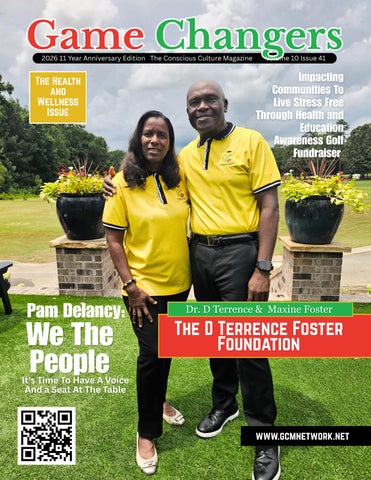
Game Changers Game Changers 2026 11 Year Anniversary Edition The Conscious Culture Magazine
The Health and Wellness Issue
Pam Delancy:
We The People
Volume 10 Issue 41
Impacting Communities To Live Stress Free Through Health and Education Awareness Golf Fundraiser
Dr. D Terrence & Maxine Foster
The D Terrence Foster Foundation
It's Time To Have A Voice And a Seat At The Table
www.gcmnetwork.net
GAME CHANGERS MEDIA NETWORK
A SEASON OF STRESS FREE THROUGH HEALTH AND WELLNESS EDUCATION “A society that keeps cures a secret so they can continue to sell medication for huge profits is not a real society, but a huge mental asylum.”- Dr. Sebi
Game 2026 Media Kit
Pulse of the Community (Small Business)
The
Changers Conscious Culture
Media Network
STRESS FREE HEALTH AND WELLNESS ISSUE 2026 Summer Edition | Volume 10 Issue 41
EDITOR-IN-CHIEF Andreal Mallard Founder/ Publisher COVER MODELS Dr. D Terrence & Maxine Foster D Terrence Foster Foundation DESIGN & LAYOUT Streetz of Gentlemen, Inc #EEEsUp Branding (@streetzofgentlemen) CONTRIBUTORS Shawn Raleigh, Patrick Davis, Dominique Huff, Micheal Brown, Richard Stewart, Kaylon Truitt, Branson Hartsfield, Andreal Mallard
BEHIND THIS ISSUE
BRAND MANAGEMENT SERVICES Streetz of Gentlemen, Inc. www.streetzofgentlemen.com streetzofgentlemen@gmail.com ADVERTISING Game Changers Magazine gamechangerstvandradio@gmail.com
FACEBOOK @gamechangersmedianetwork TWITTER @GCMediaNetwork INSTAGRAM gamechangersmedianetwork GAMECHANGERSTVANDRADIO@GMAIL.COM
WWW.GCMNETWORK.NET The information contained in this magazine is for general information purposes only. It is not intended to be a substitute for professional medical, legal, or financial advice. Always consult with a qualified professional before making any decisions about your health, legal matters, or finances. The magazine makes no representations or warranties about the accuracy, completeness, or suitability of the information contained in this magazine for any particular purpose. The magazine shall not be liable for any loss or damage arising from the use of or reliance on the information contained in this magazine. The magazine reserves the right to make changes to the information contained in this magazine at any time without notice.
CONTENTS INFO YOU NEED
37 MAKING WELLNESS PERSONEL AT FUSION HEALTH & WELLNESS
POWER, POLITICS, & A CITY DIVIDED:
41 ATTORNEY ROBERT KENNER, JR. BREAKS SILENCE
EMPOWERING WOMEN TO BUILD
51 WEALTH, PROTECT THEIR LEGACY, &
SPOTLIGHT
GET THEIR PURSE IN ORDER
PAMELA DELANCY- PASTOR ERIC LEE-DANIEL & ASHLEY GROOVER (NANA & GRUMPY)
We The People Deserve A Seat At The Table- Believing In A Better Georgia
EXCLUSIVE CONTENT
15
WE THE PEOPLE DESERVE A SEAT AT THE
19
BUILDING A BETTER GEORGIA FOR THE
59
D TERRENCE FOSTER FOUNDATION HELPING COMMUNITIES BECOME STRESS FREE THROUGH HEALTH & EDUCATION
TABLE
NEXT GENERATION
Dr. D Terrence & Maxine Foster
STICKS DIAGNOSTICS TRANSFORMING HEALTHCARE EDUCATION IN HENRY COUNTY
FEATURES
A VILLAGE FOR CHILDREN 27 BUILDING WITH AUTISM AND THE FAMILIES WHO LOVE THEM
56
REGI & PAMELA MYLES WHY CHOOSING WISEPATH OF RED OAKS THE URBAN REPUBLICAN: I’M A INTEGREITY CONSULTING IS DISTRIBUTION FREDRICK DOUGLAS REPUBLICAN NOT A THE BEST CHOICE WHO CONTROLS THE BOTTLE? MAGA PUPPET Protecting Families In the Digital CELEBRATING 10 YEARS IN Age of Technology & AI BUSINESS WITH MYLES SELECT HOW NANA & GRUMPY TURNED DUSTY DE’AMBREUS CHRISTIAN
DREAM BIG FARM INTO A PLACE 22 MYLES WHERE YOUNG PEOPLE CAN BREATHE, BELONG AND BELIEVE AGAIN
WWW.GCMNETWORK.NET
MALLARD
OUR TEAM
ANDREAL EDITOR & CHIEF
When everything else is stripped away, one truth remains: It takes a village. A village willing to work together for the greater good. A village where your background, ZIP code, political affiliation or economic status doesn't determine whether your voice matters. Because at the end of the day, most of us want the same basic thing: a decent quality of life for ourselves, our families and the generations coming behind us.
THE RESET: GETTING THE BALL BACK IN OUR COURT written by Andreal Mallard Sr In this season of RESET, a lot of people are asking the same question: Where do we go from here? The economy is tight. Families are trying to figure out how to make ends meet. Business owners are strapped for cash. Organizations aren't receiving the support they once had from their communities. And with the world constantly changing politically, socially and economically it can feel like everybody is looking for some kind of relief. Financial relief. Mental relief. A break from the day-to-day grind. Maybe just one day to breathe, reset and find the peace of mind we once had. Even the small things that keep us going can get lost in the shuffle. That daily walk gets replaced by another long day at work. Health and wellness take a back seat to deadlines, bills and responsibilities. Family time gets squeezed between everything else demanding our attention. So what's really the solution? Is it who's in political office? Is it the next election? The next leader? The next movement for justice? Is it making more money? Spending more time with family? Maybe part of the answer is much closer to home.
Game Changers Magazine|7
Recently, I became president of the Homeowners Association in my subdivision. I had never served on an HOA board before. I didn't walk into the position knowing everything, and the first 90 days taught me more about leadership than I expected. I had to learn the bylaws, Declaration and covenants the documents that govern our community. I had to understand budgets, assessments, responsibilities and, most importantly, what power homeowners actually have to shape the community where we live.
But the biggest lesson wasn't written in any governing document. It was about people. When homeowners took control of our association, everybody didn't see the same vision. Some wanted change. Some were frustrated. Some were pulling for power. Others simply wanted to finally see the results they believed they had been promised. That's when I began to understand something bigger. Sometimes the problem isn't that people don't care. Sometimes people have been investing into something for years without receiving clear answers about where their investment is going, what they're responsible for, what authority they actually have and what challenges they're really facing. And when people don't have clarity, frustration fills the gap. Leadership taught me that how we treat people matters. Accountability matters. Keeping your word matters. Grace matters. And if we're going to ask people to take responsibility, leadership must be willing to do the same.
That's my message for this season: Get the ball back in your court. There will be rough roads. There will be moments when we can't see the forest for the trees. There will be disagreements, financial challenges and people who don't immediately understand the vision. But none of that means the game is over. When a village decides to communicate, organize, educate itself and work together, something powerful happens: we stop waiting for somebody else to rescue us and begin recognizing the resources already sitting around the table. We the people have power. But that power means something only when we govern ourselves with fairness, equality, accountability and compassion creating a table where everyone has an opportunity to be heard. One band. One sound. One village. We can become the change we've been waiting to see. We can become the standard—the ruler by which others are measured. And instead of fighting over whose cup gets filled first, we can build something strong enough that our cup runneth over.
As we celebrate 11 years of Game Changers Media Network and Game Changers Magazine, I look back at everything we've experienced—the victories, setbacks, relationships, closed doors, open doors, hard seasons and unforgettable moments and one thing comes to mind. Like the old gospel song says: “Never would have made it.” But we did. And we're still here. The game is changing. The climate is shifting. The economy is challenging us. Communities are changing. Leadership is changing. And as another season approaches and we prepare to set the clocks back, remember this: As long as the clock is still ticking, we still have work to do. So RESET. Refocus. Reconnect with your family. Reinvest in your health. Reevaluate your business. Recommit to your community. And most importantly, recognize the power of the village around you. I pray this publication empowers your life, challenges your thinking or inspires somebody to become great on purpose. Thank you for 11 years of changing the game in our community. The clock is still ticking. Let's get to work. #EEEsUp
Game Changers Magazine|8
Finance Focus
De’Ambreus Christian:
Protecting Families in the Digital Age Through WisePath Integrity Consulting written by Chilton Stewart
In a world where technology is advancing faster than many people can keep up, one Georgia entrepreneur is making it her mission to ensure seniors, vulnerable adults, and families are not left behind. De'Ambreus Christian, founder of WisePath Integrity Consulting, is stepping into a growing crisis affecting communities across America: financial fraud, elder scams, identity theft, and exploitation targeting seniors and adults living with intellectual and developmental disabilities (IDD). Featured on the Voices of the Village Podcast by Game Changers Media Network, Christian shared her powerful journey from healthcare professional to financial protection advocate, revealing why she felt called to serve those most at risk in today’s digital economy.
For more than 20 years, Christian worked in healthcare before transitioning into banking and finance. It was there that she began to notice a troubling pattern. “I immediately noticed a huge void,” she explained. “Our seniors were way more susceptible to scams and financial abuse than anybody else.” What disturbed her most was not simply the scams themselves, but the emotional and psychological vulnerability behind them. Many elderly individuals live alone, have lost spouses, or lack family support. Scammers exploit loneliness, confusion, and unfamiliarity with modern technology to manipulate their victims. Christian described how fraudsters monitor public records, identify widows or retirees living alone, and strategically target them through phone calls, text messages, fake banking alerts, and online deception. “These scammers are very intelligent,” she said. “They know who’s vulnerable, and they know exactly how to groom them.” According to Christian, scams targeting seniors have become increasingly sophisticated. Fraudsters now spoof legitimate bank phone numbers, impersonate financial institutions, and even use video calling technology to build trust with victims. She recalled one heartbreaking situation involving an elderly widow who unknowingly developed a relationship with a scammer posing as a representative from her bank. Over time, the criminal gained access to her finances and orchestrated
“These scammers are very intelligent,” she said. “They know who’s vulnerable, and they know exactly how to groom them.” These experiences strengthened Christian’s resolve to create a company focused not only on financial literacy, but also on personal advocacy and protection. “People think fraud only happens online,” she explained. “Sometimes the danger is much closer to home.” What separates WisePath Integrity Consulting from traditional fraud protection services is its deeply personal and relationship-driven approach. Rather than offering generic monitoring systems alone, Christian provides hands-on education, personalized guidance, printable safety tools, scam tracking logs, and direct support for families navigating difficult financial situations. Her company helps clients: Recognize scam warning signs, detect suspicious calls and fraudulent messages, protect banking information, understand identity theft risks, navigate financial abuse situations, Safeguard adults living with IDD, monitor suspicious financial activity and build digital literacy confidence Christian says many seniors simply need someone patient enough to walk with them through the process. “They come from a different generation,” she explained. “You have to break things down in a way they can understand.” WisePath also offers one-on-one support services and subscription-based check-ins for elderly clients who may need ongoing assistance or simply someone trustworthy to talk to.
unauthorized charges and missing funds. In another case, Christian encountered a military veteran whose own daughter abused her power of attorney privileges, leaving him emotionally devastated and financially powerless.
GAME CHANGERS MAGAZINE|10
“They don’t want to feel like a burden,” Christian said. “Sometimes they just need somebody to listen.”
The name “WisePath Integrity Consulting” is deeply connected to Christian’s personal faith and values. Inspired by biblical wisdom and her desire to operate with honesty and compassion, she intentionally built the company around principles of integrity and service. “I always pray to God for wisdom,” she shared during the interview. “I wanted the company to reflect who I am and what I stand for.” That spiritual foundation has become central to her mission of restoring dignity and protection to vulnerable populations often overlooked in today’s fast-moving digital world. During the conversation, Christian shared several practical recommendations for protecting yourself and your loved ones from fraud and identity theft: Never click suspicious links in texts or emails, Verify banking calls by hanging up and calling the number on the back of your card, Use credit cards instead of debit cards while traveling, Consider RFID-blocking wallets and purses, Monitor elderly loved ones’ financial activity, Learn how card skimmers look at gas stations and ATMs and Trust your instincts when something feels suspicious
Most importantly, she emphasized the importance of spending time with elderly family members and helping them understand technology instead of dismissing their fears or confusion. As fraud and digital crime continue to evolve, Christian believes education and community awareness are the strongest tools available. Through seminars, social media education, podcast interviews, and one-on-one consulting, WisePath Integrity Consulting is helping families take proactive steps toward financial safety and peace of mind. Her message is clear: protecting vulnerable people is not just about money it is about preserving dignity, independence, and trust. For families searching for guidance in an increasingly complex digital landscape, WisePath Integrity Consulting offers more than services. It offers advocacy, compassion, and a trusted voice in uncertain times. To learn more about WisePath Integrity Consulting, visit WPIConsulting.org or follow the company on Facebook, Instagram, YouTube, and TikTok under “WPI Consulting.”
Game Changers Magazine|11
Politics
Pamela Delancy:
"We The People, Deserve A Seat at The Table" written by Domique Huff
From 39 Years of Military Service to a Campaign for Georgia’s 10th Congressional District There are candidates who enter politics because they want a title. Pamela Delancy says she entered the race for Georgia’s 10th Congressional District because she believes government has lost sight of three words written at the beginning of the United States Constitution: “We the People.” Not we the Democrats. Not we the Republicans. Not we the Independents. Not we the political establishment. We the People. That distinction sits at the center of Delancy’s campaign philosophy and the message she is carrying across a sprawling congressional district that connects growing suburban communities with rural Georgia, working families, farmers, retirees, young professionals and communities facing very different economic realities. Her message is uncomplicated: LEAD. SERVE. ADVOCATE. For Delancy, those words are not intended to be campaign decoration. They reflect the résumé she brings to the race. She describes herself first as a mother and wife. She is also a retired Army colonel whose military career spanned 39 years. Delancy began her military journey as a private before eventually becoming a commissioned officer and retiring at the rank of colonel. That climb—from private to colonel—is central to understanding how she views leadership. She has been at the bottom of an organizational structure. She has been responsible for people. She has been responsible for decisions. And now she wants voters to consider whether that same philosophy of service should have a place in Congress. “I believe in the Constitution,” Delancy explained during her conversation with Voices of the Village. “I believe in the first three words of the Constitution: ‘We the People.’”
That phrase becomes especially important in an era when Americans increasingly see politics through party labels. Delancy wants her campaign to challenge that instinct. She argues that congressional representation should not begin with party loyalty. It should begin with the people living in the district. That includes voters who agree with her. And voters who do not. It includes Democrats, Republicans and Independents. It includes the person who writes a campaign check and the resident who may never donate a dollar.
Lead- Advocate- Serve Pamela Delancy does not speak about healthcare solely from the perspective of a congressional candidate. She speaks as a nurse. She speaks as a caregiver. She speaks as a mother. And she speaks as a cancer survivor. That makes healthcare one of the most personal subjects in her campaign. Delancy grew up as the oldest of six children. With both parents working, helping care for younger siblings became part of her life early. Her mother was also a licensed nurse. Service and caregiving became familiar territory. Years later, those experiences would become much more personal. One of Delancy’s children lives with a rare chronic disease that she says may eventually require a transplant. Delancy herself was diagnosed with gallbladder cancer three years after retiring from the Army. She underwent six months of chemotherapy. Those experiences changed the healthcare debate from an abstract public-policy discussion into something deeply personal. Because illness does not check your résumé. Cancer does not ask whether the mortgage is paid. Chronic disease does not wait for your business to become profitable. A medical diagnosis can arrive without warning. And Delancy asks a provocative question: WHY SHOULD STAYING ALIVE BANKRUPT A FAMILY? It includes the small-business owner trying to keep insurance premiums under control, the rural family watching grocery prices, the senior wondering how long retirement savings will last and the parent trying to keep a roof over the family’s head. That is where Delancy wants the conversation to begin. Not in Washington. At the kitchen table. THE QUESTION What does representation really mean if working people cannot afford the basic necessities required to participate in the economy they helped build? For Pamela Delancy, that question connects nearly every major issue in her campaign. Healthcare. Wages. Housing. Education. Employment. Senior care. Mental health. Immigration. Public safety She does not view those challenges as separate political boxes. She sees them as pieces of one larger problem: Quality of life.
Her healthcare argument begins with the idea that health is inseparable from economic stability. A sick worker may miss work. A parent facing a medical emergency may lose income. Someone delaying treatment because of cost may eventually face a more serious—and more expensive —condition. Dental care, preventive medicine, mental health, chronic illness and prescription affordability are therefore not isolated healthcare debates in Delancy’s worldview. They are economic issues. Family issues. Workforce issues. And quality-of-life issues. She argues that America’s healthcare conversation must move beyond simply asking who has an insurance card. The larger question is whether people can actually afford to use the healthcare available to them. For small-business owners, that concern can become especially intense.
GA Congressional District 10
Pamela Delancy
& The Henry County Democratic Women When premiums rise dramatically, the additional expense comes from somewhere: payroll, household income, business expansion, savings or another bill. Delancy argues that healthcare should ultimately become less dependent upon a person’s employment status. Lose your job? Your medical needs do not disappear. Change careers? Your prescriptions do not suddenly become unnecessary. Start a business? Your family does not stop needing medical care. Her proposed direction includes expanding access, addressing prescription-drug costs and exploring broader healthcare financing models. But Delancy’s healthcare message goes even further. She wants Americans talking about prevention. Exercise. Nutrition. Mental health. Stress. Early diagnosis. She says surviving cancer reinforced something she already believed: Health is wealth. Without it, everything else becomes harder.
A SYSTEM BUILT AROUND PEOPLE?
Delancy repeatedly returns to a philosophical question running beneath her campaign: Has government become too focused on institutions, corporations and political systems—and not focused enough on individuals? Her answer is clear. She believes public policy should begin with the human being experiencing its consequences. That means looking at the entire person instead of placing every challenge into a separate government silo. Healthcare affects employment. Employment affects housing. Housing affects education. Education affects economic mobility. Economic pressure affects mental health. And all of it affects the family. Which leads directly to the next part of Delancy’s argument: America does not simply have an income problem. It has an affordability problem.
Game Changers Magazine|16
BECAUSE FAMILIES EXPERIENCE THEM TOGETHER.
THE PAYCHECK ISN’T KEEPING UP You can build all the affordable housing you want. But if people still cannot afford the payment, how affordable is it? That is one of the economic contradictions Pamela Delancy wants people discussing. Throughout Georgia’s 10th Congressional District, economic realities can vary dramatically. There are growing suburban communities. College communities. Agricultural communities, small towns, Working-class families, Entrepreneurs and Seniors. And families watching the price of nearly everything rise faster than their income. Delancy believes policymakers often make the mistake of discussing wages, healthcare, education, housing and employment independently. She wants them discussed together.
Game Changers Magazine|17
The electric company does not care that your insurance premium increased. The grocery store does not lower your total because your rent went up. Your mortgage company does not suspend payment because your child needs medical treatment. Life arrives as one bill. Washington frequently legislates as though every problem exists independently. Delancy wants to challenge that thinking. She advocates moving the national conversation beyond a static minimum wage toward what she describes as a living wage compensation that better reflects the cost of actually supporting a household. Her economic argument is straightforward: If full-time work does not provide enough income for basic living expenses, government programs ultimately become responsible for filling the gap. She asks whether a smarter approach would be strengthening earning power in the first place. That discussion becomes even more urgent when housing enters the picture. Across growing areas of Georgia, families face rent payments that would have seemed extraordinary only years ago.
Luxury Fine Dining for Couples- Private Events- Small Gatherings
Chef Cal & Winsetta
“Teamwork Make The Dreamwork"
Book Your Experience Today
Private Chef & Wine Tasting In The Comforts of Your Home
w w w . p r i v e e 7 1 6 . c o m
Politics
Eric Lee
FROM 1868 TO THE STATE SENATE Eric Lee Says District 42 Is About Building a Better Georgia for the Next Generation written by Chilton Stewart Pastor. Community leader. Husband. Father. Candidate. Eric Lee is bringing generations of Georgia history and nearly three decades of pastoral leadership into his campaign for Georgia State Senate District 42. For Eric Lee, running for the Georgia State Senate isn't simply about politics. It's personal. His family's connection to Henry County reaches back generations. During his appearance on Voices of the Village Podcast, Lee shared that an ancestor, Warren Combs, registered to vote in 1868. More than a century and a half later, Lee is seeking to represent District 42 in the Georgia State Senate. “The fact that I'm running for state senate in a district where my ancestors were held as slaves is a testament to progress, development and building better communities,” Lee said. Lee's father pastored Shiloh Baptist Church in McDonough for 47 years. Lee has continued that tradition of service through 27 years as pastor of Springfield Baptist Church in Rockdale County. But Lee says voters shouldn't support him simply because they recognize his family name. «“We're not hanging our hat on name recognition. We intend to contend in this district for every vote.”» His campaign message is simple:
I've got too much skin in the game.” — Eric Lee
BELIEVING IN A BETTER GEORGIA. And for Lee, “better” begins with whether ordinary Georgians can afford to build a life here.
Game Changers Magazine|19
Housing. Wages. Healthcare. Education. Opportunity. Lee says the affordability crisis facing Georgia families must become a central issue in state government. He remembers purchasing his first home at 28 years old. Today, he argues that younger generations are being forced to wait significantly longer to reach that same milestone. That matters because homeownership isn't simply about having a place to live. For generations of American families, owning a home has been one of the most important tools for building equity and generational wealth. “When people are working hard and we do work hard, we ought to have the opportunity to buy our own homes.” Lee's economic platform centers around affordability and opportunity. He argues that Georgia's state resources should do more to improve the lives of working families through investments in areas such as: Affordable housing and homeownership opportunities Education and workforce development Healthcare access and Medicaid expansion, Rural communities and healthcare infrastructure, Economic opportunities for working families and Quality of life for seniors and future generations Lee also questions whether the size of Georgia's budget reserves should be celebrated if families continue struggling with basic expenses. His argument isn't simply that government should spend more. It's that government should work better. “GOVERNMENT SHOULD WORK FOR PEOPLE WHO WORK.” After nearly three decades as a pastor, Lee says he has witnessed the real-life consequences of economic hardship. Families don't leave their financial problems outside the church doors. They bring concerns about housing, healthcare, children, employment and their futures with them. That's why Lee considers his campaign an extension of his ministry. His faith, he says, calls him toward service particularly toward people who believe government and politics have forgotten them.
Game Changers Magazine|20
“I want to make sure that we're making policy that's thoughtful enough to provide opportunity, quality of life and affordability for the coming generations.” CAN ERIC LEE CHANGE THE CONVERSATION IN DISTRICT 42? Lee believes one of the greatest threats facing Georgia isn't simply partisanship. It's disengagement. Too many people, he says, have concluded that politics doesn't work for them. They don't believe their vote matters. They don't believe politicians listen. And some have stopped participating altogether. Lee wants to change that. His campaign is particularly interested in reaching low-propensity voters' citizens who are eligible to vote but participate inconsistently because they have become disconnected from the political process. For a man whose family history includes an ancestor registering to vote in 1868, political participation carries enormous significance. Lee argues that communities cannot expect elected officials to prioritize their concerns if those communities disappear from the electoral conversation. And District 42 presents another opportunity. Lee believes Democrats can compete for a seat that has traditionally favored Republicans. But he insists the issues facing the district aren't exclusively Democratic or Republican. Families across the political spectrum are asking many of the same questions: Can I afford to live here? Can I purchase a home? Can my children find opportunities? Can my parents afford to retire here? Can my family access quality healthcare? Those questions form the foundation of Lee's campaign. THREE GENERATIONS. ONE DISTRICT. Lee's parents live within District 42. His wife of 32 years lives there. Two of his five children live within the district. His future grandchildren may grow up there. That means the decisions made under Georgia's Gold Dome aren't abstract political debates to Lee. They're decisions that could shape his own family for generations. “I want to make sure that we're making policy that's thoughtful enough to provide opportunity, quality of life and affordability for the coming generations.” From an ancestor registering to vote in 1868 to a descendant campaigning for the Georgia State Senate in 2026, Lee's story represents more than 150 years of change. Now he wants voters to determine what comes next. BELIEVING IN A BETTER GEORGIA
Game Changers Magazine|21
Community Story
Because No Dream Is Too Small
DREAM BIG, LOVE BIGGER
How Nana & Grumpy Turned Dusty Myles Dream Big Farm Into a Place Where Young People Can Breathe, Belong and Believe Again written by Kaylon Truitt
Some places entertain children. Some places educate them. Then there are places like Dusty Myles Dream Big Farm where a fishing pole, a baby goat, a paintbrush made from horsehair, a walk through the woods or a simple conversation can become the beginning of something much bigger. At the center of it all are the two people everybody simply knows as Nana and Grumpy. There are no desks. No classroom bells. No long lectures about becoming a better person. Instead, there are animals to feed, fences to build, fish to catch, trails to explore, food to cook and responsibilities to handle. And underneath all of it is something many of the young people who visit the farm desperately need: Consistency. “I love them,” Nana said simply.
For her, that really is the foundation. Many of the young people who arrive at Dusty Myles Dream Big Farm have experienced foster care, group homes, difficult family situations, abandonment, trauma or instability. Some arrive guarded. Some arrive angry. Others are simply trying to figure out where they belong. Nana understands more than they may realize. She remembers growing up without what she describes as the most loving childhood. But one person changed the trajectory of her life — Grumpy's mother. “The harder I pushed her away, the more she loved me,” Nana recalled. “It was true love. There wasn't an ‘I love you when.’ It was, ‘I love you all the time — even at your worst.’” That experience became part of the DNA of the farm. When one young girl visiting the farm told her she wanted to call her “Mom,” Nana stopped her. “You only have one mom,” she explained. “But you can call me Nana.” And just like that, Nana and Grumpy were born
The harder I pushed her away, the more she loved me,” Nana recalled. “It was true love. There wasn't an ‘I love you when.’ It was, ‘I love you all the time — even at your worst.’” Game Changers Magazine|23
Grumpy sees another side of the mission. For him, especially when working with young men, the farm becomes a training ground for responsibility. “A lot of these young boys don't know this stuff,” he explained. “How to fish. How to grow vegetables. How to tend to livestock. How to take care of something.” Give a young person responsibility for feeding an animal, maintaining a fence or completing a project and something begins to change. They start realizing: Someone depends on me. That lesson can eventually extend beyond the farm into employment, relationships, fatherhood, family and adulthood. One young man visiting the farm described himself as a high school dropout. But what others saw was something different. He was helping another child catch his first fish. He talked about wanting to work construction. Around the farm, he had already started helping build fences. Where society might have seen a statistic, Nana and Grumpy saw leadership, ability and potential. That is the difference.
Dusty Myles Dream Big Farm isn't a place without rules. It is a safe place, but it also has structure. “You can have a bad day. You can cry. You can be upset,” Nana explained. “But you're not going to be disrespectful.” That balance between compassion and accountability is intentional. They don't expect perfection. They expect growth. Sometimes that means correcting behavior. Sometimes it means giving someone another chance. Sometimes it means simply listening long enough for a young person to finally trust an adult again. “You can't save everybody,” Nana acknowledged. Then came the philosophy that perhaps best defines everything they do: “But that doesn't mean we shouldn't try.”
DUSTY MYLES DREAM BIG FARM
Their story of entrepreneurship makes the mission even more powerful. Long before the farm became a place of connection, Nana and Grumpy were building D&S Plumbing. They started the company with approximately $750 and a pickup truck. Grumpy worked from daylight until well after dark. Nana worked multiple jobs to help keep their household going. Eventually, the business grew. One truck became multiple trucks. The struggle became stability. Their son became a plumber himself and eventually purchased his own home at a young age. They know firsthand what it means to start with little and build something through discipline, sacrifice and persistence. Now they are trying to pass that mindset forward. Not every young person has to become a plumber. Not everyone has to become a farmer. The objective is much bigger: Find something you're good at. Learn responsibility. Believe you can build a life.
Big dreams. Real responsibility. Unconditional connection. Follow Dusty Myles Dream Big Farm on Facebook and online to learn more about farm experiences, youth outreach, family activities and opportunities to support their growing vision. Their vision doesn't stop with farm visits. Nana and Grumpy hope to eventually develop an independent living environment for young adults transitioning out of foster care including individual living spaces alongside shared community areas where young adults can maintain independence without losing connection. They envision young adults still having somebody to call. Somebody to correct them. Somebody to encourage them. Somebody who notices when they are struggling. In other words: Nana and Grumpy. The farm is also opening its arms wider to families looking for affordable quality time, people with special needs, veterans, first responders and others who may simply need a place to reset. Families can fish, walk trails, interact with animals, cook outdoors, explore nature, kayak and reconnect without the expensive price tag attached to many family outings. Because sometimes healing doesn't look like a program. Sometimes it looks like sitting by the water. Sometimes it looks like catching your first fish. Sometimes it looks like feeding a donkey. Sometimes it is seeing your artwork hanging on somebody's refrigerator for the first time in your life. And sometimes changing a child's future starts with something as simple as hearing: “We care about you. Come on. Let's go.”
Feature Story
IT’S OK TO ASK FOR HELP
Tamakio Patterson Is Building a Village for Children With Autism and the Families Who Love Them
written by Branson Hartsfield
Tamakio Patterson of Jewel ABA Therapy
For Tamakio Patterson, founder and CEO of Jewel ABA Therapy, helping families understand autism is about more than operating a business. It is about making sure parents know they do not have to navigate the journey alone. Her message is simple: It’s OK to ask for help. Jewel ABA Therapy, based in Stockbridge, Georgia, provides Applied Behavior Analysis, or ABA therapy, to children on the autism spectrum. Patterson describes ABA as providing children with tools that can help them communicate, learn, function in school, build independence and navigate everyday environments. One thing that makes Patterson’s mission especially important to her is age. She serves children from approximately 2 to 18 years old. Why? “Autism doesn’t stop,” Patterson says. While children may make tremendous progress when they are young, their needs can continue changing as they enter elementary school, middle school, high school and eventually adulthood. Patterson believes support should grow with them.
Game Changers Magazine|28
"It's okay to be okay. It's okay to ask for help. There are resources out there for you." Growing up, Patterson remembers a time when developmental differences, behavioral health and mental health were rarely discussed openly. Children experiencing speech delays or developmental challenges were sometimes simply told to keep moving forward. Families did the best they could with the information they had. Today, Patterson wants families to know there are more resources available and there should be no shame in using them. A new autism diagnosis can leave parents overwhelmed. Where do you start? What is ABA?What does an evaluation mean? What services does my child need? How do I deal with the school? Who can I trust? Patterson says parents should never be afraid to ask those questions. “.If you need help, come to me,” she says. “If I don’t have the answer, I’ll find the answer.” That is why Patterson considers herself more than a CEO.
Her philosophy is also changing the conversation around the children themselves. Patterson prefers to focus on what children can do, rather than defining them by their challenges. Her phrase is: “Differently abled.” Children with autism may communicate differently, process information differently or require additional behavioral and educational support. But different does not mean incapable. “These kids are some of the most intelligent and smart kids you will ever meet,” Patterson says. For her, success begins with treating every child with dignity, respect and expectations.
Parents trusted her. Families talked to her She listened. Then came an unexpected question from a former employer: Have you ever thought about opening your own ABA center? Patterson had. What she did not have was all the money necessary to make it happen. But families who believed in her eventually helped provide the opportunity Jeewel ABA Therapy was born.
Patterson did not originally plan to build a career in autism services. Raised in Detroit, her professional journey began in healthcare. She spent years working in pain management before later entering HIV/AIDS services after relocating to Georgia. Those experiences taught her how powerful education can be. Working with patients living with HIV especially showed Patterson the damage stigma and misinformation can create.
Patterson believes one of the biggest mistakes society can make is focusing completely on the child while ignoring the people raising that child. Parents and caregivers need support too. Caring for a child with significant behavioral or developmental needs can affect schedules, employment, finances, relationships and emotional health.
She found herself talking with patients, encouraging them and connecting them with information that could help them continue living productive lives. The specialty changed. The mission did not. Help people understand their situation. Give them tools. Give them hope.
That is why Patterson works closely with parents. At Jewel ABA Therapy, parent training helps families understand strategies being used with their children so there can be greater consistency between therapy and home. “You don't have to figure it out by yourself,” Patterson says. Sometimes parents need information.
Eventually Patterson entered the ABA field as a manager. The more she worked with families, the more she realized she had found something bigger than another job.
Game Changers Magazine|29
Sometimes they need resources. Sometimes they simply need someone who understands what they are experiencing. That is the environment Patterson wants Jewel ABA Therapy to provide. A safe place to ask questions without judgment.
Cover Story
Dr. D Terrence & Maxine Foster:
The D Terrence Foster Foundation, Inc. Impacting Communities To Live Stress Free Through Health & Education Awareness
BEYOND CHARITY There is a difference between giving back to a community and making service part of your life's work. For the board of directors of the D. Terrence Foster Foundation, Inc., community service spans healthcare, education, philanthropy, nonprofit leadership, cultural preservation, and humanitarian outreach. D. Terrence Foster Foundation, Inc. is a federally recognized 501(c)(3) nonprofit established in 2012. For more than 14 years, the organization has worked to improve lives through education, healthcare, mentorship, and community outreach, serving communities in the United States, Jamaica, and the Caribbean. What began as a commitment to serve has developed into something much larger: a network of scholarships, healthcare initiatives, community partnerships, humanitarian programs, and direct assistance to people in need. And behind that work is a leadership philosophy built around a simple idea: Service should reach people where they are.
A LIFE CONNECTED TO SERVICE Dr. D. Terrence Foster, MD. résumé tells the story of someone whose community involvement has not been confined to a single organization. He has served for 14 years as Founder, CEO, and Chairman of the D. Terrence Foster Foundation Inc., beginning in 2012. He was also a founding board member of the Morant Bay High School Alumni Atlanta Chapter, where he served for a decade, including four years as president, four years as vice president, and two years as a board member. From 2019 through 2024, Foster served as a founding board member and Director of Strategic Development and Analyst for the Jamaican Museum and Cultural Center in Atlanta. His leadership also extended into healthcare. From 2020 through 2024, he served as a board member of the Good Shepherd Clinic in Georgia, and from 2021 to 2022 he served as vice chairman of the AJ Cultural & Educational Fund.
Game Changers Magazine|32
Photo Credit: APAP Media Group
But titles only tell part of the story. The foundation reports that since 2008, he has provided free medical care through Dr. Foster’s medical clinic to patients from Hands of Hope Clinic, Good Shepherd Clinic, and individuals from the community at large. That personal commitment mirrors the healthcare mission the Foundation carries forward, which reports supporting Good Shepherd Clinic, Hands of Hope Clinic, free medical care for underserved patients, the Yallahs Health Center in St. Thomas, Jamaica, and medical missions and healthcare outreach throughout Jamaica.
“When education, healthcare and service come together, philanthropy becomes more than giving—it becomes legacy.” That personal commitment mirrors the healthcare mission the Foundation carries forward, which reports supporting Good Shepherd Clinic, Hands of Hope Clinic, free medical care for underserved patients, the Yallahs Health Center in St. Thomas, Jamaica, and medical missions and healthcare outreach throughout Jamaica. Foster has also taken his message beyond clinics and boardrooms. Since 2017, he has authored selfhelp books intended to provide information and encouragement to the broader community. Taken together, those efforts demonstrate the breadth of her service: healthcare, education, organizational development, cultural preservation, philanthropy, and personal empowerment.
Game Changers Magazine|33
Education Becomes Opportunity Education remains one of the Foundation's highest priorities. The organization reports being the largest single donor to several educational scholarship initiatives, including programs associated with the Morant Bay High School Alumni Association Atlanta Chapter and the Yallahs High School Scholarship Fund in St. Thomas, Jamaica. It was also a major financial supporter of the Jamaican Museum and Cultural Center of Atlanta during the institution's formative first five years. The Foundation's educational footprint has extended throughout Metro Atlanta and Jamaica. Its community-impact report identifies support for the City of Stockbridge–Henry County Back-toSchool Program, Henry County's McKinney-Vento Program for Homeless Children and Youth, the Boys & Girls Club of Metro Atlanta–Henry County, Atlanta Jamaican Association Inc., AJ Cultural & Educational Fund, and numerous Jamaican high-school alumni associations and educational programs. For the Foundation, scholarships are not simply financial transactions. They represent an investment in what comes next.
FROM ATLANTA TO JAMAICA The reach of the D. Terrence Foster Foundation demonstrates how a locally based nonprofit can develop an international footprint without losing its connection to the communities immediately around it. In Georgia, its work has touched Henry County, Clayton County, Metro Atlanta, schools, healthcare organizations, youth programs, families, and individuals. Across the Caribbean, Jamaica has remained an important part of the Foundation's mission. One of its most significant recent educational commitments illustrates that connection. For the 2025–2026 Yallahs High School Scholarship Program, the Foundation committed more than J$1 million, providing scholarships for 15 students while also supporting athletic and extracurricular programs at the school. The Foundation's scholarship program itself dates to 2016 and is intended to help deserving students complete their high school education while encouraging academic excellence, leadership, and community service. But the organization's international involvement doesn't end at the schoolhouse door.
Healthcare Without Borders Improving healthcare access is another cornerstone of the Foundation's work. Its initiatives have included adopting and supporting the Yallahs Health Center in St. Thomas, Jamaica, as well as medical missions and healthcare outreach programs throughout the country. This creates an important connection between Foster's personal history in healthcare and the Foundation's institutional work. The philosophy is straightforward: geography should not determine whether a person deserves compassion, opportunity, or assistance.
Game Changers Magazine|35
Responding When Communities Need Help Community service also means being prepared to respond when needs are immediate. The Foundation's reported philanthropic activities have included partnerships supporting homeless and single mothers, assistance for homeless women in Metro Atlanta, annual medical missions, food distributions and “Feed the Hungry” programs, community health fairs, Christmas toy and schoolsupply giveaways, and hurricane-relief efforts in Jamaica. The Foundation reports that the organizations identified in its community-impact summary have each received at least $500 in financial contributions, in addition to continued sponsorships, volunteer support, healthcare services, educational resources, or other collaborative assistance. Those numbers matter. But numbers don't always capture the complete story. Some of the Foundation's most personal work has occurred outside the spotlight. It reports quietly assisting churches, schools, charitable organizations, youth programs, families, and individuals in need—often without publicity. That reveals another dimension of philanthropy. Sometimes impact is a scholarship with the organization's name attached. Sometimes it is a medical mission. Sometimes it is a donation. And sometimes it is simply recognizing that somebody needs help and deciding to help them.
BUILDING A LEGACY THAT CAN OUTLIVE A NAME When Service Becomes Legacy
True community impact require. infrastructure. Someone has to build the organization. Someone has to develop partnerships. Someone has to identify the needs. Someone has to maintain relationships after an event ends. Someone has to ensure today's donation becomes tomorrow's scholarship, healthcare initiative, or community program. That is where philanthropy begins to evolve into institutionbuilding. The Foundation's work now touches multiple generations: students preparing for their futures, families facing immediate needs, patients seeking healthcare, nonprofit organizations serving vulnerable populations, and communities recovering from hardship. And its work depends on more than its founder. The Foundation credits its sponsors, donors, volunteers, community partners, and supporters with making its continued programs possible. That distinction matters because a sustainable nonprofit cannot depend solely on one person. A legacy becomes sustainable when other people believe in the mission enough to carry it forward.
Fourteen years provides enough time to distinguish a temporary initiative from an institution. For the D. Terrence Foster Foundation, longevity has created an opportunity to build relationships across organizations, communities, and even countries. The Foundation identifies Dr. D. Terrence Foster as its Founder and Chairman and Rev. Dr. Maxine Osbourne Foster as President, working alongside its Board of Directors, including Fitzroy Davids, Raymond Brooks, and Eric Orubele. Its impact report describes their collective work as building partnerships designed to expand educational opportunities, improve healthcare access, mentor future leaders, and strengthen communities across geographic and cultural boundaries. That may ultimately be the larger story behind the foundation’s impact. It isn't simply the number of positions each board member has held. It isn't one scholarship. It isn't one clinic. It isn't one board appointment, medical mission, donation, book, or community program. It is the accumulation of those things over years.
More Work to Be Done
The D. Terrence Foster Foundation began in 2012. More than a decade later, its mission continues. There will always be another student who needs an opportunity. Another family facing hardship. Another patient who needs access to care. Another community recovering from disaster. Another organization that needs a partner. Another young person who needs mentorship. And that means there will always be room for people willing to serve. For D Terrence Foster Foundation, Inc., the work over years of leadership demonstrates careers and community presence built on philanthropic principles. Serve where you are needed. Build partnerships that multiply the impact. And create something capable of continuing after you. That is bigger than charity. That is legacy.
Game Changers Magazine|36
Health & Wellness
Nurse Judy Bentley:
“Helping You Feel Like You Again”
Nurse Judy Bentley Is Making Wellness Personal at Fusion Health & Wellness written by Branson Hartsfield
LISTEN TO YOUR BODY Summer cookouts were good. The ribs were seasoned. The brisket was hitting. Maybe the drinks were flowing too. But now it’s time for a health reset. Bentley says it's not always the food it can be what we're putting on it. Too much sodium can contribute to fluid retention and become especially concerning for people dealing with high blood pressure or other health conditions. And those problems don't always stay isolated. Your heart, kidneys, blood vessels and circulation are connected. When one system is struggling, others can eventually feel the impact. That's why Bentley pushes prevention. Don't wait until you're in crisis to start paying attention to your body. Feeling constantly sluggish, experiencing unusual swelling, struggling to breathe, or noticing significant changes in how you feel shouldn't automatically be ignored. Sometimes you need more than another energy drink.
Let’s be real: sometimes you just don’t feel like yourself. You're tired. Your energy is low. You're not sleeping right. Your mood is off. Your body feels different. And for many people, the answer has become: “I’m just getting older.” Nurse Judy Bentley of Fusion Health & Wellness Corp says not so fast. Sometimes your body is trying to tell you something. At Fusion, Bentley’s approach starts with something simple that often gets overlooked in healthcare: conversation. “What are you eating? How are you sleeping? How do you feel? What has changed?” Because before treating the problem, she wants to understand the person.
“What are you eating? How are you sleeping? How do you feel? What has changed?” Game Changers Magazine|38
FEEL LIKE YOU AGAIN For men and women experiencing changes in energy, mood, sleep or sexual wellness, hormones may be part of the conversation. But Bentley makes one thing clear: Hormone therapy isn't something you should jump into blindly. At Fusion Health & Wellness, patients are evaluated, labs are reviewed, health history matters, and treatment is based on the individual. For men, that also means creating a safe space to talk about something many don't want to discuss: sexual performance. Instead of grabbing mystery pills or honey packs from the gas station, Bentley encourages men to get evaluated. “You don't know what you're getting,” she says. That quick fix might help tonight—but what is it doing to your body tomorrow? Bentley would rather determine why something has changed. And hormone health isn't just about sex. It can involve energy, mood, sleep and quality of life. For women dealing with menopause, symptoms such as hot flashes, poor sleep and mood changes can make everyday life difficult.
STOP RUNNING ON EMPTY Bentley also sees another common problem: dehydration. Between Georgia heat, busy schedules, workouts, coffee and energy drinks, people can push their bodies harder than they realize. Her advice? Listen to your body. Drink water. Rest. Get checked. Ask questions. Stop using caffeine and quick fixes to constantly push through exhaustion. Because healthcare shouldn't only be about treating you when you're sick. Sometimes it's about helping you get your energy back, understand your body and improve how you feel every day. That's the mission behind Nurse Judy Bentley and Fusion Health & Wellness Corp.
Fusion Health & Wellness Corp Primary Care • Hormone Health • Hydration • Preventive Wellness
FEEL BETTER. LIVE BETTER. FEEL LIKE YOU AGAIN
Nationwide Story
POWER, POLITICS & A CITY DIVIDED Inside the Battle Over Stockbridge Mayor Jayden Williams: Attorney Robert Kenner Jr. Breaks His Silence written by Shawn Raleigh A young mayor. More than $4,000 in questioned spending. An investigation. Explosive allegations. A lawsuit against his own city. What began as a local government dispute in Stockbridge, Georgia, has become the kind of political showdown that can capture attention far beyond Henry County.
HOW DID STOCKBRIDGE GET HERE? Stockbridge was supposed to be entering a new political era. Jayden Williams made history as the city’s youngest mayor, bringing a generational shift to City Hall and attracting attention well beyond the normal boundaries of municipal politics. But only months into his administration, the story surrounding Williams shifted dramatically—from history-making young mayor to the center of an escalating fight over money, authority, conduct and who ultimately has the power inside Stockbridge City Hall. In July, the Stockbridge City Council temporarily restricted several of Williams’ administrative privileges while an independent investigation moved forward. The allegations included possible misuse of a city purchasing card, unauthorized expenditures and allegations of sexual misconduct. Williams responded by taking the city to court, challenging whether the council possessed the legal authority to restrict his ability to perform his duties before the investigation had run its course. Then his attorney, Robert Kenner Jr., walked into the Voices of the Village studio.
Game Changers Magazine|41
And he came ready to talk. “The city council really overstepped their bounds,” Kenner told Game Changers Media Network, arguing that the governing charter—not political frustration, personalities or public pressure—must determine what council can and cannot do. For Kenner, that is the heart of the case. Not whether every expenditure made by Williams was perfect. Not whether questions should have been asked. Not even whether an investigation was appropriate. His argument is about process. Kenner maintains that council had every right to investigate legitimate concerns, but he argues it crossed the line by restricting Williams’ authority before completing that investigation. Williams’ lawsuit similarly challenges the city’s authority to restrict his duties and seeks restoration of access necessary for him to perform the job of mayor.
Game Changers Magazine|42
“You don’t oust him, violate your own charter, and then say, ‘Okay, let’s investigate now.’” — Attorney Robert Kenner Jr.
The financial dispute centers on more than $4,000 in city spending that council wanted examined. That number became politically radioactive. But Kenner pushes back against any perception that thousands of dollars simply disappeared. According to the defense presented by Williams and his attorneys, much of the controversy surrounds whether specific expenditures were properly categorized, adequately documented or appropriately charged to one city account rather than another. Williams later publicly defended several expenses, and the Atlanta Journal-Constitution reported that he provided explanations for purchases while also calling for broader scrutiny of city finances. Kenner acknowledged during the interview that accountability matters. A city-issued card is not personal money. But he also painted the picture of a 22-
year-old first-term mayor stepping into City Hall without what he considers an adequate transition or sufficient instruction regarding which accounts should pay for particular mayoral expenses. That distinction may ultimately prove critical. Because there is a world of difference between deliberately taking public money and incorrectly charging an otherwise legitimate government expense. And that is precisely why an investigation matters. But Kenner’s question is just as pointed: Why punish first and investigate second? “You don’t oust him, violate your own charter, and then say, ‘Okay, let’s investigate now.’” — Attorney Robert Kenner Jr. That single argument has transformed this from a spending controversy into something much larger: Who controls the Office of Mayor in Stockbridge the person elected by the voters, or the council surrounding him? If this controversy had remained about receipts, meals, travel, hotel stays and purchasing-card procedures, it might have remained another heated local government dispute. It didn't.
Game Changers Magazine|43
The investigation also included allegations involving Williams’ conduct. That changed everything. Suddenly this was no longer simply a conversation about accounting. It became personal. Explosive. And politically dangerous. During our interview, Kenner said his legal team had repeatedly sought details supporting allegations being circulated against Williams and argued that unsupported accusations were being used to damage his client before due process had played out. At the time of the interview, Kenner strongly challenged the public narrative surrounding those allegations. Since then, however, there has been an important development that readers should understand.
Stockbridge City Council Voted 3-1 To Impeach Mayor Williams on Sept 12th CBS Atlanta later reported that a Stockbridge Police Department investigation involving communications between Williams and an 18-year-old high school student found no evidence of criminal activity, while investigators did raise ethical and professional concerns regarding sexually explicit communications.
There is another layer hanging over Stockbridge that cannot be ignored. Williams is 22. He arrived in office with a young team, a strong social-media presence and a political style very different from the traditional City Hall model. Kenner believes that matters.
That distinction matters. No criminal finding does not automatically resolve political, ethical or professional questions. But ethical questions do not automatically equal criminal conduct either. And in a case already overflowing with accusation, politics and public commentary, those distinctions cannot be erased for the sake of a headline.
He argues that Williams' age, growing following and ability to galvanize younger residents made him a disruptive force inside a political environment accustomed to doing business differently. That is Kenner's interpretation—not an established finding of the court.
Kenner returned repeatedly to one principle during the interview: If transparency is the standard, make it the standard for everybody. One of the most intriguing moments in the Stockbridge controversy came when Councilwoman Yolanda Barber proposed broader examination of council spending as Williams’ expenditures were being scrutinized.
But it raises a fascinating national question. Across America, younger candidates are entering school boards, city councils, state legislatures and mayoral offices. They communicate differently. They organize differently. They campaign differently. And sometimes they collide directly with institutions built long before they arrived.
To Kenner, that went directly to the credibility of the process. If one elected official’s transactions deserve examination, he argues, taxpayers are justified in asking what transparency looks like across the entire government. The issue isn't that every council member has done something wrong. There is no basis to make that claim.
Williams represents that collision in real time. Kenner says his client came into office without the infrastructure generally associated with running an executive office, relying in part on people who had assisted him politically and paying certain support expenses himself. Critics can reasonably ask whether a person seeking major public office should already understand government procedures.
The issue is whether government accountability should operate consistently. Kenner put it more colorfully: “When you live in a glass house, you can’t throw stones.” And that may be one of the reasons this story has resonated. Because beneath the names, personalities and politics is a question voters everywhere understand: Are the same rules being applied to everybody?
Even presidents, governors and big-city mayors enter office with transition teams, administrators, counsel and experienced staff. A young mayor should be held accountable, he says. But he should also be properly equipped to govern. Accountability and preparation do not have to be enemies.
Game Changers Magazine|44
Feature Story
Who Controls The Bottle?
Regi & Pam Myles Are Breaking Barriers in the Business of Spirits written by Dominque Huff
There is a major difference between owning a bottle and controlling how that bottle reaches the market. Regi and Pam Myles understand that difference. Through Red Oaks Distribution and their experience building Myles Select Vodka, the husband-and-wife entrepreneurs have entered an area of the spirits business where Black ownership and particularly Black female leadership in distribution has historically had limited visibility. Their story isn't simply about vodka. It's about ownership, access, distribution, relationships and economic infrastructure. And their journey began with something almost unbelievable: Pam sometimes had to prove she was actually a distributor. "They Didn't Believe Me." When Pam began walking into package stores and liquor stores representing Red Oaks Distribution, she encountered skepticism. Some retailers simply weren't accustomed to seeing a Black woman walk through their doors identifying herself as a licensed distributor. Pam eventually began carrying her license. «"I literally had to walk around with my license with me to show them that, hey, I am a distributor."» Some businesses would even verify her credentials before proceeding. It exposed a challenge many entrepreneurs don't anticipate. You can complete the paperwork. You can obtain the licenses. You can create the company, you can follow the regulations and still have to convince people that you belong, But Regi and Pam kept moving.
Celebrating 10 Years In Business
THE PAPERWORK IS ONLY THE BEGINNING Social media has made entrepreneurship look deceptively simple. Create an LLC. Design a logo. Build a website. Put your name on a product. Launch. But highly regulated industries such as spirits don't operate that way. Behind every bottle is an ecosystem involving manufacturers, importers, distributors, retailers, restaurants, licensing, compliance, inventory, pricing, marketing and consumer demand. Regi and Pam didn't stop at creating a product. They learned the ecosystem. Then they positioned themselves inside it. That distinction could ultimately become more valuable than any single brand they represent.
"I'M NOT HERE TO ADD TO YOUR PORTFOLIO." Pam still makes sales calls herself. And when she walks into a restaurant carrying tequila, bourbon, vodka or another product, she's not simply asking the owner to squeeze another bottle onto an overcrowded shelf. Her approach is competitive. «"I'm not here to add to your portfolio. I'm here to replace some things."» That's a powerful statement. But it also comes with responsibility. The pricing must compete. The product must compete. The story must connect. And the distributor must provide support. Red Oaks emphasizes tastings, point-of-sale materials, social media campaigns, promotional activations and direct interaction with consumers. Their job isn't finished when a case is delivered. They want the product to move. Because getting onto the shelf is only the first victory. Staying there requires sales.
THE POWER OF REPUTATION One of Red Oaks' most important opportunities didn't begin with a cold call. It began with a referral. A previous business relationship didn't ultimately develop as originally envisioned, but Regi and Pam maintained professionalism. That reputation traveled. When VIDA Tequila was looking for representation in the Georgia market, Red Oaks entered the conversation through a referral. The lesson extends far beyond the spirits business: Never underestimate the value of leaving a relationship professionally. Today's unsuccessful negotiation could become tomorrow's introduction. For an emerging brand, a smaller distributor can also provide something enormous corporations sometimes cannot: attention. Instead of becoming one product among hundreds or thousands inside a massive portfolio, brands can work with distributors willing to personally introduce the product, educate retailers and activate the marketplace.
"They didn't believe I was a distributor." — Pam Myles
FROM SELLING A PRODUCT TO BUILDING A MARKET
One of the brands discussed during the Voices of the Village Podcast conversation was Black Eden 1912 Bourbon. The product's identity connects spirits with Black history and the legacy of Black resort culture in Michigan. For Regi and Pam, stories like this matter. But storytelling alone isn't enough. The liquid inside the bottle has to deliver. The pricing has to make sense. And consumers must want to purchase it again. That philosophy creates one of the strongest business lessons from their journey: Culture may get someone's attention. Quality earns the repeat customer. Red Oaks isn't simply searching for products with interesting labels. They're looking for brands with stories, quality and commercial potential.
BIGGER THAN MYLES SELECT
"Don't just own the bottle. Understand the system that moves it." This is where the Red Oaks strategy becomes particularly interesting. They're hands-on. They're at tastings. They're underneath the tents. They're talking with customers. They're introducing brands to restaurants. They're creating social media visibility. They're building relationships with retailers. They're connecting brands with communities. Pam jokingly described their ability to "bring the entire party" through their combination of spirits, cigars, food and relationships. But underneath the fun is a sophisticated marketing strategy. People don't simply buy products. They buy stories, experiences and relationships. A tasting introduces the flavor. The representative introduces the story. The event creates the experience. Social media reinforces the memory. Distribution makes the product accessible. That's how a bottle becomes a brand.
Perhaps the most important evolution in the Myles story is recognizing that their future doesn't have to depend on one bottle. Myles Select Vodka helped establish their presence. Red Oaks Distribution gives them the opportunity to build something much larger. Every new relationship expands the network. Every successful brand strengthens the portfolio. Every retailer expands distribution. Every restaurant introduces products to new consumers. Every activation generates market intelligence. And every successful case provides evidence that the model works. During their Voices of the Village conversation, Regi and Pam discussed continued expansion of their spirits and tobacco portfolio and potential opportunities involving established entertainment figures and brands. The direction is clear. They're building infrastructure.
"People buy into stories—but the product has to match it.
There's another story happening behind the distribution company. Marriage. Regi and Pam aren't simply business partners. They're husband and wife. Building a company together means navigating decisions about money, operations, sales, relationships, expansion and risk while still maintaining a marriage outside the business. Interestingly, several brands and entrepreneurs within their orbit also involve husband-and-wife teams. That creates an unusual level of trust. When entrepreneurs give Red Oaks responsibility for their product, they're handing over more than bottles. They're handing over their investment, reputation and vision. The assignment becomes: Help us grow what we built. That's stewardship.
THE REAL QUESTION: WHO CONTROLS THE BOTTLE? For years, conversations about minority entrepreneurship have focused heavily on ownership. Buy Black. Support Black-owned businesses. Create your own brand. Own your product. All of those things matter. But ownership is only one layer of economic power. The next questions are harder: Who manufactures it? Who imports it? Who distributes it? Who controls the relationships with retailers? Who gets it into restaurants? Who creates consumer demand? Who controls access to the marketplace? And ultimately: Who controls the bottle? Regi and Pam Myles are demonstrating that the goal cannot simply be to participate in an industry. Entrepreneurs must understand the systems surrounding the product. They've gone from having to prove that Red Oaks Distribution was legitimate to representing brands, activating products, developing restaurant relationships and positioning themselves for larger opportunities. That's not simply selling liquor. That's learning how an industry moves. And that's where economic power begins.
Game Changers Magazine|49
Money Talk
Janean C. Armstrong Award-Winning Author, Financial Educator, and Advocate for Generational Wealth
Empowering Women to Build Wealth, Protect Their Legacy, and Get Their Purse in Order
In a world where financial literacy is often overlooked and wealth-building conversations are reserved for closed doors, Janean Armstrong is determined to change the narrative. As an awardwinning author, financial educator, executive leader, and community advocate, Armstrong is helping women and families across the country take control of their finances, build lasting wealth, and secure their futures through her impactful book, "Sis, Get Your Purse In Order!" Known for her practical wisdom and no-nonsense approach to money management, Armstrong has become a trusted voice for women seeking financial freedom. Through workshops, speaking engagements, fireside chats, and media appearances, she continues to inspire audiences to shift their mindset from simply earning money to strategically managing and preserving it.
Financial Freedom Starts with Preparation One of the central themes in Armstrong's work is the importance of emergency preparedness. While many financial experts once recommended keeping $1,000 in savings for emergencies, Armstrong believes today's economic realities require a different approach. "Everyone's budget is different," she explains. "You need enough savings to cover your bare necessities for at least six months. That includes your mortgage, car payments, utilities, food, insurance, and minimum debt obligations." According to Armstrong, having six months of living expenses saved creates something many families desperately need during difficult times: peace of mind.
"When life happens, you're already dealing with enough stress. Having a financial cushion allows you to make decisions from a place of preparation rather than panic."
Breaking the Cycle in the African American Community Throughout her career in banking and financial leadership, Armstrong has witnessed firsthand how the lack of financial planning continues to impact families, particularly within the African American community. One area she is especially passionate about is life insurance.
"We'll spend hundreds of dollars at brunch, concerts, or entertainment without hesitation, but we hesitate to spend that same amount protecting our families," Armstrong says.
When you get married later in life, both people are bringing assets, responsibilities, and sometimes children into the relationship. You have to protect everyone involved." Armstrong openly discusses how she learned the importance of financial transparency and legal protection after facing challenges during her first marriage. Today, she credits those lessons for helping build a stronger foundation in her current marriage. "When my husband and I got together, we sat down and laid everything on the table. Credit scores, retirement accounts, assets, debts—everything. We weren't just entering a marriage; we were creating a partnership." Her message is clear: healthy relationships require open conversations about money. "If someone isn't willing to have those conversations, you need to do a gut check. Love and financial responsibility should go hand in hand."
She points to the growing number of online fundraising campaigns created after a loved one's passing as evidence of a deeper issue. "We have to change the narrative. We have to stop relying on GoFundMe campaigns and start investing in life insurance policies that create security and wealth for future generations." Armstrong emphasizes that the younger a person purchases life insurance, the more affordable it becomes. More importantly, she encourages families to view life insurance as a wealth-building tool rather than simply an expense. "Many people don't realize that trust funds are often built through life insurance policies. That's how wealth is transferred from one generation to the next."
Marriage Is Love—But It's Also Business One of the most talked-about chapters in Sis, Get Your Purse In Order! explores the often-uncomfortable topics of prenuptial agreements, postnuptial agreements, and financial transparency within marriage. Drawing from personal experience, Armstrong shares how her first marriage taught her valuable lessons about protecting assets and understanding the business side of relationships.
Game Changers Magazine|53
A Personal Mission Inspired by Family Perhaps the most emotional part of Armstrong's story comes from her experience caring for her father, a Vietnam veteran who battled early-onset dementia for more than two decades. For years, Armstrong served as his caregiver, managing his finances and advocating for his care. As his condition progressed, he eventually required full-time memory care services. The cost? More than $4,000 per month. "Many families simply aren't prepared for that reality," Armstrong says. While veteran benefits helped offset some of the expenses, she recognizes that countless families face similar situations without the same support systems. "We don't talk enough about long-term care planning. We don't talk enough about preparing financially for aging parents." Her father's journey reinforced her commitment to helping families understand the importance of financial planning, insurance, estate preparation, and wealth preservation.
Financial Transparency Builds Stronger Families Armstrong believes many couples operate more like roommates than financial partners. "Some married couples don't know what's in each other's bank accounts. They don't know what debts exist or what investments are being made." She advocates for transparency, accountability, and shared financial goals. Her own marriage reflects that philosophy. While she manages much of the household finances due to her professional expertise, she and her husband maintain open communication and mutual accountability. "We trust each other because we've already done the hard work up front." That trust, she says, has created a foundation for long-term success and stability.
More Than a Book A Movement For Armstrong, Sis, Get Your Purse in Order! is more than a financial guide. It is a movement aimed at transforming mindsets and empowering individuals to take ownership of their financial future. The book addresses: Emergency savings strategies, Budgeting and debt management, Life insurance education, Trusts and estate planning, Wealth transfer strategies, financial literacy for women, Prenuptial and postnuptial agreements, Long-term care preparation and Generational wealth building Her mission is simple: help families make smarter financial decisions today so future generations can thrive tomorrow.
Game Changers Magazine|54
Politics & Opinion
The Urban Republican
Furquan Stafford I'm A Fredrick Douglas Republican Not a MAGA Puppet
“If Anyone Can Stafford Can!”
“Don’t look at me as a Republican. Look at me as someone who genuinely cares about people.”
Politics has become increasingly defined by labels. Republican. Democrat. Conservative. Progressive. But Furquan Stafford, Republican candidate for Georgia State Senate District 10, wants voters in Henry and DeKalb counties to look beyond the letter beside his name. His message is straightforward: “Don’t look at me as a Republican. Look at me as someone who genuinely cares about people.” Stafford describes himself as “The Urban Republican” a Black conservative who grew up in urban communities and says his political philosophy centers on faith, family and freedom. His campaign slogan may say it best: “IF ANYONE CAN, STAFFORD CAN.” Stafford is the Republican nominee in the 2026 race for Senate District 10, an open seat following longtime Democratic Sen. Emanuel Jones’ decision to run for Congress. Stafford faces Democratic nominee Larry Johnson in the November general election.
Game Changers Magazine|57
MORE THAN POLITICS Stafford’s story did not begin beneath the Gold Dome. He says it began in the foster-care system. Stafford describes growing up without his father, moving to College Park after leaving a group home and eventually building a life centered around business, family, mentoring and community involvement. That experience, he says, shapes the way he views children who are struggling today. “When I see a lot of people in my community, I see myself.” Long before his current campaign, Stafford and his wife, Sheila, became involved with youth through the Stafford Boxing Club. Public records identify Stafford with Stafford Boxing Enterprises, while candidateprofile information lists him as a co-founder of Stafford Boxing Club.
But Stafford says the program isn't simply about throwing punches. Before young people earn access to the boxing ring, he says they are challenged on responsibility at home, behavior in school, grades, reading and personal discipline. Even having a library card is part of the program’s philosophy. The boxing gloves may attract the kids. The real objective is building character.
THE “SPIRITUAL GLOVES” One of Stafford’s more memorable concepts is something he calls “spiritual gloves.” Instead of teaching young people that every challenge requires a physical response, Stafford says the program encourages them to fight mentally against hopelessness, poor choices, negative influences and the temptation to react violently. “You’re a bigger person when you walk away.” For Stafford, that philosophy connects directly to public policy. He argues that reducing crime cannot be accomplished only through policing and punishment. Communities also need youth programs, educational opportunities, workforce preparation and places where young people can belong. Stafford says he wants schools to place greater emphasis on literacy, accountability and skilled trades. He also argues that young people who are not college-bound should leave school with pathways toward careers in construction, skilled labor and other occupations capable of producing economic mobility. That becomes one of the clearest threads running through his campaign: Give young people something productive to move toward before the streets give them something destructive to move toward.
Stafford’s most unconventional campaign argument isn't simply that voters should elect another Republican. It is that a predominantly Black district could gain leverage by electing someone inside Georgia’s Republican legislative majority. Stafford repeatedly describes politics in terms of having “a seat at the table.” His theory is that relationships with lawmakers in the majority party could potentially help District 10 compete for infrastructure appropriations and advance legislation. Whether voters agree with that premise will be one of the central questions of his campaign. Stafford puts it differently: “I’m trying to add a seat. He’s trying to fill a seat.” ROADS. TRAFFIC. RESULTS. In Henry County, Stafford knows one subject requires almost no introduction: Traffic. Growth has placed significant pressure on roads and transportation throughout the county. Stafford says his approach would begin with sitting down with the Henry County Board of Commissioners, understanding its infrastructure priorities and then working through relationships at the State Capitol to pursue additional state resources.
Game Changers Magazine| 58
He believes outside funding could help address road needs without placing the entire burden on local property owners. It is one of several areas where Stafford insists voters should judge him based upon something more tangible than political rhetoric: What can you actually bring back home? Stafford also talks heavily about school-system governance. He says taxpayers should demand greater accountability when school districts make expensive leadership decisions, purchase property or make choices that do not ultimately improve classroom outcomes. During the interview, Stafford also discussed his involvement in advocating around Bob Mathis Elementary School and his opposition to proposed school closures in DeKalb County. His broader point is that a school isn't simply a building. Closing one can affect teachers, students, transportation, families and ultimately the surrounding neighborhood.
Sticks Diagnostics Opens Its Doors to Opportunity: Ketra Parson is Transforming Healthcare Education in Henry County
written by Kaylon Truitt
Stockbridge, GA – For many people, the dream of working in healthcare feels out of reach because of the cost, time commitment, or uncertainty surrounding traditional college programs. But one local business is proving there is another path. Game Changers Media Network recently visited Sticks Diagnostics & Healthcare Training Center during its monthly Open House, where Owner and Director Ketra welcomed prospective students, community members, and future healthcare professionals to learn about the organization's growing impact across Metro Atlanta. With more than 26 years of experience in healthcare, She has built a training center focused on helping people quickly enter one of the nation's fastest-growing industries while avoiding years of college debt.
Game Changers Magazine|59
Upon completing their coursework, students are eligible to sit for nationally recognized certification exams through organizations such as the National Healthcareer Association (NHA) or National Center for Competency Testing (NCCT), depending on the program. Beyond technical instruction, the center also provides career preparation to help graduates confidently enter the workforce.
A Mission Born From Experience Originally from Virginia, She spent 16 years working at Emory Healthcare before transitioning into occupational health as a medical case manager for a major railroad company. During the COVID-19 pandemic, she recognized an opportunity to serve the community differently. "I knew teaching was one of my paths," Ketra shared. "Everything that I teach, I have a certification in, and I wanted to create a place where people could gain valuable healthcare skills without spending years in school." That vision became Sticks Diagnostics & Healthcare Training Center, a stateapproved training facility that now serves students throughout the region. Fast-Track Healthcare Careers Unlike many traditional healthcare education programs that can take 10 months to four years to complete, Sticks Diagnostics offers accelerated certification courses designed to prepare students for employment in just weeks. Programs include: Phlebotomy Technician – 4 weeks, EKG Technician – 3 weeks, Medical Assistant – 12 weeks, and Medical Billing & Coding – 8 weeks
More Than a Classroom Ketra believes healthcare education should be both challenging and supportive. "We're family-oriented," she explained. "We're going to teach, we're going to have fun, and we're going to make sure our students leave with what they need to succeed." That culture has helped the center maintain the graduation standards required as a state-approved educational facility while continuing to grow its reputation throughout the community. Why Students Choose Sticks Diagnostics According to Ketra, there are three major reasons students enroll: A faster pathway into healthcare without committing to a four-year degree. A cost-effective education that helps students avoid overwhelming student loan debt. A lifelong career opportunity with practical skills that can immediately open doors in the healthcare industry. For individuals looking to make a career change, enter the workforce quickly, or expand their medical knowledge, the center provides an accessible alternative to traditional education.
Serving the Community Beyond Training In addition to healthcare education, Sticks Diagnostics provides a variety of professional services, including: Diagnostic Testing, DOT & Non-DOT Drug Testing, DNA Testing, Mobile Phlebotomy, and Occupational Health Services The organization hosts monthly Open House events to introduce prospective students to its programs, instructors, and training environment while answering questions about enrollment and career opportunities. Get Started Today Enrollment is currently open for upcoming healthcare training cohorts.
Prospective students can also register online and learn more about available programs through the Sticks Diagnostics website and social media platforms. As healthcare continues to be one of the nation's most indemand industries, Ketra is helping ensure that opportunity is within reach one student, one certification, and one career at a time. Game Changers Media Network is committed to highlighting the businesses, organizations, and leaders making a difference throughout our communities. Through storytelling, community journalism, and multimedia coverage, we continue to showcase the people creating positive change across Georgia and beyond.
Sticks Diagnostics & Healthcare Training Center 5459 North Henry Boulevard, Suite C Stockbridge, GA 30281 943-245-1378 Email Us At: Labs@prettysticksconcierge.com
📍 📞
"The moment I walked into Sticks Diagnostics, I knew this was different. I wasn't just looking at a training center I saw God's presence. The scriptures on the walls, especially 'For I know the plans I have for you' (Jeremiah 29:11), gave me peace and confirmed that my daughter was exactly where she needed to be. This isn't just a place to learn a career; it's a place of purpose, hope, and fresh starts. As a mother, seeing my daughter take this next step means everything, and I know she's in the right hands."
Game Changers Magazine|61
Adult Day Services- Nursing- Home HealthcareTransportation- Home Cooked Meals Breakfast & Lunch Call Us Today At:
(800) 341-0120
Located At: 931 Rock Quarry Road Stockbridge, GA 30281
"Where We Put You And Your Well Being First!" For More Information Visit
www.anewwellinc.com
Partner With Us! Because Every Generation Deserves DigNity, Compassion, & Care Our Mission & Goals: Is To Provide Free Transportation for Seniors & Disabled Adults for Medical Appointments and DailyBasic Necessity Need
A Grand Daughter’s
Love For More Information Visit
www.AGrandDaughtersLove.com
"Caring With The Love Only a Grand Daughter can Give" Email Us At: Donate@AGrandDaughtersLove.com A 501c3 Non Profit Organization
Powered By
"Do It For The Culture"
Culturistic Kitchen 2130 Jodeco Road McDonough, GA
Open For Brunch-Lunch-Dinner Now Booking Reservations For Birthday Party-Special Occasions-Corporate Events