Tchoupitoulas: 1667 choupitoulas St, Ste. B, New Orleans, L 70130
@The_Gambit @gambitneworleans
STAFF
ADVERTISING
Advertising Inquiries (504) 483-3150
Advertising Director | SANDY ST E IN B R OND U M [sstein@gambitweekly.com]
Sales and Marketing Manager
ABIGAIL BO R D E LON ( 504 ) 636 -7427 [abigail.bordelon@gambitweekly.com]
Sales R epresentatives
K E LLY SONNI ER R OD R IG UE Z ( 504 ) 483-3143 [ksonnier@gambitweekly.com]
CH A R LI E T H OMAS ( 504 ) 636 -7438 [cthomas@gambitweekly.com]
B E NN E TT G E STON ( 504 ) 483 -3116
[bennett.geston@gambitweekly.com]
ALY SSA H A U PTMAN N ( 504 ) 483 -1123
[alyssa.hauptmann@gambitweekly.com]
LA URE N CU NNING H
(
) 636 -7426 [lauren.cunningham@theadvocate.com]
Sales and Marketing C oordinator
C LA RE B R I ERRE [clare.brierre@gambitweekly.com]
LION E L NOSA C KA [lionel.nosacka@gambitweekly.com]
ARTS + ENTERTAINMENT
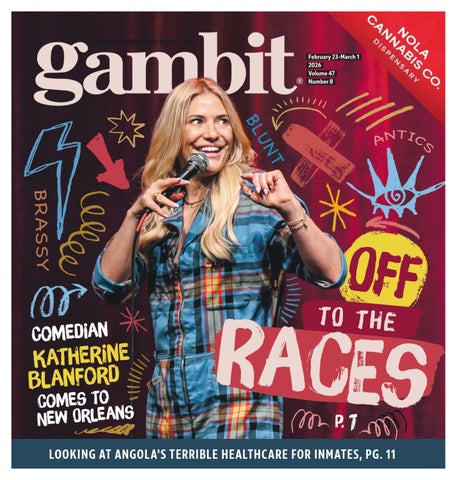
Of to the races
Comedian Katherine Blanford comes to Sports Drink
COMEDIAN KATHERINE BLANFORD IS DISAPPOINTED SHE’S COMING TO NEW ORLEANS too late to catch Mardi Gras, but while growing up in Louisville, Kentucky, she got a taste of its version: the infield at the Kentucky Derby.
“My parents started letting me go to the Derby by myself maybe sophomore year (in high school),” Blanford says from her new home in Los Angeles. “I understood why they were hesitant. As soon as I walked in, I saw a bunch of men in suits in a circle. I was like, ‘What’s going on?’ I pushed through, and there were girls in nice preppy dresses diving into a mud pit for hundred dollar bills.”
Blanford tells other stories about Derby antics in her 2024 comedy special “Catholic Cowgirl.” She’s on tour working on material for a new special, and she’ll perform at Sports Drink on Feb. 27-28.
Blanford grew up a fan of horses and racing. Her original plan to record “Catholic Cowgirl” was to film it in Louisville and have a painted horse on stage. Just like New Orleans has had artists paint their own versions of giant redfish, streetcars and bead dogs over the years, Louisville commissioned artists to paint fiberglass horses in a project called Gallopalooza.
But scheduling issues caused Blanford to scrap the Louisville filming, and instead she chose to do it in a The Riot Comedy Club in Houston. But she still wanted a horse.
“Once I had my heart set on having a horse on stage, it wasn’t going to not happen,” Blanford says. “I flew down there to look at party rentals, but I couldn’t find one. Then I found this one on Facebook Marketplace. It was this Renaissance horse from Beyonce’s Renaissance tour.
“I was like, ‘Oh, I am not buying it. I am just renting it for a day.’ She was like, ‘Yeah, just don’t sit on it.’ ” Blanford does her set in front of the white horse and tells her own Derby racing story. It’s about a Derby tradition dubbed porta-potty races. In it, people climb on top of the line of infield porta-potties and try to run the entire length of them. It’s not easy to run on the roofs of porta-potties, but the crowd makes it harder by throwing things at the runners, trying to knock them off. Blanford has completed the run. But the story in the special is not really about her.
by Will Coviello |
“I was in college and had taken my roommate to the Derby with me,” she told Gambit. “She had never been to Kentucky. I was like porta-potty races: tradition!
“I forgot to tell her it’s illegal. She gets to the end and she’s dancing and celebrating and people are cheering, and the cops are waiting for her to get down. I was hiding, and she was like, ‘I’m a teen mom. It’s my first night out.’ She went to the drunk tank for the rest of the Derby.”
Blanford has plenty of stories about other drunken adventures with her friends. There’s a stream of wild stories about the never-ending stream of bachelorette party events among her college friends. She blends the raucous double-edged sword of female friendship and competitiveness with teasing male attention in a saga of bachelorette party bikini wrestling on a raft on a lake.
Blanford revels in self-deprecating stories about growing up in the South, and she leans into physical gags imitating awkward Catholic school girls trying to twerk at a dance.
Blanford didn’t actually start her comedy career until she moved to Atlanta after college, but she got her first good taste of performing at the University of South Carolina.
“I had done a competition for a fraternity when I was in college,” she says. “It was like a pageant. You had to
Nola Nite Market
The Nola Nite Market celebrates the Lunar New Year and the Year of the Horse with food vendors and entertainment at the Westwego Farmers Market. Vendors include Get Your Mom + Dim Sum, Nola Noods, Sandoitchi, The Nori Guys, LUFU Nola, Namaste Nola, Sun’s Seoul Korean Pop-up, Bambu, Sogbu Filipino Street Food and more. The entertainment lineup includes touring Vietnamese-American rapper Thai VG and local performing groups. At 5-10 p.m. Friday, Feb. 27, and 2-9 p.m. Saturday, Feb. 28. Free admission. Visit nolanitemarket.com for information.
Ruthie Foster
do a talent portion. I wrote a sketch like I was like Chelsea Handler — that was when her show ‘Chelsea Lately’ was big. I roasted a bunch of frat guys and then did an interview with a pledge from the fraternity as Charlie Sheen. Obviously, we won, and I kind of had the bug.”
After paying some dues working out her jokes in Atlanta comedy clubs, she hit it big in 2022 when a clip of her joking about her parents being cousins went viral.
David Spade also saw the clip, and after they connected through comedian friends, Blanford started opening for Spade, along with his longtime opener Bobby Miyamoto. That gig lasted more than two years, before Blanford started headlining on her own.
Blanford moved to Los Angeles three years ago, and she’s a regular at clubs like The Improv and Laugh Factory.
She’s also a frequent podcaster, and she co-hosts “Coastal Idiots” with Shane Torres. They treat it like a talk show and have guests and activities they riff on.
Blanford has plans to record two specials this year, and she’s also looking at getting some writing projects on track.
Katherine Blanford performs at 7 & 9 p.m. Friday, Feb. 27, and Saturday, Feb. 28, at Sports Drink. Tickets $29 via sportsdrink.org.
Blues and folk singer Ruthie Foster has been on a roll. She won a Grammy for Best Contemporary Blues Album in 2025 with “Mileage.” That followed a string of honors from the Blues Music Awards, including Contemporary Female Blues Artist of the Year in 2023. The Texas native also mixes gospel, jazz and soul in her music. She performs at The Jazz & Blues Market at 7:30 p.m. Friday, Feb. 27, and Saturday, Feb. 28. Tickets $31.45-$77.85 via ticketmaster.com.
Last Dinosaurs
Australian indie rock band Last Dinosaurs gained steam around their home country in the early 2010s with upbeat, energetic demos posted to YouTube and then broke out to an international audience with their debut album. The band’s second release, 2015’s “Wellness,” wasn’t as commercially successful, but it’s a fan and band favorite, so to celebrate its 10th anniversary, Last Dinosaurs re-imagined and rerecorded the album as “Wellnxss.” They’re now on a North America tour with a stop at Gasa Gasa on Tuesday, Feb. 24. Elmjack opens at 8 p.m. Tickets are $30.62 via gasagasanola.com.
FILE PHOTO
PROVIDED PHOTO BY LOLA SCOTT
OPENING GAMBIT
THUMBS UP/ THUMBS DOWN
Shia LaBeouf gave a masterclass in how NOT to act during Mardi Gras.
Family Connects New Orleans, the city’s program offering free, in-home nurse visits for newborns up to 12 weeks old, has showed early successes, WWNO recently reported, citing researchers at Tulane University. Launched in 2023, Family Connects offers up to three house calls by a registered nurse for babies born at Ochsner Baptist or Touro Hospital. Early data shows participating families were more likely to stick to pediatric and postpartum checkups, that mothers and babies were less likely to need hospitalization and that more moms received care for postpartum depression.
Civil rights leader Norman C. Francis dies at 94
The Re-Cyclists Marching Krewe collected around 140 pounds of recyclable materials this year during the Krewe Boheme parade. The marching group is part of the sustainability-focused Grounds Krewe, and members ride shopping cart-bicycle contraptions as part of downtown walking parades like Boheme to collect aluminum cans and plastic bottles.
NORMAN CHRISTOPHER FRANCIS, THE PRESIDENT OF XAVIER UNIVERSITY for 47 years who was a force for justice in classrooms and boardrooms at the local, state and national levels, died Feb. 18 at Ochsner Hospital, according to family members. He was 94.
During Francis’ years as the leader of the country’s only Black Catholic institution of higher learning, the Gert Town campus grew from five to 16 buildings, expanding far beyond its original boundaries. Because of his focus on science, Xavier became a university that consistently sent more minority students to medical schools than any other college in the country.
Paul II, who, during his September 1987 visit, spoke in the campus’ quadrangle to the leaders of every Catholic university in the country.
Francis’ years of service have been recognized with a slew of awards, including 42 honorary doctorates and, in 2006, the Presidential Medal of Freedom, the country’s highest civilian honor.
Francis, who served on 54 boards and commissions and advised eight presidents on education and civil rights issues, was born on March 20, 1931, in Lafayette during the Great Depression.
A Krewe of Tucks rider carried beads that were tied around the necks of two Black dolls during the Saturday parade before Mardi Gras. The still unnamed rider was captured on video, and there was a swift reaction to the offensive image. City Council President JP Morrell said it was a “hate level crime depiction.” The Krewe of Tucks itself apologized and said it would investigate.
“His impact is immeasurable,” said Dr. Michael Francis, his son. “He would do anything for his family, the Xavier family and the Louisiana family.”
Among those Francis welcomed to Xavier’s campus were the Freedom Riders, civil rights activists he housed in a dormitory in 1961 after White supremacists attacked them in Alabama; former President Barack Obama, who was Illinois’ junior senator when he delivered the university’s 2006 commencement address; and Pope John
Through a scholarship, Francis enrolled in Xavier University in 1948. He was president of his class each year until his senior year, when he was elected student body president and graduated with honors in 1952. He later applied to Loyola University’s law school, becoming its first Black student. But there was a catch: Even though Francis had integrated the law school, he couldn’t live in a Loyola dormitory. So he bunked in a Xavier dorm, where he was in charge of freshmen men.
After Francis got his law degree, he joined the U.S. Army, serving
THE NUMBER OF ABANDONED MILITARY-OWNED ASSAULT WEAPONS DISCOVERED IN A BOURBON STREET BATHROOM DURING CARNIVAL.
The Louisiana National Guard confirmed that one of its members left a gun leaning against a sink after using the restroom of a hotel and bar on Feb. 8 and the weapon was recovered. The troubling incident was documented by an anonymous Reddit user in a post that quickly went viral. The National Guard said the issue is under investigation.
does it take you to recover from Mardi Gras?
16.7%
Norman C. Francis in 2022
PHOTO BY CHRIS GRANGER / THE TIMES- PICAYUNE
FEB. 28,202 6
KIDSSTAGE FR EE ADMISSION
FEDER AL CIT YALGIER S (G en Me yerAve .&Shirle yDr.)
U.S. Marine Reser ve Ja zz Band
Edna Karr-Voice sofPride
Monkey Hill Band |Big Frank/Li ttle Frank
BJ So Cole |New OrleansNightcraw ler)
Naydja CoJoe (& TheJaz zE xperience) |Brass-A-Holic s
BLAKE PONTCHARTRAIN™
Hey Blake, I came across a guidebook for the 1884 World’s Industrial and Cotton Centennial Exposition held here in New Orleans. I’m intrigued by a listing for a place downtown called the Hotel Chalmette. What can you tell us about it?
Dear reader,
COMMUNIT YPAR ADE 9am Star t-L .B Landry andL amarque,proce ed down L.BL andr ythen right on New tonS t./Gen MeyerAve.then left into Federal Ci ty Algier s, DisbandatFestivalGrounds
THE HOTEL CHALMETTE OPENED IN 1881 at the corner of Carondelet and Julia streets. The proprietor was Victor Bero, a restaurateur and caterer known for Victor’s Restaurant, which was located in the 200 block of Bourbon Street in the building that became Galatoire’s Restaurant in 1905.
“The establishment is provided with new and superb furniture and all modern improvements,” The Daily Picayune wrote about the Hotel Chalmette. “To say that it will succeed is only to forecast the prosperity of this well-ordered and spacious house.”
Newspaper stories and advertisements show the hotel underwent several renovations over the decades, including in 1921. “$25,000 will have been expended to make one of the most modern and up-to-date hotels in the city,” boasted one ad, which promoted the hotel’s hot and cold
water in every room, steam heat, new and up-to-date furniture and a desk telephone. Rooms were $1.50 per day. In 1940, the hotel underwent another renovation and expansion “to put this well-established and decidedly popular hostelry in the very forefront of New Orleans accommodations for visitors far and near,” according to The Times-Picayune/New Orleans States. “Window shades have been replaced with Venetian blinds. A smooth-running elevator takes guests up and down. Chenille spreads are on the beds and bath mats and lid covers are in every bathroom,” promoted the article. The hotel remained in business until 1976, when its contents were auctioned and the building demolished.
ERNIE K-DOE, THE SELF-PROCLAIMED “EMPEROR OF THE UNIVERSE” and flamboyant New Orleans music legend whose 1961 hit “Mother-In-Law” took him to the top of the music charts, was born 90 years ago this week.
Ernest Kador Jr. proudly claimed he was a “Charity Hospital baby,” born there on Feb. 22, 1936. The son of a Baptist preacher, he grew up singing in church choirs and developed his distinctive singing style in local nightclubs, including the Dew Drop Inn and Club Tiajuana.
In 1960, K-Doe signed with the local Minit Records label, which paired him with hit-making producer and songwriter Allen Toussaint. He had early success with two songs Toussaint wrote: “T’aint It the Truth” and “Hello My Lover.” But he would be forever associated with his third Minit single, “Mother-in-Law,” written by Toussaint and released in 1961. It became a national sensation, topping Billboard’s national R&B and pop charts. K-Doe was nominated for a Grammy and toured the country, even performing at the famed Apollo Theater. He often said, “There ain’t but two songs that will stand the test of time until the end of the world. One of them is ‘The Star-Spangled Banner.’ The other one is ‘Mother-in-Law.’ ”
K-Doe had a string of other regional hits but never duplicated his “Mother-inLaw” success. His career faltered until the 1990s, when he and his wife Antoinette bought a bar at 1500 N. Claiborne Avenue. Ernie K-Doe’s Mother-In-Law Lounge served as a music club, community center and K-Doe shrine.
K-Doe died in 2001. The lounge closed in 2010 after Antoinette’s death. In 2014, trumpeter Kermit Ruffins bought and reopened it as Kermit Ruffins’ Treme Mother-in-Law Lounge.
BLAKE VIEW
A postcard printed by Alphonse Goldsmith featuring the Hotel Chalmette
ILL AND INCARCERATED
Inmates report medical mistreatment at Angola and beyond
BY DANNY CHERRY JR.
IAN CAZENAVE was an inmate at Louisiana State Penitentiary, more commonly known as Angola, when one day, he felt an intense stabbing pain in his back, stomach and knees.
Cazenave was born with sickle cell disease and recognized the symptoms. He was having a sickle cell crisis, which occurs when sickled cells cause a blockage in a blood vessel and prevent red blood cells from carrying oxygen to tissues and organs.
According to Cazenave, the prison doctor told the prison EMT to administer medicine to ease his pain. The doctor left the room, but Cazenave says he kept waiting and waiting for the EMT to give him the pain medication. While waiting, he remembers sobbing in pain.
“I’m hurting real bad,” he says. “I’m up in there crying.”
Cazenave estimates that after 20-45 minutes, the EMT pushed the bed out of the room and across the hall. He says when the EMT closed the door, she told him if he didn’t stop crying, she wouldn’t give him the medicine.
“It was like an hour and a half before she came and administered the medicine to me,” he says. “And after that, I still wind up having to go to New Orleans to the hospital.”
That wasn’t the only medical mistreatment of his sickle cell anemia and chronic leg wounds Cazenave says he experienced during his time at Angola, from 1999 to 2024, including a lack of regular blood tests and transfusions.
According to a class action lawsuit, he developed an infection in February 2016 and his hemoglobin dropped to dangerously low levels, putting his leg at risk of amputation.
Cazenave is one of more than 200 inmates that are part of Lewis v. Cain, an ongoing lawsuit brought forth in May 2015 by lawyers representing Angola inmates against the Louisiana Department of Public Safety and Corrections (DOC), former Louisiana State Penitentiary
warden Burl Cain and other officials at the prison and DOC.
The inmates accuse the prison of denying appropriate health care to those behind bars, leading to “unnecessary pain and suffering, exacerbation of existing conditions, permanent disability, disfigurement, and even death.”
The complaint described the experiences of the inmates as “horror story after horror story.” The state DOC declined a request for comment, saying they were “unable to comment on pending litigation.”
All of the stories shine a light onto the practices of a place built on a site that was once a plantation with enslaved people. But those inmate experiences at Angola are a part of a larger national problem with health care for incarcerated people, which is often inadequate and at times horrific.
A prison system centered on cost and profit, staffing shortages, anti-prisoner biases and more deterrents all make it difficult to appropriately care for a prison population with complex needs.
“One, you don’t have sufficient staff. You don’t have sufficiently trained staff, particularly around mental health,” says Dr. Anjali Niyogi, who founded the Formerly Incarcerated Transitions Clinic to provide care for people with severe medical conditions after they are released from prison. “You don’t have enough of a budget to take care of people who are getting increasingly sick.”
A FLAWED DESIGN
IN 1976, a ruling in Estelle v. Gamble stated that withholding health care from inmates is “cruel and unusual punishment” and violates the Eighth Amendment. But the ruling doesn’t say anything about the quality of care, forcing the precedent to be retroactive care, instead of preventative The limits of the Gamble ruling can be seen in Lewis v. Cain.
The lawsuit accuses Angola workers of ignoring a wheelchair-bound
inmate’s surgery requests multiple times for a procedure meant to repair a quarter-inch tear in his penis caused by a catheter.
It alleges staff left inmate Kentrell Parker, who became paraplegic after being injured on Angola’s football field, alone for extended periods of time, laying in his own feces. In 2018, ProPublica reported he was left alone with flies crawling on his face, and in order to seek relief, he began to eat them.
According to a report by Prison Policy, roughly half of state prison systems have been court ordered to improve their mental and medical health care since 2000. The report found that prison management often treats incarcerated people’s symptoms as costly “nuisances.”
These health care systems function like a “cost control service for corrections departments, organized around limiting spending and fending off lawsuits rather than actually caring for anyone’s health,” the report said.
“It’s not a freebie. It’s not a handout,” says Bruce Reilly, a formerly
A medical ward at Angola
PHOTO BY TED JACKSON / THE TIMES - PICAYUNE
incarcerated lawyer and the deputy director for Voices of the Experienced (VOTE). “You’ve chosen to invest $50,000 to $75,000, $200,000 on holding this person in a cage.”
In many places, like Louisiana, health care in prisons is overseen by the corrections department, not health department.
Niyogi says there are significant issues with such a model.
“Department of Corrections aren’t trained medical [professionals]. They do safety, and that is what their number one charge is,” she says. “It’s the Department of Public Safety and Corrections. There’s nothing about health in any of that.”
The budget for prison health care in Louisiana is stuffed into the DOC budget, and the Inmate Exclusion Act of 1965 banned prisons from using federal dollars on inmate health care.
However, Niyogi says, there is a small caveat. In Louisiana, if an inmate is admitted to a hospital for more than 24 hours, federal dollars can be used. This doesn’t apply to outpatient visits or things that happen in the prison, which comes out of the DOC budget.
People in prison — who are disproportionately poor and people of color — have higher rates of certain chronic diseases, including high blood pressure and diabetes, than those on the outside due to systemic issues, like increased exposure to pollution and lack of access to health care and healthy food.
According to Niyogi, the majority of people who enter the carceral system already have complex issues, such as
histories of psychological, physical and sexual trauma.
In addition, the prison population as a whole has gotten older. According to research by Pew, the number of inmates 55 or older in state and federal prisons increased by 280% between 1999 and 2016.
“People are getting older. There are more medical problems. People have more medications that they need to take, procedures they need to have. And so all of that adds up to that budget,” Niyogi says.
Taking these factors into consideration, it’s not hard to see why incarcerated people have shorter life spans than non-incarcerated people.
In fact, a 2016 study found that each year a person spends in prison takes two years of their life expectancy.
UNDERSTAFFING
PRISONS ARE OFTEN UNDERSTAFFED. Many health care professionals don’t want to work in prison settings, due to lower pay and stigma, and the doctors and nurses who do take jobs in prisons are often stretched thin.
“You start doing the math on how many [health care workers] per patient. You’re just like, wow… they’re handling too many people,” says Reilly.
According to Niyogi, a prison typically has one medical director who oversees thousands of patients, far more patients than a medical director would be responsible for at a private clinic.
“No clinic has that many patients and one medical director … just from the baseline, that ratio is wrong,” she says. This can lead to prison systems seeking staff from anywhere, either by outsourcing to private health companies or hiring doctors with a history of misconduct.
According to court documents, each of the five doctors on Angola’s staff when Lewis v. Cain was filed either had a restricted license or was restricted to practicing in certain institutional settings at the time they were hired.
A doctor’s license can become restricted when they are convicted of a felony, overprescribing drugs without a legitimate reason, sexual misconduct or unethical behavior, among other reasons. Doctors with restricted licenses are allowed to practice in certain “institutional” settings, one of those being prisons.
As of 2021, Scalawag Magazine reported, 10 of 11 doctors on staff at the DOC in Louisiana had restricted licenses.
Reilly says the state medical board “uses this as almost like [the doctors’] work release program.”
In 2016, 9 of the 15 doctors working in Louisiana prisons had been disciplined by the medical board. Of those nine, two had served federal prison sentences, two couldn’t treat patients under 18 years old and one required a chaperone when treating female patients under 60 years old.
Additionally, one doctor, Casey McVea, pled guilty to possession of child pornography. He had become the medical director at Raymond Laborde
Correction Center in 2020 before dying from COVID-19.
“A lot of times, people are working in carceral settings not because they want to work with this population … or have an understanding of [this] population … it’s the only job they can get,” Niyogi says.
This essentially creates a situation where doctors with a history of unethical and illegal behavior have a great deal of power over people who have no options when seeking a health care provider.
And it can lead to issues for the formerly incarcerated once they are out of prison, since some pharmacists won’t fill prescriptions ordered by doctors with restrictions on their licenses.
And the problem goes all the way to the top. Randy Lavespere, the head of health care for the DOC since 2021 and the former Angola medical director, was convicted in 2006 of buying $8,000 of meth from an informant with the intent to distribute.
He is a defendant in Lewis v. Cain, with serious allegations of medical neglect against him.
Burl Cain, the warden of Angola from 1995 to 2015, quit during probes into his real-estate dealings. Since 2020, he’s led the Mississippi Department of Corrections.
OBSTACLES TO SEEKING CARE
THERE ARE A NUMBER OF REASONS inmates might be hesitant to
A person looks out from a guard tower near Camp 57 at Angola.
PHOTO BY HILARY SCHEINUK/ THE ADVOCATE
The main security gate at Angola
PHOTO BY JUDI BOTTONI
seek medical care. Often, prison staff don’t believe them. In fact, Lavespere in court said he believed close to half of patients were lying about their symptoms.
“A lot of times the first diagnosis is of malingering … [it] is always a diagnosis of exclusion,” Niyogi says.
The consequences can be severe and even deadly.
According to court documents, the lead plaintiff in Lewis v. Cain, Joseph Lewis, an 81-year-old with a history of chronic throat problems, submitted repeated sick call requests and grievances for two years. He was only ever prescribed over-the-counter medication. Once he was allowed to see a specialist in January 2015, it was discovered he had throat cancer.
Mississippi Today reported that when a Mississippi inmate broke his arm and asked the correctional officer to take him to the infirmary, the officer told him to go “sit his ass back down.” He later needed to have his broken arm amputated. In Colorado, a 22-year-old died from treatable infections after he was ignored by prison staff for a month.
Inmates may also be uncomfortable with the lack of privacy they have during appointments.
In cases where an inmate needs offsite treatment, and they have to make the nearly three-hour drive from Angola to the University Medical Center in New Orleans, they are followed by guards the whole time, including in the room when receiving treatment.
Costs can also be a major issue. Even small copays can dramatically impact inmates, who earn between two and
40 cents an hour, according to a 2022 ACLU report.
In 2021, the prices for medical care in Louisiana prisons were $3 for a sick call visit, $2 for a prescription visit and $6 for an emergency visit.
Seeking medical care can also put an inmate out of work for an extended period of time, wiping out their income entirely when they have a medical bill to pay.
Reilly’s group VOTE in 2022 pushed for a bill to cap copays and waive them for some inmates. He says they came to a compromise with the DOC, but a committee in the state legislature killed it in a 5-5 vote.
WHERE WE GO FROM HERE
SHELLY DICK, chief judge of the Middle District of Louisiana, ruled in a 2023 opinion on Lewis v. Cain that the medical care at Angola was akin to “abhorrent cruel and unusual punishment,” adding that the human cost was “unspeakable.” She ruled Angola violated the Eighth Amendment, Americans with Disabilities Act and the Rehabilitation Act.
The state has decided to appeal the Cain ruling, citing the Prison Litigation Reform Act, which knee-capped a different but similar lawsuit against Angola close to 30 years ago. The far-right-leaning Fifth Circuit Court will hear the appeal.
The quality of care in Louisiana’s prisons is becoming even more strained as the state locks up more people due to the legislature’s reversal of its once bipartisan criminal justice reforms. According to the Louisiana Illuminator, Gov. Jeff Landry is looking to move an additional 688 inmates to Angola specifically.
So what can be done?
A report by Prison Policy recommends removing health care from the purview of corrections departments altogether, creating independent oversight bodies separate from prison systems and creating performance measures for prison health care — similar to that of hospitals.
Reilly suggests marketing prison health care jobs similarly to muchneeded public health work.
“Maybe if you just sort of change the job description and the outreach, you’d get a different class of people,” he says.
But until major changes are made, the same issues at Angola and beyond will persist, putting the roughly 2 million people incarcerated in U.S. state and federal prisons at risk.
“I think we need to understand the true cost of incarceration is keeping people alive and healthy,” Reilly says.
Ian Cazenave and Samantha Pourciau, one of the Lewis. v. Cain attorneys
PHOTO BY LAUREN SAPP
EAT + DRINK
Social scene
A new Peruvian restaurant in Uptown by Beth D’Addono |
WITHOUT IMMIGRATION, WHAT’S FOR DINNER IN NEW ORLEANS and around the world — would taste completely different.
A visit to the newly opened Social restaurant in Uptown illustrates this point deliciously. Social’s mainstay, Nikkei cuisine, evolved in Peru because of an influx of Japanese contract laborers at the turn of the 20th century.
Born of Japanese techniques and Peruvian ingredients, Nikkei became popular in the 1980s, with Nobu founder/chef Nobu Matsuhisa one of its early pioneers. New Orleanians got a taste of this clean, flavorful fare when Dana Honn and Wataru Saeki opened the casual Nikkei Izakaya at The Broadside in late 2024.
The December opening of Social raises Nikkei cuisine to a fine-dining level. It was founded by Mexicanborn Dulce and Omar Lugo, partners in the six-restaurant Habs Hospitality Group, and their Peruvian chef/partner Adolfo Gosalvez.
The setting is stunning. The location was formerly home to the Peruvian restaurant Tito’s Ceviche. The Magazine Street spot is the second Social, after the first opened in Madisonville last May. The restaurant has a dining room lined with windows overlooking Magazine, a back-lit pink marble bar and a patio on the side. Striking wall sculptures evoke the sea and its creatures.
Gosalvez, formerly the executive chef at Mission Ceviche in New York, flies in regularly from his home in Chicago to steer the restaurant’s culinary direction and work with the team. Ricardo Hipolito is Social’s Peruvian executive chef. He also opened the Social across the lake.
“We knew right away that New Orleans was a good fit for Social,” Hipolito says. “Here there is soul, heritage and culture. Like in Peru.”
The Lugos came to the U.S. from Mexico City 20 years ago, first settling in Atlanta and then moving to the Northshore where Omar’s uncle owned several Mexican restaurants.
“We were young, and he gave us jobs,” Dulce says. They started their restaurant group 11 years ago, first opening Habanero Mexican restaurants on the Northshore and Metairie.
“Chef Adolfo really knows what he is doing,” Hipolito says. “He is so proud of what Peru brings to the table.”
Nikkei cuisine features Japanese ingredients like miso, sake, seaweed and dashi. Japanese immigrants popularized eating octopus and squid in Peru and also introduced layered umami flavors powered by soy and mirin.
These ingredients contrast with Peruvian staples like aji amarillo, lime and corn or hominy to create a distinct, flavor-packed style of cooking. Tiradito is what happens when sashimi from fresh-caught Peruvian fish is spiced with aji chili pepper and lime.
Among the ceviches, Ceviche Social showcases a combo of the fish of the day, octopus and flash fried small
scallops. The seafood is cured with aji amarillo in Peru’s national sauce, leche de tigre, the milky white juice that results from marinating raw fish in citrus (usually lime) along with garlic, ginger, onion, salt, cilantro and Peruvian chili peppers. Raw fish shows up in a handful of dishes, including the popular wontacos
tartare. A tartare using the fish of the day is served with bright citrus- and spice-forward salsa acevichada, crispy wonton chips, quinoa and furikake seasonings.
On the cooked side, traditional lomo saltado features chunks of filet mignon with red onions, potatoes and hominy, all in soy oyster sauce, served with rice. Arroz con mariscos is a Peruvian take on paella and is loaded with shrimp, calamari and octopus.
There’s also a burger on the menu.
The cocktail list offers classics, along with Peruvian favorites like a pisco sour and Nikkei-influenced sips with ingredients like wasabi honey, yuzu and cardamom syrup.
Dulce understands that not everyone is familiar with Nikkeistyle Peruvian cuisine.
“My husband and I are passionate about this food,” she says. “The flavors are so fresh — unexpected but approachable.”
FORK + CENTER
Email
Next stop
MORE THAN TWO MONTHS AFTER FIRST & LAST STOP WAS SOLD, touching off disputes between its new and former owners, the small bar in the 7th Ward recently closed. But its legacy as a mainstay for second lines and Black Masking Indians may endure.
Kermit Ruffins, the renowned trumpeter who runs Kermit’s Treme Mother-in-Law Lounge, says he was offered a lease on the now-shuttered space — and will likely accept.
Under his management, Ruffins says the property on the corner of Pauger and Marais streets would remain “an old school mom-and-pop bar,” while honoring its tradition as a longtime gathering spot for Black Masking Indians. He added that he plans to play live music there twice a week and intends to rename the bar. “I’m going to bring some good food and some good music to the neighborhood,” Ruffins says.
The closure follows months of tension after The Lens reported in October that former owners Al Reagle and his wife, Virginia Sortino Reagle — who also lease the Mother-in-Law Lounge to Ruffins — sold the building to Daniel Sellers. Carolyn Cushenberry, who had operated the bar since before Hurricane Katrina, asked Sellers to honor the existing lease. But the relationship between the two quickly soured, according to The Lens, amid various accusations. News of the sale triggered public backlash. Though First & Last Stop has passed through different hands for more than seven decades, it remained a Black-owned neighborhood hub, even amid migration and gentrification reshaping the 7th Ward. Neither Cushenberry nor Sellers could be reached for comment.
Chef Ricardo Hipolito and co-owner Dulce Lugo at Social
PHOTO BY MADDIE SPINNER / GAMBIT
Kermit Ruffins with Carolyn Cushenberry
PHOTO BY MADDIE SPINNER / GAMBIT
When First & Last Stop abruptly closed for the first time in early November, Ruffins said he had already accepted an offer to lease the space. He later reconsidered after learning that Cushenberry would no longer run the bar.
Instead, Ruffins said he stepped in to help keep the business afloat, paying the remainder of Cushenberry’s rent out of pocket, seeking public donations and hosting a benefit concert outside the bar. He said he remained open to taking over once Cushenberry retired. That moment, Ruffins says, came a couple weeks ago, when she gave up the space.
— Poet Wolfe / The Times-Picayune
Freret dining scene
THE FRERET STREET RESTAURANT
ROW PACKS A GREAT DEAL OF DIFFERENT FLAVORS AND CONCEPTS into an eight-block stretch from Jefferson Avenue to Napoleon Avenue. The options are always in flux. Here’s an updated guide of mostly local places for 2026, going block by block, starting with a spur on Jena Street, just a few steps from Freret proper that is part of the row.
• Bearcat Café, 2521 Jena St. The popular breakfast and lunch spot mixes the healthy (“good cat”) and indulgent (“bad cat”). Steps off Freret Street.
• Café Conmigo, 2511 Jena St. This newly opened Cuban café serves killer coffee, sandwiches, pastries and cocktails, with quick counter service. Steps off Freret.
• High Hat Café, 4500 Freret St. A little bit Southern (pimento cheese), a lot New Orleans (gumbo), the modern café has an old soul and a fresh edge.
• The Husky, 4510 Freret St. A gleaming lounge meets stylish rustic lodge at this seductive bar and restaurant for steaks, burgers and martinis.
• Rook Café, 4516 Freret St. The quirky coffee shop is a popular spot for studying or playing games. Try the coffee cubes.
• Pigeon & Whale, 4525 Freret St. There’s a gorgeous oyster bar (and Negroni specialist) and upscale seafood from other waters. It’s related to the Husky and has a similar sense of style.
• Sweet & Boozy, 4525 Freret St. The ice cream shop has booze-infused flavors next to the all-ages varieties.
• The Company Burger, 4600 Freret St. Before the smash burger craze, this spot set a new standard for slim, griddle-cooked, double-stacked patties. Check out the mayo bar.
• Vals, 4632 Freret St. Enjoy tacos and first-rate cocktails across the lush patio or inside.
• Freret Faire at Rouses, 4645 Freret St. The in-house restaurant (and bar!)
FORK & CENTER
at the grocery store has breakfast plates and lunch sandwiches.
• Mojo Coffee House, 4700 Freret St. The coffee house and study spot has breakfast burritos, mocktails, lemonades and, of course, caffeine.
• Pita Paradise, 4701 Freret St. Get shawarma and Middle Eastern standards in a fast-casual setting.
• Chi Chi’s, 4714 Freret St. Find Korean fried chicken (wings and sandwiches), sushi sandwiches and beer in a pint-sized shop.
• Humble Bagel, 4716 Freret St. Get a taste of the classic Northeast-style bagel shop, with fresh orange juice by the mason jar.
• Baya Bar, 4719 Freret St. A juice and smoothie bar (with a specialty in acai) from a small chain.
• Sucre, 4711 Freret St. A petit foursized outpost of the New Orleansbased sweets emporium offers macarons, ice cream, coffee and more.
• The Midway, 4725 Freret St. Get deep dish or thin crust pizza with excellent meatballs (on the pies, or on their own) and a strong bar.
• Cure, 4905 Freret St. An anchor of Freret’s new restaurant row remains a spot for upscale craft cocktails, and the short food menu is fancy and delicious.
• Sunnie’s, 4917 Freret St. The casual restaurant and bar is a poolside lounge with retro styling.
• Breezy’s at Gasa Gasa, 4920 Freret St. The verdant patio bar is attached to the indie music venue, with periodic food pop-ups.
• Mr. Tequila, 5018 Freret St. The three Gonzales brothers, natives of Mexico, serve a broad menu of taqueria standards, with margaritas on draft, including a “family-sized” version for the table.
• Bub’s Burgers, 5031 Freret St. The shed-sized space that launched other concepts is the Uptown outpost for the grab-and-go version of the popular smash burger joint.
• Imperial Woodpecker, 5033 Freret St. A fresh take on the New Orleans snowball shop.
• Good Bird, 5041 Freret St. Rotisserie chicken for sandwiches, salads and bowls, plus smoothies.
• Dat Dog, 5030 Freret St. A colorful, all-ages beer garden vibe for hot dogs and sausages with burgers, chicken sandwiches, loaded fries and drinks.
• Mint Modern Vietnamese, 5100 Magazine St. Pho, spring rolls and other noodle shop standards mixed with a few fusion twists, like the kimchi burger and chicken with green waffles. Boba teas are popular at the bar.
— Ian McNulty / The Times-Picayune
SuM mEr CaMpS
George Motz
Burger
expert by Will Coviello
GEORGE MOTZ WORKED IN THE FILM INDUSTRY MAKING MOVIES AND TV COMMERCIALS before he made the documentary “Hamburger America,” which profiled people and burgers at mom-and-pop restaurants across the country. The film turned him into a burger expert, and he wrote a book about burger joints, a cookbook and later opened a burger restaurant in his native New York, also called Hamburger America. This month, the restaurant is offering a hamburger po-boy special, and he’s coming to New Orleans to do a pop-up at Hot Stuff at 6 p.m. Thursday, Feb. 26. The fourth edition of “Hamburger America” will be released in April. It has four New Orleans places among its 220 restaurants. For more information about Motz, go to georgemotz.com or hamburgeramerica.com. For more about Hot Stuff, go to hotstuffneworleans.com.
When did the hamburger become an American icon?
GEORGE MOTZ: 1921 to put a date on it. That’s when the burger began its meteoric rise. It had been around for 40 years before that. But it wasn’t seen as anything special. It was ethnic food. It was the taco of 120 years ago. The taco has great respect, but there was a time 20-30 years ago when the taco had zero respect.
With the hamburger, they saw it as immigrant food. It was German. We got both the hot dog and the hamburger from Germany.
The hamburger was seen as questionable. In 1921, White Castle cleaned up the burger’s image. That’s when everyone started eating hamburgers. It became a national phenomenon. Over the years, all sorts of things caused fast food companies to change or die. The Great Depression was one, World War II was one, and then modernization and expansion and frozen burger patties. Frozen patties killed a lot of places in the ’70s.
Over the years, White Castle’s image has changed. Steak ’n Shake ran with it in the 1930s. In-N-Out Burger in the ’40s. McDonald’s was big. In the ’60s, Burger King and Wendy’s took off. It became a world-wide phenomenon thanks to McDonald’s and Burger King. But while this was happening, there were these mom-and-pop joints that were making amazing regional burgers, like the butter burger of
Wisconsin. Those are the ones I wanted to highlight in the film.
Why did you make the leap to restaurateur?
M: The only reason I did it is because I had partners in the restaurant business that know what they are doing. They’re friends of mine and said let’s make this happen.
I don’t deal with the real estate or balancing the books. I deal with the fun stuff, like the menu. I also waited a while. Too many people get involved in the restaurant business when they’re young and don’t have experience or foresight.
The whole point of Hamburger America, the restaurant, was to be a love letter to the hamburger. I looked at all the examples of places I had seen in 20 years. I have seen close to everything. I included things from a lot of different places. I took a lot from mom-and-pops. It feels like a real diner because of the methods and equipment in the kitchen. But even the stools and countertops are evocative of something in my hamburger world. Even the linoleum floor pattern was taken from a diner in Pennsylvania.
The reason the Oklahoma fried onion burger is on the menu is actually an accident. It was a fluke. I had finished a cookbook before I had a restaurant. I was on a cookbook tour. I was doing a morning show in Seattle. They said, “What burger can you make in seven minutes in front of an audience of 200 people and tell us the history?” I
thought about it and said the fried onion burger. I can cook it in literally five minutes. There’s only five ingredients. I made it and the host took a bite and said, “Wow, that’s a great burger.” I grabbed it out of her hand and took a bite and was like, that is a great burger. Everyone who saw that news hit wanted me to recreate that burger. So I became known for that burger completely by accident.
Tell us about the hamburger po-boy special that you’re bringing here.
M: There is a monthly rotating burger special at the restaurant. There are always great stories to these burgers. We try to recreate burgers historically accurately, whether it’s a burger still made today or it’s been gone 20-30 years. We work on every detail: the bun it’s served on; the plate it’s served on; or paper it’s served on; what’s the seasoning? This month is the po-boy burger. I wanted to do the burger from Bozo’s, which is gone now. It was in Metairie. So I wanted to do a place that still existed and did a po-boy burger. One of the best examples is Camellia Grill. They use the best bread, which is Leidenheimer French bread.
Also, I have been going to Camellia Grill for 35 years. My daughter goes to Tulane, and my brother and first cousin are both legacies. Because of my daughter, I’m in New Orleans two or three times a year. To do the burger correctly, you need to dress it correctly. To have a po-boy, you need shredded iceberg, hothouse tomatoes, dill pickle chips and mayonnaise, and maybe people put some hot sauce on there. But you have to have Leidenheimer bread. We had to work with Leidenheimer to figure a shipping lane with our supplier. That bread doesn’t exist in New York. We’re selling so many, we’re going to have to get them to send more up.
At Hot Stuff, we’re going to shed light on Camellia Grill. We’re setting up in back. The hot line is open in the front. Or you can come in back and get a couple beers and a hamburger po-boy.
PHOTO PROVIDED BY GEORGE MOTZ
Out to Eat is an index of Gambit contract advertisers. Unless noted, addresses are for New Orleans and all accept credit cards. Updates: Email willc@gambitweekly.com or call (504) 483-3106.
$ — average dinner entrée under $10
$$ $11-$20
$$$ — $20-up
Angelo Brocato’s — 214 N. Carrollton Ave., (504) 486-1465; angelobrocatoicecream.
com — This Mid-City sweet shop serves its own gelato in flavors like praline, salted caramel and tiramisu, as well as Italian ices in flavors like lemon, strawberry and mango. There also are cannolis, biscotti, fig cookies, tiramisu, macaroons and coffee drinks. No reservations. Lunch and dinner
com — Gulf Drum Yvonne is served with brown butter sauce with mushrooms and artichoke hearts. There also are oysters, seafood pasta dishes, steaks, lamb chops and more. Reservations recommended. Dinner
Thu.-Mon. $$$
Bamboula’s — 514 Frenchmen St.; bamboulasmusic.com — The live music venue’s kitchen offers a menu of traditional and creative Creole dishes, such as Creole crawfish crepes with goat cheese and chardonnay sauce. Reservations accepted. Lunch, dinner and late-night daily. $$
The Blue Crab Restaurant and Oyster Bar — 118 Harbor View Court, Slidell, (985) 315-7001; 7900 Lakeshore Drive, (504) 284-2898; thebluecrabnola.com — Basin barbecue shrimp are served with rosemary garlic butter sauce over cheese grits with a cheese biscuit. The menu includes po-poys, fried seafood platters, raw and char-grilled oysters, boiled seafood in season, and more. Outdoor seating available. No reservations. Lakeview: Lunch and dinner Tue.-Sun.
Broussard’s — 819 Conti St., (504) 5813866; broussards.com — The menu of contemporary Creole dishes includes bronzed redfish with jumbo lump crabmeat, lemon beurre blanc and vegetables. Brunch includes Benedicts, avocado toast, chicken and waffles, turtle soup and more. Reservations recommended. Outdoor seating available in the courtyard. Dinner Wed.-Sat., brunch Sun. $$$
Cafe Normandie — Higgins Hotel, 480 Andrew Higgins Blvd., (504) 528-1941; higginshotelnola.com/dining — The menu combines classic French dishes and Louisiana items like crab beignets with herb aioli. Sandwiches include po-boys, a muffuletta on flatbread and a burger. No reservations. Breakfast and lunch Mon.-Sat., dinner Fri.-Mon. $$
The Commissary — 634 Orange St., (504) 274-1850; thecommissarynola.com — Dickie Brennan’s Commissary supplies his other restaurant kitchens and also has a dine-in menu and prepared foods to go. A smoked turkey sandwich is served with bacon, tomato jam, herbed cream cheese, arugula and herb vinaigrette on honey oat bread. The menu includes dips, salads, sandwiches, boudin balls, fried oysters and more. No reservations. Outdoor seating available. Lunch Tue.-Sat. $$
Curio — 301 Royal St., (504) 717-4198; curionola.com — The creative Creole menu includes blackened Gulf shrimp served with chicken and andouille jambalaya. There also are crab cakes, shrimp and grits, crawfish etouffee, po-boys and more. Outdoor seating available on balcony. Reservations accepted. Lunch and dinner daily. $$ Dahla — 611 O’Keefe Ave., (504) 766-6602; dahlarestaurant.com — The menu includes popular Thai dishes like pad thai, drunken noodles, curries and fried rice. Crispy skinned duck basil is prepared with vegetables and Thai basil. Delivery available. Reservations accepted. Lunch and dinner Mon.-Sat. $$
Desire Oyster Bar — Royal Sonesta New Orleans, 300 Bourbon St., (504) 586-0300; sonesta.com/desireoysterbar — A menu full of Gulf seafood includes oysters served raw on the half-shell or char-broiled with with Parmesan, garlic and herbs. The menu also includes po-boys, po-boys, gumbo, blackened fish, fried seafood platters and more. Reservations recommended. Breakfast, lunch and dinner daily. $$
Dickie Brennan’s Bourbon House — 144 Bourbon St., (504) 522-0111; bourbonhouse. com — There’s a seafood raw bar with raw and char-broiled oysters, fish dip, crab fingers, shrimp and more. Redfish on the Half-shell is cooked skin-on and served with crab-boiled potatoes, frisee and lemon buerre blanc. The bar offers a wide selection of bourbon and whiskies. Reservations accepted. Lunch and dinner daily. $$$
Dickie Brennan’s Steakhouse — 716 Iberville St., (504) 522-2467; dickiebrennanssteakhouse.com — The menu includes a variety of steaks, plus seared Gulf fish, lobster pasta, barbecue shrimp and more. A 6-ounce filet mignon is served with fried oysters, creamed spinach, potatoes and bearnaise. Reservations recommended. Dinner Mon.-Sat. $$$
El Pavo Real — 4401 S. Broad Ave., (504) 266-2022; elpavorealnola.com — The menu includes tacos, enchiladas, quesadillas, ceviche. tamales and more. Pescado Vera Cruz features sauteed Gulf fish topped with tomatoes, olives, onion and capers, served
with rice and string beans. Outdoor seating available. No reservations. Lunch and early dinner Tue.-Sat. $$
Juan’s Flying Burrito — 515 Baronne St., (504) 529-5825; 2018 Magazine St., (504) 569-0000; 4724 S. Carrollton Ave., (504) 486-9950; 8140 Oak St., (504) 897-4800; juansflyingburrito.com — The Flying Burrito includes steak, shrimp, chicken, cheddar jack cheese, black beans, rice, guacamole and salsa. The menu also includes tacos, quesadillas, enchiladas, fajitas, nachos, salads, rice and bean bowls with various toppings and more. Outdoor seating available. No reservations. Lunch and dinner Thu.-Tue. $$ Katie’s Restaurant — 3701 Iberville St., (504) 488-6582; katiesinmidcity.com — The Cajun Cuban with roasted pork, ham, Swiss cheese, pickles and mustard. The eclectic menu also includes char-grilled oysters, sandwiches, burgers, pizza, fried seafood platters, pasta, salads and more. Delivery available. Reservations accepted for large parties. Lunch and dinner daily. $$
Kilroy’s Bar — Higgins Hotel, 480 Andrew Higgins Blvd., (504) 528-1941; higginshotelnola.com/dining — The all-day bar menu includes sandwiches, soups, salads, flatbreads and a couple entrees. A muffuletta flatbread is topped with salami, mortadella, capicola, mozzarella and olive salad. No reservations. Lunch Fri.-Mon., dinner daily. $$
Legacy Kitchen’s Craft Tavern — 700 Tchoupitoulas St., (504) 613-2350; legacykitchen.com — The menu includes oysters, flatbreads, burgers, sandwiches, salads and sharable plates like NOLA Tot Debris. A slow-cooked pulled pork barbecue sandwich is served with coleslaw on a brioche bun. Reservations accepted. Breakfast, lunch and dinner daily. $$
PHOTO BY IAN MCNULTY / THE TIMES- PICAYUNE
Legacy Kitchen Steak & Chop — 91 Westbank Expressway, Gretna, (504) 513-2606; legacykitchen.com — The selection of steak and chops includes filet mignon, bone-in rib-eye, top sirloin and double pork chops and a la carte toppings include bernaise, blue cheese and sauteed crabmeat. There also are burgers, salads, pasta, seafood entrees, char-broiled oysters and more. Reservations accepted. Outdoor seating available. Lunch and dinner Mon.-Sat. $$
Mikimoto — 3301 S. Carrollton Ave., (504) 488-1881; mikimotosushi.com — The menu of Japanese cuisine includes sushi, signature rolls, tempura items, udon noodle dishes, teriyaki, salads and more.The South Carrollton roll includes tuna tataki, avocado, snow crab, green onion and wasabi roe. Reservations accepted. Delivery available. Lunch Sun.-Fri., dinner daily. $$
Mosca’s — 4137 Highway 90 West, Westwego, (504) 436-8950; moscasrestaurant.com — This family-style eatery serves Italian dishes and specialties including shrimp Mosca, baked oysters Mosca and spaghetti Bordelaise and chicken cacciatore. Chicken a la grands is sauteed with garlic, rosemary, Italian herbs and white wine. Reservations accepted. Dinner Wed.-Sat. Cash only. $$$
Mother’s Restaurant — 401 Poydras St., (504) 523-9656; mothersrestaurant.net — This counter-service spot serves po-boys dressed with sliced cabbage like the Famous
Ferdi filled with ham, roast beef and debris. Creole favorites include jambalaya, crawfish etouffee, red beans and rice and more. Breakfast is available all day. Delivery available. No reservations. Breakfast, lunch and dinner daily. $$
Neyow’s Creole Cafe — 3332 Bienville St., (504) 827-5474; neyows.com — The menu includes red beans and rice with fried chicken or pork chops, as well as shrimp Creole, seafood platters, po-boys, chargrilled and raw oysters, salads and more. Side items include carrot souffle, mac and cheese, cornbread dressing, sweet potato tots and more. No reservations. Lunch daily, dinner Mon.-Sat., brunch Sun. $$
Nice Guys Bar & Grill — 7910 Earhart Blvd., (504) 302-2404; niceguysbarandgrillnola. com — Char-grilled oysters are topped with cheese and garlic butter, and other options include oysters Rockefeller and loaded oysters. The creative menu also includes seafood bread, a Cajun-lobster potato, wings, quesadillas, burgers, salads, sandwiches, seafood pasta, loaded fries and more. No reservations. Lunch daily, dinner Mon.-Sat. $$$
Orleans Grapevine Wine Bar & Bistro — 720 Orleans Ave., (504) 523-1930; orleansgrapevine.com — The wine bar offers cheese boards and appetizers to nosh with wines. The menu includes Creole pasta with shrimp and andouille in tomato cream sauce. Reservations accepted for large parties. Outdoor seating available. Dinner Thu.-Sun. $$
Parish Grill — 4650 W. Esplanade Ave., Suite 100, Metairie, (504) 345-2878; parishgrill. com — The menu includes a variety of burgers, sandwiches, wraps, pizza and salads. For an appetizer, sauteed andouille is served with fig preserves, blue cheese and toast points. Reservations accepted. Lunch and dinner Mon.-Sat. $$
Peacock Room — Kimpton Hotel Fontenot, 501 Tchoupitoulas St., (504) 324-3073; peacockroomnola.com — At brunch, braised short rib grillades are served over grits with mushrooms, a poached egg and shaved truffle. The dinner menu has oysters, salads, pasta, shrimp and grits, a burger, cheese plates and more. Reservations accepted. Dinner Wed.-Mon., brunch Sun. $$
Rosie’s on the Roof — Higgins Hotel, 480 Andrew Higgins Blvd., (504) 528-1941; higginshotelnola.com/dining — The rooftop bar has a menu of sandwiches, burgers and small plates. Crab beignets are made with Gulf crabmeat and mascarpone and served with herb aioli. No reservations. Dinner Mon.-Sat. $$
Tableau — 616 St. Peter St., (504) 9343463; tableaufrenchquarter.com — The menu features traditional and creative Creole dishes. Pasta bouillabaisse features squid ink mafaldine, littleneck clams, Gulf shrimp, squid, seafood broth, rouille and herbed breadcrumbs. Outdoor seating available on the balcony. Reservations
Tacklebox — 817 Common St., (504) 827-1651; legacykitchen.com — The menu includes raw and char-broiled oysters, seafood platters, po-boys, fried chicken, crab and corn bisque and more. Redfish St. Charles is served with garlic-herb butter, asparagus, mushrooms and crawfish cornbread. Reservations accepted. Breakfast, lunch and dinner daily. $$
Theo’s Neighborhood Pizza — 1212 S. Clearview Parkway, Elmwood, (504) 733-3803; 2125 Veterans Memorial Blvd., Metairie, (504) 510-4282; 4024 Canal St., (504) 302-1133; 4218 Magazine St., (504) 894-8554; 70488 Highway 21, Covington, (985) 234-9420; theospizza.com — A Marilynn Pota Supreme pie is topped with mozzarella, pepperoni, sausage, hamburger, mushrooms, bell peppers and onions. There also are salads, sandwiches, wings, breadsticks and more. Delivery available. Lunch and dinner daily. $ The Vintage — 3121 Magazine St., (504) 324-7144; thevintagenola.com — There’s a full coffee drinks menu and baked goods and beignets, as well as a full bar. The menu has flatbreads, cheese boards, small plates and a pressed veggie sandwich with avocado, onions, arugula, red pepper and pepper jack cheese. No reservations. Delivery and outdoor seating available. Breakfast, lunch and dinner daily. $$
Kurt Metzger
Comedian Kurt Metzger has won awards writing for TV shows including “Inside Amy Schumer,” “Chappelle’s Show,” “The Jim Norton Show” and comedy roasts. He appeared on the web sitcom “Horace and Pete.” He also released the stand-up special “White Precious” on Comedy Central. He performs at 8 p.m. Friday, Feb. 27, at The Howlin’ Wolf. Tickets $29.02 including fees via laughlife.standuptix.com.
Aimee Mann
Over the course of 10 solo albums, Aimee Mann has proven herself to be a top tier songwriter, but she may be more widely known for other work. She wrote the 1980s new wave hit “Voices Carry” while in Til Tuesday, and she compiled the soundtrack (including nine of her songs) for the star-studded ensemble drama “Magnolia.” She also appeared as one of the nihilists in the Coen brothers’ “The Big Lebowski.” Jonathan Coulton opens at 8 p.m. Tuesday, Feb. 24, at The Joy Theater. Tickets $51.05 and up via ticketmaster.com.
Michael Shannon & Jason Narducy
For the last decade or so, actor Michael Shannon and musician Jason Narducy have gotten together regularly for concerts covering some of their favorite bands and albums. Recently, the duo have been on an R.E.M. kick, touring with album-specific shows. This year, Shannon, Narducy and their band are digging into R E.M.’s 1986 “Lifes Rich Pageant” for the album’s 40th anniversary. They’ll play the album in full along with a few other R E.M. songs at 8 p.m. Tuesday, Feb. 24, at the House of Blues. Tickets are $42.80 via neworleans.houseofblues.com.
Ana Popovic
On Ana Popovic’s latest album, the appropriately titled “Dance to the Rhythm,” the Blues Music Awardnominated guitarist and vocalist adds in a lot of funk and fire to get the listener moving. She is in New Orleans Thursday, Feb. 26, for a show at The Jazz & Blues Market. The music starts
at 7:30 p.m., and tickets start at $36.60 via jazzandbluesmarket.com.
‘Murder Most Meemaw’
In Ricky Graham’s Agatha Christieinspired comedy mystery, Mrs. Marie Macalusa pens tales of intrigue in the style of an old radio show. This edition features detective Hercules Pirogue in “The Jambalaya Liar” and Miss Maple in “The Case of the Killer King Cake.” Starring Graham, Gary Rucker, Vatican Lokey, Lisa Picone-Love, Jessie Terrebonne Thompson, Ryan Nocito and Emily Bagwill. At 7:30 p.m. Thursday, Feb. 26, through Saturday, Feb. 28, and 2 p.m. Sunday, March 1, at Westwego Performing Arts Theatre. Tickets are $39 via ticketmaster.com.
Oscar-Nominated Short Films
The Academy Award winners will be announced March 15. Anyone interested in guessing the winners in the short film categories can catch the slates on a big screen through this week at The Broad Theater and The Prytania. Live action films include “The Singers,” about a barroom singing
contest, the dystopic black and white film “Two People Exchanging Saliva” and “Jane Austen’s Period Drama,” a sort of awakening farce. Documentaries address conflicts from war zones, Gaza and an Atlanta women’s health center. Find more information at thebroadtheater.com and theprytania.com.
Wiener Dog Races
Local purebred dachshunds compete in the Fair Grounds Race Course and Slots Wiener Dog Races. Post time is 12:45 p.m. Saturday, Feb. 28. Find more information at fairgroundsracecourse.com.
Choir! Choir! Choir!
The Toronto-based group Choir! Choir! Choir! host participatory shows where anyone can join in to sing — all voices welcome, the group says. The group has hosted sing-along shows covering a range of pop and rock songs, and they will focus on the music of Queen when they stop at Gasa Gasa on Saturday, Feb. 28. The show starts at 9 p.m., and admission is $36.29. Find more info choirchoirchoir.com.
FO
CALENDAR.GAMBITWEEKLY.COM
To learn more about adding your event to the music calendar, please email listingsedit@gambitweekly.com
MONDAY 23
30/90 Margie Perez, 6 pm; Piano Man ‘G’, 9 pm
ALLWAYS LOUNGE Betsy Propane & The Accessories, 7 pm
APPLE BARREL — Decaturadio, 10:30 pm
BACCHANAL Byron Asher, 6 pm
BAMBOULA’S — The New Orleans Rug Cutters, 12 pm
BJ’S LOUNGE Red Beans & Blues with Dick Deluxe, 9 pm
BUFFA’S David Doucet, 8 pm
CAFÉ NEGRIL — Lit Band, 7:30 pm
CAROUSEL BAR Jenna McSwain, 8 pm
COLUMNS HOTEL — Stanton Moore Trio, 6:30 pm
DBA Secret Six Jazz Band, 6 pm; Corey Henry & The Treme Funktet, 9:30 pm
DOS JEFES John Fohl, 8:30 pm
HOLY DIVER — DJ Reverend Robert Sinewave, 10 pm
THE MAISON Tanner Gus, 5 pm; Gene’s Music Machine, 8:30 pm
MAPLE LEAF BAR George Porter Jr. Trio, 7 pm; 10 pm
NO DICE — Matte Blvck + So Much Blood, 8 pm
OKAY BAR ACCESSTOGOD + Divtech + Cornhusk Doll + Lingua Lucem, 7 pm
TIPITINA’S — Fais Do-Do With Bruce Daigrepont Cajun Band, 5:15 pm
Balancing act
by Jake Clapp
IN PSYCHOLOGY, THE TERM “DIALECTICS” has to do with holding two contradictory ideas at once. The concept helps better explain the complexities of life when there’s truth in two opposing views.
As New Orleans indie rock band Mars & Other Planets began to go through some significant changes in the last few years, dialectics was an idea that Marissa Douglas returned to often. Douglas had built her musical identity around guitar and her vocals, but after chronic pain made playing guitar more difficult, she decided to focus on the keyboard. That led to new instruments, new sounds and new ways of doing things as Mars & Other Planets
GOING OUT
Tour de force
by Will Coviello
NATCHEZ IS A SMALL, HISTORIC TOWN along the Mississippi River, officially founded in 1716, a couple of years before New Orleans. It became a center of great wealth because of cotton production and the enslaved labor brought there.
So “Dialectics” ended up being an appropriate title for the band’s eclectic, new album.
“To me, the ultimate kind of dialectics in this was on the one hand, me not being able to play guitar as a result of chronic pain is so disastrous, and also it gave us this opportunity to create a new sound and feeling,” Douglas says.
Mars & Other Planets released “Dialectics” in early February, and the trio — Douglas, baritone guitarist Chris Billiot and drummer Lex Condes — play an album release show on Friday, Feb. 27, at Carrollton Station. Keaton Schiller and Lisbon Girls also are on the bill.
The band digs into a range of genres on the album, from grunge and indie rock to folk, metal and jazz. There also are theatrical touches as the songs unfold, like on the opener “Fever,” which starts with a heavy doom riff before resolving into piano-focused verses and a disco chorus.
Mars & Other Planets balance a lot of ideas in both the instrumentation and Douglas’ frank, relatable lyrics. It’s a result of how the band has had to change in recent years.
Douglas, who grew up in New Jersey, first came to New Orleans to attend Tulane University and, with her guitar, began playing open mics and meeting other songwriters. Wanting a band to help her flesh out musical ideas, Douglas started Mars & Other Planets in 2023 with drummer Jade Trahan and other musicians.
The band released a self-titled album in 2024, and although the songs were built around Douglas’ acoustic guitar, she bristles at the folk label
some people have tried to put on her music. Her influences have been far more diverse, from rock bands like The Pretty Reckless to hip-hop and sludge band Neurosis.
Douglas met Billiot, a musician and producer who grew up in Chalmette, when Mars & Other Planets was looking for a new studio to record the album. He soon joined Douglas and Trahan on bass, and the band operated as a guitar, bass and drum trio for a while.
But as Douglas began developing nerve pain when playing guitar, she decided to adapt to the piano and keyboard, which prompted Billiot to pick up a baritone guitar in early 2025. As the trio began working on new music, they noticed the sound was changing. The instrumentation was heavier, and Douglas’ lyrics were a little angrier — still, delivered in an airy, clear voice.
“I always wanted to express these extreme emotions, extreme sounds and extreme changes and shifts,” Douglas says. “So when people said I played folk, that’s not very extreme. I was always trying to look beyond that.”
Douglas and Billiot moved to the Northshore last year and began recording “Dialectics” in their house, and in June, Trahan left the band. Condes joined a couple months later, and the trio just finished the seven-track album in January.
“Every song is completely different from the other songs. None of them are the same genre as you go through it,” Billiot says. “It’s a journey. We were really intentional about the flow of it.”
The Feb. 27 show starts at 9 p.m. Find more info on Instagram: @marsandotherplanets.
Now, tourism is one of its main economic drivers, and Suzannah Herbert’s documentary “Natchez” shows the riverboats, people riding in horse-drawn buggies and grand homes with massive white columns that reflect its history. The Natchez Garden Club organizes events like the Spring Pilgrimage to attract visitors to the historic plantation homes and mansions.
In the film, the city’s tour guides offer different views of the city and its past. There’s Tracy McCartney, who dons an antebellum-style hoop skirt dress and greets visitors at Choctaw Hall. And we meet Tracy “Rev” Collins, a reverend who lives in the neighboring county and leads tours while talking about the history and effects of slavery in Natchez.
“I’m about to violate some Southern pride narratives with truths and facts,” he tells his passengers.
Herbert’s documentary has won numerous awards, including Best Feature Documentary at the Tribeca Film Festival last year. It recently hit local theaters for a short theatrical run. Its producer is New Orleans filmmaker Darcy McKinnon.
Natchez has a population of about 14,000, and many of the film’s subjects are familiar with each other to some extent. How they talk about the city’s past, often with very carefully chosen words, and talk to each other about it is what makes the film so intriguing.
In the opening scenes, McCartney pulls on her hoop skirt dress to greet tourists at Choctaw Hall, one of the mansions that welcomes tourists for tours as well as private events and dinners. The home is co-owned by David Garner, a white-haired man who’s losing his voice but delights in showing visitors the home’s artwork, porcelain, crystal and fancy oddities like the silverware set’s tiny turtle forks.
McCartney later shares that she was adopted, and she ended up embracing
the vision of Natchez’s antebellum grandeur because it made her feel at home.
The image of the city’s antebellum splendor attracts tourists. But the legacy is more than history, and some recent local traditions called for men to wear Confederate replica uniforms in formal portraits.
As Deborah Cosey says, “Behind the big house is the rest of the story.” Cosey became the first Black member of the Garden Club. She also owns a historic home, but it’s one that housed enslaved people.
Meanwhile, Collins leads his van tours. He is an engaging and patient man who invites the visitors to ask questions. In his tours, he provides a more comprehensive history, and he takes his passengers to the site of Forks in the Road, the second largest slave market in the Deep South after New Orleans.
Federal Park Rangers talk about efforts to make the site of Forks in the Road the basis of a Natchez National Historic Park. Among the Natchez residents the film introduces is a man who owns a muffler shop next to the site, and he won’t sell the land to the Park Service, saying that he wants a better price.
Natchez also is changing in other ways. Many of the historic homes are owned by gay men, the film says. Choctaw Hall helps sponsor an LGBTQ community fundraiser with drag queen entertainers while Bible-thumping Christians protest outside.
As the film progresses, McCartney goes on Collins’ tour. They’re friendly with each other, but it also broaches if she and others can find common ground.
For more information, visit natchezfilm.com.
Lex Condes, left, Marissa Douglas and Chris Billiot PROVIDED PHOTO BY TAYLOR CASTILLO
Tracy McCartney in ‘Natchez’ PROVIDED PHOTO BY NOAH COLLIER