Year 28 ∙ number 178 may-june 2026 gamberorosso.it
MASCIARELLI: THE CASTLE OF REDEMPTION
THE FUTURE IS BY THE GLASS
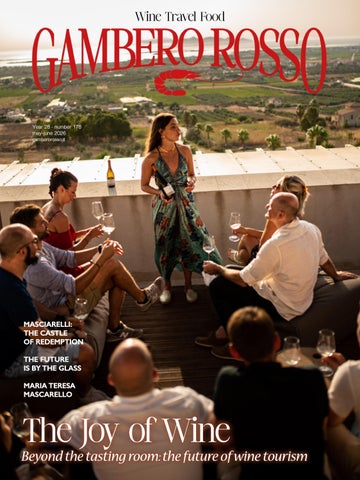
Year 28 ∙ number 178 may-june 2026 gamberorosso.it
MASCIARELLI: THE CASTLE OF REDEMPTION
THE FUTURE IS BY THE GLASS
Beyond the tasting room: the future of wine tourism

Wine is tourism by Lorenzo Ruggeri
28. Italian wine conquers Mexico City: success for the Top Italian Wine Road Show by Giuseppe Carrus

>Cover Story
“Social media and wine? Authenticity wins the day” Interview with Federica Fina by Vittorio Ferla
“These days, everyone’s a traditionalist”
From Barolo Boys to the guardians of tradition: Maria Teresa Mascarello weighs in by Simone Di Vito
20. “The future is by the glass, whether you like it or not” For Marina Cvetic, bottle sales are falling by Sonia Ricci
24. The Castle of Redemption by Lorenzo Ruggeri
26. Italy’s Finest Uncorked in Mayfair by Marco Sabellico
32. Toronto and Vancouver, strategic cities for Italian wine by Giuseppe Carrus
36. The Top Italian Wines Road Show brings a touch of wine to the vibrant Australian city by Giuseppe Carrus
40. The Top Italian Wines Road Show for the first time in Bali by Giuseppe Carrus
44. Bangkok brings the tour to a close: Italian wine toasts its success in Thailand by Giuseppe Carrus
Veal sweetbreads: the luxury of discards by Eugenio Marini
58. The chef’s recipe Salvatore Giuliano by Antonella De Santis 64 >Travel
Umbria: back to its roots by Sonia Ricci
Editor Gambero Rosso S.p.A. via Ottavio Gasparri, 13/17 - 00152 Roma +3906551121 - fax 0655112260 gambero@gamberorosso.it
Director Lorenzo Ruggeri
Editor-in-chief Sonia Ricci
Editorial team Clara Barra, Marco Sabellico (correspondent)
Editorial coordination: Antonella De Santis
Translation Eleonora Baldwin
Graphic Project
Tina Berenato - TB design
Layout
Maria Victoria Santiago, Chiara Buosi
Contributors
Giuseppe Carrus, Antonella De Santis, Simone Di Vito, Vittorio Ferla, Eugenio Marini, Marco Sabellico, Sonia Ricci
Photos and drawings
Cantine Fina (cover), Alberto Blasetti, Matteo Lippera, Marco Varoli, Adobe Stock
Copyright © 2026 Gambero Rosso S.p.A. All rights reserved.
Administration via Ottavio Gasparri, 13/17 - 00152 Roma
Advertising Class Pubblicità S.p.A. via Marco Burigozzo, 5 - 20122 Milano +390258219522 - sbianchi@class.it
Gambero Rosso is a Registered Trademark
Copyright by GAMBERO ROSSO S.P.A.
How to find us via Ottavio Gasparri, 13/17 00152 Roma +3906551121 gambero@gamberorosso.it www.gamberorosso.it filgamberorosso $gambero_rosso



Lorenzo Ruggeri
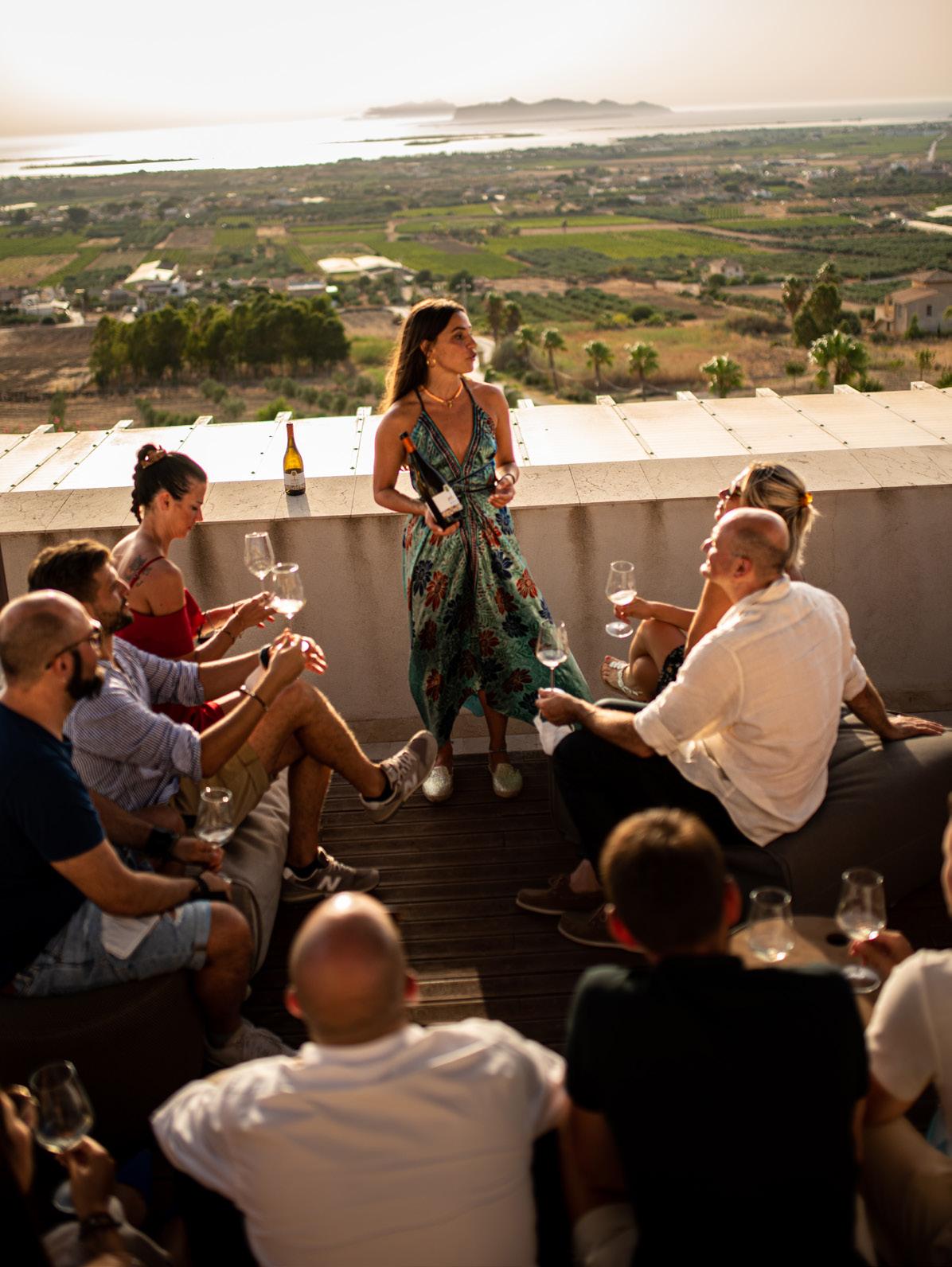
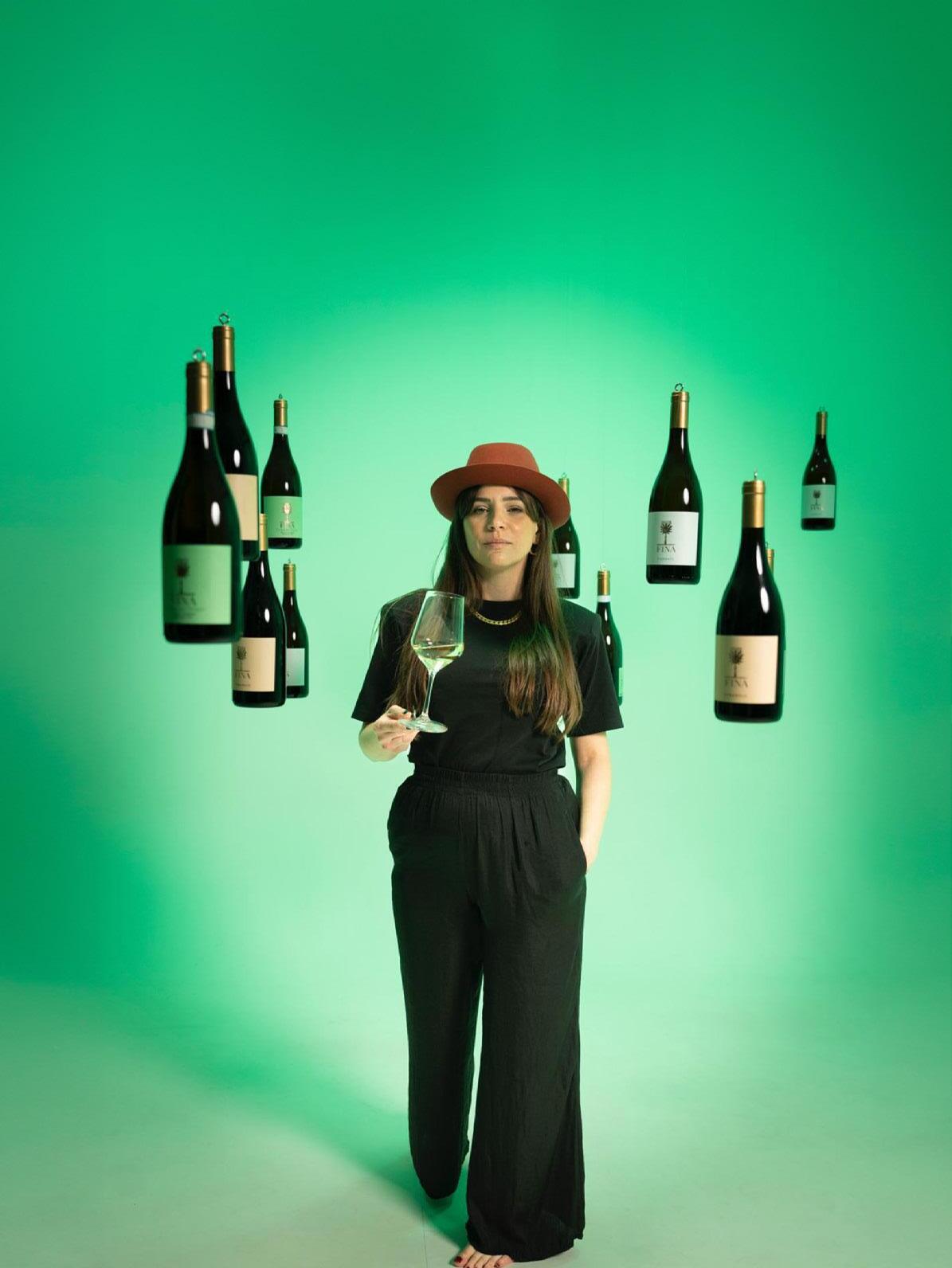
Social norms and interactions have changed, and nightlife in our cities has radically transformed. When we think of wine and young people, we must always broaden our perspective to find a different way of looking at things. Consumption patterns are changing, but above all, the values and priorities that shape how people organise their leisure time are shifting. And these choices have a profound impact on the way we drink and socialise. Over the past few months, we have delved into the nightlife of Rome and Milan in a series of articles, following the action until dawn, and giving a voice to Gen Z – those born after 1995. What emerges, first and foremost, is a widespread sense of anxiety and fear compared to previous generations. This state is accurately described by American psychologist Jonathan Haidt in his book The Anxious Generation. Gen Z is experiencing unprecedented levels of anxiety, depression and social isolation, linked to childhood dominated by smartphones and social media. The shift from free playtime to digital life has significantly altered neurological and social development, fuelling insecurities and fragility. Perhaps – and I say perhaps – instead of demonising wine, the most powerful social glue, shouldn’t we be considering serious campaigns to tackle smartphone addiction? The final blow to nightlife, however, came from Covid. It seems a long way off now, but for the younger generations, who experience everything more intensely, it marked a clear turning point. There is a “before” and an “after”. Meanwhile, figures speak clearly: over the last 15 years, 2,100 nightspots have closed in Italy – around 50 per cent. Over the same period, the population aged between 18 and 34 has fallen by around 3 million compared with 2002. Fear often leads people to stay in at all or to go out only in settings perceived as safe. The factors driving these choices are economic, but they are increasingly influenced by a sense of health – whether real or imagined – safety and a sense of belonging. For many, nightlife has become more about socialising: people go out earlier, come home earlier, and there are fewer venues where one can eat and drink late into the night. The night has grown shorter. This is the case in many cities around the world. So wine, too, has an opportunity: to bring people even closer to the world of wine production, inviting them to experience the winery as they never have before. To turn wineries into meeting places, where wine meets art, music, concerts and gastronomy – ranging from the simplest settings to refined dinners. Wine tourism is on the rise, offering more hospitality, more services and more experiences. We dedicate the cover of this issue to Federica Fina, a producer in Maralsa and president of the Sicilian Wine Tourism Movement, who has brought a breath of fresh air to winery festivals and a packed calendar of events designed to bring together wine drinkers and enthusiasts of all kinds. With the smile and joy of someone who loves this work.
“Social media and wine? Authenticity wins the day”
Interview with Federica Fina, a producer in Marsala and president of the Sicilian Tourism Movement
by Vittorio Ferla
Sicily: a land of contrasts, contradictions and paradoxes. Take, for example, the Fina winery, based in Marsala but renowned for its Traminer Aromatico – a grape variety of Alpine origin that no one would associate with the hot climes of the Mediterranean Sea. And today, it is defying history by reviving the Vitarolo, a Sicilian relic of a grape variety that seemed destined to remain consigned to the dusty archives of researchers. «We make unusual wines; we’re a winery of paradoxes», smiles Federica Fina, the second generation at the Contrada Bausa winery and the youngest of three siblings: Marco oversees the winery’s general management, Sergio follows in his father’s footsteps in the vineyard and cellar, whilst Federica handles communications, events and wine tourism. «I still remember when my father Bruno arrived at the winery in 2006 saying he wanted to plant Traminer at 500 metres, on the northern slope of the Erice hill. Everyone thought he was mad. When, in 2009, there was enough wine to produce 8,000 bottles, some sceptics asked him: “Who are we going to sell a Sicilian Traminer to?”, my father replied: “Let’s bottle it all for now; if it doesn’t sell, I’ll drink it all myself!”» That’s how Kikè came about (a clear reference to Federica’s name, Ed.) and from that moment on, everyone started looking for it. «It was Kikè that put us on the map», continues Federica, «my father was right. At first they said: it’s just a fad. But 15 years have gone by: fads don’t last nearly that long. So, we’ve planted Traminer in Marineo too, at 800 metres. After all, in Sicily there’s the right area for every variety.»
A phrase that betrays an ancient wisdom. One that has its roots in a significant history.
My father became an oenologist between the late 1980s and early 1990s. He began collaborating with
the Sicilian Regional Institute of Vine and Wine on an experimental study that marked a turning point in the Sicilian wine industry. The institute’s president was Diego Planeta, and the project involved figures like Attilio Scienza and Giacomo Tachis. My father worked alongside them in the experimental vineyards set up in various parts of the island to assess the performance of international grape varieties. From that work emerged the idea of Sicily as a “wine-growing continent”. For more than twenty years, my father Bruno absorbed everything he could from Tachis, striving to learn as much as possible from the man he calls his “dear mentor”. This is precisely the
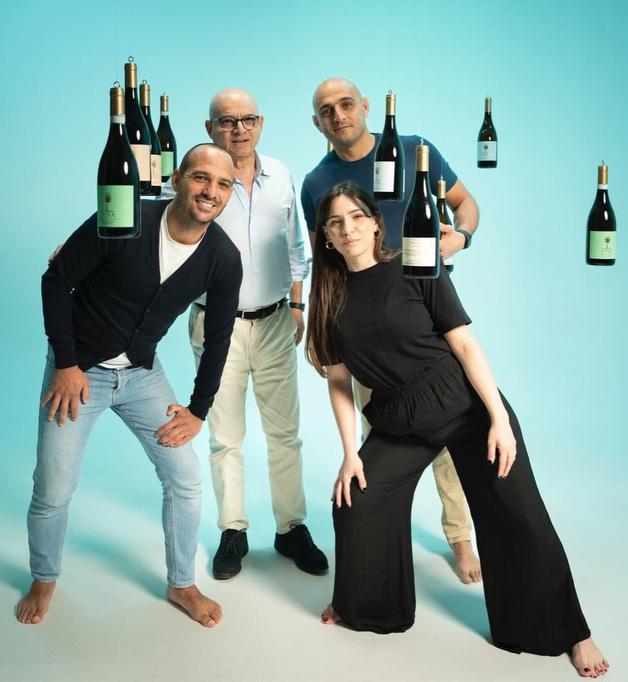
Federica Fina with her father Bruno and her brothers Marco and Sergio
name of the wine he dedicated to him following the founding of the winery in 2005.
Let’s fast-forward twenty years to the latest challenge: Vitrarolo, a wine made from a red grape variety that had almost disappeared, but was later rediscovered thanks to a project by the Sicilian Regional Government. It is a heritage variety: its revival stemmed from
the idea conceived by my father and Francesco Pulizzi of the Pietro Pulizzi winery: today we produce just 1,200 bottles. Heirloom grape varieties adapt very well to climate change and are versatile in terms of style. Even when water-stressed, Vitarolo performs brilliantly. It could be a red wine of the future: it lacks excessive structure and may appeal to emerging palates.
Thanks to its unique character, Vitarolo has been selected as one of the rare wines in Gambero Rosso’s Guida Vini d’Italia 2026. A recognition that offers a new boost…
We are focusing on the Vitrarolo, but we are already thinking about other heritage grape varieties. We are learning and observing: our winery is experimental by definition.
Intorcia, Mastro di Baglio and Baglio Oro, together with the Salt West project led by the three Masters of Wine Pietro Russo, Gabriele Gorelli and Andrea Lonardi.
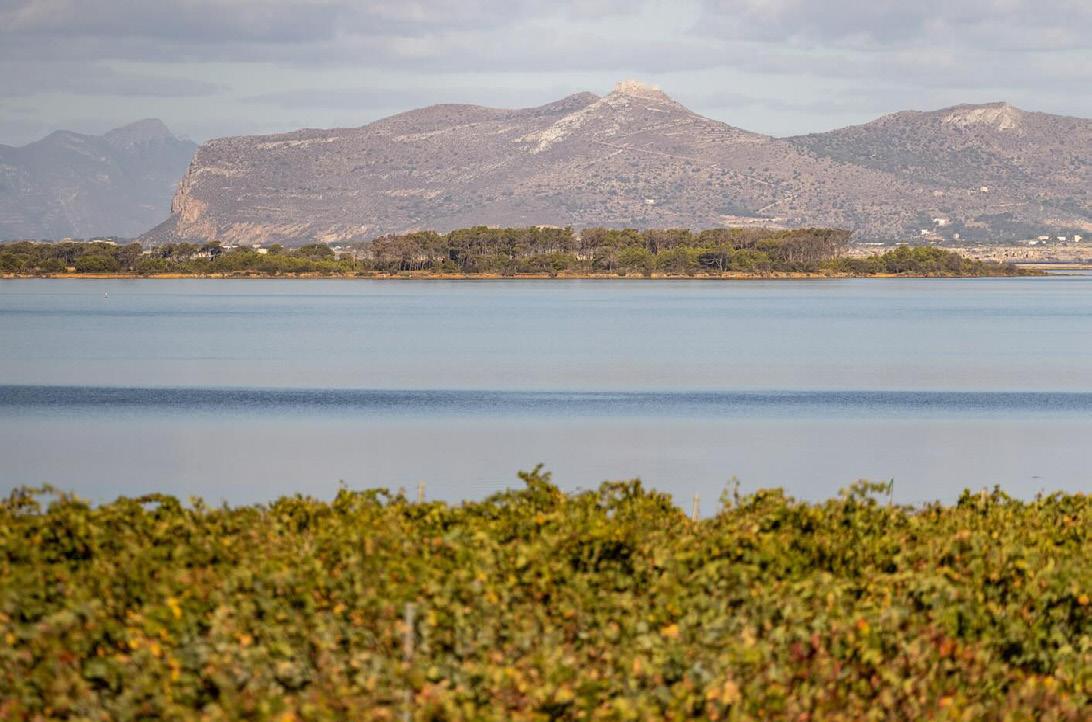
The Stagnone lagoon in Marsala
Between these two “extreme” wines – Traminer, the grape variety that comes from afar, and Vitrarolo, the grape variety that comes from the past – there is room for the flagship grape variety of the Marsala region. The Grillo is our flagship: it is the primary grape variety used in Marsala. We produce four different versions of it. Firma del Tempo comes directly from the Stagnone Nature Reserve, a place with geological features unique in the world: the vineyard almost reaches the sea, alongside the salt pans and lagoons. To showcase this area, a joint project was launched by five producers: Fina,
Marsala: a land of sun, light and wind.
A unique region with stunning landscapes: the salt pans, the Egadi Islands, and one of the most beautiful sunsets in the world. «Pulcherrima sed ventosa», in Cicero’s words. Today, it is chosen by kitesurfers for their sport. A region that produces excellent wines because the wind enhances the quality of the fruit. And then there are countless wineries to visit: Marsala is often chosen for this very reason. After all, the traveller is a wandering explorer.
In short, the ideal place for anyone looking to explore Sicily…
I am completely in love with my region and my city. I recognise its beauty and untapped potential: I feel a deep, visceral connection. I am privileged to live here and to explore the world: we are ambassadors for our city. With Generazione Next (the group of young Sicilian wine producers affiliated with Assovini, Ed.), we want to pass this responsibility on to young people and encourage them to return to Sicily. Our region is better known to outsiders: we need to communicate its appeal to locals, too. I see this through wine tourism: there are plenty of visitors, but often the locals themselves are missing. It is one of our goals for the future.
It’s difficult at a time when the wine industry is facing a serious communication crisis…
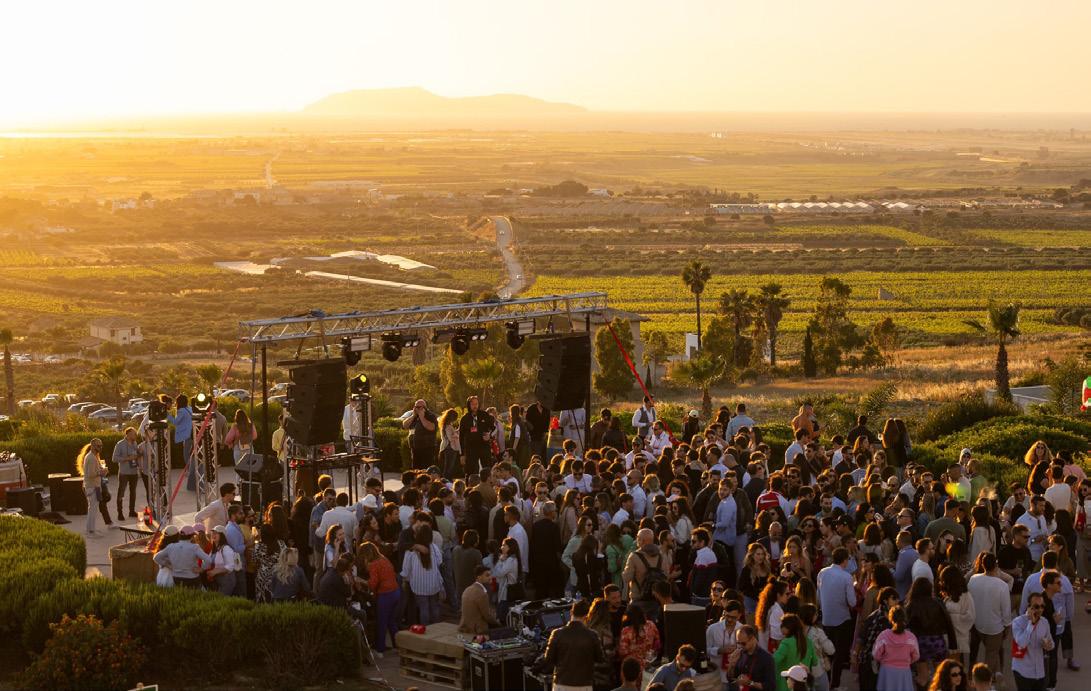
Firstly, the concerts in the vineyard. We hold three of these every year. One is part of the ‘Cantine aperte’ event organised by the Wine Tourism Movement: a true celebration featuring games, live music and DJ sets until sunset, welcoming families and groups of young people. Then there is “Kebrillerà”, a music event now in its tenth year, which has featured artists of the calibre of Jimmy Sax, Vinicio Capossela, Ron and Roy Paci. Finally, since last year, “I racconti del maestro” (The Master’s Tales), a series inspired by my father’s meeting with Giacomo Tachis, in which we invite figures from the worlds of culture and sport to talk about who their personal mentor was.
You revolutionised the way wine is presented by transforming the winery into a cultural space. How did you do it?
Firstly, the concerts in the vineyard. We hold three of these every year. One is part of the ‘Cantine aperte’ event organised by the Wine Tour-
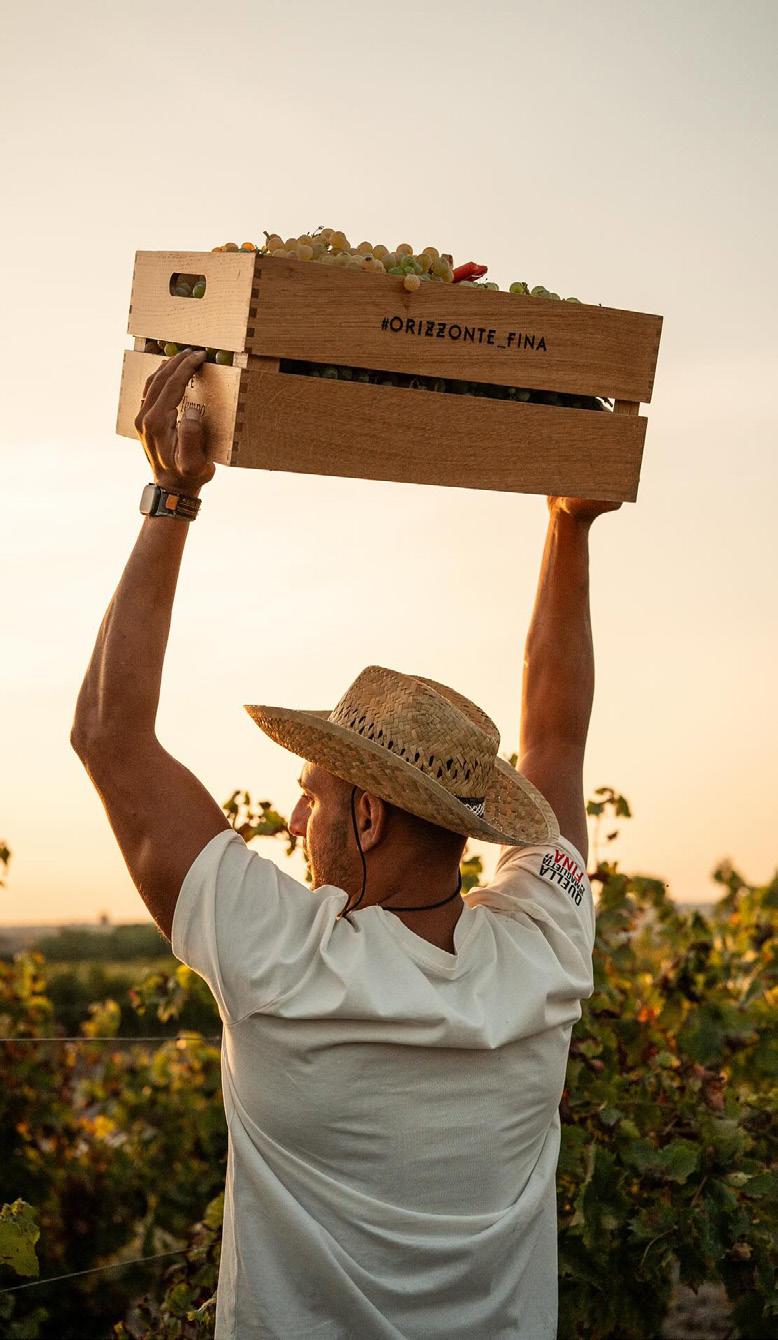
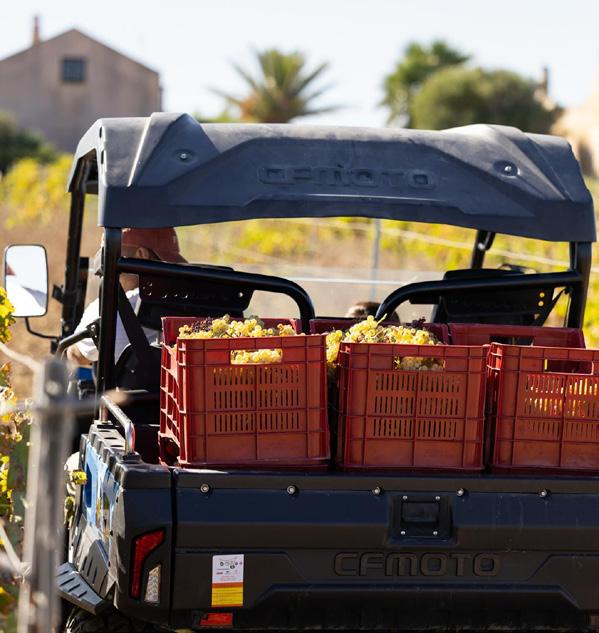
A scene from the grape harvest at Cantina Fina
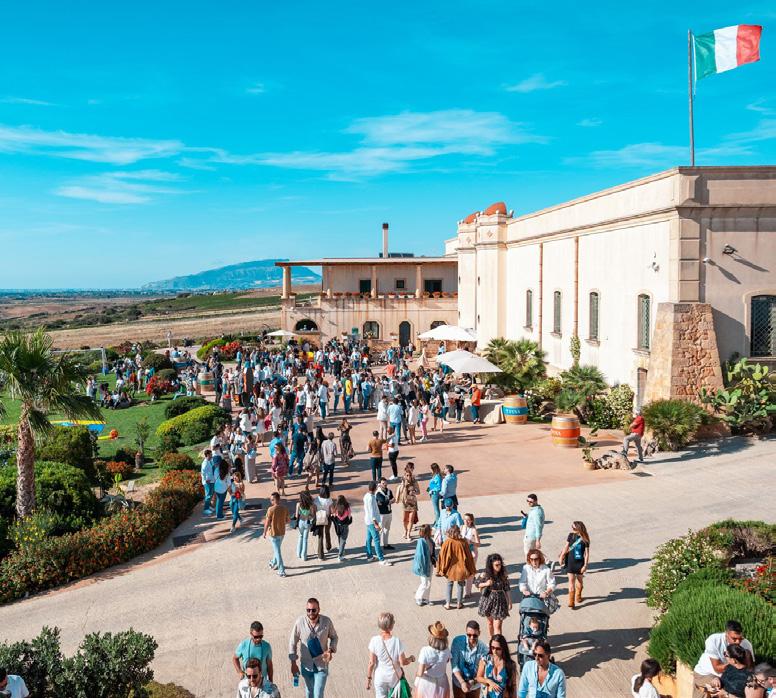
ism Movement: a true celebration featuring games, live music and DJ sets until sunset, welcoming families and groups of young people. Then there is “Kebrillerà”, a music event now in its tenth year, which has featured artists of the calibre of Jimmy Sax, Vinicio Capossela, Ron and Roy Paci. Finally, since last year, “I racconti del maestro” (The Master’s Tales), a series inspired by my father’s meeting with Giacomo Tachis, in which we invite figures from the worlds of culture and sport to talk about who their personal mentor was.
What have you learnt from these initiatives?
There’s a real desire to experience wineries in a different way. Partying doesn’t mean getting drunk; it means adopting a more accessible approach to welcoming young people and families, and promoting responsible drinking. Here at the winery, I’ve learnt how to get the children involved: I turn them into little helpers. At the end, they give me a hug and say, «Kika, we had a great time».
You’ve also become a social media strategist…
It’s our main communication channel. We share all our activities and initiatives via social media: lots of people then get in touch to ask for more details, and we reply to the messages we receive. We present ourselves as we are: we haven’t done any research or drawn up an editorial plan. Authenticity wins the day: we make people feel part of the family. Facebook and Instagram have completely different target audiences. LinkedIn is aimed at Cantina Fina in the Bausa district of Marsala
the trade and business sectors. Now the goal is to launch a TikTok profile: I’m starting to feel a bit like a boomer, but thanks to my five grandchildren, we’re having fun. I’d also like to focus on sending out newsletters. But social media involves a lot of work: it has to be done properly. And every post takes time.
You have recently become president of the Sicilian Tourism Movement. What are your thoughts on wine tourism? Sicily is incredibly difficult to define: it is vast, with a variety of sub-regions and microclimates. But the answer to the wine crisis lies precisely in wine tourism: the traveller is an explorer in search of an authentic experience. Our winery has seen a 30% increase in visitors: we receive 5,000 a year. But the Florio winery attracts over
80,000 visitors a year. That is why this could be a solution to the wine crisis. But even in wine tourism, we need to work together.
What still needs to be done? For example, we need to spread out visitor numbers throughout the year. At the moment, wineries welcome visitors 365 days a year: we are equipped to stay open even on Sundays. But other establishments should do the same: hotels, museums and restaurants should always be open. Similarly, transport between the various parts of the island should be guaranteed. The main problem is untapped potential: often there is a lack of initiative or organisational issues. But in ten years’ time, I foresee a faster and smarter Sicily, capable of preserving its ‘slow’ way of life whilst remaining responsive to the future.
“These days, everyone’s a traditionalist”
From Barolo Boys to the guardians of tradition:
by Simone Di Vito
A central figure who defies trends, Maria Teresa Mascarello runs one of the Langhe’s most distinctive wineries. With her unwavering commitment to concrete, her rejection of regional generalisations, and a philosophy of wine rooted in the vintage rather than style, her story goes against the grain without needing to say so. Stepping into the winemaking room, everything is in order, even more modern than one might expect. «My grandfather founded the winery in 1919. And since then, the choice has always been to remain a small-scale, family-run operation». Five hectares built up over time, with no plans for expansion and without ever changing the direction of production. «We’ve never gone looking for more land. In fact, when we were offered a small plot to rent in Monrobiolo di Bussia in 2015, it was more a stroke of luck than a choice», she explains. Four thousand square metres to make up for the loss of San Lorenzo, a vineyard that had been grubbed up shortly before. «I was sorry to see it go, but it was over seventy years old and no longer producing as it once did. It needed replanting». A few years later, it came back, and with it – alongside a slight increase in yield – the wine’s overall balance also improved. «Since 2020, we’ve gone from four to five vineyards in our Barolo». But the scale remains
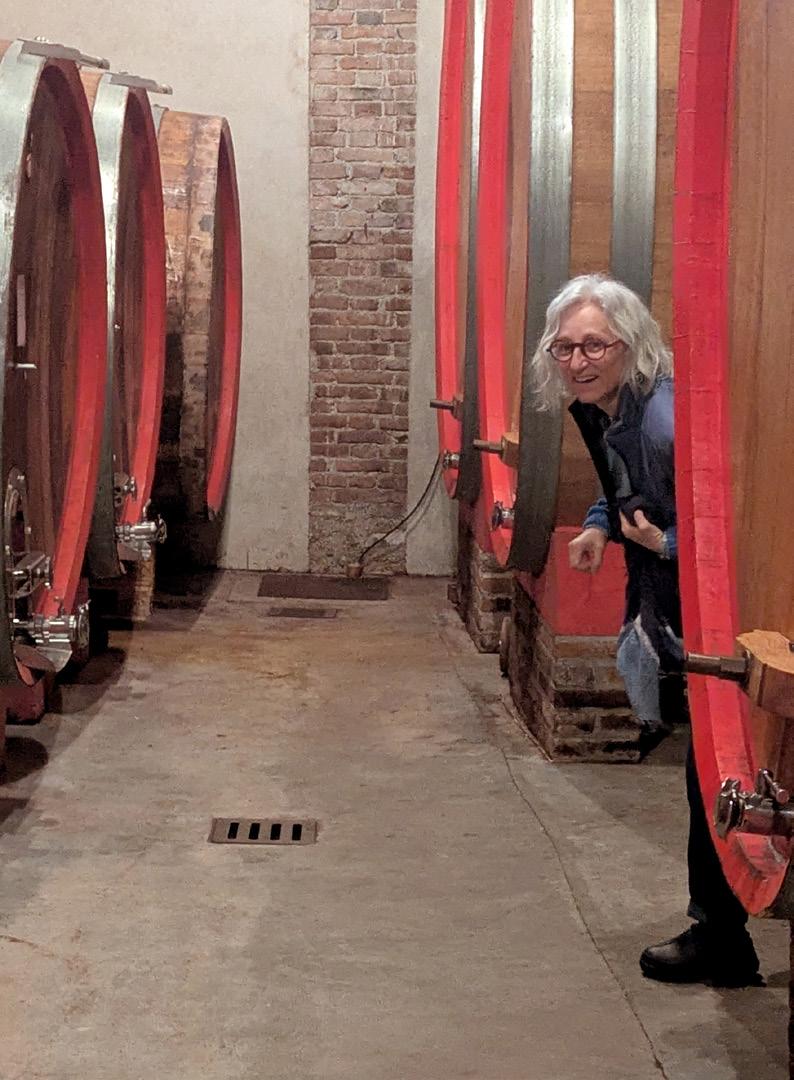
Maria Teresa Mascarello in her winery in Barolo
the same: «As I see it, being small today is an advantage: you can follow every stage of the work, from the vineyard to the cellar. I’m happy with five hectares; if I had more, it would be complicated», she continues. «Then, with the current crisis, producing a wine called Barolo certainly helps».
«We never considered making a wine from a single MGA». In recent years, however, the system has shifted, and geographical designations have reshaped perceptions of Barolo, driving an increasing trend towards parcelisation. A direction that has never become a necessity here. «Once upon a time, you could
write on the label where the wine came from, even if it was a blend of several place names. It wasn’t poetry, it was simply the truth», she explains. Now it is no longer permitted. «Those of us who have vineyards in different municipalities can no longer list them on the label. You either put a single vineyard or the municipal name», she points out. And so, in some cases, you have to make do. «Those who historically used place names have had to remove them, only to resort to a made-up name. I understand the choice of zoning, even from a marketing perspective. But what was already there by tradition should also be respected. We’re not in Burgundy», she recalls with a sigh. In the much-celebrated Barolo
produced here, the vineyards are diverse: Cannubi, Rué, Rocche dell’Annunziata, San Lorenzo, to which Monrobiolo di Bussia has been added. Different soils, exposures, balances. «This has always been our elders’ recipe. And today, with this unpredictable climate, it’s a choice that helps», she says. In increasingly unpredictable vintages, blending becomes a form of stability. It is not about the sum of the parts, but a balance born of instinct and winemaking culture. «Every vineyard contributes something. But only together do you find completeness, a complexity that you can never achieve with a single vineyard». And this is where the approach also becomes a defining feature: «On paper, our Barolo sits
at the base of the pyramid compared to those who bottle single crus. But it’s a choice we’ve always made, with pride», she emphasises. No rigid hierarchy, nor percentages to replicate: «It’s not a formula decided at a desk. Just the quantity produced by the vineyards, which changes with every harvest. What nature gives you». Meanwhile, climate change has made everything more variable. It is no longer just a question of hot or cold, but of perception: «We’ve become so accustomed to such high temperatures that when they don’t reach those levels, you think the vintage is cool. But that’s not the case. It’s just less hot», she observes.
The 2025 vintage, for example, was one of the hottest on record in the Langhe. But the way the heat was distributed has altered our interpretation. «When you’re used to 35–38 degrees, a few degrees less can be misleading». The heat brings everything forward slightly, even affecting the timing of the harvest. «Up until less than a month ago, we were thinking of October, but in the end, we harvested everything by 30 September», she says. And it also becomes harder to answer a question that seems simple. «Nowadays, more and more people ask us when they should open a bottle of our Barolo. As if it were an easy answer to give—the right, precise moment». The climate has changed, but so have the tastes of those who drink it. «People used to say: open this one in ten years, that one in fifteen. Now it’s more complicated; it also depends on what you’re looking for in a wine – for complexity, you have to wait». Yet there are vintages that surprise. «The 2017 was labelled as one to drink straight away, because it was hot and therefore destined to mature sooner. Yet, after eight years, it’s still in great shape. I opened a bottle a few days ago», she recalls.
“These days, everyone’s a traditionalist”
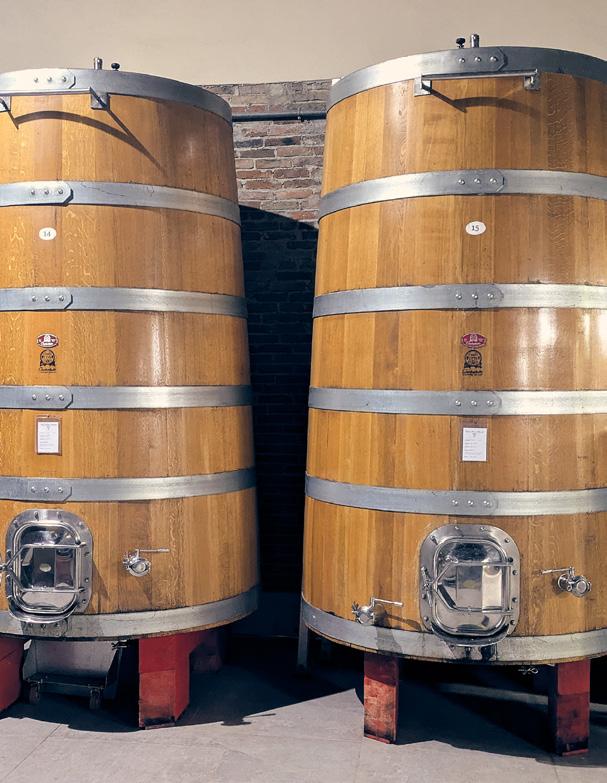
«You can draw on all the experience you like, but these days it’s becoming increasingly difficult to interpret a vintage. Every time is a different story», she says. And in the cellar, the choices inevitably reflect this unpredictability, with decisions changing from year to year. «The submerged cap, for example. We last used it in 2021, then set it aside for the next three vintages due to the characteristics of the grapes. We brought it back in 2025». The equipment in the cellar, however, remains unchanged. «During the Barolo Boys era, concrete was demolished to make way for steel and rotary fermenters. It seemed you couldn’t do without them», she recalls. But in the mean-
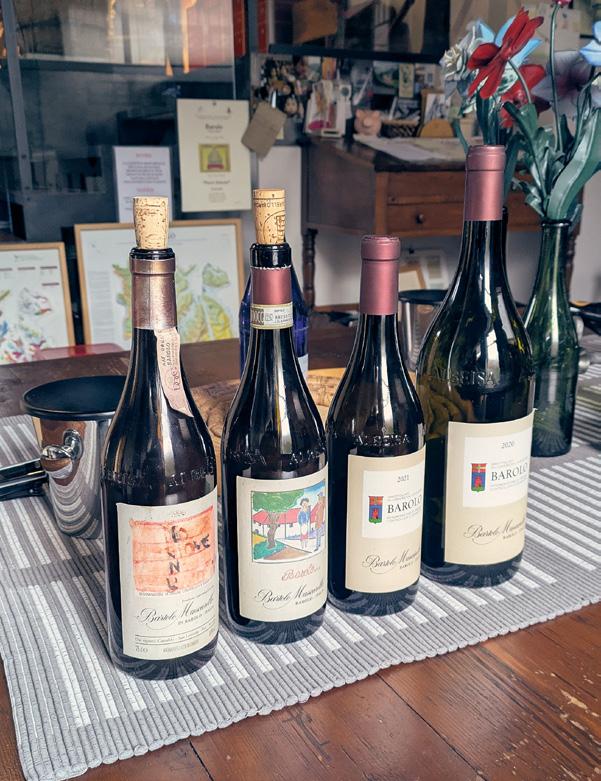
A vertical tasting of Barolo from the winery, spanning 1996 to 2021 time, concrete has come back into vogue. «We never questioned it. My father and grandfather bought these tanks over sixty years ago», she adds. Meanwhile, barriques in Barolo seem to have disappeared. And the controversies of those years, as if they had never existed. «These days, however, everyone is a traditionalist». In the meantime, some renewal was necessary. «We’ve improved a few things, but without making drastic changes. There’s always room for improvement». A table for sorting the
grapes, a gentler destemmer, a heat exchanger. «Thirty years ago, the problem was the cold. I remember my father placing a small heater in front of the tank doors in October. Now it’s the opposite». Outside, meanwhile, the system is changing: there’s more building, more communication. «A lot has been built, but not always with care. Many wineries are designed more to host visitors than to make wine». Many young people are taking up this work, even in Barolo. «Many have revived traditional practices. And they also seem to have a greater environmental awareness. That’s pleasing». But vineyard practices in the area vary. «With the difficulties of recent vintages, between rain and fungal diseases, unfortunately we’re starting to see the return of under-row herbicides», she observes. An increasing amount of money is being invested, and we can’t afford to lose out. «People want to take as much as possible from nature. But when it comes to making sacrifices? Let’s just say we’re not all willing to make them», she adds. «It’s the environment that suffers most». In the Langhe, historic grape varieties such as Dolcetto are increasingly being grubbed up to make way for the more famous and profitable Nebbiolo. «We’ve never considered giving up Dolcetto. It’s important to us», she says. Even though it is one of the varieties that has suffered the most. «Some are grubbing it up, whilst others, in other areas, have tried to make it more prominent, with longer macerations and time in wood. But that means distorting its nature. Today, the climate is also playing its part, with increasingly rapid ripening and rising alcohol levels». Then, however, comes a vintage reminiscent of days gone by. «This year we have a Dolcetto at 12.5% ABV. It hasn’t happened for thirty years». Not a choice but a consequence. «It’s the
vintage. And indeed you can taste it in the glass. It’s closer to what it’s always been». An honest, straightforward wine: «The sort you used to drink every day». Alongside the Dolcetto, the Freisa, another grape variety not to be overlooked: «Traditionally, we made it sparkling. But with the temperatures and alcohol levels of recent years, the secondary fermentation struggled to take place. So we decided to make it still».
Then there are details that reveal another side to the work. The labels, for example: «Given health problems that prevented him from going out into the vineyard, my father helped me with public relations at the win-
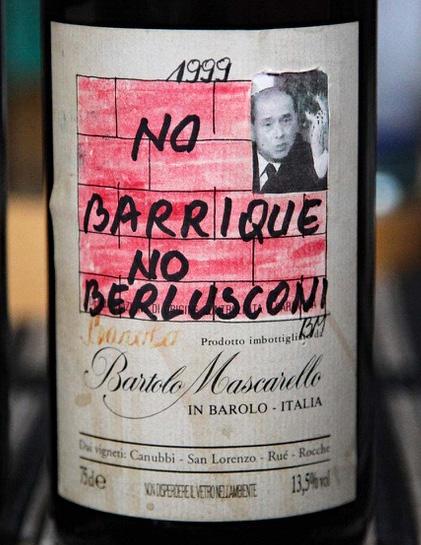
ery. And, partly for fun, he started designing labels», she explains. Without taking himself too seriously: a way “to lend a hand”. «He used to say: Just look at me, at 60, having to start drawing like a child». Over time, some of those labels have become veritable works of art. «There was no logic behind the design or the vintage. It was all random and spontaneous», she explains. She keeps around 600 different ones, yet every now and then a long-standing customer shows her photos of some she’s never seen before. The logic, however, remains the same: one label drawn for every case of twelve bottles. «Unfortunately, some people have started taking advantage and making money off them. But the wine inside is the same as
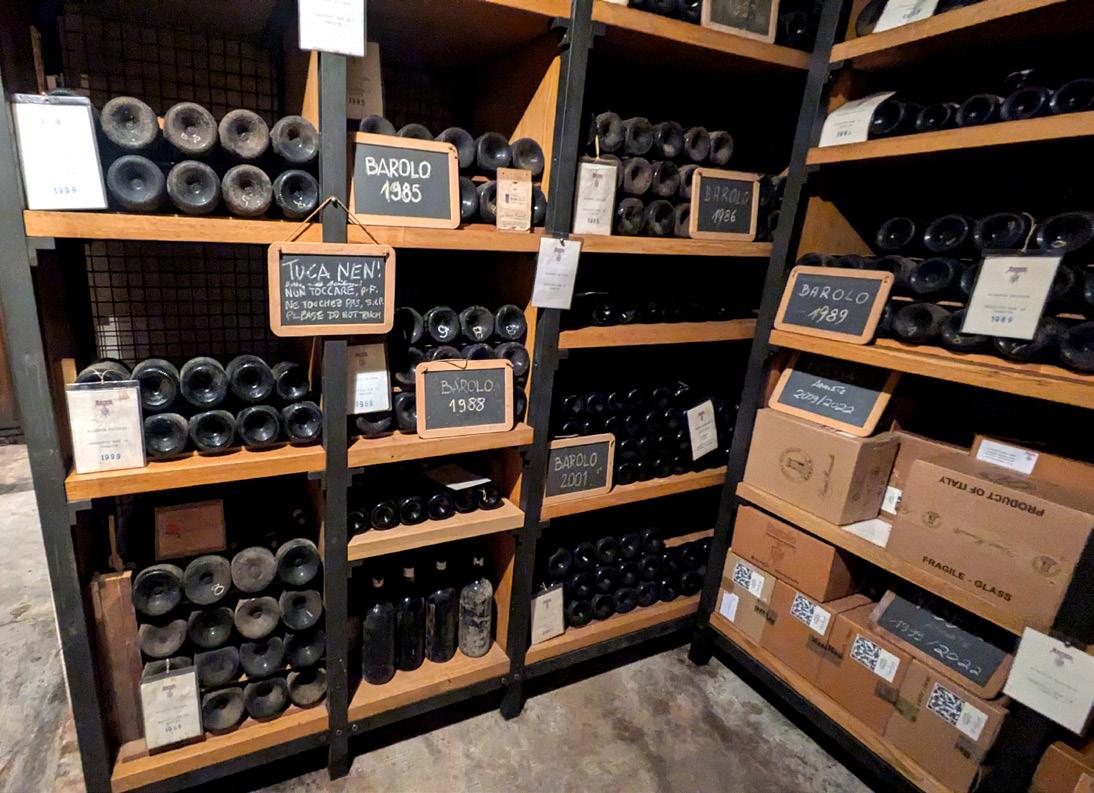
the classic label, and it’s the same price here», she adds. In the cellar, on every rack, there are signs bearing the words “TUCA NEN” (Don’t Touch, in Piedmontese). She smiles as she explains, «Those are for my mother. She’s a good cook but a dangerous one: if she’s making a roast, she goes down to the cellar and grabs a 30-year-old Barolo». When the conversation turns to women in wine, her response is clear-cut. «It annoys me when being a woman becomes a marketing ploy», she says. «Whether you’re a man or a woman, the deciding factor is that you have to be capable», In recent years, the issue has become increasingly visible. «Articles, books and conferences are being produced. It seems that
the value lies in being a woman, when in fact it should lie in merit». And there is no shortage of negative examples recently: «From a woman, I expect sensitivity and humanity, but if the behaviour is that of some women in power today, I dissociate myself from the female gender», she concludes.
Bartolo Mascarello’s gift for conciseness. An interesting fact: during the 2001 elections, the Carabinieri raided the Marchisio Alba wine shop and confiscated one of these bottles on the grounds of political propaganda in an unauthorised space.
>Dolcetto d’Alba
With an alcohol content of 12.5%, it’s the perfect everyday dining companion. It has notes of cherry and red berries; it’s simple, lively and straightforward, with a focus on freshness, vibrancy and a delicious flavour. One sip leads to another.
A wine from a “neoclassical” vintage, where breadth and vigour coexist in perfect harmony. Aromas of violet and blood orange, with a hint of spice; on the palate, it is layered, agile and refined, underpinned by dense yet well-integrated tannins. It suggests the longevity typical of great Barolos, without compromising on a drinking experience that is already deep and satisfying.
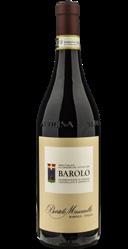
(Preview, to be released in September 2026)
More open and immediate on the palate. A crisp, airy profile, with notes of fresh cherry and hints of balsamic aromas. It is gentle, smooth and generous on the palate, with a distinct yet slender structure, well-integrated tannins and good balance, resulting in a pleasant, straightforward drinking experience.

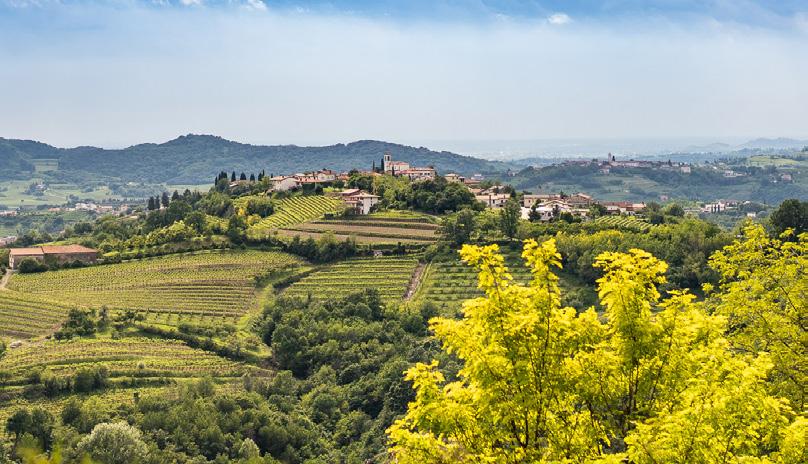
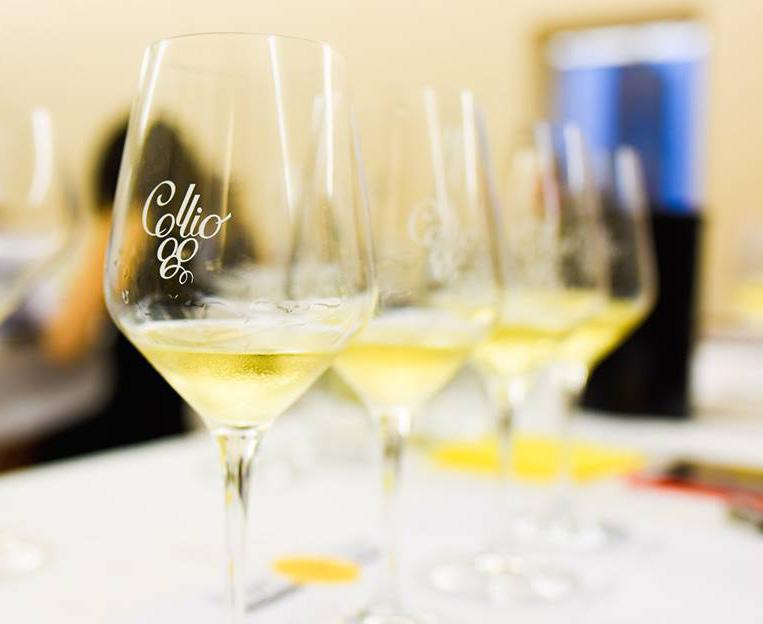
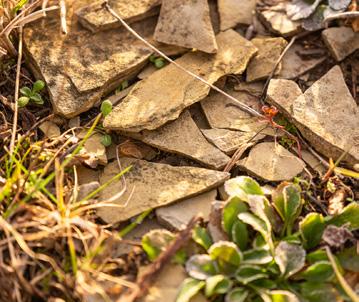
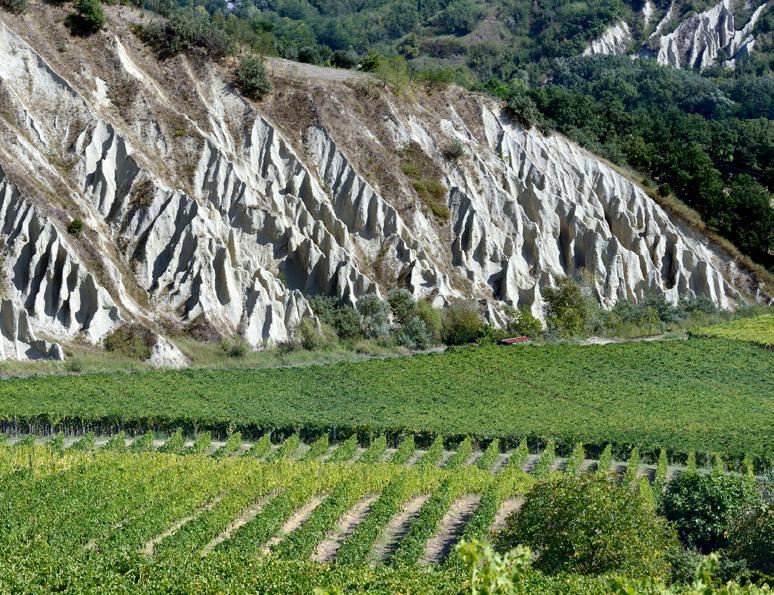
In Collio, wine is never just a matter of grape varieties. It is a balance that arises from a specific territory: a crescent of hills between the Judrio and the Isonzo, where the winds from the Adriatic meet the shelter of the Julian Alps and give rise to a unique microclimate. Here, the ponca (photo bottom right)– composed of Eocene marl and sandstone –crumbles in the hand, imparting to the wines that distinctive mineral and salty character that makes them instantly recognisable.
It is within this context that the work of the Consorzio Tutela Vini Collio takes shape, founded in 1964 as one of the first in Italy and now a point of reference for 178 wineries. After more than sixty years, the role has evolved: from safeguarding the designation to building an identity capable of establishing itself in international markets.
This growth is also reflected in the figures and production style: 88% of the vineyard area is dedicated to white wines, a focus that has made Collio a benchmark for finesse and evolution. Alongside the native grape varieties, Pinot Grigio now plays a central role, accounting for around a quarter of production and becoming one of the most effective expressions of the terroir.
It is precisely this grape variety that is the focus of the Consortium’s latest initiative. Through Collio Evolution, the appellation’s flagship event, the region chooses to present itself through a discerning lens. The 2026 edition, scheduled for 25 and 26 October in Cormons, will be dedicated to Pinot Grigio – not merely as a grape variety, but as a key to understanding the Collio region. “Beyond the grape variety. From the soil to the glass” is the chosen theme: an invitation to move beyond the idea of a uniform style and to convey the complexity of a grape variety that changes character here depending on the soils and production choices.
Technical tastings, discussions and meetings with producers will accompany a reflection aimed at defining the identity of contemporary Collio. Not a showcase, but a cultural platform. Underpinning this journey is also a focus on identity and sustainability. The Collio bottle, with its distinctive shape and yellow capsule, has become a recognisable symbol, designed to combine image and environmental responsibility through reduced glass usage.
It is within this interplay between territory and vision that Collio continues to evolve, transforming complexity into identity.

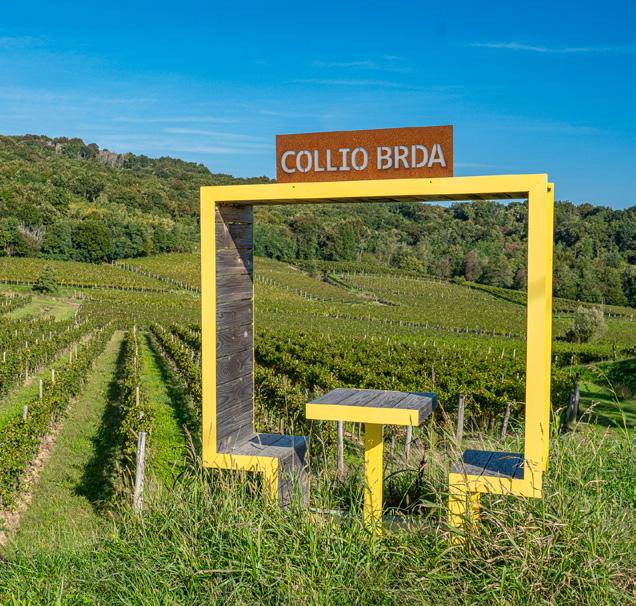

Consorzio Tutela Vini Collio
Cormons /GO) Via Gramsci, 2 +39 0481 630303 collio.it segreteria@collio.it

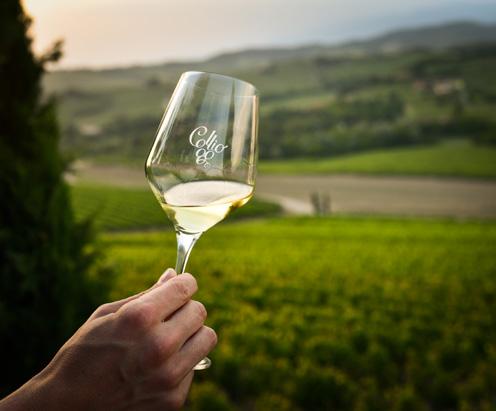
For Marina Cvetic, bottle sales are falling: high prices, low consumption. Wine is holding its own by the glass
by Sonia Ricci
«Vinitaly is a bit like our Sanremo», says Marina Cvetic, smiling, her light eyes and strong, defined features set as she stands her ground with a determination she asserts without mincing her words: «I come from the Balkans, so tenacity and determination are part of my character, just like Djokovic». We meet her here, inside Vinitaly, amidst a constant flow of people and wines, and in her presence one can sense the years during which, following the passing of Gianni Masciarelli, she took over the
winery bearing his name and carried it forward without changing course, keeping together family, children (Mriam Lee and Chiara Ludovica work alongside her), the business and a clear vision of quality forged in the hills of San Martino sulla Marrucina, within an Abruzzo region that once prioritised quantity but now also recognises the work of those who, like her, have set a different standard – no trellises in the vineyard, but the Guyot system, small rather than large wood – with the quiet strength of someone
who exists in a male-dominated world and chooses to make her mark without engaging in gender battles.
Following the death of her husband Gianni Masciarelli, not everyone would have been willing to bet on the future of the winery. They were wrong.
Was it tough?
I have a strong character; I come from the Balkans, it’s in my blood. I built up the entire export business, and I’ve also been in charge of the commercial side for years. Just because the trees don’t make a sound doesn’t mean they aren’t there.
Today, Masciarelli is one of the symbols of Abruzzo’s wine industry. How did you achieve this? For us, it was essential to cultivate a mindset focused on quality. This mindset wasn’t brought about by Gianni Masciarelli alone, but by his whole family: there has always been an unwavering belief in quality, both in the vineyard and in the cellar. We
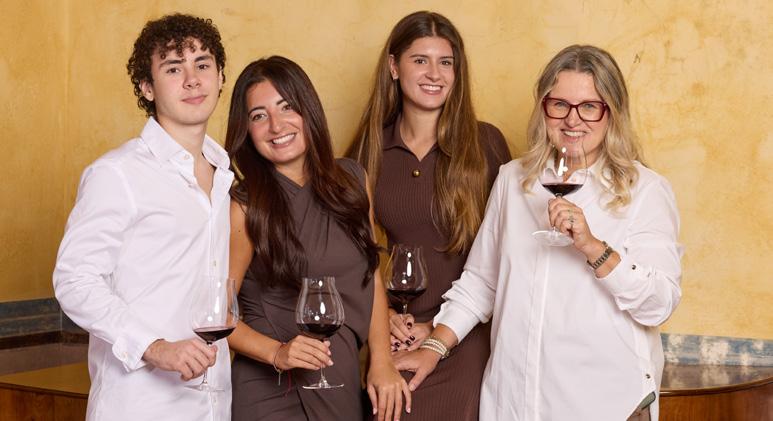
Marina Cvetic with her three children: Riccardo, Miriam Lee and Chiara
work in an extraordinary region, surrounded by national parks and rich biodiversity. We’re lucky; Abruzzo is a generous land.
You started out when wine in Abruzzo was all about quantity.
Gianni Masciarelli was a pioneer, one of the first to explain that quality could be produced in Abruzzo. Lower yields, longer fermentations, cryomaceration, low temperatures, and an intelligent use of wood. Today, the winery continues to work with a variety of materials and containers, but always with this principle in mind: to respect the wine and allow it to develop in the most suitable way.
Wine remains a very male-dominated world. How difficult was it, for a woman, to make a name for yourself in this sector?
I have a very determined character, and those who work with me know this well. My family supports me. But I also think there are many women in Abruzzo who are very strong, very serious, and hard-working. Women also bring soft skills, a gentleness, a lightness, a sensitivity that can be invaluable. But talent has no gender. If you’re good, you’re good.
Of course, but you have many women in the company, including your two daughters.
Yes, and I have a vineyard manager who is a woman, and I adore her because she’s efficient, quick, and to the point. I discuss things with her a lot. I love smart people who grasp things immediately, who truly love what they do. They don’t do it just for financial reward, but because they believe in it. But I repeat, this has no gender. I always look for human talent, in the vineyard and in the cellar.
But have you had to prove yourself more at work because you’re a woman?
I’ve worked without giving it a second thought. I have a say in pretty much
everything; I set the tone, the direction. I’m very hands-on. The wine has to appeal to those who make it and those who represent it, and I love it. Then I have one great obsession: the vineyard. I consult with the agronomist and those who work with us constantly – weekly, often daily.
How has viticulture in Abruzzo changed in recent years?
There is certainly greater awareness today regarding wine quality. In my case, I have always sought to contribute in terms of vision, organisation and harmony. For me, everything must be coherent, as if it were a symphony, right down to the smallest details. My contribution has also been in creating a system, in encouraging and organising people to do better.
In Abruzzo, however, there is still talk today of increasing yields for everyday wine, just as the market is struggling. What do you think of that?
In my view, yields should be reduced, not increased. Quality improves when production is more balanced. We must seek greater value, not greater quantity. Old vines, for example, produce less but often yield higher quality. I believe in this philosophy.
Do you think too much has been planted in Italy over the last few decades?
It’s a complex question, but certainly in many places today people are asking themselves this. In France, for example, they’re grubbing up vines. Here too, we need to look carefully at where it makes sense to keep certain vineyards and where it doesn’t. In some cases, an incentive or support might be needed to help those who have to grub up their vines.
Speaking of Abruzzo: there is a debate over
the name Montepulciano, which is also the name of the Tuscan town.
Actually, ours is called Montepulciano d’Abruzzo.
Would you ever give up calling your wine Montepulciano?
No, I would never give it up. I love Montepulciano; I’ve fallen deeply in love with it. For me, it’s a grape variety with a very strong soul. Once I start doing something, I don’t stop. Wines are a bit like children. The names are different.
Wine is going through a difficult phase at the moment. What’s your experience?
It’s a difficult time, but I’m convinced that wine is heading in a different direction.
Meaning?
It must also, and above all, be sold by the glass. Even expensive wines.
So you mean restaurants… Yes, and I can’t understand why
so many aren’t really moving in this direction yet. Everyone drinks differently: I don’t drink like someone else; perhaps I want a white wine and someone else wants a red, but that doesn’t mean we want to open a whole bottle. I myself don’t always want to spend a hundred euros on a bottle: perhaps I want a glass at lunch and one at dinner. I’d love to find thirty wines by the glass. The restaurant industry needs to change certain habits. The sommelier must return to telling stories, making suggestions, and guiding guests. This role must regain its central importance.
And what about the mark-ups in restaurants, which have risen?
Today they are one of the major issues in the sector.
Yes, it’s a problem. On the one hand there’s inflation; on the other, a balance needs to be found. In some cases, things are being taken too far, and this annoys people, who are already drinking less wine than in the past. A more sustainable approach needs to be found.
Trump’s tariffs have led to price rises and uncertainty. How are things going in the United States? Have your exports fallen?
America isn’t just New York. There are many other states, many different situations. You can’t give a single answer; there are times when the market stalls, when it’s a bit patchy, but you can’t oversimplify things.
Are you also looking at other markets?
Yes. We need promotion and we need patience. We’re looking at other markets with interest.
For example?
Brazil is a great opportunity. We need to get back to promoting the country and encouraging Brazilians to visit Italy, because when they come here, they fall in love with it. Their food, which is often aromatic, rich and even spicy, pairs very well with wine.
Then there is the geopolitical issue: Trump, Iran, Hormuz, international tensions. Are you concerned about repercussions on tourism and therefore on consumption?
We are seeing a very busy season, with many arrivals from numerous European countries: Austria, Belgium, Luxembourg, Eastern European countries. I see that at the moment, Europe is choosing Europe. There is growing demand, a desire to stay closer to home. I see potential for growth in intra-European tourism.
De-alcoholised and non-alcoholic wines. There’s a lot of talk about them. What do you think? They certainly cater to a different way of socialising and social drinking. Young people are drinking less alcohol than before; that’s clear. I’ve tasted several. The aromatic ones, with pronounced aromas, can work better in some cases.
Would you make them? Have you considered it?
It’s an issue I’m watching closely, because the market is driving it. However, for me, the pleasure of wine, its balance and its identity remain fundamental.
Another issue is red wine; tastes are changing, with people starting to prefer lighter wines over more full-bodied ones. What do you think?
Rather than changing the wine, we need to focus on the serving temperature. We’ve started serving red wines, even reserves, at 12 degrees Celsius. Then, within half an hour, they reach 14 degrees, especially in the summer heat, when it’s 35 or 38 degrees outside. The result is very interesting: the first impression is of fruit, not alcohol. When the wine is cool, you taste the fruit first.
Is that enough?
We’ve seen it all summer: people drink red wine without any problem.
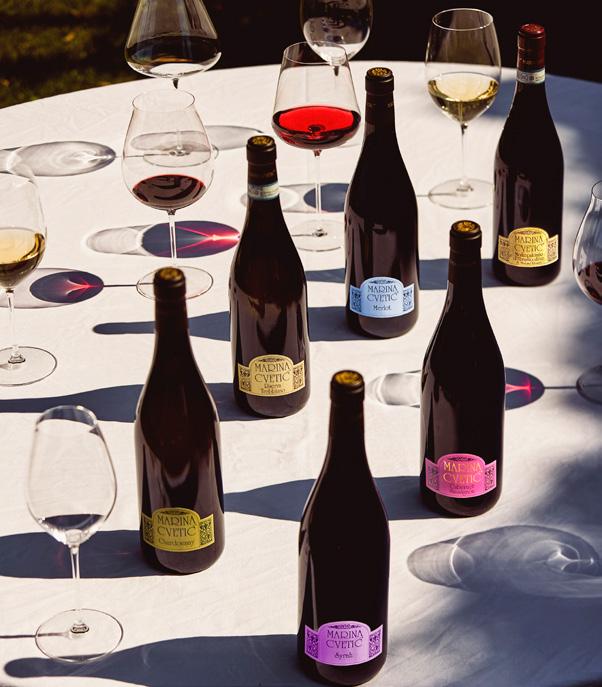
The wines of the Masciarelli winery; the Abruzzo vineyards are shown bottom left
In fact, I’d go so far as to say that red wine should be served not just cool, but cold. Even reserve wines at 14 degrees are cold.
So you don’t necessarily have to change the wine; just changing how it’s served is enough?
I’m absolutely convinced of it. The first impression is the decisive one. If the wine is pleasant at the start, the brain accepts it, the palate approves of it. Even if it reaches 16 degrees half an hour later, the experience has already got off to a good start. By lowering the temperature, you don’t change the wine: you change the way it enters the mouth. We’ve been doing this for three years and for us the result has been convincing.
>Cerasuolo d’Abruzzo
Villa Gemma 2025
This is a successful vintage, and it certainly shows. The Cerasuolo ’25 offers expressive notes of raspberries and fresh strawberries on the nose, with a juicy, elegant palate. It has rhythm and vigour, with a distinctive hint of Mediterranean scrub on the finish.
Riserva
With further ageing in the bottle, it has developed remarkable harmony and depth. Its dense tannic structure has softened, giving way to a more relaxed and refined profile, without losing any of its fullness. The finish is flavourful, with notes of small black fruits, liquorice and black pepper. Bold.
>Trebbiano d’Abruzzo
La Botte di Gianni 2019
A bespoke project inspired by a serendipitous discovery: two 700-litre tonneaux purchased by Gianni Masciarelli and never used. Marina uses them to vinify a super-selection of Montepulciano and Trebbiano. The 2019 vintage impresses with its definition, richness and precision: it is a complete white wine, refined in texture, with a very long finish of almond and broom. Only 891 bottles produced.
>Montepulciano d’Abruzzo
Villa Gemma 1995
Red Wine of the Year in our 2021 Wine Guide. Thirty-one years after harvest, it displays a remarkable vigour; it remains lively and intact in its tannic vigour, bursting with notes of ash and undergrowth, enhanced by hints of blood orange and black olives. The finish is endless.
>Miriam Lee Pecorino 2024
A new project, as yet unlabelled, by Miriam and winemaker Attilio Alfino. The wine ferments and matures in a 225-litre glass demijohn. It has a delicate nose with notes of exotic fruit and rosemary; on the palate, it is structured and lively, with a savoury, slightly bitter finish. A new beginning.
In Semivicoli, a 17th-century mansion preserves the story of Masciarelli: vision, mortgages and a great deal of tenacity
by Lorenzo Ruggeri
When Gianni Masciarelli told Marina Cvetic that he had just bought a castle, her reply was blunt: «Be serious!» After verifying that it was true, she replied: «OK, let’s get a divorce». It was yet another mortgage that Gianni had taken out to relaunch his wine-making venture. The son of a lorry driver and a farmer, he had enrolled in Economics at Pescara, but had never sat his final exam. «When he told them he’d decided to work in wine, they labelled him a failure. Even his parents didn’t take it very well. Being a winemaker was seen as a lowly job». The narrator is Miriam Lee Masciarelli, the eldest daughter of Gianni and Marina, now an increasingly central
figure in the wine project, constantly on the move to promote a brand that is now exported to around 60 countries. It all began in 1981 in San Martino sulla Marrucina, also known as the “gunpowder keg of Abruzzo”. A town in the heart of the region, which until the mid-1900s had never been conquered by invaders. Here, the vine not only provided grapes for food and drink, but the charcoal from pruned shoots was used in a secret recipe for the production of gunpowder. The gunpowder makers of San Martino – so the story goes – were formidable defenders, incredibly tenacious and stubborn. That temperament was wonderfully captured by John Fante – a native of
Torricella Peligna – in unique books such as “Confraternita dell’uva”The Brotherhood of the Grape - and Angelo Musso’s unforgettable Chiaretto. Such was Gianni Masciarelli. After a series of trips to Burgundy and Champagne, he became fiercely convinced that Abruzzo too could play a different game. He introduced the Guyot system in place of the trellis, high-density plantings of up to 10,000 vines per hectare, grape selection and ageing in new barriques – something never before seen in the region – and he also planted vineyards with north-facing exposures, which at the time struggled considerably to ripen.
visionary
He collected tractors and mortgages; whatever came in, he reinvested in the vineyard and the winery. A
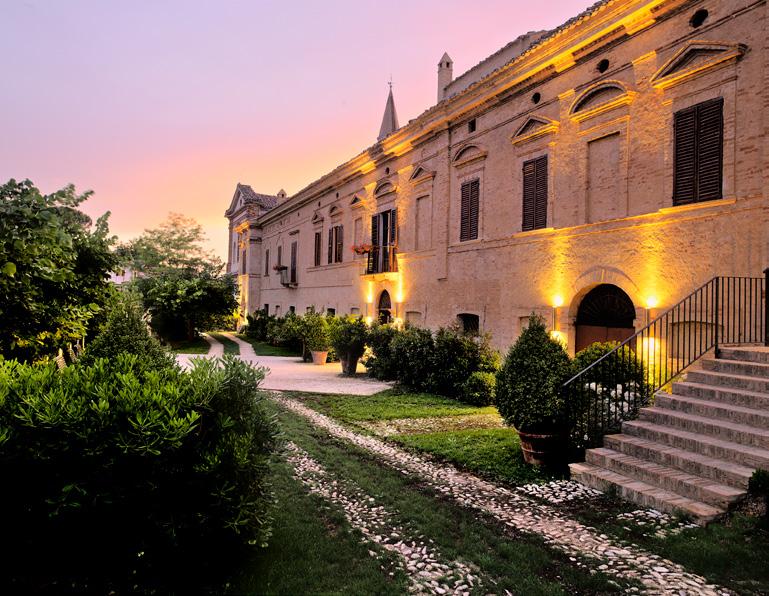
On the left, the entrance to the castle.
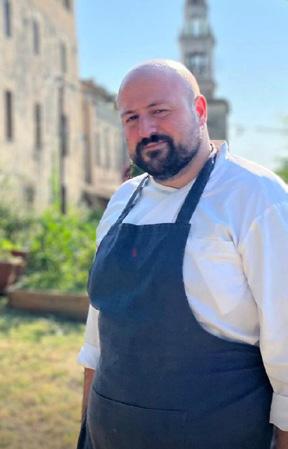
Above, chef Mario di Giovanni.
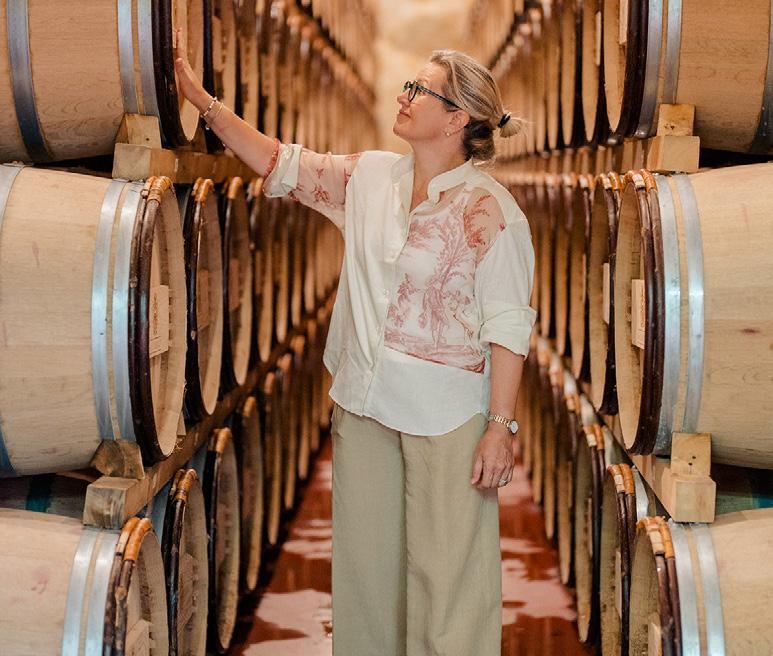
visionary who was fortunate enough to meet a woman just as tenacious and resolute: Marina Cvetic. «They met by chance through work in 1987; my mother was working in the production of Slavonian oak barrels. Gianni didn’t buy anything, but he found love», says Miriam. And if today the winery boasts 300 hectares of vineyards across all the provinces of Abruzzo and a production exceeding 2.5 million bottles, it is thanks to the determination of Marina and Miriam, who single-handedly managed to revive and expand what was Gianni’s visionary dream – a dream he left behind at the age of just 53 in 2008. Alongside Miriam is her younger sister Chiara, and her son Riccardo, just 18 years old: «Who only drinks Pinot Noir!» We eat in the castle’s wine cellar, amidst enormous barrels dating from 1808, stacks of magnums and a series of art installations, including the 500 micro-installations that gently fill this castle perched on the hills overlooking the snow-capped Maiella. «When it was purchased, it was completely abandoned; many items had been stolen, but fortunately they didn’t know the value of everything. My mother oversaw the restoration; you should have seen her chasing the carpenter with a hammer when he’d made a mistake». The palace, which once belonged to Baron Perticone, retains its charm intact and is no less mysterious thanks to a meticulous and essential restoration. It has left the old colours, shapes and all the original materials untouched: entering the castle means taking a journey back to a society of yesteryear. With the enormous kitchen on the first floor and the oil mill on the ground floor housing the restaurant, all modern facilities are carefully concealed to transport us back to another era. It is no coincidence that it was also chosen for films such as Niente può fermarci starring Gérard Depardieu: «It’s true: he used to drink as many as 12 bottles of wine
a day. At the same time, he also drank plenty of water to stay sober. And he was very kind to us». Among the castle’s guests was Prince Albert II of Monaco: «They told us the etiquette for how to behave over the days, what to say and what not to do. As soon as he entered the castle, what did my mother do? She gave him a good slap on the back. That’s just how she is», Miriam chuckles.
The establishment boasts around ten elegantly restored rooms, whilst in the kitchen we find Marco Di Giovanni, originally from the Pescara marina and the son of fishermen. Yet his cuisine places a strong emphasis on vegetables and cheeses. Like many chefs from Abruzzo, he trained under Niko Romito, with whom he worked for years. His is a cuisine with character: few ingredients per dish, clean and light flavours. In spring, he showcases broad beans (the salad with primosale cheese is excellent) and peas (ask for the recipe for the cold soup), well-glazed endives and let-
tuces, fresh stuffed pasta and more. Among the regional cheeses, a taste of the Gregoriano is a must; it owes its name to the great Gregorio Rotolo, who passed away in March 2022: a soft-textured pecorino made from raw milk from free-range sheep, produced in Scanno. A real treat. The restaurant, open by reservation from March to December, offers not only Masciarelli wines but also bottles of Burgundy: «You should have seen Gianni back in the day, uncorking Romanée-Conti with the parish priest Don Rocco as if it were peanuts; he loved sharing bottles»; Moselle Riesling, artisan wines such as Doro Princic or gems like the Assyrtiko from Gai’a Wines in Santorini, distributed by Masciarelli. Against the backdrop of the Adriatic and the Maiella, a story of social redemption and temperature swings of 20° between day and night. Which is good for the grapes. And perhaps for people too.
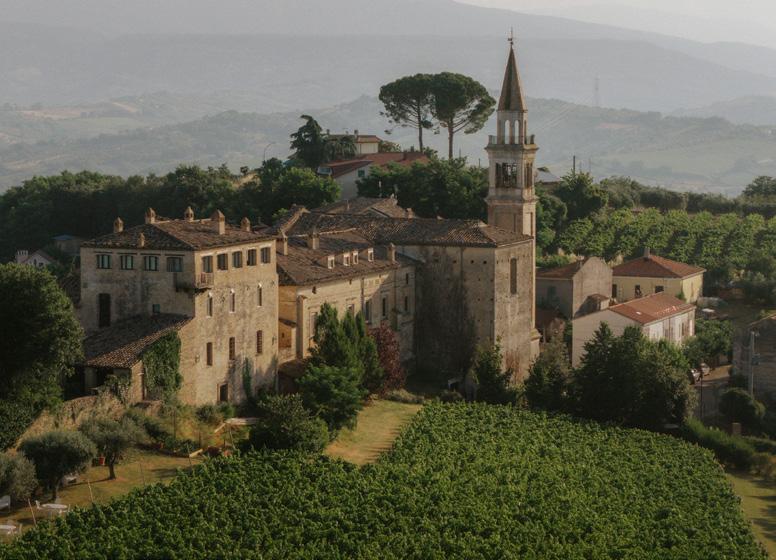
Semivicoli Castle in the municipality of Casacanditella in the province of Chieti.
by Marco Sabellico
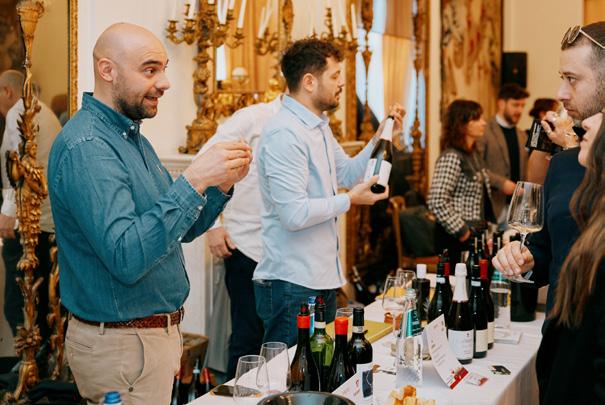
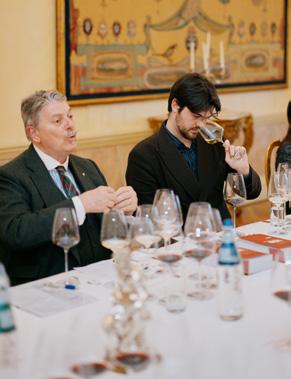
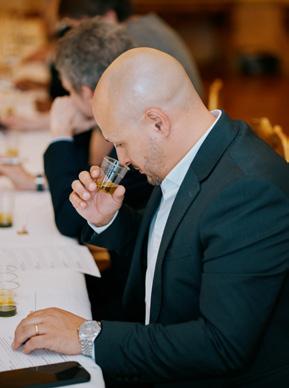
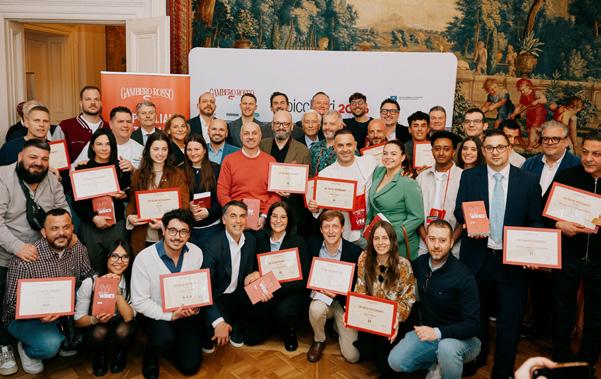
This year’s Gambero Rosso showcase in London took place at the prestigious residence of the Italian Embassy, in the heart of Mayfair and a stone’s throw from Buckingham Palace. On a radiant spring morning, 25 March, the elite of the producers featured in Vini d’Italia 2026 pulled the corks on their finest bottles for the trade and a discerning British audience.
But what sort of landscape are we facing as 2026 begins, five years on from Brexit taking effect on 1 January 2021? The country is hardly in rude health, and much of the focus is on holding steady. The agri‑food sector is under strain, yet wine historically resilient still sees Italy firmly in first place by volume, at roughly 35% of the market, and second by value at 24%, behind France (37% by value, 20% by volume),
for whom the UK remains a pivotal outlet. Over the past 12 months Italy has inched forward compared with the previous year, while France has been flat to slightly down. Spain sits further back but is broadly steady; Australia is in decline; New Zealand is broadly level in both value and volume both Antipodean countries far lower in the rankings by revenue and bottle num bers.
One caveat is the average price per bottle, which stands at about £5.80 for France, £5.10 for New Zealand, £2.70 for Italy, £1.70 for Australia and 93p for Spain. ‘The UK is a complex market,’ says Richard Benson, a wholesale distributor. ‘Duty here is now progres sive based on a wine’s alcohol content. That’s why products in the 10.5–12.5% ABV bracket are doing well whites and chillable reds, Moscato d’Asti
and Asti, and delicate sparklers like Prosecco DOC and DOCG. At the top end, the great appellations Italian and otherwise are broadly holding firm or only very slightly down. Chianti DOCG, Nero d’Avola and Primitivo are showing ever fresher, more saline profiles, often as own‑labels for the major multiples the BOBs, buyer’s own brands, that set the brief. For general consumption, the trend is decisively towards low‑alcohol wines.’
Veronese native Luca Dusi has been in London since 1995 and runs Passione Vino, both an import company and a string of successful wine bars. ‘This is an important and highly knowl edgeable market where certainly in London restaurants and wine programmes are matched by very few cities in the world. At the top end, Brexit has changed little. The broader economy may wobble, but demand for high‑profile Made in Italy is steady, even growing. Proof? Plenty of brilliant British chefs are dedicating themselves to Italian cooking, and their wine lists speak Italian. They’re the “grandchil dren” of the famous River Café that made history in the 1980s. And today you’ve honoured Jacob Kenedy, for example Italian through a grand mother whose Bocca di Lupo is a serious destination. Like him, many Brits are moving from gastropub to authentic regional Italian, with fresh pasta and local recipes. Let’s not dra matise: this is a great market and Italy is strong. We’re beguilingly hard to pin down… but we always have something
distinctive and new to offer. That’s the key to our success.’
Friulian Bruno Besa has been in Lon don since 1986 and founded Astrum Wine Cellars, which imports about 70% Italian wines. ‘It’s not an era of rampant expansion but compared with a few years ago the work done on Italian wine has been extraordinary. Buyers here are extremely well prepared: you don’t sell smoke; you sell proven qual ity at the right price. Promotion matters, but in a city with four or five fine‑wine events a day it has to be targeted like today’s Gambero Rosso tasting in the prestigious institutional setting of Casa Italia.’ Which wines and styles will win? ‘Quality terroirs always do and always will. Valtellina and northern Piedmont, for instance, or Etna, Irpinia, Tuscany in general… France has a hardcore following here, and they’re our true competitors. But we Italians are more enterprising, dynamic and responsive to market shifts and that’s
fundamental now. Brexit knocked about 20% off sterling, which is a problem. But public opinion is changing; who knows what the future may bring?
Something’s stirring…’
That view is echoed by Fabio De Nicola of Baccalà, a successful sea food‑and‑wine restaurant in Southwark that he runs with his chef friend More no Polverini. ‘One of the headaches for Italian restaurants after Brexit is how hard it’s become to hire Italian staff. We’re fortunate to be a family opera tion, with our wives alongside us.’ Besa adds: ‘Years ago, Giorgio Locatelli or Francesco Mazzei now internation al stars arrived in dribs and drabs, without any formalities. Today you can’t phone Italy and have a cook or pizzaiolo on the pass a few days later. We’ll see whether the Youth Mobility Scheme two‑year visa makes things easier. Otherwise we’ll have lots of Italian restaurants… without Italian staff!’
The tasting drew a constant stream of visitors and trade from 1pm to 6pm, much to the delight of producers, who were able to meet key operators, with many travelling in from Wales and Scotland. ‘Markets need looking after,’ says Cristina Inganni of Cantri na in Valtènesi. ‘Our rosés are doing well, and it’s important to maintain a presence in a key market like this for high‑end wine.’ The Awards Ceremo ny for the Top Italian Restaurants in the World guide, covered alongside,
was the day’s highlight, as it is at each of our international stages. Twenty‑five awardees, including two Tre Forchette (Three Forks) winners, confirm London as one of the global capitals of Made in Italy gastronomy. We’re confident there will soon be more. The market is asking for it, and that will only help the export of our great wines.
Two packed masterclasses, led by Marco Sabellico and Louis Thomas, crowned the day. The first, A Grand Tour of Italy in 11 Glasses, offered a sweep of outstanding labels from Valdobbiadene and Franciacorta to great reds and whites from Italy’s most celebrated terroirs, finishing with Marsala Vergine so dear to British palates. The second showcased six superb extra‑virgin olive oils from different regions of the Peninsula, all Tre Foglie (Three Leaves) win ners in the Oli d’Italia 2026 guide, to the delight of enthusiasts. ‘These are precious chances to deepen technical knowledge,’ concludes Daniel Murphy, maître d’ at the Royal Eagle. ‘Guests recognise when you’re sourcing quality, and they reward you for it.’
Finally, a word of thanks to the partners who contributed to the event’s success: Italesse for their excellent stemware, Pulltex corkscrews, Smeraldina mineral water, Cremoloso artisanal gelato, Farchioni 1780 extra‑virgin olive oil, ChefMéd specialities, and the Parmi giano Reggiano Consortium.
by Giuseppe Carrus
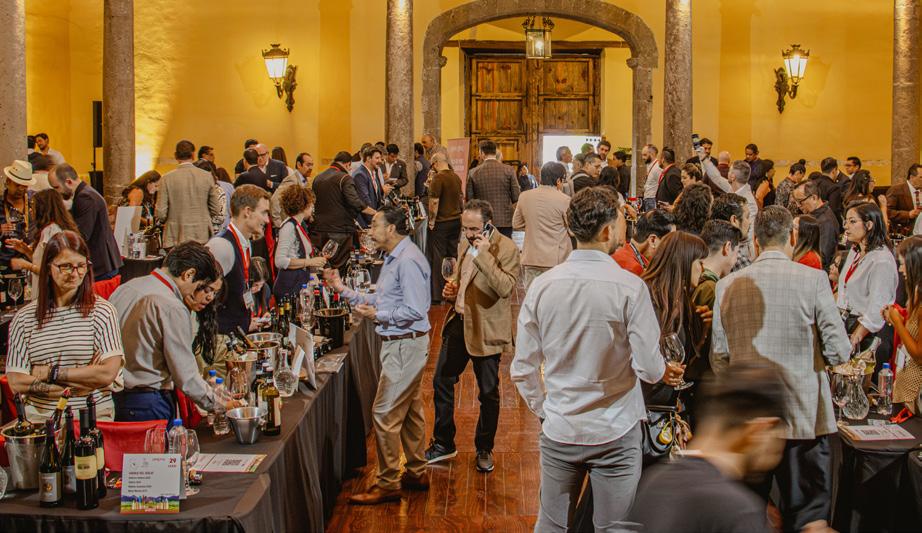
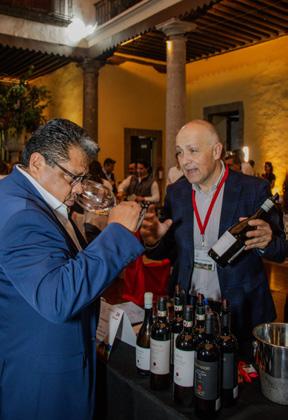
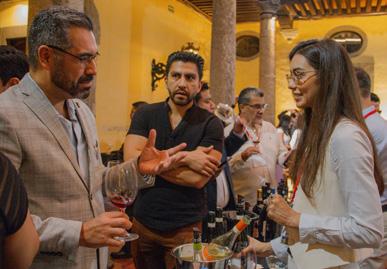
There was a large turnout and a highly knowledgeable audience for the Mexican leg of the Top Italian Wine Road Show, organised by Gambero Rosso in Mexico City. The event confirmed not only the growing interest in Italian wine, but also an increasingly evident trend: the local market is evolving rapidly, with consumers and industry professionals becoming ever more knowledgeable and discerning. What was particularly striking was the calibre of the participants: importers,
sommeliers, restaurateurs and buyers with an ever-deepening knowledge of Italian wine production. A clear sign of maturity for a market that has shown steady growth in recent years. According to the latest figures, Italian wine exports to Mexico have seen a significant increase, exceeding €90 million annually, with a positive trend set to continue into 2025. Whilst awaiting the figures for the current year, we can nevertheless state that Italy remains one of the country’s main suppliers, thanks to a diverse and
distinctive range of wines. Among the most popular types, sparkling wines stand out, particularly Prosecco, but even here – by now – the Mexican wine world is familiar with the various differences between the different DOCs associated with the type, and talking about Valdobbiadene, Asolo or Cartizze is no longer so difficult. There is also room for more structured reds such as Chianti, Barolo or Amarone, not to mention aromatic and fresh whites, which are increasingly in demand in contemporary restaurants.
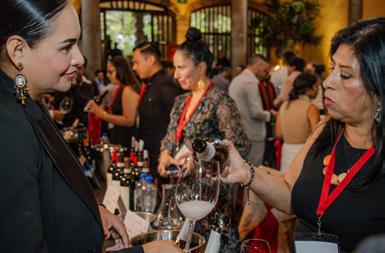
The event concluded with an awards ceremony for the best Italian restaurants in the Mexican capital. A moment that celebrated not only the quality of the culinary offerings, but also the authenticity of a cuisine increasingly faithful to its roots. The Italian restaurant scene in Mexico City is, in fact, undergoing a period of great ferment: there is growing attention to ingredients, regional traditions


Asolo Montello takes centre stage in Mexico City: the region’s appeal wins over the Mexican public
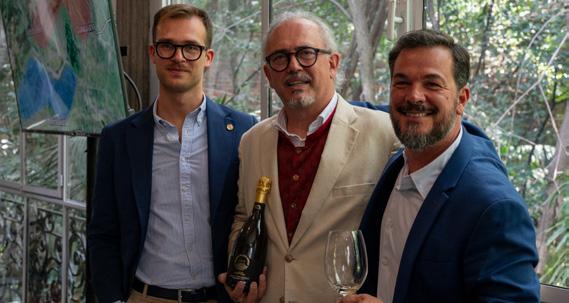
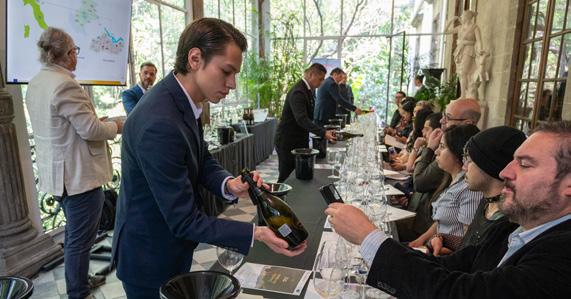
At the Mexico City leg of the Top Italian Wine Roadshow organised by Gambero Rosso, the Asolo Montello Wine Consortium, a special guest at the event, stood out as one of the most highly regarded participants. Thanks to the collaboration between the Consortium and Gambero Rosso, a masterclass entirely dedicated to Asolo Prosecco was organised, offering participants a highly valuable technical and sensory insight. Through the tasting of various wines, the distinctive identity of the appellation emerged clearly, highlighting how climatic variations and soil diversity significantly influence the organoleptic profile of the wines. A journey through the region, therefore, which confirmed the role of Asolo Prosecco as an authentic expression of a viticulture increasingly focused on promoting local characteristics and producing wines with a strong sense of identity. The masterclass was led by Giuseppe Carrus, editor of the Vini d’Italia guide, and Giampaolo Giacobbo, the Consortium’s brand ambassador, who guided the audience on a journey of discovery through the region via the wine glass. In addition to the educational session, the Consortium was present with a dedicated stand within the “walk-around tasting”, offering industry professionals – in particular buyers, importers and trade professionals – the opportunity to discover and taste a wide selection of wines from the appellation. The participation of the Consorzio Vini Asolo Montello in such a prominent international event confirms the strategic importance of foreign markets for the promotion of Italian excellence and reinforces the positioning of Asolo Prosecco among the leading appellations in the world of quality sparkling wines.
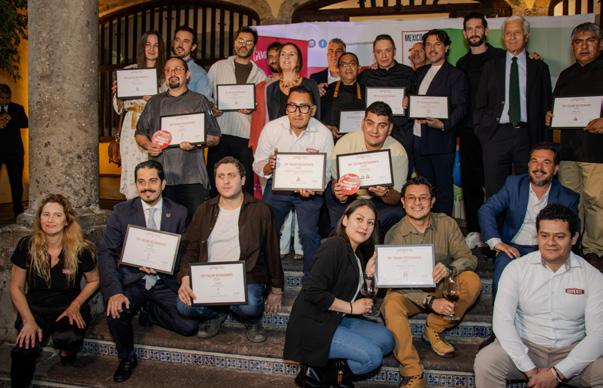
and wine pairings, in an ever-closer dialogue between the kitchen and the cellar. In short, there is a clearly visible and increasingly solid bridge between Italy and Mexico, and the success of the Top Italian Wine Road Show confirms Mexico’s central role amongst the emerging markets for Italian wine. A dynamic, curious and increasingly knowledgeable country, where Italian food and wine culture finds fertile ground. And where, event after event, a bond is being forged that goes far beyond business: that between two cultures which share the values of conviviality and quality at the table. labels,” reports Laura Basso from Durin winery.
Let’s return to the opening point. In this context, the recognition awarded by Gambero Rosso to no fewer than 16 establishments represents not only an individual accolade, but also a snapshot of a fully matured system. From fine dining restaurants to modern trattorias, right through to new-generation pizzerias (often united by a commendable focus on and knowledge of wine), they all offer a multifaceted panorama where regional tradition, technical innovation and a dialogue with the Mexican territory coexist. Let’s start with the pizzerias and highlight Pizzeria della Madonna, one of the city’s go-to spots for quality pizza, with sophisticated doughs and carefully selected toppings that elevate the experience. The same standard is set by Forneria del Becco, which forms part of a wider project by Rolly Pavia, owner of several establishments in the city. Pizza Felix is undoubtedly impressive, with two locations in the city, both dynamic and modern, serving light, fragrant pizzas and taking a contemporary approach to ingredients. All these have been awarded ‘Due Spicchi’, whilst in the “Bottiglie” category, awarded ‘Due’, Alfredo di Roma stands out for its wine list, offering a wide, well-structured and comprehensive selection that enhances the overall dining experience.
In the restaurant sector, Vecchio Forno stands out – a venture by the Cesarano family, who opened their first restaurant here in Mexico City thirty years ago and are now set to open their fourth outlet. Diners come here for the informal atmosphere and traditional feel, with a menu centred on classic, well-executed pizzas, but above all for simple yet perfectly executed trattoria-style cuisine, so much so that it has earned a ‘Due Forchette’ rating. The same rating, but with clear differences, goes to Sartoria , which offers elegant, contemporary cuisine with a strong identity and particular attention to technique and presentation. And now we come to the aforementioned Rolly Pavia (who, incidentally, opened his latest venture, Esca, less than a year ago). He has two award-winning establishments: Becco (Due Forchette) is a benchmark for high-end Italian dining in the city, with a refined offering; L’Osteria del Becco reaches even greater heights, which we consider to be at the pinnacle of the Italian scene in Mexico City and therefore among the best restaurants in the world. The cuisine on offer is mature, with a deeply distinctive technique, capable of engaging with the local area without ever losing its authenticity.
The success of these award-winning restaurants tells a story that goes beyond individual accolades. In Mexico City, Italian cuisine is undergoing a period of full-blown evolution: no longer a simple export of models, but true cultural and gastronomic integration. Quality is on the rise, the public is becoming increasingly discerning and knowledgeable, and restaurateurs are responding with ambitious projects that reflect their identity. If the present is so rich, the future looks even more promising. The city is likely to continue as a prime testing ground for Italian cuisine abroad, where tradition and innovation strike a fertile and ever-evolving balance.
The Gambero Rosso Tre Bicchieri World Tour in Canada concluded in Toronto and Vancouver with a rather clear message: Canada is no longer merely a good market for Italian wine, but an increasingly mature market where quality is recognised, sought after and understood.
by Giuseppe Carrus
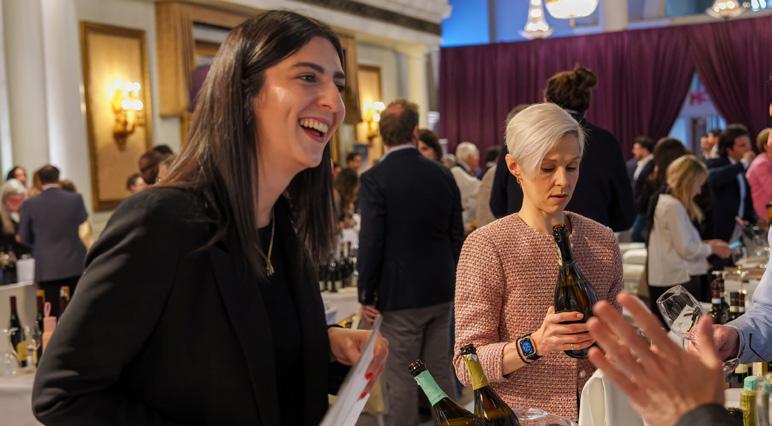
In Toronto, the tone was that of major professional events. Not just tastings, but above all direct dialogue with those who select, import and distribute the wine. At the forefront were officials from the LCBO, an essential partner for anyone wishing to enter or consolidate their position in Ontario. The masterclasses added depth to the event, transforming it into an educational experience as well
as a promotional one: from the finesse and diversity of Lombardy wines to the versatility of Montepulciano d’Abruzzo, right through to the vertical tasting of Amarone della Valpolicella Bosan from the Cesari winery, which illustrated the complexity of one of Italy’s great reds over time. More than mere tastings, these were genuine tools for understanding a market that wants to comprehend before it buys. In Vancouver, the tone changes, but not the intensity. In the elegant halls of the Vancouver
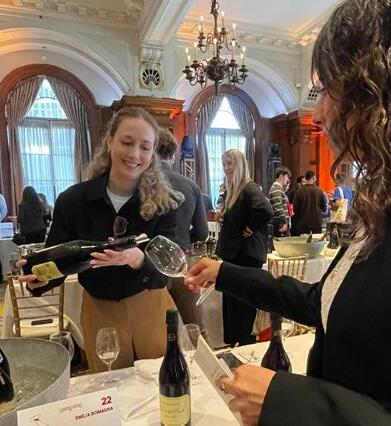
Club, the focus was first on the trade audience and then on enthusiasts: curious, knowledgeable, and increasingly open to discovery. Here, Italian wine plays a different game, one that is less institutional and more emotional. The Canadian West Coast proves to be fertile ground for lesser-known appellations and distinctive wines, in a context where the story behind the wine, as well as its quality, truly makes the difference.
Behind these two milestone legs lies a fundamental fact: Canada is now one of the most reliable markets for Italian wine, with exports amounting to around €400 million annually and steady growth over time. But the real change is not just in the figures. It lies in perception. Canadian consumers, both trade and end consumers, are moving decisively towards higher-end wines, showing an interest in appellations, indigenous grape varieties and authentic production stories. In this sense, events such as the Tre Bicchieri World Tour are not merely showcases, but concrete tools for fuelling this cultural evolution. It is no coincidence that many Italian wineries are now looking to Canada with renewed interest. The uncertainties surrounding the US market, amid trade tensions and possible changes in import policies, are driving a move towards greater diversification. Canada offers less volatility and slower but more stable growth, supported by a regulated system such as the provincial liquor monopolies which, whilst complex, guarantees predictability and continuity.
There was a time when eating Italian food in Canada was mainly about nostalgia –though not even that genuine: generous portions, adapted recipes, at best comfort food for communities far from home. That era is now over. Between Toronto and Vancouver, a new generation of restaurateurs is transforming Italian cuisine into a contemporary, precise and recognisable language. This is evidenced not only by the dishes themselves, but also by the accolades from the Gambero Rosso guide, which since 2015 has been awarding Forchette, Spicchi and Bottiglie worldwide as tangible signs of a quality that, before even considering the dishes served at the table, assesses ingredients, menu composition, the wine list and a certain Italian flair in the décor, music and hospitality.
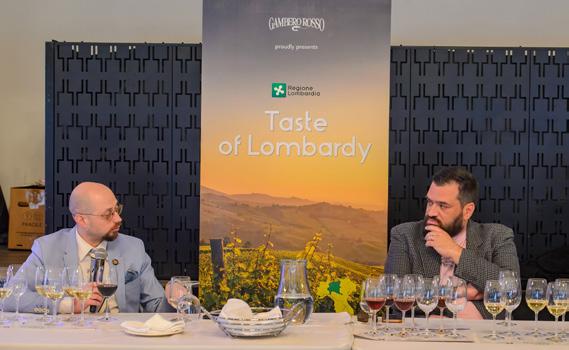
At the Toronto leg of the Tre Bicchieri World Tour organised by Gambero Rosso, the Lombardy Region stood out as the star of a rich and multifaceted wine narrative, captivating industry professionals and the international press. The focus was on the region’s extraordinary diversity of production, represented by the joint presence of the Oltrepò Pavese, Lugana, Valtenesi and Valtellina consortia, who had travelled to Canada thanks to an agreement between the Lombardy Region and Gambero Rosso. A collection of territories differing in climate, soils and traditions, which paints a picture of Lombardy’s wine-growing landscape as a veritable mosaic of appellations, grape varieties and production styles. The highlight of the event was the masterclass dedicated to Lombardy wines, aimed specifically at officials from the LCBO, Ontario’s liquor monopoly, whose presence lent the initiative significant strategic value. Thanks to the partnership between the LCBO and Gambero Rosso, Italian producers have the opportunity to present their finest wines directly to the Canadian distribution network, with the wines described and showcased by Gambero Rosso’s experts. The tasting guided participants on a journey through the region’s main wine styles: from the refined Metodo Classico sparkling wines, an expression of elegance and precision, to the great mountain reds, and on to the wonderfully fresh white wines and rosés of the Valtenesi – wines that are highly drinkable yet never lacking in character. A journey that highlighted how, despite the diversity of expressions, a common thread emerges: the strong territorial identity that characterises each appellation. The masterclass was led by Giuseppe Carrus, editor of the Vini d’Italia guide, supported by representatives from the participating consortia: Riccardo Binda (director of the Oltrepò Consortium) and Juri Pagani (director of the Valtenesi Consortium), who helped to explore the distinctive features of the various production areas in greater depth. Alongside the educational session, the Lombardy consortia also took centre stage at the walk-around tasting, with a dedicated area that allowed industry professionals – buyers, importers and trade operators – to explore a wide and representative selection of regional wines. Lombardy’s participation in the Tre Bicchieri World Tour in Toronto thus reaffirmed the strategic value of promotion on international markets, consolidating the region’s image as one of the most dynamic and versatile players on the Italian wine scene.
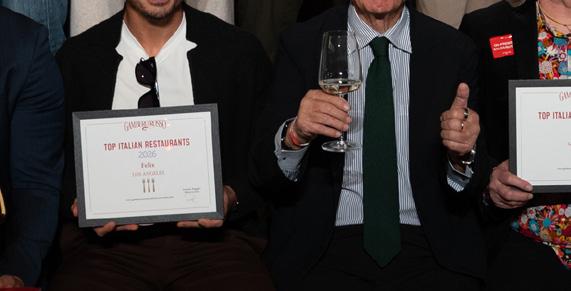
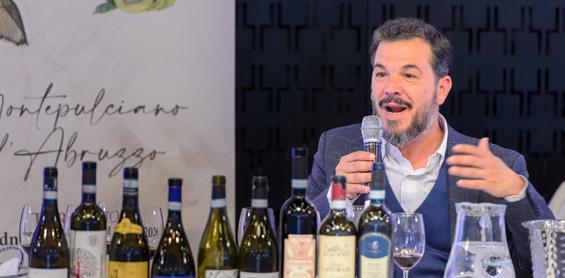
During the Tre Bicchieri World Tour event organised by Gambero Rosso in Toronto, the Consorzio Vini d’Abruzzo brought the complexity and expressive depth of Montepulciano d’Abruzzo into the international spotlight through a technical masterclass aimed primarily at LCBO officials, importers, journalists and restaurateurs. The presence of the Ontario liquor monopoly was a strategic element of primary importance: thanks to the established partnership between the LCBO and Gambero Rosso, Italian producers have the opportunity to present their most representative labels directly to institutional buyers, supported by a technical and authoritative narrative. The masterclass involved nine wineries, offering a comparison of different vintages and interpretations of Montepulciano d’Abruzzo, with the aim of highlighting the decisive role of soil and climate factors. In particular, the significant variability of the soils emerged – ranging from the clay-limestone matrix of the inland hills to the sandier and silty components of the coastal hillsides – and their impact on the tannic structure and aromatic finesse of the wines. Another key factor was altitude, with vineyards generally situated at altitudes ranging from 150 to over 400 metres above sea level: a range that significantly affects acidity, phenolic ripeness and the wine’s ability to age. The foothill areas, influenced by the Apennine air currents, produced wines with greater tension and verticality, whilst the areas closer to the Adriatic coast yielded more mature and enveloping profiles. Ample attention was also given to the sub-zones and the main appellations within the region, with references to areas such as Colline Teramane, which represents one of the most structured and long-lived expressions of the grape variety, and to other provincial areas that contribute to shaping a complex production mosaic. The tasting was led by Giuseppe Carrus, editor of the Vini d’Italia guide, who provided a detailed analysis of the various wines on offer, linking vintage, terroir and winemaking choices. Alongside the masterclass, the Consorzio Vini d’Abruzzo also played a leading role in the walk-around tasting, with a dedicated space that allowed industry professionals to further deepen their knowledge of the appellation through a wide and representative selection. The Toronto event thus confirmed Montepulciano d’Abruzzo as a wine of great technical solidity and territorial identity, capable of expressing, through the variability of its terroirs, an evolutionary potential and a distinctiveness that are increasingly appreciated on international markets.
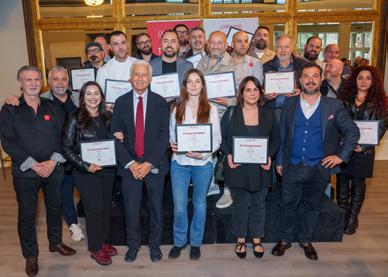
the metropolis where you can also find a slice of
Toronto is a city that isn’t afraid to be big. And its Italian cuisine reflects this: ambitious, multi-layered, often surprising. At the very top are names that speak the language of international haute cuisine. At Don Alfonso, the Italian story takes on a refined character, and here tradition isn’t merely imitated: it’s interpreted. Then there is Da Nico, an international concept with an eye on the East, yet its roots are undoubtedly in Italy. Both are at the very top, both have been awarded Tre Forchette. But Toronto’s true strength lies in the depth of its scene. You need only walk a few blocks to move from the elegance of certain restaurants to the convivial liveliness of bistros or the timeless classicism of certain now-historic establishments. A prime example? Sotto Sotto is a city institution; we could consider it a pioneer of high-quality cuisine in these parts, and we’re delighted that it now has a second location in Oakville. And then there are the places where time slows down, one glass at a time. Terroni Bar Centrale, awarded Tre Bottiglie, is more than a wine bar: it’s a small manifesto of urban Italian spirit. Not far away, Cibo Wine Bar confirms that Italian wine, here, is not merely an accompaniment but the undisputed star of the show. Pizza also has its place, not through nostalgia but through technique: Venga Cucina and Sip tell the story of a tradition that travels and adapts, without losing its identity. Toronto, after all, is just that: an Italy that grows, multiplies and reinvents itself.
If Toronto is all about energy, Vancouver is all about balance. Here, Italian cuisine seems to breathe in harmony with the landscape: simpler, brighter, and deeply rooted in the quality of the ingredients. There’s no need to raise your voice, because the ingredients speak volumes. There are places where fresh pasta becomes a daily ritual, crafted with precise movements and crisp flavours. Elsewhere, however, Italy meets a contemporary sensibility, almost North American in feel, yet without ever losing its Italian accent. What’s more, year on year, there is no shortage of new developments, and we are delighted to highlight them. We were particularly surprised by Nook, specifically the Coal Harbour branch (the chain has several outlets across the city). Due Forchette for a venue where the architecture is more American than Italian. That said, there’s no doubt about the cuisine, and perhaps it now represents the most successful balance in these parts. It’s an accessible yet refined place, modern yet rooted in tradition, and the meatballs in tomato sauce, served as a starter, will make you feel at peace with the world (and with so many imitation cuisines). In fact, we know that a great chef who has done so much for Italian cuisine in Vancouver has had a hand in this: Pino Posteraro, whom some will remember for his Choppino’s (a restaurant now closed, which for many years was awarded Tre Forchette). Another new addition is Giusti, an urban eatery with a 100% Italian menu: the green tagliatelle with ragù is proof of this. And let’s not forget the pizza, which here follows the slow rhythm of natural leavening. Spaccanapoli, awarded Due Spicchi, brings a piece of Naples to the Pacific coast, whilst Via Tevere keeps alive a tradition that speaks directly to the heart. In short, Vancouver isn’t trying to imitate Italy. It interprets it with respect, and perhaps that is precisely why it is so convincing.
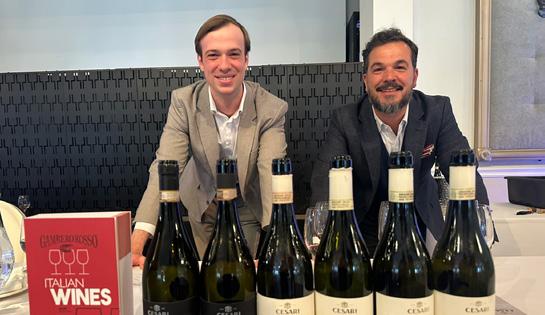
One of the highlights of the Toronto leg of the tour, the vertical tasting dedicated to Gerardo Cesari’s Amarone della Valpolicella Bosan offered more than just a simple tasting: it was a tangible demonstration of what time, terroir and a vision for winemaking truly mean. Bosan originates from a single historic vineyard in the heart of the Valpolicella Classica, an old vineyard that over the years has forged its own distinct, recognisable identity, capable of spanning the ages without losing its consistency. And it is precisely this continuity that emerged powerfully in the glasses, guided by the narrative of Niccolò Maroni (the company’s brand ambassador) and Giuseppe Carrus, editor of the Vini d’Italia guide, who took the audience on a journey spanning over twenty years. The tasting opened with the 2016, a vintage awarded the Tre Bicchieri by the Vini d’Italia 2026 Guide: an Amarone that is still young and vibrant, where structure and freshness coexist in perfect balance, hinting at a future of even greater complexity. Immediately afterwards, the 2015, the product of a warmer vintage, revealed a different yet equally compelling character: more enveloping and generous, yet never lacking in precision, a sign of careful management even in the most challenging harvests. The leap back in time becomes more pronounced with the 2006, which surprises with its energy and integrity: almost twenty years after the harvest, the wine still appears dynamic, with a freshness that underpins its structure and extends its perspective. Even more fascinating is the 2003, a vintage notoriously extreme for its heat. Yet, in the glass, Bosan displays an unexpected vitality: the fruit is still alive, the palate holds firm, maintaining tension and rhythm. With the 2001, we enter the realm of great emotions. It is a wine that combines depth, balance and complexity in an almost natural way, giving the impression that it still has much to say despite its age. And finally, the 2000, which, 26 years after the harvest, presents itself as a true masterpiece: harmonious, layered, capable of telling the story of time without being weighed down by it, but rather transforming it into elegance. More than a sequence of vintages, the Toronto event was a demonstration of Bosan’s ability to stand the test of time whilst remaining true to itself. An Amarone that does not merely seek power, but builds its identity on longevity, consistency and a surprising evolutionary energy.
by Giuseppe Carrus
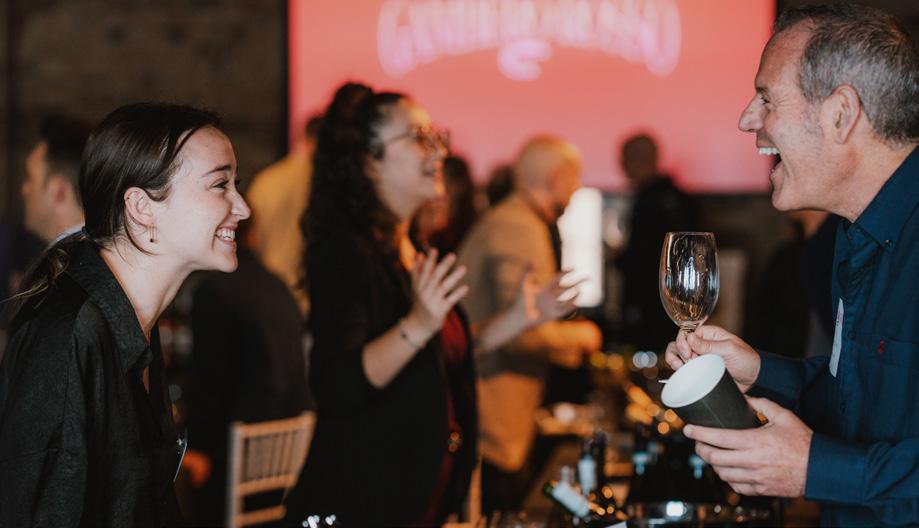
Three years may seem like a short time, but in the world of wine, it is enough to transform the language of a market. And Sydney, during the latest leg of the Gambero Rosso Top Italian Wines Road Show, demonstrated this clearly. The return to the Australian city was anything but a mere repeat of the past: it signalled a profound maturation, with Italian wine culture now firmly established in the professional lexicon of the local trade.
The setting also played its part. The event took place inside one of those large industrial brick buildings that Sydney knows how to restore and transform with contemporary elegance. Outside, almost unreal in its perfection, the entire bay lay before us: the silhouette of the Sydney Harbour Bridge, the iconic geometry of the Sydney Opera House with its unmistakable sails, and that sharp light of the Australian harbour that seems to amplify every detail. A setting that
makes the story of Italian wines even more evocative.
It was the atmosphere and the numbers of the day, even more than the words, that told the story. Forty-five Italian wineries, from north to south, took centre stage at a large tasting event entirely dedicated to industry professionals. Importers, buyers, sommeliers, restaurateurs and journalists made their way through the tasting route with attention, genuine curiosity and a level of
knowledge that is now less and less surprising. In Australia, Italian wine is no longer merely synonymous with iconic labels: it has become a subject of study, comparison and regional exploration. Furthermore, the three masterclasses led by Giuseppe Carrus represented one of the event’s most intense moments. Packed rooms, precise questions, technical yet never cold discussions. And it was precisely here that the true evolution of the Australian market became apparent. Whereas until a few years ago most of the attention was focused primarily on the best-known major appellations, today the local trade speaks naturally of territories, indigenous grape varieties and production identities. Not just Barolo, Brunello or Amarone,
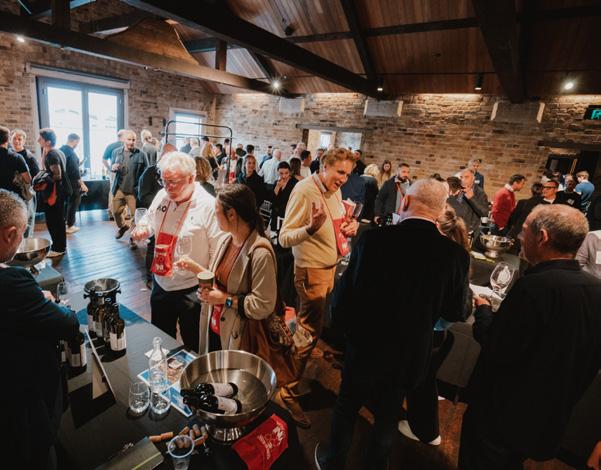
then, but also sub-zones, MGAs, Additional Geographical Units, Rives or Contrade – all terms that until recently would have seemed almost incomprehensible outside Italy.
And the figures, after all, clearly reflect this cultural growth. Australia continues to be a strategic market for Italian wine, particularly at a time when many traditional markets are seeing a slowdown in consumption. The latest analyses suggest that the Australian market is becoming increasingly attractive for wines with a strong regional identity, with growing interest in Italian whites and, above all, sparkling wines. More generally, in the 2025 export landscape, sparkling wines remain the most dynamic category of Italian wine, whilst
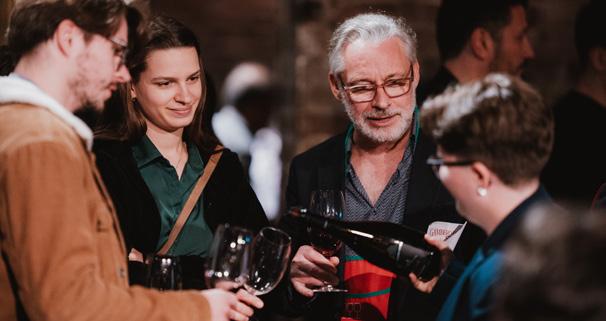
reds are facing a more challenging period internationally. Consumption trends also seem to be moving in a very clear direction: consumers are seeking fresher, more vertical, food-friendly and approachable wines, favouring whites and sparkling wines over more structured reds. Italian sparkling wines continue to grow in export volumes, whilst reds are slowing down significantly, a sign of a global shift in taste. And it is in Australia that this transformation appears particularly evident. At the same time, the comparison with local wines no longer takes the form of a sterile competition based solely on organoleptic characteristics or even structure (which has greater concentration or power), but rather through a much more contemporary and intelligent approach to wine: one that focuses on different terroirs, climates, grape varieties and production methods.
A mature, open and culturally enriching dialogue. And this is probably the most interesting insight to emerge from Sydney: Italian wine is no longer perceived as an exotic model to be imitated or challenged, but as a complex universe to be understood. Sydney, after all, seems to have
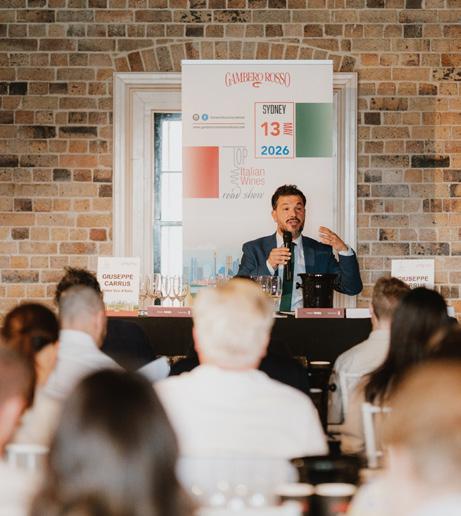
now fully embraced one of the great strengths of Italian wine: its unique biodiversity. Each tasting table told the story of a different landscape, a distinct oenological dialect, a unique vision of viticulture. And it is probably this diversity, even more so than individual labels, that fascinates Australian trade professionals today (though we recognise that it is not easy to navigate the world of Italian wine).
There was a time when, in Sydney, Italian cuisine was primarily about comfort. Spaghetti, pizzas, large dinner tables, a few memories of home brought over by immigrants and adapted to the blinding light of Australia. Today, however, the picture is much more complex. And infinitely more interesting. Because the city’s Italian scene has reached an impressive level of maturity: technique, authenticity, wine culture, research into ingredients, attention to regional origins and, above all, identity. No
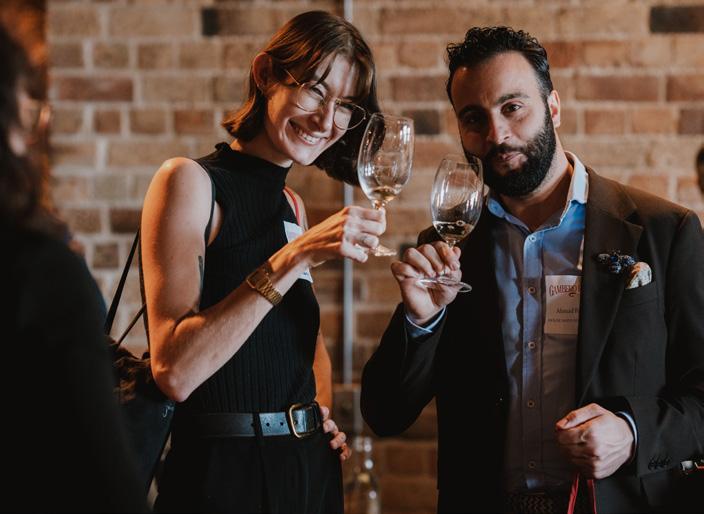
longer simply “Italian-sounding”, but a true contemporary interpretation of Italy’s gastronomic heritage. Confirmation came on May 13th, during the Australian leg of the Gambero Rosso Top Italian Wine Road Show, an event at which over twenty establishments, including restaurants, pizzerias, wine bars, bakeries and ice-cream parlours, were awarded prizes. A precious snapshot of a city that now experiences Italian cuisine not as an exotic fad, but as a sophisticated, everyday language. And so Sydney becomes a sort of parallel Italy overlooking the Pacific.
A city where you can eat a contemporary pizza of the highest calibre just a few metres from the ocean, drink artisanal Italian wines in New York-style venues, have breakfast with impeccable baked goods, or sit down to refined cuisine that speaks Italian with an international accent. When it comes to pizza, the standard is exceptionally high and reflects a variety of styles. From more popular, accessible establishments such as Pompei’s Bondi, Via Napoli and Al Taglio – each awarded a ‘Spicchio’ – to well-established
names like Cicerone Cucina Romana and Lucio Pizzeria in Darlinghurst, which have earned Due Spicchi thanks to a precise, technically accomplished and distinctive offering. But it is the top tier that really stands out. Two establishments have reached the summit and earned Tre
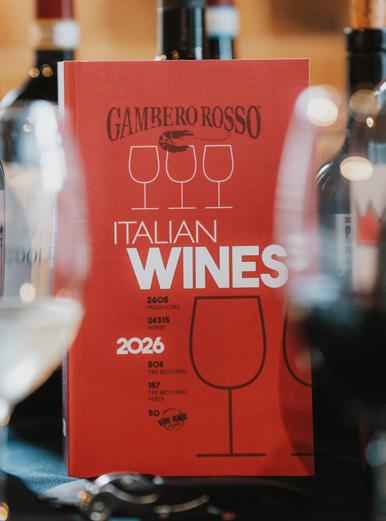
Spicchi thanks to venues capable of going beyond merely replicating tradition, finding their own distinctive style. Well-leavened doughs, quality ingredients, lightness, contemporary sensibility. It is no longer just Italian pizza abroad: it is simply great pizza. We are talking about That’s Enrico in Lobethal and Regina, both new additions this year.
Italian breakfasts and gelato are finally gaining international recognition too. Lode Pies & Pastries in Surry Hills has been awarded the Tre Cornetti (Three Croissants), a prize dedicated to the best Italian breakfast, whilst Freo has been awarded the Due Coni (Two Cones), a sign of a growing appreciation for authentic Italian artisan gelato: less sugar, a cleaner flavour profile and the right textures.
But perhaps it is wine that is the true glue holding Sydney’s Italian scene together. The city has developed a surprisingly sophisticated wine culture, characterised by a focus on small producers, regional wines, natural wine artisans, as well as the great classic Ital -
ian appellations. Fratelli Paradiso, Paski – Vineria Popolare, and 10 William St have been awarded Due Bottiglie thanks to their intelligent and contemporary wine lists; these are places where Italian wine is not merely an accompaniment, but a central cultural element. But there are also those who have achieved the highest score. 1889 Enoteca has been awarded Tre Bottiglie, undoubtedly one of the best wine bars in the city.
And then there are the restaurants. Here, Sydney truly demonstrates its gastronomic maturity. Otto Ristorante, The Restaurant Pendolino, Ragazzi, Olio Kensington St, Flaminia, Postino Osteria and Neptune’s Grotto have all been awarded Una Forchetta, representing that solid segment of Italian dining that is well-executed, down-to-earth, reliable and increasingly discerning. But it is by moving up a level that one truly understands how much the city has stepped up a gear. Pellegrino 2000, a’Mare, Pilu at Freshwater, Ormeggio at The Spit and Civico 47
have earned Due Forchette thanks to cuisines that successfully blend technique, tradition and the Australian context. They do not copy Italy: they reinterpret it by living within the Australian landscape, making the most of its extraordinary ingredients and multiculturalism. And finally, there is LuMi, awarded Tre Forchette. A symbol. Not just for Sydney, but for the whole of Italian dining abroad. A restaurant that has managed to develop a personal, refined, contemporary and international style, without losing its connection to Italian sensibilities.
By the end of the trip, one thing is clear: Sydney is no longer merely an interesting destination for Italian cuisine. It has become one of the most dynamic cities in the world for understanding the direction in which the very concept of Italian gastronomy is heading today. A city a world away from Italy, yet one that has now absorbed not only Italy’s recipes, but also its gastronomic philosophy. And this is perhaps the most significant achievement.
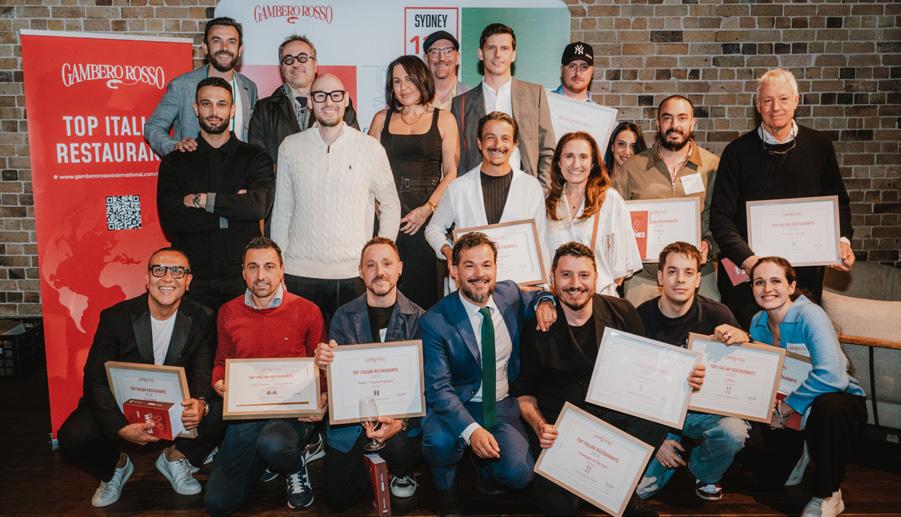
by Giuseppe Carrus
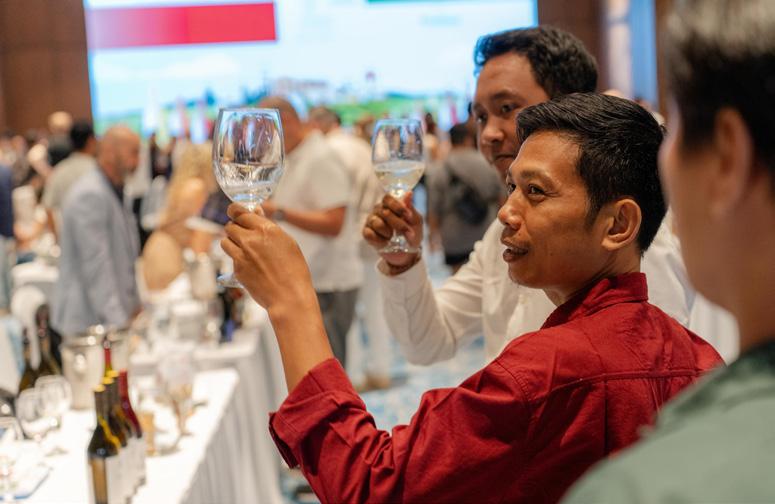
In Bali, Italian wine is no longer just a luxury reserved for resorts or a bottle to be uncorked in large international hotel chains. It has become a common language among sommeliers, chefs, restaurateurs and wine enthusiasts. And on May 18th, with the first ever stop organised by Gambero Rosso in Indonesia for the Top Italian Wines Road Show, this sensation turned into something very tangible: a clear snapshot of a young,
vibrant market, still very much under construction, yet already surprisingly mature in the way it views Italian wine.
Gambero Rosso’s Indonesian debut could not have had a better setting than the Paradisus by Meliá Bali, a resort recently renovated by the Meliá group, which hosted a busy and very well-attended day. An elegant yet relaxed venue, perfectly in keeping with the spirit of Bali: trop -
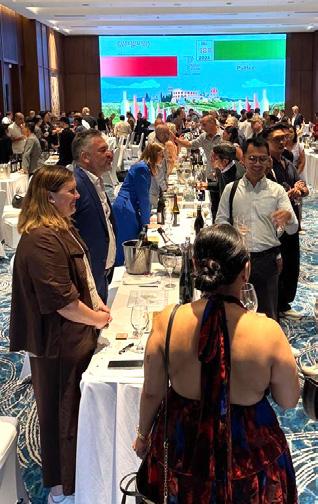
ical, cosmopolitan, refined without ostentation. The large events hall was transformed into a huge walkaround tasting, bringing together no fewer than 48 Italian wineries, from the north to the south of the peninsula, each with four different labels, in one of the largest showcases of Italian wine ever seen on the island. There was a genuine sense of enthusiasm amongst the tasting tables. Not the superficial curiosity of those seeking only prestigious
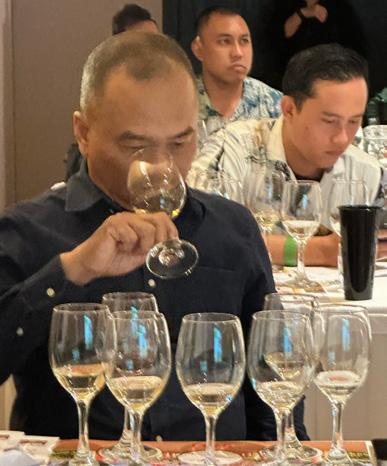
labels, but a genuine desire to understand terroirs, grape varieties, appellations, climatic differences and production philosophies. This is a particularly striking detail in a market so geographically distant from Italy, and one that demonstrates just how much Bali is growing in gastronomic and oenological terms.
After all, those who have been visiting the island for years make this clear. This is the case with Mario Belometti, F&B manager at one of the island’s most exclusive beach clubs: «Since Covid, Bali has experienced a real surge. International tourism has returned in force, but above all, the standard of what’s on offer has changed. There has been an increase in quality restaurants, contemporary cocktail bars, beach
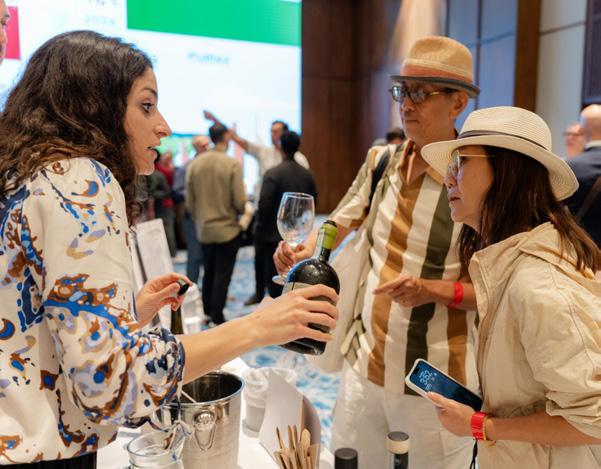
clubs with increasingly ambitious wine lists, fine dining establishments and bistros where wine is no longer merely an accompaniment, but an integral part of the dining experience. In this context, Italian cuisine continues to hold enormous appeal. It is perceived as authentic, convivial and elegant without being stuffy. And where Italian cuisine thrives, Italian wine inevitably thrives too.» It is no coincidence that the turnout from the local trade was impressive. In the corridors of the tasting event, one encountered some of the island’s most influential Balinese sommeliers, chefs, importers, buyers, food journalists and restaurateurs. Many of them viewed the event almost as an international recognition of the progress Bali has
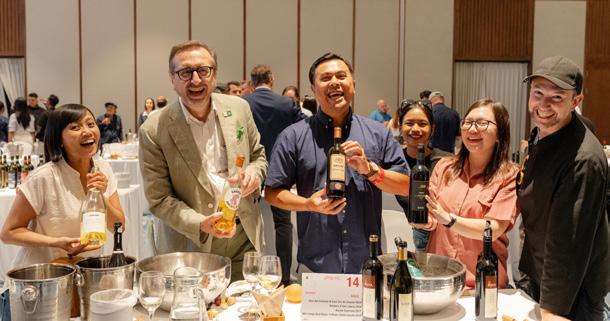
made in recent years. Being present at an event of this calibre meant feeling part of a scene that is now mature and credible in the eyes of the world.
The three masterclasses organised further raised the technical standard of the day: in the resort’s meeting rooms, in-depth sessions dedicated to the great wine regions of Italy took place, with tastings that allowed the professionals present to delve into the details of the various regional identities. A crucial moment, especially for a market like Indonesia’s, where the discerning consumer is beginning to seek not just the brand or international renown, but the regional story behind every bottle.
Ni Nyoman, a journalist specialising in food and wine, explains how useful it was to attend the masterclass: «As was said during the tasting, Italian wine is complex to understand, but this is its strength.
Realising that it’s not limited to just a few grape varieties, but that Italy’s biodiversity is something incredible, makes us want to learn more and more about this wonderful country. Through 15 wines, the masterclass took us on a wonderful journey up and down Italy.»
And this is perhaps the
most interesting aspect to emerge from the day in Bali: Italian wine is no longer perceived here merely as synonymous with the Mediterranean lifestyle. Of course, the charm of Italy continues to play an important role. But today there is a sense of something deeper. Local professionals speak of indigenous grape varieties, of designations, of differences between north and south, between altitudes and soils, and between different production styles. These are topics that, until a few years ago, were almost exclusively the preserve of more mature markets.
Walking amongst the tasting tables, one had the feeling of witnessing a small turning point. Bali is not simply a paradise-like tourist destination. It is becoming an increasingly significant Asian gastronomic hub, capable of attracting international chefs, bartenders, hospitality entrepreneurs and wine professionals from all over the world. A continuous cross-pollination that inevitably fosters cultural growth around wine as well.
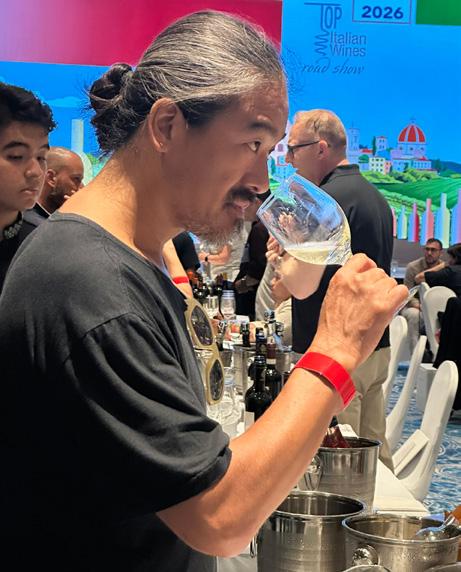
And Italy, in this context, seems to have everything it takes to become a key player. Thanks to its variety of styles, gastronomic recognisability and ability to engage with an international cuisine increasingly open to fusion, Italian wine appears perfectly aligned with Bali’s contemporary tastes. From fresh, mineral whites, perfect for the tropical climate, to more gastronomic reds and sparkling wines, which are increasingly in demand in the island’s venues, the feeling is that this is only the beginning.
The first Top Italian Wines Road Show in Indonesia therefore had all the hallmarks of a great debut. Not only because of the numbers involved or the calibre of the wineries present, but because it signalled a real shift: Bali is no longer simply an exotic destination where one can enjoy fine dining. It is a rapidly evolving international gastronomic scene. And Italian wine aims to be one of its key players.
In Bali, Gambero Rosso is launching its Top Italian Restaurants guide, thand for the first time, eight restaurants have been awarded, a sign of a gastronomic scene that has grown impressively in recent years, driven by high-end international tourism, the opening of iconic hotels and an increasingly curious and knowledgeable public. One statistic immediately stands out: two restaurants have instantly reached the top of the selection, establishing themselves as symbols of two distinct yet complementary souls of contemporary Italian cuisine in Bali. On the one hand, there is Mauri, now a historic establishment on the island, which over the years has built a very strong identity around an elegant, personal Italian cuisine deeply rooted in local produce. On the other is Il Ristorante - Niko Romito, the project by the Abruzzo-born chef within the luxurious Bulgari Resort Bali, one of
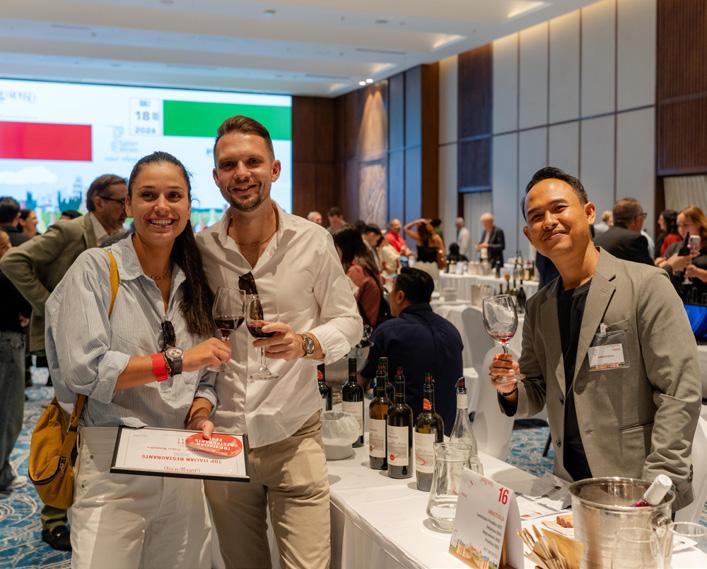
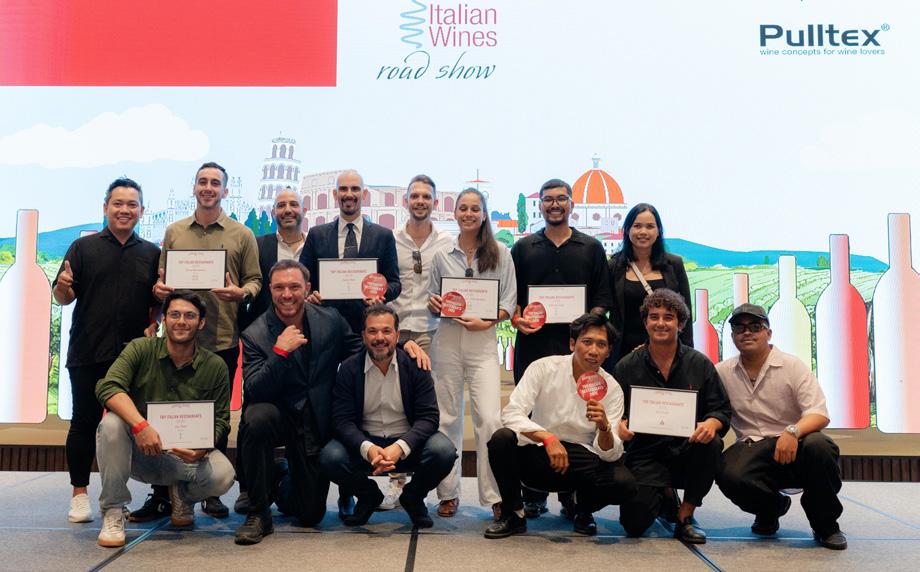
the island’s most spectacular hotels, perched on the cliffs of Uluwatu overlooking the Indian Ocean, which opened twenty years ago. Two different approaches, yet united by the same vision of Italianness: rigorous, contemporary, and instantly recognisable. And this is perhaps the most interesting point: today in Bali, people are no longer simply seeking the comfort of classic Italian cuisine, but a complete, refined experience that reflects a distinct identity. The rise in the island’s gastronomic standards since the pandemic has been impressive. New luxury hotels, cocktail bars, fine dining restaurants and increasingly ambitious wine lists have transformed Bali into an increasingly credible Asian gastronomic hub. In this context, Italian cuisine plays a central role.
The presence of Gambero Rosso and the Top Italian Restaurants guide therefore marks a significant step forward. No longer simply Italian restaurants ‘for tourists’, but establishments entering a truly in-
ternational arena, where technique, innovation and authenticity become essential elements. The fact that eight restaurants have immediately made it into the selection speaks volumes about how high the average standard is today, at least among the island’s finest establishments: Amici Bali, Bella Cucina, Osteria Luna, Zia Tina, La Lucciola and even a pizzeria, Da Maria, confirming a now well-established Italian scene where fine dining, regional cuisine, historic venues and more informal formats coexist.
Last but not least, the two establishments mentioned earlier, which have taken the top spot on the podium: Il Ristorante – Niko Romito aims to bring a contemporary vision of Italian cuisine to the world, characterised by purity, lightness and a focus on the ingredient itself, and does so through the talented Francesca Stabile, chef, and Alessandro Mazzali, executive chef of the entire resort. Mauri, on the other hand, is an establishment that over the years has
become an absolute benchmark for those seeking top-tier Italian cuisine in Bali. A restaurant that has made a tangible contribution to raising the profile of Italian gastronomy on the island, well before the arrival of the major international luxury hotel brands. It is no coincidence that the chef and owner, Maurizio Bombini, spent time right here in Bali, at the Bulgari and the Ritz-Carlton, before embarking on his entrepreneurial career.
Looking at this first selection of Balinese restaurants from Top Italian Restaurants, one gets the feeling that we are only just getting started. For Bali today seems to possess all the hallmarks of a major emerging gastronomic market: an international clientele, a growing interest in wine, cultural curiosity, and a form of luxury that is becoming less ostentatious and increasingly experiential. In this context, Italian cuisine continues to be one of the most powerful and sought-after culinary traditions in the world.
by Giuseppe Carrus

Following Sydney and Bali, Bangkok brought the 2025/2026 edition of the Gambero Rosso Top Italian Wines Roadshow to a close. A fitting conclusion to a tour that, once again, confirmed Italian wine’s extraordinary ability to appeal to international markets and win over an increasingly knowledgeable and discerning trade. The Thai leg, now a fixture in Gambero Rosso’s calendar for some fifteen years, took place in the elegant surround-
ings of the Dusit Thani Bangkok. A spectacular hotel, with huge windows overlooking the capital’s skyline providing the backdrop to a packed day of tastings, meetings and indepth discussions. No fewer than 60 wineries from all over Italy brought the walk-around tasting to life, offering a mosaic of regions, grape varieties and production styles that showcased the richness of contemporary Italian winemaking. The tasting tables were visited by a highly knowledge-
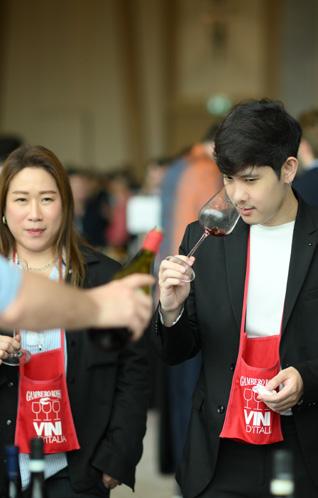
able audience comprising importers, distributors, sommeliers, restaurant buyers and specialist journalists. And it was precisely the calibre of the audience that was one of the aspects most appreciated by the producers in attendance.
“A real success,” says Roberto Cardinale, export manager for several participating companies.
“The audience is among the best I’ve ever seen at events of this kind: knowledgeable, well-informed and
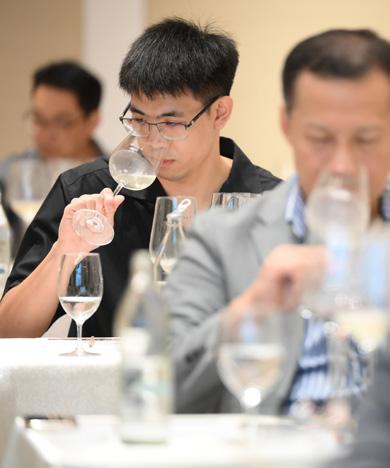
genuinely interested in learning about Italy’s wine regions and appellations.”
Massimo Furlan, commercial director of the La Ponca and Le Monde wineries, echoes this view: “Thailand continues to be one of the most interesting markets in Asia. Local consumers are among the most knowledgeable on the continent and demonstrate an increasingly in-depth understanding of Italian wine, even when it comes to lesser-known appellations or indigenous grape varieties.” These words are borne out by the figures and the atmosphere throughout the event. The Thai market is, in fact, undergoing a particularly promising phase of growth. Over the past year, total wine imports exceeded $132 million, an increase of around 13% compared
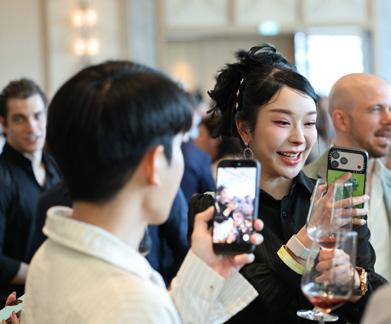
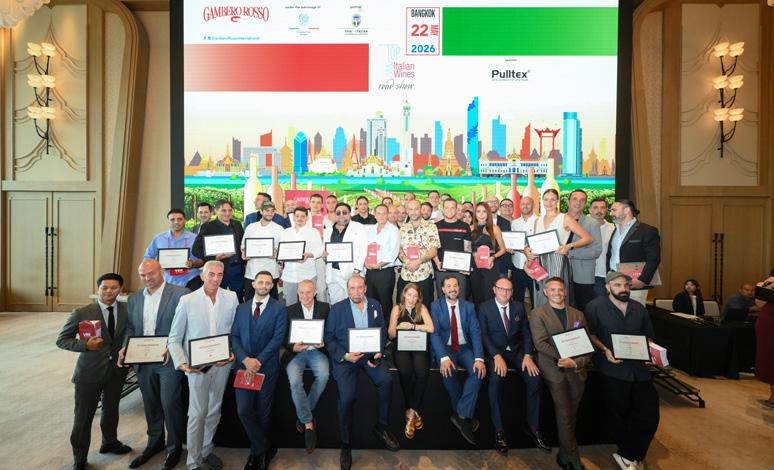
to the previous year, whilst volumes reached over 18 million litres. A result that places Thailand among the most dynamic markets in South-East Asia. Italy continues to strengthen its position, particularly in the premium segment and the sparkling wine category. Italian sparkling wines, led by the Prosecco phenomenon (but not exclusively), represent one of the most dynamic export categories to the country, supported by growth in fine dining, the international hotel sector and an urban middle class increasingly interested in quality consumption.
There was also a large turnout for the three masterclasses led by Giuseppe Carrus, one of the editors of the Guida Vini d’Italia. These three sessions were fully booked and gave local industry professionals the opportunity to taste a total of 60 wines, one from each winery present at the event. An ideal journey from north to south of the peninsula that highlighted Italy’s extraordinary wine-growing diversity and the Thai market’s growing curiosity about the distinctive characteristics of individual regions. The day concluded, as is tradition, with the awards ceremony for the Top Italian Restaurants guide, which since 2015 has been selecting and promoting the finest Italian
establishments worldwide. And once again, Bangkok impressed. In fact, 31 establishments were awarded prizes, including restaurants, pizzerias and wine bars – a true record that speaks louder than any statistic about the excellent standard achieved by Italian dining in the Thai capital. A result that confirms the maturity of a city where Italian cuisine is no longer merely an established presence, but one of the most highly regarded international culinary expressions. At the top of the rankings, two establishments that symbolise Italian haute cuisine in Bangkok have retained their positions: Clara and Cannubi by Bombana, which interpret Italian culinary tradition with elegance, technical skill and a strong contemporary identity.
Whilst the Top Italian Wines Roadshow brought its 2025/2026 tour to a close amidst the lights of Bangkok’s skyscrapers, the feeling is that the journey of Italian wine in Thailand is only just beginning. The calibre of the audience, the growth in imports and the high standards achieved by Italian restaurants all point to an increasingly mature market that is captivated by our wine heritage. A market which, year after year, continues to demonstrate that it is becoming ever more fluent in the language of Italian wine.
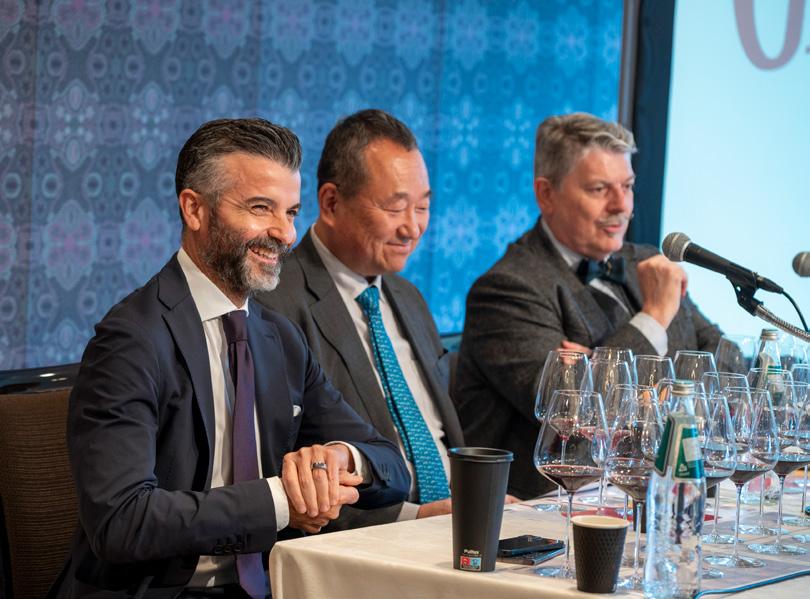
Preserving the legacy of Amarone and transforming it into a contemporary narrative. This is the inspiration behind Gerardo Cesari’s Bosan project, which finds its symbolic home in the Caveau Bosan in Fumane: a space inaugurated in November 2024 created to house the historic vintages of the Amarone della Valpolicella Classico Riserva by the same name, starting with the first harvest in 1997.
It is not merely a wine archive, but tangible proof of the label’s longevity. From the most recent vintages, such as 2015, to the more mature ones, such as 2010, 2001, 2000 and 1997, the Caveau is the narrative heart of the project: a bridge between memory, territory and a contemporary vision of Amarone.
The story of a territory is told through a label and a vision is the path Gerardo Cesari has embarked upon during the various international stops on the tour organised by Gambero Rosso.
The starting point is the historic vineyard from which Bosan originates, in the heart of the Valpolicella Classica. From there takes shape an Amarone endowed with depth, balance and the ability to evolve over time, the star of the vertical tastings presented in Tokyo,
Shanghai, New York and Toronto.
Four stops, four different markets, a single wine at the centre. And a story to tell about how Amarone, when made with a clear vision, manages to speak to markets that are very far apart.
The chosen format was a vertical tasting. In Tokyo, the first stop on the tour organised by Gambero Rosso, the room was filled with buyers and industry professionals. Marco Sabellico, editor of the Vini d’Italia guide, led the tasting alongside the winery’s general manager, Giovanni Lai. The vintages presented ranged from 2016 - awarded the Tre Bicchieri in the Vini d’Italia 2026 guide - to 2000. The 2016 showed what one expects from a young, successful vintage: freshness, energy, and the sense that the wine still has much to offer. The warmer 2015 vintage added roundness without losing its balance. The older vintages, from 2006 onwards, did the most important job: demonstrating that Bosan ages well, that it does not become flat, and that it retains a clarity of expression that is not a given in an Amarone.
In Shanghai, the tour continued with Nicolò Maroni, the winery’s brand ambassador, once again accom-
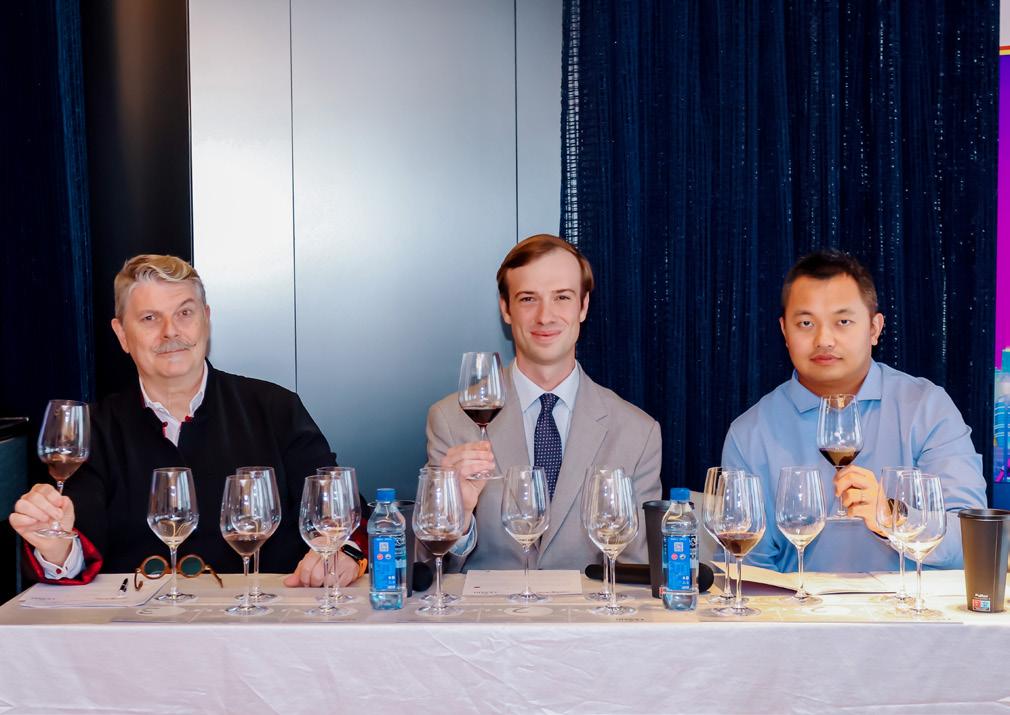
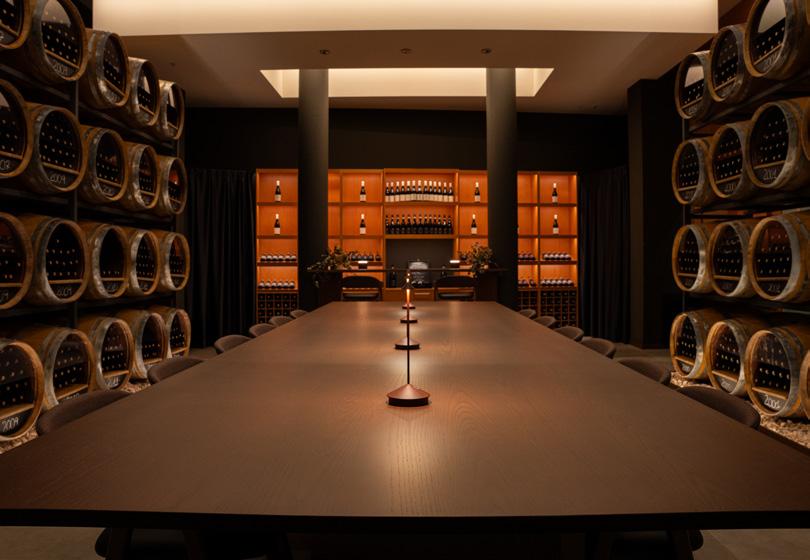
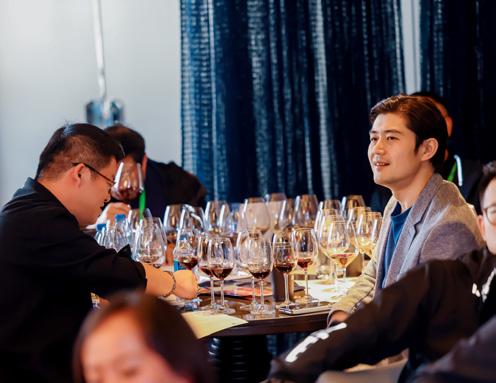
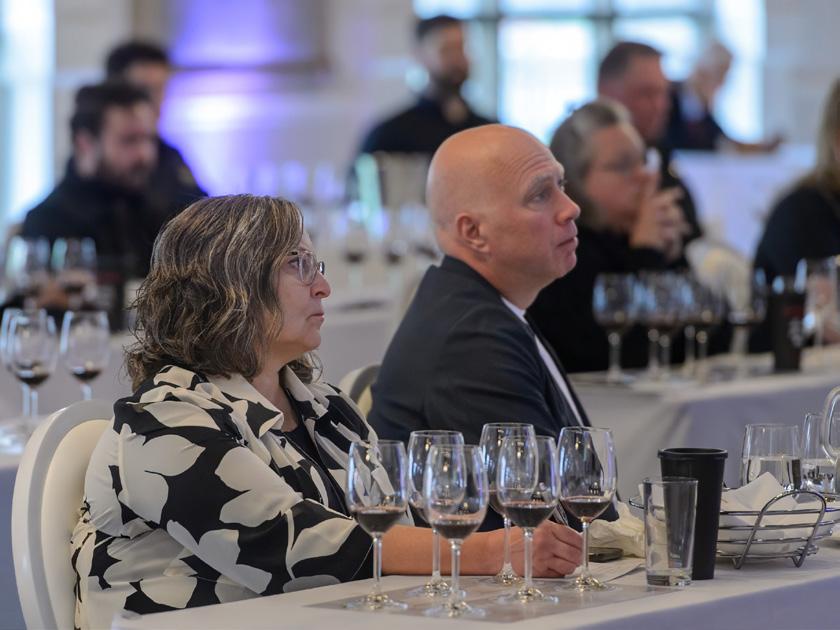
panied by Sabellico. The Chinese market listened intently to the story of a terroir-driven wine, where the comparison between vintages allowed us to showcase not only the quality of the individual wines, but the consistency of a project: the same hand, the same vineyard, different vintages.
New York is a different matter altogether. The American market remains hugely important for Italian wine, but it is also fiercely competitive, accustomed to seeing labels from all over the world paraded before it. The vertical tasting served to highlight a clear point: an Amarone with balance and tension is not a meditation wine; it is a table wine with a long-term perspective.
The final stop, Toronto, brought the tour to a close with Giuseppe Carrus, editor of the Vini d’Italia guide, once again alongside Maroni. In front of importers, buyers and the specialist press, the final message was the same as at the previous stops: territory, time, consistency. A narrative that is by no means secondary in a world where wine is increasingly chosen for the story it tells.
Cesari’s presence at these events provided a real opportunity not only to showcase the winery, but also to present a contemporary image of Amarone on international markets. These are markets where there is an increasing demand for recognisable stories, distinct terroirs and wines that demonstrate consistency, identity and the ability to evolve over time.
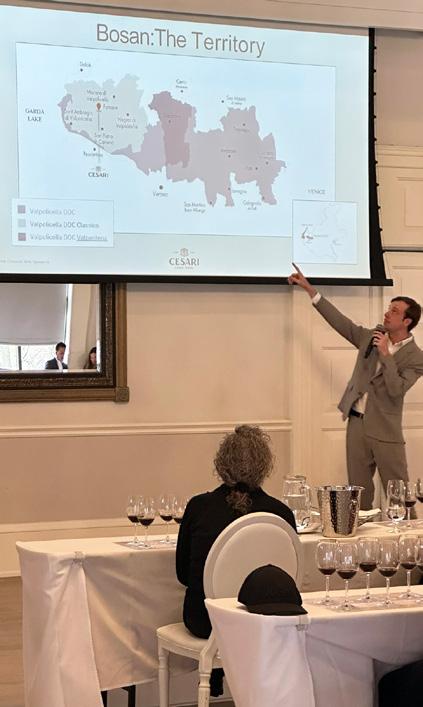
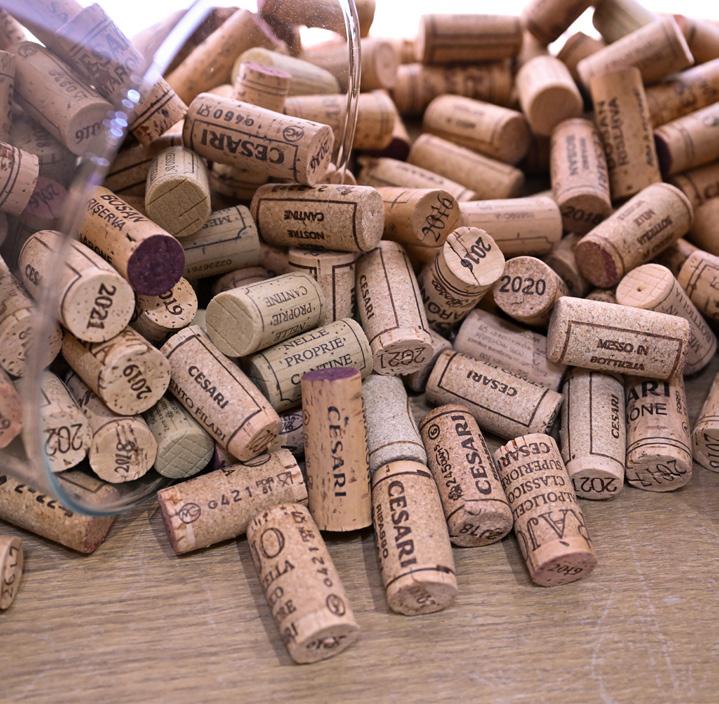
Gerardo Cesari
Via Progni, 81
37022 Fumane (VR) – Italia,
Tel: +39 045.2160150
$gerardocesari
fgerardocesari
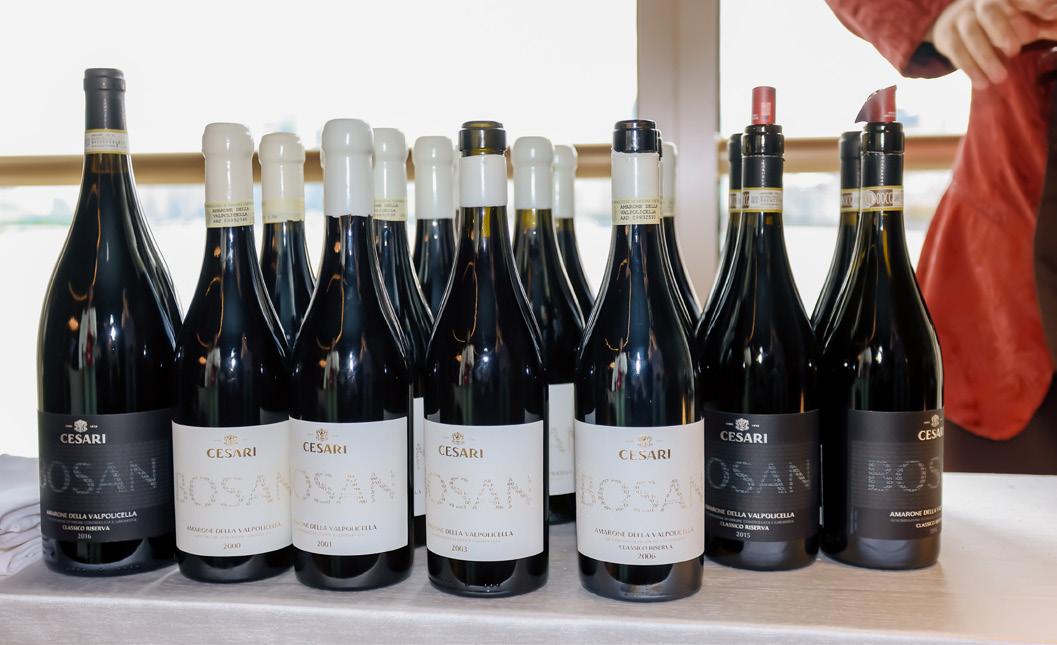
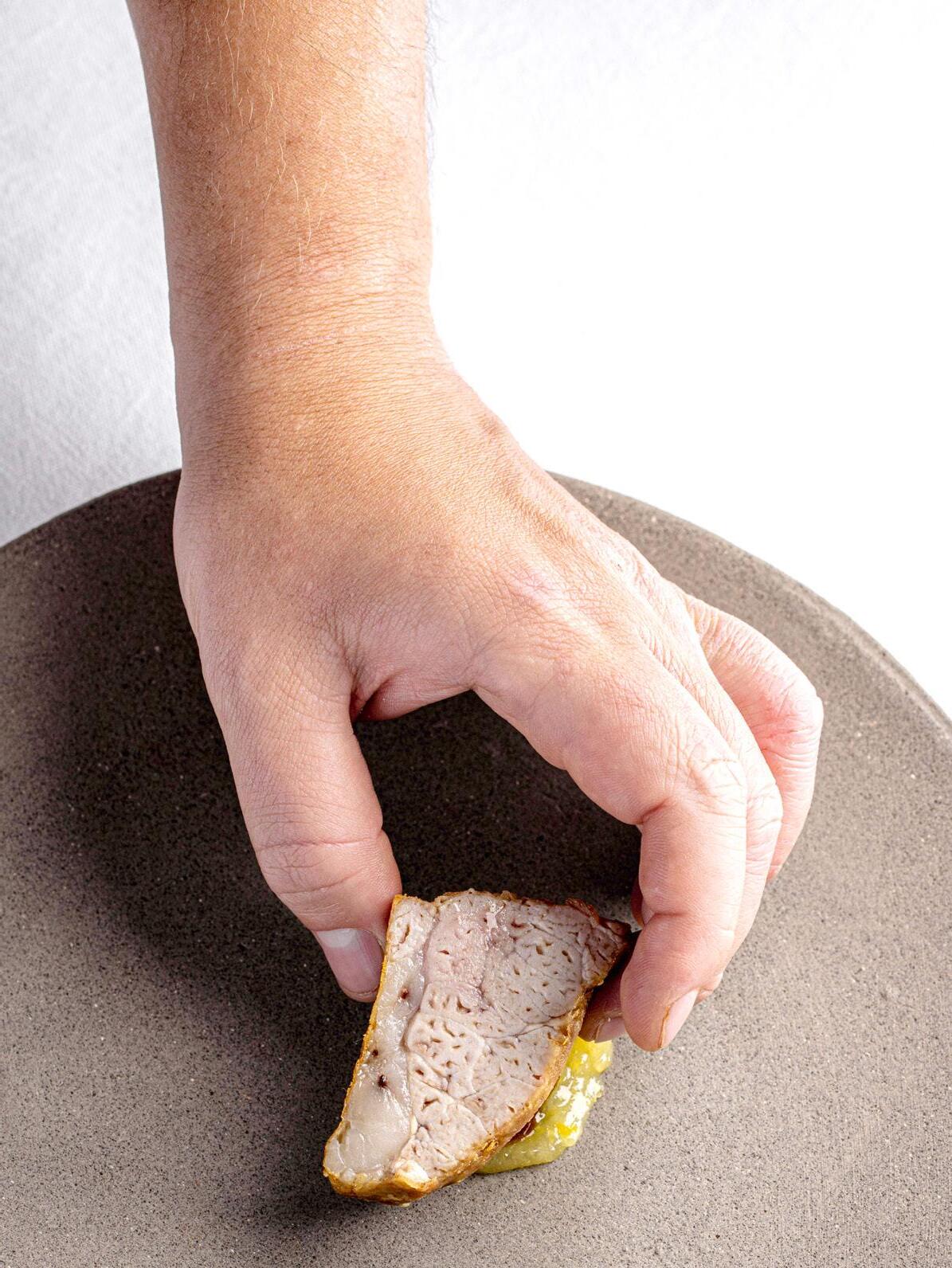
From a by-product of folk tradition to a divisive ingredient in haute cuisine. The Italian evolution of the finest offal from the fifth quarter of the cow
by Eugenio Marini
There are dishes that make or break certain restaurants. Just as there are ingredients for which a chef may have a preference, if not a weakness it struggles to hide. Certain ingredients can prove so emblematic that they serve as an irrefutable test of a chef’s maturity. A bit like squab meat, a staple of the most orthodox haute cuisine, with which generations upon generations of professionals have always measured themselves, showcasing all their talent—or faltering just when it counts most, at the moment of consecration through the highest culinary standards. After all, the preparation of this bird has long been a fetish of international grandes tables. And judging by the menus of contemporary fine dining establishments, it still seems to be so. The curious thing, however, is that it is no longer unique.
A similar fate, at least in Italy, seems to befall sweetbreads, a “humble” organ from the suckling calf. There is no tasting menu that does not feature these offal cuts, with numerous chefs on our culinary scene keen to offer their own interpretation, serving them in every possible way and at any time of the season. Clearly, given that these have been signature dishes of certain illustrious masters for some years now, this cannot be described as an absolute novelty. But never before has it achieved such widespread popularity, accompanied by the approval of the average diner. Today, it stands as the latest cross to bear and delight of signature cuisine, ranging from its culinary dimension to the ethical questions it ultimately raises.
Sweetbreads are part of the “fifth quarter” – a collection of offal once discarded by the wealthy classes, who instead reserved for themselves the front and rear
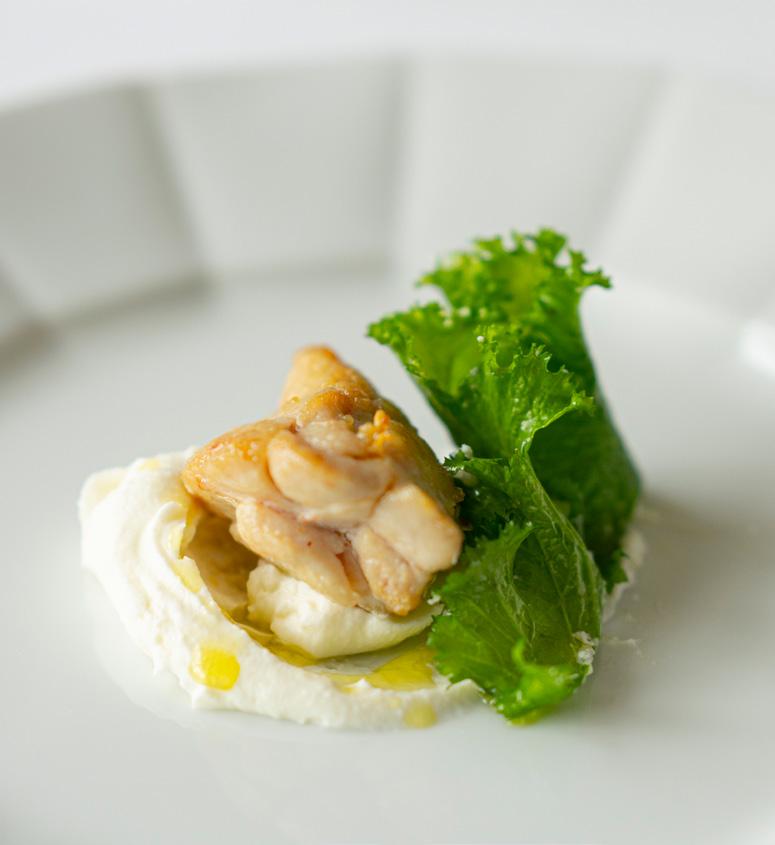
quarters of the cow, considered more noble. Sweetbreads are salivary glands (corresponding to the human thymus), found only in calves – young calves just a few months old, fed exclusively on milk. The younger the calf, the larger and more substantial this part of the animal is; it gradually shrinks until it is completely reabsorbed by the body. Lamb sweetbreads are also tasty, but they do not enjoy the same status in the world of awardwinning gastronomy: according to experts, they are not quite as refined on the palate. Those from calves, on the other hand, offer an almost graceful organoleptic richness. Their meat has taken centre stage in
Sweetbreads, cream, lemon and salt by Niko Romito’s restaurant Reale (photo by Andrea Straccini) Sweetbreads, mantis shrimp, and salted lemon by Daniele Lippi of Acquolina restaurant (Rome) (photo by Matteo Lippera)
signature cuisine, becoming the star ingredient in the creations of many chefs—even the most enlightened ones—capable of positioning themselves at the forefront of the culinary scene. To borrow a fashionable idiom — though one that is particularly apt here — one might even
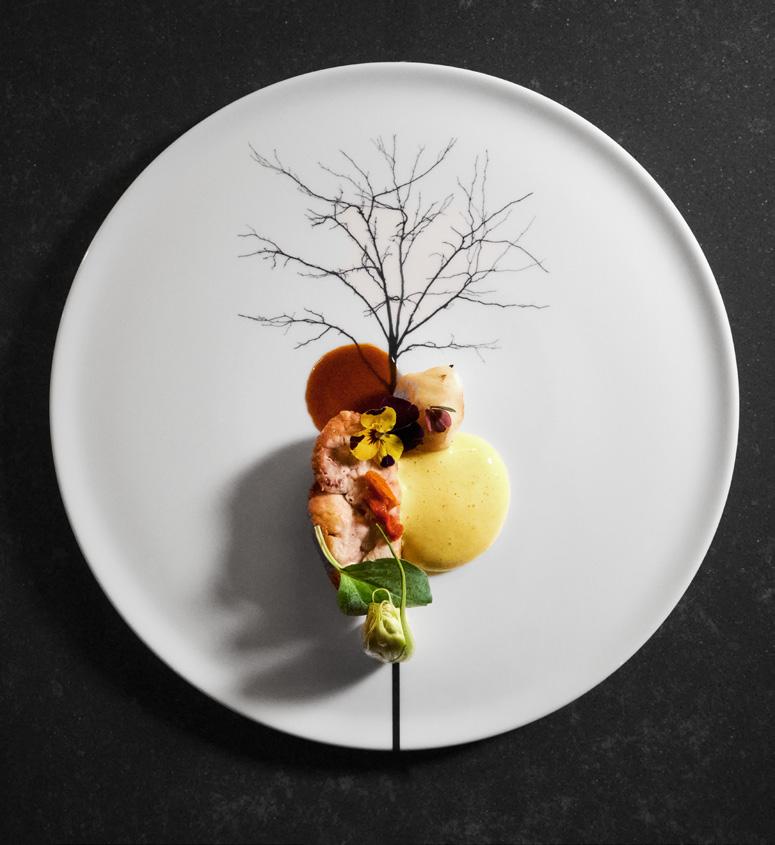
Mario and Remo Capitaneo: Veal sweetbreads, sea urchins and coffee-flavoured Bernese sauce by the Milanese restaurant Verso (photo by Marco Varoli)
venture to say that sweetbreads are now “the new squab”.
Despite this recent trend, the deliciousness of these pale offal cuts has actually been known for some time. It is no coincidence that they already appear in old cookbooks. There is evidence of them in Science in the Kitchen and the Art of Eating Well, one of the
most significant collections of the twentieth century. Indeed, in Pellegrino Artusi’s work, they are found in the form of croquettes or to be browned «alla bottiglia». In addition to the fact that, from a historical perspective, they have helped shape the culinary DNA of the folk traditions of various regions; they join coda, pajata and tripe within the realm of Roman peasant cuisine (parts that once served as a source of sustenance for some families), without overlooking their presence in the culinary cornerstones of other regions, be it the Piedmontese finanziera or the Milanese fritto misto. Their prevalence in the traditional repertoire can be traced
above all to the popular custom of coping with food shortages during the hardest times by making use of every part of the animal. Sweetbreads, therefore — as Fiammetta Fadda points out — were consumed in the same way as chicken livers and any other meat “offal”. The expert maintains, however, that for decades these offal cuts were not properly appreciated: «They were treated rather poorly. Once boiled and pressed, they would spend a whole night in the fridge. And the fact that they were used mostly as stuffing meant that for a long time their pleasant flavour went unnoticed. My Piedmontese grandparents, for instance, would add them to a béchamel sauce with giblets, prepared to fill vol-au-vents. As a result, they were often covered by other ingredients, incorporated into a heavy dish, from which they were also difficult to distinguish».
But the truth is that their use is primarily rooted in French culinary tradition. Fadda has no doubts on the matter; leafing through the issues of Grand Gourmet magazin e, of which she was editor, she recounts the history with particular clarity: «Ris de veau is a great classic of French cuisine. Indeed, there are countless variations of sweetbreads, from those en papillote or à la bonne femme, right up to the most famous ones paying homage to Cardinal Richelieu. In Italy, on the other hand, they were rarely used, at least according to what I found in old issues. In the final issue of 2004, I identified just 7 recipes featuring this cut in the meat section, which otherwise comprised 450 recipes». In the overview provided by one of the most authoritative voices in food and wine criticism, Italy’s chefs appear to have borrowed their passion for the ingredient
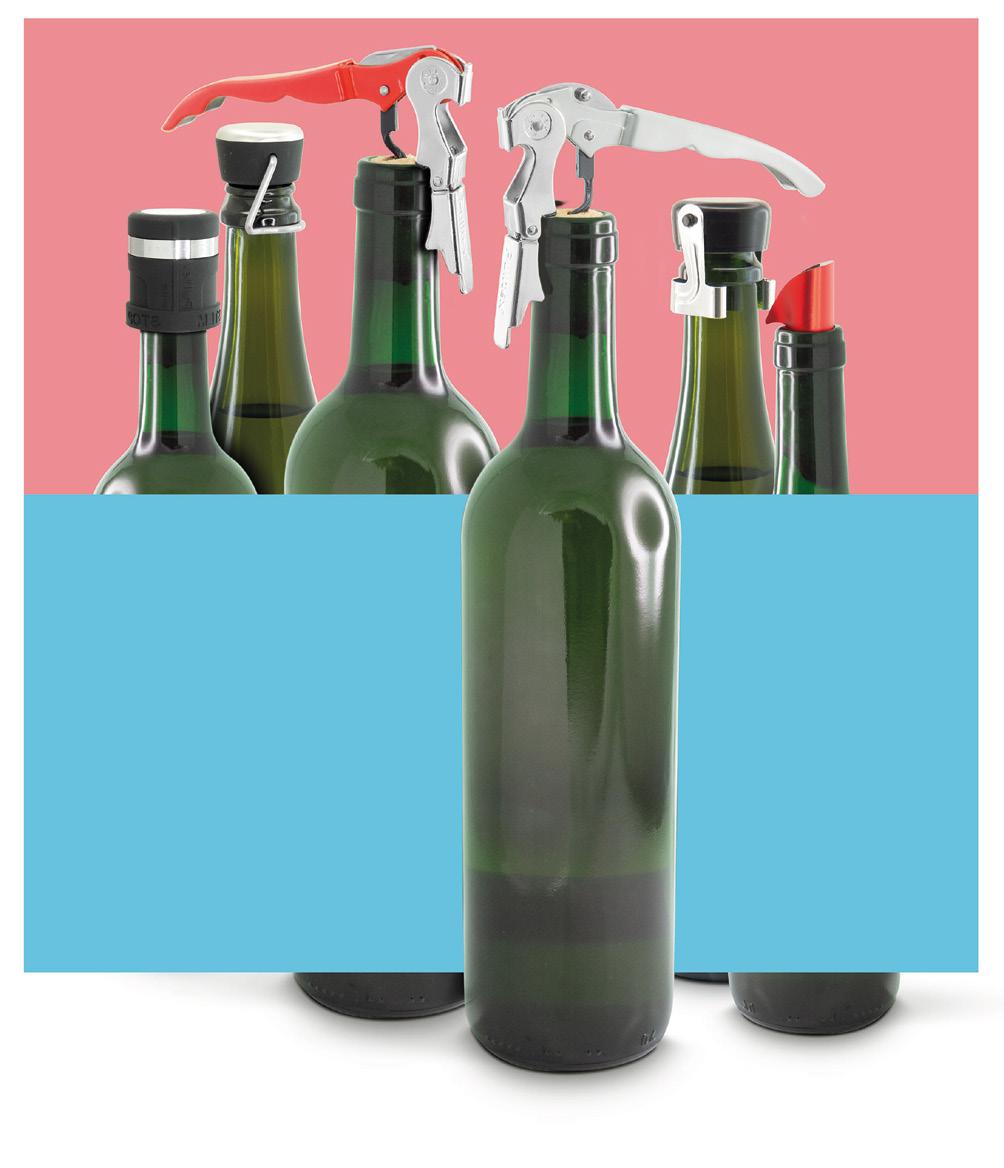
from France and haute cuisine, albeit with a certain delay. A slow and gradual “transmission” which, in the Italian context, fully encompasses signature cuisine, even in less formal settings. This aspect, combined with his Roman origins, only partially explains Arcangelo Dandini’s devotion to this exquisite gland. The restaurateur, born in the Castelli region, is so attached to this white offal that he has even “dedicated” a book to it: Animelle. Viaggio di un oste. In his own middle-class tavern, he loves to serve it “breaded” or pan-fried with a butter and anchovy sauce, after removing the outer membrane and soaking it in cold water and vinegar for half an hour. It remains, however, a love that blossomed at a tender age, emotionally linked to his grandmother’s delicacies, who used veal offal to enrich her supplì rice balls and meat sauce.
Today, the image of sweetbreads as a by-product, used merely to enhance a recipe, seems to be a thing of the past. We have reached a situation that is practically the opposite, in which this cut, whilst not a prime cut, is treated as if it were. At the same time, its economic value has also changed: whereas in the past butchers would practically give it away, given the low demand and lack of profit, it now costs as much as a prime cut of meat. So much so that in cities, butchers — as Fiammetta admits — may decide to freeze it (so they can resell it later). In short, over twenty years the price has risen from 10 to 40 euros per kg. A price that not even a ribeye steak commands these days. Chefs, in turn, are approaching it by bestowing upon it a new dignity, comparable perhaps
only to that once enjoyed by the fillet, which, ironically, almost no one seeks out anymore. From this perspective, Italian haute cuisine has gradually aligned itself with its French counterpart, which has always had a soft spot for Bresse chicken, foie gras, pigeon and, indeed, sweetbreads. It has made it a key ingredient, around which the entire dish revolves, worthy of featuring as a course on the tasting menus of Italy’s most prestigious restaurants. This phenomenon has also taken hold thanks to a new awareness among consumers, who are now culturally less reluctant to eat offal, as well as the inclination of certain gastronomic luminaries to
Sweetbreads, toma cheese and bay leaf by Antonio Ziantoni of Zia restaurant (Rome) (photo by Alberto Blasetti)
fulfil their guiding role by ‘educating’ guests about fine food, taking on the mission of introducing them to select, sometimes unfamiliar, products.
Nor can one deny that the sector is subject to cyclical waves capable of elevating a raw ingredient to the point of making it a trend or a staple. Such is the case with the refined sweetbread. And in the future? That said, its success in fine dining should also be viewed in the light of its organoleptic profile, appreciated by many top chefs. The Camanini brothers of the famous Lido 84, a restaurant in Gardone
Sweetbreads and elderflower by Andrea Antonini of Imago restaurant at the Hotel Hassler in Rome (photo by Alberto Blasetti)
Riviera that is already the stuff of legend, were among the first to bring out its best qualities. Niko Romito’s signature dish Thyroid Glands, Cream, Lemon and Salt, on the other hand, remains a fixture on the menu, even though it was introduced over 12 years ago. In its evolution, the chef at Reale has chosen to add a vegetal note, at times spicy, depending on the seasonality of the brassica (a leaf of curly mustard or red cabbage), ensuring that the milky character of the meat—here thickened by cream, with a few drops of lemon to give it a delicate acidity—remains intact. Andrea Antonini of Imago, the fine dining restaurant at the Hotel Hassler, also seeks a subtle edge in his recipe. In Sweetbread and elderflower, he uses acidified butter to provide a touch of acidity, which, in his view, enhances the spongy texture of the cut, usually paired
with very fatty and sweet components. Remo and Mario Capitaneo, at the helm of Verso, have opted to recreate a hint of toasting that binds the main elements of the dish together.
In their Veal sweetbread, sea urchins and coffee-infused Bernese sauce, the finishing of the offal and the cooking of the celeriac over charcoal move in this direction, helping to achieve aromatic harmony. Meanwhile, gastronome Fadda was pleasantly impressed by Antonio Guida’s version. At Seta in Milan’s Mandarin Oriental, the Apulian executive chef serves it with a carrot cream, Jasmine yoghurt and wild Madagascar pepper. Not to mention the version from Krèsios in Telese Terme, an unusual and sophisticated signature snack that tempts like popcorn, even though it is a tempura of sweetbreads to be dipped in ketchup.
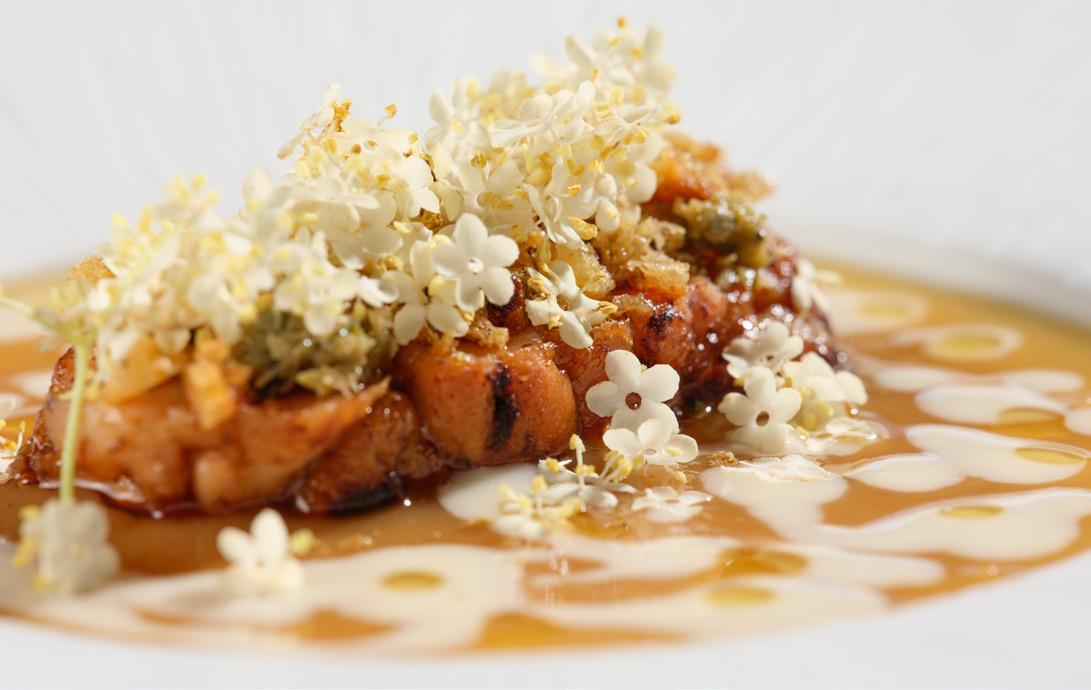
As the accomplished journalist says, when prepared well – perhaps browned to a golden hue – with its crispy exterior and its melt-inthe-mouth, creamy or rich centre, it is a particular delight to savour. Of course, it may well be delicious, but that does not detract from the fact that the existence of this offal in countless establishments on the gourmet circuit, ready to serve it almost every day, across multiple sittings, seems to raise ethical questions. Roberto Liberati, a knowledgeable and conscientious butcher who has been a vegetarian for a decade, is convinced of this: ‘A 250-kg calf yields a maximum of 500 g of sweetbreads. So the ethical argument falls flat, given that it doesn’t apply in all those cases where there is insufficient availability of the raw material. Moreover, by focusing on just one or two specific cuts, it is difficult to consider the use of offal truly effective. Furthermore, when handling such large quantities of sweetbreads – as Michelin-starred restaurants with set menus do – the traceability of the animals is lost; one does not fully know the farming methods used or the quality of the meat. And this may include unhealthy livestock, as well as those that have been force-fed, fattened on powdered milk and balanced feed, i.e. not fed on their mother’s milk, nor free to graze and therefore eat grass». Irene Piazza, a farmer and owner of the Selma Agricola Sermondi farm, shares this view. The talented former Foradori cheesemaker also advocates a more holistic approach: «How many animals must a restaurant take on to serve a single cut like the tongue? A great many. By focusing on the value of the specific cut, we forget the animal—separated immediately from its mother—and the life it has led, in a cramped space far from interaction with its peers, before being slaughtered at 4–5 months. Yet it is these
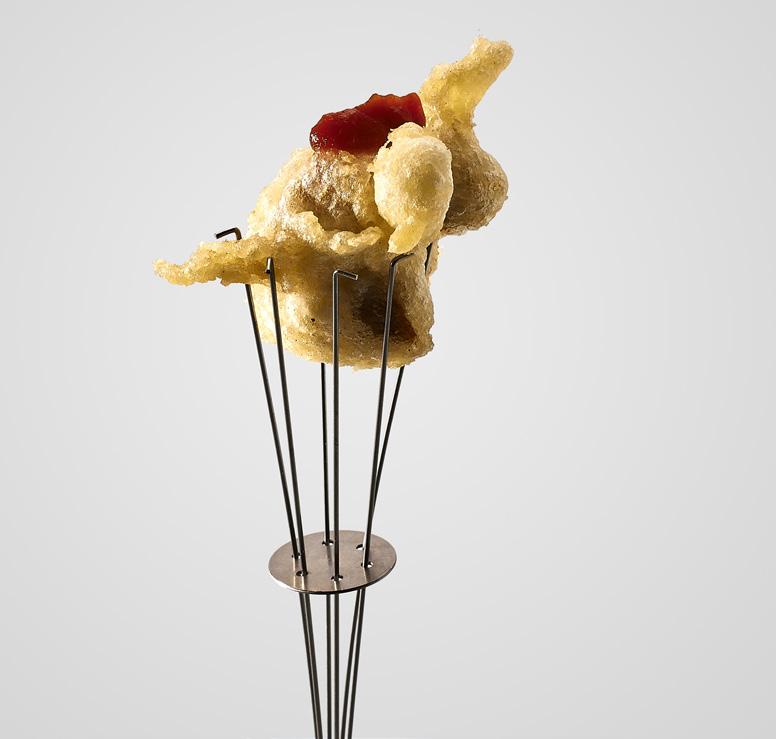
aspects that determine the quality of the meat, not the cut itself. Furthermore, the slaughter of a calf yields fewer portions than it could provide in adulthood. We need to return to embracing complexity, revising our approach based on the nuances of the agricultural world from which the products derive, which, due to changing soil and climate conditions, cannot be supplied with the same consistency».
On the other hand, chef Giuseppe Iannotti offers a different perspective, shifting the focus from the slaughter of cattle to economic sustainability: «There is no ethical issue, given that an animal is never slaughtered solely to obtain sweetbreads. Moreover, some animals yield as much as 3 kg. It is not a single cut to be served, like the kidney. And if we wish to identify critical issues, they do not relate to
Sweetbreads popcorn, a snack a t Kresios restaurant in Telese Terme by Giuseppe Iannotti (photo by Marco Varoli)
the slaughter of the animal, but rather to the high price that this once ‘poor’ cut has reached, having now become ‘rich’. At present, no restaurateur can afford to buy half-carcasses when purchasing hundreds of kilos of beef. We work with our trusted supplier on a case-by-case basis, starting with individual cuts. That is why I believe the restaurant industry cannot be sustainable. Even less so fine dining, insofar as it seeks to give a uniform shape to the head and tail of a fillet to demonstrate that the meat or fish has been cooked to perfection».
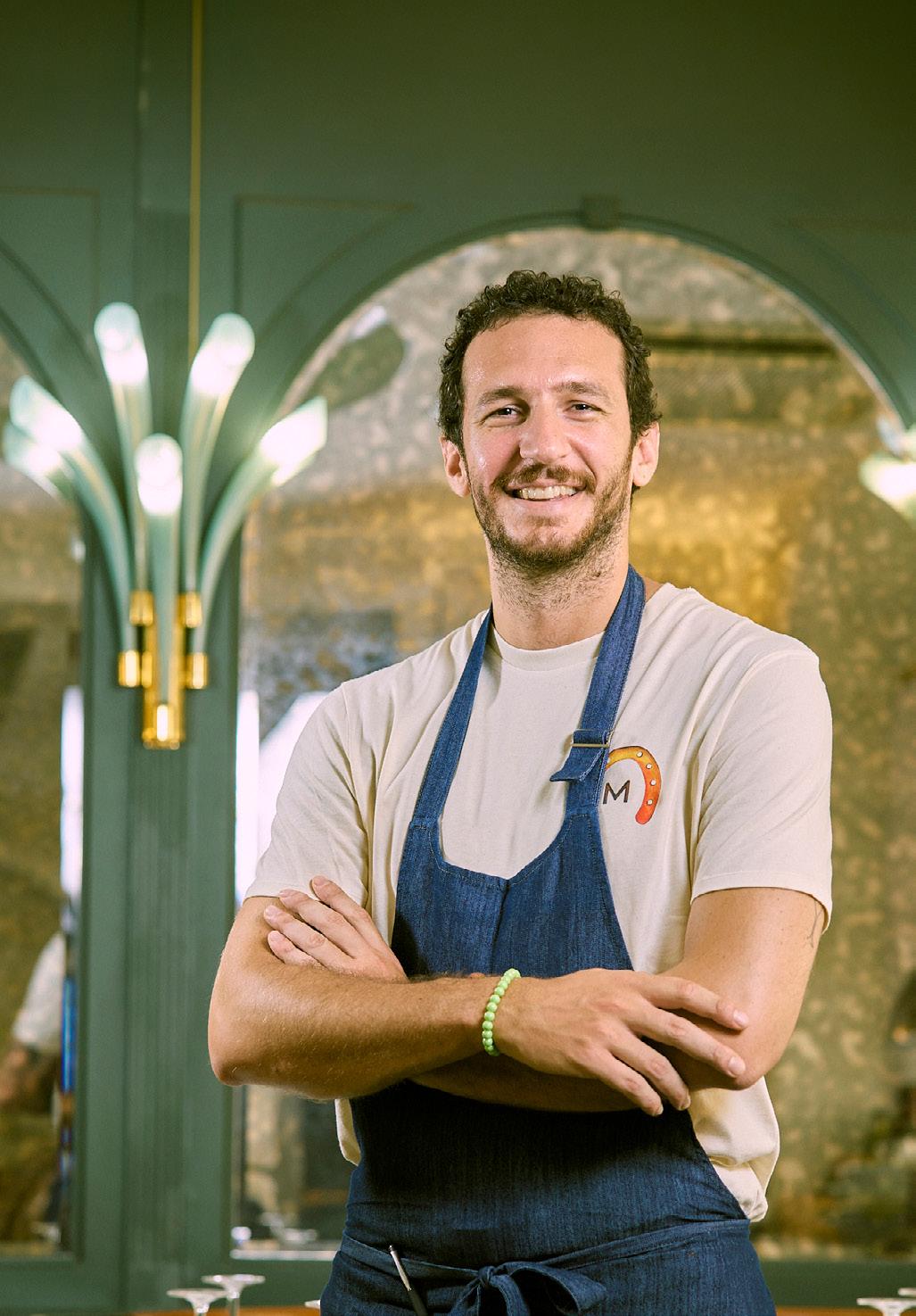
by Antonella De Santis
Born in Naples Age 35
Resident in Naples
LAST ALBUM DOWNLOADED
Quaglia Sovversiva by Marco Castello
LAST BOOK READ
Ricette Rubate, Forno Brisa
FAVOURITE INGREDIENT
Pasta
LEAST FAVOURITE INGREDIENT
Coconut
THE MEAL OF A LIFETIME
Fugu shirako in tempura, tasted in a six-seat restaurant in Tokyo located on the tenth floor of an unassuming building, the name of which I never found out
MOST VENERATED MASTER
Bittor Arguinzoniz of restaurant
Extebarri
MOST ESTEEMED
PEER COLLEAGUE
We’re a large community of young chefs; I couldn’t possibly choose just one
MY CONCEPT OF CUISINE
Traditional Neapolitan and Mediterranean, open to fusion influences
MY FAVOURITE RESTAURANT ABROAD
Villa Màs in Sant Feliu de Guixols
ONE WINE ABOVE ALL OTHERS
Fiano di Avellino or Falanghina from Campi Flegrei, older vintages
IF I HADN’T BEEN A CHEF…
A barkeep, or anything involving contact with the public in the hospitality industry
THE DISHES
Crispy anchovies, provola cheese, marinated courgettes “alla scapece” and wasabi
Genovese-style Bao taco with Cetara anchovy dressing
Stuffed sweet pepper
Ziti “allardiati”
RESTAURANT NAME >Mimì alla ferrovia
Naples via Alfonso D’Aragona, 19/21 0815538525 mimiallaferrovia.it
SEATS
150 FRONT OF THE HOUSE
Roberto Cupolo
SOMMELIER
Giuseppe Rinaldi
PREVIOUS RESTAURANTS
Marennà, chef Paolo Barrale
Quattro Passi, chef Antonio Mellino
Il Mosaico, chef Nino Di Costanzo
Il Faro di Capo d’Orso, chef Pierfranco Ferrara
Experience in Japan at five restaurants in Osaka, Kyoto and Tokyo
>Crispy anchovies, provola cheese, marinated courgettes “alla scapece” and wasabi
INGREDIENTS FOR 6 SERVINGS
24 fresh anchovies
150 g provola cheese basil lemon pepper salt
2 eggs
180 g cornflour
2 freselle biscuits flour
2 kg small pale green courgettes mint
apple cider vinegar extra virgin olive oil garlic
1 onion seed oil
220 ml water for the tempura batter
half a thumb of wasabi
2 eggs
250 g sunflower seeds pepper salt
1 lemon
2 Tbsp white wine vinegar o
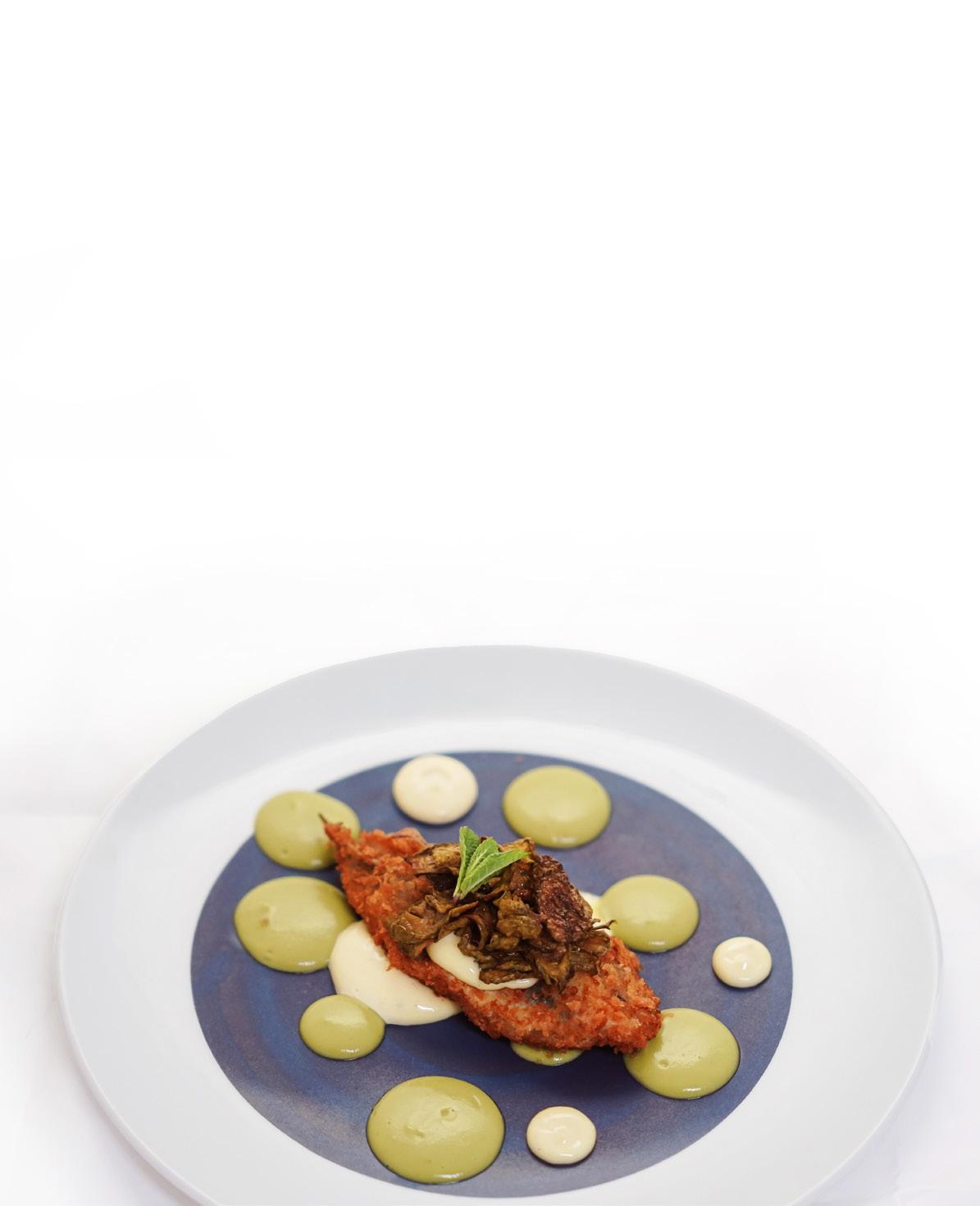
For the courgettes “alla scapece”
Tagliare le zucchine a rondelle alte 3 mm; friggere in olio di semi a 180°C e far asciugare in forno a 40* per 30 minuti. Una volta fredde, condirle con menta a julienne, aceto di mele, aglio tritato molto fine e olio extra vergine d’oliva.
For the courgette cream
Using a vegetable peeler, remove the outer skin from 200 g of courgettes, blanch them in boiling water for 20 seconds and cool them in an ice bath. Cut the rest of the courgettes into large chunks.
Meanwhile, gently fry half an onion in extra virgin olive oil in a saucepan; as soon as the onion has softened, add the courgettes and sear them over a high heat, then add some water and salt and cook for about 15 minutes.
Add the mint and the previously peeled courgettes and blend until smooth. Prepare the mayonnaise according to the traditional recipe, add the wasabi at the end and continue to emulsify
For the anchovies
Take the 24 anchovies and remove the central bone and the head, leaving the tail attached.
Cut the Agerola provola into rectangles similar in shape to the anchovies. Crush 2 freselle to make the breadcrumb coating. Place some flour on a work surface and lay half the opened anchovies on it, skin-side down; season with lemon zest, pepper, salt, the sliced provola and basil. Cover with the remaining anchovies.
In a bowl, make a tempura batter with eggs, cornflour and cold water; dip the anchovies in the batter and then coat them in the breadcrumb mixture. Fry the anchovies in hot oil.
Plating
Serve with the courgette cream at the base of the plate, the wasabi mayonnaise, and top the anchovies with the courgettes “alla scapece”.
INGREDIENTS PER 15 TACO BAO
(30 G EACH)
10 g yeast
20 g sugar
60 g sunflower oil
120 g water
50 g milk
320 g flour
5 g salt
For the Cetara anchovy dressing
1 egg yolk
1 teaspoon yellow mustard
10 Cetara anchovy fillets in oil
140 g sunflower oil
2 tablespoons lemon juice salt
pepper
For the Genovese-style beef stew
500 g beef chuck
3 kg onions
40 g tomato purée
250 g celery
250 g carrots
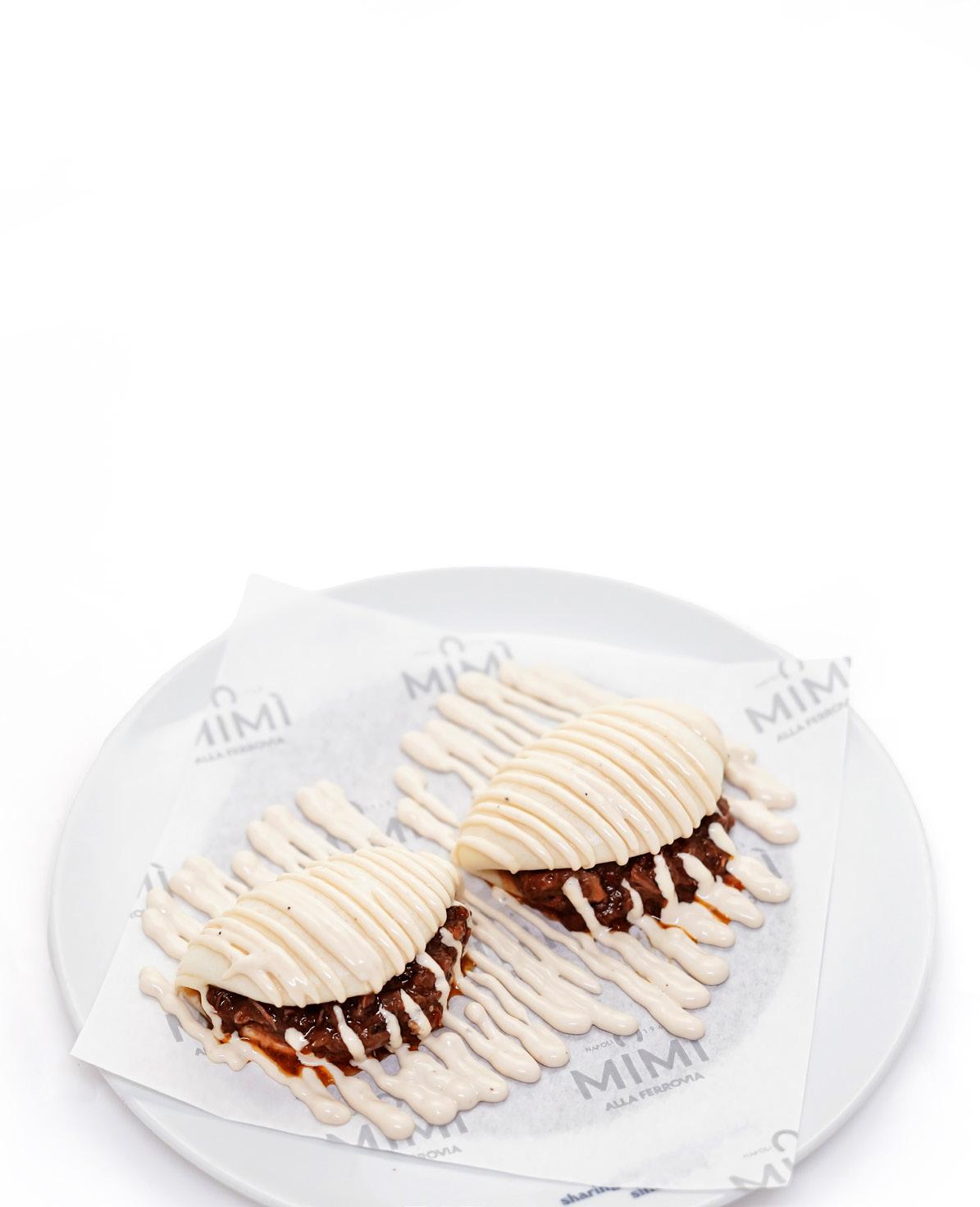
For the Genovese-style stew
Sear the meat in extra virgin olive oil on all sides, then deglaze the pot with white wine. Add 3 kg of onions a little at a time to help them caramelise; add 40 g of tomato purée, followed by the celery and carrots chopped into mirepoix.
Wait for the onions to release their juices, add water and bring to the boil again, cover with baking paper and leave to simmer gently for at least 3 hours. For the taco bao buns
Place the yeast, sifted flour, sugar, sunflower oil, milk and water into the mixer; knead until the dough is smooth, then add the salt. Place the dough in a lightly oiled bowl and cover with a tea towel. The dough is ready to be shaped when it has doubled in volume.
Cut into 30-gram portions, leave to rise again, roll out with a rolling pin and fold in half, lightly brushing the edges with a little oil. Leave to rise again and steam for about 16 minutes at 100°C.
For the anchovy dressing
Proceed making a classic mayonnaise: once the base has emulsified, add the mustard and Cetara anchovies, and continue to emulsify until you have a smooth sauce.
Plating
Fill each taco bao with the Genovese-style meat and top with the Cetara anchovy dressing.
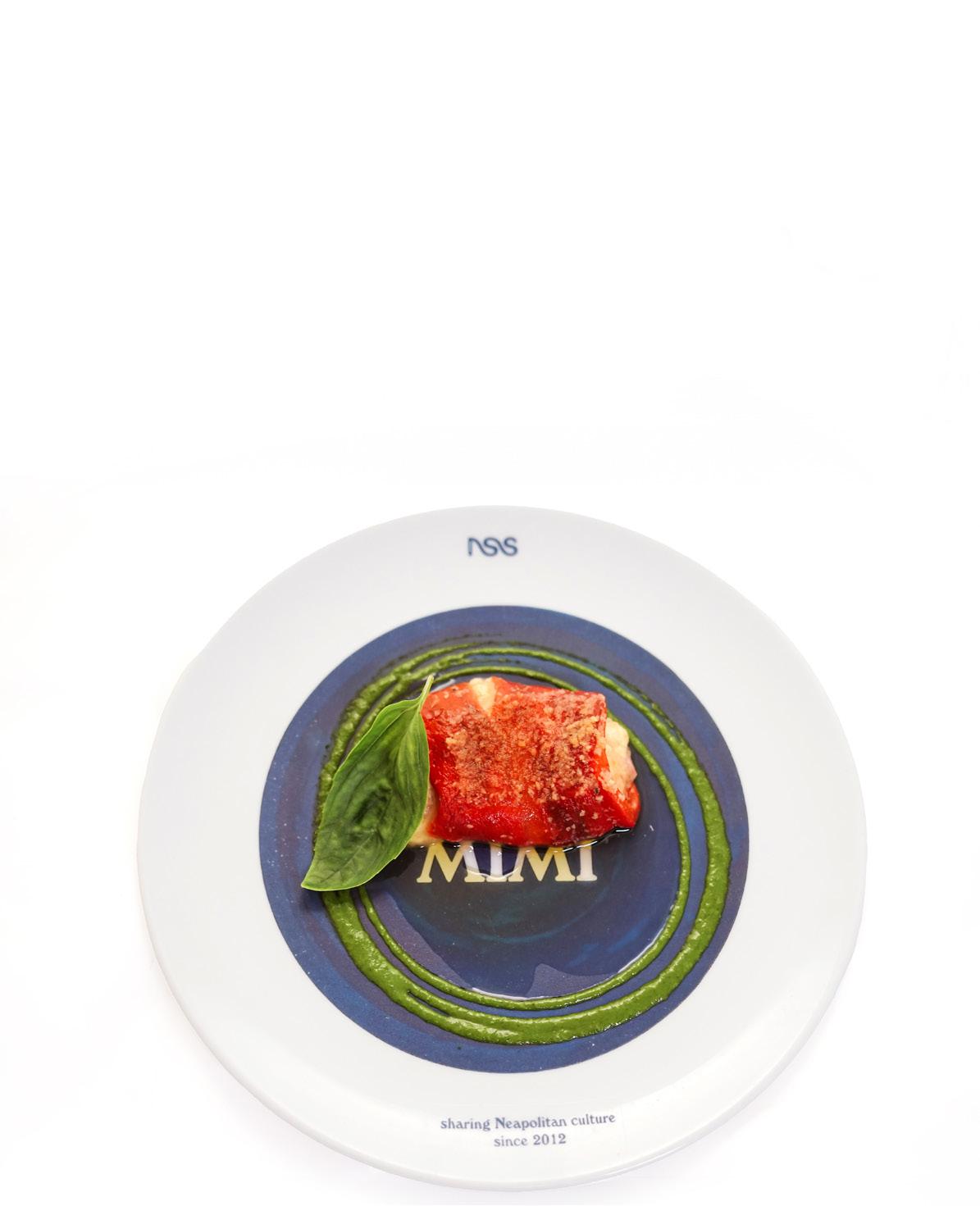
INGREDIENTS FOR 6 SERVINGS
10 yellow and red peppers, chosen from the fleshier varieties
300 g fior di latte cheese
80 g caciocavallo
80 g deli ham
110 g stale breadcrumb
30 g eggs
30 g grated Parmigiano Reggiano breadcrumbs made from the bread salt pepper
For the filling
Dice the caciocavallo (or similar cheese), the fior di latte and the ham. Soak the stale breadcrumb in water, then squeeze it out thoroughly, chop it up and add to the other ingredients. Finally, add the grated cheese, a pinch of pepper, salt and the egg, mixing until smooth and compact.
For the peppers
Wash and then flame the peppers, turning them occasionally until evenly cooked on all sides. Sprinkle with salt and leave to cool in a container covered with cling film; then peel them. Arrange them evenly on perforated trays to prevent water from pooling.
Cut the peppers into strips of about 5 cm, place 60 g of filling on each strip, roll the pepper up tightly and place it in a baking tray previously greased with oil, filling it tightly with the peppers laid side by side to avoid gaps; sprinkle with breadcrumbs and add a drizzle of extra virgin olive oil.
Bake in a preheated oven at 160°C for 20 minutes.
Leave to rest for at least 15 minutes before serving.
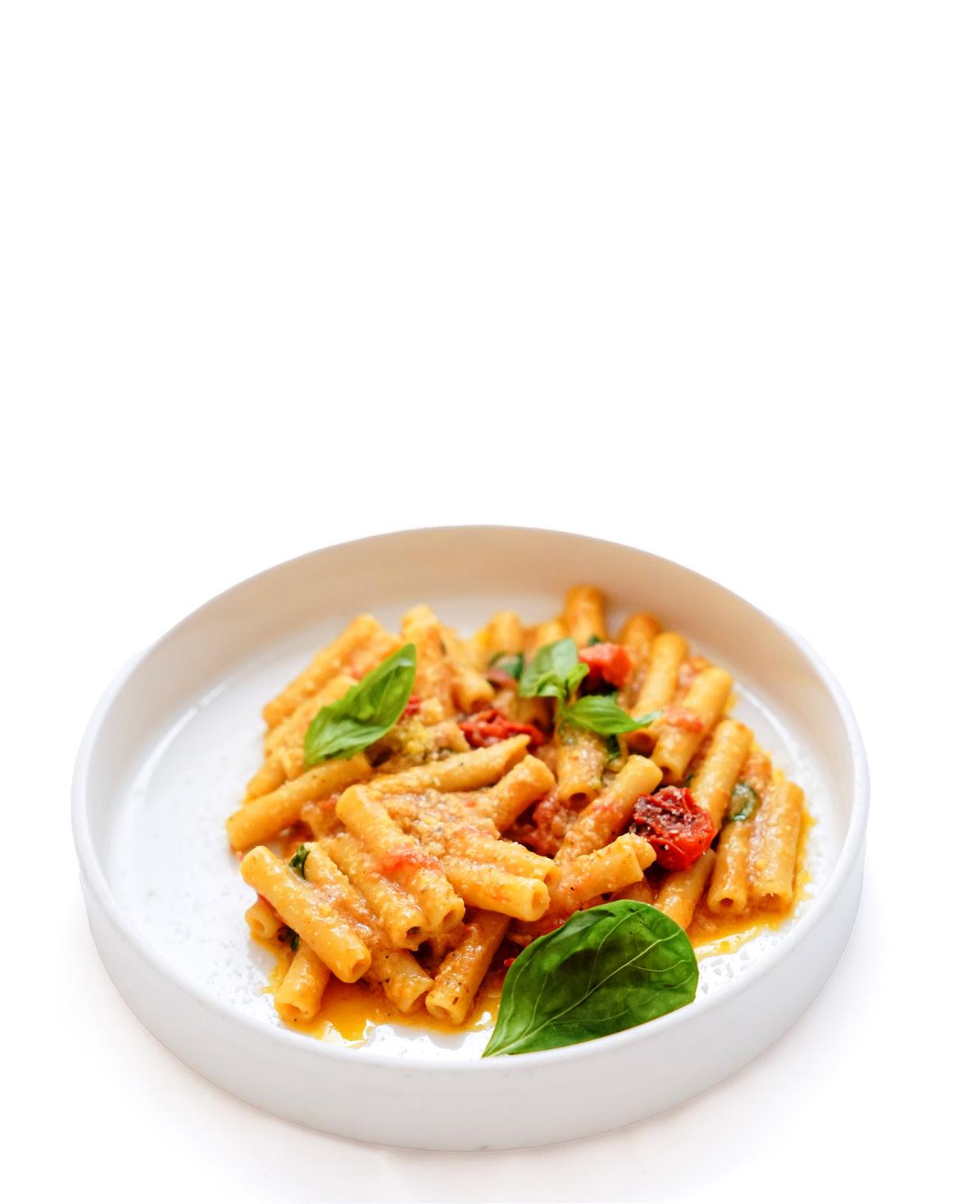
400 g ziti
700 g yellow tomatoes
200 g lardo
80 g grated pecorino cheese
Garlic
Fresh chilli
Basil
Extra virgin olive oil
For the confit cherry tomatoes
200 g datterini tomatoes
Sugar
Basil Thyme
Extra virgin olive oil
Salt and pepper
For the confit cherry tomatoes
Wash and dry the cherry tomatoes, cut them in half and arrange them on a baking tray lined with dampened baking paper. Season with olive oil, salt, pepper, thyme and a sprinkling of sugar, then bake at 150°C for 2 hours.
For the pasta
Cook the pasta in plenty of salted water. In a frying pan, gently fry the garlic in a drizzle of extra virgin olive oil and add the yellow cherry tomatoes in their own juice. After a few minutes, add the finely chopped chilli and crush the tomatoes with a wooden spoon. Remove the garlic, blend the sauce, pass it through a sieve and transfer it to a new frying pan.
Drain the pasta directly into the sauce and, with the heat turned off, add the confit cherry tomatoes, a few basil leaves and stir in the lard (previously reduced to a paste) and the grated pecorino. Serve.
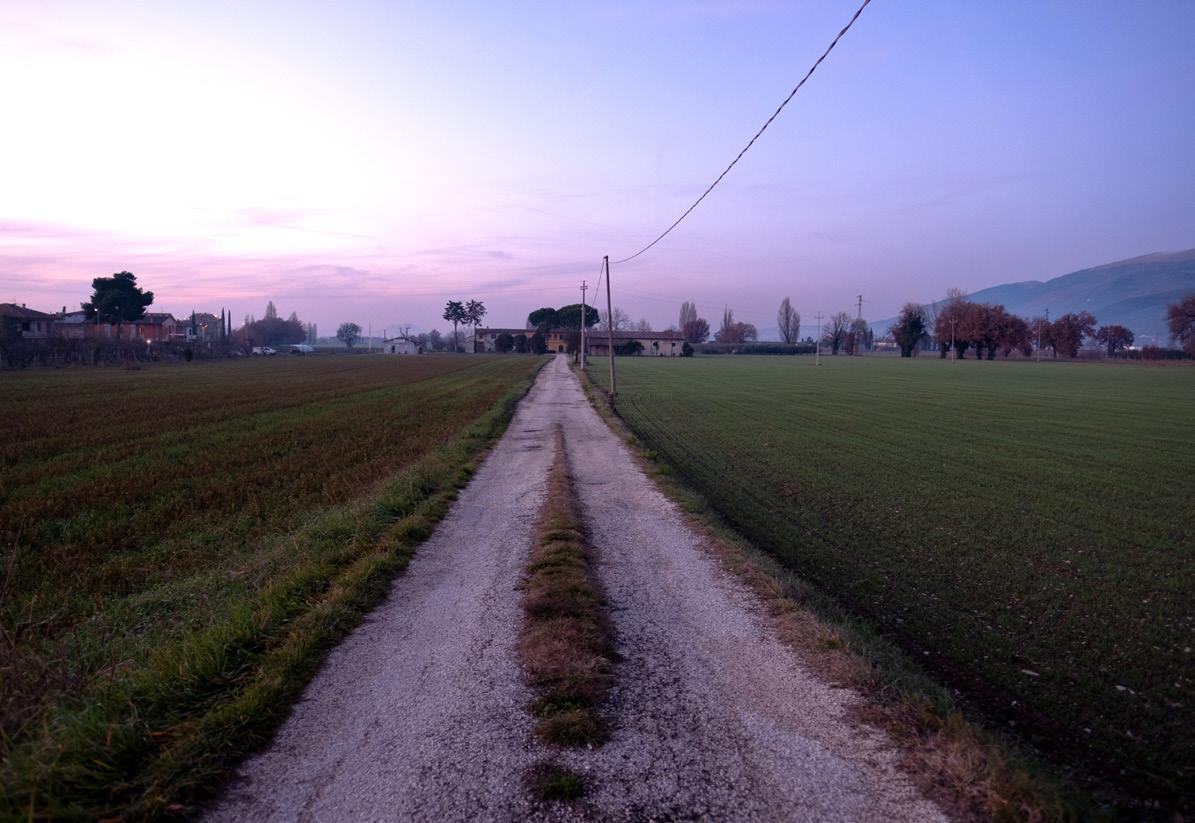
A region that is elusive but captivating. Amidst ancient peaks and untamed flavours, a journey into the hidden soul of Italy
by Sonia Ricci
Umbria remains, mysteriously, underrated. Not because it lacks anything, but because it does not reveal itself at first glance, just like those born there. It must be explored slowly, and even that is not enough. You have to stay, return, accept that you won’t understand it straight away. It is a region that cannot be reduced to a single image; it does not seek to seduce, but rather to hold you back. In any case, be careful, because its ancestral power, once experienced, can ensnare you. And perhaps it is for all these reasons – more metaphysical than tangible – that it continues to remain on the fringes of the most celebrated tourist destinations. Those born there carry it within them without realising it; the Umbrian
spirit clings like damp to the bones, like sweet Sagrantino to the teeth; those who leave it feel nostalgia, melancholy, those who pass through it find peace and happiness; the colours never cease, the blue is never just blue, the pink lasts for endless, breathless minutes, the mist hides and protects; some roads often lead nowhere, and that is the beauty of it. The rivers are full of otters, the countryside full of blackberries. Beauty, here, does not console; if anything, it persists. It is never as perfect as Tuscany, nor as rugged as Abruzzo. Umbria is a place imbued with a mysterious sense of well-being.
One way to discover it is to climb the Sibillini Mountains and then descend through the so-called Umbrian Valley
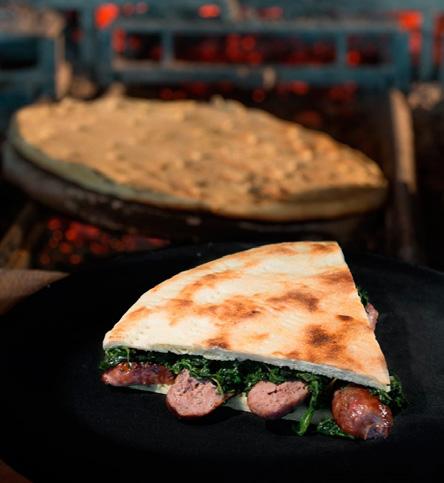
Torta al testo is a regional speciality: a simple dough made from flour, water, salt and oil, cooked on a ‘testo’, which is simply a heavy cast-iron or stone griddle. As it contains no yeast, it stays flat and fragrant
to Lake Trasimeno further north.
An evocative route that starts from Castelluccio. At dawn, the plain might be filled with heavy clouds, trapped within the plateau where Mount Vettore stands majestically (the trek leading to Lake Pilato is particularly picturesque), but as the sun rises, it fills with light, and the endless expanse of meadows and lentil fields reveals its gentle beauty. In summer, it is ochre-yellow; in winter, at sunset, it becomes almost a lunar landscape. The village has changed: the 2016 earthquake disrupted an ancient continuity, and many houses are still shored up, but there are places to stop for refreshments, and viewing the valleys from up there remains an unmissable experience.
Not far away, Norcia immediately transports
you back to a medieval world, with its Basilica dedicated to St Benedict – which was also destroyed but reopened in 2025 following extensive restoration – as well as its culinary delights, with cured meats hanging in the shop windows, mountain cheeses and meats. A visit to the Febbi dairy is a must to try their excellent ricotta and sheep’s-milk cheeses (do stop for an aperitif too), just as a visit to Fabrizio Ansuini’s artisan charcuterie is well worth it for an unmissable sandwich – plain, of course – with Norcia loin or corallina. If you wish to stay longer, the Casale nel Parco dei Monti Sibillini combines hospitality with fine dining. A family-run farm, later converted into a farmhouse, it offers an authentic and welcoming experience. Recommended dishes include the charcuterie platter, tagliolini with white ragù of wild boar, and spit-roasted meat.
The Umbrians are often described as bears, an image that captures their initial impression well—wary and stubborn—but one that is soon dispelled by the warm and cheerful welcome they are capable of offering. «Lu pane lu devi inzuppà bene» which translates to “You must soak the bread properly,” say the elders when the new oil arrives—the same people who set off at five in the morning in search of turini, meadow mushrooms, porcini and chanterelles, known here as “galletti”. And watch out for the asparagus pickers on the verges of the country roads! Their character has been shaped in a region that for centuries was ruled from above, traversed and redrawn time and again, long part of the Papal States (the tradition of unsalted bread stems from the Salt War), with shifting borders and identities that have
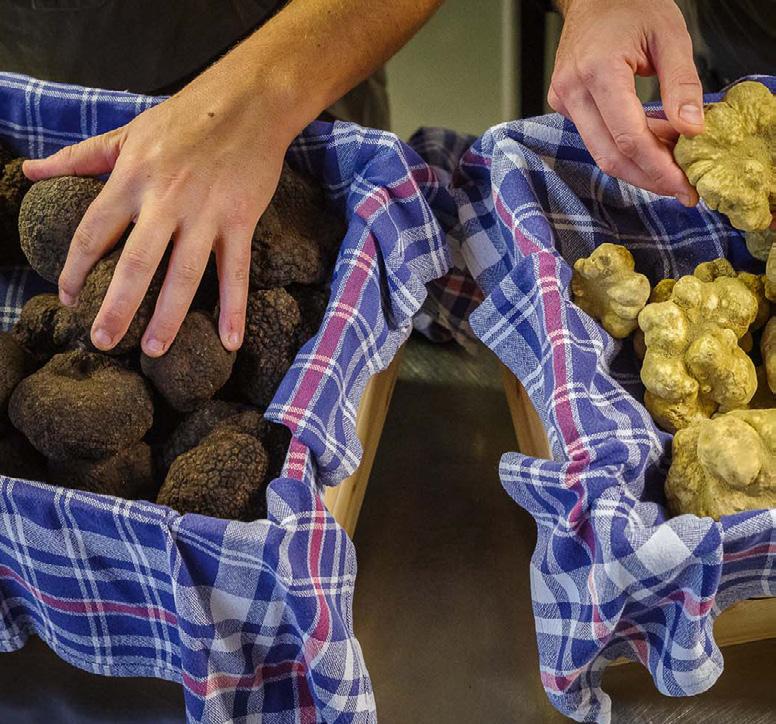
adapted without ever fully evolving. The local cuisine bears the marks of this too, a “hybrid” cuisine that changes within a few kilometres, drawing closer to Lazio and absorbing Roman influences (on hundreds of menus one reads “c-a-r-b-o -n-ar-a”), which looks towards Abruzzo and finds dishes similar to polpette con cacio e ova, and which, as it moves up towards Lake Trasimeno, becomes lighter and takes on a more Tuscan character. Even its cousin, the Marche region, has contributed a great deal to Umbria. And vice versa, we might say, though without anyone really noticing.
As you wind your way down towards Spoleto, bend after bend, the road changes character and, after several kilometres through dense woodland, opens out. Before entering the town, it’s worth heading back out again, finding the old Spoleto–Norcia railway line and walking a stretch of it through tunnels (bring a torch for the Caprareccia tunnel), viaducts and silence. An old railway line opened in 1926 and closed in 1968, which has largely been converted into a cycle and footpath. By then you’ll be ravenous, and just a few kilometres away, tucked away in the woods, Il Capanno is one of those places that never needs updating: mushrooms, charcoal-grilled dishes, seasonal cuisine, and an excellent wine list. If you happen to pass by at night, a few hares or even a wild boar might pop up on the final stretch of the dirt track.
The Umbrian Valley begins shortly after you’ve crossed the imposing Ponte delle Torri in Spoleto, but whilst visiting the village, stop by Icola, a small newsagent’s where you can listen to good music and drink natural wine, and by Crispini for
Truffles from the San Pietro a Pettine farm (Trevi)
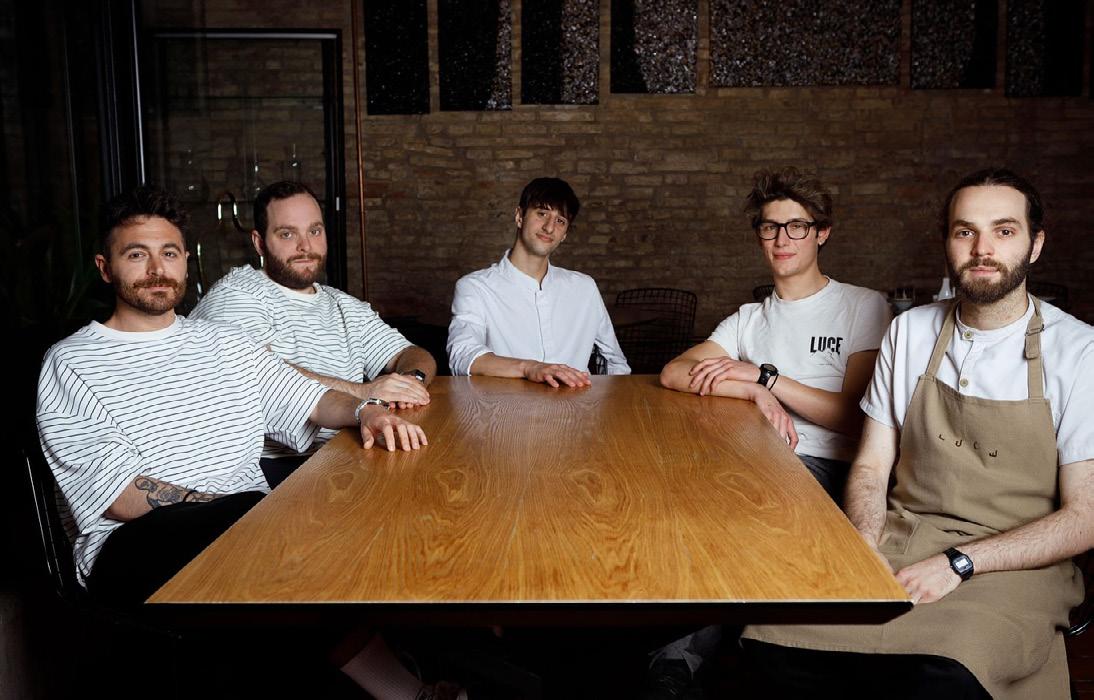
some superb ice cream. Trevi, Spello and Foligno are definitely worth a visit; here the landscape becomes agricultural yet varied, with villages clinging solitary to the hills, while the Apennines watch over them like older brothers. Often sparsely populated due to depopulation largely caused by the 1997 earthquake, these mountains are actually the finest part of this corner of the region. Untouched, remote, full of woods, great peace and little discoveries.
As you climb, olive trees dot the hills; the water flows slowly. Just above Trevi, you’ll find the excellent truffles from the San Pietro a Pettine estate (which also has a restaurant), and if you take a detour to the tiny hamlet of Pupaggi, not far from Sellano, you can savour the slow pace of life and get to know the few residents who live there. There is no specific
reason to go, but there are many reasons not to leave. Not far away lies Rasiglia, known as the ‘Venice of Umbria’ for the small streams that run through it, though in recent years it has unfortunately been overrun by mass tourism. Get there very early and you’ll appreciate its understated beauty. For those who decide to stay in the valley, you can follow the cycle path that runs alongside the Marroggia, Teverone and Timia streams. With the wind in your hair, you’ll reach Assisi.
Those who grow up in Umbria often do so whilst savouring the countryside – the countryside of their grandparents, who tended ‘the animals’ in the old red country cottages, once governed by the sharecropping system of the ‘landlords’, the great tradition of pork butchery, the sensational cured meats, the game; in homes, pigeon is eaten whole and often stuffed,
The staff at Luce restaurant in Perugia
rabbit in a stew, parmigiana made with cardoons, the desserts that rarely leave their cities of origin (the Rocciata in Foligno, the Ciaramicola in Perugia), the smell of brine from the oil mills heavy with green olives, black and white truffles, long pasta made from water and flour, cakes baked on a griddle, pulses, lake fish, and cicotto—or porchetta—extraordinary with its crispy rind and buttery interior. As children, we soon learnt that the problem wasn’t figuring out where we were, but imagining where we would go. Work was elsewhere, the grown-ups would say, and from there began a silent exodus, made up of young men and women who set sail for other shores and have not yet returned. Not all of them, to be honest.
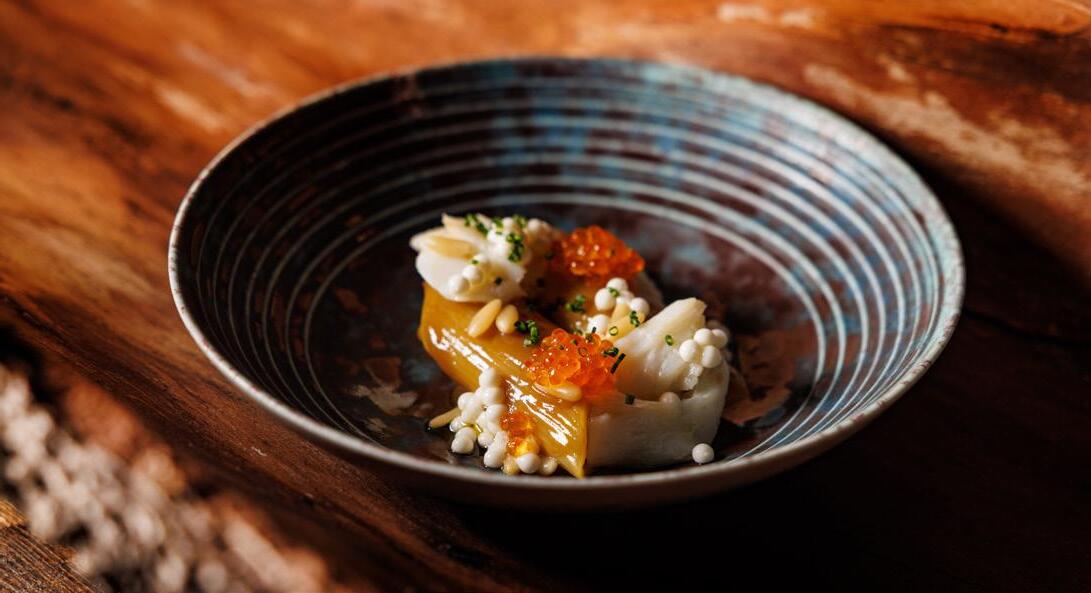
Warm pennoni, salted cod, pine nuts: one of the dishes at Une restaurant in Foligno
Foligno lies on the plain, and many people don’t feel the need to visit it, but it actually offers some interesting sights. The enormous “Cosmic Magnet” by the artist Gino De Dominicis is located in the former Church of the Holy Trinity in Annunziata, and in June and September the Quintana takes place, a jousting tournament in period costume. It’s lovely to enjoy a glass of natural wine at Artemisia, right in the main square. A little further on is Spezialità, a tea and spice shop, and Silene Piccolo Ristorante, run by chef Nicoletta Franceschini, who previously worked under Niko Romito and Antonia Klugmann. The morning begins at O’MÁ, with bread and pastries, or at Forno Cesarini, where the fojata – a twisted roll of thin dough filled with wild herbs – continues to reflect a cuisine that
has never ceased to be homely. Be warned, though, it’s addictive. Not to mention the rocciata, a sort of strudel stuffed with fruit and drizzled with Alchermes. Everyone at home has their own recipe. We were saying that someone has returned here. Capodacqua, a one-way journey: this is the story of Giulio Gigli, who has returned from one of the world’s finest restaurants –Disfrutar in Barcelona – to open his own, Une, in a tiny village of two hundred souls. A madman to those who don’t know him, an enterprising soul to those who admire him. Inside a former mill, he has created a dining experience where rural traditions are brought to life, yet without fetishism or nostalgia. Great contemporary dishes, just like his ambitions. Preserves, a charming vegetable garden, dinners in the adjacent woods, a community of producers who have taken part in the quiet revolution of Umbrian haute cuisine – for years lukewarm and in the hands of a select few, today enterprising and authentic.
From this valley, a narrow (yet charming) road leads to Colfiorito with its ancient marshland, landscapes of wheat and grass, stretching as far as the eye can see (among the local produce, Oscar Pagliarini’s ‘Salumi dell’Altopiano’ is particularly worth trying). The route then loops back to the vicinity of Rasiglia. In August, the hamlet of Scopoli hosts one of Italy’s most interesting underground music festivals, Holydays, organised for over a decade by a group from Foligno. Artists from all over the world, the chance to camp overnight, breakfasts featuring sfoglia pizza and white pizza, and music enjoyed amidst nature. A few more minutes’ drive takes you to Pale, the final outpost in the mountains before heading back down. Leaving the old Sordini paper mill behind, you can walk to the hermitage of Santa Maria Giacobbe (visits inside must be booked in advance); the climb is rewarded by the view, especially at sunset. Here you can stop at L’Angoletto, an old café-restaurant, and the Locanda di Nonna Tina.
Heading back down into the valley, carry on towards Spello to stop off at Tano Grano & Brace, which offers a more convivial experience, centred around fire and meat. Whilst you’re there, as well as visiting the village, do take the time to walk the circular route along the Roman aqueduct – it’s well worth it. Heading up towards Montefalco, however, the landscape changes once more and offers successful ventures such as the Calcabrina farm: goat farming, extraordinary cheeses and fine wine –do ring ahead to arrange a visit. At Via di Mezzo, one of Giorgione’s two restaurants, everything returns to a simpler, more direct dimension. And then there are detours that seem out of place but aren’t: Ottavi Mare, seafood in the heart of the Bevagna countryside (also worth a visit), and Camiano Piccolo, a rustic agriturismo where you can enjoy vegetable soups, truffle-stuffed cappellacci and homemade stringozzi.
Moving on, Assisi is certainly a mustsee destination, even if there’s no shortage of tourist traps (you can’t go wrong at Il Frantoio and, just outside the town, at Le Mandrie di San Paolo), as is Perugia. An Etruscan city with an austere charm, an ugly low-rise outskirts, and a wonderful old town full of bell towers. Lale Bakery, Venti Vino, Civico 25, La Fame, Luce. These are not isolated establishments; they are part of a system that brings together different generations and has given the city a new gastronomic identity. At Sara Boriosi and Giovanni Corazzol’s Venti Vino, you can enjoy the city’s finest selection of wines and delightful Venetian-style cicchetti. Andrea Pizza Contemporanea and Marghereat Lab showcase a younger
side to baked goods, whilst Edicola 518 and PostModernissimo signal a deeper, more social transformation. The first is a newsagent’s that has been rescued from decline, now split into a shop selling independent magazines (including food and wine titles) and a wine shop; the second is the city’s oldest cinema, brought back to life by four friends. Undoubtedly courageous ventures. A “pasterella” at Sandri on Corso Cavour and we’re off again. Just outside Perugia lies a proper inn, Stella Ristorante Vineria, serving seasonal cuisine with a fine wine cellar, where you can also stay overnight; La Risulta, a newer establishment serving contemporary Italian cuisine, vegetables and pure enjoyment; and for cannelloni and meatballs for a traditional Sunday lunch, there’s Maca Muta (Compignano). A little further afield, but well worth the detour, in the charming village of Spina, where the hills become even gentler, stop off at La Carneria, a butcher’s shop with a deli counter, where you can also eat by choosing directly from the counter.
And finally, the lake. Before you get there, there’s one place you simply
must stop at: Faliero. The torta al testo, freshly baked on heavy stone slabs, topped with herbs and sausage or ham. A place where everyone ends up, without distinction; it’s a common language. Lake Trasimeno, stunning at sunset, slowly comes into view. Here, Centumbrie brings together oil, wine, flour and cuisine; you can eat, sample and linger. On the lake, Il Molo and Rosso di Sera specialise in fish, as does the Locanda dei Pescatori, though the latter remains more straightforward, more unpretentious; on the shores, you can also enjoy an excellent Neapolitan pizza at Don Pietro. And before the end, a brief detour: Panicale. A square, a few alleyways, the lake beginning to appear amongst the olive trees. Nothing more needs to be said. And only then, when the journey ends on the water, can one return to that initial diaspora. Because in recent years something has shifted; some have returned. Not many, but enough to suggest that this land—difficult to describe— continues to hold, even from afar, a part of those who have passed through it.
One of the baked goods from Lale Bakery in Perugia