Wine Travel Food

Year 28 ∙ number 177
march-april 2026
gamberorosso.it
HOW AMARONE CHANGES ITS SKIN
WORLDTOUR
SOPHIA ANTINORI’S CHOICE
Year 28 ∙ number 177
march-april 2026
gamberorosso.it
HOW AMARONE CHANGES ITS SKIN
WORLDTOUR
SOPHIA ANTINORI’S CHOICE
Places, routes and consumption patterns are changing: are we ready?


They’re only changes if they’re frightening by Lorenzo Ruggeri
6 >Cover Story
Sophia’s choice
A star is born: Sophia Antinori, Lodovico and Tenuta del Nicchio by Marco Sabellico
12. “The perfect wine is dead” by Lorenzo Ruggeri
16. “I dream of a wine without prejudice. Taboos? How annoying!” by Loredana Sottile
48. Wine Paris paints a picture of a two-speed wine market (with signs of recovery). The opportunity is there, but one must seize it by Lorenzo Ruggeri and Marzio Taccetti
How Amarone changes its skin by Raffaele Mosca
32. Erbusco Model by Lorengo Ruggeri
40. Centesimi. Fiano d'Avellino
44. Chianti targets Africa by Marco Sabellico
50 Waiting for the midterms by Marco Sabellico
56. How Prowein is changing: fewer figures, more substance. And it is acknowledging its limitations by Lorenzo Ruggeri and Marzio Taccetti
60. Drink Less, Drink Better: Gambero Rosso Returns to Amsterdam by Marzio Taccetti
Wine is changing its place at the table by Eugenio Marini
70 >Travel
Maratea. At the foot of the Redeemer
Editor Gambero Rosso S.p.A. via Ottavio Gasparri, 13/17 - 00152 Roma +3906551121 - fax 0655112260 gambero@gamberorosso.it
Director Lorenzo Ruggeri
Editor-in-chief
Sonia Ricci
Editorial team Clara Barra, Mara Nocilla, Marco Sabellico (correspondent)
Editorial coordination: Antonella De Santis
Translation Eleonora Baldwin
Graphic Project
Tina Berenato - TB design
Layout
Maria Victoria Santiago, Chiara Buosi
Contributors
Eugenio Marini, Raffale Mosca, William Pregentelli, Marco Sabellico, Marzio Taccetti, Loredana Sottile
Photos and drawings
Mattia Aquila, Adobe Stock
Copyright © 2026 Gambero Rosso S.p.A. All rights reserved.
Administration via Ottavio Gasparri, 13/17 - 00152 Roma
Advertising Class Pubblicità S.p.A. via Marco Burigozzo, 5 - 20122 Milano +390258219522 - sbianchi@class.it
Gambero Rosso is a Registered Trademark Copyright by GAMBERO ROSSO S.P.A.
How to find us via Ottavio Gasparri, 13/17 00152 Roma +3906551121 gambero@gamberorosso.it www.gamberorosso.it filgamberorosso $gambero_rosso
They’re only changes if they’re

Lorenzo Ruggeri
In this issue, we have taken the fear that pervades the world of wine by the hand and transformed it into change. We have delved into the sector’s silence, its cautious and defensive stance, the underlying uncertainty, and the stagnation surrounding the usual issues that never seem to find a solution: young people who don’t drink, cryptic language, and the burden of tariffs. To do so, we travelled to Paris for the event of the moment, the much-lauded Wine Paris, and to Düsseldorf for the much-maligned Prowein. We spoke with numerous Masters of Wine – our sincerest congratulations to Cristina Mercuri, the first Italian woman to achieve this recognition thanks to her extraordinary tenacity – we interviewed restaurateurs, sommeliers and export managers, and studied new export routes (Africa, India) and consumption trends in largescale retail. There is a strange atmosphere surrounding wine, one of constant anticipation: even producers and communicators seem suddenly at a loss, hesitating to talk about their own labels as they always have, posting fewer bottles, engaging in self-criticism, and at times even flagellating themselves. Some are even joining the gym after 30 years. So, let’s try to turn the perspective on its head. And we’ll do so through a book circulating under the counter among industry insiders: *Sbronzi* by Edward G. Slingerland. It is not an invitation to reckless alcohol consumption, but a brilliant essay, written by a professor of philosophy, which combines historical research, an international perspective and irony regarding the new health craze. It starts from afar and reaches a conclusion that sounds scandalous today: intoxication is not an accident of civilisation, but one of its conditions, a sort of “social technology”. Human beings do not get drunk by mistake: they have always done so, in every era and culture. Not because they are unaware of the risks, which can be devastating, but because controlled intoxication has served a purpose: to forge bonds, break down mistrust, create communities, foster creativity, and accompany rituals. The nobles of ancient Egypt, the world’s first wine connoisseurs, were laid to rest in tombs filled with jars that meticulously recorded the vintage, the type of wine and the name of the producer. Some time ago, over lunch, Nanni Copé – a man who wrote about wine before producing excellent wine himself – remarked: «Do you realise that with my wine, people get to know one another, talk to one another, fall in love? They make love to it». Wine is not just a product: it is a feeling, a relationship, a connection. Now it is a matter of channelling all this into a real shift in consumption. Drinking less and better, certainly, but above all giving it form. The Greeks understood this: three cups, no more. After that, it is no longer Dionysus, it is hubris. And, as Maurizio Zanella says, «We mustn’t be a pain in the arse», because, yes, we know how to be incredibly tedious. And if we can no longer tolerate those who put a melon-flavoured vodka on the same level as a good bottle of wine, perhaps from an old vineyard, at the same time we must have the courage to change, look elsewhere, and listen. And put an end once and for all to the most dangerous phrase of all: «We’ve always done it this way».
A
by Marco Sabellico
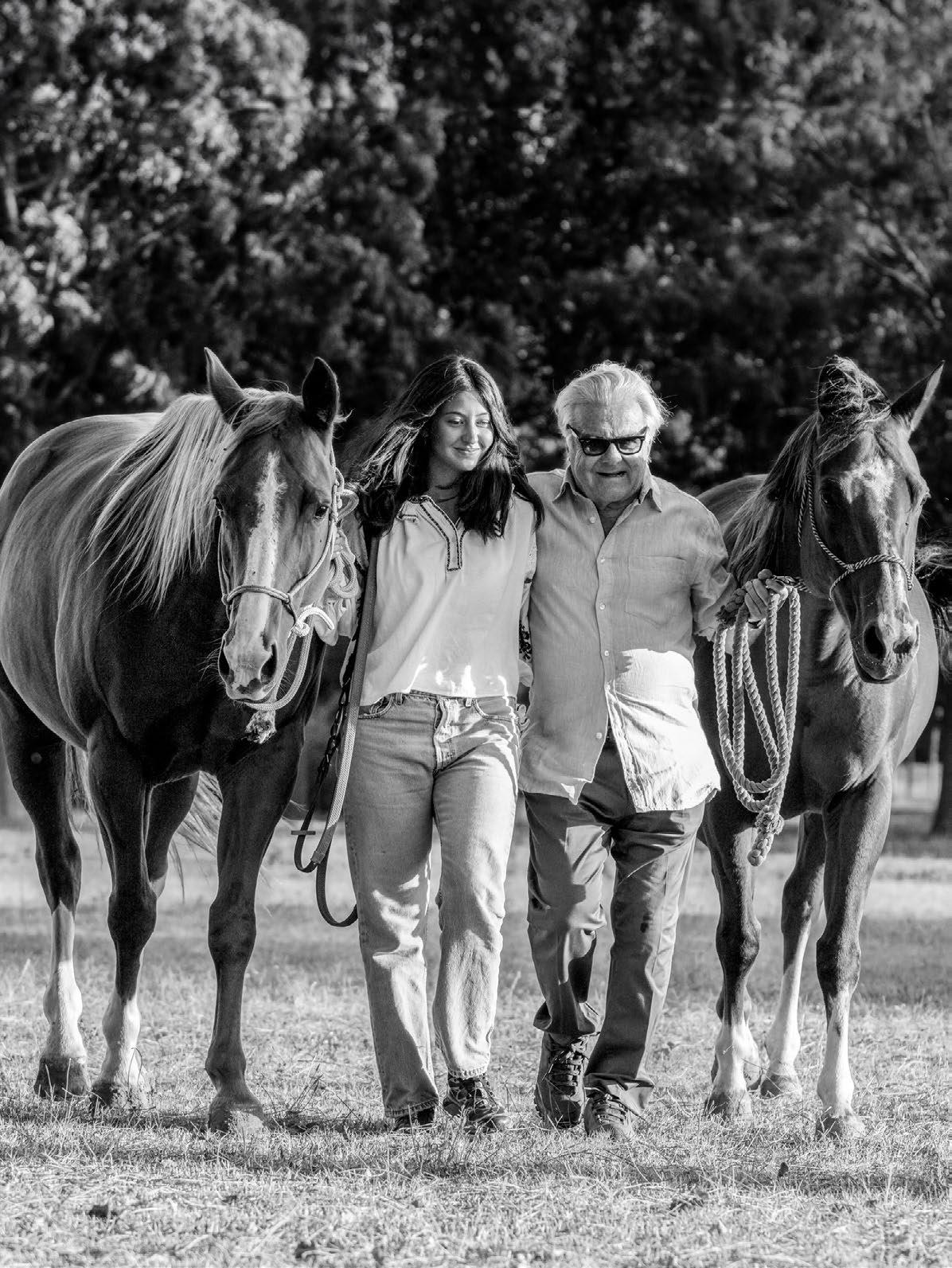
We meet Sophia Antinori in Bibbona. The new Tenuta del Nicchio winery is not yet finished, but we are curious to try the wines. Sophia is the daughter of Lodovico Antinori and represents the 26th generation of this noble family of winemakers, one of the oldest wine-producing dynasties in the world.
Have over six hundred years of tradition been a burden for you? How did you choose to get involved in the world of wine?
It was a natural choice. I have been breathing this atmosphere since I was a child. Everyone in my family is involved in the world of wine... I drink it, I like it, and in the end, I became passionate about it. And then it’s an opportunity to create something together with my father. And this land, Bibbona, Bolgheri, Castagneto Carducci are really in my DNA. It’s a beautiful place to live.
Sophia, born in 1999, grew up between Florence, London, Switzerland, and the United States. She worked in the world of wine and realized she was cut out for it. Naturally, without any pressure or the burden of a coat of arms to carry reluctantly.
Lodovico, a few years younger than his brother Piero, who runs Marchesi Antinori, represents the more eclectic and creative side of the family, which has created iconic wines such as Ornellaia and Masseto in Bolgheri, Mount Nelson in New Zealand, then Biserno (of which he is honorary president) and Lodovico in the Bibbona terroir, which now has a place in Italian wine charts thanks to him.
What is it like working with your father?
My father is an artist, he has intuition, he has vision. He consolidated the fame of Bolgheri, where before him there was only the solitary myth of Sassicaia. He discovered Bibbona and collaborated with the most eclectic and fascinating figures in the recent history of world wine. He is an incredible stimulus to do things and do them well. He passed on his passion to me, his attention to every detail, and made me understand the charm of the world of wine and of this terroir in particular.
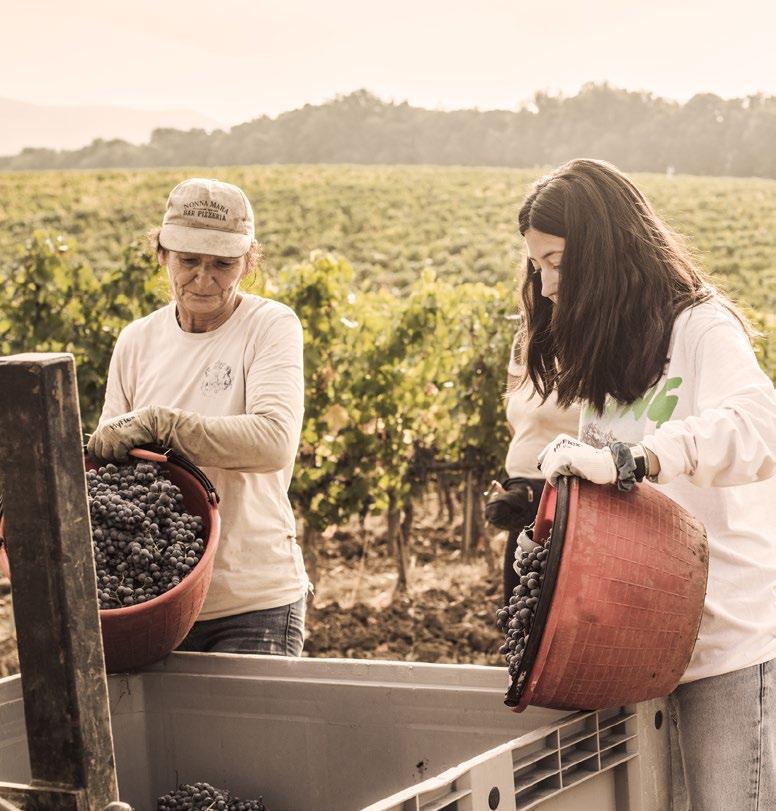
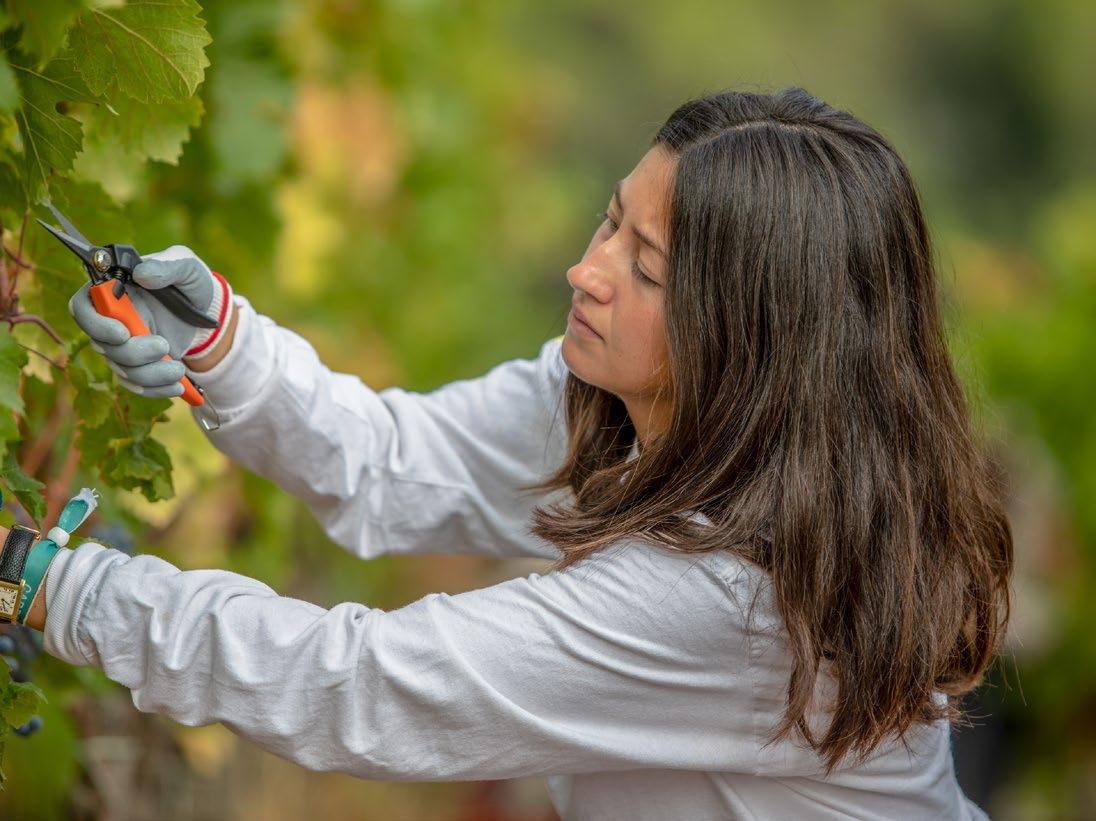
We have 13 hectares of vineyards at the moment, and we plan to grow to 18-20. It will never be a large company, but a small, high-profile chateau. An artisanal reality. We have all the prerequisites. We select and plant our vines one by one, only in locations that are truly significant in terms of quality. At the moment, we produce 2,000 bottles of Il Nicchio and around 9,000 bottles of Le due Ville. The plan is to reach 30,000 bottles over the years.
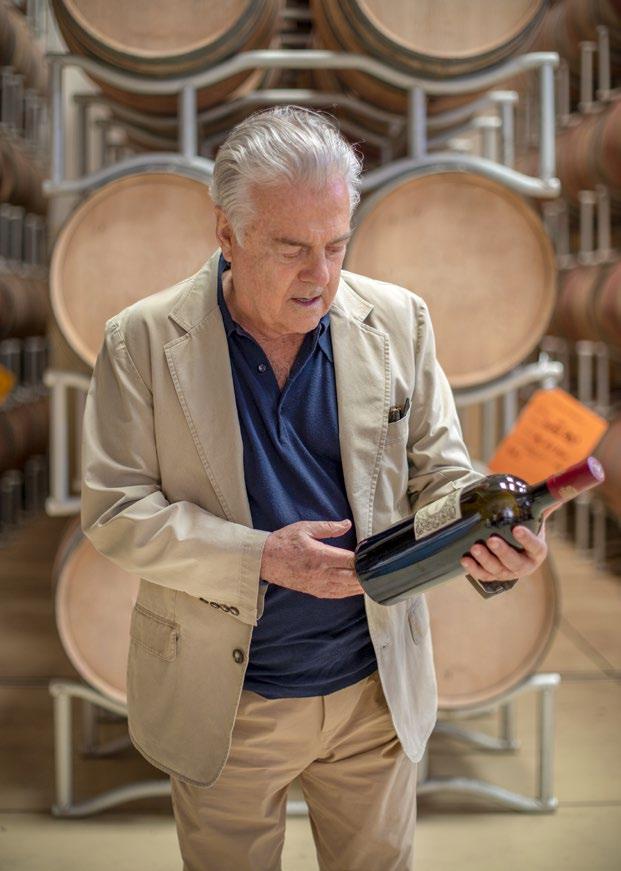
In the opening, Sophia Antinori with her father, Lodovico
Tell us about the project, then. Tenuta del Nicchio was founded with the concept of a family estate.
Over the years, Lodovico has identified a number of prestigious vineyards in the area. With high vineyards and cool exposures, he began to think about varieties, driven in part by Sophia’s
more youthful taste. We reached him by phone and asked him what Nicchio represents.
Since 1985, when Ornellaia was founded, many things have changed. The climate, for one, but also consumer tastes. The Alta Maremma remains a terroir suited to international varieties, but over the years... Cabernet Franc has come to the fore, Merlot has declined, as has Cabernet Sauvignon, Syrah is giving excellent results in the right exposures... And then there was the
Tenuta del Nicchio: a young team with extensive international experience
discovery of Ciliegiolo... In short, there was plenty to think about in light of my experiences over the years and global warming. But filtered through the sensitivity of a younger palate that makes and will make wine for new generations of consumers.
What about Lodovico?
Lodovico continues to be true to itself. It comes from a few plots in Bellaria, a vineyard between Bolgheri and Bibbona that is part of the Biserno estate, which now belongs to Antinori. But I have an agreement with my brother to continue producing it independently and, in the end, we find it in the Nicchio portfolio.
But it’s different, it’s a wine that reflects me more than Sophia, and I continue to make it with Michel Rolland, who has always worked with me. But for Tenuta del Nicchio, the team is different. Much closer to Sophia in terms of age and sensibility.
Tell us more.
Michel (like me, he adds with a laugh) is close to retiring and has sold his consulting firm to Julien Viaud, who has worked with him for a long time. So, Julien is the consultant at Nicchio, along with Andreas Fuchsberger, a talented young South Tyrolean with international experience who is our winemaker, and David Cilli, a
Tuscan who moved to Napa Valley but is originally from Val d’Orcia, whom Sophia met during her time in America, at Harlan and Promontory.
We ask Sophia what it was like to work in California.
Napa Valley is a beautiful place, and Harlan was a great experience that motivated me even more. Being part of the creation of an iconic wine is truly exciting. Great wines are made by competent people, yes, but also by people with extraordinary passion. Like Amanda, Bill Harlan’s daughter. And with obsessive attention to detail. And that’s what I brought home with me...
And what stage are we at at Tenuta del Nicchio?
The production cellar is finished and the equipment is installed. It is a simple and efficient structure. In March, we will also inaugurate the tasting room where we will welcome visitors. We continue to produce, and soon the Due Ville ‘23, the “second vin,” and the Nicchio ‘21 will be released on the market. We continue to plant the small plots that make up the mosaic of the estate, which spans Bibbona, Bolgheri, Donoratico (we have two hectares right below the Della Gherardesca tower), and Castagneto. Behind each one is a study of the soil matrices, a careful choice of varieties, different clones, and rootstocks studied for each soil and suitable for climate
change. These are often small virgin plots that we acquire from small landowners. We want to make important but elegant, fresh, relaxed wines.
We ask Lodovico if all this is not more laborious and tiring than taking over a single estate, and what challenges it entails. It’s all much more complicated and demanding. I am working much harder now than I did to create Ornellaia. But I have a great
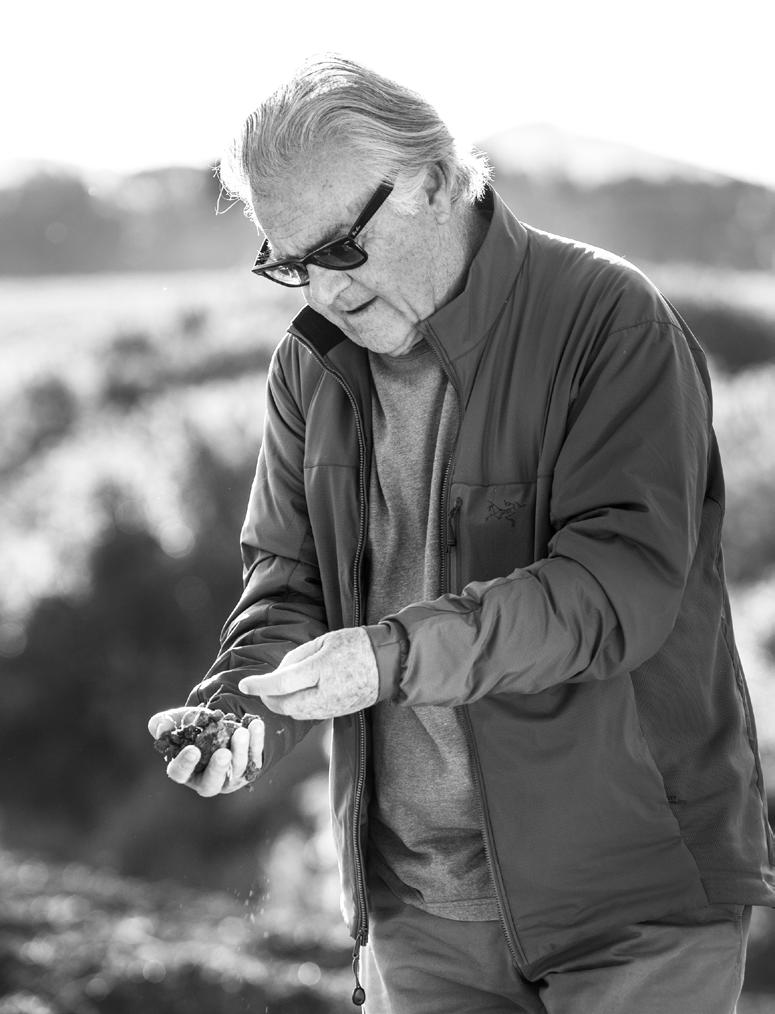
Meticulous attention to detail and a modern, minimalist winery
driving force, Sophia’s enthusiasm. The vines are young, but they will mature. I have many years and experiences with extraordinary people behind me, from my uncle Mario Incisa to André Tchelistcheff and Robert Mondavi, from Tibor Gál to Émile Peynaud and Michel Rolland.
As well as Robert Parker and Gino Veronelli, after whom I would like to name the road leading to the estate... I have already spoken to the mayor of Bibbona... Each of them has left me something, and I want to pass all this on to Sophia. However, she will make wines that are different from mine. Nobody likes to drink the wines of their parents and grandparents. Young people want something new.
For the nostalgic, there is Lodovico (he laughs again). Today, this means wines that are more slender, fresh, dynamic, less sumptuous but equally elegant, and faithful to the territory. This is Nicchio’s mission.
In
the vineyard with Lodovico Antinori
>Le due Ville ’23 90
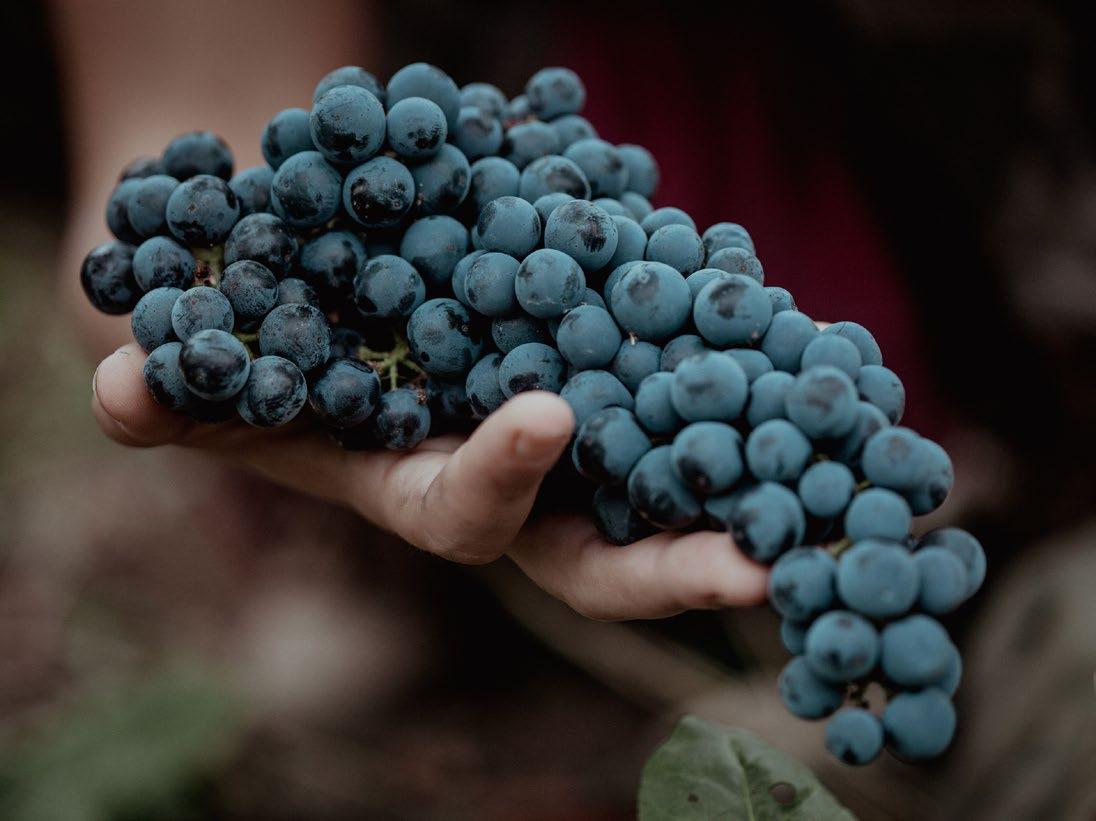
With a beautiful bright ruby colour, it is a blend of Cabernet Franc with 20% Ciliegiolo. It has structure without being redundant, nice acidity, and a rich array of crisp fruit provided by the Ciliegiolo, while the Franc brings the fragrances of the Mediterranean scrub, a smoky touch, and a tannic profile of remarkable finesse. It finishes long with hints of aromatic herbs, helichrysum, and licorice. The dosage of small (not new) barrels is excellent. 35
97
>Il Nicchio ‘21
Today, this Cabernet Franc (with just a splash of Merlot) is a rare wine, with only 2,000 bottles produced. But it captivates with its intensity, depth, dynamic momentum, and smoothness. Red and black fruits, blackberry and morello cherry above all, a solid and vertical structure, but above all an extraordinary dynamic taste, barely restrained by its youth. Aged in new barrels (80%), it closes with tobacco, eucalyptus, and juniper. The product of a great harvest, we will be talking about it for decades to come. 450
96
>Lodovico ’21
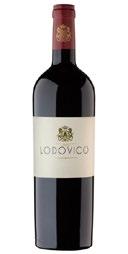
Cabernet Franc, almost pure (with a small contribution from Petit Verdot), captivates with its richness and harmony. It opens on the nose with intense nuances of black cherry, blackberry, and ripe red fruits, elegant tones of cedar and Cuban cigar (aged 16 months in small barrels, 80% new). On the palate, it is creamy, pulpy, and full-bodied, supported by a beautiful acidity, with an elegant finish marked by balsamic fragrances, Mediterranean maquis, and spices. Spectacular finesse of tannins and persistence. 550
The red Lodovico is produced in collaboration with Helena Lindberg and Michel Rolland.
The first vintage was in 2007.
Nicolas Joly, guru of biodynamics, debunks 40 years of technological excesses in vineyards and wineries: “The truth is in the taste”
by Lorenzo Ruggeri
Talking to Joly is a bit like going to certain natural medicine doctors: they don’t start with the symptoms, they hold your hand, look you in the eye, try to understand who you are and why you are really there. And then you may discover that it’s not for the
reason you thought. The same thing happens with Joly: we sit down at the table convinced we’re going to talk about wine, and we leave with the feeling that wine was just a means to read the world, weigh up its values and question the future. Of course,
20 years ago there was a different atmosphere, a real revolution at his conferences: they were very well attended, heated, full of visions, hopes, attacks with posters and memorable bottles. Today, that enthusiasm and momentum have changed. The guru of biodynamics applied to wine, born in 1945, founder of the Renaissance des Appelations movement and head of the legendary family domaine Coulée de Serrant, has changed his tune. His daughter Virginie is increasingly taking centre stage in the winery and vineyard, with the task of continuing a unique tradition: Coulée de Serrant was planted by Cistercian monks in 1130 and has been continuously cultivated ever since. Joly’s charisma is the same as ever, as are his key themes, starting with the concept of agriculture as a living organism, cosmic energy, and wine as an expression of a specific place rather than a product. But this is a
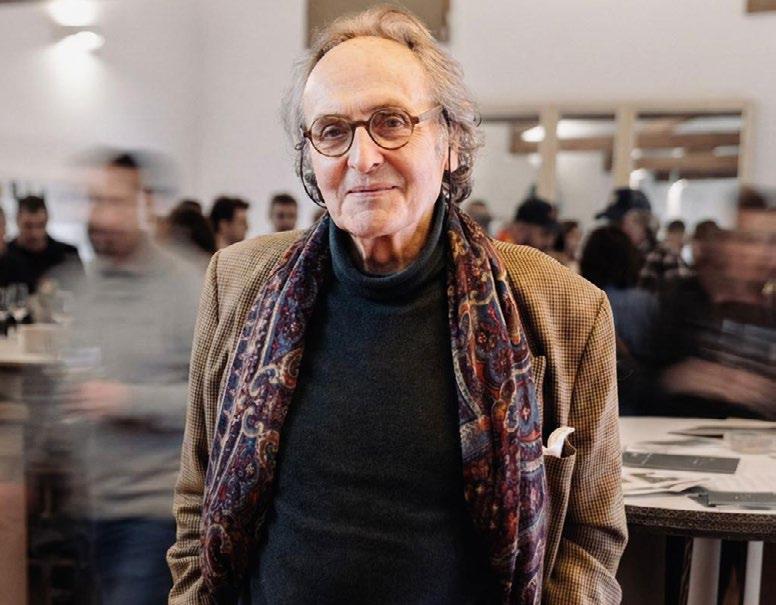
Nicolas Joly, iconic Loire producer, during the Convivium Renaissance event in Rome
different Joly. There is less confidence in the future, less militant drive, a form of disillusionment with the world that is far from hidden. But there is no detachment, and his love for wine remains pure and intact – perhaps even more evident – an almost physical, direct relationship. Joly feels it like very few others. At dinner with his Italian winemaker colleagues, he says without emphasis: “The producer must always have his heart connected to the vineyards”. This is not a romantic metaphor or a guru’s quirk, but an approach that goes beyond a method or a label. We catch up with him at the Convivium Renaissance event in Rome.
Is wine really in crisis?
Wine has become a technically perfect product. It looks good, but in reality it is just like all the others: we have destroyed the expression of the place. Over the last forty years, critics have defined what a perfect wine is. Not a real wine, but a correct wine, without flaws. I met Parker, an intelligent man who created a benchmark taste that could be reproduced through technology: osmosis, concentrations, aromatic yeasts. And so, without asking any questions, planting continued, yields per hectare increased, all you needed was a good oenologist and the wine would sell.
Cosmetic surgery and wines are the same?
The profound meaning of a designation has been lost, that fabulous ability of a small specific place to produce an original, unique flavour in a natural way, without any major technological intervention.
But technology is not only an enemy.
The problem is when it replaces life. If you have a deep understanding of agriculture and its cycles, you don’t need technology to correct everything. Let me tell you an anecdote. The Technical Team – yes, I find this name disturbing – of one of the four most important producers in Bordeaux
came to visit me. We talked at length, then they left me a bottle and said something terrible: “When you open the bottle, make sure you drink it on the same day”.
What was the bottle like?
Actually, the next day the bottle was completely flat. You can achieve perfect flavour with technology, but you cannot achieve life. Air does not lie.
And how can you recognise a living wine?
Just do the air test. A living wine improves in the bottle outside the refrigerator for up to 8-10 days after opening. The more oxidation attacks the wine, the more the wine will have the ability to resist and show its personality and, above all, its place of origin.
Are you concerned about the global decline in consumption and young people who seem uninterested?
I believe that truth always creates interest, in all areas of life. If there is a true flavour, it creates energy, a
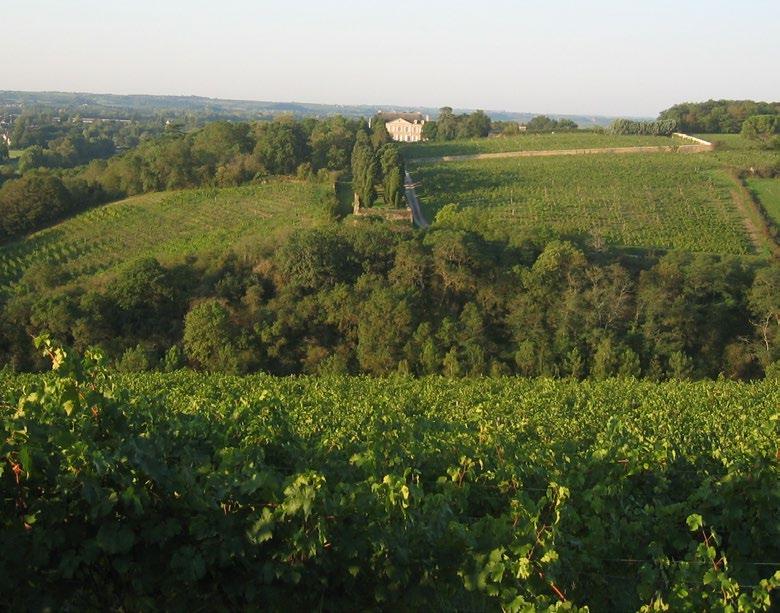
The Clos of the Coulée de Serrant, a monopole of seven hectares in Savennières
secret connection with the forces of life that comes to you directly without too many explanations. When you manage to connect with the originality of a place, something happens; you connect with the intelligence of a place, the seasons, its life cycles. I believe that young people today are very attentive to these issues and may even be more receptive to them than my generation, for example. My daughter Virginie organises events that are packed with young people.
Yet biodynamics is still opposed today.
Well, my course on biodynamics was interrupted because the director told me that over a third of the budget came from industry and he was afraid of losing funding.
The power of finance is enormous and disarming.
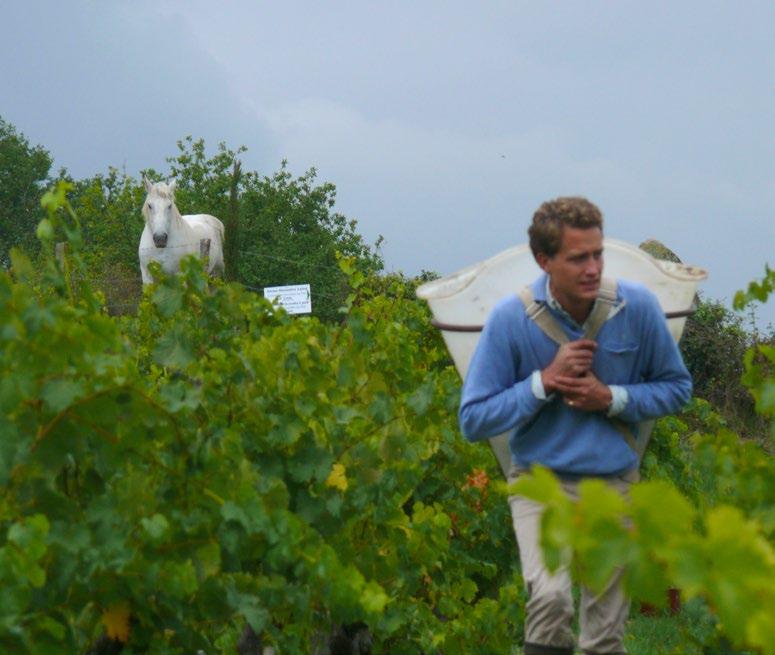
But I am convinced that the market for true taste, which does not always mean good, is growing. It may not be mass market, but it is growing: the truth of taste is tomorrow’s market.
Yes, but social habits are changing. Less wine at the table, fewer physical encounters, more time on our mobile phones, we are distracted and inattentive and unwilling to listen to wine.
I actually realised this when I took the plane from Nantes to Rome. I looked people in the eyes and it was as if they were no longer there. More generally, I see fear rather than happiness. People always need support, a phone, a television or I don’t know what. And even sadder, young people today are getting sicker and for the first time their life expectancy is decreasing. This is precisely why there is a growing desire to connect with nature, not through the mind, but with the heart. The desire to go beyond simple analysis, the need to read wine
with a deeper feeling. The part of the market that embraces this philosophy will grow.erà questa filosofia saprà crescere.
Having worked in finance, do you think we can talk about a bubble in certain wine districts today?
In Bordeaux, there are many vineyards secretly for sale and there are no investors; the Asians have left. In the 1990s and 2000s, people were willing to spend any amount of money: for years, wine was treated as a financial commodity, and prices became crazy. Then the market collapsed, and now we have high costs and oversized projects that are disconnected from the place. When you take life away, you are forced to correct everything. Increasingly large companies have been built, requiring more and more technology and costs, losing sight of the life of the place, its intelligence. And Bordeaux has great terroirs. No, I am not optimistic: we are close to a huge collapse of the financial world. I believe
Vincent Joly, Nicolas’ son, runs the estate together with his sister Virginie
that the crisis ahead of us, in one or two years, will be the biggest crisis since 1929.
The essential difference between organic and biodynamic?
Organic farming respects the life of the Earth. Biodynamics goes one step further: it reconnects the Earth to the solar system. It is important to understand one fundamental thing: the Earth does not possess life. Life comes from the Sun, the planets, cosmic rhythms. Without this connection, the Earth is a dead body. Biodynamics works on the relationship between the Earth and the forces that give it life: cosmic forces influence plants, animals and the living system. Biodynamic viticulture is not a recipe, but means acting as a sounding board for a specific place that is alive.
Let’s talk about climate. How much has it really changed?
A lot. But there is one aspect that is never mentioned. It is not just a question of temperatures, sun and rain. It is the vital forces themselves that are weaker, the balance is much more delicate. This is why biodynamics is becoming even more important today. Today, the Earth is surrounded by thousands of satellites, GPS and artificial waves. We do not yet know everything, but we do know that these frequencies disturb the cosmic forces that bring life.
The Earth’s magnetic axis is changing more and more and at a faster rate.
The more we hide the Earth from the solar system, the more the magnetic axis shifts to seek other sources of life. When we obscure the connection between the Earth and the solar system, something breaks.
Does this affect wine?
Of course! The behaviour of wine with mobile phones has changed a lot compared to 30 years ago. The taste
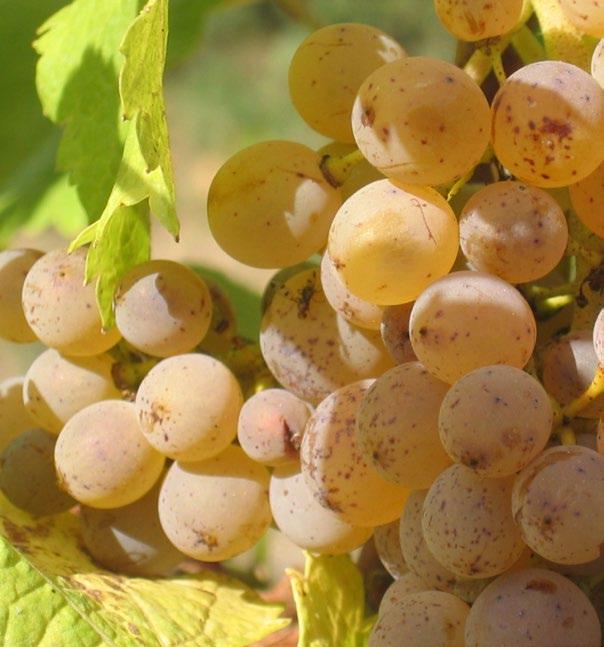
of water has also changed. It used to be much easier to produce wine. Until the 1990s, Bordeaux producers would put the grapes in barrels and go on holiday for months, then come back and the wines were extraordinary. They didn’t have to do much. Today, the work of a winegrower is much more complex.
What do you think of dealcoholised wine?
Right now, consumers are afraid of everything, including alcohol. I think it’s stupid, unnatural. I’m in favour of the opposite: rebuilding a natural balance.
There is a lot of confusion about the natural movement. There is no control over natural wine. So you have a lot of people who want to capture this market. There are people who say they make natural wine and use Roundup, use herbicides, use chemicals. And then they say, “I make natural wine”. But that’s marketing, it’s not natural wine.
Where is the misunderstanding?
Nature is something much deeper than a word. Nature is not a label. People confuse not intervening with understanding. But not intervening does not mean understanding.
The role of the appellation?
I created Renaissance des Appellations to ensure that consumers have the right to obtain a true flavour. We have a committee, we taste the wine and we make sure that things are done properly.
In closing, a straightforward question: where is the poetry in wine today?
Poetry begins with the rediscovery of its secret life. Its transformation: that little piece in spring, the leaves, then the flower. And inside that flower, all the information is already there, then a contraction and everything ends up in a grain capable of expressing the originality of that place and that place alone.
Nicolas Joly
It is difficult to analyse wines with so little time in the bottle. Nicolas Joly’s wines have certainly changed a lot over time. And this Chenin from vineyards with an average age of 35 years in Savennières is definitely more readable: it is graceful with hints of chamomile and aniseed. The palate is creamy, with notes of peach and candied citron. The finish is well-rounded, combining drinkability with a series of very flavourful counterpoints.
Nicolas Joly
It may be a cool vintage, but the colour is also very different from the Coulée of many years ago: less weight, less concentration, less alcohol. We will have to wait to evaluate it. At the moment, it offers pure notes of pear and apple. The palate is evolving, with sensations of bitter almond, delicately smoky and resinous; the finish is still very tight. Come back in at least two years to this 7-hectare vineyard planted back in 1130. .
“I dream of a wine without prejudice. Taboos? How annoying!”
Master of Wine Cristina Mercuri poses a provocative question: “It’s all very well talking about equality. But between a man and a woman, who would you hire as CEO today?””

by Loredana Sottile
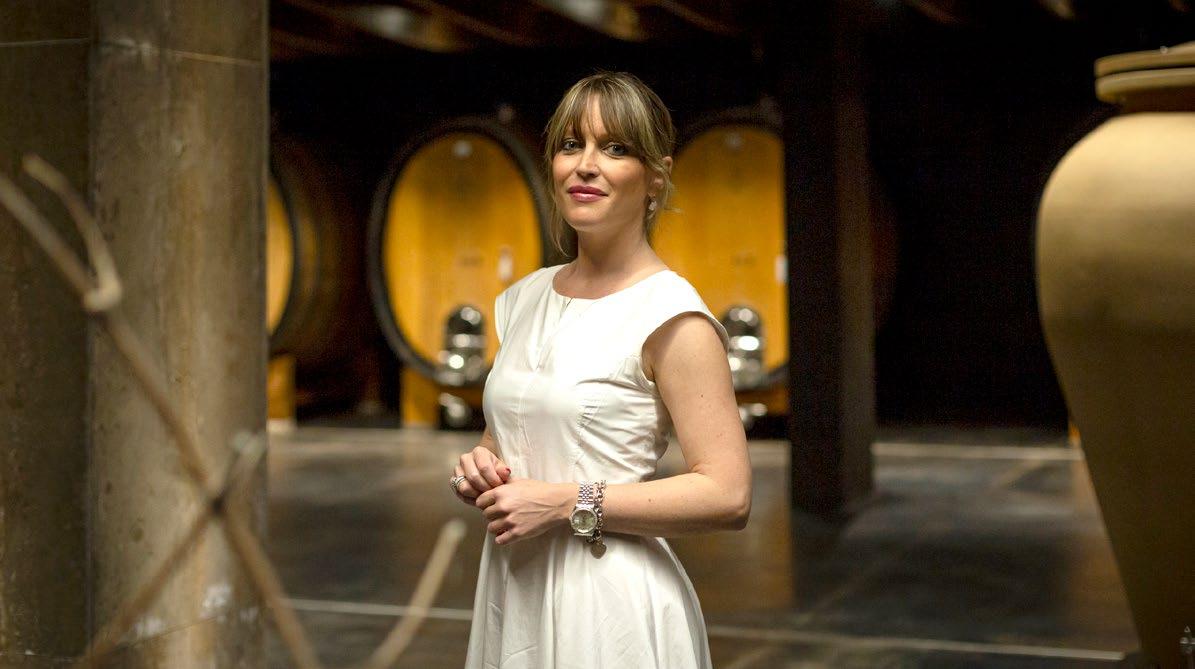
She needs no introduction: Cristina Mercuri is now widely recognised as Italy’s first female Master of Wine. And in a world still very much male-dominated, that’s just fine. Hers has been an obstacle course (all obstacles overcome so far), but new goals are now on the horizon. One above all? “To help create a more contemporary wine system, free from prejudice.”
In terms of gender, certainly, but also in terms of content. Because in an uncertain future, the watchword is to listen. Listen to the market, to new consumers, to new needs. So, green light for non-alcoholic and low-alcohol wine, bag-in-box, and screw caps. Let the purists turn up their noses: the future is won on the ground and by seizing new opportunities, just as Cristina has done with her life.
You are the living proof that changing one’s life is possible. How did it happen that at a certain point in your journey you decided that wine would be your career?
It was 2013. Until then, wine had been a passion I’d cultivated as a self-taught amateur, whilst at the same time I’d been pursuing a degree in law, then a legal internship, and finally working in a law firm. But at a certain point I realised I wasn’t happy at all. So I tried Plan B: wine. I took the plunge and mapped out my future career: wine masterclasses, the WSET diploma, the Master of Wine programme. I was 30 years old and if I was going to leave an established profession behind, I had to aim high.
It hasn’t been an easy journey, but today you’ve ticked off every single goal. Now that the dream has come true, what comes next?
My goal now is to help create a more modern, more contemporary and more professional wine industry. Ten years from now, I’d like Italian wine to be more attuned to consumers’ needs and more business-oriented.
What sort of period is this for wine?
Wine is going through a difficult period due to macroeconomic issues, wars, crises and changing tastes. We know there is a decline in consumption, but rather than super-premium wines, I would be more concerned about the mid-range segment, which is suffering particularly from competition
In that regard, as someone who also advises wine companies, what do you recommend they do?
To focus on brand power. In a sector where competition is fierce, the strongest brand wins.
A wine educator with the Mercuri Wine Club, founded in 2021, Cristina Mercuri is currently dedicated to training young people and providing strategic consultancy to businesses and the hospitality sector. In 2018, she obtained her WSET diploma and in February 2026 she was awarded the prestigious title of Master of Wine. In 2025, she also launched the DonneXstrada project to provide access to WSET training courses and give a second chance to women in difficulty.
Wine, however, is paying the price for lacklustre marketing – we have always been more focused on sales – when faced with competition from other products where marketing is really well structured. I’m thinking of other types of drinks, spirits and even non-alcoholic products.
Since you’ve brought them up: what do you think of dealcoholised wines? The debate in Italy is very heated between those in favour and against.
Personally, I believe that non-alcoholic wine can be an asset. That is why it is right that it should remain within the wine sector: leaving it to the drinks industry would mean losing significant revenue. I am not at all concerned that it will cannibalise consumption of traditional wine: de-alcoholised wine is and will remain a niche product.
Critics say that alcohol-free wines aren’t of good quality. What is your response?
Quality depends on awareness. And producers today still don’t have much awareness of how to handle them. Often they start with the bulk of the wine and try to dealcoholise it. Instead, you need to start with the vineyard: work with the most suitable grape varieties, such as aromatic ones, harvest slightly later to achieve maximum aromatic ripeness, and then choose the right dealcoholisation method. It’s easy to say that a dealcoholised wine is bad. We need to do things properly, and we need to get a move on. If we stop at the idea that ‘de-alcoholised wine equals bad wine’, we’ll never recover.
There is also another category that is currently a major focus: low-alcohol wine. Producing a naturally low-alcohol wine with a good balance of quality is certainly the challenge of the future. Today, the more varied the range, the more comfortable consumers feel about experimenting. If we spark a shift in purchasing behaviour, the cycle becomes virtuous.
Does this also apply to alternative packaging such as bag-in-box or cans, which, especially in Italy, remain taboos that are difficult to overcome?
These formats are successful where sustainability is a strong priority. In Italy, however, if the bottle isn’t made of glass, people immediately assume the quality is poor. It’s mainly a question of image, but just think how much CO2 could be saved if consumers were more open-minded, rather than approaching new ideas with prejudice. The same applies to screw caps.
But is this a prejudice held by consumers, by the wineries, or by those acting as intermediaries between the two?
Very often, the first to turn up their noses are sommeliers and industry professionals.
The Master of Wine is one of the most coveted qualifications in the wine industry, awarded by the Institute of Masters of Wine, the world’s oldest wine organisation. The extremely demanding course covers various aspects of wine: from viticulture to oenology, from communication to economics, without neglecting the organoleptic aspect. Today, there are 422 MWs worldwide. Italy has four: Gabriele Gorelli, Andrea Lonardi, Pietro Russo and, since last February, Cristina Mercuri.
If I say “natural wine”, what do you say?
That it doesn’t exist. Simply because, from a scientific point of view, wine is the result of human manipulation. And from a legal point of view, a few years ago the European Court ruled that “natural” is a misleading term that cannot be used.
So let’s call it what we like, but let’s say there is a type of wine that aligns with the concept of naturalness.
There are good artisanal wines, made with skill and expertise, and perhaps without the need for additives. But as someone who drinks them, I shouldn’t have to notice this, nor should I have to make excuses for their flaws. What’s dangerous is the trend among those producers who make slapdash wines – which might even be harmful to our health – whilst hiding behind the ‘natural’ label. I’ll always champion good, clean wines.
Tell us the truth: are young people still interested in wine? No reassuring answers. Not very much. And this is causing unease in the industry. But we need to understand why. Probably even we – myself included – were uninterested in wine up to a certain age, preferring other things, such as cocktails.
So how do we win these young people back?
We win them back through the channels they
themselves use. I like those wineries that now make mini-reels where they say, “Today I’ll take you with me and show you how I blend the wine”. Obviously, it’s important that the language used remains serious and isn’t ridiculous, but it can’t be too highbrow or too romantic, otherwise it puts people off. We need to find words that can describe a process, a scent or a sensation exactly. In this respect, the Master of Wine programme helps a great deal because you spend entire days pondering a single word.
An exercise, however, that for years perhaps many of us – and I include journalists here too – have not done.
I have heard sommeliers talking about wine as if they were reading out a technical specification sheet. I also find that too much emphasis is placed on the nose and too little on other elements that are easier for a consumer to understand, such as body, intensity and acidity. Intimidating the customer is not a good strategy: it drives them away.
In many cases, however, prices that have also driven people away. Whose fault is that?
It is true that there are fine-dining restaurants that apply higher mark-ups, but I do not feel I can criticise them given the costs involved in running the entire establishment.
And how do we explain this to the younger generations, who are already so distant from wine?
I realise that the price can be a huge deterrent for them. Sometimes young people try to buy a few bottles with their meagre savings, but then they might come across a poor-quality wine and never return. That’s why I believe the wineries themselves must solve the problem.
How?
By focusing on the quality of affordable wines. Good wines that complement the company’s other ranges.
Could we, on the other hand, suggest to restaurateurs that they focus more on serving wine by the glass? After all, between breathalysers and health-conscious trends, who drinks a whole bottle at dinner these days?
Serving wine by the glass is an excellent alternative, often overlooked due to the laziness of certain restaurateurs.
Let’s look at the wine types instead: is there still a future for reds?
Certainly. I still see many consumers favouring reds, perhaps less structured than in the past, softer and more approachable.
Why, on the other hand, despite attempts, do rosés still fail to make a breakthrough? It is a type of wine that needs to be taken more seriously, not least because, oenologically speaking, it is among the most difficult to produce. It must also be said that the quality in Italy is not yet the best: it is fine to have entry-level rosés for a more casual and playful drink, but we also need to seriously rethink the category.
One category that seems to be defying the crisis, however, is the sparkling wines: a growing number of Italian regions are venturing into production. But is there a future beyond Prosecco? Or will this “bubble” eventually burst?
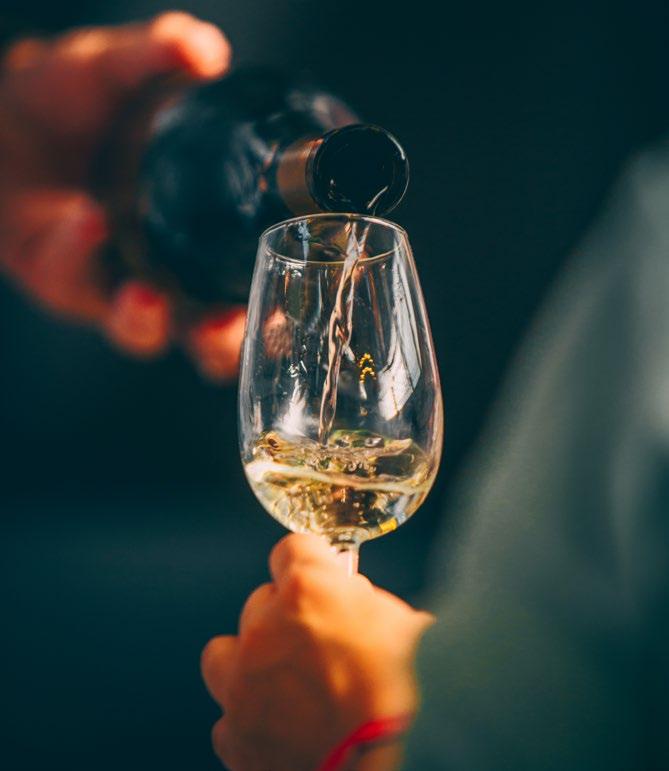
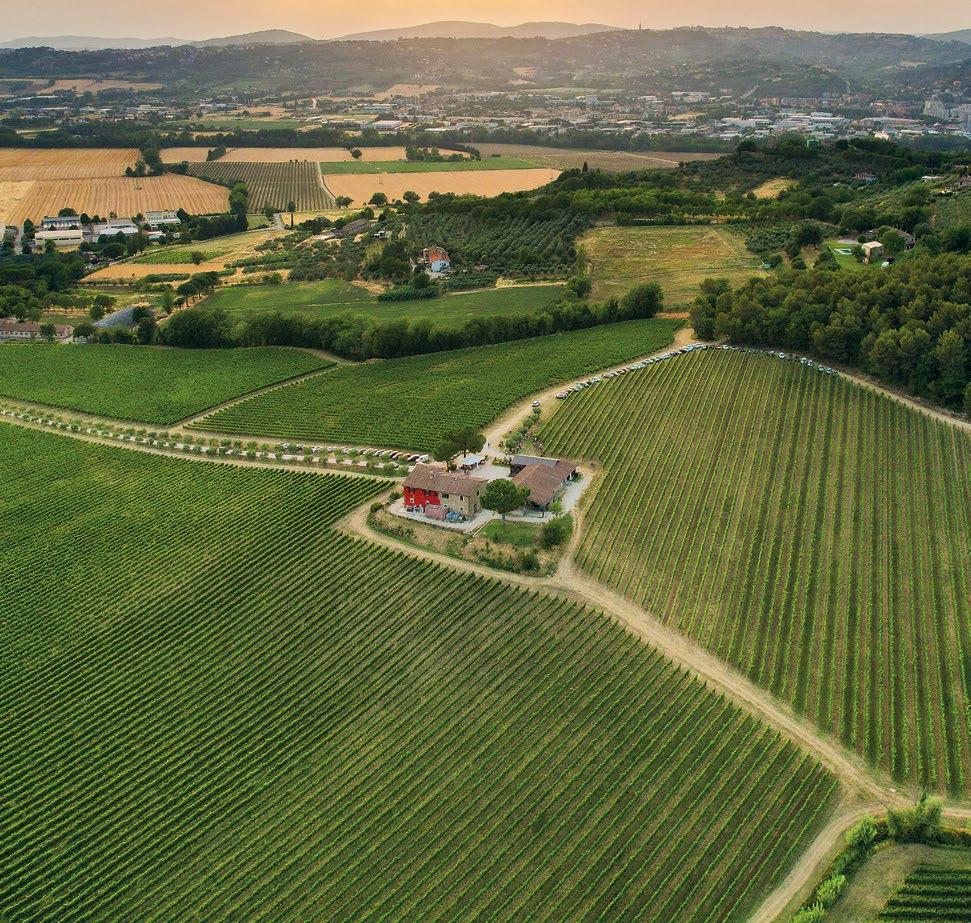

Beyond Prosecco lies Italy’s classic method. I’m thinking of Franciacorta or Trentodoc. It’s true, for now sparkling wines are popping up everywhere: from Tuscany to Puglia, but I must say that the results are often satisfactory. The future? To identify a trend, we’d need critical mass, but at the moment the only appellation with significant volume is Prosecco, which we must thank because it’s an Italian flagship around the world.
You’ve probably heard the following question a thousand times, but it’s right to keep asking it until the answer changes: is the wine world still a male-dominated one?
In terms of numbers, compared to the past, we are apparently moving closer to gender equality, but in reality we are still a long way off, considering there is still a 10% pay gap and that men hold 70% of top-level roles. It is true that today there are more women at the helm of wineries, but in most cases these are family-inherited businesses. Let’s be honest: how many women are hired as CEOs? How many would choose a woman over a man?
Even when you look at the number of women on the boards of consortia, it’s clear that equality is still a long way off. Why is that?
A few years ago, I was asked to provide a quote for running a wine masterclass at a well-known jewellery firm. I put one together. And in the end they told me that I couldn’t be the one to lead it: they needed a man. Then there are the locker-room jokes, like “I’m going to the banquet, not for the wine but for the blonde”. Things that leave me shocked, but fortunately they concern people who will retire sooner or later.
Have you personally ever been a victim of sexism?
Qualche anno fa mi chiesero un preventivo per condurre una masterclass di vini in una nota azienda di gioielli. Lo preparai. E alla fine mi dissero che però a condurre non potevo essere io: serviva un uomo. Poi ci sono le battute da spogliatoio, tipo “Vado al banchetto, non per il vino ma per la bionda”. Cose che mi lasciano scioccata, ma per fortuna riguardano persone che prima o poi andranno in pensione.
Let’s play a game: tell us some phrases that deserve a good “how annoying!” (as the song goes).
The list is very long. “A woman is more sensitive when tasting, so she’s better at it”: how annoy-
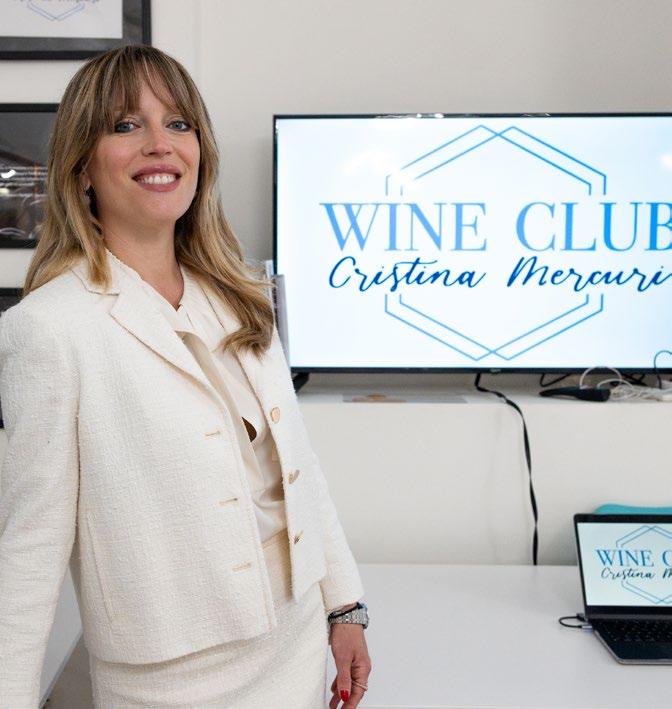
ing! “There are masculine wines and feminine wines”: very annoying! “Rosé wines are for women”: very, very annoying! Taken from a true story: “You can’t be a good oenologist because you’re a woman and you’ll have children”: annoying, annoying, annoying. Let’s just say it’s a constant annoyance almost every day.
Meanwhile, it may seem trivial, but the very fact that we have a female Master of Wine in Italy is a sign of changing times. Yes, let’s say that’s a fact. I’ll do my best not to leave anyone behind.
Let’s lock the cupboard and throw away the key: what would you leave inside?
Bad wines. Today we have every possible technology at our disposal, so please: let’s extract those tannins properly. Sometimes I see shocking oxidation. Let’s only promote well-made wines: we can do it.
A mantra for the future of wine? Listen carefully.

According to figures from the Uiv-Vinitaly Observatory, with 670,000 hectares of vineyards, 530,000 businesses, an estimated production of 47.4 million hectoliters in 2025, and a turnover of around €14 billion, Italian wine remains one of the best-performing sectors of Made in Italy, with a trade surplus of € 7.5 billion per year. The sector also employs 870,000 people and has a vineyard value of € 56.5 billion, with a direct and indirect impact of over € 45 billion and an incidence of 1.1% on the national GDP
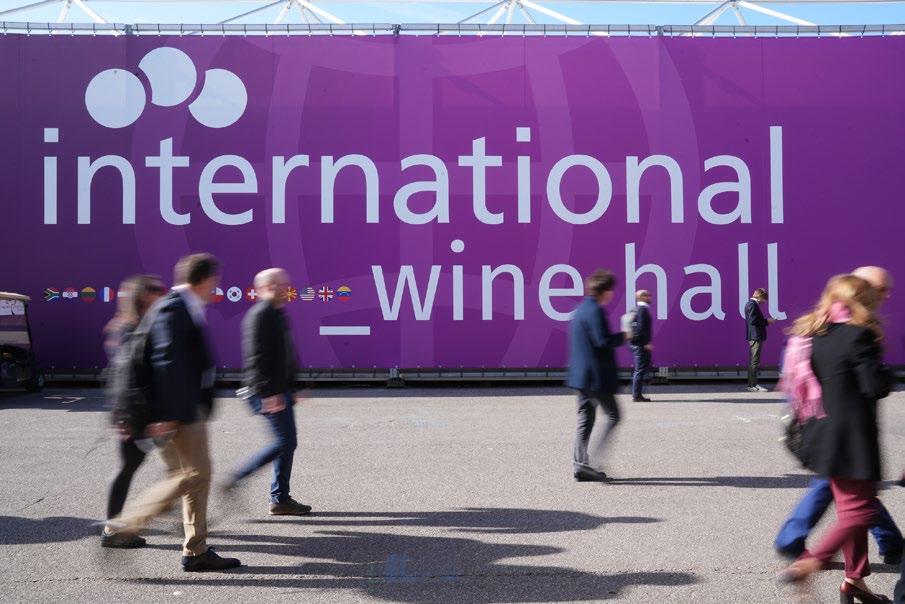
Representing the strength of the sector, the 58th edition of Vinitaly, the Italian wine fair, will be held at Veronafiere from April 12 to 15, 2026
“Vinitaly is not just an international fair, it is the global platform for Italian wine that interprets the evolution of the sector,” explains Veronafiere President Federico Bricolo. Federico Bricolo. “For this year’s edition, we are working to exceed the more than 18,500 B2B meetings organized during the 2025 event and to constantly enhance our offering, bringing it up to date with companies’ expectations and trends. At Vinitaly in Verona, companies, buyers, and institutions converge at the only event that fully represents our wine offering; a real strength that sets us apart at an international level.”
As every year, the Verona event takes up the challenge of the changes shaking up the sector. According to the analysis by the Uiv-Vinitaly Observatory, Italian consumers have changed significantly compared to the past. There are 29.4 million Italians who consume wine, with a penetration rate of 55% of the total population; daily consumers are in structural decline, at 39% with 11.4 million (in 2006 the share was 57%), while occasional consumers are growing significantly, now representing 61% of consumers. On the export side, the value of Italian wine sales in the first 10 months of 2025 stood at just over € 6.5 billion, with a 2.7% decline in value in trend terms caused by the decline in non-EU demand, influenced by declines in the United Kingdom, Switzerland, Canada, and above all by US tariffs.
In response to the winds of crisis, this year Vinitaly is strengthening its focus on the needs of businesses and the promotion of the sector. Thanks to an incoming and investment plan in collaboration with ICE-Agenzia, it confirms its position as the only international event entirely dedicated to the Italian wine business.
The figures for this year’s fair promise another successful edition: 4,000 exhibitors (7% of whom are foreign) in 18 pavilions (covering a total of 100,000 square meters of exhibition space);
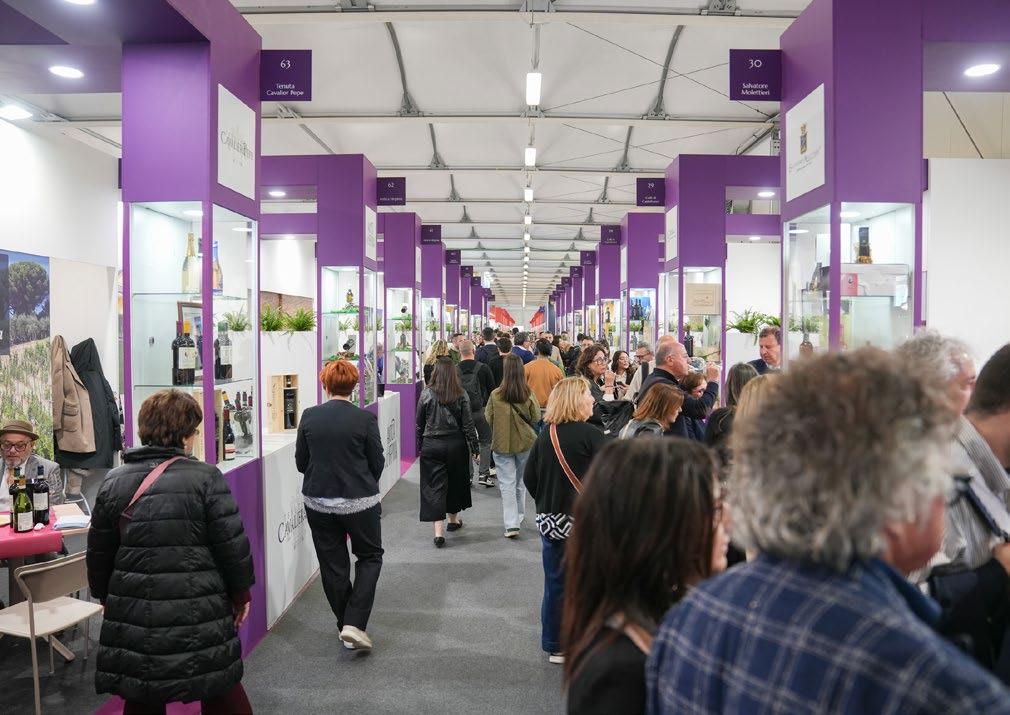
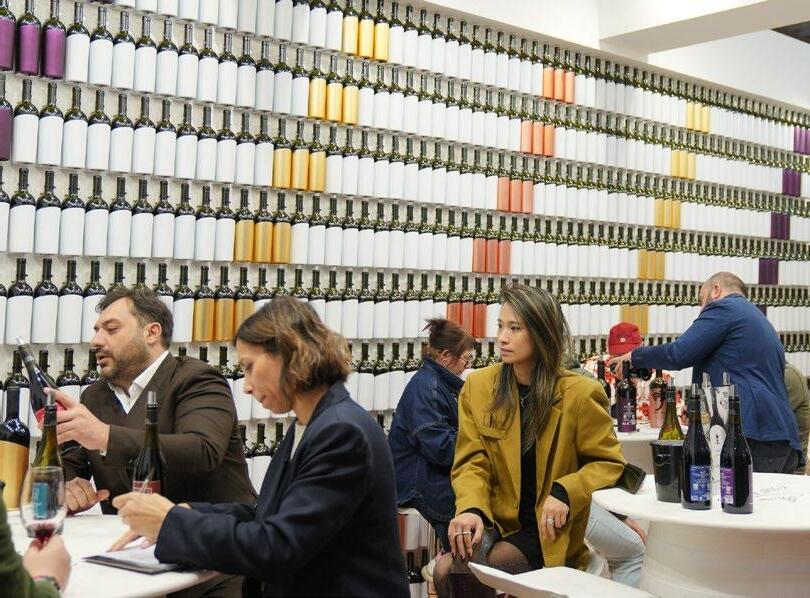
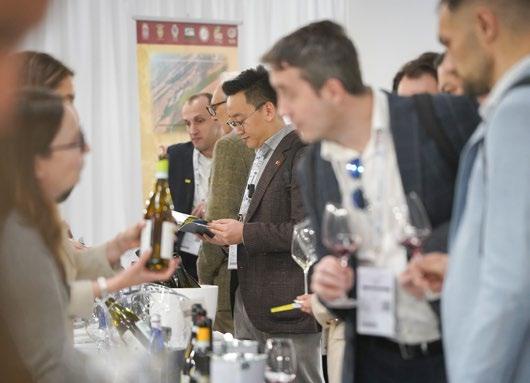
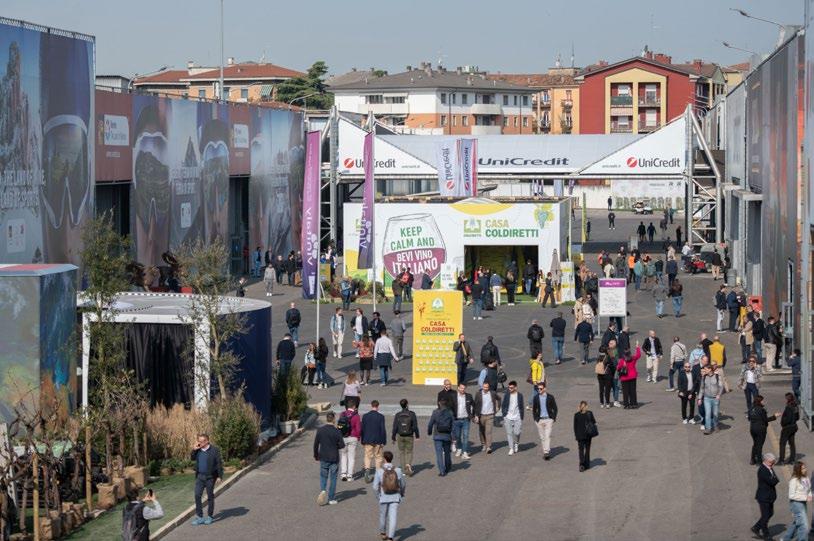
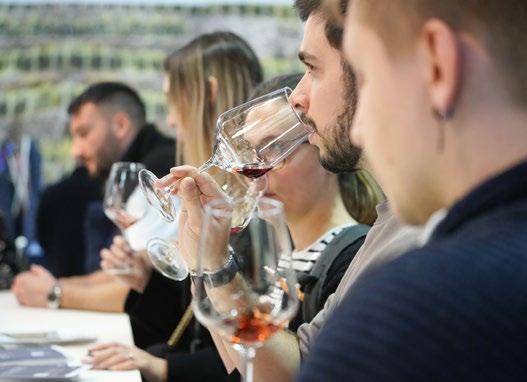
97,000 professional operators, 33% of whom come from 130 countries (+7% compared to 2024). There has been an increase in buyers from the top three target markets for Italian wine: the United States (+5%), Germany (+5%), and the United Kingdom (+30%), while there has been a decline from China (-20%). Feedback from European buyers has also been positive. The organizers have already scheduled more than 100 events, including masterclasses, tastings, and over 30 conferences, panels, and round tables, as well as nearly 19,000 B2B meetings organized by Veronafiere/Vinitaly during the event.
Attentive to the trends of this historic phase, the 2026 edition presents a series of new features First, the enhancement of NoLo – Vinitaly Experience: content dedicated to non-alcoholic and low-alcohol products will be structured in a dedicated exhibition area on the second floor of the Palaexpo, bringing together the entire supply chain, from producers to technologies, with the leading Italian brands. The Xcellent Spirits area debuts with a pavilion designed to strengthen the dialogue between the wine and spirits supply chains. There will also be space for wine tourism, which is becoming a permanent feature of the event with the consolidation of Vinitaly Tourism, which strengthens the exhibition presence and offers an incoming plan aimed at buyers and specialized tour operators, with the possibility of activating tailor-made experience packages (incoming in the territories and at the companies).
The Vinitaly Plus app, the platform that recorded 412,000 views in 2025 and collected a library of around 20,000 wines from 4,000 companies, is evolving into a two-way business tool. Starting this year, exhibiting wineries can also contact buyers directly and schedule appointments at the fair without waiting for a direct invitation from operators.
The thematic areas have been confirmed: from Enolitech, the international exhibition dedicated to design, products, and technologies for wine and beer production, to Vinitaly Bio, the area dedicated to certified organic wine, to Raw wine, the event that celebrates natural, organic, and biodynamic wines (with a full immersion tasting day on April 13), to Amphora Revolution in collaboration with Merano WineFestival and The WineHunter, to Micro Mega Wines, the selection of small wineries representing the biodiversity of Italian terroirs and cultivars, curated by Ian D’Agata, one of the world’s leading experts and promoters of Italian wine.
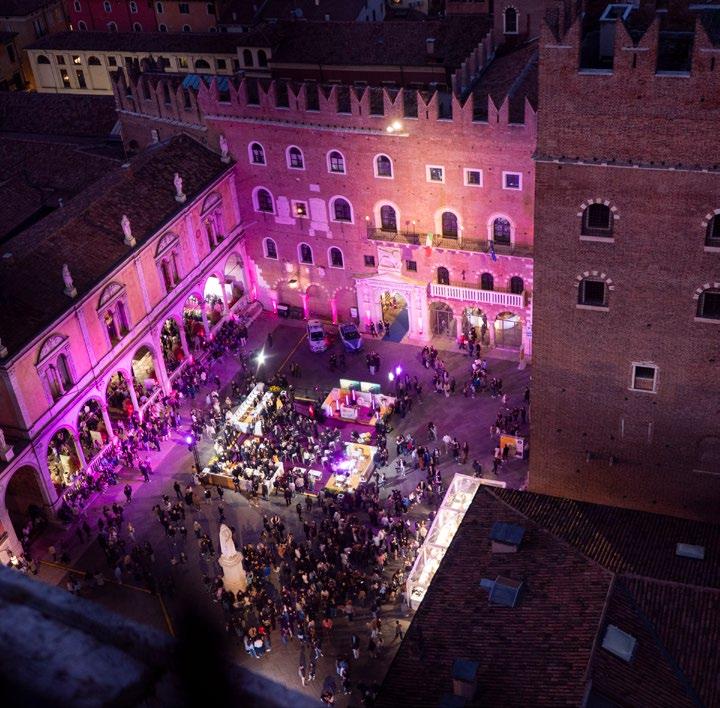
Finally, make way for events designed for wine lovers with Vinitaly and the City, the “off-site” event that will lead you on a journey of discovery of wine excellence in the historic heart of Verona. Thanks to the collaboration with the Valpolicella Wine Route, it will be possible to visit a series of local wineries with the purchase of a tasting booklet. Finally, on April 11, 12, and 14, it’s time to party with Vinitaly & the Night, the evening parties scheduled at the Gallerie Mercatali.


There are increasingly fewer heavy, hyper-structured wines. The trend is toward greater lightness, but not without risks...
by Raffaele Mosca
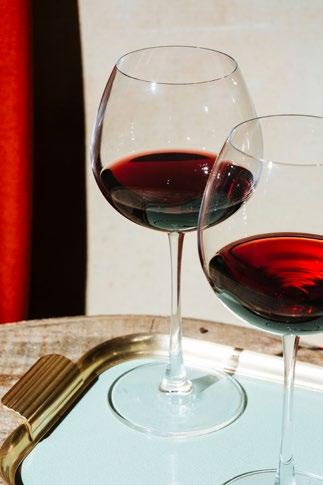
It is one of the few Italian red wines that has managed to build a consolidated image of luxury and prestige. Amarone della Valpolicella has become synonymous with a special wine, with an extreme style, capable of overwhelming and pampering the palate at the same time: extractive power, warmth, softness and concentration, in the best cases combined with a great sense of proportion. It has found its definitive consecration mainly abroad, becoming the emblem of the “meditation” red, easy to drink even without food. But even in Italy it continues to have a certain appeal, if only as a bottle for special occasions.
Today, however, it is impossible to deny that Amarone is going through a turbulent phase. The figures show a modest decline rather
than a collapse: –2.4% in 2025 according to the Valpolicella consortium. But there is real concern about the long-term viability of the appellation. Taste preferences have changed course: lightness has become a mantra, especially among professionals.
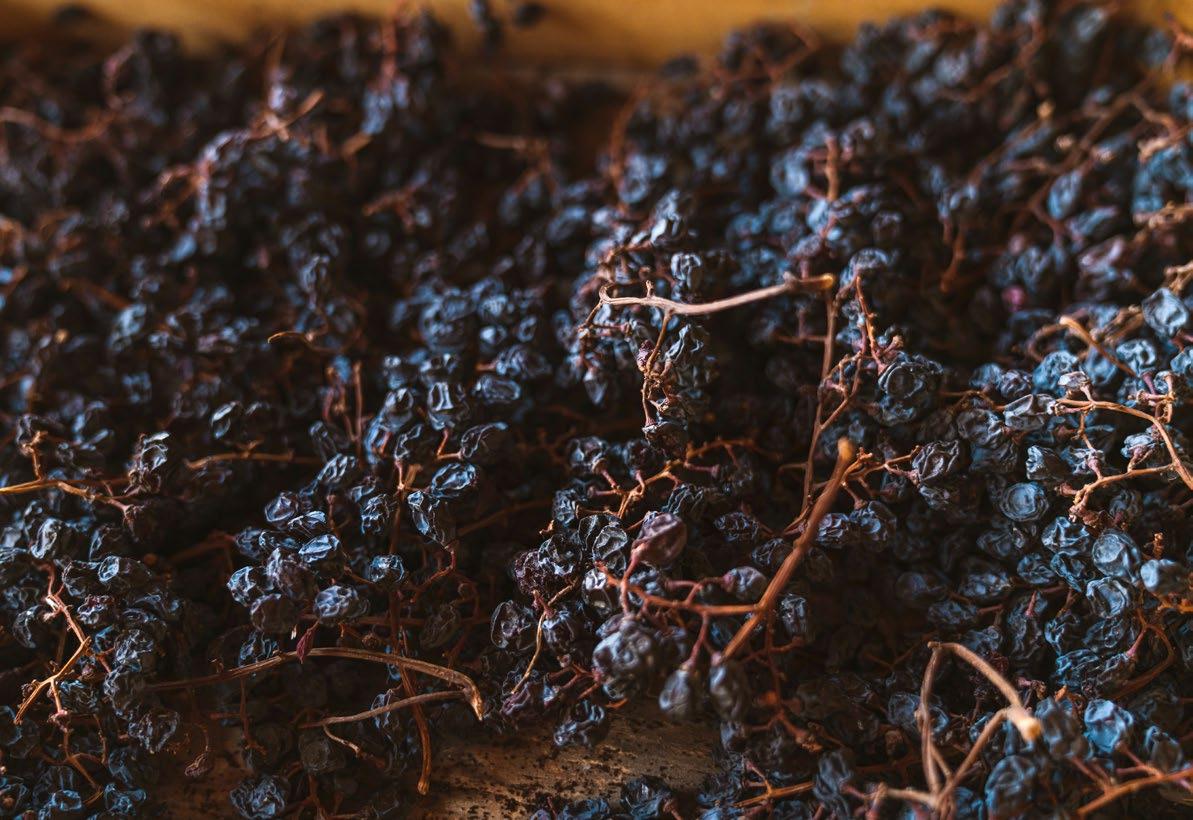
The drying process, from which it originates, results in a high concentration of sugars, making it almost impossible to have less than 16 degrees of alcohol (with peaks of 17.5). Furthermore, it goes against the trend of preferring wines that are a direct expression of the terroir, without filters or superstructures. The risk, according to many, is that it is precisely this method that “makes” the wine, crushing the differences in soil, exposure and microclimate. «The Amarone production meth -
The weather was irregular and fluctuating: a cool spring with late frosts and heavy rains, a hot and partly dry summer, and a dry September with good temperature variations. It was an unpredictable season, which required constant attention in the vineyard and in the cellar
od is a unique framework, convenient in some ways, but also double-edged», said JC Viens, ambassador of the Valpolicella Consortium, at the inauguration of Amarone Opera Prima 2026. «The risk is to focus entirely on that, when instead we should be looking above all at the terroir».
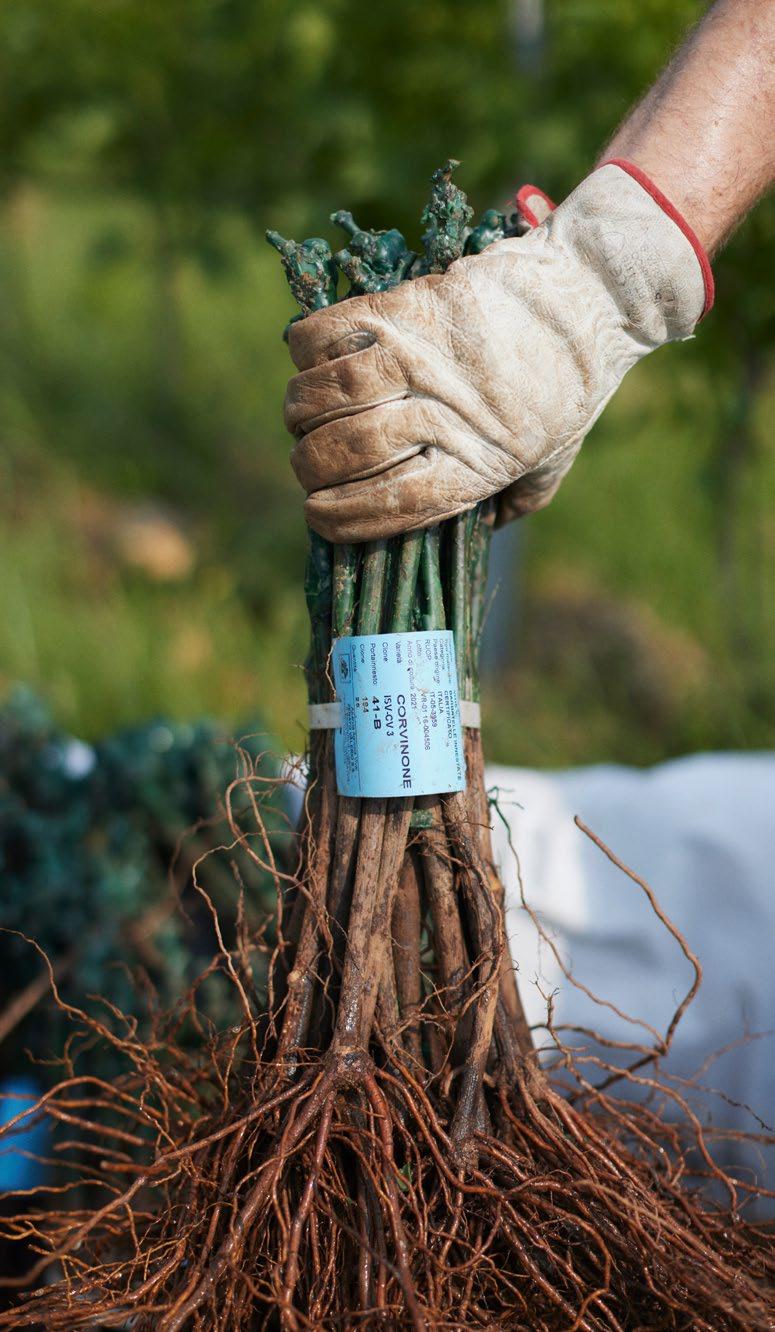
Yet, paradoxically, drying was created precisely to amplify the territory. The traditional grapes of Valpolicella – mainly Corvina, Corvinone, Rondinella and Molinara – are by their nature low in colour and light. When vinified immediately after harvest, they produce graceful, enjoyable but
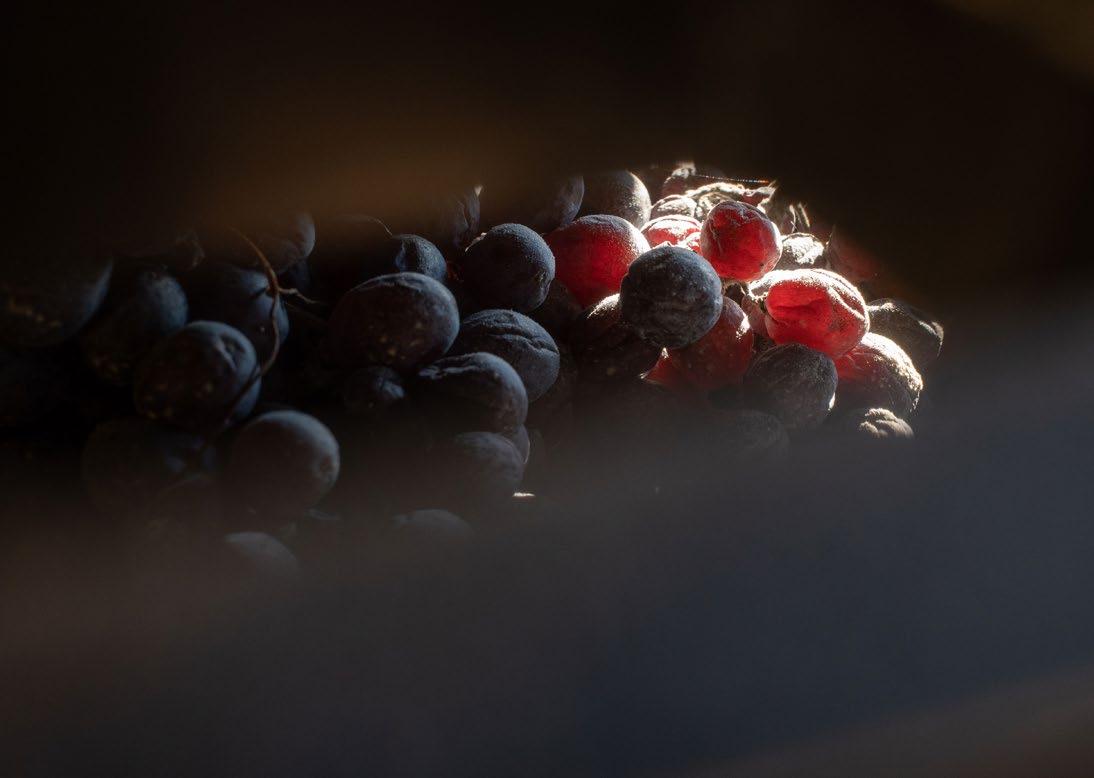
fairly simple wines. «These varieties withstand drying better than others», explains Maria Sabrina Tedeschi, president of the Famiglie Storiche dell’Amarone (Historic Families), «because they express sensations that they would not be able to develop without this step».
The solution, then, is not to reject the formula, but to reinterpret it. Even on a semantic level: «In the past, we talked about resting the grapes, not drying them», suggests Viens. «It was a different idea, more cultural than technical». This also gives rise to the next symbolic challenge: obtaining UNESCO heritage status for the technique of “resting the grapes”. The application will be officially submitted in March.
Tastings of Amarone Opera Prima 2026 and a meeting elsewhere with the Famiglie Storiche paint a picture of change: Amarone is undergoing a rapid revolution. Massive wines, marked by significant sugar residues, invasive wood and premature oxidation, are becoming increasingly rare. The trend is towards subtlety, but this is not without risks.
«The danger is making weak wines», warns Marco Speri of Secondo Marco, who has always been an advocate of a more sober and elegant style. In fact, in some cases, the desire for smoothness leads to thin wines, with profiles reminiscent of simple Valpolicella and an alcohol content that, not supported by adequate substance, leaves a dryness. In others, a vegetal and unresolved character emerges.
The best, however, demonstrate that removing does not mean stripping away. Rather than a new style, it is a return to a more classic concept, which has always been preferred by a few traditionalists who are now a much greater source of inspiration than the “modernist” meteors of the 1990s.
«Amarone in the 1970s and 1980s was like this: a complex wine, but not overly structured. And ours has always remained so», says Giampaolo Speri, owner of the winery of the same name. The recent changes made by the Consortium are a step in the right direction: for some years now, it has been possible to shorten the period in the fruit cellar, with vinification already taking place in mid-November. However, the most important producers prefer to intervene earlier, working
mainly in the vineyard.
«The problem is doing everything in the same vineyard: Superiore, Ripasso and Amarone», adds Giampaolo Speri, who has always produced Amarone from a single high-altitude cru, Vigna Sant’Urbano. There is certainly a growing focus on parcelling, exposure and altitude. The race to the top is now inevitable, with new vineyards above 500 metres, especially in Valpolicella Classica, or in cooler areas such as Valpantena. «A narrow, wooded valley, where the cold wind from the Lessini mountains is channelled», says Chiara Mattiello, communications manager at Costa Arente, one of the emerging wineries representing the 2.0 style.
Another significant comeback is that of the Veronese pergola, partially supplanted by the espalier: «If oriented north-south, it is the only system that guarantees radiation without sunburn, which leads to rot», says Marco Speri of Secondo Marco. «And for a wine made from dried grapes, rot is simply unacceptable».
2021 is considered a balanced vintage, described by many as the last “classic”. In fact, the wines reveal sharp edges and acidic tensions that are not often seen, a sign that they are still in a transitional phase. It remains to be seen whether this style can be refined and, above all, replicated in warmer vintages, such as 2022, which will be released next year.
In any case, the change will emerge slowly: many 2021 wines are still maturing and some wineries still have wines on the market that are stylistically far removed from this new sensibility. Yet the best tastings show that another Amarone is possible: less powerful, more refined, still linked to the method, but without caricature. A fine wine capable of keeping up with the times without betraying itself. And without becoming a relic for nostalgics!
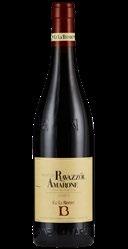
Ravazzol
Gentile e sussurrato, con un frutto molto delicato, unito a fiori rossi, erbe officinali e qualche accenno terrestre. Lo stile è quasi “nebbiolesco”, sorprendentemente austero e in levare, con grande energia salina che bilancia la materia perfettamente calibrata. Finale boschivo, profondo, senza peso né calore in eccesso.
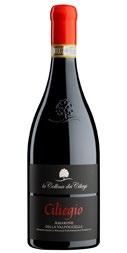
Ciliegio
Da vigne situate a 500 metri di altitudine nella Valpantena deriva un profilo di grande eleganza, con un naso di pot-pourri, ciliegia candita, spezie e pepe. Tutto è giocato su armonia e proporzione: il tannino è setoso, il frutto goloso e aereo. La freschezza accompagna lo sviluppo e calibra un finale lungo e suadente, scandito da rimandi balsamici.
>Massimago 93
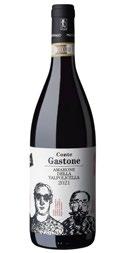
Conte Gastone
Naso chiaro e raffinato di ciliegia sotto spirito, cannella, iodio, erbe officinali e arancia candita. Il sorso è succoso e disteso, notevole per pulizia e compostezza, con un tannino delicato e nessuna percezione alcolica. Dinamico, con ottima freschezza a sostegno di uno sviluppo in equilibrio tra potenza canonica e stile contemporaneo.
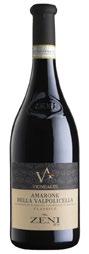
>Zeni 1870
Vignealte
Stile agile e aggraziato, giocato su pepe, iodio e frutti rossi freschi, con un tocco balsamico a dare ampio respiro. Il sorso è agile e fragrante, appena vegetale e se vogliamo un po’ semplice, tutto giocato su brio e scorrevolezza, con una chiusura lineare tra rimandi floreali e una giusta dose di frutto rosso appena candito.
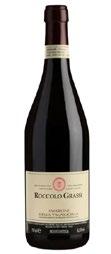
>Roccolo Grassi
Roccolo Grassi
Austero e salino, con richiami iodati e una vena animale che si intreccia a melagrana e arancia sanguinella. Il sorso è scuro e compatto, segnato da un tannino fitto, ma coerente con uno stile austero e rigoroso. Oggi è piuttosto chiuso, quasi ermetico, ma lascia intuire un’evoluzione verso maggiore distensione e profondità.
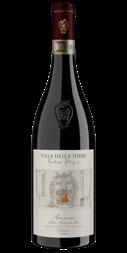
>Villa della Torre
Villa della Torre
Uno stile decisamente in levare, già evidente dal colore quasi trasparente. Il naso é molto delicato, quasi da Valpolicella superiore, con note pepate e animali, frutto rosso tenue e cenni vegetali. Insolitamente snello al centro bocca, ha tannino fine e progressione relativamente morbida, ma agile. Finale lineare, forse appena semplice, con un lieve tocco di calore.
91
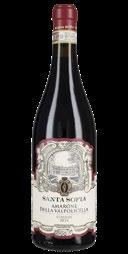
Santa Sofia
Relativamente classico al naso, con note da appassimento ben calibrate che si alternano a sfumature mentolate, officinali e chinate. Al sorso cambia passo, mostrando una freschezza vibrante che ricalibra la struttura e la rende più dinamica, un guizzo di arancia sanguinella e un tocco ammandorlato gradevole. Finale pulito, di buona progressione.
89
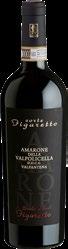
>Corte Figaretto
Brolo del Figaretto
Da vigne in Valpantena, è particolarmente fine, con richiami di sottobosco, fiori rossi e pot-pourri, attraversati da balsamicità elegante. Il sorso è coerente, ben impostato, con una dolcezza di frutto misurata e tannini ben integrati. Setoso, disteso, chiude meno meno profondo ed energico rispetto ai campioni migliori, ma preciso e senza calore.
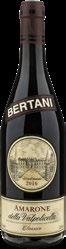
>Bertani 2016 96
>Secondo Marco 2017 95
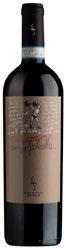
Secondo Marco
Leggero, elegante, a tratti un po’ “borgoneggiante” tra kir royal, fiori appassiti e spezie di ogni genere, con qualche accenno officinale e mentolato a dare ulteriore finezza. Agile e succoso, con un frutto di notevole delicatezza, tanta freschezza e zero estrazione eccessiva o calore. Finale lungo, di rara energia ed espansione.
Bertani
Un’interpretazione di grande “aplomb”, con un inizio sussurrato di evoluzione - tabacco, humus, affumicature - ma anche toni più freschi e un frutto di misurata dolcezza. Aristocratico, con freschezza vibrante che bilancia la struttura, una vena salino che accompagna la progressione e ne allunga il finale. Noto per essere inossidabile, ma già pienamente espressivo.
>Vigna Sant’Urbano 2020 94
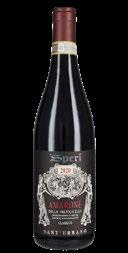
Speri
Nonostante la timidezza iniziale, rende un’idea di profondità e raffinatezza, con note delicate di china, radici e melagrana. In bocca è una lama: freschezza tagliente e un tannino incisivo, che preme nei punti giusti. La materia è senza peso, il finale balsamico e appena ammandorlato: notevole per vitalità.
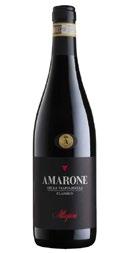
>Allegrini 2021
Allegrini
Brilla per purezza espressiva, con una trama che intreccia frutti rossi sotto spirito, nocciola e sottobosco a un legno evidente, ma ben integrato. L’appassimento regala ampiezza senza compromettere la tensione; la progressione è ariosa, distesa, con un finale complesso. giocato su un’alternanza allettante di frutto e terziari sottili. Classico che guarda al contemporaneo.
>Rubinelli Vajol 2018 93
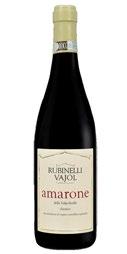
Rubinelli Vajol
Trasparente alla vista e coerentemente fine, con profumi delicati di resine, confettura di fragole, cannella e spezie varie. Tutto è giocato sull’equilibrio, con un frutto rosso molto garbato, di media maturità, che accompagna lo sviluppo suadente, calibrato da buona freschezza. I tannini sono impalpabili; il finale in levare, dai rimandi officinali.
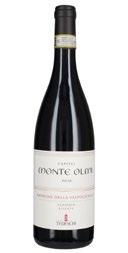
>Capitel Monte Olmi 2018
Tedeschi
Naso scuro con qualche traccia di evoluzione terziaria, tabacco e affumicatura, ma anche un frutto garbatamente dolce e accenni speziati. Il sorso è austero e vibrante, con tannino incisivo, ma ben estratto, aciditá trascinante e finale tonico. Tra i meno segnati in assoluto dall’appassimento, ha bisogno di più tempo per assestarsi.
91
>Riserva 2018
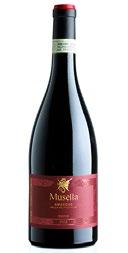
Musella
Insolito, se vogliamo un po’ “funky”, ma di bella originalità, con note di pasta d’olive, iodio e terra bagnata in sovrimpressione. Cambia registro in bocca e avvolge con il suo frutto ricco, prontamente stemperato da salinità e un accenno di volatile. Appena rustico nei rimandi finali, selvatici e terragni, ma dotato di energia e tutto meno che scontata.
91
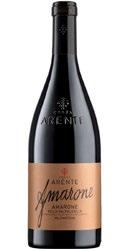
>Valpantena 2019
Costa Arente
Affumicatura, sottobosco e note ematiche si fondono a tocchi di cioccolato fondente e un frutto scuro, ma integro. Di media struttura, con il frutto ben sostenuto da tannini appena asciuganti e acidità che rimanda alla zona più fresca. Finale sobrio, composto, senza calore, anzi di sorprendente scorrevolezza.
by Lorenzo Ruggeri
photos by Mattia Aquila
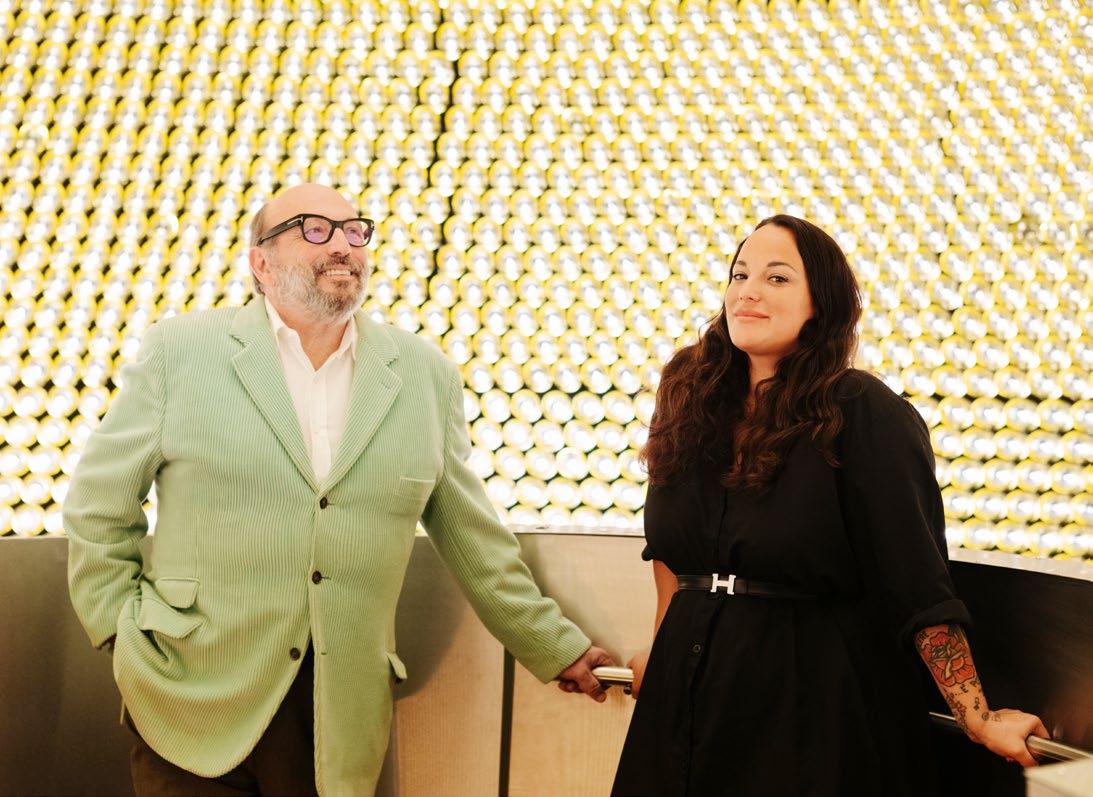
Since 2019, Ca’ del Bosco has stopped attending the major trade fairs. Nor does it invest heavily in advertising; instead, it focuses its efforts elsewhere: on bringing people to the winery. «We’re talking about 25,000 visits a year, around 6,000 from the press and trade alone. Some come just to see the artworks, others combine wine tasting with bike rides through the vineyards that last several hours.
There are simple tasting itineraries and more structured ones», says Maria Lavinia Zanella, who oversees the company’s communications and promotion as brand ambassador. The turning point for wine tourism?
Christo’s The Floating Piers – those floating piers covered in iridescent yellow fabric – put Lake Iseo on the world map: «Those 10 days of the installation did more for the lake than 100 years of tourism promotion», chuckles Maurizio Zanella. Here, they have been investing in contemporary art for some time: it is the Erbusco winery’s communication channel for enhancing its production and brand perception.
In 2023, Maurizio Zanella established the Ca’ del Bosco Sculpture Award, reserved for large-scale outdoor installations created by Italian artists under the age of 40 .
The most important factor?
Environmental sustainability
the wine-making project. Perhaps it is the leaden sky, but they create an unreal, almost sinister atmosphere.
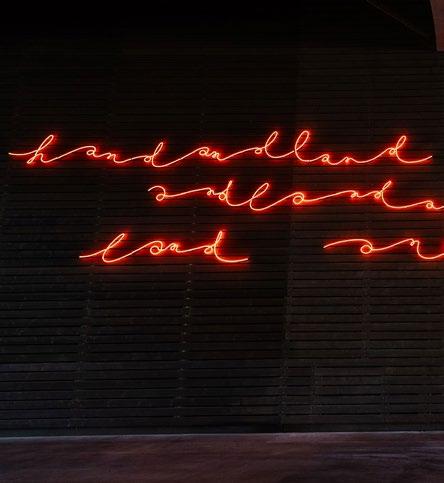
In the opening, “Prestige Immersion”: a massive upside-down bottle made up of 34,000 empty, backlit bottles of Cuvée Prestige. Above, a detail from “Handandland” by the artist Irene Coppola
Arnaldo Pomodoro’s Cancello solare has marked the entrance for almost 30 years, whilst Cracking Art’s blue wolves made of recycled plastic on the roof stand guard over
In the cellar, the starting point is a huge model – reminiscent of the TV programme Porta a Porta, but far more high-tech and, to say the least, incredibly detailed – and fully immersed in Franciacorta: its amphitheatre-like terraces, and the hills that aren’t really hills at all. And so the estate’s plots light up, with an interactive digital system capable of telling the ins and outs of every vineyard’s life: planting density, age, labour
and yields. Ca’ del Bosco – in which the Santa Margherita Group has held a majority stake since 1994 – owns around 280 hectares, comprising vineyards that have been owned or leased for at least 20 years. Many years ago, the shift towards organic farming took place: «We believe in it wholeheartedly, even though others are taking steps backwards. Franciacorta missed a historic opportunity: it could have been the first entirely organic appellation. We came close; we had reached 72%, and today we are around 53%, which is still a very high figure when compared to other major Italian and European wine appellations», adds Maurizio. The biggest problem for the estate is drought; the
is adapting with wells and new systems: «Groundwater pollution will be the issue of the future, which is another reason why organic farming is a fundamental choice». Meanwhile, planting is moving ever higher up the slopes; the latest vineyards reach 550 metres in the Santa Teresa area.
How did it all begin? From what Maurizio Zanella himself describes as a kind of exile. «This used to be called the Valley of the Wolves; nobody wanted to come here. They exiled me here after my successes in Milan», he says with a smile, as he points to what he calls the “Colosseum” – a ruin, just four walls standing around the vineyard that
has grown up all around it. «At first there wasn’t even water or electricity, just woods. The first few months were terrible, then I got hooked and saved myself with my motorbike». Zanella is one of those rare figures in Italian wine: a visionary, stubborn, unwilling to conform, more interested in forging a path than following one already laid out. Between races and escapades, he began exploring little-known areas where he later invested and planted the vineyard. Fundamental to this was his friendship with the long-standing vineyard manager, Antonio Gandossi, and the powerful influence of
Luigi Veronelli: «Without him, none of this would exist. Not just in terms of lessons but of values—the idea of going against the system, the established order, the regulations, a moral integrity that has been a true guiding light».
On the technological front, the obsession with detail and innovation borders on the “crazy”. There are four pressing lines; every crate is sterilised before use; the bunches are washed and then dried to remove copper residues, thereby also enhancing the fine lees. Since 2005, they have been among the very first to use the Jetting technique for bottling, thanks to a machine designed – and patented – that removes oxygen from the bottle before corking, preventing oxidative shock whilst allowing for a reduction in sulphites. The latest innovation – from Stefano Capelli, the winery’s oenologist for a full 40 years – concerns the cork (see box) and once again promises to change the game.
And amidst the Peso del tempo sospeso (Weight of Suspended Time), the iconic life-size rhinoceros suspended in mid-air by Brescia-based artist Stefano Bombar -
dieri, and stylised neon lettering in the shape of vine shoots (Handandland by Irene Coppola), we find the old wine press used by French oenologist André Dubois – (ironically, “from the woods” in French) – 50 years ago. He had autographed it – with that machine that looks prehistoric amidst so many lights – the bottle we disgorged à la volée: Anna Maria Clementi (dedicated to Maurizio’s mother) 1979, the first vintage produced. With a brilliant colour and vitality to spare, it is incredibly lively, with that full yet controlled aromatic richness of toasted hazelnut and pepper, already so recognisable. On the palate it is still sharp, yet with a very long finish; next, we uncork the magnum of Anna Maria Clementi 2014, the year of her passing. A wine of uncommon finesse, much more subtle, citrusy and taut, with a very pure structure, among the best vintages ever alongside 2004 and 2008 (we liked the 2015 less).
Oenologist Stefano Capelli (photo by Giuseppe La Spada)
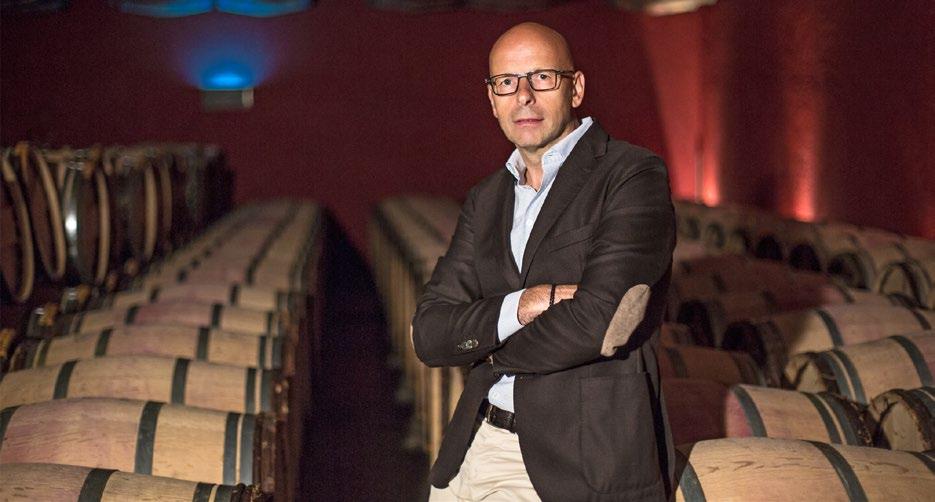
Zanella is just a step away from securing a new patent, following its pioneering Jetting technology for removing oxygen from the neck of bottles (2005). Oenologist Stefano Capelli is enthusiastic: «I had never considered one particular problem: the oxygen contained in the cork. There is plenty of it; it remains trapped and is then gradually released into the wine». Capelli’s figures are precise, the result of four years of research using new tools: this is how the idea arose to inert the cork by replacing the oxygen with nitrogen before use. «For the past year, all our wines have been sealed with inert corks. The result is evident in an even lower dose of sulphites used and an even more vibrant and fresh flavour profile. The real difference will be seen in the ageing potential of the great vintages». They work with free sulphite levels between 12 and 15 milligrams per litre. «Sulphites do not block oxygen but suppress the aromas, making the wines more rigid. It alters the wine’s character, and it is a technique that can have significant implications for still wines, particularly long-ageing reds».
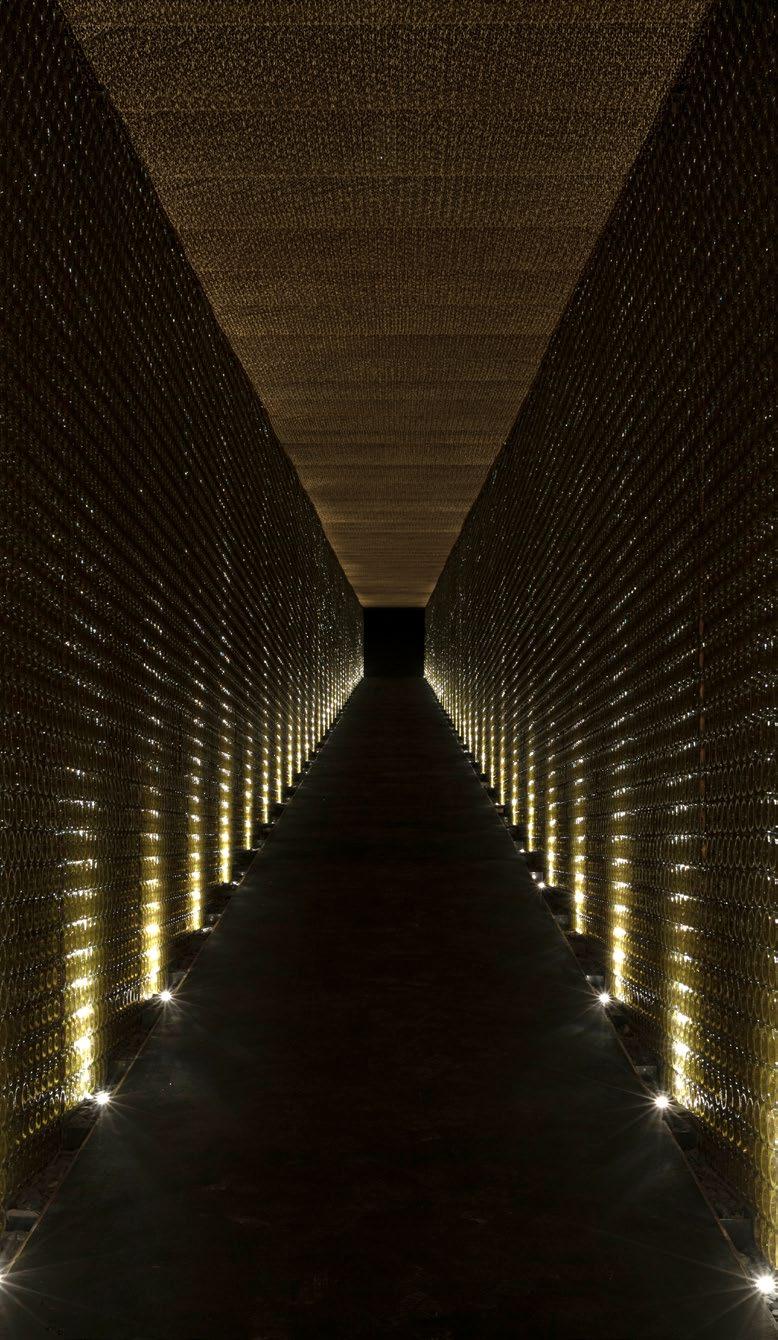
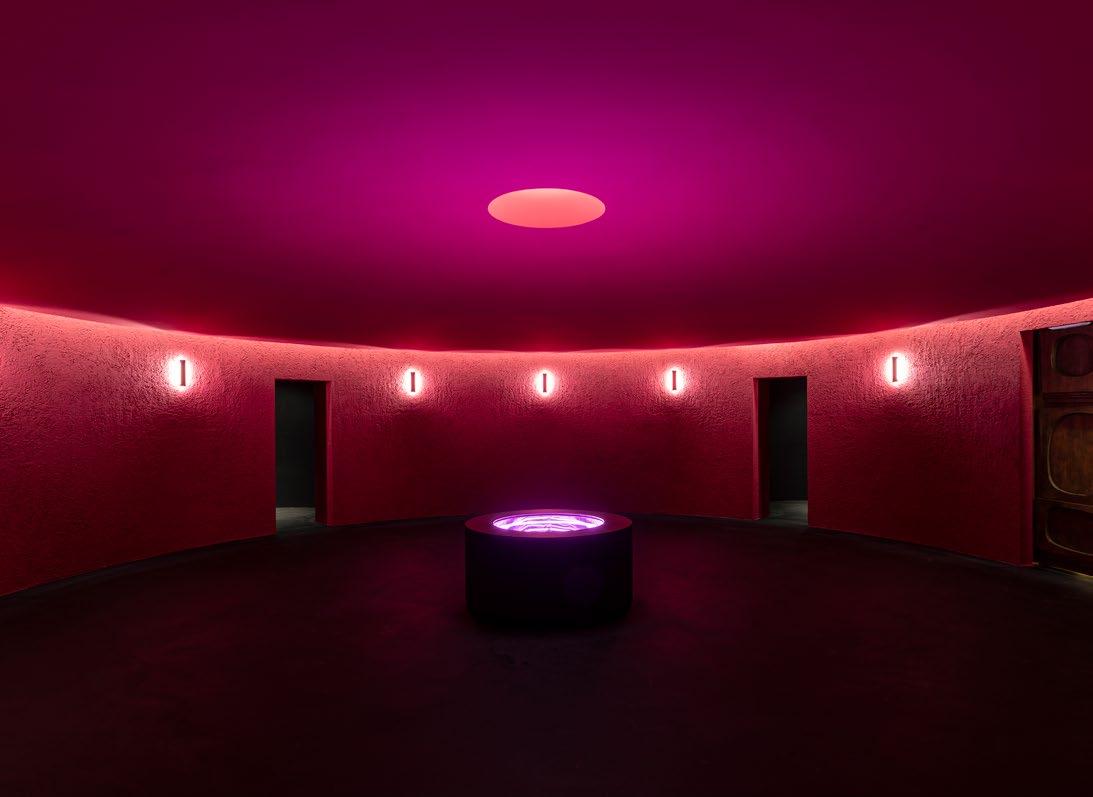
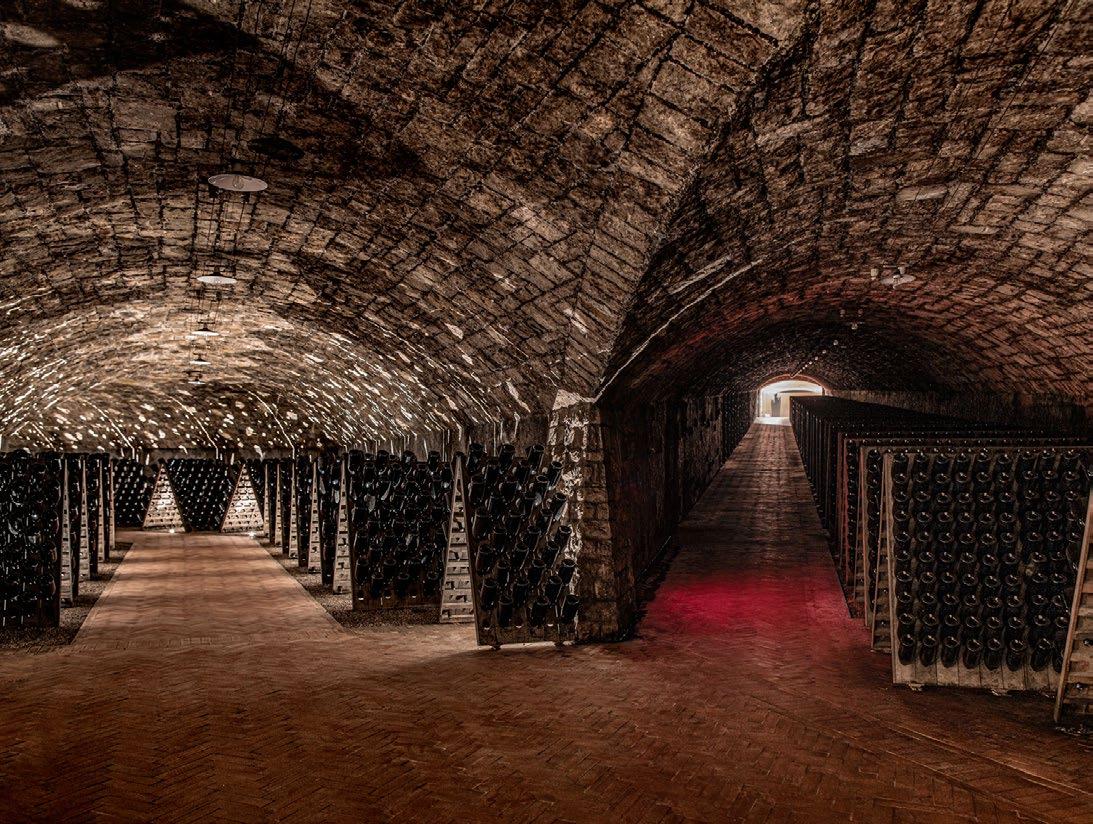
The tour continues through tunnels, plays of light and vaults with starry skies: a story of wine that needs no explanation; you simply walk through it, observe it and listen to it. This is the structure of La cupola dei sensi, a psychedelic room with four stations that play with illusion and excess: the sound of perlage taken to the extreme, touch, sight, mirror effects, and scents sprayed into the glasses. «Basically, we realised we shouldn’t bore people to death with malolactic fermentation and technical jargon, but bring wine to life through emotions, through universal instincts and sensations that everyone can relate to», Maurizio cuts to the chase. «Some people just want to come here to have a nice afternoon and might know nothing about wine, whereas others are the typical wine nerds who want to know everything. That’s why, during booking and at the start of the tours, we ask various questions to gauge the group’s mood and tailor the visit», adds Maria Lavinia. Essentially, throughout the entire tour, we never discuss the wines in detail, but everything around them reconstructs them, letting visitors imagine them to build anticipation and desire. And the journey continues through hyperrealism, excess and childlike wonder with the Prestige Immersion: visitors enter a huge upside-down bottle made up of 34,000 empty, backlit bottles of Cuvée Prestige, with a capsule leading underground, where some 10 million bottles are stored. The dialogue with art continues through sculptures – every year a prize is awarded to a young local sculptor – and fine art photography.
Cuvée Prestige Tunnel
80% of production is sold in Italy, with almost 90% going to restaurants (Esselunga handles the rest) –a rather unusual model. «It’s a completely different model to the French one: of the 140 million bottles of Champagne sold in the country, 75 million go through large-scale retailers. We have to keep on the move, build a network, maintain relationships». And the conversation turns to current affairs, starting with the issue of excessive mark-ups and falling wine sales, the lack of entrepreneurial spirit. «The chef is good at his job, but the kitchen accounts for only 49% of a restaurant. And chefs haven’t realised this yet because they’re very self-centred. In fact, where there
isn’t a superstar chef, the restaurant generally does well», Maurizio quips. It’s time for a magnum of Curtefranca Chardonnay 2009. Amazing: complete, refined, with wood and fruit dancing together; it has at least another 15 glorious years ahead of it; the Maurizio Zanella 2009, a blend of Cabernet, Merlot and Franc, is less impressive. In our long career at Gambero, we cannot recall having tasted a single Franciacorta red capable of making us jump out of our seats. The production of the estate’s still wines will focus, particularly for the reds, on the eastern part of Franciacorta, around Cellativa, where a small dedicated appellation once existed. denominazione dedicata
La cupola dei sensi, una stanza psichedelica da cui si accede alla Cuvée Prestige Immersion
There are certainly no plans for alcohol-free wines at Zanella in the near future: «We lost the battle over dealcoholised wine at European level; it shouldn’t have been called wine. It isn’t wine – take away the alcohol and you take away its soul; without it, it’s just another drink that doesn’t interest us», Maurizio states bluntly. «It was a political mistake», he points out. «The pressure from the large social cooperatives and those with too much unsold wine prevailed, but he doesn’t see a bright future for the category at all; it
will always be a minority and will stabilise at around 5% of consumption». Together with Stefano Capelli, the quiet winemaker who never leaves the cellar, we step into the technical area and recall a specific date: 1978, the year of the first Dosaggio Zero. At the time, given the harvests, it was truly a gamble; it was probably the very first of its kind in Italy and among the very first cases in Europe. And this also explains why today the Dosaggio Zero Vintage Collection is the benchmark for the category. Today, however, the situation has changed: «We no longer need to add sugar because the fruit is already ripe; I no longer have to balance the acidity. We haven’t made Brut for four years, and
even with the Satèn we’re at one and a half grams of sugar». And on the subject of oxidation, he has very clear ideas that are diametrically opposed to the Selosse school: «That is a technical manoeuvre; the oxidative flavour doesn’t let me taste the vineyard. It is an aroma generated by yeast; it is human intervention. And with these hot harvests, why should I oxidise it? I must rather protect it; I must not create the aroma, but preserve the original uniqueness». Maurizio goes further: «We must always remember where Franciacorta comes from. Today, I no longer see in young people that hunger and desire to improve that we had; some young producers have become complacent, taking things
Caveau: a bridge between ancient and modern traditions, where the lighting recreates a starry sky through the holes in the pupitres
for granted – watch out!», says the man who built the business with a bottle always ready in his suitcase, travelling tirelessly. Today, it is Maria Lavinia who carries on the legacy and builds the new network of contacts. Among the bottles unearthed in the cellar, we also find an unusual, and discontinued, Elfo 10, a blend of Erbamat (a local variety planted in the late 1980s, when it wasn’t even legal) and Sauvignon Blanc. At Ca’ del Bosco, they’ve truly tried everything: a marvellous bunch of madmen.
97
Produced in the hilly region of Irpinia, Fiano di Avellino ranks among the very best of Italian white wines.
A wine with Apennine roots, taut and mineral, capable of evolving in surprising ways. Below is a selection of some of the best wines rated on a scale of 100 points
>Fiano di Avellino Tognano Ris. ’22
Rocca del Principe Lapio (AV)
A mineral explosion. On the palate, it is a concentrated burst of energy and flavour: its intensity and power make even the glass tremble, with an incredibly long finish that lingers long after the wine has been swallowed. Following a precise, finely crafted attack, a distinct sulphurous note emerges, giving way to a range of savoury notes that dominate the palate. It displays great momentum and development, culminating in a crisp, striking finish.
96
by Marzio Taccetti
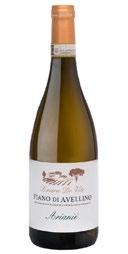
>Fiano di Avellino Arianiè ’23
Laura De Vito Lapio (AV)
Charming and full of character, Arianiè is a Fiano di Avellino with a balsamic, mountainous profile, complete and multi-faceted with notes of meadow grass, white currant, lime and green almond. The palate makes a striking impression right from the start, graceful and lively, offering a sip of great energy that concludes with a savoury, taut finish. It is persistent, with hints of aromatic herbs.
95
>Fiano di Avellino ’24
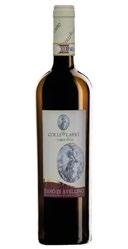
Colli di Lapio
Lapio (AV)
The winery takes its name from a small hilltop village in the heart of Irpinia and offers a fresh, refined interpretation of the Fiano di Avellino appellation. Vintage ‘24 offers notes of mountain meadows, green citrus and subtle hints of aniseed. On the palate, it is striking, with herbaceous notes and an almond-like finish that defines a wine of great charm.
>Fiano di Avellino Ciro 906 ’22 94
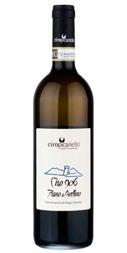
Ciro Picariello
Summonte (AV)
The volcanic-clay soils contribute to the character of this long-lasting, mineral-driven wine. The nose plays on salty and marine notes with balsamic undertones. On the palate, it reveals a pronounced savoury character and a sharp, deep, almost rocky structure. The finish returns to aromatic herbs and salt, with a composed and effective finish.
93
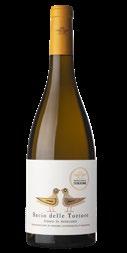
>Fiano di Avellino Bacio delle Tortore ’24
Passo delle Tortore Pietradefusi (AV)
Grapes from the renowned vineyards of Lapio give rise to this vibrant, long-lived white wine. In the glass, it surprises with a bouquet marked by distinct mineral notes, almost marine in character, with a cool, mountainous undertone. The palate is taut, playing on citrus and wet stone, developing in a linear and well-defined manner. Precision and measured elegance, maintaining consistency between nose and palate.
95
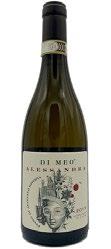
>Fiano di Avellino Alessandra Ris. ’15
Di Meo
Salza Irpina (AV)
Alessandra is the Di Meo siblings’ manifesto on the longevity of Fiano di Avellino. A white wine that defies time, presenting a complex bouquet where smoky notes dominate and lead the way to a deep, complex and exceptionally rich palate. The finish is a play of contrasts: the freshness of citron intertwines with broom, closing with a savoury persistence that shows no sign of fading.
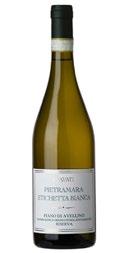
I Favati
Cesinali (AV)
A Fiano di Avellino that captivates with its explosive energy: on the nose, there are distinct notes of flint, green citrus and white flowers. On the palate, it starts off juicy, but quickly shifts gear: a surge of acidity gives it a “viper-like” quality, taut and vibrant. The definition of the fruit and its vertical drive make this an electric wine with a decidedly lively character.
>Fiano di Avellino Pietracalda Ris. ’23 94
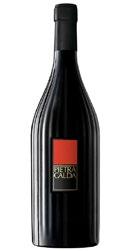
Feudi di San Gregorio
Sorbo Serpico (AV)
The winery aims for a clean style that highlights the terroir, characterised by volcanic soils and high altitudes. Pietracalda is a reserve wine that plays on precise, crisp mineral notes, lending the palate a savoury, sharp profile. A hint of fruit adds juiciness to the palate and contrasts with a savoury, fresh mouthfeel, with a hint of fennel in the finish.
93
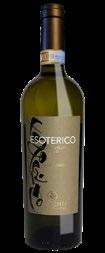
>Fiano di Avellino Esoterico ’24
Donnachiara Montefalcione (AV)
Ilaria Petitto, a fifth-generation representative, interprets the Irpinia region through her own distinctive style as she carries on the family business. Esoterico ‘24 offers aromas of candied citrus and Mediterranean herbs. On the palate, hints of lemon pulp and savoury notes provide a counterpoint to a freshness that balances the wine’s rich and complex structure, leading the palate towards a long finish.
>Fiano di Avellino ’24 93
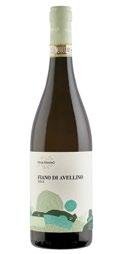
Villa Raiano
San Michele di Serino (AV)
Villa Raiano is one of the most renowned estates in the Irpinia region, producing wines that bear the distinct character of their terroir. A prime example is the Fiano di Avellino ‘24, whose profile is characterised by subtle smoky notes, wet stone and hay. On the palate, it is underpinned by a well-balanced freshness and offers a smooth drinking experience that is both subtle and intense
92
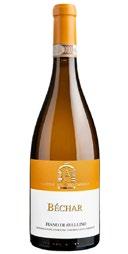
>Fiano di Avellino Béchar ’24
Antonio Caggiano Taurasi (AV)
The estate’s vineyards cover over 32 hectares in the heart of Irpinia, in Taurasi, on calcareous-clay soils – a combination that lends the wines structure and minerality. The Béchar ‘24 offers a delicate nose, characterised by subtle notes of peach and hints of aromatic herbs. On the palate, it changes character, becoming more full-bodied and savoury.
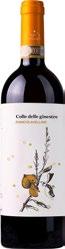
Tenuta del Meriggio Montemiletto (AV)
Tenuta del Meriggio produces its wines from the finest Irpinia crus (Taurasi, Tufo, Montefalcione).
Among these, the Colle delle Ginestre ‘21 offers aromas of grapefruit, lime and aromatic herbs on the nose. On the palate, it is smooth and balanced, underpinned by a fresh acidity and a well-measured savouriness. The finish is flavourful and has good length.
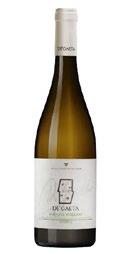
De’ Gaeta
Castelvetere sul Calore (AV)
A Fiano di Avellino reserve with a classic aromatic profile and a citrusy edge that defines its character. Notes of wild fennel, aniseed, fresh almond and subtle smoky undertones emerge, lending depth. On the palate, it is taut and vibrant, consistent with the nose, with a precise development and underpinned by a lively savouriness. The finish is clean and lingering.
92
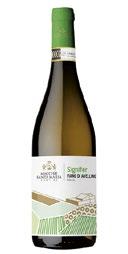
>Fiano di Avellino Signifer ’24
Macchie Santa Maria Montemiletto (AV)
Oreste de Santis valorizza i vitigni chiave irpini, tra cui il fiano, grazie alla posizione quasi baricentrica della sua cantina nel territorio. Il Signifer ‘24 convince con un profilo olfattivo pulito e sfaccettato di erbe aromatiche, e una netta sensazione di finocchietto. Il sorso è nitido e coerente, con richiami di lime e sensazioni erbacee che si rincorrono dall’attacco al finale.
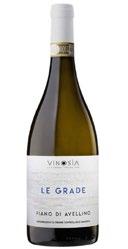
Vinosia
Paternopoli (AV)
Vinosìa is the brainchild of Luciano Ercolino, drawing on his experience with the aim of reinterpreting Campania’s winemaking tradition through a contemporary lens. The Fiano di Avellino Le Grade ‘24 impresses with its aromas of grapefruit and icing sugar, complemented by a cohesive and fresh palate. Together, they offer a personal interpretation of the terroir with a touch of modernity.
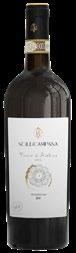
Scillicampana
Montefalcione (AV)
Produced from 100% Fiano grapes sourced from the Scillicampana vineyard in the hamlet of San Marco di Montefalcione. After 8 months of ageing in stainless steel on the fine lees, the wine spends a full year in the bottle. On the nose, it offers hints of vanilla mingling with savoury and briny notes. On the palate, it features notes of lime and aromatic herbs, with spicy undertones in the finish.
92
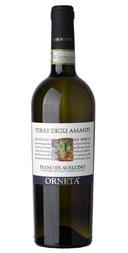
>Fiano di Avellino Torre degli Amanti ’24
Orneta
Ariano Irpino (AV)
A straightforward and thoroughly enjoyable Fiano, offering a crisp bouquet reminiscent of citrus and basil, with hints of grass and flowers. The aromas on the nose foreshadow a full-bodied and intense palate. It hits the palate with a rich lemon flavour and flows with a pleasant acidity. The finish is lively and fresh, with a citrusy aftertaste that lingers.
>Fiano di Avellino Pendino ’24 92
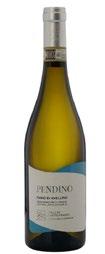
Colli di Castelfranci Castelfranci (AV)
Made from grapes grown in vineyards around 20 years old, cultivated at an altitude of 450 metres above sea level, the Pendino ‘24 has a profile characterised by balsamic and aromatic herbal notes. The palate is compelling and pleasant, with good structure and length. A subtle yet incisive interpretation of the appellation and the grape variety.
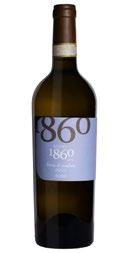
Tenuta Sarno 1860 Avellino
The estate’s clay-limestone soils produce Fiano-based wines that are lively and crisp in their youth, becoming more mellow and complex after a few years of ageing. The Fiano Sassi ‘19 offers aromas of yellow peach, grapefruit and broom flowers, with a hint of hazelnut and a touch of mint. On the palate, it is very fresh and savoury, with good structure and a delicately balsamic finish.
92
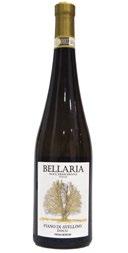
>Fiano di Avellino V. Boschi ’23
Bellaria
Roccabascerana (AV)
The Vigna Boschi ‘23 is characterised by mineral and citrus notes, with a fresh nose, hints of salt, notes of aromatic herbs and a delicate floral undertone. On the palate, it is lively, taut and flavourful, with good flavour dynamics and a savoury, mineral texture that evokes the volcanic soils where the vines are planted. It finishes with hints of hazelnut and toasted almond.
>Fiano di Avellino ’20 91
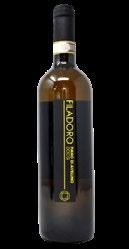
Filadoro Lapio (AV)
A Fiano di Avellino with a complex bouquet. The nose reveals notes of ripe yellow fruit, aromatic herbs and a hint of citrus. On the palate, it is straightforward, echoing the aromas perceived on the nose. The texture on the palate has good density, supported by a distinct acidity that adds a lively quality to the mouthfeel. It finishes with a savoury, lively aftertaste that lingers nicely.
91
>Fiano di Avellino
Benito Ferrara Tufo (AV)
Hazelnut, white flowers, honey and aromatic herbs define the multi-faceted profile of Sequenzha ‘24, enriched by smoky notes. On the palate, it is taut and precise, with a slender, vibrant mouthfeel. An interpretation of Fiano di Avellino that focuses more on verticality and elegance than on fullness. It finishes with a savoury note and good length on the palate.
90
>Fiano di Avellino Il Cavaliere ’24
D’Antiche Terre Manocalzati (AV)
D’Antiche Terre has made a significant contribution to the revival of Irpinia’s wine industry. The Cavaliere ‘24 is a Fiano di Avellino with a delicately vegetal bouquet. On the palate, it is both fresh and beautifully full-bodied, balanced and smooth, with a subtle almond-like finish enriched by a faint mineral note that lingers as the wine fades away.
>Fiano di Avellino Aipierti ’24 91
Traerte - Vadiaperti
Montefredane (AV)
Among Montefredane’s historic wines, Fiano has always been at the heart of the winery’s production. The Aipierti ’24 is a wine characterised by a bouquet that strikes a balance between the first hints of mineral notes and a distinct citrus freshness. On the palate, it is light and youthful, underpinned by good structure that promises to develop over time.
>Fiano di Avellino
Torricino Tufo (AV)
The nose opens with a distinct note of toasted almond, accompanied by hints of yellow fruit and subtle Mediterranean undertones. On the palate, it develops well, with a savoury finish that underpins its progression. A slight herbaceous note emerges on the finish, adding a subtle nuance to the overall profile without, however, detracting from the wine’s overall appeal.
90
>Fiano di Avellino
Selvecorte Ris.
Michele Contrada Candida (AV)
The municipality of Candida, one of the highest in Irpinia with ridges exceeding 600 metres, offers ideal conditions for Fiano, which benefits here from significant daily temperature variations. The Selve Corte Ris. ‘21 has a bouquet that ranges from yellow flowers to citrus notes. On the palate, it is taut and dynamic, yet subtle. The finish returns to citrus notes consistent with the nose, with a clean and savoury finish.
>Fiano di Avellino Eugenia ’24
Sella delle Spine
Taurasi (AV)
Made from grapes grown in a vineyard situated on clay-limestone soils. Bright yellow in the glass, it opens with notes of ripe fruit, with hints of peach and yellow apple, followed by a subtle hint of spice. On the palate, it is pleasantly taut, supported by a compact and well-structured body. The finish is lively, with good progression and length.
>Fiano di Avellino
Tenuta Cavalier Pepe Sant’Angelo all’Esca (AV) Milena Pepe, an oenologist trained in France and Belgium, brings a modern and international perspective to the winery founded by her father Angelo in the mid-1980s. The Brancato Riserva ‘23 offers herbaceous and floral notes on the nose, with distinct mineral undertones. Ageing in wood enriches its structure, yet the palate remains taut and briny, with a lingering finish on notes of white spices.
90
>Fiano di Avellino V. San Nicola ’24
Angelo Silano Lapio (AV)
Angelo Silano is a winemaker in Lapio who focuses on the zoning of his vineyards. The San Nicola ‘23 has a rustic yet captivating bouquet: pepper and beeswax with mineral and savoury notes. On the palate, it is lively, with a freshness that gives it a dynamic character. It is a wine that pairs well with food, defined by a clear, sharp minerality and a lively finish.
The Consorzio Vino Chianti is pushing new international frontiers for Italian wine as it looks to expand into African markets
by Marco Sabellico
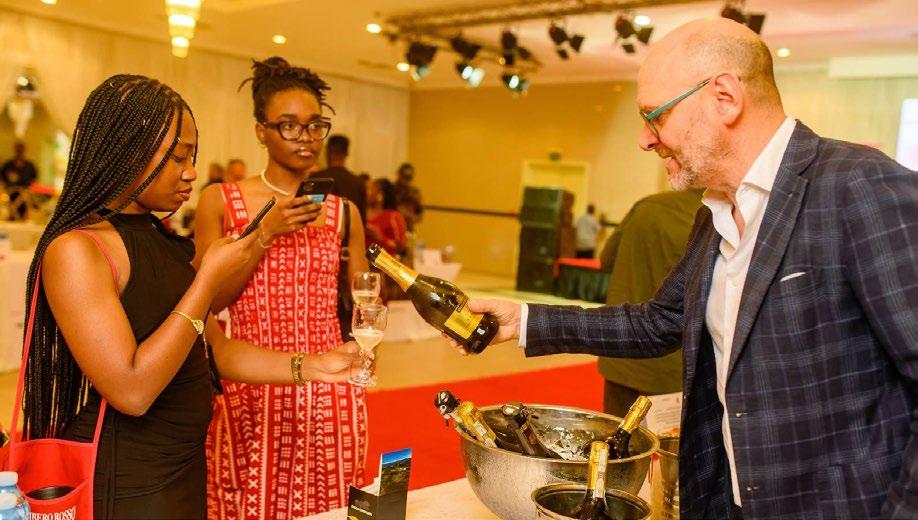
“Africa is a continent undergoing profound transformations, with demographic and economic dynamics that make it one of the most promising arenas for wine over the coming decades,” argues Giovanni Busi, president of the Consorzio Vino Chianti. “It is home to a young, increasingly urbanised population, with a growing middle and upper-middle class and rising exposure to
international consumption models.”
“For the Consorzio Vino Chianti, Africa is not a short-term gamble but a medium- to long-term strategic direction,” continues Busi. “We are fully aware that these markets cannot yet be compared to Europe or North America in terms of volume.
Precisely for this reason, however, it is essential to move now, building relationships, positioning and brand recognition. Our objective is
On the right, Giovanni Busi, president of the Cons rozio Vino Chianti
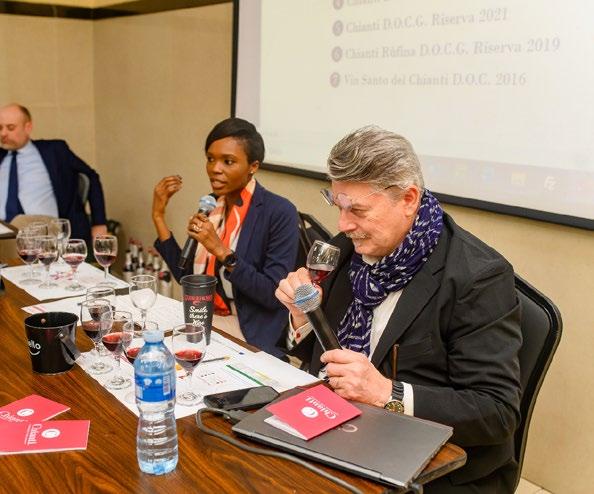
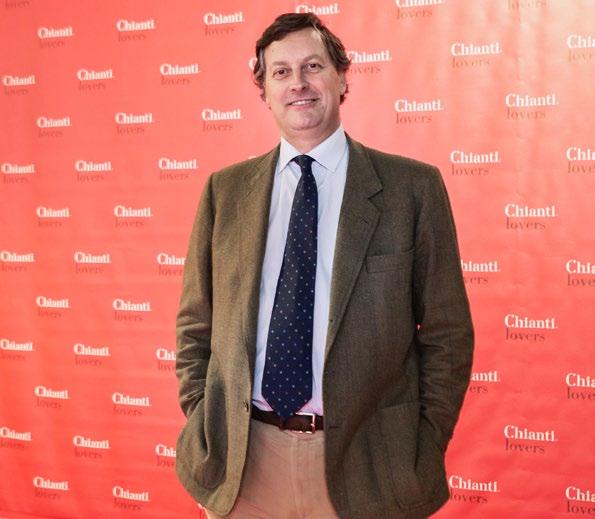
not to enter with a speculative mindset, but to initiate a gradual process: raising awareness of the denomination, explaining what lies behind a bottle of Chianti, and communicating the territory and cultural value of Italian wine. In young markets, those who arrive first with consistency and credibility lay solid foundations for the future.”
With the demand growing, Chianti has the crucial advantage of being able to supply it.
“Chianti is a broad denomination with significant production capacity and stylistic diversity, ranging from more immediate, fruit-driven expressions
to more structured and complex wines. This enables us to engage across different price segments and consumption occasions,” Busi explains.
There is also the crucial quality of Chianti’s power as a brand, with the name synonymous around the world with quality Tuscan wine.
“The Chianti brand is one of the most recognisable Italian names worldwide. Even where technical knowledge is limited, the name evokes Italy, Tuscany and quality. In emerging markets, this brand strength is a clear competitive advantage.”
Taste must be considered too. Chianti DOCG, which must be made with a minimum of 70% Sangiovese, has an organoleptic profile which lends itself to pairing especially well with spicy dishes, a trait which is highly advantageous for the Sub-Saharan table. These are gastronomic wines for an international palate.
Being one of the continent’s economic success stories of the last decade, Nigeria is on course to become the powerhouse of Africa, and where there is money and a growing middle class, a thirst for quality wine soon follows.
“Nigeria is currently one of the most interesting countries on the African continent from both an economic and demographic perspective. With more than 200 million inhabitants, strong entrepreneurial vitality and a high-spending consumer segment concentrated in major cities – starting with Lagos – it represents a compelling opportunity,” Busi suggests.
“We estimate that the potential audience for quality wine ranges between 8 and 10 million people: a limited segment compared to the overall population, yet highly qualified, with strong purchasing power, a clear preference for imported products and an affinity for international lifestyle
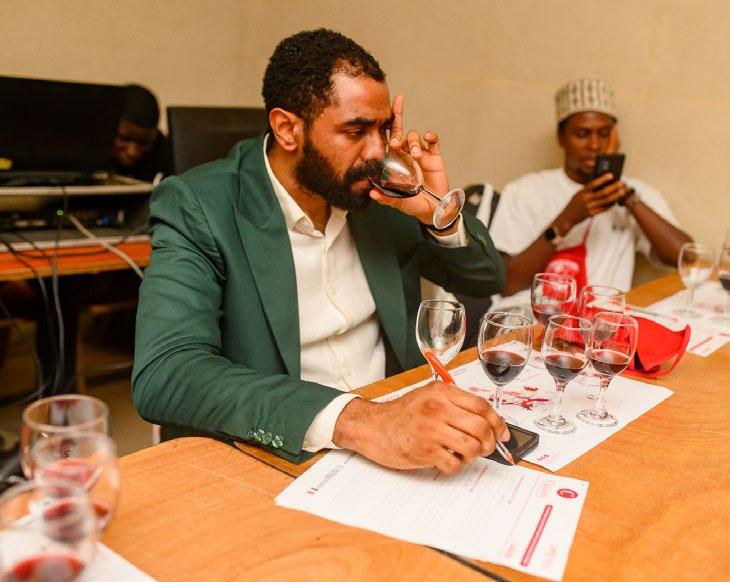
trends,” he adds. “Moreover, Nigeria acts as a regional hub. What happens in Lagos often resonates across other West African markets. Being present here means not only focusing on a single country, but beginning a dialogue with a broader region. For a denomination like Chianti, built on recognisability and reputation, this is strategically significant.”
The consorzio also believes that much of the Nigerian interest in Chianti will be driven by the younger generation – something which bucks the trend in Europe and North America of Gen Z and Millennial consumers turning away from wine.
“Consumers between the ages of 25 and 40, with high levels of education and medium-to-high incomes, are leading demand for imported wine. This is a generation accustomed to travelling, dining in international restaurants and engaging with global consumption models,” he explains. “This suggests that the issue is not so much ‘young people do not drink wine’, but rather ‘what kind of wine, and in what context’. When wine is
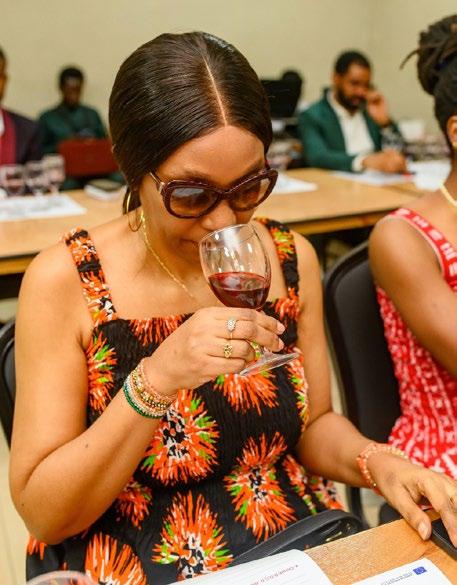
communicated in a contemporary way and positioned within an experience –whether an event, a business dinner or a social occasion – it becomes attractive to younger audiences.”
“Nigeria may therefore serve as an interesting laboratory: a young market where consumption patterns are not yet crystallised and where there is space to build a wine culture,” Busi posits. “For Chianti, which combines historical identity with a modern style, this represents a meaningful opportunity.”.
One testament to the Consorzio Vino Chianti’s commitment to growing its African presence is in its involvement with the Top Italian Wines Roadshow in Lagos earlier this year, Gambero Rosso’s inaugural event in Nigeria.
“The mission to Lagos, as part of the Top Italian Wines Roadshow organised by Gambero Rosso, marked the Consorzio’s first operational debut
in Africa with the direct participation of its member companies,” says Busi. As part of the event, there was a dedicated tasting corner featuring 13 member wineries of the Consorzio Vino Chianti, as well as a special masterclass titled A contemporary journey through the great wine lands of Chianti, which was led by Vini d’Italia guide curator Marco Sabellico.
“We arrived with clear assumptions: we knew this was a niche market, with consumption largely linked to formal occasions – galas, ceremonies, corporate events – rather than the everyday consumption typical of certain European countries. We understood that the priority would not be volume, but rather gaining insight into distribution channels, stakeholders and consumption patterns,” he explains. “Our primary expectation was to listen and observe. Engaging directly with importers, trade professionals and local media was essential in order to better understand pricing dynamics, the positioning of Italian wines and the level of awareness surrounding different denominations.”
One key observation that Busi made
from his interactions with Nigerian wine lovers at the event was “the level of attention and curiosity towards Italian wine”.
“The name Chianti is known and generally associated with Italy and Tuscany, though not always in its full articulation and complexity. This indicates that there is already a base level of awareness to build upon,” he notes. “We observed strong interest in structured yet balanced red wines, capable of pairing with dishes rich in spices and intense flavours. Notably, seasonality and serving temperature do not appear to constitute cultural barriers: red wine is consumed throughout the year, even in a warm climate. Another important factor is the emphasis on brand and presentation. In a context where wine is often linked to representational occasions, the recognisability of the denomination and the overall image play a decisive role.”
The Consorzio Vino Chianti is far from done with its efforts in Africa. After a first phase of exploration and finding where the wines from this Tuscan region might position themselves in the market, the next step is to consolidate the connections made with importers and distributors and continue to work on the communications.
“Continuity is our intention,” affirms Busi. “We do not believe in isolated initiatives. An emerging market requires consistent presence, education and direct relationships. Only through continuity can a positive first impression be transformed into a stable commercial relationship.”
And this goes beyond Nigeria – the consorzio is considering other West African markets.
“We are closely observing West Africa and certain sub-Saharan economies where the urban middle and uppermiddle class is expanding. In addition

to Nigeria, we are evaluating markets such as Ghana and Côte d’Ivoire, which show similar dynamics. We also continue to monitor countries like Kenya and Angola, where we have previously undertaken institutional activities,” says Busi. “Our criteria are clear: relative stability, the presence of a structured ‘horeca’ [Hotel, Restaurant, and Café/Catering] channel, reliable importers and demand oriented towards premium products. We are not seeking sheer scale, but environments where Chianti can be correctly positioned as a wine of quality and territorial identity.”
Although, of course, the bottom line for wine’s commercial success in international markets is determined by selling bottles, the consorzio is also keen to export something else to
Africa: an Italian approach to enjoying wine.
“For us, wine is never just a beverage: it is part of a culture of hospitality, a way of being at the table and sharing. When we bring Chianti abroad, we also bring a distinctly Tuscan idea of conviviality,” Busi explains. “In Nigeria, where wine is often associated with formal events, there is space to introduce another dimension: wine as a natural part of the meal, as a quality everyday accompaniment and as a cultural experience. Promoting Chianti also means promoting the territory from which it originates – Tuscany, its cuisine and its lifestyle. It is an integrated narrative that strengthens product perception and helps build a deeper connection with consumers.”
The opportunity is there, but one must seize it
by Marzio Taccetti
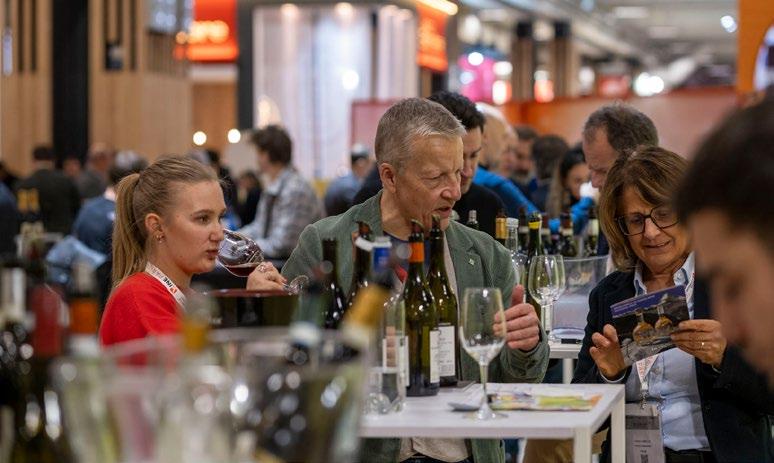
We return from Paris with a clear sense that the world of wine is anything but stagnant. It is shifting gears, and doing so at two speeds: on the one hand, there are those who complain and see everything in a negative light; on the other, there are those who invest, take the initiative and get back in the game. At the fair, there are two distinct groups: there are those who arrive prepared, with a full diary and a clear plan. And then
there are those who wait for something to happen with their arms crossed and their eyes fixed on their mobile phones. And, no, the elusive Korean buyer sent from on high to purchase half a million bottles at full price with a handshake was nowhere to be seen.
Wine Paris is growing, that much is clear, and not just in terms of
numbers. Italy is the second-largest presence after France: over 1,200 wineries, spanning more than two halls, with cohesive consortia and strong collective groups. Participation is becoming increasingly structured and organised, with the most important appellations able to work together as a unified whole — Franciacorta, Chianti Classico — and present themselves with a recognisable identity. And then there is Paris. Italians want to come here not just for business. For the city, for the atmosphere, for the very idea of being there, with the usual joke about how ugly Düsseldorf is. This matters more than people realise. The fair is practical and is located within the city; transport is efficient, flights run continuously every hour, and hotels are still affordable. For €150 you can find a decent double room, about a third of the price compared to Verona and Düsseldorf during trade fair days.
Tuesday was the real day of the fair: fairly busy aisles, a packed schedule of meetings, and well-defined buyers. Admittedly, there was no euphoria, but several producers spoke of a recovery as early as December and January. Not everyone, however, was moving at
the same pace. A fair like this requires preparation: meetings are arranged in advance, wines are selected with care, and a presence is built up gradually. Attitude, at this moment, carries as much weight as the quality of the product.
The main complaints came from Hall 2.1, where many Italian companies were concentrated; the lack of adequate facilities — including toilets — caused quite a stir. Details? To a certain extent, the location at the bottom right is certainly not the best. On the food front, Wine Paris’s offering is always rather sparse and poorly organised. It is a trade fair, but a little extra care wouldn’t go amiss. A precooked carbonara isn’t exactly the best calling card for those talking about gastronomic culture. At a wine fair, food cannot be merely an afterthought. A certain French shrewdness was also evident in the management of the balance. Our Tre Bicchieri event, the only official tasting in the French pavilion, was once again scheduled for the final day. First you look after your own house, then you make room for others: it’s understandable, but it speaks of a clear hierarchy. Alongside Tre Bicch-
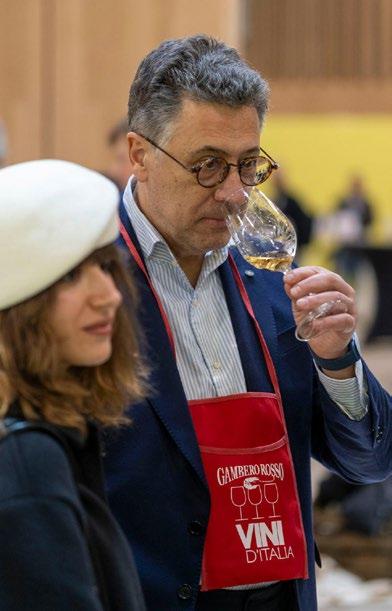
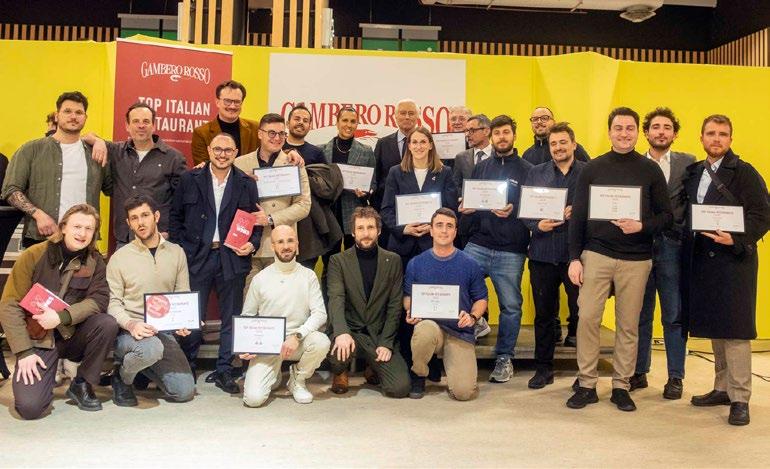
ieri, the city’s best Italian restaurants were celebrated, 14 establishments that showcase our flavours in fine style. The seminars at the fair, like the conferences, are particularly well attended. The Rare Wines tasting, for example, sold out in a matter of days: 50 places, over 130 requests. The tasting of 11 rare wines highlighted new trends, unknown varieties such as Vitrarolo, and extremely long ageing periods. When the content is solid, the response follows.
After seasons marked by stylistic extremes, moderation is back. In Champagne, dosages are more balanced, acidity is better integrated, and reserve wines play a more harmonious role; the sharp edges of a few years ago are no longer evident.
In macerated whites, from Long Island to Australia, from South Africa to Italy, extraction is more measured. Less intense colours, restrained maceration, less of a desire to impress at any cost. The identity remains, but the tone is more balanced, and there are fewer wines so light as to be almost intangible. And then there is the immediacy. Many wines are more accessible, more approachable from their early years; we have tasted many: it is not just a matter
of climate, it is an adaptation. In this sense, the 2023 vintage in Bordeaux is exemplary. Wine is facing a society that moves fast and is shortening the distance between production and consumption. And one that no longer has much desire to wait.
And awareness is growing among producers: we must work on communication, a mantra at the fair. The need to attract, to spark curiosity, to engage in dialogue rather than explain: fewer lectures and more horizontal communication, precise yet streamlined. A different model comes from the world of spirits; it is no coincidence that the Be Spirits pavilion was the most visited at the fair, with an average age significantly below the average. Business was punctuated by music and ice in the glasses. Wine Paris clearly captured a transitional phase. The market is moving at two speeds: those who invest and build are accelerating, whilst those who stand still are losing ground. The Italian wine sector still has significant potential, particularly outside traditional markets. The contacts established in Nigeria and Kenya during our Top Italian Wines Roadshow demonstrate this: diversification is a necessity. There is room for growth; one must know how to seize it.
Italian wine in Trump’s America. The Gambero Rosso tour: four successful stops in a complicated moment - for the US and for the world.
by Marco Sabellico
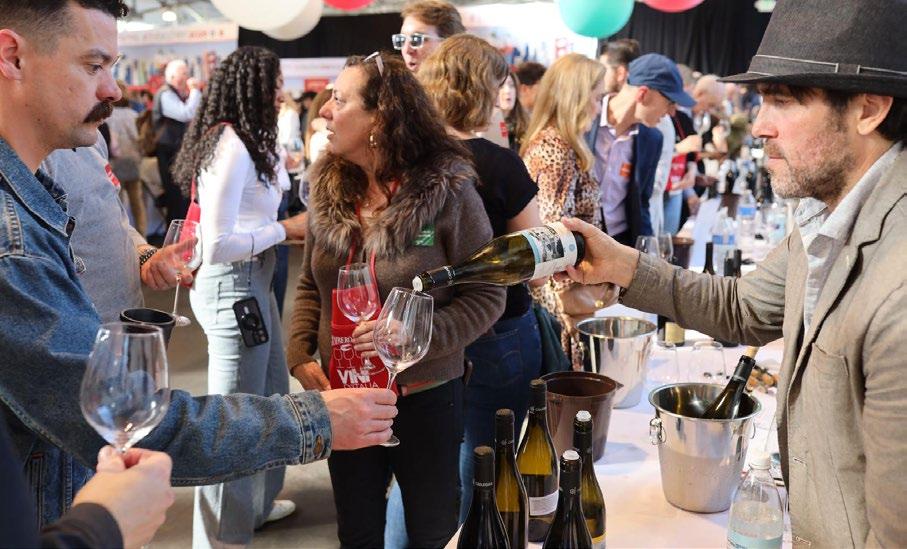
The Gambero Rosso tour kicked off in Los Angeles on February 24 at City Market Social House, in the heart of the Fashion District in Downtown LA, just as in past editions. The tried-and-true playbook saw more than 50 producers on hand, with Unione Italiana Vini as special guest. From 1 p.m. to 5 p.m., it was the usual celebration of Italian wine, with distributors, importers, sommeliers, and restaurateurs packing the big hall. It was also an important chance for us to meet the trade and take the market’s temperature. “It’s a difficult moment - no point pretending otherwise,”
says Dominic Nocerino, the owner of Vinifera Import, who flew in from New York for the occasion. “I’ve been in the business for 50 years. If I had to start today, I’m not sure I could make it. Costs have multiplied - from shipping to rent - not to mention the duties and excise regime, which brings uncertainty every day, and always rising costs. We’re a solid, structured company; we invested in infrastructure years ago and have excellent relationships with our producers, who are top-tier names in Italian wine. Above all, we have deep inventory of great vintages, which lets us smooth pricing. But I see a sector under strain, especially for small and
newer firms.” So what do you do?
“We organize tastings for top clients together with restaurateurs, pulling corks on great bottles from excellent vintages. And that’s where we sell a lot. The restaurateur is happy; the customers are happy. But it takes skill, energy, and resources. When consumption is flat, you have to be proactive - get out there, meet consumers, create the occasions.”
On politics, he won’t stick his neck out - like most others, frankly. Even though we’re in a blue state and a blue city, nobody tackles the topic head-on, not even when asked directly. Crazy is the word that crops
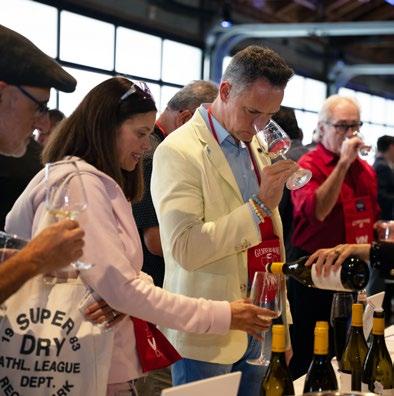
up most often, but never pinned to anyone: crazy moment, crazy situation, crazy market. Heads shake, eyes roll skyward, faces grimace. Only cabbies and Uber drivers, reassured by our Italian origins, let slip sharper remarks. The conflict in Iran has just broken out - a war no one here wanted and which - despite official assurances - risks dragging on. “They knew it would happen and had been preparing for twenty years,” says Salman, a Saudi Sunni with no love for Iran. “They’re ready for a long war of resistance, they’ve stockpiled resources, they have strategies.” When we point out that the theocracy’s leadership has been decapitated, he cuts in: “They planned for that too.”
Dining in Los Angeles can be demanding - especially in the mid-to-high range - if you can find a table. During the three days we spent at Hollywood’s feet, reservations were actually easy, from pizzerias to ethnic spots to fine dining. Not the usual crowds; lots of beer and cocktails on tables, and fewer bottles of wine than usual. Italian dining, however, is going strong.
Two days later, on February 26, we were in San Francisco under glorious sunshine. The city feels on the upswing compared to recent years, likely thanks to the new mayor, Daniel Lurie, who’s polishing it up and leaning hard into welfare and public safety. The Festival Pavilion at Fort Masonright on the Bay with a spectacular sweep from the Golden Gate to Alcatraz and Sausalito - was the setting for the event, now a classic for enthusiasts who come not only from other California cities but
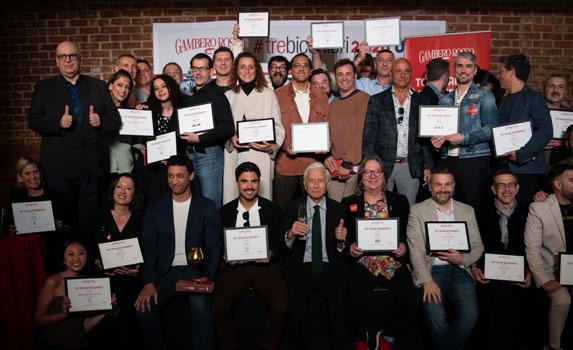
LA’s tricolore dining scene has always been especially influential. In the shadow of the Hollywood studios, thanks to the work of countless Italian professionals over the years, a new cuisine took shape—Italian in flavor yet Californian in its local ingredients and sense of composition. It’s Cal-Italian: a style that ranges from serious pizzerias to fine dining, acclaimed by critics and embraced by diners.
In Los Angeles, no fewer than 30 venues earned awards from the Top Italian Restaurants in the World guide, with entries also from San Diego, Glendale, and Coronado. Standout performances included Nardò (Tre Spicchi, from Culver City), Drago Centro, and—from San Diego—Solare (Tre Bottiglie), plus Tre Forchette winners Dora in San Diego and Felix, which also received the Italesse prize for Best Italian Wine List. “Italy is holding up,” says sales agent Martin Holland. “Pizza and pasta are strong, and fine dining is holding its own.”
Italian restaurants are a core pillar of LA’s dining landscape—socially, culinarily, and economically. Call it the UNESCO “Intangible Cultural Heritage” effect if you like, but in truth, Italian gastronomy is in Americans’ hearts. And after a carbonara and a couple of glasses of wine, it’s easier to feel a bit more optimistic about the future.
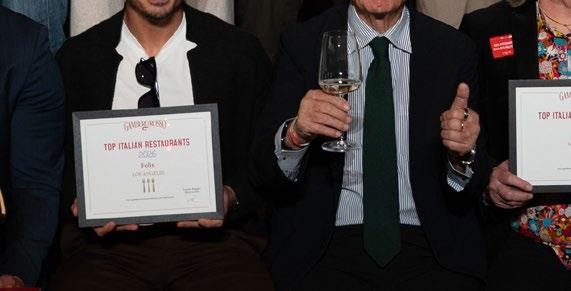
also from neighboring states - Texas, Oregon, Nevada, Arizona. It’s long been “Italian Wine Week.” “This isn’t a time for victory laps,” says importer Lorenzo Scarpone of Villa Italia. “The most exciting years are behind us. Gen Z drinks less than Gen Y, and the one-two punch of tariffs and devaluation has pushed costs up over 35%.” Who’s paying, we ask. “A few producers are meeting us halfway, but most of it lands on us importers. At first we thought these measures would be short-lived; not so. Meanwhile a lot of jobs are being lost - in administration and in the service sector. Some large distribution
companies are closing. And that depresses consumption. I don’t want to be combative with this administration, but…” But… Italian wine is holding on. We’re evidently more deeply woven into consumption habits, offering value, diversity, and an appealing, healthy image of balanced, mindful drinking. The trade confirms it. In a landscape where France is slashing prices and other competitors are struggling, Italy is holding - even against California. “More than 40 significant wineries are up for sale here in California. Even Gallo and Kendall-Jackson have put some brands on the block. That’s never happened before.
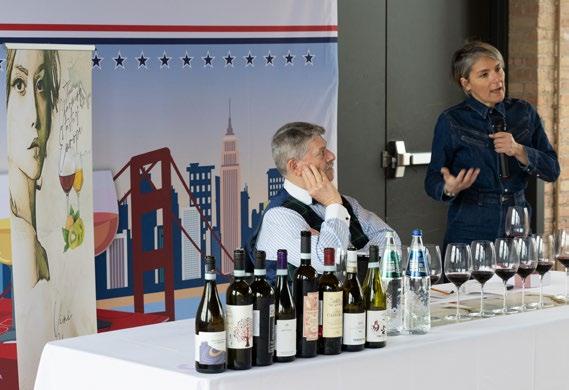
The guided tastings exploring Abruzzo’s signature wines - organized in collaboration with the Consorzio Vini d’Abruzzo - were a smash hit at every stop. It began in San Francisco, where the protagonist was Abruzzo Pecorino, a wine enjoying growing success in this market thanks to its nervy freshness, its wealth of herbal and citrus tones, and its dry, mineral profile. Seven Pecorino - ranging from IGP to Colline Teramane to Superiore - were poured across two vintages, 2005 and 2004, to gauge how the wine holds up over time. “It’s a fascinating wine that tells the story of Abruzzo in white, complementing the classic, well-known Trebbiano,” says sommelier Kirsten Szolti. “It faintly recalls Sauvignon, but it’s another magical native Italian grape that marries beautifully with Mediterranean cuisine and beyond - raw fish, shellfish. It’s got character.”
Nine excellent Montepulciano d’Abruzzo across vintages from ’24 back to the superb ’18, from various terroirs around the region, captivated palates at the Chicago event. The masterclass ranged from vineyards near the coast to those on the slopes of the Majella and Gran Sasso, from the Colline Teramane to Casauria. A fleshy, savory, full wine with noble tannins that ages elegantly. “A classy red that speaks to different terroirs while retaining a generous, sanguine, deep character,” says sommelier Martin Hancock. “Ideal with grilled red meats and the rich, spicy dishes of American tradition.” Finally, in New York, Cerasuolo d’Abruzzo took the stage: eleven labels across three vintages, from ’25 to ’23. Sarah Friedman, who works in a Brooklyn wine shop, notes: “Rosés are growing; they sell well. Cerasuolo sits on the borderland between pale, French-style rosés and red wines, but it has its own Mediterranean charm. It’s intense and delicate at once - the other face of Montepulciano. Exceptionally versatile at the table, it ages well. That’s the secret of its success.”
$100-plus California bottles no longer move easily,” concludes Paolo.
“Montepulciano d’Abruzzo, Chianti and Chianti Classico, Piedmont, Friuli, and Sicily, on the other hand, are steady.
Consumers choose reliable quality and watch
the price. All we can do now is wait for the midterms - and hope.”
The day flew by. The masterclasses by the Consorzio Vini d’Abruzzo (star: Pecorino) and by Unione Italiana Vini on Denominations of Origin (featuring seven excellent
wines) both sold out, as usual. Then Top Italian Restaurants brought another thirty fine names on stage, confirming the robust health of Italian dining: Tre Spicchi once again to Montesacro; Tre Cornetti (translated in the US as Croissants) to Emporio Rulli; Tre Bottiglie to Donato Enoteca in Redwood and to A16 - the inimitable Shelley Lindgren, a Knight of the Italian Republic, front and center. As for Tre Forchette, Belotti from Oakland and, another major confirmation, Acquerello, which also took home the Italesse prize for Best Italian Wine List. If Italian wine is holding up despite tariffs and wars, much credit goes to them - the professionals of the kitchen. The moment isn’t easy; a walk through California streets and the graffiti and street art on the walls make that clear, with ICE and the presidency frequent targets of jokes and jabs. But as Dolores, another driver (half Puerto Rican, half Nicaraguan), puts it, “Todos locos… We’re all waiting for the midterms!” The tour rolls on: next stop, Chicago.
On March 3, Chicago greeted the Tre Bicchieri producers with brilliant sunshine and far milder temperatures than in previous weeks. Once again, the Bridgeport Art Center opened its halls to the very best of Italian wine - and to a crowd of enthusiasts and trade professionals even larger than in past years. “Italy is on a roll,” says Dwight Casimere, the Windy City’s veteran wine critic, also known as The Wine Doctor. “And it’s especially the younger generation that’s getting into Italian wines today. They’re always looking for something new - and what beats Italy, with its thousand native grapes? Every label brings a new taste, a new aroma, a new discovery. Of course, the classics are the classics, but in a market that’s hardly booming, you’ve got a big edge…”
The day’s flow inside this converted industrial space - now a venue

for art and major events - proved him right. It began at 11 a.m. with a packed masterclass on Montepulciano d’Abruzzo, to the delight of the Consorzio Vini d’Abruzzo - special guest of the day - and the nine producers who poured their excellent wines. “Montepulciano d’Abruzzo is an Italian classic, and for both quality and value it’s a best-seller in this market,” says Colin Proietto of Agricosimo in Villamagna. “But like all wines, it needs to be told - its land needs to be told. Events like this are essential to cement its success.”
“Markets need to be looked after, especially in a delicate moment like this,” echoes Valentina Di Camillo of I Fauri. “By being here, we’re also backing our importer’s and distributors’ commitment. It’s crucial.”
“Wine is a tradition here in Chicago,” Dwight continues - he also writes a weekly column for The Times Weekly - “at home and in restaurants. The weekend lunch at the Italian trattoria with the whole family is a ritual. That’s why consumption holds up - Italian wine in particular. There’s always been a strong Italian-American community here, with specialty stores, restaurants, and pizzerias. It’s tradition.” We venture a question about health fads, Dry January, and the calls to avoid alcohol.
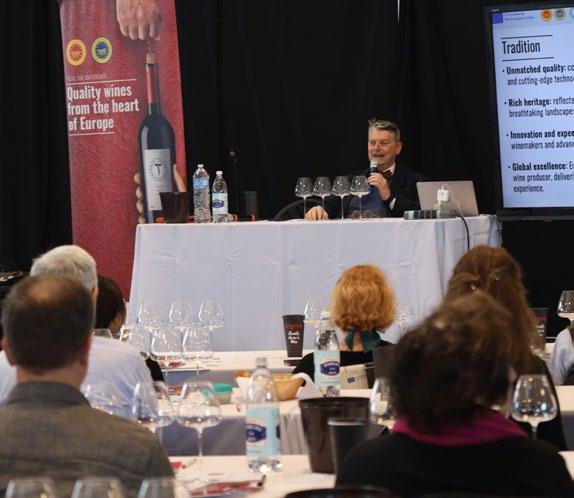
Gambero Rosso - in collaboration with Unione Italiana Viniexplains Europe’s system of wine designations of origin.
DOC, DOCG, PDO, PGI… What do these acronyms mean? While Europeans are fairly familiar with them, international consumers often aren’t, and may not know EU rules on labeling wines and typical products. Hence Taste the Difference, a three-year program funded by the European Union to build international consumer awareness of the wine appellation system and the guarantees EU law offers. Unione Italiana Vini (UIV) is Italy’s leading wine-industry association. Founded in 1895, it has spent more than a century protecting and promoting the interests of businesses across the supply chain, acting as an authoritative interlocutor with national and European institutions and as a technical and strategic reference point for companies. Together with PRODECA (Promotora d’Exportacions Catalanes), it tasked Gambero Rosso with delivering EU-cofunded masterclasses in China and the United States. After last year’s success in Chengdu, it was the United States’ turn, with two packed sessions - one in San Francisco and one in New Yorkheld during the Gambero Rosso Tre Bicchieri tour. Marco Sabellico led trade professionals to a deeper understanding of EU rules, illustrating them with on-screen educational materials and through a tasting of a wide range of DOCG/DOC (PDO) and IGT (PGI) wines. Participants became familiar with the core concepts - quality guarantees, food safety, traceability, authenticity, and sustainability - that underpin Europe’s designation system. All of this was reflected in the tasting lineup: from Conegliano Valdobbiadene to Trentodoc, from Soave to Sicilia Grillo to Vermentino di Gallura, up to major reds like Alto Adige Pinot Nero and Montefalco Sagrantino. “If you work in wine, mastering these concepts matters,” said John Flanagan, an instructor with the American Sommelier Association, “especially if you’re involved in education.”
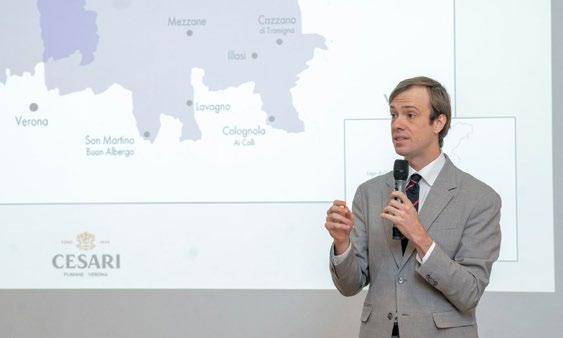
Gerardo Cesari is one of Valpolicella’s most important wineries. Founded in 1936, today it farms 140 hectares of vineyards and produces wines of outstanding quality centered on Veneto classics, successfully exported worldwide. One of the most anticipated moments of the New York Tre Bicchieri event was the vertical dedicated to its most iconic label, the Amarone Riserva from the Bosan vineyard. Marco Sabellico and the winery’s brand ambassador, Nicolò Maroni, guided an intensely focused audience down the rows of Valpolicella Classica to the celebrated Marano cru - 500 meters above sea level - planted to Corvina, Corvinone, and Rondinella (average vine age: 40 years). From these vines, since 1997 and only in the best vintages, the estate has crafted a wine of absolute prestige. In quick succession, six vintages - 2000, 2001, 2003, 2006, 2015, and the current release, 2016 - allowed the audience to delve into the techniques of grape appassimento and the winemaking behind this famed wine. It was a remarkable arc of flavor, with 2001 and 2016 - the latter a Tre Bicchieri winner - standing as the high points.
“Forget it - that’s MAGA folks. Chicago loves wine. Italian wine especially.”
“We’ve got a teetotal president - who, among other things, owns a winery in Charlottesville, Virginia - and he uses tariffs to strong-arm Europe,” says a trade insider who prefers to remain anonymous. “But for us, wine is culture and tradition - and it will stay that way.”
The day peaked with the Awards Ceremony honoring Chicago’s best Italian restaurants, who turned out in forcefrom pizzerias to full-service restaurants to wine bars. It was a wonderful stop on the tour, where some seventy Italian producers - despite the season - were warmed by an exceptionally warm welcome. We felt right at home.
New York, New York…
Two days later, on March 5, came the Big Apple - the historically most important stop on our American tour. There was a huge turnout of producers (over 130) and public at the Metropolitan Pavilion on 18th Street in Chelsea, in the heart of Manhattan. This is the USA’s most important market and, even if the moment isn’t exactly shiny, optimism wins out in the end. “It’s not an easy time for restaurants,” says Jill, a restaurant manager - then adds that, truth be told, she’s never seen truly easy times in her long career. She points to the immigration squeeze, which deprives hospitality of resources - both staff and guests. “But it’s a passing phase. This is America, and we’re optimists by nature.”
The day kicked off with masterclasses. At 11 a.m., a vertical of Amarone Bosan by Gerardo Cesari drew a full house. “Another beautiful experience with Gambero Rosso,” notes Nicolò Maroni, the winery’s brand ambassador, who led the tasting with Marco Sabellico. “This is exactly the kind of outreach we need: speaking, glass in hand, to the people who will, in turn, communicate the wine to diners - on the floor, on the list, and online.” With Unione Italiana Vini, there was another session
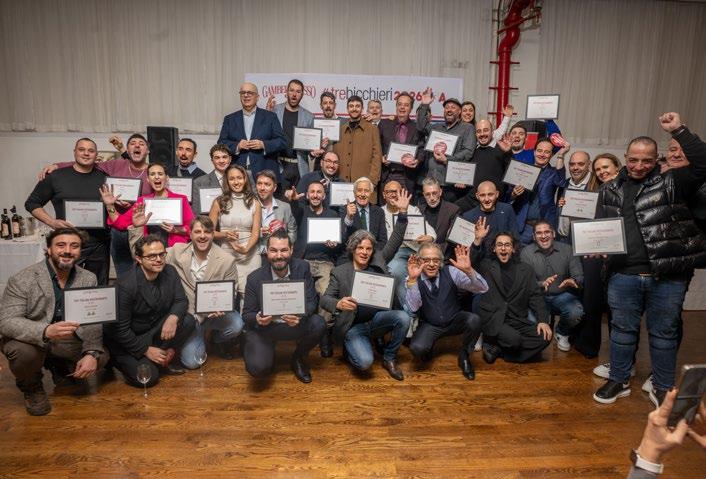
dedicated to prestigious labels and a clear framing of Europe’s designation-of-origin system - Italy’s in particular - and the guarantees that the EU and the state provide consumers through PDOs and PGIs. Finally, the Consorzio Vini d’Abruzzo entrusted Gambero Rosso with the masterclass on Cerasuolo d’Abruzzo. It was, as expected, a smash - thanks to this wine’s fast-rising popularity in the US market and to the quality of the 11 labels poured, which showed how a fine Cerasuolo goes well beyond the classic two years from harvest and pairs brilliantly with a wide range of cuisines, not just Italian.
Italy enjoyed a moment of great public participation during the impressive Awards Ceremony as well. The recent inclusion of Italian cuisine in UNESCO’s Intangible Cultural Heritage list has filled Italians with pride - especially the forty restaurateurs honored, some of whom came from Boston, Philadelphia, and even Santo Domingo. Among the standouts: Tre Cornetti to the New York outpost of Rosetta Bakery; Tre Spicchi to pizzerias Song ’e Napule and Ribalta; and Tre Forchette to La Devozione, Sistina, and Lucciola - spectacular examples of contemporary Mediterranean Italian fine dining. “Italian wine has a special allure,” says Dan Hertz, a Canadian sommelier newly relocated to New York. “They’re stories of growers and families, of places with a calling - stories that always captivate. And if there’s a global wine glut relative to consumption, authenticity will be what survives: those with a true story to tell, something genuine - not industry. The other day yet again, an Italian wine won me over. In 35 years in the trade I had never tasted a Bianchetta from the Val Polcevera - near Genoa. What a marvel.”
“It was a fantastic event again this year,” says Michael Pereira of Empire Imports. “And the New York market is in great shape - especially for Italian wines. Today I discovered some truly top-class producers
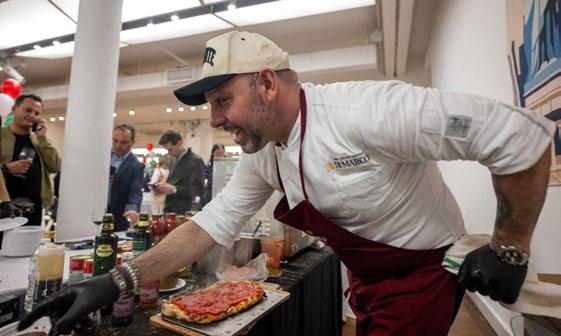
At the Tre Bicchieri Tour events in Los Angeles, San Francisco, and New York, Gambero Rosso found an outstanding partner in Di Marco’s Pinsa Romana - an Italian company that has now won a strong following in the USA as well. Pinsa dough is made from a blend of wheat, rice, and soy flours, leavened with sourdough for 72 hours. Then it’s strictly hand-shaped: pressed with the fingers to form its trademark bubbles and given its distinctive elongated oval form. Di Marco successfully markets its base pinsas in various formats, chilled or frozen; after just a few minutes in the oven, they’re crisp and flavorful, as if freshly baked. “Pinsas are low in fat and sugar - so fewer calories and highly digestible - and you can top them with everything from the classic Margherita to more exotic combinations,” says Lorenzo Lietti, Di Marco’s US Regional Sales Manager, who joined Gambero Rosso on tour. “Split open, they can also be filled with cured meats, vegetables, and cheeses.” Lietti’s team worked wonders: with portable ovens, they gave the pinsas their final bake and added toppings, serving up delicious slices to the hundreds of attendees at each event.
I hope to import.” We ask whether excise and international tensions are hitting sales hard. “In the end, we found a balance with producers; retail price increases have been minimal. Of course, you have to be proactive and engaged with customers and consumers. But the results come.”
We leave the Big Apple satisfied and optimistic. Four major American cities welcomed us with warmth and enthusiasm, and Italy’s producers headed home reassured after months of uncertainty. There are challenges in the international marketplace, the United States included. But nothing that can’t be overcome with a bit more sacrifice and hard work. We
choose to believe it - and in these four stops we saw more light than shadow. “It’s the biggest market in the world,” Dan - the Canadian sommelier who chose New Yorkreminds us. And if you can make it here, you can make it anywhere, we add, quoting The Voice. It’s up to you. And that goes for everyone.
At the close of the tour, our thanks go to the sponsors who traveled with us: Pulltex, with its excellent corkscrews; Acqua Smeraldina from Sardinia’s extraordinary springs; Di Marco, with its delicious Pinsa Romana in Los Angeles, San Francisco, and New York; and Italesse, with its beautiful glassware in San Francisco and Los Angeles.
Düsseldorf is scaling back the trade fair and focusing on quality and concrete business: fewer exhibitors, fewer visitors, but more targeted meetings. Meanwhile, the rivalry with Paris is intensifying and a new phase is beginning
by Lorenzo Ruggeri and Marzio Taccetti
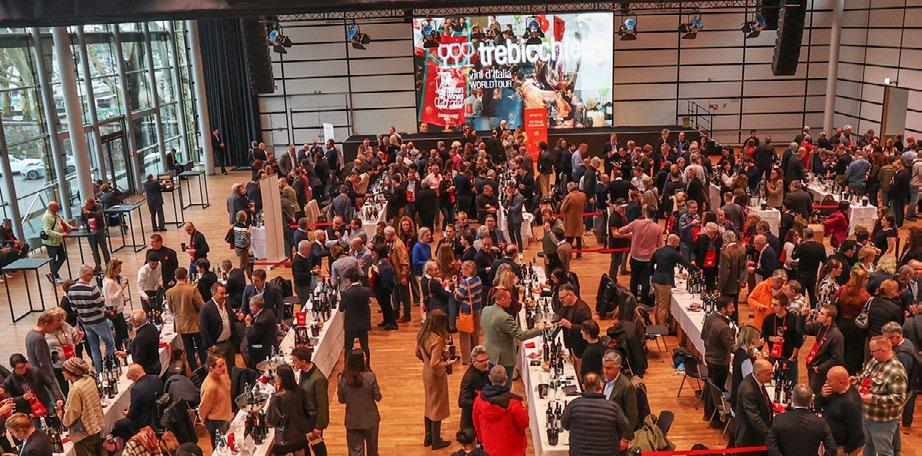
The trade fair in Düsseldorf is attempting to reinvent itself. And, for once, it admits as much. The official press release speaks openly of a market in consolidation, of the need to “refine its
profile” and make the fair more useful for real business. This transition also involves a change of leadership. Frank Schindler, an industry insider, took up his post in October 2025, having been appointed specifical-
ly to refocus the fair’s identity and purpose. “We cannot afford to rest on our laurels from recent years: our ambition is to constantly develop ProWein, decisively strengthening its relevance for the trade and for de-
cision-makers. We want to make the fair increasingly a practical business tool, more targeted, more efficient, capable of truly responding to the needs of the market.” Translation: something was no longer working.
The downsizing was evident, and the figures clearly show a reversal in growth. In 2026, the number of exhibitors fell to around 3,400 from 63 countries, compared with 4,100 in 2025. Visitor numbers were also down: 31,000 from 105 countries, compared to around 45,000 last year. However, this is not necessarily a bad thing. ProWein has gone back twelve years. It is more compact, less sprawling and without that sense of desert-like desolation that pervaded the last edition. Smaller halls, fewer wasted kilometres, more focused meetings, but a far cry from the commercial enthusiasm of that time. Before, things were growing; now they are shrinking. You can sense it even outside the fair: the same hotel as last year cost us around 40% less. Less speculation, at last. But also less pressure and international spirit.
Behind the scenes, the organisation is holding up, helped in part by the figures. The matchmaking app is
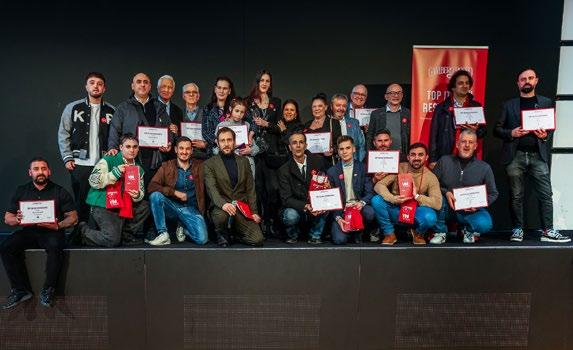
During the event, the latest additions to the Top Italian Restaurants guide were celebrated, with three new entries (Piazza Sorrento – 1 Segment, Prinzinger by Saittavini – 2 Bottiglie and Cecino’s – 1 Forchetta) among the award winners, confirming that Italian dining in Germany is on the rise and has considerable room for improvement. Among the award winners are: Thewaytonapoli in Düsseldorf (1 Spicchio), Piazza Sorrento in Krefeld (1 Spicchio), Ristorante Scala in Hagen (2 Spicchi), and established names for their wine lists such as Saittavini in Düsseldorf (3 Bottiglie). On the dining front, awards also went to L’Arte in Cucina and Piazza Saitta (2 Forchette), alongside an ever-expanding network of reliable establishments across Düsseldorf, Cologne and Wuppertal. Rounding off the programme was the seminar dedicated to Valtènesi. A masterclass designed to compare the subtle and elegant Groppello-based wines of Lake Garda with those of Provence in a direct and unfiltered dialogue.
working (over 70,000 matches made).
On the final day, with the transport strike – now something of a tradition – the organisation springs into action: shuttle buses, taxis, Uber, the airport just twelve minutes away. But there are “gaps”. Sunday and most of Monday go well; the final day is good for card games.
The comments from the exhibitors capture the spirit of this year’s event.
For Paolo Pasini, president of the Valtènesi Consortium, the fair remains a key event. «The link between Lugana and Germany is extremely strong, and on the first day in particular we made many contacts, including new ones
from Northern Europe, especially Belgium. We will definitely be back» Alessio Planeta, of the winery of the same name, offers a clear picture of the latest edition. «It’s an increasingly smaller and more local fair. Paris is growing, here it’s shrinking. It’s a complex time, but the direction seems clear». Meanwhile, for Hans Rebhholz, «In Paris, you’re just one of many. Here, as a German producer, you’re at the centre, the main focus. We took part in Wine Paris for the first time and were moderately satisfied: the next two editions will tell the whole story of the rivalry». And that is, in fact, where the game will be played.
Düsseldorf is no longer the global showcase it was a few years ago, but it remains strategic for markets crucial to Italian
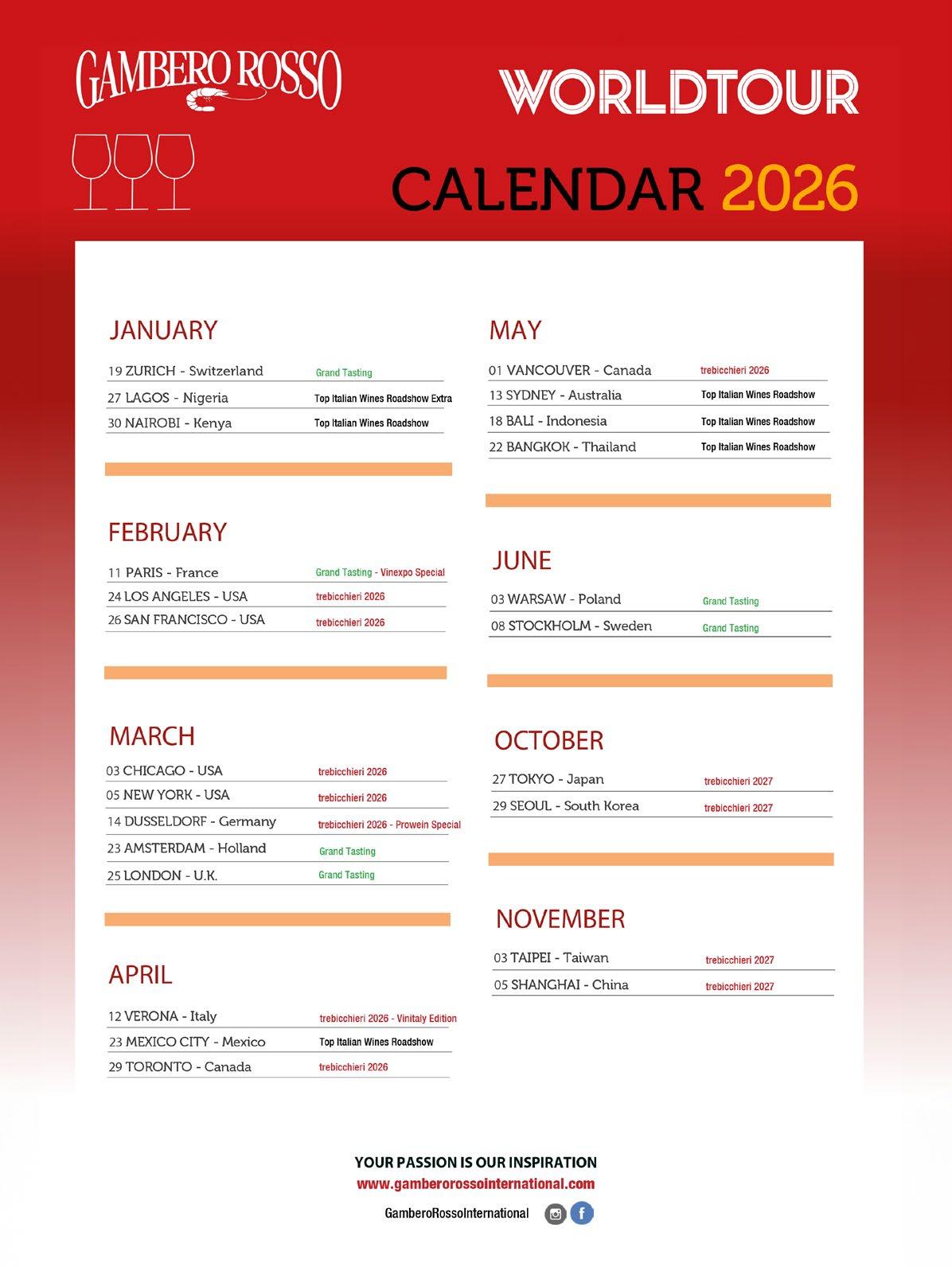
wine: Germany and Switzerland above all, yet it has realised it must change. And there are some signs of this. Sandro Bottega adds: «We’re here, we’ve worked hard and we’ll be back, but it’s certainly not a thriving fair,» he says whilst jokingly haggling with American importers. Finally, a comment that puts everything into perspective and sends a shiver down the spine. «It took us two days to get to Düsseldorf because of the missiles», says Victoria Agromakova of Wines of Ukraine. «Some historic wineries have been bombed; we spent half the winter without electricity. But we want to move forward, and the delegation of ten producers proves it».
The problem is structural at this delicate stage in the business. Three trade fairs in quick succession – Paris, Düsseldorf, Verona – are too many. They wear companies and people down. And more and more industry professionals are starting to make a choice. The emotional choice is easy: Paris. Deep down, everyone wants to be under the Eiffel Tower. But at some point, you have to face the facts. Paris continues to grow; it has embraced the international spirit of ProWein from its heyday, but risks falling into the same traps: expanding to the point of becoming unfocused, losing control, and turning into an endless showcase with a highly fragile exhibitor-to-visitor ratio. Düsseldorf, on the other hand, is returning to what it was over 10 years ago: a European trade fair, strongly German in character, significantly less global in terms of both the participating wineries and the trade visitors. All things considered, ProWein 2026 went slightly better than expected. Expectations were at their lowest in the last 20 years.
Attendance was decidedly high, better than in Paris, for our Tre Bicchieri event on Saturday 14 March at the Rheinterrasse, which featured no fewer than 100 award-winning wineries.
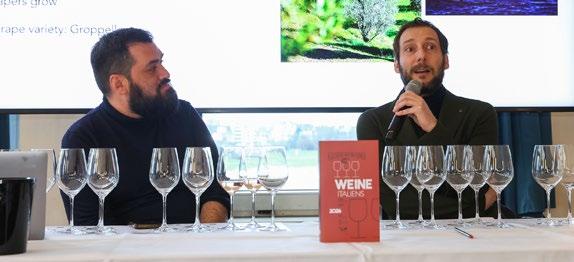
Valtènesi, which has long been engaged in a quest to define its identity with ever-greater precision, finds in this latest vintage a compelling balance between freshness and structure. The profile is particularly distinct: clear aromatic notes, subtle textures and a flavour progression that focuses on tension and fruit. The 2025 vintage is based on a concept of contemporary elegance, and an increasingly marked stylistic consistency emerges: delicate colours, aromas of small fruits and citrus, savoury, dynamic palates capable of lingering naturally. It is no coincidence that this greater awareness is also reflected in the way the appellation presents itself on international markets. During the latest edition of Prowein, a dedicated masterclass provided a valuable opportunity not only to discuss the vintage but also to compare the wines with those of Provence, thereby highlighting the stylistic evolution of these Italian rosés. This was complemented by a dedicated stand at the Tre Bicchieri event, which helped to boost visibility and recognition among trade professionals and the international press.
In particular, the German market remains one of the most promising for this style, with demand increasingly focused on fresh, terroir-driven wines with a gastronomic profile. Perhaps the most interesting finding, however, is the widespread sense that the system has reached maturity. Not just in terms of climate or production, but culturally. Today, Valtènesi seems less inclined to chase external models and more focused on promoting its own distinctiveness: that of a region capable of producing wines of precision, characterised by balance and distinctiveness.
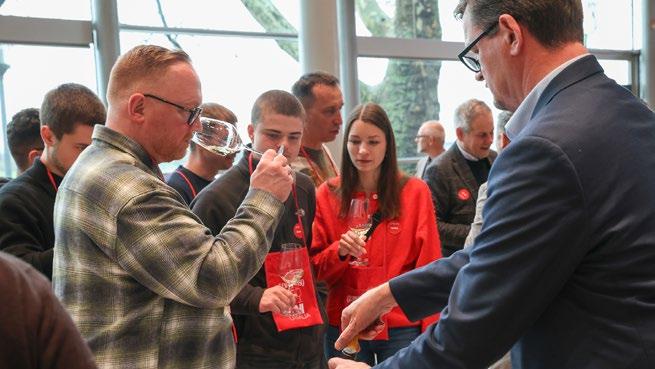
by Marzio Taccetti
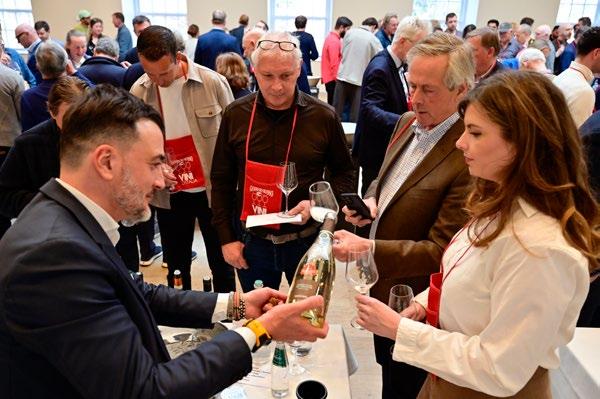
Drink less, drink better.” This was the guiding thread behind Gambero Rosso’s return to Amsterdam. On March 23, at the H’Art Museum, the Dutch stop once again connected Italian wineries with local professionalssommeliers, importers, and restaurateurs - in a market that increasingly shows the potential to become more relevant for Italian wine.
From the masterclass to the walkaround tastings, the day offered a direct exchange with a competitive yet still receptive market.
The international backdrop, however, weighs here as well: geopolitical tensions, shifting trade flows, and declining consumption. According to Michele Conte, founder of LaurusVini and an Italian wine importer in the Netherlands, Northern Europe could represent a real opportunity - provided produc-
ers avoid unfocused oversupply. The direction is clear: sustainability, identity, and coherence are no longer optional. “There is a move toward premium positioning,” he concludes, “but also greater awareness.”
That Amsterdam is a dynamic market is widely acknowledged. But dynamic does not mean easy.
Conte describes it as “highly competitive and reactive,” yet already saturated in several segments. The key is not simply entering the market, but identifying a precise space. “It’s not enough to offer a good wine: you need a story, a territory, a credible reason to earn a place on an already crowded wine list.”
A case in point is Grignolino d’Asti,
a relatively unknown grape in the Netherlands, which Conte successfully introduced by focusing on drinkability and its alignment with more contemporary consumption trends. “Today, the game is played at the intersection of drinkability and storytelling.”
Feedback from operators paints a clear picture: the Dutch market remains strongly oriented toward value for money.
Romke van Dijk (Romke’s Wijn En Spijs) confirms that the average consumer buys mostly in large-scale retail, where wine is chosen for price, accessibility, and label appeal - often below the € 11 mark. “Easy, fruity, straightforward wines perform well here.”
Alongside this broad segment, however, a more interesting niche is emerging: a smaller but growing group of enthusiasts looking for identity, territories, and producers. “They are willing to spend, as long as they find authenticity and coherence,” van Dijk notes.
Wine educator Martin Rijxman shares the same view: “Many people buy what they already know. But there is a segment that wants to understand more.” For these consumers, wine becomes a cultural experience: “Story, terroir, and food pairing all matter.” A field where Italy continues to hold a clear advantage.
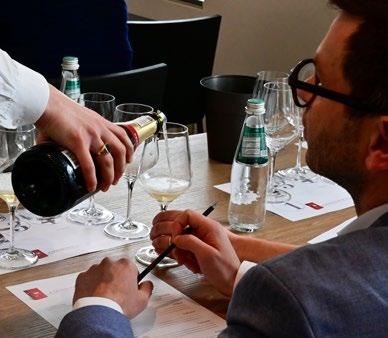
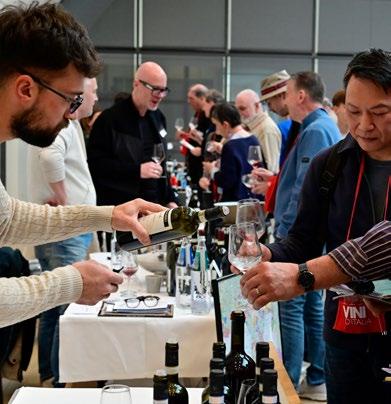
“Consumption is declining here as well,” observes Conte. The trend is shared: increasing attention to lowand no-alcohol options, as well as to sustainability and organic production.
But this is not necessarily negative. Rather, it signals a shift: people drink less, but better.
The market remains price-conscious, yet “receptive” when territoriality, craftsmanship, and coherence come into play. Not surprisingly, Conte’s portfolio focuses on small and medium-sized producers, often organic, still underrepresented in the Dutch market.
The key is not so much the category - red, white, or sparkling - but style: wines that are approachable
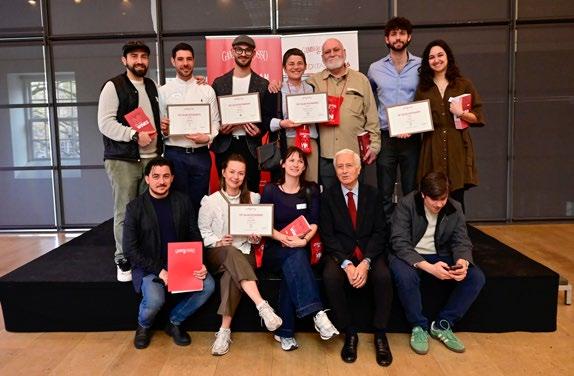
On one point, all operators agree: Italy retains a strong image, both in terms of lifestyle and wine - but producers need to be present on the ground.
Francesca Vicentini, a Soave producer, highlights the decisive role of importers: “For a family winery, local support is essential. It allows you to enter a structured context and build synergies, rather than navigating blindly.”
Event formats also matter. “Short events like this work - they are sustainable and allow you to concentrate meetings and activities.”
But if there is a place where Italian wine truly defines its positioning - especially at the higher end - it is the restaurant.
As Koen Bakker notes, “the top of the market is driven by wine lists and sommeliers.” And it is precisely within this context that the Top Italian Restaurants awards take on their full meaning.
More than a simple recognition, the awards highlight a structured and influential Italian dining scene in Amsterdam - one that actively shapes how Italian wine is perceived, communicated, and ultimately consumed.
From the accessible offering of Demetra (1 Slice), to the wine-focused identity of Vino & Friends (1 Bottle), and the reassuring presence of Insieme and La Fiorita (1 Fork), the spectrum is wide and well defined.
At a more advanced level, Tozi and Toscanini (2 Forks) represent a contemporary Italian cuisine capable of dialoguing with an international audience, where wine plays a central, carefully curated role.
At the very top, Pianeta Terra (3 Forks) stands as a benchmark - not only for its culinary ambition, but for its ability to embody that coherence between food, wine, and identity that today’s market increasingly demands.
In this ecosystem, restaurants are not just a channel: they are a filter, a stage, and a narrative tool. It is here that wines find context, meaning, and value.
And ultimately, as Amsterdam confirms, it is through this synergy - between producers, importers, and restaurants - that Italian wine can continue to grow, positioning itself not just as a product, but as a cultural experience.
on the palate, yet with a strong identity. There is growing interest in lighter reds, fresher and more contemporary expressions.
This was evident immediately
after the Italian wine masterclass: “They went back to taste the Pigato right away, but were also curious about other labels,” reports Laura Basso from Durin winery.
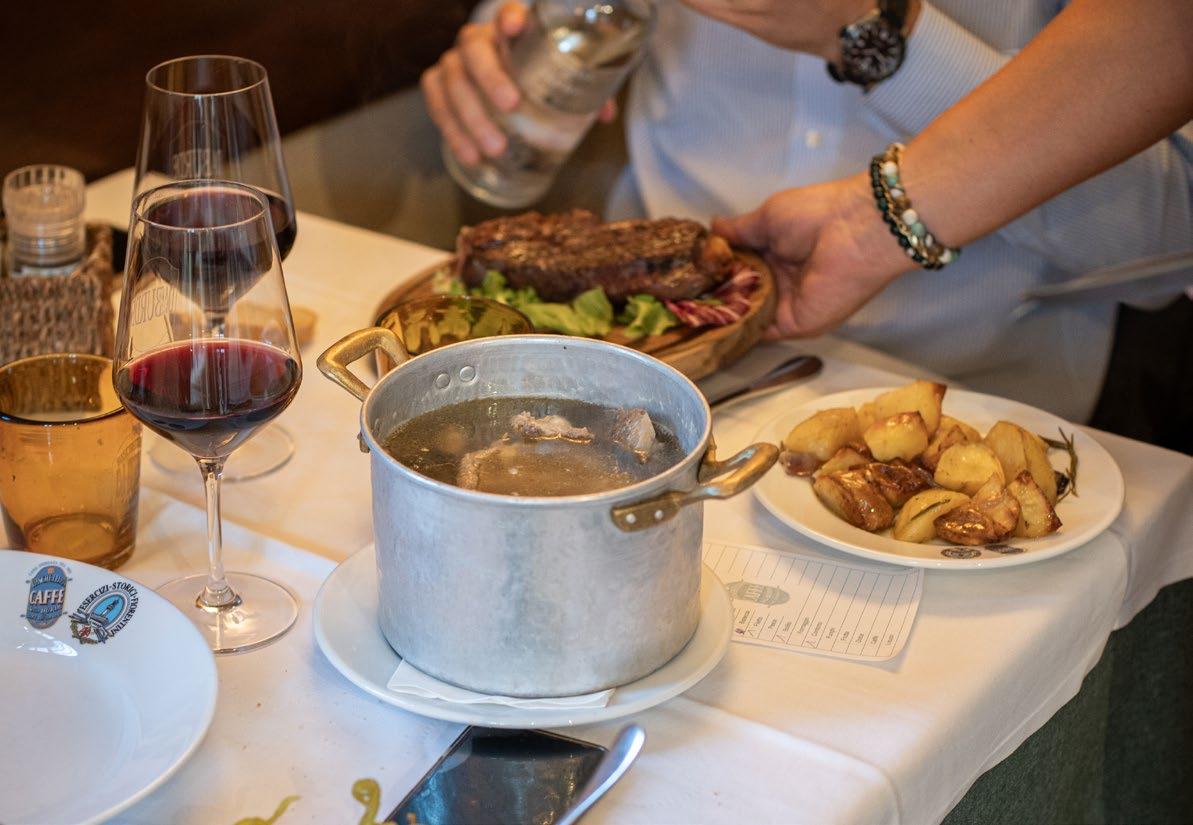
People are drinking less, but better. With attractive wine bars and new strategies, wine is seeking a new place and value in
by Eugenio Marini
The bottle of wine has disappeared from the table. The old habit has been lost, when a daily glass of wine was seen as a refreshing addition to one’s diet. In short, the era of the glass of red wine that our parents, grandparents and great-grandparents always enjoyed with their meals is over. But the truth is that people are drinking less in general, beyond the domestic sphere. The decline in consumption is widespread. It is affecting every branch of the sector, sparing no part of the catering industry, whatever its price range. And it seems difficult to pinpoint
In the opening, some of the dishes from Trattoria Da Burde in Florence
a single, clear-cut cause for this downward trend. Price remains the prime suspect, as do cultural shifts and recent public awareness campaigns, which have highlighted the health risks and the penalties associated with breathalyser checks – factors sufficient to have at least a deterrent effect, even on those who had never before turned down a glass of wine in the company of friends.
However, some restaurateurs have found a stopgap solution to the "wine crisis" by lowering their mark-up, reducing the distributor’s margin, or putting together an attractive by-the-glass offering. These business measures and sales strategies can result in a wine list offering surprising value for money, more relevant than ever
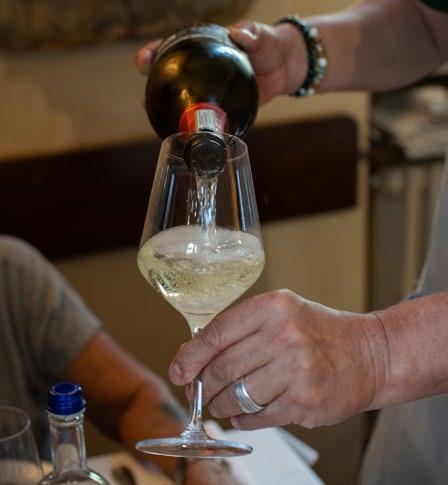
Many restaurant owners rely on wine sales to generate revenue. To do so, some charge increasingly steep mark-ups on wine, which excludes young people and those on lower incomes
to the current situation and therefore worthy of mention, wherever it is found, from the north to the south of Italy.
If figures for the wine sector are on the decline, is it down to prices or to contemporary culture, which is reshaping consumer habits? On this point, with studies and statistics constantly contradicting one another, there is disagreement, even amongst experts. Certainly, in Italy, income growth rates are struggling to keep pace with what has become perpetual inflation, not to mention the speculative nature of
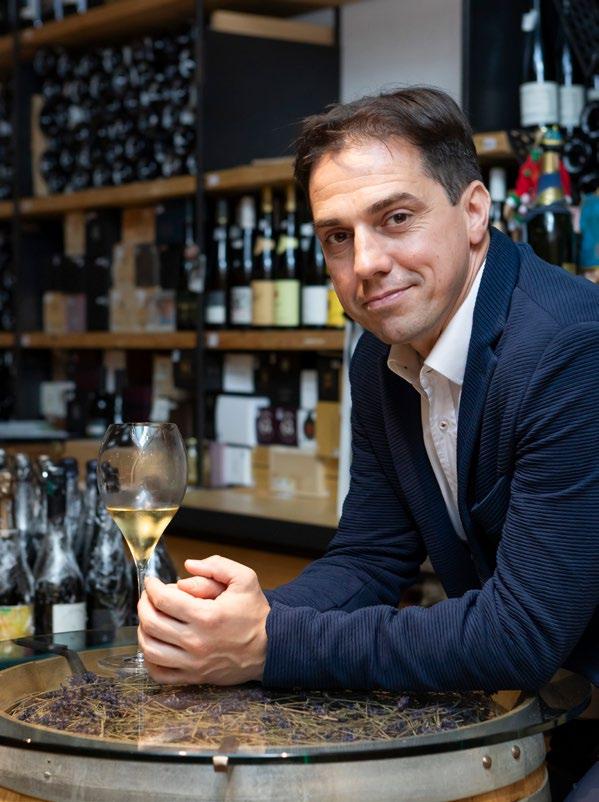
the wine sector, given that certain labels impose genuine price barriers that end up excluding many enthusiasts. Indeed, as financial analyst Marco Baccaglio writes in Intravino, whilst, for example, the price of a mid-range bottle of Barbaresco has risen by 36% over the last twenty years, wages have grown by a mere 4%. It is clear, therefore, that it is now difficult to afford various selections, including those we could have afforded in the past.
These figures would also explain the success of the world of cheaper natural wines,
available at affordable prices. «Those wines», says Andrea Gori, founder of the aforementioned wine blog, «even if they are the most fashionable productions, cost little, less than “conventional” labels. For €15 you can take home a pet-nat (sparkling wine produced using the ancestral method), whereas for the same price you’d be tasting perfectly ordinary conventional wines, not particularly interesting or enjoyable, which won’t make your evening». And among industry insiders, he wouldn’t be the only one to think so, according to Alessandro Pipero, owner of the eponymous Roman fine-dining restaurant, who, when pressed on the subject, replied bluntly: «In your opinion, have natural wines become so widespread because they’re good,
or because they cost 50% less than non-natural ones? If they cost as much as certain fine Sangiovese wines, nobody would order them. Let’s be clear: wines of the calibre of Le Pergole Torte or Monfortino aren’t drunk regularly simply because of their high price tag, given that their quality is beyond question».
Those who do not "fall back" on the more convenient, natural choice –which inspires the offerings of many city wine bars – turn to mixology, sometimes an even more accessible option, so as not to miss out on alcoholic drinks. But according to the experts themselves, in such cases it is not merely a question of cost, but also of taste and cultural – and other – choices that go beyond strictly economic considerations. Pipero doesn’t beat about the bush, taking a hard line with those who consume without full awareness: «Perhaps they do without wine, but they drink more spirits. If a spritz costs between 8 and 15 euros, can we really say that within the same price range you could get a nice glass of wine? So it’s not necessarily the case that a cocktail is a money-saving option, nor is it necessarily a healthy one. There is a lack of general knowledge. Ultimately, compared to the spritz, the wine the farmers used to drink—the sort our grandparents drank—was healthier».
As Pascal Tinari, maître D’ and sommelier at the Villa Maiella restaurant, points out, the growing focus on wellbeing and the obsessive, contemporary attention to the body are fuelling another trend, running parallel to the alcoholic one: the no-low alcohol formula. A growing market, among young people and non-drinkers, as well as among those who do not intend to drink for fear of exceeding the limits permitted by the driving laws. An offering
which, at a time of business difficulty, whilst the industry is on the hunt for unsaturated markets, is causing a little concern for all parties involved. At present, however, although it has caught the eye of various wine giants, it is not yet a genuine alternative capable of cannibalising the beverage sector, given that sales figures remain low in relation to overall market flows.
For many restaurateurs, the profit margin generally comes from wine sales. This is partly because food sales barely manage to break even. Wine lists and by-the-glass options are therefore designed to generate as much revenue as possible. The problem is that in recent years, the mark-up on each bottle has increased rather than decreased. And sometimes the mark-up on certain à la carte bottles is so prohibitive that it ends up discouraging the customer, who instead chooses to drink by the glass or as part of the set pairing menu, solutions that are currently more advantageous. Among the guidelines that guide the business owner, one principle reigns
supreme: the higher the purchase price, the lower the mark-up percentage. That said, each establishment sets its own pricing policy, which in any case must include 22% VAT. The level of mark-ups therefore varies from place to place, with some establishments marking up excessively and others not; mark-ups range from 30% to 100%. Mind you, marking up the purchase price is perfectly legitimate. However, it must always be justified by a service at the table that is up to standard; in the words of IT sommelier Gori: «the right glass, for a wine poured at the correct temperature, by qualified staff».
Clearly, it is not only the owner of the catering business who profits from each bottle; it is everyone involved in the "supply chain", from the moment the wine is produced to the moment it is served to the customer. The distributor must also make a profit, and their share of the revenue is reflected in the final bill: «‘In Italy», continues Gori, «the distribution chain really does drive up the price. It usually
happens that the distributor asks the producer for a 30% discount on the selection to be distributed, with the aim of generating their own “margin” on the quantity distributed by imposing the same percentage on the restaurateur. A significant intermediary role that allows the distribution sector to survive by protecting itself from insolvent or late-paying restaurateurs, but one that the industry is struggling to sustain». At the same time, the distributor’s role as a link between viticulture and the restaurant industry is crucial for the system to keep running: «Distribution is also fundamental because it often acts as a bank, guaranteeing the producer immediate payment for the bottles, which the restaurateur will only pay for months later». From this perspective, the intermediary cushions payment delays that would risk further paralysing the market. Nor should we overlook the situation where a restaurant owner approaches the distributor with the aim of having their wine list built from scratch. This is a common scenario
The dining room at Al Carroponte
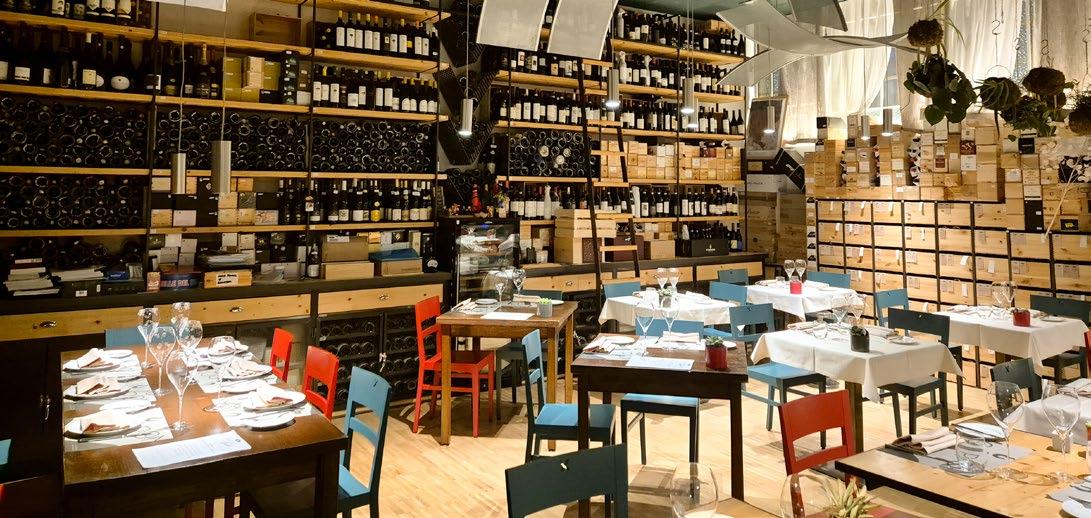
La Subida
Cormons (Go)
via subida, 52 048160531 – lasubida.it
Miil
Cermes (bZ)
via Palade, 1 0473563733 – miil it
Hotel Cristal obereGGen (bZ) via obereGGen, 31 0471615511
hotelCristal.Com
Al Carroponte
berGamo via edmondo de amiCis, 4 035240640
alCarroPonte it
Magazzino 52 torino via Giolitti, 52/a 0114271938
maGaZZino52.it
Del Belbo da Bardon san marZano oliveto (at)
s da valle asinari, 26 0141831340
La Brinca ne (Ge)
via CamPo di ne, 58 0185337480 – labrinCa.it
Hotel Ristorante Lido deiva marina (sP)
via FornaCi, 15 0187815997
0181816476
hotelristorantelido.Com
Ostreria Fratelli Pavesi
PodenZano (PC)
loC. GariGa, 8 0523524077 – ostreria it
Castellaccio
marChesi di travo (PC)
via dei Castelli, 39 0523957333
CastellaCCio.it
Locanda Mariella
Calestano (Pr)
loC. FraGnolo, 29 052552102
loCandamariella it
Antico Caffè
Calestano (Pr)
P ZZa euroPa, 2 05251701482
3889229162
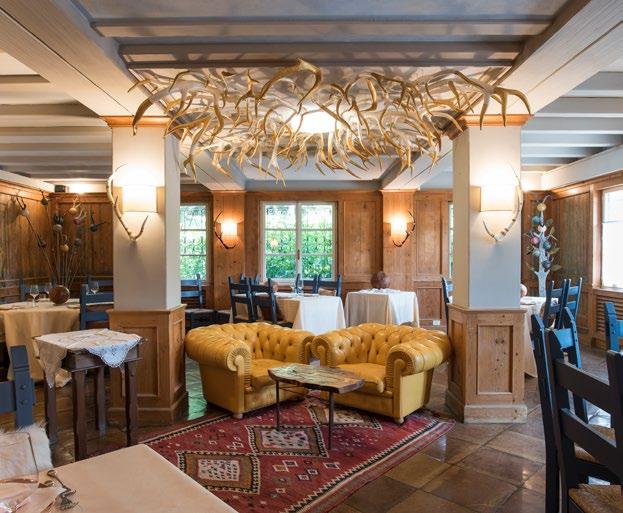
Trattoria da Massimo rubiera (re)
viale della resistenZa, 29 0522628543 3480327583
trattoriadamassimo Com
Entrà
Finale emilia (mo) via salde entrà, 60 053597105
trattoriaentra it
Lama Café
lama moCoGno (mo) via P. Giardini, 261 3487203988 – lamaCaFe eu
Osteria Bartonga
meldola (FC) s da roCCa
delle Caminate, 38 3278007128
Ristorante Del Lago
baGno di romaGna (FC)
loC aCquaPartita, 147 0543903406
ristorantedellaGoaCquaPartita it
Le Ghiaine
Cervia (ra) via romea nord, 180 0544991696 0544257669
ristoranteleGhiaine it
Da Burde
FirenZe – via Pistoiese, 154 055317206
landinG vinodaburde eu
Osteria dell’Enoteca
FirenZe – via romana, 70/r 0552286018
osteriadellenoteCa Com
Enoteca Guidi
sansePolCro (ar) via luCa PaCioli, 44 0575736587
3345272728
loCandaGuidi it
Marchese del Grillo
Fabriano (an)
FraZ roCChetta bassa, 73 0732625690
marChesedelGrillo Com
Venti Vino
PeruGia
b Go XX GiuGno, 20 0753764918 – ventivino it
Civico 25
PeruGia – via della viola, 25 0755716376 – CiviCo25.Com
Il Capanno
sPoleto (PG)
loC torreCola, 6 074354119
ilCaPannoristorante net
Ristorante da Michele roma
via tiberio imPeratore, 95 065404352
ristorantedamiCheleroma.it
Osteria Nuova
anZio (rm) via aldobrandini, 28 069830047
3496169154
ristoranteosterianuova.it
Agristor Le Due Torri
PresenZano (Ce)
s.s. 85 venaFrana, km 4700 – 0823989518
aGristorduetorri Com
Masseria del Sale
manduria (ta)
s s. 7 ter, km 2000
3493871021
masseriadelsale it
La Subida: the dining room at Trattoria Al Cacciatore
in our country, bearing in mind that in recent years people from outside the wine industry have invested in it, attracted primarily by its speculative potential. Andrea Gori himself makes no secret of this: «The average consumer’s knowledge of wine has increased, and at times they know more than the professional. In such cases, it is the distributors who handle both the supply and the consultancy, guiding restaurateurs in their choice of wines to serve and thereby compensating for their lack of expertise and creativity. When this happens, it is not uncommon for them to want to include wines they distribute on the list».
In Italy, some establishments manage to offer a range of options where customers do not perceive the mark-up as excessive. Among these is Venti Vino, a wine bar in Perugia that serves glasses from € 4 upwards, featuring local, Piedmontese and French wines, particularly from the natural and more "artisanal" sectors. How is this possible? At the helm, Sara Boriosi and Giovanni Corazzol keep purchase prices down by working directly with the wineries, thanks to the ongoing research carried out together with their partners, who travel around the country tasting wines tirelessly. So, no agents, sales representatives or distributors applying their own commission fees. Here, then, is where you can drink on a budget and enjoy cicchetti as if you were in a Venetian bacaro.
As well as being a journalist and sommelier, Gori is also a restaurateur. And a shrewd one at that. Together with his brother Paolo, he has turned the family trattoria, Da Burde, into a cornerstone of Italian gastronomy. Above all, it is a temple of wine that draws visitors from far and wide. Anyone who steps through the door of this Floren -
tine establishment, surrounded by shelves full of labels, is won over by the myriad of wine pairings—whether by the glass or the bottle—that find their way to the table even before they’ve sat down. As a result, you practically feel guilty for not ordering wine. An enticing, almost aggressive marketing strategy, which has become the most effective remedy against the current downturn.
Managers have had to come up with this approach to encourage alcohol consumption at lunch, a meal at which people are now more reluctant to have a drink. «Anyone who comes in with the idea of not having even a single glass», says Andrea, «eventually gives in, subjected to a sort of psychological
pressure, starting with the fact that you have to explicitly tell the staff whether or not you intend to drink the bottle we place on the tables. With blackboards and sheets of paper lying about, and the selection available at the bar (including old vintages of red), priced at wine shop rates, I’ve come up with all sorts of ideas to make the sales. Having the freedom of an owner in running the business, I make decisions that, from the outside, seem unwise from a business perspective. Something that, for now, has allowed us to avoid any decline in consumption».
Oscar Mazzoleni’s secret, on the other hand, is to focus on “quantity” without being influenced by the market value of the wine – one of the reasons why certain bottles might remain in the cellar for a long time. In Bergamo, the owner of Al Carroponte rotates his 3,300 wines – predominantly from France and Piedmont, with a focus on Champagne, Burgundy and Barolo — through an appealing by-the-glass and à la carte selection, sourcing both from national distributors and directly from winegrowers, prioritising purchase price even in the case of fine wines that would otherwise risk gathering dust as unsold stock: «Many restaurateurs operate with mark-ups
of 300%, which aren’t even seen in the hotel industry. It’s difficult to open a bottle worth 50 or 100 and charge 400 for it. Whereas I sell it for 180. Even when serving by the glass, smart pricing means offering a selection of glasses at 10 euros each for wines bought at 30 euros, rather than 13 euros each. Lower mark-ups encourage the customer to spend more money, as they might decide to have two glasses instead of one. This allows us, within a higher price bracket, to make a profit».
Like others, Mitja Sirk, a Friuli winemaker and sommelier at his family’s restaurant La Subida, prefers to bear the cost of transporting the wine
himself, bypassing any middlemen, in order to foster personal relationships with individual producers and ensure that diners enjoy drinks at "reasonable" prices. The only way to keep the final bill low and «maintain value for money». Having grown up keeping the empty bottles of his most satisfied customers and making wine in the amphorae gifted to him by Josko Gravner, he always puts the customer’s needs first, even if it means serving wines that don’t pair particularly well with the dishes. Again, to meet demand, he has devised a six-course wine pairing for € 55, reflecting the diverse facets of the local geology and microclimate, ranging from the freshest wine, through to the macerated variety, right up to the age-worthy label. And to think that, if it were up to him, he would offer guests only the wine list, convinced that food pairing is overrated and, in many establishments, determined by choices that ensure the highest profit margin; conversely, the evolution in the glass of the bottle ordered throughout the meal would have a different charm. But as he repeatedly emphasises, «who are we to tell the customer what to drink?»
Mitja Sirk, winemaker and sommelier at La Subida restaurant (photo by Loredana Bensa)
Talking about our wines means talking about our land, history and family. But it also means taking you on a journey of enthusiasm and passion. It means getting you into all the choices behind the creation of a new wine or the reinvention of our classics, from the initial inspiration to the final decision. In this process we always try to reach the perfect balance between man and land, tradition and change, our present and our visions of the future. We hope to tell you all this soon, sharing a

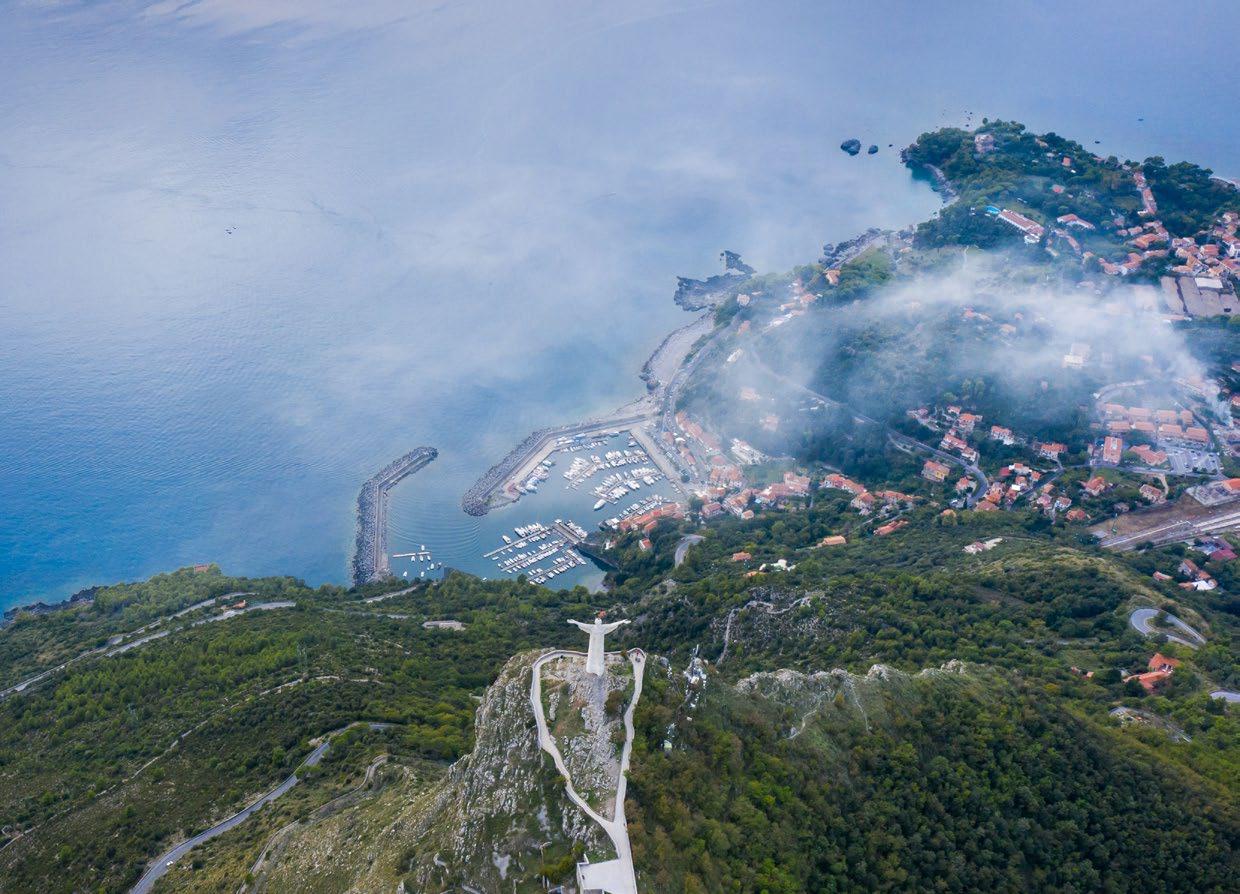
The soul of Maratea amid crystal clear sea, monuments
Overlooking the Gulf of Policastro, this town of just over four thousand inhabitants is known as “the city of 44 churches” due to its extraordinary concentration of religious buildings and their artistic value. The narrow streets, natural terraces suspended above the sea and unexpected views reveal a beauty that goes beyond the simple image of a seaside resort. Behind it, the green and lush hinterland reveals resources and traditions that are intertwined with the territory, where sea and land coexist in harmony.
The Gulf of Policastro welcomes Maratea like a luminous embrace: wind-sculpted rocks, hidden beaches and secret coves overlook clear, turquoise waters. It is in this
Aerial view of the port of Maratea, at the foot of Monte San Biagio, from which Christ the Redeemer stands out
setting that the town of Lucania reveals itself to be a rare gem of Basilicata, capable of combining unspoilt nature, historical heritage and popular traditions. There are several hypotheses about the etymology of its name, all of them evocative. Some link it to Thea Maris, the goddess of the sea, and others to Mar-ar-Ethea, the “City of the Great Etei”, an ancient people from the Black Sea. However, the most widely accepted interpretation is that proposed by the Lucanian historian Giacomo Racioppi and confirmed by the German linguist Gerhard Rohlfs: Marath-ia, “the fennel field”, a land of wild fennel, reflecting the lush spread of this plant throughout the territory.
Maratea lies at the foot of Monte San Biagio, the symbolic and historical heart of the town, dominated by the monumental statue of Christ the Redeemer, 21 metres high (second only to the Christ the
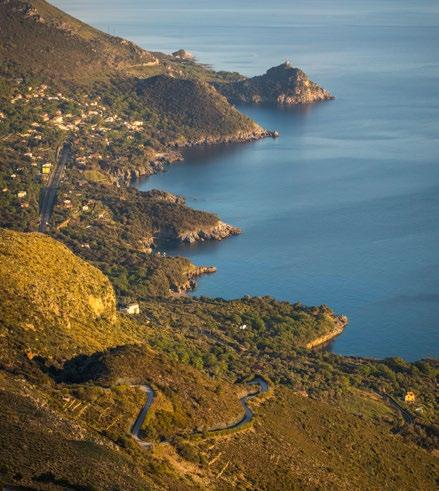
Overlooking the Tyrrhenian Sea, Maratea boasts a natural and cultural heritage of churches, folk traditions and rituals that define its identity. From legends about the origin of its name to the views of Monte San Biagio, from its wild coastline to the ancient craft of libbani, the story paints a picture of an authentic destination to be experienced at a leisurely pace, far from overtourism, where the community and the land still exist in harmony
Redeemer statue in Rio de Janeiro), donated to the town in 1965 by Count Stefano Rivetti di Val Cervo. From here, the view encompasses the entire town and the coast below, offering one of the most evocative panoramas in southern Italy. A
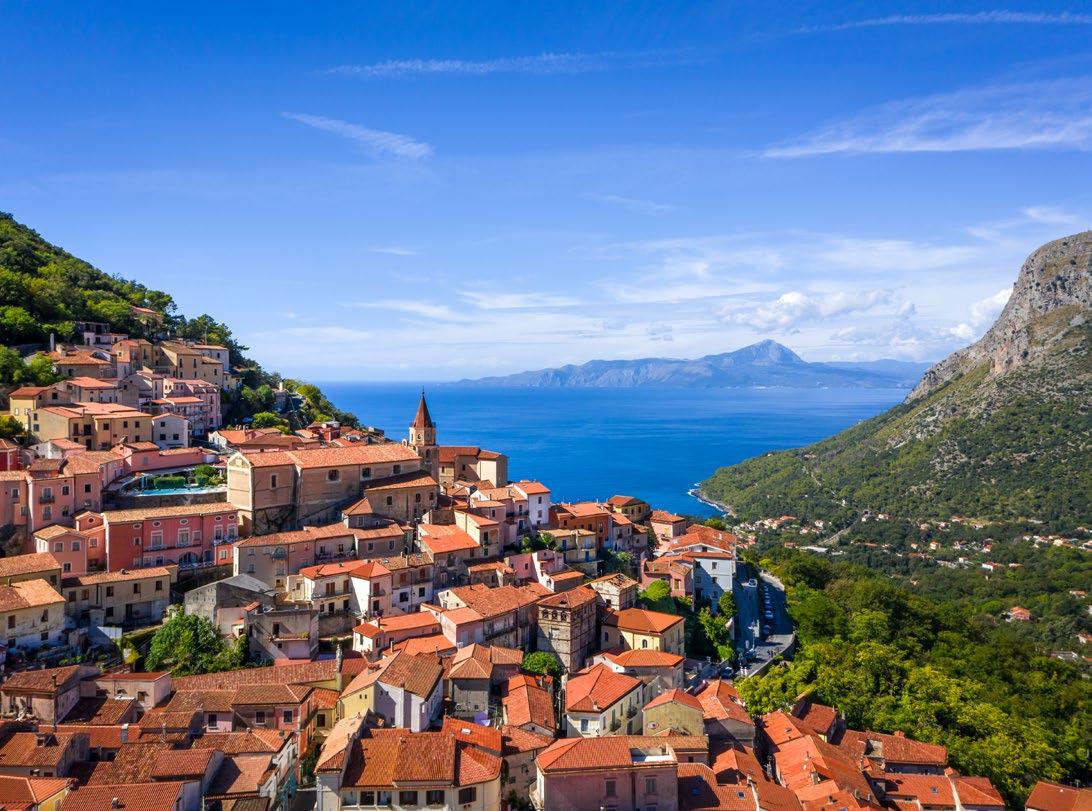
little further down are the remains of the ancient castle, while opposite is the Basilica of San Biagio, dating back to the 6th-7th century AD, which houses precious bas-reliefs and the sacred relics of the patron saint, protector of the throat. His most famous miracle was to save a young boy who was choking on a fish bone stuck in his windpipe, an episode that consecrated him as the patron saint against throat ailments. One of the most heartfelt festivals is dedicated to him, enlivening the city between the first Saturday and the second Sunday in May. Not far away is the small church of Madonna degli Ulivi, with frescoes from the 14th and 15th centuries, but there are 44 churches
scattered throughout the historic centre: from San Vito to Santa Maria Maggiore, to the Church of the Immaculate Conception with its 14th-century fresco depicting the apostles.
Maratea is Lucania’s window onto the Tyrrhenian Sea
From Monte Coccovello, which reaches 1,505 metres, to Monte San Biagio, the valleys and woods of holm oaks, oaks and chestnut trees open up into a rapid descent towards the coast. Here, for over 30 kilometres, sheer cliffs alternate with caves and coves
that can only be reached by sea, a sea rich in life, a paradise for those who love diving and snorkelling. One of the most fascinating experiences is a visit to the Grotta delle Meraviglie (Cave of Wonders), which can be reached
On the opposite page, two dishes from I Sapori di Marianna: Risotto with wild asparagus, Pollino Podolico caciocavallo cheese fondue and Lucanian black truffle, and Midnight spaghetti with fermented black garlic, extra virgin olive oil and crusco peppers; a nonspicy, modern take on the classic garlic, oil and chilli pepper dish
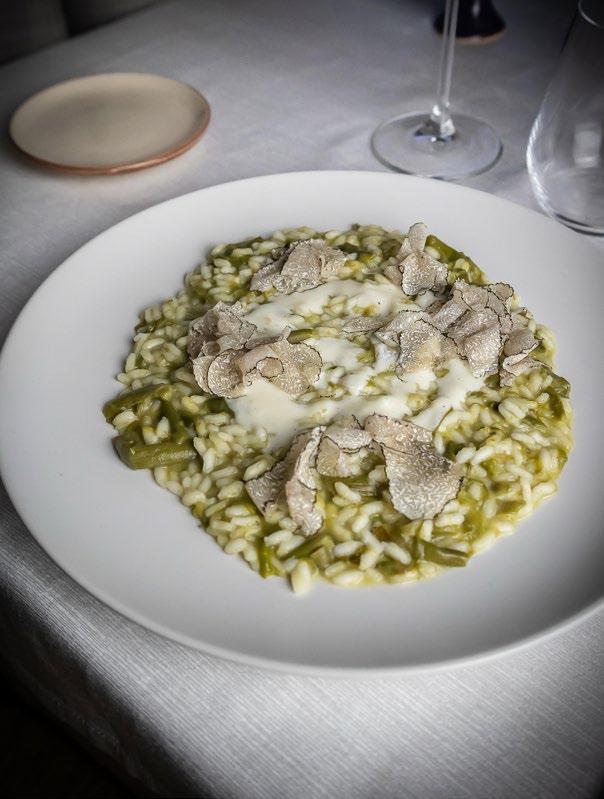
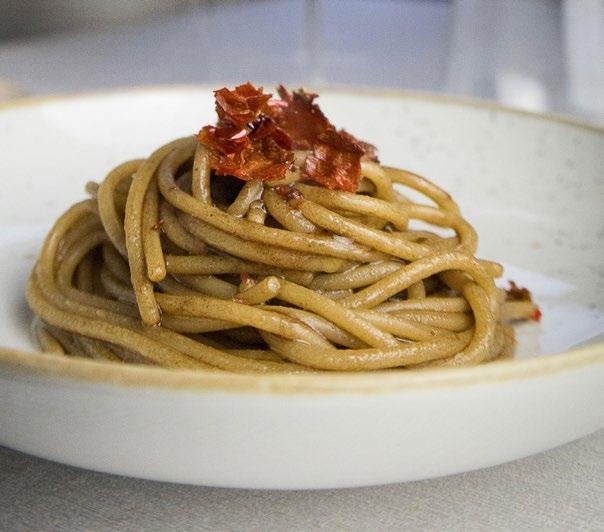
Marianna Pezzullo grew up here in Maratea, developing a passion for cooking from the age of 12, when she would cook for her friends. In 2006, after paying her dues, she opened her first restaurant in the historic centre of the town, but it was in 2018 that I Sapori di Marianna came to life. We are just outside the town, in the upper part of Maratea, in a well-kept villa overlooking Christ the Redeemer. Here we are welcomed by her son Daniele, in his early twenties, who manages the dining room with grace and elegance, demonstrating a high level of professionalism and offering advice, food pairings and smiles. Maratea’s cuisine embraces both the sea and the land, precisely because within a few kilometres you can go from the beach to an altitude of almost a thousand metres, offering every possible nuance. Marianna and Daniele carry out extensive research into the best raw ingredients, almost exclusively from the local area, and this research is immediately evident in the mixed starter, where the cheeses, cured meats and vegetables are of the highest quality. Among the first courses, the cuisine takes its cue from the sea, with spaghettoni with anchovies, fennel, cherry tomatoes and lemon, and moving inland, this is echoed by the risotto with cardoncelli mushrooms and Lucanian sausage or the fusilloni with rabbit ragù. The love for the territory can also be felt in the main courses, with tender braised pork cheek in Aglianico wine on a bed of creamed potatoes or fried salt cod with crispy peppers. Marianna’s delicious cakes are a great way to end the meal. Daniele has a great passion for wines and has transferred it all into a personal and comprehensive wine list, from small producers to important “maisons”. For those who want an overview of their cuisine, there is also a 5-course tasting menu at a more than fair price. A place of taste that makes Basilicata’s food and wine great.
I Sapori di Marianna via Campo - 339 1794102
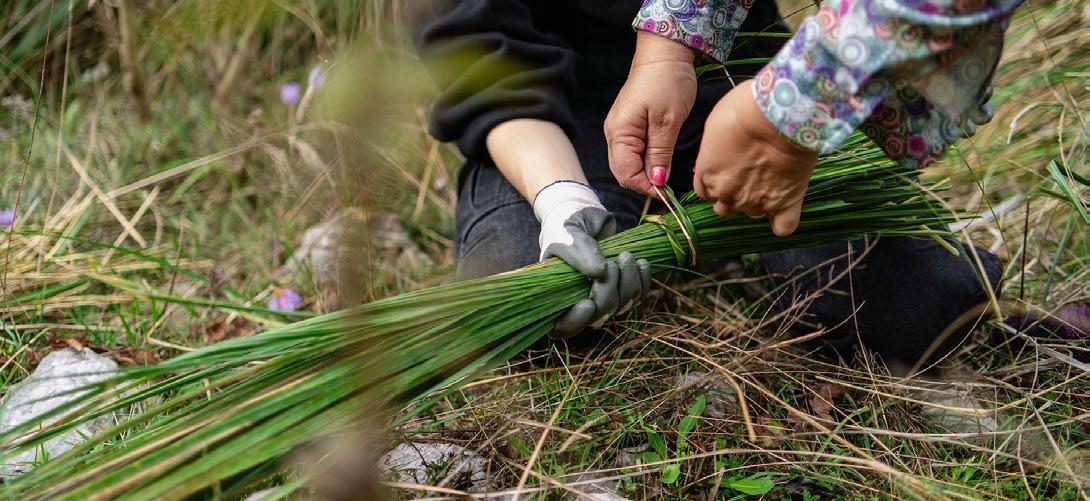
Cesare via NazioNale, 52 - 0973 871840
A historic address on the scenic road connecting Maratea and Sapri, this restaurant overlooking the sea has been a landmark since the 1960s. The setting is spacious and enjoyable, with elegant and minimalist furnishings. The seafood cuisine enhances the tradition and quality of the catch, with a simple and flavourful menu, from marinated anchovies to octopus salad. After the starters, you can choose from fresh pasta with scampi or mussels and prawns, linguine with squid ink or lobster (made to order). The meal continues with a feast of sea bass and sea bream, served roasted, baked or in acqua pazza, swordfish stew (or roasted), and the inevitable fried prawns and squid. The meal ends on a sweet note with a refreshing lemon delight. The wine cellar offers a selection of white wines from Basilicata and all over Italy, as well as rosés and sparkling wines.
La Cambusa
FiumiCello – via a. B. SaBiN, 22 – 340 9714623
A short walk from the harbour and Fiumicello beach, this is a welcoming restaurant with a refined and lively style. The original furnishings reflect the name of this family-run restaurant. The menu is simple and straightforward, with four options for each course, one of which is always vegetarian. The menu is based on seasonal ingredients and the catch of the day. The cuisine is rich and substantial, ranging from the curious cod and potato sticks with ketchup and crispy pepper flakes to the more classic spaghetti with clams. Among the main courses, “Purp” fiction’ is particularly interesting: seared octopus with crispy artichokes, whipped potatoes and anchovy sauce. Creative desserts with a nod to tradition, such as the Marateo bocconotto presented in a spoonable variation. The wine cellar is extensive and equally impressive.
Emilio via RaCia, 12 – 340 8351976
Attention to quality, which has always been Emilio Panzardi’s pride and joy, remains the hallmark of this ice cream parlour overlooking the picturesque port of Maratea. The welcoming and bright environment provides an elegant backdrop for Emilio’s ice cream, which offers flavours linked to the seasons and the local area, with recipes ranging from the great classics, such as pistachio, almond and chocolate, to more creative and original offerings, such as peach, rosemary and lemon, ricotta and white figs, chocolate and coconut water. During the winter months, Emilio devotes himself to research, which translates into continuous innovations during the gelato parlour’s opening period. His collaborations at national level are all highly prestigious and have a significant impact on the product: just think of Niko Romito’s famous “bomba”, served here with Emilio’s ice cream, which has become a real must-try. The range is completed by tartlets with ice cream and fruit, pandolce with zabaglione and the inevitable maritozzo with whipped cream.
by land. This small karst cave contains stalactites and stalagmites shaped by time. It is a short (about 30 minutes) but intense journey, where silence amplifies the wonder. We are sure that you will also be amazed by the Skywalk, a suspended steel and glass walkway that allows you to walk in the void with crystal clear water beneath your feet and a view that stretches to the horizon, offering a fascinating view of the Tyrrhenian Sea from Basilicata, a sea that also marks some of Maratea’s traditions, such as the celebration of the Madonna di Porto Salvo at the end of June, during which small boats follow the statue along the coast to the island of Santo Janni, or the production of “libbani”,
ropes woven with wild herbs, once indispensable for fishing.
MThe processing of libbani, a tradition that has been deeply rooted in women for decades, deserves special attention. Until the end of the 1970s, it was women who gathered the strands of grass (called “tagliamani” because of the extreme sharpness of the leaves) that grew along the slopes, worked them with patient and precise gestures and wove them into strong ropes, destined to travel far beyond local borders: these ropes, initially used for fishing and agriculture, be -
came essential for mussel farming, a practice widespread along many Italian coasts, from Naples to Gaeta, from the Mar Piccolo of Taranto to the Venetian Lagoon, to La Spezia, Olbia and the Trieste coast. The libbani produced in Maratea thus reached numerous areas of Italy, contributing silently but decisively to the development of an entire industry linked to the sea. Unfortunately,
On the left and below, two images from La Nuova Libbaneria Mediterranea: the herb collection and “Tenacissimae”, the contemporary furniture collection by designer Sara Bologna (photos by Marco Deodati)
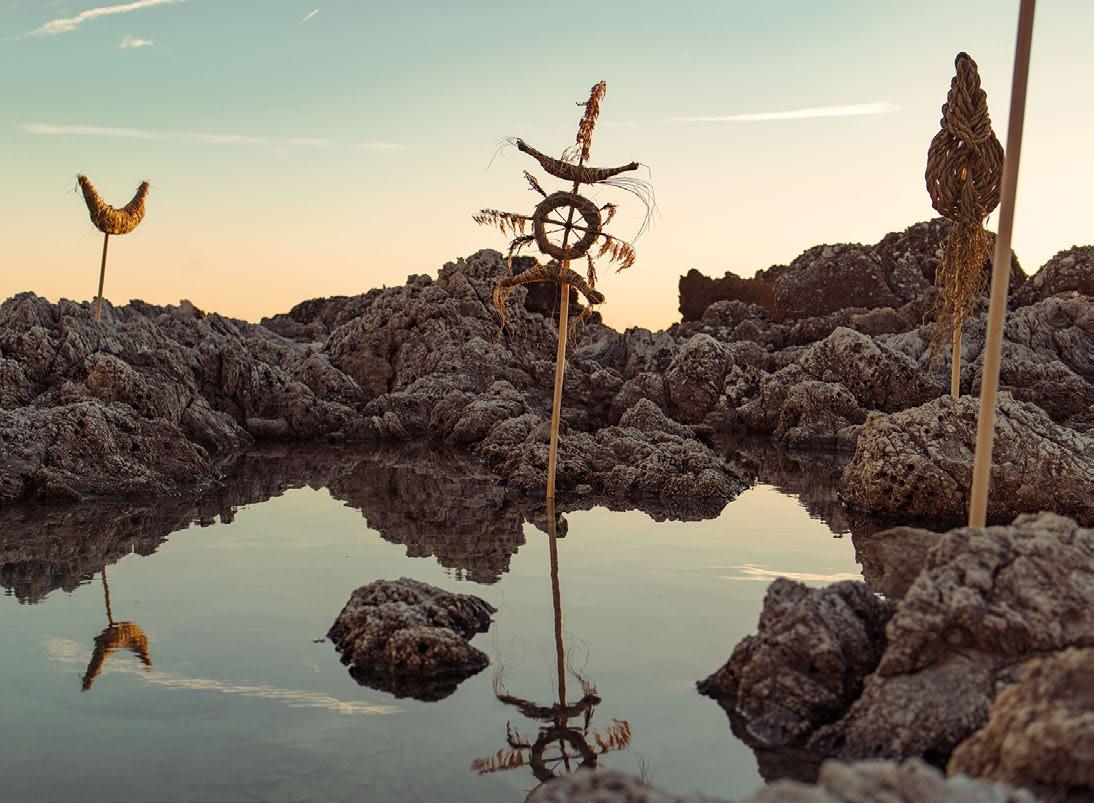
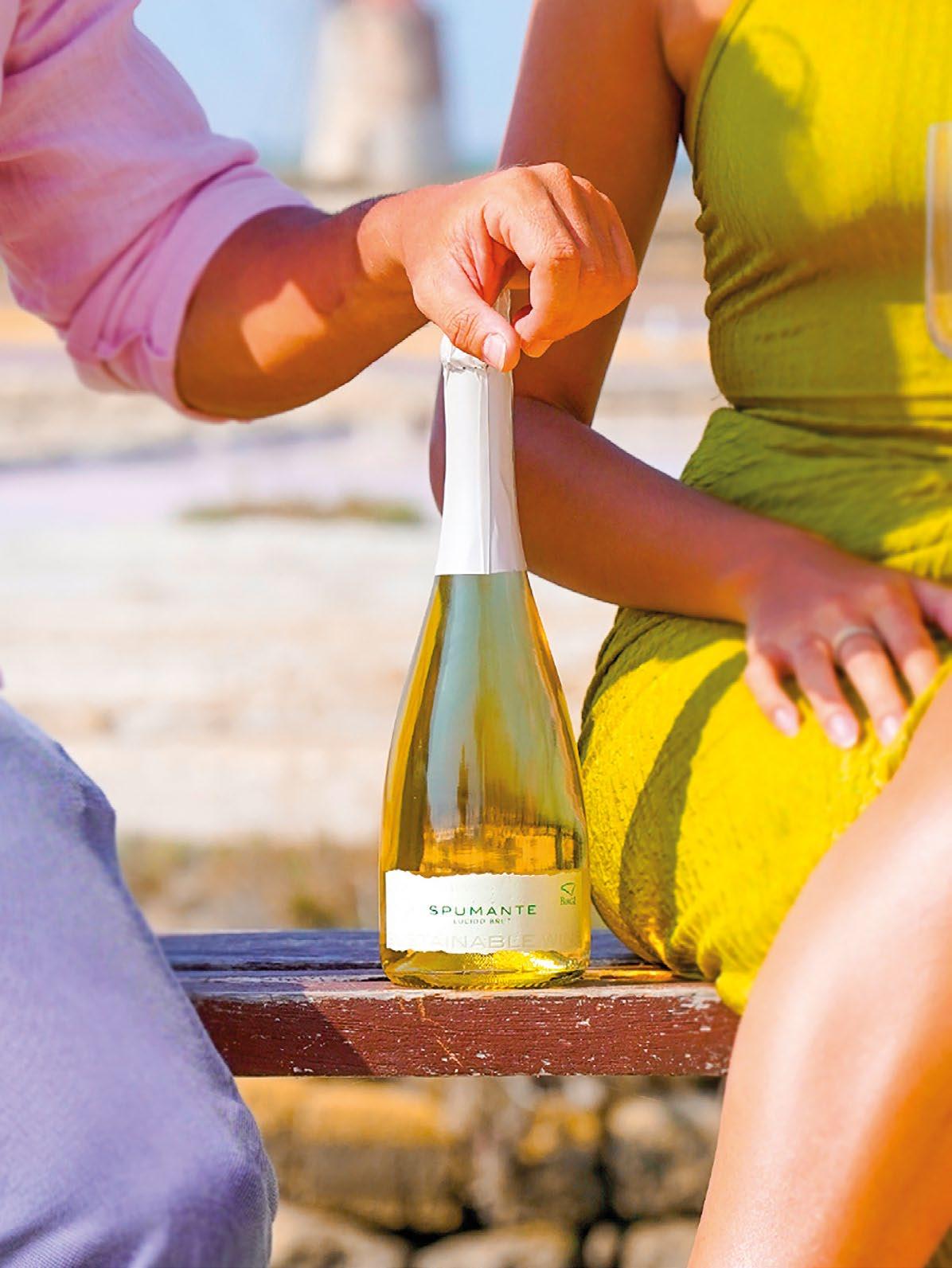
the introduction of cheaper synthetic materials in the 1960s marked the end of this tradition, but it did not erase its cultural value. In recent years, thanks to restoration projects such as the Nuova Libbaneria Mediterranea, this feminine knowledge has been revived, becoming a virtuous example of how an ancient local practice can tell a broader story.
This is also how Maratea tells its story, without fanfare, with its churches, paths, traditions linked to the sea and women’s craftsmanship, restoring the image of a place that has managed to preserve its identity by adapting to the times. A territory to be explored slowly, where there is no room for overtourism, where landscape and memory continue to dialogue, defining the authentic and profound character of this Lucanian view of the Tyrrhenian Sea.
Procession of San Biagio through the streets of Maratea
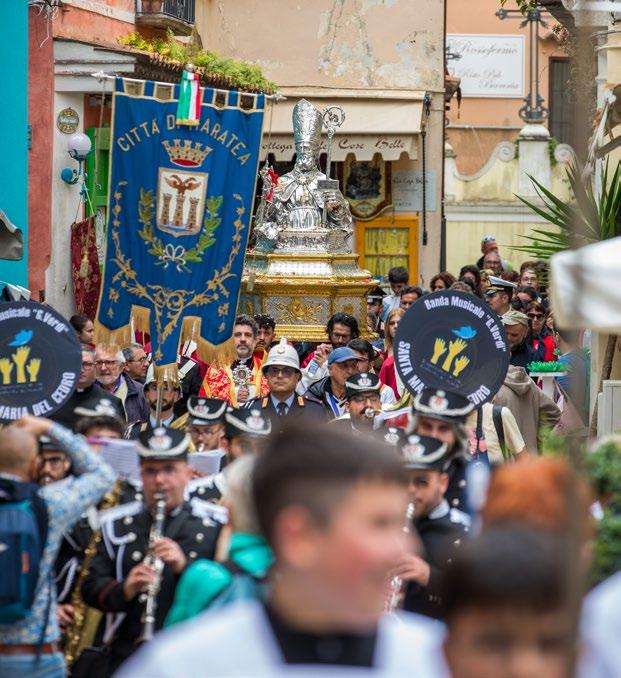
Maratea is a place that stays in your heart: the sea, the mountains, the small hamlets, and above all the people who bring it to life every day. The crystal-clear water and the embrace of Christ the Redeemer are not enough to guarantee a truly human and regenerative form of tourism. We are committed to maintaining a high level of attractiveness without reaching saturation point, out of respect for those who live and work in Maratea. While confirming our status as a hub for national summer tourism, it is the months of April/May and September/October that will hold many surprises for the future. Our role is to accompany the process of improving the quality of the offer, which has seen an increase in average length of stay and foreign visitors between 2024 and 2025. These two phenomena confirm that we have taken the right direction, as outlined in the recent Tourism Development Plan: offering more experiences and more enjoyable activities encourages people to spend longer holidays, while creating more opportunities to visit throughout the year is appreciated by tourists from across the border. Increasing Maratea’s appeal during the shoulder months is a goal that also requires commitment to promoting high value-added tourism products: weddings, events and corporate meetings are now linked to other varied forms of tourism that we can guarantee. Among other things, we are preparing a MICE catalogue that will give momentum and visibility to all the local businesses and initiatives that organise and host events, enriching them with the sustainability and authenticity that sets us apart. We are increasingly convinced that the people who choose us should be pampered, and this year we want to “win them over with food”. We are sure that those who come here on holiday, especially those who come every year, have their favourite Maratea dish: they want to eat it on the first day they arrive, or on the last day to chase away the sadness and take home the flavour of the memory. We are thinking of telling the story of Maratea in this way too, with a family album where the protagonists are the dishes that become memories, emotions and promotion. Finally, if it is true that in Maratea the sea, landscape and community coexist in harmony, and we want this to be what sets us apart from others, we must “certify” our uniqueness. We are ready to launch the “Costa di Maratea” Marine Protected Area as an opportunity for responsible and sustainable growth. Starting this spring, we will involve our guests in these activities: sports and outdoor activities in the sea and inland, by bike, on foot, by kayak, and walking suspended in the void of the Skywalk. And then the return of three evenings dedicated to the typical flavours of the territory. To confirm Maratea as a quality, green and authentic destination.
Mayor Cesare Albanese