#123 O C T/ N O V 2 02 6
THE AUTUMN EDITION
/ LIFE & STYLE IN THE ISLE OF MAN
CARNIVAL
A cavalcade of the imagination
Who’ll be joining you this Christmas? Christmas is about bringing friends and family together, and there’s nowhere better to start than around the table. At Paradise & Gell, you’ll find dining tables and chairs in a huge choice of styles, sizes and budgets, from compact settings for smaller spaces to generous dining tables made for the whole family. Whether you’re refreshing your dining room or getting ready to host this Christmas, we can help you create a space that feels just right for the occasion. And there’s plenty more to discover throughout the store this festive season. From beautiful tableware, glassware and home accessories to Christmas decorations and those all-important finishing touches, you’ll find everything you need to make your home feel warm, welcoming and ready for Christmas. Make this Christmas one to remember with Paradise & Gell.
24-30 Michael Street, Peel Telephone 01624 842818 ǀ www.paradiseandgell.com
E DI TO
#123
One minute we were sitting outside convincing ourselves that 27 degrees was perfectly normal for the Isle of Man. The next, someone turned the lights off at 6pm and we’re standing in front of the wardrobe wondering whether it’s officially acceptable to put the heating on. Welcome to the Autumn edition of Gallery.
A
s ever, we’ve assembled a slightly unlikely collection of things we think are worth knowing about, looking at, eating, drinking or occasionally arguing about.
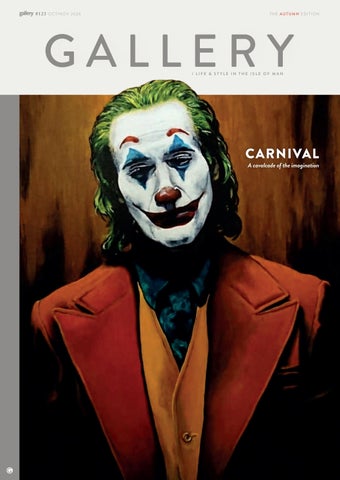
Our cover story Carnival probably sets the tone rather nicely. Six local artists, a riot of colour, folklore, fantasy, a disco duck and Martin Vaughan’s rather unsettling Joker, called ‘Smile’. In other words, exactly the sort of sensible cultural coverage you’ve come to expect from us. We also continue our journey around the Island’s remarkable runestones, where it turns out the Vikings were doing social media long before the rest of us. One unfortunate chap called Hrosketill managed to have his betrayal carved into stone and is still being named and shamed more than 1,000 years later. Suddenly that embarrassing Facebook post from 2009 doesn’t seem quite so permanent.
We’ve got a blank space baby, and we’ll write your name.
CONTRIBUTORS
/ LIFE & STYLE ISLE OF MAN
Well then… autumn happened.
Elsewhere, we meet some wonderfully creative Manx people, including photographer Jason Kinrade and artist, writer and serial project-starter Debra Tracey. There are weddings, events, cars, fashion and food — including a coconut chicken curry that claims not to require a trip to three different shops. We approve of this approach to cooking. There’s some sensible stuff too. We look at health, style and why perhaps the good life isn’t necessarily about having more of everything. Our Agenda pages turn their attention to business and wealth, including the rather important question: when is enough, enough? And somewhere amongst all that, we’ve hopefully produced another issue that makes you stop, read something you weren’t expecting to read and discover something about the Island — or the people living on it — that you didn’t know before.
We’re always looking for new contributors. If you love writing or illustrating what others write, we’d like to hear from you. contribute@gallery.co.im CAN YOU CREATE?
contribute@gallery.co.im
Sure, you might share photos of your food or have a portfolio on Behance, but why not get a little joy from seeing something in print! We’re always looking for contributions from people who are passionate about subject matters close to their hearts.
FEATURE
WE PROFILE ISLANDERS
editorial@gallery.co.im
Which, really, is the whole point.
If you are an artist with work to exhibit, an event or entertainment organiser with an event coming up, a business with some exciting news or a new product to feature, get in touch. We’re keen to feature anything captivating that will be of interest to the good people of the Isle of Man who flick through a Gallery each edition.
So put the kettle on. Or open something more interesting. Autumn’s here.
SR
SR
/ LIFE & STYLE IN THE ISLE OF MAN Disclaimer.
All rights reserved. Any form of reproduction of Gallery Magazine, in part or whole is strictly prohibited without the written consent of the publisher. Any views expressed by advertisers or contributors may not be those of the publisher. Unsolicited artwork, manuscripts and copy are accepted by Gallery Magazine, but the publisher cannot be held responsible for any loss or damage. All material, copy and artwork supplied is assumed to be copyright free unless otherwise advised. Contributions for Gallery should be emailed to editorial@gallery.co.im. Names have been changed to protect the innocent and no penguins were harmed in the manufacture of this magazine, although the new cover colour is called ’penguin white’. Tag us in your pictures at @galleryisleofman and #gallerysmallprint and we’ll give you something.....
Recycle.
Gallery recycles all its storage and packing materials, boxes and any old magazines that are returned. We don’t get that many fortunately. We love to know our readers hang on to previous copies but when you move or find that they’re taking up too much space, put them out in the recycling bins. If you want to find out more about recycling, call 01628 686540. We put this in a green font. It’s not made out of leaves, honest.
4
PUBLISHED BY
221 Media
PO BOx 52 Douglas, Isle of Man IM99 1GY REGISTERED IN THE ISLE OF MAN NO. 125981C
PUBLISHER
ADVERTISING
STEVE REDFORD steve@gallery.co.im
01624 619540
01624 619540
sales@gallery.co.im
07624 249249
CON T EN TS
#123 HIGHLIGHTS
10
The Runestones of Mann - Part 2
22
Mr & Mrs McCormack
38
MBCSG Ladies Fashion Lunch
30
My Name is... Debra Tracey
54
Private Banking For The Next Gen
62
Elevate You Awards
CONTENTS SECTIONS Upfront
06
Hardware
18
Appetite
20
Weddings
22
Culture
28
Events Agenda
FEATURES Runestones of Mann-Fusion of two Worlds 10 In the last issue, we journeyed through the Manx runestones across the North and West of the Island, discovering how Scandinavian settlers left their names permanently carved into the Manx landscape. But that is only half of the story.
Theses are the Good Days
14
38
Make good choices most of the time and appreciate what your body allows you to do right now, because one day we may look back and realise just how fortunate we were.
50
When is Enough, Enough?
56
For generations, wealth has been measured in fairly predictable ways: what we earn, what we own and what we have in the bank. But perhaps the most valuable things in modern life aren’t quite so easy to put on a balance sheet.
5
E UDI PFTO RO N T
Reluctant Vampire written by Eric, and adapted by Neil and Rob Gibbons has been filmed. This BBC comedy series, scheduled for broadcast in the Autumn on BBC1 and BBC iPlayer, stars Lenny Rush, Tom Davis, Sian Clifford and a stellar cast with Gary Morecambe as script consultant. The Royal Mail has released a Morecambe & Wise Collector’s Sheet of Stamps as part of their Celebrating Britain range. These ten first class stamps show memorable M&W TV Moments including the Christmas Special.
EVERLASTING SUNSHINE Your chance to own it
2026 is the 100th birthday year of Eric Morecambe, while his partner in comedy Ernie Wise, of the famous ‘short fat hairy legs’, would have turned 100 last year. Events marking the legendary duo’s centenaries started in this Spring and tributes are still going on… Back in May, a dedicated Morecambe and Wise week was held in Eric’s hometown of Morecambe, Lancashire with one gigantic 100-year birthday party, featuring magical moments from their stage, film and television careers over ten decades at the Winter Gardens. The centrepiece was an on-stage conversation, hosted by Eric & Ern producer Martin Clarkson, with Eric’s son and daughter Gary and Gail Morecambe. For 90 magical minutes they brought to life the stories of this remarkable partnership that brought warmth and humour to British lives over so many decades and continues to bring sunshine to fresh generations. As part of the commemorative celebrations, an official Centenary Morecambe and Wise portrait, was unveiled. “My intention was to paint Morecambe and Wise not only as icons of the screen that we knew and loved but also to capture their off-screen chemistry and personalities.” The family fully agreed … “This fabulous painting captures everything I emotionally recall about Dad and Ernie … their closeness, their trust and their enduring partnership” says Gary Morecambe, “They are forever young on TV and that’s how I picture them in my memories.” “It’s just glorious” adds Gail “I see two happy boys in their bow ties, celebrating their 100th birthday party. It’s caught every aspect of their warmth and particularly the twinkle in both of their eyes.” Artist Jen Allen was thrilled with the family’s response and their permission to release a small number of limited-edition prints which are now available. Ongoing Morecambe and Wise inspired shows are happening on a national basis too. Eric & Ern, a homage to the comedy duo, continues with nationwide performances this autumn and winter including The Gaiety Theatre, Douglas on 7 December. The Last Laugh, a play based on imagining three comedy icons Eric, Tommy Cooper and Bob Monkhouse sharing a dressing room pre-show, is also currently touring UK venues, while an upcoming TV dramatisation of the book The
6
BRING ME SUNSHINE Prints are available exclusively via artist Jen Allen’s website. Limited edition hand-numbered artist signed prints (20 x 26 in, 195 run), £295, printed on quality art paper ready-to-frame together with a certificate of authentication signed by the family, plus a detailed coloured illustrated timeline spanning the duo’s lives from 1925 to 2026.
More details and buy at shop.artbyjen.co.uk/ product/mw EXTRA FOR OUR READERS
Add code GALLERYIOMMAGFRIEND to also receive a hand-signed original print of the original development sketch from the early stages of the painting. Venues and dates for the theatre shows at www.thelastlaugh.co.uk www.ericandlittleern.co.uk
Morecambe and Wise Collectors’ Stamp Sheet £19.20 a sheet of ten from www.shop.royalmail.com
U PF RON T
NEW5 1N NUMB3R5 27.6°C
82
Candidates stood in the 2026 Isle of Man General Election for 24 seats in the House of Keys. Proof, if nothing else, that there is no shortage of people willing to tell us how the Island should be run. Voters had rather more names to remember than usual.
The hottest temperature of summer 2026. Not exactly Death Valley, but warm enough for the Island to collectively discover barbecues, rosé and the urgent need for a fan that had been in the loft since 2018.
200+
45% The reported fall in the number of babies born on the Isle of Man over the past 15 years. Bad news for future school rolls. Potentially excellent news for anyone hoping to get a table in a family restaurant on a Friday night.
324
The registered unemployment rate on the Isle of Man for August 2026 is 0.7%, representing 324 registered unemployed individuals. 520 live vacancies remain listed at the Job Centre.
More than 200 Isle of Man visa permissions were cancelled during the 2025-26 financial year. A reminder that immigration statistics are not just numbers on a government spreadsheet - behind every figure is a job, a family, a business or a change of plan.
1,146 Cattle exports were recorded in the Government’s 2026 figures through August. A sizeable Manx delegation heading off-Island, although presumably without lounge access, hand luggage or complaints about the departure gate.
£8.4m
Invested in AI and digital. The Isle of Man Government has committed £8.4 million to expand the Island’s Ai and digital capabilities, supporting innovation, new jobs and a more diverse, future-ready economy.
7
CO MMUN I T Y
Strengthening Search and Rescue on the Isle of Man
When someone goes missing, every minute counts. Behind every successful search is a network of dedicated organisations working together to bring people home safely.
O
ne of those organisations is SARDA Isle of Man (Search and Rescue Dog Association Isle of Man), a volunteer-led charity that provides specialist search and rescue dog support to the Island’s emergency services. Operating under the command of the emergency services during incidents, the team plays a critical role in locating missing and vulnerable people, often in difficult terrain and high-risk situations. Funding from the Manx Lottery Trust’s Dormant Assets Fund has enabled SARDA Isle of Man to significantly enhance its operational capability through the purchase of a specialist Incident Support Vehicle. More than just a vehicle, it acts as a mobile command hub, allowing the team to coordinate searches more effectively, communicate seamlessly with emergency service partners and deploy advanced technology including digital search management, live GPS tracking, drone capability and satellite communications. The result is a faster, more efficient and better-connected response when it matters most. The impact has been immediate. The vehicle is already operational and supporting live incidents, helping strengthen multi-agency working and ensuring volunteers have the tools they need to respond effectively in emergency situations. The funding has also helped position SARDA Isle of Man at the forefront of search and rescue capability. The charity is currently the only organisation on the Island using a fully digital search management system, enabling real-time coordination of search teams and improving communication throughout an operation. It represents a significant step forward, not
8
COMMU N IT Y
only for SARDA, but for the wider emergency response network that supports communities across the Isle of Man. Marc Marshall from SARDA Isle of Man said: “This funding has genuinely transformed what we’re able to do as an organisation. The Incident Support Vehicle has already become the heart of our operations, allowing us to arrive on scene and establish a fully functioning command point within minutes. It gives us the technology to manage our part of a search digitally, track teams in real time, access live drone footage and maintain reliable communications with multiagency’s like the Police, Fire Service, helicopters and other emergency services.
“Before this investment, we simply didn’t have that capability. Today, we’re able to support searches in a way that’s more coordinated, more efficient and ultimately more effective. It means our volunteers can focus on what they do best, knowing they have the tools and information they need to carry out searches safely and professionally. As a volunteer charity, we’re continually looking for ways to improve the service we provide to the Isle of Man. Support from the Manx Lottery Trust hasn’t just funded a vehicle; it’s strengthened our ability to work alongside our emergency service partners and has given us a capability that will benefit the Island’s community for many years to come. When someone goes missing, every improvement we can make has the potential to make a real difference, and that’s exactly what this funding has enabled us to do.” This project demonstrates how strategic funding can create lasting change. By investing in organisations like SARDA Isle of Man, the Manx Lottery Trust is helping strengthen essential community services, empowering volunteers and ensuring charities have the tools they need to make an even greater difference across the Island.
9
CU LT UR E
Part Two: East & South
The Runestones of Mann: The Fusion of Two Worlds Words & Trail by: Megan Quirk
In the last issue, we journeyed through the Manx runestones across the North and West of the Island, discovering how Scandinavian settlers left their names permanently carved into the Manx landscape. But that is only half of the story. This time, our journey must explore the East and South of the island: beginning on the coast at Maughold before travelling south through Lonan, Onchan, Braddan, Marown, Santon and Malew. And this time, rather than beginning with the Vikings, we need to go back even further to understand. What is clear to us is that when Scandinavian settlers arrived on Mann, sometime in the mid-ninth century AD, they did not arrive to an empty island. Instead they encountered a population that had already been Christian for generations, with many of their own burial grounds, carved monuments and a network of tiny chapels we now know as Keeills. The stones of the east and south in particular allow us to see how these initial interactions potentially unfolded. Maughold: 38 Stones and a World Before the Vikings Long before the Viking crosses were being carved, Maughold was clearly seen to have been an important Christian centre. Evidence for an early monastery standing on the site includes Latin-inscribed stone slabs dating from around the eighth to ninth centuries and the remains of several keeills around the current churchyard. There is one stone that remarkably even preserves the name of a man who lived here more than 1,000 years ago: Branhui.
Today, the Maughold Cross House contains 38 carved stones from the churchyard and village, the largest collection associated with any single Manx parish. Unlike the other parishes, however, Maughold is fortunate to possess earlier Manx stones carved in Ogham script (an early form of writing on Mann), while its later monuments introduce Scandinavian art, mythology and runes. A Dragon Returns If you followed Part One, you will already know the story of Sigurd the Dragon Slayer. Four Manx crosses situated at Andreas, Jurby, Maughold and Malew all contain scenes associated with the Sigurd legend. Whilst many Runestones do exist in Scandinavia today, the Isle of Man remains extraordinary in the concentration of stones we possess. There have been only nine runestones and one picture stone depicting this very myth across Norway, Sweden and Denmark combined – whilst four stones survive on the island alone.
35 Manx Crosses with Runic Inscriptions (28 translated)
Its Latin inscription records that, in the name of Jesus Christ, Branhui brought water to the site. Branhui is a Welsh name, and has traditionally been interpreted as a monk living in this community around the year 800 AD. What this one inscription tells us is that prior to Vikings and warriors settling here – Mann already had a network of monks, water supplies, dedicated worship and an established Christian community.
The Calf of Man Crucifixion
There is one final southern stone we need to find. But you won’t find the original where it was first discovered.
10
Marown Calf of Man
Santon Malew
C U LT U RE
At Maughold, the Cross named simply ‘122’ takes us back towards v the beginning of the story of Sigurd’s path to heroism. It is here we meet the Norse trickster god Loki who kills the shapeshifter Otr. Compensation is demanded, treasure changes hands, and Otr’s brother Fáfnir becomes so consumed by greed that he transforms into a dragon to guard it. The stage is set for Sigurd’s most famous adventure… What is perhaps most unusual is that these stones were not viewed as pagan and later destroyed. Instead it appears that Sigurd’s victory over the dragon could be understood and accepted by Christians as a parallel for the triumph of good over evil. The dragon itself could represent Satan, while the dragon-slayer could be compared with the Archangel Michael. The old stories therefore did not necessarily have to disappear when Christianity was adopted by the Vikings; they could simply take on new meanings. Therefore, the Manx crosses capture this extraordinary transitional world in stone: pagan imagery being used to express Christian ideas.
The Little Churches of Mann: Keeills Leaving Maughold and travelling south, it is worth looking out for another feature of the Manx landscape: the keeills.
Kirk Andreas Church
Mailbrikti's Cross (Gaelic name commemoration)
Maughold
Lonan Onchan Braddan
The Braddan ‘II’ cross is different and perhaps a hint of something much more sinister. Despite surviving only as a fragment, its inscription can still be translated: “Hrosketill betrayed the faith of his sworn confederate.
These tiny early chapels once existed in remarkable numbers. Estimates suggest over 170 keeills existed across the landscape, while archaeological evidence suggests that some may have acted not only as places of worship and burial but also as landmarks within the divisions of the Manx countryside. Some were tiny - perhaps only around ten by fifteen feet. More remote examples may even have functioned as retreats or hermitages, with the potential of the Calf of Man as a possible example. Lonan: Eight Crosses - Can You Find Them All? At Lonan Old Church, you will need to venture this time into the churchyard which holds an important collection of eight medieval carved crosses dating from roughly the seventh to tenth centuries. The showstopper is an impressive wheel-headed cross slab you should look out for. Onchan: A Stone That People Couldn’t Stop Writing On Onchan has six medieval crosses inside St Peter’s Church - and this stop gives us two particularly good mysteries. First, look for the animals: one of the stones shows two dog-like creatures crouching beside the cross with their mouths open. However, one particular monument stands out from the rest and tells an unusually long story. Most Manx runestones contain one principal inscription. Onchan stone ‘141’ has seven. The earliest inscription commemorates a woman named Myrgjol and was carved onto an older Irish cross. It appears that later generations returned to the monument and added their own inscriptions. One later carver proudly declared that he could examine and interpret the runes correctly. Yet the later writing suggests that knowledge of the runic system was becoming lost. Eventually a monk named Thurio added Christian inscriptions referring to the cross and Jesus Christ. All of this is essentially medieval graffiti. Instead of capturing one moment in time, the stone records generations of people encountering the same monument. Its meaning changed as the people around it changed and the runes that had once been part of everyday Scandinavian culture eventually became something later inhabitants had to decipher. Braddan: Naming and Shaming, Viking Style Continue towards Old Kirk Braddan and we find one of the strangest inscriptions in the entire Manx collection. As we have seen, most of the Manx runestones are memorials to the dead. They tell us that one person raised a cross in memory of another, whether they were parents, children, husbands or wives whose names might otherwise have vanished entirely. The Braddan ‘II’ cross is different and perhaps a hint of something much more sinister. Despite surviving only as a fragment, its inscription can still be translated: “Hrosketill betrayed the faith of his sworn confederate.”
11
CU LT UR E
It seems that rather than lovingly commemorating someone who had died, somebody appears to have erected this monument to record another person’s betrayal and as perhaps a curse to their behaviour. Who was Hrosketill? Who did he betray? What did he do that was serious enough for somebody to carve it into stone? We do not know. But more than 1,000 years later his betrayal is still remembered. Whoever wanted to name and shame him certainly succeeded. Under Viking law, breaking a sworn oath was punishable by outlawry (exile), so who knows what ever happened to Hrosketill. Marown: Five Crosses - Look Beyond the Runes Marown’s historic parish collection numbers five crosses. This is a good place to slow down and look at the stones as works of art rather than searching only for inscriptions. At this stop I advise you to consider - if you were commissioning a memorial 1,000 years ago, what design would you have chosen? Santon: Three Lone Survivors Santon’s historic parish collection is smaller: only three carved stones. That makes it a useful reminder that not every parish has a great crowd of surviving monuments. What we see today is only a fraction of what once might have existed, but it remains as a great reminder to us that we must treasure and conserve those we do have left. Before Odin and Sigurd: The Calf of Man Crucifixion There is one final southern stone we need to find. But you won’t find the original where it was first discovered. If you stand at the Sound and look across the water towards the Calf of Man – what comes to mind first is perhaps seabirds, dramatic scenery and its lighthouses. But more than 1,000 years ago, it also formed part of the Island’s Christian landscape. In 1770, following the demolition of an ancient keeill on the Calf, an extraordinary carved stone was discovered - known only as the Calf of Man Crucifixion that dates from around the late eighth century, notably before the Scandinavian settlement of Mann. It has been interpreted as being part of the central altar within this once small church. At its centre
is Christ upon the cross and to his right stands a Roman soldier, piercing Christ’s side with a spear. The figure originally carved on the opposite side has been lost, but has traditionally been interpreted as the sponge-bearer from the Crucifixion story. What is unusual is that the artistic style shows Byzantine influence, strengthening the evidence for connections between early Christians on Mann and the wider trading world. And this little slab completely changes the way we should think about the later Viking crosses. What this confirms is that Scandinavian settlers did not bring the tradition of Christian stone carving to a culturally empty island. They encountered it here. Therefore, what the Calf Crucifixion demonstrates is that sophisticated Christian imagery was already being carved on Mann before their arrival. Later Scandinavian settlers adopted the existing tradition of raising carved monuments and added something of themselves such as runes, Scandinavian art, Norse names and the stories of their ancestors. The result was the extraordinary collection we have today.
Mission Instructions
A Winter Runestone Trail There is one drawback to publishing a trail like this during a Manx winter. The weather! So perhaps this is the perfect opportunity to finish our journey indoors. The Manx Museum holds crosses and carved stones that are no longer displayed outdoors, including the original Calf of Man altar panel. Across the Island, other crosses remain protected inside churches and purpose-built shelters.
At every stop, look closely at the real stones, tick off what you find, and reconstruct the island’s past
Manx National Heritage has also digitally scanned the collection, allowing the carvings to be rotated, enlarged and examined in 3D online. For some of the more weathered stones, it can actually make details considerably easier to spot.
The East & South Cross-Hunter Route Follow the trail from Maughold down the east and south of Mann.
For families, there is another obvious place to finish: the House of Manannan brings the world represented on these stones back to life. The stories of the Manx crosses are incorporated into its interpretation, which includes the famed Gaut the carver who could be commissioned to carve and erect stones for your loved ones. Lastly, let us remember that these are not simply Viking stones or Christian stones. They are the story of medieval Mann - and of the people who made the Island their home.
12
Need a repair ? Leave it to us. iQ is the only Apple Authorised Service Provider on the island.
iQ Prospect Hill, Douglas. www.iQIOM.com
Premium Reseller
HE A LT H & N U T R I T I O N
These are
14
HEA LTH & NU T RIT ION
5. Maintain your strength Words: Martin Malone – Personal Trainer/Sports Nutritionist at Simply Nutrition
Muscle becomes increasingly important as we age. Strength training helps maintain muscle mass, bone health, physical function and independence. Think back to standing up from that chair. We take our strength for granted until we begin to lose it. As we age, strength gives us freedom.
I recently gave a presentation to a group of professionals where I used a simple exercise to illustrate the importance of making better lifestyle choices. I asked everyone to stand up and sit down several times. Eventually 6. Prioritise sleep is essential recovery time. It supports there were giggles and confused faces until I explained why. All 20 or so Sleep physical recovery, cognitive function, emotional attendees could stand up from their chairs without assistance. But there regulation and metabolic health. Aim for a may come a day when each of us finds that simple task much more difficult. reasonably consistent routine and enough sleep I reminded them: “These are the good days.” The choices we make today can play a significant part in determining when that day eventually arrives. Your health-span is how long you remain healthy, active and independent, doing the things you want to do. Your lifespan is simply how long you live. Ideally, we want those two things to be as close together as possible. Of course, there are no guarantees. Someone can make excellent lifestyle choices and still develop a serious illness. Genetics, ageing and environmental factors all play a part. But lifestyle remains enormously important. Noncommunicable diseases such as cardiovascular disease, cancer, diabetes and chronic respiratory disease account for around threequarters of deaths globally. Nearly one in two people in the UK will develop cancer during their lifetime. Stroke remains a major cause of death and long-term disability, with many of its major risk factors being modifiable. For me, that last point is particularly personal. A close family member suffered a stroke at 60. He was severely disabled afterwards and spent another 15 years living in a nursing home. Fifteen years sitting in a chair every day, needing assistance with even the simplest tasks. I know it broke his heart! Many years ago, one of my lecturers used a phrase that has stayed with me:
The body keeps a score. What we repeatedly do today influences our health tomorrow. Excessive UV exposure accumulates skin damage. Smoking significantly increases the risk of cancer and cardiovascular disease. Consistently overeating and accumulating excess body fat increases the risk of metabolic disease and some cancers. But I’m not here to lecture anyone or suggest we should eliminate every possible risk from our lives. A healthy lifestyle should help you enjoy life, not prevent you from enjoying it. Have the ice cream on the beach. Enjoy the sticky toffee pudding after Sunday dinner. Have a few sociable drinks with friends if you choose to. As I
write this article, I’m sitting in Madeira enjoying the sunshine myself. Sensible sun exposure can contribute to vitamin D production; the key is avoiding excessive exposure and, particularly, sunburn.
The important word throughout all of this is balance. So here are my ten recommendations for improving your health-span while still enjoying your life.
1. Eat mostly whole foods
Build most of your diet around vegetables, fruit, lean proteins, fish, eggs, wholegrains, legumes, nuts and seeds. These provide the protein, fibre, healthy fats, vitamins and minerals your body needs. You don’t need a perfect diet, just aim to eat well most of the time.
2. Limit ultra-processed foods
Not everything processed is unhealthy. Frozen vegetables and Greek yoghurt are processed, for example. The bigger concern is a diet dominated by ultra-processed, energy-dense foods that are often high in calories, salt, sugar or saturated fats. Enjoy them occasionally rather than making them the foundation of your diet.
3. Stay hydrated
Water is essential for virtually every physiological process in the body. Drink regularly throughout the day and increase your intake when exercising or in hot weather. Your requirements vary according to your size, activity and environment, so don’t become obsessed with hitting an arbitrary number.
4. Exercise your heart
Include plenty of lower-intensity cardiovascular activity such as brisk walking, cycling or swimming, alongside some higher-intensity exercise if appropriate for you. You don’t need to train like an athlete. Consistency matters far more than occasional hero workouts.
to wake feeling refreshed. We often sacrifice sleep to fit more into our lives, yet poor sleep can eventually reduce our capacity to enjoy them.
7. Manage stress
We cannot remove all stress, nor would we necessarily want to. Short-term stress can motivate us and improve performance. The problem is relentless stress without adequate recovery. Exercise, time outdoors, hobbies, holidays or simply some quiet space in your day can all help. Find what allows you to genuinely switch off.
8. Be sensible with alcohol
From a purely health perspective, less alcohol is generally better. But for many people, having a drink is also part of socialising and celebration. If you drink, make it a conscious choice rather than an automatic daily habit. Include alcohol-free periods and avoid regularly drinking to excess.
9. Invest in relationships
Health isn’t purely physical. Make time for family, friends and the people who make you laugh. Put the phone down occasionally, have conversations, share meals and create experiences together. A longer life means little if we don’t have people with whom we want to share it.
10. Practise gratitude
We spend a remarkable amount of time thinking about what we don’t have or what we need to achieve next. Occasionally stop and recognise what is already good. Gratitude doesn’t mean ignoring life’s difficulties, it means not allowing them to prevent us from appreciating what we have right now. And perhaps that brings us back to where we started. Health isn’t about perfection. It’s about balance. Eat well, but enjoy the dessert: exercise, but take rest days: work hard, but make time for the people you love; look after tomorrow without forgetting to enjoy today. Make good choices most of the time and appreciate what your body allows you to do right now, because one day we may look back and realise just how fortunate we were.
15
LIF E &ST Y L E
The Autumn Reset:
When your wardrobe no longer feels like you There is something about autumn that feels like a second January. The return to routine, change in the air and rediscovery of clothes we haven’t seen for six months can bring an urge to reset. We clear out cupboards, make plans and start thinking about the months ahead. Our wardrobes get caught up in that feeling too. Except sometimes, when we pull out last year’s clothes, they don’t quite feel like us anymore. Earlier this year, I asked 202 Isle of Man women about their relationship with their wardrobes as part of the first Isle of Man State of Style Report. Just 8% said their wardrobe completely reflected who they are today, while average style confidence was only 5.5 out of 10.
When life changes, style can too
Perhaps that isn’t surprising. A baby arrives. Our bodies changes. We go through menopause. We change careers, start working from home, lose or gain weight, or simply reach a different stage of life. Yet our wardrobes have a habit of preserving previous versions of us. When those familiar clothes stop working, it’s easy to turn the criticism inwards. But instead of asking “What’s wrong with me in this?”, a much more useful question is “What isn’t working for me here?” That shift is at the heart of understanding personal style.
Finding your way back to you
One of the simplest places to start can be colour. We tend to think of colour analysis as discovering whether we’re a Spring, Summer, Autumn or Winter, but the useful part goes much further than receiving a seasonal label. It’s about understanding why certain colours work differently on you. The colours that harmonise naturally with our colouring can make the complexion appear clearer, the eyes more noticeable and the face more balanced, while other colours can emphasise shadows, redness or unevenness. Once you understand the qualities of colour that suit you - whether that means warmer or cooler, brighter or softer, lighter or deeper - choosing clothes becomes less about guesswork and more about understanding what you’re looking for. There’s an emotional element to colour too. Think about the difference between wearing a colour you feel fantastic in and one you instinctively want to hide in. The garment hasn’t changed your personality, but it can change how visible, comfortable or confident you feel walking into a room. That’s why discovering your colours can be particularly interesting after a period when you haven’t felt quite like yourself. It isn’t about being told which colours you’re “allowed” to wear; it’s about understanding which ones help you come forward. Style analysis answers a slightly different question. If colour helps us understand which colours bring us to life, personal style
16
helps us understand what actually feels like us. Body shape and proportions can explain why the cut of one jacket feels fantastic while another never quite sits properly, but personal style is about much more than dressing for a body shape. Personality, preferences and lifestyle matter just as much. One woman might feel incredible in dramatic tailoring, bold print and statement jewellery, while another could wear exactly the same outfit and feel as though she’s dressed as somebody else. Neither woman is getting style wrong; they’re simply different. Understanding those differences can be incredibly freeing, particularly if you’ve spent years recreating outfits you’ve seen on friends, influencers or mannequins and wondering why they never feel quite the same on you.
The aim isn’t to end up with another list of rules to follow. It’s to develop a language for your own style. Once you understand that language, you can interpret trends rather than automatically follow them, recognise which purchases genuinely belong in your wardrobe and become more comfortable letting the others pass you by. Take the Autumn Wardrobe Reset Challenge
Before buying anything new this season, start by choosing three words you’d like your style to be. They might be polished, comfortable and colourful, or modern, feminine and confident. Forget trends and think instead about how you want to look and feel when you get dressed. These three words become your personal style filter.
Then, before your next purchase, try the 3–2–1 test:
3 — Can you think of three existing pieces in your wardrobe you could wear it with? 2 — Can you name two real-life occasions when you would actually wear it? 1 — Can you identify one clear way it connects to your three style words? Perhaps its bold colour delivers confident, its clean tailoring feels polished, or its soft knit and relaxed shape captures comfortable. If you can’t answer all three, pause before buying. The aim isn’t to restrict your wardrobe, but to make sure new pieces work with what you already own, have a genuine place in your life and move your wardrobe closer to the style you want to create. For the next month, try using your three words and the 3–2–1 test every time you’re tempted to buy something new. You may find that the best autumn wardrobe reset isn’t about buying more at all - it’s about becoming clearer about the woman you’re dressing now.
L IF E&ST Y LE
About the author
Rebecca Hills is the founder of Vera Rae, an Isle of Man colour analysis and personal styling consultancy, and creator of the 2026 Isle of Man State of Style Report. Through colour and style analysis, she helps women understand what suits them, rediscover their personal style and feel more confident in what they wear.
Find out more at verarae.com
17
Your Own Private
MOTOR SHOW Some showrooms sell cars. Others make you want to stay a while.
T
here is something wonderfully unpredictable about walking through the doors of SkillanNaylor Car Company.
On one visit you might find the latest BMW M car occupying centre stage, flanked by a Porsche 911 and a 600bhp performance SUV. Come back a few weeks later and the landscape could have changed completely: perhaps a manual Aston Martin V8 Vantage, an immaculate modern classic, a hot hatch from the era when cars were smaller and lighter, or something you simply weren’t expecting to see. Think of it as your own private motor show. No crowds. No barriers. And absolutely no requirement to be in the market for a new car.
Because great cars deserve to be enjoyed. SkillanNaylor is an independent Manx car company built around a simple philosophy: stock cars that excite us.
That sounds obvious. It isn’t. Without the constraints of representing a particular manufacturer, we’re free to indulge our enthusiasm. Performance, luxury, rarity, engineering, provenance, design – there are many reasons why a car might earn its place in our Douglas showroom. Sometimes it’s because of what’s beneath the bonnet. Sometimes it’s the badge on the nose. Occasionally it’s simply because we looked at it and thought: we have to have that.
18
H A RDWA RE
And perhaps that’s becoming more important. The motor industry is changing at extraordinary speed. Electrification, hybridisation and increasingly sophisticated technology are redefining what a modern car can be. Some of the results are remarkable. Yet at the same time, enthusiasts are rediscovering the appeal of cars from a slightly less complicated age – hydraulic steering, naturally aspirated engines, manual gearboxes and the simple pleasure of a great engine responding directly to your right foot.
We like both. The latest performance machinery can be breathtaking, but so too can a beautifully maintained car from twenty years ago. You don’t have to choose a side. The history of the motor car isn’t a straight line; it’s a collection of brilliant ideas, characters and experiences.
That’s why you’ll find such variety at SkillanNaylor. Of course, buying and selling cars remains at the heart of what we do. We source cars for customers, offer carefully selected prestige and performance vehicles from stock and provide a consignment service for owners who want us to present and sell their car on their behalf. But the showroom has become something else too.
It’s somewhere to talk cars. Some customers arrive knowing the exact make, model, colour and specification they want. Others arrive with absolutely no intention of buying anything and leave having discovered a car they’d never previously considered.
We rather like that.
The result is deliberately eclectic. A Porsche might sit beside a Land Rover. A BMW M car alongside an Aston Martin. A beautifully preserved analogue sports car can share showroom space with something offering 600 horsepower, four-wheel drive and enough technology to embarrass a laptop. Different generations. Different philosophies. Different price points. But always interesting.
Because despite the convenience of searching for cars online, the internet can’t replicate standing next to something special. It can’t convey the curvature of a body panel, the smell of a leather interior, the click of a beautifully engineered switch or the noise of an engine starting from cold.
Cars are physical things. Emotional things. The best ones make you turn around for another look after you’ve parked them. And those are exactly the sort of cars we like.
So, if you’re passing our Douglas showroom, come in. You don’t need an appointment. You don’t even need to be looking for a car. After all, when the motor show is on your doorstep, it seems a shame not to have a look around. SkillanNaylor Car Company Your own private Motor Show. Woodside House, Ballafletcher Business Park, Douglas, IM4 4QE
www.sncc.im
19
A PPETI T E
When the Wines Turn Orange Words by Anne Berry - Wine Down
From ancient Georgian winemaking to wild Chilean fizz and a fireside Grenache, it’s time to embrace the flavours of autumn.
T
he nights are really drawing in now and the heatwave of summer 26 is a distant memory. It was a summer of long, balmy evenings, drinking glasses of Rose on the patio. Now it’s time to start looking forward to evenings by the fire, maybe with a glass of something autumnal like a mellow red or an interesting orange? If you’ve never tried an orange wine, autumn is the ideal time to do so. October 6th is Orange Wine Day, which was introduced in 2018 to raise awareness of this increasingly popular style of wine. Orange wines are made from white grapes and it is the oldest method of winemaking, dating back to Georgia 8000 years ago! Nowadays, when making a white wine, the skins are generally removed before the fermentation begins. When making an orange wine, the skins remain during the fermentation process, which adds a small amount of tannin and colour to the wines. Many orange wines are still fermented and aged in amphorae (clay pots), just as they were in Georgia many centuries ago.
20
However, modern techniques are used during the process so the wines are fresher and cleaner than they would have been back then. A good introduction to your orange wine journey is the Vachnadziani Qvevri Rkatsiteli. Produced in Georgia (where else to start!), it is made using the indigenous Rkatsiteli grape variety and is then aged in a qvevri, a clay vessel, which allows a little oxidation, giving the wine aromas and flavours of orange peel, honeycomb and beeswax. On the palate it is very dry and has a lovely rich texture. If you like that and are feeling more adventurous, there’s the Pet Nat Miao from Vina Echeverria in Chile. This is a naturally sparkling, unfiltered wine with aromas of smokey orchard fruit, peach, apricot, and citrus, and a zesty, textured palate of mandarin, orange peel, and wild herbs. One of the most weird, yet most flavoursome wines around! If you just fancy a decent autumnal red, then look no further than the wonderfully balanced ‘Nicolas’ from the talented team at Domaine Lafage. This Grenache is smooth and not too heavy yet full of flavours of black cherry and blackberry with Mediterranean herbs and spice. Whatever your taste, there’s something for everyone and our knowledgeable team can point you in the direction to find the wine for you.
A PPET IT E A PPET IT E
Coconut Chicken Curry with Curry Leaves & Crispy Onions The curry that doesn’t need a million spices or a trip to three different shops. Just onions, coconut, a few spices and curry leaves. I made this a few weeks ago, and I’ve thought about it roughly every day since. It’s the sort of curry that gets its flavour from patience rather than a cupboard full of jars — three onions cooked down properly, curry leaves crackling in the oil, a tin of coconut milk and that’s essentially it. A note on those leaves: fresh are worth it. I buy mine from Robinson’s and keep a bag in the freezer, pulling out a handful straight from frozen whenever I need them. And don’t be tempted by light coconut milk, the full-fat tin is what makes the sauce cling. From Boo’s Little Kitchen For more recipes, follow along on Instagram: @booslittlekitchen
SERVES 4 INGREDIENTS For the curry
• 4 chicken supremes or 8 bone in chicken thighs, skin removed • 2–3 tbsp vegetable or coconut oil • 3 medium onions, thinly sliced • 2 fat garlic cloves, grated • 4cm piece of ginger, grated • 1 tsp black mustard seeds • 1 tsp ground turmeric • 1 tsp dried fenugreek leaves, crushed between your palms • 10 or so curry leaves, fresh or frozen • 1 tbsp tomato purée • 1 x 400ml tin full-fat coconut milk • 1 tsp salt, plus more to taste • A good pinch of caster sugar • 1 green chilli, slit lengthways (optional) • Squeeze of lime, to finish
To serve
• Basmati or pilau rice • Crispy fried onions (the tub from the supermarket — no shame) • Fresh coriander
HOW TO Pat the thighs dry and season well with salt. Heat a bit of the oil in a wide, deep pan over a medium-high heat and pop the chicken in. Leave it alone for 5 minutes until golden, then turn and give it 3 minutes on the other side. Lift out onto a plate — it won’t be cooked through yet. Add the rest of the oil and tip the sliced onions into the same pan with all that chicken goodness. Cook for 5 minutes over a medium heat until they start to collapse, then add the garlic and ginger. Keep going for another 10 minutes, stirring now and then, until everything is soft, sweet and golden. This is the whole flavour base, don’t rush it! Push the onions to one side, add a splash more oil if the pan looks dry. Add the mustard seeds and when they start to pop (about 30 seconds), throw in the curry leaves. They’ll crackle and smell incredible, followed by the turmeric and fenugreek leaves. Stir everything together and cook for 1 minute. Stir in the tomato purée and cook out for 2 minutes, until it darkens slightly. Pour in the coconut milk, add the salt, the sugar and the chilli if using, and bring to a gentle simmer. Half-fill the empty tin with water, swirl, and add that too. Return the chicken and any resting juices to the pan. Simmer gently, uncovered, for 25–30 minutes until the chicken is cooked through and the sauce has thickened. Taste and salt, a squeeze of lime and another pinch of sugar if it needs. Spoon over rice, sprinkle with crispy onions and coriander and serve.
21
W E DD I N G S
Gallery presents the wedding of Jordan McCormack & Kyle Larrosa were married on 14 August 2026. Ceremony: St Ninians Church Reception: The Comis Hotel Photography: Matt Mosur
22
Mr & Mrs McCormack
W EDDIN GS
IF YOU WOULD LIKE YOUR WEDDING FEATURED, PLEASE CONTACT US ON WEDDINGS@GALLERY.CO.IM
23
W E DD I N G S
Gallery presents the wedding of
Mr & Mrs Brown
Matt & Heather were married on the 28 June 2025 Ceremony & Reception: The Mill House `Photography: Matt Mosur
24
W EDDIN GS
IF YOU WOULD LIKE YOUR WQEDDING FEATURED, PLEASE CONTACT US ON WEDDINGS@GALLERY.CO.IM
25
W E DD I N G S
Gallery presents the wedding of
Mr & Mrs
Robinson Stephen Phillip Robinson & Ana Marie Bautista Alcantara were married on the 8th August 2026 Ceremony:Douglas Registry Office Reception: Ocean Views, Onchan Photography: TimeFrame Photography
26
W EDDIN GS
IF YOU WOULD LIKE YOUR WQEDDING FEATURED, PLEASE CONTACT US ON WEDDINGS@GALLERY.CO.IM
27
CU LT UR E
CARNIVAL
a cavalcade of the imagination
Words: Suzy Holland Images: the artists
When an exhibition that had been in the planning for over a year was postponed, Hodgson Loom Gallery curator Julie Ashby Smyth didn’t see a six week gap in her very organised schedule as a problem, just an opportunity to do something different. She reached out to artists whose work reflects and celebrates the unexpected, or, as she describes it to me “a celebration where rules are thrown out of the window , giving artists the opportunity to create without restriction, and to lose themselves in the art of art.”
C
arnival could have been a disconnected mish-mash of artists and artworks which clash uncomfortably. But you’re forgetting that Julia is a skilled curator and what she’s done here is bring six local artists together in a chaotic, colourful mix of styles and themes using, as she says, “joyful, often grotesque imagery to express artistic freedom and individuality.” It really is ‘art for art’s sake’.
28
Megan Hindley and Gemma Joughin are not just any old artists, they are also both accomplished tattoo artists working out of Cut & Ink in Douglas. Their styles are very different – Megan tends towards folklore, wildlife and nature, creating intricate line drawings often with a sense of humour embedded. Gemma on the other hand veers towards the fantastical, working in vibrant colour to create hyperrealistic drawings. She uses colour, dark and light to capture the smallest details – and likes her subjects she’s drawing and painting to look as much like a photograph as possible. The finished paintings pop off the page – and are actually very sculptural. Like Megan, Lisa Lennon and Julia Ashby Smyth both credit growing up in the Isle of Man, submerged in the folklore, myths and superstitions which influence their work. But Lisa and Julia have taken this in different directions: Julia’s immediately recognisable style begins with fine line detailed drawings to which she adds coloured inks and ‘sparkle’ where appropriate - sometimes drawing what she sees, and only then adding folklore elements from her vivid imagination to
C U LT U RE
“I had to shuffle, wiggle and pull something together sharpish,” Julia Ashby Smyth said. “Once the other artists were on board I had to shoehorn some space to work on my own pieces, but it was lovely just being able to draw and not do commissioned stuff. But Carnival represents what all artists crave for, the freedom to create and bring to life a character, a being or a story. I hope visitors to the Hodgson Loom Gallery enjoy our works as much as we enjoyed creating them!”
the work. Only Julia could see a chunk of gorse looking like a hidden wuitch somewhere around Bulgham Bends!
Lisa, however, adds science fiction and fantasy to the folkloric mix. She’s an avid reader, and consumer of films and TV and her work is, she says, “a mixture of magical realism, dark folklore and sci fi, but all with a focus on classic portraiture.” She works mainly in watercolour, but not as you might expect: she starts with very technical drawings, only then adding many layers of translucent pigment with subtle colour mixing, resulting in a final image that actually looks 3D. Wood artist Graham Hall’s work of course, is 3D but although he does produce functional pieces (King Charles and Queen Camilla were given a bowl by him by the Isle of Man on the occasion of their coronation) he is also well known for his work that’s a thing of beauty in its own right. His love of the Manx countryside, and in particular its trees flows into every piece he makes: “I love trees and their place in our landscapes. They mark times and record our past as well as providing us with the air we breathe and shelter from heat and storms.” Graham prefers to work with fallen wood, and it is this which often shows in the finished pieces as what some might think as imperfections but actually celebrate form not function. For personal reasons Graham hasn’t been able to create new works recently, so his contribution to this carnival of art is items which decorate his home. A very personal selection.
So what about the sixth artist Martin Vaughan? Martin says that in recent years he has developed a real love of portrait painting and sees it as like solving a puzzle – a challenge of painting both a likeness and the person beyond the image. His two portraits in Carnival (of The Joker Smile! and That’s Life of Frank Sinatra) are very relevant to the carnival theme: the Joker is a flamboyant carnival performer with a very dark hidden reality, and in That’s Life you see what Martin sees: Sinatra as the ultimate performer – a real showman. I’ve heard a rumour Martin might drop off a third portrait during the lifetime of the exhibition and that’s definitely worth looking out for so keep an eye on his Instagram posts (vaughans.artroom) or Hodgson Loom FB page. Julia says that putting this exhibition together at the last minute had its own challenges. “I had to shuffle, wiggle and pull something together sharpish,” she told me. “Once the other artists were on board I had to shoehorn some space to work on my own pieces, but it was lovely just being able to draw and not do commissioned stuff. But Carnival represents what all artists crave for, the freedom to create and bring to life a character, a being or a story. I hope visitors to the Hodgson Loom Gallery enjoy our works as much as we enjoyed creating them!” Carnival is open now at the Hodgson Loom Gallery in Laxey and runs to 14 November.
29
CU LT UR E
My job is … Self-employed artist, writer and creative educator.
The best job in the world is … Mine!
My worst habit is … I’m probably guilty of putting everyone else first and forgetting to leave a little time for myself, though my husband would argue that my worst habit is my inability to keep anywhere tidy.
If I could change one thing in my life it would be … I would have a bigger garden with plenty of space for plants, art, dogs, greenhouses and lots of sheds.
If I had to only eat one kind of food for the rest of my life it would be… Soup. I love all kinds of home-made soup. My favourite at the moment is cauliflower and asparagus. This was an accidental recipe that came about from available ingredients, otherwise known as ‘bottom of the fridge soup’.
This is a bit more about me: I have always enjoyed collaborating with other artists and involving as many groups and individuals as possible so my 60 Over 60 Faces of Mann project, funded by Arts Council IOM as part of its 60th anniversary celebrations in 2025 was exhilarating. It took months of creativity, project management and planning before
30
coming to fruition in a truly extraordinary exhibition this time last year. I was so grateful to Julia Ashby Smyth for her incredible hanging skills and support that went much further than I could have hoped for. The generosity of His Excellency Sir John Lorimer to give his time to officially open the exhibition was tremendous. And all the visitors! To see so many sitters, artists and their supporters was wonderful. I still tear-up with a smile each time I think of it. The project was always about recognising ordinary people who have led extraordinary lives or achieved extraordinary things, and sharing their voice with the wider community, with the hope that they would inspire others. Although I’d always planned for other artists to be involved, I didn’t expect so many but I am so happy that they all came for the ride. The project was enriched beyond my wildest dreams, and I love that all these artists are now being recognised for their achievements. As for my own contribution, consolidating what I’d learnt from my online glass courses with painter and glass artist Narcissus Quagliata (@narcissus_ quagliata on Instagram), I’d originally planned to create six glass portraits myself, all whilst juggling all the other responsibilities of putting the exhibition together. But at the last minute, six became seven, so I’m now perfectly happy to offer ‘glass portraits’ to my list of available commissions! I always planned to publish a book to celebrate this exhibition and ordinarily I’d have cracked straight on with it but, as this is real life, it had to wait as my priority was my husband who was about to have his long-awaited operation, in Liverpool.
C U LT U RE
Thankfully, after a few months, he’s now on the mend and I have been able to re-live the whole 60 Over 60 Faces of Mann experience through writing and publishing the book which, thanks to a generous grant from Culture Vannin, will be available before Christmas via my website www.islebecreative. co.im, at the Bridge Bookshops in Port Erin and Ramsey and at the Manx National Heritage museum shops.
The 3 most important things in life are… Health Family & Friends Inclusion
If I could be a celebrity for a day, it would be… None - I’d hate the limelight. I’d much rather spend the day with one, and I think that would be Richard E. Grant. I love his sense of style and humour, and I loved his memoir, A Pocketful of Happiness, inspired by his late wife.
Jumping forward to 2027 I have several community visual arts projects awaiting funding approval, including a very exciting large-scale mosaic mural, an environmental art project and projects exploring heritage, inclusion and creative wellbeing. There is also a collaboration with stained glass artist Beth Collister and a Creative Network mosaic triptych for Ballasalla in the pipeline. But the biggest news is my collaboration with published novelist Joanne Clague. We have joined forces to become ‘Writers’ Island Retreat’ which specialises in offering writing retreats and local writing days. Our aim is to offer exciting and unique experiences for participants, whilst bringing the wonder of Manx culture and heritage to the fore. Our first local writers’ day in August was a huge success and we are busy planning several experiences across the Island, and then a luxury 4 day retreat next September. If you’re interested in these retreats why not join our mailing list: writersislandretreat@gmail.com Yes, I am pretty busy but, I mean, who needs sleep?
The best time of year is … Today. Today is always the best time of the year, whatever day it is.
The best advice I’ve ever been given is… Trust your instinct.
If I could have one question answered in the world it would be… Why is creativity still treated as a luxury rather than something essential to wellbeing?
My dream house would be… I’ve thought about this a lot! It would definitely overlook the sea, probably in Port St Mary or Gansey. It would have several storeys, with a lift to accommodate visitors with limited mobility and each en-suite bedroom would have its own veranda, edged with beautiful flowering shrubs and climbers. The open plan kitchen would be huge, with a table large enough to seat all my family and friends. Books, plants and art by local artists would fill all the rooms and there would be glorious velvet chaise longues in each room for my standard poodle to lounge on, which would save me tripping over her when she parks herself in my way. But the best room in the house would be the garden, with herbs, fruits and vegetables bursting from the soil, and huge, glorious garden art to sit by to inspire words or mark-making. I would have solar panels, some kind of backup generator and a clever underground irrigation system to water the plants in the hot weather.
So what’s next… Well, first is the launch of the 60 Over 60 Faces of Man book which will be available by the end of this year. I’m probably better known as a visual artist, but I also offer writing workshops (in-person and online) from ‘The Word Shed’. These fit nicely around my existing glass and mosaic workshops and I still manage to find time to create my own range of art which is available at selected outlets on the Island, and on commission. Full details of stockists can be found on my website www.islebecreative.co.im
Self Portrait
31
CU LT UR E
Erin Arts Centre
to host Sea Thief premiere Words: Suzy Holland Images: Jackie Morrey Grace
32
C U LT U RE
The name Jackie Morrey-Grace might be familiar to you: she’s a three time winner of the Island’s Poetry Slam and has also been the winner and achieved several commended awards in the Olive Lamming writing prize and Manx Lit Fest Short Story Slams. She’s written several books of poetry and spoken word prose. She’s popped up around the Island with live productions of her work (under the Penny Productions umbrella) – and collaborations with dancers, singers and musicians. But she’s also the founder of Without Wings The Manx Autoimmune Trust, a charity supporting all those with autoimmune conditions in the Isle of Man – Jackie herself suffers from a chronic autoimmune disease which affects how and when she’s able to perform. Sea Thief was originally published as a prose poem in 2023 but due to what Jackie describes as an ‘horrific period of ill-health’ has been on the backburner ever since. “It’s a dark folk tale, partly inspired by my love of Dvorak’s symphonic poems, particularly The Noon Witch,” says Jackie, “which in turn was inspired by Erben’s tale of the same name.” The live premiere of Sea Thief takes place on Friday 13 November at the Erin Arts Centre, and Jackie has taken the words on the page into a theatrical folk poetry world involving what she says is “a bunch of very wonderful people.”
“I’m incredibly fortunate in the people who’ve joined me for this new show,” So what is Sea Thief about? In brief it’s the tale of a pirate (the Sea Thief) who has committed a terrible atrocity and now has to confront the results of his actions in the form of a girl who awakens some long-lost memories of the time before he became so depraved. With me so far? As in many folk tales, the pirate can’t bring himself to kill the girl – and she offers him ‘one more night’ as an alternative to her walking into the sea and being lost forever. But big surprise! it’s a trick. She is transformed into a beautiful woman, he caves in to her seductive whims – no surprise there either - and she uses his lapse of reason to dramatically turn the tables. That’s not the end of the story – but I’ll let you see the production or read Jackie’s self-penned, beautifully illustrated book, “Sea Thief and Other Horrors” to learn the rest. Safe to say, the sea is the winner and both the pirate and the woman are its tragic victims. Jackie describes the themes of this prose poem as vulnerability, pain, loss, trauma-bonding and most of all the fragility of humans and human nature. Quite a haul for a poem which, when spoken, is just 6 minutes long.
Along with a secret opener, Sea Thief is just the first half of this production. After the interval Jackie and her merry band of collaborators perform an extended version of Jackie’s 2022 prose poem performance piece Asila’s Song. “I’m incredibly fortunate in the people who’ve joined me for this new show,” says Jackie. “John Stillman, Musical Director of the Blue Vannin Jazz Club, will be playing the violin in Sea Thief, before moving to the Erin Arts Centre Steinway for Asila’s Song. We also have jazz vocalist Lauren Gray, percussion from my husband Ed Morrey, sound art from Amy Howse and dancers Owen Atkinson, Ash Gibson and Rachel DeeDee. I also play the cello and sing.” Like many writers, illustrators and artists of all types, Jackie is worried about the rise of AI and how it’s distorting the creative landscape: “I have no intention of using AI for my own work. Everything I create, from stories, poetry and songs to my drawings, music and stage productions is about process – becoming lost in that childlike world of wonder, stumbling across new ideas, exploring them, solving their puzzles, making connections then developing them – often in collaboration with others. For me, the product might be a book or a show, but it’s the spontaneity within the creative process that really enchants me and that leads to so many incredible learning opportunities and enriching experiences with other people. That’s the part that, as humans, I believe we need to hold sacred.” If you’d like to be in the audience for the premiere of Sea Thief on 13 November, then tickets are available from www.erinartscentre.com. Jackie’s own website is www.jackiemorreygrace.weebly.com where you can buy her books, including the earlier ones, On Ravensdale Hill, Asila’s Song, There Are Worse Places to Hide than Inside Secrets as well as Sea Thief and also prints of her original fine-line drawings. And Bridge Bookshops in Port Erin and Ramsey also stock her work. The next fundraiser for Without Wings (IOM Charity # 1213) is on 10 October – the 10th anniversary Band-A-Thon: 12 hours (1pm to 1am) 12 bands at Quids Inn in Douglas. It’s a non-ticketed event – turn up, chuck a quid or more in the bucket and buy some raffle tickets to help provide support to everyone affected by an auto-immune disease in the Isle of Man. Check out www.facebook.com/withoutwingsiom for more information and full details of the bands taking part. The last Band-AThon in 2024 raised £1100 and the Charity would love to beat that total in this, its 10th anniversary year.
“For the show, I have included music, song and experimental theatre which extends it to around 23 minutes,” says Jackie. “This means I have been able to develop these themes further in a way which I hope the audience will find as exciting as the team are as we work it all out!”
33
CU LT UR E
The photographic journey of
Jason Kinrade 34
LIFE & ST YLE IN JERSEY
PEOPLE
For Jason Kinrade, portrait photography has never simply been about taking someone’s picture. It’s about finding the person behind the photograph. Jason’s fascination with photography began at a young age, when a Kodak Brownie arrived as a Christmas present. That first camera sparked an interest that would remain with him throughout his life, although it would be some years before photography became much more than a passion. Living on the Isle of Man provided an extraordinary place in which to develop that interest. Jason began exploring the Island with camera in hand, drawn to its landscapes, changing light and natural beauty. Photography encouraged him to look at familiar surroundings differently — to notice the details, atmosphere and moments that might otherwise be missed. Wanting to develop his skills further, Jason began studying with The Photography Institute, eventually gaining a diploma in photography. During this period, however, something began to change. His attention gradually moved away from landscapes and towards people.
Portraiture opened up an entirely different world.
Rather than simply creating a technically good photograph, Jason became fascinated by the emotion, character and connection that could be captured within a portrait. It was here that his real love for photography began to grow. Since then, his photographic journey has taken him beyond the Isle of Man to Italy, Spain and the UK, with his work published as far afield as the USA. One particularly memorable chapter saw Jason attend London Fashion Week twice, photographing runway shows for Manx designers Preen by Thornton Bregazzi.
Despite these experiences, Jason believes that a photographer should never stop learning.
During Covid, he joined The Portrait System — formerly known as Sue Bryce Education — one of the world’s leading online portrait photography education communities. His aim was simple: to continue developing his craft and become a better portrait photographer.
Today, Jason works both from his studio and on location, frequently using the Manx landscape as a dramatic backdrop for his portraiture. The Island continues to influence his photography just as it did when he first began exploring it with a camera. Ask him to choose a favourite location and there is no hesitation.
Niarbyl.
Its rugged coastline, changing weather and unmistakably Manx character make it somewhere Jason returns to again and again — both as a photographer and simply as someone who appreciates the remarkable landscape of the Island he calls home. And after all these years, that curiosity that began with a Kodak Brownie is still there. The cameras may have changed, the locations may have become more ambitious and the portraits more refined, but the reason for picking up a camera remains remarkably simple: to create something meaningful and, above all, to capture the person behind the photograph.
There is something incredibly rewarding about seeing someone leave the studio feeling more confident, more visible and perhaps seeing something in themselves that they hadn’t noticed before.
Years of learning, experimentation and refining his style followed, along with a number of photographic awards. Jason was subsequently welcomed as an Associate of The Portrait System, an achievement that recognised both the standard of his work and his continued development as a portrait photographer. But awards and qualifications aren’t what Jason considers the most rewarding part of his work.
For him, that happens in the studio.
Many people arrive believing they aren’t photogenic or feeling uncomfortable in front of a camera. Jason loves watching that uncertainty gradually disappear during a portrait session. Creating an environment where someone can relax, feel comfortable and simply be themselves is as important to him as lighting, posing or camera technique. There is something incredibly rewarding about seeing someone leave the studio feeling more confident, more visible and perhaps seeing something in themselves that they hadn’t noticed before.
That human connection remains at the heart of Jason’s photography.
His experience has also given him opportunities to share what he has learned with other photographers. Jason has demonstrated his approach to portrait photography for both the Southern Photographic Club and the Isle of Man Photographic Society, as well as being invited to guest judge for the Southern Photographic Club. Photo of Jason by David Storey
35
PE O PL E
36
C U LT U RE
To discover more of Jason’s portrait photography and his latest work, visit: jasonkinrade.com
37
E V E N TS
MBCSG - ANNUAL LADIES FASHION LUNCH
38
EV EN TS
Photography: Serena Wood Photography IF YOU WOULD LIKE YOUR EVENT COVERED, PLEASE CONTACT US ON PAPARAZZI@GALLERY.CO.IM
Manx Breast Cancer Support Group welcomed guests to its annual Ladies Fashion Lunch at The Abbey Restaurant in Ballasalla, once again generously sponsored by Chase Wealth Solutions.
F
ashion, jewellery and fundraising came together for a hugely successful afternoon in support of the Manx Breast Cancer Support Group. Guests enjoyed a fashion show presented by Rachael from Noble Boutique, based on Ridgeway Street in Douglas, showcasing a selection of looks for the occasion. Adding a little extra sparkle to proceedings, Manx Crown Diamondsdisplayed a selection of jewellery, with auction pieces supported by RHS Jewellers of Laxey. The afternoon proved an outstanding fundraising success, with an amazing £25,000 raised on the day to support the important work of the Manx Breast Cancer Support Group. A huge thank you goes to Chase Wealth Solutions for their continued sponsorship and support, and to Sarah, Shannon, Nadine and the fantastic team at The Abbey for helping make the event such a success. Thanks also go to Matt Fletcher – Hosts and DJs for keeping the afternoon flowing and the celebrations going.
39
E V E N TS
40
EV EN TS
41
E V E N TS
DOUGLAS RUGBY CLUB ANNUAL DINNER
Douglas Rugby Club celebrated the most successful season in its 153year history when 140 guests gathered at Woodbourne House for the club’s annual black-tie dinner on Saturday 13 June.
T
he evening reflected on an outstanding year across the club, with a screened review of the season preceding the annual awards presentations.
Douglas 1st XV enjoyed a memorable campaign, reaching the promotion play-offs in Regional Two North West before adding silverware with victory over Wilmslow in the Cheshire County Vase final at Lymm. There was plenty to celebrate elsewhere in the club too. The 2nd XV Celts completed an impressive double by claiming both the Manx Cup and Manx Shield, while Josh Campbell and Ian Larson earned county recognition with selection for the Cheshire and Lancashire U20 squads respectively. Club chairman John Gelling also took the opportunity to recognise some of those whose work behind the scenes helps make the season possible, presenting bouquets to Carly Snellgrove, Anne Howarth and Lorraine Matthews in appreciation of their contribution to the evening and their support throughout the year. A special presentation was made to Gareth Hooson-Owen, who received a framed memento to mark the end of his remarkable 17-year tenure as club president.
42
EV EN TS
IF YOU WOULD LIKE YOUR EVENT COVERED, PLEASE CONTACT US ON PAPARAZZI@GALLERY.CO.IM
The evening concluded with the presentation of the club’s annual awards: 1 The Golden Ball Kyle Martin — presented by Tony WilsonSpratt 2 Most Improved Player Matty Clague — presented by DRUFC President Gareth Hooson-Owen 3 Celts Player of the Year Jonty Shimmin — presented by Percy Hampton
2
4 Top Try Scorers Simon Hoddinott and Matty Wood — presented by Joanna Crookall of Ramsey Crookall
6
5 Players’ Player of the Year Josh Campbell — presented by 2024–25 winner Harry Cartwright 6 Clubman of the Year Tim Hewson — presented by DRUFC Chairman John Gelling
After a season of historic achievements, trophies and individual honours, the dinner provided a fitting celebration of a landmark year for Douglas Rugby Club.
1
5
3
4 43
OFFICIAL OPENING OF THE MANNIN CANCER HELP CENTRE AT NOBLES HOSPITAL
44
Photography: Serena Wood Photography IF YOU WOULD LIKE YOUR EVENT COVERED, PLEASE CONTACT US ON PAPARAZZI@GALLERY.CO.IM
The Trustees of the Mannin Cancer Help Centre were really pleased to hold the official opening of the £2.5m Centre, nine months after its soft opening.
T
he Centre was officially opened by Sir John Lorimer KCB DSO MBE and Lady Lorimer MBE who are also joint Patrons of Mannin Cancers. The building which was designed by Mark Savage and Nich Brown of Savage Chadwick Architects and Built by Tooms Bros (1994) Ltd, is there to help all patients and their families who have had a cancer diagnosis. Working together with Macmillan Cancer Support, Minds Matter and Manxcare the vision of the Centre is to offer practical and emotional support to patients diagnosed with Cancer on our Island. The Centre is now offering support group meetings for many different Cancer types phone 777080 for more details. Like we say the kettle is always on pop in we’d love to see.
45
E V E N TS
VIKING CUP LADIES DAY
Ladies Day, hosted by Triskelion Polo Club and brought to you by Ramsey Crookall, in support of the Mannin Cancer Help Centre at Noble’s Hospital.
T
riskelion Polo Club welcomed guests for a fabulous afternoon of sport, style and fundraising at this year’s Ladies Day, as teams took to the field to compete for the prestigious Viking Cup. Alongside the polo, guests enjoyed lunch accompanied by wine, with a live jazz band providing the soundtrack to the afternoon before a DJ kept the celebrations going into the early evening. Mannin Cancer Help added a little friendly competition away from the polo field with prizes for the Best Dressed Ladyand Best Dressed Man, while a raffle and luxury prize draw helped raise vital funds for the charity. The generosity of guests and supporters resulted in an impressive £7,160 being raised on the day. All money raised remains on the Isle of Man, helping to support patients using the new Mannin Cancer Help Centre at Noble’s Hospital. A huge thank you goes to Ramsey Crookall for their continued help and generous support of Mannin Cancer Help, and to everyone who contributed to making the day such a success.
46
EV EN TS
Photography: Jonathan Burton IF YOU WOULD LIKE YOUR EVENT COVERED, PLEASE CONTACT US ON PAPARAZZI@GALLERY.CO.IM
47
E V E N TS
48
EV EN TS
49
Manx Dermatology and Allergy Clinic Do you have a complicated skin problem that other doctors have been unable to help? Would you like to be prick tested for allergy to foods, or inhaled allergens like pets, dust, pollen and moulds? Or would you just like to see a true expert about your moles? We are two senior and fully accredited Consultant Dermatologists living on the island, who each has decades of experience working in the NHS. We firmly believe that “in person” consultations and continuity of care are best for our patients. We are also recognised by the major health insurers. We provide expert diagnosis and treatment for all skin problems. Common conditions include acne, rashes including eczema, skin cancers, moles, sun damage and hair problems. Dr Buckley is also an expert in allergy, including allergy affecting the skin, lungs, nose and eyes. Dr Deirdre Buckley FRCP and Dr William Phillips FRCP
21A Village Walk, Onchan, IM3 4EB | www.manxdermatology.com secretary@manxdermatology.com
07624 361254
BUSINESS CONTENT DOESN’T HAVE TO FEEL LIKE BUSINESS CONTENT. Too much business publishing is promotion talking to promotion. AGENDA IS DIFFERENT. Put your business message in bold print alongside sharp journalism, fresh ideas, intelligent opinion and stories people actually want to read. Because the best place for your brand isn’t surrounded by advertorial. It’s surrounded by content people love. BE SEEN. BE READ. BE PART OF THE AGENDA.
AGENDA
BUSINESS SUPPLEMENTS
MEDIA WITH A LIFE /WORK BALANCE
WEALTH & LIFEST YLE
AGENDA
/ BUSINESS CULTURE
AG E NDA
The Future of Work Isn’t Coming.
We’re Building It. Before we ask what AI will do to work, perhaps we should decide what we want work to do for us.
T By Kelly Corlett
here is no shortage of people telling us what the future of work will look like. Which jobs AI will replace, which skills will matter, what young people should learn and how leaders will need to change. I am increasingly uncomfortable with how confidently some of this is presented. AI is already changing what we can do and how quickly we can do it. I use it myself and see enormous potential in researching more deeply, exploring multiple directions and moving from an idea to something useful at a pace that wasn’t previously possible. But AI is the means, not the purpose. In our rush to understand what technology means for the future of work, have we skipped a more fundamental question: what kind of working world are we actually trying to create?
We’re already building it
Organisations are redesigning roles and deciding what to do with technology. Leaders are deciding whether to solve the problem or develop the person, whether to give another instruction or enough context for someone to think for themselves. Employers are deciding what they expect from somebody entering work and how they will help them become work-ready. These may look like everyday decisions, but collectively they are the future of work. Businesses need to perform. Putting people at the centre doesn’t change that. But it does invite us to ask what good work should create. We ask a great deal of people: effort, resilience, adaptability and a willingness to keep changing. What is that creating in the person giving it, beyond the work and
52
the pay? If I imagine a better working world five or ten years from now, I imagine people being treated and rewarded fairly, supported to do their work well and able to see where they fit into the bigger picture. I want people to know that what they do matters and to become more capable through work: more confident, better able to exercise judgement and more willing to create and solve problems. Perhaps good work should create value in two directions. The organisation should be stronger because you worked there. But after three or five years, shouldn’t you be stronger because you worked there too? Good work can create value through people while also creating value in people.
The choices underneath the technology
This is where AI offers a genuinely exciting possibility. If it can take more of the repetitive and frankly dull parts of work, we have an opportunity to use more of our human capacity for interaction, imagination and judgement. If technology allows somebody to do in three hours what previously took five, efficiency doesn’t make the next decision for us. The released capacity could become more output, or time to think, develop somebody, speak properly to a customer or solve a neglected problem. AI can give us deeper research and more options, but we still need judgement and discernment about what we do next. Do we use that capacity simply to get more out of people, or also to enable more in them?
AGEN DA
That question reaches the next generation too. We worry that some young people arrive without enough communication skills, resilience, confidence or practical judgement, while some of the entry-level work through which previous generations developed those capabilities is disappearing. We increasingly expect young people to arrive work-ready while some of the places where previous generations became work-ready are disappearing. Education cannot replicate every lesson learned from being part of a workplace: getting something wrong, being relied upon or discovering that how you communicate matters as much as what you know. If the first rungs of the ladder are changing, creating the next way onto it becomes a shared responsibility.
What leadership makes possible
And leadership matters here. For most people, the future of work won’t be experienced through a global forecast. It will be experienced through what happens when they turn up for work on Monday and through the people who shape that environment.
Small choices, multiplied
On the Isle of Man, that gives me more optimism than anxiety. Our size means individual leaders and employers can have considerable reach. A business giving somebody their first meaningful experience of work matters. A manager developing a handful of people matters. An organisation investing some AI-created capacity in better work matters. Multiplied across an Island our size, those choices begin to shape the working world we all inhabit.
Four questions for a leader on a Sunday evening
1.- If somebody spends three years working with you, what do you want them to become betterable to do? 2.. When technology creates capacity in your team or organisation, what are you choosing todo with it? 3.- Where are you creating opportunities for people to learn through work, particularly thosejust entering it? 4.- If the future of work is being built through the choices we make now, what is one choice youcould make differently this week?
A leader cannot promise that nothing will change or that they know exactly what happens next. They can help people understand what is happening, why it matters, what is expected of them and where they have room to act. They can create opportunities to develop judgement rather than simply follow instructions and build capability rather than dependence.
I don’t know exactly what work will look like in ten years, and I’m increasingly sceptical of anyone who claims they do. But we are not waiting for it to arrive. We are shaping it now through choices about technology, opportunity, development and, above all, people.
Technology can change the task, process and pace. Leaders influence how people experience those changes and what they become capable of as a result. At its best, leadership creates the conditions in which people can perform, develop and contribute more fully.
AI will enable extraordinary things. But it is still the means, not the purpose. Perhaps the real test of the working world we’re building is not only what our organisations can produce, but what the people within them become capable of too.
Kelley Corlett is the founder of The Skills Academy, working with leaders and organisations across the Isle of Man to build leadership and workforce capability.
53
AG E NDA
Private banking
for the next generation
Emma Weir and Tom Dalton-Brown from Nedbank Private Wealth, discuss how private banking is evolving to meet the needs of younger professionals building wealth today.
P
rivate banking and wealth management has traditionally been associated with established wealth, face-to-face meetings and clients who have already reached a particular stage in life. However, the next generation is beginning to challenge that image.
Across the Isle of Man, more young professionals are taking an active interest in their financial futures. Research suggests younger investors are increasingly engaged with their finances, seeking information, investing regularly and taking a proactive approach to growing their wealth. For Emma Weir, Wealth Executive and Tom Dalton-Brown, Associate Wealth Adviser at Nedbank Private Wealth Isle of Man, this shift presents an opportunity to make wealth management more relevant and accessible. “More people are engaging with financial decisions earlier in life,” says Emma. “They’re asking questions, doing their own research and looking for guidance to help them make informed decisions.” Tom agrees “There’s still a perception that private banking is only for people who are already established and have made their millions. In reality, many of our clients are still building towards their goals and looking for support as they navigate important financial decisions.”
Building wealth, not waiting for it Today’s financial journeys rarely follow a straight line. Many professionals are balancing competing priorities, whether that’s buying a home, developing a career, growing a business or supporting a family. “Earning a good income is only one part of building long-term financial security,” Tom explains. “The earlier people begin thinking strategically about their finances, the more opportunities they create for themselves over time.” Emma believes this is why wealth planning should not be viewed as something reserved for later life.
54
Emma Weir, Welath Executive Tom Dalton-Brown, Associate Wealth Adviser “Starting the conversation early doesn’t mean having everything figured out. It simply gives you more time to build knowledge, explore opportunities and make decisions with confidence.”
Guidance in a world of information Young people have access to more financial information than any generation before, via investment platforms, financial news, podcasts, social media and AI tools. However, information alone isn’t always enough. “The challenge isn’t finding information,” says Emma. “It’s understanding what information is relevant to your own circumstances and long-term objectives.” Tom believes this is where professional advice continues to add value. “Our role is to understand what matters to our clients and help them make sense of their options. Sometimes the greatest value we provide isn’t a product or a solution, it’s helping someone gain clarity and confidence in their decision-making.” They have also observed that younger generations increasingly value opportunities to learn from and connect with their peers. This thinking helped inspire NedGen, a Nedbank Private Wealth initiative that brings together young professionals and future leaders across the Isle of Man.
AGEN DA
Through networking and educational events, NedGen creates opportunities for people to share ideas, build professional connections and discuss topics ranging from entrepreneurship and career development to financial wellbeing. “We’re seeing a strong appetite from young professionals who want to learn, connect and exchange experiences,” says Tom. “NedGen provides a platform for those conversations to happen naturally.”
Self-service with a personal connection Digital access is now an essential part of the private banking experience. People expect to manage routine banking conveniently, receive information quickly and communicate securely wherever they are. “Our clients want banking to fit around their lives,” says Emma. “Digital tools can streamline everyday tasks, whether someone is at home, in the office or travelling.” Yet despite technological advances, both Emma and Tom believe personal relationships remain central to effective wealth management. “When financial decisions become more complex or significant, people still want to speak to someone they trust,” says Tom. “Having a relationship with someone who understands the bigger picture can make a real difference.” Rather than replacing personal service, technology works best when it complements it, providing convenience while preserving access to expert support when it matters most.
Nedbank Private Wealth brings together private banking, lending, investment management and wealth planning expertise, to help clients navigate different stages of their financial journey. “It is about making the experience as joined up as possible,” Tom explains. “As people’s circumstances evolve, we can help ensure they have access to the right support and expertise.”
Changing the conversation For Emma and Tom, the future of wealth management isn’t about abandoning traditional strengths such as trust, expertise and longterm relationships. Instead, it’s about delivering them in a way that reflects how younger generations live, work and build wealth today. “People are increasingly engaged with their finances and want to be part of the decision-making process,” says Emma. “They want to understand their options and feel confident about their future.” As younger generations take greater ownership of their financial wellbeing, wealth managers have an opportunity to build relationships much earlier in a person’s journey. Technology will continue to change how those relationships are delivered, but the objective remains the same: helping people make informed decisions and move towards their goals with confidence. “At the end of the day, people still want to work with people,” Tom concludes. “The tools may evolve, but trust, understanding and personal connection will always matter.”
Looking at the bigger picture Modern financial lives rarely fit neatly into one category. Personal banking, lending, investments, property, business interests and family considerations can all overlap. “What clients value is having someone who can look beyond an individual transaction and understand the bigger picture,” says Emma. “Financial decisions are rarely made in isolation.”
55
AG E NDA
When Is Enough, Enough? The new meaning of wealth on the Isle of Man
For generations, wealth has been measured in fairly predictable ways: what we earn, what we own and what we have in the bank. But perhaps the most valuable things in modern life aren’t quite so easy to put on a balance sheet.
A
sk someone what it means to be wealthy and the obvious answers tend to arrive first: a good income, a valuable home, investments, savings and enough put aside for a comfortable retirement. All perfectly sensible. But ask a slightly different question — what would make you feel wealthy? — and the answers become much more interesting. More time. More freedom. Less stress. The ability to travel. Helping the children. Working because you want to rather than because you have to. Taking Friday afternoon off without checking your bank balance first. Perhaps our definition of wealth is changing.
The wealth we don’t count
Money remains important. It provides security, opportunity and choice. Pretending otherwise is a luxury in itself. But there are other forms of wealth that rarely appear on a statement. Time is probably the most obvious. On the Isle of Man, we sometimes forget what an extraordinary commodity this can be. A commute measured in minutes rather than hours may not increase your salary, but over a working lifetime it can return thousands of hours that might otherwise have been spent sitting in traffic or standing on a train. An extra hour with your children every evening? Walking the dog before work? Getting home while it is still light? None appears on a payslip. All have value.
56
Rich in choices An extra hour One of the greatest things money ultimately buy isn’t a thing with your children can at all. It’s choice. The choice to change career. Start a business. every evening? Reduce your hours. Travel for three months. Support a family Walking the dog member. Retire earlier. Say yes to an opportunity — or, occasionally, before work? enjoy the considerable luxury of saying no. That doesn’t Getting home necessarily require extraordinary while it is still light? wealth. someone in their twenties, None appears on For wealth might mean having saved to put down a a payslip. All have enough deposit on a first home while still enjoying life. In their value. thirties or forties, it might mean
financial resilience while raising a family or building a business. Later, it could mean reaching the point where work becomes optional. The number changes. More importantly, so does the objective. Which raises a question we probably don’t ask ourselves often enough: what are we actually accumulating wealth for?
AGEN DA
The Isle of Man advantage?
This is where living on a small island presents an interesting proposition. The Isle of Man naturally talks about financial advantages when attracting businesses, entrepreneurs and professionals. But perhaps its less measurable advantages deserve equal billing. Space. Safety. Community. Shorter journeys. Access to nature. The possibility — not always achieved, admittedly — of getting home before dinner goes cold. For somebody arriving from a major city, that change in lifestyle can represent a very real increase in personal wealth even if their bank balance hasn’t moved. Conversely, island life has its own financial pressures. Housing, travel, raising a family and planning for later life all require money. The point isn’t that money matters less. It’s that it works alongside everything else.
Spending the other currency
Perhaps, then, we should think about life as having more than one bank account. There is the financial one, certainly. But there’s also a time account, a health account, a relationship account and, if we’re fortunate, an experience account. We make deposits and withdrawals from all of them. Working late might increase one while depleting another. Taking a long holiday might do precisely the reverse.
The danger of ‘more’
There is an odd characteristic of financial success: the finishing line has a habit of moving. The first target becomes the next target. The bigger house becomes another renovation. The promotion brings a higher salary — and sometimes an even fuller diary.
Maybe being rich isn’t having everything. Maybe it’s having enough of the things that matter.
‘Enough’ can be surprisingly difficult to define. Business culture doesn’t always help. Success is visible when it arrives as growth, revenue, promotion or acquisition. Nobody announces on LinkedIn that they’ve deliberately decided not to expand the company because they’d rather spend Wednesdays playing golf. Perhaps they should. Knowing what enough looks like might be every bit as important as knowing how to achieve more. Ambition is valuable, but it works best when attached to a purpose.
Neither decision is automatically right or wrong. The skill is recognising the trade. Because building wealth without ever deciding what you want it to provide risks turning accumulation into the objective rather than the means. For one person, a life of wealth might involve building a substantial company.
For another, it’s retiring at 55. Someone else wants to leave something meaningful to their children; another intends to spend the lot travelling. There isn’t a correct answer. But there is probably value in knowing your own. Because perhaps the ultimate measure of wealth isn’t simply how much you have accumulated. It’s whether you have enough freedom to decide what happens next.
57
AG E NDA
Five steps to creating a
life well-lived Karim Chowdhury: Head of Wealth Management Isle of Man, Nedbank Private Wealth
Living longer can open up more opportunities to do the things that matter most to you, providing your finances are working alongside your ambitions.
A
t Nedbank Private Wealth, we often meet people who haven’t fully realised the possibilities their wealth could create. Taking a step back and looking at the bigger picture can help you make informed financial decisions that support your goals, your family, and the life you want to lead. But what does a “life well-lived” actually mean? The truth is, it’s different for everyone. Your priorities and aspirations will change over time as life evolves. What matters is having a clear understanding of where you are today, where you want to be in the future, and a financial plan that’s flexible enough to adapt along the way.
Here are five steps that can help. Think about what matters most to you Every journey starts with a destination. That doesn’t mean having every detail planned out, but it does help to have a sense of what you want life to look like in the years ahead. For some people, that might mean focusing on their career and building long-term financial security. For others, it could be planning for retirement, helping the next generation, travelling more, or making the most of life’s experiences. Whatever your aspirations, taking the time to define them can make it much easier to make confident financial decisions.
To find out more about Nedbank Private Wealth and how we can help you create a life well-lived, contact us on +44 (0)1624 645000 or email client.services@nedbankprivatewealth.com.
58
Work with someone who understands your goals Managing your finances can sometimes feel overwhelming, especially when markets and economic conditions are constantly changing. Having a trusted wealth planner by your side can make a real difference. The right adviser will take the time to understand what’s important to you, help you navigate uncertainty, and provide the guidance you need to stay focused on your long-term goals. Many people with significant wealth have complex financial needs, international interests, or family considerations. That’s why it’s important to work with someone who understands your unique circumstances and can tailor advice accordingly. Build a plan around the life you want to live A good wealth plan isn’t just about numbers. It’s about helping you achieve the things that matter most to you. Whether you’re preparing for retirement, planning a major life event, supporting your family, funding future adventures, or giving back to causes you care about, having a clear strategy can provide reassurance and direction. Most importantly, it helps ensure your wealth is working towards the future you’ve imagined. Put your plan into action Even the best plan only delivers value when it’s put into practice. Once you have a clear roadmap, you can start making informed decisions about how you save, invest and manage your wealth. Working closely with your wealth adviser and wider team can help you make the most of opportunities while staying aligned with your personal goals. Regular reviews are equally important. Life changes, priorities change, and your plan should evolve with them. Enjoy the journey Life isn’t only about reaching the next milestone. It’s about enjoying the experiences along the way. A well-structured wealth plan can give you the confidence to make important decisions, whether that’s buying a dream home, spending more time with family, exploring philanthropic opportunities, or deciding when to retire. Just as importantly, it can provide peace of mind. Knowing you have a trusted adviser helping you stay on track means you can spend less time worrying about your finances and more time focusing on the people, passions and experiences that make life meaningful.
Service that feels personal. Because it is. That’s what our clients tell us.
Get in touch to find out how we can help you +44 (0) 1624 645000 client.services@nedbankprivatewealth.com
nedbankprivatewealth.com WEALTH PLANNING | INVESTMENT MANAGEMENT | PRIVATE BANKING Nedbank Private Wealth is a registered trade name of Nedbank Private Wealth Limited. Nedbank Private Wealth Limited is incorporated in the Isle of Man with company number 008785V and is licensed by the Isle of Man Financial Services Authority. Registered office: St Mary’s Court, 20 Hill Street, Douglas, Isle of Man. Client comments from Client Satisfaction Survey 2023
W W W.G A L L E R Y.C O.I M
@GALLERYIOM
59
AG E NDA
It’s All About Money
Top 10 Reasons Why Financial Literacy Matters More Than Ever for Young People
IFGL is launching a financial literacy programme in partnership with Junior Achievement, designed to help Year 11 students develop the knowledge, skills and confidence they need as they begin their journey into adulthood.
I
t’s All About Money is aimed at 15 and 16-year-olds who may soon be entering the workplace, earning their own income and making important financial decisions for the first time. As young adults begin to take greater responsibility for managing their finances, it is important they are equipped with the knowledge and skills needed to make informed choices.
2. Building Good Money Habits Early Learning to budget, save regularly and think carefully before spending helps turn positive financial behaviours into lifelong habits. Developing these skills early can reduce the likelihood of problem debt, make financial goals more achievable and create a strong foundation for long-term financial wellbeing.
3. Managing a Bank Account with Confidence A bank account is more than a place to store money. Financial education helps young adults understand statements, monitor balances, recognise pending transactions and avoid unnecessary overdraft charges. Regularly reviewing finances and setting account alerts can also help identify errors and maintain control of day-to-day spending.
4. Preparing for Financial Independence As financial independence grows, so does responsibility. Whether planning for further education, travel, a first home or everyday living expenses, young adults need to balance immediate priorities with longer-term goals. Financial literacy provides a practical framework for making informed decisions and adapting when circumstances change.
60
Here are 10 reasons why financial literacy matters more than ever for young adults today. 1. Understanding a First Payslip Receiving a first payslip is an exciting milestone, but it can also be confusing. Financial literacy helps young adults understand salary, tax, National Insurance, pension contributions and other deductions. Understanding these elements makes it easier to budget effectively and know where money is going from the start of working life.
AGEN DA
5. Understanding the Cost of Living Rent or mortgage payments are only part of the cost of living. Water bills, gas bills, rates, insurance, transport, food and unexpected expenses can quickly add up. Understanding these wider costs helps young adults budget realistically and avoid taking on commitments they may struggle to afford. 6. Understanding the Difference Between Saving and Investing Saving and investing serve different purposes. Savings can provide accessible funds for emergencies and short-term goals, while investments may offer greater long-term growth potential in exchange for a higher level of risk. Understanding concepts such as risk, time horizons and compound growth helps young adults choose an approach that aligns with their financial goals.
7. Protecting Against Scams and Fraud Young adults are increasingly managing their finances through apps, online shopping platforms and digital payments. Financial literacy helps them recognise potential scams, question unexpected requests, identify warning signs and protect personal information. It also provides the confidence to seek advice and report suspicious activity before financial loss occurs. 8. Making Better Financial Decisions From choosing a mobile phone contract to financing a car, financial decisions often involve weighing up costs and benefits. Financial literacy helps young adults compare options, read terms and conditions carefully and understand the long-term implications of their choices. This turns financial decisionmaking from guesswork into informed, confident choices.
9. Reducing Financial Stress Money concerns often arise when people feel uncertain about what they owe, what they can afford or how they would cope with an unexpected expense. Understanding how to budget, save and plan ahead can replace uncertainty with greater confidence and control. While financial education cannot remove every challenge, it can help young adults navigate financial difficulties more effectively. 10. Creating Lifelong Financial Wellbeing Financial literacy is not a one-off lesson. It is a skill that develops throughout life. The ability to set goals, review decisions and adapt plans can help individuals navigate changing careers, family responsibilities, major purchases and retirement planning. Developing these skills early can build resilience and support long-term financial wellbeing.
A Skill for Life
Financial literacy is one of the most valuable life skills a young person can develop. Understanding how money works, making informed decisions and building positive financial habits early can help create greater confidence and independence in the years ahead.
Programmes such as It’s All About Money play an important role in equipping young adults with the practical knowledge and skills needed to navigate an increasingly complex financial world.
61
AG E NDA
The Elevate You Awards winners - Kate Parsons, Megan Coulthurst, Jessica Welch and Rebecca McNair
WOMEN IN BUSINESS CELEBRATED AT THE SECOND ELEVATE YOU AWARDS Photographer: Amore Du Plessis
T
he awards, sponsored by FIM Capital, aim to recognise the achievements of women in business from across the Isle of Man. More than 140 people gathered at Woodbourne House recently, for an afternoon ceremony celebrating women’s achievements across the island. Four accolades were presented to leading women from the island: Kate Parsons of RehabLab Physiotherapy took home Entrepreneur of the Year; Megan Coulthurst from Embrace Wigs was awarded Solopreneur of the Year; Rebecca McNair from Isle Listen won Leader of the Year and, new for 2026, the Inspirational Woman of the Year award was presented to Jessica Welch of domestic abuse support social enterprise, Space4Action. Five women were also presented with Highly Commended: Bridget Carter – Bridge to Justice Limited; Dr Karen Wilson – Mannin Doctors; Hazel Stewart – Hansard Global; Siobhan Milnes – Institute of Directors; and Laura Stewart – Manx Care. Now in their second year, the Elevate You Awards were the brainchild of Louise Wheeler, founder of Douglasbased LC Consultancy, who came up with the idea after attending similar events in the UK.
62
AGEN DA
Exhibitors
Louise Wheeler - founder of Elevate You
63
AG E NDA
Elevate You Ambassadors
Highly Commended
64
AGEN DA
The Elevate You judging panel - Lisa Karran, John McChesney, Joanne Posey and Alicia Woodward Louise, said: “A huge congratulations to our winners on their achievements, as well as all of the shortlisted finalists and nominees. This year’s Elevate You Awards have once again been a great success and it’s been incredible to see the community come together to lift our island’s incredible women up and celebrate everything they have done.
“We received double the number of entries this year, compared to 2025, and demand for tickets for this year’s event has been astounding. The ceremony also saw a panel discussion take place with two of last year’s Elevate You winners - Alicia Woodward of Capital International and Catherine Davis of Rex Physiotherapy Services - who shared their experiences
and insights as women in business with the audience and panel moderator Lisa Karran. New initiatives this year also included an exhibitor hall where attendees could chat with local businesses, including Vera Rae Image Consultancy, Paragon HR & Recruitment, SlayntVie Medical, Cushla Therapies, neoworx and The Gal Pals Collective, as well as afterceremony drinks and networking. Louise added: “To have achieved all of this for a second year running, with the support of our 2026 headline sponsors FIM Capital, who have helped make the whole process possible, has been an amazing experience.
“Thank you to everyone who has been involved and helped bring my vision to life.”
65
AG E NDA
F
or years, the smartphone has promised to become the office in your pocket. The problem has always been the pocketsized screen. Apple’s new iPhone Duo may finally do something about that. Closed, the Duo behaves much like a conventional iPhone, with a 5.4-inch outer display. Open it and you get a 7.6-inch Super Retina XDR screen — Apple’s largest iPhone display yet — creating something closer to a miniature tablet that still disappears into a jacket pocket.
annotating documents, taking handwritten notes or marking up presentations.
For business users, that transformation is more than a party trick.
Video meetings benefit from the folding design as well. Prop the phone partially open The biggest improvement is multitasking. on a desk and it effectively supplies its own iOS 27 introduces Split View on iPhone Duo, stand — useful for the increasingly familiar Teams or Zoom meeting conducted five allowing two apps to run alongside each minutes before boarding a flight. other. You might have Mail open beside Calendar, Slack next to a document, or Safari alongside Notes. App combinations can also There are compromises. At 254g, this be saved, while two windows of the same app isn't Apple's lightest pocket companion, and first-generation folding hardware can be opened simultaneously. inevitably introduces more complexity than It sounds relatively mundane until you use a a conventional slab of glass. Then there is the price: at $1,999 in the US, this is firmly laptop phone for actual work. Constantly jumping territory rather than casual phone-upgrade between an email, attachment and diary is one of those tiny frustrations we have simply territory. learned to tolerate. Duo gives everything And photographers should look carefully at some breathing room. the specification sheet. The Duo sacrifices The larger screen should also make reviewing some of the specialist camera capabilities available on the iPhone 18 Pro range, so spreadsheets, PDFs, presentations and Apple's conventional Pro phones may remain contracts considerably more civilised. The the more logical choice for users whose work inner display uses a nano-texture finish revolves around professional image and video designed to reduce reflections and glare. production. There is serious hardware underneath it too. The Duo uses Apple's A20 Pro processor, But that's arguably missing the point. backed by a new thermal system intended to The iPhone Duo isn't simply an iPhone with a hinge. Its strongest argument is that it can be maintain performance during multitasking a normal phone when you're walking between and demanding AI workloads. Apple Pencil support is also due later this year, potentially meetings, then become a genuinely useful working screen when you sit down. making the Duo particularly useful for
66
For executives, entrepreneurs and frequent travellers who already conduct half their working lives from an iPhone, that distinction could be significant.
“
The Duo probably won't replace your MacBook entirely. But it might make you leave it at home more often. And for a business device that still fits in your pocket, that may be the more interesting achievement. AGENDA VERDICT
CAR HIRE
Hire The ASP Way The Price You See Is What You Pay
Need to hire a car or van on the Isle of Man? Whether it's for a day, a week, or longer, or you're arranging transport for visiting colleagues, ASP CarHire has you covered. Enjoy competitive rates, exceptional customer service, and a modern new fleet of stylish, reliable vehicles.
WHY CHOOSE ASP CARHIRE? • One low rental price with no hidden charges • Unlimited mileage included • Breakdown cover included • Airport pick-up and drop-off included as standard • Airport surcharges included • Child seats and satellite navigation available
Visit to browse our vehicle range, book online, and view our latest special offers.
What our customers say:
Where to find us
"The service from ASP was excellent – warm, friendly and great value for money, with no hassle. The vehicle was clean, economical and easy to drive. Having used many other car and van hire companies on the Island, I couldn't recommend ASP CarHire more highly. We will certainly use ASP again." Andrew Mackness – July 2026
BOOK ONLINE www.aspcarhire.com +44 1624 813001
The Park, Balthane Estate, Ballasalla,Isle of Man, IM9 2AH
sales@aspcarhire.com
Play now. Pay later. Get the latest Mac and pay over 24 months interest free at iQ. Visit us instore or head to iQIO OM.com for details.
Mac
iQ Propsect Hill, Douglas.Ấ www.iQIOM.com
Premium Reseller