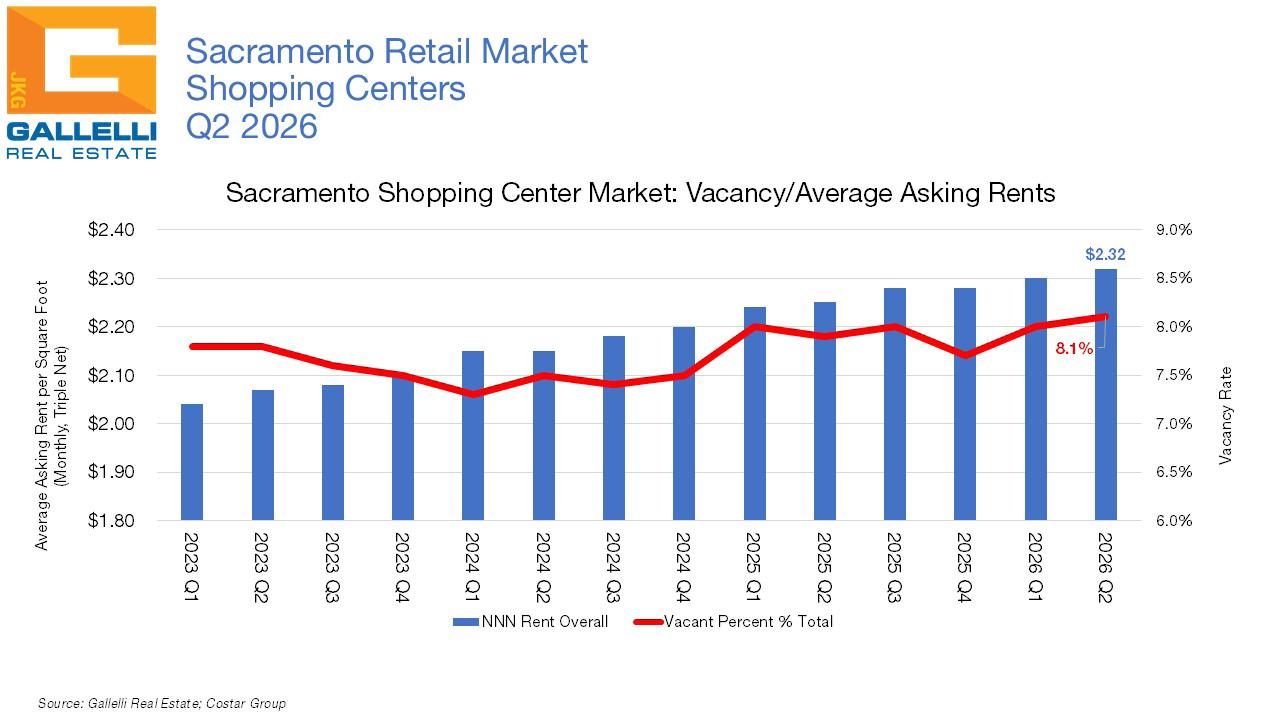
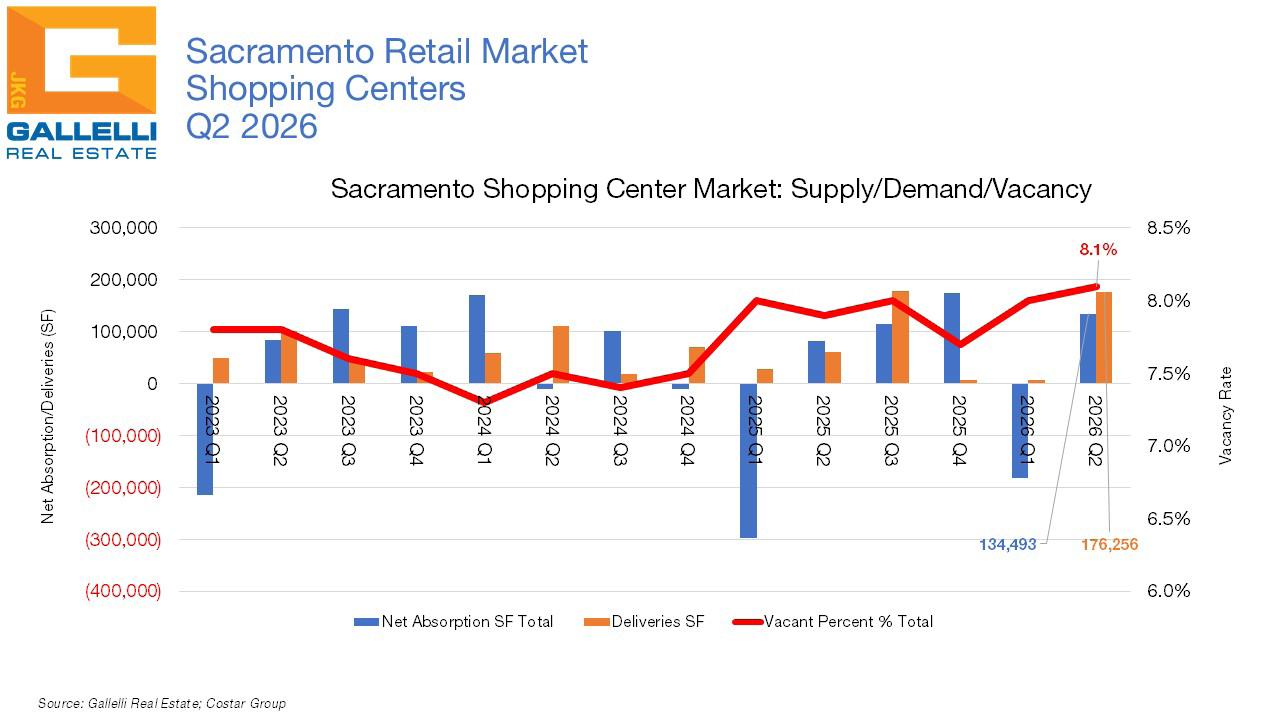
Vacancy for shopping center space in the Sacramento region stood at 8.1% as of the end of Q2 2026, reflecting a slight uptick from the revised 8.0% rate recorded three months ago. It also reflects an increase from the 7.9% rate of a year ago. While the market recorded 135,000 square feet (SF) in positive net absorption, this number was surpassed by 176,000 SF of new product that came online, which drove vacancy up modestly. However, most of this vacancy remains concentrated in the region’s Class B and C properties. Our brokers continue to report limited space availability across the region’s Class A properties, where we estimate vacancy to be closer to 5.0%.
The current average asking rent in the region is $2.32 per square foot (PSF) on a monthly triple net basis, up 3.1% over last year’s recorded rate of $2.25 PSF, though there are wide variances behind this benchmark figure. Asking rates for smaller suite space in newer Class A properties can top the $4.00 PSF range, while asking rents for larger Class C boxes can go for less than $1.00 PSF.
All told, we track 66.3 million square feet (MSF) of shopping center space across the Sacramento region. Grocery or drug store-anchored community/neighborhood centers account for 58.5% of the region’s inventory with 38.8 MSF of product. Community/neighborhood center vacancy currently stands at 7.7%, up from the 7.5% reading of three months ago and the 7.1% vacancy rate of a year ago. This shopping center type recorded positive net absorption to the tune of 95,000 SF, but this number was eclipsed by deliveries with community/ neighborhood centers accounting for nearly all the new shopping center construction in the region in Q2.
In Elk Grove, Pappas Investments delivered The Village, a 125,000 SF Whole Foods-anchored center (of which roughly 25,000 is currently available). Other tenants that have signed on at this project include Barnes & Noble and Shake Shack. Meanwhile, in Lincoln, Stuart James Construction delivered the first phase (49,000 SF) of the Nugget Market-anchored Whitney Ranch project, with additional buildings
slated for delivery in Q3. The current average asking rent for community/neighborhood space in the Sacramento region is $2.22 PSF, up 3.3% from the $2.15 PSF rate of a year ago.
Big box-anchored power centers account for 10.9 MSF of space across the Sacramento region, or 16.4% of the region’s inventory. Vacancy held steady at 5.5% in Q2 in what could best be described as a flat quarter with little movement or deal activity. Net absorption totaled less than 1,000 SF, while we tracked only a handful of leases accounting for less than 10,000 SF in total deal activity. The current average asking rent for power center space in the Sacramento region is $2.25 PSF, up 2.3% from the $2.20 PSF posted at midyear 2025.
Unanchored strip centers account for 8.7 MSF of space locally, or 13.1% of the region’s total inventory. Vacancy for this shopping center type fell in Q2 to 6.6%, down from last quarter’s reading of 7.0%. Occupancy across the Sacramento region’s strip center inventory increased by 36,000 SF over the last three months with eight of the region’s 14 distinct submarkets recording vacancy declines. The current average asking rent for
power center space in the Sacramento region is $2.18 PSF, up 3.8% from the $2.10 PSF rate of a year ago.
There is 4.7 MSF of regional and super regional mall space in the Sacramento region, accounting for 7.1% of the region’s total shopping center inventory. Over the last 20

years the local mall inventory has dropped from eight to four centers as once struggling centers like Downtown Plaza (now Downtown Commons) and Florin Mall (now Florin Towne Centre) found new life after being converted to other shopping center types. The remaining centers include Arden Fair Mall in the Arden/Howe/Watt submarket, the former Sunrise Mall (recently rebranded as Sunrise Tomorrow) in Citrus Heights, County Fair Mall in Woodland and the Roseville Galleria. As is the case nationally, mall performance remains extremely bifurcated by Class. Vacancy in the region now stands at 21.9%, up slightly from last quarter’s reading of 21.7%. But the lion’s share of mall vacancy in the region is at the soon to be redeveloped Sunrise Tomorrow project, while there is virtually no vacancy currently at the 1.4 MSF Roseville Galleria.
Lastly, outlet and lifestyle centers account for 3.1 MSF of shopping center space locally (4.7% of the region’s inventory) and currently have a vacancy rate of 4.9%, down from last quarter’s reading of 5.3%. New leases at Downtown Commons and Folsom Premium Outlets helped to drive 13,000 SF of positive net absorption as this asset class recorded its third consecutive quarter of gains. The current average asking rate for lifestyle and outlet center space in the Sacramento region is $3.00 PSF, the same rate recorded a year ago.
Though the region’s overall shopping center vacancy rate is currently 8.1%, there are several key local submarkets where tight availability is curtailing deal activity. In West Sacramento the current vacancy rate is just 2.7%, up slightly 2.1% three months ago. In Folsom vacancy now stands at 2.9%, up slightly from Q1’s reading of 3.1%, while vacancy in the Natomas market has hovered at just 3.6% for the past six months. Meanwhile, Elk Grove (4.2%), Auburn/Lincoln/ Loomis (4.9%), Roseville/Rocklin (5.0%) and the Davis Woodland (5.5%) trade areas all report tight leasing conditions with vacancy rates of 6.0% or less. At the other end of the spectrum, the Carmichael/Citrus Heights/Orangevale market currently reports the highest vacancy rate in the region at 16.8% (down from last quarter’s 17.2% rate), but this number is somewhat misleading as nearly 785,000 SF of the 1.3 million square feet (MSF) of space currently vacant comes from the soon to be redeveloped Sunrise Tomorrow project. Take that space out of the mix and vacancy here drops to 6.7%.
Vacancy in the Highway 50 submarket currently stands at 14.1%, down from last quarter’s reading of 14.6%. While this trade area currently has 487,000 SF of vacant space, roughly half of which is from some prominent vacant big boxes along the Folsom Boulevard corridor in the western portion of Rancho Cordova. Space availability in the eastern portion of Rancho Cordova/Gold River and south of Highway 50 in the Capital Village and Anatolia Ranch areas is significantly tighter.
Vacancy currently stands at 10.9% in the Arden/Howe/Watt submarket, up slightly from last quarter’s reading of 10.7%. There is currently 779,000 SF of vacant space across this submarket, but nearly a third of this space comes from Arden Fair Mall (244,000 SF). This includes 157,000 SF of former Sears space that Dick’s Sporting Goods is currently converting into a House of Sport store that will be opening sometime next year. Meanwhile, larger box vacancies (including the 72,000 SF former Kohl’s store at 1896 Arden Way) account for another 260,000 SF of space. Smaller space availability in the Arden Arcade area is actually fairly tight.
The other local submarkets where vacancy is currently elevated include South Sacramento (9.6%), El Dorado Hills (8.5%), Downtown/Midtown/East Sacramento (7.3%) and the Rio Linda/North Highlands trade areas (7.3%).
There is currently just 90,000 SF of new shopping space under construction across the Sacramento region. This is the least amount of new space under construction that we have tracked in more than ten years. While there are dozens of proposed projects across the region and many will be going forward in the months ahead, development levels have fallen nationally in recent years as costs have risen. Since the 2022/2023 inflation wave, construction costs have averaged 30% to 40% above where they stood just four years ago, but local retail rents have only grown by about 10% during this time. This challenge is not going away any time soon. In June, the Associated General Contractors of America released a report that indicated materials prices have spiked another 10% over the past year due to continued tariff pressure on steel and copper as well as the impact of oil price spikes from the Iran war.
Following the pandemic rebound of 2022/2023, retail bankruptcies and closures spiked in 2024 and 2025. Yet, this had little impact on the retail property market partially because little product has been built nationally going back to the 2008 Great Financial Crisis. Meanwhile, another factor that has helped to keep national and local vacancy in check is that a new crop of categories not traditionally thought of as major shopping center tenants has been extremely active in recent years. According to the Brown Book Retail and Restaurant Tenant Database, MediSpas, veterinary hospitals, physical therapy urgent care clinics and car washes over the last three years have added more than 3,000 units nationally in retail settings.
The good news for existing landlords is that new development levels will remain constrained for the foreseeable future. Additionally, though we have recently seen a spike in restaurant closures (especially legacy QSR chains like Wendy’s, KFC, Pizza Hut, and Jack in the Box), chain store closures overall are down in 2026. Major chain tracking firm Coresight Research counted a net loss of 8,825 store closures in 2024, roughly 3,000 net closures in 2025 and are forecasting between 2,500 and 2,800 closures for 2026.
Meanwhile, we continue to see aggressive growth from discounters, dollar stores, offprice apparel, grocery stores, fitness concepts and newer QSR banners (particularly coffee and chicken concepts). Ironically, the retail property market remains in solid shape even as there are growing signs that American consumers are in a fragile place.
Heading into the final half of 2026, the economic outlook remains cloudy. As of July 2026, hostilities had resumed in the Middle East with energy prices back on an upward trajectory. Inflation, which fell during the June ceasefire to 3.5%, will be heading in the wrong direction for now. The Federal Reserve will be under increasing pressure to raise interest rates to respond, with bond yields already climbing upward as this report went to press. It remains to be seen how long the current conflict disrupts energy supply chains, but most energy industry analysts agree that even with an immediate settlement, gas prices are not likely to get back to pre-war levels before 2027.

To date, consumers have weathered these challenges largely because 2026 was a bumper tax refund season that helped to counterbalance some of the real income shock caused by the Iran war. But US consumers have also been drawing down savings and racking up more debt to offset higher costs. That said, monthly retail sales numbers have been dropping, consumer confidence metrics have been near alltime lows, personal bankruptcies are up 11.9% through March 2026 (the latest data available from the Administrative Office of the U.S. Courts) and household debt as of end of Q1 stood at an all-time high of $18.8 trillion.
If there is good news here, it is that credit card balances during this same period fell by $25 billion to $1.25 trillion as more consumers looked towards home equity loans to pay off high interest rate credit cards. The American economy has remained resilient despite the American consumer being in what appears to be a fragile place. Should energy prices resume an upward spiral, low- and middle-income consumers might not get a chance to rebuild their savings buffers over the final half of the year which could lead to a further erosion of consumer spending.
The good news is that as cloudy as the economic outlook may currently be, most forecasters see a declining risk of recession ahead. The Survey of Professional Forecasters is the oldest quarterly survey of macroeconomic forecasts in the United States. The results from the Q2 2026 forecast are that the consensus view of economists was that real GDP would expand by 2.2% overall in 2026 (down 0.3% from last quarter’s survey). Forecasters anticipate a slight uptick in unemployment from 4.4% to 4.5% by year-end with sluggish, though positive, job growth averaging 35,000 per month through the remainder of the year (they predict this to increase to
65,000 monthly jobs in 2027). The consensus view of economists was that the US will record an annual inflation rate of 3.2% by the close of this year, up from their previous estimate of 2.8%. However, only 23% of respondents believed recession was likely in the next four quarters.
Improved hiring is one of the reasons for optimism; according to the Bureau of Labor Statistics (BLS), there were 6.6 million jobs available in the US as of the end of 2025. That number increased to 7.6 million as of May 2026 (BLS’ monthly Job Openings and Labor Turnover Report lags unemployment data by one month). It’s a significant jump that, if sustained, should see employment growth improving over the second half of 2026.
Record corporate profits are likely one factor behind the recent spike in job openings. According to the Bureau of Economic Analysis, corporate profits reached a record $4.43 trillion in Q1 2026, up from $4.35 trillion in Q4 2025, accounting for 12.4% of US GDP, the highest level since Q2 2021 and second highest since 1947.
Another theory is that many corporations that had pulled back on hiring as they embraced new AI tools are discovering that while these tools may help to boost productivity and eliminate many redundant tasks, that automation without human expertise can only go so far. Ernst & Young-Parthenon recently released a report that found the percentage of global CEOs that believed AI investments would result in significant headcount reductions fell from 46% in January of 2025 to just 20% in May of this year. Meanwhile, Goldman Sachs economists predict that AI will disrupt roughly 9% of the workforce (15 million), but that these losses will be distributed across at least a 10-year adoption period with most workers finding new employment within a year. They also anticipate that new occupations enabled by AI will increasingly become where these employees land.
Gallelli Real Estate is a private firm that specializes in commercial real estate services and property management. We believe that as a boutique firm whose understanding of the business runs as deep as our core values, our advantage is large. We take pride in our unique approach to offer more individual solutions that address the ever changing needs of our clients and the industry. After all, our success is measured by the success of our clients and the strength and longevity of our relationships.








bsessions@gallellire.com



kkuhn@gallellire.com





ebenoit@gallellire.com