
Studio visits, interviews, behind-the-scenes access, and more on gagosian.com/quarterly
House on Utopia Parkway: Joseph Cornell’s Studio Re-Created by Wes Anderson
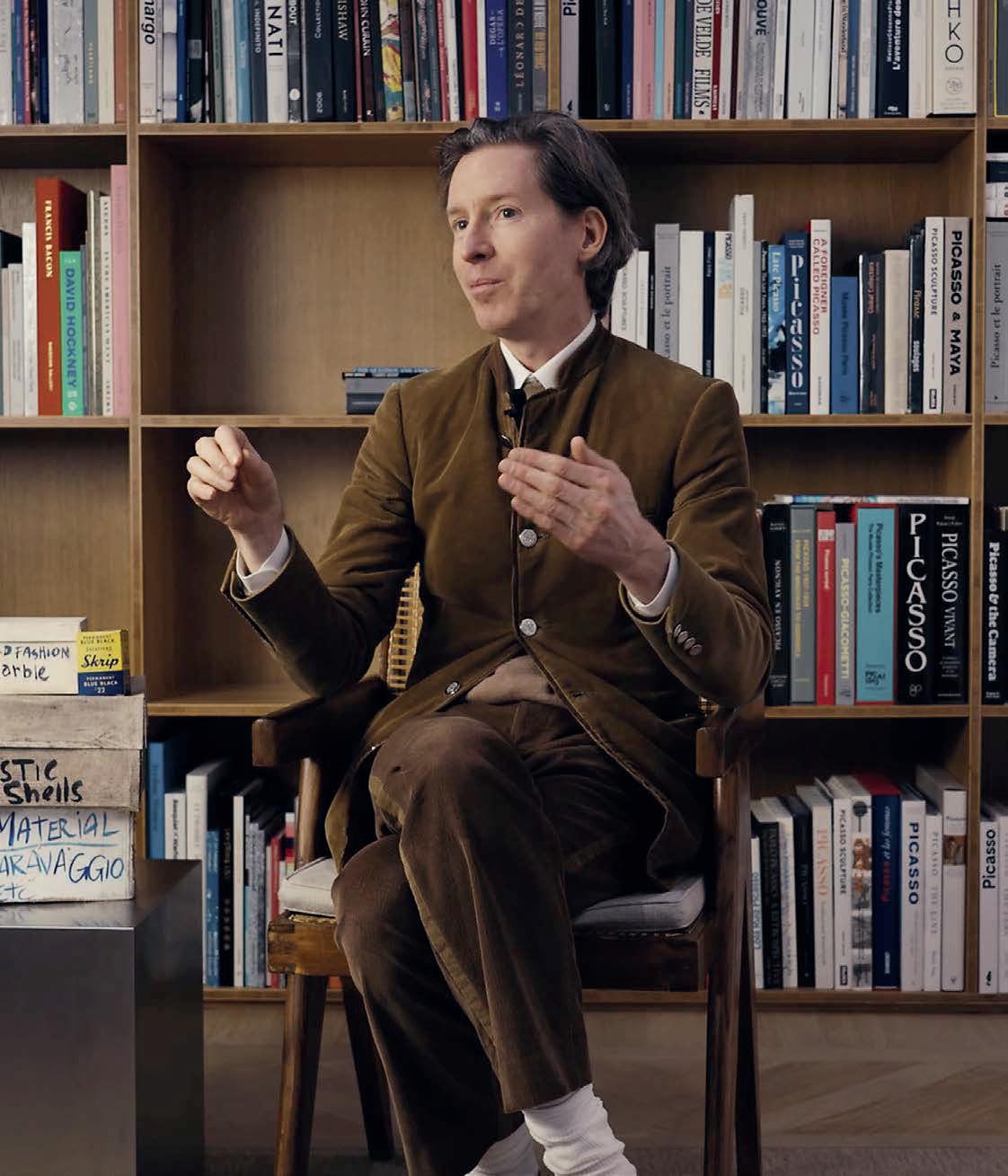
The House on Utopia Parkway: Joseph Cornell’s Studio Re-Created by Wes Anderson is an exhibition conceived by curator Jasper Sharp and the acclaimed American filmmaker. The show brings Cornell’s New York studio to the heart of Paris, transforming Gagosian’s storefront gallery into a meticulously staged tableau—part time capsule, part life-size shadow box—for the first solo presentation of the artist’s work in Paris in more than four decades. In this video, Anderson discusses the genesis of the exhibition and the process by which it came together.
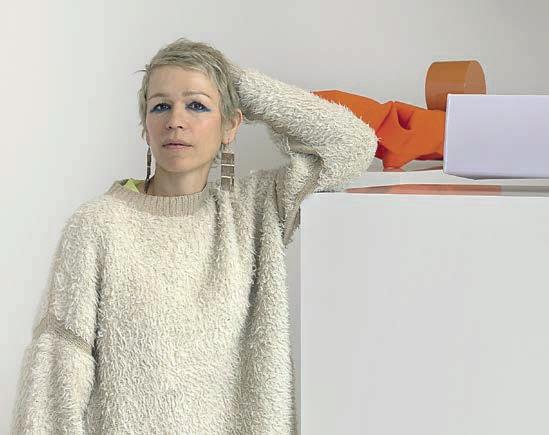
Beverly Hills
Carol Bove: Nights of Cabiria
Join the artist inside her recent exhibition at Gagosian, Beverly Hills, as she considers the power of illusion, the histories of her materials, and the philosophical lessons at the heart of Federico Fellini’s films.
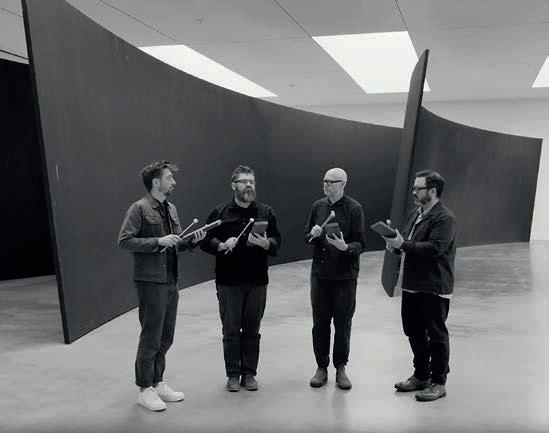
New York
Richard Serra: Steve Reich’s “Music for Pieces of Wood”
In this video, musical ensemble S¯o Percussion performs Steve Reich’s “Music for Pieces of Wood” inside the exhibition Richard Serra: Running Arcs (For John Cage), 1992 at Gagosian, New York.
Editor-in-chief
Alison McDonald
Managing Editor
Wyatt Allgeier
Editor, Online and Print
Gillian Jakab
Text Editor
David Frankel
Executive Editor
Derek C. Blasberg
Digital and Video
Production Coordinator
Alanis Santiago-Rodriguez
Design Director
Paul Neale
Design Alexander Ecob
Graphic Thought Facility
Website
Wolfram Wiedner Studio
Proofreading
Lindsey Westbrook
Founder Larry Gagosian
Publisher Jorge Garcia
Published by Gagosian Media
For Advertising and Sponsorship Inquiries
Advertising@gagosian.com
Distribution David Renard
Distributed by Magazine Heaven
Distribution Manager
Alexandra Samaras
Prepress DL Imaging
Printed b y Pureprint Group
Contributors
Justin Beal
Avis Berman
Valentina Castellani
Dan Fox
Salomé Gómez-Upegui
Christian House
Jeff Koons
Courtney J. Martin
Deborah McLeod
Aimee Ng
Ashley Overbeek
Helen Oyeyemi
Carlo Ratti
Vicky Richardson
Bartolomeo Sala
Jason Stanley
Kristen Stewart
Mike Stinavage
Candice Thompson
Carlos Valladares
David Velasco
Edoardo Zegna
Thanks
Richard Alwyn Fisher
Jin Auh
Frank Avila-Goldman
Lisa Ballard
Priya Bhatnagar
Michael Cary
Barbara Castelli
Serena Cattaneo Adorno
Allison Chomet
Vittoria Ciaraldi
Janine Cirincione
Maggie Dubinski
John Elderfield
Roe Ethridge
Raymond Foye
Mark Francis
Brett Garde
Eleanor Gibson
Lauren Gioia
Sarah Godfrey
Darlina Goldak
Nan Goldin
William Griffith
Michael Heizer
Andrew Heyward
Jasper Johns
Camilla Johnston
Titus Kaphar
Shiori Kawasaki
Bailey Keiger
Rogan Kersh
Léa Khayata
Lilly Knierbein
Meaghan Lloyd
Lauren Mahony
Farshid Moussavi
Olivia Mull
Viet-Nu Nguyen
Stefan Ratibor
Helen Redmond
Heidi Rosenau
Lauran Rothstein
Abram Scharf
Isabel Shorney
Rebecca Sternthal
Harry Thorne
Natasha Turk
Kara Vander Weg
Timothée Viale
Millicent Wilner
Jonas Wood





















Step

Jasper Johns first exhibited his crosshatch series in January of 1976; a group of abstract allover compositions that marked a distinct break from the iconography of his earlier works, they were a revelation to audiences at the time. Larry Gagosian saw that show, and for its fiftieth anniversary he has organized a major new exhibition on the series. He speaks with us here about his personal history with the crosshatch works.
The questions posed by Marcel Duchamp have challenged artists for generations, and we are thrilled to have Jeff Koons share his thoughts on the enduring legacy of art’s best-known provocateur. In our Game Changer column we look back at the trailblazer Beatrice Wood, the “Mama of Dada.” And we consider the legacy of the French gallerist Berthe Weill, who fearlessly defended the art of her time.
Jason Stanley celebrates Titus Kaphar’s newest paintings and their refusal to accept the political myth building that is actively working to reframe American history. David Velasco speaks about the intimacy, power, and love that continue to drive audiences to Nan Goldin’s genre-defining work The Ballad of Sexual Dependency forty years after its creation.
Our film articles focus on two well-known actors who have defied expectations by moving
to a different side of the camera: Kristen Stewart shares the challenges and joys of directing her first feature-length film, The Chronology of Water, and we honor the late Diane Keaton by spotlighting Heaven , a film she directed in 1987.
As Michael Heizer continues his six-decade investigation of negative sculpture with two of his most complex works of this kind to date, we look back at the earlier sculptures that paved the way to his creation of these new ones. A section on architecture opens with an homage to Frank Gehry, a visionary whose radical, symphonic, and joyous buildings transformed the world around us. We consider the complexities of legacy planning and the profound impact of philanthropic gifting with Courtney J. Martin, executive director of the Robert Rauschenberg Foundation.
Avis Berman looks at the formative experiences of Roy Lichtenstein on the occasion of an upcoming retrospective; Derek C. Blasberg considers the paintings of Thomas Gainsborough with an eye toward the role of fashion in portraiture; Helen Oyeyemi kicks off our short-fiction series this year; and Ashley Overbeek looks at the role blockchain can play in helping to resolve some of the world’s oldest cultural disputes.
Alison McDonald, Editor-in-chief













Larry Gagosian speaks about the impetus for an exhibition of historic works by Jasper Johns at the 980 Madison Avenue gallery, New York.
Jeff Koons tells Alison McDonald about his appreciation for the pioneering artist and thinker Marcel Duchamp.
The Frick Collection, New York, opened Gainsborough: The Fashion of Portraiture on February 12. Ahead of the exhibition’s opening, Aimee Ng met with the Quarterly ’s Derek C. Blasberg to talk about the project.
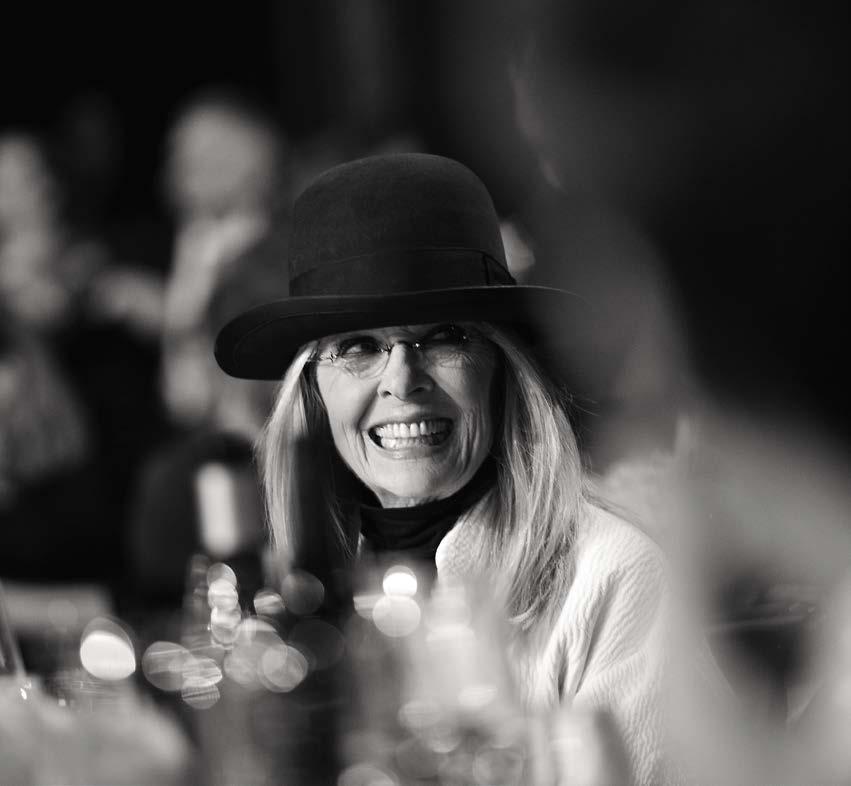
Carlos Valladares celebrates the lesser-known angles of the iconic and treasured actor Diane Keaton, with particular attention to Heaven of 1987, the first film she directed.
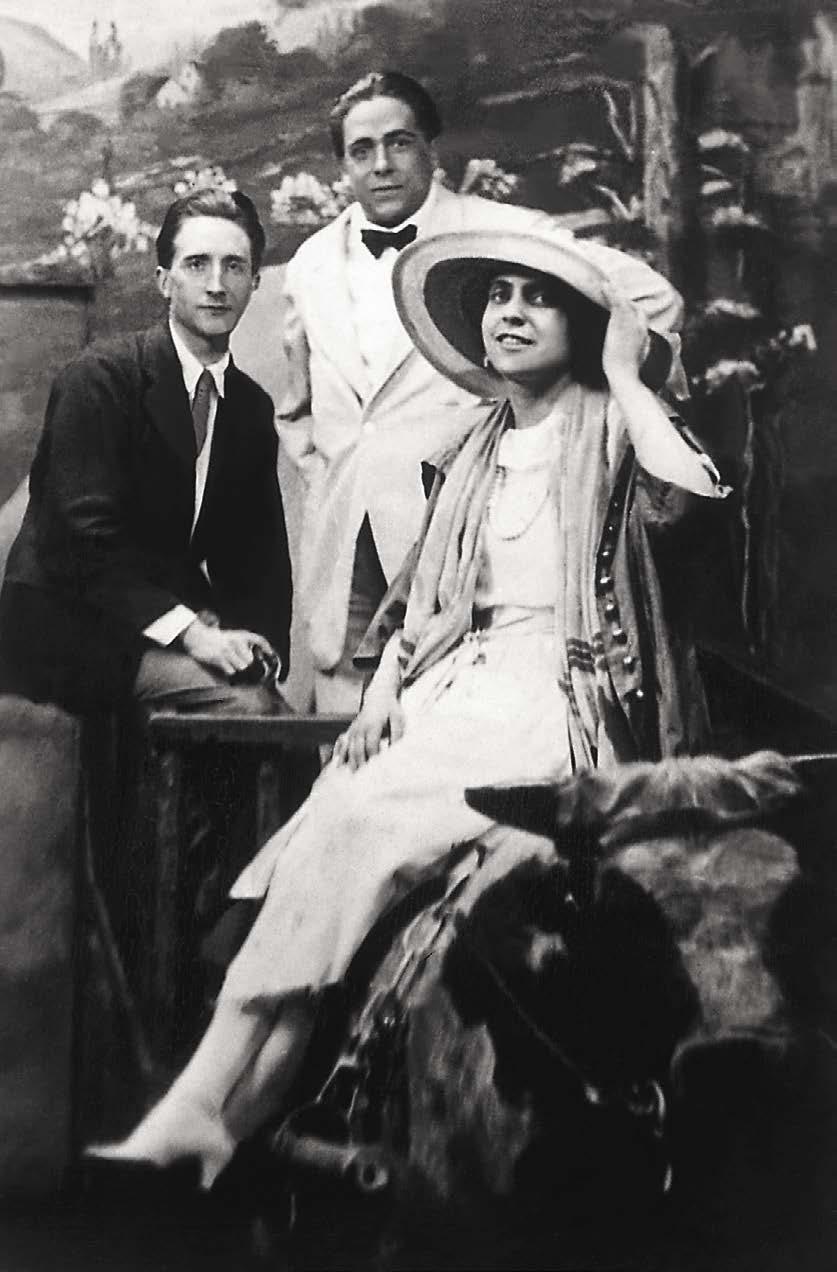
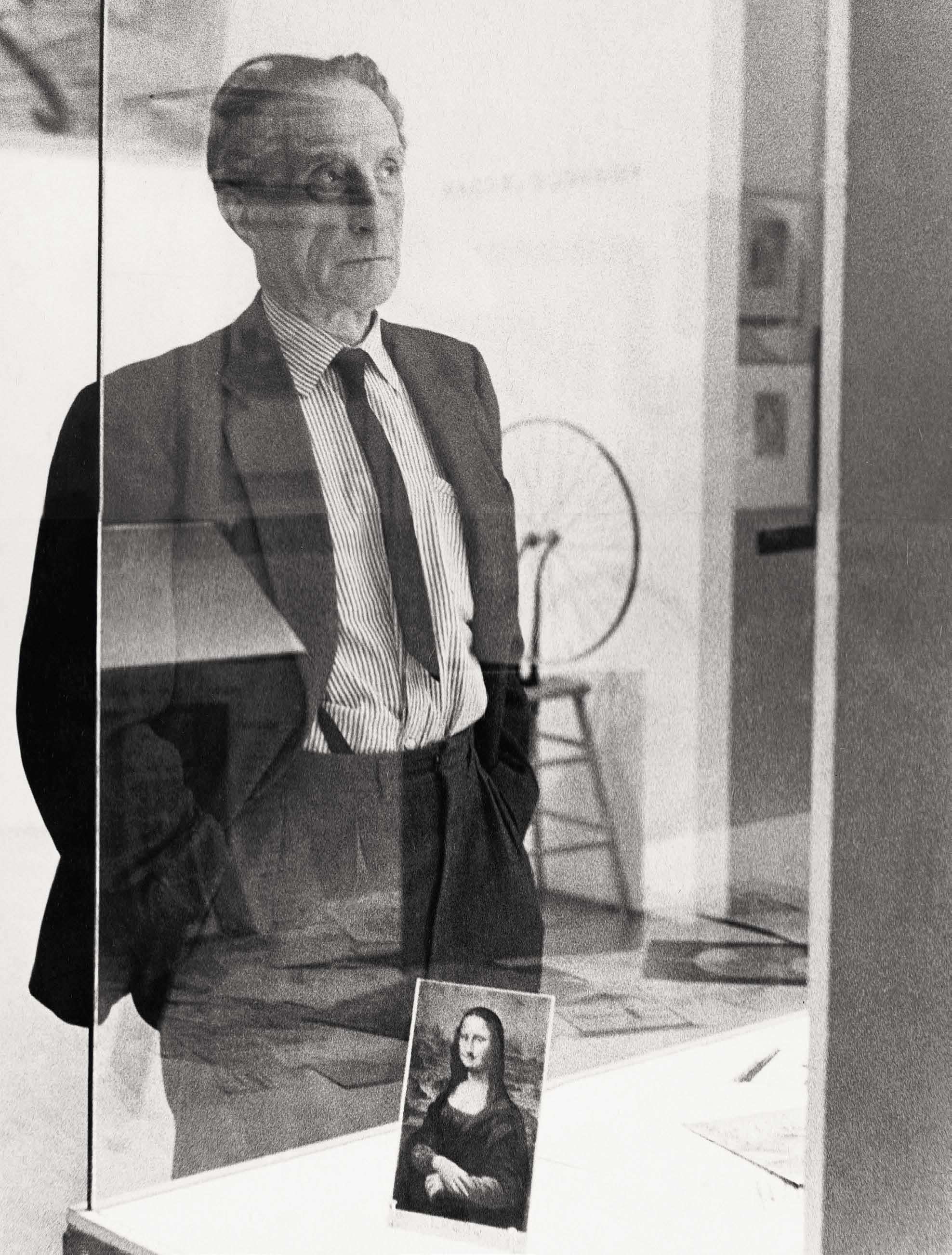
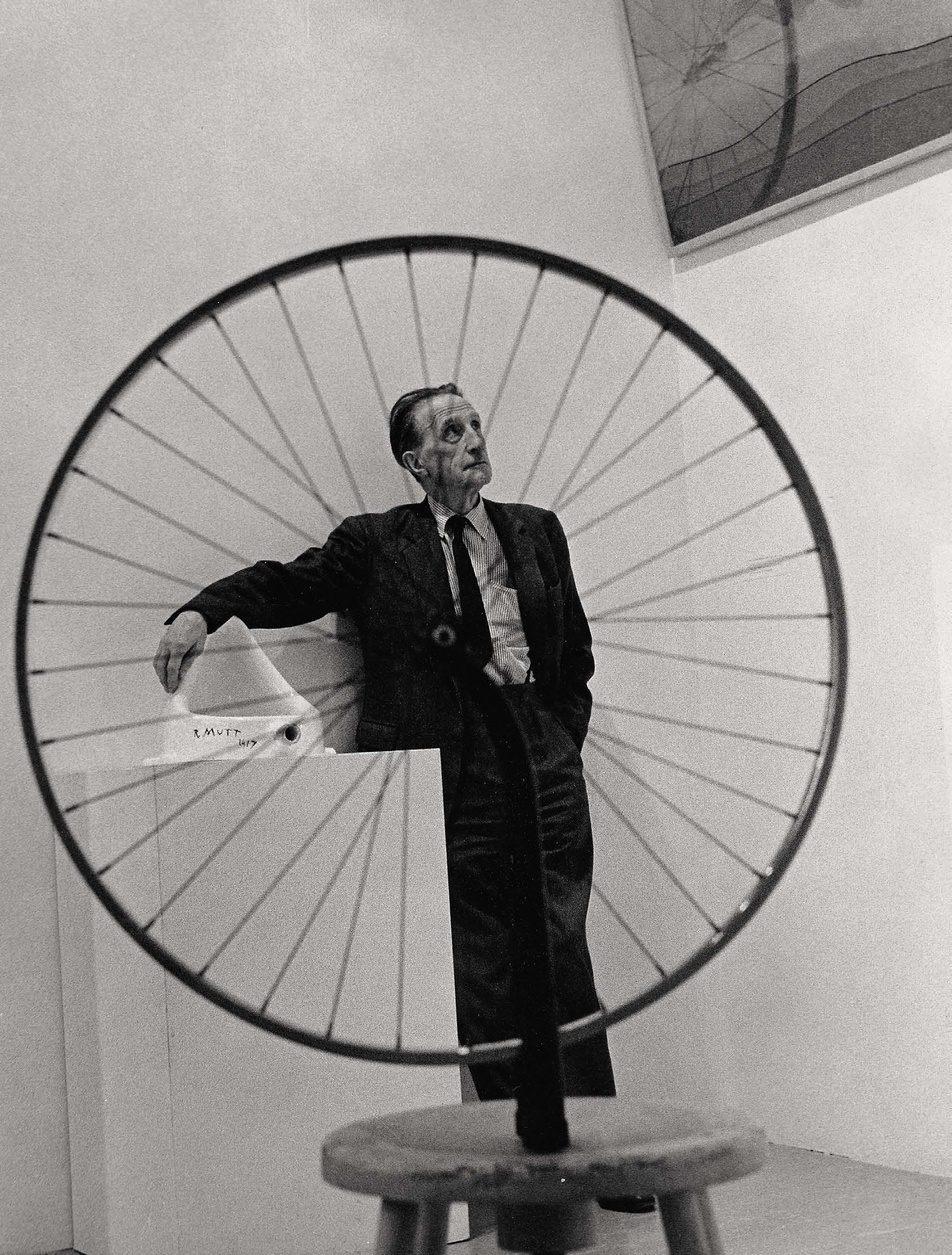
Opposite: Marcel Duchamp at the exhibition The Art of Assemblage , The Museum of Modern Art, New York, 1961.
Marvin Lazarus
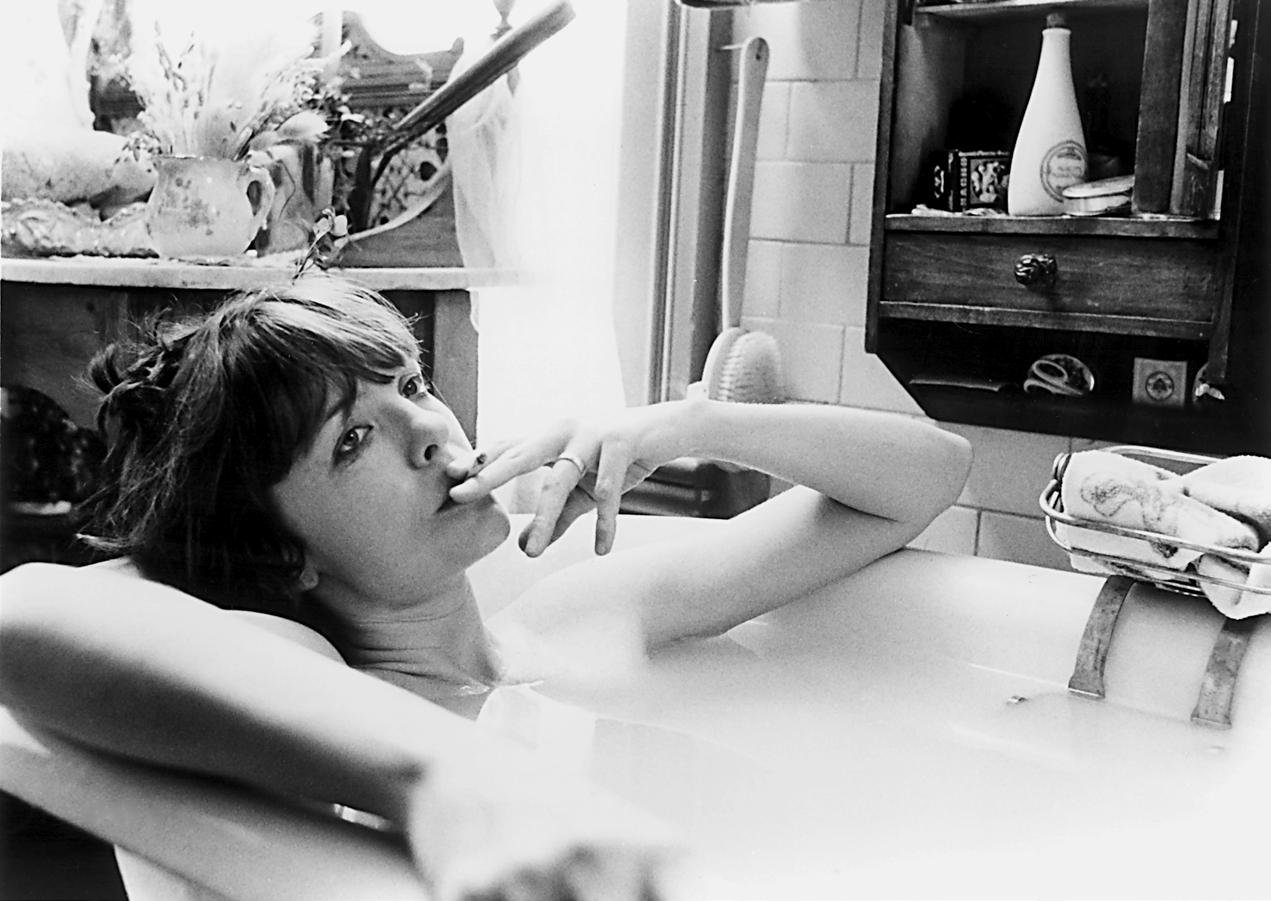
Above: Diane Keaton in Shoot the Moon (1982), directed by Alan Parker.
© MGM, courtesy Everett Collection
Across his nearly six-decade career, Michael Heizer has continued to probe the possibilities of sculptural form defined by absence. His Gagosian exhibition Negative Sculpture , comprising Convoluted Line A and Convoluted Line B (both 2024), features two of the artist’s most complex negative sculptures to date.
88
The Quarterly ’s 2026 fiction writer, Helen Oyeyemi, kicks off her series with the first installment, “Introduction to a Genie (of Sorts).”
94
Justin Beal considers the artist’s new tennis court paintings.
Mike Stinavage talks with Kristen Stewart about her first feature-length film as a director, The Chronology of Water
The Robert Rauschenberg Foundation
Courtney J. Martin, executive director of the Robert Rauschenberg Foundation, discusses its approach to the artist’s lifelong philanthropy, the intricacies of stewarding an artist’s goals and passions, and more.
For the fortieth anniversary of Nan Goldin’s genre-defining photobook The Ballad of Sexual Dependency (Aperture, 1986), David Velasco looks back to the series’ creation and evolution.
Valentina Castellani considers the impact of the French gallerist.
Jason Stanley, author of Erasing History: How Fascists Rewrite the Past to Control the Future (2024), considers Titus Kaphar’s new paintings, examining their potent refusals of jingoistic myth-building and their strident remembering of American history.
Avis Berman reflects on the artist’s formative experiences in New York in the 1920s and ’30s.
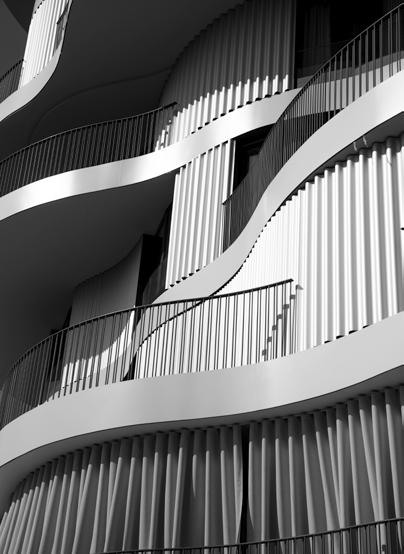
A collection of essays on architecture, including an homage to the generous vision of Frank Gehry by Deborah McLeod, a profile of the London-based architect Farshid Moussavi by Vicky Richardson, a dive into the legacy of the prophetic magazine Archigram by Dan Fox, an appreciation of Kenneth Frampton by Bartolomeo Sala, and a conversation between Edoardo Zegna and Carlo Ratti.
The month-long Dance Reflections by Van Cleef & Arpels Festival returns to New York with big ambitions this spring. Candice Thompson speaks to the festival’s artists and previews its program across the city.
Above:
Ashley Overbeek tells the story behind the Art and Antiquities Blockchain Consortium (AABC), cofounded by Susan de Menil.
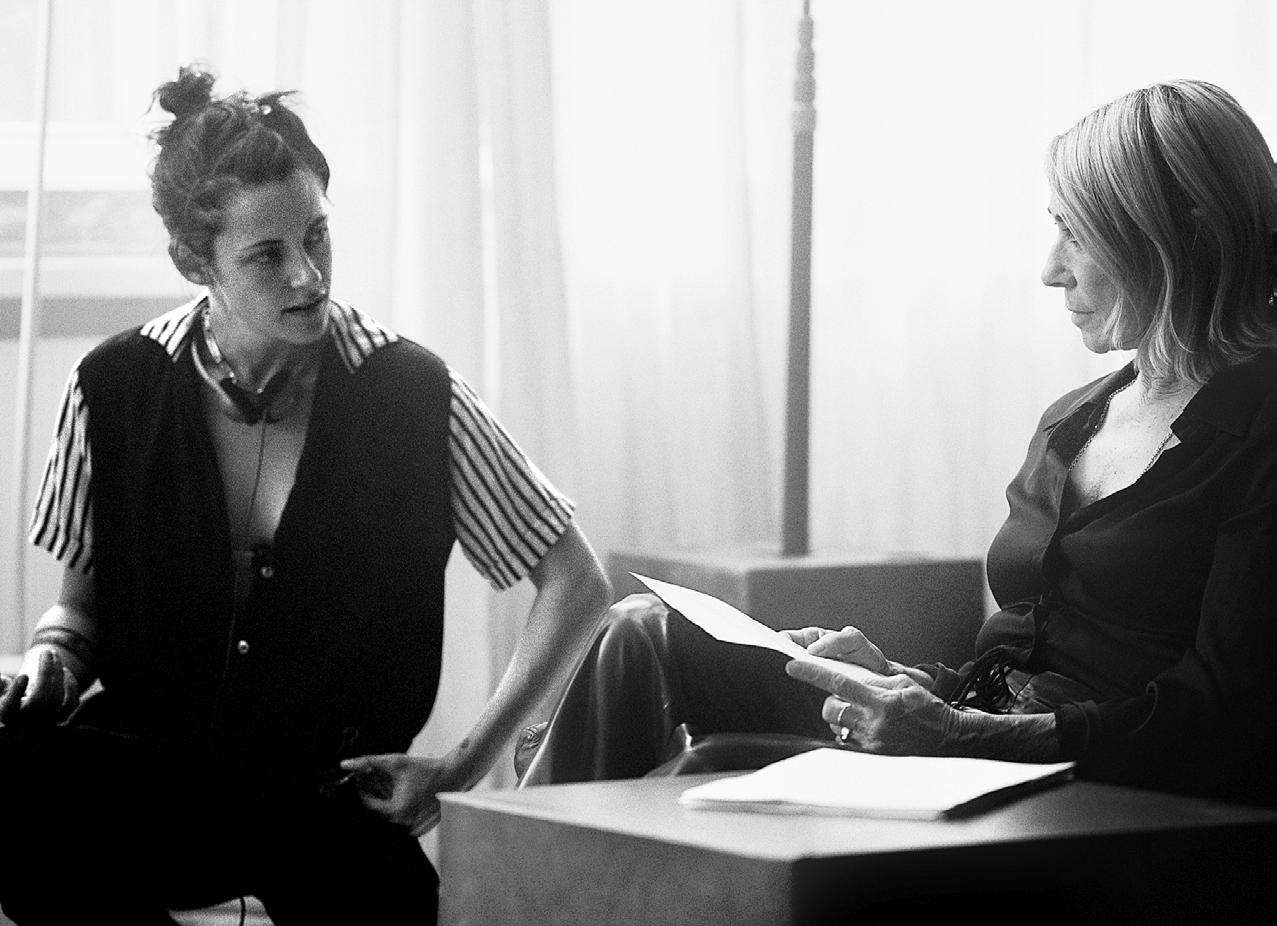
Below: Kristen Stewart on the set of The Chronology of Water (2025). Photo: courtesy The Forge
Christian House reports on Paris’s American Library, a storied collection of English-language books in the French capital, tracking its evolution and enduring role in a cosmopolitan literary milieu from World War I to the present day.
Salomé Gómez-Upegui honors Beatrice Wood, the “Mama of Dada,” an underappreciated trailblazer within the movement who went on to become a brilliant ceramist.
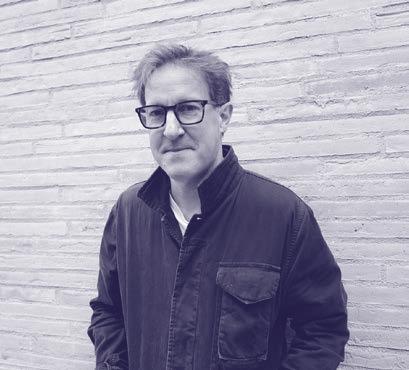
Christian House worked as a proposals writer at Sotheby’s for a decade before a period as an obituarist for the Telegraph . He now writes on visual arts, literature, and history for such publications as the Financial Times , Canvas , and CNN Style
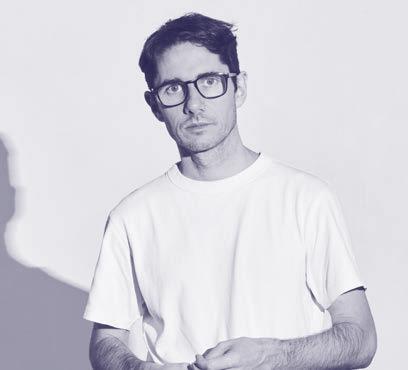
Dan Fox is a writer, musician, and filmmaker. The author of the books Limbo and Pretentiousness: Why It Matters , he is also the codirector of the BBC documentary Other, Like Me: The Oral History of COUM Transmissions and Throbbing Gristle He is a consulting editor for the Yale Review and lives in New York. Photo: Matthew Porter
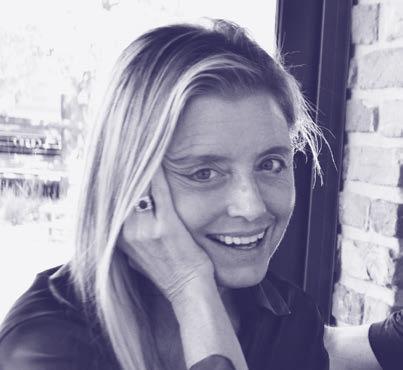
Valentina Castellani has held leading roles at Sotheby’s and Gagosian and has worked as an independent dealer. She is an adjunct professor in NYU Steinhardt’s MA program in Visual Arts Administration.
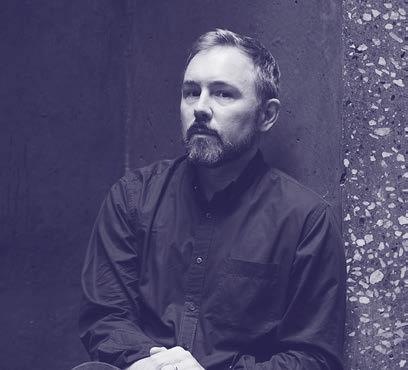
Justin Beal is an artist and writer based in New York. His first book, Sandfuture , was published by the MIT Press in September 2021 and his writing has recently appeared in Harper’s , Frieze , and the New York Review of Architecture
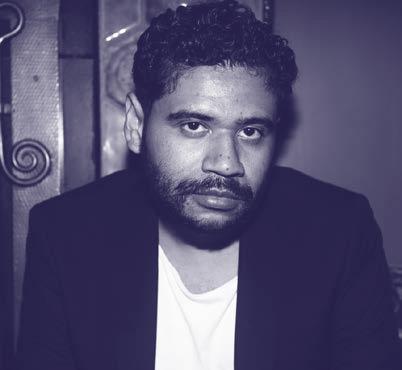
Carlos Valladares is a writer and critic from Los Angeles. He studied film at Stanford University and began his PhD in the History of Art and Film & Media Studies at Yale University in the fall of 2019. He contributes regularly to Art in America , n+1, and Frieze . He lives in New York. Photo: Jade Sacker
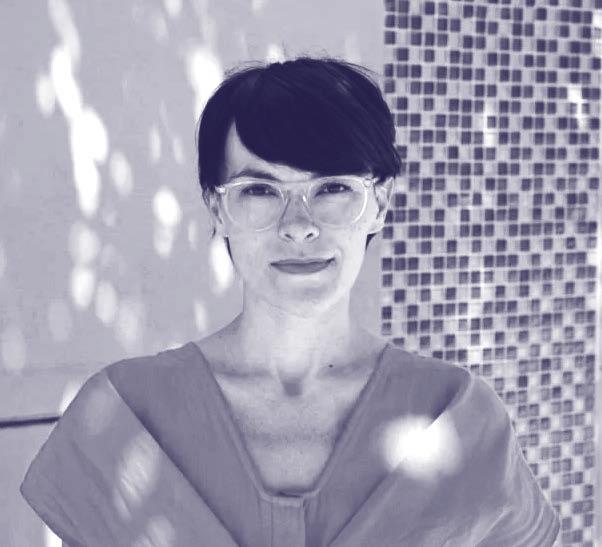
Candice Thompson is a writer and dance critic based in Brooklyn. She was a dancer with the Milwaukee Ballet Company before earning an MFA in literary nonfiction from Columbia University. She has written extensively about dance for publications including Andscape, All Arts, the Brooklyn Rail, the New York Times, and Fjord Review.
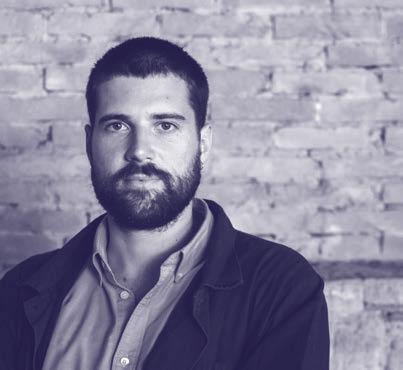
Bartolomeo Sala is an Italian freelance writer and editor based in London. His writing has appeared in the FT Magazine , the New Statesman , the Brooklyn Rail , and elsewhere. He works as a coeditor for the magazine Translator Mag .

Salomé Gómez-Upegui is a Colombian-American writer and creative consultant based in Miami. She writes about art, gender, social justice, and climate change for a wide range of publications and is the author of the book Feminista Por Accidente (2021).

Vicky Richardson is a curator, journalist, educator, and architectural adviser. She is the former Head of Architecture at the Royal Academy of Arts, London, and director of the makerspace Grymsdyke Farm. She recently set up Pick Up Architecture Ltd.

Deborah McLeod is a senior director at Gagosian, having joined the gallery as director of the Beverly Hills outpost in December 2005. In 2009 she oversaw the Richard Meier–designed expansion of the Beverly Hills gallery, doubling the footprint and adding an outdoor exhibition space.
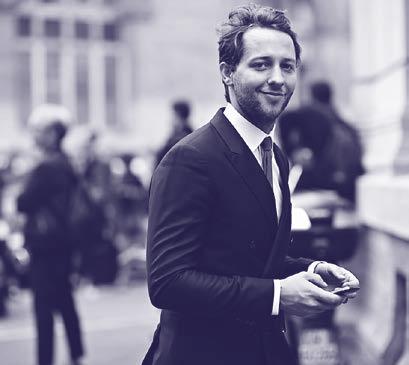
Derek C. Blasberg is a writer, fashion editor, and New York Times best-selling author. He has been with Gagosian since 2014 and is the executive editor of Gagosian Quarterly.
Since his emergence as an artist in the 1980s, Jeff Koons has blended the concerns and methods of Pop art, Conceptual art, and the readymade with popular culture to create his own unique iconography, often controversial and always engaging. He works with everyday objects to address themes of self-acceptance and transcendence.
Helen Oyeyemi’s eleven books include the novels Peaces , Parasol against the Axe , and A New New Me , and the short-story collection What Is Not Yours Is Not Yours . She lives in Prague. Photo: Milan Bureš

Aimee Ng currently serves as the Frick Collection’s Peter Jay Sharp Chief Curator and has been an instrumental member of the curatorial department at the Frick Collection since 2015. Before coming to the Frick, Ng held fellowships at the Morgan Library & Museum’s Drawing Institute, New York, and at the Center for Curatorial Leadership. Photo: Joseph Coscia Jr.

Mike Stinavage is a writer and waste specialist from Michigan. During his political science masters program at CUNY Graduate Center he was awarded Fulbright and Martin Kriesberg fellowships to research the politics of waste in northern Spain. He currently lives in France.
David Velasco is a writer based in New York. From 2005 to 2023 he was an editor at Artforum and was editor in chief for the final six of those years. He is the recipient of a Literary Award from the Lannan Foundation (2024) and of fellowships from MacDowell (2025) and Denniston Hill (2025).
Ashley Overbeek is the founder and CEO of the kombu caviar company Pearle. She is the former director of strategic initiatives at Gagosian, where she had the pleasure of working with artists on innovative digital projects.
Kristen Stewart is an actress who was nominated for an Academy Award for her portrayal of Princess Diana in Pablo Larraín’s film Spencer (2021). In 2015 she became the first American actress to be awarded a César Award in the Best Supporting Actress category for her role in Olivier Assayas’s Clouds of Sils Maria , in which she starred alongside Juliette Binoche. Stewart recently starred in Rose Glass’s film Love Lies Bleeding , which premiered at the 2024 Sundance Film Festival and was released widely in March 2024. The first film she directed, the experimental short Come Swim , premiered at the 2017 Sundance Film Festival.
Courtney J. Martin became the Executive Director of the Robert Rauschenberg Foundation in 2024. She was previously the Paul Mellon Director of the Yale Center for British Art. An art historian, curator, and professor, Martin began working with the New York–based Dia Art Foundation in 2015 and was appointed Deputy Director and Chief Curator in 2017. She had previously taught at Brown University and worked at the Ford Foundation.


Jason Stanley holds the BissellHeyd-Associates Chair in American Studies at the Munk School of Global Affairs & Public Policy at the University of Toronto. He is the author of seven books, which have been translated into over twenty-five languages, and writes often about authoritarianism, free speech, and democracy for the Guardian , the New York Times , and many other publications around the world.


Alison McDonald is the chief creative officer at Gagosian and has overseen marketing and publications at the gallery since 2002. During her tenure she has worked closely with Larry Gagosian to shape every aspect of the gallery’s extensive publishing program.

Myles Mellor has been writing crosswords for Gagosian since 2024. Over a career spanning twenty-five years he has published in over one thousand magazines, newspapers, government organizations, and Fortune 500 publications. Photo: Debby Fleming

Joshua Chuang is a director of photography at Gagosian. He was formerly Miriam & Ira D. Wallach Associate Director for Art, Prints, and Photographs and Robert B. Menschel Senior Curator of Photography at the New York Public Library.
An architect and engineer by training, Carlo Ratti works on the future of cities and the built environment. He is a professor of the practice of urban technologies at the Massachusetts Institute of Technology, Boston, where he directs the Senseable City Lab, and is a full professor in the Department of Architecture, Built Environment, and Construction Engineering at the Politecnico di Milano. He is a founding partner of the international architecture and innovation office CRA-Carlo Ratti Associati and has established several tech start-ups in the United States and Europe. He was the curator of the Venice Biennale Architettura 2025.
Edoardo Zegna is the fourthgeneration leader of the Zegna clothing house. Before joining the family business he was the head of product at Everlane from 2011 to 2014. Since entering Zegna Group in 2014, he has served many roles, including head of Omnichannel, head of content and innovation, and chief marketing, digital, and sustainability officer.
Avis Berman is the author of Rebels on Eighth Street: Juliana Force and the Whitney Museum of American Art , James McNeill Whistler, Edward Hopper’s New York , and Roy Lichtenstein: The Impossible Collection , and coauthor of Katharine Kuh’s memoir My Love Affair with Modern Art: Behind the Scenes with a Legendary Curator Berman sustains a parallel career as an oral historian, interviewing over five hundred people in the visual arts for museums and artists’ foundations.
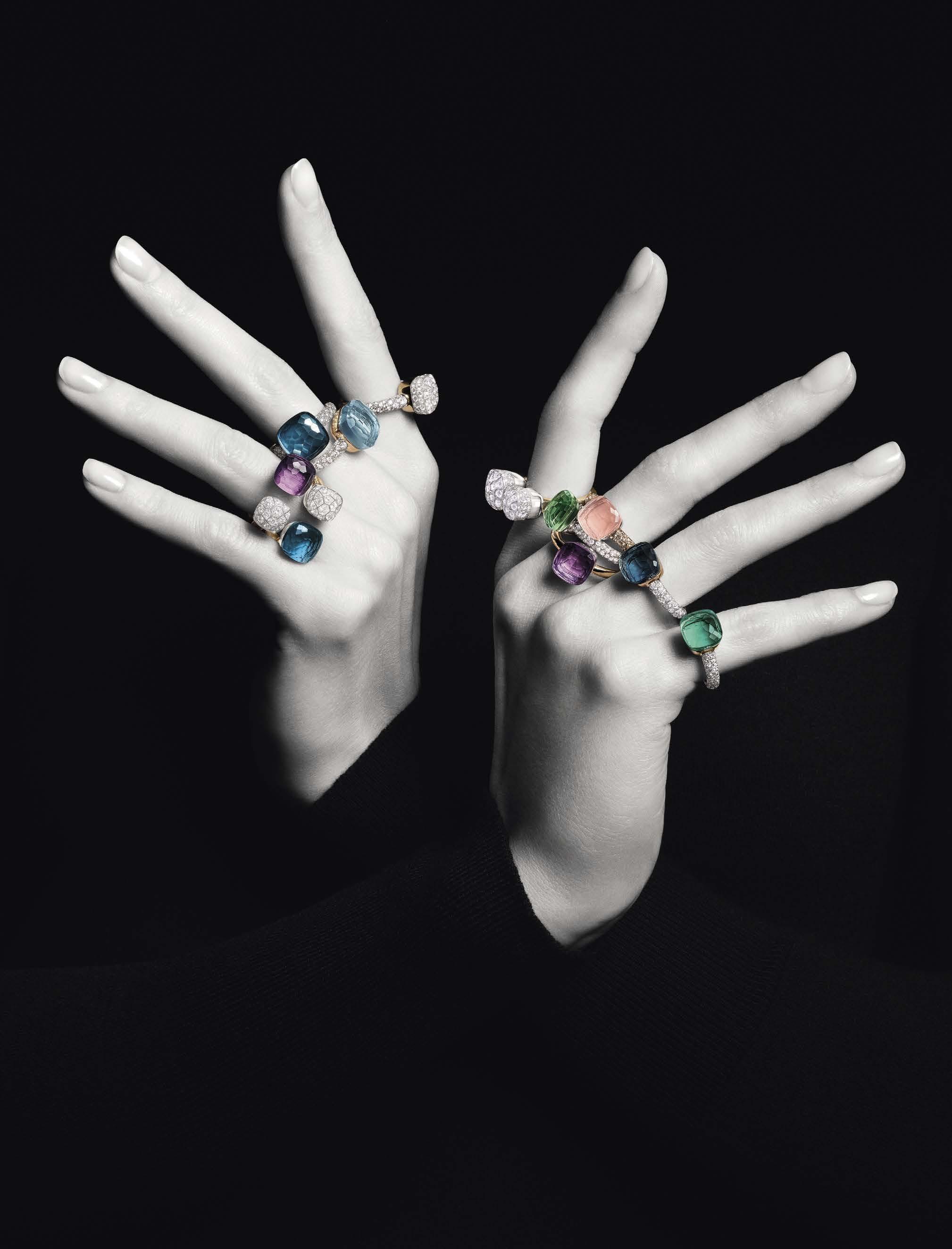
Gagosian Quarterly presents a selection of new releases coming this spring.
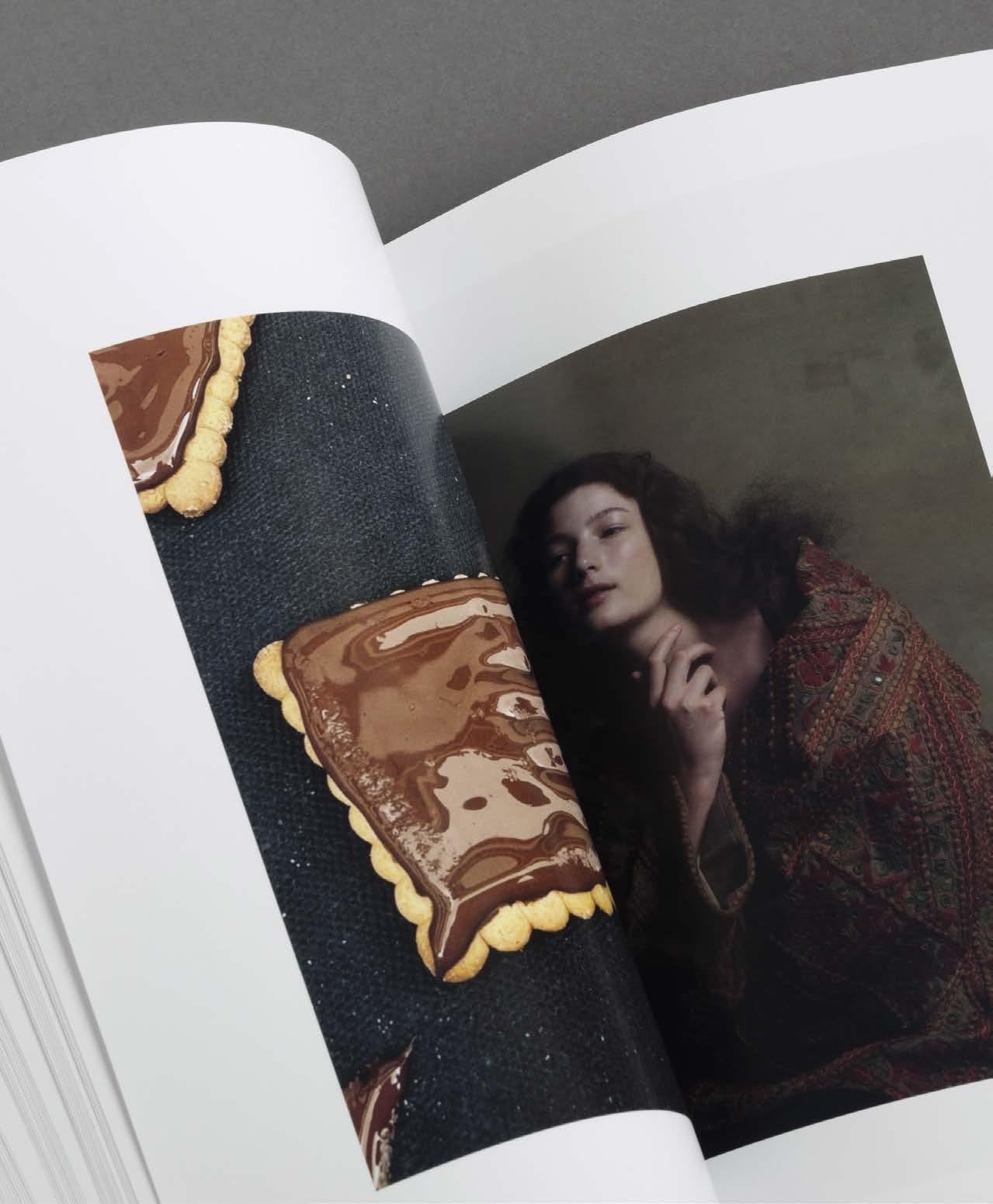
Rude in the Good Way (Loose Joints Publishing, 2026)
Monograph
Rude in the Good Way, by Roe Ethridge
A new monograph published by Loose Joints presents the everalluring photographs of Roe Ethridge. Juxtaposing commercial glamour and private sexuality, still-life arrangements and artists’ studios, the works play with the expectations of genre and form. The publication accompanies a solo exhibition at Gagosian, Athens, through March 7, 2026.
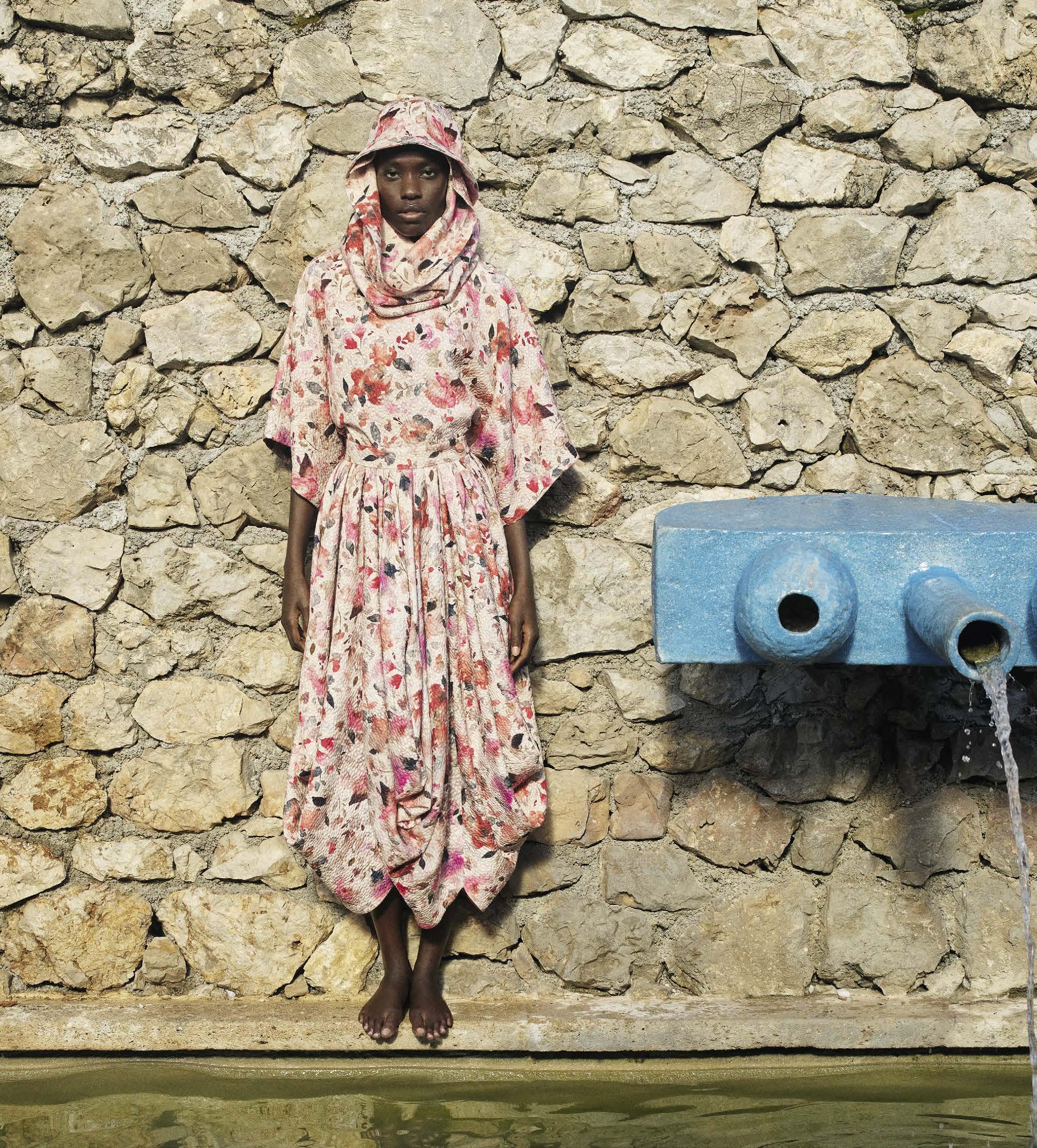

Forever Young
Sisley Paris has introduced a new addition at the heart of the Sisleÿa L’Intégral Anti-Âge routine: the Sisleÿa Longevity Essential Serum, a unique, comprehensive approach to skin longevity. The serum’s combination of nourishing and beautifying ingredients restores skin’s comfort while reviving its radiance and freshness. A duo of hyaluronic acids in different molecular weights ensures immediate and long-term hydration.
Below:
The Bride and the Bachelor s

Picture Books Tituba , by Elif Batuman with a painting by Louise Bonnet
Tituba is part of Gagosian’s Picture Books series, an imprint developed by author Emma Cline to publish fiction by leading writers alongside contributions by celebrated contemporary artists. Here, Elif Batuman’s mordantly witty story traces its unnamed protagonist’s attempts to write a novel about the enslaved Indigenous woman who was the first person to confess at the notorious Salem witch trials in Massachusetts in the late seventeenth century. The story is accompanied by Louise Bonnet’s unsettling painting Enclosure 1 (2025), which demonstrates the artist’s characteristic subversion of the conventions of figure painting.
Thinking through Art The Bride and the Bachelors , by Calvin Tomkins
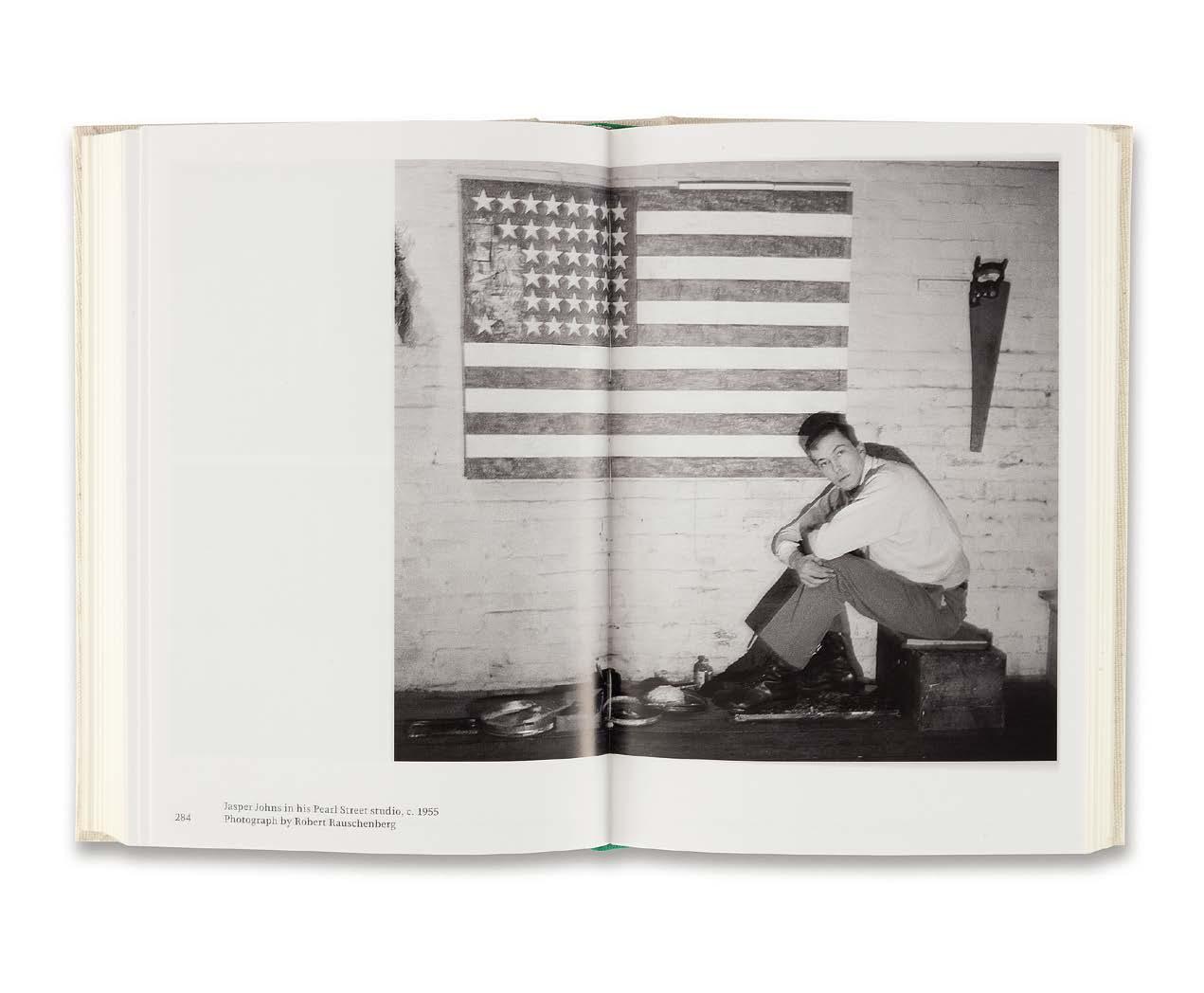
This revised and expanded edition of Calvin Tomkins’s book The Bride and the Bachelors features a new chapter examining the life and work of Jasper Johns, along with a new preface by the author. The original edition, published in 1965, included chapters on Marcel Duchamp, John Cage, Jean Tinguely, and Robert Rauschenberg. Its subtitle, The Heretical Courtship in Modern Art , conveyed the challenges that the work of these artists presented to viewers at the time.

Tosquelles: Healing Institutions , edited by Joana Masó
Francesc Tosquelles lived a life in which psychiatry, politics, and collective creativity collided, from the Spanish Civil War to a radical experiment in care at a psychiatric hospital in Nazi-occupied France, alongside poets, thinkers, and future luminaries such as Frantz Fanon and Paul Éluard. Tosquelles: Healing Institutions , edited by Joana Masó, anthologizes Tosquelles’s writings for the first time, and in the process traces the evolution of his singular style of institutional psychotherapy and its revolutionary challenge to how societies treat care, power, and difference.
Left: Tosquelles: Healing Institutions (Semiotext(e), 2026)
Below: In the American West (Abrams, 2025)
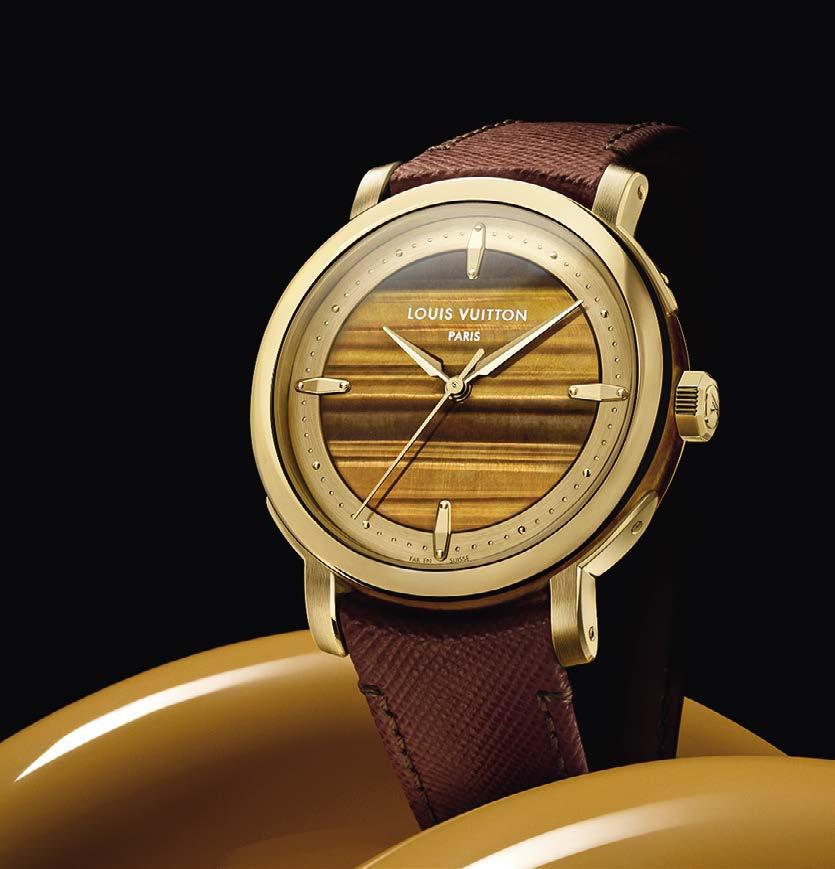
This new watch harnesses the golden-brown hues of tiger’s eye stone and yellow gold in an intricate timepiece. Inspired by the architecture of Louis Vuitton trunks, the Escale’s design draws from the house’s tradition of rich craftsmanship and choice natural materials.
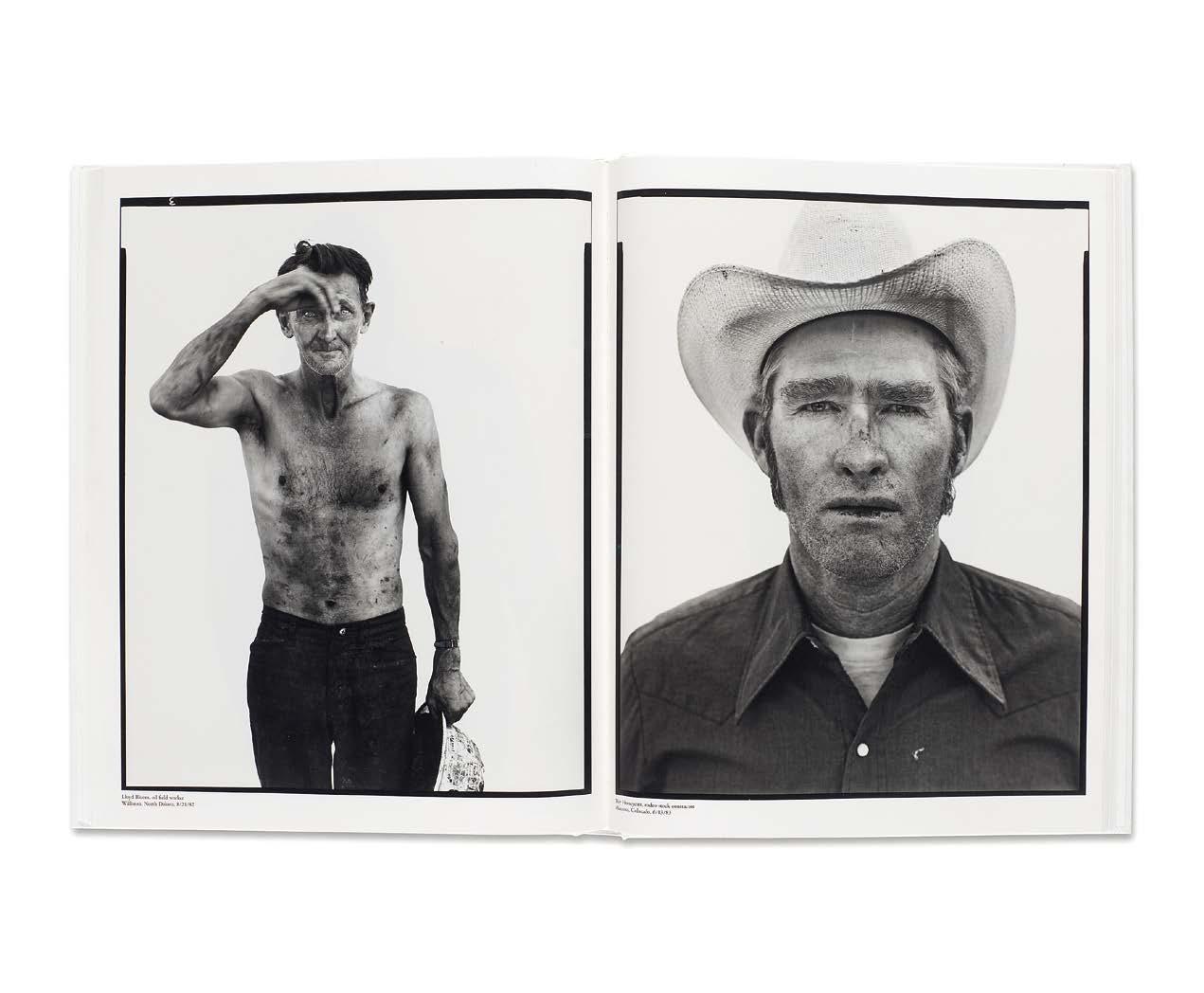
A Reissued Classic In the American West , by Richard Avedon
This fortieth-anniversary edition of Richard Avedon’s In the American West is a lush reissue of his legendary book, originally published by Harry Abrams in 1985. Avedon’s landmark series—commissioned in 1979 by the Amon Carter Museum in Fort Worth, Texas—is the result of a five-year project that saw him travel through twenty-one states. This large-format publication reproduces 103 black-andwhite photographs from the series and includes a foreword by Avedon and an essay by photographer Laura Wilson, who assisted Avedon on the project.


Release the potency of anthocyanins in a new serum with a unique antioxidant performance.

REPLUMPS RETEXTURES REVITALIZES ILLUMINATES


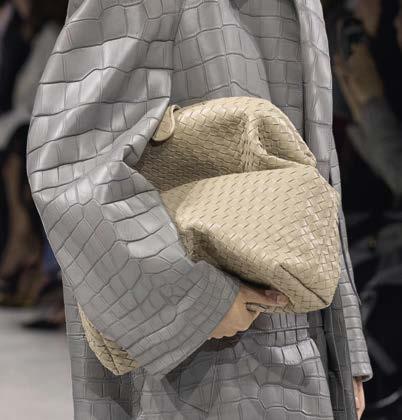
Originally produced in the late 1970s, the Lauren clutch gained iconic status through its use by Lauren Hutton’s character Michelle Stratton in Paul Schrader’s 1980 film American Gigolo Reintroduced in 2017 as the Lauren 1980, the bag featured the same design and material as the original in an exclusive Gigolo red color. This year, for her first Bottega Veneta collection, creative director Louise Trotter takes Lauren in new directions.
Below: Foirades/Fizzles (Petersburg Press, 1976)
Right: Roy Lichtenstein: Painting with Scattered Brushstrokes (Gagosian, 2025)
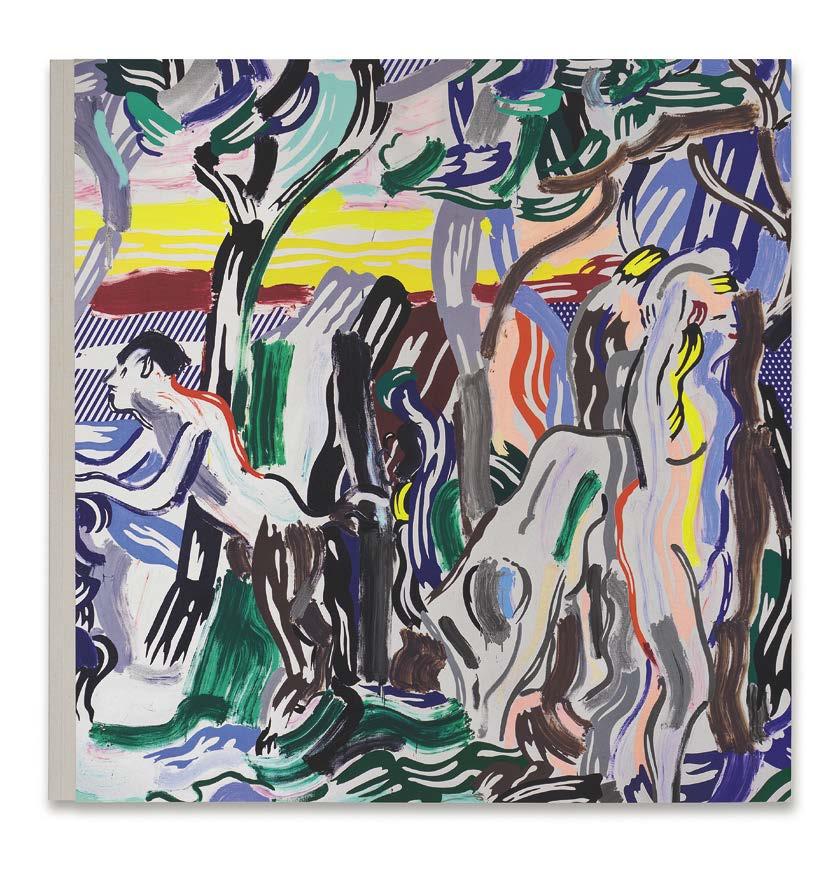
A
Roy Lichtenstein: Painting with Scattered Brushstrokes highlights a selection of paintings, watercolors, and other works on paper from the collection of the Lichtenstein family. Titled after a 1984 canvas, the book focuses on the artist’s use of the brushstroke as a formal and symbolic device. The volume illustrates over forty works that deploy the motif of the brushstroke to explore varied art-historical precedents through landscapes, figures, and abstractions.
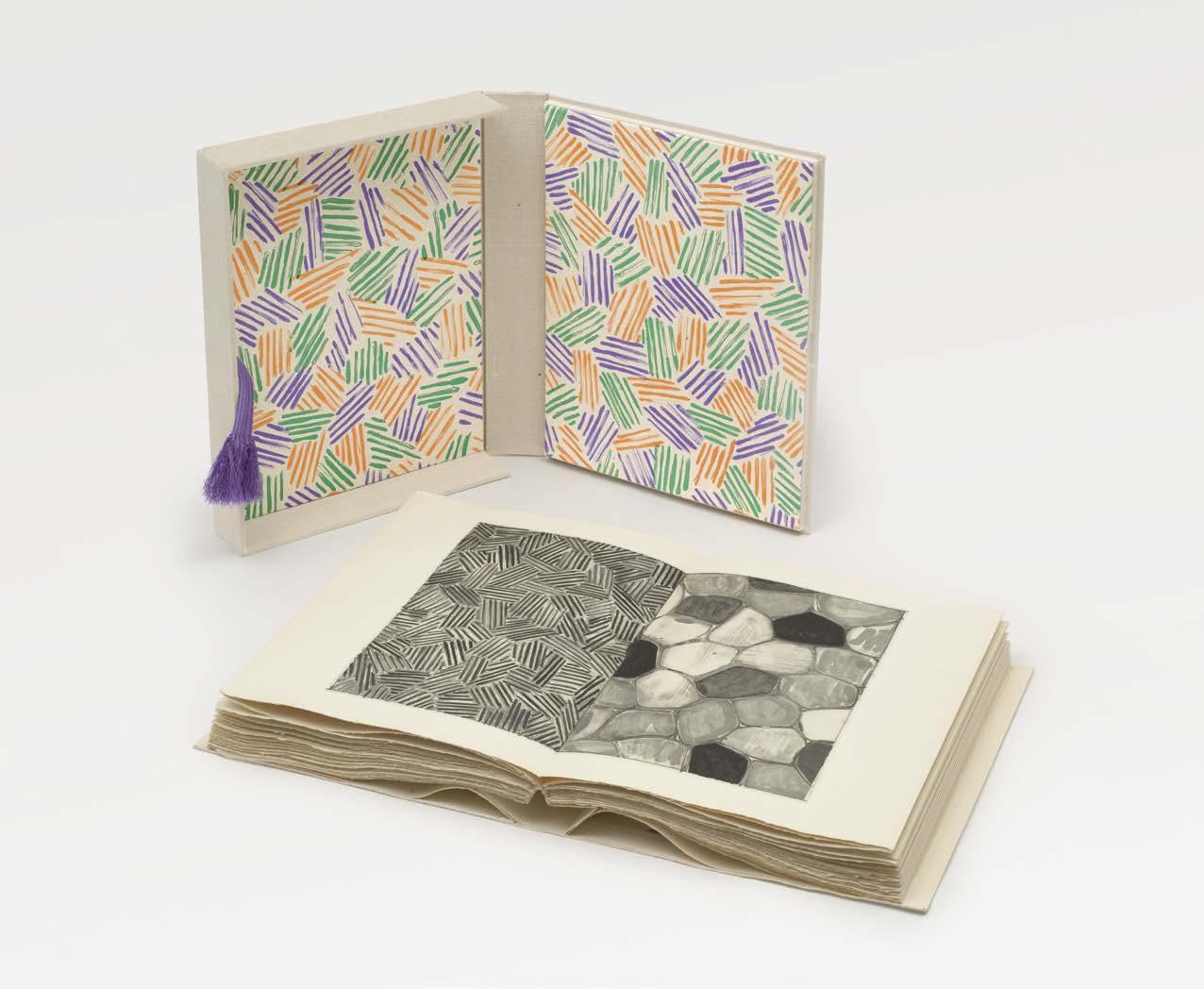
Artist’s Book Foirades/Fizzles , by Samuel Beckett and Jasper Johns
With Jasper Johns: Between the Clock and the Bed on view at Gagosian, New York, it’s an ideal time to look back at Foirades/Fizzles , a signed, limited-edition artist’s book containing original prints by Jasper Johns and texts by Samuel Beckett. Johns created thirty-three etchings and a lithograph specifically for this formative publication, using his monumental painting Untitled (1972) as the source for his imagery of crosshatches, flagstones, and cast fragments. He also created prints of the numerals 1 to 5 to indicate and delineate Beckett’s five texts. Johns printed the etchings in 1975–76 at Atelier Crommelynck, Paris, a wellknown printer that Pablo Picasso had worked with extensively. Edited by Vera Lindsay, the book was published by Petersburg Press in 1976.
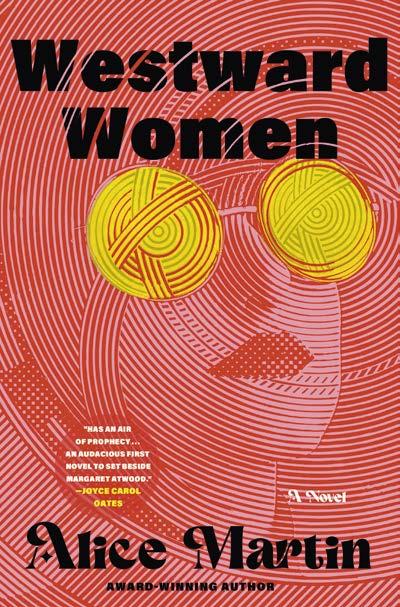
Novel Westward Women , by Alice
Martin
It begins with an insatiable itch and ends at the Pacific Ocean. Alice Martin’s debut novel, Westward Women , is a dazzling dystopian road trip. Set in the 1970s, it centers on four interconnected women and a mysterious infection that prompts women across the country to abandon their lives—jobs, families, their very selves—and travel west, where they vanish forever.
Left: Westward Women (St. Martin’s Press, 2026)
Right:
Fish Tank Blanket, edition of 80 (House of Voltaire, 2022)
Below: Photo: courtesy Saint Laurent
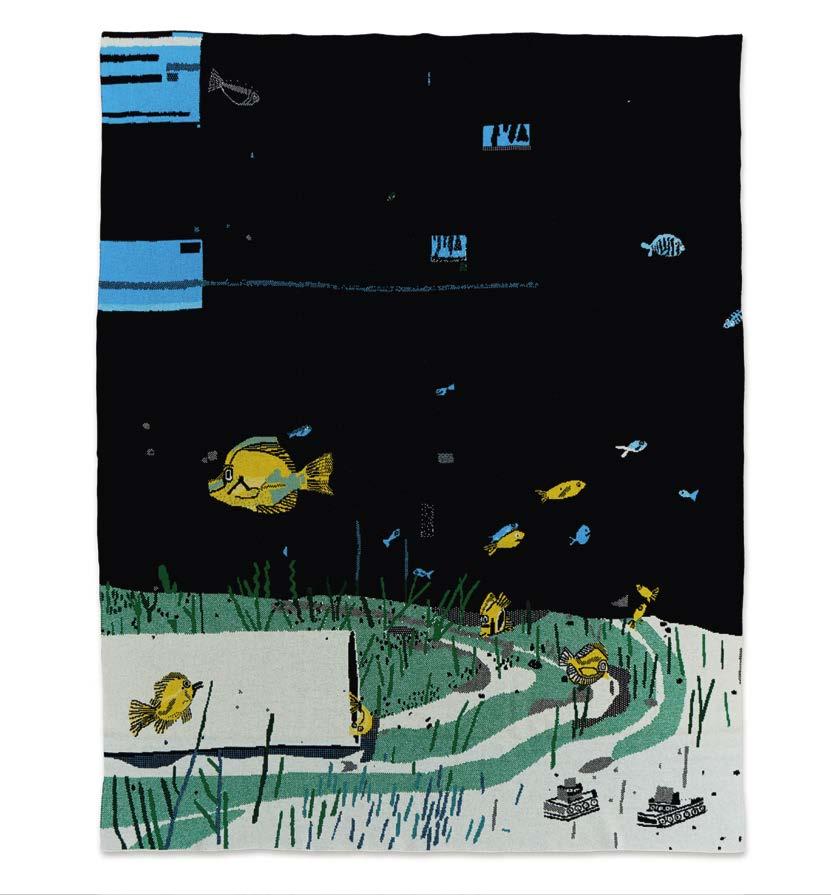
This limited-edition all-cashmere blanket, made with a double-sided jacquard technique, features a variation on Jonas Wood’s painting Small Fish Tank (2012) on the front and a muted bird’s-eye pattern on the back. The primary image is typical of Wood’s work in its use of bold line and flat color and in its focus on an object from the artist’s everyday life. Produced by House of Voltaire, a small, family-run company that uses traditional weaving techniques, the blanket has both a soft handle and a heavyweight feel.
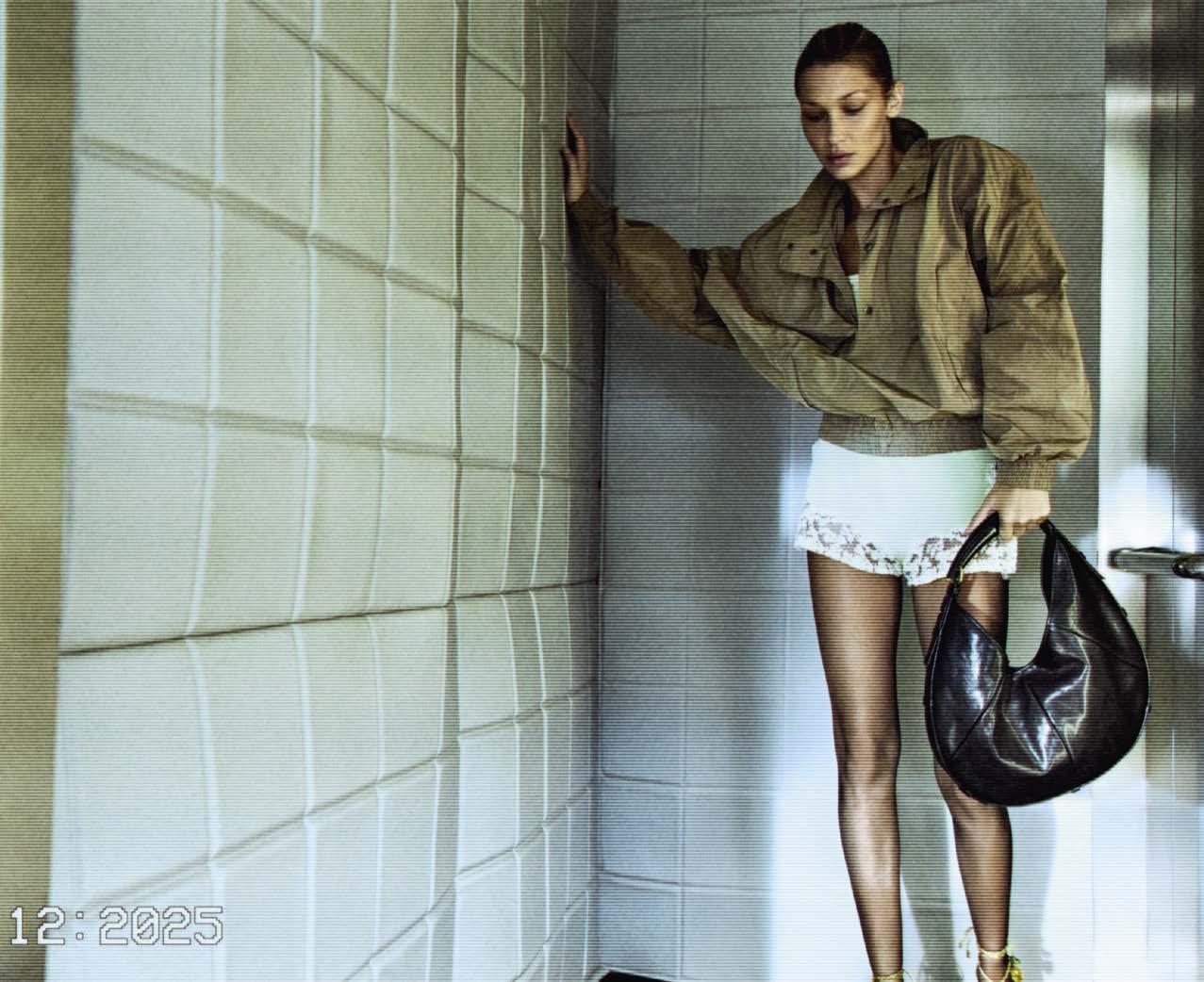
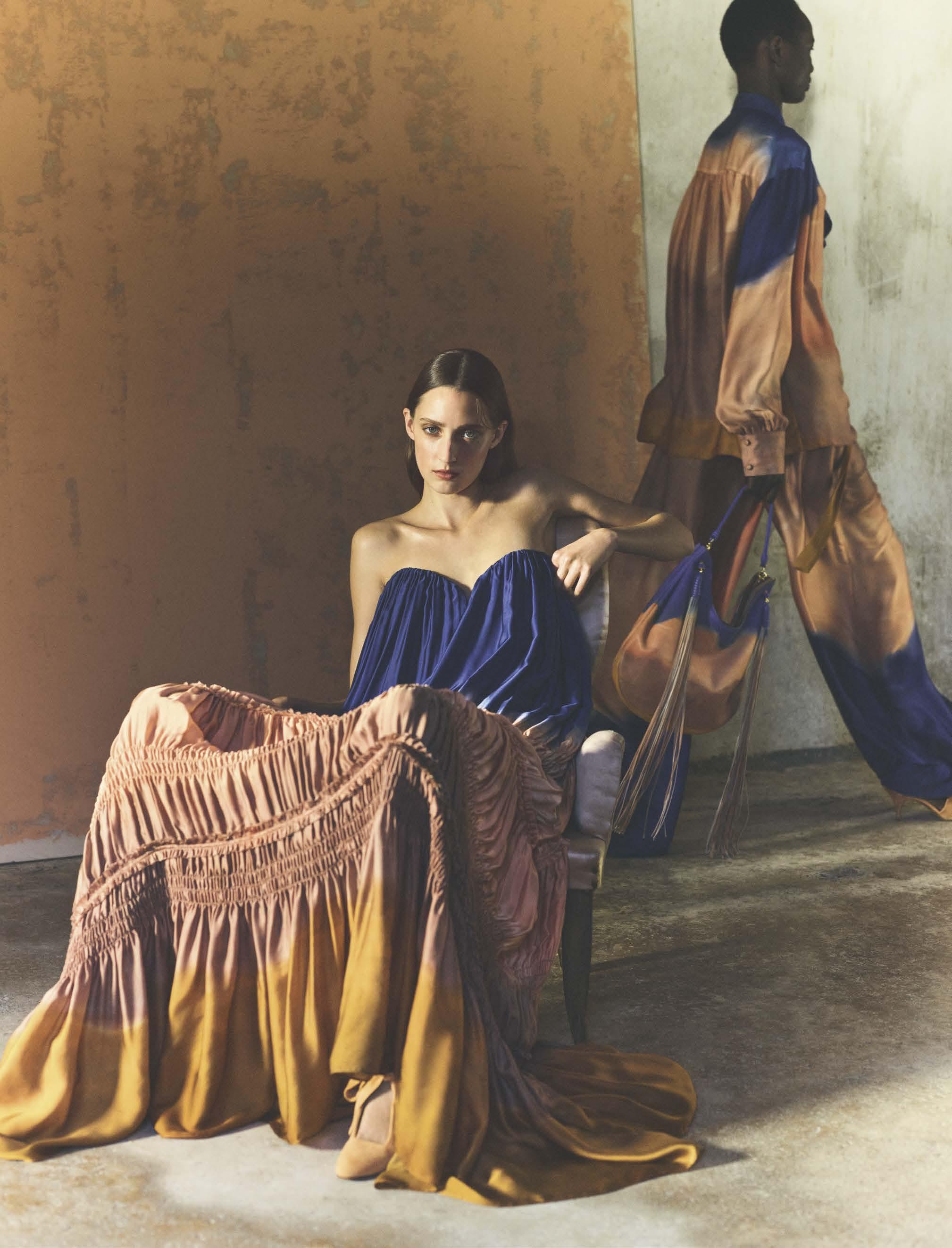
For the Spring 2026 season Saint Laurent reintroduces its iconic Mombasa bag, subtly reinterpreting it while staying true to its original allure. Available in three versatile sizes, the bag boasts luxurious materials—Courchevel leather, vintage calfskin, alligator—and a palette ranging from classic black to rouge cabernet.
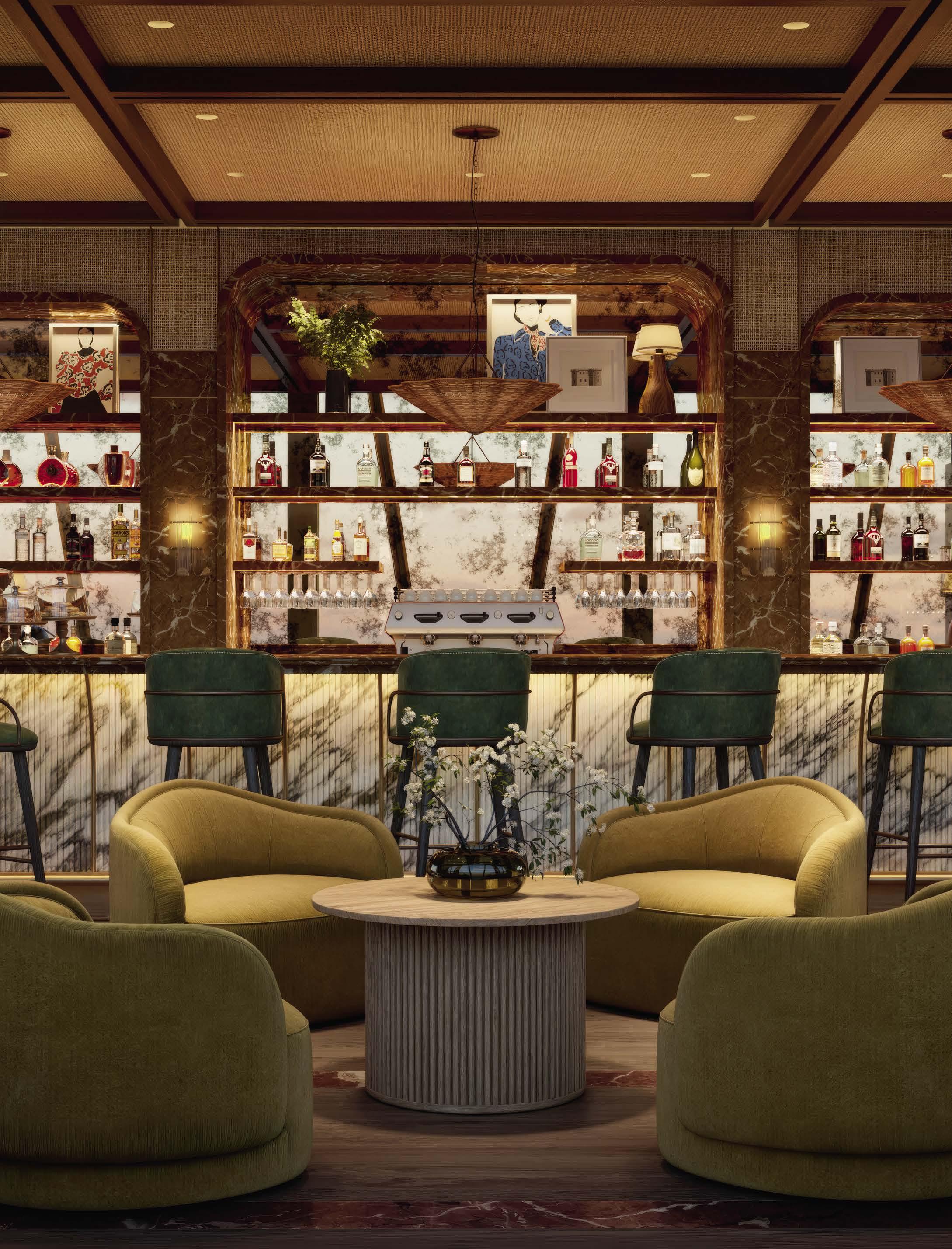
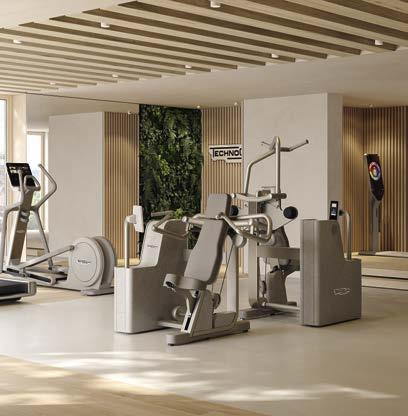
The new Technogym Sand Stone collection redefines luxury wellness with an aesthetic inspired by nature, offering a textured and enveloping experience. Its sophisticated palette, combining careful design with advanced materials, elevates wellness spaces by seamlessly blending performance, sustainability, and timeless elegance into a versatile and immersive environment. From speckled stone casings to warm titanium details and soft clay surfaces, the collection uses innovative materials to create a holistic and inviting design language for a unique exercise experience.
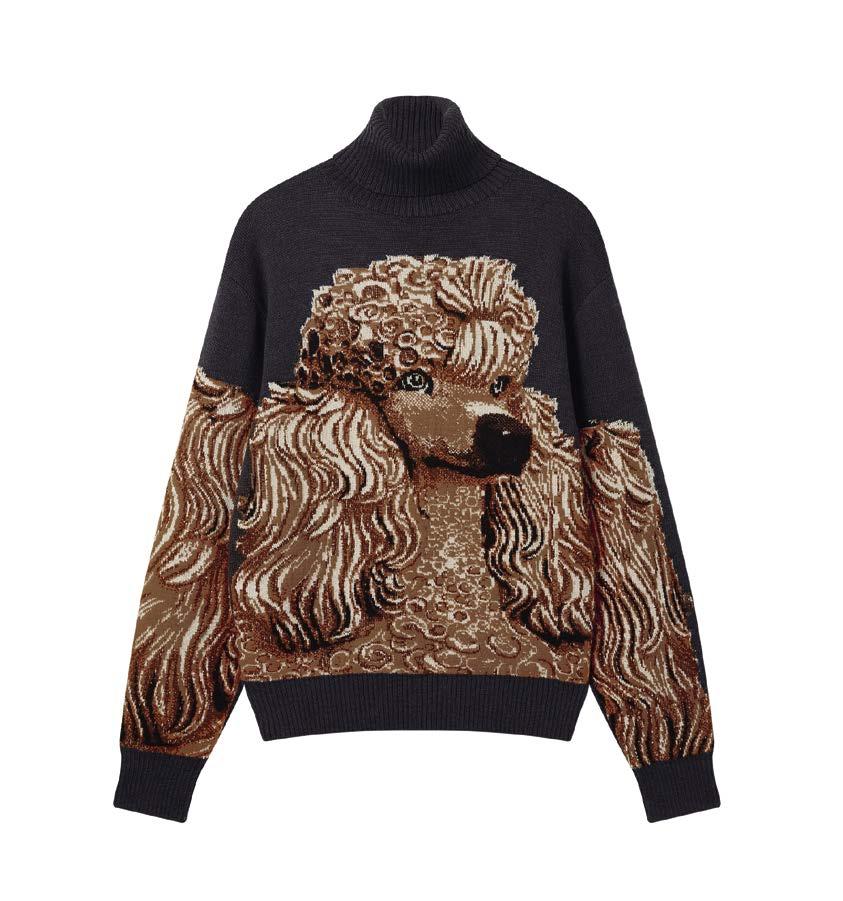
Stella McCartney’s new limited-edition capsule collection, made in collaboration with Jeff Koons, launched in January 2026. Blending the two creators’ singular visions, the collection, which was first seen in McCartney’s Winter 2025 runway show, features organic cotton T-shirts printed with artworks by Koons and slogans by McCartney, alongside pieces including tanks, hoodies, and a wool turtleneck. The collaboration continues the pair’s long-standing creative partnership, which has previously included jewelry, prints, and charitable initiatives.

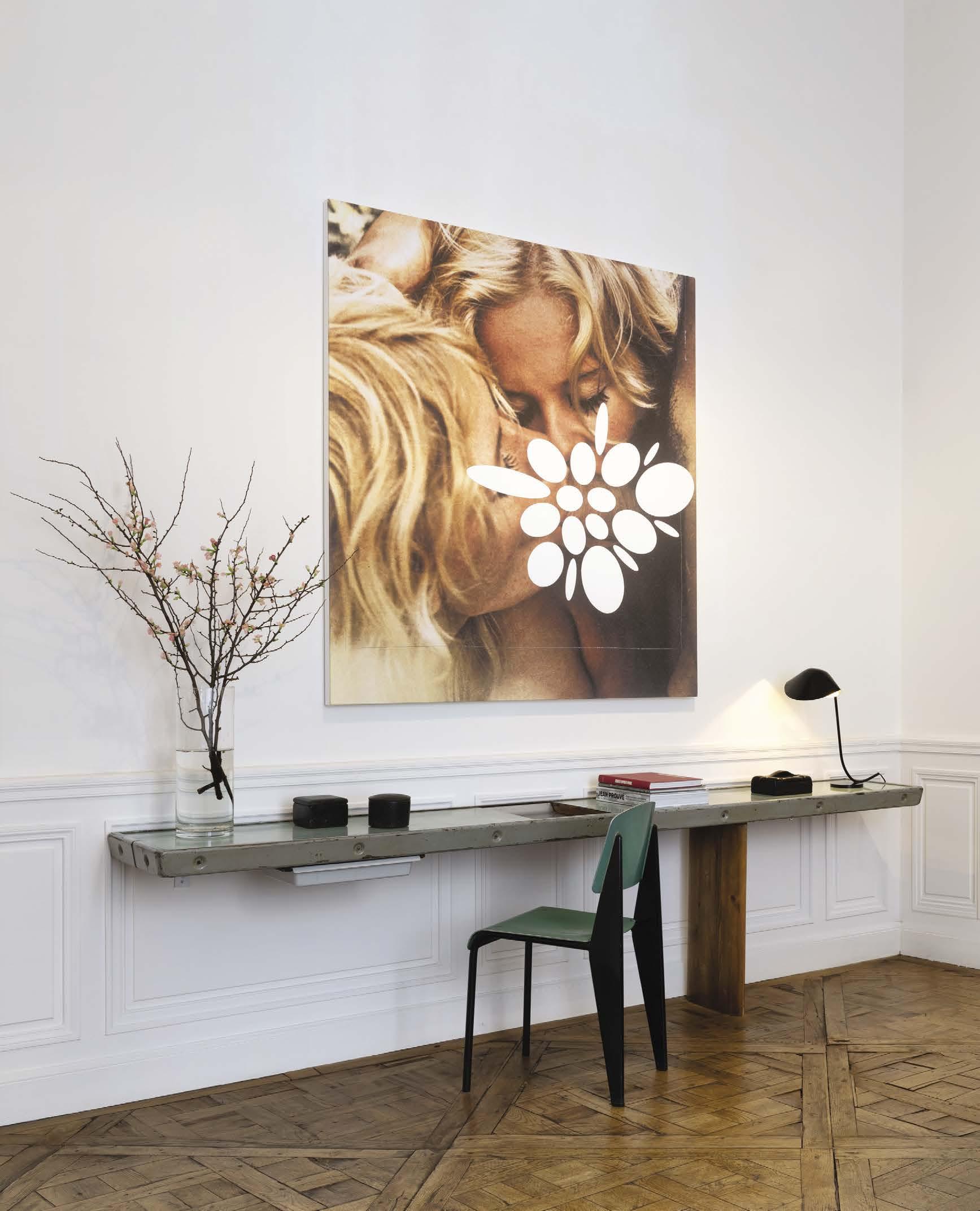
Joshua Chuang tracks the midlife genesis of the celebrated photographer’s devotion to the art of making prints, focusing on the many versions of Seine Rowboat . To read the full essay, visit gagosian.com/quarterly.
At a gathering of leading figures organized by New York’s Museum of Modern Art in 1950 to discuss the state of photography, Irving Penn proclaimed that “the end product of [the photographer’s] efforts is the printed page, not the photographic print. . . . The modern photographer does not think of photography as an art form, or of his photograph as an art object.”1 It was the golden age of the magazine, and the thirtythree-year-old Penn had reached the height of his influence, having risen from Alexander Liberman’s design assistant at Vogue to become one of its star photographers. By the early 1960s, however, Penn found himself increasingly dissatisfied with editorial work, particularly with how his pictures looked and functioned in print. Amid what he perceived as a broader decline in magazine production values—exemplified by Condé Nast’s 1964 shift from rotogravure to offset lithography— Penn began seeking a different outlet for his most serious creative ambitions.
The year before, while visiting the George Eastman House (now Museum) in Rochester, New York, Penn was unexpectedly “staggered by the prints made by the old photographers,” struck by their devotion to the print itself. This encounter prompted him to study early photographic literature and obsolete printing techniques in search of ways to endow his own work with greater presence and personal meaning.
Platinum and gum bichromate— two nineteenth-century printing processes prized for their tonal depth and tactile surfaces— intrigued Penn most. Working around the demands of his editorial career, Penn devoted himself to sustained experimentation with these processes, rigorously testing formulas, methods, and materials. Central to this new ethos was his embrace of the negative

as a generative source capable of yielding multiple meanings through prints that varied in texture, scale, and tone, allowing him to reanimate and reinterpret key images from his oeuvre.
Among these was a color photograph Penn made in late summer 1951 of a man rowing on the Seine. When it appeared in Vogue in April 1953, the image was printed in a high key, suppressing extraneous detail and isolating the blurred figure against a hazy field. A wisp of bright streaks trails across the frame like an apparition—a flaw in the negative that Penn chose to accentuate rather than retouch. The photograph became a significant motif: He later tinted the background emerald green and selected it for the cover of his first monograph, Moments Preserved (1960). For exhibition, he produced a series of dye transfer prints, manipulating individual color channels to create variations whose emotional tenor shifts as the background moves from ivory white to pale yellow.
2
In 1969, Penn—by then, as he
put it, a “victim of a printmaking obsession”3—returned to Seine Rowboat , recasting the image as a gum bichromate print made by coating a surface with sensitized mixtures of pigment and gum arabic and exposing them through contact internegatives. The grain, already pronounced through extreme enlargement of a 35mm frame, was further intensified for pointillist effect. Drawing upon his training in high-end magazine production, Penn repeatedly coated and printed the image onto a single surface (here, porcelainized steel) using various pigments, producing an atmospheric, Turneresque composition.
Five years later, Penn returned to the motif once more, this time working in platinum metals on hand-coated paper. Using a bespoke pin-registration system he had developed to allow multiple coatings and exposures from different internegatives, he softened the image’s contrast while preserving its tonal density, imbuing the composition with a quieter, more contemplative intensity.
1. Penn quoted in an audio recording of the symposium “What Is Modern Photography?,” held at the Museum of Modern Art, New York, October 20, 1950, available at https://www. wnyc.org/story/207507-modern-photography/.
2. In 1959, dye transfer prints of Seine Rowboat were included in two major group exhibitions, the Biennale Internazionale della Fotografia in Venice, and Photography in the Fine Arts at the Metropolitan Museum of Art, New York. Another was included in Penn’s first commercial gallery show, at Alexander Iolas Gallery, New York, in 1960.
3. Irving Penn, Passage: A Work Record (New York: Knopf, 1991), 144.
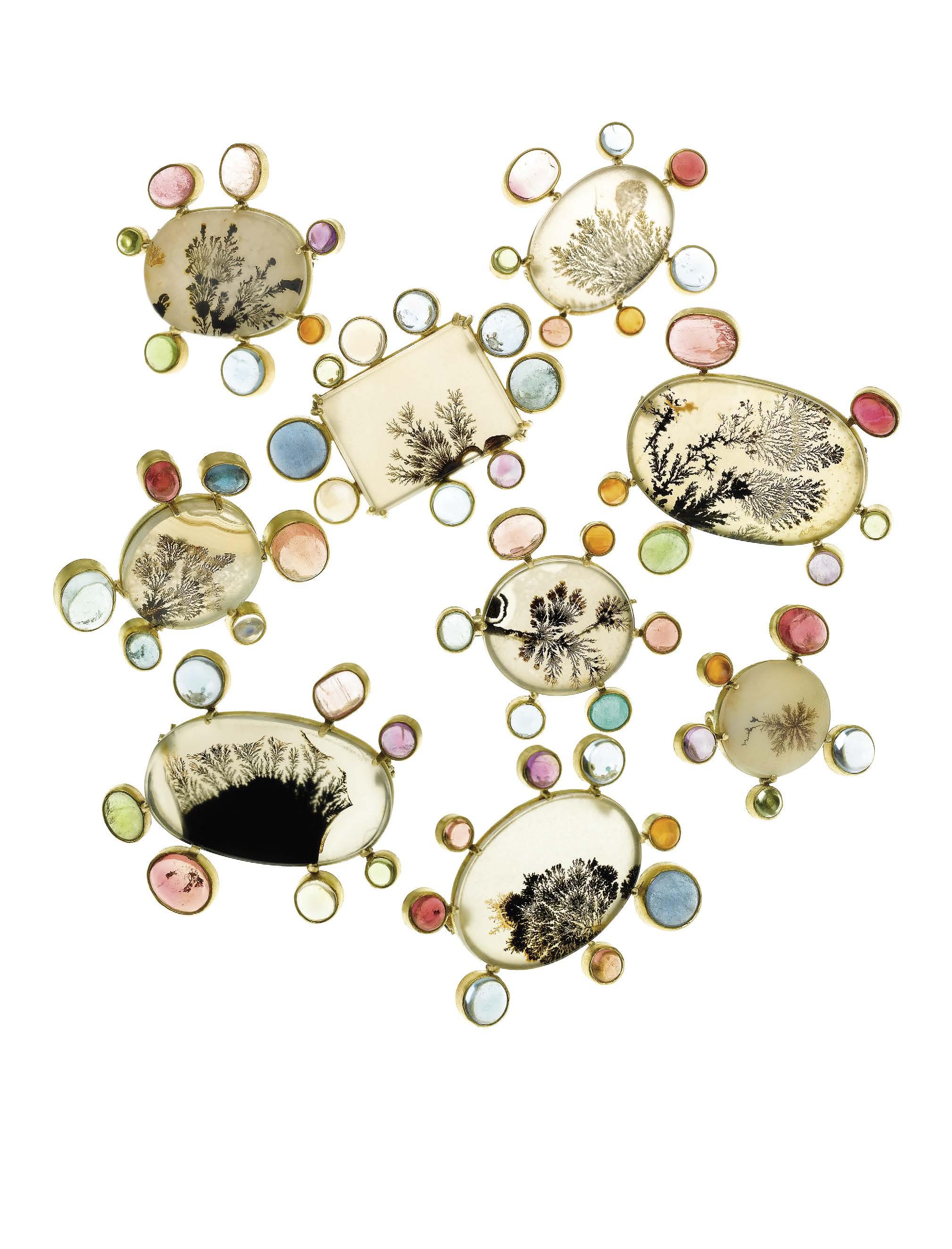
This puzzle, written by Myles Mellor, brings together clues from the worlds of art, dance, music, poetry, film, and beyond. Solution
1 Night Playground painter (two words)
6 Vermeer’s The Lesson
9 Supernatural romance film starring Demi Moore and Patrick Swayze
10 Casino Royale star, last name 11 Top Gun actor Kilmer 12 Frisbee, e.g.
14 Early Renaissance painter famous for his Adoration of the
Magi , Sandro
18 Cariou of Sweeney Todd
19 Andy Warhol painting based on a film starring Elizabeth Taylor (two words)
25 the Dragon , Bruce Lee movie
27 Oscar-winning film starring Zoe Saldaña
30 Little white
32 The Drifters’ song “Save the Dance for Me”
33 Musical ability
36 Heist-movie classic The Job
37 Leonardo Vinci
38 Girls , movie starring Tina Fey and Lindsay Lohan
41 Italian Renaissance painter who was also a friar (two words)
44 Miz
45 Evening, informally
46 Under the Sun , starring Diane Lane
47 Selecting the best from different styles Down
1 Steely Dan song selected by 1 across in his 1995 Desert Island Disc selections
2 The number of Mousquetaires (French)
3 “Lovely” Beatles meter maid
4 Evil warrior in The Lord of the Rings
5 Bad guy in Jack and the Beanstalk
6 Harry Potter’s expertise
7 Red Stare painter Jenny
8 Cowriter, with Dua Lipa, of “One Kiss,” Harris
12 1973 Elton John song lyric “ , you’re a star in the face of the sky”
13 Vital force of Chinese medicine
15 Racetrack shape
16 “Rocks” at the bar
17 Allow
20 London museum
21 Rowing equipment
22 Composer of The Four Seasons
23 Led Zeppelin’s Whole (two words)
24 Park , Steven Spielberg blockbuster
26 Pen point
27 In the style of (two words)
28 “Just thought!” (two words)
29 Concerning
31 in the Rain (1952 musical directed by Gene Kelly)
34 Commercial spot
35 Setting for The Life of Pi
38 Bruno who sang “Die with a Smile,” a duet with Lady Gaga
39 Slumber painter Weyant
40 Level
41 Strong and healthy
42 Alien in a 1982 film
43 Stan who created Spider-Man

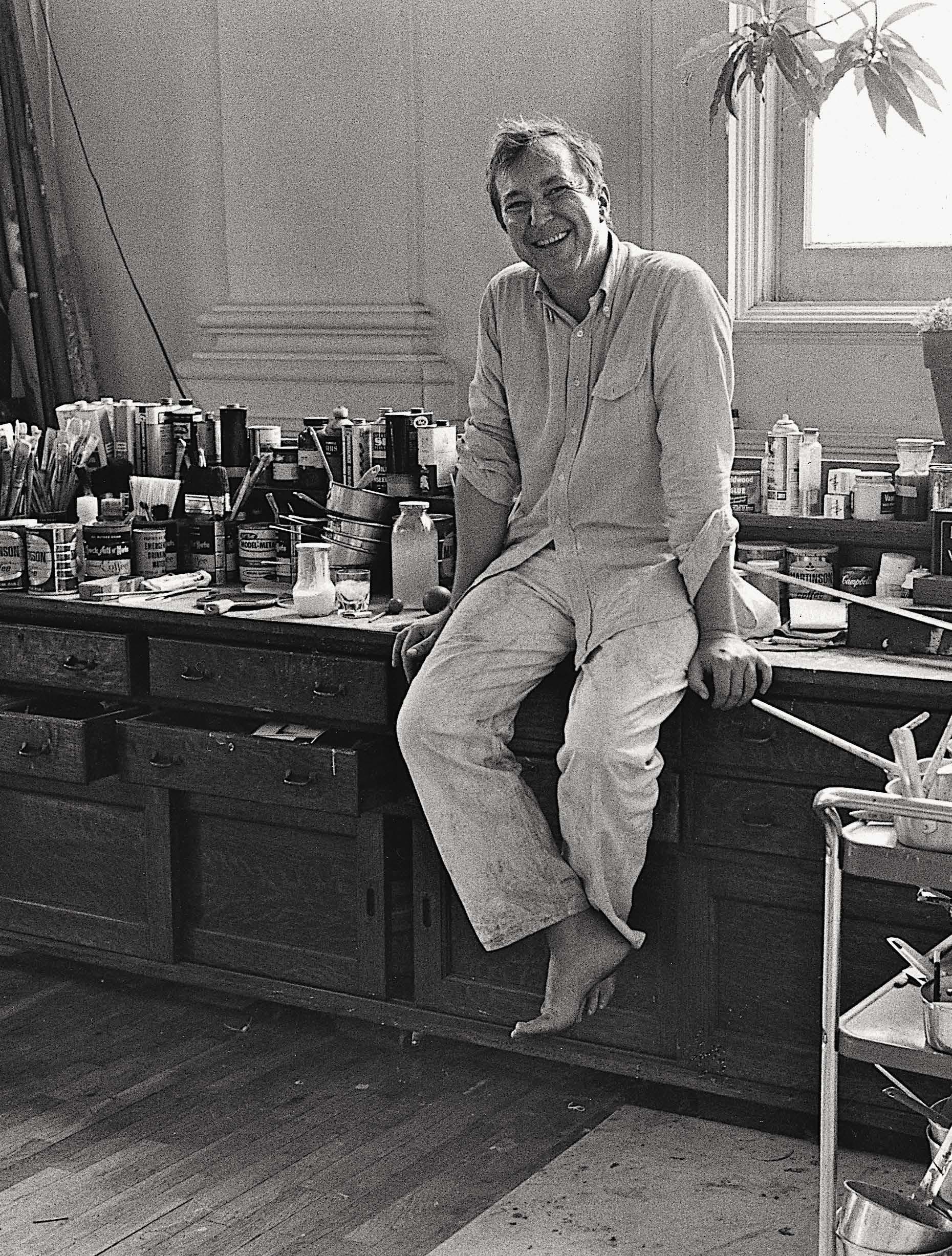
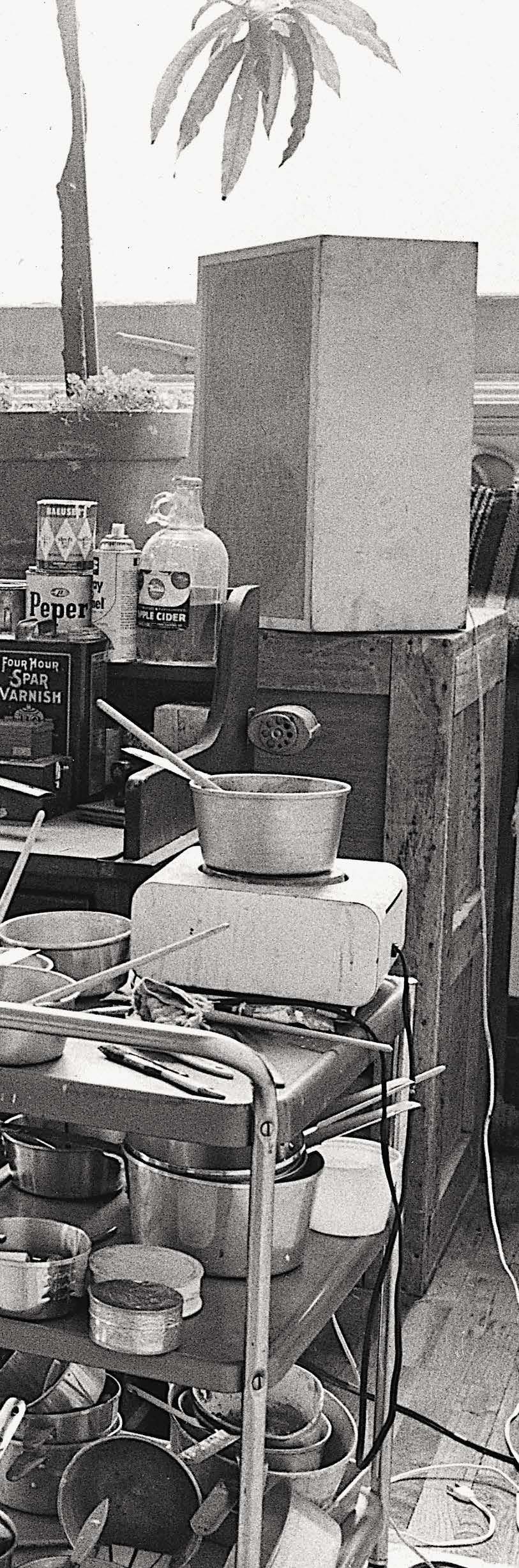
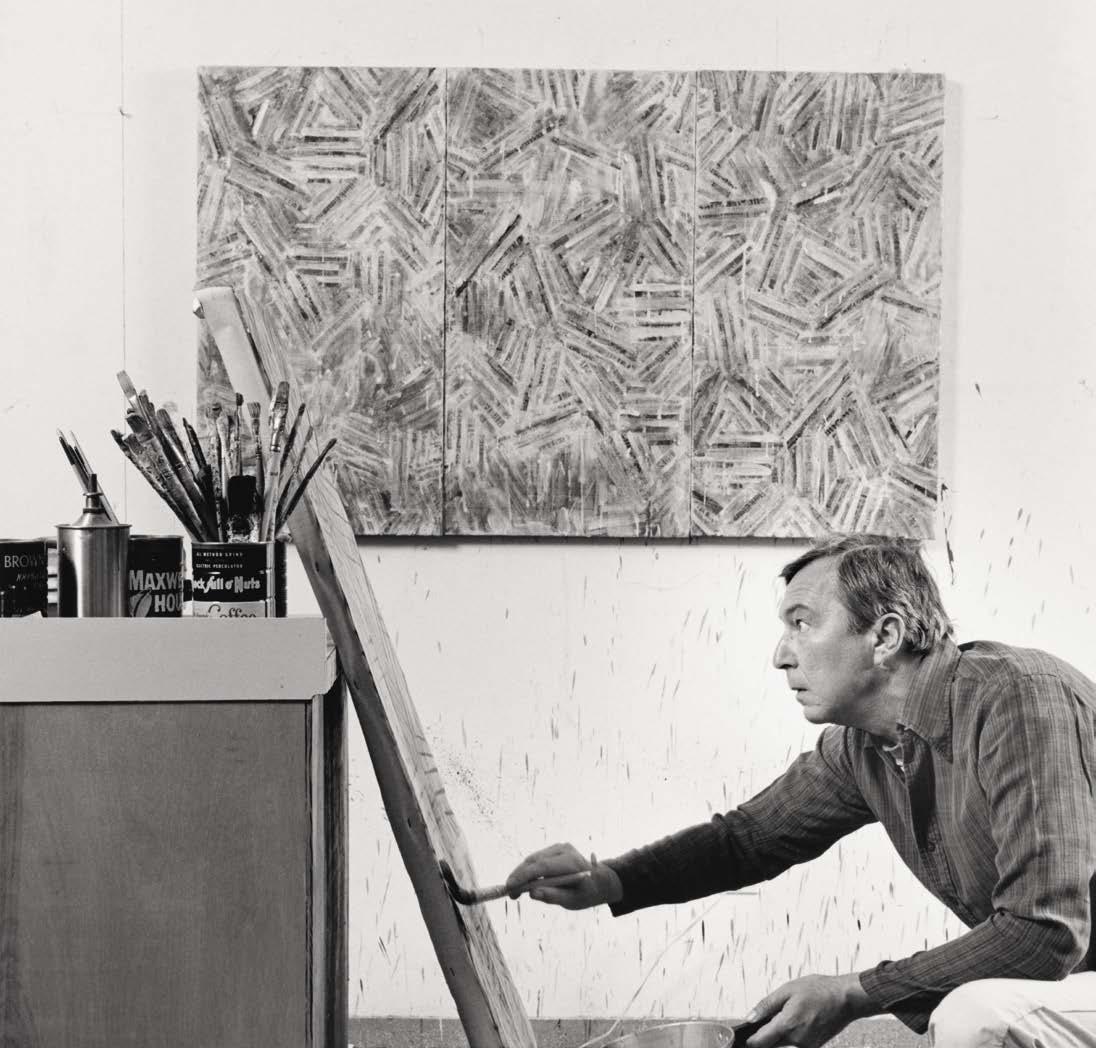
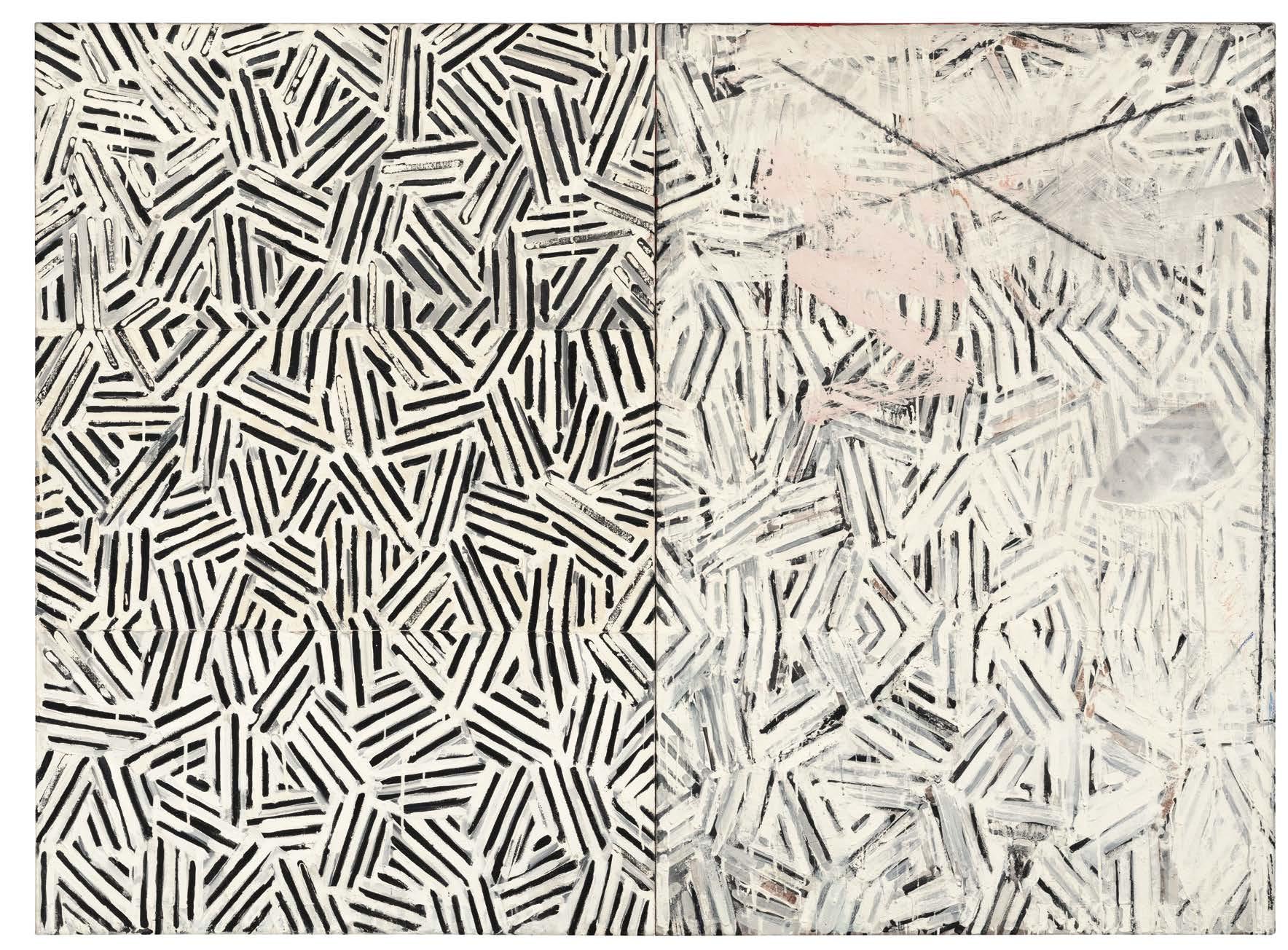
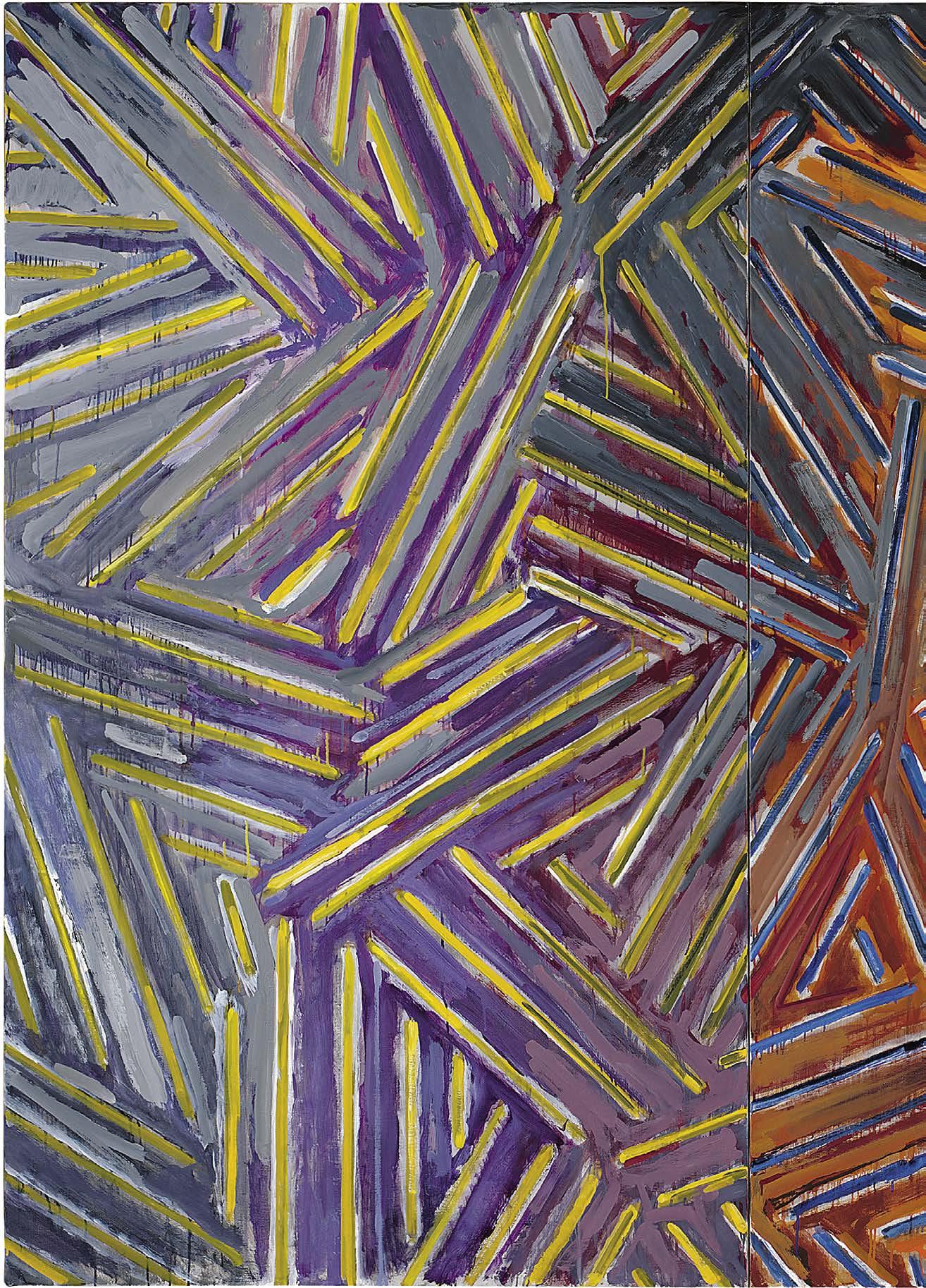
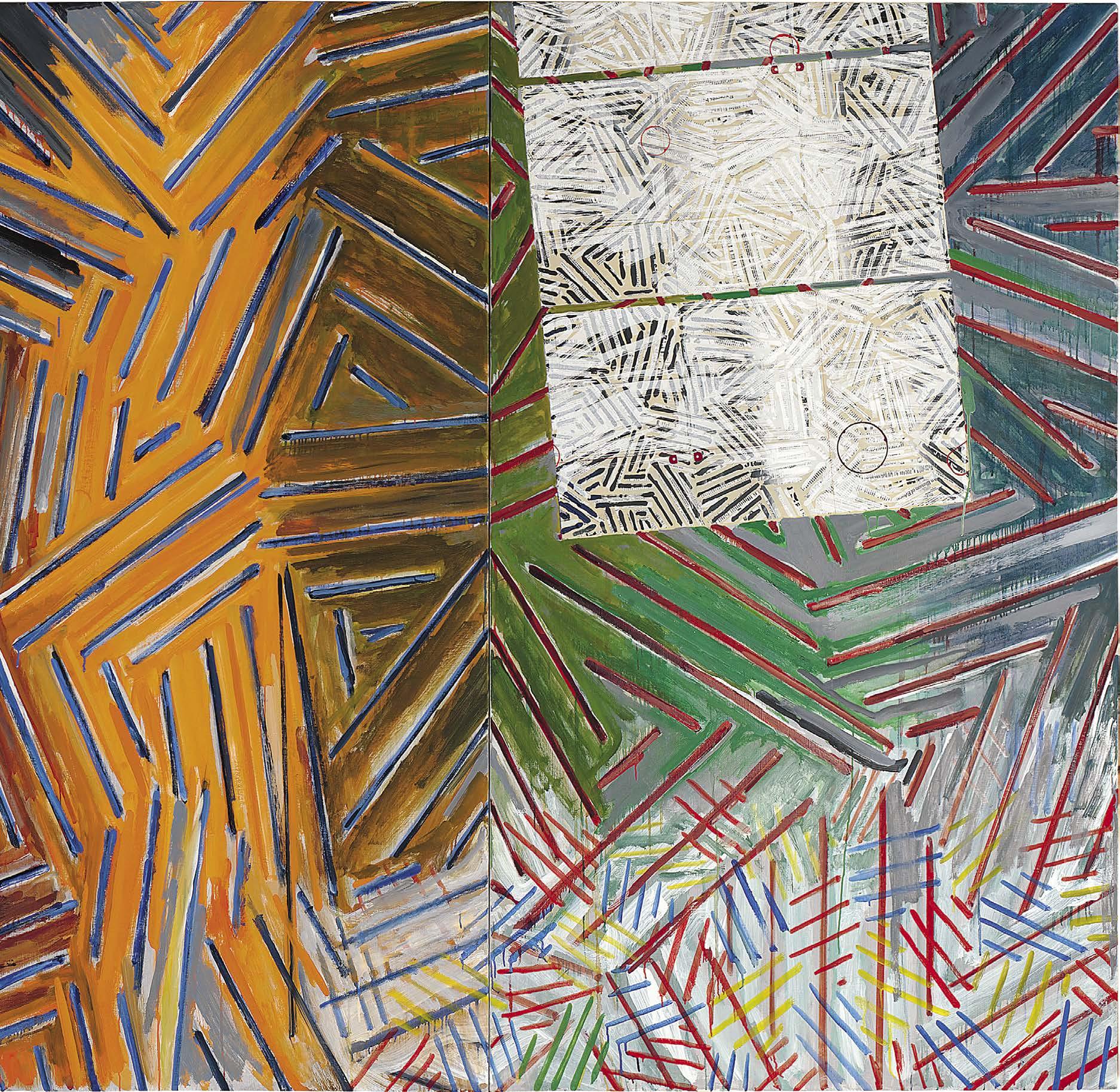
On January 22, Gagosian, in partnership with Castelli Gallery, opened an exhibition of historic works by Jasper Johns at the 980 Madison Avenue gallery. A survey of the crosshatch paintings and drawings that dominated his practice from 1973 to 1983, the presentation united works that have rarely been seen with loans from sources including distinguished American museums. The exhibition commemorates the fiftieth anniversary of this body of work’s debut at Castelli Gallery in 1976. Here, Larry Gagosian speaks with the Quarterly ’s Alison McDonald about the impetus for this project, his memories of seeing the exhibition in 1976, and the enduring impact of these paintings on artists and collectors.
ALISON MCDONALD Why mount an exhibition of Jasper Johns’s crosshatch works, and why now?
LARRY GAGOSIAN First of all, because I want to look at them. The crosshatches are one of the most beautiful sequences in Johns’s body of work, and they really bring the complexity of his technique, and of his experimentation with medium and surface, right to the front. They’re physical and it’s confrontational and challenging, and you don’t get that from a reproduction in a book—you need to be with them in the room.
AMCD And how do you think that experience changes a viewer’s perception of the work?
LG It’s been said before, but this guy can really paint [laughter ]. It’s Johns’s processes of working with different materials that really inspire and make him so important to other artists, not just to art history. Richard Serra looked closely at Johns when he was starting out—and you may not think that because of what Richard would go on to create, but Johns’s method of experimentation triggered something in Serra. When Brice Marden was a young artist, he worked as a guard at the Jewish Museum during that early Johns retrospective there in 1964. He stood in the galleries all day looking at Johns’s surfaces, that real, deep looking that artists—and guards—do, and it’s through Johns that Brice discovers the possibilities of encaustic that are so important to his own early works. So bringing a large group of crosshatches together for folks to really see them in all their variety is always going to feel like an important thing to do. To get a new generation of
artists and collectors excited.
AMCD When was the first time you saw the crosshatches?
LG I saw their debut at Leo Castelli’s in 1976. I was lucky: I was dating a dancer in Merce Cunningham’s company and had followed her to New York. I didn’t meet Jasper at the time, but I met John Cage and Merce and got to travel with them—I remember playing chess with Cage on a tour bus when the company was on the road. It was crazy and fun and my real introduction to the art scene in New York.
AMCD And was that your introduction to Leo?
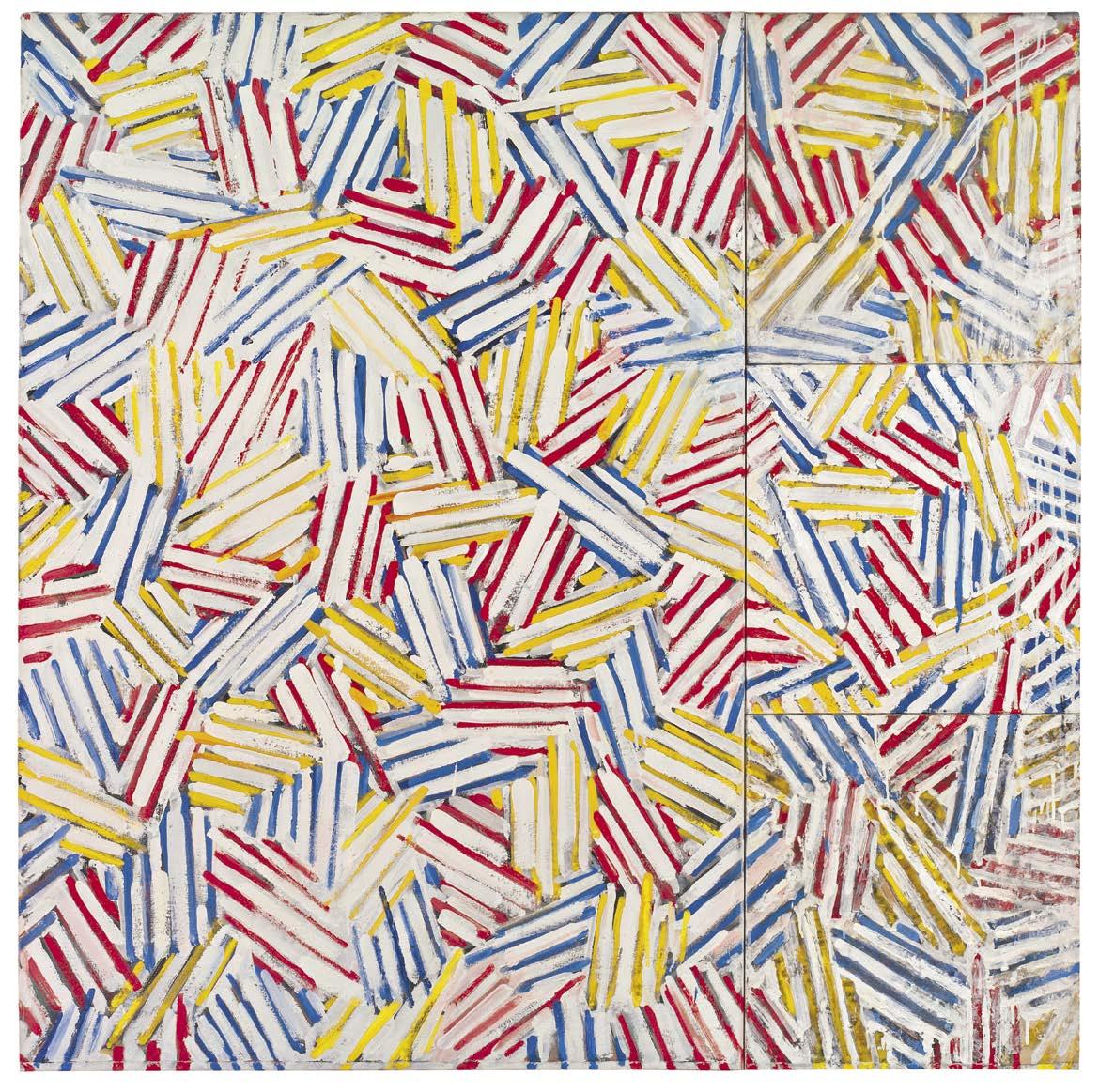
LG No, I opened my first gallery on Broxton Ave. in Westwood Village in Los Angeles in August of 1975 with a New York–based Castelli artist (Ralph Gibson), so we’d started doing business together. Leo and I just clicked, as the saying goes. He was very open to working with me and we became great friends. Jasper’s show at Leo’s in 1976 was a revelation—not just personally to me, it was a new direction for Johns that nobody expected. It was an exciting moment. The “overall” pattern of the crosshatch moved Johns beyond any association with Pop and showed him addressing both his AbEx predecessors and the minimalist moment of the 1970s at the same time in a shocking, inventive way. He didn’t just know how to paint, he knew how to make a painting do more.
AMCD So you worked with Leo as early as 1975, and on this current exhibition you’re still collaborating with Castelli Gallery.
THE CROSSHATCHES ARE ONE OF THE MOST BEAUTIFUL SEQUENCES IN JOHNS’S BODY OF WORK, AND THEY REALLY BRING THE COMPLEXITY OF HIS TECHNIQUE, AND OF HIS EXPERIMENTATION WITH MEDIUM AND SURFACE, RIGHT TO THE FRONT.
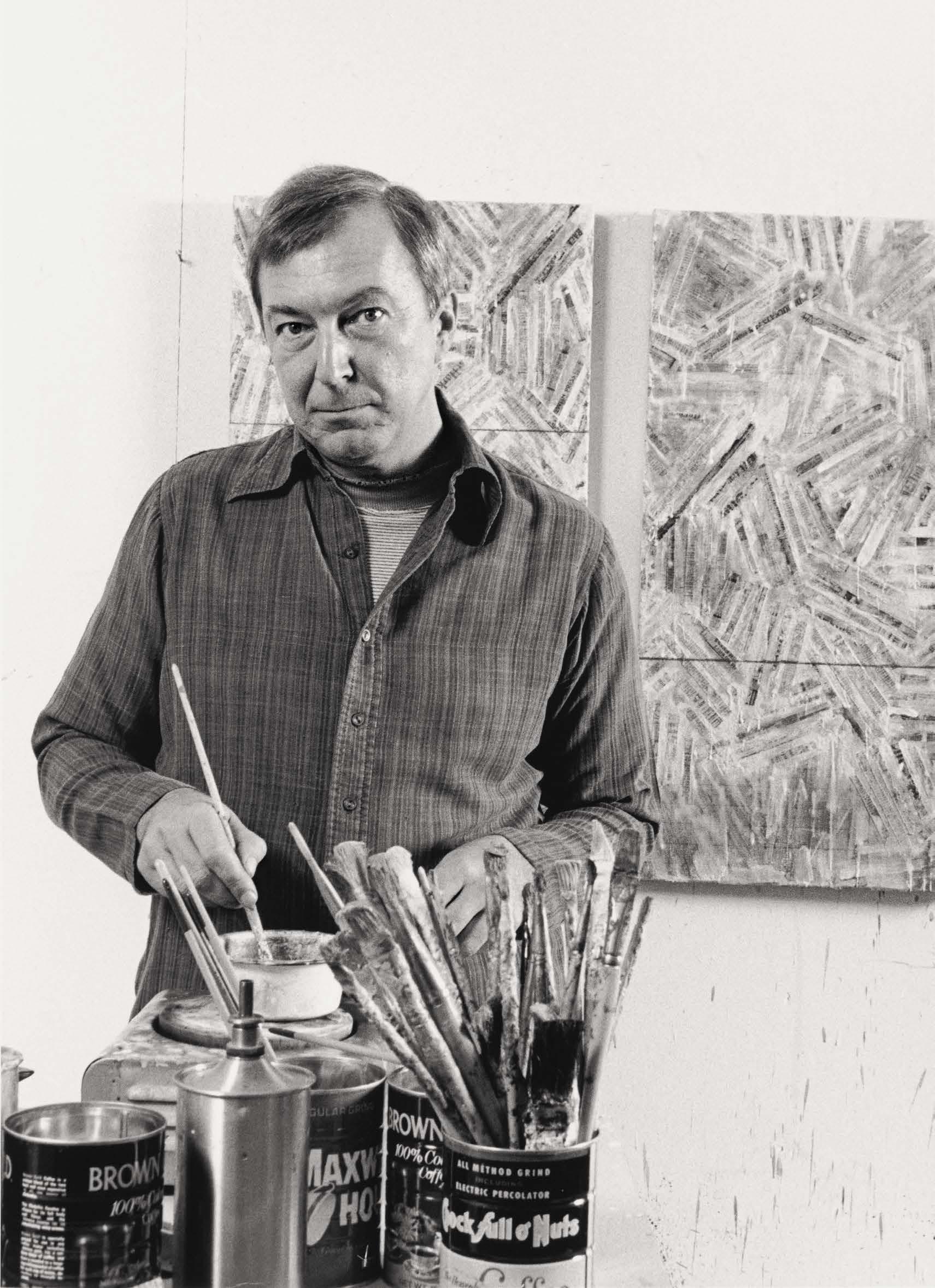
Opposite: Jasper Johns in his studio, Stony Point, New York, c. 1976–80. Photo: © 1991 Hans Namuth Estate, courtesy Center for Creative Photography, University of Arizona
This page: Jasper Johns, Untitled , 1975, oil, encaustic, and collage on canvas, in 4 parts (joined), 50 1 8 × 50 1⁄8 inches (127.3 × 127.3 cm), The Eli and Edythe L. Broad Collection. Photo: Jamie Stukenberg, Professional Graphics, Rockford, Ill. © The Wildenstein Plattner Institute, Inc., New York, 2025
Artworks © 2026 Jasper Johns/Licensed by VAGA at Artists Rights Society (ARS), New York
LG Barbara Castelli and Jasper have been close friends for over thirty years. We cocurated this show, and though I’ve known Barbara for a long time, it’s our first time working on an exhibition in this way and it’s been fun. And we have Leo in common, so he’s kind of been present in the background through a lot of this, in a comforting way. Leo debuted the crosshatch works on 77th Street in January 1976, so our exhibition marks the fiftieth anniversary of that show, and it’s great that we get to do it right around the corner.
AMCD You opened 980 Madison Ave. in 1989 with an exhibition of Johns’s Map paintings.
LG I did—that was a very difficult show to put together, but in the end, collectors and museums were generous and I was able to open this new space with this extraordinary body of work. It really put my gallery on the map, so to speak . . . [laughter ]. In 2026 we’re moving into a brand-new gallery on the ground floor in the same building and winding down operations upstairs, so the crosshatch show feels like a nice bookend in relation to opening with Maps .
AMCD You’ve titled the show Between the Clock and the Bed . Why that title?
LG The crosshatch shows up for the first time as a panel in a multipanel work in 1972, but the
first solely crosshatch work was Scent , of 1973–74. It was titled after Jackson Pollock’s last painting, Scent , 1955—so that shows you where Johns was thinking. I owned Pollock’s Scent for many years, lived with it—I bought it from Marcia Weisman, who was Norton Simon’s sister. It’s a common misconception that Johns’s crosshatches were inspired by the Edvard Munch self-portrait Between the Clock and the Bed , 1940–43, but in fact Johns had been exploring the crosshatch theme for years before he encountered the Munch. But when he did, he painted six different versions of a composition inspired by the Munch, and we were able to bring all six together for this show— not an easy feat, as three of them are very large and difficult to lend, but the Museum of Modern Art in New York, the Virginia Museum of Fine Arts in Richmond, and the National Gallery in Washington, DC, have come through for us in an extraordinary way to make this happen. I’ve always felt that for a show like this you really need to dig deep and get as many significant loans as you could possibly get. It’s a once-in-a-lifetime chance to get to do a show like this, and I couldn’t be more thankful to Jasper for his enthusiasm in helping us to realize this exhibition.
Jeff Koons tells Alison McDonald about his appreciation for
the pioneering artist and thinker Marcel Duchamp.
ALISON MCDONALD Thank you so much for taking the time to talk to me about Marcel Duchamp, an artist whose influence I see in a lot of your work. I wanted to start by asking if you have a favorite work by Duchamp?
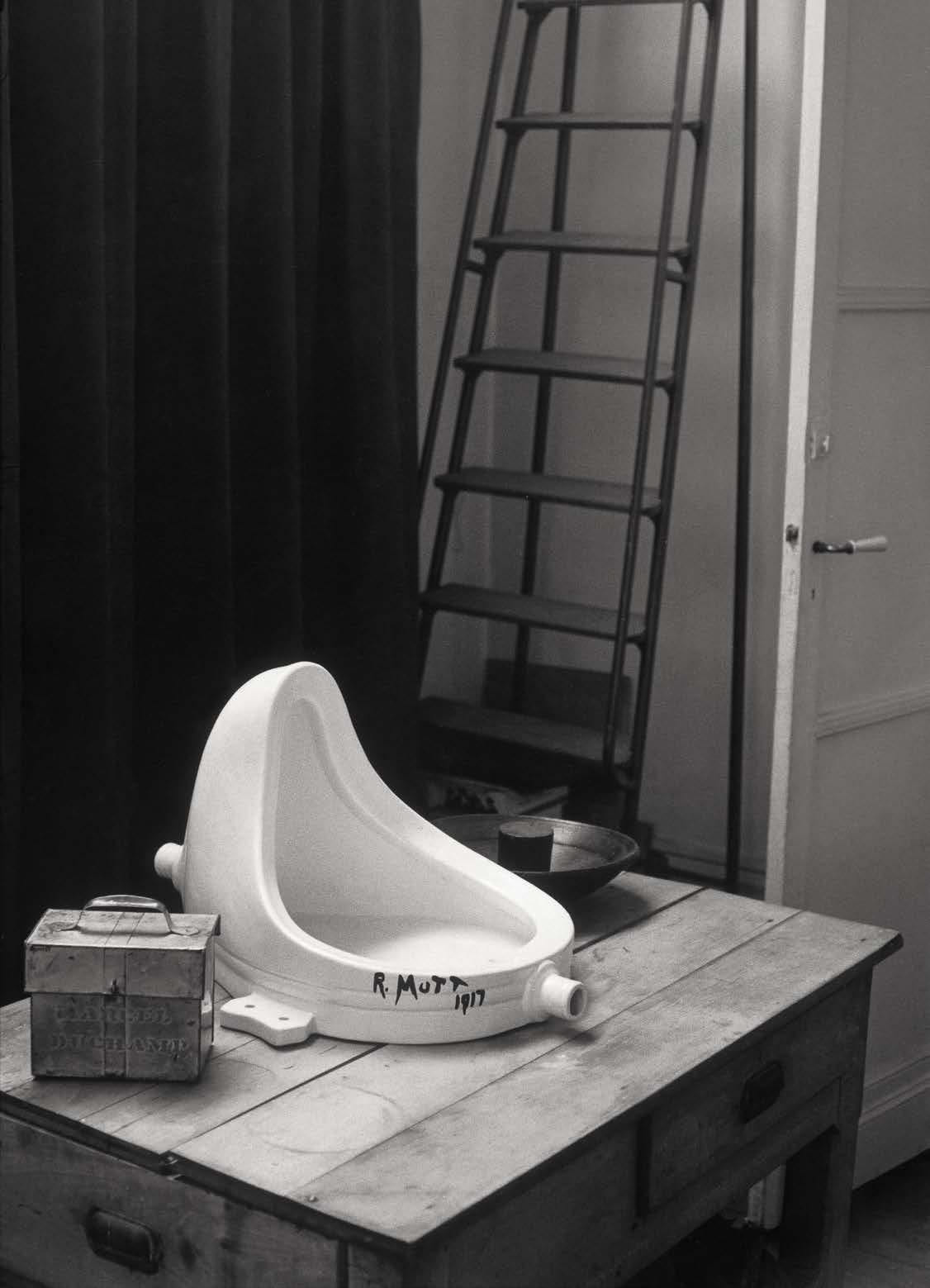
JEFF KOONS Whenever someone mentions Duchamp’s name, the work that immediately comes to mind is Fountain [1917]. I enjoy that work for its form, its materialism. And as you know, I’ve worked in porcelain, and the urinal is part of the reason I chose to work in that material.
AMCD Desire is such an important part of your work—I was curious how you think Duchamp reflects on desire?
JK I think desire is strong in Duchamp’s work. I love the prints, which tend to have a sexualized desire there. But even more than that, in an absolutely abstract way, the readymades bring about a desire for transcendence. They present something so much bigger, a dislocation, very ethereal possibilities—the idea that something can be manifested opened such a vast new area for exploration in art. And I think that’s a desire—a desire to be able to find that opening, to reveal that possibility. So I think desire in Duchamp’s work is both sensual, a desire of becoming, and at the same time it’s spiritual, allowing us to open any type of understanding about the space that we can create for ourselves, both physically and intellectually.
AMCD It’s so interesting you used the word “spiritual” because I think for Duchamp all good art holds within it something akin to a religious sensibility, or the potential for a moment of profound revelation. That can come from a canvas that’s been labored over by the artist’s hand, from something that’s been crystallized as a conceptual idea, or from an object that’s been appropriated and brought into a different context.
One question I have for you, because this permeates your work as well, is related to Duchamp’s elevation of the viewer as essential to completing the work of art.
JK I’ve always enjoyed Duchamp’s generosity— his opening us to the environment and everything that’s within our world, our life experience, that can be looked at as art, or as a material that can be incorporated into art. Everything is in play. That’s a tremendous generosity—anything can be looked at without judgment. I see it as the removal of judgment and the acceptance of everything. Eric Kandel, a Nobel Prize–winning neuroscientist at Columbia who has always been supportive of my work, once told me that he loved my work’s reflectivity, the fact that it brought in the viewer. He made me aware of Alois Riegl, a nineteenthcentury Viennese art historian who was the first to speak about the idea of the beholder’s share in art. I would assume these ideas eventually made their way to Duchamp, who was very, very curious about everything. Of course, in Vienna at the time you had Sigmund Freud, and you had all this development related to the mind and sociology, and these types of ideas. But Riegl was the first to discuss the idea that the work of art is finished in the mind of the viewer, and that’s where the real experience lies.
AMCD That’s fascinating. I’ve never heard about that before.
JK It’s interesting speaking about Duchamp because he’s so critical within my work. I started working with the readymade back in the ’70s. For me, it was a way of dealing with objects and with images and of removing judgment, having everything be a source and a possibility. There’s a certain point when Duchamp’s work became a critical foundation for my work, and of course it’s the basis of Pop art and Andy Warhol’s work, and you know the homage Jasper Johns and Robert Rauschenberg would give. His work is a cornerstone for so much that follows. He offers a new way of thinking, this presence, this opportunity, a way of opening oneself to the world and a sense that art can be anything.
AMCD Those traces of Duchamp in the work you made at the very beginning of your career continue in the works you’re making today, but perhaps in different ways. Do you feel that your thinking about Duchamp has evolved over time? Has your sense of his influence shifted over the years? Have you gotten to know him better?
JK Well, one of the things I enjoy most about the idea of the readymade is that everything’s already there. As I was saying before, he certainly laid a foundation for generations of artists to follow, and while that’s radical, he’s also connected to art history. I was once in Greece with an archeologist and historian, Dr. Harry [Ilias Theocharis] Tzalas, who was acting as a tour guide on some of the islands, taking us around to show us sites. And he said to me, Jeff, I know you love the idea of the readymade, but the readymade is an ancient idea: If you lived in ancient Greece you would have walked by a temple and if it was falling apart, you’d realize, oh, you could put that above the doorway of your house, and you would have just taken some of those stones home. Everything was a readymade. Everything was there to absorb, to use, and to adapt in any manner. And I thought that was really beautiful and that it was a tie that Duchamp was connecting us to, this adaptability. And you know, maybe in society—the way we developed through the nineteenth century, the Industrial Revolution, all of these objects that carry an essence of ownership— this idea of adaptability and that everything was
there to serve and be used, he reopened all that. AMCD Duchamp once said that “you can cut off the artist’s hands and still end up with something that is a product of the artist’s choice,” that art can be a product of that choice. Of course this idea relates clearly to Warhol, but as we have already discussed, he was influenced by Duchamp. I wonder whether that way of thinking ever offered you freedom in your practice.
JK Absolutely. After my first year of art school I was at home for a summer working in a machine shop that built big wrenches, it was a way to make some money, and I was using one of these machines to lift the cranes and my hands slipped. I ended up getting a cut on my left hand and I had to get stitches. And I remember going to the doctor, I was worried whether this was going to be okay, and he said yes. But it made me think about my approach and I started to lean into this Duchampian manner. I was also thinking of Henri Matisse, lying in bed making those big cutout pieces, those big designs. It was about this sense of freedom that yes, art is an intellectual, philosophical pursuit, not just a physical pursuit.
AMCD We’ve spoken about Duchamp’s influence, but I think it’s remarkable that even the few artists we’ve mentioned—Warhol, Johns, Rauschenberg— make work that looks absolutely nothing alike. It fascinates me to see how the work of one artist can shape the way future generations think, and the art that they make, in ways that are totally unpredictable. Also, looking at Duchamp’s contemporaries, there was such a wide swath of artmaking happening across those groups at that time. What has surprised you about Duchamp, and the way his work connects to other artists?
JK I’ve always loved the idea of the avant-garde, and with Duchamp and his friends around him, Francis Picabia, Salvador Dalí, you have all these people establishing a way of life, to have as vast a life as possible, to have as great an experience as possible, and to enjoy the pleasures of art as much as possible, while at the same time trying to offer the rest of the world the opportunity to transcend too. But most of all what I really love about Duchamp is that kind of aha moment. I mean, just think about the bigness of the idea. It was a game changer. They talk about being outside the box, but it’s really about opening oneself up, embracing
Previous spread: Marcel Duchamp at the exhibition The Art of Assemblage, The Museum of Modern Art, New York, 1961. Photo: Marvin Lazarus
This spread, left to right: Fountain (1964, after 1917 lost original) in Duchamp’s studio, Neuilly-sur-Seine, France, 1968 © Fondation Henri Cartier-Bresson, Magnum Photos
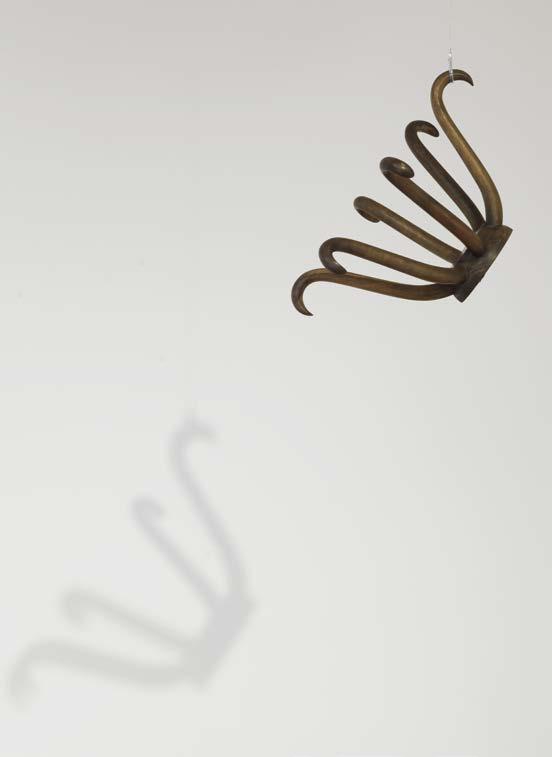
Marcel Duchamp, Portechapeau (Hat Rack), 1964 (after 1917 lost original), wood hat rack, 9 ½ × 18 × 18 inches (24 × 45.7 × 45.7 cm), private collection. Photo: Rob McKeever
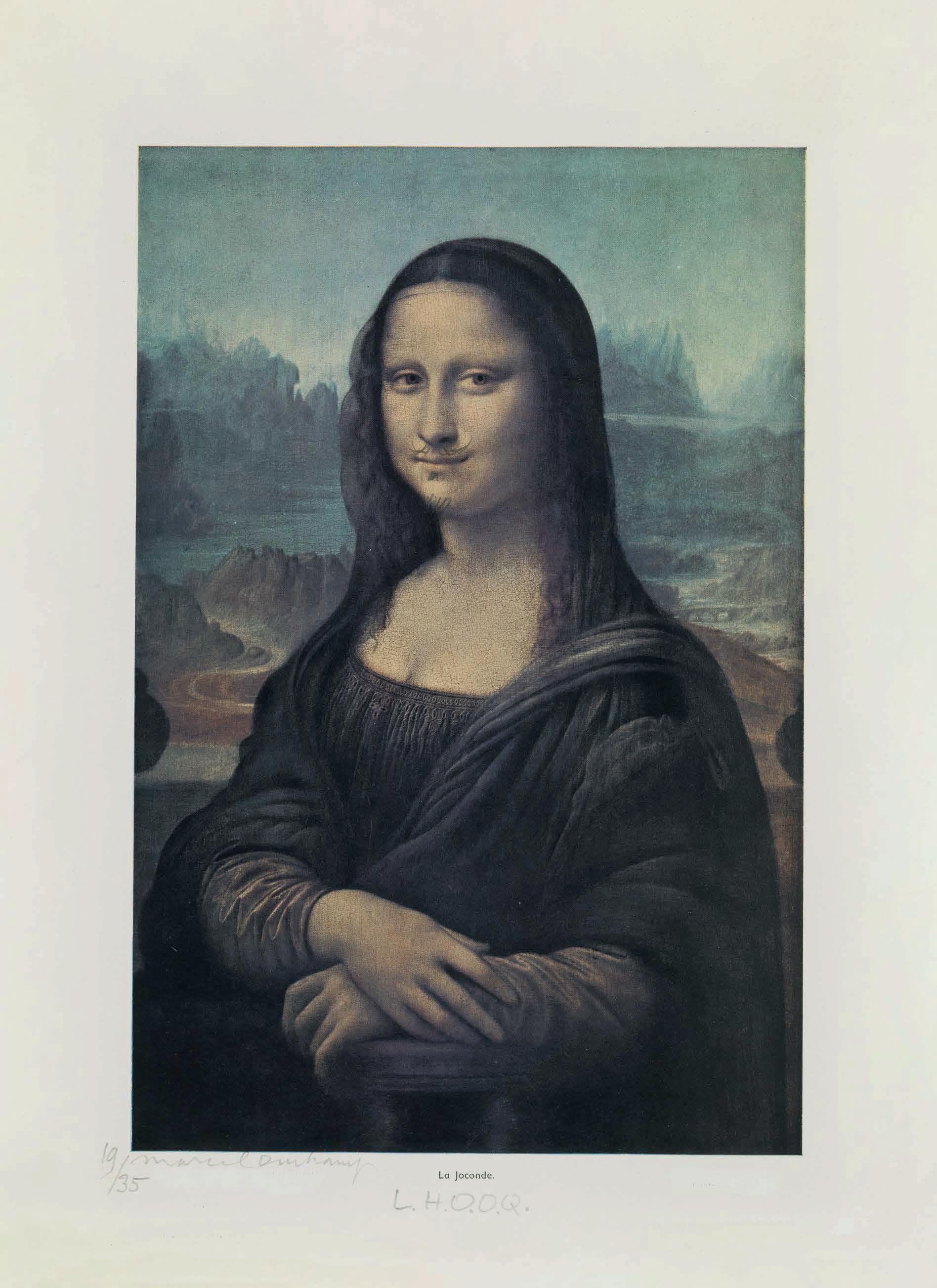
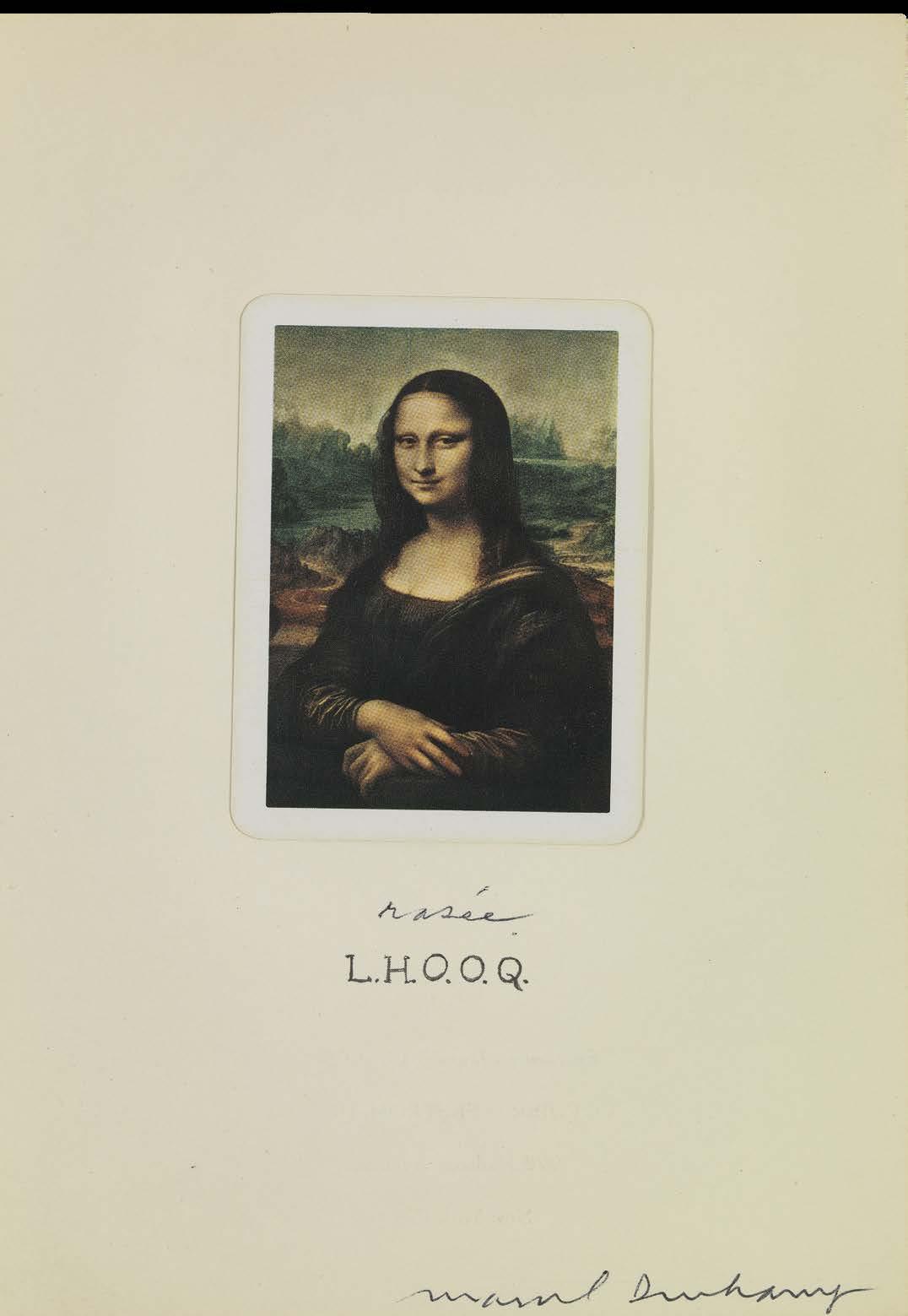
Marcel Duchamp, L.H.O.O.Q. rasée (L.H.O.O.Q. Shaved ), 1965, playing card with ink mounted on printed invitation, 8 ¼ × 5 3⁄8 inches (21 × 13.7 cm), private collection. Photo: Rob McKeever
Artwork © Succession
Marcel Duchamp/ADAGP, Paris/Artists Rights Society (ARS), New York
all the freedom, all the possibilities, everything. There’s nothing restraining us in any manner other than ourselves. Culture, the external world, really doesn’t make judgment; it’s inanimate. Judgment comes from within us. And if we can just remove that, we can, I believe, really be engaged.
AMCD If you met Duchamp at a dinner party, what would you talk about? What questions would you have for him?
JK Well, I’d probably start by asking about his interests. We know that he was extremely cerebral but also that he loved physical, sensual experience, so I guess I would want to speak about the connection there. And I might want to see if he had any awareness of Riegl or if it was just something in the air that he happened to pick up on. And I would ask about his generosity, whether that was something he consciously sought. I know as an artist when I was younger, I would always just enjoy that sensual experience of developing personal iconography and learning that I could control feelings and sensations. And the readymades do have those, even though they’re removed. But you look at a shovel, you feel that piece. You feel these
readymade objects. They’re still very sensual.
AMCD Lately I’ve been reading interviews with him and one talk stood out, a panel discussion with Rauschenberg and several art historians at the Museum of Modern Art in New York on the occasion of the Art of Assemblage exhibition in 1961. It was a very animated talk, and Rauschenberg was quite provocative in challenging the art historians, who were sharing these quite heady ideas that may have been a bit hard to follow. The historians seemed to enjoy the banter quite a bit and it certainly kept the talk interesting, but Duchamp was very quiet the whole time. He seemed so reserved, but when he spoke, it packed such a punch. You can tell that everyone in the room was hanging on his every word. During a different panel conversation at MoMA, this one in 1964, there’s one moment that I loved where Alfred H. Barr Jr. challenged Duchamp on his idea that art is not about beauty by saying, Well, then why are your objects so beautiful? And Duchamp apparently smiled and said, Well, nobody’s perfect.
JK [Laughs ] I’ve always felt that there tends to be a lot of critical dialogue around Duchamp’s work
that creates a hierarchy, and sometimes it feels like this hierarchy was created as a way to keep Duchamp for themselves. For Duchamp it’s about an intellectual equality, made not just by the hand but by the mind. There’s no desire for this hierarchy. And what I’ve tried to do with my work is emphasize the removal of hierarchy—these ideas are for everyone, and are to be celebrated by this act of the removal of judgment, this act of acceptance, of opening everything up to be used, adapted. Everything is empowerment at that point. But as soon as you bring in hierarchy, it’s disempowering, it’s segregating. And I’ve always looked at his work as the opposite.
Duchamp is such a cornerstone in so many ways. And this part about removing the body and bringing about intellectual discourse opens us up to the beauty of, okay, all the human disciplines can be engaged. I would even say that maybe the idea of the dilettante—to be a dilettante is always looked at as negative but I think of it as positive, because it reflects being open to everything and being involved in all the human disciplines. And I think Duchamp represents that freedom.
The Frick Collection, New York, opened Gainsborough: The Fashion of Portraiture on February 12. The first exhibition devoted to the English artist’s portraiture ever held in New York, the show comprises more than two dozen paintings and explores the role of fashion in Gainsborough’s depictions, in terms both of the sitters’ clothes and of the larger context of class, labor, craft, and time.
Aimee Ng, the Frick’s Peter Jay Sharp Chief Curator, has been working on the show for a decade; last fall she met with the Quarterly ’s Derek C. Blasberg to talk about this historic project.
* at The Frick Collection, New York

Previous spread:
Thomas Gainsborough, Lords John and Bernard Stuart, after Anthony van Dyck , c. 1765, oil on canvas, 92 ½ × 57 ½ inches (235 × 146.1 cm), Saint Louis Art Museum
This page:
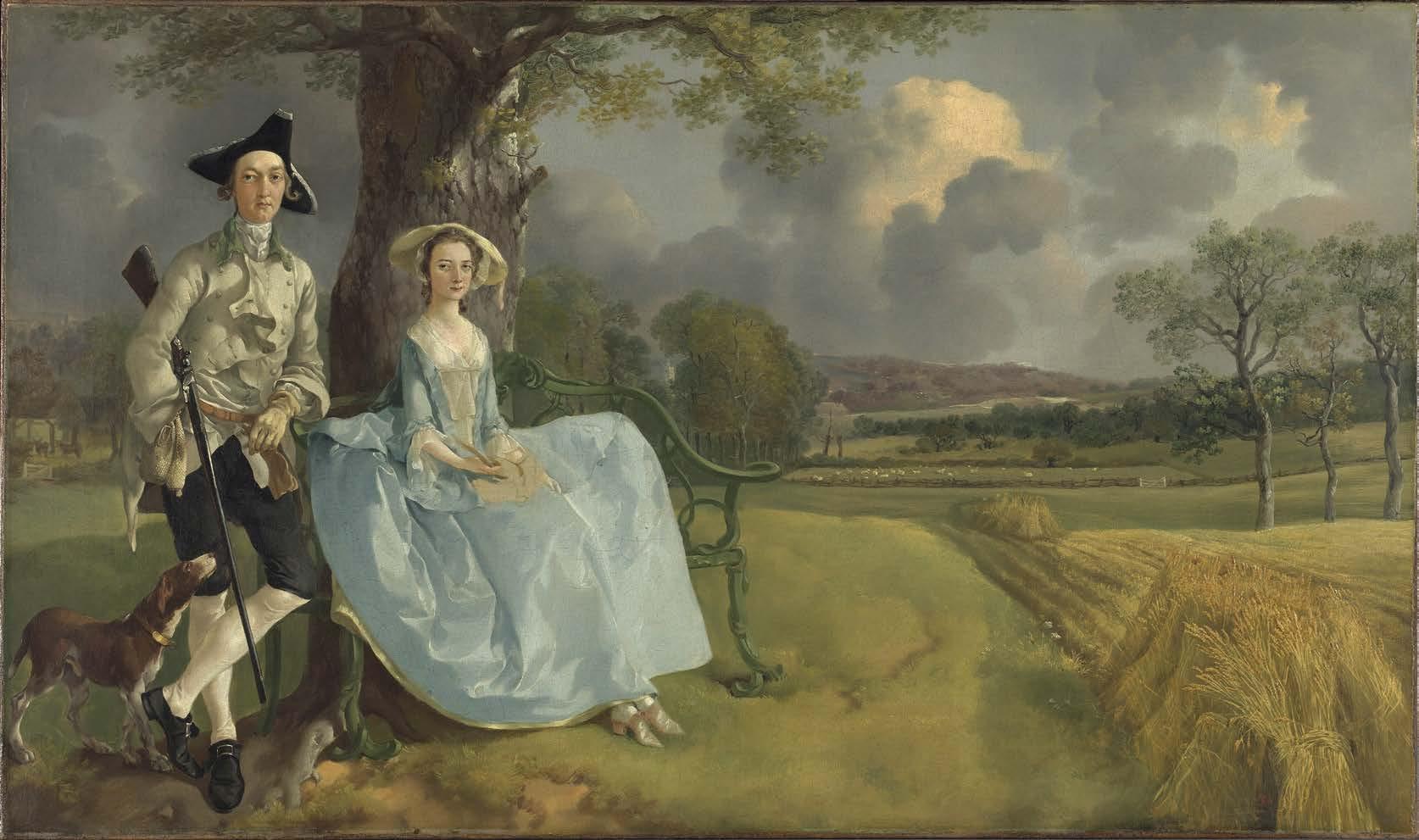
Thomas Gainsborough, Mr. and Mrs. Andrews , c. 1750, oil on canvas, 27 ½ × 47 inches (69.8 × 119.4 cm), © The National Gallery, London
DEREK C. BLASBERG When I opened the catalogue, the first thing I saw was the miniature mannequins wearing the couture dresses.
AIMEE NG Incredible, aren’t they? Before fashion magazines, they would send these mini fashion models—that’s how they circulated the latest trends. They even had diplomatic immunity during wartime.
DCB The dolls did?
AN Yes! The dolls could cross borders because it was that important to get these things to market. DCB Will this show have other pieces of fashion ephemera?
AN Not this exhibition, but about halfway through, our cabinet gallery will display a series of fashion plates from the library’s collection. That opens on April 1. They’re among the earliest fashion plates still in existence, and we have probably the most extensive extant collection of this early volume, 1778 to 1787, all hand-colored from Paris.
DCB I didn’t know the Frick had these! Are they displayed often?
AN Because they’re works on paper, they can’t be out all the time. But it’s a good way to think about how culture and trends were circulated in eighteenth-century fashion.
DCB Did this Thomas Gainsborough show start as a fashion show?
AN No, it didn’t. To be honest, we sat down and thought, “We have seven Gainsborough paintings and two drawings, among other pieces—how is it that there’s never been a Gainsborough portrait show in New York City ever ?” That was more than ten years ago, so I’ve been thinking about this for a long time.
DCB In the past, when we’ve spoken to people who work in the art space about fashion, they almost seem . . . not apologetic, but there’s been a suggestion that fashion or style or the way people dress is secondary or less important as a cultural contribution. It’s the idea that art is of a higher aspiration. Working on a show like this, did you
find any pushback around the concept of style as an artistic element?
AN No, not at all! In fact, it’s a quality that has made people very interested in the show, because it’s so relatable. As someone who has studied historical European portraits, I can say that personal style is inextricable from self-identity in a painting or sculpture. Whether it’s an invention, whether it’s embellished, whether it’s exactly what you wore, you can’t take that away from the work. Of course a subject’s features are one thing, but so is their style. It’s not diminishing to value personal style, or the idea of fashion as important not only to the people depicted but also to the people who look at these over time.
DCB You’re preaching to the choir here!
AN Paintings like Gainsborough’s are historical documents of what people wore in their era. To be clear, fashion is not just this sort of whimsical, frivolous thing; there’s a sense of understanding history and society through the clothes that made their way into paintings.
DCB What took ten years to produce the exhibition?
AN Of course a lot of stuff happened, including in the art world, around social justice and representation. That made it challenging to make Gainsborough and his ilk the primary focus at a time of reckoning, and rightfully so. But in time I pitched the show as the fashion of portraiture. I wanted to claim this artist, who was truly at the center of the fashion world, in a show that wasn’t only about what people wore. Fashion was about class, about social hierarchy. People understand fashion, and it becomes an avenue of access— people might find a way in and look at these pictures less as “rich white people” and more as figments in constructions of their era’s society. The show also includes the one Black figure whom Gainsborough painted.
DCB Tell me more about that work, which I see is titled Ignatius Sancho and was completed in 1768.
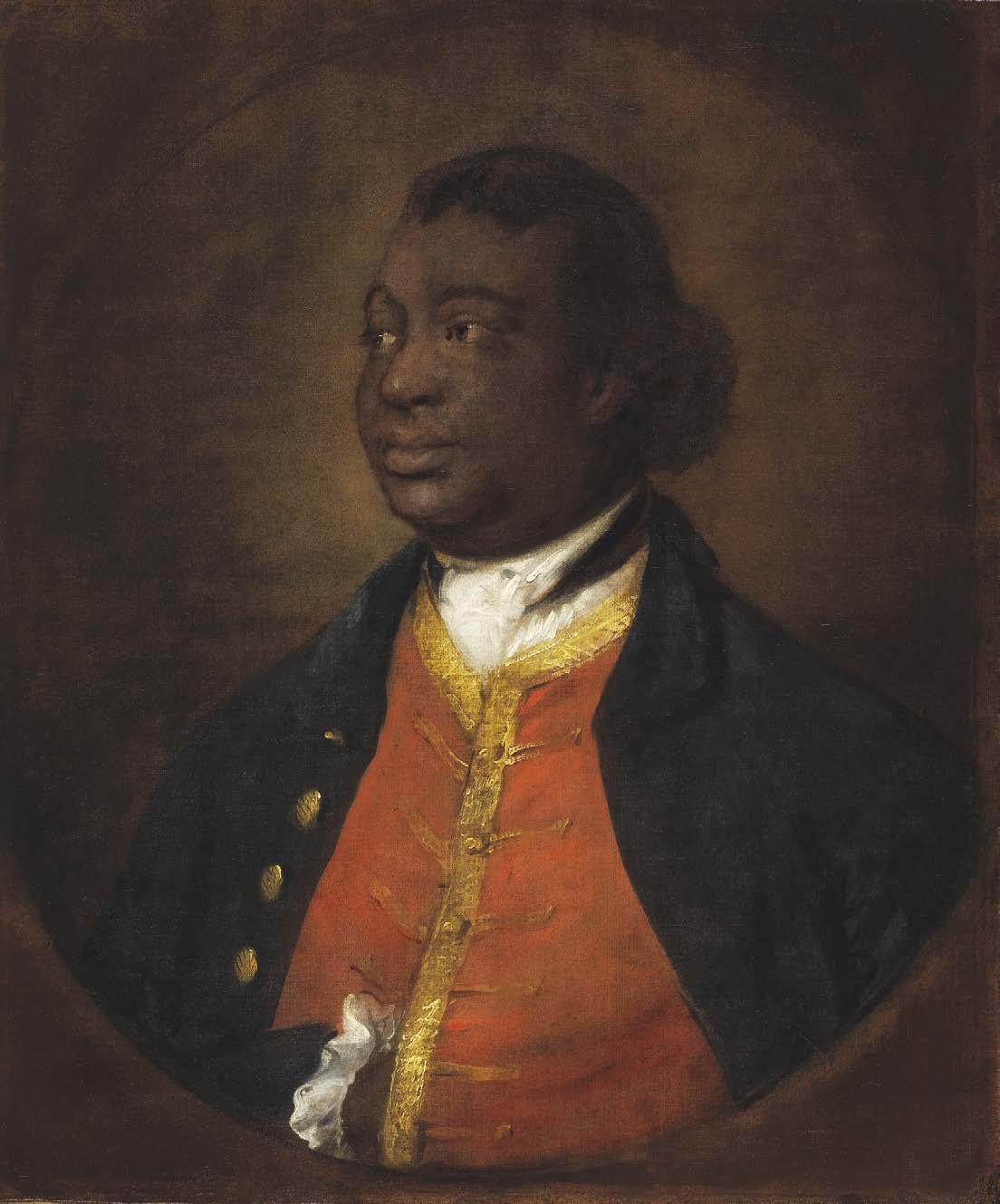
AN Fashion is essential in this work because what Gainsborough chooses to paint Ignatius Sancho wearing is selective in terms of his identity. He’s a valet, he’s a servant—but he doesn’t get painted in his livery, he’s painted in the clothes of an independent gentleman, as the musical composer and writer that he was in his outside life. This picture shows how what sitters chose to picture themselves wearing was a construction of identity. It also speaks to how multiple our identities can be.
DCB Do we have any supporting texts on the painting?
AN We know it was painted in Bath, where Sancho was working in the service of the Duke of Montagu. We know the painting entered the collection of the sitter’s family, which means it wasn’t put on the market as a sellable work. When Sancho died, it stayed with his daughter, and then stayed with the family until it was sold, eventually landing at the National Gallery of Canada, Ottawa, in 1907.
DCB Do we know why Gainsborough painted him?
AN We know Gainsborough was terrible with money and we know that he would occasionally trade a painting for a service. Because we don’t have a receipt or a composition, it’s possible that he paid for music lessons from Sancho, who was a composer and a musician. Gainsborough had traded other works for lessons on the viola da gamba, and perhaps he did here too. On a valet’s salary, Sancho wouldn’t have been able to afford to commission a painting himself.
DCB The fashion in the portrait tells a story.
AN The other thing that interests me here, and this is why Gainsborough is an excellent conduit for looking at the whole moment, is how the word “fashion” meant different things than it does now. DCB I love this. Tell me more.
AN Now, when we say “fashion,” we think Vogue and Harper’s Bazaar. We think specifically about the fashion business. Of course there are the archaic meanings of “fashion,” as in “to fashion something,” using the word as a verb—to make something. But in Samuel Johnson’s early dictionary of the English language, “fashion” means something specific: it’s a social rank, a hierarchy, a condition above the “vulgar” and below nobility. It’s below nobility, of course, because nobility is above everything, including fashion, but fashion is above the “vulgar.” That doesn’t apply to our world today; fashion doesn’t dictate where you live in the social hierarchy. But it was intriguing to think about a time when it most definitely did.
DCB To have a painting by Gainsborough was fashionable, too.
AN Yes, the show explores the idea that it’s not only important what you wear in the pictures, in terms of constructing identity, but that portraits themselves were part of a fashionable life. And yes, Gainsborough was a fashionable portraitist at this time—but not all the time. Artists would go in and out of style. There are many contemporary reports, including diary entries, of members of high society
Thomas Gainsborough, Ignatius Sancho, 1768, oil on canvas, 29 × 24 ½ inches (73.7 × 62.2 cm), National Gallery of Canada, Ottawa
going around to artists’ showrooms as a morning activity. They’d want to see who was painting whom—Reynolds did you, that’s a particular class; Hoppner did you, that’s another group.
DCB The first quote in the book is fantastic: “Fashion is gentility running away from vulgarity and afraid of being overtaken by it,” which is from James Northcote, a British painter who was a pupil of Joshua Reynolds’s.
AN Gainsborough studied portraits from the previous century, notably those of Van Dyck. Time is significant to his work because class connects you to a more extended history. In England that means you didn’t come from nothing. In the aristocracy, in the peerage, the person with the highest rank—right now, among nonroyals it’s the Duke of Norfolk—is established by how old your title is. So we also think about how being able to attach yourself to this artistic lineage becomes very important—even if it’s fake!
DCB You mean people would put old portraits on their walls and visually suggest ancestry, even if it was a stretch?
AN Precisely. We think of Americans like Henry Clay Frick, who founded this museum’s collection, buying portraits of other people’s ancestors to put in the dining room to give an impression of lineage. That was happening in the seventeenth century too. People buy connections to history, and by being closer to the beginning, your class and your family are suddenly lifted.
DCB What about a painting like Mr. and Mrs.

This page:
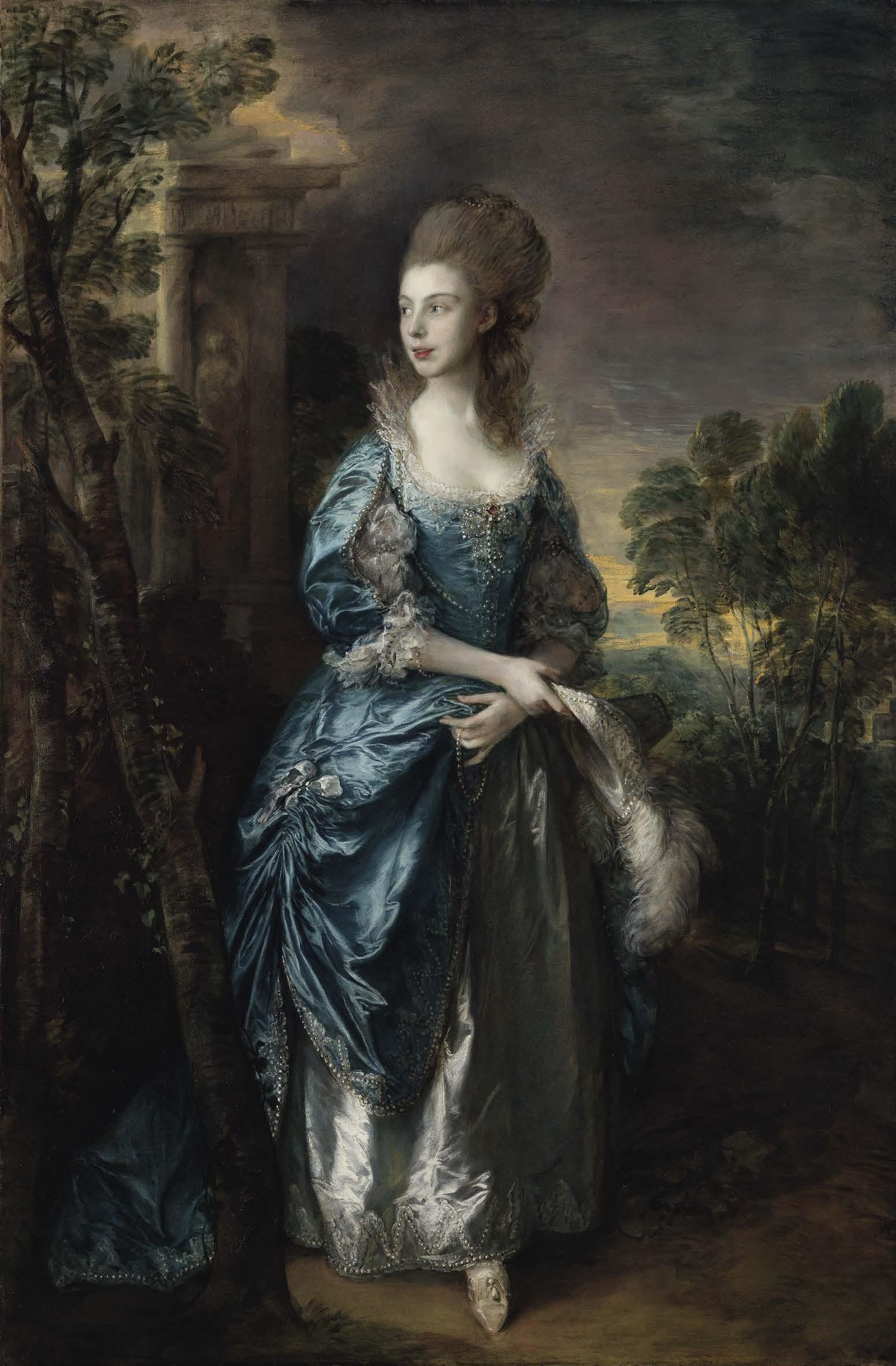
Opposite: Thomas Gainsborough, The Hon. Frances Duncombe, c. 1776, oil on canvas, 92 ¼ × 61 1 8 inches (234.3 × 155.3 cm), The Frick Collection, New York.
Andrews [c. 1750], which includes not only the fashions of that era but also a vantage, a view over a landscape?
AN The Andrews live at the National Gallery in London, and it’s a portrait not just of the couple— him with his rifle and his little dog—but of the land they own.
DCB That’s a real fashion flex!
AN It’s been incredible to dive into the fashions, the accessories—all the different forms of style in these images—the foundation of lifestyle.
DCB Has there been a show devoted to Gainsborough’s style before?
AN No, though Gainsborough works appeared in a big exhibition about Georgian style at the Queen’s Gallery at Buckingham Palace in 2023. I should also mention that there are no dresses or actual pieces of clothing in this show. This is a painting show. It’s about both what people wore and the fact that sometimes the relationship between what they wore in their everyday life and what they appear to be wearing in their portraits is not at all related.
DCB You’re saying that, if it were a fashion show, we’d see the dresses. Whereas here the concept is more about what the paintings of these fashions are.
AN There’s the idea that you’d put on your best frock when you had your portrait painted, of course, or a frock that you wished were your best frock. It’s not necessarily true that all the outfits you see belonged to the sitters, or even that they existed at all.
DCB The power of fashion!
AN This is that power. There’s a quote I like from Lady Duff-Gordon, a fashion designer in the early twentieth century: “Put even the plainest woman into a beautiful dress and unconsciously she will try to live up to it.” It’s as if the designer has created a new personality for her client. Every movement reflects increased self-confidence, a new joy of living.
DCB That’s like that great Marilyn Monroe line: “Give a girl the right shoes and she can conquer the world.”
AN Gainsborough has greater power: his subject doesn’t even have to put the dress on. He could paint her in anything.
DCB This show isn’t limited to women’s fashion, is it?
AN There’s an incredible portrait of Gainsborough’s nephew, Gainsborough Dupont, who was named after the family surname. One thing that stands out to me is this incredible fluffy hair and collar, which was clearly copied from another style and another era.
DCB Look how the collar balances those scarlet tendrils framing his face!
AN The Tate is loaning this work and we’re thrilled it’ll be in the show.
DCB How is it being back in the Frick’s original building, after a few years at the Whitney’s old Marcel Breuer building during your construction and renovation project?
AN I’m so happy to be back. As much as I liked the experiment in the Breuer building for a while, I like working in the mansion. It makes me feel closer to the art.
DCB I know it’s a controversial opinion but I thought it was awesome to have the collection in a different context, at least temporarily.
AN I’ve seen them now in different iterations and they almost look like other pictures. The Fragonards, for example, when they came out of the Fragonard room and were put on the walls as paintings in the Breuer building, were a totally different experience from now, when you remember that they’re these three-dimensional things and all.
DCB The Frick had such a brilliant and thoughtful rollout when it reopened. There was a line around the block! The garden was saved and the new restaurant feels considered.
AN We’re all thrilled with how it worked out. The cafe is called Westmoreland after the Fricks’ private train car, which would take them to and from western Pennsylvania, and you get that feeling when you’re in it. The new murals give you the sense of being in it. There were so many moving parts [during the renovation], but everything comes back to the center and the identity of the Frick as a unique institution. You don’t walk in there and think you could be anywhere.
DCB The Breuer building was a solution to a problem.
AN We weren’t about looking for a modernist gallery space, but it just so happened that one was available that could accommodate us, and it just so happened that it was an architectural marvel as well.
DCB Was that a polarizing move?
AN It wasn’t for everybody when it was announced. But there were many people, even the brutalism haters, who admitted to seeing the paintings very differently. For a short time it was an absolute advantage.
DCB And we knew it was going to come back here eventually.
AN Of course, and it’s good to be home.
by Carlos Valladares
I didn’t want any boy loving me, not at all, not for a second. I began to formulate how much better it would be if a lot of people loved me instead of one confusing, hard-to-understand boy. This barely realized notion, among others, unwittingly helped drive me toward acting.
—Diane Keaton, Then Again , 2011
She has more artistic courage than anyone I know. —Richard Brooks, in Deborah C. Mitchell, Diane Keaton: Artist and Icon , 2001
If there is a heaven, then in the waiting room they’re projecting a Diane Keaton film. Which one, you ask? It’s not Annie Hall (1977), though that performance will always be the primary reason we loved her down here in Fun Hell, and an advance in the language of cinematic comedy as profound as when Katharine Hepburn, in 1938, tore her gown in a Bringing Up Baby ballroom. Not Something’s Gotta Give (2003) or Looking for Mr. Goodbar (1977), not Reds (1981) or Baby Boom (1987), though these are unquestionably her finest performances. (One would need an entire book to dissect the wonders of Something’s Gotta Give .) No: In heaven they’re showing Heaven (1987), the first film Keaton directed.
This seventy-eight-minute documentary/film essay, in which Keaton gathers dozens of normies and crazies and asks them to describe heaven, is surely the most appropriate film one can watch to mourn the immense loss, with her death last October, of America’s nonpareil in comedy. Not only did Keaton innovate by practically single-handedly inventing the YouTube supercut and Adult Swim antihumor years before the fact, she also left us a sincere, lasting monument to human daffiness. Post–Taking Off (1971), pre–Adam Curtis, Heaven is high-octane, sincere American poetry to the nut degree. Narration by Dr. Robert L. Hymers, Jr., whose rabid, castigating sermons Keaton is entranced by, loops throughout the film like the raving of a beloved but senile stepfather, with such Lynchian pronouncements as “Mama Cass, the Mamas and the Papas, she died ssssstrrraaaaangled on a sssssaaaandwich !”1 and “An old lady with her hose in front of her house spraaaayed!! those girls down the street ! She turned the water full force on those beautiful girls in their dresses—because all girls wore dresses then! ”2 A young couple starts flirting and practically making love in front of Keaton’s camera as they discuss how amazing their heavenly orgasms will be: “You’re so rude , Kenny!” “I’m sorry, Pooh.” “It’s okay, Noopy. You see, I’m Pooh and he’s Noopy.” Keaton’s own grandmother is the bluntest: “Oh, I’m ready to die. I ain’t makin’ any future plans. I don’t want to live that long. That’s too long to live to wait for about $15 or $20.” Throughout Heaven , Keaton incorporates images from classical studio movies depicting the afterlife: Cabin in the Sky (1943), The Horn Blows at Midnight (1945), and the kitschily all-Black heaven in The Green Pastures (1936): the American id, an unvarnished spectacle. Keaton directed three later narrative films, but Heaven , a stupefyingly awesome outlier in relation not only to those fine if conventional pictures but to any big-budget studio pictures even remotely tied to the signifier “Diane La-Di-Da Keaton,” now sadly cements her reputation among a holy trinity of onehit-wonder US auteurs, next to Charles Laughton (The Night of the Hunter, 1955) and Leonard Kastle
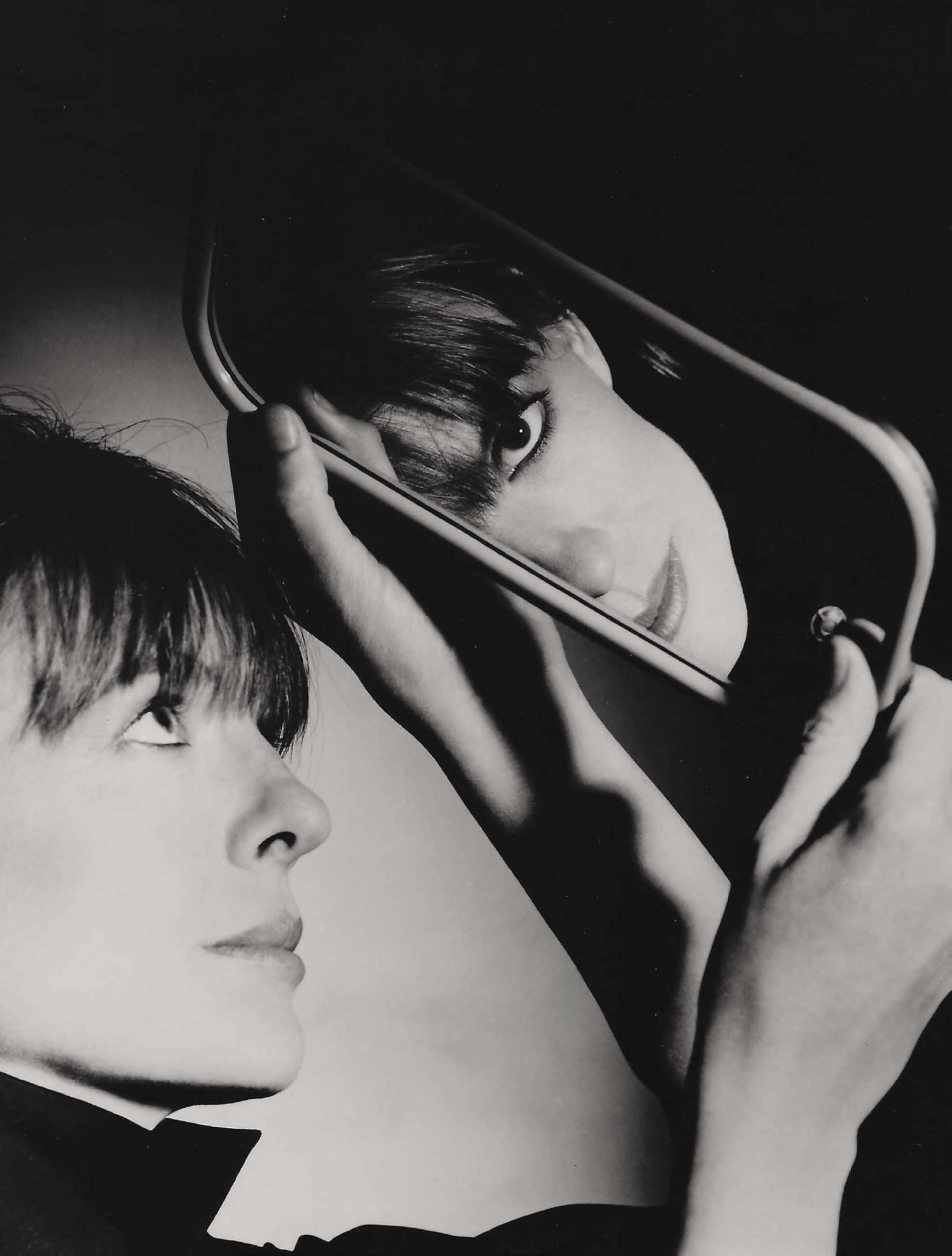
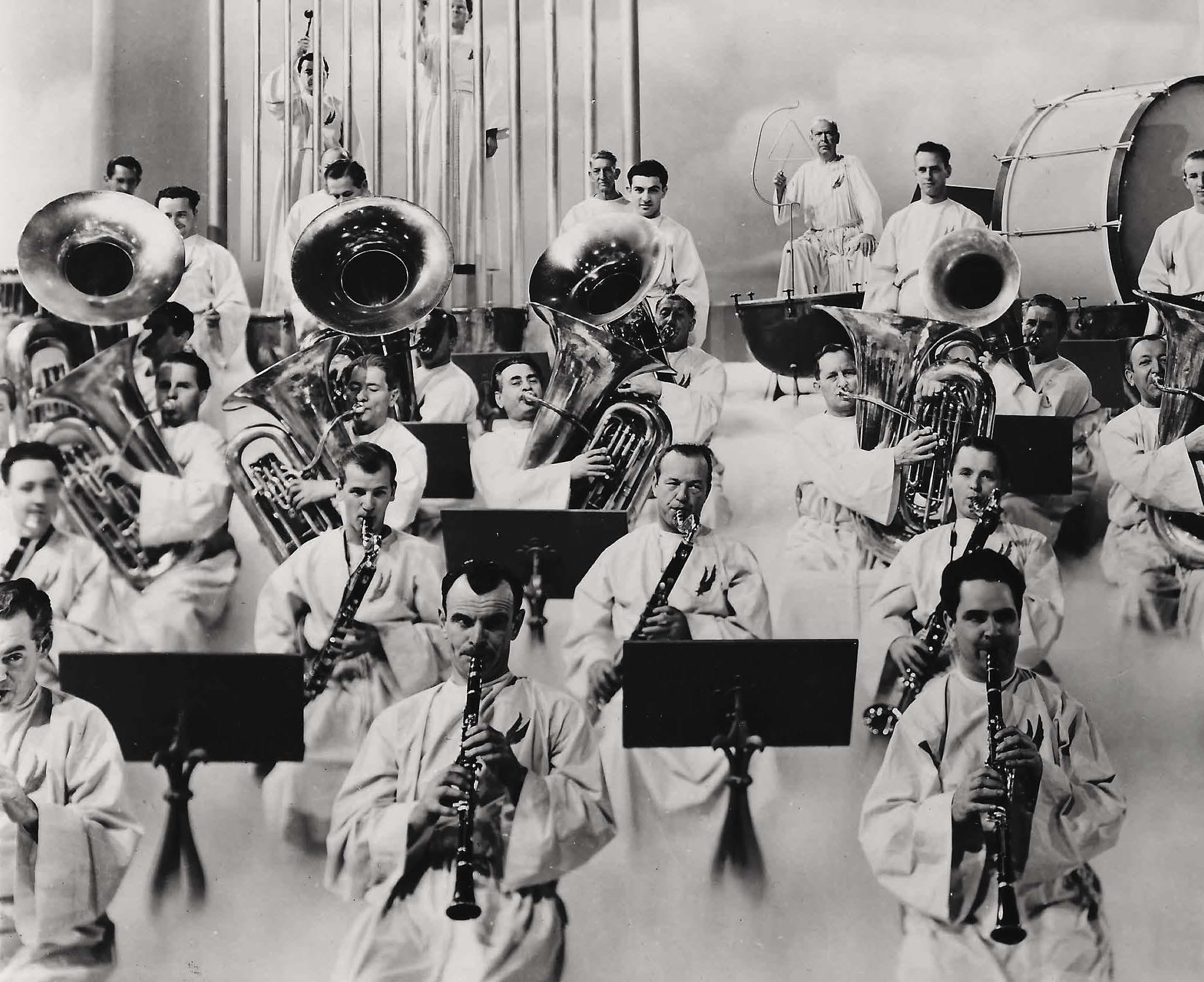
(The Honeymoon Killers , 1970). These creative geniuses should have gone on directing films in the experimental vein suggested by their one and only foray into the venture. And Keaton’s Heaven is every bit as obsessed by weird life as those other two masterpieces; it’s wildly shot and edited, framing the yearning for something beyond the surface as the definitive characteristic of the human project. Co-cinematographer on Heaven was Frederick Elmes, who only a year earlier had shot Blue Velvet for David Lynch, and Lynch’s uncanny familiarity with the disturbed subterranean nightmare beneath the billboard advertisement of the Pax Americana bleeds into Keaton’s project, which has a far kinder eye and heart yet is stuffed with more morbid belly-laughs at the wonderfully insane range of human behavior and more cleanly skirts condescension.3 Keaton, herself an agnostic, was flummoxed by the contrasts of heaven and hell; in a press conference for the film at Cannes she admitted, “I don’t get hell as an idea; I get heaven, but I don’t get hell. It’s too mean-spirited!”4 Yet her project, like Agnès Varda’s, is less about proselytizing for moral ideas about who is good and who is bad and more about listening to people with an open
heart and a seemingly limitless curiosity, then finding a form that matches the eccentricity she stumbles upon.
It seems as though Keaton’s punishment for making this beautiful, original work was the inability to do another film like it again. Heaven became a joke in the mainstream press, attacked mercilessly as twee, insignificant, the caprice of a privileged celebrity. The eternal curse in this country: ingenuity going unheard and unheeded. Today it is a total joy for me to discover—if only, alas, after the Great Diane has left our mortal coil, I am embarrassed to admit.
Keaton’s passing, at the age of seventy-nine, has a lot of us reeling, as you can imagine. Born Diane Hall in Los Angeles in 1946, raised in a middle-class Protestant family in Santa Ana, she emerged from the world of late-’60s New York theater—she was one of the hippie ensemble in the original Broadway production of Hair —and specifically from Sandy Meisner’s acting studio. Her rise in the 1970s, beginning with her Kay Adams in The Godfather (1972) and continuing with her Oscar-winning titular role in Woody Allen’s Annie Hall , made her the definitive American movie actress of the era: a comic original
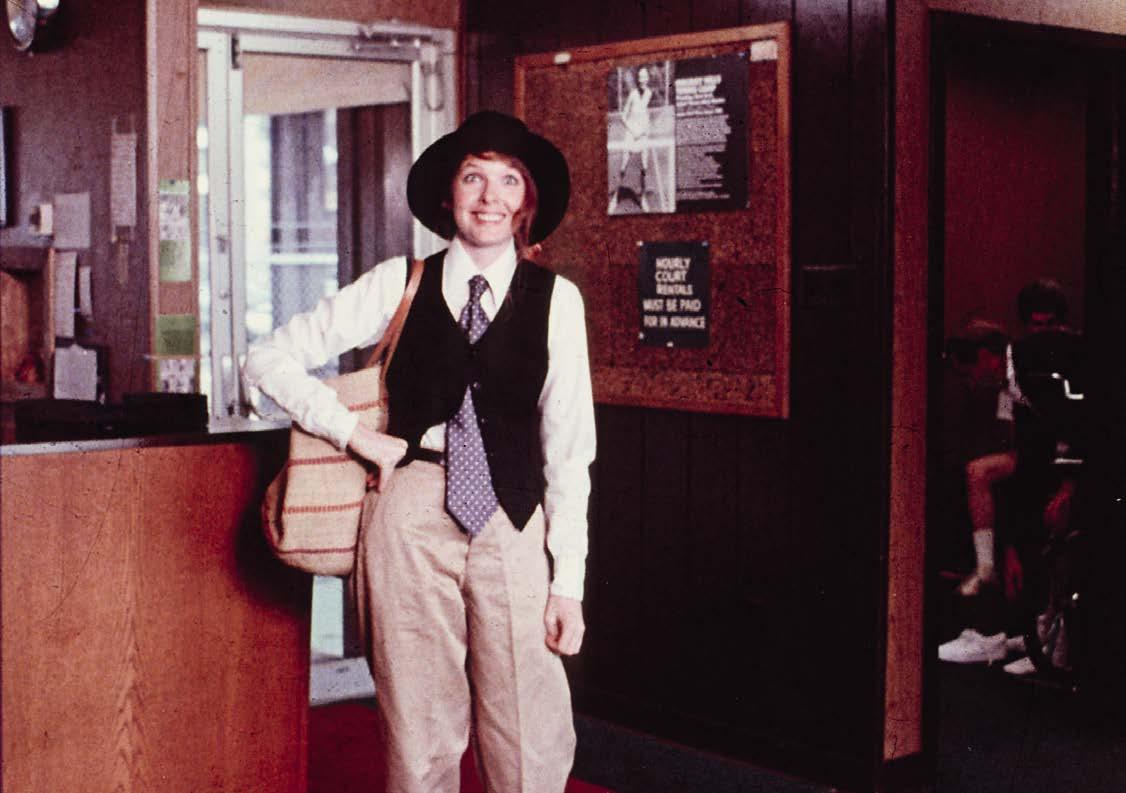
in the lineage of Hepburn and Carole Lombard but with a nervous, daffy modernity all her own. (Late in life she would write multiple wonderful and revealing memoirs, the crown jewel of which, Then Again of 2011, is billed as a dual memoir of Keaton and her mother, Dorothy.) Beyond acting, her work sprawled widely: director of four feature films and the aforementioned modern masterpiece Heaven , memoirist, underrated photographer in the Sherrie Levine/Richard Prince/Cindy Sherman postmodern lineage, thrift shop rat, and accidental fashion revolutionary whose menswear-inflected silhouettes reshaped mainstream style. Keaton’s career, so often reduced to the Annie Hall image of tie-vest-hat, is in fact an American epic in miniature: a six-decade body of work shaped by curiosity, self-invention, and the restless instinct to look at familiar things— romantic comedy, family melodrama, the concept of heaven—from the oddest of angles.
When Keaton was asked about Heaven , she expressed a strikingly low and devastated opinion: The film “was a critical bomb. And I really had to take it. I really felt: OK, I’m sorry I made it!”5 This particular quirk of her persona comes through in many interviews and the testimony of friends:
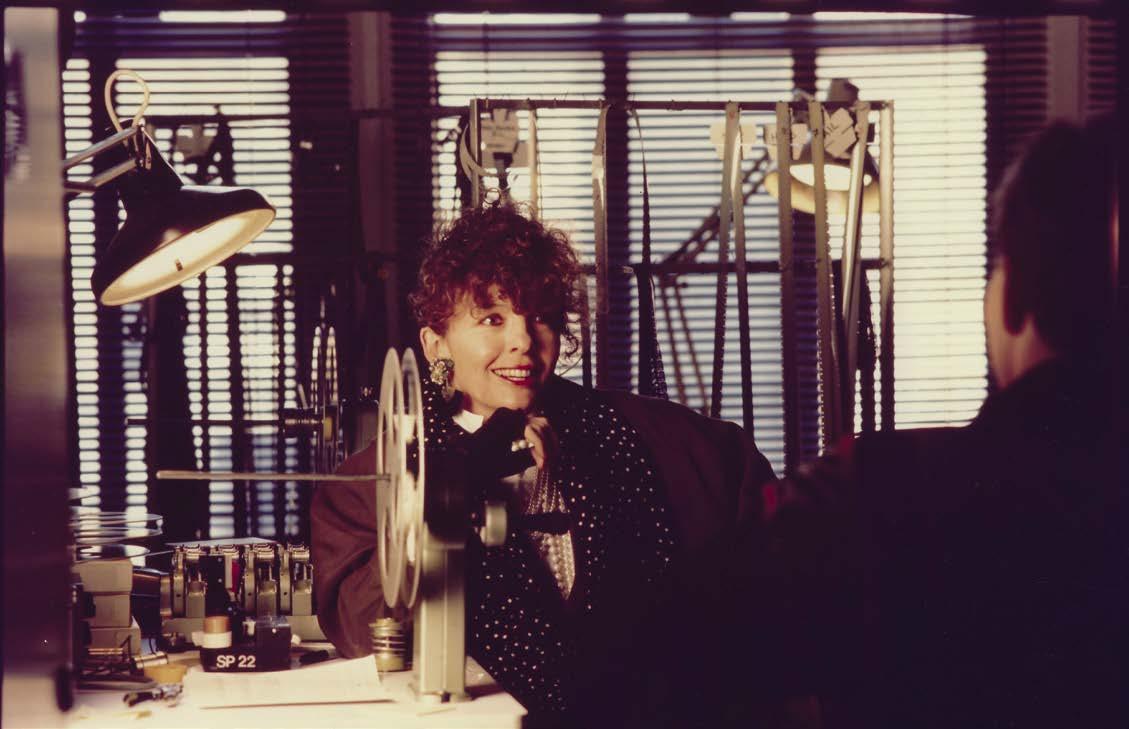
A penchant for self-deprecation. Laugh at yourself before they get a chance to laugh at you. It’s similar to Allen’s comic approach, which half-explains their affinity for each other’s styles. “I’m an amateur; I’m nobody special,” said Keaton on her photography. 6 Yet the filmmaker for whom she crafted her most astonishing performance—that in Looking for Mr. Goodbar —would have none of this: “She doesn’t have a high opinion of herself,” said the director Richard Brooks, “but she’s got a lot of guts. And she’s tough. She is tough internally.”7 What defines the Keaton attitude is the ability to whip and sculpt an irredeemable detritus into forms this side of pop cubism. Her style sparked a movement in itself, as evidenced by her last book, Fashion First (2024), and the literally hundreds of articles written about her thrifted clothes, purchased from Goodwill and culled by stopping people on the street and asking them where they got what they were wearing. 8 Keaton’s hipness to collage also seeped into her major métier, acting. Perhaps nowhere is this more evident than in her most filigreed performance, as the schoolteacher looking for a feeling in Brooks’s still powerful, haunting, and wallopdelivering thriller Looking for Mr. Goodbar, based
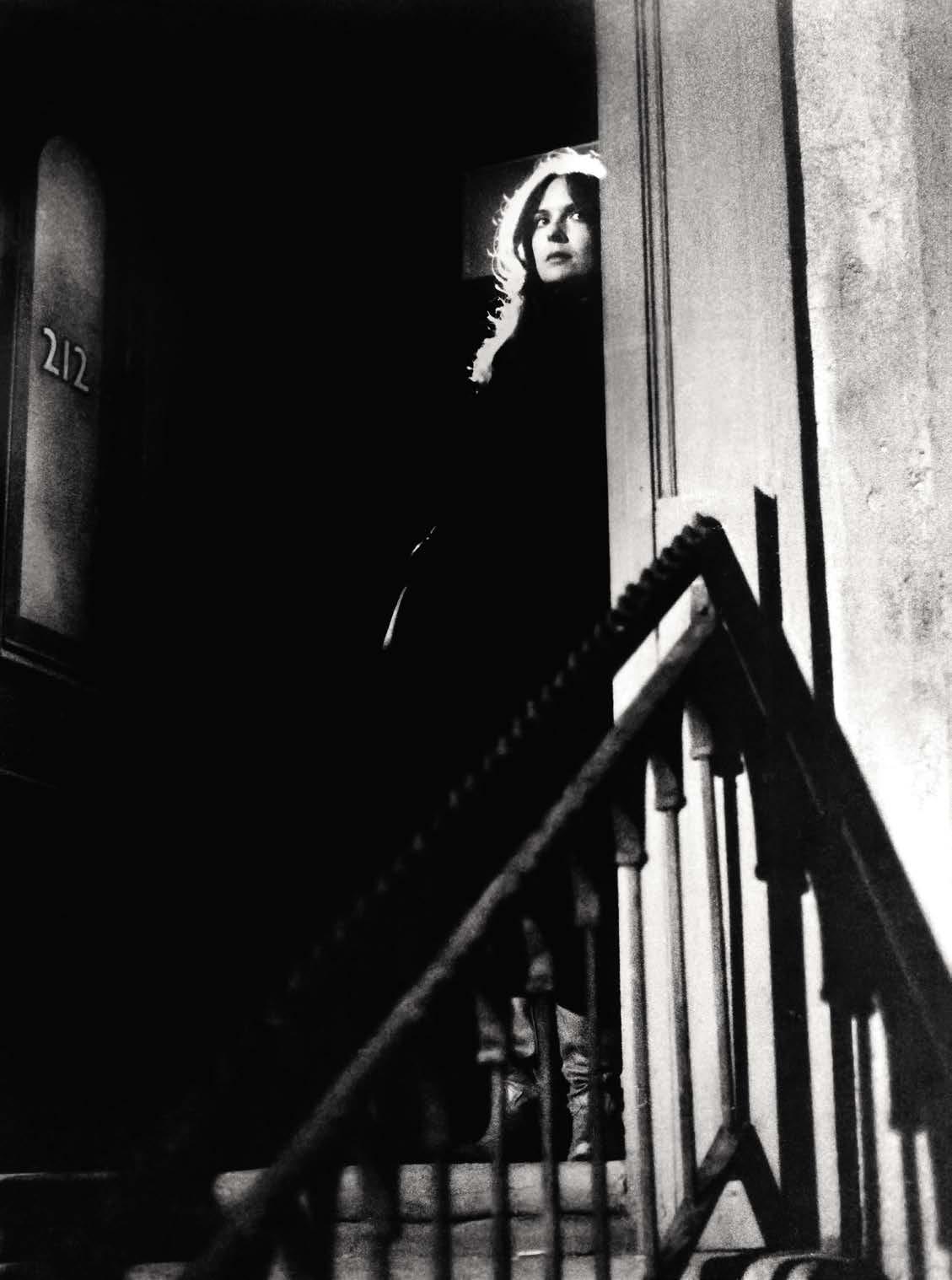
on the real-life murder of Roseann Quinn on January 2, 1973. This tightwire act of a picture features a breathtakingly Godardian splay of personalities, tics, gestures, and debunkings of cliché ideas of the single woman, all packed by Keaton into the complicated, lively, and ultimately tragic life of Theresa Dunn, a schoolteacher in her early twenties cruising the city’s singles bars in search of easy sex and distraction from her disability, a bad back. Between a life born into a God-fearing family as a “repressed Catholic virgin” (the film critic Molly Haskell’s words) to her final end as a “taunting, self-anesthetized bitch” in one of the most brutal and horrifying endings to a movie you’ll ever see, Keaton-as-Dunn creates “an extraordinarily complex and compelling female character” in an era whose imaginary was fueled by Serpicos, Godfathers, Skywalkers, Quints, and proto-incel Taxi Drivers. 9 Whenever Keaton flashes her I’mgoing-out smile in Mr. Goodbar, it’s exultant but also vaguely concealing a menace inside herself, a vulnerability. She’s on a Lacanian death trip, pursuing the annihilation of the desiring ego as she hops from romantic man (William Atherton) to lunatic man (Richard Gere) to, finally, self-loathing dark
soul of the night (Tom Berenger).
Some might be tempted to dismiss the film as the moralistic scoldings of a misogynist schoolmarm: “If you don’t act Good, girls . . . ”10 But Brooks is strangely hip. He’s not reactionary so much as he is a ghoulishly, painfully accurate observer of the deadness of ’70s life, clued in (thanks to Keaton) to a grisly critique of modernity that only Rainer Werner Fassbinder in Germany or Robert Bresson in France were attempting. Brooks said it best: “I wanted to do a story about a contemporary girl who is influenced by the world in which she lives, not only by her upbringing and her physical handicap but by seeing Hustler and Penthouse on newsstands, by the advertisements on TV that are more violent even than knifings and car chases. ‘If you use this toothpaste, that fellow will kiss you.’ That is a violent lie.”11 Thesis: What a society wants (e.g., women’s liberation in hypercapitalist patriarchy) lags far behind the reality of people’s relationships with each other.
That Keaton so smoothly integrates her signature oh-gosh-gee Annie Hall–isms into an almost Flaubertian, unsentimental study of the New York woman circa 1977 made the experience of watching
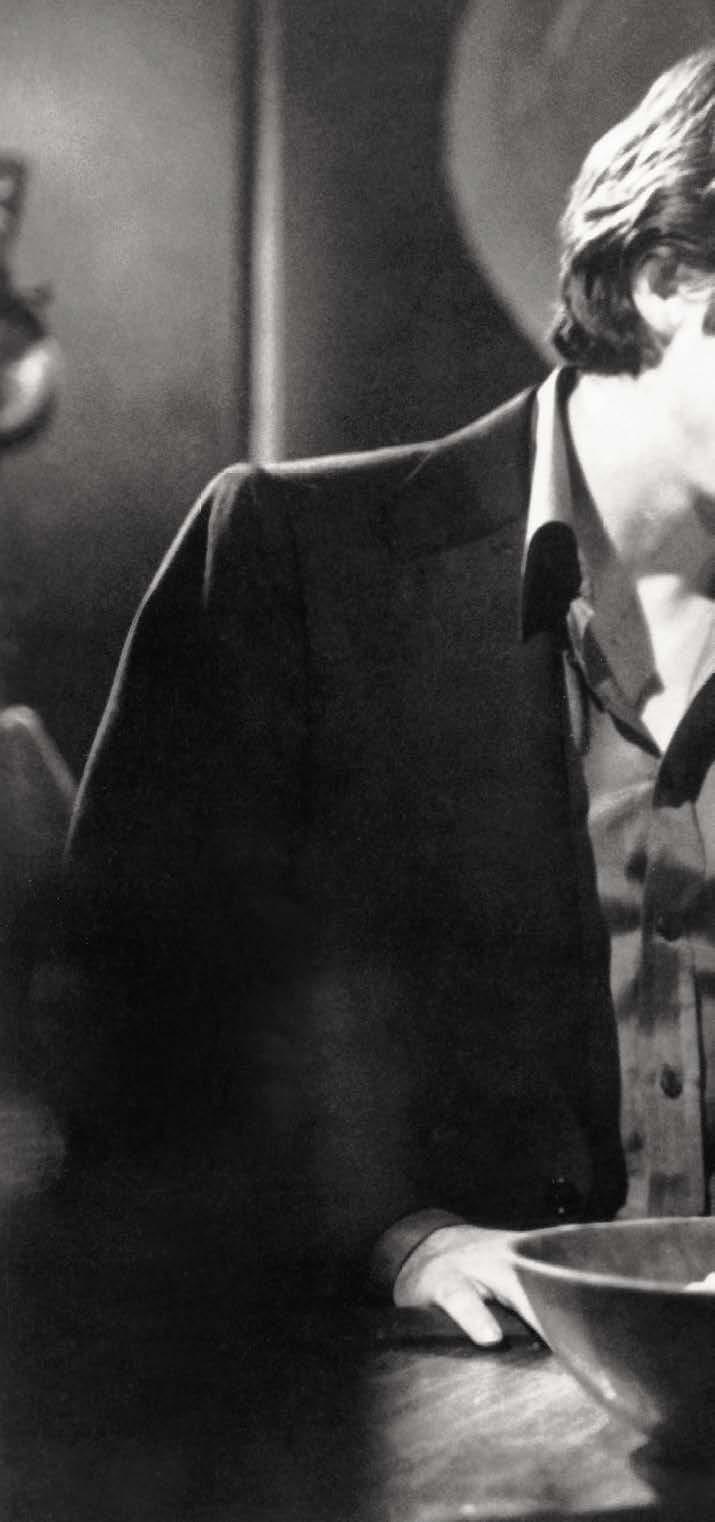
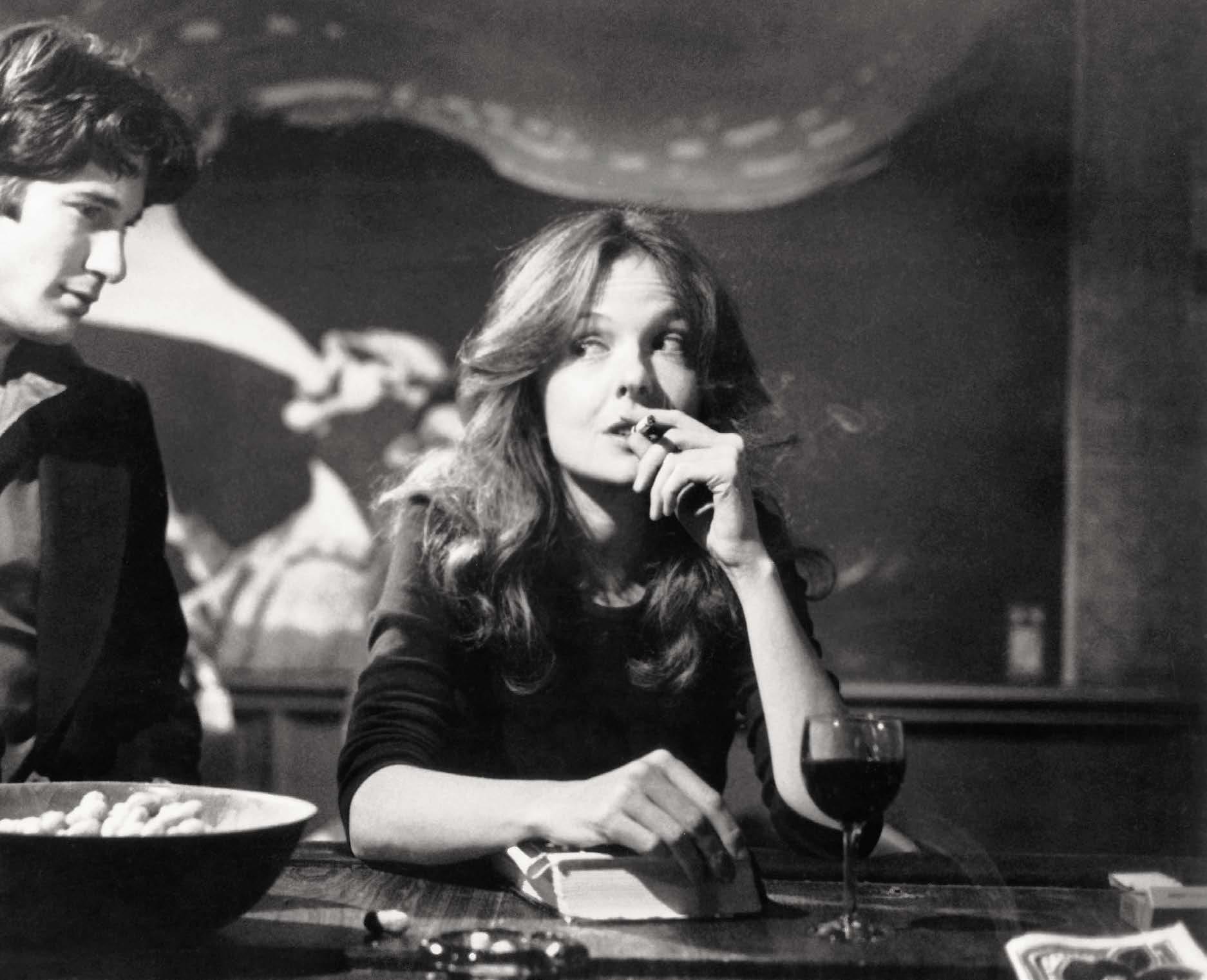
Looking for Mr. Goodbar at a recent, sold-out Roxy Cinema screening in New York properly surreal. Keaton and Brooks bear witness, coldly, to a consumerist, puritanical society in moral decline—par for the course for the director of In Cold Blood (1967). Despite the necessary advances of second-wave feminism, Goodbar says, there is still, in American cities, a feeling among men that women are there to be lusted after, despised, and dispatched on general, irrational principle. The last man Theresa meets (Berenger’s self-loathing gay man, in the film’s last-minute slide into Gothic horror) is also swallowed alive as a victim of this misogynist hate. If Goodbar were made today, the true-crime element would be pushed to unbearable, obscene degrees— which makes the quotidian chilliness of Brooks’s framing, and Keaton’s patient development of her character, so radical to watch. It is head-spinning to consider that Keaton made this the same year she cemented her iconic status as Annie Hall, a night-and-day as baffling as Ernst Lubitsch directing the tragic Broken Lullaby and the comic Trouble in Paradise in the same calendar year of 1932. But recall Plato’s summary, in the Symposium (c. 385–370 bce), of a point made by Socrates, when he “was
trying to get [Agathon and Aristophanes] to agree that knowing how to compose comedies and knowing how to compose tragedies must combine in a single person and that a professional tragic playwright was also a professional comic playwright.”12 Such a rare figure was Diane Keaton.
1. Mama Cass did not choke to death on a sandwich. This is an urban legend.
2. Writing later of his decision to appear in the film, Robert Hymers dismissed Diane Keaton’s effort, as did many other contemporary newspaper critics. “It was a nice opportunity to witness for Christ to Diane Keaton and Warren Beatty,” he sermonized, but “ … you won’t find the truth about Heaven by interviewing people and looking at old movies! You can’t learn much about Heaven from Jack Benny playing the angel Gabriel!” Hymers, “Longing for Heaven! A Sermon preached at the Baptist Tabernacle of Los Angeles, Lord’s Day Morning, May 5, 2013,” available online at www.rlhymersjr. com/Online_Sermons/2013/050513AM_LongingForHeaven.html (accessed December 8, 2025).
3. Not only did Frederick Elmes shoot Heaven for Diane Keaton (he also shot Eraserhead and Wild at Heart ) but Catherine E. “Log Lady” Coulson served as assistant camerawoman. Perhaps this partly explains how and why Diane Keaton, of all people, got the gig directing that totally deranged season 2 episode of Twin Peaks in which Ben Horne (Richard Beymer) reenacts the Battle of Appomattox.
4. Keaton, in John Hanrahan, “Diane Keaton’s doco HEAVEN asks is there life after death? Does Heaven exist? If so, what’s it like?,” press conference for Heaven , Cannes Film Festival, 1987. Available online on the YouTube channel “John Hanrahan’s Movie Star Interviews,” https://www.youtube.com/watch?v=dWdCYndWSVw (accessed December 8, 2025).
5. Keaton, in Angie Corcetti, Diane Keaton: On Her Own , Peter Jones Productions, for A&E network, 2002. Available online at https:// www.youtube.com/watch?v=Oby6y9cbpOA (accessed December 8, 2025).
6. Ibid.
7. Richard Brooks, quoted in Deborah C. Mitchell, Diane Keaton: Artist and Icon (Jefferson, NC: McFarland, 2001), 47.
8. See Rachel Tashjian, “How Diane Keaton Redefined the Movie Star Look,” Washington Post , August 31, 2024. Available online at https://www.washingtonpost.com/style/fashion/2024/08/31/dianekeaton-book-fashion-first/ (accessed December 8, 2025).
9. Molly Haskell, “Exposing a Nerve,” New York , October 31, 1977, 118.
10. For Haskell, author of the classic 1974 study From Reverence to Rape: The Treatment of Women in the Movies , Brooks’s “aggressive, unflinching approach to the sexual theme forces Keaton to expose herself, but her nudity, shocking at first, acquires a strange transparency. By holding firmly to her own point of view, she carries us through the transitions from sexual awkwardness to ecstasy and out the other side, through the barrier of the senses to her innermost being. Amidst the garish horrors with which Brooks surrounds her, she creates a sanctuary, a circle of intimacy. . . . [Her] Theresa, in a brilliant improvement on [Judith Rossner’s] novel, has a rewarding job teaching deaf children. Her sensitivity—her ability to listen and to communicate—gives her a life force that is a welcome relief from the squalor of the other half of her double life, but it makes her death doubly unbearable, like watching a friend commit suicide. She has an inner light that is the brightest thing on the screen, and when that goes out we feel that truly the world must come to an end.” Ibid., 116.
11. Brooks, quoted in Douglass K. Daniel, Tough as Nails: The Life and Films of Richard Brooks (Madison: University of Wisconsin Press, 2011), 204.
12. Plato, Symposium , c. 385–370 bce, Eng. trans. Robin Waterfield (Oxford: Oxford University Press, 1994), 71.
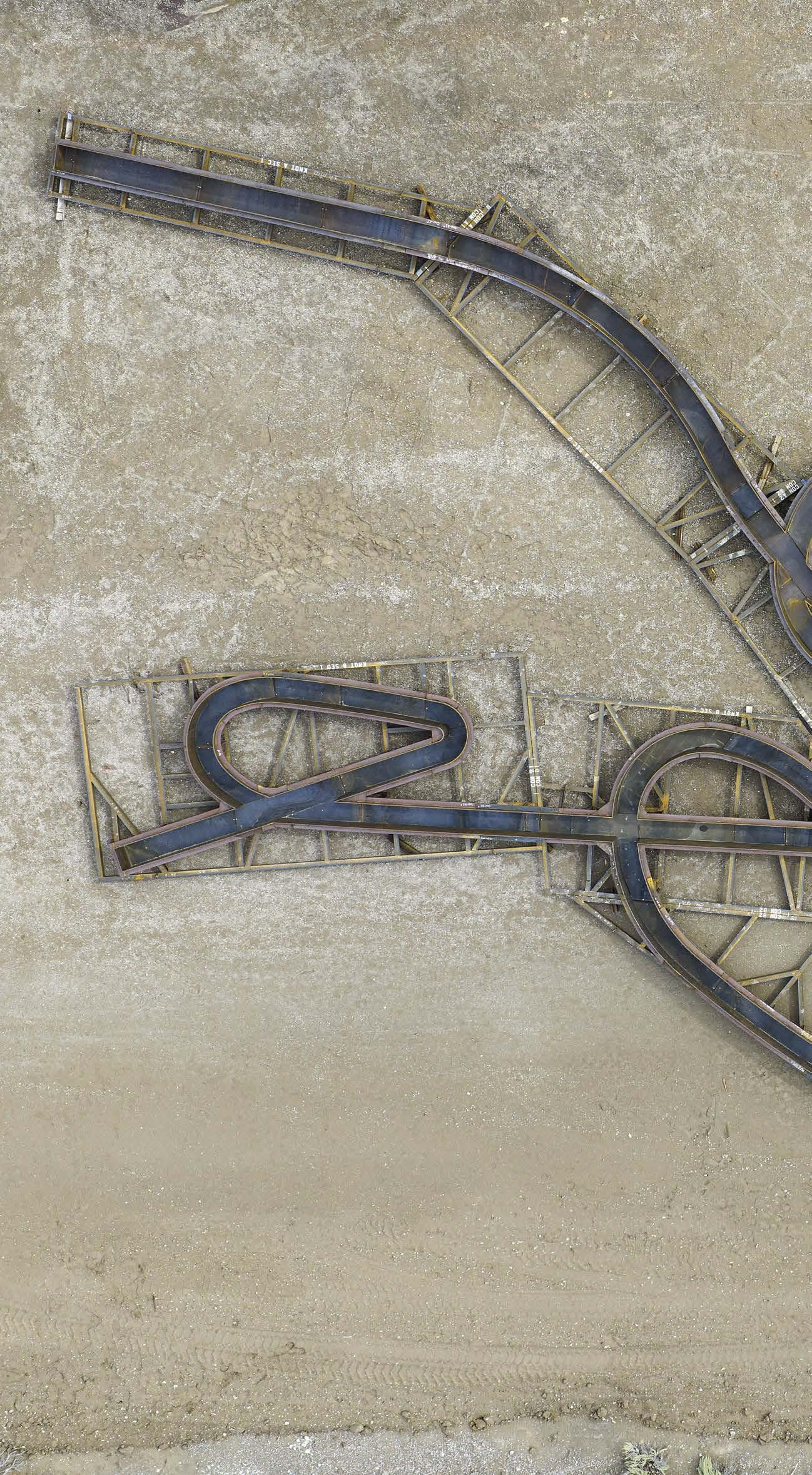
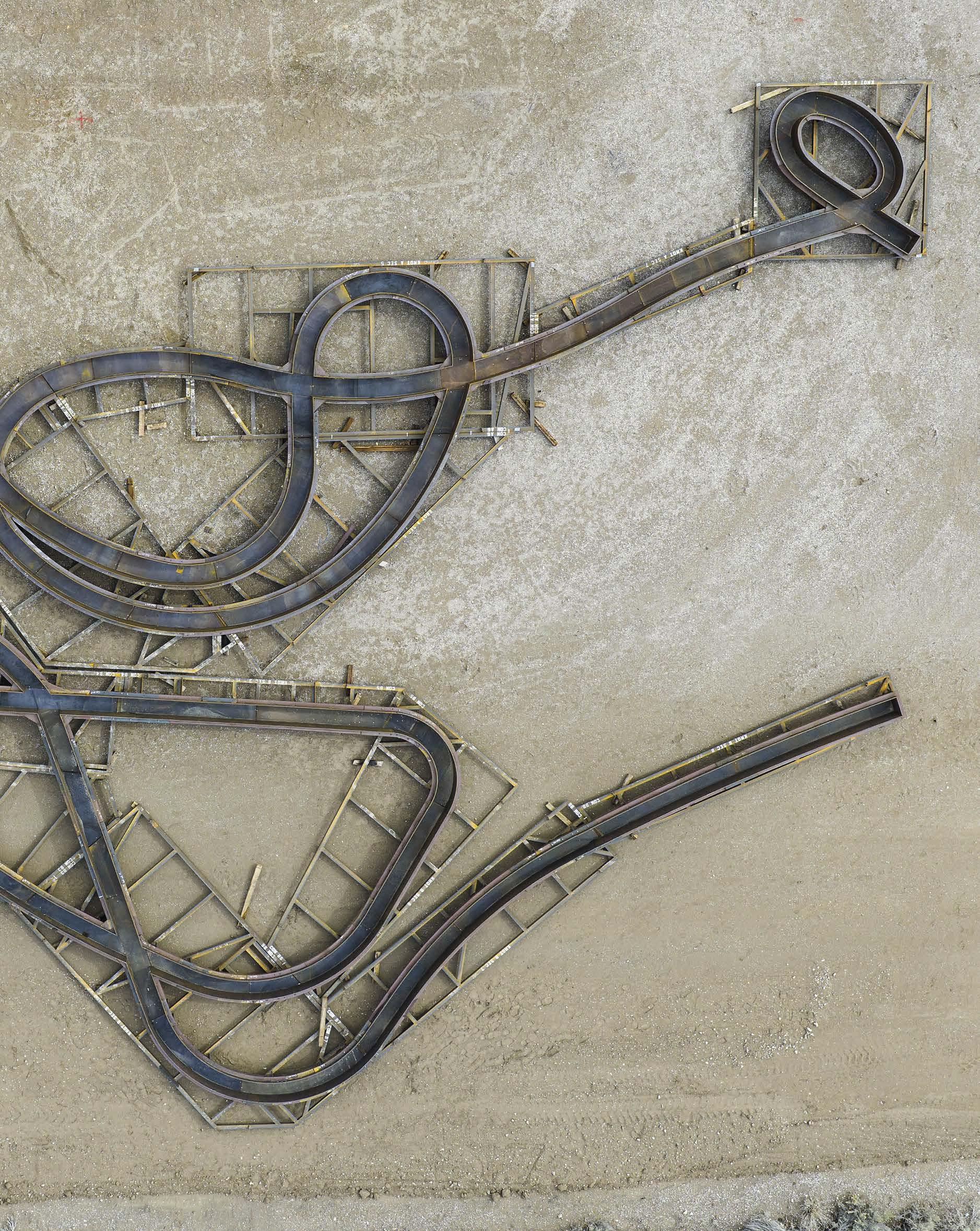
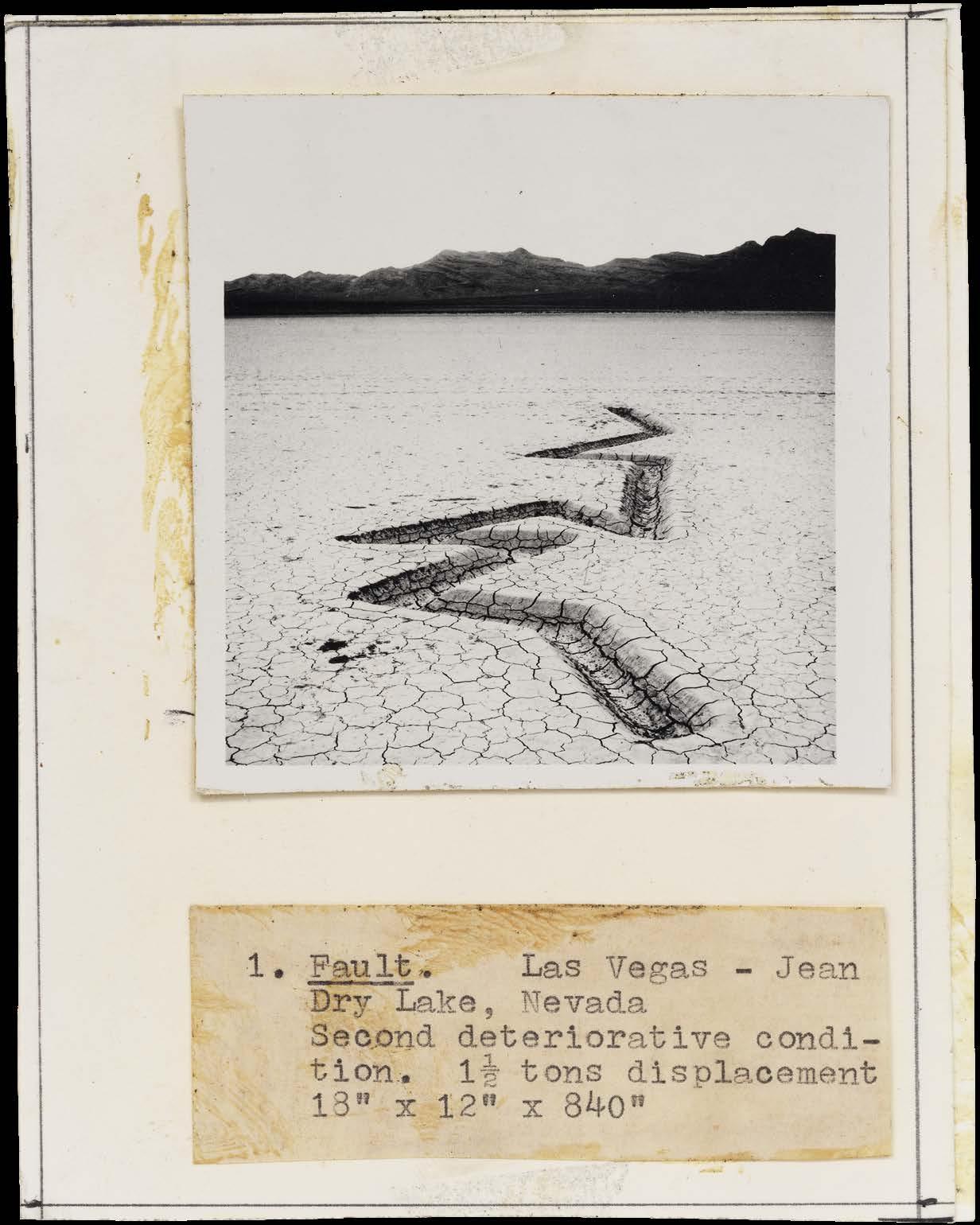
Across his nearly six-decade career, Michael Heizer has continued to probe the possibilities of sculptural form defined by its absence. His exhibition Negative Sculpture features Convoluted Line A and Convoluted Line B , among the artist’s most complex negative sculptures. In the following pages, we consider a selection of works that have preceded the new sculptures.

Previous spread: Michael Heizer, Convoluted Line A and Convoluted Line B, 2024 (both), steel, 87 feet 6 inches × 30 feet (26.7 × 9.1 m); 87 feet 7 inches × 35 feet 5 inches (26.7 × 10.8 m) © Michael Heizer.
Photo: Clint Jenkins
This spread, left to right: Michael Heizer, Untitled (Nine Nevada Depressions, Rift [Fault]), 1968, silver gelatin print mounted on paper, 6 × 5 inches (15.2 × 12.7 cm) © Michael Heizer. Photo: Rob McKeever
Michael Heizer, Rift , 1968/1982, steel, 10 feet × 51 feet 9 inches × 6 inches (3 × 15.8 × .2 m), Menil Collection, Houston © Michael Heizer.
Photo: Adam Neese
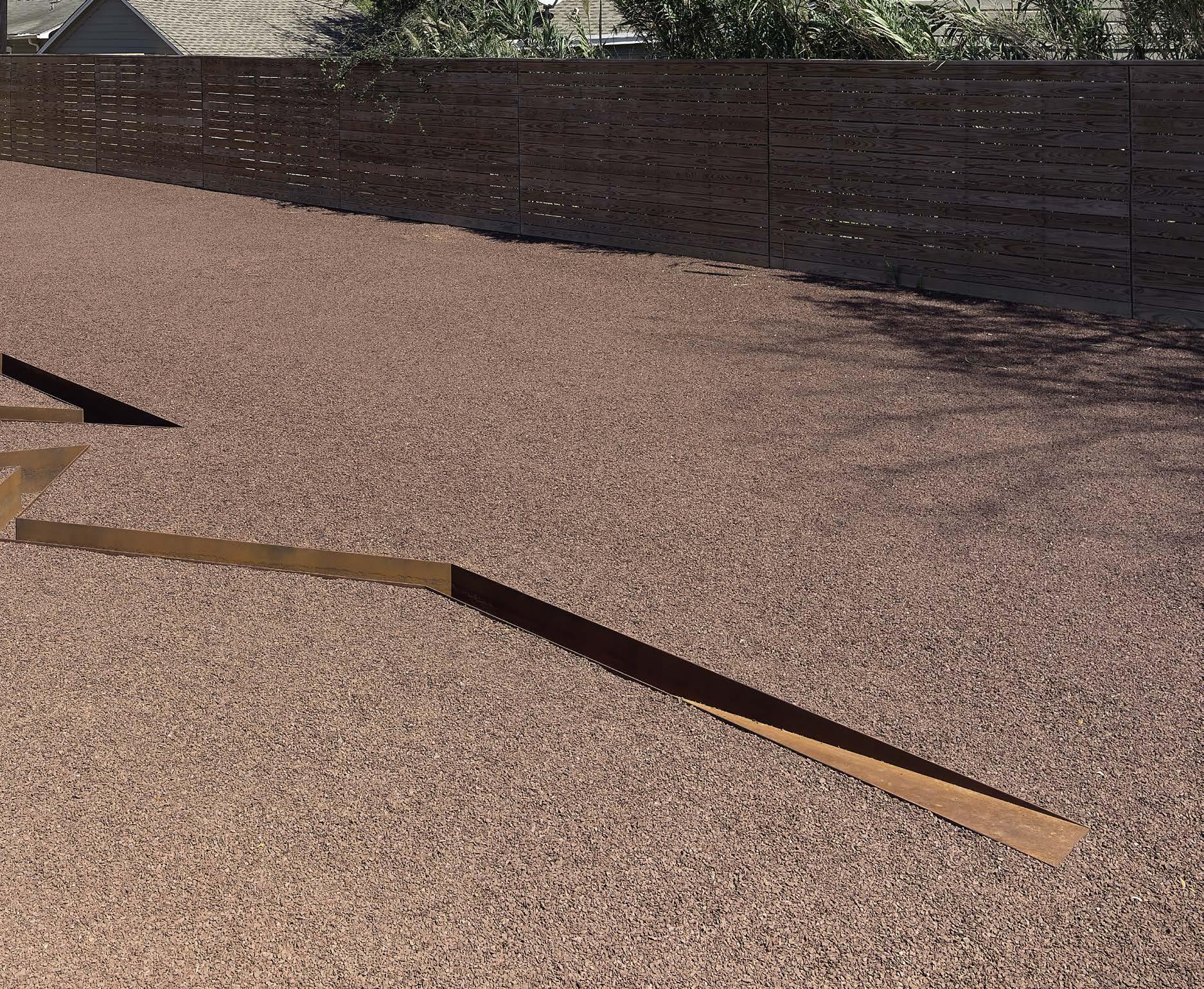
Since the mid-1960s, Michael Heizer’s work has sought to challenge long-held artistic traditions and the established art gallery system. This began in earnest in 1966 with shaped, threedimensional canvases with cut-out voids and then shaped canvases composed of lighter and darker geometric passages to suggest the absence and presence of form. These works questioned the boundaries between painting and sculpture. In winter of the following year, Heizer visited the Sierra Nevada mountains, where he dug two large pits in the woods. Lining one, North , with plywood and the other, South , with sheet metal, he inaugurated his career-long pursuit of sculptural form described through negative space.
With the financial backing of New York taxi tycoon and art collector Robert Scull, the following year Heizer embarked on his most ambitious body of work then to date: the Nine Nevada Depressions (1968)—nine excavations
into the earth in the form of loops, intersections, zigzags, and broken lines placed across 520 miles of dry lake beds in Nevada. Rift (1968, deteriorated), the first of these, is a 1.5-ton displacement of earth in the form of a dynamic, jagged line. These interventions have all deteriorated or been dismantled, but their forms and the questions their physical reality provoked remain central to Heizer’s work even today.
Heizer ultimately turned to more resilient media to ensure the longevity of the sculptures, making later versions of some early works—Dissipate #2, Isolated Mass/Circumflex, and Rift , for example— in weathering steel. These were acquired by the Menil Collection, Houston, in 1994, 1997, and 1999, respectively. Convoluted Line A and Convoluted Line B do not take the form of any one of the original depressions; instead, they elaborate on this tradition and reflect the refinement of the artist’s aesthetic sensibility over time.
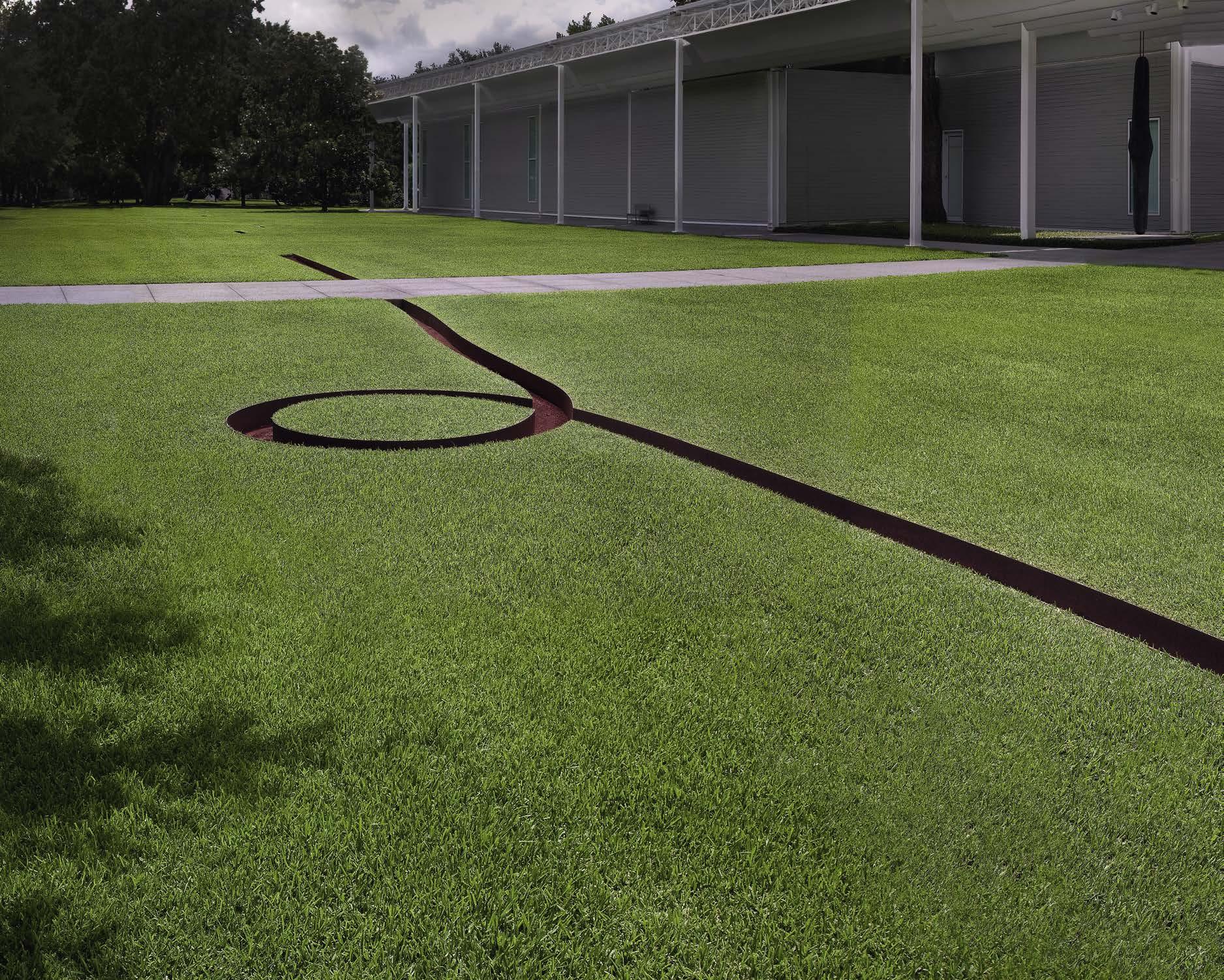
For Heizer, defying the inherent limitations of media is part and parcel of making sculpture. Isolated Mass/Circumflex (1968, deteriorated) of the Nine Nevada Depressions takes the form of one long, softly curved horizontal line punctuated by a single loop just off center. Formed by digging into the ground and removing several tons of raw earth, it exemplifies the finesse with which Heizer rendered lyrical form using simple construction tools early in his career.
Isolated Mass/Circumflex (#2), the later
weathering steel version, was installed in the Menil Collection’s front lawn bisecting the central walkway in advance of its opening in 1987.
Convoluted Line A and Line B are the most intricate of Heizer’s curvilinear negative line sculptures. Meandering with the delicacy of a hand-drawn line, their elegant twists belie the rigidity of steel. Indeed, it is the deft handling of heavy machinery that underpins the precise articulation of Heizer’s most sophisticated sculptural concepts.

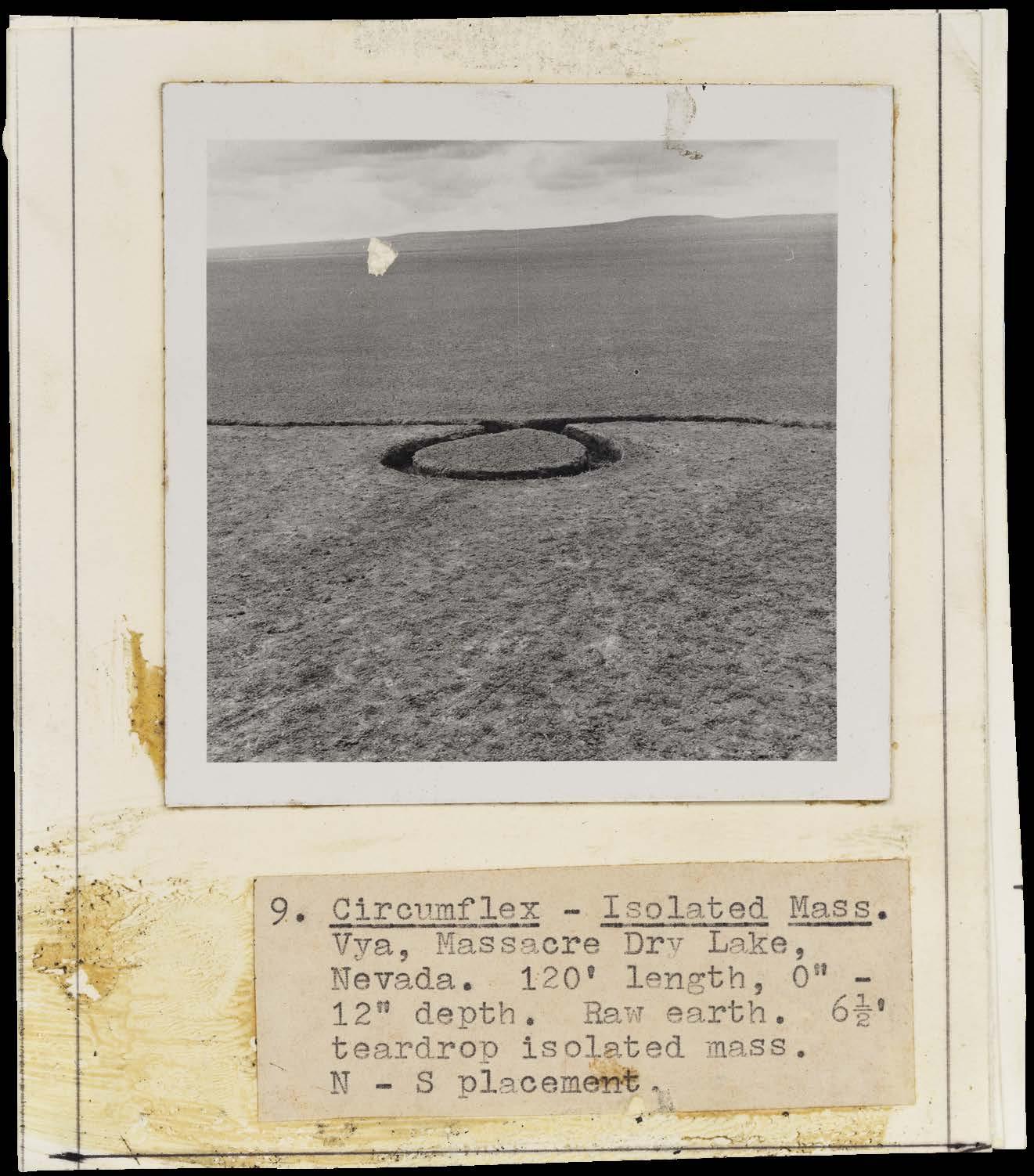
This spread, left to right: Michael Heizer, Isolated Mass/Circumflex (#2), 1968/1978, steel, 12 feet 2 inches × 121 feet 9 inches × 8 inches (3.7 × 37.1 × .2 m), Menil Collection, Houston © Michael Heizer. Photo: Tom Vinetz
Michael Heizer, Untitled (Nine Nevada Depressions, Isolated Mass/Circumflex), 1968, silver gelatin print mounted on paper, 6 × 5 inches (15.2 × 12.7 cm) © Michael Heizer. Photo: Rob McKeever
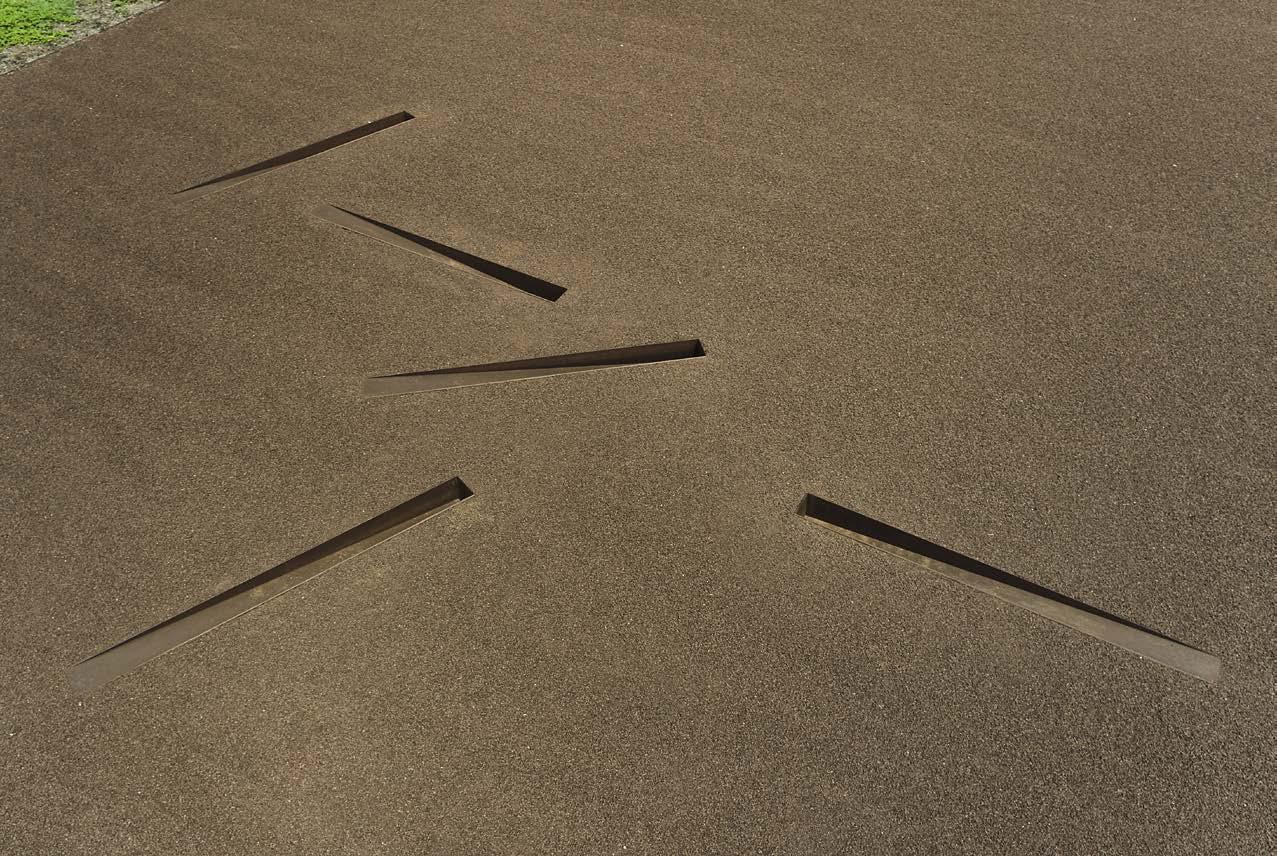

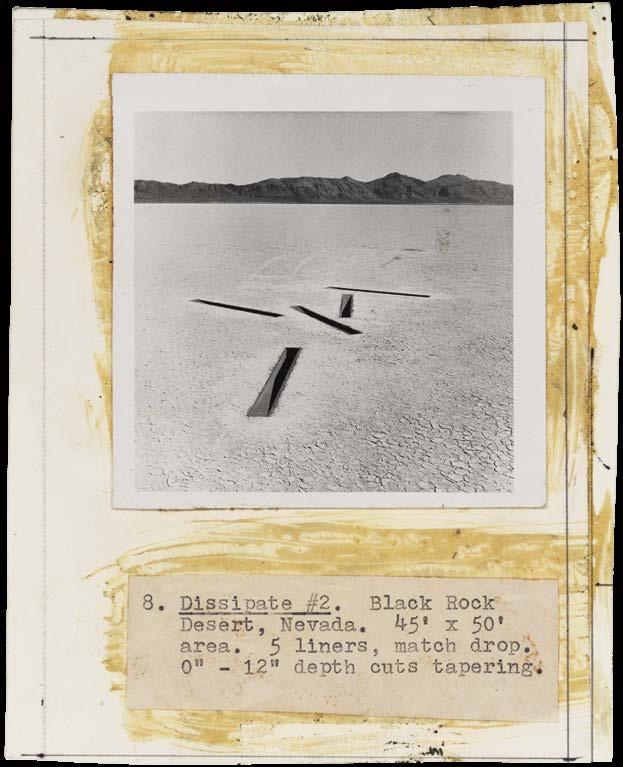
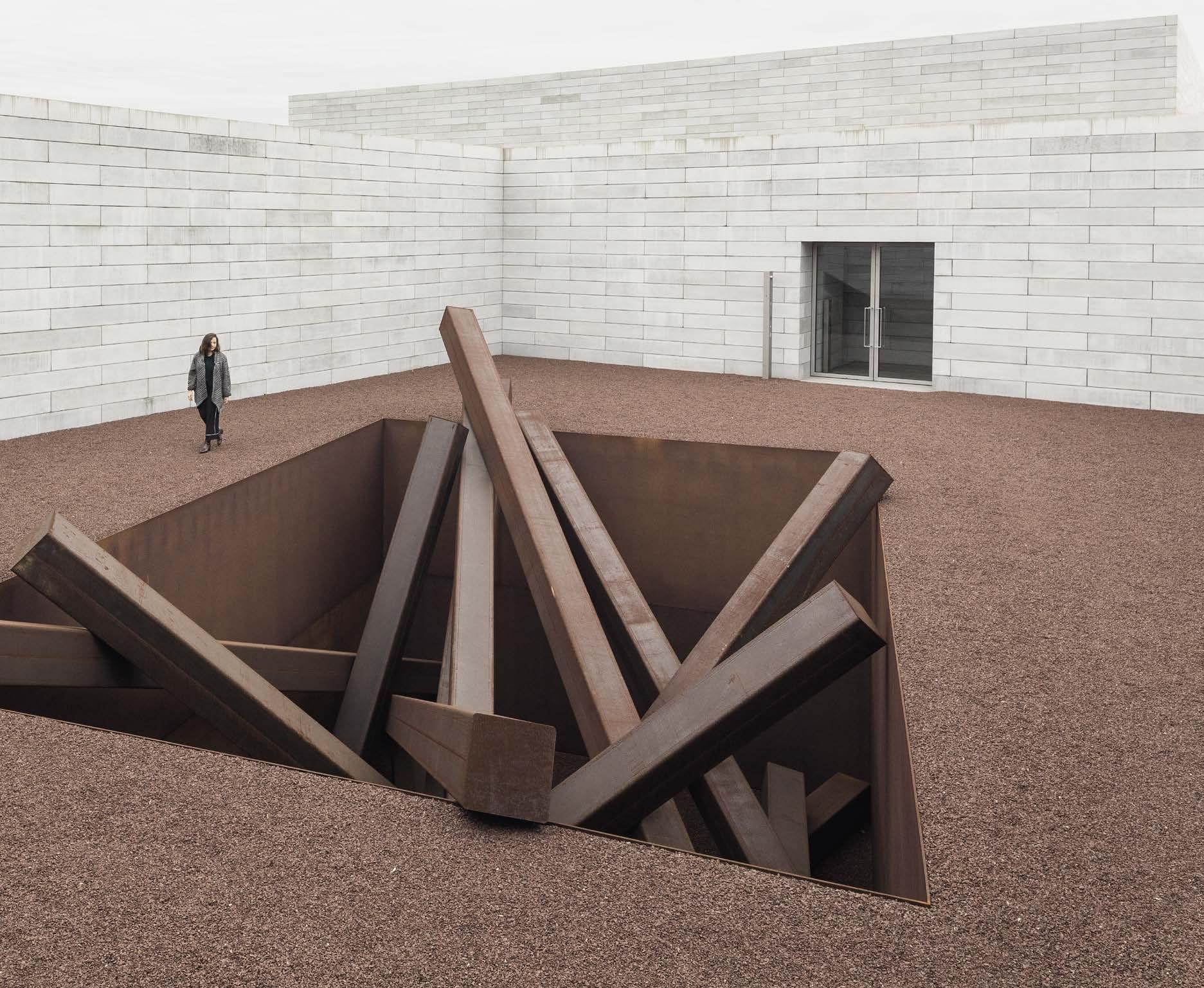
Chance was an integral part of Heizer’s process of sculpting and painting while working in the California and Nevada deserts throughout the late 1960s. Remade in weathering steel in 1970, Dissipate #2 (1968, deteriorated), of the Nine Nevada Depressions , consists of five wooden earthliners whose haphazard arrangement references a composition entitled Matchdrop (1968)—five matchsticks that were dropped from two feet in the air and then taped onto a sheet of paper where they landed. This mode of generating composition through chance continued with other work, including Adze Dispersal (1968–71). Installed for the first time in California’s Mojave Desert in 1968, it consists of 524 stainless-steel elements of varying sizes tossed and sunken into the earth. Later dismantled, the work was exhibited in the
Whitney Museum of American Art’s exhibition
Two Hundred Years of American Sculpture (1976) and later acquired and shown by the Museum Ludwig, Cologne, each time with the components arranged in a different formation.
First designed as a small-scale wooden model in 1967, and later commissioned at monumental scale for Glenstone, Maryland, Collapse (1967/2016) also finds its sublime power in the tension between random disorder, and balance and control Composed of massive steel beams deftly leaned upon one another in an enormous open box, it represents the artist’s interest in chaos theory—the study of the organizational patterns that underlie the apparent unpredictability of chaotic systems.
Convoluted Line A and Convoluted Line B continue these lines of investigation.

From 1970 until 2022, Heizer built the City Located in remote central eastern Nevada, the work consists of mounds and depressions made of compacted raw earth and delineated by snaking concrete curbs. The City serves as a central point of reference for the entirety of Heizer’s artistic output, even for those works preceding it, including the Nine Nevada Depressions . It is where the artist’s career-long interest in the articulation of negative space, the limits of orientation, and the potential of scale, heft, and perspective coalesce.
To traverse the City ’s expansive footprint, one must navigate its difficult terrain, and surrender
to its sublime vastness, scale, and wild solitude.
The sensorial impact of Convoluted Line A and Convoluted Line B , each of which is a sprawling 87 ½ feet long, is also rooted in their scale. Like the sweeping stretches of the City ’s terrain, their form cannot be perceived from one viewpoint but must be traced on foot. Their curvilinear shape also evolves out of the City ’s formal vocabulary— from its undulating paths to its hooked mounds and vertiginous hairpin turns.
Negative Sculpture will be on view at Gagosian’s West 21st Street location through March 28, 2026.
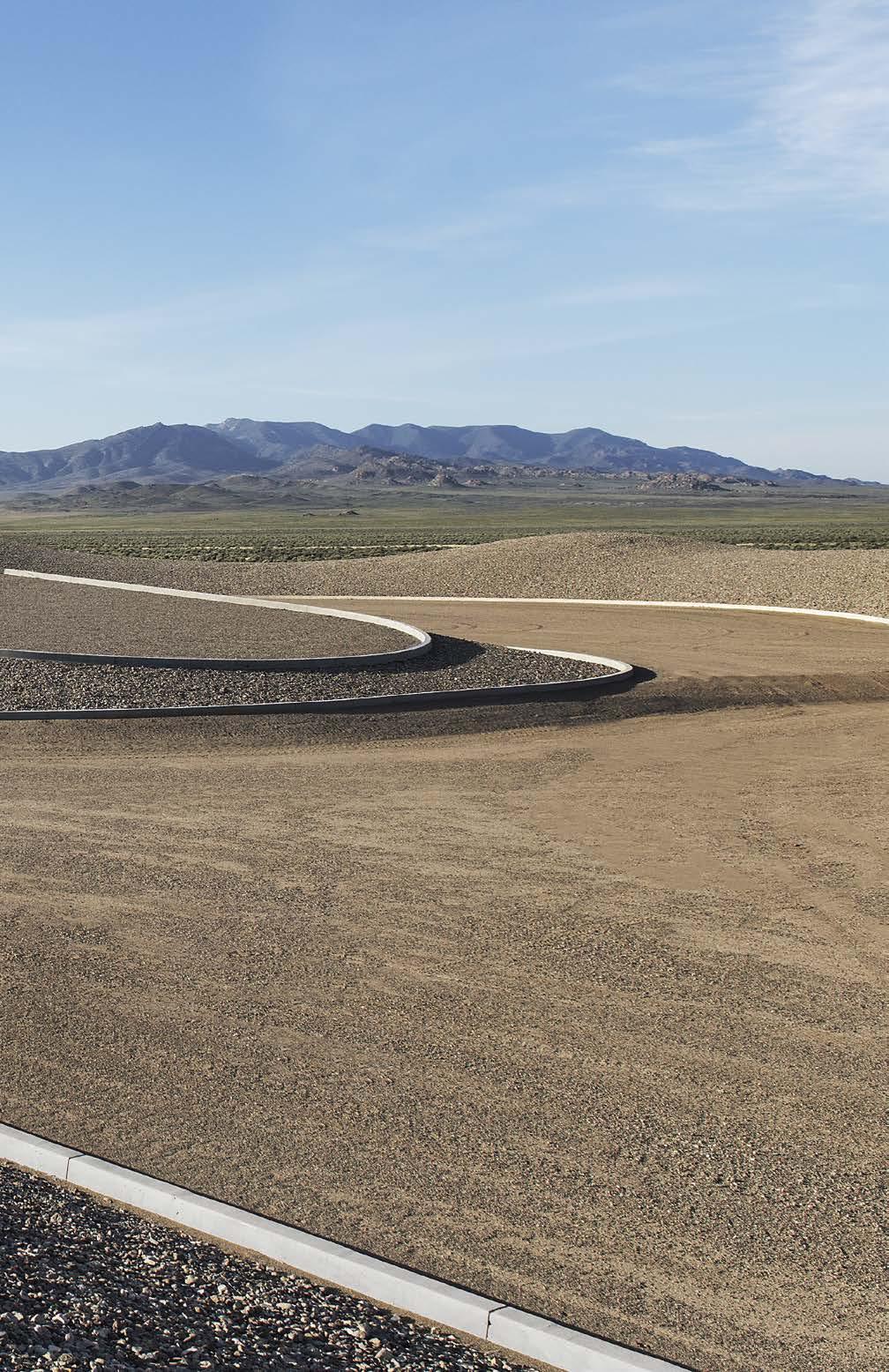
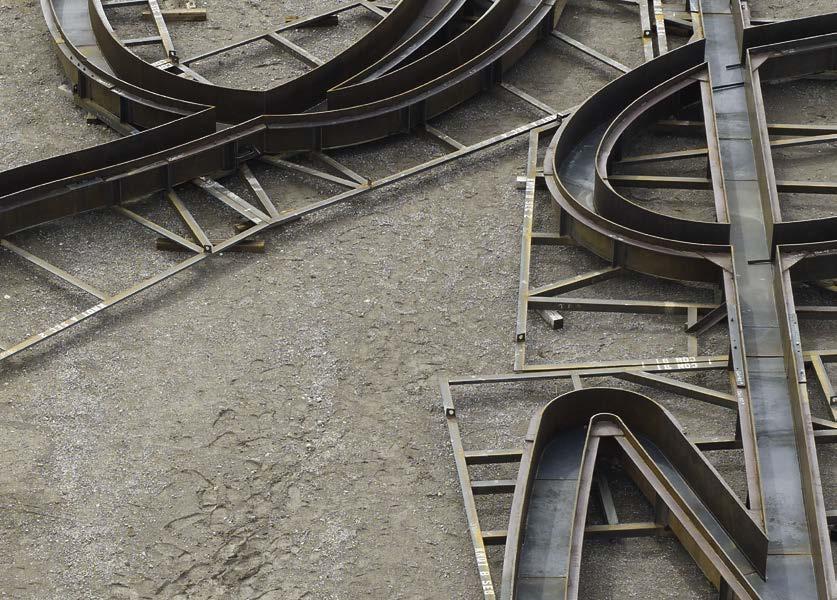



Dust isn’t that different from people. It has sentimental attachments. It keeps secrets. It has characteristics that correlate with the climate and customs of the place where it’s found. That’s probably why the dust I’m telling you about (twenty-first-century temple dust) had a such a positive attitude. Granting wishes? No problem. As long as I don’t rush, I can accumulate the energy to do it!
The dust had a pleasant viewpoint high up on a roof gable that overlooked a tiny courtyard. It watched over the throngs of adolescents who arrived in jeans, trainers, and T-shirts but put on saffron-colored robes to live at the temple as monks for the month of March, when the school holidays only meant they’d cause a ruckus at home. Here the March monks came under the tutelage of adult monks with a variety of temperaments and abilities. In the mornings there were alms-collection outings with calm and serious monks, who showed their charges which gestures pay heed to distress. The livelier and more loquacious among the monks spoke in parables that the kids would suddenly wake up in the middle of the night to debate the meaning of. There were gruff and rugged monks who led their juniors up the nearby mountain (to the dust the expedition’s progress was like an eager little orange thread stitching the foliage together) and stood at the peak chanting in steady voices that bridged heaven and earth. March was an interesting month for the full-time monks in that each type of man noticed that they
had at least one disciple among the March monks, and it was an interesting month for the March monks who couldn’t imagine adapting to the sharp and serene symmetries of temple life until, just before it was time to go home, they realized they had adapted. The dust, which was a pretty rich mix of incense ash, flecks of plaster, hair, and ant and centipede fragments that flew up in the air when attacked by volunteers with brooms, acquired the perspective that most characteristics are learned. This has upsides and downsides. For instance, hatred isn’t intuitive. It’s something you have to keep reminding yourself of. Unfortunately, the same goes for feeling joy when good things happen to other people. As for what’s learned, and how well it’s learned—aptitude is a factor, but honestly? Necessity is a greater factor. And at the heart of all the learning there’s a great hesitation, a desire, even, to postpone the date of the examinations that prove what we’re actually qualified to do in the world. It’s not unusual to study indefinitely without putting anything into practice.
The dust, however, developed an objective. It became a witness to a misdemeanor it was moved by, and it thought: This minor memory is just the right size for the likes of me to protect.
You see, there were often girls among the March monks at this temple. Officially only boys were allowed, but some girls who had yet to cross the threshold of puberty said
“No way” to being left to a month of mind-disintegrating boredom at home, shaved their heads, and tagged along with their brothers, male cousins, or neighborhood friends. The temple administrators would squint a bit but would sigh and leave it be. The kids the monks squinted indecisively at had their princess status acknowledged through their sleeping quarters, which were less ascetic than everybody else’s dormitories, but otherwise all the March monks mixed freely throughout the day, when supervision was in abundance.
Inevitably there came a March when one of the girlish monks and one of the boyish monks took particular notice of each other. They both liked to bombard the adult monks with questions, and rapidly developed follow-up questions to the answers they received. These two quickly became known for having plenty to say, but they went quiet when ajahn Dawa, the monk at the head of the temple’s holiday program, called them in to ask if they had anything to do with the predawn scenes some of the monks had begun waking up to: dozens of cats and dogs curled up at the feet of every statue in the temple complex, all of these strays resting in the shallowest stages of sleep like a squadron of bodyguards who knew better than to surrender their vigilance. The boyish monk and the girlish monk were the very picture of perplexed youth, looking at each other and at ajahn Dawa with round and guileless eyes. Despite having around fifty years’ less life experience than the ajahn , they were very nice to him and spoke gently, as grandparents correct a grandchild who makes senseless accusations out of the blue. But in his mind ajahn Dawa was unable to clear them of involvement. After he dismissed this suspicious pair, he considered having their activities closely followed, but asking his fellow monks to do this would altogether lower the tone of their fellowship. He could already picture ajahn Asnee saying, “Just to be clear, venerable brother— you’re asking us to . . . harass children?” with his hand just
below his rib cage to indicate the height at which the children stood. Upon further reflection ajahn Dawa accepted this as a lesson on allowing frustrated ego to lead him onto the wrong path: He’d seized on the first opportunity to associate those two with phenomena he found ominous . . . all because he was upset that they treated him as if they were his equals. So what if they did? Wasn’t it true? And what was actually ominous about the night strays, anyway? The statues they slept at the base of had their hands raised to bless them and everyone else. Morning after morning, the canines and felines jumped over the temple walls quite peaceably, without seeming to expect breakfast.
Had ajahn Dawa pursued this matter he would’ve discovered that he wasn’t as prideful as he thought and his underlying instinct about this duo was actually half right. The boyish monk was spending the money he’d been given for emergencies on tuna. All the tuna went to a scruffy tomcat who’d marched in at the temple’s gate when there was a clash between four contiguous sets of brawlers over some mumbled words that may or may not have been an insult. It was difficult to say what exactly it was about the cat that had compelled a faction of skinny monks to follow him down the street and step in between big angry men until all the lava cooled. Perhaps that cat had the soul of a general. The boyish monk observed that the tomcat even ate his tuna with a fierce expression, as if fueling up for the next trial of patience.
Meanwhile the girlish monk was spending every penny of her own emergency money on stewed meat for a stray ridgeback who wasn’t all that steady on his legs, had a notion that affectionate pats only came his way by mistake, and made obstinate bids to craft such happenstance, ambling closer and closer with lowered head and sidelong looks until he succeeded. But that was it—between the two of them the boyish monk and the girlish monk were only feeding one cat and one dog . . . they weren’t acquainted
with any of the others who made an outdoor dormitory of the temple grounds, so neither monk saw why they should have to own up to being the cause for that.
Having just about evaded investigation, the boyish monk and the girlish monk become sworn brothers and contrived to spend more unsupervised time together. Impossible, of course: The adult monks might have been above surveillance, but the dust was always spying on them from the roof. It scattered down the walls to double-check its findings. The girlish monk and the boyish monk sat cross-legged in diagonally opposing corners of the courtyard. They mostly closed their eyes and stared straight into a sun that was the inverse of the one outside their bodies, but occasionally, when some thought tilted their equanimity, when a patch of skin itched or sweat pooled in a fold of their robes, one of them would open their eyes and look over at the other. They never did this at the same time, so the boyish monk never saw the way the girlish monk looked at him, and the girlish monk couldn’t have guessed that her face was the focal point the boyish monk sought without hesitation as soon as his eyes opened. But as their proficiency at meditation improved, the intervals between these flashes of insecurity lengthened, and there was a half-smile on both faces that said, He’s always there. She’s always there. And that was their March, feeding their dog and their cat first, then sneaking away for something like choir practice, soundlessly singing a song that felt improvised but couldn’t be, as every voice they heard carried its melodies in perfect pitch. Motorbikes revving up, the looping calls of cuckoos, the dainty rustle of lizards sweeping their tails around like petticoats, all these completed the song.
On their last day as March monks, the boyish monk and the girlish monk adopted their diagonally opposing positions and held still from 11 am until the bell rang for noon without opening their eyes once or falling asleep. They might have been recording every single sensation or
thinking about what it would be like to try this in other, lonelier places. A few minutes after noon, the girlish monk borrowed the boyish monk’s penknife, climbed up onto her counterpart’s shoulders, and scratched a series of letters onto the farthest brick she could reach. He asked her what she’d written and she told him not to worry about it. That’s right, the dust thought. Just leave it to me. The ridgeback dog departed with the girlish monk and her big brother; the dust never saw him or any of the canine statue sleepers again. The tomcat vanished but his associates continued to frequent the temple gardens from time to time.
A couple of decades passed. The former boyish monk ran into a friend who’d taken part in that temple’s March program at the same time as he had. It was Songkran, so both former boyish monks had come home to pay their new year’s respects to their parents. After washing their parents’ hands with distilled water and familiarizing themselves with their cousins’ latest ambitions and achievements, the friends met up to watch the new year’s parade from the balcony of the temple where they’d both been monks for a month (the very same temple where the dust had covered what the girlish monk had written). The Songkran parade in these friends’ hometown couldn’t be beaten, mostly due to the acrobats from the theater school who gave their all to the festivities every year, running along the floats equipped with doublebarreled water guns and soaking every pedestrian in the vicinity while turning dazzling backflips and cartwheels. But the boyish monk couldn’t concentrate on the spectacle before him. He kept thinking—somewhere just below this balcony are the words that the girlish monk wrote, whatever they are. When his friend asked what was on his mind, he blurted out some recollections of sneaking off to meditate with the girlish monk, only to be scoffed at: “Come on . . . you’re really telling me you two really didn’t do anything?”
The boyish monk, now an adult monk, said: “What do you mean? What we did wasn’t enough for you?”
After a moment of silence the monk’s friend, now the wonder of a chain of bars in Bangkok, shrugged and suggested going down into the courtyard and seeking out the scratches. “It was that courtyard down there, yes?”
The now adult monk didn’t want to go and look. In fact, not looking for any sign of what the girlish monk felt for him had become a point of discipline, but he didn’t know how to say so. The dust had heard the whole exchange and resolved to put up a fight: This other guy didn’t deserve to read the girlish monk’s confession of love. Luckily, fireworks swarmed the skyline, so the two friends gawped at that instead.
Five more decades passed. The dust flowed around the temple rafters like a languid low-pressure weather system. People who tried to clear it away said that it wasn’t dust, but the temple abbot warned them against spreading strange rumors: “We will definitely take strong legal action.”
One midwinter the abbot of another temple paid a visit to this temple where the dust was running amok. The visiting abbot led the morning rites as a guest of honor, then slowly walked to a certain courtyard, got a chair, and stood up on it. The dust got really close to the visiting abbot’s face and stared at him until he sneezed. It was him—the boyish monk who’d held a girlish monk up on his shoulders a few days ago. (At least, it seemed like a few days ago to the dust. What were all these wrinkles about?) At long last the former boyish monk was ready to look at the letters the girlish monk had carved out with his penknife. He held onto the wall with one hand and swept dust away with the other. He did this without a jot of apprehension: He’d entered a state similar to the one he’d shared with another monk in his youth.
He might have felt apprehensive if he’d kept an eye on what the dust was doing. He had to clap his hands every now and again, to shake debris free, and a few younger monks who’d been hovering in the vicinity to see if they could be of assistance retreated with hacking coughs that echoed down
the hallways. As the dust behind him fell into a person-sized heap, the visiting abbot found the knife marks. Wiping a hand on the back of the chair, he took his phone out of the pocket of his robe and shone the flashlight.
The girlish monk had carved out both their initials as they would appear according to the Roman alphabet. There was no symbol that connected the two pairs of initials— she’d simply written his and then hers without any extra space between them, so that the letters appeared to form a single unpronounceable word.
The dust watched the abbot anxiously; he stood on the chair tracing this word with his fingertips; it didn’t look as if he was taking his discovery that well. Then he took a picture of the engraving, typed out a message on his phone, and sent the photo to someone, so he was probably OK after all. There was only one person he could be sending the photo to: his friend the abbess.
No sooner had the abbot climbed down from the chair than a streak of fur whistled past his ankles and pounced on the pile of dust. If the sudden movement hadn’t made him jump, the sheer mass of fallen dust would have. It towered over him. But the tomcat met this great golden beige mass head-on and pummeled away at it with its paws. The abbot was both sorrowful and relieved that this was not the tomcat he’d bought a lot of tuna for. This one didn’t have the soul of a general; he was a sculptor. The dust twisted this way and that, hissed “Ouch, ouch, ouch,” and pulled itself into a hominid shape, seemingly by way of dodging the tomcat’s claws. . . . The visiting abbot covered his eyes and called out for a robe to be brought to the courtyard. The tomcat stood back, appraising the work his will had wrought, then stalked away.
The dust got dressed, bowed to the visiting abbot, and followed the tomcat.
Her first commitment has run its natural course. Now’s the time to establish her wish granting credentials! More on that soon.

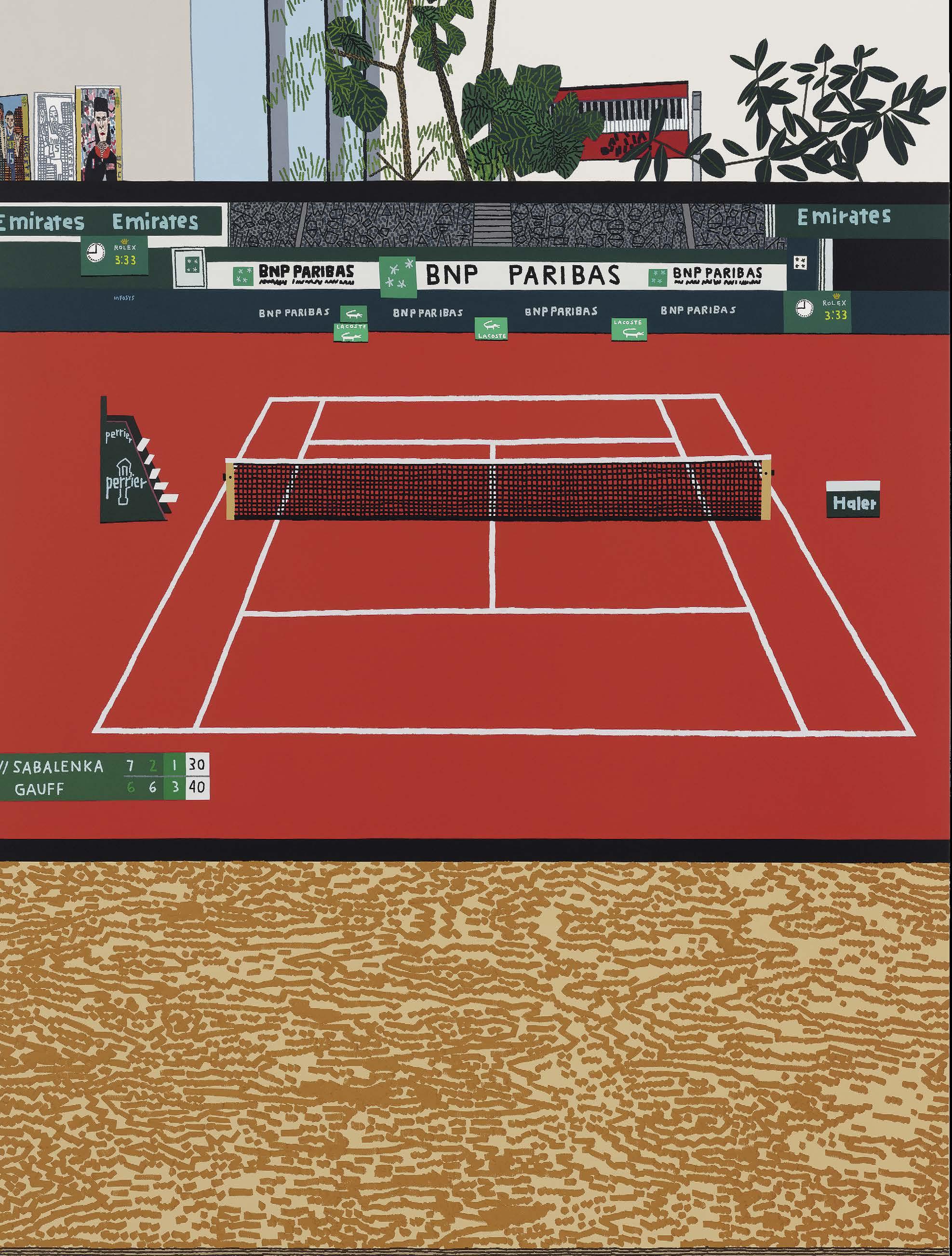
A tennis match could theoretically go on forever. There is a clock, but the elapsed time has no implication for the match; in theory, two perfectly paired opponents could go in and out of deuce, game after game, forever. As I left Jonas Wood’s studio recently, the thought occurred to me that the same might be true of his series of tennis court paintings, bound as they are by rules and parameters that seem to allow for endless repetition with infinite different results. These rules are clearly important to Wood. So too is the practice , a word so debased by overuse in art discourse that I hesitate to evoke it but for the fact that I do so here in the more literal, more athletic sense: to get the reps in, to get better,
to optimize performance in the studio. I will return to this idea of practice later, but first, the rules.
Wood’s tennis court paintings are neither paintings of tennis courts nor paintings of tennis courts on television. They are paintings of images (sometimes straight photographs, sometimes collages) of tennis courts on a television in Wood’s studio and home. In that sense they are more about watching tennis on television, often while painting, than they are about playing or watching tennis in person. The first rule therefore is the frame.
On television, tennis is usually seen through a camera positioned overhead and behind one baseline. In his 2006 New York Times essay “Roger Federer as Religious Experience,” David Foster Wallace describes this specific geometric condition in painterly terms: “You, the viewer, are above and looking down from behind the court,” Wallace explains, and “this perspective, as any art student will tell you, ‘foreshortens’ the court.”1 This forced vantage point, from which the long rectangle of the court appears nearly square in perspective, is Wood’s point of departure. As a result, in many of these tennis court paintings we see a rectangle cut into smaller boxes and alleys by white lines, surrounded by an out-of-bounds, filmed from its shorter end so that it appears squarish, broadcast within the horizontal frame of a television, and more often than not photographed on a vertically oriented iPhone. In other words, each of these paintings begins with a vertical rectangle foreshortened within a horizontal rectangular frame within a vertical rectangular frame. The dimensions of the court and the respective aspect ratios of the screens establish the specific geometry of the series and connect it to the art-historical reference of Josef Albers’s Homage to the Square (c. 1950–76).
Albers had his rules too: Each painting contained three or four concentric squares built with paint applied directly from the tube with a palette knife. The concentric frames of multiple squares functioned for him, as tennis courts and screens do for Wood, as fields on which to experiment with
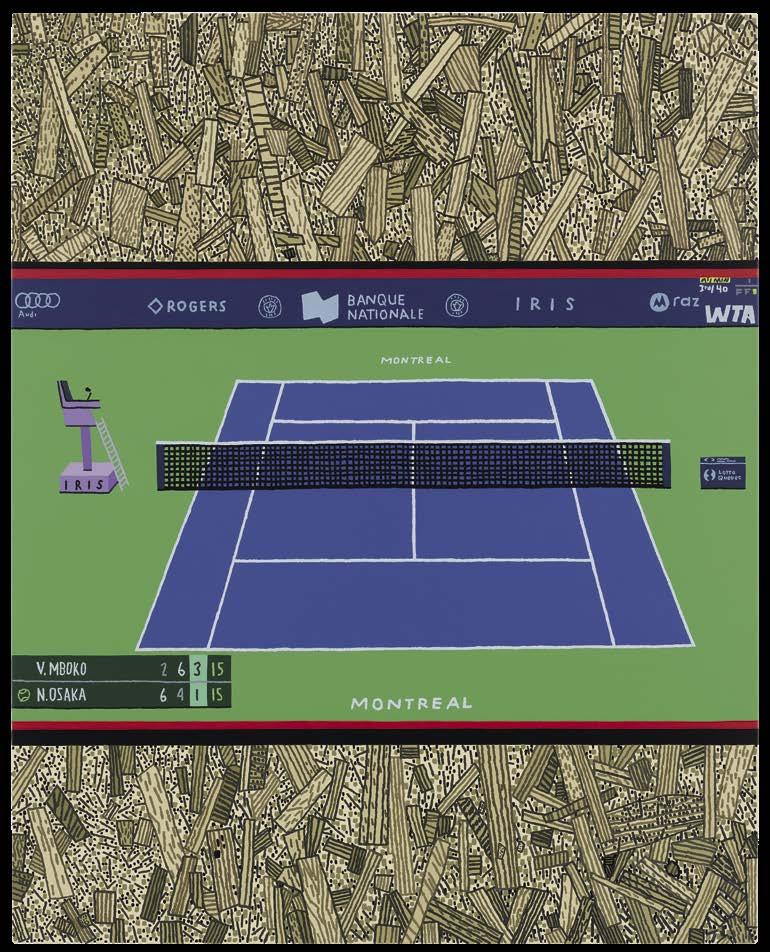
the interactions of color. Tournament-level tennis is particularly conducive to this exercise because of the various surfaces and textures on which it is played. The red-brick clay at the French Open, the neatly trimmed Wimbledon grass, and the blue hard courts of the US and Australian Opens, for example, comprise the Grand Slam quartet that were the subject of Wood’s first tennis court paintings fifteen years ago.
Television broadcasting is largely responsible for the chromatic range that makes contemporary tennis such a fertile ground for experiments in color theory. The International Tennis Federation started using the now ubiquitous yellow ball in 1972, not for the players’ benefit but because this specific shade of yellow, called “optic yellow,” is easier to see on television than the traditional white tennis balls. Following suit, major tournaments saw an opportunity to use colored courts as a means of distinguishing themselves. The (nearly blue) “Pro Purple” surface at the BNP Paribas Open (Indian Wells , 2025), for example, was designed to be the exact spectral opposite of optic yellow. The women’s final in Riyadh (WTA Finals Riyadh , 2025) is played on a brilliant purple court inside charcoal gray. A similar charcoal gray is used for the entire court at the Laver Cup in its various locations, which I particularly like because it reminds me of the final scene of Michelangelo Antonioni’s Blow-Up (1966), in which a troupe of mimes play tennis without a ball. Wood has not painted the Laver Cup court, though, I assume because it is only an exhibition tournament, so that’s another rule. The National Bank Open (Canadian Open , 2025) uses a more traditional blue court surrounded by green, while the Abierto Mexicano Telcel is played on a monochrome field of blue ( Mexican Open , 2025). The Erste Bank Open and Swiss Indoors Basel (both of which are painted in this show) use their own shade of blue inside the lines and another slightly lighter one out of bounds. The calendar of international tournaments provides a succession of readymade exercises in color theory.
Opposite:
In his essay “Green or Yellow,” Nicholas Fox Weber, director of the Josef & Anni Albers Foundation, discusses the color theory of the tennis ball in relation to specific examples of Albers’s Homage to the Square that use a similar shade of acid green inside squares of blue and gray. 2 Indeed, the color looks different each time, just as an optic yellow ball likely appears more yellow rising off the blue court at Arthur Ashe in New York and greener against the clay at Roland Garros in Paris. The green or yellow question is not of great relevance to Wood’s tennis court paintings, which do not include balls. That’s a rule. So too are no players, no players’ benches, no umpires, no ball crews. The crowd, if shown, is reduced to an abstraction, the kind of graphic pattern that might appear in a vintage video game, which, incidentally, is also the subject of a painting in this show (Nintendo 3 , 2025). The only three-dimensional object on the court, other than the net, is the umpire’s chair, which occurs regularly but not always and which, I suppose, serves as a symbolic reminder of Wood’s rules.
The absence of figures in these paintings shifts the courts from scenes of action to sites of abstraction. Sometimes a scoreboard tells us who is playing and where they are in the match, but for the most part the atmosphere is one of time suspended—no players, no weather, no shadow. Wood talks about removing the athletes from the court in these paintings as a way of emphasizing the flat
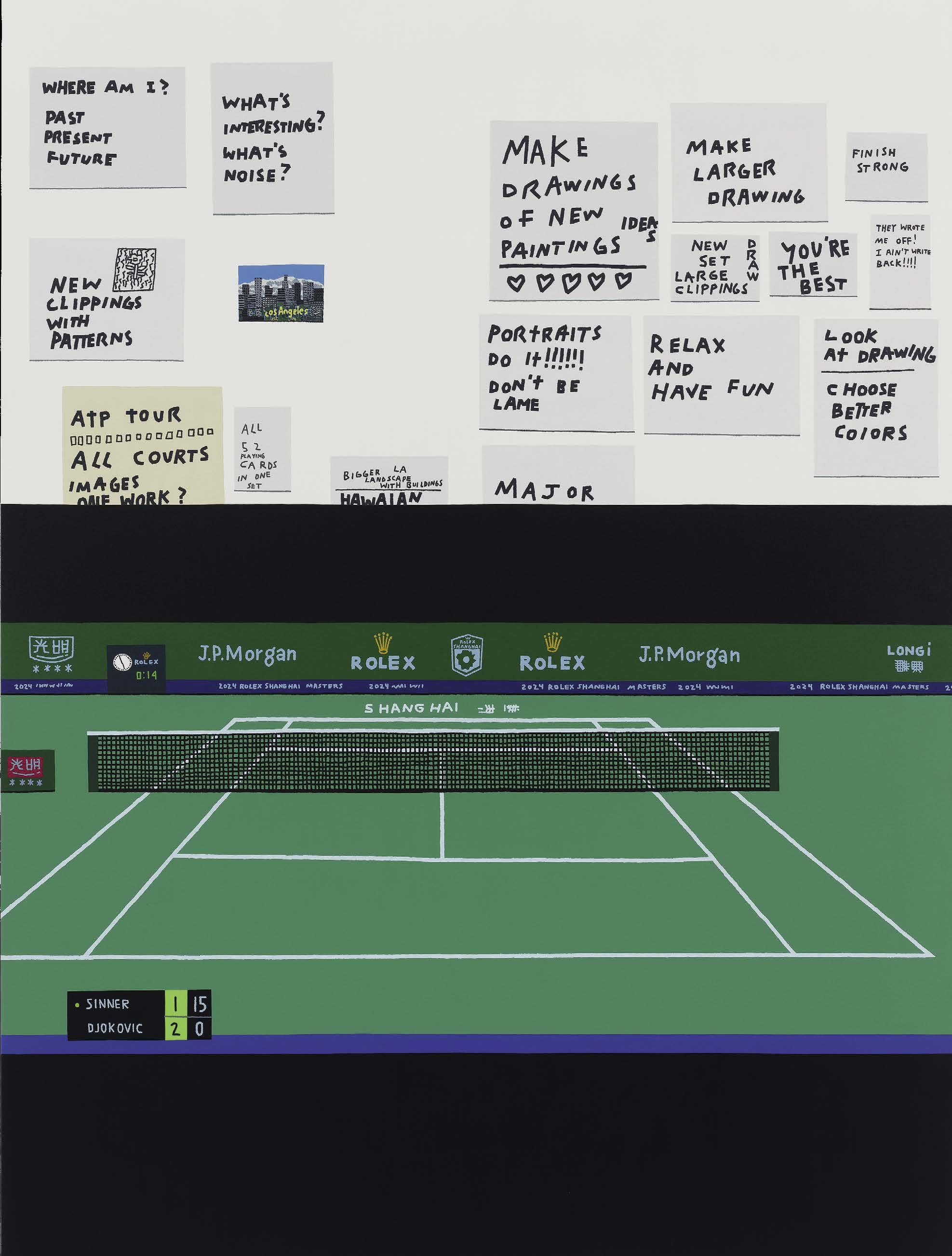
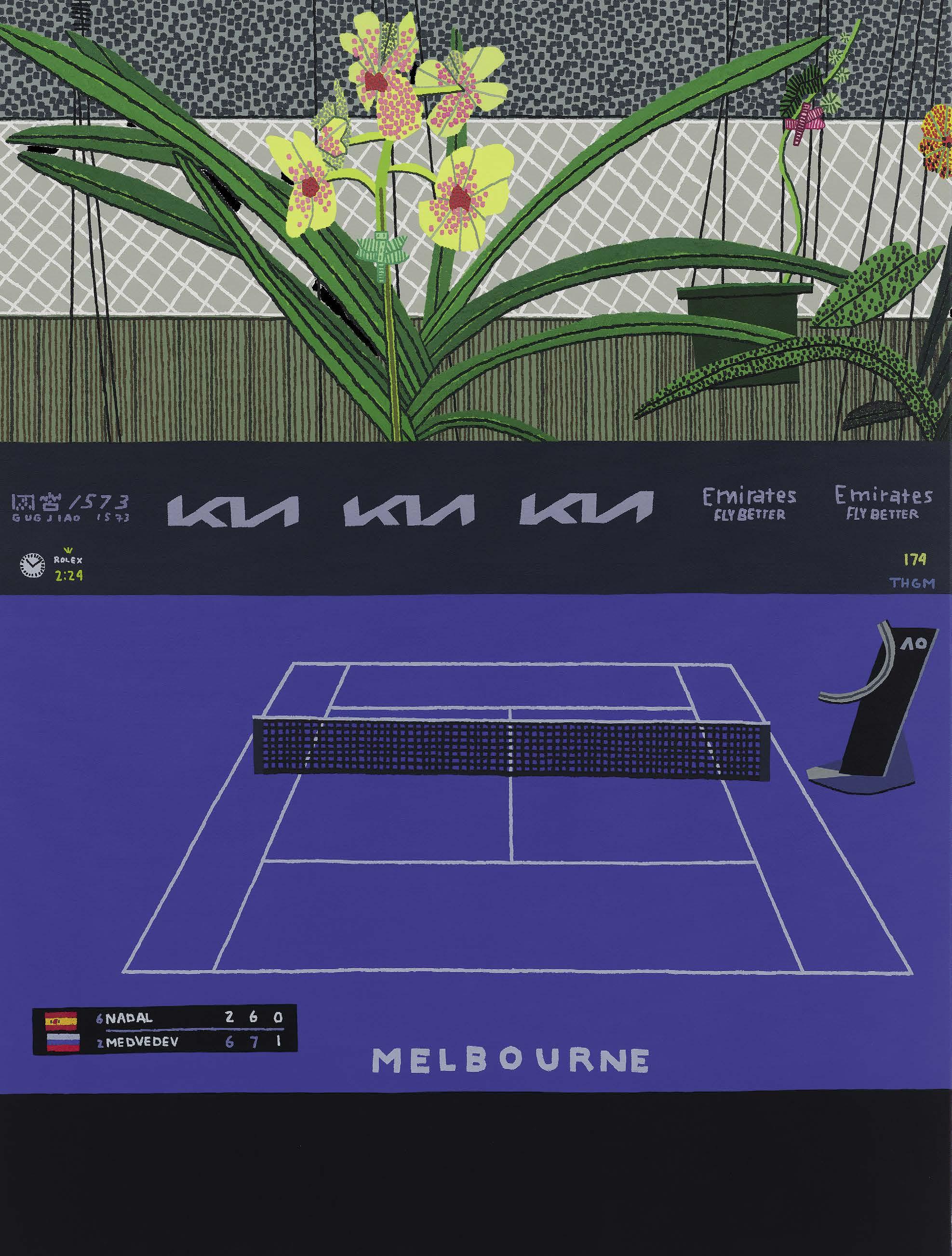
expanses of color. The erasure reminds me of two other works that grapple with the narrative space of televised sports, Paul Pfeiffer’s ongoing series Four Horsemen of the Apocalypse and Douglas Gordon and Philippe Parreno’s 2006 film Zidane: A 21st Century Portrait , though instead of isolating the solitary figure, Wood turns his focus to the geometric puzzle of the empty field of play.
As with much of Wood’s work, the tennis court paintings often include glimpses of the studio in which they were made: Plants and printouts and patterned surfaces fill the space surrounding the screen. In Shanghai Masters (2025), a television monitor shows the first set of a match between Jannik Sinner and Novak Djokovic. On the wall behind the television is a collection of notes and postcards, including ideas, lists of things to do, and motivational messages like “Relax and have fun” or “Finish strong.” Wood is open about his interest in self-help and notes like these can be found throughout the studio. When I first saw them on the wall, I was reminded of a scene in the 2004 documentary Metallica: Some Kind of Monster when the record label brings in a performance coach accustomed to working with professional football players to help James Hetfield and Lars Ulrich work through a period of creative impasse.3 The session does not go well, but the scene forever changed the way I think about creative performance in relationship to sports psychology.
Shanghai Masters also reminds me of Andre Agassi’s autobiography, Open (2009), written in collaboration with Pulitzer Prize–winner J. R. Moehringer. Open rises above the sports-memoir genre in part because of Agassi’s remarkable candor about his struggles with mental health, family dynamics, and self-image. 4 In a field crowded with triumphantly self-congratulatory memoirs, Open is a book about how hard being really good at something can be.
Tennis is a good metaphor for the creative process and there happens to be some extraordinary writing on the topic by authors in addition to those already mentioned, including Geoff Dyer, John McPhee, Vladimir Nabokov, Claudia Rankine, and Álvaro Enrigue, whose 2013 book Sudden Death imagines a match between the poet Francisco de Quevedo and Caravaggio.5 In the penultimate chapter of Speak, Memory (1951), Nabokov, an avid tennis player, famously wrote that “the pleasure of writing is not unlike that of playing tennis.” I have always read some irony in the statement, or at least a wry implication of that specific kind of hard-won pleasure that can only be derived from enormous effort. (Other writers, including Wallace and Dyer, who also compares tennis to writing in his 2016 Harper’s article “Tennis Lessons,” are more candid about how frustrating both can be.)
Tennis, like writing or artmaking, is largely an individual enterprise. You need an opponent to play, but it is a cliché in tennis writing that the player’s true adversary is not on the other side of the net. “The true opponent, the enfolding boundary, is the player himself,” Wallace writes in Infinite Jest (1996). “Tennis’s beauty’s infinite roots are selfcompetitive.”6 All of this is to say that to be good, you must be so disciplined that your play is nearly automatic while you also remain distinctly yourself. It is this tension between discipline and style, for example, that animates the masterful back and forth of McPhee’s book Levels of the Game (1969), about the 1968 US Open match between Clark Graebner and Arthur Ashe. This delivers me to the point that I have been slowly building up to all
Opposite: Jonas Wood, Melbourne, 2025, oil and acrylic on canvas, 48 × 36 inches (121.9 × 91.4 cm)
This page:
Jonas Wood, Wimbledon with Wood Grain , 2025, oil and acrylic on canvas, 102 × 66 inches (259.1 × 167.6 cm)
Artwork © Jonas Wood
Photos: Marten Elder
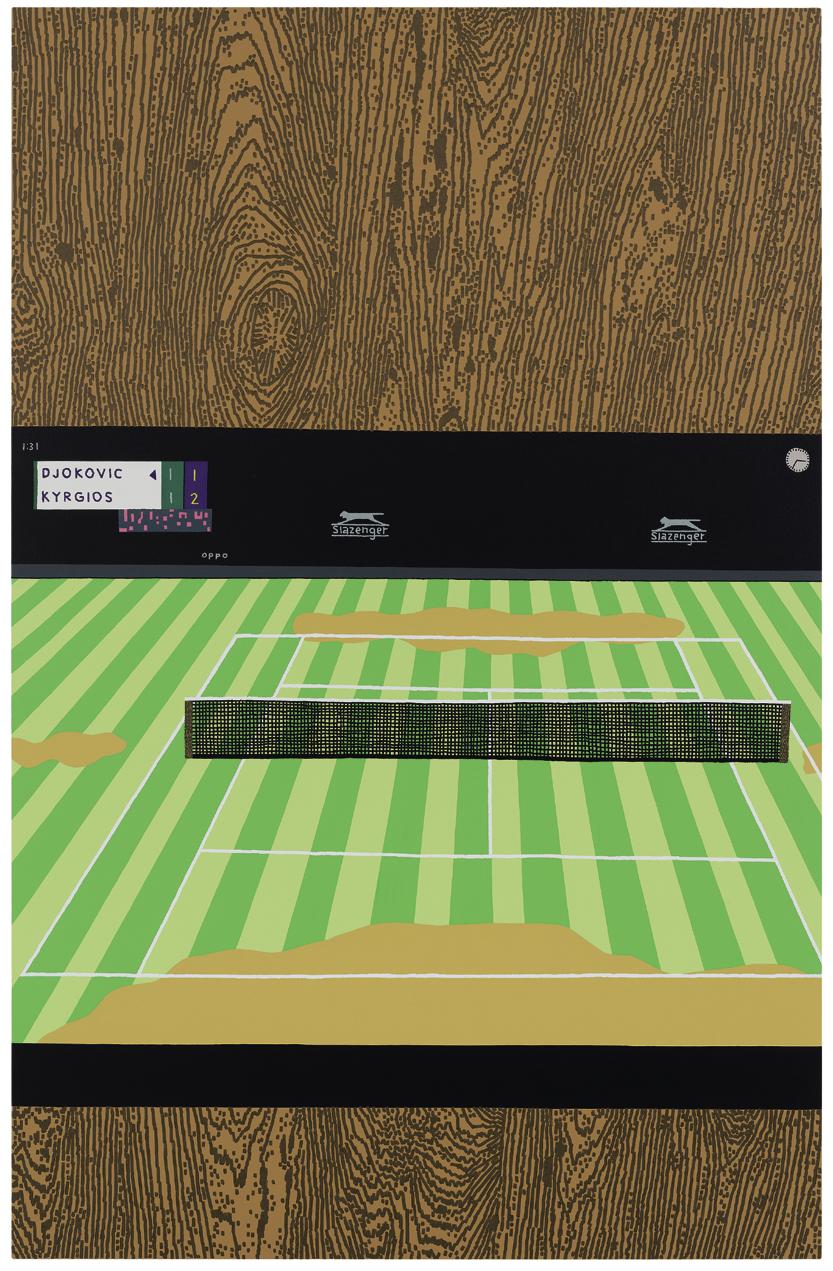
along, which is that perhaps these paintings are less about tennis than about painting itself. In a conversation published in the 2021 catalogue 24 Tennis Court Drawings , Wood frames his approach to this series in terms of selfimprovement: “The way I think about this is, how can I keep practicing something I like, and continue to get better at it?” These empty tennis courts are spaces for Wood to sharpen a style, to refine a discipline, to practice . To find freedom within a set of constraints. This seems to be what is happening in a trio of new paintings in this show. In Paris Olympics with Crying Girl (2025), Dubai with Nude with Blue Hair (2026), and Hamburg Open with Girl (2026), the mise-en-scène of the studio or the flat field of black background has been replaced by rendered details of Roy Lichtenstein prints (Crying Girl [1963], Nude with Blue Hair [1994], and Girl [from the 1¢ Life portfolio, 1963], respectively). There is something different about these paintings: The frame of the television screen has flattened into the plane of the canvas, the depth of the studio has collapsed into two-dimensional space, and the figure has returned in the graphic but undeniably corporeal form of Lichtenstein’s women. These paintings feel like both part of the series and something entirely new.
The final rule is that there are no rules. A careful student of Wood’s tennis court series will find exceptions to nearly all of the rules I have enumerated in this essay—an errant racket or a jumbo ball. The exceptions become a game within the game. The rules exist, nonetheless, to get you to
those fleeting moments when they no longer apply, when you are totally loose and free and open. It is the breaks in the rules that allow the series to generate new energy and encounter new possibilities. Wallace concludes his description of tennis’s enfolding boundary in Infinite Jest as follows: “You compete with your own limits to transcend the self in imagination and execution.”7 If someone has written a better single-sentence description of the process of writing or making art, I have never read it.
1. David Foster Wallace, “Roger Federer as Religious Experience,” New York Times , August 20, 2006. The difference between live tennis and televised tennis was a topic of obsession for Wallace, who in the same essay proposed the analogy “that TV tennis is to live tennis pretty much as video porn is to the felt reality of human love.”
2. “Green or Yellow” is included in Nicholas Fox Weber’s book The Art of Tennis (Boston: Godine, 2025), which I found underwhelming for reasons I touch on below.
3. It seems worth mentioning here that there happens to be a line in Wallace’s “Roger Federer as Religious Experience” describing Federer as “Mozart and Metallica at the same time.”
4. Andre Agassi’s relationship to self-image was undoubtedly complicated by the success of his ubiquitous “Image Is Everything” campaign for Canon Rebel cameras, which makes him a particularly interesting case study in the intersection of sports and visual culture.
5. For all the good writing about tennis, there is very little good art about tennis. I am sure some readers will take issue with this statement and I have my own list of exceptions—George Bellows’s languid 1920 painting Tennis Tournament, Roe Ethridge’s 2019 still life Penn and Wet Butt, or Reggie Burrows Hodges’s In the Service of Others series—but in my experience, those works that take tennis as subject inevitably get bogged down in the aesthetics of class and leisure.
6. Wallace, Infinite Jest , 1996 (repr. ed. New York: Back Bay Books, 2006), 95.
7. Ibid.

Mike Stinavage meets with actor—and now director—Kristen Stewart to talk about her debut feature-length film, The Chronology of Water.


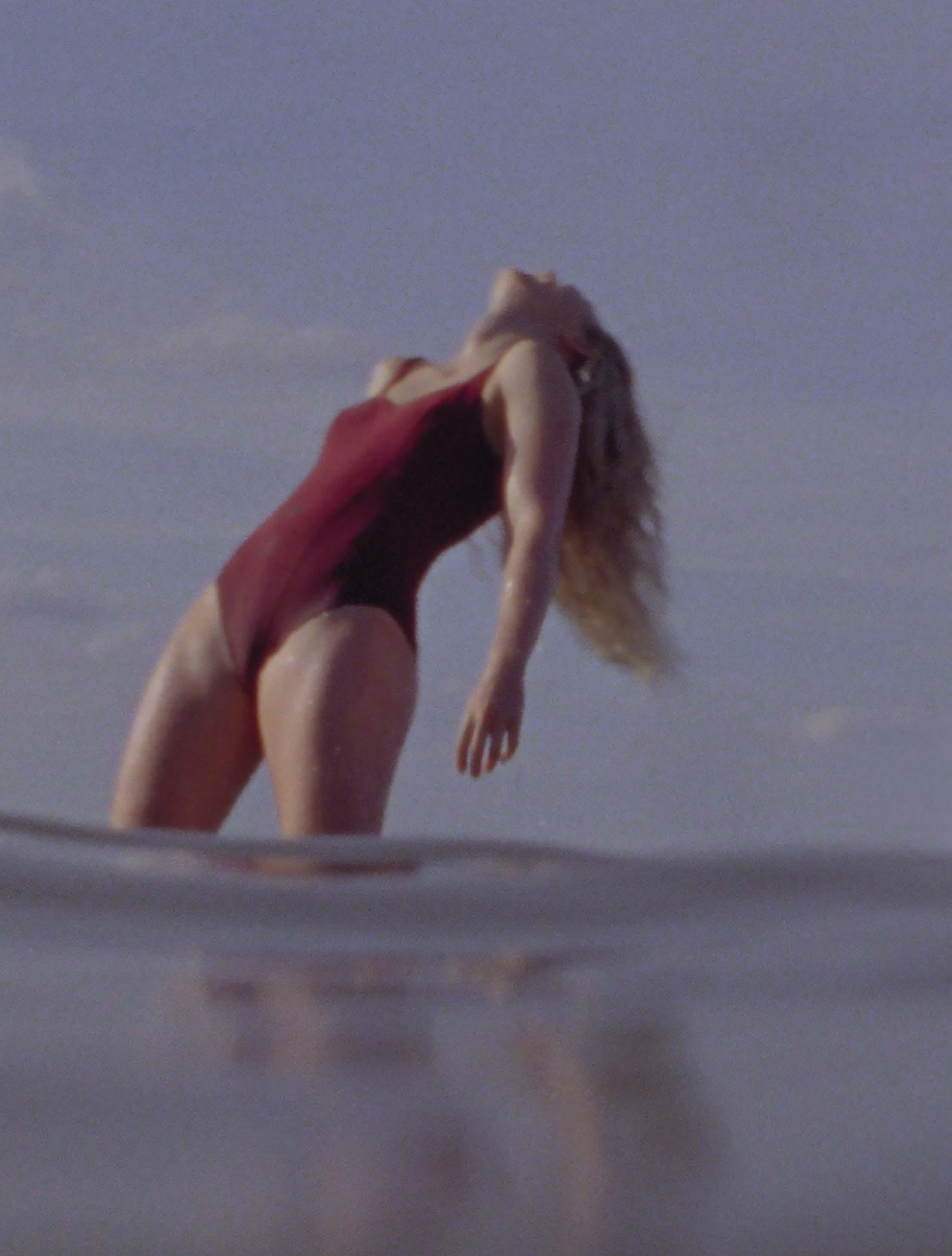
Previous spread and opposite:
Stills
Below:
Kristen
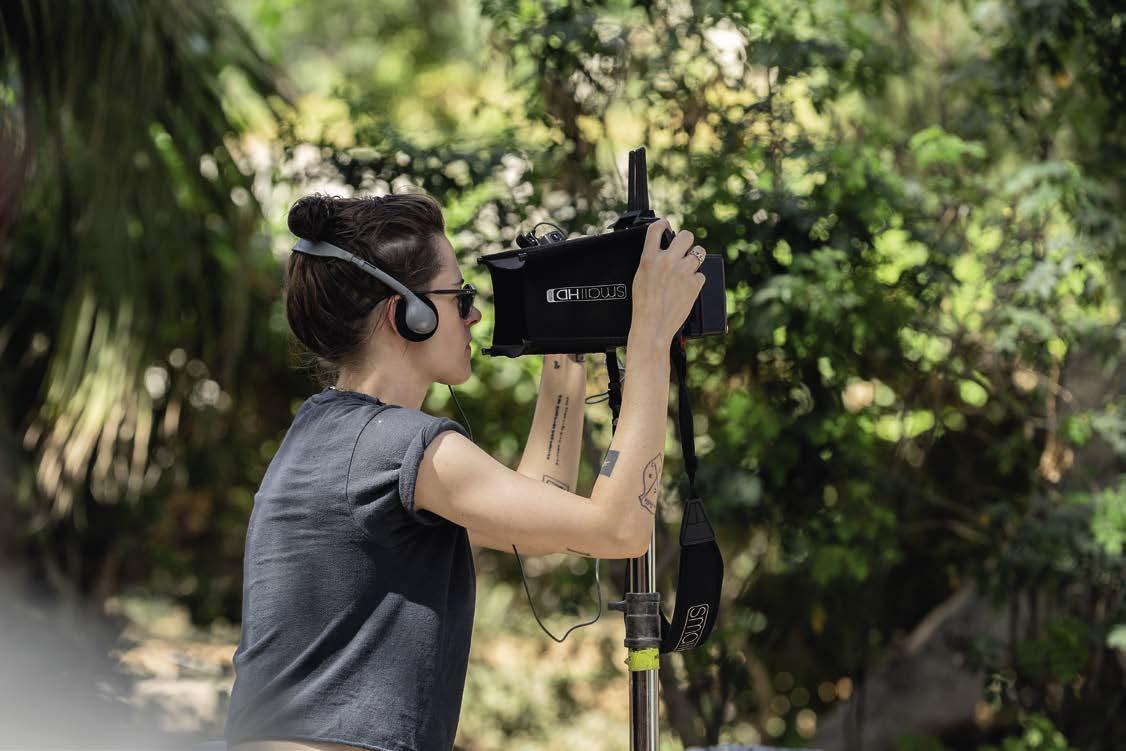
In September, the town of Deauville, a coastal enclave of Normandy, France, goes from blue, white, and red to red, white, and blue for the Deauville American Film Festival. Among this year’s special guests was Kristen Stewart, whose directorial debut, The Chronology of Water, won the Revelation Prize, having premiered in the spring at Cannes. Some weeks later, Stewart and I caught up to talk about the film, which she adapted from Lidia Yuknavitch’s 2011 memoir of the same name. In it, Lidia, played masterfully by Imogen Poots, flails and flounders and appeals poetically to the human condition.
MIKE STINAVAGE Okay, let’s see how much ground we can cover in the time we have.
KRISTEN STEWART Ready, set, go! Let’s cover all the fucking ground.
MS Let’s do this. I was really taken by The Chronology of Water, which I saw at the Deauville Film Festival. It was a highlight for me. I’d be curious to hear you talk a little bit about the festival: Were the American flags everywhere as jarring to you as they were to me?
KS You know how your phone gives you memories? I recently saw a picture that I don’t necessarily remember taking, being like [sticks up middle finger ] right under the flags. I was taken fully aback, though not by their presence, because that’s obvious, it’s an American film festival that takes place in France. But my reaction to the scale of that image wasn’t a positive one. It was irksome.
MS For me, too—the quantity of flags hanging from every surface at the festival site and in the town.
KS It’s just too associated now with people who are like [ yells ] beating their fucking chests.
MS During the festival Q&A, you mentioned there were a lot of people who doubted the movie, which as I understand took a long time—maybe a decade—to make. Could you talk a little bit about the doubts you heard about, and which of those doubts were most unsettling for you?
KS Superloaded question because there are so many ways to answer this. The reason I really wanted this to be my first film is because it’s about expression itself, and despite it being hyperspecific [to Lidia Yuknavitch], considering it’s a memoir, it’s


the whole notion that you can rewrite your life, and that is kind of everyone. The book is so inviting that Lidia almost goes away as a character and you sort of fill in atmospheric blanks, despite being dragged through the hyperspecifics of this one woman’s life. When you reduce it to a synopsis, it sounds a lot like stories we’ve heard before. It sounds like hell. It sounds so much smaller than what the book gives you.
As a filmmaker, I can’t imagine ever wanting to examine anything from the outside. I really am interested in interior life and how people see things versus what they see. I knew that if I had Imogen, and if I followed my instincts and meandered through intuition, there was no way I’d be wrong. You can’t fail if you’re coming from a very pure place.
The film took eight years because I had to figure out the grammar. I think I was able to make something specific while not reducing it to terms inherently designed to belittle the female experience. The words that are given to us to define ourselves are bullshit, so we have to break the back of them and make them ours. That’s what the movie’s about.
It’s not about the fact that Lidia got abused by her father and turned to drugs and swimming and then finally had a baby. That frames the plot and her life, but really the book is about this atmosphere of trespass and repossessing the body through words and art and pain. This breaks through to a place of joy in an undulating and frustrating and unexpectedly shaped way, which leaves people on the edge of their seats and sometimes falling through completely. It’s like a train that slows down and speeds up when you don’t expect it.
MS The deep conviction really came through, that’s for sure.
KS I just answered probably three of your questions in one because I’ve just been ticker taping.
MS Not a worry—the most interesting thing is to hear you speak freely about the film. I will say that I can imagine the elevator pitch for this film being difficult because of the nuance, the tone, and the cuts to different images where we see Poots’s character go through all the different kinds of waves.
To your last point, you very successfully take us not only to the edge of but over the guardrails of typical filmmaking and typical narrative. Did you ever
have vertigo about going over those guardrails, and tackling such commendable but very difficult topics of the human condition?
KS I’ve been watching some really tough material lately. On the set, we kind of looked away from the most abhorrent human tendencies in the movie and renarrativized them. And there’s something miraculous-feeling about it, like something holy and cool. There’s very little hyperrealism. It’s all a rendering. The film feels like it’s from her perspective, so you’ll encounter striking images and you don’t always know what happens before or after an experience; often she’ll be talking to you about it as you’re watching it, or it will be in montage. It’s sort of like how you remember life. I’ve said this before, but I wanted it to feel like a DMT trip that you suddenly woke up from and wrote one final sentence.
When I was on set, I wasn’t afraid of going over. I just wanted to make sure we stayed in a place where I wasn’t thinking about how people were watching it from the outside. It really needed to feel like it had its own little body that had eyes. And you can’t look everywhere at once; that makes you
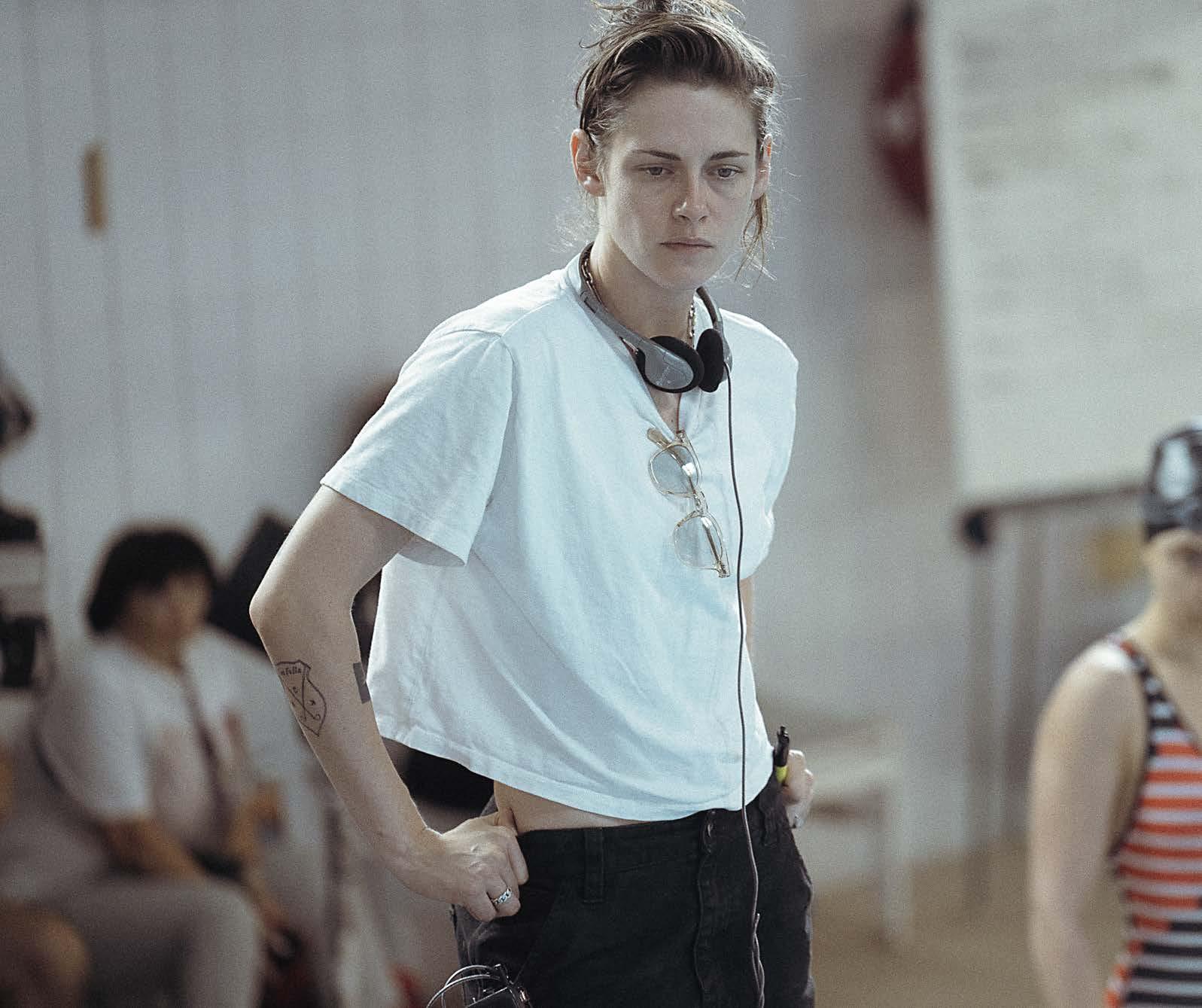
so fucking focused on the touch of something, the color of something, how hot something feels. The tone of her voice in any given moment is so much more important than knowing where she is in her life. You just feel that her mother is a ghost in the film. This kind of recollection feels so much truer to being a human than “And then this happened and then this happened and then this happened.” Also, if we showed you all the shit that happens to Lidia in an objective way, no one would be able to watch this movie.
The movie’s fun to watch even though on paper, yes, it’s hard. I also think it’s like a Rorschach inkblot test: People come out of the screenings sometimes and are like, “Oh wow, that was like really tough for me.” And then some chick will come out and be like, [sigh ], “God that felt so good.”
MS When tackling these concepts of grief and addiction, especially with someone as talented as Imogen Poots as the protagonist, it’s easy to think of grief and addiction as somehow romantic, as something beautiful. Yet in reality we know that it’s not. The lived experience is brutal. Do you think there’s
a danger there, in the representation of grief and addiction onscreen as romanticized?
KS When morality is taken into art, it creates a scenario where you’re looking at yourself from the outside, which is really the antithesis of everything that I think is pure in art. And there are sensory representations and sort of slippery slopes that have undeniable momentum and exhilaration and a lot of euphoria baked into their release. When I was younger, that was what I fixated on. I definitely didn’t think about the shitty repercussions. I’m thinking of Sophie Gilbert’s book Girl on Girl: How Pop Culture Turned a Generation of Women Against Themselves [2025]. And there could be an entire other meditation on how we’ve been turned into addicts, too—I was raised on [the Cheech and Chong film] Up in Smoke [1978] and on every fucking bong-pulling and red-cup party, all of those. But I think we show hell in our representation of drugs and alcohol in the movie. You turn to them because of the voids in yourself and you try to fill them, but you just gouge them out even deeper, and then filling them back up again becomes
almost impossible. I mean, it’s like a death drive— Lidia’s on such an unbelievable death drive. And you can see it from the beginning. But at the same time, it would be so silly to deny that it’s also fun as fuck.
MS It gives a certain color and vivaciousness to life, the ups and downs. It’s easy to internalize, almost unknowingly, a life-is-a-wonderful-shitstorm mentality from the things we watch.
On a different note, I wanted to ask you about your future directorial plans. As I understand it, you’re thinking about both directing and acting in the film. What are the risks and rewards associated with having both roles?
KS People have, I think, defined what those roles are, and what the public expects of and projects onto actors—their sort of servitude because of the rarefied and incredible positions that they’re in, because everyone wants to be in the movies and make a lot of money and have attention. And directors are these sort of visionary, mysterious Wizards of Oz who fill a position of power resembling teachers, church leaders, fathers. It’s like this


authoritarian role that is revered. But my actors have everything to do with the storytelling and with the realization of every dream. It’s not a big deal to get in front of the camera and do a couple of scenes. I’m an actor; I’ve been doing it since I was nine years old. I just think we need to blow the smoke away from having the roles of both actor and director. It’s not a huge deal. I have one foot in it and one foot out at all times. As an actor, I don’t need to be blind to the process, don’t need to lose all sense of self in order to be a conduit for someone else’s perspective, to be filled with the spirit of the director’s notions, the mouthpiece for someone else’s ideas. Are you fucking kidding me? We’re doing this together. We are literally mirrors of each other and if we’re lucky we share space and have overlapping ideas that find their way into the movie. MS It’s admirable to hear about your filmmaking process and imagine such collaboration taking place both in front of and behind the camera, without a Queen of Sheba on high directing everyone into place. What future directing projects are you taking on?
KS I’m writing three movies right now and I have a feeling that one of them, which is the most buoyant one, and the one I’ve been thinking about for the least amount of time, is going to be my next one. I want to shoot it in LA. Have you seen [Mona Fastvold’s film] The Testament of Ann Lee [2025]?
MS No, not yet. Should I?
KS It’s incredible. I was talking to Mona about structure. A huge aspect of what my movie ultimately wants to be about—even though it’s currently still in gestation—is breaking down barriers and acknowledging them and finding new bodies and shapes. Every movie has its own body and its own kind of process. I’d like to make a movie about that. I’m meditating on how to create a bespoke process, and not having that be something you say just in interviews but actually thinking every day how to get closer to people and further away from imposed, controlling, fucking dead narratives. It’s like—I wish I could tell you more, but I actually shouldn’t [laughs ].
This ongoing series features conversations with experts in the field of artists’ estates and legacy stewardship who offer insights that might prove useful to artists, their staff, foundations and estates, scholars, and others. Courtney J. Martin, the Executive Director of the Robert Rauschenberg Foundation, began her work at the Foundation in 2024, following posts at the Yale Center for British Art, the Dia Art Foundation, Brown University, and the Ford Foundation. At the tail end of the 2025 centennial of Rauschenberg’s birth, Martin met with the Quarterly ’s Alison McDonald to discuss the Foundation’s approach to the anniversary, the artist’s lifelong philanthropy, the intricacies of stewarding an artist’s goals and passions, and more.
ALISON MCDONALD In October you celebrated the centenary of Robert Rauschenberg’s birth with a series of exhibitions and programs. That must have been an exciting time. Why was it important to mark that occasion?
COURTNEY J. MARTIN Anniversaries can serve as moments of reflection and offer opportunities for an institution to come together and rethink its mission. The centennial was our chance to educate ourselves as a foundation, figure out who we are at this moment, and decide what we want to prioritize relative to his legacy. And I am fortunate because I find him to be utterly and completely fascinating. He’s obviously an enmeshed member of American art history, twentieth-century art history, postwar art history. There are all kinds of ways you can put him in those different boxes. And I can see his continued relevance to artists working today, and the centennial emphasized that as well.
AMCD You recently published a book of his writings, which is something of a revelation.
CJM Yes, the first book of his writings came out in October. Sure, lots of contemporary artists that we know have writings, but this is different for Rauschenberg because in his lifetime he was a self-diagnosed dyslexic. Because he was so approachable, kind, and funny, always exuding warmth and speaking with a Southern accent, people did not always recognize that he was hugely intellectual and theoretical. This book of writing challenges those impressions.
AMCD Were there exhibitions that you helped support during this moment as well?
CJM As a foundation, before the centennial we did
not fund exhibitions of the artist’s work as we have in the past year. We supported them in the sense that we waived fees for image usage, or we allowed researchers access to our archives and the expertise of our curatorial and archival staff.
AMCD Something that stood out to me during the centennial was that Rauschenberg reinvented himself numerous times over the course of his career and showed up across disciplines in unexpected ways. There are so many different facets to who he was and what he did, and having this condensed into one moment emphasized that for me. And of course he was very philanthropic during his lifetime, starting early in his career. Looking back on those efforts now, you have an opportunity to see how his generosity made waves for future generations, helping other creators who then became successful and became generous themselves.
CJM Change, Inc., which is the organization that he founded in 1970, gave out small-scale grants to artists in emergencies, and some of our best stories relate to support that was given during medical emergencies. That spirit of generosity, his willingness to give to other people, is something that occurs over and over again—funding people’s ability to get health care for their children, supporting artists who had fires in their studios, helping with studio emergencies, things like that. And all of that happened before Change, Inc. What he does by establishing Change, Inc. is systematize it and bring it to a wider network of people. I do think it’s rare that somebody at that young of an age recognizes not only that they could do it but that they should do it. He starts the current iteration
of our foundation in the ’90s with the hope that it will extend posthumously. I am amazed that he had that kind of forethought and that he thought beyond just a small circle of artists he knew in New York, or people he would later know in Florida, and included all artists as prospective beneficiaries.
AMCD What are some of the benefits of systematizing that kind of giving? And what do you feel are important considerations when structuring similar plans related to other artist foundations into the future?
CJM That is a good question. It is very important to set up a clear understanding of intention. When Rauschenberg passed, it was already very clear to his executors that there would be a turnover. That was without question. Often, I go back to what Rauschenberg did as an example of where we should be going. I have his example of working with the Foundation for Contemporary Arts. I have his example of what he charted out in Change, Inc. And then I actually have the work that was done and the tenets that he set out for the first iteration of the foundation. We have two firm mission statements to look back to and ask, Are we staying close to those missions? Are we deviating from them? What is it that we should be doing? And how do we shape a contemporary response that looks like the thing that he charted out? For example, he funded aids research. It is very unlikely now that we would be in this space because aids research is very different now from what it was in the ’80s. But what is the international health crisis that is happening right now?
AMCD What advice would you have for a living artist, and their family or studio, when it comes to
thinking about how to organize themselves for legacy building?
CJM Well, first, understanding what is at stake. If you are an artist, is it your goal that you have a collection posthumously? Is it important that you have family involvement? Do you want to be philanthropic? If so, what are your interests? Do you actually want to state them or do you want to let someone else make that decision later? Because you can go both ways, and there are success stories on both sides. But it needs to be clear to all parties at the moment at which you have made that decision that this is what you’re doing. Sometimes it’s not clear, and that leads to anxiety and confusion.
AMCD Would you agree that the two most important things to decide when establishing a foundation are a mission statement and funding?
CJM Yes.
AMCD Of course, funding is complex and different for every artist, but what advice might you have in this regard? Do artists need to earmark some of their works, or a specific collection of assets, that can be deaccessioned as needed? Or are there other, more creative ways in which people can prepare for future revenue streams?
CJM That question of resources is fascinating. There are concrete resources—a collection of the artist’s own work is a concrete resource. Imagerights fees can be a concrete resource. But there’s also goods and property. A lot of artist-endowed foundations own the artist’s original studio or household space, which becomes property the foundation could either use or sell. One of the things that I have been really surprised by, and I’ve seen this with several artists’ estates, is how much art was exchanged with other artists and how that presents different questions from owning work by the artist themselves. Does that work need to stay with the estate, and if it stays with the estate does it need to be transferred to the foundation? What is the function of that art? Is it a collection on its own that needs to be recognized as such? Should it be gifted? Should it be returned to the artists who made the work?
AMCD There is so much overhead that comes with managing art collections—proper insurance, storage, logistical requirements for lending, and the responsibility to ensure that it be seen.
CJM None of it is simple and I would say that, at least between European and American midcentury artists, there was a prolific way in which they traded art with each other. Many artists who found fame early bought the work of their peers to build community and support other artists. As a result, many of them left major collections that have a value in and of themselves, but they also have a legacy value. They can help future generations understand the artist who acquired the collection in a more meaningful way.
AMCD In addition to your role at the Rauschenberg Foundation, you have experience on the boards of the Henry Moore Foundation and the Chinati Foundation. What strategic insights might you be able to share from these very different artists and experiences?
CJM They look radically different to me. Rauschenberg and [Donald] Judd knew each other, they lived in the same neighborhood and were in overlapping social groups. But there is nothing about any of the objects made by any one of those three—the third being Henry Moore—that you would call the same. Still, at their core, all of them had a real interest in supporting other artists. With Judd, he thought of Chinati as a museum
that he was establishing for the works of other artists in which his work was also included. And he saw that going forward, it needed to be separate from not only the Judd Foundation but also from the requirement to enhance his own artistic legacy. He had a clear perspective on showing those works together, specifically in the landscape of Marfa, that has guided the Foundation going forward. Moore was a mentor, a teacher, he grew a generation of artists. He was a statesperson for artists at mid-century in Britain and in New York as well. One of his greatest gifts to other artists was giving them an example of how to run a studio. How to be an equitable employer? Before he established the Henry Moore Foundation, he was interested in building an administrative network to help other artists succeed. All three wanted to serve a community of artists, and that desire folds into how each of their philanthropic efforts goes forward. And there are other overlaps—all of them have boards invested not only in the art itself but also in scholarship, research. I do not think that’s an accident. It has a lot to do with the people who are drawn to those artists and feel a commitment to the work, which comes out of an understanding of how the artists placed themselves as people in addition to being artists.
AMCD How do foundations build strategic boards? Is it important to include other artists, museum professionals, family members?
CJM I have never been on a board that has a charter for placement of membership. But I have had the experience of building an advisory board for a museum when I was at the Yale Center for British Art. I asked myself, What was it that I needed to best function in this role? I felt that because I was in an institution that had been built by a worldrenowned architect [Louis Kahn], I needed an architect on our advisory board so that any questions that I had relative to the facilities, the operational aspects of the museum, I could have a conversation with someone who had an investment in the museum and its programming. Personally, I feel that institutions related to art of any scope and type should have at least one artist on their board. I cannot imagine having a conversation about how we move forward serving living artists without having multiple perspectives from living artists. I have seen more artists moving onto museum boards, and I think it has opened museums to a broader perspective. I would like to see the same thing happening in artist-endowed foundations.
AMCD Artist foundations often want to grow an audience for the work, so they invite the public in. At the same time, they want to provide meaningful engagement to professionals and to offer artists opportunities such as residencies, which are typically by invitation only. What are some of the challenges between public and private that you grapple with?
CJM The Rauschenberg Foundation is not a museum. It would be wonderful if we had the ability to host the public every single day with regular opening hours, but we cannot. At the same time, we see a fair number of researchers, writers, academics, students, curators, coming to our archive and to our library or meeting with our curatorial staff. That is a meaningful part of our public efforts because those voices are shaping the discourse about not just Rauschenberg but also his peers. Serving a hundred scholars in a year will result in articles, books, essays, and exhibitions going forward. So that public is important to us, but that public is less visible to other people.
AMCD Sometimes an archive can include material samples for conservation purposes, other times there’s ephemera or letters or photographs of the artist working. How do you define an archive, and which categories have you found most useful?
CJM We have every category that you just named. We have paper materials that are not considered to be works of art, but we also have paper materials that are works of art and live inside the collection. We have photographs, clothing, notes, and ephemera. We have receipts from fabric that he bought in stores around the world. And we have used those receipts to match against objects that he made from those fabrics. We have letters from other artists. We have examples of things that he found, items from the natural world and things from built environments. We have objects from his performances. We have all those things in our archive.
AMCD How do you decide what to keep and how to organize it?
CJM Well, having a good archivist is very important. And again, we are fortunate that he made lots of decisions about what should be contained in the archive. In fact, the book of Rauschenberg’s writings that we just discussed—the origin of that project starts within our archive. One day our archivist, Francine Snyder, found a folder that was labeled “writing.” I do not know that she would have necessarily pulled these things together or gone looking for them if they were separated across the archive, but he had segregated them out, which indicated, “These are important to me as writings.”
AMCD You have described your role at the foundation as part of a continuum that will continue “past your working days.” This struck me, as it forecasts a long future legacy for the Foundation, and that perspective must inform decisions you are making daily. What considerations come into play when planning for the estimated lifespan of a foundation? How important is it to identify a goal or endpoint?
CJM In certain foundations it’s paramount. And for artists and their advisors, counselors, and studio staff, having those conversations is critical. Is there a problem that you want to solve? Is there a future where we can one day be able to eradicate X or be able to serve X? Are there activities that should be ongoing? Is there a moment where you no longer care that there is a dedicated place to go that hosts the collection or archive? An early decision that needs to be made is whether there will be a catalogue raisonné, because that can take a long time to research. As such, it can be a factor in determining the lifespan of a foundation.
AMCD And how would you go about deciding, if that question was not answered by an artist, when to sunset a foundation? What are some of the benefits to that?
CJM Some of it is purely practical. Are there enough funds to continue? Are those funds being used for that purpose? Is there still an interest in doing this work? Was something being funded that is no longer interesting or viable or vibrant? Or it’s a question of impact. There are some models that I find completely inspiring, like the Roy Lichtenstein Foundation, for example, that do incredibly impactful work in a large way for a focused period. Get the work out to collections. Make substantial gifts to certain institutions. Shore up the resources of places that may have been fragile themselves. And then that’s it. The work is done. That can be incredibly smart and speak to a confidence about understanding what the goals were.

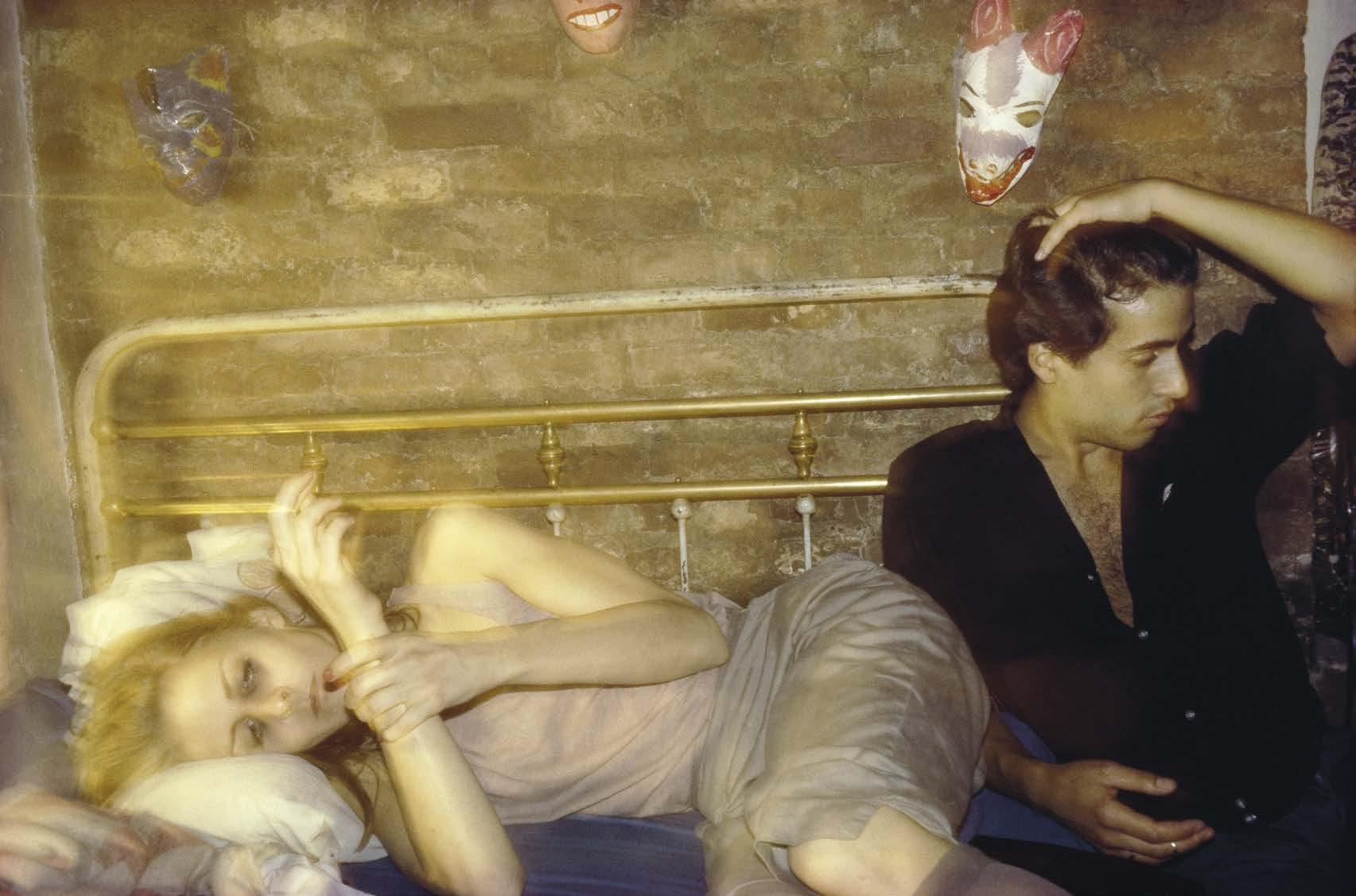
For the fortieth anniversary of Nan Goldin’s genredefining photobook The Ballad of Sexual Dependency (Aperture, 1986), Gagosian, London, will be exhibiting all of its 126 photographs, the first time the entire body of work will be shown in the United Kingdom. To celebrate the occasion, David Velasco looks back to the series’ creation and evolution, considering the radical exploration of seeing and love at the core of The Ballad .
I watch The Ballad of Sexual Dependency because I need to see how she sees the world. Nan Goldin has, for many decades now, submitted her seeing and so our seeing to a continuous evolution. She does this, I think, by trying to see with the eyes of others, by pairing her sight with that of those often effaced or mangled by the common world of images. Another word for this is empathy, though this is a small word, a word too often contained to individual feelings to properly describe such a vast and transformative adventure of the spirit.
The world moves through her vision. She sees, then we see, then things change. Nan has said that she makes no distinction between her art and her activism. This is not because she makes “activist art,” an invention of the market that manages to be at once cynical and naive; it is because her art and her activism are extensions of the same attitude toward the world. They are ways of learning where to stand, what to look for in the given atmospheric conditions (lighting, mood, character), when to show up and when to withdraw, when to light a cigarette, when to take your shot. It is this deep desire to be close to certain people, to dignify them by showing them at the quicksilver intersection of who they really are and how they want to be seen, that has made Nan such a uniquely consistent innovator of style, genre, form, and action.
Generations of artists have tried to copy Nan’s aesthetic without understanding that to make pictures like that you have to move through the world differently. It is no accident that the same person
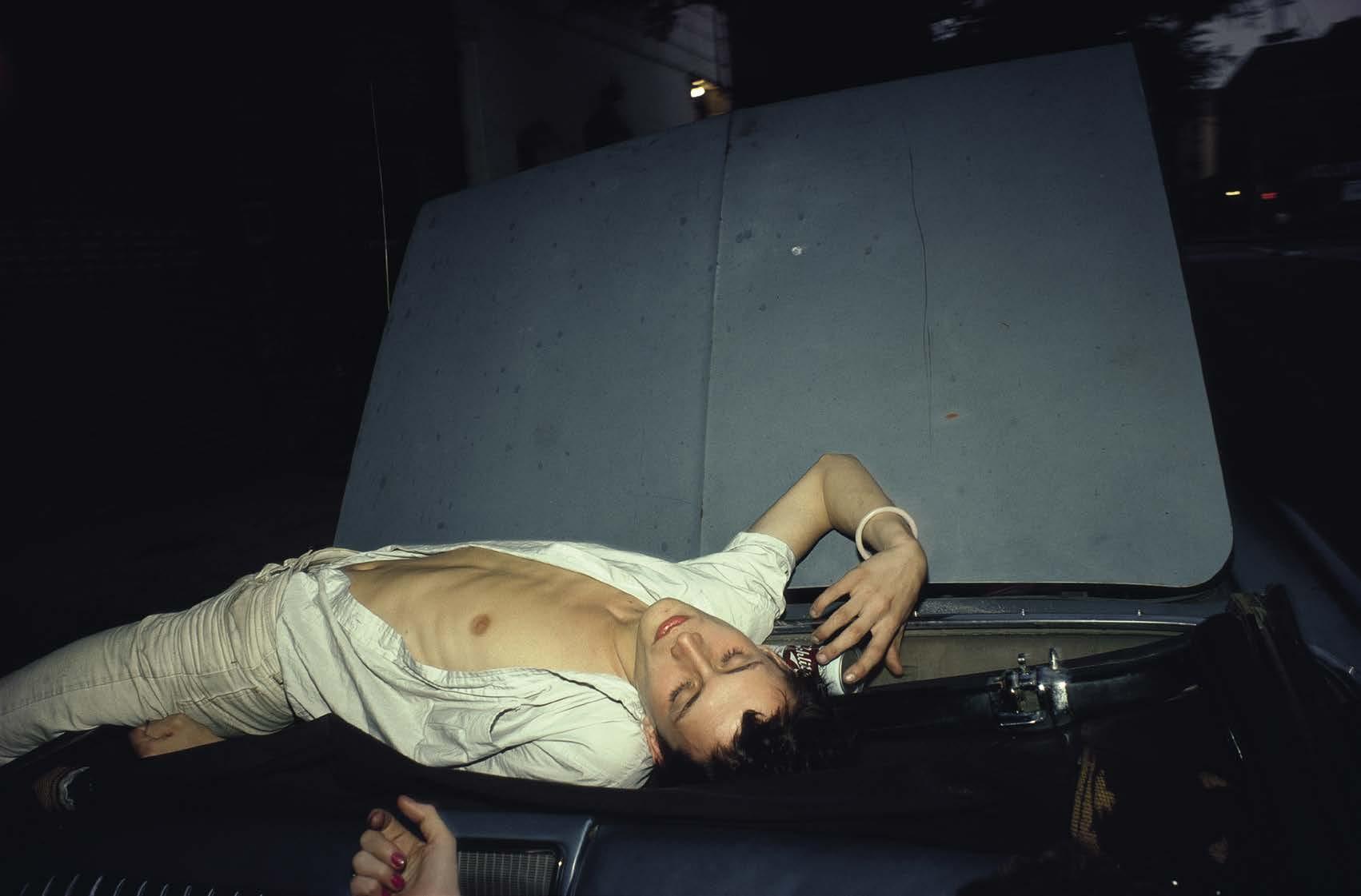
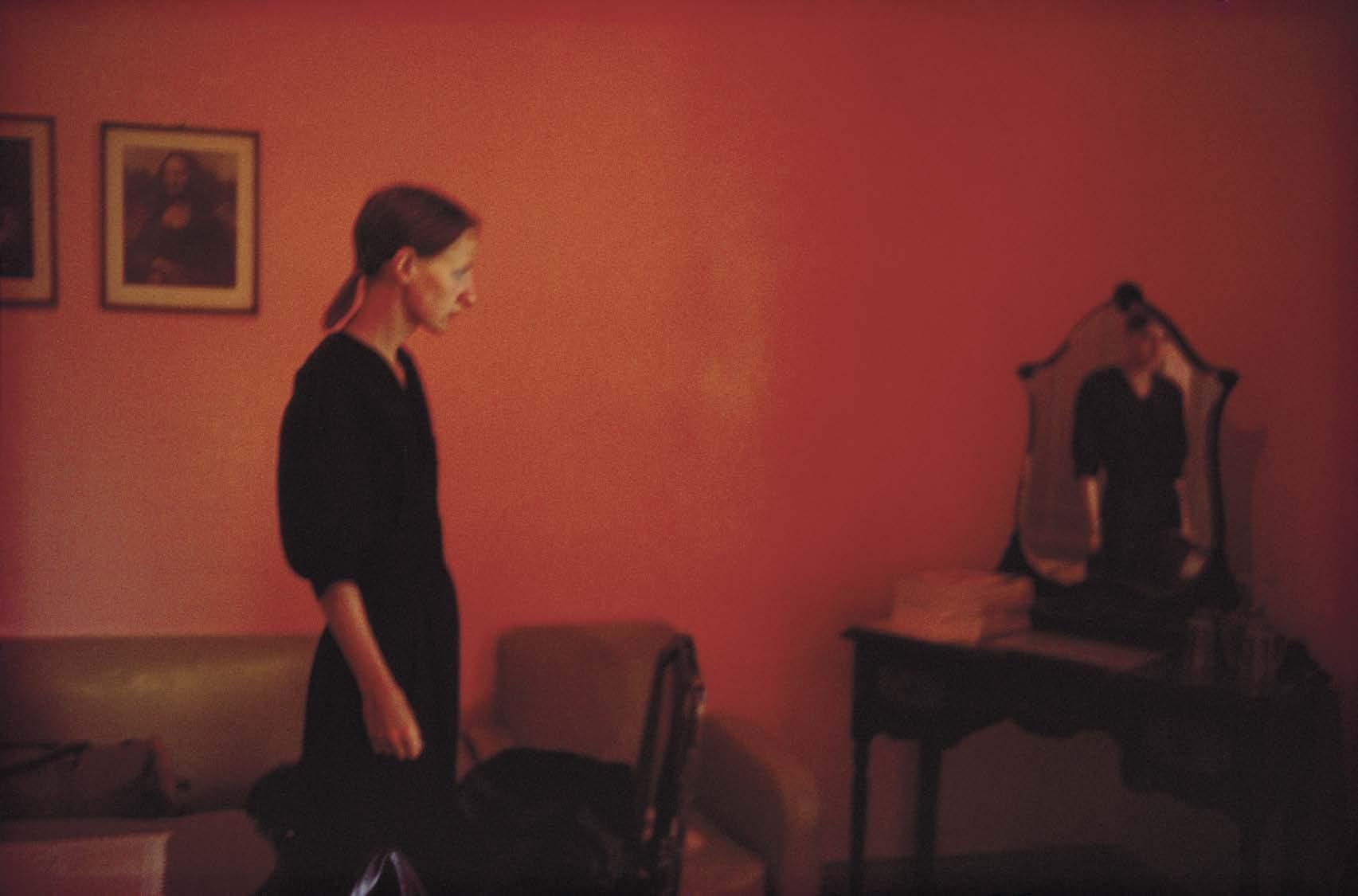
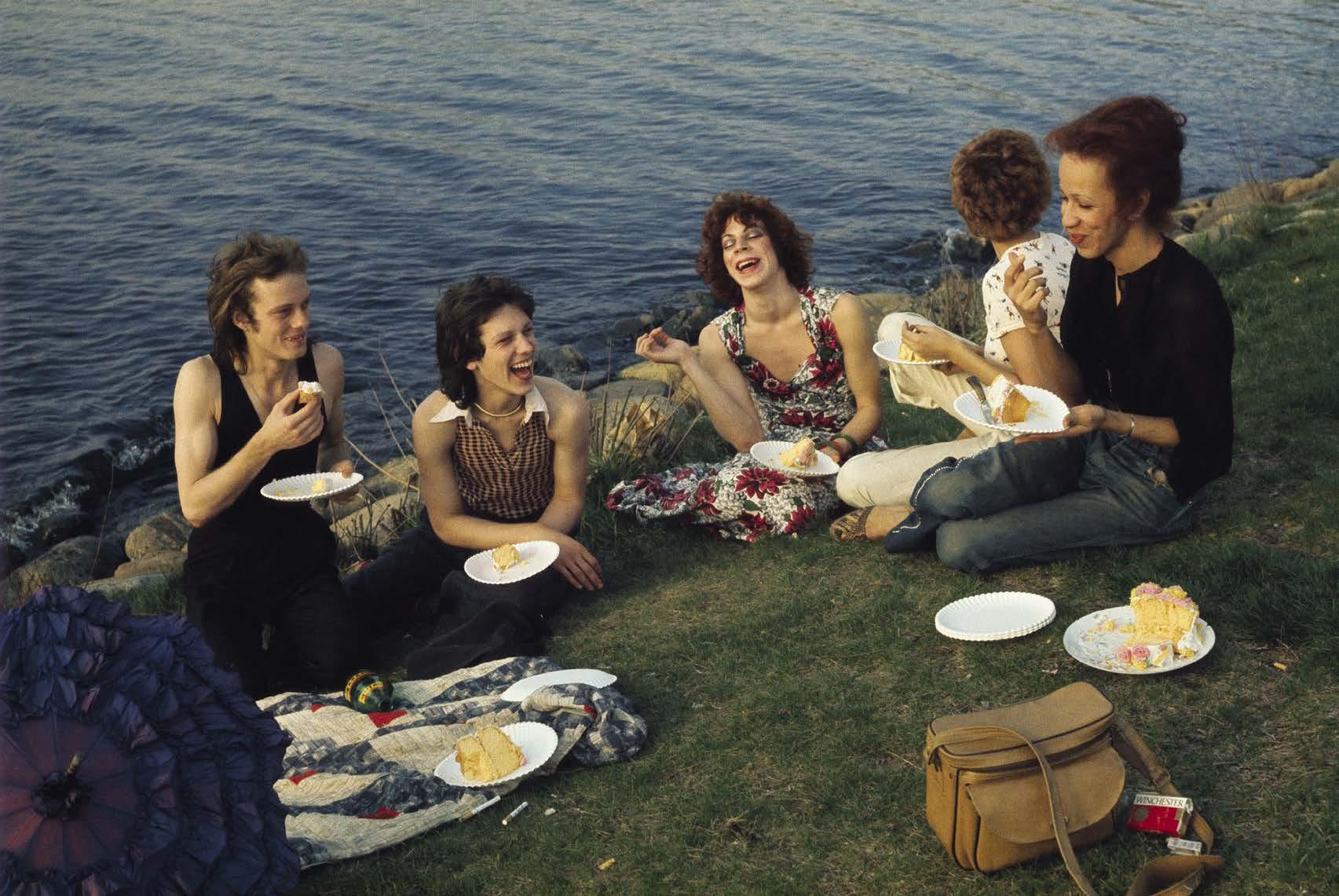
who lugged slides of her friends to nightclubs and made new combinations of songs and images to make them happy—who in doing so invented new ways of looking and telling stories with pictures— would be the same person to join and often lead righteous struggles around aids , the opioid epidemic, the genocide of the Palestinian people. It is all about attitude—how and why you look. Attitudes become form, as Harald Szeemann put it. Really getting to the attitude demands a deeper understanding of aesthetics and its assassin, beauty.
It is early morning and this young girl is leaving the club. She has red or bleached curls and she’s cranked all the way up. She had known she was famous before anyone else caught on, and this keeps her safe. She is carrying these images—some of the most extraordinary images ever created, so special they belong to history, really—in a plastic bag. She just dumps the trays from the projector, nearly a thousand fragile slides, into this bag and moves on. Before the next showing, wherever that might be, she sits down in a loft with Rene Ricard or Suzanne Fletcher or her agent Marvin Heiferman and she does a massive amount of coke and puts them back together, in whatever order then feels right.
This is how The Ballad of Sexual Dependency got made, over years, contingently, one night to the next. Nan got used to showing her pictures as slides in the 1970s, when she was in school at Boston’s Museum of Fine Arts and living in a
lesbian-separatist commune in Provincetown. She had no access to a darkroom so she used slides to show her pictures to her teachers. Like most innovations, it was at first just the solution to a problem.
It came together at night, in spaces for dancing or film or music. Unlike the pictures in an art gallery, The Ballad brought its own light. Probably the earliest iteration was at Frank Zappa’s birthday party at the Mudd Club in 1979, but the work wasn’t yet a work and wouldn’t even be called The Ballad for a few more years. Most of her friends couldn’t get in and probably no one even noticed what was happening.
The soundtrack started coming together in 1980, when Nan screened slides at the Times Square Show and her DJ boyfriend played music. Everything evolved through the doing—at other clubs and gatherings; at Edit deAk’s Dubbed in Glamour event at the Kitchen in 1980; at the Arsenal theater in Berlin; during the Whitney Biennial in 1985; at the Saint, a massive club on Second Avenue, in May 1986; many many times at O-P Screening Room, an avantgarde venue on Broadway near East 12th run by a Palestinian-Egyptian man named Rafic Azzouny. In the early days the audience and the subjects were the same. The people would scream at the screen when they saw their photo; some would protest a picture and Nan would take it out. Sometimes the show was twenty minutes and sometimes an hour and a half. (The canonical iteration is around forty-five minutes.) In 1986, the curator François Hébel suggested Nan carve out the pictures of drag

queens, and so those pictures got assembled into another of her masterpieces, The Other Side
Nan says that anyone who took as many photos as she did could stand where she does, that the genius is all in the edit. I know that’s not true. We live in an endless current of images and I’ve looked at millions of pictures and when I see one of Nan’s it still stops me wherever I am. She has an instinct for photos. I don’t know why or how, but she does. From the ages of fifteen to eighteen she watched all the great movies—Antonioni, Jack Smith, Warhol, Bertolucci, Bergman, John Waters, Morrissey, Fellini. She saw what the camera could do. And she knows what thing goes next to or across from another. She gets everything and just enough in the frame.
Nan has rhythm. Clash is important: one wrong thing next to one right thing, ornamental patterns—sparring wallpapers and bedspreads. In the book you get it right off the bat in The Parents at a French restaurant, Cambridge, Mass. (1985), her father’s crowded floral tie antagonizing the chintzy banquette, the tie and the seating as alike and estranged as the parents are to each other. Then the clash between images: Immediately after the claustrophobic picture of the parents is Susan and Max sunbathing on the beach, Provincetown, Mass. (1976), two young people naked and angular and free. Then suddenly the contrast of colors—the teal wall of Self-portrait in blue bathroom, London (1980) across from the bleary red of Suzanne with Mona Lisa, Mexico City (1981), the spread beginning and ending with a mirror.
The Ballad ’s rhymes and discords are so funny. In the slideshow, where music is the motor, it is funny to hear the Velvet Underground and Nico’s “I’ll Be Your Mirror” over the section of people looking at their reflections. It is funny to put—again, in the slideshow—a picture of the Aperture book of the Ballad covered in lines of coke. It is funny to introduce a section featuring a gunslinging Brian, Nan’s abusive boyfriend, with Ennio Morricone’s title song for Sergio Leone’s Western The Good, the Bad, and the Ugly (1966). There is humor and violence and beauty that smacks the eye awake. French Chris on the convertible, New York City (1979) is a modern pietà. Nothing has caught the essential distance of intimacy like that dreamy smear of Greer and Robert on the bed, New York City (1982). And few images radiate the emotional and compositional complexity of Picnic on the esplanade, Boston (1973)—Nan’s Déjeuner sur l’herbe , taken when she was twenty.
“These photos come out of relationships, not observation,” Nan writes in the first foreword to the book version of The Ballad , published now forty years ago. As always, Nan sees what she’s doing better than anyone. She sees everything, sometimes too much. Some people talk about The Ballad as though it’s an artwork like other artworks, something you can own or put in a museum. But it’s actually an act of devotion, scripture, a manual for how to be with others. What this cascade of pictures does is teach us how to see, which is just another word for love.
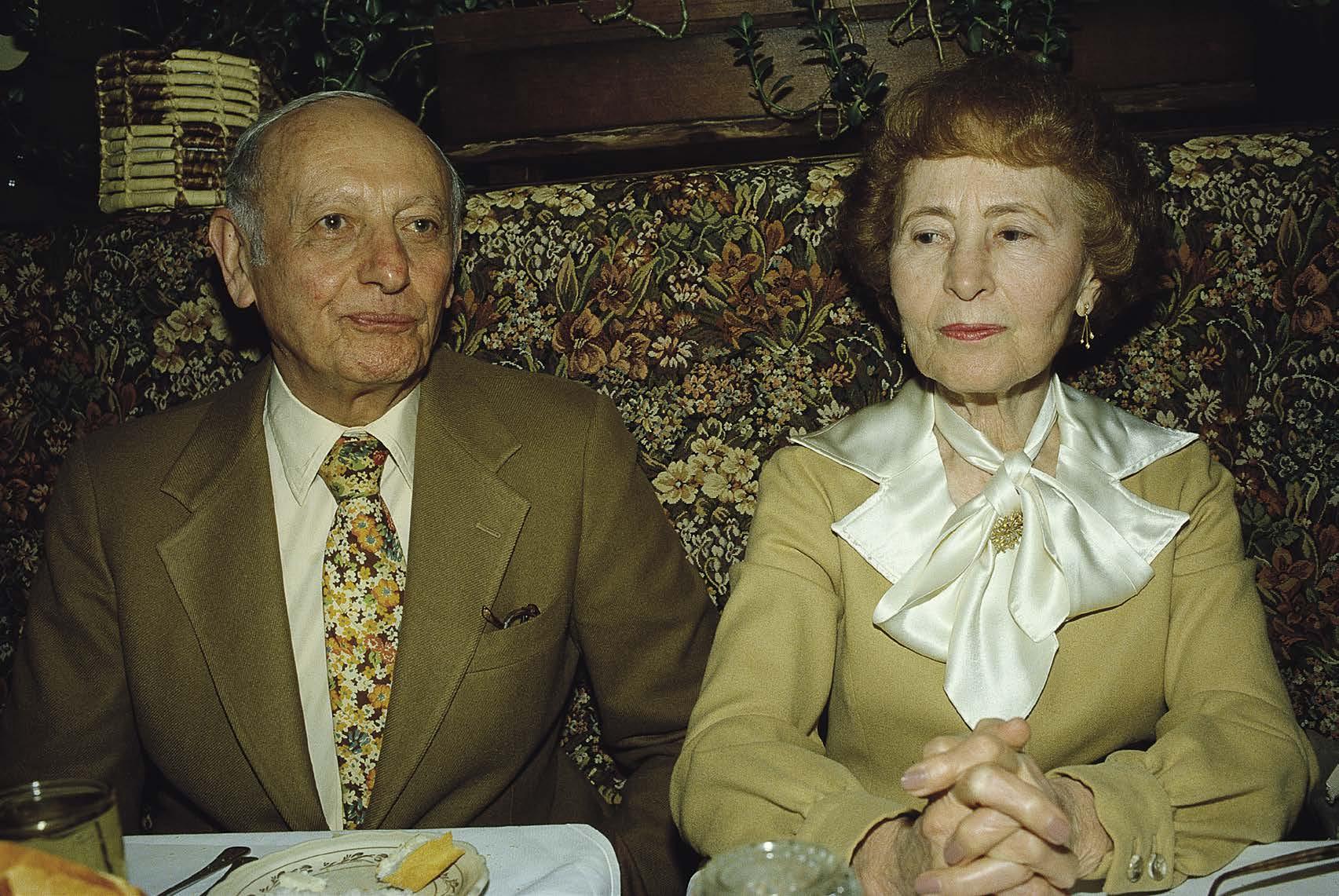
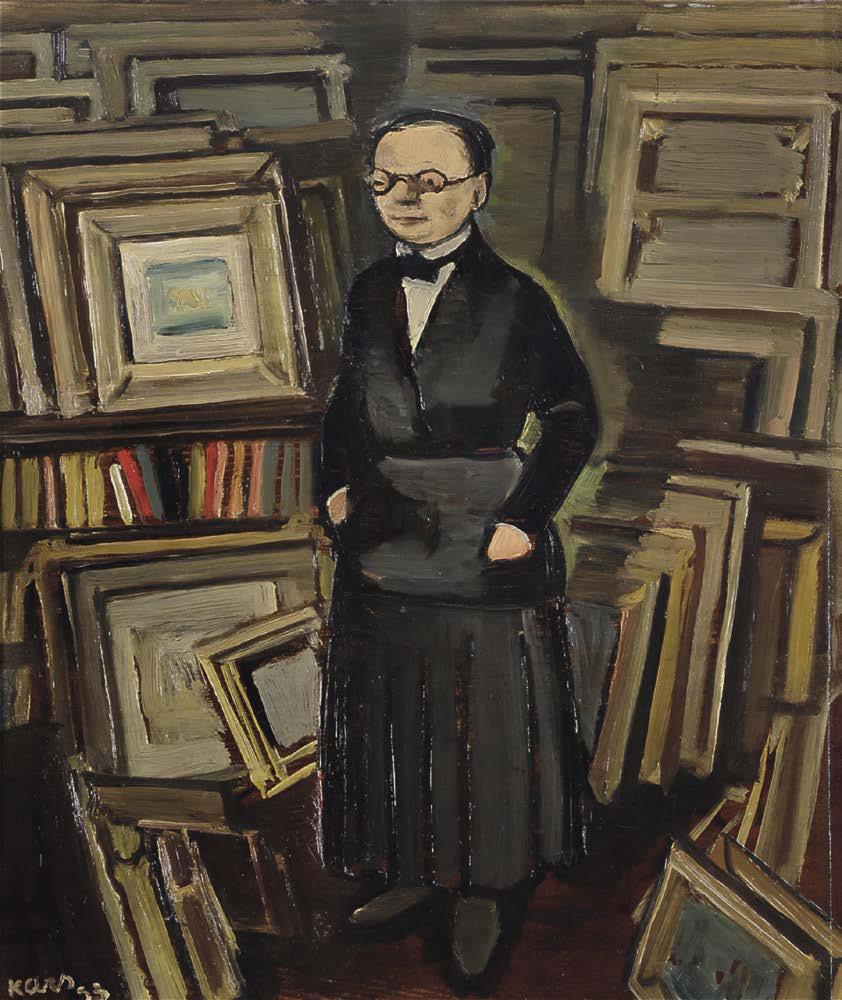
Valentina Castellani is the author of Trading Beauty: Art Market Histories from the Altar to the Gallery (2026), an expansive history of the art market and of the dealers who charted its course. Here—inspired by the recent exhibition Berthe Weill: Art Dealer of the Parisian Avant-garde at the Musée de l’Orangerie, Paris—Castellani considers the impact of the French gallerist.
In December 1917, a modest gallery on the rue Taitbout in Paris became the setting for one of the more notorious episodes in the history of modern art. The occasion was Amedeo Modigliani’s first— and only—solo exhibition during his lifetime. This is how Berthe Weill, the gallery’s owner, would later remember the preview: “When the daylight faded, we turned on the spotlights. Intrigued to see so many people in the shop, a passerby stopped and stared. He was joined by a second, then a third; eventually, a crowd gathered. The division police commissaire , whose precinct was across the street, got upset. ‘What’s that? A nude?’ . . . He sent over a plainclothes cop with a friendly manner. ‘The commissaire orders you to remove that nude.’ ‘Really, why?’” Summoned to the police station, Weill was asked to “remove all that filth.” She boldly replied, “Fortunately, some connoisseurs don’t share that opinion. Besides, what’s wrong with those nudes, anyway?” “Those nudes! . . . Those disgus— . . . they . . . they . . . h-h-h-have hairs !” was the commissaire ’s answer. 1
By then Modigliani had spent several years in Paris, immersed in the bohemian milieu of Montparnasse. Known among peers for his sensuous, elongated figures uniting sculptural grace and modern eroticism, the young Italian painter and sculptor remained largely unknown to the general public. The exhibition presented around thirty paintings, four of them large female nudes unlike anything the Paris art world had seen. Visible through the gallery window, they confronted passersby with a directness that many found provocative, even obscene. Declaring the paintings indecent under censorship laws, the police ordered their removal, and when Weill resisted, they forced her to close the show, cutting it short before anything could be sold. Its impact however was profound, symbolizing the clash between avant-garde art and the conservative social mores of earlytwentieth-century France.
For Modigliani, who was struggling with poverty and ill health, Weill’s exhibition represented a fleeting moment of recognition during his lifetime. Just three years later, aged only thirty-five, he would die of tuberculosis exacerbated by malnutrition and alcohol and drug consumption. His pregnant partner, Jeanne Hébuterne, would commit suicide a day later. Fame would come for Modigliani posthumously, and it proved both international in reach and lasting in impact. The intrepid young gallerist who organized his Paris debut, on the other hand, has until recently remained marginalized by history.
Make Way for Berthe Weill: Art Dealer of the Parisian Avant-Garde , a traveling exhibition curated by Sophie Eloy, Anne Grace, Lynn Gumpert, and Marianne Le Morvan, has finally shed light on this visionary dealer’s crucial role in advancing the early-twentieth-century avant-garde. 2 Weill’s gallery was indeed the first in Paris devoted entirely to emerging artists, the only space, writes the art historian Michael C. FitzGerald, “exclusively committed to contemporary art.”3 The list of those who debuted there is impressive: André Derain, Kees van Dongen, Raoul Dufy, Henri Matisse, Maurice de Vlaminck, and Francis Picabia, to name just a few, while the Mexican Diego Rivera made his first Paris appearance there. Weill’s support of female artists is also noteworthy: Nearly a third of her exhibitions, and one in five solo shows, featured women. Among them were the African-American sculptor Meta Vaux Warrick Fuller, who found refuge from racism in Paris, as well as the support of Auguste
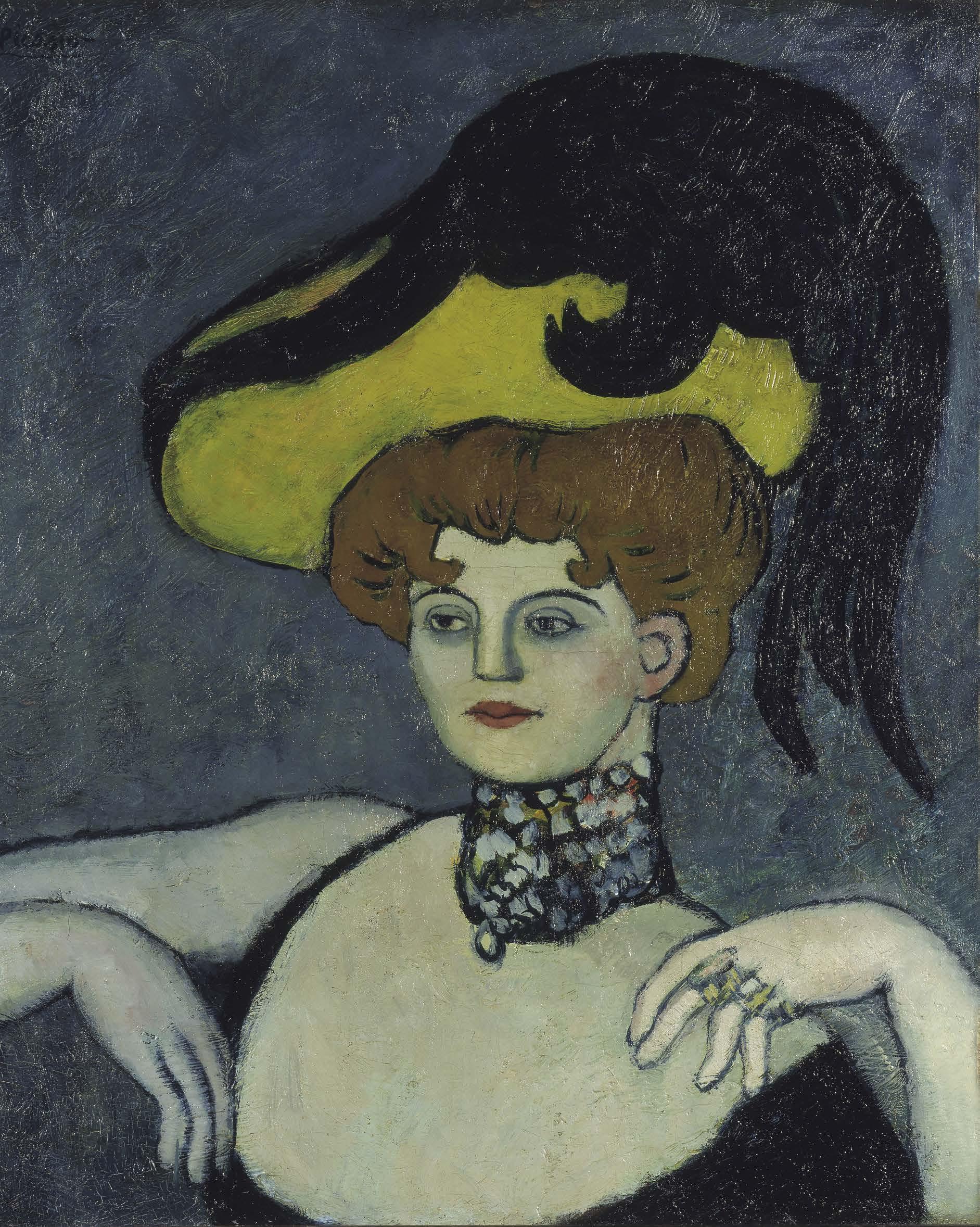
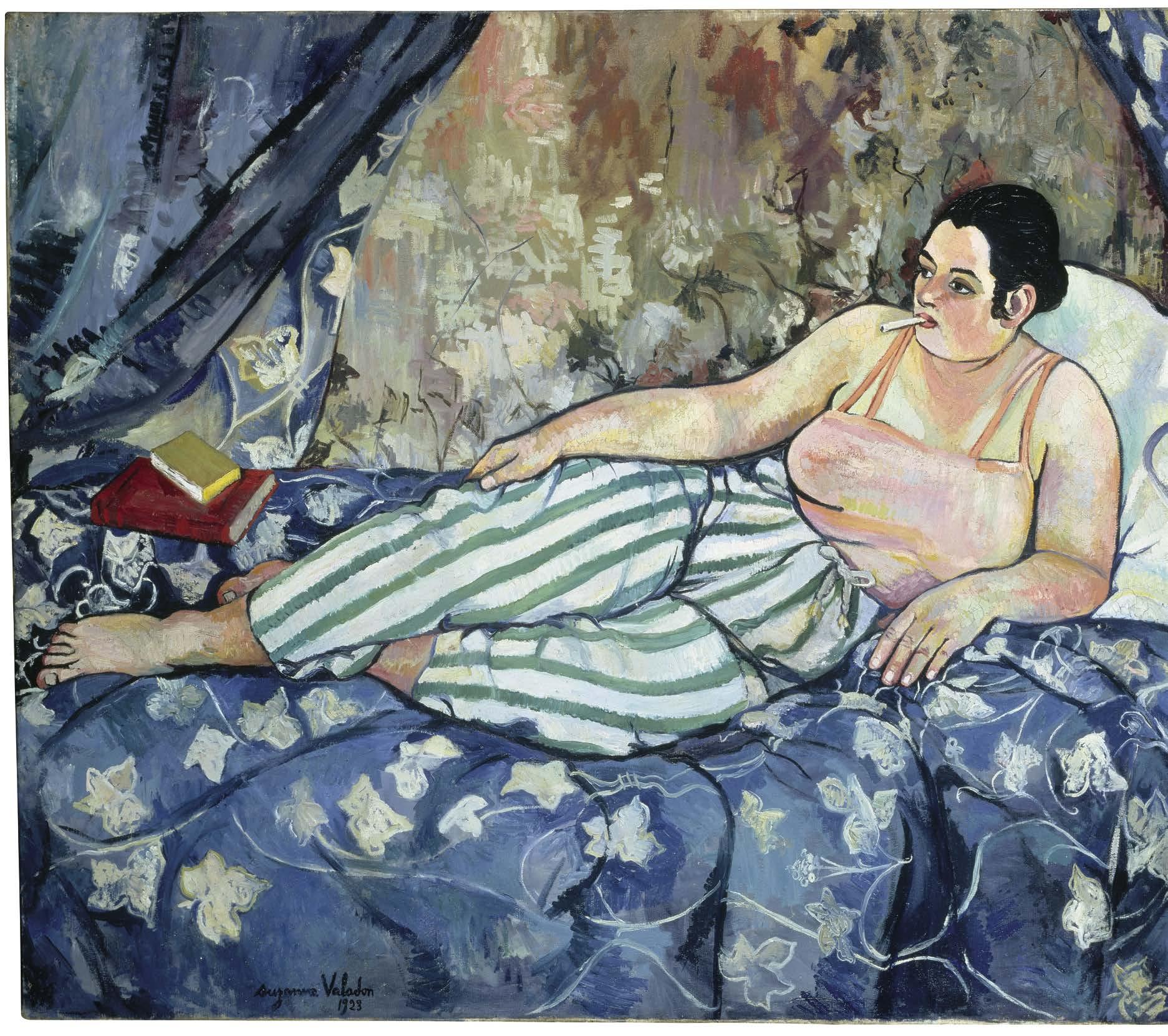
Rodin, and Suzanne Valadon, former model of Pierre-Auguste Renoir and Henri de ToulouseLautrec, who defied convention as the first woman to paint male nudes.
Born in Paris in 1865 to a Jewish family of Alsatian origin, her father a ragpicker, her mother a seamstress, Weill grew up with limited means but remarkable independence of spirit and intellectual curiosity. In 1901, after apprenticing with an art and antique dealer, Salvator Mayer, she used her small dowry to open a tiny gallery on the rue Victor Massé in Montmartre. “I started out with just fifty francs in hand and went into debt to pay the costs involved in opening a shop. Obviously, the situation wasn’t ideal, but I couldn’t back out now. Besides, what was the worst that could happen? Not being able to hang on? I will hang on!!!”4
At first the venture specialized in books, prints, and posters, but it gradually turned toward contemporary art—a bold and risky move, particularly for a
young Jewish woman. In France, these were times of rising and virulent anti-Semitism. The infamous Dreyfus Affair had shaken the nation to its core: In 1894, Alfred Dreyfus, a Jewish army officer, had been falsely accused of treason and condemned to exile on Devil’s Island, a remote penal colony off the coast of French Guiana. The wrongful conviction exposed deep fractures in French society, dividing the country into fiercely opposing camps. Launching a gallery in this climate was an act of courage for Weill, who, “standing barely five feet tall, with light blue eyes behind oval glasses, . . . deployed a keen wit, biting humor, and sharp eye for talent. She also cut a striking figure in an allmale guild, and her brash outspokenness clashed with the hushed, reserved murmurs of the commercial art world.”5
Driven by her conviction that the radical young artists of the time deserved to be seen, Weill persevered in her mission. Her business model differed
Previous spread, left: Georges Kars, Portrait of Mme. Berthe Weill, Art Dealer, 1933, oil on canvas, 22 1⁄8 × 18 1⁄8 inches (56 × 46 cm), collection Dr. Slezak. Photo: © Maxime Champion/Delorme & Collin du Bocage
Previous spread, right: Pablo Picasso, Hetaira , 1901, oil on canvas, 25 ¾ × 21 ½ inches (65.3 × 54.5 cm), Pinacoteca Agnelli, Turin © 2026 Estate of Pablo Picasso/Artists Rights Society (ARS), New York. Photo: © Gilles Mermet/Art Resource, New York

Left: Suzanne Valadon, The Blue Room , 1923, oil on canvas, 35 ½ × 45 5 8 inches (90 × 116 cm), Centre Pompidou, Musée National d’Art Moderne, Paris/Centre de Création Industrielle, on deposit at the Musée des Beaux-Arts de Limoges. Photo: © Centre Pompidou, MNAM-CCI, Dist. Grand Palais Rmn/Art Resource, New York/Jacqueline Hyde
Below:
Amedeo Modigliani, Nude with Coral Necklace, 1917, oil on canvas, 26 ¼ × 39 7⁄8 inches (66.5 × 101.1 cm), Allen Memorial Art Museum, Oberlin College, Ohio. Gift of Joseph and Enid Bissett. Photo © Allen Memorial Art Museum, Oberlin College, Ohio
sharply from that of her contemporaries. “For a debut exhibition,” writes Le Morvan, the gallerist Eugène Druet would charge the artist for renting the space (18,000 francs, paid in paintings), as well as a 20 per cent commission, deducted from sales, to cover the cost of producing and sending out catalogs and of printing posters. Likewise, the Galerie La Licorne would deduct the cost of postage, promotion, press, posters, and frames from any profits made. So, before they could even exhibit, an artist had to lay out a substantial sum. Berthe Weill, on the other hand, did not charge for exhibitions, refusing any artist’s offer to pay; she even went so far as to give those in dire need her share of the takings and to share her table with them. She also refused to draw up exclusive contracts, considering them unfair on the artist.6
Weill’s vision was cosmopolitan and inclusive: “She was a superb talent-spotter, and what caught her eye evidently had little or nothing to do with an artist’s nationality, religion or ethnicity,” observes the history professor Charles Dellheim.7 Over the forty years of her gallery’s existence, about four hundred artists passed through it. 8 When her finances allowed, she produced small catalogues, and in November 1923 she even started a publication of her own, Bulletin de la Galerie Berthe Weill Unlike her wealthier rivals, Weill lacked the capital to acquire and hold works for future resale—a strategy used by Ambroise Vollard, for example, to create and monopolize Paul Cézanne’s market—so despite its ambitious program, her gallery always struggled amid scarce sales and few collectors.9 Its cultural significance and pioneering role, however, cannot be overstated. It was Weill who made the first sale of Pablo Picasso’s work in Paris, soon after he arrived from Barcelona for his first stay in the city, in October 1900: three small pastels depicting bullfighting scenes. Acquired from the Catalan industrialist-turned-artists’-agent Pedro Mañach for 100 francs for all three, they were immediately resold for 150 francs to Adolphe Brisson, the publisher of Annales Politiques et littéraires . Aged nineteen, virtually unknown, and speaking little French, Picasso had to rely on fellow Spanish expatriates to enter the Paris art scene. Mañach organized his debut at Vollard’s in 1901, but it was at
Weill’s in April 1902 that his first Blue Period works appeared—none of which sold.
Facing chronic financial difficulties, Weill’s gallery relocated multiple times in response to shifting urban geographies and rising rents: from Montmartre to the rue Taitbout, then in 1920 to the rue Laffitte, and finally, in 1934, to the rue SaintDominique. During the 1920s it supported artists such as the Russian-born Marc Chagall, whose work combined modernist innovation with lyrical, folkloric imagery, and the Polish Moïse Kisling, who merged post-Impressionist colorism with classical forms. In 1933, Weill published her autobiography, Pan! . . . Dans l’œil! . . . ou trente ans dans les coulisses de la peinture contemporaine (1900–1930) (Pow! . . . Right in the Eye! . . . Thirty Years behind the Scenes of Modern French Painting ), which appeared in English only in 2022. 10 Its frontispiece featured a portrait of her by Picasso—testimony to their lasting mutual esteem, though by then the artist had found representation elsewhere, first with DanielHenry Kahnweiler and later with Paul Rosenberg. By 1939, the combined pressures of economic hardship, the resurgence of anti-Semitism, and the looming threat of World War II forced Weill to close her gallery permanently. The enthusiasm and fearlessness that marked her extraordinary enterprise emerge vividly through her own words: “A flood of new ideas and concepts was busting out of Montmartre, a flowering that would blow away the pundits . . . and the world. ¶ The jokes flew and money was scarce . . . but what the hell!”11
1. Berthe Weill, Pow! Right in the Eye!: Thirty Years behind the Scenes of Modern French Painting , 1933, Eng. trans. ed. Lynn Gumpert, trans. William Rodarmor (Chicago: University of Chicago Press, 2022), 101–2.
2. The exhibition was coorganized by New York University’s Grey Art Museum, the Montreal Museum of Fine Arts, and the Musée de l’Orangerie, Paris, where it concluded in January 2026.
3. Michael C. FitzGerald, Making Modernism: Picasso and the Creation of the Market for Twentieth Century Art (Berkeley, Los Angeles, and London: University of California Press, 1995), 25.
4. Weill, Pow! Right in the Eye! , 3–4.
5. Marianne Le Morvan, Introduction, in Weill, Pow! Right in the Eye !, xv.
6. Le Morvan, “Berthe Weill and Her Gallery,” in Gumpert, Le Morvan, Anne Grace, et al., Berthe Weill: Art Dealer of the Parisian Avant-garde , exh. cat. (Paris: Flammarion, for the Grey Art Museum, New York University, New York; the Montreal Museum of Fine Arts; and the Musée de l’Orangerie, Paris, 2025), 18.
7. Charles Dellheim, “What Are You?,” in ibid., 36.
8. See Anne Grace, “Picturing Berthe Weill,” in ibid., 41.
9. See Robert McDonald Parker, “Early Modernist Collectors of the Galerie B. Weill,” in ibid., 182.
10. See note 1.
11. Ibid., 26.

Jason Stanley, author of Erasing History: How Fascists Rewrite the Past to Control the Future (2024), considers Titus Kaphar’s new paintings, examining their potent refusals of jingoistic myth-building and their strident remembering of American history.
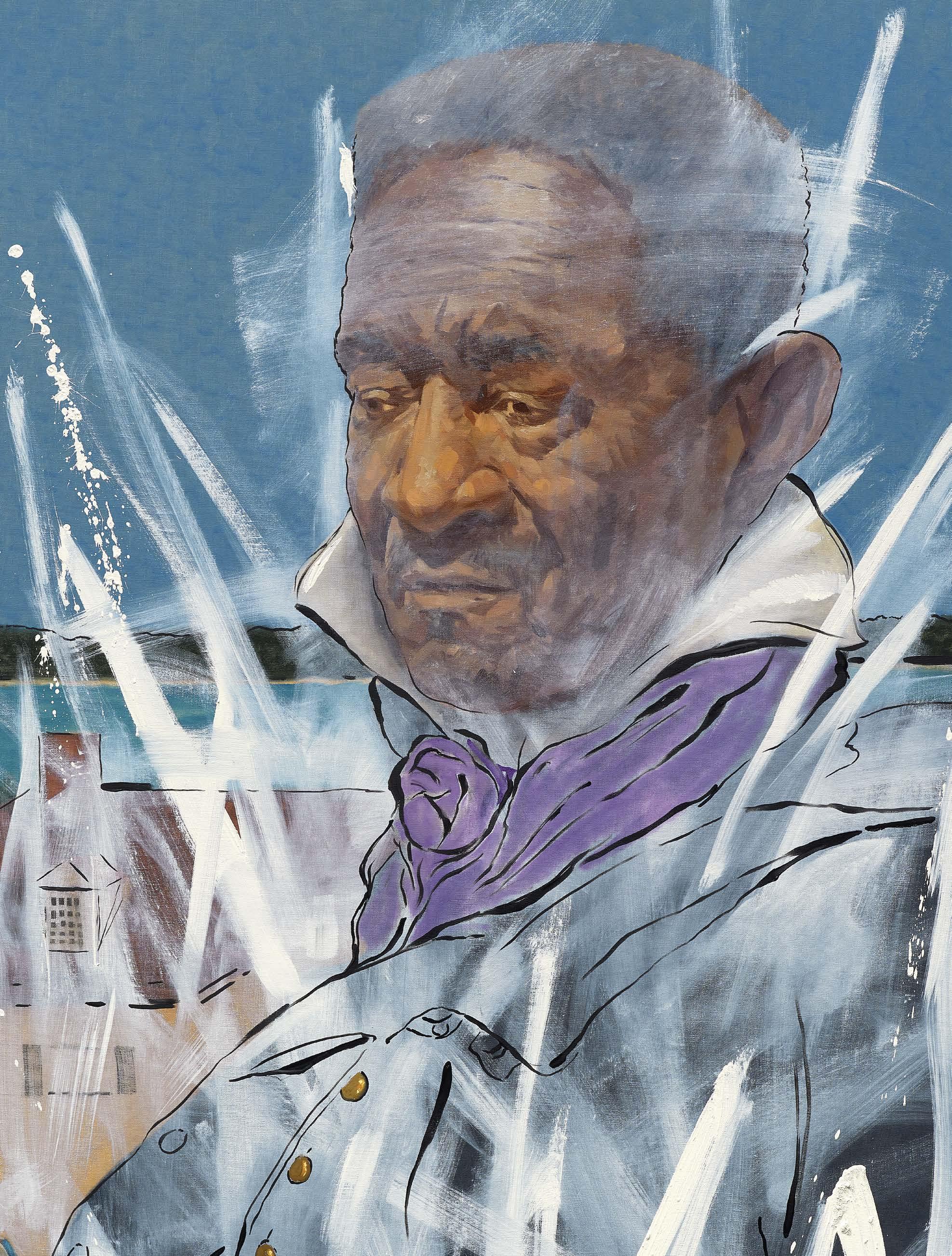


At the core of most national myths is a cult of the founders, a veneration of figures taken to be the original figures who defined the nation. It may be, as in the US, something like the “founding fathers,” or it may be people whose conquests or achievements were so great that they are taken to be essential to the nation’s identity (Joan of Arc?). Such cults can be relatively innocent, but when they are taken as a justification for placing one group of citizens (those who share the founders’ “identity”) above others, they mount an existential threat to democracy. When the founders are represented as embodying a superior racial or religious identity, a cult of the founders may justify atrocity. For over a decade, the work of Titus Kaphar has cut through the American version of this myth, uncovering the history of the people it necessarily erases.
In Playing in the Dark: Whiteness and the Literary Imagination (1992) Toni Morrison wrote, “There is quite a lot of juice to be extracted from plummy reminiscences of ‘individualism’ and ‘freedom’ if the tree upon which such fruit hangs is a black population forced to serve as freedom’s polar opposite.” Indeed, large parts of the mythology of American freedom are predicated on the non freedom of Black and Indigenous Americans. Think, for example, of the settlers’ covered wagons heading west in the nineteenth century, a picture many of us have in
our heads as an iconic symbol of American freedom: That image is simultaneously an image of Indigenous dispossession and loss. In his painting The Cost of Removal (2017), Kaphar reworks a contemporary portrait of Andrew Jackson, the American president responsible for the Indian Removal Act of 1830—an important step in that dispossession. Jackson is shown mounted on horseback, a pose stereotypical of American freedom. Strips of cloth are nailed to the canvas, hanging down from Jackson’s chin to his feet; on these strips Kaphar has written the words Jackson used to justify the removal of Indigenous Americans from their land. The nails recall the nail-studded power objects of Africa’s Kongo religion, an example of which Kaphar had seen at the Yale University Art Gallery. Their presence, then, is a manifestation of Black agency in both material and technique; they are also, well, rusty nails driven into a president’s face.
To represent George Washington as innocent is to demand that history forget those he enslaved. Kaphar’s Shadows of Liberty (2016) is an oil portrait of Washington, on a grand scale characteristic of the subject. Like Jackson in The Cost of Removal , Washington is on horseback and strips of cloth are nailed to his head; here, each strip bears the name of a person he enslaved, the names being drawn from the ledger where he kept track of such things. The title Shadows of Liberty alludes to the same point Morrison makes; that American freedom must be understood in the light of such shadows.
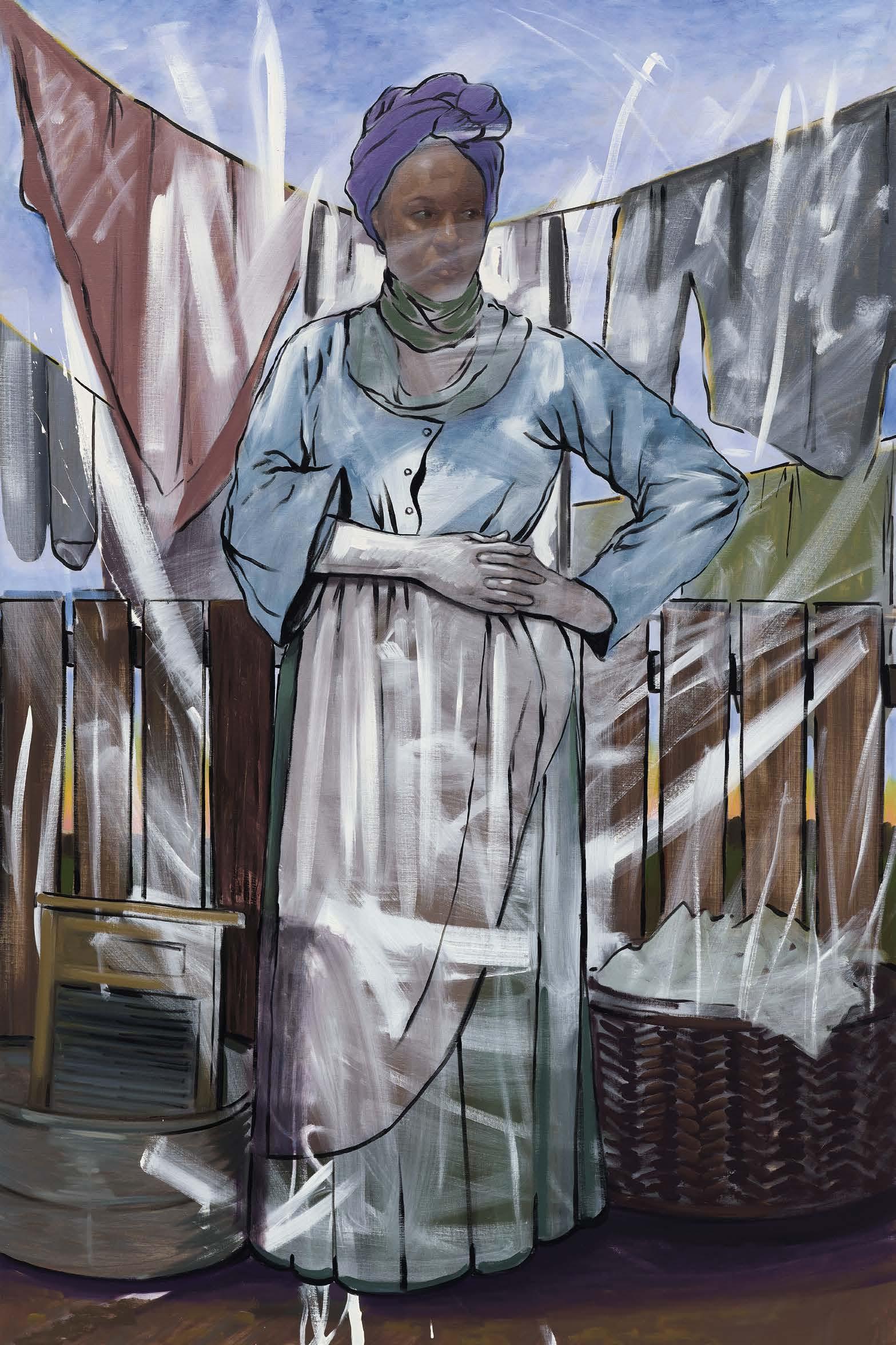
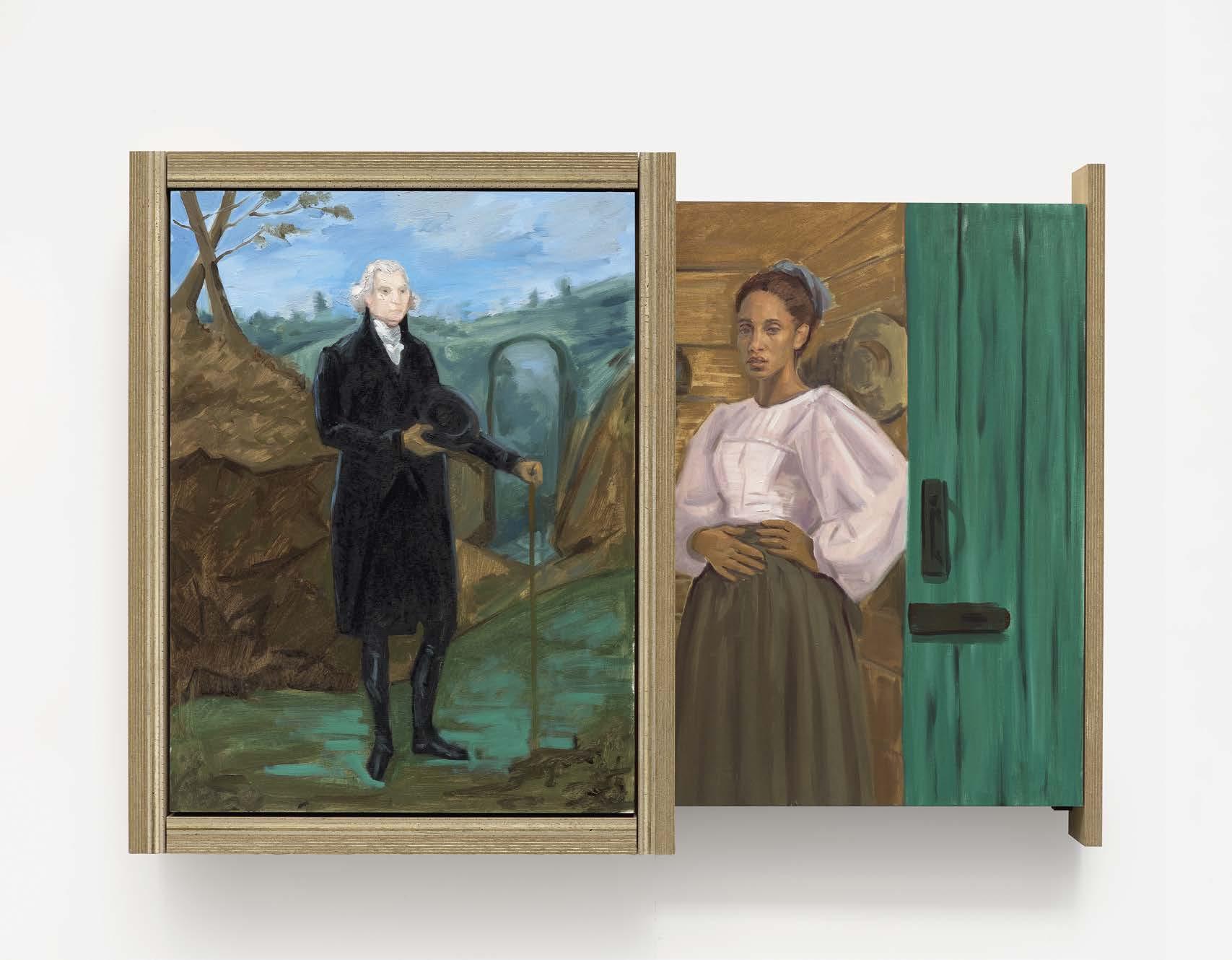
In his new paintings Kaphar continues his fo cus on America’s cult of the founders. Bathing in the Warmth of Another Stolen Day (Ona Judge) (2025), for example, refers to a woman enslaved by Washington and his wife, Martha; classified as a fugitive slave after her escape from the household in 1796, she was pursued by agents of the Washington family and located in New Hampshire, but refused to return. Here Kaphar calls our attention to the whitewashing of her legacy and even existence under the conception of “patriotic education” espoused by Donald Trump, and codified in one of the forty executive orders he issued in the first ten days of his second presidency, “Ending Radical Indoctrination in K–12 Schooling,” which calls for schools to instill in their students “a patriotic admiration for our incredible Nation and the values for which we stand.”
American history has always demanded such erasures of the agency of anyone who is not white, Christian, and male (like the founding fathers). They were documented, for example, by W. E. B. Du Bois, whose 1935 book Black Reconstruction challenged the narrative myths that erased Black agency and accomplishment in the Civil War and its aftermath and set up a fictional past that absolved whites of any guilt in ending Reconstruction. Kaphar’s work attacks similar racist myths, and constitutes a powerful visual critique of white innocence, but Kaphar often performs this critique indirectly, his more primary goal being to defend the legacy of Black Americans whose agency and
indeed existence is threatened by racist history. Forget Me Not (James Armistead Lafayette) (2025), for example, commemorates an African-American who spied for the Continental Army, having been promised his freedom for passing military intelligence to the Americans while seeming to work for the British. As if to emphasize the absurdity of Trump’s frequent call for a “patriotic history,” Kaphar’s painting reminds us that attacks on Black history and agency are a distortion of patriotism rather than an amplification of it.
Kaphar’s new series operates differently from his earlier work: As well as offering alternative perspectives on our founding myths, it must be read as a defiant resistance to a moment when Black history is subject to specific legal and administrative threat. It speaks both to a lengthy history of erasure and to a current moment when any challenge to these erasures faces increasing legal danger. The current American regime makes its targets deliberately vague (“Anti-Americanism”) but emphasizes exactly the kind of work Kaphar has been making.
This year marks the 250th anniversary of the founding of the United States, which the Trump regime is planning to celebrate with “patriotic” art and architecture. Kaphar will challenge this propaganda by exhibiting his work in several American museums. Those now in power regard the perspectives his work provides as problematic for their rule. They rightly regard his project as a threat to fascism.

Avis Berman’s biography of Roy Lichtenstein, Transcending Taste: Roy Lichtenstein (1923–1961), is to be published this fall by Abbeville Press, aligning with a major retrospective at the Whitney Museum of American Art, New York, in October. For the Quarterly she has adapted part of her text to focus on the artist’s formative experiences in New York in the 1920s and ’30s.
The essentials of childhood form us all. Even when we rebel against them, our thoughts, beliefs, and dreams are inseparable from our earliest years. Roy Lichtenstein, a native New Yorker, was no exception. He declared that his hometown was “the center of the universe,” a belief rooted in his childhood in Manhattan. 1 His boyhood experiences— rich, textured, and determinative—could have happened nowhere else.
Born on October 27, 1923, Lichtenstein, a quiet boy bent on being an artist, was raised in an upper-middle-class milieu. He was the only son of Milton and Beatrice Werner Lichtenstein, his
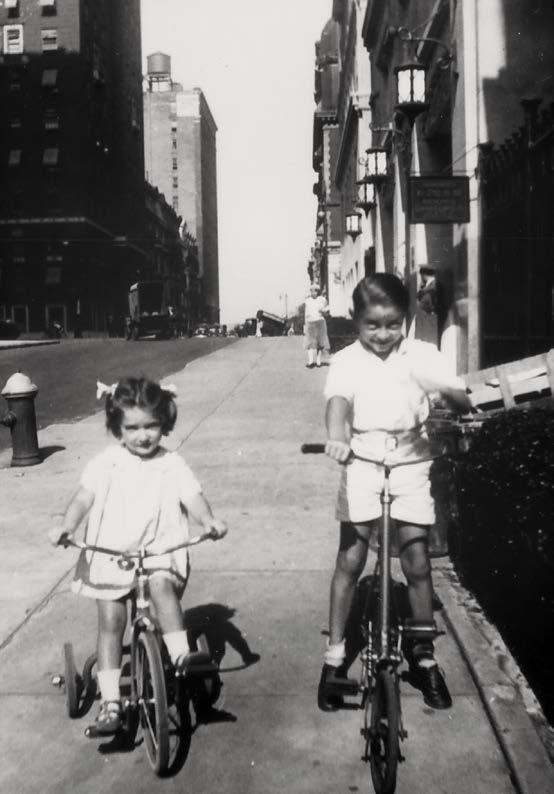
father a commercial real estate broker, his mother a musically talented woman who had wanted to be a concert pianist before her marriage. Beatrice, whom everyone called “Beezie,” and Milton were wed on March 1, 1922, and lived on the Upper West Side. The Lichtensteins’ first apartments were in the high nineties and low hundreds hugging West End Avenue, a district of well-tended apartment buildings and blocks close to Riverside Park and the Hudson River. West End Avenue was supposed to become a second Park Avenue; that never quite caught on, but it was filled with solid residential construction made for families with servants. Roy lived on and near West End Avenue for the first seventeen years of his life, making it the area of New York he knew best growing up.
In the late 1920s, Milton’s business was prospering and Beezie was pregnant again. Before the birth of Renée, their second child, on December 17, 1927, they moved into the Clebourne, a grand building at 924 West End Avenue. Lichtenstein was an unlikely iconoclast in this atmosphere of privilege, but precisely because the household was proper and orderly, its heavy politesse created a setting that an artist might satirize. Selma Koch, Lichtenstein’s cousin, said, “At dinner, butter was never put on the table” except as “butter balls, and grapefruit had to be scalloped.”2 Renée Lichtenstein agreed: “We always had live-in help, and. . . . [t]here was some poor soul, in uniform, serving dinner. Good conversation and everything on time. All that was very structured. . . . But . . . [our parents] . . . were just funny, and we laughed a lot. . . . in spite of being very middle class in their actions and the way they led their life, verbally they always saw the irony of things. . . . That surely got passed down to my brother and his painting.”3
In late 1931 the Lichtensteins moved into 505 West End Avenue, at 84th Street, where they lived on the same floor as the conductor, composer, and virtuoso pianist Sergei Rachmaninoff. For Beezie this was akin to a dream realized: She still practiced the piano and her favorite composers were Tchaikovsky and Chopin. Lichtenstein remembered crawling underneath his mother’s piano, pushing the pedals to see how they worked, well before the family lived at 505 West End. 4 Without any formal teaching he learned to play
well enough to bang out blues and boogie-woogie. Rachmaninoff’s presence turned into a shared pastime for Beezie, Roy, and Renée: When the weather was good, the three of them left the building to stand outside the pianist’s open windows, listening to him play as the melodic sound floated down to the street below.
Lichtenstein also discovered the excitements of newspaper comic strips and vibrant radio serials in the genres of adventure and science fiction. He followed Dick Tracy , featuring the tough-talking detective who faced off against peculiar-looking villains; Alley Oop , starring a Stone Age protagonist who rode around on a dinosaur; and his favorite of the three, Buck Rogers Buck Rogers in the 25th Century A.D., to give the strip its full title, was extravagantly pseudo-scientific. The central character, an action hero who time-travels from the 1920s to vanquish evil in the twenty-fifth century and has a sideline in interplanetary exploration, made his debut in a comic strip in 1929 that was syndicated to forty-seven newspapers; 5 by 1932, the strip had become an equally popular radio serial. These melodramas were an escapist brew of futuristic technology, clashes between good and evil, and valiant young men and boys acing feats of derringdo through their supernatural powers.
Lichtenstein’s immersion in newspaper strips and radio programs that were central to popular culture for middle-class American children in the 1930s was his introduction to cartoon imagery, style, characterization, and symbolism, and his imagination was seeded by them. The entertainments he knew from boyhood he would quarry decades later, augmenting them with 1960s adventure comics in the same genre. Thought to be avant-garde, he was nothing less than retrospective—among other things, he was memorializing the ephemera of his past. Buck Rogers was the central figure in a 1961 oil titled Emeralds , and he portrayed what he called “Buck Rogers architecture” in the print This Must Be the Place (1965) and in his monumental Times Square Mural (1990), both of which envision a space-age urban environment from a faux-1930s perspective. The name “Buck Rogers” was Lichtenstein’s shorthand for the folly of expecting the future to be anything like predictions of it.
During the second half of 1933, the family moved to a seven-room apartment at 305 West 86th Street, between West End Avenue and Riverside Drive. It would be their home for the next eighteen years. At school, Lichtenstein was an average student, his academic performance just adequate because he spent his time outside the classroom on art and music. Art was the primary preoccupation, but his other passion was jazz and blues. The infatuation would probably have been less intense and meaningful but for his friendship with an intrepid boy named Donald Wolf, who educated him in jazz. Wolf had formed a band with two other boys; they patterned themselves after a Benny Goodman swing quartet, but they lacked a clarinetist. Lichtenstein was taking clarinet lessons, so he joined Wolf and his friends to fill the celebrated horn player’s spot.
Lichtenstein and Wolf were part of an event that became a milestone in American cultural history: Wolf got a pair of fourth-row tickets to Benny Goodman’s momentous concert at Carnegie Hall on January 16, 1938. Here, hot jazz and swing were heard in an august sanctum more known for Bach than for blues. Jazz and other varieties
of African-American music had appeared earlier at Carnegie Hall, but this concert was different, jazz historian James Lincoln Collier writes, in the way it “captured the public imagination,” and its effect still resonates beyond the jazz community.6 Goodman’s band, a musical sensation, defined swing at that moment. He performed with his fullsize, thirteen-piece orchestra, gave spots to his trio and his quartet—chamber units within his larger ensemble—and included a jam session with musicians from Duke Ellington’s and Count Basie’s bands. The trio consisted of Goodman, Gene Krupa on drums, and pianist Teddy Wilson, hired in 1935; the quartet had emerged when vibraphonist Lionel Hampton signed on in 1936. The addition of these brilliant musicians, Lewis Erenberg writes, made Goodman “the most visible symbol of racial integration in the music business.”7 At first the trio and quartet had been heard only on radio broadcasts and recordings, so less cognizant listeners would not have known that the band was integrated, Wilson and Hampton being Black. As Goodman’s clout grew, he insisted that his entire ensemble appear on stage—either everyone played or no one did.8
The Goodman concert would win canonical status as a marker of racial equality a year before the contralto Marian Anderson was denied permission to sing before an integrated audience in Washington, DC. The audience was as excited as the musicians were nervous. Despite the Goodman band’s fame, jazz was still considered a low form of entertainment, and Carnegie Hall was a byword for elevated classical music. This dichotomy only added to the furor: All of the hall’s 2,760 seats sold out, as did a hundred extra chairs added to the side of the stage to accommodate the demand.9 On the
Below: Roy Lichtenstein, Emeralds , 1961, oil and graphite pencil on canvas, 68 3⁄8 × 68 ½ inches (173.7 × 172.7 cm)
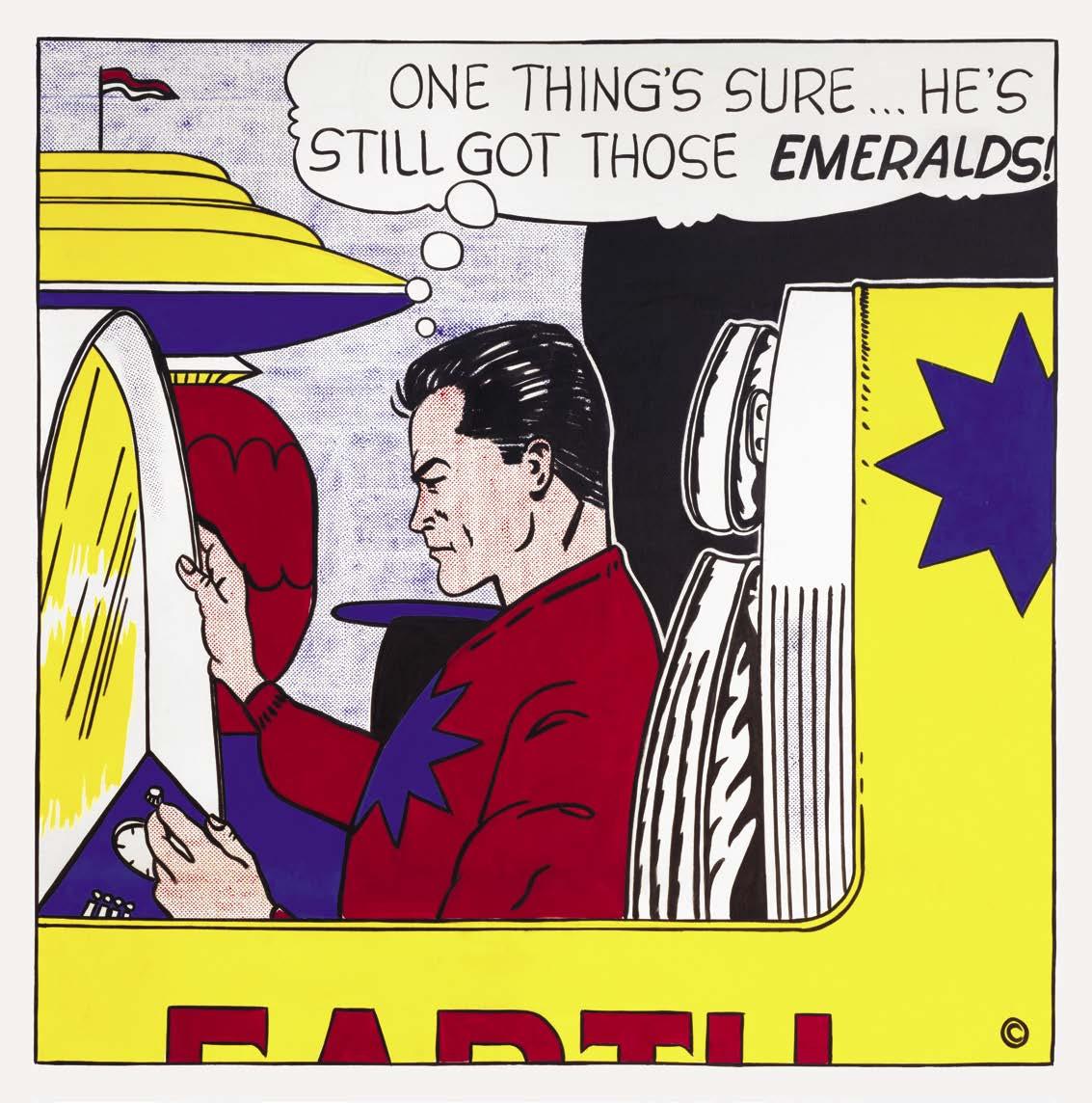

day of the concert, a long line queued at the box office for standing-room tickets.
The concert was a triumph. After Basie’s “One O’Clock Jump,” tributes to the Gershwins and Irving Berlin followed with “I Got Rhythm,” “The Man I Love,” and “Blue Skies.” When the quartet played, Wilson brought down the house with his rendition of “Body and Soul.” This jazz standard was Lichtenstein’s favorite song. The finale was the swing blockbuster “Sing, Sing, Sing,” which Goodman’s full band embroidered with variation on variation. The teenagers in the audience were bouncing up and down in their seats as Goodman sizzled on the clarinet and Krupa hit the drums. Don Wolf never forgot the event—nearly seventy years after the concert took place, he brightened from his memory of its sights and sounds. As for Lichtenstein, the performance may have been the
first time he witnessed popular art crashing the gates of cultural acceptance and high art being the better for it.
Pablo Picasso had personified the summit of modern art for decades but in the late 1930s he was attracting even more attention. In the spring of 1937 he painted Guernica , the apocalyptic canvas that was swiftly recognized as a consummate expression of antiwar protest against fascism’s threat to the world. Picasso’s impact on New York was heightened through the agency of the Museum of Modern Art and its visionary director, Alfred H. Barr Jr. The artist was sparsely represented in the museum’s permanent collection, and Barr would remedy that as the preamble for two exhibitions planned for 1939: a celebration of the institution’s first ten years of existence and an allencompassing Picasso retrospective. In 1938 and 1939, Barr acquired two paintings that are touchstones of the museum’s collection to this day: Girl before a Mirror and Les Demoiselles d’Avignon 10 They and nine other Picasso works were exhibited from May 10 to September 30, 1939, during the run of Art in Our Time , an exhibition of over 280 paintings, drawings, watercolors, prints, sculptures, and photographs, plus a concurrent architecture show and film program. The opening of this tenthanniversary show was timed to coincide with the launch of the museum’s new, purpose-built building at 11 West 53rd Street. More than 1 ½ million people visited the new Modern and its inaugural exhibition. As a New Yorker, an artist in the making, and a museumgoer, Lichtenstein would not have missed them.
The publicity for Art in Our Time positioned the show as bait for the crowds expected to jam the 1939–40 New York World’s Fair, which had opened on April 30, just ten days before. 11 Lichtenstein was one of the 25 million spectators at the fair and there is no guesswork about its effect on him: It was not only a formative experience but the great
This page, left: The Trylon and Perisphere at the New York World’s Fair, 1939–40. Photo: Manuscripts and Archives Division, the New York Public Library
This page, below: Roy Lichtenstein, Preparedness , 1968, acrylic, oil, and graphite pencil on canvas, in 3 parts (joined), 120 × 216 inches (304.8 × 548.6 cm). Photo: courtesy Solomon R. Guggenheim Museum, New York
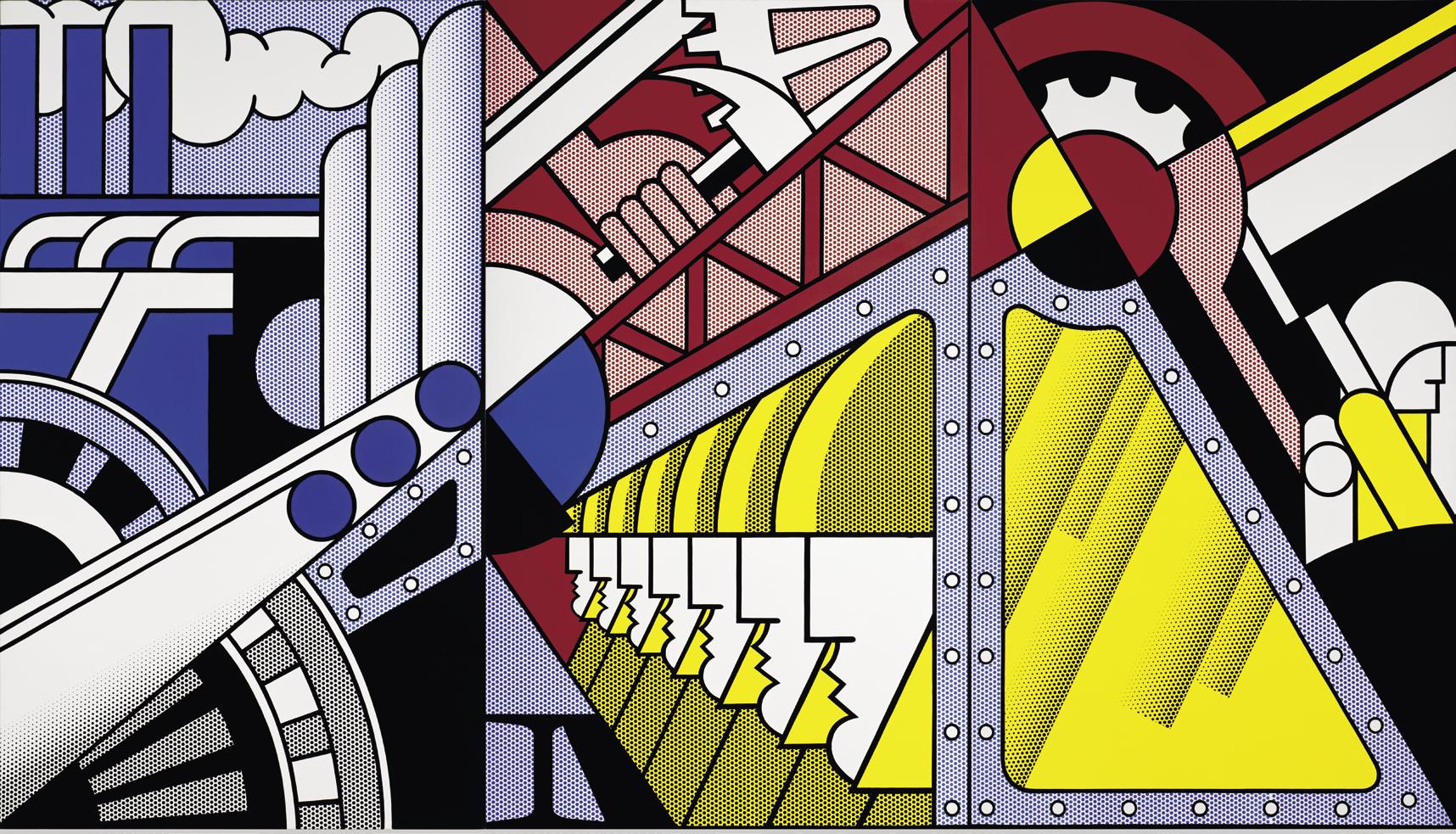
visual event of his early life. The fair was a hymn to industrial design, and the profession’s titans created pavilions and exhibitions for it. Lichtenstein derived later renditions of Depression-era motifs and images from its streamlined architecture and overall design, and he poked fun at a materialism marketed as social idealism. The fair’s main theme was “building the world of tomorrow,” and it trumpeted a fantastical future of machine-age efficiency. Television was introduced, as were Frigidaires and fluorescent lights. In its rampant consumerism, the fair was practically a lexicon of the Pop art that would emerge twenty years later, and throughout the 1960s Lichtenstein would exploit the ironies of an American escapism reached through technological bliss.
Like so many young people of his generation, Lichtenstein did not so much visit the fair as live in it. The art historian Robert Rosenblum was captivated by the fair as a child and was drawn back to it again and again; he would describe it as an “Elysian Fields” with a “science-fiction modernity,” akin to “something out of Buck Rogers or Flash Gordon” landing in Queens. 12 No wonder Lichtenstein registered the 1930s as sequences of design motifs and architectural caprices. Visitors entered the fair along a flag-lined boardwalk, beyond which gleamed a tall white obelisk and a wide white globe, united in a sleek partnership. These structures were the Trylon and Perisphere, the trademark symbols of the Fair. The Trylon and Perisphere, paired in geometric balance, were so freighted and yet so meaningless that forty years later Lichtenstein could not resist their graphic and humorous potential, incorporating them into two Surrealist-inflected paintings in 1977.
Lichtenstein’s favorite ride was Futurama, a spectacle devised by the designer Norman Bel Geddes for the General Motors pavilion. It was a sensational trip through a vision of what a fully motorized America would look like in 1960. Visitors sat in sound-equipped chairs on a train whooshing through a panorama of streets, mountains and rivers, airports and sidewalks, descending and ascending for fifteen thrilling minutes. Lichtenstein remembered the pavilion’s roads around planned cities, which prophesied miracles yet only made things worse. Preparedness (1968) and Peace through Chemistry (1969–70), two of Lichtenstein’s most biting titles, were inspired by the “rational thinking” and seemingly benevolent social straitjacketing implicit in corporate wishfulfillments like Futurama if taken to actual conclusions. Lichtenstein’s memory was accurate: The titles of the murals on the fair buildings’ exteriors were as bromidic as the ones he created. These murals were Lichtenstein’s first sustained exposure to a major art form of the 1930s. It was an art form that he would attempt with distinction, becoming one of the most significant muralists of his generation in what was largely a postmural culture.
From November 15, 1939, to January 7, 1940, Picasso: Forty Years of His Art took over the Modern. It opened during the first semester of Lichtenstein’s senior year in high school and contained more than 350 works, including Guernica . Lichtenstein did not say whether or not he saw this megashow in New York, although even more fiercely than in May, when the museum had reopened, he was closer to a future dedicated to art. In 1939 Lichtenstein was not entirely ready for Picasso, especially in such depth and intricacy. He recalled that when he first saw Picasso’s work, “it looked . . . very insensitive to me”—its “crudeness” was overwhelming, and
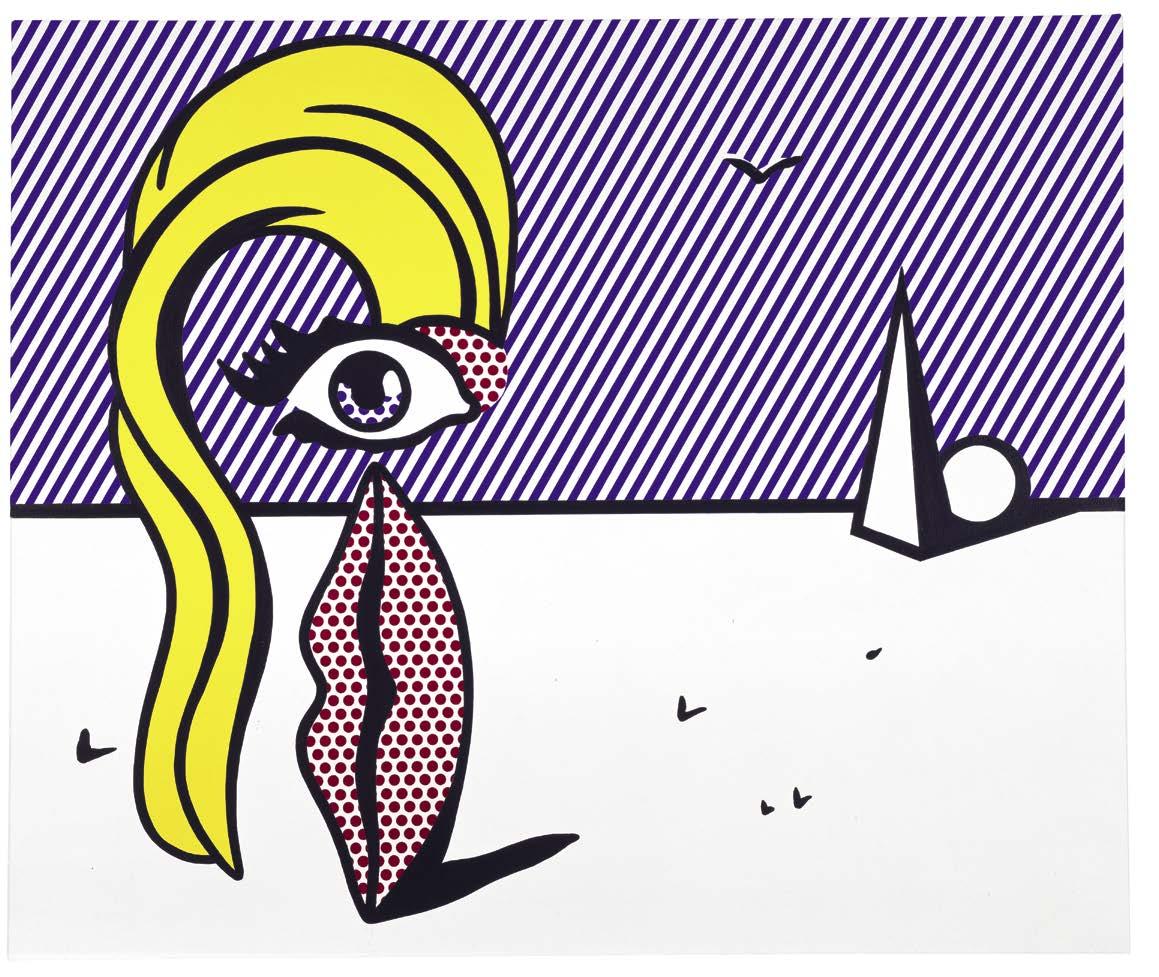
Guernica was one of the pictures that had perturbed him as crude. 13 Picasso’s raw vigor struck him as more threatening than tonic. By 1941, though, the Spaniard was Lichtenstein’s chief artistic god and Guernica his favorite painting.
As the summer of 1940 sped to an end, Lichtenstein prepared to enter Ohio State University, where he could get art training and the college degree his parents required. That September, he left the East Coast for Columbus. He would not live in New York full-time again until 1963.
Text © Avis Berman
1. Roy Lichtenstein, quoted in Avis Berman, “In a New Times Square, a Wink at Futures Past,” New York Times , September 1, 2002.
2. Selma Lichtenstein Koch, interview with the author, March 20, 2002, 42. Roy Lichtenstein Foundation Archives, New York.
3. Renée Lichtenstein Tolcott, interview with the author, July 26, 2001, 13–14. Roy Lichtenstein Foundation Archives.
4. Lichtenstein, in an interview with Frederic Tuten, January 22, 1988, 8. Roy Lichtenstein Foundation Archives. Lichtenstein, in Richard Brown Baker, “Oral history interview with Roy Lichtenstein, 1963 November 15–1964 January 15.” Archives of American Art, Smithsonian. Available online at www.aaa.si.edu/ collections/interviews/oral-history-interview-roy-lichtenstein11994#transcript (accessed December 20, 2025).
5. See McCandlish Phillips, “Returning from the 25th Century . . . ,” New York Times , December 2, 1969, 62.
6. James Lincoln Collier, Benny Goodman and the Swing Era (New York and Oxford: Oxford University Press, 1989), 214–15.
7. Lewis A. Erenberg, Swingin’ the Dream: Big Band Jazz and the Rebirth of American Culture (Chicago and London: University of Chicago Press, 1998), 82–83.
8. See Ross Firestone, Swing, Swing, Swing: The Life and Times of Benny Goodman (New York and London: W. W. Norton & Company, 1993), 183.
9. Ibid., 211.
10. See Michael FitzGerald, Picasso and American Art , exh. cat. (New York: Whitney Museum of American Art, in association with Yale University Press, New Haven and London, 2006), 169.
11. Russell Lynes, Good Old Modern: An Intimate Portrait of the Museum of Modern Art (New York: Atheneum, 1973), 197.
12. Robert Rosenblum, “Remembrance of Fairs Past,” in Remembering the Future: The New York World’s Fair from 1939 to 1964, exh. cat. (New York: Queens Museum/Rizzoli International Publications, 1989), 11–12.
13. Lichtenstein, in Baker, “Oral history interview with Roy Lichtenstein.”
Above: Roy Lichtenstein, Figure with Trylon and Perisphere, 1977, acrylic, oil, and graphite pencil on canvas, 42 × 50 inches (106.7 × 127 cm)
Artwork © 2026 Estate of Roy Lichtenstein/ DACS

Every building, a self-portrait
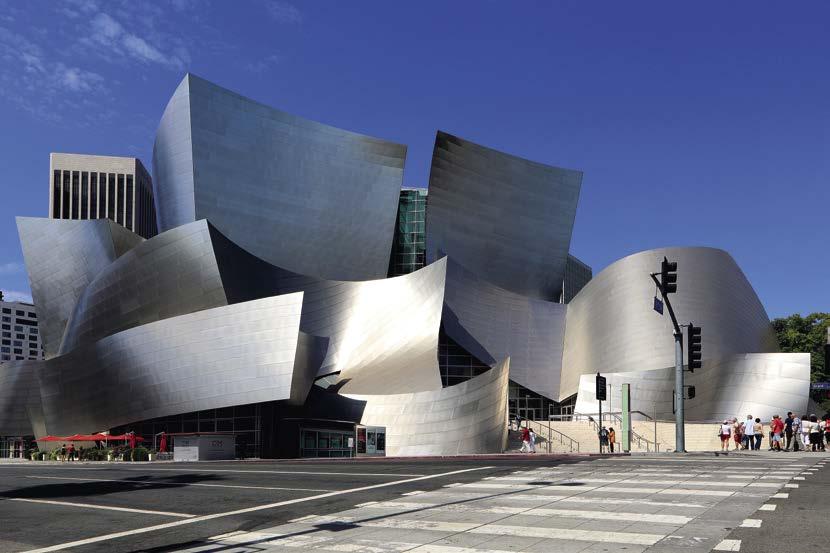
Deborah McLeod, senior director at Gagosian, Beverly Hills, reflects on the generous and innovative vision of Frank Gehry. Having worked with the architect and artist for more than a decade, McLeod addresses his outsized impact on the city of Los Angeles and the world beyond.
Frank Gehry was beating the clock and he wanted more time. He had so much to do, and his vision for the future of his adopted hometown Los Angeles—and of the world—was vibrant. This is how his optimism in these dark times prevailed; he was on a mission to transcend the known and to create architecture that was art, alive not inert, capable of inspiring joy and uniting us in awe. His calendar was packed: the opening of the Guggenheim Abu Dhabi next year, the 2028 Olympics in LA, and the realization of his ambitious LA River Master Plan, which is to bring art centers, public parks, and civic amenities to our underserved communities, transforming our city. Frank was so much a part of the fabric of LA, and for so long, that his loss seems to have knocked out our center of gravity. We are wobbling now, without our generous and daring visionary, our international icon, our teacher, our irrepressible agent of change for the good. He was the best of us and our vital GPS beacon.
As one of the most inventive and radical architects of the ages, Frank was consumed with his practice. His close family and deep friendships brought balance and joy. So did his extracurriculars: Frank played in a men’s hockey league until he was in his late seventies, he was an avid sailor, and he was deeply passionate about music. A teacher throughout his life, in 2014 he and Malissa Shriver cofounded Turnaround Arts California to bring art to low-performing elementary and middle school children in the state. He was a prince.
Previous spread:
The Walt Disney Concert Hall, Los Angeles, 2003. Architect: Gehry Partners, LLP and Frank O. Gehry. Photo: Ted Soqui/Corbis via Getty Images
Opposite:
The Walt Disney Concert Hall, Los Angeles, 2017. Architect: Gehry Partners, LLP and Frank O. Gehry. Photo: Raymond Boyd/Getty Images
This page:
Larry Gagosian and Frank Gehry at the opening of FrankGehry:AStudy, Gagosian, Beverly Hills, March 18–May 1, 1999. Photo: Bei/Shutterstock
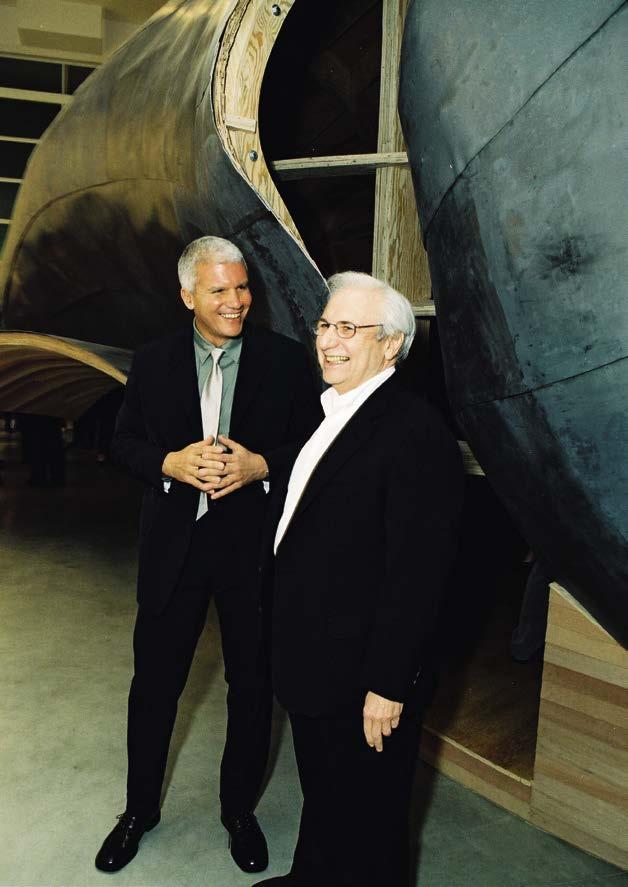
Among Frank’s happiest and most rewarding pursuits outside of architecture was his sculpture practice. He thought like an artist, his friends were nearly all artists and musicians, and he was in heaven creating art for art’s sake, with only himself to serve and satisfy. I had the supreme privilege of working with Frank in this regard at Gagosian for thirteen years.
Frank meant so much to our gallery, especially in Los Angeles, and he remains a pillar of our formidable artist roster. He was a giant, a radical deconstructor and inventor, like Pablo Picasso. Larry and Frank had a robust forty-year friendship and Larry tracked Frank’s practice closely, including his design work. Frank began to make furniture in the late 1960s and Fish and Snake Lamps in the early 1980s, when he participated in a Formica Corporation contest to show off its new laminate. Frank worked with Tomas Osinski, an artist, trusted craftsman, and friend, to help realize the lamps. In 1983 this resulted in the first Frank Gehry Fish Lamps, and they were exhibited at Gagosian Gallery in Los Angeles the following year.
The lamps were a watershed for Frank, who had been fascinated by the elegance and dynamism of the fish form for decades but now saw it as an architectural blueprint. He said he recognized “a complete vocabulary that I can draw from” and he never looked back. That first group of Fish Lamps— approximately two dozen—were acquired by luminaries including Agnes Gund, Jasper Johns, Philip Johnson, Victoria Newhouse, and Marcia Weisman. Frank kept good company. In 2012, the magnificent Frank Gehry–designed Fondation Louis Vuitton was under construction in Paris, and Larry had the good idea of making an exhibition of Frank’s beloved vintage Fish Lamp sculptures in our Paris gallery, which had opened just a year prior. “Paris loves Frank,” Larry had said. I made the call to Frank, he agreed to the show, and I set about locating the lamps we hoped to borrow. The next time I spoke to Frank, I took a flyer and asked if he would consider making a small edition of new Fish Lamps so that we would have something to sell in this exhibition of loaned works. Frank said he would think about it. The next day he said, “I have an idea.” You are very lucky if Frank Gehry has ever said this to you.
Frank had started to conceive of an entirely new body of Fish Lamp sculptures for Paris. The forms were more
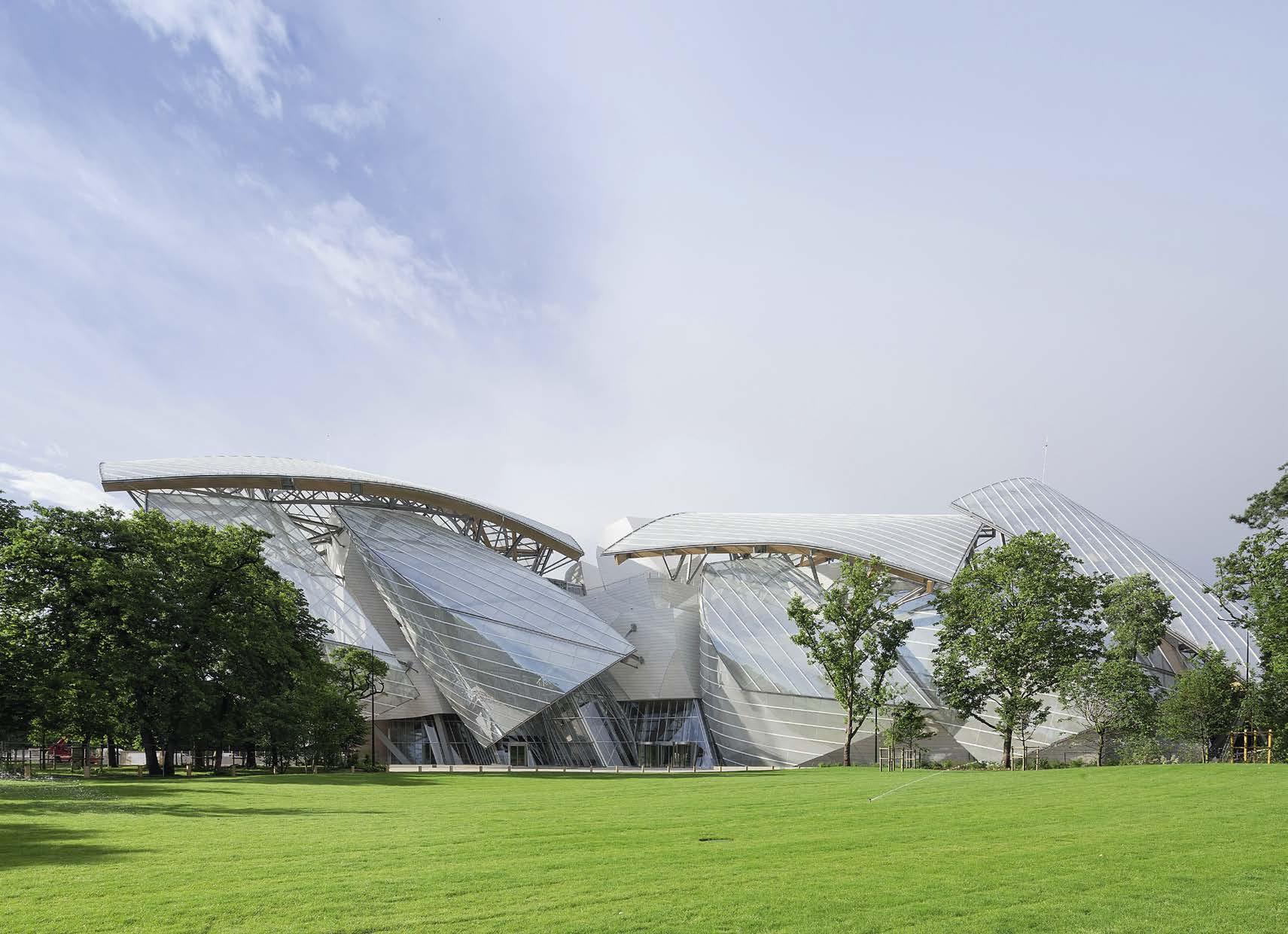
dynamic, some hanging from the ceiling, some diving, tails up, as big as men. Frank was so exhilarated that the show doubled and we presented this new work in both Paris and Los Angeles in concurrent shows in 2013. I was thrilled: Not only were we getting two shows of new work, but Frank Gehry was about to execute an architectural intervention in our Beverly Hills gallery. Dear Diary! Larry was thrilled too. Frank’s design was an amazement, with intimate darkened rooms to give the magical glowing lamps maximum effect. Immersive installations are common now but Frank was ahead of the curve, and we had lines around the block.
Frank’s art and architecture make you feel your humanity, and this was his intention. Fifty years ago, he wept when he stood in front of the classical Greek bronze Charioteer of Delphi: He had the charged realization that inert material sculpted by an unknown artist in the fifth century bce could touch him with profound emotional impact across millennia. This became Frank’s North Star principle for his architecture.
Frank was this way in person too. He was warm and put people at ease by telling stories that were funny and usually self-effacing. His mind sparkled and his thinking was fresh. Frank said, “If I knew where I was going, I wouldn’t take the project.”
Frank’s architectural language was the same language he spoke every day. One of love, joy, and compassion. Frank’s emotional and symphonic architecture captured and radiated all of that. Each of his buildings is a self-portrait. The world will miss Frank Gehry terribly, and in LA it will be a sharper pain. Frank said he wanted his buildings to provide comfort. We shall look for it there.
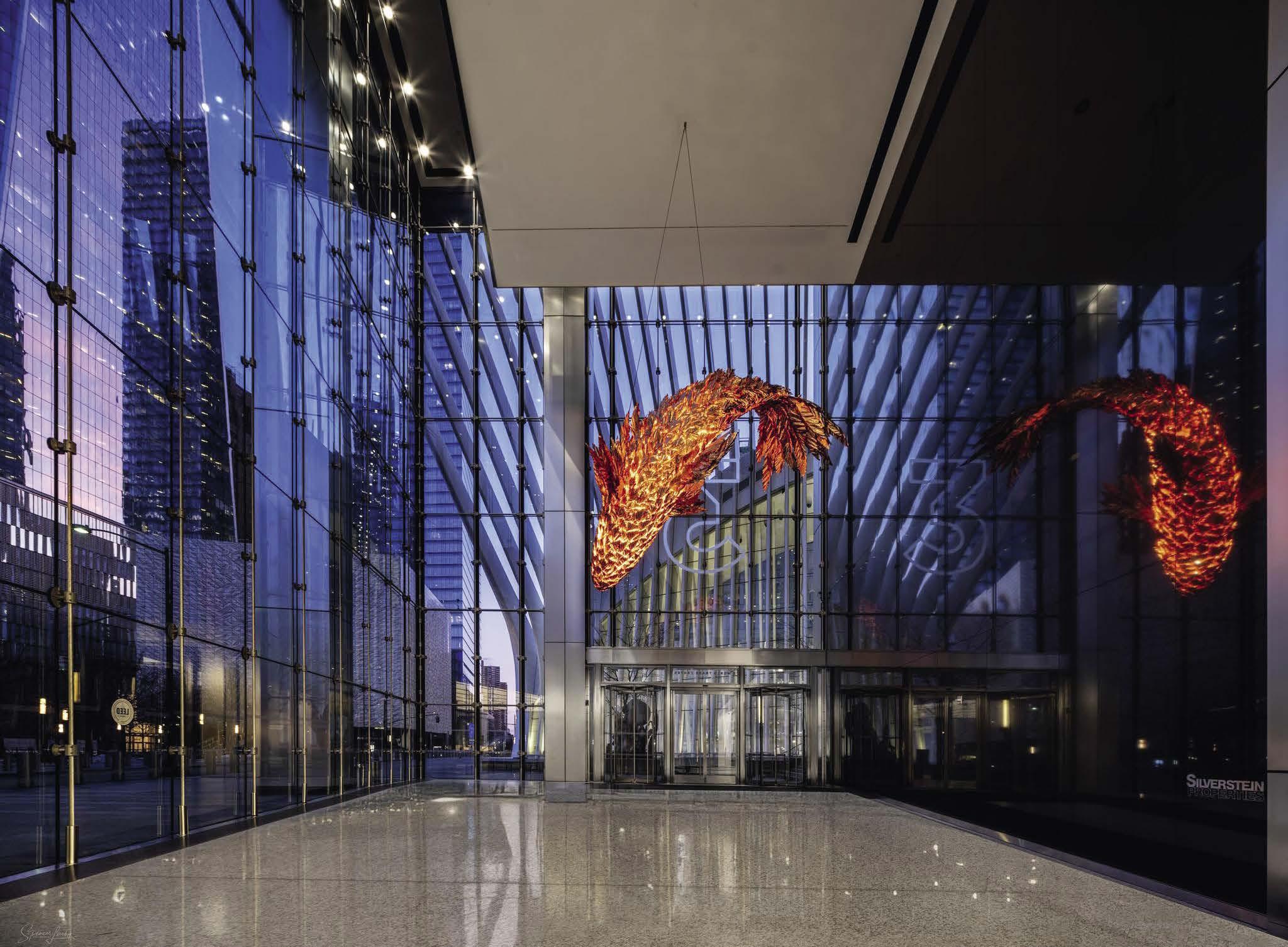
Frank’s architectural language was the same language he spoke every day. One of love, joy, and compassion. Frank’s emotional and symphonic architecture captured and radiated all of that. Each of his buildings is a self-portrait.

Vicky Richardson surveys the unceasing explorations in the practice of the London-based architect Farshid Moussavi.

Farshid Moussavi thrives on the unpredictability of contemporary life, in which, she says, “change is the only constant.” Circumstances that make most of us anxious or insecure drive her to want to learn more about the world. Alongside running an international architecture practice, Moussavi is a prolific writer—author of four books—and for the past twenty years has held the post of professor in practice of architecture at the Harvard Graduate School of Design. She also finds time to be “town architect” of Lewisham, a borough in South London, and an active member of the Royal Academy of Arts.
Iranian born, Moussavi has lived all over the world but makes her home in London, a city she describes as having a “unique sense of freedom.” The openness of London’s culture, and the city heritage that she says is “constantly being reworked,” plays to her ability to navigate the complexity of history, aesthetics, and politics. Founded in 2011, her East London studio, Farshid Moussavi Architecture (FMA), is developing a range of projects that reflect Moussavi’s interests, including a bespoke store for a luxury brand in Shanghai; a primary school and mixed-use apartment buildings in France; and the design of a tapestry for an exhibition in Scotland. Her largest project to date, the Ismaili Center, Houston, has been her main focus for the past six years and opened to the public last December.
Moussavi’s latest and possibly most exciting challenge is to design a new wing for the National Gallery in London’s Trafalgar Square. FMA has been shortlisted in a high-profile competition alongside a stellar group of global architects: Foster + Partners, Kengo Kuma & Associates (profiled in the Summer 2025 issue of the Quarterly), Renzo
Piano Building Workshop, Selldorf Architects, and Studio Seilern. This is a huge moment for Moussavi, who has yet to design a major cultural building in her home city. She describes the opportunity as a “perfect project because it involves thinking about the next chapter of the museum, and as part of that, the contribution museums make to the cultural life of the city.”
Moussavi initially made her name in the 1990s with her previous practice, Foreign Office Architects, a practice title that she and Alejandro Zaera-Polo, her partner there and former husband, came up with to express the condition of being outsiders in London. Moussavi then spent several years as an itinerant architect: in Cambridge, Massachusetts, for two years while working on her master’s at Harvard Graduate School of Design; in Genoa working for Renzo Piano; in Rotterdam with Rem Koolhaas’s practice OMA; in Tokyo, working on Foreign Office Architects’ award-winning Yokohama Port Terminal, completed in 2001; and in Vienna as head of the Akademie der bildenden Künste’s Institut für Kunst und Architektur from 2002 to 2006. Reflecting on what drew her back to London, she says, “Each place I’ve lived in is different, but they all expected you to conform. I love the fact that British culture allows you to be who you want to be. You can walk into any store on Sloane Street and no one will judge the way you look. Whereas in Italy if you don’t change your tights from black to nude on the first day of spring, you get tutted at.”
The mental image of Moussavi on a bus in Italy wearing black in the sunshine easily comes to mind. When we meet she is dressed head to toe in black Comme des Garçons, with a signature puffy skirt and Peter Pan collar

blouse. She insists that the distinctive outfit is—like her architecture—purely practical: “I’m wearing a nylon shirt that can go in the washing machine and my wedge shoes are very comfortable.”
The freedom that Moussavi experiences in London allows her to move easily between the worlds of architecture, art, and fashion. Fashion designers Hussein Chalayan and Daniel W. Fletcher are good friends, and the sculptural clothing she wears by Junya Watanabe, sacai, and Simone Rocha seems to reflect the inventive forms and decorative flourish of her architecture. Moussavi has in fact given much thought to the meaning and role of decoration within architecture: Her first book, Function of Ornament (2006), argued against the traditional counter-positioning of the two nouns of the title, saying that ornament itself is a “produced affect” that has agency in relation to the experience of a building.
La Folie Divine of 2017, a nine-story apartment building in Montpellier, is a case in point. Its curvilinear balconies protrude like frills around the facade. Corrugated aluminum paneling gives way to rippling curtains, and the effect is a playful form that corresponds to the brief for a modern-day folie. But this is not decoration whose purpose is to enliven an otherwise conventional housing block—rather, the exaggerated curves are the expression of an experimental new living space with flexible, adaptable interiors and private outdoor space.
FMA is working on two more projects in France. Although the country is geographically close to the United Kingdom, its architectural culture is very different, which Moussavi enjoys: “In France architects are expected to have a vision which is not just aesthetic but also political, urban, social, and environmental. They believe the architect is the best person to lead a project, and that the architect can be both an artist and an intellectual.”
Unlike some leaders of international practices, Moussavi is not a figurehead who leaves others in the office to do the work. In 2011, when FMA won its first commission for housing—at La Défense-Nanterre, just north of the city of Paris—she threw herself into researching experimental social housing and urbanism, taking groups of students to explore the neglected suburbs of Ivry and Aubervilliers. In the process she became a champion of the pioneering French architect Renée Gailhoustet, whose imaginative social housing designs from the 1960s–’80s have been a major influence on FMA’s work.
This
Moussavi relishes a new project at Saclay, south of Paris, and another in Montpellier. Both sites are new urban districts offering the possibility of projecting a new outlook on life and architecture. At the zac République in Port Marianne, a developing neighborhood of Montpellier, the practice is designing a building that unusually combines offices and homes, allowing the possibility of reversing those uses should the demand change. It’s a forward-looking approach that Moussavi believes stems from France’s productive system of public accountability combined with a dynamic private sector. In Saclay, a new research quartier, FMA is designing a primary school that will serve a community of academics and researchers. It offers the opportunity to respond to the scale of children with a means of construction that includes simple, playful details. The facade will be clad in circular ceramic tiles, layered like shingles, in three soft colors. “The impression is of clouds, fish scales, or maybe speech bubbles,” says Moussavi. “Hopefully children will feel they are in a unique, exciting place.” The challenge of such bespoke, one-off projects is that they draw Moussavi into an effort for each building to “belong to its context and time.” To allow this level of involvement, she is careful not to allow the practice to grow too large, and brings in extra capacity and specialist knowledge by collaborating with other architects and engineers.
The recent completion of the Ismaili Center in Houston was a major milestone for FMA. It is the first Ismaili Center in the United States—there are six others in Europe, Asia, and Canada—and occupies an eleven-acre site, where it provides not only spaces for Muslim prayer and religious gathering but also civic and cultural spaces for Muslims and non-Muslims alike. The project brings many of Moussavi’s ideas together in response to a sensitive brief set by the late Aga Khan Prince Karim, who sadly passed away in February 2025, before the building’s completion.
The commission might easily have been an opportunity for Moussavi to reflect on her Iranian identity, given that the Ismaili branch of Shia Islam has its origins in Persia. But Moussavi dislikes the stress on celebrating identity and prefers to see the project as a chance to bridge East and West. “I avoided a representational take on the project and wanted to find a way to renew certain Islamic practices of working with structure, light, and craft,” she says. The building references Islamic architecture through the practical provision of spaces rooted in the context and climate of Houston. A primary consideration was to mitigate the heat and humidity of the region by creating outdoor covered verandas, which echo Persian eivaˉn-haˉ and connect the interior to the landscape outside. At the heart of the building is a high atrium, which recalls Islamic domes but actually consists of stacked cutouts with a rotating geometry. The building’s ornament is not applied decoration, as in traditional Islamic architecture, but generated by playing with new stonecutting techniques to create patterns in dialogue with the space.
Each project is a learning experience for Moussavi, who says she is “passionate about the knowledge that is transferable from project to project across time.” For a moment she is taken back to the late 1990s, when she and Zaera-Polo designed the Yokohama Port Terminal and learned for the first time to use computers for design and construction. She reflects, “It’s amazing we managed to see it through—it didn’t even look like a building!”
Moussavi wrote her most recent book, Architecture andMicropolitics (2023), as a consideration of how designs emerge and of the common perception in the profession that architects have lost influence. This is the closest she has to a manifesto, although it takes the form of a six-hundred-page pavement slab rather than a slim pamphlet. Featuring a bright red cover and a mirror glued to the front, the bold design, by the OK-RM studio, reflects the idea of agency that is so important to her, literally bringing the reader into the picture.
Most of the book is taken up with documenting in immense detail four FMA projects from 2011–22. There are pages and pages of intricate drawings illustrating the taxonomy of elements in a museum (FMA’s design for the Museum of Contemporary Art Cleveland) and exhaustive studies showing color, geometry, and analysis of the brief. Each project receives a rhizomatic diagram capturing the moment when key design decisions were made. The overall effect is like the complex folded façade of a Moussavi building. If you need convincing that Moussavi can handle complexity, there is for good measure an essay by the French philosopher Jacques Rancière outlining the connection between politics and aesthetics. The book is beautiful and compelling but is perhaps overcomplicated, particularly considering that Moussavi’s message is pretty simple—that the architect’s role is to find the opportunities. In response to the suggestion that she might be celebrating complexity, Moussavi explains, “Normally buildings are reduced to plans and maybe an architect’s sketch, but the book tries to capture the extensive space and dynamics of an architectural project to show that there are opportunities for micropolitics as the architectural process unfolds, often in unexpected ways. So, the message is simple but the task is not.”
Opposite:
The exterior of the Ismaili Center, Houston.
Architect: Farshid Moussavi Architecture.
Photo: Iwan Baan
This page: The interior of the Ismaili Center, Houston.
Architect: Farshid Moussavi Architecture.
Photo: Iwan Baan
As a woman in the predominantly male world of architecture, Moussavi has learned to hold her own in challenging situations and finds no contradiction between having strong opinions and working collaboratively. Other women architects who have similarly combined a fighting spirit with an open, collaborative way of working come to mind—notably Gailhoustet, whose work is receiving attention thanks in part to Moussavi’s efforts, and the Brazilian/Italian architect Lina Bo Bardi. “Women are good at holding the ship together, whether at the scale of a family or a business,” says Moussavi, who keenly champions the role of women in the field but is reluctant to be limited by the label of “woman architect.” In our current identity-driven culture, where both self- and group expression are so important, Moussavi stands out: “I’m not interested in expressing my background, whether as an Iranian or as a woman. In fact, I get irritated by architects who use their identity to talk about their projects.” As if conscious that culture today is becoming entrenched in different positions—a direction alien to the beliefs of the late Aga Khan, who so inspired her—Moussavi proposed “dialogue” as the theme of last year’s Royal Academy Summer Exhibition. Taking on the role of “coordinator” of the exhibition—a position dating back to the Academy’s beginnings, in 1768—Moussavi proposed a radical restructuring, mixing architecture with art for the first time and encouraging conversation among artists from different cultural backgrounds. It was a risky approach, as the show is routinely panned by critics for its eclectic mix of high art and “puppy paintings,” but Moussavi’s curation was praised by many and succeeded in shifting the exhibition into new territory. Making change, at whatever level possible, is one of Moussavi’s greatest contributions to art, culture, and architecture—not in the “change the world” sense meant by Ben & Jerry’s, but in the sense of letting go of the past. “When you’re the child of refugees,” she explains, “you have to embrace change. I saw my parents having to start again, working hard. There’s optimism in the idea you can let go and start again.”
Kenneth
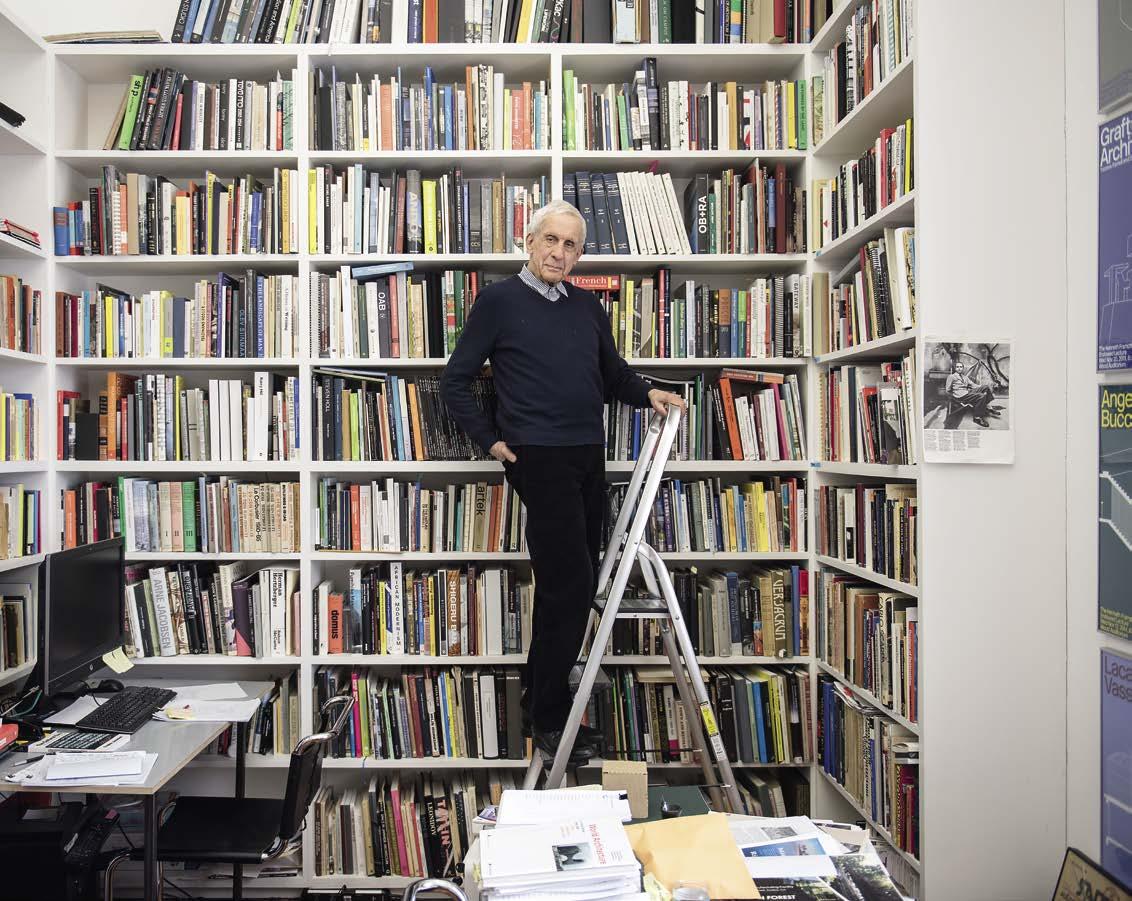
Bartolomeo Sala revisits the career of the esteemed critic and historian and makes a case for the continued relevance of his humanist approach.
Neverhavethepotentialpoliticalconsequencesofarchitecturebeengreater,andneverhasthepoliticalsensibilityof architecture been less.
—Richard Sennett, DemocracyandUrbanForm, 1980
The contemporary city is a place affected by multiple, often compounding crises. City centers and high streets are hollowed out and turned into touristic playgrounds while inhabitants decamp to faraway suburbs. Snaking motorways tear at the urban fabric. Real estate prices and rents are exorbitant. High-rise financial citadels and single architectural set pieces barely mask the reality of living in what is just—bar a few pockets of affluence—an endless urban sprawl, while genuine public spaces, or whatever is left of them, are mostly the vestiges of civilizations past. This condition, by which metropolises have gone past the “scrambled” stage to turn into ill-defined suburban agglomerations, has been so naturalized that the popular solution has become an increasingly technocratic one that seeks to accelerate the current model, as if building more and more indiscriminately would deliver a different outcome rather than exacerbate problems as endemic as the housing crisis.
Opposite: Kenneth Frampton, emeritus professor of architecture at the Graduate School of Architecture, Planning and Preservation at Columbia University, in his office, New York, 2019. Photo: Alex Fradkin/Redux
Below:
Corringham, London, 1964.
Architect: Kenneth Frampton.
Photo: © The Estate of Sam Lambert
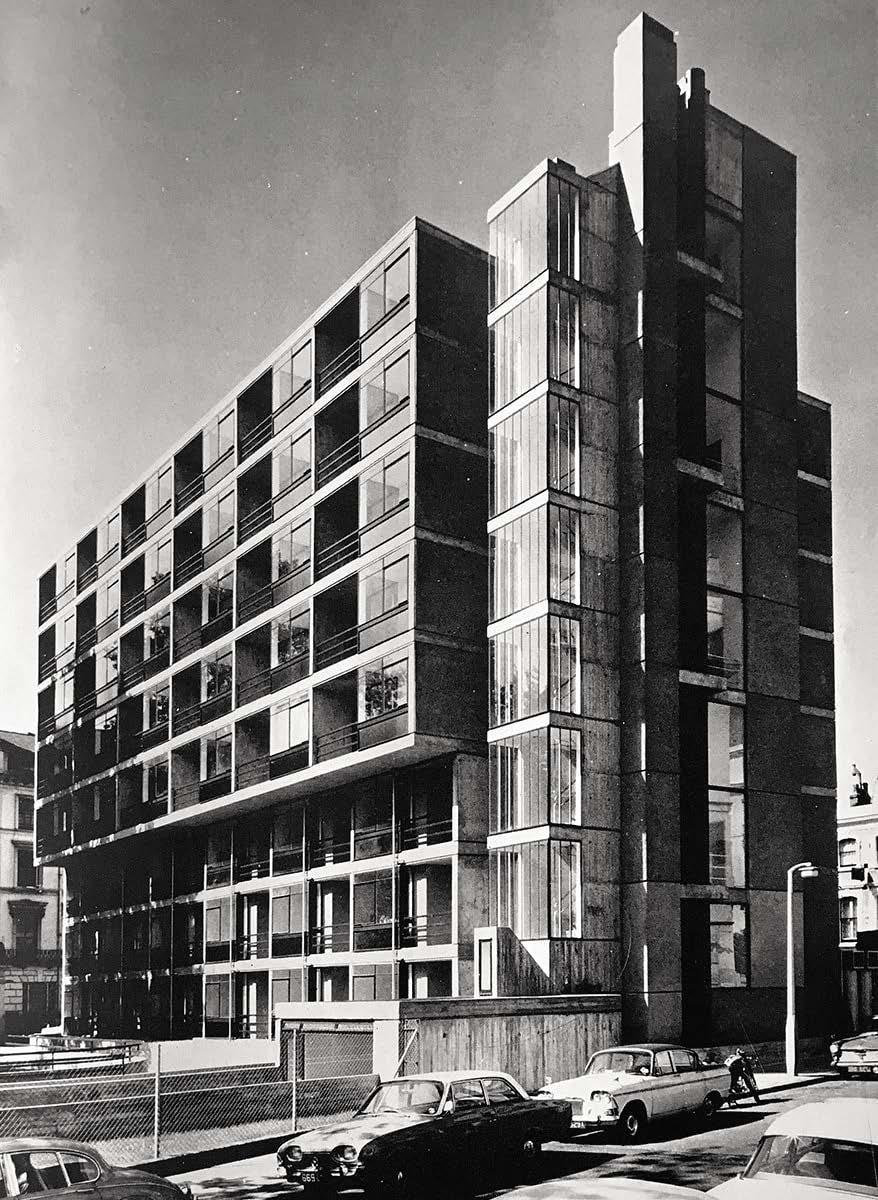
A writer who has never had patience for the turn contemporary cities have taken in the last half century, tirelessly criticizing their universal grammar of “freestanding highrises” and “serpentine freeways” surrounded by a suburban hinterland, is Kenneth Frampton, emeritus professor of architecture at Columbia University and author of Modern Architecture:ACriticalHistory, his incredibly influential textbook first published in 1980 and now in its fifth revision. Born in 1935 in Woking, a commuter town southwest of London, Frampton completed his studies at the Architectural Association School of Architecture, where the modernist cult of technology inherent in functionalism, the approach then on the rise, was balanced by the Arts and Crafts tradition, a long-standing humanist outlook seeking to undo some of the most alienating and destructive aspects of industrial civilization.1 In London in 1960–64, Frampton designed a residential apartment block inspired by both Russian Constructivism and Le Corbusier’s Unité d’Habitation. This structure—Corringham, in Bayswater—remains his only building as a practicing architect. Frampton’s career took an unexpected and decisive turn in 1965, when he moved to the United States to pursue a career in teaching. An anecdote he tells, a sort of origin story to his radicalization, is the experience of traveling in a helicopter over Manhattan during his first trip to the United States and suddenly being confronted with the city’s nightscape, a “ferocious panorama” of lights, cars, and consumerism. 2 Another, at around the same time, was reading Hannah Arendt’s book The Human Condition (1958), which, with its emphasis on ever-accelerating cycles of production and consumption eating away at genuine human freedom and action, proved a decisive influence on his work. Frampton would spend most of the subsequent decade and a half writing essays informed by Arendt’s thinking, as well as by the writings of Walter Benjamin and Herbert Marcuse—critical thinkers who likewise, while “acutely aware of the dark side of the Enlightenment,” never abdicated from the socialist promise inherent to what Frampton, following Jürgen Habermas, calls the “unfinished modern project.”3 (Modern Architecture famously opens with Benjamin’s passage on Paul Klee’s monoprint AngelusNovus [1920], which the latest edition, published in 2020, juxtaposes with another image of the wreckage left behind by progress: a nineteenth-century engraving of Paris in which the recently built Arc de Triomphe towers over the barrière de l’Etoile, then in the process of demolition.)
All these preoccupations would culminate in what to this day remains Frampton’s most influential and incisive piece of what some of his detractors called “operative” criti-
cism—that is, criticism that doesn’t simply describe but seeks to influence architectural practice. First published in 1983, “Towards a Critical Regionalism: Six Points for an Architecture of Resistance” wasn’t merely an intervention against the eclecticism of postmodern architecture, which had been sanctioned three years earlier in Paolo Portoghesi’s exhibition The End of Prohibition and the Presence of the Past, the show that constituted the first Venice Architecture Biennale. More important, the essay attempted to show how this new kind of architecture—which renounced all socialist commitment while embracing technique and spectacle for their own sake—did nothing to correct the flaws inherent to the modern movement it reacted against. Rather, it worked merely as a “compensatory facade” to capitalism’s fundamental homogenizing thrust, its refashioning and flattening of the world into its own image.4
Against this “universal placelessness” Frampton pitched architecture as a critical practice openly fighting “the relentless onslaught of global modernization” by both trying to recuperate culturally rooted, site-specific forms of building and producing spaces in which people could meet and act together. 5 Detailing what he was not afraid to call an “arrière-garde position,” almost a war of attrition, Frampton made clear that what he meant by “critical regionalism” was not the nostalgic return of some imagined tradition, vernacular, or codified style.6 Rather, it was a practice that sensitively combined modern building techniques with elements drawn from the repository of world culture in order to preserve architecture’s fundamental function as a “space of human appearance”—an Arendt coinage he had long made his own.7 As an example, Frampton cited Jørn Utzon’s Bagsvaerd Church in Copenhagen (1976), which, by combining an “optimal”
Frampton pitched architecture as a critical practice openly fighting “the relentless onslaught of global modernization” by both trying to recuperate
culturally
rooted, site-specific forms of building and producing spaces in which people could meet and act together.
Kenneth Frampton and unidentified person (likely a student) looking at a model, c. 1980–2000. Photo: G. Steve Jordan, courtesy Kenneth Frampton fonds, Canadian Centre for Architecture, Montreal, gift of Kenneth Frampton
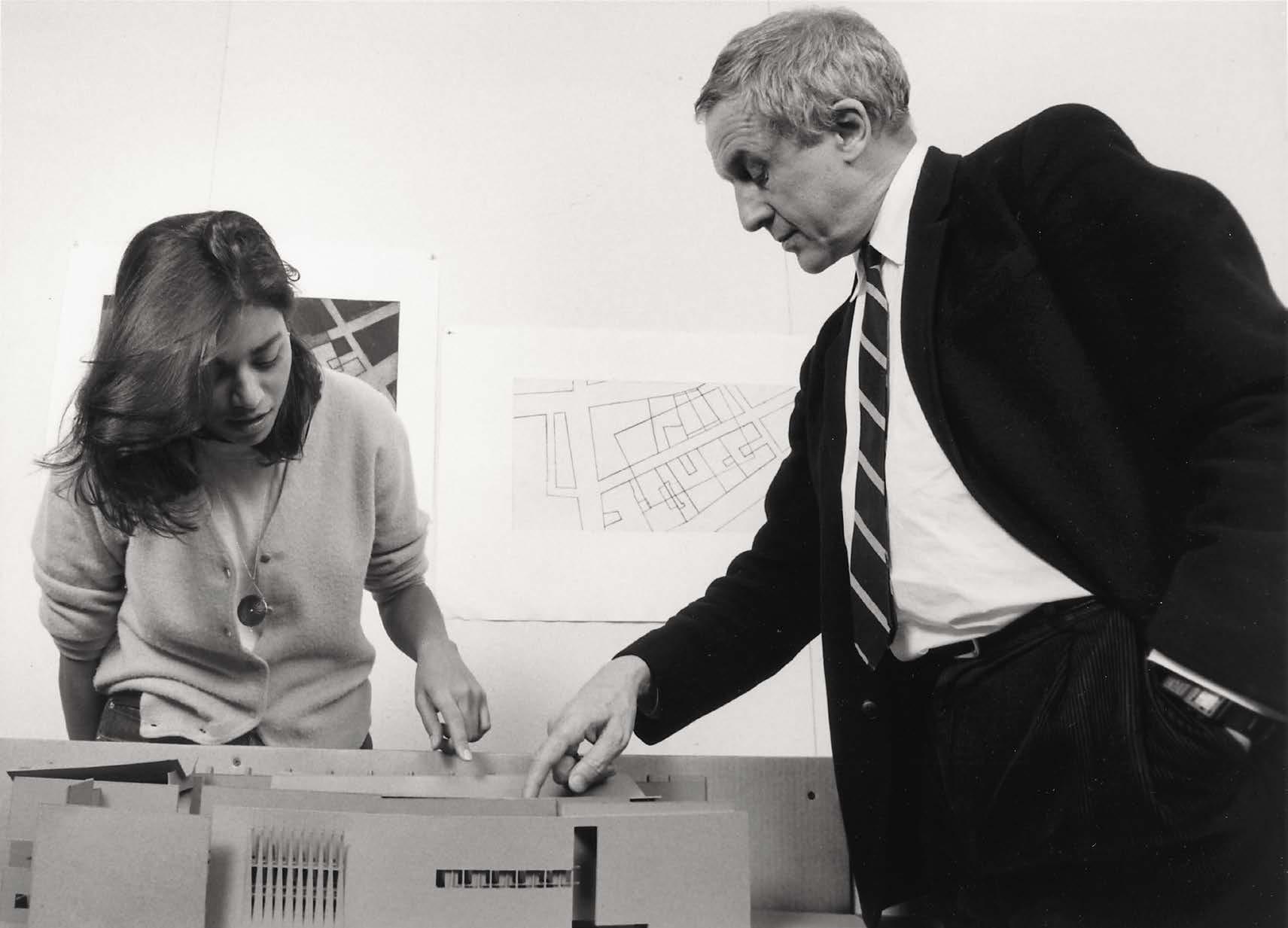
Kenneth Frampton
modular exterior with “a far less optimal” reinforced-concrete shell vault reminiscent of a pagoda roof, delivered “a new basis for the spiritual” for our highly secular age. 8
“Towards a Critical Regionalism” presented all the themes that are central to Frampton’s thought. Points 5 and 6 in particular, “Culture Versus Nature” and “The Visual Versus the Tactile,” contained—as it were, in nuce—ideas that grounded his argument and made it nuanced and compelling. Due to the dense nature of the writing and its reliance on continental philosophers such as Paul Ricoeur, whose quote about modernization constituting a “subtle destruction” not just of “traditional cultures” per se but of the very “creative nucleus of great cultures” serves as the essay’s epigraph, it is easy to see how it could come off as a little fuzzy—a collection of value statements rather than a workable program. 9 As Mary McLeod reports in an illuminating essay, Fredric Jameson, for instance, dismissed the essay’s ideas on the grounds that “Frampton’s ‘arrière-garde’ critique was itself participating in the celebration of pluralism and difference so typical of both postmodernism and late capitalism.”10 Frampton dedicated most of his subsequent work to refining and developing his intuitions. At the risk of simplifying slightly, I would say that he focused his reflection on two ideas that, together, gave substance to his theory of a critical architectural practice. The first of these concepts is “tectonics,” namely the idea that a building, rather than having a disembodied facade circulating mainly as an image (think the “Bilbao effect”), should arise organically from and showcase the construction techniques, the craft, and the materials employed. (The term “tectonics” itself, which Frampton can be credited with reviving in architectural parlance, refers to the art and science of construction.) The natural corollary of this principle is the treatment of architecture not as divorced from its context but rather as the natural continuation of its surroundings, and thus in intimate dialogue with not just the local culture and way of life but also the topography, contingencies of climate, and qualities of light on the site. Frampton would develop this idea in his concepts of “megaform” and “urban acupuncture,” and in the belief—advanced, for instance, in “Seven Points for the Millennium: An Untimely Manifesto”—that “the cultivation of landscape” should take precedence over “concentrating exclusively . . . on the design of buildings as aesthetic objects.”11
The second concept is the idea of “phenomenology” or the “tactile,” that is, the idea that we experience a building through all five senses, not just sight alone. “Varying levels of illumination, ambient sensations of heat, cold, humidity and air movement, varying aromas and sounds” all the way down to “floor finishes” all have an influence on how we take in and interact with the environment.12 This might sound like a frivolous point, but it strikes at the heart of Frampton’s conception of architecture as a provider of habitats conducive to human flourishing. Indeed, the idea brings within itself a scathing
1. On this formative yet mostly overlooked period in Kenneth Frampton’s life, see Jorge Otero-Pailos, “Surplus Experience: Kenneth Frampton and the Subterfuges of Bourgeois Taste,” chapter 5 in OteroPailos’s Architecture’s Historical Turn: PhenomenologyandtheRiseofthe Postmodern (Minneapolis: University of Minnesota Press, 2010), 183–250.
2. Frampton, in Matthew Blunderfield, “Kenneth Frampton,” Scaffold podcast (London: Architecture Foundation, November 28, 2025). Available online at https://podcasts.apple.com/ gb/podcast/kenneth-frampton/ id1345689462?i=1000738759973 (accessed December 26, 2025).
3. Frampton, Modern Architecture: A Critical
critique of the current way of building that reduces everything to an Existenzminimum overdetermined by the diktats of real estate and housing markets. It also suggests a return to a more sustainable way of building that, in foregrounding the lived experience of the inhabitants, combines “long-life/ loose-fit” buildings with “lower-rise, high-density” developments to offset some of the nefarious effects of contemporary motorized sprawl.13
Frampton never developed his ideas in a vacuum but rather in response to specific architects. These, of course, include the Portuguese Álvaro Siza and the Japanese Tadao Ando, both of whom he has graced with monographs. Another architect who features prominently in his writings is the Finn Alvar Aalto—“the one figure from the so-called ‘heroic core’ of the modern movement” whose practice always showcased a “phenomenological” attention to human well-being, which—together with the incorporation of vernacular sources and sensitivity to light—set him apart and make “his legacy . . . still ripe for further development.”14
As imagined in “Towards a Critical Regionalism” and Frampton’s other writings, architecture is a marginal activity, made obsolete by the instrumental thinking of capitalism and purposefully trying to mend its damages while subsisting at its edges. The introduction to the most recent edition of Modern Architecture concludes with the statement, “At best, what is left for the critical practice of architecture at a large scale are predominantly horizontal megaforms designed as artificial landscapes in order to encapsulate some vestige of the civic, and stand against the universal placelessness of the environment as a whole.”15 One can wonder if there is something quietist about this, but that impression is fundamentally contradicted by not just Frampton’s immense influence on architecture as a whole (in 2018, he received a Golden Lion for Lifetime Achievement at the Venice Architecture Biennale) but also the highly reflexive nature of his work, in which he constantly revises and refines his ideas. (The same revision of Modern Architecture, published when he was ninety years old, presents a whole new section called “World Architecture” in which he seeks to correct the Eurocentric bias of the previous editions.)
Although Frampton refers directly to Antonio Gramsci relatively rarely in his writing, his posture is close to Gramsci’s maxim “Pessimism of the intellect, optimism of the will.” Architecture’s room for maneuver might be limited but it can still have far-reaching effects. Indeed, in a world like ours, where design has turned positively hostile and seeks to cement rather than challenge the feeling of living in a crushing techno-dystopia (the Vessel in Manhattan’s Hudson Yards and Tesla’s Cybertruck are two great cases in point), Frampton’s operative criticism returns to the humanist roots of architecture, and in so doing provides, “against the prospect of cultural degeneration” that seems now more inevitable than ever, “a basis from which to resist.”16
History, 1980 (5th rev. ed. London: Thames & Hudson, 2023), 11–12.
4. Frampton, “Towards a Critical Regionalism: Six Points for an Architecture of Resistance,” in Hal Foster, ed., The AntiAesthetic:EssaysonPostmodernCulture (Port Townsend, WA: Bay Press, 1983), 17.
5. Ibid., 24, 29.
6. Ibid., 20.
7. Ibid., 25.
8. Ibid., 22–23.
9. The epigraph comes from Paul Ricoeur, HistoryandTruth, 1955 (Eng. trans. Charles A. Kelbley, Evanston: Northwestern University Press, 1965), 276–77.
10. Mary McLeod, “Kenneth Frampton’s Idea of the ‘Critical,’” in Frampton, Daniel Talesnik, and McLeod, KennethFrampton:
ConversationswithDanielTalesnik,Essay byMaryMcLeod (New York: Columbia University Press, 2023), 20.
11. Frampton, “Seven Points for the Millennium: An Untimely Manifesto,” in The Architectural Review 206, no. 1233 (November 1999): 76–80.
12. Frampton, Modern Architecture, 366.
13. Ibid., 628–34.
14. Frampton, in Frampton, Talesnik, and McLeod, Conversations with Daniel Talesnik, 175.
15. Frampton, Modern Architecture, 12.
16. Frampton, “Rappel à l’Ordre: The Case for the Tectonic,” ArchitecturalDesign 60, no. 3–4 (1990) 20.


Architect, professor, and curator of last year’s Venice Architecture Biennale, Carlo Ratti, met with Edoardo Zegna, a fourth-generation leader of the Zegna clothing house, to explore the intersections of architecture and fashion, focusing on sustainability and the challenge of balancing global brand identity with local specificities.
CARLO RATTI It’s often said that architecture is our third skin, fashion—the clothes we wear—being our second skin and our biological one being the first. What do you think?
EDOARDO ZEGNA That’s interesting. I don’t know if you work only on the third skin and we work only on the second skin. Clearly we dress people, but actually I hope we go way beyond the second skin: We literally touch the first skin and maybe figuratively the third. Why does one buy one brand versus another? It’s not a matter of going around naked or dressed; fashion helps people build layers of themselves, a story through clothing. It goes way beyond the product. But that said, I like this analogy of the second and third skins.
CR I was thinking about it when curating the Venice Architecture Biennale: The blending of natural and artificial is a bit like the blending of different skins. The three skins is a simple way to look at it. There’s also perhaps the planetary skin, which is an interface between the human and everything around. When we design a building or a public space or a master plan for a city, we consider if it’s accessible or if only a few can get a piece of it. In your work, how do you reconcile that?
EZ When you buy a piece of our clothing, it expands you. But as you say, they’re not for everybody. Somebody once said, “The best things in the world are free. The second-best things in the world are expensive.” I like that. And I think the vision of my great-grandfather started with, How can I make the most luxurious things in the world accessible to the most people? But in many ways you’re right that the products of my industry can be labeled as things not everybody can touch.
For me, as the fourth generation of a family and a brand, the one thing I want to be remembered for is something that’s actually very accessible to everybody: That’s Oasi Zegna, this amazing hundredsquare-kilometer natural territory in the Italian Alps that my great-grandfather had the vision to plant and protect in 1930. What makes me so proud of this place is that he didn’t do all of this for fame, for money, for ego; he did it because it felt right. And I think in today’s world this is such a luxurious sentiment. So, on your point about touching people: My hope, probably one of my big missions, is to ensure that people
can have access to the style of life that is Zegna on a wider spectrum. Does that make sense, Carlo?
CR Yes, you have different contact points. In architecture that works in a similar way; you can design for everybody in public space, but you’ve also got different ways to engage with it.
Something else I was thinking about, having been to Oasi Zegna, is the particular experience of the purity, the fresh air, the snow during the winter. Where your grandfather was, this place in the Alps, is very close to formative places where I’ve spent time. And there’s this thing that we look at a lot in our work, it’s an old question by the French philosopher Paul Ricœur about the relationship between unique places and the problem of universalities, the fact that some things tend to replicate across the whole planet. I just did a project in Berlin for COP30 [the 30th Conference of the Parties to the United Nations Framework Convention on Climate Change] in the middle of the Amazon, and you end up absorbing the climate, people’s input, and blending it into the project. So your project is always mediating between a universal idea and then the local condition. How does that play out for you?
In your case with Zegna, is it the same in Japan and on Fifth Avenue, New York? How does this tension work between what is universal and what is specific to a place?
EZ One needs to be careful as a brand not to localize too much, because then you risk losing yourself and the main reason somebody wants to associate with you. That doesn’t mean that one shouldn’t be looking at local cultures and traditions to put inside the full package. I mean, we’re talking about psychology almost: The essence of desirability stems from having a very clear idea of who you are, and then people really recognize you and your difference. So this is why I challenge my design team. Ultimately, to be really desirable is not to do what everybody else is doing, or adapting too much of what specific cultures are doing; it’s quite frankly the opposite. What is the new shoe we should be doing? It’s a shoe that has nothing to do with a trend that is actually out there. How can I establish my own island in the ocean rather than trying to do it in a busy city where everybody is?
So as a consequence, I think this idea of Oasi Zegna is probably my biggest mission, because in many ways it’s a distillation of who we are. It stems from asking, How can we get the best natural fibers in the world and make a garment uncomplicated? By the way, I think this applies to you in the same way. Ultimately the hardest thing in your work is not to add but to remove, right? I think that applies to design as a whole: Everybody can add, the hard thing is to remove. Removal is the real mastery. Metaphorically the idea is, How do I throw down my facade so people want to enter? And when you’re inside the shop, how do I metaphorically open the windows into my world? So yeah, that’s how I’d answer the local/global question. It’s important to incorporate some local approaches, but the best feeling I could hope for is if you enter one of our stores, you feel you’ve walked into another world—not like anywhere else.
CR I also wanted to ask about sustainability. At the Venice Architecture Biennale we focused a lot on circularity: where materials come from, how you have an ethical supply chain, and, at the end, how you can reuse things. To give you an example, at every Biennale you have a lot of plasterboard that eventually goes to landfill. This year we decided to do everything with chipboard, which is made from old furniture, and then at the end of the Biennale we shredded it and turned it into new chipboard. I like the idea that the Venice Biennale will keep on living in people’s kitchens. I think this is similar
Edoardo Zegna
to your approach: In some parts of the fashion industry there have been issues with the procurement and supply chain and so on, but it seems to me that you’re different because of your origin as Zegna, you actually have to control the chain, and that makes a big difference versus some of the more opaque subcontracting systems.
EZ Right. Let’s start with the source. I’ve always been quite mind-blown about how picky we are when we go to a supermarket and look at what’s organic and what’s not, where our food comes from, and so forth, and then we enter a clothing shop and we just assume that everything’s fine. So I’ve always liked the idea of knowing what you’re wearing, right? It’s this idea of traceability that you underlined.
CR When you were speaking, I thought it was funny because banks nowadays have the saying KYC, Know Your Customer; you can do KYC, Know Your Cashmere [laughter]. EZ Exactly. I’d love to know what sheep the wool comes from! Traceability has become all fancy and trendy, but it’s something we’ve always done. We’ve created the labels Oasi Lino [linen], Oasi Cashmere— everything in that bucket with Oasi in front is 100 percent traceable.
The second thing: Let’s say for a suit we have a piece of fabric in a rectangle. The interesting fact we discovered, ten years or so ago, was that about 30 percent of the material gets discarded as you cut out the shape of the garment. Why are we discarding this 30 percent of a rectangle made from the best natural fibers in the world? We said we shouldn’t, right? So we’re now taking that discarded fabric and repurposing it under the initiative #UseTheExisting. This has formed a small subset of the collection, but we’re very proud of it. It actually costs us a fortune to make, but it’s not more expensive on the price tag at the end. The traceability aspect, and the optimization of not wasting material, reflect our value system.
Then what you’re touching on is, What do we do with the rest? So listen, we’re not one of the fast fashion companies that are just manufacturing and then going on sale. We don’t discount our products— in many ways we’re creating products that are quintessentially forever. The idea is not to have seasons; we could be wearing the same amount of clothing while traveling to China in August as on November 1. Yes, it has to be warmer or less warm, but it’s about a garment that’s uncomplicated. We have a life cycle for a product that’s way longer than any other company. Clothing that doesn’t sell or becomes obsolete is dead stock. There are still companies that don’t treat dead stock well, but for us it’s a priority. We don’t burn it, we repurpose it: It can go into filling mattresses, or the insides of puffer jackets, and so forth. I go to this idea of, How do you want to educate your kids, and how can you be consistent in your way of life across everything you do? And that goes back to your first question about first skin, second skin, third skin. I want anybody to be able to expand their style of life through us. And as obvious as it is, it’s fascinating how a piece of clothing outlasts a human—that clothing is probably worn by more than one person in its life cycle. How many memories, how many stories, does that piece of clothing hold?
CR I’d like to hear about Zegna’s recent evolution. covid has been a big accelerator in fashion, and we’ve also seen that in the architecture space. I think you were already changing before covid in terms of the way people work—the fact that people stopped wearing ties to work, for example. The way people dress has changed. Edward Glaeser and I
did an op-ed in the New York Times about the “Playground City.” It was about New York post- covid and the fact that cities are really changing their primordial function. Now we work more flexibly and we spend more time at home or in third places. We have a more relaxed way of living, and somehow it seems to me that you’ve been one of the most successful brands to jump on that and to see how you dress in this new “Playground City,” or whatever you want to call it. This has occupied us over many building projects, in Singapore and other parts of the world. Do you see the changes continuing to happen, or are we entering a more static phase? Can we think through how we will work, live, and hence dress in five years?
EZ Churchill supposedly said once long ago, Don’t let a good crisis go to waste. covid and these changes have allowed us to be less product focused and more story focused. We have so many stories in our company, and telling these stories becomes pivotal to building new collections. It comes back to the word “uncomplicated.” You have to listen to what real people want and create a product for that—solve function first and add the aesthetic second. Learning from your world about industrial design processes has really helped us cut through this.
CR When you want to design a jacket together, let me know. I’m tired of garment bags, but there’s a trade-off of garment bags or wrinkles. So what about creating something you can just throw into your trolley and it comes out perfectly?
EZ I’m developing exactly that! That’s too funny. CR This idea of essentiality, this idea of simplicity, is a common thread through our work. This year my architecture firm designed the Olympic torch for the next Olympics; it’s called “Essential,” and we wanted to make the flame the protagonist. Usually in the Olympictorch design, there’s redundancy, almost like a car-design exercise in which you keep adding. We did the opposite— for the first time, we did the minimum, and actually got a lot of prizes and great reviews. It was announced and now it’s about to start running.
Another common thread: working with the Alps. Reyner Banham, a famous radical architect of the 1960s, had this idea of the bubble, the minimum needed to mediate between us and the outside, and thinking along those lines we just presented a bivouac, a shelter designed for the Alps; Oasi Zegna is in the Alps, and it’s where Zegna’s first woolen mill is, in Trivero. Usually when we design something for the Alps, for alpine architecture, for extreme environments like Antarctica, we really need to focus on what’s essential and go back to the basics. It seems to me that in fashion, too, you’ve learned from extreme environments.
EZ Yes, a pocket in the mountain needs to be in the right place, because otherwise it can be deadly. Pushing a product to the extreme of its use means that it has gone through the most rigorous tests in the world in many ways. It’s like when you buy a watch and they tell you it can resist 10,000 meters below water—it’s not like you’re going to test it, but you know that watch is indestructible. You know you’re not just wearing a watch that shows you the time, you’re wearing a world record, an abstract layer of the untouchable.
CR An environment like the mountains urges you to be ethical, in architecture and fashion, to think clearly about what matters and what doesn’t.
Previous spread: Edoardo Zegna and Oasi Zegna, Italy. Photos: courtesy Zegna
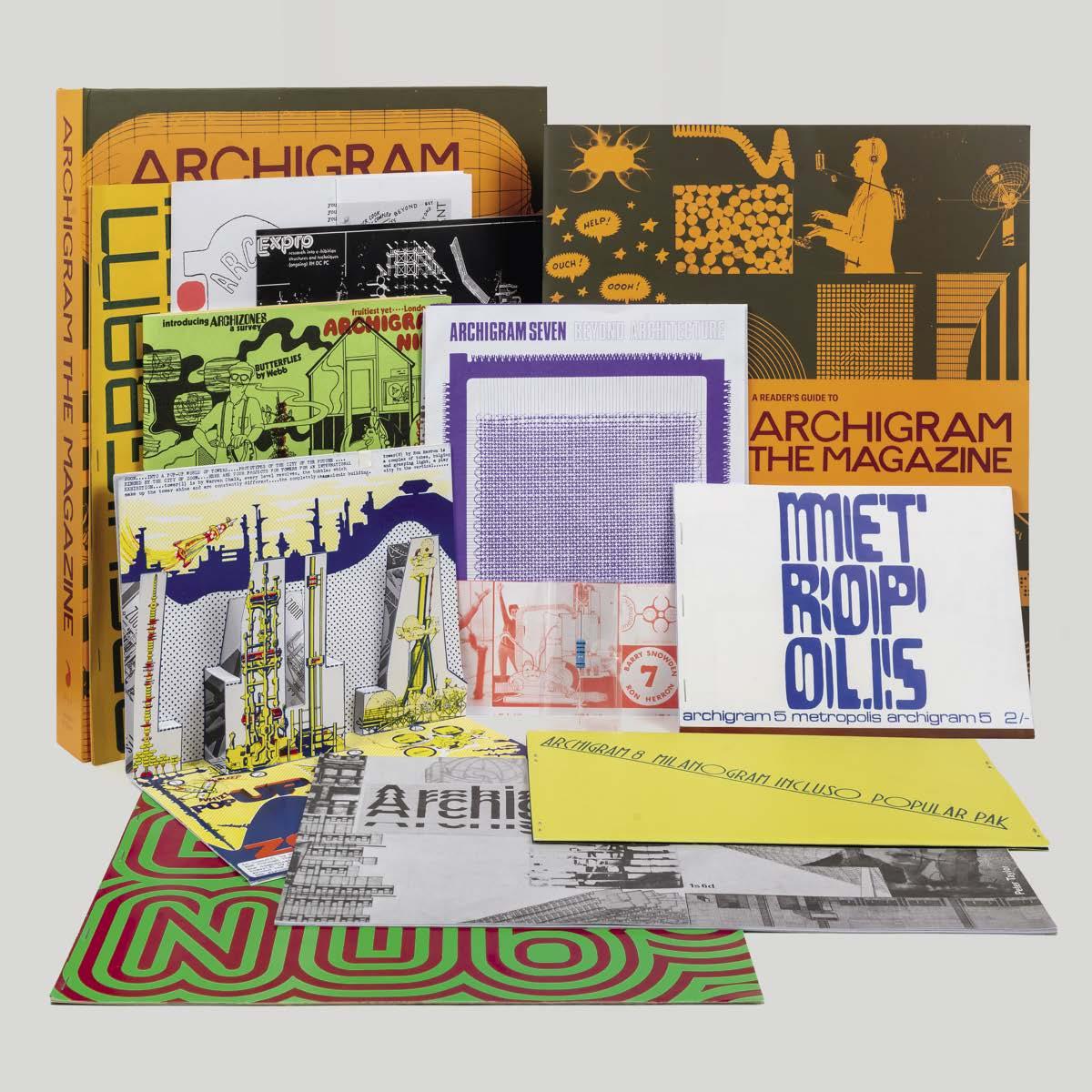
D.A.P. and Designers & Books have published the first authorized facsimile of the highly influential and heterodox magazine Archigram, produced by the architectural collective of the same name between 1961 and 1974. This new edition faithfully duplicates the original nine and a half issues, complete with pop-ups, electric resistors, gatefolds, and all, and accompanies them with a collection of essays by key figures from the world of architecture. Here, Dan Fox considers the legacy of these innovative, irreverent, and prophetic magazines.
“Keep the drearies on the run!” they liked to say. “This’ll upset them!” “They” were Archigram, a loose coalition of architects formed in London in 1961: Warren Chalk, Peter Cook, Dennis Crompton, David Greene, Ron Herron, and Mike Webb. “Them,” the drearies, were dour modernists, preachy architect academics, jobs-worth town planners, and ideology cops of both the left and the right. Archigram were antipuritans and tech-optimists. They were Information, Pop, and Space Age rolled together. Believing that people deserved more than to spend their lives living in drab boxes, Archigram imagined a new paradigm for architecture: expendable, flexible, mobile, high tech, cheerful. Buildings should be as dynamic as aircraft and home appliances. Archigram wouldn’t be the ones to build this world; the group’s major work was the magazine that gave them their name, a paper monument in 9 1/2 issues, constructed from collage and Letraset, poetry and polemic, and ornamented with a sci-fi lexicon of clip-ons, cushicles, gloops, infogonks, paks, and suitaloons.
The Archigram six taught at architecture schools and worked for commercial practices. They did civic jobs for the Architects Department of the London County Council (LCC). In the pages of their magazine they shared wild dreams of inflatable homes and networked “Informaisons.” Cook, for instance, proposed modular Plug-In Cities with units that could be swapped in and out according to need, and Instant Cities resembling nomadic music festivals. Crompton prophesied a smart Computor [sic] City constantly responsive to its inhabitants’ needs. Herron imagined colossal Walking Cities, like cruise ships on mechanical legs—perhaps Archigram’s most indelible image. “What is a room?” they asked, “what does it do?” The group questioned the nature of a home, a road, a town, the media, and wondered if all of them could be the same thing. “The existence of the pocket tape recorder has the same meaning for us as the tower crane,” they declared.
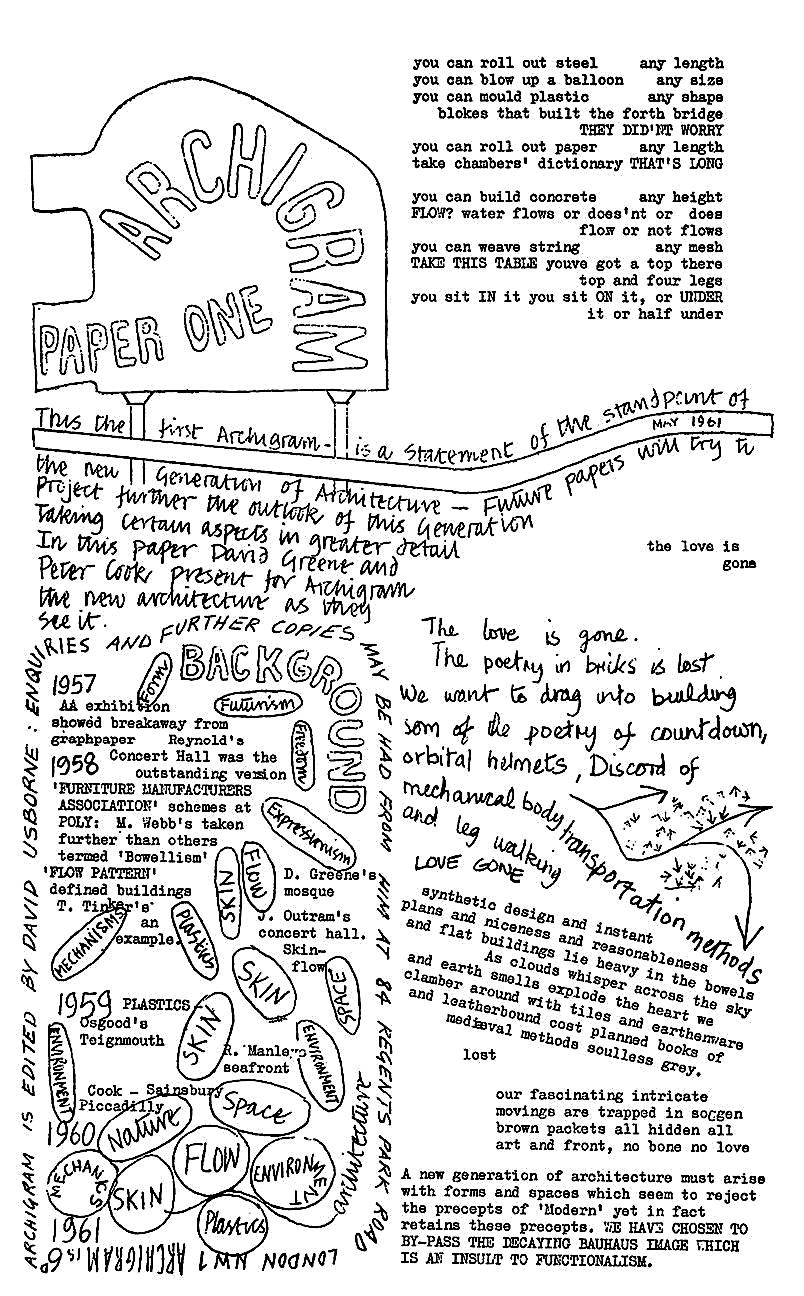
Archigram dissolved in the mid-1970s. Much has been said about their legacy. Renzo Piano’s and Richard Rogers’s Centre Pompidou in Paris, with its colored service ducts and flexible interior spaces, is frequently cited as an example of the group’s influence. (In Denis Postle’s 1980 documentary Beaubourg:FourFilms, the original Archigrammers are captured outside the Pompidou sniffily noting how static and undynamic it appears to them.) Archigram inspired the High-Tech movement of the 1970s, and later the work of marquee names including Tadao Ando, Diller and Scofidio, Zaha Hadid, Bjarke Ingels, and Bernard Tschumi. They provoked counterreactions too, accused of being fantasists, of not being political enough, and, in the glare of hindsight, for advocating ideas that immiserated twenty-first-century life. The authors of LearningfromLasVegas (1972), Denise Scott Brown, Robert Venturi, and Steven Izenour, dismissed them as Jules Verne “with an appliqué of Pop-aerospace terminology.”
The reputation of Archigram magazine outstripped its availability. For years original editions were hard to find outside specialist research libraries. Copies exchanged hands among private collectors for eye-watering sums. If you were lucky you might see one trapped in a vitrine in an exhibition about “lost modernist futures,” or whatever the urgent topic was in curator-world that season. Archigram’s most eye-catching images—the Plug-In City, the Walking City—circulated online, in architectural history books, and blown up on the walls of museums. Here they emerged cropped, rescaled, amputated from their original contexts, and in full color (most issues of Archigram magazine were monochrome). Arguably it didn’t matter: The ideas were the important thing. But something was missing. The authorized set of facsimile editions recently published by Designers & Books and D.A.P. restores what has been unavailable

to general readers for years: a sense of Archigram as more handmade zine than magazine, fizzing with the energy of work done on stolen time with paper and glue raided from the office stationery cupboard.
The first issue appeared in May 1961. It was made by Cook, Greene, and Webb, then fresh out of architecture school, and edited by designer David Usborne. Cook would later describe it as “a weird little thing”; he wasn’t wrong. ArchigramPaperOne cost sixpence and comprised two sheets of paper, one folded around the other. On one page were splodged images of architectural models. Idea fragments in neat lettering snaked between the pictures: “The inner space pushes through the skin.” “Roads—Walls—Spaces can exist as one.” On the other sheet, scribbled keywords in little balloons bumped against islands of typed text. The language was terse and cryptic, like field reports from architectural secret agents: “ freedom, flow, plastics . . . D. Greene’s mosque, Cook—Sainsbury Piccadilly. ‘ furniture manufacturers association’ schemes at poly: M. Webb’s taken further than others termed bowellism.” What was bowellism? Was it contagious? Who were these people? Whoever it was could speak we-know-best avant-gardese: “ we have chosen to bypass the decaying bauhaus image which is an insult to functionalism.” Elsewhere the cockiness was softened with the kind of wistful declaration that young idealists are so good at: “The love is gone. The poetry in bricks is lost.” A single red dot beside the masthead, printed with an inked potato, seemed to reply: Never mind, cheer up.
After the first issue came out, Cook, Greene, and Webb met Chalk, Crompton, and Herron, who were a little older and worked for the LCC. The friends sensed something was in the air. They had in common a dissatisfaction with the watered-down modernism of postwar Britain and with the raw concrete “honesty” of New Brutalism. Genuflecting to
Previous spread, left to right: Archigram:TheMagazine (D.A.P. and Designers & Books, 2025)
Facsimile of ArchigramPaperOne
Above: Inside of Archigram:TheMagazine
Mies van der Rohe and Le Corbusier didn’t interest them. Cities were dense and unpredictable, not machines serving tidy idealizations of human behavior. Prefab technology from World War II and drawings of cities in science-fiction comics interested the group. They looked to the American philosopher-architect Buckminster Fuller, with his prefabricated Dymaxion houses and geodesic domes, and, further back, to the Weimar-era architect Bruno Taut, who worked with color and gardens. The group admired the pod structures that the Japanese Metabolists were exploring. Early issues of the magazine nodded to Yona Friedman in France—he had envisaged a “mobile city” in the 1950s—and to the Dutch artist Constant, an ally of the Situationists in Paris, who conceived of an evolving, borderless metropolis of leisure and selfdiscovery that he called New Babylon. Cook, Greene, and Webb invited the older trio to contribute to Archigram2. This second issue came out a year later and was sharper than the first—landscape format, black and white, staple bound, spreads alternating between project descriptions and designs. Issue 1’s idea-fragments were now glued into complete sentences. There were murmurings about “expendability,” “flexibility,” and “throw-up throw-away structures.” Opinionated but not doctrinaire, the group opened their pages to fellow travelers. Issue 2, for instance, featured a contribution about new farm design from Andrew Anderson, one of the so-called “Christian Weirdies” who had studied at the Architectural Association in London in the late 1950s. The architect Cedric Price wrote about the “expandable house.” Price, Archigram’s brandy-swilling, cigar-chomping uncle, was a paper visionary; almost all of his ideas would remain unrealized during his lifetime, but he was influential and he sang in the same key as the younger architects. His Fun Palace was designed with theater director Joan Littlewood as a flexible, interactive culture complex where visitors could “try starting a riot or beginning a painting—or just lie back and stare at the sky,” while his Potteries Thinkbelt was a plan to redevelop Staffordshire’s dilapidated ceramics factories as a vast rail-connected education zone. So the story goes, a wealthy couple once consulted Price about designing a new house. He advised them to get a divorce.
The third issue of Archigram arrived in the autumn of 1963—portrait format, navy on yellow, subtitled “Towards throwaway architecture.” People were beginning to use the name of the magazine to refer to the group, and they decided to adopt it officially. Issue 3 came on the heels of LivingCity, an exhibition staged by Archigram at the Institute of Contemporary Arts (ICA), London, the previous July. LivingCity attempted to bottle the energy of urban life under the new ruling signs of pop, consumerism, and technology. Architecture could be about the way you lived your life—about housing, infrastructure, and telecommunications, sure, but also about music, fashion, food, entertainment, travel. Subjective experiences and fleeting happenings were as vital as brick and mortar. “All are important,” they declared, be it “the triviality of lighting a cigarette, or the hard fact of moving two million commuters a day.” Chalk put together a “Living City Survival Kit” for the show; items included Daz detergent, Player’s No. 3 cigarettes, and an Ornette Coleman album. (The kit also included a copy of Playboy; this “survival” seemed more geared to men than to women.) Talk of transience and invisible experience upset some in the sober British architecture world. “The idea of an expendable environment is still somehow regarded as akin to anarchy,” wrote Cook in the issue 3 editorial. “As if, in order to make it work, we would bulldoze Westminster Abbey. we shall not bulldoze westminster abbey.”
The show came about through Theo Crosby, formerly associated with the Independent Group, which had been
based at the ICA. (Crosby also happened to be a manager at Taylor Woodrow Construction Company, where the Archigram six now held day jobs.) The Independent Group had included Pop artists Richard Hamilton and Eduardo Paolozzi, architecture critic Reyner Banham, and others. Like them, the Archigram team was fascinated by the new products of consumer society. They liked movies, jazz, Ivy suits, and other signals of America. Readers of the magazine now started to see bold modern typefaces and photomontages appear increasingly in its pages. Following Hamilton and Paolozzi, Archigram collaged adverts, diagrams, comics, and illustrations into plans for buildings that resembled engine cross-sections, spaceships, and container ports. Archigram, wrote Banham, “make no bones about being in the image business—like the rest of us they urgently need to know what the city of the future is going to look like.”
With amazing archigram 4 in 1964, the group entered their imperial phase. Chalk, the driving force behind the issue, saw “space comics” as a goldmine of architectural ideas produced “outside the conventional closed architect/aesthete situation,” and amazing archigram 4 drew lines between early modernists such as Taut, his contemporary Carl Krayl, and DC’s Superman comics. The cover was silk-screened in bright yellow, red, and blue and gridded with benday dots. A superhero with a jet pack and laser soared across a forest of high-tech towers. The issue’s theme word, “zoom,” exploded next to him. Inside, a loosely organized cartoon strip reproduced frames from science-fiction comics—moon bases and futuropolises made of “geodesic nets, pneumatic tubes, plastic domes and bubbles”—and led to a pop-up centerfold of exotic skyscrapers.
Banham took copies of issue 4 to the United States, where he spread the word among the architecture commentariat. Orders began to come in from Europe and Japan. Archigram5, the “Metropolis” issue, returned to a conventional format. It looked like a little blue-and-white sales prospectus but its tone was strident: “Are cities still necessary?” asked the editorial. They weren’t going to wait for an answer from the drearies. “Archigram 5 shows schemes with guts, schemes in which decisions have been made.” This was the issue that featured the famous Computor City and the Walking City. There was a breezy tour that took in Piranesi and projects by the Metabolists, Hans Hollein, and others. Underwater architecture was discussed. Strangest of all was a polemic from the critic Martin Pawley that stood out for being either deeply ironic or cruelly Darwinian, it was hard to tell. He called the metropolis “a cage” in which “tortured spirits observe the decline of the social contract into a savage duel between tear gas and napalm laden policemen.” Plusçachange. “Turn the cage into a new kind of jungle,” he went on, “not a reserve for the degenerate survivors of a dying species.” Did someone mention a Living City Survival Kit?
By the time No 6 appeared, in the fall of 1965, there were listings for stockists in Helsinki, Los Angeles, and Paris. Webb and Chalk left for the United States to teach; Archigram went international. Curiously, the magazine was not easy to read. It was small. The layouts were often dense, the type cramped, and thick ink on thin paper blotted detail from the images. There was something ration-era about it, as if optimistic in vision but hamstrung by poor materials. The texts were oddly punctuated and tended toward insularity, giving the reader the impression of eavesdropping on a private conversation. (Issue 6, for instance, presented with little commentary Chalk’s extensive visual research into 1940s design. Intriguing for architects and designers, but what did it mean to a curious general reader?) If you were lucky, you might productively misunderstand it. There was a certain sprezzatura to the magazine, something attitudinal,
take-it-or-leave-it. Cook’s designs beautifully combined a ligneclaire precision with a love of curves and soft, almost inflatable-looking forms. Arts and Crafts gone high-tech. (Interviewed for Bloomberg in 2018, Cook remarked that “a lot of Archigram was strangely Victorian, perhaps more so than Modernist. . . . [The Victorians] reproduced foliage in iron and they decorated and shaped and placed funny turrets on corners.”) Herron was a talented collagist working under the influence of Paolozzi and Dada, setting the hand-drawn and the photographic in arresting juxtapositions of scale and texture.
Archigram drawings offered a form of thinking out loud, provocation over planning. They held open a gap between imagination and reality in which you might believe that in an architect’s studio somewhere in London the models had already been built, the first Plug-In City capsules would be on the market in a matter of months, and all you had to do was place your order through the computer console in your kitchen.
Given their radicalism, the Archigram world could seem affluent and male. Critic Jonathan Meades observes that Archigram “always included ‘dolly birds’ and ‘get-away people,’ ‘the fun set’ and ‘people in a hurry’ and other impatient clichés of their hedonistic era” in their designs. “When the dolly birds went from minidresses to Laura Ashley” in the late 1960s, Meades continues, “there was a fundamental disconnect between the collective’s imagined decors and the people inhabiting them.” It’s true that as the sharp, mod 1960s loosened into the Summer of Love, the figures populating Archigram did not grow long hair or appear to drop acid and call for revolution. The group was ostensibly of the left, but what confused their critics was that they were also in thrall
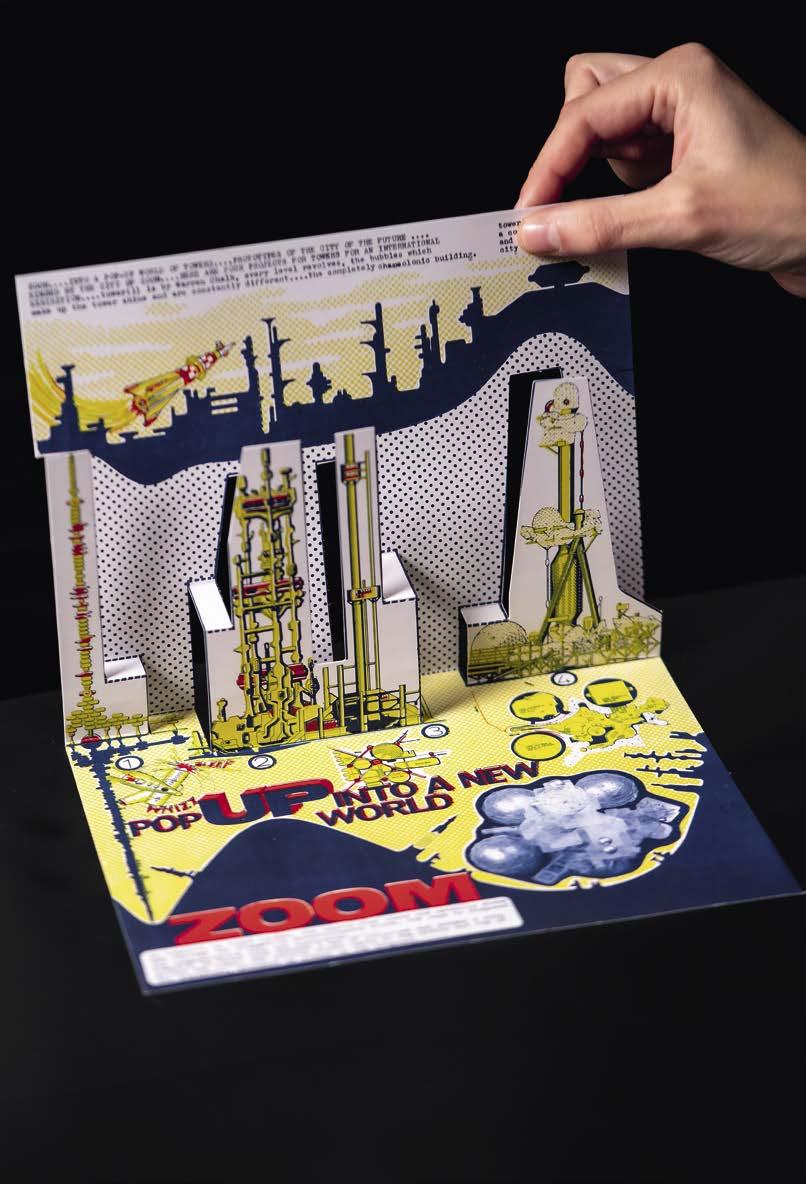
to consumerism and technology. They disliked rigid politics: Issue 9, for example, included a terse open letter from Cook to the group arse (Architectural Radicals, Students and Educators), accusing them of being “holier-than-thou” leftists— with a name like arse, presumably not that holy—but conceding common ground and encouraging the groups to “jostle each other towards the action.”
Archigram was never considered part of the 1960s British underground press, sold on marches and read in squats along with the International Times and Oz. In retrospect the issues weren’t entirely distinct from it either: They were self-distributed, they used innovative graphic design and printing techniques, and advocated for new ways of living. In later issues the group advanced what art historians would come to call “hippie modernism.” Archigram seemed to share with collectives such as Ant Farm, Superstudio, and HausRucker-Co a devotion to finding ways in which technology could service a new global consciousness. Copies of the magazine would not have looked out of place in a California head shop alongside issues of Radical Software and the Whole EarthCatalog. (There was an advert for the latter in Archigram’s last full issue.) ArchigramSeven (1967) was themed “Beyond Architecture.” It set the tone for the rest of the magazine’s run. The issue came with a free electric resistor and readers could send off for Archigram-related film strips, lecture tapes, and slides. The next issue, in 1968, included Cook’s Infogonks, precursors to smart glasses. “The printed page is no longer enough,” they wrote in no. 7’s editorial, “magazines will dissolve into hybrid networks of all media at once.” They declared that “the network is ready to be electrified.”
The final edition—ArchigramNine, “fruitiest yet”— arrived in 1970 with a green-and-red cover depicting a man working in a garden wired up to a communications network.
This spread: Inside of Archigram:TheMagazine
Photos: courtesy D.A.P.

A packet of seeds was stapled to the inside pages. Among the ideas proposed was an “Enviro-pill,” a kind of hallucinogen attuned to the user’s surroundings. “We are following our dreams yet further and seeing a gentler, softer more tantalizing environment,” ran the editorial lede. As if predicting the group’s own demise, they wrote, “The Futurist gear of Plug-In City was necessary at the time, in order to make the statement that ‘Architecture does not need to be permanent.’ Later this can be simplified to ‘Architecture does not need to be.’”
Archigram got called utopian. This was either a compliment or an insult depending on how close your feet were to the ground. The group refused the label and argued that they were responding to how people already behaved, dealing with the environment as it existed, not as they wished it to be. Their ideas could be built, they insisted. Herron long maintained that the technology to build his Walking Cities existed; all that was missing was the money and the guts to do it. One idea came close: In 1969, Archigram won a prestigious international competition to design an entertainment center in Monte Carlo. They established an office to produce it. The project was scuppered in the early 1970s by stagflation and the oil crisis. The group disbanded in the mid-1970s. A halfissue coda—number 9 1/2—drifted out in the form of a loose pamphlet in 1974.
In a short film that Postle made about Archigram for the BBC in 1967, a confident voiceover declared that “automation affects our way of thinking more than our way of doing.” How differently those words sound in the age of AI. Be careful what you wish for, may be one of the lessons of the twentieth-century avant-gardes. The Futurists promoted war and those who survived World War I got to see death at an industrial scale. Pop artists praised consumerism; shopping ate the planet. Minimalism was minimized to a shorthand for wellness and wealth. Short of seeing Walking Cities lumber past our windows, we live in a negative version of Archigram’s world. Smart buildings and geolocators track our movements. Wearables transmit information about us to businesses and governments. People are reduced to users. The network has been electrified and dreams of expendability and automation, of a better life through plug-ins and popups, seem part of the empire of enshittification.
A few years ago, Greene said in an interview, “I wonder if the purpose of architecture could actually be to be a point of stasis in an ever-changing world. . . . Why either/ or though? Why not both/and? Part of architecture should be permanence and stasis and the resistance to change that the cathedral has, and the rest might allow rapid and easy change.” They said it all along. We do not have to bulldoze Westminster Abbey.
The month-long Dance Reflections by Van Cleef & Arpels Festival returns to New York this year with big ambitions. Candice Thompson speaks to the festival’s artists and previews its program across the city.
Serge Laurent knows it is his duty to observe the large artistic landscape of dance, but as director of dance and culture programs for Van Cleef & Arpels, he sees a need to go beyond showcasing the artists doing the best work. Rather, he tries to identify those dancers taking risks to find new approaches to their form. “In each era there are artists who are inventing new ways of generating movement, and this is a real fascination for me,” says Laurent, noting the lasting influence of such artists as Robert Wilson and Merce Cunningham, with their memorable visual signatures.
When the Dance Reflections by Van Cleef & Arpels Festival returns to New York City—it will run until March 21—it will present twenty different productions in nine separate venues in two boroughs, its biggest iteration to date. Representing a large range of cultures and themes, this cohort of artists also highlights the intricate lineages that percolate inside the live art form. The festival opened at New York City Center with a program featuring Cunningham’s biped (1999) alongside Christos

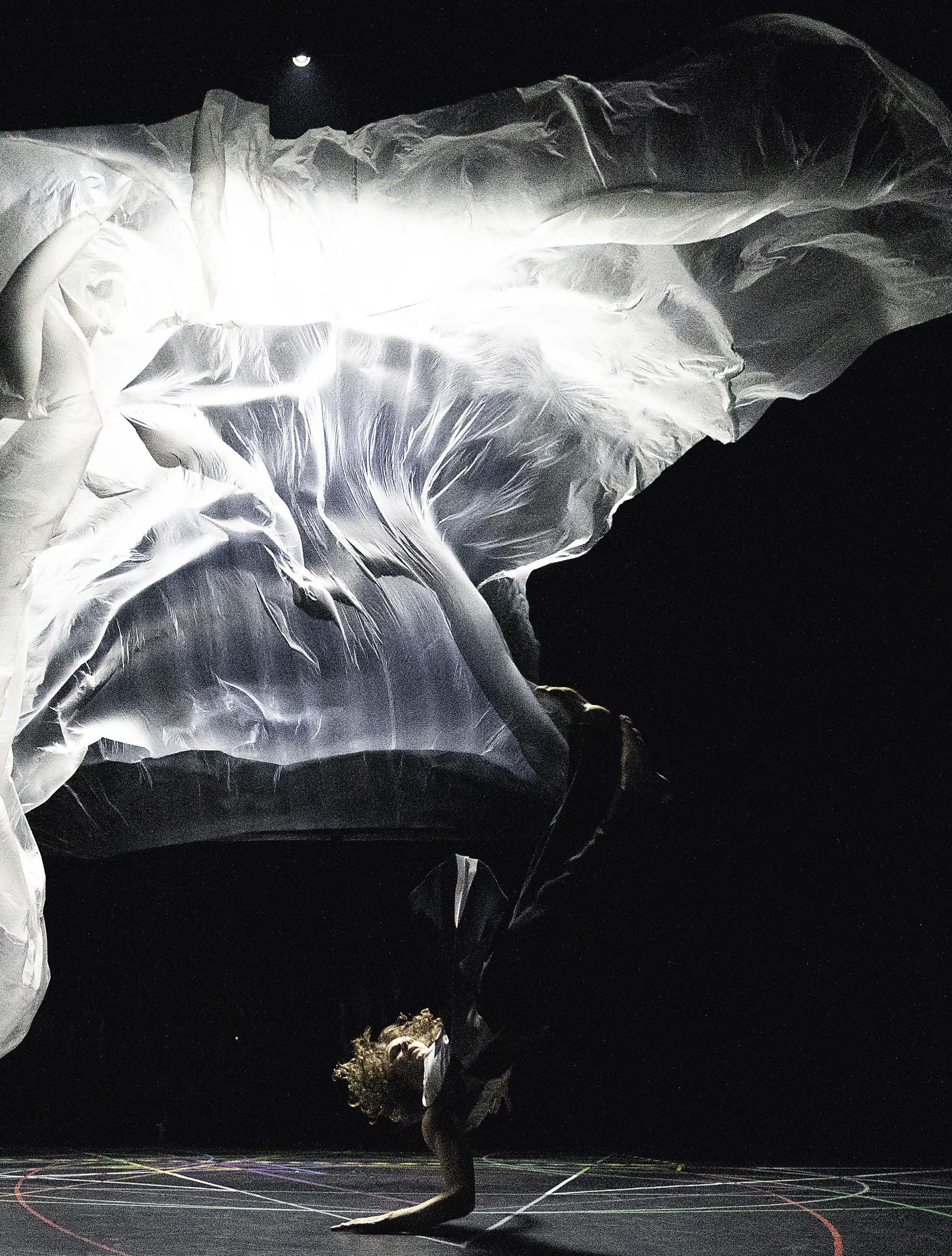
Papadopoulos’s Mycelium , created for the Ballet de l’Opéra de Lyon in 2023. “I remember the first time I saw the work of Christos, six years ago, and I said, ‘What a strange way to move!,’” muses Laurent, “and it’s exciting because I saw his latest work recently, and it’s evolving, but still the voice is strong. My perception is that all the artists in the festival have this singularity, this specificity.”
Working with the Joyce Theater’s New York Center for Creativity & Dance the festival will feature around twenty workshops open to both trained dancers and anyone with an interest in moving their body. There is something for everyone, and that is by design: Cyra Levenson, deputy director and director of education and public engagement at the Guggenheim Museum in New York, describes Dance Reflections as “a new fascia” connecting the various parts of the city’s dance community, from presenters and producers to artists, students, and audiences. The mission of Dance Reflections is three-pronged, spanning creation, transmission, and education. These values grew out of a long history of cross-pollination between the High Jewelry maison and the art of
dance, a relationship that dates back to the 1920s and includes, most famously, George Balanchine’s Jewels , a three-act ballet from 1967 that the choreographer developed after visits to Van Cleef & Arpels’s Fifth Avenue salon.
Under the direction of Laurent—who studied archaeology at the École du Louvre before a long tenure at the Fondation Cartier pour l’Art Contemporain and the Centre Pompidou—Dance Reflections’ support for the art form is expanding exponentially and meeting the moment with a greater diversity of dance styles and choreographic voices. Among big names such as Trisha Brown, Lucinda Childs, and Anne Teresa De Keersmaeker, the international slate includes Robyn Orlin’s We wear our wheels with pride and slap your street with color . . . We said “bonjour” to satan in 1820 (2021), made with the Moving into Dance Mophatong company and looking at the history of rickshaw drivers in South Africa; Alessandro Sciarroni’s Save the Last Dance for Me (2019), exploring the Italian folk dance polka chinata; and Benjamin Millepied’s Romeo & Juliet Suite (2022), utilizing handheld cameras, live video feeds, and a cast of
star-crossed lovers eschewing traditional gender norms to celebrate a more universal love.
Layers of dance and art history are embedded in the productions that make up this month-long festival, which Laurent stresses is for everybody, not just an elite or specialized audience. “I’m convinced now that the best way to approach contemporary art is to give historical notions to audiences,” he says, reflecting on lessons he has learned over the years as a curator of live art, “because contemporary art, it’s not something crazy coming from an artist, you know, it’s just the result.”
This contextual inclination goes beyond wall text or program notes to the works selected for the festival. Beyond the opening double bill of biped and Mycelium , illuminating pairings and associations can be found in the schedule of dances. In some cases mentees perform across town or a week apart from their mentors.
On March 11–12, for example, at New York Live Arts in Manhattan, Soa Ratsifandrihana
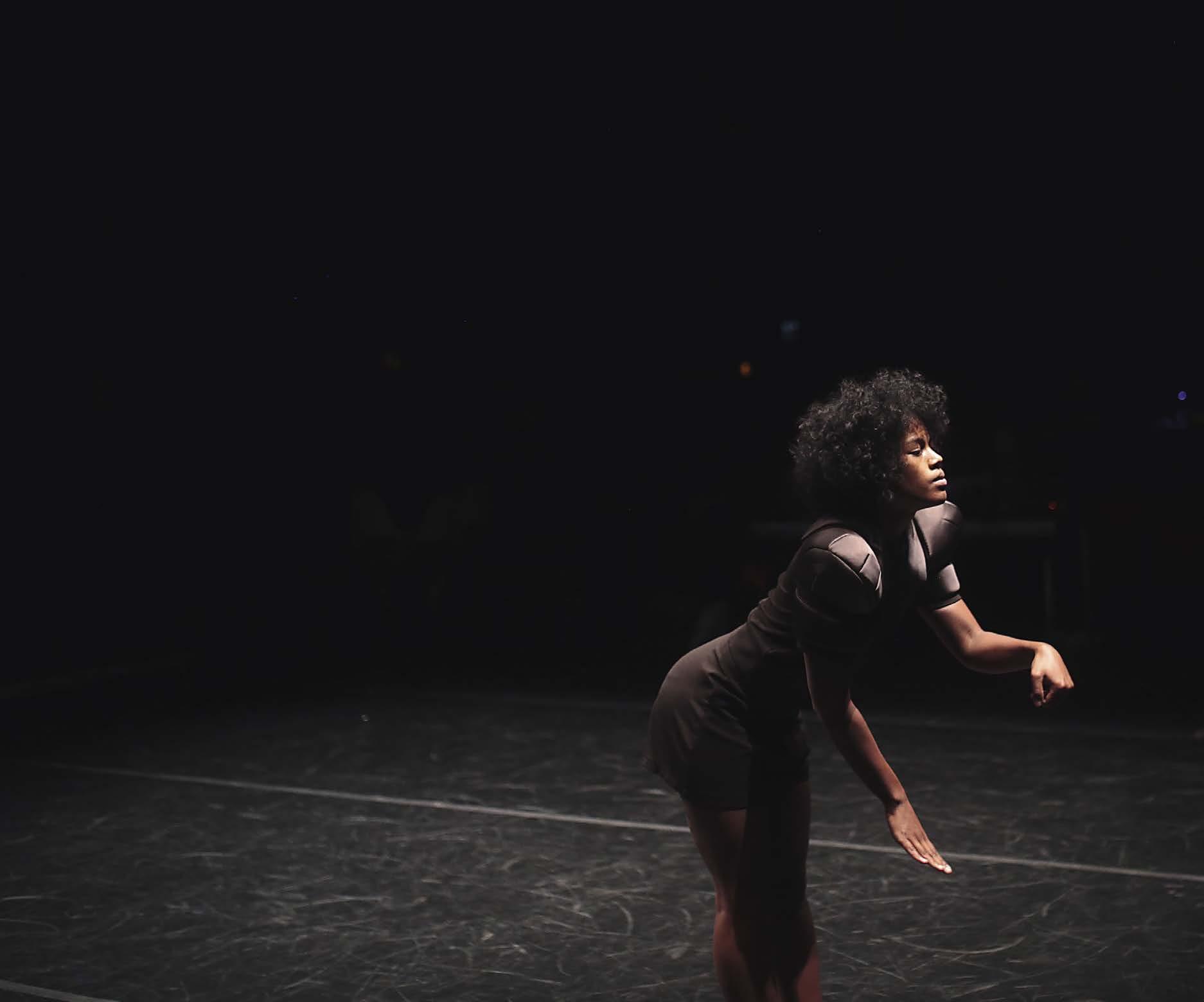

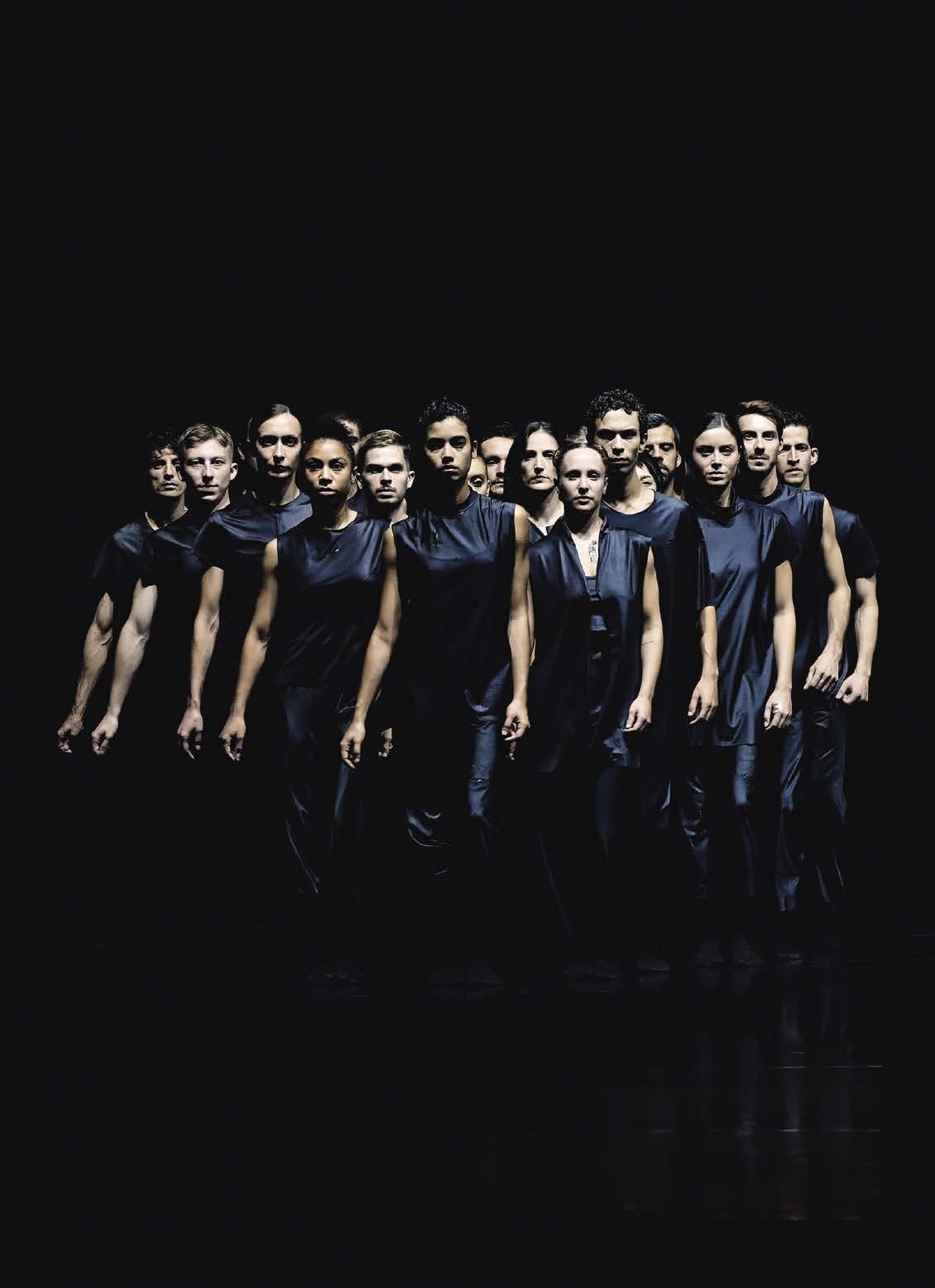
will perform g r oo v e , a solo dance that she carved from her dance history in 2021. “I was interested in bringing together dances that I’ve been practicing on a daily basis, in my room, as much as dances that I was practicing on stage,” says Ratsifandrihana, “and when I started the process, I became interested in bringing back dances that I used to practice when I was having celebrations with the Malagasy diaspora in France. The diaspora from Madagascar is big in Toulouse, where I grew up, and we had those moments on Sundays when we met all together and we were just dancing, especially [the traditional Malagasy couples dance] the afindrafindrao.” In g r oo v e , this elegant nineteenth-century line dance, which Ratsifandrihana learned as a child, exists alongside both the breakdancing that she and her brother loved as teenagers and the movement languages absorbed into her body from time spent working with choreographers such as De Keersmaeker, whose Rosas company can be seen at NYU Skirball performing exit above – after the tempest (2023) a week before Ratsifandrihana’s performance of g r oo v e
“The choreographic intention was to find a way through repetition to somehow fall into a dance, and then another, and then another, and then another,” says Ratsifandrihana, reflecting on how her body morphs between dance genres spanning continents and eras. “And this mechanism brings an energy that evolved throughout the piece. My body doesn’t judge. There’s no hierarchy.”
Perhaps the essential thread running through the month of performances can be traced back to the short-lived collective known as the Judson Dance Theater, which birthed American postmodern dance makers such as Brown and Childs. “When I started to pay attention to this art discipline, I met a generation of dancers from the ’90s, and they were always talking about the New York scene from the ’60s called postmodern,” says Laurent. “From them they learned they could escape the formality of dance. Contemporary art and dance
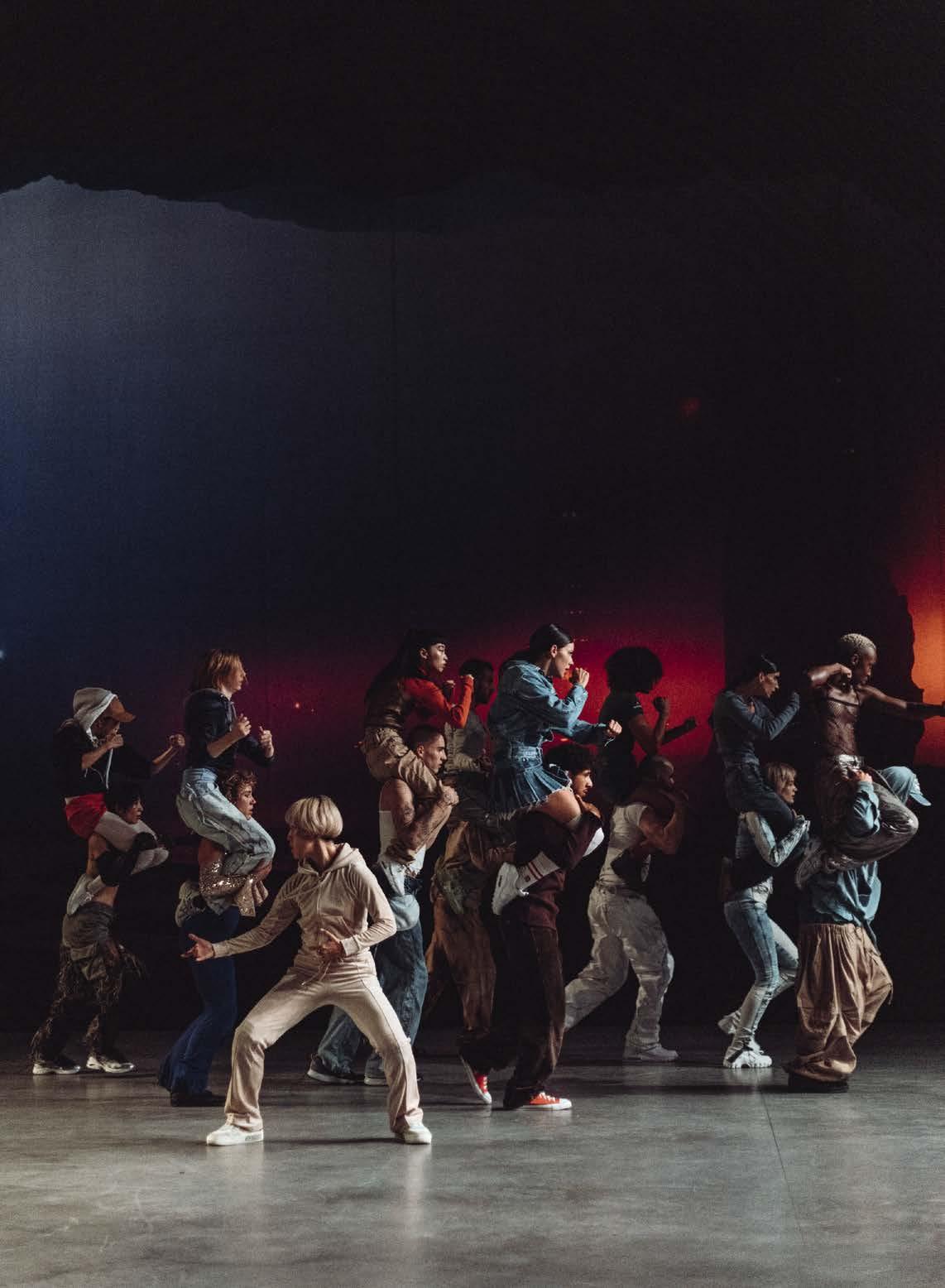
could be so diverse because any kind of movement was possible.”
That exchange between generations and the freedom it offered has continued to ripple out. It is especially clear in Laurent’s selection of such artists as the French choreographer Noé Soulier, and the collective (la)horde and their Ballet national de Marseille, along with works from the postmodern icons Childs and Brown. “We are very aware of the shoulders that we’re standing on, that we would not be here if Lucinda hadn’t done the amazing work that she is doing,” says Marine Brutti, onethird of (la)horde , which also includes Jonathan Debrouwer and Arthur Harel. The festival will close on March 14–15 at the Guggenheim with Childs’s Early Works , a collection ranging from dances she made for the Judson in 1963 to works from the first years of her own company, which she founded in 1973. In her highly abstract and mathematical dances, which seem to require a kind of casual virtuosity, one might be able to glimpse the seeds that inspire (la)horde
In (la)horde’s Age of Content (2023), which took over the Brooklyn Academy of Music (bam) near
the beginning of the festival, new mythologies are for the taking. The work weaves postmodern dance with jazz, TikTok dances, BBL references (i.e., the “Brazilian butt lift” surgery), Juicy Couture, and digital screens as the conceptual artists and dancers of the company deconstruct and question the whirlpool of information and entertainment we drown in daily. At the end of the production, a massive TikTok-style jazz routine takes over the stage, part inside joke, part contextual play. Can it cross over to the realm of art if presented with great execution on a proscenium? “Some people will see it as a beautiful moment, like in a musical. And this is fine, there’s no guilty pleasure for us,” says Brutti. “But our vision of this was a little bit more acid. They’re going through pain, and pretending everything is fine, and the curtain is never going down, and the lights are flickering. How do we deal with it? Some people are going to love it for the right reasons, and some are going to love it for the wrong reasons. And same goes the other way—they’re going to hate it for the right reasons. And it’s really not about people pleasing. It’s something else.”

The Trisha Brown Dance Company’s Dancing with Bob: Rauschenberg, Brown & Cunningham Onstage (2025), at bam on February 26–28, gives audiences the chance to experience the sets and costumes of Robert Rauschenberg, who was deeply involved in the Judson, as his centennial celebration continues into 2026. “My impression of Bob was that he loved dance more than anybody,” remembers Carolyn Lucas, associate artistic director of the Brown company; Brown and Rauschenberg “would just have the craziest ideas together. I don’t think that he knew the rules, and one of the rules was visibility and invisibility.” In Brown’s Set and Reset , Rauschenberg’s play with transparencies, light, projection, and translucent costumes meets Brown’s experiments in setting and resetting movement while maintaining the light feel of improvisation. On the same performance is Cunningham’s Travelogue , representing an entirely different kind of collaboration between Rauschenberg and a choreographer, one based on experiments in chance and parallel creation. Scores by artist Laurie Anderson and
composer John Cage round out the star-studded event. The program also marks the first time the Trisha Brown Dance Company will perform a work by Cunningham, with the support of the Merce Cunningham Trust.
For the Brown company, which Lucas has run since 2013, the support of Van Cleef & Arpels has gone beyond a single program or festival. “When we made a transition into doing new choreography, they supported our repertory,” said Lucas. “And here we are again. They’re doing something so big when it feels like there’s a little bit of depletion all around, right?” New York’s first Dance Reflections festival, in 2023, was an encouraging lift to an arts sector that had suffered so many setbacks during the pandemic. In the few years since, though, the challenges of producing and presenting live art have only continued, with government support on the wane and issues of affordability straining both dance companies and their artists. “ bam has been interested in our work for a very long time, but they haven’t had the opportunity to bring our company and to make our set fit until Dance Reflections
made it possible,” says Brutti of (la)horde . The magnitude and importance of this kind of sustained support—which works at deeper levels than the typical piecemeal project grant, particularly for the live-art ecosystem in the United States—cannot be understated.
And New York City has not been the sole beneficiary. Last fall the festival took over Seoul; it has also appeared in London, Hong Kong, Los Angeles, Kyoto, and Saitama. With sixty-five partners in seventeen different countries, Dance Reflections has set up an invaluable and far-reaching network for the continuation and appreciation of live art. “For most of our duration, we’ve had a wider audience in France,” says Lucas of the Brown company, “but with all the support we’re receiving, we’re strengthening our United States programming again. Maybe the postmoderns brought a certain kind of freedom to France, but in turn, Van Cleef brings us the freedom to continue.” Brutti agrees: “Dance Reflections is sending a massive signal that dance is important, dance is relevant, and dance is present.”
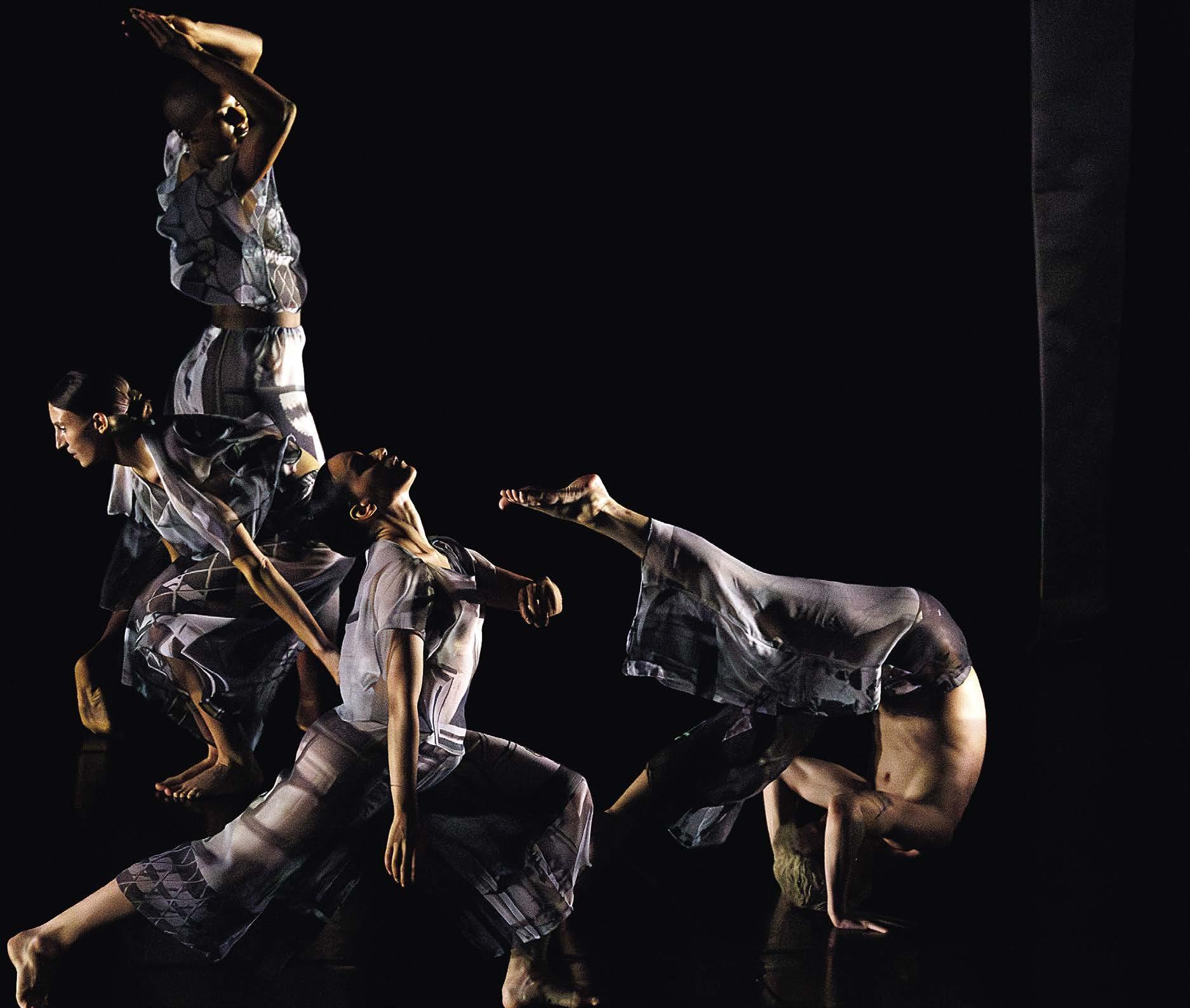
Ashley Overbeek tells the story behind the Art and Antiquities Blockchain Consortium (AABC), cofounded by Susan de Menil. The story begins with a famous pair of Byzantine frescoes once hosted by the Menil Foundation in Houston, passes through the repatriation of a group of Bura funerary objects to Niger, and explores how new technologies are helping to resolve the world’s oldest cultural disputes.

It started with two frescoes cut into thirty-eight pieces.
In June of 1983, Dominique de Menil sat in her Paris apartment, studying two grainy photographs depicting a pair of Byzantine frescoes. The works had been offered to her for sale by Aydin Dikmen, a Munich-based Turkish collector who would later be arrested for trafficking looted antiquities, having systematically concealed the provenance of his stolen works.
De Menil and associates quickly traveled to Munich to see the frescoes in person. They were taken to a shabby one-bedroom apartment with no electricity. Inside, illuminated only by the light of two candles, were the two frescoes, cut into thirtyeight plaster fragments, two of them propped up to view and the others stacked in a crate in a corner. Dikmen provided detailed provenance documentation and a remarkable story to support his claims of legitimate acquisition; on paper, everything appeared in order. In reality, something felt profoundly wrong.
Rather than proceeding with the purchase, de Menil insisted on a level of due diligence far more rigorous than that of many of her contemporaries, who at the time were still acquiring antiquities with minimal scrutiny. She began working with Herbert Brownell Jr., the US attorney general under President Dwight D. Eisenhower and then in private practice. Intent on uncovering the true history of the objects, she shared images of the fragments with authorities in the countries that could potentially claim ownership. Three nations stepped forward but only one produced proof: Officials in Cyprus sent photographs from the chapel of Saint Euphemianos in the village of Lysi, taken in 1974 and showing the frescoes in situ. But in 1983, all that remained on the ceiling of the holy site were two jagged voids.
From that moment, de Menil and the Menil Foundation in Houston began developing a plan for retrieving, restoring, and responsibly stewarding the work, in collaboration with the Cyprus government’s Department of Antiquities and the Church of Cyprus. The frescoes were transferred to London,
where conservators painstakingly stabilized and restored them. A consecrated, purpose-built chapel was constructed on the Foundation campus and over the next fifteen years more than 450,000 visitors came to see it. In 2012, when that stewardship agreement concluded, the works were returned home to Cyprus.
After de Menil’s passing in 1997, it was her daughter-in-law Susan de Menil who guided the nuanced conversations around the fresco’s final journey home and the responsibilities that would follow once it left Houston. For Susan, the Lysi frescoes revealed an often overlooked truth: Culturalheritage disputes do not need to be zero sum. For centuries, ownership has been framed as a matter of physical possession, yet the Lysi project showed that the rights surrounding an object can be shared. “If restitution to the source country is the starting point, what else can museums steward?” Susan asked. Conservation rights, display rights, academic research rights, reproduction rights, and long-term stewardship can be negotiated in parallel to repatriation and physical ownership. The fresco demonstrated that a single object can generate many forms of value that can in turn be allocated among stakeholders.
When Susan de Menil explored whether this model could scale, she was confronted with a structural problem: Many countries that had been the sources of cultural artifacts were wary of entering complex negotiations over repatriation without a neutral arbiter. Even when parties reached an agreement, there was no system to ensure followthrough as government ministers, museum directors, and governing bodies changed over time. No one wanted to rely on costly, unpredictable litigation; what was needed was trust. And what was missing was a mechanism to guarantee that trust.
Technology has long allowed us to solve problems that otherwise seemed intractable, and our century is nothing if not a period of enormous technological change. In that context, Susan wondered why cultural institutions and governments were still
navigating the repatriation of artifacts with tools that had not evolved in half a century. She began thinking about a specific new piece of the puzzle: blockchain technology.
Blockchain tends to dominate headlines through stories of speculative currency trades and nonstop hype cycles. At its core, though, blockchain is a tool that enables groups of people to come to agreement across borders without relying on a single centralized authority. At a high level, blockchain creates a shared ledger that many parties can access but no single party controls. Once information is written onto the ledger, it cannot be erased. New details can be added as amendments but the original record remains intact. In the context of cultural heritage, this means that provenance data, conservation reports, legal agreements, and negotiated rights can be recorded in a way that all stakeholders must approve before the entry is finalized. With objects whose provenance is usually listed only in museums’ private databases, making this kind of information much more accessible globally, and setting it beyond the ownership or control of a single entity or country, is pretty revolutionary.
The same structure also allows complex rights to be divided with clarity. Physical ownership, display rights, conservation responsibilities, reproduction permissions, and research access are just some of the many rights that can be defined as separate entries in the ledger.
Blockchain is only one part of the toolkit. Other technologies, including photogrammetry and high-resolution spectrographic imaging, allow objects to be captured in precise three-dimensional form. These digital twins can be used for conservation planning, research access, virtual display, or comparative study without requiring the physical object to cross borders. Digital models can also be attached to the blockchain record so that every update to an object’s condition or scholarship is anchored to the same shared source of truth.
Together, these tools create something culturalheritage negotiations have long lacked: They allow stakeholders in different countries, operating under different laws, to work from a single transparent

system that records provenance, defines rights, and preserves that information securely.
Susan de Menil and a group of other women have recognized the potential of contemporary technology (including but definitely not limited to blockchain) for artifact and antiquities stewardship.
“Instead of using Web3 to speculate on the future, we propose using it to reconcile the past,” Susan told me. They founded a 501(c)3 nonprofit, the Art and Antiquities Blockchain Consortium (AABC), with the mission of applying new technology to some of the world’s oldest stewardship challenges and unlocking stymied repatriation efforts through research, education, and advice.
In a recent initiative, AABC partnered with the Lam Museum of Anthropology at Wake Forest University, Winston-Salem, North Carolina, to pilot this model through the repatriation of a group of Bura funerary objects to their source country. The Bura civilization flourished between the third and thirteenth centuries in what is now southwestern Niger. Its terracotta vessels, equestrian figures, and funerary urns are among the most significant archaeological materials in West Africa. Many of these objects left the region through illicit excavation and opaque private sales, creating fractured provenance histories that have made repatriation nearly impossible to navigate. The objects held by the Lam Museum are representative of this broader problem: They are culturally consequential but their provenance is incomplete and their legal status ambiguous, placing them in a kind of institutional limbo. Dr. Andrew Gurstelle, academic director of the Lam Museum, elaborates, “The Bura objects represent some of the only known artifacts from the early Iron Age of the Sahel. Their forms match artifacts excavated from burial contexts, which means that the faces, bodies, and patterns are meaningful windows into these ancient cultures. As an archaeologist, my professional training included ethics of using museum collections and repatriation. It was coincidental that my research was in West Africa, near to the Bura site, and I happened to be familiar with the objects and their history of looting. When I became the academic director of the Lam Museum, I immediately recognized the objects and knew that repatriation was the direction to go.”
For this project, AABC began by providing contextual research to support a dialogue between the Lam Museum and Niger’s Ministry of Culture, with the shared goal of repatriating more than one hundred Bura funerary objects from the museum back to Niger. The consortium helped to establish a collaboration with the Factum Foundation, whose technicians used photogrammetry to create high-fidelity digital twins of the works. Students at Wake Forest were trained to conduct additional scans, turning the project into a form of capacity-building as well as of conservation. Each digital model was then minted as a noncommercial NFT containing key metadata, including the object’s agreed-upon provenance and its archaeological context. These files can be accessed by researchers anywhere in the world with an Internet connection, which allows the objects to remain available for study even after they physically return to Niger. “AABC and blockchain technology have provided a pathway to actively record information about the Bura objects while negotiating the terms of repatriation,” observes Gurstelle. “Because it is transparent and decentralized, blockchain has been useful to build trust between stakeholders. This has been especially helpful to bolster support for traditional, physical repatriation.”
Nigerien architect and professor Mariam Issoufou, who is working closely with AABC and the Lam Museum on the project, notes the thoughtfulness of AABC’s approach. “There is a level of humility that is rare,” she said. “A desire to do the right thing, even while acknowledging you may not know exactly what that is . . . and that begins the process on equal footing. What I find incredible is how technology is being used to even the playing field, to inject some justice into a process that is usually full of inequities. Blockchain helps ensure the objects are not resold later and that their paths remain transparent. That is one of the main issues with museums and the objects they hold.”
Repatriation alone is not the end of the story: AABC has placed equal emphasis on outreach and community-led education in the source countries to which objects are returned. In partnership with AABC and the Lam Museum, Issoufou has been convening a series of focus groups in Niamey with some of Niger’s most visible artists, filmmakers, musicians, and cultural thinkers, including filmmaker Aïcha Macky, poet Abdoulaye Saidou Souleymane, satirist and comedian Mamane (Mohamed Mustapha), photographer Aboubacar Magagi, and musician Abel Zamani. Their task is to ask how the history of the Bura civilization should be shared within Niger and how future generations might engage meaningfully with their heritage.
Issoufou describes the stakes clearly. “After repatriation, what does that actually mean for people? What does it mean for the population? How do you raise awareness about these objects, about this civilization? Once objects are taken away and sequestered elsewhere, you are cutting source communities off from their own history.” Reaching people across the country also requires navigating linguistic and cultural inclusion. “Niger has seven major languages. I speak three, but that is still only a fraction,” she says. “It was crucial that the creatives involved carry different linguistic and cultural layers and speak to the nation as a whole, not just to one ethnic group. Of course ethnic identities matter. They shape the languages we speak and the food we eat. But we also have to build a shared national story. Restitution gives us the opportunity to have the most meaningful conversations about what it means to belong to the same country.”
Just as the Lysi frescoes returned home more than twenty years ago after their period of shared care in Houston, the first of the Bura objects will return to Niger in 2026. But countless objects remain displaced. “The Restitution of African Cultural Heritage: Toward a New Relational Ethics” (2018), a report written by Senegalese economist Felwine Sarr and art historian Bénédicte Savoy on commission from the French government, estimates that more than 90 percent of Africa’s cultural artifacts reside outside the continent. AABC is working to develop new pathways to increase accountability and shared stewardship, including ongoing research with several universities on ways in which technology can support these goals, such as using blockchain to create on-chain revenue sharing from museum admissions and blockchain wallet programs that give source communities direct participation in stewardship.
As Issoufou puts it, “I think too many times, when we realize we do not know the answer to something, we assume it means the answer does not exist. I feel the opposite. I think there could be something amazing there. The question is whether we can excavate it.”
Previous spread: The Byzantine Fresco Chapel during its time at the Menil Collection, Houston, 1997; designed by François de Menil. Photo: © Paul Warchol Photography
Opposite: Fragments of the frescoes in individual trays at a warehouse in Greenwich, South London, 1984. Photo: Laurence J. Morrocco, courtesy the Menil Collection
This page: Bura funerary object, reliquary figure, Volta, Niger, c. 2nd–11th century, ceramic, 16 ¼ × 6 inches (41.3 × 15.2 cm). Photo: Timothy S. Y. Lam Museum of Anthropology, Wake Forest University
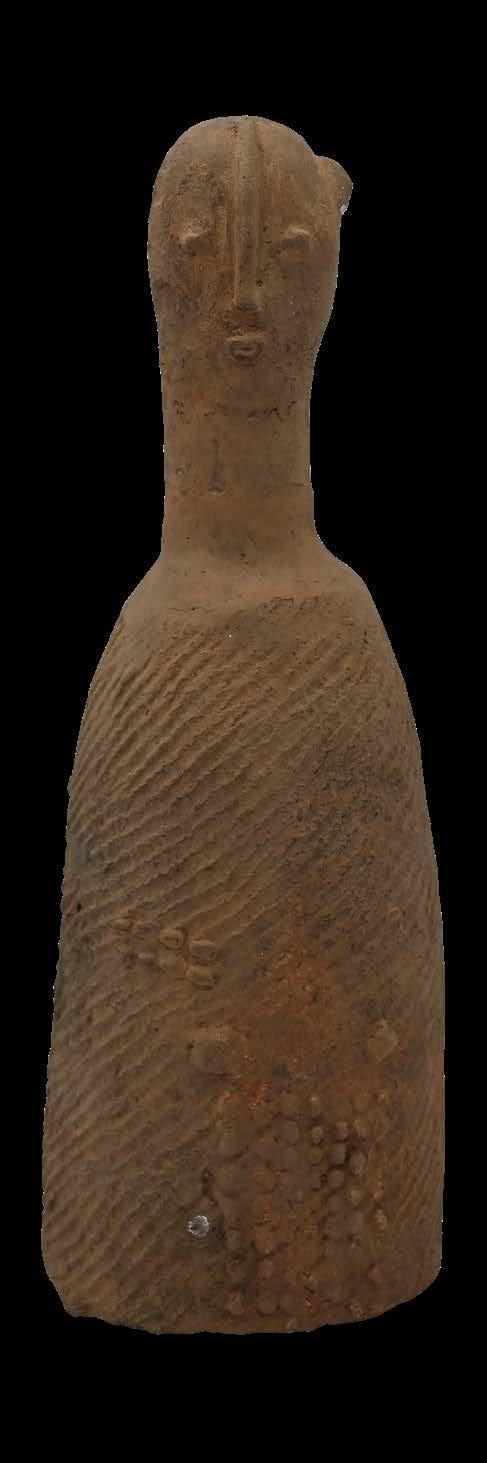
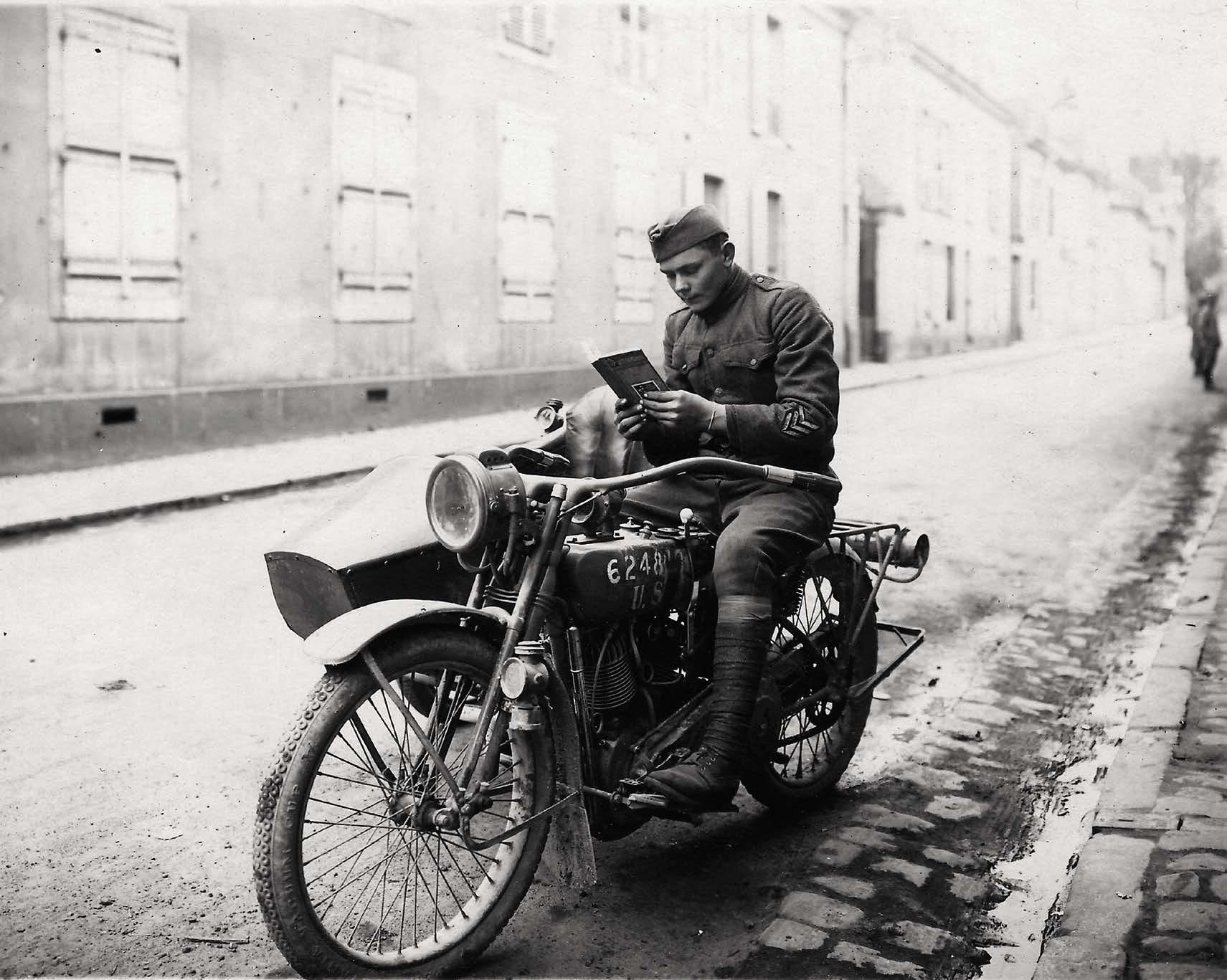
Christian House reports on Paris’s American Library, a storied collection of English-language books in the French capital, tracking its evolution and enduring role in a cosmopolitan literary milieu from World War I to the present day.
The invitation to the ceremony for the American Library in Paris Book Award arrives with a footwear warning. The event is held in the Hôtel de Talleyrand, an opulent eighteenth-century residence, overlooking the place de la Concorde, that was once the nerve center of the postwar Marshall Plan. The problem is its exquisite parquet flooring: Wear flats. There have been slip-ups. The warning is fitting: The American Library in Paris has been creating safe spaces for readers for more than a century.
This private lending library opened in 1920 and is today situated just over the Seine from the Hôtel de Talleyrand at 10 rue du Général Camou, an oddly quiet side street near the Eiffel Tower. This unassuming building is a citadel of free speech and a refuge for bibliophiles of all nationalities: It is the largest English-language lending library in continental Europe, with a print collection of over 100,000 volumes and some 5,000 members. Yet it remains unknown to most visitors to the city and indeed to many Parisians.
I’m in Paris to attend the award presentation and discover more about an establishment brimming with knowledge but somewhat shrouded in mystery. What I discover is an unlikely tale of pioneering librarianship, experimental literature, wartime resistance, and shadowy spies. It is also a story of community.
During its fledgling days in the 1920s and ’30s, the American Library was the haunt of diplomats, professors, and journalists, as well as local children sitting down to story hour. And then there were the avant-garde cultural figures: Gertrude Stein and Ernest Hemingway perused the library’s stacks and wrote for its literary journal, Ex-Libris
The Hôtel de Talleyrand reception hails this year’s award winner while also marking the departure of Audrey Chapuis, the library’s director for the past seven years. On the eve of her return to the United States to become president of the Tampa Bay History Center, in Tampa,
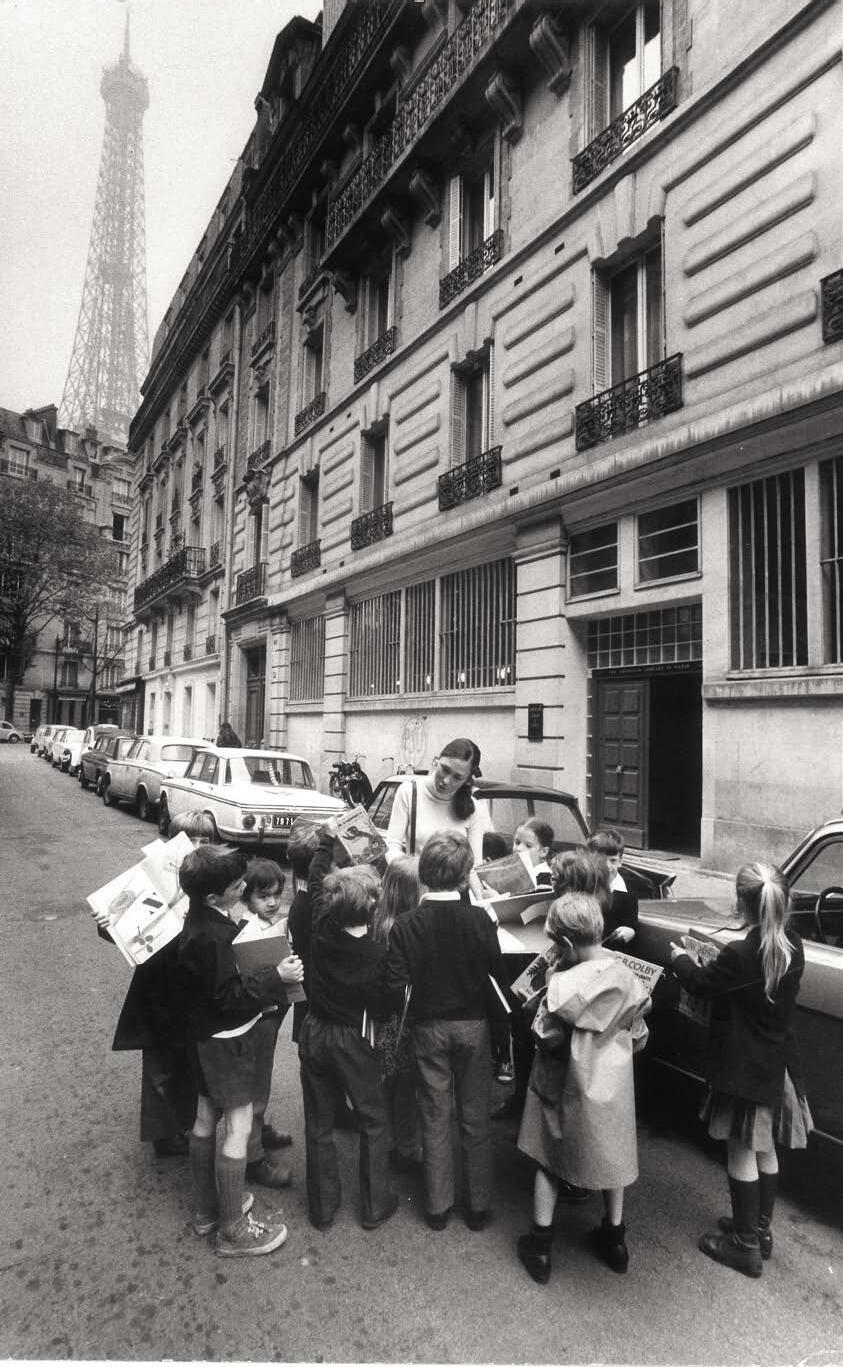
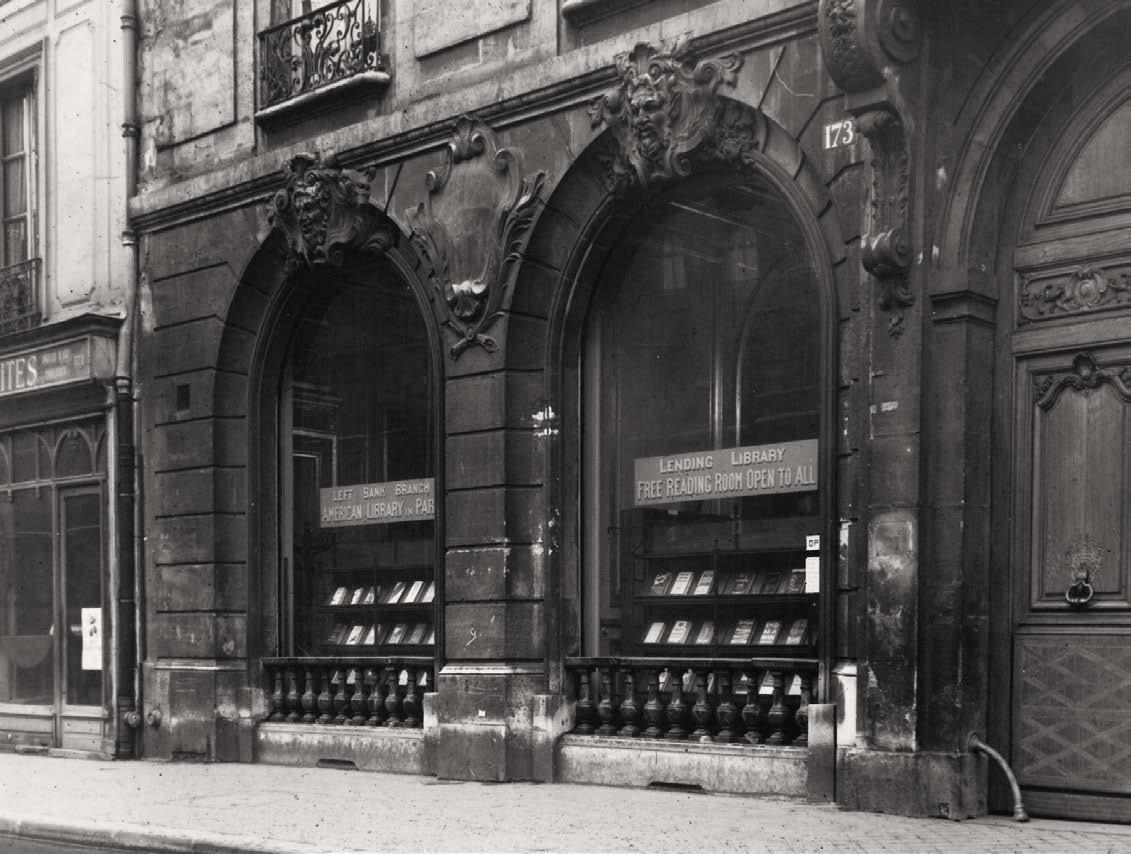
Florida, she considers the library’s unique place in Parisian culture—and in her own life. “When I was seventeen, I wanted to come and find writers and thinkers and artists who wanted to sit around and talk about the meaning of life. And that actually exists here, it’s a true thing. And it’s vital, vibrant, and continuously relevant,” says Chapuis, talking to me in her office deep in the library’s lower ground floor. As with so many Americans, Chapuis’s romantic idea of literary Paris was informed by the current incarnation of Shakespeare & Company, the Left Bank bookshop that is a popular tourist haunt. “And then I discovered the American Library when I moved here. I said: ‘Oh, no, this is the real deal.’”
The members assembled for the award are a debonair lot. I talk to a number of lawyers. The men’s tailoring is discreet while the women are a riot of scarves. One senses the presence of Patek Philippes. The award is to be presented to the British biographer Sue Prideaux for her Wild Thing: A Life of Paul Gauguin (W. W. Norton), which debunks many of the tawdry myths surrounding the French painter. Prideaux has a talent for unpicking the tangled psychology of complicated characters—her previous subjects have included Edvard Munch, Friedrich Nietzsche, and August Strindberg.
Prideaux’s study of Gauguin has already won Britain’s Duff Cooper Prize, but the library award, which celebrates works of literature that draw on France for their inspiration, is particularly welcome: “Libraries have meant so much to me all my life, from when I was a little girl sitting on a library floor reading Beatrix Potter fairy tales,” notes Prideaux. “It’s like being given a present from all the books. The wonderful thing about a library like this one is that you can just wander about—it’s like the best sweet shop in the world, you never know what you’re going to pull off a shelf.”
The library was born of war. Its motto is “Atrum post bellum, ex libris lux ”—“After the darkness of
war, the light of books”—and its bookplate features a book lying open on top of a rifle and sword, with the dawn sun breaking in the background. When the United States entered World War I in 1917, the US Library War Service sent out a nationwide call for books to send to soldiers heading overseas. “The slogan of the Library War Service was ‘one book for every soldier.’ Two and a half million books were eventually shipped to Europe in just over a year,” notes Mayanne Wright, a Parisbased American writer of textbooks who sidelines as the library’s docent archivist, providing history talks to visitors and scouring Paris flea markets for ephemera relating to the period when the institution was founded.
Talking me through the library’s history, Wright explains that its seed was sown at the end of World War I, when some of the books sent to France became its nascent collection. Meanwhile, an information revolution was underway in France. “The first literary agency [the William A. Bradley Literary Agency] was founded in Paris in the 1920s. They published everybody who’s anybody in the Lost Generation of the avant-garde— people who couldn’t get published, like James Joyce, Henry Miller, later on James Baldwin. And the man who founded that agency was involved with the library. He was on our fundraising team.”
The library had several homes, including its original spot overlooking the gardens of the Élysée Palace, before it settled into its current premises in 1964. Free to all (although a borrowing card cost ten francs), it was innovative from the beginning. There were readings by French literary luminaries such as André Gide and Colette. The children’s reading room—which today includes a dedicated mezzanine for teenagers—was particularly pioneering: “American influence basically brought children’s librarianship to France,” says Wright. “We were the first one to open a dedicated children’s department. That was in 1920. We’ve never had anyone call into question a book that a kid would read.”
Left: The former Left Bank branch, located only a few blocks from the Sorbonne at 173, boulevard SaintGermain, Paris, 1948
Below:
Annotated volume from the personal library of Marlene Dietrich, now owned by the American Library in Paris
But there have been dramas. Amazingly, the library remained open during World War II. Some staff fled the German Occupation, others were interned. One was shot by the Gestapo for not raising his hands fast enough during a surprise inspection. Another librarian, Freddie Hawkins, had a French mother and a British father (Eric Hawkins, managing editor of the Paris Herald ).
“Being bicultural and bilingual, Freddie was approached by the British spy services,” says Wright. “We have the reports from the British government. He was a really bad spy. He only went on three missions because he wrote poor reports and had a hot temper.”
Rumors of spies in the library swirl through its corridors. Dorothy Reeder, its director in the early 1940s, was said to be a spook. “The 1950s census has her back in Washington, DC, and she’s listed as an analyst in Intelligence,” says Wright.
In the postwar years the library continued to be used by celebrated writers, including Mary


McCarthy, Art Buchwald, and Samuel Beckett. And over the subsequent decades it built a marvelous collection. It doesn’t have a first folio by Shakespeare or a dazzling medieval book of hours; there’s no priceless copy of John James Audubon’s Birds of America . What it does have, notes Wright, is a unique group of early Paris phone books; books owned by screen actress Olivia de Havilland, who served on the library’s board; part of Sylvia Beach’s collection from the original Shakespeare and Co.; and volumes from the library of Marlene Dietrich, some of them annotated. “She was quite the scoffer,” says Wright. “Many of the notes are written in red.”
In the twenty-first century the library has become much more than a depository of books. “We are a kind of free port for intellectuals,” says Rachel Donadio, its curator of cultural programs. “The library exists outside the logic of the market, outside the French cultural establishment, outside the United States, and this gives us real freedom.”
The library’s current “Ways of Seeing” program showcases links between literature and visual art. Speakers have included the author Michael Pollan, on psychedelics; Sarah Burns and David McMahon, on their and Ken Burns’s documentary about Leonardo da Vinci; and curators Lynn Gumpert and Sophie Eloy, who discussed their exhibition at the Orangerie on the spirited fin-de-siècle Paris art dealer Berthe Weill. And there have been recent talks by novelists such as Jhumpa Lahiri and Rachel Cusk. “Writers understand the soul of the library,” says Chapuis, adding that the institution has a duty to platform all voices: “I assume that something might come down the pipe that would give us pause, but it hasn’t yet.” What would the library’s stance be on a controversial figure such as Jordan Peterson, the psychologist and bestselling author of 12 Rules for Life (2018)? “If we had Jordan Peterson, we would put him in conversation with someone who would ask the right questions,” says Chapuis. “We want
to have a library with books on the shelves, which means that there will be books with opinions we don’t agree with.”
The library expands its mission through the de Groot Visiting Fellowship, which supports writers, scholars, and other thinkers who advance cross-cultural dialogue, and a Cultural Fellowship that allows authors space and time to work on a project. The current Cultural Fellow is Molly Ringwald, the American actress and author of both fiction and nonfiction. “Having a dedicated place where I go for an extended period of time was truly transformative for my process,” says Ringwald, who is working on a memoir of her time living in Paris during the 1990s. “I think that libraries are useful for everyone—actors, writers, students—or anyone who could use a break from the endless media cycle of catastrophe online. Looking to the past for instruction, inspiration, and solace is just some of what libraries have offered me.”
For its members, the library also offers a hub that is lively yet familiar. “While as expats we are all in search of the exotic international experience, there’s comfort too in finding a bolt-hole filled with like-minded individuals whose values feel comfortable and require no translation. Such is the feeling you get as an American upon entering the American Library in Paris,” says Laura Wenke, an American marketing executive who has lived in the city for many years. “The intellectual horsepower I find here is the icing on the cake.”
Spending time with the librarians and friends of the library, one gets the sense that they see the institution as a retreat from febrile politics, siloed thinking, and the speed and jarring nature of modern life. Few view the library as a sanctuary quite as much as Maisie Fieschi, its chief of staff. Fieschi was raised as a reader: Her mother is the celebrated Australian children’s author Ursula Dubosarsky. Within a year of arriving in Paris in 2012, Fieschi, then an editor in her twenties, had met her future husband, Simon, a French social
Left: Inside the American Library in Paris
Throughout: Photos: courtesy American Library in Paris, unless otherwise noted
media manager. In an essay written for an anthology, The Gifts of Reading for the Next Generation (2025), Fieschi recalled how tragedy struck several years later: “Our Parisian life unfolded like every clichéd Audrey Hepburn film—until 7 January 2015. Simon was the second person shot during the attack on the Charlie Hebdo offices. The satirical cartoon magazine was targeted by Al-Qaeda militants who wanted to silence its writers and deny readers their freedom of choice.” Nearly a decade of intensive medical care and rehabilitation, legal fights, and media attention followed. In 2024, Simon Fieschi died as a result of his injuries.
By then, Maisie had discovered the American Library. She was a reader, then a volunteer, before joining its permanent team. “It was a choice: I wanted and needed to be among books,” she writes. “Joining the Library, the world opened up to me again, just as it had in my childhood, wandering through my mother’s book collection. Once a week, I would retreat to its shelves, indulging in solitary afternoons among the stacks, surrounded by books curated by generations of librarians I would never meet. In those moments, I was simply myself—free of political labels, free of the burdens of victimhood, free of Charlie Hebdo. The American Library was my personal refuge, and it revitalized me.”
The morning after the book award I meet Sue Prideaux for breakfast in a café near the place Vendôme. She is keen to celebrate the institution that has celebrated her.
“The library has an incredibly dedicated and united team that is driven by its belief in the scholarship that drives the institution,” Prideaux tells me. “Their feeling of the importance of their cog in the Enlightenment wheel, which gives meaning to their lives, reminds me of my dear Nietzsche: ‘If you have a why, you will always find a how.’ From the conversations I had, it was strikingly evident they had their why.”

Roe Ethridge, Lila Moss in the Waves on Rockaway Beach, 2025
Included in the new publication Roe Ethridge: Rude in the Good Way (Marseille, France: Loose Joints Publishing, 2026)
41 Main Street, East Hampton, NY
Open daily 10am–5pm



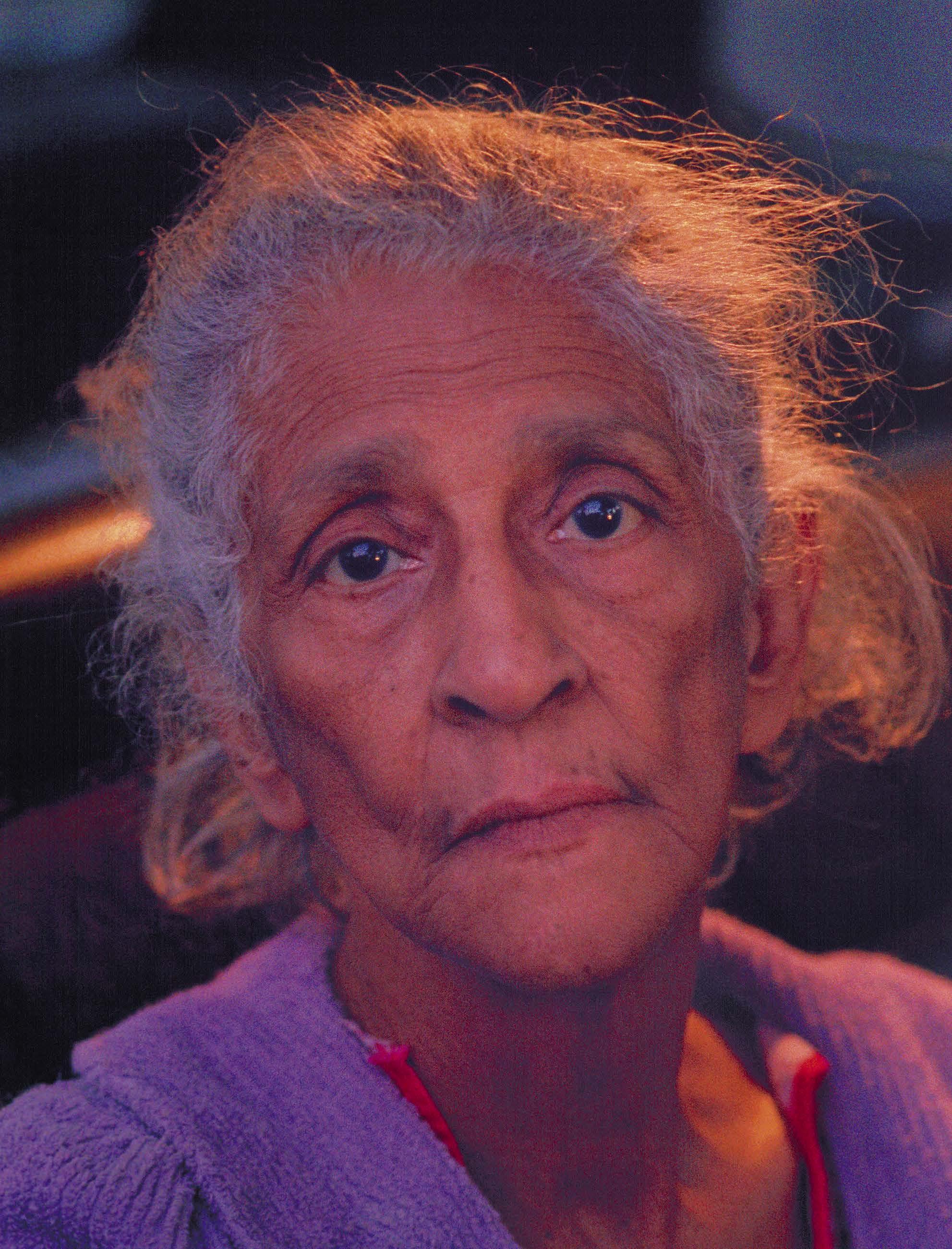



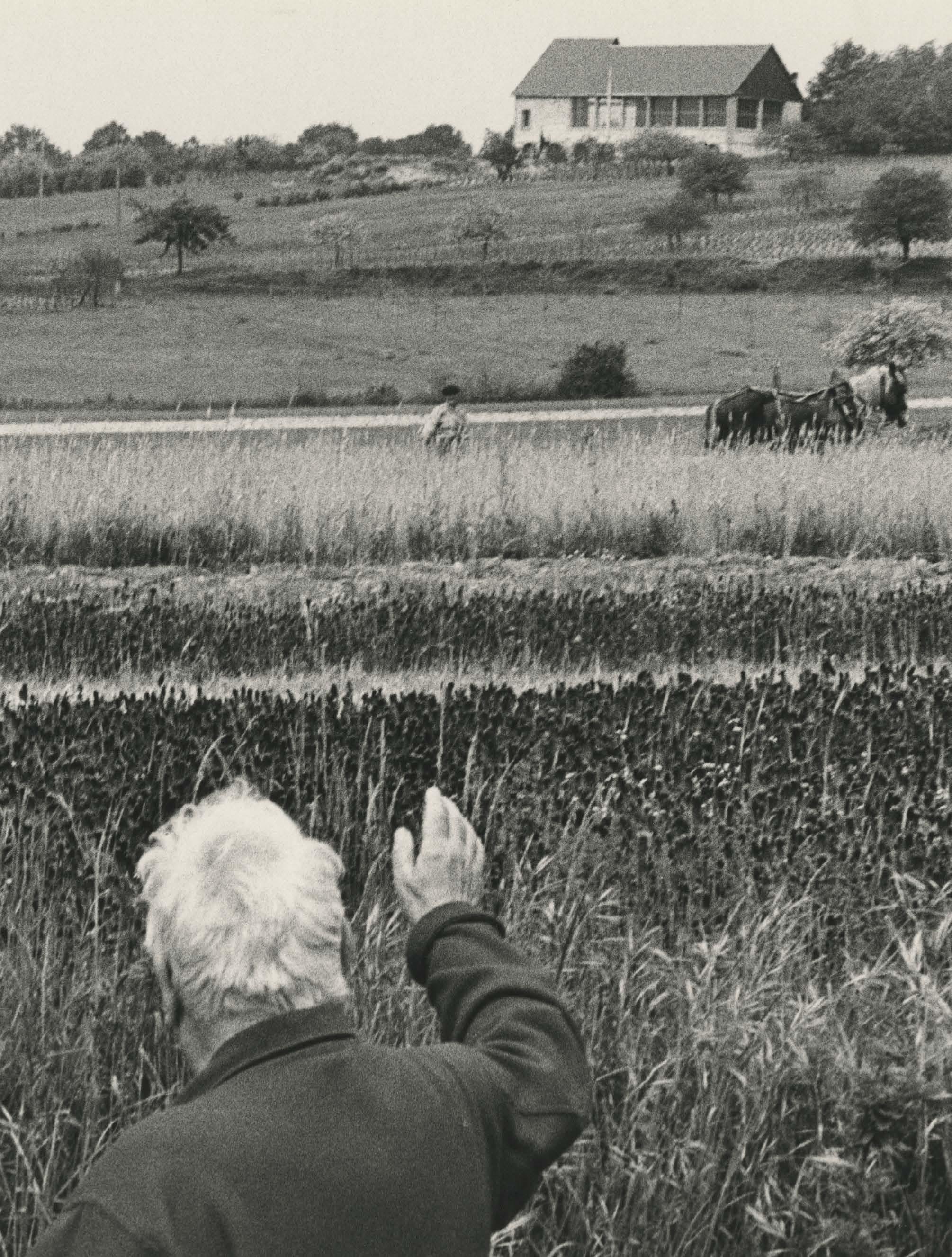

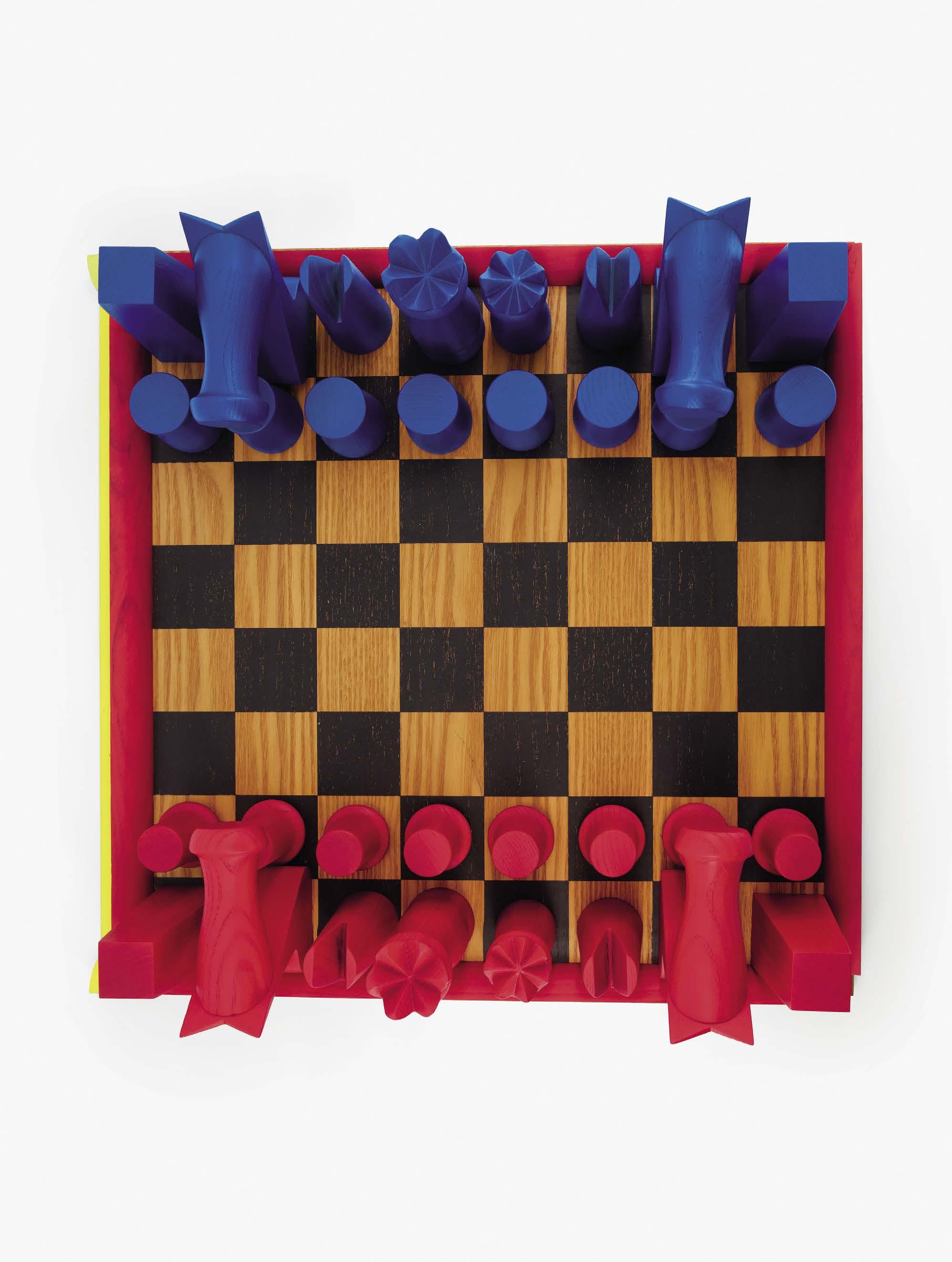

ÉDITIONS CAHIERS D’ART
14, RUE DU DRAGON, PARIS VI FONDÉE EN 1926
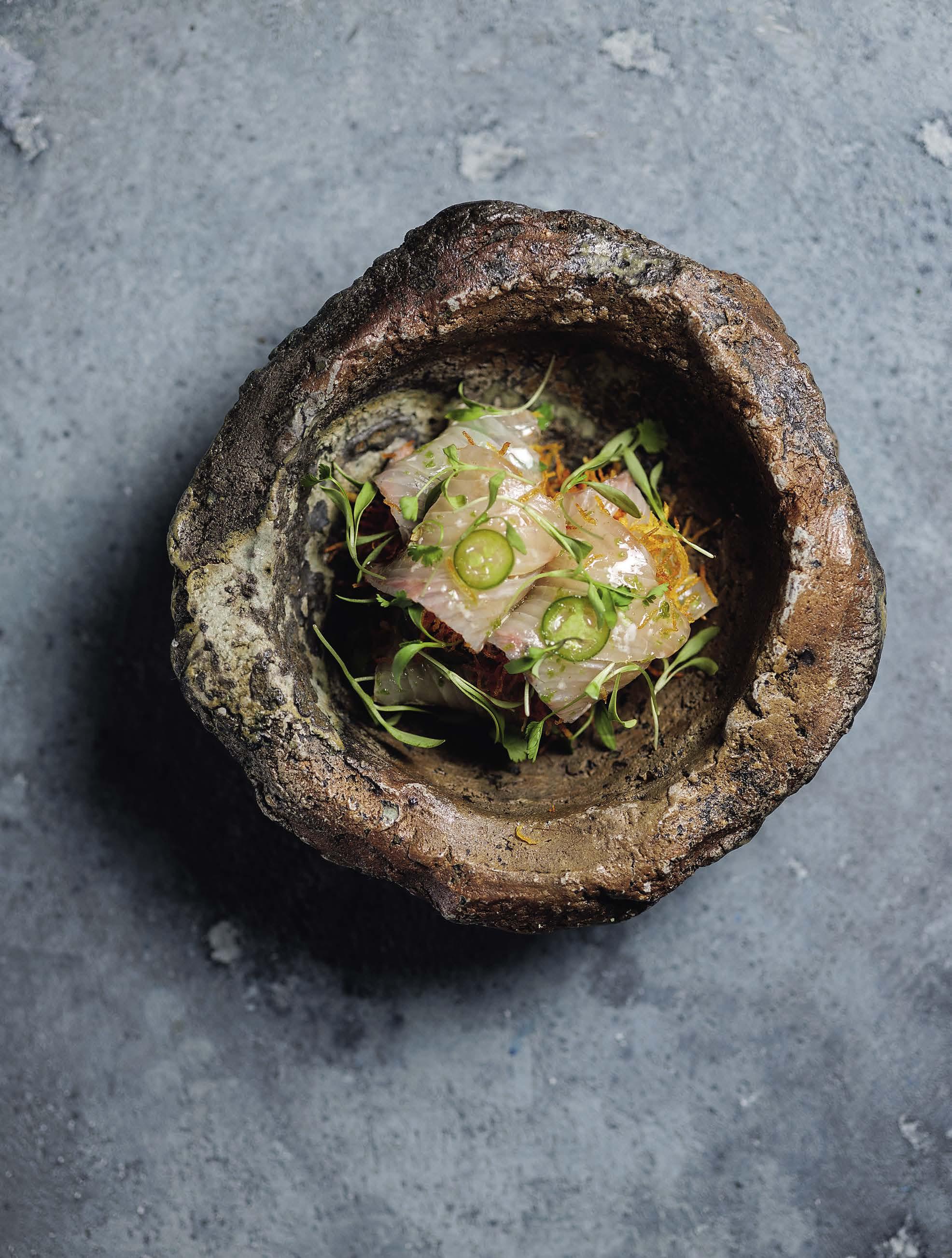
Salomé Gómez-Upegui honors Beatrice Wood, the “Mama of Dada,” an underappreciated trailblazer within the movement who went on to become a brilliant ceramist.
“I was born radical,” Beatrice Wood wrote in her aptly titled autobiography I Shock Myself (1985). “Even when I was a little girl I had a feeling of antagonism toward my mother. My family used to look at me and say, ‘She doesn’t belong to us.’”1
Completely unbothered by the matter of not belonging, Wood—who would go on to become a defining figure in New York’s Dada scene and, years later, an acclaimed ceramist—was just nineteen when she scandalized her affluent family by announcing her plan to become an artist and lead a bohemian life in Paris. An unfathomable ambition for a woman coming of age at the turn of the twentieth century. In 1912 she moved to France and studied briefly at the prestigious Académie Julian, but her plans were cut short by the onset of World War I. Forced to return to New York, she immersed herself in the city’s vibrant theater scene and performed more than sixty roles, using the pseudonym “Mademoiselle Patricia” to protect her family’s reputation, until an unexpected encounter with a Frenchman changed the trajectory of her life.
Wood met Marcel Duchamp in 1916 while visiting the avant-garde composer Edgard Varèse, who was in St. Vincent’s Hospital, New York, with a broken leg. She and Duchamp immediately became friends and shortly afterward Duchamp introduced her to the French author Henri-Pierre Roché. Wood had love affairs with both men, but beyond that, the three formed a profound friendship that shaped New York Dada and led to their cofounding of the ephemeral but foundational Dadaist journal The Blind Man . Together they were part of the inner circle of the renowned collectors Louise and Walter Arensberg, who remained important to Wood throughout her life. Duchamp and Roché “loved me in a paternal sort of way. . . . They were not interested in the theater; they wanted me to concentrate on art. The three of us were something like un amour à trois ; it was a divine experience in friendship,” Wood wrote in I Shock Myself. 2 The trio’s relationship is believed to have inspired François
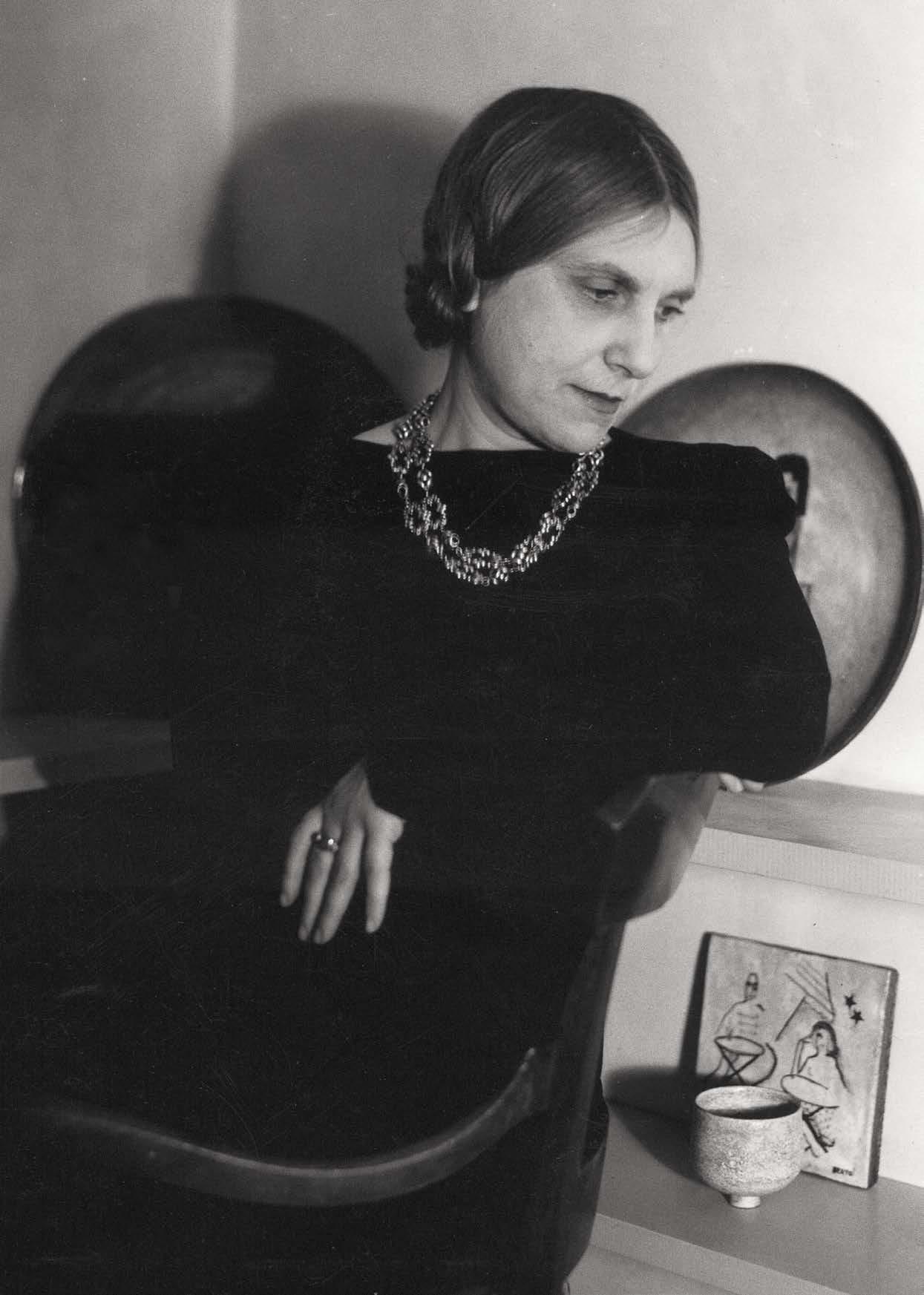
Opposite: Beatrice Wood with her ceramics at America House (now Museum of Arts & Design), New York, 1947. Photo: courtesy Beatrice Wood Center for the Arts/ Happy Valley Foundation
This page: Marcel Duchamp, Francis Picabia, and Beatrice Wood, Coney Island, Brooklyn, 1917. Gift of Jacqueline, Paul, and Peter Matisse in memory of their mother Alexina Duchamp. Photo: The Philadelphia Museum of Art/Art Resource, New York
Truffaut’s acclaimed French New Wave film Jules et Jim (1962).
Encouraged by Duchamp, Wood began to make humorous and often autobiographical drawings. When Duchamp caused outrage with Fountain at the first exhibition of the Society of Independent Artists in New York in 1917 (largely considered the debut of New York Dada), Wood caused commotion with her piece Un peu d’eau dans du savon (A little water in some soap), a drawing of a woman’s naked torso with a real piece of soap, shaped like a shell, placed between her legs.
Despite the undeniable influence of Duchamp on Wood’s thought, the Mama of Dada—as she came to be known after the release of a 1993 documentary with that title, recounting her role in the movement—remained her own authority. Intent on pursuing acting and eager to distance herself from her controlling mother (who was known to threaten suicide when Wood spoke of going abroad or pursuing an artistic career), she traveled to Montreal in 1918 to work in the city’s French theater. Once there, seeking further escape from her mother’s grip, she impulsively entered a tumultuous marriage with the theater manager Paul Renson that later ended in annulment.
Back in New York City at the start of the 1920s, Wood engaged in yet another torrid love affair, this time with the British actor and director Reginald Pole. Though the relationship resulted in heartbreak, Pole introduced her to Dr. Annie Besant, a leading figure in the Theosophical Society (which Wood joined in 1923), and to the Indian spiritual teacher Jiddu Krishnamurti. This exposure to Eastern philosophy played a pivotal role in shaping Wood’s worldview.
In 1928, seeking to rebuild her life, Wood moved to Los Angeles, where the Arensbergs had relocated years earlier and with whom she grew closer than ever. She also
became an increasingly devout follower of Krishnamurti. During a trip to Holland to hear him speak, she fell in love with a set of lusterware plates she bought in an antique shop, and once again her life took an unexpected turn. Back in LA, determined yet unable to find a teapot to match her beloved plates, Wood enrolled spontaneously in a ceramics course at Hollywood High School. At the onset of her forties, and relying on pure experimentation, she began studying the medium to which she would devote the next six decades of her life. As was customary for Wood, this new path was deeply shaped by the relationships she cultivated, most notably with the renowned AustrianAmerican ceramists Gertrud and Otto Natzler, who broadened her throwing and glazing techniques.
In 1948, Wood moved to Ojai, to a house across the street from Krishnamurti. She would continue to live and work in this town until the age of 104, just one year before her passing, in 1998. Today, the home and studio she built in Ojai is open to the public as the Beatrice Wood Center for the Arts. It was there that she began creating the works for which she would become most celebrated: one-of-a-kind vessels with iridescent surfaces, achieved unconventionally with in-glaze rather than overglaze lusters—luster glazes applied before firing the ceramics rather than after, as was customary among most ceramists.
Wood ultimately arrived at a style defined by improvisation and combining her many interests, including folk art, modernism, jewelry, and mysticism. She created dazzling bowls, plates, and chalices adorned with handcrafted details, playful fish sculptures (alluding to her astrological sign, Pisces), and figurative works that echoed her Dada-era drawings. Very early in her foray into ceramics, Wood received wholesale orders from prestigious department stores such as Bullocks Wilshire and
Neiman Marcus. And as she dove deeper into the medium, her pieces were exhibited widely at institutions across the United States, including the Los Angeles County Museum of Art, the Phoenix Art Museum, and the Delaware Art Museum.
Well into her eighties and nineties, Wood produced some of her best work, garnering the attention of influential art dealers such as Dada expert Francis Naumann and ceramics scholar Garth Clark. Although she garnered significant
1. Beatrice Wood, I Shock Myself: The Autobiography of Beatrice Wood , ed. Lindsay Smith, 1985 (reprint ed. San Francisco: Chronicle Books, 2006), 4.
2. Ibid., 25.
3. Wood, in Paul Karlstrom, “Oral history interview with Beatrice Wood, 1992 March 2,” Archives of American Art, Smithsonian. Available online at https://www.aaa.si.edu/ collections/interviews/oral-history-interviewbeatrice-wood-11853 (accessed December 19, 2025).
recognition during the final decades of her life, the market for her work declined sharply after her passing. Still, this would likely have mattered little to Wood, whose guiding philosophy was shaped far more by joie de vivre than by accolades. At the age of ninety-nine, in an interview for the Smithsonian’s Archives of American Art, she reflected, “I don’t make pottery to make money. I don’t make pottery to have exhibitions. I make pottery because I enjoy it.”3