The Best of the Best. Then and Now Built to Last: What Makes an Icon Truly Stand the Test of Time
The Evolution of Excellence: Why Great Technologies Never Stop Adapting
The Forces Shaping Tomorrow’s Best Tech
ASUS ROG Zephyrus Duo
ASUS ROG Zephyrus G14
ASUS ROG Zephyrus G16
Epson SureColor SC-F20030
HONOR X7e
HUAWEI Watch GT
Infinix HOT 70
LG xboom Stage 501
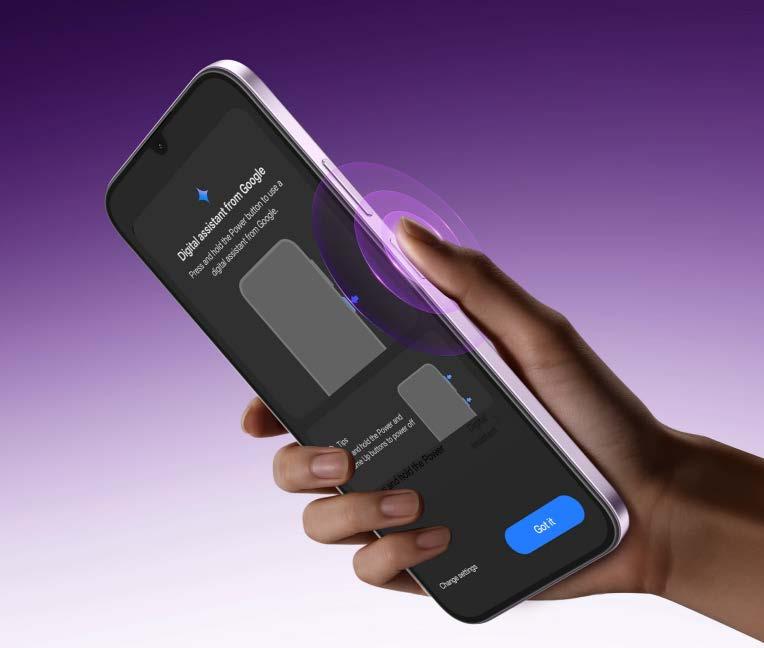
OPPO A6s 5G
The Best of the Best. Then and Now.
Words by Maribelle Alba
Twenty-six volumes ago, Gadgets Magazine set out to document a world where technology was evolving at an extraordinary pace. Since then, we’ve seen breakthrough products redefine entire categories, familiar devices become everyday essentials, and oncepromising innovations quietly fade into history.
Looking back, it’s interesting to see which technologies are still with us today. Some arrived to enormous excitement before fading from view. Others earned their place much more quietly, becoming part of
everyday life before we realized how much we depended on them.
That idea inspired this anniversary theme.
What makes a product an icon? Why do some technologies continue to evolve while others disappear? And what forces will shape the next generation of products that define our lives?
Our Cover Stories explore those questions from different perspectives. Together, they look back at the innovations that endured, examine why the best ideas continue to evolve, and consider the changes already shaping what comes next.
BUILT TO LAST WHAT
MAKES AN ICON TRULY STAND THE TEST OF TIME
Words by Phia Manuell Layoso
Every year brings a new wave of products promising to be faster, smarter, thinner, or more powerful than what came before.
A smartphone with better screen resolution. A smarter TV. A car with smarter safety features. A laptop that’s thinner, faster, and powered by the latest processor. Brands strive to introduce the next breakthrough, each promising to redefine the way we live, work, and connect.
News articles get written, the media goes crazy for a few days, and consumers rush to experience what’s next. Yet as quickly as these innovations arrive, many quietly fade into the background, replaced by newer versions the next year.
A select few follow a different path.
They remain relevant even as technology and consumer preferences evolve. People still recommend them, rely on them, and use them as the benchmark for newer products. Some become woven into family traditions, while others shape the design, purpose, and expectations of an entire product category.
They become icons.
But iconic status is not determined by sales alone. Many bestselling products
are eventually forgotten. It is not guaranteed by innovation either, since history is filled with groundbreaking ideas that arrived too early, failed to reach the right audience, or were overtaken by better-executed alternatives.
A product becomes iconic when it offers something more enduring: a recognizable identity, proven reliability, cultural meaning, and a legacy that extends beyond its original moment.
More than a Product
Every product always begins with a purpose. A phone helps people communicate. A car transports people from one point to another. A camera takes pictures. A game console offers fun.
An icon goes further. It becomes part of everyday life.
Over time, people stop thinking about it only in terms of what it does. They remember where it took them, what it helped them accomplish, or which moments it helped preserve.
Take, for example, the Toyota Corolla. By technical standards, it is just a small sedan. But to many families in the world, it became their first car. It carried kids to school, took them on numerous family trips, and remained reliable year after year.
The Corolla did not gain popularity because of its distinctive design or exceptional performance. The Corolla gained fame for its reliability. Over time, it stopped being only a means of transport and became a symbol of reliability and mobility.
The same pattern can be seen in products that become part of daily routines.
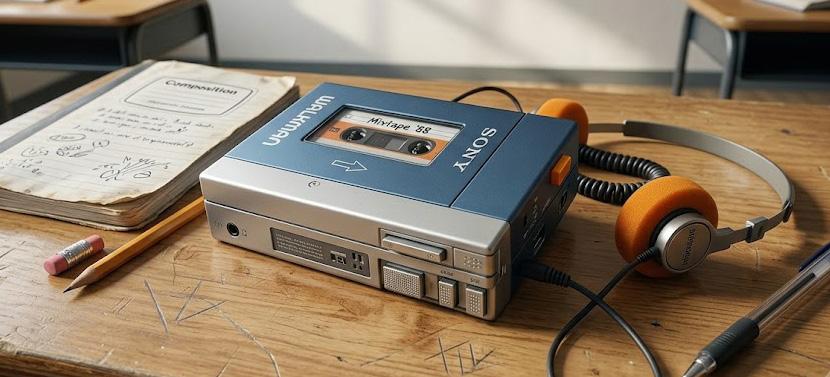
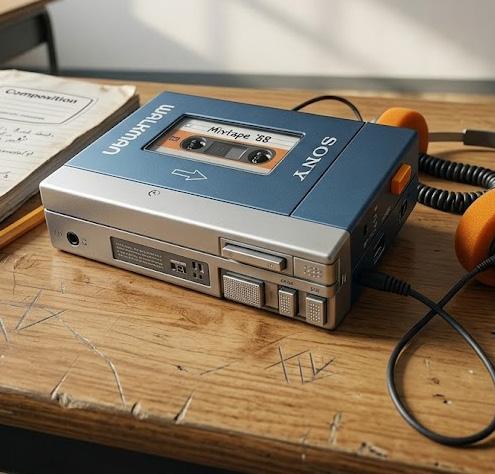
The Sony Walkman is not only an audio cassette player that allows listening to music on the go. This device changes people’s experience of listening to music. Music was no longer limited to the living room, the car, or a home stereo—it could accompany someone on a commute, during a walk, or throughout an ordinary day.
Although smartphones and streaming services have long replaced cassette players, the idea introduced by the Walkman remains deeply embedded in modern technology.
That is one of the strongest qualities of an iconic product. People remember not only what it was, but also how it changed the way they lived.
Design That Never Ages
Technology changes rapidly, but good design seems to last for decades without becoming outdated.
Unlike trends that come and go, timeless design focuses on clarity, usability, and purpose. It avoids unnecessary complexity and instead creates an identity that people instantly recognize.
A great example would be the Volkswagen Beetle. The Volkswagen Beetle demonstrates how powerful that identity can be.
Even though the car was constantly evolving, something remained consistent: its iconic rounded look made it recognizable across generations. It became more than a car. It became a symbol of simplicity, individuality, and a particular era of popular culture.
The contoured Coca-Cola glass bottle continues to be an iconic piece of packaging. At a time when brands did not require a logo for recognition, it was the bottle’s contour that made it instantly recognizable.
This is what lasting design achieves. It creates familiarity without becoming trapped in the past.
The strongest product identities are not preserved by refusing to change. They endure because designers understand which elements are essential and which can evolve.
A truly iconic design gives people something to recognize, even when everything around it has been updated.
Trust Built Over Time
In the current marketplace, competitors can quickly match specifications, imitate design details, and offer similar functions at a lower price.
What they cannot reproduce instantly is a long record of dependable performance.
Trust develops through years of reliable performance and consistently positive experiences. Consumers will always return to product lines that consistently meet expectations, as familiarity reduces uncertainty. People naturally gravitate toward products they know they can depend on.
Few products demonstrate this better than the Casio G-Shock.
The watch earned its reputation by doing exactly what it promised. Built to withstand drops, shock, water, and all manner of harsh environments, the watch became famous not for its luxury, but for its reliability.
Newer watches may offer health tracking, notifications, navigation, and advanced sensors. But the G-Shock remains relevant because users understand what it represents: toughness, dependability, and a design built for real-world use.
That reputation has been reinforced over decades.
Trust also explains why people often remain loyal to familiar product systems. Another example is Canon. For decades, photographers have relied on Canon cameras because of their consistency and reliability. When a once-in-a-lifetime moment cannot be recreated, confidence in the equipment becomes just as important as the technology inside it.
The product is no longer judged in isolation. It becomes part of a relationship built through experience.
Marketing may persuade someone to try a product. Only consistent value can persuade them to keep believing in it.
From Product to Legacy
A product does not become iconic simply because it lasts for decades.
Some products remain in the market because of habit, scale, or limited competition. Others endure without leaving a meaningful influence. An icon does more—it shapes what comes next.
They can introduce a new design, reshape an entire product category, or raise the standard for what consumers expect. Even after the original technology
has been replaced, the ideas they introduced continue to influence future generations of products.
The Walkman transformed the way people experienced music by making it personal and portable. The G-Shock became the standard for durability in watches. The Corolla earned its reputation as the benchmark for reliable, everyday transportation.
The iPhone deserves a place alongside these products—not only because it became one of the world’s best-selling devices, but because it fundamentally changed what people expected from a smartphone.
It combined communication, entertainment, navigation, photography, computing, and internet access into one intuitive device that appealed to a wide audience. Today, its impact can still be recognized in almost every smartphone on the market.
Truly iconic products often become the standard by which others are judged. They serve as the reference point whenever new or competing products are introduced.
That is what defines a lasting legacy.
Strong sales may create popularity, but enduring value, consumer trust, and a
meaningful impact on culture are what secure a product’s place in history.
The Test of Time
Today, artificial intelligence, electric vehicles, wearables, and connected homes form the basis of the next generation of products that will one day become icons.
Some products may bring groundbreaking innovations. Some may bring high sales or worldwide recognition. None of these products, however, will become icons overnight.
An iconic product is built over time.
Products that make an impact over time are not always the fastest, the strongest, or the most costly. The products that make an impact are those that stay relevant years after their launch date.
They remain relevant because they solve real problems, earn trust through years of dependable performance, develop an identity people recognize, and continue influencing the products that follow.
This is what it means to be an icon.
The best products are not just designed for now – they are built for the future.
Cover Story
Words by Aljhelyn Piador
The Evolution of Excellence
Why Great Technologies Never Stop Adapting
History has shown that innovation alone rarely guarantees longevity.
Many technologies arrive with groundbreaking ideas, only to fade as habits, expectations, and lifestyles change around them. The products that endure are seldom those that simply introduced something new. More often, they are the
ones that kept evolving long after their first breakthrough.
That is because relevance is never fixed.
The way we communicate, work, learn, create, and preserve memories today is very different from how we did twenty years ago. Technology that succeeds over decades recognizes that while human needs remain surprisingly consistent, the ways
people expect those needs to be fulfilled continue to evolve.
Perhaps that is the real definition of excellence.
Not building the perfect product once, but continually asking the same question: What do people need now?
The Evolution of Memory
Long before smartphones could capture cinematic video or artificial intelligence could remove unwanted objects with a tap, photography already served a simple and deeply human purpose: preserving memories.
A family portrait displayed in the living room. A graduation photograph carefully stored in an album. A child’s first steps captured for future generations.
The technology has changed dramatically over the past century, but the reason people reach for a camera has remained remarkably constant.
For decades, manufacturers competed by improving the camera itself. Better lenses. Larger sensors. Faster autofocus. Higher resolution. Professional photographers mastered exposure, aperture, shutter speed, and film development because creating an exceptional image demanded technical expertise.
Eventually, however, expectations began to shift.
Photography was no longer reserved for birthdays, weddings, and holidays. It became part of everyday life. Parents wanted to capture fleeting moments before they disappeared. Travellers wanted to share experiences instantly. Friends wanted to document ordinary days as easily as extraordinary ones.
The question quietly changed.
It was no longer:
“How can we build a better camera?”
It became:
“How can we make remembering easier?”
Apple became one of the companies that most clearly recognized this shift.
When the first iPhone arrived in 2007, camera phones were already common. Nokia, Sony Ericsson, Samsung, and others had spent years improving camera hardware, while dedicated digital cameras still produced noticeably better images.
Rather than competing solely through specifications, Apple gradually shifted much of photography’s complexity away from the user.
Features such as HDR, Portrait Mode, Night Mode, and computational photography allowed the device to make increasingly sophisticated decisions automatically. Users no longer needed to understand every technical setting to capture memorable images. The technology worked quietly in the background, allowing people to focus on the moment instead of the mechanics.
The experience continued after the shutter was pressed.
Cloud synchronization transformed photographs from files stored on a single device into memories that followed users across phones, tablets, and computers. More
recently, artificial intelligence has begun making it easier to organize, search, and edit growing photo libraries using natural language rather than manual sorting.
Apple did not invent the camera phone, nor was it alone in advancing computational photography. Companies such as Google, Samsung, HONOR, OPPO, vivo, and Xiaomi have all helped redefine what smartphone photography can accomplish. Together, they shifted the industry’s attention away from hardware specifications alone toward intelligent software and seamless user experiences.
The evolution of photography reflects a broader lesson.
People have never simply wanted better cameras.
They have wanted better ways to remember.
Technology continues to evolve because that desire remains unchanged, even as the tools that fulfil it become increasingly intelligent.
The Evolution of Connections
For centuries, technology has worked to overcome physical distance. Letters carried thoughts across oceans, telephones allowed voices to travel across cities, and the internet made conversations nearly instantaneous.
But as the world became more connected, our expectations changed.
Connection was no longer measured by how quickly a message could be delivered. We began looking for richer ways to share our lives through photos, videos, live conversations, online communities, and real-time collaboration. We wanted technology that did not simply transmit messages, but helped us share experiences, build relationships, and work together regardless of distance.
As people’s expectations evolved, so did the technologies that enabled them. Digital platforms were no longer just communication tools. They became spaces for community, commerce, entertainment, and collaboration. Facebook is one of the clearest examples of this broader transformation.
When Facebook launched in 2004, its purpose was to help people connect through online profiles. Users shared status updates, uploaded photos, and reconnected with classmates and friends. It reflected how people wanted to socialize online at the time.
As digital behavior changed, Facebook adapted alongside it. The introduction of the News Feed transformed static profiles into continuously updated conversations. Messenger evolved into a standalone platform as users increasingly preferred private, instant communication over public posting. Facebook Groups enabled people with shared interests to build communities regardless of geography. Marketplace expanded the platform beyond social interaction into local commerce, while Facebook Live and later Reels reflected the growing demand for real-time and shortform content.
During the COVID-19 pandemic, that adaptability became even more apparent. As physical distancing became part of everyday life, Facebook’s ecosystem helped families celebrate milestones, businesses stay connected with customers, schools communicate with students, and communities support one another despite being apart. The platform demonstrated how digital connection had evolved beyond conversation to include collaboration, support, and shared experiences.
Yet this evolution also came with trade-offs. As Facebook expanded into news, commerce, video, and AI-powered discovery, it faced growing scrutiny over privacy, misinformation, content moderation, and the influence of algorithmic feeds on what people see and share. At the same time, changing user behavior shifted much of online interaction away from public posting toward private messaging and smaller communities, while younger audiences increasingly explored newer social platforms. Reinvention, it became clear, was as much about responding to challenges as introducing new features.
Even so, Facebook and Messenger have continued to evolve. Features such as Channels provide creators and organizations with new ways to communicate with their communities, while Meta AI is transforming Messenger into more than a messaging app by helping users search for information, generate ideas, and interact with AI directly within conversations. These developments reflect a broader industry trend: communication platforms are becoming tools not only for connecting people, but also for helping them discover, create, and collaborate.
Facebook’s continued relevance illustrates a larger lesson about technological excellence. Great communication technologies endure not because they remain unchanged, but because they continually redefine what connection means as people’s needs evolve.
The Evolution of Creativity
Creativity has always been one of humanity’s defining traits. Long before the first computer, people painted cave walls, composed music, designed buildings, and wrote stories to make sense of the world around them. Technology has never replaced that instinct. It has simply expanded what people are capable of creating.
For decades, creative software focused on individual capability. Word processors replaced typewriters. Graphic design moved from drafting tables to desktop computers. Video editing became digital. Every
advancement gave creators more precision, more control, and more possibilities.
But as technology matured, the nature of creativity itself began to change. Ideas were no longer developed by one person on one computer. Creative work became increasingly collaborative, with teams working across continents, designers switching between devices, and students and professionals expecting instant access to files, feedback, and information. The evolution of creative technology was no longer defined solely by what software could do, but by how effectively it enabled people to work together.
That shift gave rise to a broader creative ecosystem. Platforms such as Canva made design accessible to millions of people with little to no formal training, while Figma reimagined collaboration by allowing entire teams to design together in real time through the browser. Together, they reflected an industrywide transition from isolated desktop applications to connected, cloud-based creative workflows that welcomed both professionals and everyday users.
It’s difficult to talk about modern creativity without talking about Adobe. Long before “content creator” became a career, Adobe was already helping people produce everything from magazines and photographs
to films, illustrations, and digital experiences. Its software has shaped the workflows of creative professionals for decades.
As those workflows evolved, Adobe evolved with them. For years, Creative Suite represented the benchmark for professional creative software, with applications installed on individual computers and upgraded through periodic releases. It reflected how creative work was done at the time.
As collaboration, mobility, and cloud computing became central to the creative process, Adobe recognized that the workflow had become the real product. With the introduction of Creative Cloud, its tools became part of a connected ecosystem where projects could move across devices, assets could be shared through the cloud, and continuous updates replaced long upgrade cycles.
More recently, Adobe responded to another major shift with Firefly, its family of generative AI tools. Rather than presenting artificial intelligence as a replacement for creative professionals, the company positioned it as a way to accelerate repetitive tasks, generate early
concepts, extend images, and streamline parts of the creative process while leaving creative judgment in the hands of users.
Like many technological advances, however, generative AI has also introduced new questions. Debates surrounding authorship, copyright, training data, creative ownership, authenticity, and the impact of automation on creative professions continue to shape how these tools are developed and adopted. As with previous technological shifts, adaptation has brought both new opportunities and new responsibilities.
Adobe’s continued relevance reflects a broader lesson about creative technology. Success has come not from preserving a familiar way of working, but from recognizing that creativity itself has become more collaborative, more connected, and increasingly supported by intelligent tools.
Today, people expect more than software that can edit photos or produce videos. They expect platforms that help them brainstorm, collaborate, learn new skills, and transform ideas into finished work more efficiently than ever before.
The Evolution of Excellence
Photography. Connection. Creativity.
At first glance, they seem like very different technologies. Yet they all point to the same lesson: while the tools continue to evolve, the human needs behind them remain remarkably consistent. We still want to remember. We still want to belong. We still want to create.
The technologies that endure illustrate how technology can evolve alongside those needs, but adaptation alone is not the measure of excellence. Market forces, ecosystems, and timing also shape
which technologies endure. The stronger test is whether each new evolution continues to create meaningful value for the people who use it.
Perhaps that is the real definition of excellence. Not delivering a breakthrough once, but continually responding as people’s lives, expectations, and habits change.
Because the technologies we remember aren’t simply the ones that changed the world once.
They’re the ones that never stopped changing with it.
THE FORCES SHAPING TOMORROW’S BEST TECH
THE BEST GADGETS OF TOMORROW ARE ALREADY BEING DESIGNED. JUST NOT WHERE THEY USUALLY ARE.
Words by Chris Noel Hidalgo
In September 2023, Apple made one of the most consequential changes to the iPhone: it dropped the iPhone’s proprietary Lightning connector for USB-C. For more than a decade, Lightning was one of the defining features of Apple’s ecosystem, even as virtually all other smartphones and portable devices moved on to standardize USB-C as a charging and data transfer mechanism. Now, instead of carrying multiple charging cables, consumers only need one USB-C cable for their laptops, tablets, earbuds, power banks, and portable gaming devices.
That shift wasn’t driven by any change in design philosophy or any Appleengineered breakthrough involving USB-C. Rather, it came after the European Union adopted a new law requiring USB-C as the common charging standard across devices. Rather than make separate iPhone models for Europe and the rest of the world, Apple adopted USB-C across its global market.
It’s a reminder that the technologies we use every day aren’t shaped by consumer demand, innovation, or product designers alone. Policymakers,
chip manufacturers, trade negotiators, environmental pledges, AI investments— all these typically unseen forces ultimately influence what ends up being in our hands one way or another. If you want to know what the next great tech will look like, don’t just look at product leaks and launches.
Make sure to also watch what’s happening in the world.
Governments are becoming product designers
You’d be forgiven for thinking that government regulation only slows down innovation. Increasingly, however, it is also helping steer it.
Europe has become the clearest example. The European Union’s (EU) Common Charger Directive established USB-C as the charging standard for phones, tablets, laptops, cameras, handheld consoles, and other portable consumer devices sold within Europe. Rather than make separate production lines for EU and non-EU products, many brands decided to comply en masse with their global shipments. For consumers, it
means fewer specialized cables to purchase. For the environment, it means less electronic waste.
Repairability is another example. The EU’s Right to Repair Directive is also set to affect the global market. Taking effect on 31 July 2026, it directs manufacturers to provide spare parts, repair information, and longer product support while reducing barriers to independent repairs. Although the legislation applies only within Europe, multinational brands rarely develop entirely separate product strategies for different regions. Because global manufacturers generally prefer standardized production and support systems for efficiency, changes introduced for one major market can influence products sold elsewhere.
The result could change both how products are designed and how long consumers keep them. For years, the industry revolved around frequent upgrade cycles, and regular device replacement was the norm. Tomorrow’s best products may instead be those that last longer, remain repairable, and receive support for many years after purchase.
The engineer is still designing tomorrow’s gadgets. But increasingly, lawmakers are helping write the design brief. Most people will never read the legislation behind the changes. But they’ll simply notice that the products in their hands work a little differently than they used to.
Semiconductors are the new strategic resource
If oil defined much of the industrialized twentieth century, semiconductors are defining the digitized twenty-first. They influence battery life, device performance, wireless connectivity, AI capabilities, manufacturing costs, and ultimately, price tags. When chip production is constrained, consumers feel the effects almost immediately with delayed product launches, higher prices, fewer choices, or all three at the same time.
Semiconductor fabrication is an extraordinarily complex process involving
global supply and production chains.
Just as COVID-19 disrupted the alreadyfragile supply chain, the Middle East conflict has led to trade restrictions, volatile energy supply, delayed shipping, and more complicated logistics for semiconductor manufacturing. Even products, such as those from Apple whose specifications remain unchanged, can become more expensive simply because the silicon inside them costs more to produce.
The boom in artificial intelligence infrastructure adds further strain. Large-scale AI models require advanced processors paired with high-bandwidth memory (HBM). The rapid expansion of AI services is causing semiconductor factories and chipmakers to divert production away from consumer electronics into such enterprise infrastructure. This leaves less manufacturing capacity available for consumer-grade products, with shelf prices soaring as a result.
These developments have made semiconductors a strategic geopolitical resource. The United States, the European Union, Japan, South Korea, and China have all introduced major initiatives aimed at strengthening domestic semiconductor production and reducing dependence on overseas manufacturing. Locally, the Philippines has joined the US-led Pax Silica initiative, which aims to strengthen semiconductor and AI supply chains among partner economies. For the country, the opportunity lies in moving further up the value chain through advanced manufacturing, assembly, packaging, testing, and related infrastructure. Whether these efforts ultimately increase supply enough to lower consumer prices remains to be seen.
Consumers may never follow semiconductor policy. Yet the availability, affordability, and capabilities of tomorrow’s devices increasingly depend on decisions made far upstream from
the electronics store. Companies with reliable chip access won’t just launch first. They’ll define the pace of innovation for everyone else.
The demand for more efficiency and sustainability
For years, many tech companies lived by the mantra that bigger numbers equal a better device. More megapixels. More gigahertz. More RAM. More cores. More battery. Those specifications matter, yes, but another measure of innovation is becoming just as important: how efficiently a device delivers that performance throughout its lifetime.
The shift begins with energy efficiency. Chipmakers are chasing the best performance per watt instead of just raw computing power. More efficient processors enable thinner devices, longer battery life, cooler and quieter systems, and more capable on-device AI. Consumers benefit from devices that last
longer on a single charge, generate less heat, and remain useful for more years before their batteries begin to degrade.
Moreover, behind every cloud-based AI-generated image and AI-powered feature is often an enormous network of data centers consuming vast amounts of electricity and water to keep equipment operating within safe temperatures. As AI adoption accelerates, reducing energy and water use is becoming as much a business requirement as an environmental one. Companies that can deliver more capable AI features while consuming fewer resources will gain an advantage as operations scale and as governments tighten sustainability requirements.
Sustainability is influencing tech in other ways as well. Brands now use recycled components, lower-carbon manufacturing processes, and plastic-free packaging. Devices are increasingly designed to receive longer software support, allowing consumers to keep them in service for more years before replacement.
Sustainability is no longer simply corporate goodwill, but a business necessity due to stronger environmental
regulations and accountability the world over. The next generation of iconic devices may not simply be faster. A device that performs well for six years may ultimately represent better engineering than one that delivers marginally higher performance but requires replacement after three.
What tomorrow’s tech will look like
History doesn’t tell us exactly which company will build the next iconic product. What it does offer is a clue about where to look. The technologies that define the next decade will emerge where product design and engineering intersect with policy, silicon, sustainability, and consumer confidence. Companies that can adapt to those forces—not just build impressive hardware—will shape what we ultimately use every day.
Those are the forces quietly shaping tomorrow’s technology. The next great gadget won’t simply reflect the imagination of its engineers.
It will reflect the world that made it possible.
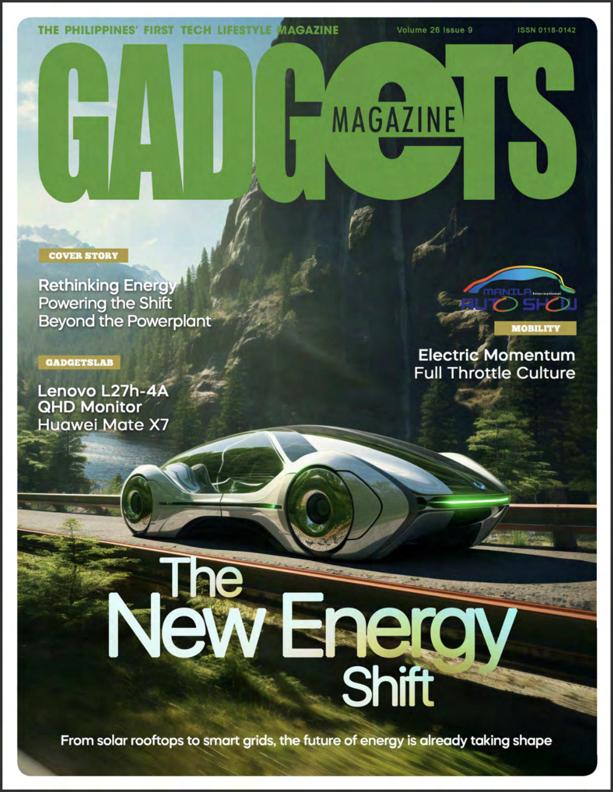
Concept visual created for illustration purposes only
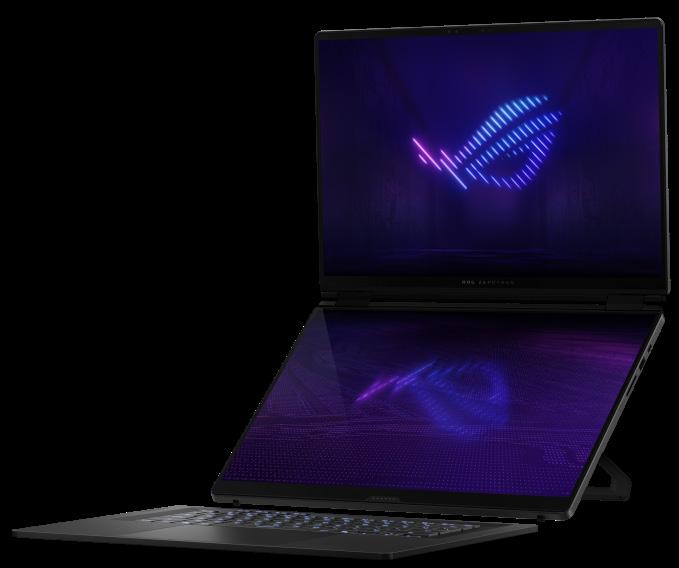
ASUS ROG Zephyrus Duo
ASUS REPUBLIC OF GAMERS
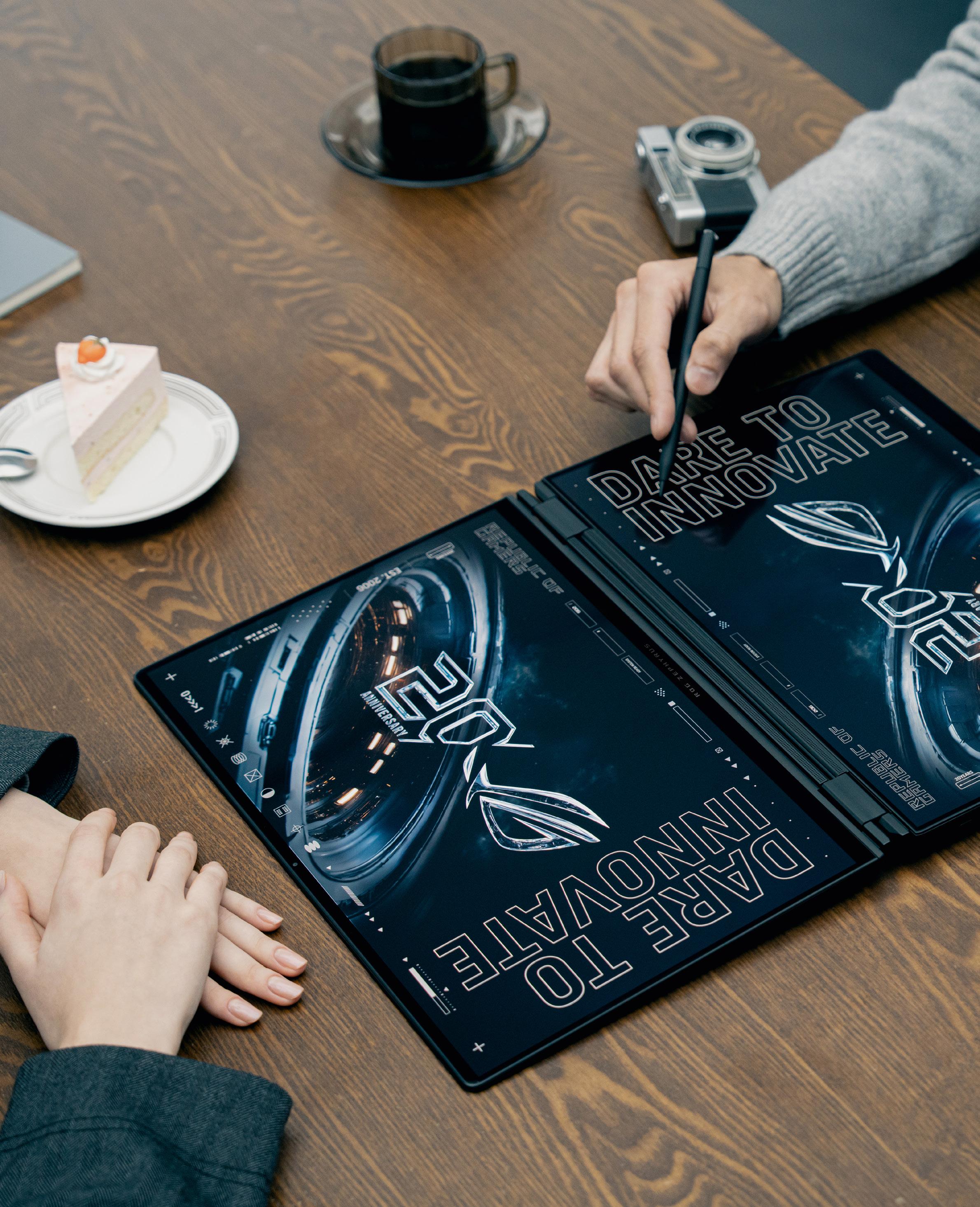
is redefining portable gaming and productivity with the 2026 ROG Zephyrus Duo (GX651AX), billed as the world’s first 16-inch dual-screen gaming laptop. Designed for gamers, creators, and multitaskers, it combines dual OLED displays, flagship hardware, and multiple operating modes in a premium portable form factor.
The Zephyrus Duo features two 16inch 16:10 touchscreen displays, each with a 120Hz refresh rate, creating an expansive 32-inch combined workspace. The primary 3K ROG Nebula HDR OLED display delivers up to 1,100 nits of peak brightness, 100% DCI-P3 color coverage, and Dolby Vision HDR support for vivid visuals across games, creative work, and entertainment. Anti-glare coatings on both screens improve visibility in different lighting conditions.
A new 320-degree kickstand hinge expands the laptop’s versatility, allowing users to switch between Laptop, Dual-Screen, Book, Tent, and Sharing modes. ASUS ScreenXpert software makes transitioning between these configurations seamless, whether for gaming, content creation, collaboration, or multitasking.
Powering the Zephyrus Duo is an Intel Core Ultra 9 386H processor
paired with an NVIDIA GeForce RTX 5090 Laptop GPU with up to 150W Max TGP, alongside 64GB LPDDR5X memory and a 2TB SSD. The combination is designed to handle demanding games, creative applications, and AI-powered workloads with ease.
Finished in Stellar Gray with the signature Slash Lighting design, the Zephyrus Duo comes bundled with the ASUS Pen 3.0, ROG Universal Backpack, ROG Gladius III Gaming Mouse, PC Game Pass, Microsoft 365 Basic, and ASUS’ No. 1 Quality & Service package, which includes a three-year international and local warranty plus one year of accidental damage protection.
Gaming Laptop
ASUS ROG Zephyrus G16
THE 2026 ROG Zephyrus G16 (GU606) combines premium portability with high-end gaming performance, offering powerful hardware inside an ultrathin aluminum chassis measuring just 1.49cm thick and weighing 1.85kg.
Equipped with up to an Intel Core Ultra 9 386H processor and an NVIDIA GeForce RTX 5090 Laptop GPU with 160W TGP, the Zephyrus G16 is built for demanding games, creative workloads, and AI-enhanced applications. Configurations include up to 32GB LPDDR5X memory and 2TB PCIe SSD storage.
Visuals are handled by a 16-inch 2.5K ROG Nebula HDR OLED display with a 240Hz refresh rate, NVIDIA G-SYNC support, and VESA DisplayHDR True Black certification. The display is designed to deliver smooth gameplay, vibrant
HDR content, and accurate color reproduction for gaming and creative work alike.
Keeping the hardware running efficiently is ASUS’ ROG Intelligent Cooling system, which combines Tri-Fan Technology, Liquid Metal, and an enlarged ventilation area with redesigned exhaust outlets for improved airflow. A 90Wh battery supports fast charging from 0 to 50% in just 30 minutes and is rated for up to 22 hours of video playback or 14.7 hours of web browsing.
The Zephyrus G16 also includes an ROG Exclusive Sleeve, ROG Strix Impact Gaming Mouse, PC Game Pass, Microsoft 365 Basic, and ASUS’ No. 1 Quality & Service package with a three-year international and local warranty plus one year of accidental damage protection.
Gaming Laptop
ASUS ROG Zephyrus G14
Gaming Laptop
BUILT FOR GAMERS and creators who value portability, the 2026 ROG Zephyrus G14 (GU405) packs flagshipclass performance into a slim 1.59cm chassis weighing just 1.5kg, making it one of the most compact premium gaming laptops in the ROG lineup.
The laptop is powered by up to an Intel Core Ultra 9 386H processor and an NVIDIA GeForce RTX 5080 Laptop GPU with up to 130W TGP, supported by up to 32GB LPDDR5X memory and 2TB SSD storage for demanding games, creative software, and local AI workloads.
Its 14-inch 3K ROG Nebula HDR OLED display features a 120Hz refresh rate, NVIDIA G-SYNC, VESA DisplayHDR True Black 1000 certification, and full DCI-P3 color
coverage, delivering vibrant visuals with smooth motion and high color accuracy.
ASUS has also redesigned the laptop’s thermal system with thicker heat pipes, updated heat pipe placement, 137 ultrathin copper fins, a refined intake mesh, and ROG Intelligent Cooling with Tri-Fan Technology. According to ASUS, the updated cooling design increases airflow while helping the system operate more quietly under load.
Bundled with an ROG Exclusive Sleeve, ROG Strix Impact Gaming Mouse, PC Game Pass, Microsoft 365 Basic, and ASUS’ No. 1 Quality & Service package, the Zephyrus G14 brings premium gaming performance and portability together in a compact package.
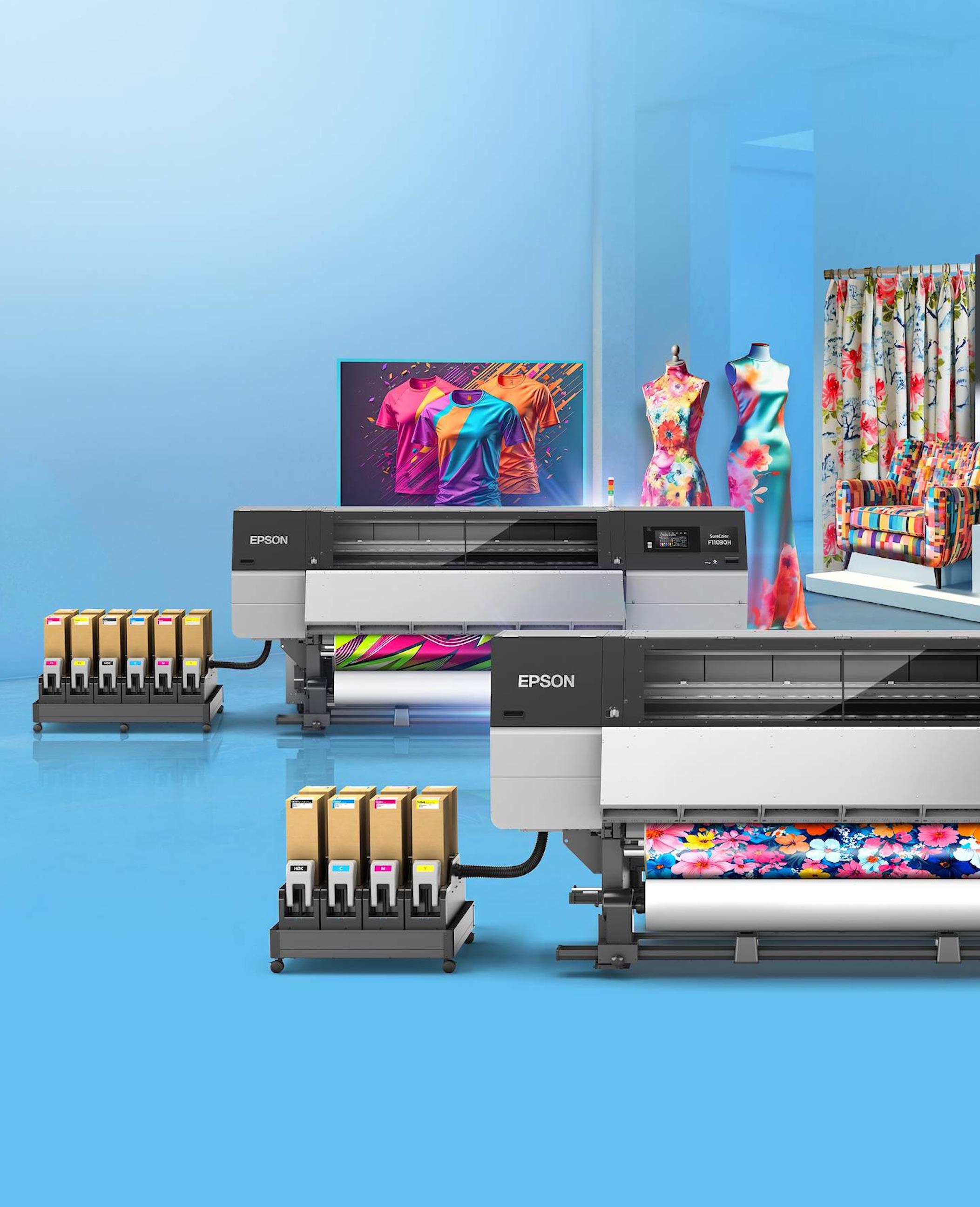
Epson SureColor SC-F20030
EPSON is expanding its industrial textile-printing lineup with the SureColor SC-F20030, a 76-inch dye-sublimation printer designed for high-volume production environments.
Built for textile manufacturers, print-on-demand providers, and commercial print operations, the SC-F20030 uses eight Epson PrecisionCore MicroTFP printheads arranged in an overlapping horizontal configuration. This doubles the four-printhead architecture of its SC-F11030 predecessor and supports production speeds of up to 306sqm per hour at 600 x 600dpi.
The printer uses Epson UltraChrome DS Ink and a bulk ink supply system fitted with 10-liter ink packs. Hot-swap functionality automatically switches to a second ink pack of the same color when the first runs out, allowing printing to continue while the empty pack is replaced.
To support continuous production, the SC-F20030 incorporates a drying system that heats both sides of the transfer media. This helps cure ink during printing while reducing unwanted ink transfer and media wrinkling. An intake fan and media cleaner also limit dust buildup and help prevent nozzle clogging.
Optional jumbo roll and jumbo reel units can accommodate media loads of up to 300kg, reducing the need for frequent roll changes during extended production runs.
Operators can also replace selected components, including the printhead and anti-drying cap, with assistance from the printer’s diagnostic functions. This user self-repair capability can shorten recovery time and reduce dependence on service calls.
With its combination of higher throughput, automated ink handling, integrated drying, and simplified maintenance, the SC-F20030 is positioned for textile businesses scaling up digital dye-sublimation production.
Industrial Dye-Sublimation Printer
HONOR X7e
HONOR has introduced the HONOR X7e, a budget-friendly smartphone that combines a large battery, AI-powered features, and enhanced durability for users who need reliable everyday performance. Initially available through HONOR’s official online stores, the device aims to deliver long-lasting power and practical features at an affordable price.
The standout feature is its 7,500mAh battery, designed to keep users connected for longer whether they’re streaming, gaming, working, or browsing. When it’s time to recharge, 45W HONOR SuperCharge helps minimize downtime, making the X7e well suited for busy, on-the-go lifestyles.
The HONOR X7e also introduces an Instant AI Button, providing onetouch access to AI-powered tools that simplify everyday tasks and improve productivity. Combined with intelligent software features, it brings smart assistance within easy reach.
Built for everyday reliability, the smartphone carries 5-Star SGS Premium Drop Protection and an IP64 rating for water and dust resistance,
giving it added protection against accidental drops, splashes, and dusty environments.
For photography, the X7e is equipped with a 50MP AI Main Camera paired with a 5MP front camera, while a 6.61inch 120Hz display delivers smoother scrolling and a more responsive viewing experience. Powering the device is the MediaTek Helio G81 Ultra processor with 128GB of storage, providing dependable performance for daily apps, entertainment, and content creation.
Smartphone
HUAWEI WATCH
Infinix HOT 70
Smartphone
PHP8,999 12GB+128GB
PHP9,999 16GB+128GB PHP10,999 12GB+256GB
INFINIX is bringing a fresh take to the budget smartphone segment with the HOT 70, a device that places as much emphasis on personal style as it does on everyday performance. Built around the brand’s new Dynamic Shine Design, the HOT 70 combines expressive finishes, AI-powered productivity tools, dependable hardware, and long-lasting battery life in a package priced below PHP10,000.
The HOT 70 is available in six colorways, highlighted by the Thermo Orange edition with a temperatureresponsive rear panel that changes shades as temperatures rise or fall. Users can even personalize the back with semi-permanent patterns using custom stamps or molds. The Quiet Violet and Green Texture variants feature Lumina Flare Dynamic Flame Texture finishes that create shifting light effects, complemented by the faceted Crystal Mood Island camera design. Measuring just 7.49mm thick and weighing 195g, the phone also features a fingerprintresistant Pearl-Smooth finish for a clean, comfortable feel.
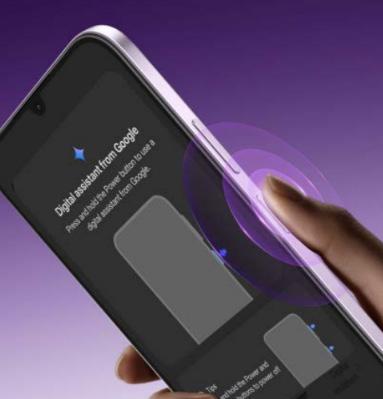
A dedicated One-Tap AI button provides users with quick access to the phone’s growing suite of AI tools. AI FlashMemo can recognize information from screenshots and convert it into useful actions such as creating calendar events or saving contacts, while AI MindHub organizes captured content into a searchable knowledge
base. A long press activates Folax AI, which provides access to leading AI models including ChatGPT and Google Gemini for quick on-screen assistance. AI-powered wallpaper generation, photo editing tools such as AI Eraser and AI Extender, and a 50MP main camera round out the smartphone’s intelligent feature set.
Under the hood, the HOT 70 runs on the MediaTek Helio G100 Ultimate processor paired with a 6.78-inch FHD+ display featuring a smooth 120Hz refresh rate and up to 700 nits of brightness for comfortable outdoor viewing. A 6,000mAh battery supports 45W Lightning FastCharge, while All-Scenario Bypass Charging helps reduce heat during extended gaming, streaming, or charging sessions.
Designed to withstand everyday use, the HOT 70 carries IP65 dust and splash resistance together with SGS-certified Premium Performance and Gold Standard Drop Resistance certifications. It also includes privacy and connectivity features such as XGuard Full-Link Protection, Pure Voice noise cancellation, and UltraLink Bluetooth communication. Supported models are eligible for up to three major Android OS upgrades and five years of security updates, helping extend the phone’s usable life well beyond its price class.
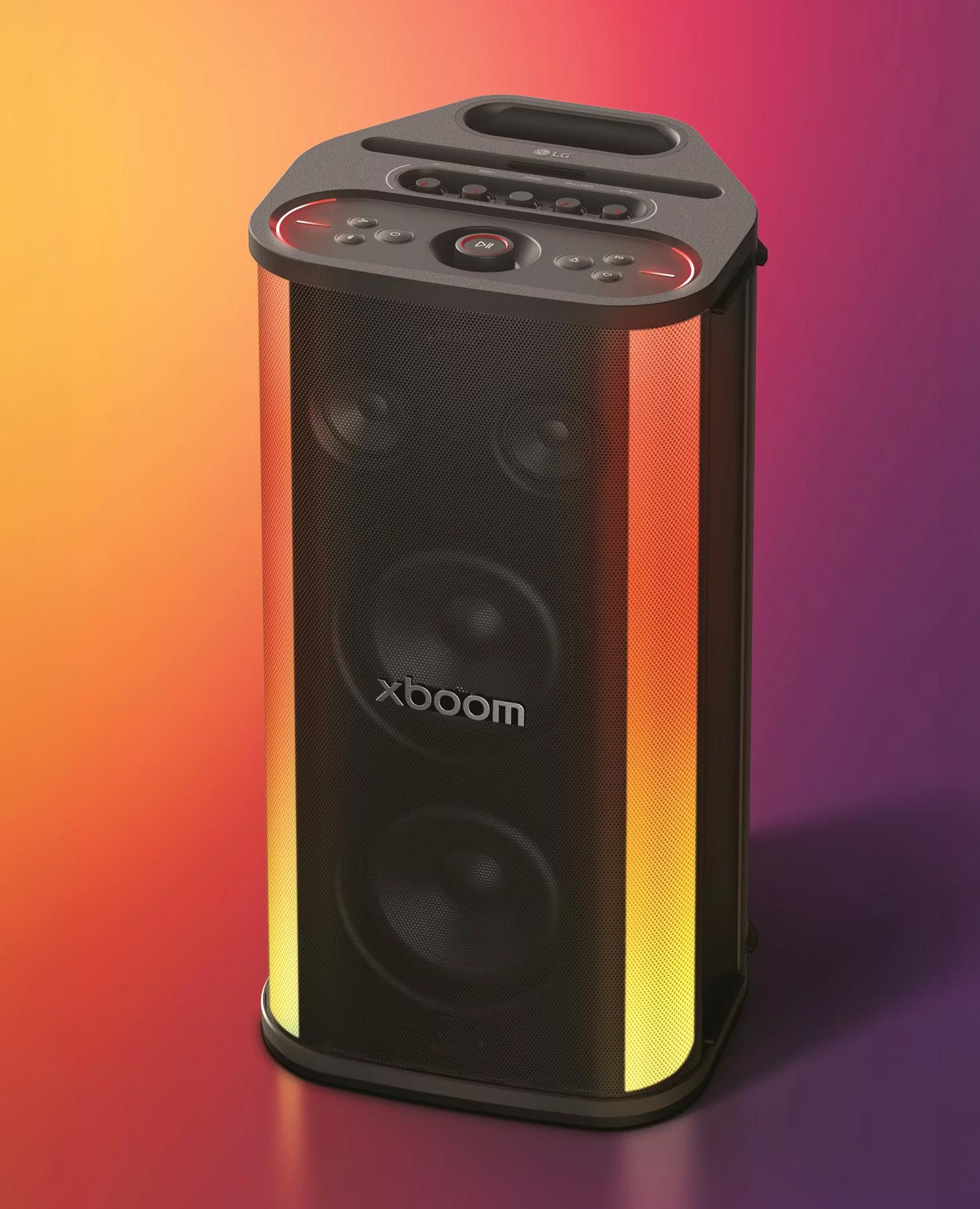
Stage 501 LG xboom
LG ELECTRONICS PHILIPPINES
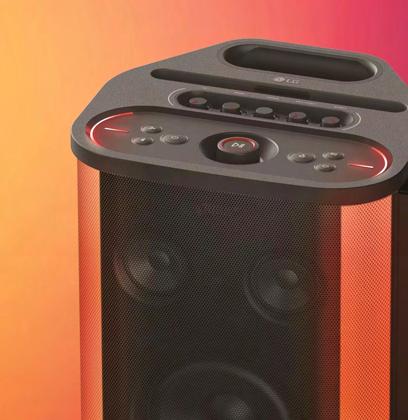
has introduced the LG xboom Stage 501, a portable party speaker designed to deliver powerful sound, AI-powered entertainment features, and flexible placement for both indoor and outdoor gatherings. Built for everything from casual listening to karaoke nights, the speaker combines premium audio hardware with intelligent technologies that adapt to different environments.
The Stage 501 features xboom Signature Sound, refined in collaboration with will.i.am, and premium drivers developed with Danish audio specialist Peerless. Its dual 5.25-inch woofers and two 2.5inch full-range drivers are engineered to deliver deep bass, clear vocals, and balanced sound for larger spaces.
Several AI-powered features enhance the listening experience. AI Sound automatically adjusts equalization based on the type of content being played, while AI Lighting synchronizes built-in lighting effects with the music to create a more immersive atmosphere. Space Calibration Pro uses a
built-in gyro sensor to optimize audio performance according to the speaker’s placement and surroundings.
For karaoke sessions, the Stage 501 includes AI Karaoke Master, which separates vocals from music and allows users to adjust vocal levels and pitch in real time. A dedicated AI Karaoke Control Knob also enables quick switching between original vocals and instrumental playback without requiring a separate app.
Designed for portability, the speaker supports four mounting configurations—horizontal, tilt, vertical, and pole modes—to suit different party setups. An integrated carry handle makes it easy to move, while its IPX4 water resistance helps protect against splashes during outdoor use. The replaceable 99Wh battery provides up to 25 hours of playback, and Auracast™support via Bluetooth LE Audio allows compatible speakers to broadcast synchronized audio across larger listening areas.
Portable Party Speaker
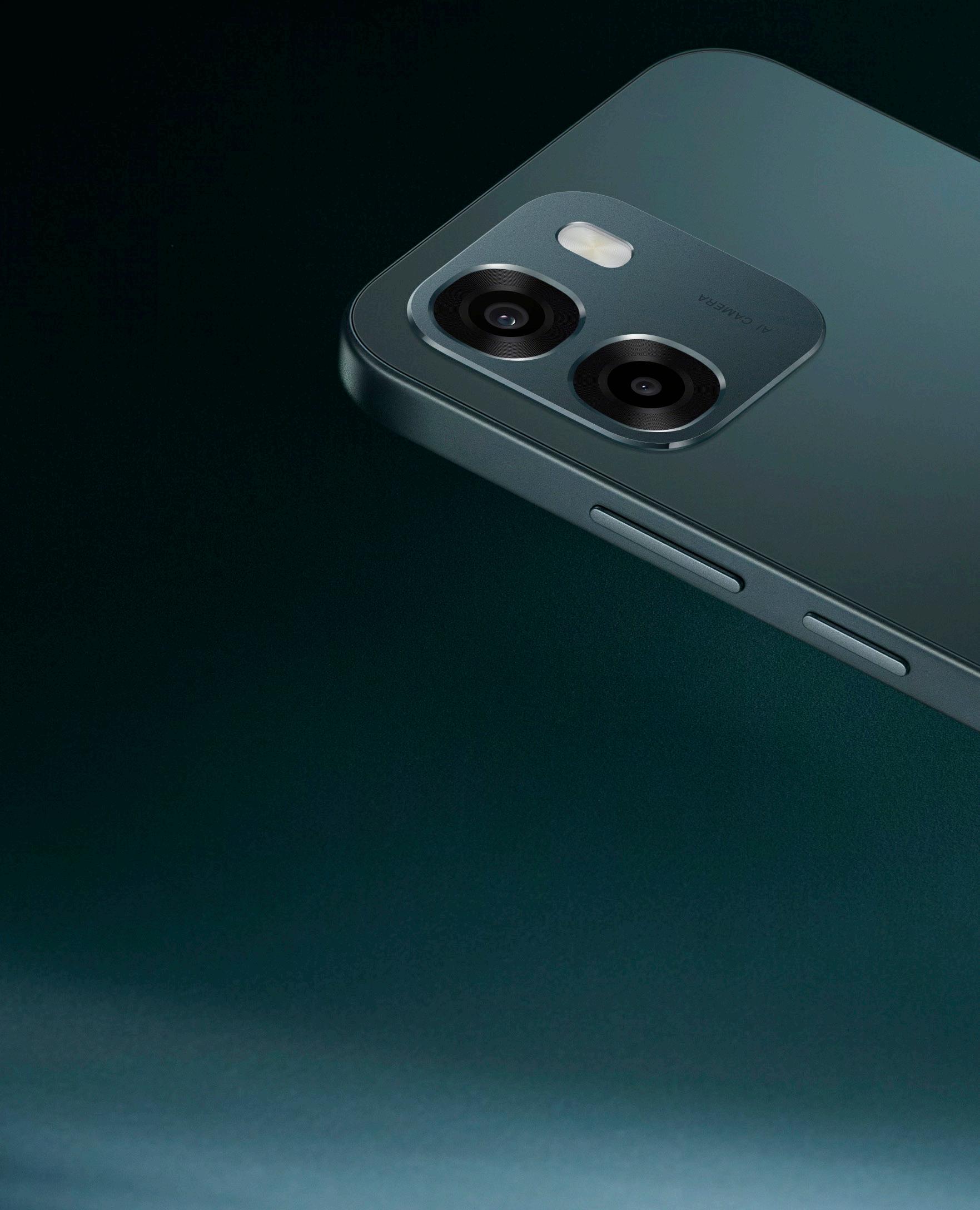
A6s 5G OPPO
Smartphones
USD2,900
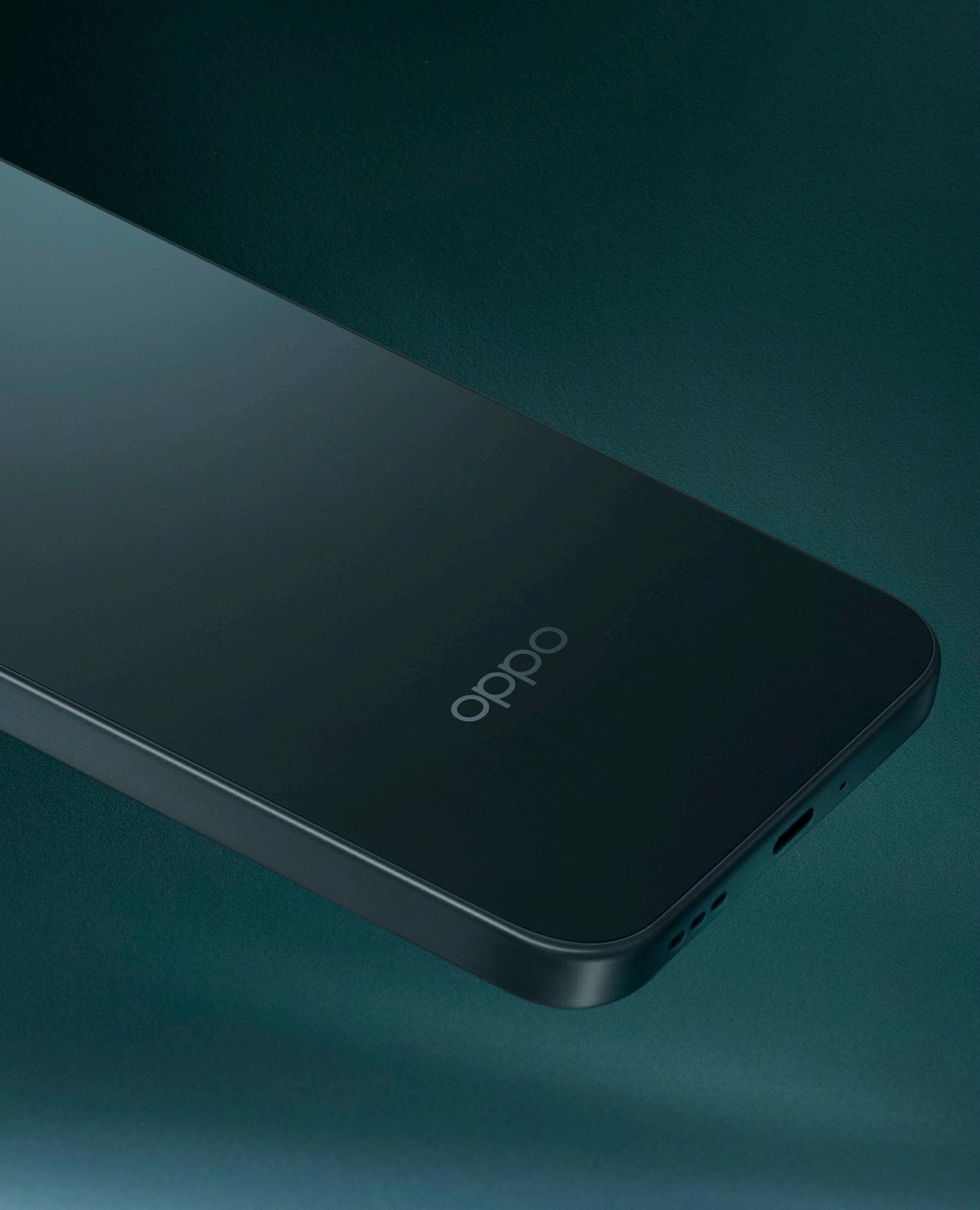
THE OPPO A6S 5G combines AIpowered productivity tools with longlasting battery life and dependable everyday performance, making it a practical choice for users who want to work, create, and stay connected from a single device. Running ColorOS 16, the smartphone integrates a range of built-in AI features designed to simplify common tasks without relying on multiple apps.
At the heart of its AI experience is Google Gemini, which helps users brainstorm ideas, summarize information, draft emails and messages, rewrite text, and plan projects directly on the device. The integrated assistant
is designed to streamline everyday workflows for students, professionals, and content creators.
Photography is enhanced by a suite of AI Camera features built into the gallery. AI Eraser 2.0 removes unwanted objects and photobombers, AI Unblur sharpens motion-blurred images, AI Clarity Enhancer restores detail to older or zoomed-in photos, and AI Perfect Shot improves group photos by intelligently correcting facial expressions and lighting using other images stored on the device.
The OPPO A6s 5G also includes AI Recompose, which suggests improved
photo composition for more balanced images, and AI Studio, allowing users to transform photos into creative styles without using third-party editing apps.
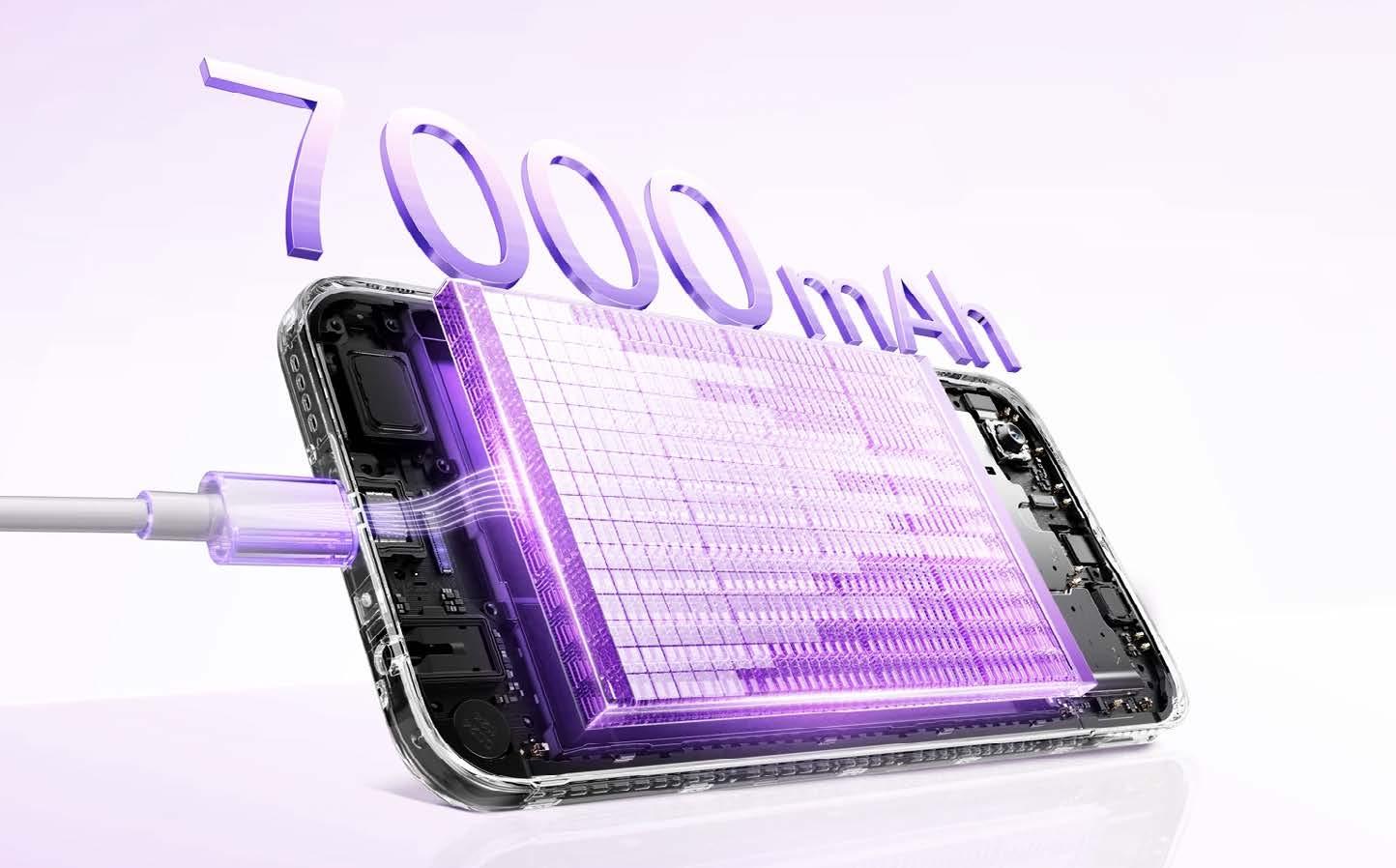
Beyond its AI capabilities, the smartphone delivers reliable everyday performance with 60-Month Fluency for long-term responsiveness and a 7,000mAh battery designed to support extended use throughout the day.
The combination of built-in AI tools, long battery life, and dependable performance makes the OPPO A6s 5G a well-rounded smartphone for productivity, content creation, and entertainment.
Samsung Galaxy Z Flip8
THE SAMSUNG GALAXY Z FLIP8 combines a compact folding design with an expanded cover-screen experience focused on quick interactions, AI assistance, and flexible content creation.
Weighing 180g and measuring 6.1mm thick when unfolded, the Flip8 is Samsung’s slimmest and lightest Galaxy Z Flip to date. It opens to a 6.9-inch FHD+ Dynamic AMOLED 2X display with an adaptive refresh rate of up to 120Hz. Outside, a 4.1-inch Super AMOLED FlexWindow lets users access apps, information, and selected functions without unfolding the phone.
Now Brief delivers personalized information and suggested next steps directly through the FlexWindow. Users can also access Gemini Intelligence using the side key or natural voice requests, allowing connected actions to be performed with fewer steps.
A 50MP main camera and 12MP ultrawide camera support the Flip8’s FlexCam experience. Flex Mode enables handsfree shooting at different angles, while Camcorder Grip with Zoom Rocker provides additional control when recording video. Super Steady now includes Horizontal Lock to maintain stable framing, and FlipShot uses the cover screen for customizable mirror selfies.
The Flip8 is powered by the Exynos 2600 processor, with 12GB of memory and either 256GB or 512GB of storage. Its 4,300mAh battery supports 25W wired charging, 15W wireless charging, and Wireless PowerShare.
Additional features include IP48 water resistance, Wi-Fi 7, Android 17, One UI 9, Galaxy AI, and Samsung Knox security. It comes in Graphite, Cream, and Pink, with Mint available exclusively online.
Samsung Galaxy Z Fold8
PHP109,990 (12GB | 256GB)
PHP137,990 (1TB | 16GB)
PHP116,990 (12GB | 512GB)
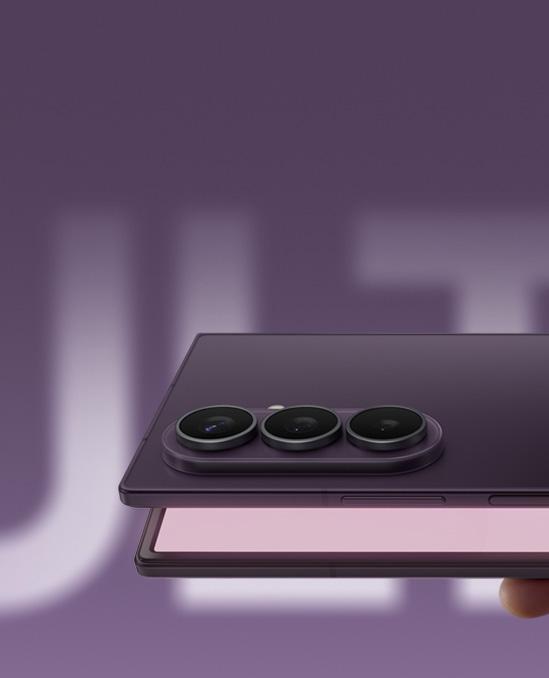
THE SAMSUNG GALAXY Z FOLD8 is designed for users who want the versatility of a large foldable screen without the added size and weight associated with productivity-oriented flagship models.
At 201g, it is Samsung’s lightest Galaxy Z Fold yet. The device features a 5.5-inch Dynamic AMOLED 2X cover screen with a 10:16 aspect ratio for messaging, browsing, and short-form content. Unfolded, its 7.6-inch QXGA+ display uses a 4:3 aspect ratio suited to films, games, articles, and e-books. Both screens support adaptive refresh rates of up to 120Hz.
Samsung’s Flex Titanium display structure combines a titaniumalloy film with an enhanced titanium plate. The design is intended to reinforce the folding display, absorb pressure and impact, and reduce crease visibility over time. The main screen also reaches up to 3,000 nits of brightness and incorporates Vision Booster and a low-reflection finish.
The Fold8 runs on the Snapdragon 8 Elite Gen 5 Mobile Platform for Galaxy, with configurations offering up to 16GB of memory and 1TB of internal storage. A 4,800mAh battery supports 45W wired and 20W wireless charging.
Its rear camera system consists of dual 50MP wide and ultrawide cameras. Dual Recording captures footage from different perspectives, while My FanCam tracks a selected subject and automatically reframes footage for different formats.
The Fold8 also features Galaxy AI, Android 17, One UI 9, IP48 water resistance, Wi-Fi 7, Bluetooth 6.0, and Samsung Knox security. Color choices include Graphite, Cream, and Lavender, with Pistachio available online.
Foldable Smartphone
Samsung Galaxy Z Fold8 Ultra
Foldable Smartphone
PHP123,990 (12GB | 256GB)
PHP151,990 (16GB | 1TB)
PHP130,990 (12GB | 512GB)
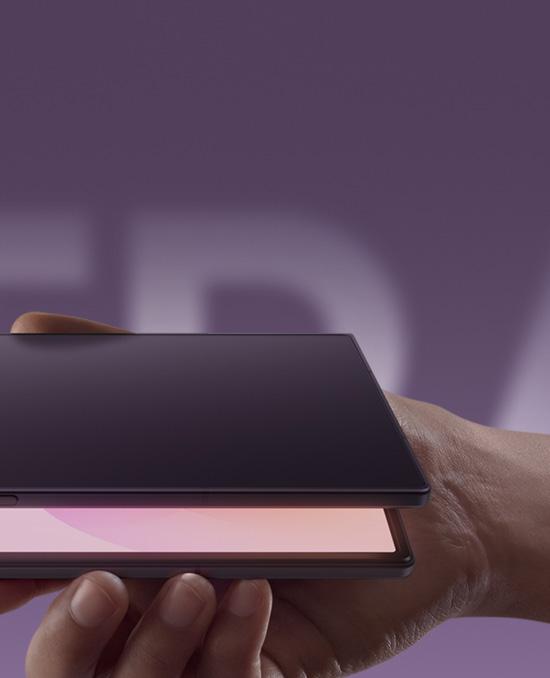
SAMSUNG brings its Ultra smartphone formula to a foldable form factor with the Galaxy Z Fold8 Ultra, a productivity-focused device built around a large workspace, flagship performance, and advanced content-creation tools.
The Fold8 Ultra opens to an 8-inch QXGA+ Dynamic AMOLED 2X main display with an adaptive refresh rate of up to 120Hz. Its 6.5inch cover screen provides a more conventional smartphone experience when folded. Despite the expansive display, the device measures 4.1mm thick when unfolded and weighs 215g.
Power comes from the Snapdragon 8 Elite Gen 5 Mobile Platform for Galaxy, paired with up to 16GB of memory and 1TB of internal storage. The large screen supports multitasking and Galaxy AI workflows, including Gemini Notebook and drag-and-drop functions in Split view.
For photography, the rear camera system combines a 200MP wide camera, 50MP ultra-wide camera, and 10MP telephoto camera with 3x optical zoom. Improved Nightography supports low-light capture, while 8K video through the APV codec and Cine LUT controls
give creators more flexibility during shooting and editing.
The 5,000mAh battery supports 45W wired charging and 20W wireless charging. Samsung also uses an expanded graphite cooling structure to manage heat during demanding workloads.
Other features include IP48 water resistance, Wi-Fi 7, Bluetooth 6.0, Android 17, One UI 9, and Samsung Knox security. The Fold8 Ultra is available in Graphite, Cream, and Violet Shadow, with Green Shadow offered as an onlineexclusive color.
Synology DP5200
Enterprise Backup Solution
AS ORGANIZATIONS expand across multiple offices and increasingly rely on hybrid IT environments, protecting business data has become more complex. Synology’s new DP5200 ActiveProtect appliance is designed to simplify enterprise backup while providing comprehensive protection in a compact 1U form factor.
The DP5200 offers up to 36TB of usable capacity and supports a broad range of workloads from a single platform. It can protect VMware vSphere and Microsoft Hyper-V virtual machines, Windows and Linux servers, Windows PCs, macOS devices, Microsoft 365 environments, Oracle and Microsoft SQL databases, as well as SMB, NetApp, and Nutanix file servers. Synology says additional support for Azure VM, Amazon EC2, Nutanix AHV, Proxmox VE, and Google Workspace will be added through the upcoming ActiveProtect Manager 2.0 update.
Designed to scale with growing organizations, the appliance can operate as a standalone backup server for individual sites or serve as a centralized management platform overseeing up to 120,000 workloads and monitoring as many as 1,000 servers across multiple locations through a single management console.
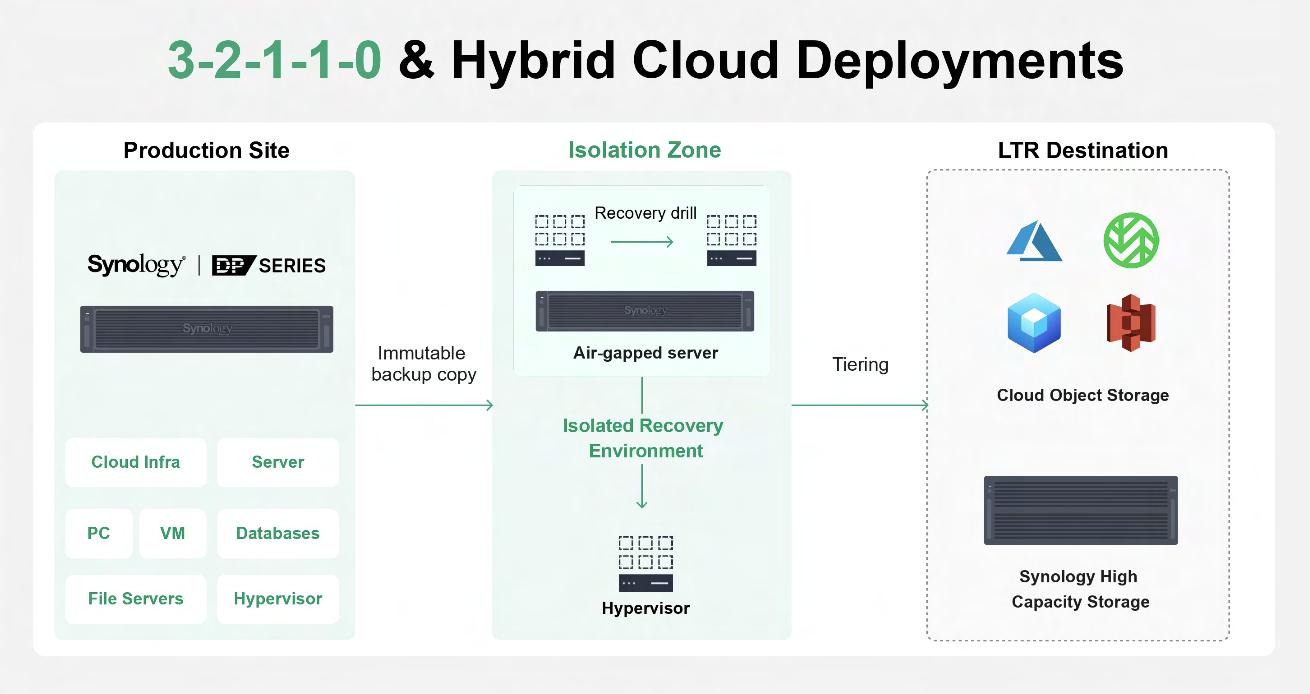
Security is another major focus. The DP5200 incorporates multi-factor authentication, immutable WORM storage, logical air gaps, and version-based tiering to support the 3-2-1-1-0 backup strategy. With the arrival of ActiveProtect Manager 2.0, Synology also plans to introduce AI and machine learning capabilities that can detect backup anomalies and scan for malware before data restoration, helping organizations strengthen their cyber resilience.
Combining centralized management, broad platform compatibility, and enterprise-grade security in a spaceefficient design, the Synology DP5200 is positioned as a scalable backup and recovery solution for businesses, managed service providers, and distributed organizations looking to simplify data protection.
vivo X300 FE
Smartphone PHP54,999
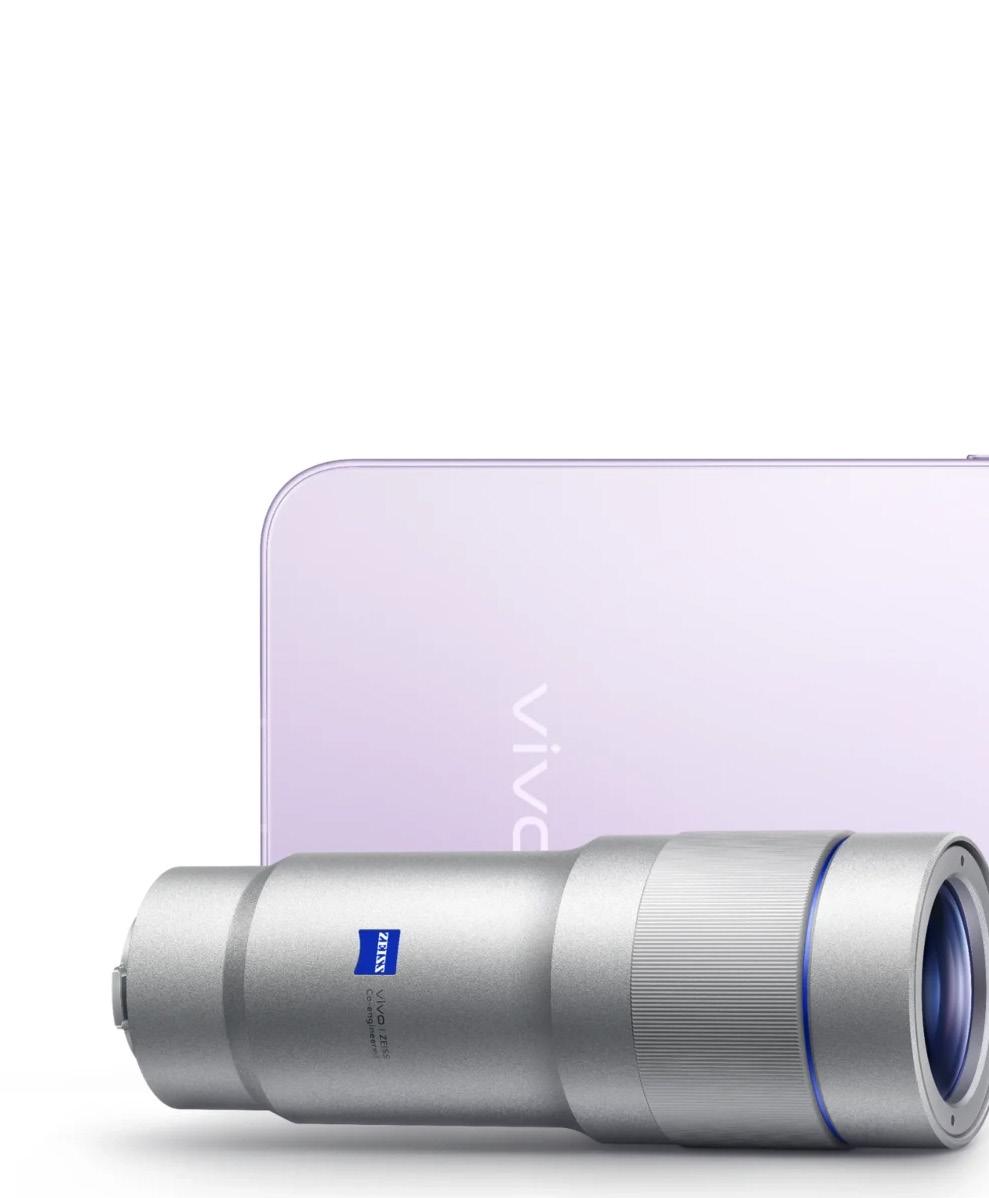
THE VIVO X300 FE brings the classic appeal of street photography to a smartphone with its dedicated Street Photography Mode, combining camerainspired controls, ZEISS imaging styles, and manual shooting options in a compact device designed for capturing everyday moments.
Built for spontaneous photography, the Street Photography Mode is designed to help users react quickly to fleeting scenes. It pairs intuitive controls with creative shooting tools, making it easier to capture candid moments, changing light, and everyday life without carrying a dedicated camera.
The X300 FE includes built-in ZEISS Natural and Black & White imaging styles that recreate classic photographic aesthetics straight from the camera. ZEISS Natural adds subtle grain and texture for a film-inspired look, while the Black & White profile emphasizes contrast, composition, and emotion. Adjustable effects further allow users to personalize their images with minimal post-processing.
For greater creative control, the smartphone offers both Auto and Pro shooting modes. Auto mode features a dedicated Exposure Value (EV) adjustment dial for quick brightness control, while Pro mode provides manual adjustments for EV, ISO, Auto White Balance (AWB), shutter speed, and simulated bokeh to suit different shooting conditions.
By combining dedicated street photography features with the convenience of a smartphone, the vivo X300 FE offers a versatile imaging experience for photography enthusiasts.
Xiaomi 17T Series
Smartphones
PHP33,999 - Xiaomi 17T
PHP47,999 - Xiaomi 17T Pro
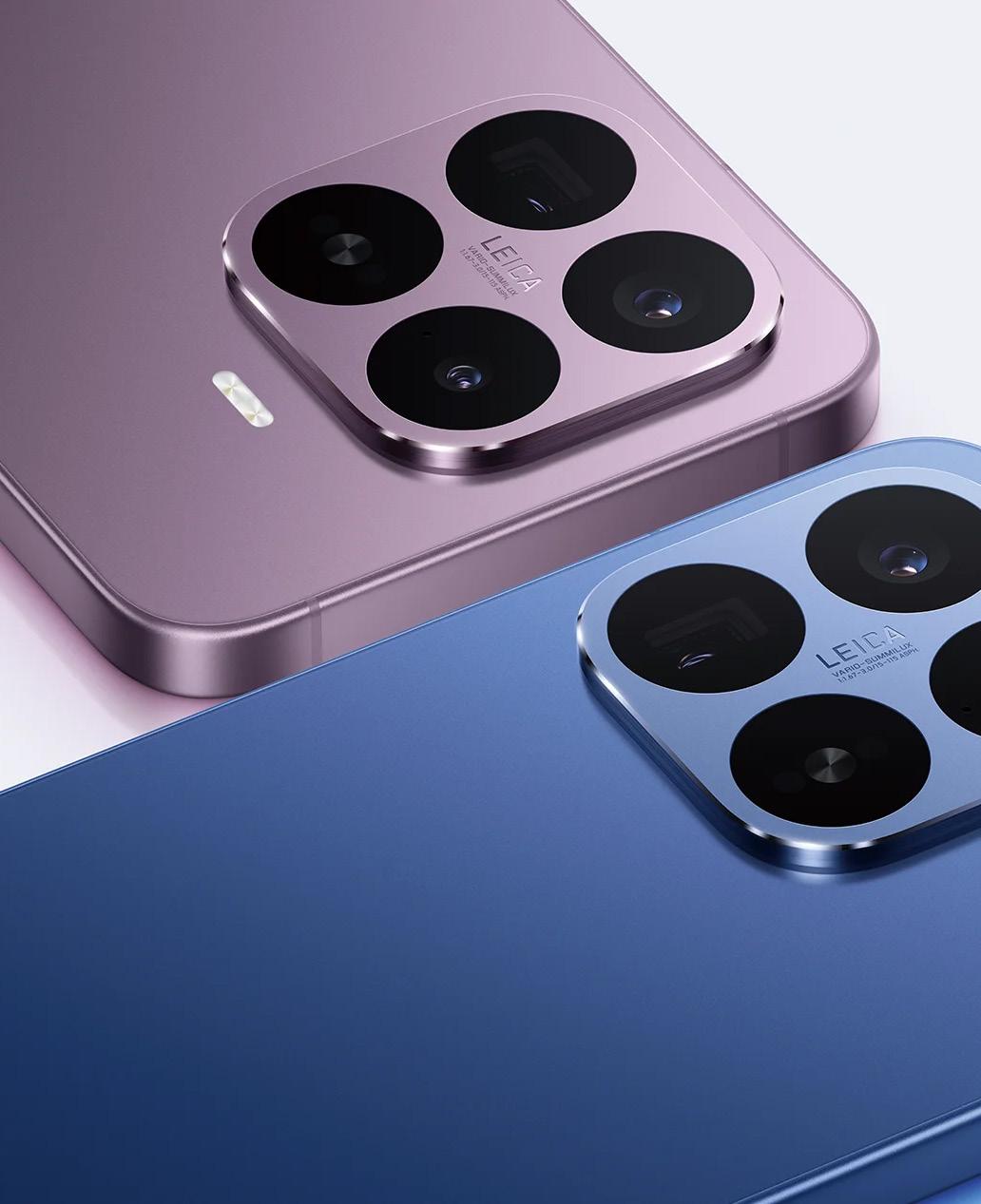
THE XIAOMI 17T SERIES is designed for users who need a smartphone that can keep up with demanding workdays, combining large silicon-carbon batteries, flagship MediaTek processors, Leica-engineered cameras, and AI-powered productivity features in two performance-focused devices.
Battery life is one of the series’ biggest upgrades. The Xiaomi 17T packs a 6,500mAh silicon-carbon battery with 67W HyperCharge, while the Xiaomi 17T Pro raises the capacity to 7,000mAh and adds 100W wired HyperCharge, 50W wireless charging, and up to 22.5W wired reverse charging for compatible accessories. Both are built to minimize charging interruptions throughout the day.
Powering the devices are MediaTek Dimensity chipsets built on advanced manufacturing processes. The Xiaomi 17T uses the Dimensity 8500-Ultra, while the 17T Pro steps up to the Dimensity 9500. Both models include 12GB of RAM, with storage options of up to 512GB on the 17T and 1TB on the Pro for users handling larger files and media libraries.
The displays are equally geared toward extended use. The Xiaomi 17T features a 6.59-inch 120Hz AMOLED display, while the 17T Pro offers a larger 6.83-inch 144Hz panel. Both incorporate Xiaomi Vision Care and carry TÜV Rheinland certifications for Low Blue Light, Flicker Free, Circadian Friendly, and Intelligent Eye Care to improve viewing comfort during prolonged screen time.
Running Xiaomi HyperOS 3, the series also includes Xiaomi HyperAI features such as AI Writing, AI Interpreter, Circle to Search with Google, and Google Gemini to streamline everyday tasks. Both models are co-engineered with Leica for imaging and carry an IP68 rating for dust and water resistance, making the Xiaomi 17T Series a well-rounded option for users balancing productivity, content creation, and everyday entertainment.
REVIEWED BY PHIA MANUELL LAYOSO
REALME C100i
Some smartphones immediately catch your attention with their design, while others impress you with what’s inside. This one certainly made a strong first impression with its sleek and stylish design.
After using it as my daily phone, I realized there’s more to it than just its looks. Was it for better or worse? Here’s my honest experience.
DESIGN
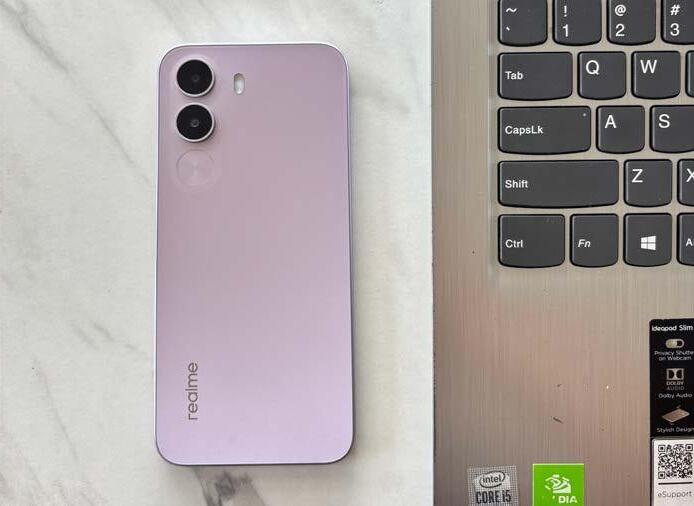
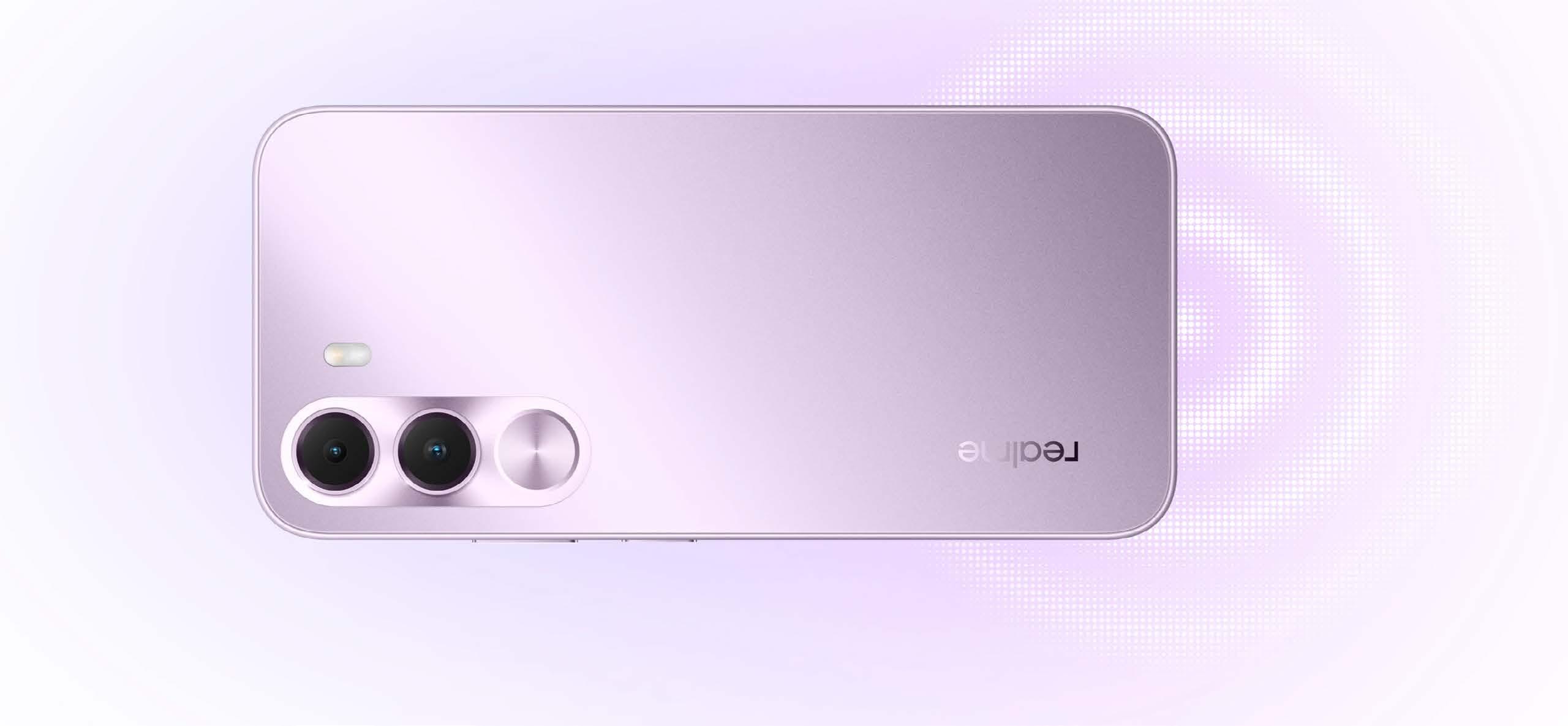
I got the Dawn Purple color that has a stunning shining finish that makes the phone look very premium despite being affordable. The back design features a camera module that is designed in a vertical style which adds a modern flair to the design. Even though this is a budget smartphone, the realme C100i has a stylish aesthetic that I genuinely liked.
The phone measures 8.38mm thick and weighs 208 grams. As someone who is used to smaller and lighter devices, I initially found it a bit bulky. However, the weight is understandable considering the large battery packed inside.
At the front, the 6.8 inches display with a 120Hz refresh rate is great for surfing through different applications such as social media browsing and watching videos. It was also responsive enough despite the
occasional lagging when switching between applications.
HARDWARE
The realme C100i is powered by the Unisoc T7250 processor, paired with 4GB of RAM and a maximum 256GB of storage capacity, running on realme UI 7.0 with Android 16 as its operating
system. Although the hardware is sufficient for every day task, it isn’t the fastest performer and can struggle when handling multiple apps at once.
One area where the phone stands out is its durability. The phone is equipped with Military-Grade Shock Resistance and IP64 dust and splash resistance. This makes the phone more durable in the face of accidental falls, or other daily stresses.
The greatest strength of the phone is the 7000mAh Titan Battery. The battery capacity of this device can easily last through the whole day without needing frequent charging. The battery also includes a 15W and 6W reverse charging. realme has also included a 7-Year Battery Health Warranty, which is indeed a good thing for those who plan to use this device for many years.
When it comes to taking photos, the realme C100i is equipped with 8MP AI rear camera and 5MP front camera. The cameras are capable of taking decent pictures under proper lighting and can be used for casual snapshots, though they are not the phone’s strongest feature.
USER EXPERIENCE
Although I have been using this device for day-to-day activities like surfing social media apps, watching movies, sending messages and even browsing the web, I would say the device performs pretty well. However, the phone struggles when handling multitasking and moving between apps. I faced some lag and delay from time to time, which made the experience less seamless than what you could expect with the 120Hz screen.
The phone’s camera is fairly basic and works well only under good lighting. While it’s sufficient for casual snapshots, consumers looking for more detailed photos or better performance may find it lacking.
The standout feature of the realme C100i is undoubtedly its battery life. The powerful 7000 mAh battery made it through an entire day’s worth of usage, during which I was able to spend many hours scrolling through social media posts, watching videos, and doing general
browsing. It is one of those phones that you don’t have to hesitate taking out of the house for fear of low battery status.
However, my biggest drawback is the charging speed. While the phone offers great battery life, the 15W charger seems slow to me. Recharging from a low battery requires patience, making it less convenient for users who are always on the go.
VALUE
The realme C100i starts from PHP 6 313 for 4GB + 64GB, PHP 7 379 for 4GB + 128GB, and PHP 8 199 for 4GB + 256GB. This price point makes the realme C100i an affordable phone to use considering its high battery capacity and high storage capacity.
Despite the device showing its strength in battery capacity and having enough storage capacity, its performance is better for basic tasks rather than demanding workloads. Nowadays, consumers expect both long battery life and smooth performance, so the C100i may not appeal to those who prioritize gaming or heavy multitasking. However, for consumers looking for a reliable smartphone with high battery capacity and large storage capacity, the realme C100i can be a good choice.
BOTTOMLINE
The realme C100i is a decent smartphone within a budget category. Its battery power is 7000 mAh, which is enough for a whole day of use. The performance and cameras are not good but are enough for basic tasks. It is a good phone for people looking for a long-life smartphone that does not need frequent charging.
SPECIFICATIONS
Display: 6.8” 120Hz Ultra Smooth
Display
Resolution: 1570x720
Processor: Unisoc T7250
Memory: 4GB + 64GB / 4GB + 128GB / 4GB + 256GB
Rear Camera: 8MP AI Rear Camera
Front Camera: 5MP Front Camera
Battery: 7000mAh
Other Features: Rain Touch Mode, AI Outdoor Mode, Air Gestures
WHAT'S HOT
7000mAh Titan battery
Affordable
Large storage options
Stylish design
WHAT'S NOT
Unisoc T7250 entry level
Performance isn’t always smooth
Average camera quality
Slow charging
LAND CRUISER GOES HYBRID
Toyota brings electrified power to its iconic flagship SUV while preserving the capability and durability that defined its legacy.
or more than 70 years, the Toyota Land Cruiser has earned a reputation as one of the world’s toughest and most dependable SUVs. Now, the legendary nameplate enters a new chapter as Toyota Motor Philippines introduces the Land Cruiser HEV, bringing hybrid technology to its flagship SUV while staying true to the durability and capability that have defined it for generations.
A New Era for the Land Cruiser
Toyota Motor Philippines has officially added the Land Cruiser HEV to its local lineup as part of its expanding range of electrified vehicles. Previewed at the 10th Philippine International Motor Show, the hybrid variant supports Toyota’s multi-pathway approach to reducing carbon emissions while giving customers more powertrain options to suit different lifestyles and mobility needs.
The arrival of the Land Cruiser HEV marks the first electrified version of the iconic SUV in the Philippine market, combining Toyota’s proven hybrid technology with the Land Cruiser’s established reputation for performance on and off the road.
Built on Seven Decades of Heritage
The Land Cruiser traces its roots back to 1951, when it began life as the Jeep BJ before eventually adopting the Land Cruiser name. Over the decades, Toyota continuously refined the platform, building a global reputation for quality, durability, and reliability.
The model first arrived in the Philippines with the Land Cruiser 80 in 1990. That generation introduced improved comfort, technology, and refinement while retaining the rugged capability that made the Land Cruiser famous. Today, multiple generations of the SUV continue to serve owners across the country, reflecting both the vehicle’s longevity and its loyal following among enthusiasts.
Hybrid Power Without Compromise
The Land Cruiser 300 remains a full-size SUV engineered for both city streets and demanding off-road terrain. While the existing model uses a 3.3-liter twinturbo V6 diesel engine producing 306
PS paired with a 10-speed automatic transmission, the new Land Cruiser HEV adopts a different approach.
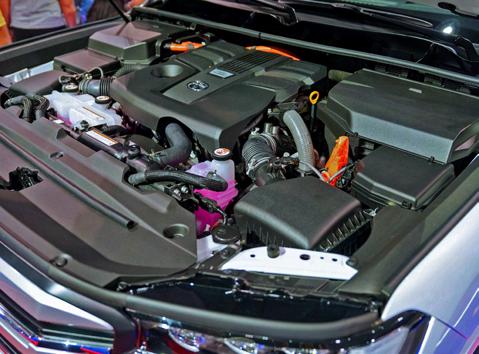
The hybrid variant combines a 3.5-liter twin-turbo V6 gasoline engine producing 415PS with an electric motor that contributes an additional 49PS. Toyota has also equipped the Land Cruiser HEV with electric power steering, providing lighter steering effort for improved everyday driving. Exterior updates include Aero styling with Jet-Black Garnish, giving the hybrid model a subtle visual distinction.
Rather than redefining the Land Cruiser, Toyota has enhanced it with electrified technology while preserving the performance and durability that have made the SUV a benchmark in its class.
Expanding the Power of Choice
According to Elijah Marcial, first vice president for vehicle sales operations at Toyota Motor Philippines, the Land Cruiser HEV reflects the company’s commitment to providing customers with a wider range of mobility solutions.
“The Land Cruiser HEV is part of Toyota’s efforts in offering different powertrains that address our customers’ needs and lifestyles. Customers who want to experience the legendary heritage and proven performance of the Land Cruiser while having access to Toyota’s hybrid technology will find this car to be the perfect choice as their partner on the road. We hope the addition of the Land Cruiser HEV to Toyota’s wide lineup of cars gives our customers the power of choice when it comes to their mobility needs.”
The Land Cruiser HEV is available in Attitude Black Mica, Silver Metallic, Gray Metallic, and Precious White Pearl, offering buyers a choice of finishes as Toyota’s iconic flagship SUV enters its electrified era.
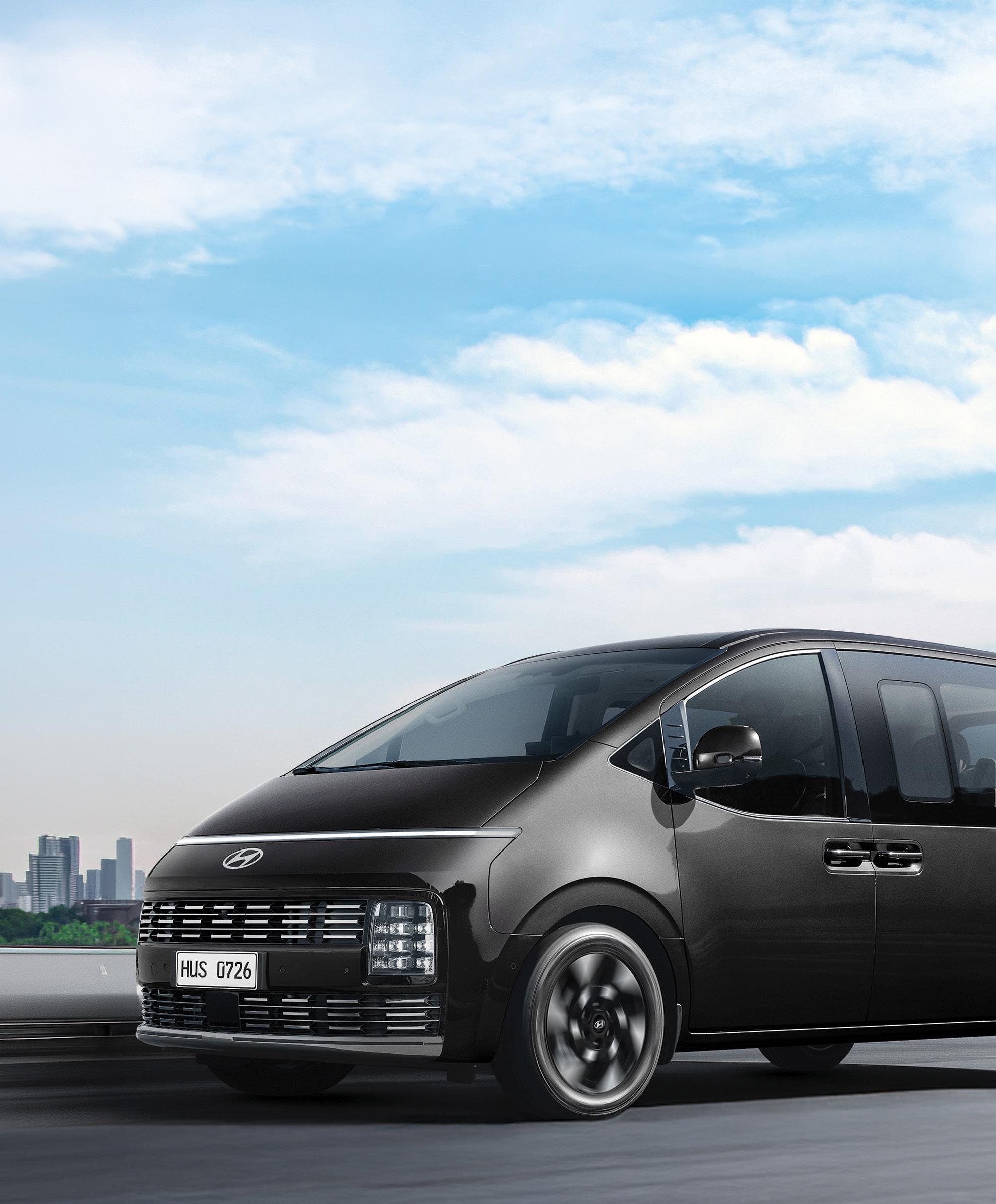
THE SMARTER STARIA
Hyundai adds hybrid efficiency, advanced connectivity, and greater versatility to its premium people mover
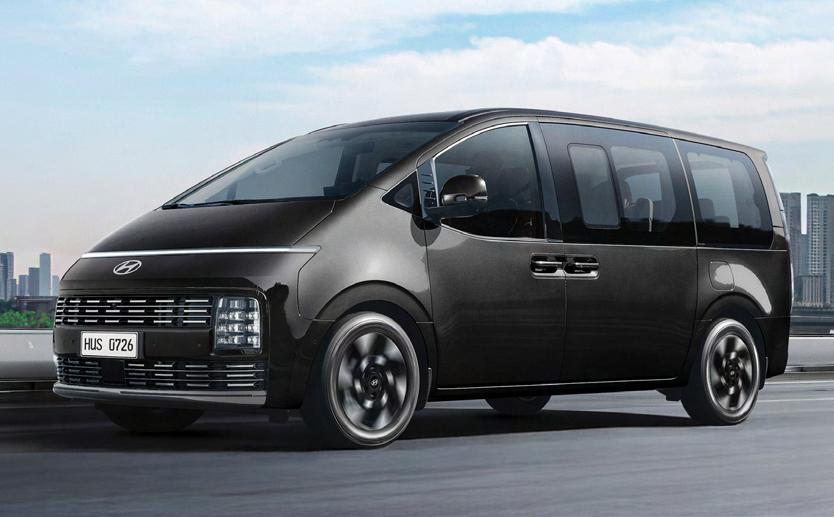
yundai Motor Philippines is expanding its hybrid lineup with the launch of the new STARIA Hybrid, bringing electrified performance to one of its most recognizable nameplates. Starting at PHP1.999 million, the premium people mover combines hybrid efficiency, advanced connectivity, and versatile cabin configurations for families, businesses, and professionals looking for a more capable everyday vehicle.
A Fresh Look for a Familiar Favorite
The new STARIA Hybrid retains the futuristic design that has become its signature while introducing several
styling updates. A redesigned front grille, new 18-inch alloy wheels, and distinctive cube projection LED headlamps give the premium van a more refined and commanding presence on the road, while preserving the spacious cabin that has made the STARIA a standout in its segment.
Connected Wherever the Road Leads
The STARIA Hybrid is the first Hyundai model in the Philippines to feature
Bluelink, the brand’s Connected Car Service platform.
Through Hyundai Live Services, drivers can access real-time traffic and weather updates directly through the infotainment system without needing to connect a smartphone. With information refreshed every two minutes, the system helps make every journey safer and more efficient.
Bluelink also supports online voice recognition, allowing users to send and receive text messages while keeping their attention on the road. Beyond the drive, owners can remotely monitor vehicle status, diagnostics, and health reports, while controlling climate settings, door locks, the horn, and exterior lights before entering the vehicle.
Premium Comfort, Flexible Space
Inside, the STARIA Hybrid has been designed to make long journeys more comfortable and everyday driving more convenient.
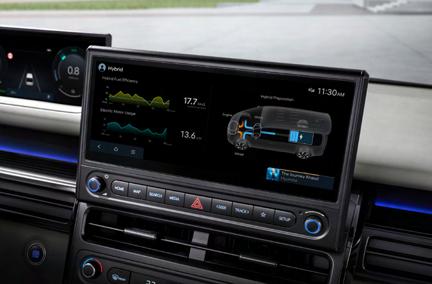
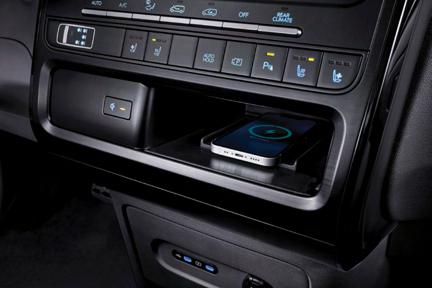
A larger 12.3-inch infotainment display provides easy access to navigation, entertainment, and hybrid fuel economy information, while a 12-speaker Bose premium audio system delivers an immersive listening experience throughout the cabin. USB Type-C charging ports in both front and rear rows, along with a wireless charging pad, ensure passengers stay connected wherever they go.
Additional premium touches include a steering column-mounted Shift-by-Wire selector that creates a cleaner cockpit layout, power seats with lumbar support, heated and ventilated seating, and a dual power tilt sunroof.
Hyundai has also enhanced the STARIA’s versatility. The nine-seater now features a three-row seating configuration, while the seven-seater gains extended seat rails that allow owners to easily balance passenger comfort and cargo space depending on the journey.
Hybrid Technology That Works Behind the Scenes
The STARIA Hybrid is powered by Hyundai’s hybrid system, delivering bestin-class fuel efficiency of 17.7km/L while introducing technologies that enhance everyday driving.
The e-Handling system improves agility and stability when cornering, while e-Ride enhances ride comfort over speed bumps and during rapid acceleration. Together, these hybrid-exclusive
technologies help create a smoother, more composed driving experience without compromising practicality.
Confidence for Every Journey
The new STARIA Hybrid is equipped with Hyundai SmartSense, the company’s suite of advanced driver assistance technologies.
New features include Blind-Spot Collision-Avoidance Assist and Side Parking Distance Warning, giving drivers greater confidence when navigating traffic and tight parking spaces. Six strategically placed airbags further strengthen occupant protection, reinforcing the STARIA Hybrid’s focus on safety for everyone onboard.
According to Jiho Son, president of Hyundai Motor Philippines, the STARIA Hybrid completes the company’s growing hybrid lineup while continuing the legacy established by the STAREX.
“The STARIA is one of the most iconic nameplates in our current lineup, completing our Hybrid range while carrying a legacy Filipinos trust. Building on the STAREX’s role in family life, we are proud to be launching the STARIA Hybrid which brings a more connected, comfortable experience for modern and practical Filipino families.”
Available in Creamy White, Abyss Black Pearl, and Shimmering Silver Metallic, the new STARIA Hybrid is offered in six variants, with prices starting at PHP1.999 million for the GL 9-seater hybrid and reaching PHP3.199 million for the Premium Plus 7-seater. Hyundai also continues to offer the STARIA Cargo diesel variant, giving buyers a wider range of options to match different mobility needs.
BIG CAR ENERGY , COMPACTFOOTPRINT
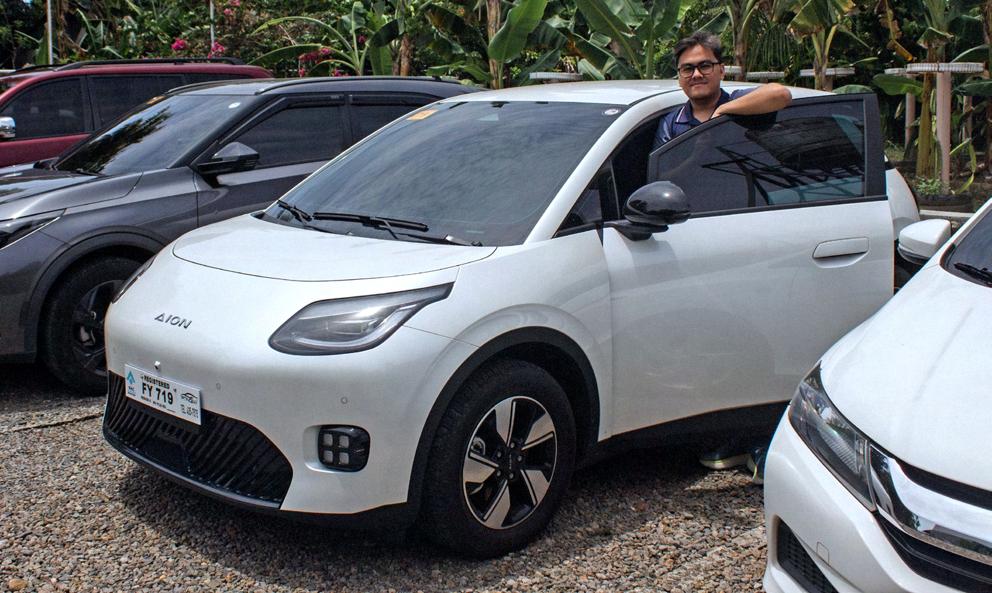
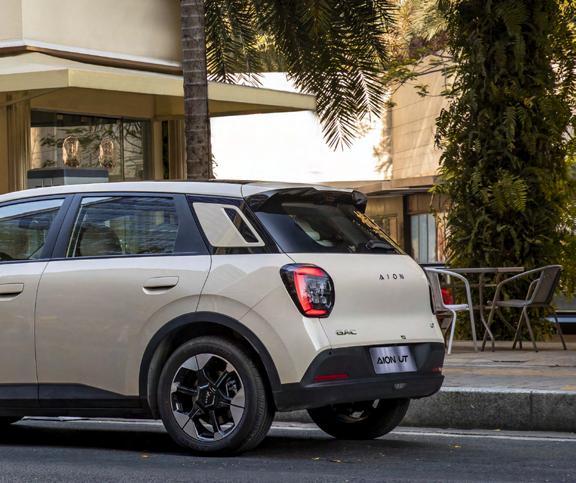
The GAC AION UT brings award-winning design, generous cabin space, and practical electric mobility to Filipino drivers
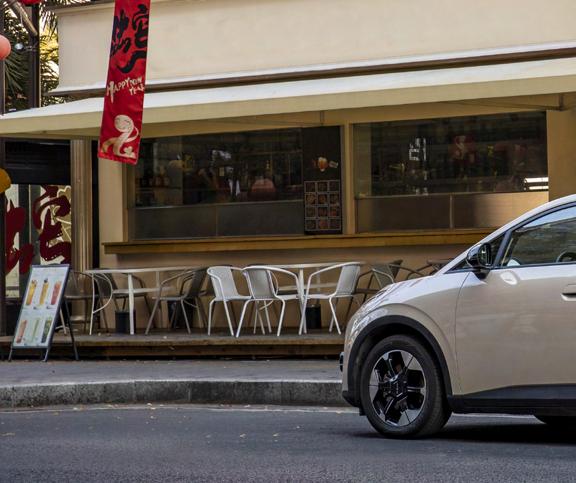
he GAC AION UT is making its Philippine debut after earning international recognition across markets including Thailand, Australia, Latin America, and Europe. Combining award-winning design, practical technology, and a surprisingly spacious cabin, the compact electric hatchback brings GAC’s latest approach to urban mobility to Filipino drivers.
Already recognized with accolades including The Most Valuable EV Award at the Bangkok International Motor
Show, Best Compact Electric Vehicle Award in Mexico, and Best Subcompact Hatchback 5-Dr. EV at Thailand’s Car of the Year 2026 awards, the AION UT has established itself as one of GAC’s standout global electric vehicles while continuing to gain traction among urban drivers.
Designed to Feel Bigger Than It Looks
Designed by GAC’s Milan Design Center, the AION UT combines what
the company calls “Digital Magic Cube” styling with a sleek fastback-inspired silhouette.
Although classified as a compact hatchback, the AION UT features a 2,750 mm wheelbase that creates a spacious, lounge-like cabin. GAC describes this approach as delivering “Big Car Energy,” offering interior room and comfort typically associated with larger vehicles.
Safety is equally central to the package. The AION UT is equipped with GAC’s Magazine Battery 2.0, which the company says maintains a zero spontaneous combustion safety record.
According to Steven Wang, senior vice president of GAC International, the
AION UT represents another step in expanding the company’s electrified lineup in the Philippines.
“We are thrilled to bring another global hit from GAC’s line of innovations to the Philippines through the AION UT. This milestone allows us to further serve and diversify our brand offerings in the local mobility scene. We are confident that the AION UT will bolster dynamic, safe, and sustainable driving for Filipinos this 2026.”
Early Owners Share Their Experience
Filipino drivers who have already taken delivery of the AION UT are highlighting its comfort, efficiency, and everyday usability.
Paul Lacson, a government employee from Silay City and an existing GAC owner, said the hatchback has become his preferred vehicle for daily commuting. He cited its strong highway performance, ride comfort, and energy efficiency, noting that a recent 100-kilometer trip consumed only around 20% of the battery. After comparing the AION UT with several EV and hybrid competitors, he also praised its spacious cabin, features, and overall value.
First-time EV owner Jeff Filio, a quality analyst, said he chose the AION UT after researching several brands. He pointed to its driving range, onboard technology, and companion mobile app as key factors behind his decision, adding that the vehicle has lived up to his expectations.
Engineered for Everyday Ownership
Beyond the vehicle itself, GAC says the AION UT reflects the company’s broader engineering experience, drawing on more than two decades of collaboration with Toyota and Honda to deliver vehicles that meet high standards for quality, durability, and performance.
To support local owners, GAC Philippines has also expanded its ownership ecosystem with a nationwide network of 30 dealerships, a dedicated parts warehouse, and comprehensive aftersales support.
The AION UT is backed by an eight-year or 160,000-kilometer vehicle warranty, an eight-year or 200,000-kilometer warranty for the core electric drive system, and two years of free roadside assistance, giving buyers added confidence as they transition to electric mobility.
Affordable Electric Mobility
The AION UT Elite is available in Champs-Elysees Beige, Emerald Green, Rococo White, Seine Silver, and a two-tone Rococo White with Emerald Green finish, with a suggested retail price of PHP1,068,000. With its combination of award-winning design, generous interior space, advanced battery technology, and competitive pricing, the GAC AION UT offers Filipino motorists an accessible entry into electric mobility while reinforcing GAC’s growing presence in the country’s EV market.
SKYNOMAD REDEFINES THE SUV CABIN
Xiaomi’s newest EV series transforms the SUV into an intelligent, adaptable living space for work, family, and everyday life.
iaomi EV is expanding beyond performance-oriented electric vehicles with the introduction of SkyNomad, its second product series designed around a different idea of mobility. While the Xiaomi SU7 and YU7 are positioned as driver’s cars, the new SkyNomad series shifts its attention to everyone inside the vehicle, reimagining the SUV cabin as a flexible space that adapts to the changing demands of everyday life.
Designed Around How People Use Their Cars
According to Xiaomi, today’s SUV buyers are looking beyond spacious interiors and premium materials. As vehicles increasingly serve as places to work, rest, travel, and spend time with family, comfort is no longer measured solely by size. Instead, the focus has shifted toward creating a cabin that feels natural and adaptable throughout the day.
That thinking became the foundation for SkyNomad’s development in early 2023. Rather than simply building another large SUV, Xiaomi set out to create one that functions as an extension of a person’s living space while on the move.
An Interior That Changes With You
At the heart of SkyNomad is Xiaomi’s all-new Kunlun Architecture, developed specifically to support a reconfigurable interior.
The platform combines a flat floor with a long-track seating system that allows the cabin to transform for different situations. In driving mode, it provides generous space for passengers, luggage, and even pets. When parked, the same interior can be reconfigured into a mobile workspace, a lounge, or an activity area for families.
Xiaomi says achieving this level of flexibility required bringing together three of its core strengths: artificial intelligence, its connected smartdevice ecosystem, and advanced manufacturing technologies.
Lei Jun, founder, chairman and CEO of Xiaomi, described the philosophy behind the project in a Weibo post:
“Our answer was to let intelligence define the space, to build a living interior that moves with you.”
One Vehicle, Multiple Roles
Rather than targeting a single lifestyle, SkyNomad is designed for people whose daily routines constantly change. It is intended to serve commuters during the
workweek, families on weekend trips, and professionals who occasionally need a mobile office.
Xiaomi describes the series not as a lifestyle statement but as a practical tool that adapts to the different roles people play throughout the day. Instead of designing separate vehicles for different users, SkyNomad aims to support the same person across work, leisure, and family life.
Expanding Xiaomi’s EV Vision
SkyNomad represents the latest addition to Xiaomi EV’s growing portfolio, following more than five years of vehicle development. Together with the
SU7 and YU7 series, it broadens the company’s approach to electric mobility by offering two distinct philosophies: one focused on the driving experience and another centered on the people inside the cabin.
The Xiaomi SkyNomad series is scheduled to launch first in mainland China following more than three years of development, with additional details expected to be announced in the coming months.
MOVING AS ONE
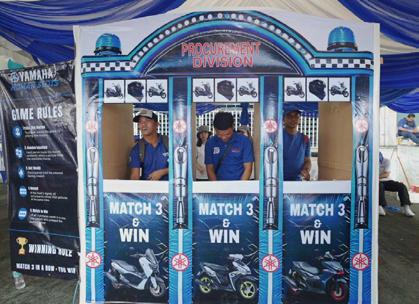
Yamaha Day 2026 celebrates the shared actions and collective spirit behind one of the world’s leading mobility brands.
Momentum rarely begins with a single spark. More often, it grows through countless individual actions that come together to create something larger than themselves.
That collective energy defines Yamaha Day 2026. Built around the theme “Own the Moment, Take Action,” this year’s celebration recognizes how every employee, rider, and customer contributes to the legacy Yamaha has built over more than seven decades. More than an annual observance, it is a reminder that the company’s success is driven by a shared purpose that extends across every product, every experience, and every journey.
At the heart of that purpose is Kando, Yamaha’s philosophy of creating a deep sense of satisfaction and excitement through meaningful experiences.
A relay of trust
To bring this year’s theme to life, Yamaha Motor Philippines organized an Ekiden Tasuki, a traditional Japanese long-distance relay in which teammates pass a sash, or tasuki, from one runner to the next.
More than a sporting event, the relay served as a symbol of Yamaha’s culture. Each handover represented trust, continuity, and the belief that every individual action contributes to a greater collective effort. Together, those actions create the momentum that defines One Yamaha.
Employees gathered at Yamaha Motor Philippines’ Lima headquarters to participate in four activities designed around the event’s central message.
Action Run encouraged teamwork, fitness, and camaraderie through the spirit of the relay.
Action Walk became a celebration of creativity and pride as departments showcased their identity through coordinated presentations.
Action Support featured interactive booths prepared by different divisions, highlighting collaboration while reflecting Yamaha’s culture of innovation.
Meanwhile, Action Digital allowed employees who could not attend in person to participate virtually, reinforcing the idea that meaningful action can take many forms and that every contribution matters.
Together, these four activities demonstrated how individual efforts can converge into a shared movement where personal initiative and collective purpose exist side by side.
Every action counts
Yamaha Day 2026 reinforces the idea that momentum is not an abstract
concept. It is created through everyday actions that inspire others and move an organization forward.
This year’s theme serves as a reminder that every contribution matters, regardless of role. From igniting passion and fueling freedom to inspiring riders to express their individuality, Yamaha continues to build on a foundation of innovation, adventure, and a legacy of pushing boundaries.
As Yamaha celebrates another year of shared purpose, the message remains simple: meaningful progress begins when people choose to own the moment and take action.
Today and tomorrow, Yamaha moves as one.
THE TRIPLE 10
Shell’s latest concept car explores how smarter thermal management could help the next generation of electric vehicles charge faster, travel farther, and reduce their environmental footprint.
For years, improving electric vehicles has often meant fitting them with larger battery packs to extend driving range and deliver better performance. Shell believes there may be another way. Its latest proof-of-concept vehicle explores how rethinking one of an EV’s most fundamental systems—thermal management—could unlock faster charging, greater efficiency, and lower lifecycle emissions without relying on ever-larger batteries.
The Shell Triple 10 Challenge concept car was developed as a compact, massmarket electric vehicle demonstrator that showcases a different design philosophy for the next generation of battery electric vehicles. Rather than focusing solely on battery size, the
concept aims to make every kilowatthour work harder through more efficient heat management across the vehicle’s powertrain.
Its name comes from three ambitious targets that Shell believes can help shape the future of electric mobility: charging in under 10 minutes, achieving an energy economy of 10km/kWh, and limiting the vehicle’s estimated lifecycle carbon footprint to approximately 10 tonnes of CO2e.
Three ambitious goals
The first objective is reducing charging time. During testing, the Triple 10 concept charged its battery from 10% to 80% in just 9 minutes and 54 seconds
while maintaining thermal stability and without compromising battery lifespan.
While some production EVs are capable of similar charging times, they typically rely on ultra-fast chargers delivering more than 300kW. Shell’s concept achieved its result using a more widely available 175kW charger, adding approximately 24 kilometers of driving range per minute of charging, compared with an average of around 13 kilometers per minute for many current battery electric vehicles using the same charging power. According to Shell, this represents almost 90% more range added for every minute spent charging.
The second objective focuses on efficiency. Shell says the concept car
delivers an energy economy of 10km/ kWh, representing more than a 30% improvement in overall energy efficiency compared with many currentgeneration EVs. Rather than increasing battery capacity, the vehicle achieves this through a smaller, more efficient battery system supported by advanced thermal management.
The third objective addresses lifecycle emissions. Shell estimates the concept car’s carbon footprint at approximately 10 tonnes of CO2e over its lifecycle. Its lightweight construction, optimized battery capacity, use of low-carbon and recyclable materials, and charging using 100% renewable electricity are estimated to reduce lifecycle emissions by around 50% compared with typical battery electric vehicles in the European market.
Cooling that changes the equation
At the center of the Triple 10 Challenge is Shell Recharge thermal fluid. Unlike conventional cooling systems that circulate a water-glycol mixture around the battery pack, Shell’s dielectric fluid enables direct immersion cooling of the battery, electric motor, and power electronics.
This simplified single-circuit architecture manages heat across the entire powertrain while reducing much of the piping and complexity associated with conventional cooling systems. According to Shell, the Triple 10 Challenge is the first road-worthy vehicle to demonstrate this type of cooling architecture under real-world fast-charging conditions.
“With the Triple 10 Challenge concept car, we have unlocked the potential for faster charging, lighter systems and improved lifecycle efficiency by using our advanced thermal fluids,” said Cara Tredget, vice president, Mobility & Lubricants Technology at Shell.
“Together with our co-engineering partners, we are proud to develop alternative options for sustainable EV development leveraging technologies that are available today and are scalable to support customers into the future.”
Engineering a lighter EV
The concept’s cooling architecture also enabled Shell and its engineering partners to rethink the battery pack itself. By combining a more compact battery design with Shell’s advanced thermal fluid and a simplified housing architecture, the concept vehicle is estimated to reduce overall battery-pack cost by approximately 25% compared with a conventional EV.
Several specialist engineering companies collaborated on the project. RML developed the battery pack architecture and integration, replacing much of the heavy piping associated with traditional cooling systems. Empel Systems designed the electric motors and drive units, using the single-circuit cooling system to reduce motor size while maintaining high power density and supporting the vehicle’s efficiency target.
Vehicle integration, testing, and validation were carried out by HORIBA MIRA, whose Vehicle Thermal and Electrical Optimisation System was
used to evaluate the cooling architecture under simulated extreme weather conditions. The completed concept car was unveiled at the company’s proving ground in the United Kingdom.
Looking beyond today’s EV
The Triple 10 Challenge builds on Shell’s long history of developing ultra-efficient vehicle concepts. Previous initiatives include Project M, the company’s ultraefficient city car introduced in 2016, the Starship freight-efficiency program, and the Shell Eco-marathon, which has challenged students around the world to design and build some of the world’s most energy-efficient vehicles for more than four decades.
Alongside the unveiling of the concept car, Shell also announced that it is bringing its charging, thermal fluids, battery solutions, and related EV technologies together under the Shell Recharge brand, with the Shell EV-Plus name being retired.
Rather than presenting another way to build a bigger battery, the Triple 10 Challenge demonstrates how improving the way an electric vehicle manages heat could unlock gains in charging speed, efficiency, weight, cost, and lifecycle emissions using technologies that Shell says are already available today and can be scaled for the future.
LUXURY ON THE MOVE
Suzuki’s new Burgman 15 blends premium comfort, modern technology, and everyday practicality in its first 150cc maxi scooter.
Suzuki Philippines is expanding its scooter lineup with the launch of the new Burgman 15, introducing its first 150cc maxi scooter to the local market. Built around the concept of “Intelligent Luxury,” the new model combines premium styling, advanced technology, and rider-focused features to deliver a more refined commuting experience for urban riders.
Unveiled at Market! Market! in Taguig, the Burgman 15 also marks another milestone for Suzuki, with the Philippines becoming the first ASEAN market to launch the new scooter.
A New Premium Commuter
According to Koichiro Hirao, president of Suzuki Philippines Inc., the Burgman 15 reflects the company’s commitment to understanding the evolving needs of Filipino riders.
“This is where we level up your riding experience. Let Suzuki innovate your journey with power, convenience, features, and sophistication— translating the true meaning of intelligent luxury.”
Designed with elegant proportions and aerodynamic bodywork, the Burgman 15 features a signature triple LED headlight, premium finishes, and styling that gives it a commanding road presence while maintaining the practicality expected from a daily commuter.
Built for Everyday Performance
Power comes from a 150cc liquidcooled, fuel-injected engine producing 10.6kW and 14.2Nm of torque. Suzuki says the scooter delivers responsive acceleration and smooth performance while achieving a fuel economy rating of 43.6km/L, making it suitable for both city commuting and longer rides.
The Burgman 15 also rides on 14-inch front and rear wheels, contributing to improved stability and ride comfort.
Technology That Enhances the Ride
Suzuki has equipped the Burgman 15 with a range of rider assistance and convenience technologies that support its Intelligent Luxury philosophy.
Among the highlights are Twin Rear Suspension with Sub-Tank for improved comfort over uneven roads, Traction Control System (TCS), Tire Pressure Monitoring System (TPMS), Engine Auto Stop-Start System, and a Side Stand Safety Switch.
The scooter also features a keyless Intelligent Key System, a full-color TFT instrument display, and dual USB Type-C charging ports, including one with a cable pass-through that allows devices to remain connected while riding.
Other practical touches include a spacious riding position with flexible foot placement, premium seat cushioning, a top box-ready rear carrier, an anti-theft alarm with answer-back function, and full LED lighting with passing and hazard lights.
Intelligent Luxury for Urban Riders
According to Norminio Mojica, managing director and treasurer of Suzuki Philippines Inc., the Burgman 15 answers long-standing demand for a larger premium scooter in Suzuki’s lineup.
“We have received a lot of requests for Suzuki to enter this category and it is precisely why we are proud to introduce the new Burgman 15—our answer to this demand designed around our vision for Intelligent Luxury. This is Suzuki’s commitment to you.”
The new Burgman 15 is available in Pearlescent White with Metallic Matte Gold and Pearlescent Black with Metallic Matte Gray, and is priced at PHP165,000.
With its combination of premium styling, modern rider technology, efficient performance, and everyday practicality, the Burgman 15 gives Suzuki a strong entry into the growing 150cc premium scooter segment while offering Filipino commuters a more sophisticated way to move through the city.
Gaming
DEVELOPER
PUBLISHER Square Enix, Claytechworks Square Enix
PLATFORM PC, PlayStation 5, Xbox Series X/S, Nintendo Switch 2
Words by Jose Alvarez
Action RPGs and turn-based RPGs have been locked in a battle to see which is the superior type of RPG for what seems to be forever. The Legend of Zelda popularized the action RPG, while Final Fantasy popularized the turn-based RPG in the late 1980s. Over the years, gamers have played both types, and frankly, there is no clear winner in this nearly 40-year-old debate. However, The Adventures of Elliot: The Millennium Tales has sought to bring action RPGs a step ahead. Can Square Enix and lead developer Tomoya Asano hit a home run with The Adventures of Elliot?
Head developer Tomoya Asano said that the game will have “simple and easy to understand gameplay,” which could mean anyone of any age could play it. Action RPGs are known for their brutal difficulty (just ask anyone who’s played the lesser-known but notoriously hard Alundra, for instance). The HD-2D format, popular for remasters of older games, lends it that old-school RPG charm, which is apparent in the world of Philabelldia. Humans live in the Kingdom of Huther, and Elliot must journey through time with his companion, Fale, to save the kingdom and help people along the way.
Gaming
Elliot’s arsenal includes a sword, spear, hammer, and sickle. You can use these against enemies or to clear objects that are in your way. You can also use bombs to blow up specific walls and boulders, a boomerang (my favorite weapon) that can hit loads of enemies in one go, and arrows for long-range combat. One disappointment is the lack of a dodge, but Elliot can block attacks with his shield. The shield becomes key, as you can upgrade the shield to stun enemies, making Elliot’s journey somewhat easier. Fale also has her own set of abilities, such as creating a copy of Elliot, a high-speed boost, teleportation, and a fire-based attack. You can also
control Fale independently, allowing you to solve puzzles.
The player can upgrade Elliot’s skills through Magicite depending on their playstyle. The boomerang can be upgraded to hit more enemies, but it comes at a cost: slower movement. If you like going in up close on groups of enemies at the cost of defense, you can also upgrade your sword to hit harder when the shield gauge is full. Magicite can be found anywhere, and the game’s currency (tul) can be used to buy accessories, healing potions, and even hold more Magicite as the game progresses.
While my expectations were huge (after all, my favorite game of all time also involves time travel), The Adventures of Elliot doesn’t use this gimmick to its advantage. The appearance only slightly changes over time, but the map layouts don’t. In some cases, even the same enemies appear in different time periods, which doesn’t make the player feel like they’re going into a new age and fighting new monsters. Even the bosses are just reskins of old bosses, which is rather disappointing (and, once again, something a certain game did a lot better). While Asano did make a great game, he did leave way too much on the table, giving seasoned gamers the impression that he merely phoned it in after trying to make a better name for the action RPG, which has taken hits in recent years due to RPG fans wanting more turn-based fare.
The game looks impressive and can be fun, but sadly it does not make the best impression for action RPGs. While anyone can pick it up and play and learn to become better at action RPGs, there could have been a lot more effort placed into its development. Overall, it’s great for a weekend play. Still, hopefully this can be a learning experience for creating a better time-travel-themed action RPG in the future, one people can truly immerse themselves in while still debating the merits of action versus turn-based RPGs.
BUILDING THE NEXT GENERATION OF AUTO TECHNICIANS
The Isuzu Heart and Smile Project celebrates its 25th graduating batch, highlighting nearly two decades of technical education and industry collaboration that continue to open career opportunities for Filipino youth.
For nearly two decades, the Isuzu Heart and Smile Project (IHSP) has demonstrated how industry and technical education can work together to create meaningful career pathways for young Filipinos. As the program celebrated the graduation of its 25th batch of scholars, it also marked 18 years of equipping underprivileged youth with the
skills, certifications, and practical experience needed to succeed in the automotive industry.
Since its launch in 2008, IHSP has evolved into one of the Philippines’ longest-running full-scholarship automotive technical training programs, helping hundreds of students transform educational opportunities into long-term careers.
Education That Leads to Employment
The latest batch of graduates successfully completed the twoyear Automotive Servicing Course at the Isuzu–TESDA Auto Mechanic Training Center in Tacloban, Leyte. Upon completion, they earned the National Certificate (NC) IV, the highest certification awarded by the Technical Education and Skills Development Authority (TESDA) for the program.
Beyond classroom instruction, the curriculum combines industry-standard technical training with hands-on experience, values formation, and workplace discipline to prepare students for careers in automotive servicing.
The program is implemented through a long-standing partnership among Isuzu Motors Limited, TESDA, and World Vision, providing scholars with full educational support while strengthening their technical and professional competencies.
Eighteen Years of Changing Lives
Over the past 18 years, the Isuzu Heart and Smile Project has produced 473 graduates across 25 batches, demonstrating the long-term impact of sustained investment in technical education.
Many alumni have gone on to build careers in Isuzu dealerships, independent automotive service centers, manufacturing companies, and international employers. Others have established their own automotive servicing businesses, extending the program’s impact beyond individual graduates to their families and communities.
The project also places strong emphasis on professionalism, teamwork, discipline, and work ethics—qualities that complement technical expertise and help graduates adapt to the demands of today’s automotive industry.
Learning Beyond the Classroom
The graduation ceremony also highlighted the practical nature of the program.
Current scholars showcased their technical competencies through live skills demonstrations, allowing incoming students and guests to see firsthand the expertise developed throughout the two-year course. Outstanding graduates were likewise recognized for their achievements, reinforcing the program’s emphasis on excellence and continuous learning.
As Batch 25 begins its professional journey, the program is also welcoming Batch 29, composed of 18 new scholars who will undergo training through 2028, ensuring that another generation of aspiring automotive technicians can benefit from the same educational opportunities.
Investing in Future Talent
Addressing the graduates, Mikio Tsukui, president of Isuzu Philippines Corporation, encouraged them to carry the values developed during their training into their professional careers.
“Today marks the beginning of a new chapter in your lives as working professionals. The companies that will welcome you undoubtedly have high expectations of you. With the technical skills, knowledge, and discipline you have acquired during the past two years, I am confident that you will be able to meet—and even exceed—those expectations.”
Tsukui also emphasized that the program reflects Isuzu’s longterm investment in people and skills development.
“At Isuzu, being a Responsible Partner means investing in people and creating opportunities that last beyond the classroom.
Seeing Batch 25 graduate reminds us that the true success of this program is measured not only by the number of scholars we have trained, but by the lives they have transformed, the families they now support, and the communities they continue to uplift. We are proud to support this meaningful partnership and remain committed to helping develop the next generation of skilled Filipino automotive professionals.”
A Model for Industry-Led Technical Education
As the Isuzu Heart and Smile Project celebrates another milestone, it continues to demonstrate the value of partnerships between industry, government, and the non-profit sector in expanding access to quality technical education.
By combining scholarships, nationally recognized certifications, industry immersion, and values-based learning, the program equips young Filipinos with the knowledge and confidence to build sustainable careers while helping strengthen the country’s future automotive workforce.
WHAT AI CAN'T ENGINEER
Words by Josh Arguelles
When Judgment Matters
An AI can map terrain or run structural load simulations in seconds, but it acts like a high-tech GPS—highly capable until changing conditions create a blind spot. When deep underground or working in unstable rubble, a seasoned geotechnical or structural
Beyond Speed and Automation
Most human knowledge is now accessible at the touch of a button. With the rise of advanced generative AI, complex calculations can be processed in seconds, leading some to wonder whether the raw, problem-solving value of a human engineer is slowly fading into obsolescence.
But they couldn’t be more wrong.
To understand why the human element remains irreplaceable, one has to look at the unpredictable nature of infrastructure. AI has evolved to model increasingly complex real-world conditions and dynamic environments. However, while AI can process enormous amounts of data and help navigate complexity, humans remain essential for high-stakes accountability, ethical trade-offs, and novel situations where historical data or model assumptions fall short.
engineer brings field intuition, adaptive problem-solving, and split-second judgment that sensors and algorithms cannot fully replace.
This is where technology reaches its limits and human engineers make the difference.
It is also the very spirit driving this year’s Intercollegiate AggregatES Quiz (ESQ), hosted annually by UP Aggregates, Inc.
ESQ searches for some of the brightest young Civil Engineering students from colleges and universities across the country. This year, the organization aims to strip away the technological conveniences available to aspiring engineers and challenge them in a competition where engineering fundamentals take center stage.
The Human Advantage
The future of engineering is not about choosing between AI and human expertise. The best engineers will know how to use both. AI can process information faster than any individual, but engineers remain responsible for interpreting results, making difficult
Engineering Without Shortcuts
At this year’s ESQ, participants set aside search engines, engineering software, and automated tools. Instead, they are placed in a high-pressure environment where success depends on technical knowledge, analytical thinking, and sound engineering instincts.
Without automated engineering software doing the heavy lifting, success comes down to manual calculations, analyzing engineering problems from first principles, and applying concepts that every engineer is expected to understand before relying on digital tools.
Real-world engineering requires more than pushing data to the cloud; it demands a practical understanding of physical materials and how they behave under real conditions. When students are stripped of automated tools, they can no longer rely on software defaults alone. Instead, they must think critically, evaluate assumptions, and apply engineering principles to reach sound conclusions.
For the leaders behind the event, the mission goes far beyond testing textbook formulas. As the Overall Heads emphasized, “More than just a quiz, ESQ tests aspiring engineers under pressure to develop the human judgment, honor, and excellence that no AI can replicate.”
decisions, and accepting accountability when those decisions affect people’s lives.
That is something no algorithm can assume.
AI has the processing power, but real engineering takes a human pulse.
About the author
Josh Benjamin Arguelles is a civil engineering student at UP Diliman who writes about structural design, engineering education, and technology. He advocates for grounding modern engineering education in first-principles thinking and responsible human judgment.
Photos courtesy of Intercollegiate AggregatES Quiz (ESQ)
SKILLS THAT PAY OFF
Coursera’s latest report finds Filipino employers increasingly rewarding graduates with micro-credentials through faster hiring and higher starting salaries.
Micro-credentials are becoming a valuable asset in today’s job market, with Filipino employers increasingly recognizing them as proof of practical, job-ready skills. According to Coursera’s Micro-Credentials Impact Report 2026, employers are not only hiring more graduates with these credentials but are also willing to offer higher starting salaries and faster pathways into the workforce.
Based on insights from more than 3,500 employers, learners, and higher education leaders across seven countries, including the Philippines, the report points to a growing shift toward skills-first hiring as organizations respond to the demands of an AI-driven economy.
Hiring Is Becoming Skills-First
The report found that 96% of Filipino employers hired at least three candidates with microcredentials during the past year, underscoring the growing importance of industry-recognized skills in recruitment.
Nearly 89% of employers said they are willing to offer higher starting salaries to graduates who hold micro-credentials, while 36% would pay more than 15% higher for candidates with generative AI micro-credentials.
Employers also reported better workplace outcomes. Around 90% said entry-level employees with micro-credentials perform better during their first year, while 77% said credentialed candidates move more quickly through the hiring process.
According to Ashutosh Gupta, managing director for Asia Pacific at Coursera, employers are increasingly looking for candidates who can demonstrate practical capabilities from day one.
“As AI reshapes the workplace, employers are placing a premium on candidates who can prove they have practical, job-ready skills. In the Philippines, micro-credentials are no longer just a differentiator—they are becoming an essential signal of employability.”
Students Are Responding to Employer Demand
The growing emphasis on skills is also influencing how students choose universities and learning pathways.
The report found that Filipino students are 4.6 times more likely to pursue micro-credentials when they carry formal academic credit than when they do not. Nearly two-thirds also consider industry-created micro-credentials that count toward a degree to be the strongest indicator of academic rigor.
The benefits appear to extend beyond graduation. According to the study, 85% of Filipino graduates who earned micro-credentials secured jobs aligned with their field of study within 12 months, highlighting their growing role in improving employment outcomes.
Universities Are Aligning with Industry
The report comes as Philippine higher education continues to integrate industry-recognized learning into degree programs.
The Commission on Higher Education’s CMO No. 1, Series of 2025 established a national framework for industry-aligned, stackable micro-credentials, providing universities with a policy foundation for embedding these credentials into their curricula.
Among the institutions leading this effort is Mapua Education Group, which has integrated more than 50 Professional Certificates across six schools, including the Mapúa schools in Manila, Laguna, and Mindanao, National Teachers College, the University of Nueva Caceres, and Mapúa Malayan Digital College.
Dr. Dodjie Maestrecampo, president and CEO of Mapua Education Group, said embedding micro-credentials into degree programs allows graduates to present globally recognized proof of their capabilities alongside their academic qualifications.
“The Philippines is at an inflection point. Our graduates are talented, but talent alone doesn’t win in a global job market—proof of skills does. Micro-credentials embedded into a degree give Filipino students exactly that: industryrecognized, globally credible evidence of what they can deliver from day one.”
Building a Workforce Ready for AI
The report comes as AI adoption accelerates across industries. A Google report estimates that AI could generate approximately USD50.7 billion in productivity and cost benefits for the Philippines by 2030, provided the country develops a workforce equipped with the right skills.
Coursera’s findings suggest that micro-credentials are becoming an increasingly important bridge between higher education and employment. As employers place greater value on verified, industry-relevant skills, universities are adapting their programs to prepare graduates for evolving workplace demands.
For students entering an increasingly competitive job market, micro-credentials are emerging as more than an academic supplement—they are becoming a practical investment that can lead to stronger employment prospects, faster hiring, and higher starting salaries.
MORE JOBS AHEAD
TP in the Philippines is expanding its operations with a new Pasay site expected to create more than 1,000 jobs while strengthening the country’s position as a global hub for digital business services.
TP in the Philippines is expanding its local operations once again, with a new facility in Pasay City expected to create more than 1,000 jobs as demand for customer experience, digital transformation, and AI-enabled services continues to grow.
The company’s 29th Philippine site will be located at the Four E-Com Center Building within the SM Mall of Asia complex and is scheduled to begin operations in September. The expansion was formalized through an agreement signed by TP in the Philippines chief executive officer Rahul Jolly and Philippine Economic Zone Authority (PEZA) director general Tereso Panga.
A Vote of Confidence
For TP, the new facility represents another investment in the Philippines and its workforce.
“TP’s newest expansion reflects our continued confidence in Filipino talent and the country’s position as a global leader in customer experience and digital business services,” said Jolly.
As the company celebrates 30 years of operations in the Philippines, the opening of its 29th site marks another milestone in its continued growth. Jolly said the expansion is not simply about increasing capacity, but also about investing in modern, digital-first infrastructure that supports the company’s long-term operations.
He added that TP remains committed to creating meaningful careers, expanding economic opportunities for the local workforce, and delivering technology-enabled transformation solutions and digital business services to leading global brands.
Creating More Opportunities
Panga welcomed TP’s latest expansion, saying it further reinforces the country’s position as a leading global hub for IT-BPM and digital services.
“As TP broadens its presence across the country, particularly in emerging regional IT hubs, PEZA remains fully committed to supporting their future growth plans through investor-friendly policies, infrastructure
Supporting Continued Growth
The new Pasay operations center comes as demand for customer experience, digital transformation, and AI-enabled services continues to grow worldwide.
According to TP, the additional site reinforces the company’s sustained growth momentum and represents its third expansion announcement in less than a year. It also strengthens TP’s presence in Pasay, complementing its existing operations at the MAAX Building within the SM Mall of Asia complex, where more than 5,000 TP employees are currently based.
The company said the continued investment reflects its confidence in the Philippines as a strategic location for delivering digital business services to clients around the world.
development, and close collaboration with industry stakeholders,” he said.
“We look forward to creating more high-value jobs and economic opportunities for Filipinos together.”
With the new facility expected to begin operations later this year, TP’s latest expansion will bring more employment opportunities to Filipino professionals while supporting the continued growth of one of the country’s largest providers of digital business services.
From L-R: TP in the Philippines Finance Senior director Ariel Carpio, TP in the Philippines CEO Rahul Jolly, PEZA director general Tereso Panga, and deputy director general for Operations Vivian Santos.
When AI Becomes Your Biggest Visitor
Fastly’s latest research suggests businesses need new strategies as AI-generated traffic reshapes how the internet works.
Artificial intelligence is no longer just generating content or answering questions—it is becoming one of the internet’s fastestgrowing sources of traffic. According to new research from edge cloud platform Fastly, AI-generated requests are growing significantly faster than human activity online, prompting organizations to rethink how they manage their websites, applications, and digital services.
Analysis of traffic across Fastly’s global network found that AI requests grew by approximately 30% between January and May 2026, expanding 6.5 times faster than human traffic during the same period. The company says the shift is creating new opportunities for businesses while also introducing new challenges for infrastructure, content management, and digital strategy.
Beyond Bots and Bad Traffic
For years, organizations have focused on identifying and blocking malicious bots. Fastly’s research suggests that approach is no longer sufficient as AI systems become legitimate users of online services.
Instead of treating all automated traffic as a threat, businesses are increasingly being asked to distinguish between interactions that should be blocked and those that create value.
Machine-generated traffic now represents a significant share of internet activity, encompassing AI crawlers, AI fetchers, bots, intelligent agents, and API-driven systems. These technologies increasingly discover content, retrieve information, compare products, validate facts, and complete tasks on behalf of users.
Fastly also notes that organizations are making more strategic decisions about AI traffic management, balancing content protection with visibility and customer acquisition. Those decisions can ultimately influence whether AI systems discover, reference, and surface a company’s content in AI-powered search and assistant platforms.
Not All AI Traffic Is the Same
One of the report’s key findings is the distinction between AI crawlers and AI fetchers.
AI Traffic Becomes a Business Decision
The report argues that AI traffic management is evolving from a technical concern into a broader business strategy.
Fastly observed that organizations are responding differently depending on their priorities. One large company chose to block a sudden increase in AI fetcher traffic to maintain greater control over its content, while another allowed AI agents to access its services, resulting in sustained growth in AI fetcher activity and potentially greater visibility through AI-powered platforms.
These contrasting approaches highlight a growing reality: decisions about AI traffic now influence not only cybersecurity and infrastructure, but also content discovery, customer engagement, and digital distribution.
Building a Machine Traffic Strategy
According to Artur Bergman, founder and chief technology officer of Fastly, AI is fundamentally changing how organizations think about digital experiences.
“AI traffic is fundamentally changing how the internet operates. Businesses are moving beyond a world where humans are the primary users of digital experiences. The challenge is no longer simply blocking bots—it’s understanding which machine interactions should be accelerated, managed, challenged, or stopped.”
AI Is Reshaping the Internet
The report identifies several emerging trends that are changing how organizations manage online services.
AI crawlers systematically collect information to build and update AI models, while AI fetchers retrieve information in real time to answer user queries through AI assistants and emerging agentic applications.
These workloads place very different demands on digital infrastructure. Based on May 2026 data, 51% of AI requests required origin server access, compared with less than 9% of human traffic, increasing the load placed on websites and backend systems.
Fastly also observed rapid growth in activity associated with AI services, including Claude-related traffic, which increased by more than 555% compared with its January 2026 baseline.
As AI assistants and autonomous agents become more common, Fastly argues that organizations need greater visibility into which AI systems interact with their digital properties, better context for evaluating whether those interactions create business value, and more precise controls to manage different types of machine traffic.
Rather than viewing AI traffic solely as something to block, businesses are increasingly being challenged to determine when machine interactions should be welcomed, limited, or stopped altogether. As AI becomes a larger participant in the online ecosystem, managing machine traffic may soon become as important as managing human visitors.
Artur Bergman, Founder and Chief Technology Officer at Fastly
Powering MSME Growth
Lazada expands its support ecosystem to help Filipino businesses succeed in e-commerce.
Lazada Philippines is deepening its support for the country’s micro, small, and medium enterprises (MSMEs) through expanded partnerships with government agencies and the relaunch of LazGrow Together, a unified growth initiative designed to help Filipino entrepreneurs build and scale their businesses in the digital marketplace.
Positioning itself as more than an e-commerce platform, Lazada says the
initiative reinforces its role as a longterm growth partner by providing sellers with structured onboarding, business education, and the tools needed to succeed in an increasingly competitive online economy.
A Unified Platform for Seller Growth
The relaunched LazGrow Together campaign centers on the message, “Grow Your Brand on Lazada,” and is built around three pillars: encouraging
entrepreneurs to embrace e-commerce with confidence, supporting sellers through guided onboarding and education, and equipping them with insights and business tools to grow sustainably.
At its core, the program aims to help MSMEs “sell right and sell wide,” enabling both new and existing entrepreneurs to establish stronger brands while expanding their reach through Lazada’s marketplace.
Expanding Public-Private Collaboration
Since October 2025, Lazada Philippines has broadened its collaboration with organizations that support MSME development, including the Department of Science and Technology (DOST), the Department of Trade and Industry (DTI), and Go Negosyo.
Through these partnerships, the company has participated in more than ten initiatives focused on digital upskilling, seller onboarding, and marketplace readiness.
The collaborations have already connected Lazada with more than 300 aspiring brands and sellers, while the DOST’s network alone represents over 7,000 MSMEs, highlighting the opportunity to bring more local businesses into the digital economy.
To further support entrepreneurs, Lazada has also developed practical onboarding tools, including an Excelbased seller calculator that helps business owners better understand pricing, margins, profitability, and
other key considerations before launching online.
Additional partnership programs are also in development as Lazada continues to expand its MSME support initiatives.
Building Trust Alongside Growth
Beyond helping businesses reach more customers, Lazada is also focused on helping brands build long-term credibility.
The company says platforms such as LazMall, which features verified brands and official stores, reinforce consumer confidence by ensuring product authenticity and providing a trusted shopping experience.
By operating within a marketplace built around verified sellers and trusted transactions, MSMEs can strengthen brand equity while building lasting relationships with customers.
Supporting the Next Stage of Digital Commerce
As more Filipino businesses adopt digital channels, Lazada says collaboration
between the private sector and government will remain essential in helping MSMEs compete and grow.
According to Carlos Barrera, chief executive officer of Lazada Philippines, the company’s latest initiatives are intended to give entrepreneurs the capabilities they need to succeed in an increasingly digital business environment.
“MSMEs drive the Philippine economy, and our responsibility is to ensure they are fully equipped to thrive in the digital arena. Through the LazGrow Together initiative and our vital partnerships with key institutions, we are proudly shaping a more inclusive, empowered, and dynamic digital marketplace for Filipino businesses.”
With expanded partnerships, practical seller enablement tools, and a renewed focus on guided business growth, Lazada is positioning itself as more than a marketplace—helping Filipino MSMEs build stronger brands, improve digital capabilities, and unlock new opportunities in the country’s evolving e-commerce landscape.
ROBLOX ROLLS OUT AGE-BASED SAFETY CONTROLS
New Kids and Select accounts introduce stronger game reviews, chat safeguards, and parental controls to help protect younger users online.
Roblox has rolled out its new Roblox Kids and Roblox Select account types worldwide, introducing age-based protections that automatically adjust access to games, chat, and parental controls as children grow. The update also introduces additional reviews for games available to users younger than 16, reflecting the platform’s continued focus on creating a safer online environment for younger players.
Roblox says the new account system is designed to help children gradually develop digital independence while giving parents the tools to stay informed and involved as their children mature.
Safety Settings That Grow With Users
The new account structure introduces different levels of access based on a user’s age.
Roblox Kids accounts, designed for younger users, apply the platform’s strictest default safety settings, including disabling chat. As children move into Roblox Select accounts, access to more mature content and communication features gradually expands, while protections and parental controls remain in place.
Users aged 16 and above must complete an age check—either through government-issued ID verification or secure facial age estimation—before gaining access to unrestricted Roblox accounts and chat features.
Stricter Reviews for Games and Developers
Roblox has also strengthened the standards for games made available to younger audiences.
While all games published on the platform continue to pass through Roblox’s moderation systems and receive content maturity ratings, titles included in the Roblox Kids and Roblox Select catalogs now undergo additional reviews before becoming available.
Developers publishing games for younger users must verify their identity, enable two-factor authentication, and maintain a Roblox subscription or pay a one-time refundable publishing fee. Roblox also performs ongoing evaluations of gameplay and reviews reports submitted by users aged 16 and older.
Games featuring social hangout experiences, free-form drawing tools, or sensitive subject matter
are excluded from the Kids and Select catalogs. At launch, Roblox Moments, which allows users to share gameplay clips, is also unavailable for these account types.
The platform has also tightened controls around external links, allowing social media links to be viewed or shared only by age-verified users aged 16 and above.
Chat Access Now Depends on Age Verification
Communication on Roblox is now more closely tied to verified age.
Users who have not completed an age check cannot access chat, regardless of the age entered when creating their account. While self-declared age is still used to assign Roblox Kids or Roblox Select accounts, chat remains unavailable until age verification is completed.
For children younger than nine, chat remains disabled by default, although parents may choose to enable ingame text chat through Parental Controls. Until children reach the age of 16, parents can continue to adjust chat settings based on their family’s preferences.
Where chat is available, users can communicate only with others in their own or similar age groups or with Trusted Friends—people they know personally and designate as trusted contacts. Roblox says text filtering, chat rephrasing, and child exploitation monitoring remain active across all eligible conversations.
Giving Parents Greater Oversight
The new account system also expands the platform’s parental controls.
Parents who link their Roblox account to their child’s can customize
chat permissions, approve or decline Trusted Friend requests, review friend lists, and block or report users. They can also manage screen-time limits, spending controls, and determine which games their children can access.
As children grow older, parental controls gradually shift from direct management to visibility. Parents of teenagers can continue receiving insights into screen time, spending activity, and friend lists, helping them guide their children’s online habits while encouraging greater independence.
According to Dr. Anuradha Rao, member of Roblox’s Global Parent Council, the new tools work best when paired with active parenting and open communication.
“The new accounts offer additional opportunities for parental involvement and oversight, shared experiences, and access to resources for online safety. When combined with active parenting and open communication, these features can help families develop healthy technology habits at home and foster more positive online interactions.”
Building a Safer Digital Playground
With age-based accounts, enhanced game moderation, stronger developer verification requirements, expanded parental controls, and age-verified communication, Roblox is reinforcing its approach to online safety for younger users.
Rather than applying a single set of rules across its entire community, the platform now adapts protections as children grow, giving families greater flexibility while helping young users develop safe and responsible digital habits over time.
Filipinos are among the most confident internet users in AsiaPacific when it comes to online safety—but a new study suggests that confidence is not translating into safer digital behavior. According to global insurtech bolttech’s Asia-Pacific Cyber Safety Landscape 2026 report, many Filipinos continue to practice risky online habits despite believing they are well protected, resulting in one of the region’s widest gaps between perception and reality.
The findings point to a growing cybersecurity challenge: awareness of online threats is high, but many users still fail to adopt the habits needed to reduce their risk.
CONFIDENCE ISN'T ENOUGH
bolttech’s latest cybersecurity study finds many Filipinos overestimate their online safety, even as risky digital habits leave them vulnerable to scams and cybercrime.
Confidence Outpaces Cyber Hygiene
The study found that 96% of Filipino respondents rated their online safety habits as “good” or “very good.” However, only 48% consistently practiced strong cyber hygiene, creating a 48-point perception gap—significantly wider than the AsiaPacific regional average of 41%.
That disconnect is reflected in real-world experiences. According to the survey, 93% of Filipinos have encountered scam attempts, exceeding the regional average of 89%, while 57% have already become victims of cybercrime, compared with 39% across Asia-Pacific. More than half of respondents also expect someone in their household to fall victim to cybercrime within the next year.
According to Jemma Delacruz, general manager, Philippines at bolttech, the challenge is no longer simply educating consumers about cyber risks.
“What this shows is that the issue is no longer awareness—it’s behavior. Consumers already know cyber risks exist, but protection today still depends too heavily on individuals making the right decisions every time. What’s needed now is a shift towards support that is embedded and seamless, so people are protected as they go about their everyday digital lives.”
Risky Habits Remain Common
The report found that unsafe online practices continue despite widespread awareness of cyber threats.
Nearly 70% of Filipino consumers reuse passwords across multiple online accounts, increasing the likelihood that a single compromised password could expose several services at once. The study notes that many users still neglect basic cyber hygiene practices, leaving themselves vulnerable to increasingly sophisticated phishing attacks, scams, and account takeovers.
The findings suggest that understanding cyber risks alone is no longer enough if safer digital habits fail to follow.
Southeast Asia Faces Greater Exposure
Compared with other markets surveyed, consumers across much of Southeast Asia—including the Philippines, Vietnam, Thailand, and Indonesia— reported higher exposure to cybercrime and scam activity than respondents in South Korea, Japan, Hong Kong, Taiwan, Singapore, and Australia.
According to David Black, founder and chief executive officer of Blackbox Research, the findings reveal a growing disconnect between public concern and personal action.
“Scams have become an inescapable friction in the regional digital economy. Yet even with the vast majority facing scam threats, there is a stark disconnect between public anxiety and personal action, as most consumers declare their own safety protocols are failing to keep pace.”
Turning Awareness Into Action
The Asia-Pacific Cyber Safety Landscape 2026 report surveyed 3,850 consumers across 11 markets to better understand online behaviors, experiences, and attitudes toward cyber risk.
For cybersecurity professionals, the findings reinforce a familiar message: technology alone cannot eliminate cyber threats if users continue to practice unsafe digital habits. Strong, unique passwords, multi-factor authentication, and greater vigilance against phishing attempts and online scams remain among the simplest and most effective ways to reduce cyber risk.
As cybercriminals continue to refine their tactics, the report suggests that the biggest challenge may no longer be helping people recognize online threats—but encouraging them to consistently practice the behaviors that keep them safe.
MADE IN TAYTAY GOES DIGITAL
The Municipality of Taytay is working with PLDT Enterprise, Multisys Technologies Corporation, and the Department of Trade and Industry to help local MSMEs reach more customers through a new digital marketplace.
Taytay’s well-known tiangges are taking a step into the digital economy.
The Municipality of Taytay, together with PLDT Enterprise, Multisys Technologies Corporation, and the Department of Trade and Industry (DTI), has launched the Made in Taytay app, a digital marketplace designed to help local micro, small, and medium enterprises (MSMEs) expand beyond traditional retail and reach customers online.
The initiative gives businesses—particularly Taytay’s garment makers, along with local woodwork producers—a platform to showcase and sell their products anytime, extending their reach beyond the municipality’s physical marketplaces.
Bringing Local Businesses Online
For many MSMEs, the app provides more than another sales channel. It creates new opportunities to connect with customers while maintaining a presence in Taytay’s established retail community.
Among the early users is Desserie Valdizno, owner of Rikishee RTW Store, who believes the platform highlights products that are genuinely made in Taytay.
“The beauty of this app is that it is not just proudly Pinoy—the items for sale are really Made in Taytay,” she said.
Valdizno noted that shoppers can browse products online, contact sellers directly, and choose to pick up purchases through the Logistics Hub at the Taytay Tiangge. The platform also allows customers to view products online before visiting participating stores.
Supporting MSME Growth Through Technology
According to Blums Pineda, senior vice president and head of PLDT Enterprise, helping MSMEs scale through technology is an important part of supporting economic growth.
“In a country where more than 90% of businesses can be considered MSMEs, supporting them by helping them scale and access more opportunities through technology forms a big part of nationbuilding,” he said.
Pineda added that the initiative reflects PLDT Enterprise’s commitment to empowering local entrepreneurs with tools that enable sustainable business growth.
To support merchants using the platform, PLDT Enterprise has also deployed connectivity across the tiangge centers, allowing vendors to manage their online storefronts more efficiently. The app integrates digital payment options, including e-wallets, while also providing tools for inventory tracking, basic accounting, and order management to help simplify daily operations.
A Collaborative Effort
Vic Tria, first vice president and head of Enterprise Domestic Business and SME at PLDT Enterprise and president and chief executive officer of Multisys Technologies Corporation, described the initiative as an example of what collaboration between technology providers and local stakeholders can achieve.
“This is proof of what we can do when we move together,” he said. “Multisys is proud to be part of this effort to showcase the talents and the craftsmanship of our Taytay entrepreneurs and bring them closer to more customers through the Taytay app.”
The Made in Taytay initiative is part of PLDT Enterprise’s broader efforts to support MSMEs through digital solutions developed with local governments and industry partners. Similar collaborations are also being explored in other areas as part of a continuing effort to help build a more inclusive and resilient MSME ecosystem.
By combining local government support, private-sector technology, and digital tools for entrepreneurs, the initiative demonstrates how collaboration can help traditional business communities expand their reach while opening new opportunities in the digital marketplace.
Desserie Valdizno, owner of Rikishee RTW Store, believes that the Made in Taytay app is a great way to showcase what Taytay has to offer.
Beyond Connectivity
With AI Fiesta and Globe Cloud, Globe is expanding beyond traditional telecommunications by giving Filipinos affordable access to artificial intelligence, secure cloud storage, and digital tools for everyday life.
The role of telecommunications companies continues to evolve. Beyond delivering mobile and broadband connectivity, today’s telcos are increasingly building digital services that help customers work, learn, create, and manage their everyday lives.
Globe’s latest offerings reflect that shift. Through AI Fiesta and Globe Cloud, the company is expanding its digital ecosystem with services designed to make artificial intelligence more accessible while helping customers securely store and manage their growing digital content.
Together, the two platforms represent Globe’s continuing effort to complement
connectivity with practical digital tools that support productivity, creativity, and everyday convenience.
Bringing AI Within Reach
Artificial intelligence is becoming part of everyday life, from writing and research to creative work and personal projects. Yet for many users, navigating multiple AI platforms—and paying for separate subscriptions—can be both confusing and expensive.
Globe aims to simplify that experience through AI Fiesta, an application that provides access to several leading AI models within a single platform.
The service allows users to compare responses from models including ChatGPT, Claude, Gemini, Grok, DeepSeek, and others using a single prompt, making it easier to identify which model best suits different tasks such as writing, studying, research, creativity, and productivity.
Specialized features such as Image Studio for creative design and visualization, Super Fiesta Mode for intelligent model matching, Deep Research, and real-time web information retrieval further expand the platform’s capabilities.
“People are increasingly curious about AI, but navigating different tools and subscriptions can be overwhelming,” said
AI Fiesta CEO and co-founder Mohammad Hasan, Globe chief marketing officer KD Dizon, and Globe vice president for product experience group Coco Domingo present the Globe-exclusive AI Fiesta offer
Mohammad Hasan, chief executive officer and co-founder of AI Fiesta. “AI Fiesta was designed to simplify that experience by bringing together access to leading AI models in one application.”
Through Globe-exclusive offers, customers can purchase token-based access packs, with sachet subscriptions starting at PHP49. Instead of maintaining multiple premium AI subscriptions, users can access different models through a flexible token system based on prompt complexity.
Helping Filipinos Use AI Responsibly
According to Globe, growing interest in AI is being driven largely by digitally active Gen Z and Millennial users who are incorporating these tools into both personal and professional activities. At the same time, concerns surrounding misinformation, security, and job displacement continue to influence how many Filipinos approach the technology.
“AI is becoming part of everyday life, especially for Filipinos looking for smarter and more efficient ways to manage work, studies, passion projects, and personal responsibilities,” said KD Dizon, chief marketing officer of Globe.
Dizon said Globe’s exclusive AI Fiesta offers are intended to make premium AI tools more accessible and relevant to everyday needs while helping customers discover practical ways AI can improve productivity and creativity.
She added that as AI continues to evolve, access and education are equally important, with Globe aiming to help customers use these technologies in ways that create real value in their daily lives.
Making Room for Digital Life
As more aspects of daily life move online, managing digital content has become another growing challenge. Photos, videos, documents, and creative projects quickly consume storage space on mobile devices, often forcing users to delete files or transfer content elsewhere.
To address this, Globe introduced Globe Cloud, a cloud storage service designed to provide secure, affordable, and accessible online storage for everyday users.
The platform enables customers to back up photos and videos, organize memories into albums, and access files across multiple devices. Features such as Flashbacks and Highlights help users rediscover saved moments, while AI-powered editing tools can enhance older photographs or transform images into stylized 3D, cartoon, anime, and other creative versions.
For additional security, Globe Cloud includes a Private Folder protected by a PIN or biometric authentication to safeguard sensitive files.
“Globe Cloud lets you keep your memories safe, so you can make room for new ones,” said Darius Delgado, chief commercial officer of Globe. “By giving Filipinos a secure and affordable way to protect what matters, we’re helping them move forward with more confidence in their digital lives.”
Flexible and Accessible
Designed for a wide range of users, Globe Cloud offers subscription plans ranging from 50GB to 2TB, with prices starting at PHP39 for 30 days. Customers can also take advantage of an introductory offer priced at PHP5 per month for the first three months.
Unlike many global cloud storage platforms, Globe Cloud does not require a credit card for subscription, making the service more accessible to a broader range of Filipino users. Subscription packs are available through GlobeOne, while the service can initially be accessed through Android devices and web browsers.
The Expanding Role of the Modern Telco
AI Fiesta and Globe Cloud highlight how telecommunications companies are steadily expanding beyond their traditional role as connectivity providers.
Rather than simply giving customers access to the internet, Globe is building services that help people make better use of that connection—whether by exploring artificial intelligence, managing digital content, or improving everyday productivity.
As digital lifestyles continue to evolve, the modern telco is becoming more than a network operator. It is increasingly serving as a gateway to the tools and platforms that shape how people work, learn, create, and stay connected. Globe customers can purchase token-based
AI Fiesta brings multiple AI models into one platform, allowing users to compare responses to the same prompt.
POWERING HOPE IN TIMES OF CRISIS
Jackery Philippines donates portable power stations and solar panels to Sarangani LGUs, supporting emergency response and strengthening disaster preparedness.
Whenever communities are in need, the spirit of bayanihan reminds us that there will always be people ready to help. Following the recent earthquake that struck off Mindanao, relief efforts quickly mobilized to support affected communities, particularly in the province of Sarangani, where reliable electricity became one of the most urgent needs during emergency response operations.
Responding to a call for assistance from the Philippine Disaster Resilience Foundation (PDRF), Jackery Philippines donated portable power stations and solar panels to the local government units of Malapatan and Glan. The equipment is intended to power immediate rescue efforts while helping strengthen the municipalities’ preparedness for future emergencies.
From L-R: Jowil Ceasar Berdos, Liaison Officer, Incident Management Team; Mark Christopher Quiño, Incident Commander; Jay Oliver Eda, Planning Section Chief, Incident Management Team; and Rene Cutamora, Operations Section Chief, Incident Management Team.
Delivering Critical Power
Key officials from both LGUs, who led their respective Incident Command Systems during the magnitude 7.8 earthquake and Typhoon Inday, received the donated equipment at the Malapatan Incident Command Post.
The portable power stations and solar panels are designed to provide a dependable source of electricity for emergency operations centers, makeshift medical stations, and community charging hubs, allowing responders to deploy power quickly where it is needed most.
“Having power is very important for our rescue team so we can stay connected, especially during emergencies, so we are very thankful to Jackery and PDRF for this big donation,” said Mark Christopher Quiño, incident commander of the LGU of Malapatan, Sarangani. “This will really help our team serve the people of Malapatan, Sarangani better.”
Supporting Disaster Response
Earthquakes often disrupt local infrastructure, with power lines among the first systems to fail. The sudden loss of electricity can make it more difficult to coordinate rescue teams and keep communication channels operational during critical response efforts.
Jackery’s portable power stations provide responders with a plug-and-play alternative that avoids the fuel
dependencies and logistical challenges associated with traditional gas generators, helping ensure that essential operations can continue even during prolonged outages.
“At the heart of Jackery is a simple promise: to champion a ‘Life Uninterrupted’ for Filipinos,” said Igue Bonifacio, marketing and emerging businesses head of Cognetics Inc., the official distributor of Jackery in the Philippines.
“When the PDRF reached out about the situation in Sarangani, there was no hesitation from our end,” he added. “With this donation, we wanted to ensure the community has the dependable power they need while rescue and recovery efforts are underway. This is our way of standing with the nation, ensuring that no community is left to rebuild in the dark.”
Strengthening Community Resilience
The collaboration between Jackery and PDRF highlights how the private sector can support disaster management by providing practical technologies that address immediate needs while contributing to longer-term preparedness.
By combining portable power solutions with humanitarian assistance, the initiative helps communities become less vulnerable to prolonged grid outages while supporting a safer and more resilient foundation for future disaster response.
From L-R: Mark Christopher Quiño, Incident Commander, LGU of Malapatan, Sarangani; Christopher Caballero, Operations and Warning Section Chief, MDRRMO Glan; along with the staff of MDRRMO Glan
WHY HEALTHY LIVING STARTS WITH HEALTHY
Every breath powers the moments that matter. From keeping up with a busy workday and staying active with loved ones to exercising, sleeping, and simply going about everyday life, healthy lungs make it all possible.
Yet despite working around the clock, our lungs are often taken for granted until something goes wrong. Today, health experts are encouraging a shift in perspective, recognizing that lung health is not only about preventing respiratory disease but also about supporting overall wellness throughout life.
Healthy Lungs, Healthier Lives
Global attention on lung health continues to grow. Last year, the World Health Assembly adopted a landmark resolution promoting an integrated approach to lung health, recognizing healthy lungs as essential to physical well-being, resilience, and quality of life.
That renewed focus comes as the World Health Organization estimates that 99% of the world’s population breathes air that exceeds its recommended air quality guidelines. The finding highlights how everyday environmental exposures continue to challenge respiratory health regardless of age or location.
Unlike many aspects of our health, our lungs are constantly interacting with the world around us. Commuting through traffic, spending long hours in air-conditioned offices, exposure to dust and changing weather, and navigating crowded public spaces all place continuous demands on the respiratory system.
While many of these environmental factors are beyond our control, maintaining healthy lungs begins with consistent everyday habits that support long-term respiratory wellness rather than waiting until breathing becomes difficult.
Making Lung Health Part of Everyday Wellness
In line with National Lung Month this August, LAC Philippines is encouraging Filipinos to make lung health an integral part of their daily wellness routine.
Healthy lungs are supported by many of the same habits that contribute to overall well-being. Regular physical activity, balanced nutrition, quality sleep, adequate hydration, and avoiding tobacco smoke whenever possible all play important roles in maintaining respiratory health. Together, these lifestyle choices help support healthy respiratory function while strengthening the body’s natural defenses.
For those looking to complement these healthy habits, nutritional supplementation may also help support respiratory wellness and immune health.
Nutritional Support for Respiratory Wellness
LAC Philippines highlights two supplements designed to complement an active, healthconscious lifestyle: LAC Activated Lung Protect and LAC TriAction C1000.
LAC Activated Lung Protect is formulated with a proprietary blend of eight Traditional Chinese Medicinal herbs, including Radix rehmanniae, Radix ophiopogonis, and Herba menthae, ingredients that have traditionally been used to nourish and support the respiratory system. The supplement is intended for individuals regularly exposed to environmental stressors such as pollution, dust, heat, and prolonged airconditioned environments.
Complementing respiratory wellness is a healthy immune system. LAC TriAction C1000 provides 1,000mg of Vitamin C in a buffered, timedrelease formulation designed to release nutrients gradually while remaining gentle on the stomach. The formula is enhanced with Alpha Lipoic Acid to help regenerate Vitamin C, together with Grape Seed Extract, L-Glutathione, and Citrus Bioflavonoids, providing antioxidant support while helping maintain normal immune function.
Every Breath Matters
National Lung Month serves as a timely reminder that caring for our lungs should be part of everyday wellness—not something we think about only when breathing becomes difficult.
While we may not always be able to control the air we breathe, we can take meaningful steps to support the organs that make every breath possible. Through proactive lifestyle habits and scientifically based nutritional support, caring for our lungs can become part of living stronger, healthier, every day of the year.
After all, healthy living starts with healthy breathing.
DHSUD, PAG-IBIG FUND TURN OVER 8,000 HOMES UNDER EXPANDED 4PH
The Department of Human Settlements and Urban Development (DHSUD) and Pag-IBIG Fund inspected housing projects and turned over house-and-lot units in Tarlac on Wednesday, July 8, 2026, marking further progress under President Ferdinand R. Marcos Jr.’s Expanded Pambansang Pabahay para sa Pilipino Program (Expanded 4PH) as it continues to help more Filipino families become homeowners.
DHSUD Secretary Jose Ramon P. Aliling and Pag-IBIG Fund Chief Executive Officer Marilene C. Acosta, together with other officials, led the inspection of Kaia Homes and Brentwood Residences, both houseand-lot projects in Tarlac.
“The Expanded 4PH Program is delivering on President Marcos’ directive to give every Filipino family a real opportunity to own a home. The completed housing units we saw today in Tarlac, including homes ready for occupancy, show that the program is not just a promise on paper. These are actual homes being built and turned over to Filipino families,” Aliling said.
“Through stronger collaboration between the public and private
sectors, we are moving more Filipinos from aspiration to actual homeownership, and Tarlac is the latest proof of that progress,” he added.
At Brentwood Residences, officials also led a turnover activity for PagIBIG housing loan borrowers who purchased homes in the project. The activity follows a string of recent Expanded 4PH inspections and turnovers in Batangas, Pampanga, Nueva Ecija, Laguna, Bacolod and other areas, underscoring the steady nationwide rollout of the administration’s housing program.
Brentwood Residences, developed by Apec Homes, is a 7.4-hectare residential project offering 1,022 townhouse units priced from PHP850,000 to PHP1.2 million, while Kaia Homes, developed by Citihomes Builder and Development Inc., is a 47.8-hectare development with 7,066 townhouse units priced from PHP999,000 to PHP1.16 million. Together, the two projects have a total of 8,088 housing units. Eligible socialized housing units in both developments qualify for Pag-IBIG Fund’s housing loan with a subsidized 3 percent rate under Expanded 4PH, helping keep monthly payments more affordable for qualified borrowers.
Acosta said Pag-IBIG Fund’s financing programs work hand in hand with the government’s housing efforts to keep homeownership within reach of ordinary Filipino workers.
“Secretary Aliling and DHSUD are making sure that more quality housing options reach Filipino families under the Expanded 4PH Program. Pag-IBIG Fund’s role is to help our qualified members afford these homes through low interest rates and manageable monthly payments that fit an ordinary worker’s budget,” Acosta said.
“We also encourage our borrowers to keep their housing loan payments up to date. By paying their housing loans regularly and on time, our borrowers not only keep their accounts in good standing, but also help Pag-IBIG Fund sustain its housing programs and continue offering affordable financing to more Filipino workers and families who aspire to own a home,” she added.
DHSUD and Pag-IBIG Fund said they will continue inspecting housing projects and leading turnover activities in other provinces as more Expanded 4PH developments move forward and more completed homes are made available to Filipino families under the Marcos administration.
MALAYSIA TO HOST 4TH ASEAN BATTERY TECHNOLOGY CONFERENCE
Industry leaders, policymakers, researchers, and investors will gather in Sepang this August to discuss battery manufacturing, safety, investment, and deployment across Southeast Asia.
Malaysia will host the fourth ASEAN Battery Technology Conference (ABTC 2026) from August 19 to 21, 2026, at the Mövenpick Hotel & Convention Centre KLIA in Sepang.
Organized by NanoMalaysia Berhad, the regional conference will bring together policymakers, manufacturers, investors, researchers, and other industry stakeholders to discuss the next stage of battery development and industrialization in Southeast Asia.
This year’s conference carries the theme, “Industrialising Battery Technologies: Strengthening ASEAN’s Battery Value Chain for Global Competitiveness.”
The event comes as demand for electric mobility, renewable-energy storage, and other battery-powered technologies continues to grow across ASEAN, creating opportunities for the region to strengthen its role in the global battery economy.
Scaling ASEAN’s Battery Industry
Following previous editions in Bali, Singapore, and Phuket, ABTC 2026 will focus on strengthening manufacturing capabilities, improving battery safety and standards, encouraging investment, building more integrated supply chains, and supporting commercial deployment in mobility and energystorage applications.
“ASEAN has strong potential across research, manufacturing, electric mobility, energy storage, and circularity, but turning this potential into industrial
capability requires closer alignment between governments, industry, researchers, and investors,” said Professor Rezal Khairi Ahmad, chief executive officer of NMB Group.
He said the conference would provide a platform for regional and international stakeholders to work together in strengthening ASEAN’s battery industry and its long-term competitiveness.
Over three days, sessions will cover battery co-creation and safety, manufacturing, application integration, and market enablement. Discussions will also examine the ASEAN battery landscape, manufacturing scaleup, recycling, circularity, emerging technologies, and the policies needed to support industry growth.
Regional and International Experts
Among the international experts expected to participate are Professor Ying Shirley Meng of the University of Chicago and Argonne National Laboratory, and Professor Khalil Amine, Argonne distinguished fellow and director of the Advanced Lithium Battery Technology Programme.
Regional organizations expected to take part include the Sustainable Energy Development Authority Malaysia,
Malaysia Automotive, Robotics and IoT Institute, Pertamina, Singapore’s Agency for Science, Technology and Research, and the Electric Vehicle Association of the Philippines.
“Each market brings different strengths across policy, research, manufacturing, safety, financing, and deployment,” said Ts. Dr. Nurul Akmaliah Dzulkurnain, chief executive officer of the International Battery Centre.
She said the conference would help ASEAN countries strengthen regional connections and identify ways to work more effectively toward a more competitive battery industry.
Partnerships for Battery Development
ABTC 2026 is also expected to feature the exchange of several partnerships and agreements related to energy storage, technology transfer, battery manufacturing, and commercialization.
These include a collaboration between NanoMalaysia Berhad and the Institution of Engineers Malaysia on energy-storage development and technology transfer, as well as a supply agreement between GigaFactory Malaysia and Milan Utama for the prototyping of compact battery energystorage systems.
Other planned collaborations involve Infineon Technologies and Ampace, and Green Tenaga and Go Rental Singapore.
By connecting stakeholders across battery materials, cells, packs, system integration, recycling, and end-use applications, ABTC 2026 aims to support a more competitive, resilient, and interconnected battery industry across ASEAN.
Words by Jose Alvarez
Let me preface this with the simple fact that Steam is still around as of this writing, but nobody knew 30 years ago that it would be the digital distribution platform of choice. The brainchild of Valve CEO Gabe Newell, considered a titan in the PC gaming community, and also known for his (alleged) hatred of the number three, Steam has brought games to PC, even creating its own OS (SteamOS). I grew up with Steam and frequently used it, as I was an avid Counter-Strike player. But what made Steam possible, and what makes it the platform of choice for digital distribution of PC games?
Earlier attempts to make a digital distribution platform had a laundry list of issues. Many were technological in nature (mostly a lack of infrastructure), but also had the misfortune of terrible timing. GameLine (1983) was the first of these services for the Atari 2600. You needed an Atari 2600, which cost USD199.99 in 1977 (USD1,020 in 2026), USD60 for the hardware (USD201.88 in 2026), USD15 for the membership fee (USD50.47 in 2026), and USD1 per game (USD3.36 in 2026, limiting its popularity. The video game crash of 1983 essentially ended this service. Sega Channel (1994) was another one, and I had previously covered this in Gadgets back in May 2019. It was doomed due to not only the lack of infrastructure, but also Sega balancing one too many projects in the 1990s. Steam, however, came at the right time, when everyone already had some level of Internet access.
Gabe Newell and Mike Harrington founded Valve in 1996, releasing Half-Life in 1998. At the time, updating PC games required players to manually download patches from websites, causing a fragmented ecosystem that meant hundreds of different versions of games. Many popular Half-Life mods arose from its success, including games such as Counter-Strike (arguably the most popular
video game mod in gaming history) and Team Fortress Newell launched Steam in 2003 to automatically update Valve games, prevent cheating in Valve games, and help with multiplayer matching. While initially not well-received, the release of Half-Life 2 in 2004, which required Steam activation, expanded Steam to millions of players and prompted them to keep a digital game library. Steam further expanded in the mid-2000s as both major publishers and indie game developers published on Steam, placing the two (at least on paper) on equal footing, meaning people could play an AAA game on the same platform as a game that had a much smaller team (or even, in some cases, just a single developer doing all the work).
Steam added cloud saves, achievements, friends/chat, automatic patches, and numerous sales as the 2010s came about. You could find some AAA games on Steam for as little as USD10 or even less during a seasonal or weekend sale, and random sales from various publishers and developers have made games accessible to far larger audiences. With massive growth, however, came some speed bumps—Steam Workshop and Greenlight, in particular, were experiments in allowing more player-created mods and users to vote for indie games to get published on Steam, but were met with mixed reviews.
Steam also began to branch out into hardware, such as early Steam Machines, Steam Controllers, and Steam Link in the 2010s. By 2017, Steam Direct replaced Steam Greenlight, exploding the number of games available on Steam. Steam reportedly let anything through that wasn’t illegal or blatant
trolling, which allowed indie developers to create oddities such as Goat Simulator, Gabe Newell Simulator, and other strange and curious games that many people might not admit to playing, let alone enjoying. The COVID-19 pandemic kept on raising Steam’s popularity as many people stayed home and played games.
Competitors such as Epic Games also began popping up in the late 2010s, offering Fortnite and other games available for digital distribution. The Steam Deck’s release in 2022 allowed players to take their Steam library on the go as well, serving as a huge boon to PC gamers who were on the go and didn’t want to carry a heavier laptop. The Steam Machine came out in late June 2026 to lukewarm fanfare at the base price of about USD1,099, with units with all the bells and whistles running closer to USD1,500.
However, as with all other things, there are cons to digitalonly platforms. Steam can pull access to games at any time (at the time of this writing, three games I purchased on Steam are no longer available on the platform). The controversy around digital-only platforms continued to accelerate as Sony announced it would discontinue all physical media by 2028 on July 1, 2026. This raised questions on the viability of digital-only media, as one is buying access to a product rather than the entire product itself. While Steam is still the king of digital distribution platforms, it will have to take into account the backlash from gamers against gaming companies’ desire to phase out physical media in the future. Yet, Steam still reigns supreme, and it won’t be going away anytime soon.
Lenovo Legion Go S
Handheld gaming PCs have gone from niche to borderline mainstream in a few short years. With more gamers craving portability that even the lightest gaming laptops can’t match, it’s no surprise that companies are scrambling ...more