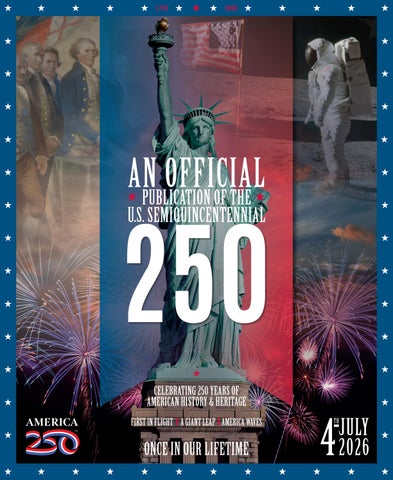
1776
2026
ANPUBLICATION OFFICIAL OF THE
U.S. SEMIQUINCENTENNIAL
CELEBRATING 250 YEARS OF AMERICAN HISTORY & HERITAGE FIRST IN FLIGHT I A GIANT LEAP I AMERICA WAVES
ONCE IN OUR LIFETIME
4
JULY 2026
TH
U.U.S.
ENJOY OUR JOURNEY AT 250
U.S. NATIONAL ANTHEM
The Star-Spangled Banner is the official national anthem of the United States, featuring lyrics written by Francis Scott Key during the War of 1812. Inspired by the resilient American defense of Baltimore's Fort McHenry on September 14, 1814, Key penned a four-verse poem originally titled "Defense of Fort McHenry." Its melody was borrowed from a popular 18th-century British club song composed by John Stafford Smith. Although deeply integrated into military and public traditions throughout the 19th century, President Hoover signed the congressional act officially making it the national anthem in 1931. Andrea Izzotti. Shutterstock
CONTENTS
America250
WHAT'S INSIDE A REVIEW CELEBRATING AMERICA'S 250TH ANNIVERSARY
06. WELCOME & REFLECTIONS 06 12 14 18 20 22
Publisher's Note Hillsdale College A King's Speech A Nation at 250 Native Nations at 250 Hillsdale College
25. THE BIRTH OF A NATION
26 Road to Revolution 30 Patriot Rebellion 34 Declaring Freedom 38 Wave your Stars and Stripes 40 Architects of American Liberty 52 The Pivotal Crossing 54 The 56 Signers 56 The Founders' Blueprint 58 Protecting Freedom 60 A Nation Divided. A Nation Reborn 62 Freedom from Servitude
63. BUILDING THE AMERICAN REPUBLIC 64 66 70 72 76 79 80 82
04
Innovators That Rewrote The World The Long Line The People's House Remembering the First Ladies Wild West Legacy Hispanic Vision Steel Nation The Great Wave
85. A NATION TRANSFORMED 86 88 92 94
Power to the Women Signs of Trouble Recovery, Relief & Reform America Sparks Up
97. AMERICA & THE WORLD
98 A Century Under Arms 102 The Silent Conflict
105. BLACK AMERICAN HISTORY
106 America at 250 112 Struggle. A Never-Ending Process 116 Faith, Freedom & Justice 118 Enacting Equality 120 Black Patriots 124 Black Business Built America Too 126 The First American Revolution
129. SCIENCE, INNOVATION & TECHNOLOGY 130 To the Moon and Beyond 134 250 Years of Healing 136 The Silicon Kingdom 140 The Web Awakes 144 Shaping Tomorrow
145. THE AMERICAN ECONOMY 146 The Money Machine 148 The Trading Nation 150 The Backbone Nation 152 America's Industrial Titans
THE U.S. SEMIQUINCENTENNIAL
A Commemorative Review
ONCE IN OUR LIFETIME 155. CULTURE, ARTS & AMERICAN IDENTITY
156 The Dream Factory 160 A Nation Dressed 162 The American Songbook 166 Feeding America 172 America's Alcohol
173. SPORTS & NATIONAL PASSION
174 Gridiron Evolution. NFL 178 Myth to Diamond. MLB 182 Hoop Tales. NBA 184 Puck Drops. NHL 190 American Speed. INDYCAR 194 An American Original. NASCAR 198 Soccer Roots. MLS 200 Fairway Chronicles. PGA 202 History of the USOPC
205. AMERICA'S FUTURE 206 Gen 250 208 2026 Onwards 210 Vision 2276
213. STATES & LANDMARK SPOTLIGHTS 214 A Home Away from Home 220 Icons of Liberty 224 Route 66 228 50 States United
245. GREAT AMERICAN INSTITUTIONS
246 The Quiet Engine of America’s 250th 248 Learning's Legacy 252 Debt of Honor 254 The Helping Nation
257. 250 MOST INFLUENTIAL AND WOMEN & MEN AMERICA THE WORLD 258 250 Icons
271. AMERICA250 CELEBRATIONS 283. INTERNATIONAL COUNTRY PARTNERS 284 Ireland & America 286 An Irish American Family Tale 288 Northern Ireland 290 Latvia 290 Lithuania 291 Spain
291 San Marino 292 Italy & America 294 Liechtenstein 294 Monaco 295 Slovenia 295 Portugal
05
WELCOME & REFLECTIONS Publisher's Note
1776
Publisher, CEO & Founder Christopher Atkins. Group of Nations
2026
Christopher Atkins
Design & Creative Direction Christian Gilliham. cgcreate9@gmail.com
Publisher, CEO & Founder
GROUP OF NATIONS
Ecommerce Consultant Kerrin Hands. Elevatr Digital
ANPUBLICATION OFFICIAL OF THE
Advertising Executives Ray Baker. SVP of Project Richard Reale. VP
U.S. SEMIQUINCENTENNIAL
Origination Illuminate Print CELEBRATING 250 YEARS OF AMERICAN HISTORY & HERITAGE FIRST IN FLIGHT I A GIANT LEAP I AMERICA WAVES
ONCE IN OUR LIFETIME
4
JULY 2026
TH
Editorial Review Team Ed Pérez. United States Semiquincentennial Commission Kevin T. Edwards. America250.org, Inc. Matthew De Leon. America250.org, Inc.
I arrived in the land of opportunity in 1995 with an idea about what it might let me do. Thirty years later I am holding 'An Official Publication of America250'. Somebody should note the irony. The man publishing this prestigious publication for America250 was born in London, England—on the wrong side of the argument that started it. America never once held that against me. I have never stopped being grateful for that. It is the dream people talk about, and it is not a slogan. It is a country that asks where you are going rather than where you came from, and then gets out of your way. Group of Nations founded and published the first-ever G7 summit official publication. Then came another summit, and another, and then the G20. Leaders came and went. The summits lasted a weekend. The books are still here, thirty years of them. This one will outlive all of them, because a country only turns 250 once. Nothing in thirty years of publishing compares to the honor of being trusted with that. I did not make this history. I was only allowed to help write it down. Thank you, America. Happy Birthday.
Christian Gilliham Creative Director
GROUP OF NATIONS
Cover Credits Statue of Liberty andersphoto. Shutterstock Declaration Rawpixel.com. Shutterstock NASA Rawpixel.com. Shutterstock Fireworks iamlukyeee. Shutterstock
SPECIAL THANKS United States Semiquincentennial Commission Ed Pérez America250.org, Inc. Kevin T. Edwards Matthew De Leon Michael Murphy Global Icons The Exclusive Licensing Agent of America250 Bill McClinton George Kviloria Lesley Tuttle Anna Steiner Fabritech The Operator of the Official America250 Online Store: Jordan Jonker Marcus Medina Courtney Jonker Brittany Brooks Brook Shepard
Creating 'An Official Publication of America250' has been an incredible honor, and I have tried to do it justice. The brief was simple and plain. To make a visual record of America's 250 years of history that people will still want on their shelf in fifty years' time. Thirty years of International Creative Direction brought me here: Guinness World Records, G7, G20, B20 and COP Summit Publications and many creative projects for numerous International Financial Institutions over many years. My thanks go out to Group of Nations for the trust they have placed in me. Every crafted page here... was created to be kept.
06
SHOP HERE
AN OFFICIAL PUBLICATION OF THE U.S. SEMIQUINCENTENNIAL 4th JULY 2026
Michael Murphy. America250.org, Inc. Matthew Spalding. Hillsdale College Jennifer Latchman. Good Goblin Prod. Talia Gilliham. CGcreate Editorial Contributors Wilfred McClay. Hillsdale College Larry P. Arnn. Hillsdale College Matthew Mehan. Author Anita McBride. American University Bernice A. King. The King Center Vonnetta L. West. The King Center Lt. Governor Dr. Dale G. Caldwell Pastor & 35th Secretary of State. NJ John William Templeton. Founder Dr. Carlton B. Goodlett. Conservator Chestley Eugene Talley. Jarvis Christian University William Thomas Chair. Route 66 Road Ahead Partnership Robin Tyson. AI Media Transformation Jake Digregorio. NASCAR Curt Cavin. INDYCAR National Football League Major League Baseball United States Olympic & Paralympic Committee (USOPC) Advertisers & Advertorials Stellantis. Chrysler, Dodge, Jeep & Ram Hillsdale College The Official United States Mint Grace Alley Old Glory Beer James Madison University CGcreate Group of Nations The King Center Jarvis Christian University SV Realty Group & LRG Collective Induction Hardware NHL. Learn To Play Constituting America America the Beautiful Foundation SIXT. RENT THE CAR Route 66 Centennial Fordham University The Irish Emigration Museum ireland.com Titanic Belfast Leslie Latchman Photography ingo-peace.org Global Alliance Council jmi-ibnf.org ©2026 USSC. All Rights Reserved. The America250® word mark and logo are trademarks of USSC and are used under license The views expressed in this publication are those of the contributors and do not necessarily reflect those of Group of Nations or America250®. Every effort has been made to ensure accuracy at the time of going to press. The publisher and copyeditors accept no liability for errors, omissions, or the content of advertisements.
America didn’t become America by chance. It took revolution. It took opportunity. It took backbone. It took courage. Those same ideals shaped Chrysler, Dodge, Jeep® and Ram. They are the reason we call our America250 campaign America Made Us. The audacity to challenge convention. The determination to do the hard work. The optimism to keep innovating. And the freedom to choose a new road. This is why partnering with America250 means so much to us. This celebration is more than a look back at our nation’s first 250 years. It’s a recognition of the enduring spirit that continues to move America, and our brands, forward. As the steward of these legendary American brands, I’m proud to celebrate the people, communities and generations who made them what they are. They belong to America’s story because America is their story. Congratulations on 250 remarkable years. May the road ahead be as bold, resilient and inspiring as the one that brought us here. Antonio Filosa CEO, Stellantis
©2026 FCA US LLC. All Rights Reserved. Chrysler, Dodge, Jeep and Ram are registered trademarks of FCA US LLC.
WELCOME & REFLECTIONS A King's Speech
14
THE U.S. SEMIQUINCENTENNIAL
A Commemorative Review
KING CHARLES III
King Charles III delivered a joint address to the U.S. Congress on Tuesday April 28 2026, marking the 250th anniversary of American independence, only the second British monarch to address Congress, after Queen Elizabeth II in 1991.
"M
r. Vice President, Mr. Speaker, members of Congress, representatives of the American people across all states, territories, cities and communities. I would like, if I may, to take this opportunity to express my particular gratitude to you all for the great honor of addressing this joint meeting of Congress, and on behalf of the Queen and myself, to thank the American people for welcoming us to the United States to mark this Semiquincentennial year of the Declaration of Independence. And for all of that time, our destinies as nations have been interlinked. As Oscar Wilde said, we have really everything in common with America nowadays, except, of course, language. We meet in times of great uncertainty, in times of conflict, from Europe to the Middle East, which pose immense challenges for the international community and whose impact is felt in communities the length and breadth of our own countries. We meet too in the aftermath of the incident not far from this great building, that sought to harm the leadership of your nation and to foment wider fear and discord. Let me say, with unshakeable resolve, such acts of violence will never succeed. Whatever our differences, whatever disagreements we may have, we stand united in our commitment to uphold democracy, to protect all our people from harm, and to salute the courage of those who daily risk their lives in the service of our countries. Standing here today, it is hard not to feel the weight of history on my shoulder, because the modern relationship between our two nations and our own peoples spans not merely 250 years, but over four centuries. It is extraordinary to think that I am the 19th in our line of sovereigns to study with daily attention the affairs of America. So I come here today with the highest respect for the United States Congress, this citadel of democracy created to represent the voice of all American people, to advance sacred rights and freedoms. Speaking in this renowned chamber of debate and deliberation, I cannot help but think of my late mother, Queen Elizabeth, who in 1991 was also afforded this sacred honor and similarly spoke under the watchful eye of the Statue of Freedom above us. Today, I am here on this great occasion in the life of our nations to express the highest regard and friendship of the British people to the people of the United States.
Above: State Dinner for King Charles III and Queen Camilla. Tuesday, April 28, 2026, in the East Room of the White House. Rawpixel.com. Shutterstock
AS I LOOK BACK ACROSS THE CENTURIES, MR. SPEAKER, THERE EMERGED CERTAIN PATTERNS, CERTAIN SELFEVIDENT TRUTHS FROM WHICH WE CAN LEARN A ND DRAW MUTUAL STRENGTH. Now, as you may know, when I addressed my own parliament at Westminster, we still follow an age-old tradition and take a member of Parliament hostage, holding him or her at Buckingham Palace until I am safely returned. These days we look after our guest rather well, to the point that they often do not want to leave. I don't know, Mr. Speaker, if there are any volunteers for that role here today. As I look back across the centuries, Mr. Speaker, there emerged certain patterns, certain self-evident truths from which we can learn and draw mutual strength. With the spirit of 1776 in our minds, we can perhaps agree that we do not always agree, at least in the first instance. Indeed, the very principle on which your Congress was founded, "no taxation without representation," was at once a fundamental disagreement between us and at the same time, a shared democratic value which you inherited from us. Ours is a partnership born out of dispute, but no less strong for it. So perhaps in this example, we can discern that our nations are, in fact, instinctively like-minded, a product of the common democratic, legal and social traditions in which our governance is rooted to this day. Drawing on these values and traditions time and again, our two countries have always found ways to come together. And by Jove, Mr. Speaker, when we have found that way to agree, what great change is brought about — not just for the benefit of our peoples, but of all peoples. This, I believe, is the special ingredient in our relationship. As President Trump himself observed during his state visit to Britain last autumn, the bond of kinship and identity between America and the United Kingdom is priceless and eternal. It is irreplaceable and unbreakable. Mr. Speaker, this is by no means my first visit to Washington, D.C., the capital of this great republic. It is, in fact, my 20th visit to the United States, and my first as King and head of the Commonwealth. ››
15
WELCOME & REFLECTIONS A King's Speech
THIS IS A CITY WHICH SYMBOLIZES A PERIOD IN OUR SHARED HISTORY, OR WHAT CHARLES DICKENS MIGHT HAVE CALLED A TALE OF TWO GEORGES: THE FIRST PRESIDENT, GEORGE WASHINGTON, AND MY FIVE TIMES GREAT-GRANDFATHER, KING GEORGE III.
›› This is a city which symbolizes a period in our shared history, or
what Charles Dickens might have called A Tale of Two Georges: the first president, George Washington, and my five times greatgrandfather, King George III. King George, as you know, never set foot in America. And please rest assured, ladies and gentlemen, I am not here as part of some cunning rearguard action. The Founding Fathers were bold and imaginative rebels with a cause. Two-hundred-and-fifty years ago—or, as we say in the United Kingdom, just the other day—they declared independence by balancing contending forces and drawing strength into diversity. They united 13 disparate colonies to forge a nation on the revolutionary idea of life, liberty, and the pursuit of happiness. They carried with them and carried forward the great inheritance of the British Enlightenment, as well as the ideals which had an even deeper history in English common law and Magna Carta. These roots run deep, and they are still vital. Our Declaration of Rights of 1689 was not only the foundation of our constitutional monarchy, but also provided the source of so many of the principles reiterated, often verbatim, in the American 'Bill of Rights' of 1791. And those roots go even further back in history. The U.S. Supreme Court Historical Society has calculated that Magna Carta is cited in at least 160 Supreme Court cases since 1789, not least as the foundation of the principle that executive power is subject to checks and balances. This is the reason why there stands a stone by the River Thames at Runnymede, where Magna Carta was signed in the year 1215. This stone records that an acre of that ancient and historic site was given to the United States of America by the people of the United Kingdom to symbolize our shared resolve in support of liberty and in memory of President John F. Kennedy. Distinguished members of the 119th Congress, it is here in these very halls that this spirit of liberty and the promise of America's founders is present in every session and every vote cast not by the will of one, but by the deliberation of many, representing the living mosaic of the United States in both of our countries. It is the very fact of our vibrant, diverse and free societies that gives us our collective strength, including to support victims of some of the ills that so tragically exist in both our societies today.
16
And Mr. Speaker, for many here and for myself, the Christian faith is a firm anchor and daily inspiration that guides us not only personally, but together as members of our community. Having devoted a large part of my life to interfaith relationships and greater understanding, it is that faith in the triumph of light over darkness which I have found confirmed countless times. Through it, I am inspired by the profound respect that develops as people of different faiths grow in their understanding of each other. It is why it is my hope, my prayer, that in these turbulent times, working together and with our international partners, we can stem the beating of ploughshares into swords. I am mindful that we are still in the season of Easter, the season that most strengthens my hope. It is why I believe with all my heart that the essence of our two nations is a generosity of spirit and a duty to foster compassion, to promote peace, to deepen mutual understanding, and to value all people of all faiths and of none. The alliance that our two nations have built over the centuries, and for which we are profoundly grateful to the American people, is truly unique, and that alliance is part of what Henry Kissinger described as Kennedy's soaring vision of an Atlantic partnership based on twin pillars: Europe and America. That partnership, I believe, Mr. Speaker, is more important today than it has ever been. The first reigning British sovereign to set foot in America was my grandfather, King George VI. He visited in 1939 with my beloved grandmother, Queen Elizabeth, the Queen Mother. The forces of fascism in Europe were on the march, and some time before, the United States had joined us in the defense of freedom. Our shared values prevailed. Today we find ourselves in a new era, but those values remain. It is an era that is in many ways more volatile and more dangerous than the world to which my late mother spoke in this chamber in 1991. The challenges we face are too great for any one nation to bear alone. But in this unpredictable environment, our alliance cannot rest on past achievements or assume that foundational principles simply endure. As my prime minister said last month, ours is an indispensable partnership. We must not disregard everything that has sustained us for the last 80 years. Instead, we must build on it. Renewal today starts with security. The United Kingdom recognizes that the threats we face demand a transformation in British defense. That is why our country, in order to be fit for the future, has committed to the biggest sustained increase in defense spending since the Cold War—during part of which, over 50 years ago, I served with immense pride in the Royal Navy, following in the naval footsteps of my father Prince Philip, Duke of Edinburgh, my grandfather King George VI, my great uncle Lord Mountbatten, and my great grandfather King George V. This year, of course, also marks the 25th anniversary of 9/11. This atrocity was a defining moment for America, and your pain and shock were felt around the whole world. During my visit to New York, my wife and I will again pay our respects to the victims, the families, and the bravery shown in the face of terrible loss. We stood with you then, and we stand with you now in solemn remembrance of a day that shall never be forgotten.
THE U.S. SEMIQUINCENTENNIAL
A Commemorative Review
In the immediate aftermath of 9/11, when NATO invoked Article Five for the first time, and the United Nations Security Council was united in the face of terror, we answered the call together, as our people have done so for more than a century, shoulder to shoulder through two world wars, the Cold War, Afghanistan, and moments that are defined our shared security. Today, Mr. Speaker, that same unyielding resolve is needed for the defense of Ukraine and her most courageous people. It is needed in order to secure a truly just and lasting peace. From the depths of the Atlantic to the disastrously melting ice caps of the Arctic, the commitment and expertise of the United States Armed Forces and its allies lie at the heart of NATO— pledged to each other's defense, protecting our citizens and interests, keeping North Americans and Europeans safe from our common adversaries. Our defense, intelligence and security ties are hardwired together through relationships measured not in years, but in decades. Today, thousands of U.S. service personnel, defense officials and their families are stationed in the United Kingdom, as British personnel serve with equal pride across 30 American states. We are building F-35s together, and we have agreed on the most ambitious submarine program in history, AUKUS. And we are doing it in partnership with Australia, a country of which I am also immensely proud to serve as sovereign. We do not embark on these remarkable endeavors together out of sentiment. We do so because they build greater shared resilience for the future, so making our citizens safer for generations to come. Our common ideals were not only crucial for liberty and equality, they are also the foundation of our shared prosperity. The rule of law, the certainty of stable and accessible rules, an independent judiciary, resolving disputes and delivering impartial justice: these features created the conditions for centuries of unmatched economic growth in our two countries. This is why our governments are concluding new economic and technology agreements to write the next chapter of our joint prosperity, and ensure that British and American ingenuity continues to lead the world. Our nations are combining talent and resources in the technologies of tomorrow. Our new partnerships in nuclear fusion and quantum computing, and in AI and drug discovery, holding the promise of saving countless lives. More broadly, we celebrate the $430 billion in annual trade that continues to grow. The $1.7 trillion in mutual investment that fuels that innovation, and the millions of jobs on both sides of the Atlantic, supported across both economies. These are strong foundations on which to continue to build for generations yet unborn. Our ties in education, research and cultural exchange empower citizens and future leaders of both countries. The Marshall Scholarship, named after the great General George Marshall and the association of which I am so proud to be patron, are emblematic of the connection between our two countries. Since its founding, more than 2,300 scholarships have been awarded, opening doors for Americans from all walks of life to study at the United Kingdom's leading universities. So as we look toward the next 250 years, we must also reflect on our shared responsibility to safeguard nature, our most precious and irreplaceable asset.
OUR DECLARATION OF RIGHTS OF 1689 WAS NOT ONLY THE FOUNDATION OF OUR CONSTITUTIONAL MONARCHY, BUT ALSO PROVIDED THE SOURCE OF SO MANY OF THE PRINCIPLES REITERATED, OFTEN VERBATIM, IN THE AMERICAN 'BILL OF RIGHTS' OF 1791.
For millennia, millennia before our nations existed, before any border drawn, the mountains of Scotland and Appalachia were one. A single continuous range forged in the ancient collision of continents. The natural wonders of the United States of America are indeed a unique asset, and generations of Americans have risen to this calling. Indigenous, political and civic leaders, people in rural communities and cities alike, have all helped to protect and nurture what President Theodore Roosevelt called the "glorious heritage" of this land's extraordinary natural splendor, on which so much of its prosperity has always depended. Yet, even as we celebrate the beauty that surrounds us, our generation must decide how to address the collapse of critical natural systems, which threatens far more than the harmony and essential diversity of nature. We ignore at our peril the fact that these natural systems—in other words, nature's own economy— provide the foundation for our prosperity and our national security. The story of the United Kingdom and the United States is, at its heart, a story of reconciliation, renewal, and remarkable partnership. From the bitter divisions of 250 years ago, we forged a friendship that has grown into one of the most consequential alliances in human history. I pray with all my heart that our alliance will continue to defend our shared values with our partners in Europe and the Commonwealth and across the world, and that we ignore the clarion calls to become ever more inward looking. Mr. Speaker, Mr. Vice President, distinguished ladies and gentlemen, America's words carry weight and meaning, as they have since independence. The actions of this great nation matter even more. President Lincoln understood this so well with his reflection in the magisterial Gettysburg Address, that the world may little note what we say, but will never forget what we do. And so to the United States of America, on your 250th birthday, let our two countries rededicate ourselves to each other in the selfless service of our peoples and of all the peoples of the world. ★ God bless the United States and God bless the United Kingdom.
17
BIRTH OF A NATION
Architects of American Liberty
GEORGE WASHINGTON BORN: FEBRUARY 22, 1732
G
THE INDISPENSABLE MAN
eorge Washington’s leadership was the singular anchor that held the American Revolution together. Appointed Commander-in-Chief of the Continental Army in 1775, he faced the daunting task of transforming a disorganized militia into a professional fighting force capable of confronting the global superpower of Great Britain. Washington’s military genius lay not in tactical victories, but in strategic survival. He understood that as long as his army remained intact, the revolution lived on. Through brutal winters at Valley Forge and Morristown, he managed to maintain military discipline, overcome severe supply shortages, and suppress mutinies. His tactical boldness was evident in his surprise Christmas crossing of the Delaware River to secure victories at Trenton and Princeton, reviving the nation's sagging morale. By outlasting British resolve and leveraging a critical alliance with France, Washington delivered the decisive blow at the Siege of Yorktown in 1781. Most remarkably, upon achieving total victory, he voluntarily resigned his military commission to the Continental Congress. This historic act of self-restraint stunned a world accustomed to military dictatorships and firmly established the foundational American principle of civilian control over the military. Forging the Executive and Neutrality Policies As the unanimous choice to serve as the first President of the United States, Washington faced the monumental task of translating abstract constitutional principles into a functional, unified government. Recognizing that every action he took would set a precedent for future generations, he approached the office with immense care and dignity. He assembled a brilliant, diverse cabinet that brought competing intellectual forces like Thomas Jefferson and Alexander Hamilton into the executive branch.
I HOPE I SHALL POSSESS FIRMNESS AND VIRTUE ENOUGH TO MAINTAIN WHAT I CONSIDER THE MOST ENVIABLE OF ALL TITLES, THE CHARACTER OF AN HONEST MAN.
42
DIED: DECEMBER 14, 1799
Washington successfully navigated dangerous early domestic crises, including the Whiskey Rebellion of 1794. By personally leading troops to suppress the Western Pennsylvania tax revolt, he demonstrated that the new federal government possessed the authority and resolve to enforce its laws. Externally, he issued the Proclamation of Neutrality in 1793 to protect the fragile young economy from being consumed by European conflicts. Upon stepping down after two terms, he established a crucial democratic precedent of rotation in office. In his famous Farewell Address, he offered timeless warnings against the corrosive nature of political factionalism and the dangers of forming permanent foreign alliances. ★ Below: George Washington. Rawpixel.com. Shutterstock
THE U.S. SEMIQUINCENTENNIAL
A Commemorative Review
JOHN ADAMS BORN: OCTOBER 30, 1735
J
THE VOICE OF INDEPENDENCE
ohn Adams was the intellectual engine of the early American Revolution. Unlike his more charismatic contemporaries, Adams relied on sharp legal reasoning and a deep understanding of historical governments to champion the separation from Great Britain. In the Continental Congress, his tireless debate earned him the reputation as the "Atlas of Independence." He was the driving force that pushed a hesitant congress to vote for separation in July 1776, famously convincing Thomas Jefferson to write the declaration draft. Beyond his revolutionary rhetoric, Adams was a masterful constitutional thinker. In 1780, he singlehandedly authored the Massachusetts Constitution. This brilliant Below: John Adams. Everett Collection. Shutterstock
DIED: JULY 4, 1826
document introduced a balanced tripartite system with a strong executive, a bicameral legislature, and an independent judiciary. It became the structural blueprint for the subsequent United States Constitution. Adams firmly believed that a government of laws, not of men, was the only way to protect individual liberties from the twin dangers of tyranny and unchecked populism. His dedication to constitutional structure shaped the early American republic's institutional framework. A Fractured Presidency and the Defense of Peace Adams served as the first Vice President under George Washington before narrowly winning the presidency in 1796. His single term was defined by intense political instability, marked by the severe fracturing of the Federalist Party and escalating geopolitical tensions. The ongoing war between Great Britain and Revolutionary France spilled over into American waters, triggering an undeclared naval conflict known as the Quasi-War. While members of his own party, led by Alexander Hamilton, demanded a formal declaration of war against France, Adams resolutely pursued a path of armed neutrality. He built up the young nation's navy while simultaneously sending peace commissioners to Europe. This independent stance successfully averted a catastrophic war but cost him his political popularity. Amidst this geopolitical crisis, Adams signed the highly controversial Alien and Sedition Acts of 1798. These laws aimed to suppress foreign subversion but severely restricted free speech and damaged his historical legacy. Despite losing the bitter election of 1800 to Thomas Jefferson, Adams secured a peaceful transfer of power. His final political act was appointing John Marshall as Chief Justice, ensuring a lasting judicial legacy for the young nation. ★
OUR CONSTITUTION WAS MADE ONLY FOR A MORAL AND RELIGIOUS PEOPLE. IT IS WHOLLY INADEQUATE TO THE GOVERNMENT OF ANY OTHER.
43
BIRTH OF A NATION
Architects of American Liberty
THOMAS JEFFERSON BORN: APRIL 13, 1743
T
THE AMERICAN PARADOX
homas Jefferson’s primary contribution to the founding of the United States was his extraordinary ability to articulate the philosophical foundations of human liberty. As the principal author of the Declaration of Independence in 1776, he synthesized Enlightenment ideals into a powerful manifesto for self-governance. His immortal words asserting that "all men are created equal" with unalienable rights to "Life, Liberty and the pursuit of Happiness" became the moral compass of the nation, even as his own status as a lifelong enslaver highlighted the deep contradictions of the founding era. Jefferson was an ardent defender of radical republicanism, advocating for a decentralized federal government that prioritized states' rights and agrarian democracy. He viewed an independent class of small-scale farmers as the ultimate guardians of civic virtue. A champion of intellectual liberty, he authored the Virginia Statute for Religious Freedom, which dismantled the state-sanctioned church and established a vital template for the absolute separation of church and state later enshrined in the First Amendment. Executive Expansion and the Contradictions of Power Jefferson’s election to the presidency in 1800, which he termed a peaceful revolution, shifted the nation away from Federalist centralization. Ironically, his executive actions often expanded federal authority far beyond his strict interpretation of the Constitution. His greatest presidential achievement came in 1803 with the Louisiana Purchase. When presented with Napoleon’s surprise offer to sell the vast territory for fifteen million dollars, Jefferson set aside his constitutional doubts regarding executive territorial acquisition to secure the nation's future.
I NEVER CONSIDERED A DIFFERENCE OF OPINION IN POLITICS, IN RELIGION, IN PHILOSOPHY, AS CAUSE FOR WITHDRAWING FROM A FRIEND.
44
DIED: JULY 4, 1826
This monumental deal instantly doubled the geographic size of the United States, opening vast frontiers for exploration and settlement. However, his second term was severely marred by the Embargo Act of 1807. In a disastrous attempt to force Great Britain and France to respect American maritime neutrality without resorting to open warfare, Jefferson banned all international trade. This economic policy inadvertently crippled the American shipping industry, triggered widespread domestic smuggling, and forced an uncharacteristic expansion of federal enforcement powers before being repealed as he left office. ★ Below: Thomas Jefferson. Library of Congress
THE U.S. SEMIQUINCENTENNIAL
A Commemorative Review
JAMES MADISON BORN: MARCH 16, 1751
J
THE FATHER OF CONSTITUTION
ames Madison was the primary intellectual force behind the creation and ratification of the American constitutional system. Arriving at the Constitutional Convention of 1787 in Philadelphia, Madison presented the groundbreaking Virginia Plan. This framework fundamentally shifted power away from the weak Articles of Confederation toward a strong, centralized federal government. He engineered the intricate system of checks and balances and the separation of powers, ensuring that no single branch of government could achieve absolute dominance. To secure ratification, Madison partnered with Alexander Hamilton and John Jay to write The Federalist Below: James Madison. picryl.com
DIED: JUNE 28, 1836
Papers. His specific essays, notably Federalist No. 10 and No. 51, offered brilliant analyses of how an expansive republic could control the destructive influence of political factions while safeguarding minority rights. Initially opposed to a federal bill of rights, Madison listened to public concerns and personally drafted the first ten amendments to the Constitution in the First Congress, ensuring the protection of fundamental individual liberties like free speech and religion. Presidential Leadership During the War of 1812 As the fourth President of the United States, Madison’s leadership was thoroughly tested by escalating British aggression against American shipping and sailors. In 1812, he became the first American executive to ask Congress for a formal declaration of war. The War of 1812, often called the Second War of Independence, pushed the young nation to the brink of financial and military collapse. The conflict was marked by severe tactical blunders, including the humiliating burning of the White House and Capitol building by British forces in 1814. Throughout the intense crisis, Madison resolutely refused to suspend civil liberties or expand his executive authority into wartime tyranny, demonstrating that a republic could successfully wage a major war without sacrificing its democratic principles. The war concluded in a stalemate with the Treaty of Ghent, but General Andrew Jackson’s stunning victory at the Battle of New Orleans sparked a massive wave of national pride. Madison’s presidency concluded in an Era of Good Feelings, leaving the country economically independent and globally secure. ★
THE FUTURE AND SUCCESS OF AMERICA IS NOT IN THIS CONSTITUTION, BUT IN THE LAWS OF GOD UPON WHICH THIS CONSTITUTION IS FOUNDED.
45
BIRTH OF A NATION
Architects of American Liberty
ALEXANDER HAMILTON BORN: JANUARY 11, 1755
A
THE FINANCIAL VISIONARY
lexander Hamilton was the brilliant and aggressive architect of the American capitalist economy and federal administrative state. Serving as the nation’s first Secretary of the Treasury under George Washington, Hamilton recognized that economic stability was the key to national survival. He devised a bold financial plan to establish the young republic's creditworthiness. Hamilton advocated for the federal government to assume all outstanding state wartime debts, binding the financial interests of wealthy citizens directly to the success of the nation. Despite fierce opposition from Thomas Jefferson and James Madison, he successfully established the First Bank of the United States to manage government funds and regulate currency. Hamilton championed an industrial and commercial vision for America, outlined in his influential Report on Manufactures. He argued for protective tariffs and government subsidies to foster domestic manufacturing, reduce reliance on European imports, and build a powerful national military capable of defending American commercial interests on the global stage. The Federalist Leader and the Politics of Faction Hamilton's aggressive push for a centralized federal government led directly to the creation of the Federalist Party, the nation's first formal political organization. As its undisputed leader, Hamilton used his brilliant pen and sharp intellect to clash openly with the democratic-republican faction. His political philosophy was rooted in a deep skepticism of pure democracy; he favored a strong executive and a government led by elite men of property and merit.
THE REAL ROCK OF POLITICAL SALVATION IS SELF-LOVE PERPETUATED FROM AGE TO AGE IN EVERY HUMAN BREAST, AND MANIFESTED IN EVERY ACTION.
48
DIED: JULY 12, 1804
This elitist stance made him a polarizing figure in early American politics. His influence extended into the election of 1800, where he broke with his party to back his longtime rival Thomas Jefferson over Aaron Burr, whom he viewed as a dangerous political opportunist. Hamilton’s unyielding political principles and personal feuds ultimately led to his downfall. His long-standing rivalry with Burr culminated in a historic duel in Weehawken, New Jersey, in July 1804. Hamilton’s untimely death cut short the life of a financial genius whose institutional designs still form the backbone of modern global finance. ★ Below: Alexander Hamilton. Library of Congress
THE U.S. SEMIQUINCENTENNIAL
A Commemorative Review
BENJAMIN FRANKLIN BORN: JANUARY 17, 1706
B
THE FIRST AMERICAN
enjamin Franklin was the elder statesman of the American Revolution, bringing vital international prestige to the patriot cause. While younger founders built domestic institutions, Franklin secured the external support necessary for the revolution's survival. In 1776, Congress dispatched the seventy-year-old philosopher to Paris as a secret commissioner. Franklin was already world-famous for his scientific discoveries in electricity and his popular writings. He used his celebrity status to charm the French court and public, masterfully presenting himself as a rustic American symbol of liberty. His sophisticated diplomacy bore fruit in 1778 with the signing of the Treaty of Alliance.
Below: Benjamin Franklin. picryl.com
DIED: APRIL 17, 1790
This critical pact brought French gold, troops, and naval power into the war, shifting the balance of power against Great Britain. Franklin continued his diplomatic triumphs by negotiating the Treaty of Paris in 1783. His skill at playing British and French interests against each other secured highly favorable terms for the United States, including independence and vast western territorial boundaries. The Sage of Compromise and Social Reform Returning to America, Franklin’s final major public service occurred at the Constitutional Convention of 1787. As the oldest delegate, his role was that of a unifying mediator. When debates over state representation threatened to dissolve the convention, Franklin’s steady presence and humor calmed heated passions. He helped forge the Great Compromise, which created a bicameral legislature to balance power between large and small states. In his final address to the convention, he urged delegates to doubt their own infallibility and sign the document, ensuring national unity. Beyond politics, Franklin was an active agent of social reform. In his final years, he became the president of the Pennsylvania Abolition Society. In 1790, he signed a historic petition to Congress demanding the immediate end of the slave trade and the total abolition of slavery. This final public act reflected his lifelong evolution as a humanitarian philosopher dedicated to civic improvement, scientific inquiry, and the expanding boundaries of human freedom. ★
WAR IS WHEN THE GOVERNMENT TELLS YOU WHO THE BAD GUY IS. REVOLUTION IS WHEN YOU DECIDE THAT FOR YOURSELF.
49
BIRTH OF A NATION
Architects of American Liberty
SAMUEL ADAMS BORN: SEPTEMBER 27, 1722
S
FATHER OF THE AMERICAN REVOLUTION
amuel Adams Samuel Adams was one of the most influential political philosophers and organizers of the American Revolution. Born in Boston, Massachusetts, in 1722, he grew up in a prominent family but found his true calling not in business or law, but in the fiery crucible of colonial politics. As a leader of the Massachusetts radicals, Adams dedicated his life to resisting British taxation and advocating for colonial rights, earning him a reputation as the "Father of the American Revolution." Architect of Resistance Adams was a master of political mobilization and propaganda. He recognized early on that uniting the disparate colonies required both a shared grievance and a robust communication network. When the British Parliament imposed the Stamp Act of 1765 and the Townshend Acts of 1767, Adams responded by penning powerful essays and organizing public protests. He was a founding member of the Sons of Liberty, a secret society that actively challenged British authority, and he helped orchestrate the Boston Tea Party in 1773—a pivotal act of defiance that pushed the colonies toward open rebellion. Beyond local protests, Adams created the Committees of Correspondence. This vital network allowed leaders across the Thirteen Colonies to share political intelligence and coordinate their resistance. His ability to frame British policies as direct threats to liberty galvanized public opinion and turned
IF WE SUFFER TAMELY A LAWLESS ATTACK UPON OUR LIBERTY, WE ENCOURAGE IT, AND INVOLVEOTHERS IN OUR DOOM.
50
DIED: OCTOBER 2, 1803
localized anger into a unified continental movement. Following the outbreak of the Revolutionary War, Adams served in the Continental Congress, where he passionately advocated for total separation from Great Britain. In 1776, he proudly signed the Declaration of Independence. After the war, he continued to shape the new nation, helping to draft the Massachusetts Constitution and serving as the state’s governor from 1794 to 1797. When he died in 1803, Samuel Adams left behind a legacy as a relentless defender of liberty whose grassroots organizing laid the very foundation of American democracy. ★ Below: Samuel Adams. Library of Congress
THE U.S. SEMIQUINCENTENNIAL
A Commemorative Review
JOHN HANCOCK BORN: JANUARY 23, 1737
J
THE BOLD MERCHANT OF REVOLUTION
ohn Hancock was the financial engine and public face of early revolutionary resistance in Boston. Inheriting one of the largest merchant fortunes in New England, Hancock became a primary target of British economic policies. When the Townshend Acts imposed strict customs duties, Hancock used his wealth to fund patriot resistance and actively evade British taxes. The high-profile seizure of his merchant ship, the Liberty, by British officials in 1768 triggered widespread rioting in Boston, transforming him into a popular hero of the liberty movement. Alongside Samuel Adams, Hancock led the local Sons of Liberty, using his financial resources to support boycotts and political
Below: John Hancock. picryl.com
DIED: OCTOBER 8, 1793
networks. His radical activities made him a wanted man; British troops marching toward Lexington and Concord in April 1775 were specifically ordered to arrest Hancock and Adams. His ability to bridge the gap between elite merchants and radical working-class patriots was essential in building a unified front against imperial overreach in Massachusetts. President of Congress and the Iconic Signature Hancock’s popularity led to his unanimous election as the President of the Second Continental Congress in May 1775. In this difficult role, he managed the chaotic politics of a diverse legislature transitioning from protest to open revolution. He oversaw the creation of the Continental Army and supported the appointment of George Washington as Commander-in-Chief. Hancock’s most famous moment occurred on July 4, 1776, when Congress approved the text of the Declaration of Independence. As President of Congress, his bold, large signature was the only one to appear on the official broadsides printed and distributed that night. His dramatic script became an enduring symbol of defiance against George III. After his service in Congress, Hancock returned to Massachusetts, where he helped draft the state constitution and was elected as its first Governor. He served eleven terms, remaining an immensely popular figure who used his political leverage to secure Massachusetts crucial ratification of the federal Constitution. ★
THERE! HIS MAJESTY CAN NOW READ MY NAME WITHOUT GLASSES. AND HE CAN DOUBLE THE REWARD ON MY HEAD!
51
BUILDING THE AMERICAN REPUBLIC The Long Line
THE LONG LINE A STORY OF THE AMERICAN PRESIDENCY STORY: GROUP OF NATIONS
Abraham Lincoln. In Office: 1861-1865 Everett Collection Shutterstock
66
THE U.S. SEMIQUINCENTENNIAL
A Commemorative Review
I
n the sweltering summer of 1787, fifty-five men gathered behind locked doors in Philadelphia with a problem no republic had ever solved. They needed an executive—someone to enforce the laws, command the army, and speak for the nation. But they had just fought a war to escape a king. How do you create a leader powerful enough to govern but not powerful enough to become a tyrant? The delegates argued for months. Some wanted Congress to choose the executive. Others wanted a direct popular vote, but in an age of slow mail and scattered farms, they feared voters could never know candidates from distant states. The compromise they struck was original: the Electoral College. Each state would appoint electors equal to its representation in Congress, and those electors would choose the president, who would serve four years and could be removed by impeachment. Power would be borrowed, never owned. Everyone in that room knew who the first president would be. In 1789 the electors chose George Washington unanimously. Washington understood that everything he did would become precedent. He accepted the title "Mr. President," and after two terms he did something almost unthinkable for a man holding supreme power: he walked away. That tradition went unwritten until the Twenty-second Amendment made the two-term limit law in 1951. Challenges The system was tested almost immediately. The framers had not anticipated political parties, and in 1800 Thomas Jefferson and his running mate Aaron Burr tied in the Electoral College, sending the election to the House of Representatives for thirty-six ballots. The Twelfth Amendment fixed the flaw in 1804. But 1800 proved something more important: power passed peacefully from one party to its rival. John Adams went home to Massachusetts. Below: George Washington. In Office: 1789 -1797. Rawpixel.com. Shutterstock
That quiet morning may be the most important moment in the office’s history. In 1828 Andrew Jackson, an orphaned frontier soldier, swept into office on a wave of newly enfranchised voters, and the presidency became a popular institution. When William Henry Harrison died a month into his term in 1841, Vice President John Tyler settled an open constitutional question by taking the oath. His precedent carried the nation through seven more deaths in office and was written into the Twenty-fifth Amendment in 1967. Testing Times The gravest test came in 1860. Abraham Lincoln won without a single Southern state, and eleven states left the Union. Lincoln’s victory in the Civil War—and his assassination days after it— fixed the office at the center of American life. His successor, Andrew Johnson, survived impeachment by a single Senate vote. Reconstruction ended with another test. The disputed election of 1876 was settled by a special commission and a political bargain that withdrew federal troops from the South. It was one of five times—in 1824, 1876, 1888, 2000, and 2016—that the winner of the presidency lost the national popular vote, each renewing the argument the framers began in Philadelphia: who, exactly, should choose the president? The answer kept evolving as new amendments widened the vote.
AMERICA WILL NEVER BE DESTROYED FROM THE OUTSIDE. IF WE FALTER, AND LOSE OUR FREEDOMS, IT WILL BE BECAUSE WE DESTROYED OURSELVES. ABRAHAM LINCOLN
Below: Thomas Jefferson. In Office: 1801-1809. Rawpixel.com. Shutterstock
67
BUILDING THE AMERICAN REPUBLIC
Remembering the First Ladies
REMEMBER THE FIRST LADIES SHAPING A UNIQUE AND ENDURING ROLE IN AMERICAN HISTORY
As America celebrates its 250th anniversary, the legacies of First Ladies, from Martha Washington to Melania Trump, reveal their profound influence on the nation’s continually evolving story. STORY: ANITA B. McBRIDE
Below: Martha Washington. 1789-1797 Library of Congress
72
A
s America marks 250 years since the signing of the Declaration of Independence, our nation’s Presidents and First Ladies are a unique entry point to reflect on our past through the vital lens of their leadership, struggles, resilience, and influence – stories from our history that encourage us to examine on what leadership in a democracy means. The stories of our Founding Fathers and the men who succeeded them are well documented in history books. But, history courses have seldom included as thorough a review of the vital role played by the women who stood beside the presidents as First Ladies. They are as much a part of history as their husbands. In some instances, they made it possible for their husbands to be president. Grace Coolidge captured a common sentiment: “There was a sense of detachment—this was I and not yet I, this was the wife of the President of the United States and she took precedence over me.” Martha Washington likened her early months to being a prisoner. Abigail Adams knew she had to watch her words, while nearly two centuries later Betty Ford declared that being ladylike did not require silence. These voices highlight the personal challenges of a position defined by each woman’s vision within the constraints of her era. Thankfully, the scholarship about first ladies has been growing over recent years, creating a more robust environment to examine and evaluate this important role in American society that has no constitutional basis, no salary, and no official rule book— yet over 237 years, these history-making women have shaped the role – and the country – through partnership, resilience, and advocacy. From the beginning, George Washington understood that the presidency was a two-person job. He needed a surrogate for head-of-state ceremonial duties. Lucky for him, Martha Washington was an experienced hostess who expertly filled that role and set enduring precedents as a gracious hostess who helped define the customs of the new republic. Reluctantly leaving Mount Vernon, she arrived in New York after George Washington’s inauguration and found that advisors had already outlined duties for her.
THE U.S. SEMIQUINCENTENNIAL
A Commemorative Review
I WOULD RATHER MARRY A GOOD MAN, A MAN OF MIND, WITH A HOPE AND BRIGHT PROSPECTS AHEAD FOR POSITION, FAME AND POWER THAN TO MARRY ALL THE HOUSES, GOLD AND BONES IN THE WORLD. MARY LINCOLN Above: Abigail Adams. 1797-1801 Library of Congress
She transformed the ceremonial side of the presidency into a true partnership, assisting with state functions in an era when the young nation balanced republican ideals with familiar monarchical traditions. This thread—hostess, partner, and public representative—connects every First Lady to the present. The title “First Lady” itself evolved gradually. Early presidential wives were called “Lady Washington,” “Mrs. President,” or “Lady Presidentress.” Scholars trace widespread usage to the mid-19th century, with Zachary Taylor reportedly calling Dolley Madison the country’s “first lady” at her funeral in 1849. The term gained popularity in the late 19th and early 20th centuries and persists today, though some, like Jacqueline Kennedy, found it outdated. Not every president had a wife in the White House. Bachelors, widowers, and Below: Dolley Madison. 1809-1817 Library of Congress
Above: Mary Lincoln. 1861-1865 Everett Collection. Shutterstock
cases where wives died in office led to surrogates (daughters, nieces, sisters) to carry out the duties, but as historian Lewis L. Gould noted, only wives possessed the unique history, relationship, and access that truly shaped the institution. The books I co-authored, therefore, focus on presidential wives who engaged significantly with the role. The early republic emphasized women supporting civic virtue through family education and moral example while operating “above” politics. First Ladies balanced public expectations of traditional femininity with behind-the-scenes influence. Martha Washington, Abigail Adams, and Dolley Madison established the role within new spheres of public and domestic life. Throughout the 19th century, many First Ladies navigated personal tragedies— illness, loss of children, widowhood—while fulfilling hostess duties. Some, like Sarah Polk, wielded significant behind-the-scenes political influence. Others faced criticism for lavish entertaining during national crises, as with Mary Lincoln during the Civil War. By the late 19th and early 20th centuries, figures like Julia Grant, Edith Roosevelt, and Florence Harding engaged more visibly with the press. During this period, first ladies’ public activities also addressed societal issues that were emblematic of the era’s reform movements, such as temperance, labor and workplace reform, and suffrage, which brought more women out of the private sphere of the home and into the public square.
The 20th century brought dramatic transformation to the role and to the White House. Edith Roosevelt professionalized the role of first lady by hiring the first professional staff member, a social secretary, to handle the demanding social schedule and the increased press attention on her young and large family. Edith also oversaw the enlarging of the White House that her predecessors envisioned. For the first time, the family quarters were private, and a new Executive Wing for the president’s staff was built– known to all now as the West Wing. Edith’s successor Nellie Taft was no stranger to activism. She was determined to have a front row seat to her husband’s presidency. She was a strong first lady who publicly supported women’s equality in education and careers and declared herself a suffragist. Some examples in first lady history tell us that influence or power has gone too far. ›› Below: Florence Harding. 1921-1923 Everett Collection. Shutterstock
73
BUILDING THE AMERICAN REPUBLIC
Remembering the First Ladies
Above: Eleanor Roosevelt. 1933-1945 Franklin D. Roosevelt Presidential Library & Museum
›› The most powerful first lady in history may be Edith Wilson, who did not champion women’s rights or support suffrage but was attacked for running a “petticoat government” by severely controlling access to her husband after his stroke. Although how much power she exercised may never be known in full, evidence suggests it was substantial and was one of the factors in the eventual passage of the 25th Amendment, which established clear procedures for filling presidential and vice presidential vacancies in times of death or temporary or permanent incapacitation. Unlike many first ladies, Florence Harding was not a reluctant first lady. She orchestrated her husband’s political rise and once declared, “I know what’s best for the President, I put him in the White House.” She openly supported the 19th Amendment giving women the right to vote and was the first, First Lady to cast a vote for her husband, marking a significant move forward for women’s rights. Eleanor Roosevelt revolutionized the first lady position as an activist, using her newspaper column “My Day,” advocating for civil rights and human rights, and traveling extensively. Her long tenure during the Depression and World War II set a new standard, though some later First Ladies stepped back from activism
74
Above: Jacqueline Kennedy. 1961-1963 Robert Knudsen. White House Photographs
I KNOW WHAT’S BEST FOR THE PRESIDENT, I PUT HIM IN THE WHITE HOUSE. FLORENCE HARDING
and exercised freedom to choose their level of public activism. Postwar and modern First Ladies continued expanding the role. They championed causes tied to families, children, health, education, historic preservation, the environment, and global issues. Many traveled abroad independently, collaborated with international counterparts, and developed larger and more professional Office of the First Lady operations. 2008 marked a watershed event in American history with the election of Barack Obama as the 44th president. With this outcome the nation had its first African American president and first lady in the White House. Michelle Obama brought to her role the most varied background of any first lady having worked in both the public and private sectors, but announced her first priority was settling her young children into as normal a life as possible.
Above: Betty Ford. 1974-1977 Library of Congress Prints & Photographs Division. D.C.
By 2021, Dr. Jill Biden exemplified balancing the role with maintaining her own career and continuing to work as a college professor. There is no single way to be a First Lady. Some embraced traditional roles; others exerted private influence or public advocacy. They mirror their times yet often push boundaries. Polls, such as the Siena College surveys, consistently rank Eleanor Roosevelt highest, with others like Abigail Adams, Dolley Madison, and Lady Bird Johnson in the top tier. Public and scholarly assessments often align, recognizing both achievements and the context of each era —including controversies and personal challenges. Remember the First Ladies takes a thematic lens and explores their role thematically–how these women influenced campaigns, White House stewardship, media use, and civil rights, while providing historical context on women’s societal roles. Stories of triumph, tragedy, glamour, and criticism reveal their full humanity. Some first ladies left copious records; others burned papers, leaving gaps that ongoing research continues to fill. Their legacies endure because they operated as presidential partners—each in her own way. They supported husbands through elections, wars, and crises while
THE U.S. SEMIQUINCENTENNIAL
A Commemorative Review
AMERICA'S First Ladies: 1789-2026 1st
Martha Washington: (1789-1797)
2nd Abigail Adams: (1797-1801) 3rd Dolley Madison: (1809-1817) 4th Elizabeth Monroe: (1817-1825) 5th Louisa Adams: (1825-1829) 6th Anna Harrison: (1841) 7th Letitia Tyler: (1841-1842) 8th Julia Tyler: (1844-1845) 9th Sarah Polk: (1845-1849) 10th Margaret Taylor: (1849-1850) 11th Abigail Powers Fillmore: (1850-1853) 12th Jane Pierce: (1853-1857) 13th Mary Lincoln: (1861-1865) 14th Eliza Johnson: (1865-1869) 15th Julia Grant: (1869-1877) Above: Michelle Obama. 2009-2017 Rawpixel.com. Shutterstock
Above: Melania Trump. 2017-2021 & 2025-Present 1 Andrew Thomas 1. Shutterstock
carving out an independent impact. As symbols of American womanhood, they reflected evolving expectations yet demonstrated agency within an undefined position.
humanoid robot into the White House East Room, advocating the safe use of technology for children’s education instruction. Future First Ladies—potentially including a “First Gentleman”—will build on these precedents while continuing to address new challenges. What remains constant is the platform these women hold to drive conversations, foster unity, champion humanitarian causes, and shape national character and culture. By honoring their stories, we gain deeper appreciation for the shared endeavor that built and sustains the republic. The First Ladies remind us that leadership appears in many forms—sometimes behind the scenes, yet always essential to the nation’s progress. ★
Why First Ladies Matter for America250 On the nation’s Semiquincentennial, remembering these women completes the American story. From Martha Washington’s reluctant but foundational service as hostess to contemporary First Ladies navigating media scrutiny and global diplomacy, their contributions highlight partnership, resilience, and the power of informal influence. Martha Washington could never have imagined that one of her successors could run for elective office as Hillary Clinton did. Although the public co-presidency the Clintons tried to achieve in the White House was not feasible, her political influence is powerful. Hillary’s election as a US Senator and appointment as a Cabinet member were significant firsts for a first lady, as was being the first to run for president and to win a major party nomination for president. The role of first lady continues to evolve with society. In the rapidly changing 21st century, First Lady Melania Trump made history by escorting an AI-powered
16th Lucy Hayes: (1877-1881) 17th Lucretia Garfield: (1881) 18th Frances Cleveland: (1885-1889) 19th Caroline Harrison: (1889-1893) 20th Frances Cleveland: (1893-1897) 21st Ida McKinley: (1897-1901) 22nd Edith Roosevelt: (1901-1909) 23rd Helen Taft: (1909-1913) 24th Ellen Wilson: (1913-1914) 25th Edith Wilson: (1915-1921) 26th Florence Harding: (1921-1923) 27th Grace Coolidge: (1923-1929) 28th Lou Hoover: (1929-1933) 29th Eleanor Roosevelt: (1933-1945) 30th Elizabeth Truman: (1945-1953) 31st Mamie Eisenhower: (1953-1961) 32nd Jacqueline Kennedy: (1961-1963) 33rd Claudia 'Lady Bird' Johnson: (1963-1969) 34th Patricia Nixon: (1969-1974) 35th Betty Ford: (1974-1977) 36th. Rosalynn Carter: (1977-1981) 37th Nancy Reagan: (1981-1989) 38th Barbara Bush: (1989-1993) 39th Hillary Clinton: (1993-2001) 40th Laura Bush: (2001-2009) 41st Michelle Obama: (2009-2017)
ANITA B. McBRIDE is the Director of the First Ladies Initiative at American University, Co-Founder of the First Ladies Association for Research and Education (FLARE) and Co-author of 'Remember the First Ladies: The Legacies of America’s History-Making Women'.
42nd Melania Trump: (2017-2021) 43rd Jill Biden: (2021-2025) 44th Melania Trump: (2025-Present)
75
A NATION TRANSFORMED America Sparks Up
AMERICA SPARKS STORY: GROUP OF NATIONS
UP 94
THE U.S. SEMIQUINCENTENNIAL
A Commemorative Review
T
he transition of America from a nation lit by gaslight and kerosene to one humming with electrical power is the story of a second industrial revolution. It is a narrative driven by intense corporate rivalries, brilliant inventors, and a massive infrastructural transformation that completely reshaped daily life, labor, and the American landscape. The Dawn of Direct Current In the late 1870s, artificial light was a luxury of flickering gas jets and smoky oil lamps. Cities were dark, dangerous, and dependent on the sun to dictate the rhythm of work and commerce. This changed on September 4, 1882, when Thomas Alva Edison flipped the switch at his Pearl Street Station in lower Manhattan. Edison’s system utilized Direct Current (DC), electricity that flows continuously in a single direction. The Pearl Street Station initially powered just 400 lamps for 85 customers, including the New York Times. It was a marvel of engineering, but DC had a fatal flaw. It could not travel efficiently over long distances. Because voltage dropped significantly within a mile of the generating station, DC required a patchwork of small power plants every few blocks to maintain voltage. This made electrification an expensive luxury, feasible only in densely populated, wealthy urban centers. The Current War As Edison sought to expand his DC empire, a brilliant Serbian engineer named Nikola Tesla arrived in New York with a different vision. Tesla understood that Alternating Current (AC), which reverses direction periodically, was the key to scaling the power grid. Unlike DC, AC voltage could be stepped up to incredibly high levels using transformers, allowing it to travel hundreds of miles over thin wires with minimal energy loss, and then stepped down safely at its destination. Edison refused to accept Tesla’s ideas, prompting Tesla to part ways with him. Left: Thomas Alva Edison. 1847-1931 Rawpixel.com. Shutterstock.com Right: Nikola Tesla. 1856-1943 Library of Congress
Above: Niagara Parks Power Station. Oleg Mayorov. Shutterstock
TESLA UNDERSTOOD THAT ALTERNATING CURRENT (AC), WHICH REVERSES DIRECTION PERIODICALLY, WAS THE KEY TO SCALING THE POWER GRID.
Tesla soon partnered with George Westinghouse, a visionary Pittsburgh industrialist who recognized that AC could bring electricity to every corner of America, not just rich city blocks. What followed in the late 1880s was the infamous 'War of the Currents'. Edison launched a ruthless public relations campaign to discredit AC, claiming it was too dangerous for domestic use. He went so far as to publicly electrocute stray animals using AC power to stoke public fear. When the state of New York decided to use an AC-powered chair for capital punishment, Edison campaigned to have the process called 'Westinghousing'. The World’s Fair and Niagara’s Triumph Despite Edison's aggressive tactics, the superior efficiency of Alternating Current could not be suppressed. The turning point came in 1893 when the 'Westinghouse Electric Company' won the contract to light the World’s Columbian Exposition in Chicago. When President Grover Cleveland pressed a button to illuminate the fairgrounds with a dazzling display of nearly 100,000 AC lamps, the public saw that AC was both safe and breathtakingly powerful. ››
95
BLACK AMERICAN HISTORY America at 250
AMERICA AT 250
MLK STILL CALLS A DIVIDED NATION TO CONSCIENCE STORY: BERNICE A. KING & VONNETTA L. WEST
A Nation at a Prophetic Crossroad
W
e write this at a moment when America turns 250, while still wrestling with the truth Rev. Dr. Martin Luther King, Jr. named with prophetic precision: this nation has always been two nations struggling inside one body. A nation with a split moral personality. One America committed to liberty, justice, and the dignity of all people; the other America committed to domination, exclusion, and the preservation of inequity. One America proclaiming the sacredness of human life; the other America normalizing violence as a tool of policy and power. This internal conflict is not symbolic; it is structural. And as we reach this milestone, the question before us is whether we will finally reconcile these two nations into one just, humane, and morally grounded society. This anniversary invites celebration, but it also demands truth. We cannot meaningfully commemorate 250 years of independence without acknowledging the violent displacement and genocide of Indigenous people, the treacherous enslavement of African people, and the enduring inequities that flow from those foundational sins. We cannot romanticize the founding while ignoring the moral contradictions embedded in it. And we cannot pretend that the fractures of the past have healed when the evidence of division, dehumanization, and despair remains so painfully present.
MY MOTHER, CORETTA SCOTT KING, UNDERSTOOD THIS URGENCY. SHE FOUNDED THE KING CENTER IN 1968 BECAUSE SHE KNEW MY FATHER’S DREAM WAS NOT A RELIC OF HISTORY BUT A ROADMAP FOR HUMANITY.
106
America at 250 is not a moment of uncomplicated commemoration for Black people, Indigenous people, or many other communities whose suffering made the nation’s rise possible. For us, this 250th anniversary is not a simple celebration; it is a reckoning. At the birth of this nation, Black people were not citizens; America legally defined us as property. America exploited our ancestors’ bodies and labor to build the wealth that underwrote America’s early and present prosperity. And even after the abolition of chattel slavery, America still denied our humanity through Black Codes, Jim Crow laws, segregation, lynching, and the violent enforcement of racial hierarchy. We must name this plainly: America did not function as a democracy for Black people at its founding. It did not function as a democracy for us in the Reconstruction era. It did not function as a democracy for us through the long night of Jim Crow. America only became a democracy for Black people in 1965, when President Lyndon B. Johnson signed the Voting Rights Act into law—a law for which Dr. King, Amelia Boynton Robinson, John Lewis, Hosea Williams, Viola Liuzzo, and others fought, bled, and, in the case of Viola, died. That means that for Black Americans, this nation is not 250 years old. It is 61 years old. We are only 61 years into the fragile experiment of multiracial democracy, and even that experiment is under renewed attack. This truth does not diminish our love for this nation; it deepens our demand that the nation love us back, not sentimentally, but structurally. At 250, America must confront the fact that its democratic promise has never been fully realized for all its people. The question is whether the next 61 years will look like the last or whether we will finally choose justice, truth, and the Beloved Community. Bernice’s Voice as Daughter, Minister, and CEO As co-authors, we write with one voice of conviction, but there are moments when the voice of a daughter must stand distinct. As Bernice—a minister, the daughter of Rev. Dr. Martin Luther King, Jr. and Mrs. Coretta Scott King, and the CEO of The King Center—I know my father’s voice not only as a global moral force but as the voice that shaped my earliest understanding of justice, dignity, and love. And I know that his prophetic witness still calls America, not abstractly, but urgently, insistently, and without apology. ››
THE U.S. SEMIQUINCENTENNIAL
A Commemorative Review
Dr. Martin Luther King, Jr. Rawpixel.com. Shutterstock
107
BLACK AMERICAN HISTORY Black Patriots
Corporal Isham Valentine
BLACKPAT 120
THE U.S. SEMIQUINCENTENNIAL
A Commemorative Review
Bartholomew Holmes
RIOTS!
I
n the winter crucible of Valley Forge, Corporal Isham Valentine served in General George Washington’s army during one of the Revolution’s most severe tests of endurance. Bartholomew Holmes also served in the Continental Army and fought at Stony Point, one of Washington’s daring nighttime bayonet assaults—a dramatic victory that revived Patriot morale after months of grinding war. He later endured the Siege of Charleston, where he was captured, escaped British confinement, returned to the ranks, and fought again at the Battle of Yorktown. These are not merely the war stories of two men. Isham stood among nine Valentine kinsmen—brothers and first cousins—who fought for the Patriot cause. Bartholomew and his brother likewise belonged to that larger, often-overlooked company of Black Patriots—thousands who took up arms against the British in the struggle for American independence. Free Black Life in Colonial Virginia Black life in colonial Virginia did not begin under the rigid system of racial slavery many people imagine today. As Encyclopedia Virginia explains, free Black people lived alongside white people in the colony, and throughout much of the seventeenth century many exercised rights later generations would lose—owning property, working for wages, paying taxes, and voting. For some, colonial Virginia held opportunity. ››
THE VALENTINE AND HOLMES FAMILIES FIGHTING FOR FREEDOM IN THE AMERICAN REVOLUTION STORY: CHESTLEY EUGENE TALLEY
121
SCIENCE, INNOVATION & TECHNOLOGY To the Moon and Beyond
REACHING FOR THE STARS AMERICA'S SPACE LEGACY STORY: GROUP OF NATIONS
130
Left: Katherine Johnson. NASA. 1953-1986 Featureflash Photo Agency. Shutterstock Right: The official crew portrait of the Apollo 11 astronauts: Neil A. Armstrong, Commander; Michael Collins, Module Pilot; Edwin E. “Buzz” Aldrin, Lunar Module Pilot. Cape Kennedy. 1969 Rawpixel.com. Shutterstock Astronaut: Vadim Sadovski. Shutterstock Satellite: Artsiom P. Shutterstock Shuttle: Assistant. Shutterstock Orion: Dima Zel. Shutterstock
THE U.S. SEMIQUINCENTENNIAL
A Commemorative Review
O
f all the stories America has written in its 250 years, none reaches higher—literally—than the story of its space program. In less than the span of a single human lifetime, the United States went from launching its first small satellite to walking on the Moon, dispatching robotic explorers past every planet in the solar system, and sending astronauts around the Moon once again in April 2026. It is a story of audacity, tragedy, ingenuity, and return. The Shock That Started It All The Space Age arrived with a beep. On October 4, 1957, the Soviet Union launched Sputnik, the first artificial satellite, and Americans looked up at the night sky to find a rival's machine passing overhead. The response was swift: in 1958, President Eisenhower signed the act creating the National Aeronautics and Space Administration—NASA—a civilian agency charged with winning the new frontier. America's first satellite, Explorer 1, had already reached orbit that January, discovering the Van Allen radiation belts and demonstrating that the United States would answer the challenge with science. The early race belonged to Moscow. The Soviets put the first man, Yuri Gagarin, into orbit in April 1961. Three weeks later, Alan Shepard became the first American in space aboard Freedom 7, a fifteen-minute suborbital arc that nonetheless electrified the country. In February 1962, John Glenn orbited the Earth three times in Friendship 7, and America had a spacefaring hero. The Mercury program proved a man could survive and work in space; the Gemini program that followed proved nearly everything else—spacewalks, rendezvous, docking, and two-week endurance flights—the essential toolkit for the voyage to come. "We Choose to Go to the Moon" On May 25, 1961, with barely fifteen minutes of American human spaceflight experience to draw on, President John F. Kennedy stood before Congress and committed the nation to landing a man on the Moon and returning him safely to the Earth before the decade was out. It was, and remains, the boldest engineering pledge ever made by a head of state. ››
131
SCIENCE, INNOVATION & TECHNOLOGY 250 Years of Healing
250 Years of Healing STORY: GROUP OF NATIONS
I
n 1776, American medicine was closer to medieval than modern. Doctors bled their patients, disease theories involved humors: blood, phlegm, yellow bile, and black bile. George Washington himself likely died faster in 1799 because physicians drained nearly half his blood treating a throat infection. Life expectancy hovered under forty. That the same nation would, within 250 years, eradicate ancient plagues, transplant human hearts, decode the genome, and add nearly four decades to the average life is among the most consequential achievements of the American experiment—and its story is one of relentless, often unsung, discovery. From Bloodletting to the Operating Table The founding generation had one genuine visionary in Benjamin Rush, signer of the Declaration and pioneer of humane psychiatric care, and one great early victory: Benjamin Waterhouse brought Jenner's smallpox vaccine to America in 1800, and Thomas Jefferson personally championed it, vaccinating his household and predicting smallpox's extinction.
Left: Dr. William T.G. Morton. The first use of ether in dental surgery. 1846 Spatuletail. Shutterstock
134
THE U.S. SEMIQUINCENTENNIAL
A Commemorative Review
But the first world-changing American discovery came on October 16, 1846, in the surgical amphitheater of Massachusetts General Hospital, when dentist William T.G. Morton publicly demonstrated ether anesthesia—and surgery ceased to be torture. “Gentlemen, this is no humbug,” the astonished surgeon announced. The century closed with Army doctor Walter Reed proving that mosquitoes carried yellow fever, making possible both the Panama Canal and modern epidemiology, while Johns Hopkins invented the modern research hospital and, after the Flexner Report of 1910, American medical education became the world's gold standard. The Century of Miracles The twentieth century turned American laboratories into humanity's pharmacy. When Britain's penicillin discovery languished for lack of production, American labs and industry scaled it from a laboratory curiosity to D-Day quantities—the true birth of the antibiotic age. Then came the triumph over the disease that terrorized every American summer: polio. Jonas Salk’s killed-virus vaccine was announced in 1955 to church bells and weeping parents. Salk famously refused to patent it, asking, “Could you patent the sun?” Together, Salk’s injected vaccine and Albert Sabin’s oral vaccine helped drive polio from the Western Hemisphere. Maurice Hilleman, the most prolific vaccinologist ever, developed more than forty vaccines including measles, mumps, and hepatitis B, saving tens of millions of lives with barely a headline. American surgeons crossed the body's last frontiers: the Blalock-Taussig-Thomas operation 1944—devised with Black lab technician Vivien Thomas, whose genius went unrecognized for decades—saved "blue babies" and helped launch heart surgery; Joseph Murray performed the first successful organ transplant, a kidney, in 1954; and Michael DeBakey pioneered the bypass and the artificial heart era. James Watson co-discovered DNA's double helix; Raymond Damadian and Paul Lauterbur gave medicine the MRI; and when AIDS emerged in 1981, American science—through the NIH and researchers like Anthony Fauci—eventually transformed a death sentence into a manageable condition.
Above: Concept of CRISPR, Gene Therapy, Laboratory Innovation, Futuristic Medicine and Diagnostics. Anton Vierietin. Shutterstock
JENNIFER DOUDNA'S CO-INVENTION OF CRISPR GENE EDITING MADE REWRITING DNA PRACTICAL, AND IN 2023 THE FDA APPROVED THE FIRST CRISPR CURE, FOR SICKLE CELL DISEASE, THE ANCIENT SCOURGE FINALLY ANSWERED.
The Genetic Frontier The twenty-first century opened with an American-led moonshot completed: the Human Genome Project, finished in 2003, read all three billion letters of human DNA and launched the age of precision medicine. Jennifer Doudna's co-invention of CRISPR gene editing made rewriting DNA practical—and in 2023 the FDA approved the first CRISPR cure, for sickle cell disease, the ancient scourge finally answered. Jim Allison's cancer immunotherapy taught the immune system to attack tumors, converting terminal melanomas into survivable illness. And when COVID-19 struck, decades of quiet American research—Katalin Karikó and Drew Weissman's mRNA breakthroughs at Penn—delivered effective vaccines in under a year, the fastest in history, saving millions worldwide. Today American labs lead the AI-driven drug discovery race, obesity and Alzheimer's
treatments are finally bending curves, and roughly half the world's new medicines originate in the United States. The nation that once bled its first president now edits genes to cure the dying—250 years from humors to CRISPR, with the next miracle already in a lab somewhere between Boston and San Francisco. ★
AMERICA'S MEDICAL MIRACLES Ether anesthesia: 1846 The modern research hospital. Johns Hopkins: 1889 Yellow fever transmission solved: 1900 Mass-produced penicillin: 1943 First successful human organ transplant: 1954 Polio vaccines: 1955, 1961 Maurice Hilleman’s 40+ vaccines: mid-20th century Human Genome Project completed: 2003 Modern cancer immunotherapy: 2011 mRNA vaccines: 2020 First approved CRISPR-based treatment: 2023
135
SCIENCE, INNOVATION & TECHNOLOGY The Silicon Kingdom
136
THE U.S. SEMIQUINCENTENNIAL
A Commemorative Review
STORY: GROUP OF NATIONS
A
unique convergence of geography, capital, and counterculture transformed a California valley of fruit orchards into the epicenter of global technology. Over seven decades, Silicon Valley did not just manufacture microchips; it exported a new way of living, thinking, and organizing human society. The Digital Revolution in America reshaped the global economy, redefined geopolitics, and fundamentally altered the fabric of daily human life. While the geographic boundaries of this revolution began in Northern California, its ripples quickly spread across the nation, drawing in key players from the Pacific Northwest and creating an interconnected web of hardware, software, and creative platforms that built the modern world. The Seeds of Silicon, Intel, and the Genesis of Hardware Before it was synonymous with software, Santa Clara Valley was known as the “Valley of Heart’s Delight”, a scenic agricultural region famous for its fruit orchards. The transformation into a technological powerhouse began with military necessity and academic vision. Frederick Terman, the dean of engineering at Stanford University during the 1940s, recognized that the university needed to retain its brightest minds. Instead of watching graduates leave for the East Coast, Terman incentivized them to start companies locally, establishing the Stanford Industrial Park and leasing university land to high-tech firms. In 1956, William Shockley, co-inventor of the transistor, founded Shockley Semiconductor in Mountain View. His abrasive management style quickly alienated his top scientists. Eight of them left to form Fairchild Semiconductor in 1957. ››
OVER SEVEN DECADES, SILICON VALLEY DID NOT JUST MANUFACTURE MICROCHIPS; IT EXPORTED A NEW WAY OF LIVING, THINKING, AND, ORGANIZING HUMAN SOCIETY.
Left: Silicon Valley. Synonymous with the rise of the computer and electronics industry, the digital economy, and the Internet. It is not only a geographic location but also a state of mind regarding regional economic development and American wealth. Atosan. Shutterstock
137
CULTURE, ARTS & AMERICAN IDENTITY The Dream Factory
the dream factory THE MOVIE CAPITAL OF THE WORLD STORY: GROUP OF NATIONS
They caught A shark. Not THE shark. Matt Hooper - Richard Dreyfuss
156
THE U.S. SEMIQUINCENTENNIAL
A Commemorative Review
Left: A famous American landmark on Mount Lee in Griffith Park, Los Angeles. Built in 1923 as "HOLLYWOODLAND" to advertise a housing site. It later shortened its name and grew into a global symbol of the movie industry. Katherine Hepburn: spatuletail. Shutterstock Stephen Spielberg: Loredana Sangiuliano. Hollywood Sign: 21 Aerials. Shutterstock Shutterstock Oscar: Yta23. Shutterstock Jaws: seeshooteatrepeat. Shutterstock Reel: Yta23. Shutterstock
I’m going crazy. I’m standing here solidly on my own two hands and going crazy. The Philadelphia Story: 'TracyLord' -Katherine Hepburn
N
o American export has traveled farther than the movies. Steel and software shaped economies, but Hollywood shaped imaginations—teaching the world what a cowboy, a gangster, a hero, and a happy ending look like. From a dusty Los Angeles suburb chosen for its sunshine, the American film industry grew into the planet's dream factory, and its stories, stars, and franchises remain the common culture of billions who have never set foot in the United States. The American appetite for spectacle is as old as the republic. The theaters of 1776 were makeshift affairs—the Continental Congress actually discouraged playgoing as frivolous in wartime—but the young nation quickly built playhouses in every city, and by the nineteenth century entertainment was an American industry: P.T. Barnum invented modern show business and the publicity stunt, touring theater and Wild West shows carried drama to the frontier, and vaudeville circuits trained the comedians, singers, and dancers who would one day walk straight onto movie screens. When the movies arrived, America was already a nation of showmen waiting for a bigger stage. The invention itself was American from the first frame. Thomas Edison's laboratory built the Kinetoscope in the 1890s; nickelodeon theaters spread through working-class neighborhoods, selling immigrants a five-cent window into their new country. ››
Right: Phineas Taylor Barnum. American Showman. 1860-64. The early 1860s were a time of great success for Barnum and his American Museum. Charles D. Fredricks & Co. Everett Collection. Shutterstock
157
CULTURE, ARTS & AMERICAN IDENTITY The American Songbook
The American Songbook STORY: GROUP OF NATIONS
You're still the one I run to, The one that I belong to, You're still the one I want for life. You're Still the One. Shania Twain
162
THE U.S. SEMIQUINCENTENNIAL
Left: Shania Twain. 2024 MusiCares Person of the Year Los Angeles. Kathy Hutchins. Shutterstock Also: Broadway. Nashville. TN Alexey Fedorenko. Shutterstock Right: Direct from Graceland: Elvis Exhibition Loredana Sangiuliano. Shutterstock Wirestock Creators. Shutterstock
I WAS TRAINING TO BE AN ELECTRICIAN. I SUPPOSE I GOT WIRED THE WRONG WAY ROUND SOMEWHERE ALONG THE LINE.
N
o country has given the world more music than the United States. Jazz, blues, country, gospel, bluegrass, rock and roll, soul, funk, disco, and hip-hop—every one of them was born on American soil, and together they have become the closest thing humanity has to a shared soundtrack. The story runs the republic's full 250 years, and it is the story of America itself: peoples who arrived from everywhere—willingly and in chains—carrying melodies that collided, merged, and produced something the world had never heard. The nation was born singing. The soldiers of 1776 marched to "Yankee Doodle"—a British taunt the rebels defiantly claimed as their own—and to the hymns of William Billings, the Boston tanner whose "Chester" made him America's first homegrown composer. The raw materials of everything to come were already present. British and Irish settlers carried ballads and fiddle tunes into the Appalachian hollows, where they aged like whiskey into what would become folk and country music. Enslaved Africans, forbidden almost everything else, kept rhythm and the call-and-response of the field holler and the spiritual—the seed of gospel, blues, jazz, and ultimately most American popular music. In the churches of both races, hymns taught harmony to the young nation; by the nineteenth century, Stephen Foster was writing the first American popular songs, Francis Scott Key's 1814 verses were on their way to becoming the national anthem, brass bands marched under John Philip Sousa, and Scott Joplin's ragtime piano was syncopating the new century before it arrived.
ELVIS PRESLEY
A Commemorative Review
Country Roads: The Music of the American Heartland Country and western music is, at its core, the sound of rural America set to strings. Its birth certificate is usually dated to 1927, when talent scout Ralph Peer set up recording equipment in Bristol, Tennessee, and captured the Carter Family—whose "Wildwood Flower" and "Will the Circle Be Unbroken" became the genre's scripture—and Jimmie Rodgers, the "Singing Brakeman" and country's first star. But its true home had opened two years earlier: the Grand Ole Opry, the Nashville radio barn dance first broadcast in 1925, which remains the longest-running radio program in American history and country music's mother church to this day. From those roots the genre branched wide. Bill Monroe invented bluegrass with lightning mandolin; Bob Wills wired fiddle music into western swing; Hank Williams—dead at twenty-nine, immortal ever since—distilled heartbreak into three
chords and the truth. Kitty Wells opened the door for country's women in 1952 by answering the men back in "It Wasn't God Who Made Honky Tonk Angels." The honky-tonk era gave way to the polished Nashville Sound of Patsy Cline, whose "Crazy" (written by a young Willie Nelson) may be the most perfect country record ever cut. The outlaws—Willie, Waylon Jennings, and Johnny Cash, the Man in Black who sang for prisoners and presidents alike—reclaimed the music's rough edges in the 1970s. And its women became giants: Patsy Cline, whose voice made "Crazy" a standard; Loretta Lynn, the coal miner's daughter who sang working women's lives; and Reba McEntire, Shania Twain, Miranda Lambert, and Carrie Underwood after them. Garth Brooks brought stadium scale in the 1990s and became one of the best-selling solo artists in history; Carrie Underwood, an Oklahoma farm-town girl, won American Idol in 2005, found her home on Nashville's Grand Ole Opry, and followed Elvis to a Las Vegas residency. ››
Love me tender, love me sweet. Never let me go. You have made my life complete. And I love you so. Love Me Tender. Elvis Presley
Right: Johnny Cash Exhibit. Nashville. TN Ritu Manoj Jethani. Shutterstock
163
CULTURE, ARTS & AMERICAN IDENTITY Feeding America
feeding
AMERICA
FROM SUBSISTENCE FARMS TO THE WORLD’S TABLE STORY: GROUP OF NATIONS
166
THE U.S. SEMIQUINCENTENNIAL
A Commemorative Review
I
n 1776 almost every American was a farmer. Food was local because it could not be anything else, seasonal because there was no alternative, and preserved by salt, smoke, and cellar or not preserved at all. Two and a half centuries later the United States runs the most productive agricultural system in human history and exports its eating habits to every continent. The story between those two points is the story of a country that learned to feed itself, then fed a continent, then fed much of the world—and now, at 250, is arguing about what that abundance has cost. The First American Table The colonial larder was already a blend, and not a voluntary one. Corn, beans, squash, pumpkin, cranberry, maple, and the turkey came from Native agriculture, without which the first colonies would not have survived a winter. Wheat, pork, apples, and cider came from Europe. A great deal else came from West Africa, carried in the holds of slave ships and in the knowledge of the people who survived them: rice, okra, black-eyed peas, sorghum, watermelon and yams. Carolina Gold rice made the Lowcountry rich on cultivation expertise that enslaved Africans brought with them and were never paid for. Regional cuisines set early and set hard. Cod and beans in New England, oysters and ham on the Chesapeake, the Creole kitchens of New Orleans, chiles and beef across the Spanish Southwest, where Spanish had been the language of the kitchen since the sixteenth century. What the young republic ate depended entirely on where it happened to be standing. Feeding a Continent Three signatures in a single year changed everything. In 1862 Abraham Lincoln signed the Homestead Act, the Morrill
Above: Homestead Act. Sod Hut and Settlers. Sergey Kohl. Shutterstock
IN 1862 ABRAHAM LINCOLN SIGNED THE HOMESTEAD ACT, THE MORRILL LAND-GRANT ACT AND THE LAW CREATING THE DEPARTMENT OF AGRICULTURE, WHICH HE CALLED THE PEOPLE’S DEPARTMENT. Left: Hamburger Valentyn Volkov. Shutterstock Below: Wheat Robert Kneschke. Shutterstock
Land-Grant Act and the law creating the Department of Agriculture—which he called the People’s Department. Land, science and settlement arrived together, and the land-grant colleges turned farming into a research discipline. Then came the machinery. The railroad, the refrigerated car, the Mason jar, the grain elevator, condensed milk. Cattle slaughtered in Chicago could be eaten in Boston. Food stopped being local, and America stopped eating seasonally.
Abundance brought its reckoning. Upton Sinclair wrote The Jungle in 1906 to expose the conditions of packinghouse workers; what it produced within months was the Pure Food and Drug Act and the Meat Inspection Act. The now-universal principle that food should be safe by law dates from that year and that book. All the while the table was being rewritten by arrival—German brewers and butchers, Italian pasta and pizza, Chinese restaurants in mining camps, Jewish delicatessens, Mexican kitchens older than the border that crossed them. Abundance and its Reckoning Postwar America industrialized the plate: the supermarket, frozen food, the TV dinner, the interstate and the drive-through window. The hamburger became one of the most successful cultural exports the country has ever sent abroad, and the fast-food counter did more to shape how the world pictures America than any embassy. American agricultural science traveled too. Norman Borlaug’s wheat, and the Green Revolution it seeded, are credited with averting famine for hundreds of millions of people and won him the Nobel Peace Prize in 1970. The counter-movement came from inside. Farmers markets returned, regional cooking was rediscovered, and immigrant food moved from cheap to celebrated. Today 1.88 million farms work 876 million acres, and fewer than two Americans in a hundred farm at all—against roughly nine in ten in 1790. At 250 the argument is no longer about scarcity but about what abundance is for: nutrition, food deserts, farm consolidation, climate, and who profits. The central fact, though, has not changed since 1776. The American table was assembled from everywhere, by everyone. That is exactly what makes it American. ★
167
SPORTS & NATIONAL PASSION
Gridiron Evolution. NFL
Gridiron O
n September 17, 1920, a group of men gathered in the Jordan and Hupmobile auto showroom in Canton, Ohio. There were not enough chairs, so some of them sat on the running boards and fenders of the cars. By the end of the evening, they had founded what would become the most powerful sports league in America. They called it the American Professional Football Association, they set the franchise fee at one hundred dollars, but no team ever paid it, and they elected as their first president the most famous athlete in the country: Jim Thorpe, the Olympic champion and star of the hometown Canton Bulldogs. Two years later, in 1922, the organization adopted the name it carries to this day— the National Football League. Professional football did not begin in that showroom. The game had been played for pay since at least 1892, when William "Pudge" Heffelfinger, a former Yale star, quietly accepted five hundred dollars to play a single game for the Allegheny Athletic Association in Pittsburgh— making him, as far as history records, the first professional football player. In the decades that followed, semi-professional teams flourished in the mill towns of Pennsylvania and Ohio, where factory workers and former college players competed on rough fields for modest paychecks and local pride.
Above: Canton Bulldogs. Circa 1920. NFL
174
Left: Jim Thorpe. Signed by the Canton Bulldogs in 1915. NFL
Above: Patrick Mahomes vs. Los Angeles Chargers. Ben Liebenberg. NFL
THE U.S. SEMIQUINCENTENNIAL
A Commemorative Review
Evolution A HISTORY: FROM CANTON TO THE WORLD
STORY: NATIONAL FOOTBALL LEAGUE
Sporting Chaos Players jumped from team to team for the highest offer, teams raided college rosters, and schedules were improvised. The meeting in Canton was an attempt to bring order to that chaos. Order did not come quickly. The league's early years were precarious. Franchises came and went—teams from towns like Muncie, Hammond, Rock Island, and Duluth appeared and vanished within seasons. Of the original members, only two survive in recognizable form today: the Decatur Staleys, who moved to Chicago and became the Bears under playercoach George Halas, and the Chicago Cardinals, who now play in Arizona. The Green Bay Packers, who joined in 1921, remain the league's most remarkable survivor—a publicly owned team from a small Wisconsin city that outlasted every big-city rival of its era. The young league's first great gift arrived in 1925, when Harold "Red" Grange, the "Galloping Ghost" of the University of Illinois, signed with the Bears the day after his final college game. Grange's barnstorming tour that winter drew enormous crowds, including some 70,000 to the Polo Grounds in New York—and proved that professional football could be a spectacle worth paying for. Through the 1930s, the NFL built the framework of the modern game. ››
Right: Tom Brady (12). NFL
175
SPORTS & NATIONAL PASSION
STORY: MAJOR LEAGUE BASEBALL
T
he United States turned 250 on July 4, but the patriotic celebration continues in Philadelphia with baseball’s biggest and brightest stars taking part in the All-Star Game at Citizens Bank Park. Believe it or not, baseball’s roots go back to the founding of this country. So, let’s look back at where baseball stood every 50 years since the Founding Fathers gathered in Philadelphia to sign the Declaration of Independence in 1776. Together, we can trace not only the history of a sport, but the rhythm of America over the course of two and a half centuries. 2026 More than ever, baseball is a global sport with Major League and Minor League players hailing from North America, South America, Asia, Europe, Australia, and Africa. The worldwide game was celebrated throughout March in another thrilling World Baseball Classic. Team Venezuela beat Team USA in a dramatic championship game at LoanDepot Park in Miami. The semifinals not only included a stacked team from the Dominican Republic, but also an upstart squad from Italy. Shohei Ohtani and Aaron Judge are the game’s two greatest superstars, covering both coasts of the United States. Ohtani is a two-way megastar, bashing home runs as the Los Angeles Dodgers’ designated hitter and putting up zeroes as one of the game’s best starting pitchers. Meanwhile, Judge is a home-run-hitting machine for the New York Yankees. This year will also be remembered as the season that MLB introduced the Automated Balls-Strike System (ABS). ››
178
SHOHEI OHTANI AND AARON JUDGE ARE THE GAME’S TWO GREATEST SUPERSTARS, COVERING BOTH COASTS OF THE UNITED STATES.
Myth to Diamond. MLB
Myth to Diamond
THE U.S. SEMIQUINCENTENNIAL
A Commemorative Review
BASEBALL WAS, IS AND ALWAYS WILL BE TO ME THE BEST GAME IN THE WORLD. GEORGE HERMAN: 'BABE RUTH JR'
Left: George Herman "Babe" Ruth Jr. (1895–1948). Nicknamed "The Bambino" and "The Sultan of Swat". An elite left- handed pitcher for the Boston Red Sox to a legendary slugging outfielder for the New York Yankees. 1919. Rawpixel.com. Shutterstock
179
SPORTS & NATIONAL PASSION
An American Original. NASCAR
An American Original STORY: JAKE DIGREGORIO. NASCAR
F
ew American sports reflect the country that created them as fully as NASCAR. Born from the automobile and shaped by American ingenuity, competition, and grit, NASCAR’s history is, in many ways, America’s history. Its story runs through the rise of the automobile, the breaking of barriers and the relentless pursuit of speed. After World War II, stock-car racing was booming but fragmented. Bill France Sr., a racer and promoter from Daytona Beach, Fla., believed it needed structure. On Dec. 14, 1947, he brought racing figures together at the Streamline Hotel. NASCAR was conceived, and on Feb. 15, 1948, it held its first sanctioned race—on Daytona’s beach-road course. But NASCAR was about more than individual performance. It was about placing the automobile —cars based on the same models Americans could buy at their local dealership—at the center of a national sporting experience. It was built on the belief that anyone with the knowhow, determination and courage could test their mettle on the track and earn a place in sports history. ››
194
Above: Ryan Blaney. Winning the NASCAR Cup Series. Phoenix Raceway. Phoenix, AZ. 2023 Getty Images. NASCAR
Above: Fonty Flock. At the wheel of Frank Christian's Air Lift Oldsmobile during the NASCAR Cup race. Daytona Intl SPDWY. FL. 1953 Getty Images. NASCAR Right: Austin Cindric #2. Crossing the finish line to win the NASCAR Cup Series 64th Annual Daytona 500. Daytona Intl SPDWY. FL. 2022 Getty Images. NASCAR Below: Richard Petty. Winning an unprecedented seventh national title in NASCAR’s Cup Series. Daytona Intl SPDWY. FL. 1979 Getty Images. NASCAR
THE U.S. SEMIQUINCENTENNIAL
A Commemorative Review
195
250 MOST INFLUENTIAL WOMEN & MEN 250 Icons
250 ICONS
Celebrating 250 American and International Women and Men who Helped Build the Nation, and Inspired it. STORY: GROUP OF NATIONS
258
THE U.S. SEMIQUINCENTENNIAL
A Commemorative Review
WOMEN Pioneers & Early Revolutionaries 01 Abigail Adams Abigail Adams was an advocate for greater political rights for women, especially in regards to divorce and property ownership. While her husband didn’t heed her advice then, he did consider her his better half. 'Remember the Ladies'. 02 Phillis Wheatley First African American woman to publish a book of poetry. 03 Mary Wollstonecraft Author of 'A Vindication of the Rights of Woman'. (1792) 04 Mercy Otis Warren Political Writer and Propagandist for the American Revolution. 05 Elizabeth Zane Heroine of the 'Last Battle of the Revolution' at Fort Henry. 06 Sacagawea Shoshone Guide for the Lewis and Clark Expedition. Left: Amelia Earhart Everett Collection. Shutterstock Abraham Lincoln Everett Collection. Shutterstock
Left: Statue of Abigail Adams and son John Quincy Adams. Adams National Historical Park. raintree, Quincy, MA. Joseph Sohm. Shutterstock
259
AMERICA250
250 Celebrations
250 CELEBRATIONS yorktown 250 commemorative ceremony: 2025
Parades, ceremonies, concerts and fireworks. Celebrated from small towns... to our great cities. These pictures capture America on its historical birthday. Courtney Reed
HONORING THE MILITARY U.S. Army 250 Celebration: Fort Bragg, NC: 2025
272
Photos: Courtney Reed
THE U.S. SEMIQUINCENTENNIAL
A Commemorative Review
U.S. Army 250 Grand Parade: Washington, DC 2025
Official White House Photos: Molly Riley, Emily J. Higgins, Gabriel B. Kotico and Carlos Fyfe. Courtney Reed
New Year’s Eve 2025: Ringing in 2026
273
AMERICA250
250 Celebrations
STATE CELEBRATIONS: IN ORDER OF STATEHOOD mississippi: 20th state. december 10, 1817
missouri: 24th state. august 10, 1821
texas: 28TH state. december 29, 1845
Texas America250 Commission. El Paso Photos: Bryan Chavez
IOWA: 29TH state. DECEMBER 28, 1846
Living History Farms
278
THE U.S. SEMIQUINCENTENNIAL
A Commemorative Review
CALIFORNIA: 31TH state. SEPTEMBER 9, 1850
USA250-OC (Orange County)
oregon: 33rd state. february 14, 1859
kansas: 34TH state. january 29, 1861
south dakota: 40TH state. november 2, 1889
Oregon 250 Commission. Photos: Peter Marbach
Kansas Department of Commerce
colarado: 38TH state. AUGUST 1, 1876
History Colorado. Overend Photography
South Dakota State Historical Society
279