Fort Worth Magazine - March 2026

Page 1


The City's Magazine

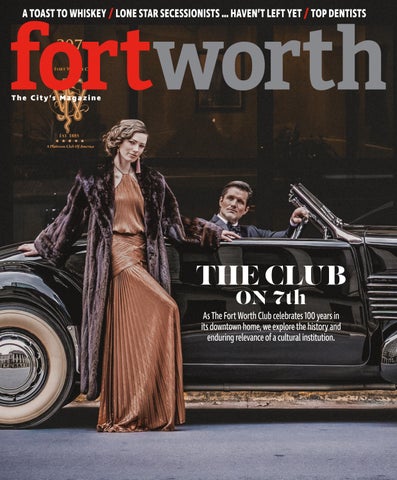
THE CLUB ON 7

th

As The Fort Worth Club celebrates 100 years in its downtown home, we explore the history and enduring relevance of a cultural institution.

The right move for your joint care.

When it comes to your joint care, we’re flexible.

You have your reasons for taking care of your joints, and at Texas Health, we’re ready to help you every step of the way. That’s why more North Texans choose Texas Health than any other health system for their joint care.

With our range of programs — from preventive care to injections to full joint replacements — physicians on the medical staff of Texas Health hospitals can develop personalized care plans based on your lifestyle and unique needs. Our focus is to help you recover quickly and get back to what you love.

Take our hip and knee health assessment or find a joint care specialist at YourJointHealth.com

Diva Diamonds & Jewels embodies timeless elegance, offering one-ofa-kind designs that celebrate individuality and refined beauty. We are committed to providing exceptional jewelry crafted with precision, passion, and lasting value. From rare gemstones to contemporary creations, our collection blends tradition with modern sophistication to ensure every piece tells its own story.

42

FEATURES

Whiskey Business

Fort Worth has made a full embrace of the wonderful world of whiskey, an invention of the British Isles that has made its way inside and outside the Loop by way of the great Kentucky traditions.

The venerable Fort Worth Club celebrates 100 years on Seventh Street, but its history and traditions are anything but in the past.

52 Texit, Forever

Though there’s no legal off-ramp from the United States, Texas secessionists and fellow travelers insist the dream is still alive and well — and winnable.

33 The Club

DEPARTMENTS

THE FORT

12 City Dweller

Gyna Bivens (1954-2026), a great Fort Worth life.

18 Calendar

Clint Black, Shaq, “Back to the Future: The Musical,” and the NCAA Women’s Basketball Tournament. Oh, my.

20 Fort Worthian

Hannah Lacamp Borer, chief marketeer of Fort Worth-native Blackland Distillery, knows her way around a barrel — in the rickhouse and in the arena.

22 State Lines

Round Top: pop. 90. (Not including the hundreds of thousands of antique dealers, designers, and junkers.)

26 Cowhand Culture

A late-night collision in 2001 set off one of Fort Worth’s most disturbing true-crime sagas.

28 The Reverie

A Fort Worth peace march captures the nation’s attention.

Alessandro and Alfonso Salvatore’s second

specialize in a true staple of

WE COMPOUND:

» Weight Loss Injections

» Ophthalmic Sterile Solutions

» Hormone Replacement Therapies

» Pediatric Medications

» Dermatological Preparations

» ED And Women’s Health Treatments

» Veterinary Medications

’Cause People Make the Place

My first exchange with Michael Thackerson, assistant general manager of The Fort Worth Club, was over email, where I made him aware of the magazine’s intention to write a feature on the 100th anniversary of the Club’s renowned home on downtown’s West Seventh Street — a place, with its carved granite and green marquees, that has no doubt crossed into local landmark status.

Michael suggested we meet in person at the Club — on the 11th floor. While I had been to the Club’s 12th floor event spaces on many occasions — an occupational perk of working at a publication that throws exceptional parties — this would mark the first time my presence had graced the institution’s central hub without being directed to another floor due to my disorientation. Soon after meeting, with what appeared to be an encyclopedic knowledge, Michael quickly began waxing lyrical about the Club — its origins (which began 140 years ago), its evolution, its members (new and old), and its move to its current quarters 100 years ago. He spoke with pride about this cultural institution.

Hearing wonderful quotes, the feature story presenting itself before my very ears, I quickly snagged my phone to record the rest of the conversation — even requesting he repeat a few unrecorded nuggets from earlier in the conversation.

Wanting to schedule a photoshoot for the feature (the resulting photos by Olaf Growald you can see on the cover and within the story, which begins on page 33), we agreed a Sunday, the day the Club is closed, would be best.

Michael would end up being the person greeting us as we entered the Fort Worth Club for the shoot the following Sunday, forfeiting his day off to assist in a city magazine’s endeavor to capture what makes the Club extraordinary and exceptional. Gracious and helpful, at one point, he even grabbed a leaf blower to clear Sixth Street of any unwanted debris for what ended up being the cover shot.

While we captured some fantastic photos, it’s clear what makes the Club exceptional isn’t anything one can capture on film or through a camera lens — it’s the devotion and the work of an institution’s people.

ON THE COVER:

Ron Sturgeon, a multi-faceted entrepreneur who also opened the DFW Car & Toy Museum in April of last year, lent a big hand when he gave us permission to use his 1936 810 Cabriolet made by Cord. The cover was photographed by Olaf Growald, styled by Jenny Davis, and features Camille Kraus and Jason Alan Smith of Kim Dawson Agency as models.

owner/publisher hal a. brown president mike waldum

EDITORIAL

executive editor brian kendall

contributing editor john henry contributing writers brandi addison, jenny davis, malcolm mayhew, michael h. price, shilo urban copy editor sharon casseday editorial intern kenzie johnson

ART

creative director craig sylva senior art director spray gleaves contributing ad designer jonathon won contributing designer lauren deitzer

ADVERTISING

advertising account supervisors gina burns-wigginton x150 marion c. knight x135

account executive tammy denapoli x141

territory manager, fortworthinc. rita hale x133

account executive patrick mccune x158 senior production manager michelle mcghee x116

MARKETING

director of digital robby kyser

marketing manager corinn crippin events and promotions consultant victoria albrecht

CORPORATE

chief financial officer charles newton operations manager kaitlyn lisenby founding publisher mark hulme

CONTACT US main line 817.560.6111 subscriptions customerservice@fwtexas.com

CORRECTIONS? COMMENTS?

CONCERNS? Send to executive editor Brian Kendall at bkendall@fwtexas.com.

DIGITAL EDITION:

The virtual editions of both current and previous issues are available on our website. Flip through the pages to read more about the great city of Fort Worth by visiting fwtx.com.

©2026 Panther City Media Group, LP. All rights reserved. No part of this publication may be reproduced without written permission from the publisher.

FortWorthMagazine(ISSN 1536-8939) is published monthly by Panther City Media Group, LP, 6777 Camp Bowie Blvd., Suite 130, Fort Worth, TX 76116. Periodicals Postage Paid at Fort Worth, Texas. POSTMASTER: Send change of address notices and undeliverable copies to Panther City Media Group, 6777 Camp Bowie Blvd., Suite 130, Fort Worth, TX 76116. Volume 29, Number 3, March 2026. Basic Subscription price: $29.95 per year. Single copy price: $4.99

NEXT MONTH
Top Doctors
AI’s Expanding Role in Medicine
FEI World Cup Fashion

Texas’ trusted resource for appliances, plumbing, lighting, & decorative hardware for over 75 years.

Spring Mesa Ranch

3,173± Acres | $23,500,000 Callahan County, Cross Timbers Region of Texas

Set amid the iconic terrain of the Callahan Divide, Spring Mesa Ranch is a distinguished private ranch offering scale, beauty, and authenticity. The land has been meticulously restored to honor the heritage of an early Texas cattle ranch, featuring native grasses, productive rangeland, abundant wildlife, creeks, and well-designed ranch infrastructure. A commanding16,770 square foot hilltop residence with resortstyle amenities serves as the centerpiece, complemented by guest accommodations, equestrian facilities, and additional improvements—making Spring Mesa Ranch one of the region’s premier private ranch opportunities.

THE FORT

PEOPLE TO KNOW THINGS TO DO PLACES TO GO

WHAT TO DO IN MARCH

Clint Black returns to Billy Bob’s in March, which is filled with a bunch of things to do, including “Back to the Future: The Musicial,” Disney On Ice, and the NCAA Women’s Basketball Tournament at Dickies. Your hometown Frogs might just be there, too.

WHAT WE’RE WRITING ABOUT THIS MONTH:

On page 12 Gyna Bivens, former Fort Worth mayor pro tem and champion of Stop Six, dies at age 71. On page 20 Hannah Lacamp Borer is still doing barrels, now whiskey barrels as marketing chief for Blackland Distillery. On page 22 A trip to Round Top, Texas. On page 26 A Fort Worth tragedy has become a regular on true-crime television and the big screen. On page 28 A nation stops to listen to the footsteps of Fort Worth’s Buddhist monks.

Faithful Servant

Six-term Councilmember Gyna Bivens leaves lasting mark on District 5.

Gyna Bivens, a six-term City Council member representing the East Side and Stop Six and Fort Worth mayor pro tem, has died.

Bivens died on Monday, Feb. 9, at the age of 71.

Bivens announced in October that she was battling pancreatic cancer.

“I’m completely heartbroken that we have lost such a light and force in this world,” Mayor Mattie Parker said in a statement. “Gyna Bivens truly personified love and service, and she was a champion for neighborhoods throughout east Fort Worth and the entire city for many years.

“Gyna’s passion and love for all of District 5 and the Stop Six community was unwavering, and she worked tirelessly in her time on City Council and beyond as an advocate for economic develop-

ment, neighborhood revitalization, and the senior citizen community.”

Bivens served on the City Council from 2013-25. She declined to run for a seventh term, saying she “felt comfortable leaving now,” citing achievements over her years on the dais. Her tenure was consequential.

Bivens was a leader in development advances in Stop Six, including Cavile Place, an affordable housing complex, and Hughes House, a mixedused development named in honor of former Dunbar basketball coach Robert Hughes. Both of those projects were boosted by a $35 million federal grant, essentially personally delivered by Ben Carson, then head of the Department of Housing and Urban Development.

The Trinity Lakes development is a sprawling development constructed

by Ken Newell. It will also serve as a transit hub. Progress is being made and construction begun on Lancaster, a major thoroughfare long neglected in District 5.

District 5 includes Fort Worth’s historic Stop Six and Handley neighborhoods and extends north to Mosier Valley, site of the settlement of the first freed slaves in Texas, and east to State Highway 10 and across State Highway 360.

“The city of Fort Worth, the District 5 family, and the Stop Six community lost an amazing champion today,” said City Councilmember Deborah Peoples, who succeeded Bivens last year. “The Bible tells us: ‘When I am weak, then I am strong’ (II Corinthians 12:10 NIV).

“Through her tireless dedication to our community, Councilwoman Gyna Bivens was a beacon of light. Throughout her illness, she carried herself as she always has, with grace and strength and love. I am most thankful for Councilwoman Bivens for all the work she did in District 5 and also for her support and kindness even during the past few months. May we all not be weak but strong for her family. Rest in power.”

Tributes from her former council colleagues poured in.

Said Mayor Pro Tem Carlos Flores: “She served our city with class and distinction for 12 years. While we mourn her, let’s celebrate her life by remembering what she meant to us all. My heartfelt condolences to her family and loved ones. God rest your soul, Gyna.”

“I miss her common-sense approach [and] her nonpartisan viewpoints,” District 4 Councilmember Charles Lauersdorf said on Facebook. “The world was a better place with Gyna, and I’m going to miss my friend.”

Gyna Machelle Bivens was born on Oct. 16, 1954, to Rev. Roy W. Bivens and Betty Joyce Bivens.

Bivens came from a line of Baptist preachers. Her father, born near Palestine, founded Sweet Home Missionary Baptist Church in 1956 in the living room of the family home in Stop Six. Today the church is on

Ramey Street. Roy Bivens was also a truck driver for Armour & Co.

Her grandfather, J.D. Green, was a preacher at True Light Missionary Baptist Church in Riverside. He later moved to Dangerfield, Texas, and was part of the city charter committee there.

She said last year as she prepared to leave public office that she brought her upbringing and her faith to the office, saying she prayed over every meeting agenda — “at least most of them anyway.”

When she discerned over whether to seek another term, she turned to her faith.

“Well, in spite of me cursing like a sailor, I am a woman of faith, and I prayed to the Lord to let me know when it was time to go,” Bivens said from her now former office at new City Hall. “I had talked about leaving in 2021, and my mother — closer to God than I am, I guess —said, ‘No, you’re not done yet.’ So, I stayed another term.”

Bivens graduated from Dunbar High School in 1973. She earned a bachelor’s degree from University of North Texas in radio/TV/film.

Bivens’ first taste of City Hall was in San Antonio as a television reporter for KMOL. She moved over to the other side as a public information officer for the city of San Antonio.

Bivens moved home to work for Oncor as a communications person. It was while there that then-District 5 Councilman Frank Moss asked her to serve on the Board of Adjustment. “The Board of Adjustment will change your life,” she said. Moss also appointed her to the board of Trinity Metro, which she eventually chaired.

Moss, Bivens said, “is the one who made me.” She eventually unmade Moss, challenging him for his council seat in 2013. She received 92 more votes than Moss in a three-way race in the May election and squeaked by him by literally a few votes in the runoff.

“Gyna was a tenacious advocate for southeast Fort Worth and a relentless

voice for neighborhoods that too often felt unheard, whether she was working on economic development, public transportation, public safety, or quality-of-life issues for the families she represented,” said District 3 Councilmember Michael Crain.

“Her years of leadership on the Fort Worth City Council and in regional and national organizations reflected not only her deep knowledge of policy, but also her unwavering belief that government should open doors of opportunity for every resident.”

On the night she was first sworn in, in her first term, she introduced three speakers, including her mother and pastor.

“With that, mayor, I’m ready to go to work,” she said to then-Mayor Betsy Price.

Bivens quickly gained a reputation for blunt honesty, the kind that left no doubt where she stood, and no confusion about what she expected.

Said Lauersdorf: “She always called me ‘Marine’ and would whisper ‘hoorah’ next to me on the dais when either of us dropped some heat.”

At a forum during that first campaign against Moss in 2013, Bivens said she decided to run after repeatedly driving past boardedup buildings that sat vacant for years. She highlighted a proposal for a church-run pilot program that would serve as a local contact point for seniors who need help but lack nearby family support.

Promising to be a strong advocate for neighborhoods, Bivens said the city needed decisive leadership. “We don’t have to keep wandering around like folks in the wilderness,” she said. “You’ve got to have someone who’s not afraid — who’s not shy.”

She added for emphasis before closing: “I was born, raised, and will probably die here. But not until we get some things done.”

Gyna Bivens, a great Fort Worth life.

A Stockyards Reset Stockyards

Hotel, H3 Ranch to close for $30M renovation.

The historic Stockyards Hotel and H3 Ranch restaurant next door will close temporarily in April to undergo a comprehensive renovation exceeding $30 million, Stockyards Heritage Development Company announced.

H3 Ranch is anticipated to reopen in late 2026, with renovations focused on kitchen and back-ofhouse infrastructure alongside a refreshed dining room experience that reflects what guests and locals have loved for decades. Stockyards Hotel is expected to reopen in early 2027 with a design that tips its hat to a defining era in Stockyards history, translating the past into present-day form through extraordinary experiences, unmatched comfort, and Texas-sized hospitality.

The properties will close April 6. Stockyards Heritage Development Company, the developer behind the Mule Alley and Hotel Drover, is a partnership between Majestic Realty Co. and the Hickman Companies. Stockyards Heritage Development Company bought the properties in 2022.

“Stockyards Heritage Development Company has played a major role in the revitalization of the historic Fort Worth Stockyards as well as the continued evolution of the city’s Western legacy and tourism growth,” said Rick H. Kline III, Majestic Realty’s president of operations for the Fort Worth Stockyards. “We will bring this care and understanding to the enhancement of Stockyards Hotel and H3 Ranch, ensuring their stories continue to be written for generations to come.”

CIO CIO SAN
PINKERTON
SUZUKI MIHO SAKODA ZACH BORICHESVSKY
KAYLA NANTO

Tarrant County Democrat heads are still spinning from the opioid of victory — a stunning triumph that has the perennial underdog party in these parts believing the time has come: The proverbial people want a change of colors.

That might well be hallucination.

But until January, at least, Democrat Taylor Rehmet, an Air Force veteran and working-class union leader from Fort Worth, will be a Texas senator, representing Senate District 9. He upended the presumptive favorite — Leigh Wambsganss of Southlake — in the special election to finish out Kelly Hancock’s term in the Texas Senate in a district that has been red since 1991.

Upended is a bit of an understatement. Rehmet won the runoff overwhelmingly, by 14 points. That’s a landslide in a district Donald Trump won by 17 points in 2024.

Rehmet, preaching the old political Gospel of attending to the “struggles of everyday people,” used a motivated Democrat base, the sour aftertaste of mid-decade redistricting, an appeal to independents, and sleepy Republicans who stayed home to achieve office in Austin.

“I did the work,” Rehmet said to CBS’ local Ch. 11 affiliate. “I stuck to what I wanted to do, and that was go meet voters of all different parties. Talk with them, not at them. Listen. Understand the issues of what they’re facing day to day. That’s what we did.”

With the Texas Legislature out of session until next year, Rehmet won’t be giving everyday people a voice in

Blue ShoesSway

Special election stunner has Democrats dancing — and Republicans eyeing November.

Around Cowtown in 8 Seconds

A

smattering of things you might’ve missed

Pay Day? Fort Worth City Council pay will top the list of proposed amendments of a May charter election. Voters will be asked whether to increase the pay of the mayor to $60,000 and $50,000 for the 10 other members of the council. That equates to a doubling of pay.

the political process for the next 10 months. It’s possible he’ll never even cast a vote.

Rather, he’ll soon be back campaigning. He faces a rematch with Wambsganss for a full four-year term in November.

The race will be hot. The pundits already have the binoculars out for any signs this race is the one that turns the weathervane in Texas.

We’ve seen something like this fairly recently.

In a special election runoff to replace Anna Mowery in the state House in 2007, Democrat Dan Barrett surprised Mark Shelton. Shelton won the seat in the next general election. No Democrat has sniffed victory there since.

Special elections typically draw a fraction of the electorate. It’s the committed partisans and activists who show up. In low turnout, a ripple can seem like a current.

“There will be a lot more voters in November,” said Tarrant County Republican Chair Tim Davis. “That’s what we’re looking forward to. This election will be back on the ballot in November, and these same candidates will be head-to-head again in November, and we expect the result to be different.”

Tarrant County Democratic Party Chairwoman Allison Campolo said she expects Democrats to match that Republican voter increase.

We’ll see where this goes. No one should get too excited — or out of sorts — just yet.

The Flying Saucer’s Finale: Officials have unveiled the plan to replace the iconic “Flying Saucer” — the Fort Worth Convention Center arena — with a transparent, four-story structure with a central tower at Main and Ninth streets. It’ll provide a great view of the courthouse. Price tag of Phase 2 of the convention center overhaul: $606 million.

It’ll Have a Name, too: City officials are also planning to sell the naming rights of the complex. That’s right, this place could be the Fort Worth Magazine Convention Center. Estimates place the naming rights and sponsorship valuation currently at $450,000-$500,000. So probably won’t be the Fort Worth Magazine Convention Center.

Whoa, Nellie: The Fort Worth City Council has tapped the brakes on rezoning a site that could become one of the largest data center campuses in DFW. Councilmembers Chris Nettles and Jeanette Martinez say they want more information on the impact the campus will have on infrastructure and resources. It’s likely only a matter of time until the answer is yes.

The Account No. Is …: White Castle, the 1,459-pound European crossbred Grand Champion steer of the Fort Worth Stock Show & Rodeo, sold for a record $550,000 in the annual Junior Sale of Champions. Caiman Cody, 13, of Tolar was the exhibitor. Trico Electric was the high bidder.

Mr. Micallef to the Head of the Table: Restaurateur Mike Micallef of the highly acclaimed Reata, has been named chair of the Fort Worth Chamber for 2026. They’ll eat well at those meetings.

Silencing the Lambs? Tarrant County Commissioners voted 3-2 along party lines to approve new rules that will give residents less time to speak at meetings. About 24 of the county’s 2.1 million people urged the court in-person not to approve the rules.

Not How Low You Can Go: Tarrant County College officials say they have pulled the historic TXU North Main Power Plant and 8-acre site off the market after only one bid — which came in lower than the property’s $9.4 million appraised value. Not the way that’s supposed to work.

March

4-15

Patriot

Fort Worth

The Will Rogers Memorial Center is no stranger to hosting the best fourlegged athletes on dirt, so Patriot Fort Worth, an 11-day showcase of multiple equine events including barrel racing, team roping, and steer wrestling, is right in the venue’s wheelhouse.

Will Rogers Memorial Center patriotevent.com

12-29

‘A Case for the Existence of God’

Local players for Stage West perform this acclaimed 2022 play by Samuel D. Hunter that follows two modern-day fathers as they grapple with the taxing responsibilities that accompany adulthood.

Stage West stagewest.org

March 19-22

14

Cowtown Goes Green

When we say “green,” we’re not talkin’ energy efficiency. This Stockyards event is the biggest St. Paddy’s Day event in Cowtown and includes food, drinks, music, parade, and the very un-Irish armadillo races, pony rides, gunfight shows, and a matinee rodeo.

The Stockyards fortworthstockyards.com

20-22

Jane Glover Conducts

World-renown British conductor Jane Glover travels across the Atlantic to direct the Fort Worth Symphony through three classic pieces, including Beethoven’s famous “Symphony No. 4” and Haydn’s “Sinfonia Concertante,” which will feature a quartet of FWSO players as soloists.

Bass Performance Hall fwsymphony.org

Disney On Ice: Jump In!

Despite the official beginning of spring, the chill will stick around a couple more days for Disney

On Ice’s “Jump In,” an interactive ice-skating performance that features over 50 Disney characters, including the always dependable Mickey Mouse and Donald Duck. Dickies Arena | dickiesarena.com

21

Clint Black

The country crooner stops by the world’s largest honky-tonk during his 2026 national Back On The Blacktop Tour. While he sports an impressive string of ’90s hits, including “Killin’ Time,” it’s his recent inclusion on the “Landman” soundtrack that has a lot of people chattering.

Billy Bob’s Texas billybobstexas.com

21

Shaq’s Bass All-Stars Festival

After serving as the first host of Shaq’s — yes, that Shaq — music festival in 2024, Panther Island missed out on the festival’s lineup in 2025. Better late than never, Shaq — who goes by DJ Diesel for musical purposes — and friends return for a much-anticipated encore in March.

Panther Island shaqsbassallstars.com

24-29

‘Back to the Future: The Musical’

The time-travel film that remains a timeless classic gets the musical treatment. Don’t worry, you’ll still get those classic tunes from Huey Lewis and the News — “The Power of Love” and “Back in Time” — in addition to some new numbers by Alan Silvestri and Glen Ballard. Bass Performance Hall basshall.com

27-30

NCAA Women’s Basketball Tournament

Dickies Arena gets an up-close-and-personal taste of March Madness as the venue hosts one of two regionals of the NCAA Women’s Basketball Tournament. For homers, at press time, TCU is ranked 17.

Dickies Arena dickiesarena.com

29

Spring Gallery Night

You’ll find art springing from galleries, museums, local businesses, and side streets alike during Fort Worth’s annual Spring Gallery Night, a free citywide art crawl hosted by the Fort Worth Art Dealers Association. Various locations fwada.com

photos provided by Dickies Arena // Billy Bob’s Texas // Bass Performance Hall

Hannah Lacamp Borer

Director of Marketing and Communications, Blackland Distillery

By Brandi Addison Photo by Olaf Growald

Hannah Lacamp Borer’s Fort Worth roots run as deep as those of a wild fig tree — which happen to thrive in Cowtown.

Born and raised in the Ridglea area, Lacamp Borer attended Southwest Christian and spent much of her youth barrel racing alongside her sister. “It was a really cool way to grow up,” she says. “I felt like I had the full Fort Worth experience and did it the right way.” She then headed south for Baylor for higher education, leaving her hometown right before it was due for a major glow up.

Once she returned to Fort Worth, the city had completely transformed.

Lacamp Borer says. “I’m not someone who can sit at a desk all day; I like being out in the world.” But such hard work and devotion also take a true love and enthusiasm for what one is promoting.

HANNAH AND HER FAVES

As a PR, journalism, and new media major — one doesn’t receive a bachelor’s in just journalism nowadays — Lacamp Borer returned home with an itch to tell stories and suddenly found herself in a city that had a lot of stories to tell. Putting her degree to good use, she landed a role at PAVLOV, a local boutique advertising agency, where she discovered her love of working with local businesses and realized her knack and affinity for marketing. “You get to be the voice for these people,” Lacamp Borer says about her passion for assisting the growth of community ventures.

A lover of all things local, here are some of Hannah’s favorite Fort Worth spots.

“Marcus, our founder, has a culinary approach to distilling,” she says. “You can really taste the difference when someone understands how everything balances together.” She says she also admires the local connections with which the business partners, even those that are done quietly and without fanfare. For instance, all grains come from North Texas farmers, and after distillation, the leftover grain is returned as cattle feed or fertilizer.

Nightlife: Down ‘n Out Brewery: Maple Branch Coffee: Cherry Coffee

Tex-Mex: Pulido’s Sushi: Tokyo Café

Comfort Food: Paris Coffee Shop

Fitness: Bumble Bee Yoga

Record Store: Doc’s Bottle Shop: Tricks of the Trade

Music Venue: Tulips

But really, she says, they don’t have to cling to Fort Worth in branding the way you might expect — the distillery can be its own self — because “Texans love Texas, and Fort Worthians love Fort Worth, so they’re going to come out anyway, just because we’re here and we’re local.

“It’s a symbiotic relationship,” she continues. “We shine a spotlight back on Fort Worth while carving out our own identity.”

One such local venture was Blackland Distillery, a native Fort Worth brand (read more about them on page 47) she first worked with as a client before joining full time in 2021. At the local distillery, Lacamp Borer’s days are varied: sometimes thrilling, sometimes quiet, but always hands-on. Even the distillery’s quieter moments would be considered “exciting” when compared to most workplaces. On any day, she may be pitching the brand to local retailers, hosting tastings, shooting content for social media, or strategizing at her laptop — and some days all of it. “This isn’t a 9-to-5 job, for sure,”

A genuine lover of local flavor, Lacamp Borer is also a regular patron of local businesses. On rare free weekends, she and her husband, Patrick, explore nearby restaurants, coffee shops, and bars — and, if they’re lucky, catch live music on a nearby patio. Occasionally, the couple travels elsewhere in the state, heading to places like Big Bend or wherever the road leads. “I’m just obsessed with Texas,” she says — though she never stays away from Fort Worth for too long.

“Support the people who support you,” she says. “Pour into your community. That’s my mantra personally and professionally.”

1. Climbing Emory Peak in Big Bend National Park with her husband, Patrick. 2. A family moment at the Presbyterian Night Shelter Gala. 3. With Blackland Distillery’s Joseph May and Markus Kryreos during the Aspen Food & Wine Festival. 4. Hannah and Patrick Borer tied the knot in Palm Springs in 2024. 5. Odds are you’ll find Hannah with a bottle of Blackland in her hand. If not, she’s probably talking about it. 6. Hannah and her fellow kickball teammates. 7. Hannah’s roots include lots of time on horseback.

Round Top, Texas

Population: 90

Mile after mile of treasures sprawl out in every direction from Round Top, from 17th century French furniture to exotic handicrafts and post-modern statues. “The Show” has descended, a world-renowned shopping bonanza that transforms the speck-in-theroad town into one of the largest antique markets in America.

Every year more than 100,000 international dealers, designers,

and down-home “junkers” pile into the tiny town for the Round Top Antiques Show, which takes place over multiple weeks in March and October (plus a shorter stint in January). Thousands of vendors set up shop at curated markets, like the Original Round Top Antiques Fair, and in historic buildings, country barns, and cow pastures.

Overstuffed tents and booths line

Highway 237 between La Grange and Carmine, a 23-mile stretch that includes museum-quality pieces, folksy flea-market finds, and everything in between. Shoppers wade through a smorgasbord of salvaged architectural castaways, collectible coffee tins, ’50s glassware, Welsh weavings, vintage game boards, handmade jewelry — and anything else you can think of.

If that sounds like a lot … it is.

You’ll need comfortable walking shoes, formidable stamina, and a high tolerance for dust and crowds if you’re heading south for Round Top’s next show, March 14-28. For those who make the effort, however, the rewards are many. In addition to uninhibited retail reverie, you’ll encounter endless creative inspiration and kindred-spirit camaraderie. Days of treasure hunting give way to evenings of fine cuisine, cold frosés, and Texas music under starry skies. But Round Top isn’t just an antiquer’s paradise — it’s an antique itself. Much of the town’s carefully restored architecture dates to the 1800s. Part of Stephen F. Austin’s colony, the area was heavily settled by Germans and Czechs. They built the six-pew St. Martin Catholic Church (allegedly the world’s smallest Catholic church) and the Gothic-style Lutheran Church (now the local library).

Henkel Square Market

Many of Round Top’s heritage properties have been relocated from elsewhere in Central Texas, including those at Henkel Square Market. A pleasant gathering place with smart boutiques and restaurants, it doubles as the town square. Early Texan craftsmanship is also on display at Winedale Historic Center, a collection of meticulously refurbished log cabins, ranch houses, and outbuildings. During spring and summer, you can attend Shakespearean performances in a hay barn built in the 19th century.

Explore another cluster of frontier-era structures at Round Top Festival Institute, whose idyllic grounds feature a spectacular wooden concert hall. An internationally acclaimed classical music academy, the Institute’s concert hall boasts some of the best acoustics in Texas. It hosts regular orchestral productions and music-and-wine evenings, along with the Round Top Music Festival every summer. With sculpture-dotted lawns and hidden seating nooks, its landscaped campus is a peaceful setting for picnicking or strolling before the show.

Whether you want to walk through history, browse antiques, or buy new furnishings for every room in your house — Round Top’s unexpected treasures are a treat to behold.

Explore Round Top

Savor: Most Texas towns with less than 100 residents would count their lucky stars to have a Dairy Queen — but Round Top has well over a dozen cafes, brewpubs, lounges, wine bars, diners, and chef-driven restaurants. Many double as shops. One of the buzziest new outlets is Rabbit Rabbit, an indoor/outdoor garden spot with creative eats like Big Mac steak tartare and gochujang lasagna with miso brown butter. Find elevated flatbreads and sammies at the new Boon & Company, and indulge in wood-fired fine dining at the revamped Duo Modern. You might be legally required to have a slice of pie at Royers Café before you leave town; its Texas trash pie (with chocolate, coconut, caramel, pretzels, and graham crackers) is an ooey-gooey work of art.

Shop: Tap into the antique fair vibe year-round at multi-shop hubs like Henkel Square Market, a historical museum village that looks like a movie set. Browse farmhouse relics and luxury goods at Round Top Village, the town’s newest retail development, or head to Market Hill for upscale vintage pieces alongside contemporary fashions. Round Top Vintage Market and Round Top Antiques & Design Center both offer a classic antique mall experience. Peruse European heirlooms at Paul Michael and trendy outfits at Chic Shab — and don’t miss Junk Gypsy’s 8,000-square-foot headquarters, a glammed-out, boho-cowgirl fever dream.

Enjoy: Retail therapy requires refueling at the end of the day: Start at Ellis Motel (which is not a motel) for cocktails in a whimsical world of crystal chandeliers, mounted animal heads, and two-wheelers on the walls. Dip into Prost on Block 29 for cabernets in a casual wine bar, or sneak into the speakeasy inside 550 Market (the password is “shhh”). The bar at Lulu’s restaurant is so eclectic that it’s almost psychedelic — and there are also poolside tables outside. Got your second wind? Boot-scoot on down to SD’s Roadhouse (formerly known as Stone Cellar), a honky-tonk and dance hall in a converted 1861 rail depot.

Snooze: Choose between a bounty of boutique hotels, restored ranch houses, cozy-luxe cottages, and cute-as-a-button B&Bs. The newest arrival is Hideaway Round Top, with casitas and a farmhouse in a quiet, pastoral environment with a spring-inspired swimming pool. The Frenchie Boutique Hotel blends 1890s character with an airy aesthetic that hits a pitch-perfect note for a girls’ getaway (and Instagram likes). Rancho Pillow Motel provides colorful boho-maximalism with rustic Texas charm, and Junk Gypsy’s Wander Inn offers artsy-retro eclecticism — plus warm biscuits delivered daily to your door.

How to Get There: Drive south from Fort Worth on I-35 to Waco and then exit 333A for Valley Mills Drive. Turn left and cross under the freeway. At the traffic circle, take the second exit onto US-77 S and follow it for about 100 miles until you reach Giddings. Turn left onto US-290 E for 10 miles, then turn right onto Round Top Road for about 7 miles to arrive at Round Top. The entire drive is just over 200 miles and takes about four hours with stops.

Indian Creek artisan gifts and home decor shop
Round Top Fire Department building dating from 1904
The Gallery at Round Top building

MORE THAN JUST BILLIARDS

S

r e m i u m g a m e r o o m e s s e n t i a l s . F r o m p o o l t a b l e s & c u e s t o s h u f f l e b o a r d , f o o s b a l l , a i r h o c k e y , d a r t s , a n d

s p a c e W e a l s o o f f e r e x p e r t s e r v i c e s , i

d i s c o u n t s f o r i n t e r i o r d e s i g n e r s .

V i s i t u s t o d a y a n d d i s c o v e r w h y w e ’ v e b e e n a t r u s t e d n a m

i n N o r t h T

V i s i t O u r S h o w r o o m

3 9 7 0 W V i c k e r y B l v d

F o r t W o r t h , T X 7 6 1 0 7

f t w o r t h b i l l i a r d s

Murder on a Windshield

Revisiting the bizarre and tragic Fort Worth killing that has been retold countless times on television and the big screen.

Atraffic fatality becomes a murder when attempts are made not only to ignore the matter, but also to dispose of the body and swear all concerned to secrecy. Vows of secrecy have a way of betraying themselves, often through the inevitable neurotic aftershocks.

The killing of Gregory Glenn Biggs, 37, an off-the-grid citizen whom the

perpetrators sensed might never be missed, became a cause celébre in the criminal history of Fort Worth.

The case became the stuff of dire legend when it found its way into cinema as a plot-pivot of both a mass-market motion picture and three network-television serials.

The implement of the slaying was

an automobile, driven recklessly of course and under intoxication. But the particulars are more horrific than merely unfortunate or even tragic: On Oct. 26, 2001, a 25-yearold nursing assistant named Chante Jawan Mallard struck Gregory Biggs, a homeless man who was seeking to regain homefulness, with her Chevrolet Cavalier.

The force of the crash lodged Biggs in the windshield. Mallard drove home and left Biggs imprisoned, garaged in the shattered glass. She neither summoned the authorities nor attempted to administer aid. Biggs died within hours, according to the medical examiners’ calculations. Mallard conspired with friends to extract and dump the body and destroy evidence. Thus convicted, she was sentenced to 50 years’ imprisonment.

The atrocity came only gradually to light. Four months after the Oct. 27 discovery of the discarded body in a parkway, Mallard became a suspect: She was reported to have been talking and laughing about such an incident at a Valentine’s Day gathering. Once overheard, the nervous disclosure became the basis of a tipoff to the police.

Photos by FortWorthStarTelegram
Chante Jawan Mallard after a jury sentenced her to 50 years for the murder of Gregory Glenn Biggs
Gregory Glenn Biggs

According to the account, Mallard mentioned that she would not be driving her own automobile. She explained that she had struck a pedestrian while intoxicated and “messed up” on marijuana and the drug ecstasy. She told the guests that she and a boyfriend, named only as “Terrance,” had listened to Biggs’ dying pleas.

They waited until Biggs died “a couple of days later,” the account continues, whereupon “Terrance” and a purported brother left the body in Cobb Park, southeast of downtown Fort Worth. Nizam Peerwani, the medical examiner, said Biggs had died within hours, not days, from blood loss and shock; Biggs likely would have survived if given medical treatment. Police sought to determine who had disposed of the body.

A Severe Muse

In Chicago, the experimental playwright and filmmaker Stuart Gordon learned of the Fort Worth case and developed from it a crime melodrama called “Stuck” (2007). The motion picture takes broad dramatic liberties but hews to an essence of the incident and its aftermath. The actors include Mena Suvari and Stephen Rea in roles equivalent to Mallard and Biggs.

Gordon and his affiliated studio, Amicus Entertainment, offered a premiere showing to Fort Worth’s Lone Star Fim Festival, only to be rejected on grounds that the picture “reflects ill upon our fair city,” quote/

unquote. More to the point: It is the picture’s backhanded inspiration that reflects ill upon our fair city, and the dismissal of Gordon’s gesture was a denial of a sobering reminder. A fainter, earlier influence had appeared in January of 2004 in an episode of the teleseries “Law & Order.” In the segment called “Darwinian,” a pedestrian fatality looks bad for a motorist (who had sought to hide the body) until a determined lawyer establishes that death had been caused by a beating before the collision.

A more nearly explicit reflection of the Biggs case would surface in the second season of Noah Hawley’s “Fargo” (2015), in which the victim is pictured as a homicidal mobster (Kieran Culkin) who stumbles into the path of a car driven by a prone-to-panic beautician (Kirsten Dunst) and finds himself wedged within the windshield. Her conspiratorial attempt at a cover-up triggers a gang war.

Yet another adaptation occurs in a 2019 episode, “Monsters,” of the Fox procedural drama “9-1-1”: A collision lodges a homeless man in a windshield. The motorist (played by Stephanie Lemelin) drives about aimlessly until a fireman (Oliver Stark) halts her and summons a life-saving rescue.

A Dire Resolution

An affidavit indicates that Mallard had implicated men named Vaughn and Terrance. No such personages surfaced. It was Mallard’s acquaintances Clete Deneal Jackson, 28, and Herbert Tyrone Cleveland, 25, who confessed to moving Biggs’ body. It was Jackson whom Mallard had at length called for assistance.

Jackson and Mallard and Cleveland, a cousin of Jackson, took the body to Cobb Park, then set fire to the car’s interior fixtures. All faced trial and conviction. A wrongful-death lawsuit filed by Biggs’ son, Brandon, a ministerial student at age 20, was settled out of court.

Chante Mallard faces a possibility of parole in 2027.

According to medical examiners, Biggs likely would have survived had he received timely medical attention.
The home and adjoining garage of Mallard, where Biggs was left, stuck in her car’s windshield, for three days

A Nation Pauses for Fort Worth Monks

The rich blessings of what the American founders handed down was on full display in a 108-day walk from Fort Worth, Texas, to Washington, D.C.

A group of venerable Buddhist monks, led by Venerable Bhikkhu Pannakara of the Huong Dao Temple in Fort Worth’s Stop Six neighborhood, provided affirmation that faith traditions, even those far from our founding roots, still have urgent moral wisdom to offer the public square.

What was it that captivated a nation as these monks walked 2,300 miles? The Lord works in mysterious ways.

“Our purpose is very clear,” said Pannakara in an interview. “We are not walking to promote anything other than peace. Loving, kindness, and compassion are really needed. And these are the things that all religions teach. I feel grateful we have different religions to serve all kinds of people around the world. All the venerables, all the reverends, all the gurus, all the teachers, all teaching people how to live a better life, how to become a better person, a good person in this society.”

A gentleman by the name of Mike Bedenbaugh met up with them a few miles from his home in Prosperity, South Carolina, where he has lived practically his entire life, save for stints in the Navy and school at Columbia University.

“I’m driving down outside of Aluna, South Carolina, which is a very small rural county seat of only 3,000 people, and they’re 15 miles on the other side,” Bedenbaugh says

by phone. “It’s very sparsely populated, and this church is out in the middle of nowhere, and a mile before the church, I start seeing people in parked cars. This is in the most reddistrict religious Bible belt buckle here in South Carolina, and there’s like 200 or 300 people standing around wanting to see these people. It was astonishing.”

The monks returned to Fort Worth on Feb. 14. They walked the six miles from the bus depot in downtown back to the temple in Stop Six. The monks are of the Theravada tradition of Buddhism. There are three lineages: Theravada, Mahayana, and Tibetan. Tibetan is best known for the Dali Lama.

“We and Tibetan tradition are totally different,” Pannakara said.

Pannakara said he came up with the idea of a walk to raise awareness of peace to all people “because I have seen so many suffering around me in Fort Worth, Texas, where I live.”

For two years during the pandemic, he said his temple gave out food to 750 families a week.

Pannakara told Bedenbaugh, who sat down with him: “I see a lot of people struggling with their life, not physically, but mentally. And then when I also travel around the world to do disaster relief, too, I see that, and I think that I should do something to support this country and the world. If I stay at the temple, then I only can support the small community. But when I do something, then I probably can meet with someone. Finally, I decided to take a walk.”

Pannakara said he simply expected

to run into people along the way.

“I thought if they can see us, they can pause for a moment and they can look back within themselves and they feel peace, they feel joy. That’s enough. That’s all I expected at the beginning. I have never expected this turnout.”

Pannakara said he initially expected to walk back to Fort Worth, but he misjudged the mileage.

The walk, Pannakara said, was also meant to test how much pain he could stand — he walked most of it barefoot — stepping on nails, screws, and glass, among other things. The group also got caught in the brutal winter storm. One walker was hit by a car and seriously injured, resulting in leg amputation. Their dog — a stray adopted from India — also required surgery, though he returned to the troupe but carried on in a car.

The monks stayed in a Methodist church that night in South Carolina. The next day after a 15-mile morning, they stopped in Saluda, South Carolina, a town of a little more than 3,000.

“He stood on the steps of the courthouse, and there’s 1,000 people in the yard,” says Bedenbaugh. “I tell you, sitting down with those people and seeing what they were communicating, especially the monks, I saw more connectivity to what Christ taught than I have in a lot of churches I’ve been in.”

Bedenbaugh said there were tears in the eyes of listeners.

“He said I know I’m doing the right thing when I see what’s happening here, to see all these people. He didn’t say this. I am, but you think we’re in the middle of redneck town, and that’s not a derogatory comment. I mean, these are people of the earth, blue-collar workers, and here they are out here just wanting to touch the energy of peace. It was amazing.”

To schedule your free in-home informational visit, please contact us at (817) 398-3881, email gethelp@ vna texas.org or visit vna texas.org

I chose Fort Worth for its people, and as a cosmetic dentist, I’m proud to help them feel confident through healthy, beautiful smiles. With advanced training in implants, Invisalign, and sedation, I focus on personalized care that aligns with each patient’s goals. What sets us apart is my team’s commitment to comfort, trust, and a customized experience from the moment you walk in.

Located behind the Public Mark

The Harden offers modern apartment living for all ages blending historic character with contemporary comfort and

THE CLUB ON 7 th

Only four years after the Fort Worth Club built a new home, Amon Carter was already looking to build another one. Amon got his way, and a city club became a cultural institution.

is on display at the DFW Car and Toy Museum in north Fort

Models: Camille Kraus, Kim Dawson Agency; Jason Alan Smith, Kim Dawson Agency Hair and Makeup Artist: LB Rosser, Kim Dawson Agency Stylist: Jenny B. Davis, The SWB Agency Assistant Stylist: Jackie Osmon, The SWB Agency
The car on the cover is a 1936 Cord 810 Cabriolet courtesy of Ron Sturgeon, whose entire collection of over 200 cars
Worth.
By Brian Kendall Photography by Olaf Growald

ON HIM:

Tuxedo: Alessandro Vitello, $650, The Squire Shop

Shirt: David Donahue, $165. The Squire Shop

Bow tie: Tuxedo Park, $29.50, The Squire Shop

Stud and cufflink set, courtesy of the Squire Shop

Cummerbund: Jos. A Bank, $69.50. josbank.com

Shoes: Joseph Abboud, $125. josbank.com

ON HER:

Dress : Ramy Brook, $895. Neiman Marcus Fort Worth

Earrings: Cezanne, $32. Dillard’s

Bracelet: Cezanne, $58. Dillard’s

Bag: Cult Gaia, $498. Neiman Marcus NorthPark

Heels: Jeffrey Campbell, $225. Dillard’s

Cattle

barons,

oil tycoons,

debutantes, philanthropists,

entrepreneurs,

civic leaders, CEOs, wide— eyed
and wheelers and dealers — for such an exclusive institution, The Fort Worth Club Building welcomes a surprisingly broad swath of Cowtown through its doors. And while a lot has changed over the 100—year history of 306 W. 7th St., one quirk undoubtedly hasn’t:
You’re just as likely to see a pair of cowboy boots as you are a pair of wingtips resting on the rungs of the lounge’s barstools.

The Fort Worth Club, founded in 1885, serves as a crossroads — both the literal and figurative meeting spot of the city’s many interests. It’s where the minds, the money, and the make-do attitudes converged to set agendas, steer policy, and get balls rolling. Just take a gander at the historical roll call of members — Amon Carter, Sid Richardson, William Moncrief, Kay Granger, and Ed Bass — and it’s not hard to imagine a brief sharing of pleasantries turning into a 30-year project on Panther Island.

“Big deals are made in the Fort Worth Club,” longtime club member and former Fort Worth mayor Mike Moncrief says. “Decisions about this city, this county, this community, this state, this country, even the world itself are made right here at the Fort Worth Club.”

Few local institutions, if any, have been as consequential to our city. And, according to Moncrief, its influence, even after 140 years, endures.

But we kick this story off not at the beginning. The beginning was 39 years earlier when a group of cigar-smoking, bowler hat-

wearing men of a certain ilk founded the Commercial Club of Fort Worth. Rather, we begin this story in 1924 on what was then an empty lot on downtown’s West Seventh Street.

1924 — Topping Off a House Built on the Rock

The crack of an explosion rings out through downtown Fort Worth. It’s a thunderous blast that could echo off the courthouse façade seven blocks away or even awaken a sleeping panther — or not. The sound, caused by sticks of dynamite, has become a common occurrence since the turn of the century. As downtown takes shape — a shape mostly traveling upward — construction crews are using the explosive to prepare sites for raising structures. Today, they’re excavating half a city block that occupies Seventh, Sixth, and Throckmorton streets to make way for the new Fort Worth Club Building — blasting away the Fort Worth limestone that occupies much of downtown’s bedrock.

Reporting on the excavation of this new 12-story building to be occupied by The Fort Worth Club, a Record-Telegram editorial page observes, “Fort Worth’s downtown district has, fortunately, the double Scriptural advantage of being ‘a city set upon a hill’ and ‘a house founded on the rock.’”

Three months earlier, Amon Carter, the publisher, businessman, and city booster who is also the president of the Fort Worth Club, spoke about and promoted the potential construction of the new building during a dinner to a room full of oilmen — petroleum professionals with some of the deepest pockets in the nation. The exciting new construction project combined with a “trust company with at least $1 million in capital within the year” were the centerpieces of a keynote address meant to promote the advantages of doing business in Fort Worth. With Carter in his wheeling-and-dealing comfort zone, this was unlikely a difficult pitch. Afterall, such a large city club is proof of Fort Worth’s commitment to growth and its unwillingness to skimp on its institutions.

The great initiator of many Fort Worth projects that became landmarks, institutions, and icons, Carter worked similar magic with The Fort Worth Club Building soon after taking the reins as president of the Club in 1920. In 1939, 13 years after the completion of the new building, legendary food and beverage distributor Ben E. Keith paid tribute to Carter at a club dinner and relayed a story about the Star-Telegram owner launching the movement for a new building almost immediately after his ascension to the presidency. This despite the fact The Fort Worth Club’s then home at 610 Main St. had only been erected four years prior — a six-story structure built in the same location as the club’s previous three-story home.

At the time, the Club was clearly on the same cadence as modern-day professional sports teams searching for new arenas. With the Roaring ’20s rolling in, art deco skyscrapers sprouting up like weeds in a flower bed, and an economic boom seeming predetermined, by the time Carter became president, the redbricked building at the corner of Sixth and Main was already old news. And Carter naturally got his way.

In 1925, the structure would become the Floyd J. Holmes Building after the club sold the property to its new owner, an oilman who, naturally, named the building after himself. But before The Fort Worth Club vacated the premises for good, the iconic yet recently defunct Haltom’s Jewelers occupied the entirety of the first floor — yes, even the famous four-faced clock once appeared on the corner of Main and Sixth streets — before moving to Sundance Square in 1988. Today, the building is occupied by the Ashton Hotel and is in the National Register of Historic Places.

Carter’s new 12-story building that would dwarf the Club’s previous homes and serve as a business epicenter, was designed by Sanguinet, Staats, & Hendricks. The first two-thirds of this agency name — the Sanguinet and the Staats — were the same folks responsible for designing downtown’s iconic Flatiron Building, which, at the time of its construction was one of the city’s first steel-framed buildings and, at a vertigo-inducing

seven stories, the tallest building in the whole of North Texas. Wyatt C. Hedrick would join the firm in 1922. And, given that both Marshall R. Sanguinet and Carl G. Staats retire and sell their shares of the firm to Hedrick following the completion of the new Club in 1926, most credit Hedrick with the 1924 design of The Fort Worth Club Building.

The overall structure, with its Spanish Revival design and distinct U-shape above the sixth floor, is strikingly similar to the building that houses Jonathan Club, a social and business club in Los Angeles, built in 1924 — the very year Carter first presented the new project’s designs when promoting the city. No documentation exists confirming whether the Jonathan Club building had inspired the design of the Fort Worth Club, so any statement claiming otherwise is simply conjecture. That said, their resemblance is uncanny and the timing is notable.

At an estimated cost of $1.5 million that would balloon to $2 million by the time the building is complete, Carter receives his building permits and excavation begins in September 1924. The start of construction follows in January 1925. Only six months later, the first half of the massive structure’s façade seems nearly finished — with beautifully carved granite covering a skeletal inside. Giant steel beams, two pairs at three columns wide by eight columns deep occupying each side of the building’s U design, rise from granite façade, topping off the building at 175 feet. Now the fourth tallest in Fort Worth, the building already dwarfs anything that appears to its west and is a significant addition to a growing skyline.

The Fort Worth Club cuts the ribbon and officially opens the doors to its new 12-story building Wednesday, March 3, 1926 — completed just in time for the Club to host the annual Queen’s Ball, celebrated during the opening of the Southwestern Exposition and Fat Stock Show, that Friday. “The Queen’s Ball, the Steeplechase, and the Fort Worth Club dances will be more elaborate this year than ever,” reads a Star-Telegram Sunday edition in 1926, “with each of them to be in the ballroom of the new Fort Worth Club, which has not yet been used. The Queen’s Ball will be the initial event which will usher in the many gala affairs.”

It’s an era of growth — fatter wallets, taller buildings, and better music. And the Fort Worth Club now has all three. Concerning the latter, the Club initially hires the Duncan-Marin Orchestra, a Chicago-based act led by L.C. Duncan, as a residency act. The Orchestra, which includes some of Fort Worth legend Ray McKinley’s earliest work as a drummer, takes on the name “The Fort Worth Club Orchestra” and performs regularly at and is even broadcast live from the Club on local station WBAP. According to the station, the airings “won immediate favor as evidenced by the large number of applause messages received.” By July, L.C. Duncan goes on tour, and the Fort Worth Club Orchestra falls under the tutelage of Smith Ballew. Ballew, who is also a Western singing star, would go on to perform on the silver screen as one of the first “singing cowboys.” Yet, most would only know his voice from the 1934 John Wayne film, “The Man from Utah,” in which he dubbed all of Wayne’s singing and never

ON HIM:

Blazer: Canali, $3,395. Neiman Marcus Fort Worth

Shirt: Perry Ellis, $76. Dillard’s

Tie: Giorgio Armani, $275. Neiman Marcus Fort Worth

Reversible silk pocket round: Edward Armah, $95. Neiman Marcus Fort Worth

Trousers: Zanella, $328. Neiman Marcus Fort Worth

Belt: Cole Haan, $80. Dillard’s

Shoes: Flag Ltd, $82.50. Dillard’s

ON HER:

Silk dress: $229. Iota Modern Vintage

Fox fur wrap: $250. Iota Modern Vintage

Pearl rope strand necklace: Woods, $1,320. You Are Here

Pearl lariat necklace: $1,870. You Are Here

Heels: Kurt Geiger, $235. Dillard’s

Meet the Executive Chef Who Has Spent Nearly 20 Years at the Fort Worth Club

Moving from city to city, kitchen to kitchen, is often a part of the restaurant industry lifestyle. Especially for chefs, who sometimes spend a few months opening a restaurant, getting things off the ground, then moving on to the next project.

Tim Prefontaine, executive chef at the Fort Worth Club, chose a different path, one that has kept him in one of Fort Worth’s most enduring dining institutions for nearly 20 years.

In an industry where burnout is common and reinvention is constant, staying put somewhere nearly two decades says a lot about Prefontaine’s approach to being a chef.

apprenticeship that included internships at notable resorts across the country and the Caribbean.

For him, the draw has been equal parts trust and challenge, he says: freedom to build his own team, cook how he wants (“always from scratch,” he says), and shape a culinary program that stretches across one of Fort Worth’s most storied restaurants.

The challenge, he says, lies within the sheer breadth of his day-to-day responsibilities — overseeing three kitchens, 22 service rooms, and a culinary team of more than 40.

“There is a lot going on under one roof,” says Prefontaine, who started working at the FWC in the summer of 2008. “We have three kitchens and 22 rooms where food is served on any given day and prepared by a culinary team of 42. There is always room for improvement, we can always be better, and it’s that challenge that keeps me going.”

Originally from Massachusetts near Cape Cod, Prefontaine first entered the restaurant world in high school after moving to New Hampshire. What started as a job evolved into a career during a demanding 6,000-hour culinary

The menus he’s curated at FWC reflect his wide range of experience. Of course cooking in Fort Worth means there will be steaks, such as a Wagyu strip and rib-eye, both sourced from Rosewood Ranches. There’s a lot of seafood, a nod to his days cooking in the Caribbean: blackened Florida grouper, pan-seared scallops, lobster mac and cheese. A rotating Healthy Fare menu takes lighter, healthier appetites into consideration, with dishes like a cauliflower rice bowl and his take on shakshuka, made with pasture-raised eggs served over stewed Swiss chard.

“My philosophy about what makes great food has evolved dramatically over the years,” he says. “I would say these days it’s about flavor and simplicity.”

The FWC’s rotating cast of A-lister diners doesn’t seem to faze him.

“We have had lots of politicians, sports figures, actors, directors, even a few defense secretaries over the years,” he says. “Most recently while they were filming the new TV show “The Madison,” Michelle Pfeiffer and a few of the cast had lunch here while on set.”

Yet even after nearly 18 years at the club, Prefontaine says the setting itself hasn’t lost its impact.

“Even to this day when I walk into work and look up at the building with all its architecture and glory, still standing after 100 years, it gives me chills,” he says. “It’s unimaginable the number of memories that individuals have made during its 140-year history. I truly feel blessed to have been able to contribute in some way.”

personally appeared.

But Ballew is far from the only person with celebrity status who graces the halls of the new Fort Worth Club Building. With the Club now boasting a bowling alley, barber shop, multiple dining rooms, a gymnasium, swimming pool, and apartments for its members and an inn for their guests, the Club plays host to several prestigious visitors. Look through its guest registry, and you’ll find a veritable who’s who of early- to mid-20th century industry tycoons, political personalities, members of the media, stars of the silver screen, and a guy who flew across the Atlantic. It’s a roster that includes President Franklin D. Roosevelt, Will Rogers, Douglas MacArthur, Bob Hope, Gene Autrey, Jimmy Stewart, and Charles Lindbergh just to name a few.

And sharing the building with these personalities are the building’s other initial tenants, which include the Fort Worth & Denver City Railway Co.; M.H. Thomas and Company, a commodities broker who occupied an office in the basement; and Fakes & Co., a then-prominent furniture retailer that occupied the building’s first five stories.

With several other downtown buildings topping out over 150 feet in height, many becoming staples of the downtown skyline, three months before Black Tuesday in October 1929, a headline on the front page of the Fort Worth Star-Telegram’s Sunday edition reads in all caps, “CITY IN ITS MOST PROGRESSIVE ERA: $127,424,698 EXPENDED HERE IN SKYSCRAPER CONSTRUCTION.” The article goes on to credit the 12-story Fort Worth Club Building with kicking off the development of West Seventh as a street of business buildings.

Onward through the depression, a second world war, a cold war after that, the death of Amon Carter in 1955, and the cultural shifts of the following decades. Through it all, the 12 floors of the building on Seventh remained the place to see and be seen.

2026 — Evolution and Enduring Relevance

Though it’s called “the library” within the Fort Worth Club, the room with a magnificent fireplace, comfy couches, plush armchairs, and a bar to boot serves more as a lounge to club members than a library. But despite its dimly lit ambiance, this doesn’t mean the room lacks books. Quite the contrary: On the shelves adjacent to the fireplace — where an exact replica of the State Capitol’s “The Battle of San Jacinto” hangs over the mantel — are beautifully preserved collections that date to the earliest days of the Fort Worth Club, then called the Commercial Club of Fort Worth. These books, which range from classics to scientific, are at the foundation of the club’s conception.

In 1885, a group of men seemingly in a perpetual wardrobe of three-piece suits, bowler hats, and pocket watches founded the Commercial Club of Fort Worth with a stated purpose of supporting “any literary or scientific undertaking and the maintenance of a library.” While the literary and scientific undertakings don’t seem to have bared any fruit, the group did

Tuxedo top: Ronny Kobo, $398. shopbop.com

Commando, $198. You Are Here

$34. Iota Modern Vintage

$28. Dillards

Pants:
Earrings:
Bracelet:
Kitten heels: Jimmy Choo, $950, Neiman Marcus Fort Worth
Top: Cinq à Sept, $365. Neiman Marcus Fort Worth Pencil skirt : Cinq à Sept, $395. Neiman Marcus Fort Worth Flats: stylist’s own

maintain a library, which there remains proof of to this day. Regardless, their mission statement, no matter how inaccurate it might have been, was enough for the state to grant the Club its corporate charter. But realizing its name was no longer functional or appropriate, the Commercial Club of Fort Worth became The Fort Worth Club on May 19, 1906. And within their three-story building on Main Street, deals were being cut and decisions made that would affect the future of Fort Worth — occurrences that would become even more prominent when the Club moved to its new home on Seventh.

“I think the public perception was the Seventh Street gang met at the Fort Worth Club and ran the city,” former mayor Mike Moncrief says. “They probably weren’t far from wrong.

“But it has changed,” Moncrief continues. “The Club, in a good way, has become much more representative of the city. I think having women becoming members [was very important]. Today, you’ve got a lot of women who are CEOs and civic leaders.”

Exhibit A is Mayor Mattie Parker.

In the years following the Civil Rights movement, the Fort Worth Club would open its membership to women and people of color. To put it in context, few city clubs across the nation didn’t have to change membership prerequisites based on race and gender after 1964.

According to Moncrief, while the rate is far from its previous clip, big and important decisions are still made on the 11th floor of the Club. Yes, it’s behind closed doors, and it’s exclusionary — but so is its drama. The Fort Worth Club was and remains the place that exemplifies “The Fort Worth Way,” where wealth is worn comfortably, and one does business face-to-face with hardy handshakes as ironclad as ink to paper. That said, much like the city it represents, the Club continues to evolve.

While the overall purpose of the club might’ve changed since its founding, the goals are no less high-minded — healthier people and a healthier city.

including Hunter Baird, a senior vice president at Benchmark Bank who was first introduced to the Fort Worth Club through pick-up games on the Club’s basketball court.

“The wellness part of the athletic center has really come along,” Baird says. “Over the past four or five years it’s been a great success. It’s big on longevity, too. So, really it hits your younger crowd and a lot of your older crowd, as well. It’s just wanting to see people live healthier and longer lives.”

WHERE TO SHOP THE LOOKS

Dillard’s Hulen Mall

4850 Overton Ridge Blvd. Fort Worth dillards.com

Iota Modern Vintage

4912 Camp Bowie Blvd. Fort Worth iotavintage.com

The Squire Shop

4528 Hartwood Drive Fort Worth thesquireshop.net

Neiman Marcus Fort Worth

The Shops at Clearfork 5200 Monahans Ave. Fort Worth 817-738-3581 neimanmarcus.com

You Are Here

4804 Camp Bowie Blvd. Fort Worth 817- 862-7466 youareherefw.com

“First and foremost, we’re a business club,” says club manager Michael Thackerson. “You join because you want to build relationships with very influential people. Then there’s the social component with our restaurant, events, and Davey O’Brien Sports Lounge. And then the fitness and wellness component is huge for us.”

The Club has dedicated 35,000 square feet to a fitness and wellness center that Thackerson calls “the preeminent fitness and wellness facility of any city club in the country.”

Most current members interviewed for this story said the fitness and wellness center was their favorite aspect of the club,

Outside of visiting physicians, the Club’s Performance + Longevity Center serves as a onestop spot for a member’s full health, including fitness, nutrition, pain reduction, and mental wellness.

“From tip to tail, I mean, whatever you need from a health and wellness perspective, whether it be nutrition consultation or you can buy your supplements or grab-and-go healthy food,” says Courtney Kimberling, executive director of Mary I. Gourley Scholarship Foundation who’s been a Fort Worth Club member since 2019. “And even if you just want to get a workout in, they offer all of that.”

The Club is also home to the Davey O’Brien Hall of Fame, which includes memorabilia from each year’s Davey O’Brien Award winner. Named after the former TCU quarterback who led the Horned Frogs to a national championship in 1938, the award has honored the nation’s top college quarterback every year since 1981. In February, the Club hosts the annual black-tie gala in the player’s honor. And next to the Hall of Fame is the Davey O’Brien Lounge, where the club’s many art displays make way for flat-screen TVs showing the latest games and highlight reels.

Through name changes, address changes, rule changes, and membership changes, the Fort Worth Club is not the same institution that moved into Amon’s brand-new 12-story building in 1926, which is a positive development. It’s also fortunate to call Fort Worth home, a city whose respect for cultural institutions means it’s not going anywhere soon.

“Fort Worth is unique in that even its own architecture reflects the old and the new,” Moncrief says. “It also reflects the fact that we don’t just take down old buildings and put up new ones. We refurbish, we reuse, we repurpose some of those older structures because we value our history. We are proud of where we’ve come from, and we don’t want to just replace the old for the new. We protect our city’s treasures.

“I think the Fort Worth Club is one of Fort Worth’s treasures. And I think the city is very protective of it because it’s earned it.”

Whiskey Business

From its origins to its distillation and all the smoky sips, we present an inside look at the wonderful world of Fort Worth whiskey.

By Shilo Urban Images By Thanin Viriyaki

Whiskey 101

A Distilled History of Texas’ Brown Spirit

Whiskey might have been born in the British Isles and brought to American fruition in Kentucky, but the story of this essential frontier spirit is indelibly intertwined with Texas. With the opening of Blue Flag Distillery this spring, Fort Worth’s whiskey scene hits an exciting new stride — whether you’re a fan of straight barrel-proof bourbon, a smooth blended rye, or simply hanging out in tasting rooms and trying new things. While the local distillery boom is just getting started, the mythology of Texas whiskey began long ago. And like any good origin story, it’s shrouded in mystery.

Whiskey probably first arrived in Texas in the early 1800s, tucked into the wagons and saddlebags of Anglo-American settlers from Kentucky, Tennessee, and Virginia. America’s Upper South was already established as the heart of whiskey production in the young country, a land blessed by clear streams and amber waves of wheat, rye, barley, and corn — all the ingredients for a fine batch of whiskey.

Many of those immigrants were only a generation or two removed from their Scots-Irish ancestors, whose culture had a disproportionate influence on the frontier and especially North Texas. Originally from the lawless Scottish Lowlands, they settled in Northern Ireland for roughly a century before moving en masse to the New World — and heading directly for the backwoods of the Appalachian Mountains. Whiskey had been born in their British homelands, where medieval monks had first transformed grain mash into uisce beatha, the water of life.

the 1820s. The Father of Texas had conflicting feelings about the development.

“Philanthropy cannot but weep at the incalculable mass of human misery and degradation which the use of ardent spirits heaps upon mankind,” wrote Austin. Still, he supported domestic distilling, explaining, “It is better that the money which is thrown away by the drunken and worthless parts of our citizens should go into the pockets of our own distillers, than into the pockets of foreigners.”

Resilient and fiercely independent, the Scots-Irish (also called Scotch-Irish or Ulster-Scots) and their descendants were well-suited to the rugged frontier. So they moved with it, streaming into Kentucky and Tennessee and down to Texas, including the likes of Sam Houston, Jim Bowie, and Davy Crockett. They brought pragmatic Protestant values of self-sufficiency and hard work, a distrust of elites, and a fighting spirit — and they also brought stills for making whiskey and the know-how to do so.

Whiskey Pioneers

Whiskey wasn’t the first liquor distilled in Texas. The Spanish began making brandy at their missions in the mid-1600s, and farmers in Stephen F. Austin’s colony were turning sugarcane into rum by

Another of our founding fathers had a very different relationship with whiskey. Sam Houston was a heavy, nay legendary drinker known as “Oos-tse-tee” or “Big Drunk” to his Cherokee friends. He favored extended bouts of public drinking, which contributed to his resignation as Tennessee governor and subsequent arrival in Texas.

The earliest Texas “distilleries” were small, homescale operations that produced only enough for one family, perhaps with a little leftover to trade. But this began to change as communities of farmers coalesced in the 1830s and 1840s. They built grist (grain) mills to process their crops for the market, and distilleries were the natural companions of those mills.

The first commercial distillery in the state may have been opened in the 1830s by Jabez Fitzgerald, a Tennessean who settled south of the Red River in Fannin County. Every spirit made at this point, and long after, boasted many of today’s buzzwords: small batch, artisanal, grain-to-glass, crafted with local ingredients. Every spirit was also basically moonshine or “new make” — unaged whiskey. Customers often bought it right off the still, bringing their own jugs and jars. Any aging that occurred happened unintentionally, when distillers stored or transported their product in wooden barrels.

Fitzgerald’s distillery was washed away by a flood in 1843. Calamities such as this plagued the nascent whiskey industry, says Andrew Braunberg, co-founder of Still Austin Whiskey Co. and author of Fires, Floods, Explosions, and Bloodshed: A History of Texas Whiskey.

Fitzgerald’s story was just one example of “the bad luck that would haunt so many early Texas distillers,” including floods, feuds, theft, sabotage, arson, epidemics, crop failures, and outright lawlessness. The combination of open flames and high-proof

SAM HOUSTON
STEPHEN F. AUSTIN

alcohol made fires extremely common; later steam boilers could explode in spectacular fashion. Buildings collapsed and workers were scalded. Owners died of yellow fever, of typhoid fever, of the flu — if they weren’t shot by rivals or vigilantes. Welcome to the West.

Nevertheless, they persisted, because whiskey was far too useful to abandon. In fact, it was liquid survival.

A Frontier Essential

For Texans and everyone else on the frontier, whiskey was more than a drink — it was a necessity. Distillation let farmers turn grain into a highervalue commodity that kept far longer and was easier to store and transport. It was a cash-poor society, and whiskey served as an informal currency that could be traded for labor and supplies. Liquor was safer to drink than water, and it offered comfort and escape in an isolated, rough-and-tumble world that was as brutal as it was boring.

Whiskey was also medicine, and usually the only game in town: a painkiller, antiseptic, disinfectant, stimulant, sedative, and the base ingredient in most tonics and tinctures. People considered it a pharmaceutical wunderkind, an all-around cure that settled the stomach, boosted the appetite, and alleviated fever, hysteria, and colic. For whatever ailed ya, whiskey was the answer.

When the Civil War erupted in 1841, whiskey became even more important as the Union’s blockade of the Confederacy choked off supplies of medicine (and everything else). Opium and morphine vanished, as did the quinine needed to fight malaria, then endemic in the South. Medical alcohol was desperately needed on battlefields, in hospitals, and at home. Texas whiskey production soared to its highest level yet, with over 80 distilleries in operation.

But as the South struggled on and grain shortages mounted, whiskey makers faltered. Only a smattering of slipshod, informal distilleries remained by the end of the war. But as the nation rebuilt, so would the Texas whiskey industry — or at least it would try.

Whiskey in the Wild West

The tumultuous post-war years presented distilleries with a new roster of challenges. High taxes were heaped on hard liquor to pay off war debts, leading to a thriving black market for moonshine. Violence erupted among rivals and revenue agents. Bribes, fraud, and corruption were rife. And “whiskey” meant very different things to different people.

Most gentlemen preferred straight Kentucky bourbon, which adopted oak-barrel aging as its standard by the 1880s. You could find the spirit in money towns like Deadwood, Dodge City, and Fort Worth after the cattle drives kicked in. As the railroads crept westward, so did Kentucky bourbon.

But fine bourbon was a far cry from the booze sipped by the average Westerner. The worst bottle of whiskey at a liquor store today is better than almost anything that cowboys drank on the Chisholm Trail. Frontier watering holes and dingy saloons overwhelmingly served unaged moonshine, also called white dog, white lightning, and rotgut. Most of it tasted awful at best and could kill you at worst.

An entire industry sprang up to render the rotgut more

palatable: rectification. Rectifiers redistilled, filtered, flavored, sweetened, colored, and mixed cheap liquor to make it taste better. Many simply created imitation whiskey from high-proof, neutral grain spirits (akin to modern Everclear, almost 100% alcohol). Most of it was labeled “pure.”

Burnt sugar was a popular ingredient, along with infusions of tobacco, toast crumbs, tea, prune juice, oak shavings, glycerin, molasses, and cayenne pepper. Nefarious characters might add toxins like turpentine and lead acetate. Food regulations and trademark laws slowly filtered in, cramping many rectifiers’ styles and drawing a line between true aged whiskey and “common” or rectified blends. But soon whiskey drinkers would have a much bigger problem than mislabeled bottles.

The Party’s Over

of Mexican Catholics and beer-loving Germans and Czechs, the state was still overwhelmingly Evangelical and rural. Blue laws restricting the sale of alcohol had already been enacted in 1863, and some are still on the books in 2026 (just try buying a bottle of wine at Trader Joe’s on Sunday before 10 a.m.).

Texas counties started voting themselves dry in the late 1800s, and the state’s last distillery shuttered in 1909. By the time national Prohibition arrived in 1920, Texas had already banned the manufacture and sale of alcohol. Texas whiskey was no more. Prohibition ended in 1933, but many dry laws remained in place for decades. You couldn’t order a cocktail at a bar anywhere in Texas until 1971. High taxes and rigid regulations further discouraged distilleries.

A New Era Dawns

Almost 100 years after the last distillery closed, Texas whiskey was reborn in 2007 when Garrison Brothers Distillery began making bourbon in the Hill Country. It was the first post-Prohibition whiskey distillery in the state. Many others soon joined them. In 2010, TX Whiskey was founded in Fort Worth, followed by Acre Distilling, Trinity River Distillery, Blackland Distillery, and Blue Flag Distillery. Texas now has one of the highest concentrations of craft distilleries in the nation. Many double as bars and event spaces, places to gather with friends and celebrate the artistry of whiskey.

Whiskey was everywhere on the frontier. Workingmen and fancy folk alike woke up with a “morning bracer” and sipped small drams throughout the day. They drank at meals, between meals, at work, on stagecoaches, and most certainly at night. Americans consumed seven gallons of pure alcohol per person each year in the 1830s, about three times today’s average. Women drank, too, just more privately, excepting saloon performers and prostitutes.

Saloons were particularly a problem, especially in mining camps and cattle towns like Fort Worth. In 1875, Texas had one saloon for every 349 people, and those were only the licensed joints. Alcohol was increasingly linked to violence (including domestic violence), workplace accidents, and poverty, issues that were all becoming more visible as the country urbanized.

America’s temperance movement had been simmering since the early 1800s, but Progressive reformers and Protestant revivalists (especially women) began pushing for Prohibition. They cast spirits as a sinful vice of city dwellers, the working class, minorities, and immigrant communities — and a moral threat to the nation’s stability.

Prohibitionists found eager ears in Texas. Despite large numbers

This new wave of makers takes inspiration from the Texas terroir and the enterprising independence of their forebears. They’re using limestone-filtered water and grains from our vast farmlands, including heirloom varieties. They’re experimenting with barrel toasts and finishes, and some are infusing mesquite or pecan wood into the mix.

Most of all, they’re embracing Texas’ extreme climate, which creates obstacles as well as opportunities — and fuels dynamic invention. Our sweltering summers and freezing winters are quite different from whiskey’s traditional homelands. Aging whiskey in hot warehouses significantly increases the “angel’s share,” or the amount that’s lost to evaporation. Wild fluctuations in temperature and humidity cause wooden barrels to expand and contract dramatically, accelerating maturation and intensifying flavors. What takes a decade in Scotland or Kentucky can be accomplished in two or three years in Texas.

The result: bold, wood-forward whiskeys with big flavors that are unwaveringly Texan, and easier than ever to find in Fort Worth. From the Scots-Irish immigrants to the earliest settlers and frontier entrepreneurs, a pioneering spirit has always flowed through the story of Texas whiskey — and it continues to drive modern makers as they innovate the craft today.

Dram Designations

Know Your Texas Whiskey

Whiskey is a distilled spirit made from fermented grain mash (usually corn, barley, rye, and/or wheat) that’s aged in oak barrels, which are typically charred. Sounds simple enough — but you’ll also see all kinds of descriptors on a bottle of Texas whiskey. Here’s the lowdown:

Barrel finished: Aged for a second time in a barrel that once contained a different liquid such as wine, sherry, rum, port, cognac, brandy, beer, or maple syrup.

Barrel proof: Bottled straight from the barrel with no added water. High alcohol content, a thicker mouthfeel, and intensely concentrated flavors. Also called cask strength.

Blended: At least 20% straight whiskey blended with neutral spirits. Flavoring, coloring, and sweeteners may or may not be added. Lighter, smoother, and cheaper than straight whiskey.

Bottled-in-bond: Produced at one distillery in one season, aged four years, and 100 proof.

Bourbon: American whiskeys made with at least 51% corn and aged in new charred oak barrels; sweeter with notes of oak, caramel, and vanilla. Most bourbons also include malted barley and rye or wheat. All bourbon is whiskey, but not all whiskey is bourbon.

Corn: American whiskeys made with at least 80% corn, often unaged or lightly aged in used and/or uncharred oak barrels. Gently sweet, grassy, and grainy.

New make: Unaged whiskey; basically moonshine. Also called white whiskey.

Rye: At least 51% rye and aged in new charred oak barrels, a dry finish with sharp and spicy flavors of spice, pepper, and clove.

Single barrel: All the bottle’s contents were aged in a single barrel.

Single malt: Made from 100% malted barley at a single distillery, distilled in pot stills, and aged in oak. Flavors are malty, nutty, honeyed, and/or smoky.

Small batch: A marketing term with no legal definition.

Straight: American whiskeys aged at least two years in new charred oak barrels, with nothing added except water. Exception: Straight corn whiskey does not have to be aged.

Wheat: At least 51% wheat and aged in new charred oak barrels, soft, and subtle.

Whiskey or Whisky? Whiskey is generally used for Irish and American spirits, while whisky refers to Scotch, Canadian, and Japanese spirits. Whisky is also sometimes used by American distillers with Scottish heritage.

From Barrels to Bottles to Boutiques

Local Bottle Shops We Love

Find curated craft whiskeys and personalized service at these independently owned stores:

Tricks of the Trade 219 S. Main St. 817.349.9266

Liquor Library

7433 Oakmont Blvd. 817.615.9500

Tarrant Liquor

5250 N. Tarrant Parkway, Ste. 110 817.849.2474

Higher Proof

UPGRADE YOUR WHISKEY GAME

Want to learn more about Texas whiskey and how to make it? Along with tastings and tours at local distilleries, you’ll find classes and customization programs.

Sign up for a blending session in the Barrel House at ACRE DISTILLING, held on Sundays at 1 p.m. and Thursdays at 6 p.m. You’ll taste four whiskeys and learn how to blend them, and you can bottle the result to take home. Acre also hosts cocktail-making classes on Fridays and Saturdays, each featuring a different spirit.

OAK & EDEN in Clearfork offers whiskey customization experiences. Following an hour-long private class in its library and a two-part whiskey tasting, you’ll craft a custom whiskey complete with Oak & Eden’s signature “spire,” a spiral-shaped piece of toasted oak, inside the bottle. Its tasting room and bar also serves whiskey flights and artisan cocktails.

If you’re seriously serious about whiskey, sign up for BLACKLAND DISTILLERY’S VIP barrel program. You’ll taste whiskeys with master distiller Ezra Cox before choosing your mashbill (mix of grains), which will be cooked, fermented, distilled, and barreled. You can taste your whiskey as it ages over the next three years, and when it’s finally ready, you’ll get a custom label, tasting party — and the barrel as a souvenir.

A blending session at Acre Distilling

A Monster Mash

Fort Worth Whiskey Companies

1

Blue Flag Distillery

701 Galveston Ave.

Fort Worth’s newest distillery, which opens this spring in the former Rahr & Sons brewery building, will focus on American single malt whiskey. But that’s far from all — they’ll also brew beer, sell wine, and craft grape-based gin and vodka. Founder Will Rucker left his life in the oil and gas industry to pursue something he’d always wanted to do: hospitality. He joined forces with head of operations Nate Swan, whose brewmaster background at Rahr and Martin House gives him expertise with malted barley — making single malt whiskey a natural choice for their new distillery.

“Operational-chic” is the style of the redesigned stillhouse and event space. “We want people to be able to touch, feel, smell what we’re doing here,” says Rucker. “We want to show the distillery, but also offer a high-quality experience, especially on the hospitality side.” Fort Worth will have to wait a few years for Blue Flag’s single malt whiskey to age, but the tasting room opens this April, so you can sample their gin and vodka in artisanal cocktails. Look for food trucks and special events to pop up at the distillery, starting with the Get Lit book fair on March 29.

Heads-up: Rucker plans to release bottles of new make (unaged) whiskey later this year; follow Blue Flag Distillery on social media for updates.

2 Blackland Distillery 2616 Weisenberger St.

Blackland’s whiskeys blend beautifully into cocktails, and their balanced flavors and polished vibe set the distillery apart. So does its embrace of technology, including computerized iStills that help maintain precision and consistency. The soft, smooth whiskey is a bartender’s best friend, especially at Blackland’s upscale cocktail lounge and tasting room in the Foundry District. Prairie Gold Texas Straight Bourbon is its flagship, but fans also love the flavored Blackland Texpresso Whiskey and Blackland Texas Pecan Brown Sugar Bourbon.

Heads-up: Blackland Distillery has partnered with Bowie House to create a custom blend from three Blackland whiskeys, including 6-Year Texas Straight Bloody Butcher Corn Whiskey, 4-Year Texas Straight Rye, and 4-Year Texas Straight Triticale (a 19th-century wheat-rye hybrid grain). “We haven’t released any of the whiskeys that it’s made with,” says Joseph May, Blackland’s national sales director. The bespoke blend

is only available at the hotel. Try it in the Bowie House Old Fashioned.

3 Trinity River Distillery

1734 E. El Paso St., Suite 130

Located in the historic Ranch Style Bean factory and home to Silver Star Spirits, this distillery uses a distinct Texas ingredient: rain. “Rainwater is a very soft water,” says master distiller Brett Luchesi. “It provides a velvety, almost creamy mouthfeel and lets the distillate shine.” Its grains also impart the Texas terroir. “All of our grain is grown within three hours from the distillery, and our grains are malted 15 minutes away.” Enjoy tours of the distillery, live entertainment, special events, and patio sips of Silver Star Texas Whiskey or 1849 Straight Bourbon Whiskey. “Our bourbon has a unique flavor,” says Luchesi. “The sweetness is balanced with the depth. It’s bold yet delicate.”

Heads-up: Trinity River Distillery plans to open additional days each week starting in April; tours and tastings are currently offered from Thursday through Saturday.

4 Acre Distilling Co.

1309 Calhoun St.

“Acre is a completely manual operation — no automation in our processes,” says owner Tony Formby. “This allows us to control the process and focus on the small

Blackland Distillery’s current lineup of products includes seven different whiskey types and flavors.
Nate Swan in the soon-to-open Blue Flag Distillery, which will occupy the former Rahr and Sons Brewery in South Main.

A Shot o’ Stagger Juice

Words for Whiskey in the West

Whiskey’s ubiquity and inconsistency on the frontier spawned copious colorful nicknames. Ready for a drink?

Order from the bar dog at the groggery and have a drappie, drink a noggin of dustcutter, and grease your holler — but don’t get too bousy or you’ll be known as a blue botter who’s squiffy, spiflicated, and soused to the gourd.

» Rotgut

» Tarantula Juice

» Pop Skull

» Coffin Varnish

» Nose Paint

» Prairie Dew

» Medicine Water

» Stagger Juice

» Tanglefoot

» Firewater

» Tongue Loosener

» Snake Poison

» Mountain Dew

» Oh-Be-Joyful

» Chain Lightning

» Gut Warmer

» Corn Juice

» Red-Eye

» Kansas Sheep Dip

» Forty Rod

» Blue Ruin

» Busthead

» Tornado Juice

details that make a difference. Distilling in small batches also gives us the opportunity to experiment.” All of Acre’s grains come from Texas farmers in the Panhandle, and all its spirits are sold right at its downtown distillery, situated where Hell’s Half Acre once stood. Formby and his head distiller, JB Flowers, may stick to manual, old-school techniques when making whiskey — but they’re ahead of their time when it comes to the distillery’s solar panels.

“The solar array is the result of my former career in the renewable tech world and my upbringing in British Columbia,” says Formby, who built the solar array in 2020. “It generates all the power for the two buildings, and we sell an equal amount back to the grid. The solar served us well during the 2021 freeze!” The thick masonry walls of Acre’s centuryold building also temper the Texas heat and cold, facilitating the production of Longhair Jim Straight Bourbon Whisky, Texas Jack Peach-Flavored Whisky, and the award-winning Acre Texas Single Malt

Whisky. “We consider distilling spirits an art form.”

Heads-up: Acre recently acquired a winery and brewers’ permit and now serves wines from Texas and the West Coast. They’ll begin brewing beer later this year.

5

TX Whiskey

2601 Whiskey Ranch Road

Fort Worth’s most famous whiskey distillery is also its oldest — but it’s still only 16 years young. Originally known as Firestone & Robertson Distilling Co., the company’s hilltop Whiskey Ranch stillhouse has a Texas-sized personality and epic views of downtown. “At TX Whiskey, heritage gives us the foundation, but Texas forces us to think differently,” explains head distiller Craig Blair. “The climate here accelerates how whiskey interacts with the barrel, so we use modern tools to understand and guide that intensity rather than fight it. We still rely on time-tested practices — grain selection, careful fermentation, distillation techniques, and quality oak — but innovation allows us to tailor those traditions to Texas conditions.” You’re probably most familiar with TX Blended Whiskey, but TX also crafts a fine line of bourbons: straight, barrel proof, bottledin-bond, and finished in port, sherry, or cognac barrels.

Heads-up: TX is releasing its 7-Year Rye Whiskey Full Proof Experimental on April 25 with a brouhaha at Whiskey Ranch featuring bottle signing and engraving, food trucks, and live music (tickets required).

Silver Star spirits contain Texas grains malted only minutes from Fort Worth.
Tony Formby, owner of Acre Distilling Co.

6 POPS’ Famous Brand

Whisky

“Be genuine, don’t cut corners, and make something you’d be proud to pour for family and friends at your own table,” says Scott Haro, founder of POPS’ Famous Brand Whisky, which is not a distillery but a brand that’s blended and bottled in Fort Worth. Haro works with small batches of two single-grain Canadian spirits, a sixyear-old corn whiskey, and a 22-year-old rye.

“The corn provides roundness and approachability, while the rye adds structure, depth, and spice,” explains Haro. “Once we find the barrels of the aged whiskeys that stand out, we carefully apply modern blending techniques to refine texture and drinkability.” Nothing except Fort Worth water is added — no sweeteners, coloring, or flavoring of any kind. “That’s it. Just time, patience, and intention. We believe blending, when done openly and carefully, is not about hiding anything — it’s about honoring what each component does best.” The result is a straightforward, drinkable blend that’s meant to be consumed, not collected. “Texas has a deep tradition of doing things simply and doing them well, and that philosophy shapes how we build our whiskey.”

Heads-up: You can buy POPS’ Famous Brand Whisky in Fort Worth at Tricks of the Trade, Goody Goody, and Spec’s.

Feel the Burn

Sip These Standout

Whiskey Cocktails

1

BOWIE HOUSE: OLD FASHIONED

Made with Blackland Distillery’s bespoke Bowie House Texas Whiskey, this signature libation tastes like the hotel feels — a stylish refresher with Dr Pepper syrup, Angostura, and cherry bitters.

2

THOMPSON’S BOOKSTORE: 21ST AMENDMENT

Celebrate the end of Prohibition. Clyde Mays Alabama Style Whiskey snaps like a fresh apple with cinnamon syrup, fresh lemon, and ginger beer. Bonus points for the salted maple sugar rim.

3THE AMBER ROOM: TO PEACH THEIR OWN

With bright lemon, ginger beer, and high-rye Basil Hayden bourbon, this riff on a mule gets a touch of Southern sweetness with almond syrup — and the Amber Room’s speakeasy vibe is perfectly suited for sipping.

4 REFINERY 714: THE NIGHT CAP

Slip up to this rooftop whiskey bar to rendezvous with Buffalo Trace Bourbon in a silky, plush whiskey sour. Dark Luxardo cherry juice tempers its feisty lemon and Cointreau.

5

THE USUAL: THE QUIET WILD

Irish whiskey stars in this wildly complex slow-sipper made with herby Punt e Mes, dusky-eyed Cherry Heering, and dark mole bitters. Sage butter is the final twist.

6 ATLAS: SAHARA OLD FASHIONED

Spiritual awakenings happen in the desert, especially when you’re drinking this smoked, spicy-sweet cocktail made with High West Campfire Rye and cardamom bitters. Atlas also offers flights of Texas whiskeys.

Sahara Old Fashioned at Atlas
To Peach Their Own at The Amber Room
21st Amendment at Thompson’s Bookstore
TX Whiskey Ranch

TEXIT FOREVER

Though there’s no legal off-ramp from the United States, Texas secessionists and fellow travelers insist the dream is still alive and well — and winnable.

MOST LEGAL SCHOLARS, PERHAPS ALL OF THEM,

argue that this idea Texas can simply pick up her things and leave the United States was settled a long time ago with Texas v. White, a Reconstruction-era dispute that wound its way to the United States Supreme Court.

It’s the constitutional wall Texas secession arguments run into.

After the Civil War, Texas sued to recover U.S. Treasury bonds that had been sold by the state’s Confederate government, arguing those transactions were illegal because the secessionist government lacked lawful authority.

To decide whether Texas could even bring the case, the U.S. Supreme Court first had to answer a more fundamental question: whether Texas had ever legally left the Union.

Writing for the majority, Chief Justice Salmon P. Chase — Lincoln’s ardent antislavery treasury secretary appointed by the 16th president as chief justice in 1864 — answered with language that has shaped the law ever since.

“The Constitution, in all its provisions, looks to an indestructible Union, composed of indestructible States,” Chase wrote, concluding that secession was legally void and that Texas had remained a state throughout the Civil War.

Texas had, in fact, never left the Union because it couldn’t do so. So, acts taken in furtherance of secession, the Court held, were therefore invalid. It’s a ruling that continues to frame modern debates over state sovereignty and independence.

Nevertheless, independence for Texas, our Texas, is an idea that persists, Sam Houston be damned.

Part of it is in myth making. There is this notion that the United States agreed to a caveat when it brought Texas in as the 28th state — that because of its unique identity as the only state that once stood as an independent republic, it could present a card and leave when it wanted to.

Not the case, of course.

There was one provision unique to any U.S. state. Texas could split up into four other states — so, in addition to Texas, five states. The

annexation resolution also said that any of these new states created could be free or slave states, however the spirit moved their residents. All would be south of the Missouri Compromise demarcation. The slave question, of course, has been resolved.

In the years after Reconstruction, up until 1900, scattered individuals and small groups periodically claimed that Texas had never legally rejoined the Union after the Civil War. Texas, therefore, remained a sovereign republic.

None of these — or at the most only a few long forgotten — were organized mass movements. Think Johnny Reb hanging onto his glory years.

Through the first eight decades of the 20th century, we saw sort of the same, but these claims originated out of political protest mostly over New Deal expansion and oil regulation battles. Civil Rights legislation was, of course, another source of sore spots and fertile ground for secession griping.

But it wasn’t until the 1990s that a movement began to take root.

One was Richard McLaren’s Republic of Texas. He began signing up followers as “citizens” of the self-declared Republic of Texas, telling them that such status would free them from federal taxes and many of the fees and regulations imposed on U.S. residents. He urged one couple to stop paying their mortgage, arguing that debt itself was unconstitutional, and convinced others that their Davis Mountain resort assessment fees were invalid.

That all ended bizarrely with hostage taking, a standoff, claims of diplomatic immunity, and, ultimately, a state prison sentence. But the episode cemented the “Republic of Texas” in the national imagination.

Separate from that, but sprouting up in the aftermath is the now 20-year-old Texas Nationalist Movement. Its leader is a gentleman named Daniel Miller, a son of East Texas who now resides in Nederland.

His is a good, ol’ fashioned political movement designed to persuade through the power of politics.

“Texas versus White,” he says, “is particularly problematic. It has got so many problems that if it were to go in front of a modern court, it doesn’t survive.”

He asks if I want the full lecture on Texas

v. White. The CliffsNotes would suffice, I assure him.

Daniel Miller is a funny guy. A fun guy with a great sense of humor and terrific sense of irony. Miller says he noticed in my bio that I am a fan of the band Modest Mouse. He is too, he asserts. That leads to conversation about The KLF, a 1990s band.

He “eats, sleeps, and breathes music,” he says.

“The KLF basically created this entire sort of acid house music genre,” Miller says. “The story is fascinating because they had one hit over here but were super big in the UK. And they hated the music business. Everything they did was just contempt for the music business.”

The KLF shocked Britain twice in the early 1990s — first at the Brit Awards in 1992, and then two years later with an act of financial self-immolation.

At the Brit Awards, Bill Drummond and Jimmy Cauty took the stage with extreme-noise band Extreme Noise Terror, fired blank rounds from a machine gun over the music industry crowd during a blistering performance of “3 a.m. Eternal,” and later dumped a dead sheep at an after-party with a note reading, “I died for you — bon appétit.”

They promptly announced they were quitting the music business and deleted their catalog. In 1994, under their art-world alias the K Foundation, they escalated the provocation by burning 1 million pounds in cash on the Scottish island of Jura — filming the act and offering no clear explanation — cementing their reputation as pop’s most confounding saboteurs of their own success.

Simply put, the band was protesting the art world and capitalism, and capitalism in the art world. Drummond has since scratched his head over what they did, saying that at times they may have misunderstood their own motivations.

When I suggest that sounds like the kind of antiestablishment mindset he has, he responds laughing, “What a coincidence.”

Miller, who grew up a space nut, got a taste for politics as a young man, running for mayor of White Oak at age 18. He finished third in a three-man race. Looking back, he says, “I wouldn’t have voted for me either.”

He owns a technology consultant company that takes on some political campaigns, but

mostly works with brands, advocacy organizations, and nonprofit charities.

His public life as head of the Texas Nationalist Movement has caused at times his company pain. He recalls an episode after he appeared on Sean Hannity’s show on Fox News. A big sponsor left the company.

“We were with them for about three years,” Miller says. “Boy, they jerked the plug in a hurry, and it hurt. But look, if that’s how they want to run their business, that’s their business.”

Asked if that incident gave him pause about his public life, he says flatly, “Never.”

Now going on 30 years as a Texas nationalist advocate and activist, Miller has no doubts about the path, not only that he is on, but the path Texas is on.

His argument for Texas leaving is difficult to dispel: The federal system is a wreck. That’s

hard to argue. So dysfunctional is it that it makes the Kardashians appear a model American family, picket fence and all.

Miller notes the trend of political independence and economic interdependence. When the United Nations was established through the San Francisco Conference in 1945, there were 51 nation-states. Today there are 193 — 195 if you include “observer states,” Vatican City and Palestine.

Much of that increase was due to decolonization and the weakening of colonial empires after the war. India didn’t become an independent nation until 1947. Algeria didn’t appear on a map until 1962. The breakup of the Soviet Union established 15 more.

Independence movements clearly have been a thing in the last 80 years.

Texas isn’t a lone ranger on this American

separation business. The Alaskan Independence Party, formed in the early 1970s, also claims its relationship with the United States was improperly established and should be reconsidered.

The movement traces its intellectual roots to Joe Vogler, a fiery activist who argued that Alaskans were never given a legitimate vote on full independence when the territory became a state in 1959.

When Alaskans voted that year, the ballot offered statehood versus remaining a territory, but not independence as a formal option. Vogler and his supporters contended that this omission made statehood legally questionable.

So, Miller asks simply: Why not Texas?

“The arguments kind of write themselves,” Miller says, “but what I encourage people to do and have for many years now, is to think of it this way. Imagine for a moment that Texas was already a self-governing independent nation, right? We had everything that every other selfgoverning independent nation has. Instead of having a debate about whether we should leave the union, ask yourself this question: Would you be willing, knowing everything you know about the federal government right now, to give up all of that control and join the union?

“Every single person that’s running for any federal level office right now is not campaigning on going up there and maintaining all of this good stuff.”

Miller’s Texas Nationalist Movement is not a war-drum, militia-type organization, but a structured political effort aimed at advancing independence through legal and electoral channels.

“Oh, my God, no,” he says of any kind of armed uprising. “That would be totally contrary to what we talk about. We are thoroughly committed to seeing that the people of Texas get their referendum on independence and we have the orderly exit we’ve seen around the world time and time again.”

Miller is the author of two books — Texit: Why and How Texas Will Leave the Union and another soon to be released and a to-be-decided title on Texas v. White.

That book, he says, explains that Chase’s argument rests on what he considers an unconventional reading of constitutional history, particularly the relationship between the U.S.

Constitution and the Articles of Confederation.

The Constitution of 1789 replaced the Articles entirely, ending that governing framework. Chase, however, treated the Constitution not as a replacement but as an amendment to the Articles. He pointed to the phrase “Perpetual Union” in the Articles of Confederation and connected it to the Constitution’s preamble, which speaks of forming “a more perfect Union.”

In Chase’s view, that language signaled continuity rather than rupture — suggesting that the Constitution preserved and built upon the original “Perpetual Union” rather than dissolving it.

The publisher of both books is Defiance Press & Publishing in Conroe. Its website says the company is “committed to promoting high-quality and thought-provoking books to conservative and libertarian readers.”

The Texas Nationalist Movement is night and day from the group calling itself the Republic of Texas in the 1990s in the remote outpost of Fort Davis.

Though not a native Texan, Richard McLaren began in the early 1990s to cast himself as an heir to the state’s revolutionary tradition. Immersing himself in the lore of figures such as Sam Houston, James Bowie, William B. Travis, and David Crockett, he adopted what he called a “Texian” identity, invoking the language and symbolism of 1836.

As he declared himself an “ambassador” of a reconstituted Republic of Texas, McLaren positioned himself as an authority on what he described as the state’s true constitutional heritage. He bestowed military-style titles on followers, who wore patches reading “Republic of Texas Militia,” and advanced the claim that Texas had never been lawfully annexed by the United States in 1845.

Members of the group asserted that the Republic had been formally “reconstituted” in 1995 under the 1836 Constitution, and some began referring to themselves as officials in what they considered a restored national government.

From that premise flowed an entire parallel civic structure. The group recruited “citizens,” issued its own documents, and declared that members were not subject to federal or state taxes, mortgages, or many government regulations.

McLaren argued that, under international

law, the annexation of one sovereign nation by another required a formal treaty ratified by both parties. In his view, no such valid treaty had ever been properly executed between the United States and Texas. He contended that the U.S. Senate had not secured the constitutionally required two-thirds vote to approve annexation.

The movement found fertile ground among Texans drawn to libertarian and anti-government ideas. Aligning itself with the broader sovereign-citizen movement, the Republic of Texas established an “embassy” in a travel trailer in the Davis Mountains and styled its leader, McLaren, as consul-general. Members produced homemade license plates and passports, created star-shaped “Ranger” badges, and even issued an eviction notice to then-Gov. George W. Bush.

At one point, they filed a lawsuit seeking $93 trillion in Civil War reparations from the federal government.

“As we have so often seen, followers of such movements mostly tend to be uneducated individuals, with no family support mechanism, nor meaningful work history, some with mental health issues, and often with criminal backgrounds,” said Gary Noesner, former FBI consultant and crisis negotiator who was present at the 1997 standoff as well as at the Waco standoff in 1993, as quoted by author Donna Marie Miller (no relation to Daniel Miller) in

Texas Secessionists Standoff: The 1997 Republic of Texas “War.”

“Such individuals are seemingly attracted to false political or religious prophets like bees are to honey.”

McLaren was this kind of charismatic figure who claimed to have all the answers that others need to solve their problems, Noesner said.

“Presented with certainty, backed up by fuzzy logic, and delivered with manifested self-assurance, such leaders convince their followers of the righteousness of their cause,” said Noesner. “This is a familiar pattern common among right-wing, anti-government zealots and the cult movements of the 1990s.”

The modern-day Republic of Texas adherents came to regard themselves as separate from and not subject to U.S. authority. On that basis, they asserted that federal and state laws did not apply to them and claimed the right to determine for themselves what was legally binding.

“This bogus concept inevitably led them to believe they could disregard and flaunt U.S. law and determine for themselves what was legal and what was not,” said Noesner. “The behaviors spawned by their unorthodox beliefs encouraged followers to break various laws, to issue false financial liens, and to constantly push the margins of legal behavior.”

This all came to a head in April 1997 with McLaren and several armed followers holed up

at a property in the Davis Mountains near Fort Davis after issuing threats and taking hostages. The confrontation escalated into a weeklong armed standoff with state authorities, including the Texas Rangers and the Department of Public Safety.

The crisis ended when McLaren and other leaders surrendered without a large-scale shootout. Authorities arrested McLaren and several associates.

McLaren was charged and later convicted on multiple felony counts, including kidnapping, aggravated assault, engaging in organized criminal activity, and fraud-related offenses tied to bogus liens and “warrants.”

In 1998, he was sentenced to 99 years in prison.

Daniel Miller says he was surprised to receive a collect call from McLaren in the early 2000s — before the Texas Nationalist

Movement was formed.

What did he want?

“I’ll be honest with you, I’m not entirely sure,” Miller says. “To this day, I can’t tell you other than he expressed his belief in Texas being independent. There was a lot of legal jargon that I did not really fully grasp, but my sense was that he still believed, but that’s what I got from it.”

Daniel Miller has said his assessment of Richard McLaren mirrors his broader critique of the Republic of Texas movement itself. In his view, the group tapped into a real current of pro-independence sentiment in the 1990s, but its structure and strategy were fundamentally flawed.

Miller argues that the movement adopted an approach that was out of step with modern political realities. Rather than building a broadbased, contemporary independence campaign, it relied on what he sees as outdated 19th-

century models of political change. Attempting to revive templates from the 1830s, he suggests, was ill-suited to the late 20th century and made failure almost inevitable.

He also points to leadership problems. The organization, he contends, operated with little discipline or strategic cohesion, readily handing out grandiose titles to anyone who professed belief in independence. That lack of structure, combined with internal splits in late 1996 and early 1997, fractured the movement. By the time of the Fort Davis standoff, it had effectively collapsed.

According to Miller, the deeper damage was psychological. Many Texans who were drawn to the idea of independence found their hopes raised and then dashed by what he characterizes as poor tactics and dysfunction. While some retained belief in the broader cause, they lost confidence in that particular vehicle.

Ultimately, Miller believes the movement failed because it mistook paperwork and procedural maneuvers for political power. Independence, he argues, cannot be achieved through filings or symbolic declarations but must rest on sustained popular support. Once the movement drifted away from being a peopledriven effort, he suggests, its decline became unavoidable.

“The good thing is that a lot of people out there, they never really lost faith in the underlying mission, just the vehicle that they thought was going to get them there,” Miller says. “And so it’s a shame that it went down that way, but honestly, what really tanked them was not rallying around that standard in Article I, Section 2 of the Texas Constitution.

When Texas actually really did this in 1861, its top citizen was horrified by the thought of it.

Sam Houston, then the governor of Texas, went around the state stumping for staying in the Union. He warned that the Confederacy, the South, and, most importantly, Texas, would be destroyed in a long war it had no chance of winning. “Utter ruin” were two words he used in accurately predicting the South’s fate.

“Never will I consent to give up our Federal Constitution and our Union of States,” Houston said in a speech in Brenham. “The federal Constitution, the federal government and its starry flag are glorious heritages bequeathed to the South and all sections of our common country by the valor and patriotism of Washington and all the brave revolutionary soldiers, who fought for and won American independence. Not a single Southern right has been violated by any president or by any federal administration. President Lincoln has been elected because the secession Democratic leaders divided the Democratic party and caused the nomination of two separate presidential Democratic tickets and nominees.”

At the secession convention, Texas voted to secede, requiring all state officers to take an oath to the Confederacy. Houston refused and, as a result, he was removed — “deposed,” as he called it — as governor.

In September 1861, a New Orleans newspaper published a letter written by Houston, who takes a different tone. It is consistent with Houston’s documented tone after the war began.

He said that while he openly opposed secession while it was still a matter of debate, he accepted the decision and did nothing to obstruct it, including take Lincoln’s offer of troops to Texas to maintain the status quo. Moreover, he added that “Mr. Lincoln and his cabinet have usurped the powers of Congress, and have waged war against the sovereign States, and have thereby not only absolved the States, but all the people of the several States from their allegiance to his government.”

Ultimately, he argued that the will of the people is supreme and that politicians and citizens should abide by the decisions of the people, even when they disagreed.

Said Houston: “I have lived and acted upon the principle that all public officers should obey the will of their constituents and all private citizens support the government which secures to them their liberties.”

What is often overstated by revisionists is the implication that the letter proves Houston became a secessionist. Nothing is further from the truth. What it does is show acceptance of political reality. There never was any conversion.

However, it is in that concept of the “will of the people” and Article I, Section 2 of the Texas Constitution that Miller is betting on Texas independence.

All political power is inherent in the people, and all free governments are founded on their authority, and instituted for their benefit. The faith of the people of Texas stands pledged to the preservation of a republican form of government, and, subject to this limitation only, they have at all times the inalienable right to alter, reform or abolish their government in such manner as they may think expedient.

The Texas Nationalist Movement is seeking a referendum to begin negotiations with the United States to leave the Union. The Texas Republican Party has shown accommodation by adding the call for a referendum to its party plank.

“I would say the Republican Party has officially caught up with where the rest of Texas is on the issue,” Miller says.

The Texas Nationalist Movement, according to its figures, is gaining support. It counts more than 632,000 registered members, a mere fraction of Texas’ 31 million people. Still, Miller believes support is building.

A bill filed last session died a quick death in committee.

Academic research suggests that support for Texas secession is driven less by economics than by identity and grievance.

A 2025 survey of more than 1,000 Texans by political scientist George D. Brooks and colleagues, published in the Journal of Globalization Studies, found that Texans who expressed a strong sense of state identity — and who held negative views of globalization and illegal immigration — were significantly more likely to say they would vote for Texas to “Leave” in a hypothetical referendum.

Nationally, a 2025 study in Publius: The Journal of Federalism analyzing Cooperative Election Study data found that while support for allowing states to secede exists, it remains a minority position and is closely tied to placebased identity and attitudes about federal authority.

What would separation actually look like?

The first step would require a binding vote of Texans authorizing negotiations with the federal government, followed by approval from Congress — likely through an act of Congress or a constitutional amendment ratified by threefourths of the states.

If Washington actually agreed, Texas and the federal government would then face years of negotiations over debt, military bases, citizenship, trade, currency, Social Security and Medicare obligations — how much have we all paid into that? — and control of federal land and infrastructure.

That divorce would be extremely costly. Not separating, Miller says, will cost much, much more. Will his movement be successful, I ask him. Without reservation, he says “absolutely.”

“Look, the federal government is on an unsustainable trajectory. You couple that with the fact that the people of Texas have a growing discontent with governance out of Washington, D.C. You take that with the political polarization … polarization, I think, is probably an inaccurate term. I think we’re looking at Balkanization, and that’s frightening to me. And you overlay it on the global trend of self-determination, and the end of that equation is Texas becomes independent either by choice or by default. That’s just the reality of it. Our role in this is to do this in an orderly and structured way.”

Top Dentists 2026

This list is compiled and provided by topDentists (Copyright 2012-2026 by topDentists, Augusta, GA), a database of dental professionals who have been selected as “tops” by vote of their peers.

The complete database is available at usatopDentists.com. For information email help@usatopdentists.com or visit usatopDentists.com.

Dental Anesthesiology

Rajeev Misra

Endodontics

Chad R. Allen

Sayeed Attar

Charles “Trey” E. Brown III

Alex Fitzhugh

Ray C. Gillespie

Pei Kang

John W. Loeffelholz

Deborah C. Loth

Miguel Martinez

Francisco J. Nieves

Rajiv Patel

Jeffrey L. Saunders

Kayla Tavares Tio

Ai Tran

Casey L. Turner

Ryan M. Walsh

General Dentistry

Kevin M. Altieri

Kipton F. Anderson

Stephen P. Anderson

Jonathan R. Angwin

Kristen L. Angwin

Paola Arcila

Sheri N. Audu

Kimberley A. Baker

John E. Barroso

Barrett L. Bartell

Garron Belnap

Amy N. Bender

Gina A. Biedermann

Jessica H. Brigati

Stephen G. Brogdon

Jacob S. Brown

Kent R. Brown

Timothy S. Casey

Sean M. Cerone

Johnny S. Cheng

Barry S. Cole

Mitch A. Conditt

Katie M. Coniglio

William L. Cook III

Dakota Cooper

P. Brent Cornelius

Reid Darnell

Rupal B. Davé

Emily Davis

Ravi V. Doctor

Lee C. Dodson

Chad L. Drennan

Michael R. Drennan

Chad C. Duplantis

T. Paul Dyer

Caitlin Flosi

Jason R. Fowler

Tonya K. Fuqua

James B. Getz, Jr.

Michael J. Goulding

Tamara Gray

Nikki P. Green

David J. Greer

Christopher A. Hawkins

Victoria C. Heron

D. Brent Hicks

Lindsey A. Horwedel

Timothy M. Huckabee

Adrienne D. Jennings

Christopher Kim

Tracy Kirk

Kenneth D. Kirkham

Justyna S. Laska

Richard B. Luczak

Patrick R. Malone

Gregory Martin

Scott A. Mason

Ben Melton

David Kyle Metzger

D. Keith Metzger

Jason M. Miller

Mark S. Moore

Sarah J. Morris

Ashley K. Murrey

Karen L. Neil

David M. Nelson

Kathleen Ong

Depal P. Parikh

Gary N. Pointer

J. Richard Polson

Jo Lynn Porter

William H. Ralstin

Diana H. Raulston

Alejandra “Ali” C. Rivas

Kovach

J. Michael Rogers

Jeremy I. Rudd

Souvik Sarkar

Michael D. Shelby

Joshua T. Smith

Brent A. Spear

Brooks M. Stevens

John B. Struble

Mark E. Studer

J. Tyler Tate

Jean A. Tuggey

Bryan S. Wall

Timothy M. Warren

Eric S. Wear

Gary L. White

Todd White

Eric M. Wilson

Gregory B. Wright

Marshall H. Wright

Saam Zarrabi

Oral and Maxillofacial Surgery

Franklin Awah

Brandon R. Brown

Ryan Carmichael

Mazen Duraini

Craig E. Harrison II

Eduardo A. Humes

David K. Hunter

Haroon Ismaili

Herman Kao

David W. Kostohryz, Jr.

Todd A. Kovach

Diana Lois

James Macholl

David E. Parmer

Robert B. Peak

Mau K. Pham

William F. Runyon, Jr.

Gregory B. Scheideman

Michael D. Sheppard

John C. Shillingburg

John P. Stella

Gregory D. Taylor

Chris L. Tye

Michael R. Warner

Fayette C. Williams

Orthodontics

J. Moody Alexander

James Andy Barron

Daniel J. Bekish

Sheila G. Birth

Jose G. Chow

Monte K. Collins

Basma M. Fallah

Cristi L. Fletcher

Ronald D. Groves

Bradley S. Hall

Cameron Jolley

John M. Kelley, Jr.

Jeremy R. Lustig

David M. Mikulencak

Robert J. Montoya

Scott A. Myser

Anthony Patel

Evan Perkins

Nicholas R. Ridder

Paul Robinson

Christopher A. Sorokolit

Aaron V. Swapp

Shane R. Tolleson

Andrew N. Young

Pediatric Dentistry

Sandra L. Armstrong

Michael Ball

R. Nelson Beville III

Jerod W. Brazeal

Alexis Capeci

Shannon Coyle Cestari

Austin R. Church

Jody D. Cremer

Christopher M. Davis

Daniel E. Donohue

Aishwarya Indiramohan

Drew M. Jamison

Jennifer P. Ketchel

Manivara P. Krone

Elizabeth M. Laborde

Mark C. Lantzy

Bridget D. McAnthony

Charles W. Miller

Janell I. Plocheck

Elizabeth Gold Rector

Susan Merlene Roberts

Robert Casey Stroud

Amy K. Watts

Ed Watts

John B. Witte

Daniel E. Wright

Jason A. Zimmerman

Periodontics

Amjad Almasri

Elise Anyakwo

Scott Bedichek

Farhad E. Boltchi

Steven K. Britain

Brent F. Gabriel

William M. Grover

Sarah J. Kelly

N. Joseph Laborde III

Shelby Nelson

George D. Pylant IV

George D. Pylant III

Matthew R. Steffer

Daniela A. Zambon

Prosthodontics

Hanife C. Bayraktaroglu

James C. Fischer

Steven J. Fuqua

Jorge A. Gonzalez

Annie C. Wilson

FOCUS

Dentists to Know

When asked their biggest fear, many people reply, “Going to the dentist.” It seems that there is something about sitting alone in a huge chair surrounded by unknown gadgets and the shrill of machinery that undoubtedly makes the stomach uneasy. However, the intention of dentists is not to scare you but to leave you with a dazzling smile. To help ease your mind, local dentists have purchased space to not only inform you of their skills but to gain your trust.

The information in this section is provided by the advertisers and has not been independently verified by Fort Worth Magazine.

Fort Worth Cosmetic & Family Dentistry

MEDICAL SPECIALTY: Cosmetic, Implant, Comprehensive, and Sedation Dentistry. EDUCATION/CERTIFICATIONS: The practice is staffed by doctors who hold either a Doctor of Dental Surgery (DDS) or a Doctor of Medicine in Dentistry (DMD) degree.

AWARDS/HONORS: Best of Fort Worth for more than 10 years.

MEMBERSHIPS: American Academy of Cosmetic Dentistry, American Dental Association, Texas Dental Association, Fort Worth District Dental Society, Spear Education, Texas Dental Association, and American College of Oral Implantology.

GREATEST PROFESSIONAL ACHIEVEMENTS: Building a team where everyone truly cares about each other and every patient in a positive and supportive environment. INNOVATIONS: Digital Scanner, 3D printing, same-day CEREC restorations, DEKA

Diode Lazer, Piezosurgery, Platelet-Rich Fibrin Technology, 3D Cone Beam Technology, and Fontana Lightwalker II. UNIQUE PATIENT CARE: At Fort Worth Cosmetic & Family Dentistry, your transformation is guided by four doctors, each doing what they do best, so you can look and feel amazing. Bob Leedy, DDS – Our Implant Dentist: Dr. Bob specializes in implants and uses advanced surgical technologies to provide custom and predictable care. We place and restore implants right in our office, so you won’t have to go anywhere else for treatment. Nikki P. Green, DDS – Laser Dentistry: Dr. Nikki uses the Fotona LightWalker® laser system to treat delicate tissues precisely, often without cuts, sutures, or traditional drilling. Less healing time. More confidence moving forward. Laura Throm, DMD – Clear Aligners: A straighter smile

changes how you show up in the world. Dr. Laura helps you achieve your transformation discreetly, with clear aligners that fit your lifestyle. She is a general dentist providing orthodontic services.

Jeanette Mikulik, DDS – Cosmetic & Rehabilitation Dentistry: Dr. Jeanette restores balance, strength, and beauty to smiles that have been worn down, damaged, or compromised over time. Rebuild your confidence with a wow smile that functions beautifully. FREE ADVICE: The best dentistry is no dentistry when a healthy beautiful smile is maintained throughout our lifetime. We are here to serve you and help you achieve a healthy smile, the one your heart desires. If you find yourself needing and wanting to improve your oral health or appearance, give us a call. PICTURED: Dr. Bob Leedy, Dr. Nikki Green, Dr. Laura Wasek-Throm, and Dr. Jeanette Mikulik.

Fort Worth Cosmetic & Family Dentistry

5720 Locke Ave.

Fort Worth 76107

817. 587.1179 Fax 888.503.8727 ngreendental.com

Shannon Cestari, DDS

Children’s Dentistry of Arlington

SPECIALTY: Pediatric Dentist. EDUCATION: DDS, Texas A&M University College of Dentistry; Pediatric Certificate, Eastman Institute for Oral Health; Certificate of Proficiency American Board of Laser Surgery. AWARDS/HONORS: Fort Worth Magazine Top Dentists; D Magazine Top Dentists; Fellow of the AAPD; Diplomate of the American Board of Pediatric Dentistry; Cambridge Who’s Who. PROFESSIONAL AFFILIATIONS: American Academy of Pediatric Dentistry, Texas Academy of Pediatric Dentistry, Southwestern Society of Pediatric Dentistry; Greater Dallas Pediatric Dental Society; American Board of Pediatric Dentistry; American Dental Association, Texas Dental Association, Fort Worth District Dental Society, Dallas County Dental Society, Academy of Laser Dentistry, American Dental Society of Anesthesiology, Mommy Dentists in Business. GREATEST PROFESSIONAL ACHIEVEMENT: My greatest professional achievement is being credentialed at multiple hospitals allowing dental rehabilitation under general anesthesia to help protect the patient’s developing psyche. INNOVATIONS: We offer laser dentistry for patients’ dental needs and infant frenectomies. UNIQUE PATIENT CARE: We listen to your needs and concerns and provide many sedation options regarding methods of treatment, including Nitrous, Oral Sedation, IV Sedation, or General Anesthesia at a hospital facility. The team is fun and energetic to help make your child feel at ease while providing excellent dental care. PICTURED: Shannon Coyle Cestari, DDS

Children’s Dentistry of Arlington 1000 North Fielder Arlington 76012

817.261.3100 Fax 817.303.3715

childrensdentistryofarlington.com

Orthodontics by Birth & Fletcher

SPECIALTY: Orthodontics. We specialize in straightening teeth with braces and clear aligners, as well as simple appliances for sleep apnea for patients that cannot tolerate their CPAP. EDUCATION/ CERTIFICATIONS: Both Drs. Sheila Birth and Cristi Fletcher are board certified by the American Board of Orthodontics. AWARDS/HONORS: Top Dentist, Fort Worth Magazine; Mom Approved, Fort Worth Child; Tops in Tarrant County, Society Life MEMBERSHIPS/AFFILIATIONS: American Board of Orthodontics, American Association of Orthodontics, American Dental Association, Texas Dental Association, and Fort Worth Dental Association. INNOVATIONS: We use an intraoral scanner which replaces “gooey” impressions and have a 3D X-ray which give us more tools to treat orthodontic cases. UNIQUE PATIENT CARE: Dental monitoring-remote monitoring. We monitor your child’s compliance remotely and keep you informed weekly with fewer in-office visits. MISSION STATEMENT: We redefine orthodontic care with cutting-edge technology and patientcentered treatment. Through dental monitoring, we provide weekly virtual check-ins, minimizing office visits while maximizing efficiency and results. Our philosophy prioritizes expansion over extraction, ensuring a healthy, natural smile that lasts a lifetime. We are committed to innovation, convenience, and exceptional outcomes because your time and your smile matter.

Orthodontics by Birth & Fletcher

4420 Heritage Trace Parkway, Ste. 300 Keller 76244

817.348.0910

109 W. Renfro Burleson 76028

817.546.0770

3060 Sycamore School Road Fort Worth 76133

817.370.0268

bsfortho.com

Rodeo Dental & Orthodontics

Jackeline Perez, DDS

SPECIALTY: Founded in the historic Fort Worth Stockyards, Rodeo Dental & Orthodontics has grown into one of the nation’s premier multi-specialty dental groups. Recognized on Fortune Magazine’s Impact 20 list and consistently named a Best Place to Work in Fort Worth, Rodeo continues to elevate both clinical excellence and patient experience. Dr. Jackeline Perez embodies that spirit. She prioritizes listening, education, and comfort, especially for patients experiencing dental anxiety, and she ensures every visit is built on trust. EDUCATION: Texas A&M College of Dentistry. MEMBERSHIPS: American Dental Association, Texas Dental Association, and Fort Worth District Dental Society. UNIQUE PATIENT CARE: When Dr. Perez walks into Rodeo Dental & Orthodontics in Forest Hill, it feels like coming home because in many ways, it is. Years ago, she sat in these very chairs as a patient. Today, she returns as the doctor, serving the community that once cared for her. PROFESSIONAL ACHIEVEMENTS: Dr. Perez’s passion for dentistry began during a service trip to the Dominican Republic, where she assisted with dental screenings for children. That experience sparked a calling rooted in service, compassion, and access to care, values that align seamlessly with Rodeo Dental’s mission. For Forest Hill families, her presence represents more than a new dentist. It represents care that comes full circle.

PICTURED: Dr. Jackeline Perez.

Rodeo Dental & Orthodontics

3330 Mansfield Highway, Ste. B Fort Worth 76119

817.727.4189

RodeoDental.com

CHOWTOWN

LOCAL EATS AND RESTAURANT NEWS

Second Serving

The

WHAT WE’RE CHEWING OVER THIS MONTH:

On page 70 Our favorite burger joint in the city has now moved beyond it. Fred’s Texas Cafe recently opened a new location in Crowley. We chat with CEO Quincy Wallace about taking a Fort Worth icon across the city line — and how Fred’s plans to grow without losing its scrappy charm. On page 71 A Tex-Mex institution returns, Duchess launches a new dinner series, and other bits and bites in our Chowtown Lowdown column.

brothers behind one of Fort Worth’s best restaurants, Bocca Osteria Romana, strike again. Meet Felina, Alessandro and Alfonso Salvatore’s new Roman-style pizza spot in the South Main area.

Second Serving

Texas brothers Alessandro and Alfonso Salvatore follow up their runaway hit of a restaurant, Bocca Osteria Romana, with Felina, a new South Main spot shaped by family, travel, and deeply personal cooking.

When brothers Alessandro and Alfonso Salvatore started exploring the idea of opening a second restaurant in Fort Worth, they immediately thought of the dish they couldn’t do at their first: pizza.

There’s just no room at Bocca Osteria Romana for the Salvatore brothers to install a wood-fired brick oven, the tool needed to make their Roman-style pies. The place is too small, the kitchen

already crowded. So, if they couldn’t do pizza at Bocca, they decided to find a place where they could.

That search led to Felina, their recently opened second restaurant, located in the former Funky Picnic Brewery & Cafe space on Bryan Avenue. Felina follows the runaway success of Bocca Osteria Romana, the brothers’ Italian/Roman restaurant that took Fort Worth by storm when

it opened a little over a year ago (it was our pick for best new restaurant of 2024); it remains one of the city’s toughest reservations.

But rather than repeat what works, Felina gives the brothers room to stretch and tell a broader story about where they’ve been and what they love to cook.

Originally, the brothers planned to serve pizza at Bocca. But the restaurant’s housemade pastas claimed the tiny kitchen, consuming both space and manpower. Add in the rest of Bocca’s labor-intensive menu, and the idea of doing pizza there, at least the way they wanted to do it, became impossible.

With Felina, they finally have the room. “The kitchen is absolutely huge,” Alfonso says. Room enough for a brick, wood-fired pizza oven the brothers had imported from Italy.

The 2,500-square-foot space seats about 125 guests — far more legroom than Bocca. Felina retains some of its sibling’s warmth, though. Tables sit close enough to encourage conversation, and sepia-toned lighting casts a soft glow. More space, similar vibe.

The star of the menu is Roman-style pizza — not to be confused with Neapolitan pizza, though both are cooked in wood-fired ovens. Where Neapolitan pies are known for soft centers and airy crusts, Roman-style pizza leans into contrast and texture.

Roman pizza, Alessandro explains, begins with a softer interior that transitions into a cracker-thin, crisp crust toward the edge. The dough develops slightly charred bubbles — otherwise known as “blisters” — similar to Neapolitan pizza, but those bubbles are smaller and more numerous, resulting in a pie that balances crunch and chew. “It’s sort of anti-Neapolitan,” Alessandro says.

Pizzas come in both familiar and adventurous flavors, ranging from a classic Margherita to the Hot Mess, a mashup of soppressata, spicy honey, and whipped ricotta. The wild mushroom pie leans earthy and rich, swapping traditional mozzarella for

Photos by Thanin Viriyaki
Brothers Alessandro (left) and Alfonso Salvatore make Roman-style pizzas at their new restaurant, Felina.

Oaxaca and finishing with dollops of whipped goat cheese. Then there’s the breakfast taco pie, topped with tomato salsa, fior di latte, chorizo, potato, and egg.

Other pies push further into the restaurant’s border-crossing identity. The namesake Felina arrives coated in roast poblano crema with housemade ragu and golden raisins, balancing smoke with sweetness, and the appropriately named Tongue in Cheek arrives layered with roast tomato salsa, braised veal tongue and veal cheek and chimichurri — no doubt a nod to the brothers’ Latin influences.

Another nod to Roman street food appears in the mortadella sandwich, which traces its roots to what Romans call pizza bianca alla romana, or focaccia bianca — flatbread folded in half like a wallet and meant to be eaten on the go. At Felina, the brothers call these folded creations “portafoglio,” Italian for wallet, a reference to the way these grab-and-go sandwiches are traditionally folded and carried through the streets of Rome. They come in several styles, from the simple House Bianca dressed with olive oil, rosemary, garlic, and Maldon salt to the meat-heavy salumi layered with prosciutto, mortadella, salami, and soppressata. Other variations include chicken Caesar with breaded chicken and anchovy dressing, and a vegetable-packed option loaded with zucchini, eggplant, mushrooms, and Romanesco broccoli.

Appetizers include a beautiful hummus served with cushiony-soft naan bread freshly baked in the brick oven, its pieces cut into small pizza slices, which makes for easy dipping; potato and cod croquettes; meat and cheese boards; and the must-try lamb and eggplant meatballs served in a pleasantly spicy salsa verde, served still bubbling hot.

There are salads, too, whose ingredients will change with the seasons, and desserts such as seasonal bread pudding and key lime gelato pie.

“There’s a reason why there’s not a big pizzeria sign outside,” Alfonso says.

“Because we’re doing so much more than just pizza. There are elements of Latin, Mediterranean, American. We knew we didn’t want to confine ourselves to one specific cuisine with this place. We want it to tell a bigger story.”

That story begins in McAllen, where the brothers — along with sister Francesca — grew up engulfed by different cuisines. An Italian father from Rome and a Puerto Rican mother shaped a household steeped in multiple cultures. “Food was never background noise,” Alessandro says. “It was the language of the house.”

Their father’s job took the family to Mexico City, where street food and everyday cooking left a lasting impression. “Those years marked me. The smells alone,” Alessandro says. “Corn masa, chiles roasting, exhaust and dust and rain mixing in the air taught me more than I realized at the time.”

Another defining experience followed: living with his grandparents in Rome. “My father sent me there to learn the language, the culture,” he says. Over time, the city rewired his understanding of food. His nonna, Marisa Tupini — whose father, Umberto Tupini, once served as mayor of Rome — cooked without shortcuts or spectacle. “My grandparents cooked every day,” he says. “I watched everything. The way their hands moved, their patience. I learned their stories, their Rome.”

Alessandro later worked at Da Luciano, a restaurant in Rome’s Montemario area, where he learned the art of cooking with repetition and discipline. “The kitchen was unforgiving in the best way,” he says. “I learned how to shut up and do the work.”

Life eventually pulled him back to Texas, where his family was dealt a heavy blow: the death of their father from brain cancer. In hindsight, Alessandro says, his passing was a wake-up call. “That kind of loss rearranges your internal wiring. It forces decisions,” he says. “After college, I knew it was time to get to work and build something real.”

In 2014, Alessandro opened Aca-

pulco Taquería Mexicana in San Juan, a nod to the Mexican street food he grew up on. Shortly after came the original location of Bocca Osteria Romana, also in Puerto Rico. “These weren’t concepts assembled in a boardroom,” he says. “They were personal.”

A year and a half after opening Bocca in Fort Worth, the brothers are turning the page with Felina. The restaurant’s name nods to both their heritage and new home — “Felina,” meaning feline in both Italian and Spanish, is a reference to Fort Worth’s longtime nickname, Panther City.

As with Bocca, Alessandro oversees the kitchen while Alfonso manages operations — a partnership that has spanned years and countries.

“Everything we do for our restaurants, we do out of a love for food,” Alfonso says. “If you get caught up with the business side of things, and forget why you’re here in the first place, you lose something. At the end of the day, this food tells our story better than anything else could.”

Felina,401BryanAve., instagram.com/felina_fortworth

Roman-style pizza, with a cracker-thin crust, at Felina
by Malcolm Mayhew

Burger Boss

Fred’s Texas Cafe owner Quincy Wallace talks expansion, small-town pride, and why his cheeseburgers will never change, even when the ZIP code does.

Fred’s Texas Cafe, the famed burger joint that drew every walk of life in Fort Worth to its charmingly ramshackle West Seventh home before relocating to the West Side, is now venturing beyond its city limits. In January, Fred’s opened a 6,200-square-foot location in a historic building in downtown Crowley, its first outpost outside Fort Worth since Fred’s was born in 1978.

Now led by CEO Quincy Wallace, who took over from owner-chef Terry Chandler — who inherited the restaurant from his parents — Fred’s Crowley iteration blends old and new: a preserved 19th-century bar and authentic chuckwagon anchor a newly constructed dining room that seats 220, with a patio for 60 more on the

way. Bigger footprint, different town, but Wallace insists the quality of Fred’s stellar burgers ain’t budging. As he put it during a recent interview, if you close your eyes, those burgers should taste exactly like they did back in their Seventh Street days.

Fort Worth Magazine: Congrats on the new space. People are digging it?

Wallace: It’s been incredible, more than we ever dreamed. The crowds have been solid and forgiving — there’s not much to see in there yet. We don’t have much decor or signage, and people have been OK with that. But it’s all coming.

FWM: Well, you got that big chuckwagon in there.

Wallace: Terry and I hauled that thing all over Fort Worth, cooking out of it, doing catering gigs and cookouts at ranches. It was with us when we did Andrew Zimmern’s show. We just kind of retired it, and I didn’t know what to do with it. I didn’t want to sell it because, well, there’s not really a chuckwagon market. Then I thought, I’ve got the perfect place to lay it to rest.

FWM: That’s an actual chuckwagon, right?

Wallace: It’s a grain wagon from the late 1800s that was converted into a chuckwagon. Most chuckwagons started out as regular wagons, used for moving goods. This one is from Bolivar, Missouri. It’s been in the Fred’s family for decades. Terry bought into it when he took over Fred’s from his parents, and then I got involved in it shortly thereafter because I was his right-hand man.

FWM: You’ve been with Fred’s now since… .

Wallace: The late ’90s. I started in the kitchen with Terry in ’99. Could have been ’98, but I’m pretty sure it was ’99. No cell phones back then. No Facebook Memories to remind me what I was doing back then. All I remember is, I needed beer money and Terry needed some help in the kitchen, and it all fell into place from there.

FWM: Do you still talk to Terry?

Wallace: Very rarely. From what I understand, he’s in El Salvador not working in the restaurant business (laughing). There’s no bad blood or anything like that. It’s just when he got divorced and left, he left. We’re still partners but only in name. He’s not connected financially anymore. I’ve asked him a couple times if he wants to come back and, you know, be a part of American society again, and he’s always like, ‘Nah, I’m good.’

FWM: Moving Fred’s from West Seventh to the West Side — what a great decision that turned out to be. It’s always packed.

Wallace: We got to grow the West Side back — and the only way to do that was to put businesses in place. There

Fred’s Texas Cafe has taken its colder-than-cold beer and emporium of fried foods to Crowley.

is a great working community there. Teenagers want jobs, they want to work. We could have gone somewhere else, to the suburbs further west, but you know, that’s a lot of Californians whose kids don’t want to work (laughing).

FWM: So, Crowley. That’s kind of an unexpected place to open a Fred’s.

Wallace: It’s a growing area with a strong sense of community. People from Crowley are very prideful they’re from Crowley, and I love that. A developer reached out to me, and then I visited with [the city of] Crowley about it, and that’s how we got involved there.

FWM: What’s your goal with the new location?

Wallace: My goal with this location, our location in north Fort Worth, and any future locations is to offer the same food and the same experience that you’ve come to know and expect. The same great, big burgers, the same chicken-fried steak, the same friendly service.

Now, I will say that Crowley is going to look and feel a bit different because we’re not quite finished with the decor. I personally don’t know enough about Crowley to decorate it — and I want it to feel like you’re in Crowley. But I’ve met a lady in Crowley whose family owned a mercantile there for like 60 years, and she’s got some old photos of the city and some other memorabilia. I don’t want to just put “Texas” signs up. That’s the only difference you’ll find in Fred’s is if we go in somewhere else, it’s going to be unique to that area. But the food, you should be able to close your eyes and have the same cheeseburger that you had on Seventh Street.

FWM: That building has a lot of history.

Wallace: First building that ever went up in Crowley. It was built in 1887, I believe, and opened as a general store. It’s been a lot of things over the years, but there’s a bar that’s been kept intact, which is very cool. We constructed the dining room from scratch around the bar and put in a patio. During construction, one of the guys found an old horseshoe, which to me seems like a good sign.

Fred’sTexasCafe,101N.MagnoliaSt.,Crowley,fredstexascafe.com

The Chowtown Lowdown

Duchess, the New American restaurant inside the Nobleman Hotel in the South Main area (and one of this writer’s picks for Fort Worth’s best new restaurants), is launching an intimate wine dinner series this spring that will pair the daring food of Duchess executive chef Marcus Kopplin with an assortment of natural wines from wine vendor Woodstock. An absolute bargain at $125 per person, the inaugural dinner takes place at 6:30 p.m., April 1, and will feature a six-course meal paired with standout wines from across Europe. The evening will open with a trio of refined snacks — duck fat challah with crème fraîche and sturgeon caviar, deviled egg and steak tartare — paired with Sommariva Prosecco Superiore. From there, the menu will move through spring-inspired dishes like crab and apple soup with Ribolla Gialla, a vibrant garden salad matched with Roero Arneis, and rabbit ragu alongside Rioja Crianza. The main course will feature rich lamb belly with polenta, fiddleheads and lamb jus, paired with Jean-Louis Chave Sélections’ Côtes du Rhône “Mon Coeur.” For dessert, there will be a playful carrot cake panna cotta and Cirelli’s skin-contact Abruzzo white. The wines will be presented by Leslie Hartman, former general manager of Clay Pigeon. Secure your spot on Duchess’ Resy web page.

By the time you read this, the original location of Heim BBQ on Magnolia Avenue will be no more. Co-owner Will Churchill told Fort WorthMagazinethe restaurant’s smokers need a rebuild and that sales had begun to soften. Rather than pour money into it, the gang that now owns the brand — Churchill, his sister Corrie Fletcher, and Heim’s original owners-turned-minority partners Travis and Emma Heim — decided to close the location to focus on Heim’s stores in Weatherford, Dallas, and Fort Worth’s River District, while they also launch a new food truck concept called Pig Stand that they hope to turn into brick-and-mortar. Pig Stand will focus on a small menu of sandwiches and desserts. Meanwhile, Travis and Emma are in the process of opening a pizza joint, called One Trick Pony, in the cool old South Main building last occupied by Hot Box Biscuit Club.

Local barbecue trailer Smoke & Bone has moved from its home at Panther Island Brewery to 218 Bryan Ave., the Near Southside spot where Brix BBQ used to set up its trailer. Owners Ross and Katherine Marquette offer traditional ‘cue but also some curveballs, like sriracha and kimchi sausage, Dr Pepper-infused barbecue sauce, and hot honey pork belly burnt ends, the latter of which were recently high-fived by TexasMonthly.instagram.com/smokebonebbq

I was afraid one of the city’s best Mexican restaurants was gone for good. But the River Oaks location of Chuy’s Mexican Restaurant recently reopened after the owners — the local Adame family — took a long, long break (their Boat Club Road and Haltom City locations have remained open). Not to be confused with the Austinbased chain of the same name, Chuy’s specializes in traditional Tex-Mex — huge platters of tacos, burritos, enchiladas, and the best carne guisada in town, all served with monolithic flour tortillas, made in house. The original location on North Main is long gone (there was a time when there were more than a half-dozen stores throughout the area and beyond), but the River Oaks location is quite possibly the best incarnation with its lively vibe and beautiful decor. Any time’s a good time to go, but don’t sleep on its breakfast, especially its pork chops and eggs, which’ll fill ya up for the day. facebook.com/ChuysMexicanRestaurant

Antique chuckwagon at Fred’s in Crowley Fred’s CEO Quincy Wallace

LEGALTALK

Welcome to LegalTalk, a section dedicated to empowering our readers with vital insights into the world of law. Here, we delve into critical topics that matter most from legal rights to contracts. Whether you’re looking to stay informed or seeking to understand complex legal issues, LegalTalk is your trusted source for the knowledge you need to lead a better-informed life. The information provided in this section is provided by our advertisers and has not been independently verified by Fort Worth Magazine.

Would I win primary custody?

Q: Dads can’t win primary custody, right?

A: Wrong. Dads with a proven history of doing the grunt work of parenting win primary custody all the time.

Q: I smoked pot in Colorado — am I toast now?

A: Maybe. Especially if your child broke their arm while you were on your “Rocky Mountain High.” If your vibe resulted in no concern for your child, then no – you are not toast but make that the last time.

Q: I work full time; can I win primary custody?

A: Both stay-at-home and working parents win custody all the time for different reasons. The parent’s priorities drive the narrative. Not all stay-at-home parents are focused on the children and not all working parents are farming out their parenting duties. Sometimes, the best thing you can do for your child is to work.

Q: Can my child decide where to live?

A: No. But, if a proper motion is filed, the court has to interview a child 12 or older in this regard. The court still makes the ultimate decision though, and not all input from a child is mature or well reasoned.

Q: Will I lose custody if I take psychological meds?

A: Not automatically. If your condition causes your child physical or emotional harm, custody may be affected. If your condition is well managed and medication improves your parenting, it’s likely a nonissue.

Q: My child doesn’t want to see the other parent, so I win, right?

A: No. In fact, it will likely be held against you if you are in any way, intentionally or otherwise, influencing the child to stop seeing the other parent. In spite of being a very nuanced area of the law, the consequences are severe.

Q: I am a “social drinker” or “I only had two beers.” Not a big deal right?

A: Ha – red flag! Actually, alcohol is easily tested now. If you have two kids in the bathtub and a third one eating dog food while you are enjoying prosecco with your girlies, you’re likely going to have to respond to allegations of alcohol abuse. While alcohol is legal, if you anticipate a custody fight, abstinence is your friend.

Is title insurance a scam?

Q: What is title insurance?

A: It is a policy that protects property owners and lenders against financial loss relating to defects such as errors in recording, undisclosed liens, or ownership disputes. Sublayers commonly include the “handshake” deal gone wrong, the do-it-yourself method imploding, and the repeat offender: deceased on title and dying intestate (without a will). A policy will indemnify you if these result in a loss.

Q: How does title insurance protect me?

A: It can protect the consumer against past-due property taxes, unsatisfied mortgages, contractor liens/claims/allegations, boundary disputes, fraud, and claims from prior owners.

Q: Is it required?

A: Lender’s policy is required by lenders financing the deal. In Texas, owner’s insurance is optional but well worth your coin as a safeguard.

Q: How long does coverage last?

A: Coverage lasts as long as you own the property. Unlike homeowner’s insurance or car insurance, there are no annual premiums or renewals. Caveat: In a refinance, a lender’s policy will be required, but the consumer gets a substantial discount on costs (25% or 50% off, depending on circumstance).

Q: How much does it cost?

A:The Texas Department of Insurance regulates each title operation with respect to what it charges. This is a one-time premium, based on the purchase price (or loan amount). The formula to calculate is a doozy, but here are some examples: a $150,000 purchase costs $1,027; a $500,000 purchase runs $2,756; a $1 million policy costs $5,226.

Q: What happens if a title issue arises after closing?

A: The insured must file a claim, and the title company (via its underwriter) will defend ownership and property rights. Coverage often includes legal fees or losses related to covered claims.

Q: Does title insurance cover future issues?

A: Title insurance is different in that it primarily covers issues that occurred before purchase but that were undiscovered at closing. We look backwards, sometime as far back as the property’s sovereignty.

Q: Is title insurance worth it?

A: You’ve heard it time and time again: “Purchasing a home is the largest investment you will ever make.” Look at it as an investment and long-term protection against costly legal fees, ownership issues, or a total loss.

What should I know about Texas DWI law?

Q: Can I be charged with a DWI if I am under the legal limit?

A: Yes. We regularly see charges filed with BAC levels below 0.08. While this does not guarantee a conviction, it does require defending the case through the court system to get the right result.

Q: What does Intoxication mean?

A: Intoxication is defined as a BAC (blood alcohol content) of 0.08 or higher or the loss of mental or physical faculties due to alcohol, drugs, medication, or other substances. Examples include illegal drugs, prescription medication, over-the-counter medication, supplements, or any other substance that could cause you to lose faculties.

Q: Can an officer forcibly take my blood?

A: Yes. If a person refuses to consent to a blood test, Texas law allows an officer to apply for a warrant for that person’s blood. Once the warrant is signed by a judge, the officer will have a medical professional or qualified technician draw the blood.

Q: Can someone be arrested without a breath or blood test??

A: Yes. A breath or blood test is not required to make an arrest. Texas law allows an officer to make an arrest based on the officer’s observations. Typically, observations include poor driving, swaying, bloodshot eyes, odor of alcohol, and even slurred speech.

Q: What is the first thing you should do after a DWI arrest?

A: Contact an attorney immediately. There are two parallel cases — criminal charges AND an administrative license suspension — with a strict 15-day deadline to act to protect your driver’s license. If you fail to file paperwork within 15 days of the arrest, your license is automatically suspended, even if the criminal charges are still pending.

Q: What are the biggest mistakes people make after an arrest?

A: Waiting to hire an attorney. Important deadlines and opportunities arise early, even before the first court date. Another common mistake is overlooking the collateral consequences. An experienced attorney will be able to explain not only the immediate result in court but also how this will affect you down the road.

Q: What are the potential penalties for a firsttime DWI?

A: Penalties vary based on BAC level. A first-time DWI with a BAC under 0.15 may include up to $2,000 in court fines, 180 days in county jail, a one-year license suspension, and a $3,000 “super fine” from Texas DPS to retain your driver’s license. A BAC of 0.15 or higher may result in court fines up to $4,000, up to 365 days in county jail, a one-year license suspension, and a $6,000 “super fine” from Texas DPS to retain your driver’s license.

Sparks Law Firm

1320 S. University Ste. 1015

Fort Worth 76107

817.334.0300

sparkslawfirm.com

Why use a trial lawyer for your personal injury case?

Q: What specific types of cases does Westbrook Law handle?

A: We focus exclusively on personal injury law. We represent people injured in car wrecks, commercial trucking crashes, and workplace accidents. By specializing solely in personal injury, we dedicate 100% of our resources to fighting insurance companies for the injured.

Q: What is the difference between a trial lawyer and a settlement lawyer?

A: A trial lawyer prepares every case as if it will go to a jury verdict. Many law firms operate as “settlement mills,” accepting whatever the insurance company offers to avoid going to court. Insurance companies know which lawyers will fight and which ones will fold.

Q: Does it really matter if my attorney actually goes to court?

A: Absolutely. If an insurance company knows your lawyer is afraid of the courtroom, they have no incentive to offer fair value. They leverage that fear to force low settlements. A trial lawyer’s reputation forces them to take your claim seriously from day one.

Q: Are you an ABOTA member, and what does it mean to be an ABOTA member?

A: I am a member of ABOTA. The American Board of Trial Advocates (ABOTA) is an invitationonly national organization for experienced trial lawyers. Membership requires significant jury trial experience and high ethical standards. It signals to opponents that your attorney is a proven veteran in the courtroom, not just a negotiator.

Q: You served as the 2025 president of the Tarrant County Trial Lawyers Association. How does that leadership experience benefit your clients?

A: Serving as president allowed me to lead our local legal community and stay at the cutting edge of trial advocacy. This leadership role reflects the trust of my peers and provides me with deep insight into our local courts, which is an advantage I bring to every client’s case.

Q: What is one question I should ask before hiring an attorney?

A: Ask them: “When was the last time you picked a jury?” If they can’t answer or haven’t tried a case in years, they may not be equipped to maximize your recovery when the insurance company plays hardball.

How do you prepare to separate from your spouse?

Q: What should I do if I’m just considering separation?

A: You must prepare for separation before taking any action. Think of it like a project, logistical not emotional. Start by identifying financial needs, preferred co-parenting style, ideal living situation, and any fault that led to separation. Next, strategize with a divorce attorney about the probability of

realizing your goals through legal action. This way, you have a clear roadmap, whether or not you take the journey.

Q: What information will I need as I prepare for divorce?

A: Expect that your access to important information will become limited upon formally separating or taking legal action. So, prepare in advance by learning about the existence of and access to all assets and debts. If you have children, identify your children’s educational and medical providers to preserve access to their records.

Q: What factors influence the timeline and expense of a divorce?

A: While the complexity of financial entanglements,

separate assets, and child possession has influence, the parties’ willingness to resolve disputes efficiently is the greatest factor. Being clear about your priorities and willing to concede “want items” in favor of “must-have items” can significantly reduce both the length and expense of the process.

Q: Are there any resources that can help guide me through this process?

A: Yes, obtain a copy of “Your Next Chapter: A Guide To and Through Divorce.” This guide provides a clear plan, timeline, and checklist to accomplish your goals. It walks you through key issues step by step so you can stay organized and focused on what matters most. Download it at versustexas.com/divorceguide.

Varghese Summersett

THIRTY YEARS OF EXCELLENCE CONTINUES!

2025 was a busy year for Kane Hall Barry Neurology–celebrating 30 years of service to Tarrant County, expanding the Keller office space, adding new providers, and moving into a new building in Bedford. As the year came to a close, the team celebrated its wins, and set goals for the new year.

For 2026, high on the priority list is continuing to provide compassionate care to patients while building a workplace where teamwork thrives. One way the team comes together is participating in the annual MS Walk. 2026 will be the 20th year Kane Hall Barry has participated! Each year involves inviting patients, families, and staff to join our team, along with fundraising efforts to help find a cure for Multiple Sclerosis.

With seven neurologists and five nurse practitioners with a variety of subspecialties, the providers at Kane Hall Barry work together to meet the complex needs of their patients Several providers are recognized as Partners in MS Care by the National

Multiple Sclerosis Society. In addition, their expertise includes sleep medicine, neuromuscular disorders, headache medicine, neurophysiology, vascular neurology, and CMT (Charcot Marie Tooth).

On top of their shared knowledge and experience, the practice offers convenient, on-site testing by certified technologists and skilled technicians. Testing such as EMGs, EEGs, home sleep tests, evoked potentials, spirometry, vascular studies, and cognitive assessments are available.

The practice has two onsite infusion suites (Keller & Bedford) that offer a convenient and comfortable environment for the intravenous administration of medication. Therapies include treatments for autoimmune disorders, inflammatory

neuropathies, rheumatoid arthritis, lupus, and Crohn’s disease-just to name a few. Because of their deep understanding of migraines, the infusion center often provides same-day infusions for patients to break an active migraine, all under the care of certified registered nurses with oversight by an on-site neurologist.

With 3 convenient locations – Bedford, Keller, and Mansfield - Kane Hall Barry Neurology & Infusion is leading the way in providing high-quality, compassionate, and patient-centered neurological care to support patients and their families within the Dallas-Fort Worth Metroplex, just as they have for the past 30 years.

(Top row, left to right) Nurse Practitioners: Shavonne Hill & Bobbie Johnson, Dr. Kahlon, Dr. Shah; Nurse Practitioners: Kinzi Self,
Jessica Mason, Debbie Stapel, (Bottom row, left to right) Dr. Ansari, Dr. Kane, Dr. Barry, Dr. Maddukuri
Dr. Arif

Introducing the 2026 Dream Home

Teaming with some of the area’s top homebuilding and design professionals, the Aledo River home will feature the latest in trends, design, and technology.

Aledo, a small town of 6,000 residents, is both an honorary member of the overarching DFW metroplex and a countrified rural community with one heck of a good high school football team. Its location, 20 miles west of downtown Fort Worth, is within a swath of land before one reaches the equine-loving city of Weatherford — where the West truly begins — making Aledo,

both geographically and culturally, the gateway to the West.

This town, where convenience meets isolation, is where the 2026 iteration of the Fort Worth Magazine Dream Home is currently under construction with an aim for completion in early September. The home, which is a collaboration of some of the industry’s top local profession-

als, will showcase some of the latest in homebuilding trends, design, and technology. Home tours will take place in October, when Fort Worth Magazine will also release a special issue dedicated to the home and those who had a hand in its design, construction, and interior. Ticket sales for the home tours will benefit a Wish with Wings, a local charity that grants wishes to terminally or chronically ill children.

In this, the project’s 26th year, the magazine has suitably teamed with Tyler Brabec of Aledo-based Brabec Custom Homes to deliver a stunning 6,600-square-foot, single-story house in the architectural style of the French Riviera. Mike Perkins of Elm Residential served as the home’s architectural designer.

“If I were going to build my dream home, it would look like this,” Brabec says. “I’m super passionate about the way this home looks. And [The French Riviera style] is, frankly, what we get asked to build the most right now.”

Returning for her eighth Dream Home project — and fifth in a row — is Susan Semmelmann of Semmelmann Interiors. One of the area’s most lauded and sought-after interior designers, Semmelmann has time and again delivered jawdropping interiors without sacrificing livability.

While many of Fort Worth Magazine’s past Dream Homes have been located in beautiful yet treeless subdivisions, this year’s home, in the Aledo River development, will feature a sprawling 2-acre lot with trees shading much of its front landscape — providing the remote feel that has made Aledo such an attractive destination for homebuilders and homeowners alike.

Keep an eye out for further announcements as the home nears completion, including a mid-March launch of a new website dedicated to the Dream Home and its partners.

Rendering by Blount Designs

Dream Home Partners

Appliances

Architectural Plans

Cabinets Kitchen

Cabinets (other)

Countertop Fabrication

Countertop Materials

Door Front

Doors Interior

Fence Wood - Iron - Gates

Fireplaces

Flooring Materials (wood and carpet)

Flooring and Tile Labor

Garage Doors and Openers

The Jarrell Co.

Elm Residential

The Kitchen Source

Renova Custom Woodworks

Set in Stone

KLZ Stone

Durango Doors

Henson Lumber

Buzz Custom Fence

Metro Brick and Stone Co.

Vintage Floors + Finishes

Vintage Floors + Finishes

Open Up Garage Doors

Gutters

Hardware

HVAC (materials and labor)

Interior Designer

Lighting Fixtures

Low Voltage/AV/Security

Lumber and Trusses

Plumbing Fixtures

Roofing

Tile Material (with labor)

Trash Removal

Windows and Doors Exterior

Loveless Modern Gutters

Ricks Hardware

Performance Heat & Air

Semmelmann Interiors

Ferguson

The Otium Group

Landon Lumber

Ferguson

Red Barn Roofing

DalTile

Waste Advantage

Ram Windows & Doors

Grand Entry Gala

Junior League of Fort Worth

The 14th annual Grand Entry Gala was hosted by the Junior League of Fort Worth in partnership with the Fort Worth Stock Show & Rodeo. The Jan. 11 event brought together community leaders, volunteers, and supporters for a night celebrating service, philanthropy, and a proud Fort Worth tradition.

Ben & Madolin Rosenthal, Billy & Rozanne Rosenthal, Ashli & Todd Blumenfeld
Keisha Sullivan, Julio Sullivan, Angie Kraus, Ed Kraus, Sasha Bass, Michael Hoepp, Albert Monte
Patrick & Vivian Bailey Ed Bass, Brad Barnes
Rachel Navejar-Phillips, Treasure Maddox, Elaine Agather, Ashli Blumenfeld, Lorene Agather, Kristen Kilpatrick Snow, Rose Alvarez
Caroline & Mark Grace
photos by Canon Elizabeth Photography

FROM OUR KITCHEN TO YOUR EVENT

RIVER RANCH CATERING

That’s right—our team prepares every dish in-house with authentic Texas flavors and top-quality ingredients. We’re not just the venue; we’re the caterer, bringing our signature flavors to your event, whether at our ranch or yours!

Enjoy fresh, in-house catering with full-service setup and staff, ensuring a flawless dining experience at our venue.

Get our signature Texas flavors with customized menus, professional staff, and drop-off, pick-up, or full-service catering options at your chosen location.

ProScapes is a female-owned Texas HUB

Certified full-service landscape and outdoor living company serving residential in the Fort Worth/Denton metro area. We offer a variety of services designed to fit your individual needs, including:

» LAWN & TREE CARE

» MULCH/TRIMMING

» LANDSCAPE DESIGN & INSTALLATION

“I am so grateful to have Terri Loddick and her team at Proscapes handle my landscaping. They do it all—design, maintenance, planting, trimming, and mosquito control— and even helped with my putting green. It’s a pleasure working with them!” Contact us at (817) 337-3336

»

GIVE BACK

GREATER FORT WORTH’S CHARITY/SOCIAL EVENTS

MARCH

Mar. 1

Go Red The Worthington Renaissance Fort Worth Hotel American Heart Association

Mar. 5

Champions Breakfast Cullen Yards Girls Inc. of Tarrant County

Mar. 6

10th Annual Pull for Kids Clay Shoot Defender Outdoors

Clay Sports Ranch CASA of Tarrant County

Mar. 7

Strong Familes Event - Art Station Collab. Lena Pope Lena Pope - Rooted Together

Mar. 7

Taste the Love Taste Community Restaurant Taste Project

Mar. 7

Jewel Charity Ball TBD

Cook Children’s Hospital

Mar. 7

Camp Classic Trail Run

Camp El Tesoro Camp Fire First Texas

Mar. 7

Race 2 Remember Them

Trinity River / Acme Brick The WARM Place

Mar. 7

Bowl for Kids’ Sake Arlington area/TBD Big Brothers Big Sisters, Greater Tarrant

Mar. 11

Women of Hope Luncheon

One Safe Place One Safe Place

Mar. 26

Transforming Lives Luncheon

Cullen Yards Center for Transforming Lives

Mar. 26

Bank on Women Tarrant Area Food Bank

Tarrant Area Food Bank

Mar. 28

Boots ‘N BBQ Cullen Yards Cristo Rey Fort Worth

Mar. 28

The Blast Panther Island Pavillion Cook Children’s Health Foundation

Mar. 28

Reflections: A Legacy in the Making Social Space Texas Center for Arts + Academics

While it wasn’t Snowpocalypse Part II — never reaching the perilous, grid-faltering heights of the 2021 winter storm — January’s short flurry of ice, snow, and freezing temperatures still managed to upend our daily routines, forcing remote work and Fort Worth ISD to cancel classes for three days. The freeze would last 58 hours, result in a couple of inches of snow, and dip to a low temperature of 13 degrees. Looking at the same data from the infamous 2021 storm, which is now the yardstick of every subsequent snowstorm, the metroplex experienced 140 consecutive hours of freezing temps, 5 inches of snow, and a low of -2 degrees. Despite its dangers, the January storm provided local photographers with an incredible opportunity to snap images of landmarks in a condition we rarely see: dusted in snow.

@waltburns
PHOTO BY WALT BURNS

Pictured:

Turn static files into dynamic content formats.

Create a flipbook