
Fort Worth Magazine - February 2026

Page 1


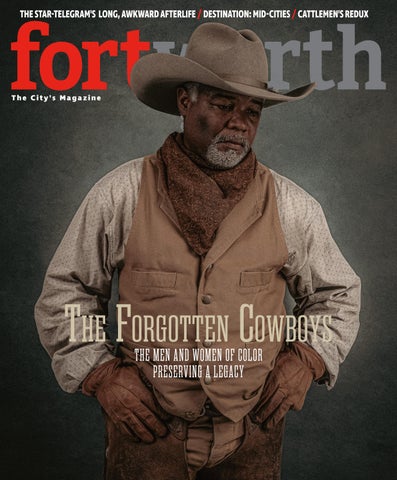
T he Forgo TT en C owboys

THE MEN AND WOMEN OF COLOR

PRESERVING A LEGACY
Every heartbeat is a battle won.

Join the Go Red movement to help lower the risk of heart disease in women.

Heart disease doesn’t have to be the leading health threat for women. Together, we can change that by raising awareness and taking action. Join Texas Health and Go Red for Women® to reduce heart disease risk by embracing healthy habits and inspiring others to do the same. Start by learning your personal risk — take our five-minute heart health assessment and learn how simple changes can lead to big results.

Learn more at TexasHealth.org/GoRed

Proud Local Sponsor of Go Red for Women®

Pictured: Mike Brown, Platform Director
Spur Chevrolet

FEATURES

A Heritage on Horseback

These cowboys of color cherish the traditions of the West in the modern era, keeping alive the legacy handed down by family, community, and history.

44 The Death of a Newspaper

Once a dominant civic force, the FortWorthStarTelegramhas been undone by all the usual suspects, including collapsing ad revenue and changing reader habits in an industry that failed to adapt before it was too late. Only God knows what’s next.

52 Meet Me in the Middle

Instead of arguing over who makes the drive from east to west, these date-night spots split the distance while offering easy chemistry, good food and drinks, and neutral territory for seeing whether love is worth the mileage.

DEPARTMENTS

THE FORT

11 City Dweller

The 90-year-old Will Rogers Coliseum shows off its new face-lift for the Fort Worth Stock Show & Rodeo. She looks great!

18 Calendar

What’s going on in February? The story of Henry VIII’s unlucky wives comes to Bass, and the Bellamy Brothers return to Billy Bob’s.

20 Fort Worthian

Meet Stephanie Rhodes Russell, resident conductor of the Fort Worth Symphony Orchestra.

22 State Lines Glen Rose: pop. 2,770.

24 Cowhand Culture

Sister of Fort Worth jazz icon Ornette Coleman, Trudy Coleman earned her own legend as a fearless, genre-bending singer crowned the “Boss-Lady of the Blues.”

26 The Reverie

Paul Waples, the forgotten financier behind the Star-Telegram , helped shape Fort Worth’s civic and business legacy.

CHOWTOWN

146 Dining

A multimillion-dollar renovation, high-profile new owners, and a chef with Las Vegas pedigree have given Cattlemen’s Steakhouse new life.

151 Four Courses

Fort Worth chef Michael Duff and Michael Arlt of The Mont craft a four-course menu built for shifting seasons and lingering nights.

The Great American Story

Tackling a feature on the Cowboys of Color is something that’s been on my editor-of- Fort WorthMagazine bucket list since I learned the Cowboys of Color Rodeo existed. So, it’s been on my list since my first year at the magazine — which was six years ago.

It’s one of those stories that’s made its rounds during plenty of brainstorming sessions and casual editorial exchanges. “Cowboys of Color” was a three-word phrase that seemed to regularly make its way to the end of those “Wouldn’t it be cool if we did ...” sentences. Everyone loved the idea. So, it’s somewhat cathartic to see the piece, which includes fantastic photography by Olaf Growald and art direction by Craig Sylva, finally come together.

Granted, while the multicultural rodeo launched by Cleo Hearn a few decades ago directly inspired our interest to do this piece, we had always wanted to speak with cowboys and cowgirls of color who were outside the world of rodeo. We wanted to dust off the history books and tell the stories of the old cowboys Hearn’s rodeo celebrates — the forgotten cowboys. While you’ll read it in the feature (which you can find on page 30), it bears repeating that, according to historians, people of color — namely people of Black, Latino, and Indigenous decent — made up nearly half of the drovers, wranglers, ropers, and ranch hands during that era of the Wild West we so often romanticize.

We also wanted to speak to those engrained in the culture of the West and

carrying on the legacy of the multicultural cowboy and promoting diversity through their way of life — by riding a horse through a McDonald’s Drive-Thru (this actually happens) or caring for a sick calf.

While the cowboys of color whose legacies they carry faced more than their fair share of hardships in the form of racism and discrimination — not to mention the brutal elements and grueling work — they still managed to make an impactful and positive mark on the making of the West. More than anything else, it’s the story of a dogged determination to contribute and make a difference.

As it states on the back of your quarter, e pluribus unum (out of many, one). Yet another reason the West remains the greatest American story.

ON THE COVER:

Shot by Olaf Growald at the Fort Worth Magazine photo studio, we invited seven current cowboys of color to visit our offices in their full working, Western attire for a photoshoot. Capturing each of them separately, all seven shoots are likely to remain among our magazine’s most memorable photography sessions.

CORRECTIONS? COMMENTS?

CONCERNS? Send to executive editor Brian Kendall at bkendall@fwtexas.com.

Republic of Texas The Fort Worth Club Turns 100

NEXT MONTH
Brian Kendall EXECUTIVE EDITOR

Feb. 11 will mark five years since “Snowmageddon,” the winter storm that caused over 200,000 Fort Worthians to lose power with temps dropping to -2 degrees. While we all know what Sen. Ted Cruz was up to during this infamous freeze, how did you keep warm?

Was renting a home on the east side that, naturally, lost power. Was fortunate to have a friend downtown who opened their small studio apartment to a few of us without power. We crashed in sleeping bags and killed time by watching movies like “The Sandlot” and “Little Giants.”

During the 2021 deep freeze, temperatures stayed below freezing long enough for the lake beside our home to partially ice over. We spent those days wrapping outdoor faucets, keeping taps dripping, staying bundled inside, and making sure our family and animals stayed warm and safe.

I camped out on my sister’s lumpy couch for a week because she has an older gas-heated home. Thank the heavens for Meadowbrook!

owner/publisher hal a. brown

president mike waldum

EDITORIAL

executive editor brian kendall

contributing editor john henry

digital editor stephen montoya

contributing writers jenny davis, malcolm mayhew, michael h. price, shilo urban

copy editor sharon casseday

ART

creative director craig sylva

senior art director spray gleaves

contributing ad designer jonathon won

ADVERTISING

advertising account supervisors gina burns-wigginton x150

marion c. knight x135

account executive tammy denapoli x141

territory manager, fort worth inc. rita hale x133

account executive patrick mccune x158

senior production manager michelle mcghee x116

MARKETING

director of digital robby kyser marketing manager corinn crippin events and promotions consultant victoria albrecht

CORPORATE

chief financial officer charles newton operations manager kaitlyn lisenby founding publisher mark hulme

CONTACT US

main line 817.560.6111

subscriptions customerservice@fwtexas.com

Grateful and fortunate to have power during that storm. In fact, we were so grateful that we didn’t run our heat, knowing the issues with ERCOT, and only used the heat from our gas fireplace to heat only part of the house. We closed off all the bedrooms and slept in the living room by the fireplace.

Having the gas fireplace on, wearing heavy socks, and drinking lots of hot coffee.

Lost power for three days! We wore lots and lots of layers of clothes and blankets. The third day, we could finally get out and drove to the Embassy Suites-Downtown (where I used to work) for a hot shower and charged our cell phones.

I missed the infamous Snowmageddon entirely. I was still in Michigan, shoveling close to a foot of snow, completely oblivious to the chaos in Fort Worth.

DIGITAL EDITION:

The virtual editions of both current and previous issues are available on our website. Flip through the pages to read more about the great city of Fort Worth by visiting fwtx.com.

©2026 Panther City Media Group, LP. All rights reserved. No part of this publication may be reproduced without written permission from the publisher.

FortWorthMagazine(ISSN 1536-8939) is published monthly by Panther City Media Group, LP, 6777 Camp Bowie Blvd., Suite 130, Fort Worth, TX 76116. Periodicals Postage Paid at Fort Worth, Texas. POSTMASTER: Send change of address notices and undeliverable copies to Panther City Media Group, 6777 Camp Bowie Blvd., Suite 130, Fort Worth, TX 76116. Volume 29, Number 2, February 2026. Basic

Subscription price: $29.95 per year. Single copy price: $4.99

A Stellar Real Estate Experience

4

Once known for its history, The Harden has evolved for today’s Fort Worth

Located behind the Public Market, The Harden offers modern apartment living for all ages blending historic character with contemporary comfort and unmatched access to Downtown, Medical District and much more *12+ month lease and select units only

MENTION THIS AD AND RECEIVE ONE MONTH FREE

com (817) 537-3158

THE FORT

PEOPLE TO KNOW THINGS TO DO PLACES TO GO

FORT WORTHIAN

Absorbing music as a child, Stephanie Rhodes Russell rose to lead orchestras worldwide, a journey that has taken her to Fort Worth.

WHAT WE’RE WRITING ABOUT THIS MONTH:

On page 18 What’s going on in February? Here’s what. On page 22 Down by the Paluxy River sits Glen Rose, clearly once home the beasts of yesterday. On page 24 Ornette Coleman carried Fort Worth to New York; his sister Trudy stayed put, forging her own fearless path from Cowtown. On page 26 Paul Waples: The story of a forgotten Fort Worth great.

Still Stunning

Ninety years young, Will Rogers Coliseum has been polished for prime time in the 21st century.

AThe 90-year-old Will Rogers Coliseum is showing off its new face-lift at this year’s Fort Worth Stock Show & Rodeo.

It’ll be difficult not to stare. She looks great!

“You will see a beautiful concourse,” says Lauren Lovelace Murray, executive vice president of the Fort Worth Stock Show & Rodeo. “[Stock Show President] Matt Carter always said it looked like a 1970s roller derby through that concourse.”

The renovations took nine months to complete.

“We had lots of the old dressing rooms and rodeo secretaries’ offices that you’ve probably seen on that backside that have been turned into multiuse meeting room space,” says Murray.

Plus, a commissary kitchen.

New lighting within the arena itself gives spectators and competitors a new perspective.
Let there be light! Those old dungeon doors are a thing of the past.
New exhibit hall space that can accommodate about 200 seated guests is part of the upgraded New Deal project.
The bathrooms now feature — are you sitting down? — hot water.
The original Will Rogers painting, dedicated by Gen. Dwight Eisenhower and that remains “really special to this facility,” was restored and placed back in the front lobby.
The renovations align with Wyatt Hedrick’s original art deco architecture of 1936.

Horsepower

That Stock Show — and Equine — Economy Never Freezes.

In Fort Worth, the first part of the year always brings extra layers of flannel, bull sheeeeet, and cold hard cash.

We’re grateful for two of those. Old Man Winter can stick it. (I do hope he didn’t hear that.) Yet, he just can’t seem to help himself by decreeing a round of “Stock Show weather” to torment us all.

I saw something on the socials the other day about the Alaskan Wood Frog. It freezes solid in the winter. Heart stops, breathing ceases, brain goes silent. In the spring, it comes alive as if nothing happened. That’s many of us in winter.

Well, anyway, that’s all offset by the economic impact, which like the Fort Worth Stock Show and Rodeo is enduring. And hot. Well, it’s legendary.

At an economic impact forum, “The Power of Sports in Fort Worth,” hosted by the Fort Worth Chamber of Commerce, Stock Show officials say its impact on the local economy is $120 million, with 1.2 million people visiting the grounds for the 23-day show.

Moreover, the impact of Will Rogers Memorial Center is $350 million a year. There are horses roaming the property pretty much year-round. Specifically, about 200 events every year. That’s why they call those guys who built the complex 90 years ago visionaries.

Will Rogers, as you know, debuted its multimillion-dollar makeover for the Stock Show, including newfangled amenities like hot water in the bathrooms.

Horses were at the center of economic development in Fort Worth at the very beginning and they still are. The more things change … .

“Whether you know it or not, whether you’re a bank or a builder, your business is fueled in part by the equine industry,” says Pam Minick,

who moderated a discussion the equine industry on Thursday at the Kimbell Art Museum. “In the Stockyards alone, when you think of equine, you might think of the steers, but we’ve got drovers on horseback that push those steers, and 10 million visitors a year are seeing that. Don’t think that those visitors don’t impact your businesses.”

Among those is the National Reined Cow Horse Association, which has moved all of its operations to Fort Worth after transferring its premier event, the Snaffle Bit Futurity, here several years ago. Between two events, one in February and the futurity in the fall, the NRCHA is in the coliseum 30 days.

The transformation of the Stockyards includes the city-owned Cowtown Coliseum. Built in 1908, she is the grand dame of public buildings in Fort Worth. It is managed through a partnership of the PBR, ASM Global, and Stockyards Heritage Development Co., which has upgraded the facility to meet modern standards and expectations.

Those upgrades have amounted to a transformation in business activity.

In 2026, the complex will host 279 events, up from 76 when the partnership took over, says Tim Young, general manager of Cowtown Coliseum.

“We’ve worked really hard to keep the historical value while making the building function better for our guests,” says Young. “I believe in 2022 it did about $4 million of revenue just out of the Coliseum. We’ll finish this year at about $28 million.”

In Fort Worth we’re getting another equestrian event this year: FEI World Cup Finals Jumping & Dressage, April 8-12 at Dickies Arena, which itself

has fostered a huge economy with more than 1.1 million people walking through its stately doors annually. More than 12,000 of those came to see the Dallas Mavericks play Oklahoma City in a preseason opener. Mavericks president Ethan Casson was also part of the forum. He says they’ll definitely be back.

The FEI World Cup, though, will bring top riders from Europe, Australia, the Middle East, and North America to Fort Worth, all of them vying for the world crown.

It takes, ahem, los huevos to do this stuff, says Ms. Minick.

“The,” um, “balls that people have to have to do the cow horse event and the tenacity that folks have to be a bull rider,” says Minick. “But these equestrians that make a 6-foot jump … it’s not if they fall off, it’s when, because it’s just unnatural. And the elegance of these horses. If you don’t have tickets to that event, you need to because it’s a whole different level of horsemanship.”

That World Cup will precede by a couple of months the other World Cup — futbol’s FIFA World Cup. Soccer’s governing body said this week that more than 500 million people in just over a month — that’s half a billion — submitted applications for the event’s random selection draw.

In addition to the host countries — U.S., Mexico, and Canada — the highest number of applications came from Germany, England, Brazil, Spain, Portugal, Argentina, and Colombia.

Many of them will be coming here to the so-called “Dallas Stadium” — better known as AT&T Stadium in Arlington — to watch, among others in the round-robin portion, England, Argentina, and Japan.

“These are events that we support, but that are independently run and operated here and really bring an increased economic impact to our city,” says Mitch Whitten, COO of Visit Fort Worth. “And many people ask us, ‘How do we get involved?’ Or ‘How can we support?’ It’s really simple: buy a ticket, attend, bring a child, bring a grandchild, bring family.”

‘Landman’ by the Numbers

Did the local filming of the popular TV show have an impact on Fort Worth? The numbers don’t lie.

Now that the Taylor Sheridan-made, Billy Bob Thornton-starring, Fort Worth-centric second season of the Paramount+ series “Landman” has officially ended (it technically hadn’t before we went to press, but we’re gonna go out on a limb and say that last episode left us on quite the cliffhanger), we were curious about the show’s impact on our city — economic and otherwise.

Employing locals and largely shot on location — the city wasn’t just a backdrop for establishing shots — Season 2 of “Landman” showcased iconic Cowtown businesses and landmarks like Bowie House, 61 Osteria, TCU, Will Rogers Memorial Center, White Elephant Saloon, and Cattlemen’s Steak House. There’s little doubt the show’s regular viewers and binge watchers got their fill of the city. And while more tourist dollars are likely forthcoming, the show has already had quite the positive effect on the city — road closures be damned.

Provided by the good folks at Visit Fort Worth, here are some astonishing numbers to put Season 2 of “Landman” into perspective:

135 days spent on-location in Fort Worth

3,856 people hired to work on the show, which includes

• 1,092 crew members

• 192 cast members

• 2,500+ extras

11.2 million people reached during coverage of the red-carpet season premiere in Fort Worth

9.2 million viewers tuned in to watch within the first two days after the season’s release 262% jump from the Season 1 premiere

Around Cowtown in 8 Seconds

A smattering of things you might’ve missed

GMFP: Gary Patterson is taking his rightful place in the College Football Hall of Fame Class of 2026, following a 43-year career, including 24 at TCU, where he transformed the Horned Lizards into national prominence. Of the nine previous from TCU, Sammy Baugh and Davey O’Brien were the first, LaDainian Tomlinson the most recent, with Dutch Meyer and Bob Lilly among those in the middle.

Law, Order, and Politics: Texas Gov. Greg Abbott swooped into town to receive the endorsement of his reelection campaign from a number of law enforcement organizations, including the Fort Worth Police Officers Association. Who says this Republican is against organized labor?

Earned Distinction: The National Medal of Honor Museum in Arlington, dedicated to telling the stories of heroism and courage under the most extreme circumstances, has been named the “Best New Museum in America” by USAToday’s readers’ choice awards.

Portal Whiplash: Former TCU QB Josh Hoover, who bolted town through the transfer portal, has signed with Indiana, presumed national champion of 2025 (the game is still a few days away, as of this writing). Meanwhile, the Horned Frogs have signed his successor: Jaden Craig, smart guy and transfer from Harvard U.

Powering Back Up: The Fort Worth City Council has taken the first step to permanently protecting the 113-year-old Fort Worth Power and Light Co. building from the figurative wrecking ball. The site would have high redevelopment potential with historic credits available.

The Yankees Know What Up: M.L. Leddy’s, which has fitted the who’s who in its fancy selections of Western attire for more than 100 years, was named by The New York Times as one of the 50 best clothing stores in America. How about that?

You Can Run but Not Hide From Technology: The Tarrant County District Attorney’s Office has launched a task force focused on unsolved homicide cases and other violent crimes. The Cold Case Task Force will use DNA technology and digital forensics to work alongside local police departments to solve cold cases.

SuperFrog Canonized: Long overdue, SuperFrog at long last is getting his day in the sun in the bobblehead culture. (Has he had one before? IDK.) The SuperFrog bobblehead has arrived at TCU, a seven-inch, purple-and-white monument to a banner year and a century-plus of carefully cultivated oddity. He was released in conjunction with National Bobblehead Day by the National Bobblehead Hall of Fame and Museum.

Arsenal of Politics

Mr. Hegseth Goes to Fort Worth To Play Politics

In January, Lockheed Martin welcomed U.S. Secretary of War — or Defense, or some such other — Pete Hegseth to its F-35 Lightning II production facility in Fort Worth as part of his nationwide tour of political stump speeches called the “Arsenal of Freedom Tour.”

The visit also highlighted Lockheed Martin’s central role in U.S. defense manufacturing and a record year for the world’s most advanced fighter aircraft.

Hegseth toured the F-35 final assembly line, met with Lockheed Martin executives, and addressed more than 600 employees inside the sprawling North Texas facility, which employs roughly 19,000 workers. The Fort Worth plant is the sole final assembly site for the F-35 and anchors a national supply chain of more than 1,900 suppliers, over half of them small businesses.

“I’m looking out into an incredible audience of Americans here who are committed to an incredible company that’s building incredible platforms,” Hegseth told employees. “Thank you for accepting and grasping the chal-

lenge of President Trump as well as our department. We are shoulder to shoulder with you because we can’t deter the next conflict without the skills and capabilities you have.”

Lockheed Martin delivered a record 191 aircraft in 2025, surpassing the previous high of 142 jets. Annual production is now running at a pace five times faster than any other allied fighter currently in production, underscoring the program’s global footprint and industrial capacity.

“Every one of our 19,000 employees here, and many more at our own and our suppliers’ factories around the country, are totally dedicated to building these jets faster and more efficiently,” said Jim Taiclet, chairman, president, and CEO of Lockheed Martin.

Beyond aircraft production, Lockheed Martin recently announced a framework agreement with the U.S. Department of War to accelerate production and delivery of PAC-3 Missile Segment Enhancement interceptors, described by the company as the first major example of its Acquisition

Transformation Strategy being put into action.

Globally, more than 1,290 F-35s are now operational, with the fleet surpassing 1 million cumulative flight hours in 2025. The aircraft operates from 50 bases worldwide, including 11 nations flying the jet from home soil. In 2025, the program also completed delivery of its most advanced software upgrade to date, Technology Refresh 3, while sustaining a global fleet approaching 1,300 aircraft.

The visit, naturally, also carried a broader political message. In remarks on the factory floor, Hegseth framed the Fort Worth plant as a modern “arsenal of freedom,” arguing that rebuilding U.S. military strength requires speed, accountability, and results. He pointed to President Trump’s pledge to raise defense spending by more than 50% in 2027 and said future contracts would be awarded based on performance and delivery, not brand names.

“We ultimately don’t care what the name is on the side of the missile or the plane,” Hegseth said, while adding he hoped Lockheed Martin would win “a lot” of future contracts.

Building a stronger War Department requires rewarding defense manufacturers that take risks in developing new products, while also cutting bureaucratic red tape at the Pentagon. Moreover, he said, it requires eliminating what Hegseth described as the distractions of “woke ideology.”

“No more DEI, no more dudes in dresses, no more climate change worship and social justice and political correctness,” Hegseth stumped.

“We’re done with that. We’re unleashing the war fighter to be ready, trained, disciplined, accountable, and lethal.”

The F-35 program supports an estimated 49,000 jobs locally and generates more than $9 billion in regional economic impact.

February

7

Clay Walker

The chart-topping country crooner behind the hits “What’s It to You,” “Live Until I Die,” and “Rumor Has It” will feel right at home among a sea of cowboy hats at the World’s Largest Honky-Tonk.

Billy Bob’s Texas billybobstexas.com

10

Cliburn Sessions: Conrad Tao + Caleb Teicher

A collaboration between piano prodigy Conrad Tao, who’s making his fifth metroplex appearance, and dancer Caleb Teicher, whose percussive dancing will add quite the punch to Tao’s compositions. Tannahill’s Tavern and Music Hall tannahills.com

10-15

‘Six’

A modern (and musical) take on the stories of the six “ex”-wives of the megalomaniacal Henry VIII. The work, written by Toby Marlow and Lucy Moss, scored a couple of Tony Awards in 2022. Bass Performance Hall basshall.com

11-March 1

‘Bull in a China Shop’

Based on true events and set in the world of academia, this funny yet tender play tells the love story of two suffragettes over the course of 40 years.

Amphibian Stage amphibianstage.com

21

Bellamy Brothers

This will mark the country duo’s 70th trip to Billy Bob’s. We know they’ve done more than the 1975 chart-topper “Let Your Love Flow,” but that infectious tune, alone, is worth the price of admission. Billy Bob’s Texas billybobstexas.com

26-March 1

Fort Worth Music Festival

Josh Abbott Band, Wade Bowen, and Josh Weathers headline the fourth year of Tim Love’s Stockyard music festival and conference, which spotlights Texas-based bands and musicians. The Stockyards fortworthmusicfestival.com

27-March 1

Shakespeare at the Symphony

Partnering with the Dallas Theater Center, the Fort Worth Symphony Orchestra will weave Shakespeare-inspired compositions into scenes from “A Midsummer Night’s Dream” and “Romeo and Juliet.” Bass Performance Hall basshall.com

27-March 1

Cowtown Marathon

Get ready for a weekend full of CamelBaks, Hokas, and road closures, as the always accommodating five races (5K, 10K, half marathon, full marathon, and ultra marathon) take over the city. Will Rogers Memorial Center cowtownmarathon.org

28-March 8

‘Hairspray’

The Tony Award-winning musical based on John Waters’ classic 1988 film gets the Casa Mañana treatment, which, we’ve learned, means it’s gonna be a damn good time. Casa Mañana casamanana.org

Feb. 16

Harlem Globetrotters

Attendees will bear witness to their fair share of finger spins, behind-the-back passes, and other basketball trickery as the Globetrotters trounce their perpetual sacrificial lamb, the Washington Generals.

Dickies Arena dickiesarena.com

photos provided by Bass Performance Hall // Billy Bob’s Texas // Cowtown Marathon // Dickies Arena
‘Six’

V e l o c i t y P r o A m F o o s b a l l T a b l e

MORE THAN JUST BILLIARDS

S i n c e 1 9 5 2 , F o r t W o r t h B i l l i a r d s h a s b e e n t h e g o - t o d e s t i n a t i o n f o r

p r e m i u m g a m e r o o m e s s e n t i a l s . F r o m p o o l t a b l e s & c u e s t o s h u f f l e b o a r d , f o o s b a l l , a i r h o c k e y , d a r t s , a n d a r c a d e s , w e h a v e e v e r y t h i n g t o e l e v a t e y o u r s p a c e W e a l s o o f f e r e x p e r t s e r v i c e s , i

d i s c o u n t s f o r i n t e r i o r d e s i g n e r s .

V i s i t u s t o d a y a n d d i s c o v e r w h y w e ’ v e b e e n a t r u s t e d n a m e

i n N o r

V i s i t O u r S h o w r o o m

3 9 7 0 W V i c k e r y B l v d

F o r t W o r t h , T X 7 6 1 0 7

8

s a l e s @ f o r t w o r t h b i l l i a r d s c o m

LEARN MORE

w w w b i l l i a r d s u p e r s t o r e c o m f w b i l l i a r d s

f t w o r t h b i l l i a r d s

Resident Conductor, Fort Worth Symphony Orchestra

Stephanie Rhodes Russell
By Stephen Montoya Photo by Richard W. Rodriguez

Stephanie Rhodes Russell once sat beneath a grand piano in her family’s home, 8 years old, absorbing every note of her mother’s voice lessons. Decades later, these early memories in American Fork, Utah, would aid Rhodes Russell in leading world-class orchestras from Moscow to Charlotte and, now, the Fort Worth Symphony Orchestra — which she conducted on Jan. 16 and 17 during its annual “Wild West Rodeo” performances.

“I remember just kind of taking it all in,” Rhodes Russell says about her mother’s lessons. “Feeling the vibration.”

Rhodes Russell began piano at 5 and quickly became a natural collaborator. Her early strength was sight-reading — in layman’s terms, the ability to accurately perform music from written notation — a skill that made working with singers second nature and would later draw her toward opera.

After earning a bachelor’s degree in collaborative piano from Utah State University and a master’s in piano performance from the University of Michigan, she moved to Moscow as a Fulbright scholar, where she worked at the Bolshoi Theatre and specialized in Russian repertoire and diction. “Languages are such an important part of opera,” she says. “When you understand the language, you hear how a melody works differently.” She now speaks French, Italian, German, Spanish, and Russian fluently, skills that inform her musical interpretations.

Along the way, she found herself in opera’s deep end, assisting on two Richard Wagner “Ring” cycles (“Der Ring des Nibelungen”) — the four-opera, 15-hour endurance test of the classical world — working under world-renowned conductors Donald Runnicles and Philippe Auguin, an experience that sharpened her musical stamina and her sense of scale. “Ultimately, you’re taking what’s on the page, and you’re trying to bring it to life in sound,” she says. “You’re responsible for bringing all the components together.”

Her rehearsal process reflects this

philosophy. “The first rehearsal is really about getting on the same page,” she explains. “Then it’s like diagnosing something … figuring out what needs work and fine-tuning the palette. I don’t make a single sound,” she adds. “I need [the orchestra] to really feel like I’m there for them.”

In addition to her steady rise in the world of conducting symphonies, Rhodes Russell serves as associate professor and music director of opera at the University of North Texas, a position she’s held since 2022. Feeling an unwavering commitment to educate the next generation of singers, performers, conductors, and composers, Rhodes Russell also founded the Women’s Artistic Leadership Initiative, a nonprofit that equips emerging female artists with leadership and business skills. “You want to inspire and ultimately empower them to play their best,” she says.

But when she’s at home, life is less formal and more improvisational. With three young children, she admits, “Balance is nonexistent. But when I’m with [my family], I make sure I can give them 100%.” Whether shaping an orchestra’s sound or a family’s rhythm, her goal is the same — bringing people together to realize a vision.

“At the end of the day, the conductor is important, don’t get me wrong, but the musicians tuning into each other and really being on the same page is more important,” she says. “As a conductor, I really think I’m there to facilitate their artistry and help bring the best out of them.”

BY THE WAY....

What type of music do you listen to when you’re not conducting?

“I love silence because it’s hard to come by in my life. There is so much noise between the music and between the kids. If I can drive in silence, that’s a gift, but I also love podcasts. I love listening to podcasts and just giving my brain a break from the usual things it thinks about. My husband loves ‘90s alternative rock, so there’s a fair amount of it playing in our household. I’m not opposed. I love a wide variety of musical styles.”

1. Surrounded by my sisters and mama after a performance with Utah Opera. 2. Conducting a production of Humperdinck’s “HÄNSEL UND GRETEL” at the Murchison Performing Arts Center. 3. Celebrating with Santa and the FWSO at Northpark Center. 4. With opera singers Solomon Howard and Kelsey Figueroa after my debut at Washington National Opera. 5. We have our hands full in the best kind of way. 6. Backstage with Principal Guest Conductor Dame Janet Glover after assisting her on a fantastic performance of Mahler’s Symphony No. 4. 7. My favorite audience member! Love it when my husband can make my performances. This one was with UNT Opera.

Glen Rose, Texas

Population: 2,770

Bootleggers, faith healers, and dinosaurs have all followed the waters to Glen Rose, where the clear, shallow Paluxy River runs through the heart and history of the town. Frontier trader Charles Barnard built a stone grist (grain) mill on the river in 1860, a three-story structure that grew into the settlement of Glen Rose. Barnard’s Mill still stands on the peaceful banks of the Paluxy, now a museum full of fine

artwork and pioneer history. Before it became a museum, however, the mill housed a hydrotherapy spa for the many tourists who came to “take the waters” in the town. Numerous local springs and artesian wells supply water that’s rich in calcium, sulfur, magnesium, and iron — minerals once believed to cure all types of maladies. Beginning in the late 1800s, people streamed into Glen

Rose to alleviate their arthritis, skin disorders, nervous conditions, digestive issues, and “female complaints.” Such claims didn’t just lure in patients; they also attracted self-proclaimed folk healers who ostensibly used magnets, herbs, or prayers to amplify the water’s powers (for a fee, of course).

By the 1920s, another group of renegade entrepreneurs had found a home in Glen Rose: bootleggers. The same spring water that healed all ills was ideal for distilling whiskey, and the valley’s cedar-covered hills provided plenty of secluded hideouts. The area became known as Whiskey Woods, which is also the name of the most exciting new restaurant in town. Tucked inside a century-old building by the courthouse square, WhiskyWoods steakhouse and speakeasy feels like an upscale, Prohibition-era hangout with moody lighting in vintage bottles, cozy banquettes, and killer cocktails.

Moonshiners may have tiptoed around Glen Rose 100 years ago, but the monsters who came before — 100 million years before — stomped their footprints forever into the muddy lagoon that once covered the land. Some of the world’s best-preserved dinosaur tracks appear on the bed of the Paluxy River just west of town.

Now part of Dinosaur Valley State Park, the tracks were initially spotted by a schoolboy in 1909. Hundreds

Fossil Rim Wildlife Center

of footprints have since been discovered, including 70 new tracks revealed by a drought in 2022. It’s an awe-inspiring site, especially when you imagine the 40-ton, long-necked sauropods lumbering across the landscape and leaving behind meter-wide footprints — and the Tyrannosaurus rex-like theropods, whose three-toed tracks can still run a shudder up your spine.

As impressive as the dinosaur tracks may be, they aren’t the only prehistoric marvel in Glen Rose. The same silty, muddy lagoon that preserved the dinosaur tracks also turned ancient trees into petrified wood — lots of it. Builders in the 1920s used fossilized wood to construct homes and other structures, four dozen of which still exist today. You’ll see fantastic examples on the courthouse square: a star-shaped well and bandstand, both made of petrified wood (with a dino footprint embedded in the bandstand for good measure).

Follow in the steps of the sauropods, the moonshiners, and the cure-seekers and head to the water at Big Rocks Park, where you can wade and swim in the Paluxy River right in the middle of town. Dramatic boulders and small cascades create a natural playground for a warm spring day — and the perfect place to step into the water-carved history of this fascinating small Texas town.

Explore Glen Rose

Savor: Relax at a table overlooking the Paluxy River at the casual-elegant Snyder Tavern (at Inn on the River) or the laid-back barbecue and beer joint Sexton Mill (in a converted 1941 mill). Both offer indoor and outdoor seating, as does the Riverhouse Grill, a charming eatery in a Craftsman-style home from the early 1900s. Glen Rose also brings the sweets, with grilled honey buns at Green Pickle and excellent, fruit-heavy pastries at The Fried Pie Shoppe (inside the Exxon on the left as you’re driving into town). But Baked is the can’t-miss sweet shop; this artisanal, European-style bakery launched in Granbury to wide acclaim before opening its second location in Glen Rose last year.

Shop: Glen Rose has come into its own since the pandemic, with new wooden sidewalks jazzing up the historic town square and its quirky, mom-and-pop shops. Browse antiques and artisan wares from dozens of vendors at Barnard Street Mercantile, an impressive variety of locally made jellies, upcycled furniture, retro dresses, and trendy jewelry. Find Texas-themed treats nearby at the award-winning Cowboy-Up Chocolates, like red pepper peanut brittle and margarita-flavored truffles (some are even shaped like Texas). Drop by Rhythm & Co. Books for new reads and witty bric-a-brac and shop for flower arrangements and inspirational decor at Front Porch Designs.

Enjoy: You may have driven through Fossil Rim Wildlife Center on a field trip as a school kid, but if you haven’t — and definitely if your children haven’t — this renowned animal park is well worth a look. Live out your African safari dreams with zero jetlag on a seven-mile, self-driving tour as giraffes, zebra, and wildebeest roam freely around you. Behind-the-scenes tours let you mingle with cheetahs and rhinos, and there are miniature goats in the petting zoo. Glen Rose is also known for bluegrass music, with comeand-play jams every third Saturday in Oakdale Park and bluegrass festivals every spring and fall (the next fest starts Feb. 26). See mastodon bones and an antique moonshine still at Somervell County Museum and a 25-foot replica of Noah’s Ark at the Creation Evidence Museum.

Snooze: For a ranch-style escape with luxury perks, Rough Creek Lodge has been undergoing a multimillion-dollar, female-led renovation with revamped guest rooms and public spaces (including new pickleball courts). Set on 9,000 wooded acres outside the city, the spa resort offers fine dining and heaps of activities like clay shooting and zip lining. On the other side of town by the Brazos River, the new La Palmilla features a Spanish-Revival design that wouldn’t be out of place on the Costa del Sol: arched doorways, terracotta tile roofs, and beautiful tiled staircases. Both hotels also have individual guesthouses for families and groups

How to Get There: It’s less than an hour from Fort Worth to Glen Rose. Drive south on the Chisholm Trail Parkway for 27 miles toward Cleburne, then turn right at the first stoplight onto Highway 67 S. Glen Rose is 25 miles ahead.

Somervell County Courthouse
Bread Pudding Dessert
Paluxy River

Boss-Lady of the Blues

Trudy Coleman, sister of jazz great Ornette Coleman and once hailed by the NewYorkTimesas a “gutsy blues belter,” was in a class of her own.

Time was when a denizen of Fort Worth could venture among New York’s hipster scene and be hailed as a fellow hometowner of Ornette Coleman.

That jazz innovator called New York home, but he never allowed New York to forget his Fort Worth origins.

The Cowtown bearings of Coleman (1930-2015) remain legendary in New York, where he knew every

eatery that would suit his tastes in Texas-style, vegetarian down-home cooking.

Coleman’s native-son persistence in the rarified atmosphere of experimental music was a source of ironic amusement to Truvenza “Trudy” Coleman Leach (1920-1994), sister of the avant-garde jazzman and a respected entertainer, herself.

Unlike Ornette, Trudy clung to middle-class family life in Fort Worth. By the time I caught up with her in 1981, she had retired, more or less, indulging the occasional urge to tour as a featured vocalist with this band or that.

Her home occupied a northern-edge corner in Como, that historic Black neighborhood in West Fort Worth. Her husband, Sam Leach, did business as a mortgage banker and a manager at General Dynamics.

“Fort Worth is home, all right,” she told me. “Always the place to come back to when the rest of the world would wear me out.

“Yes, and I mean to tell you,” she continued, “I did get fed up with those cake-eatin’ New York critics’ attempts [during the 1960s] to liken me to Ella Fitzgerald … or Billie Holiday — even to Mahalia Jackson, when occasionally they’d catch me doin’ some churchy-fied material.

“I’ve never thought I sounded like anybody but Trudy Coleman — although one comparison I did find flattering was that I sounded like ‘a female Big Joe Turner.’ Which suited me okay, ’cause Big Joe has been a friend and a mentor.”

Nor did Miss Coleman count herself purely a jazz or blues singer.

“I do the blues, of course,” she said, “and country-western ballads. And rock ’n’ roll. And pop material. And the sacred songbook, as suits the occasion. A singer sings, don’t y’know?”

Big Joe Turner had dubbed her “the Boss-Lady,” as a corollary to his own “Boss of the Blues” sobriquet. And because a singer sings, don’t y’know, she was talking that afternoon in August of 1981 about a forthcoming tour. She joined her brother that October in London for a three-month tour. The occasion would prove to be Trudy Coleman’s last prominent showcase, barring a bravura guest-shot during the waning 1980s with a women-injazz program at Caravan of Dreams.

Truvenza Coleman was born in Rio

Vista, Texas, south of Fort Worth. She declined to declare a birthdate. (A recurring snark among musicians held that Truvenza was in fact the mother of Ornette, posing as an elder sister.)

“I started playing the piano at about age 8 or 9,” she said. “Quite a few years before Ornette developed an interest in the saxophone.” She attended I.M. Terrell High School, a cauldron of pioneering Black-musical instruction; finished high school at Waco; attended Prairie View A&M College; and worked briefly as a teacher.

“I was working as a booking agent for this band,” she said, “and they insisted that they needed ’em a girl singer, but I kept insisting, ‘I can’t do this.’” The band became known as Trudy Coleman & Her Orchestra.

By 1961, Miss Coleman had come to the attention of a hungry-for-hits local record producer, Major Bill Smith.

Smith said, in retrospect: “Aretha Franklin, Dionne Warwick, them Motown gals — ain’t a one of ’em can withstand the heat that Trudy gives off. So I recorded her right off the bat, you bet.”

The result was an opportunistic single, “Come Back, Jack,” as if in reply to Ray Charles’ recording of “Hit the Road, Jack.”

Trudy Coleman reflected with mixed feelings: “That record did for me absolutely nothing. Except maybe to get me a reputation for trying to do a takeoff on Ray Charles — not my intention, but probably the intention of that Major Bill Smith. But he brought me to the attention of John Hammond.” (Hammond was an influential producer with Columbia Records.)

“So, anyhow,” she continued, “Mr. John Hammond, he liked what I was doin’, so he arranged for me to get produced by him for Columbia Records.” Trudy Coleman’s Hammond-at-Columbia sessions feature the accompaniment of such Ornette Coleman associates as the horn artists Don Cherry and Dewey Redman and drummer Charles Moffett.

“I still have jobs waiting for me in New York, if I’m of a mind to take ’em, y’know,” she said. “The sidemen, now, they like me because I don’t act like some kind of a prima donna. There ain’t no more divas — and if there were, I sure-enough wouldn’t act like I was one.”

Her expansive presence seemed to contradict the cocooned atmosphere of her household, where a son had installed security cameras, within and without. And a ritual of positive identification had been required before photographer John Makeig and I could gain entrance.

Trudy Coleman would isolate herself increasingly as the 1980s wore on. She ventured out to attend Ornette Coleman’s homecoming engagements when the downtown area’s Caravan of Dreams opened in his honor in 1983 — but seldom otherwise.

When Marjorie Crenshaw, founder of the Fort Worth Jazz Society, arranged a series of women-in-jazz programs at Caravan of Dreams during 1989-1990, she asked an assistant to invite Trudy Coleman.

“And Truvenza just told her, right over the telephone: ‘What is this? Some kind of a joke you’re tryin’ to pull? Who put you up to this?’” recalled Mrs. Crenshaw in 2005.

“I had to call Truvenza up in person, my ownself, just to assure her that she was wanted. She ended up joining the lineup, but by this time she was not in the best of health — came onto the stage supported by a walker-apparatus, she did. But she sang her heart and soul out, I’m here to tell you.”

And so Trudy Coleman did. I was there.

Trudy Coleman died on Oct. 1, 1994. Her funeral program, as preserved by Marjorie Crenshaw, cites a birthdate of July 16, 1920. And so much for her recurring declaration that “Ornette and I, we’re about the same age.”

She had been correct, of course, in declining to state her age for the published account: A chronological dating plants misleading expectations in anyone toward anyone else. Miss Coleman’s singing, if only for as long as she pursued it, had kept her youthful in aspect and outlook.

Coleman with Trudy & T-Bone Walker

The Forgotten Architect of Fort Worth

Of all the words ever written in the FortWorthStar-Telegram— and there have been many — few were as poignant as those left behind by Louis J. Wortham, the original publisher and editor of the paper formed in 1909.

“So let it suffice to say in this moment of shock and sorrow, that a mighty oak has fallen this day in the forest of humanity, and that the living men of this generation will not look again upon so majestic, kindly, and noble a specimen.”

Those words were written in the aftermath of the death of Paul Waples, who was killed in November 1916 when the car he was riding in collided with an Interurban railcar near his home on the East Side.

Waples, who was 66 at his death, was the president of the Waples-Platter Grocery Company, initially begun by his father, who supplied groceries to railroad workers laying tracks in North Texas. The company became known as Waples-Platter Grocery Company with the addition of Waples’ brother-in-law Andrew Platter.

From Fort Worth, Waples-Platter Grocery Company grew into a wholesale powerhouse, serving grocery houses in five states and bringing to market products like the internationally renowned Ranch Style Beans.

It was from this empire that the StarTelegram was born. In fact, there would be no Star-Telegram — certainly not in 1909 — without Paul Waples, who fronted Amon Carter and Wortham the capital to get the Fort Worth Star off the ground — a $50,000 investment made by Waples and associates. That’s close to $2 million today. When Carter came

back to ask for more to acquire the rival — and financially more stable — Telegram, Waples reluctantly doubled down.

Carter was said to have worn down Waples through sheer persistence, talking about the potential acquisition relentlessly.

Waples structured the ownership so that Carter and Wortham each received 10% of the new company — even though Carter had no cash to pay for his share. He secured it with borrowed collateral, including a piece of swamp land in Florida.

Had Waples not agreed to invest capital, Amon Carter likely would have left town for a job in New York.

Fate and Paul Waples intervened. That contribution to Fort Worth history — not to mention Ranch Style Beans — should have been enough for history to recall this “man of affairs.” Yet, Waples is a forgotten figure.

Waples was said to be a “yes, we can’er,” and a “canner.” In the parlance of the day — a doer.

Said B.B. Paddock: “In matters of statewide interest he had no limitations. He did whatever was essential to success regardless of the expenditure of time or money. He did not wait for others, but performed his part and more, believing, as he did, that every man should give a part of his time, a part of his talent and a part of his money for the good of society and for the benefit of mankind.”

Said another: “Paul Waples was always the first to volunteer whenever a public service was needed.”

That is the very definition of servant leadership.

In addition to his service to his family-owned company, Waples was president of the Fort Worth Board of Trade — a precursor to the Chamber of Commerce — a director in the American Exchange National Bank of Dallas, a trustee of Texas A&M University, and chairman of the Democratic State Executive Committee. He was also chairman of the executive committee of the St. Louis World’s Fair in 1904.

In his role with the state Democrats, his was a prominent voice against Prohibition, viewing the measure as excessive government intrusion. Moreover, he believed it inflamed class, regional, and cultural divisions and distracted from broader economic and governance priorities. His stance aligned with urban, commercial, and business constituencies who feared Prohibition would damage commerce and invite corruption.

More than 1,500 attended his funeral services here. More than 5,000 were in attendance for his burial service in Denison.

Waples was remembered as a man to whom others turned without hesitation. One minister recalled knowing a man who called on Waples no fewer than 100 times seeking financial help — always on behalf of someone else — and never once left with less than he had asked for. “They are going to miss Paul Waples,” the minister said, “when the winter winds begin to sweep across the Texas prairies.”

Among those remembered in his estate — valued at $500,000 (almost $15 million today) — were the estimated 170 women who worked for him at least two years. Each of them received $1,000, the equivalent of $30,000 today.

“The only reason he didn’t stand among the great national figures,” said the pastor at Waples Methodist Church in Denison, which still stands, “was because he chose not to.”

Said the Star-Telegram in its farewell: “Whosoever comes to write of Paul Waples, comes to write of the great.” And, so, we have come to do just that.

FREE INSPECTIONS

FULL STORM RESTORATION

LOCALLY OWNED & OPERATED SINCE 1994

QUALITY OVER PROFIT

$5,000,000 LIABILITY POLICY

J arred H oward

Don’t be surprised if you see a tall, striking man on a horse going through a McDonald’s drivethru in East Fort Worth. It’s just Jarred Howard, a young man who’s spent the past 12 years headfirst in horsemanship. Howard studied architecture and had been trying his hand at different vocations before COVID gave him the green light to pursue his passion: horses. And he’s translated this passion into 2REquine, an equestrian center in East Fort Worth that offers trail rides, lessons, training, boarding, rehab, and “pretty much anything as far as horses are concerned.” A strong advocate for Black cowboy history, he also competes in rodeo and is a proud member of the Circle L 5 Riding Club, Fort Worth’s first and largest Black riding club.

A H eritA ge on H orseb A ck

THE UNSUNG STORY OF THE COWBOYS OF COLOR AND THE FORT WORTHIANS WHO CONTINUE THEIR LEGACY.

1

The Many Hands That

Built the West

It’s Nov. 16, 1907, and the vast, rich landscape Bass Reeves had patrolled for 32 years as a deputy U.S. Marshal has officially become the 46th state in the Union. No longer Indian Territory and now Oklahoma, the land’s transition to statehood ushers in the retirement of the 68-year-old Reeves. The fabled lawman’s decision to holster his revolvers and turn in his badge brings about a collective sigh of relief from criminals, fugitives, and outlaws who have dared cross into Indian Territory — the men whose nightmares Reeves had haunted.

Over a decade before he became a U.S. Marshal, during the Civil War, Reeves had escaped slavery in Texas — killing his slaveowner over a poker game, as legend has it — and sought refuge in the Indian Territory, where he would live with and learn from the Indigenous tribes. During his three-decade tenure as a U.S. Marshal, Reeves made a nearly unthinkable 3,000 arrests and killed 14 outlaws (all in self-defense, mind you). All the more remarkably, according to historian and Bass Reeves biographer Art T. Burton, Reeves emerged unscathed, with hardly a scratch on him, from every encounter with the territory’s most-wanted and depraved. His garments, however, were not as fortunate, as both hats and belts famously fell victim to perforation from gunshots — a life of near-misses.

The exploits and good deeds attributed to Reeves can seem so outlandish and sound so improbable that one would naturally question whether the stories are of myth or legend. Fearless, formidable, principled, and incorruptible, Reeves is the greatest real-life hero the Wild West ever had — the King Arthur and Hercules of saloons and shootouts.

Whether tall tales or faithful accounts, following Reeves’ death, it would take 113 years for his story to reach a wider audience, which it finally did thanks to the Taylor Sheridan-produced series

“Lawmen: Bass Reeves.”

Wyatt Earp, Pat Garrett, Bat Masterson, and even anti-heroes like Jesse James and Butch Cassidy, meanwhile, got their stories told through the entire evolution of media — pulp novels, radio programs, cinema, and television sets — with wearying frequency. There was, however, one fictional character whose life and acts of daring seem to mirror that of Reeves: the Lone Ranger.

“How does the Black Lone Ranger turn White?” wonders Donald Lee, a 15-year veteran of the Fort Worth Herd. “I mean, I grew up watching Randolph Scott. I grew up watching Clint Eastwood, John Wayne, all that, right? And that’s really cool. But as a Black kid, it’s also important to see [someone who looks like you] on a big screen.”

Despite the unceasing popularity of men carrying six shooters and riding horses, from the silent-film era to talkies and technicolor, in Hollywood, Reeves was largely forgotten.

“Black cowboys, Hispanic cowboys — they were an integral part of shaping the West,” Wendell Hearn of the Cowboys of Color Rodeo says. “But when Hollywood made the pictures, we just somehow got left out.”

ing the romanticized post-Civil War cattle drives from the 1860s to the 1880s, nearly half of cowboys were either Black or Hispanic.

“Many of the events people see in rodeos are based on things that were once jobs [on cattle drives],” Jarred Howard, owner and operator of 2REquine says. “And the job wasn’t something that’s pretty. Wrangling 1,200-pound cows in harsh weather and traveling miles and miles in blazing heat and blasting cold — that was not desirable. But people need to know that a large percentage of the people doing it were [people of color]. I think it’s important for people to know that history.”

J ose H ernandez III

A third-generation vaquero, Jose Hernandez III grew up performing ranch work with his family near the border city of Del Rio, where he started working cattle and breaking horses before his baby incisors fell out. He is the namesake son of a rough stock rodeo champion, something Hernandez also took up during his younger years before moving to Fort Worth in 2001, when he began working as a horse trainer. In 2010, after being spotted in the Stockyards by Herd drover Brenda Taylor for his traditional vaquero dress, he was offered a post with the Herd. Having plenty of experience riding horses and working cattle, Hernandez would accept the invite to join and has worked as a drover ever since.

Whatever the reasons may be — racism, whitewashing, economics — Reeves is merely one example of this exclusion. If films were to strive for authenticity and portray the West accurately, their casts would be so diverse and representative that it would fundamentally reshape our familiar image of the American West. “Even now,” Lee says, “when Black people come to the Fort Worth Stockyards, and they see me, it’s like I’m a unicorn.”

According to some estimates — many of which happen to be reputable — dur-

Despite what we may see on the small or silver screens, where John Wayne leads the herd and gets the girl, bearing witness to a real cattle drive of the 19th century would be difficult to romanticize. The obstacles — weather, terrain, animals, disease, and Indigenous resistance — were endless and claimed many lives. And the physical hardships (for man and horse) — never-ending saddle bruises, dehydration, muscles strains, and hoof injuries — weren’t inconveniences but constants. Those who managed to adapt to the trail life were some of the most physically and mentally hardened people of that era. Complain about a rock in your boot, and someone’s likely to give you something far worse to complain about.

“The cattle drive and ranching, they’re not a glamorous job,” Hearn says. “So, you really didn’t care what the other guy looked like as long as he could do the job. I mean, there weren’t a lot of people looking to do the job, so if you found someone who wanted to do it and could do it, it didn’t matter what skin color he was.”

If one is interested in witnessing a more accurate representation of a 19th century trek by horse, Fort Worthians don’t have to look much beyond their own backyards. With Black and Hispanic drovers in their ranks, including long-time vets like Lee and Jose Hernandez — a vaquero from Del Rio who makes his own chaps — the Fort Worth Herd includes a diverse representation more historically accurate than anything one might read in books by Louis L’Amour or see on shows starring James Arness. But those who embark on the twice-daily cattle drives down East Exchange Avenue — the professional drovers who have had more eyes on them than any cowhand in the past — know their purpose goes far beyond trying to achieve an accurate portrayal of a 19thcentury cattle drive.

“I’m very proud to represent my culture and, like they say, mi raza [my race],” Hernandez says. “And especially [in The Herd] because I want to be able to continue to [practice the vaquero culture] and inspire the new generation. I’m always willing to help anybody who wants to learn and tell them my story.”

“Every kid deserves to be able to see something positive about their race projected in a positive way,” Lee says. “And oftentimes, especially the era we grew up in, there wasn’t a whole lot of positive — unless you want to talk about pro football and stuff like that. But in terms actually contributing to the building of a nation or to the revitalization of the economy of a particular state, we don’t see much about it. And that’s huge! [what Black cowboys accomplished] should make us feel proud.”

Without the cowboys who did the dirty work to lay the foundation in the West — to help make life a little less difficult for others — the sprawling new frontier that epitomized hope and the American Dream would have never existed.

The West was built by many hands, and it’s time we remember them.

The First Cowboy

One might assume that to definitively proclaim any one race or culture as the first to “cowboy” is risky business. Give the incorrect answer,

and your response could be bordering on blasphemy. However, the true first cowboy — those who first served as cowhands — in this case, isn’t debated, but it is a complex tale rooted in colonialism and classism.

According to “The Original Cowboys” by Katie Gutierrez for TexasHighways, cowboys first appeared south of our current border in what was then the Spanish frontier (Mexico) in the 16th century — not terribly long after Cortés conquered the Aztec Empire and over 100 years before the idea of a United States of America had even surfaced.

Upon arriving during his first expedition, Hernan Cortes brought 16 horses, effectively introducing the statuesque species to the area and giving the Spaniards a clear advantage in battle. Following his conquest and wishing to keep the horse a benefit for the few, Cortes ordered that a Native American riding any equine was punishable by death. But this policy would become a hindrance once the expanding livestock required horsemen to do labor the conquistadors felt was beneath their status. Unwilling to give the task to the Indigenous people, the Spanish assigned this new job of wrangling and caring for the cattle to their Moorish slaves, whom the conquistadors would go on to disparagingly refer to as vaqueros (directly translating to “cowmen”). So, these enslaved Black Muslim men were effectively the first cowboys.

became superior horsemen.”

Fast-forward 100 years, and the descendants of the Spanish, Native Americans, and Moors produced the first generation of Mexican vaqueros. Raised with a Spanish method of catching small game using ropes from native fibers, they would go on to work cattle using similar methods with lassos made from cowhide.

Q u I nceola r e I d

Two years ago, Quinceola Reid became the Fort Worth Herd’s first female drover of color, guiding longhorns down East Exchange Avenue twice a day. Though school — she’s a recent TCU grad — and her subsequent ambitions made her stint come to an end, it was a history-making moment. A military veteran who didn’t begin riding until 18, Quinceola’s passion now spans Western horsemanship and endurance riding. Quinceola also shares through her Instagram, @thehorselesshorsewoman, equine access tips for those who don’t own horses and serves on the National Cowgirl Museum’s steering committee. After earning her degree in biology from TCU, she was accepted into UT Southwestern’s Physician Associate program, which she begins this fall.

Driving herds of cattle, the vaqueros quickly adopted new clothing and techniques to make their work and lives easier, resulting in the advent of sombreros, chaps, and lariats. Competitions would soon emerge from these new-found methods, producing roping, reining, bronc busting, and bull riding. In short, the vaqueros gave the Anglo settlers their first lessons in being cowboys and even gave them their first appetite for rodeo. With a threecentury head start on their White counterparts, vaqueros spent generations learning, working, and honing their craft, forging a distinct, familial, and deeply proud culture.

Soon requiring more vaqueros to assist in working cattle, the Spanish would drop their previous ordinance that came with a death sentence and began allowing the Indigenous people to ride horses. Except, they could only do so without a saddle, as such luxuries for the derriere “were the mark of gentlemen.” According to Gutierrez, forcing the Indigenous to go saddleless means the Spanish “unwittingly ensured that Native Americans

Also receiving cowhand tutorials from vaqueros were newly emancipated Black men and women who headed west, particularly to Kansas, seeking economic opportunity in the midst of reconstruction. Learning the skills of the vaquero, Black cowboys were able to acquire jobs as ranch hands, trail hands, and horse wranglers from which they typically made equal wages to their White counterparts.

“[Black cowboys] occupied all the positions among cattle-industry employees,” Kenneth Porter writes in African Ameri-

cansintheCattleIndustry , “from the usually lowly wrangler through ordinary hand to top hand and lofty cook.” That said, Porter reminds us that post-Civil War, inequality remained rampant west of the Mississippi. “But [Black cowboys were rarely] found as ranch or trail boss,” he continues. “And were typically assigned to handle [break] horses with poor temperaments and wild behaviors.”

It’s not as if this world of bovines, barns, and broncs was completely foreign to these cowboys, either. According to Tracy Owens Patton in Let’sGo,Let’s Show,Let’sRodeo:AfricanAmericans andtheHistoryofRodeo, enslaved men and women in the South would regularly manage large herds of cattle, especially in Texas, where nearly 30% of the population were enslaved Black men and women when the Civil War broke out. In these instances, ranchers would distinguish White ranch hands from Black ranch hands by calling them “cowhands” and the more pejorative “cowboys,” respectively. And not long after the American Revolution, these cowboys would regularly partake in competitions related to their cowhand skills — competitions from which their White owners would profit. Whether these events or those cowboys ever receive such a recognition, some semblance of the rodeo we know today did kick off a century later thanks to the traveling vaudeville of Buffalo Bill’s Wild West Shows. And two of the sport’s biggest acts were Black cowboys — Bill Pickett, who invented the sport of bulldogging, and Jesse Stahl, one of the greatest saddle bronc riders of all time.

Setting up shop within The 101 Ranch Wild West Show near Ponca City, Oklahoma, Pickett showed thousands of curious onlookers his new sport inspired by the method dogs use to subdue cattle: biting their upper lip. The sport had Pickett, saddled atop a horse, chase a steer in full gallop. He’d then leap from his horse, grab the steer by its horns, and wrestle it to the ground often by biting its upper lip. Though a novelty act in 1910, today, the sport is known as steer wrestling and is now one of the nine events that make up ProRodeo competitions. It’s also the only event whose invention you can trace back to a single person.

Quanah Parker and the World’s Greatest Horsemen

Lance Tahmahkera talks about the two horses he feeds every morning. “They’re our pets,” he says, waving off any seriousness about his riding ability. When speaking about himself, Tahmahkera drizzles everything with a thick coat of humility. But bring up his tribe, his people, his legacy — in other words, add the element of the Comanche — and his voice becomes sharp and assured.

“The Comanche were the greatest horsemen in the world,” Tahmahkera says, shifting to a matter-of-fact tone. He’s not gloating or beaming with a brazen amount of pride, either. Tahmahkera simply understands his culture and takes pride in the lineage, histories, and traditions of those who came before him. And the Comanche, for the sake of survival and preserving their culture, rode horses as if man and equine shared a single nervous system.

Tahmahkera begins this story with the Comanche themselves. It’s generally agreed the Comanche were a spinoff of the Shoshone, originating farther north — in Wisconsin — before moving south and becoming a people of the plains. There are multiple oral explanations for why — buffalo, sickness, and a legendary dispute between families — but no one can be certain. Regardless, the Comanche, following the buffalo across a vast range that included West Texas, Oklahoma, and beyond, became nomadic. And the advantage that set them apart from other plains tribes was the horse.

“We learned how to hunt and how to fight from the back of a horse,” Tahmahkera says. “That’s what made us the most dominant tribe in that whole area.”

Tahmahkera is a great-greatgrandson of Quanah Parker, the last chief of the Kwahadi Comanche and first-born son of Cynthia Ann Parker, whom the Comanche had kidnapped at the age of 9 following a raid on Fort Parker. The story of Cynthia Ann and Quanah is one that’s cinematic in scope and continues to draw interest, stir thoughts, and raise questions. And it’s a story Tahmahkera is used to telling. After all, he tells it pretty regularly at schools, libraries, and lecture halls despite being an introvert. “If I keep my word count to 100 a day, I’ve had a good day,” he says. “But if it’s about the Comanche people, I can talk endlessly.” d onald l ee

Donald Lee, now a 15-year veteran drover of the Fort Worth Herd, bought a horse just two weeks into his first journalism internship after graduating college, unaware if it was going to lead to a job.

“My coworkers were worried what I’d do if I didn’t get the job,” Donald recounts. “And I’m, like, ‘At least I got a horse.’” Donald first learned to ride horses, and got a solid helping of Clint Eastwood films, in his hometown of Beaumont when he was 5. Though he’d remain in journalism until social media and blogs started taking subscriptions and pageviews from newspapers, his personal friend Cleo Hearn, founder of the Cowboys of Color Rodeo, recommended he look into the Fort Worth Herd, as he’d “be perfect for doing cattle drives in the Stockyards.” The rest is history.

To the Comanche, the horse wasn’t simply transportation, it was integral to their survival, culture, and way of life; these horses, with a specific gait and stamina, were bred and shaped for the Comanche. In 1836, the Comanche home of Texas found itself in the crosshairs of a growing number of new settlers and in a struggle for independence — for Texas to become

a slave-owning nation unto itself. Among these new settlers were the Parkers, who arrived from Illinois in the mid-1830s and built Fort Parker in present-day Limestone County, just east of Waco, to preach Christianity to local tribes. Yet, according to Tahmahkera, their underlying purpose was to unknowingly serve as a territorial line for Mexican interests. “Mexico still controlled Texas, and Santa Ana was giving away land,” Tahmahkera says. “They were using settlers as a buffer to keep the Comanches and the other tribes from going further into Mexico.”

On May 19, 1836 — one month after Texas’ victory at San Jacinto and the Alamo still fresh in memory — a large raiding party of about 300 Comanches arrived at Fort Parker under the pretense that they sought water. According to Tahmahkera, the raid ended with five settlers killed and five captives taken, one being a 9-year-old Cynthia Ann.

Captivity, Tahmahkera explains, was part of the brutal frontier reality — one that included bargaining. “We stole people,” he says. “The women we took, you could use them as slaves. You could literally barter them back.” But children were taken, too, and Cynthia Ann became the most famous example — vanishing from the Anglo world for 24 years.

With her aunt and uncle too old to care for her, Cynthia Ann would end up in East Texas to live with her brother, Silas Jr.

“She did assimilate back into the White person way of life in East Texas,” Tahmahkera says. “She did OK, but then Topsannah, her daughter, got ill and died just a couple of years later.

“Cynthia [Ann] just gave up after that. She didn’t know what happened to her family, her husband, her other two children. And the story I’m told, the story my family tells, she basically starved herself to death. Her heart was broken.”

l ance Ta H ma H kera

During that time, she was raised as a Comanche — seen as no different from anyone else in the tribe — and would go on to wed and bear the three children of Peta Nocona, the tribe’s chief. Of their three children, Quanah, which means “golden eagle”, was the eldest. By all accounts happy with her life among the Comanche people, Texas Rangers would recapture Cynthia Ann during an attack along the Pease River. The incursion, led by Sul Ross, occurred when the Comanche men were away hunting, so Cynthia Ann was taken along with her daughter, Topsannah [meaning “prairie flower”]. Word was then sent to Cynthia’s uncle who lived in Birdville — his home sitting on the land that’s now occupied by the North East Mall in Hurst. However, Cynthia Ann did not return to Anglo life as a restored daughter or niece, she returned as a woman separated from her family, unable to speak her natural tongue, and grieving for the two children and husband she would never see again.

A great-great grandson of Quanah Parker — a Comanche warrior, businessman, and political leader whose statue appears in the Fort Worth Stockyards — Lance Tahmahkera regularly visits classrooms, libraries, and lecture halls to share the stories of his Comanche ancestors. When traveling to speak, he carries a bag of items relevant to his family and the Comanche, which includes two eagle feathers gifted to him by fellow Comanches for noble or selfless acts. Lance was previously employed by Texas Health Resources for 45 years — retiring in 2023.

Tahmahkera recalls a story from his father’s aunt — a woman who carried firsthand family stories through Quanah’s household. As a child, she asked one of Quanah’s wives whether the Comanche truly accepted Cynthia Ann — a stolen, blond hair, blue-eyed, whiteskinned girl. Her response: “She was Comanche all the way.”

That distinction matters in a culture that has long been filtered through Hollywood stereotypes, bestselling historical fact and fiction, and general appropriation. Tahmahkera laments about the stories in mass circulation bent for profit. And his family, particularly his great-greatgrandfather, Quanah Parker, has been on the receiving end of these fallacies. One fabrication in particular that troubles Tahmahkera is a best-selling book that lays some blame on Quanah for the accidental death of his father-in-law, Yellow Bear, who died by natural gas inhalation after blowing out a lamp but failing to turn the light’s gas valve off while the two were staying at Fort Worth’s Pickwick Hotel in 1885. The book, “Empire of the Summer Moon,” claims Quanah had drunkenly passed out on the floor near the room’s entrance, giving him enough oxygen to survive, and might’ve been

the one to blow out the lamp.

“But [Quanah] didn’t drink,” Tahmahkera says. “[Deceit] sells the books, but it destroys a legacy.”

Yet, such misrepresentations seem pointless. The story of Quanah doesn’t require any fiction to heighten its entertainment value.

Though Texas Ranger Sul Ross had spread word that Quanah’s father, Peta Nocona, died during the Battle of Pease River in 1860 — at the same time of Cynthia Ann’s recapture — Quanah personally corrected Ross some years later, telling him Nocona died four years following the battle from old war wounds and grief at the loss of Cynthia Ann and Topsannah. Following his father’s death, Quanah became a prominent warrior and helmsman among the Comanche people, famously refusing to sign a treaty with the U.S. government in 1867. And for the next eight years, Quanah and the Kwahadi people would continue to fight those encroaching on their land, their resources (the buffalo), and their traditions. In 1874, tensions would escalate into the Red River War, a military campaign to forcibly relocate the remaining free tribes onto reservations in Indian Territory.

After Col. Ranald S. Mackenzie, the man tasked with subduing the plains tribes, managed to round up and slaughter over 1,400 of the Kwahadi’s ponies — mass destruction of the Comanche way of life — it became impossible for the tribe to continue fighting. “They killed those horses knowing that we could no longer fight,” Tahmahkera says. “I mean, that was our way of life, the horse. And it was the next summer when Quanah led the Kwahadis onto the Fort Sill Reservation.”

The Kwahadis were the last tribe to surrender.

According to Tahmahkera, Quanah was a leader under impossible terms — a man born into a world of buffalo who led his people through war and subsequently guided them through surrender, reservation life, and forced assimilation without losing their identity.

Upon entering Fort Sill, the first question Quanah asked was simple: “What happened to my family? My mother, my sister. What happened?” Following the surrender, Quanah would visit his

mother’s side of the family in East Texas, learn English, and take the name Parker to honor his mother.

With new insights and a keen understanding of the expanding White culture, Quanah would negotiate the survival of his people in a new economy. Now on a reservation in Indian Territory, Quanah became a successful rancher and investor, gaining a considerable amount of wealth that he regularly shared with his people. One example of his shrewdness and business acumen, Quanah would only allow cattle from other ranches to pass through Comanche land for a fee. If ranchers refused, they were forced to go around. According to Tahmahkera, this was a difficult lesson learned by the famous Charles Goodnight, a rancher of unusual renown, who once refused to pay the toll. The resultingtrek made him pay the toll on each subsequent visit.

Quanah, whose statue now sits in the Stockyards, would visit Fort Worth often on business trips and, in 1909, led 38 members of his tribe in full regalia during the Stock Show & Rodeo parade. Quanah would also travel to Washington, D.C. and became friendly with Teddy Roosevelt — riding in his inaugural parade and hosting the president during a 1905 wolf hunt.

Fathering 25 children, one can find descendants of Quanah’s far outside the borders of the Comanche Nation near Lawton, Oklahoma. And Fort Worth, a city Quanah once frequented, has become an unexpected anchor for the Comanche warrior’s legacy. After serving in World War II, Quanah’s grandson, Vance Tahmahkera, became the first descendent to move to the area where he worked at the U.S. Postal Service for 23 years and raised his family. Vance’s brother and Lance’s father, Monroe, would soon follow, working at Carswell Air Force Base installing HVAC units for 50 years.

Despite Quanah’s assimilation, Tahmahkera continues to circle a defining principle: adaptation without erasure. “Quanah said two things,” Tahmahkera tells me. “He said, ‘Learn the White man’s ways. Keep our Comanche culture.’”

Tahmahkera worries about lost language, lost stories, lost traditions, and lost legacies. According to Tahmahkera, only 1% to 2% of the 17,000 Comanches can

fluently speak Comanche. But an effort is underway, including the founding of a committee and school dedicated to the survival of the language.

And there is something else, a defining aspect of the Comanche culture that’s almost amorphous — something that leads to their unparalleled horsemanship, measured wisdom, and deep knowledge of the plains — that is worth preserving as a distinct trait of the Comanche. And to do so, to achieve these qualities, one must entrench him or herself in the Comanche way — a substantial ask of future generations. But perhaps such things begin with something simple, like having two horses that one feeds every morning.

chaquetillas (short jackets) of their male counterparts, the charros.

The side-saddled escaramuza and the charros, who ride astride, make up the charrería — the national sport of Mexico that serves as the marquee event of the Best of Mexico Celebración, a Stock Show event that spotlights the world of Mexican equine sports.

n aydalyn r I os

Naydalyn Rios is the daughter of a professional charro and an escaramuza, so it’s no wonder that she’s been riding horses since the age of 2 and competing since she was 10. Though her mother, Mirna, jokes that her daughter never really had a choice concerning whether she would continue the family legacy and become an Adelita (a common name for escaramuza charras that references those who fought in the Mexican Revolution), Naydalyn admits there was a time she considered no longer riding before her mother gave her one year to decide. The young Adelita, her mother says, was also set to be a 10-year-old joining a team of women in their late teens and early 20s. Of course, Naydalyn elected to continue escaramuza for a simple yet profound reason: her family. As her extended family is also heavily involved in the charrería (her uncle, Alfonso, can be found on page 42), it’s a sport that’s clearly in her blood.

“I am just one person,” Tahmahkera says regarding his efforts to preserve the Comanche way of life. “I’m but a drop in the bucket. Our culture’s not going to get lost, but we have to be vigilant to make sure that that doesn’t happen.”

A Heritage on Horseback

Saturday, Jan. 17. Horses outnumber cars on the streets of downtown Fort Worth. Without a combustion engine within earshot, thousands of cowboys and cowgirls guide their steeds along the brick roads near Sundance Square, tracing the route of the annual “All Western” Parade, which officially kicks off the Fort Worth Stock Show and Rodeo. For a couple of hours, these high-traffic thoroughfares revert to their storied past, resembling Tombstone, Arizona more than downtown Fort Worth. Making their way through a tide of denim and beaver felt cowboy hats are the colorful dresses and ornate sombreros of the escaramuza and the embroidered

Like the rodeo, the charrería takes its cues from the skills that grew out of ranching culture — in this case from the original cowboys: the vaqueros.

The competition’s purpose, which took on a new meaning following the Mexican Revolution in 1910, is about honoring and preserving the identity of rural Mexico.

Defeating the Spanish for independence, the new nation’s evolved ranching culture and skilled horsemen were markedly superior to their European foe, making it both a tactical and cultural emblem that’s now at the heart of Mexican identity and a symbol of national pride.

Like the rodeo, the competition includes roping, bull riding, and bronc busting, while adding events with more flare — charros are true showmen — that up the ante with risk seldom seen in ProRodeo competitions. One such event, the manganas a pie (manganas on foot), involves a charro, on foot and rhythmically dancing through impressive rope trickery, perfectly timing a cast of his rope to lasso the front legs of a mare galloping in a circle. The charro, usually with the rope tied to his foot, waist, or even neck, then uses his own body — often digging his heels into the dirt after falling — to bring the horse to the ground.

Another event without a rodeo counterpart is the escaramuza, the charrería’s

only female competition. This beautiful and daring display of teamwork and horsemanship consists of eight women, riding side-saddle and clad in colorful, elaborate, and very heavy dresses, executing tightly choreographed and complex patterns in a high-speed gallop. And such precision — while navigating the unknown variables of one’s horse, teammates, and teammates’ horses — requires an immense amount of commitment, dedication, and practice.

“It’s three times a week we practice,” says Naydalyn Rios, a member of local escaramuza team Las Coronelas. “And on the days you aren’t practicing with the other seven girls, you’re riding at home.”

There’s a swagger and panache to the events in the Best of Mexico Celebración. Yet, meet an escaramuza or charro in person, like Naydalyn or her uncle Alfonso Rios, and you might be surprised by their humility. Alfonso, 19, is already considered one of the best charros in the world.

“He is the top. Best charro,” says Mirna Alejandra Carrasco, Naydalyn’s mother and founder of the Las Coronelas de Fort Worth. “[Alfonso is] ranked one of the highest [charros] consecutively, not even just one year, consecutively. [Alfonso and Naydalyn] don’t talk about themselves enough, but there’s so much to say.”

During previous years, this distinct part of the Stock Show and Rodeo was normally relegated to an early morning time slot in the Will Rogers Coliseum. Today, the dazzling pageantry of escaramuza combined with the valor and virility of the charro has made the charreria a popular go-to event that offers a respite from the normal rodeo fare.

After the charros and escaramuza pass during the “All Western” parade, another group of riders appear, proudly flying black flags emblazoned with “Circle L 5 Riding Club” — the first and largest Black riding club in Fort Worth with over 100 members in its ranks. No single riding club fought harder or longer for inclusion in this procession after the group was sidelined in the 1950s due to segregation.

“We do a lot of community outreach,” says Jarred Howard, owner of 2REquine and longtime member of Circle L 5 Riding Club. “We do a lot of supporting and uplifting the culture of the Black cowboy,

and we do our best to maintain that culture and give younger generations and older generations an avenue to continue to develop and to engulf themselves in the culture.”

The Circle L 5 Riding Club also takes part in the Cowboys of Color Rodeo, a multicultural event performed at each Stock Show & Rodeo since 2010. Though initially founded by Cleo Hearn as the Black American Rodeo in 1971, the multi-date rodeo is now dedicated to showcasing cowboys and cowgirls of Black, Hispanic, and Indigenous heritage.

This will mark the first year the tribute to forgotten cowboys will take place without its founder in attendance, as the Western world continues to mourn the passing of Cleo Hearn in November 2025. Though the pluralistic rodeo pioneer and champion roper created the event to teach history and spotlight other cowboys of color, Cleo, himself, has an incredible story full of historic accomplishments that go beyond the creation of the Cowboys of Color Rodeo, including serving on President John F. Kennedy’s presidential honor guard and becoming the first African American to attend college on a rodeo scholarship. Cleo’s four sons, Harlan, Eldon, Robby, and Wendell stepped in over the past few years to continue the tradition and become equal leaders of the annual event, which, like the Best of Mexico Celebracion, has seen an uptick in interest and attendance over the past few years.

couldn’t get much traction,” Wendell says. But, as he emphasizes, they now need to strike while the branding iron is hot.

“The stories and culture [of the forgotten cowboys] needs to carry on because, as quickly as it’s become popular, it can disappear just as easily if you don’t keep the ball rolling. And we don’t want it to disappear again.”

With such incredible, rich, and storyfilled histories, the legacy of the true cowboys of color could seem like a lot to live up to. And, well, it is.

a lfonso r I os

For the past three summers, Alfonso Rios has visited Mexico to study under Andres Aceves, a man widely considered one of the greatest competing charros in the world. You see, despite his shy demeanor, Alfonso, whose entire family (father and all brothers) also compete in charrerria, is one of the most talked about young charros — a prodigy who, one of these days, just might unseat someone from the top spot. The charreria events themselves, which also involve the side-saddled escaramuza, are a showcase of unrivaled horsemanship that includes a complex series of drills that highlight one’s daring spirit and communication with and control of their equine partner.

After all, the likes of Bass Reeves, Bill Pickett, Quanah Parker, and Simón de Arocha didn’t just contend with heat, dust, stray bullets, and rattlesnakes, they also navigated an immense amount of discrimination — demonstrated by their overlooked history — to help shape and forge the mythology of the West.

But these contemporary representatives of the culture know they’re putting their boots in stirrups for reasons that far outweigh any pressure or expectations they may feel.

Fort Worth drover Donald Lee tells a story about an uplifting moment that happened when doing a program with the Fort Worth Herd — the kind they regularly do for curious visitors to the Stockyards.

“It wasn’t yet my turn to talk, but I’m in the arena with the other drovers and we were all taking turns doing our presentation. There was this one Black boy, he must have been about 10. He stayed looking at me. He stayed looking at me no matter what was going on.

According to Wendell Hearn, the popularity is the result of his father’s dogged determination.

“It’s incredible to witness the success because we also witnessed what [Cleo] did to build it — the hard times when he was first trying to put [the rodeos] on and

“And then when it was my turn to talk, his eyes just lit up. And afterward, they wanted to take a picture with me, and this little boy gave me the biggest hug — he was so excited. [And I can’t help but think] when he looked at me, he saw himself doing something positive.”

THE DEATH OF A NEWSPAPER

Once a Fort Worth giant, the ‘Star-Telegram’ languishes in decline.

For much of the 20th century and well into this one, the Fort Worth Star-Telegram was the most recognizable brand in town — the unquestioned authority on business, cops, courts, culture, religion, and sports.

If a deal was cut, a crime committed, a coach fired or money found under a pizza, a preacher, ahem, exposed or one firing a pistol in self-defense — or not — or a public fight worth having at City Hall, it showed up in the Star-Telegram. And if it didn’t appear there, that absence mattered because for generations, this was the first place Fort Worth looked to understand itself.

Everything we knew came from the Star-Telegram, Harold Taft, and Paul Harvey.

As one author noted, the actual Bible and “its surrogate,” the Star-Telegram, were the two journals seen most often in West Texas homes, beginning, of course, in the place “Where the West Begins.” The Star-Telegram’s distribution extended at one time to all of West Texas — from the Colorado River to the Rio Grande River and out to the West Texas town of El Paso. In total, more than 375,000 square miles.

The Star-Telegram didn’t just report the city and region. It was the voice that decided who or what rose — or fell — and what demanded our attention.

That authority was not self-proclaimed. It was earned — and twice affirmed by Pulitzer Prizes. Peers across the country also once recognized a Sports section that was second to none of the nation’s biggest, most venerable and old-line dailies from one coast to the other.

Advertisers, too, admired and took notice of the audience that at its peak numbered in the hundreds of thousands who each day picked up a paper off the lawn or grabbed one out of a coin-operated news rack.

Ironically, the Star-Telegram was also a leader in digital news. StarText evolved into one of the first — if not the first — online news platforms. If anyone had the foresight to know where that medium was going, they stayed as quiet as a church mouse.

As memory serves, everybody thought reading online was cute. Nothing could compare to the St. Johannes Gutenberg’s printed product. Until, of course, something arrived that could compare — and didn’t need to be delivered or paid for. It’s also why no one noticed the revolution wasn’t asking for permission.

The habits of readers changed faster than smartphone updates.

Hubris is a royal bitch.

It all went to shit, of course. To borrow a phrase, the falling out was unlike anything we’ve ever seen before. Certainly, not since Eve’s indiscretions. Or more recently, 1929.

Readers and advertisers — classifieds and otherwise — went chasing different, younger models, blowing to pieces a business structure that had worked so well, for so long, it was mistaken for permanence.

“People tend to blame bias [in reporting for the downfall], which could be a part of it, but it’s not the major cause,” says Margaret Sullivan, author of Ghosting the News: Local Journalism and the Crisis of American Democracy. “They don’t understand that the business model — print advertising — fell off a cliff.”

Nothing lasts forever. Love, marriage, and news anchors — nope. Friendships drift. Bad habits? OK, those linger.

And newspapers — and their subsequent platforms — were felled by the migration of attention and advertising — not to mention their own hand, Brutus-like — after more than 100 years as the nation’s dominant mass media.

The Star-Telegram went right along with them, but under the added weight of the special circumstances — a perfect storm, really — of its parent company, McClatchy, which for some amounted to the worst proper name in Fort Worth history. And we’ve had some notorious surnames running around here.

As the industry plunged, McClatchy had the added high water of having leveraged almost $5 billion to purchase Knight Ridder and its properties, including the Star-Telegram, in 2006. It wasn’t long before the bottom fell out. Still a profitable paper, every dollar the Star-Telegram made went out the door to try to help pay McClatchy’s debts.

At the heart of the fall were the habits of readers, who found other options.

More recently, for the first time, social media has displaced even television as the way Americans get news, according to a study by the Nieman Journalism Lab. “The proportion accessing news via social media and video networks in the United States (54%) is sharply up,” the report’s authors write, “overtaking both TV news (50%) and news websites/apps (48%) for the first time.”

The popularity of podcasts in the U.S. reflects the amount of investment publishers, producers, and advertisers have put into this auditory medium, further fragmenting the market for news: “Our data suggest that in the U.S. a similar proportion now consume news podcasts each week as read a printed newspaper or magazine (14%) or listen to news and current affairs on the radio (13%).”

That is all quite problematic as the so-called “rage economy” — a media, political, and digital business model in which anger, outrage, and grievance are intentionally provoked and monetized because they reliably drive attention, engagement, and revenue — has taken root.

That rage — the truthfulness of what those guys “report” is way down the list of their chief priority … engagement and, worse, propagandized disinformation — is directly opposed to the mission

of local journalism, which is pivotal to healthy communities and our form of democracy. It is the arm of information closest to the community. In many cases — certainly in the “old” days — readers personally knew writers and editors. That meant something.

“Local journalism is more trusted, so its loss deepens the problem of mistrust and worsens the belief in partisan falsehoods,” says Sullivan, who was once the editor of her hometown daily, The Buffalo News. Sullivan is also a columnist for the Guardian US. “It also makes people less likely to be engaged in their communities, and even less likely to vote.”

Readers have also lost sight of the value of local journalism, many absolutely refusing to pay for content. “It’s free somewhere,” the thinking goes.

The mindset drives people like me to the doorstep of the asylum. It has also given rise to the nonprofit model of journalism that is trending. The most successful nonprofit going — the last I heard, anyway — is the Texas Tribune. Another has sprouted in recent years — the Fort Worth Report, which does good work.

The nonprofits stay afloat through philanthropy, basically, though there are other revenue streams.

The expectation of readers actually paying for something, Sullivan says, “has atrophied.”

“A combination of revenue streams is necessary,” Sullivan says. “Consumer revenue, advertising, and philanthropy — that may be a combination that works.”

OK, so, before we continue, there’s something you should know. Your writer here has a history with the Star-Telegram. I was there when it all went to shit. For readers sensitive to that kind of language, there really is no other way to describe the experience of being up to your neck in dung. Well, in my case, experiences. I was also there at what certainly had to have been the newspaper’s height.

We were blowing and going. We were fat and making money hand over fist. Well, someone was making money hand over fist.

And management and executives spent it like a drunk believing there would never be a morning after. No expense was ever deemed expendable if it meant giving readers information and vicarious experiences. How else to explain Wayne Lee Gay, the paper’s classical music critic — we had a classical music critic! — traveling the world to profile auditions for the Van Cliburn International Piano Competition?

An intimate look at the competitors, the music that moves them, and the nail-biting decisions that must be made to narrow the list to 30.

“That would have been four months of our budget,” says one current reporter who wished to remain anonymous.

Super Bowls — when there was still a reason for the local dailies to be at those — were treated like presidential visits. At least two dozen staffers went out to the Super Bowl — each of the three in four years — to catch everything associated with it.

Natural disasters called for reporters on-site, whether that be an F5 tornado in Paris (Texas, that is) or Oklahoma, or a hurricane on

the Gulf Coast.

In the mid-1980s, an earthquake devastated Mexico City. The paper sent 10 or so reporters, plus photographers, as well as the executive editor.

The Star-Telegram was there.

“For days on end,” says one former staffer. “Money was no object.”

New Reata chef Grady Spears was found in Alpine about to do a three-day photo shoot with Martha Stewart in Marfa.

“‘How fast can you get there,’” remembers a reporter being asked by her editor. “I was on a plane that day with a photographer. It really was a great time to be doing that stuff.”

And there was life in the newsroom. Curious, competitive, opinionated, and flawed — one amalgamated living organism called journalists. Did I mention flawed?

It was a blast. We had so much fun in that newsroom that extended beyond into social circles and bar life.

Noted author Dan Jenkins, the Fort Worth native and noted author, inscribed in a book he wrote and gave to me: “Newspapers: They sure were fun while they lasted.” Indeedy.

But like Charlie Sheen, that party eventually came crashing down like an imploded Taj Mahal.

The first sign of trouble was the retirement of Wes Turner, the newspaper’s publisher. New publisher Gary Wortel arrived saying a leaner — and allegedly meaner — operation was forthcoming. Any objective observer would tell you there was indeed fat to cut.

Other than death itself, change is the only sure thing in this world.

However, the only strategy employed, by all appearances, was

ing to market the paper the way Amon Carter once did.

And McClatchy certainly didn’t know a thing about Fort Worth, Texas, it was clear, as it began sending publishers and newsroom leaders into town. They might as well have been Marvin the Martian.

I eventually went back to the Star-Telegram to write sports as a freelance contractor. My old editor, the sainted Celeste Williams, who vehemently protested the decision to knife me six months earlier, invited me back into the fold, while not completely interrupting my tee times.

Six months or so later the News Department called. They were offering me a full-time job covering the city of Fort Worth. “The serious stuff,” as Celeste always said. I accepted.

“You know what this means?” I said to my new editor, the late, great John Gravois.

“What’s that?” he asked.

“I’ll be the first person laid off twice at the Star-Telegram.”

And, so, I was two years or so later.

C’est la vie.

“How Amon Carter and the newspaper are remembered in a thousand years is unimportant,” said one yesteryear newsman, Alf Evans. “Nothing will matter then anyway. But in the old days, everybody had fun. That’s what everybody remembers about Amon Carter. They had fun.”

There was no disputing that the newsroom I worked in had a distinct presence.

Though he had been dead 40 years before I arrived, Amon Carter was still very much there. Those kinds of personalities don’t just fade away.

making sure all the legalese in the separation packages aligned. Any strategy about how the news was covered or the paper produced didn’t even seem to enter into the conversation.

I was in the first batch of those called to the guillotine on the fourth floor — aka human resources.

“I just make the appointments,” said the caller when I asked her why little ol’ me was being brought before the Ministry of Death. In the ensuing weeks and months, dozens at a time would be laid off or accepting of buyouts to get out of McClatchy’s hair. There seemed to be no rhyme or reason for who was selected for the needle. It was like a landscaper indiscriminately running down weeds with his chopper.

During a three-martini lunch on the day of my layoff, it was decided that I’d grieve the loss of my job in golf and distilled spirits. It did dawn on some of us, as we took long looks at 10-foot putts, that perhaps the paper, clearly needing to trim, at the same time should at least have tried to sustain a product people wanted to read. Or not. Desperate measures. But whatever the case, this bunch did not have the innards or the will — or ability — of this newspaper’s maker.

“No is just a word in the dictionary,” Amon Carter once reputedly said. “I don’t often consult a dictionary.”

McClatchy seemingly had no real idea or concern about even try-

A bust of Amon greeted employees and visitors on the foyer entrance on Seventh Street. Awards of journalistic excellence were called “Amons,” with a small statue and all. Think the Oscars. One year, we even had an Oscar-style event to present the winners.

The Carters even left Amon’s boat, the “West Texan,” behind to Capital Cities for use by employees. I’d always heard rumors that Ruth Carter Stevenson, Amon’s daughter, retrieved the bust at some point from McClatchy. I’d be surprised if she didn’t at least attempt to do the same with the “West Texan” out of fear it’d wind up in a pawn shop. McClatchy was broke.

The office of the publisher was Amon’s old office. New employees went in there during orientation. The conference room still had all the markings of another time. You could feel something in the newsroom.

Then again, it could have just been me.

Jerry Flemmons was a longtime Star-Telegram reporter and writer who wrote the authorized biography of Amon Carter, Amon: The Life of Amon Carter Sr.

Flemmons shares a great anecdote about the founding of the Star-Telegram.

Amon had just returned to Fort Worth from San Francisco, where he struggled as an advertising salesman. In Fort Worth, he formed the Texas Advertising and Manufacturing Company.

He had an appointment with another salesman to buy a typewriter. He had no intention of using it but believed the presence of one would impress customers. (He had also been awoken by the salesman while taking a nap to alleviate a hangover, which he acquired at the White Elephant drinking and playing cards, according to Flemmons. Amon was a renowned poker player.)

The salesman eventually got around to another product he was considering: cow chip fuel. The salesman believed there was a market for cow chips soaked in oil for those who couldn’t afford other fuels. There was also plenty of cow chips in Fort Worth. At a demonstration of the alighted cow chips, they were “instantly all aware of inherent weakness” in the potential for cow chips as heat. Burning cow manure stinks.

So much for that. However, there also were two newspaper reporters on-site to see the demonstration — one from the Dallas Morning News and another from the Fort Worth Record. They struck up a conversation with Amon about forming a daily afternoon newspaper to compete with the Fort Worth Telegram.

None of them had any money, including Amon Carter, who was all ears. He had business experience, he could sell advertising, and he thought he knew where he could borrow the money to get it up and running.

Right on the spot, the three also decided on a name, the Star. Flemmons made note: “Future social historians, take a foot-

note: The Fort Worth Star, parent of the Star-Telegram, which would become Texas’ and the South’s largest, most influential publication, was the only newspaper ever conceived and founded over a pile of burning cow manure.”

One of Fort Worth’s early newspapers was the Democrat. Its editor was B.B. Paddock, a former Confederate scout turned civic booster. He was described as portly and Victorian in temperament and tone, according to Flemmons.

He had tried to place his paper squarely in the path of sin — crusading against Hell’s Half Acre, the city’s notorious red-light district where cowboys, card sharps, and prostitutes relieved cattlemen of their pay. It worked for a bit.

Cowboys indeed stayed away. So did commerce. Furious merchants demanded Paddock mind his own business. The Acre roared back to life, and Paddock’s paper, like many before it, withered.

The city’s first paper, The Chief, founded in 1849 by the eccentric Anthony Banning Norton, died of obsession. Norton, a Henry Clay man, vowed not to shave or cut his hair until Clay became president. He’d still be waiting. Clay never did. Norton’s beard grew to lengths not seen again until ZZ Top. And readers tired of reading about Henry Clay.

So long, Chief. Thanks for nothing, Henry Clay.

By 1906, nearly 40 publications had come and gone in Fort

Worth.

Into that woodchipper stepped the Star, whose startup funding was provided by Paul Waples, a wholesale food magnate who gathered together a few friends to finance the venture with $50,000.

Waples brought in Louis Wortham as publisher and editor. Amon had no stake in the venture, but he was offered the job of ad salesman.

At its conception, only two papers remained standing. C.D. Reimers’ Telegram, a successful afternoon daily run by a shrewd businessman and mediocre journalist, and Clarence Ousley’s Record, a morning paper. Ousley, however, did something that mattered. He fought the Associated Press monopoly that allowed the Dallas News exclusive access to national wire copy in North Texas. He won. The Record and the Telegram became AP papers.

The Star did not.

Frozen out of the AP, the fledgling paper was left with a skeletal ScrippsMcRae wire service — 500 words a day. Enough to survive? Hardly.

By late 1908, the situation was brutally simple.

The Fort Worth Star was failing.

The Fort Worth Telegram was thriving.

no cash to pay for his share. He secured it with borrowed collateral, including a piece of swamp land in Florida.

By November 1908, the Telegram was sold.

On Dec. 31, 1908, Carter walked into the Star newsroom and handed managing editor Jimmy North a short announcement to box on page one. It declared that the Star was ceasing publication.

The Star had vision, energy, and salesmanship — largely because of Amon — but it lacked capital and consistent advertising support. The Telegram had strong circulation, Associated Press access, and a healthy advertising base. It was the dominant afternoon paper in Fort Worth.

Carter and Wortham — who had squeezed out the two journalists, A.G. Dawson and M.C. McCaleb — eventually reached the same conclusion: The only way the Star could survive was to buy the Telegram.

“We were failing, so we decided to expand,” Carter said, according to Flemmons.

The idea was absurd. The weaker paper buying the stronger one ran against every business instinct in town.

A front man, O.P. Thomas of the Abilene Chamber of Commerce, set up a deal to purchase the Telegram for $100,000. Amon pawned nearly everything he owned. If the rest couldn’t be raised, Amon, who had a wife and child, planned to accept a job in New York.

Carter and Wortham returned to Waples, the original Star backer, who initially showed little interest. Carter talked — relentlessly — until Waples agreed to back the deal.

Other Fort Worth businessmen followed, including W.C. Stripling and other merchants who had once refused to advertise in the Star. The paper that had been dismissed as doomed was now buying its rival.

Waples structured the ownership so that Carter and Wortham each received 10% of the new company — even though Carter had

Reporters were stunned.

Carter coolly told them that a “new paper” might be starting up the next day at Eighth and Throckmorton streets — the address of the Telegram building — and that if they showed up early, they might get jobs.

Minutes later, word spread that the Telegram was also shutting down.

Both staffs went drinking, according to Flemmons.

The Star-Telegram — and a monopoly — was born on the biggest gamble Amon Carter ever made to that point.

The new paper stabilized its finances, consolidated advertising, and eventually became one of the most profitable newspapers in the country. Amon Carter in the 1920s even had the audacity to turn down an offer from publishing giant William Randolph Hearst, who then purchased the Fort Worth Record.

The Star-Telegram very shortly after ran the Record and Hearst out of town.

Rather than strength, it all emerged from the Star’s nadir.

The Star-Telegram, 117 years later, is back at its nadir. Few are having any fun.

Rather than an Amon Carter and Paul Waples, the paper is owned by Chatham Asset Management, a hedge fund which bought the chain out of bankruptcy in 2020. The deal was valued at $312 million for more than two dozen news outlets in 14 states, including the Sacramento Bee, the Miami Herald, and the Star-Telegram.

In addition to the Carter family’s ownership — Amon died in 1955 — the Star-Telegram has now been held under five other owners, beginning with the family’s sale to Capital Cities in 1974, which included WBAP radio. (KXAS/Ch. 5 was sold to Lin Broadcasting for $35 million.) In 1996, Cap Cities/ABC merged with Disney, which off-loaded its newspaper properties to Knight-Ridder.

McClatchy bought out Knight Ridder in 2006. The floor fell out about a year later.

It has been well-documented — or perhaps the phraseology is “well-known” — that Ruth Carter Stevenson strongly resisted the original sale of Carter Communications in 1974 for $80 million. Who knows how history would have been changed had she won

that family argument.

What’s next for the Star-Telegram? God only knows.

It is, of course, a shell of its former self. Once a newsroom buzzing with hundreds of journalists, today there isn’t even a newsroom. The paper works out of a coworking space on the West Side. When the paper began layoffs in 2008, it employed more than 1,000, including those at the printing plant, a building originally constructed for $73 million in the 1980s. The paper later sold the building after it ceased printing its own paper.

It prints a paper Wednesday, Friday, and Sunday.

“Of the hedge funds that could have bought us, this was probably the best one,” says a current staff member.

Chatham has kept the McClatchy name in its portfolio, though the company is now private. Alden Global Capital, another bidder, was in on the recent sale of the Dallas Morning News, which was eventually purchased by Hearst.

Hedge fund ownership is part of a trend in traditional news platform ownership. And they don’t have the best reputation for it. Many have come in and gutted news organizations, harvesting internal organs with no concern for puncturing the stomach and intestines, before taking to the processor.

Chatham has resisted doing that.

Local journalism is pivotal to healthy communities. It is the arm of information closest to the community. In many cases — certainly in the “old” days — readers personally knew writers and editors. That meant something.

One staffer credited Steve Coffman, the newspaper’s president, for advocating for the staff and its mission as custodians of an industry built on the watchdog work of holding government and commerce to account.

“The one thing to his credit Steve has done is made keeping jobs a priority,” says one staffer. “We really haven’t had any substantial layoffs in a long, long time. We did lose a couple people a few months ago who were audience growth. But I mean, the reality of it is we’re a small news organization now of a staff of, I don’t even know, what we are, 30 to 40 people?”

It’s difficult to imagine a “daily” in a city of one million getting smaller, but it could always get smaller.

The Star-Telegram lost employees in the aftermath of a labor strike in 2022. Members of the Fort Worth NewsGuild — we didn’t have a union when I was there — walked off the job for 24 days. They sought better pay, severance pay, and sick leave policies. Their new contract was something of a consolation prize. The union said at the time that management moved ever so slightly on pay.

“I think we all had to come to the unfortunate realization that the company was never going to give us something that was fair,” said Kaley Johnson, a union leader, at the time of the strike. “They had no intention of doing that. We just fought as hard as we could for something close to fair.

“They had no priority to [meet us] on those things. Their priority was to save as much money as possible, and they don’t really care what else.”

One former staffer who was part of the strike said, despite a conciliatory tone, Coffman held a grudge over the walkout. She estimated that roughly three employees who were part of the

strike remain on staff.

“It just became a little toxic because Steve was still so mad and petty and passive aggressive about everything that went on with the strike,” the staffer said. “He always kind of saw [the strike] as a personal attack.”

That animosity toward striking employees, she said, also stalled careers inside the organization because of roadblocks put up by Coffman.

Coffman did not respond to an interview request.

“That would really surprise me,” said another current staffer.

News publishers have new concerns: artificial intelligence.

A survey by Nieman Lab showed that confidence has sunk to one of its lowest points in years, with fewer than four in 10 executives expressing optimism about journalism as a whole. At the same time, a slim majority say they remain confident in their own organizations — a disconnect that reflects an industry bracing for disruption while hoping to outmaneuver it.

A major source of anxiety is the accelerating influence of AI, which is reshaping how audiences find and consume information. Executives describe a coming shift away from static articles toward more fluid, personalized “liquid content” that can be reassembled by AI systems depending on a user’s needs.

As AI-powered “answer engines” increasingly bypass traditional search and deliver information directly, publishers fear losing both visibility and control over how their journalism reaches the public. That erosion is already showing up in traffic patterns. Referral traffic from search engines, long a cornerstone of digital publishing, continues to decline, forcing news organizations to rethink both distribution and revenue.

While subscriptions, advertising, and events remain critical, many publishers are also eyeing partnerships with AI companies and technology platforms as potential new income streams — even as those same platforms contribute to the industry’s instability.

Publishers also feel pressure from another direction: the booming creator economy. Independent creators, influencers, and newsletter writers are capturing attention, talent, and advertising dollars, particularly among younger audiences.

In response, newsrooms are experimenting with creator-style strategies of their own, encouraging journalists to build personal brands, expanding video and social platforms like YouTube, and forming partnerships that blur the line between traditional journalism and creator-led media.

As it turns out, Amon Carter — with his larger-than-life persona he deployed to become the ultimate influencer — was way ahead of his time 100 years ago. He, along with his friends, such as Will Rogers, was the best storyteller going for a couple of generations.

And he didn’t need social media or AI to do it.

In the end, the local news platforms — which supposedly employ the best storytellers in town — have done a lousy job of telling their story.

Irony and Greek tragedy are inseparable.

“We have not done a great job of telling our own story because for a long time we didn’t have to,” Sullivan says. “We need to do a lot better with that, especially in the age of social media, partisan influencers, and widespread misinformation.”

MEET ME IN THE MIDDLE

Date Night Destinations Between Fort Worth and Dallas

You live in Fort Worth, you’re looking for love, and you’ve found a potential match. They seem kind, compatible, and authentic — but there’s one little problem: They live in Dallas. Or Plano. Or McKinney, God help you. Fort Worthians who are active on the dating scene frequently face this dilemma due to the larger population east of the 817, where there are simply more fish in the sea. And it always begs the question: Should you meet in Fort Worth or Dallas? Who’s going to make the long drive? Find a middle ground instead at these sweet spots between the big cities.

Whether you’re seeking a casual first-date hangout or a swanky romantic restaurant, each of these date night destinations splits the difference — and doubles your chances for love.

Photos by Thanin Viriyaki

FireHouse GastroPark in Grand Prairie

You can meet your date for coffee, cocktails, dinner, or live music alfresco at this stylish rehabbed firehouse. With a thoughtful vintage aesthetic and a tropical indoor garden, the gastropub is a sprawling urban oasis with several spaces to explore. “It gives you a feel-good vibe with a hidden-gem quality,” says Jason Smith, who renovated and redesigned the former firehouse with his wife Carlee. On select nights, Americana-rock-folk-blues bands and singer-songwriters perform on the outdoor stage. “Unlike most live music venues, you can choose to tuck away into a climate-controlled patio or our coffee shop for some deep eye contact and sweet nothings,” says Smith. Enjoy scratch-made food from the smokehouse, such as pulled pork nachos or Nashville hot chicken — and if you’re trying the craft cocktails, be sure to ask about the secret menu. fhgp.info

321 W. Main St., Grand Prairie 75050

Hop & Sting Brewing Co. in Grapevine

Is he a hefeweizen guy? Is she an IPA girl? A lager fan or a stout lover? With a welcoming ambiance and highly ranked beers, this small-batch brewery is ideal for laid-back lingering. Tasting flights provide a ready-made conversation starter, and a rotating tap list with 10-15 beers means that there’s always something new to sample. Grab a seat in the shaded beer garden, head upstairs for more privacy, or join the bar scene in the taproom. “Our atmosphere is casual and no pressure, perfect for first dates especially,” says co-owner Jon Powell, who knows about meeting in the middle. “My wife and I started dating when she lived in Denton and I was in Grapevine.” Food trucks at the brewery dish out barbecue and birria tacos, and music and trivia nights add energy. Bonus: Hop & Sting is one block from Grapevine’s Main Street Station, so you’re just a short train ride away from Fort Worth. hopandsting.myshopify.com

906 Jean St., Grapevine 76051

FireHouse GastroPark
Hop & Sting Brewing Co.

Coal Vines Pizzeria & Wine Bar in Southlake

You’ll feel like you’ve stumbled upon a secret at this intimate eatery, with its under-the-radar allure and outstanding coal-fired pizzas. Part low-lit speakeasy and part Italian hideaway, it sets an upscale yet unstuffy stage for romance. The wine list strikes a keen balance between variety and affordability, with fan favorites and interesting blends, and servers offer recommendations in a way that makes you sound like you know what you’re doing. The cuisine is a cut above, with house-made sauces and build-your-own pastas. If your date turns out to be a dud, you can always go across the street to Southlake Town Square for a round of retail therapy. coalvinespizza.com

251 E. Southlake Blvd., Ste. 301, Southlake 76092

Soy Cowboy in Arlington

You might not expect to find a svelte, sophisticated restaurant sandwiched between AT&T Stadium and Globe Life Field, a realm of sports bars and gameday burgers. But Soy Cowboy upends expectations, from its sculptural modern design to its imaginative Pan-Asian fare.

“You get a little bit of Chinese, a little Korean, a little Japanese, and a little bit of Thai,” says Chef Bill Treviño. “We’re just trying to capture a little bit of everything to give you a nice culinary tour.”

It’s an adventurous choice for date night, with artistic sushi platters, delicious dim sum, and smoke-infused meats from the robata charcoal grill. With premium sake flights and literal dessert fireworks, this is the place to go if you want to impress — or be impressed. Valet parking is free with validation at the Loews Hotel, and Texas Live next door gives you numerous options for extending your evening. soycowboy.com

888 Nolan Ryan Expressway, Ste. A, Arlington 76011

Soy Cowboy
Coal Vines Pizzeria & Wine Bar

Harvest Hall in Grapevine

If you tend to get restless during sitdown dates, this grand food hall invites interaction in a fashionable, Euro-cool environment. Wander between eight eateries and two bars before deciding where to dine — perhaps Mediterranean appetizers from Zatar, Venezuelan entrees from Arepas, and a finale of Italian tiramisu from Pizza by Luigi. Other vendors serve seafood, barbecue, eggrolls, and Nashville hot chicken. Open seating lets you choose the best fit for your date: bar stools, a communal table, or a corner nook. Lively and social, Harvest Hall has excellent people-watching to keep you entertained — and it’s right on the TEXRail train line.

harvesthall.com

815 S. Main St., Grapevine 76051

Café Americana in Arlington

Can your date look past first impressions? Café Americana’s plain, industrial exterior is reminiscent of Globe Life Field (which is only 2 miles away). But step inside to discover a gorgeous, cozy-chic haven with emerald-green walls and a veritable forest of plants. It’s comfortable and unpretentious yet elevated enough to seem special — and the menu of globally-inspired small plates gives you plenty to talk about. Start with sangria and Spanish-style tapas like crispy fried yucca or gambas al ajillo (sizzling garlic shrimp). Serious entrees include pork vindaloo and strip steaks, along with four types of paella during weekday lunches. Continue chatting over mint tea and coconut cake, a raved-about dessert with pineapple rum sauce and burnt merengue.

cafeamericanatx.com

403 E. Main St., Arlington 76010

Harvest Hall
Café Americana

Silver Dollar Winery in Bedford

A low-key, rustic joint with awardwinning wines, this local haunt has a down-home character with a touch of Hill Country charm. Nobody’s a stranger at this family-owned winery, where the conversation flows between regulars, drop-ins, and the amiable staff making it almost feel like you’re on a group date or the set of Cheers. Go for some flights, post up around a barrel table on the patio, and debate the merits of West Texas reds vs. North Texas whites. Nibble on sharefriendly eats like charcuterie boards and creamy buffalo chicken dip. The winery’s relaxed setting makes it easy to unwind and connect; for more diversion, go on a live music night (usually Friday).

silverdollarwinery.com

1937 Bedford Road, Bedford 76021

Winsome Prime in Dallas

Located in Trinity Groves, this posh steakhouse is technically in Dallas — but it’s still very much in the middle if you’re meeting someone from Frisco or McKinney. Opened in 2025, the dark and moody space is luxurious without being intimidating. It’s quiet on weeknights and buzzing on weekends, but the cocktails and cuisine are top-notch whenever you go. Begin with their signature charbroiled oysters with smoked collard greens and then dive into steaks, seafood, or pasta. Pineapple pizza is a polarizing subject, but what about pineapple steak? Order the Hawaiian rib-eye (topped with charred pineapples) to uncover your date’s opinion on the sweet-savory divide. Other bold dishes include truffled lasagna, crab beignets, and chili-glazed shrimp with Japanese aioli. “We’re not only known for our global flavors, but also for the restaurant’s seamless transition from dining to lounging with a vibrant bar area, music, and our Bonnieand-Clyde speakeasy in the back,” says co-owner Rob Wright. If things are going well, slip off to the secluded speakeasy for a change of scenery and another round.

winsomeprime.com/dallas

331 Singleton Blvd., Dallas 75212

Winsome Prime
Silver Dollar Winery

2026 FACES FORT WORTH of

Pioneers in their fields, the following pages feature some of Fort Worth’s finest.

Those spotlighted in “Faces of Fort Worth” want to share their expertise in various industries from medicine and retail to professional accomplishments, personal pastimes, and so much more.

The Face of Custom Iron Works

Aaron Architectural Iron, LLC

With our talented team of over 50 employees and our expertise 40 years in the making, Aaron Architectural Iron, LLC has become a leading figure in custom iron shops in the Dallas-Fort Worth metroplex. No matter your iron-related need, our shop can help with any part of the fabrication process — from consulting and design to fabrication and installation. What makes us unique in this division is both our all-around knowledge of the steel construction industry and our excellence and adaptability in completing projects. We are adept at providing commercial and residential services and can take on any project. It is our goal to provide customers with high-quality products they can take pride in and deliver a seamless experience. The iron work we create is not just beautiful, but long-lasting and unique. Customers continue to return for their iron-related needs because they know Aaron Architectural Iron, LLC will provide exceptional products and services, all with competitive pricing. We have established ourselves as a reliable and reputable iron shop here in the DFW area by ensuring we keep our customers happy. PICTURED: (Sitting, left to right) Todd Brock (Owner), Hunter Fitzgerald, Derek Hackleman, Gabriel Armstrong, Willie Swain, Stephen Stratton (Owner); (standing, left to right) Baylor Brock, Nathan Quisenberry, Blayne Bosen, Stephen Swain, Mark Visage, and Carlos Rodriguez. 107 W. Barron Ave. | Fort Worth 76140 | 817.731.9281

The Face of Pilates

BODYBAR Pilates Franchising

BODYBAR Pilates has become Fort Worth’s finest destination for strength, confidence, and community by redefining what people expect from Pilates. More than a workout, it is a premium experience that blends expert instruction, consistent programming, and a welcoming atmosphere where members feel both challenged and supported. In a city that values connection and quality, BODYBAR stands out by creating studios that feel like a home base — friendly, elevated, and purpose-driven. Members come for results, but they stay for the people, finding themselves part of something larger than a class schedule. What makes BODYBAR unique is the balance between brand consistency and boutique personalization. Every studio reflects a recognizable premium brand that builds trust while maintaining a personal touch. Programming is carefully designed to be approachable for beginners yet challenging enough to inspire long-term progress. The environment is modern, clean, and energizing, with every detail intentionally crafted to elevate the member experience. Instructors deliver coaching that feels personal and motivating, while still consistent across locations. The BODYBAR “wow factor” is the difference members feel immediately — leaving each class stronger, taller, and more energized, with progress that translates into everyday life. High-energy sessions keep motivation high, while personalized coaching ensures every member feels seen and supported. The community itself fosters accountability, celebrating each individual and making them feel missed when absent. From the moment someone walks through the door, the elevated vibe signals a premium experience worth repeating. BODYBAR Pilates is more than fitness; it is a lifestyle rooted in results, connection, and confidence. The BODYBAR community builds a more capable you! PICTURED: Kamille McCollum, Matt McCollum, Sarah Duesterhaus, Brittany Granby, Heath Ellenberger, Sarah Phillips, Tina Huynh, Kim Fairchild Barry, and Michael Piermarini.

3236 W. Seventh, Ste. B | Fort Worth 76107 | 817.862.9550 | bodybarpilates.com | info@bodybarpilates.com

The Face of Customized Fencing

Buzz Custom Fence

Buzz Custom Fence has become the face of fencing in Fort Worth by delivering far more than standard installations — it’s built a reputation rooted in trust, craftsmanship, and an elevated customer experience that consistently sets it apart. Its approach begins with exceptional service: clear communication, same-day transparent pricing, honest timelines, and a commitment to treating every customer like a neighbor rather than a transaction. Instead of offering generic, one-size-fits-all solutions, Buzz Fence takes a design-forward, consultative approach that considers how each fence will function, complement the home, and withstand North Texas weather. This thoughtful planning is backed by superior materials and installation standards that exceed industry norms, ensuring long-lasting durability without shortcuts. Buzz Fence’s transparency — from pricing to process — removes the uncertainty homeowners often face, creating a smooth, stress-free experience from the first call to the final walkthrough. Beyond the work itself, Buzz Fence’s deep community roots and long-tenured team reinforce its reliability; many employees have been with the company for years or even decades, reflecting a culture built on pride, respect, and craftsmanship. This stability translates directly into consistent results and a level of accountability that keeps customers returning. Ultimately, Buzz Fence’s wow factor isn’t just the beautiful fences it builds — it’s the ease, professionalism, and confidence it brings to every project, turning first-time clients into lifelong advocates and solidifying its place as Fort Worth’s trusted fencing leader. Don’t just take our word for it: “Correct quote — no gimmicks or hidden costs … exactly what they promise,” - Priya D. PICTURED: Denise Schrader, Hoyt Harris, Traci Miller and Danny Gomez.

5104 W. Vickery Blvd. | Fort Worth 76107 | 817.263.9788

buzzfence.com

A Face of Divorce Law

Goranson Bain Ausley

At Goranson Bain Ausley, it’s all about our clients. We measure success by what matters most to you and your family. Whether it’s preserving relationships, fostering effective co-parenting, protecting assets, or ensuring a family business thrives, our focus is always on helping you achieve your goals. For us, success goes beyond resolving a case — it’s about delivering exceptional service that safeguards your family and secures your future. What truly sets Goranson Bain Ausley apart isn’t just our legal knowledge and experience — it’s our client-centered approach. We’re committed to showing up with integrity, empathy, trust, and responsiveness. We’re here for Fort Worth families, ready to provide the guidance and care you need when it matters most. PICTURED: (left to right) Andrew Tisdale, Cindy Tisdale, Gary Nickelson, Cassidy Pearson, Brooke Baker, Hailey Schmitt, Chris Nickelson.

1200 Summit Ave., Ste. 800 | Fort Worth 76102 | 817.670.2484 | gbafamilylaw.com

The Face of Iconic Global Real Estate Icon Global

In 2025, Fort Worth power broker Don Bell joined power brokerage Icon Global. Icon was founded by Australian Bernard Uechtritz and is renowned for representing some of the largest, unique, and oftentimes complex real estate deals nationally as well as operating in Europe. In January 2026, the successful marketing and sale of the Teton Ridge TR9 Ranch western equestrian sports complex in Weatherford was also led by Bell and is an additional testament to the synergistic marketing finesse and global reach of Icon Global. Uechtritz has led the historic and record-breaking sales of some of the world’s most iconic ranches, including the 535,000-acre W.T. Waggoner Ranch listed at $725 million, Alcoa’s $240 million Sandow Lakes, the $100 million Tomas Ranch owned by Exxon, and many more. Bell led the acquisition of the 260,000acre Four Sixes (6666) Ranch listed at over $320 million, sold to Taylor Sheridan. Bell brings to Icon Global his cohesive representation of celebrity and family office clientele as a focus of his specialty practice in addition to a national network of cattle ranchers, horse breeders, and western equestrian sports operations. Icon Global is an internationally connected full-service brokerage, specializing in iconic, unique, and one-of-a-kind real estate opportunities including Ranch, Industrial, Commercial Equestrian, Agribusiness, Hospitality, Trophy Estates, and more. PICTURED: Don Bell. 214.855.4000 | icon.global | info@icon.global

The Face of Luxury Real Estate

John Zimmerman

Compass Real Estate Fort Worth

What makes John Zimmerman the No. 1 agent in Fort Worth? A relentless pursuit of excellence and dedication to providing the best results for his clients across every price point. He has been the No. 1 producing agent in Fort Worth for over a decade, a testament to his consistency, expertise, and client-first approach. Innovation and hard work are not just taglines but an obsessive pursuit that inspires fierce client loyalty. As the founding agent for Compass Real Estate’s Fort Worth office, Zimmerman combines over 30 years of residential real estate experience with Compass’ best-in-class data and technology to optimize the client experience. 817.247.6464 | john.zimmerman@compass.com | jzfortworth.com

The Face of Smart Living in DFW

The Otium Group

After 25 years in the field, Brian Hugghins has become one of the most respected names in luxury home technology and smart living across the Dallas–Fort Worth metroplex. As the founder of The Otium Group, Hugghins leads a design-driven integration firm handling high-end electronics, lighting, surveillance, shading, automation, and landscape lighting all built for beauty and performance. If you’ve dined at Quince, or the new Dos Mares, you’ve already experienced his work. Hugghins and his team outfitted both restaurants with custom 1-Sound systems. These audiophile-grade setups elevate the atmosphere without overpowering it. “You feel the sound, but you don’t have to yell over it,” he explains. Each system is handcrafted to blend into the space without distracting from the design. The result is two of the most acoustically balanced and refined dining environments in Fort Worth. What began as a one-man operation under the name H. Customs has grown into a full-service integration firm. As his clientele became more discerning, Hugghins responded by expanding, building elite in-house teams for shading, lighting, automation, and security. This evolution led to the creation of The Otium Group with one clear goal: to become the turnkey technology partner for the city’s most prestigious homes and commercial spaces. Today, Hugghins remains hands-on, often found reviewing blueprints, calibrating systems, or personally walking job sites. He’s part strategist, part perfectionist, and fully committed to delivering an unmatched luxury experience. From Fort Worth to Dallas, dream homes to restaurants, he’s designing the future. And he’s doing it with the kind of quiet confidence that only comes after two and a half decades at the top and still climbing.

5059 Martin Luther King Freeway | Fort Worth 76119 | 817.300.1518 | theotiumgroup.com

The Face of Pharmacy

Perrone Pharmacy, Inc./PerroneRX, LLC

Founded in 1952, Perrone Pharmacy proudly stands as the oldest family-owned pharmacy in Tarrant County. For more than 70 years, we have combined tradition with innovation to deliver exceptional pharmaceutical care across the Dallas–Fort Worth region. Our mission has always been to provide personalized services while meeting the evolving needs of patients and health care institutions. We specialize in sterile compounding, preparing customized medications for investigational drug studies, hospital and clinic patients, and individuals with unique medical conditions. Beyond compounding, we extend our reach through mobile immunization programs, serving employers, assisted living communities, churches, and charitable organizations. Our team also supports hospice care, dispensing and delivering medications to more than 60 facilities throughout DFW. Accessibility is central to our operations. PerroneRX, LLC, our contract services division, operates 24/7, while Perrone Pharmacy, Inc., our retail division, remains open seven days a week. With our dedicated fleet making over 300 deliveries daily, we ensure timely service across the metroplex. Our pharmacists bring over 220 years of combined clinical expertise, offering unmatched depth of knowledge. We remain at the forefront of industry standards through professional memberships, leadership participation in seminars, and rigorous third-party testing of our labs, processes, and compounded products. Patients and institutions choose Perrone because of our breadth of services, reliability, and unwavering commitment to quality care. PICTURED: (seated) Gabretta Guerin, RPh; Paula Perrone, J.D., Owner Perrone Pharmacy, Inc./PerroneRX,LLC; (standing) Paloma Garza, PharmD; Heather Wessner, PharmD, Pharmacist-in-Charge, Perrone Pharmacy, Inc.; Marcus Zavala, PharmD, Chief Pharmacist Officer, Perrone Pharmacy, Inc./PerroneRX, LLC, Pharmacist-in-Charge, PerroneRX, LLC; Russel Whisenhunt, RPh; Stephen Sibley, RPh; and Megan Lee, PharmD. NOT PICTURED: Patricia Diaz, RPh; Wendy Fleig, RPh; Jacob Johnson, PharmD; Mi Lam, PharmD; and Haley McKeefer, PharmD. 3921 Benbrook Highway | Fort Worth 76116 | 817.738.2135 | perronepharmacy.com | info@perronerx.com

The Face of Family Dentistry

Rodeo Dental & Orthodontics

Rodeo Dental & Orthodontics exists to give every family the key to access high-quality dental care — a mission that began right here in Fort Worth in 2008. Founded on the belief that no one should be denied world-class oral health care because of their ZIP code, income, or background, Rodeo set out to transform what a dental visit could feel like. Today, the organization continues to focus on expanding access, reducing barriers, and improving long-term oral health outcomes for underserved families across multiple communities. What truly sets Rodeo Dental apart is its commitment to creating a fun, uplifting, and memorable patient experience. Each office is designed to limit dental anxiety — especially for children — through vibrant, themed environments, engaging activities, and a welcoming team that makes every visit feel more like a celebration than an appointment. This unique atmosphere helps patients of all ages feel comfortable, confident, and excited to return for preventive care. From its origins in Fort Worth to its growth across the region, Rodeo Dental remains grounded in its founding purpose: to elevate lives by making world-class dental care accessible, affordable, and enjoyable for every family. PICTURED: Ashleigh Orduno, Dr. Jinny Kim, Dr. Sahil Patel, Dr. Maggie Zarrabi, Dr. Javier Ortiz, and Crystal Herrera.

100 E. 15th St., Ste. 520 | Fort Worth 76201 | rodeodental.com

The Faces of Solar Energy Tarrant Roofing

Danny Leverett, the driving force behind Tarrant Roofing, has always believed that customers are the foundation of the company’s success. From the beginning, he cultivated strong relationships with Realtors, home inspectors, insurance agencies, and property management firms across Texas, but the arrival of COVID-19 posed an unexpected challenge. Leverett quickly realized that retreating was not an option, and within 48 hours he shifted strategy, transforming Tarrant Roofing from a transactional business into a trusted partner with the goal of becoming the roofer of choice in Texas. Guided by a “Quality First, Profit Second” philosophy, Leverett emphasizes accountability, openly acknowledging that mistakes happen but insisting they are always corrected — even if it means redoing an entire roof. This commitment to integrity has fueled growth and reinforced customer trust. Leverett’s leadership style is defined by passion and ambition; he rejects complacency, believing it to be the enemy of progress, and instead embraces the privilege of coming to work each day. His relentless drive has propelled Tarrant Roofing into new ventures, including expansion into commercial projects and the establishment of an in-house metal fabrication department. In July 2023, the company launched its Solar Division, further diversifying its offerings and positioning itself at the forefront of sustainable energy solutions. Leverett’s vision, resilience, and unwavering dedication to customers have created a legacy of excellence, ensuring that every roof touched by Tarrant Roofing reflects the company’s values. With Leverett at the helm, the business continues to rise, driven by innovation, integrity, and a passion for pushing boundaries, proving that for Tarrant Roofing, the sky truly is the limit. PICTURED: Danny Leverett. 1900 Handley Ederville Road | Fort Worth 76118 | 817.571.7809

The Face of HVAC

Texas Total Comfort Systems

LLC

We’ve become the Face of HVAC in Fort Worth by building a reputation rooted in long-term experience, customer-focused service, and dependable solutions that truly support the people we serve. Our past recognitions, including being named the No. 1 contractor in the Fort Worthy Awards, reflect the trust our community places in us, but what truly sets us apart is how personally we take that responsibility. We treat every customer like family, not just a client, because this company isn’t just ours — it belongs to every person who invites us into their home or business. That philosophy drives everything we do, from offering industry-leading warranties and satisfaction guarantees to investing in highly trained, uniformed technicians who believe in our culture of service. We pay close attention to the small details that create a sense of comfort and trust, such as sending text updates, technician bios, and photos so customers know exactly who is arriving and when.

Our commitment extends beyond service calls and into the community, where we volunteer, donate, and support local organizations and youth programs as part of our belief in servant leadership. As a veteran-owned company that employs many veterans, we bring discipline, integrity, and heart into every interaction. Our wow factor comes from what customers consistently describe as the “I can feel the difference” experience — an approach built on advanced technical and interpersonal training, proactive communication, genuine care, and a commitment to leaving people not just satisfied but truly impressed with the professionalism, honesty, and attention to detail they receive from us every time. PICTURED: (left to right) Colby, Adam, Duane, Richard, Dana, Garrett, Tiffany, Freon “The HVAC Bulldog” and Ricky, Brooke, Jonathan, Michael, Zak, Tale, and Dennis.

12033 Camp Bowie West Blvd | Aledo 76008 | 817.238.9014

A Face of Personal Injury Law

Varghese Summersett

Every day people have their lives shattered through no fault of their own. We know because we represent them — victims of car wrecks, trucking accidents, hazardous workplace conditions, and other catastrophic events that leave lasting physical, emotional, and financial scars. At Varghese Summersett, we are dedicated to securing compensation and justice for victims who have been injured, or their loved ones killed, due to the negligent or wrongful acts of others. Our team fiercely advocates for our clients, working tirelessly to ensure that their rights are protected and voices are heard. We’re not afraid to take on the toughest cases or the biggest companies. We understand that behind every case is a person going through something profound in their life. We fight for them. PICTURED (left to right): Katie Mast, Kayleigh Conley, Shantae Haymer, Rebecca Cardona, Ty Stimpson, Katie Steele, Taylor Brumbaugh, Natasha Walkup, Anna Hall, and Celina Rodriguez. 300 Throckmorton St., Ste 700 | Fort Worth 76102 | 817.203.2220 | versustexas.com | info@versustexas.com

The Face of Natural Stone, Hardscape, and Landscape Materials

Whiz-Q Stone

Whiz-Q Stone, founded in 1983 by the Whisenand family, has grown from a West Texas sandstone quarrying operation into one of the largest and most trusted natural stone and landscape supply yards in North Texas. Built on family values that continue today, the Fort Worth based company has spent more than four decades serving homeowners, builders, contractors, designers, and landscapers with a focus on quality materials, deep product knowledge, and dependable service. Situated on a 22-acre yard in Fort Worth, Whiz-Q Stone is a leading source for natural stone used in landscapes, home builds, and outdoor living remodels, along with sand and gravel for both utility and decorative applications. The yard features extensive outdoor displays and an unmatched selection of bulk materials, making it easy for customers to see, touch, and compare products before purchasing. In addition to natural stone, Whiz-Q Stone offers hardscape products from top manufacturers including Techo-Bloc, Keystone Hardscapes, Pavestone, Belgard, and Unilock, as well as a wide range of stone options for patios, walkways, retaining walls, and outdoor living spaces. Backed by delivery services and a knowledgeable team known as the Rock Nerds, the company remains a trusted local resource while staying committed to Fort Worth, family ownership, and helping customers build outdoor spaces meant to last. 4501 E. Loop 820 S. | Fort Worth 76119 | 817.429.0822 | whiz-q.com

The Face of Med Spa and Cosmetic Services

A Nurse’s Touch Skin Care & Med Spa

Daisy Williams, RN, is the founder of A Nurse’s Touch Skin Care & Med Spa, where medical expertise meets beauty innovation. After a career in critical care and oncology, Daisy followed her passion to transform lives through skin care. Her award-winning spa is the only one in the nation offering exclusive combination services. What sets A Nurse’s Touch apart is its exceptional team of nurses and aestheticians who tailor every treatment to each client’s unique needs. Services include permanent makeup, electrolysis, facials, and advanced skin care. As a master nurse injector, Daisy specializes in Botox, dermal fillers, neurotoxins, and biostimulators, delivering natural, confidenceboosting results. Now, A Nurse’s Touch is being expanded into their big, beautiful new location in January 2026 — the premier destination for transformative med spa experiences. A Nurse’s Touch Skin Care & Med Spa | 4255 Bryant Irvin, Ste. 211 | Fort Worth 76109 682.200.3278 | anursestouchfortworth.com | Instagram@anursestouchfortworth

Accent

The Face of Cosmetic Surgery

Accent On You

Y. Anthony Nakamura, M.D., F.A.C.S., P.A.

Sameer H. Halani, M.D.

Staying humble and enjoying the combination of the love of science with the artistry of cosmetic surgery make Accent On You unique. We take the time to explore with our patients their individual needs and concerns. With over 30 years of experience, we work hard to find a surgical plan that is both realistic in expectation while achieving beautiful aesthetic results. We understand that each patient comes to us by choice and consider this a privilege. We are continually self-evaluating and improving the pre-, intra-, and post-operative experience for our patients. Our biggest wow factors are the facility and our wonderful staff. They all love what they do, and it shows. They work closely with each surgeon to create a safe, inviting, and individualized plan of care for each of our patients. PICTURED: Sameer H. Halani, M.D., and Y. Anthony Nakamura, M.D.

3030 South Cooper St. | Arlington 76015 | 817.417.7200 | accentonyou.com

The Face of Holistic Spa and Salon Services

BIJOU

At BIJOU, we believe beauty begins from within — and that lasting results are achieved through intention, consistency, and care. Every service, from our facials to massages, has been thoughtfully created to support whole-body wellness, combining nurturing skin treatments with mindful practices that honor both skin health and overall well-being. Our team of highly educated and passionate women is dedicated to delivering personalized, holistic services, taking the time to truly understand each individual and care for them with purpose. BIJOU is where luxury and holistic practices collide beautifully to achieve an all-over glow!

308 W. Cannon St. | Fort Worth 76104 | bijoubycrystal@gmail.com

A Face of Child Custody Law Law Office of Lauren L. Boysen, PLLC

Something I don’t talk about often is my journey. I grew up in extreme poverty. I’ve lived through some pretty horrific events in my lifetime, and I worked extremely hard to get where I am today. What I think is unique about me is my ability to empathize with my clients. Often, the events surrounding their lives are traumatic or downright scary. It’s important for my clients to know that they’re not just a paycheck to me. Their lives, their stories, their well-being ... it matters to me and my team. It’s sometimes hard to make a difference being one person in a world of billions, but I’ve found that making a difference to the people I represent is more fulfilling than words can convey.

1008 Macon St. | Fort Worth, Texas 76102 | 817.768.6468 | lawofficelaurenboysen.com | lauren@lawofficelaurenboysen.com

The Face of Authentic Italian Cuisine

Café Bella

Eli Golemi honed her cooking skills with her mother and aunts. These culinary virtuosos were the driving force behind Eli’s passion for crafting innovative dishes. Eli’s expertise in food and service has been the cornerstone of Café Bella’s success, and many of those early customers have become loyal patrons. As Café Bella celebrates its 26th anniversary and a stunning remodel, these stand as testaments to Eli’s dedication and charm of its cozy yet elevated dining experience. While quality and service remain paramount, Eli’s true passion lies in providing a personalized touch and connection with her customers. What sets Café Bella apart is not only its authentic Italian cuisine but also its unique offering of bringing your own wine. Come and indulge in an unparalleled Italian dining experience at Café Bella. PICTURED: Eli Golemi and her son, Arti Golemi.

Westcliff Shopping Center | 3548 S. Hills Ave. | Fort Worth 76109 817.922.9500 | cafebellaftw.com

A Face of Entrepreneurship and Small Business Corsair Law Firm

Kyle Thomas Carney is a civil trial and appellate attorney who partners with trial lawyers on complex cases and represents professionals and small-business owners in employment, higher-education, and unfaircompetition matters. An Aggie lawyer, Kyle recently obtained a major appellate victory in the 14th Court of Appeals, obtaining a reversal and a take-nothing judgment that eliminated a $2.4 million award. He founded his own firm to make highquality trial and appellate representation accessible to clients who often lack it. Drawing on his trial experience, network, and tech-enabled efficiencies, Kyle understands the pressures facing modern trial lawyers and works to position cases for success from the outset. Carney Law PLLC is rebranding as Corsair Law Firm, reflecting the firm’s commitment to organize talented lawyers for small businesses and professionals caught in high-stakes civil disputes. PICTURED: Kyle Thomas Carney.

680 N. Carroll Ave., Ste. 110 Southlake 76092 817.717.1195 | carney.law

The Face of Curing Cancer

Returning to Fort Worth has been a true blessing for my family and me, as this city embodies the values of connection, compassion, and service that I deeply missed while we were away. I am honored to provide high-quality, patient-centered oncologic care to a community that means so much. What sets me apart is my belief that the cancer journey is a partnership — patients remain in control while I guide and support them with treatment plans tailored not only to their medical needs but also to their personal values and priorities. No two journeys are alike, and care should never be one-size-fits-all. My “wow” factor lies in building genuine relationships; I enjoy learning about my patients’ lives beyond cancer, and those connections often grow into friendships. Walking alongside them during such a pivotal chapter is the most rewarding part of my work. PICTURED: Phillip Saunders, D.O. Multiple Locations |

The Face of Land & Equestrian Properties

Christie’s

International Real Estate @properties Lone Star

Representing exceptional land and luxury equestrian estates throughout Fort Worth and across Texas, our Land & Ranch Division delivers white-glove representation guided by deep market expertise and a sophisticated strategic vision. With decades of specialized experience spanning the equestrian industry and luxury real estate, our division experts provide tailored advisory services for discerning clients seeking distinctive properties, privacy, and enduring long-term value. Christie’s International Real Estate @properties Lone Star is a premier luxury brokerage uniting the Christie’s brand with the innovation and strength of local leadership. Led by CEO and Principal Jerry W. Mooty, Jr., the firm delivers world-class service through advanced technology, entrepreneurial mindset, and global reach, powered by 300 agents across Texas. PICTURED: David Inman, Senior Vice President Land & Ranch; Jerry W. Mooty, Jr., CEO & Principal; Michael Hoover, Regional Vice President; Malyn Dennis, Megan Humphrey, Realtors.

1000 W. Magnolia Ave. | Fort Worth 76104 | 817.458.1431 |

The Face of Audiology and Hearing

Aids

Diane Blaising, AU.D., ADA, ABA, FAAA

Cityview Audiology & Hearing Aids, Inc.

With more than 30 years of experience helping patients with hearing needs, Dr. Diane Blaising, owner and founder of Cityview Audiology & Hearing Aids, Inc., is the Face of Audiology and Hearing Aids in Fort Worth. Dr. Blaising and all the providers are known for taking time and great care listening to a person’s concerns, whether about hearing, tinnitus or cognition. The research is out that shows hearing loss is a major contributing factor for cognitive decline. This risk can be addressed by treating hearing loss with hearing aids. Cityview not only specializes in precise hearing aid fittings, but also in tinnitus treatment. CItyview offers the FDAapproved Lenire Tinnitus Treatment Device. This device has helped over 90% of those who used it in the clinical trials. “For me, the best part is making a difference in the lives of my patients.” Dr. Blaising is board-certified in audiology. 5701 Bryant Irvin Road, Ste. 202 | Fort Worth 76132 | 817.263.1800

The Face of Cast-Iron Pipe Service Experts

ClearWater Plumbers

CWP just celebrated its 23rd anniversary as a family-owned and -operated plumbing company. With nine years in this specialty, we were on the forefront of cast-iron remediation and continue to invest in training with new technologies to ensure we can provide the best options for those with cast-iron pipes in their homes. Encouraged by our core values and culture, our team prioritizes the education of our customers so that they are aware of the lifetime value of our services and can make informed decisions based on our plumbers’ expertise. We always focus on our customers’ health and safety, and approach every opportunity with a servant’s attitude, empathy, and innovation. Maintaining high standards and fostering genuine relationships have led to customer satisfaction and loyalty. PICTURED: (back, left to right) Gary Anderson, Cory Reeves, Bryson Walker; (front) Alicia Darbishire, Cindy Boss, Amy Longspaugh (owner), Madison Valdez.

6954 Boat Club Road | Fort Worth 76179 | 817.296.0670 | clearwaterplumber.com | service@clearwaterplumber.com

The Face of Customized Closets

Closet Factory DFW

Closet Factory DFW delivers accessible luxury through custom-designed storage solutions for every area of your home, including closets, garages, home offices, pantries, mudrooms, laundry rooms, and more. As a locally owned and Texas-made company, we take pride in our craftsmanship. Every project is thoughtfully designed and manufactured in our Grapevine factory by experienced, trusted professionals. Our team lives by seven key values: 1) Obsess over our customers, always. 2) Dependable to ourselves, our families, our customers, and our community. 3) Relentless in the pursuit of our goals, turning challenges into opportunities. 4) Meticulous with a constant focus on quality and attention to detail. 5) Team-oriented because all we accomplish is the result of a team effort. 6) Resolute in our confidence to achieve our objectives. 7) Thoughtful in every decision we make. PICTURED: John Alexander, President. Showroom: 600 E. Dallas Road, Ste. 150 Grapevine 76051 | 214.530.9447 | closetfactory.com

The Face of Fine Jewelry

Collections Fine Jewelry

For more than 42 years, Collections Fine Jewelry has proudly served Fort Worth, Saginaw, and surrounding communities, growing alongside generations of families who trust it as their hometown jeweler. More than a jewelry store, Collections celebrates life’s most meaningful milestones, from engagements and anniversaries to custom designs and expert repairs. What truly sets it apart is an unwavering commitment to honesty, transparency, and genuine value. Fair, upfront pricing, established by founder Sharon Evans and carried on by her family, ensures customers always know exactly what they are paying for. Yet the real distinction is the welcoming, family-style experience customers feel the moment they walk through the door. At Collections Fine Jewelry, every visitor is treated like family, and every milestone is honored with heartfelt care and lasting appreciation.

PICTURED: Shawn Evans Magee, JJ Sissen, Stephen Bost, Jim Sissen, and Kim Evans Sissen.

708 S. Saginaw Blvd. | Fort Worth 76179 | 817.232.9251 | collectionsfinejewelry.com

A Face of Criminal Defense

Andrew Deegan, Attorney at Law

Our boutique criminal defense practice stands out in Fort Worth because we treat every client like a human being navigating one of the hardest moments of their life — not a case file. We take the time to understand their circumstances, support their families, and guide them through a stressful process with clarity and compassion. What sets us apart is our reputation as a top-rated, fivestar firm known for relentless advocacy and results that reflect our determination. When someone is arrested, they need a fighter who won’t back down, and that’s exactly what we deliver. While we hope our clients never face another arrest, they return to us because they know we show up for them every single time with the same commitment and unwavering support. PICTURED: Andrew Deegan. 933 W. Weatherford St., Ste. 212 | Fort Worth 76102 817.689.7002 | andrewdeeganlaw.com andrew@andrewdeeganlaw.com

The Face of Sushi DRG Concepts

Nanou Khanhthong is the visionary behind DRG Concepts and its newest restaurant, Nikuya Rooftop — guiding the project from inception through every layer of design, culinary development, beverage programming, and brand identity. His hands-on approach ensured that each element, from the ambiance of the space to the pacing of the menu, was crafted to deliver an elevated rooftop experience rooted in Fort Worth’s character and the genuine warmth of Southern hospitality. Drawing from Japanese culinary traditions and the disciplined butcher philosophy of sister restaurant Wicked Butcher, Nanou shaped Nikuya Rooftop as a blend of precision, refinement, and approachability. High above the city, the restaurant captures downtown Fort Worth’s evolving energy through sweeping skyline views, curated flavors, and a hospitality-driven atmosphere — resulting in a destination that feels intentional, immersive, and distinctly its own. PICTURED: Nanou Khanhthong 512 Main St. | Fort Worth 76102 817.601.4621 | nikuyarooftop.com

The Face of Opera

Fort Worth Opera

Fort Worth Opera celebrates its 80th Anniversary this season, marking its place as Texas’ oldest opera company and a vital part of Fort Worth’s cultural identity. General & Artistic Director Angela Turner Wilson views the milestone as both a tribute to the company’s legacy and a commitment to its bold future. The season opened with a rare U.S. appearance by international tenor Jonathan Tetelman, followed by Philip Glass’s cinematic “La Belle et la Bête” and a Western-themed Cowboys & Culture concert with Metropolitan Opera star Clifton Forbis. The celebration concludes at Bass Performance Hall with Puccini’s “Madama Butterfly,” echoing the company’s inaugural season. With education programs reaching 20,000 students annually and the Match the Momentum campaign, Fort Worth Opera is shaping an accessible, artist-driven next chapter. PICTURED: Anthony D. Pound, Angela Turner Wilson, and Ryan Lathan. 1612 Summit Ave., Ste. 202 | Fort Worth 76102 | fwopera.org | 817.731.0726

The Face of Snoring and Sleep Apnea Disorders

Fort Worth Snoring and Sleep Center

Dr. Mitch Conditt practiced cosmetic dentistry for 25-plus years in Fort Worth. Over the last 10 years, he focused on saving lives and marriages by treating snoring and sleep apnea. As a board-certified sleep dentist, he is one of the few dentists in Texas that has limited his practice to this type of treatment. Fort Worth Snoring and Sleep Center focuses on treating those who are intolerant of the CPAP or prefer something more current and comfortable. What continues to wow us and our patients is what a huge difference these appliances can make in someone’s life. Let us help you get your life back together by reducing your snoring, improving the quality of your sleep, and decreasing your daytime fatigue. PICTURED: (left to right) Candra Lawrence, Katie Blood, Hope Vanderwerff, Dr. Mitch Conditt, Brandi Cloud, Yvette Akins. 451 University Drive, Ste. 102 | Fort Worth 76107 | fortworthsnoringandsleepcenter.com | office@fortworthsnoringandsleepcenter.com

DR. MITCH CONDITT

The Face of Ford

SouthWest Ford, Platinum Ford, Triple Crown Ford, and Platinum Ford North

SouthWest Ford, Platinum Ford, Triple Crown Ford, and Platinum Ford North offer more than an impressive lineup of new and preowned Ford models — they deliver a premier customer experience backed by teams who genuinely care. Recognized among the Top 100 Dealers in the Nation, our stores are committed to making every interaction smooth, professional, and welcoming. Customers can complete their entire purchase online and have their vehicle delivered to their doorstep at no extra charge. From sales to service, we aim to consistently exceed expectations and build relationships that last long after the sale. PICTURED: (back row) Jonathan Franco, GM, Platinum Ford North; Dustin Rodgers, GM, Triple Crown Ford, Stephenville; (front row) Stephen Gilchrist, Dealer Operator; Adam Vincze, GM, Platinum Ford; (not pictured) Chris Bonnett, GM, SouthWest Ford, Weatherford.

Platinum Ford | platinumford.com | 469.595.0099

SouthWest Ford | southwestford.com | 817.596.5700

Triple Crown Ford | triplecrownford.com | 254.968.7000

Platinum Ford North | platinumfordnorth.com | 940.286.7468

The Face of Chevrolet

Platinum Chevrolet, Pegasus Chevrolet, and Spur Chevrolet

Platinum Chevrolet, Pegasus Chevrolet, and Spur Chevrolet are each committed to delivering excellent service and creating an experience where every customer feels like family. What sets us apart is how easy we make it to do business — quick, straightforward, and transparent from start to finish. That commitment has helped our stores earn the Mark of Excellence Award for outstanding customer service. You can purchase your vehicle completely online and have it delivered directly to your doorstep at no extra charge. Whether you’re shopping for your next vehicle or trusting us with service, our “everyone is family” culture is why customers return again and again. Come experience what it means to Drive the Difference. PICTURED: (left to right) Mike Brown, Platform Director; Stephen Jimenez, GM, Spur Chevrolet; Stephen Gilchrist, Dealer Operator; Justin Rudd, GM Platinum Chevrolet.

Pegasus Chevrolet | pegasuschevytexas.com | 469.988.5637

Platinum Chevrolet | platinumchevytexas.com |

The Face of Honda

SouthWest Honda and Platinum Honda

At SouthWest Honda and Platinum Honda, personalized service is more than a promise —it’s how we do business. Our teams understand that the customer relationship doesn’t end at the sale, and we’re committed to providing outstanding care long after you drive off the lot. What sets us apart is the consistency of our service. With an experienced team, attention to detail, and a strong commitment to our core values, we deliver a buying experience that feels seamless, professional, and truly customer focused. We also make it easy to shop your way. Customers can complete their entire purchase online and have their vehicle delivered directly to their doorstep at no extra charge. Come experience what it means to Drive the Difference. PICTURED: Stephen Gilchrist, Dealer Operator; Jonathan Franco, GM, Platinum Honda. (Not Pictured) Darrin Swenson, GM, SouthWest Honda Platinum Honda | 2020 N. Highway 75 | Denison 75020 | 430.204.1186 | platinumhondatx.com SouthWest Honda | 5010 NW Cache Road | Lawton, Oklahoma 73505 | 580.360.6487 | southwesthonda.com

The Face of Volkswagen

SouthWest Volkswagen

At SouthWest Volkswagen, we believe buying a vehicle should feel exciting, not stressful. That’s why we’ve built a reputation on a transparent, hassle-free experience with fair pricing, no hidden fees, and never charging over MSRP. But the real difference is the relationship. Our customers come back because they’re treated like family and supported long after the purchase. With sales, service, and parts all under one roof, we deliver a seamless experience designed to make every step simple. Visit SouthWest Volkswagen and Drive the Difference. PICTURED: Stephen Gilchrist, Dealer Operator; (not pictured) Chris Bonnett, GM, SouthWest Volkswagen. SouthWest Volkswagen | southwestvolkswagen.com | cbonnett@gilchristautomotive.com | 817.458.5400

The

Face of Chrysler, Dodge, Ram, Jeep

SouthWest, Platinum, Spur, and Pegasus CDRJ

SouthWest, Platinum, Spur, and Pegasus CDRJ are known for delivering a dealership experience that feels personal, professional, and built on trust. We believe the relationship begins at the sale — and is strengthened through every interaction that follows. Our teams are dedicated to doing what’s right for every customer, creating an experience defined by high-quality service, attention to detail, and genuine care. That commitment has helped make us some of the fastest-growing Chrysler Dodge Ram Jeep dealerships in the region. Visit us and Drive the Difference. PICTURED: (back, left) Scott Millsap, GM, Platinum CDRJ; (front. left) Mike Brown, Platform Director; (back, right) Trey McGee, GM, SouthWest CDJR; Stephen Gilchrist, Dealer Operator; Stephen Jimenez, GM, Spur CDJR.

Platinum Chrysler Dodge Ram Jeep | platinumcdrjtexas.com |469.430.9980

SouthWest Chrysler Dodge Ram Jeep | southwestcdjrtexas.com | 817.402.1357

Pegasus Chrysler Dodge Ram Jeep | pegasuscdjr.com| 469.988.5635

Spur Chrysler Dodge Ram Jeep | spurcdrj.com | 254.223.6252

The Face of Cadillac

Platinum Cadillac

Platinum Cadillac believes luxury should feel honest, effortless, and centered on an exceptional customer experience. As one of DFW’s newest Cadillac facilities, we’ve built a space focused on comfort, efficiency, and elevated service, but what truly defines us is our commitment to transparency. Our customers shop with confidence because our pricing is clear, fair, and free from hidden or arbitrary fees — no surprises, no gimmicks, no confusing add-ons. We’re proud to be small enough to know you personally while offering the selection, resources, and expertise expected from a premier Cadillac dealership. Whether you’re purchasing your next vehicle or visiting for service, our team values your time and delivers consistent, respectful care. That dedication keeps customers returning, referring others, and choosing to experience the Platinum Cadillac difference. PICTURED: Stephen Gilchrist, Dealer Operator; Justin Rudd, GM, Platinum Cadillac.

390 TX-557 Spur, | Terrell, Texas 76160 | 469.819.3151

The Face of Nissan

SouthWest Nissan and Platinum Nissan

At SouthWest Nissan and Platinum Nissan, customers enjoy VIP treatment, a family-friendly atmosphere, and a team that’s committed to making the car-buying process easy and enjoyable. From your first visit through every mile ahead, we focus on building relationships — not just completing transactions. Nissan’s lineup has never been more exciting, combining standout style with advanced technology, and we’re proud to offer one of the largest selections of new vehicles under $30,000. With transparent pricing and a consistent commitment to exceptional service, our customers know exactly what to expect, and they return because they feel valued every step of the way. We believe in creating customers for life, and we invite you to come Drive the Difference. PICTURED: (left to right) Jonathan Franco, GM, Platinum Nissan; Stephen Gilchrist, Dealer Operator. SouthWest Nissan | 817-596-3811 | southwestnissantx.com | cbonnett@gilchristautomotive.com Platinum Nissan | 430.210.2157 | platinumnissantx.com | jfranco@gilchristautomotive.com

The Face of Toyota

Platinum Toyota and SouthWest Toyota

Platinum Toyota and SouthWest Toyota are built on a simple promise of personalized service and long-term relationships. Our teams understand that earning a customer’s trust doesn’t stop at the sale. It’s proven in every interaction that follows. From your first visit to every service appointment, we focus on listening to your needs, doing what’s right, and making the experience smooth and tailored to you. With experienced, welcoming teams committed to delivering exceptional care, we’re proud to provide one of the best customer experiences in the industry. Come see why so many drivers continue to Drive the Difference with Platinum Toyota and SouthWest Toyota. PICTURED: Jonathan Franco, GM, Platinum Toyota; Stephen Gilchrist, Dealer Operator; Justin Rogers, GM, SouthWest Toyota. Platinum Toyota | platinumtoyota.com | jfranco@gilchristautomotive.com | 430.210.2156

The Face of Entrepreneurs

Girl Scouts of Texas Oklahoma Plains

I first learned business skills in second grade managing my Girl Scout Cookie program. Each year, I would earn my way to camp by setting goals and growing my business. I still use those business skills today as the CEO. As a lifetime member, my ability to connect with people and build relationships helps make Girl Scouts what it is today. It’s exciting to see Girl Scouts stay relevant to today’s girls while keeping Girl Scout traditions alive. It has always been an important part of my life, and it warms my heart seeing young women gain confidence and entrepreneurial skills that reflect the lasting impact of Girl Scouts and the spirit of future entrepreneurship. PICTURED: Becky Burton, CEO, Girl Scouts of Texas Oklahoma Plains. Girl Scouts of Texas Oklahoma Plains | 4901 Briarhaven Road | Fort Worth 76109 800.582.7272 | gs-top.org | customercare@gs-top.org

The Face of Equine

Equine Sports Medicine & Surgery

Equine Sports Medicine & Surgery (ESMS) is recognized as the face of equine veterinary care in Fort Worth, thanks to its long-standing commitment to the health, performance, and longevity of equine athletes. ESMS is a world-class referral hospital serving performance, ranch, and elite racehorses nationwide. ESMS offers advanced diagnostics, surgery, critical care, rehabilitation, and a highly skilled team of veterinarians and technicians. With a service-first culture, cutting-edge sports medicine capabilities, and a dedication to communication and partnership, ESMS delivers exceptional care tailored to each horse. Clients trust ESMS for expertise, integrity, and unwavering support. PICTURED: Reese Hand, DVM, DACVS-LA; Chad Marsh, DVM, DACVS-LA; Dylan Lutter, DVM, MS, DACVS-LA, CERP, CAC; Camille MacDermott, DVM; Rudy Madrigal, DVM, DACVIM; (not pictured) Savannah Kimball, DVM; Lane Morrison, DVM; and Sarah Morales, DVM. 2991 I-20 Frontage Road | Weatherford 76087 817.596.2829 | equinesportsmedicine.com | esms2829@equinesportsmedicine.com

The Face of Hormonal Therapy and Healthy Aging

Institute for Hormonal Balance

We are the trusted face of hormone optimization, recognized for our expertise and proven methods. Our team has trained other providers in techniques that consistently deliver maximum benefits — enhancing quality of life while protecting long-term health. What sets us apart is our unique blend of knowledge and compassion. We believe care should never be one-size-fits-all, so we tailor every plan to the individual, ensuring patients receive the attention they deserve. The “wow factor” of our practice is the compassion of our staff. Patients often share how welcomed and cared for they feel, describing our clinic as a place where they truly belong. Our mission is simple: to make sure every patient feels heard, valued, and supported throughout their journey. PICTURED: Mandy Cotten, DNP, APRN, FNP-C, Family Nurse Practitioner.

Institute for Hormonal Balance

4224 Park Springs Blvd., Ste 100 | Arlington 76016

5700 E. Interstate 20 Service Road, S. | Willow Park 76008

202 S. Coleman | Prosper 75078

817.467.7474 | donovitz.com | mcotten@ihbmc.com

The Face of Roofing

Joe Hall Roofing & Contracting

Brett and Tina Hall have been serving the Fort Worth community as its roofer for over 36 years in a state that has no required licensing or registration, advocating for contractor alignment to high industry standards. Led by core values of integrity, family, knowledge, innovation, and health, they strive to create a one-of-a-kind customer experience emphasizing client education. They recognize that anyone can sell and install roofs, but few can craft a rich company culture that promotes growth within their business by focusing on the lives and well-being of their team (both professionally and personally), which in turn ripples in how the staff interacts with customers and industry partners. Joe Hall’s team specializes in the personal touch with the motto “Big enough to serve, small enough to care.” As a result, over 85% of their annual revenue comes from repeat clients. PICTURED: Brett Hall and Tina Hall, Co-owners. 1925 W. Pioneer Parkway | Arlington 76013 | 817.274.6777 | joehallroofing.com | info@joehallroofing.com

The Face of German Shepherd Award-Winning Breeder

King Of Zion German Shepherds

King Of Zion German Shepherds is a boutique kennel specializing in long-coated West German Show-Line German Shepherds. Founded by Alonzo and Lucie Williams, the program is built on a philosophy of quality over quantity, with an uncompromising focus on health, temperament, structure, and beauty. What sets King Of Zion apart is its rare, hands-on approach — Alonzo and Lucie personally breed, train, title, and show their own dogs under the German SV standard, producing dogs held to the same criteria as those imported from Germany. Their dedication extends beyond breeding through the founding of the Narrow Path Dog Club, which hosts events and brings respected experts from Germany to the United States. More than breeders, the King Of Zion team members are devoted stewards of the breed, preserving its legacy while producing loyal, loving family members, who are naturally protective and bring joy into families.

682.730.2217 | kingofziongermanshepherds@gmail.com | kingofziongermanshepherds.com

The Face of Kitchens and Baths

The Kitchen Source

The Kitchen Source is a full turnkey kitchen and bath design build firm dedicated to delivering an exceptional client experience from start to finish. Our award-winning designers work collaboratively with each client to transform vision into reality through thoughtful design, meticulous planning, and expert execution. Renowned for our professionalism and uncompromising quality, we offer distinctive design services using only the finest materials and top-of-the-line appliances. As a family-owned, third-generation business with more than 35 years of experience, our legacy is built on trust, craftsmanship, and lasting relationships. From projects across the country, including New York, Hawaii, and the Cayman Islands, our commitment remains the same: to provide an elevated, seamless experience throughout every step of the project. PICTURED: Amber Paulk, Elizabeth Tranberg, Addison Campbell, Lauren Henson, Carley Scott, Kristin Winders, and Jennifer Johns.

3116 W. Sixth St. | Fort Worth 76107 | 817.731.4299 | thekitchensource.com

The Face of Farm & Ranch

Talia Lydick

Williams Trew

Longtime Fort Worth native Talia Lydick has sold some of the most prominent residential and farm and ranch properties in Fort Worth and the surrounding areas. Her knowledge of real estate ranges from being a seller’s agent, giving her clients confidence in their representation, to being the buyer’s agent, finding the perfect home or property. One of Talia’s interests is the equine industry, having owned and shown many horses over the years. Her experience in the equine industry has broadened her network to the farm and ranch community. Talia’s energetic personality and love for working with people enhance her capabilities in communications, sales, negotiations, and ability to maintain satisfied clients. All indications show that 2026 is going to be an active year for farm and ranch properties. If you have any questions about the market or your property, give Talia a call.

3707 Camp Bowie Blvd., Ste. 300 | Fort Worth 76107

The Face of Custom Bedding

Manufacturers

The Original Mattress Factory

A 129-year-old, Fort Worth family business, the Original Mattress Factory manufactures quality bedding and sells directly to the public nationwide. We are focused on innovating the best way to give our customers a great night’s sleep at a low price. Not settling for anything less, we believe that we need to own and control the production process to make sure quality is second to none. A Texas original since 1896, our family takes pride in continuing the tradition of excellence, quality, and value in our products that the generations before us established. Our employees, customers, and vendors are our lifeline for our success. We are proactive in our approach to making sure everything from ordering the raw materials, to production, to delivery is done in a timely manner and with top quality and integrity.

900 East Vickery | Fort Worth 76104 | 817.334.0361 | originalmattress@gmail.com | themattressfactory.com

A Face of Commercial Real Estate Law

Duane Morris LLP

Duane Morris is recognized as a leader in Fort Worth because its attorneys — Chris Brown, Veronica Law, and Roger Diseker — have deep, decades long roots in the community and an insider’s understanding of its legal and business landscape. Their presence reflects the firm’s strategic statewide growth, adding Fort Worth in 2022 to complement established offices in Houston, Austin, and Dallas. As the only firm in the market with a truly global platform of more than 900 lawyers across the U.S., U.K., and Asia, Duane Morris delivers integrated, innovative solutions backed by a long record of client service excellence and financial stability. Clients return because the team builds enduring relationships, anticipates challenges, and provides practical, commercially focused counsel informed by strong local ties, civic leadership, and extensive experience in construction and real estate matters. PICTURED: Chris Brown, Veronica Law, and Roger Diseker.

The Face of New Construction

Real Estate

Moss Residential

Ashley is a seasoned real estate broker with over 20 years of experience, specializing in new construction and luxury properties. Working closely with builders, developers, and end users, she brings a deep understanding of the building process and delivers strategic pricing, innovative marketing, and expert negotiation. Raised in Fort Worth and holding a business and real estate degree from SMU, Ashley serves luxury communities throughout Dallas, Fort Worth, Southlake, and Westlake. She pairs her strong real estate and homebuilding background with modern techniques and technology to provide industry-leading service. Ashley has built a thriving, referral-based business grounded in integrity, attention to detail, and long-term relationships. Whether you’re a builder seeking a broker with deep new-construction expertise or a homebuyer looking for someone you can trust with your largest investment, Ashley is here to guide you every step of the way.

817.966.7904 | moss-residential.com

The Face of Breakfast

Ol’ South Pancake House

Founded in 1962 and celebrating over 60 years in business. Voted Best Breakfast in Fort Worth many times, Ol’ South Pancake House has become known as THE spot to go to for breakfast in Fort Worth. And, except for Christmas Eve, we don’t close. Ever! Owner Rex Benson continues to carry on the same tradition of serving homestyle cooking that his father, late co-founder David Benson, started over 60 years ago. And Rex has started some of his own traditions, such as the Mega Pancake Challenge and a beautiful, fully equipped catering trailer for events. Now, we have added a brand-new location that’s open in Burleson to that list! We always welcome families and children, hungry TCU students craving some homestyle cooking, tourists looking to grab a bite from a true local joint, and everyone in between. So, try us out — see how sweet life can be, the Ol’ South way! 1509 South University Drive | Fort Worth 76107 | 817.336.0311 | olsouthpancakehouse.com

The Face of Home Appliance Sales and Service

Oliver Dyer

Growing up in a family business performing service in customers’ homes, I always considered my customers to be my best source of new customers. Whether it’s service or delivering new appliances into thousands of homes, I’ve seen how my customers react when a worker respects their home. Everyone at Oliver Dyer Appliance knows his or her customer will refer friends, neighbors and family members, so they go out of their way to create a satisfied customer. We only sell appliance brands where the manufacturer backs our efforts to do whatever necessary to satisfy every customer. If it’s not good enough to be in our homes, it isn’t good enough to be in yours. My name, email address and personal cell phone number are on every invoice. In over 40 years, I’ve only had a handful of calls with a problem, but I’ve received thousands of calls complimenting my employees. 8320 Camp Bowie W. | Fort Worth, Texas 76116 | 817.244.1874 | oliverdyersappliance.com

The Face of Orthopedic and Sports Medicine

Michael H. Boothby, MD

The Orthopedic & Sports Medicine Institute

Dr. Michael Boothby continues to provide excellent minimally invasive knee and shoulder orthopedic surgeries for his patients and is working to expand the geographic access and number of orthopedic surgeons who comprise The Orthopedic & Sports Medicine Institute. Originating in Fort Worth in 2011, a second physical therapy location also opened in Aledo. OSMI established its Decatur office in 2018. The new building for the Mansfield clinic opened in October 2024. It serves several different patients’ needs, including a second location of Orthopedics Today Walk-in Clinic like the Fort Worth location and a state-of-the-art physical therapy facility. What distinguishes OSMI is the pursuit to deliver orthopedic and sports medicine care with faster access and unparalleled service experiences on the path to creating the best results for clients’ health and their functional abilities. This includes children, adults, and athletes.

The Face of Cataract Surgery

Dr. Reinke has been performing cataract removal with lens implantation for over 20 years. A fellowshiptrained retina subspecialist (Massachusetts Eye and Ear Infirmary, Harvard Medical School), Dr. Reinke has experience using the latest technology and intraocular lenses available for cataract surgery, including laser-assisted cataract removal. Dr. Reinke personally sees every patient at every appointment and spends time with patients in order to determine the best lens implant option for their lifestyle. Patients receive a comprehensive retina evaluation prior to and after cataract surgery. Cataract patients often have co-existing problems, such as diabetes or age-related macular degeneration, and Dr. Reinke is able to manage these issues without additional referrals elsewhere. With personalized attention by highly empathetic and skilled staff, Dr. Reinke is able to provide excellent care for patients as part of the cataract removal experience.

1310 N. White Chapel Blvd. | Southlake 76092 | 817.310.6080 | dfwlasercataract.com martin_reinke@yahoo.com

The Face of Hardware

Ricks Hardware & Decorative Plumbing

Ricks Hardware is celebrated as a leading source for luxury decorative hardware and plumbing fixtures throughout the DFW area. Our staff is recognized for exceptional customer care, professional expertise, and a commitment to showcasing the latest and most creative products available. We take pride in being a small business that distinguishes itself from larger rivals. Each client receives individualized attention, from private consultations to in-home evaluations and hands-on installation of hardware. Our mission is to provide the finest experience possible — at every stage of the process. PICTURED: (left to right) Ken Moore, Granbury Manager; Jeff Sojourner, Granbury; Darci Cohen, Fort Worth; Tammy Rounsley, Fort Worth; Lauren Mitchell, Fort Worth Manager; Dannie Salee, Fort Worth.

Ricks Hardware & Decorative Plumbing | 6040 Camp Bowie Blvd., Ste. 3105 | Fort Worth 76116 817.476.1418 | rickshardware.com | lauren@rickshardware.com | ken@rickshardware.com

The Face of Weight Loss and Nutrition

SciFit Center

SciFit Center, led by Dr. Bryce Calvillo, is redefining modern weight loss and nutrition through a science-driven, compassionate approach. As an industry leader, the center provides a comprehensive, individualized program that integrates nutrition, exercise, lifestyle habits, and metabolic health. Clients meet weekly one-on-one with highly trained professionals for personalized guidance and accountability, supported by advanced body composition scanning to track progress. Food Sensitivity Testing further tailors each plan by identifying how the body responds to specific foods, promoting long-term, nonrestrictive success. To elevate results, innovative peptide therapies are available to support weight loss, muscle toning, tissue repair, inflammation reduction, and overall wellness. With expert care and genuine support, SciFit Center sets the standard for sustainable health transformation. PICTURED: Dr. Bryce Calvillo, Health & Wellness Practitioner, and the SciFit Center Team.

4000 Bryant Irvin Road | Fort Worth 76109 271 W. Southlake Blvd. | Southlake 76092 SciFitCenter.com | HealthyLife@SciFitCenter.com

The Face of Custom Homebuilding

Sean Knight Custom Homes

For more than 35 years, Sean Knight Custom Homes has been recognized as one of North Texas’ premier homebuilders. Led by Sean Knight, a Certified Master Builder and Remodeler, our team is known for delivering luxury craftsmanship with uncompromising quality and refined sophistication. We believe exceptional homes begin with exceptional relationships. That’s why we place a strong emphasis on trust, transparency, and open communication throughout every stage of the building process. Our deep industry expertise — combined with meticulous attention to detail, honesty, and a proven track record of excellence — sets us apart in the marketplace. At Sean Knight Custom Homes, we don’t just build remarkable homes; we create lasting partnerships. Our commitment to service, precision, and integrity ensures that every client feels valued, supported, and confident from start to finish.

109 S. Ranch House Road, Ste. 107 | Aledo 76008 | 817.560.0828 | sknight@flash.net | seanknightcustomhomes.com

A Face of Family Law

Seltzer Family Law, PLLC

Sarah C. Seltzer is board certified in Child Welfare Law by the Texas Board of Legal Specialization, AV Pre-eminent Peer Rated through Martindale-Hubbell, Super Lawyers’ Texas Rising Star since 2019, and Top Attorney in Family Law by Fort Worth Magazine, 2015-2023, 2025. For more than 10 years, Sarah has utilized her expertise and leadership to equip her team to deliver an unparalleled level of strategic representation — excellent, efficient, and effective — throughout the legal process. At Seltzer Family Law, we take time to understand each client’s unique situation and explain the law so the client can make informed decisions during a demanding and vulnerable time. We understand that sometimes family law matters can be amicably resolved, while others require an aggressive approach to deliver results. We take intentional and specific action individualized to protect each client’s rights. PICTURED: Laura N. Zachariah and Sarah C. Seltzer.

6777 Camp Bowie Blvd., Ste. 340 | Fort Worth 76116 | 817.887.9206 | YourTexasFamilyLawyer.com

Face of

J. Warren St. John

The Law Office of J. Warren St. John

The St. John family started practicing law in Texas in 1896 and has a rich history with various family members practicing different types of law, one of which includes his great-grandfather who was the first United States District Judge assigned to Fort Worth in 1919. St. John has tried hundreds of complex felony trials in both federal and state courts throughout Texas and practice in federal court in Washington, D.C. What sets St. John apart is his integrity and honesty to all his clients no matter what they are charged with. He represents them zealously within the bounds of the law to get the very best result he can for them based on whatever criminal offense they are charged with in federal or state court.

801 Cherry St., Ste. 2020 | Fort Worth 76102 | 817.336.1436 |

The Face of Interior Design Semmelmann Interiors

Design must serve the life lived within it, because beauty without purpose feels empty. From the beginning, Semmelmann Interiors has been guided by the conviction that homes should ground, inspire, and bring peace to those who live in them. Rooted in meaning, mastery, and legacy, each project is custom and thoughtfully guided from architectural detailing through final installation. An in-house team of designers, artists, and makers ensure every detail is intentional, creating spaces that function as both sanctuary and statement. The signature aesthetic blends ethereal inspiration with elevated materials and natural elements, resulting in refined yet deeply livable homes. Clients return because they feel seen, supported, and aligned, knowing the work extends beyond their walls through ongoing philanthropic efforts. The outcome is not just a beautiful home, but a fulfilled way of living within it.

PICTURED: Susan Semmelmann.

4374 West Vickery Blvd. | Fort Worth 76107 817.774.4045 | semmelmanninteriors.com

info@semmelmanninteriors.com

The Face of Cosmetic and Reconstructive Plastic Surgery

Matthew H. Steele, M.D.

Many patients in the DFW area seek out Dr. Matthew H. Steele because of his calming bedside manner, his eye for aesthetic detail, and his excellent results. A double board-certified plastic surgeon, Dr. Steele insists on an individualized, “patient first” philosophy that ensures your privacy, comfort, safety, and complete satisfaction. Dr. Steele uses the latest pioneering techniques to create effortless, natural results. His team prides itself on providing an individualized, first-class experience, taking the time to build a trusting, collaborative relationship with each patient. Plus, the modern clinic is designed to make patients feel safe and comfortable while undergoing their transformation. PICTURED: (standing, left to right) Jennifer Geyer, Jessica Garcia, Keri Steele, Bonnie Piceno, Tylar Whitney; (seated) Dr. Matthew Steele.

5656 Edwards Ranch Road, Ste. 202 | Fort Worth 76109

A Face of Labor and Employment Law

Tanner and Associates, PC

Tanner and Associates, PC has been recognized by U.S. News & World Report as a Tier One law firm in three areas: Labor Law – Unions, Employment Law –Individuals, and Labor and Employment Litigation. Rod Tanner, the firm’s founding shareholder, is a Fellow in the prestigious College of Labor and Employment Lawyers, and he is widely recognized as one of the state’s pre-eminent labor and employment attorneys. Texas Super Lawyers (Thomson Reuters) named Mr. Tanner one of the state’s Top 100 Super Lawyers in 2019-2020. Noting that the purpose of our labor laws is to establish justice in the workplace, Mr. Tanner has said that “our passion for accomplishing this vision is matched only by our dedication to our clients’ interests.” PICTURED: Rod Tanner.

The Face of Executive Terminal and Private Aircraft

Texas Jet

Pilots have ranked Texas Jet a Top Five Independent FBO for 20 consecutive years in Pro Pilot Magazine’s PRASE Survey, and that longstanding recognition reflects what sets us apart. Texas Jet provides comprehensive ground handling, fueling, hangar and office leasing, and concierge support for private jets and business aviation at Fort Worth Meacham International Airport (KFTW). Texas Jet’s team members are the heart of our operation, delivering a level of service rooted in genuine hospitality, professionalism, and pride. We anticipate needs before they’re spoken, maintain uncompromising safety standards, and bring a shared passion for aviation that elevates every customer interaction. This dedication creates an experience that feels personal, reliable, and unmistakably Texas Jet. It’s why pilots continue to choose us year after year. PICTURED: Gabby Galvan, Customer Service Specialist; Matt Nelson, Assistant Line Service Manager; Cody Akers, Ramp Team; Gracie Drum, Customer Service Specialist. 200 Texas Way | Fort Worth 76106 | 817.624.8438 | texasjet.com | customerservice@texasjet.com

The Face of Primary Care

UT Southwestern Medical Center at Fort Worth

Our Fort Worth Primary Care Clinic stands out as a leading destination for comprehensive, patient-centered primary care by combining the warm, personalized attention of a neighborhood practice with the exceptional expertise of UT Southwestern’s nationally recognized health system. Located in the heart of Fort Worth, we offer a full spectrum of services, including preventive care, wellness visits, women’s health, pediatric care, and chronic disease management, all supported by a collaborative team of physicians, advanced practice providers, and nurses. Patients benefit from modern, convenient amenities such as on-site labs, pharmacy services, and free parking, along with seamless access to UT Southwestern specialists ranked among the best in the nation. What keeps patients returning is our commitment to compassionate, evidence-based care and our dedication to ensuring every individual feels supported, informed, and empowered to achieve lifelong health and well-being.

Pictured: Kenneth Katzen, D.O.

600 South Main Street, 3rd Floor, Suite 500 | Fort Worth, Texas 76104 | Utswmed.org/primarycare-fw | 817-635-3977

The Face of Higher Education

UTA Fort Worth

The University of Texas at Arlington is redefining higher education in Fort Worth through two campuses that connect today’s opportunities with tomorrow’s vision. At the UTA Fort Worth Center, located downtown, students pursue rigorous undergraduate and graduate programs designed for working professionals, supported by the resources of a Carnegie R-1, Tier One research university. In fall 2028, UTA West will open in west Fort Worth and Parker County, expanding this impact with workforce-aligned programs in high-demand fields that drive innovation, talent development, and regional growth. What distinguishes UTA is its commitment to community-driven education — meeting learners where they are, partnering with industry, and investing in North Texas. Together, UTA Fort Worth and UTA West create a seamless pathway that empowers students and strengthens the region, making UTA the trusted leader in education. PICTURED: Dr. Wayne Atchley, UTA Vice President of Regional Campuses. 1401 Jones St. | Fort Worth 76102 | 817.272.5988 | fortworth.uta.edu | utafw@uta.edu

The Face of Award-Winning Waxing Boutique

Vanity Room Waxing Boutique

Established in 2008, Vanity Room Waxing Boutique has consistently elevated the waxing experience in Fort Worth, earning awards and recognition that affirm what our clients already know: Every visit delivers exceptional care and expertise. Being regarded as the face of waxing in Fort Worth is an honor built on years of consistency, advanced training, and genuine client relationships. At Vanity Room, each service is intentional, never rushed, and always centered on comfort and skin health. We believe outstanding results begin with trust, which is why our techniques are thoughtful and tailored to each individual. The relationships we’ve cultivated remain at the heart of our work. With a long-standing, dedicated team, we create a warm, familiar environment where clients feel confident, cared for, and truly known. PICTURED: (standing) Kymra, Nikki, Sabrina, Shelby; (seated) Rachel and Austyn. 5013 Byers Ave. | Fort Worth 76107 |

The Face of Vein Specialists

Vein Treatment Clinic, Dr. James Chalk

As a native of the DFW area with deep family roots in Fort Worth and Arlington, I’m proud to serve the community that shaped me. My training in residency and fellowship gave me extensive experience in diagnosing and treating vein diseases using the most advanced, minimally invasive techniques available today. What truly sets me apart is the combination of being a board-certified vascular surgeon and offering a comprehensive approach that goes beyond leg veins to include evaluation and treatment of central venous pathology. Patients return because they know they’ll receive attentive, individualized care from a team that values clarity, collaboration, and genuine partnership. We take the time to understand each patient’s concerns, tailor their treatment, and deliver proven results that improve both comfort and confidence. PICTURED: Dr. James Chalk.

3455 Locke Ave., Ste. 300 | Fort Worth 76107

817.710.3845

The Face of Architecture

For more than 40 years, VLK has shaped Fort Worth with extraordinary design and a reputation as one of the region’s top workplaces. From our Southside headquarters, we proudly serve clients across Texas to Virginia with uncompromising excellence and dedication. What sets us apart is our client-first philosophy: Every project reflects each client’s unique vision rather than a predetermined style. We listen carefully, build consensus, and deliver solutions tailored to their priorities. Our team is innovative and creative yet always centered on the people we serve. Beyond design, we are passionate advocates, responsive partners, and committed community members. That devotion builds trust, respect, and authentic relationships. Over time, those partnerships often lead to repeat clients — the highest honor we can receive. At VLK, your vision truly inspires our work. PICTURED: Sloan Harris, CEO, Chairman.

The Face of Hospice and Palliative Care

Texas, Olivia Roges, RN,

For more than 90 years, the Visiting Nurse Association of Texas has been a trusted health care partner, bringing care directly into the home where patients feel most comfortable. VNA provides compassionate hospice and supportive palliative care, always guided by the patient and family to ensure dignity, comfort, and the best possible quality of life. Our unique palliative program offers in-home visits, symptom management, and care coordination led by a dedicated team that includes a full-time social worker, RN, and Nurse Practitioner. VNA Hospice serves patients of all ages, including one of the only pediatric hospice programs in North Texas, and extends care to those without the means to pay. Generations of families have relied on VNA’s patient-first approach. Recognized as a four-star hospice, VNA’s excellence reflects the skill, compassion, and commitment of our staff to those we serve. PICTURED: Olivia Rogers

2821 West Seventh St., Ste. 290 Fort Worth 76107

817.745.5045 | vnatexas.org | gethelp@vnatexas.org

The Face of Menopause

Elisabeth Wagner, DO, FACOG, MSCP

Midlife Women’s Health and Menopause Program

MYTexasHealthCareOBGYN

Midlife women’s health is a new priority for our nation. Care for women in midlife is limited, and access to expert care is, frankly, rare. A million and a half U.S. women will reach menopause this year. Menopause is natural and universal, but it is different for every woman. Women deserve care by well-trained physicians. Physicians need to develop their skill to serve women completely. I have been learning and working in women’s health since 1996 and focused on the midlife health transitions since 2018. My medical practice is unique in Fort Worth because I am dual certified as an OB-GYN and a Menopause Society Certified Practitioner. I see patients surrounded by the support of a traditional medical practice, and I am actively in network with most insurances. You deserve a health care home built for you. Expert, comprehensive support, access. I commit to your needs. Come get healthy with me!

mytexashealthcareobgyn.com/physicians/elisabeth-wagner-do ewagner@txhealthcare.com | 817.923.0088

The Face of Mohs Surgery

Molly M. Warthan, M.D.

Dr. Molly M. Warthan has performed over 8000 skin cancer surgeries in her career. Specializing in Mohs Micrographic skin cancer surgery, she excises skin cancers from the face and neck mostly and does frozen tissue sections on the skin cancer to ensure that the skin cancer is completely removed before suturing the area. A board-certified dermatologist, Dr. Warthan had the unique opportunity to do her fellowship for Mohs skin cancer surgery with a Mohs surgeon and a plastic surgeon who did all the skin cancer surgery repairs. She is able to ensure skin cancers are removed prior to patients leaving the office. The Warthan Dermatology Mohs Skin Cancer Surgery Center wants its patients to feel comfortable with the staff and the physician and offers its patients a warm, friendly environment while they are having surgery.

Warthan Dermatology Mohs Skin Cancer Surgery Center 5751 Edwards Ranch Road, Ste. 101 | Fort Worth 76109 817.923.8220 | mohsdermatology.com | info@mohsdermatology.com

The Face of Residential Real Estate

Martha Williams Group

At The Martha Williams Group, we believe a home should be more than a place to live — it should feel like the one. A space that reflects who you are and supports the life you’re building. Finding that kind of home starts with the right guidance. You deserve real estate professionals who truly listen and understand Fort Worth at a deeper level. As Fort Worth natives, we offer intimate knowledge of the city’s most desirable neighborhoods and a proven ability to uncover opportunities others miss. With exclusive listings, strategic insight, and a dedicated full service team, we deliver a thoughtful, detail driven experience from first showing to final closing.

The Martha Williams Group | 3707 Camp Bowie Blvd., Ste. 300 | Fort Worth 76107 | marthawilliamsgroup.com

Martha Williams | 817.570.9401 | martha@williamstrew.com

Amanda Massingill | 817.455.1226 | amanda@williamstrew.com

Debbie Petty | 817.228.4771 | debbie.petty@williamstrew.com

Patricia Williams | 817.504.2410 | patricia@williamstrew.com

Trey Freeze | 817.559.5529 | trey.freeze@williamstrew.com

The Face of Artificial Grass

WinterGreen Synthetic Grass

We have earned our place as Fort Worth’s go-to expert for premium turf solutions, serving homeowners, businesses, and builders with installations that elevate spaces and endure year after year. As a locally owned company, we operate without franchise limitations, giving us the freedom to handselect superior products, refine our installation methods, and customize every project to fit each client’s vision. Our highly trained crews are detaildriven and committed to excellence from the first consultation to the final brushup. Clients value our clear communication, professionalism, and dependable results, knowing their turf will look exceptional and perform beautifully long after installation. What sets us apart is our wow factor: consistent, reliable outcomes that deliver confidence and ensure every investment continues to impress season after season. PICTURED: Winter Moore.

WinterGreen Synthetic Grass

1507 E. First St. | Fort Worth 76102 817.386.7261 | wintergreengrass.com

winter@wintergreengrass.com

CHOWTOWN

LOCAL EATS AND RESTAURANT NEWS

The conchas are huge, the coffee is sweetly spiced, and nobody’s here to camp out with a laptop. Con Azucar Cafe is brewing something different on Fort Worth’s North Side.

WHAT WE’RE CHEWING OVER THIS MONTH:

On page 146 With new ownership, a top-tier chef, and a multimillion-dollar makeover, Cattlemen’s Steakhouse is giving hungry Fort Worthians a reason to come back. On page 151 The culinary minds behind one of the city’s best new restaurants, The Mont, create a four-course menu that flexes with the weather and the moment.

Con Azucar Cafe

The Second Coming of Cattlemen’s

My wife and I are standing under the Cattlemen’s sign everyone in our city knows and loves, its twinkling lights firing up North Main as they have for decades, that big fake cow just a few feet above our heads. Before going in, we’re pausing for a moment while I try to remember the last time I was here. Twenty years? Thirty years? All I remember is I took my parents to dinner here, then we walked over to Billy Bob’s to see a Willie Nelson concert. Yeah, must have been 30 years ago, now that I think about it.

Matter of fact, that was my first and only time to visit Cattlemen’s. It’s funny, you live in this city your whole life, and you only visit Cattlemen’s once? But, as I recall, the food and service were a little too rough around the edges for me, and I do like my edges rough sometimes. I think at that point, Cattlemen’s had established itself as one of the city’s premier tourist traps, not necessarily a place where locals go, and after our visit I knew chances would be slim that I’d go back.

Yet here I am, 30 or so years later, about to walk into the restaurant reborn. I’ll admit it: When word started circulating that Cattlemen’s was getting a multimillion-dollar makeover at the hands of Taylor Sheridan, I was a little apprehensive. I mean I love “1883” and all, but Fort Worth has learned, sometimes the hard way, that when one of our beloved institutions gets “reimagined,” its soul can be collateral damage. Whatever Cattlemen’s of yesterday lacked, it most certainly made up for with soul. That I remember.

So with a bit of trepidation, we walked in, expecting to mourn; instead, we were a bit shocked, a bit excited, and pretty much floored. This wasn’t the Cattlemen’s we remembered — and I can’t tell you how much of a good thing that is.

Opened in 1947 in the heart of the Fort Worth Stockyards, Cattlemen’s has always been more than a restaurant. Like so many of our other long-running culinary institutes, from Carshon’s to Fred’s to Joe T.’s around the corner, it’s a landmark,

One of Cattlemen’s handsomely refurbished dining areas

an entity stitched into the city’s DNA like the Wrangler patch stitched into the jeans of everyone swirling around us as we’re led to our table. Over the decades, it has fed ranchers and tourists, Stock Show regulars and politicians, locals who could order blindfolded, and out-of-towners bedazzled by cowboy culture. It has survived culinary trends, urban reinvention, a pandemic, and the slash-and-burn mentality that claims so many of our city’s historic dining rooms. That alone makes its survival — and revival — worth celebrating.

The reno, we observed, doesn’t erase the past so much as it frames it. Photographs of Stock Show cattle champions line the walls. Iron chandeliers hang overhead. Polished wood gleams. Booths upholstered in tooled leather beg for long meals of steaks and beer and rowdy conversations. Classy but approachable, with both out-of-towners and locals in mind, this is not a theme park version of Fort Worth, as I feared it might be; this is just Fort Worth all polished up like an old pair of boots that have many, many more miles to go.

Cattlemen’s second wind comes courtesy of Sheridan — writer, director, rancher, and now restaurateur — and partners Dan Schryer and David Glasser, who work under the SGS Holdings banner. Thanks to their room-by-room makeover, it looks better than it ever has, but it still feels unmistakably like Cattlemen’s.

To your left as you walk in is the massive new patio, outfitted with a stage for live music, its own bar and plenty of seating. It will soon be accompanied by its own mini-restaurant, a smokehouse that’ll serve sliders, barbecue, and other light bites. That’ll open in the next month or so, I’m told, when spring/summer start to roll in. A year ago, this patio was a parking lot.

Below us is the already-famous, soon-to-open private club, Cattlemen’s Club, another new addition. It’s in the basement of the restaurant, out of sight, except for the stanchion-blocked entrance visible in the lobby with

an illuminated “C” above it. Did you see the third episode of Season 2 of “Landman,” the one where Billy Bob Thornton’s character socked that lawyer on the head with a beer bottle? Filmed right here.

The kitchen, though, is where Cattlemen’s rebirth is truly evident.

On our first visit back, we ordered the 14-ounce New York strip sourced from the Four Sixes Ranch in Guthrie — now one of Sheridan’s homes. Cooked over an open charcoal fire at one of two dining room grill stations, inches away from diners, the steak arrived with a deep, blackened crust, simple seasoning, and a clean, beefy flavor that made me forget the last steak I had here, all those years ago. Not that I remember it anyway.

That leap in quality is thanks to newly hired executive chef Theodore Tom, formerly of the known SW Steakhouse at the Wynn Las Vegas. Tom had previously collaborated with the 6666 Ranch on events in Vegas, and as word spread that Cattlemen’s Steakhouse was undergoing a major renovation under new ownership, he put two and two together. “When I learned that Taylor Sheridan and David Glasser were behind the project, my interest was immediately piqued,” Tom says. “The more I heard about their vision

for a refined, elevated steakhouse in the Stockyards, the more I felt drawn to it.”

Tom’s path to Fort Worth — and to this kitchen — wasn’t exactly linear.

“Even though I loved cooking from a young age, I didn’t immediately pursue a culinary path,” says Tom, who grew up in Denver. “My first career was in the music industry, a world that taught me discipline, artistry, and the power of storytelling.”

That early detour, he says, shaped the way he approaches food now.

“After several years, I felt a pull toward something more hands-on and expressive,” he says. “That shift led me into the kitchen, where I began my culinary journey as a line cook.” Through what he describes as “hard work, determination, and a genuine love for the process,” Tom worked his way up in one of the most demanding culinary environments in the country: Vegas.

After more than 15 years at the Wynn, Tom and his wife felt it was time for something new. “Wynn had been a defining part of my career, but I felt ready for a fresh challenge, something that would allow me to grow and help shape a restaurant from the ground up,” he says.

Tom’s first visit to Fort Worth came in April 2025, and it sealed the deal,

Cattlemen’s swanky new bar, complete with cowhide barstools

he says. “I had never been to the city before, and from the moment I arrived, I was struck by the strong sense of community and the genuine character of the people,” he says.

Taking the reins of a kitchen with nearly eight decades of history hasn’t been lost on him. “Stepping into a kitchen that means so much to so many people isn’t something I take lightly,” he says. “Rather than feeling pressure, I see the scrutiny as a responsibility. I’m honored to take the reins of such an iconic establishment, and my goal has been to create a menu that feels contemporary and elevated while still honoring [Cattlemen’s] classics.”

To achieve that goal, he made several updates and edits to what was once a fairly sprawling menu. Now, the menu is tight and focused, with, obviously, a major emphasis on the steaks.

On our second visit, a media dinner, we tried the 32-ounce dry-aged tomahawk chop, beautifully cooked medium rare, presented sliced on a carving board. A pronounced sear and well-formed crust gave way to evenly cooked meat with simple salt and pepper seasoning, the kind of execution that allows the quality of the beef to shine. On the side came pods of

fresh garlic and a ramekin of housemade whiskey shoyu sauce, the latter of which was appreciated but hardly needed; as good as the sauce was, the steak was fantastic on its own.

Cattlemen’s revamped steak lineup also includes a 20-ounce cowboy bone-in rib-eye from Bosque Ranch in Texas, joined by a 14-ounce New York strip from the 6666 Ranch, the same place from which the tomahawk hails. Additional Texas offerings include the Trail Boss Favorite 14-ounce rib-eye from Bosque Ranch and a 10-ounce American Wagyu skirt steak from Rosewood Ranch.

The menu also features several Black Angus cuts, such as the 32-ounce Cattlemen’s porterhouse, a 20-ounce Ranch Boss T-bone, and a 16-ounce bone-in New York strip, all sourced from Dodge City, Kansas. Center-cut filet mignon, offered in 7- and 10-ounce portions, comes from West River Ranch in South Dakota, while a 10-ounce Stockman’s sirloin from Lime Springs, Iowa, rounds out the lineup.

Those who recall Cattlemen’s pre-Sheridan days with fondness will be relieved to know several menu stalwarts remain, like the plate-engulfing chicken-fried steak, now topped with Wagyu sausage gravy, hand-battered onion rings, and calf fries, Fort Worth’s dare-you-to-try dish (for the clueless: They’re fried bull or calf testicles).

Alongside the classics are several new dishes: a lovely steak tartare made with chopped filet mignon, serrano chiles, and red onion, and served with seasoned corn tortilla chips; Wagyu meatballs with smoky, cheesy polenta and spicy marinara; and a lone but large crab cake accented with remoulade and pickled Fresno chiles. A nice surprise is the Wagyu beef bolognese tossed with pappardelle and a braised short rib finished with chimichurri and roasted mushrooms. Yes, there’s bolognese at Cattlemen’s.

It’s quite a turnabout from the Cattlemen’s that opened in 1947, a husband-and-wife venture from Jesse and Mozelle Roach. Ambitious and unusually versatile, Jesse cycled through

careers as a pharmacist, lawyer, insurance man, and Texas state legislator. A Mount Pleasant native, he trained in pharmacy in Little Rock, opened a drugstore in Austin, then shifted to law after passing the bar, eventually serving two terms representing Hunt County in the Texas House before settling in Fort Worth to operate insurance agencies catering to truckers.

The couple opened Cattlemen’s in the same building that housed their insurance business. Early Star-Telegram ads for the restaurant touted “refrigerated air” and Sunday “Dollar Dinners,” along with calf and lamb fries. The restaurant gained national recognition and eventually expanded to multiple locations across Fort Worth, Arlington, and Dallas, including a beloved spinoff, Farmer’s Daughter on University Drive, a restaurant that was closer to where the couple lived, at 2540 Boyd St.

While the other locations came and closed, the Stockyards original endured through decades of change, most recently under owners Marti Taylor and Larry Heppe, who remain part-owners through this transition.

The restaurant’s next chapter includes the Cattlemen’s Club, the private, members-only space hidden below the main dining room. Memberships are priced at $3,000 annually with a one-time $1,000 initiation fee; corporate memberships run $9,000 and include up to four members. Slated to open by the end of January, the club includes its own bar, kitchen and open grill station.

“It’s basically a second restaurant,” Tom says. “But even more elevated.”

Walking back out under that familiar sign, it struck me that this version of Cattlemen’s doesn’t ask you to suspend disbelief or buy into nostalgia you don’t feel. It just asks you to come eat — and to take the place seriously again. Thirty years ago, I checked it off my to-do list and moved on. This time, I’m already thinking about when I’ll be back.

Cattlemen’sSteakhouse,2458N.MainSt., cattlemenssteakhouse.com

Theodore Tom, Cattlemen’s executive chef

Sweet Escape

Con Azucar Cafe brings coffee, community, and the biggest conchas you’ve ever seen to Fort Worth’s North Side.

Afamily of six — parents and their kids ranging in age from tots to phone-waving teens — gathers around the concha the way people do a birthday cake after the candles are blown out, each grabbing a generous hunk of the pinkfrosted Mexican pastry. Oddly enough, there’s still a lot left over, a lot — more than plenty for a round of seconds. These, clearly, are no ordinary conchas, nor is the place that serves them your everyday cafe. Newly opened on Fort Worth’s North Side, Con Azucar Cafe is a small, family-run coffee and pastry shop specializing in Mexican-inspired coffee drinks — and conchas as big as babies.

“They’re at least 14 inches in diameter and weigh about three pounds,” says Demian Sanchez, son of owner Samantha Sanchez. “We went through three batches of prototypes. The bakers, at first, didn’t understand why we wanted them so big. But finally, they got it. They understood

what we’re trying to do here.”

Delivered fresh daily by a local Mexican bakery, the conchas are intentionally oversized and meant to be shared — a physical expression, Demian Sanchez says, of the cafe’s community-first approach. The snug, colorfully decorated space is run almost entirely by the Sanchez family. From sunup to sundown, mom, dad, and son are behind the counter, serving whimsical Mexican coffee drinks rarely seen in Fort Worth’s coffee scene — and serving them to a different kind of customer.

Con Azucar is a deliberate departure from Fort Worth’s coffeehouse norms. You won’t find tables overtaken by headphone-wearing doom-scrollers. Rather, the room stays lively and social, designed for families, kids, and chatty teens. Music is upbeat, flowers line the walls (and ceiling!), and there’s a big swing for selfies. It’s something you may have never thought you’d experience at a coffeehouse: fun.

All of it revolves around the cafe’s signature item: the concha, a traditional Mexican sweet bread whose name comes from its shell-like pattern baked into the sugary topping. Soft, lightly sweet, conchas are a staple of panaderias throughout Mexico and Mexican-American communities. At Con Azucar, they’re ginormous, meant to be torn into together.

“People just go crazy for them,” Samantha says. “We do have regular-sized conchas, too, but if you’re here with your friends or your family, they’re the perfect thing to share.”

Along with conchas, the cafe serves drinks and bites that lean into tradition while still feeling playful. Café de olla, a spiced Mexican coffee brewed with cinnamon and piloncillo, anchors the drink list, offering a warm, aromatic alternative to standard drip coffee. Espresso drinks are available, too, including lattes flavored with horchata, mazapan, and Duvalin — familiar Mexican sweets transformed into creamy, dessert-like drinks. The cafe’s name translates to “coffee with sugar” for a reason.

For those looking beyond pastries, the cafe also serves tortas, traditional Mexican sandwiches built on a soft, crusty rolls and filled with meats, beans, cheese, and fresh toppings. And for customers with a sweet tooth, there’s a dessert that feels destined for social media fame: a concha sliced and filled with ice cream and drizzled with cajeta and chocolate syrup.

Con Azucar Cafe began three years ago in San Jose, California, founded by brothers Victor and Alex Garcia along with partners Alexandria Gonzales and Uriel Valdivias, who set out to bring Mexican coffee culture to a broader audience. What started as a neighborhood cafe quickly grew into a national brand now franchising across the country. The Sanchez’s location is the first in Texas.

“Their mission really resonated with me,” Samantha says. “Any time that I, as a business owner, can do something that shines a positive light on Mexican culture, I want to do it.”

Sugary drinks and treats at Con Azucar Cafe

By trade an SMU-educated economist, Sanchez has spent her adult life doing just that, involving herself — and her family — in various businesses that promote Mexican culture. Born in Monterey, Mexico, she moved to Dallas with her family at a young age. Following her time at SMU, she and her husband — sometimes with Demian by their sides — embarked on numerous business endeavors, the most successful of which has been a talent booking company responsible for bringing major Mexican music acts through North Texas.

That job, and others before it, required her to travel, which is how she got the idea to open a coffeehouse.

“As an economist, I’m always thinking about business, and I travel a lot,” Sanchez says. “On my travels, one thing I noticed is that coffee is everywhere. No matter where you go, there’s a coffee shop. Coffee is universal — you remember the smells, you remember the taste of your favorite coffee at your favorite coffeehouse.”

The roughly 2,000-square-foot building that houses Con Azucar

has a story of its own. Built in 1955, it has served as a car lot and a bar over the decades. Today, it’s owned by Juan Rodriguez, the well-known Fort Worth chef who, with his wife Paige, runs the popular North Side pop-up dinner club Magdalena’s.

The couple purchased the property in 2023 with plans to open their own concept, a wine and tapas bar called La Coqueta. Before it opened, however, Juan accepted what he calls a dream job with Westland Hospitality, the local restaurant group behind the revivals of Pulido’s and Margie’s Italian Gardens. With the building’s future suddenly uncertain, Sanchez stepped in with her proposal — and Rodriguez, impressed by her vision and commitment, agreed to lease her the space.

“Juan helped us every step of the way,” Samantha says. “He helped us build out the patio. He offered advice and guidance. This is our first restaurant, so we needed as much help as we could get.”

Before opening the doors, the Sanchezes and their staff trained under the brand’s exacting standards, learning everything from the use of high-end coffee equipment to the precise recipes behind each drink — and, of course, how and where to find the larger-than-life conchas that anchor the cafe.

“Coffee is an art, it’s delicate, it’s precise, it’s all of these things,” Samantha says. “But there’s more to a coffeehouse than just good coffee. You want to feel welcome. I want people to walk in here and instantly feel connected to everyone around them. To me, that’s what a coffeehouse should be about.”

ConAzucarCafe,1216N.MainSt.,instagram. com/conazucarcafe

The Chowtown Lowdown

As reported online last month by this very magazine and this very writer, a new restaurant has opened in the muchwatched South Main space previously occupied by Tre Mogli. Brooklyn’s is an American fusion spot from first-time restaurant owner Brandi Bohn, a 33-year-old West Texas native who has spent several years in the hospitality and fine-dining industry, most recently as the bar captain at Quince, the global-cuisine restaurant on the Trinity River. Bohn says the restaurant is named after her favorite food neighborhood and her favorite 8-year-old daughter. The menu, Bohn says, is intentionally wildly diverse and is meant to capture the melting pot of the city it’s named after. She’s putting good use to Tre Mogli’s pizza oven, using it for naan bread-based pies topped with beef bulgogi and blackened chicken béchamel. Other dishes that mix and match flavors and styles include a 14-ounce rib-eye finished with a hoisin glaze; quesadillas filled with chicken teriyaki; and orange lemongrass shrimp scampi.

401S.MainSt.,instagram.com/brooklynsdining

The Chumley House, Duro Hospitality’s Europeaninspired steakhouse in the Cultural District, is channeling London tradition with a new Sunday night dining experience called Proper Sunday Roast for Two. As its name implies, the meal is designed for two and centers on a 36-hour slowcooked prime short rib with a shareable Yorkshire pudding. Sides include crispy marble potatoes with caramelized onion-herb butter, harissa-glazed carrots, and mushroom Madeira gravy. It’s served Sundays, 4:30–9:30 p.m., and costs $150 for two.

3230CampBowieBlvd.,thechumleyhouse.com

Good news for fans of La Rueda, the acclaimed East Side Mexican breakfast and lunch spot housed in a beautiful ranch home built in 1925. According to a widely shared post on the restaurant’s Facebook page, they’ve expanded their hours to include dinner once again, a hark back to when owner Javier Villagomez originally opened the restaurant in 2012. Everything I’ve had at La Rueda has been exceptional, from the French toast topped with so much fresh fruit, you can barely see the toast, to the generously portioned fajitas to the plate-engulfing chile rellenos, which my rellenoloving wife swears. Dishes are always nicely presented, too, going against the grain of other modestly priced Tex-Mex spots. It’s one of my favorite restaurants in the city.

2317OaklandBlvd.,instagram.com/la_rueda.restaurant

Restaurateurs sure do love that tiny 1935 building on Magnolia Avenue across the street from King Tut’s old digs. Not long after Vice Burger vacated it last year (one of several food-related occupants over the years), a new place moved in: Sweet Stacks. The menu is Asian-inspired, with items such as eggrolls, potstickers, and edamame. Their signature dish: Japanese pancakes, which have a fluffy, souffle-like texture. Similar to previous tenants, it’s to-go mostly, although there are a few barstools inside and an outdoor patio. According to CultureMap, Sweet Stacks is a spinoff of Sweet Rice, a mini-chain of Asian restaurants with locations throughout Texas. 1515MagnoliaAve.,817-615-9727

Demian Sanchez and one big concha

4 Courses

Michael Duff and Michael Arlt of The Mont

By the time you read this, Fort Worth should, in theory, be in the throes of winter. But as anyone here knows, it may be 70 degrees out. That’s Texas weather for you.

For this season’s Four Courses feature, we turned to the two culinary forces behind The Mont, the stylish New American spot that took the city by storm last year, winning both

fans and accolades, including a top spot on Fort Worth Magazine’s Best New Restaurants list. Culinary director Michael Arlt and executive chef Michael Duff designed this fourcourse menu with the city’s fickle weather in mind, creating dishes that shine whether the temps lean cool or mild.

GULF FISH CEVICHE

Ingredients:

• 3/4 cup fresh-squeezed orange juice

• 1/3 cup fresh-squeezed lime juice

• 1/4 cup fresh-squeezed lemon juice

• 3 jalapeños, deseeded and julienned

• 1/2 pickled red onion, thinly sliced (pickled 1 cup water, 2/3 cup white vinegar, 1/3 cup sugar)

• 1 bunch cilantro, thinly chopped (stems as well)

• 1 skinless and boneless Texas redfish diced into 1/4-inch pieces (snapper makes a great substitute)

• 1/4 cup good quality olive oil

• Sea salt to taste

Instructions:

1. Combine all ingredients in a bowl over ice.

2. Thoroughly mix everything together; the fish should be just able to be topped by the liquid in the bowl.

3. Place a piece of cling film over the surface of the fish and allow the citrus to cure the fish — approximately 10-15 minutes.

4. Taste and add more sea salt and olive oil if needed.

5. Serve immediately and enjoy with tostadas, crackers, or fresh chicharrónes.

WHITE BOLOGNESE

Ingredients:

• 1/2 cup olive oil

• 2 pounds ground wild boar (venison, beef or chicken will work fine as a substitute)

• 2 cups finely chopped yellow onion

• 1 cup finely chopped celery root

• 1 cup finely chopped fennel bulb

• 3 tablespoons minced fresh garlic

• 1 bay leaf, fresh

• 4 sprigs thyme, leaves stripped and stem removed

• 4 sprigs oregano, leaves stripped and stem removed

• 1/2 cup dry white wine

• 1 quart chicken stock

• 1 pint heavy cream

• 1 cup crème fraiche

• 1/4 cup Parmesan, freshly grated (reserve some to garnish)

• 1 cup mezze maniche pasta (rigatoni makes a great substitute)

• Sea salt to taste

• Aged balsamico (optional) to garnish

Instructions:

1. In a heavy bottom pot (like a Dutch oven), heat olive oil until just starting to smoke.

2. Add the ground boar.

3. Cook out all the liquid naturally in the ground boar and stir to break meat up.

4. Do not sear aggressively, just gently cook until moisture has been removed.

5. Add the onion, celery root and fennel.

6. Fry in the rendered fat/olive oil along with the boar for about 8-10 minutes or until the vegetables are translucent.

7. Then, add the garlic, bay leaf, thyme and oregano leaves and cook 2-3 minutes more.

8. At this stage, add a few pinches of salt (but not too much, as the flavor will change as the sauce reduces).

9. Deglaze the pan with white wine, cooking until the pan is dry. Then, add the stock.

10. Bring the mixture to a simmer and reduce by 50%. Then, add the heavy cream and cook until the sauce has thickened over a low simmer — about 1 hour over a low flame.

11. Once the sauce has thickened, add the crème fraiche and Parmesan cheese.

12. Taste and then add salt and some fresh lemon juice (lemon will help brighten and balance, not to flavor) to season the sauce.

13. Combine the sauce with the pasta (cooked al dente) and thoroughly combine. If it looks at all dry, add some more crème fraiche.

14. To finish the plate, grate some fresh Parmesan over the top and then a drizzle of balsamic vinegar and finishing olive oil (optional).

Instructions:

1. In a stock pot, add the gallon of water, pink salt, kosher salt, and sugar.

2. Bring to a boil to dissolve the granules, then cool down until cold.

3. Cover the short ribs in the brine and place them in the fridge for 24 hours. After, remove the short ribs from the brine and rinse/pat dry.

4. In a sauce pot, bring 1 quart veal stock to a simmer and reduce by 75%. Then cool down and set aside.

5. Heat a grill (preferably charcoal/ wood) until grates are very hot — a nice cast iron with a high heat fat can substitute. Sear the short ribs until a nice crust is formed. Allow them to cool down.

6. In a large freezer bag (a large vacuum bag can work if available) combine short ribs, demi and herbs. Using a circulator (sous vide) cook at 165 degrees for 24 hours.

7. When the short ribs are 2 hours from being complete, begin the sauce. In a heavy bottom pot (rondeau is ideal), heat the olive oil and add

the beef trimmings (or stew beef). Color aggressively for 10-15 minutes, creating a heavy fond on the bottom of the pan.

8. Remove the beef, add shallots, garlic, peppercorns, and herbs. Continue to color and get them golden — approximately 3-5 minutes.

9. Deglaze with the vinegar. Stir and scrape the bottom of the pan. Add the red wine and bring to a simmer, reduce by 75%.

10. Add the beef back to the pan and add the stock. Bring to a simmer and reduce again, by 75% or until glossy and coats the back of a spoon.

11. Strain through a fine sieve and finish with salt and vinegar (as needed).

12. Before serving, gently melt/stir in a few knobs of butter (optional).

13. To serve, remove the ribs from the bag and place them under a broiler to get a new crust. Put onto a serving platter and glaze them with the red wine sauce.

14. Serve with mashed potatoes, polenta, or a pave.

24-HOUR BRAISED SHORT RIBS WITH RED WINE SAUCE

Ingredients:

(For the short ribs)

• 5 bone-in short ribs

• 1 teaspoon pink curing salt

• 1 gallon of water

• 1/2 cup kosher salt

• 1/2 cup sugar

• 1 quart veal stock (substitute can be 1 pint of chicken and 1 pint of beef stock)

• 2 sprigs rosemary

• 2 sprigs thyme

• 1 bay leaf, fresh

(For the red wine sauce)

• 1/4 cup extra virgin olive oil

• 1 ½ pounds beef trimmings (substitute can be stew meat — this meat can be saved for another use after sauce is made)

• 2 shallots, thinly sliced

• 3 garlic cloves, crushed and in its paper

• 10 black peppercorns

• 1 sprig thyme

• 1 bay leaf, fresh

• 2 tablespoons cabernet sauvignon vinegar (or high-quality red wine vinegar)

• 1/2 cup brandy

• 1/2 bottle (750ml) of red wine (cabernet sauvignon is ideal)

• 1 1/2 quarts of veal stock (substitute can be half-and-half beef stock and chicken stock)

• Sea salt to taste

• Red wine vinegar to taste

PARMESAN CHEESECAKE

Ingredients:

(For the crust)

• 300 grams butter cookies

• 1/2 lemon zest

• 25 grams sugar

• 10 grams Parmesan, grated

• 1 1/2 teaspoons fine ground pepper

• 30 grams melted butter

(For the filling)

• 288 grams cream cheese (room temp)

• 288 grams mascarpone cheese (room temp)

• 75 grams Parmesan, grated (use good quality 20- to 24-month aged)

• 1/2 each vanilla bean

• 120 grams sugar

• 3 grams sea salt

• 5 whole eggs

Instructions:

1. For the crust, place all ingredients into a food processor and pulse until a wet sand is formed.

2. Using a springform pan (9-inches), press and shape the crust into the pan until it has an even layer on the bottom and goes up the sides.

3. Bake at 325 degrees for 5-10 minutes depending on your oven, crust should be golden and have a good crumb. Allow to cool.

4. In a mixer with a paddle, combine the room temp cream and mascarpone cheese, Parmesan, and vanilla bean (seeds). Work until a smooth paste is formed, but don’t mix beyond a medium speed, so no air is added. Add the sugar and salt until dissolved.

5. Turn the paddle speed down to a low speed and work each egg in (one at a time) until they are fully incorporated.

6. Pour into a pre-baked crust and place into an oven at 275 degrees (low fan) and bake for 40-50 minutes until the internal temperature reaches 150 degrees or a soft jiggle is left. Allow to cool to room temp.

7. Serve at room temp with a citrus curd, salted cream, or any topping you like with cheese cake.

Top Attorneys FortWorthMagazine

FortWorthMagazinehosted its annual Top Attorneys cocktail reception on Dec. 10, at The Crescent Hotel Fort Worth ballroom. The event celebrated this year’s honorees, whose achievements were highlighted in the December issue of the magazine and online.

Attendees mingled over a selection of wine, beer, cocktails, and delicious hors d’oeuvres. The relaxed atmosphere and culinary

treats no doubt contributed to the camaraderie among these legal professionals—proving they can play nice outside the courtroom. A special thanks goes to our generous Gold Sponsors, AEKO Technologies and Forvis Mazars, for their contributions in ensuring a successful event.

Jordan Stimpson, Benson Varghese, Craig Dameron, Graham Norris
Melissa Swan, Jessica PhillipsPresswood, Kristen Carr
Megan Cooley, Nikki Chriesman-Green, Caroline Harrison
Tina Campbell, Scott Smith, Heather Ogler, Matthew Mclain
Hal Brown, Rob Opitz
Rob Opitz, Chris Clark
photos by Corinn Crippin

GIVE BACK

GREATER FORT WORTH’S CHARITY/SOCIAL EVENTS

FEBRUARY

Heart Health Awareness Month

Feb. 7

8th Annual Fashion Show

The Bowden

Christ’s Haven for Children

Feb. 11

Pink Tie Guys

Kickoff Event

TBD

Susan G. Komen

DFW

Feb. 19

Strong Foundations

Speaker Series

Amon Carter Center

Lena Pope - Rooted Together

Feb. 19

8th Annual Help and Hope Texas Live!

Arlington Charities

Feb. 20

Go Red for Women Luncheon

Worthington

American Heart Association

Feb. 21

Let’s Play Bingo! Ladies Luncheon

Live! By Loews Hotel

Alliance For Children

Feb. 21

Foodie

Philanthropy

Cullen Yards

Foodie Philanthropy

Feb. 28

Feb. 28

20th Anniversary Celebration Cullen Yards Methodist Justice Ministry

JOIN US FOR

FASHION LUNCHEON

Tuesday, April 7, at the Fort Worth Convention Center

Texans shine brightest when we come together for a great cause! We’d love to see you at the 2026 Fashion Luncheon where the community comes together for fashion and fun, all while raising funds for the Texas Health Wellness for Life® Mobile Health Program! Wellness for Life brings free mammograms and other important health screenings to neighbors in Fort Worth and surrounding neighborhoods who need them most.

HOSTED BY THE KUPFERLE HEALTH BOARD

Chaired by Stacy Butler, M.D.

SPECIAL THANKS TO OUR SPONSORS

Taken along the Trinity River on Feb. 15, 2021. While not remotely as calamitous or consequential as the events on Dec. 7, 1941, for Fort Worthians, Feb. 11, 2021, is a day that will forever live in infamy. Dubbed “Snowmageddon” or “The Great Texas Freeze,” it was on this day that statewide temperatures hit record lows causing a strain on its power grid, which resulted in over 4.8 million homes and businesses losing power and every city-dwelling Texan becoming all-too familiar with the acronym ERCOT. While the length of outages varied widely, some Fort Worthians were left without power for several days. According to state officials, 246 people died as a result of the winter storm and subsequent power outages. Three months after the incident, the Texas House and Senate approved a bill that now requires power generation companies to weatherize facilities to withstand extreme weather.

@itsdarah
PHOTO BY DARAH HUBBARD

Turn static files into dynamic content formats.

Create a flipbook