![]()


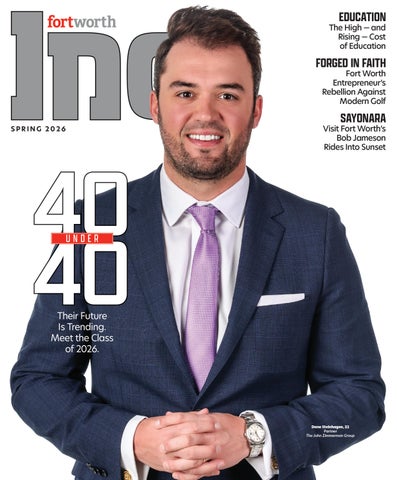
32 Top of the Class: The stars of these 40 fine folks aren’t just rising, they’re right overhead and shining like supernovas. They’re titans of industry, educators of our youth, planners of our city, and pavers of the future.
56 The High Cost of Learning: If our math is right, beginning one’s higher ed at a four-year college equals four years of tuition. With rising costs, other, walletfriendly options are looking less like a frog and more like a prince.
60 MBA Guide: A comprehensive list of Texas universities that offer Master of Business Administration degrees.
4 Publisher’s Note Bizz Buzz
10 Running on Horseback: In Fort Worth, piling in cash from equines has nothing to do with having a good day at the tracks.
16 EO Spotlight: Leslie Shields, who entered entrepreneurship during a pregnancy and pandemic, credits this baptism by fire for her subsequent success.
Inside the C-Suite
20 Health & Fitness: If the aftermath of COVID-19 brought any bright spots, one would be the reflective tape this CFO wears since picking up a passion for running.
24 Leisure Class: Taking his cues from Ben Hogan, Christopher Griffin has set out to make golf clubs that’ll up your aesthetic game while lowering the scores in your golf game.
28 Food & Drink: Those thirsty for tequila will have a chance to get accustomed to a brand with no additives and one notable celebrity endorsement.
64 Analyze This/ Banking: The paperless way of doing business transactions is here to stay — better adapt if you haven’t already.
64 Analyze This/ Legal: A state-wide cut in regulations will make at-home food businesses an enticing industry for future entrepreneurs.
66 Analyze This/ Taxes: The passage of the One Big Beautiful Bill Act will require some recalibration — and recalculation — when it comes to charitable deductions.
68 Analyze This/ Chamber: Don’t underestimate the role of business advocacy in advancing Fort Worth’s economic success.
72 1 in 500: After leaving an undeniably positive impact on Cowtown, Bob Jameson, who has helped guide Visit Fort Worth as president and CEO for the past 13 years, is officially laying down the reins.

18 From the Mayor: No need for Fort Worth to mask its identity. As the city banks on the West, it’s paying off.


OWNER/PUBLISHER HAL A. BROWN
One of the great privileges of publishing Fort Worth Inc. is having a front-row seat to our city's future. Every spring, that future comes into sharp focus with the 40 Under 40 issue — and this year’s class reminds us just how strong Fort Worth’s bench really is.
This marks the 39th year of the 40 Under 40 awards, and only our second year stewarding the program since acquiring it from the Fort Worth Business Press in 2024. We approached that responsibility with equal parts humility and resolve. This program matters. It has history. It has credibility. And, most importantly, it shines a spotlight on the rising leaders who are already shaping Fort Worth’s economy, culture, and civic life.
The response this year was nothing short of remarkable. We received 309 nominations, each one a testament to the depth of talent across our region. Narrowing that field down is never easy — and it’s certainly not scientific — but it is thoughtful, intentional, and rooted in leadership, impact, and trajectory.
The resulting 2026 class has an average age of 36, with honorees comprising of 41% women and 59% men. It is an impressive group by any measure. They represent a wide and dynamic cross section of Fort Worth’s professional ecosystem: accountants and attorneys, architects and builders, bankers and boot makers. You’ll find consultants and city government leaders alongside doc-
tors, dentists, distributors, educators, entrepreneurs, hotel executives, manufacturers, local retailers, and Realtors — just to name a few.
What unites them isn’t a job title or an industry. It’s momentum. These are people who are building companies, improving institutions, serving their communities, and creating opportunity for others— sometimes boldly and other times quietly.
We will celebrate this year’s honorees on Thursday, Feb. 12, at River Ranch, where we’ll once again gather friends, colleagues, and supporters to recognize not just individual achievement but the collective promise of Fort Worth’s next generation of leaders.
To our winners: Congratulations. To those who nominated them: Thank you for taking the time to recognize excellence. And to our readers: Enjoy getting to know this exceptional group. If Fort Worth’s future looks bright, it’s because people like these are already at work.

VOLUME 12, NUMBER 1, SPRING 2026
owner/publisher hal a. brown president mike waldum
editorial executive editor john henry creative director craig sylva senior art director spray gleaves contributing editor brian kendall
photographer richard w. rodriguez copy editor sharon casseday
advertising main line 817.560.6111 territory manager, fort worth inc. rita hale x133
advertising account supervisor gina burns-wigginton x150
advertising account supervisor marion c. knight x135 account executive tammy denapoli x141 account executive patrick mccune x158 senior production manager michelle mcghee x 116 contributing ad designer jonathon won marketing director of digital robby kyser marketing manager corinn crippin events and promotions consultant victoria albrecht
corporate cfo charles newton operations manager kaitlyn lisenby
To subscribe to Fort Worth Inc. magazine, or to ask questions regarding your subscription email customerservice@fwtexas.com.
Fort Worth Inc. is published quarterly by Panther City Media Group LP, 6777 Camp Bowie Blvd, Suite 130, Fort Worth, TX 76116. Postage Paid at Fort Worth, Texas. POSTMASTER: Send change of address notices and undeliverable copies to Panther City Media Group, 6777 Camp Bowie Blvd, Suite 130, Fort Worth, TX 76116 Volume 12, Number 1, Spring 2026. Basic Subscription price: $19.95 per year. Single copy price: $6.99
©2026 Panther City Media Group. All rights reserved. No part of this publication may be reproduced without written permission from the publisher. how to contact us For questions or comments, contact John Henry, executive editor, via email at jhenry@fwtexas.com.


The 40 Under 40 event, held on Feb. 21, 2026, at the River Ranch Stockyards, celebrated Fort Worth’s rising leaders and their remarkable achievements. This unforgettable evening was made possible thanks to the generous support of our sponsors. PRESENTING SPONSORS

WE SET THE STANDARD FOR BUSINESS EXCELLENCE IN FORT WORTH.
READY TO JOIN US?
Ameriprise Financial
Apex Capital Corporation
Blueprint Communications
C1 Truck Driver Training
Caribou Coffee
Clearfork Wealth Management
Cullen Yards LLC
Jani-King of Fort Worth
Enchiladas Ole’ Restaurant
Evans & Rosedale Capital
Firefighter Roofing
Fish Window Cleaning
Getz Dental
Institute for Success and Leadership Training, LLC
Mula Integrative Health & Wellness
National Cowgirl Museum & Hall of Fame National Multiple Sclerosis Society
Orant Charities
Plumb
The Guitar Studio
The Salvation Army Fort Worth
Thrift Store The Vickery
VIP Total Health & Hydration
WellMind Therapy Center
WLF Club

What

Cold snaps come and go, but the equine economy keeps Fort Worth warm — and flush.
WORDS BY JOHN HENRY
In Fort Worth, the first part of the year always brings extra layers of flannel, bull sheeeeet, and cold hard cash.
We’re grateful for two of those. Old Man Winter can stick it. (I do hope he didn’t hear that.) Yet, he just can’t seem to help himself by decreeing a round of “Stock Show weather” to torment us all.
And, sure as Christmas comes every year on the 25th, he hit us with a visit from the Arctic Circle in late January.
I saw something on the socials the other day about the Alaskan Wood Frog. It freezes solid in the winter. Heart stops, breathing ceases, brain goes silent. In the spring, it comes alive as if nothing happened. That’s many of us in winter.
Well, anyway, that’s all offset by the
economic impact, which like the Fort Worth Stock Show and Rodeo is enduring. And hot. Well, it’s legendary.
At an economic impact forum, “The Power of Sports in Fort Worth,” hosted by the Fort Worth Chamber of Commerce, Stock Show officials say its impact on the local economy is $120 million, with 1.2 million people visiting the grounds for the 23-day show.
Moreover, the impact of Will Rogers Memorial Center is $350 million a year. There are horses roaming the property pretty much year-round. Specifically, about 200 events every year. That’s why they call those guys who built the complex 90 years ago visionaries.
Will Rogers, as you know, debuted its multimillion-dollar makeover for the Stock Show, including newfangled
amenities like hot water in the bathrooms.
Horses were at the center of economic development in Fort Worth at the very beginning, and they still are. The more things change … .
“Whether you know it or not, whether you're a bank or a builder, your business is fueled in part by the equine industry,” says Pam Minick, who moderated a discussion about the equine industry in January at the Kimbell Art Museum. “In the Stockyards alone, when you think of equine, you might think of the steers, but we've got drovers on horseback that push those steers and 10 million visitors a year are seeing that. Don’t think that those visitors don't impact your businesses.”
Among those is the National Reined Cow Horse Association, which has moved all of its operations to Fort Worth after transferring its premier event, the Snaffle Bit Futurity, here several years ago. Between two events, one in February and the futurity in the fall, the NRCHA is in the coliseum 30 days.
The NCHA holds its three major events at Will Rogers, including the Futurity each November and December.
The transformation of the Stockyards includes the city-owned Cowtown Coliseum. Built in 1908, she is the grand dame of public buildings in Fort Worth. It is managed through a partnership of the PBR, ASM Global, and Stockyards Heritage Development Co., which has upgraded the facility to meet modern standards and expectations.
Those upgrades have amounted to a transformation in business activity.
In 2026, the complex will host 279 events, up from 76 when the partnership took over, says Tim Young, general manager of Cowtown Coliseum.
“We've worked really hard to keep the historical value while making the building function better for our guests,” says Young. “I believe in 2022 it did about $4 million of revenue just out of the Coliseum. We'll finish this year at about $28 million.”
In Fort Worth we’re getting another equestrian event this year: FEI World Cup Finals Jumping & Dressage, April 8-12 at


Dickies Arena, which itself has fostered a huge economy with more than 1.1 million people walking through its stately doors annually. More than 12,000 of those came to see the Dallas Mavericks play Oklahoma City in a preseason opener. Mavericks president Ethan Casson was also part of the forum. He says they’ll definitely be back.
The FEI World Cup, though, will bring top riders from Europe, Australia, the Middle East, and North America to Fort Worth, all of them vying for the world crown.
It takes, ahem, los huevos to do this stuff, says Ms. Minick.
“The,” um, “balls that people have to have to do the cow horse event and the tenacity that folks have to be a bull rider,” says Minick. “But these equestrians that make a 6-foot jump … it's not if they fall off, it's when, because it's just unnatural. And the elegance of these horses. If you don't have tickets to that event, you need to because it's a whole different level of horsemanship.”
That World Cup will precede by a couple of months the other World Cup — futbol’s FIFA World Cup. Soccer’s governing body said in January that more than 500 million people in just over a month — that’s half a billion — submitted applications for the event’s random selection draw.
In addition to the host countries — U.S., Mexico, and Canada — the highest number of applications came from Germany, England, Brazil, Spain, Portugal, Argentina, and Colombia.
Many of them will be coming here to the so-called “Dallas Stadium” — better known as AT&T Stadium in Arlington (someone really needs to have a talk with these out-oftowners) — to watch, among others in the round robin portion, England, Argentina, and Japan. Who knows who is coming in the knockout round.
“These are events that we support, but that are independently run and operated here and really bring an increased economic impact to our city,” says Mitch Whitten, COO of Visit Fort Worth. “And many people ask us, ‘How do we get involved?’ Or ‘How can we support?’ It's really simple: buy a ticket, attend, bring a child, bring a grandchild, bring family.”
Residential disrupter LEAGUE builds out a full-service platform as Scott Lowe steps in to lead commercial expansion.
WORDS BY JOHN
HENRY
An upstart that made its name shaking up Fort Worth’s residential real estate scene, LEAGUE is now making a deliberate push into commercial. It’s doing so with a leader who has seen the business from nearly every angle.
LEAGUE Commercial has named longtime broker and entrepreneur Scott Lowe as managing director, marking a new phase for a firm that has grown quickly by pairing relationship-driven brokerage with a heavy emphasis on storytelling and marketing.
“When I look back at my 14-year journey, I’ve been part of groups that were just getting started and grew into something meaningful,” Lowe says. “LEAGUE is at that point right now. The culture, the leadership, the relationships — it made sense to pour back into something that’s building.”
Lowe joins LEAGUE after 14 years with Vision Commercial, where he helped grow the firm from a handful of agents into a respected player across Tarrant County and the Mid-Cities. Before that, he spent time with Panther Real Estate, working on the development side, and built a career that spans investment sales, brokerage, financial planning, and business ownership.
That operator’s perspective — not just the broker’s — has become a central part of LEAGUE Commercial’s pitch.
In 2008, during the depths of the recession, Lowe and his partners bought a coffeehouse franchise and redeveloped an old gas station into a café in the Mid-Cities. The experience, he says, permanently shaped how he views commercial real estate.
“When you’re the one signing the lease, negotiating finish-out, trying to figure out free rent and allowances, it changes how
you advise people,” Lowe says. “Real estate decisions impact day-to-day operations in ways business owners don’t always see until they’re living with them.”
That lens aligns with how LEAGUE’s founders began thinking about commercial real estate two years ago. As the residential brokerage grew — now topping roughly 150 agents — referrals to outside commercial firms kept piling up.
“There were agents already in-house who wanted to jump into commercial,” Lowe says. “They were seeing the growth of Fort Worth, the branding opportunity, and the fact that deals were leaving the company.”
Rather than continue outsourcing, LEAGUE chose to build its own platform.
Today, LEAGUE Commercial has grown to about 10 agents and is positioning itself as a full-service operation serving business owners, investors, and operators across North Texas.
“Scott’s reputation in the commercial arena is marked by integrity, expertise, and results,” says Matt Lewis, LEAGUE’s co-founder and broker. “His leadership strengthens our ability to serve clients across every real estate need.”
The firm has invested heavily in marketing infrastructure, including drone photography, high-end visuals, and agentled video storytelling more commonly associated with luxury residential listings.
“There’s momentum everywhere,” Lowe says, pointing to the Stockyards resurgence, major developments at University and White Settlement, westward expansion near Walsh and Aledo, and a steady influx of young talent. “We’re one of the largest cities in the country now, but affordability is still here. That creates opportunity.”


WORDS BY JOHN HENRY
We were introduced to Stella Jets, a women-owned private aviation company based in Southlake, two years ago.
Oh, the places they are going — and have been since lifting off as a charter broker.
Tia Minzoni, president and co-founder, and her co-founding daughter, Jasmine Johnson, have since launched two other Stella brands — StellaShAire and Stella Experiences — and, even more recently, have been introduced to a nationwide audience.
The company was featured in an episode of Bravo’s “Real Housewives of Potomac” on Jan. 18 to show off the luxury private jet experiences it has to offer.
Stella Experiences, brand- and celebritycurated travel events and sweepstakes, gives travelers a chance to hop on board with a favorite celebrity or athlete. StellaShAire is a members-only, by-the-seat private aviation service that bridges the gap between first-class commercial travel and full jet charter, offering private terminal access, concierge service, and a streamlined, stress-free flying experience.
“The production company had heard of us from some of their talent,” says Minzoni, who joked that she “never wanted to be famous. For me, everything is about the brand, and I was scared to death to see myself on TV.”
The episode showcased Stella Jets’ white-glove concierge service as cast members experienced private jet travel. The appearance marks another milestone for the company, which has become a household name since its 2022 acquisition by Minzoni and Johnson.

The company offers access to nearly 7,000 aircraft operators worldwide through its three divisions.
“Being featured on 'Real Housewives of Potomac' is our chance to shatter every outdated assumption about private aviation,” says Minzoni. “We’re disrupting an industry that’s been gatekept for far too long. And we’re doing it with women at the helm, proving that luxury aviation can be exceptional for everyone.”
Gatekept refers to access to private aviation, implying that cost, culture, and entrenched power structures have historically kept the industry narrow, exclusive, and male-dominated.
Stella also has a new headquarters — Addison Airport — where the company operates from its own private terminal and luxury lounge, one of the few companies with dedicated private terminals.
The opportunity to work with the women of “Real Housewives,” Minzoni says, “wasn’t just business, it was a statement.”
“We’re building the table we weren’t invited to, and we’re bringing other women with us,” she says.
The Bravo appearance also won’t be a one-hit wonder. Stella will get more exposure in an upcoming episode of “Real Housewives of Atlanta” this summer, as well as something to be announced with Netflix, Minzoni says.
“We’re excited about that,” Minzoni says. “We’re doing a lot of stuff with production companies and talent, especially under Stella Experiences, and putting together these cool experiences for the cast.”
Chamber Duty Calls: Reata honcho Mike Micallef has been named chair of the Fort Worth Chamber for 2026. He succeeds Brian Newby.
Important Tax Season Note: The feds introduced a change to the worst time of the year. Paper checks are being phased out as the IRS moves nearly all tax payments and refunds online.
Scoring in the Sandhills: Mark and Robyn Jones, founders of Westlake-based Goosehead Insurance, purchased the 41,000-acre Pawnee Springs Ranch in Nebraska for $56 million, a record-setting sale in the Sandhills region. They intend to develop it into a “world-class cattle operation” focused on ranching and backgrounding livestock.
More Ranching Real Estate: In January, Theorem Ranch acquired Teton Ridge’s T9 Ranch and Equestrian Facility, a Western performance property in Parker County. The property had been listed for $45 million. Jason Itkin and Kisha Itkin plan to relocate their horse operation from Montana.
Everybody Now Welcome: Wilks Development announced that The Harden at Public Market, a 199-unit apartment community located behind the historic Fort Worth Public Market, received approval from the Department of Housing and Urban Development to transition from senior living to conventional housing, opening the property to residents of all ages. The Harden opened in October 2025 and offers one- and two-bedroom residences ranging from 723 to 1,550 square feet. Rental rates start at $1,391.
More Gold in the Permian: A new U.S. Geological Survey assessment estimates 28.3 trillion cubic feet of natural gas and 1.6 billion barrels of oil remain technically recoverable in the Woodford and Barnett shales deep beneath the Permian Basin.
Raising the Trophy: Despite negative net absorption overall, an analysis by JLL shows that Class A and trophy office space in Fort Worth recorded strong demand in 2025 as tenants continued relocating into higher-quality buildings.
Industrial Strength: Dallas-Fort Worth ended 2025 as the strongest industrial real estate market in the United States, powered by surging leasing activity and steadily tightening vacancy, according to a JLL report. The region marked a seventh consecutive year exceeding 20 million square feet — a feat unmatched by any other U.S. market.


Several years ago, an insurance mentor’s blunt advice sparked an epiphany for Leslie Shields.
A 1099 agent did not constitute true business ownership.
“He told me, ‘You don’t own it if you can’t sell it,’” Shields recalls vividly of what inspired her to open her own agency. “I didn’t want to do that anymore. So I decided to go out on my own … I mean, very quickly. Open enrollment opened Nov. 1, and I think I was still processing but didn’t care. I just leapt. I wasn’t selling one more season for a business I didn’t own.”
That was the start of the Shields Agency, a Fort Worth-based health insurance firm she opened in 2019.
We all know what happened next: COVID. But just because she’s extra challengeoriented, Shields also threw pregnancy into the equation. A difficult pregnancy at that. Hyperemesis. Hyper what?
“It means basically you are deathly ill the entire pregnancy,” she tells me in words I now understand.
She made it all work, however, even managing three weeks of maternity leave. She and husband Chris have a healthy 5-yearold boy, Harrison, who is running around the office on South Main as we converse in a conference room.
Shields, 42, a Texas A&M graduate who grew up in Rockwall, has entrepreneurship in her blood. Her father owned a financial planning business, and her mother, at 74, still has her own practice as a therapist.
She is an advocate for women in business. “I have a passion in that area,” she says. “I'm really involved with the women of EO both regionally, nationally, globally.”
A mentor’s blunt advice pushed Leslie Shields to build a business she could truly own, just as COVID and pregnancy collided.
WORDS BY JOHN HENRY PHOTOS BY RICHARD W. RODRIGUEZ
Tell me about the podcast. "It covers the messy stories of authentic, vulnerable entrepreneurs. We decided that we should do my story first, and I couldn't do it. And I was putting it off and putting it off and putting it off. Chris told me, 'Well, don't do it by yourself. Have one of your friends who knows you well, interview you. And so I did. It made it so much easier."
You are writing a book? "Yes. The Hidden Hiring Advantage. It's about how small-business owners tap overlooked talent pools — including remote rural workers, part-time mothers, and post-retirement people. It should be out this year."
How did starting a business while sick and pregnant change you as a leader? “I don’t know who I would’ve been as a business owner if I hadn’t gone through that. The things that became really important to me during that time — flexibility for women with children, empathy, humanity — I extended to my team. That’s how we built everything.”
What's something about you that would surprise people who know you only professionally? “Probably that I love to cook and once lived in Bandera, Texas, where I taught school for two years — I was kindergarten and pre-K.”
What's a habit or routine you swear by? “I have to do yoga or bar two to three times a week. And if I can do more than that, I do.”
What's your coffee order? “Americano. I put my calories into food and wine. I love good food.”
Do you have any book recommendations? “I like kind-of self-help books. I really like Gabrielle Bernstein, and she talks all about manifesting and attracting the right things in the universe.”

She also streams a podcast titled, “Life, Business, and Everything in Between.”
“He told me, ‘You don’t own it if you can’t sell it.’”

The mayor says the numbers prove it.
WORDS BY MATTIE PARKER
PHOTO BY OLAF GROWALD
There’s been a lot of talk about the economic impact of the Fort Worth Stock Show & Rodeo — and for good reason. Welcoming roughly 1.2 million visitors every year, the Stock Show and Rodeo’s estimated annual economic impact is around $120 million. That isn’t just a reason for our city to celebrate it’s revealing of
the moment Fort Worth is experiencing.
Along with our cherished culture and traditions, it’s a testament to the importance of Western sports and heritage to the vitality of our city. The impact stretches far beyond the 23 days of competition every January and February, from the repeat visitors who fall in love with our city during the stock show to the numerous special events hosted in conjunction throughout the year. This sustained momentum is made possible in large part by the City of Fort Worth’s strong partnership with the Fort Worth Stock Show & Rodeo at the Will Rogers Memorial Center.
A now 90-year-old treasure, the Will Rogers Coliseum and Memorial Center is part of our city’s identity. And the City of Fort Worth and FWSSR’s continued investment in renovations of the facility will only increase its impact for years to come.
That blend of authentic Western heritage and forward-looking growth is attractive to rodeo fans and major global companies alike.
For example, iconic workwear brand Ariat International announced late last year that it will invest $72.6 million and create 250 new jobs as it relocates its regional headquarters to Fort Worth. The announcement underscores the city as a destination for logistics and world-class brands while leaning into our authentic Western culture.
Our city’s unique “brand” is also playing a leading role in bolstering our economy through the film and entertainment industry. This past year we celebrated nearly $1 billion in economic impact and more than 50,000 jobs created in Fort Worth over the past decade, thanks, in part, to what some like to call the “Taylor Sheridan” effect. Sheridan, along with 101 Studios, the team at the Fort Worth Film Commission, and countless others, are championing this work on behalf of our city.
Meanwhile, Fort Worth’s traditional industries continue to thrive, and we are seeing more and more companies bet on Fort Worth with relocations and expansions in every ZIP code.
Embraer broke ground last fall on its new $70 million aircraft maintenance
center at Perot Field Fort Worth Alliance Airport, which will grow the company’s North Texas presence by more than 50%. Wistron announced in August its plans to establish two AI supercomputing facilities at AllianceTexas – an estimated $761 million total investment. And earlier in the year, Siemens opened a $190 million manufacturing hub in South Fort Worth.
These wins fueled a monumental 2025 for economic development and growth in Fort Worth, thanks to our robust incentive programs and efforts by the city and the Fort Worth Economic Development Partnership. In FY25 alone, we secured $6.7 billion in new capital investment and nearly 7,000 new jobs.
The return on these deals is clear: wellpaying jobs that allow people to build their lives here, a more diversified economy that can weather downturns and global disruptions, and a stronger commercial tax base that reduces the burden on our residents. The projects Fort Worth won last year are forecasted to produce $166 million in net new taxes for the city over the life of their incentive agreements.
But there’s more to this economic success than incentive programs. Behind a strong local economy is a simple truth: People want to live and work and raise their families here.
Fort Worth continues to be one of the fastest-growing large cities in the country. And our city’s high quality of life and focusing on what matters most to our residents – like public safety, infrastructure, green space – play a major role in this growth. Local government focused on the basics and smart policy that sets the city up for success far into the future, along with our cultural authenticity, is shaping the city’s economic outlook for 2026 and beyond.
And if the Fort Worth Stock Show & Rodeo is any indication, Fort Worth’s economy isn’t just riding momentum — it’s champing at the bit for the next run.
Fort Worth Mayor Mattie Parker is serving her third term.

20 Health & Fitness / 24 Leisure Class / 28 Food & Drink
In the agave fields of Mexico, a Parker County tequila brand is staking its claim on craft, culture, and a woman challenging tradition.


What began as a pandemic escape became a predawn ritual on the trails for a Fort Worth CFO.
WORDS
BY JOHN HENRY PHOTO BY RICHARD W. RODRIGUEZ
The COVID-19 pandemic and shutdowns will be remembered as the perfect little misery for the living. Shut in with nothing to do except drown
our boredom and anxiety in whiskey, Judge Judy, and “The Price Is Right” — without Bob Barker. “The Price Is Right” without Bob Barker is like spring in Texas without bluebonnets.
There was one very positive offshoot for many of us during that time — we got tired of being shut in and doing all that stuff. We went outside and began to move. Outside left plenty of room to leave 6 feet between you, friends, and strangers.
And outside was the ideal place to start exercising again.
That’s exactly what happened with Robby Bourgeois, CFO of Man Group.
"I didn't start running until COVID," he says, explaining that with his company based in New York, he was there two, three times a month. Plus, he had new kids.
“I went probably eight years of just not being very active. COVID grounded me for about a year and a half, two years, and I needed to do something.”
That something turned into running, which is now, five years later, part of his lifestyle.
Bourgeois will be one of the thousands partaking in The Cowtown, the annual running and fitness festival in Fort Worth. He’ll be running the race’s half-marathon, conducted on March 1, the same day as the marathon and ultra marathon.
"Running is a good way to explore cities, too,” says Bourgeois, who is back on the road quite a bit, but he now does more than merely find good places to eat dinner.
Bourgeois is a native of New Orleans, a graduate of Jesuit High School. He came to Fort Worth to go to TCU, where he studied accounting and finance. His older brother had found TCU.
“I had visited him a couple of times when I was in high school and had a lot of fun,” Bourgeois says. “I hate to say I followed him, but I basically followed him. My parents encouraged us to get out, go do something.
Bourgeois and two partners launched Varagon Capital Partners in 2014. He was the CFO. The partners sold a majority of the business to the Man Group in 2023. Man Group owns 75% of Varagon, while the co-founders and some minor equity holders own 25%. Varagon continues to run as a distinct investment platform under the umbrella of Man Group. Bourgeois remains CFO of that investment engine.


He also serves as a member of the Man U.S. Charitable Foundation and is a member of the board of directors for the Boys & Girls Clubs of Greater Tarrant County.
Soon after he discovered running, Bourgeois connected with the Fort Worth chapter of F3, a men’s fitness group built around fitness, fellowship, and faith. (Faith is defined by them as “a belief in something bigger than yourself.”)
Founded in Charlotte, North Carolina, in 2011, F3 has since grown to more than 24 countries and 48 states.
F3 in Fort Worth was founded right after the COVID period when we all needed more fitness, fellowship, and faith.
“I started in May of 2020 with F3,” Bourgeois says. “By November of that year, a couple of us had signed up for the half in the Fort Worth Marathon. It kind of snowballed from there. It was like, ‘Oh, I can do this. I kind of like running.’”
A year later, he ran the New York Marathon, which is a five-borough tour of
New York City, starting on Staten Island and winding through Brooklyn, Queens, the Bronx, Manhattan, and into Central Park. In addition to being one of six World Marathon Majors, it is the largest marathon in the world in terms of participants. It draws more than 50,000 finishers a year from just about every country in the world.
“From Staten Island, your first mile and a half to two miles is climb, but then descending down from there is when the crowds start forming, and you're like, ‘Oh, this is really cool.’ And, ‘I need to slow down, too, because I'm already going way too fast.’
“Coming over the bridge, I can’t remember the bridge — from Queens and Brooklyn into the city — on mile 16, that's when the crowds start roaring. That was really cool.”
He’s done with marathons — for now. It’s a matter of time. Work, family, and marathon training is too much. Once his
kids, ages 12 and 10, become more selfsufficient and involved in fewer activities, he’ll likely make a jump back in the 26.2mile haul.
For now, it’s working primarily with the F3 group, which he meets up with just about every morning at 5:30. He makes a a trip to Comfort, Texas, each year with those guys for an ultra-type relay experience. It’s eight guys who each have to run 3-mile, 5-mile, and 8-mile loops.
The weekly work amounts to about 20 miles a week, plus separate workouts in between. When I met up with him at the Clear Fork trailhead on a recent Thursday — on the eve of Mother Nature releasing her winter hell spell — he had just completed a 5-mile jaunt.
“We work out rain or shine,” says Bourgeois. “It's kind of addictive. That sort of combination of, I call it community and accountability, is pretty addictive. It's a lot of fun.”


Fort Worth golf entrepreneur channels Ben Hogan’s precision and perseverance into American-made irons.
WORDS BY JOHN HENRY
Christopher Griffin was a latecomer to golf, but like one who comes to faith later in life, he discovered a love for the game that was indeed full of flame.
It wasn’t the chase of the handicap that motivated him. It was golf’s story. Its past, its places, and the craftsmanship. The aesthetics and tradition meant more than the score, though he is more than capable of efficiently slapping the ball around the course.
“I was in my mid-30s,” Griffin says. “Most of my rounds, once it really grabbed me, were walking solo rounds, twilight nines.
I was very lucky to be at a beautiful public course up in the north of Seattle for most of those rounds. And I just fell in love with the entire experience, really, as much as anything.”
Griffin is a self-described “very aesthetically minded” person. He grew up around a lot of art. A lot of books, he says. And over a period of time, he began to notice something that bothered him as engineers had taken over the club design business over the last generation of play.
It was with that mindset that he had a revelation.
"At some point I realized I was look-
ing in the golf stores, and there wasn't a single club that appealed to me in any way whatsoever,” Griffin says. “There was no engineering claim that could be made to entice me to play something that looked the way these clubs looked.”
"This is such a beautiful game. It's played in such a beautiful setting, and yet you look in people's bags, and it's just one abomination after another."
When Griffin began browsing the used racks of old golf clubs, he said it felt like walking through an art gallery, filled with vintage Top Flites, Hogans, Wilsons, and MacGregors. He quickly fell in love with the aesthetics of those classic designs.
“I made a decision that that's what I was going to play,” he says.
With that began research into what would eventually become Precision53 — P53 — Griffin’s golf club design and manufacturing business based in Fort Worth. It was founded in 2014 and began selling privately to clients since 2000.
His company was founded on two principles — manufactured in America with American steel, and every club is designed as a high-end product and a piece of functional art.
“Those are two things that you just don't find in the golf industry anymore,” he says. He adds that his is the only golf equipment company in the world “committed to forging its irons in the United States.”
Forged from certified U.S. steel, P53’s irons were the first in over two decades to achieve this.
“We invested in our own tooling and dies and sourced 100% certified U.S. steel for this project. We paid a very high price in both capital and time to do things the right way.”
To borrow a phrase, which I’m sure you’ve heard, he had a vison to make American irons great again. And he plans to do it inspired by whom we consider America’s greatest golfer, with all due respect to Mr. Jack and Mr. Tiger.
P53 is an homage to the perseverance and persistence of Fort Worth’s Ben Hogan and one of golf history’s greatest seasons, 1953, when the Hawk won the Masters, U.S. Open, and British Open. All only four years after suffering life-threatening injuries in a car accident in West Texas.
“P53 is a tip of the cap to the man,” Griffin


says. “I have always appreciated his perseverance in the face of just unbelievable hardship and the unbelievable lack of faith of others. And he prevailed.”
Griffin is an interesting guy.
Raised in Memphis, Griffin earned an English degree with a minor in chemistry from Mississippi College before completing a master’s in English literature at Baylor University. He later added a master of humanities in philosophy from the University of Dallas. After marrying, he settled in Dallas, then moved to Austin in 2003, where he earned an MBA in private equity finance and entrepreneurship from the Red McCombs School of Business at the University of Texas.
Following a series of finance-related roles, Griffin was recruited to the West Coast, where he spent six years at Microsoft working in the venture capital arena. In 2012, he returned Texas.
Griffin had piddled around in college with golf but never seriously. He only picked up the game later because his father-in-law was a player.
“My father-in-law had picked up the game after a 30-year hiatus, and that's what got me into the game. He would come to visit, and to entertain him or while we were there [we’d play golf]. I went down to the big box store and bought whatever set of clubs was on sale on the wall.
“Surprisingly to me, I fell in love with the game.”
Griffin is exacting about what qualifies as a forged iron. P53 clubs are produced using a single billet of U.S.-certified steel sourced from mini steel mills in the Midwest, rather than multipiece constructions that rely on screws, internal weights, or assembled components.
That billet is sent to a family-owned partner forge in the Pacific Northwest, where the irons are shaped using a massive gravity-hammer forge — larger, Griffin notes, than anything commonly seen in even the most revered Japanese forging operations.
The process requires custom tooling and dies designed specifically for P53, a level of investment and control he believes is essential to true forging, even if the broader industry applies the term far more loosely.
“The industry clearly disagrees with me on that, and there's no regulatory body to enforce it,” he says.
Unlike many manufacturers that contract overseas production and work from preexisting blanks, P53 controls the process from the raw steel forward. After forging in the Pacific Northwest, every head is shipped to Texas, where all machining, grinding, and finishing are completed in-house.
The approach is slower, more expensive, and intentionally uncompromising. For Griffin, however, it is the only way to produce an iron that reflects the integrity, craftsmanship, and performance standards he believes modern golf equipment has largely abandoned.
Each club costs in the four-figure range. He’s very private about how many clients he has. He says the figure is in the hundreds not the thousands.
But suffice to say, he’s very selective about whom he sells to.
“These are exceptionally interesting people from all over the world, mostly in the United States from all different walks of life,” Griffin says. “The attribute that holds us together is sort of a mutual appreciation of some aspect of what I'm trying to do. For some, that’s American manufacturing. For others, it's the quality of the product. For others, it's the experience of coming down and spending time with us and getting to know and understand the process.
“But in every case, there's some identification where someone wants something more than what the industry typically offers.”
Each client — individually — is invited to Fort Worth for a club fitting and conversation about the manufacturing process. Fitting and education take about a day. The next day they play golf at Griffin’s home club.
“It’s ostensibly a testing scenario of fitting with real balls, real pens, second shots on sidehill lies.”
Typically, it takes a hundred days or so to deliver the clubs.
Griffin started this business with Jeff Sheets, a golf club designer. “He was a great set of guardrails for me because he had seen so much in terms of experience.”
Griffin leases space at Leonard Golf Links
in West Fort Worth. It’s the same facility Nike used before leaving the golf club business in 2016. Marty Leonard has a small investment in the company, she says.
“I think he accomplished what he wants in terms of actually designing and getting a club made that he's satisfied with because he's a perfectionist, no question,” says Leonard.
A perfectionist, just like Hogan.
“I think he would like it,” Leonard says of what Hogan would think of Griffin’s enterprise. She knew Hogan well, noting, of course of the mercurial Hawk, with a laugh, “You don't know about Hogan for sure.”
“But [Griffin] is just about as precise as he was and wanting it to be just exactly almost perfect. I'm encouraged and anxious for him to get the clubs in more people's hands where people can actually try ’em out.”
As I’m listening to Griffin’s story, it suddenly dawns on me that this unique golf innovator is somewhat like another from yesteryear.
Marvin Leonard had tried to play golf in his early 20s but found it took too long to play. He reasoned that even as a bachelor, he was too busy with an upstart business in downtown Fort Worth to mess with chasing a white ball around a golf course.
A doctor convinced him to change his mind some years later when Leonard was in his early 30s. He needed exercise and recreation, the doctor told him.
Golf became an obsession for Marvin Leonard. Rather than equipment, it was bent grass greens. He was told bent grass, which he discovered in California, could never survive in Texas.
When I suggest the parallel, Griffin almost breaks down. He turns his head slightly from the computer screen so as not to reveal tears welling up.
When he’s able to compose himself, he says to me:
“The thing that I continue to hear about Mr. Marvin was his vision,” Griffin says. “I'm sure Marty would agree, I don’t hold a candle to Mr. Marvin. But what I did appreciate was that he would often do things that would leave others scratching their heads, but he saw something that a lot of people didn't see.”


In Mexico’s agave fields, a Parker County tequila brand bets on craft, culture, and a woman breaking tradition.
WORDS
BY JOHN HENRY
Here’s a drinking game for you. Before you agree to play, make sure you’re not driving and doubly make sure you don’t have anything important to attend to the next day.
OK, ready, set, go: Take a drink for every celebrity with a tequila brand.
You’ll have a good buzz on your head before finishing this sentence.
I counted 16, and I’m surely missing some. They include Clooney, Strait, one with a Kardashian tie (insert an eye roll here), Eva Longoria, Sammy Hagar, Lebron James, Michael Jordan — not in that order — The Rock, Kevin Hart, and Nick Jonas. I didn’t even realize Nick Jonas was old enough to drink. Check his ID.
Whatever the case, the celebrity brands have had to confront the critical eye — namely the view that their products are more vainglorious cash grabs than passion projects.
"Our space really got bastardized by the shove-it-down-your-throat, celebrityendorsed additive garbage,” says Andrew Summersett, 38, an entrepreneur from Aledo whose “juice” is clearly a passion project.
Point Blank Tequila is free of both additives and coastal celebrities, though there is a local A-lister who approves.
Point Blank was the exclusive tequila sponsor for Bosque Ranch Live, the inaugural music festival in the fall hosted by Taylor Sheridan at his Bosque Ranch.
You’ve heard of him, I’m sure of it.
The event served as an introduction of the brand for a fall market retail launch. And it’s the first element of, by all appearances, a partnership between Point Blank and Sheridan on specialty events and branding.
The three expressions of Point Blank: blanco, anejo, and reposado.
Point Blank has made a splash since entering the retail market. Most recently — beginning in February actually — Point Blank landed a major distribution deal with Total Wines. You can find it there in the store’s locations in Texas’ five major cities — Fort Worth, Dallas, Austin, Houston, and San Antonio. It’s there as well as a growing number of other liquor stores in DFW, including Gina’s, Uptown Liquor, Fort Liquor, Brock Liquor, and Orale Liquor. You can also order directly from the website at pointblankmarket.com/collections/all.
“It’s very uncommon for a brand-new label to [land that kind of deal],” Summersett says. “I mean, that's mecca, right? That just doesn't happen for new labels in their first year. We got in front of their staff, they tasted it, they loved it, and they loved the story.”
They loved the whole gang, Summersett adds.
Point Blank, Summersett says, has all the elements of the Sheridan's cowboy ideal — a blend of respectful rebellion and one who pushes back against conformity, particularly the conventional wisdom of celebrity brands.
This vaquero identity isn’t mere costume and script, however.
Point Blank’s story begins in the Highlands of Jalisco, Mexico, an important cultural region of eastern Jalisco. You’ll find Summersett down there five or six times a year. The place has become part of his being.
The distillery is in the small town of San Juanito de Escobedo in Altos de Jalisco. Its historical development was shaped by early Spanish-colonial settlement and indigenous resistance. It retains a deep Catholic heritage, visible in its pilgrimage sites and strong cultural conservatism.
Economically, the area is anchored in livestock, local manufacturing, and, yes, tequila. Altos de Jalisco is a part of the important blue agave production zone.
The town has a population of roughly 11,000.
Summersett calls the landscape “shockingly beautiful.”
“It is a tequila town,” Summersett says. “All the farming and production in and around are based on agave and tequila farming primarily. There's a lot of sugarcane down there, but it's mostly a tequila town. It's just ingrained in that culture. At Thanksgiving, you're not drinking wine with your turkey or whatever. You’re drinking tequila. The people there — our partners, our friends who are really more like family than anything — this is what they do. This is their legacy and their parents' legacy and their kids’ one day. It’s an amazing thing. It's a fascinating place.”
Tequila doesn’t begin in a bottle but rather a field.
Long before tequila existed, agave shaped

We’re proud to see you honored for the positive impact you're making ever y day for our team, our clients and our future Congratulations, Car ter, on your 40 Under 40 recognition!


40 Under 40 Honoree, Jared Shelton
As president of Texas Health Harris Methodist Hospital Fort Worth, Jared Shelton is committed to improving the lives of those we serve in Tarrant County. We’re proud to have him at the helm, providing oversight of the future of the hospital. Shelton’s ability to align mission-driven leadership with a compassionate, community-first mindset sets a powerful example in health care for our hospital and beyond. With so many personal and professional achievements in just the past few years, it’s no surprise he’s a 40 Under 40 honoree.
daily life in Mexico. Indigenous communities used the plant for food, fiber, tools, and fermented drinks, and its cultivation long predated distillation.
When the Spanish introduced distillation during the colonial era, agave was transformed into a spirit, and by the 1600s agave distillates were being produced around the town of Tequila in Jalisco, where blue agave and local conditions began to define a distinct regional product.
For generations, tequila remained a rural, labor-intensive trade, passed down through families and closely tied to ranch culture. Even today, agave sets tequila’s pace and character: The plant takes six to eight years to mature, must be harvested by hand, and reflects the land where it grows. In Jalisco’s highlands, cooler temperatures and higher rainfall produce sweeter, more floral agave.
Skilled harvesters called jimadores use a coa, a sharp circular blade, to strip the agave down to its heart. A plant harvested too early lacks sugar; too late, it ferments poorly.
For generations, those heavy piñas were carried out of the fields by hand or loaded onto donkeys like Nacho, the real animal whose likeness now anchors the Point Blank’s label.
incredible,” says Summersett. “She's a very strong woman in a very male-dominant industry and society.”
Summersett isn’t the only one who believes “she’s the best.” Gómez Santiago was named 2024 Best Woman Distiller by the Women’s International Wine & Spirits Competition. To further illustrate the uniqueness of a woman as master distiller, La Alteña, for instance, appointed its first woman master distiller in its 88-year history in 2025.
Mexico elected Claudia Sheinbaum as its first female president in 2024 — a historic milestone, to be sure — but that kind of
worked in capital equity raising and real estate much of his career. He has a degree from Baylor and a master’s in international business from St. Mary’s University in San Antonio.
He has partners in this endeavor — Bill and Jeff Foss, father and son. Bill Foss is the founder and CEO of Sauvecito Tequila. Bill was looking to sell an agave farm he purchased in the early 2000s when the recession reared its head and showed its fangs in 2008-09. It was difficult to find a buyer. Coincidentally, that also happened to be when the agave plants were at long last ripe for picking.

Nacho, whose real name is Sebastian, is a real donkey that lives on the ranch in Mexico, cared for by a vaquero also named Nacho.
James Michener’s Mexico portrays a Mexican society long shaped by Spanish colonial patriarchy, Catholic hierarchy, and rigid gender roles, particularly in rural, agricultural regions.
In his depictions of agave culture, mezcal, and early tequila production, skilled trades and distilling are almost exclusively male domains.
But it’s against that historical backdrop that Zandra Gómez Santiago has broken through. She is the master distiller — maestra tequilera — at Destiladora Agave Azul distillery, the renowned agave plantation and distillery behind Point Blank, owned by Don José García.
She is truly a pioneer in the industry.
“She's a self-made tequilera, and she's
stuff remains very much an exception in male-dominated Mexican society.
Gómez Santiago has been at this for more than 20 years. She was brought on by Don José García as an administrative aide and evolved in the craft. Summersett describes her as a “finance and accountant mind” by education and tequila by craft.
“She is what we would call a super taster. She has that palate. She has that complexity in her sense of smell and sense of taste,” he says. “And she evolved very quickly to managing the nuance of the harvesting and the distillation process.”
Summersett also believes that something Taylor Sheridan recognized with the Point Blank brand: girl power. The writer and director has a penchant for strong female character in his Paramount+ empire.
Point Blank is also leaning into the culture and history to market its tequila brand.
Summersett has been at this for close to four years. Before taking this on, he
The Foss team turned all that into its own tequila brand all their own.
“I’ve always been obsessed about things that have a very high barrier to entry, things that are hard to do because not everyone does them,” Summersett says. He cites as an example the “hundreds of thousands of companies” that got halfway through or three-quarters of the way through a label and never landed it in the states or on the shelf.
“It can be a lonely, tough place when you're producing and importing and branding and selling. It's a ton of work. I don't want to minimize the efforts here, but if you want to brew your own beer in your basement, you can. If you want to go find some soil in West Texas or the Panhandle and grow grapes and make wine, you can do that too. Tequila's not that way. You got to go where the tequila is. You got to go to Jalisco, Mexico — the region of tequila. That’s where the agave is.”
By the sounds of it, he was also tired of drinking bad tequila with George Clooney or whoever’s name on it. There is a very discerning tequila community — like wine — that will “spit out your product if it’s not premium quality.”
Point Blank ain’t that stuff.
“No, you don't have to dump it into a margarita to stand it. That's not tequila, right? I mean, let us show you how it's really made, how the magic happens here, and what it's supposed to taste like, what the experience is supposed to be. I think that's magic.”


Here they are.
Meet the 2026 40 Under 40 class, all Fort Worth leaders already leaving an outsized mark on business, culture, and community.
The Fort Worth Inc. 40 Under 40 Class of 2026, a cohort of talented and inspirational young people who are driving Fort Worth forward to a future that will, in part, be molded in their image.
Rather than describing themselves simply as driven, many of this year’s honorees pointed to something more foundational: the ability to build relationships and tell compelling stories.
Those skills — connecting people, ideas, and opportunities — have helped them lead impactful companies, rethink how business is done,
BY JOHN HENRY / PHOTOGRAPHY BY RICHARD W. RODRIGUEZ
and uncover unexpected avenues for investment across Greater Fort Worth.
These are founders launching companies before most people feel settled, executives trusted with big decisions early, civic leaders shaping neighborhoods, and creatives redefining how Fort Worth sees itself.
One is a forensic accountant who cut his teeth on a multibillion-dollar divorce case and … is a card-carrying Swiftie. That tracks.
They are also bold.
Among this year’s overachievers is at least one who can say, truthfully, that
she decorated a 12-foot Christmas tree with a live monkey on her shoulder. File that under “chaos management.”
Another of our subjects took up English jumping because, as she puts it, she needed “a hobby that’s not eating food.” I get that. We all get that.
It hasn’t been easy, of course, reaching this point of life and career. It’s required curiosity, discipline, and persistence.
And as Conan O’Brien once said, some delusion, no doubt.
That’s the way this thing works. Sometimes.
Sheri Audu, 38 Dentist
Museum Smiles
Helping people smile with confidence isn’t just Sheri Audu’s profession — it’s personal. As a teenager, improving her own smile became a turning point in her confidence and self-expression. That experience stuck. It showed her how something seemingly small can have a powerful ripple effect, shaping how people see themselves and how they show up in the world. Dentistry became her calling.
For more than a decade, Fort Worth has been the place where that mission has come to life. Audu arrived drawn by the city’s energy, momentum, and sense of possi bility — and she’s loved growing alongside it ever since. Dentistry is about connection as much as care.
“Fort Worth has been the perfect place to grow alongside a community that never stops reaching higher.”
Grounding it all is family. Her parents, especially her mother, have been her steady compass, reminding her to focus on what truly matters and not sweat the small stuff.
Fort Worth: A great place to live, work, and play. What are you doing when at play? When not in the office, you can usually find me on the Trinity Trails or at a neighborhood gym.


Partner
Whitley Penn
Aaron Ballard has always had a thing for numbers. As a kid, he watched stock tickers on CNBC for fun and even built financial statements for his own odd-job “business” at age 10. That early curiosity stuck, steering him toward accounting and finance in college, but not down the traditional audit-or-tax path. Ballard wanted something different. He found it in forensic accounting, where finance meets the law. The turning point came just three years into his career when he was tapped to work on a multibillion-dollar divorce case that consumed the next two years of his professional life.
“This once-in-a-lifetime case was incredibly challenging and rewarding, and it confirmed that this career path was going to be a long-term fit for me,” says Ballard, who has bachelor’s and master’s from Abilene Christian University.
Throughout that journey, Ballard credits mentor Jim Penn, founder of Whitley Penn, for shaping his approach and expectations. Penn pushed him to think creatively, aim higher, and grow from a “baby-faced” graduate into a firm partner.
Beyoncé or Taylor Swift? Willie Nelson or George Strait? “As a card-carrying Swiftie, my answer to both questions is Taylor Swift.”
Founder & CEO
Fort Worth STEAM Academy
Nicholas Ditto once planned a career as a public defender aimed at expanding access to justice. Over time, he recognized that many systemic challenges shared a common root: unequal access to high-quality education.
“I realized I could make the greatest impact in the classroom.”
The Fort Worth Chamber of Commerce named Ditto its 2025 Young Professional of the Year, honoring his leadership and impact expanding educational opportunity. Ditto led Fort Worth STEAM Academy from concept to state approval and broadened access through free STEAM programs across Fort Worth.
The tuition-free public charter middle school will open in August.
Ditto, who has a bachelor’s from University of Minnesota and a master’s in secondary education from Arizona State, has been a principal in the IDEA Public Schools.
“I believe education is the cornerstone of opportunity.”
He’s a bowler. “Bowling in a league is a meaningful part of my week. It builds community and helps me reset after a busy stretch. The sport is unique: You’re competing against yourself while motivating your team, and they’re doing the same. That mindset carries into my work at Fort Worth STEAM Academy.


Numbers have always been Amy Brietzke’s north star. She began her academic journey studying agricultural economics at Texas A&M, initially picturing a future rooted in agriculture. Then a pivotal conversation with an ag law professor changed everything, introducing her to commercial banking and a specialized master’s program that opened an entirely new path. Brietzke credits that advice as career-defining.
Today, she specializes in commercial real estate banking, with a focus on single-family development and homebuilding.
Her defining moment came early. Just 11 months into her first portfolio manager role, her entire team departed the bank, leaving her — barely out of training — responsible for a $350 million portfolio. Choosing to stay and lead through uncertainty tested her.
“That period tested my resilience and leadership in ways I hadn’t anticipated, but it ultimately strengthened my confidence and shaped the professional I am today.”
All part of that ag upbringing.
The buckles “take me back to where my story began showing steers — long days in the barn and countless hours of practice. Each buckle represents a quiet victory earned through patience, hard work, and heart.”
Senior Portfolio Manager Argent Financial Group
While Charles Denison’s school-age peers were following every move of their favorite professional athlete, he had his eyes on … fund managers?
“Bill Miller was a favorite at the time,” he says. Denison followed that direction, earning a bachelor’s in finance from Ag U, Texas A&M.
His introduction to investment management was on a ranch where his parents and grandparents raised cattle. “I remember one particular calf we sold … my mother reinvested the proceeds into a mutual fund,” he says. “That experience bridged the worlds of agriculture and investment management for me and planted a seed.”

Agriculture, he says, taught him the triedand-true principles of patience, stewardship, risk management, and “the idea that meaningful growth compounds over time.”
He is board president of the BRIT Foundation.
What is your mantra? “Own the outcome. In life and in investment management, there are countless factors outside our control. But what we can control is how we prepare, how we respond, and the decisions we make. Owning the outcome means accepting reality as it is, rather than what we wish it were, and taking full responsibility for what’s within our influence.”

Chief Business Officer
Higginbotham
Carter English, who played football at TCU, began his career chasing a dream of coaching in college. He worked his way into the profession, but over time the lifestyle no longer aligned with the future he envisioned as a husband and father. That realization prompted a pivot. Following a brief stint in finance, an introduction to Higginbotham redirected his path.
In 2022, English and his wife relocated to San Antonio with a job with Higginbotham. The move coincided with the birth of their daughter, Isabelle, who was born with Down syndrome. What began as a season of uncertainty became one of purpose. Inspired by their daughter’s life, the family helped launch The Rise School of San Antonio, expanding educational opportunities for children with special needs.
English and his family are back in Fort Worth, where he now serves as chief business officer.
An eighth-generation Texan with a proud Western heritage, the cowboy hat is “one of my most valued possessions.” It’s also symbolic of Higginbotham’s mantra to “wear the white hat.” The whistle represents his life as a college football coach, a “season of my life that was incredibly formative.”
Partner
La Palmilla Texas
Mitchell Ellis says he’s always had an entrepreneurial zeal but was never sure how to pursue it.
He had a career in aviation as a helicopter pilot and later joined the Fort Worth Police Department. He spent 13 years as a patrol officer, tactical operator, and detective in the Crimes Against Children Unit.
He and his wife, Kimmie, started a small business, Miter and Pine, a furniture business. In 2015, they made their first real estate investment, which led to building an Airbnb in 2019.
Then in 2018, something terrible happened. Ellis’ fellow officer Garrett Hull was killed in the line of duty.
“Garrett’s death hit us deeply and became a defining moment in our lives. It reminded us how short and fragile life can be, and it pushed us to start pursuing the dreams we had always talked about.”
La Palmilla Texas hotel in Glen Rose opened in 2023. It has experienced “incredible growth” since. Between running the hotel and launching a new helicopter company, Ellis, who has left law enforcement, has found his calling.
Favorite quote: “Commit your actions to the Lord, and your plans will succeed.” -- Proverbs 16:3

Ryan Griffin approaches each venture with a simple guiding principle, borrowed from Abraham Lincoln: “Whatever you are, be a good one.” So far, so good.
While still a student at UT Arlington, Ryan Griffin launched Fort Worth Axe Factory as a class project. What began as an experiment
people together, solving problems creatively, and building brands that become ingrained with the community.”
Most important mentor: “My late grandfather was the biggest influence. He ran an automotive business for over 50 years. His legacy taught me that entrepreneurship isn’t just about making money. Being a business owner is about showing up every day, treating people right, and building


Baylor Scott & White Cardiovascular
Karan Gupta has always been drawn to disciplines that demand rigorous problem-solving. Cardiology is that. The integration of physiology, engineering, and cutting-edge science captured his interest early.
That curiosity was transformed to a calling in med school when in 2013 his father required emergency open-heart surgery.
“Seeing the profound impact his cardiologist and surgeon had — not only in saving his life, but in giving our family more time with him — deeply shaped me,” Gupta says. “It showed me the kind of difference a physician can make at the most critical moments in someone’s life.”
The birth of his son also reframed his sense of responsibility, reinforcing his belief that his work extends beyond treating individual patients to helping build a healthier future for the next generation. Together, these experiences continue to drive Gupta’s dedication to advancing the prevention, treatment, and eventual cure of heart disease.
What are you doing in your free time? When not at work or coaching, attending, or bussing our kids to their various extracurricular activities, you will likely see me on the golf course or driving range at the Mira Vista Country Club. I have been severely bitten by the golf bug.”

Polsinelli
Elizabeth Hatch represents purchasers and sellers in all aspects of commercial real estate transactions. She earned her Juris Doctor from Texas Tech University School of Law, graduating summa cum laude and as a member of the Order of the Coif, and holds a bachelor’s in English from Trinity University. Her mother initially suggested she become a lawyer, a career path she originally dismissed in favor of nursing.
“My mom really wanted me to be a lawyer, but that was never a childhood dream of mine. So,
it’s funny, as much as I hate to admit it, my mother was 100% right.”
Funny how that works. What Hatch knew was that she didn’t want to teach English and discovered she didn’t want to be a nurse, either.
Hatch has also taken on a new hobby — horseback riding in the English tradition. That is, jumping. “And a couple years ago, I was like, I have to have a hobby that’s not eating food,” she jokes. Her cousin was in English. Hatch tried it and fell for it. Today, she and her horse Aspen can be found jumping obstacles.
Bonds Ellis Eppich Schafer Jones Eric Haitz didn’t set out to become a restructuring attorney.
While in law school, after clerking for two federal judges, he told a hiring partner he wanted to be a trial lawyer. The response — a mix of skepticism and challenge — nudged him toward bankruptcy law, a field he knew little about. One class later, he was hooked. By the end of the summer, Haitz opted out of litigation entirely, drawn in by the blend of law, finance, and strategy that defines restructuring work.
A graduate of the University of Virginia School of Law, where he also earned an MBA, Haitz thrives at the intersection of legal analysis and business reality. For him, restructuring is about more than courtrooms and statutes. It’s about understanding cash flow, capital structures, and how leverage can create viable turnaround stories. Today, advising middle-market companies and creditors that business fluency often proves decisive.
The Lion, the Witch and the Wardrobe by C.S. Lewis “reminds me that even when the path isn’t obvious, there’s room for courage and creativity. For me, it’s a quiet nod to doing things my own way while keeping a sense of wonder.”

Alissa Kolm, 34
VP Relationship Manager — Corporate Banking Bank of Texas
Moving to Fort Worth with her husband in 2015 was a defining moment for Alissa Kolm.
“I had never been to Fort Worth,” she says, “I had no idea at the time just how many wonderful people I would meet and how much we would grow to love this city.”
Her extrovert personality drew her to banking. Kolm sought a career that paired analytical rigor with meaningful relationship-building.
“Banking uniquely blends those two strengths,” she says.

It also comes with the opportunity to help local companies grow, what she says is the most rewarding part of her work.
She wouldn’t be standing where she is today without her parents, who provided the stability and security to take risks in opportunities. And it’s that growth, she says, that happens outside of one’s comfort zone.
“Looking back, I realize just how lucky I was to have that foundation, something I know, unfortunately, not everyone is given at the start of life,” she says.
Matthew Minor is living his best life with the dual life of actor and residential real estate agent.
“Business excites me and art fulfills me,” he says.
Minor, a graduate of Arlington Heights, pursued his art in New York for 10 years after studying at Oklahoma. He remains a member of the award-winning Godlight Theatre Company and travels back to work with them when able. A graduate of The Neighborhood Playhouse School of the Theatre in New York, he was inspired on the stage by Betty Buckley, who told him he was “made to be an actor.”
Since 2019, he has risen in business as a residential agent.
Compass, he says, operates by a guiding principle that strategic growth isn’t just about the numbers, but about who a person is and what they bring to the business — valuing character and contribution as much as financial performance.
“Compass never forgets that.”
Magnifying glass? “It represents what I do every day — look high and low for my client’s next property. I’ve got to find what’s not on the internet.” He also recently performed in a Sherlock Holmes play.

VP HR Operations & Analytics WWEX Group
Diego Montalvo’s professional journey calls to mind a familiar piece of Yiddish wisdom: “If you want to make God laugh, tell Him your plans.”
While completing a Master of Science in Exercise Physiology at TCU, he planned to continue on to a Ph.D. program. Burnout, however, led him to take a year off. It was a decision that ultimately reshaped his career.
He landed a role as a corporate recruiter through Vista Equity Partners for one of its portfolio companies, where he found a mentor who introduced him to a field he quickly grew to love. As he progressed, Montalvo discovered a passion for using
data and problem-solving to guide meaningful business and people’s decisions.
The blend of analytical rigor and human connection continues to drive him today. It wasn’t the path he envisioned, but one he wouldn’t change.
“God truly made a way and opened doors I never expected,” he says. “That one decision set me on a completely different path — one that has brought purpose, growth, and fulfillment.”
Favorite motivational quote: “Success is not final, failure is not fatal; it is the courage to continue that counts.”


Sara Norman is a transactional partner at Cantey Hanger, where she focuses on real estate, business entities, estate planning, probate, and related commercial matters. She brings a decade of legal experience to the Fort Worth firm after practicing law exclusively in Southeast Texas before joining Cantey Hanger.
Norman is board certified in commercial real estate law by the Texas Board of Legal Specialization, a distinction she earned in 2022, and has been recognized by industry peers as a “Rising Star” in Super Lawyers for 2023 and 2024 as well as in The Best Lawyers in America: Ones to Watch for Real Estate Law and Trusts & Estates. She also received the 2022 Outstanding Young Lawyer Award from the Jefferson County Bar Association.
Norman’s educational foundation began at Lubbock Christian University, where she earned a bachelor’s in organizational communications, cum laude. She continued her legal studies at Texas Tech University School of Law, graduating with a J.D. in 2014, with concentrations in energy and corporate law and membership in the National Order of the Barrister.
Has she watched “Saturday Night Fever”? The disco ball wasn’t a styling choice so much as a personal brand statement. Norman enjoys living.

VP Marketing
Justin
Brands
Storytelling is in Jessica Ogden’s blood.
“I grew up loving books, movies, and music videos — storytelling being the common denominator. I’ve always been captivated by how stories can connect people across differences,” she says.
It is one reason she chose a camera to be photographed with. “It reflects how I approach my work — listening first, observing closely, and letting the story lead. The best marketing happens when the focus stays on the customer, not the marketer, and authenticity is allowed to do the heavy lifting.”
Marketing wasn’t the original plan, but it proved to
Birdie Bridal
Syble Owings and team have grown Birdie Bridal to three locations in Azle, Fort Worth, and Colleyville. Her mentor James Barton has always been along for the ride.
Owings credits the late Barton as her greatest influence
be an ideal blend of a type-A, analytical mindset driven by problem-solving and a creative instinct focused on building and expression. While it wasn’t a path she would have predicted early on, it has become a natural fit for her strengths.
Becoming a mother, she says, “has only clarified my purpose and perspective.”
Where will you find her at play? During rodeo season, the rodeo — duh. “I’ve served on the Horse Show Greeting and Justin Mutton Bustin’ committees at the Fort Worth Stock Show & Rodeo. We love cheering on our favorite Justin athletes, Fletcher’s corny dogs in hand.”
in business. Barton, she says, was a rare presence whose genuine joy and encouragement left a lasting mark on everyone he met. From an early age, Barton recognized what he called a “spark” in Owings.
More than offering advice, he was her steadfast cheerleader, urging her to take risks, believe in her abilities, and maintain optimism through challenges.
“His faith in me helped build the foundation of the confidence I carry today as a leader and business owner,” she says. His example continues to shape how she leads — serving as a daily reminder to lift others up with the same kindness, encouragement, and unwavering belief that he so freely gave.

Beyoncé or Taylor Swift? Willie Nelson or George Strait? None of the above. “I’m more of a Forrest Frank fan! I love jamming out to his music with my kids — it’s always such a fun, feel-good time for us.”
Chef
The Crescent Hotel Fort Worth
Preston Paine didn’t follow a traditional learning path. Severely dyslexic, he often found that linear styles of thinking and education didn’t fully click. The kitchen, however, did. Its tactile, hands-on nature resonated in a way that immediately made sense.
Paine discovered cooking through a family mentor, trained internationally and at Eleven Madison Park, co-founded Shug’s Bagels, and now serves as executive chef at Crescent Hotel’s Emilia’s.
For Paine, the culinary world isn’t just about food; it’s about experience. He’s drawn to the idea that a meal can anchor a memory, mark a celebration, or turn an ordinary moment into something meaningful.
That perspective continues to shape how he approaches his craft.
Tell us about the chef’s knife: “This knife has been with me on every step of my journey. It’s been used in every Michelin-starred kitchen I’ve worked in; I used it while coming up with the recipes for my bagel shops; it’s been on set with me for all of the

Jessica Perez is Fort Worth all the time, driven by the power of connection to make an impact in community.
As president of SteerFW, she focuses on creating opportunities, building rela tionships, and strengthening Fort Worth through leadership, collaboration, and service. Her work is shaped by a desire to solve challenges and open doors where they didn’t previously exist — particularly for those navigating barriers similar to the ones she witnessed growing up as the daughter of immigrants.
Stepping into leadership within SteerFW marked a defining moment in her career.
“I’ve always been inspired by the pow er of connection and making an impact,” she says. “My career path has been driven by a desire to solve challenges, build meaningful relationships, and create opportu nities where they didn’t exist before.”
The purse “reflects my pride in Fort Worth and my commitment to building meaningful connections that open doors for others. This city has shaped who I am, giving me opportunities, mentors, and a platform to advocate for my community. Every day, I work to help make Fort Worth a thriving, inclusive city where people feel supported, empowered, and seen.”

Co-Founder
Realsy Foods Inc.
Austin Patry brought to the office an Xbox controller. It represents a passion many don’t know he has — gaming.
“I love diving into complex, openworld fantasy realms to unwind. I look at these games as art — I’m constantly inspired by the developers’ world-building and narratives.”
He’s on this list because of his entrepreneurial zeal.
Patry, who studied — and experienced — entrepreneurship at TCU, co-founded Realsy after identifying a need for genuinely clean, simple snacks made with real ingredients. At TCU, he and partner Sophia Karbowski launched a health-food truck and later
brick-and-mortars before pivoting into consumer-packaged goods — thank you, COVID — creating nut butter-filled date snacks free of additives. Their mission-driven brand champions nutrition and transparency, scaling nationwide while staying true to wholesome, farmto-shelf snacking values.
Food, like gaming, is a natural for him.
“I grew up in restaurants, so food has always been at the center of my life,” he says. “Nutrition has always been a core value for me, and I wanted to share the power of clean, delicious, and nutrient-dense snacks with the world.”
What is your guilty pleasure TV show? Currently, Hunter x Hunter (Anime).


Principal
Schwarz Hanson Architects
John Pathak was born in Kathmandu, Nepal, and moved to Texas at age 9 when his parents relocated to Dallas to study at Christ for the Nations Institute. From an early age, he felt a calling to use his gifts to further God’s work in his home country.
In 2019, Pathak, who has bachelor’s and master’s degrees from UTA, took a leap of faith, leaving his job to spend six weeks in Nepal partnering with a local Christian architecture firm serving remote Himalayan communities to support mission-driven work.
That experience reshaped the trajectory of his career and ultimately led him to Schwarz Hanson Architects, where he continues to pursue purpose-driven projects. Among them is work in Nepal providing housing, education, and safety for children rescued from human trafficking.
“The Khukuri is a weapon that the Gurkha soldiers carry, but it also represents the strength, courage, and loyalty of the Nepalese people. It gives me a glimpse into the work ethic and self-discipline of the people I am connected to. As the saying goes from the famous Gurkha and Mountaineer Nims Purja: ‘Giving up is not in the blood.’”
President Ricochet Fuel Distributors
Cass Powell grew up listening to business talk at the dinner table and riding along on fuel checks, absorbing just about everything of the company her mother, Kelly Roberts, founded in 1988.
“I saw my mom as a busy executive, but she was at family dinner every night, and I
started with the company as marketing coordinator and held multiple roles before working her way to the role of president.
“Growing up, I always loved and respected that I had two hard-working parents, and I wanted that for my family,” she says. “I really kicked my career into overdrive when I worked during most of my first maternity leave. When my second son came and lived in the NICU for six months, I realized how things needed to be


SVP Commercial Relationship Manager Regions Bank
Kyle Sederstrom’s love of fly fishing started young and became a shared passion with his family, rooted in time spent outdoors with a fly-fishing rod in hand. For him, the sport offers a rare connection between the fisherman and the environment.
The parallels to his career are clear. Like fly fishing, progress isn’t always about the immediate outcome. The “catch” isn’t the sole measure of success; the real value lies in the craft, preparation, learning, and patience required along the way. That philosophy continues to shape how he approaches both his work and long-term growth.
Sederstrom has had a lifelong curiosity about how money and commerce work, particularly how entrepreneurs build companies. It was a mindset that followed him through high school and ultimately led him to TCU, where he earned a finance degree.
Middle-market commercial banking proved to be the right fit, blending finance, relationship-building, and community engagement into a fulfilling career path.

President
Texas Health Harris Methodist Fort Worth
Jared Shelton is president of Texas Health Harris Methodist Hospital Fort Worth, one of the largest acute-care hospitals in North Texas, a role he assumed in September 2024. With the appointment came a clear signal of confidence of his trajectory from senior leadership: “Jared is a rising star.”
He previously led Texas Health Harris Methodist Hospital Hurst-Euless-Bedford and served in leadership at Texas Health Presbyterian Hospital Allen and Dallas.
Shelton earned a bachelor’s degree from Wake Forest University and a master’s degree in healthcare administration
CEO & GM
G.L. Hunt Foundation and Repair
When his father-in-law faced serious health challenges, Hayden Slack was called upon. His sisters-in-law weren’t available, and his brothers-in-law were pastors.
So, it was Hayden Slack, with bachelor’s and master’s degrees in accounting from Angelo State University, who took over G.L. Hunt.
“I was the only one who could take it on,” says Slack. “What started out as a family responsibility has turned into a passion for building a company that makes a real difference in people’s lives.
from Trinity University in San Antonio. He serves as the Regent for the Texas-Northern region of the American College of Healthcare Executives and on the Texas Hospital Association’s Council on Policy Development.
“I always had a desire to do something professionally that was going to help people. Given my interest in business and strategy, I thought healthcare leadership might be a way for me to positively impact my community.”
He brought his putter and a plaque of his scorecard from a round of golf this summer at the Old Course at St. Andrews, Scotland. “It represents three things I love: travel, golf, and history.”
G.L. Hunt was founded by Gary Hunt in 1987. In addition to Fort Worth, the company has locations in Dallas, Austin, San Antonio, and Waco.
“Much like our lives, our businesses are shaped by thousands of small decisions,” he says. “Consistency is what led me to where I am today.”
What might you be doing away from the office and job site? “My wife and I love catching concerts and the rodeo at Dickies Arena, then heading down to the Stockyards to spend time at the Drover.”


President/Co-Owner
B Smart Builders
Heather Smitherman went to TCU to become a teacher. “Never did I imagine my career would be in construction, but I have absolutely loved it.”
B Smart Builders was founded by Cheryl Bean in 2008. Smitherman joined soon after and took over the company a few years ago.
“Watching her work with contractors, clients, and employees was truly inspiring. For 14 years, we worked side by side until she chose a different path.”
One of the biggest turning points in Smitherman’s journey came when she and her partner
were accepted into the 20/20 Club, a national network of elite builders. Meeting twice a year with industry leaders nationwide, the experience reshaped the company.
“That opportunity didn’t just improve our processes, it elevated our vision and helped us grow into the business we are today.”
When not at the office, where are you at play? With four children, there isn’t much downtime, but “you’ll often find us at the Woodshed patio or sharing a margarita at Joe T’s. It’s our favorite way to unwind and enjoy time together.”
Phillip Michael Smart was born to a 13-year-old mother and single parent.
“We grew up together and learned together,” says Smart, who has a degree from Northwestern State in Natchitoches, Louisiana (that’s NAKuh-tush). “Her grit, showing up, stretching what we had, refusing to quit, became my blueprint. She taught me to measure success by the stability you create and the dignity you keep.
“That’s why I chose economic development: I know the cost of limited opportunity, and I’m committed to changing it.”
His journey is simply her lesson applied, he says — turn struggle into purpose and purpose into progress.
In his career, the Louisiana native has helped secure millions in investment capital to support revitalization efforts and drive meaningful neighborhood transformation across Louisiana and Texas.
What are you doing away from the office? “When I’m off the clock, I am looking for the best Cajun food in the area, and I’m at the Fort Worth Nature Center & Refuge, hiking with the family, spotting the bison herd, and resetting by the water. It’s my favorite reminder that Fort Worth’s best playground is its wild side.”

Assistant General Counsel
Bell Textron
Since his days as a second grader, Kenneth Spears knew he wanted to be in business. Everything after that aligned with the goal. In high school he was the president of the Future Business Leaders of America. He went on to study accounting at Georgetown College in Kentucky.
As a junior in college, he was working in the university’s Office of Advancement, where the vice president at the time — an attorney — frequently encouraged promising students to consider law school. Spears more than once had consistently brushed it off.
One day, however — what would later feel like fate — the VP refused to let the idea go. He told him, “I know you want to pursue accounting, but you really should consider law as well. Having both would put the world in your hands.
“That singlehandedly changed the trajectory of my life,” he says.
With a J.D. in hand from Texas Southern University’s Thurgood Marshall School of Law, Spears is today a bona fide business leader in the big world of business.
The basketball represents his competitive nature. He also played it growing up. Today, he coaches AAU basketball.


Kelly Hart & Hallman
Taylor Spalla decided years ago that the oil patch was preferable to the slick of politics. He had a unique opportunity to intern in the George W. Bush White House while at Southwestern University, traveling around the world coordinating events. His first job out of college was with a Texas gubernatorial campaign.
“I thought I wanted a career in politics and felt having a law degree would assist with that,” says Spalla, who went to law school at Texas Tech, where he also earned an MBA. “I soon learned during law school I was more intrigued with oil and gas law.”
Spalla was editor-in-chief of the Texas Tech Administrative Law Journal. He has worked for Kelly Hart in Midland, Austin, and now Fort Worth.
Career highlights include representing private-equity-backed energy clients in major Permian Basin transactions, including a roughly $500 million acquisition of groundwater rights and a $600 million sale of oil and gas assets to a publicly traded operator.
Beyoncé or Taylor Swift? Willie Nelson or George Strait? It’s complicated. “I am in my ‘Girl Dad Era,’ so … Taylor Swift. Growing up in Boerne — definitely George Strait.”

6th Ave Homes
Lauren Staats could easily claim a peculiar badge of honor: decorating a 12-foot Christmas tree with a live monkey perched on her shoulder.
Whiskey tango foxtrot was a-goin’ on there?
A Fort Worth native, Staats believes her career path was a matter of nature and nurture. Her adoptive parents always encouraged creativity, she says, but then she discovered her biological parents were an interior designer and pool builder.
Her professional journey took her across the Red River, where she jokingly calls herself a former “traitor.”
Staats spent seven years in Oklahoma City, working with an interior design firm and later with a developer focused on historic remodels and urban infill projects.
It was in OKC that she also found a pivotal mentor in Scarlet Le Cao, who, along with her current employer, Jimmy Williams, pushed her beyond her comfort zone.
“They saw something in me I hadn’t yet conceptualized,” Staats says.
What’s up with the wallpaper? It represents boldness, color, and unexpectedness. “The boldness represents my belief that great spaces and great businesses don’t happen when you play it safe; they happen when you’re willing to make a statement.”
Senior VP UMB Bank
Daryl Stafford is senior vice president and relationship manager in the Commercial Banking division at UMB Bank, where he leverages more than a decade of corporate banking experience to drive client engagement and support business growth.
He holds a BBA and an MBA from TCU.
A close friend during Stafford’s senior year in college introduced him to a commercial banking training program that offered rotations across several departments. He saw it as a great opportunity to gain broad exposure and identify where his strengths and interests aligned. “Those rotations proved invaluable and helped me to develop a well-rounded foundation and ultimately sparked my interest in areas like energy and fund finance — fields I hadn’t considered before.”
He is also CFO of La Pamilla Texas, the hotel co-owned by 40U40 Class of 2026, Mitchell Ellis.
He is pictured with Cowtown Clay, a Father’s Day gift. The handprint mold of his two sons was used to create the A. “It is such a strong reminder of my family and the purpose of why we work. I cannot imagine anything more that I would want to represent me than my faith and my family.”


Linebarger Goggan Blair & Sampson
Jordan Stimpson’s law career began behind the scenes of “Good Morning America,” of all places, with Diane Sawyer and Robin Roberts. She was a summer intern working on a journalism degree at SMU.
“There were several big news stories that summer that involved legal issues, and I got to help with them,” Stimpson recalls. “The team said I had a knack for these types of stories and offhandedly suggested I look into law school.”
Stimpson earned a J.D. at University of Houston and began her law career at the Dallas County District Attorney’s Office. A five-year stint with the D.A.’s office in Tarrant County followed.
Stimpson says a simple credo has defined her life: Just say “yes.”
“Saying yes shaped my life in more ways than I can count and continues to do so.”
It started with saying yes to “Good Morning America,” despite having no idea how she’d arrange to move and live there. How to pay for law school? Who knows? But yes.
Mentors? She says her parents, small-business owners as Schlotzsky’s franchisees. “Watching my parents taught me resilience, endurance, hustle, grit, courage, and most importantly, faith.”

The John Zimmerman Group
Dane Steinhagen moved to Fort Worth to go to school and play baseball at TCU. He never left. Today, he’s in residential real estate. His attention to learning how to hit a curveball was matched only by his curiosity with architecture, design, and the intricate details of homebuilding.
“My fascination with luxury properties and distinctive craftsmanship naturally led me to pursue a career in real estate. Selling trophy homes has always been a professional goal, and I feel privileged to have cultivated the net-
work, market knowledge, and trust necessary to turn that vision into reality.”
He operates on the principle that though there are certainly more talented people out there — always are — none of them will work harder than he does.
His game-worn TCU baseball helmet reminds him what the game taught him and what he takes to his profession: discipline, preparation, resilience, and how to perform under pressure.
“Showing up every day, committing to getting better, and trusting the long game, which ultimately led to competing in two Men’s College World Series in Omaha.”

Associate Producer
Stage West Theatre
Garret Storms directs and produces a wide range of work at Stage West Theatre. His Stage West directorial credits include “Once Upon a Mattress,” “Cruel Intentions: the ’90s Musical,” Jacob Marley’s “Christmas Carol,” “Hir,” “Like a Billion Likes,” “Deer,” “The Nether,” and “Mr. Burns.”
“Since I was a very young person, I’ve loved stories,” he says. “And I was always intrigued with how stories were told — first-person, humor, music, a camera angle, bodies moving in space, genre. There are so many ways to tell any given story, and how a story is told can be so memorable and impactful.”
He also directs at Theatre Three, Undermain Theatre, and WaterTower Theatre. As an actor, Storms’ credits span Stage West and other regional companies including Amphibian Stage, Second Thought Theatre, Shakespeare Dallas, Uptown Players, and Trinity Shakespeare Festival. He holds a BFA in Musical Theatre from Sam Houston State University.
“‘The Wizard of Oz’ was foundational for me. Its profound influence continues to weave its way through my work — the necessity of adventure, the loss of innocence, the importance of friendship, the meaning of home.”
Owner & President ManaMed
We’ve met Trevor Theriot before. He is a past winner in Fort Worth Inc.’s Entrepreneur of Excellence program.
ManaMed is a medical device company that designs, develops, and distributes a wide range of orthopedic and recovery-focused products aimed at helping people prevent injuries, recover from surgery or injury, improve mobility, and manage vascular issues.
The company’s proprietary PlasmaFlow is a portable sequential compression device designed to help prevent blood clots after high-risk surgeries like total knee and hip replacements.
“PlasmaFlow gave patients a way to recover safely at home,” he says.
His career path began on UCLA’s football field. Then a player, he tore his anterior cruciate ligament (ACL) in his knee, kicking off a whirlwind of surgery, physical therapy, and recovery devices. He remembers thinking the “entire space feels stuck in time.”
“So much of what patients depend on hasn’t evolved. That experience lit a fire in me — to rethink how recovery could look, feel, and function.”
Favorite quote: “Success is peace of mind, which is a direct result of self-satisfaction in knowing you made the effort to become the best you are capable of becoming.” –John Wooden, “Pyramid of Success.”

VP Marketing
U.S. Energy Development Corp.
Like some others on this list, Tess Trahern is a storyteller, but she was drawn to the profession by storytelling’s ability to move markets, shift perceptions, and shape billion-dollar industries.
“Marketing became my perfect intersection of art and analytics: where a great idea can spark real-world impact. At its best, my work is translation. I take big, abstract ideas and turn them into something that actually connects with a group of people and drives results for the business.”
U.S. Energy Development Corporation is a privately held oil and gas exploration and production firm that was founded in 1980 in Buffalo, New York, by Joseph and Judy Jayson. Their son, Jordan Jayson, is the CEO today. The company is headquartered in the Stockyards.
Trahern has a bachelor’s in marketing from Oklahoma and an MBA from St. Edward’s in Austin.
Beyoncé or Taylor Swift? Willie Nelson or George Strait? Taylor and Willie — the storytellers. Of course. “Both know how to reinvent themselves while staying grounded in their roots, which is something I deeply respect.”

Varghese Summersett
J. Turner Thornton is a family law attorney and partner at Varghese Summersett, where he leads the firm’s Family Law Division.
A North Texas native, Thornton was born and raised in the region. He graduated with a bachelor’s in kinesiology (with a minor in business) from UT Austin in 2009. He earned his Juris Doctor from Texas A&M University School of Law in 2012.
Thornton is a three-time selection to Super Lawyers’ Rising Stars list (2023–25), recognition by Best Lawyers in America for family law, and earned the Texas A&M Law
Alumni Legacy Award for Private Practice Achievement.
“Admittedly, becoming an attorney was a biproduct of originally wanting to be a sports agent, ala ‘Jerry Maguire,’” Thornton says. “While I don’t work in sports, a lot of the same aspects of being an agent exist in my career, as family attorneys are heavily involved in some of the biggest decisions clients make in their lives.”
Podcast recommendation: cast. Jefferson is a great communicator and teaches folks how to apply lawyer communication techniques to everyday communication problems.”

JPMorgan Chase
Cassie Walker, then a freshly minted graduate of Texas Tech University, began her banking career at the absolute worst time. The year 2008, though, was only the beginning of adversity, particularly as it concerned her transition to commercial banking.
“I faced multiple no’s due to my lack of a business degree, but I persisted,” says Walker, who studied English and literature at Texas Tech.
She expanded her education with an Executive MBA at TCU, while gaining invaluable support at Bank of America.
More than ever, as a commercial banker with JP Morgan, she’s “inspired daily by the entrepreneurs who build our communities. Helping these middle market businesses grow and succeed isn’t just my job, it’s a privilege, and it’s exactly where I’m meant to be.”
She brought books with her to the photoshoot: “The books symbolize curiosity, imagination, and a lifelong desire to learn. The cowboy boots represent my roots and upbringing, grounding me in the values I was raised with and reminding me that no matter where life takes me, I always carry where I come from with me.”


UTA Fort Worth
Daisy Valk is a first-generation college graduate who has built a career around helping others find their way forward. Raised in Oregon and a Texas resident for the past 12 years, she now works at the intersection of education, advocacy, and community service. With more than 16 years of experience in social work, Valk began her career working with federal inmates before shifting her focus to survivor advocacy. She is now in her 10th year at The Women’s Center of Tarrant County, where she supports survivors of sexual assault.
Her commitment to access and opportunity also extends to higher education: At UTA Fort Worth, she manages graduate recruitment and community outreach, helping students navigate pathways to advanced degrees.
The keepsake Valk brought with her for a photograph is deeply personal — an ultrasound photo strip from “our pregnancy, symbolizing the moment our vision of parenthood became real.” She and her husband lost baby Iris. “It reflects a journey marked by love, loss, and growth. This experience continues to influence how we lead our lives — with greater empathy, perseverance, and a deep commitment to the future we are building.”
Lulu Hernandez Walker is a highly experienced public accountant with a focus on governance, risk, and compliance, helping organizations navigate complex technical and regulatory environments.
With more than eight years of experience, Hernandez Walker has led and executed a wide range of engagements, including SOC 1 and SOC 2 examinations, IT audits, Sarbanes-Oxley compliance, EI3PA assessments, FFIEC and FDICIA reviews, and technology consulting projects. She is particularly passionate about SOC engagements, where she leads teams in testing control design and operating effectiveness and delivers detailed, actionable reports that support both compliance and business objectives.
Her expertise spans business process controls, general computer controls, and application controls across diverse industries, including government, financial services, technology, loan servicing and origination, oil and gas, and professional services.
Hernandez Walker, who earned a BBA in finance from Texas Woman’s University, is a member of the Institute of Internal Auditors Dallas Chapter and the ISACA North Texas Chapter.
She was photographed in her beekeeper hat and smoker. “Beekeeping has become a calm, grounding habit for me, and these tools represent my commitment to supporting the environment and doing my small part to save bees.”


Trinity Metro
Eva Williams serves as director of budget and grants, overseeing the development and management of federal, state, and local funding for transit projects in Fort Worth and surrounding areas.
Williams has a strong background in finance, strategic planning, and project management, with experience spanning transit, marketing, and education. She graduated in May 2021 with an MBA from TCU’s Neeley School of Business. She has a bachelor’s from Texas Woman’s University in criminal justice.
“Interestingly, I like to say that finance found me,” she
says. “My career path shifted after experiencing some health setbacks, but that change led me to discover a genuine passion for the finance field.
“What began as an unexpected turn has grown into a meaningful career — one that allows me to support our agency’s mission and help ensure our community has safe, reliable access to the places they live, work, and play.”
That’s a reMarkable tablet she’s holding. “It’s where I keep everything — meeting notes, work ideas, personal goals, to-do lists, and random thoughts — so nothing gets lost or scattered. It represents how I try to manage both my work and personal life — simply.”


As tuition and living expenses soar, community colleges are emerging as Texas’ most effective engine for access, mobility, and workforce readiness.
BY JOHN HENRY / IMAGES BY OLAF GROWALD
e recently had the privilege of seeing economist Mark Dotzour make a presentation at River Crest Country Club.
He served 18 years as chief economist of the Real Estate Center at Texas A&M University. He has given more than 1,800 presentations to over 345,000 people and has written over 90 articles for magazines and journals.
He’s considered a leading authority on the Texas economy, known for his in-depth analysis of population growth, job creation, and real estate trends.
Dotzour is as entertaining as he is knowledgeable. And, yes, we know all about economists.
Economists have predicted nine of the last five recessions.
Economists are never wrong. Reality just underperforms expectations. Their forecasts can be spotty, but Dr. Dotzour has all kinds of hot sports opinions about the economy, specifically as it concerns real estate and education.
“If you happen to be investing in student housing, I would think twice about it now,” he says. “Here's the news, Bloomberg: ‘If you're in your 20s, having a college degree no longer helps you find a job faster.’
“That's Bloomberg. And then the LinkedIn CEO. There's a handsome fellow, snappy-looking young man. He's probably had four Red Bulls before he got to work this morning. He's saying fancy college degrees are losing value as AI skills take over.”
What Ryan Roslansky actually said was that instead of chasing candidates with Ivy League degrees, employers will be on the hunt for AI-savvy talent with the adaptability “to keep up with the new ways of working.”
Dr. Dotzour then shows a survey done of Gen Z subjects. “It said 32% of their people are happy with their education path, but 23% regret going to college.”
That almost certainly has as much to do with how much it cost to get it.
You don’t need to write “college education is expensive” 100 times on the blackboard to understand that lesson.
The headline tuition number is only one line in the story. The broader “cost of attendance” — which includes housing, food, transportation, textbooks and other essentials — is where many Texas students say the pressure is intensifying.
According to a March 2025 research brief by Trellis Strategies focused on Texas, tuition and fees at public universities in the state have outpaced income growth, and the total cost of attending college keeps rising because non-tuition expenses are climbing too. The brief highlights that housing is a “significant and growing expense” and points to increases in room-and-board costs over the past five years that can push students into basic-needs insecurity.
So, Texas’ higher-education affordability problem is no longer simply a tuition story. It’s increasingly a cost-of-living story.
Tuition and mandatory fees at Texas public universities are tracked
by the Texas Higher Education Coordinating Board as an average charge for resident undergraduates taking 15 semester credit hours, a full-time load. According to the Coordinating Board’s tuition-and-fees methodology, the figures are meant to reflect the typical full-time resident undergraduate bill, while noting that actual charges can vary by institution, program, and student circumstances.
The Trellis brief quantifies that squeeze. According to Trellis’ analysis of Texas institutions, in-state tuition and fees at Texas public four-year colleges rose about 11% from 2018–19 to 2023–24, while oncampus room and board rose about 10% and off-campus room and board (not living with family) rose about 15% over the same period.
TCU and Chancellor Daniel Pullin this fall hosted a panel of seven education leaders titled “Fueling Innovation & Economic Vitality.”
Fort Worth Mayor Mattie Parker joined the roundtable.
What emerged wasn’t just a conversation about economic vitality, jobs, and quality of life but about the renewal of the ideals of curiosity and connection required to make this place a true innovation ecosystem.
In the parlance of the day, there was a lot to unpack here.
They hit on all the standard themes, such as collaboration among the institutions, as well as local government institutions, as the primary catalyst for driving innovation and economic growth. They moved on to universities as the “talent engines” responsible for producing the skilled workforce and workforce readiness and retention.
And, of course, the talk turned to the matter of access and affordability, and the enormous debt load some students take on for a four-year college degree that they hope to pay off before slipping into permanent rest and, God willing, the warm embrace of the Lord.
price. Scholarships, grants, and other forms of financial aid typically lower the actual cost, and what families pay often varies widely based on income.
At TCU, the average net price — what students pay after aid — was, ahem, only $39,005 during the 2022–23 academic year, according to the most recent federal data available from the National Center for Education Statistics.
According to data, that places TCU in the middle among comparable private universities. Harvard reported an average net price of $17,900, while Tulane’s average net price was $50,631.
Tuition at TCU has increased 56% since 2016, a trend mirrored across higher education. Nationwide, private nonprofit four-year colleges have raised tuition and fees by an average of 74% over the past 30 years, according to the College Board.
“Doesn't surprise me all the young people are voting for socialists because their hopes for buying a house have been blown out of the water. And now they're going to college and taking on college debt. Then people like the CEO of Palantir, one of the hightech names in cybersecurity, is telling everybody, ‘You don't need a college degree. You come to work for us. Don't waste your money on a college degree.’ That message is coming through.”
“Maybe the world needs a little bit more of a return to idealism as to what might be possible,” said Pullin.
That kind of talk will make your ears perk up.
Expanding access and affordability is a prerequisite for long-term economic growth and social mobility, they all agreed.
TCU’s and Texas Wesleyan’s steps in making their programs more affordable and, by extension, accessible are notable examples, though seeing figures will take your breath away.
The cost of attendance for the 2026-27 academic year at TCU, a private institution, for students living on campus is more than $88,000, according to the school’s website, after an increase of tuition by more than 4%.
Its tuition rate next year of $66,500 is more than Harvard. That makes people’s stomach hurt. The average cost of tuition for private colleges in the U.S. is a little more than $43,000. The most expensive reportedly is Southern California at $75,000.
Suffice to say, TCU has faced backlash over that price tag.
The school points out that most students do not pay the full sticker
Last year, TCU announced a new program providing free tuition — as well as housing and food assistance — to eligible Texas students. To qualify, students must reside in Texas, receive a Pell Grant, and come from a family with an adjusted gross income below $70,000.
For students who do pay tuition, TCU has said it plans to increase need-based aid by the same percentage as its tuition increase for prequalified students, according to information posted on the university’s website.
Texas Wesleyan offers to cover any remaining tuition costs for Pell Grant-eligible Texas residents. UTA President Jennifer Cowley notes that the university serves more Pell-eligible students than the entire Ivy League combined.
Cost of attendance for in-state students at UTA is roughly $28,000-$30,000, including $11,950 in tuition and fees. The average net price for tuition for in-state students is about $15,000 a year.
Pullin’s Idealism > Cynicism, which has pervaded in abundance just about every social structure — from the family, schools, churches, and local governments — all of them essential to healthy communities that innovate, has always had a difficult time competing with the bottom line.
The money has become a breeding ground for distrust in the institutions. That’s not good for the universities.
This crazy rise in tuition is likely, at the very least, caused by — surprise — government intervention.
Billionaire Mark Cuban, who we all wish was still the majority owner of the Dallas Mavericks, has been making the claim for years that readily available government-backed loans have distorted prices across higher education. He has said that when students can borrow almost unlimited amounts through federally guaranteed loans, colleges face little market pressure to control tuition or administrative costs, allowing prices to rise unchecked.
According to Cuban’s remarks cited by Business Insider, forgiving student loan debt — a popular political carrot tried by the Biden administration but rejected by the U.S. Supreme Court — without addressing
college pricing would only worsen the problem. He has described broad loan forgiveness as “the worst thing” policymakers could do if it leaves the underlying cost structure intact, because it would effectively bail out institutions while reinforcing expectations that future borrowing will also be erased.
Cuban has also focused on how access to easy capital shifts risk away from schools and onto students. According to Business Insider, he has argued that colleges face no real downside when graduates struggle to repay loans, since institutions receive tuition upfront while borrowers shoulder decades of repayment risk. That dynamic, he has said, encourages schools to expand programs and spending regardless of student outcomes.
In discussing solutions, Cuban has suggested imposing limits on how much students can borrow annually.
That actually happened in 2025’s One Big Beautiful Bill. Congress created a lifetime cap on all federal student loans to $257,500. Undergraduate annual limits and aggregate caps remain generally structured like current Direct Loan limits, but loans for less-than-full-time enrollment will be prorated based on credit load. For graduate students, the annual borrowing limit has been set at $20,500.
It's a good news-bad news scenario. It’s good that students’ debt load will be less, but not so good for students who desperately need the money to go to school.
In the backdrop of all this is the changing landscape of workforce development.
“Doesn't surprise me all the young people are voting for socialists because their hopes for buying a house have been blown out of the water,” says Dotzour, the former Aggie professor. “And now they're going to college and taking on college debt. Then people like the CEO of Palantir, one of the hightech names in cybersecurity, is telling everybody, ‘You don't need a college degree. You come to work for us. Don't waste your money on a college degree.’ That message is coming through.”
The study highlights strengths of the Texas system, such as a balance between local autonomy and statewide coordination that allows for tailored programs, strong employer engagement that ensures training aligns with labor market needs.
Two years ago, a headline on our website read: “Community Colleges Are Reeling. The Day of Reckoning Is Here.” It was a story by The Associated Press, part of a series on “saving the college dream.”
Within days, perhaps hours, an email was delivered to my inbox. It read — and I’m paraphrasing for dramatic effect — “Hey, Cowboy, we want a word with you.” It was TCC, with a standing invitation to see what was happening on their campuses. The Alliance campus was where they directed me.

“Tarrant County College [was founded] based on the belief that to have a true democracy you must have an educated population that can make informed decisions,” said Tarrant County College Chancellor Elva LeBlanc.
In reality, you need even more than that. In order to be in full communion with democracy, you need a career and a stake in the game.
Tarrant County College is an integral part of all of this.
According to a policy analysis and strategic report produced by Texas 2036, a nonprofit policy research organization focused on long-term challenges facing Texas, community colleges are central to workforce development strategies.
And livelihoods.
More than 40% of Texas higher-education enrollment is concentrated in two-year public colleges and average annual tuition around $2,828 — among the lowest in the nation.
Misconceptions and myths remain prevalent that community colleges are less valuable than four-year schools. It’s part of the enduring “arrogance,” as Tarleton State President James Hurley called it, of the college caste system. The joke, however, is on, well, the high-handed.
“Finally in this country, the conversation is no longer about what fancy degree you got, but it's what job you have,” said Mattie Parker, the mayor. “Can you raise a family? Do you see upward mobility? Do you see career success in front of you? And I think as a community, we are leading in that.”
TCC is a leading job creator through its trade programs. I went on a tour of its avionics program. LeBlanc joined the tour, no doubt to impress upon me the importance of TCC's critical mission. According to the U.S. Bureau of Labor Statistics, the occupation of aircraft and avionics equipment mechanics and technicians will see more than 13,000 openings per year, many of those in Texas, on average through 2034, largely driven by replacement needs.
“Of the 200-plus programs that we have, several are technical programs, and the students not only learn the skills for that program, but they learn to be entrepreneurial because many of them end up being a business owner,” LeBlanc said. “My presidents [of the six campuses districtwide] shared with me multiple stories of our students starting with an idea at Tarrant County College and now owning their own businesses.”
LeBlanc said tuition starts at $74 an hour, “among the lowest in the state.” TCC — unlike state or private universities — has a taxing entity to offset the costs.
TCC is a great answer to the question of upward social mobility and economic development. Glenn Hegar, the A&M System president, noted that he began his academic journey at a community college. Thousands of Tarrant County College students go on to four-year colleges, many of them to UTA.
And if they do it right, they won’t have to worry about anybody else paying for it because they’ll have a good job to cover the tab.


The MBA at DBU is an exceptional Christ-centered MBA that you can complete in as few as 24 months. Taught by world-class Christian faculty dedicated to student learning and development, the DBU MBA equips you with experiential learning and a global perspective.

LEARN MORE AT dbu.edu/discover


For more than 125 years, Dallas Baptist University (DBU) has stood as a Christ-centered institution that equips students to be transformational servant leaders. Through a transformative educational experience, DBU develops students to be bold servant leaders in the classroom, courtroom, boardroom and beyond.


SHAPING HEARTS. SHARPENING MINDS. SENDING OUT LEADERS.
At Trinity Christian Academy, we believe education is about more than academics. It’s about raising up Kingdom leaders who love Jesus, think critically, serve others, and impact the world. Our students are known, loved and prayed for everyday.
OUR STUDENTS EXPERIENCE:
SAFE, CHRIST-CENTERED ENVIRONMENT
A BIBLICAL WORLDVIEW IN EVERY SUBJECT
COLLEGE-PREP ACADEMICS & SMALL CLASS SIZES
CHAMPIONSHIP-LEVEL ATHLETICS
VIBRANT FINE ARTS
WEEKLY STUDENT-LED WORSHIP
LOCAL & INTERNATIONAL MISSION TRIPS


IWORDS BY JOEY HEINRICH
In the business-to-business (B2B) world, checks have long been the preferred method of payment, but the rise of electronic options is rapidly changing the payables landscape.
According to the Association for Financial Professionals’ (AFP) 2025 Digital Payments Survey, 76% of organizations plan to update their payments strategy within the next three years. Exploring new payment formats and channels is a top priority, cited by 72% of respondents. The shift is already underway: Checks now account for just 26% of B2B payments, down from 33% in 2022.
As business operations move faster, payment speed is becoming increasingly important to a company’s bottom line. For organizations still relying on checks, electronic payment methods such as automated clearing house (ACH) transfers and commercial cards offer compelling alternatives that can address a wide range of business spending needs.
Purchasing card usage has climbed steadily for years, with improved cash flow emerging as a primary driver. The most direct benefit comes from the extended float period built into card payment structures.
Digital card platforms also provide significantly better data visibility. Realtime spending data allows companies to analyze expenses monthly, quarterly, or annually; schedule payments in advance; and optimize cash flow throughout the year. Businesses can also track spending by supplier or category, using trend data to negotiate better terms with frequent vendors—often by offering faster supplier
payments while maintaining standard terms with the card provider.
Commercial card programs further reduce administrative costs by consolidating payments and automating reconciliation, eliminating timeconsuming processes such as invoicing, reimbursements, and cash advances.
Beyond cash flow benefits, commercial cards deliver efficiencies in cost and risk management. The median cost of processing a paper check is $3 — twice the cost of a purchasing card transaction. Cards also offer built-in security features, including EMV chips and customizable payment controls that allow administrators to monitor and regulate spending, creating stronger fraud protection than traditional check systems.
Card programs also improve both supplier and employee experiences. Payments can be scheduled in advance and tracked in real time, disputes are reduced, and internal expense disbursements are simplified. Administrators maintain control through authorization limits, while employees avoid out-of-pocket expenses and reimbursement delays.
With gains in efficiency, security and cash flow optimization, commercial cards have become a powerful treasury management tool and an increasingly popular payment option. While implementation can be complex, a strong banking partner can provide end-toend support and remain a resource as business needs evolve.
Joey Heinrich is senior vice president and commercial payments consultant at UMB.

WORDS BY NATALIE WATERS
Have you been dreaming of starting up your own home bakery or selling your famous recipes to the public? It may be your well-loved bread, your grandma’s sugared pecans, or the family’s special barbecue spice rub.
Most likely, you’re overwhelmed with which health codes apply and what type of licenses are needed. Are you fearful that you may be required to have those daunting labels you see on the side of cereal boxes?
Dreams aside — back to your day job you go.
Well, I am happy to report that Texas is doing its part in making your dreams within reach. Since 2011, Texas has overhauled its laws to better allow for these types of startup food businesses. And, in September 2025, the state implemented some of its biggest changes yet. Texas has made it easier than ever to get your at-home food business off the ground without needing to worry about cumbersome FDA regulations or any local licensing.
In Texas, this type of business is called a “cottage food industry.” This term covers almost every type of food you might sell, with a few exceptions — like meats, seafood, ice products (including ice cream), certain canned goods, and
raw milk. Additionally, if the food you are selling requires refrigeration, there are a few additional protocols to follow.
To be considered a cottage food industry, your company must stay within a few parameters:
• Gross income must be under $150,000 annually (up from $50,000 prior to September 2025).
• You may only operate in Texas.
• Online sales are allowed, but the company must deliver the product to the buyer in person; these goods cannot be shipped.
• Goods can be shipped if the sale was made in person and it’s shipping within Texas
If a company stays within these boundaries, Texas has only three requirements:
1. Food must be packaged in a home kitchen in a way that prevents the product from becoming contaminated.
2. Food must be labeled according to the cottage food industry requirements.
3. The business owner must complete a simple course in handling food safely before making any sales. The required information on the label is one major change made last year. Previously, each label was required to include your home address, posing a safety issue. Now, you may register your company, at no cost, with the Texas Department of State Health Services. You’ll receive a unique identification number that may be included on the label in lieu of your address.
The label must also include: 1. the common name of the product; 2. a disclosure of any major food allergens; and 3. the following statement: "This food is made in a home kitchen and is not inspected by the Texas Department of State Health Services or a local health department."
If you meet these requirements, you’re ready to move. (Texas law precludes federal and local agencies from imposing any additional requirements on cottage industries.) Rest easy knowing you have done all that’s needed.
Thanks to Texas’ commitment to cut


the red tape required to open an at-home food business, there is no better time to take that leap and start chasing your dream.


WORDS BY DANIELA ARROYO AND MAYA BLOOM
The
(OBBBA), enacted in July 2025, introduces several provisions that will affect tax planning, compliance, and reporting across a wide range of situations. While the OBBBA introduces changes to several areas of the tax code, the changes relating to charitable contributions are particularly significant. Targeted amendments modify the rules governing deductibility of charitable contributions for both individual and corporate taxpayers, marking one of the most significant shifts to the charitable contribution landscape in recent decades.
OBBBA introduces a significant change in which individuals who do not itemize deductions may claim an above-theline deduction to income for qualified charitable contributions. Beginning in 2026, eligible taxpayers may deduct up to $1,000 of qualified charitable contributions ($2,000 for married taxpayers filing jointly) in addition to claiming the standard deduction. By allowing this adjustment, the OBBBA aims to encourage charitable donations among a broader range of taxpayers.
New AGI Floor for Itemized Charitable Deductions
Beginning in 2026, taxpayers who itemize will be subject to a new adjusted gross
income (AGI) floor (a minimum threshold) for charitable contributions. Charitable contributions are now deductible only to the extent total contributions exceed 0.5% of AGI. As a result, a portion of charitable gifts will no longer be deductible. This limitation applies to all contribution types, reducing the tax benefit of smaller or routine charitable donations.
For example, consider an individual with an AGI of $500,000 who makes $50,000 in charitable contributions. In this instance, the first $2,500 (0.5% of $500,000) is nondeductible, leaving a deduction of $47,500. As a result, planning the timing and amount of charitable contributions may become more relevant, particularly in higher income years. It may be more advantageous to bundle donations in certain years to maximize the available deduction. Donor advised funds (DAFs) are one tool taxpayers may consider to be strategic with timing of donations while maintaining a consistent schedule of donations or grants to charitable organizations.
Charitable contributions of cash to public charities, including DAFs, continue to receive favorable treatment. The OBBBA made the 60% of AGI limitation for such contributions permanent, while the existing 20%, 30%, and 50% AGI limitations remain unchanged for cash gifts to certain organizations
and noncash gifts such as stock. Cash gifts are deducted before noncash gifts under the ordering rules, which limits the overall amount of the deduction for charitable contributions. Due to the ordering rules and limitations, it’s imperative to plan the types of property donated and the recipient organizations, as well as the timing and amount of donations to maximum tax deductions.
The OBBBA also introduces a floor applicable to corporate charitable contributions, while the existing cap on deductions remains. Beginning in 2026, corporate charitable contributions are deductible only to the extent that the total amount of contributions exceeds 1% of taxable income. However, charitable deductions remain capped at 10% of taxable income, consistent with previous law. Contributions below the applicable floor are not deductible in the year of the donation. Amounts disallowed may be carried forward for up to five years, allowing for future potential tax benefits, but only if contributions for the year exceed the 10% threshold. Otherwise, the amount disallowed under the 1% floor is permanently nondeductible and does not carry forward.
To illustrate the mechanics, assume a corporation has taxable income of $1,000,000. The charitable contribution floor would be $10,000 (1% of $1,000,000), and the cap would be $100,000 (10% of $1,000,000). Consider the following scenarios:
Scenario 1: The company makes $200,000 in charitable contributions. The deductible amount would be $90,000, calculated as the difference between the cap and the floor. The nondeductible amount of $110,000 could be carried forward, since total contributions exceed the 10% cap.
Scenario 2: The company makes $100,000 in charitable contributions. The deductible amount would still be $90,000, but the nondeductible portion would not be carried forward since the total charitable contributions did not exceed the cap.

The OBBBA’S introduction of new floors combined with existing limitations reflects a shift toward stricter limits on charitable deductions for both individual and corporate taxpayers. Thoughtful planning and coordination will be crucial to ensure charitable giving is structured to maximize tax benefits while achieving a taxpayer’s donation objectives.
Daniela Arroyo and Maya Bloom are certified public accountants with Fort Worth-based JTaylor.

WORDS BY STEVE MONTGOMERY
When people hear the phrase business advocacy, they often think narrowly — city ordinances, state legislation, or a vote at City Hall. While those outcomes are important, advocacy is far more comprehensive, and far more human, than policy alone.
Advocacy equals economic impact through our focus on retaining businesses, growing businesses, and championing business-friendly policies. All of which benefit not just our members, but the long-term economic strength
of the entire Fort Worth business community.
At its core, business advocacy starts with listening.
It happens when chamber leaders are in industrial parks, downtown offices, and neighborhood corridors sitting across the table from business owners and executives who are navigating workforce shortages, transportation challenges, regulatory hurdles, or rising costs. On their own, these challenges may feel isolated or inevitable, but when heard collectively, patterns emerge. And those patterns are where real solutions — and thereby advocacy — begin.
This is the often-unseen value of a chamber of commerce.
For 144 years, the Fort Worth Chamber has served as a convener and advocate for the business community — not just reacting to issues but identifying them early by listening to businesses of all sizes and industries. Advocacy is not a single moment or meeting; it is an ongoing process of engagement, synthesis, and representation. It is translating lived business experience into coordinated action that improves the environment for all businesses.
That work becomes especially critical as Fort Worth continues to grow at a rapid pace. Growth brings opportunity, but also complexity. Infrastructure and mobility demand increase. Workforce pipelines must evolve. Businesses need a unified voice to ensure policies and investments work with economic reality.
This is where chambers turn conversation into collective action.
When advocacy is done well, priorities of the collective business community are well understood. Engagement matters now more than ever, particularly as leadership transitions across many of Fort Worth’s legacy companies.
For generations, Chamber membership was seen as a given — something businesses simply did as community investment. Today’s leaders, especially those newer to ownership or executive roles, understandably expect clearer value, relevance, and return on time and investment. The Chamber recognizes that shift and is evolving alongside it.
Engagement today does not look one way, and it does not require a decadeslong résumé of civic involvement. In fact, the advocacy work of the Chamber is strongest when leaders at every stage participate.
Opportunities to engage could look like:
• Joining area or issue-focused boards that reflect geographic or business sector-specific priorities
• Serving on Chamber committees that shape policy positions, programs, and initiatives
• Participating in industry-specific peer gatherings to share challenges and solutions
• Engaging in targeted advocacy briefings, events, or listening sessions
• Building relationships with other business leaders facing similar operational realities
These avenues allow leaders to contribute insight, influence priorities, and stay informed — without requiring a one-size-fits-all level of involvement — to ultimately shape the direction of our community.
For younger and emerging leaders, engagement is not about replicating how previous generations participated. Addressing today’s challenges from modern workforce expectations to long-term competitiveness is simply not possible without engagement. Their perspectives are not supplemental; they are essential.
The Fort Worth Chamber is committed to being a modern advocate: one that listens deeply, acts strategically, and represents the full spectrum of the business community. Advocacy may not always be visible, but its impact is felt every day in policies shaped, barriers reduced, and opportunities created by the voices of many in the business community.
In a fast-growing city like Fort Worth, business advocacy is not optional. It is foundational. And it is strongest when business leaders choose not just to observe, but to engage.


Fort Worth’s most exclusive shooting destination.


Reserved for a select membership, the Shield Club offers six private indoor lanes, fully equipped conference room, and a luxury lounge with snacks, drinks, and spirits. A refined, all-inclusive experience designed for comfort, whether hosting clients or enjoying the range. Request a private tour and discover the Shield Club.


WORDS BY JOHN HENRY
Come May, Bob Jameson will be riding into the sunset, waving his hat sayonara to the role he calls the job of his life.
Jameson is retiring after 13 years as president and CEO of Visit Fort Worth, which has experienced transformative growth under his direction.
He’s leaving now because as others had told him: “You’ll know when it’s time.”
It’s time, he says.
“Nothing more than that,” the 71-yearold says. “People said, ‘Why don't you stay through the World Cup?’ There will always be ‘the next thing.’ It would be neverending.”
Jameson has appeared perennially on the Fort Worth Inc. The 500.
Mayor Mattie Parker called Jameson’s impact on visitor tourism “immeasurable.”
That there is now seemingly always something going on in Fort Worth is a testament to a job well done by Jameson, who moved here 41 years ago to run the Worthington Hotel.
Under his leadership, the city’s visitor economy doubled, and tourism became a central pillar of Fort Worth’s economic development strategy.
He is credited with transforming the city’s convention and visitors bureau into a broad-based destination marketing organization. Under his leadership, Visit Fort Worth launched the Fort Worth Sports Commission, Hear Fort Worth music office, the Fort Worth Film Commission, and the Fort Worth Tourism Public Improvement District, while expanding convention sales and services and support for the Fort Worth Herd.
Jameson says it wasn’t until COVID that he truly realized the importance

of the nighttime economy — the music scene — and the contribution of the small businesspeople — the musicians — to the “vitality of a destination.”
The impact shows up across key indicators. Over the past decade, Fort Worth’s tourism economy grew to a $3.6 billion annual impact, visitor counts rose to more than 11.7 million, hospitality employment doubled to about 30,000 jobs, and direct visitor spending reached a record $3 billion, generating $287 million in state and local taxes.
Jameson has also played a key role in the renovation of the Fort Worth Convention Center, where recently Jameson and civic leaders cut the ribbon on the first phase of the complex’s renovation project, part of the city’s wider economic development strategy to attract meetings from across the state and country.
The expansion is taking place in two
phases. Totaling 76,794 square feet, the $95 million Phase I includes a grand southeast entrance and terrace, state-of-the-art food and beverage facilities, a retail coffee bar for casual networking, 11 new loading docks (up from seven), and the realignment of Commerce Street to create a site pad for a future convention hotel and additional retail or restaurants.
Phase II construction, estimated at $606 million, is anticipated to begin in late 2026 and run through early 2030. It will include the demolition of the convention center arena.
Jameson and city leaders have been working on a plan since 2013 that included building Dickies Arena and expanding the convention center to meet demand.
To see the expansion come to life, Jameson says, “is absolutely a highlight for me.”