The most beautiful places and towns to visit

Page 1


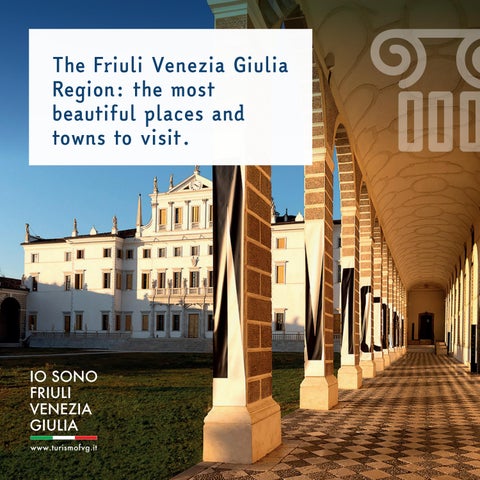
The Friuli Venezia Giulia Region: the most beautiful places and towns to visit.

Project carried out with the contribution of the Presidency of the Council of Ministers – Minister for Disabilities

Ministro per le disabilità

Presidenza del Consiglio dei Ministri

The brochure “The Friuli Venezia Giulia Region: the most beautiful places and towns to visit” was born within the project “A Region for All”, which PromoTurismo FVG had activated together with the Regional Council of People with Disabilities and the Tetra-Paraplegic Association of FVG, and which had the objective to identify and overcome not only architectural or sensory barriers but also information and cultural barriers, to allow the guests to be truly guests, whatever their needs are.

It is a publication created in collaboration with the associations ANFFAS FVG APS ETS and Progetto Autismo FVG who have worked together to simplify the texts of a classic tourist brochure in a language that is easy to read and understand, printed in a highly readable font.

In Friuli you can go from the mountains to the sea in one hour.

You can go from the mountains of Tarvisio to the sea of Lignano, Grado or Trieste.

On the journey you can discover new places and do many beautiful things.

Trieste

Photo of the piazza Unità in Trieste

Trieste

Trieste is a border city because it is very close to Slovenia.

People who live in Trieste come from many different states.

In the past there was an Austro-Hungarian King in Trieste. The king built Trieste similar to Vienna, the capital of Austria. Trieste is smaller than Vienna.

Trieste is a city by the sea.

Piazza Unità d’Italia is located in the city center of Trieste. The square is rectangular and has four sides. Around the square there are many buildings and the Church of San Nicolò.

On one side of the square there is the Molo Audace. The pier is a construction which is used to anchor boats and ships.

From the boats and ships

Passengers get off on dry land and sailors can unload goods. The pier is a very nice place to walk around because you can see the open sea and you can breathe good air. From the Pier of Trieste you can see the white towers of the Miramare Castle.

Photo of the Miramare Castle

The Miramare Castle

Ferdinand Maximilian of Habsburg lived in Miramare Castle with his wife Charlotte of Belgium.

Ferdinand was an Archduke of the Austro-Hungarian Empire and commanded in Northern Italy.

The Archduke is the most important person after the king. Everyone can visit the Miramare Castle!

Inside the Miramare Castle you will find wonderful rooms with furniture, paintings, statues and precious objects. Everyone can visit the beautiful park as well.

Natural and Marine Reserves

The sea around the Castle is a Marina Nature Reserve. The Marina Nature Reserve is a seaside area where you can’t fish.

In the Marina Nature Reserve you can swim and see the fish accompanied by a guide. The guide is a person who works in the Reserve and knows the place very well.

The guide lets you enter the Marina Nature Reserve if you respect the rules.

Photo of the bay of Sistiana
Photo of the Caffè degli Specchi in Trieste

Coffee in Trieste

Trieste is an important place for coffee. Coffee from all over the world arrives in Trieste to be processed. In Trieste there are many café-bars and ancient clubs. In the past, famous writers went to café-bars and they talked about their ideas and stories to write. Everyone can enter these bars!

In Trieste, espresso coffee has another name, Go and find out for yourself!

And the beaches?

You can choose the one you like best!

There are 15 km of beaches from Duino to Trieste.

There are rocks, small pebble beaches and bays. The bays are small indentations of the coast.

Trieste is a city with beaches. At some beaches you have to pay to enter.

You can find umbrellas, sunbeds, showers, toilets and bars.

The most famous place is “La Lanterna”.

People who live in Trieste say they go to the “Pedocin”.

The Pedocin is a small café where you can eat and drink.

“La Lanterna” is a unique beach in Europe. There is a wall that divides men from women.

Photo of the Rilke Trail
Photo of the Duino Castle

The castle of Duino

High up on the rocks there is also the Castle of Duino. It is a very beautiful, ancient place! The Princes of the Tower and the Badger were the first owners of the Castle.

Inside the castle you can find the precious objects That princes used.

Near the castle you can visit a bunker built in 1943 during World War II for the Germans.

The bunker is a military construction with holes in the walls to shoot.

The bunker also has a part underground to protect yourself from bombs and hide from enemies.

The poet Reiner Maria Rilke lived in the castle for many years.

Near the castle there is a path which begins in Duino and ends in Sistiana. The path is called Rilke, after the poet. Near the castle there is also the Fisherman’s Village. Here the dinosaur Antonio was found.

Antonio is the largest Italian dinosaur. If you want to see Antonio, you can go to the Natural History Museum in Trieste.

Photo of the village of Muggia

The village of Muggia

Near Trieste you will find the village of Muggia.

Muggia is a small seaside village and you can see the Palazzo Comunale and the Duomo. Muggia is similar to Venice but Muggia is smaller. Muggia is famous for the Muggesano Carnival. Every year many people in masks and painted floats move through the streets of the town.

Photos of the Karst hills

The Val Rosandra

The Rosandra stream is the only river in the Karst. The stream is a river which has water only when it rains. The Rosandra stream crosses the Rosandra Valley. The valley is named after the stream.

Val Rosandra is a natural park with many plants and animals. People who walk around the park really like it. Here you can explore caves and climb rocks.

The Karst

From Trieste you can reach the Karst.

The Karst is a mountain area made up of rocks, paths, caves, forts and sinkholes. Sinkholes are large funnel-shaped holes in the earth. The castellieri are buildings made on the hills surrounded by walls.

There are beautiful trails in the Karst which you can walk or cycle. You can take a ride on the tram which takes you from the village of Opicina to the hills of the Karst. Sgonico is a village in the Karst and there you can visit the Grotta Gigante. It is open all year round.

The beaches and the lagoon

Photo of the island of Grado

Grado, the island of the sun

Grado is a small seaside town similar to Venice. You can walk through calli and campielli. The campielli are small squares surrounded by low houses. The calli are small narrow streets between stone houses.

In the narrow streets you can see the fishermen’s houses. In the oldest part of the city you can go to the Field of the Patriarchs.

You can see the Basilica of St. Euphemia and the Basilica of Santa Maria delle Grazie. The Basilica of Santa Maria delle Grazie is the oldest in Grado.

Grado is called the Island of the Sun because it has 3 kilometers of beach always under the sun, never in the shadows.

Photo of the beach in Grado

The thermal baths of Grado

Grado was part of the Austro-Hungarian Empire.

The nobles loved Grado very much and reached the island to swim and go to the marine spa.

The thermal baths are large pools with hot water. Hot water comes out of the ground and helps people who are in pain. The thermal baths are still there today and many people go to the spa to relax.

The beach of Grado

Grado today is a seaside area where all the beaches have umbrellas and sunbeds. Adults and children can have fun and relax. Grado is good for families with small children because the sea water is shallow. There are also roads to go by bicycle.

Photo of Lignano Sabbiadoro

Lignano Sabbiadoro

The beach of Lignano Sabbiadoro is 8 km long and the sand has a golden color. Lignano is well known throughout Italy for the fun and parties that take place during the summer.

Lignano is made up of three parts: Sabbiadoro, Pineta and Riviera. Sabbiadoro is for people who want to go shopping, see many shops and have fun in the evening. Pineta is for people who want to have a quiet holiday in the parks, gardens and beach. Riviera is for people who want to rest and see the maritime pines.

Young people can go to Lignano to have fun; Families with children can go because the sea is calm and the water is shallow. In Lignano children can play in the parks.

Photo of the Casoni

The lagoon

Lignano and Grado are in the lagoon. The lagoon is a part of the sea with shallow water. In the lagoon there are many islets and canals. Canals are man-made waterways for navigation. You can take boat tours and see the Casoni, that is, the fishermen’s huts with thatched roofs.

In the lagoon there are the Reserves, that means protected areas where man cannot build and ruin nature. You can find the Foci dello Stella Reserve and the Canal Novo Valley Reserve. The Canal Novo Valley Reserve reaches as far as Marano Lagunare. Marano Lagunare is a small fishing village.

Near Grado there is the Valle Cavanata Nature Reserve and you can also go there by bike. In the Cavanata Valley you can see many water birds, like ducks and swans.

Photo of the island of Barbana

The lagoon of Grado

In the lagoon of Grado there is a small island with the sanctuary of Barbana.

The sanctuary is a church dedicated to a saint or to the Madonna. You can get to the island by ferry, that is, a boat that takes people from one side of the sea to the other.

Near the lagoon and the Soča river there is the island of Cona. On the island of Cona you can see many different types of animals, especially birds.

There are also horses that live free on the island.

In Grado, Lignano and Marano Lagunare you can take a boat trip and see nature.

You can also go down to the mainland and take a bike ride.

The historical cities of the South of Friuli

Photo of the Roman remains of Aquileia

The South of Friuli

The Bassa Friulana, that means the South of Friuli, has a great treasure. There are three cities built in different periods of the past. The three cities are very important in Europe.

Aquileia

Aquileia was a city of the Roman Empire. In Aquileia there are many remains of the ancient history of Rome. These remains are very important and are protected by UNESCO.

UNESCO is the world organization which deals with education, science and culture. UNESCO protects all important places (mountains, lakes, cities, buildings) and no one can touch them.

In Aquileia you can visit the Roman forum. The forum was the square of the Romans.

You can see the necropolis and the houses of the Romans with mosaic floors. The necropolis was the cemetery of the Romans. There are also the remains of a port on the river.

Photo of the Basilica di Aquileia

La Basilica di Aquileia

You can see the Basilica of Santa Maria Assunta. In the Basilica there is the floor with the largest mosaic made by the Christians of ancient Rome. Inside the Basilica, there is also the Baptistery and the Sudhalle. The Sudhalle is a room to the south with another large mosaic. The Baptistery is a well with 8 sides and contains holy water for baptism. You can also find the National Archaeological Museum with the treasures discovered in Aquileia. In the Museum you can see precious stones, coloured glass vases, ornate gold, statues and mosaics. Aquileia was one of the largest and rich cities in the Roman Empire!

Photo of Palmanova

Palmanova, the star-shaped city

Palmanova is a fortress city built by the Republic of Venice. A fortress city is a city surrounded by high walls. The walls are used to prevent enemies from entering. There are no other cities like Palmanova, it is unique. It is star-shaped with 9 points and a square in the center. There are three gates to enter the city and they are called Porta Cividale, Porta Udine and Porta Aquileia. From the gates the streets continue until you reach the square.

Photo of the Monfalcone Museum
Photo of Torviscosa

Torviscosa

Torviscosa is a town built in 1940. It was a company town, that is, an industrial city. The industrial city is a city built around a large factory. All the people who live in an industrial city work in the same factory. In Torviscosa there was the SNIA VISCOSA factory. SNIA VISCOSA worked cellulose.

Cellulose is a material that is obtained from the wood of trees or straw.

Torviscosa is divided into zones.

There are spaces to work, the village where the workers live, houses for bosses, houses for clerks, leisure facilities and spaces for everyone.

Monfalcone

Monfalcone is also an industrial city. It is located near Torviscosa.

In Monfalcone there is the workers’ village of Panzano where you can see an interesting museum.

Photo of Villa Manin

Passariano di Codroipo

In Passariano, near Codroipo, there is the Villa Manin.

Villa Manin is a large villa and was built by a rich family from the Veneto region. Today at Villa Manin you can see many exhibitions. The French general Napoleon Bonaparte also slept at Villa Manin in 1797.

Near the villa you can visit the old stables. The stable is where the horses rest.

In the stables you can see the carriages used many years ago.

Around the villa there is a very large park where you can take a walk.

Near Villa Manin there is the village of Rivolto. In Rivolto there are the barracks of the Frecce Tricolori.

The Frecce Tricolori are Italian military aircraft who do acrobatics in the sky.

The cities beside Pordenone

Photo of the Piazza di Pordenone

Pordenone

Pordenone is a fairly large city. Pordenone is located near the Veneto region. Pordenone is called the painted city, because there are so many frescoed palaces. The frescoed palaces are those palaces who have paintings on the walls. The frescoed palaces are located in the historic center, that is, in the center of the city.

In the city of Pordenone there are many events, such as the “Pordenonelegge” event, where you can find many old and new books and the “silent film days”, where they show old movies where people don’t speak.

A painting by Antonio De Sacchis

The painter from Pordenone

A very famous painter was born in Pordenone. His name was Antonio de Sacchis. This painter was called “Il Pordenone” and his paintings can be seen both in the Duomo and in the Art Museum of the Palace called Ricchieri.

A river also passes through the city of Pordenone. This river is called Noncello. The city of Pordenone and the nearby villages are from the Middle Ages, that is, of that period of history Where there were kings and where castles were built.

Photo of the Livenza river that crosses the city of Sacile

2. Sacile

Sacile is a smaller town than Pordenone.

Sacile is a city with many bridges, because there is the Livenza river that crosses the city.

Sacile looks a bit like the city of Venice and for this reason it is also called the “Garden of the Serenissima”. The Serenissima was the republic of Venice.

Photo of the square of San Vito al Tagliamento

San Vito al Tagliamento

In the city of San Vito al Tagliamento

There is a beautiful castle from the Middle Ages. Inside the castle there are many frescoes. In the city of San Vito al Tagliamento there is still the moat, that is, a canal that divides the city center from the other parts of the town. A long time ago the moat was used to defend against enemies and to prevent them from entering the city center.

In San Vito al Tagliamento

There are still the three towers that were used a long time ago as gates to enter the city center.

In San Vito al Tagliamento there are many religious palaces. The most beautiful are the Duomo and the church of Santa Maria del Battuti. In these palaces you can see many frescoes.

Photo of a tower in Cordovado

Sesto del Reghena

Sesto al Reghena is a small village in the Province of Pordenone. It’s a place smaller than a city. In Sesto del Reghena there is the Benedictine Abbey. The abbey is a monastery, that is, a place where religious monks live. This abbey is so called because the Benedictine monks lived there.

Cordovado

Cordovado is a small city, with many ancient palaces. One of the city’s palaces is located in the middle of a park with very old trees.

Photo of the castle of Valvasone
Photo of a painted palace in Spilimbergo

Valvasone

Valvasone is a small town. In the village church of Valvasone, there is the only Venetian organ made in 1500, that is, many years ago. The organ is an instrument that is played like the piano and is often found in churches.

Spilimbergo

The city of Spilimbergo is also called the city of mosaics. It is so called

Because there are many mosaics in the city. There is also a school that teaches mosaic art. This school is special and it is not found anywhere else in the world. In Spilimbergo there are also many palaces antiques and paintings. There is also a beautiful Duomo with many frescoes by the painter Antonio de Sacchi inside. The painter Antonio de Sacchis is nicknamed “Il Pordenone”.

Photo of the Maniago museum

Maniago is a small town in the province of Pordenone Famous because knives are made in this city. In Maniago there is in fact the museum of Blacksmiths Art and Cutlery. This museum tells the story of the city of Maniago And tells why it became famous for its knives. Maniago is also famous because in this city the swords and knives of some very famous films have been made, such as the Robin Hood film and the Indiana Jones film.

The magredi

In the province of Pordenone, There are also the magredi. The magredi are pieces of land full of stones and gravel. The word “magredi” means lean lands, because on this earth there is little grass. The magredi, however, are full of water underground. On these lands people cultivate the vine that is used to make wine. This wine is called Doc Friuli Grave.

Photo of Pasolini’s notebooks

Pier Paolo Pasolini

In the city of Casarsa della Delizia, which is always located near Pordenone, Pier Paolo Pasolini lived some time ago. Pier Paolo Pasolini did many things in his life, for example he made a film, wrote poems and painted paintings.

Pier Paolo Pasolini is buried in the cemetery.

The cities beside Udine

Photo of the climb to the Castle of Udine

Udine

Udine is a fairly large city.

The city of Udine is located in the hilly area of Friuli Venezia Giulia, that is, it is located on the hills.

Udine is a city where there are many bookstores and taverns. Taverns are old bars where you can drink and eat. In the city of Udine there is a beautiful Castle, and there are also the castle museums. In Udine you can see many paintings by Tiepolo. Tiepolo was a famous painter who painted many religious works that can be seen in churches.

The most beautiful square in Udine is Piazza Libertà. From Piazza Libertà you can see the Castle. There is also another very beautiful square called Piazza Matteotti. In this square there are many taverns and bars where you can eat and drink typical things of the Province of Udine.

A little higher than the city of Udine, near the mountains, there are so many beautiful villages, such as Rive D’Arcano, Artegna and Colloredo di Monte Albano. In these villages you can see many ancient towers and many landscapes. There are also many castles from the Middle Ages.

Photo of the castle of Ragogna

San Daniele del Friuli

A well-known village near Udine is San Daniele. San Daniele is a famous town because there they make delicious raw hams. San Daniele raw ham is famous all over the world.

In San Daniele there is also the Guarneriana Library. The Guarneriana Library is the oldest library of the whole Friuli Venezia Giulia.

In San Daniele there is also the Church of Sant’Antonio Abate. In this church there are many beautiful frescoes, that is, paintings made on the wall.

3. Ragogna

Near San Daniele there is a small town called Ragogna. In Ragogna there is the Scriptorium Foroiuliense. The Scriptorium Foroiuliense is a school of amanuenses. Amanuenses are scribes thst means people who wrote and copied texts a long time ago. Amanuenses are like writers who write articles for newspapers. In Ragogna there is also a beautiful castle. From this castle you can see the Tagliamento river.

Photo of the church of Venzone
Photo of the Cathedral of Gemona del Friuli

Venzone

Venzone is a small town near the mountains of Friuli. There was a strong earthquake in Venzone in 1976 which destroyed almost the entire area. The inhabitants of Venzone, however, were very good And they immediately began to rebuild the country all together. Venzone is a medieval town and is surrounded by ancient and old walls. Venzone is one of the most beautiful villages in Italy.

Gemona del Friuli

Gemona del Friuli is another town that was destroyed by the earthquake in 1976. In Gemona del Friuli there is a large cathedral which was rebuilt after the earthquake. There is also the Palazzo Comunale and the medieval historic center.

Photo of the village of Cividale del Friuli where the Natisone river passes

Cividale del Friuli

The town of Cividale is very beautiful because it is full of history. Cividale is a Lombard town, that means it is a country that a long time ago was inhabited by people who came from Germany.

In Cividale you can visit the National Archaeological Museum, where you can see many ancient things. In Cividale you can also see the Christian Museum and the Lombard Temple. The Lombard Temple is a monument with many works of art and many frescoes.

Finally, in Cividale you can also see The CIPS, that is, the Museum dedicated to puppets made by Vittorio Podrecca who lived in Cividale.

Photo of the Sanctuary of Castelmonte

The Natisone Valleys

Near the town of Cividale

there are the Natisone Valleys. The Natisone Valleys are parks where the Natisone river passes. In these parks there are rivers, waterfalls and caves.

The most famous cave in the Natisone Valley is called the cave of San Giovanni D’Antro. It is a very beautiful cave. Inside this cave there is also a chapel, that is, a place where you can pray. Inside the chapel there is a wooden altar.

Near Cividale in the Natisone Valleys there is Castelmonte. Castelmonte is a very famous place because there is the Shrine of the Blessed Virgin. The Sanctuary is like a church, where you can pray.

In the Natisone Valleys there is also the Abbey of Rosazzo. The Abbey of Rosazzo is an old monastery from the Middle Ages.

Photo of the butterflies of Bordano
Photo of the storks of Fagagna

Fagagna

From the city of Udine

you also arrive in Fagagna. Fagagna is a small town which is famous because there are Storks.

The Storks of Fagagna live in the Oasis of Quadris. The Quadris Oasis is a small park.

Bordano

A little higher than Udine near the mountains there is the village of Bordano. The village of Bordano is famous for butterflies. The village has murals with drawings of butterflies. Murals are drawings that are made on the walls of houses.

In Bordano there is also the Butterfly House. The Butterfly House is a very beautiful place where many different species of butterflies live These butterflies come from all over the world.

Near Bordano there is also the Lake Cornino Nature Reserve where there are many griffon vultures that live free. Griffon vultures are birds.

Friuli DOC feast in Udine

What language is spoken in Friuli?

In Friuli people speak Italian and Friulian. Friulian is a minority language, that is, a language such as Italian and English which, however, is spoken only by a few people. In Friuli, in addition to Friulian, people also speak Slovenian and German. People speak Slovenian and German because Friuli Venezia Giulia confines with Slovenia and Austria.

The cities beside Gorizia

Photo of the fountain of Neptune located in Piazza della Vittoria in Gorizia

Gorizia

Gorizia is a small town with many palaces and gardens. The city of Gorizia has become part of Italy only after the First World War. Before, the city of Gorizia belonged to the Austrians. During the Second World War, however, It was divided into two parts. The southernmost part of the city of Gorizia has become Slovenia.

In the city of Gorizia there are many museums and a castle.

In Gorizia there is also Piazza della Vittoria with the fountain of Neptune and the beautiful church of Sant’Ignazio.

Photo of the hills where wine is produced

Cormons

Near Gorizia there is the village of Cormons. Cormons is famous because it is a town where wine is produced. There are other villages near Cormons that produce wine and that have beautiful landscapes. These villages are Dolegna del Collio, San Floriano and Savogna D’Isonzo.

The First World War

Took place in many towns in Friuli Venezia Giulia. A long time ago the Friuli Venezia Giulia region was divided into two parts. One part belonged to Italy and one part belonged to Austria. In many parts of Friuli Venezia Giulia such as on the Karst or in some villages of Carnia, There are parks and open-air museums that talk about what happened during the First World War.

The mountains of Friuli

Photo of a ski slope in Monte Lussari

The ski slopes

During the winter there are many places where you can ski in Friuli Venezia Giulia.

There are the slopes of the Friulian Piancavallo Dolomites, the slopes of Forni di Sopra and Sauris, the slopes of Ravascletto and Zoncolan and the slopes of Tarvisio and Sella Nevea. All these slopes during the summer are very nice for mountain biking and cycling.

Under the Friulian Dolomites, that is, under the mountains of Friuli Venezia Giulia, There are places with many caves and many lakes such as Lake Barcis.

In many small towns and villages in the mountains of Friuli Venezia Giulia, you can eat the typical dishes of Friuli.

Photo of the mountains near the village of Sauris

Carnia

In an area of the mountains of Friuli Venezia Giulia

You find Carnia.

Carnia is a mountain area of Friuli where there are many villages such as Zuglio, Sutrio, Sauris e Pesariis.

Zuglio is famous because in the town there are things that date back to Roman times.

Sutrio is famous because in that town

There are very good carpenters who work with wood.

Sauris is famous because there is an important ham factory where they make a good smoked raw ham.

Pesariis is famous because it is the town of clocks and watches.

Photo of Fusine Lakes

Il Tarvisiano

In another area of the mountains of Friuli

You find Tarvisio and the surrounding area.

In the Tarvisian area there is Mount Lussari.

Mount Lussari is a slope where you can ski, but at the top of the mountain there is also a sanctuary, that is, a church, where many people go to pray.

In the Travisian area there is the town of Tarvisio.

Tarvisio is a town that confines with Austria.

Near Tarvisio there is the Cave del Predil mine. Many people from the neighboring villages worked in this quarry a long time ago.

The quarry is now closed, but you can visit it on foot or by train.

Food and drinks

Photo of some products to eat made in the Friuli Venezia Giulia Region

Eating and drinking

In Friuli Venezia Giulia,

There are many good things to eat, such as San Daniele ham and Montasio cheese.

There are also many good things to drink, such as wines and spirits.

The

of Friuli Venezia Giulia

AUSTRIA

BELLUNO

TREVISO

VENEZIA

TRIESTE SLOVENIA

Tarvisio
Tolmezzo
PORDENONE
UDINE GORIZIA

The map of Friuli Venezia Giulia

FRIULI VENEZIA GIULIA is here

ITALY

EUROPE

Credit

G. Baronchelli

N. Brollo

A. Castiglioni

A. Cop

M. Crivellari

E. e S. Ciol

F. Gallina

L. Gaudenzio

IKON / A. Michelazzi

F. Marongiu

M. Milani

F. Pappalettera

F. Parenzan

D. Scarpante

S. Sclabi, M. Rosso

Archivio Comune di Monfalcone

Archivio Casa delle Farfalle Bordano

Tassotto&Max

Turn static files into dynamic content formats.
Create a flipbook
Issuu converts static files into: digital portfolios, online yearbooks, online catalogs, digital photo albums and more. Sign up and create your flipbook.