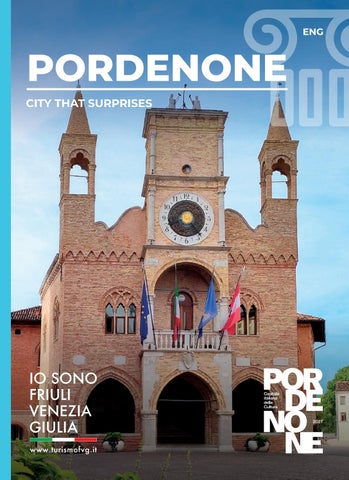
PORDENONE
CITY THAT SURPRISES

PORDENONE
In the heart of Friuli Venezia Giulia, nestled between the Carnic Alps and the Venetian lagoon, Pordenone is a city that preserves a rich heritage of history, art and timeless charm. Far from the hustle and bustle of the most crowded tourist routes, Pordenone reveals itself as an authentic destination, a hidden gem that invites visitors to discover the most genuine and captivating side of north-eastern Italy. This city is not merely a place to visit, but an experience to be fully embraced. Its hidden corners, valuable cultural landmarks and lush natural surroundings come together to offer every visitor a complete and authentic journey. Pordenone also boasts a vibrant cultural

and artistic scene, which has earned it the prestigious title of Italian Capital of Culture 2027.


THE CORSO VITTORIO EMANUELE
The elegant heart of Pordenone, this street is a true open-air museum where frescoed palaces, arcades and noble architecture recount centuries of history. The frescoes, dating from the 15th to the 17th centuries, depict floral motifs, sacred figures, coats of arms and mythological scenes, rendered in the characteristic colours of Renaissance mural painting. Strolling along the street, visitors breathe in a unique atmosphere in which art and everyday life intertwine, beautifully enhanced in the evening by the warm glow of the streetlights.
CHURCH OF THE HOLY TRINITY
Located a short distance from the historic centre, the Church of the Holy Trinity features a distinctive octagonal plan and preserves a rich blend of art, history and spirituality. Of medieval origin, it offers an intimate, timeless atmosphere. Inside, it houses valuable frescoes, including those in the apse painted in 1555 by Giovanni Maria Zaffoni, known as Il Calderari, a leading figure of the Pordenone school.
THE TOWN HALL LOGGIA
The Town Hall Loggia, in the very heart of Pordenone, is one of the city’s symbols and a 16th-century Renaissance masterpiece. With its elegant porticoed structure, it served for centuries as the centre of public and civic life, hosting assemblies, proclamations and events. Today it continues this tradition by accommodating cultural events and markets. Its walls, decorated with coats of arms and bas-reliefs, tell the story of the city.

CO-CATHEDRAL (DUOMO) OF SAN MARCO
A jewel of sacred art in the heart of the city, the Duomo of San Marco was first built in the 13th century and remodelled several times, combining Gothic and Renaissance elements. The brick façade and the 15th-century bell tower define its refined elegance. The three-nave interior houses masterpieces such as the altarpiece by Il Pordenone, the frescoes of the Montereale Mantica Chapel by Calderari and Amalteo, and sculptural works by Giovanni Antonio Pilacorte, one of the foremost Friulian Renaissance artists.

THE NONCELLO RIVER AND THE BRIDGE OF ADAM AND EVE
The Noncello River flows through Pordenone, offering evocative views and an atmosphere of tranquillity. Spanning it is the Bridge of Adam and Eve, located in an
ancient part of the city that was once a hub of agricultural and river activity. The 18th-century statues of Jupiter and Juno, reinterpreted by tradition as Adam and Eve, gave the bridge
its present name. Today, the site blends nature, history and myth, making it one of the most poetic corners of Pordenone.
CORSO GARIBALDI AND THE BELL TOWER OF SAN GIORGIO
The vibrant heart of Pordenone, Corso Garibaldi is an elegant pedestrian street that brings together history, culture and everyday life. Lined with historic buildings, refined shops, welcoming
cafés and traditional restaurants, it creates a lively yet sophisticated atmosphere that invites visitors to stroll and discover the city’s charm. Dominating the scene with its imposing presence is the bell

tower of San Giorgio, one of Pordenone’s most recognisable landmarks. Tall and slender, it takes the form of a Doric-style column crowned by the statue of Saint George.

CHURCH OF SANTA MARIA DEGLI ANGELI (KNOWN AS THE CHURCH OF THE CHRIST)
Founded in the 14th century by the Confraternity of the Battuti, the Church of Santa Maria degli Angeli is distinguished by its 1510 portal of Pilacorte and by
the side door of 1555 featuring a statue of Saint Roch. The brick bell tower recalls the Romanesque style. Inside are 14th-century frescoes, a stone portal and a precious wooden Crucifix, from which the church takes its current name, the Church of the Christ.
PIAZZA DELLA MOTTA AND THE FORMER CONVENT OF SAN FRANCESCO
Piazza della Motta, one of the oldest squares in Pordenone, was once a place of trade and markets and today remains a symbolic space surrounded by historic buildings. Overlooking

the square is the former Franciscan convent dating back to the 13th century, an example of simple, austere architecture that has now been transformed into a multifunctional cultural venue.


CIVIC ART MUSEUM –PALAZZO RICCHIERI
Palazzo Ricchieri, along Corso Vittorio Emanuele II, is one of Pordenone’s most important historic residences and is now home to the Civic Art Museum. Originating in the 13th century as a fortified tower belonging to the Ricchieri family, it was transformed between the 14th and 16th centuries into a noble residence with porticoes, loggias and frescoes. The façade preserves lateGothic elements with chivalric and heraldic motifs, while the interior features richly decorated wooden ceilings and 15th-century frescoes, including the Story of Tristan and Isolde. The museum houses works from the 13th to the 19th centuries, with a particular focus on Friulian art and on Il Pordenone.
SILVIA ZENARI NATURAL HISTORY MUSEUM
Housed in the 16th-century Palazzo Amalteo, the Silvia Zenari Museum preserves valuable collections in geology, palaeontology, zoology, botany and entomology, with a particular focus on local ecosystems. It is an ideal place to explore biodiversity and the relationship between humans and the environment.


PALAZZO DEL FUMETTO
The Palazzo del Fumetto, located in a restored historic building, is a landmark for contemporary art and pop culture. It hosts permanent and temporary exhibitions, workshops and meetings with authors dedicated to comics, illustration and animation, engaging audiences of all ages in a creative and accessible atmosphere.
DIOCESAN MUSEUM OF SACRED ART
Located within the Diocesan Centre for Pastoral Activities, the museum preserves sculptures, paintings, frescoes, textiles and sacred furnishings dating from the 7th to the 20th centuries, mainly originating from churches of the diocese. The exhibition, organised by type and function, includes works by Friulian and Venetian artists such as Il Pordenone and Pomponio Amalteo.
IMMAGINARIO SCIENTIFICO
The Science Museum, housed in the former dyeing workshops of the ex Cotonificio di Torre, offers interactive routes exploring natural phenomena and the laws of physics. With six thematic areas and hands-on laboratories, it stimulates curiosity and creativity, inviting both adults and children to discover science in a direct and engaging way.
MUSEO ARCHEOLOGICO
DEL FRIULI OCCIDENTALE
(ARCHAEOLOGICAL MUSEUM OF WESTERN FRIULI)
Located in the Castle of Torre, just a short distance from the centre of Pordenone, the Archaeological Museum of Western Friuli traces the history of the upper Pordenone plain from the Palaeolithic period to the Renaissance. Through reconstructions and artefacts, it recounts Neolithic villages, castellieri, the Roman Villa of Torre, late Roman necropolises and 15th-century ceramics, and includes the UNESCO finds from Palù di Livenza, as well as the history of the castle and of Count Giuseppe di Ragogna.


THE CITY PARKS
The parks of Pordenone offer green havens of relaxation. Parco San Valentino is ideal for walks and picnics among centuries-old trees, while the more intimate Parco Galvani provides shaded areas for play. It is also home to the Museo Itinerario della Rosa Antica (MIRA), a historical and educational museum trail set among heritage roses, enabling visitors to recognise their characteristics, history and botanical connections. Parco del Seminario, along the Noncello River, brings together meadows, small woodland areas and wetlands, making it perfect for walks and birdwatching. Finally, Parco Martiri delle Foibe (formerly the Rorai Ponds), with its three bodies of water, combines remembrance and nature, offering a peaceful place for walks and contemplation.
IMAGINATION RUNS ALONG THE WALLS: URBAN ART ITINERARIES

Pordenone boasts a lively collection of murals that transform once-grey walls into true open-air galleries. In the Torre district, entire façades host gigantic animal figures, while in the city centre, in Vicolo delle Acque, the white gorilla by Davide Toffolo stands out as a tribute to Copito de Nieve. Local and international artists have breathed new life into the city with colour and creativity, inviting residents and visitors alike to discover further works scattered across walls and buildings.

PORDENONE ON TWO WHEELS: THE PERFECT CITY FOR CYCLING
In Pordenone, cycling is not just a means of transport, it is a way of life.With dozens of kilometres of safe, wellconnected cycle paths, the city invites visitors to rediscover the pleasure of slow, sustainable and scenic movement. From quiet urban cycle lanes that cross parks and neighbourhoods to greener routes along the Noncello River or towards the Rorai ponds, every journey offers an opportunity to experience the city from a new perspective. Cycling in Pordenone means moving freely, breathing clean air and discovering hidden corners where art, nature and modern life meet. Whether you are a cycle tourist, a commuter or simply an enthusiast, bicycles are always welcome here.


GIOVANNI ANTONIO DE’ SACCHIS, KNOWN AS IL PORDENONE
(PORDENONE 1483/84 - FERRARA 1539)
Born in Pordenone between 1483 and 1484, Giovanni Antonio de’ Sacchis, known as Il Pordenone, is considered one of the leading painters of the Italian Renaissance. Renowned for his intense and dramatic frescoes, he combined strong compositional power with luminous, dynamic colours. His works, found mainly in Friuli and Veneto, influenced numerous pupils and contemporary artists.


TORRE, CHURCH OF SAINTS HILARY AND TATIAN
The construction of the first church dates back to the 7th century, while the present building was erected between 1880 and 1885 in Neoclassical style and embellished in the decades that followed. Inside, it preserves a copy of one of Il Pordenone’s most powerful works: the altarpiece of the high altar depicting the Madonna with Saints Hilary and Tatian, Anthony the Abbot and John the Baptist (1519 (?)–1521). The original work is housed in the Diocesan Museum of Sacred Art of Concordia-Pordenone. The baptismal font is the work of Pilacorte.
VALLENONCELLO, CHURCH OF SAINTS RUPERT AND LEONARD
Consecrated in 1438 and enlarged between the 18th and 19th centuries, the church preserves the Madonna and Child with Saints by Il Pordenone and the fresco Adoration of the Shepherds by Calderari, a follower of the master.
VILLANOVA, CHURCH OF SAINT ULRIC
Dating back to the 13th century and a parish church since 1542, the church houses frescoes by Il Pordenone (1514) depicting the Doctors of the Church, the Prophets, the Evangelists, the Coronation of the Virgin and angels playing musical instruments. These works stand out for their luminous tones and great pictorial freedom, clearly visible in the powerful figure of the Prophet Jeremiah.

RORAI GRANDE, CHURCH OF SAINT LAWRENCE THE MARTYR
The Church of San Lorenzo in Rorai Grande, built in the early 20th century on earlier structures, preserves frescoes by Il Pordenone (1516) and by Marcello Fogolino depicting the Virgin, the Doctors of the Church and the Evangelists, characterised by realism and sombre tones.

FRESCOES AND SCULPTURES

AN ART ITINERARY IN THE HEART OF WESTERN FRIULI
An art itinerary in Western Friuli devoted to Il Pordenone (1483–1539), his pupils and the sculptor Pilacorte (1455–1531), leading visitors through frescoed churches, altarpieces and carved portals. Painting and sculpture blend harmoniously to narrate a journey through beauty.
PARISH CHURCH OF SAINT STEPHEN AND ORATORY OF SANTA MARIA DEI BATTUTI
In Valeriano, the Church of Saint Stephen houses Il Pordenone’s first documented fresco (1506), while the Oratory of Santa Maria dei Battuti displays, on its façade, Saints and a Madonna painted by the same artist and, inside, the Nativity of 1524, a masterpiece of grace and realism.


SAN MARTINO AL TAGLIAMENTO, PARISH CHURCH
The Parish Church of San Martino al Tagliamento preserves important examples of 16th-century Friulian art. On the exterior wall stands a large fresco of Saint Christopher, painted by Il Pordenone around 1518, now faded but still impressive in scale. Inside are two fine altarpieces by Pomponio Amalteo, depicting Christ in Glory with Saints and a Madonna and Child flanked by Saints Another composition shows Saints Martin, Stephen, John the Baptist and George. These works reveal Amalteo’s full artistic maturity and his strong connection to Il Pordenone’s legacy.
PINZANO AL TAGLIAMENTO, CHURCH OF SAINT MARTIN
In the Church of Saint Martin, Il Pordenone frescoed a monumental Madonna and Child and the Martyrdom of Saint Sebastian, works dating to around 1525–1528. The church also preserves an altarpiece by Giovanni Antonio Guardi, a leading figure of 18th-century Venetian painting.

TRAVESIO, PARISH CHURCH (PIEVE) OF SAINT PETER THE APOSTLE
The largest fresco cycle painted by Il Pordenone in Friuli is found in the Church of Saint Peter the Apostle in Travesio. The artist worked here in several phases between 1516 and 1524/27, decorating the apse with the Stories of Saint Peter: a series of spectacular and complex scenes animated by intense vitality, dynamism and a rich array of figures. The church also preserves an altarpiece by Pomponio Amalteo, Il Pordenone’s pupil and son-in-law, who carried forward his stylistic legacy. Completing the church’s artistic heritage are a splendid portal and a baptismal font decorated with musical putti, among the finest works by the celebrated sculptor Pilacorte.

LESTANS, CHURCH OF SANTA MARIA ASSUNTA
In the choir of the Church of Santa Maria Assunta is preserved one of Pomponio Amalteo’s most important pictorial cycles. A leading artist of the Friulian Renaissance and a direct continuator of Il Pordenone’s work, Amalteo depicts episodes from the Old and New Testaments with great narrative intensity and remarkable technical mastery. He blends his master’s compositional legacy with a highly personal sensitivity to colour and the expressiveness of figures. The result is a mature and harmonious cycle that testifies to the artistic vitality of sacred painting in 16th-century Friuli.

The ancient parish church of San Martino d’Asio can be reached by following a scenic path, also accessible by car, which winds along the southern slope of Mount Pala, through rocks, shrubs and breathtaking views over the Tagliamento Valley. Inside the 16th-century church is preserved one of the absolute masterpieces of Friulian Renaissance sculpture: the region’s most monumental stone altar, created by Giovanni Antonio Pilacorte between 1525 and 1528. Arranged on two tiers of figures, the altar is enriched by an extensive ornamental and decorative repertoire. A careful restoration – still in progress – is gradually restoring the sculptures’ refined original colouring and the preciousness of their finely carved details.

PIEVE OF SAN MARTINO D’ASIO

TAURIANO, CHURCH OF SAN NICOLÒ
VACILE, CHURCH OF SAN LORENZO
Here Il Pordenone frescoed the choir around 1508. In the vault, divided into robust ogival ribs, are depicted the Risen Christ with the Evangelists, the Doctors of the Church and the Prophets; in the under-arch are figures of saints holding the symbols of their martyrdom.
Set within the rolling hills of the Pordenone area, the Church of San Nicolò is a significant stop for understanding the spread of Renaissance painting linked to the school of Il Pordenone. Inside, it preserves a cycle of 16th-century frescoes attributed to artists from his circle, with scenes from the life of Christ and the saints, among which the figures of Saint Nicholas and Saint Sebastian stand out. The decorative scheme, rich in colour and expressive intensity, reflects the vitality of Friulian sacred art even in more intimate settings.


GAIO, CHURCH OF SAN MARCO
The church stands on a rocky spur overlooking panoramic views of the Tagliamento Valley. Built in 1490 at the behest of Alvise di Spilimbergo and dedicated to Saint Mark the Evangelist, it features a main portal by Giovanni Antonio Pilacorte with the Lion of Saint Mark and floral decorations. Inside, it preserves 15th-century frescoes, including works by Il Pordenone and the Story of Tristan and Isolde, as well as richly decorated wooden ceilings.
IN THE SURROUNDINGS OF PORDENONE

The area surrounding Pordenone invites visitors on a journey through history, art and nature. Ancient castles, fortified villages and small art towns preserve the charm of the Middle Ages and the Renaissance, offering evocative atmospheres and views of great beauty. Beneath arcades, among frescoes, noble palaces and welcoming squares, each place tells centuries of events and traditions. Alongside its historical and artistic heritage, the area also preserves a rich network of traditional crafts, handed down from generation to generation: from woodworking to ceramic art, and from fine lace-making to embroidery, all bearing witness to a creative ingenuity that still characterises local communities today. Equally remarkable is the natural setting: the magredi, an ecosystem that is extremely rare in Europe, comparable to a steppe, where biodiversity finds expression in unique plant and animal species. This landscape, seemingly austere, in fact conceals a surprising ecological richness and is an ideal place for excursions, walks and moments of contemplation. Just a few kilometres from the city, visitors will also find farms offering outstanding local produce, including fine wines and gastronomic specialities that tell the story of the deep bond between people and their land. In this way, the surroundings of Pordenone reveal themselves as a harmonious mosaic in which art, history, nature and traditions coexist, offering authentic and ever-changing experiences to those who explore them.


SACILE
12,5 KM
Sacile, known as the “Garden of the Serenissima”, brings together water and land through bridges, narrow streets and noble palaces. In the historic centre stands Palazzo Ragazzoni, whose Salone d’Onore was decorated in 1583 by the Mannerist painter Francesco Montemezzano. Six large scenes celebrate the deeds of the Ragazzoni brothers with luminous colours and a distinctly Veronese style, recently restored to their original splendour.
CANEVA AND PALÙ DI LIVENZA
21 KM
At the foot of the Friulian Prealps, Caneva enchants visitors with its green landscapes, authentic hamlets and the imposing castle that dominates the valley. The area is of great archaeological interest, with evidence ranging from the Neolithic period to the Lombard age. Among the most important sites is Palù di Livenza, an ancient Neolithic pile-dwelling settlement recognised as a UNESCO World Heritage Site. Set in an unspoilt landscape of springs, reed beds and stretches of water, the site preserves the remains of a prehistoric settlement of extraordinary historical and environmental value.
Palù di Livenza offers a unique experience in which archaeology and biodiversity coexist in perfect balance, providing evocative scenery and an authentic immersion in the area’s most ancient history.


POLCENIGO
18 KM
Polcenigo, one of I Borghi più belli d’Italia (Italy’s Most Beautiful Villages), brings together history, architecture and nature. Among elegant villas, 17th-century palaces and cobbled lanes, the clear waters of the Livenza River and the springs of the Gorgazzo create enchanting views. The historic centre, rich in ancient mills and timeless atmospheres, is ideal for walks, excursions and food-and-wine itineraries set in the green landscape of the Friulian Prealps.
CASTEL D’AVIANO
15 KM
Castel d’Aviano, at the foot of the Friulian Dolomites, combines rolling hill landscapes with a millennia-old history. Dominated by its ancient castle, the village preserves Venetian villas, frescoed little churches and cobbled streets imbued with old-world charm.
PIANCAVALLO
29 KM
Situated at an altitude of 1,280 metres, Piancavallo is an ideal destination all year round. In winter it offers skiing, snowboarding, snowshoeing and amusement parks for families; in summer, trekking, mountain biking, climbing and panoramic views stretching as far as the sea. Nature, sport and relaxation come together here, complemented by mountain huts and local produce that complete the experience.
FORRA DEL CELLINA NATURE
RESERVE
31 KM
In the heart of the Valcellina valley, the Forra del Cellina Nature Reserve offers spectacular scenery: canyons, waterfalls and a turquoise river winding its way through the rocks. The old panoramic road, accessible on foot or by bicycle, allows visitors to admire suspension bridges, tunnels and breathtaking viewpoints. The reserve is home to golden eagles, chamois, falcons and a rich plant biodiversity, offering a unique experience of nature, adventure and unspoilt beauty.
BARCIS
31 KM
Set in the Friulian Dolomites, Barcis captivates visitors with its turquoise lake, forests and dramatic peaks. Ideal for sport, excursions, relaxation and photography, it offers lake activities, panoramic trails and genuine hospitality. Highlights not to be missed include the Forra del Cellina, the lake itself and local events. Barcis is also a gateway to the Friulian Dolomites Natural Park, a UNESCO World Heritage Site.
ERTO AND CASSO
58 KM
Nestled in the Friulian Dolomites, Erto and Casso tell a story of history, resilience and wild beauty. Among stone houses and wooden roofs, time seems to stand still, offering silence, reflection and evocative views. Close to the Vajont Dam, they are places where history and the mountains intertwine.


CLAUT
51 KM
Claut, set within the Friulian Dolomites Natural Park, is ideal for lovers of nature and outdoor sports. In winter it offers cross-country skiing, sledging, ice sports and climbing; in summer, hiking, canyoning and visits to caves and dinosaur footprints. The village preserves traditional stone houses and hosts museums such as Casa Clautana, the Ciasa da Fum and the CLAPP (an interactive sculpture trail), making it particularly suitable for families.
THE FRIULIAN DOLOMITES PARK
51 KM
The Friulian Dolomites Park offer spectacular scenery and numerous trails for short walks or multi-day hikes. Among the most representative are the Friulian Dolomites Loop and the Alta Via di Forni, which allow visitors to admire striking landmarks such as the Campanile di Val Montanaia.
The park preserves authentic villages and wild valleys for lovers of wilderness.
ANDREIS, POFFABRO, FRISANCO
33 KM
Andreis, Poffabro and Frisanco are villages of the Friulian Dolomites closely linked to history, nature and traditions. Andreis is renowned for its daltz, wooden balconies once used for drying produce and as service spaces, and for its museum preserving objects from local 20th-century rural life. Together, Andreis, Poffabro and Frisanco offer an authentic glimpse into the cultural heritage of the mountain communities.
MANIAGO
25 KM
Maniago is internationally renowned for its outstanding artisanal tradition: knife-making. The Museum of Blacksmith’s Art and Cutler elegantly recounts the centuries-old history of this craft, which lies at the very heart of the area’s identity. Over the last century, Maniago’s reputation has reached far beyond local borders, even as far as Hollywood: the swords used in cult films such as Braveheart, Robin Hood and Indiana Jones and the Last Crusade were in fact forged here, by the skilled hands of its master craftsmen.
VAL TRAMONTINA
50 KM
The villages of Val Tramontina, in the heart of the Carnic Prealps, offer tranquillity, unspoilt nature and stone architecture that tells the story of traditional rural life. Highlights include the abandoned hamlets of Tamar and Palcoda, the remains of Movada in Lake Redona, and the Pozze Smeraldine, natural pools of turquoise water set deep within the forest.
CLAUZETTO AND THE GREEN CAVES OF PRADIS
52 KM
Clauzetto, known for its warm hospitality, offers outstanding natural scenery and breathtaking views, with trails leading to spectacular gorges and to the Green Caves of Pradis di Sotto. A circular route leads to the Grotta della Madonna, a vast cavern capable of accommodating up to a thousand people, where a Christmas Mass is celebrated every 24 December. The caves preserve prehistoric finds, fossils and flint tools, now displayed in the nearby Pradis Cave Museum.


SEQUALS
34 KM
Best known as the birthplace of the legendary boxer Primo Carnera (whose Villa Carnera can be visited), Sequals combines rural tradition with sporting memory. The historic centre retains the typical atmosphere of Friulian villages, with stone houses, inner courtyards and ancient little churches. The surrounding area offers nature trails ideal for walking and cycling, as well as wineries producing excellent local wines.
SPILIMBERGO
31 KM
Spilimbergo, famous as the City of Mosaic, is home to the renowned Scuola Mosaicisti del Friuli, a world centre of excellence in mosaic art. The historic centre features the Cathedral known as the “Church of the Seven Eyes”, with its 16th-century organ decorated by Il Pordenone and 14th-century frescoes, bearing witness to the town’s rich artistic tradition.
VALVASONE ARZENE
19 KM
In the heart of Valvasone Arzene, one of I Borghi più belli d’Italia (Italy’s Most Beautiful Villages), elegant historic residences overlook enchanting views. Highlights include the 12th-century castle, with 14th-century frescoes, Venetian floors, a chapel and a small 18th-century theatre, and the cathedral, which houses the only fully functioning 16th-century Venetian organ in Italy, with painted doors by Il Pordenone.
CASARSA DELLA DELIZIA AND
PIER PAOLO PASOLINI
21 KM
Pier Paolo Pasolini spent long periods in Casarsa della Delizia, his mother’s birthplace. His maternal home now houses the Pier Paolo Pasolini Study Centre, the starting point for discovering places dear to the writer: the Church of Santa Croce, which inspired I Turcs tal Friúl; the village of Versuta with the Church of Sant’Antonio Abate; and the hamlet of San Giovanni, where he developed his political awareness. Pasolini is buried in the town cemetery alongside his family, bearing witness to his deep bond with this land.
SESTO AL REGHENA
25 KM
Sesto al Reghena, one of I Borghi più belli d’Italia, is home to one of the most important Benedictine abbeys in Friuli Venezia Giulia: Santa Maria in Sylvis, founded in the Lombard period. During the Early Middle Ages, the abbey was a centre of great power and, over time, developed into a true fortified citadel, complete with towers and moats defending the monastic complex. Of outstanding artistic value are the 13th-century frescoes that decorate its interiors.
CORDOVADO
29 KM
Cordovado, listed among I Borghi più belli d’Italia (Italy’s Most Beautiful Villages), is a medieval village with a perfectly preserved historic centre. Its highlights include the castle, the parish church of Sant’Andrea, the Sanctuary of the Madonna with the former Dominican convent, and the route linking the fortified medieval village to the Renaissance Borgo Nuovo. Also not to be missed are the 18th-century noble residences Villa FreschiPiccolomini e Palazzo Bozza-Marrubini.


SAN VITO AL TAGLIAMENTO
20 KM
San Vito al Tagliamento, a picturesque medieval town, boasts a frescoed castle with a moat and three towers, elegant noble palaces and important religious buildings. These include the cathedral, the Church of Santa Maria dei Battuti with works by Pomponio Amalteo and a portal by Pilacorte, and the Church of the Annunciation with 14th-century frescoes. Completing the town’s charm is the Teatro Sociale Gian Giacomo Arrigoni, an elegant example of 18th-century Venetian theatre architecture.
I MAGREDI
20 KM
In the heart of Friuli Venezia Giulia, in an area encompassing the stony basins of the upper plain formed by the Cellina and Meduna streams, lie the Magredi. This protected area is home to orchids, rare butterflies and resilient grasslands, creating a unique ecosystem that has developed across the municipalities of San Quirino, Vivaro, Sequals, San Giorgio della Richinvelda, Cordenons and Zoppola. Vivaro, regarded as the “green heart” of the area, offers trails for walking, cycling and horse riding. The Magredi Visitor Centre provides information on the area’s flora, fauna and geological features.
MONTEREALE VALCELLINA
20 KM
In Malnisio, a hamlet of Montereale Valcellina, visitors can explore the former Pitter Hydroelectric Power Station, an elegant example of early 20th-century industrial architecture. Also worth visiting are the Archaeological Museum, with finds from the Bronze and Iron Ages as well as Roman and Lombard remains, and the Church of San Rocco, embellished with frescoes by Calderari of the Pordenone school.
MEDUNO E TRAVESIO
27 KM
Meduno, set between the Carnic Prealps and the Cosa stream, combines the charm of stone houses and frescoed churches with panoramic trails ideal for hiking and outdoor sports. From nearby Mount Valinis, visitors can enjoy spectacular views over the surrounding valleys. The nearby hamlet of Toppo, listed among I Borghi più belli d’Italia (Italy’s Most Beautiful Villages), is arranged around the Masi di Toppo and the Borgata di Pino, and features the elegant Palazzo Toppo-Wassermann. A short woodland path leads to the remains of the Castle of Toppo and to the Chapel of Sant’Antonio Abate, from which a striking view opens out over the plain below.
CIMOLAIS
48 KM
Overlooking the Friulian Dolomites Natural Park, Cimolais is a small, quiet village characterised by stone houses and flower-filled corners. From the village, paths and mule tracks lead into wild valleys and high-altitude meadows, offering breathtaking panoramas.


FANNA, CAVASSO NUOVO, ARBA, CASTELNOVO DEL FRIULI, PINZANO AL TAGLIAMENTO
28 KM
In the heart of the Pordenone foothills, Fanna, Cavasso Nuovo, Arba, Castelnovo del Friuli and Pinzano al Tagliamento offer unique landscapes, traditions and flavours. Fanna enchants with its views of the Prealps and the Sanctuary of the Madonna di Strada. Cavasso Nuovo preserves stone courtyards set among fields and woodland. Arba combines river landscapes, gentle hills and historic little churches. Castelnovo del Friuli offers chapels, villas and scenic viewpoints. Pinzano overlooks the Tagliamento river, with spectacular views and nature itineraries.

OUTDOOR EXPERIENCES

The Pordenone area is an ideal destination for those who wish to experience the land at a relaxed pace, guided by the slow rhythm of a walk or a cycle ride. Here, nature becomes a travelling companion: trails wind through green countryside and along waterways, offering ever-changing and evocative views. Walking or cycling in this region means immersing oneself in an authentic landscape, where the tranquillity of nature intertwines with local history and culture. Alongside the quiet of the countryside and the charm of rivers, visitors can discover small villages with an ancient character, elegant villas set in greenery and museums preserving the memory of the past. Each route thus becomes a complete experience: a slow, mindful journey that allows travellers to savour the area in all its variety, amid unspoilt nature, traditions and artistic heritage.
ROUTES IN THE CITY OF PORDENONE
Cycling through the green heart of Pordenone (R066)
This route runs mainly along the city’s cycle paths and offers an enjoyable experience for cyclists of all levels.
https://www.turismofvg.it/it/ bike/in-bici-nel-cuore-verdedi-pordenone-r066

ROUTES IN PORDENONE AND THE SURROUNDING AREA
SACILE AND PORDENONE LOOP (R0001)
This cycle-tourism itinerary links Sacile and Pordenone, offering a pleasant ride through ancient Venetian villas where the timeless atmosphere of the Serenissima can still be felt.
https://www.turismofvg.it/ it/bike/anello-di-sacile-epordenone-r001
PATRIARCH AND VINE LOOP (R020)
A cycling route starting from the Renaissance city of mosaics, Spilimbergo, and leading into an evocative natural landscape through the Magredi of the Meduna and Cellina rivers.
https://www.turismofvg.it/it/ bike/anello-del-patriarca-edella-vite-r020
PASOLINI LOOP (R021)
A cultural cycling route centred around Casarsa della Delizia, the place where Pier Paolo Pasolini’s earliest literary and artistic experiences first took shape.
https://www.turismofvg.it/it/ bike/anello-pasoliniano-r021

10000 STEPS FOR HEALTH
“DISCOVERING
PORDENONE BETWEEN GREENERY AND WATER” ITINERARY
This circular walking route starts from the Bridge of Adam and Eve along the Noncello River and crosses numerous city parks: Galvani (MIRA and the Palazzo del Fumetto), Seminario, Castello with the Archaeological Museum, San Carlo, San Valentino, Immacolata, Cimolai, Via Casarsa, the Rorai Ponds, Burida, Querini and IV Novembre. The route also touches on cultural and urban landmarks such as the Roman Villa and the pordenonelegge literary park, before completing the loop and returning to the starting bridge.


THE WAY OF SAINT CHRISTOPHER
The Way of Saint Christopher is made up of three distinct routes: one crossing the foothill area, another running through the Magredi plain and the spring-fed wetlands, and a third entering the evocative Val Meduna. The main route follows the foothills, crossing the territory between the
Livenza and Tagliamento rivers, which have always shaped not only the physical geography but also the cultural identity of Western Friuli. From Caneva to Spilimbergo, over more than 150 kilometres, walkers discover a land rich in history, nature and traditions.


FESTIVAL

Pordenone is a lively and culturally vibrant city, where art, music, literature and cinema animate squares and public spaces every year, transforming the city into an open stage for thousands of visitors.
LITERATURE AND CULTURE
PORDENONELEGGE
Organised by the Pordenonelegge Foundation, pordenonelegge takes place every year in September and turns the entire city into a festival. It is not simply an event hosted in Pordenone and its surrounding area, but an immersive experience that transforms streets and squares into places of encounter and discovery. It is a celebration of books and reading, bringing together authors, readers and the curious to share stories, ideas and perspectives that engage with contemporary reality. Novels, poetry, essays on economics, medicine, society and geopolitics: every subject becomes an opportunity for shared knowledge and imagination.
www.pordenonelegge.it
DEDICA FESTIVAL
Organised by THESIS Associazione Culturale, DedicaFestival is a unique event in Italy, entirely devoted to a leading figure of international culture. Each edition invites the public to explore the intellectual, creative and human journey of a great author through a rich programme of talks, theatre performances, book presentations, concerts, exhibitions and film screenings. The aim is to create a space for dialogue and exchange, where the arts become a means of exploring ideas, reflections and diverse visions. www.dedicafestival.it
PORDENONEPENSA
PordenonePensa is a cultural festival conceived by the Circolo Culturale Eureka and active since 2009. It promotes pluralism, freedom of thought and accessible cultural outreach, far removed from elitism and conformity. Since 2015 it has featured the Festival del Confronto (Festival of Dialogue), a core format based on debates between guests with differing viewpoints, designed to stimulate reflection on major contemporary issues. Alongside this, the festival includes thematic spinoffs:
- PordenonePensa in Giallo, dedicated to crime reporting, mysteries and investigation.
- PordenonePensa Scienza, for those who enjoy science explained clearly and passionately, from astronomy to genetics. www.pnpensa.it


CINEMA
LE GIORNATE DEL CINEMA MUTO
Le Giornate del Cinema Muto is one of the world’s most important film events dedicated to the rediscovery and study of silent cinema and early film history. It features screenings of rare films accompanied by live music, as well as the participation of scholars, historians and enthusiasts from all over the world. Founded in 1982 by the Cineteca del Friuli and Cinemazero, it has become a global point of reference in the field. www.giornatedelcinemamuto.it

PORDENONE DOCSFEST- THE VOICES OF DOCUMENTARY
Each year the festival turns the city into a major hub for documentary cinema, presenting awardwinning international documentaries, national premières, Italian and international guests, along with meetings and events that offer in-depth perspectives on contemporary reality. www.pordenonedocsfest.it

FMK - INTERNATIONAL SHORT FILM FESTIVAL
The FMK International Short Film Festival, organised by Cinemazero, celebrates the most interesting, original and acclaimed international short films. The selection is curated through ongoing research at major film festivals and specialised online platforms. www.fmk-festival.it

MUSIC
PORDENONE BLUES&CO FESTIVAL
In Pordenone, music enlivens the city with events for every taste. The Pordenone Blues & Co Festival celebrates the best of blues, soul and rock, bringing Italian and international artists to the stage. Each year it offers engaging concerts, workshops and a unique atmosphere that brings together music lovers of all ages. www.pordenonebluesfestival.it
JAZZINSIEME
JazzInsieme showcases both emerging talents and leading international performers, creating a dialogue between tradition and innovation. The programme includes concerts, jam sessions, workshops and guided tours set to the rhythm of music. www.jazzinsieme.com
MUSIC IN VILLAGE
Music in Village transforms city squares into live music venues, offering a series of concerts, events and activities dedicated to music in all its forms. www.musicinvillage.it


PIANO CITY PORDENONE
Piano City is a city-wide festival celebrating the piano with concerts held in theatres, squares and unusual locations throughout the city. An event that turns Pordenone into a sonic stage, bringing the magic of piano music closer to a wide audience. www.pianocitypordenone.it

FOOD AND WINE

The Pordenone area boasts a rich and varied gastronomic heritage, shaped by ancient traditions and a deep-rooted bond with the land.
The Pordenone area boasts a rich and varied gastronomic heritage, shaped by ancient traditions and a deep-rooted bond with the land. Among the local specialities is Pitina IGP, small meatballs made from sheep or goat meat, created in the mid-19th century as a way of preserving meat from animals no longer productive. Prepared with aromatic herbs and salt, then double-smoked and cured, it develops a distinctive flavour with a delicate smoky note. The red onion of Cavasso and Val Cosa, sweet and crunchy, was once close to disappearing but has been revived thanks to the commitment of the local community. From Val Cellina and Val Vajont comes pestith, a fermented preparation made from round turnips with
purple collars. In San Quirino, a rare elongated bean is grown, harvested by hand and ideal for soups and stews; it has been saved from extinction by young farmers. The ancient apple varieties of Upper Friuli bear witness to the region’s long fruit-growing tradition, now enhanced by initiatives supporting small producers. In terms of wine, the area includes the Friuli Grave DOC, with grape varieties such as Ribolla Gialla, Friulano, Pinot Grigio and Prosecco, as well as the Lison DOCG, home of Tocai Friulano. Wineries and vineyards offer immersive experiences, from tourist harvests to guided tastings. Among sweets and fruit are the Pordenone Biscuit, created in the 1940s with maize and durum wheat flours, almonds and a touch of grappa,


and the FigoMoro of Caneva, small and exceptionally sweet, celebrated at a dedicated fair. Local cheeses include Asìno della Val d’Arzino, traditional dairy cheeses and the pit cheeses of Val Tramontina, aged in underground environments to develop intense, distinctive aromas. Goat farming provides high-quality milk for cheese production, with outstanding examples such as the San Gregorio dairy in Aviano. Niche productions include Dardago saffron, grown in small plots and harvested by hand, and grappa, distilled from grape pomace during the harvest season. Craft beer also has historic roots in Pordenone and is now experiencing a revival through numerous local microbreweries, symbols of identity and creativity.


HOSPITALITY IN PORDENONE AND THE PORDENONE AREA

Pordenone and the surrounding area
The
Pordenone mountains
List of PromoTurismoFVG Infopoints
Aquileia Infopoint
Via Giulia Augusta, 11 – 33051 Aquileia (UD)
Tel. +39 0431 919491 | Cell. +39 335 7759580 info.aquileia@promoturismo.fvg.it
Arta Terme Infopoint
Via Nazionale, 1 – 33022 Arta Terme (UD)
Tel. +39 0433 929290 | Cell.+39 335 7463096 info.artaterme@promoturismo.fvg.it
Cormons Infopoint
Piazza XXIV Maggio, 15 – 34071 Cormons (GO)
Tel. +39 0481 386224 | Cell. +39 335 7697061 info.cormons@promoturismo.fvg.it
Forni di Sopra Infopoint
Via Cadore, 1 – 33024 Forni di Sopra (UD) Tel. +39 0433 886767 | Cell. +39 335 1083703 info.fornidisopra@promoturismo.fvg.it
Gorizia Infopoint
Palazzo Paternolli, Piazza della Vittoria, 48 – 34170 Gorizia
Tel. +39 0481 535764 | Cell. +39 335 1084763 info.gorizia@promoturismo.fvg.it
Grado Infopoint
P.zza XXVI Maggio, 16 – angolo Portanuova, 26 34073 Grado (GO)
Tel. +39 0431 877111 | Cell. +39 335 7705665 info.grado@promoturismo.fvg.it
Lignano Pineta Infopoint (summer season)
Via dei Pini, 53 – 33054 Lignano Pineta (UD) Tel. +39 0431 422169 | Cell. +39 331 1435222 info.lignanopineta@promoturismo.fvg.it
Lignano Sabbiadoro Infopoint
Via Latisana, 42 – 33054 Lignano Sabbiadoro (UD) Tel. +39 0431 71821 | Cell. +39 335 7697304 info.lignano@promoturismo.fvg.it
Marano Lagunare Infopoint (summer season)
Piazza Cristoforo Colombo
33050 Marano Lagunare (UD) Cell. +39 334 6835248 info.marano@promoturismo.fvg.it
Miramare Infopoint
Porta della Bora, adiacente all’ingresso del Viale dei Lecci
34121 Trieste
Cell. +39 333 6121377 info.miramare@promoturismo.fvg.it
Muggia Infopoint
Piazza Marconi, 1 – 34015 Muggia (TS)
Tel. +39 040 9571085 info.muggia@promoturismo.fvg.it
Palmanova Infopoint
Borgo Udine, 4 – 33057 Palmanova (UD)
Tel. +39 0432 924815 | Cell. +39 335 7847446 info.palmanova@promoturismo.fvg.it
Piancavallo Infopoint
(winter and summer season)
Via Collalto, 1 – 33081 Piancavallo (PN)
Tel. +39 0434 655191 | Cell. +39 335 7313092 info.piancavallo@promoturismo.fvg.it
Pordenone Infopoint
Palazzo Badini
Via Mazzini, 2 – 33170 Pordenone
Tel. +39 0434 520381 | Cell. +39 335 1516948 info.pordenone@promoturismo.fvg.it
Sappada Infopoint
Borgata Bach, 9 – 33012 Sappada (UD)
Tel. +39 0435 469131 | Cell. +39 335 1085932 info.sappada@promoturismo.fvg.it
Sistiana Infopoint
Sistiana 56/B – 34011 Duino – Aurisina (TS)
Tel. +39 040 299166 | Cell. +39 335 7374953 info.sistiana@promoturismo.fvg.it
Tarvisio Infopoint
Via Roma, 14 – 33018 Tarvisio (UD)
Tel. +39 0428 2135 | Cell. +39 335 7839496 info.tarvisio@promoturismo.fvg.it
Tolmezzo Infopoint
Palazzo Lo Basso
Piazza XX Settembre, 7 – 33028 Tolmezzo (UD) Tel. +39 0433 44898 | Cell. +39 335 7747958 info.tolmezzo@promoturismo.fvg.it
Trieste Airport Infopoint
Via Aquileia, 46 – 34077 Ronchi dei Legionari (GO) Tel. +39 0481 476079 | Cell. +39 334 6430667 info.aeroportofvg@promoturismo.fvg.it
Trieste Infopoint
Via dell’Orologio, 1 (angolo Piazza Unità d’Italia) 34121 Trieste
Tel. +39 040 3478312 | Cell. +39 335 7429440 info.trieste@promoturismo.fvg.it
Udine Infopoint
Piazza I Maggio,7 - 33100 Udine Tel. +39 0432 295972 | Cell. +39 335 1088307 info.udine@promoturismo.fvg.it

Check the opening hours and the full list of Infopoints
HOW TO TRAVEL TO FRIULI VENEZIA GIULIA
BY CAR
Highway:
A4 Torino/Trieste
A23 Palmanova/Udine/Tarvisio
A28 Portogruaro/Conegliano
A27/A4 Trieste/Belluno
BY PLANE
Airport of Trieste www.triesteairport.it
40 km from Trieste and Udine
80 km from Pordenone
130 km from Venezia
120 km from Lubiana
Scan the QR code and find out so much more about Friuli Venezia Giulia
BY TRAIN
www.trenitalia.it www.italotreno.it
BY BIKE
www.alpe-adria-radweg.com www.adriabike.eu
BY BOAT
Along the coast and through the channels of the Lagoons of Grado and Marano
48 hours or 7 days of excitement, culture and... fun. A single Card for Friuli Venezia Giulia, starting from €30!


What are the ADVANTAGES for you? ?
With the Card in the Pordenone area, you can get around freely: enjoy entry to all the museums in Pordenone, visit the Maniago Museum of Cutlery, hire audio guides in Pordenone, Spilimbergo and Sacile, and much more. And of course, you can also use it to explore the whole region.
Included with the FVGcard free of charge
• Access to the main museums and attractions in Friuli Venezia Giulia
• Guided tours
• Audio tours
• Hiking tours in the mountains and hills
WHERE the FVGcard is sold
• PromoTurismoFVG Infopoints
• Affiliated sales partners
• Online at www.turismofvg.it/fvg-card
The FVGcard also extends its benefits to 1 child under the age of 12. Free admissions can be used only once for each facility or service. The discounts are only granted to FVGcard holders.

Discover all the benefits!
Archivio Parrocchia di Clauzetto
N. Brollo
E. Caldana
C. Chiandoni
F. Ciol
M. Crivellari
U. Da Pozzo
E. Falaschi
F. Gallina
L. Gaudenzio
CREDIT INFO
PromoTurismoFVG
Strategies, Development, Operations for Tourism via Aquileia, 46 34077 Ronchi dei Legionari (GO) info@promoturismo.fvg.it
S. Giacomuzzi
L. Giagnoni
V. Greco
L. Laureati
D. Monti
M. Moro
E. Pellin
G. Scognamiglio
F. Terrazzani
M. Valdemarin
Pordenone Infopoint
Palazzo Badini
Via Mazzini, 2 - 33170 Pordenone
Tel. +39 0434 520381 Cell. +39 335 1516948 info.pordenone@promoturismo.fvg.it