The Mystery of Neutron Stars: Nature’s
Nuclear Reactors by Dan Mason
Introduction: A Signal from Deep Space
Jaden adjusted the radio telescope’s settings, scanning the night sky for signals. The monitor flickered beep… beep… beep… a pulse, repeating with perfect regularity.
“Did we just find an alien message?” Jaden joked, half-serious.
It wasn’t aliens, but it was something just as strange a pulsar, a rapidly spinning neutron star, sending out radio waves like a cosmic lighthouse.
Neutron stars are some of the most extreme objects in the universe. They form when massive stars collapse, crushing matter to unimaginable densities. A single teaspoon of neutron star material weighs about a billion tons more than all the humans on Earth combined. They spin at mindblowing speeds, generate intense magnetic fields, and, when they collide, create gold and platinum in spectacular explosions.
For physicists, neutron stars are nature’s most powerful nuclear physics laboratories a place where the laws of matter, energy, and even space-time itself are stretched to their limits.

What is a Neutron Star?
Scene: A Star’s Last Moments
A massive star, ten times the size of the Sun, has reached the end of its life. For millions of years, it has burned hydrogen into helium, then fused heavier elements like carbon and iron. But now, it has run out of fuel. Gravity takes over. The core collapses at nearly a quarter of the speed of light, crushing atoms together with such force that protons and electrons merge into neutrons
In an instant, a supernova erupts one of the most powerful explosions in the universe. What remains is a neutron star, a city-sized core packed so densely that even light struggles to escape its grip.
How extreme is it?
The scale of neutron star explosions is so extreme that even the strongest nuclear bomb barely registers in comparison like comparing the energy of a matchstick to the Sun.
• A neutron star’s gravity is 2 billion times stronger than Earth’s.
• Its surface is hotter than the Sun’s core.
• Some neutron stars spin up to 700 times per second faster than a blender blade.
Neutron stars aren’t just exotic objects; they push the boundaries of nuclear physics beyond anything we can replicate on Earth.
Want to know more? NASA’s NICER mission, mounted on the International Space Station, is studying neutron stars up close. Read more here.
Pulsars Nature’s Cosmic Clocks
A 1967 Discovery
In 1967, astrophysicist Jocelyn Bell Burnell was analyzing radio signals when she noticed something odd a perfectly timed pulse, repeating every few seconds. At first, scientists jokingly called it LGM-1 (Little Green Men), thinking it might be a signal from extraterrestrials.
But they soon realized these pulses came from rapidly spinning neutron stars now called pulsars.
• Why do pulsars “blink”? Their strong magnetic fields create beams of radiation, and as the star spins, these beams sweep across space like the light from a lighthouse.
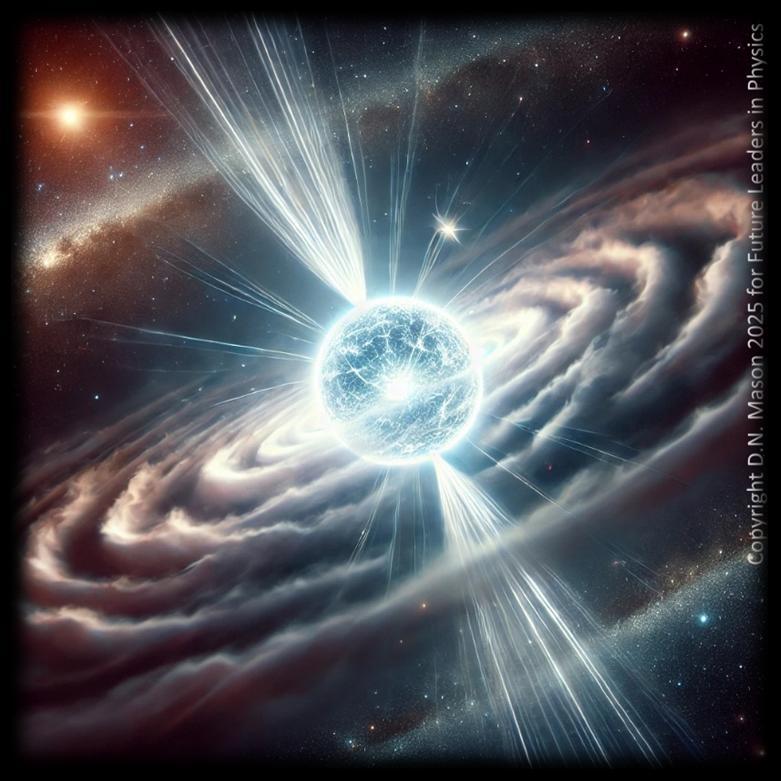
• How precise are they? Some pulsars are so consistent they rival atomic clocks in accuracy.
• Why do we care? NASA is testing pulsars as a potential deep-space GPS system to navigate spacecraft beyond the solar system.
Want to know more? NASA’s SEXTANT project successfully demonstrated pulsar-based navigation. Check it out here.

Neutron Star Mergers & The Origins of Gold
A Cosmic Collision
Two neutron stars, locked in a gravitational dance, spiral closer and closer. After millions of years, they finally collide unleashing energy trillions of times greater than the Sun. The explosion creates something incredible: heavy elements like gold, platinum, and uranium. Yes, this is true: the gold in your jewelry was likely forged in a neutron star collision billions of years ago.
In 2017, the LIGO observatory detected gravitational waves from one of these collisions the first time humanity “heard” two neutron stars crashing together. This breakthrough proved that neutron stars are essentially the factories of the universe, creating the elements that make up planets, life, and even us.
Want to know more? NASA’s neutron star research covers everything from gravitational waves to extreme matter. Explore more here.
Careers That Explore the Cosmos
For students like Jaden, who dream of unraveling cosmic mysteries, here are a few career paths:
• Astrophysicists – Study neutron stars, black holes, and the physics of the universe.
• Nuclear Physicists – Investigate how matter behaves under extreme pressures.
• Gravitational Wave Researchers – Detect and analyze neutron star mergers.
• Space Mission Engineers – Design probes to study extreme objects like pulsars.
Neutron stars challenge our understanding of matter, energy, and space-time. If you’ve ever asked, “What happens if we push physics to its absolute limit?” this is where you’ll find the answer.
The Universe’s Greatest Physics Lab
Jaden’s radio telescope discovery was just the beginning. Scientists around the world are uncovering new neutron stars, unlocking gravitational waves, and testing the limits of physics in ways never before possible.
Neutron stars are nuclear physics in its most extreme form beyond anything we can recreate in a lab. They hold answers to the biggest questions in science, from the origins of elements to the fundamental forces of nature.
And maybe, one day, one of today’s high school students will be the one to unlock their secrets.
Sources & Further Reading:
• NASA NICER Mission: Studying neutron stars from the ISS – Read more
• NASA SEXTANT Project: Using pulsars for deep-space navigation – Check it out
• NASA on Neutron Star Mergers & Gravitational Waves: Explore here
• LIGO Gravitational Wave Observatory: First detection of a neutron star merger – Visit LIGO
The Power ofAntimatter: The Most Explosive Fuel in the Universe
by Dan Mason
The Ultimate Energy Source
Imagine a spaceship that could reach Mars in days instead of months, powered by the most efficient fuel known to science antimatter. While it sounds like science fiction, antimatter is real, and its energy potential dwarfs anything else we know.
But there's a catch: antimatter is incredibly rare, difficult to produce, and annihilates regular matter on contact in a burst of pure energy. If we could harness it, antimatter could revolutionize everything from space travel to clean energy.
Let’s dive into the world of antimatter how it’s made, why it’s so powerful, and whether it could ever be the fuel of the future.
What Is Antimatter?
Inside A High-Tech Particle Accelerator Lab
Deep underground in Switzerland, the Large Hadron Collider (LHC) smashes protons together at nearly the speed of light. Scientists huddle around screens as exotic particles blink into existence for fractions of a second including antimatter.
Antimatter is the mirror image of regular matter. Each particle has an opposite counterpart:
• The antiproton is like a proton but negatively charged.
• The positron is like an electron but positively charged.
• When matter and antimatter meet, they annihilate, converting all their mass into energy.
This isn’t just theory antimatter annihilation has been observed in physics experiments, and even naturally occurs in rare cosmic events.
The Ultimate Energy Source
E=mc²
When antimatter meets matter, 100% of its mass turns into energy.
For comparison:
• Chemical reactions (like gasoline) convert less than 1% of their mass into energy.
• Nuclear fission (used in power plants) converts 0.1%.
• Nuclear fusion (the Sun’s process) reaches about 0.7%
• Antimatter annihilation? 100%. Nothing else comes close.
A single gram of antimatter could generate as much energy as an atomic bomb but in a controlled reactor, it could provide clean, limitless power.
Why Don’t We Use It Yet?
Inside a Cryogenic Storage Facility at CERN
A technician must carefully monitor a chamber storing a few atoms of antihydrogen, kept away from regular matter by powerful magnetic fields.
The problem? We can’t make much of it.
• To date, all of human technology has produced only a few nanograms of antimatter.
• The cost to produce 1 gram of antimatter is estimated at $62.5 trillion not exactly budget-friendly.
Even if we could make more, storing antimatter is a nightmare. Since it annihilates on contact with matter, it must be held in electromagnetic traps, making long-term containment incredibly difficult.
Could Antimatter Power a Spaceship?
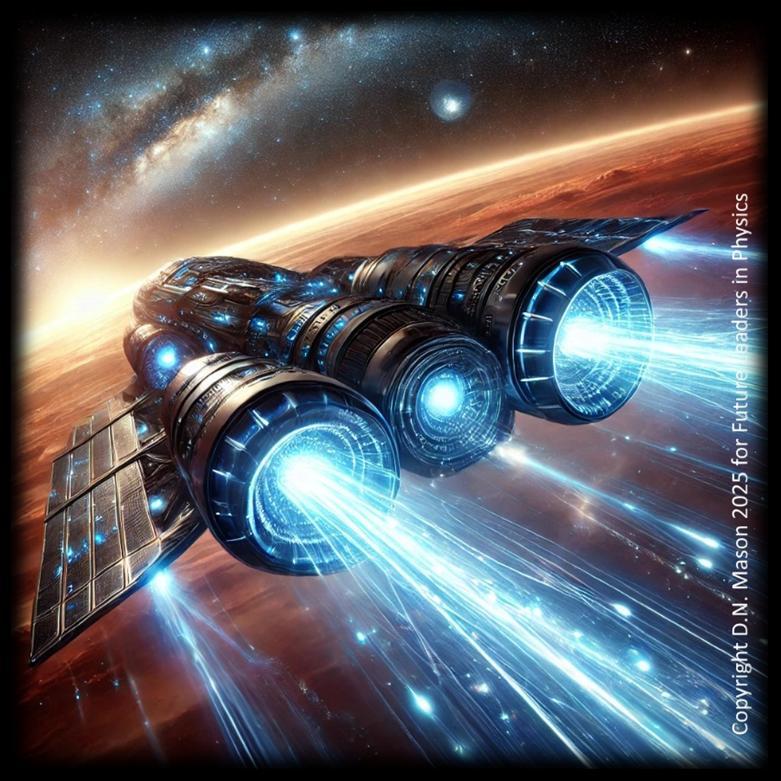
NASA and private space companies have explored the idea of antimatter rockets. Theoretically, an antimatter-powered spacecraft could:
• Reach Mars in weeks instead of months.
• Travel to nearby stars within a human lifetime.
• Carry a fraction of the fuel needed for a chemical rocket.
By using antimatter to superheat propellant, these spacecrafts could achieve speeds close to 10% of the speed of light fast enough for interstellar travel to be possible.
But until we figure out how to produce and store antimatter in large amounts, these ideas remain in the realm of future science.
Antimatter in Medicine
Believe it or not, antimatter is already used in medicine today. Positron Emission Tomography (PET) scans use positrons to detect diseases like cancer.
Scientists are even exploring whether antimatter could be used in medical treatments to target and destroy cancer cells with pinpoint precision, offering new possibilities for treatment.
The Most Exotic Fuel of the Future
Antimatter is the most powerful energy source in the universe, but right now, it’s one of the most impractical. If we could unlock its potential, it could transform space travel, energy, and even medicine.
For students interested in physics, antimatter research opens the door to:
• Particle physics (studying fundamental forces of the universe)
• Space propulsion engineering (designing next-gen spacecraft)
• Energy innovation (exploring new ways to generate power)
So, is antimatter the fuel of the future? Maybe not yet but for the next generation of scientists and engineers, the challenge is waiting.
Sources:
• NASA Technical Reports Server – Antimatter Propulsion: This report explores the potential of antimatter as a propulsion mechanism for space travel. https://ntrs.nasa.gov/api/citations/20200001904/downloads/20200001904.pdf
• Department of Energy – Antimatter Explained: An overview of antimatter, its properties, and the mysteries surrounding it. https://www.energy.gov/science/doeexplainsantimatter
• NASA – Deceleration of Interstellar Spacecraft Utilizing Antimatter: This article discusses the feasibility of using antimatter-based propulsion for interstellar missions. https://www.nasa.gov/general/deceleration-of-interstellar-spacecraft-utilizing-antimatter/
• Stanford University – Feasibility of Antimatter Power Plants: An analysis of the challenges and potential of using antimatter as an energy source. https://large.stanford.edu/courses/2017/ph240/payzer1/
• Universe Today – Antimatter Propulsion Is Still Far Away, But It Could Change Everything: An article discussing the current state and future prospects of antimatter propulsion. https://www.universetoday.com/170107/antimatter-propulsion-is-still-faraway-but-it-could-change-everything/
These resources provide comprehensive information on antimatter, its potential applications, and the current state of research in the field.
Further Reading:
• NASA – Radioisotope Positron Propulsion: Explores the concept of using positrons (antimatter particles) in propulsion systems. https://www.nasa.gov/general/radioisotopepositron-propulsion/
• ThoughtCo – Could Matter-Antimatter Reactor Technology Work?: An article examining the feasibility of matter-antimatter reactors as an energy source. https://www.thoughtco.com/matter-antimatter-power-on-star-trek-3072119
• Wikipedia – Antimatter Rocket: Provides an overview of proposed rocket designs utilizing antimatter as a power source. https://en.wikipedia.org/wiki/Antimatter_rocket
• Physics Stack Exchange – Large-scale Antimatter Production: A discussion on the challenges and possibilities of producing antimatter in large quantities. https://physics.stackexchange.com/questions/268126/large-scale-antimatter-production
• The Guardian – The Most Dangerous Delivery Truck? How a Lorry-load of Antimatter Will Help Solve Secrets of Universe: An article detailing recent advancements in antimatter research and transportation. https://www.theguardian.com/science/2024/dec/08/cern-antimatter-secrets-universescience
From Atoms to Medicine: How Nuclear Physics Saves Lives by Dan Mason
Introduction: The Power of the Atom in Medicine
When Olivia was twelve, her grandmother was diagnosed with cancer. The doctors recommended radiation therapy to target the tumor. Olivia had always associated radiation with danger, but now it was being used to heal. This experience sparked her curiosity about how nuclear physics plays a pivotal role in modern medicine.
From advanced imaging techniques to targeted cancer treatments, nuclear physics is integral to healthcare innovations that save lives daily.
Seeing the Unseen – Nuclear Imaging
Seventeen-year-old Jordan has been experiencing persistent fatigue. His doctor suggests a PET scan (Positron Emission Tomography) to investigate potential underlying conditions.
In the imaging suite, a technologist explains the procedure: Jordan will receive an injection of a radioactive tracer, commonly fluorodeoxyglucose (FDG), which mimics glucose a primary energy source for cells. After the injection, he will rest for about an hour to allow the tracer to distribute throughout his body. Then, he will lie on a table that slides into the PET scanner, a machine that detects the radiation emitted by the tracer.
How does it work?
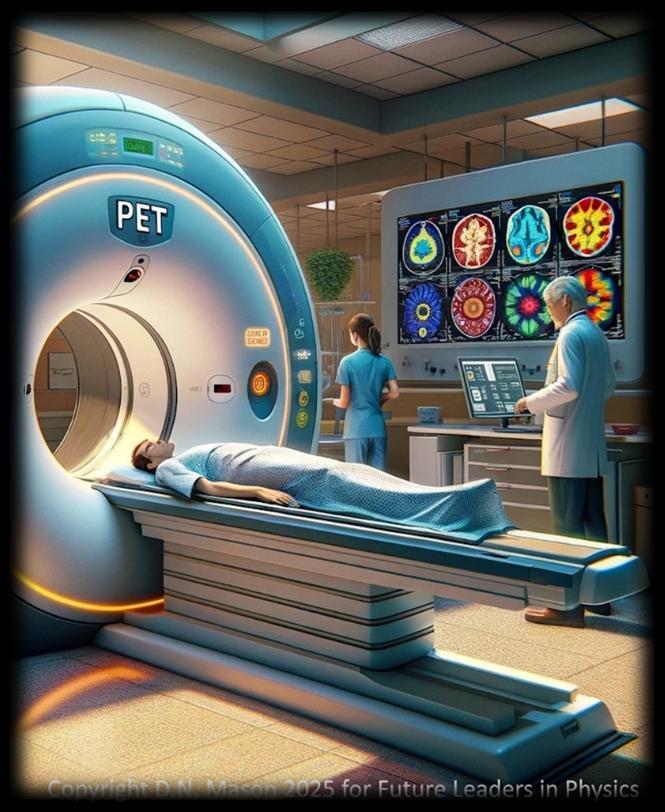
• Tracer Uptake: Active cells, such as cancer cells, consume more glucose and thus absorb more of the FDG tracer.
• Imaging: The PET scanner detects the radiation from the tracer, creating detailed images that highlight areas of high metabolic activity.
• Diagnosis: These images help physicians identify abnormalities like tumors, which often exhibit increased glucose metabolism.
This non-invasive procedure provides critical information about organ and tissue function, enabling early and accurate diagnosis of various conditions.
Fighting Cancer with Radiation Therapy
Ms. Patel, a retired teacher, has been diagnosed with breast cancer. Her oncologist recommends radiation therapy as part of her treatment plan.
In her consultation, the radiation oncologist explains that radiation therapy uses high-energy beams, such as X-rays or protons, to destroy cancer cells. The treatment is meticulously planned to target the tumor while sparing surrounding healthy tissue. Types of Radiation Therapy:
• External Beam Radiation Therapy (EBRT): A machine directs radiation beams at the cancer from outside the body. This is the most common form of radiation therapy.
• Internal Radiation Therapy (Brachytherapy): Radioactive sources are placed inside the body, near the cancer cells.
How does it work?
• DNA Damage: Radiation damages the DNA of cancer cells, inhibiting their ability to reproduce
• Cell Death: Over time, the damaged cancer cells die off, and the body naturally eliminates them.
Ms. Patel learned that treatments are typically administered five days a week over several weeks, allowing healthy cells to recover between sessions.
The Future of Nuclear Medicine
In a cutting-edge research facility, scientists are developing innovative therapies that harness nuclear physics to combat cancer more effectively.
One promising advancement is Yttrium-90 (Y-90) radioembolization, a treatment for liver cancer. This minimally invasive procedure involves injecting tiny beads loaded with radioactive isotope Y-90 directly into blood vessels feeding a liver tumor. The radiation targets cancer cells from within, minimizing exposure to healthy tissue. Patients have experienced significant tumor reduction with Y-90 therapy, highlighting its potential as a life-extending treatment option.
Another innovative approach is the use of iodine-123-labeled PARP inhibitors for treating aggressive brain tumors like glioblastoma. In a clinical trial at University College London Hospitals, a patient experienced a 50% reduction in tumor size after receiving this targeted radioactive therapy. The treatment delivers radiation directly to cancer cells, sparing healthy brain tissue.
Careers in Nuclear Medicine
Inspired by her grandmother's journey, Olivia is now considering a career in nuclear medicine. This field offers various paths:
• Medical Physicist: Develops and monitors radiation treatment plans to ensure patient safety and treatment efficacy.
• Nuclear Medicine Technologist: Prepares and administers radioactive tracers for imaging procedures and operates the imaging equipment.
• Radiation Oncologist: A physician that specializes in using radiation therapy to treat cancer
• Biomedical Researcher: Investigates new radioactive compounds and therapies to advance medical diagnostics and treatments.
These professionals collaborate to diagnose and treat diseases, improving patient outcomes through the application of nuclear science.
The Atom's Healing Power
Olivia's initial apprehension about radiation transformed into admiration for its medical applications. Nuclear physics not only powers cities but also empowers physicians to diagnose and treat complex diseases.
From illuminating unseen biological processes to precisely targeting cancer cells, the principles of nuclear physics are integral to modern medicine. As research progresses, the potential for new therapies and diagnostic tools continues to grow, offering hope to patients worldwide.
For those intrigued by the intersection of physics and healthcare, nuclear medicine presents a fulfilling career path dedicated to harnessing the atom's power to heal.
Sources & Further Reading:
• PET Scans & Imaging: Cleveland Clinic –https://my.clevelandclinic.org/health/diagnostics/10123-pet-scan
• Radiation Therapy Overview: National Cancer Institute –https://www.cancer.gov/about-cancer/treatment/types/radiation-therapy
• Yttrium-90 Radioembolization for Liver Cancer: Vogue Article –https://www.vogue.com/article/cancer-treatment-essay
• Iodine-123 Brain Tumor Therapy Trial: The Times –https://www.thetimes.co.uk/article/remarkable-therapy-shrinks-aggressive-brain-cancer by-half-nbthkg7qp