T he O ak T rees
Molly Backes, Communications Coordinator
Afew weeks ago, I found Mary Jane Hamilton’s 1991 book The Meeting House: Heritage and Vision on the extensive shelves at my parents’ house. It is an oddly-shaped book, longer than it is tall, with a folded cardstock cover the color of a paper grocery bag. Flipping through it, I looked at familiar images from FUS’s history: site plans, construction of the iconic prow, a group of men standing around a shovel at the ground-breaking ceremony, a group of women holding up the curtain they’d woven for the Hearth Room—the same curtain that now hangs in a glass case outside my office. There are pictures of the Stonehaulers—the women and men who helped transport a thousand tons of dolomite rock from a quarry outside Sauk City to our site in Shorewood Hills over the course of many weekends in 1949 and 1950. In the story of our congregation, we honor the Stonehaulers as our forebears, the people who with their own hands and determination built this church.
idea that Wright specifically identified our oak trees as a part of his overall vision for the Meeting House.
f f U s
(con’t from page 10)
According to the nature writer Margaret Roach, oak trees “support more life-forms than any other North American tree genus, providing food, protection or both for birds to bears, as well as countless insects and spiders, among the enormous diversity of species.” A keystone species, oaks are the glue that holds an entire ecosystem together. You could also say that they hold the land itself together—their large root systems help to keep the soil in place, increasing rainwater absorption and preventing erosion. In this season of drought, the wide canopy of our oaks has provided relief from the scorching sun for the plants and animals beneath them. While most of the grass on our campus is as yellow and dry as straw, the growth under the oaks is still green.
and emotional labor. Our oaks connect us not just to the ancient generations of ancestors who held such trees sacred but also to the more recent generations of FUS members who loved and cared for these trees, specifically.
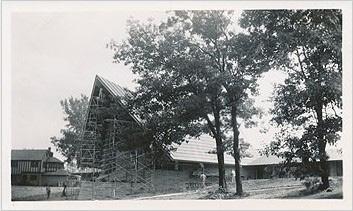
In his 1947 design for FUS, Frank Lloyd Wright called it “A Country Church for the Madison Unitarians.” Back then, this spot—now solidly in the middle of the city—was a rural suburb. Early visitors to the Meeting House report being able to see all the way to Lake Mendota. Hamilton writes: “In keeping with his vision of a rural church, Wright sought to preserve a nearby grove of oak trees where he hoped the parishioners would picnic after Sunday services, as he had in his youth with the Lloyd Jones family [...] near Spring Green.” Though I’ve long been familiar with Wright’s philosophy of organic architecture and site-based design, this was the first time I’d encountered the
Growing up at FUS, I loved our oak trees. In my CRE class called “Religion Without Walls,” our teacher and resident ecologist Brent Haglund encouraged us each to find our own sacred spot somewhere on campus; mine was in the wide, low branch of one of the old oaks north of the Loggia. (Recently Brent told me that some of the lower branches of the oaks needed to be cut down in the 90s because they “were killed by kids climbing on them,” and I had to confess that I was one of those kids!) In my family, my dad was the UU who brought us to church on Sundays, and my mom was a recovering Catholic who said that the only church she believed in was nature. Climbing into the oak tree and settling myself against its sturdy trunk, listening to the leaves whisper against each other while the adults were still inside the Landmark, I discovered a way to unite my parents’ theologies: I could be at church and in nature at the same time.
(con’t on page 11)
Oak trees have been sacred to people in cultures across the world for millennia. In many traditions, oak trees are also significant meeting places— sites of holy rites and rituals, gathering places for community meetings and celebrations, landmarks for travelers. When our congregation decided to build our Meeting House alongside an oak grove, we joined an ancient tradition that countless numbers of our ancestors observed before us, a tradition that may be as old as humanity itself: gathering in community under the oak trees to celebrate and wonder and mourn and grow together.
Researching our oak trees took me into the FUS archives, where I found an entire box of minutes, memos, invoices, and letters from the members of the Grounds and Landscaping Committee(s), representing nearly 75 years of work. As I flipped through the documents, I found myself unexpectedly moved by how much people have invested in the care of our land—not just their time and money, but their physical and intellectual
As the stewards of an iconic architectural landmark, we can sometimes get bogged down in the Frank Lloyd Wright of it all. We are a dynamic community—living, growing, exploring, changing, gorgeously imperfect and human—that dwells in a building which can sometimes feel more like a museum than a home. The story of the Stonehaulers is important because it reminds us that though this place represents the unique vision of one man, it also embodies the love and labor of the community members who built it. In the decades since, we have used the term to remind ourselves, too, of the love and labor it takes not only to build a church but to keep it going and thriving. In my book, every person who has tended to our land over the last 75 years is a Stonehauler, too.
Brent Haglund calls the four oldest oaks on our campus the “Signature Oaks.” They are the oldest members of our community, witnesses to this place long before we showed up. Oak trees can live for hundreds of years, so with any luck, they will stand witness long after we’re gone. It’s hard to imagine what the world might look like in the future, but the oaks, with their slow growth and long timelines, help me to see what it could be. The people caring for our trees 75 years from now haven’t been born yet, but they will be connected to us, just as we are connected to those who came before us. The oak trees—beloved elders, sacred meeting place—will make family of us all. ◊
12 THE MADISON UNITARIAN
10 THE MADISON UNITARIAN
O
JULY/AUGUST 2023 11
Meeting House with oak trees, ca. 1951
