MTA MOTOR July 2022

Page 1


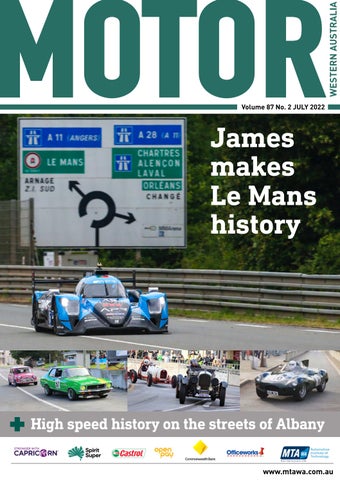
High speed history on the streets of Albany

With MTA WA CEO

Stephen moir

NEW GoVErNmENt, NEW oPPortUNItIES

The 2022 Federal election has been run and won and we now have the Albanese Labor Government in office.

Before I talk about the opportunities we have with the new Government, I want to recognise the work that was done by the previous Morrison Government in providing much needed reform for the automotive industry.

These significant reforms included amending the franchising code of conduct, passing legislation to mandate access for motor vehicle service and repair information and introducing improved unfair contract terms – undoubtedly the most significant reform package the automotive industry has seen to date.

The franchising code amendments included significant improvements to disclosure, coverage, adequacy of terms to secure a return on investment, dispute resolution, and compensation requirements and will greatly assist in addressing the substantial power imbalance that exists between internationally headquartered car manufacturers and their Australian dealership networks.

Equally important was the introduction of world-leading legislation to mandate access to motor vehicle service and repair information, compelling car manufacturers to share technical service and repair

information with all Australian repairers and the subsequent introduction of the Australian Automotive Service and Repair Authority (AASRA) as the inaugural scheme adviser.

I am very proud of the role that the MTA WA played, along with the State MTAs and VACC, in leading the way to have these important reforms delivered and I want to also thank the Morrison Government and, in particular, Ministers Cash, Sukkar and Andrews for their support throughout this process.

Change always brings with it opportunity and if the first few weeks of the Albanese Government are any indicator, it seems keen to address a number of issues that impact on the automotive industry. The MTAs can, and will, play a leading role in assisting the new government in the development of practical policy positions.

Historically, politicians have tended to focus much of their environmental strategy on the electrification of the motor vehicle fleet. The EU has recently called for a complete ban on the sale of new combustion engine vehicles by 2035 and it was only in 2019 that the then Shorten-led opposition called for 50% of all new vehicle sales to be EVs.

Several State governments, including the Western Australian McGowan Government, have announced incentive

A delegation from all MTAs and VACC will head to Europe in September where they will meet with manufacturers, industry bodies, dealership groups and repair businesses to look at how they have managed to transition to EVs and, more importantly, what do we need to do now to ensure the ongoing viability of our member businesses.

programs to increase the uptake of EVs along with versions of road user charging mechanisms.

What’s missing in all of this work is a consistent approach across all jurisdictions, particularly in the area of road user charges and much greater input from industry is required to ensure that we have a well-informed debate about the pros and cons of EVs, what is achievable and where the industry needs to be focussed moving forward.

The national MTAs and VACC are leading the discussion on this in an attempt to shape the development of future policy, both nationally and at a State level. We have already called an industry heads summit for late July in Canberra to commence the discussion, and this will be followed by a broader summit later in 2022 that will involve the relevant Ministers, heads of Government departments and industry leaders.

To assist in this, a delegation from all MTAs and VACC will head to Europe in September where they will meet with manufacturers, industry bodies, dealership groups and repair businesses to look at how they have managed to transition to EVs and, more importantly, what do we need to do now to ensure the ongoing viability of our member businesses. The information gathered from this delegation will also form the basis for our input into policy development.

Hopefully, the end result will be a nationally consistent approach to issues such as mandatory carbon targets for vehicle manufacturers to increase supply of EVs, the introduction of a national road user charge system that will replace existing taxes such as the fuel excise and tariffs, and a more consistent approach to

the subsidisation of EV purchases and investment in supporting infrastructure.

The future for the automotive industry is very exciting but it is critical that we have a very clear view of what is ahead so that members and the industry can plan to meet future needs.

Body repair sector at risk of collapse if nothing changes

The body repair sector is continuing to come under extreme pressure from the insurance industry as a result of a refusal by insurers to renegotiate terms with repairers. The majority of insurers have not increased the hourly rate paid to repairers for over 10 years and repairers are having to work off a base rate in some instances of $30 per hour whilst they try to repair vehicles back to manufacturers’ standards.

I fear this will end in a sector that can no longer repair to a standard as it is forced to repair to price. The sector is approaching crisis point with the viability of many businesses in question as a result of significant increases in the cost of paint, parts, labour and overheads.

Research undertaken by the MTA WA has clearly shown that paint costs from five suppliers have increased between

eight to 35%, resins and latex are up by 30%, solvents up by 19% and shipping costs have increased by 30%.

The current labour shortage is placing extraordinary pressure on wage costs and this has only been added to by recent wage case increases and a superannuation increase. WA’s inflation rate is currently at 7.5% – the highest in the country – and yet despite these significant cost increases, insurers are refusing to review their rates for repairers.

I think we also need to be very clear that these cost increases are not solely as a result of COVID as the Insurance industry would have us believe. These increases have been building over the past ten years.

In March of this year, I arranged for our national body, the MTAA, to write to the Insurance Council of Australia (ICA) to seek their support for urgent action aimed at addressing this issue. In this correspondence, apart from highlighting the significant cost increases faced by the industry, we called for an urgent summit with the ICA and key members. This meeting would bring attention to the immediate need to negotiate fair and reasonable compensation for body repairers recognising the cost increases in labour, parts, technology and materials for our members.

This year the number of Automotive Award categories has been reduced from 14 to six, ensuring that the prestige of being nominated, let alone being named the winner, is truly recognition the recipient is the best of the best.

The ICA responded to this approach in May, acknowledging that “the impact of the global pandemic, natural disasters and global supply chain disruptions has been far reaching and the insurance industry is conscious that this is also impacting motor repairers.” However, they declined our request for a summit citing competition law implications as the reason. I am sorry, but this response is nothing other than bullshit.

Collision repairers have exhausted all productivity improvements and cost absorption strategies across all expense areas of their business and enough is enough.

It was encouraging that in April this year the Federal Government, after numerous submissions from the MTAA, announced a Treasury review into the regulatory settings in the commercial conduct of the car insurance and smash repair industry. This was a significant announcement and the fact that it was to be performed by a department as opposed to a Parliamentary panel meant that it has the potential to deliver a

much quicker response for industry.

The election put this review on hold, however Richard Dudley, the CEO of MTAA, has been successful in having the new Government, under the new Assistant Minister for Competition, Charities and Treasury, Dr Andrew Leigh MP, understand the significance of this issue and we are hopeful that the review will proceed before the end of this year.

In the meantime, there is an urgent need for the industry to push back on unfair compensation from insurers. Insurers should not be in the business of quoting for repairs: they assess and work with the repairer to determine a fair rate.

A number of repair members have already started to refuse to take on work where the insurer is not paying at the required or fair level and I would encourage all members to consider this as one way of changing the way that insurers deal with this industry. It is worth noting that many repairers who have pushed back have been successful in obtaining their required payment for repair jobs.

Automotive Awards are back

The Spirit Super, MTA WA Automotive Awards are back for 2022 with a celebration of everything that is great about our automotive industry. Our night of nights is an event not to be missed.

I am really pleased that Spirit Super, formerly MTAA Super, have come on board as the Diamond Sponsor for the event. We also thank Capricorn Society and the Small Business Development Corporation for their support.

This year the number of categories has been reduced from 14 to six, ensuring that the prestige of being nominated, let alone being named the winner, is truly recognition the recipient is the best of the best.

I would encourage all members to consider attending the gala event at Crown Perth Grand Ballroom on Saturday August 20 to celebrate the achievements of our industry’s leading lights. Interest in this year’s event is unprecedented and members will need to move quickly to secure seats as they are selling fast.

Congratulations James Allen

Australians have always featured strongly in international motorsport with drivers such as Sir Jack Brabham, Vern Schuppan, Alan Jones, Mark Webber, Daniel Ricciardo, Allan Moffat and Peter Brock, amongst a host of others, all achieving success on the international stage.

We can now add one more name to that list, with West Australian James Allen winning his class at last month’s 24 Hours of Le Mans, one of only four Australians to achieve this feat.

James, the son of well-known WA motoring luminary Matthew and grandson of the late Bob Allen, has been competing in Europe since he was 16.

Like his father and grandfather, James is a quiet achiever, going about his business with great humility but we at the MTA WA could not let his success go unnoticed.

We have a feature on James and his journey to a Le Mans podium starting on page 12 of this edition of MOTOR that I’m sure members will enjoy.

ALLFLOW INDUSTRIAL

COMPLETE WASHBAY SERVICES

EXPERTS IN DESIGN, CONSTRUCTION & SERVICING OF WASH DOWN AREAS.

WE SPECIALISE IN SOLVING YOUR WATER WASTE PROBLEMS, FROM THE APPROVAL PROCESS THROUGH TO THE COMPLETE INSTALLATION, WITH A FULL BACKUP SERVICE PLAN.

SUPPLIERS OF THE VGS OIL WATER SEPARATOR (VERTICAL GRAVITY SEPARATION) THERE IS A DIFFERENCE THE VGS

• Continuously meets the performance standards

• Is able to handle high concentrations of oil

• Effective removes the suspended solids

• Reduces vapour content to acceptable levels

• Requires less floor space OUR SERVICES

• Oil/Water Separators

• Vertical Gravity Separators

• Installation & Consultation

• Wash Bays & Wash Pads

• Service & Maintenance

• Spare Parts 3/30

James Allen and fiancé Amber Okeeffe

An event not to be missed

The Automotive Industry night of nights is just around the corner. The 2022 MTA WA Automotive Awards will acknowledge and celebrate the achievements our industry’s shining stars with a gala event not to be missed.

Building on the overwhelming success of the 2019 and 2021 Awards, members will again come together at the Crown Grand Ballroom on Saturday August 20.

This year the number of categories has been reduced from 14 to six, ensuring that the prestige of being nominated, let alone being named the winner, is truly recognition the recipient is the best of the best.

Accolades will be bestowed in five categories – Apprentice of the Year, Innovator of the Year, Small Automotive Business of the Year, Large Automotive Business of the Year and Automotive Woman of the Year – throughout the evening.

A most prestigious award is a new addition this year to allow the MTA WA and all its members to recognise and honour a very special individual in our industry.

In a testament to how much the MTA WA values its outstanding members, the Industry Recognition Award will be presented to a worthy candidate who has dedicated a minimum of 15 years service with a legacy as an outstanding ambassador, mentor and contributor to the automotive industry.

The Awards present a great opportunity for industry leaders, business owners and their employees to share in the success of our industry while enjoying an extraordinary evening.

Included in the ticket price are predinner drinks, a beautiful three-course dinner with premium wines and beers (special dietary needs catered for) and outstanding entertainment.

Oliver Peterson – Oly to his friends – is back by popular demand as the Master of Ceremonies.

The host of 6PR’s afternoon show, Perth Live, Oly is renowned for his wit, intelligent commentary on the news of the day and his engaging interactions with his audience. Oh, and he is also a massive motor head.

One of Australia’s most loved comedians, Peter Rowsthorn, will bring his uproarious brand of humour to the stage as part of a massive night of entertainment.

Star of Kath and Kim, Thank God You’re

Here, Talkin’ About Your Generation and Hughesy We Have a Problem, amongst many other television appearances, Peter is a comic genius guaranteed to bring the house down. And if that wasn’t enough, guests will dance the night away to the ever-popular Murphy’s Law and their outstanding repertoire of classic rock, pop and danceable songs. Tickets are selling fast so make sure you are part of this amazing celebration of our industry and the people who make it so great.

Oliver Peterson
Peter Rowsthorn
Murphy’s Law

French and fantastique

PEUGEOT 3008 GT PLUG IN HyBRID 2022

The French have always been known for making interesting and, can we say, uniquely unconventional motor vehicles, with Citroen’s 2CV arguably being the best example. Whilst quirky, the little 2CV was in production for over 40 years and has gone on to become somewhat of a fashion icon, which says something about style over substance.

The latest offering from Peugeot, the world’s second oldest vehicle manufacturer, maintains that uniquely French trait with the new mid-sized 3008 GT Plug-in Hybrid SUV building on Peugeot’s excellent line up of family sized SUVs offering something a little different.

The GT is competing in a hotly contested market segment and goes up against cars like Volvo’s XC40 Recharge, the Toyota Rav 4 Cruiser, Lexus’ NX450h and the Mitsubishi Eclipse Cross. New model variants from Kia and Hyundai are also not too far away. Plug-in hybrids are finding many new owners, offering that happy place between range anxiety inducing full electrics and eco destroying ICE cars and are a great compromise for urban environments.

At first glance the 3008 GT PHEV is a striking car, with its black grill, black badges, 19-inch black wheels and fastback styling, complete with a rear roof spoiler. This is a car with an attention grabbing distinct look and is befitting of the style of the French.

The car has two ports at either side of the rear quarter panel, one for petrol and one for electric recharging.

Slipping into the cockpit, the first thing you notice is the small, flat top and bottom steering wheel that is set below the driver’s display, giving a very unconventional view for the driver. Unlike the majority of cars where you look through the steering wheel to the instrumentation, the 3008 gives the driver an unobstructed view of the dash display and while it takes a little getting used to, it really works very well.

Seats are trimmed with Napa leather, providing exceptional comfort levels which, for me, was a real highlight of this car. There are, however, a couple of frustrating aspects to the seating. Whilst the driver’s seat has full electric adjustability, massage function and two position memory, the front passenger has to use a manual lever to adjust their seat, which is disappointing for a car in this price bracket.

In the rear there is plenty of room for three passengers, aided by the relatively flat floor and high roof line and passengers also have access to two USB ports and a 12-volt socket.

The driver has an impressive 12.3inch digital display that provides a crisp and clear range of information and can be configured to individual preferences. Unfortunately, the same can’t be said for the 10-inch infotainment system display which does appear to be a little grainy at times, particularly when using the external cameras. That said the system is easy to navigate and to set your own preferences.

The system includes Apple car play and android auto, digital radio, 3D sat nav, a 10-speaker sound system, dual zone climate control and wireless charging for phones.

There are ample storage options throughout the car, including a huge centre console bin that will take a couple of large bottles, and door bins that are lined with carpet to stop those odd bits and pieces from sliding around.

The boot will accommodate 590 litres with a limited amount of additional storage under the floor. However, because the battery pack is

located directly under the boot and rear seats, there is no spare tyre.

The 3008 GT is definitely a wolf in sheep’s clothing, looking at first glance like your average, albeit stylish, family SUV. It is only when you hit the accelerator that the surprise is uncovered. This car is quick, really quick. It will accelerate from 0 to 100k/hr in just under 5.8 seconds, making this one of the fastest SUVs in its class.

Power is provided by a 1.6T petrol engine producing 147kW, supported by a front motor producing 81kW and a rear motor producing 83kW. Collectively this setup produces a whopping 222 kW (300 hp) through its AWD system and eight speed automatic. There are four driving modes available – electric, hybrid, sport and 4WD. I used the hybrid mode for the majority of my driving but, when boredom set in, a quick flick to sports mode livens everything up. One of the more impressive features of the 3008 GT is the incredibly smooth transition that occurs when the car switches from electric to petrol, requiring a double check of displays to confirm..

The 13.2kW battery on the 3008 GT is not large and the car’s battery management system only allows for 3.7kW of AC charging, meaning that

it can take over five hours to reach full charge. This gives the 3008 GT a published range of 60 kilometres but in my short time with the car, 40 to 50 kilometres is more realistic. Given that the average daily commute is under this distance, the good news is that the 3008 GT should adequately meet the needs of most drivers. I would recommend, however, that when the car is parked at home it should be plugged in to ensure a fully charged battery for the next day.

Peugeot claim a fuel consumption rate of 1.6L/100km which is excellent for a car that weighs in at just short of two tonnes.

The 3008 GT’s driver assistance package is reasonably standard for a car of the price, featuring autonomous emergency braking with low light detection of pedestrians and cyclists, lane keep assist, lane departure warning, blind spot monitoring and adaptive cruise control.

Overall – very good indeed On the road the 3008 GT Sport is a joy to drive. It’s fast, responsive, very comfortable and, with its ability to get off the mark quickly, has a fun factor that makes driving this car a really enjoyable experience.

Further to this, it’s practical, roomy and well equipped which makes it a very good SUV indeed.

The 3008 GT Sport PHEV comes with a five-year, unlimited kilometre warranty and the battery is covered for eight years or 160,000 km.

The 3008 GT is at the upper end of the price range for this type of vehicle with a drive away price of $88,900, making it around $20,000 more than the standard two wheel drive ICE GT Sport. The performance and economy, plus the fact that the hybrid drives all wheels, definately recoups some ground on price.

I want to thank John Nossiter and Haydn McGrath from Perth City Peugeot & Citroen for allowing me to experience the Peugeot 3008 GT Sport Plug in Hybrid.
REVIEW: STePheN MOIR PICTURES: gRAhAM CAWLeY

Perth to Le Mans podium

Despite winning his class in what is perhaps the most prestigious motorsport event in the world, the 24 Hours of Le Mans, West Australian James Allen has unfinished business at the famous Circuit de la Sarthe.

As part of the Portugese-based Algarve Pro Racing team, James won the LMP2 Pro-Am class at this year’s race, a result he describes as the greatest achievement of his career so far.

“It was fantastic to win the class and stand on the podium with my team mates and I’m very proud to have that trophy, but it’s not the outright win so there is still a bit of work to do,” James said from his home in France.

This attitude epitomises the man and the racing driver. Humble and gracious in victory, he is hungry for the opportunity to secure a drive in one of the Le Mans Hypercars in order to fulfil his lifelong dream of winning the 24 hour race outright.

The 25-year-old Perth born driver was talking after winning his class and finishing 16th outright, despite starting from the back of the grid.

Dedication to grandfather

Son of Western Australian motoring luminary and long-time MTA WA member Matthew Allen and grandson of long-time MTA WA board member, past President and life member, the late Bob Allen, James has been competing in Europe since he was 16.

Touchingly, James dedicated this win to his grandfather, who passed away late last year.

“Even back when I was starting out in go-karts in Perth, I always said to my family I wanted to win Le Mans one day and grandad always encouraged me to

follow that dream,” James says.

“When he was able, grandad used to come to all my races in Europe to support me but unfortunately, with his illness, he never got to see me race the LMP2, but I know he was so proud of what we’d achieved.

“Last year I was here in Europe and because of Covid I wasn’t able to return to see him before he passed away and nor was I able to go to his funeral which was incredibly sad,” James said.

Poignantly, this year’s Le Mans race finished on Bob Allen’s birthday, making the class win even more special for James.

Unlike many young drivers hoping to make a career in motorsport, his move to Europe was not fuelled by a desire to gain a Formula 1 seat, but rather to end up exactly where he is now.

“I don’t know what it was about Le Mans, but if I had to put it down to anything, and I’ve thought about this for such a long time, I just fell in love with the prototypes and that style of car and I

just wanted to drive one.

“I have never really considered Formula 1 to be a car – more a specialised racing machine – whereas I view a prototype with a roof and covered wheels and so on as the ultimate expression of a car.

“I think I fell in love with the prototype cars before I fell in love with the sport and racing to be honest,” James explains.

Australian go-kart champion

His journey to a Le Mans podium began like all good motorsport beginnings – on the go-kart tracks. Starting at Wanneroo as a 13 yearold, the young James Allen, with strong support from his father and grandfather, competed up and down the State for two and half years.

His first major title came in 2012 when he won the Australian Junior Karting Championship. This victory was to mark the beginning of chasing his European motorsport dream.

“We found out about the Formula BMW Talent Cup – essentially a German championship – and I went to a test day a few months after I had won the Juniors in karting,” James explains.

In an extraordinary display of raw talent, James went straight from a go-kart to a BMW powered open-wheel formula race car with wings and a 6-speed sequential gearbox, competing on an unfamiliar circuit.

“I will admit it was a hell of a learning curve as I had never driven anything like this before, let alone raced such a car,” James says.

In a Championship that consisted of one round of three races, James finished an amazing fifth outright, securing a podium for a third placing in one of the races.

For 2014, he was racing Formula Renault, a series considered to be one of the major stepping stones into a Formula 1 seat – a fact borne out by noting several of James’ closest competitors in that championship are

WEST AUSTRALIAN JAMES ALLEN IS ONE OF MOTOR RACING’S NICE GUyS. HOWEVER, DESPITE MANy SUCCESSES, MOST RECENTLy IN PERHAPS THE MOST CHALLENGING RACE IN THE WORLD, HE IS CHASING THE ULTIMATE VICTORy.
WORDS: PAUL ROBERTS
James and #45 Algarve Pro Racing team enjoyed a perfect race after an imperfect practice. Proud dad Matthew Allen.

now current F1 drivers: Charles Leclerc, George Russell, Lando Norris and Alex Albon.

“I’ll admit my first two years in Formula Renault were a bit rough, but by year three I was fighting for podiums and wins,” James said.

By 2017, he finally got to realise the dream of racing a Le Mans prototype and the 90th running of the 24 hours of Le Mans in June marked the fifth time James has driven in the event.

This year was to prove to be one of the most difficult with an accident in free practice on the Wednesday eliminating them from qualifying as the team worked through the day and night to rebuild the car.

“Unfortunately, one of my team mates, Steven Thomas, was new to the circuit and was pushing hard to get up to speed when he put the car into the wall,” James explains.

“It wasn’t a particularly big shunt but it was the wrong place at the wrong angle and the wishbone went straight through the chassis, facilitating an almost ground up rebuild by the team,” James said.

Starting from dead last

In a classic adversity to victory motorsport story, the No 45 prototype started from the back of the 62-car field with James at the wheel, took the lead in the Pro-Am LMP2 class in the middle of the night and ultimately finished 16th outright and two laps clear of the second-placed Pro-Am LMP2 car at the 24-hour mark.

“The team did a fantastic job getting the car back together for Thursday’s free practice and in the race it felt amazing, allowing me to quickly get through the (slower) GTE traffic in the first stint and starting the battle with the LMP2 cars which the other boys continued with their stints.

“We never lost heart and, in fact, my engineer said the best results he’s had at Le Mans, which after all is an endurance race, have come from the shittiest lead ups,” James said.

With Le Mans finished for another year, James is still very busy with Algarve Pro Racing driving duties throughout Europe in several concurrent championships.

With announcements from several major manufacturers at this year’s Le Mans regarding their intention to build and race Hypercars, James’ dream to hold aloft the outright winner’s trophy is surely now a step closer.

In a classic adversity to victory motorsport story, the No 45 prototype started from the back of the 62-car field with James at the wheel, took the lead in the Pro-Am LMP2 class in the middle of the night and ultimately finished 16th outright and two laps clear of the second-placed Pro-Am LMP2 car at the 24-hour mark.

ENGINE: Gibson Gk-428 : 4200 cc normally aspirated 90 degree V8

POWER OUTPUT: 603 bhp

MAx. REVS: 9.000 RPM

MONOCOqUE: Carbon fibre & Honeycomb

BODYWORk: Carbon / kevlar light lamination

LENGTH: 4.745 mm

WIDTH: 1.895 mm

HEIGHT: 1.045 mm

WEIGHT: 930 kg

James Allen’s Oreca 07 LMP2
James Allen (centre) celebrates on the podium with team mates Rene Binder (left) and Steven Thomas.

High speed motor musuem

Monaco, Bathurst, Adelaide, Singapore … there are many magnificent street circuits that, for all but a few days a year, carry everyday traffic travelling at sign posted speed limits.

To place Albany, perhaps more infamous for its now outlawed whaling industry, amongst those famous circuits may seem an exaggeration but every year over the WA Day long weekend in June, the streets are transformed for a motorsport event unique in Australia.

This year was the 31st running of the Albany Classic, an event that has cemented itself as the year’s major highlight for the historic motorsport community and a tourist boon for the city.

Organised jointly by the Vintage Sports Car club of WA and the Albany Classic Motorsport Club, this is one

of only two such events in Australia, the other being in Northam.

Featuring 150 vintage, veteran and classic cars racing around a temporary concrete lined circuit in the centre of Albany, the event attracts in excess of 8000 spectators.

While the event has an operating budget of over $300,000, the Classic is largely the result of a huge amount of work by volunteers.

Rob Ozanne, past president of the Vintage Sports Club of WA (VSCCWA) and part of the organising committee takes up the story.

“The event is absolutely huge and grown enormously over the years,” Rob says.

“The VSCC looks after all of the paperwork, which includes Motorsport Australia permits, insurances,

organising and co-ordinating entries, working out grids, vehicle scrutineering and so on,” he said.

In order to satisfy Motorsport Australia (formerly CAMS) requirements, entries are limited to cars made before 1985 and the event is run as a regularity with drivers aiming to consistently achieve a nominated lap time.

Regularity

“Although the events are strictly not races in the traditional sense, spirited driving is encouraged and with 30 cars out on track at any one time, this high speed museum is a truly magnificent and unique spectacle,” Rob said.

With vehicles running in five class specific groups ranging from pre-war vintage and veteran racing cars, some of which competed in the first Albany

Around the Houses in 1936, through to mid 1980s V8 Holden Commodores and Ford Falcons, the variety of motorsport history on show is truly impressive.

“We always have more interest than available places, but to some extent this ensures that the cars racing are, for the most part, period correct,” says Rob.

“One of the other very appealing aspects of the Albany Classic is that competitors do not necessarily need a full blown race car,” he said. “Many of the vehicles are road cars fitted with the necessary safety items and the drivers get to experience the thrill of motorsport and to be involved in this unbelievable event.”

One such competitor who is now integral to the running of the event, started this way 22 years ago.

Local Glenn Badger is the President of the Albany Classic Motorsport Club, joint organisers of the event, and the man responsible for the track logistics and set up.

“In the late 1990s, some of my mates were helping with the track set up on the Saturday night so I also got involved,” Glenn said.

“I had a collection of Ford Escorts (at current count he has 11) and one of the original Albany organisers said to me that first night ‘you know if you just do a couple of mods to your car, you can do the Around the Houses,’” Glenn explains.

“I got the Escort together for the 2000 event and I’ve done every Albany since. The bug hit very hard and over the years I’ve also done several Targa events as well as having an involvement with historic touring cars, both in an Escort and my XW GT Falcon,” Glenn said.

Exhilarating

As a local competitor and someone so involved in the organisation of the event, Glenn is in a unique position to explain the sense of pride and exhilaration drivers feel participating in the Albany Classic.

“Driving fast on what is a challenging, unforgiving concretelined street circuit in an event that you helped organise and set up with a bunch of mates … words can’t really describe the feeling,” Glenn said.

“It’s quite overwhelming having kids come up to you in the pits with their program asking for your autograph or seeing the crowds waving and cheering and clapping on the cool down lap … you could be Ayrton Senna at the Monaco Grand Prix. It’s just fantastic.”

‘‘Seeing the crowds waving and cheering and clapping on the cool down lap … you could be Ayrton Senna at the Monaco Grand Prix. It’s just fantastic.
Glenn Badger, President Albany Classic Motorsport Club
WORDS: PAUL ROBERTS
PHOTOS: GRAEME HOWIE, TERRy McGRATH

History dates back to 1936

From the 1930s to the 1960s, long before there were any dedicated racing circuits like Wanneroo and Collie, Around the Houses racing enjoyed tremendous popularity and races were run in many Western Australian country towns.

Exactly as the phrase suggests, the cars, many of them home built specials, were raced around the streets of the town with hay bales often the only barrier between the machines and spectators.

Stray dogs and the occasional spectator venturing on to the track certainly presented a hazard to the drivers, but events were mostly conducted in a carnival atmosphere.

Taking its cue from European style events of the time, Albany can claim to be a pioneer in Australian motorsport with the first Around the Houses style race in this country held over a 2.5 mile (4 kilometre) circuit around the town on March 8 1936.

The Albany Tourist Trophy, as it was called, was a 25 lap handicap race contested by nine entrants. A massive crowd of 10,000 were in attendance and the success of this event was built upon in subsequent years.

Notwithstanding a break during WWII, the event was held until 1962 when safety concerns over the ever-increasing speed of cars and several high profile fatal accidents in Europe ultimately saw to its demise.

Fast forward to the late 1970s and a group of prominent motoring enthusiasts, including the late Peter Briggs, began formulating ideas to resurrect the Around the Houses racing concept in a way that would satisfy the requirements of the Confederation of Australian Motorsports (CAMS) and their insurers.

A solution was found in the form of ‘regularity’ where competitors are rewarded for staying as close to a nominated lap time as possible rather than racing flat out to be first at the chequed flag.

The first such event, the inaugural York Flying 50 in 1980, showcased historic cars and motorcycles racing around the streets to rapturous enthusiasm from both competitors and spectators alike and continued to be a very popular event for many years.

The VSCCWA was formed in 1984 as the incorporated body responsible for organising the York Flying 50 event and the club today runs several very high profile historic motorsport events each year, including the Albany Classic and its sister event, the Northam Motor Sport Festival.

Given that Albany justifiably lay claim to the original Around the Houses racing event, a group of local enthusiasts began meeting in the late 1980s with a desire to resurrect the concept in the southern city and approached the VSCCWA to help.

With tremendous support from the City of Albany, the dream was first realised in 1990 and the Classic is today one of the key attractions on the Albany calendar, second only to the ANZAC Day commemoration in popularity.

The event’s future seems assured with the two organising clubs signing an agreement with the City of Albany this year to run the event until at least 2027.

Albany’s overnight transformation

Pardon the use of a word no-one involved in the Albany Around the Houses event wants to hear, but the event doesn’t just happen by accident.

It is the result of a massive amount of work by a group of dedicated volunteers, no more so in evidence than in the actual setting up the circuit.

The transformation from an accessible Albany town centre on Saturday afternoon to a dedicated, Motorsport Australia approved racing circuit as the sun rises on Sunday morning is nothing short of a miracle.

Glenn Badger, President of the Albany Classic Motorsport Club, is the man charged with organising the logistics of creating the racetrack and co-ordinating a team of approximately 80 volunteers working through the night.

Road closures and track set up all happen under the cover of darkness in the early hours of Sunday morning. Flatbed trucks deliver the 750 large concrete blocks that will form the barrier between racecars and spectators with forklift and crane operators positioning the blocks under the guidance of a third person.

And totally in keeping with the spirit of the volunteers building the track, all heavy duty equipment and operators are supplied free of charge by local businesses.

“The set-up has evolved into a well oiled machine with a great group of volunteers helping out every year on a particular section, knowing exactly what to do and where to start,” Glenn said.

“Due to compliance with Motorsport Australia directions, we’ve phased out the use of armco barriers over the years which was also very labour intensive to install.

“In the early days of the event, it was bricks and logs which must have been absolutely horrific to install as well as having questionable safety properties.

“We’ve now got more machines involved and less hands with the aim of making the installation as safe as possible for volunteers and the event as safe as possible for spectators,” Glenn said.

Once the blocks are position, a crew is responsible for chaining them all together while separate crews install safety fencing, bunting and two temporary overpass pedestrian bridges. Specially engineered flush mounted curbing, traffic islands and round-abouts are also removed.

Once the chequed flag has fallen on the final event of the day and the crowds have made their way home, the whole process is reversed and by early Monday morning, the Albany town centre is back to its speed limited norm.

‘‘50 years, one motoring love

David Moir has owned and competed in many interesting cars over the last 50 years, but there is one vehicle that has witnessed them all come and go, never to be replaced.

In what can only be described as an automotive love affair, David has owned his Austin-Healey 100 for almost 51 years, having purchased the car as a 19 year old student while studying mechanical engineering at Hobart University.

“My first car was an FJ Holden but with my brother-in-law about to purchase an Austin-Healey 3000, I was planning to buy his Triumph TR4,” David said.

ALBANy AROUND THE HOUSES COMPETITOR DAVID MOIR CELEBRATED 50 yEARS CONTINUOUS OWNERSHIP OF HIS RED AUSTIN-HEALEy 100 IN 2021. HE’S NOT ABOUT TO PART WITH IT ANy TIME SOON.

WORDS: PAUL ROBERTS

When the sale of the big Healey fell through, David’s desire for a sportscar lead him to the classifieds of the local newspaper and the discovery a red Austin-Healey 100 for $1000.

“This was 1971 and the car was about 18 years old. It’s interesting to think back on how we talked about how well cars were built in those days, which is absolute

Albany is such a special event with an interesting and challenging track layout and fantastic camaraderie amongst like-minded enthusiasts.

rubbish,” David says with a laugh.

“If I bought an 18 year old Mazda MX5 today, for example, I wouldn’t have to do anything to it.

“When I bought the Healey, it had been restored in inverted commas and yet shortly after I rebuilt the engine and did all sorts of stuff that you certainly wouldn’t have to do on a modern car less then 20 years old,” David said.

Interestingly, parts availability for a 70-year-old Austin-Healey is better now than when David purchased the car.

“The gearbox in the car when I bought it was a fragile three speed and, with my enthusiastic driving style in the first few years of ownership, I managed to strip a few teeth off the cluster gear,” David explains.

“Back in the mid 70s I was still able to walk into a British Motor Corporation (BMC) dealer and buy new genuine mechanical parts for it.

“That situation dried up very quickly but you certainly couldn’t have bought any body parts back then and yet now people are

remanufacturing almost everything for the cars, including a business in Ballarat who will build you a brand new chassis,” David said.

Over the years, the Healey has received another engine refresh, a gearbox and overdrive rebuild, suspension and brake overhaul and a respray.

“The car is now in the best mechanical condition it has ever been since my purchase 50 years ago and it is still a great pleasure to drive,” David says.

The Healey, while being David’s everyday car for many years in the 1970s, also gave him an opportunity to become involved in club-level motorsport, an enthusiasm that continues to this day.

“My first experience driving the Healey on a racetrack was at Baskerville in Tasmania and can still remember the high level of anticipation and excitement I had in driving the car at speed,” David said.

Moving to WA from Tasmania in 1990 to take up an engineering position with the RAC, David joined the Vintage Sports Car Club of WA (VSCCWA)

and entered his first Albany Around the Houses Classic in 1991. He most recently competed in the 2021 event.

“It’s such a special event with an interesting and challenging track layout and fantastic camaraderie amongst like-minded enthusiasts,” David said.

The future

When the conversation turns to the question of the future for cars like David’s Healey and who the enthusiast custodians are going to be once the current owners become too old to drive, David pauses to think. It’s an ongoing discussion of concern within the VSCCWA, the organisers of the Albany Classic.

“I think it depends on the marque to some extent,” says David. “Porsches, for example, will hold their value and interest for longer I suspect because you can still buy a Porsche and that generates interest in the older models.

“Austin-Healey stopped production 50 years ago and to most they’re just funny old English cars,” David said.

Interestingly, the values are still currently holding up but David

suspects that in the next 10 or so years they will drop significantly except for the super rare models that collectors invest in.

Nostalgia, though, is a wonderful thing and there is no doubt that this is part of the charm that has lead David to 50 years of continuous ownership.

He can’t quite put his finger on why the Healey has stayed with him when cars such as a Mini Cooper S, Escort Twin Cam, Lotus Elan, Targa prepared Datsun 240Z and a Porsche 944 Turbo, amongst others, have come and gone.

“I guess I just like the Healey and I can’t see myself selling it,” David says. “I could have sold it lots of times but I hope to get another 10 or 20 years of pleasure from my car.”

An event like the Albany Around the Houses Classic certainly demonstrates that these older special cars are capable, entertaining to drive, fast and reliable and maybe the future drivers are some of the young people enthusiastically watching from behind the concrete barriers.

A younger David Moir, sliding through the corner at Baskerville Raceway, Tasmania in 1979. “This seemed to be the angle of the car everytime through this corner, but I never spun it!” said David.
Vintage Sports Car Association of WA Secretary and Albany Classic competitor, David Moir
Picture: Graeme Howie, Sports Pixx Photography

WA motoring icon passes

Peter Briggs, the larger than life Western Australian businessman and one of Australia’s greatest car collectors, has died at the age of 83. Reflecting on his passing, MTAWA Group CEO Stephen Moir said that Peter’s establishment of the York Motor Museum in the late 1970s remained an very important legacy in Western Australian motoring history.

“Peter is perhaps best known for creating this fantastic museum and bidding at international auctions to ensure that it featured the finest collection of classic cars anywhere in Australia, attracting enthusiasts to York from all over the world,” Stephen said.

His influence on the establishment of York and the Avon Valley in general as a tourism destination cannot be underestimated, with many decrepit buildings and hotels bought and restored by Peter with the aim of making York the most significant inland tourism town in Western Australia.

He was instrumental in establishing the York Flying 50, inspired by the “Around the Houses” race events conducted throughout Western Australia from the 1930’s to the 1960’s. At its peak, the event attracted 18,000 visitors to York.

A regular competitor in the Flying 50, the sight of his massive 1930 Le Mans Blower Bentley thundering around the streets of York was a highlight and thrilled crowds. He formed the Bentley Driver’s Club in 1998 and was the current president of the club when he passed away.

Having qualified as a quantity surveyor, Peter initially worked for the Public Works Department before his entrepreneurial streak lead him into property development.

Peter Briggs 1 February 1939 – 31 May 2022

After recovering from bankruptcy in 1972, he moved in to the booming resource industry and during his business career controlled more than 30 publically listed companies with interests ranging from oil and gas production in the USA, exploration and oil and gas drilling in the Middle East and Australia, and, perhaps most successfully, gold mining in Western Australia.

Peter’s success in the mining industry enabled him to indulge his passion for classic cars and he owned more than 200 cars during his lifetime. He drove his cars in rallies all over the world and, with his wife Robin navigating, won the Historic Monte Carlo Rally twice.

He also raced at the old Caversham circuit in the Swan Valley in the 1960’s and won the 1971 WA Touring Car Championship at Wanneroo Raceway

after purchasing the legendary 500hp Holden Monaro from Norm Beechey.

He showed his cars at Concours events all over the world, winning awards at the famous Pebble Beach Concours d’Elegance in California, Villa d’Este in Italy, and New Delhi in India.

In 2017, the York Motor Museum was purchased by a consortium of York motoring enthusiasts, the Avon Valley Motor Museum Association. With the core display comprising cars from the Peter Briggs collection, the new ownership has ensured that the museum remains a vital part of the local community for years to come.

“I hope that my collection of fine cars gives as much pleasure to you as it does to me,” said Peter at the time.

Peter and wife Robin, at the Pebble Beach Concours d’Elegance in 2004.
With thanks to Graeme Cocks

With

How does Openpay work?

Delivering career ready apprentices

With more than 80 percent of apprentices remaining with their host employer upon completion of their certificate, the MTA WA Group Training Organisation (GTO) has a fantastic track record.

It is also testament to the hard working GTO team that a record number of 291 apprentices are currently building a career in the automotive industry with demand for skilled technicians at an all time high.

On the other side of the coin, interest from school-age students to enrol in the MTA WA program is also outstripping the number of places available with a thorough application process ensuring only the most enthusiastic candidates are selected.

“The kids have got to have the passion,” says Steve Spini, MTA WA Group Training Manager.

“All applicants have to pass an aptitude test before we interview them to discuss, amongst other things, their motivation for wanting to get involved in the industry,” he says.

“If the reply is ‘well, it’s a safe career’

buses, panel and paint, auto electrical and vehicle body building.

The demand from employers seeking apprentices is currently outstripping supply, with the MTA maintaining a standard of providing quality people genuinely looking for a career in the automotive sector.

The ones who tend to succeed, Steve says, are those tinkering with their cars, riding dirt bikes on the weekend or youngsters brought up in an enthusiast family where cars were considered more than just a way of getting from point A to point B.

“And then we also find the kids who have no idea what they want to do who subsequently discover their passion within the automotive industry and it becomes the best decision they’ve made,” Steve says.

“At the end of the day, all you need is a kid with a good attitude prepared to put in the effort over four years.”

Encouragement

“We give them all the encouragement in the world, monitor their progress, offer pastoral care and, importantly, instil in them an appreciation of loyalty to their employer.

Right host delivers great outcome

DDAyNE BORN IS AN MTA WA GROUP TRAINING ORGANISATION SUCCESS STORy. HOWEVER, THE JOURNEy TO REALISING HIS DREAM HAD SEVERAL FALSE STARTS BEFORE HE FOUND THE RIGHT HOST.

WORDS AND PICTURES: PAUL ROBERTS

or ‘mum and dad want me to do it’, it’s a safe bet that the kid is lacking the desire and passion to excel.

“This decision is a career choice, not a fall back position. People spend a third of life working and that’s a long time to endure a career you’re not happy with,” Steve says.

Steve describes the MTA’s Group Training program as almost like a labour hire organisation or employment agency for dealerships and workshops looking to host apprentices and provide on-the-job training.

“We promote automotive apprenticeships in schools and the wider community, manage all the paperwork, wages and any issues that may arise, including worker’s compensation for example,” Steve says.

And befitting a multi-faceted industry, MTA Group Training sources apprentices for all areas, from light vehicle mechanics to heavy duty trucks and

“The host employer invests four years nurturing and teaching their apprentices and we are very proud of the retention rate of qualified technicians with the original host,” Steve says.

“We have many great hosts who continually take on apprentices year on year and the other side of our job is to also ensure they are happy and there are no issues,” Steve said.

On the rare occasions when a personality clash, work related problem or a downturn in custom creates an issue for the employer, it is the GTO’s responsibility to find the apprentice a new host.

“Once we’ve got to know the apprentice a little better, we can work out the hosts that are perhaps a little more suitable to the kid’s personality and pair them up,” Steve said.

“At the end of the day, we want the kids to have success, not failure, and we want the industry to continue to embrace the high quality delivery of service from the MTA’s Group Training Organisation,” Steve said.

ayne Born is a perfect example of the importance of matching the right host to the personality of the apprentice in order to ensure an outstanding outcome for both parties.

Dayne’s apprenticeship journey hasn’t always been a smooth or happy experience, but having just completed his light vehicle apprenticeship as a mature aged 28 year old, he is now very much a valued member of the team at the Car Factory in Joondalup.

And it’s thanks to the MTA WA’s GTO team, under the guidance of Steve Spini, that Dayne did eventually find the right home.

The story of how he came to be part of the Car Factory team mirrors to some extent his journey from finishing school to being a fully qualified mechanic.

“After I finished Year 12 in 2010, I did a three year apprenticeship as a

cabinet maker but when that finished I struggled to find a job in that industry and, to be perfectly honest, it wasn’t the career for me” Dayne said.

Three years working for Western Power as a meter reader followed by a year battling health issues including depression followed before Dayne paid for his pre-apprenticeship in motor mechanics with a private agency.

Struggling to find a job, he was finally placed with a workshop in the northern suburbs to begin his apprenticeship. It wasn’t to be the beginning Dayne was hoping for.

“I was just thrown in the deep end with the business owner expecting me to perform at the level of a qualified technician and continually berating me for things he thought I should know but that I had never been taught,” Dayne said.

“My stress levels were through the roof and this experience took

Steve Spini (left) with two apprentices.
‘‘ I love the fact that everyday and every job is different. Cars are like a massive puzzle where the pieces keep changing dependent upon the make and model and what aspect you’re working on.
Dayne Born, The Car Factory, Joondalup

a massive toll on my health and the relationship with my partner, but we did get through it,” he said emphasising the hidden implications of being placed in the wrong environment as a young apprentice.

Dayne eventually left that establishment and found himself at Motorfix in Wangara.

“That was just fantastic,” he says. “I learnt more in the first week than I had in two years at the other workshop.”

Unfortunately a downturn in business meant another interruption to Dayne’s apprenticeship and several further incompatible placements before he came on board with the MTA’s Group Training Program.

Around mid-2020, after business had picked up following the initial shock of the Covid pandemic, Kevin Fettes of the Car Factory in Joondalup got in touch with the MTA looking for a mature-aged apprentice.

Mature-aged apprentice

“Taking on Dayne as a apprentice really worked to our advantage as it’s great to have someone a little older with world experience who can make mature decisions without direction,” Kevin said.

“With a younger apprentice you often have to reassure and go through the whole process whereas an more mature adult tends to think ‘I can do that so I don’t need to ask.’

“Also this is a great place for an apprentice as we are just a small workshop with a small team so we can really concentrate on helping the kids out,” Kevin said.

The personalities also worked. Dayne was about to start his third year of the apprenticeship and fully admitted that he was more of a hands-on learner than a bookworm.

“One of the problems with Dayne’s apprenticeship experience was going through six different shops, he was shown how to do things six different ways,” Kevin said.

“Initially I would say to Dayne ‘this is how you do it’ and he would say ‘but I was taught to do it this way’ to which I

would have to reply ‘well, you were taught wrong mate!’

“But I wouldn’t just say that is wasn’t right, I would explain and show him why which I think is so important when you’re training someone to be a quality mechanic,” Kevin said.

With a view to maintaining quality as the cornerstone of the Car Factory’s reputation, Kevin instills in all his apprentices that there is no such thing as a stupid question.

“It’s stupid when they don’t ask and then they make a mistake,” he says.

Epilepsy

Dayne, who also suffers from epilepsy but thanks to medication has been fit-free for 14 years, has also had to endure the discrimination that comes with such health issues.

“Epilepsy is a big thing that no-one really knows anything about so once they hear that word they freak out, wondering if I can perform or being concerned I’ll have a fit,” Dayne said.

“That was never an issue for us,” says Kevin. “Many people will run away from a perceived risk, but it’s far more important to see the person.”

Dayne is full of praise for the MTA’s training (“all the lecturers were absolutely fantastic and helped me so much when I was struggling”) and he has absolutely excelled at the Car Factory, loving the job he has now made his career.

“I have been into cars for as long as I can remember,” he says, proudly stating that he collects Hotwheels model cars and has a collection numbering over 1000, including rare early lead models.

“I find it fascinating that the motorcar started as a steam powered invention and we’ve now progressed to where an electrical signal is sent to fire the engine.

“I love the fact that everyday and every job is different. Cars are like a massive puzzle where the pieces keep changing dependent upon the make and model and what aspect you’re working on.

“The car cannot talk to us. We’ve got to work out the problem from what the customer has told us and what we have felt in order to make things perfect again and I love that challenge.

“I will continue signing up for training because one of the great things about this industry is that you never stop learning,” Dayne said.

With the excitement of a baby due in November, his apprenticeship successfully completed and finding the supportive and friendly workplace he needed, Dayne’s life has finally come a full circle.

Passing on the knowledge ... and the business

Kevin Fettes has long history of taking on apprentices and imparting his knowledge, and his steadfast belief that quality is the most important aspect of the job, to the next generation of mechanics.

Now semi-retired, he has recently sold The Car Factory to one of his former apprentices, Tom Bubrzychi, fulfilling a succession plan developed when Tom was first placed at the workshop several years ago.

“It was always my plan to take on an apprentice and train them up not only on the mechanical side of things, but also the management side of the business with a view to eventually selling it on when I retired,” Kevin said. Tom was the perfect fit, achieving all the goals Kevin set and maintaining the high standards the Car Factory has become known for.

“It was a fantastic opportunity and one that I am exceptionally fortunate to have been given,” says Tom. “It wasn’t like ‘here’s the business, see you later’,” Tom said. “Kevin didn’t throw me in the deep end for he had given me all the tools to manage the business and by the time I had bought it, I was pretty well running it anyway.” Kevin currently still helps out at the Car Factory three days a week with Tom, Dayne and first year apprentice Kieran Gallagher.

Now a fully qualified technician, Dayne Born is passing his knowledge on to first year apprentice kieran Gallagher.

Next generation training

ELECTRIC VEHICLES

REPRESENT AN EXCITING AND CHANGING AUTOMOTIVE LANDSCAPE. WITH MANUFACTURER SUPPORT, THE MTA WA IS DELIVERING TRAINING TO MEET THE NEEDS OF THE FUTURE.

WORDS AND PICTURES:

With very strong manufacturer support and a new state-of-the-art training facility in Balcatta, MTA WA is at the forefront in preparing new and existing technicians for the future in the ever changing automotive industry.

In an Australian first, MTA WA’s Automotive Institute of Technology (AIT) will bring a new apprenticeship qualification in electrical vehicle technology on stream in the next 12 to 18 months.

With manufacturers investing heavily in electric vehicle technology, this will be the realisation of a goal to ensure the industry has the skilled technicians to service and repair these vehicles in the future.

The MTA WA’s Automotive Innovation Training Centre, which was officially opened in November last year by the Premier, the honourable Mark McGowan MLA, is currently delivering training in the latest automotive advancements, including battery and hybrid technology and new driver assistance systems.

“We are the only training organisation in WA offering electric vehicle education and the new facility in Balcatta is allowing technicians to add further skillsets in new EV technologies to their portfolio,” said Mel Greenhow, Manager of the MTA WA’s Registered Training Organisation.

“However, with the industry moving in such a different direction and at such a rapid rate, the creation of a full EV apprenticeship pathway is a really exciting innovation that our members will need in the future,” he said.

‘‘ We have one of the most up-to-date collections of training vehicles and resources anywhere in the country.
Mel Greenhow, Manager MTA WA Registered Training Organisation

source some training parts such as steering, suspension and engine components.

“We thought it would be a tremendous addition to our training fleet if we half cut it and revealed all the electronics running through the car while ensuring that everything was still fully operational,” Mel explained.

Idlewild Offroad in Malaga were tasked with adding the structural frame and strengthening the floorpan once the roof, doors and back end of the car had been removed.

The result is a fantastic training tool that allows students to see and understand what is usually hidden behind bodywork and interior fabrics with everything fully functioning, from reverse sensors to air conditioning.

Following the successful transformation of the Veloster, Hyundai offered another preproduction promotional vehicle – this time the exciting i20N.

He is proud the MTA WA, as the industry body, has such tremendous support from vehicle manufacturers as this ensures real world training on a current range of vehicles.

“We have one of the most up-to-date collections of training vehicles and resources anywhere in the country and that is mostly due to the support we get from manufacturers such as Hyundai, Kia and Toyota,” Mel said.

Vehicles include, amongst others, a Toyota CHR Koba, a hybrid Toyota Corolla and Rav 4, an electric Kona, i20N and Veloster from Hyundai and a Kia Stinger and Carnival, along with an extensive collection of electric motors and batteries.

The training collection includes what are perhaps two of the most unique Hyundai vehicles in the world.

The brainchild of the MTA WA’s training division, a fully operational, front end only Veloster, complimented recently by the addition of a similarly converted i20N, has been created by the team at Balcatta as a interactive educational tool.

“The first car we did was the Veloster,” says Mel. “It was a pre-production modified model that Hyundai used to promote the new car around Australia.

“As it was modified and did not have an Australian compliance plate, the car was due to be crushed once it had finished its promotional duties,” he said.

Hyundai offered the car to the MTA WA in mid-2021, expecting that it would be used to

“Manufacturer support like we’ve had from Hyundai is absolutely essential,” Mel said.

“Without their support to have this number of training vehicles would cost hundreds of thousands of dollars.”

The assistance is a two-way street. As vehicle makers continue to invest heavily in electric vehicle technology, manufacturers are looking to up skill their workforce with help from the MTA.

And as technologies in vehicles evolve, such as advanced driver assist systems, so will the training opportunities offered by the MTA WA.

“The way vehicle design is heading nowadays is unlike anything we’ve ever seen and as the industry leader in education, we plan to develop more and more post trade training opportunities in future technologies,” Mel said.

“We had two weeks to do this car before it had to be crushed,” Mel said. “With the i20N, we kept the front doors on and the windscreen in place, but the concept is essentially the same.”

Aside from the excellent training opportunities these cars present, a very practical aspect is the space saving size of a half cut vehicle and, sitting on dolly wheels, the ease of manoeuvrability.

With over 600 apprentices currently involved in training programs and an ever increasing demand for the skills imparted, the MTA WA continues to ensure the industry has a supply of well qualified technicians able to meet future needs.

GO TO WEBSITE

SEND EMAIL

Combine super and save

Like fish and chips, super works better when together.

If you’ve ever had more than one job, there’s a chance you’ve got more than one super account. While having more than one account is okay, it can prevent you from getting the most out of your super. Here are three reasons why combining your super into one account makes super sense.

1. It’s easier to keep track of your super Super isn’t something we think about every day, so it can be easy to lose track of your super.

The ATO estimates there’s $13.9 billion in lost and ATO-held super in Australia1 Most of this is from people changing jobs and losing contact with their super funds.

Having your super in one place makes keeping track of your super much easier and reduces the chance of your super becoming ‘lost’.

Combining your accounts makes managing your super simpler too.

For every account you have, you’ll need to make decisions about investments, insurance, and beneficiaries. You also need a set of login details to access your account online.

Having a single account will save time and hassle and can help you engage with your super, as you can manage it all in one place.

Things to consider before combining

2. You can save on fees

Having multiple super accounts means paying multiple sets of super fees. Over time these fees add up and can have a serious impact on your overall super balance. This is especially true early in your career when your super balance is smaller.

Most super funds also offer default insurance cover, such as death or permanent disablement cover. Each month you pay an insurance fee (or premium) for this cover.

If you have multiple super accounts, you may be paying for duplicate cover you don’t want, don’t need, or is no longer appropriate for your situation.

So, like fish and chips, super works better when together.

By combining your super, you can reduce the amount of fees you pay, eliminate unnecessary cover, and plug the holes where your super has sprung a leak.

3. Combining super is quick and easy

A few years ago, combining super accounts was a real hassle. There were multiple forms to fill out, and you had to know where your super was before you could transfer it.

Now you can find and combine your super online in minutes.

To combine your super into your Spirit Super account, log in to Member Online and use the Find and combine tool under the Contributions tab.

The Find and combine tool helps you find all your super accounts as well as any lost or ATO-held super you have. You can then choose which accounts you want to roll into Spirit Super. It’s easy and only takes a few minutes.

You can also find and combine your super accounts through your MyGov account.

So, there’s no excuse to delay.

Combining super makes things easy and can save you money, but there are things to consider before proceeding.

Performance - fees and performance will differ from fund to fund. Make sure you’re combining into a fund that provides great value.

Insurance - combining super may close your old super accounts and cancel any insurance attached to them. So, make sure you’re not giving up any cover you need before combining.

Tax - think about if you want to claim a tax deduction or split contributions. You won’t be able to do this on any contributions you transfer into your chosen fund.

Investments - if combining into your Spirit Super account, all transferred money will be invested in your current chosen future transaction investment strategy.

With Commissioner for Consumer Protection Gary Newcombe

Backyard operators targeted

Consumer Protection is determined to eradicate the illegal practice of backyard operators who buy and sell multiple vehicles as a profitmaking business, given they rob both consumers of their rights and legitimate licensed dealers of business.

In recent weeks, we have successfully prosecuted three unlicensed motor vehicle dealers who sold 172 vehicles between them and collectively received almost $52,000 in court fines. One of those individuals was also convicted of winding back the odometers on two vehicles by a total of 366,700 kilometres.

One complainant contacted us after the car he’d purchased had broken down and had finance still owing on it from a previous owner. Another consumer who

paid $2,000 for a vehicle through the same unlicensed dealer had to spend a further $4,500 to make it roadworthy.

These illegal traders generally do not repair any faults in the vehicle once sold, creating safety concerns.

Backyard operators take away business from legitimate licensed operators who meet the costs of complying with licence conditions and the laws controlling their activities.

They also rob unsuspecting consumers of their rights to a warranty and other remedies should something go wrong with the vehicles after purchase.

We’re urging industry and the community to report unlicensed dealers to Consumer Protection and help us put a stop to this illegal practice.

Review drives change for consignment sales

Losses incurred by owners when selling their motor vehicles and caravans on consignment have prompted the State Government to propose new laws.

Given the dealer can keep any money they receive from the sale in excess of the amount they agree to pay the owner, this has at times resulted in dealers giving below reasonable value sale price estimates to vehicle owners.

After dealers Luxuride and Xoticar broke the law while selling vehicles on consignment, leaving their victims a combined $2 million out of pocket, Consumer Protection undertook a review of the industry and its future in Western Australia.

While the consultation presented options for no changes or to ban consignment sales altogether, the consensus from the feedback received suggested that consignment sales were important to both dealers and vehicle owners, but that stronger laws were required.

Currently, motor vehicle dealer licences specify that consignment sales are not allowed and separate applications to have this restriction removed are made to Consumer Protection.

Under the proposed new laws, consignment sales will become a separate licence category with applicants having to comply with specific conditions, allowing for greater flexibility if disciplinary action becomes necessary.

Stopping unsafe car sales

Automotive officers from Consumer Protection regularly carry out random inspections at dealerships and place green “Unfit for Sale” stickers on vehicles that have defects and are considered unsafe or unroadworthy.

A vehicle issued with a ‘green sticker’ cannot be sold until the dealer arranges for the defect to be fixed and an inspection undertaken at an approved Department of Transport facility. Alternatively, the dealer can choose to de-licence the vehicle.

To stop unsuitable people from obtaining a licence to sell on consignment, the State Government has proposed changes to the Motor Vehicle Dealers Act that would include establishing a more stringent character test that would also assess an applicant’s close associates.

The training course would also be updated to ensure dealers have a clear understanding of their legal obligations when selling on consignment.

Another change would be to introduce a separate licence category for consignment sales that required applicants to comply with specific conditions.

These proposed new laws would be implemented on top of the existing rules, which include:

• All consignment contracts must be in writing, contain certain regulated terms and conditions and state in writing the amount which the owner should be paid;

• The dealer can keep any money they receive from the sale in excess of the amount they agree to pay the owner;

• The dealer must give the owner a copy of the consignment agreement immediately after the agreement is signed;

• All proceeds or money from any consignment sale must be held in a trust account;

• The dealer must pay the total net proceeds to the owner within two business days of receiving payment.

Check our website to find further information about the current rules for consignment sales and the recommendations from the consultation.

During their inspections so far in the 2021/2022 financial year, the team has prevented the sale of 71 unroadworthy vehicles, with most defects involving bald tyres, cracked windscreens, as well as faulty or frayed seatbelts. Other safety issues identified included a missing wingmirror and a non-compliant LPG tank that was possibly dangerous.

It is unacceptable for a dealer to sell defective vehicles, as they can pose a great danger to the occupants and other road users. Used vehicles being sold by dealers must at the very least be safe, even if they are an older model or being offered for sale at a cheap price.

New Motor Vehicle Information Service

From 1 July 2022, a new national scheme takes effect that requires motor vehicle service and repair information to be made available for Australian repairers to purchase at a fair market price.

The Australian Competition and Consumer Commission (ACCC) will oversee the new mandatory Motor Vehicle Information Scheme, which requires all Australian motor vehicle repairers to have fair access to the information needed to service and repair cars. This includes software updates to connect a new spare part with a car, and information and codes for computerised systems from a car manufacturer.

In the past, only car manufacturers and their affiliated repairers were able to access important service and repair information. This prevented

many independent repairers from competing fairly for car servicing and repair work. It created additional costs for consumers as well as inconvenience and delays. The new law, which amends the Competition and Consumer Act (CCA), applies to passenger vehicles and light goods vehicles other than omnibuses, manufactured on or after 1 January 2002. It does not apply to 2 or 3 wheeled vehicles, farm, construction or heavy vehicles, motor homes or buses. These changes to the automotive servicing sector adopt recommendations from the ACCC’s new car retailing industry market study. Repairers can contact the Australian Automotive Service and Repair Authority – a joint industryled body that has been appointed as the Scheme Adviser – from 1 July 2022.

Turn static files into dynamic content formats.

Create a flipbook