![]()


Welcome to the first edition of MoToR for 2022, and what a challenging start to the year it has been.
There are certainly a number of challenges facing us all at the present time but, encouragingly, business conditions remain relatively strong and look to remain this way for some time.
Two new strains of CoVID have hit and, as a result of the international crisis in the Ukraine that has the potential to escalate into a world war, oil prices across the globe have seen substantial increases. Further, Australia has experienced a spate of natural disasters and to top that off, we will vote in the Federal election on May 21. If you are feeling a little jaded, like many, you have good reason.
There are certainly a number of challenges facing us all at the present time but, encouragingly, business conditions remain relatively strong and look to stay this way for some time.
The MTA WA has continued to work hard to have a number of critical issues dealt with and I am pleased that we have been able to work with our interstate colleagues and our national body, the MTAA, to achieve a number of positive outcomes for members.
The Federal election will provide us all with the opportunity to critically assess what both major parties can offer to secure the future and whilst I would never advise members to favour one major party over the other, I would urge caution about casting votes for minority parties as you may not be aware of where their preferences will flow. It is important that we all make a call as to who is in the best position to take Australia forward, keeping business conditions positive and growing the economy.
The tragedy that is the Ukrainian crisis has had a direct effect on world oil prices as sanctions on Russian oil impact on the international market.
Fuel is one of the key costs facing families and businesses alike, and prices
have been surging at the fastest rate on record. In just a two-week period during March, the wholesale price of fuel rose by over 20 cents a litre, resulting in fuel passing the $2/litre mark for the first time. The impacts on consumers, both directly at the bowser and indirectly through increasing prices in a range of areas including the supermarket, required a response but unfortunately there was an absence of proactive action being taken by our political leaders. The MTA WA is regularly sought after for comment by the media on fuel pricing and it was the MTA WA who first raised the prospect of relief at the petrol pump through a temporary cut to the fuel excise four weeks before the Federal Budget was brought down. When first raised, the Federal Treasurer ruled out any tax relief and, disappointingly, other motoring organisations such as the Australian Automobile Association and the NRMA agreed, arguing that cutting the excise would restrict the flow of funding to road maintenance. To push the case further, I personally raised the issue of a cut to the excise with the Attorney General, Senator Michaelia Cash, who agreed with the concept and took the proposal to both the Prime Minister and Treasurer. Now whether this had any effect or not I can’t answer, but it was very pleasing to see that a six-month cut in the fuel excise by 24 cents was announced in the budget and we are now seeing the benefits of this announcement as fuel prices fall. This is not the first time that Senator Cash has taken key issues raised by the MTA WA back to the PM with the extension of the job keeper scheme and the instant asset write off relief representing just two examples. I want to thank Senator Cash for her continued support of the automotive industry and the MTA WA in particular.

It was the MTA WA who first raised the prospect of relief at the petrol pump through a temporary cut to the fuel excise four weeks before the Federal Budget was brought down.
In June 2021, the Federal Parliament passed a law that will require car manufacturers and other data providers to share motor vehicle service and repair information with independent repairers and Registered Training organisations at a fair market price from 1 July 2022. This provides a fair and equitable process that protects both dealers and independent repairers and follows over 10 years of solid work, not only by State MTA’s and the MTAA, but also the Australian Automotive Aftermarket Association (AAAA).
To support the introduction of this legislation, the Assistant Treasurer Michael Sukkar, announced in March the appointment of the Australian Automotive Service and Repair Authority (AASRA) as the inaugural scheme adviser and provided a $250,000
Commonwealth Grant which, along with financial contributions from both the MTAA and AAAA, will fund the operations of AASRA.
Minister Sukkar’s announcement also culminated months of dedicated work by the MTAA, Australian Automotive Aftermarket Association, Australian Automotive Dealer Association, and Federal Chamber of Automotive Industries to establish AASRA as an industry-based, not-for-profit company performing a crucial role in administering the scheme.
The appointment of AASRA, and the provision of the grant, will provide the surety needed to meet the challenges of operating an information portal for mechanics, provide dispute resolution processes and monitor and report on the operation of the scheme to Government.
It is essential that members
understand the implications of this change, how it could impact on your business and what new opportunities now exist. The MTA WA, in association with our lawyers, Arns and Associates, will be conducting briefing sessions for members once the details of the scheme are known Members will be notified of times and venue and bookings will be essential as sessions are expected to be popular.
The Morrison Government has been very proactive in ensuring fairer practices are introduced into the automotive industry and have delivered a world-leading mandatory information sharing scheme. Further to this, significant changes to franchising regulations have also been introduced which will address the power imbalance between car manufacturers and dealers by

over the past few months, the MTA WA has been meeting with body repairers in an attempt to gather data that supports the claims of unfair behaviour by motor vehicle insurers and which would assist in the development of a strategy to combat these actions.
including a specific new car dealer schedule in the Franchising Code. In addition, the Government has improved unfair contract terms legislation and has supported the easing of access to collective bargaining, Unfair behaviour of insurers has to end The body repair industry has been the victim of unfair and, in some cases, unconscionable practices by a number of motor vehicle insurers for years and it has been disappointing that during the CoVID crisis, the behaviours only appear to have been getting worse. over the past few months, the MTA WA has been meeting with body repairers in an attempt to gather data that supports the claims of unfair behaviour and which would assist in the development of a
strategy to combat these actions.
As mentioned, the Federal Government has introduced a class exemption for collective bargaining, where eligible small businesses can collectively bargain without breaching competition laws and this is an option available to the body repair sector.
In summary, the class exemption allows businesses with an aggregated turnover of less than $10million in the previous financial year to form or join a bargaining group to collectively bargain with customers or suppliers –in this case motor vehicle insurers.
It is fair to say that the appetite amongst body repairers to use the collective bargaining line has been limited.
The MTA WA, through our national body the MTAA, asked for a letter
discuss the need to negotiate fair and reasonable compensation for body repair businesses.
To coincide with this, Richard Dudley, CEo of MTAA, issued a media statement calling on insurers to treat repairers as a partner rather than a pariah, highlighting the fact that body repair small businesses are already dealing with historic skills shortages and ballooning labour, parts and materials costs, as well as adapting to changing technology and materials in new cars.
Further, repairers then have to contend with insurance companies applying deliberate cost containment strategies, failing to adequately pay for some legitimate costs incurred and refusing to consider meaningful adjustments for rising labour, parts and materials and business operation costs. Many businesses will fail if urgent action is not taken.
We are awaiting a formal response from the ICA before determining our next steps to address this critical issue for our members.

The annual Automotive Excellence Awards were scheduled to take place in April and would once again have provided a wonderful showcase for the automotive industry here in WA. Unfortunately, the uncertainty created by COVID along with existing restrictions have meant that the event has had to be postponed and the Awards will now be held on 20 August 2022 at the Crown Ballroom.
The Awards once again promise to be an outstanding event and I would encourage members to consider nominating their business for an award and to be showcased amongst the very best in our industry. Nominations for category awards will be called for in May, with judging taking place during June and July.
to be forwarded to the Insurance Council of Australia (ICA) detailing our concerns and calling for an urgent meeting to discuss a pathway forward that would allow for a fairer relationship between repairers and insurers. A copy of the letter was also forwarded to the Federal Treasurer, Assistant Treasurer and Minister for Small Business so that they are aware of what is occurring. In the correspondence, details of the cost increases in parts, paint, consumables, freight, wages and overheads were highlighted, as was the fact that insurers have provided little, if any, compensatory adjustments over the past several years.
The MTAA called for an urgent summit with ICA members to
EXPERTS IN DESIGN, CONSTRUCTION & SERVICING OF WASH DOWN AREAS.
WE SPECIALISE IN SOLVING YOUR WATER WASTE PROBLEMS, FROM THE APPROVAL PROCESS THROUGH TO THE COMPLETE INSTALLATION, WITH A FULL BACKUP SERVICE PLAN.
SUPPLIERS OF THE VGS OIL WATER SEPARATOR (VERTICAL GRAVITY SEPARATION) THERE IS A DIFFERENCE THE VGS
• Continuously meets the performance standards
• Is able to handle high concentrations of oil
• Effective removes the suspended solids
• Reduces vapour content to acceptable levels
• Requires less floor space


3/30 Walters Drive Osborne Park, WA 6017 (08) 9244 4622
OUR SERVICES
• Oil/Water Separators
• Vertical Gravity Separators
• Installation & Consultation
• Wash Bays & Wash Pads
• Service & Maintenance
• Spare Parts
sales@allflow.com.au www.allflow.com.au
PAUL ROBERTS


“I was assured at the time that it was owned by someone who had ideas about turning it into a rally car but when it arrived, the underbody clearly illustrated that it had been rallied.
“The body itself, however, was in amazing condition – very straight with no rust – so I began the restoration process, rebuilding the brakes, suspension, gearbox, and so forth,” Don said.
However, promotion to the Front Bench in March 2021 curbed Don’s available time to “play” with cars and Markich Motors, who Don has had a long association with, took delivery of the car to finish the restoration.
Passion. It’s a word that resonates with Don Punch MLA whether he is talking about his beloved cars, his ministerial portfolio of Small Business or his enthusiasm for regional Western Australia.
“Yes, I am very passionate about things close to my heart and, from a motoring perspective, this is certainly reflected in the cars I have had over the years,” Don, the Member for Bunbury, says while admiring the lines of his 1976 Triumph Dolomite Sprint.
The Dolomite is just one of the interesting 1960s and 70s British cars owned by the recently promoted Western Australian Minister for Small Business – a Hillman Imp, Morris Mini 997, sporting the famous Downton tuned engine, a Triumph GT6 and a Mini Cooper S completing the collection.
The now rare Dolomite Sprint, currently close to completion following a restoration with Bayswater Triumph specialists
Markich Motors, holds a special place in Don’s affections.
“Like a lot of people I guess, I tend to have gone for cars in later life that I either had or wished I had as a younger man,” Don explains when asked why a Dolomite.
“I brought a Triumph Dolomite 1850 around 1979 and being a resident in Moora, it constantly overheated.
“It did a big end bearing and blew a head gasket, requiring me to saw through the bolts to remove the cylinder head. I don’t know why I like Dolomites given the problems that car gave me,” he laughs.
However, he hankered after the much more desirable and powerful 16-valve Dolomite Sprint, a car British Leyland developed to be their mainstay competition weapon. Winning the 1975 British Touring Car Championship, the model had a storied career as a successful race and rally car throughout the 1970s.
“I really love this car for many reasons,” Don explains.
“They’re a great driver’s car – a real wolf in sheep’s clothing with that engine – very comfortable and I really like the old world touches of this period of Triumph as well as the lines of that Michelotti designed body,” he said
The meeting with Don at Markich Motors brought together two of the rare Dolomites – 620 Sprints were imported to Australia and fewer than 100 are thought to have survived –with a locally developed competition version also present. Running a competition engine built by David Markich, the racing Sprint has been successfully campaigned by its owner for many years.
Interestingly, Don’s Dolomite would appear to have some competition history as well.
“I bought the body shell from NSW about five years ago in order to re-shell another Sprint I have had for about 15 years,” Don said.
The marque of Triumph has run through Don’s veins for many years, previously owning a Stag, a front wheel drive Toledo and learning the basics of vehicle engineering when “doing up” his first car – a Triumph Herald “purchased when I was 16 for $20 from behind the Colliefields Hotel in Collie from a guy about to go to prison.”
Likewise, small business has nearly always been a part of Don’s life.
“I grew up with my parents running a photography business and then I subsequently ended up in small business supporting my wife Helen with some enterprises in the south-west,” Don explained.

‘‘Markich Motors is a great example of the passion small business owners have: people who really love the product and the industry they’re in and being connected, trusted and building strong relationships with their community.

“We have run a yacht hire and charter business, an ocean sailing training business – sailing being another passion – as well as online marine navigation training.
“That experience taught me a lot about the mechanics of small business which I then took into my role as CEo of the South-West Development Commission.
“I see a real marriage between people’s personal motivation and aspiration for what their business can achieve and the mechanic’s side of getting cash flow up, keeping a track of debtors, marketing, finding new opportunities, etc,” Don says.
The mechanics of running a small business are the skills but at the heart of it is the personal passion and commitment that individuals bring, Don explains.
“Markich Motors is a great example of the passion small business owners have: people who really love the product and the industry they’re in – in this case servicing and restoring classic cars – and being connected, trusted and building strong relationships with their community of enthusiasts,” he says.
“As Small Business Minister, I have had a lot of meetings around the regions and in Perth and you get to meet people in such a diverse range of industries with such extraordinary passion who have contributed so much – it is really inspiring.
“Small business owners have been through an incredible amount over the last few years with the pandemic and the uncertainty and anxiety this has caused and yet they’re still resilient,” Don said. “We should acknowledge and congratulate that commitment.”


As Minister for Small Business, Don strongly recommends the Small Business Development Corporation (SBDC) to those looking for advice and help, particularly as the impacts of the Covid 19 pandemic are still being felt.
“I think that one of the hard things in business is learning to deal with the cyclic nature of the ups and downs that the business owner has no control over,” Don said.
“It is important to occasionally take a step back, look at the business
dispassionately and think about it in that helicopter view where you look at what the strengths and weaknesses are,” he said.
Having a chat to someone external to the business can help focus the owner’s understanding of what they are personally bringing to the business and what the business needs.
Business coaching and mentoring is available through the SBDC, both in the metropolitan area and through their network of local business advisors throughout
Help and advice specific to the motor trades industry is always available from the MTA WA.
A great advocate for the MTA WA, Don outlined its importance as an organisation that supports and empowers its members to sustainably develop and grow their businesses.
“As Small Business Minister, I can always rely on the MTA leadership to effectively support the businesses and employees they represent and provide valuable advice to Government on the issues facing their members,” Don said.


The last edition of MOTOR marked the introduction of what will be a regular feature as we review vehicles now entering the market that are at the forefront of new technology. To kick this off I was very fortunate to have access to two great examples of leading-edge tech in the Porsche Taycan and Hyundai Ioniq 5 which, for me, were both fun and highly educative. The Taycan, in particular, changed my view on what a performance EV could be.
In this edition, I take a close look at three examples from the Lexus line up – the wellestablished ES 300 Hybrid, and two new entrants in the NX plug-in Hybrid and the all-electric UX – that really illustrate how this prestige marque has all the bases covered.
I want to thank David Jeary, Timothy Low and Emily Morris from Lexus of Perth for allowing me to review these three cars and for the great customer experience that is synonymous with David’s dealership.
Lexus were the first manufacturer to introduce a Hybrid back in 2005 with the RX 400h, which is still available today, albeit in a much-evolved fashion.
Currently Lexus have six hybrid models on offer, ranging from the highperformance flagship model LC coupe, through to sedans and SUVs and all exemplify great technology and, in these times of high fuel prices, fantastic economy.


1 2 3

sound insulation, ensuring a very quiet ride which only adds to the overall feeling of luxury.
The transition from battery to petrol power is seamless, which is a testament to the engineering that has gone into developing this car.
At a time when consumers are almost singularly focused on SUVs, the ES 300h offers a very real alternative as a large, comfortable sedan, suitable for both executive transport and family runs alike.
Lexus have always been known for their highquality finishes and the ES 300h doesn’t disappoint. The finish both externally and internally is exceptional.
The cabin is very spacious and will comfortably transport four adults. The rear seat leg room is enormous and passengers in the back will also enjoy nice touches like reclining rear seats, side and rear window shades and a centre armrest with temperature and media controls. The ES 300h provides those great luxury touches more common in far more expensive Euro models.
Up front, the driver is greeted by a well laid out cockpit oozing with quality finishes such as a hand stitched dash, plush leather seating, real wood inlays and a large 12.3inch infotainment display. The driver displays are a mix of analog and digital which present all the relevant information in a clear fashion. A really crisp and easy to read heads-up display also provides essential information for the driver.
The front seats have a ten-way electric adjustment
Sitting at just under five metres long, the ES 300h immediately comes across as an impressive sedan with the striking looks further amplified by the large grill, a feature across the Lexus range, and the outstanding quality of the external finish. This is a car that would not look out of place in any luxury line up and, in fact, is the only choice if you are looking for a large, fuel efficient luxury sedan that comes in under $90,000.
The vehicle that I tested was a 2021 Sports Luxury model which comes with a 2.5 Litre 4-cylinder petrol/ hybrid powertrain, producing 160kW (218 hp), giving the Lexus a 0 to 100 kph time of 8.6 seconds – not bad for such a large vehicle.
The ES 300h is front wheel drive and returns an impressive fuel consumption result of approximately 4.5L per 100 km.
Comfort abounds
I spent two days driving the Lexus and it performed impeccably in all conditions. The 18-inch wheels give the car a firm, very smooth hold on the road whilst still retaining enough feel for the driver to really enjoy the driving experience. on the freeway the ES 300h lopes along with ease and provides an incredibly comfortable ride. The ES 300h benefits from top notch


while a really nice touch is the driver’s seat and steering wheel automatically moving back or forward when switching the ignition off or on to allow very easy entry/exit from the vehicle.
A nice retro touch is the inclusion of a CD player, something I haven’t seen in a while but which will be a welcome feature for those of us that aren’t converts to Spotify. Front seats are both heated and cooled and the driver’s side comes with a four-way lumbar support. The Sport Luxury also comes fitted with a premium 17 speaker Mark Levison stereo which provides brilliant clarity. Smartphone connectivity through both Android and Apple devices is also standard.
one criticism that I do have with this model was the absence of a touch screen, with the system relying on a touch pad located on the center console to control the infotainment system. To say that it was tricky to operate is an understatement but I understand that the 2022 model has rectified this with a full touch screen system.
Lexus, like most Japanese car makers, have a strong focus on safety and the ES 300h features autonomous braking, lane keep assist, interpretive cruise control and, for those of us who may be tempted to exceed the speed limit, an annoying voice that reminds you to obey the road rules but also warns when approaching speed radars and school zones.
The boot space provides for 473 litres and is accessed by a power tail gate, easily accommodating three large suitcases or, more importantly, a large golf bag.
In summary, the Lexus Sport Luxury is a really easy car to like and provides both luxury and quality at an affordable price. The car comes with a four year, 100,000 kilometre warranty and customers also get to enjoy the Lexus Encore program which provides a range of additional benefits such as complimentary loan vehicles and cap priced servicing.
The Lexus Sports Luxury retails for $89,648 drive away which is good value when you look at the equipment and quality that this car provides. The entry level Luxury retails for $73,200.

WPART


ith a number of market leading hybrid models, Lexus, like its larger stablemate Toyota, have been the leaders when it comes to hybrid technology, preferring this above launching into the field of electric vehicles. That was until now. Enter the Lexus UX300e, the very first allelectric Lexus.
At first glance, it is difficult to differentiate the UX300e from the other models in the UX line up. The Electric badge on the rear doors is the only external indicator that this is something new and very different.
I have to say, when I first drove this car my initial view was that this is a really nice car. And while I appreciate that this assessment may be a little bland, for me it sums up this car perfectly.
While the UX300e may not be as specced up as its competitors, have the same range and is on the high side price-wise, it presents as a really well-balanced model that won’t disappoint, given it is an absolute pleasure to drive around town.
So lets have a look at what you get when you sit in the drivers seat of the UX300e.


The first thing you notice is the build quality, which is exceptional and synonymous with Lexus. The finish on this car was simply brilliant. This model was the Sports Luxury, which would be my pick as it comes with a number of great features. The seats, which in this model were a two toned blue and grey leather, were really comfortable and you immediately felt as if you were part of the car. This is unlike some other EVs I have experienced which have you feeling like you are sitting on the seats rather than in them.
Both front seats are 8-way power adjusted and are also heated and cooled.
Excellent sounds
The Sports Luxury comes fitted with a Mark Levinson 13 speaker sound system which curiously also includes a CD player. The cabin is dominated by a 10.3 inch multimedia screen which presents a range of information and services. However, the screen is not a touch screen and to access the options you have to use the centre trackpad, which I personally found very clumsy. That said, Emily from Lexus Perth has obviously had some practice and she was able to very efficiently navigate her way through the screen with no fuss. Maybe it’s an age thing!
one of the draw backs with the UX is the lack of space for rear passengers. The rear row is elevated to accommodate the 400kg battery and this means that even average sized adults would struggle to be comfortable on a longer run. The space would be fine for couples with younger children.
Driving the UX300e does, however, outweigh some of the negatives that I have mentioned.
The first thing you notice is how quiet this car is, much quieter than every other EV I have driven so far. Lexus have invested heavily in the sound insulation which effectively wipes out all road noise. Clearly this must have been on the designer’s minds as they have included a button, the Active Sound Control, which the driver can engage to pick up a bit more feedback when doing things like accelerating and braking.
Externally, the Sports Luxury rides on 18-inch alloys, and comes with a moonroof, LED headlamps with dynamic auto levelling, and acoustic front glass to further improve the sound deadening. The UX’s appearance is dominated by the large spindle grill which, despite its size, really fits this car well.
EQA, the car actually feels faster than this when accelerating as the UX pulls away so effortlessly.
Two charge points are accessed via hatches on either side of the vehicle, one for rapid charging, and the other for plugging in at home for an overnight charge. Charge times aren’t spectacular, with an overnight home charge using a 7kW AC charger unit taking approximately 7 hours. If you choose a conventional three pin plug, it will take around 14 hours to charge from empty to 80 percent. Rapid charge can be done via the DC port and will bring the battery up to 80 percent in approximately 60 minutes. Whilst this is slower than a number of Lexus’ competitors, I think this has been done intentionally to preserve battery life and, as a reward for owners, Lexus do offer a 10-year warranty on the battery along with a industry leading five year unlimited warranty.
The system has satellite navigation, digital radio, Apple CarPlay and Android Auto – the later requiring a wired connection which can be done using the two USB-C ports up front. For the driver there is a 7 inch colour display which provides a limited level of information and options when compared to other EVs out there. There is a heads up display to assist the driver further.
The front wheel drive UX features a single electric motor that generates 150kW and 300 nM of power and will give a published range of 305 kilometres, although I would suggest that this may be optimistic if you had all options, like heated seats, air con and a few other toys all going at the same time.
While 0 to 100kph is achieved in just over 7 seconds, which is comparable to other EVs such as the Mercedes
The 54.3 kilowatt hour battery gives a driving range of 305 kilometres and road tests have shown that the UX300e will consume around 15.0 kWh/100km. Boot space is 413 litres which is fine for the shopping or, if you lay the rear seats down, suitcases or a set of golf clubs with a buggy.
In summary, this is a car that is perfect for a couple or a single person looking for an exceptionally finished, stylish and fun electric car. It is very responsive, really well equipped and perfectly suited for urban areas where it will excel in providing a great EV experience.
Pricing of the UX300e Sports Luxury is just under $93,000 drive away. Lexus UX300e the very first all-electric Lexus
Lexus have invested heavily in the sound insulation which effectively wipes out all road noise.


Sales of hybrid vehicles are gaining traction in Australia with VFACTS reporting 71,000 conventional “selfcharging” hybrid vehicles were sold in 2021. This represents 89 percent of all electric vehicle sales last year. Toyota’s RAV4 Hybrid was Australia’s third best selling car, clearly showing that consumers are eager to take up the advantages offered by these fuel-efficient offerings.
The newer plug-in hybrids have been slower to take on with 3,372 PHEV’s sold in 2021 – a surprising statistic given the advantages that PHEVs offer. Which brings
me to this review of the Lexus NX450h+, Lexus’ other first for 2022.
For those of you who, like me, are not up with the actual difference between a standard hybrid and a PHEV, here is a very short summary. A hybrid vehicle uses an electric motor and an internal combustion motor, working concurrently to power the car. The battery in a hybrid is recharged continually while driving and, in particular, through regenerative braking and the kinetic energy created is then stored in the battery. Hybrids are very efficient in balancing out the use of the battery and combustion engine and this does reduce fuel consumption and Co2 emissions.
A PHEV, by contrast, has a battery that powers one or two electric motors and a combustion

I have now had the opportunity to drive the pure Hybrid ES300h, the all-electric UX300e and the plug in hybrid NX 450h+ over a number of days and all three offer a great driving experience in their specific sector.
The ES300h is a great large sedan suitable for both executive transport or as a family transport for those who don’t want an SUV.
The UX300e is a really strong offering for those looking for an electric vehicle that comes with all the trimmings and is best suited to urban areas.
The NX450h+ is the pick of the three models. Beautifully finished and with a high level of technology, this car ticks all the boxes in terms of a total package. Offering a spacious cabin which is brilliantly finished, it is the tech that really sells this car for me.
engine. A PHEV will use the battery exclusively until it runs down to a pre-set level, at which time the combustion engine will take over. This means that while a PHEV can give the driver up to 80 kilometres of battery powered travel, it does require the owner to recharge via plug in technology. PHEVs provide a perfect solution for those looking for the benefits of a battery vehicle whilst killing off range anxiety with the petrol engine there as a back-up.
In a first for the brand, the Lexus NX450h+ builds on the success of the NX350 hybrid with this all-new, highly equipped, all-wheel drive plug in hybrid.
This car is a quantum leap forward over previous models with an impressive array of design and technological advancements that will delight owners, not to mention its striking road presence. Standing on 20inch alloys and with Lexus F sport lines, which include the large black spindle grill, LED headlamps and a rear spoiler, this is a good looking car.
The internal layout is equally impressive and it is very different from previous models with the numerous switches and the frustrating track pad now replaced by a clean dash layout. Dominated
by the 14-inch multimedia touch screen, this new approach creates an amazing sense of space in the cabin.
Heads up display
The multimedia system comprises a satellite navigation system, DAB radio, Apple CarPlay and Android auto, duel zone airconditioning and more. The driver gets an 8-inch digital dash that provides a good level of information about the performance of the car, including the status of the battery and range. Further assistance is provided by a colour heads up display that would be the best I have seen to date. With excellent clarity, it not only gives essential information such as speed and cruise control setting, but also allows additional menu items to be displayed on the HUB via two pads on the steering wheel.
My favourite feature on this car was the new voice assistant, which is by far the most intuitive and simple system that I have seen. Rather than having to provide an initial command to start a process such as navigation, the 450hx simply reacts to “Hi Lexus, navigate me to…” The same simplicity applies to the temperature controls where the system determines who in the car is speaking and then adjusts that position, ie the front
passenger can ask Lexus to make adjustments that just apply to the left-hand side. There are similar systems marketed by other brands, but this one works so easily it has set a new standard.
The cabin is high quality with leather seats that are power adjusted, heated and cooled in the front, and very roomy in the back. A 14 speaker sound system provides excellent audio quality but, surprise, there is no CD player. A wireless phone charger sits at the front of the centre console and tucks under a closed compartment so as to avoid driver distraction.
Lexus have introduced a new door opening process called e-latch. The handles are fixed but the doors open when your hand is slipped behind the handle. on the inside, you simply press the door opening button and you’re away, although the doors are fitted with a clever feature that will not allow them to open if it detects an approaching vehicle or cyclist.
The 450h+ has three power sources working to propel the car, with two electric and one petrol engine putting out a combined output of 227kW or around 300 hp.
The front electric motor produces 134kW/270 Nm, the rear 40kW/121Nm and the 2.5 litre petrol 4 cylinder
engine 136kW/22Nm which combined makes the 450h+ one of the fastest SUVs in the Lexus range. This, along with the very efficient CVT transmission driving through all four wheels, gives an incredibly smooth and responsive driving experience.
I drove the 450h+ over two days and the battery easily met my daily commuting needs. Charging was true to the marketing info and I was able to charge the battery from 10 percent to full in just over two hours.
The NX450h+ is a great car to drive or to be a passenger in with a luxurious, high tech fit out and a very comfortable ride. More importantly, the NX450h+ offers the perfect solution for those wanting the benefits of an electric vehicle without the stress of range anxiety. Considering that the majority of Australian driving is in urban areas and that the battery range on this car is 80 kilometres, the NX450h+ provides a great solution at a reasonable price. Drive away pricing will see the 450h+ hit the road at $103,000, which represents a very competitive proposition when compared with its rivals in this sector.
2021 APPRENTICE OF THE YEAR, ZACHARY RANDOLPH, WANTS TO BE THE BEST OF THE BEST. HAVING COMPLETED HIS CERTIFICATE 3 IN LIGHT VEHICLE MECHANICAL TECHNOLOGY, HE IS WELL ON HIS WAY TO COMPLETING HIS AUTO ELECTRICAL APPRENTICESHIP
WORDS AND PICTURES: PAUL ROBERTS
From having absolutely no idea where his future lay upon leaving school to discovering a career he absolutely loves, Zachary Randolph is a testament to the success of the MTA WA apprentice and training program.
His passion for cars is matched only by an enthusiasm to continually learn and, in an MTA WA first, the 2021 Apprentice of the Year is now also half way to completing his Certificate 3 in Auto Electrical to add

to his qualification in Light Vehicle Automotive Technology.
And as a valued employee of Mindarie Workshop and Auto Electrical, Zachary could not be in a better position to hone his skills in all facets of the automotive industry.
“As time goes on, we will see more and more hybrid and full electric cars coming through the workshop and we will need experienced people to work on these,” Zachary said.
“There will obviously still be full mechanical cars for a long time to come, so that’s why I need both trades.
“I want to stay in the game and I want to be ahead of it,” he says.

Remarkably, for someone so passionate about the industry, Zachary says he wasn’t mechanically minded at all while growing up in a household full of ‘motorheads’, preferring computer games to engines.
“Everything I have learnt has been between Mindarie Workshop and the MTA training,” Zachary said.
“Prior to this, I was basically only capable of changing the oil on my car on the ground, and even that was with my brother showing me how to jack the car up,” he says.
It is his brother, Ethan, that Zachary has to thank for initially igniting his passion for cars and, more importantly, ‘pushing’ him into applying for a preapprenticeship with the MTA WA.
“Ethan and I had a bit of a love-hate relationship growing up as I was always on my video games and he was always working on his cars so our worlds didn’t really come together,” Zachary explains.
Having no idea what he wanted to do once he’d finished school, Zachary, now 23, spent two years moving between a few part-time jobs before Ethan alerted his brother to the MTA WA pre-apprentice program.
“Ethan actually made the initial phone call to the MTA on my behalf and following an interview, I was enrolled into the program and from there I got the job with Mindarie Workshop,” Zachary says.
“If my brother hadn’t pushed me, I wouldn’t be where I am today.”
The MTA WA pre-apprenticeship program is a full-time six month training course, with the week broken into three days at the MTA Innovative Training Centre and two days of placement in the workplace.
Mindarie Workshop proprietor Dave Durrant is a strong advocate of the program, having taken on 28
‘‘
I
don’t like cars beating me and the only thing beating me at the moment is the electrical side, which is why I signed up for the Auto Electrical apprenticeship program.
Zachary Randolph
apprentices over the years, including six currently.
“The beauty is that we know where the kids are at with what they’re learning and we can give them practical experience in those particular areas,” Dave says.
“We get fantastic support from MTA Training Supervisor Angela Joyce and if there are any difficulties, we can nip it in the bud very quickly and help them get back up to speed,” he said.
The most important trait a young apprentice needs is passion says Dave.
“We are moving into a new era and a lot of workshops take the opinion that we need smarter people in our industry,” Dave says.
“I’m much more excited by passion. There is no point in having the smarts if you don’t want to be there.
“We can teach the smarts with education and training but if you don’t have the right person with the right passion, they will just not stay in the industry,” Dave says.
With Zachary, Dave has found a kindred spirit.
“I absolutely love working on cars and doing jobs that challenge me and make my mind think,” Zachary says.
The first one to put his hand up to tackle a difficult job, particularly if he hasn’t had that experience previously, exemplifies Zachary’s passion.
“I don’t like cars beating me and the only thing beating me at the moment is the electrical side, which is why I signed up for the Auto Electrical apprenticeship program,” Zachary says.
“I need to understand how everything works and with this training I’m learning about all the electrical components in a car and gaining experience in using diagnostic equipment, which I love.”
With an eye on the future, Zachary would love to open his own workshop “once I’m competent and I believe I know everything.”
“That won’t be for a while yet so I’ll be here learning from Dave for as long as I can and I’ll keep signing up for more training,” Zachary says.
“I want to be the best of the best.”
Several Nationally recognised courses are offered by the MTA WA through the Automotive Institute of Technology.
From pre-apprentice certificates, such as the one that set Zachary on such a successful career path, through to skill based training, the courses on offer are varied and industry targeted.
Qualification courses include:
• Pre-apprentice certificates for light vehicle servicing, vocational preparation and automotive electrical technology;
• Certificate II in heavy vehicle and light vehicle tyres;
• Certificate III in automotive electrical technology;
• Certificate III in light vehicle automotive technology; Post trade courses include air conditioning, tyre and accessory fitting and the MTA WA is the only training centre offering hybrid and electric vehicle education.
“The outstanding success of the MTA WA training is founded on its innovative approach, high quality trainers, and regular communication with the apprentice’s employer or supervisor. Put simply, we offer an approach to training that assures high quality and meets the industry’s needs,” said MTA WA CEo Steve Moir.
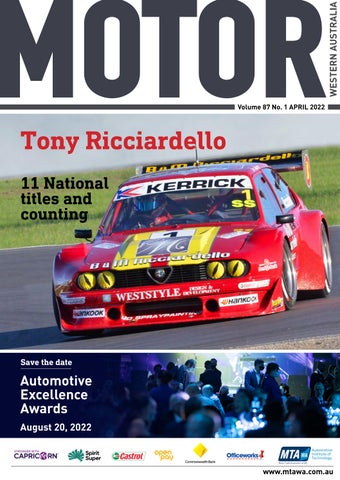
IN 1998 TONY RICCIARDELLO WON HIS FIRST AUSTRALIAN SPORTS SEDAN CHAMPIONSHIP. HE’S DONE IT 10 MORE TIMES
SINCE AND IS NOT ABOUT TO HANG UP THE HELMET JUST YET
Imagine, if you can, travelling down the main straight at Phillip Island, at 305 kph, the mid mounted 6 litre small block V8 Chevrolet engine to your left screaming at 7,800 rpm as you close in on your braking point.
Welcome to the office of 11-time Australian Sports Sedan Champion, Tony Ricciardello.
To say this is all in a day’s work for Tony is correct. However, to suggest that all Tony does is drive the car, albeit very well and very successfully, is to overlook the mechanic’s dedication and minute attention to detail in preparing the racecar.
And this personality trait also flows through to his customer’s cars, his personal collection of classic muscle cars, his family life and his management of B&M Ricciardello Motors and Perth’s Car Spa in North Perth.

WORDS: PAUL ROBERTS
As Tony says: “I’m very particular with things and everything has to be done perfectly. There are no short cuts.”
The reliability and speed of the famous red Chevy Alfetta that has taken Tony to the top of the sport – most recently in 2019 – is testament to this attitude.
Built in 1992, the Alfetta has more or less had a continuous racing history, first driven locally by Western Australian motorsport legend Brian Smith before Tony made his debut as a 18 year-old protégé in 1998.
Crowned Western Australian Sports Sedan Champion that year, Tony also competed in the National Championship in 1998, winning the series at his first attempt.

The logistics of being a Perth-based team competing in the Eastern States are not to be underestimated.
“Pretty well each season runs like this,” Tony explains.
“I freshen the car up over the summer break and then in March, it’s packed in the transporter with every possible thing I think we need and driven to Melbourne to be based at Les Small’s workshop.
“once it leaves Perth, it doesn’t come back until November, unless something really major has happened,” Tony says.
The itinerary of a national race weekend for Tony is arduous. He flies from Perth, arriving two or three days early to prep the car, does the race meeting and then often stays on for a couple of days to ensure the car is perfect for its next outing.
“If I find any issues, I get things prepared in Perth so that when I come back for the next meeting, I’m able to use the day or two beforehand to fix the car,” Tony said.
There can be surprises, however, like


the one that befell the team just prior to the last race meeting of the season at Sandown in 2019.
“I thought there was something amiss with the engine and it turned out to be a piston failure,” Tony explains.
“The spare engine was good, but it wasn’t quite to the same spec and didn’t fit a slightly different mounting position.
“I managed to source some pistons in Perth, had them machined and my father Basil caught a flight from Perth to Melbourne, via Sydney, with the parts.
“Les Small and I worked all through the Thursday night, removing the engine and stripping it down. Friday was spent rebuilding the engine and running it in on the dyno and – after next to no sleep – we rocked up to qualifying on Saturday.
“After all that, we ended up winning the weekend and the 2019 championship,” Tony says proudly.
And then CoVID hit.
After a two-year hiatus, the 2022 championship got underway in midMarch, this time without it’s current
champion on the grid.
“The car is pretty well ready to go –just a few little things to finish panel wise – but the trouble is I am just so busy with other work and the days keep disappearing.
“Since 1998, I haven’t stopped racing at a national level – including several years as a V8 Supercar driver and other races overseas – and it does take a toll on you both physically and mentally,” Tony explained.
“I think the pandemic gave us the chance to have a mental break and now you’ve got to turn it around and get back into it. The list of things that have gotten in the way has grown so I’m trying to manage that at the moment,” he says.
Although not on the grid, Tony was a very interested observer of that first round of the 2022 championship.
“There’s a lot of new cars in the series with some big money spent, but we’ll still be at the front and it will be good to get back out there and show what an old boy can do,” he says with a smile.
‘‘ Dad started the motorsport and as I’ve gotten older, the whole family – my mum, my wife, the kids – we all go racing.
A lot of people have a family picnic at the park. our picnic is motorsport.
Tony Ricciardello, Australian Sports Sedan Champion

“I hope to have the car back on track in a couple of months, but just to get there is a lot of work, ensuring that everything is perfectly organised with the semi and all the spares, etc.
“The amount of work you put into the car at the workshop is huge while the time you spend on the track is so little.
“The prep work and the engineering of the car at the workshop is 90 percent of the equation, with the driving representing just 10 percent before you’re back at the workshop again.
“Luckily I really enjoy both sides,” Tony says.
However, aside from Tony’s fearlessly competitive side, there is something perhaps even more important than winning – his family.
“My dad, who has always been there, is 78 now and some of the crew are getting a bit older as well,” Tony explained.
“I don’t feel like I’ve got anything left to prove so my mindset is to look after them first and foremost. I don’t want to go back to racing nationally where they could be put in a situation of potentially catching CoVID,” he says.
Now a father of two girls and a son, Tony’s family life, as it has always been, is inextricably tied up with motorsport.

that might highlight a weakness, so you make something a little bit stronger,” says Tony. “I’m always managing one upgrade to the next and endeavouring the make sure the weakest link is not weak.
“I’ve been at Phillip Island where you’re doing 280kph half way down the straight and on gear changes, it’s popping the front of car up because of the massive downforce on the rear.
“Dad started the motorsport and as I’ve gotten older, the whole family – my mum, my wife, the kids – we all go racing,” Tony says. “A lot of people have a family picnic at the park. our picnic is motorsport.”
The third generation Now a third generation motorsport family, Tony’s son orlando, 11, is racing go karts, scoring a few wins so far in his short career.
“Motorsport does run in the blood, but it is so important to me that he doesn’t get it into his mind that he has to prove something to his dad,” Tony says.
“I want my kids to have fun first and if something does happen later on, you follow it but if not, you just make sure those memories are good.”
However, there could well be another Perth driver making big waves in the future.
“He’s pretty serious and even though he might be happy, the focus is on the next thing and improving,” Tony says. Orlando has definitely inherited this attitude from his father, given Tony’s continual desire to develop and improve the Alfetta.
“Being a mechanic and having that personality, I’m always chasing something, but it’s like a revolving door – you make a little bit more power but
“It’s amazing when you’ve got 600plus lb/ft of torque and the actual inertia of that power is giving you aero wash at the front so when you brake, it feels like there’s nothing there.
“It’s slightly delayed and then you get that whole transfer of weight and the front suddenly locks up.
“But you’re also racing so you’ve got to have your race brain on to try and manage all that’s going on around you as well as the car,” Tony says, giving some insight into driving the enormously powerful Alfetta.
However, when things are not perfect his mechanical background and intimate knowledge of the car has allowed Tony to quickly pinpoint problems and make positive changes. Eleven national titles and numerous lap records would bear testimony to this.
Perhaps the best example of Tony’s continual development and unceasing commitment to making the Alfetta one of the fastest cars in Australia is a comparison in lap times.
“In the mid 1990s, the car was lapping Wanneroo Raceway in approximately 57.3 seconds,” he says. “In 2019, I broke the outright lap record previously held by John Bowe in an open wheeler with a lap time of 53.16 seconds.”
As Tony says, referring to the business he and his dad run: “Not bad for a couple of car wash mechanics!”


When Firas Alhashimy, owner of PHC 4x4 Car Accessories in Bayswater, says he loves a challenge, it comes as no surprise once you have heard his story.
From heading a multi-faceted motoring business empire started by his father in 1952 to fleeing war ravaged Iraq with his family for the relative safety of Jordan in 2005, the likeable Iraqi has lived a remarkable life.
“My dad started PHC as an importer and in 1955 he became
the Iraqi distribution agent for Ford, Chevrolet and Dodge.
Iraq was very rich and the first Middle Eastern country to embrace motor vehicles,” Firas said.
“In 1980, Iraq stopped the importation of American cars and we then became the distributor of Japanese brands such Toyota, Mitsubishi and Nissan as well as being a wholesaler and retailer of motoring accessories,” he said.
Never one to stop finding opportunities, Firas established a manufacturing plant for car mudguards covering all Iraq in 1988 and in 1993 a seat

We opened the first shop in Wotton Street Bayswater in 2018 just to test the market. My aim was to provide quality products and service at an affordable cost.
Firas Alhashimy, owner PHC 4x4 Car Accessories
cover manufacturing business employing 14 workers, in addition to a screen printing enterprise and the auto accessories business.
In 2000, his father died and Firas had to wind back some of the operations against the background of increasing civil unrest in his home country and, ultimately, a devastating war.
He made the decision to move his family to Jordan at the end of 2004 with the Iraqi war becoming ever more deadly and in 2005 established an office in China. Here PHC Tyres and PHC Automotive Batteries was born, with export exclusively to the Middle East that continues to this day.
Coming to Australia
The story of how he and his family came to live in Australia is extraordinary.
“We had been permanent residents in Jordan for five years with me flying back and forth to China managing my business interests,” he said.
“one day in early 2010 I receive a call from the Australian Consulate saying that we have a chance to immigrate to Australia, to which I reply ‘we didn’t apply’.
“Everyone who fled Iraq had to register with the United Nations for possible resettlement which is how we ended up on the Australian Consulate’s radar.
“In early September 2010 we have an interview and a health check and on october 26 – 40

days later – I receive a phone call saying ‘congratulations your visa has been approved and you fly to Australia on November 30’.
“There are thousands of families suffering – my wife managed a volunteer organisation helping those in need called Benevolent Hands organization – and here we were being offered this opportunity even though we had never formally applied.
“I thought maybe it was good if I came with my family to a safe place as the Middle East was so unstable and who knew what was going to happen,” he said.
Consulting to the Australian oil and gas industry for several years while still managing his China/Middle East importation business, he eventually decided to come back to what he describes as his ‘passion hobby’ – selling automotive accessories.
“We opened the first shop in Wotton Street Bayswater in 2018 just to test the market,” Firas said.
“I thought that the prices competitors were charging was crazy, so my aim was to provide quality products and service at an affordable cost. We live by the PHC motto ‘help the customer’.
“More than 90 percent of what we sell is manufactured overseas and a lot of it is under our own brand. We also install, but we do not call that side of the business a workshop, but rather a salon fitting,” he says proudly.


Now a third-generation company, with Firas’ son operating the Wotton Street store, expansion is very much on the cards.
“We opened this Collier Road showroom in late 2020 and my aim is to open several more stores over the next few years as a franchise operation,” Firas said.
The stores will all employ a consistent interior design and branding theme, initially starting with premises south of Perth before entering the Eastern States market.
“We also wish to become a wholesaler as well as a retailer and there is a lot of interest from the Middle East for a PHC 4x4 Accessories store.
“It is not easy to make a couple of branches and to care for your customers and give the best service you possibly can, but I love the challenge, and nothing is impossible,” he said.
Pandemic
The pandemic has had both a positive and negative impact on the business.
“Pre pandemic, I estimate 40 to 50 percent of our business was backpackers but now our customer base extends to all budgets, big and small,” Firas said.
“The last two years, when a lot of people were customising and improving their vehicles for travel, business was good, but the problem was getting the product from overseas.
Container and transportation costs skyrocketed and delays in supply are common, but I try and keep my prices similar to pre-covid,” he said.
Interestingly, PHC stands for Perfect House Company – “if you have a perfect house, you can have a perfect life, perfect everything,” Firas explains proudly.
Given where Firas now finds himself – “we are so lucky to be in Perth, particularly with the pandemic” – his business name of PHC would appear to reflect this ethos … perfectly.
‘‘It is not easy to make a couple of branches and to care for your customers and give the best service you possibly can, but I love the challenge and nothing is impossible.
Firas Alhashimy, owner PHC 4x4 Car Accessories
Firas describes the auto accessories business as his “passion hobby”. His other hobby is restoring and building cars.
“The first car I restored was a 1953 Ford Zephyr 6,” he said.
His most recent purchases for restoration are two 1983 720 4x4 Datsun utes and his pride and joy is a personally customised 2000 bright yellow Mercedes SLK Convertible.
However, there is one car story from Firas’ past that almost brings a tear to his eye.
Two cars he restored in Iraq gained some unwanted attention – a 1962 Chevrolet Impala (“amazing car, jet black with perfect brand new chrome that I restored from zero”) and a 1963 Plymouth Barracuda (pictured below with Firas’ son).
“Sometime around 1994/95 I have a tip off that a Government VIP knows of my cars and to be careful and I know what this means,” Firas explains.
“They take the car whether you like it or not and give you a gift in exchange and whether this gift is equal or not equal in value or you like or don’t like does not matter.


With Openpay you get paid right away, while your customers get more time to pay with up to 6 months*. No interest. No hassle. Just smart, simple and flexible payment plans. Openpay is available across a range of automotive specialities across Australia, including wheels, servicing, exhausts, dental, retail, home improvement and more.

“So that very day I sell the cars at about half their value and transfer ownership because I am scared to put myself in this situation.
“One week later, the person I sold them to, who also has a 1963 Buick Riviera, gets a knock at the door saying Mister X wishes to meet you as His Excellency would be very happy with your cars,” Firas says.
I asked Firas would saying ‘no’ result in that person just disappearing. Chillingly, Firas just smiles and says “it is just not possible to say no.”
Download the Openpay app Sign up and check your approved spending limit
Create a plan, customise your terms and get more time to pay
• Potential to increase customer average spend by 40-100%
• Increase customer conversion and loyalty
• Virtually no risk to the business
Eric Weitzman Head of Automotive
• Enhance customer experience with seamless payments
• Bring forward deferred service work, and attract new customers

Hire and rental companies are being warned of a potential loss of property should a client fall insolvent during a rental agreement period.
Alan Moody of Haulmore Trailer Sales in Hazelmere is urging similar businesses to be aware of the importance of properly registering equipment with the Personal Properties Security Register (PPSR) as it stands at the moment following an incident in December last year.
As well as wishing to alert the industry of potential PPSR pitfalls, he is also calling for the law to be changed to protect the owners of rental and hire equipment.
“In December last year one of my clients went into voluntary administration and, at that time, they had a low loader dolly on hire from me,” Alan said.
“When I contacted the administrators to arrange the return of our equipment, I was told the PPSR document we filed was incorrect and that they will retain and sell my property to collect funds for creditors.
“Upon making enquiries with expert PPSR consultants, I have been informed that it can be lawful for insolvency companies to seize rental equipment if the PPSR document is in any way flawed or not updated prior to the rental period exceeding two years,” Alan said.

‘‘
Under no circumstances should a piece of equipment that is owned by the hirer and rented out in good faith be able to be sold as an asset of the company that has gone insolvent.
Alan Moody, Managing Director Haulmore Trailer Sales


Alan is incredulous that this could happen given Haulmore manufactured and licensed the equipment and the unit in question was 100 percent owned by Haulmore. He has never come across this situation in almost 50 years of running the business.
“Under no circumstances should this be legal and the law needs to be changed immediately,” Alan said.
“As a long-standing member of the MTA WA, I reached out to Group CEo Stephen Moir, expressing my disbelieve and outlining my concerns about what appeared a ‘legal loophole’ in the Personal Property Securities Act (PPSA).
“I am not just concerned about my experience but that of other businesses that have lost considerably more than I have.
“I know that the only way to get change is to ask the associations that have political reach to lobby on member’s behalf,” Alan said.
Upon hearing Alan’s story, Stephen raised this issue directly with the Attorney General, Senator Michaelia Cash.
“I hope that the MTA WA can help ensure that other business owners are
aware of the risks associated with long term hire and PPS registrations and we will continue to work with like-minded associations and Government on the necessary amendments required to update the current legislation,” Stephen said.
CEo of the Hire and Rental Association of Australia (HRIA), James oxenham, has been advocating for changes to the PPSA for a number of years but says that this issue has now come to a head with the recent Probuild and Condev collapses and urgent action is required.


It is estimated that some $4million worth of assets were on hire to Probuild sites and are now at risk of being seized by liquidators if hire companies were caught out by the PPSA.
While Alan is out of pocket from the rental and is unlikely to ever see that money, he is adamant that the system needs changing and lobbying is essential.
“Under no circumstances should a piece of equipment that is owned by the hirer and rented out in good faith be able to be sold as an asset of the company that has gone insolvent,” Alan said.
“Federal politicians need to be made aware of this outrageous and ridiculous situation and the law needs changing immediately,” he said.


The MTA WA has long advocated for our members working in the commercial vehicles sector through the Commercial Vehicle Industry Association of WA (CVIA WA), a division of the MTA WA. CVIA WA has an active committee chaired by Andrew Wade from Wade Fleet Vehicle Maintenance, and a group of dedicated committee members who meet regularly to progress important agenda items that are affecting the sector both at a state and national level. on 30 March, Chair Andrew Wade and Senior Division Manager Graham Cawley attended a National CVIAA committee meeting in NSW to discuss industry issues being progressed nationally.
Arguably one of the key issues is the implementation of the Road Vehicle Standards Act 2018 (RVSA) and the accompanying regulations that are replacing the outgoing Motor Vehicle Standards Act 1989. With the new legislation comes the new system, the Register of Approved Vehicles (RAV) and associated operating system RoVER.
Some in the industry are just not ready or equipped to transition to the new system, which is anything but perfect. Those in the industry that had used the old system know that it was easier to use and more efficient when compared to RoVER.
CVIAA lobbied for an additional extension of the transition period by 12 months to allow industry to become aware and ready for the new system. CVIAA’s lobbying has been successful. “The Road Vehicle Standards (Consequential and Transitional Provisions) Amendment Bill
received Royal Assent, on Friday 1 April 2022, extending the end date of the Road Vehicle Standards transitional period by 12 months to 30 June 2023”.
The MTA WA would like to acknowledge the hard work and industry engagement from the Office of the Hon Barnaby Joyce MP.
Whilst the extension is appreciated, CVIAA will not stop there and seeks an option to use either the old system and/ or the new systems to apply for new vehicle approvals, until such time when the ROVER is operating efficiently and to industry expectations.
CVIAA has highlighted the RoVER deficiencies and although some progress has been made, the RoVER is no where near acceptable and the developers must take more notice of those that use the system. CVIAA on behalf of CVIA’s in every State will continue to engage with Government to resolve this very important issue.
The CVIAA meeting in NSW was a great opportunity for members to talk with all the State MTA’s and Chamber CEo’s about ongoing issues impacting the commercial vehicle industry.
The meeting was very productive and a strategy going forward regarding some critical issues was developed. CVIAA will continue to work for the industry throughout 2022 by leveraging the resources available in the different States and utilising connections that CEo’s have with politicians in their respective States.

on a State level, CVIA WA is pushing hard in 2022 to get some movement on critical agenda items such as an improvement for the licensing of heavy vehicles. It is costing heavy vehicle dealers and manufacturers more than $3.3million in lost time and inspection fees to license new heavy vehicles.
on Tuesday 29 March 2022, MTA WA
CEo Stephen Moir and Graham Cawley met with the Managing Director of the Department of Transport, Ian Cameron.
The purpose of this meeting, among other things, was to discuss the need for change and highlight the unnecessary steps heavy vehicle dealers/manufactures must take to license each and every heavy vehicle. It was agreed during the meeting that the current process is difficult, time consuming and results in double handling.
Ian has committed to working with industry to identify potential improvements to the current processes. The Department of Transport WA will establish a working group to meet with the MTA WA and CVIA WA representatives.
CVIAWA Committee members
• Mr Andrew Wade (Chair)
Wade Fleet Maintenance
• Mr Garry Spouge (Vice-Chair) MMT Mining Services
• Mr Joe Giura Westrans
• Mr Mike Verhoogt Bruck Rock Engineering
• Mr Paul Wilson CJD Trucks
• Mr Frank Johnston Major Motors
• Mr Joe Dickenson Rops Engineering
• Mr Dennis Barrington Major Motors


The past two years could easily be considered the most tumultuous period in history to run a small business.
Since the first tremors of COVID-19 disruption reached Western Australia in early 2020, local business owners have continually adapted to rapidly evolving conditions. It is little wonder that fatigue is setting in as we wait to pass the peak of Omicron cases and return to the long awaited “business as usual.”
While there is a sense of light at the end of the tunnel, operators overloaded by constant pandemic-related disruption may struggle to form a clear strategy to navigate their way to the end of the crisis. Even if your business has performed well during the pandemic, setting simple goals to support your business while we move towards the new normal can help.
When you combine the 24-hour news cycle, social media channels, opinions of business peers, employees and family, there are a wealth of voices competing for your attention. To avoid information overload and ensure you are receiving the correct advice to manage your business in a pandemic, it’s important to be selective about which you listen to.
Firstly, identify the essential information sources to run your business during the pandemic, such as the Small Business


These sources offer correct and timely advice about CoVID-19 settings and small business assistance in a local context. You can sign up to receive essential SBDC updates by email or contact
Access financial assistance where relevant
Several grant programs have been made available by the WA Government to support small businesses financially impacted by the pandemic or associated restrictions.
While not all programs may be relevant to you, a summary of most of the financial assistance
programs for small businesses is available in the CoVID-19 section of the SBDC website.
We are also administering some of the programs, such as the Small Business Hardship Grant and the Tenant Rent Relief Scheme, both of which close on 30 June 2022.
Your accountant is a reliable
Pay attention to your mental health
The mental health impacts of the CoVID-19 pandemic have been well documented, but it’s important to recognise signs of stress or anxiety in yourself.
Early warning signs such as finding it hard to concentrate or problem-solve, feeling more irritable or sensitive than usual, relying more heavily on alcohol or smoking to ease pressure and constantly thinking about work in your personal time can be some of the symptoms you may be tempted to ignore.
However, “soldiering on” can affect your long term mental health outcomes, your
relationships and your business.
While your GP is a great first port of call, there is specialised counselling and resources tailored to small business owners available.
The NewAccess for Small Business owners coaching program provides a structured six session program with your own coach — you can learn more by calling 1300 945 301 — while the Ahead for Business website at provides resources and tools to support mentally healthy businesses.

By Natalie Zurita, Special Counsel, Panetta McGrath Lawyers
The opening of WA’s borders and transmission of COVID-19 is leading to many employees taking time off work. Here is a summary of the current employee leave entitlements and how to navigate other common scenarios.
Staff or dependents unwell due to COVID-19
our business advisers via the website or phone on 133 140 for free, personalised business advice.
The Motor Trade Association is another highly reliable source of updates. Industry associations distil general business advice with an understanding of how it affects your industry. Ensure you are signed up for member updates and keep an eye on the MTA website. Secondly, opt out of all unnecessary channels if they are causing confusion or stress.
source of advice about how to manage any impacts of the pandemic on your business finances. Understanding your business as they do, they are in the strongest position to help identify where costs can be reduced and profit margins protected during any downturn in trade.
It’s important to know that during times of both challenge and opportunity, there is support available for small business owners. You can turn to my team at the SBDC as a starting point for business advice, skills development and resources, and they can refer you to other services you may need, such as tailored financial counselling.

If an employee is unwell due to COVID-19 and unfit for work, then the employee should take their entitlement to paid sick leave.
This entitlement is accrued by permanent employees (i.e. full time and part time) but not casual employees.
If a permanent employee needs to care for an immediate family member or a household member (dependent) who is sick with CoVID-19, they are entitled to carer’s leave, allowing them to use accrued sick leave.
Casual employees are entitled to two days unpaid carer’s leave to care for a dependent who is ill, but employers and employees can come to an agreement for the casual employee to take an increased period of leave.
Employees are not entitled to take sick or carer’s leave in circumstances other those stated above. For example, an employee is not entitled to access their paid sick or carer’s leave for home schooling children or to attend a scheduled medical appointment.
Finally, before processing the employee’s sick or carer’s leave entitlement, the employer can (and should) ask the employee for evidence of:
• their illness; or
• evidence of the employee needing to care or support a dependent because of an illness, injury or unexpected emergency.
Employees are also expected to tell their employer as soon as possible when
they are taking sick or carer’s leave and for how long.
When staff are well but isolating In circumstances where an employee is a close contact and is required to isolate but remains fit to work, the employer may want to explore whether the employee can temporarily perform their job remotely.
If working remotely is not feasible, then the employee will not be entitled to their usual pay for any period of isolation unless the employee can access their other paid leave entitlements (i.e. annual leave or long service leave).
Employees’ usual annual leave and long service leave entitlements will continue to operate in this period and normal leave application processes in the workplace apply. However, it would be prudent for employers to take a flexible and compassionate approach to leave applications at this time.
Close contacts returning to work In limited circumstances, the WA Government has permitted critical workers who are close contacts of CoVID-19 cases, to return to work and perform essential duties for continuity of operations. This only applies to specific workplaces and certain measures must be in place to mitigate ongoing health and safety risks. otherwise, an employee who is a close contact (or is an asymptomatic CoVID case) should not be permitted to return to the physical workplace, until they are well or have finished isolating.


By Michael Morgan, Managing Director
From 31 March 2022, all businesses and organisations in Western Australia, including the automotive industry, will be subject to a new set of work health and safety (WHS) laws.
These ‘nationally harmonised’ WHS laws bring WA into line with most other states and territories, broadening the scope of responsibility for ensuring the health and safety of workers, others at workplaces and those affected by the work being undertaken.
The new laws come with increased corporate and personal responsibilities, an increased regulatory approach and tough new penalties, including fines and jail terms for non-compliance.
Significantly, a new offence of ‘industrial manslaughter’, attracting a $10million maximum penalty and a 20 year jail term, has been introduced, with businesses and their ‘officers’ liable to prosecution in the event of a work-related death resulting from a breach of the legislation.

The Work Health and Safety Act 2020 (WA) (‘WHS Act’) passed the WA parliament in November 2020. The WHS Act replaces the existing occupational Safety and Health Act 1984 (WA) and other related mining and petroleum safety legislation.
The WHS Act will be supported by three new sets of WHS Regulations, which were gazetted on 11 March 2022. one set of these regulations applies to ‘General’ workplaces, with the other two sets applying to mining and petroleum/geothermal operations.
The WHS Act and Regulations will be administered by the Department of Industry Regulation and Safety (DMIRS)/ WorkSafe, with the WorkSafe WA Commissioner holding the position of independent regulator and prosecutor.
Whilst there are transitional provisions for some of the WHS Regulation requirements, the main duties and new penalties under the WHS Act apply immediately.
Penalties in the WHS Act are significant with breaches of a health and safety duty ranging from $570,000 to $3.5million for a corporation, $120,000 to $680,000 and 5 years jail for an ‘officer’, and from $55,000 to $340,000 and a 5 year jail term for a worker or other individual.
The industrial manslaughter offence applies where a person has a health and safety duty and engages in conduct that causes a workplace death, knowing that the conduct is likely to cause the death of an individual and acting in disregard of that likelihood.
Essentially industrial manslaughter is a gross negligence offence causing the death of a worker or other person. It will only be prosecuted in the most egregious of circumstances. The maximum penalty for a PCBU is $10million and for an officer of a PCBU, $5million and 20 years jail. A worker cannot be prosecuted for industrial manslaughter.
Many in the automotive industry may remember the tragic work accident in July 2013 involving the death of a parts manager when he was hit by a vehicle in a pre-delivery area of a dealership. In that matter, WorkSafe WA prosecuted the pre-delivery assistant for breaching his employee duty to ensure the health and safety of others. The employee was convicted after a trial and fined $9,500 (from a then maximum of $20,000 for that offence) and ordered to pay $12,000 in court costs.
Under the new WHS Act, a prosecution of serious harm

under similar circumstances would attract the highest maximum penalty level for a worker of $340,000 and a 5 year jail term.
If a motor trader dealership, or other business, was convicted of a similar serious harm incident, the penalties are very significant and may include industrial manslaughter where gross negligence is found to have caused a death.
Like all businesses in WA, automotive businesses will need to review their current approaches to WHS and prepare for the new laws. This includes WHS systems, practices and processes related to workers, officers, suppliers, customers and contractors.
The new WHS legislation for WA is a generational change in the laws and regulation of health and safety related to work. The obligations, compliance requirements and resulting penalties are a significant shift from the existing oSH regime. All automotive businesses and officers running these businesses need to understand the new laws and make plans to ensure their businesses comply.
The MTA WA provide information on the transitional arrangements to the WHS laws and can refer members that may require specialised WHS assistance to WHS Foundation.
For further assistance, please contact the MTA WA on (08) 9233 9800.
PCBU: In order to capture all types of organisations, including those without employees, the term ‘employer’ in existing WA safety laws is replaced with the broader ‘Person Conducting a Business or Undertaking (PCBU)’. A PCBU can be an individual, a partner in a partnership or a sole trader, but will typically apply to companies and other entities. PCBU’s will be responsible for ‘primary duty of care’ to ensure the health and safety of workers and others affected by the work.
Officer Due Diligence: The WHS Act imposes new, up-front positive corporate ‘officer’ due diligence duties for organisational decision makers. These new duties replace derivative, faultbased duties in existing WA safety laws, and are intended to increase decision making accountability affecting workplace health and safety. Officers include board members, directors and senior managers, but not middle management. Responsibility will depend on all the circumstances of a person’s position and level of, or expected level of, WHS decision-making involvement.
Duty to all people affected by the work: The definition of people owed a duty under the proposed new WHS laws by PCBU’s is broadened from ‘employees’ to ‘workers and other people affected by the work’. This includes all directly employed and indirectly engaged workers. It also includes customers, patrons, residents, tenants, students, visitors, spectators, and passers-by. Volunteers are also deemed to be workers and owed a duty of care by the PCBU.
Increased Consultation: There are increased health and safety obligations for both internal and external parties involved with ‘consultation, cooperation, and coordination’, including contractors and PCBU’s with common interests.
Upstream Duties: Increased ‘upstream’ duty of care to ensure health and safety related to plant, substances and structures are also included, with WHS obligations on designers, manufacturers, constructors, suppliers and importers.
Prohibition on indemnity and insurance: The WHS Act prevents an indemnity or insurance policy being offered or taken out for the purpose of paying a penalty under the WHS Act. Insurance can still be used to seek legal advice or to defend a WHS prosecution, but not for any resulting penalty upon conviction.
Codes of Practice: In addition to the WHS Act and WHS Regulations, WA will predominantly adopt the national model WHS Codes of Practice (available at www.safeworkaustralia.gov. au). Complying with the Codes of Practice, covering all type of hazards in workplaces, is compulsory (unless a higher standard is adopted) and can be used in evidence for a WHS prosecution.