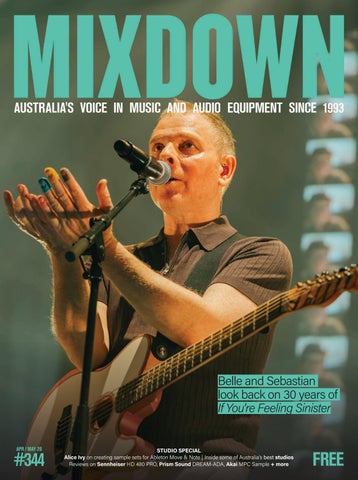
Mixdown Issue 344

Page 1


Just as the legendary K Series quickly became the New Standard for powered loudspeakers, the K Column is destined to forever elevate your expectations from a column loudspeaker. It’s the perfect combination of sleek and stylish design, coupled with the acoustic performance of a high output, high fidelity loudspeaker system.

Australia & New Zealand

8 September - Auckland, Powerstation

10 September - Sydney, The Opera House

11 September - Brisbane, The Tivoli

12 September - Melbourne, The Forum

TICKETS & INFO: THEPHOENIX.AU

Product News

Tour News

Belle & Sebastian

Cradle of Filth

Tubular Bells

Alice Ivy

Sabre Sound Studio

Studios 301

Crash Symphony Productions

MILAB Microphones

In Focus: Fender Studio Pro

Audio Interfaces

In Focus: Warm Audio Microphones

In Focus: Pedaltrain

In

EDITOR

Anita Agathangelou

PUBLISHING DIRECTOR

Patrick Carr

DESIGNER

Kelly Lim

CONTRIBUTORS

Corin Shearston, Lewis-Noke Edwards, Daniel Wright, Brett Voss, Jamie Colic, Rob Gee, Scott Renton, Sarah McRitchie, Anthony "ToK" Norris, Alexander Sims, Tamara Issa

FOR ADVERTISING OR CONTENT PARTNERSHIPS advertise@mixdownmag.com.au

DISTRIBUTION distribution@furstmedia.com.au

ACCOUNTS accounts@furstmedia.com.au

PUBLISHER

Furst Media Pty Ltd

FOUNDER

Rob Furst

There’s something about the colder months that pulls artists inward. The days get shorter, the nights stretch out, and with fewer distractions and more space to reflect, the studio becomes its own world. It’s no coincidence that some of the most intimate and enduring records were born from a chill in the air.

This issue is our Studio Special, and with autumn well and truly here, there’s no better excuse to close the door and get to work. We speak to the people behind some of Australia’s best studios about adapting and surviving, explore music-making on the go, and get a peek inside the live reimagining of Mike Oldfield’s epic Tubular Bells

Longevity is a recurring thread throughout this issue. Gear is always

changing. Studios look different now than they did 30 years ago, and they’ll look different again in another 30. Being in the world of music is a long, strange trip, but the human impulse to create remains the same, no matter how the industry shifts around it.

Our cover stars, Belle and Sebastian, are proof that great music endures – heading to Australian shores to celebrate 30 years of If You’re Feeling Sinister, an album that continues to find new audiences, decade after decade.

So whether it’s a season of making or a season of resting, I’ll see you on the other side.

EDITOR'S NOTE
Cover credit: Gaelle Beri

PRODUCT NEWS

Ernie Ball enters the tuner market with the Fast Pitch

CMCMUSIC.COM.AU

No one enjoys playing out of tune, especially on stage. The Ernie Ball Fast Pitch tuner is a compact chromatic clip-on designed to keep guitarists, bassists and stringed-instrument players in tune without a hassle. A 360-degree rotating clip keeps it secure on the headstock at whatever angle works best, and one-button operation with automatic shut-off keeps things simple. The bright LCD screen handles dim stages and bright outdoor settings equally well, and chromatic mode means it's not locked to standard tuning. For players moving between alternate tunings or returning quickly between songs live, the Fast Pitch is a winner.

wood tops, ziricote fretboards and headstock veneers. The lineup covers the Custom 24, Custom 24-08, Studio, Special Semi-Hollow, McCarty 594 and Paul's Guitar, with each model limited to two colours and 200 pieces worldwide.

Mango isn't a tonewood you see often on electric guitars. PRS Senior Wood Manager Michael Reid notes it's similar to maple but slightly lighter and less dense, with figures that frequently display a distinctive "bee's wing" pattern. It also has solid sustainability credentials – harvested from farmed fruit trees at the end of their productive life rather than felled specifically for timber.

Paired with ziricote on the fretboard and headstock veneer, the result is visually striking without losing what makes the Core Series so popular. At 200 pieces per model, these won't hang around.

LEWITT's MTP 5 is a stage vocal mic built to sound better and last longer

Six legendary EHX pedals are now plugins, and they sound like the real thing

EHX.COM | VIBEMUSIC.COM.AU

MixWave has partnered with Electro-Harmonix to release the EHX Classics Bundle – the brand's first officially licensed plugins. The bundle includes four plugins, six effects, and all have been built using component-level modelling of the original analogue circuitry.

The lineup covers the Big Muff Pi Fuzz, the Deluxe Memory Man delay with chorus and vibrato, the Electric Mistress Flanger/Filter Matrix and the Small Clone Chorus. Between them, they account for a significant chunk of the guitar tones that have defined rock, post-punk and shoegaze across the last few decades.

Each plugin is available individually or as part of the bundle via MixWave.

Akai Professional's brand new MPC Sample puts beatmaking in your backpack

PRS Guitars releases six mango wood limited editions across its Core Series ELFA.COM.AU

PRS Guitars has announced six limitededition Core Series models, each featuring mango

LEWITT has released the MTP 5, a dynamic stage vocal microphone designed to handle the realities of live performance. A tailored dynamic capsule delivers strong clarity and high-end response, while the optimised cardioid polar pattern resists feedback and isolates the vocal from loud stage instruments. For performers who cup the mic, a metal ring around the grille keeps the polar pattern intact, and rubber capsule suspension keeps handling noise to a minimum.

Full-metal construction throughout means it's built for touring, and the washable integrated windscreen is a practical touch for shared use. A switch version is also available for talkback and emceeing applications.

ELFA.COM.AU

Akai Professional has released the MPC Sample, a compact battery-powered standalone sampler inspired by the legendary MPC60. Built for spontaneous creativity, it runs up to five hours on a single charge and includes a built-in speaker and internal microphone.

Sixteen RGB velocity-sensitive pads with poly aftertouch, Instant Sample Chop Mode, real-time Timestretch and Repitch, and over 100 factory kits make it a capable compact unit straight out of the box. Projects load directly into MPC3 for anyone wanting to continue in software.

Sennheiser's HD 480 PRO brings open-back accuracy to a closedback design

SENNHEISER.COM/EN-AU

Closed-back headphones have always come with a trade-off: isolation at the cost of accurate bass reproduction, and often comfort too. Sennheiser's new HD 480 PRO sets out to fix both. Designed for producers, engineers, vocalists and live audio professionals, the HD 480 PRO delivers a tight, accurate low-end response alongside a lightweight fit that accounts for glasses wearers, pressure points and long sessions.

Patented features include Special Axes Geometry for consistent fit across different head shapes, a comfort zone in the ear pads for glasses temples and cable-borne noise decoupling near the earcup. A Vibration Attenuation System handles unwanted reflections and distortion throughout.

For anyone needing isolation – tracking vocals, FOH reference or working alongside others – these sit at the top of Sennheiser's 400 series professional range.

Yamaha upgrades its DXR/ DXS and CXR/CXS loudspeaker ranges with the new mk3 series

AU.YAMAHA.COM

Yamaha has launched the DXR/DXS mk3 and CXR/CXS mk3 series – a substantial refresh of its professional loudspeaker and subwoofer lineup. The DXR mk3 powered speakers come in 10", 12" and 15" models, each driven by a new 2000W Class D amplifier with output up to 134 dB SPL. Onboard 96kHz DSP includes Yamaha's Advanced FIR-X Tuning, feedback suppression modes and up to eight user presets. The DXS mk3 subwoofers match that architecture with a 2500W amplifier and 12", 15" or 18" bass cones. Unpowered CXR mk3 and CXS mk3 versions cover installation applications, and the D-Remote app handles wireless control across the full range.

The Roland SPD-SX PRO just got a significant free update

ROLAND.COM/AU

Roland's free Version 2.0 update for the SPD-SX PRO is out now with a bunch of new additions. Highlights include DAW-style timestretching for real-time or high-quality offline tempo matching, DJ-style muting for dynamically dropping backing tracks in and out, and the ability to assign master effects per kit rather than globally.

Backup files from the standard model can now be loaded directly into the PRO, making it straightforward to carry existing setups across. Trigger muting, adjustable panel brightness, MIDI monitoring on the main screen and support for user-imported kit images round out the update.

Fender marks 75 years of the Telecaster® with a five-model anniversary collection

AU.FENDER.COM

Fender has launched the 75th Anniversary Telecaster® Collection, a five-model limited-edition range marking 75 years of one of the most

influential guitar designs ever made. The lineup spans the full spectrum of what the Tele can be –from the Vintera® Road Worn® 1951 with its swamp ash body and Pure Vintage 1951 pickups, through to the forward-looking American Ultra II with its Fastlane™ humbucker and dual S-1 switches. In between sit the American Professional Custom with its flame maple cap and gold hardware, the Cabronita with TV Jones pickups in both positions, and the Player II in Diamond Dust Sparkle.

Sterling by Music Man takes the StingRay into baritone territory

CMCMUSIC.COM.AU

Sterling by Music Man has expanded its StingRay lineup with a baritone model, built for players who want to go lower. Tuned to B on a 27.5" scale with 24 frets, dual humbuckers and a 3-way toggle, the StingRay Baritone can handle thick low-end and high-gain playing without breaking a sweat. A roasted maple neck and rosewood fingerboard keep the feel smooth, locking tuners and a vintage-style tremolo add stability, and a colourmatched headstock with bold block inlays tie the whole thing together nicely.

TOUR NEWS

Cradle of Filth and DevilDriver are bringing their acclaimed double headline tour to Australia in July

THEPHOENIX.AU

After their 2023 North American tour was met with near-universal praise, Cradle of Filth and DevilDriver are finally bringing their double headline show to Australia. Fresh off their acclaimed 14th studio album The Screaming of the Valkyries, Dani Filth and company arrive with a fully sold-out Australian tour already behind them. DevilDriver, led by Dez Fafara, bring two decades of punishing riffs and anthemic modern metal alongside them.

TOUR DATES

ໞ 9 July: The Tivoli, Brisbane

ໞ 10 July: The Enmore, Sydney

ໞ 11 July: The Forum, Melbourne

ໞ 14 July: Hindley St Music Hall, Adelaide

ໞ 16 July: Astor Theatre, Perth

Miles Davis' saxophonist Bill Evans is bringing an all-star band to Australia this October

Saxophonist Bill Evans – best known for his work with Miles Davis during the 1980s – returns to Australia for the first time in over 25 years this October, touring with drummer Keith Carlock, bassist

Pablo Contreras and keyboardist George Whitty. Evans' credentials speak for themselves: performances on landmark Davis releases, collaborations with Herbie Hancock, John McLaughlin and Mick Jagger, and 27 solo albums including the Grammy-nominated Soulgrass.

TOUR DATES

ໞ 1 October: The Concourse, Chatswood

ໞ 2 October: Factory Theatre, Marrickville

ໞ 3 October: The Gov, Adelaide

ໞ 4 October: Memo Music Hall, St Kilda

ໞ 7 October: Astor Theatre, Perth

ໞ 9 October: The Tivoli, Brisbane

ໞ 11 October: Northcote Theatre, Melbourne

Sparks announce Melbourne and Brisbane headline shows this May

DESTROYALLLINES.COM

Sparks are heading back to Australia this May for headline shows in Melbourne and Brisbane, plus a Sydney Opera House appearance as part of Vivid Live – their first Australian dates since 2023. Brothers Ron and Russell Mael arrive on the back of their acclaimed 28th studio album MAD! and companion EP MADDER!, following a rapturously received world tour.

TOUR DATES

ໞ 25 May: Joan Sutherland Theatre, Sydney Opera House (Vivid Live)

ໞ 28 May: Palais Theatre, Melbourne

ໞ 30 May: Glasshouse, QPAC, Brisbane

Mike Oldfield's Tubular Bells is coming to Australia this June as part of the 50th Anniversary World Tour

recorded is heading to Australian stages this June. Tubular Bells in Concert brings Mike Oldfield's highest-selling instrumental album of all time to life in full, led and arranged by Robin A Smith – a collaborator who has worked alongside Oldfield for over 25 years across Edinburgh Castle, the London Olympics Opening Ceremony and beyond.

The show also features extended sections of Tubular Bells II and III, covering the full arc of Oldfield's remarkable trilogy.

TOUR DATES

ໞ 3 June: Hamer Hall, Melbourne

ໞ 5 June: Adelaide Entertainment Centre, Adelaide

ໞ 6 June: His Majesty's Theatre, Perth

ໞ 10 June: QPAC, Brisbane

ໞ 11 June: Civic Theatre, Newcastle

ໞ 12 June: Canberra Theatre, Canberra

ໞ 13 June: Sydney Opera House, Sydney

Laufey returns to Australia and makes her New Zealand debut with her biggest shows to date this July and August

SYDNEYOPERAHOUSE.COM

Two years on from a sold-out Australian tour, Laufey is back – and this time she's playing arenas. The dual Grammy Award-winner, who has accumulated over 4.25 billion global streams and holds the record for the biggest jazz LP debut in Spotify history, kicks off at Perth's RAC Arena on 25 July before hitting Adelaide, Melbourne, Brisbane and Sydney, wrapping up at Auckland's Spark Arena on 12 August – her New Zealand debut.

TOUR DATES

ໞ 25 July: RAC Arena, Perth

ໞ 28 July: Adelaide Entertainment Centre Arena, Adelaide

ໞ 30 July: Rod Laver Arena, Melbourne

ໞ 31 July: Rod Laver Arena, Melbourne

ໞ 1 August: Rod Laver Arena, Melbourne (new show)

ໞ 3 August: Brisbane Entertainment Centre, Brisbane

ໞ 7 August: Qudos Bank Arena, Sydney

ໞ 8 August: Qudos Bank Arena, Sydney

If you’re feeling sinister, go off and see Belle and Sebastian, thirty years on

Stuart Murdoch is busy. It's no problem – the Belle and Sebastian frontman has always had an air of elusiveness – so it's Chris Geddes, the band's long-term keyboardist and founding member, who hops on to chat. It is, without meaning to be, a very Belle and Sebastian thing to happen.

WORDS BY ANITA AGATHANGELOU
Photo credit: Gaelle Beri

The band is celebrating 30 years of If You're Feeling Sinister. If you're a '96 baby like me, its longevity speaks for itself. The record has made its mark on my life, first sitting on my iPod Classic, and now in regular rotation on TIDAL. If you're a true OG, you'll have it on CD, too.

The band is midway through a run of shows performing it front to back, and it seems like the right time to ask what it feels like when something you made in just five days outlives the moment it came from by decades.

Geddes speaks to the album reaching new and younger audiences: "I certainly never imagined when we first got together and made those two albums that we'"d still be going as a band 30 years later, and be playing to audiences where some of the crowd are in their teens or twenties. But maybe I shouldn't be so surprised. When the group got together, a lot of the music we bonded over was also from about 30 years earlier (Love, The Left Banke, Nancy and Lee, Carole King), and while I wouldn't put us up there with those, I did believe in what we were doing, and Stuart's songs in particular had a certain magic."

What Geddes says rings true. Music, like all art, circles back around. Cycle, rinse, dry, cycle, rinse, dry. And with a perfect 10 from Pitchfork just this year, there's plenty to reflect on.

"When I listen to Sinister now, I can definitely hear faults – songs speed up, and a lot of my own playing I don't think is that great."

It's a tricky balance: reviews, the feeling of making the work, and hindsight. When I ask how much weight he puts on criticism, Geddes speaks to the band's earlier days. "Personally, I feel that bad or mediocre reviews stick with you more than good ones, and we definitely had our share of panning over the years. Some people just reacted against the overall aesthetic of the group, which I suppose you should just be able to shrug off, but it's not always easy."

Both Tigermilk, their debut record, and If You're Feeling Sinister came out in 1996 – a short time between drinks – and even though they're both quintessentially Belle and Sebastian, there's a bit of a sonic leap between them.

"It's kind of interesting, because if you look back at our discography, it's almost like Tigermilk was the template we followed more in subsequent records, because it's quite varied in terms of the sounds and energy from song to song. Sinister was more of a cohesive thing. All the records we've done since have had a bit of that all-over-the-place thing, which I think is sometimes both a strength and a weakness."

artist shares their work, they're offering a piece of their interior life. In turn, it becomes part of ours. When I ask Geddes about the songs coming from a time of isolation and reaching so many people worldwide, Geddes treads lightly, so as not to speak for Stuart.

"He wrote the songs coming out of a pretty dark time in his life," Geddes says, "and I know it means a lot when people share stories of how our music has helped them with their own struggles. The audience singing along with ‘Get Me Away From Here I'm Dying’, or getting up to dance to ‘The Boy With the Arab Strap’ – it always feels really special."

It's worth remembering how fast this classic album, a Pitchfork perfect 10, was made, and how contingent that speed was on the circumstances. The band rehearsed in the church hall where Stuart worked as a caretaker; both early records were tracked almost entirely live, overdubs added

“I certainly never imagined when we first got together and made those two albums that we'd still be going as a band 30 years later”

quickly afterwards. Engineer Tony Doogan, who went on to work with the band across several subsequent records, deserves credit that rarely makes it into the retrospectives. "We couldn't have got them recorded as quickly as we did if he hadn't been such a good engineer, and amenable to what we were trying to do."

If You're Feeling Sinister is very much an album in the truest sense. It's a cohesive and immersive world you step into rather than a collection of tracks. In an age where singles edge out albums and shorter tracks win the dreaded algorithm, it's a special thing for a record to keep living as a whole –especially live. I ask Geddes whether there's a flow state that comes with performing it front to back.

"A hundred percent. We usually change the set quite a lot from night to night on tour, and speaking personally, to play a set where you know without thinking what the opening ten-song sequence will be has been brilliant. It does make it a lot easier to be in the moment when playing. I wouldn't really say it's a nostalgic feeling, though – for me, I just feel like I'm in the song at that moment we're playing it."

You'll be lucky to catch the band in that flow state yourself – they're currently legging it across the world on the anniversary tour, and hit Australia's shores in September.

Of course, I have to ask a little something for myself. ‘I'm a Cuckoo’ isn't from either of the albums being toured, but it's an all-time favourite of mine – and if you're familiar with Thin Lizzy's ‘The Boys Are Back in Town’, you'll clock the similarity immediately. The riff was, Geddes confirms, very much deliberate. "The guitar riff was definitely an intentional tip of the hat. Stuart and Bob are both big Thin Lizzy fans – me too, to an extent, although the drum break on Johnny the Fox Meets Jimmy the Weed is my own favourite moment in their catalogue."

I ask Geddes what music is exciting him now.

"We've had some really cool artists open for us at some of the recent shows. Liana Flores in Manchester and Selma French were both brilliant, and I've been listening to them a lot. I'm going to the Barcelona Psych Fest with friends this weekend, and I'm really looking forward to seeing Michael Rother, Altin Gün, and Derya Yıldırım there, as well as others I'm not so familiar with yet."

I like hearing what Geddes is listening to, and that he's looking forward to seeing music he's not yet familiar with. There's always more to come.

It's easy with an anniversary tour to lean too hard on nostalgia – but truly great music shouldn't sit in the past. If You're Feeling Sinister has done thirty laps around the sun, and is a prime example of great music living in the past, present and future, within us.

Somewhere right now, a teenager is listening to If You're Feeling Sinister for the first time, and maybe in another thirty years, it'll be part of the fabric of their story. Cycle, rinse, dry.

The songs on Sinister grew out of a difficult time in Stuart Murdoch's life. Living with ME/ Chronic Fatigue Syndrome, he spent long periods in isolation – something that lingers in the album's interiority.

We all live in our inner worlds, and when an

Things look a little different now. The band have kept making music, most recently 2023's Late Developers, and the process has evolved with time. "We take a lot longer in the studio now. Depending on how we're working, we might start recording a song almost while it's still being written, rather than the writing, rehearsing and recording being separate stages, as they were in the early days."

TOUR DATES

ໞ 12 September: Palais Theatre, Melbourne

ໞ 13 September: Enmore Theatre, Sydney

ໞ 15 September: Fortitude Music Hall, Brisbane

ໞ 17 September: Astor Theatre, Perth (playing Tigermilk in full plus fan favourites)

ໞ 18 September: Astor Theatre, Perth

Tickets via destroyalllines.com

Devil’s thunder down under:

Cradle of Filth prepare for Terra Extremis

Ahead of their July Australian tour, we speak to Dani Filth about Cradle of Filth's cinematic live show, their partnership with DevilDriver and what to expect from their most riotous run of dates here yet.

Two years after their last Australian tour, Cradle of Filth return this July alongside American groove metal band DevilDriver, whose frontman Dez Fafara also manages Cradle of Filth.

With the band now in its 35th year, having sold over four million records since forming in the fabled ‘witch country’ of Suffolk, England in 1991, Cradle of Filth are synonymous with one man – frontman, co-founder and sole remaining original member, Dani Filth. His band’s macabre, gothic allure is well matched to the ornate archways, marble and masonry of the historic venues hosting the tour, four of which first opened before 1930.

That atmosphere gets a physical boost from the rooms themselves – the Tivoli, the Enmore, the Forum and the Astor – when the tour kicks off on July 9. Perth closes the run on July 16, with Adelaide’s Hindley St Music Hall, opened in 2022, serving as the second-last stop. “The aesthetics help,” Filth explains. “I think the fans will like it.”

Part of what’s driven the band’s momentum over the past eleven years is knowing who to share a stage with. Both bands first co-headlined in the US in 2023 across a two-leg tour, and the pairing stuck. Filth describes DevilDriver as the “meat and potatoes” to Cradle of Filth’s “exotic dessert” – and the groove metal four-piece from Santa Barbara, southern California, isn’t short on their own talking points. Their city sits near The Lost Boys’ fictional vampire-riddled Santa Carla, AKA Santa Cruz, which feels appropriate. One of their most-streamed songs is a cover of AWOLNATION’s ‘Sail’, and they’ve put out two star-studded outlaw country cover albums, the second instalment of the

Dealing With Demons double album arriving in May 2023.

DevilDriver formed in 2002, eleven years after Cradle of Filth, and have been led since day one by Dez Fafara – who also happens to have managed Cradle of Filth since 2014. Fafara runs The Oracle Management alongside his wife Anahstasia and counts Sharon Osbourne as a mentor. Before DevilDriver, he spent a decade fronting ’90s nu-metal outfit Coal Chamber, with two reunion stints following their original breakup.

“Dez is my manager and one of my best friends, so it’s good to hang out… our bands are slightly different, but they’re not a million miles apart sound‐wise, and the fans get on well,” Filth says.

Having now played every continent bar Africa and Metallica’s 2013 stomping ground of Antarctica, Filth is a long way from the self-confessed naivety that complicated his first Australian tour in 2001, supporting Cradle of Filth’s fourth album Midian.

Filth tells us: “I don’t drink anymore, which is a good thing, because I once accidentally flooded the whole floor of a hotel by running a bath, then going back to bed and leaving the plug in… I woke up to banging on the door, jumped out, burnt my feet [in the water] on the floor [and incurred] about four and a half grand’s worth of damage… it wasn’t great.

“I don’t think it was drinking, I think it was more the fact that I had intense jet lag after [flying in] from Japan.”

Even Cradle of Filth’s most casual fans would know Filth for his trademark ‘boiling tea kettle’ scream – the jewel of a five-octave vocal range

that spans vile, swampy growling all the way up to notes that trouble neighbouring dogs. It’s a technique front and centre on the band’s acclaimed fourteenth album, The Screaming Of The Valkyries, which landed high on global album charts.

In the wake of the album’s impact, “the shows are going to be big,” Filth says. “Very riotous and very cinematic… they’re going to be great.”

By most accounts, their latest album is one of their strongest in decades. Certain tracks, like ‘Malignant Perfection’ and ‘To Live Deliciously’, are now nestled online amongst classics like ‘Nymphetamine Fix’ and ‘Her Ghost In The Fog’. Cradle of Filth are working on a studio-length follow-up, alongside a reissue of a 1999 EP, From The Cradle To Enslave. Their upcoming July tour marks the shortest gap between their visits to Australia.

“It may seem this way, but we’re not a band that goes out of their way to shock people,” Filth explains. “If we do, then it’s just part of what we are.” In fact, Filth is very charming, friendly and funny. He even has taxidermied butterflies on the wall of his living room in rainy England, next to a shrunken head and a mummy’s sarcophagus.

“[I’m] looking forward to coming to your beautiful country once again,” Filth says, in closing. Are sunshine and beaches on the menu? He counters the suggestion with a mention of “killer sharks.” Touché!

TOUR DATES

ໞ 9 July: The Tivoli, Brisbane

ໞ 10 July: The Enmore, Sydney

ໞ 11 July: The Forum, Melbourne

ໞ 14 July: Hindley St Music Hall, Adelaide

ໞ 16 July: Astor Theatre, Perth

Tickets via thephoenix.au

Mike Oldfield's long-time collaborator brings Tubular Bells to the stage

WORDS BY MIXDOWN

In 1972, a shy 19-year-old locked himself away at a residential studio in rural Oxfordshire and, over the course of a single week, recorded one of the most ambitious debut albums in music history.

Playing almost every instrument himself across 274 overdubs, Mike Oldfield created Tubular Bells – a 50-minute, largely instrumental epic that would go on to sell an estimated 15 million copies worldwide, launch Richard Branson's Virgin Records, and become the highest-selling instrumental album of all time.

More than 50 years on, the music is still very much alive. Tubular Bells in Concert brings Oldfield's visionary work to Australian stages this September, led and arranged by Robin A Smith – Oldfield's long-term Musical Director and collaborator of over 25 years. The show performs Tubular Bells in full, plus extended sections of Tubular Bells II and III and the worldwide hit Moonlight Shadow, reimagined for a live ensemble of eight musicians.

We spoke to Smith ahead of the Australian dates about five decades of Tubular Bells, what it means to reimagine a classic, and why the music still moves audiences to tears every single night.

Tubular Bells in Concert has been touring the world as part of the 50th Anniversary celebration. What has the audience response been like globally, and what does it mean to bring the show back to Australia?

The audience response, right from the onset at the Royal Festival Hall and for the 160 following concerts, have been outstanding. For some reason, there's an incredible outburst of emotion and joy at the end of every concert. Yes, the music is fantastic, but it's totally unique. Last time we toured in Australia, the response was amazing.

To bring it back is an honour, because I know it's going to mean so much to people who listened to his music when they were much younger. That younger person, now older, has children or family of their own – and of course Mike's music lends itself to all kinds of emotions, memories and joys.

You've collaborated with Mike Oldfield for over 25 years. What has that relationship meant to you, and what keeps drawing you back together?

It has always been such a pleasure to have worked with Mike. He's such a creative being –sensitive, thoughtful and very measured – and of course, he draws on my knowledge of music to enhance his creative vision. For example, he doesn't read music, but the music he plays is incredible; he needs people like myself to write it down and communicate it to others. My greatest pleasure was working on the Voyager album, which was a collection of folk tunes. It was amazing to explore the ability to arrange music for his style – the result was sublime.

How did you approach shaping the show, both in terms of what to include and how to reimagine it for live performance?

I made the choice because from the outset it was very clear that people adore Mike's music and his legacy. I have been his Musical Director right from Tubular Bells II through to Tubular Bells III, the Millennium, and ultimately Mike's performance at the 2012 London Olympics, so I've seen how his music touches people. I wanted to do a concert, but obviously it's impossible to play all three pieces because it would be too long, so I've taken what I judged to be some of the most beautiful, exciting and dramatic elements from both Tubular Bells II and III Moonlight Shadow, you could play anywhere in the world, any time, and it just brings a smile to anybody's face.

I was given permission by Mike to re-imagine his work, so with my band of eight, I have construct-

ed his music. I now use a cello and classical vocalist to enhance and show off the beautiful melodies, as well as an expansive percussion section to really bring out the dramatic quality of Mike's compositions. The guitar parts, for example, are fiendish. As part of living with Mike's music over the years, you can see that his guitar playing has improved and improved – and these musicians love to show off their skills.

The reimagining of all Mike's work is a very careful process. I make sure that every note is true to Mike's original composition –so, for example, with Tubular Bells, the guitar parts are essentially the same because they're played on a guitar, but I've embellished the overall sound to make it far more cinematic. Ultimately, for new audiences, it gives a timeless quality to his work. And when you consider that the whole concert is performed live by these eight musicians, and Tubular Bells itself is 50 minutes long without a break, it allows the audience to really go on a journey. Not to mention a bagful of memories for those who remember his work.

At this point, what does Tubular Bells mean to you, personally?

Because the music is so extensive – on the scale of a classical concert – you never get tired of it. I certainly don't. There are so many high points, sections of deep, intense emotion and drama, and just to hear the impact it has on the audience is incredible – whether it be the end of Tubular Bells III, which was performed at the 2012 London Olympics.

For someone coming to this show who might only know Tubular Bells from The Exorcist, what should they expect from the full experience?

So many people have come to the shows over the years who only knew the beginning of Tubular Bells, but there is a reason it was successful then and remains so now: once you've started, you are strapped in for the journey of your life. So many twists and turns, so many different styles and genres – from sublime ambience to heavy rock to stirring folk melody to moments of utter beauty. There's something there for everyone. Everybody always says the same thing: that the concert is an altogether expansive experience – and truly unique, to have real musicians actually playing.

TOUR DATES

ໞ 3 June: Hamer Hall, Melbourne

ໞ 5 June: Adelaide Entertainment Centre, Adelaide

ໞ 6 June: His Majesty's Theatre, Perth

ໞ 10 June: QPAC, Brisbane

ໞ 11 June: Civic Theatre, Newcastle

ໞ 12 June: Canberra Theatre, Canberra

ໞ 13 June: Sydney Opera House, Sydney Tickets via davidroywilliams.com

Photo credit:
David Harris
“The creative process was very aligned”:

Alice Ivy on creating a demo set for Ableton

WORDS BY ANITA AGATHANGELOU

Alice Ivy – real name Annika Schmarsel – has spent the better part of a decade cementing herself as one of Australia's most distinctive electronic producers.

From winning the 2016 Triple J Unearthed Listen Out competition to releasing three studio albums, performing at festivals across the country and collaborating with the likes of Montaigne, Thelma Plum, E^ST and Bertie Blackman, the Melbourne-based artist has built a sound that sits comfortably across hip hop, soul and alternative electronic music.

Earlier this year, she became one of just two artists globally selected to create a demo set for the Ableton Move and Note update – a significant nod to her reputation as a producer who understands both the technical and creative sides of musicmaking. It's a full-circle moment too, given that Ableton was the software that first opened the door to production for Schmarsel when she moved to Melbourne to study at RMIT back in 2014.

We caught up with her to talk about the process, the gear she reached for and what it means to have her samples in the hands of Ableton users around the world.

Hi Annika! Congratulations on being one of two artists globally to create a new demo set for Ableton Move and Note. How does it feel knowing that your work lands in the hands of Ableton users all over the world?

It’s an honour! When I first started using Ableton, I was heavily relying on all the inbuilt sounds, so it’s a special feeling knowing that samples I’ve created might find their way into other people's creations. That’s so cool to me, and I hope people get some inspo from it!

You’ve created a sample pack for Ableton previously. How did the opportunity to collaborate on the Move and Note update come about?

The last time I created a sample pack for Ableton was way back in 2018, so when they reached out about becoming involved in the new update, it was an immediate yes from me! What’s really cool about the new update is that it allows you to work with audio rather than just MIDI. I think one of my strengths as a producer is creating sounds and samples from scratch using outboard gear, synthesisers and a lot of live instrumentation, which really lends itself to the new features.

“I really enjoyed familiarising myself with a different piece of gear and new software.”

Had you used Ableton Move or Note before this project, or was this your first time getting hands-on with them both?

Despite using Ableton as a DAW throughout my career, creating this project was my first time experimenting with the Move and Note. I really enjoyed familiarising myself with a different piece of gear and new software. Challenging myself and doing something a little different each time I approach a new project fuels the inspiration and keeps me on my toes.

Walk us through how you approached creating the demo set – did you follow the same kind of formula you usually would to create, or go a different way?

Generally speaking, I started in the same way I usually approach a new work. I turn everything on in the studio and start playing around until I find an idea that sticks, whether it’s a synth part or a bass line, that kind of thing. Finessing was a little different than usual. Instead of approaching the piece as a whole, I drilled deep on every individual aspect of the composition, so people would be able to use each sample in a different way, but it would all still be compatible. I had to be very particular about each part and how it sits in the piece, as well as in isolation, and in other adaptations, which is not something I would normally consider.

Ableton Move and Note are designed for making music on the go. Did that context change how you thought about the loops you were creating?

Absolutely! My approach was to keep everything as simple as possible and not go overboard with the loops or make them overly complicated.

What gear did you use to create the loops, and why did you reach for those particular instruments or tools? Do you have a go-to piece of hardware?

On the demo set, I used a Fender Jazz Bass, a Telecaster and a Wurlitzer. I stayed away from synths because I wanted it to feel as organic and live as possible. In terms of outboard gear, I was running everything through Neve preamps. I recorded the vocals using a Wunder CM7 S, running through the same pre, an LA-2A and a Roland RE-201 Space Echo. I love running the Space Echo on snares, claps and vocals to give them that really colourful feel. Apart from the absence of synths on this occasion, those instruments and bits of hardware are generally my go tos in the studio.

Was there a sound, texture, or even a feeling that you kept coming back to throughout the process?

Definitely the colourful, analogue ‘70s vibe. It’s easy to do when you limit yourself to just a handful of instruments and outboard gear!

Creating loops that will be experienced by a huge range of people, from beginners to seasoned producers, is a pretty unique challenge. How did you think about that audience when making creative decisions? Again, I wanted to keep the process as simple as possible. I had a broad audience in mind when it came to selecting instruments, as well as keeping the playing style a little straighter than what I would normally do to allow the set to be more diverse and work across multiple genres. Hopefully, it finds its way into many different projects!

What do you hope people take away from your demo set, especially those who are just starting with music production?

I hope that people find inspiration in the demo set and use the samples! What got me super hooked on Ableton when I first started producing was sampling and how accessible it was to incorporate amazing audio clips within my compositions. I’m hoping these clips do that for others. Has working on this project changed the way you think about your own music-making process at all?

Yes and no! The creative process was very aligned with how I would normally begin a project; however, the finessing stage and perfecting each individual part is probably not something I would spend as much time and energy on as long, provided everything was feeling right.

Keep up with the Ableton Note and Move update at ableton.com

Photo credit: Ian Laidlaw

Inside Sabre Sound Studio, Melbourne’s newest world-class recording space

WORDS BY MIXDOWN

What inspired you to start your own studio?

Being a musician in a band and a DJ, my goal when I was 18 years old was to study audio engineering and then ultimately open a recording studio.

The opportunity came forty years later when I met Ern Rose, and he provided the inspiration and encouragement to pursue my dream. Ern Rose is known for running Metropolis/AAV Studios in South Melbourne. He is best described as one of Australia's legends of music production, spanning over 50 years on albums such as Whispering Jack, Sons of Beaches and many Little River Band albums, just to name a few.

I felt a strong desire to create a space that truly prioritises the artist experience. I wanted to build a unique and distinct environment where technical excellence supports – not dictates – the creative process. Ultimately, Ern's mentorship and partnership inspired me to take on this venture.

Can you give us a brief history of Sabre Sound Studio – how did it go from an idea to a fully operational recording space?

Ern was able to inspire designer Peter Brown and builder Warren Tassle to regroup, 30 years after the building of Metropolis Studios, to take on the Sabre Sound Studio project. Ern, together with lead engineer Dave Kerven, were instrumental in the configuration and installation of the control room with the seamless integration of analogue and digital equipment.

Working alongside an exceptional design and build team, we carefully considered every element, from room proportions and sightlines through to materials and acoustic treatment. The project evolved from concept to completion in just over

12 months with a clear guiding principle: every decision had to serve the music. The result is a purpose-built facility that feels both technically refined and creatively inviting.

Is there a particular business ethos or philosophy that has driven you through this venture?

At the core of Sabre Sound Studio is the belief that great performances come from a comfortable, inspiring environment. We've designed the space to encourage musicians to play together, interact and respond to each other in real time. That sense of collaboration is where the magic happens.

We were also very conscious of making the facility accessible to emerging artists, giving them the opportunity to explore their creativity.

How important is the environment to the creative process in your view?

It's absolutely fundamental. The environment shapes how people feel, and that directly impacts their performance.

Natural light helps maintain energy and focus during long sessions, while carefully designed lighting can shift the mood to suit the music. Acoustics are equally important – not just for accuracy, but for comfort. When a room sounds right, musicians play differently – they relax, take risks, and that's when you capture something truly special.

The flexibility of the space is also important as it allows the artist and engineer to tailor and tune the spaces according to their creative needs. We have a philosophy of "one size fits one."

What kind of artists or projects is Sabre Sound Studio best suited to?

It's a versatile space that works across all genres. Whether it's a full band tracking live, a singer-songwriter session or a more detailed production process, the environment supports it.

We also designed the space to be visually accommodating for video production, which has become an increasingly important part of modern recording projects.

You've brought together state-ofthe-art technology and vintage gear under one roof – how did you approach curating that collection?

The guiding principle was simple: it has to sound exceptional.

We've combined our personal collections of microphones, outboard gear, consoles and recorders to create a palette that offers both character and precision. A Pro Tools HDX setup provides a robust, industry-standard backbone, paired with 48 channels of Apogee Symphony MkII Special Edition conversion, delivering remarkable clarity and depth.

For those who want to explore a fully analogue path, the Otari MTR90 allows us to capture the unique sonic character of tape.

Our microphone collection spans vintage Neumann models through to boutique modern designs, and we offer a wide palette of preamp colours – from the character of the Auditronics console pres and EQ, Telefunken V76/V72 and Neve tone of the Vintechs through to the precision of GML and DiGiCo preamps.

Is there a particular piece of gear in the studio that you're especially proud of or excited about?

It's less about a single piece and more about how everything integrates. Having said that, the Yamaha nine-foot Concert Grand Piano is something we're particularly proud of.

It allows us to capture performances with incredible detail while retaining the warmth and depth that only an instrument of that calibre can provide. It also has a unique history. Having come from Metropolis, it has featured on many recordings over its lifetime, adding another layer of character to the studio.

What's your vision for the studio over the next few years?

Our vision is to establish Sabre Sound Studio as a destination for both local and international artists – a place known for its sound, its atmosphere and its collaborative spirit.

We'll continue refining the space, expanding our capabilities where it adds value and building long-term relationships with artists and producers who see the studio as an integral part of their creative process.

Longer term, we plan to expand our service offering across all aspects of artist development, creating pathways to enable emerging artists to navigate the music industry.

“We're making records we're genuinely proud of”: Australia's longest-running professional recording studio, Studios 301

Studios 301 has been operating since 1926, which makes it Australia's longest-running professional recording studio. What does that legacy mean to you, and how do you carry it forward day to day?

When you're looking after a studio that's been going for nearly a hundred years, you're not running a business so much as looking after something that belongs to the Australian music industry. Every artist who's walked through 301's doors since 1926 left a bit of themselves in the place, and the job is making sure the next hundred years of artists get to do the same thing.

Day to day, it shows up in the small stuff. The standard we hold every session to. The engineers we bring through. The care we put into archives we digitise for labels and institutions. Legacy isn't a plaque on the wall, but a daily decision to be worthy of the name.

What prompted the move to Surry Hills, and what does the new space offer?

The move was a deliberate creative reset. It's built for how artists actually work now, not how they worked ten years ago.

We built it in collaboration with SDP LA, the team behind the acoustic design for Trent Reznor, Billie Eilish and Finneas, and Zedd. So while the footprint is smaller and more intimate than before, the room itself is doing the same job as some of the best private studios in the world.

Surry Hills puts us right in the middle of Sydney's creative corridor. Artists can walk in from a writing session, track something, grab dinner around the corner and be home an hour later. That

kind of proximity matters. The best sessions happen when there's no friction in the way.

The reality is, the way records get made has changed a lot in the last few years, and the room you need to make them in has changed with it. Surry Hills is our response to that.

The control room runs an API 1608 sidecar with curated outboard chains and PMC MB3 XBDs for monitoring. The outboard rack is heritage-heavy: a Fairchild 670, Pultec EQP1As, a working AMS RMX16, eight vintage Neve 1084s, and a mic cabinet stocked with vintage Neumanns, RCAs and a Telefunken 251.

Studios 301 has hosted everyone from David Bowie and U2 to Flume and Charli XCX. What's a moment or session from the studio's history that stands out?

The Coldplay residency in December 2016 is up there. The band took over Studio 1 for a week during their Australian tour, working with their long-time producer Rik Simpson. The room had a 72-channel Neve 88R at the time, and they used every input and output of it. "Something Just Like This", their collaboration with The Chainsmokers, got its finishing touches in the room and went on to spend months in the global top ten. 301's Owen Butcher was on the session and recalls how generous the band were throughout. At one point, Chris Martin handed seventy-five free concert tickets to a writing camp that was using the studio's other rooms at the same time.

What does a typical session look like?

The honest answer is there's no typical session, and that's kind of the point. A day might start with a pop vocal tracking session, move into an Atmos remix at lunchtime, and finish with a small

ensemble in the live room. What stays constant is the standard.

Before you walk in, the engineer has already read your brief. For vocal sessions, the signal chain is patched and ready to go the moment you step up to the mic. The workflow is designed so that the technical side disappears as much as possible, and you can focus on the performance.

You're working with engineers who've made records that have charted globally, won ARIAs and been Grammy-nominated. That kind of credit on one roster is rare in Australia, and it shows up in small ways - the mic choice you didn't think of, the arrangement note that unlocks the bridge, the vocal comp that suddenly makes the chorus land.

Because we cover everything from first take to mastered delivery in both stereo & Atmos, you can stay inside one creative ecosystem instead of handing your record over to four different studios.

The music industry has changed enormously over the past decade. How has Studios 301 adapted, and what does a world-class studio need to offer in 2026 that it didn't ten years ago?

Ten years ago, a world-class studio needed a great live room, great mics, and great engineers. That's still true. But it's now the price of entry, not the differentiator.

What it needs now is flexibility, spatial audio capability, and a global reach. Artists don't live where the studio lives anymore. They write on a laptop in Berlin, track vocals in LA, mix in Sydney. Our online mixing and mastering platform means you can work with a 301 engineer from anywhere in the world and get the same result you'd get standing in the room. That wasn't really viable a decade ago.

The studios that survived this last decade are the ones that stopped behaving like real estate companies and started behaving like creative partners to artists. That's the shift we've made.

What's your vision for the studio over the next few years?

Simple to say, hard to do: make 301's second century as influential as its first.

First, 301 is the home for real, human-made music in an AI era. The tools are changing fast, but music is more than what a computer can predict from an average of everything it's been fed. It's human connection and the raw, unpredictable performance that makes a record unique, and that's increasingly where the commercial edge lives too.

Second, continuing to meet artists where they are, whether that's in Sydney or online from anywhere in the world.

Third, a run of new collaborations with engineers and some amazing brands coming through Surry Hills in the year ahead. Some we'll announce soon, others we can't say yet, but it's the strongest slate 301 has put together in a long time.

We're a hundred-year-old studio that feels like a brand-new one right now. The energy in the building is the best it's been in years. Artists are booking in, saying the new space is exactly what Sydney needed, and we're making records we're genuinely proud of. That's the real headline.

Crash Symphony Productions: one of Australia's most advanced surround sound studios

WORDS BY MIXDOWN

Crash Symphony Productions has just installed one of the most advanced surround sound systems in Australia. What drove the decision to invest in surround sound?

Surround sound mixing marked the final technological frontier for Crash Symphony Productions – an exciting and natural progression to expand opportunities for our mixing engineers. From TV and film to video games, Dolby Atmos music, immersive meditation and healing experiences, and exhibitions, a wide range of projects now benefit from surround sound formats.

After three years of building, how does it feel to have the new system up and running? What did that process involve?

The process has been challenging, costly and time-intensive, so completing the system is a huge relief. Delays in sourcing key components added to the complexity, while installing 24 speakers throughout the mixing room proved to be a significant undertaking. Our studio technician, Francis Misfud, expertly handled the installation –managing audio cabling, speaker mounts, power distribution and ensuring precise speaker alignment toward the mixing position.

Once the hardware was in place, attention turned to configuring the digital signal routing and software required for surround sound mixing. This stage was led by our main mixing engineer and producer, Stewart Havill. Our primary DAWs, Logic Pro X and Pro Tools, were carefully set up to support surround sound mixing. With both hardware and software fully operational, the final step was calibrating the system using Trinnov to ensure optimal performance.

You're running 24 surround sound speakers that can be quickly reconfigured to almost any format. How did you go about designing a system so flexible?

Our primary reference was the Dolby website, which provides extensive guidance on speaker configurations and immersive audio formats. While Dolby Atmos can theoretically support up to 128 channels – aligned with the capabilities of the Prism ADA-128 converter – most professional mixing is conducted in 7.1.4. This configuration includes seven speakers on the horizontal plane, four overhead and one subwoofer.

The most advanced format we identified in Dolby's documentation was 13.1 Auro, comprising 13 array speakers, one subwoofer and a "Voice of God" ceiling speaker. As a result, there is no single format that utilises all 24 speakers simultaneously. Instead, speakers are activated as required, depending on the selected format.

To accommodate this flexibility, we designed the system around the highest supported configuration and worked backwards. At the centre of this is the French-designed and built Trinnov D-MON, which allows us to switch between formats quickly and seamlessly – something that would otherwise be significantly more complex without such a system.

What are the key pieces of gear that make the surround sound system work the way it does?

The system features nine ceiling speakers, eleven positioned around the room on the horizontal plane and four subwoofers placed in each corner. Two additional speakers can be engaged when required for a 13.1 configuration. The Trinnov D-MON handles system calibration and monitoring, while the ADA-128 manages conversion across all 24 channels. Audio is routed via Dante, ensuring efficient signal flow into the computer.

All hardware is housed in racks positioned to the left of the mixing position, with a large 65-inch screen directly in front of the engineer for TV and film work. Speaker groups are controlled using Philips Hue power switches, allowing activation to be managed digitally from a central iPad. This means only the necessary speakers are engaged – for example, when working in 2.1 – rather than running the entire system at once.

A hardware patch bay manages all analogue signal routing, enabling the integration of outboard effects and dynamics processing when desired. The Trinnov system also includes the La Remote, which allows the engineer to switch between speaker configurations – such as 2.0 and 7.1.4 – at the press of a button, making format changes, folddowns and expansions seamless and efficient.

Surround sound mixing has traditionally been associated with film and TV. How has that changed, and what kinds of artists and projects are you seeing come through the studio?

We were inspired by developments in the music industry to expand into surround sound mixing. Streaming platforms like Apple Music are actively encouraging artists and producers to deliver mixes in surround sound and Dolby Atmos. As a result, many serious music creators are now exploring immersive formats, with some platforms even promoting or boosting artists who release surround mixes alongside traditional stereo versions. Given the volume of music production we handle, entering this space was a natural progression.

In addition, we have extensive experience mixing surround sound for museums and outdoor exhibitions. The meditation and healing industry has also become a frequent client, where highquality surround mixes elevate the listener experience – immersive formats make these recordings truly spectacular.

What does mixing in surround sound bring to a track that a traditional stereo mix can't?

Dolby Atmos and other immersive surround sound formats aim to bring the listening experience closer to real life while also opening new creative possibilities. By increasing the number of speakers and optimising their placement, mixing engineers gain a dramatic expansion of their sonic palette.

Where do you see immersive audio and Crash Symphony Productions heading over the next few years?

Our mission is to train all our engineers to mix in these advanced surround sound formats. We anticipate a significant increase in TV, film and video game music projects, and our team – made up of passionate composers and songwriters – is excited to apply their creativity in these immersive formats.

Many of us are eager to mix our own work in these engaging soundscapes, driven to help our music clients advance their careers and provide their fans with richer listening experiences. Our system is extremely comprehensive and largely future-proof. We look forward to establishing ourselves as one of Australia's leading surround sound mixing studios.

Edge-terminated vs. centre-terminated mics: what's the difference?

Recording engineers are creatures of habit. Many of us find ourselves reaching for the same mics time and time again.

While manufacturers are often quick to boast frequency response graphs, max SPL specifications and more, what's often overlooked – and quite possibly the single biggest determiner of a mic's tonal character – is hiding in plain sight (that is, if we remove the grille). It's the foundational design of the mic and its capsule.

Condenser microphones remain steadfast in our mic lockers because of their clarity and natural sound, all the while managing to hype the source for best results. However, not all condensers are created equal. Most true condenser microphones are either centre-terminated or edge-terminated, the latter being well known for adding air, clarity, hype, sparkle and a slew of other audio buzzwords.

Centre or edge-terminated refers to where and how the microphone capsule transmits sound, and it has a drastic effect on the result. These mics are often praised for their heft, weight and low-end richness, with the electrical lead that carries the signal connected to the centre of the capsule.

Edge-terminated designs carry that signal from the edge of the capsule – the edge retaining more detail and nuance in a performance. The most famous examples of

edge-terminated mics carry the AKG name – their famous C12 was used to record the likes of Frank Sinatra, Elvis Presley, Michael Jackson, the Beatles and Whitney Houston. Even Prince is reported to have carted around a rare stereo AKG C24 condenser as his mic of choice throughout his career, utilising one of the C24's dual CK-12 capsules to impart some of that silky top-end character onto his productions.

Suffice to say, the influence of the CK-12 capsule and its offspring sits at the very core of what is often referred to by audio engineers as the AKG, or 'Austrian', sound – with incredible detail and transient response, combined with a highly musical top end which, unlike so many 'claustrophobic'sounding capsule designs, seems to become sweeter with a bit of distance in the open air.

To dive deeper, we spoke to Chris Hansen, Director of Product Development at AKG. Chris is sitting in his mixing and production room, clearly excited to talk tech.

"Edge-terminated, in terms of capsule design, is something AKG invented," Chris begins with a smile. "Y'know, decades ago.

Referring to edge-termination versus centre-termination, Chris explains: “There's an aspect of capsule termination that influences the sound and tone of a microphone, as well as the overall frequency response. This decision occurs when you're looking at a medium- to large-diaphragm capsule, but the larger you get, the more common these two designs become.”

This distinction is most com-

nated capsules is maintaining quality standards in production, which explains why different C12s are often said to have slightly different sonic characteristics.

"All the products in the AKG portfolio prioritise sonic accuracy and transparency. I've been in sessions where I've stood in a room with a performer, set up an AKG microphone, walked into the control room, and forgotten that I'm not standing next to them. That transparency is something that's carried through the range, no matter which direction you go."

mon in large-diaphragm condensers, with the edge-terminated design popular ised in the AKG C12, which has been produced in various forms since the '50s.

"That was the first microphone in the portfolio where the edgeterminated capsule was a really significant part of the design. The differ ence is how the electrical signal leaves the capsule assembly and carries on into the rest of the circuit. Where you terminate, or where you tap that, is obviously the difference between these two designs."

This detailed, accurate sound is versatile – moving the mic around a source can yield drastically different sounds, whereas a centre-terminated design provides more predictability when miking different spaces and sources.

As an engineer and producer, Chris often reaches for an edge-terminated design when it comes to vocals, for articulation, clarity and excitement – as well as for drum

Speaking to the sonics, Chris explains that an edge-terminated capsule will have a 'lighter, more airy sound', a result of the minimal material in contact with the diaphragm.

"By terminating the capsule around the edge, you're leaving the diaphragm to vibrate more freely. A diaphragm is extremely thin, measured in microns, and allowing the front edge of the diaphragm to vibrate freely helps it capture higher frequencies. Again, it's not that one is better than the other – these are just two different designs. And you live with the results of that choice."

A centre-terminated capsule offers a more predictable frequency response, albeit rolling off some of the high end that an edge-terminated design would extend to. Chris notes that the challenge with edge-termi-

"It's the aggregate sound of the kit – a pretty complex group of sounds escaping the drum kit and filling up the room. For overheads, that's all they're doing. They're capturing multiple instances of transient attack per second. Every drum, every cymbal is a transient. So that's an area where an edgeterminated capsule is important."

Chris also goes for an edgeterminated design for stringed instruments, whether it be an acoustic guitar, a violin or another detailed source.

"Those instruments all have a complex set of overtones which fill up the frequency spectrum in a way that's very pleasing to our ears. Having a microphone that can capture that is very important, because you can never EQ that back in if you didn't capture it the first time."

From the workhorse C414 XLS to the flagship C12VR, AKG's dedication to edge-terminated design has shaped the sound of recorded music for over 75 years, and shows no signs of stopping.

One of professional audio's most storied microphone brands is back

BY

Some brands are replaceable, and others leave a gap that nothing else quite fills. When MILAB went bankrupt in August last year, the professional audio world lost something that had been part of its fabric for over eight decades. Anyone who had worked with a VIP-series mic knew it. The good news is that gap didn't stay empty for long.

MILAB is officially back in production. The Stockholm-born manufacturer, originally founded in 1939 as Pearl Microphones, has been revived under new leadership with microphones once again rolling off the factory floor. For studios, broadcasters and engineers who've long respected what the brand stands for, it’s welcome news.

To understand the importance of the revival, it helps to know what MILAB has built over its 85-plus year history. Starting out as Pearl Microphones in Sweden, the company earned a global reputation through uncompromising craftsmanship, technical innovation and a design philosophy that consistently produced some of the most distinctive microphones in the industry. These weren't mass-marketed trends –MILAB microphones were trusted by broadcasters, professional studios and artists at the very top of their craft.

A reputation like that takes decades to build, which made its bankruptcy all the more felt.

Leading the revival are David

Stenmarck, known for his work with Epidemic Sound and IMRSV, alongside Andreas Liffgarden, a music technology veteran and entrepreneur. Together, they've assembled a team of engineers, designers and industry specialists with the shared mission to restore MILAB to its rightful place in professional audio.

This isn't a case of new ownership swooping in with fresh branding and little else. It’s not purely a nostalgia act, either. Production manager Hans Svensson, who has spent the past 40 years building MILAB microphones, is leading the factory floor with the kind of institutional knowledge that can't be replicated or rushed.

"Reviving MILAB is both a responsibility and a privilege," says Stenmarck. "This is a brand deeply rooted in Swedish audio excellence, and also an important, largely untold part of the Swedish music wonder. To bring it back with the right people, the right values, and a long-term vision is a rare opportunity and an honour."

Liffgarden is equally clear-eyed about what they've taken on, saying "MILAB is not just a microphone

company, it's a legacy. Our goal has been to respect its heritage while building a modern, forward-looking manufacturer that serves today's creators at the highest professional level."

The first microphones off the production line are from the VIPseries – MILAB's award-winning flagship range, and arguably the most recognisable product the brand ever produced. Featuring a distinctive rectangular capsule design and exceptional sonic clarity, the VIP-series built its reputation in real studios, on real sessions, with artists who had their pick of anything on the market.

Ray Charles, Michael Jackson and Drake are among the names who have used VIP-series microphones, which gives you a reasonable sense of the calibre of work these mics have been part of. The top-of-the-line VIP60 is back in production, reaffirming MILAB's commitment to precision engineering and premium materials from the jump.

Starting the revival with the VIPseries is a smart move, signalling that the new team understands the stamp MILAB has made on the industry.

The VIP-series relaunch is just the starting point, with new product lines already in development. Upcoming releases are set to include modern studio tools and innovative designs aimed at producers, artists and broadcast professionals. The team describes it as combining MILAB's signature sonic character with

next-generation engineering.

What the leadership has confirmed is that development is moving at full speed. The brand isn’t relying purely on its back catalogue; the intent is clearly to build something that earns its place in contemporary studios as much as it honours the history behind it.

The professional audio market has plenty of options, but few brands that carry the kind of sonic identity and historical weight MILAB does. A revived MILAB that combines its classic pedigree with modern development ambitions is certainly something to look forward to.

With Svensson's four decades of experience anchoring production, and a leadership team that respects what the brand represents, the foundations look solid.

Welcome back, MILAB.

Fender Studio Pro Audio Interfaces

WORDS BY

If you took the time to ask a stranger to draw the silhouette of an electric guitar, they would likely present you with something that looks at least a little bit like a classic Fender Stratocaster.

Fender is a name so synonymous with electric guitars and basses that iconic designs like the Stratocaster, Telecaster, Jazz Bass, Precision Bass, Jaguar and Jazzmaster have remained relatively unchanged for over 50 years.

The brand has never been one to shy away from innovation either – bringing modern designs like the beloved Meteora into the lineup and taking the amp modelling market by storm with the Mustang Micro and Tone Master Pro. More recently, Fender expanded its ecosystem in a significant direction with the acquisition of PreSonus in late 2021. As of January this year, that acquisition has fully taken shape: Studio One Pro 8 is now Fender Studio Pro 8, complete with native Fender amp and effects plugins, while PreSonus' Quantum and AudioBox interface ranges are transitioning to the Fender brand as the Fender Quantum Series and Fender AudioBox, respectively. PreSonus continues to operate as a subsidiary of Fender Musical Instruments Corporation.

With more musicians exploring home recording than ever before, the timing makes sense. Fender's Studio interface lineup now spans the full spectrum of the market – from a simple portable interface for home demos to a professional-grade hub capable of anchoring a working studio.

Fender AudioBox GO

The entry point in the Fender Studio range, the AudioBox GO is a compact 2-in/2-out USB-C audio interface designed to prioritise portability without sacrificing sound quality. It provides a combo XLR

input with switchable 48V phantom power and a dedicated ¼" instrument input for plug-and-play guitar and bass recording. It also ships with six months of free access to Fender Studio Pro 8, giving you everything you need to start tracking, mixing and mastering from day one.

Fender Quantum LT4 FX2

The Quantum LT4 FX2 is a 4-in/2-out audio interface designed with duos and content creators in mind. Two low-noise MAX-HD microphone preamps deliver up to +75dB of gain, making it a comfortable match for anything from dynamic to condenser microphones. Low-latency drivers and professional-quality converters keep things running smoothly, while integration with Fender Studio Pro and Universal Control allows remote management from any compatible phone, computer or tablet. A standalone mode also lets the LT4 FX2 function as a straightforward analogue mixer when needed.

Fender Quantum LT2 Creator Bundle

A well-considered starter pack for aspiring producers and content creators, the Quantum LT2 Creator Bundle pairs the LT2 2-in/2-out USB-C audio interface with a PreSonus M7 condenser microphone and PreSonus HD7 monitoring headphones. Straight out of the box, it's set up to capture high-quality, low-noise voice recordings – a solid foundation for anyone getting started without wanting to compromise on the important details.

Fender Quantum LT16 16x8 USB-C audio interface

The Quantum LT16 steps things up considerably with eight MAX-HD preamps and plenty of flexibility for larger ensembles and multi-microphone setups. Eight combo XLR inputs sit on the front panel, with an additional eight TRS inputs on the rear. Custom low-latency drivers and quality converters keep the signal chain clean, and the unit ships with a perpetual licence for Fender Studio Pro – which makes the overall package strong value for the spec on offer.

Fender Quantum HD2 20x24 USB-C audio interface

Aimed at the discerning professional, the HD2 20x24 offers 32-bit/192kHz converters for highquality capture of ensemble, band and vocal recordings in a studio environment. Auto-gain speeds up setup, while reamp outputs allow experimentation with different amplifier and pedal configurations without the need for external impedance-matching equipment. Its compact footprint makes it a practical choice for project studios and mobile recording rigs alike.

Fender Quantum HD8 26x30 USB-C audio interface

The flagship of the range, the Quantum HD8 26x30 expands I/O via 16 ADAT channels, additional TRS outputs and S/PDIF connectivity – more than enough to anchor any working studio. Flexible DSP monitoring and loopback routing support streaming, podcasting and multi-application recording, while the ability to output to multiple monitoring sources makes it well-suited to studios running a large microphone array. It's a setup that scales as your needs grow.

PORTABLE PA SOLUTIONS

From the ultra-portable EON ONE Compact to the powerhouse PRX900 Series, JBL delivers pro-grade sound for DJs on the move. Designed to last, built for fast setup and easy transport, our portable PA solutions make it effortless to own YOUR STAGE and command YOUR SOUND.

Audio-Technica R-Series Headphones

A trusted name amongst audio engineers and music fans alike for more than 60 years, Audio-Technica has stayed true to its mission of producing high-quality audio for everyone.

Whether you’re looking for the next piece of gear to add to your studio collection or simply levelling up your home hi-fi setup, Audio-Technica’s dedicated pursuit of an ever-evolving purity of sound is what makes it such a compelling choice.

With over 50 years of dedication to headphone excellence, Audio-Technica has recently expanded its offerings with the introduction of the R-Series line of professional open-back models. You may be familiar with their former flagship headphones – particularly the ATH-R70x, which featured specially designed drivers and acoustically transparent housings that provided an accurate and natural open-back sound, the first of their kind for AudioTechnica. The release of the R-Series has seen the ATH-R70x upgraded to the new ATH-R70xa, joined by the ATH-R50x and ATH-R30x, providing solutions for a range of needs and budgets.

ATH-R70xa

The R-Series’ flagship pair of professional open-back reference headphones, the ATH-R70xa, are an enhanced version of their predecessor, the ATH-R70x. While they still deliver the natural and balanced sound we’ve come to expect, the improved accuracy and detail create a heightened listening experience, with precise soundstage and imaging.

The ATH-R70xa utilises Audio-Technica’s innovative transducer design for open-back headphones, previously featured in the ATH-R70x and further developed in the flagship ATH-ADX5000. Following additional refinements to the open-back design in the ATH-ADX3000 in 2024, Audio-Technica decided it was time to bring these updates to professional users with the ATH-R70xa. What makes the open-back design so crucial

to sound quality? It’s all about controlling airflow. Sound travels as a result of vibrations, causing air molecules to move back and forth as they collide. An open-back design allows air to flow through the rear of the driver, preventing pressure build-up that is common in closed-back headphones. This means sound reproduction relies purely on the quality of the drivers, rather than being coloured by acoustic cavities or resonance.

With the ATH-R70xa’s sound originating purely from its transducer and avoiding unwanted distortion, the headphones achieve impressive accuracy with highly realistic soundstaging. Like any good reference headphones, engineers can feel confident that the ATH-R70xa will provide a reliable reference across a range of studio environments and output formats – including stereo, surround and immersive. With wide and precise imaging, these headphones are an excellent tool for sound production, from mixing music, dialogue and foley to game design.

Designed for critical listening, the ATH-R70xa delivers highly detailed and accurate sound across the frequency spectrum, as well as excellent transient response, making it well suited to every stage of the production process – including mastering. Combined with the benefits of unrestricted airflow, the broad frequency range of 5 Hz to 40,000 Hz ensures transparent reproduction of every detail, providing the clarity and separation required for complex contemporary mixes.

A favourite – or not-so-favourite – topic among audio engineers and musicians is listening fatigue, and the small things we do to reduce strain on both our ears and minds. Managing this can be key to working longer and more productively. AudioTechnica has addressed this with an open earcup design, a new headband, and a user-replaceable suspension strap – all aimed at making the headphones feel light and almost non-existent during use. Weighing just 199 g (without the cable), the featherlight and breathable design offers a natural listening experience conducive to long studio sessions, allowing users to fully immerse themselves in sound production. Don’t be fooled by the lightweight, minimalistic build – the hand-crafted metal

construction ensures these headphones are built to last.

ATH-R50x and ATH-R30x

Staying true to the R-Series’ goal of delivering professional headphones for all needs and budgets, the ATH-R50x and ATH-R30x each offer their own advantages.

Sharing many of the same open-back characteristics, the ATH-R50x features drivers modelled on those used in the ATH-R70xa. These have been re-engineered to deliver a more powerful bass response than typically found in open-back designs, without compromising upper-midrange clarity –resulting in excellent balance for mixing vocals and lead instruments.

The headphones are built using proprietary 45 mm large-aperture drivers with rare-earth magnets and copper-clad aluminium wire voice coils. They utilise high-efficiency magnets and a pure alloy magnetic circuit design to reduce distortion and ensure accurate, extended high-frequency response. Weighing just 207 g, these lightweight headphones provide long-lasting comfort. The detachable 3.0 m cable features 2.5 mm twist-lock connectors at the earcups and a 3.5 mm (1/8”) gold-plated stereo mini-plug, with a 6.3 mm (1/4”) adapter and carrying pouch also included. The ATH-R50x effectively bridges the gap between the flagship ATH-R70xa and the entry-level ATH-R30x.

Described as the gateway to the R-Series experience, the ATH-R30x is ideal for home studios and emerging audio professionals. This entry-level model doesn’t compromise on performance, still utilising an open-back design to allow sound to flow naturally from the drivers. It’s well suited to home recording, multimedia content creation and detailed everyday listening. Audio-Technica’s meticulous approach to transducer design is evident here, delivering balanced, all-round clarity. The enhanced 40 mm drivers produce well-defined lows, transparent mids and smooth, extended highs. These durable yet lightweight headphones weigh just 210g and feature replaceable velour earpads and cooling open-back earcups, along with a 6.3mm (1/4”) adapter.

Warm Audio Microphones

A studio’s identity is rarely defined by its acoustic treatment or its furniture; it is defined by its ‘locker’. For decades, the path to professional-grade sonics was guarded by a fivefigure entry fee – the vintage tax on the legendary circuits that defined the 20th century.

Warm Audio didn’t just disrupt this market; they democratised the aesthetic. By focusing on the specific flavours and non-linearities that engineers used to spend a lifetime chasing, they have moved beyond being a recreation brand to becoming a primary colour palette for the modern hybrid studio.

The current fleet offers a range that covers the contemporary locker effortlessly, proving that a professional sonic identity is now a matter of choice, not just capital.

The foundations: utility and versatility

If a studio has a go-to piece of kit, it is likely an 87-style FET. The WA-87 R2 is the cornerstone of the Warm lineup, but its value is not in its technical lineage – it is in its authority. This is a mid-forward microphone that demands attention in a mix. It handles the omni-utility role with a certain muscularity, excelling on everything from drum overheads that need to glue together to broadcaststyle vocals that need to sit right at the front of the speakers.

For those requiring a flatter, more transparent capture, the WA-14 provides a distinct alternative. It trades the mid-push of the 87 for a

shimmering, expensive top end. It is a microphone that feels open, making it essential for grand piano or the jangly, surf-indie rhythm guitars currently dominating the Australian alternative scene. It captures the air around an instrument without thinning out the body.

The Junior SE series – comprising the WA-87jr SE and WA-47jr SE – takes this a step further by offering a faster transient response. Because they use a transformerless FET circuit rather than the heavier transformercoupled designs of their flagship counterparts, they react to sound with surgical precision. The 47jr SE, in particular, offers a tighter version of a vintage vibe, making it a formidable choice for high-energy tasks where you want the character of a classic mic but the controlled low end of a modern one.

The muscle: instrument specialists

When it comes to the thump of a record, the WA-47F is the heavy lifter. It is a microphone designed for impact. While many try to force it into a vocal role, its true home is in front of sources that move a lot of air – the outer kick drum or a bass cabinet. It provides punchy detail that tube

a modern, high-output mode that brings more detail and shimmer to the performance. It is a chameleon ribbon that fits into almost any genre. The ‘money channel’: flagship tube condensers

For the lead vocal – the ‘money channel’ – the choice of microphone is less about accuracy and more about emotional intent. Warm offers four distinct flavours of tube saturation:

WA-8000: This is the sound of modern polish. It delivers an airy, radio-ready top end that is the hallmark of contemporary pop and R&B. It feels expensive and finished the moment you hear it through the monitors.

microphones often soften. It is the difference between a sound feeling warm and a sound feeling solid.

In contrast, the WA-84 brings a sense of weight to the smalldiaphragm world. Most pencil mics can sound brittle or clinical, but the WA-84 injects a sense of harmonic richness into the signal. For acoustic guitars, it is about capturing the wood – the resonance of the body – rather than just the zing of the strings. It makes small instruments sound large and intimate.

The vibe architects: character and texture

Warm’s foray into mechanical transducers has produced some of their most interesting flavour mics.

The WA-19 is a standout – a recreation of a 1960s dynamic that feels like a time capsule. Often called the ‘Beatles mic’, it is a dynamic microphone that delivers condenser-like clarity and top end. It is an incredible tool for snare-bottom or lean acoustic guitar tracks where you want to avoid low-end build-up right at the source, giving you a mix-ready sound before you even reach for EQ.

The WA-44 ribbon is the polar opposite – dark, gooey and massive. It is the ultimate smoothing tool, taming harsh high frequencies and providing a sultry intimacy to vocals or brass. It feels like a late-night radio broadcast from 1945.

Sitting in the middle is the FENTONE, a selectable passive/active ribbon. It solves the traditional gainstaging headache of ribbon mics. You can run it in a vintage mode for that classic, dark response, or flip it into

WA-251: Arguably the most musical mic in the fleet. It has a lush character that feels wider and silkier than a standard workhorse. It sits in a mix effortlessly, providing a sense of depth that feels like it was recorded in a much larger room.

WA-CX12: This is the choice for high-fidelity transparency. It captures the true air of a performance without adding heavy colouration. If you have a vocalist with a beautiful, natural tone that does not need fixing, this is the mic for you.

WA-47: The vintage powerhouse. It provides a larger-than-life bottom end and smooth, uncompressed highs. It is the sound of the 1950s –bold, authoritative and harmonically rich.

The verdict: building the modern locker

The strength of the Warm Audio ecosystem is not just in the accuracy of the recreations, but in the accessibility of a professional workflow. In modern production, the goal is source correctness – selecting the microphone that solves the mix’s problems before the record button is even pressed.

Whether it is the WA-14 for clean rhythm beds, the WA-47F for the foundation of the rhythm section, or the WA-8000 for a polished lead vocal, these microphones provide a professional palette. They allow the producer to focus on the performance, knowing that the vibe –whether modern air or vintage weight – is already baked into the circuit.

WORDS BY BRETT VOSS

E VERSE 8

W E ATHERIZED BAT TERY-POWERED LOUD SPE AK ER WI TH BLUE TOOTH ® AUDIO A ND CON TROL distributed by SCAN FOR

MORE

EVE R SE 8’s superior sound quality, output capacity, and wide, even coverage is unmatched by any other battery-powered loudspeaker available today The difference is clear to hear via an 8” woofer mounted using EV’s patented SST (Signal Synchronized Transducers) port design, and a high-output titanium tweeter mounted onto a custom constant-directivity waveguide. System reliability is verified with extensive music abuse and endurance testing

Decades of pro-audio know-how delivered in a super-portable package

EVER SE 8 is powered by a custom-designed high-capacity Li-ion battery pack, fully optimized for audio use and providing plentiful power for up to 12 hours of run time. Protection circuitry reduces the risk of your battery discharging to such a low voltage that it can no longer be recharged – for example, after long periods in storage. Tool-free screws make removing the battery pack effortless. Uncompromising sound quality, unplugged

2

In combination with the rugged polypropylene enclosure, use of the included weatherized input cover allows EVERSE 8 to meet the IP43 rating (water resistant for splashes and light rain) when running on battery power and while Bluetooth® streaming. Built-in feet with no-skid rubber pads ensure the system stays put. Bring EVERSE 8 outside for busking, marching band practice, or the backyard BBQ – wherever you need a PA, whatever the forecast

Pedaltrain Pedalboards

WORDS BY MIXDOWN

Pedaltrain's Classic Series and Nano MAX offer a pedalboard for every setup, from compact two-rail boards for the minimalist to full five-rail rigs built for serious touring players.

Sometimes a purchase isn't a particularly fun one, but a necessary one. Collecting pedals is all well and good, so long as you have a way to protect them – which is where Pedaltrain comes in.

If your first foray into the world of pedals was littered with random pieces of wood, tape that doesn't hold, or, heaven forbid, loose pedals in a tote bag, you'll know the importance of a durable and sturdy pedalboard. Nashville-based Pedaltrain has been creating boards since 1999, and their range of hand-cut, hand-welded aluminium boards has become the default recommendation for good reason.

Every Pedaltrain board is handfinished from aircraft-grade aluminium, which keeps them lightweight without compromising on strength. Not to mention, each board comes with a lifetime warranty, so you’re covered for the long haul.

The open-rail design isn't just an aesthetic choice, but makes cable routing and power supply mounting a

thing looks neat and tidy on stage. It's a classic for a reason.

Available with a soft case, tour case or as a board-only option with accessories.

JR MAX

Don't let the "JR" fool you. The JR MAX stretches out to 28" x 12.5" across four rails, which is longer than you'd expect from something compact. That extra length makes a difference when you're trying to squeeze in one more pedal, and it opens up more layout options than a shorter board allows.

than their previous tour case design, a significant difference when you're moving a lot of gear. The Classic PRO ships with 160" of professional-grade hook-and-loop and zip ties so everything is safe and sound from day one. Available with a soft case, wheeled tour case or as a board only.

Nano MAX

whole lot easier than a solid-surface board. It’s a practical design choice that gives you the flexibility to reconfigure your setup without starting from scratch each time. Every board ships with professional-grade hookand-loop and zip ties included, so you can get straight to building your board.

With a range that now spans everything from ultraportable two-rail setups to full touring rigs, there's a Pedaltrain for every player.

Classic 3

The Classic 3 is a reissue of the cult-favourite PT-3, now updated for modern rigs. At 24" x 16" across five rails, there's enough real estate for a fairly established board – drive, modulation, delay, reverb and everything in between – with plenty of space underneath to keep cables and power supplies out of sight.

A solid choice for players who've outgrown smaller boards but don't need to go full touring rig just yet, the Classic 3 is just the right size for the essentials and a couple of extras. The elevated mounting surface keeps pedals accessible, and the whole

The clearance underneath keeps power supplies and cables neatly hidden away, and its compatibility with Pedaltrain's VDL-MK and True Fit Universal Brackets gives you more room to set up your board how you like. For players who want something that’s easy to travel with but doesn't force you to leave too many pedals at home, the JR MAX hits the middle ground. Available with a soft case, tour case or as a board only.

The Classic PRO is the big one of the bunch, and if you're building a serious rig, it’s definitely worth considering. At 32" x 16" across five rails, there's room for a comprehensive setup without having to play pedal Tetris every time you add something new. The open front design makes mounting power supplies and switching systems easy, and at just a little over 2kg, the board itself is light enough that it doesn't add another heavy piece of gear you need to haul around.

For players doing bigger shows or longer runs, a wheeled tour case option is available. Pedaltrain has engineered it to be up to 35% lighter

For players who want to travel light without sacrificing too many of their beloved pedals, the Nano MAX takes the popular two-rail Nano form factor and extends it to 28" x 5.5". This is enough room for the essentials – think a drive or two, a modulation, delay and tuner – or even a graband-go setup for smaller gigs and rehearsals.

With a low-profile design and open frame, the Nano MAX will sit neatly on any stage and make cable routing easy, even if it’s a compact board. This will suit players who've figured out exactly what they need and prefer to travel light. Like the rest of the range, the Nano MAX ships with hook-and-loop and zip ties so it’s ready to go right away. Available with a soft case or as a board only.

The cases

Whichever board you land on, Pedaltrain has made some significant upgrades. Soft cases have been updated across the entire range, so whichever board you choose that is bundled with a soft case, you’ll be getting the new Deluxe MAX case. These feature platinum SBS zippers with proper pull tabs, water-resistant shells and wipe-clean liners.

The soft case shoulder straps have had the biggest overhaul, with washer-less clasps stress-tested to just under 20kg each, connected via double-reinforced hooks and cordura nylon. For players who need more protection, hard tour cases are available across the range, and the wheeled option for the Classic PRO is notably lighter than its predecessor.

Classic PRO

The Pedal Power 3 series is the first lightweight, high current, international voltage power supply to deliver zero-noise performance. Combining the best of time-tested analog engineering with cutting-edge technology to produce the cleanest, most reliable power in the business. Delivers a rugged, lightweight platform for organising your pedals and keeping cables neatly tucked away and out of view.

The original isolated power supply for pedalboards. The industry standard for nearly two decades.

KRK Kreate

WORDS BY MIXDOWN

As if KRK’s iconic yellow and black speakers hadn’t already earned their place among music makers, the brand raises the bar once again with the Kreate series.

KRK Systems has been at the forefront of professional monitoring solutions for nearly 35 years, prioritising accuracy, reliability and precision above all else. Taking design to new heights, KRK’s vision is cemented in statements like, “If it’s not right, it’s not going to market.”

With this philosophy running deep within the brand’s consciousness, it’s no wonder that KRK has become the reference speaker of choice for many professional producers and engineers, including the likes of Scott Storch (Eminem), Ben Grosse (Blink182), and Armin van Buuren.

However, KRK Systems is not a brand that only pledges its allegiance to working professionals, with its extensive product line reaching all corners of the market. In fact, KRK monitors have often been the first set of reference speakers picked up by budding producers, content creators and engineers, as evidenced across social media platforms like TikTok and YouTube.

From industry classics such as the Rokit and V Series to the brandnew Kreate series, it’s evident that KRK has no intention of slowing down when it comes to providing modern creatives with the tools required to execute their craft.

KRK Kreate Series

The Kreate series is a testament to KRK’s dedication to delivering legendary audio performance to those on a budget. Designed as a gateway into the KRK family, these Bluetoothready studio monitors are the perfect companion for anyone embarking on their first foray into music or content creation.

Combining pro-grade components with accessible connectivity options, the Kreate line is poised to become a future classic.

Kreate 3 Powered Studio Monitor Pair

The smallest in the Kreate line, these 3-inch monitors pack plenty of punch despite their compact form factor. They combine the impact of a 3.5-inch low-frequency driver with a 0.75-inch tweeter for high-end clarity.

A Class D power amplifier drives the Kreate 3s at a solid 65 watts, with a total dynamic power output of 130 watts. Despite their size, they still feature all the connectivity and Bluetooth functionality of their larger counterparts, in a desk-friendly format.

Kreate 5 Powered Studio Monitor

The Kreate 5 sits in the middle of the range, offering a slightly larger

nearfield speaker suited to a wide variety of spaces.

All monitors in the Kreate range feature innovative boundary controls and EQ calibration, helping optimise performance even in less-than-ideal environments such as untreated bedrooms or home studios.

This model is also available in a sleek and subtle Latte finish, perfect for those after a certain aesthetic.

Kreate 8 Powered Studio Monitor

The Kreate 8 rounds out the range, offering the largest and most powerful speaker in the lineup. Featuring the same core functionality as the rest of the series, the Kreate 8 is best suited to larger spaces.

Like the Kreate 5, the Kreate 8 features a rear-ported design. For optimal performance, these speakers should be positioned slightly away from walls to prevent excessive lowfrequency build-up.

The KRK Kreate series represents one of the brand’s most accessible monitor ranges, without compromising on quality. With options suited to different spaces and needs, there’s truly something for everyone.

As budding engineers, producers and creators will quickly learn, room acoustics play a crucial role in sound quality—and speaker choice is a big part of that equation. While the Kreate 8 delivers the most low-end power, it may not be ideal for smaller rooms. In many cases, the Kreate 5 could offer a more balanced and accurate listening

experience, depending on room size, layout and construction.

For more experienced engineers, the Kreate 3 provides a highly portable option for working on the go, where critical listening is still required. Smaller speakers tend to excite a room less, making them less susceptible to acoustic inconsistencies. While they may not impress A&R representatives at full volume, they’re more than capable for editing and mixing tasks on the move.

The Kreate series offers an easy entry into the world of KRK, combining decades of world-class experience and R&D into compact, capable designs. The smallest model, the Kreate 3, features a two-way design with a 3.5-inch low-frequency driver and a 0.75-inch tweeter. The Kreate 5 and 8 step things up with 5-inch and 8-inch low-frequency drivers respectively, alongside 1-inch high-frequency drivers.

Whatever you need to create, KRK Kreate can help you do it.

BRAND: AKG

PRODUCT: C414 XLS

DISTRIBUTOR: Madison AV

RRP: $2599

REVIEW BY: Lewis Noke-Edwards

The family of AKG C414 microphones is some of the most widely used and famous in history. Not only do they offer premium, world-class sound, but they're workhorses. For those of us not lucky enough to own a vintage one, AKG's expanding range of 414s is extensive and designed to fit every mic locker. Proudly carrying this torch is the C414 XLS, a multi-use condenser microphone that'll become a mainstay of recordings whether it's used right up on a blistering guitar cabinet, or ushered to the back of a drum room to capture balanced, robust recordings of an acoustic space.

Commonly used in various stereo configurations, the C414 XLS has provided many an engineer with crystalclear drum overheads, vocals and acoustic string recordings, thanks to the switchable polar pattern, adjustable from omni to figure of eight, and everything in between.

The AKG C414 XLS is a reference-quality, multi-pattern studio condenser microphone. Being a condenser means it requires 48V of phantom power, used to power the internal diaphragm that gives condensers their unique clarity and crispness. This also powers features like

the adjustable polar pattern, offering five patterns: cardioid, figure of eight, hypercardioid, omnidirectional and wide cardioid. Omni captures sound from all around the microphone, while cardioid shifts the focus to the front of the capsule. Figure of eight captures at the front and back, and hypercardioid and wide cardioid both push the boundaries of cardioid for a little more capture at the back and sides.

Weighing just 300g, the C414 XLS is perfect for precarious positioning, where a heavier microphone might droop. The mic captures every nuance and detail from 20Hz–20kHz with a max SPL of 158dB. All of this is to say that the mic can handle just about anything and everything! Beyond the adjustable polar pattern, the mic features an adjustable low-end roll-off at 160, 80 and 40Hz, as well as a pad for 6, 12 or 18dB of attenuation. Another addition to the mic is the overload warning present on the mic itself, via a peak-hold LED. Microphone clipping can be more difficult to audibly discern, though it can be equally detrimental to the audio signal, so it's important to keep in mind. You'll need to check this on the mic itself, remember, so block your ears

and get your drummer to bash away to ensure the mic is well-padded!

In use, the AKG C414 XLS is the classic AKG sound in a modern, revamped package. Tying together the clarity we're accustomed to with the best of modern tech, the XLS offers clear sound with clear indicators for audio signal, as well as a handy addition to ensure that signal is as good as it can be. The XLS follows on from the classic AKG C414 B-ULS. The C414 B-ULS is found in more professional studios in the world than any other mic, and for good reason. The ULS stands for ultra-linear, and the XLS follows in these footsteps, offering a supremely flat, accurate recording.

In use, the C414 XLS offers a darker, more linear response than the brighter, airier capture of its gloss gold sibling, the C414 XLII, nestling nicely into a mix immediately while also taking EQ, effects and processing easily. Hyping up the high end with an EQ doesn't introduce harshness or mess, just excitement and detail.

Using it on a detailed, harmonically rich source like an acoustic guitar gives the source depth, while the guitar itself feels present without being overtly 'close-sounding' like some condensers can. An acoustic instrument like a guitar can sound flat and lifeless when mic'd too close, but the C414 XLS excels in blending in a bit of the room and ambience. Louder sources like a guitar amp give a detailed reproduction of the source, but without the fizzy high end that some condensers have, particularly on guitars. While the XLS variant might be darker than others, it's definitely not a dark mic per se and yields the clear results you'd expect from a

condenser, especially an AKG!

The switchable stereo pattern allowed me to quickly and easily access some more complex stereo miking patterns with either matching stereo settings for ultra-wide stereo recording or varying polar patterns for a more defined stereo field, particularly helpful when recording acoustic spaces.

All in all, the AKG C414 XLS is a multi-pattern studio condenser capable of recording anything you can think of. Multiple attenuation settings allow for even the loudest sources to be captured with healthy headroom, and the onboard peak indicator will indicate when things are, uh… peaking. Various polar pattern settings are available for different jobs, allowing in more or less ambience and room sound.

Whether you're diving into a vintage C12, a budget-friendly C114 or the C414 XLS that sits in the middle of those, there are two specific voicings that edge-terminated AKG microphones are famous for. The brighter, rich top end (or ‘Goldklang’) of the CK-12, and the more recessed, more pliable sound of the matte gold Ultralinear offerings.

The C414 XLS very much sits in the latter camp. For instruments, it's your new go-to for loud, punchy drum overheads, detailed acoustic guitars, or nuanced orchestral strings – and everything in between. It handles everything from bombastic, explosive sounds to whisper-quiet, articulate performances with ease. AKG have been at the top of the game for quite some time, and it's the innovation seen in the AKG C414 XLS that keeps them there.

The KRK KREATE SERIES monitors bring amazing value and legendary KRK studio monitoring performance to musicians, engineers, producers, and content creators. Available in three sizes, these best-in-class two-way studio monitors are designed speci cally for the diverse needs of creative professionals.  KRK KREATE SERIES monitors provide the tools you need to reproduce every nuance of your sound with astonishing clarity and accuracy.

SCAN ME

BRAND: Prism Sound

PRODUCT: DREAM-ADA

DISTRIBUTOR: Amber Technology

RRP: Enquire for pricing

REVIEW BY: Anthony "ToK" Norris

As an audio engineer and musician for over 45 years, it takes a serious set of features for any piece of equipment to impress me, especially in the digital audio sphere. The new flagship from Prism Sound is most certainly one of those examples.

The digital audio converter market is saturated. At the top end, a few stand-out companies are developing serious devices. If Prism Sound wasn't already a consideration for high-end gear, it most certainly is now.

On the DREAM-ADA, inputs and outputs are entirely customisable across multiple audio transmission formats. These cover Dante, AVID HDX, AES-EBU and Analogue, along with Mic-pres if that's a module you opt for. An input from a Dante device can be routed back out to another system running HDX, whilst simultaneously being routed to one of the analogue outputs. That's a massive difference compared with practically anything else on the market for pro audio, and where the DREAM-ADA really comes into its own. The system refers to each of these format sections as Domains.

Being able to bridge multiple systems through one central conversion device is the most compelling element of this unit. The routing system is accessible either via software over an Ethernet connection or through the front panel, which is straightforward to navigate. Often, users are met with a clunky matrix block that makes routing to multiple destinations tedious – not so with the DREAM-ADA. Select an input, then select the output you wish to assign. Each domain's output appears separately, so multiple paths can co-exist and are represented on the front panel meters for each section.

The front panel is a touchscreen, and the software interface mirrors it closely, covering routing options, sync and clocking settings, filter and parameter inspection, system status with temperature monitoring, and a contextsensitive help menu. Although nearly all settings are accessible from the front panel, the software option is particularly useful when the unit isn't physically close to the engineer – it simply needs to be on the same network as the rest of the system.

For those working with Pro Tools HDX, setup was straightforward. AVID interfaces require a DigiLink licence that flags to your system that one of their devices is attached. For third-party interfaces, developers mimic an AVID device, which also allows control of sample rate and bit depth directly from your Pro Tools session. The DREAM-ADA's AVID Emulation setting within the HDX domain made this simple to configure. Once set, there was no need to return to the Prism for any further changes.

One of the more unique features on the DREAM-ADA is Prism's Overkiller. Most professional interfaces can soft-clip input levels into the digital converters when overs are encountered, but Prism has taken a different approach. As the user manual states: "The Prism Sound Overkiller acts in a uniquely progressive manner, which gives it unrivalled capacity to soak up large tran-

sient overloads without any noticeable distortion, whilst protecting the A/D converter from over-modulation."

For engineers who prefer to capture with adequate headroom and apply any clipping later with plug-in processors, this is a meaningful feature. Audio life doesn't always cooperate, and having a system that can address clipping at the conversion stage is increasingly becoming an essential tool.

Each pair of analogue inputs also supports a Mid-Side mode, which automatically matrices a pair of M-S microphone signals to appear as a stereo signal. Having this at the conversion stage rather than inside the DAW is a genuinely useful touch.

So, how does it sound?

My immediate reaction wasn't "this is so much better than my Lynx." But switching between their main outputs and A-B'ing them by ear, there is a difference. The DREAM-ADA has a presence and clarity that is audible in comparison to my Lynx Aurora 16, which is now close to 20 years old. By presence, I don't mean brighter – the entire sonic picture feels unveiled.

To represent this graphically, I ran a spectrum analysis of both devices' output conversions to analogue using the same piece of audio, recorded at an extremely high sample rate on a DSD 1-bit recorder running 5.8 MHz. Lining them up to the sample and inverting the Lynx version, the differences occur at below -72dBFS, with notable peaks in the 2-4kHz range – where human hearing is most sensitive. These differences are minute and at very low amplitude, but the test graphically confirms there is a measurable and audible distinction.

I also used the DREAM-ADA as the master clock for all comparison sessions. Prism does not take clock stability lightly, and the internal clock is robust and stable. For any digital system requiring a single master clock, you'll be well served by the ADAs.

Both the Prism and DAD converters sit at the higher end of the market, but the DREAM-ADA presents an extremely powerful system for an entire production facility, allowing connectivity across multiple systems and various DAWs. It also places a serious contender in a market that has been largely dominated by the AVID MTRX range in Australia and New Zealand.

Worth noting for those considering entry points into the Prism ecosystem: the broader Prism range – the Lyra, Lyra II, Titan and Atlas – all use the same converters as the DREAM-ADA, making this quality of digital audio conversion available across different studio scales and budgets.

Thanks to Amber Technology, Prism's Australian distributor, for their assistance in making this review possible. The DREAM-ADA is without doubt the most impressive A/D/A converter I have used, and I'll be seriously investigating Prism when it comes time to upgrade.

The much-anticipated Akai MPC Sample is here. The legendary MPC line of products shaped some of hip-hop, R&B and electronic music’s most classic recordings. The original MPC 60 allowed musicians to produce lavish instrumentals at a time when such capability was virtually unheard of.

Nowadays, there are MPCs for every function. Semi-portable MPCs like the MPC Live 3 are as powerful as a DAW. Akai designed the MPC Studio line for use in tandem with their Windows and macOS software. The original successors to the MPC 60 are still widely available on the secondhand market. After almost 40 years of design evolution, what does the MPC Sample bring to the table?

The MPC Sample offers a return to basics. Keywords from Akai’s website are “intuitive”, “simple”, and “idea generation”. It’s robust, too, boasting 60 onboard effect types and a master compressor with “retro colour”. This iteration is designed to keep the MPC workflow in your backpack, with a 5-hour battery life. It’s designed for a new generation of artists who want to focus on what really matters in rhythmic music production.

DAWs are endlessly granular. The first impression a user gets is that of a passenger sitting in an airplane cockpit. The Sample makes the MPC workflow intuitive for even absolute beginners. It’s a fully-featured production station without the bells and whistles. Akai is aiming for versatility. The Sample targets a strapped-for-cash market that hungers for durable and affordable gear.

The Sample begs you to assign any sounds to the MPC’s pressure-sensitive pads. A built-in dynamic microphone is the key innovation here. Next to the sequence record button is an identical sample record button, encouraging users to collect sounds as often as they use them.

Any sound from your environment is waiting to be chopped, reversed, pitched, panned, loaded with effects and re-sampled beyond recognition. Combine these sounds with the stock drum kits and loops to make something entirely new, joining in the lineage of the greatest tastemakers in recent music history.

Like other MPCs, the Sample comes with a factory library of high-quality one-shots and loops. The 2GB of samples span genres including hip-hop, funk, house, jazz and more. The sounds are of high quality and will be useful well into the future for building your sample library. 8GB of internal storage and a microSD slot allow endless expansion. There is plenty to get started with before connecting your MPC with more advanced production setups.

BRAND: Akai Professional

PRODUCT: MPC Sample

DISTRIBUTOR: Electric Factory

RRP: $699

REVIEW BY: Sarah McRitchie

The MIDI and USB-C connectivity of the Sample allows a variety of use cases. On its own, you can produce, compose, record, sequence and arrange an entire song. The I/O includes 2 1⁄4” TRS ports for audio in and 2 for audio out, with MIDI and sync out. The USB-C port is used to charge the battery, connect gear and transfer data. Tucked at the back of the machine, the I/O allows the Sample to work in perfect harmony with extensive collections of audio gear. You can use the built-in speaker or plug in your headphones.

At first glance, I was wary of the pads, which are smaller than the standard MPC size. Usually, bite-sized alternatives cramp the interface and use cheaper materials. Portability being a selling point, how does the Sample measure up in build quality?

It looks like there is no worry here. The usual suspects: ports, knobs and drum pads, are sturdy with an expensive feel. Haptic feedback is satisfying and responsive. It’s easy to perform a hi-hat roll with varied velocity without your fingers straying off the pads. The smaller pads may even work better for some users – there is less distance your fingers need to travel to trigger other samples. Despite this, I never hit the wrong pad by accident. Even with smaller pads, it feels identical to drumming on my MPC Studio.

It also doesn’t budge; you can punch in rhythms without the device moving or tilting on your lap. This allows you to trust your muscle memory over time, so you can learn the MPC Sample like any other instrument. This has always been a strength of the MPC, but now this strength can better fit into your schedule.

The MPC Sample is what Akai says it is. Whether it fits into your music production workflow is another question. It’s a product defined by its quality and convenience, but also by its limitations. If you want the MPC workflow on the go, you will find the build quality and portability to exceed your expectations.

It can’t replace a DAW, but it can focus your creativity in ways DAWs can’t. If you’re an MPC enthusiast, you can already see where this fits into your process. For those just getting started with MPCs or music production, Akai positions it as the entry point in both price and functionality. Either way, the Sample has a way of bringing fun and focus back to making music.

BRAND: Fender

PRODUCT: Vintera® III Mid '60s Jazzmaster®

DISTRIBUTOR: Fender Music Australia

RRP: $2299

REVIEW BY: Alexander Sims

Described as a vintage-style guitar for a modern era, the Vintera series was introduced in 2019 as a replacement for Fender's Classic Series. Now on the cusp of releasing the third iteration on April 15, Fender's Vintera III series will focus on the "golden era" of Fender guitars with specifications ranging from the early 1960s to early 1970s, and will include a Bass VI, Jazzmaster, Jaguar, Mustang, and Jazz Bass.

How is the Vintera III Jazz-master different from the last iteration?

The Vintera III features a laminate rosewood fretboard, C-shaped neck profile, and '60s pickups, as opposed to the Vintera II's late-'50s C-shaped neck profile, slab rosewood (Pau Ferro) fingerboard, and '50s singlecoil Jazzmaster pickups. Both models feature the same-style chrome hardware.

There are no other words to describe the Vintera III Jazzmaster other than stunning. Right out of the box, this guitar feels great to play and looks great in Sonic Blue, which originally was a custom colour, so expect some custom and possibly classic finishes.

Modelled after a mid-'60s (1964–1966) Jazzmaster, the Vintera III features a matching painted headstock but has no white binding around the fretboard, as Fender began adding binding in late 1965 when CBS took over from Leo Fender.

The neck is made from maple and features a gloss polyurethane finish with a rosewood fretboard, and

what looks to be period-accurate clay dot inlays. The '60s C-shaped profile feels comfortable and smooth, with a 7.25" radius fingerboard and vintagetall frets that contribute to that classic playing feel. The truss rod has periodcorrect access at the base of the neck and is bound to the body with four screws. The headstock features the CBS-era bold black-and-gold-style Fender logo with bookending scrolls, as well as Fender's 'custom body' label, hinting at the non-standard paint finish, as well as vintage-style open-back tuners.

The body is made from alder. The overall weight is on the heavier side, but shouldn't cause issues when holding it standing up. As someone who has a love-hate relationship with offset guitars, this Jazzmaster® is incredibly comfortable to play. The body's comfort curves have been lovingly carved. The treble horn provides easy access to the high notes despite the block neck joint. The Sonic Blue finish is matched with a light mint-green three-ply pickguard and parchment-coloured pickup covers, volume and tone knobs, selector switch tip, and vibrato arm end tip.

The bridge consists of six-barrelstyle saddles with multiple grooves to accommodate the strings and movement from the floating vibrato system. After hearing and reading about common issues associated with this style of bridge, I haven't had any strings jumping out after heavy use or experienced any rattling problems. The saddles appear to

have enough groove cut to keep all the strings from jumping out, despite my best efforts to try to replicate said problems.

Plugging in for the first time, I was instantly transported into surf guitar and rockabilly. The pickups have that classic punchy twang that the Jazzmaster® is known for, as they are single-coil. Even with the tone at zero, these single coils are incredibly bright.

The Jazzmaster features one volume and one tone control, a threeway pickup selector, as well as the infamous rhythm/lead circuit. Often disconnected or the switch taped off in case of accidental engagement, the rhythm/lead circuit has got to be one of the most misunderstood and underappreciated features on any guitar. Allowing the player to preset volume and tone for the neck pickup, it offers a slight variance in tone compared to simply switching to the neck pickup via the three-way pickup selector. However, the tonal variance is negligible.

One of the most enjoyable things about this guitar is its vibrato/tremolo system. While it may not deliver the extreme dive-bombs of modern vibratos, it will scratch your surf guitar and shoegaze itches.

The action of the vibrato is wonderfully smooth, adding just the right amount of wiggle to notes and chords, and even under heavy use, the tuning holds rock solid. The vibrato arm pushes in firmly and snugly, with no unwanted flopping or

rattling, and requires serious force to detach. The one minor gripe is that the vibrato lock doesn't quite perform as intended, with either setting allowing both up and down movement, possibly due to insufficient spring tension. It's a small niggle on an otherwise excellent system, and one that did little to diminish my enjoyment of it. I found myself reaching for the arm constantly, and whenever it wasn't within reach, something felt distinctly missing.

The quality of this guitar is outstanding and would be a great option to consider for anyone wanting to upgrade from their first instrument. Having had the pleasure of spending a few days with it, along with trying out some other recent Fender releases, the Vintera® III Jazzmaster® is the only one I'm constantly playing. Everything about it is simply joyous.

My first proper guitar was a Telecaster. I got a great deal on it from a local guitar store where I was doing work experience, and it's still my main gigging and recording instrument today. As my reliable Tele turns 15, the original shape that catapulted Fender from an obscure pickup shop to a global brand turns 75 – and Fender has released a five-model anniversary collection to celebrate.

The model I've got my hands on is arguably the most classic and instantly recognisable of the lot: the 75th Anniversary Vintera® Road Worn® 1951 Telecaster® model.

There's a beauty to this guitar in its simplicity, and its timeless design has been a massive factor in Fender's sustained success over three-quarters of a century. This Vintera model is an era-accurate recreation of the original Telecaster that we all picture when the name is mentioned: butterscotch finish, black pickguard, barrel saddle bridge, and that unmistakable thin-profile Telecaster headstock.

The road-worn finish on this model is what really makes it stand out. The 1950s "U"-shaped maple neck has been aged with a nitrocellulose lacquer finish on the front and back to give it a wonderfully playedin feel that's usually earned from decades of touring, not straight out of the case. You get all the charm of a vintage neck without the bows and worn-out frets – this thing was set up and gig-ready as soon as I unpacked it. The same goes for the ash body and hardware. The butterscotch finish

BRAND: Fender

PRODUCT: 75th Anniversary Vintera® Road Worn® 1951 Telecaster®

DISTRIBUTOR: Fender Music Australia

RRP: $3199

REVIEW BY: Scott Renton

has also received the nitrocellulose ageing treatment, giving the paint a gorgeous cracked look when the light hits it at the right angle – retailer photos certainly don't do this justice.

There's some light oxidation and relic finishing on the bridge and selector switch plate, and vintage-style tuning pegs add to the look while providing modern tuning stability. Fender has spared no detail on this Telecaster – there are vintage-style flat-head screws, a special 75th Anniversary neck plate (and decal on the headstock) – even the string-through holes on the back of the body have been tastefully road-worn.

The "U"-shaped neck is thicker than many modern counterparts, and a 7.25" radius fretboard ensures the playing experience is truly reflective of the 1950s. The frets are tall, and the fretboard ageing gives them a golden, matte undertone that's quite unique to this guitar. It's beautifully worn-in without any of the frustrations that can come with a genuinely vintage instrument.

You're not getting a true vintage Fender experience without a tweed case, and this Telecaster is no exception. It comes packed in the classic rectangular case with greenbrown horizontal stitching and a lush red interior that wouldn't look out of place in your nan's living room. The case candy has nice personal touches, signed by Fender employees at each step of the production and line-check process to guarantee quality.

And of course, you get an ashtray bridge cover included, along with a mini Fender zip bag for your picks and certificate of authenticity.

Goodies aside, there's a reason that Telecasters are celebrating their 75th birthday. Versatility and playability go hand-in-hand with the iconic shape, and that applies to this model. This thing sounds like a Tele should – it has that instantly recognisable sound that can be described as anything from a quack to a chime or a twang – but we all know it. Fender has reproduced the pickups for this Telecaster using specs from 1951, delivering that true, authentic Tele sound using cloth-covered wire, fibre bobbins, and alnico magnets – all common materials from the era.

It responds beautifully to playing dynamics and handles pedals well. In true Telecaster fashion, it's just as comfortable with a distorted solo and a driving riff as it is with shimmering chorus chords and twangy, syncopated inversions. The range of sounds on offer is admirable, especially when you factor in the Tele's simplistic three-way selector switch and single volume and tone controls – though there's good reason this layout has stood the test of time. It's also super light, so there are no issues with longer gigs or taking it on the road.

Playing this Vintera Tele gives you an appreciation for where the iconic shape came from and the history that surrounds it. You get a sense of what someone might have experienced when they took one of

these home in 1951 and first plugged it in – but at the same time, you feel the passage of time, the songs that have been written, and the great players who have held a Tele throughout the decades.

The Vintera series aims not only to celebrate the Telecaster's 75-year history, but also to capture a hardto-describe feeling and sense of achievement. It delivers something you can't quite articulate – though it becomes clearer once you wrap your hands around the fretboard. The 75th Anniversary edition of this timeless Telecaster delivers on playability, eraspecific features and, most importantly, that indescribable yet instantly recognisable Telecaster feel, sound and vibe. If you didn't understand before you played one, you certainly will afterwards.

BRAND: Fender

PRODUCT: John Osborne Telecaster®

DISTRIBUTOR: Fender Music Australia

RRP: $3699

REVIEW BY: Alexander Sims

Celebrating 75 years of the Telecaster, Fender has released a range of new and reissued Telecasters.

Since its inception, players have modified their Telecasters, adding humbucking pickups to the neck position, six-saddle bridges, and other mods. Yet one modification has become synonymous with the Telecaster: the B-Bender. Originally invented in 1968 by musicians Gene Parsons and Clarence White of Nashville West and The Byrds, it was designed to imitate pedal steel players, who can bend a note while playing a chord.

As part of this milestone, Fender has released the John Osborne signature Telecaster. While Fender has made B-Bender Telecasters over the years, the John Osborne Telecaster has generated considerable hype, as it marks the first time since the early 2000s that Fender has included a BBender model in its range.

So, who is John Osborne? Osborne rose to fame alongside his brother T.J. in their duo, Brothers Osborne. Over their career, they have achieved multiple Top 10 hits, won seven Academy of Country Music Awards and six Country Music Association Awards. During this time, Osborne has cemented himself as one of the great modern guitar pickers in country music.

How did this guitar come to be? The story goes that Osborne borrowed a B-Bender Telecaster during the recording of Brothers Osborne's album Port Saint Joe and fell in love with it. Upon returning home, he

purchased an aftermarket body fitted with a B-Bender and combined it with the neck and electronics from his 1968 Telecaster, effectively creating what would become his signature model.

Opening the case and seeing this guitar for the first time was genuinely exciting, as it felt like I was looking at John Osborne's own Telecaster. It appears to have all the wear and dings of the original. The back of the guitar is particularly striking, featuring a clear panel over the B-Bender mechanism, which is a marvel of engineering. Picking it up, the weight feels balanced – not too light and not too heavy.

Having followed the evolution of Fender's Road Worn series since its inception, the John Osborne Telecaster features all the right kinds of wear and ageing. However, it must be said that it's not a one-to-one replica due to manufacturing tolerances and processes, though this review model comes very close to the images on Fender's website.

The 1968-style C-shaped neck, featuring a maple cap, has a worn-in feel as expected from Fender's Road Worn treatment. However, if you're used to modern appointments, it may come as a surprise to feel a somewhat raw neck. The sides of the fretboard have been carefully rolled and sanded to replicate years of playing. What might initially be mistaken for baked maple or accumulated grime is actually a light oil finish, ensuring the wood isn't truly raw. That said, after extended playing, my hand did feel

slightly oily – possibly due to excess finish from the factory.

The alder body has also received the Road Worn treatment and features a nitrocellulose lacquer finish in Olympic White, along with one of the most recognisable pickguards in modern guitar design. It has become so closely associated with Osborne that fans have even had tattoos of it.

Osborne has introduced several thoughtful quality-of-life improvements to standard Telecaster hardware, including a toggle-style pickup selector switch in place of the traditional blade, and compensated brass barrel saddles. The bridge plate is string-through-body, with the exception of the B string due to the B-Bender mechanism.

The electronics follow the classic Telecaster layout: neck and bridge pickups, along with master volume and tone controls, and a three-way selector switch. The bridge pickup offers plenty of bite and responds well to adjustments in volume and tone. Rolling the tone all the way off produces a mellow, almost jazzy character. The neck pickup, with its exposed pole pieces, may appear to be a custom design, but it is simply a standard Telecaster neck pickup with the cover removed – a modification that slightly increases output.

The most exciting feature of this Telecaster is, of course, the B-Bender. My first impressions made it clear that mastering its capabilities would require significant time and practice, particularly when it comes to phrasing and chord voicings. Owning a

B-Bender fundamentally changes your approach to the instrument, as activating the mechanism requires a physical movement.

Applying downward pressure to the neck while playing a note or chord can feel counterintuitive, especially for players who don't use a thumbover technique à la Hendrix. However, this is a small trade-off for access to a unique musical vocabulary that relatively few guitarists possess.

If you're a fan of John Osborne and play guitar, this instrument is a dream realised, capturing all the defining characteristics of his style. However, if you're simply looking for a guitar with a B-Bender to begin learning, the price may be prohibitive. That said, you're still getting an exceptional Telecaster with one of the most distinctive modifications available.

There's always a bit of buzz in the production world when Sennheiser are about to drop a new pair of cans. The HD 480 PRO are no exception, arriving with a closed-back design focused on accuracy, comfort, and professional studio use.

Closed-back headphones have long come with a trade-off: isolation over accuracy, especially in the low end. The HD 480 PRO look to shift that balance, offering a more accurate bass response while keeping things comfortable for producers cooking up in the studio for hours on end.

Visually, the design is sleek, keeping things clean and understated. Finished in matte black, with smooth, rounded earcups and a slim but sturdy headband, they have a modern, streamlined profile. There is also a thoughtful focus on accessibility here. The earcups are braille-marked for left and right, making orientation immediate and inclusive. It's a small detail, but one that shows real consideration in the design and adds to the overall usability of the 480s.

In the box, you get a detachable cable that can be worn on either the left or right side, adding a useful level of flexibility depending on your setup. The cable also features a coiled section near the earcup connector, designed to reduce handling noise travelling into the headphones and keep your monitoring clean and distraction-free.

On paper, the HD 480 PROs present a solid set of specs. Built around a closed acoustic design with

BRAND: Sennheiser

PRODUCT: HD 480 PRO

DISTRIBUTOR: Sennheiser

RRP: Enquire for pricing

REVIEW BY: Tamara Issa

a circumaural fit, they use a dynamic transducer with a 38 mm diameter, keeping the focus on controlled and consistent sound reproduction. At 272 grams (without the cable), they remain lightweight enough for extended sessions without adding unnecessary fatigue.

The wide frequency response spans from 3 Hz to 28,700 Hz, giving you a full picture of your mix from lowend weight through to finer detail up top. When you're working on something like a bassline or kick, you're not just hearing the thump, but the shape and texture of it as well, making it easier to dial things in properly.

There is plenty of headroom with a maximum SPL of 130 dB, allowing them to handle louder monitoring situations without falling apart, which is especially useful when tracking or working in noisier environments. With an impedance of 130 ohms, they sit comfortably in the professional range, pairing best with studio gear while still being flexible enough to run off a laptop or portable setup when needed.

Let's talk comfort, because if they don't sit right, hurt to wear, or give you a headache, they will quickly end up as studio dust collectors. I wore the 480s for a few hours straight, reading, listening to music, and even recording a bassline with a bandmate. At no point did they feel like they were clamping too hard or slipping off.

The ear cushions felt soft and properly padded, sitting comfortably around my ears rather than press-

ing into them. There was a strong sense of isolation. I appreciated how removed I felt from the sounds of the outside world. That same quality carried into recording, where it helped reduce external noise and limit bleed.

Sonically, the HD 480 PRO follow through on their promise of a more accurate low end. Rather than leaning into exaggerated bass, the low end feels tight, controlled and well-defined. There is enough presence to feel immersive, but it stays grounded in a way that makes it reliable. The midrange comes through clearly, allowing vocals to sit naturally without feeling pushed or recessed. High frequencies are handled with restraint, offering enough detail without becoming harsh – helping to reduce fatigue over longer sessions.

In practice, this makes them a strong option across a range of scenarios. In the studio, they are well suited to tracking and monitoring, where isolation and consistency are key. They also translate well into live environments, where their secure fit and controlled sound make them a reliable option for on-stage monitoring.

The HD 480 PRO feel like an evolution of the closed-back formula. Rather than overhyping any one feature, they focus on getting the essentials right, delivering a controlled, comfortable and dependable listening experience for real-world audio work, comfortable enough to wear for hours and versatile enough to move between setups. For producers and engineers who need something they can rely on day in, day out, the 480s just make sense.

BRAND: Markbass

PRODUCT: LMK 58R

DISTRIBUTOR: CMC Music

RRP: $2295

REVIEW BY: Rob Gee

I can still remember the first time I got my hands on an LMK, back in a previous decade. It was a time when we were often excited by the little things, and the Little Mark had already proven that to be the case. However, having two separate channel EQs on the one compact head was always going to get the attention of gearheads – more control and more versatility, with the only complaints coming from those few who didn’t know how to dial in one EQ, let alone two.

It was a joyous time for tone. Then it all went away, as the LMK was discontinued and became a search notification on used gear sites.

Finding one is no longer a drama, as Markbass has reissued one of their all-time favourite amp heads in the LMK 58R. That’s right, the LMK is back, and it’s had a little facelift. Those who remember the older model will instantly note the changes, and I believe these changes are for the better.

Firstly, the LMK 58R comes with a tougher build, with more rugged components. The input jacks are now metal, not the old plastic ones that didn’t always stand the test of time. The channel selection switch and EQ bypass switches are also more rugged toggles that feel firm yet easy to operate.

The other obvious change is that the LMK 58R now offers more connections on the front panel compared to the older model. That means the footswitch input and XLR line output are now accessible up front, so you don’t have to dig about with cables in the rear when it’s in a rack case. This makes setting up for gigs or rehearsals much easier, having everything right up front. The rear panel houses the IEC power cable connection and the speaker outputs on either a single Speakon connector or a pair of ¼-inch jacks.

Whilst we are talking about differences in appearance, there will be some of you who instantly notice a couple of big omissions from the front panel. That’s right, the VPF and VLE controls are no longer an option. Some of you will no doubt go straight to the forums about this change, whilst most will shrug it off with the realisation that they were often overlooked features that probably didn’t need to be in the new model anyway.

The VPF (Variable Pre-shape Filter) has now been replaced with a flat/ scooped switch to kick in an easy voicing adjustment. The VLE (Vintage Loudspeaker Emulator) just seems to have disappeared altogether. But is that a bad thing? Were players really looking for a vintage tone in this amp in the first place? Probably not. In reality, this amp gained so much love from users because it allowed them to sculpt two separate sounds, rather than rely on a preset. It’s a move that is certainly a space saver from Markbass, and one that cleans up the overall signal path, so it’s no great loss.

Speaking of sculpting two separate tones, that is what the LMK 58R, like its predecessor, is all about. With two independent channels, you can use two

separate instruments that require very different EQ control without having to adjust anything. It could be as simple as a P-Bass and a J-Bass combo, or a more esoteric mix of electric bass and synthesiser, or even an electric cello or an upright bass. The key is having two channels pre-dialled for the appropriate instruments so you can swap between them during a set without worrying about the tone on either.

It’s a neat little setup that will even have the guitarist slightly jealous as they add more and more pedals to their rig to balance out variations in tone from more than one guitar.

That said, you don’t have to play with two instruments. The LMK 58R doesn’t care if you’re happy riding it out with just the one – in fact, it encourages this, with the ability to sidechain Channel 2 and add it to the mix via the channel selection toggle. That way, you can create two very unique tones with the one instrument and blend them for a full, rich sound that is uniquely yours.

Individual gain, low, mid-low, mid-high, and high controls for each channel allow you to sculpt separate clean and driven tones that can be switched or mixed to your liking. The scope of these four EQ curves overlaps nicely, so you can find a lot of variety when playing around with the controls. It’s not simply a matter of more or less mid-range – as one is adjusted, the other responds accordingly, with the overlapping frequencies finding a unique balance between the two.

The same principle applies when the two channels are blended. More or less gain in each will create a unique resonance, then each of the EQs layers over the other to sculpt a sound unique to every user.

For those who want to run it hard, the newly designed bi-band limiter ensures that punchy attacks are kept in control for full expression without blowing headroom. The speed of this limiter means you don’t have to worry about it lagging to engage, resulting in a more natural response. This is backed up by the Markbass 500-watt Class D power amp, which has driven the success of Markbass for many years. It’s built from the ground up to deliver power from a very compact design without sacrificing your instrument’s tone.

When all is said and done, this is one of those great ‘set and forget’ amplifiers that allows variation at the instrument end. It’s not a bank full of preset patches that lets you choose some homogenised tone and be done with it. The LMK 58R is about the player finding their sound and staying with it.

If you want a compact bass amp with a variable, modern, clean signal path that weighs less than some effects pedals, this is the amp for you. Go on, check one out at your local Markbass dealer. It’s sure to pique the interest of even the fussiest tone snobs.

Well, big news! It’s finally happened. The MIDI controller we have all been waiting for is now a reality, and I know a lot of you are as excited about this one as I just happen to be. AlphaTheta has really come through with SLAB, the first controller made specifically for Serato Studio.

With that in mind, SLAB allows you to find a perfect integration between software and hardware for a more intuitive workflow. But let’s not take my over-excited first glance as gospel. How about we have a closer look at this piece of kit from AlphaTheta?

Alright, let’s get to it. First and foremost, we have to talk about initial impressions when you take the unit out of the box. It is a nicely built piece of kit. Fairly slimline in design, so it sits low and flat on your work surface.

While SLAB has a solid feel in construction, it’s not unnecessarily heavy either. Then, the look. Well, it is unashamedly designed around the classic MPC desktop design, and why not? It’s a work surface so many of us know how to navigate in our sleep, just about, so it already feels like a familiar piece of kit before you even turn it on.

Of course, what struck me as noteworthy right away was that the transport/master control section is on the left side of the workspace, whereas many would have expected it to be on the right. This is not a quiet attempt to throw fuel on the left-handed vs right-handed fire, but

BRAND: AlphaTheta

PRODUCT: SLAB Serato Studio Controller

DISTRIBUTOR: Jands

RRP: $699

REVIEW BY: Rob Gee

rather what appears to be a very clever understanding of how people work with these controllers. Let’s face it, most of the user base is going to be right-handed, and as such will be triggering the pads with the right hand a lot of the time.

I know, when I use other controllers, I am constantly reaching over my right hand to access transport controls with my left. I am sure I’m not the only one doing this. And now, AlphaTheta have brought everything back into a place that has your two hands working side by side, rather than over the top of each other. It’s the little things. But consider how many years you have worked around your hardware, and now the hardware is working with you.

The transport controls are dominated by the large rotary encoder dial and the large round Play and Record buttons. These are hard to miss and can easily be triggered without having to look for them. It brings a more DJ-like feel to the production process, keeping the flow going, rather than having you constantly looking for buttons that should be at your fingertips.

With this, Dial mode allows you to engage in a range of tasks like library scrolling, scrubbing, and even finetuning parameters in your plugins, with the aid of the Focus button. Additional control of extended parameters is found with the four rotary encoders running across the top of the unit.

Below these encoders, we have the ubiquitous array of 16 touchpads

that is synonymous with this style of MIDI controller. These are just over an inch squared each, with a nice soft touch that is velocity sensitive, with adjustable aftertouch. Each pad has an illuminated strip at the top which changes colours based on modes and assignments. Say, for instance, if you’re using the pads for step sequencing, each instrument is represented by a different colour, so you can see how each one is mapped out colour by colour as you scroll through the instruments.

To the left of the pads is a touch strip for adding dynamic adjustments to a range of parameters, in a way that just can’t be achieved with the use of a rotary encoder. We also have a row of function buttons that allow you to switch the unit to different modes and bring up various functions on screen. All in all, there isn’t a lot of clutter on the work surface, just the essentials to allow you to work with the software. Your focus remains, as it should, with the computer’s screen where the magic is happening.

What AlphaTheta have set out to deliver with SLAB is an intuitive link between the musician and the software. With the incredibly highpowered ability of Serato Studio to create, mix and redefine sounds, SLAB speeds up the workflow, taking your hands away from the mouse and putting them into the mix.

It’s easy to see how one can liken

this to the ultimate drum machine. Built with the layout of the classic sampler and drum machine, but with the enormous resources of Serato Studio as the engine, SLAB takes the computer out of the equation and brings you further into the musicmaking process.

Sure, many of you will already be using Serato Studio with a host of other MIDI controllers. That’s great, and they all have their place. I’m not suggesting you do away with any of them. We all have our favourites for certain processes.

The beauty of SLAB is that it can operate as a complete workstation on its own, for those who love a simple setup, or it can seamlessly integrate into a bigger studio configuration, complemented by keyboards and additional controllers. What you don’t have to worry about, with either way of working, is having to map it out to talk to the software. SLAB was purpose-built for controlling Serato Studio, so it just lights up when they’re together and works the way a dedicated controller should work.

I encourage anyone using Serato Studio to take a closer look at SLAB before you continue to struggle with your existing controller. Drop into your local AlphaTheta dealer this weekend and get your hands on one. Once you see it, feel it, and watch it in operation, I think you’ll know what needs to be done.

BRAND: Martin

PRODUCT: DE Retro Plus Mahogany

DISTRIBUTOR: Electric Factory

RRP: $3799

REVIEW BY:

C.F. Martin & Co. – or Martin Guitars, as most know them – was founded in 1833. The company has been around for almost 200 years, and that’s about how long it took me to get my hands on one of their guitars for the first time.

They say first impressions are the most important, and Martin left a lasting one on me with their new DE Retro Plus Mahogany, part of their Road Series. Acoustic guitars are great to look at and hold, but they’re made to be played above all else. The first thing you notice about this guitar is the playability. There’s no break-in period, no setup session or tweaking. Straight out of the gig bag, it plays like you’re speaking to an old friend. One you haven’t seen in years, who picks up the conversation exactly where you left it last time.

The action is low with no buzz, strings are super plucky and responsive and there’s no need for heavy-handedness. Your fingers do a little and the guitar does the rest. The fretwork is exceptional, which isn’t always the case for a new guitar. Fret ends are smooth to touch and the crowning and levelling straight out of the bag is noticeable. There’s a real sense of craftsmanship about the DE Retro Plus – and that’s what you should feel when you unwrap a quality acoustic instrument.

The dreadnought body gives your playing warmth, cathedral-like resonance and excellent volume and sustain. There’s a heap of dynamic variance on offer here, particularly

for an acoustic guitar, and the body dimensions mean you’re not struggling to reach around like on some dreadnought shapes.

This DE Retro Plus is built with a torrefied spruce top, ebony fretboard and bridge and a mahogany body. A matte finish on the back of the neck adds to playability, and the contrast of the spruce with the polished mahogany back looks great. Moving to the headstock, you’ll find the classic Martin squared-off shape that’s instantly recognisable. There are also vintage-style Grover tuners that provide excellent stability and add to the guitar’s retro look and feel.

Both the visual and tonal characteristics of this guitar come from Martin’s aging processes. The spruce top is thermally aged to help achieve a broken-in sound that you can typically only get from a truly vintage guitar. The fretboard has also been visually aged, so there’s some variance in light and darker patches of wood – plus the pearl inlays are darker as a result, which really adds to the vintage style of the instrument. The combination of all the retro elements executed properly on a new guitar makes you feel as if you’ve travelled back in time when you strum it.

What snaps you out of your nostalgia trip is how light this thing is, which isn’t the case with a lot of vintage guitars. The warmth and resonance you get from something that’s super gig-friendly and easy on your back is noticeable. It’s impressive that it’s so lightweight, considering

that the DE Retro Plus has a built-in pickup for when you want to plug in at a show or shape your tone at home. The volume and tone controls are subtly tucked away inside the sound hole and they barely leave a footprint. Small sliders control both and there’s great range at each end of the scale. The pickup is battery-powered and inserts along with your lead at the base of the body. I didn’t get to gig with this thing, but running it through my amp at home showcased how rich you can get it to sound. I’d love to hear one live and mixed properly.

If you are taking the DE Retro Plus to a show, the included gig bag is one of the better examples I’ve seen. The outside has a tear-resistant material and waterproof zips, backpackstyle straps and a couple of storage pockets. Inside is a thick layer of foam padding, a pillow for the neck and a lush, velvety blue lining. I’d sleep in here if I could.

Martin’s website says this guitar is “not your grandparents’ guitar but might one day be your grandkid’s,” and it’s hard to argue with this sentiment. It has a vintage charm about it that invokes a certain image or feeling – at least to me. And I think that’s an important factor in determining whether a guitar is right for you or not.

The first strum when you pick up a DE Retro Plus transports you to the front porch of a farmhouse, plucking away on your grandfather’s guitar on a balmy summer night, watching the sunset while the crickets chirp. There are plenty of well-made guitars that

play great, though they can often lack character. This guitar from Martin delivers on modern playability without a compromise on soul – it strikes a wonderful balance of both and leaves a lasting impression on the player.

Whether you’re looking to upgrade your acoustic sound or get into a modern workhorse that’s as comfortable plugged in at a gig as it is on your grandad’s porch, the DE Retro Plus is a winner. A player’s guitar that will strike a chord with both gigging musicians and enthusiast collectors.

Turn static files into dynamic content formats.

Create a flipbook
Mixdown Issue 344 by Furst Media - Issuu