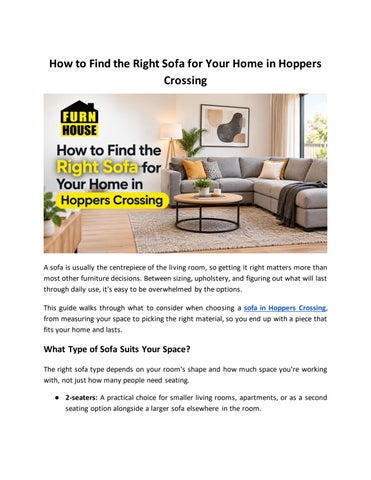
How to Find the Right Sofa for Your Home in Hoppers Crossing
A sofa is usually the centrepiece of the living room, so getting it right matters more than most other furniture decisions. Between sizing, upholstery, and figuring out what will last through daily use, it's easy to be overwhelmed by the options. This guide walks through what to consider when choosing a sofa in Hoppers Crossing, from measuring your space to picking the right material, so you end up with a piece that fits your home and lasts.
What Type of Sofa Suits Your Space? The right sofa type depends on your room's shape and how much space you're working with, not just how many people need seating. ● 2-seaters: A practical choice for smaller living rooms, apartments, or as a second seating option alongside a larger sofa elsewhere in the room.
● 3-seaters: The most common option for standard living rooms, offering enough seating for a small household without overwhelming the space. ● Corner/L-shape sofas: Suited to larger or open-plan living rooms, making efficient use of wall space while offering more seating overall. ● Modular sofas: Flexible configurations that can be rearranged as needed, useful if you like to change your layout or aren't sure exactly how the space will be used long-term. ● Sofa beds: A practical option if your living room doubles as a guest space, sofa beds offer comfortable seating by day and a usable bed by night without dedicating a separate room to it. Before deciding on a type, measure your room, and think about traffic flow. A large corner sofa might look great in photos, but it can make a small room feel cramped if it doesn't leave enough walking space.
How Do You Choose the Right Upholstery? The material you choose affects how the sofa feels, how it holds up, and how much upkeep it needs over time. ● Fabric: Soft, breathable, and comfortable, making it well-suited to Australia's warmer months when leather can feel hot to sit on. It's generally more budget friendly, though it can absorb spills and odours if not treated or cleaned regularly. ● Genuine leather: Durable and easy to wipe clean, developing a natural patina as it ages. It costs more upfront but holds up well over years of daily use. ● Faux leather: A middle ground between the two, offering leather's easy-clean surface at a lower price point. It doesn't breathe as well as fabric or last quite as long as genuine leather, but it's a practical choice for busy households. Whichever material you land on, think about who's using the sofa and how often. A household with kids or pets might lean toward faux leather or a treated fabric, while a quieter living room might suit genuine leather just fine.
How Do You Measure Your Space Before Buying a Sofa? Getting the measurements right before you buy saves you from ending up with a sofa that overwhelms the room or leaves it feeling awkward and unbalanced. As popular UK-based home decor magazine Homes & Gardens points out, a sofa is usually the largest piece in a living room, so its dimensions carry more weight than most other furniture decisions. ● Room dimensions first: Measure the length and width of the space, then decide where the sofa will sit before choosing a size. ● Walking space: Leave roughly 75-90cm of clearance for main walkways around the sofa. ● Doorways and hallways: Measure the width of doors and hallways the sofa needs to pass through, and check which way doors swing. ● Diagonal depth for large pieces: For 3-seaters, corner sofas, or modulars, measure diagonally to check whether the piece can be tilted through a doorway. ● Coffee table spacing: Leave at least 45cm between the front of the sofa and a coffee table, enough to sit comfortably without feeling cramped. ● Sketch it out or tape it down: Marking the sofa's footprint on the floor with tape gives a clear visual before committing, especially for corner or modular sofas. Get these measurements sorted early, and choosing the right size, shape, and choosing the right style becomes far easier.
What Should You Check for Comfort and Durability? A sofa can look great in the showroom and still fall short years down the line if what's underneath isn't built to last. ● Frame construction: A solid wood or metal-reinforced frame holds up far better over time than particleboard or thin plywood, especially under regular use. ● Cushion fill: Foam density affects how firm or plush the seat feels over time. Higher-density foam holds its shape longer, while softer fill feels plusher at first but may compress faster.
● Seat depth: Deeper seats suit lounging and taller users, while shallower seats offer more back support for shorter users or upright sitting. ● Suspension system: Springs or webbing beneath the cushions affect long-term comfort, sagging is usually the first sign of a weaker suspension system wearing out. ● Warranty: A longer warranty period is often a sign the manufacturer trusts the frame and construction to hold up, and it's useful cover if something does go wrong. ● Consider a recliner sofa: If comfort and adjustability matter more than a standard fixed seat, a recliner sofa in Melbourne combines sofa seating with a reclining function, giving you both in one piece rather than choosing between them. A sofa that checks these boxes will still feel comfortable and hold its shape years after the one that only looked good on day one.
Sofa vs Sofa Bed: Which One Do You Need? Both serve the same core purpose, everyday seating, but the right choice comes down to how your living room actually gets used day to day. Standard Sofa
Sofa Bed
Best For
A dedicated living room A living room that doubles as a guest without guest-space needs room
Comfort
Generally more comfortable Slightly firmer seating in some models, for everyday sitting, built since the frame also supports the foldpurely for seating out mechanism
Space efficiency
Uses less floor depth since Solves two furniture needs in one there's no folding mechanism piece, useful in smaller homes
Price
Typically lower, since there's Usually costs more due to the added less mechanical complexity folding frame and mattress
Frequency of guests Better if you rarely host Better if you host regularly or don't overnight guests have a spare room
If overnight guests are rare, a standard sofa is usually the more comfortable everyday choice. If space is tight and guests are frequent, a sofa bed solves two problems with one purchase.
How Do You Style a Sofa Once It's In Place? Once the sofa's in the room, a few finishing touches make the difference between it looking furnished and looking styled. ● Add cushions in varying sizes: Mix two or three sizes rather than matching pairs, it adds visual interest without looking cluttered. ● Layer in a throw: Draped over one arm or folded along the back, a throw adds texture and warmth to an otherwise flat surface. ● Pair with a rug that fits the scale: The rug should extend at least under the front legs of the sofa, a rug that's too small can make the whole layout feel disconnected. ● Get the coffee table proportion right: Aim for a coffee table roughly two-thirds the length of the sofa, and keep it low enough that it doesn't compete visually with the seat height. ● Balance with a side table: A side table at arm height on at least one end adds function without overcrowding the space. ● Consider a statement piece nearby: A floor lamp, plant, or artwork above the sofa can anchor the space and draw the eye without overwhelming it. None of these are essential, but together they're what turns a sofa from a functional piece into the centrepiece of the room.
Final Thoughts Finding the right sofa comes down to matching it to your space, your household, and how you'll actually use it day to day, not just picking whatever looks best in a showroom photo. Get the size, material, and comfort right, and the styling almost takes care of itself.
FAQs 1. What size sofa is right for a small living room? A 2-seater or compact 3-seater usually works best for smaller rooms, leaving enough walking space around it. Measuring the room before buying prevents ending up with a sofa that overwhelms the space. 2. Is fabric or leather better for a sofa? It depends on your household. Fabric is more budget-friendly and breathable, while leather is more durable and easier to clean but can feel warm in summer. Faux leather offers a middle ground between the two. 3. Is a corner sofa a good choice for a small room? It depends on the room's shape. Corner sofas work well in square or open-plan spaces but can overwhelm a narrow room. Measuring diagonally and mapping out the footprint helps confirm the fit. 4. What's the difference between a sofa and a sofa bed? A sofa is built purely for seating, while a sofa bed folds out into a usable bed, making it a practical choice for homes that double as guest space. 5. How long should a good sofa last? A well-made sofa with a solid frame and good-quality cushioning can last well over a decade with regular use. Frame construction matters more than upholstery when it comes to longevity. 6. What should I check before buying a sofa online? Confirm the exact dimensions, not just seating capacity, and check delivery access requirements like doorway width and stairwell clearance before ordering. 7. Do recliner sofas offer the same comfort as a regular sofa? Yes, and often more, since they combine standard seating with the option to recline. They're a good choice if adjustability and comfort are a priority.
8. How do I keep a sofa looking new for longer? Rotate cushions regularly to distribute wear evenly, vacuum fabric sofas often, and clean spills as soon as they happen to prevent staining or odour buildup.