JULY/AUGUST 2026
Episode 1: “America First” — The first part focuses on the rise of the space shuttle, beginning in the 1970s. It features two astronauts who defied the stereotypes of the time. Anna Fisher became the first mother in space. The physician and astronaut took part in three major programs while enduring media scrutiny that questioned her decision as a mother to pursue the risks of space travel. Entering the shuttle program at the same time, physicist and astronaut Ronald McNair became a beloved celebrity. He will be remembered as the first African American astronaut and a member of the doomed Space Shuttle Challenger mission.
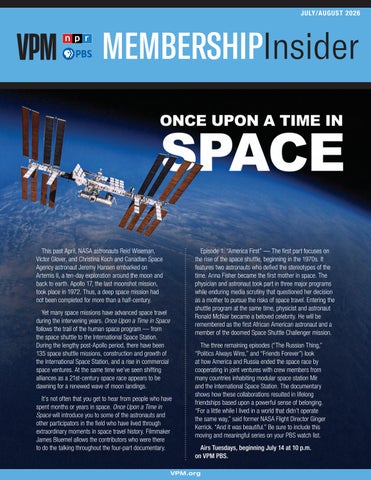
This past April, NASA astronauts Reid Wiseman, Victor Glover, and Christina Koch and Canadian Space Agency astronaut Jeremy Hansen embarked on Artemis II, a ten-day exploration around the moon and back to earth. Apollo 17, the last moonshot mission, took place in 1972. Thus, a deep space mission had not been completed for more than a half-century. Yet many space missions have advanced space travel during the intervening years. Once Upon a Time in Space follows the trail of the human space program — from the space shuttle to the International Space Station. During the lengthy post-Apollo period, there have been 135 space shuttle missions, construction and growth of the International Space Station, and a rise in commercial space ventures. At the same time we’ve seen shifting alliances as a 21st-century space race appears to be dawning for a renewed wave of moon landings. It’s not often that you get to hear from people who have spent months or years in space. Once Upon a Time in Space will introduce you to some of the astronauts and other participators in the field who have lived through extraordinary moments in space travel history. Filmmaker James Bluemel allows the contributors who were there to do the talking throughout the four-part documentary.
The three remaining episodes (“The Russian Thing,” “Politics Always Wins,” and “Friends Forever”) look at how America and Russia ended the space race by cooperating in joint ventures with crew members from many countries inhabiting modular space station Mir and the International Space Station. The documentary shows how these collaborations resulted in lifelong friendships based upon a powerful sense of belonging. “For a little while I lived in a world that didn’t operate the same way,” said former NASA Flight Director Ginger Kerrick. “And it was beautiful.” Be sure to include this moving and meaningful series on your PBS watch list. Airs Tuesdays, beginning July 14 at 10 p.m. on VPM PBS.
VPM.org