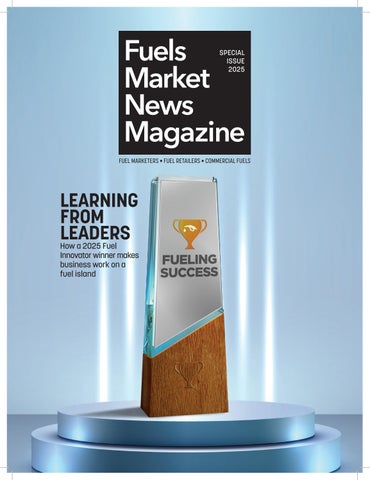
SPECIAL ISSUE 2025
LEARNING FROM LEADERS How a 2025 Fuel
Innovator winner makes business work on a fuel island
02 From the Editor TRANSPORTATION ENERGY INSTITUTE 04 Fueling and Charging Today—and Tomorrow TEI provides perspective on the alternative energy solutions available to retailers and marketers today.
RETAIL OPERATIONS 06 Real Business of AI
Retailers should cut through the AI hype for tangible results.
08 Terminal Profitability
A look at how modern payment kiosks can kickstart c-store revenues.
FEATURES
Gaskins: A Convenience 10 Derek Leader’s Journey His path through the industry has taught him the value of maximizing customer experience.
14 Meet the Winners
This year’s top fuels innovators are QuikTrip and Rotten Robbie.
Business Work on a 16 Making Fuel Island Selling fuel in California takes the word ‘challenge’ to the next level.
24 Closing a Chapter
An appreciation for the past five years of FMN.
FuelsMarketNews.com | 1
FROM THE EDITOR
Convenience Leadership in a Gladiatorial Arena
T
he 2025 Fuels Innovators of the Year Award Education Session was another outstanding success, drawing over 250 engaged attendees. This wasn’t just an opportunity to recognize leaders in the fuels and charging category—but also a chance for an insightful question and answer education session. I’ve been very proud of this award and the winners who have graciously shared both their keys to success and the stumbling blocks they have encountered. This year, Tom Robinson, chairman of Robinson Oil, discussed how its Rotten Robbie stores navigate the challenging world of fuel retailing in California. Tom is an accomplished industry veteran and he’s also someone who has no problem with a frank discussion—something that carried forward in our session. As you’ll see from our coverage of the event, doing business in California can be challenging, not just on the fuels front but also to do business in general. And yet, for four generations Rotten Robbie has not just managed to succeed but thrive, finding opportunities and efficiencies by thoroughly understanding the markets in which it operates. One anecdote from this session illustrated this point well. Tom noted that the city of Santa Monica was working to ban filtered cigarettes because the filters were showing up on the beach, and a quick Google search after the session showed that the county of Santa Cruz approved a ban on filtered cigarettes beginning
January 1, 2027. While our focus is on fuels, tobacco sales are very important to the overall success of convenience and fuels retailers. What struck me as extraordinarily peculiar (but not really surprising) was that the ban would limit the very filters that have historically limited the amount of tar, a stated health benefit. Yet this ban is proposed in a state where “healthiness” is considered part of its current, core identity. At one point, after Tom finished a particularly long list of day-to-day hurdles to doing business, I asked him jokingly why a smart guy like himself not only continued to do business in the state but passed it along to the next generation. Tom laughed. I already knew the answer from our conversation. It’s clear that Tom has enjoyed the challenge and competition and pure entrepreneurial spirit that characterizes convenience and fuel retailing. In California that can be a gladiator sport, and like so many in the industry, Tom has been a gladiator. That is what makes this industry strong, flexible and able to go beyond the ability to not just survive but to thrive.
EDITORIAL Keith Reid Editor-in-Chief (847) 630-4760; kreid@fmnweb.com Jeff Lenard VP of NACS Media & Strategic Communications (703) 518-4272; jlenard@convenience.org Leah Ash Editor/Writer lash@convenience.org CONTRIBUTORS Scott Friedman, Karthik Ganapathi
DESIGN Ji Ho Creative Director jho@convenience.org Erika Freber Art Director efreber@convenience.org David Marvin Graphic Designer dmarvin@convenience.org
ADVERTISING Ted Asprooth (703) 518-4277; tasprooth@convenience.org
PUBLISHING Ben Nussbaum Publisher (703) 518-4248; bnussbaum@convenience.org Logan Dion Digital Ad and Media Trafficker (703) 864-3600; production@convenience.org
EDITORIAL COUNCIL RETAILER/MARKETER MEMBERS Mark Fitz, president, Star Oilco; Derek Gaskins, head of guest experience, BP; Brian Renaud, director of retail fuel pricing and analytics, Sheetz; Scott Minton, director of business development, OnCue Marketing VENDOR/SUPPLIER MEMBERS Regina Balistreri, director of marketing, ADD Systems; Joe O’Brien, vice president of marketing, Source North America; Kaylie Scoles, marketing director, RDM Industrial Electronics Inc.; Ed Kammerer, director of marketing and global product strategy, OPW Fueling; Michael Munz, marketing manager, Petrosoft Fuels Market News Magazine is published quarterly by the National Association of Convenience Stores (NACS), Alexandria, Virginia, USA.
Keith Reid is the editor-in-chief of Fuels Market News. He can be reached at kreid@fmnweb.com.
Subscription Requests: circulation@fmnweb.com POSTMASTER: Send address changes to Fuels Market News Magazine, 1600 Duke Street, Alexandria, VA, 22314-2792 USA. Contents © 2025 by the National Association of Convenience Stores. Periodicals postage paid at Alexandria, VA, and additional mailing offices.
1600 Duke Street, Alexandria, VA, 22314-2792 PUBLISHED BY
2 | 2025 Fuels Innovator of the Year
Test Your Sumps in 60 Seconds Without Water, Waste, or Downtime.
Reduce your testing time to minutes instead of hours
No loss of fueling customers
o sw Removes water disposal fees
NO WATER. NO WASTE. NO DOWNTIME. SEE HOW DRI-SUMP SAVES YOU TIME & MONEY Visit www.dri-sump.com
Fueling and Charging Today—and Tomorrow TEI provides perspective on the alternative energy solutions available to retailers and marketers today. BY KEITH REID
I
t’s time that we start taking ownership of the future of the fuels market and start leading the industries that are affected to make change for the positive,” said Transportation Energy Institute Executive Director John Eichberger in 2013, announcing the formation of the group, then known as the Fuels Institute. The Transportation Energy Institute (TEI) is a non-advocacy research organization dedicated to studying transportation-energy. It was formed from the recognition that there is not just one road to the future of energy, decarbonization and transportation. The organization takes a non-advocacy approach, with a focus on education for all impacted parties—from fuel producers and providers to the transportation industry and ultimately the legislators and regulators that set policy. Here’s a update from Eichberger on some issues top of mind with TEI.
4 | 2025 Fuels Innovator of the Year
If you were to look at the profile of stores selling a lot of E15, they’re making a ton of money.
WHAT SHOULD RETAILERS CONSIDER IF THEY ARE ONLY SELLING THE TRADITIONAL THREE GRADES OF GASOLINE AND PETROLEUM DIESEL? I think that comes down to money. If you were to look at the profile of stores selling a lot of E15 (15% ethanol content), they’re making a ton of money. The customers are saving anywhere from 10 to 30 cents per gallon. Their margins are higher than E87 (up to 87% ethanol) or the conventional E10 (10% ethanol). And they’re getting the RINs if they’re blending themselves, so the economics are there. You can use E15 in 2001 or newer vehicles, which represents about 90% of the vehicles on the road today. So, you have an audience that can buy the fuel, and the infrastructure requirements aren’t that onerous—most of your lines are compatible if they’ve been installed within the last 15 to 20 years. Still, check the details with your distributors and equipment vendors. IS CARBON THE SAME CONCERN TODAY THAT IT WAS PREVIOUSLY? A lot of marketers and retailers seem to be complacent now because the Trump administration is de-emphasizing carbon. But Trump and his policies aren’t going to be around forever and the global push for lower carbon has not gone away. Biofuels and reduced carbon intensity will be good for PR; it’ll be good for compliance. It’ll be good in the voluntary carbon market once that develops. It can also boost credibility on the environmental side. From my perspective, it makes a lot of sense on several fronts. WHAT IS THE OVERVIEW OF FUNDING OPTIONS FOR EV CHARGER INSTALLATION? Despite news suggesting the contrary, EVs remain an important and growing part of the transportation sector. As with all new technologies, there are
going to be periods of exceptional growth and periods of contraction, but the technology is successful and there are millions of drivers who want to buy these vehicles. For retailers, this opens an opportunity—in some markets. It’s important to understand demand for charging services in their specific operating region. I always suggest that retailers evaluate their community. Do they see EVs driving on the road or parked at popular destinations? Are other businesses installing charging and are they being used frequently? Are local car dealers offering EVs for sale and are customers asking for EVs? Regardless of whether a market is ready for more chargers today, communicating now with local utilities and charging equipment providers can help a retailer develop plans to be prepared to install chargers when the time is right. WHAT IS SOME OF THE RESEARCH TEI IS WORKING ON FOR THE NEAR FUTURE? There are a variety of things we have in the hopper. One is an overview of funding options for EV charger installation. We’re working on a summary of TEI research on emissions reductions from combustion engines and liquid fuels. We’ll explore the opportunities and challenges associated with midlevel ethanol blends. And frankly, one issue that is starting to intrude is aging underground storage tank infrastructure. The typical 35-year warranties from the major upgrade cycle in the 1990s are starting to expire, and retailers are beginning to encounter ramifications from their insurers. TEI ALSO HAS AN ANNUAL MEETING. WHAT ARE THE MAIN BENEFITS FOR ATTENDEES? TEI ’26 will be held in Fort Worth, Texas, this coming April, and
attendees will hear an honest assessment of what’s going on in the market. The transportation and energy sectors are dealing with a great deal of uncertainty; TEI ’26 will provide some clarity by looking at market conditions and trajectories from a practical and global perspective, to understand the fundamentals affecting different segments of the market and to cut through the rhetoric portrayed in the media.
Despite news suggesting the contrary, EVs remain an important and growing part of the transportation sector.
Keith Reid is editorin-chief of Fuels Market News. He can be reached at kreid@fmnweb.com.
FuelsMarketNews.com | 5
RETAIL OPERATIONS
The Real Business of AI Retailers should cut through the AI hype for tangible results. BY KARTHIK GANAPATHI
T
he conversation around artificial intelligence is impossible to escape. For executives, it can feel like standing in the middle of a crowded street: There is a lot of noise, but not much clarity. But for business operators, the path forward doesn’t lay in speculation or hype—it lays in results. AI is not a magic wand, nor is it a looming threat waiting to replace the workforce. It’s a tool. Like every other industrial innovation, its value comes from how 6 | 2025 Fuels Innovator of the Year
it’s applied. We already experience AI every day: Netflix recommendations, spell check, sentence completion prompts, voice assistants, fraud protection and assisted driving all augment human decision-making without taking control away from humans. Before applying AI, it’s important to clarify what we mean by it. One helpful distinction is narrow versus general AI. Narrow AI builds targeted intelligence into systems to help make faster, better decisions
and is already delivering value in industrial automation, analytics and customer operations. General AI, the so-called holy grail, would pass the “Turing test,” having the ability to understand, reason, learn and behave at a human level. However, it remains largely hypothetical and the source of sweeping claims—often driven by marketing buzz. Too often, companies either hesitate to act for fear of making the wrong move or throw themselves into pilot
RETAIL OPERATIONS
AI is only as good as the data you feed it. Without clean, structured and harmonized information, even the most advanced models will generate noise or misleading results. programs that never leave the lab. The reality is that successful AI adoption requires something much simpler: focus. Start with a business challenge that matters—reducing downtime, improving quality and streamlining logistics. Apply AI to those challenges, measure its impact and scale what works. Then translate the theoretical promise to tangible outcomes: move from “can be done” to “we did it.” The truth is that the hype around AI will fade—what won’t fade are the competitive advantages for the companies that take a disciplined, practical approach to AI. For executives looking to cut through the hype, three principles provide a clear starting point: 1. GET YOUR DATA RIGHT. AI is only as good as the data you feed it. Without clean, structured and harmonized information, even the most advanced models will generate noise or misleading results. Start by organizing customer, product and equipment data into a single source of truth. This approach provides visibility into profitability, operational performance and opportunities for improvement, creating a foundation upon which any AI-enabled system can reliably operate. This view also helps organizations analyze current performance, identify gaps and prepare for more advanced AI applications. 2. START SMALL, SCALE FAST. The most effective AI implementations begin with targeted, high-friction problems rather than broad, undefined initiatives. At Vontier, for example,
a spike in call volumes prompted the team to apply the old-school Kaizen methodology, identifying areas for continuous improvement across the organization. This analysis clarified which application and process changes were needed to reduce call volumes. With that foundation in place, the company leveraged agentic AI tools to process incoming calls more efficiently. Some improvements were simple, such as deploying AI agents to augment support personnel. Others—like automated triaging and closed-looped backlog management— required more advanced AI models and careful orchestration. This first step demonstrated that disciplined, small-scale pilots can deliver tangible results and build a foundation for broader adoption. 3. KEEP HUMANS IN THE LOOP. AI can predict outcomes, generate insights and automate tasks, but it cannot replace human judgment. Leaders should treat AI as an assistant rather than a substitute, ensuring outputs are validated, errors caught and biases mitigated. Human oversight safeguards quality and accountability while allowing teams to redirect effort toward higher-value work—interpreting insights, making strategic decisions and innovating in ways machines cannot replicate. Practical applications for AI span multiple domains: In product design, software development and delivery, AI can provide near-immediate benefits, with predicted efficiency savings of $2.6 to $4.4 trillion. AI accelerates
discovery, isolates core feature needs and translates them into discrete engineering tasks, reducing cycle times and improving roadmap fidelity. The bottom line is clear: AI today will not fully replace operations, but businesses that embrace AI with discipline and purpose will outpace those who don’t. The winners won’t be the ones who talk the loudest about AI—they’ll be the ones who get their data right, solve real problems and keep humans at the center of decision-making.
AI is not a magic wand, nor is it a looming threat waiting to replace the workforce. It’s a tool.
Karthik Ganapathi is the president of Invenco by GVRInvenco by GVR, a Vontier business. Learn more at invenco.com.
FuelsMarketNews.com | 7
RETAIL OPERATIONS
Terminal Profitability How modern payment kiosks can kickstart c-store revenues. BY SCOTT FRIEDMAN
M
ultiple revenue streams are critical for today’s convenience stores. And multiple purchase options are equally critical for key profit drivers such as fuel dispensers and car washes to enhance the customer experience. But you need the right tools for the task— or you risk lost profits, often right at the payment terminal itself. Customers have specific expectations from c-stores—speed and efficiency. When fueling, they want open lanes at the pumps. In the store, they want great offers and quick transactions. And
8 | 2025 Fuels Innovator of the Year
at the car wash, they want a quick and thorough wash that starts with an easyto-use EMV-compliant payment system. Many convenience store sites that fail to update their payment kiosks miss a significant opportunity to provide a fast, efficient process for their customers. Older payment terminals are increasingly inefficient and clunky and can lead to additional expenses for the site, including possible hidden fees associated with non-EMV compliance. Outdated terminals also directly affect the customer and traffic flow in
Upgrading to modern kiosks can help mitigate these problems and there are opportunities to reduce the risk of lost profits through equipment upgrades without compromising operational uptime or customer satisfaction.
RETAIL OPERATIONS
Customers visit convenience stores for a quick stop, whether for fuel, snacks or drinks, a car wash or all the above. In any case, they expect speed and reliability. Operators shouldn’t hamper that with outdated payment kiosks that slow everything down or are prone to errors. and out of the bay. Drivers fumbling for cash or coins can cause long lines to form. And these older machines are more likely to jam or operate incorrectly. These inadequacies frustrate the customer and harm the customer experience from the outset, reducing the likelihood of repeat business. Upgrading to modern kiosks can help mitigate these problems and there are opportunities to reduce the risk of lost profits through equipment upgrades without compromising operational uptime or customer satisfaction. To accomplish this, sites must consistently deliver effortless operations across the board, which begins with the first customer touchpoint—the kiosk. WHAT CAN UPDATING THE PAYMENT TERMINALS DO FOR THE STORE? An increasing number of devices are interconnected on site, which allows retailers to offer incentives for the car wash at the fuel pump, inside the store or both. That communication flexibility enables the c-store to easily sell car wash subscriptions and promote loyalty programs, among other benefits. New kiosks can serve as the central hub, bringing several key advantages: • EMV compliance • Flexible and secure transactions for multiple payment types • Increased customers throughput in peak hours
• Personalized customer advertising and upsell opportunities • Connections to apps for subscriptions and rewards programs • Speed, security and personalization with AI-powered license plate recognition (AI-LPR) Installation can be straightforward from a physical standpoint, requiring no special infrastructure or technology—aside from having adequate power availability and a secure internet connection. With most new systems built for plug-and-play capabilities, a c-store can be up and running with new digital payment terminals quickly and easily. HOW DO NEW TERMINALS BENEFIT THE C-STORE CUSTOMER? Customers visit convenience stores for a quick stop, whether for fuel, snacks or drinks, a car wash or all the above. In any case, they expect speed and reliability. Operators shouldn’t hamper that with outdated payment kiosks that slow everything down or are prone to errors. Today’s technologies are more accepting of different payment methods, which speeds things up. Modern kiosks are EMV-ready, allowing for cards, apps and rewards programs to make things more efficient and give the store more revenue options. Plus, new kiosks are more user-friendly, with bigger screens, simple interfaces and easy-tofollow instructions.
New payment systems also provide several key benefits to the customer that can kick off a great experience and drive repeat business: • Ease of use, plus speed and efficiency • Multiple payment options—no need to count cash or risk a jam during payment • Personalized incentives based on purchase history • Quick access to rewards, discounts, memberships and loyalty programs Many c-store car washes are losing profits at the payment terminals without even realizing it due to inefficiencies and cumbersome operation of older kiosks. By upgrading to new generation terminals, stores can more effectively cross-market between the fuel pumps, car wash, the store and even the individual customer through several levels of interactivity. Furthermore, installing new kiosks that accept multiple, secure and accessible payment types gives the store additional revenue streams while minimizing profit loss from outdated equipment that could provide a negative experience.
Scott Friedman is the director of marketing at OPW Vehicle Wash Solutions, which consists of PDQ Manufacturing Inc., Belanger Inc., Innovative Control Systems (ICS), Kesseltronics and Transchem. Learn more at opwvws.com.
FuelsMarketNews.com | 9
DEREK GASKINS: A Convenience Leader’s Journey
His path through the industry has taught him the value of maximizing customer experience. By Keith Reid 10 | 2025 Fuels Innovator of the Year
D
erek Gaskins began his career in convenience retailing in 2002 when he left his position as a brand manager at Procter & Gamble (P&G) to lead the non-food operations for Giant Eagle. While there, he helped launch the GetGo convenience brand following the acquisition of Crossroads stations from Guttman Oil. Gaskins also led the marketing team during the development of Giant Eagle Express and Market District Express, as well as the company’s fuelperks loyalty program. In 2009, Gaskins joined NACS as vice president of marketing, where he oversaw brand development and integration, social network campaign execution and channel analytics. His retail customer-facing skillset was reapplied in 2011 when he joined Mid-Atlantic Convenience Stores (MACS) as SVP of merchandising and marketing. He has also served as Rutter’s chief customer officer and as Yesway’s chief marketing officer. Gaskins currently works as BP’s head of guest experience, setting the go-to-market strategy and supporting how BP engages with consumers across its U.S. retail stores. FMN talked to Gaskins about what he thinks is important in convenience retailing today. WHAT PROMPTED YOUR MOVE INTO THE CONVENIENCE INDUSTRY? When I was at P&G—20-plus years ago—I saw where the consumer trends were going. I felt small-format retailing would be a winner. And today it is stronger than ever. A lot of things accelerated that—the Great Recession and more recently Covid. We were one of the only places open when the world shut down. And our industry rose to the challenge. Not only are we fueling the communities that we serve, but we fuel first responders, we fuel the heroes and the police and fire departments when there’s a natural disaster, a hurricane, a fire—any of those things. We are where consumers,
and the people who are serving those communities, go when they need supplies. They rely on us for fuel, hydration, replenishment and nourishment. HOW WOULD YOU CATEGORIZE FUEL IN THE CONVENIENCE STORE MIX OF OFFERS? I look at fuel as indispensable. It’s a traffic driver—a necessity that vehicles need. Yes, there are shifting landscapes, more efficient vehicles and EVs—the long-term demand will go down, but it will remain vital. And fueling the world is something that as a channel and industry we are uniquely serviced and set to do. And that ties into the rest of the store offers. The number one benefit that consumers want as an incentive or as a reward is discounts and savings on fuel. When I was at Giant Eagle we launched fuelperks and it was very straightforward because that was the consumer benefit. Fuel remains the dominant perceived value for such programs throughout the industry from consumers who engage with convenience retail. DESCRIBE YOUR NACS EXPERIENCE. I joined the association as the VP of marketing and worked with Henry Armour to reposition NACS more globally and to move from a gasoline focus to more broadly encompass the range of fuels and charging. It gave me more purpose in areas in which I have always had a passion for in retail. I think what NACS uniquely did was help me look across channels. P&G was a global brand and I had an opportunity to launch products and do global research, but NACS was looking at it through the lens of a retailer and across the 28 categories that comprise inside sales. From my P&G experience as a CPG brand manager, I realized that the convenience channel oftentimes doesn’t get equity. Simply put, we’re subsidizing other channels. You see mass marketers or the club channel, and their cost of goods oftentimes
Derek Gaskins head of guest experience, BP
is significantly lower, so much so that my retail prices may appear to be insulting—but the consumer doesn’t understand why. Consumers see something like Pringles and ask “How come it’s more expensive in a convenience store compared to my grocery store?” So, when I engage with suppliers, it’s around more equity as a channel. I also received some insights at NACS though its expanded global push on how to look outside your market, and even your country, for things that work. Henry Armour likes to say—I think he credited William Gibson—that “the future’s already here, it’s just unevenly distributed.” That means that you can look globally at other markets and obtain things that work and best practices and apply them in your market. I saw that firsthand when I was at Rutter’s and we hosted some Australian retailers. They were fascinated with pay at the pump, and I was thinking this is something we did decades ago. They were asking if you lost foot traffic inside the stores. As we’ve learned, if you make it easy for the customer to do business, you’ll do more business. Yet they did not learn this insight until they saw it in practice in another country. I’m fortunate now that at BP I can do that without looking outside of the company. With our global operations, FuelsMarketNews.com | 11
I can see what’s happening in the U.K. or New Zealand or Australia and other regions where we operate, and our operations abroad can see what we are doing in the United States. YOU HAVE SPOKEN BEFORE ABOUT WORKING WITH INDUSTRY LEGEND THE LATE JOE PETROWSKI WHILE AT YESWAY. JOE HAD A LONG HISTORY IN THE INDUSTRY, INCLUDING HIS TIME AS CEO OF THE CUMBERLAND GULF GROUP. COULD YOU SPEAK ABOUT THAT EXPERIENCE? I looked up to him. He was a role model, a mentor. Our backgrounds are similar in that we both came from some tough places, Joe from Brockton, Massachusetts, and me from inner city Washington, D.C. Joe had an MBA from Harvard and was one of the sharpest guys in the room. His sense of humor, his wit, his relationship building—they were outstanding. He was just a giant of a man in every way. Joe took a liking to me, he made time for me and we kept in touch for the rest of his career. I didn’t realize at the end how much he was fighting for his life, but he was still invested in the industry and his company and the business. Whenever I’m mentoring a young marketer, category or brand manager, I’m always saying understand those who came before you and respect and learn from them. This industry was built by some giants. You know, when you look at Lonnie Allsup and what he did with Allsup’s, or you look at Stan Sheetz and what that has turned into, or Dick Wood and Wawa, or James Thornton and what he has done with that brand— I think we have a responsibility to carry it forward. WHAT DO RETAILERS TEND TO OVERLOOK IN THE CONSUMER RELATIONSHIP? Know the customer and be obsessed with them. At BP we have a concept: guest obsession. Observing consumers is critical. One of my franchisees was telling me how he goes in stores and literally just observes consumers. And I love that. 12 | 2025 Fuels Innovator of the Year
A lot of us convenience retailers will look at research, syndicated data, sales, and we’ll get Nielsen and Circana and the analysis and say this is what it is. That’s great, but go into a store, slow down and observe. Watch the behavior—how they shop, the adjacencies, the hot zones. That helps you understand the needs that consumers often cannot articulate. You can be a very scientific marketer, which is great and I consider myself to be one, but recognize the art of retailing. CAN YOU DESCRIBE BP’S RETAIL AND MARKETING TODAY? We are committed to growth, and we are truly global. I’ve worked for some great brands, great companies, but the people that you encounter here are world class at what they do and are committed to it. Another thing that stands out is our franchises. We have multiple banners, and we look to leverage the scale and BP’s core growth across all of them. You have ampm, which is a very successful regional brand on the West Coast that we’re looking to grow east of the Rockies. TA, one of the big three travel center brands nationwide, is committed to first responders, the military and supporting the communities, which is great. That professional driver segment is a hero. They transport the goods that keep this country and this world going, and TA is at the heart of all that. And then you have Thorntons. Thorntons has almost been a training ground for talent when you look industry wide with folk who have moved on to lead some of the best retail brands out here. BP has preserved that legacy and has grown that banner and the brand. And summing it up with BP and Amoco, we are growing our branded retailers and wholesalers. We have a brand that is resurgent and are committed to the direction that our CEO set to expand our culture of excellence.
A lot of us convenience retailers will look at research, syndicated data, sales, and we’ll get Nielsen and Circana and the analysis and say this is what it is. That’s great, but go into a store, slow down and observe.
Keith Reid is editorin-chief of Fuels Market News. He can be reached at kreid@fmnweb.com.
THE ROOT OF YOUR SUCCESS GROW PROFITS WITH ADD SYSTEMS SOFTWARE
Process Automation
SmartConnect®
Atlas Reporting®
Financials
Pegasus® Mobile
Raven® Mobile
Software is an integral part of your business. Choose a partner whose products enable you to grow your profitability. ADD ENERGY Co.
Your driver Jim B will be delivering fuel today to 400 East 2nd St. Ocean Isle Beach, NC
SOFTWARE FOR THE PETROLEUM & CONVENIENCE STORE INDUSTRIES
Learn more at addsys.com 800-922-0972 FuelsMarketNews.com | 13
MEET THE
WINNERS
QuikTrip and Rotten Robbie have been honored with the 2025 FMN Fuels Innovator of the Year Awards, presented by Fuels Market News Magazine.
14 | 2025 Fuels Innovator of the Year
ABOUT THE AWARDS The convenience retailers were selected for the awards based on overall fuel excellence, technology and operational efficiency as noted by their presence on the annual Oil Price Information Service (OPIS)/ FMN Fuel Leaders rankings. (For more details, see the Summer 2025 issue of FMN Magazine.) These rankings used data and analysis that ranked retailers with a core focus on operational fueling efficiency and market performance in a range of areas. The companies were then reviewed for their active promotion of fuels and charging relative to other store categories by a panel of industry veterans and experts.
CONVENIENCE STORE CHAIN 100 OR MORE STORES QuikTrip Corporation was founded in 1958 and is headquartered in Tulsa, Oklahoma. QuikTrip is a privately held company with over 1,100 stores across 21 states. With annual revenues exceeding $11 billion and more than 31,000 employees, QuikTrip is recognized as a leader in convenience retail, known for quality products, outstanding customer service and spotless stores. QuikTrip has been named one of the best places to work for 15 consecutive years. The company donates 5% of its net profits annually to charitable organizations and offers a wide selection of fresh food, beverages and Top Tier-certified fuels. QuikTrip’s commitment to excellence and community continues to set it apart as a trusted brand and employer of choice.
CONVENIENCE STORE CHAIN UNDER 100 STORES Robinson Oil Corp. is a fourth-generation northern California family business with a history dating back to the 1930s. It operates 39 Rotten Robbie locations that have a focus on quality fuel at good prices, as well as a solid convenience offer in the store. It has offered biodiesel since 2008, has explored EV charging and now offers premium renewable diesel. On the commercial side, the company provides fuel management solutions for small- to largebusiness fleets, over-the-road transportation companies and government agencies. It works with the national fleet fueling programs Pacific Pride, CFN and Fleetwide.
FuelsMarketNews.com | 15
16 | 2025 Fuels Innovator of the Year
MAKING BUSINESS WORK ON A
FUEL ISLAND Selling fuel in California takes the word ‘challenge’ to the next level.
Fuels Market News presented the 2025 Fuel Innovators of the Year awards to Rotten Robbie (for a retailer with fewer than 100 sites) and QuikTrip (for a retailer with 100 or more sites) at the NACS Show on October 14. Accepting the award for Rotten Robbie was Tom Robinson, chairman of Robinson Oil Corp. Tom is a past chairman of NACS, past president of SIGMA and past board member of the California Independent Oil Marketers Association. QuikTrip was unable to accept the award in person but submitted an acceptance statement (see page 19). Robinson participated in a lively Q&A session with Keith Reid, editor of Fuels Market News. WHAT ARE SOME OF THE CHALLENGES YOU FACE IN CALIFORNIA? We don’t have as many c-stores as some other states per capita, so it’s less competitive in some respects. At the same time, there are so many regulations and costs to cover that I had to make a list. I don’t think any other state still has Stage 2 vapor recovery. We have enhanced vapor recovery, which means that if it gets out of sync it goes into alarm and then we’ve got a problem. And now with all the canisters in cars, you have fugitive emissions. In most states, if somebody drives off with a nozzle, the cost to replace hoses and breakaways would be a couple hundred dollars. But in California it’s about $700 to replace everything. FuelsMarketNews.com | 17
We have consumers that will pay a lot at some locations, and yet you can also see the classical shift for a couple of pennies or a nickel a gallon, which is an interesting phenomenon when you’re trying to figure out how to price. We have higher excise taxes than most states. Not only that, but we have greenhouse gas initiatives, and we have the low carbon fuel credits. It’s not called cap and trade anymore; it’s called cap and invest— which I think really is just cap and spend some of those dollars on the bullet train or whatever. Most of the cities that we’re in have passed higher minimum wage laws, so our wage rates are higher than virtually anywhere else. We have various tobacco bans and menthol bans. We have the California Environmental Quality Act, which basically means you can stop any project for almost any reason that you want. Obviously, the rules on refiners have rapidly discouraged refining in our state. California always had volatility, and it’s always going to have volatility because it’s a fuel island with special fuels. And, of course, our governor decided that he was going to ban internal combustion cars in 2035. There’s been a rollback at the federal level, and we’ll see how that plays out. But that’s certainly a big deal. Other than that, California’s a great place and we truly have the best weather in the United States. But it’s an interesting place to do business, let’s put it that way. HOW DOES THE CUSTOMER LOOK AT HIGH FUEL PRICES IN CALIFORNIA? California fuel buyers are always paying $1 to $2 more than the 18 | 2025 Fuels Innovator of the Year
average price in the rest of the country, and it absolutely amazes me they don’t complain about that more. I think it’s partly because our borders don’t have a lot of population. So, it’s not like you can easily cross the border to save money—no one in the Bay Area or in the LA Basin is going to go out of state to get fuel. Also, our prices, from high to low, can range in price from 40 cents to a dollar. Certainly, some of the branded locations are competitive, but with the private brands everybody’s fighting over a couple of pennies. No one is giving anybody any extra room. So, we have consumers that will pay a lot at some locations, and yet you can also see the classical shift for a couple of pennies or a nickel a gallon, which is an interesting phenomenon when you’re trying to figure out how to price. A LOT OF RETAILERS REALLY PROMOTE THEIR STORE OFFERS, BUT YOU PROMOTE THE FUEL SIDE OF YOUR BUSINESS AS MUCH—IF NOT MORE. For us, and I think in general for California retailers, we are very fuel dependent. The stores alone will not carry us if the fuel doesn’t work out. Historically, we had some challenges. Our legacy locations, which were generally built in the ’60s, mostly tend to be on smaller lots. And back in the 1980s when Mothers Against
Drunk Driving pushed that it was bad to sell gasoline and sell beer at the same place, cities were able to ban gasoline and beer sales, and we couldn’t get that turned around until the early 2000s. Fuel has been—and continues to be— the most significant part of our business. HOW DO YOU MANAGE YOUR WHOLESALE, COMMERCIAL AND RETAIL BUSINESSES? For a long time, we’ve been a private brander, and along with that we’re in the commercial fueling business with Pacific Pride and CFN. That compliments what we’re doing with fuels. We buy at the rack and at the pipeline. Our operations are concentrated, which makes that relatively easy since we only have a few terminal clusters. GIVE US YOUR TAKE ON DEMAND DESTRUCTION. It’s certainly expensive building new facilities—that’s a challenge. But there’s also a lot of people that are really doing a great job of building new facilities. The good ones are gaining, the pretty good ones are maintaining and the ones that are less good are losing. When I look at what we’re going through and what those in my study group are experiencing, most of them are just dealing with the normal stuff that they’re worried about— turnover and those kinds of things.
HOW HAS RENEWABLE DIESEL WORKED OUT FOR YOU? Adopting renewable diesel was driven by the credits for low carbon fuel or for cap and trade. I think the new producer’s credit for bio has messed that up a bit. Between CARB diesel and renewable diesel, it’s sort of a push. You’re starting to see some folks back out of renewable and going back into CARB. Renewable is a refined biodiesel that refiners produce. You can ship it through a pipeline. It’s a great product. Probably the only challenge is you can have starting issues in cold weather—more than petroleum diesel—but that’s not much of an issue in California. CARB diesel is also a good product with higher CETANE and other positive attributes. WHAT ABOUT EV CHARGING? EVs have been a disaster for us. We’ve had some incentives, but it’s been expensive for us. Our vendor went bankrupt, and they wanted to charge us for the ongoing maintenance of these units. The cost was an order of magnitude greater than what we were getting in gross revenues. And charging’s a little bit different for us because an awful lot of our locations are suburban; we’re generally not on the interstate where you really need charging. WHAT ROLE HAS TECHNOLOGY PLAYED IN YOUR OPERATION? We’ve kept up with the advancements in the industry. I remember sticking tanks. The way that you monitored your tanks in earlier days was inventory reconciliation. Now you have equipment that does that. When we had a price change, I remember having to go to every pump. We still change our price signs locally, which a lot of people don’t. One notable change is the programs that we use to dispatch fuel. I can remember dispatching fuel with pencil and paper and it’s so much
easier now to figure that out. These things are not new technologies, but they have been significant enhancements through the years. Today, I’m interested in how people are using AI. Our HR manager uses it for new hires. HOW HAVE THINGS CHANGED AND HOW HAVE THEY REMAINED THE SAME? Anybody that started in business 30 or more years ago wanted to have either “petroleum” or “oil” in the name because they wanted to be associated with these big oil companies. And now, some want to de-emphasize the fact that they sell petroleum products. It wasn’t that long ago that you had gas stations without stores and stores without gas stations. You still have some of that, but the marriage of the two has been impressive for our industry—not to mention the size of the stores and the foodservice programs. There was a time when a 2,400 square foot store was standard, and now they’re a lot bigger. We’ve gone through waves of consolidation at all levels. Companies like Circle K and 7-Eleven are massively large. And it wasn’t too long ago that QuikTrip was probably a couple hundred stores. The other thing that was a big deal was the shale revolution. During that period our increase in production was greater than the production of any OPEC country except Saudi Arabia. When he had the financial crisis, that was one of the few industries that did well. And after that we haven’t had the same crude oil spikes that we used to have. The only spike we had was the Ukraine War, and that was short-lived. I can remember selling gasoline for $0.26. I can remember it going over a dollar, and then over $2.00. But the one thing that has not changed is being competitive. People are fighting to gain a few more gallons. It’s been a great business, and it just continues to amaze me.
Fuel is QuikTrip’s “Gateway to Our Brand.” While unable to accept the award in person because of a scheduling conflict, QuikTrip provided the following statement: “On behalf of everyone at QuikTrip, we are honored to receive the FMN Fuel Innovators Award. Although we are unable to accept the award in person, we are deeply grateful for this recognition and appreciate the opportunity to reflect on what it means to us. Since 1958, our mission has remained clear: deliver a consistently excellent experience for our customers, from the fuel pumps to the checkout, while giving back 5% of our net profits each year to support the communities we serve. This award is a meaningful acknowledgment of the values that have guided us for decades, including customerfirst innovation, operational excellence and a deep commitment to community impact. Fuel is often the first interaction customers have with QuikTrip, and we treat it as the gateway to our brand. Speed, reliability and trust in product quality are central to that experience. These values are reinforced throughout our stores with thoughtful service and technology that make every visit smooth and convenient. Innovation at QuikTrip is always centered around people. Whether through mobile ordering, store layout enhancements or the exploration of electric vehicle charging and alternative fuels, every advancement is designed to make life easier for our customers while preserving the personal connection they value. Our commercial customers are an essential part of our story. For drivers and small business owners who depend on efficiency, we provide dependable service that supports their daily operations and builds lasting loyalty. This award reflects our dedication to customer experience and community impact. At our core, QuikTrip’s leadership is powered by people. It is driven by the employees who deliver excellence every day, the customers who choose us, and the communities that make it all possible. We are proud to celebrate this honor as a recognition of all three. Thank you again for this meaningful recognition.”
FuelsMarketNews.com | 19
THANK YOU TO OUR
SPONSORS Fuels Market News would like to thank the sponsors who helped support the 2025 FMN Fuel Innovator of the Year Awards.
ADD SYSTEMS ADD Systems provides efficiency-gaining software for the convenience store and fuel distribution industries. For more than 50 years, ADD has developed back-office and mobile software solutions for the ever-evolving retail landscape. Its software helps clients spend less time on administrative tasks and more time on great customer experience and improved financials. Designed with client advisors from top industry chains, ADD software offers a modern c-store application with efficiency and visibility and tighter merchandise and fuel management.
AMERICAN COALITION FOR ETHANOL The American Coalition for Ethanol (ACE) is a home where ethanol producers join with farmers, consumers, researchers, technology firms, automotive companies, biofuel leaders, investors, rural electric cooperatives and businesses that supply and benefit from the ethanol industry. ACE sparks collaboration between producers and technology innovators. It builds bridges between rural communities and policymakers, between farmers and environmentalists, between retailers and drivers. 20 | 2025 Fuels Innovator of the Year
DRI-SUMP Dri-sump is a pioneer in developing negative pressure, or vacuum containment testing, to overcome many of the well-known limitations of traditional hydrostatic testing. Dri-sump delivers tightness testing results within 60 seconds without using a drop of water. It is also proven to identify leaks half as large as current hydrostatic testing benchmarks. This digital testing technology is approved for EPA compliance across the United States—and preferred by top testers and fuel retailers globally.
INSTORE.AI With deep roots in voice analytics and decades of experience driving innovation across industries, InStore.ai recognized a clear opportunity to bring its proven technology into the world of in-person retail. Its platform aims to reshape how retail operates, turning everyday conversations into valuable insights that drive customer engagement and streamline operations. This is the future of in-store interaction: smarter, more connected and measurable.
THANK YOU TO OUR
SPONSORS (CONTINUED)
LOCK AMERICA Lock America has been manufacturing high security locking devices for over 25 years. The company offers fuel dispenser locks that protect against credit card skimming devices and other theft. The easy-to-retrofit Lock America High Security System replaces the “universal” locks found on most gas dispensers. This high-security system, built around a non-duplicatable key and a virtually pick-proof mechanism, provides each location or unit with its own unique key code with the option of installing a master key system retrofit for virtually every dispenser.
MAKO NETWORKS Founded in 2000, Mako Networks develops technology to deliver simple, secure, PCI-certified networks to distributed enterprises, such as gas stations, convenience stores, retail chains, quick-service restaurants and health clinics. Mako Network’s innovative edge security solution is deployed in 22 countries by some of the largest multilocation companies in the world. The All-in-One Mako System provides effortless, nonstop secure networking using proprietary cloud-managed plug-and-play devices that offer speed to deployment and instant scale with no onsite IT required.
MARK VII Mark VII is the North American subsidiary of WashTec AG, a provider of innovative solutions for all aspects of vehicle washing. The company has over 50,000 premium quality car wash systems installed worldwide and more than three million vehicles washed every day with Mark VII technology. The company is known for the invention of the gantry car wash to the perfecting of equipment and wash results, innovative digital platforms and new chemical solutions. 22 | 2025 Fuels Innovator of the Year
SMART SOFTWARE TO GROW YOUR CONVENIENCE & FUEL PROFITS
Process Automation
SmartConnect®
Atlas Reporting®
Financials
Pegasus® Mobile
Raven® Mobile
Learn how ADD Systems’ Smart Software and AI can help you grow your business.
ADD ENERGY Co.
Your driver Jim B will be delivering fuel today to 400 East 2nd St. Ocean Isle Beach, NC
Learn more at addsys.com 800-922-0972
NOTE FROM NACS
Closing a Chapter
I
have known Keith Reid for as long as I’ve been at NACS, and that’s more than a quarter century. When we first met, he was the editor of National Petroleum News, the oldest and most respected publication serving the fuels industry. After NPN folded in 2013, Keith continued to serve the industry, helping to cofound Fuel Marketer News, which eventually became Fuels Market News. Five years ago, NACS acquired Fuels Market News because of its fit within the industry. After all, convenience stores sell an estimated 80% of the fuel purchased in the country. And, a big reason for our interest in acquiring FMN was that Keith was coming along as the editor. Over the past years, Keith has led an impressive community of fuelsminded retailers and suppliers. More than two decades after first
meeting Keith, it’s clear to me that his passion for our industry remains as strong as it’s ever been. That was evident during the 2025 NACS Show Education Session that he led celebrating FMN’s Fuel Innovators of the Year. While FMN has served its readers well the past five years, we have made the difficult decision to cease publication of Fuels Market New Magazine and its online companion, fuelsmarketnews.com. This will be the final print issue of FMN Magazine. In an extensive reader survey and other analysis, we found that there is still a thirst for fuelsrelated content, but a standalone magazine and website had become of less interest to our members. In 2026, we will integrate the elements of FMN into other NACS communications, especially into NACS Magazine with a monthly department dedicated to fueling.
NACS also will explore other fuelsand energy-related opportunities to connect retailers and suppliers. I would like to express my deepest gratitude to Keith for his work over the past five years of pushing FMN Magazine forward and delivering timely, relevant content to our readers. And I’m sure that we will continue to work together to better the industry that we both care deeply for. And, feel free to reach out to Keith. He can be found via his LinkedIn profile or elsewhere online. Thanks again, Keith. Till we meet again. Jeff Lenard is NACS VP of media and strategic communications. He can be reached at jlenard@ convenience.org.
Thieves Steal $8,000 of Diesel Fuel! Spring, TX Florida Man Accused of Tampering with Gas Pumps and Stealing Fuel! Tampa, FL It’s Dangerous Out There!
Secure Your Pumps, Pulsars & Tanks with Lock America High Security Lock Kits! Replace your “universal” shipper locks with Lock America’s easy-to install kits. • Unique registered key code for each customer, with master key option. • Weather-resistant brass and stainless steel.
SECURE Your Pulsar with Lock America!
800-422-2866 24 | 2025 Fuels Innovator of the Year
www.laigroup.com sales@laigroup.com
s i
s
.
s si
s
s
c i
s:
o s i
i s
s -
s
o
i
oic . si s. io
o
S
i
s -
c
s
si
s.