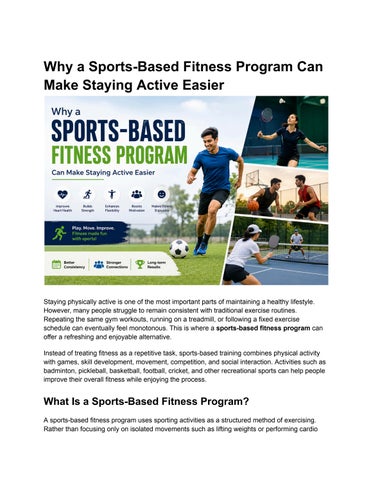
Why a Sports-Based Fitness Program Can Make Staying Active Easier
Staying physically active is one of the most important parts of maintaining a healthy lifestyle. However, many people struggle to remain consistent with traditional exercise routines. Repeating the same gym workouts, running on a treadmill, or following a fixed exercise schedule can eventually feel monotonous. This is where a sports-based fitness program can offer a refreshing and enjoyable alternative. Instead of treating fitness as a repetitive task, sports-based training combines physical activity with games, skill development, movement, competition, and social interaction. Activities such as badminton, pickleball, basketball, football, cricket, and other recreational sports can help people improve their overall fitness while enjoying the process.
What Is a Sports-Based Fitness Program? A sports-based fitness program uses sporting activities as a structured method of exercising. Rather than focusing only on isolated movements such as lifting weights or performing cardio
exercises, participants engage in activities that naturally involve running, jumping, changing direction, stretching, balancing, and coordinating different parts of the body. A well-designed program may combine sport sessions with warm-ups, mobility exercises, strength-building movements, skill development, and fitness assessments. The goal is not necessarily to turn every participant into a professional athlete. Instead, sports become a practical tool for encouraging regular movement and helping people build healthier fitness habits. Platforms such as Fitness Through Sports focus on making fitness more engaging by connecting physical activity with sports and community participation.
Sports Can Provide a Full-Body Workout One of the biggest advantages of sports-based fitness is that the body performs several different movements during a single session. Consider a game of badminton. A player may repeatedly move forward, backward, and sideways while lunging, jumping, bending, and swinging the racket. These movements require the legs, shoulders, arms, back, and core to work together. Similarly, football includes running, sprinting, kicking, balancing, and quick direction changes. Basketball involves jumping, accelerating, passing, dribbling, and defending. Because sports involve dynamic movement patterns, participants can improve several aspects of physical fitness simultaneously. These may include: ● ● ● ● ● ● ● ●
Cardiovascular endurance Muscular strength Coordination Balance Agility Flexibility Speed Reaction time
This variety can make sports-based exercise more engaging than performing the same movements repeatedly.
Fitness Becomes More Enjoyable One of the biggest challenges in fitness is consistency.
People may understand that they should exercise regularly but still struggle to maintain a routine. A major reason is that exercise sometimes feels like another responsibility rather than something they genuinely enjoy. Sports can change that experience. When people are focused on returning a shuttlecock, scoring a point, completing a rally, passing a ball, or playing with teammates, they may pay less attention to the fact that they are exercising. The activity becomes the primary experience, while fitness becomes a natural outcome. Enjoyment can play an important role in helping people return regularly. If someone looks forward to a sports session, maintaining an active lifestyle can become much easier.
Sports Encourage Social Interaction Traditional exercise can sometimes be an individual activity. Although some people enjoy training independently, others find greater motivation when they exercise with other people. Sports naturally create opportunities for social interaction. Participants may play with friends, family members, teammates, coaches, or other members of a sports community. This interaction can create a supportive environment where people encourage one another and enjoy shared experiences. For beginners, this can be especially useful because exercising in a positive group environment may make fitness feel less intimidating. Social participation can also create accountability. When people regularly meet teammates or attend scheduled sports sessions, they may be more likely to maintain their fitness routine.
Improves Coordination and Functional Movement Sports require the brain and body to work together. During a game, players continuously observe their surroundings, react to movement, make quick decisions, and coordinate their actions. For example, a pickleball player must judge the speed and direction of the ball while positioning the body correctly to return the shot. These repeated movements can help develop coordination, balance, reaction time, and body awareness.
Such abilities are useful not only for sports but also for everyday activities. Moving comfortably, changing direction, maintaining balance, and controlling the body are all important elements of functional fitness.
Suitable for Different Fitness Levels Another advantage of sports-based fitness is its flexibility. Beginners do not need to start with highly competitive games or intense training sessions. Activities can be adapted according to age, fitness level, mobility, and experience. A beginner might start with simple drills and controlled rallies before progressing to longer games. Someone returning to exercise after a long break may begin with lower-intensity activities and gradually increase the duration and intensity. More experienced participants can increase the challenge through competitive matches, faster drills, endurance sessions, and advanced training. This flexibility allows sports-based fitness programs to support people at different stages of their fitness journey.
Sports Can Support Mental Well-Being Physical activity is commonly associated with physical health, but sports can also contribute to mental well-being. Playing a sport requires concentration. Participants must pay attention to the game, their teammates, their movements, and what is happening around them. This can provide a temporary break from work-related or everyday stress. Sports can also create feelings of achievement. Learning a new skill, improving a shot, completing a longer rally, or performing better than before can build confidence and motivation. The social component of sports may also help people feel more connected by giving them regular opportunities to interact with others.
Skill Development Keeps Exercise Interesting Another reason people may stay interested in sports is that there is always something to improve. In traditional exercise, progress is often measured through numbers such as weight lifted, calories burned, distance covered, or repetitions completed.
Sports provide additional forms of progress. A badminton player may improve their serve. A pickleball player may learn better positioning. A football player may develop improved ball control. A basketball player may become more accurate with shooting. These small improvements create new goals and challenges, keeping physical activity interesting over time.
Building a Sustainable Fitness Routine The most effective fitness routine is often the one a person can maintain consistently. It is not necessary for every workout to feel extremely intense. Regular movement performed week after week can be more sustainable than occasionally completing very demanding workouts and then stopping. A structured sports-based fitness program can combine enjoyment, exercise, coaching, community, and measurable progress. People who dislike conventional gym routines may discover that sports provide a more natural way to remain active.
Final Thoughts Fitness does not always have to mean lifting weights or spending long periods on exercise machines. Sports can provide an engaging alternative that combines physical activity with skill development, competition, teamwork, and enjoyment. From improving cardiovascular endurance and coordination to encouraging social interaction and consistency, a sports-based approach can support multiple areas of fitness. Ultimately, the goal of fitness should not simply be completing workouts. It should be building an active lifestyle that is enjoyable enough to continue for the long term.
Ready to Explore a Better Way to Stay Active? Want to make fitness more enjoyable through sports? Read more about sports-based fitness programs at Fitness Through Sports and explore a more engaging way to stay active.