
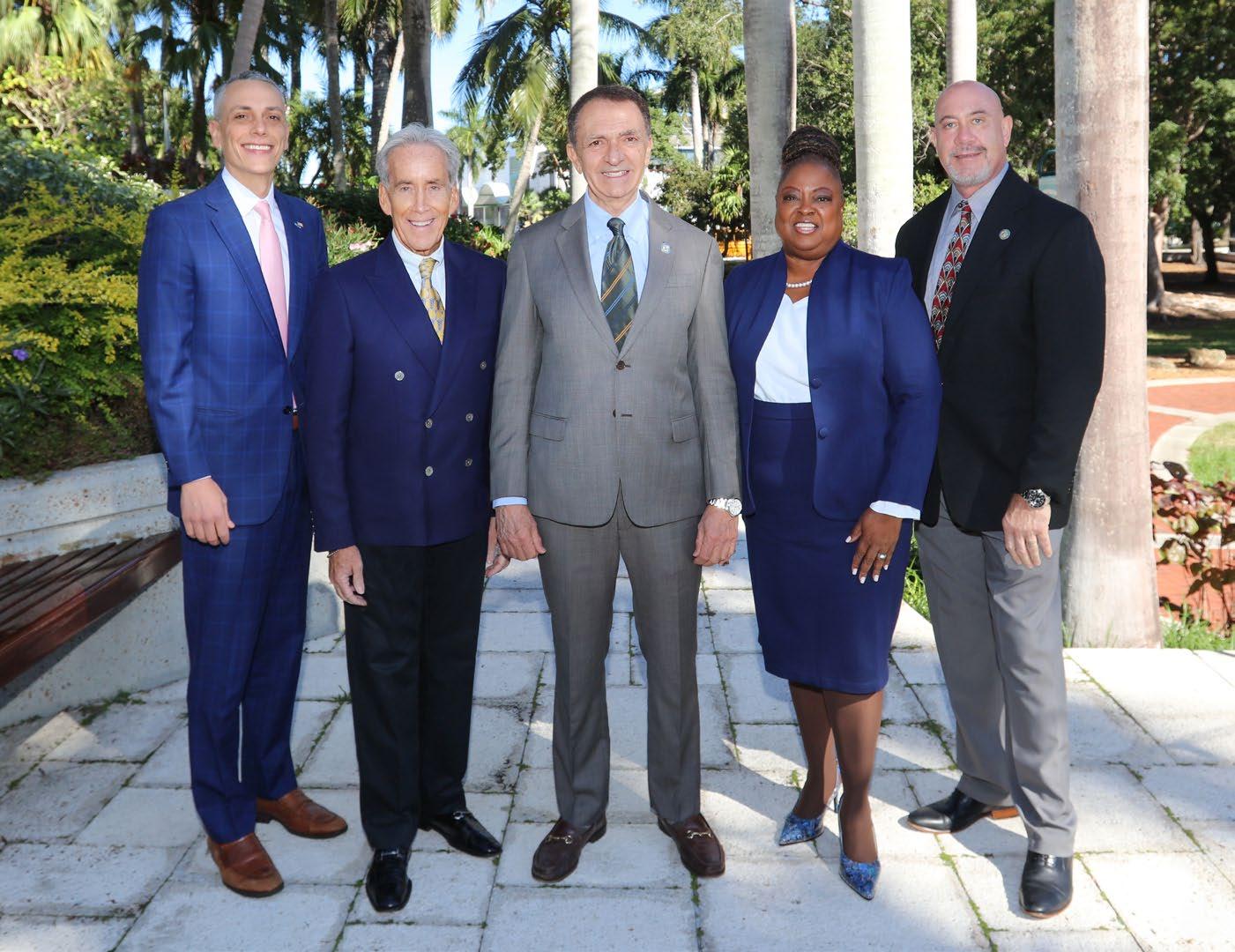
Mayor Dean J. Trantalis
Vice Mayor Ben Sorensen, District 4
Commissioner John C. Herbst, District 1
Commissioner Steven Glassman, District 2
Commissioner Pam Beasley-Pittman, District 3
Acting City Manager Christopher Cooper
City Attorney Shari McCartney
City Auditor Pat Reilly
City Clerk David R. Soloman
•

1180
• CS/CS/CS/HB 399 – Land Use and Development Regulations, by Rep. Borrero
CS/CS/SB 208, by Sen. McClain 20
• CS/SB 504 – Code Inspector Body Cameras, by Sen. Burgess | CS/HB 509, by Rep. Partington 21
• CS/CS/HB 803 – Building Permits and Inspections, by Rep. Trabulsy
CS/CS/SB 1234, by Sen. DiCeglie 22
• CS/CS/CS/HB 927 – Local Land Planning and Development, by Rep. Sapp CS/CS/SB 1138, by Sen. Massullo, Jr. 23
• SB 962 – Affordable Housing, by Sen. Bradley | CS/CS/HB 837, by Rep. Busatta 23
• CS/CS/HB 1389 – Affordable Housing, by Rep. Redondo | SB 1548, by Sen. Calatayud 24
• CS/CS/CS/SB 1614 – Enforcement of the Florida Building Code, by Sen. Leek CS/CS/HB 1169, by Rep. Tramont 25
• CS/HB 967 - Electronic Payments Made to Units of Local Governments, by Rep. Buchannan
1612, by Sen. DiCeglie
• CS/CS/CSHB 1093 – Vertiports, by Rep. Spencer | CS/CS/SB 1362, by Sen. Harrell
• CS/CS/HB 1329 – Local Government Finances, by Rep. Bernarroch CS/CS/CS/SB 1566, by Sen. DiCeglie
7031 –

• CS/CS/HB 425 – Historic Cemeteries Program, by Rep, Aristide | SB 34, by Sen. Sharief
• SB 428 – Drowning Prevention, by Sen. Yarborough | HB 85, by Rep. Kendall
• CS/CS/HB 1069 – Background Screening, by Rep. Trabulsy | CS/CS/SB 1168, by Sen. Grall
• CS/CS/HB 1103 – Local Administration of Vessel Registration, by Rep. Andrade CS/SB 1682, by Sen. Trumbull
• CS/HB 1217 – Prohibited Governmental Policies Regulating Greenhouse Gas Emissions, by Reps. Snyder and Jacques | CS/SB 7046, by
• CS/SB 156 – Criminal Offenses Against Law Enforcement Officers and Other Personnel, Sen. Leek CS/HB 17, by Rep. Baker
• CS/CS/HB 277 – Domestic Violence and Protective Injunctions, by Rep. Tendrich CS/CS/SB 682, by Sen. Calatayud
• CS/SB 418 – Law Enforcement Officer Interactions with Individuals with Autism Spectrum Disorder, by Sen. Jones | CS/CS/HB 365, by Rep. Valdés
• CS/HB 559 – Animal Welfare, Rep. Chaney | CS/SB 676, by Sen. Arrington
• CS/CS/SB 984 – Firefighter Cancer Benefits, by Sen. DiCeglie | CS/CS/HB 813, by
• CS/CS/CS/SB 290 – Department of Agriculture and Consumer Services, by Sen. Truenow CS/CS/HB 433, by Rep. Alvarez, D.
• CS/CS/SB 848 – Stormwater Treatment, by Sen. Truenow | CS/CS/HB 1457, by Rep. Pittman
• CS/SB 382 – Micromobility Device (electronic bicycles), by Sen Truenow CS/HB 243, By Rep. Benarroch
• CS/CS/HB 1245 – Biosolids Management, by Rep. Shoaf | CS/CS/CS/SB 1294, by Sen. Bradley
• CS/CS/HB 1285 – Biosolids Management, by Rep. Boyles | CS/CS/SB 1474, by Sen. Gaetz
• CS/CS/CS/HB 1417 – Department of Environmental Protection, by Rep. LaMarca CS/CS/CS/SB 1510, by Sen. Massullo Jr.
• CS/CS/HB 1451 – Utility Services, by Rep. Busatta | CS/CS/SB 1724, by Sen. Martin
The State of Florida 2026 Regular Legislative Session was characterized by notable budget reductions, shifts in overall government interactions, and extended negotiations. The Regular Session ran from January 13 to March 13, 2026, but concluded without agreement on a final budget, leading to three subsequent special sessions – (1) focused on congressional redistricting; (2) dedicated to completing the state budget; and (3) proposing a Constitutional amendment on property tax reform.
During the Regular Session, 1,896 bills were filed and 237 were approved by the House and Senate. The Legislature adopted the state budget and under state law, the Governor had until June 30 to approve the budget or exercise line‑item veto authority, after which the final appropriations act for Fiscal Year 2026–27 will be set. On June 29, the Governor signed the $117.6 billion budget and released approximately $1.7 billion in vetoes, including nearly $810 million in line-item vetoes. These vetoes removed funding for many local projects across the state, including programs related to health care, senior services, public safety, law enforcement equipment, behavioral health, emergency response, water and infrastructure projects, workforce programs, arts and culture, and community services.
Throughout the legislative session, the City’s contract lobbying teams coordinated with the City staff to monitor legislation, advance the City’s stated priorities, and pursue appropriations, while also reviewing and responding to proposals that could affect local authority or impose additional requirements. More than 200 bills were tracked, and ultimately, $3.31 million in funding was secured for City of Fort Lauderdale projects.
This Final Report provides an overview of significant legislation – both enacted and not enacted – and a City department level summary of budget items relevant to the City, with links to referenced measures.

Vote: Senate 21-17; House 83-28 | Approved by the Governor, May 4, 2026, Chapter No. 2026-229
The Legislature convened Special Session D on Tuesday, April 28 and concluded on Wednesday, April 29, after passing HB 1D, a mid-decade congressional redistricting plan. The session focused narrowly on congressional districts and was briefly recessed so senators could review the U.S. Supreme Court’s decision in Louisiana v. Callais, which had just been released and became central to both sides’ arguments. The Governor signed the new maps into law on May 4, 2026.
Procedurally, the Senate took up its own redistricting bill (SB 8D), then substituted the House’s version, HB 1D, in its place. HB 1D was read a second and third time and then approved. A motion to temporarily postpone SB 8D considering the new Supreme Court decision failed. After passing HB 1D, the special session adjourned Sine Die, while leadership noted that regular-session work on the state budget and a future special session on property taxes would follow.
Supporters of the new law argued that updated districts were needed to address population changes since the 2020 Census and to correct potential one-person-one-vote imbalances. They also asserted that Louisiana v. Callais raised the legal standard for race-conscious redistricting, and that the new map should be viewed as consistent with that decision and with non-racial elements of Florida’s Fair Districts Amendment. Proponents emphasized that mid-decade redistricting is not prohibited and described the new districts as compact.
Opponents stated that the map is unconstitutional and improperly reduces minority voting influence. They contended that it was drawn to increase the number of districts likely to elect Republicans rather than to resolve clear legal problems. They also raised concerns about the pace and scope of the process, pointing to a lack of broad public hearings, and noted that many constituents are focused on economic issues. In addition, they anticipated litigation over the map and pointed out that defending it in court will require public expenditures.
Vote: Senate 35-0; House 99-6 | Approved by the Governor, June 29, 2026, Chapter No. 2026-232
The Legislature called a special session beginning May 11 to negotiate and finalize the state’s General Appropriation Act (state budget). The Legislature concluded Special Session E on May 29, after passing a $114.5 billion budget, which now heads to the Governor for approval. It is important to note that the Governor has line-item veto authority. The state’s fiscal year begins July 1. The overall budget is approximately half a billion less than FY 2025-26, pre-veto. The budget makes targeted investments in the state workforce and core public services.
Education funding spans early learning through higher education, with a focus on both base operations and specific enhancements. K–12 funding through the FEFP totals $30 billion, increasing per student support and the Base Student Allocation, and setting aside $1.56 billion for teacher salary increases, including a dedicated amount for veteran educators. Additional K–12 and early learning dollars support safety programs, mentoring, literacy, exceptional education, special schools, and early childhood initiatives such as School Readiness and VPK. In higher education, colleges and universities receive substantial operating funding with no required tuition increases, and workforce and career programs benefit from nearly $785 million, alongside about $1.1 billion in student financial aid led by Bright Futures and several targeted scholarship programs.
Health and human services together receive just over $49 billion, including full funding for Medicaid and KidCare and targeted increases for disability services, child welfare, behavioral health, opioid response, elder programs, and public health initiatives. Criminal and civil justice agencies are funded at just over $8 billion to address correctional operations, facility needs (including a new prison hospital and a major Broward Detention Center project), juvenile justice capacity, law enforcement programs, and court system workload and technology.
Transportation, economic development, and environmental priorities are supported through large allocations to the transportation work program, emergency management activities, housing and job-growth initiatives, agriculture and food systems, Everglades and water quality projects, resilience and parks, and wildlife management. General government agencies receive about $8.9 billion, with an emphasis on enterprise IT modernization, cybersecurity support for local governments, fire and firefighter services, and state facility maintenance.
Vote: Senate 32-0; House 95-11 | Approved by the Governor, June 29, 2026, Chapter No. 2026-239
This is a comprehensive tax bill making notable changes to Florida’s property tax, sales tax, and state revenue statutes, with implications for municipalities such as the City. On the property side, it conforms homestead “Save Our Homes” portability to the Constitution (allowing up to three prior years of homestead history and maintaining a $500,000 cap on transferable assessment differential), creates a three percent (3%) assessment-increase cap for qualifying mobile home parks whose taxes are passed through to residents, and clarifies that certain military and federal personnel can maintain homestead status while stationed outside the state and renting their homes. It also standardizes the timing and procedures for denial of exemptions and related value -adjustment board appeals and confirms that children’s services councils and certain other public bodies are not required to contribute tax increment funds (TIF) to Community Redevelopment Agency (CRA) trust funds or to conservation-related TIFs, which sets clearer limits on the tax-increment base for redevelopment and conservation financing.
Beyond ad valorem changes, the bill requires online residential listing platforms to display estimated ad valorem taxes based on formulas and millage data published by the Department of Revenue, rather than on the seller’s current tax bill, beginning in 2027. It revises and adds several sales-tax provisions, including shifting the permanent back-to-school holiday to July 20 – August 20, creating a multi- year, refund-based exemption for specified “home hardening” products installed on homesteaded dwellings under a value cap, and establishing a temporary 2026 holiday for defined hunting, fishing, and camping items. The bill also readjusts documentary stamp tax distributions to fund transportation programs, the C-51 Reservoir, and Florida Rail Enterprise, revises caps and allocation rules for programs such as the Strong Families Tax Credit and reduces certain gaming taxes (slot machine and cardroom taxes) and license fees, all of which alter the broader fiscal environment in which Fort Lauderdale operates but do not change the City’s direct taxing authority.
CS/HJR 1F – Save our Homes from Excessive Property Taxes, by Rep. Overdorf
Vote: Senate 30-9; House 75-26 | Placement on the 2026 ballot for consideration by electorate
The constitutional amendment makes certain changes to sections 4, 6, and 9 of Article VII of the Florida Constitution and creates a new section in Article XII for implementation. The amendment will appear on the November 3, 2026 statewide ballot for voter approval. If approved it will take effect January 1, 2027.
The proposal will increase the homestead exemption, for levies other than school district levies, to up to $150,000 beginning January 1, 2027, and up to $250,000 beginning January 1, 2028, for qualifying homesteaded properties. The amendment will also create a separate structure for new Florida residents establishing a homestead on or after January 1, 2027, under which those residents would initially receive up to a $50,000 non-school exemption and generally would not qualify for the higher exemption levels until after maintaining Florida residency for five years, subject to the amendment’s terms.
In addition, the proposal will reduce annual assessment growth caps for certain non-homestead properties from ten percent (10%) to five percent (5%) beginning January 1, 2027. This reduced cap would apply to residential real property containing nine units or fewer that is not otherwise covered by homestead assessment limitations, as well as to most other non-homestead real property covered by the amendment.
The amendment also authorizes counties and municipalities, by ordinance and as implemented by general law, to increase homestead exemptions for their respective levies up to all remaining assessed value, while special districts may do so through referendum.
The proposal would constitutionally limit the allowable uses of county and municipal ad valorem tax revenues to specified categories such as public safety, infrastructure, education, natural resources, debt obligations, retirement obligations, and government operations. It also removes prior trust fund language that might otherwise have suggested a state-level backstop for local impacts, indicating that service reductions or local fiscal adjustments may not be offset by a dedicated state funding source.
The amendment further authorizes, but does not require, the Legislature to create ad valorem tax relief for renters through future general law. As written, renter relief remains permissive rather than mandatory, which means the direct constitutional benefit of the proposal is concentrated primarily on qualifying homesteaded property owners.
The Legislature also adopted CS/SB 4F during Special Session F, amending section 200.065, F.S., relating to the method of fixing millage. Under that act, the maximum millage rate a municipality may levy in each fiscal year is the rolled-back rate unless the governing body approves a higher rate under the voting thresholds established in statute.
A municipality may adopt up to 110 percent (110%) of the rolled-back rate by a two-thirds vote of the governing body. A rate above 110 percent (110%) requires either a unanimous vote, a three-fourths vote where the governing body has nine or more members, or referendum approval. These limits are important because any future City effort to offset erosion of the taxable base through a millage adjustment would need to comply with these revised statutory constraints.
Current planning-level estimates indicate that the proposal could reduce City revenue by approximately $17 million in FY 2028, the first year of implementation, increasing to $27.3 million annually in FY 2029. The second year amount represents roughly 11 percent (11%) of the City’s property tax revenue and is based on the adopted FY 2026 budget, gross taxable value of approximately $63.5 billion, and about 38,000 estimated homesteads. The fiscal impacts below are based upon the second year impact.
The City’s FY 2026 General Fund Budget totals approximately $520.4 million, and property taxes account for about 48 percent (48%) of that total. Because of that reliance, a revenue reduction of this scale would have meaningful consequences for budget stability, service delivery, and the City’s flexibility to absorb future cost increases without additional fiscal adjustments.
Current estimates also suggest that the average homesteaded property could realize approximately $824 in annual City tax savings under the proposal. At the same time, preserving overall revenue through rate adjustments could shift a larger share of the tax burden to non-homestead property owners, including renters, businesses, and other commercial properties that would not receive the same exemption benefit.
If the estimated annual loss were absorbed proportionally across City operations, planning-level impacts could include approximately $9.8 million affecting police, $6.7 million affecting fire rescue, $3.7 million affecting parks and recreation, and $7.2 million affecting all other City functions. These figures illustrate that the proposal has implications beyond tax policy and could directly affect service levels residents and businesses rely upon every day.
Potential response strategies include absorbing the loss through service reductions, service restructuring, reduced or delayed capital investments, workforce controls, contract review, facility consolidation, or cancellation of programs. Alternatively, the City could consider a millage increase to preserve revenue, but current estimates indicate that fully recovering the projected loss could require an approximately 12 percent (12%) increase in the millage rate, which would place additional burden on non-homestead taxpayers and would remain subject to the voting thresholds in state law.
Vote: Senate 30-8; House 75-27 | Approved by the Governor, June 24, 2026
This bill revises how local governments calculate the maximum millage rate that can be adopted by a simple majority vote. Specifically, the bill eliminates the current requirement to adjust the maximum millage rate based on changes in per capita Florida personal income. Instead, local governments, including counties, municipalities, dependent and independent special districts, and municipal service taxing units, must use the rolled-back rate established for Truth in Millage (TRIM) notice compliance as the basis for determining the allowable maximum rate.
In addition, the bill creates a limited exception to the statutory 75-word cap on ballot summaries. This exception applies when the Legislature approves a joint resolution proposing amendments or revisions to Article VII, sections 4, 6, and 9 of the Florida Constitution, and the measure is submitted to voters at the November 3, 2026, general election. Except as otherwise expressly provided in this act, this act shall take effect upon becoming a law.
HB 5001E, Florida’s General Appropriations Act for fiscal year 2026-27, covers the period from July 1, 2026, through June 30, 2027. The bill appropriates a total of $114.46 billion across seven sections of state government and funds 111,558 state positions. The seven (7) sections of the state budget, in descending order of total funding:
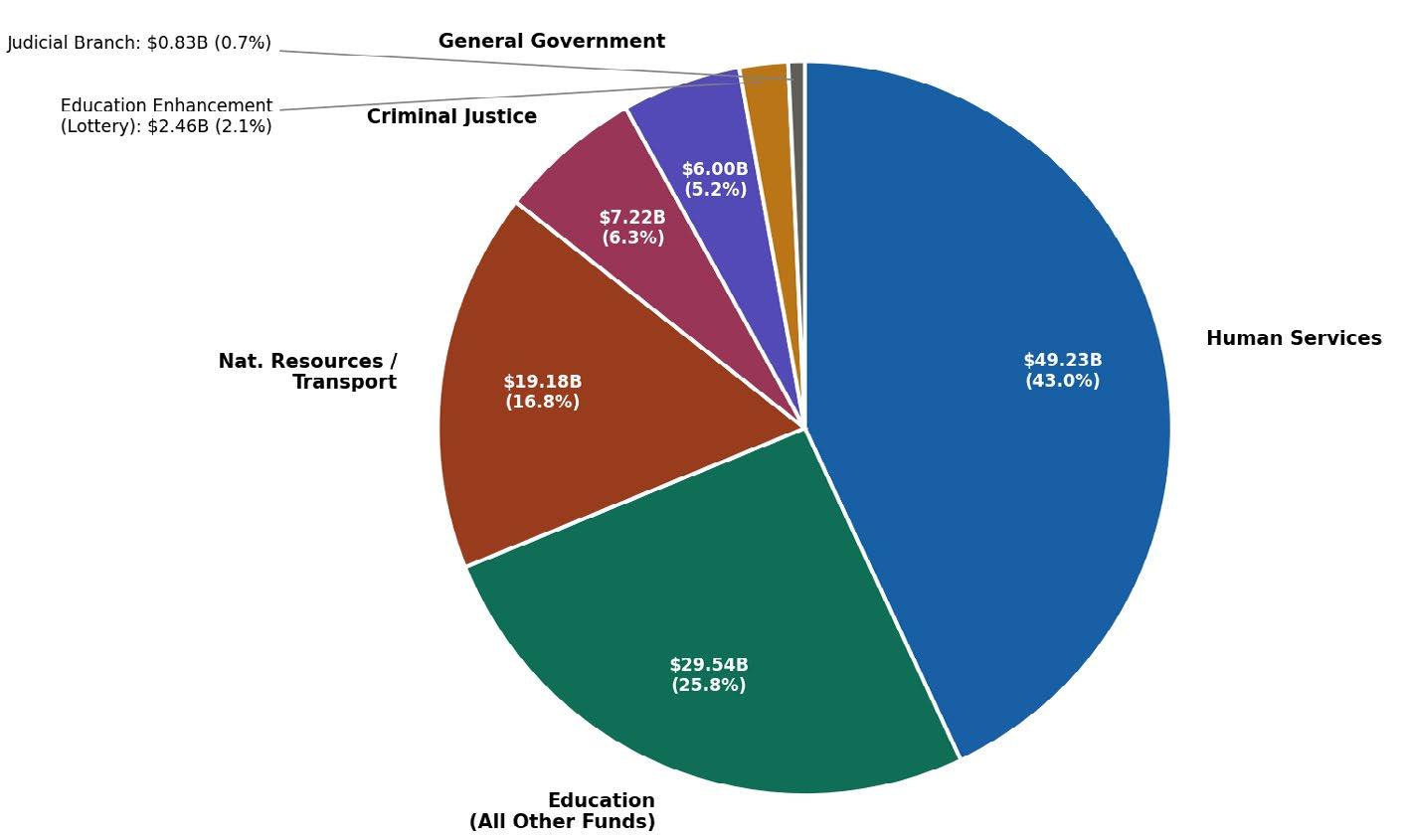
• Medicaid dominance: Within Human Services, Medicaid and Temporary Assistance for Needy Families (TANF) alone account for $37.6 billion – roughly a third of the entire state budget.
• Transportation capital outlay: The Department of Transportation’s fixed capital outlay program totals $11.78 billion, almost entirely funded through trust funds and federal money rather than General Revenue.
• Funding sources: The $114.46 billion total comprises approximately $52.3 billion General Revenue, $34.9 billion federal funds, and the remainder from trust funds, lottery proceeds, PECO bonds, and tobacco settlement dollars.
Municipalities across the state are affected by this budget in three areas: (1) statewide programs that distribute by formula, (2) competitive grant pools cities apply for, and (3) member-project earmarks. The sections below summarize each area with a focus on programs that may affect the City and neighboring municipalities.
Funds flow to all municipalities through formulas or pass-through arrangements:
to every city/ county for affordable housing
Loan (SAIL)
Major Competitive Grant Pools
These pools are available to municipalities through competitive application processes. Coastal cities like Fort Lauderdale historically benefit substantially from Resilient Florida grants:
Grant Pool
Resilient Florida | Statewide Flooding & Sea Level Rise Resilience Plan
Resilient Florida Planning Grants
Local Government Fire Service Grants
Local Transportation Projects
(Line Item 2097A)
Water Projects
(Line Item 1766A)
Amount (millions)
$160
Notes
Coastal cities are historically major recipients
$10 Vulnerability assessments and planning
$22.9 Combines GR + Insurance Regulatory Trust; 35+ named projects this cycle
$208.34 Fully allocated by specific earmarks this cycle
$380.39 Fully allocated by specific earmarks this cycle
Below is a total of $9,354,903 in funding for nine distinct projects as part of the budget request. Of these, seven projects received legislative approval, amounting to $3,623,991. Following the Governor’s review and veto process, five projects – totaling $3,318,078 – retained their funding and were not vetoed
The project aims to create a complete street that allows the iconic roadway to provide residents and visitors with a “Main Street” experience while also operating as a regionally significant corridor for commuters and balancing the needs of all the users. This new project supports the City’s Vision Zero Plan to eliminate traffic fatalities and severe injuries by enhancing pedestrian safety and improving ADA facilities. Once constructed, the city will realize its vision of developing an active, unique, world-class live, work, and play-friendly streetscape. The requested amount was $1,000,000.
The project will mill and resurface the existing 28-year-old pavement, install wider sidewalks, and install landscape enhancements for nearly 1.5 miles of the Galt Mile Streetscape. Additionally, the project will upgrade pedestrian lighting, refresh pavement markings, and add new regulatory signage. Direct services will include increased multimodal access, enhanced street lighting, enhanced shade from upgraded landscaping, raised crosswalks and wider sidewalks, resulting in the enhancement of the functionality and safety for residents and visitors. The requested amount was $1,2500,000.
$500,000
In partnership with the Barrington Irving Technical Training School (BITTS), this program is designed to provide high school students and adults with technical career training, mentorship, and direct pathways to employment in the aviation industry. By aligning education with industry demand, the program bridges the gap between individuals seeking meaningful careers and the aviation sector’s urgent need for skilled technicians. It offers an alternative to the traditional four-year college track, creating opportunities for young adults, particularly those from low-income backgrounds or underserved communities, who may otherwise lack access to higher education or specialized training. At the same time, it supports individuals seeking to transition into a high-demand, well-paying field where long-term career stability and advancement opportunities are abundant. The requested amount was $1,000,000.
Roadways throughout the city need critical improvements. The total cost to resurface these roadways is $12.5 million, not including future maintenance. Funding will be used to improve roadways with asphalt overlay and/or milling and resurfacing to restore pavement for streets with a Pavement Condition Index (PCI) of 55 and below. According to the Metropolitan Transportation Commission, PCI provides a snapshot of the pavement health of a road. It is measured on a scale of 0 to 100 (where 100 means a newly paved road). The PCI score is affected by several factors, such as pavement age, climate and precipitation, traffic loads and maintenance. Roadways with a PCI of 55 and below are in poor condition. This project will improve the condition of roadways throughout the City within the City right of way. By restoring the surface before the roadway requires reconstruction, it will save the taxpayer from bearing the burden of the cost. Waiting would make restoration four times more costly. The requested amount was $850,000.
This project seeks funding to replace the reserve fireboat with a modern, fully equipped vessel that ensures reliable, advanced life support capabilities, and operational efficiency in one of the world’s busiest marine communities. Fort Lauderdale Fire Rescue (FLFR) operates with two fireboats, one frontline and one reserve. The reserve vessel has reached the end of its serviceable life and lacks critical medical and operational capabilities to serve the city in emergency situations. The requested amount was $643,078.
Launched in March 2025 with Department of Children and Families funding, the Substance Abuse and Mental Health Treatment Housing Program provided shared housing and wrap-around services to individuals experiencing homelessness with mental health or substance use disorders. In just four months, the program housed or reunified seventyone percent (71%) of mental health referrals and supported substance use participants with thirty five percent (35%) remaining in recovery housing, eleven percent (11%) in stable alternatives, and fourteen percent (14%) referred to higher care. Concentrated in Fort Lauderdale – home to nearly half of Broward County’s unsheltered population – the program proved that pairing housing with treatment creates sustainable pathways to recovery and stability. With expansion, this model could serve as a blueprint for communities across Florida, addressing homelessness and behavioral health needs on a broader, statewide scale. The requested amount was $250,000.
Rio Vista and Lauderdale Harbors have been subject to criminal activity and desire to install License plate Readers to every entrance/exit of the community, which will integrate with the Fort Lauderdale Police Department infrastructure, with the main goal of deterring criminal activity. Installing License Plate Readers at every entrance/exit of the community, which will integrate with the City of Fort Lauderdale Police monitoring system to deter criminal activity. City investment in neighborhood security provides the citizens with an improved sense of safety. The requested amount was $111,825.
This project is complete rehabilitation of nine wastewater pumping stations, including structures, piping, mechanical and electrical equipment. Aging infrastructure in the wastewater collection system can lead to increased power costs, increased repair costs, and higher pump station failures. Complete rehabilitation of these stations will reduce or eliminate these issues. The requested amount was $3,650,000. Unfortunately, this project did not make it into the final negotiated budget.
The project’s primary objectives are twofold: to create a more inviting environment that supports existing businesses and attracts new ones, and to draw visitors to the district, capitalizing on its proximity to SR A1A. By addressing the current challenges of inadequate lighting and vacant storefronts, the project aims to transform the district into a vibrant, safe, and economically thriving area that serves both residents and tourists. Ultimately, these improvements will benefit the adjacent residential condominiums and anchor hotel while creating a more appealing destination for visitors. The requested amount was $1,600,000. Unfortunately, this project did not make it into the final negotiated budget.
Bills Approved by the Legislature and Signed into Law by the Governor 2026 Laws of Florida (L.O.F.)
HB 145 – Claims Against the Government, by Rep. McFarland | CS/SB 1366, by Sen. Brodeur
Vote: Senate 36-0; House 108-1 | Vetoed by the Governor, June 30, 2026
The bill revises the state’s statutory waiver of sovereign immunity to increase the limits on amounts that the state, its agencies, and political subdivision may pay for tort claims without further action by the Legislature. The bill also changes the statute of limitations applicable to different types of tort actions against a government entity. Absent the state’s statutory waiver of sovereign immunity, which is immunity from lawsuits, lawsuits against the state would be barred. Specifically, the bill:
• Increases the statutory caps on payment of claims or the collectability of judgments against the state or its agencies or subdivisions, from $200,000 per person and $300,000 per incident, to $350,000 per person and $500,000 per incident.
• Revises certain statutes of limitation and presuit procedures for certain types of claims against government entities, including claims for negligence, contribution, medical malpractice, wrongful death, and sexual battery on victims under 16 years of age.
The new caps apply to causes of action that accrue after the bill’s effective date. Due to the veto, the provisions set forth will not take effect on October 1, 2026.
CS/CS/HB 655 – Pub. Meetings/Attorney Meetings to Discuss Private Property Rights Claims, by Rep, Duggan | CS/CS/SB 332, by Sen. Bradley
Vote: Senate 37-0; House 116-0; Approved by the Governor, June 12, 2026, Chapter No. 2026-142
The bill creates a limited exception to Florida’s open meetings and public records laws so that government officials can privately discuss certain property-rights claims with their attorneys. Specifically, it allows a state or local agency – or its chief administrative or executive officer – to meet in private with the agency’s attorney during the 90-day notice period for a claim filed under the Bert J. Harris, Jr., Property Rights Protection Act. During this confidential session, officials may review the claim, discuss legal strategy, and consider potential settlement options without disclosing those discussions in real time.
Under current law, meetings to discuss a Bert Harris claim must be open to the public, even though similar strategy meetings about active lawsuits can be closed until the litigation ends. The bill brings Bert Harris claim discussions more in line with those litigation-strategy meetings. It creates a public records exemption for transcripts, recordings, minutes, and any other records generated during the closed portion of the meeting, meaning those materials are not immediately available for public inspection. However, the bill requires that a record of the meeting be created and preserved, and it mandates that the transcript be made public once the claim is either settled or the statute of limitations expires.
To maintain transparency, the bill sets conditions for providing notice that such a private meeting will occur and for documenting that the meeting took place, even though the detailed content remains confidential until the claim is resolved. Finally, the bill specifies that these new public meeting and public records exemptions are subject to Florida’s Open Government Sunset Review Act and will automatically repeal on October 2, 2031, unless the Legislature reviews and reenacts them before that date. The effective date of this bill is July 1, 2026.
CS/CS/SB 1134 – Official Actions of Local Governments, by Sen. Yarborough
CS/CS/HB 1001, by Rep. Black Vote: Senate 25-11; House 77-37 | Approved by the Governor, April 22, 2026, Chapter No. 2026-43
The bill places broad limits on how counties and municipalities in Florida may engage with diversity, equity, and inclusion (DEI) initiatives. It prohibits local governments from funding, promoting, or taking official actions – such as adopting ordinances, resolutions, rules, regulations, programs, or policies – that relate to DEI. It also bars counties and municipalities from using any funds, from any source, to create, support, sustain, or staff a DEI office or DEI officer, and it prevents local governments from allowing their funds to be used by employees, contractors, or others to promote DEI initiatives.
Under the bill, a county or municipal official who, in their official capacity, violates these prohibitions is deemed to have committed misfeasance or malfeasance in office, which can carry serious consequences under existing law. The bill authorizes any resident to file a lawsuit in circuit court against a county or municipality that violates these provisions, creating a direct enforcement mechanism for members of the public. At the same time, it makes clear that local governments may still take actions required to comply with state or federal law and recognizes several exceptions, including activities related to operating and maintaining federal monuments and memorials in Florida or recognizing individuals or groups honored by state -authorized monuments, memorials, or museums. The bill also extends its restrictions to local contracting and grantmaking. Potential recipients of county or municipal contracts or grants must certify that they do not and will not use local government funds to require employees, contractors, volunteers, vendors, or agents to ascribe to, study, or receive instruction using DEI-related materials.
For contracts specifically with a DEI officer that are in place as of January 1, 2027, the new statute applies to those existing agreements; for all other contracts, the requirements apply to contracts executed or renewed after January 1, 2027. While the bill restricts direct DEI activity by local governments, it allows counties and municipalities to continue issuing event permits in a content-neutral way and to provide public safety services, and it does not prevent them from recognizing state and federal holidays or monuments or complying with state and federal legal obligations. The effective date of this bill is January 1, 2027.
CS/CS/SB 1180 – Community Development District, by Sen. Arrington
CS/CS/HB 1051, by Rep. Alvarez, J.
Vote: Senate 37-0; House 112-0 | Approved by the Governor, June 25, 2026, Chapter 2026-164
The bill makes several changes to how community development districts (CDDs) operate, focusing on recall procedures for board members, regulation of synthetic turf, and the definition of certain high-intensity, mixed-use districts.
First, the bill establishes a formal recall election process for members of a CDD’s board of supervisors that closely follows the recall procedures already used for municipalities and charter counties. A supervisor may be removed only for specific reasons: malfeasance, misfeasance, neglect of duty, drunkenness, incompetence, permanent inability to perform official duties, or conviction of a felony involving moral turpitude. The bill sets out how a recall petition must be initiated and filed, how signatures are to be verified, and what ballot language must be used. It also includes public notice requirements, explains how vacancies created by a recall are to be filled, and creates penalties for misconduct in the petition process. Anyone removed by recall, or who resigns after a recall petition has been filed against them, is barred from being appointed to the CDD’s governing body for two years after the recall or resignation date.
Second, the bill addresses synthetic turf regulation. Under a 2025 law, once the Department of Environmental Protection adopts minimum standards for installing synthetic turf on small residential properties, local governments are prohibited from banning compliant synthetic turf or regulating it in ways that conflict with those standards. This bill clarifies that this limitation on local government regulation does not prevent a CDD from enforcing deed restrictions related to synthetic turf within its community. Finally, the bill expands the definition of a “compact, urban, mixed-use district,” a specialized
type of CDD intended to support dense, downtown-style development with a mix of uses. Under the revised definition, a qualifying district may consist of up to 75 acres, must be located within a municipality, and must lie within either a federally designated qualified opportunity zone or a locally designated community redevelopment area. To qualify, the district must also have development entitlements for either: (1) at least 400,000 square feet of retail space and 500 residential units, or (2) at least 250,000 square feet of commercial space and 500 residential units that are affordable to very low-or moderate -income households. The effective date of this bill is January 1, 2027.
CS/CS/HB 1085 – Local Government Cyber Security, by Rep. Miller | CS/SB 576, by Sen. Harrell
Vote: Senate 39-0; House 104-1 | Approved by the Governor, May 22, 2026, Chapter No. 2026-115
As passed, the new law establishes the Local Government Cybersecurity Protection Program as a formal, ongoing initiative to strengthen cybersecurity capabilities across Florida’s local governments. The program is primarily administered by the Florida Digital Service (FLDS), which is responsible for providing information technology commodities and services to help local governments build and improve cybersecurity risk management programs consistent with state law. Its central goal is to boost local preparedness and resilience against cyber threats, including ransomware.
To support this work, FLDS is authorized to seek and accept state, federal, and other grant funding. The program must use objective eligibility and evaluation criteria, with priority given to fiscally constrained counties, and grant awards are to be distributed annually by December 1. Even if the local government does not receive a grant, it may still purchase IT services made available through the program. Participating local governments must enter into data sharing agreements with FLDS so that cyber threats and incidents can be detected, prevented, and addressed in a coordinated way under the State Cybersecurity Act. FLDS is also required to submit annual reports on the program’s performance and outcomes to key state budget and legislative leaders.
In parallel, the new law creates a complementary program at the University of South Florida, administered by the Florida Center for Cybersecurity (Cyber Florida). This component is similarly focused on assisting eligible local governments by procuring and delivering cybersecurity tools and services and by administering their own annual grants, which must be awarded by October 1, again giving preference to fiscally constrained counties. Cyber Florida is also empowered to pursue federal and other external funding and must enter into data sharing agreements with both local governments and FLDS to ensure that cybersecurity efforts are coordinated statewide rather than fragmented.
Cyber Florida must provide its own annual reports on implementation and outcomes to the Governor’s Office of Policy and Budget and the Legislature’s appropriations leaders. The entire framework created by the new law is scheduled to sunset on July 1, 2031, unless lawmakers decide to reauthorize it. The effective date of this bill is July 1, 2026.
SB 594 – Local Housing Assistance Plans, by Sen. Burton | HB 267, by Rep. Stark Vote: Senate 39-0; House 110-0 | Approved by the Governor, June 12, 2026, Chapter 2026-135
As passed, the new law updates Florida’s State Housing Initiatives Partnership (SHIP) Program to better support mobile homeowners and expand how local governments can use housing funds. It allows local governments to use SHIP funds to provide short-term lot rental assistance for mobile homeowners, capped at the equivalent of six months’ rent. It also requires counties and municipalities to formally include strategies in their local housing assistance plans to address the needs of residents affected by mobile home park closures, including direct financial support such as lot rental assistance.
In addition, the new law clarifies that mobile homes qualify for homeownership assistance, as well as rehabilitation and emergency repair funding under SHIP. It further expands flexibility by allowing funds designated for housing construction, rehabilitation, or emergency repairs to be used for mobile home improvements. Finally, the new law removes the existing twenty percent (20%) cap on the use of SHIP funds for manufactured housing, giving local governments greater discretion to allocate resources based on community needs.
For the City, the new law would most likely shape how it uses its SHIP allocation and strengthens protections and resources for mobile homeowners who meet income guidelines. More specifically, the City already receives SHIP funds and operates down payment assistance, housing rehab, and emergency repair programs for income-eligible households. However, the City is now required to build explicit strategies for mobile homeowners into its Local Housing Assistance Plan, including how it will assist residents when mobile home parks close and how it will deliver lot-rent assistance. This likely means new or revised guidelines, written policies, and outreach procedures targeted to manufactured home communities. The effective date of this bill is July 1, 2026.
CS/CS/CS/HB 399 – Land Use and Development Regulations, by Rep. Borrero
CS/CS/SB 208, by Sen. McClain
Vote: Senate 27-11; House 73-27 | Approved by the Governor, March 27, 2026, Chapter No. 2026-27
The new law adds new guardrails for how local governments handle development fees, compatibility, and certain specialized projects, and it will require Fort Lauderdale to adjust its codes, processes, and staff practices beginning January 1, 2027. More specifically, the new law will require the City to ensure that development permit and development order fees are closely tied to the actual cost of reviewing, processing, and deciding applications, rather than being used as a general revenue source or a broad policy lever. This will likely prompt an internal fee study or update to Fort Lauderdale’s fee schedule to document the cost basis for each fee category and to withstand legal or political scrutiny from applicants who feel overcharged. The new law also requires that interlocal agreements with school districts address reasonable access to public easements and rights-of-way for school facilities, which means the City will need to work with Broward County Public Schools to ensure school projects can connect to streets, utilities, and pedestrian networks without unnecessary procedural barriers.
On the land use side, the new law pushes local governments to be more explicit and objective about “compatibility.” Comprehensive plans and land development regulations will have to list specific factors for assessing whether residential uses within a residential zoning district or future land use category are compatible. In practice, Fort Lauderdale will need to codify measurable standards – such as height transitions, setbacks, buffering, traffic impacts, and noise – rather than relying heavily on generalized, subjective concerns about neighborhood character. Land development regulations must also incorporate objective design standards or other mitigation tools to address potential incompatibility, which could mean more detailed design criteria in the ULDR (e.g., façade treatments, step-backs, landscaping, screening) as opposed to broad, discretionary review language.
The new law also changes how staff and decision-makers can rely on compatibility to deny projects. Before recommending denial of a rezoning, subdivision, or site plan on compatibility grounds, staff must identify the specific areas of incompatibility and may recommend mitigation measures to the applicant. A denial on compatibility grounds must now include written findings that identify those incompatibilities, explain why the proposed mitigation is inadequate, and conclude that no feasible mitigation measures exist. For Fort Lauderdale, this will require more structured staff reports, careful documentation in backup materials, and a more negotiation-oriented approach with applicants to explore mitigation before moving toward denial. It may reduce the City’s ability to use compatibility as a flexible, last-minute basis for opposition, while also giving residents and applicants clearer, more transparent reasoning in controversial cases.
The new law further supports manufactured and off-site constructed housing. It explicitly allows manufactured housing to be placed on any lot within a recreational vehicle park, expanding siting options for this type of housing. It also reinforces parity for off-site constructed residential dwellings – such as modular or factory-built homes – by requiring that zoning, land use, and development regulations treat them the same as site-built single-family construction. For Fort Lauderdale, this can support modest infill and alternative housing types where zoning already permits single-family homes, but it will also require the City to ensure its code does not impose additional burdens on off-site construction beyond what it requires of conventional housing.
For large destination resorts and similar large lodging properties, it requires local governments to approve certain minor special exceptions or variances – specifically for the maintenance, modification, or refurbishment of qualifying structures at “large destination resorts” of at least 5 acres and 500 guest rooms with a three-year average occupancy of at least 70 percent – without a public hearing or additional local action, and these provisions sunset on July 1, 2031. In Fort Lauderdale, where large oceanfront hotels and resorts play a major role in the economy, qualifying properties could benefit from a faster, more administrative process for routine changes, reducing hearing workloads for boards and staff while potentially limiting public input on some site-level tweaks.
Finally, the new law protects certain industrial and environmental operations from specific local conditions. It prohibits local governments from conditioning permits or approvals for compost processing facilities on the purchase of adjacent property to widen a privately owned road, and from revoking a permit for a compost facility that is regulated under state or regional water management rules and remains in compliance. While Fort Lauderdale may have a limited number of such facilities, this provision restricts the City’s leverage to use road expansion or permit revocation as tools to address neighborhood concerns around truck traffic or operations, requiring it instead to work within state regulatory frameworks and other local tools (such as traffic management or code enforcement) to address impacts. The effective date of this bill is July 1, 2026.
Partington
Vote: Senate 39-0; House 111-0 | Approved by the Governor, April 23, 2026, Chapter No. 2026-48
The new law sets clear expectations for any county or city that allows code inspectors to wear body cameras and would require Fort Lauderdale to build out a full policy framework if it chooses to use them.
It requires local governments to adopt written policies that cover when and how code inspectors may use body cameras, which inspectors are allowed to wear them, and which types of enforcement encounters they may record. At the same time, the law guarantees that an inspector must be allowed to record any encounter with a member of the public while performing official duties, so local rules cannot completely bar recording during field work. Those policies must also spell out how cameras are maintained and stored, and how audio and video footage is retained and released.
Local governments that use body cameras for code inspectors must train everyone who wears, uses, stores, maintains, or releases that footage on the jurisdiction’s policies and procedures, and they must periodically review their practices to ensure compliance. Recordings must be kept in line with Florida’s public records retention rules, unless another law provides a different standard. In Fort Lauderdale, this would likely mean coordination between code enforcement, IT, and the City Clerk’s office to manage storage, retention schedules, and responses to public records requests, along with regular training updates for staff.
The law also defines key terms so there is no ambiguity: a body camera is a portable device worn by a code inspector that records audio and video of their encounters, and a code inspector is any city or county employee or agent whose job is to ensure code compliance. Importantly, it exempts these recordings from Florida’s wiretap and oral communication consent rules, meaning code inspectors can record their interactions in the field without having to notify every person or obtain consent beforehand. A linked Senate bill – SB 506 – creates a public records exemption for these recordings, which will further shape how much of the footage is subject to disclosure.
For Fort Lauderdale, adopting code-enforcement body cameras under this new law could strengthen documentation in contentious cases, provide evidentiary support in hearings or litigation, and offer some protection for both residents and inspectors by creating an objective record of interactions. It would also bring new operational burdens: drafting and updating detailed policies, funding equipment and data storage, training staff, and navigating public records issues and community concerns about privacy and surveillance. The effective date of this bill is July 1, 2026.
CS/CS/HB 803 – Building Permits and Inspections, by Rep. Trabulsy
CS/CS/SB 1234, by Sen. DiCeglie
Vote: Senate 37-0; House 109-0 | Approved by the Governor, May 6, 2026, Chapter No. 2026-63
The new law makes broad changes to Florida’s building code, permitting, and inspection system, aiming to standardize processes, reduce delays and costs, and expand the role of private providers. It will require cities to update local codes, internal procedures, and fee structures to match these new statewide rules. For single-family homes, building permits will now have a one year expiration, and the law creates clear permitting pathways for manufactured housing in places like mobile home lots and single family zoning districts. The Florida Building Commission must develop uniform commercial and residential permit applications, which means Fort Lauderdale will need to adopt those standard forms instead of relying on wholly customized applications. The law also limits how local governments calculate inspection fees, tying them more closely to actual inspection costs rather than overall project value.
To cut red tape on small residential projects, the new law requires local governments – outside flood hazard areas – to exempt certain work on single family homes valued at $7,500 dollars or less (excluding electrical, plumbing, structural, mechanical, or gas work) from permitting, as well as the installation of temporary residential hurricane and flood protection walls that meet specified standards. It also requires a single, unified permit for retaining walls that span more than one lot and restricts local governments from imposing glazing requirements on new commercial or mixed use projects beyond what state standards allow. For smaller projects under $15,000 dollars, certain permit applications must get a response within five business days, and homeowners’ associations can no longer insist that a building permit be issued before they will review construction on a parcel.
On inspections and private providers, the new law directs the state to put in place term contracts for building code inspection services and allows qualified individuals from out of state to perform inspections and plan review work for up to a year after a declared state of emergency. Local governments must now create and maintain a registration system for private providers and private provider firms, and they are required to reduce permit fees for commercial construction when owners hire private providers for plan review or inspections. The law substantially tightens and clarifies how local governments interact with private providers, including limits on local oversight and application review practices, new notice and corrective-action requirements, and revised fee calculations when private providers are used.
Finally, the law requires off site constructed residential dwellings (such as modular homes) to be treated the same as site built single family houses in applicable zoning districts, while still allowing local governments to apply reasonable, objective compatibility standards focused on architectural features. For Fort Lauderdale, this means adjusting its permitting and land development regulations to ensure that manufactured and off site constructed homes are not subject to more restrictive rules than comparable site built homes, while also building in clear design criteria to manage neighborhood fit. Overall, the City will likely need to overhaul its permit workflows, update its fee schedules, revise its land development regulations, and expand its systems for coordinating with, and registering, private providers, all with an eye toward faster processing, more predictable standards, and somewhat reduced local discretion in several areas. The effective date of this bill is July 1, 2026.
CS/CS/CS/HB 927 – Local Land Planning and Development, by Rep. Sapp CS/CS/SB 1138, by Sen. Massullo, Jr.
Vote: Senate 33-0; House 110-0 | Approved by the Governor, May 6, 2026, Chapter No. 2026-64
The new law requires larger counties and cities to set up a formal, private sector–assisted review track by January 1, 2027. Under this system, local governments must maintain a registry of preapproved private professionals who can perform preapplication reviews of plans, permits, and plats before they are submitted to the city or county for final action. After a qualified contractor reviews the materials and certifies that they meet local requirements, the local government then performs an administrative review rather than starting from scratch.
When an applicant chooses this route, the local government has tight timelines. Within five days of receiving the private professional’s preapplication certification, it must confirm receipt, check completeness, and notify the applicant if anything is missing. Once an application is complete or deemed complete, the local government must approve, approve with conditions, or deny it within 45 days. If the local government fails to take final action within 10 days after the applicant gives notice of the missed deadline, the application is automatically approved. These decisions are made administratively, without public hearings or additional review layers. To support this process, each jurisdiction must keep a registry of at least four qualified contractors or two qualified firms, free of conflicts with the local government, either on its own or in partnership with another jurisdiction.
The new law also tightens rules around platting and expedited approvals. Local governments may not add extra regulations beyond existing standards that a plat applicant must meet for final plat approval. The expedited permitting process, previously focused on full residential subdivisions or communities, now explicitly applies to one or more phases of a project, which helps larger master-planned developments move forward in stages. The expedited program must approve stabilized access roads capable of supporting emergency vehicles, and utilities plans required before building permits are issued no longer require all related infrastructure to be completed up front, except for access and roadway improvements needed for fire department access and operations. Once a preliminary plat is approved, the applicant gains a vested right in that approval for at least five years, if they rely on it and incur costs or begin construction, giving developers more predictability and protection from shifting local standards.
In practice, the City will need to design and manage this new private professional review track, including creating a registry, setting internal procedures for processing affidavits, and adapting workflows to meet the aggressive five day and 45 day timelines and handle possible automatic approvals. Staff will also have to adjust platting practices, subdivision reviews, and phased approvals to comply with the new limits on additional plat conditions and the strengthened vested rights framework. For the development community, this could mean faster, more predictable processing for compliant projects; for the City, it means less discretion to delay or reshape projects at the platting and permitting stages and more emphasis on front end standards, clear checklists, and careful administrative review. The effective date of this bill is July 1, 2026.
Vote: Senate 38-0; House 109-2 | Approved by the Governor, June 25, 2026, Chapter 2026-163
The new law makes a targeted adjustment to how the Live Local Act applies in agricultural areas. Under the Live Local framework, certain commercially, industrially, or mixed-use zones can qualify for preemptions that require local governments to allow specified affordable housing developments. The new law clarifies that farms and farm operations – including activities like packaging and selling products grown on-site – are not treated as commercial, industrial, or mixed-use zoning for these purposes. In other words, agricultural land using those kinds of on-farm business activities does not automatically trigger Live Local’s affordable housing preemption.
The new law also confirms that counties and cities are not required to authorize multifamily or mixed-use residential development in areas that are farms or farm operations, or lands used for related agricultural purposes. Practically, this
preserves local discretion to keep active farm properties in agricultural use rather than being compelled to allow higherdensity housing under Live Local solely because of certain on-site commercial-type activities. The effective date of this bill is upon becoming a law.
CS/CS/HB 1389 – Affordable Housing, by Rep. Redondo | SB 1548, by Sen. Calatayud
Vote: Senate 35-0; House 98-4 | Approved by the Governor, June 26, 2026, Chapter 2026-179
Further modifications to the Live Local Act are found in this set of bills. This new law fine-tunes the Live Local Act to open more public and religious land for affordable housing, tighten some local limits on height, and clarify where local governments retain more control.
It requires counties, cities, school districts, and certain religious institutions to treat multifamily and mixed-use residential projects as allowable uses on their property when Live Local criteria are met. For religious institutions, this applies to sites over three acres that have housed a place of worship for at least ten years. Through July 1, 2030, qualifying multifamily or mixed-use projects can also be assembled from multiple nearby parcels under common ownership or control, so long as they are separated only by narrow gaps – no more than fifteen feet – and limited public pedestrian access.
At the same time, the new law reinforces some guardrails. It confirms that farms and farm operations, including on-site packaging and sales of farm products, are not treated as commercial, industrial, or mixed-use for Live Local purposes, and applies that clarification retroactively to January 1, 2024. It also specifies that Live Local’s preemptions do not apply in areas intended to preserve open land character, areas of critical state concern, or property under a conservation easement. Projects near airport runways or noise zones may still proceed under Live Local, but only if the airport’s governing body approves them. To protect the height allowances granted under Live Local, the new law prevents local governments from using setbacks, stepbacks, or similar dimensional tools to indirectly lower a project’s height. It also gives applicants who submitted Live Local projects before July 1, 2026, a choice: they may proceed under the rules that were in place at the time of submission or revise their applications to take advantage of the new provisions.
On the tax side, the law refines the “missing middle” ad valorem exemption created by Live Local starting with the 2027 tax roll. It defines a “multifamily project” to include multiple parcels developed under a single plan and held under common ownership or control, so long as they are not separated by more than 200 feet of land and do not consist of single-family homes. It also makes it harder for a taxing authority to opt out of this exemption; instead of showing that affordable unit supply exceeded demand in just the most recent year, the authority must demonstrate that this has been true for each of the previous three years. Additionally, if a development received a building permit within four years before a local government opted out, it can still apply for and receive the exemption in future years if the owner continues to qualify and apply.
The new law also strengthens fair housing protections. It makes clear that it is unlawful to discriminate in land use decisions or in development permitting based on how an affordable housing project is financed, and it waives sovereign immunity for the state and local governments in cases alleging this type of discrimination. That change is designed to ensure that projects using tools like tax credits or other affordable housing financing cannot be treated less favorably solely because of their funding structure.
Finally, the law explicitly allows local governments to offer density bonuses to landowners who donate real estate for affordable housing for military families receiving a basic housing allowance. It also directs the Office of Program Policy Analysis and Government Accountability to study two potential tools to expand homeownership-oriented affordability: the use of mezzanine (second-position, short-term) financing to spur construction of owner-occupied affordable housing, and the role tiny homes might play in meeting affordable housing needs. The report on these topics is due by December 31, 2027. The effective date of this bill is July 1, 2026.
CS/CS/CS/SB 1614 – Enforcement of the Florida Building Code, by Sen. Leek
CS/CS/HB 1169, by Rep. Tramont
Vote: Senate 37-0; House 112-0, Approved by the Governor, June 12, 2026, Chapter No. 2026-126
The new law tightens how local governments can use the money they collect from building code enforcement. Under existing rules, cities and counties can charge reasonable fees to review plans, process permits, and perform inspections, and those revenues must be used to support the cost of enforcing the Florida Building Code. Previously, if those enforcement fees generated more money than needed, local governments were allowed to spend the excess on a few related purposes, including technology upgrades, training for building officials, and even constructing a new building to house the code enforcement agency.
The new law removes the option to use excess building code enforcement funds for constructing a building that houses the local government’s building code enforcement agency. Local governments may still use fee revenues for enforcing the code and for other allowed purposes, but they can no longer tap those surplus funds to build or significantly expand a dedicated code enforcement facility. The effective date of this bill is July 1, 2026.
CS/HB 967 - Electronic Payments Made to Units of Local Governments, by Rep. Buchannan CS/SB 1612, by Sen. DiCeglie
Vote: Senate 39-0; House 112-0 | Approved by the Governor, June 25, 2026, Chapter 2026-169
The new law requires local governments to modernize how they accept payments and clarify rules for traditional Native structures known as chickees, with practical implications for Fort Lauderdale’s day -to-day operations and cultural accommodations.
It directs cities and counties to accept credit cards, debit cards, charge cards, and electronic funds transfers for payments, except in situations where another form of payment is specifically required by law. Local governments must also offer a way for people to make these payments online. For Fort Lauderdale, this means ensuring that permitting, utility bills, recreation fees, and similar payments can be handled through electronic and online systems, which should improve convenience for residents and businesses while requiring the City to maintain secure, reliable payment platforms.
The new law also protects the ability of members of the Miccosukee Tribe of Indians of Florida and the Seminole Tribe of Florida to construct chickees in side yards, if they are at least 10 feet from the property line or from any other structure. Local ordinances or policies cannot block these structures under those conditions, and local regulations on chickees cannot be more restrictive than federal floodplain management rules. For Fort Lauderdale, this limits the City’s ability to use zoning or building codes to prohibit or heavily restrict chickees for tribal members, particularly in residential areas.
In addition, the law updates the definition of a “chickee” for purposes of exemption from the Florida Building Code. Chickees may now include wooden decks, non-wood fasteners, and even electrical or plumbing features, if those features are installed under a proper permit specifically for that work. Chickees built by tribal members remain exempt from the Building Code; however, the law makes clear that non-tribal individuals who construct a chickee and claim that exemption improperly commit a first-degree misdemeanor. The law also exempts chickees from the Florida Fire Prevention Code if they are at least 20 feet from any other structure that is subject to the Building Code, or if they use fireproofing or fire protection measures approved by a certified fire protection system contractor.
This means that municipalities will need to adjust their land development, permitting, and code enforcement practices to:
• Support broad online and electronic payment options across departments.
• Respect the specific siting and regulatory protections for chickees used by tribal members, particularly when reviewing permits or responding to code complaints.
• Coordinate with fire and building officials to apply the updated chickee exemptions appropriately while still addressing legitimate safety issues.
The effective date of this bill is January 1, 2027.
CS/CS/CSHB 1093 – Vertiports, by Rep. Spencer | CS/CS/SB 1362, by Sen. Harrell
Vote: Senate 38-0; House 110-0 | Approved by the Governor, April 20, 2026, Chapter No. 2026-35
The bill updates Florida law to explicitly support the development of vertiports – facilities used for the takeoff and landing of powered-lift aircraft – and their associated charging systems. It provides that vertiports and their charging infrastructure are qualifying projects for public-private partnerships, meaning they can be financed and delivered through joint arrangements between state or local governments and private entities. The bill also incorporates vertiport-related facilities into the definition of “airport infrastructure” for commercial service airport infrastructure programs, placing them alongside more traditional aviation projects for funding and planning purposes.
In addition, the bill authorizes the Florida Department of Transportation (FDOT) to help fund projects at public vertiports. If no federal funding is available for a project, FDOT may pay up to 100 percent (100%) of the project costs. However, if federal funds are available, FDOT may cover up to 80 percent (80%) of the non-federal share of those costs, effectively leveraging federal dollars while still providing substantial state support. The effective date of this bill is July 1, 2026.
CS/CS/HB 1329 – Local Government Finances, by Rep. Bernarroch
CS/CS/CS/SB 1566, by Sen. DiCeglie
Vote: Senate 34-0; House 87-19 | Approved by the Governor, June 24, 2026, Chapter 2026-161
The bill, which may be cited as the “Local Government Financial Transparency and Accountability Act,” strengthens public access to county and municipal budget information and tightens rules around impact fees. It requires counties and municipalities to post their tentative, adopted tentative, and final budgets – along with any budget amendments – on their official websites in PDF or a similar downloadable, searchable format. These posted budgets must include specified minimum information, such as a budget overview; summaries of expenses by fund, department, and program; and detailed expenditures related to debt obligations and capital projects. The bill lengthens transparency timelines by requiring tentative budgets and proposed budget amendments to be posted at least five days (rather than two) before public hearings, and by mandating that final budgets and adopted amendments remain available online for at least five years instead of two.
In addition, counties and municipalities must conduct an annual “budget reduction strategy” workshop, publish a quarterly report summarizing employee compensation, and post an annual budget development calendar outlining the expected
timeframes and key milestones for the budget process. The bill also makes significant changes to how local governments calculate and increase impact fees. It requires that impact fees related to transportation capacity be calculated using a plan-based methodology and revises the process for increasing impact fee rates under “extraordinary circumstances.” Any study used to justify such an increase must clearly identify the standards used to demonstrate the extraordinary circumstances and explain how and over what timeframe the higher fee will increase system capacity. Local governments, including counties, municipalities, school districts, and special districts, may not use the extraordinary -circumstances provision to increase a particular impact fee by more than 100 percent over any four- year period. Finally, the bill establishes procedures for impact fee payors to request refunds or credits in cases of overpayment and addresses the expiration of certain interlocal agreements related to impact fee collection and use. The effective date of this bill is January 1, 2027.
HB
Vote: Senate 34-0; House 109-0, Approved by the Governor, June 12, 2026, Chapter No. 2026-137
The bill updates Florida’s corporate income tax code by aligning it with the federal Internal Revenue Code (IRC) as it existed on January 1, 2026, while deliberately excluding certain new federal provisions. Florida currently imposes a 5.5 percent tax on the taxable income of corporations and financial institutions doing business in the state, using federal taxable income as reported on federal returns as the starting point for calculating state tax liability. Because of this linkage to federal law, Florida periodically updates its corporate tax code to reflect changes to the IRC.
House Concurrent Resolution 1 (H.R. 1), known as the One Big Beautiful Bill Act (OBBBA), amended the federal IRC and became law on July 4, 2026, introducing several changes that, if fully adopted, could affect Florida’s corporate income tax collections. These federal changes include accelerated (“bonus”) depreciation for certain assets, immediate expensing for specified research and experimental costs, an increased deduction for business interest expenses, and expanded deductibility for certain business meals. The bill, however, chooses to retain Florida’s current treatment of these items by continuing to apply the version of the IRC in effect on January 1, 2025, for: bonus depreciation of assets, amortization of research and experimental expenditures, the deduction for business interest, and deductions for certain business meals.
In addition, the bill does not adopt certain new federal sections created by OBBBA, specifically the provisions establishing a new deduction for qualified production property and a new deduction related to domestic research and experimental expenditures. By selectively conforming to the IRC – adopting most provisions as of January 1, 2026, but carving out these changes – the bill maintains Florida’s existing corporate tax base for these items rather than expanding or narrowing it in line with the new federal law. The Revenue Estimating Conference has determined that, as structured, these conformity choices will not affect state or local government revenues. The bill applies retroactively to January 1, 2026, ensuring that corporate income tax calculations for that tax year are based on this updated, but selectively modified, reference to the federal code. The bill is effective upon becoming a law.
CS/CS/HB 425 – Historic Cemeteries Program, by Rep, Aristide | SB 34, by Sen. Sharief
Vote: Senate 39-0; House 110-0 | Approved by the Governor, May 21, 2026, Chapter No. 2026-87
The new law creates a specific pathway for historic African American cemeteries to generate revenue for their long-term care by selling unused land, while guiding how local governments respond. When a historic African American cemetery that is listed in the State’s Historic Cemeteries Program sells vacant land specifically to fund its long-term maintenance
and upkeep, the county or municipality must approve a requested zoning or land use change for that land. The new designation must allow development, but local governments retain reasonable discretion to decide exactly which zoning or land use category to apply, if it is consistent and compatible with the surrounding properties.
In practice, this means that if a qualifying cemetery in or near Fort Lauderdale sells excess vacant land for upkeep, the City would be obligated to approve a rezoning or land use amendment that allows development in line with adjacent uses (for example, residential, commercial, or mixed-use comparable to neighboring parcels). Fort Lauderdale would still control the specific category and conditions, but it could not deny the change outright if the statutory criteria are met. The effective date of this bill is July 1, 2026.
SB 428 – Drowning Prevention, by Sen. Yarborough | HB 85, by Rep. Kendall
Vote: Senate 36-0; House 108-0 | Approved by the Governor, April 21, 2026, Chapter No. 2026-38
The new law expands the Swimming Lesson Voucher Program so that, if other eligibility criteria are met, children from age one through age seven can qualify, rather than limiting eligibility to children four and younger as before. The law also updates the program’s purpose to explicitly include drowning prevention, signaling that vouchers are meant not just for recreation, but as a core safety tool for young children.
In addition, the new law directs the Department of Health to create standardized educational materials on drowning prevention and safe bathing practices. These materials must cover key safety measures and meet minimum content standards, and they must be provided to parents and caregivers as part of postpartum or childbirth education delivered by hospitals, birth centers, home birth providers, and childbirth educators. The requirements are written into the licensing laws for hospitals and birth centers, which means the distribution of these materials becomes part of routine practice.
For Fort Lauderdale, where water is a central part of daily life, from beaches and canals to backyard pools, these changes could be especially significant. More local families will be able to access subsidized swimming lessons for young children, potentially through providers operating in and around the city, and new parents delivering at area hospitals and birth centers will receive consistent, state-developed guidance on drowning risks and safe bathing. Over time, that combination of expanded swim access and standardized education may help reduce accidental drownings and near-drownings among young children in the community. The effective date of this bill is July 1, 2026.
CS/CS/HB 1069 – Background Screening, by Rep. Trabulsy | CS/CS/SB 1168, by Sen. Grall
Vote: Senate 36-0; House: 104-0 | Approved by the Governor, May 22, 2026, Chapter No. 2026-114
The new law requires any organization that signs up with the state to run criminal history checks to name a user administrator who will serve as the main point of contact and ensure compliance with all state and federal rules. That role is responsible for managing how background information is requested, handled, and protected, which should lead to more consistent practices inside larger entities like hospitals, nonprofits, or city affiliated programs. The law also says that when someone is screened through the statewide clearinghouse for care providers, they may not deny or fail to acknowledge sealed or expunged arrests, and it directs the state to disclose the existence of those records to eligible organizations using that system. In other words, certain sensitive roles will still see a fuller picture of a person’s history, even if those records have been sealed or expunged in other contexts.
It also reshapes background screening rules for independent sanctioning authorities, which oversee youth athletic leagues and teams. These organizations are now treated as qualified entities in the state clearing system, making it easier for them to access and share background screening results. The law narrows the mandatory Level 2 screening requirement (the more intensive check) to core on field volunteers – coaches, assistant coaches, team managers, and referees – and bars
anyone who fails a Level 2 screen from serving as an athletic coach. It gives some flexibility for referees and volunteers under the age of eighteen (18): they can be exempted from Level 2 screening if they pass a simpler Level 1 check and work under the direct supervision of a coach who has passed a Level 2 screening. The law also allows background screening records to be shared with youth sports governing bodies that meet federal Safe Sport standards designed to prevent abuse.
For municipalities like Fort Lauderdale, these changes will matter wherever children’s programs and youth sports are organized – whether through the City’s parks and recreation department, local nonprofits, school based leagues, or independent club teams that use municipal fields. Local programs will likely need to designate a compliance lead, tighten their volunteer onboarding processes, and ensure that coaches and other key adults working closely with children complete the required Level 2 checks. At the same time, the option to use Level 1 screening with supervision for younger volunteers and some referees may help leagues maintain sufficient staffing while still improving safety. Overall, families may see stronger and more standardized screening; organizations will see additional administrative work but clearer rules about who must be screened, how, and under what safeguards. The effective date of this bill is July 1, 2026.
CS/CS/HB 1103 – Local Administration of Vessel Registration, by Rep. Andrade
CS/SB 1682, by Sen. Trumbull
Vote: Senate 37-0; House 109-0 | Approved by the Governor, April 20, 2026, Chapter No. 2026-36
The new law gives local governments more tools to manage problem vessels and improve boating safety, while making a targeted change to anchoring rules in Monroe County.
Counties and municipalities may now, by ordinance, authorize their code enforcement officers to enforce laws dealing with vessels at risk of becoming derelict, vessels declared public nuisances, and boats holding long term anchoring permits. Those local ordinances can only take effect after state wildlife officials review and approve them, ensuring consistency with statewide boating policy. Once authorized, code enforcement officers can issue non-criminal citations through the uniform boating citation system for violations related to these vessels and anchoring rules.
The new law also lets local governments adopt ordinances to regulate vessel speed and operation near potentially hazardous blind corners on the water. Specifically, they may set boating restricted areas within 300 feet of a confluence of water bodies that creates a blind corner and extend that restriction up to 1,000 feet if needed to maintain safe navigation and visibility. The boundaries of these restricted zones must be clearly marked so boaters understand where the rules apply.
Separately, the law modifies an existing exception in Monroe County for live aboard vessels in an anchoring limitation area. Vessels that serve as a domicile will remain exempt from relocation requirements until at least sixty (60) new public moorings (rather than the previous one hundred (100)) are available within one mile of the Key West Bight City Dock. This change adjusts the threshold for when those long term anchored vessels may be required to move into moorings once additional capacity is in place. The effective date of this bill is July 1, 2026.
CS/HB 1217 – Prohibited Governmental Policies Regulating Greenhouse Gas Emissions, by Reps. Snyder and Jacques | CS/SB 7046, by Appropriations Committee
Vote: Senate 24-12; House 80-29 | Approved by the Governor, April 22, 2026, Chapter No. 2026-45
The new law sharply limits how Florida governments can use “net zero” climate policies, while leaving traditional utility regulation and other statutory powers in place. It defines a net zero policy as any policy, program, or initiative designed to balance greenhouse gas emissions with equivalent removals from the atmosphere. Under the new law, no governmental entity – state, regional, county, municipal, special district, school, state college, or state university – may
adopt or enforce resolutions, ordinances, rules, codes, or policies that support a net zero policy. Governments are also barred from using public funds to advance net zero goals, whether by giving procurement or purchasing preferences tied to net zero criteria or by paying dues, membership fees, subscriptions, or contributions to private organizations that adopt, require support for, or advocate for net zero policies.
The law goes further by prohibiting any government imposed charge – tax, fee, penalty, offset, or assessment – intended to advance a net zero policy, and it bans governmental entities from implementing or enforcing programs, or joining organizations, that set greenhouse gas limits or require or encourage participation in emissions trading programs. Each governmental entity must file an annual affidavit with the Department of Revenue affirming compliance with these restrictions.
At the same time, the new law preserves some existing authority. It does not prevent municipalities or other governmental entities that own and directly operate electric or natural gas utilities from adopting rules or policies to govern those utilities. It also leaves intact the Public Service Commission’s powers over regulated public utilities and does not otherwise restrict governments from exercising their lawful authority in areas unrelated to net zero policies. The Legislature formally finds that net zero policies, carbon taxes or assessments, and emissions trading programs are detrimental to Florida’s energy security and economic interests and inconsistent with the state’s energy and environmental policies and then builds these prohibitions and definitions around that finding. The effective date of this bill is July 1, 2026.
CS/SB 156 – Criminal Offenses Against Law Enforcement Officers and Other Personnel, Sen. Leek
CS/HB 17, by Rep. Baker
Vote: Senate 31-4; House 103-8, Approved by the Governor, June 16, 2026, Chapter No. 2026-144
The bill strengthens protections for law enforcement officers during arrests and detentions by limiting when citizens can use or threaten to use force against them. It explicitly prohibits any person from resisting an arrest or detention, or from using or threatening force against an officer performing official duties, if the officer acts in good faith and is identifiable or reasonably appears to be law enforcement.
Under the bill, “acting in good faith” means making sincere and reasonable efforts to follow legal requirements, even if the arrest or detention is later found to be unlawful. The measure repeals existing language that previously stated an officer was not justified in using force if they knew an arrest or legal duty was unlawful, thereby expanding protection for officers who act in good faith. The bill also increases penalties for certain crimes committed against officers. Manslaughter of a law enforcement officer is added to the list of offenses requiring life imprisonment without the possibility of release. Additionally, the offense of battery on a law enforcement officer, firefighter, or other specified personnel is ranked higher – as a level 5 offense – on the state’s Offense Severity Ranking Chart.
Finally, the bill makes technical revisions to ensure that all statutes relating to resisting or committing violence against an officer specify that the officer must be “engaged in the performance of official duties,” instead of “engaged in the lawful performance or execution of a legal duty.” The effective date of this bill is upon becoming a law.
CS/CS/HB 277 – Domestic Violence and Protective Injunctions, by Rep. Tendrich
CS/CS/SB 682, by Sen. Calatayud
Vote: Senate 37-0; House 112-0 | Approved by the Governor, May 21, 2026, Chapter No. 2026-86
The bill updates and strengthens Florida’s laws on domestic violence and protective injunctions. Domestic violence is defined as any assault, battery, sexual offense, stalking, kidnapping, false imprisonment, or other criminal act resulting in physical injury or death between family or household members.
It also revises several statutes to enhance penalties and improve victim protection. It reclassifies a second or subsequent domestic violence offense to the next higher degree and reduces from two prior convictions to one the number required before a subsequent violation of an injunction becomes a third-degree felony. It also allows penalty enhancements for persons who commit domestic violence and have a prior conviction for a similar offense.
Judges are given broader authority to consider additional factors when determining whether to issue protective injunctions, including threats to kill or injure a family pet and the existence of a military protective order. Law enforcement officers who have probable cause to believe a military protective order has been violated must notify the agency that entered the order. The Florida Department of Law Enforcement must also enter dating and sexual violence injunctions into the statewide injunction verification database. To further assist victims, the bill increases relocation assistance benefits from $1,500 to $2,500 per claim and raises the lifetime cap from $3,000 to $5,000.
Finally, the bill establishes two pilot programs for electronic monitoring of offenders – one for misdemeanor offenses in Pinellas County and one for felony offenses in the Sixth Judicial Circuit. Each program operates from July 1, 2026, through June 30, 2028. Courts may require electronic monitoring as a condition of probation when a defendant is subject to a no-contact order or convicted of violating an injunction. Monitoring becomes mandatory if the court finds clear and convincing evidence that the defendant poses a threat of violence or physical harm to the victim. The effective date of this bill is July 1, 2026.
CS/SB 418 – Law Enforcement Officer Interactions with Individuals with Autism Spectrum Disorder, by Sen. Jones | CS/CS/HB 365, by Rep. Valdés
Vote: Senate 37-0; House 111-0, Approved by the Governor, June 16, 2026, Chapter No. 2026-147
The bill establishes a statewide “Blue Envelope and Blue Card Program” to help individuals with autism spectrum disorder (ASD) and law enforcement communicate more safely and effectively during traffic stops and other vehicle-related encounters. The blue envelope is meant to hold key documents – such as a driver license, registration, and proof of insurance – and its exterior will clearly indicate that the driver has ASD, along with simple communication guidelines for officers. The blue card, which can be digital or a durable wallet-sized card, will similarly identify a person as having ASD and provide officers with quick tips on how to interact with them. Both the envelopes and cards must be available upon request from the Department of Highway Safety and Motor Vehicles or local tax collectors beginning January 1, 2027.
The bill also strengthens training requirements for law enforcement officers on how to interact with individuals who have ASD. The Criminal Justice Training Commission must ensure that training covers what ASD is and how it can manifest, how to interview or interrogate individuals with ASD in a way that protects their rights, how to locate and safely return an ASD individual who has run away, how to recognize and respect an individual’s autonomy while spotting possible abuse or coercion, and how to use de-escalation strategies. Officers must also be trained to distinguish ASD-related behaviors from defiance or belligerence, understand how their actions can impact people with ASD, and become familiar with the blue envelope/blue card program and any “SAFE” designation. This expanded training must be built into basic recruit training by July 1, 2028, and all officers must complete it – either as part of basic recruit training or through continuing education – by July 1, 2030.
Possible implications include safer, less confrontational encounters between law enforcement and individuals with ASD, as officers are better equipped to recognize ASD-related behaviors and adjust their approach. Practically, agencies will need to update curricula, allocate time for training, and manage distribution and awareness of the blue envelopes and cards, while DHSMV and local tax collectors will need processes to provide these materials and educate the public. The effective date of this bill is July 1, 2026.
CS/HB 559 – Animal Welfare, Rep. Chaney | CS/SB 676, by Sen. Arrington
Vote: Senate 37-0; House 114-0 | Approved by the Governor, May 12, 2026, Chapter No. 2026-78
The new law creates new third-degree felony offenses for adults who either cause or entice a minor to commit, or who commit in a minor’s presence, aggravated animal cruelty, animal fighting or baiting, or sexual acts involving animals. These new crimes are added to the state’s offense severity ranking chart, and the existing offense of animal fighting or baiting is ranked more severely, reinforcing that these acts are treated as serious felonies.
When a minor is found to have committed an animal cruelty offense, a juvenile court must order a psychological evaluation and, if recommended, counseling or treatment for as long as the court deems appropriate. The minor’s parent or guardian – or the state if the youth is a ward of the state – is responsible for the cost, but the court must waive or reduce fees if it finds indigency and significant financial hardship. If a parent or guardian willfully refuses to follow through with the recommended treatment plan, the court may hold that parent or guardian in contempt, underscoring the expectation that adults help address underlying issues.
The new law also updates and expands the state’s animal abuse database maintained by the Florida Department of Law Enforcement. The database must now include detailed information such as an offender’s name and aliases, date of birth, race, county of conviction, charges, case number, disposition, identifying marks or tattoos, and a booking photograph for anyone convicted of, or pleading guilty or no contest to, an animal cruelty offense, regardless of whether adjudication was withheld. Clerks of court and county detention facilities are required to provide this information to FDLE. The law sets specific posting periods – three years for a first misdemeanor conviction, five years for a first felony conviction, and ten years for any subsequent conviction – and establishes a process for individuals to petition for removal of their information if their conviction is overturned or their record is sealed. The effective date of this bill is October 1, 2026.
CS/CS/SB 984 – Firefighter Cancer Benefits, by Sen. DiCeglie | CS/CS/HB 813, by Rep.
Vote: Senate 37-0; House 109-0 | Approved by the Governor May 22, 2026, Chapter No. 2026-99
Under current law, certain full-time firefighters who meet specific criteria and are diagnosed with covered cancers are eligible for special disability and death benefits. To qualify, they must have been continuously employed by the same employer for at least five years, have avoided tobacco use during the preceding five years, and not have worked in another job during that time that is shown to carry a higher cancer risk.
If a qualifying firefighter dies from cancer or from circumstances related to its treatment, existing law provides a set of death benefits. When the firefighter participated in an employer-sponsored retirement plan, the plan must treat the death as having occurred in the line of duty. If there was no such retirement plan, the employer must pay the firefighter’s beneficiary a death benefit equal to at least 42 percent of the firefighter’s annual salary for a minimum of ten years, plus a one-time payment of $75,000.
The new law extends the availability of that $75,000-dollar cancer-related death benefit for a limited period after a firefighter leaves employment. Specifically, the benefit remains available for one year following termination, as long as the former firefighter meets all eligibility criteria at the time they left and is not later employed again as a firefighter. The Legislature also states that this change serves an important state interest, reflecting an ongoing commitment to support firefighters and their families in cases where a qualifying cancer-related death occurs shortly after a firefighter’s service ends. The effective date of this bill is July 1, 2026.
CS/CS/CS/SB 290 – Department of Agriculture and Consumer Services, by Sen. Truenow
CS/CS/HB 433, by Rep. Alvarez, D.
Vote: Senate 38-0; House: 94-10 | Approved by the Governor, March 23, 2026, Chapter No. 2026-3
The new law makes a wide range of changes affecting agriculture and the work of the Florida Department of Agriculture and Consumer Services. It further updates rules governing fairs and permanently establishes the Farmers Feeding Florida program, signaling ongoing support for efforts that connect agricultural producers with food assistance needs. It also preempts local governments from restricting gas-powered farm and landscape equipment, ensuring that decisions about this type of equipment remain at the state level rather than subject to varying local ordinances. Further, it revises how biosolids are regulated, adjusts provisions related to state -owned lands, and repeals the Babcock Ranch Advisory Group, reflecting a broader reshaping of certain land and environmental governance structures. It also creates a Food Animal and Equine Veterinary Medicine Loan Program to help support veterinarians working with livestock and horses, and amends laws related to signal-jamming devices, health studios, and commercial solicitation, tightening or clarifying regulatory standards in those areas. The effective date of this bill is July 1, 2026.
CS/CS/SB 848 – Stormwater Treatment, by Sen. Truenow | CS/CS/HB 1457, by Rep. Pittman
Vote: Senate 36-0; House 112-0 | Approved by the Governor, May 6, 2026, Chapter No. 2026-60
The new law updates how Florida regulates stormwater treatment, by requiring applicants seeking environmental resource permits (ERPs) for regional stormwater management systems to demonstrate adequate financial, legal, and administrative capability and to update their financial responsibility documentation at least every five years. Permits for these regional systems must now include a clear graphic showing the drainage area they serve, generally based on a Hydrologic Unit Code (HUC) 12 subbasin, unless the applicant can show through modeling that a slightly different area would provide the same level of treatment. Within those drainage areas, individual ERP applicants are allowed to buy and use pollution reduction allocations from a regional system to help meet stormwater performance standards.
The new law also formally recognizes “compensating stormwater treatment” as an acceptable mitigation option when existing ambient water quality makes it impossible to meet standards on site. It ties this concept to water quality enhancement areas (WQEAs), where “enhancement credits” generated by a WQEA are treated as compensating treatment under the ERP program, and using such a credit transfers legal compliance responsibility from the purchaser to the entity that generated the credit. Only reductions from WQEAs may be labeled as “credits,” and each WQEA’s service area must be defined at the broader HUC 8 subbasin scale. The Department of Environmental Protection must adopt WQEA permitting rules by October 1, 2026, but in the meantime is directed to accept and act on applications for provisional WQEA permits; any enhancement credits issued under those provisional permits must continue to be honored even if the permit is later modified to align with the new rules. The law also bars certain regional stormwater systems and WQEAs operated by non local entities from providing treatment, net water quality improvement, or enhancement credits for proposed port activities at specified seaports if those activities would add stormwater pollution.
The City may see greater use of shared stormwater systems and off site, compensating treatment arrangements within defined drainage basins, which could influence how local development projects are designed and how ERPs are structured. If Fort Lauderdale chooses to participate in or coordinate with a regional stormwater system or a future WQEA, staff would need to understand how purchasing or selling pollution reductions or enhancement credits shifts compliance responsibility and how those tools fit into local basin planning. The City’s port related activities near Port Everglades may also interact with the new limitations on using non local regional systems or WQEAs to offset stormwater impacts from certain port projects, requiring closer coordination with state regulators and careful planning of on site or locally controlled stormwater solutions. The effective date of this bill is July 1, 2026.
CS/SB 382 – Micromobility Device (electronic bicycles), by Sen Truenow
CS/HB 243, By Rep. Benarroch
Vote: Senate 37-0; House 112-0 | Vetoed by the Governor, June 25, 2026
The new law sets basic safety rules for e-bike riders around pedestrians and launches a broader look at micromobility safety statewide. It requires anyone riding an electric bicycle on shared paths to yield to people on foot and to give an audible signal, such as a bell or verbal alert, before passing a pedestrian. When riding on a sidewalk or other pedestrian only area, an e bike rider may not exceed 10 miles per hour if a pedestrian is within 50 feet. Violating these requirements is treated as a non-criminal traffic infraction and is punished as a nonmoving violation rather than as a criminal offense.
The new law also creates a nine member Micromobility Device Safety Task Force housed with the state’s highway safety agency. This task force is charged with reviewing how micromobility devices – such as e bikes and e scooters – are regulated and used and must recommend changes to state law and the overall regulatory framework by October 1, 2026. To support that work, the law sets up a temporary crash data collection system: through late September 2026, local police and the Florida Highway Patrol must track and report specific information on crashes involving micromobility devices, and the state will compile a summary report for the Governor and Legislature by October 31, 2026. Due to the veto, the provisions will not take effect upon becoming a law.
CS/CS/HB 1245 – Biosolids Management, by Rep. Shoaf | CS/CS/CS/SB 1294, by Sen. Bradley
Vote: Senate 38-0; House 111-0 | Vetoed by the Governor, June 30, 2026
The new law tightens how Class AA biosolids can be used on agricultural land and shifts the focus clearly toward “beneficial reuse” rather than disposal. Specifically, it limits the land application of bulk Class AA biosolids to no more than the agronomic rate, that is, the amount of nutrients that a crop or vegetative cover can reasonably take up during the relevant growing season. Applications at or below that rate must be managed so that beneficial reuse is the primary purpose, and not simply a way to discard material. The law expressly prohibits bulk land application when nutrients cannot realistically be absorbed by plants, and the effect is to dispose of biosolids on the site; this is now defined as “disposal” and is not allowed.
It further introduces new recordkeeping and product standards. Owners or operators of land application sites must keep specified application records for five years, and they must receive written notice of these requirements when bulk Class AA biosolids are distributed for use on their land. The Department of Environmental Protection is directed to start rulemaking by November 1, 2026, to implement these provisions for bulk distribution and marketing, and the University of Florida’s IFAS must publish recommended agronomic rates for Class AA biosolids every two years beginning November 1, 2027. Class AA biosolids fertilizer products cannot be marketed or distributed for agricultural land application unless they meet all statutory requirements, and compost products that do not claim nutrient or plant growth benefits must carry certification under the U.S. Composting Council’s Seal of Testing Assurance if they are to be used on agricultural land. In practice, Class AA biosolids may not be applied to farmland unless they either qualify as compliant fertilizer products or meet the specified compost standards.
The forthcoming DEP rules and IFAS agronomic rate guidance could also influence how the City plans future biosolids disposal or reuse strategies, potentially increasing the emphasis on higher value reuse pathways and reducing reliance on land application that might be viewed as disposal. Due to the veto, the provisions set forth will not take effect on November 1, 2026.
CS/CS/HB 1285 – Biosolids Management, by Rep. Boyles | CS/CS/SB 1474, by Sen. Gaetz
Vote: Senate 38-0; House 110-0 | Approved by the Governor, June 25, 2026, Chapter 2026-171
The new law restricts when the state can permit land application of septage as Class B biosolids on fields. More specifically, it bars the Department of Environmental Protection from issuing or renewing a land application site permit for Class B biosolids if there is a permitted wastewater treatment facility within 30 miles that accepts septage for a higher level of treatment and meets certain conditions. That facility must be owned or operated by a federal, state, or local government entity, must still be in operation for wastewater purposes, and must have available capacity. If such a facility exists within the 30-mile radius, land application of septage as Class B biosolids at the proposed site cannot be authorized. The effective date of this bill is July 1, 2027.
CS/CS/CS/HB 1417 – Department of Environmental Protection, by Rep. LaMarca
CS/CS/CS/SB 1510, by Sen. Massullo Jr.
Vote: Senate 34-3; House 110-0; Approved by the Governor, March 19, 2026, Chapter 2026-2
The bill makes a series of revisions to statutes governing the Florida Department of Environmental Protection (DEP), with changes spanning environmental regulation, permitting, water quality protections, and coastal resiliency. It repeals the Environmental Regulation Commission and removes all related statutory references. The bill also updates permitting requirements for solar facility construction by requiring applicants seeking certain stormwater permits to incorporate sitespecific erosion and sediment control measures, along with any additional appropriate protections. Operators of solar facilities must comply with all applicable construction and operational permit conditions. Within the Northwest Florida Water Management District, new stormwater management systems serving solar facilities must be designed to meet a 100-year, 24-hour storm standard.
The bill modifies provisions within the Indian River Lagoon Protection Program by limiting septic system upgrade or sewer connection requirements to commercial or residential properties of 10 acres or less, thereby removing this requirement for larger residential properties. It also requires permitting agencies to notify property owners when septic system upgrades are necessary in connection with certain repair, modification, or replacement applications.
In addition, the bill authorizes and encourages the use of public-private partnerships for coastal resiliency projects. DEP is directed to promote private sector investment in these efforts, publish biennial progress reports on partnership-funded projects, and maintain an online dashboard providing real-time updates on project implementation. It also extends the due date for annual operating permits for major sources of air pollution and removes language specifying that permitting costs are to be treated as direct and indirect costs of the air operation permit program. Finally, the bill ratifies DEP’s rule revisions establishing minimum flows and levels for the Lower Santa Fe and Ichetucknee Rivers and associated Priority Springs, as set forth in Rule 62-42.300, Florida Administrative Code. The effective date of this bill is July 1, 2026.
CS/CS/HB 1451 – Utility Services, by Rep. Busatta | CS/CS/SB 1724, by Sen. Martin
Vote: Senate 30-6; House 79-24; Approved by the Governor, June 12, 2026, Chapter 2026-135
The new law requires that any new service agreements – or extensions, renewals, or material changes to existing agreements – for water, sewer, natural gas, or electric service outside municipal boundaries must be in writing and subject to public input before they take effect. Public meetings must be held not only in the municipality providing service but also in the unincorporated or municipal areas that will be served, and utilities must hold annual customer meetings thereafter. This is intended to give outside customers a clearer voice in how service terms are set and changed.
The new law also limits what municipal water and sewer utilities can charge customers outside their boundaries. It eliminates a previously authorized twenty-five percent (25%) surcharge for areas outside city limits and caps all rates, fees, and
charges for those customers at no more than twenty-five percent (25%) above what city customers pay. Municipal utilities may keep using an existing outside city surcharge only if it was in place before March 1, 2026, and only to the extent needed to comply with bond covenants that existed as of July 1, 2024; those surcharges must be phased out by July 1, 2029, or when the related debt is retired, expires, or is refinanced, whichever comes first. By January 1, 2027, and every year after, cities that serve customers outside their limits must report specific data on those services to the Public Service Commission, which will compile and submit an annual summary to state leaders. The law also expressly reserves to the state authority over any regional utility created by legislative charter amendment after January 1, 2023, effectively preempting local charter changes in that narrow context.
Because the City provides water, sewer, natural gas, or electric service to unincorporated Broward County or neighboring municipalities, it will need to formalize new and amended service agreements in writing; hold the required public meetings both in the City and in the areas served; and meet the new reporting requirements to the Public Service Commission. The City will also need to review any current surcharges or higher rate structures for outside city customers to ensure they do not exceed the twenty-five percent (25%) cap going forward, and to plan for the phase out of any existing surcharges that are tied to older bond covenants. The effective date of this bill is July 1, 2027, except as otherwise provided.
Bills that were monitored and unsuccessful
CS/CS/SB 380 – Legal Notices, by Sen. Trumbull | CS/CS/HB 1009, by Rep. Griffitts Jr.
Status: Died in Rules
This proposal would have modernized Florida’s public-notice statutes to allow governmental agencies – including clerks of the circuit court, tax collectors, and water management districts – to publish legally required notices on their own official websites (or a private website they designate) instead of paying for newspaper publication. The companion bill also established timeframes for how long notices must remain posted online and was expected to produce indeterminate positive fiscal impact on local governments.
CS/HB 437 – Public Records, by Rep. Andrade | SB 770, by Sen. Rouson
Status: Died in Rules
This bill would have made significant changes to Florida’s Public Records Act. Specifically, it would have proposed establishing a mandatory three-day agency response timeline; requiring written explanations for delays or denials; restricting agencies’ ability to charge fees; capping labor charges at the base hourly rate of the lowest-paid employee capable of doing the work; authorizing fee waivers for journalists, nonprofits, and other public-purpose requesters; requiring written cost estimates upon request; and creating first-degree misdemeanor penalties for willful and knowing violations.
Status: Intergovernmental Affairs Subcommittee
This proposal would have placed a constitutional amendment on the 2026 ballot imposing twelve-year consecutive term limits on county commissioners and district school board members. After hitting the twelve-year cap, an official would need to step aside for at least four years before being eligible to run again. Companion legislation in prior years had drawn opposition from rural counties and small county officials.
CS/CS/SB
Status: Died on Senate Calendar
The bill would have established new protections for public employees who disclose ethics violations and created a framework for addressing retaliation, but it did not pass. It sought to define key terms such as “adverse personnel action” and “protected activity,” and to specify that retaliation by public officials against employees engaging in protected disclosures would constitute a breach of the public trust.
The bill also would have prohibited agencies and their contractors from taking punitive actions against employees who report ethics violations, outlined the types of disclosures covered, and provided remedies for affected employees. In addition, it would have required the Commission on Ethics to share certain ethics complaints, with appropriate redactions, with the Public Employees Relations Commission and, upon request, with specified employees.
The bill would have established formal complaint procedures for employees alleging retaliation, including fact-finding by the Commission on Ethics, notice requirements, and potential corrective actions. Finally, it would have incorporated
the prohibition on retaliation into existing statutory standards governing the conduct of public officers and employees of political subdivisions.
Status: Died in Community
The proposal would have established uniform standards for local regulatory enforcement by limiting counties, municipalities, and special districts from taking arbitrary or unreasonable enforcement actions, but it did not pass. It sought to prohibit local governments from initiating or threatening enforcement actions that could be deemed arbitrary or unreasonable by a court and defined “enforcement action” for purposes of applying these restrictions.
The bill would have created a process for individuals and businesses to request a review of potentially improper enforcement actions, requiring local governments to evaluate such requests and provide a written response within 30 days. It also would have established remedies for affected parties, including the recovery of attorney fees and costs, damages of up to $50,000 per occurrence, and injunctive relief when a violation was found.
In addition, the proposal would have extended whistle-blower protections to individuals who report questionable local enforcement practices.
Status: Died in Intergovernmental Affairs Subcommittee
The proposal would have significantly revised laws governing special districts and soil and water conservation districts, but it did not pass. It sought to abolish several specified soil and water conservation districts and transfer their assets and liabilities to the Department of Agriculture and Consumer Services, while also directing the Department to oversee the winding down of their administrative and fiscal affairs.
The bill would have modified annexation and service delivery provisions by prohibiting municipalities from assuming fire control services in newly annexed areas, thereby preserving the authority of independent special fire control districts to continue providing services and levying taxes. It also would have encouraged independent special districts to allow public access to their lands for outdoor recreational use and provided liability protections for such access.
In addition, the proposal would have expanded procurement options by allowing special districts to utilize state purchasing agreements for commodities and contractual services. It would have revised performance review requirements for certain independent special districts and directed the Office of Program Policy Analysis and Government Accountability to conduct targeted reviews of specified districts by a set deadline.
The bill also would have authorized independent special districts to require statewide and national criminal history background checks for certain employees, contractors, and appointees. It included changes to the qualifications and eligibility requirements for soil and water conservation district supervisors, including additional documentation standards and granting the Commission on Ethics authority to investigate related complaints. Finally, it would have removed the requirement for soil and water conservation districts to obtain approval from other districts before undertaking certain activities; however, none of these provisions were enacted.
HB 247 – Public Records/Municipal Clerks, by Rep. Campbell | SB 248, by Sen. Rodriguez
Status: Died in Intergovernmental Affairs Subcommittee
This bill would have created a public-records exemption for personal identifying and location information of current and former municipal clerks and their staff, plus their spouses and children. Followed the pattern of last session’s SB 268, which shielded similar information for state and local officials in response to threats against public officials.
HB 263 – Public Records/County Administrators & City Managers, by Rep. Rizo | SB 830, by Sen. Leek
Status: Died in Intergovernmental Affairs Subcommittee
This bill would have created a public-records exemption for personal identifying and location information of current county administrators, deputy/assistant county administrators, city managers, and deputy/assistant city managers, along with their spouses and children.
HB 347 – Adoption and Display of Flags by Governmental Entities, by Borrero | SB 426, by Sen. Yarborough
Status: Died in Government Operations Subcommittee
This is the fourth year this proposal has been introduced in the Legislature. It attempts to ban government entities from displaying flags representing political partisanship, political ideology, race, gender, or sexual orientation (including Pride, MAGA, and BLM flags). Out-of-compliance entities would face $500/day fines collected by the Department of State. Should it pass, it would preempt local ordinances permitting such flag displays.
HB 389 – Smoking in Public Places, by Rep. Andrade | SB 986, by Sen. Gruters
Status: Died in Health & Human Services
The bill would have expanded existing restrictions on smoking and vaping by prohibiting the use of tobacco and marijuana products in additional public places and clarifying key statutory definitions, but the proposal did not pass. It would have revised legislative intent to emphasize protecting the public from exposure to secondhand smoke and vapor from both tobacco and marijuana.
The proposal would have broadened the definition of “public place” to include common areas such as streets, sidewalks, and government buildings, and would have updated the definitions of “smoking” and “vaping” to explicitly encompass marijuana products. It also would have extended the prohibition on smoking and vaping to indoor workplaces and all public places, with a limited exception for unfiltered cigars.
In addition, the bill would have prohibited the smoking or vaping of marijuana products in customs smoking rooms and made conforming changes to statutory cross-references; however, these changes were not enacted.
Status: Died in Intergovernmental Affairs Subcommittee
The proposal would have prohibited political subdivisions from using public funds to support most not-for-profit entities or organizations, but it did not pass. It would have created section 112.3662, Florida Statutes, to define the terms “not-forprofit entity or organization” and “political subdivision” and to apply the funding restriction statewide.
Under the proposal, counties, municipalities, and other political subdivisions would have been barred from using public funds to provide financial support to any not-for-profit entity or organization in Florida, with a limited exception for rural hospitals. Although the bill was filed, the Legislature did not enact these provisions, and current law regarding local government funding of not-for-profit entities remains unchanged
Status: Died in Government Operations Subcommittee
This bill would have directed OPPAGA, the Auditor General, and the Government Efficiency Task Force to jointly review state spending – including Hope Florida contracts, litigation costs, education materials, New College of Florida expenditures, and migration-related spending – with recouped funds going to a new “Working Floridians” tax rebate for federal EITC recipients.
Status: Died in Regulated Industries
The proposal would have required certain condominium associations to conduct a structural integrity reserve study (SIRS) to estimate future maintenance costs and ensure adequate reserve funding, but it did not pass. It would have defined “structural integrity reserve study” in statute and applied this requirement to condominium buildings of six or more stories in height.
Under the proposal, condominium buildings of five stories or fewer would have been exempt from conducting a structural integrity reserve study. Associations governing those shorter buildings would have been permitted, by majority vote of the membership, to waive or reduce reserve contributions. The bill also would have established procedures for local enforcement agencies to accept prior inspection reports and clarified the timelines for required milestone inspections. In addition, it would have updated reporting requirements for local enforcement agencies related to building inspections and repairs; however, none of these provisions were ultimately enacted.
Status: Died in Community Affairs
The bill would have authorized neighborhood improvement districts to plan, finance, or complete certain structural safety and building compliance improvements, but it did not pass. It would have added a new subsection (17) to permit these districts to undertake such projects when approved by district residents or a designated advisory council. Under the proposal, structural safety or building compliance improvements – including those required under any state or local structural recertification program – could have proceeded only with approval by either a majority vote of the district’s residents or a resident advisory council.
Status: Died in Ways & Means
The proposal would have substantially revised Florida’s tax structure to generate additional revenue for education and other purposes, but it did not pass. Titled the “Freedom 3 – The School and Safety Revenue Replacement Act,” it would have increased the state’s general sales tax rate and created a new surtax on certain property transactions.
Specifically, the measure would have raised the statewide general sales tax rate from six percent (6) to nine percent (9%). One-third of all proceeds collected from the increased rate would have been dedicated to the Florida Education
Finance Program to support public school funding. In addition, the proposal would have imposed a new five percent (5%) surtax on transactions described in section 201.02 or section 201.133, F.S., and required the Department of Revenue to distribute the surtax proceeds to the counties in which the property is located.
CS/SB 948 – Florida Starter Homes Act, by Sen. McClain | CS/HB 1143, by Rep. Nix, Jr.
Status: Died in Judiciary
This major housing preemption bill would have created the “Florida Starter Homes Act” limiting local zoning regulations on residential lots, requiring streamlined approval for development permits, setting parking maximums for small lots, and requiring as-of-right permitting for off-site-constructed homes (modular/manufactured) in single-family districts. Imposed strict scrutiny review on local housing regulations.
HB 6017– Preemption of Firearms Preemption, by Rep. Daley | SB 954, by Sen. Polsky
Status: Died in Criminal Justice Subcommittee
The proposal would have repealed Florida’s statewide preemption of local firearms regulation, but it did not pass. It sought to remove s. 790.33, F.S., thereby allowing counties, municipalities, and other local jurisdictions to adopt and enforce their own regulations relating to firearms and ammunition. The measure also would have amended s. 790.251(4), F.S., to delete cross-references to the preemption statute. As a result, the prohibition on certain employer restrictions on firearm possession would no longer have been tied to the existence of statewide preemption.
Status: Died in Intergovernmental Affairs Subcommittee
The proposal would have required voter approval before counties, municipalities, and special districts could increase salaries or other compensation for their governing bodies, but it did not pass. It also would have broadened the applicability of chapter 145, Florida Statutes, to cover all county officials by removing existing exceptions for charter and consolidated governments.
Under the measure, the statutory salary formula would have applied to noncharter boards of county commissioners, while charter counties could have retained charter-based salary structures. However, any future salary or compensation adjustments in charter counties would have been contingent on approval by referendum. Existing supplemental compensation in charter and consolidated counties would have been allowed to continue, but no new increases could have taken effect without voter approval.
The proposal further would have created new requirements in s. 145.20, 166.021(10), and 189.0165, F.S., mandating that any proposed salary or compensation increases for county commissioners, municipal officials, or special district board members be submitted to the electorate in a referendum held during a presidential-election-year general election. The measure would have exempted from this requirement any increase in retirement benefits that resulted solely from participation in the Florida Retirement System.
Rep. Shoaf
Status: Died in Rules & Ethics
The proposal would have limited how local governments use public funds for lobbying and certain non-itemized expenditures, but it did not pass. It would have created the “Federalism Protection Act” and defined terms such as “public
funds,” “local government,” and “elected official” to establish the scope of the restrictions.
Under the measure, local governments would have been prohibited from spending public funds to retain lobbyists in specified circumstances, while still allowing them to employ in-house staff to perform lobbying or advocacy functions. The proposal also would have barred elected officials from entering into contracts that used public funds for any purpose not specifically itemized in their adopted budgets. The bill would have authorized the Commission on Ethics to investigate alleged violations of these provisions and to report its findings to legislative leaders and the Governor and Cabinet.
Status: Died in Finance and Tax
The proposal would have expanded eligibility for affordable housing property tax exemptions by revising key definitions, lowering project size thresholds, and adding compliance and reporting requirements, but it did not pass. It would have defined a land use restriction agreement (LURA) as an agreement with a minimum three-year term that requires the property to be used for income-restricted housing.
The measure would have shortened the definition of “newly constructed” so that qualifying improvements had to be completed within two years, rather than five years, before the owner requested certification. It also would have reduced the minimum size of a qualifying multifamily project from seventy (70) units to fifty (50) units and modified eligibility criteria for units rented to households with incomes up to one hundred twenty percent (120%) of area median income.
Under the proposal, certain units rented to households in the 80% to 120% AMI range could have received a seventy five percent (75%) exemption, while units rented to households below eighty percent (80%) AMI could have received a full exemption, provided they were subject to a LURA or met ongoing affordability conditions. The bill would have created annual compliance reporting requirements and established a presumption of eligibility for units covered by a LURA that met rent and income limits approved by the Florida Housing Finance Corporation.
The proposal also would have authorized property appraisers to issue verification letters for proposed projects that met affordable housing criteria and clarified that exemptions could continue with successive owners if affordability requirements remained in place. It would have revised the process and timelines for local governments to opt out of certain partial exemptions and updated the conditions under which multifamily projects would remain exempt despite subsequent ordinance changes. Finally, the measure would have moved the deadline for the Shimberg Center’s annual housing report from December 31 to September 30.
CS/HB 635 – Cybersecurity Standards and Liability, by Rep. Giallombardo
CS/SB 692, by Sen. Leek
Status: Died in State Affairs
Companion bills providing liability protection for local governments and private entities from lawsuits arising out of cybersecurity incidents, conditioned on substantial compliance with recognized cybersecurity standards or frameworks, implementation of disaster recovery plans, and use of multi-factor authentication. The bills also preempted local governments from imposing cybersecurity standards or processes on vendors beyond state baseline requirements. Florida’s Digital Service already maintains State of Florida Cybersecurity Standards (SFCS) modeled on the NIST framework; these bills would have built statutory safe harbors on top of that administrative framework
CS/CS/SB 48 – Housing, by Sen. Gaetz | CS/HB 313, by Rep. Nix, Jr.
Status: Died in House Messages
The proposal would have amended Florida’s affordable housing framework, including provisions related to the Live Local Act, but it did not pass. It would have required every county and municipality, by December 1, 2026, to adopt an ordinance allowing accessory dwelling units (ADUs) as a byright use in all areas zoned for single-family residential housing, while still permitting local regulation of ADU permitting, construction, and use within specified limits. The measure also would have clarified that a property owner could not be denied a homestead exemption solely because an ADU on the property was rented to another person, although the ADU would have been separately assessed for property tax purposes based on its use.
In addition, it would have allowed local governments to provide density bonus incentives to landowners who donate real property to support attainable housing for military families receiving the basic allowance for housing. Finally, the proposal would have authorized donated land for affordable housing to be used specifically for such military households and directed the Office of Program Policy Analysis and Government Accountability (OPPAGA) to evaluate the effectiveness of mezzanine financing, or second-position short-term debt, in promoting owner-occupied affordable housing, as well as the potential for tiny homes to help meet the state’s affordable housing needs. Since the measure did not become law, none of these changes took effect.
HB 337
Status: Died in Housing, Agriculture & Tourism Subcommittee
The proposal would have expanded local governments’ authority to support small-footprint grocery stores in foodinsecure areas to increase access to nutrient-dense foods, but it did not pass. It would have included legislative findings documenting the lack of affordable, healthy food options in certain communities and defining key terms such as “food insecure area,” “nutrient-dense food,” “small-footprint grocery store,” and “supermarket.” Under the measure, local governments would have been permitted to adopt land development regulations that facilitate the establishment of smallfootprint grocery stores in food-insecure areas and to incorporate such provisions into their comprehensive plans. The proposal also would have allowed local governments to require ongoing reporting from these small-footprint grocery stores to monitor their operations and impact.
Status: Died in Commerce and Tourism
The proposal would have established new registration and funding requirements for large-scale county destination marketing organizations, but it did not pass. It would have defined these entities as destination marketing organizations with annual operating budgets of $5 million or more and required them to register with the Department of State, which would have maintained a public directory.
The measure also would have imposed a one-to-one private-to-public funding match for public contributions, specifying acceptable sources of private funds and excluding contributions from certain entities that receive more than fifty percent (50%) of their funding from public sources. Any public contributions that were not matched with qualifying private funds by June 30 each year would be required to revert back to the contributing county or municipality. The most significant impact of the proposal is relevant to Broward County’s Visit Lauderdale.
CS/HB 465 – Community Association Management, by Nix Jr. | CS/SB 822, by Sen. Gruters
Status: Died on Second Reading Calendar
The proposal would have imposed new requirements on certain community associations and their management, but it did not pass. It would have required condominium, cooperative, and homeowners’ associations with annual revenues of $750,000 dollars or more to contract with a licensed community association management firm, and obligated board members and officers to ensure that any manager or firm they hired held the appropriate license.
The measure also would have mandated that community association managers and management firms maintain a minimum $1 million dollar errors and omissions insurance policy, separate from any insurance carried by the association. In addition, it would have required the immediate revocation of a manager’s license, along with a permanent bar on future licensure, upon conviction of specified serious financial or capital felonies.
Finally, the proposal would have clarified that timeshare management firms and their employees are primarily governed by Florida’s timeshare statutes but must also comply with certain licensing provisions in chapter 468 when managing non-timeshare properties.
Status: Died in Housing, Agriculture & Tourism Subcommittee
The proposal would have created a new program within the Department of Commerce to assist small businesses affected by state and local government construction projects, but it did not pass. It would have been titled the “Construction Disruption Assistance Act” and added as part XIII of chapter 288, F.S.
Under the measure, eligible small businesses located within defined construction zones could have received financial assistance if they demonstrated losses attributable to construction activity and showed that access to or visibility of the business was obstructed. The bill would have established the Construction Impact Relief Revolving Loan Program to offer low-interest loans of up to 100,000 dollars, funded by legislative appropriations and administered by the Department of Commerce.
The proposal also would have required a public awareness and marketing campaign to promote the program and support impacted businesses, as well as a publicly accessible, regularly updated website containing program information. Applicants would have been required to acknowledge that funding was not guaranteed, and the Department of Commerce would have received liability protections related to program administration. Finally, the measure would have mandated annual reports to the Governor and Legislature on program performance.
Status: Died in Finance and Tax
The proposal would have strengthened concurrency requirements and impact fee regulations by introducing a planbased methodology and new standards for local governments, school districts, and special districts, but it did not pass. It aimed to require the use of recent, localized data to project 10 year growth, plan for capacity needs, and identify capital projects as part of updated impact fee studies. Under the measure, interlocal agreements adopted under the intergovernmental coordination element would have been required to address the extra jurisdictional impacts of development and to provide mitigation funding using a plan-based methodology.
Transportation concurrency interlocal agreements between counties and municipalities would also have been required to employ this methodology, and certain existing agreements would not have been allowed to extend beyond October
1, 2031. The proposal would have defined “extraordinary circumstances” for purposes of exceeding standard phase in limits on impact fee increases, required that capacity projections be based on current local data, and prohibited reliance on automatic deductions or data more than four years old in demonstrating such circumstances. It would have established a structured process for increasing impact fees, including phase in limitations, required public workshops, and unanimous approval to exceed standard limits when supported by plan-based studies.
In addition, the measure would have entitled prevailing petitioners in impact fee challenges to refunds of overpayments with interest, as well as reasonable attorney fees and costs, if an impact fee was improperly assessed by a local government, school district, or special district. Finally, it would have updated a cross-reference in the Local Government Infrastructure Surtax statute to align with a revised definition of public facilities.
Status: Died in Rules
The proposal would have overhauled several aspects of community association governance, including dissolution procedures for homeowners’ associations (HOAs), certain condominium and HOA requirements, and the creation of a specialized court program for association disputes, but it did not pass. It would have deemed the governing documents and exclusive easements of a dissolved HOA unenforceable and required clerks of court to update the public records to reflect the dissolution.
The measure would have defined “habitable” and updated the definition of “video conference” for condominium and cooperative associations. It also would have required condominium and homeowners’ associations to add a statement to their governing documents acknowledging that they are governed by the applicable statutory act, and to hold a membership vote on that language by a specified date.
The proposal would have imposed stricter obligations on associations to provide records to law enforcement or prosecuting agencies and created criminal penalties and personal liability for failing to comply. It would have eliminated presuit mediation requirements in favor of a system requiring either nonbinding arbitration or a mediation request before filing certain association-related court actions. Prosecuting agencies would also have been included among the recipients of turnover inspection reports for condominium and cooperative buildings prior to developer turnover. In addition, the bill would have prohibited associations from enforcing requirements for specific roofing materials when a replacement roof appears substantially identical in shape and color to the original and meets applicable code standards. It would have created a formal legal process for terminating an HOA, including member voting thresholds, court oversight of the termination, and rules for distributing remaining assets.
Finally, the proposal would have established an optional community association court program with specialized jurisdiction over association disputes and dissolutions, including the creation of new judgeships for that purpose. It also would have modified certain definitions, updated statutory cross-references, and clarified financial statement requirements for HOAs, with an effective date of July 1, 2026.
Status: Died in Ways & Means
The proposal would have expanded Florida’s affordable housing incentives and adjusted several related tax and affordability provisions, but it did not pass. It would have required local governments to offer incentives such as fee waivers or density bonuses to developers who construct affordable housing and specified that those incentives must be applied toward affordable housing development. The measure would have increased the minimum affordability period for certain multifamily rental units from thirty (30) to fifty (50) years to qualify for specified zoning benefits. It also would
have reduced the maximum income eligibility for certain affordable housing property tax exemptions from 120% to 100% of area median income.
In addition, the proposal would have exempted qualifying first-time homebuyers from documentary stamp taxes on deeds and related instruments when purchasing a principal residence and defined eligibility criteria, including first-time homebuyer status and use as a primary home.
Status: Died in Finance and Tax
The proposal would have created a documentary stamp tax exemption for first-time homebuyers purchasing a principal residence, but it did not pass. It would have added a new subsection to section 201.02, F.S., to exempt certain residential property transfers to qualifying first-time homebuyers from the documentary stamp tax. The measure would have defined a first-time homebuyer as an individual who had not owned a principal residence within the preceding three years and who met the statutory definition of a moderate-income person. It also would have added a new subsection to section 201.08, F.S., to exempt qualifying promissory notes and other related documents executed by first-time homebuyers in connection with the purchase from documentary stamp taxes.
SB 1176
by Rodriguez | HB 1397, by Rep. Rizo
Status: Died in Community Affairs
The proposal would have imposed new licensing requirements on certain local businesses engaged in transactions subject to federal sanctions programs, but it did not pass. It would have required applicants for a local business tax receipt, as well as those seeking renewal, to provide proof of an active license or authorization from the U.S. Treasury’s Office of Foreign Assets Control (OFAC) if they conducted transactions covered by federal sanctions. Under the proposal, businesses renewing their local business tax receipts online would have been permitted to satisfy this requirement through an electronic certification affirming that they held a valid OFAC license or authorization. Because the measure was not enacted, these additional documentation and certification requirements did not take effect.
CS/SB 1706 – My Safe Florida Condominium Pilot Program, by Sen. Pizzo | CS/HB 1497, by Rep. Hunschofsky
Status: Died in House Messages
The proposal would have modified the My Safe Florida Condominium Pilot Program to add income-based eligibility criteria, broaden the types of improvements that could be funded, and remove geographic limits, but it did not pass. It would have defined “area median income” and eliminated the program’s “service area” restriction so that more condominium associations could participate statewide.
Under this measure, at least eighty percent (80%) of the units occupied in a participating condominium would have been required to be occupied by households with incomes at or below 80% of the area median income, although mixed-income condominiums could still qualify if they met this threshold. The Department of Financial Services would have been authorized to adopt rules for verifying and periodically recertifying household income to ensure continued eligibility. The proposal also proposed expanding allowable uses of grant funding to include recommended hurricane mitigation improvements and water intrusion mitigation devices designed to prevent wind-driven rainwater from entering buildings. To receive a final grant award, an association would have been required to complete 100% of the recommended opening protections in the common elements.
HB 81 – Postsurgical Recovery Homes, by Rep. Robinson F. | SB 404, by Sen. García
Status: Died in Health Care Facilities & Systems Subcommittee
The proposal would have created a new licensing and safety framework for postsurgical recovery homes to ensure appropriate postoperative care, but it did not pass. It would have been titled the “Postsurgical Recovery Home Safety Act” and would have required facilities providing short-term, nonacute postoperative care to obtain a state license. Under the measure, operators would have been subject to criminal background checks, proof-of-insurance requirements, and regular inspections conducted by the Agency for Health Care Administration (AHCA).
Facilities would have been required to provide around-the -clock licensed nursing support, meet minimum staff-to-patient ratios, and comply with specified facility safety standards. The proposal also would have prohibited any person or entity from operating or advertising a postsurgical recovery home without a valid license, with violations subject to fines, license suspension or revocation, and potential felony charges. The AHCA would have been authorized to adopt and enforce rules governing licensing, inspection, and staff training.
HB 217 – Land Use Regulations, by Rep. Abbott | CS/SB 218, by Sen. Gaetz
Status: Died in Intergovernmental Affairs Subcommittee
The proposal would have revised post-disaster land use rules for certain hurricane -impacted areas, but it did not pass. It would have defined an “impacted local government” as any county designated under specified federal disaster declarations for Hurricanes Debby, Helene, or Milton, as well as any municipality within those counties. The measure would have substituted the term “impacted local government” for “county or municipality” in existing statutes governing land use regulation following hurricanes. It also would have prohibited these impacted local governments from imposing moratoria or adopting more restrictive land use regulations on hurricane -damaged properties through October 1, 2027, and would have invalidated any such actions taken on or after August 1, 2024. In addition, the proposal would have allowed residents and business owners in the affected areas to bring civil actions against impacted local governments that failed to comply with these provisions, including specified rules for attorney fees and damages.
CS/CS/CS/HB 299 – Blue Ribbon Projects, by Rep. Melo | CS/CS/CS/SB 354, by Sen. McClain
Status: Died on Second Reading Calendar
The proposal would have created a new framework for large-scale “blue ribbon projects” intended to preserve natural areas, promote sustainable land use, and provide long-term development flexibility, but it did not pass. It would have required a minimum of 15,000 contiguous acres, with at least sixty percent (60%) of the land designated as a reserve area to protect environmental resources and limit certain uses, and up to forty percent (40%) available for development. Within the development area, the proposal would have allowed residential densities of up to twelve (12) units per acre and required the inclusion of affordable or “missing middle” housing. Development rights would have been vested for 50 years, with an additional 25- year extension if at least fifty percent (50%) of the development area was constructed within the initial vesting period.
The measure also would have mandated adoption of a comprehensive “blue ribbon plan,” including conceptual maps, phasing, and master planning for water, wastewater, transportation, and recreational needs. Local governments would have been required to follow a defined approval process, record approved plans, integrate them into the local comprehensive plan, and could deny them only on limited grounds, subject to specified appeal rights.
Status: Died in Commerce and Tourism
The proposal would have changed how counties may use tourist development tax revenues by removing a dedicated funding requirement for tourism promotion and advertising, but it did not pass. It would have deleted the statutory provision requiring that at least forty percent (40%) of all tourist development tax revenues be spent on tourism promotion and advertising. By eliminating this minimum allocation, the measure would have given counties greater flexibility to direct tourist development tax revenues to other authorized uses, rather than maintaining a fixed share for advertising. Because the proposal failed, the existing requirement to dedicate a specific portion of tourist development tax revenue to tourism promotion and advertising remains in place.
Status: Died in Natural Resources & Disasters Subcommittee
The proposal would have created the “Landscape Irrigation Standards and Watering Restrictions Act” to conserve water and standardize the design, installation, and operation of landscape irrigation systems, but it did not pass. It would have established uniform design, zoning, and spacing requirements for new or significantly modified irrigation systems and required property owners to obtain a landscape irrigation permit and use licensed irrigation contractors to install systems and connect them to water supplies.
The measure also would have imposed consistent watering schedules statewide, limiting irrigation to specified days and times based on property address, with targeted exceptions for newly planted landscapes and micro-irrigation systems. It would have prohibited certain high-volume or inefficient irrigation practices, required micro-irrigation in narrow planting beds, and set minimum separation distances between irrigation emitters and impervious surfaces to reduce runoff and waste.
Enforcement would have been carried out by local governments using a tiered system of warnings and fines for noncompliance, with explicit authority to penalize violations of the new standards. The proposal further would have added a licensed irrigation contractor as a member of the Construction Industry Licensing Board and defined the scope of practice and licensure process for irrigation contractors. Agricultural production systems, greenhouses, nurseries, cemeteries, golf courses, recreational areas, and systems used to grow vegetables or fruit, and nut trees would have been exempt.
CS/SB
Status: Died in Rules
The proposal would have strengthened construction standards, streamlined commercial permitting processes, and limited the ability of governmental entities to shift the risk of government caused delays to contractors on public works projects, but it did not pass. It would have created section 255.0994, F.S., to prohibit contract terms that deny contractors compensation or time extensions when delays are caused by governmental actions, including in situations involving concurrent delay. The measure would have defined “commercial construction project” and required the Florida Building Commission to adopt a uniform commercial building permit application and trade specific acceptance standards for use statewide. It also would have limited local building permit fees to the actual and reasonable costs incurred by the issuing authority, expressly prohibiting fee calculations based on market rates or general industry standards.
In addition, the proposal would have barred local governments from imposing certain glazing requirements on more than fifteen percent (15%) of the primary façade of a structure in new commercial or mixed use construction or restoration.
Local enforcement agencies would have been required to provide specified reductions in permit fees for owners or contractors who use private providers for plans review or inspections on commercial projects, with agencies forfeiting those fees if the reductions were not properly applied. The bill further would have mandated that new nonresidential structures in flood prone areas be elevated above the design flood elevation or substantially floodproofed below that level. It would have added “mitigation products” to the list of items requiring statewide product approval and directed the Florida Building Commission to incorporate certain electrical code standards for new swimming pools into the Florida Building Code.
CS/HB 79 – Water Safety for Residential Rentals & Vacation Properties, by Rep. Maggard
CS/CS/SB 658, by Sen. Burgess
Status: Died in Housing, Agriculture & Tourism Subcommittee
The proposal would have required certain water safety measures in vacation rentals located near swimming pools or other water bodies, but it did not pass. It would have applied when a water body or swimming pool was situated within 150 feet of the rental unit. Under this measure, doors and windows providing direct access to a nearby water feature or indoor pool would have been required to be equipped with exit alarms or self closing, self latching devices. The proposal also would have established civil liability for property owners or operators who failed to comply with these requirements, unless the safety devices were removed or modified at the request of, or on behalf of, the guest. In addition, the bill would have provided definitions for “swimming pool,” “vacation rental,” and “water body” to clarify its scope and application.
SB 750 – Alternative Plans Review and Building Inspection, by Sen. DiCeglie
Status: Died in Community Affairs
The proposal would have further limited how local governments charge permit fees when applicants use private providers for building inspections or plan reviews, but it did not pass. It would have required the local jurisdiction to reduce the permit fee by any cost savings realized from not performing services handled by a private provider. The measure also would have removed the authority of local governments to charge a separate administrative fee related to building inspection or plan review services when private providers are used.
SB 840 – Land
for Local Governments Affected by Natural Disasters, by Sen. DiCeglie | HB 1465, by Rep. Andrade
Status: Died in the Intergovernmental Affairs Subcommittee
This proposed bill would have adjusted previously adopted limits on how local governments could change land use regulations after major hurricanes (SB 180). It would have further limited how certain hurricane -impacted local governments could regulate land use after a storm in ways that might delay repairs to damaged properties, but it did not pass. It would have narrowed the definition of an “impacted local government” from jurisdictions within 100 miles of a hurricane’s track to those within 50 miles that were also included in a federal major disaster declaration.
As written in the bill, impacted local governments would not have been allowed to enforce moratoria that delayed hurricane -related repairs or reconstruction, to require storm-damage repairs to comply with new regulations adopted after the hurricane, or to impose new procedures that extended approval timelines. They would still have been permitted to enforce certain amendments or development approvals requested by private property owners, requirements imposed by other laws, or provisions implementing floodplain management standards.
The proposal also would have allowed local governments to request proof that a property was damaged by the hurricane
but would have removed existing authority for property owners to seek injunctive relief against local governments under these provisions. It would have clarified that changes to the Florida Building Code or local technical amendments remained permissible. Finally, the measure would have shortened the period during which specified counties were barred from adopting new moratoria or land use restrictions and advanced the expiration date for these constraints from 2028 to 2026
HB 911 – FL Building Code Construction Requirements, by Rep. Mooney Jr. | SB 1218, by Sen. Rodriguez
Status: Died in Industries & Professional Activities Subcommittee
The bill would have tightened wind and impact-resistance standards for certain new or reconstructed buildings and structures, but it did not pass. It would have required qualifying buildings to be constructed with impact-resistant features and wind-resistant materials designed to withstand wind speeds of at least 160 miles per hour.
The bill would have applied these standards to R1 and R2 multistory residential occupancies, as well as to new residential construction located within five miles of tidal waters and in high-velocity hurricane zones. It also would have covered buildings or structures designated as emergency shelters, along with the rebuilding of uninhabitable or destroyed structures within those categories. In addition, the proposal would have defined “natural emergency” by reference to the existing definition in section 252.34, F.S.
SB 958
by Sen. Bradley | HB 865, Rep. Blanco
Status: Died in Community Affairs
The bill would have established a uniform statewide approach to regulating drinking straws and stirrers, but it did not pass. It sought to prevent local governments from adopting or enforcing regulations that failed to allow the use of straws and stirrers made from renewable, home compostable certified, industrial compostable certified, or marine biodegradable materials.
Local governments would have been required, by 2027, to revise any existing ordinances or rules to permit the sale or use of these approved alternative products. Going forward, they would have been allowed to regulate drinking straws and stirrers only if their rules required the products to be renewable, home compostable certified, industrial compostable certified, and marine biodegradable. Finally, it would have exempted prepackaged beverages and certain medical and senior care facilities from any such local rules.
Status: Died in Regulated Industries
The proposal would have limited local governments’ authority to regulate certain residential backup power systems and reduced permitting requirements for small-value work on single -family properties, but it did not pass. It would have prevented local governments from adopting technical amendments to the Florida Building Code that require permits or equivalent approvals for backup power systems that are otherwise exempt. Under the bill, local governments could not have required a building permit for work valued at less than $7,500 on a single -family dwelling’s lot, except when the work involved electrical, plumbing, or structural components. Contractors performing work that did not require a permit would have been required to keep a written record of the project, including a description of the work and its cost.
Further, the proposal also would have prohibited local enforcement agencies from requiring permits for the design, installation, or repair of qualifying backup power systems installed by licensed contractors. These systems were defined
as those providing up to 50 kilowatts of power or 100 kilowatt-hours of storage for one - or two-family dwellings or townhouses. Counties, municipalities, and special districts would have been barred from imposing additional local ordinances on such systems beyond the requirements of the Florida Building Code or the Florida Fire Prevention Code, though inspections could still have occurred without review of the plans. Finally, it would have limited the issuance of stop-work orders to situations involving immediate life -safety hazards and would have prohibited local governments from denying or revoking a certificate of occupancy for an existing dwelling solely because a backup power system failed inspection.
CS/HB 1049 – Building Permit Requirements, by Rep. Esposito
Status: Died in State Affairs
The proposal would have expanded where certain residential manufactured buildings could be placed and narrowed local authority over permitting for minor residential work and backup power systems, but it did not pass. It would have prohibited local governments from denying building permits for certified residential manufactured buildings located on mobile home lots or comparable sites. It also would have barred local governments from adopting building code amendments that require permits for backup power systems meeting new statutory definitions; and prohibited requiring a building permit for work on single-family residences valued at less than $7,500, with limited exceptions, while requiring contractors to maintain written records of such work. Finally, the proposal would have exempted certain backup power system installations performed by licensed contractors from local building permit requirements, allowing only minimal local oversight and inspections.
1260, by Sen. DiCeglie
Status: Died in State Affairs
The bill would have expanded Florida’s emergency response capacity for construction and recovery activities, but it did not pass. It would have authorized the Department of Management Services to establish and maintain statewide term contracts for building code inspection and debris removal services, making those services available to local governments during declared states of emergency. It also would have allowed qualified individuals from other states, as well as those working under a state term contract, to perform specified building code inspection functions and plan review for up to one year following a declared natural emergency.
CS/CS/HB
Status: Died in Rules
The bill would have overhauled how local governments calculate and administer impact fees by introducing a planbased methodology and revising concurrency and interlocal agreement requirements, but it did not pass. It would have defined a “plan-based methodology” for new or updated impact fee studies, requiring the use of current local data, a 10- year growth projection, and a corresponding list of specific capital projects.
Under the measure, intergovernmental coordination mechanisms would have been required to address extra jurisdictional development impacts and include mitigation funding plans based on this plan-based methodology. Any interlocal agreement that imposed transportation capacity or impact fees would also have been required to follow the plan-based approach and could not have extended beyond October 1, 2031.
In addition, the bill would have defined “extraordinary circumstances” for purposes of exceeding standard phase -in limits on impact fee increases and required a demonstrated-need study, using the plan-based methodology, to justify
higher rates. It would have prohibited reliance on outdated data, the automatic carry -forward of prior fee deductions, or increases above specified thresholds unless the new criteria were satisfied. Finally, the measure would have entitled payers to refunds of improperly assessed impact fees, with interest, and allowed prevailing petitioners to recover reasonable attorney fees and costs.
Status: Died in Human Services Subcommittee
The proposed legislation would have created the “Recovery Residence Accountability and Protection Act of 2025” to require mandatory certification and higher operational standards for recovery residences, but it did not pass. It sought to revise the definition of recovery residences and clarify four levels of structured support, each with specific supervision and programming requirements. Certification would have been mandatory for any person, entity, or organization operating a recovery residence, replacing the existing voluntary framework.
The proposal also would have required the third-party credentialing agency to demonstrate expertise in recovery housing and to be affiliated with the National Alliance for Recovery Residences. It further specified criteria for active on-site management by a certified administrator and expanded background screening, inspection, and compliance monitoring obligations.
In addition, the proposed language would have aligned admission practices with the Americans with Disabilities Act and the Fair Housing Act, including prohibiting recovery residences from denying admission solely because an individual is prescribed medication for a substance use disorder, while allowing individualized assessments. It also would have permitted one hundred-percent (100%) abstinence-based recovery residences to limit admission of individuals receiving medication-assisted treatment only where such admission would fundamentally alter the abstinence-based model. Finally, it would have modified referral rules by removing the requirement that any referred recovery residence be managed by a certified administrator, while still requiring valid certification and adherence to appropriate standards of care.
Status: Died in Judiciary
The proposal would have broadened state preemption over several local regulatory areas, but it did not pass. It would have barred local governments from restricting religious services or gatherings, including associated parking, and would have voided any local ordinances or policies that conflicted with this protection. Further, the proposal would have prohibited local enforcement agencies from denying building permits or certificates of occupancy based on certain landscaping conditions or repairs needed after a natural disaster. It would have eliminated the need for building permits when local enforcement agencies construct playground equipment, fences, or other specified low-cost projects on single-family residential property. Finally, the proposal would have preempted – to the state – the regulation of mutual benefit corporations, invalidating conflicting local licensing or regulatory requirements and revised standards for homebased businesses and restricted local governments from regulating the parking of vehicles, trailers, or heavy equipment on larger residential parcels.
SB 136 – Protections for Public Employees Who Use Medical Marijuana as Qualified Patients, by Sen. Polsky
Status: Died in Health Policy
The proposal would have created new employment protections for certain public sector workers who lawfully use medical marijuana, but it did not pass. It would have established, in section 112.0556, F.S., that public employers may not take adverse personnel action against employees or job applicants solely because they are qualified patients using medical marijuana in compliance with state law. Under this measure, employers could still have taken adverse action where an employee’s job performance was impaired, as demonstrated by specific, articulable symptoms observed in the workplace. Before imposing discipline based on a positive marijuana test, employers would have been required to provide written notice of the result and an opportunity for the employee to explain or contest it.
The proposal also would have created a civil cause of action for employees who experienced adverse personnel actions in violation of these protections, including the potential recovery of damages. It would have clarified that the law did not require health insurance plans to cover medical marijuana and did not obligate employers to provide accommodations that would create undue hardship or conflict with federal requirements. In addition, the measure would have allowed law enforcement agencies to adopt policies prohibiting medical marijuana use by their personnel.
Status: Died in Insurance & Banking Subcommittee
The proposed legislation would have rebranded and restructured the Florida Health Choices Program around employersponsored individual coverage health reimbursement arrangements by renaming the program and its governing corporation as the Florida Employee Health Choices Program and Florida Employee Health Choices, Inc. It would have updated legislative findings and intent to emphasize support for employer-sponsored individual coverage arrangements.
Had the measure been successful, the program’s marketplace would have been narrowed to focus on comprehensive individual health insurance products available to participating employees, while certain existing risk-pooling mechanisms and related exemptions from the Florida Insurance Code would have been eliminated. The legislation would have revised the program’s governance structure by establishing an eight-member board of directors and granting the new corporation authority to administer the program. Finally, the bill would have adjusted the deadline for the corporation’s annual report and updated various statutory references to align with the program’s new name and structure.
CS/HB 641 – Gender Identity Employment Practices, by Rep. Plakon | CS/SB 1642, by Sen.
Status: Died on Second Reading Calendar
The bill would have imposed new limits on how state-funded employers address pronouns and gender-related topics in the workplace, specifically, creating section 112.0456, F.S., to provide that employees and contractors could not be required to use pronouns that do not align with a person’s biological sex, and would not have required employers to adopt pronoun usage contrary to biological sex.
Job applications for covered employers would have been restricted to offering only “male” or “female” as sex options, with nonbinary or similar alternatives prohibited. The bill would have also barred adverse personnel actions against employees or contractors for holding or expressing religious, moral, or biology-based beliefs about gender ideology, and would have provided administrative and civil remedies, including attorney fees, for individuals subjected to adverse
actions in violation of these provisions. Finally, it would have amended section 760.10, F.S., to prohibit employers receiving state funds from requiring training, instruction, or other activities related to sexual orientation, gender identity, or gender expression.
CS/HB 689 – Employer Immunity from Civil Liability, by Rep. Oliver | SB 1702, by Sen. Martin
Status: Died in Judiciary
The bill would have provided employers with civil immunity when taking certain adverse personnel actions against employees or job applicants who use or possess marijuana. It defined key terms, including “adverse personnel action,” and incorporated existing drug-testing definitions by reference to section 112.0455(5), F.S. Under this proposal, employers would have been immune from civil liability if an employee’s possession or use of marijuana occurred on a workplace site or if marijuana use impaired the employee’s job performance. Finally, this bill also granted immunity when an employee or job applicant refused or failed a drug test for marijuana, provided the employer complied with statutory drug-testing requirements.
HB 1065 – Public Employee Housing Benefits, by Rep. Grow |
Status: Died in Government Operations Subcommittee
The proposed legislation would have created a new benefit option for certain public employees to use accrued leave toward the purchase of a primary residence, but it did not pass. It would have established the Heroes Reward Program in section 112.049, F.S., applying to public employers covered under section 447.203(2), F.S.
Under this bill, eligible employees could have received a voluntary, one-time payout of accrued sick and annual leave to assist with buying a primary residence, provided that at least 21 days of sick leave remained after the payout. Any amount of accrued annual leave could have been redeemed for this purpose but leave paid out through the program could not later be used in other leave -payout programs and would not have counted toward retirement benefits.
The bill also would have set documentation requirements, including direct payment of the leave proceeds to the closing agent, with a requirement to return the funds if the real estate transaction failed to close. Finally, it would have authorized the Department of Management Services to adopt implementing rules or allow local governments to adopt parallel provisions.
SB 1236 – Employers Receiving Economic Development Incentives from State Agencies, by Sen. Massullo Jr. | CS/CS/HB 1387, by Rep. Overdorf
Status: Died in Governmental Oversight and Accountability
The bill would have imposed new conditions on employers receiving state-awarded economic development incentives to protect employees’ secret ballot rights in union elections and safeguard their personal information, but it did not pass. It would have created section 447.18, F.S., defining terms such as “labor organization,” “secret ballot election,” and “personal contact information.”
The bill further covered employers would have been required to sign a written agreement pledging not to recognize a union solely based on authorization cards and not to disclose employees’ personal contact information to a labor organization without the employees’ consent. The proposal also would have prohibited these employers from entering into neutrality agreements with labor organizations or requiring their subcontractors to do so.
Finally, it would have also authorized the Attorney General to investigate alleged violations and to recover economic
development incentives previously awarded if an employer was found noncompliant and would have required a separate written agreement incorporating these prohibitions and expressly allowing the state agency to administer the incentive to recoup funds if the employer failed to meet the statutory requirements.
Status: Died in House Messages
This proposal would have allowed state and local government deferred compensation plans to offer a Roth contribution option, specifically authorizing qualified Roth contributions for eligible employees participating in these plans. It also would have repealed an existing statutory provision that restricted employee contributions to the state deferred compensation plan. Finally, it would have ratified the Chief Financial Officer’s prior actions permitting Roth contribution options under the state plan.
SB
by Sen. Sharief
Status: Died in Banking & Insurance
The bill sought to expand the powers of the state’s insurance consumer advocate in challenging rate filings, including authority to pursue court action and seek reimbursement of related expenses, and it would have prohibited the Office of Insurance Regulation from approving certain rate increases deemed excessive. With the bill’s failure, existing procedures for reviewing and approving property insurance rate filings, and the current scope of the consumer advocate’s authority, remained unchanged.
SB 122 – Local Business Taxes, by Sen. Truenow
Status: Died in Appropriations
The bill proposed repealing the statutory framework for local business taxes while allowing specified municipalities (Panama City/Panama City Beach) to continue imposing a business tax under limited conditions, including the ability to revise the definition of “merchant” without increasing designated tax rates. Because it did not pass, local governments may continue to retain their existing power and structure to levy and administer local business taxes.
Status: Died in Select Committee on Property Taxes
This proposal would have required counties, municipalities, and school districts to lower their property tax rates for one year. It would have done this by freezing their FY 2027-28 tax rates at the same levels they used back in FY 2022-23. That freeze would have automatically rolled taxes back across the state, saving homeowners and businesses billions of dollars. Further, the bill also detailed exactly how those temporary tax limits would be calculated and made clear that the change would only apply for that one year. After FY 2027-28, the normal rules for setting tax rates would have gone back into effect. However, since the bill did not pass, nothing changes. Local governments and school districts will set their FY 2027-28 tax rates using the usual formulas, with no temporary rollback.
Status: Died in Ways & Means
This is one of eight unsuccessful property tax proposals presented during Regular Session. It would have placed a constitutional amendment on the 2026 ballot fully exempting homestead property from all ad valorem taxes levied by counties, municipalities, and special districts, leaving only school district millage in place for homesteads. The proposal also prohibited local governments from reducing total funding for law enforcement to offset the revenue loss.
CS/CS/HJR 203 – Phased Elimination of Non-school Property Tax, by Rep. Miller
Status: Died in Senate Appropriations
The second unsuccessful property tax proposal would have offered a more gradual approach to the same goal by proposing a constitutional amendment to phase out non-school ad valorem taxes on homesteads over ten years, beginning in 2027. Starting January 1, 2027, the non-school homestead exemption would have increased by $100,000 each year, so that by January 1, 2037, the entire assessed value of a homestead would be exempt from all non-school property taxes, effectively eliminating county, city, and special-district property taxes on primary residences. Like HJR 201, the resolution would have prohibited local governments from reducing total funding for law enforcement, firefighters, and other first responders as non-school property tax revenues disappeared.
Status: Died in Ways & Means
The third unsuccessful property tax proposal would have granted full relief from non-school property taxes to homestead owners age 65 or older, while keeping school district taxes in effect. The resolution targeted seniors by exempting their homestead property from all county, municipal, and special-district ad valorem levies, and, like the broader proposals, it would have prohibited local governments from reducing total funding for law enforcement and other first responder services as a response to the reduced tax base.
Status: Died in State Affairs
The fourth unsuccessful property tax proposal would have asked voters to approve a new non-school homestead exemption equal to twenty-five percent (25%) of a home’s remaining assessed value after existing exemptions, thereby layering an additional, value -based benefit on top of current homestead exemptions. The proposal also required local governments maintain total funding levels for law enforcement.
Status: Died on Second Reading Calendar
The fifth unsuccessful property tax proposal would have linked property tax relief to maintaining property insurance by proposing a constitutional amendment to increase, by 200,000 dollars, the non-school homestead exemption for properties that carry qualifying property insurance coverage. The measure aimed to offset high insurance costs by significantly expanding the portion of a homestead’s value exempt from county, municipal, and special-district taxes for insured homeowners, while expressly barring local governments from reducing total funding for first responders such as law enforcement and fire services.
Status: Died in Ways & Means Committee
The sixth unsuccessful property tax proposal would have expanded the portability of the Save -Our-Homes cap by removing the cap on how much accumulated non-school assessment benefit a homeowner could transfer when moving from one homestead to another. Under current law, the difference between a home’s market value and its capped assessed value may be moved to a new homestead only up to a specified dollar limit; this resolution would have allowed the full accrued non-school benefit to follow the homeowner, providing greater tax continuity for those who relocate while still owning a primary residence in Florida. The measure also would have required counties and municipalities to maintain law-enforcement funding despite changes in the tax base.
Status: Died on Second Reading
The seventh unsuccessful property tax proposal would have revised constitutional limits on assessment increases for both homestead and non-homestead property to recalibrate how quickly taxable values may rise over time. For nonhomestead property, the proposal contemplated higher allowable increases on a multi- year basis – up to fifteen percent (15%) every three years – instead of the current annual cap, while also clarifying that assessments could not exceed just value and setting related rules for future reassessments. As with companion property -tax proposals, the resolution would have required maintenance of overall funding for law enforcement and other first responders.
SB 456 – Tourist
by Sen. Smith
Status: Died in Commerce and Tourism
This bill would have broadened the statutory list of authorized uses for county tourist development tax revenues by allowing those funds to support public safety improvements and the development and construction of affordable and workforce housing. Under the bill, tourist-tax proceeds could have been used, in part, to finance public safety projects that increase tourist-related business activity – such as enhanced policing or emergency services in tourism corridors –and to cover land acquisition, site improvements, design, and construction costs for affordable and workforce housing aimed at tourism-sector and local workers. The measure preserved existing uses – such as convention centers, stadiums, and tourism promotion – but added these new options with the condition that no more than seventy percent (70%) of the cost of a qualifying public facility be paid with tourist development tax revenues.
CS/SB 240 – Auxiliary Containers, by Sen. García | HB 575, by Rep. Weinberger
Status: Died in Appropriations Committee on Agriculture, Environment, and General Government
The proposal would have established a uniform statewide framework for regulating auxiliary containers and single -use packaging to reduce plastic and polystyrene waste, but it did not pass. It sought to move primary regulatory authority from local governments to the state, define new terms in law, and direct the Department of Environmental Protection to lead coordinated waste -reduction efforts.
Under the measure, “auxiliary container” and “single -use” would have been defined in statute, and local regulation of auxiliary containers would have been broadly preempted, with limited exceptions for glass, existing ordinances, and certain rules applied on public property. The Department of Environmental Protection would have been required to
develop a uniform ordinance governing the use and disposal of single -use, nonrecyclable auxiliary containers, including formal stakeholder engagement and public workshops, and to prepare a statewide Marine Debris Reduction Plan by December 31, 2026, with data-collection protocols and strategies to curb plastic and polystyrene waste in marine environments. The bill also would have eliminated, to the greatest extent possible, the sale or distribution of single -use plastic containers and banned polystyrene foam containers in parks managed by the Division of Recreation and Parks, repealed the existing statutory preemption for polystyrene products, and updated cross-references in waste -management law to reflect the new definitions.
Status: Died in State Affairs
The proposal would have tightened jurisdictional limits on how local governments and special districts establish mooring fields, but it did not pass. It aimed to ensure that entities could seek permits only within their own territorial boundaries and to reinforce local consent where multiple jurisdictions overlap. Under the measure, state law would have been amended to add a new paragraph expressly prohibiting local governments and special districts from applying for permits to establish or maintain mooring fields outside their own jurisdiction. Counties would have been barred from seeking mooring field permits within incorporated municipal areas unless all affected local governments agreed, thereby formalizing a requirement for intergovernmental approval in shared waters. The bill also would have protected existing mooring fields by preserving those that already hold final, non-appealable permits or have received approval from every jurisdictional local government.
Status: Died in Natural Resources & Disasters Subcommittee
The proposal would have tightened lobbying restrictions by defining “expenditure” for lobbyists and principals, authorizing ethics investigations into prohibited spending, and barring district board members and certain employees from making or accepting such expenditures. It also would have required quorums and affirmative majority votes for board actions, eliminated the need for separate legislative approval to create certain St. Johns River Water Management District subdistricts or basins, and expanded annual reporting for the Comprehensive Everglades Restoration Plan to include remaining cost estimates, performance metrics, and project-status categories.
On the fiscal and project-management side, the measure would have prohibited districts from using state funds as a local match for state grant programs unless those funds were specifically appropriated for that purpose and required that any separate ad valorem tax for capital projects receive majority approval of the governing board. It would have mandated detailed capital improvement plans, with itemized financial and scheduling data, in preliminary budgets, including distinct reporting for Everglades projects by the South Florida Water Management District, and allowed the Legislative Budget Commission to reject certain budget items while requiring use of actual state revenue figures in final budgets. The proposal also would have given preference to bids meeting strict bonding and warranty conditions on capital projects exceeding $20 million and reshaped districts’ role in the Statewide Flooding and Sea Level Rise Resilience Plan by requiring separate ranking of their projects, capping district-submitted projects at twenty-five percent (25%) of total plan funding and setting a minimum annual funding threshold of $100 million for the plan.
Status: Died in Finance and Tax
The proposal would have broadly barred Florida governmental entities from adopting, funding, or enforcing net-zero and related carbon-reduction policies. It was drafted to define key terms in statute and then systematically prohibit the use of net-zero frameworks in local and state planning, budgeting, and regulatory tools.
Under the measure, a new section of law would have defined “net-zero policies,” “carbon-intensive activities,” and related concepts, establishing a clear legal basis for what kinds of climate -related goals and programs were covered. Governmental entities would have been prohibited from including or referencing net-zero policies in comprehensive plans, zoning regulations, or other official policies, effectively blocking local governments and state agencies from incorporating net-zero targets into land-use, development, or strategic planning documents.
The bill also would have restricted funding and fiscal tools used to advance net-zero goals. It would have banned the expenditure of public funds to support, implement, or promote net-zero policies, including using procurement preferences or membership dues to organizations that advocate such policies. Governmental entities would have been disallowed from imposing taxes, fees, assessments, or penalties intended to advance net-zero objectives, including levies on carbon-intensive products or emissions. In addition, the proposal would have prohibited the establishment or enforcement of cap-and-trade programs by any governmental entity and required annual affidavits attesting compliance with these restrictions. Finally, it would have amended several statutes to clarify that local government powers could not be exercised in ways that conflict with the prohibitions on net-zero policies. While this standalone bill failed, some of the provisions were ultimately included in the tax package (HB 7031E).
HB 321 – Carrying Weapons and Firearms, by Rep. Hunschofsky | SB 406, by Sen. Polsky
Status: Died in Criminal Justice Subcommittee
The proposal would have clarified and expanded the list of places where weapons and firearms are prohibited. Under this measure, a new section of law would have enumerated locations where carrying weapons or firearms is prohibited, including government buildings, schools, and certain places classified as nuisances. It would have expressly allowed lawful carrying or storage of a firearm in a vehicle and retained the existing exceptions under section 790.251(7), F.S. ensuring that recognized rights relating to vehicle storage and specific activities remained intact.
The bill also would have cleaned up the firearms statutes by removing duplicative references to prohibited locations and consolidating those restrictions into the newly created section. Violations committed knowingly and willfully of the new prohibitions would have been punishable as a second-degree misdemeanor.
CS/CS/SB 330 – Disability Provisions for Firefighters, Law Enforcement, and Correctional Officers, by Bradley | HB 739, by Rep. Sapp
Status: Died in House Messages
Under the measure, “employing agency” and “heart disease” would have been defined in statute, and existing definitions for firefighters and law enforcement and correctional officers would have been updated to reflect current usage. Law enforcement, correctional, and correctional probation officers would have been allowed to rely on a previously conducted physical examination to claim disability presumptions when their current employer did not require a new exam, rather than losing access to those presumptions simply because no fresh exam was mandated. The bill also would have removed obsolete language and made technical revisions to align cross-references with the updated definitions. In addition, agencies would have been required to maintain physical exam records for a specified period, with a presumption of compliance if records were not preserved beyond that timeframe.
HB 451
Status: Died in Insurance & Banking Subcommittee
The proposal would have expanded mental health protections for 911 public safety telecommunicators to match those available to first responders. As described in the proposal, “911 public safety telecommunicator” would have been defined by cross-reference to section 401.465(1), tying the coverage to individuals certified in that role under current law. The bill would have applied existing statutes governing mental or nervous injury benefits for first responders to 911 telecommunicators, ensuring they could access comparable workers’ compensation protections for job-related psychological trauma. It also would have exempted 911 telecommunicators from certain statutory limits on temporary benefits for mental or nervous injuries, preventing those caps from uniquely restricting their access to support.
HB 521
CS/CS/SB
Status: Died in Fiscal Policy
The proposal would have ended the State’s current statewide red-light camera program and replaced it with a simpler system run directly by local governments. Essentially, the concept was to eliminate the Mark Wandall Traffic Safety Program and all the special rules that come with it and let cities and counties use red-light cameras on their own, under a more streamlined set of rules. If it had passed, cities and counties would have been allowed to issue tickets for certain red-light violations if a camera clearly captured a photo or image of a car running the light. At the same time, the bill would have done away with the old formulas that tell governments how to split up red-light camera fine money and the special administrative hearing setup used to fight those tickets, including some of the procedures for local hearing officers.
HB 1129 – First Responders, by Rep. Alvarez, D. | SB 1286, by Sen. Wright
Status: Died in Insurance & Banking
The proposal would have renamed the Florida Law Enforcement Recruitment Bonus Payment Program to the Florida Law Enforcement Officer and Firefighter Recruitment Bonus Payment Program; expanded eligibility so newly hired firefighters could receive bonuses alongside law enforcement officers and required the state to work with the Division of State Fire Marshal to verify firefighter information. The measure also would have extended the program’s end date from 2026 to 2028, authorized the Chief Financial Officer to use a review panel to help evaluate and recommend certain fire service grants, and created an Institute for Posttraumatic Stress Disorder within the Department of Financial Services to act as a statewide hub for first responder behavioral health research, training, outreach, and program development.
Status: Died in Intergovernmental
The proposal would have overhauled how 911 and emergency dispatch services are organized across the State. It aimed to centralize emergency calls within each county or region under a single call center, tighten funding rules to push counties toward unified operations, and set clearer standards for how calls are handled and systems are secured. Had the proposal passed, every county, or a group of neighboring counties, would have been required to run or formally designate one unified 911 call center, overseen by a new executive board (either a county Emergency Communications Center board or a regional version). Counties that unified their 911 operations would have continued to receive state emergency funding, while those that did not comply would have lost access to those funds and eventually faced annual funding cuts of twenty-five percent (25%) after 2029. In counties that missed key deadlines, the sheriff would have been empowered to take over operation of the 911 center and fold remaining dispatch agencies into that unified system.
In addition, it would have changed how emergency calls are handled between centers, by prohibiting transferring 911 calls between call centers within the same county unless at least one responding unit had already been dispatched, and even then, transfers would only be allowed if the emergency was explicitly outside the local jurisdiction. On the technology side, all 911 centers would have been required to be interoperable with state emergency communications networks, meet specified cybersecurity standards, and be formally designated as critical infrastructure.
HB 239 – Standards for Storm Water Systems, by Rep. Grow | CS/SB 558, by Sen. Burgess
Status: Died in Intergovernmental Affairs
The proposal would have tightened and standardized how new storm water systems are built and inspected across Florida, but it did not pass. It would have required counties and cities to follow Department of Transportation standards for any newly installed storm pipes and related structures, and to use a certified third-party engineer, specifically, a NASSCO PACP-certified technician working for an independent engineering firm, to carry out final inspections before the systems were accepted. These statewide rules would have applied to both county and municipal projects and would have explicitly overridden any different local storm water requirements, based on a finding that uniform storm water standards are an important state interest.
CS/HB 607 – Industries and Professional Activities, by Rep. Yarkosky
Status: Died in Commerce
The proposal aimed to reduce or remove some continuing education requirements for occupations like real estate brokers and sales associates, engineers, and others, and to stretch many license renewal periods from two years to four years, with fees adjusted for the longer timeline. It also would have moved much of the licensing authority away from separate boards and commissions and into the state’s main business-regulation agency, effectively dissolving or reorganizing some older regulatory bodies and cleaning up outdated references in the law. In addition, the measure would have officially allowed mobile barbershops, given veterinarians more flexibility to prescribe medicine via telehealth, updated licensing and discipline rules for harbor pilots, and created a clearer path for internationally licensed accountants to become licensed in Florida. Finally, it would have removed duplicate oversight rules, required the state agency to email licensees simple summaries of important law changes, and required certain divisions to be based in Tallahassee.
Status: Died on the Senate Calendar
The proposal would have required the Department of Environmental Protection (DEP) to factor in new kinds of data and local funding commitments when deciding whether a beach is “critically eroded,” and to weave local planning more directly into the statewide beach management system. Further, under this measure, DEP would have had to closely review beaches that have been repeatedly repaired with public or private money when deciding if they should be labeled critically eroded, and beaches with a local financial plan and certain geologic characteristics would automatically qualify for that designation. The department’s secretary would have been allowed to require coastal local governments to prepare local strategic beach management plans, including analyses of compound flooding, property conditions, and expert recommendations, and those plans would have been formally integrated into the statewide beach management framework through updated references. The bill also would have expanded the criteria for declaring areas of critical state concern to cover low-lying coastal sections that face repeated flooding or long periods under emergency declarations.
HB 855 – Perfluoroalkyl and Polyfluoroalkyl Substances (PFAS), by Long | SB 1058, by Sen. Berman
Status: Died in Natural Resources & Disasters Subcommittee
The proposal would have updated Florida’s approach to PFAS contamination and firefighting foam. It would have clarified key PFAS terms in law, required the Legislature to ratify statewide PFAS cleanup target levels and let environmental regulators keep those targets aligned with evolving EPA standards, and mandated temporary screening values for other PFAS while federal rules were pending.
The bill also would have created liability protections for responsible buyers of contaminated property who perform proper investigations, address PFAS contamination, and comply with ongoing obligations, while still allowing the state to recover cleanup costs from the original polluters and to issue completion letters when cleanup goals were met. Covered sites could have qualified for financial assistance, and fire departments would have been barred from using PFAS-containing Class B foam for testing or training after a certain date, except during actual firefighting or fire -prevention operations.
CS/HB 1089 – Waste Facilities, by Rep. Bartleman | CS/SB 1196, by Sen. Sharief
Status: Died in State Affairs
The proposal would have placed new limits on where ash-producing waste disposal and waste -to-energy plants can be built. It would have created a one -mile setback rule so that any new incinerator or waste -to-energy facility could not be built within one mile of a large federally authorized water impoundment of at least 100 acres, while exempting existing facilities, canal structures, and counties with populations under 1.7 million from this restriction. The measure also would have cleaned up and renumbered related references in the solid waste and recycling laws and kept in place the existing penalties for local governments that do not meet their recycling responsibilities.
HB 1167 – Advanced Wastewater Treatment, by Rep. Cross | SB 1468, by Sen. Berman
Status: Died in Natural Resources & Disasters Subcommittee
The proposal would allow any plant capable of treating more than 1 million gallons of wastewater per day to file an annual report detailing the age and condition of its infrastructure, maintenance practices, history of spills, how well its treatment systems are performing, and the levels of key pollutants in its discharges. The Legislature stated that poorly treated wastewater from aging facilities threatens both the environment and the economy, and the Department of Environmental Protection would have been directed to work with water management districts to pull all these local reports into a single statewide summary each year for state leaders and the public, to help identify which plants most urgently need upgrades or investment.
HB 283 – School Zone and Pedestrian Safety, by Rep. Alvarez, J. | SB 498, by Sen. Rodriguez
Status: Died in Transportation & Economic Development Budget Subcommittee
The proposal would have required that any new crosswalk built in certain school zones or on public roads with speed limits over 35 miles per hour include modern traffic control devices that follow national standards. These devices could have included options like Pedestrian Hybrid Beacons, Rectangular Rapid Flashing Beacons, traditional flashing beacons, or in-roadway warning lights, all aimed at making pedestrians more visible and reducing crashes.
HB 323 – Parking on Public Property, by Rep. Steele | SB 910, by Sen. Mayfield
Status: Died in Intergovernmental Affairs
It would have clearly defined “public property” and “publicly owned buildings or facilities” so that all parking areas owned by a government were covered by the new rules. Under this measure, if someone paid for parking on public property and did not use all the time they paid for, the local government would have to either refund the unused amount or let the driver carry that unused time over for future parking. The bill also would have made parking enforcement less strict by barring towing for at least 12 hours for cars parked on public streets, roads, or highways, and by preventing officers from issuing tickets for 2 hours after the meter expired in metered or timed lots or garages. Local governments would not have been allowed to let private businesses charge parking fees on public property, although they would still have been able to set and enforce their own parking rules for public property.
HB 1183 – Transportation Infrastructure Land Development Regulations, by Rep. Cross | CS/CS/SB 1342, by Sen. Rouson
Status: Died in Rules
The proposal would have required every county, city, and certain special districts to set up two tiers of transit-oriented development (TOD) zones and rural “livable urban village” areas by December 1, 2026, with mixed-use zoning that has homes alongside hotels, restaurants, offices, and shops. Within these zones, local governments would not have been allowed to enforce strict limits on building height, floor area, setbacks, open space, or minimum parking beyond set minimum thresholds, and they would have been barred from capping single -family or multifamily use, dwelling size, or residential density. Once created, TOD zones could not be shrunk or eliminated, and local rules on lots with historic property would have been tightly constrained unless they protected already -registered historic buildings. It also would have given property owners and housing organizations a way to sue local governments that violated these rules, while waiving local governments’ usual immunity for these claims, and encouraging public transit agencies and other government bodies to develop land in TOD zones, using proceeds to help pay for transit service and improvements.
CS/SB 1310 – Railroad Crossing Safety, by Sen. Rodriguez | CS/HB 1323, by Rep. Tuck
Status: Died in Appropriations Committee on Transportation, Tourism, and Economic Development
This proposal would have created a new section in state law telling the Department of Transportation to carry out a statewide study of advanced detection and monitoring systems at public railroad-highway grade crossings, looking at both current tools and emerging technologies. The study would have had to examine costs, possible ways to pay for upgrades, which crossings are highest risk, and any legal or operational issues, with input from rail companies, local governments, safety experts, and federal agencies. The department would then have been required to send a report with its findings and recommendations to the Governor and Legislature, without forcing the state to install any specific safety system.
HB 193 – Utilities (Solar Decommissioning), by Rep. Boyles | SB 200, by Sen. Bradley
Status: Died in in Economic Infrastructure Subcommittee
This proposal would have clarified that when solar projects are built on agricultural land, that land should be restored to productive farm use once the solar equipment reaches the end of its life. The measure would have defined what counts as agricultural land and spelled out what “decommissioning” a solar facility means, including removing equipment and
restoring the soil. Counties would have been allowed to adopt local rules requiring owners to fully decommission solar facilities that stop operating, with financial guarantees in place so money is available to pay for that work. The Department of Environmental Protection would have been directed to create and update best management practices for building solar facilities, focusing on things like soil percolation, stormwater control, and making sure sites can withstand major storms. The proposal also would have required that storm-hardening projects for utility transmission and distribution lines only go forward when the expected benefits to customers are greater than the expected costs, and it would have simplified the review standards used to judge whether those projects are cost-effective, while removing outdated language and telling the Public Service Commission to adopt updated rules by a set deadline.
Status: Died in Economic Infrastructure Subcommittee
This bill would have allowed municipalities, with voter approval, to transfer utility earnings for public-utility purposes in amounts up to ten percent (10%) of the general fund for customers inside city limits, and up to a variable amount capped at ten percent (10%) for customers outside the city. During officially declared emergencies, cities could have gone above the ten percent (10%) cap if they paid back the excess within three (3) fiscal years. Further, the bill would have barred spending these transferred earnings on non-utility purposes and would have cut off state infrastructure funding for any city that violated that rule. It also would have required cities to clearly disclose, in their budget and annual financial reports, how much utility money was transferred, what share of total utility earnings that represented, and why the transfer was made.
SB 940 – Municipal Water and Sewer Utility Rates, Fees, and Charges, by Sen. McClain
Status: Died in Regulated Industries
Like the bill that passed, this bill would have changed how cities set extra charges on water and sewer service for customers outside their city limits. It would have removed current legal caps that limit those surcharges to twenty-five percent (25%) above in-city rates (and no more than fifty percent (50%) in total excess) and allowed special surcharge levels tied to old bond agreements to continue only until those debts were paid off, expired, or refinanced. The measure also would have required municipalities to complete a detailed rate study and submit it to the state environmental agency by January 1, 2028, and then every seven years, looking at long-term capital needs and whether rates are fair to all customers. Smaller cities with fewer than 10,000 utility customers could have asked for up to two extra years to finish the study if the work caused too much financial or administrative strain.
CS/CS/CS/SB 1014 – Provision of Municipal Utility Service to Owners Outside Municipal Limits, by Sen. Mayfield | CS/CS/HB 1075, by Rep. Sirois
Status: Died in Returning Messages
This proposal would have defined terms like municipal utility, main line, and sufficient capacity so everyone understood when a city utility had to provide service. Under the bill, a municipal utility could not refuse to serve someone simply because that owner did not want their property annexed into the city, unless there was already a contract saying otherwise. The utility would have had 90 days after an application was filed to decide whether it had enough capacity and to lay out the connection costs. Property owners could have gone to court to enforce these rights and, if they won, recover their attorney fees and court costs, while cities would still have been allowed to charge all normal rates, fees, and contributions allowed under law.
Status: Died in Economic Infrastructure Subcommittee
This bill would have required utilities to update their ten- year site plans at least every two years, including expected customer demand, the effects of demand-side management (like efficiency programs), and the general locations of future power plants. The Public Service Commission would have had to issue a final order approving or rejecting each plan within nine months, and utilities whose plans were rejected would have needed to resubmit promptly. Utilities would not have been allowed to seek certification for power plant sites that were not listed in an approved plan.
The measure also would have broadened what the Commission must consider when reviewing plans, adding factors such as cost-effectiveness, environmental impact, reliance on in-state energy resources, and regulatory risks. It would have allowed the Commission to hold public hearings, either required or upon request, so the public could weigh in on proposed long-term utility plans. In addition, the proposal would have raised the maximum fee utilities pay for plan review from $1,000 to $100,000 and explicitly confirmed the Commission’s authority to adopt rules governing plan submission and approval.
Status: Died in Regulated Industries
The proposal would have defined “utility” to include water, wastewater, stormwater, electric, and gas services and restricted counties and municipalities from using utility revenues for nonutility governmental activities, instead requiring that any surplus revenues be returned to ratepayers. Under this measure, local governments would have been required to reinvest utility funds into system operations, infrastructure maintenance, and upgrades, guided by a five - year budgeting strategy. The proposal also would have prohibited charging higher rates or surcharges to customers outside municipal boundaries beyond the actual cost of providing service and removed a municipality’s authority to impose such out-of-boundary surcharges. In addition, the bill would have authorized the withholding of certain state funds from local governments that violated these requirements.