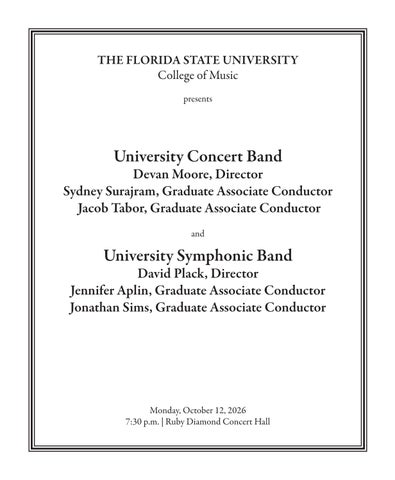
THE FLORIDA STATE UNIVERSITY College of Music presents
University Concert Band
Devan Moore, Director Sydney Surajram, Graduate Associate Conductor Jacob Tabor, Graduate Associate Conductor and
University Symphonic Band
David Plack, Director Jennifer Aplin, Graduate Associate Conductor Jonathan Sims, Graduate Associate Conductor
Monday, October 12, 2026 7:30 p.m. | Ruby Diamond Concert Hall
To Ensure An Enjoyable Concert Experience For All… Please refrain from talking, entering, or exiting during performances. Food and drink are prohibited in all concert halls. Recording or broadcasting of the concert by any means, including the use of digital cameras, cell phones, or other devices is expressly forbidden. Please deactivate all portable electronic devices including watches, cell phones, pagers, hand-held gaming devices or other electronic equipment that may distract the audience or performers. Recording Notice: This performance may be recorded. Please note that members of the audience may at times be included in this process. By attending this performance you consent to have your image or likeness appear in any live or recorded video or other transmission or reproduction made in conjunction to the performance. Florida State University provides accommodations for persons with disabilities. Please notify the College of Music at (850) 644-3424 at least five working days prior to a musical event to request accommodation for disability or alternative program format.
University Concert Band Danse Diabolique (1900/1995)
Joseph Hellmesberger Jr. (1855–1907) tr. Tohru Takahashi 5’30”
Choreography (2009)
Robert Sheldon (b. 1954) 5’30”
Albanian Dance (2005)
Shelley Hanson (b. 1951) 3’
Sun Dance (1997)
Incantation and Dance (1963)
Sydney Surajram, Graduate Associate Conductor
Jacob Tabor, Graduate Associate Conductor
Frank Ticheli (b. 1958) 5’
John Barnes Chance (b. 1958) 5’
Symphonic Dances (2010) I. Renaissance Dances II. Tango
Yosuke Fukuda (b. 1975) 11’
Russian Sailors’ Dance (1927/2003)
Reinhold Glière (1855–1907) tr. Erik Leidzén 5’30” INTERMISSION
University Symphonic Band Sol y Sombra (1958)
George E Gates (1920–2004) rev. Van Ragsdale 4’
Timba (2022)
Giovanni Santos (b. 1980) 6’
Jennifer Aplin, Graduate Associate Conductor
Danzón No. 2 (1994)
Arturo Márquez (b. 1950) tr. Oliver Nickel 10’
Latin Dance Movements (2019) Prelude Beginner’s Rhumba Bolero Samba Despreocupada
Anthony O’Toole (b. 1988) 8’
Jonathan Sims, Graduate Associate Conductor La Chancla (2024) El Cumbanchero (1995)
Dennis Llinás (b. 1980) 8’ Rafael Hernández (1892–1965) arr. Naohiro Iwai 4’
NOTES ON THE PROGRAM Hellmesberger: Danse Diabolique Joseph Hellmesberger Jr. (1855-1907) was born to a prominent musical family in Vienna, Austria. His grandfather, Georg Hellmesberger Sr. was the first concertmaster of Vienna Philharmonic, which has long been one of the most outstanding orchestras in the world. Joseph started his musical career at a young age as a virtuoso violinist, but later made his living as a conductor and composer. He was appointed principal conductor of the Vienna Philharmonic from 1901 to 1903. Danse Diabolique is witty, macabre, and full of humor. Brisk, agile woodwind writing permeates this work throughout its constant and energetic journey. Tohru Takahashi transcribed this orchestral work for band in 1995. Sheldon: Choreography Robert Sheldon, notable music educator, composer, and former faculty member at Florida State University, wrote this piece as a commission for the Association of Texas Small School Bands All-State Band in 2008. Choreography is fast paced, with rhythmic interjections made by each section in the ensemble. This is contrasted by the flowing lyrical section that follows. Written in Overture form, Choreography pulls inspiration from various dance forms including ballet, contemporary stage dances, and theatrical productions. Hanson: Albanian Dance Shelley Hanson’s setting of the Albanian tune, “Shōta” is a festive and rowdy village dance. Shōta is shortened from the phrase “Vallja e shotës,” which loosely translates to “dance of the duck.” Hanson’s swirling melodic lines bring a brisk sense of joy and celebration to the ensemble. Metric and grooving, the dance reinvents itself constantly, with different instrument groups symbolically joining the dance while others fall back and take a supporting role. Gleeful and brisk, Albanian Dance is a three minute party that builds energy all the way to the very end. Ticheli: Sun Dance Sun Dance’s themes call visions of joyous dances and songs to the mind. Frank Ticheli showcases his signature writing style to create an atmosphere of hospitality and warmth throughout this work. The legato melodies and rhythmic figures work together to depict a summer town festival where people are gathered to enjoy dance, music, and good company. Written during a pivotal time in Frank Tichelli’s career, Sun Dance was commissioned by the Austin Independent School District for their All-City Honor Band Festival in 1997. Sun Dance was performed at the Midwest Clinic in the same year. Ticheli’s work continues to stand the test of time, spreading light to all it touches.
Chance: Incantation and Dance John Barnes Chance’s (1931-1972) Incantation and Dance was initially commissioned in 1963 by the Greensboro High School in Greensboro, North Carolina. Chance’s writing calls to mind a dark, almost sacrificial, ritual similar to Stravinsky’s Rite of Spring. The piece begins with a dark and foreboding Incantation before yielding to a pressing call to action from the percussion section. The winds enter with a ceremonial Dance that is frantic and pulsing, with a sly feeling of dark joy. Driving brass, screaming woodwinds, and a bouncing uneven bass line contribute to the piece’s constant sense of uneasiness. Chance’s scoring highlights the blend of the ensemble, and his use of triumphant brass, flowing woodwind runs and metric percussion grooves all come together triumphantly in this classic work for band. Fukuda: Symphonic Dances Yosuke Fukuda (b. 1975) has been arranging and composing since he was in junior high school. His composition, Symphonic Dances for Wind Ensemble, was commissioned by the Central Band of the Japan Air Self Defense Force to present a survey of several dances from across the globe. The first movement, Renaissance Dances, captures the spirit and brilliance of composers like Susato, Praetorius, and other music from the Renaissance period intended for high society social functions. Tango is rife with flavors of Argentinean elegance and romance, giving the ensemble a chance to showcase musical intensity and passion throughout. Glière: Russian Sailors’ Dance Russian Sailors’ Dance is a dance from the Russian Ballet The Red Poppy. The ballet premiered in 1927, and was one of the first ballets from Russian to have modern revolutionary themes. The ballet is set in China in 1920. Ships from around the world are docked in a Chinese harbor, the captain of an unnamed soviet ship becomes central to the story when he intervenes to free starving harbor workers from their masters. The Red Poppy deals with love, kindness in the face of evil, and inspiring others to take up the fight for justice. Russian Sailors’ Dance has strong influences of sea shanties. Listeners will undoubtedly hear the musical influences of the high seas and open water. Gates: Sol y Sombra Written in 1958 for the Richardson High School Band, Sol y Sombra translates to sun and shadow, referring to the seating in the bullfighting arena. These seats start in the sun and end in the shadow for the fight. The “sun” is characterized by a bright, high-energy march style, featuring bold brass writing, strong accents, and driving rhythms that represent the bull. In contrast, the “shadow” introduces a more lyrical character, with flowing melodic lines and elements of Spanish dance that evoke the grace and movement of the bullfighter. Throughout the piece, these contrasting ideas alternate, overlap, and develop, creating a musical exchange between the bull and the fighter. As the two themes become increasingly intertwined, Sol y Sombra portrays the bullfight not simply as a confrontation, but as an intricate dance between the bull and bullfighter.
Santos: Timba Pronounced teem-ba, timba is a Latin dance derived from son and salsa with Afro-Cuban roots. Beginning and ending in the Bembé style, the West African tradition was preserved through the sacred music of enslaved people in 19th century Cuba. This music evolved with music of Cuba into the modern percussion heavy Bembé style. Santos describes music in Cuba as, “diverse, electric, transformative, soulful, elegant and energetic,” and Timba celebrates this rich Afro-Cuban tradition. Giovanni Santos is an Hispanic American composer and educator and currently serves as director of bands and associate professor music at the University of Redlands, California. Timba was commissioned by the Allen High School Wind Ensemble in Texas and premiered at the Midwest Band and Orchestra Clinic in Chicago, Illinois. Márquez: Danzón No. 2 Arturo Márquez’s Danzón No. 2 was composed for symphony orchestra in 1994 and was commissioned by the National Autonomous University of Mexico (UNAM). It premiered in 1994 by the Orchestra Filar-monica de la UNAM in Mexico City and was later transcribed for concert band by Oliver Nickel. The piece draws inspiration from the danzón, a Cuban dance tradition that synthesizes several Spanish, British, and French dance forms. Márquez was inspired by visits to dance halls where the danzón remained a vibrant social tradition, especially in the state of Veracruz and in Mexico City. The work is built on a beautiful, elegant main theme, first stated on the clarinet. The theme moves between intimate, lyrical passages featuring colorful small ensemble groupings with piano and increasingly energetic dance rhythms, culminating with a spirited expression of the danzón’s rhythmic energy. Originally written for orchestra, Danzón No. 2 has become one of Márquez’s most recognized works and has been widely performed in its wind ensemble transcription. The piece celebrates the elegance, passion, and rhythmic vitality of the danzón tradition. O’Toole: Latin Dance Movements Latin Dance Movements began as a work composed in 2015 for the Southern California Brass Consortium and its conductor, Hector Salazar. In 2019, Anthony O’Toole expanded the piece for full wind band through a commission from a consortium of ensembles led by Erick Von Sas. When expanding the original brass ensemble work for wind band, O’Toole added the Bolero movement specifically for woodwinds, providing a distinct change in texture and character. Latin Dance Movements is inspired by the energy and rhythmic character of different style of Latin dance music. The piece features lively syncopations, colorful percussion, and melodies that give each movement its own distinct personality, moving between energetic dance rhythms and contrasting lyrical moments. The music continually builds in energy and rhythmic intensity, bringing the contrasting dance styles together and driving the work toward a lively and spirited finale.
Llinás: La Chancla Dennis Llinás’s La Chancla draws inspiration from the familiar Hispanic cultural image of the chancla, or flip flop, often humorously associated with the authority of a mother or grandmother. Llinás, a Cuban-Colombian composer and conductor who currently serves as Director of Bands at the University of Oregon, brings this image to life by contrasting whole-tone and octatonic writing which are used to liken the chancla to the mythical sword Excalibur with the lively rhythms and functional harmony of merengue. The work was commissioned by a consortium led by Thomas Verrier and Vanderbilt University. For each participating institution, a copy of La Chancla was donated to a Latin American band with limited access to new music. Through humor, rhythmic energy, and contemporary wind writing, La Chancla offers a spirited celebration of Hispanic culture. Hernández: El Cumbanchero El Cumbanchero, often referred to as “the party animal” is a high energy Latin piece written by Rafael Hernández in in 1943. A vibrant celebration of Latin rhythm, dance, and energy, this piece was extremely popular in Puerto Rico to the point that President John F. Kennedy dubbed Hernandez as “Mr. Cumbanchero.” Naohiro Iwai adapted the Latin chart for concert band in 1995, and it has quickly become a favorite around the world as a dynamic concert closer. Bright brass writing and exciting woodwind passages are driven by a wide range of Latin percussion instruments. Driving rhythms and animated ensemble writing propel the music forward, culminating in an exciting and powerful finale.
University Concert Band Personnel Devan Moore, Director Sydney Surajram & Jacob Tabor, Graduate Associate Conductors Piccolo Maya Sparks Flute Addison Peltier Camille Pagador Katrina Varieur Kathleen Antmann Kayte Warner Oboe Richard Wilson Randy Piloto Jules Noorlander Mariana Rivera Bassoon Ada Dapkus Megan Meese Clarinet Shelby Hamilton Hailey Gonzales Katherine Pawling Anthony Cieza Elizabeth Hopkins Ella Atkinson Daniel Stevens Kylianne Winters Victoria Quiles Shelby Simoneau Leonardo Lisboa
Bass Clarinet Max Simanian Zachary Costea (Contra) Saxophone Samantha Santiesteban Yaunner, alto Logan Wong, alto Caitlyn Jones, alto Ellen Cohn, alto Enzo Ward, tenor Gracie Snider, tenor Ryan Maxson, baritone Trumpet Max Carpenter Gabriel Gonzales Caleb Martin Allie Massey Seanna Reser Khloe Kamen Kazah Dixon Horn Kate Lansford Joseph Rojas Nolan Beighley Bea Perry Maren Smith
Trombone Micah Hreczkosij Frank Hobbs Andrew Walker Jacob Ballinger Rigels Doko, bass Euphonium Alexis Bowman Nick Batten David Adepeju Gavin Burns Ryan Nguyen Jacob Richardson Tuba Paul Van Damme Angelo Scarpitta Grant Markiewicz Seth Massey Alejandro Carranaza String Bass Connor Oneacre Percussion Carys Whitesides Luis Bernal-Moreno Emilia Parsons Colton Campbell Chloe Overholt Caleb Blakeslee *Principal **Co-Principal
University Symphonic Band Personnel David Plack, Director Jennifer Aplin and Jonathan Sims, Graduate Associate Conductors Piccolo Allie Mattice*
Bass Clarinet Gabriel Dos Santos
Flute Anna Todd Lexi Smith Claire Mckenzie Elizabeth Adkins Madison Leimer Charis Henry
Saxophone Steven Waterston, alto Daniel Ahn, alto Jennifer Fuentes, alto Owen Boss, alto Olivia Turke, tenor Jakub Zella, baritone
Oboe Emma Brock* Megan Halter Alex Van Amburg Delayna Curtis
Trumpet Franki Stressman ** Erik Links** Mikey Moore Addie Elliott Makenna Payne Riley Mustard Evan Workman Corey Newell
Bassoon Benjamin Vela* Miriam Smith Sebastian Miguel Hernandez Meneses Clarinet Brandon Mullane, E-Flat Alex Acevedo** Brady Anderson** Zach Candela Grace Whiting Ryan Golbe Zachary Costea John Rodda Eliza Taylor Jacob Lirio Amanda Stewart Jamari Richards William Wagner
Horn Coen Taylor* Janaya Ackermann Brandon Bourdeau Kylie Saine Sarah Crisostomo Joseph Cosme Trombone Calvin Fein* Hunter Scott Sam Mercier Connor Casey Julia Antmann Reagan Lesser Marcus Lampkin Jr., bass
Euphonium Adam Zierden* Lee Anderson Karina Benton Tuba Devin Walmsley* Noah Bryant Allegra Hreschak Sophia Farfante String Bass Daniel Martinez Percussion Ethink Brink Timothy Thomas Chance Douglas Ethan Stefanski Travis Beeton Caleb Cristodera Piano Bryden Reeves
* Principal **Co-Principal