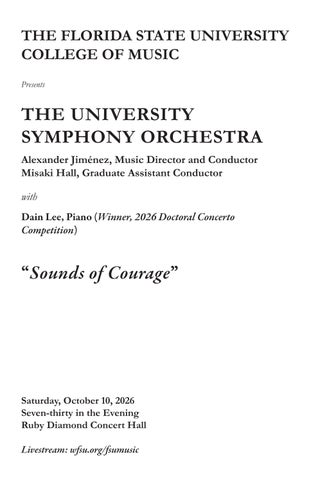
THE FLORIDA STATE UNIVERSITY COLLEGE OF MUSIC Presents
THE UNIVERSITY SYMPHONY ORCHESTRA Alexander Jiménez, Music Director and Conductor Misaki Hall, Graduate Assistant Conductor with Dain Lee, Piano (Winner, 2026 Doctoral Concerto Competition)
“Sounds of Courage”
Saturday, October 10, 2026 Seven-thirty in the Evening Ruby Diamond Concert Hall Livestream: wfsu.org/fsumusic
ng i t r o p p u S e Arts th
850-894-8700
www.beethovenandcompany.com 719 North Calhoun Street, Suite E Tallahassee, Florida 32303
Claire owner TomWilliamson, Buchanan, owner
PROGRAM An American Port of Call
Adolphus Hailstork (b. 1941)
Piano Concerto No. 1 in F-sharp Minor, Op. 1 Vivace-Moderato Andante Allegro vivace
Sergei Rachmaninoff (1873-1943)
Dain Lee, piano Misaki Hall, conductor INTERMISSION Symphony No. 5 in D Minor, Op. 47 Moderato Allegretto Largo Allegro non troppo
Dmitri Shostakovich (1906–1975)
Please refrain from talking, entering, or exiting while performers are playing. Food and drink are prohibited in all concert halls. Please turn off cell phones and all other electronic devices. Please refrain from putting feet on seats and seat backs. Children who become disruptive should be taken out of the performance hall so they do not disturb the musicians and other audience members.
ABOUT THE MUSIC DIRECTOR AND CONDUCTOR Alexander Jiménez serves as Professor of Conducting, Director of Orchestral Activities, and String Area Coordinator at the Florida State University College of Music. Prior to his appointment at FSU in 2000, Jiménez served on the faculties of San Francisco State University and Palm Beach Atlantic University. Under his direction, the FSU orchestral studies program has expanded and been recognized as one of the leading orchestral studies programs in the country. Jiménez has recorded on the Naxos, Neos, Canadian Broadcasting Ovation, and Mark labels. Deeply committed to music by living composers, Jiménez has had fruitful and long-term collaborations with such eminent composers as Ellen Taafe Zwilich and the late Ladisalv Kubík, as well as working with Anthony Iannaccone, Krzysztof Penderecki, Martin Bresnick, Zhou Long, Chen Yi, Harold Schiffman, Louis Andriessen, and Georg Friedrich Haas. The University Symphony Orchestra has appeared as a featured orchestra for the College Orchestra Directors National Conference and the American String Teachers Association National Conference, and the University Philharmonia has performed at the Southeast Conference of the Music Educators National Conference (now the National Association for Music Education). The national PBS broadcast of Zwilich’s Peanuts’ Gallery® featuring the University Symphony Orchestra was named outstanding performance of 2007 by the National Educational Television Association. Active as a guest conductor and clinician, Jiménez has conducted extensively in the U.S., Europe, and the Middle East, including with the Brno Philharmonic (Czech Republic) and the Israel Netanya Chamber Orchestra. In 2022, Jiménez led the Royal Scottish National Orchestra in a recording of works by Anthony Iannaccone. Deeply devoted to music education, he serves as international ambassador for the European Festival of Music for Young People in Belgium, is a conductor of the Boston University Tanglewood Institute in Massachusetts and serves as Festival Orchestra Director and artistic director of the Blue Lake Fine Arts Camp in Michigan. Jiménez has been the recipient of University Teaching Awards in 2006 and 2018, The Transformation Through Teaching Award, and the Guardian of the Flame Award which is given to an outstanding faculty mentor. Jiménez is a past president of the College Orchestra Directors Association and served as music director of the Tallahassee Youth Orchestras from 2000-2017.
TONIGHT’S SOLOIST South Korean concert pianist Dain Lee earned her Doctor of Music in Piano Performance from Florida State University, where she studied with Dr. Heidi Louise Williams. She currently serves as Collaborative Pianist at the Mercer University School of Music in Georgia. An active soloist and collaborative pianist, Lee has performed extensively throughout the United States and Korea. She is the winner of the 2026 Florida State University Doctoral Concerto Competition. Her recent competition honors include First Prize at the 2026 Swiss International Music Competition, the Absolute Award at the Eighth Finlandia International Piano Competition, First Prize at the 2025 American Protégé International Music Competition, for which she performed at Carnegie Hall’s Weill Recital Hall, and the winner of the 2024 Masterworks Festival Concerto Competition, appearing as soloist with the Masterworks Orchestra performing Grieg’s Piano Concerto conducted by David Chan. She was also a finalist in the 2026 Odyssiad Piano Concerto Competition and 2026 Vancouver Piano Competition. Lee has participated in piano festivals and masterclasses across the United States and Korea, including the International Keyboard Odyssiad Festival, Texas State International Piano Festival, Knoxville International Piano Festival and Competition, Masterworks Festival, and the Ian Hobson Piano Festival. She has performed in masterclasses for internationally renowned pianists including Antonio Pompa-Baldi, Boaz Sharon, Hung-Kuan Chen, Ian Hobson, Steven Spooner, and HieYon Choi. As a collaborative pianist, Lee has worked extensively with singers and instrumentalists in recitals, competitions, masterclasses, opera, chamber music, and ensemble performances. Her collaborative experience includes performances with the Florida State University Wind Ensemble, Illinois Wind Symphony, Illinois Modern Ensemble, and University of Illinois Varsity Men’s Glee Club, as well as ballet productions and numerous chamber recitals. Originally from Seoul, South Korea, Lee holds a Master of Music degree in Piano Performance and Literature from the University of Illinois Urbana-Champaign, where she received an accompanying assistantship, and both Bachelor of Music in Piano Performance and Bachelor of Business Administration degrees from Ewha Women’s University in Seoul. Her piano mentors include Dr. Heidi Louise Williams, Dr. Ian Hobson, Dr. Rochelle Sennet, and Dr. Da-Hye Choi.
NOTES ON THE PROGRAM Hailstork: An American Port of Call Adolphus Hailstork has written in a variety of genres, producing works for chorus, solo voice, piano, organ, various chamber ensembles, band, and orchestra. His early compositions include Celebration, recorded by the Detroit Symphony in 1976, and two works for band (Out of the Depths (1977) and American Guernica (1983)), both of which won national competitions. Hailstork’s works have been performed by such prestigious ensembles as the Philadelphia Orchestra, the Chicago Symphony, and the New York Philharmonic, under the batons of leading conductors such as James DePreist, Daniel Barenboim, Kurt Masur, and Lorin Maazel. Hailstork’s Second Symphony was commissioned by the Detroit Symphony. His second opera, Joshua’s Boots, was commissioned by the Opera Theatre of St. Louis and the Kansas City Lyric Opera. Hailstork’s Second and Third Symphonies were recorded by the Grand Rapids Symphony Orchestra, under David Lockington, on a Naxos label disc released in January 2007. Recent works include Earthrise, a new large scale choral work premiered by James Conlon, Three Studies on Chant Melodies for the American Guild of Organists, and Whitman’s Journey, a cantata for chorus and orchestra, premiered by the Master Chorale of Washington, D.C. Rise for Freedom, an opera about the Underground Railroad, was premiered by the Cincinnati Opera Company. Hailstork wrote An American Port of Call for the Virginia Symphony who premiered it in 1985. Hailstork gives this summary of the piece: “The concert overture, in sonata-allegro form captures the strident (and occasionally tender and even mysterious) energy of a busy American port city. The great port of Norfolk, Virginia, where I live, was the direct inspiration.” — John P. Varineau Rachmaninoff: Piano Concerto No. 1 “I have rewritten my First Concerto,” Rachmaninoff communicated to a friend. “It is really good now. All the youthful freshness is there, and yet it plays itself so much more easily. And nobody pays any attention. When I tell them in America that I will play the First Concerto, they do not protest, but I can see by their faces that they would prefer the Second or Third.” Youthful freshness is not an unexpected quality considering that the first movement of the Concerto was written by a student musician of 17, and the second and third movements when he was all of 18. What is remarkable is that Rachmaninoff maintained the freshness when he revised the work in 1917, some 26 years later. By that time, he had many major works to his credit – in addition to the Second and Third Piano Concertos, there were two symphonies, for the second of which he had won the prestigious Glinka Prize. And he had become celebrated not only as a composer but also as a pianist and conductor. The First Concerto, then, reflects both a teenaged Rachmaninoff who was already in possession of a strongly defined compositional style, and a mature, worldly, and experienced creative artist.
The 26-year delay between the completion of the Concerto and its final revision is typical of Rachmaninoff ’s somewhat haphazard approach to composing. The fact is, in his youth he was known as a somewhat lethargic student. Yet, in spite of his efforts to avoid hard work, he turned out some impressive scores even before graduating from the Moscow Conservatory. In addition to the First Concerto, there was the one-act opera Aleko, which won the admiration of Tchaikovsky, and several piano pieces, including the C-sharp minor Prelude, whose immense success hounded the composer throughout his life. And of course, the emotional abyss into which he fell following the failure of his First Symphony in 1897 halted his productivity until a kind of hypnosis treatment brought him out of the depression and into the glories of the Second Piano Concerto. The mark of youthful impetuosity is particularly apparent at the opening of the First Concerto, where an urgent two-measure fanfare in horns, clarinets, and bassoons sparks a fiery entrance from the piano, which, erupting high in the treble, lunges down the keyboard in blazing double octaves and chords. In his subsequent three piano concertos, the firstmovement scene is set with far more reserve and seriousness: at age 17, temperamental abandon came naturally. Following this introductory boldness, which climaxes in a cadenzalike flourish, the strings sing the lyric main theme, after which the piano takes the melody, adorning it with inimitable Rachmaninoffian decoration. Later, a stunning cadenza that follows an expanded return of the fanfare opening treats the main materials in a fantastic, brilliant fashion. The middle movement’s nocturnal atmosphere, initiated by a horn solo, may echo the mood of the slow movement of Tchaikovsky’s Fifth Symphony, but the melting, extended piano solo that follows resonates with the pure Romanticism of Rachmaninoff. In this movement as in the vital finale, the pianism is absolutely ravishing and quite able to compensate for the somewhat wobbly structural stability, and, in the last movement, for the theme in a slow middle section that exceeds the acceptable level of sugar content. What matter: “It is really good now… it plays itself so much more easily.” (If one has the fingers and the soul of Rachmaninoff.) — Orrin Howard Shostakovich: Symphony No. 5 Dr. Jiménez’s take: “And all this is coarse, primitive and vulgar. The music quacks, grunts, and growls, and suffocates itself in order to express the love scenes as naturalistically as possible. And ‘love’ is smeared all over the opera in the most vulgar manner. The merchant’s double bed occupies the central position on the stage. On this bed all ‘problems’ are solved. In the same coarse, naturalistic style are shown the death from poisoning and the flogging, both practically on stage.” – 28 January 1936
This excerpt from a review of a performance of Dmitri Shostakovich’s opera Lady Macbeth of the Mtsensk District was not merely a persnickety opinion piece by a cranky reviewer. It was a prison sentence in the form of a music review, published in the Soviet newspaper, Pravda. Although unsigned, the article is generally believed to have reflected Joseph Stalin’s views after attending a performance and reportedly leaving the theater deeply displeased. Its title summarized the condemnation: Muddle Instead of Music (sometimes translated as Chaos Instead of Music). At the center of the controversy was the Soviet state’s determination to bring every aspect of society under its control, including art. The doctrine of Socialist Realism demanded music that was accessible, optimistic, and supportive of Soviet ideals. Whether Stalin objected to the opera’s musical language, its subject matter, or both, the result was the same: Shostakovich found himself under the scrutiny of a regime where artistic disfavor could become a matter of life and death. Cultural authorities made clear that his future depended upon demonstrating that he had reformed. A new symphony, embodying the principles of Socialist Realism, became the proposed solution. It would serve as his “response to just criticism.” Premiered on November 21, 1937, by the Leningrad Philharmonic under Yevgeny Mravinsky, the Fifth Symphony was an immediate triumph. Shostakovich composed it during one of the darkest periods of Stalin’s reign, when arrests, imprisonments, and executions affected millions of Soviet citizens. Friends, family members, and professional colleagues disappeared into the machinery of the state. Shostakovich reportedly even slept in the stairwell outside his apartment so that, if the secret police came for him in the night, his family would be spared witnessing the arrest. A masterpiece, the Fifth Symphony has always fascinated me because of its apparent duality. It seemed to say one thing to Soviet officials and quite another to the people who heard it. According to a contemporary administrator of the Leningrad Philharmonic, Shostakovich was “rehabilitated as a composer at this tense time. It was simple in language, was full of extended melodies, and what was particularly important, it finished with victorious fanfares whose ‘outspoken’ nature could not be called into doubt.” Many listeners, however, appear to have heard something very different. Eyewitness accounts describe audience members openly weeping during the third movement. To them, the music seemed to express both the pain of living under profound repression and a stubborn sense of human resilience. The first movement opens with a burst of rhythmic energy in the strings that provides the motivic foundation for much of what follows. The music quickly subsides, leaving a solitary and chilling melody high in the violins. We are soon confronted by a menacing march punctuated by ominous low horns. An atmosphere of growing agitation builds toward one of the symphony’s most terrifying climaxes before receding into a mood of nostalgia. Particularly remarkable is the movement’s conclusion, where the angular
rhythms from the opening return in subdued form, accompanied by delicate ascending scales in the celesta. The second movement comes closest to reflecting Shostakovich’s love of Mahler. Occupying the position normally reserved for the slow movement, this grotesque waltz paints, for me, a paradoxical picture of an overbloated state attempting to regulate artistic expression. The low strings stomp, brass flourishes proclaim, and flute and violin solos seem almost to laugh. The third movement, which moved many listeners to tears at the premiere, is a tour de force of emotional expression. Shostakovich divides the violins into three sections and the remaining strings into two, drawing from the orchestra an extraordinary range of color and depth. The climax, with its naked anguish, is nearly impossible to comprehend. Eventually the movement seems exhausted by its own emotional outpouring, ending with an exquisitely conceived dialogue between harp and celesta. Yet even here, Shostakovich leaves us with an unexpected sonority of hope in F-sharp major. A menacing D-minor chord followed by a threatening march opens the finale. The ferocious main theme surges forward before giving way to a remarkably lyrical trumpet solo supported by a torrent of repeated notes. A four-measure brass fanfare then carries the music unexpectedly into the brilliant key of A major. A sweeping string melody briefly suggests hope before crashing headlong into a terrifying wall of sound led by brass and percussion. Undeterred, the music returns in B-flat major, sparsely orchestrated and led by a noble horn solo. The march rhythm gradually reappears and ultimately yields to the symphony’s famous concluding peroration. What are we to make of this ending? Is it the triumph of a people who have endured suffering? Is it the triumph of a state that demands submission? Nearly ninety years after its premiere, the question remains unresolved. The longer I have lived with this symphony, the less certain I have become that it provides a definitive answer. Perhaps Shostakovich intended it that way. For all of the apparent certainty of the final pages, he concludes not with a complete D-major or D-minor chord, but with an open fifth: D and A. Missing is the third, the single note that would reveal whether the music is truly major or minor. After all the struggle, all the anguish, and all the triumph, Shostakovich withholds the one note that might tell us the truth. — Alexander Jiménez
University Symphony Orchestra Personnel Alexander Jiménez, Music Director Misaki Hall, Graduate Associate Conductor Violin I Ioana Popescu‡ Jean-Luc Cataquet Masayoshi Arakawa Klaus Bryant Will Purser Ilayda Ilbas Keren Garcia Mariana Reyes Parra Javaxa Flores Amanda Marcy Emily Palmer Abigail Jennings Francesca Puro Elizabeth Milan
Viola Noel Medford* Benjamin Suarez Yey Mulero Abigayle Benoit Jeremy Hill Angeleena Jackson Hannah Jordan Nathan Oyler Maya Johnson Joseph Villagomez Emelia Ulrich Jonathan Taylor Madison Jansons
Cello Violin II Natalie Taunton* Rachel Lawton* Addison Miller Rose Ossi Mitchell George Noah Johnson Sydney Spencer Sarita Thosteson Connor Peterson Irsia Ruiz Guzman Jason Tejada Quinn French Turner Sperry Peter Fennema Jake Reisinger Mulunesh Creaghan Maria Ruiz Katherine Ng Daniel Jimenez-Gaona Larah Pereira Christina Leach Bass Alexa Dinges Caleb Duden* Sobin Son Christopher McDuffie Samuel Ovalle Paris Lallis Hayden Green Connor Oneacre Emma Waidner Charlotte Wooldridge Jarobi Watts Flute Claire Park* Kathryn Lang* Emily Speight Alexandra Kotsonis Moriah Garcia
Piccolo Moriah Garcia Oboe Zoe Gurwitz* Rebecca Johnson* Rebecca Keith Andrew Swift Clarinet Charlotte MacDonald* Daniel Kim* Zhiyao Zhu Eb Clarinet Steven Higbee Bassoon Emmalee Odom* Georgia Clement* Jordan Vestal Susanna Campbell Contrabassoon Jordan Vestal Susanna Campbell Horn Wyatt Gibson* Allison Hoffman* Andrew Keller Sarah Schwenke Davis Craddock
Trombone Elijah Van Camp-Goh* Connor Altagen* Dylan White Bass Trombone Ryan Meyaard Tuba Yonathan Zegeye Percussion Matthew Korloch* Gabrielle Overholt Nicholas Bahr Caitlin Magennis Jessica Weinberg Harp Keirstin Li Sierra Stacy Piano/Celesta Erick Santiago-Jimenez Orchestra Manager Tori Young Orchestra Stage Manager Connor Oneacre Orchestra Librarians Misaki Hall Shaka Lwaki
Trumpet Thana Ransiyawaranon* Avery Hoerman* Library Bowing William Rich* Assistant Keren Garcia Rodriguez
‡ Concertmaster * Principal/Co-Principal
Tickets & Information January 10:
February 13:
Trinity Episcopal Church
Holy Family Senior Center
Dina Kasman
Will Fulkerson & Friends
4PM
Classical Pianist
January 22:
6PM
Soul Blues/Jazz
6PM
March 10:
Singer-Songwriter
Trinity Episcopal Church
February 7:
Stephen Mattingly Tantalus Quartet
Trinity Episcopal Church
March 19:
Leon Anderson & Jazz Ensemble
Trinity Episcopal Church
Trinity Episcopal Church
Jeff Black 4PM Jazz
6PM
Classical Guitar
6PM
Bluegrass
Echo Valley
Trinity Episcopal Church, 79 6th Street, Apalachicola Holy Family Senior Center, 203 7th St, Apalachicola
www.inconcertapalachicola.org
ZUKERMAN PLAYS ELGAR Yaniv Dinur, Conductor Pinchas Zukerman, Violin
BEN-HAIM Symphony No. 1
ELGAR
Violin Concerto in B minor
FRIDAY OCTOBER 16 RUBY DIAMOND TICKETS: TALLAHASSEESYMPHONY.ORG
Experience the magic of Join us for our exciting
2026-2027 Season, featuring:
Oct 16 - 25 | Fallon Theatre
Nov 6 - 15 | Lab Theatre
Nov 19 - 22 | Fallon Theatre
Feb 26 - Mar 7 | Lab Theatre
Apr 9 - 18 | Fallon Theatre
(850) 644.6500 | tickets.theatre.fsu.edu
A Journey in Song 2026–2027 SEASON
FALL
winter
SPRING
Glory to Peace
Sounds of the Cinema 2
Forward to 40!
Nov. 22, 2026
April 25, 2027
Jan. 24, 2027
TICKETS AT TCCHORUS.ORG OR 850-597-0603
UNIVERSITY MUSICAL ASSOCIATES 2026-2027 Dean’s Circle Les and Ruth Ruggles Akers Dr. Pamela T. Brannon Richard Dusenbury and Kathi Jaschke Glenn Hosken
Albert and Darlene Oosterhof Bob Parker Paula and Bill Smith Margaret Van Every
Gold Circle Joyce Andrews Drs. Charles and Sharon Aronovitch Louie and Avon Doll Patrick and Kathy Dunnigan Ron Erichson/Beth Frederick Kevin and Suzanne Fenton Wallace W. Floyd Ken Hays Andrew and Karen Hoyt Jayme and Tom Ice Alexander and Dawn Jiménez
Howard Kessler and Anne Van Meter Jim Lee William and Susan Leseman Bob and Linda Lovins Mary Anne Price Todd and Kelin Queen Jim and Betty Ann Rodgers Karen and Francis C. Skilling Stan Whaley and Brenda McCarthy Bret Whissel Sustainer
Kathryn M. Beggs Karen and Greg Boebinger Karen Bradley Steve and Pat Brock Suzi and Scott Brock Brian Causseaux and David Young Bonnie and Pete Chamlis Keye and Jennifer Chang Glenn and Mary Cole Carol J. Cooper Sandy Dafoe Floyd Deterding and Kelley Lang Diane and Jack Dowling Aaron and Caroline Ellis Joy and James Frank William Fredrickson and Suzanne Rita Byrnes
Edi Gay Michael and Marsha Hartline Melanie Hines and Dudley Witney Dottie and Jon Hinkle Todd S. Hinkle The Jelks Family Foundation, Inc. Emory and Dorothy Johnson Gregory and Margo Jones Dennis G. King, Esq. Annelise Leysieffer William and Gayle Manley Robert and Patty McDonald Tom and Kathleen Moore Walter and Marian Moore Joel and Diana Padgett Ann W. Parramore Almena and Brooks Pettit
Sustainer cont’d M Rashotte David and Joanne Rasmussen Mark and Carrie Renwick Ann and Michael Riley Lawrence and Lisa Rubin Frances V. Sasser Scott and Andrea Smith Greg Springer and Jonathan Jackson
Dr. James and Ruth Anne Stevens Richard Stevens and Ron Smith Ma’Su and William Sweeney Martin Kavka and Tip Tomberlin Steve Moore Watkins and Karen S. Brown David and Jane Watson Kathy D. Wright
Patron Mary S. Bert Debra Billard Marcia and Carl Bjerregaard Larry and Sara Bourdeau Malcolm A. Craig Rochelle Davis William H. Davis Larry Deeb Geoffrey Deibel Pamala J. Doffek Judith Flanigan John S. and Linda H. Fleming Bonnie Fowler, Realtor Ruth Godfrey-Sigler Sue Graham Jerry and Bobbi Hill Madeleine Hirsiger-Carr Richard and Linda Hyson Sally and Dr. Link Jarrett Susan Johnson Judith H. Jolly Judith Page Jolly Arline Kern Blaire K.S. Koerner Elna Kuhlmann
Stacey Lampkin Eric and Francee Laywell Donna Legare James J. Logue Dr. Lynne Y. Lummel Patrick Malone Victoria Martinez Stephen Mattingly Ann and Don Morrow Doug Pawling Edward Reid Jill Sandler Scott Scearce Annette Schwabe Jeannette Sickel Judy and Mike Stone George Sweat Anne Swerlick Marjorie Turnbull Ed Valla Sylvia B. Walford Diana Wang Geoffrey and Simone Watts Jeff Wright
Associate Patricia C. Applegate Judy Arthur Grace Atkins Bonnie Bailey Michael and Megan Bakan Marty Beech John and Sarah Bender Susan Berube Beverley Booth The Boyette Family Hillman and Lin Brannon David and Carol Brittain Michael Buchler and Nancy Rogers Brian and Judy Buckner Kasia Bugaj and J. Renato Pinto Robby and Brooke Bukovic Joe Calhoun Cherie Came Darren and Peyton Cassels Marian Christ Chuan Dr. Genevieve Clarkson Dr. and Mr. Clevenger Renee Coburn and Austin Stilson Sarah Hess Cohen Linda D. Davey David and Julie Detweiler Daniel and Katie Elliott Sarah Eyerly Dr. Rhonda Marteen Flanagan GRC ARCHITECTS Miriam Gurniak Gene and Deborah Glotzbach Donna Heald Carla Connors and Timothy Hoekman Matt and Holly Hohmeister
Jane A. Hudson Louise B. Jones William E. and Dee Jones Felecia Jordan Jackson Steve Kelly John Mac Kilgore Paige McKay Kubik Keith and Mary Ledford Jane LeGette Eric Lewis Charlotte Malone Arunima Mandal Patricia Martin Jeanmarie Perri Morton Lealand and Kathleen McCharen Landon and Amber O’Connell Dr. Jeanne O’Kon Drs. L. O’Neil and S. Alston Rod Oldenburg Thomas Parrish Becky Parsons Michelle Peaceman Jeff Poole Maria Rodas Anamika Roy Sanford A. Safron Kim and Randy Shively Sue Sokoll Sudarat Songsiridej and Mary Schaad Susan P. Stephens Anne Stevenson Fernando Roberto Teson C. Richard and Phrieda L. Tuten Steve Urse Janie W. Weis Karen Wensing
Lifetime Members Willa Almlof Florence Helen Ashby Mrs. Reubin Askew Tom and Cathy Bishop Nancy Bivins Ramona D. Bowman André and Eleanor Connan Russell and Janis Courson J.W. Richard Davis Ginny Densmore Carole Fiore Patricia J. Flowers Hilda Hunter Julio Jiménez Kirby W. and Margaret-Ray Kemper Patsy Kickliter
Anthony M. Komlyn Fred Kreimer Beverly Locke-Ewald Cliff and Mary Madsen Ralph and Sue Mancuso Meredith and Elsa L. McKinney Ermine M. Owenby Mike and Judy Pate Laura and Sam Rogers Dr. Louis St. Petery Sharon Stone Donna C. Tharpe Brig. Gen. and Mrs. William B. Webb Rick and Joan West John L. and Linda M. Williams
Corporate Sponsors Beethoven & Company Business Sponsors WFSU Public Broadcast Center
The University Musical Associates is the community support organization for the FSU College of Music. The primary purposes of the group are to develop audiences for College of Music performances, to assist outstanding students in enriching their musical education and careers, and to support quality education and cultural activities for the Tallahassee community. If you would like information about joining the University Musical Associates, please contact Kim Shively, Director of Special Programs, at kshively@fsu.edu or 850-645-5453.
The Florida State University provides accommodations for persons with disabilities. Please notify the College of Music at 850-644-3424 at least five business days prior to a musical event if accommodation for disability or publication in alternative format is needed.