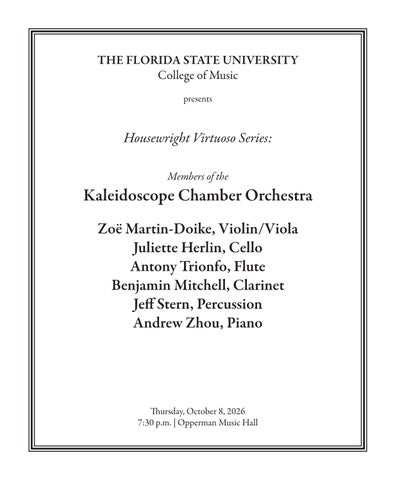
THE FLORIDA STATE UNIVERSITY College of Music presents
Housewright Virtuoso Series: Members of the
Kaleidoscope Chamber Orchestra Zoë Martin-Doike, Violin/Viola Juliette Herlin, Cello Antony Trionfo, Flute Benjamin Mitchell, Clarinet Jeff Stern, Percussion Andrew Zhou, Piano
Thursday, October 8, 2026 7:30 p.m. | Opperman Music Hall
PROGRAM Prelude, Allegro, and Pastorale (1941) I. Prelude II. Allegro III. Pastorale Benjamin Mitchell, clarinet; Zoë Martin-Doike, viola Kembang Suling (1995) I. Bali II. Japan III. India
Rebecca Clarke (1886–1979)
Gareth Farr (b. 1968) Antony Trionfo, flute; Jeff Stern, percussion
Largo for Violin, Clarinet and Piano (1901) Zoë Martin-Doike, violin; Benjamin Mitchell, clarinet Andrew Zhou, piano
Charles Ives (1874–1954)
Piano Étude No. 1 in C (1999, rev. 2003)
Unsuk Chin (b. 1961)
Light and Matter (2014)
Constellations (2018)
Andrew Zhou, piano
Zoë Martin-Doike, violin; Juliette Herlin, cello Andrew Zhou, piano
Tiffany Renée Jackson, guest vocalist
Kaija Saariaho (1952–2023)
Emma O’Halloran (b. 1985)
Antony Trionfo, flute; Benjamin Mitchell, clarinet Zoë Martin-Doike, violin; Andrew Zhou, piano; Jeff Stern, percussion
To Ensure An Enjoyable Concert Experience For All… Please refrain from talking, entering, or exiting during performances. Food and drink are prohibited in all concert halls. Recording or broadcasting of the concert by any means, including the use of digital cameras, cell phones, or other devices is expressly forbidden. Please deactivate all portable electronic devices including watches, cell phones, pagers, hand-held gaming devices or other electronic equipment that may distract the audience or performers. Recording Notice: This performance may be recorded. Please note that members of the audience may at times be included in this process. By attending this performance you consent to have your image or likeness appear in any live or recorded video or other transmission or reproduction made in conjunction to the performance. Florida State University provides accommodations for persons with disabilities. Please notify the College of Music at (850) 644-3424 at least five working days prior to a musical event to request accommodation for disability or alternative program format.
NOTES ON THE PROGRAM Clarke: Prelude, Allegro and Pastorale for clarinet and viola Rebecca Clarke was one of the outstanding violists and composers of the early twentieth century, and her intimate knowledge of string playing is evident throughout Prelude, Allegro and Pastorale. Written in 1941 and premiered the following year in Berkeley, California, the work brings together two instruments unusually well matched in colour: the dark, flexible voice of the viola and the clarinet’s extraordinary ability to move from warmth and intimacy to brilliance and agility. The three movements reveal strikingly different sides of this partnership. The opening Prelude is searching and atmospheric, unfolding through long phrases and shifting harmonic colours. The Allegro transforms the conversation into something more animated and mercurial, with the two players exchanging rapid gestures and pursuing one another through sudden changes of character. The concluding Pastorale returns to a more spacious landscape. Its lyrical lines have an improvisatory quality, as though heard at a distance, while moments of greater intensity repeatedly disturb the apparent calm. Throughout the piece, neither instrument is simply accompanist to the other. Clarke treats clarinet and viola as two independent personalities: sometimes moving together, sometimes answering one another, sometimes seeming to pull the music in different directions. The result is music that can feel at once intimate and elusive—a conversation between two voices whose colours continually merge and separate. Farr: Kembang Suling for flute and marimba New Zealand composer and percussionist Gareth Farr describes Kembang Suling as three “musical snapshots of Asia.” Commissioned for flautist Alexa Still and premiered with Farr himself playing marimba in 1996, it draws particularly on Farr’s fascination with Indonesian gamelan, while its three movements evoke musical worlds associated with Bali, Japan and South India. The first movement begins in Bali. Flute and marimba initially seem almost to fuse into a single instrument, weaving flowing lines inspired by gamelan and the suling, the Balinese bamboo flute. Gradually the flute begins to break free, wandering away from the marimba until the relationship becomes an increasingly animated musical argument. The second movement enters a completely different soundscape. Here Farr evokes the Japanese shakuhachi, its solitary, breath-inflected voice floating above the marimba’s resonant sonorities. Time seems to expand before the explosive final movement sends both players into a virtuoso race. For that finale Farr turns toward South Indian scales and rhythmic thinking. Beneath the apparent exuberance lies an intricate design: the marimba cycles through bars of 5/4, 5/8 and 5/16 while the flute repeatedly sets contrasting cross-rhythms against it. The mathematics may be complex, but the effect is wonderfully physical—a dazzling contest between two performers constantly threatening to fly apart before snapping back together.
Ives: Largo for Violin, Clarinet and Piano Charles Ives is often remembered as the great American musical maverick: a composer who could superimpose marching bands, hymns, popular songs and radically conflicting harmonies decades before such experiments became commonplace. But another Ives exists alongside the provocateur—the composer of strange, private, intensely lyrical music. The Largo belongs to that more introspective world. Dating from 1901 and originally conceived for violin and piano before Ives made the version for violin, clarinet and piano, it predates many of his most famous experimental works. Yet the fingerprints of the mature Ives are already present: familiar-sounding gestures lead somewhere unexpected, lyrical phrases seem to remember music we cannot quite identify, and moments of warmth are interrupted by harmonic turns that destabilise the landscape. The unusual combination of violin and clarinet gives the music much of its character. Sometimes their lines seem to inhabit the same expressive world; elsewhere they sound like independent voices overheard at the same moment. Beneath them, the piano can alternately support, comment on and complicate what they say. In barely a few minutes, Ives creates something that feels less like a conventional narrative than a memory: recognisable in outline, emotionally vivid, but impossible to grasp completely. Chin: Piano Etude No. 1 in C for solo piano For Unsuk Chin, the étude is not merely an exercise in virtuosity. She has described the genre as an encounter with limits—pushing the performer toward the boundaries of what can be played while simultaneously pushing the composer toward the boundaries of what can be imagined. Her first piano étude, In C, compresses that idea into three extraordinarily concentrated minutes. Written in 1999 following a stay in Bali the previous year, the piece reflects Chin’s encounter with Balinese gamelan. Rather than imitating gamelan directly, she absorbs some of its underlying principles into the mechanics of the piano: interlocking rhythmic patterns, overlapping layers of pulse and an iridescent approach to resonance. Three different pulsations continually interact, producing the sensation of several musical mechanisms running simultaneously. The title is both perfectly accurate and slightly mischievous. C really does provide the work’s harmonic foundation, but this is emphatically not “C major” in the traditional sense. Instead Chin builds the harmony from the overtone series above C, using resonance and pedalling to suggest colours that stretch beyond the piano’s fixed tuning. The result is music of tremendous kinetic energy: glittering, precise and almost machine-like, yet constantly changing as patterns collide, overlap and refract one another. The virtuosity lies not simply in playing quickly, but in allowing the listener to hear several layers of motion at once.
Saariaho: Light and Matter for violin, cello and piano Kaija Saariaho spent much of her career exploring the boundary between sound and colour, creating music in which harmony, timbre and texture seem almost inseparable. Curiously, despite writing numerous works for small ensembles, she long hesitated to compose for one of chamber music’s most familiar combinations: the traditional piano trio, whose formidable history she found difficult to approach. Her eventual answer was Light and Matter. Rather than confronting the weight of that tradition directly, Saariaho begins with precisely the opposite idea: weightlessness. Written in New York, the piece was inspired in part by the changing light Saariaho observed from her window overlooking Morningside Park. The contrast between flickering light on moving leaves and the solidity of tree trunks found its way into the music: motion against stillness, luminosity against mass. The piece unfolds continuously, its three connected sections growing from a restless, shimmering perpetual motion. Tiny gestures pass rapidly among violin, cello and piano, creating the impression of light ricocheting across different surfaces. Gradually this luminous fabric gathers weight. Gestures become more dramatic, rapid exchanges give way to slower, almost chorale-like textures, and the music seems temporarily to acquire mass and gravity. Then the process reverses: solidity dissolves and the original flickering energy returns. Rather than treating violin, cello and piano as three fixed identities, Saariaho continually redistributes colour and motion among them. Light and Matter becomes an exploration of transformation itself—of how something fleeting can become solid, and how solidity can dissolve again into light.
O’Halloran: Constellations for amplified soprano, flute, clarinet, violin, cello, piano, percussion and electronics Irish composer Emma O’Halloran’s Constellations begins with a question of artistic identity: how do you find your own voice when the history surrounding you seems to have been written largely by other people? O’Halloran, who describes herself as a largely self-taught composer, has said that she spent considerable time thinking about her place within a musical tradition dominated historically by white male composers. Another source of inspiration came from research into prehistoric cave art suggesting that many of the handprints preserved on cave walls were made by women. O’Halloran wrote her own text for Constellations, connecting those traces of human presence across thousands of years with the contemporary act of making art and claiming a creative voice. In her description, the piece is ultimately about “finding your voice and making the art that you want to make.” Written in 2018 for amplified voice, chamber ensemble and stereo playback, Constellations surrounds the singer with a sound world in which acoustic and electronic elements blur together. Layers accumulate gradually; instrumental colours emerge and disappear; the electronics seem at times to enlarge the physical ensemble into a much wider space. Against this backdrop, the voice remains intensely human and direct.
The title offers a revealing image. A constellation exists because we look at isolated points of light and imagine connections between them. O’Halloran’s music performs a similar act: fragments of sound, history, memory and identity gradually become part of a larger pattern. Constellations was premiered at National Sawdust in Brooklyn in June 2018 by soprano Madeline Healey and the Refugee Orchestra Project, conducted by Lidiya Yankovskaya. It had been selected through National Sawdust’s inaugural Hildegard Competition, created to support women and other underrepresented composers. In a programme that moves repeatedly between individual voices and shared musical identities, Constellations offers a particularly resonant conclusion: the discovery that finding one’s own voice does not mean standing alone, but finding one’s place within a much larger field of voices. ABOUT THE KALEIDOSCOPE CHAMBER ORCHESTRA Based in Los Angeles and recognized as one of the world’s leading conductorless orchestras, the Kaleidoscope Chamber Orchestra is dedicated to enriching lives through exhilarating concert experiences, artistic excellence, musician leadership, and connecting with diverse communities. Founded in 2014 by clarinetist Benjamin Mitchell, Kaleidoscope’s work has been recognized by ABC News, KUSC Radio, Los Angeles Times, Musical America, Performance Today, San Francisco Classical Voice, Symphony Magazine, and the Washington Post. Regularly performing everything from chamber works to large symphonies, all without a conductor, artistic decisions are made as a group through a highly collaborative and democratic process, where each musician’s contributions are valued equally. In addition to regular performances at major concert venues throughout California including Walt Disney Concert Hall, the Musco, Hahn Hall, and Zipper Hall, Kaleidoscope has partnerships with many schools, hospitals, and homeless shelters, where most of their concerts are performed each year. Kaleidoscope maintains a strong focus on new music, both through their call for scores and commissions by composers including Adam Schoenberg, Alex Dowling, Alyssa Weinberg, Anna Clyne, Augusta Read Thomas, Chiayu Hsu, Christopher Cerrone, Donald Crocket, Emma O’Halloran, Gabriella Smith, Julia Adolphe, Krists Auznieks, Libby Larsen, Melinda Wagner, Natalie Dietterich, Pamela Z, Peter S. Shin, Viet Cuong, and Will Healy. More information about Kaleidoscope at: www.kco.la ABOUT THE ARTISTS Violinist and violist Zoë Martin-Doike is a compelling and versatile artist whose career moves fluidly between the intimacy of chamber music and the grandeur of the world’s leading orchestral stages. Equally at home in both roles, she brings a rare combination of precision, warmth, and expressive depth to her playing—qualities that have made her a sought-after collaborator across a wide range of musical settings. Zoë first came to international attention as a founding violinist of the Aizuri Quartet, an ensemble celebrated for its vibrant interpretations and adventurous programming. During her time with the group, the quartet earned top prizes at the prestigious Wigmore Hall International String Quartet Competition and held notable residencies at the Curtis Institute of Music and the
Barnes Foundation in Philadelphia. A dedicated chamber musician, Zoë is currently a member of the Iris Trio, where she continues to explore the rich and nuanced dialogue of small ensemble playing. Her festival appearances include the Steans Institute at Ravinia as well as the Sarasota, Norfolk, Taos, and Marlboro Music Festivals—each experience contributing to a musical perspective that is both refined and adventurous. In addition to her achievements as a violinist, Zoë is an accomplished violist, having earned top prizes in both disciplines, including the Primrose International Viola Competition and the Lennox International Young Artist Competition. Her artistry was further recognized when she won the 2019 Kaleidoscope Chamber Orchestra Competition, leading to a featured solo appearance with the ensemble the following season. Zoë’s orchestral career is equally distinguished. Since 2018, she has been a member of the Metropolitan Opera Orchestra, one of the world’s most esteemed ensembles, where she performs regularly in the uniquely demanding and collaborative environment of opera. She also frequently joins the Philadelphia Orchestra on international tours, contributing to performances that span the core symphonic repertoire and beyond. Her musical foundation was shaped by extraordinary mentorship. She studied violin with the renowned Pamela Frank at the Curtis Institute of Music, where she served as concertmaster during the 2011–12 season. She later completed her master’s degree at the Jacobs School of Music at Indiana University, pursuing a rare double major in violin and viola under the guidance of Mimi Zweig and Atar Arad. Celebrated for her poetic and deeply communicative playing, French cellist Juliette Herlin has been recognized by Strings as a “rising star” and praised for her “impressive artistry” (San Francisco Classical Voice). She has performed across the U.S., Europe, Asia, and South America, appearing in prestigious venues including Alice Tully Hall in New York, the Kennedy Center in Washington, D.C., the Théâtre des Champs-Élysées and the Musée du Louvre in Paris, and the Zhuhai and Chongqing Grand Theaters in China. Herlin’s debut album, Dialogue: Debussy & Schumann, recorded with pianist Kevin Ahfat and released in the summer of 2025 on Orchid Classics, has garnered critical acclaim and reached the top of the classical charts with over three million streams. Hailed as an “impressive debut album” (Strings), it was awarded five stars from Diapason and featured in The Strad and Gramophone magazines. 2025–26 season highlights include a performance of Paquito D’Rivera’s Cello and Clarinet Concerto, The Journey, with the composer himself, Beethoven’s Triple Concerto with the Round Top Festival Orchestra, conducted by Carl St. Clair, and recitals across the U.S. Previous highlights include Herlin’s New York Concerto debut at Merkin Hall and the North American premiere of Camille Saint-Saëns’s Third Cello Sonata as part of a recital presented by the Music Academy of the West. An avid chamber musician, she has performed with artists such as Gérard Caussé, Martin Chalifour, Glenn Dicterow, Alex Kerr, Teng Li, Richie Hawley, Anthony Marwood, Nicolas Namoradze, Roger Tapping, and Donald Weilerstein. Herlin is the cellist of the Aletheia Piano Trio, alongside pianist Fei-Fei and violinist Francesca dePasquale. Formed in 2013 at the Juilliard School, the trio made its debut at the Rose Studio and Alice Tully Hall at Lincoln Center in
New York, and at the Terrace Theater at the Kennedy Center in Washington, D.C. They have since performed across the U.S., made their Korean debut with the Beethoven Triple Concerto alongside the Gustav Mahler Orchestra, and toured China in 2018 and 2019, performing in Poly Theaters throughout the country. She has been invited to perform at prestigious series and festivals, including the Chamber Music Society of Palm Beach, Yellow Barn, Shenson Chamber Music Concerts, Shandelee Music Festival, Sundays Live at LACMA, Concerts in the Barn, the Chamber Music Society of Logan, Friends of Chamber Music Reading, Dame Myra Hess Memorial Concerts, the Festival International Violoncello León in Mexico, and the Festival Jeunes Talents in France. Her performances have been broadcast widely on radio, including Your Classical’s Performance Today, BBC Radio 3 (UK), CBC (Canada), WFMT, KUSC, WRTI, WRR, RTBF (Belgium), NPO Klassiek (Netherlands), RNE (Spain), and France Musique (France). Winner of the Yamaha Music Foundation of Europe String Competition, Herlin is also the recipient of first prizes at the International Vatelot/Rampal Music Competition and the UFAM Competition in Paris, as well as a Beverly Hills National Auditions winner. She has been invited to be guest principal of the Dallas Chamber Symphony, Fort Worth Symphony, and Kaleidoscope Chamber Orchestra. Additionally, she has performed with the Los Angeles Philharmonic, the Paris Opera, and the Orchestre Philharmonique de Radio-France. As a dedicated advocate for contemporary music, Herlin has worked closely with prominent composers such as Kaija Saariaho and Jörg Widmann, and premiered many new works. Eager to discover various repertoires and explore historically informed performance, she has collaborated with jazz legend Wayne Shorter and bassist Esperanza Spalding, clarinetist Paquito D’Rivera, as well as studied baroque cello with Bruno Cocset and Phoebe Carrai. Herlin is Assistant Professor of Cello at TCU’s School of Music and the co-founder/director of the Texas Chamber Music Institute. Additionally, she has been invited to present masterclasses at institutions such as the Manhattan School of Music, Oberlin Conservatory, San Francisco Conservatory of Music, and the University of Michigan, and in China, Colombia, Mexico, and Denmark. In the summer, she is on faculty at the Round Top Festival and the International Cello Institute. Admitted at the age of sixteen to the Conservatoire National Supérieur de Musique de Paris (CNSMDP), Herlin obtained her Bachelor and Master of Music degrees studying with Jérôme Pernoo. She pursued her studies at the Juilliard School with Richard Aaron and received her Doctor of Musical Arts degree from the University of Southern California under the guidance of Ralph Kirshbaum. She plays a Pietro Pallotta cello (c. 1800 from Perugia) and is honored to be a Bärenreiter Ambassador. Known for his “soaring flute... where dance and song become possible again” (The Boston Musical Intelligencer), Anthony Trionfo is a “breezily virtuosic” (The New York Times) musician actively building one of today’s most exciting musical careers. At home in front of an orchestra, Anthony’s engagements include concertos with the Edmonton Symphony, Grant Park Festival Orchestra, Gulf Coast Symphony Orchestra, McCall Festival Orchestra, Orchestra of St. Luke’s, Stockton Symphony, and Riverside Symphony. In recital, Anthony presents engaging, fun, and thoughtful programs for any audience. Recent shows have taken him to the Alys Stephens Center, Clemson University, Festival de Ibagué in Colombia, The Kennedy Center, Kravis Center, The Morgan Library & Museum, and Tennessee Arts Academy.
This season, Anthony continues furthering his musical journey by presenting concerto debuts with Orpheus Chamber Orchestra, Longwood Symphony, and the Oregon Chamber players in addition to premiere recitals for the Cosmos Club in Washington, DC, and the Artists Series of Sarasota. Anthony currently serves as second flutist of ProMusica Chamber Orchestra in Columbus, Ohio, and has been on multiple tours with the Orpheus Chamber Orchestra. He plays with a variety of ensembles and often collaborates with the Jupiter Chamber Players and Kaleidoscope Chamber Orchestra in addition to performances with the Columbus, Knoxville, Princeton, and Seattle symphonies. Anthony began studying the flute at age eleven before appearing as a concerto soloist three years later with the Las Vegas Philharmonic. In 2016, Anthony won First Prize in the Young Concert Artists Susan Wadsworth International Auditions and made his YCA Series debuts at New York’s Merkin Concert Hall and Washington, DC’s Kennedy Center along with pianist Albert Cano Smit in 2018. Anthony has a passion for cultivating new repertoire and gave the world-premieres of drip/spin (2017) and Musica Spolia (2021) by former YCA Composer-in-Residence Katherine Balch. In 2022, Coretet commissioned composer TJ Cole to write a new piece for Anthony involving flute, piano, and electronics set to premiere in 2024. Anthony is devoted to creating positive change in society and eliminating barriers for musicians. In 2020, Anthony curated the panel discussion “Learning to Listen: A discussion addressing the nuances of the Black experience within classical music.” Its success allowed him to create the “Illuminate!” series, presented by the Sphinx Organization alongside fellow musicians Steven Banks and Randall Goosby, which explored intersectionalities of allyship, ethnicity, pedagogy, queerness, and race in the music field. Anthony is a founder of the Umoja Flute Institute, a nonprofit dedicated to providing flutists of African descent with the tools needed to succeed and thrive at all levels of music making. Anthony also serves on the Aspen Music Festival and School’s Inclusion, Diversity, Equity, and Access (IDEA) Committee. With a passion for nurturing the growth and development of an individual’s artistic voice, Anthony has been guest faculty for programs at The Juilliard School and Interlochen Center for the Arts. He has presented masterclasses and clinics for DC Youth Orchestra Program, Harmony Program (NY), Harmony Project (CA), Jumpstart Young Musicians Program (CA), Edmonton Flute Association, Florida State University, Iowa State University, and University of the Pacific in addition to being a former faculty member of MusicAlly. Anthony currently maintains a private studio of unique and inspiring students. Anthony received his master’s and bachelor’s degrees from the Colburn School Conservatory of Music in Los Angeles, California, under the tutelage of James Walker, former principal flute of the Los Angeles Philharmonic. While at Colburn, he served as Student Council President, Performance Forum Master of Ceremonies, and became a Teaching Fellow, where he studied the art of pedagogy with Robert Duke. He completed his high school studies at the Interlochen Arts Academy in Michigan as a student of Nancy Stagnitta. He has had additional studies with Nadine Asin, Timothy Day, Megan Lanz, Emmanuel Pahud, and Mark Sparks. Anthony is a Burkart Flutes & Piccolos artist and plays a 998 Elite silver flute with a 19.5k gold headjoint.
Recognized by Musical America as one of the most innovative people in classical music, clarinetist Benjamin Mitchell is the founder and president of the Kaleidoscope Chamber Orchestra. Originally from California and currently based in Dublin Ireland, Benjamin maintains an active performing and teaching career while leading Kaleidoscope’s artistic planning, fundraising, marketing, and other administrative needs. Benjamin’s work has also been praised by ABC News, KUSC Radio, Los Angeles Times, Performance Today, San Francisco Classical Voice, Symphony Magazine, and the Washington Post. In addition to performing in major venues such as Carnegie Hall, Elbphilharmonie Hamburg, Tonhalle Zürich, Walt Disney Concert Hall, and Wigmore Hall, Benjamin has performed regularly at the Lucerne Festival for over a decade, working with composers including George Benjamin, Liza Lim, Matthias Pintscher, Unsuk Chin, and Pierre Boulez. Benjamin co-curated Lucerne’s inaugural Forward Festival, performed in the Lucerne Festival Contemporary Orchestra, and served on the faculty of the Lucerne Festival Academy. Benjamin has also collaborated with other organizations including the Aspen Music Festival, Donaueschinger Musiktage, Eighth Blackbird, Ensemble intercontemporain, Enso String Quartet, Los Angeles Philharmonic, Houston Symphony, Nash Ensemble, National Symphony Orchestra of Ireland, Riot Ensemble, Royal Opera House, and the Thy Kammermusik Festival. To provide new opportunities for composers, Benjamin organized Kaleidoscope’s call for scores, which received thousands of applications from composers in over 90 countries and created the world’s largest open access library of contemporary music in partnership with UCLA Library. Benjamin has also worked to expand the classical music repertoire with commissions from composers including Adam Schoenberg, Alyssa Weinberg, Anna Clyne, Augusta Read Thomas, Chiayu Hsu, Christopher Cerrone, Danny Clay, Donald Crocket, Emma O’Halloran, Gabriella Smith, Hannah Lash, Julia Adolphe, Krists Auznieks, Libby Larsen, Melinda Wagner, Natalie Dietterich, Pamela Z, Peter Shin, Viet Cuong, and Will Healy. Benjamin received his bachelor’s degree from the University of California at Los Angeles and holds graduate degrees from Rice University, Indiana University, Zürcher Hochschule der Künste, University of Southern California, and the Royal Academy of Music, where he is currently pursuing a PhD. Benjamin is also a certified teacher of the Alexander Technique and has taught privately and through workshops at the Colburn School, Lucerne Festival Academy, Oberlin Conservatory, Technische Universität Berlin, University of the Pacific, University of Southern California, and the University of Wisconsin at Eau Claire. Known for performing “with precision and an impressive attention to timbral detail” (Boston Musical Intelligencer), percussionist Jeff Stern has developed a voice to listen for in today’s contemporary music scene. He has performed extensively throughout the United States, Europe, and Asia, and has collaborated with and championed the work of a number of the world’s preeminent composers. Notable premieres include Alejandro Viñao’s Stress and Flow with The Percussion Collective, James Wood’s Secret Dialogues for solo marimba, and John Luther Adams’ Sila at Lincoln Center’s Out of Doors Festival. As a proponent for the music of our time, Stern also actively commissions works by composers of his generation, such as Michael Laurello, Thomas Kotcheff, Emma O’Halloran, Robert Honstein, and Juri Seo.
Stern is the executive director, co-artistic director, and founding percussionist of 2 piano/2 percussion group icarus Quartet. Winner of the 2019 Chamber Music Yellow Springs Competition, icarus is quickly gaining the attention of composers, presenters, and audiences everywhere. They have been artists in residence for programs including Chamber Music Northwest’s Protégé Project, the Vienna Summer Music Festival, Bowling Green State University’s Klinger ElectroAcoustic Residency, and the DMV Music Academy held at the Kennedy Center’s REACH. The Quartet’s debut commercial album, BIG THINGS, featuring the music of Michael Laurello, Brad Lubman, and Paul Lansky was released on Furious Artisans records in June 2022, receiving praise from the Wall Street Journal as “a beautifully immersive recording…an impressive calling card.” In the 2024-25 season, icarus made their debut on the Secrest Artist Series in Winston-Salem, NC to premiere three companion works to Bartók’s Sonata for two pianos and percussion written expressly for iQ by Martin Bresnick, Viet Cuong, and Pulitzer Prize-winner Jennifer Higdon. Their appearance was lauded by the Cultural Voice of North Carolina as a “performance about as perfect as one could ask for: superior musicality with nuance, and a commitment to music-making as expressive as possible.” With The Percussion Collective, Stern has toured the United States, performed on a live broadcast for WXQR’s Midday Masterpieces, and given a featured evening performance at the Percussive Arts Society International Convention. He joined the Collective for Chris Theofanidis’ Drum Circles concerto for four percussionists with the Baltimore Symphony Orchestra under the baton of JoAnn Falletta in March 2022, with The Florida Orchestra in September 2023 led by resident music director Michael Francis, and again with the Phoenix Symphony in October 2024 with Colombian-American conductor Lina Gonzalez-Granados. In February 2025, Stern and the Collective returned to The Florida Orchestra as soloists for the concerto version of Emmy Award-winning composer Garth Neustadter’s Seaborne with video by Kjell van Sice. With his various Collective colleagues, representing some of the brightest stars in modern percussion, Stern has given two world premieres by Neustadter, two world premieres by Alejandro Viñao, and premieres of works for solo violin and percussion quartet by Ke-Chia Chen and Kenji Bunch at the Kennedy Center with virtuoso violinist Paul Huang. Stern is a frequent guest collaborator with new music ensembles around the country including NOVUS NY, Sandbox Percussion, the American Modern Opera Company, Akropolis Reed Quintet, Kaleidoscope Chamber Orchestra, and ensemble mise-en, with whom he toured Hong Kong in 2018. He has appeared at the Yellow Barn Music Festival, Bang on a Can Summer Festival, Norfolk Chamber Music Festival, Annapolis Chamber Music Festival, Lake George Music Festival, and the Eighth Blackbird Creative Lab, and can be heard on the Albany, Bright Shiny Things, figureight, Furious Artisans, and Cantaloupe record labels. Other recent collaborations have run the gamut of style and medium – from contemporary opera with conductor/composer Matthew Aucoin and MacArthur Genius director Peter Sellars to orchestral percussion accompanying Icelandic cosmic rock band Sigur Rós to adapting bass lines and harp melodies for marimba alongside Columbian-Canadian singer-songwriter Lido Pimienta on her 2025 NPR Tiny Desk Concert. Stern also teamed up with electronic music icon Dan Deacon, arranging and recording percussion for the soundtrack to Netflix film Little Brother, released in summer 2026. Stern has served on the percussion faculty at the Peabody Institute of the Johns Hopkins University since 2017, and has taught at the Luzerne Music Center since 2022. He holds a B.M. from UMass Amherst, an M.M. from the Peabody Conservatory, where he was awarded the Harold Randolph Prize in Performance, and an Artist Diploma from the Yale School of Music. Stern is a proud artist endorser of Vic Firth sticks and mallets, Zildjian cymbals, Evans drumheads, and Pearl/Adams drums and percussion.
Raised in British Columbia and California’s Bay Area, pianist Andrew Zhou has been noted for his “great sensitivity” and “luminous technique” (Anaclase), as well as performances of “extraordinary energy” whose “sonic range and expressive power stun under his steely fingers” (ResMusica). He is the second-prize laureate at the Concours International de Piano d’Orléans, where he garnered four special awards. Zhou works closely with today’s leading composers, including Unsuk Chin, Liza Lim, and Walter Zimmermann, having performed significant national premieres of their works. He has also been the dedicatee and first performer of countless works by a generation of young composers. Appearances in major venues include the KKL (Switzerland), Tongyeong Concert Hall (Korea), and the Théâtre des Bouffes du Nord (Paris) and commissioning grants have been awarded by the Arts Council of Ireland and the Fromm Foundation. Polymathic in temperament, Zhou composes, improvises, and opines on sundry topics intersecting the musical, social, and literary, frequently on Zhouology, his Substack newsletter. Alongside contemporary works, he specializes in late 19th-/early 20th-century French music, much of which is neglected today. He is a fierce proponent of recovering historically erased works, while his performances make the most experimental and complex scores accessible to audiences. He is a core member of New York-based PinkNoise and the half of the piano duo HereNowHear, which commissions boundary-breaking repertoire in orbit of Stockhausen’s Mantra. Recent albums include sedgeflowers | MANTRA and Présences Lointaines (Solstice). From 2021 to 2023, he curated and coached as a Contemporary Leader for the Lucerne Festival Academy (Switzerland). Zhou is Assistant Teaching Professor at Syracuse University and teaches at Cornell University. Primary teachers include Xak Bjerken, Bruce Brubaker, and Thomas Schultz, alongside influential work with Teresa Dybvig, Françoise Thinat, Pierre-Laurent Aimard, and Tamara Stefanovich. A graduate of Stanford University, New England Conservatory, and Cornell, where he earned his doctorate, he has studied nine languages (and speaks six to varying degrees of adeptness). Called a “surrealophile” in Natan Last’s Across the Universe, a history of crosswords, his puzzles have appeared in The New York Times. A New Haven native, Tiffany Renée Jackson is a trailblazing multidisciplinary artist whose voice transcends genres and stages. A celebrated singer, scholar, music author, arts administrator, and vocal pedagogue, she bridges the worlds of performance, academia, and creative innovation. A pioneer in both opera and symphonic music, Jackson has performed on prestigious stages across the U.S., Europe, and beyond. Her operatic career includes a role in the groundbreaking debut of Mark Adamo’s Little Women as Marmee, a production that became one of the most performed American operas. Her artistry spans classical, jazz, and spiritual traditions. A champion of emerging artists, she founded The Paris Performance Experience (Academy YXIE) and developed her acclaimed autobiographical one-woman show, Rising of the Necessary Diva.