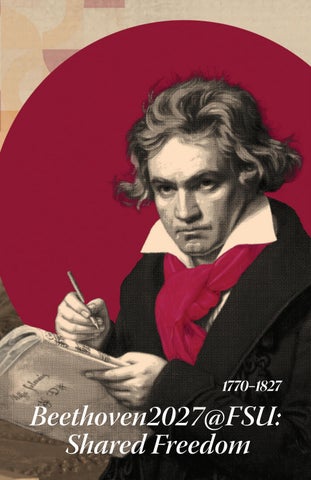
1770–1827
Beethoven2027@FSU: Shared Freedom
About Beethoven2027@FSU: Shared Freedom Beethoven2027@FSU: Shared Freedom is a year-long, seven-concert celebration of Ludwig van Beethoven’s chamber music, honoring the bicentenary of his passing. Curated by Dr. Qing Jiang, Associate Professor of Piano and Director of Keyboard Collaborative Arts, the series features FSU students, alumni, faculty, and guest artists, and centers on Beethoven’s violin sonatas, cello sonatas, variation sets, and songs, alongside our “Letters to Beethoven,” a commissioning initiative that brings new works by FSU composers into dialogue with his legacy. Together, these programs explore transformation, collaboration, humor, innovation, and artistic freedom, inviting audiences to experience Beethoven as a living creative force whose music continues to inspire new generations. Beethoven2027@FSU: Shared Freedom is sponsored by the College of Music and is presented in collaboration with the Museum of Fine Arts. All performances are free and open to the public.
Series Curator
Series Annotator
Commission Director
Dr. Qing Jiang Associate Professor of Piano Director of Keyboard Collaborative Arts
Dr. Anya Wilkening Visiting Assistant Professor of Musicology
Dr. Liliya Ugay Associate Professor of Composition Director of Polymorphia
A digital version of this program will be updated prior to each event throughout the series with notes and additional information; scan here to access the most recent version of the program.
Please click here to complete a brief survey about the program.
SCHEDULE Concert I: Aria to Variations Thursday, September 24, 6:00 p.m. | Museum of Fine Arts From opera arias to instrumental variations, this program traces Beethoven’s dialogue with Mozart and Handel, revealing how familiar melodies are transformed through imagination and invention. Concert II: Shared Virtuosity Tuesday, October 6, 7:30 p.m. | Opperman Music Hall Celebrating the equal partnership between performers, this program explores Beethoven’s re-imagining of the duo as a space for artistic conversation and shared brilliance. Concert III: Beethoven’s Musical Playground Sunday, November 15, 4:00 p.m. | Opperman Music Hall Mezzanine From comic duos to witty songs, this family-friendly program uncovers the musical humor and spontaneity at the heart of Beethoven’s creativity. Concert IV: A Countryside Lunch with Beethoven Wednesday, December 2, 12:30 p.m. | Ruby Diamond Concert Hall Lobby Inspired by nature and friendship, this brown-bag lunch concert invites listeners into Beethoven’s pastoral world. Concert V: A Life in One Evening Friday, January 22, 7:30 p.m. | Opperman Music Hall (Housewright Virtuoso Series) Through music and letters, this program follows Beethoven’s path from young virtuoso to visionary artist, offering an intimate portrait of a life shaped by creativity and resilience. Concert VI: New Instruments, New Sounds Wednesday, March 3, 7:30 p.m. | Dohnányi Recital Hall Exploring Beethoven’s fascination with evolving instruments and expressive possibilities, this program highlights his innovative spirit that continually pushed music toward new horizons. Concert VII: The Art of Fugue Wednesday, March 24, 6:00 p.m. | Beth Moor Lounge Concluding the series with works shaped by counterpoint, this program illuminates Beethoven’s lifelong pursuit of musical freedom through structure, innovation, and craft.
Concert I. Aria to Variations Thursday, September 24, 2026 6:00 p.m. | FSU Museum of Fine Arts “Se vuol ballare” from The Marriage of Figaro
Wolfgang Amadeus Mozart (1756–1791) Joe Decker, bass Bryan Fields, piano
12 Variations on “Se vuol ballare” for Violin and Piano, WoO40
Ludwig van Beethoven (1770–1827)
Jean-Luc Cataquet, violin Yiyang Mu, piano — Brief Pause — “See the conqu’ring hero comes” from Judas Maccabaeus
George Frideric Handel (1685–1759)
Lillian Grusz, soprano; Olive Poole, mezzo-soprano Suzanne Lommler, mezzo-soprano; Tony Washington, tenor Joe Decker, bass; Yiyang Mu, piano 12 Variations on ‘See the conqu’ring hero comes’, WoO 45
Ludwig van Beethoven
Evan Jones, cello Diana Dumlavwalla, piano — Brief Pause — La partenza, WoO 124
Ludwig van Beethoven Suzanne Lommler, mezzo-soprano Lillie Hodgson, piano
Violin Sonata No. 1 in D Major, Op. 12, No. 1 II. Tema con variazioni: Andante con moto Sophia Han, violin Deloise Lima, piano — Brief Pause —
Ludwig van Beethoven
“Bei Männern, welche Liebe fühlen” from The Magic Flute
Wolfgang Amadeus Mozart
Catherine Spitzer, soprano; Paul Niu, baritone Bernard McDonald, piano 7 Variations on ‘Bei Männern, welche Liebe fühlen,’ WoO 46
Ludwig van Beethoven
Mitchell George, cello Fernando Garcia, piano — Brief Pause — “Ein Mädchen oder Weibchen” from The Magic Flute
Wolfgang Amadeus Mozart Paul Niu, baritone Daniel Farias, piano
12 Variations on ‘Ein Mädchen oder Weibchen,’ Op. 66
Ludwig van Beethoven
Gregory Sauer, cello Qing Jiang, piano — Brief Pause — Beethoven2027@FSU Commission I: Letters to Beethoven – World Premiere – Fugue in E minor for Piano Four-hands
Justin Gruber
Shulin Cai and Cheng Chen, piano
Please refrain from talking, entering, or exiting while performers are playing. Food and drink are prohibited in all concert halls. Please turn off cell phones and all other electronic devices. Please refrain from putting feet on seats and seat backs. Children who become disruptive should be taken out of the performance hall so they do not disturb the musicians and other audience members.
TEXTS AND TRANSLATIONS “Se vuol ballare” from The Marriage of Figaro Se vuol ballare, signor Contino, il chitarrino le suonero. Se vuol venire nella mia scuola, la capriola le insegnerò. Saprò...ma piano: meglio ogni arcano dissimulando scoprir potrò. L’arte schermando, l’arte adoprando, di qua pungendo, di là scherzando, tutte le macchine rovescierò.
If you wish to dance, mister Count, the little guitar I’ll play for you. If you want to come to my school, the cabriole I will teach you. I will know how to...but quietly: better that I dissemble so that I can discover (your plan). (By) the art of cunning, (by) the art of employing (my cunning), here stinging, there joking, all your plots I will upset.
“See the conqu’ring hero comes” from Judas Maccabaeus See, the conqu’ring hero comes, Sound the trumpets, beat the drums; Sports prepare, the laurel bring; Songs of triumph to him sing. See the God-like youth advance, Breathe the flutes, and lead the dance; Myrtle wreaths and roses twine, To deck the hero’s brow divine.
La partenza, WoO 124 Ecco quel fiero istante! Nice, mia Nice, addio! Come vivrò, ben mio, Così lontan da te? Io vivrò sempre in pene, io non avrò più bene, Ee tu, chi sa, se mai ti soverrai di me! Here is that proud moment! Nice, my Nice, goodbye! How will I live, my dear, So far away from you? I will always live in pain, I will no longer have any joy, And you, who knows, if ever you will tire of me!
“Bei Männern, welche Liebe fühlen” from The Magic Flute PAMINA Bei Männern, welche Liebe fühlen, fehlt auch ein gutes Herze nicht.
PAMINA With men who love feel, a good heart is also not missing.
PAPAGENO Die süβen Triebe mitzfühlen, ist dann der Weiber erste Pflicht.
PAPAGENO The sweet urges to feel along with him, is then the woman’s first obligation.
BOTH Wir wollen uns der Liebe freu’n, Wir leben durch die Lieb’ allein.
BOTH We want to enjoy love; We live through love alone.
PAMINA Die Lieb’ versüβet jede Plage, Ihr opfert jede Kreatur.
PAMINA Love sweetens every pain; To it makes sacrifices every creature.
PAPAGENO Sie würzet unsre Lebenstage, sie wirkt im Kreise de Natur.
PAPAGENO It flavors our daily life, It works in the cycle of nature.
BOTH Ihr hoher Zweck zeigt deutlich an, nichts Edlers sei als Weib und Mann, reichen an die Gottheit an.
BOTH Its high purpose shows clearly, nothing more noble is as a woman and man, aspires to Godliness.
“Ein Mädchen oder Weibchen” from The Magic Flute Ein Mädchen oder Weibchen wünscht Papageno sich! O so ein sanftes Täubchen wär Seligkeit für mich! Dann schmeckte mir Trinken und Essen, dann könnt ich mit Fürsten mich messen, des Lebens als Weiser mich freu’n, und wie im Elysium sein.
A maiden or little wife wishes Papageno for himself ! Oh, such a tender little dove would be bliss for me! Then would taste wonderful to me drink an food, then could I with princes compare myself, of life as a wise man enjoy myself, and as in paradise be.
Ach kann ich denn keiner von allen den reizenden Mädchen gefallen? Helf eine mir nur aus der Not, sonst gräm ich mich wahrlich zu Tod.
Ah, can I then none among all of the charming maidens please? If only one of them could help me out of my difficulty, otherwise will I worry myself truly to death.
Wird keine mir Liebe gewähren, so muβ mich die Flamme verzehren! Doch küβt mich ein wieblicher Mund, dann bin ich schon wieder gesund!
Will none grant me love, then the flames must consume me! But should kiss me a woman’s mouth, then already I would be healthy again!
NOTES ON THE PROGRAM Throughout his life, Ludwig van Beethoven (1770-1827) was fascinated by variation form, in which a single melody is thoroughly explored through transformation. The young composer published his very first work—a set of variations for piano on a march by Chrisitan Ludwig Dressler—in 1782, when he was just twelve years old. Only four years before his death, he produced the monumental Diabelli Variations: a set of thirty-three variations on a simple waltz. Clearly, the creative and compositional challenges of this form proved engaging to Beethoven for the duration of his career. Tonight, we explore his ingenuity, performing both the model and Beethoven’s subsequent metamorphoses. The Marriage of Figaro, an opera by Wolfgang Amadeus Mozart (1756-1791), was premiered in Vienna in 1786. Based on Beaumarchais’ stage comedy of the same name, the opera offers social commentary cloaked in humor and captivating music. In “Se Vuol Ballare,” for instance, the title character considers how best to foil his employer’s plan to seduce Susanna, a fellow servant and Figaro’s fiancé. Beethoven adopts only the opening ‘A’ part of Mozart’s ternaryform aria, emulating Figaro’s staccato singing with violin pizzicato. Each subsequent iteration has its own character: an elegant, smoothly flowing first variation, for instance, gives way to an energetic second one driven by bubbling sixteenth notes. A brief journey into the parallel minor moves us further afield from the original, but the jaunty F-major tonality is soon restored. Mozart’s melody is woven throughout: listen for how Beethoven ornaments its contour while allowing it to remain recognizable. As its title suggests, “See, the Conqu’ring Hero Comes!” is a triumphant chorus by George Frideric Handel (1685-1759). In the context of the oratorio Judas Maccabaeus, the work’s homorhythmic proclamations celebrate a victory of the Jewish people, who successfully freed themselves from Greek rule as recounted in the Old Testament. Yet the chorus also resonated with the current political circumstances in England: Prince William Augustus had recently defeated the Jacobites in the Battle of Culloden, ending the uprising. Almost half a century later, Beethoven borrowed the melody for a set of theme and variations for piano and cello in honor of Friedrich Wilhelm II—a suitably flattering choice for the King of Prussia. After hearing the melody in its basic form, each successive version pushes the boundaries of Handel’s melody in different ways: look out for fragments of the original, even as the harmonic and rhythmic landscapes shift drastically. On tonight’s program, the case of “La Partenza” is unique in several ways. Written by Beethoven himself, this canzonetta sets the first stanza of a poem by Pietro Metastasio. The text laments the pain of separation as lovers are forced to part. While the melody is not expressly reused elsewhere, the second movement of the Violin Sonata No. 1 in D Major nevertheless is reminiscent of the song. Written around the same time, they share a key (A major) and have gestures in common: the second half of the opening phrase, for instance, echoes the opening vocal motive, and the two share a dotted rhythmic figure. The sonata movement itself is also
cast as a set of variations: we might thus think of this pair as yet another exhibit of Beethoven’s predilection for exploring shared musical material in new, engaging ways. The Magic Flute premiered in 1791 in Vienna, mere months before Mozart’s death, and was an immediate success. By the following year, the work was already celebrating its onehundredth performance in the city. Beethoven moved to Vienna around this same time and quickly capitalized on the opera’s fame; he produced not one, but two sets of variations on Mozart’s music. In “Bei Männern, welche Liebe fühlen,” Papageno and Pamina extol the virtues of love; throughout the opera, we witness their numerous trials as they each seek a partner. The two trade phrases, echoing one another before joining in glorious harmony. The cello and piano collaborate in similar ways in Beethoven’s set of seven variations on the theme, trading dialogue and supporting one another. In the next act, Papageno details his desire for a wife more thoroughly in “Ein Mädchen oder Weibchen.” Beethoven captures the charm of Papageno’s aria, but expands the material: across the variations, it surpasses Papageno’s characteristic comedic rusticity, and becomes newly lyrical and even, at times, poignant. – Anya Wilkening NOTE FROM THE COMPOSER “Fugue in E Minor” is a contemporary response to the musical world of Ludwig van Beethoven, drawing inspiration from his intensity, rhythmic drive, dramatic contrasts, and ability to transform compact musical ideas into extraordinary momentum. At the center of the work is the fugue, one of Western music’s oldest and most rigorous contrapuntal forms. A single musical idea is introduced, passed between voices, layered upon itself, transformed, and continually reimagined. Here, that process grows increasingly restless. As the subject races between the pianists, individual lines overlap and collide, creating the sensation of musical ideas chasing one another across the keyboard. The choice of E minor gives the work a dark, turbulent foundation, while the four-hand medium allows the piano to become something larger than a single performer. With four hands sharing one keyboard, gestures multiply, registers collide, and the distinction between individual performers begins to disappear. At its most intense, the music seems to demand more than four hands; it is almost as though the fugue itself has seized control of the instrument. Rather than quoting Beethoven directly, Fugue in E Minor channels his musical spirit: the struggle between order and instability, restraint and eruption, and the transformation of a simple idea through relentless development. The result is both homage and reimagining; it is a fugue looking backward toward Beethoven while unleashing his restless energy into the present. – Justin Gruber
ABOUT THE ARTISTS Joseph Decker (bass-baritone) has appeared in a wide range of operatic and concert performances throughout the Gulf Coast. With Pensacola Opera, he has performed as a member of the choir in Le Nozze di Figaro, Pagliacci, Die Fledermaus, Lucia di Lammermoor, Carousel, La bohème, Il barbiere di Siviglia, and Die Zauberflöte. His recent roles at FSU include Pandolfe in Massenet’s Cendrillon, Guglielmo in Mozart’s Così fan tutte, and is soon to include Slim from Carlisle Floyd’s Of Mice and Men. Most recently, he performed as Figaro in Mozart’s Le Nozze di Figaro with Opéra Bastide in Villefranche de Rouergue, France. A native of Florida, Joseph earned the Bachelor of Music in Vocal Performance from the University of West Florida, where he studied with Corey McKern. He currently attends Florida State University, pursuing a Master of Music in Vocal Performance under the instruction of David Okerlund. Hailing from Myrtle Beach, South Carolina, Bryan Fields is an avid proponent of operatic music and German lieder. He is currently pursuing a Master of Music in Opera Coaching at Florida State University. Past areas of study have included two degrees of Piano Performance at Furman University (’24) and Western Michigan University (’26) where he served as the graduate assistant for their opera program.
Jean-Luc Cataquet Santaella, a Puerto Rican violinist and teacher, began studying the violin at the age of four with Martin Goldman. He has had the honor of studying with Brandon Ironside and Francisco Caban for his undergraduate degree. He has also performed for renowned violin pedagogues and performers such as Paul Kantor, Lucie Robert, Nicholas Hatt, Gabriel Lefkowitz, and David Kim. Cataquet was the first prize winner of the XXIV Conservatorio de Música de Puerto Rico Concerto Competition. In addition to his passions for solo and orchestral repertoire, Cataquet is an avid chamber musician and has had the privilege of being coached by members of the Velox Quarett, the Ezra Duo and the Verona Quartet. He is currently pursuing a doctoral degree in Violin Performance at Florida State University College of Music and is a Graduate Assistant of Shannon Thomas. He was also recently named the Associate Concertmaster of the Panama City Symphony. Yiyang Mu is a collaborative pianist and singer from Shanghai, China. She earned a Bachelor’s degree from the Shanghai Conservatory of Music and the Master’s degree in Collaborative Piano from the Mannes School of Music, where she studied with Professor Cristina Stanescu. She is currently pursuing a Doctor of Music degree in piano at Florida State University, studying with Qing Jiang. During her time at Mannes, Yiyang served as a Mannes-approved accompanist, including for String
Department auditions. She also participated in the AIM Paris Music Festival as a professor’s assistant and collaborative pianist, performing at the renowned Salle Cortot in Paris. Lilian Grusz is a soprano pursuing a Master of Music degree in Vocal Performance at Florida State University, where she studies with Professor David Okerlund. She holds a Bachelor of Music in Voice Performance from the University of North Florida. Most recently, she performed Fiordiligi in Florida State Opera’s Così fan tutte. Upcoming engagements include the International Czech and Slovak Voice Competition in Green Bay, Wisconsin, in October 2026 and A Celebration of Florence Price with the Musicians Club of Women in Chicago in April 2027. Olive Poole is a mezzo-soprano and first-year master’s student in Vocal Performance at Florida State University. They earned their Bachelor of Music in Vocal Performance from James Madison University, where they cultivated their artistry through a variety of operatic and musical experiences. Their recent operatic roles include Mother Marie in Dialogues of the Carmelites and Idamante in Idomeneo. They have also participated in the Miami Music Festival, appearing as Susanna in The Ghosts of Versailles. At FSU, they look forward to exploring new repertoire and continuing to grow as a performer and artist. Tony Washington is a tenor who was born and raised in St. Louis, Missouri. There, he studied at the St. Louis Opera Theater Artistsin-Training Program, where he learned to sing a variety of repertoire, participated in master classes with leading professionals in the opera industry, and began to develop an understanding of the tenor voice. He then moved to Kentucky, where he studied at Murray State University and earned a Bachelor’s degree in Music Education. During his time at Murray State, he was involved in Menotti’s opera Amahl and the Night Visitors, where he performed the role of Kaspar, as well as Tebelak’s musical Godspell, in which he performed the roles of Judas and John the Baptist. In addition to these roles, Washington competed in the semifinals of the National Association of Teachers of Singing (NATS) competition in Philadelphia, where he participated in a master class with tenor Isai Muñoz of the Boston Conservatory. Catherine Spitzer is a first-year doctoral candidate in Vocal Performance at FSU. She most recently made her Carnegie Hall debut as the soprano soloist in Vivaldi’s Gloria with the New England Symphonic Ensemble and MidAmerica Productions. Catherine has also performed with Vero Beach Opera, Gulfshore Opera as a Professional Artist in Residence, First Coast Opera, Little Opera Theatre of NY (virtual), Utah Festival Opera and Musical Theatre, the Sunrise Pops Orchestra, Miami Oratorio Society, and was a Young Artist with Chicago Opera Theater. Previous
operatic and concert credits include Penelope Ann (Penelope Ann’s Revenge, world premiere), Mimì (La bohème), Rosalinda (Die Fledermaus), Königin der Nacht (Die Zauberflöte), Pamina (The Magic Flute), Handel’s Messiah, Mendelssohn’s Elijah, and Carmina Burana. Chinese baritone Paul Niu is pursuing a Doctor of Music degree in Vocal Performance at Florida State University, where he serves as a graduate assistant voice teacher. He holds bachelor’s and master’s degrees from Pensacola Christian College. His credits include Don Alfonso in Mozart’s Così fan tutte, the title role in Mendelssohn’s Elijah, and a guest solo appearance at PCC’s 50th Year Gala. He will also be performing in the upcoming production of Carlisle Floyd’s Of Mice and Men as George Milton. Paul is grateful for the opportunity to share music with others and seeks to use his gifts for the glory of God. Originally from Grand Rapids, Michigan, Mitchell George started playing the cello at the age of 8 and has played in the Tallahassee Symphony Orchestra since 2022. He earned a Bachelor’s degree in cello performance from Wheaton College, where he studied with Leonardo Altino, and earned the Master’s degree in Cello Performance from Florida State University, studying with Greg Sauer. He is currently studying to earn a doctorate in cello performance at FSU and is an active chamber musician and private cello teacher in the Tallahassee community. Fernando Garcia is a pianist from San Diego, California, pursuing a Doctor of Music degree in Piano Performance at Florida State University under Read Gainsford. He earned the Bachelor of Music degree from the Jacobs School of Music, studying with Professor Jean-Louis Haguenauer. As a soloist, Garcia has performed internationally and recently won the 4th Ponce Project International Competition, with performances in Mexico during the 2027 concert season. He champions contemporary music through ensembles including Florida State’s Polymorphia and premieres new works, including DaSean Stoke’s opera Saturday’s Sorrow. As a collaborator, he performed with NANM Scholarship Competition winner Matthew James and was invited as an honorary member. Daniel Farias is a pianist, composer, and orchestrator from Miami, Florida. He earned the B.M. degree in Piano Performance from Florida State University in 2026, where he studied piano under Heidi Louise Williams and composition under Artur Akshelyan. He is continuing his studies at FSU, pursuing an M.M. degree in Opera Coaching under Bernard McDonald. In 2025, Farias participated in the Miami Music Festival’s summer collaborative program and played with the Tallahassee Symphony Orchestra. Farias has composed, music directed
and orchestrated multiple shows with White Mouse Productions at FSU and made his OffBroadway debut with them in 2024. Cheng Chen is a first-year doctoral student in Piano Performance at the Florida State University College of Music, studying with Stijn De Cock. His interests include solo, chamber, and collaborative piano, with a special interest in the music of Chopin, Beethoven, and contemporary composers.
Shulin Cai is a pianist and graduate student at Florida State University’s College of Music, where she studies Piano Performance. Her musical interests include solo performance, collaborative piano, chamber music, and piano pedagogy.
Justin Gruber is a composer, conductor, educator, and brass musician currently pursuing a Master of Music degree in Composition from Florida State University. His music has been presented by ensembles and festivals across the United States and internationally, with recent projects spanning orchestral, chamber, vocal, and interdisciplinary work. Alongside composing, Gruber is a Research Assistant at FSU and maintains an active interest in conducting and music education. His work explores storytelling, identity, memory, and the expressive possibilities of contemporary concert music. Lillie Hodgson is a collaborative pianist from Lawton, Oklahoma. Hodgson graduated with a Bachelor of Music degree from Cameron University in 2025, and has since collaborated with local churches in Oklahoma, Lawton public schools, Cameron University, Lawton Community Theatre, and Elgin Public Schools. She recently attended La Musica Lirica in Novafeltria, Italy, where she had the opportunity to study with Mutsumi Moteki and play for the voice studios of Andrew Garland and Suzanne Mentzer. Hodgson is currently pursuing a Master of Music degree in Collaborative Piano at Florida State University. She is a student of Qing Jiang.
Professor of Cello Gregory Sauer joined the College of Music in 2006. A native of Davenport, Iowa, Gregory Sauer attended the Eastman School of Music and the New England Conservatory. His principal teachers included Ada Marie Snyder, Charles Wendt, Paul Katz, Laurence Lesser, Bonnie Hampton and Colin Carr. For eleven years prior to his arrival at FSU Sauer taught at the University of Oklahoma, where he was named Presidential Professor (2005). Praised for his versatility, Sauer performs in many different musical arenas. He has appeared in recital at the Old First Concert Series in San Francisco, the Crocker Art Museum in Sacramento, the Brightmusic Concert Series in Oklahoma City, at universities and schools of music such as the Blair School of Music at Vanderbilt, the Shepherd School at Rice University, the University of Iowa and the University of Tennessee, among many others. Sauer was a prizewinner in the Hudson Valley Philharmonic and Ima Hogg National competitions and has performed concertos with the Hudson Valley Philharmonic, the Houston Symphony, the New American Chamber Orchestra, the Quad City Symphony, Oklahoma City Philharmonic, the Columbus (GA) Symphony, the Tallahassee Symphony, and the Missoula Symphony, among others. Sauer joined the Carpe Diem String Quartet in 2019, playing concerts in Carnegie Hall’s Weill Recital Hall, Siena, Italy, and in the group’s first China tour. Along with his brother, Thomas Sauer, he serves as co-Artistic Director of Chamber Music Quad Cities in their hometown of Davenport, Iowa. Other chamber music ventures have resulted in appearances at the Austin Chamber Music Center, the Snake River Music Festival, the Victoria Bach Festival, the Texas Music Festival, the Colorado Music Festival, and the Garth Newel Music Center. As a member of the Fidelio Quartet, a prizewinning group in the London International String Quartet Competition, he performed concerts in the UK, Germany, Italy, and the Tanglewood and Aspen Music Festivals. In 2006, Sauer was appointed to the music faculty at Florida State University. Prior to that he taught eleven years at the University of Oklahoma, where he was named Presidential Professor. Other teaching/performing positions have been a visiting professorship at the University of California at Los Angeles, summer programs such as the Texas Music Festival, the Duxbury Music Festival, the Foulger International Music Festival, the Green Mountain Chamber Music Festival, Red Lodge Music Festival, and the Hot Springs Music Festival. Sauer has recorded for MSR Classics, Harmonia Mundi, Albany, and Mark Records. Sauer attended the Eastman School of Music and the New England Conservatory. His teachers included Ada Marie Snyder, Charles Wendt, Paul Katz, Laurence Lesser, Bonnie Hampton, and Colin Carr.
Bernard McDonald has worked with major opera companies in North America, Europe, and the Far East. International appearances have included engagements at the New National Theatre Tokyo, the Netherlands Opera, the Netherlands Radio Choir, the Dutch National Opera Academy in Amsterdam and The Hague, the Royal Conservatoire of Scotland in Glasgow, and productions of Carmen, La Bohème, Die Zauberflöte, and Le Nozze di Figaro for Opera Kelowna in British Columbia. Upcoming engagements include Albert Herring with Opera Orlando, the professional world première of Evan Mack’s Ghosts of Gatsby, Trouble in Tahiti, and Gallantry at Mobile Opera, and West Side Story with Indianapolis Opera. Recent engagements include Rusalka with Opera Orlando and Rigoletto, Tosca, La bohème, Suor Angelica, Gianni Schicchi, Il tabarro, Le Villi, and La Canterina with Mobile Opera. McDonald conducted the US staged première of Montemezzi’s L’incantesimo for Pittsburgh Festival Opera, where he also conducted productions of Gianni Schicchi, Le Nozze di Figaro, The Merry Widow, and The Magic Flute. McDonald has worked with major opera companies throughout North America, Europe, and the Far East. International engagements include the New National Theatre Tokyo, Netherlands Opera, Netherlands Radio Choir, Dutch National Opera Academy, and the Royal Conservatoire of Scotland, as well as productions of Carmen, La Bohème, Die Zauberflöte, and Le Nozze di Figaro with Opera Kelowna in British Columbia. Engagements in 2026–27 include Le Nozze di Figaro (Indianapolis Opera), Don Giovanni and Albert Herring (Opera Orlando), Mozart and Salieri and The Magic Flute (Mobile Opera). Recent engagements include Rigoletto, Tosca, La bohème, Suor Angelica, Gianni Schicchi, Il tabarro, Le Villi, La Canterina, Ghosts of Gatsby, Trouble in Tahiti, and Gallantry with Mobile Opera; West Side Story (associate conductor) with Indianapolis Opera; and Rusalka with Opera Orlando. He conducted the U.S. staged première of Montemezzi’s L’incantesimo for Pittsburgh Festival Opera, where he also conducted Gianni Schicchi, Le Nozze di Figaro, The Merry Widow, and The Magic Flute. After professional training at the San Francisco Opera Merola Program, he joined the music staff of the New York City Opera and later served as Head of Music and Chorus Master at Florida Grand Opera in Miami. As Chorus Master at Glyndebourne, he prepared more than twenty-five productions for conductors including Sir Simon Rattle (Idomeneo), Sir Charles Mackerras (Die Zauberflöte), and Vladimir Jurowski (Otello). Additional appearances include the Aspen Music Festival, Indianapolis Symphonic Choir, Pittsburgh Opera, Central Iowa Symphony, and Bay View Music Festival. He has worked as a vocal coach at the Manhattan School of Music, Indiana University Opera Theater, the University of Cincinnati College-Conservatory of Music (CCM), and the Royal Conservatoire of Scotland. He studied piano and collaborative piano at the Royal Conservatoire of Scotland; opera coaching and accompanying at the Guildhall School of Music and Drama and CCM; musicology at the University of Glasgow; and conducting at Indiana University.
McDonald serves as Director of Opera and the Marcus B. and Betty Graves Shelfer Professor of Musical Theatre and Opera at Florida State University. Evan A. Jones completed a B.Mus. in Cello Performance at McGill University and a M.M. and D.M.A. in Cello Performance from the Eastman School of Music, and pursued summer studies at Banff, Meadowmount, and Orford. He has given the world premieres of solo works by Clifton Callender, Robert Morris and Ciro Scotto, the North American premieres of two works by Iannis Xenakis, and the New York City premieres of works by Dexter Morrill and Christopher AuerbachBrown (in Merkin Hall and Weill Recital Hall, respectively). Jones previously served as Pamela Frame’s assistant at Eastman and as cello instructor at Colgate University; he currently serves as professor of music theory at FSU and as assistant principal cellist in the Tallahassee Symphony Orchestra. Canadian pianist Diana Dumlavwalla is Professor and Director of Piano Pedagogy at Florida State University. Previously, Dumlavwalla taught at Western University where she developed the faculty’s inaugural doctoral piano pedagogy course. She also serves as a member of the Royal Conservatory of Music’s College of Examiners and adjudicates at local, regional and state/provincial competitions. As a soloist and chamber musician, Dumlavwalla has performed in North America, Europe and Australia. She has presented lecture recitals and papers at numerous conferences and her research has been featured in journals such as the International Journal of Music Education, American Music Teacher and Canadian Music Teacher. Dumlavwalla was awarded the 2018 and 2021 MTNA E-Journal Article of the Year, the 2023 FSU Advisor of the Year Award and the 2023-2024 FSU University Teaching Award for Excellence in Community Engaged Teaching. She is currently the President of the Florida State Music Teachers Foundation Dumlavwalla completed the D.M.A. Performance degree at the University of Toronto. She received the M.Mus. (Piano Performance) from the Royal College of Music in London, B.Mus. (Piano Performance and Voice) from Wilfrid Laurier University and the Associate diploma from the Royal Conservatory. Mezzo-soprano Suzanne Lommler is consistently praised for her dramatically committed performances and solid vocal technique. As Silvia (Haydn’s L’isola Disabitata), she displayed “beautiful voice…clear projection…and a warm, focused tone that was equal to the role’s wide vocal compass.” Her performances in Chicago with Haymarket Opera have garnered great critical acclaim. The Chicago Tribune also wrote of her “dark and alluring” voice in the role of the sorceress Melissa (Handel’s Amadigi): “Lommler’s assured technique allowed her to turn on a dime from fury to pathos and back again. Her sorceress all but burned up the stage.”
She has enjoyed making debuts in other title roles, such as Carmen for Opera Kelowna (British Columbia); Xerxes for Haymarket Opera (Chicago); and Dorabella and Cherubino (among others) for the Hamburger Kammeroper (Germany). She sang Melide in Cavalli’s Ormindo for Pittsburgh Opera. Her New York City debut was as Annio in La Clemenza di Tito, conducted by Julius Rudel. Equally at home on the concert stage, she has performed in recital with twice-Grammynominated harpsichordist Jory Vinikour at Great Lakes Baroque Festival (Milwaukee); the Flying Forms Trio at Grinnell College (Iowa); and Mobile Opera’s Winter Gala (Alabama). She has been a soloist with the Lyra Baroque Orchestra (St. Paul, MN); The Grinnell Singers and Orchestra (Mozart’s Mass in C minor); Orchestra Iowa (Bach’s Mass in B minor; Bach’s St. John Passion – broadcast on Iowa Public Radio); the Central Iowa Symphony (Mahler’s Rückertlieder); the Indianapolis Symphonic Choir and Indianapolis Chamber Orchestra (Bach’s Magnificat). She also sang Carmen in the woodcut motion picture Kharmen by Jay Bolotin. Lommler has performed in recital at the Handel House Museum (London); the University of British Columbia’s Minds and Music concert series; in Hamburg’s Opernsalon series (Germany); with the Edinburgh Quartet (Scotland), Kansas City Symphony, Cincinnati May Festival, Bloomington Early Music Festival, Spoleto Festival (Italy), Cincinnati Opera, Portland Opera Repertory Theatre (Maine), Florida Grand Opera, Utah Festival Opera, Garsington Opera (England), the Glyndebourne Festival Opera, Glyndebourne on Tour, the Ravinia Festival’s Steans Institute (Highland Park/Chicago), and the Tanglewood Institute (Massachusetts). She earned the Master of Music degree in performance from the Manhattan School of Music and the Bachelor of Music degree in performance from the Cincinnati College-Conservatory of Music. In addition to performing, Lommler enjoys teaching. She was on the faculty of Grinnell College for many years but recently relocated to Tallahassee, where she teaches voice at Florida State University. She is enthusiastic about helping students find their own unique voice through a healthy singing technique. Praised by Classical Voices of North Carolina for “making the violin seem easy, almost as child’s play,” violinist Sophia Han is a versatile performer. Han has appeared as guest soloist with orchestras across the United States and performed with artists including Michael Bublé, Audra McDonald, Stephen Curtis Chapman, and toured with the rock band STARSET. Among her extensive orchestral experience, Han has served as Associate Concertmaster of the Paducah Symphony Orchestra and has appeared with the St. Louis Symphony and The Florida Orchestra. Her chamber music experience includes performances with the 314 Quartet, the St. Louis Chamber Soloists, Rio Verde Quartet, and a distinctive violin-saxophone-piano trio alongside her husband, Zach Stern, and pianist Richard Blumenthal.
Currently serving as Visiting Assistant Professor of Violin at Florida State University, Han is a dedicated educator and sought-after adjudicator. She is a proud alumna of Florida State University where she was a member of the graduate quartet in residence. Han has earned dual master’s degrees from the University of Michigan and a bachelor’s degree from the University of North Carolina at Chapel Hill. Prior to returning to FSU as faculty, Han was Associate Professor of Violin and Viola at Southeast Missouri State University, where she founded the Performing Arts Thrive Here (PATH) Entrepreneurship Residency and built lasting connections with the surrounding community through numerous performances and educational outreach. Collaborative pianist Deloise Chagas Lima is a native of Curitiba, Brazil. She joined the College of Music keyboard faculty at Florida State University in the fall of 2005. During the summer months she has been a member of the artist faculty at the Brevard Music Center since the summer of 2008, and in 2013 she implemented a new collaborative piano program at this festival. Prior to teaching in the United States, Lima was on the faculty of the School of Music and Fine Arts of Parana for over twenty years, teaching collaborative piano and chamber music. As a sought-after collaborative pianist and orchestral keyboardist, she has performed extensively throughout the US, Europe, and South America with many distinguished artists, including Frank Almond, Sydney Outlaw, David Pittsinger, Paul Edmund Davis, Ian Clarke, Steve Cohen, Bill Ludwig, Joe Luloff, Marianne Gedigian, Amy Porter, Bill Preucil, and Alex Klein, among others. She also performs regularly with her husband, oboist Eric Ohlsson. In Brazil, she was the pianist of the Minas Gerais Symphony for two seasons and was a soloist with that orchestra and the Curitiba Chamber Orchestra. She was appointed principal keyboardist of the Tallahassee Symphony Orchestra in 2015 and she is also an official accompanist for the Florida Flute Association. She is the music director for the Evening of Music and Dance, a yearly collaboration with the Tallahassee Ballet and the College of Music at Florida State University. She received the Bachelor of Piano Performance degree from the School of Music and Fine Arts of Parana, Brazil, a Performance Certificate in piano from Trinity College of Music, London, and is an Associate of the Royal College of Music in organ performance. Following her early studies, Lima received the Master of Music in Piano Performance and Literature from University of Notre Dame du Lac and the Doctor of Musical Arts degree from Florida State University. Anya B. Wilkening is Visiting Assistant Professor of Musicology at the College of Music at Florida State University. She received the PhD in Historical Musicology from Columbia University in 2024. Her research focuses on new analytic approaches to musical borrowing in medieval vernacular song, exploring not only what this technique can tell us about the process of composition, but also what it reveals about social, intellectual, and cultural connections across Europe and
the Mediterranean. Her work has been supported by the Belgian American Educational Foundation and the Institut de recherche en musicologie (IReMus), where she is a member of the Musical Patrimony research team. She has presented her work at the annual meeting of the International Congress of Medieval Studies (Kalamazoo 2024), the American Musicological Society (Chicago 2024), and the Medieval and Renaissance Music Conference (Durham/ Newcastle-upon-Tyne 2025), among other conferences. A deeply committed pedagogue, Wilkening has taught both undergraduate and graduate courses and ensembles. In 2022, she earned the Core Preceptor Award for Teaching Excellence in Music Humanities at Columbia University. She also held several fellowships through the Center for Teaching and Learning during her time at Columbia University, and was appointed Senior Lead Teaching Fellow in 2023-2024. Wilkening is also an active violinist, and holds the Master’s and Bachelor’s degrees in Music from the Shepherd School of Music, where she studied with Paul Kantor. She has performed widely across the United States and Europe, from New York’s Carnegie Hall to the Musikverein in Vienna. An avid chamber musician, Wilkening has studied and performed at the Aspen Music Festival and School (2018), the Robert Mann String Quartet Seminar (2017 & 2018), and Strings Music Festival (2017). She also served as a Da Camera Young Artist, performing and teaching throughout Houston as both a soloist and chamber musician. Anya performs on a 1761 Florentine violin made by Lorenzo and Tomaso Carcassi. Praised for “spirited” (Boston Globe) playing and “vigorous and passionate” (New York Times) performances, Chinese-born pianist Qing Jiang enjoys a diverse career in solo, chamber, and contemporary music. As a concerto soloist, Jiang has appeared with the Britten-Pears Orchestra under maestro Oliver Knussen, and the Lanzhou Symphony under revered Chinese conductor Zushan Bian, as well as with the Chattanooga Symphony, Williamsport Symphony Orchestra, Aspen Music Festival Orchestra, and Arizona State University Orchestra. Passionate about chamber music, Jiang has performed with many leading artists, including Itzhak Perlman, Joel Krosnick, Joel Smirnoff, David Shifrin, Natalie Clein, and the Juilliard, Shanghai, Jasper, and Parker string quartets. She has held longstanding collaborations with cellist Michael Kannen, and violinist Ying Xue with whom she has performed at Yellow Barn and in Carnegie Hall at the invitation of celebrated violinist Christian Tetzlaff. Jiang has also performed extensively with Roger Tapping, Natasha Brofsky, and Laurie Smukler, including a multi-city China tour. Jiang is artist faculty at the Kneisel Hall Festival in Maine, as well as recurring faculty at Yellow Barn, Yellow Barn’s Young Artist Program, and the Interlochen Chamber Music Camp. Other festival appearances include Ravinia, Music@Menlo, Aldeburgh, Perlman Music Program, and the Garth Newel Music Center. Curious and invigorated by collaboration, Jiang has appeared with fortepianists and Jazz improvisers, as well as with noted singers Susan Narucki, Ariadne Greif, and Lucy Fitz Gibbon. She has also worked with composers
Jennifer Higdon, Jörg Widmann, Brett Dean, and Colin Matthews, and commissioned works by Zhou Tian, Juri Seo, Eric Nathan, and Daniel Temkin. A recipient of the Jack Kent Cooke Award, Jiang trained at Arizona State University, Juilliard, and New England Conservatory, under Caio Pagano, Robert McDonald, Wha-kyung Byun and Patricia Zander. She has previously taught at New England Conservatory, the Curtis Institute, and Bucknell University. Jiang currently serves as the Associate Professor of Piano and Director of Keyboard Collaborative Arts at Florida State University.
Concert II. Shared Virtuosity Tuesday, October 6, 2026 7:30 p.m. | Opperman Music Hall Cello Sonata No. 1 in F major, Op. 5, No. 1 I. Adagio sostenuto – Allegro II. Rondo. Allegro vivace
Ludwig van Beethoven
Turner Sperry, cello Ha Eun Hyun, piano Beethoven2027@FSU Commission II: Letters to Beethoven – World Premiere – Chartreuse Fantasy for Viola and Piano
Jacob Grice
Jeremy Hill, viola Seunghye Park, piano 4 Arietten und ein Duett, Op. 82 I. Hoffnung IV. L’amante impaziente
Ludwig van Beethoven
Neue Liebe, Neues Leben, Op. 75, No. 2 Sarah Wells, soprano Martin Katz, piano INTERMISSION Adelaide, Op. 46
Marcía Porter, soprano Qing Jiang, piano
Violin Sonata No. 9 in A major, Op. 47 “Kreutzer” I. Adagio sostenuto – Presto II. Andante con variazioni III. Presto Shannon Thomas, violin Anna Dmytrenko, piano
TEXTS AND TRANSLATIONS “Hoffnung” Dimmi, ben mio, che m’ami, dimmi che mia tu sei e non invidio ai Dei la lor’ divinità! Con un tuo sguardo solo, cara, con un soriso tu m’apri il paradiso di mia felicità!
Tell me, my dear, that you love me, tell me that you are mine And I won’t envy the Gods their divinity! With just one look of yours, dear, with a smile You open for me the paradise of my happiness!
“L’amante impaziente” Che fa, il mio bene? Perchè, perchè non viene? What is he doing, my dear? Why, why doesn’t he come? Vdermi vuole languir così! He wants to see me languish like this! Oh come è lento nel corso il sole! Oh, how slowly the sun moves in its course! Ogni momento mi sembra un dì! Every moment feels like a day to me! “Neue Liebe, Neues Leben” Herz, mein Herz, was soll das geben? Was bedränget dich so sehr? Welch ein fremdes, neues Leben! Ich erkenne dich nicht mehr. Weg ist alles, was du liebtest, Weg, warum du dich betrübtest, Weg dein Fleiß und deine Ruh – Ach, wie kamst du nur dazu!
Heart, my heart, what can this mean? What is it that besets you so? What a strange and new existence! I do not know you anymore. Gone is all you used to love, Gone is all that used to grieve you, Gone your work and peace of mind – Ah, how can this have come about!
Fesselt dich die Jugendblüte, Diese liebliche Gestalt, Dieser Blick voll Treu und Güte Mit unendlicher Gewalt? Will ich rasch mich ihr entziehen, Mich ermannen, ihr entfliehen, Führet mich im Augenblick, Ach, mein Weg zu ihr zurück.
Does the bloom of youth ensnare you, This dear figure full of charm, These eyes so kind and faithful With inexorable power? When I try to hasten from her, Control myself, escape her, In a moment I am led, Ah, back to her again.
Und an diesem Zauberfädchen, Das sich nicht zerreissen läßt, Hält das liebe, lose Mädchen Mich so wider Willen fest; Muß in ihrem Zauberkreise Leben nun auf ihre Weise. Die Verändrung, ach wie groß! Liebe, Liebe, laß mich los!
And by this magic little thread That cannot be severed, The sweet and playful girl Holds me fast against my will; In her enchanted realm I must now live as she dictates. Ah, what a monstrous change! Love! Love! Let me free!
“Adelaide” Einsam wandelt dein Freund im Frühlingsgarten, Your friend wanders alone in the spring garden, Mild vom lieblichen Zauberlicht umflossen, Gently bathed in the magical sweet light Das durch wankende Blütenzweige zittert, That shimmers through trembling boughs in bloom, Adelaide! Adelaide! In der spiegelnden Flut, im Schnee der Alpen, In des sinkenden Tages Goldgewölken, Im Gefilde der Sterne strahlt dein Bildnis, Adelaide!
In the mirroring waves, in the Alpine snows, In the golden clouds of the dying day, In the fields of stars your image shines, Adelaide!
Abendlüfte im zarten Laube flüstern, Silberglöckchen des Mais im Grase säuseln, Wellen rauschen und Nachtigallen flöten: Adelaide!
Evening breezes whisper in the tender leaves, The silvery bells of May rustle in the grass, Waves murmur and nightingales sing: Adelaide!
Einst, o Wunder! entblüht auf meinem Grabe One day, O miracle! there shall bloom on my grave Eine Blume der Asche meines Herzens; A flower from the ashes of my heart; Deutlich schimmert auf jedem Purpurblättchen: On every purple leaf shall clearly shimmer: Adelaide! Adelaide!
NOTES ON THE PROGRAM Throughout much of the seventeenth and early eighteenth centuries, the relationship between instruments in duo sonatas maintained a firm boundary: one instrument carried the melody while the other provided harmonic support or commentary. Though Wolfgang Amadeus Mozart (1756–1791) began to break this mold by creating genuine dialogue between two instruments, Ludwig van Beethoven (1770–1827) was responsible for pushing this partnership into one of equal virtuosity. In his chamber music and art songs, performers increasingly engage one another as artistic peers: exchanging ideas, challenging one another, and contributing their distinctive voices to craft a shared phrase. The resulting music relies on give-and-take, trading rigid hierarchy for true conversation. Tonight’s program explores this idea of shared virtuosity. From the groundbreaking F-major cello sonata to the monumental “Kreutzer” Sonata, the works featured this evening offer a glimpse of Beethoven’s continual expansion of what two musicians can accomplish together. Paired with a newly commissioned work that engages with Beethoven’s legacy, these compositions reveal a composer fascinated by what can happen when performers participate as equals.
Beethoven composed the Cello Sonata No. 1 in F major, Op. 5, No. 1 in 1796 during a visit to Berlin. The work was dedicated to King Friedrich Wilhelm II of Prussia, who was an enthusiastic amateur cellist, and premiered at the royal palace with Beethoven on the piano. Perhaps in honor of its illustrious dedicatee, Beethoven gave the cello a far more prominent role than that of the basso continuo—the supportive harmonic foundation often previously provided by instruments such as the cello. Instead, both performers are offered substantial melodic material to develop and share. The opening movement begins with an unusually slow introduction before launching into an Allegro in which piano and cello trade themes, seemingly competing to outdo one another. The Rondo finale, full of wit and energy, continues this spirited interplay. Beethoven’s vocal music is often overshadowed by his symphonies and sonatas. However, he also composed significant works for the voice, including one opera, two settings of the Mass Ordinary, and many art songs. In this latter genre, he was among the first to give the piano an active role. In Beethoven’s hands, the keyboard does not merely accompany; it creates the atmosphere, drives the pacing, and illustrates the text, turning each song into a miniature chamber work. The vocal selections presented tonight showcase this partnership. In “Hoffnung” (Hope), the harmonic transitions created by the piano balance uncertainty with optimism, offering a particular interpretation of the simple poem, while its ebullient interjections in “L’amante impaziente” (The Impatient Lover) capture the breathless impatience suggested by its title. In “Neue Liebe, neues Leben” (New Love, New Life), meanwhile, the piano’s restless gestures mirror the internal chaos of Goethe’s speaker. Swept up in the unexpected love depicted in the text, the keyboard is a wordless but equal participant in the drama. Described by Beethoven as a “cantata,” the stand-alone song “Adelaide” utilizes many of these same techniques. The piano sets the scene for Friedrich von Matthisson’s solitary lover, who wanders through nature while consumed by thoughts of his beloved. Lilting triplets capture the bucolic setting and contemplative nature of the poem, enhanced by fleeting gestures evoking the rushing waves described in the third stanza. Once again, Beethoven offers a clear musical reading of the poem: harmonic modulations between stanzas seem to evoke the lover’s unfulfilled desire. The final stanza, in which the narrator considers his eventual demise, is accompanied by a substantial character and tempo shift. In Beethoven’s hands, death is rapturous, rather than tragic—only in his grave, it seems, is the narrator truly united with his beloved. Completed in 1803, the Violin Sonata No. 9 in A major, Op. 47, shows the spirit of equal partnership at its most ambitious. Now known as the “Kreutzer” Sonata, the work also bears a rather unique subtitle, in which Beethoven signals that both instruments were expected to command the stage: scritta in uno stilo molto concertante, quasi come d’un concerto (“written in a very concertante style, quasi-concerto-like”). Like the F-major cello sonata, it too begins with a slow, tense introduction before exploding into a fiery Presto that demands equal brilliance from both violinist and pianist. The second movement is a set of variations, a form that fascinated Beethoven throughout his career and provides an ideal vehicle for
violin and piano to explore different kinds of musical dialogues. The finale is in the style of a tarantella—a frenzied Italian dance that, apocryphally, was intended to act as a cure for a poisonous spider bite. Here, the action urges each instrument forward, pushing both performers to their technical limits. – Qing Jiang & Anya Wilkening
ABOUT THE ARTISTS Jacob Grice is a composer and violist based in Tallahassee, FL. He is currently studying for a DMA in music composition and theory at Florida State University under Eren Gümrükçüoğlu. He also received a Bachelor’s degree in Viola Performance at Oklahoma State University, where he studied viola under Jacqueline Skara and composition under Igor Karaça. Jacob enjoys all things new music, teaching lessons, and playing viola in ensembles such as the Polymorphia New Music Ensemble and the Tallahassee Symphony Orchestra. His music has received several premieres by ensembles such as the Tallahassee Ballet Company, Oklahoma State Symphony Orchestra, and the New York Live Arts ballet company. He also frequently collaborates with music and dance students at FSU, where his music can be heard in students’ performances. Jeremy Hill, currently pursuing a doctoral degree in Viola Performance at Florida State University, began his viola studies in the Music school of Caguas, Puerto Rico. Studying under Francisco Figueroa, the former assistant principal violist of the Puerto Rico Symphony Orchestra, Hill started at 8 years old on the violin, with the expectation of switching to viola. Upon graduating high school, He continued his studies in The Conservatory of Music of Puerto Rico, where he learned from the Principal Violist of PRSO, Emanuel Olivieri. He is currently a graduate assistant at FSU and forms part of the Tallahassee Symphony Orchestra, Panama City Symphony, and Northwest Florida Symphony Orchestra. Korean pianist Ha Eun Hyun is pursuing a Doctor of Music in Piano Performance at Florida State University, where she studies with David Kalhous. Her deep interest in chamber music has also led her to concurrently pursue studies in collaborative piano with Qing Jiang through the Master of Arts program. Previously, she earned both a Master of Music and a Performer Diploma in Piano Performance from the Indiana University Jacobs School of Music under the tutelage of Emile Naoumoff. During her time at Jacobs, she served as an Associate Instructor, gaining valuable experience in both performance and teaching. These experiences continue to shape her approach to music, which values sincerity, depth, and meaningful connection through performance.
Seunghye Park has performed at renowned concert halls including the Wigmore Hall and St John’s Smith Square, as well as at the 2018 PyeongChang Winter Olympics. She is a First Prize winner of the Osaka International Music Competition and has released albums with Sony Music Korea, including her classical albums The Virtuoso and Dolente. She studied at the Royal Academy of Music and Seoul National University with scholarship support. She is currently pursuing a Doctor of Music in Piano Performance at Florida State University as a recipient of the Legacy Fellowship and Lucilla Gumm & Wiley Housewright Memorial Fund Scholarship. Turner Sperry is a first-year doctoral student at Florida State University studying cello performance under Greg Sauer. Originally from Iowa, Sperry received an undergraduate degree from the University of Northern Iowa before pursuing a masters degree at FSU. Sperry is active in the community; playing with several regional symphony orchestras, teaching local cello students, and playing for community outreach events are just some of the activities he enjoys doing. Sarah Wells is an operatic soprano from Jacksonville, North Carolina, now based in Tallahassee, Florida. She is pursuing a DM in Vocal Performance at Florida State University, where she also earned the Master of Music degree; she holds a Bachelor’s in Music Education from UNC Wilmington. Her roles include La Contessa (Le nozze di Figaro) and Anne Sexton (Transformations). In 2025, she debuted professionally as Zerlina (Don Giovanni) with Opera Wilmington and recently appeared as Gertrude in Peach State Opera’s Hansel and Gretel. A competition finalist and award recipient, Wells continues to cultivate a dynamic operatic career. Hailed as “a fine combination of keyboard mastery and elegant refinement,” Ukrainian-American pianist Anna Dmytrenko has distinguished herself as a versatile artist on the international stage. Over the course of her career, she has performed in some of the world’s most renowned venues, including Carnegie Hall, Lincoln Center, Kimmel Center, Popejoy Hall, Temple Emanu-El, Auditorium Gaber, Paris Philharmonie, Salle Cortot, Smetana Hall, Teatro Sociale di Como, Theatro Municipal de São Paulo, and the Amman Royal Cultural Center. Dmytrenko’s artistry has been recognized with prizes at numerous international competitions. She won top prizes at the Cantu International Piano Competition, Manhattan International Music Competition, New York International Piano Competition, and Ricard Viñes International Piano Competition. At the inaugural Olga Kern International Piano Competition, she received Second Prize, along with the Audience Choice and Best Contemporary Piece awards, performing Prokofiev’s Piano Concerto No. 2 in the final round with the New Mexico Philharmonic under Vladimir Kern.
Concerto highlights include appearances with the Orchestre de Chambre de Paris, conducting Beethoven’s Piano Concerto No. 3 from the keyboard, as well as with the Orquestra Sinfônica Municipal de São Paulo, KwaZulu-Natal Philharmonic, Prague Summer Nights Festival Orchestra, Amman Chamber Orchestra, Orquestra Simfònica del Vallès, and the Bacău Philharmonic Orchestra. Festival appearances include the Verbier Festival, Festival de Piano Rafael Orzo de Córdoba, International Keyboard Institute and Festival in New York, and St. Martin-in-the-Fields in London. Her debut album, Anna Dmytrenko: Live in Recital, features works by Medtner, Rachmaninoff, and Barber. Deeply connected to her Ukrainian roots, Dmytrenko has performed fundraising concerts in support of Ukraine, including solo and concerto appearances organized by Classical Movements. She is committed to championing the works of Ukrainian composers, such as Bortkiewicz, Kosenko, Silvestrov, and Skoryk. Her dedication reflects a broader artistic vision: using music not only as a vehicle for personal expression, but also as a means of celebrating cultural heritage and fostering community through the arts. Dmytrenko earned the Doctor of Musical Arts degree at the Manhattan School of Music under the tutelage of Olga Kern, where she was honored with the Helen Cohn Award, presented to an exceptional doctoral graduate. She began her musical studies in Mariupol, Ukraine, continued in Delaware with Jeanne Pascal and David Brown, and then entered the Juilliard School Pre-College Division to study with Oxana Yablonskaya. She holds a Bachelor’s degree with Regents Award from the Royal Academy of Music in London, studying with Christopher Elton, and earned two Master’s degrees in Solo and Chamber Music from the Universität der Künste in Berlin with Pascal Devoyon. In addition to her musical training, she completed Harvard Business School’s Credential of Readiness (CORe) program with honors, reflecting her interest in exploring the intersections of music, leadership, and professional development. Equally dedicated to scholarship and pedagogy, Dmytrenko taught piano classes for undergraduate and graduate students at the Manhattan School of Music during her doctoral studies, guiding students in developing essential keyboard skills and musical understanding. Her dissertation, “Prokofiev Piano Concerto No. 2: An In-Depth Look from the Pianist’s Bench,” focuses on a work that has been central to her performing career, providing practical guidance on both its historical context and practicing techniques from the perspective of the performing pianist. Deeply passionate about teaching, her philosophy centers on tailoring her approach to the unique strengths, goals, and needs of each student. With a career that bridges international performance, research, and education, she is committed to inspiring the next generation of musicians while bringing audiences powerful and transformative concert experiences.
Martin Katz has been dubbed “the gold standard of accompanists” by The New York Times. His 45-year career has taken him to 5 continents, collaborating with the world’s most celebrated singers in recital and recording. Marilyn Horne, Frederica von Stade, Kathleen Battle, David Daniels, Karita Mattila, and Jose Carreras are among his regular partners, and he has recorded for RCA, CBS, BMG, EMI and Decca labels. Katz is also active as a conductor and editor. He has led opera productions for San Francisco’s Merola program, the BBC, Tokyo’s NHK, as well as innumerable performances in Ann Arbor. His editions of baroque and bel canto operas have been performed in Houston, Ottawa, and at the Metropolitan Opera. At U-M for more than 3 decades, he has chaired the program in collaborative piano and coached vocal repertoire for singers and pianists alike. His students are working all over the world. Now an author too, Katz’s first opus, The Complete Collaborator, has been published by Oxford University Press. Award-winning soprano Marcía Porter made her New York solo recital debut in Weill Recital Hall at Carnegie Hall in 2005. An active recitalist, the soprano has performed in numerous venues throughout the United States, Italy, Brazil, and the Czech Republic. Porter has sung at such prestigious international festivals as the Prague Proms, Piccolo Spoleto Festival, the Ravinia Festival, and the Ameropa International Chamber Music Festival. She has performed with such national and international organizations as the Czech National Symphony Orchestra, the San Antonio Symphony Orchestra, Beijing International Symphony Orchestra (Beijing, China) and the Camerata Filarmonica Bohemia (Prague, Czech Republic). Porter has also performed with the Lyric Opera of Chicago, Opera Theatre of St. Louis, Chautauqua Opera, Dayton Opera, and Chicago Opera Theatre. Porter’s discography includes the 2011 world premier recording of Requiem für Mozart, works for soprano and orchestra by Antonio Rosetti, which was released by the German record label Ars Produktion, and the 2013 recording, Open Thine Heart, a recording of contemporary American vocal works, which was released by Albany Records. A Fulbright Scholar and Rotary International Cultural Ambassadorial Scholar, Porter has won several other awards and honors including the 2004 National Association of Teachers of Singing (NATS) Artist Award Competition, the NATS Intern program, finalist in the Metropolitan Opera Central Regional Competition, Jessye Norman Graduate Fellowship in Voice, Opera Carolina Young Artist Recital Program Award, and the Farwell Award. In 2011-2012 Porter was a Fulbright Scholar to Brazil. Her research was entitled “Bridging boundaries through musical collaboration and cultural exchange: a lecture and recital series of contemporary classical Brazilian and African American vocal literature.” During her residency at the Universidade de São Paulo, she presented numerous recitals, lectures and masterclasses in cities throughout Brazil including São Paulo, Campinas, Alphaville, Ribeirão Preto and Brasilia.
Porter is a Professor of Voice at the Florida State University College of Music. She is a much sought after clinician and has presented masterclasses throughout the mid-western and southeastern US. She has served on the faculty of Ameropa International Chamber Music Festival in Prague, Czech Republic and as a visiting Professor of Voice at Universidade de São Paulo. Porter, a graduate of the New Orleans Center for the Creative Arts, received Bachelor’s and Master’s degrees in voice performance from Northwestern University and earned the Doctor of Musical Arts degree in performance from The University of Michigan, where she studied with world-renowned Metropolitan Opera singer Shirley Verrett. Previous teachers include Margaret Harshaw, Carmen Mehta, and Kathleen Kaun. Violinist Shannon Thomas is an acclaimed performer and educator known for her compelling artistry and passion for nurturing young musicians. A 2025 Fulbright Scholars finalist, she currently serves as Professor of Violin at Florida State University and directs the Gabriel Del Orbe Violin Program in the Dominican Republic. Praised for her “expressive, dynamic playing,” Thomas has appeared throughout North and South America, Europe, and Asia with recent performances including appearances at the Kennedy Center, Garth Newell, Steinmetz Hall, Bolivia’s Centro Sinfónico, and the Banff Centre. She is a member of the Rothko Trio and regularly performs with ProMusica Chamber Orchestra and IRIS Collective. She has recorded for Blue Griffin Records, celebrating music of Lera Auerbach, Ellen Zwilich, and Jennifer Higdon; an upcoming recording with the Rothko Trio will feature works by Pulitzer Prize-winner Kevin Puts, Libby Larsen, Joan Tower, and Latin Grammy nominee Miguel del Águila. Committed to a holistic, student-centered philosophy, Thomas mentors young musicians with a focus on artistic growth and personal development. In the summers, she teaches at Green Mountain Chamber Music Festival and Hilton Head Chamber Music Institute. Her students have been recognized as prizewinners and finalists in national competitions such as MTNA and Sphinx, and are frequently admitted to top music programs across the country. Shannon has presented educational sessions and masterclasses at the National ASTA conference, Florida Music Educators Association annual conference, and the University of North Carolina at Chapel Hill’s Luby Violin Symposium. In addition, she has served as an adjudicator and clinician for the Seattle Young Artists Music Festival Association, the Music Teachers National Association, and regional All-State orchestral auditions. Invested in expanding access to music through education, Thomas is co-founder of MusicBridges Tallahassee, a nonprofit empowering youth through music and diversity. Her previous teaching appointments include the Kinhaven Music School, University of Southern Mississippi, Interlochen Arts Camp, and Innsbrook Summer Music Academy, where she also served as Education Director.
Thomas earned a Doctorate of Musical Arts at the Cleveland Institute of Music, where she was Paul Kantor’s teaching assistant; she also holds degrees from Yale and Vanderbilt Universities. She also pursued graduate work at Arizona State University, where she was the first student to be accepted into the Artist Diploma program. She studied chamber music with Peter Salaff, Merry Peckham, George Sopkin, Christopher von Baeyer, Laurie Smukler, and members of the Juilliard, Blair, Toyko, St. Lawrence, and Cavani String Quartets. Her principal teachers have included Paul Kantor, Cornelia Heard, Jonathan Swartz, Robert Lipsett, and Ani Kavafian. Praised for “spirited” (Boston Globe) playing and “vigorous and passionate” (New York Times) performances, Chinese-born pianist Qing Jiang enjoys a diverse career in solo, chamber, and contemporary music. As a concerto soloist, Jiang has appeared with the Britten-Pears Orchestra under maestro Oliver Knussen, and the Lanzhou Symphony under revered Chinese conductor Zushan Bian, as well as with the Chattanooga Symphony, Williamsport Symphony Orchestra, Aspen Music Festival Orchestra, and Arizona State University Orchestra. Passionate about chamber music, Jiang has performed with many leading artists, including Itzhak Perlman, Joel Krosnick, Joel Smirnoff, David Shifrin, Natalie Clein, and the Juilliard, Shanghai, Jasper, and Parker string quartets. She has held longstanding collaborations with cellist Michael Kannen, and violinist Ying Xue with whom she has performed at Yellow Barn and in Carnegie Hall at the invitation of celebrated violinist Christian Tetzlaff. Jiang has also performed extensively with Roger Tapping, Natasha Brofsky, and Laurie Smukler, including a multi-city China tour. Jiang is artist faculty at the Kneisel Hall Festival in Maine, as well as recurring faculty at Yellow Barn, Yellow Barn’s Young Artist Program, and the Interlochen Chamber Music Camp. Other festival appearances include Ravinia, Music@Menlo, Aldeburgh, Perlman Music Program, and the Garth Newel Music Center. Curious and invigorated by collaboration, Jiang has appeared with fortepianists and Jazz improvisers, as well as with noted singers Susan Narucki, Ariadne Greif, and Lucy Fitz Gibbon. She has also worked with composers Jennifer Higdon, Jörg Widmann, Brett Dean, and Colin Matthews, and commissioned works by Zhou Tian, Juri Seo, Eric Nathan, and Daniel Temkin. A recipient of the Jack Kent Cooke Award, Jiang trained at Arizona State University, Juilliard, and New England Conservatory, under Caio Pagano, Robert McDonald, Wha-kyung Byun and Patricia Zander. She has previously taught at New England Conservatory, the Curtis Institute, and Bucknell University. Jiang currently serves as the Associate Professor of Piano and Director of Keyboard Collaborative Arts at Florida State University.
Concert III. Beethoven’s Musical Playground Sunday, November 15, 2026 4:00 p.m. | Opperman Music Hall Mezzanine Violin Sonata No. 2 in A major, Op. 12, No. 2 I. Allegro vivace
Ludwig van Beethoven
Ajay Balkaran, violin Dylan Rhodes, piano Duet mit zwei obligaten Augengläsern, WoO 32 Benjamin Leonardo Suarez Pernia, viola Connor Peterson, cello Violin Sonata No. 8 in G major, Op. 30, No. 3 I. Allegro assai Christina Leah, violin Juan Baquero, piano Beethoven2027@FSU Commission III: Letters to Beethoven – World Premiere – Reverence
Emelia Ulrich Elizabeth Milan, violin Lillie Hodgson, piano
Aus Goethes Faust, Op. 75, No. 3 Der Kuss, Op. 128 Troy Sleeman, baritone Augusto Fioreli Barbieri, piano Cello Sonata No. 3 in A major, Op. 69 II. Scherzo. Allegro molto Natalie Taunton, cello Jiwon Kim, piano
Concert IV. A Countryside Lunch with Beethoven Wednesday, December 2, 2026 12:30 p.m. | Ruby Diamond Concert Hall Lobby Beethoven2027@FSU Commission IV: Letters to Beethoven – World Premiere – Untitled
Yida Wang
Violin Sonata No. 5 in F major, Op. 24 I. Allegro II. Adagio molto espressivo III. Scherzo – Allegro molto IV. Rondo – Allegro ma non troppo Ioana Popescu, violin Erick Santiago-Jimenez, piano Horn Sonata in F major, Op. 17 I. Allegro moderato II. Poco Adagio, quasi andante III. Rondo – Allegro moderato Wyatt Gibson, natural horn Yicheng Wang, piano Mailied, Op. 52, No. 4 Der Wachtelschlag, WoO 129 Justin Eifert, tenor Yiyang Mu, piano Cello Sonata No. 4 in C major, Op. 102, No. 1 I. Andante – Allegro vivace II. Adagio – Tempo d’andante – Allegro vivace Thu Vo, cello Lujie Wang, Piano
Ludwig van Beethoven
Concert V. Beethoven: A Life in One Evening Friday, January 22, 2027 7:30 p.m. | Opperman Music Hall Housewright Virtuoso Series Beethoven2027@FSU Commission V: Letters to Beethoven – World Premiere – Untitled
Eren Gümrükçüoğlu
Duo for Two Flutes in G Major, WoO26 I. Allegro con brio II. Minuet quasi Allegretto
Ludwig van Beethoven
Karen Large and Mary Matthews, flute Cello Sonata No. 2 in G minor, Op. 5, No. 2 I. Adagio sostenuto ed espressivo – Allegro molto più tosto presto Gregory Sauer, cello Qing Jiang, piano Heiligenstadt Testament (1802) Violin Sonata No. 7 in C minor, Op. 30, No. 2 I. Allegro con brio Ben Sung, violin David Kalhous, piano “Immortal Beloved” letter (1812) An die ferne Geliebte, Op. 98 Eric Rieger, tenor Natalie Sherer, piano String Quartet in B-flat major, Op. 130 IV. Allegro Shannon Thomas and Ben Sung, violin Pamela Ryan, viola, Gregory Sauer, cello
Concert VI. New Instruments, New Sounds Wednesday, March 3, 2027 7:30 p.m. | Dohnányi Recital Hall Beethoven2027@FSU Commission VI: Letters to Beethoven – World Premiere – Beethoven Sketches
Clifton Callender
Cello Sonata No. 2 in G minor, Op. 5, No. 2 II. Rondo. Allegro George Speed, bass Galen Dean Peiskee, Jr., fortepiano Violin Sonata No. 6 in A Major, Op. 30, No. 1 I. Allegro II. Adagio molto espressivo III. Allegretto con variazioni Anya Wilkening, violin Michael Bukhman, piano Wonne der Wehmut, Op. 83, No. 1 An die Hoffnung, Op. 32 David Griffith, baritone Emma Anderson, fortepiano Violin Sonata No. 10 in G major, Op. 96 I. Allegro moderato II. Adagio espressivo III. Scherzo: Allegro – Trio IV. Poco allegretto Special Guest, violin Read Gainsford, piano
Ludwig van Beethoven
Concert VII. The Art of Fugue Wednesday, March 24, 2027 6:00 p.m. | Beth Moor Lounge Beethoven2027@FSU Commission VI: Letters to Beethoven – World Premiere – Untitled
Liliya Ugay
Violin Sonata No. 3 in E-flat major, Op. 12, No. 3 I. Allegro con spirito II. Adagio con molta espressione III. Rondo: Allegro molto Masayoshi Arakawa, violin Christopher Tavernier, piano Violin Sonata No. 4 in A minor, Op. 23 I. Presto II. Andante scherzoso, più allegretto III. Allegro molto Rachel Lawton, violin Santiago Martinez Sverko, piano Busslied, Op. 48, No. 6 An die Hoffnung, Op. 94 André Chiang, baritone Katie Barr, piano Cello Sonata No. 5 in D Major, Op. 102, No. 2 I. Allegro con brio II. Adagio con molto sentimento d’affetto – Attacca III. Allegro – Allegro fugato James Kim, cello Qing Jiang, piano
Ludwig van Beethoven