NOTES ON THE PROGRAM Seok: Sonata for Alto Saxophone and Piano This sonata explores the traditional sonata form with extended harmonic language and some inspiration from jazz.
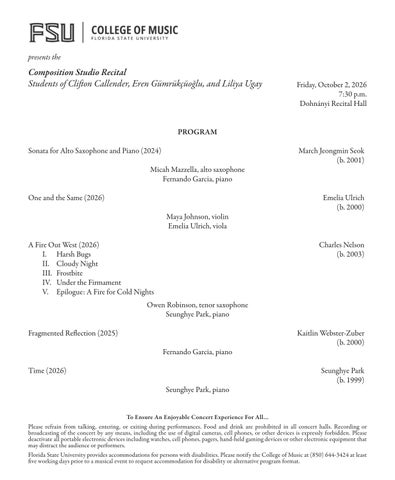
presents the
Ulrich: One and the Same
Composition Studio Recital Students of Clifton Callender, Eren Gümrükçüoğlu, and Liliya Ugay
I wrote this work for my friends Francesca Puro and Georgiy Khokhlov who commissioned me to write them a duo for violin and cello. When Francesca first approached me about the piece, I had no idea what I would come up with or when I would be able to write it, but I knew I wanted to compose a work for them. What resulted was really inspired by the idea of partnership. This was my first time writing music for a couple and I thought a lot about what this meant for the closeness of a chamber duo. The title of this piece is a distillation of the idea of being so interwoven and in sync that you almost fuse. I wanted to capture the idea of two people singing the same song, maybe a lullaby, and both of them gradually introducing new threads of ideas and familiar songs and reacting to what their partner adds. The feeling I hope this piece encapsulates is how the stability of trust in partnerships—in life and in music—can free us to be silly and joyful together. Nelson: A Fire Out West Out west in the desert the nearly dead see unobstructed. The bugs flock to decay in the beating heat. As if answering prayers, the clouds shroud the stars, and the nearly dead drift into freeze. No heart left for prayer, the clouds divide. Stars strike just the eyes. A short moment later they seem to leave the sky, but there is not death yet. Now the body warms. First the fingers, then the hands, then the arms, then the chest. Then the whole turns to sit beside the fire the body knew before the eyes.
PROGRAM Sonata for Alto Saxophone and Piano (2024) Micah Mazzella, alto saxophone Fernando Garcia, piano One and the Same (2026)
Maya Johnson, violin Emelia Ulrich, viola
Webster-Zuber: Fragmented Reflection Fragmented Reflection is my exploration of introspection. The opening transports us into our individual inner landscapes. This solitude of thought, at times uncomfortable in its stillness, is often where we can reflect and learn who we truly are, and why we are just that. A nostalgic musical memory appears briefly before dissolving into the austerity of the first theme. It is unable to return in the same form - mirroring the notion that memories can both swiftly emerge and fade within our minds. As it progresses, Fragmented Reflection evokes the ever-changing nature of self through thought, painting an internal portrait, reminding us that humanity is shaped by fractured narratives and we will encounter these along our journey. The theme of identity is expressed through the use of the piano’s full range to mirror the breadth of human emotions: from moments of pensive, philosophical musing to passionate, sweeping gestures. It suggests what lies deep within us, our stories, our potential for transcendence, while illustrating the resilience of the human spirit and the profound transformations manifesting from our lived experiences. The contrast of utter brokenness with grace and beauty reflects how we see ourselves—fragmented, yet always evolving—yearning for a balance between struggle and splendor, where both closely coexist and productively fuel a universal and ongoing process of renewal. Park: Time This piece is inspired by a line from Dante’s Divine Comedy (Inferno): Nessun maggior dolore / Che ricordarsi del tempo felice / Ne la miseria. (“There is no greater sorrow than to recall a time of happiness in misery.”) Based on this idea, Time explores a wide range of emotions shaped by memory and experience, including rage, sadness, desperation, nostalgia, melancholy, and freedom. The piece reflects the complexity of human emotions and the way memories can shape our perception of the past. The music evokes a longing for idealized past happiness through heightened lyricism and a dreamlike atmosphere. The final coda reaches toward a sense of utopia, yet leaves the future uncertain through an open ending.
Friday, October 2, 2026 7:30 p.m. Dohnányi Recital Hall
A Fire Out West (2026) I. Harsh Bugs II. Cloudy Night III. Frostbite IV. Under the Firmament V. Epilogue: A Fire for Cold Nights
March Jeongmin Seok (b. 2001)
Emelia Ulrich (b. 2000)
Charles Nelson (b. 2003)
Owen Robinson, tenor saxophone Seunghye Park, piano Fragmented Reflection (2025) Time (2026)
Fernando Garcia, piano
Seunghye Park, piano
Kaitlin Webster-Zuber (b. 2000) Seunghye Park (b. 1999)
To Ensure An Enjoyable Concert Experience For All… Please refrain from talking, entering, or exiting during performances. Food and drink are prohibited in all concert halls. Recording or broadcasting of the concert by any means, including the use of digital cameras, cell phones, or other devices is expressly forbidden. Please deactivate all portable electronic devices including watches, cell phones, pagers, hand-held gaming devices or other electronic equipment that may distract the audience or performers. Florida State University provides accommodations for persons with disabilities. Please notify the College of Music at (850) 644-3424 at least five working days prior to a musical event to request accommodation for disability or alternative program format.