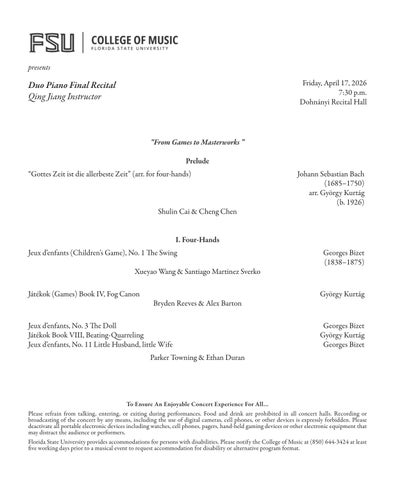

presents
Duo Piano Final Recital
Qing Jiang Instructor
“From Games to Masterworks ”
Prelude
“Gottes Zeit ist die allerbeste Zeit” (arr. for four-hands)
Friday, April 17, 2026
7:30 p.m.
Dohnányi Recital Hall
Johann Sebastian Bach (1685–1750)
arr. György Kurtág (b. 1926)
Shulin Cai & Cheng Chen
I. Four-Hands
Jeux d’enfants (Children’s Game), No. 1 The Swing Georges Bizet (1838–1875)
Xueyao Wang & Santiago Martinez Sverko
Játékok (Games) Book IV, Fog Canon György Kurtág Bryden Reeves & Alex Barton
Jeux d’enfants, No. 3 The Doll Georges Bizet
Játékok Book VIII, Beating-Quarreling György Kurtág
Jeux d’enfants, No. 11 Little Husband, little Wife Georges Bizet
Parker Towning & Ethan Duran
To Ensure An Enjoyable Concert Experience For All…
Please refrain from talking, entering, or exiting during performances. Food and drink are prohibited in all concert halls. Recording or broadcasting of the concert by any means, including the use of digital cameras, cell phones, or other devices is expressly forbidden. Please deactivate all portable electronic devices including watches, cell phones, pagers, hand-held gaming devices or other electronic equipment that may distract the audience or performers.
Florida State University provides accommodations for persons with disabilities. Please notify the College of Music at (850) 644-3424 at least five working days prior to a musical event to request accommodation for disability or alternative program format.
Játékok Book IV, Hand in hand (hommage à sarkösy)
Thong Truong & Gabriel Silva
György Kurtág
Jeux d’enfants (Children’s Game), No. 2 The Spinning Top Georges Bizet
Xueyao Wang & Santiago Martinez Sverko
Játékok Book IV, Hommage à Halmágyi Mihály
Lujie Wang & Yutian Wang
Sonata for Piano Four-Hands
György Kurtág
Francis Poulenc
I. Prelude (1899–1963)
II. Rustique
III. Final
Lujie Wang & Yutian Wang
Sonata in D Major for piano Four-Hands, K. 381
Wolfgang Amadeus Mozart
I. Allegro (1756–1791)
II. Andante
III. Allegro molto
Bryden Reeves & Alex Barton
II. Two Pianos
The Pianist from the Carnival of the Animals Camille Saint-Saëns (1835–1921)
Bryden Reeves & Alex Barton
Suite for Two Pianos Founded upon Old Irish Melodies, Op. 104
Amy Beach
I. Prelude (1867–1944)
II. Old-time Peasant Dance
III. The Ancient Cabin
Waltz for Two Pianos
Lujie Wang & Yutian Wang
Seunghye Kim & Gabriel Silva
Six Canonic Etudes, Op. 56 (arr. for two pianos)
György Kurtág
Robert Schumann
No. 1 Pas trop vite (1810–1856)
No. 6 Adagio
Xueyao Wang & Santiago Martinez Sverko
arr. Claude Debussy (1862–1918)
Blanc et noir (In White and Black)
Claude Debussy II. Lent. Sombre
Bryden Reeves & Alex Barton
III. Mirroring: Four-Hands and Two Pianos 12
Prelude and Waltz in F
György Kurtág Lundu
Francisco Mignone (1897–1986)
Seunghye Kim & Gabriel Silva
Hommage à Paganini
György Kurtág Variations on a Theme by Paganini for Two Pianos
Witold Lutosławski (1913–1994)
Shulin Cai & Cheng Chen
Postlude
“Sheep may safely graze”, BWV 208 (arr. for four-hands)
Shulin Cai & Cheng Chen
Johann Sebastian Bach arr. Mary Howe (1882–1964)
This concert explores the piano as a shared instrument of play, dialogue, and transformation—tracing a path from musical “games” to works of symphonic imagination. Featuring music for piano four hands and two pianos spanning three centuries, the program highlights how play, imitation, and collaboration lie at the heart of compositional mastery. At its center stands György Kurtág, whose Játékok (Games) serves as a unifying thread throughout the evening and a tribute to the composer on the occasion of his 100th birthday this year.
The evening begins and ends with Bach’s cantata music, whose writing embodies the highest form of musical play, refracted through the voice of Kurtág and Mary Howe. The first set focuses on piano four hands and unfolds in two parts. Selections from Bizet’s Jeux d’enfants (Children’s Games) are interwoven with Kurtág’s Játékok, placing two composers in playful dialogue across time. Bizet’s charming miniatures paint vivid scenes of childhood, while Kurtág distills musical ideas into exploratory gestures and intimate physical interactions at the keyboard. This dialogue expands with sonatas by Mozart and Poulenc. Mozart’s Sonata in D major, one of the earliest and most celebrated works for four hands, sheds light on the musical possibilities of twenty fingers at a single keyboard. Poulenc’s Sonata, written nearly two centuries later, presents a drastically different sonic world within the same formal framework.
The second set turns to the sonority and spatial drama of two pianos. Saint Saëns’s The Pianists from The Carnival of the Animals offers playful parody, followed by Amy Beach’s expansive Suite for Two Pianos, founded on old Irish melodies. Schumann’s Six Canonic Études, heard in Debussy’s two piano arrangement, lead into Debussy’s Blanc et noir, his final masterwork for two pianos, marked by some of his starkest contrasts and most concentrated expression. The final set mirrors works through dance and homage: Kurtág’s Prelude and Waltz in F alongside Mignone’s Lundu, and Kurtág’s Hommage à Paganini paired with Lutosławski’s brilliant Variations on a Theme by Paganini. From games to masterworks, the concert celebrates musical play as a source of ever-expanding creativity.