PROGRAM
Overture to I vespri siciliani Guiseppe Verdi (1813–1901)
Suite from Lt. Kijé, Op. 60 Sergei Prokofiev
Kije’s Birth (1891–1953)
Song
Kije’s Wedding
Troika Song
Kije’s Burial
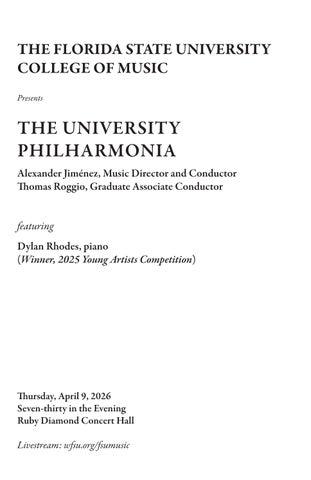
Piano Concerto No. 2, Op. 18
INTERMISSION
Sergei Rachmaninoff Moderato (1873–1943)
Adagio sostenuto Allegro scherzando
Dylan Rhodes, piano
Thomas Roggio, graduate associate conductor
Please refrain from talking, entering, or exiting while performers are playing. Food and drink are prohibited in all concert halls. Please turn off cell phones and all other electronic devices. Please refrain from putting feet on seats and seat backs. Children who become disruptive should be taken out of the performance hall so they do not disturb the musicians and other audience members.
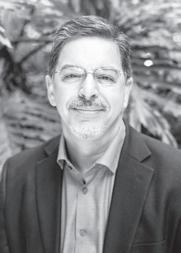
Alexander Jiménez is Professor of Conducting, Director of Orchestral Activities, and String Area Coordinator at the Florida State University College of Music. His work spans performance, recording, mentorship, and artistic leadership, with recordings on labels including Naxos, Navona, Neos, Canadian Broadcasting Ovation, and Mark. Known for his commitment to contemporary music, he has collaborated with an array of distinguished composers, among them Ellen Taaffe Zwilich, Ladislav Kubík, Anthony Iannaccone, Krzysztof Penderecki, Martin Bresnick, Zhou Long, Chen Yi, Harold Schiffman, Louis Andriessen, and Georg Friedrich Haas.
Jiménez has appeared as a guest conductor throughout the United States, Europe, and the Middle East, leading ensembles such as the Royal Scottish National Orchestra, the Brno Philharmonic, and the Israel Netanya Chamber Orchestra. He is at home with both professional and educational ensembles, having conducted regional and state honor orchestras across the country, as well as the NAfME All‑Eastern Honor Orchestra in 2009. His educational work includes engagements with the Boston University Tanglewood Institute and the Blue Lake Fine Arts Camp.
At Florida State University, Jiménez has overseen significant growth in the orchestral studies program, helping shape it into one of the nationally recognized programs of its kind. Under his direction, the University Symphony Orchestra has appeared at major conferences including the College Orchestra Directors National Conference and the American String Teachers Association National Conference. The University Philharmonia has also gained national visibility, performing at the Southeast Conference of the Music Educators National Conference and, most recently, the College Orchestra Directors Association National Conference in 2023. The University Symphony Orchestra’s national PBS broadcast of Ellen Taaffe Zwilich’s Peanuts Gallery® was named the Outstanding Performance of 2007 by the National Educational Television Association (NETA). In 2023, the Orchestra undertook a successful tour, performing at the Steinmetz Concert Hall of the Dr. Phillips Center for the Performing Arts in Orlando, as well as in national theaters of Santiago and Santo Domingo in the Dominican Republic.
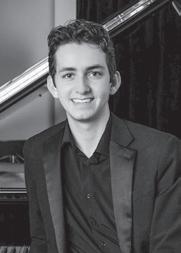
Praised for his “sensitive playing” and “brilliant passagework,” Dylan Rhodes is a versatile and compelling young artist who has performed throughout North America. An active soloist and chamber musician, he performs a wide range of repertoire and has commissioned and premiered new works for solo piano, chamber ensembles, and orchestra. He has appeared in masterclasses with Ksenia Nosikova, Derek Hartman, Wael Farouk, Evren Ozel, Li shan Huang, Sean Kennard, Ryan Speedo Green, Ricky Ian Gordon, the Arianna String Quartet, and Suzanne Farrell. Dylan is currently a junior pursuing a degree in Piano Performance at Florida State University, where he studies with Heidi Louise Williams and has received additional instruction from Ney Fialkow, Daisy Jáffe, and Yun‑ Ling Hsu.
Dylan has won first prize in the Charleston International Competition, FSU’s Annual Competitive Festival XV, FSU’s Young Artist Concerto Competition, and the Tenth Steinway Gulf Coast Competition, with additional recognition from the William Byrd Piano Ensemble Competition, FSU’s Annual Competitive Festival XIV, the MTNA Young Artist Competition, the John Leatherwood Concerto Competition, the Grey Perry Collegiate Piano Competition, and the Raymond Solo Piano Competition. He made his concerto debut at age sixteen with the Space Coast Symphony Orchestra performing Gershwin’s Piano Concerto in F, and this past year he made his debut at Carnegie Hall. In addition to his solo work, Dylan maintains an active collaborative schedule as a pianist for choirs, instrumentalists, vocalists, and dancers, and is also active as a music director and choral conductor.
NOTES ON THE PROGRAM
Verdi: Overture to I vespri siciliani
Giuseppe Verdi was a purely operatic composer, and one of the most successful the world has known. Only Mozart and Wagner have matched the sustained success as repertory works as Verdi’s major operas. From the very beginning of his career, his operas were well received by audiences, although critics of his own time did not give him his due. Perhaps for him, like the modern examples of Gershwin (Porgy and Bess) and Lloyd Webber (Phantom of the Opera), popularity with audiences prejudiced high minded critics into believing his works shallow. In any event, since the second quarter of this century, he has been given the same respect by scholars as by listeners. Verdi, more than any other, now defines the modern Italian opera.
Verdi was precocious, but hardly in the same sense as Mozart. Though he began playing keyboard while very young, and assumed some of the church organist duties of his teacher at age nine, he was not considered a prodigy. In fact, he was turned down for admission to the Milan Conservatory when he applied at age nineteen, and was essentially self taught as an operatic composer.
Written immediately after his immense success with La Traviata, Sicilian Vespers was conceived as a grand opera for the Paris stage. As such, it was a departure for Verdi, and the opera probably fell short of his goals, due to an inadequate story line and libretto.
Verdi possessed in abundance that one natural gift which is an essential skill for an operatist – the ability to write a melody line that stirs the audience’s emotions to match the dramatic intent of the story line. His overture to I Vespri Siciliani displays this skill in a purely instrumental medium. From its darkly haunting opening to its whirlwind conclusion, this compact overture captures the listener’s imagination. It tells a story – even before a word is sung – in a style much like his other overtures.
Immediately after the brooding introduction a lilting cello tune establishes a peaceful mood which quickly gives way to agitation. The original melody eventually returns, but in a more insistent form. In its turn, the agitation becomes more and more frenzied, leading to a presto ending, which requires considerable virtuosity in the strings. First exposure to this music must be a shock to any string player, however seasoned: the page is covered with black (referring to the fast passages), and the measures simply fly past. However, so skillfully has Verdi painted his canvas that, even if a note should be omitted here or there, the energy and the passion are always felt.
– C. Michael Kelly
Prokofiev:
Suite from Lt. Kijé
Composed in 1933, Lieutenant Kijé was Prokofiev’s first film score and the first major work he wrote after returning to the Soviet Union. Based on a short story by Yuri Tynyanov and directed by Aleksandr Feinzimmer, the film’s satirical quality proved ideally suited to Prokofiev’s renowned caustic humor. The story begins with a simple clerical error: through a nervous slip of the pen, a military clerk mistakenly enters into the official rolls the name of a non existent officer, “Podporuchik Kijé.” Though Kijé exists only on paper, the rigidity of military bureaucracy—combined with the half‑mad paranoia of Tsar Paul I—allows this fictional figure to take on an illusory life. Kijé is punished and exiled to Siberia, reassigned, promoted to general, married, and ultimately killed, all out of sheer administrative necessity.
The five‑movement orchestral suite heard this evening was completed on July 8, 1934 and is drawn from fragments of the original film score. Prokofiev supplements the full orchestra with instruments chosen for their distinctive coloristic and dramatic effects: the cornet evokes military ceremony, the tenor saxophone introduces elements of parody, and
sleigh bells imitate the sound of a horse drawn troika. In addition, he assigns prominent solos to instruments not typically featured in this way, including the double bass, tuba, and piccolo.
Like his earlier Classical Symphony, Prokofiev writes music evocative of an earlier historical style. Unlike the Symphony, which draws upon eighteenth century Viennese Classicism, the music of Lieutenant Kijé reflects what might be called “pre‑Empire” St. Petersburg, with its Prussian style parades, ceremonial marches, and stylized Russian folk songs.
Although the music is largely conventional in a tonal sense, Prokofiev frequently interjects unexpected elements that subtly amplify the absurdity of the story. Otherwise consonant harmonies are interrupted by deliberate “wrong notes,” and abrupt, almost comical changes of key occur throughout the score. The colorful use of tenor saxophone, solo tuba, and a duet between double bass and viola further reinforces the strange circumstances surrounding Kijé’s existence. In the final movement, Prokofiev masterfully weaves together the principal themes to form a retrospective of Kijé’s life. The opening cornet melody— evocative of the vast Russian landscape and perhaps the loneliness of Tsar Paul I—returns hauntingly at the very end.
– Alexander Jiménez
Rachmaninoff: Piano Concerto No. 2
Like J. S. Bach, who upon his death was looked upon as more or less an old fuddy‑duddy (now we know better, of course), Rachmaninoff has borne his share of criticism for having composed in a hopelessly old‑fashioned style, long after its relevance. His compositions are the last major representatives of vivid Russian Romanticism—long after that style was presumed dead and buried. Yet, like Bach, his musical genius, his talent, and his strong belief in the validity of his art all led him to create a legacy that took “old‑fashioned‑style” to a natural and valid high point of achievement. While a child of the nineteenth century, he died almost at the midpoint of the twentieth, secure in his success, and secure in the world’s enduring appreciation of his “dated” style.
Rachmaninoff wrote four piano concertos, the first of which was a student composition (later revised) from 1896 and the last was composed in 1926 (revised in 1941). The second is by far the most popular, and was finished in 1901, when the composer was twenty eight years old, and had just undergone a devastating series of professional setbacks that cast him into deep depression. It contains all of the essential characteristics of Rachmaninoff’s style that have established his lasting place in audiences’ esteem everywhere. An unparalleled melodic sweep, the lyricism of which seems to unfold in growing cascades of sound, is coupled with masterful orchestration of rich, lush textures. The composer was a virtuoso pianist and his writing for the solo piano emanates from a mastery of the almost limitless figurations possible for the instrument. Although Rachmaninoff left Russia after the Revolution, never to return, and lived in a variety of places—at his death in 1943, he was living in Beverly Hills—he lived as a Russian all of his life.
That ethnicity speaks eloquently in almost every bar of his music, and anyone can sense that from the first ominous chords that build the tension before the entrance of the main theme in the second concerto. The darkness of the mood is enhanced by the simple choice of register for that theme, for it is scored for unison low strings and clarinet, right at the bottom of the violins’ range. The winsome second theme, in a happier mode, is pure Rachmaninoff. The middle of the movement is suitably restless, in a varied tapestry of themes, keys, and textures, leading to a climax, where we expect the usual review of the opening. But, the composer, ever creative, turns things upside down, and we hear quite a different closing section than is usual. New ideas and relationships add considerably to the charm of the movement, as it builds to the inevitable climax at the end.
The slow movement finds the piano ruminating with figurations that leads one to ask: “Where is the theme?” The flute provides the answer, in a delicate solo that leads to a series of exchanges between the solo piano and other instruments in a languorous atmosphere that is now thought of as a trademark of the composer. Even if you don’t have perfect pitch, there is an indefinable satisfaction gotten from the unexpected choice of key for this movement, a rather unusual relationship between E major and C minor.
The last movement, of course, is the one with the melody made so famous during the 1940s in a maudlin pop arrangement. For all of that, to the present, this concerto continues to be a source of musical elements ripped from it and used in unexpected contexts. In any case, after a few gestures in the lower instruments, the soloist kicks the movement off with a grand cadenza that teases us as to where the movement could possibly go. The answer is a dynamic march of a theme, snapping along. The “big, lyrical theme” is the contrast, introduced by the warm, rich viola section. Exciting give and take between the two ideas propels the movement along, until the “big, lyrical theme” wins the day, and soars rhapsodically to the majestic ending that only a grouch would denigrate.
–© 2015 William E. Runyan
Violin 1
Ajay Balkaran‡
Irsia Ruíz Guzmán
Mulunesh Creaghan
Myra Sexton
Christina Leach
Lucia Garro
Sasha Richeson
Leah Tryzmel
Chloe Gullo
Violin 2
Olivia Leichter*
Jenna Marie Meola
Lindsay Cunningham
Connor Brown
Shane Sharkey
Violet Lorish
Max Loesener
Elina Nyquist
Maya Sharma
Viola
Brenden Brewer*
Joseilys Quinones
Jacqueline Wang
Emma Patterson
Keannamarie Goliat
Angeleena Jackson
Madison Jansons
Corinne Williams Hough
University Philharmonia Personnel
Alexander Jiménez, Music Director
Thomas Roggio, Graduate Associate Conductor
Cello
Addison Miller*
Tyler Benko
Enzo Savage
María Ruíz Guzmán
Jason Tejada Chancay
Miroslav Beck
Chloe Kolenc
Ashley Gessner
Daniel Jimenez Gaona
Brandon Bonamarte
Matthew Pooler
Bass
Daniel Martinez*
Emma Waidner
Gavin Smith
Garrett Gilley
Christopher T. McDuffie
Jean Philippe Montas
Charlotte Wooldridge
Flute
Sarah Kimbro*
Daniel Ascanio Perez
Krista Zimmerman
Piccolo
Krista Zimmerman
Oboe
Haley O’Neill**
Lorin Zamer**
Emma Druggan
Richard Wilson
English Horn
Richard Wilson
Clarinet
Daniel Burrow**
Dawson Huynh**
Tenor Saxophone
Luis Angel
Bassoon
Susanna Campbell**
Ben Kiely**
Sophia Clement
Amelia Khanji
Horn
Andrew Keller**
Isaac Roman
Emma Brockman
David Pinero
Trumpet
Sharavan Duvvuri**
Grason Peterson**
Nathan Reid**
Tyler Bennett
Trombone
Sarah Castillo*
Justus Smith
Bass Trombone
Kevin Li
Tuba
Connor Kelley
Percussion
Ethan Turner
Drew Jungslager
Cole Martin
Harp
Sierra Stacy
Celesta Thong Truong
Orchestra Manager
Steven Stamer
Stage Manager
Connor Oneacre
Orchestra Librarians
Guilherme Rodrigues
Tom Roggio
Library Bowing Assistant
Victoria Joyce
‡ Concertmaster * Principal ** Co-Principal
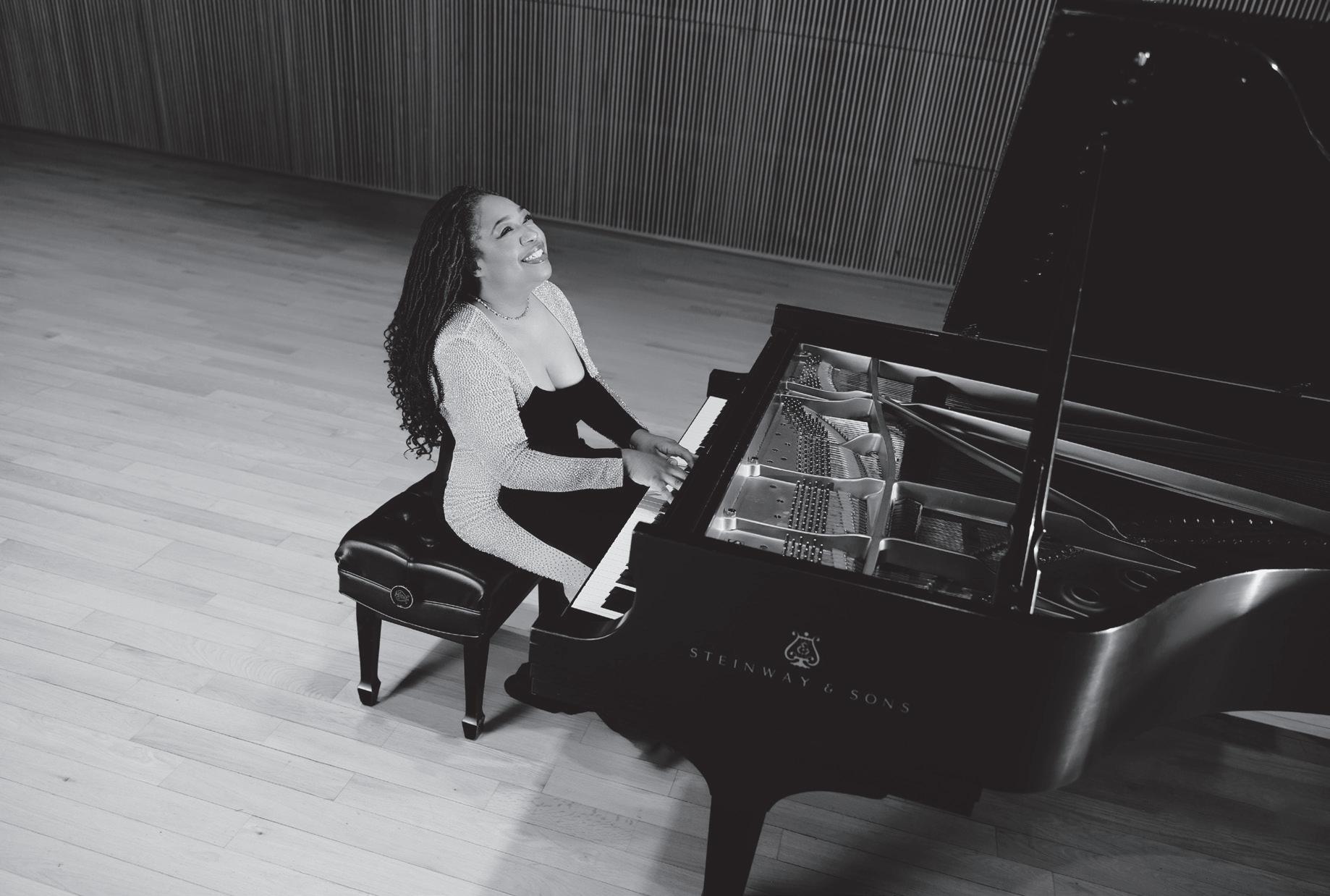
Yaniv Dinur, Conductor
Michelle Cann, Piano WAGNER
Prelude and Leibestod from Tristan und Isolde LISZT
Piano Concerto no. 1 STRAUSS
Death and Transfiguration
Le Poeme de l’extase
SATURDAY MAY 2
2025-2026
Dean’s Circle
Les and Ruth Ruggles Akers
Dr. Pamela T. Brannon
Richard Dusenbury and Kathi Jaschke
CarolAline Flaumenhaft
Joyce Andrews
Louie and Avon Doll
Patrick and Kathy Dunnigan
Kevin and Suzanne Fenton
Andrew and Karen Hoyt
Alexander and Dawn Jiménez
Albert and Darlene Oosterhof
Jim Lee
Paula and Bill Smith
Margaret Van Every
Gold Circle
Bob Parker
Todd and Kelin Queen
Jim and Betty Ann Rodgers
Karen and Francis C. Skilling
David and Jane Watson
Bret Whissel
Sustainer
Stan and Tenley Barnes
Kathryn M. Beggs
Karen Bradley
Steve and Pat Brock
Suzi and Scott Brock
Brian Causseaux and David Young
James Clendinen
Mary and Glenn Cole
Carol J. Cooper
Sandy and Jim Dafoe
F. Marshall Deterding and Dr. Kelley Lang
Diane and Jack Dowling
Aaron and Caroline Ellis
John S. and Linda H. Fleming
Joy and James Frank
William Fredrickson and Suzanne Rita Byrnes
Ruth Godfrey-Sigler
Michael and Marsha Hartline
Ken Hays
Melanie Hines and Dudley Witney
Dottie and Jon Hinkle
Todd S. Hinkle
The Jelks Family Foundation, Inc.
Emory and Dorothy Johnson
Gregory and Margo Jones
Anne van Meter and Howard Kessler
Dennis G. King, Esq.
William and Susan Leseman
Annelise Leysieffer
Linda and Bob Lovins
William and Gayle Manley
Robert and Patty McDonald
Marian and Walter Moore
Ann W. Parramore
Almena and Brooks Pettit
David and Joanne Rasmussen
Edward Reid
Mark and Carrie Renwick
Stephen and Elizabeth Richardson
Lawrence and Lisa Rubin
Patrick J. Sheehan
Dr. James and Ruth Anne Stevens
Sustainer cont’d
Richard Stevens and Ron Smith
Marshall and Nell Stranburg
William and Ma’Su Sweeney
Martin Kavka and Tip Tomberlin
Steve Moore Watkins and Karen Sue Brown
Stan Whaley and Brenda McCarthy
Kathy D. Wright
Mary S. Bert
Joe and Susan Berube
Marcia and Carl Bjerregaard
Greg and Karen Boebinger
Larry and Sara Bourdeau
David and Carol Brittain
Dean and Lyndsey Caulkins
Bonnie and Pete Chamlis
Malcolm A. Craig
Linda Davey
Rochelle Davis
Judith Flanigan
Bonnie Fowler, Armor Realty
L. Kathryn Funchess
Harvey and Judy Goldman
Michael Hanawalt and Justine Sasanfar
Jerry and Bobbi Hill
Richard and Linda Hyson
Sally and Dr. Link Jarrett
Judith H. Jolly
Arline Kern
Jonathan Klepper and Jimmy Cole
Elna Kuhlmann
John and Silky Labie
Keith Ledford
Patron
Donna Legare
Joan Macmillan
Patrick Malone
Victoria Martinez
Stephen Mattingly
Ann and Don Morrow
Joel and Diana Padgett
Karalee Poschman
Mary Anne J. Price
Julian and Betty Proctor
Carol Ryor
Ken and J.R. Saginario
Magda Sanchez
Jill Sandler
Paula S. Saunders
Jeanette Sickel
Susan Sokoll
George Sweat
Ed Valla
Scott and LaDonna Wagers
Sylvia B. Walford
Diana Wang
Geoffrey and Simone Watts
Natalie Zierden
Patricia C. Applegate
Sarah and John Bender
The Boyett Family
Michael Buchler and Nancy Rogers
Judy and Brian Buckner
Kasia Bugaj and J. Renato Pinto
Robby Bukovic
Darren and Peyton Cassels
Marian Christ
David and Julie Detweiler
Katie and Daniel Elliott
Sarah Eyerly
Cynthia Foster
Gene and Deborah Glotzbach
Sue Graham
Laura Gayle Green
Miriam Gurniak
Donna H. Heald
Carla Connors and Timothy Hoekman
Jane A. Hudson
Jayme and Tom Ice
Stephanie Iliff
William and DeLaura Jones
Jane Kazmer
Paige McKay Kubik
Joe Lama
Jane LeGette
Eric Lewis
James J. Logue
Dr. Lynne Y. Lummel
Cindy Malaway
Lealand and Kathleen McCharen
Dr. Linda Miles
Drs. Linda O’Neil and Sebastian Alston
Becky Parsons
Michelle Peaceman
William and Rebecca Peterson
Adrian and Rachel Puente
George Riordan and Karen Clarke
Sanford A. Safron
Lori and Charles Smith
Sudarat Songsiridej and Mary Schaad
Susan Stephens
Allison Taylor
C. Richard and Phrieda L. Tuten
Steve Urse
Janie W. Weis
Karen Wensing
Drs. Christopher and Heidi Louise Williams
Lifetime Members
Willa Almlof
Florence Helen Ashby
Mrs. Reubin Askew
Tom and Cathy Bishop
Nancy Bivins
Ramona D. Bowman
André and Eleanor Connan
Russell and Janis Courson
J.W. Richard Davis
Ginny Densmore
Carole Fiore
Patricia J. Flowers
Hilda Hunter
Julio Jiménez
Kirby W. and Margaret-Ray Kemper
Patsy Kickliter
Anthony M. Komlyn
Fred Kreimer
Beverly Locke-Ewald
Cliff and Mary Madsen
Ralph and Sue Mancuso
Meredith and Elsa L. McKinney
Ermine M. Owenby
Mike and Judy Pate
Laura and Sam Rogers
Dr. Louis St. Petery
Sharon Stone
Donna C. Tharpe
Brig. Gen. and Mrs. William B. Webb
Rick and Joan West
John L. and Linda M. Williams
Sallie and Duby Ausley
Beethoven & Company
Corporate Sponsors
Ron Erichson/Beth Frederick
Business Sponsors
WFSU Public Broadcast Center
The University Musical Associates is the community support organization for the FSU College of Music. The primary purposes of the group are to develop audiences for College of Music performances, to assist outstanding students in enriching their musical education and careers, and to support quality education and cultural activities for the Tallahassee community. If you would like information about joining the University Musical Associates, please contact Kim Shively, Director of Special Programs, at kshively@fsu.edu or 850-645-5453.
The Florida State University provides accommodations for persons with disabilities. Please notify the College of Music at 850-644-3424 at least five business days prior to a musical event if accommodation for disability or publication in alternative format is needed.