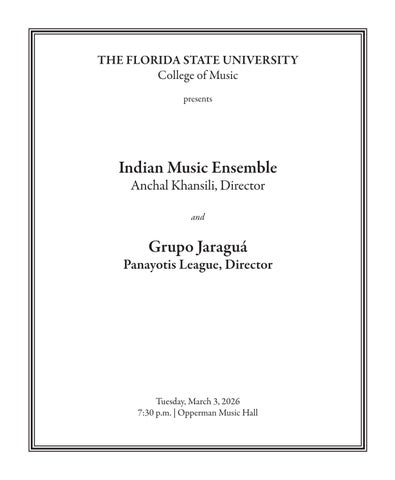
THE FLORIDA STATE UNIVERSITY College of Music presents
Indian Music Ensemble
Anchal Khansili, Director and
Grupo Jaraguá
Panayotis League, Director
Tuesday, March 3, 2026
7:30 p.m. | Opperman Music Hall
To Ensure An Enjoyable Concert Experience For All…
Please refrain from talking, entering, or exiting during performances. Food and drink are prohibited in all concert halls. Recording or broadcasting of the concert by any means, including the use of digital cameras, cell phones, or other devices is expressly forbidden. Please deactivate all portable electronic devices including watches, cell phones, pagers, hand-held gaming devices or other electronic equipment that may distract the audience or performers.
Recording Notice: This performance may be recorded. Please note that members of the audience may at times be included in this process. By attending this performance you consent to have your image or likeness appear in any live or recorded video or other transmission or reproduction made in conjunction to the performance.
Florida State University provides accommodations for persons with disabilities. Please notify the College of Music at (850) 644-3424 at least five working days prior to a musical event to request accommodation for disability or alternative program format.
Chanakya
Raag Bageshree (Balma mori)
Indian Music Ensemble
Semi-classical; arr. Anchal Khansili
Classical; arr. Anchal Khansili
Sason ki Mala Qawwali
Bageshree (Yaad karo)
Classical; arr. Anchal Khansili
Dam mast Qalandar Qawwali; arr. Anchal Khansili
Indian Music Ensemble Personnel
Ana Uribe Law, violin
Addy Burwell, sitar/keys
Alyssa Witherington, vocals/keys
Janet Rebollar, vocals
Kayla Varghese, vocals
Raúl Parra, flute
Kuan Yu-Yang, clarinet
Nicholas Montoya, tabla
INTERMISSION
Grupo Jaraguá
Chega de Saudade
Antônio Carlos Jobim/Vinícius de Moraes
Yemanjá Panayotis League
Jaraguá Jackson do Pandeiro
Feira de Mangaio Sivuca
Até a Lua Tião Carvalho
Lua Cheia
Ana Maria Carvalho
Lágrima Jackson do Pandeiro
Grupo Jaraguá Personnel
CarlosManuel Aceves, Talia Boudjemaa, Gabriel Carbo, Panagiotis Christeas
Lucas Cornejo, Gordon Cortney, Gabriel Cuellar, Koen DeVries, Paige Douglas, Stevie Eason
Isaac Erazo, Sebastian Gonzalez, Owen Hillman, Robert Knox, Gabriel Lanza Santos
Garrett Mclees, Enzo Oliveira Savage, Wayne Pearcy, Sebastian Perez Gonzalez
Javier Riveira, Sebastian Salas, March Seok, Ana Gabriela Serra Almeida Leite
Chanakya
This piece was originally performed by Rishabh Rikhiram Sharma in 2024 as part of his nine-composition project Navras, a title that refers to the nine fundamental aesthetic emotions (rasas) in Indian classical theory of music, dance, and theatre. Chanakya primarily channels vīra rasa, the sentiment of courage and valor. In our interpretation, however, the piece also gestures toward śṛṅgāra rasa (love and beauty), particularly through the lyric, “Saiyan tohe aise mai niharoon,” which translates as: “My beloved, I gaze upon you in this way.” The coexistence of valor and love reflects the layered emotional landscapes characteristic of Indian aesthetic philosophy, where multiple rasas can inhabit a single expressive form.
Raag Bageshree
Raag Bageshree (also spelled “Bageshri”) is a late-night raga of the Kafi thaat in Hindustani classical music. It is known for evoking moods of longing, romantic separation (viraha), and quiet devotion. For this presentation, the bandish, “Balma Mori Tore Sang,” was selected. The text expresses yearning for the beloved and intensifies the emotional resonance of separation. The khayal is rendered collectively by the vocalists, while individual taan passages are developed independently, allowing for the gradual unfolding (barhat) and expansion of the raga. Through this interplay of unity and individual improvisation, the emotional depth of Bageshree emerges.
Sason Ki Mala
One of the most well-known qawwalis associated with Nusrat Fateh Ali Khan. The title translates as, “On the rosary of my breaths, I chant Your name.” The text expresses devotion so deep that every breath becomes an act of remembrance. Although the language may sound romantic, in Sufi poetry the “beloved” refers to the Divine. This rendition is inspired by the violin interpretation of the Leo Twins, while also incorporating harmonium to present the qawwali through instrumental dialogue while retaining its devotional spirit.
Raag Bageshree
This expanded rendition of Raag Bageshree builds upon the earlier vocal presentation by introducing clarinet in a calland-response dialogue with the voice, accompanying by two tabla players, engaged in their own rhythmic dialogue. By layering these exchanges, the performance highlights the interactive nature of Hindustani classical music and creates an advanced presentation of the raga/raag.
Dam mast Qalandar
Dam Mast Qalandar is one of the most iconic Sufi devotional songs (qawwali) of South Asia. It is dedicated to the 13th-century Sufi saint Lal Shahbaz Qalandar, whose shrine in Sehwan Sharif (present-day Pakistan) remains a major pilgrimage site. The refrain, “Dam mast Qalandar,” can be loosely translated as “With every breath, in ecstasy, O Qalandar.” The song blends Persian, Urdu, and Punjabi poetic traditions, reflecting centuries of devotional practice in the region. Traditionally, qawwali is performed with energetic hand clapping, which forms a central rhythmic element of the style. In this rendition, that spirit is retained while combining Indian instruments such as harmonium and tabla with Western instruments including piano, violin, and clarinet.