American Musicological Society, Southern Chapter
Society for Ethnomusicology, Southeast and Caribbean Chapter
2026 Joint Meeting
Hosted by Florida State University
February 27–28, 2026


FRIDAY, 27 FEBRUARY
All sessions to take place in Dohnányi Recital Hall (DRH) in the Housewright Music Building (HMU)
7:30 Vehicle onsite at DoubleTree by Hilton Hotel Tallahassee
Location: 101 S Adams St
8:00 Bus departs from DoubleTree by Hilton Hotel Tallahassee
Location: 101 S Adams St
8:07 Bus arrives at College of Music at Florida State University
Location: 122 N Copeland St
7:45–10:15 Registration
Location: Opperman Music Hall Lobby (Kuersteiner Music Building - KMU)
8:15–8:30 Opening Remarks
Dean Todd Queen, Frank Gunderson, Blake Howe, & Alex Carrico
8:30–10:00 Session 1: Musical Landscapes - Chair, Joseph Sargent, University of Alabama
“A Steppe Toward the Sublime: Wordless Choir and the Idyllic Sublime in Tiomkin’s Western Film Music”
Kayleigh Bagley, University of Florida (AMS-S)
“Frontier Imaginaries: Tin-Pan Alley Styled Songs of the Klondike Gold Rush”
Timothy Yu, Florida State University (SEMSEC)
“Struttin’ and Purrin’: The Performance Practice and Cultural Heritage of Wild Turkey Calling”
Jason Mitchell, University of North Carolina at Charlotte (SEMSEC)
10:00–10:15 Break - Refreshments available in the Opperman Mezzanine (KMU)
10:15–11:45 Session 2: Negotiating Identities - Chair, Warren Kimball, Louisiana State University
“Broadcasting the Nation: Radio Programming and Canon Formation in 1920s Puerto Rico”
Julian Duncan, Florida State University (SEMSEC)
“Operatic Censorship, Failure, and Success: Naples 1844–1845”
Andreas Giger, Louisiana State University (AMS-S)
“The Spirit of Music in Balkan Modernism: Close Readings from Inter-War Bulgaria”
David Salkowski, University of North Florida (AMS-S)
11:45–1:30 Lunch
1:30–3:00 Session 3: Archives and Representation - Chair, Maria Ryan, Florida State University
“Preserving Latinx Musical Heritage in Florida: Archival Insights into Music and Culture”
Ana Uribe Law, Florida State University (AMS-S)
“Reflections on Collaborative Methodologies in a Community Archiving Project in South Africa”
Lyndsey Copeland & Leonard Boetles Gewers, Carleton University (SEMSEC)
“Sounding the Past, Singing the Future: Afro-Brazilian Feminisms, Ancestrality, and the Politics of Listening in Contemporary Music”
Lidiana de Moraes, Florida State University (SEMSEC)
3:00–3:15 Break - Refreshments available in the Opperman Mezzanine (KMU)
3:15–4:45
Session 4: Cultural Exchanges and Performances - Chair, Silvio dos Santos, University of Florida
“‘We Never Knew What Friends We Had’: Billy Joel as Cultural Diplomat”
Kendall Waters, University of Florida (AMS-S)
“Two Hundred Years of Lisa Cristiani: Analyzing Three Performances in East Siberia, 1849”
Emilia González Dorantes, Louisiana State University (AMS-S)
“Meredith Monk and Mythmaking: Transportive Ritual in The Games and Education of the Girlchild”
Maya Johnson, Florida State University (AMS-S)
4:45–5:00 Break - Refreshments available in the Opperman Mezzanine (KMU)
5:00–6:00 Business Meetings
Locations: SEMSEC (DRH) & AMS-S (Lindsay Recital Hall, KMU)
7:30 Rainbow Concert of World Music
Location: Opperman Music Hall (KMU)
9:45 Bus departs from College of Music at Florida State University
Location: 122 N Copeland St
9:52 Bus arrives at DoubleTree by Hilton Hotel Tallahassee
Location: 101 S Adams St SATURDAY, 28 FEBRUARY
7:30 Vehicle onsite at DoubleTree by Hilton Hotel Tallahassee
Location: 101 S Adams St
8:00 Bus departs from DoubleTree by Hilton Hotel Tallahassee
Location: 101 S Adams St
8:07 Bus arrives at College of Music at Florida State University
Location: 122 N Copeland St
8:00 Refreshments available in the Opperman Mezzanine (KMU)
8:30–10:00 Session 5: Rethinking the Score - Chair, Brett Boutwell, Louisiana State University
“The Transcriber as Analyst: Revisiting Luciano Berio’s Mahler and Verdi Transcriptions”
Thomas Peattie, University of Mississippi (AMS-S)
“Mel Bonis and the Art of Self-Representation”
Christy Sallee, University of Florida (AMS-S)
“From Exercise to Transcendence: A Computational Revision of Liszt’s Etudes S. 136, S. 137 and S. 139”
Luis Z. Pro Villamonte, University of Florida (AMS-S)
10:00–10:15 Break - Refreshments available in the Opperman Mezzanine (KMU)
10:15–10:20 Introduction of Keynote - Denise von Glahn, Florida State University
10:20–11:20 Keynote: “Reconstructing the Soundscapes of the Apalachee-Hispanic Community at Mission San Luis (Tallahassee, FL)”
Sarah Eyerly, Florida State University (SEMSEC)
11:20–1:30 Box lunch and Sound Walk at Mission San Luis (2021 Mission Rd.)
12:00 Bus leaves for Mission San Luis (bus located on Copeland St.)
12:15 Sound walk
1:00 Bus departs Mission San Luis to return to campus
1:30–3:00
Session 6: In/Exclusion in Musical Communities - Chair, Jason Mitchell, University of North Carolina, Charlotte
“Weaponized Melodies: Musical Semiotics and the Westboro Baptist Church’s Parodic Protest”
Brandon Dye, University of Florida (AMS-S)
“We Are the Dead: The Year Zero ARG and the Evolution of Fan Technoculture”
Jeremy Polley, University of South Carolina (SEMSEC)
“Performing Greekness in Diaspora: Embodiment, Authenticity, and Cultural Identity at the Tallahassee Greek Food Festival”
Panagiotis Christeas, Florida State University (SEMSEC)
3:00–3:15 Break - Refreshments available in the Opperman Mezzanine (KMU)
3:15–4:45
Session 7: Aesthetic and Interpersonal Interpretations of Anti-Hegemony in Tallahassee, Florida - Chair, Alex Carrico, University of South Carolina
“‘Weird, Beautiful, Mysterious and Dark’: Negotiating Alternativeness in Tallahassee’s Musical Underbelly”
Ray Lenhart, Florida State University (SEMSEC)
“Wading Through Noise: Micro-Ritual and Neo-Tribality in Tallahassee’s Free Improv Jam Scene”
Daniel Cobbey, Florida State University (SEMSEC)
“Red Scare Rebellion: Anti-Hegemonic Praxis in Show Organizing”
Zachary Moreau, Florida State University (SEMSEC)
4:45–4:50 Announcement of AMS-S Student Paper Prize Winner
4:50–5:00
Closing remarks
5:15 PM Bus departs from College of Music at Florida State University Location: 122 N Copeland St

Presentation Details and Abstracts
About the Keynote Speaker
Sarah Eyerly is Professor of Musicology and Associate Dean for Research and Faculty Development in the College of Music at Florida State University, and a faculty affiliate in Native American and Indigenous Studies. As a musicologist, professional singer, and sound artist, her research and teaching focus on the reconstruction of historic music repertories and soundscapes, and on music as a site of cultural and religious encounter in early America.
Her book and sound mapping project, Moravian Soundscapes: A Sonic History of the Moravian Missions in Early Pennsylvania (Indiana University Press, 2020), reconstructs the communal and environmental soundscapes of eighteenth-century Indigenous and Moravian settlements, demonstrating how sound and practices of listening shaped religious culture and social life. Moravian Soundscapes received the Music in American Culture Award from the American Musicological Society and the Dale W. Brown Book Award from the Young Center for Pietist and Anabaptist Studies and was a finalist for the Waterloo Center for German Studies Book Prize.
She has also received article awards in multiple fields, including the Lester J. Cappon Award from the Omohundro Institute for Early American History and Culture, the Robert F. Heizer Award from the American Society for Ethnohistory, and the Srinivas Aravamudan Prize from the American Society for Eighteenth Century Studies. Her work on adaptations of German music by Inuit musicians in Labrador was reviewed in the Frankfurter Allgemeine Zeitung and received the Marjorie Weston Emerson Award from the Mozart Society of America. Her research has been supported by the NEH, the ACLS, the American Musicological Society, and the Society for American Music.
As a sound artist, she has recently designed installations for the Eiteljorg Museum of American Indians and Western Art in Indianapolis, Indiana, Mission San Luis in Tallahassee, Florida, and the Moravian World Heritage Site in Bethlehem, Pennsylvania. She is currently developing a new installation exploring the underground and underwater soundscapes of Edward Ball Wakulla Springs State Park near Crawfordville, Florida, as well as an installation for the Philadelphia International Airport on early Lenape history in southeastern Pennsylvania.
She has served as president of the Society for Eighteenth-Century Music, vice president of the Mozart Society of America, and as a member of the Board of Directors of the American Musicological Society. Prior to joining the faculty at Florida State University, she taught at UCLA, the University of Southern California, and Butler University.
“Reconstructing the Soundscapes of the Apalachee-Hispanic Community at Mission San Luis (Tallahassee, FL)”
From 1656 to 1704, Mission San Luis de Talimali served as the political center of the Apalachee nation and the largest Catholic mission community in the Spanish colonial province of Santa Elena de la Florida. Reconstructed by the State of Florida in the mid‑twentieth century, the site now operates as a living history museum dedicated to interpreting the region’s Indigenous and Hispanic past. In this lecture, Sarah Eyerly will discuss a collaborative public history project undertaken by students and faculty in musicology and archaeology at Florida State University that seeks to reconstruct the intangible cultural heritage of Mission San Luis through sound. Grounded in archaeological and archival research, the project’s collaborators employed digital mapping, soundscape composition, field recording, and historically informed performances of spoken texts and music to create a location-based mobile sound installation. By foregrounding listening as a mode of historical interpretation, the project invites museum visitors to consider the role of sound in shaping communal, devotional, and intercultural life in early Florida.
Session 1: Musical Landscapes
“A Steppe Toward the Sublime: Wordless Choir and the Idyllic Sublime in Tiomkin’s Western Film Music”
Kayleigh Bagley,
University of Florida (AMS-S)
As the United States emerged as an international power, cultural institutions sought concert music that could project a clear and uplifting national identity. In The Sound of a Superpower, Emily Abrams Ansari explores how composers such as Aaron Copland responded with accessible styles and often pastoral imagery to help define a lasting musical Americanism. While concert composers were forging an American idiom, film music was simultaneously becoming a powerful arena for shaping national sound a mass cultural space where ideas of American identity resonated with a significantly wider audience.
During a presentation by actor Gig Young, Dimitri Tiomkin was introduced as the “Russian born composer who wrote the most American sounding music ever heard.” Although he was born and trained in Russia, Tiomkin is best remembered for his melodies within American Western films. He had explained his affinity for the characteristic Western landscape that “a steppe is a steppe,” referring to the expansive land of his own country. The sweeping landscape of the American West captivated Tiomkin, inspiring him to seek projects that gave him the opportunity to give vast spaces a musical voice markedly different from Copland evocations of wide-open spaces.
Michael Beckerman introduced the “idyllic sublime” within his discussion of Western films explaining the phenomenon as idyllic music paired with sublime images of large and dramatic mountain vistas. To build upon Beckerman’s concept, I use the work of Eric Saylor in his study of English Pastoral Music to argue pastoralism as a broad concept positioning the “idyllic sublime” among the many interpretations of pastoral. I associate the “idyllic sublime” with
Tiomkin’s application of wordless choir focusing on the 1948 film, Red River. Known for his firm views on the integration of his music into films, Tiomkin conducted his own scores to ensure complete control over their execution. I therefore argue that his pairing of wordless choir with prolonged landscape shots demonstrates an intentional participation toward a unique pastoral sound, rather than a casual association. In this paper, I position Tiomkin as an active figure in determining the “idyllic sublime,” rather than emulating Copland’s interpretation of an American pastoral.
“Frontier Imaginaries: Tin-Pan Alley Styled Songs of the Klondike Gold Rush”
Timothy Yu, Florida State University
(SEMSEC)
In this paper, I explore how imaginaries of the Alaskan frontier are created and mediated through the publication and circulation of American popular sheet music written about the Klondike Gold Rush during the late nineteenth century. The two steamers, Excelsior and Portland, brought unseen riches from the Klondike River to the harbors of San Francisco and Seattle in 1897, driving laborers from the continental United States to the Klondike in search of gold. Yet many were shocked by the harsh weather and geographical conditions of the Alaskan-Yukon area, which led to the high number of fatalities of gold miners and prospectors. As a result, composers of the popular music industry during the late 1890s fashioned songs of the Tin-Pan Alley model, with lyrics highlighting themes of courage and nostalgia that romanticizes narratives of the Klondike Gold Rush. Drawing from Adam Kielman’s (2022) concepts of actual and vicarious mobilities, I examine songs such as “Billy Pike of Klondike” (1897) and “In the Far Off Alaska Clime” (1898) to understand how physical and imagined distances between the continental U.S. and Alaska first constructed the myth of the Alaskan frontier. While these composers drew inspiration from the actual narratives of gold miners, I argue that the publication and circulation of these songs also contributed to the shifting perceptions of Alaska as a frontier, in what Birgit Abels (2022) calls “musical worlding,” in turn, shedding light onto Alaskan’s frontier myth as a recent chapter in the long “frontier” history of the United States.
“Struttin’ and Purrin’: The Performance Practice and Cultural Heritage of Wild Turkey Calling”
Jason Mitchell, University of North Carolina at Charlotte (SEMSEC)
Using calls to lure in wild turkeys in North America is an ancient practice. We know that Native Americans were using implements made of wing bones from their query animal or possibly even a simple leaf from a black cherry tree or a Carolina jessamine plant to imitate the many clucks, purrs, and yelps of the North American wild turkey and its various subspecies. Today, modern turkey hunters use a plethora of instruments created by a multimillion-dollar industry to accomplish the same task. I seek to understand turkey calling as a sound making practice and as a form of intangible cultural heritage in rural America by drawing upon my own autoethnographic experiences and oral history interviews conducted with professional callers and independent call manufacturers. This paper begins with an examination of turkey calling as a quasi-musical art complete with its own considerations of form, tone, articulation, timbre, genre, and elements of improvisation much like how musicologists may discuss a particular musical
tradition. I then draw upon the work of Bakhtin (1982) and Tuan (1990) to situate the practice within the context of cultural heritage by analyzing what I call the chronotopophilial properties of the artform – space, place, and time. These chronotopophilial aspects of turkey calling are embodied by every turkey hunter in rural America, but they are exhibited by callers in the various competitions held across the country with the largest being the contest series held at the annual meeting of the National Wild Turkey Federation each year.
Session 2: Negotiating Identities
“Broadcasting the Nation: Radio Programming and Canon Formation in 1920s Puerto Rico”
Julian Duncan, Florida State University (SEMSEC)
During the 1920s, radio station WKAQ in San Juan, Puerto Rico, played a key role in shaping the island’s national identity through its musical programming. Inaugurated in 1922 with a broadcast from the Teatro Rialto, WKAQ was among the first radio stations in Latin America and quickly became a fixture of musical life on the island. Influential figures like Joaquín Burset, the station’s artistic director, and the Figueroa-Sanabia family curated musical tastes by hosting frequent, diverse radio concerts featuring the station’s studio orchestra and other popular ensembles. These performances included works by local Puerto Rican composers, as well as classical and U.S. popular music. Station host Joaquín Agusty and Burset emphasized that all musical broadcasts should include at least one piece in the style of a danza, Puerto Rico’s national music genre. Soon after the station started broadcasting, WKAQ engineers ran telephone lines to several sites around the city, including the Plaza Baldorioty. Alongside studio concerts, this allowed them to transmit retretas, twice-weekly outdoor concerts performed by military and civic bands that were central to cultural life on the island. Focusing on the 1920s, before the shift to advertising-driven network radio, this paper traces WKAQ’s early history and analyzes its radio concert programs. By consistently featuring local genres and musicians, I argue that WKAQ helped shape Puerto Rican national identity and consolidate a distinctly Puerto Rican musical canon.
“Operatic Censorship, Failure, and Success: Naples 1844–1845”
Andreas Giger, Louisiana State University (AMS-S)
Naples was a treacherous place for composers during the reign of Ferdinand II (r. 1830–59). The primary reason was the kingdom’s volatile system of censorship: it caused Giuseppe Verdi to withdraw Una vendetta in dominò (eventually premiered as Un ballo in maschera in Rome), and it contributed to Gaetano Donizetti’s decision to leave Naples in 1838. By the time of the world premiere of his Caterina Cornaro at the Teatro San Carlo on 18 January 1844, Donizetti was too ill to return to Naples and supervise the preparations. The opera failed. About a year later, the young Verdi was more fortunate. I due Foscari, composed for Rome in 1844, premiered in Naples on 9 February 1845 and was well received. Both Caterina Cornaro and I due Foscari were heavily modified by the Neapolitan censors, and yet, if we can believe the critics, the
operas’ contrasting receptions were due to the quality of the music alone. Scholars, too, have refrained from blaming an opera’s failure on the censors, probably because outright failures of heavily censored operas are difficult to find.
Editors of critical editions of nineteenth-century operas have generally reinstated censored poetic text, but nobody has yet asked whether censorship significantly influenced an opera’s success. This case study of two operas performed at the same theater and within a year under the same political system seems to suggest that the answer depends on the nature and extent of the censorship. The plot of Caterina, complicated and contrived even in its uncensored form, became virtually incomprehensible in its censored one. By contrast, the plot of I due Foscari was relatively clear in its uncensored and censored versions and in the censored one even afforded the audience some moral satisfaction in lieu of the original catharsis.
This case study suggests that expanding its scope is warranted. In addition, it might prompt research in other areas (e.g., film in authoritarian countries) where scholars have focused on the effectiveness of censorship but not its impact on popular success.
“The Spirit of Music in Balkan Modernism: Close Readings from Inter-War Bulgaria”
David Salkowski,
University of North Florida (AMS-S)
In his landmark tome, Music in the Balkans, Jim Samson remarks that with the exception of Dimitar Nenov (1901–1953), European modernism did not make a mark on musical life in Bulgaria between the World Wars (Samson, 2013). After the devastation of the Balkan Wars and the First World War, many musicians in the newly independent nation were busy returning to the work of building institutions and professional life. There was hardly a classical tradition from which to break; in the standard historiography, the “first generation” of Bulgarian composers, such as Dobri Hristov (1875–1941), were largely concerned with forming choirs and arranging folk songs according to Western European harmony, while the second, led by Pancho Vladigerov (1899–1978), which came of age in the 1920s, integrated these folksongs into larger symphonic forms. This Southeastern pocket of Europe confined, as historian Maria Todorova has noted, to the reputation of the most rural, backward, and “Balkan” of Balkan nations was out of step with the rest of the continent, striving to replicate the long nineteenth century within a few short years of the twentieth.
And yet, many of the new Bulgarian intelligentsia had all the experiences constitutive of modernism. Many had studied abroad in Russia, Vienna, or Istanbul, most were multilingual, and all had the experience of accelerated modernization that left sharp epistemological ruptures. In this paper, rather than seeking modernism in Bulgarian music of the 1920s and 1930s, I turn to music in Bulgarian modernism of that period. I provide close readings of fiction, critical sketches, and philosophical essays in modernist periodicals such as Plamuk (The Flame) and Zlatorog (Golden Horn), arguing that specific repertoires and concepts of music, ranging from Western classicism to futurism to folk song, served as key intellectual resources for Bulgarian modernists. Concepts of realism, expressionism, and impressionism that these intellectuals
worked out through discussions of music, in turn, shed new light on how music may be defined as part of artistic modernism in the broader project of Balkan modernity.
Session 3: Archives and Representation
“Preserving Latinx Musical Heritage in Florida: Archival Insights into Music
Ana Uribe Law, Florida State University (AMS-S)
and Culture”
This paper examines how Florida-based archives preserve, represent, and make visible Latinx musical heritage in local Tallahassee archives, particularly within Florida State University’s Allen Music Library and the Florida State Archives. Drawing on recent debates in archival ethnography and decolonizing methodologies, I argue that the archive functions not merely as a repository of cultural artifacts, but as a living site where institutional values, community engagement, and questions of access intersect. By approaching the archive as a site of ethnographic fieldwork, this paper explores how institutional and local archives tell a history of preserving Latinx musical voices in Tallahassee and Florida, helping shape understandings of Latinx identity, cultural memory, and musical expression within the United States.
Through a brief analysis of four archival objects, including Venezuelan harpist Jesús Rodríguez’s 1991 Folklife Apprenticeship Program interview, a 2019 photograph of Miami’s Puerta de Oro Dance Group, reel-to-reel recordings from ethnomusicologist and FSU professor Dale A. Olsen’s personal collection, and a Latin American music compilation produced by the Pan American Union in the 1940s, this paper highlights the layered representations of Latinidad (being Latino) within Tallahassee’s archival landscape. These materials reveal both the historical marginalization and the growing recognition of Latinx musicians in institutional collections. At the same time, they underscore the limitations of digital indexing and access, which continue to restrict public engagement with these cultural histories.
Engaging with theories by archivists such as Michelle Caswell and Whitney Douglas, I situate these archives within broader conversations about community literacy, cultural preservation, and the politics of visibility. I suggest that the evolving presence of Latinx materials in state and university collections challenges musicologists to reconsider how regional archives can serve as active agents in reimagining the U.S. musical canon. Ultimately, this paper invites reflection on how local, digital, and institutional archives can move beyond extractive models toward more equitable and participatory practices that acknowledge the diversity of Latinx musical diasporas within and beyond Florida.
“Reflections on Collaborative Methodologies in a Community Archiving Project in South Africa”
Lyndsey Copeland & Leonard Boetles Gewers, Carleton University (SEMSEC)
Following much attention toward the re(p)(m)atriation of colonial-era music collections, ethnomusicologists are engaging in constructive discourse on decolonial methodologies emerging from critical perceptions of “the archive.” Indeed, recent scholarship advocates for contemporary archiving with and for Indigenous communities (e.g., Onyeji and Onyeji 2023; Kummels and Cánepa 2023; Watkins, Madiba, and McConnachie 2021), and asks us to consider: What might a postcolonial or decolonial music archive be and do? What are the forms and challenges of archival activism? What is “best practice” in collaborative archiving, and in which contexts?
In this presentation, we a Khoe musician and an ethnomusicologist present work from an ongoing collaborative project, “Sounding Indigenous in South Africa,” that investigates and archives the heritage performance practices of people in the Northern Cape province who identify as Khoesan and are known as a “first people.” Our team of Indigenous activists, academics, and community members is establishing digitized performances held in archives jointly managed by Khoesan partners and whose content activists can use to promote cultural revivalism and policy change efforts.
We will offer critical reflections on our collaborations to date, including our training of community researchers in ethnographic methods; our construction of a co-hosted digital archive; and our design and implementation of public events with and for Khoesan communities in the Northern Cape. We will then foster conversation about best practices in the collaborative making of new archives with Indigenous communities.
“Sounding the Past, Singing the Future: Afro-Brazilian Feminisms, Ancestrality, and the Politics of Listening in Contemporary Music”
Lidiana de Moraes, Florida State University (SEMSEC)
This paper examines how contemporary Afro-Brazilian musicians use sound as a feminist tactic to reclaim their ancestry and challenge epistemic erasures within Brazil’s cultural industry. Focusing on artists such as Luedji Luna, Xênia França, and Larissa Luz, the study looks at how their music creates sonic spaces for Black women’s voices and ancestral wisdom, framing listening as a form of political engagement. Through detailed analysis of selected tracks, I trace the interplay between traditional Afro-Brazilian rhythms such as ijexá and samba-reggae and modern production techniques, highlighting how these artists weave narratives of spirituality, memory, and gender-based resistance into popular music aesthetics. Drawing on decolonial and Black feminist theories, the paper argues that these musical practices serve as sonic archives of resistance, bridging past and future while negotiating visibility in a neoliberal cultural economy. By situating these works within broader Afro-diasporic soundscapes, this research contributes to discussions on music as a space for epistemic resistance and cultural continuity, offering insights
into how contemporary Afro-Brazilian artists reshape popular music as a tool for social and political affirmation.
Session 4: Cultural Exchanges and Performances
“‘We Never Knew What Friends We Had’: Billy Joel as Cultural Diplomat”
Kendall Waters, University of Florida (AMS-S)
On July 27, 1987, as part of his world tour promoting the album The Bridge, Billy Joel played the second of six shows in the Soviet Union. While Joel wasn’t the first rock and roll artist to pass behind the Iron Curtain, he was the first to play full concert sets for audiences mostly made up of ordinary citizens rather than handpicked officials. US Americans, however, tend to forget the historical importance of this tour, remembering instead the flipped keyboard, the broken microphone stand, and what the Associated Press called the “temper tantrum” within this performance. Joel’s biographers also seem to think the tour is of little import; in the biographies consulted for this project, the Soviet tour receives scant attention. In contrast to US American listeners and critics, Joel describes the tour as “one of the high points of his musical career” (Bordowitz 2005). Clearly, there is a disconnect between the importance Joel places on his Soviet tour and the import listeners and critics ascribe to it, and these opposing views beg the question of whether Joel’s tour fulfilled the diplomatic function it assumed.
In this paper, I demonstrate that the Soviet leg of The Bridge tour was indeed an example of successful cultural diplomacy. I turn to previous research on cultural diplomacy during the period of glasnost and perestroika; this research, facilitated through oral histories conducted by Foglesong and Brigham, reveals that citizen-led groups and initiatives such as Peace Links: Women against Nuclear War, the American-Soviet Peace Walk of 1987, and Beyond War drove efforts to strengthen ties between the two nations through exchange trips, international scholarly collaboration, and a focus on interpersonal relationships and shared humanity. By situating the Soviet portion of Joel’s tour within these citizen-driven efforts to improve the Soviet-American relationship, I posit that the incident on July 27 may have even contributed to the tour’s diplomatic success.
“Two Hundred Years of Lisa Cristiani: Analyzing Three Performances in East Siberia, 1849”
Emilia González Dorantes, Louisiana State University (AMS-S)
Information about French cellist Lisa Cristiani (1825–1853) and her travels through Imperial Russia has mainly reached us thanks to two French periodicals published around the first decade since her death. However, at the time, sources prioritized the journey itself, centering the narrative on her travels rather than her musical activities.
Recently, interest in Cristiani has resurfaced and research about her has expanded our previously limited knowledge about her life. Scholars like Hoffmann (2011) and Deserno (2018) have focused on biographical and feminist analysis, and DeVries (2014) has unveiled new documents from Russian libraries, still, her musical performances have not been the central focus of research.
This presentation focuses on three of Cristiani’s most emblematic concerts in the towns and settlements of Petropavlovsk, Ayan, and Yakutsk during the Summer and Fall of 1849. These performances took place while she participated in the expedition to Kamchatka, organized by the Governor-General of East Siberia, Nikolai N. Muravyov. By compiling, contextualizing, and analyzing information from German, Dutch, French and Russian sources, particularly the memoirs of Russian diplomat Bernhard V. Struve (1889), this piece of research places Cristiani’s musical performances center-stage.
Analysis of these musical events shows how Cristiani was able to take advantage of the uncommon situation she was in, providing her traveling companions with musical entertainment and morale boosting. She also served as a cultural ambassador of western Europe in a time and place where the Russian Empire was consolidating as a colonial power, all without access to traditional concert infrastructure. These accomplishments justified the efforts Muravyov and his subordinates made to accommodate the inclusion of a musician and her invaluable Stradivarius cello into a military reconnaissance expedition.
“Meredith
Monk and Mythmaking: Transportive Ritual in The Games and Education of the Girlchild
”
Maya
Johnson, Florida State University (AMS-S)
Well-known for her interdisciplinary use of multimedia, Meredith Monk’s (b.1942) works have reinterpreted themes of memory, myth, and ritual since her career’s beginnings in the 1960s. For example, Monk has experimented with juxtaposition of time, often looking at the present day from the perspective of someone living in the past like Book of Days (1980) or dystopian future, like The Games (1983). Her works have even been characterized as a practice of mythmaking, like in Education of the Girlchild (1973) and Vessel: An Opera Epic (1971). Despite numerous audience and critic reactions of her work as transformational, there have not yet been published works connecting her work with performance studies (Schechner 2020; Taylor 2003), especially Schechner’s idea of transportive ritual: a ritual inspiring liminality for an audience within the shared theatre space.
I argue that Monk enacts Schechner’s transportive ritual through her works’ manipulation of time and storytelling of mythic quest, as demonstrated in the futuristic The Games (1983) and mythical Education of the Girlchild (1973), respectively. Using archival materials from the NYPL’s Meredith Monk Archive as well as recorded interviews and eyewitness reviews, I explore how performance studies’ view of ritual can provide insight into process-based multimedia artists. Ultimately, I show how Monk’s work is not only interdisciplinary
multimedia, but a living theater that metaphorically transports the audience over the course of the performance.
Session 5: Rethinking the Score
“The Transcriber as Analyst: Revisiting Luciano Berio’s Mahler and Verdi Transcriptions”
Thomas Peattie, University of Mississippi (AMS-S)
The centenary year of Luciano Berio (1925–2003) offers a unique opportunity to take stock of the composer’s place in the history of twentieth-century music, including how our understanding of his contribution to this history has been shaped by shifting attitudes toward the musical legacy of the postwar avant-garde. Whereas scholarship on Berio has long reflected a decidedly formalist orientation, more recent studies have attempted to situate the composer’s music in the larger historical and political contexts of his time (Kuo, 2022; Davis, 2024). In this paper, I consider one such context by addressing the fraught question of the postwar attitude to the musical past. To this end, I explore Berio’s lifelong practice of transcribing the music of other composers through the lens of his richly annotated “source scores”, the published scores he used as a point of departure at the earliest stage of the transcribing process. I argue that these seldomdiscussed scores (deposited in 2015 at the Paul Sacher Foundation in Basel) provide new insight into Berio’s compositional process, his attitude toward the music of his nineteenth-century forebears, and the central place of transcription in the context of his broader creative practice. This is particularly evident in the printed score of Mahler’s Second Symphony that Berio used during the composition of Sinfonia (1968–69). The significance of this score lies in its wealth of autograph annotations indicating the placement of the pieces Berio would go on to quote in his self-described “analysis” of Mahler’s scherzo in the third part of Sinfonia, something that in turn offers evidence as to how the composer listened to Mahler’s scherzo during the transcription process. Traces of Berio’s listening habits can also be found in his copies of Mahler’s Lieder und Gesänge and Giuseppe Verdi’s Composizioni da camera, both of which served as the starting point for his transcriptions of these songs. Confronted with evidence of Berio’s initial encounter with this music specifically in the form of his annotated references to Wagner and Verdi we come face to face with the moment that Berio first recognized in these songs the presence of other music.
“Mel Bonis and the Art of Self-Representation”
Christy Sallee, University of Florida (AMS-S)
French composer Mel Bonis (1858–1937) exists in the archive as fragments of several, seemingly incongruent personalities. There is Mélanie Bonis, the precocious Conservatoire student; Mel Bonis, the gender-ambiguous published composer; and even Madame Domange, pious and dutiful wife and mother. There is also a shadowy figure that protects scandalous secrets. Her affair and secret daughter were sources of agonizing guilt, yet they are the central pillars of her biography today. This paper explores Bonis’ strategies of self-representation,
seeking to understand not only how she saw herself, but also how she wanted to be seen, and the ways she fashioned her own image for the public and posterity.
Mélanie Bonis was born into a religious family who didn’t support her interest in music. She taught herself to play the piano, gaining admission to the Paris Conservatoire. Prematurely torn from her studies by parents who disapproved of her love interest, she was married off to a wealthy widower. A later reunion with her first love reignited her professional ambitions to compose and publish her music. Or so the story goes. The only historical accounts of Bonis’ life were written and published by her children. Following the lead of Etienne Jardin, I take these documents with skepticism for their myth-making tenor.
To investigate the ways Bonis saw herself and wanted to be seen by the public, I first posit her memoir as a public-facing performance of self. In it she wrote that a work of art reflects its creator because an artist cannot put anything but herself into her work. Following this, and borrowing methodology from Natalie Zemon Davis, I look to Bonis’ music as a source of biographical information, examining her set of solo piano works known today as Femmes de légende. Each piece in the set is titled after a female character from history, myth, or literature. These are not only musical representations of “legendary” female figures, but function as musical self-portraits. By centering Bonis’ work and voice in my scholarship, I counter the paincentered biographical narrative that is taking shape in emerging Bonis studies.
“From Exercise to Transcendence: A Computational Revision of Liszt’s Etudes S. 136, S. 137 and S. 139”
Luis Z. Pro Villamonte, University of Florida (AMS-S)
This paper reexamines the evolution of Franz Liszt’s twelve études from Étude en Douze Exercices S.136 (1827) to Douze Grandes Études S.137 (1836) and the definitive Études d’Exécution Transcendante S.139 (1852). I argue that the long-standing claim that the 1852 revision “simplifies” the 1836 version is historically misleading, since this “simplification” is performative rather than structural: less note-dense but harmonically and formally more complex.
Using the Music Processing Suite software (Hoffmann 2018) to extract symbolic-score data (including note counts, measure spans, and local key changes), I quantify technical, harmonic, and structural changes across stages of revision. Results show that while Liszt substantially enlarges S.136 in the S.137 version, the 1852 revision reduces surface density without shortening the overall length in measures. At the same time, S.139 introduces more modulatory activity, implying additional cadences, transitional dissonances, and local re-tonicizations. Across all versions, the études retain their macro-shape, and their tonal layout suggests a deliberate longrange design, supporting a cyclic interpretation.
In dialogue with Margulis and Beatty’s information-theoretic framework (2008), I interpret these findings as evidence that in the S.139 version there is a redistribution, rather than a reduction, of
musical complexity: a decrease in local surface variability accompanied by an increase in largerscale harmonic and structural complexity. Methodologically, this paper demonstrates how symbolic-score analysis can reassess historical claims and reveal revision practices that might remain unseen using conventional methodologies.
Session 6: In/Exclusion in Musical Communities
“Weaponized Melodies: Musical Semiotics and the Westboro Baptist Church’s Parodic Protest”
Brandon Dye, University of Florida (AMS-S)
The Westboro Baptist Church’s (WBC) musical parodies raise a fundamental question about how familiar songs can be reshaped to create shock and force an audience to confront their religion and rhetoric. When the WBC rewrites patriotic anthems, hymns, and holiday tunes, the melody draws the listener toward one set of meanings, while the new text pushes that expectation in another direction. The resulting tension sits at the center of the WBC’s protest practice. Scholars such as Jonathan Pieslak have examined the group’s rhetoric and its position within extremist musical cultures, but the particular work these parodies perform has received much less sustained attention. The songs move through public spaces with ease and shape the emotional atmosphere surrounding the WBC’s protests. However, the musical and cultural operations that give them force are often left unexamined. This gap concerns how the WBC depends on cultural familiarity to redirect symbols that audiences usually approach with trust, memory, or national feeling.
This paper argues that the WBC’s parodies function by breaking and rebuilding the relationship between melody and meaning. Semiotic approaches drawn from Saussure, Roland Barthes, and Umberto Eco clarify how the group treats a melody as a signifier loaded with cultural associations and then assigns new signifieds through rewritten text. Pierre Bourdieu’s concept of cultural capital offers a way to understand how the group draws authority from the emotional charge and social value embedded in these melodies. Through close readings of “You’re a Filthy Flag,” “O Wicked Land of Sodomites,” and “Santa Claus Will Take You to Hell,” this paper traces how patriotic symbolism, biblical imagery, and holiday traditions serve as vehicles of moral accusation. Bringing together semiotics and cultural theory, this paper shows how the WBC embeds its message in everyday sounds and uses those sounds to reinforce its theological claims. It also demonstrates how familiar musical materials can be mobilized to produce forms of exclusion and harm, how cultural symbols become unstable when absorbed into ideological struggle, and how these sonic practices structure the emotional and political conditions in which public protest takes shape.
“We Are the Dead: The Year Zero ARG and the Evolution of Fan Technoculture”
Jeremy Polley, University of South Carolina (SEMSEC)
In 2007, Nine Inch Nails’ Year Zero was released not merely as a concept album but as a sprawling Alternate Reality Game (ARG) that unfolded across websites, hidden USB drives, phone calls, and real-world events. This paper explores how Year Zero transformed music fandom into a participatory technoculture, merging dystopian narrative, digital innovation, and political critique. Drawing on primary fan archives such as NinWiki’s Year Zero Research and Year Zero Timeline, and secondary analyses by Brown, Bruno, Hall, Dozal, Johnson, and others, I trace how Trent Reznor’s project blurred the line between art and activism.
The paper situates Year Zero within the history of concept albums from The Wall to American Idiot and within the emerging scholarship of ARG design. Concepts such as “This Is Not a Game,” “collective intelligence,” and “sensemaking” illuminate how NIN fans collectively authored the ARG’s dystopian world through decoding, collaboration, and creative production. The project thus models what Johnson calls the “cultural logic” of ARGs an interplay of paranoia, immersion, and shared imagination. Ultimately, this paper argues that Year Zero was not a marketing stunt but a prototype for participatory art in the digital era. By examining its transmedia storytelling, fan labor, and political resonance, I show how Reznor’s experiment prefigured today’s blurred boundaries between creator and audience, fiction and reality, control and resistance.
“Performing Greekness in Diaspora: Embodiment, Authenticity, and Cultural Identity at the Tallahassee Greek Food Festival”
Panagiotis Christeas, Florida State University (SEMSEC)
This paper examines how Greekness is mediated in Tallahassee Greek Food Festival, a major diasporic event organized annually by the local Greek Orthodox community. Drawing on twenty hours of ethnographic fieldwork, including soundscape recordings, participant observation, extensive fieldnotes and the use of dual positionality as a native Greek and as a Greek of the diaspora, I analyze how music, dance and food act as agents in shaping the Greekness within the diasporic context.
My argument is that the festival operates as an actor-network in which Greekness emerges through intra-action. Festival elements such as choreographed dance presentations, Greek live music and Greek food reveal how authenticity becomes a fluid, locally negotiated concept, rather than a fixed standard anchored in homeland traditions. Drawing on theories of embodiment, intra-actional ontology, diasporic identity, and cultural authenticity, I demonstrate that performances at the Greek festivals are bringing Greekness into being, not as an imitation of “real” Greek culture but meaningful re-creation shaped by local community memory, intergenerational transmission, and the social function of the event.
This paper concludes by identifying the Tallahassee Greek Food Festival as a safe space for the local community to reclaim its Greek cultural identity and sustain its diasporic continuity despite the demographic decline in its population. Rather than judging and debating about the authenticity, I argue that these performances, through embodiment, illuminate how cultural identities adapt, evolve and establish themselves in a diasporic context.
Session
7: Aesthetic and Interpersonal Interpretations of Anti-Hegemony in Tallahassee, Florida
“‘
Weird, Beautiful, Mysterious and Dark’: Negotiating Alternativeness in Tallahassee’s Musical Underbelly”
Ray Lenhart, Florida State University
(SEMSEC)
In his seminal 2002 essay, Michael Warner defined counterpublics as: “complex metatopical space for the circulation of discourse… for developing oppositional interpretations of its members’ identities, interests, and needs.” Recently, scholars have complicated this understanding emphasizing the countercultural’s uneasy embeddedness in neoliberal economic and spatial hegemonies (Köymen 2022; Krims 2007; Mazzarella 2017). In this paper, I unfold a cultural microhistory of the Tallahassee venue, CA Chapel (1983-1986), an anarcho-communist non-profit arts organization, as well as experimental punk and noise collective. I ask two primary questions: How do counterpublics navigate their embeddedness in spatial, cultural, and aesthetic economies in ways that “maintain awareness of their subordinate status” (Warner 2002); and how is this framed and limited by neoliberal hegemonies of late-capitalist US cities? Through interviews with CA and analysis of documentary materials from grassroots archival collections, I highlight how CA navigated unstable economic, urban, and musical landscapes to enact their self-proclaimed “cultural mission” of disrupting Tallahassee’s stale aesthetic hegemony. I analyze the various ways through which the scene addressed itself (Warner 2002), including print news publications, posters, and grant materials. Going beyond the discursive, my analysis emphasizes the economic and cultural tensions of “alternative” space in the late-capitalist US city. Joining theorists from the “atmospheric turn,” I argue that a significant way CA responded to this instability of alternativeness was through complex webs of local atmospheric intimacies (Böhme and Jephcott 2017; Plourde 2019) and global media circulations. I thereby reconfigure Warner’s theorization of counterpublics by emphasizing the materiality of urban experience.
“Wading Through Noise: Micro-Ritual and Neo-Tribality in Tallahassee’s Free Improv Jam Scene”
Daniel Cobbey, Florida State University (SEMSEC)
In the past few years, Tallahassee, Florida has seen a revival of an underground experimental music scene that had been largely dormant since the 1980s. This revival has been spurred by Super Cool Awesome Music Studio, or SCAMS, a recording studio and production company formed in 2023 that is dedicated to pushing artistic boundaries in North Florida. This revival coincided with the second Trump presidency and is increasingly intertwined with the Tallahassee
punk scene’s anti-hegemonic political agenda. In this paper, I build from Jacques Attali and Paul Hegarty’s formulations of noise, Victor Turner’s writings on ritual and communitas, and Andy Bennett’s conception of the neo-tribal in drawing connections between the city’s experimental arts scene and local political landscape. I do this through ethnographic case studies of three SCAMS-produced performances featuring the experimental noise artists Bl_ank of Portland, Oregon, Scott Bazar of Panama City Beach, Florida, and SCAMS co- founder Alex O’Connell (in a duet performance with myself). These case studies focus on onstage social interactions between the performers, their interactions with audience members, and their engagement with the host venues. I argue that these SCAMS events foster a culture of neo-tribal communitas through the use of noise as anti-genre and, moreover, this communitas forges social bonds between members of divergent subcultures that remains and facilitates anti-hegemonic action after the musical act.
“Red Scare Rebellion: Anti-Hegemonic Praxis in Show Organizing”
Zachary Moreau, Florida State University (SEMSEC)
This paper examines how Tallahassee’s punk/DIY scene cultivates anti-hegemonic political praxis through grassroots show organizing. Drawing on ethnographic fieldwork conducted since 2024, including participant-observation in local venues and semi-structured interviews with organizers, musicians, and activists, I focus on the October Revolution show as a case study of how musical events become sites of leftist coalition building. Held after hours in a tattoo shop in Tallahassee’s Railroad Square arts district, October Revolution brought together members of the Freedom Road Socialist Organization, the Tallahassee Immigrant Rights Alliance, and musicians from the city’s queer and DIY punk communities to remember and reflect on the 1917 Bolshevik Revolution. In a dim, overfilled room, performers and attendees articulated shared frustrations with local governance, policing, and Florida’s broader climate of reactionary politics. Grounded in a general Gramscian understanding of hegemony, I converse with thoughts from Ernesto Laclau and Chantall Mouffe’s Hegemony and Socialist Strategy, who lay out fundamental principles on how hegemony plays a crucial role in class struggle (Laclau and Mouffe 1985). Interviews with figures such as Delilah Pierre, community organizer and lead vocalist of the queer punk band Degenerate State, illuminate the intellectual histories and lived experiences shaping contemporary left political work in Tallahassee. In this, I demonstrate how antihegemonic musical practices not only critique dominant power structures but also anticipate alternative political possibilities. This work is crucial in the current political moment, especially in Florida which spearheads a current and particular form of political cruelty.
Society for Ethnomusicology, Southeast and Caribbean Regional Chapter Recognizes Dr. Dale A. Olsen
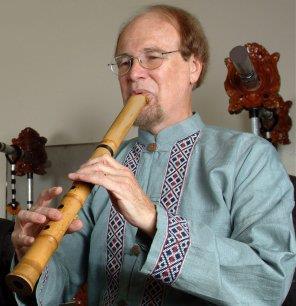
This year the Society of Ethnomusicology, Southeast and Caribbean Regional Chapter celebrates its 45th year. SEMSEC was founded in 1981 by Dr. Dale A. Olsen, who has served the chapter over the course his career, occupying various leadership positions and establishing the Dale A. Olsen Student Paper Prize. It is with deepest gratitude that we present Dr. Olsen with the Outstanding Leadership Award in recognition of his distinguished service to and continual stewardship of this organization. We thank Dr. Olsen and his wife, Diane, for their support of SEMSEC and for joining us for this year’s conference.
Dale A. Olsen was born in 1941 in Albert Lea, Minnesota. He received both a bachelor’s degree in 1964 and master’s degree in 1966 from the University of Minnesota, where he studied Historical Musicology and Flute Performance, and received his Doctorate degree in 1973 from the University of California, Los Angeles. Between his Master’s and Doctoral degrees, Dr. Olsen lived with his wife, Diane, as a Peace Corps volunteer in Santiago, Chile. Since then, he has lived, worked, and conducted research in South America as a National Endowment for the Humanities awardee, a Fulbright scholar, a Florida State University Developing Scholar, and a Committee on Faculty Research Support awardee. Dr. Olsen also received grants to conduct research in American and European museums, Italy, China, Korea, Tonga (South Pacific), Japan, Ireland, Vietnam, Thailand, and Panama. In 2005–2006 he was awarded a Guggenheim Memorial Fellowship to finish his book, Popular Music of Vietnam: The Politics of Remembering, The Economics of Forgetting. Dr. Olsen began teaching at the Florida State University School of Music in 1973, became a Distinguished Research Professor in 2001, and retired in 2008 as Professor Emeritus.
Conference Information
Travel
By air, Tallahassee is served by the Tallahassee International Airport (code TLH; 6 miles from campus). FSU College of Music is located near the intersection of S. Copeland St. and W. Park Ave. The paper sessions will be held in the Dohnányi Recital Hall located in the Housewright Music Building on the FSU campus. A map of the FSU campus showing sites of interest to conference attendees is available here
Parking
For Friday, visitors can register for a guest account and then purchase and print a $5 parking permit ahead of time via this link. This visitor permit will allow you to park in any non-gated faculty/staff or student lot for the entire day. More information on visitor parking at FSU is
available here: https://transportation.fsu.edu/visitors. On-campus parking can be difficult to find, so attendees are advised to arrive no later than 8:00 a.m. on Friday to locate a parking space. For Saturday, all on-campus parking lots are free for the day, including gated lots (the gates are typically raised after 5:00 p.m. on Friday). Attendees may still need to arrive early to locate a space on Saturday morning.
Lodging
A block of rooms has been set aside at a conference rate at the Doubletree by Hilton Tallahassee (101 S. Adams St.; $179/night + tax). Booking must be completed by January 26th in order to receive the conference rate. Booking can be completed by calling 1-877-800-2652 (group code 90A or “Musicology Conference”). The Doubletree provides complimentary on-site parking, a complimentary airport shuttle, and is within walking distance of the Housewright Music Building (5 blocks). Other hotels in the vicinity include the Four Points by Sheraton Tallahassee Downtown (850-422-0071), Hotel Indigo Tallahassee (850-210-0008), Aloft Tallahassee Downtown (850-513-0313), Residence Inn by Marriott Tallahassee Universities at the Capitol (850-314-5936), Days Inn by Wyndham Tallahassee University Center (844-5354171), and Econo Lodge (850-877-2755). Attendees are advised to book hotel rooms well in advance, since our meeting coincides with the Florida legislative session and a number of local events.
Thursday Dinner
An informal dinner is planned for Thursday, February 26 at 6:00 p.m. (EST) at The Monroe (1327 S Monroe St Suite 5, Tallahassee, FL 32301). Everyone is welcome, including student members. If you would like to join us, please send an email to Erol Köymen (egk24a@fsu.edu) by February 9. Please indicate the number of people attending and the approximate time you expect to arrive. Further inquiries about local arrangements may be sent to Erol.
Student Paper Prizes
AMS-S
Students whose papers have been accepted for inclusion in the AMS-S program may apply to receive a Student Paper Award of $250 by following these guidelines:
1. To be eligible for a student paper award, a student must be enrolled in an undergraduate or graduate music program, and graduate students must not have completed the Ph.D. Students must be current members of both the national AMS and the Southern Chapter. Note: to be eligible students must be student members of the AMS (not “regular” members).
2. Before being considered for an award, student papers must be accepted for presentation at the chapter meeting through the normal review process. Students whose papers are accepted must attend the chapter meeting and present the paper in order to receive a prize.
3. A copy of the complete paper, including handouts, must be received via email by Chapter President Blake Howe (bhowe@lsu.edu) by Friday, February 20, 2026, at 6:00 p.m. (EST). Slideshow files and audio/video files, if essential to the presentation, may be included.
4. Two Student Awards, consisting of $250 each, will be awarded. The winners will be announced at the business meeting or, if student presentations extend into Saturday afternoon, immediately after the final presentation. The winners will be acknowledged in the March AMS-S newsletter and recognized by the national organization on its website.
5. The committee reserves the right to refrain from making an award if the members deem no student paper worthy. A student who wins the award is ineligible to receive the award again in the year immediately following.
SEMSEC
Students whose papers have been accepted for inclusion in the SEMSEC program may apply to receive The Dale A. Olsen Prize. This prize is awarded annually to the best student paper presented at the annual SEMSEC meeting. The prize is named in honor of Dale A. Olsen, founding member of SEMSEC and Professor Emeritus of Ethnomusicology at Florida State University. The award is only given if the committee identifies a deserving student paper that meets the criteria of the prize. A student shall be defined as a person pursuing an active course of studies in a degree program. This will include persons who are engaged in writing the doctoral dissertation, but not those who are teaching full time while doing so. Paper prize submission must be submitted by Saturday, March 14th. The winner will be announced by Friday, May 29th . Please submit your paper (and accompanying presentation if relevant) to: https://forms.gle/4CxmafsCE5htVt4W7.
We sincerely thank our hosts at Florida State University, along with the session chairs, presenters, and conference volunteers.