20260222_FCA_Frank Martin

Page 1


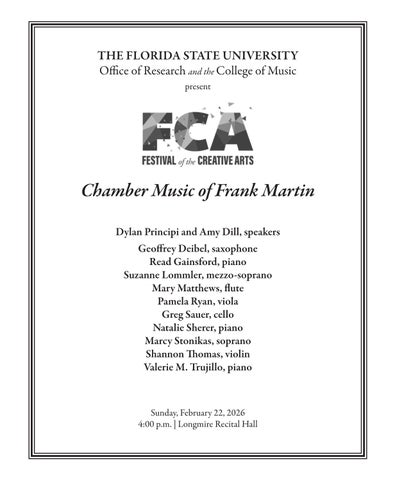
THE FLORIDA STATE UNIVERSITY

Office of Research and the College of Music present

Chamber Music of Frank Martin

Dylan Principi and Amy Dill, speakers

Geoffrey Deibel, saxophone

Read Gainsford, piano

Suzanne Lommler, mezzo-soprano

Mary Matthews, flute

Pamela Ryan, viola

Greg Sauer, cello

Natalie Sherer, piano

Marcy Stonikas, soprano

Shannon Thomas, violin

Valerie M. Trujillo, piano

Sunday, February 22, 2026 4:00 p.m. | Longmire Recital Hall

To Ensure An Enjoyable Concert Experience For All…

Please refrain from talking, entering, or exiting during performances. Food and drink are prohibited in all concert halls. Recording or broadcasting of the concert by any means, including the use of digital cameras, cell phones, or other devices is expressly forbidden. Please deactivate all portable electronic devices including watches, cell phones, pagers, hand-held gaming devices or other electronic equipment that may distract the audience or performers.

Recording Notice: This performance may be recorded. Please note that members of the audience may at times be included in this process. By attending this performance you consent to have your image or likeness appear in any live or recorded video or other transmission or reproduction made in conjunction to the performance.

Florida State University provides accommodations for persons with disabilities. Please notify the College of Music at (850) 644-3424 at least five working days prior to a musical event to request accommodation for disability or alternative program format.

Introduction

PROGRAM

Iain Quinn

“Frank Martin: Shifting Tonality for Shifting Times”

Dylan Principi

Ballade pour flûte et piano (1939)

Frank Martin (1890–1974)

Mary Matthews, flute

Valerie M. Trujillo, piano

Trio sur des mélodies populaires irlandaises (1925)

1. Allegro moderato

2. Adagio

3. Gigue

Trois chants de Noël (1947)

Shannon Thomas, violin; Greg Sauer, cello

Read Gainsford, piano

Text: Albert Rudhardt

1. Les cadeaux (1894–1944)

2. Image de Noël

3. Les bergers

“The Voice of Cassandra”

Quatre sonnets à Cassandre (1921)

Marcy Stonikas, soprano

Mary Matthews, flute; Natalie Sherer, piano

INTERMISSION

Amy Dill

Text: Pierre de Ronsard

1. Qui voudra voir comme un dieu me surmonte (1524–1585)

2. Nature ornant la dame qui devoyt

3. Avant le temps tes tempes fleuriront

4. Quand je te vois, seule, assise, à part toi

Suzanne Lommler, mezzo soprano

Mary Matthews, flute; Pamela Ryan, viola; Greg Sauer, cello

Ballade pour saxophone et orchestre à cordes (1938)

Geoffrey Deibel, saxophone

Valerie M. Trujillo, piano

Trois chants de Noël (1947)

Text: Albert Rudhardt (1894-1944)

Les cadeaux

J’ai vu trois rois sur le chemin

Tous plus beaux les uns que les autres

Ayant des cadeaux pleins les mains

À côté des leurs

Que seront les notres?

Autant dire rien!

Ils ont mis vers le petit prince

La myrrhe l’or et l’encens

Nos pauvres presents paraissaient bien minces

Près des trésors de trois provinces

Il a regardé les bijoux

Nous restions sans rien dire

Puis il a regardé vers nous

Et son premier sourire fut pour nous

The Gifts

I saw three kings upon the way, each fairer than the other two, carrying gifts in bold array.

Compared with that, what can we do?

You might as well say: Nothing!

They offered to the little prince myrrh and gold and frankincense. Our poor presents will look rather small beside the treasures of three provinces all.

On the jewels he did gaze. We, we were silent all the while. Then to us he turned his eyes.

And his very first smile was for us.

Image de Noël

L’enfant Jesus des images

Le beau bébé rose et blanc

Tend ses deux poings vers les mages

Ou vers un berger tremblant

Le boeuf sans cérémonie

Rumine en grondant un peu

Et la Vierge en manteau bleu

Sourit à la compagnie

Christmas Picture

The child Jesus we always see, the bonny baby, white and pink, holds out his fists to the Magi or to a shepherd, trembling. The ox, unceremoniously, chews and mumbles a little. And the Virgin in a blue mantle smiles on the company.

Les bergers

Il n’était pas encor minuit

Que la nouvelle étoile a lui

Pour éclairer la terre;

Puis soudain le ciel s’entrouvrit, Et vêtus de lumière,

On pouvait voir en Paradis

Tous les anges réunis

En prière.

Par les déserts, marchant pieds nus,

Tous les bergers étaient venus

Jusqu’à la pauvre hutte.

Ils amusaient l’Enfant Jésus

Avec des airs de flûte.

Les anges chantaient: Gloria!

Et les pâtres: Hosanna!

Alleluia, Alleluia, Alleluia, Alleluia.

Quatre sonnets à Cassandre (1921)

Text: Pierre de Ronsard (1524-1585)

1

Qui voudra voir comme un dieu me surmonte

Comme il m’assaut, comme il se fait vainqueur, Comme il renflamme et renglace mon coeur, Comme il se fait un honneur de ma honte,

Qui voudra voir une jeunesse prompte

A suivre en vain l’objet de son malheur, Me vienne lire: il verra ma douleur

Dont ma déesse et mon dieu ne font compte.

Il connaîtra qu’amour est sans raison,

Un doux abus, une belle prison,

Un vain espoir qui de vent nous vient paître.

Et connaîtra que l’homme se décoit

Quand plein d’erreur un aveugle il reçoit

Pour sa conduite, un enfant pour son maître.

The Shepherds

It was still not midnight and the new star bright came to shine on the world. At once opened the skies and costumed in light, within paradise you would see angels unite in prayer.

Through wastes and barefoot all the shepherds did come up to the poor hut. They made Jesus hum to their airs on the flute.

The angels sang: Gloria! And the shepherds: Hosanna! Alleluia, Alleluia, Alleluia, Alleluia!

Translation: Paul Griffiths

Whoever wishes to see a god overcoming me, assailing me, vanquishing me, making my heart flame and freeze repeatedly, and taking pride in my shame...

whoever wishes to see a young man quick to pursue in vain the object of his misery... should read my words: he will see my suffering, which is ignored by my goddess Cassandre, and by my god.

He will learn that love is irrational, a sweet illusion, a beautiful prison, a futile hope which feeds on empty air.

He will learn that one lets oneself down when one mistakenly accepts Eros the blind as guide, Eros the child as master.

Nature ornant la dame qui devoyt

De sa douceur forcer les plus rebelles, Luy fit present des beautez les plus belles, Que des mille ans en espargne elle avoyt

Tout ce qu’Amour avarement couvoyt, De beau, de chaste, et d’honneur soubz ses ailles, Emmiella les graces immortelles De son bel oeil qui les dieux emouvoyt.

Du ciel à peine elle estoyt descendue, Quand je la vi, quand mon ame ésperdue En devint folle: et d’un si poignant trait,

Le fier destin l’engrava dans mon ame, Que vif ne mort, jamais d’une aultre dame Empraint au cuoeur je n’auray le portraict.

3

“Avant le temps tes tempes fleuriront, De peu de jours ta fin sera bornée, Avant [le]1 soir se clora ta journée, Trahis d’espoir tes pensers périront ;

Sans me fléchir tes écrits flétriront, [En]2 ton désastre ira ma destinée, Ta mort sera pour [m’aimer]3 terminée, De tes soupirs [nos]4 neveux se riront.

Tu seras fait d’un vulgaire la fable, Tu bâtiras sur l’incertain du sable Et vainement tu peindras dans les cieux.”

Ainsi disait la nymphe qui m’affole, Lorsque le ciel, témoin de sa parole, D’un dextre éclair fut présage à mes yeux.

Nature, when adorning that lady whose gentleness would compel the most recalcitrant, bestowed on her all the most beautiful features that she had been saving up for centuries.

Everything fair and chaste and honourable that Eros was avariciously guarding under his wings went to sweeten the immortal graces of her beautiful eyes which excited the gods themselves.

Scarcely had she descended from heaven than I saw her, and, distracted, became crazy about her... Proud Fate engraved her

in my heart with such a sharp arrow that, whether alive or dead, I will never have the portrait of any other lady imprinted on my heart.

“Your hair will prematurely blossom white; your lifespan will be short; your day will close before your evening; your thoughts will perish with their hope betrayed; your writings will wither without swaying me; my destiny will cause your ruin; your death will befall for love of me; your descendants will ridicule your sighs; you will become a laughing-stock; you will build on unstable sand and paint futilely on the skies!”

The nymph who drives me crazy was making these prophecies, when heaven as witness to her words flashed before my eyes the sinister omen of a lightning-bolt.

Quand je te vois, seule, assise, à part toi

Quand je te vois, seule, assise, à part toi,

Toute [amusée]1 avecque ta pensée, La tête un peu encontre bas baissée, Te retirant du vulgaire et de moi,

Je veux souvent, pour rompre ton émoi, Te saluer, mais ma voix offensée

De trop de peur se retient amassée

Dedans [ma]2 bouche et me laisse tout coi.

Souffrir ne puis les rayons de ta vue, Craintive au corps mon âme tremble émue, Langue ni voix ne font leur action.

Seuls mes soupirs, seul mon triste visage

Parlent pour moi, et telle passion

De mon amour donne assez témoignage.

When I see you sitting all by yourself, engrossed in your thoughts, with your head somewhat lowered, withdrawn from the crowd and from me,

then I often want to greet you, to interrupt your moodiness; but my weakened voice, excessively fearful, stays back in my mouth, leaving me mute.

I cannot stand the brilliance of your appearance; my soul quivers timorously in my body; my tongue and vocal cords do not function.

Only my sighs, only my sad face speak for me; and such passion gives sufficient evidence of my love.

Translation: Peter Low

Turn static files into dynamic content formats.

Create a flipbook