THE FLORIDA STATE UNIVERSITY
COLLEGE OF MUSIC
Presents THE UNIVERSITY
SYMPHONY ORCHESTRA
Alexander Jiménez, Music Director and Conductor
Thomas Roggio, Graduate Associate Conductor featuring
Hana Beloglavec, Trombone
Saturday, February 21, 2026
Seven-thirty in the Evening
Ruby Diamond Concert Hall
Livestream: wfsu.org/fsumusic
PROGRAM
D’un matin de printemps (Of a spring morning)
Thomas Roggio, conductor
Lili Boulanger (1893–1918)
Trombone Concerto (2021)
Dani Howard
I. Realisation (b. 1993)
II. Rumination
III. Illumination
Hana Beloglavec, trombone
INTERMISSION
Le Sacre du printemps (The Rite of Spring), K.15
Igor Stravinsky
First Part: Adoration of the Earth (1882–1971)
Introduction
The Augurs of Spring
Ritual of Abduction
Spring Rounds
Ritual of the Rival Tribes
Procession of the Sage
The Sage
Dance of the Earth
Second Part: The Sacrifice
Introduction
Mystic Circle of the Young Girls
Glorification of the Chosen One
Evocation of the Ancestors
Ritual Action of the Ancestors
Sacrificial Dance
Please refrain from talking, entering, or exiting while performers are playing. Food and drink are prohibited in all concert halls. Please turn off cell phones and all other electronic devices. Please refrain from putting feet on seats and seat backs. Children who become disruptive should be taken out of the performance hall so they do not disturb the musicians and other audience members.

Alexander Jiménez is Professor of Conducting, Director of Orchestral Activities, and String Area Coordinator at the Florida State University College of Music. His work spans performance, recording, mentorship, and artistic leadership, with recordings on labels including Naxos, Navona, Neos, Canadian Broadcasting Ovation, and Mark. Known for his commitment to contemporary music, he has collaborated with an array of distinguished composers, among them Ellen Taaffe Zwilich, Ladislav Kubík, Anthony Iannaccone, Krzysztof Penderecki, Martin Bresnick, Zhou Long, Chen Yi, Harold Schiffman, Louis Andriessen, and Georg Friedrich Haas.
Jiménez has appeared as a guest conductor throughout the United States, Europe, and the Middle East, leading ensembles such as the Royal Scottish National Orchestra, the Brno Philharmonic, and the Israel Netanya Chamber Orchestra. He is at home with both professional and educational ensembles, having conducted regional and state honor orchestras across the country, as well as the NAfME All‑Eastern Honor Orchestra in 2009. His educational work includes engagements with the Boston University Tanglewood Institute and the Blue Lake Fine Arts Camp.
At Florida State University, Jiménez has overseen significant growth in the orchestral studies program, helping shape it into one of the nationally recognized programs of its kind. Under his direction, the University Symphony Orchestra has appeared at major conferences including the College Orchestra Directors National Conference and the American String Teachers Association National Conference. The University Philharmonia has also gained national visibility, performing at the Southeast Conference of the Music Educators National Conference and, most recently, the College Orchestra Directors Association National Conference in 2023. The University Symphony Orchestra’s national PBS broadcast of Ellen Taaffe Zwilich’s Peanuts Gallery® was named the Outstanding Performance of 2007 by the National Educational Television Association (NETA). In 2023, the Orchestra undertook a successful tour, performing at the Steinmetz Concert Hall of the Dr. Phillips Center for the Performing Arts in Orlando, as well as in national theaters of Santiago and Santo Domingo in the Dominican Republic.
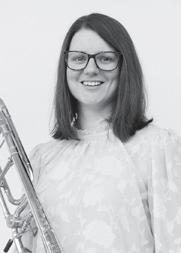
Trombonist and pedagogue Hana Beloglavec has a dynamic career performing as a soloist, chamber musician, orchestral musician, and teaching at Florida State University. Beloglavec has performed as a guest artist soloist at the 2022 International Women’s Brass Conference and with the U.S. Army Orchestra at the 2020 American Trombone Workshop. Her debut album, Bayou Home, was released through Summit Records in February 2023. This project was funded through the State of Louisiana Board of Regents ATLAS grant.
Also deeply interested in orchestral music, Beloglavec currently performs as the principal trombonist of the Tallahassee Symphony Orchestra and has served as the acting principal trombone with the Baton Rouge Symphony Orchestra for the 22 23 season. In summer of 2019 she performed as a substitute for the Armenian National Philharmonic’s production of Verdi’s Otello – the first female brass player to perform with the orchestra. She has also performed as a substitute trombonist with the Chicago based early‑music ensemble Music of the Baroque as well as the Chicago Symphony Orchestra.
Beloglavec was a core member of Seraph Brass from 2017 2020 and with the group performed and taught across the United States and the world. With Seraph, she was a guest artist at the 2019 Busan Maru International Music Festival in South Korea, the 2017 and 2018 Lieksa Brass Week in Finland, and the 2019 Artosphere Music Festival in Fayetteville, Arkansas.
Beloglavec received the Doctor of Musical Arts degree from Northwestern University, where she studied with Professors Michael Mulcahy, Douglas Wright, Timothy Higgins, Randall Hawes, and Christopher Davis. She completed the Master of Music degree at Yale University and the Bachelor of Music degree at Western Michigan University, where she studied with Professor Scott Hartman and Dr. Steve Wolfinbarger, respectively. In 2019 she was awarded the Early Career Award from Western Michigan University’s College of Fine Arts. Hana Beloglavec is currently an assistant professor of music at Florida State University and has formerly held positions teaching at Louisiana State University in Baton Rouge, Louisiana and Midwestern State University in Wichita Falls, Texas.
Hana Beloglavec is a Shires Artist and an Ultimate Brass Artist.
Boulanger:
D’un matin de printemps
The bronchial pneumonia that struck Lili Boulanger at the age of 2 resulted in constant ill health and a life that lasted less than 25 years. Her parents, and her famous and widely respected sister, the teacher and conductor Nadia, were trained and active musicians. She too displayed phenomenal musical talent, which her devoted family did everything to encourage. When she won the prestigious Prix de Rome at 19—she was the first woman to win it for music—it made international headlines. Her physical condition severely restricted her ability to answer the growing demand for her music. She created a small but consistently intriguing and attractive catalog of music that, to quote Claude Debussy, “undulates with grace.” It includes songs and choral works, piano and chamber pieces, and a handful of orchestral compositions.
She composed the companion works D’un soir triste (On a Melancholy Evening) and D’un matin de printemps (On a Spring Morning) in 1917 and 1918. Shortly after composing the small ensemble original versions, she transcribed them for orchestra. They were, alas, the final pieces she wrote with her own hand. The manuscripts, with their tiny notes, betray the increasing severity of her illness.
A vast emotional gulf lies between them. D’un soir triste is almost funereal in its mood and its dark palette of colors, and it swells up to several harsh climaxes. It may reflect Boulanger’s awareness that death was imminent. The sharply contrasting and much briefer D’un matin de printemps is sweet, playful, and transparently scored.
– Don Anderson
Howard: Trombone Concerto
Dani Howard is a British composer and orchestrator who is quickly gaining international recognition. Her works have been commissioned and performed by orchestras including the London Symphony Orchestra, the Royal Philharmonic, Royal Stockholm Philharmonic Orchestra, the Fort Worth Symphony Orchestra, and the NCPA Orchestra of China.
The Trombone Concerto was written for London Symphony Orchestra principal trombonist Peter Moore. As she prepared to work on the concerto, the COVID 19 pandemic hit and deeply influenced her inspiration for the work. She focused on the everyday heroics of the first responders, city workers, medical workers, and all those who risked their lives to help those who were sick, in need, and shut in. The Trombone Concerto celebrates such individuals and their resolve.
In the first movement, the humming rhythms of day to day life (embodied in the solo trombone’s instruction to ‘play as if you are totally oblivious to your surroundings’) are displaced by a gradual ‘Realisation’ – a way to contribute, perhaps, or a sense of one’s own worth. This seed of an idea is turned over and over in the second movement, ‘Rumination’. Here, over a repeating harmonic cycle, the initially unaccompanied trombone is joined in stages by sections of the orchestra, its confidence growing with every new exchange. Then comes the ecstatic finale, an ‘Illumination’ in which the soloist’s resolve is borne out in a burst of fireworks.
– Timmy Fisher
Stravinsky: Le Sacre du printemps
It’s somewhat fun to look back at the styles and fashions that shocked our ancestors, smugly reveling in our own sophistication and advanced thinking. Yet, it must be said that almost a century on, the musical impact of Stravinsky’s epochal ballet, Le Sacre du printemps, still has the power, if not to shock, at least to affect audiences in powerful ways. It is the third and final ballet from Stravinsky’s early musical maturity—the others being The Firebird (1910) and Petrushka (1911)—all three were commissioned by Sergey Diaghilev for his famous Ballets Russes. The latter was the most influential dance company in the world, the cream of Russia’s dance community, and which was active for decades in Europe, most notably in Paris and Monte Carlo. Under the artistic leadership of Diaghilev, this company was the cutting edge, so to speak, of contemporary dance, and responsible for the creation of artistic works whose influence continues unabated today.
Diaghilev’s genius for innovation naturally led him to the young Stravinsky, who had been a protégé of the famous Rimsky Korsakov, master teacher, composer of operas, and one of the most adroit orchestrators in musical history. The latter is key to understanding much of the musical style of Stravinsky’s three ballets, for Rimsky Korsakov’s sparkling evocation of Russian picturesque images through challenging and imaginative scoring for the orchestra leads directly from the older composer to his student. Stravinsky’s first two ballets for the company were “smash” hits, and so naturally Diaghilev was receptive to Stravinsky’s ideas for a ballet that was based upon what archaeologist and folklorist, Nikolai Roerich, thought to be authentic fertility rites of ancient Russia. A so called “primitivism” was of interest to artists in many fields as the Post Romantic era ground to a close, in preparation for the Modernism of the twentieth century. It should therefore not be surprising that an enterprising young composer with the ambition and imagination of Stravinsky should create a musical style unlike anything heard before in the ballet pits of France.
What the audience heard that night in May 1913 at the Théâtre des Champs‑Élysées in Paris was a triumph of daring musical innovation–a masterpiece of rhythmic, harmonic, and melodic originality. And it was not always pretty. The rhythms were thumping, insistent, and not common, at all. Unexpected accents, irregular and constantly changing metres, and displaced accents gave a kind of rhythmic “vertigo” to Parisian ballet audiences
used to refined, predictable, and elegant dances from centuries of tradition. The melodies did not partake of the traditional scales that had formed the melodies of European music, and were played in unusual ways by the instruments—ultra high, or in odd combinations, for example. The same could be said for Stravinsky’s new, daring harmonies—including the use of dissonance apparently for its own sake. In other words, for its very appropriate primitivism. Both dancers and musicians found the score almost beyond their powers of execution—it still is a technical challenge to today’s highly trained artists.
Well, Parisians are passionate about their art, and they had an immediate reaction to the music, as well as the “sexually suggestive” and “crude” choreography. The riot at the première is now legendary: catcalls, whistles, fistfights in the aisles, with order barely restored by the arrival of police. It must be said, that in today’s somewhat staid concert world, it’s rather nice to reflect about an audience that simply cared that much about high art. Well, it was a ground‑ breaking night, and many of the fundamental concepts of concert music were never the same thereafter. But it is important to also observe that most composers did not go on to compose works in the style of Le Sacre du printemps, including Stravinsky, himself. But the innovations wrought by him were part of a vanguard of musical change that was reflected in the transformations in all of art after the cataclysm of social change that was World War I.
The ballet consists of fourteen numbers, or dances, divided into two parts, the first part centering around various aspects of the annual life of the tribe, and the second focusing on rituals leading up to the human sacrifice of “The Chosen One.” Noteworthy events to listen for include the famous (very high and tricky) bassoon solo at the very opening; the irregular (and famous) accents in the following dance, “The Dance of the Adolescents;” the unusual woodwind combinations in the “Round Dance;” the general barbarism and virtuosity required of the orchestra in the “Dance of the Earth;” the dense, ghost like harmonies of the introduction to the second part; and the alternation between steady, almost monotonous rhythms and the confusing metre changes that occur in the “Glorification of the Chosen One.” The last movement, “Sacrificial Dance,” is in many ways a recap of all of these marvelous sounds, and reminds us of why some historians— with only small exaggeration—posit the beginning of twentieth‑century music in this stunning ballet.
Today, when one visits the serene island cemetery, San Michele, in Venice, where both Diaghilev and Stravinsky are buried, only a few yards from each other, it is far in time and distance from the youth of these two masters in Russia. I have always found it deeply poignant to see the faded ballet slippers and spent votive candles left on their modest markers by generations of dancers and musicians who have made the pilgrimage in homage. – © 2015 William E. Runyan
Violin 1
Masayoshi Arakawa‡
Javaxa Flores
Keat Zhen Cheong
Mari Stanton
Francesca Puro
Ioana Popescu
Ilayda Ilbas
Rachel Lawton
Stacey Sharpe
Will Purser
Sobin Son
Alexa Dinges
Violin 2
Emily Palmer*
Elizabeth Milan
Abigail Jennings
Samuel Ovalle
Bailey Bryant
Noah Johnson
Mariana Reyes Parra
Katherine Ng
Victoria Joyce
Carlos Cordero Mendez
Hayden Green
Quinn French
Christopher Wheaton
Viola
Noel Medford*
Jeremy Hill
Yey Mulero Rivera
Hannah Jordan
Nathan Oyler
Tyana McGann
Emelia Ulrich
Spencer Schneider
Maya Johnson
Jonathan Taylor
Harper Knopf
Abigayle Benoit
University Symphony Orchestra Personnel
Alexander Jiménez, Music Director
Thomas Roggio, Graduate Associate Conductor
Cello
Thu Vo*
Noah Hays
Mitchell George
Param Mehta
Turner Sperry
Natalie Taunton
Jake Reisinger
Ryan Wolff
Abbey Fernandez de Castro
Tia Stajkowski
Jaden Sanzo
Sydney Spencer
Bass
Caleb Duden*
Kent Rivera
Connor Oneacre
Christian Maldonado
Paris Lallis
Jarobi Watts
Flute
Kaitlyn Calcagino*
Nikkie Galindo
Shelby Werneth
Jordi Banitt
Paige Douglas
Oboe
Rebecca Johnson**
Gracee Myers**
Andrew Swift
Rebecca Keith
Steven Stamer
English Horn
Steven Stamer
Gracee Myers
Clarinet
Hannah Faircloth**
Jaxon Stewart**
Anne Glerum**
Hali Alex
Harper Golden
Bass Clarinet
Hannah Faircloth*
Hali Alex
Bassoon
Cailin McGarry**
Josie Whiteis**
Hunter Fisher
Georgia Clement
Hannah Farmer
Horn
Eric On**
Kate Warren**
Jeason Lopez
Gio Pereira
Allison Hoffman
Issac Roman
Coen Taylor
Brandon Bourdeau
Trumpet
Avery Hoerman**
Noah Solomon**
Johniel Najera
William Rich
Jeremiah Gonzalez
Anthony Gonzalez
Trombone
Grant Keel*
Aryn Nester
Brent Creekmore
Tuba
Yoni Zegeye*
Colin Teague
Percussion and Timpani
Darci Wright*
Gabby Overholt
Caitlin Magennis
Waylon Hansel
John Baker
Jordan Brown
Harp Noa Michaels
Keyboard Lujie Wang
Orchestra Manager
Za’Kharia Cox
Orchestra Stage Manager
Carlos Cordero Mendez
Orchestra Librarians
Guilherme Rodrigues
Tom Roggio
Library Bowing
Assistant
Victoria Joyce
‡ Concertmaster * Principal ** Co-Principal