THE
FLORIDA STATE UNIVERSITY College of Music presents the
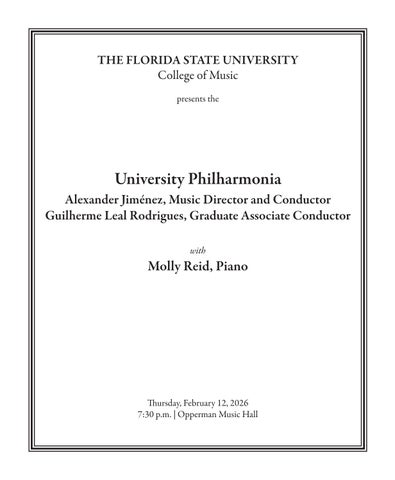
FLORIDA STATE UNIVERSITY College of Music presents the
Alexander Jiménez, Music Director and Conductor
Guilherme Leal Rodrigues, Graduate Associate Conductor with Molly Reid, Piano
Thursday, February 12, 2026 7:30 p.m. | Opperman Music Hall
Overture to Idomeneo
Variations in Search of a Theme by Matos Rodríguez
Wolfgang Amadeus Mozrt (1756–1791)
Arthur Barbosa
Variation 10 – Gran Marcha (b.1965)
Variation 9 – Olvido
Variation 8 – Arrabal
Variation 7 – Miserere
Variation 6 – Carnaval
Variation 5 – La Gaucha
Variation 4 – Contradanza
Variation 3 – Si supieras
Variation 1 – Comparsa
Molly Reid, piano
Guilherme Leal Rodrigues, conductor
Symphony No. 2, Op. 30 “Romantic”
Howard Hanson
Adagio-Allegro moderato (1896-1981)
Andante con tenerezza
Allegro con brio
Please refrain from talking, entering, or exiting during performances. Food and drink are prohibited in all concert halls. Recording or broadcasting of the concert by any means, including the use of digital cameras, cell phones, or other devices is expressly forbidden. Please deactivate all portable electronic devices including watches, cell phones, pagers, hand-held gaming devices or other electronic equipment that may distract the audience or performers.
Recording Notice: This performance may be recorded. Please note that members of the audience may at times be included in this process. By attending this performance you consent to have your image or likeness appear in any live or recorded video or other transmission or reproduction made in conjunction to the performance.
Florida State University provides accommodations for persons with disabilities. Please notify the College of Music at (850) 644-3424 at least five working days prior to a musical event to request accommodation for disability or alternative program format.
Praised for “spellbinding” performances that feature “structural, long phrasing,” American pianist Molly Reid brings a distinctive voice to classical piano performance. Her command of sound and style has consistently earned her top prizes in competitions including the MTNA-Steinway & Sons Young Artist Piano Competition, the Rosen-Schaffel Young Artist Competition, the Annual Keyboard Competitive Festival at Florida State University, the 2025 Florida State University College of Music Doctoral Concerto Competition, and the 2025 Ocean Music International Piano Concerto Competition.
Reid began her piano studies at a young age with her parents, both classical pianists. Her principal teachers include Heidi Louise Williams and Rodney Reynerson, with additional study under Ney Fialkow, Junie Cho, and Eugene Pridonoff. She has performed in master classes with renowned artists including Boris Giltburg, Hung-Kuan Chen, Boris Berman, Émile Naoumoff, and Ksenia Nosikova.
Equally accomplished as a scholar, Reid has presented papers and lecture-recitals at national and regional conferences across the United States. Her work has been published in the Journal of Music Theory Pedagogy and recognized with the Best Student Paper Award at the national Pedagogy into Practice Conference. In 2024-25, she was one of 100 women doctoral students in the U.S. and Canada who received the P.E.O. Scholar Award from P.E.O. International (Philanthropic Educational Organization).
Reid holds degrees from the University of Cincinnati College-Conservatory of Music (MM) and Appalachian State University (MM, BM), and is currently a dual doctoral candidate in piano performance (DM) and music theory (PhD) at Florida State University, where she is supported with a Legacy Fellowship and teaches undergraduate music theory and ear training.
Mozart: Overture to Idomeneo, rè di Creta
Mozart composed Idomeneo in 1780-81 on a commission from the Bavarian court in Munich. It was his first great opportunity to stage a full-scale music drama in the reformed tradition of Christoph Willibald Gluck that included a substantial role for chorus and ballet. The plot was based on a tragédie lyrique, as French opera of the period was called, by librettist Antoine Danchet with music by André Campra.
Idomeneo, the King of Crete, was one of Agamemnon’s generals and trusted advisors in The Iliad. In a late Roman extension of the aftermath of the Trojan War, Idomeneo leaves his kingdom in the care of his young son Idamante to join the siege of Troy. The essence of the plot is a little like the biblical story of Jephtha, who in return for a military victory vowed to sacrifice the first living thing to greet him when he returned home – as it turned out, his daughter. Idomeneo, beset by a storm at sea on his homeward journey from the Trojan War, has made a similar vow to Neptune. The rest of the plot concerns his vain attempts to avoid sacrificing Idamante. Naturally, there’s a love interest as well, a triangle among Idamante, the Trojan princess Ilia and – of all people – Agamemnon’s daughter Electra, who has sought refuge in Crete after her mother Clytemnestra has murdered her father. Ultimately, after Idamante has slain a sea monster sent by Neptune to devour the Cretan people, an oracle emerges as a deus ex machina, ordering Idomeneo to abdicate in favor of his son.
Unfortunately, the opera was not a great success and never gained popularity in the composer’s lifetime, although Mozart himself thought highly of it. He made numerous changes to gain its acceptance in Vienna, but to no avail. It has experienced a limited renaissance in large opera houses, where innovative productions outside the standard repertory have elicited audience support.
As was customary of overtures at the time, the Overture to Idomeneo is in sonata form, although without any significant development section. There is the obligatory slow introduction, a series of pompous blasts of the full orchestra, followed by a threatening theme, recalling what Mozart would later put into his overture for Don Giovanni. The Allegro runs out an array of themes, the most important of which are the first and second. The recapitulation simply recasts the themes into their proper keys for a proper resolution in the tonic.
– Elizabeth & Joseph Kahn 2016
Barbosa: Variations in Search of a Theme by Matos Rodríguez
Few musical works have achieved the extraordinary cultural reach of the tango created by Uruguayan composer Gerardo Hernán Matos Rodríguez in the mid-1910s, known worldwide today as La Cumparsita. Originally conceived not as a tango, but as a carnival march for a student organization in Montevideo, the piece became famous in the vibrant popular nightlife of Montevideo.
When tango pianist and conductor Roberto Firpo first performed the piece in 1916, he reshaped it significantly, adding a contrasting trio section drawn from his own tango La Gaucha Manuela and incorporating a melodic gesture inspired by the Miserere from the opera Il Trovatore by Giuseppe Verdi. After an ephemeral success in 1916, the piece fell into oblivion and would only reappear in 1924, with the addition of lyrics by Pascual Contursi and Enrique Pedro Maroni, under the title Si supieras. This version propelled the tango to international fame, especially through iconic recordings by Carlos Gardel.
Arthur Barbosa’s Variations in Search of a Theme by Matos Rodríguez engages directly with this layered history. Rather than presenting the theme in a traditional way, Barbosa deliberately avoids stating it in its pure form. Instead, the work unfolds as a kind of musical archaeology: a sequence of variations that begin far removed from the original material and gradually draw closer to it. The listener encounters fragments, shadows, rhythmic allusions, harmonic distortions, suggesting memories, emotions, and historical moments associated with the tango, before slowly approaching its recognizable contours.
This inverted trajectory sets the work apart from conventional theme and variation structures. Here, the variations do not move away from the theme, but toward it, inviting the audience into an active process of listening and recognition. Each variation offers a different “face” of the same musical character, shaped by surprise, transformation, and reinterpretation.
The great Argentine composer Astor Piazzolla once famously dismissed La Cumparsita as “the most frighteningly poor tango in the world,” yet recorded it in four distinct versions throughout his career—demonstrating precisely the melody’s extraordinary capacity for reinvention. Barbosa’s work embraces this paradox, celebrating the tango’s seemingly simple surface and its limitless possibilities.
By withholding the explicit identity of the source material, Variations in Search of a Theme by Matos Rodríguez ultimately offers each listener a personal moment of discovery—echoing the enduring mystery of a melody that, more than a century later, continues to reinvent itself through those who hear, perform, and enjoy it.
Howard Hanson (1896-1981) was born in Wahoo, Nebraska. He studied at the University of Nebraska, the Institute of Musical Art (later renamed the Juilliard School of Music) and Northwestern University. He began his teaching career at the College of the Pacific in California before moving on to the American Academy in Rome and then, beginning in 1924 and for the next forty years, directing the Eastman School of Music in Rochester, New York. Hanson’s Symphony No. 2, subtitled “Romantic,” was premiered in 1930 by Serge Koussevitzky in celebration of the fiftieth anniversary of the Boston Symphony Orchestra. The composer’s program note for the first performance is excerpted (in edited form) below:
My aim, in this symphony, has been to create a work young in spirit, Romantic in temperament, and simple and direct in expression. The first movement begins with an atmospheric introduction in the woodwinds. The principal theme is announced by four horns and is imitated in turn by the trumpets, woodwinds and strings. A transition leads into the subordinate theme in the strings with a counter subject in the solo horn. The development section follows, with the principal theme announced by the English horn and developed throughout the orchestra. The climax of the development section leads directly to the return of the principal theme in the original key by the trumpets. The subordinate theme then follows, and the movement concludes quietly in a short coda.
The second movement begins with its principal theme announced by the woodwinds with a sustained string accompaniment. An interlude in the brass, taken from the introduction of the first movement, develops into the subordinate theme, which is taken from the horn solo in the first movement. A transition leads into a restatement of the principal theme of the movement.
The third movement begins with a vigorous accompaniment figure in strings and woodwinds, the principal theme entering in the four horns and later repeated in the basses. The subordinate theme is announced first by the cellos. The development of this leads into the middle section, piu mosso. This section begins with a pizzicato accompaniment in the violas, cellos, and basses, over which is announced a horn call. This leads to a fanfare first in the trumpets, then in the horns and woodwinds, and then again in the trumpets and woodwinds. The climax of this fanfare comes with the announcement of the principal theme of the first movement by the trumpets, against the fanfare theme of the woodwinds. The development of this theme leads into a final statement of the subordinate theme of the first movement fortissimo. A brief coda of this material leads to a final fanfare and the end of the symphony.
Though Hanson did not compose any movie scores, it is interesting to note that the music from his Romantic Symphony has had major impacts on films made (in at least one case) more than fifty years after the symphony was premiered. It is obvious that John Williams was hugely influenced by the music of the opening of the symphony’s final movement when he derivatively scored the bicycle chase scene in 1982’s E.T. the Extra-Terrestrial. And three years earlier, in 1979, an enraged Hanson had to be persuaded not to sue the makers of Alien for using (without Hanson’s permission and without paying him a cent!) the music that ends the symphony’s second movement to underscore the final scene of the film along with the closing credits.
©William Schrickel
Violin 1
Christina Leach‡
Lucia Garro
Chloe Gullo
Sasha Richeson
Leah Tryzmel
Ajay Balkaran
Mulunesh Creaghan
Myra Sexton
Irsia Ruíz Guzmán
Violin 2
Olivia Leichter*
Shane Sharkey
Max Loesener
Jenna Marie Meola
Violet Lorish
Maya Sharma
Elina Nyquist
Connor Brown
Lindsay Cunningham
Viola
Joseilys Quinones*
Jacqueline Wang
Madison Jansons
Angeleena Jackson
Corinne Williams-Hough
Brenden Brewer
Keannamarie Goliat
Emma Patterson
University Philharmonia Personnel
Alexander Jiménez, Music Director and Conductor
Guilherme Leal Redrigues, Graduate Associate Conductor
Cello
Jason Tejada-Chancay*
Brandon Bonamarte
Addison Miller
Ashley Gessner
Daniel Jimenez-Gaona
María Ruíz Guzmán
Tyler Benko
Matthew Pooler
Miroslav Beck
Chloe Kolenc
Enzo Savage
Bass
Charlotte Wooldridge*
Christopher T. McDuffie
Emma Waidner
Jean-Philippe Montas
Garrett Gilley
Gavin Smith
Daniel Martinez
Flute
Sarah Kimbro*
Daniel Ascanio-Perez
Krista Zimmerman
Piccolo
Krista Zimmerman
Oboe
Lorin Zamer**
Haley O’Neill**
Emma Druggan
Richard Wilson
English Horn
Haley O’Neill
Clarinet
Joseph Eckhart**
Nicholas Mackley**
Bassoon
Susanna Campbell**
Ben Kiely**
Sophia Clement
Amelia Khanji
Contrabassoon
Susanna Campbell
Horn
Andrew Keller**
Isaac Roman**
Emma Brockman
David Pinero
Davis Craddock
Trumpet
Angelo Del Oro**
Grason Peterson**
Nathan Reid**
Trombone
Sarah Castillo**
Justus Smith
Bass Trombone
Kevin Li
Tuba
Connor Kelley
Percussion
Ethan Turner
Drew Jungslager
Cole Martin
Alex Aquino
Harp
Sierra Stacy
Orchestra Manager
Steven Stamer
Stage Manager
Connor Oneacre
Orchestra Librarians
Guilherme Rodrigues
Tom Roggio
Library Bowing Assistant
Victoria Joyce
‡ Concertmaster * Principal ** Co-Principal