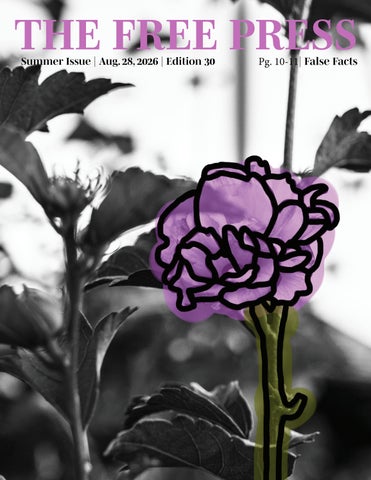
THE FREE PRESS Summer Issue | Aug. 28, 2026 | Edition 30
Pg. 10-11| False Facts
02
The Free Press
CONTENTS CONTENTS NEWS
A&E
Pg 04: Casting the Future Pg 05: Monitor the Mandering Pg 13: 250 Years
Pg 08-09: Photo Gallery Pg 12: Summer Releases Pg 14: Home Away from Home
FEATURE Pg 06: Early Bird Gets the Produce Pg 07: An Uplifting Development Pg 15: Civic Citizens
OPINION
Pg 10-11: False Facts
4700 Overland Dr, Lawrence KS, 66049
NEWS STAFF EDITORS-IN-CHIEF Ceci Bennett Grace Mosconi MANAGING EDITORS Stella Dorssom Kyla Meikle DESIGN EDITOR Abbie Veeder ASST. DESIGN EDITOR Jaime Stone PHOTO EDITOR Layla Afani-Coburn CAPTIONS EDITOR Leona Randall
ABOUT THE COVER Blooming, a flower reaches for the sun during the warm summer months. The flower blossoming represents a time of renewal and opportunities. In this issue, you will read about a variety of changes that have occured this summer and changes still to be made throughout the school year. The highlight of the flower showcases that despite the weeds and dark environment, a flower can grow with the right amount of determination and courage. We hope the cover inspires everyone to reach for the sun during the school year. Design by Harper Finck, photo by Carter Braden.
COPY EDITOR Collette Colvin SPORTS EDITOR Griffin McDonnell ONLINE EDITOR-IN-CHIEF Kinley Gigous SOCIAL MEDIA EDITOR-IN-CHIEF Julia Andrade REPORTERS Dara Adedipe Penny Coleman Harper Finck Samantha Lowe Sydney Tiemann Maya Wuthrich DESIGNERS Harper Finck
FOR BREAKING NEWS AND MORE CONTENT VISIT OUR WEBSITE! FSFREEPRESSONLINE.COM
SOCIALS @fsjournalism TikTok: @freestatejournalism
MISSION STATEMENT Curious Free State journalists will amplify voices, gather superior sources and tell pivotal stories of our community in a visually creative way in order to serve our audience and foster quality scholastic journalism in Lawrence, Kansas.
PHOTOGRAPHERS Addison Powers Carter Braden BUSINESS TEAM Dylan Tenbrink
The Free Press
Design by Grace Mosconi
03
LETTER FROM THE EDITORS Hey Firebirds!
T
eenagers in the United States spend up to 35 hours a week in school. From August to May, high school students spend the majority of their time at school and extracurricular activities. Therefore, when summer rolls around, a gap is left in many schedules. Summer hangouts, jobs and travel all occur in quick succession during this time of the year. With so much happening, it is easy to miss or forget major events. In this issue, we attempted to cover the biggest topics and events from the summer while still keeping the content entertaining. Summer is a time to explore new hobbies and experiences, and we hope our issue reflects all the exciting things that occurred recently. The local news turned national this year with Lawrence’s
Smiling, News Editor-in-Chiefs junior Grace Mosconi and senior Ceci Bennett pose for the photo. Photo by Kinley Gigous
warm welcome of the Algerian national soccer team. Lawrence played a small role in the World Cup, but any role in the world’s largest sporting event quickly becomes important. As our local events grew in coverage, such as the 50th anniversary of the Lawrence Farmers Market, we attempted to take a unique angle and summarize the key points. We hope we were able to hit these points from this summer so that you can all be caught up when the school doors open. We hope this issue brings every reader as much joy reading it as it did for us creating it. While schedules are filling up again, we attempt to make news, from pop culture to politics, as enjoyable and straightforward so everyone has access to the truth. We look forward to another year of publishing for Free State!
04
The Free Press
News
CASTING THE FUTURE High school seniors challenge historical turnout trends amid changing political atmosphere
program encouraging civic discussion among youth, Sedich said new voters can be discouraged when they feel disconnected from a political system they did not design.
“
Younger people often feel cheated by the system that we have been handed. People are so cynical about politics because it can feel disheartening, Sedich said.
“
E
ligible Kansas voters have until Oct. 13 to register for this fall’s midterm elections. During what students and educators describe as a changing political climate, youth engagement is shifting away from historical patterns. Incoming senior Daisy Devlin said the model is being altered by the higher voter turnout from teenagers. “Lately, people are more interested because of the current political atmosphere,” Devlin said. “There’s a sense of urgency with it.” This urgency comes during a period of shifting voter participation among ages 18 to 29, a demographic that historically lags behind older generations. According to data from the Center for Information and Research on Civic Learning and Engagement (CIRCLE) at Tufts University, youth midterm turnout reached a record low of 13% in 2014, before rising to 28% in 2018, and settling at 23% in 2022, the second-highest turnout in the past 30 years. Turnout numbers are continuously growing. According to a May 2026 CIRCLE survey, 56% of young people said they were extremely likely to vote in this year’s midterms, indicating strong intent among new voters. Pizza and Politics coordinator at the Dole Institute of Politics and Free State alum Kaitlynn Sedich said politicians are putting in less work to win young voters than in past elections. “I think that most politicians underestimate the students that want to be engaged, and on the other side of things, I think that most students don’t know how to get engaged,” Sedich said. One driver of that urgency is the current people’s political disapproval. According to Pew Research Center, President Donald Trump’s approval rating has reached an all-time low, contributing to discussions about the stakes of the midterm elections. As the coordinator of Pizza and Politics, a
Story by Dara Adedipe
The political disconnect influences student conversations. Devlin said she has not talked about the upcoming election with any of her peers, calling political conversations “a little bit taboo” with people being scared to disagree. Social pressure is not the only barrier to youth participation. Free State government teacher Jeff Haas said navigating everyday life plays a heavy role in how younger generations view civic participation. “They’re trying to get their own footing in life, and sometimes that affects
how important they think it is to go cast one vote,” Haas said. Rather than focusing solely on voting, Haas said his primary goal is to ensure students understand the system they are entering. “I view myself as a little more of an advocate of education than I do an advocate of registration,” Haas said. With record high turnouts, having votes from a new younger demographic can alter outcomes. Haas said a larger youth turnout has the power to shift national outcomes. “Generally speaking, the younger voters that are in the cycle, the better chance we have to collectively move forward on important issues,” Haas said. “The more you can nudge up the younger vote, I think the better chance we have of getting beyond the divisive politics,” Haas said. Both Haas and Sedich said becoming an informed voter begins long before Election Day. Sedich said they encourage students to research candidates, issues and reliable sources. “Educating yourself of your own accord is the most important step,” Sedich said. “You need to get to know yourself and your values, and then go into the research with those in the back of your mind.” Although young voters have historically voted less than older generations, Sedich said they hope more people recognize that students are invested in issues affecting their futures. “I wish that older generations knew how much we care,” Sedich said. “We have opinions on that. We have some frustrations about how that’s impacting our lives.” A blue and red Kansas represents the fight between the Democrats and Republicans to gain a political majority during the upcoming midterm elections through voters. Illustration by Grace Mosconi
The Free Press
Design by Ceci Bennett & Grace Mosconi
05
MONITORTHEMANDERING
Deciphering the illegality of geographic voting manipulation
W
ith the approaching 2026 midterm elections, concerns surrounding the current political sphere are becoming more frequent nationwide. According to Pew Research Center, about 19% of citizens fully trust the federal government to abide by the Constitution in 2025, compared to 73% in 1958. According to an article by the Brennan Center for Justice — the process of manipulating maps to favor election outcomes — or gerrymandering, has hit a sharp increase this year, with some wondering if their vote even counts, especially when states are redrawing district voting lines. The concept of gerrymandering first became prevalent in 1812 in Massachusetts, when Gov. Elbridge Gerry redrew state senate districts to favor his Democratic-Republican Party over the rival Federalist Party. Before 1842, a single party could unanimously sweep an entire state delegation. When deemed unfair by the Whig Party (an active political group from 1833 to 1854), the Apportionment Act of 1842 legally required states to divide themselves into single-member districts and elect a representative from each. However, the act backfired when state legislators realized they had free rein to redraw voting maps. Whether the redistricting is legal or not is up for debate, depending entirely on the contents of the map and who it may be excluding. In today’s era, mapmakers possess the modern resources to easily achieve their desired voter outcome. Massive computing powers, like Geographic Information Systems, let mapmakers generate thousands of redistricted maps using algorithms. Although used sporadically in politics, tools like Harvard University’s Redist and the ALARM Project hold algorithmic accountability as they aim to eliminate illegal tech usage. While the Voting Rights Act of 1965 previously protected minority votes, 2026 technology is being used to bypass protections and target neighborhoods under “race-blind” redistricting. According to the Yale Law
News Brief by Penny Coleman
Journal, “race blind” redistricting is where mapmakers create districts based on variables excluding race. However, the topic became controversial when race blind redistricting caused direct friction with federal law.
Under the Voting Rights Act, states are legally required to associate a person’s race with their vote. Making minority votes invisible not only undermines personal voting value and compromises national voting research, but also creates civic controversy. One contentious case of redistricting appeared in Louisiana earlier this year. In 2022, a redistricted map, drawn and solidified by the Louisiana legislature, was sued for only having one majority-Black district. After the map’s re-creation in 2024 with an additional majority-Black district, a different group claimed the map held prejudice against non-African Americans. When taken to the Supreme Court in 2026, a vote of 6-3 was reached on April 29, voting the map a racial gerrymander. In Louisiana's case, there was no obligation from Section 2 of the Voting Rights Act to create another majority-Black voting district. With the specific district spanning over 200 miles, the Supreme Court argued the state lacked a concrete reason to create a race based district this large, and the end result would most likely compromise local midterm election results. Now with the 2026 midterms arriving, the Louisiana Legislature will use a map during election season that closely resembles the original 2022 district map, until after the elections where legislatures can return to the drawing board. While gerrymandering began as a state practice, its
growing influence can be viewed at the national level. According to the Council on Foreign Relations, President Donald Trump aims to favor Republicans’ chances of holding onto the House by encouraging red states to redraw their maps. The outcome of the 2026 midterm elections will fundamentally shift depending on which states actually redraw their maps. However, recent Kansas controversy may foreshadow that red states may not be persuaded. According to the Kansas Reflector, Trump coaxed the Kansas Legislature to draw a congressional map that excludes the third district of Kansas, currently represented by Democrat Sharice Daniels. “The fact that we have legislators that were saying they’re more beholden to Donald Trump than they are to Kansas voters was infuriating. Not just for me, but for tons of people, particularly across the 3rd District,” Davids said. “That’s not a political party thing. Taking someone’s vote and treating it like it’s some kind of chess piece is inappropriate.” Although Democratic Kansas Governor Laura Kelly said the state lacks the budget to redraw the congressional map entirely, Trump's encouragement of the new draft persists. Ultimately, it will be up to each individual court case to determine what redistricting really is and if it can truly be distinct from gerrymandering. The salamander is the classic representation of gerrymandering. The magnifying glass with an eye signals the how gerrymandering is being watched. Illustration by Grace Mosconi
06
Feature
The Free Press
EARLY BIRD GETS THE PRODUCE Lawrence Farmers Market plans ahead during 50th anniversary
Story by Maya Wuthrich
Displayed, flowers and wreaths are hung and placed at a booth at the Lawrence Farmers Market. Photo by Addison Powers
people that you wouldn't otherwise, and that part is really one of the high points.” To see positive results on the actual day of the market, however, Susan Shanklin said additional work is necessary. Besides planning and organizing for market days, Shanklin said marketing and promoting products requires a lot of dedication and responsibility. Emily Lysen is the market’s first-ever full-time employee and director of development. Lysen said that because vendors have their hands full, the creation of her position in 2021 was essential to help shift responsibilities from vendors’ shoulders to hers. "Peter's Family Farm, they're not just farmers and bakers and jam makers, they also clean houses. They have to have a whole other job. Jill with Moon on the Meadow, she's an acoustical engineer, like she has a whole other full-time job too, and so they are farming and doing amazing work, but that doesn't sustain them enough… ” Lysen said. Lysen and her team now handle communication with the City of Lawrence. The market staff and the City are currently seeking a permanent location. According to the Lawrence Farmers Market’s website, the market has been searching for a long-term venue with a pavilion structure, bathrooms and utility access since 2015. “The goal of this project isn't just to be for the market, it's for a multi-use pavilion facility for the entire community; we've just led the charge because this is something we need,” Lysen said.
Lysen said the farmers market values community input in choosing a permanent home. The market offers locals the chance to hear more information and voice their own opinions at Community Engagement Events. “We want everybody to be really involved in the decision-making process,” Lysen said. Though the Lawrence Farmers Market may change locations, Lysen said other market traditions will be upheld. The market will continue ensuring all goods sold come from Kansas, while also within a 50 mile radius of Lawrence.
“
The farmers are really proud of what they do, and they work really, really hard. They're not interested in competing with somebody who can buy wholesale and sell at a really cheap price, Lysen said.
“
N
ow the oldest operating farmers market in Kansas, the Lawrence Farmers Market celebrated its 50th birthday in June 2026. To commemorate the occasion, the market hosted a “Local Food Cup” on June 27. The Food Cup included a dunk tank, a local produce competition, a photo booth and a soccer shootout. The event drew in large crowds, and the farmers market now has up to 100 vendors. However, the market that Lawrence knows now has undergone change and growth since it began. According to the Lawrence Farmers Market website, the market started out as a pop-up in the Chamber of Commerce Bank parking lot in 1976. It moved to its location at 824 New Hampshire St. in 2007, and has been operating there since. Free State junior Zacha Zavarse said her family has been shopping at the farmers market for almost a decade, and she continues to return. “We see a lot of people that we don't normally see [or] that we haven't seen in a while at the farmers market, so it's nice to reconnect with people,” Zavarse said. Behind the scenes, vendors devote time and effort preparing for shoppers. Sister-in-laws Susan and Ann Shanklin co-run their flower booth, Almost Wild. Susan Shanklin said they spend all day Friday getting ready for Saturday’s market. “Flower farming is really hard work. It's very labor-intensive,” Susan Shanklin said. “Ann and I both agree that coming to the farmers market is a payoff, because you get to know a lot of different
“It's really all about that, about showcasing Kansas and showcasing Lawrence,” Lysen said. Lawrence Farmers Market events, including town hall meetings, surveys and community presentations, are listed within a schedule available on the Lawrence Farmers Market website.
The Free Press
Design by Ceci Bennett
AN UPLIFTING DEVELOPMENT strategies to endure the pandemic shutdown. Confined contact wasn’t an option, so she filled her Uplift-branded Jeep with coffee and pastries and delivered them to neighborhoods and businesses. Problem-solving is the exact reason why Huslig has faith in the new, larger location.
“
If it doesn't scare you, it's not worth doing. If it doesn't make you nervous and it doesn't give you the what-about, is it really worth your time? Is it really a challenge? Huslig said.
“
U
plift Coffee owner Kelli Huslig said she has always gone through life with a particular notion: to serve others and build relationships with those around her. Before applying her philosophy by opening her first cafe in 2020, her sentiment had a different meaning. Instead of serving coffee, she served minds, with nearly 25 years of experience in education. “This is actually my retirement gig. I opened my Second Street location when I turned 50. The reason I did it is because relationships are really important to me. That’s what I was doing in school, and I've always loved coffee shops,” Huslig said. In the years leading up to opening in 2020, Huslig said she knew cafes were where her heart was, so she took the initiative to learn every detail about them. “When I finished [teaching], my husband was really like,‘You need to do your dream.’ So I spent about a year and a half researching coffee shops. My husband used to travel a lot [for] his work, and I went with him everywhere and talked to as many coffee shops as I possibly could. Then I went to coffee school down in Texas,” Huslig said. Huslig opened Uplift Coffee on Jan. 28, 2020, two months before the pandemic. Although many businesses struggled to remain afloat in the midst of the COVID-19 outbreak, Huslig said she made perseverance a priority, which her experience in the education system had trained her for. “I don't have a business background, but I ran a school for 10 years, so it was one of those things where I went, ‘Well, this lesson plan isn't working; let's do a new lesson plan. Our mission is to uplift and elevate anybody we have the opportunity to serve. So, how do we do that in a world where doors have to be closed and locked?’” Huslig said. Huslig said she created unique
Two-year Uplift employee Piper Hall said the new location will be an exciting change. Additionally, she said that something she’s looking forward to is strengthening employee bonds. “Kelli and [her husband] Carl are awesome to us. I always joke that they're like my Lawrence mom and dad. Kelli is really great with whom she hires. So it's not like coming to work; it's like coming to hang out with your friends,” Hall said. “Sixth Street was kind of the hub for orders. Now with Mass Street being the new hub, it's an adjustment to work around. So I think it's really starting to strengthen our teamwork.” Though Huslig said she’s afraid some may say the size of the new location is too excessive for a coffee shop, she hopes it’s actually an advantage to fulfill the foundational unity aspect on which Uplift is built.
Uplift Coffee Shop acquires new downtown location
07
Story by Penny Coleman
“The bar is a mock bar, so you're having interaction with your customer the entire way down it. One thing I don't love about Sixth Street [Uplift] is you have to turn your back to your customer immediately,” Hall said. While some businesses look at others as blatant competition, Huslig said competition wasn’t her biggest concern. Driven by passion and enthusiasm, she said she just focuses on uplifting the community, instead of competing with it. “There are so many amazing coffee shops and cafes. That's what makes [Lawrence] just fantastic. So my goal is not to take from that. My hope is to just add to the options for people to come and enjoy,” Huslig said.
Illustration by Harper Finck & Ceci Bennett
08
A&E
The Free Press
SUMMER GALLERY Riding a unicycle, busker Hilby the Skinny German shows his juggling talent at the Lawrence Busker Fest on May 30. Photo by Layla Afani
Finishing her morning run, senior Dani Gates attends summer running at Muncher’s Bakery. Photo by Ceci Bennett
Singing into the microphones, participants of the Amplify summer camp perform their final song at the showcase hosted on Aug. 1. Photo by Kinley Gigous
The Free Press
Design by Ceci Bennett
09
Leading the Lawrence City Band, conductor Paul Popiel attends his last city band concert before his retirement from KU and move to Notre Dame University. Photo by Layla Afani
Holding their signs, radio station KJHK walks in the Lawrence Pride Parade on June 6. After the parade, Lawrence Pride hosted a block party with live music and performances, food trucks and business booths. Photo by Layla Afani
Showing off for the crowd, busker Cate Great performs at the Lawrence Busker Fest. Photo by Layla Afani
10
The Free Press
Opinion
FALSE FACTS Censoring Colbert raises concerns about truthful media
S
tephen Colbert gave his last monologue on “The Late Show with Stephen Colbert,” after 11 years on air. Colbert’s show had been a crucial piece of popular culture throughout the last few decades. From celebrity guests to discussing the latest news, “The Late Show” was a program to be enjoyed. While the show focused significantly on interviewing special guests about their lives, Colbert also used the time to share his own opinions. He consistently spoke negatively about President Donald Trump’s policies, causing Trump to later refer to Colbert as a “dead man walking,”on Trump Media-owned platform Truth Social. However, Colbert struck a nerve with Trump by accusing him of using a “big fat bribe” to aid a lawsuit over a 60 Minutes interview. Following the controversy, it was announced by CBS that Colbert would be taken off of air. According to AP News, CBS claimed financial reasons prompted the ending of “The Late Show,” but the timing of Colbert’s comment points to the contrary. Trump shared his approval for the removal of Colbert’s show. This demonstrates how Trump holds the power to silence people with a snap. Colbert, victor of 11 Emmy Awards, was simply shut down when he shared an opinion contrary to the president, the person who is supposed to protect our freedoms. Additionally, when late-night television show host Jimmy Kimmel made anti-MAGA comments, he was temporarily taken off the air in late September 2025. In a country that praises free speech, it seems that the law only remains when the message aligns with the person enforcing the law. Throughout American history, the United States has prided itself on the freedom of its people. This has led to a plethora of
digital content across platforms. No news platform is without bias. No matter how careful the staff is, their opinions will eventually leak through. However, instead of presenting these beliefs as opinions, they are often presented as facts. This is where the problem occurs. Colbert presented his thoughts as an opinion, but Trump simply stated that Colbert was wrong.
Instead of arguing over facts, our media has evolved into who has the correct opinion, and silencing the opposers. According to a study by Pew Research, around 56% of U.S. adults said they trusted national news in October 2025. This percentage dropped by nearly 11% from March of the same year. The issue is simple; the media complicates differentiating between opinion and fact. How and where the American people obtain their news has become a topic of debate. Presently, it matters whether you get your news from FOX News or CNN, for example. If you believe FOX News, you are a Republican. If you believe CNN, you are a Democrat. News stations should be devoted to providing people with the necessary facts. Instead, they have become increasingly polarized and distorted. Facts should never be twisted. When information is altered or withheld from the general public, problems arise. People are left divided over what to believe. Facts become a catalyst for conflict. Instead of everyone forming opinions based on
Opinion by Grace Mosconi
facts, they form facts based on opinions. Confusion leads to anger, and anger leads to harsh actions. Colbert was not silenced because he was wrong; he was silenced because his belief challenged those in power. Fewer and fewer people are fact-checking their knowledge. Instead of communicating this conflict and using a factual debate, the issue became a war of words, eventually leading to the attempted quietening of Colbert. This is simply unacceptable and incredibly conflicting. When facts are not checked, the line between truth and fallacy fades. Believing or denying a fact, defined by the Cambridge Dictionary as “something that is known to have happened or to exist,” is now being questioned. By denying these facts, we are sending ourselves back into the past, refusing to acknowledge the changing world. Facts should be reported through the media in a fair, consistent and knowledgeable way. It is unfair to hide the truth so thoroughly when it is something someone wishes to hide. People deserve to be presented with the facts. It is also right to acknowledge that out of these facts, opinions will emerge. Colbert knew the facts and had thus formed an opinion. The media should share unbiased facts. However, it is important to recognize that opinions will form out of these facts. No matter how different opinions may be, each one should be considered and valued. Opinions are the root of how we improve as a society. We have to tear buildings down to make new ones.
The Free Press Nevertheless, when Colbert used these facts to make a joke and form an opinion, he was shut down.
America is sliding down the slippery slope of silencing those with any sort of differing opinion. When the entire country becomes biased, facts are harder to find. We have normalized false information and the need to fact-check even the most basic information. People are led to believe something other than the truth because the truth is difficult to find. However, they continuously choose the easy route. Instead of recognizing that facts can be verified and opinions cannot, people disregard information that does not align with their viewpoints. According to a study by Pew Research, political parties are less likely to recognize biased news if it supports their opinion. For example, 89% of Democrats correctly identified left-leaning political information as fact, while only 37% identified right-leaning information as fact. Words are power, and Colbert showed that through sharing his opinion. We live in a polarized and untrusting world. Colbert, through sharing his opinion, was able to impact the opinions of others. Information is what leads our minds, but opinions are what guide our actions. Facts are the building blocks we use to construct, but it is up to us what we choose to build.
The headline sits in a marquee, representing the marquee outside the Ed Sullivan Theater in New York City, where Colbert had his weekly shows. Illustration by Ceci Bennett
Design by Ceci Bennett
11
According to PBS News, in July 2025, Trump cancelled
$9 billion intended funding for public broadcasting and foreign aid.
Statistics from PBS News, The New York Times and The Wall Street Journal.
According to The New York Times, Colbert’s average viewer count was
2.7 million viewers. Colbert’s viewer count for the series finale was
6.7 million viewers.
According to The Wall Street Journal,
$40 million had been lost annually over the last few years, allegedly leading to the cancellation of the show.
The New York City skyline portrays looking out the window behind show host Stephen Colbert's desk to the city below. Illustration by Ceci Bennett
12
The Free Press
A&E
ER M SUM SES EA L E R E N O IT M D A
Minions and Monsters
Toy Story 5
released June 19
Every Year After
released June 10
released July 1
“The Time of My Life” - Benson Boone song released June 25 “You seem pretty sad for a girl so in love” - Olivia Rodrigo album released June 12 “I Knew It, I Knew You” - Taylor Swift song released June 5
"Ain't in LA" - ADELA song released July 23
Love Island season 8
released June 2
Spider Man: Brand New Day released July 31
The Free Press
News
Design by Ceci Bennett
250 YEARS
13
United States celebrates 250 years since Declaration of Independence Story by Sydney Tiemann
Eisiminger said the Fourth of July is not worth celebrating unless she is surrounded by loved ones because the country is flawed. Similarly, Turner said that the country is imperfect, therefore there is always room and time for improvement, so she believes we should push for improvement. “It’s difficult to take pride in this country with all of the negativity being spread throughout the media,” Turner said.
“
Maybe that’s exactly why we have to celebrate, though, to remember the history of the people, to remind ourselves of the positivity this nation has fostered, and to celebrate that we will be the change, Turner said.
“
T
he United States celebrated its 250th anniversary free from British rule on July 4, 2026. The date marks the Second Continental Congress’ acceptance of the Declaration of Independence. The United States has retained self-sovereignty since first declaring its freedom. According to a study by Samuel Arbesman at the University of Vermont, empires typically have a lifetime around 220 years. Incoming junior Maddy Turner said one of the reasons the United States has been successful as an independent country for so long is that it continues to grow and help its people. “It’s important to see that there are countless officials working, sometimes behind the scenes, to protect human rights, environmental change and more,” Turner said. Similarly, incoming junior Rory Kuhlmann said that the United States has improved through the years, but it could not have done so without help. Kuhlmann said that the United States has been so accomplished because of the inspiration it took from different cultures, making the United States more welcoming. “The United States has changed so many lives; people from around the world come here, and they combine their culture and customs with ours and other cultures,” Kuhlmann said. Incoming junior Olive Eisiminger said that 250 years of independence is significant because it shows that even when things seem bad, people strive to make them better. Eisiminger said that she celebrates the Fourth of July because she loves fireworks, not because she wants to celebrate our country. “Being with people I love makes the Fourth of July worth celebrating,” Eisiminger said.
In contrast, Kuhlmann said that the Fourth of July should still be celebrated because there is a difference between nationalism and patriotism. Kuhlmann said patriotism is acknowledging that the country is imperfect while still loving your country, whereas nationalism is complete loyalty and the belief that your country is superior to others. “The U.S. was built on the knowledge of our Founding Fathers. They weren’t perfect and didn’t know everything that the growing nation would need, and that let us change laws retroactively,” Kuhlmann said.
Similarly to Kuhlmann, Eisiminger said that the country has taken specific actions to shape America into what it is now, including changing old laws. Eisiminger said the country has continued to grow through the justice system to ensure that people's individual rights are protected, while also making sure the law is upheld. “America has changed through the Civil Rights movement, many inventions and our technology has continued to advance,” Eisiminger said. Additionally, Turner said that the country continuously changes to be safer and better for everyone. Turner said America’s independence has given everyone a chance to find their best selves while supporting their personal beliefs instead of dictating everyone's choices. “America is a place for everyone to find new beginnings and for new ideas to make a real impact,” Turner said. “The United States is constantly changing because it is governed by the people for the people, and, like everything, people, culture and society change.” In contrast, Kuhlmann said that since the country is so susceptible to change, it will help the country stay independent for a long time. She also said that because of all of the diversity within America, people from other countries have also enjoyed their time here due to events such as the World Cup and the Olympics, which have overall changed some of their opinions on the country. “The fact that we have made it this long shows that the system of checks and balances our founding fathers built works, and should it continue to work, the U.S. should last another 250 years,” Kuhlmann said.
14
Sports
The Free Press
H ME AWAY FROM H ME
Lawrence residents and businesses embrace Algerian soccer team
T
his summer, Lawrence hosted the Algerian Men’s National Soccer team during the World Cup. Staying at the Hilton DoubleTree hotel and practicing at Rock Chalk Park, the Algerian team and its supporters quickly found a home in Lawrence. In addition, many Lawrence-operated businesses welcomed the team. Liberty Hall, a local theatre and event space, arranged watch parties for the Algerian team. Staff member at Liberty Hall, Caroline Blanke, said that the World Cup and hosting Algeria were perfect opportunities to gain attention and build a stronger sense of community in Lawrence. “We try to really focus on building community,” Blanke said. “That's been a big initiative of ours this past year, bringing in more people, and especially maybe people haven't really been exposed to what we do.” Although Lawrence residents and Algerians have their differences, city-hosted watch parties downtown have proved that no difference can stop the city from supporting its guests. Incoming sophomore Cy Colistra said that when he went to a watch party, he was impressed by the attitude of others and thought it was great to host the team. "I felt that everyone was supporting Algeria unwaveringly as if it were their own country," Colistra said. "This goes to show how positively impactful this choice by the Algerian team has been for us." As part of their annual film festival, Blanke said that Liberty Hall had the privilege of doing a showing of an Algerian co-production, “The Arab,” which she said reinforced the idea that the city wants visitors to feel comfortable.
We wouldn't want people to feel like they couldn't just exist as who they are. So, all are welcome. Come exist here and be your best version of yourself, Blanke said.
These acts not only brought together current Lawrence residents, but also translated to the Algerian team itself. According to FIFA, after being welcomed in Lawrence, head coach Vladimir Petkovic said he was taken aback by the city’s kindness. “I was deeply moved by the welcome we received from the fans in Lawrence. I almost shed a tear,” Petkovic said. “I hope we make it out of the group stage so we can share this adventure with even more fans.” Another local establishment, The Lebanese Flower, did its part to welcome the team with special Algerian dishes. Coowner of the restaurant, Hamza Chahine, said that food is an important factor in bringing people together, and being one of the only local places serving Arabic food was special. “I think food brings people together. In Kansas, there's not a lot of Arabic cultural food. We're one of the only people here doing that, so I think just getting more dishes from other places close to us will bring more people,” Chahine said. At Rock Chalk Park, the Algerian team opened practices for fans
Story by Stella Dorssom
to watch and even included Lawrence youth soccer players in sessions. Colistra said that allowing fans into the practices fostered a deeper connection between Lawrence and Algeria. “Practicing at Rock Chalk is good because it is a great training facility and also has stands for people to watch them practice,” Colistra said. “It is also pretty close to where a lot of people live, so it is exciting to be so close.” Embracing Algerian culture came with some changes to Lawrence's businesses. Chahine said that when planning the Algerian dishes to serve, he had to consider the similarities and differences between the new dishes and what they typically serve. “A lot of it is just the flavoring, with similar flavors, we use a lot of olive oil. Right now our Algerian special is an olive dish, and we use a lot of olives already in here, it's on the mezzos and all sorts of stuff,” Chahine said. Although Midwesterners are stereotyped as kind people, Blanke said that Lawrence has differentiated itself from the rest of the Midwest with its diversity and positive community. Blanke said that the city has always been compassionate, but hosting the team brought it out even more so. “People have always said people in the Midwest are so sweet, but I think specifically here in Lawrence, we have always been such a welcoming and uplifting community,” Blanke said.
Made by the Algerian fans, this banner was gifted to the City of Lawrence and was temporarily hung on Massachusetts St.
Feature
The Free Press
Design by Kinley Gigous
CIVIC CITIZENS
15
Story by Ceci Bennett
Lawrence Youth Activists prepare for the new year
W
hen junior Julia Andrade and senior Emery Laclé founded the nonpartisan organization Lawrence Youth Activists last winter, they had one goal: to increase the political literacy of the Lawrence community. Since then, LYA has spread from Free State to Lawrence High School and Bishop Seabury Academy. “We didn't want to be tied to Free State. We didn't want to have those repercussions and limits of what we can say, what we can do, also, relying on a teacher would be difficult. We just wanted to spread it where anyone in Lawrence who's interested can come and learn more,” Andrade said. Over the course of the spring semester, the group held monthly meetings at the Lawrence Public Library to educate themselves on news, local and international. Laclé and Andrade make monthly presentations of news stories, including incidents in Venezuela and the recent Tennessee Abortion law, to help improve the political awareness of the organization’s members.
Andrade said she hopes to help spread the true news, instead of false information from the media. “We talk about anything that we want people attending the meeting to know about. The main reason is that we see so much on social media, but we don't always know if it's true. I think with people our age, they just don't hesitate and just take it all in, so putting the facts out on the slideshows is really helpful,” Andrade said. In addition, many members of LYA routinely attend local political debates between Democrats and Republicans at the Dole Institute of Politics, a University of Kansas-run bipartisan center founded by late Sen. Robert Dole. Member of LYA, junior Penny Coleman, said she wants the club to continue involving itself in the community and local events. "Our main mission is to be out there, be in the community. Show what it's like to be young political activists at our age and how important that is," Coleman said. Both inside and outside of the monthly meetings, members of LYA also write postcards and put together birthday boxes for children in need.
We would write cards telling people that they should go out and vote. Not necessarily who they should vote for, but that their vote is important, and why their vote is so important, Coleman said.
"So we would write these little postcards, and we would send them out to anonymous people within our community." Member of LYA, junior Penelope All said she hopes to attract new members and encourage teenagers to vote. “We try to get as many people to come to our meetings as possible. At those meetings we talk about current events, how those events make us feel and how we can impact others' decisions,” All said.
TE OF OLE INSTITU
ROBERT J. D
POLITICS
Located at 2350 Petefish Dr., LYA has participated in several debates at the Dole Center, a bipartisan institution.
Rating popular summer foods Opinion by Harper Finck
Offers a great variety of flavors and brands to choose from. They always help refresh on a hot day, and even offer healthier versions for those looking to fulfill their sweet tooth while still feeling their best.
The sweet taste isn’t consistant. It either tastes good but has a bad texture, or it has a good texture but a bad taste. It is never both, making it an unreliable snack.
You either love them or don’t, there’s no in-between. The pinnacle of childhood barbecues and picky eaters, the hot dog is a great choice. Although, there are few options for vegetarians offered.
Despite the stickiness of the snack, it is a fantastic choice. Customizable to every individual, it never fails to arouse nostalgic feelings.