







Issue 8 | May 18, 2026 | Edition 29 | The Future of Space


Issue 8 | May 18, 2026 | Edition 29 | The Future of Space
Pg 04-05: War at Peace
Pg 08: The Future of Space
Pg 09: Changing Equality
Pg 17: Hidden Hazards
Pg 14: Cleanup Crew
Pg 15: Welcoming Our Wetlands
Pg 19: Reflecting on Changes
Pg 06: Running for All
Pg 07: Empty Bleachers
Pg 10: A Short Season
Pg 11: Polar Plunge
Pg 12-13: Photo Gallery
Pg 18: The Journey to Recognition
Pg. 22: Coloring Page
Pg 23: Ads
Pg 03: Letter from the Editors
Pg 16: Passing the Trash
Pg 20-21: All Hail Mary

Orbiting around the moon, the Artemis II spacecraft, Integrity, flies past Asia on its descent down back to Earth after completing its lunar mission. The cover, showcasing our world from an outer perspective, illustrates the extended coverage of our issues. As you read through our stories, you will learn about the effects this and various other world events have had on us as students. Flip to page 8-9 to read about the events and goals of the Artemis II mission and the political strife surrounding it. Design by Harper Finck





Curious Free State journalists will amplify voices, gather superior sources and tell pivotal stories of our community in a visually creative way in order to serve our audience and foster quality scholastic journalism in Lawrence, Kansas.
EDITORS-IN-CHIEF
Ceci Bennett
Grace Mosconi
MANAGING EDITORS
Stella Dorssom
DESIGN EDITOR
Abbie Veeder
ASST. DESIGN EDITOR
Jaime Stone
PHOTO EDITOR
Layla Afani-Coburn
CAPTIONS EDITOR
Leona Randall
COPY EDITOR
Collette Colvin
SPORTS EDITOR
Griffin McDonnell
Kyla Meikle ONLINE
EDITOR-IN-CHIEF
Kinley Gigous
SOCIAL MEDIA
EDITOR-IN-CHIEF
Julia Andrade
PHOTOGRAPHERS
Miles Beaty
Winry Eymard
Nathan Kramer
Ariza Nozcal
REPORTERS
Om Bhakta
Penny Coleman
Rae Cordova
Jillian Lehmann
Samantha Lowe
Lucas Sherwood
Sydney Tiemann
DESIGNERS
Hannah Billen
Harper Finck
Celeste Jenkins
Allison McCall
Ariza Noscal

Welcome to our final issue of the year! This issue highlights a variety of subjects, all the way from the moon and back to Lawrence. We sought to find a balance between student culture, news and entertainment and hope. The result is an issue that all readers can enjoy. From local to national, we hope to have covered all the bases.
Per tradition, the final issue of the year is completed by next year’s news editorial staff. As the editors for the 20262027 year, we hope to bring new concepts to the table with what we choose to cover and how we cover it. Unique ideas will be
We hope to have given everyone a reason to pick up the last issue of the year, and look forward to crafting next year’s publication. Hi Firebirds!
formed and changes will be made, but we hope to carry on the tradition of providing knowledge and awareness to the Free State community.
When our new editorial staff met to plan our first issue, it was important to us that news should be educational, but we also hope to engage as many readers as we can. A large number of our staff have joined the journalism staff within the past year or two. So many of us are still learning and developing in our abilities, but we look forward to getting to grow alongside our fellow Firebirds. We are excited to fulfill our position in publishing information and entertainment for the student body.
With every story, photo and design we made, lots of effort was put into preparing this issue and we are very excited for you to read through our hard work!

After seven weeks of gas price inflating and global tensions rising, the United States and Iran entered a two-week ceasefire on April 7. While U.S. Defense Secretary Pete Hegseth declared the destruction in Iran a “historic and overwhelming victory,” the United States and Iran were unsuccessful in reaching a ceasefire agreement in Pakistan, failing to end the war.
On the first day of the war, the United States killed the Supreme Leader of Iran, Ali Khamenei. According to Reuters, more than 3,000 Iranian citizens have been killed, over half of them were civilians not engaged in the war, and 254 were children.
The Iran War began Feb. 28 when the United States and Israel bombed Iran. The bombardment continued for seven weeks until the ceasefire was enacted. Additionally, according to the Center for Strategic and International Studies, the United States' failure to notify its allies of its attack on Iran has resulted in higher international political tensions among the United States and its European allies.
On April 1, President Donald Trump gave a presidential address on the war in Iran. In the almost 20 minute address, Trump said he believes this war is a result of past U.S. presidencies failing to stifle Iran’s nuclear power; Looking toward the future, Trump said his goal for the war is preventing Iran from obtaining nuclear weapons
According to the U.S. Central Command, when the United States attacked Iran, it also announced Operation Epic Fury: an attack on the “Iranian regime’s security apparatus, prioritizing locations that pose an imminent threat.”
We are systematically dismantling the regime’s ability to threaten America or reject power outside of their borders. That means eliminating Iran’s navy, which is now absolutely destroyed, hurting their air force and their missile program at levels never seen before and annihilating their defense industrial base, Trump said. “ ”
According to the Public Broadcasting System, nearly 400 Americans have either been killed or wounded 40 days after Operation Epic Fury had gone into place. According to Reuters, more than 3,000 Iranian citizens have been killed, over half of them were civilians not engaged in the war, and 254 were children.
The United States has also strategically targeted the Strait of Hormuz, a critical waterway for exiting the Persian Gulf as well as transporting oil. According to the International Energy Agency, in 2025, 34% of the world’s crude oil trade was transported through the Strait of Hormuz.
According to the American Automobile Association, the current average price for gas is $4.09, nearly one dollar more than a year ago. According to the New York Times, Trump said that gas prices may not drop by the November midterms.
The war entered a two-week ceasefire on April 7, and was followed with a meeting in Islamabad on April 11.
However, Vice President J.D. Vance announced that negotiations in Islamabad over peace terms failed. Furthermore, according to the Washington Post, thousands of U.S. troops are being sent to the Middle East amidst the ceasefire.
The morning of April 17, despite the United States continuous blockade of the Strait of Hormuz, Iran agreed to reopen the strait. According to The New York Times, Trump said he was sending negotiators to Pakistan, to reattempt peace talks, however Iranian officials said they had “no plans” for peace talks after the United States fired upon and seized an Iranian ship in the Strait of Hormuz.
As of April 22, Trump said he will extend the ceasefire until an agreement can be made, but will continue to blockade Iranian ports.


Trump's goals in Israeli-Iran war with compared to present outcomes

Donald J. Trump
Story by Rae Cordova

March 2, 2026

Our objectives are clear. First, we’re destroying Iran’s missile capabilities… and their capacity to produce brand new ones... Second, we’re annihilating their navy… Third, we’re ensuring that the world’s number one sponsor of terror can never obtain a nuclear weapon… And finally, we’re ensuring that the Iranian regime cannot continue to arm, fund, and direct terrorist armies outside of their borders.
Gas prices have gone due to the disruption of the Strait of Hormuz.
convenient way to obtain liquefied natural gas, oil and other products to the United States. As a result of the U.S. and Israel attacking Iran on Feb. 28, it was blocked. With less access, prices per gallon have spiked. While oil prices are dropping due to the Strait of Hormuz closing, gas prices are not lowering as the U.S. is unable to refine the oil.
Political tensions have risen… due to the conflicts with the United States and Iran. Following the U.S. attacking Iran, President Donald Trump uploaded a post on his own social media platform, Truth Social, stating “a whole civilization will die.” According to the Center for American Progress, “The U.S.-Israeli war in Iran may be remembered in much of the United States as a reckless war of choice that imposed enormous costs on Americans.” Before Trump declared war on Iran, he had not informed any of the Gulf partners about the actions he was going to take, which left many Gulf nations frustrated and at a loss of trust for America.
People have less expendable money… due to the effects of tariffs. As the war continues, tariffs set by Trump have spiked costs for imported goods. Individuals such as home renters and lower and fixed income communities are struggling to keep up with rising prices. According to the Washington Center for Equitable Growth, “A diplomatic settlement of the Iran war would bring some immediate economic relief, yet the extensive physical destruction of infrastructure critical to Iran and its neighboring Persian Gulf countries means global and U.S. economic growth will likely continue to suffer.”
Unified
In previous years, students have had the opportunity to compete in unified soccer, bowling, basketball and bocce ball. This year, Unified Sports has decided to implement a track team to its program starting on May 9.
There are less events than a traditional track team, but there are still many events for the athletes to choose from. Some of the events will include softball throw, standing long jump, 100-meter dash, 100-meter wheelchair, 200-meter dash, 400-meter dash, 4x100meter dash and the 4x200-meter dash
Special learning teacher Erin Campbell said that the Unified Track and Field team will be a new, positive space for students that offer a way for people to get together and show off their school spirit.
“It brings people with and without disabilities together and allows people to compete in a safe space. Students also feel a sense of pride and school spirit, a sense of belonging,” Campbell said.
Unified Track and Field member senior Owen Carnagey said that, in Unified Track, students having fun while participating is more important than how well students do competitively.
“It is less focused on competition and more focused on allowing students to [play] against each other who don't usually get to,” Carnagey said.
Advertised during his IPS class, Carnagey said he was asked if he could help out on the team. Carnagey said he joined the Unified Track team to build a stronger bond with those peers.
“ “
I love being around those students, so it just gives me extra time to build bonds with them outside of class and outside of school, Carnagey said.
Sophomore Elliot Ramsey said that the Unified Track team was mentioned to him by Special learning teacher Angela Wilson. Ramsey said what made him decide to actually join the team was his love for running and a desire to help others enjoy the activity, even if they haven't tried track before.
Story by Jillian Lehmann
“I really like running, so I thought it would be fun to do it with other kids, so that they could get into running because maybe they would like it. Maybe they have never tried it before,” Ramsey said.
Because the track is closing for repairs on May 1,Wilson said the Unified Track meets will be hosted at West Middle School.
“The [Free State] track will be going under construction this summer. Some of the work is supposed to begin in May, which is why the track meet and graduation are moved to other locations,” Wilson said.
Since the track's construction affects both practices and meets, Wilson said she is recruiting for next year’s Unified Track team starting now. Wilson said you don’t have to be on the school’s original track team to join the school’s Unified Track team.
“You don't have to be on the Free State track team to participate, so if you're interested, you know, say you're a runner, and it's kind of something that would be interesting to you,” Wilson said. “You're definitely always welcome to come out and join us and be part of it.”
Student athletes compare the popularity of spring and fall sports Story by Om Bhakta
According to a poll on @fsjournalism, 47% of students' favorite sport to watch is football; boys soccer was the second most popular at 27% favorability and volleyball in third at 15% favorability. Because of this preference, student athletes who partake in spring sports have noticed a significant difference in attendance at their games.
Assistant girls soccer coach Simon Skinner said the difference in attendance was noticeable as soon as the season began. During the first home game of the season, Skinner said he noticed more fans in attendance for the opposing team.
To see their students commuting from out of town to cheer on their team, outnumbering our student fans, it was a bit disheartening to say the least. Our girls deserve more support than that, Skinner said. “ “
For girls swim and dive, junior Helena Mattes said she thinks a large part of the problem is difficulty advertising when games are during the busy spring season.
“Most everyone in the school knows when there's a football game or basketball game, but I'll wear my swim team shirt to
school on the days we have meets and people will say to me, ‘You have a swim meet today?’” Mattes said. “Not many students would've even known when our senior night meet was without actively looking for that information.”
In addition to smaller crowds in attendance, she also believes the girls swim and dive team is having a harder time getting athletes to join. Mattes said that because swimming has less people in it now, it makes it harder to get people to try the sport later because students continue to stay unaware of it.
“Not many girls go out to swim in general because of how unpopular it is,” Mattes said. “...Girls swimming is a spring sport, its season is at the same time as the most popular sport: track. On the other hand, the boys swim team at Free State seems pretty big for a swim team, one reason being because it's a winter sport.”
For sports like golf that never take place on campus, sophomore and JV golfer Jake McMahon said that, even if students would like to support the team, it is inaccessible for many fans to show up at games.
”It would be better to grow the team if it had more support from the school,” McMahon said “...I’m not sure if golf can receive the same amount of support from fans since it is a calmer sport.”


NASA

Setting a new record for space travel at more than 250,000 miles away from Earth, the Artemis II mission’s Orion capsule splashed down on April 10, 2026 after completing its 10-day voyage.
Commander Reid Wiseman, Pilot Victor Glover and Mission Specialists Christina Koch and Jeremy Hansen were the crew tasked with testing the updated capsule in a deep space environment.
Junior Emmett Henry said that after the diverse backgrounds and ethnicities seen on this mission, the odds are extremely high that equality in high profile missions will become the norm in space exploration.
“This shift in how the American people view ourselves, where we can identify with a woman and a Black man in space, is massive,” Henry said. “Hopefully people are able to accept that this crew is a pretty accurate representation of America's people.”
In addition to having the first person of color and first international partner on a lunar mission beyond lowEarth orbit, sophomore Vivenne Pro said she loved that there was a woman on this flight. She said Koch is a trailblazer who has previously participated in the first all-women spacewalk and spent nearly a year inside the International Space Station (ISS).
“With this mission, she was able to be put into the light. She is such a good role model for so many young girls,” Pro said.
Sophomore Maddy Turner said it was nice to see representation and qualification work hand in hand. She said having a diverse crew inspires everyone to believe they have a


Story By Samantha Lowe
chance to do something as monumental as this mission and that she hopes it will help unite society in a time of unrest.
“
“ We really needed something to connect us in such a time of uncertainty and conflict, Turner said.
According to Space Policy Online, President Donald Trump has proposed a 23% overall cut to the agency’s funding for the fiscal year 2027, despite the recent NASA success. However, because Trump wants to continue prioritizing Moon and Mars missions, he would make cuts to the climate, earth science and astrophysics programs. Turner said that as soon as these programs are defunded, there will be no foundation for the space programs to build on or receive in-depth research from.
“It's great to have more recognition for projects like Artemis II, but we're shifting away from what we can be doing from home,” Turner said.
Similarly, Henry said the government taking initiative
does not always help people, and that these funding issues are something to be vocal about as citizens.
“While space discovery is really cool, the effect it has on the average, everyday person is very little,” Henry said. “The effects climate change has on us are going to be very much felt in the coming decades.”
Earth and Space Science teacher Jayce Doolittle said NASA hasn't had a sufficient budget in a while. Doolittle said NASA is having a lot more talks about future missions now because they plan to deorbit the ISS in 2030. The ISS has high maintenance costs and outdated technology. He said they have done everything with it, but since the ISS is what NASA is known for, they need something else to hold the public’s attention. With the shift from research to missions, Doolittle said the public will be more eager to support material advancement.

“What's the point of being human if not to explore?” Doolittle said. “Once we explore Earth, we have to find something else to explore. That's kind of what [humans] do.”
In the next few years, the Artemis III mission with Blue Origin and SpaceX will test equipment, including space suits and docking, and then Artemis IV is planned to be the official lunar landing. Doolittle said that beyond establishing a sustained presence on the Moon, NASA has set its sights on human exploration to Mars.
“[Students] in high school now, who are dreading their next assignment or their AP test, are going to be some of the people working on those missions,” Doolittle said.
In early 2026, the Kansas State Legislature passed the SB 244 law, which directly affects transgender people’s access to private bathrooms and, in some cases, invalidates state-issued driver’s licenses.
According to the Kansas Reflector, after the state legislature passed this law, the United States Department of Education ordered four Kansas districts to stop allowing students to use bathrooms and locker rooms based on gender identity rather than biological sex.
English teacher Logan Mackay, said that as a member of the LGBTQ+ community himself, he has experienced some discrimination and that this law causes more harm than good for students.
“ These civil rights protections for an already vulnerable minority population will have an immense impact on students' physical and mental well-being, Mackay said.
Similarly, junior Oren Gnojek said they are disappointed with the lack of empathy that is shown to people who are different in any way and they are scared of how far the legislature might go to make everyone similar.
“This law goes against so many basic human rights,” Gnojek said. “We, as people, have the right to be called what we want, say what we want and be who we are.”
These new laws will not only affect those who have changed their names or who are transgender, but will also make those who go by nicknames feel discriminated against as well. Senior
Story By Sydney Tiemann
Olive Minor, who does not identify as transgender, said that although these new laws will not directly affect her, she still thinks they will threaten relationships between many students and teachers.
“It's harder to focus and enjoy school when you're being dehumanized by teachers, even if it's against their will,” Minor said.
Minor said that, because Lawrence is a liberal town, she hopes they will not take this change lightly and people will add it to their weekly protests. Similarly, Mackay said that even though the Department of Education’s agreement has been repealed, he will do everything in his power to create a welcoming environment for his students by using their preferred name and pronouns.
“Overall, this change will embolden others to be discriminatory and malicious towards the queer community,” Mackay said. Mackay said that if students are not able to feel like themselves in a school building, they will not feel safe both inside and outside of school. Minor said that with these new laws, students will feel less welcome and learn less because they are not being respected.
“These new laws will weaken trust in our education system and prevent trans students from being fully themselves at school,” Minor said.
Minor said that this law puts teachers in a rough spot because they want to support and respect their students while also complying with the law. Gnojek said they are especially worried about younger students who rely on school and their teachers as a safe space to use their preferred names and pronouns, but Gnojek said they hope there’s a way to continue making students feel comfortable at school.
“I hope that there are ways that schools can still legally make small moves to continue helping students feel safe and accepted,” Gnojek said.

by Griffin McDonnell
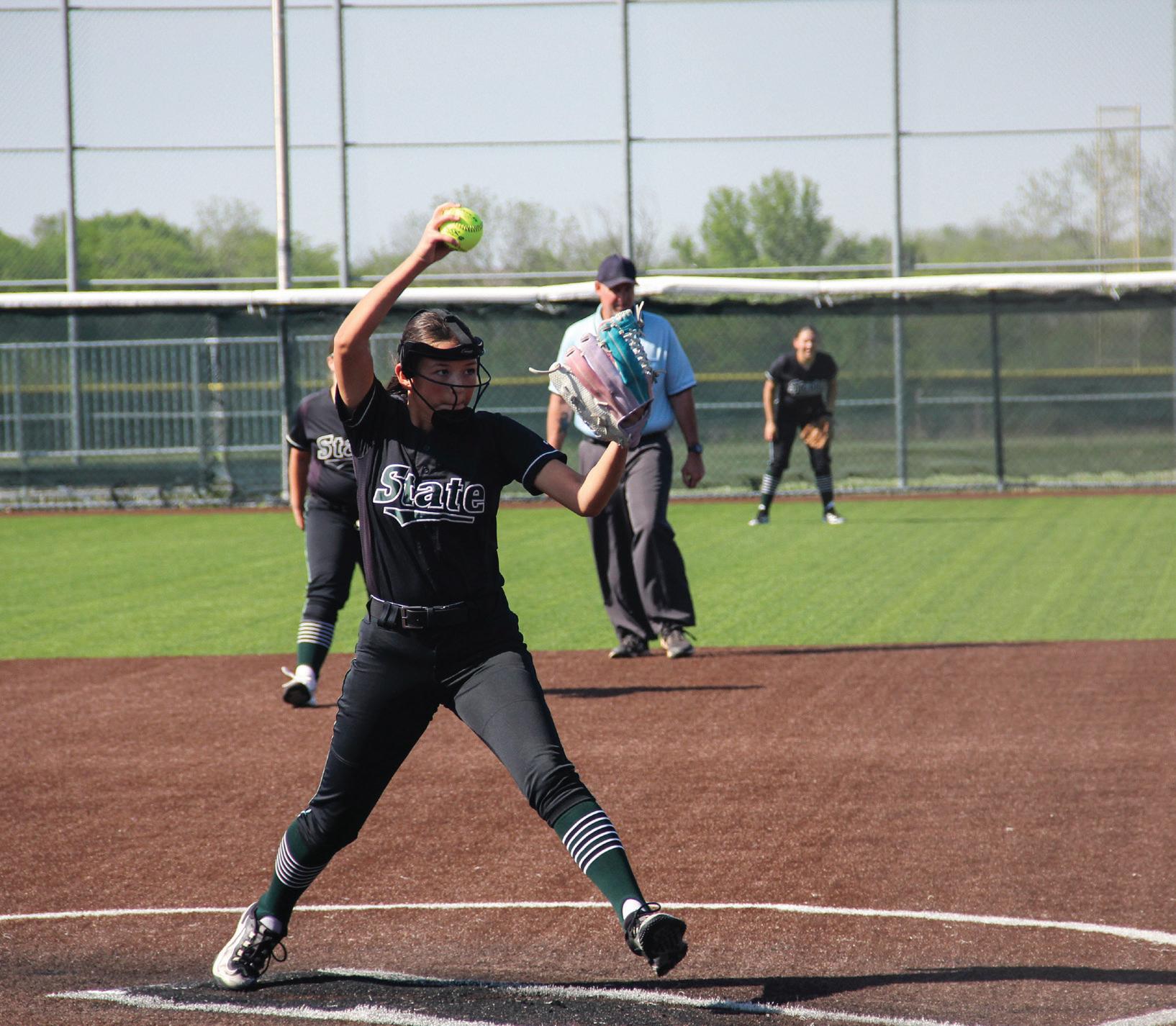
After not having a C-team in 2025, the decision to keep more players for the 2026 season came with challenges. Although having three teams can reduce cuts, many other schools lack the necessary players for three teams, which has led to scheduling conflicts as the C-team tries to add more games.
The Varsity softball team had 21 scheduled games compared to eight games afforded to C-team. C-team coach Elijah Randall said having fewer games affects their season, as his players don't have the same opportunities to grow.
“Game experience is one of the most valuable ways for players to develop,” Randall said. “The more games you play, the more opportunities athletes have to grow, make adjustments and build confidence. While we work hard in practice, it’s difficult to fully replicate the intensity and atmosphere of a real game.”
Randall said that the main cause of this issue is the other schools' lack of participation in the Sunflower League. He said that having fewer players limits the number of other teams that can compete.
“One of the main reasons it was more difficult to schedule games this year is that many teams in our league have lower
participation numbers,” Randall said. “With fewer players signing up across programs, it naturally limits the number of teams available to compete.”
The team still practices regularly, even with the reduced competition. Randall said his focus remains on developing his players so they're ready when opportunities arise.
We don’t necessarily change how we prepare for practices. Our focus remains on developing skills, building fundamentals and keeping players engaged so they’re ready to compete whenever opportunities arise,
Randall said.
Former member of the team, freshman Ava Mann, said that the program shouldn't have had a C-team, as moving players up to junior varsity would have made them feel more included.
“Not making a C-Team if you don’t have the means to do so would have been the right choice. Putting eight girls on a team, making them practice a month before having a game is absurd,” Mann said. “If we could move these players up to JV for some practices and games, then the players would be so much more included."
C-team player and freshman Stella Kulseth said that although it makes some of her teammates upset, having fewer games pushes you to make a better team so that you can be rewarded with more games.
“Having fewer games just pushes you to be a better player, so that way you can advance up to JV or Varsity and reward yourself with more games,” Kulseth said. “Having fewer games makes some of my teammates mad, but I think, as I said before, it pushes you to be a better player and teammate to be able to play more.”

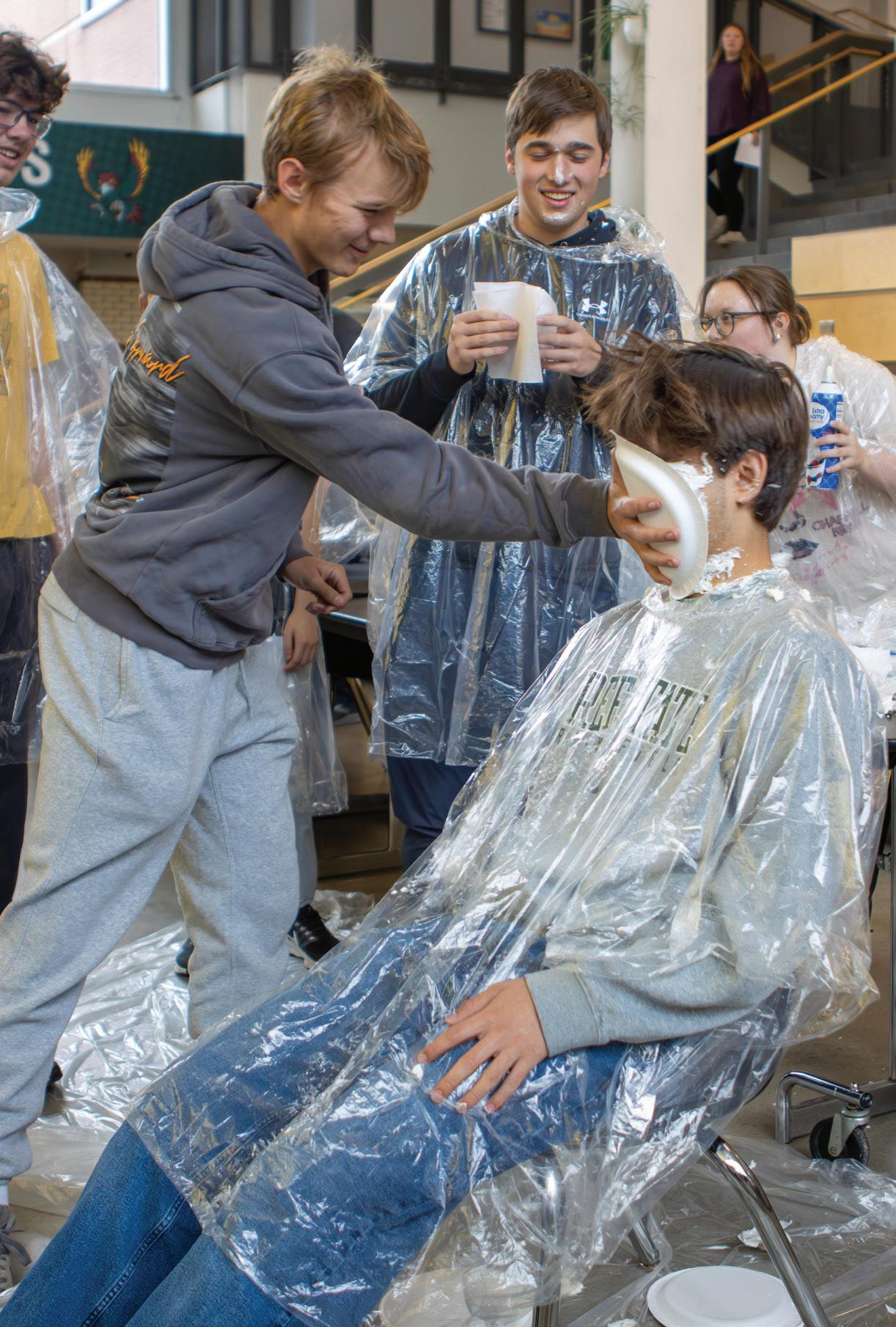
“I thought it was a lot of fun, because everyone was cheering,
freshman Quinlynn Vail said.
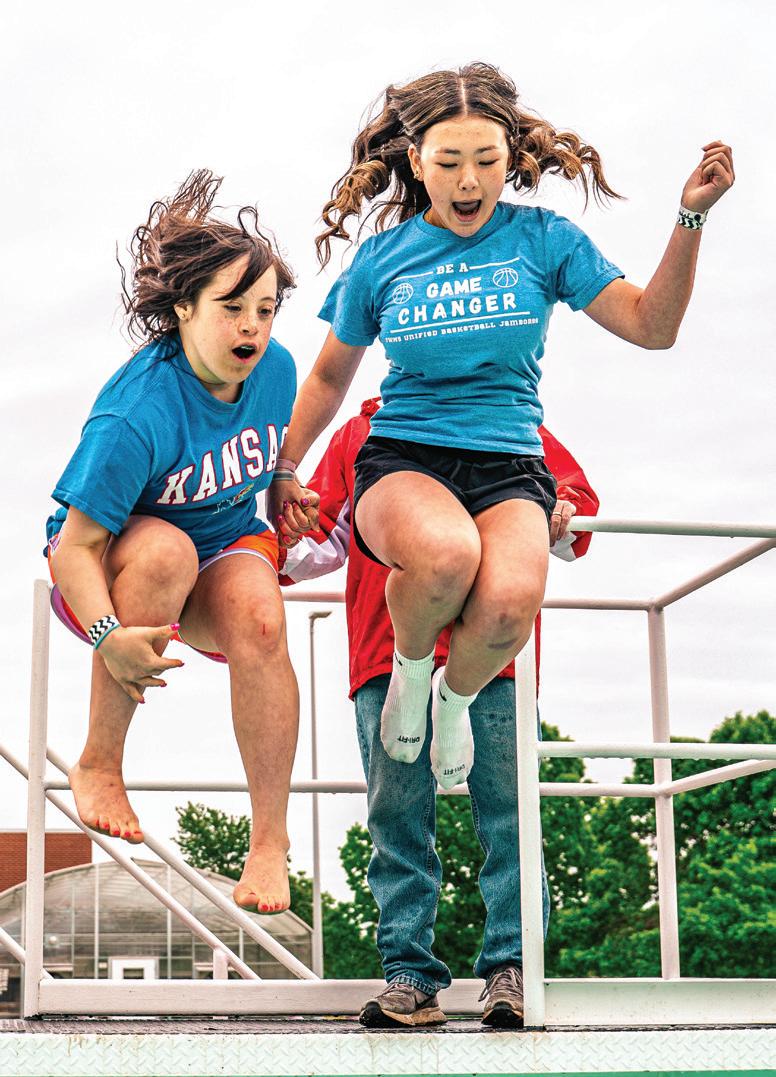
It was great. The vibes here are awesome. [There is] food and a dunk tank, [and they] told me exactly where to jump,
sophomore Elijah Moneymaker said.
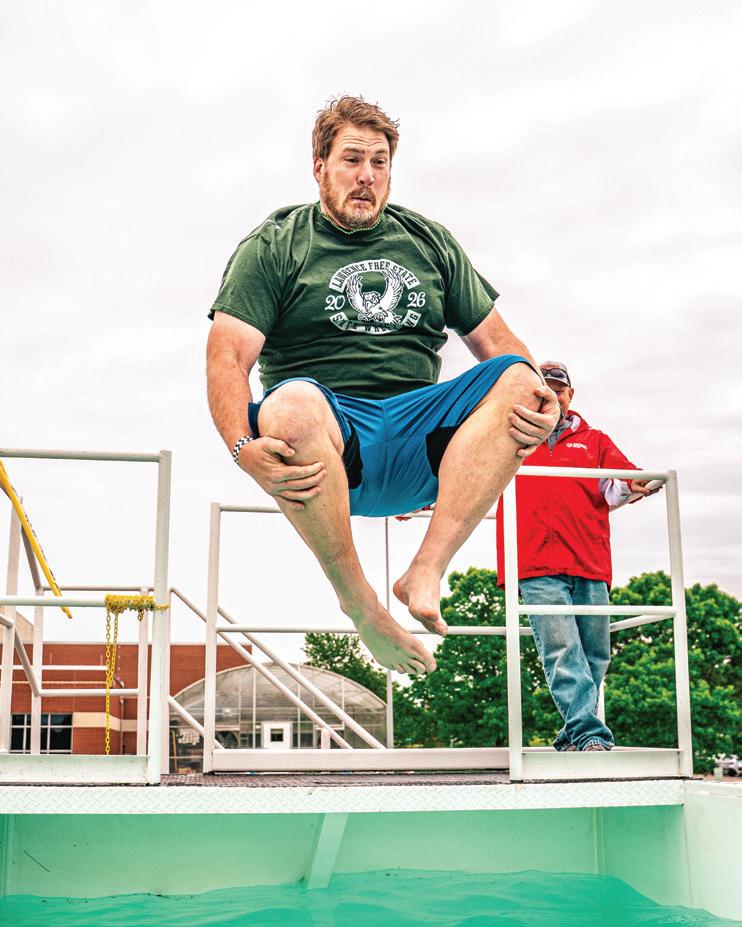

Quotes collected by Stella
Dorssom
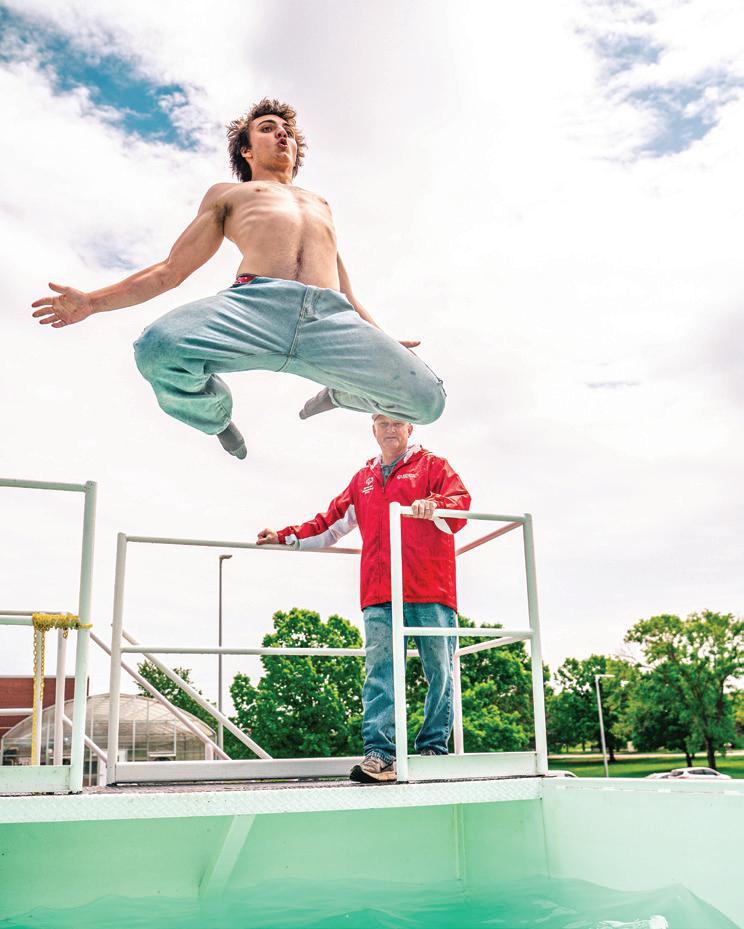
I think it's a really fun thing and it's going towards a good cause,












Story by Collette Colvin
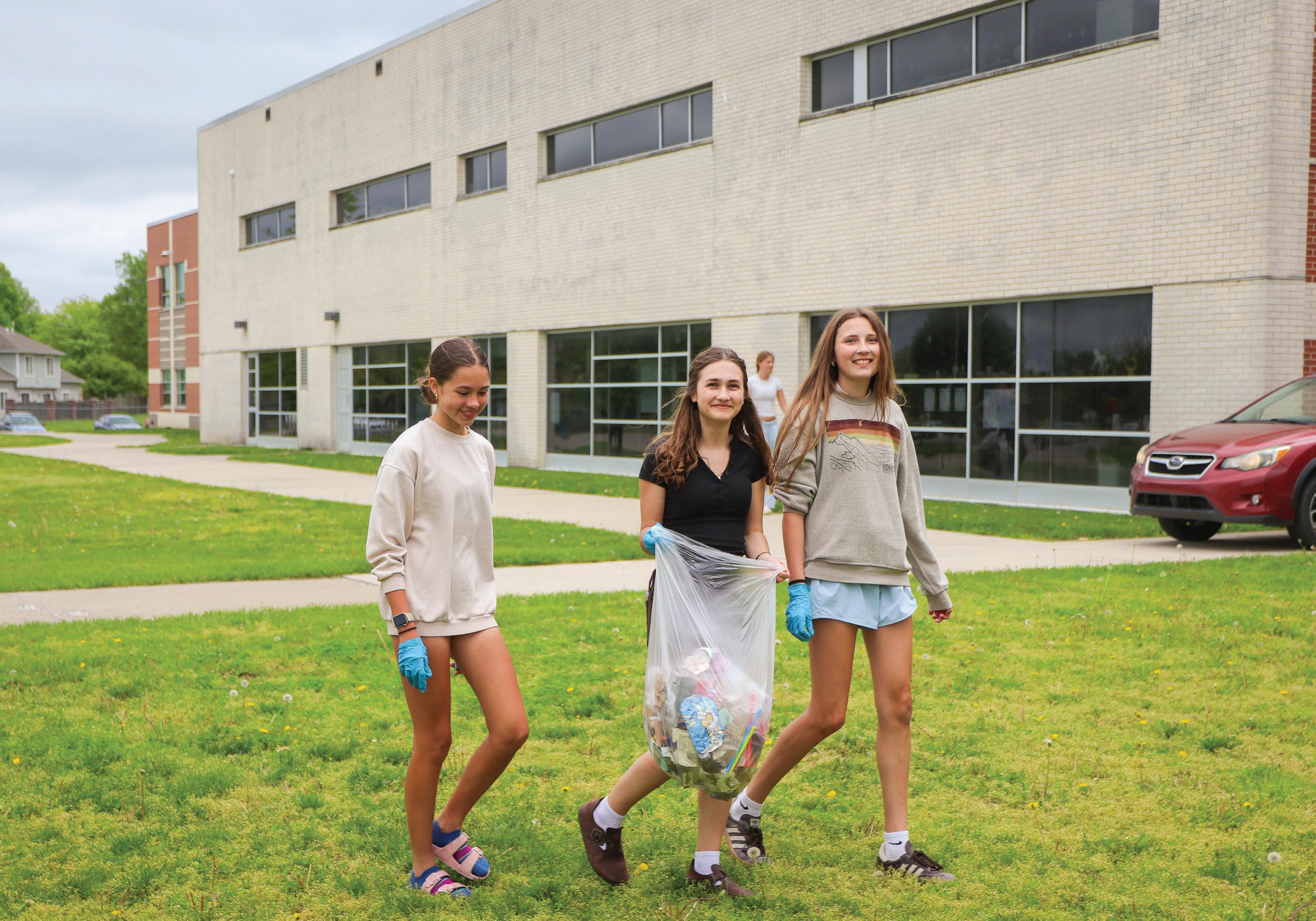
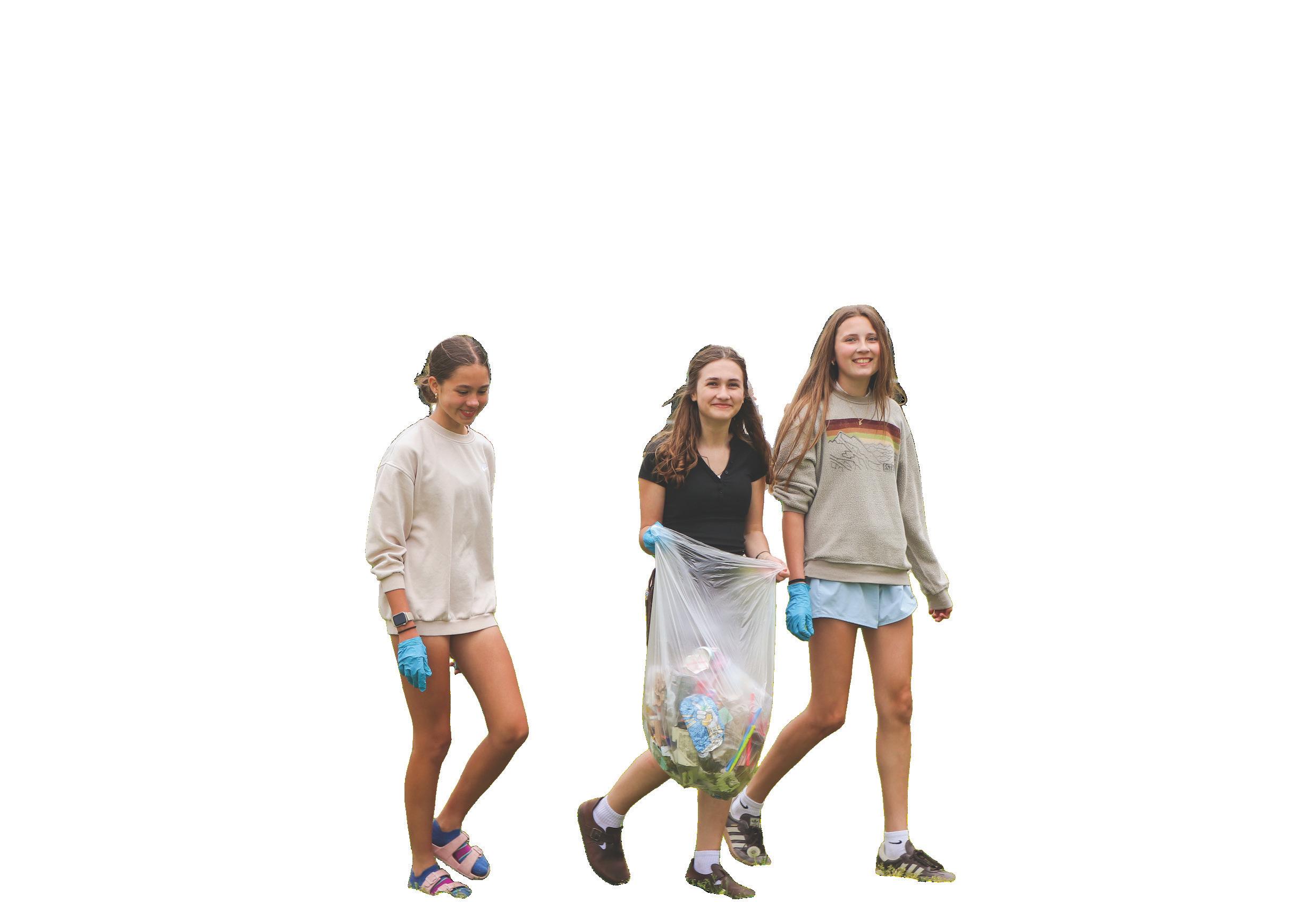
Project Pickup held its final meeting of the school year on Earth Day, which was April 22. The club met every two weeks on Wednesday after school to clean up trash around the school property and the local area, including the bridge on the south side of the building facing Overland Drive. Project Pickup is the first organized effort to clean up the school campus and is completely student-led.
Despite being named one of the cleanest cities in Kansas by the Topeka-Capital Journal and taking measures like banning plastic bags in 2024, AP Environmental Science teacher and Project Pickup sponsor Julie Schwarting said Lawrence still faces major problems with pollution.
“[Trash] blows or washes in the areas that we don't see it anymore, but it's still in the area, washing downstream. I've seen worse places, but I think we could all be a little more careful,” Schwarting said.
Pollution exists beyond the Free State area and Lawrence as a whole.
According to the nonprofit Keep America Beautiful, nearly 50 billion pieces of litter pollute roads and waterways in the United States, which is around 152 pieces of litter per U.S. resident.
However, Schwarting said that Project Pickup has made a noticeable difference in the amount of trash polluting the area. She said that the student leadership has raised awareness about pollution and helped students get involved in the community.
“
Schwarting said that the local area receives a lot of pollution blown in from the nearby commercial district, and that it has affected both the school campus and the Free State prairie. She said that when trash blows into the prairie, it stops pollution from blowing into waterways, but harms the wildlife that lives there.
[Pollution] is not going to go away soon, unless we do something about it. Project Pickup is a super way for students… to do something on their own. It's not an adult telling them to do it,
Schwarting
said.
Sophomore Elijah Moneymaker, who has worked with Project Pickup through Key Club, said that the student leadership encourages students to help the school in their own ways, rather than a teacher telling them to do something. Moneymaker said that although the school has faced problems with pollution, Project Pickup has made a noticeable impact, and the school is cleaner.
“It’s really spaced out around the school, so you don't see it as much. But when project pickup is around, and you really see how much they gather, it's a substantial amount,” Moneymaker said.
Freshman Avery Koester has gone to almost every Project Pickup meeting this year, and said the club has helped her meet new people, support her community, local nature and keep the school clean. She said that the student-led aspect of the club encouraged her to join.
“[Project Pickup] helps build community within the students, people who actually care about the environment,” Koester said.
Story by Stella Dorssom
During American Wetlands Month this May, the Baker Wetlands is surrounded by both praise and concern. According to the Association of State Floodplain Managers, wetlands in America have the unique position of providing numerous ecological, economic and social benefits. However, wetlands have seen a decrease in area as they cover less than six percent of the southern 48 states as of 2019, which is half the domain they once covered.
Biology teacher Sara Abeita said that the wetlands supply services not only to animals, but also to humans. Abeita said that she enjoys visiting the Baker Wetlands to go birdwatching, but the wetlands have other benefits.
“Things like water filtration, reducing flood damage, and holding on to carbon dioxide are all benefits that humans get from wetlands just existing,” Abeita said.
Freshman Sam Bauch said that having and recognizing American Wetlands Month further emphasizes its impacts. He said that while the wetlands provide physical advantages to humans, they also maintain social connections.
“The Baker Wetlands has always been a place around Lawrence that helps the community connect through shared interests, or for young kids to learn more about the Kansas ecosystems,” Bauch said.
Although May is dedicated to recognizing the benefits of American wetlands, sophomore Rory Kuhlmann said that laws put in place cause devastation to the area, contrary to the month's intent. Kuhlmann said that bringing awareness to the month is now even more important.
“
[American Wetlands Month] is especially important right now with our current administration dismantling so many laws that protect our ecosystems, Kuhlmann said.
“
According to the University Daily Kansan, the Lawrence planning commission has approved a request to allow construction near the Baker Wetlands. The prepared development plan includes construction for a sports complex, entertainment district, apartments, restaurants and a hotel. Abeita said that the area should be protected, not built upon.
“All of this building and disruption can impact the essential parts of the wetland ecosystem by increasing pollutants, changing water flow and habitat destruction for the organisms in the area,” Abeita said.
Additionally, Bauch said the wetlands need to be protected in order to guard the biomes that are necessary to the local ecosystem. Bauch said the wetlands are safest when people are aware of their importance and speak out against destruction.
“The wetlands and other necessary biomes are best protected when we bring attention to the needs of the areas and conservation efforts, like restricting the development around areas,” Bauch said.

However, Abeita said that biology teachers at Free State have done a good job at spreading positive messages around the Baker Wetlands. Abeita said she hopes the teachers’ message will bring more awareness to American Wetlands Month and the Baker Wetlands specifically.
“I've been really proud of the work that the ninth-grade biology teacher team has put in to educate students about the importance of healthy native ecosystems,” Abeita said. “I hope that those messages can stick with students as they come across things like American Wetlands Month.”

Schools should be places designed to protect children and facilitate the growth of the individual and the mind. However, corruption, as with many organizations, is tainting the innocence of the public school system.
According to the U.S. Department of Education, 1 in 10 students will experience school employee sexual misconduct by the time they graduate from high school. This equates to around 4.5 million students in the U.S. experiencing unwanted attention from teachers and faculty members before reaching adulthood. Not only is this a horrifying statistic, but it also suggests these cases are far more common than realized.
Anyone can be impacted by this abuse, from your childhood best friend to someone you've exchanged mere words with; the impact is felt through communities. However, but many of these stories will never be heard or reported.
Opinion by Ceci Bennett & Stella Dorssom

In our country, sexual assault in schools remains largely unreported, leading to further normalization of the abuse. Not enough energy has been invested in conducting these trials. Our federal government is willing to fund expensive wars to obtain raw materials, but is unwilling to fix the issues present at home. According to the U.S. Department of Justice, of the 43 states that require reports to authorities, only 5% of staff-known cases of other employees harassing students are reported. This highlights a national problem that requires attention beyond the consideration it is receiving now.
Furthermore, when these violations occur, many districts choose the seemingly easier — yet far more selfish — route: ignoring allegations and avoiding parental retaliation. According to the Defense of Freedom Institute, when public school employees are investigated for sexual abuse, many school districts are under no legal obligation to notify parents or note the investigation in the employee’s personnel file. These loose standards allow districts to spread perpetrators across different schools and districts in a phenomenon called “passing the trash.” Leaving employees free of consequences for their actions allows for the recurrence of abuse within schools.
According to the U.S. Department of Education, 1 in 3 offenders targeted more than one victim. Of these, one perpetrator
could have as many as 73 victims over the course of their time as a teacher.
The offender, by causing damage to multiple victims, showcases their lack of remorse. If one-third of perpetrators are willing to hurt multiple children, laws need to be enforced with more intent to cease sexual violence in schools.
According to the American College of Obstetricians and Gynecologists, victims of sexual abuse tend to be less skilled at self-protection. The repeated victimization forces these survivors to be more vulnerable and consequently further exploited.
According to The National Sexual Violence Research Center, teen girls have reported the highest levels of sadness and sexual violence in the last 10 years compared to other age groups, with 30% saying they have seriously considered attempting suicide as of 2023. This is nearly a 60% increase from 2011.
While many of these cases appear small-scale, recent news proves otherwise. Controversy surrounding important figures and their appearances in the Epstein Files shows the sheer scale of the issue beyond just the school environment. The Epstein Files are a series of documents that include the sex trafficking activities of Jeffrey Epstein and Ghislaine Maxwell. The Files highlight the illegal actions of grown adults preying on girls as young as 14.
Before the Epstein Files Transparency Act, which was signed into effect in November 2025, the files were left hidden for almost 20 years. It was only after immense pressure from the American public that the files were released, though with large sections redacted in order to keep the personal information of the victims safe. Unfortunately, all it has done is keep the perpetrators safe from the public eye. According to NPR, no people involved with the Epstein files have been arrested in the United States.
With the files being a major source of attention in the last year, we must understand the repercussions this has on the public school system and beyond. While a major goal of the transparency act was to keep the victims safe, the redaction was not done consistently and led to errors where various information was leaked. If the Federal Bureau of Investigation had such a high human error rate with their redactions, it is not easy to doubt that mistakes like this are made on a much more local scale within our own districts.
As we see the rise of these events in our social spheres, we must remember they impact not only individual students but also entire districts and states. In order to keep our future generations safe from sexual violence, it is imperative to keep schools a safe place while holding those accountable for the harm caused by their despicably selfish actions.
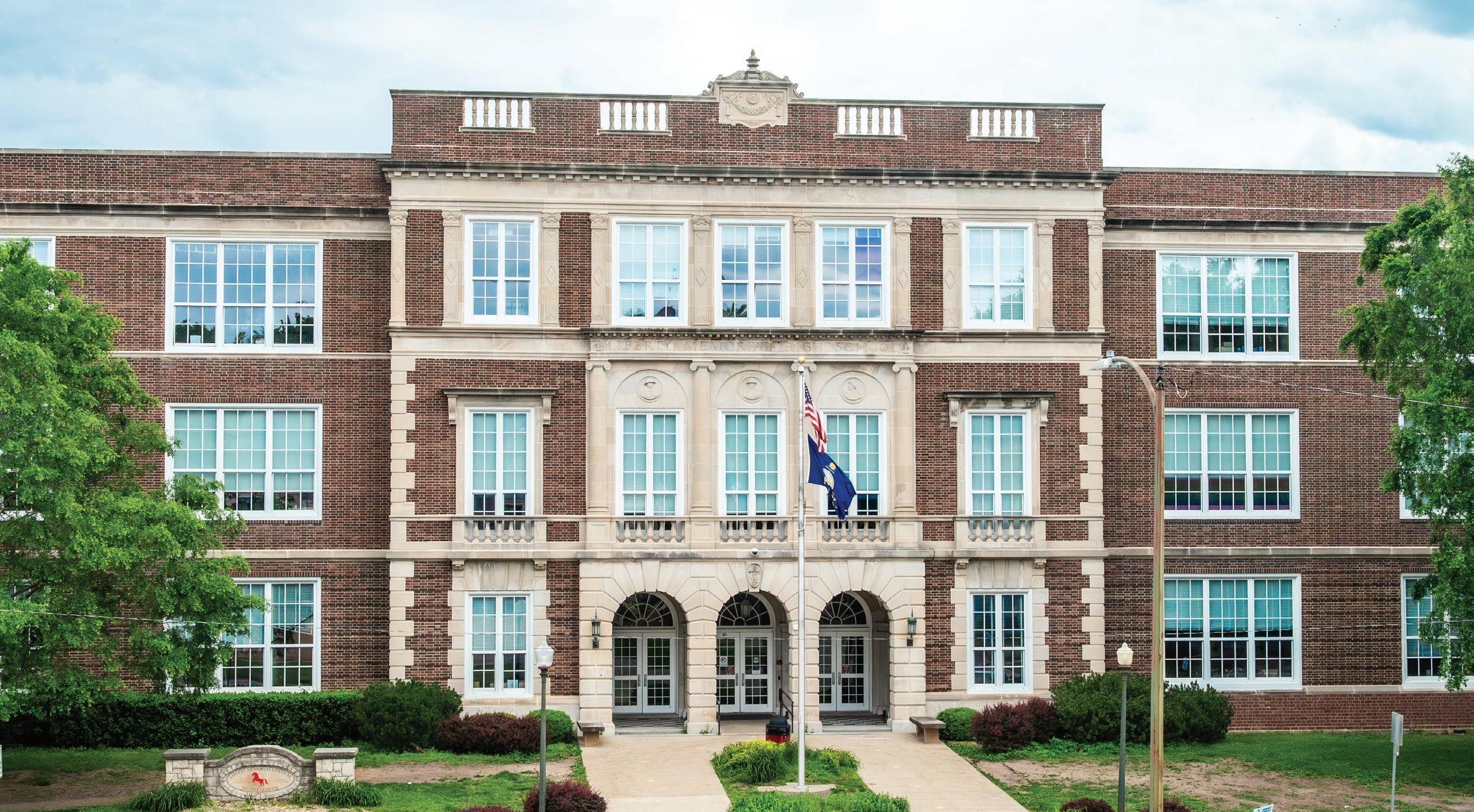
An anonymous student’s local sexual assault case at Lawrence Memorial Central Middle School has been taken to the federal courts.
According to KCTV5, in October 2023, Lawrence Memorial Central Middle School gym teacher and Lawrence High School wrestling coach Patrick Naughton was reported to the middle school’s school resource officer by one of his students for sexual harassment.
According to the Kansas City Star, the anonymous student reported that Naughton had touched the backs and bottoms of students, attempted to coax students into closets alone with him, and was seen leering at the girls' chests and bottoms.
According to the Lawrence Journal-World, the actions were reported
to school leaders, but never to the district coordinator or the student’s family. The school did not fully investigate the incident, allowing it to be dismissed by an official instead of the Title IX coordinator, who would typically manage reports of sexual harassment, closing the case.
According to the Lawrence Journal-World, after another incident in which Naughton was reported to the school, Central Middle School sent out a mass email claiming that the allegations were false.
According to KCTV5, the district’s Title IX coordinator admitted that the district had “dropped the ball” by not handling the situation correctly during a video conference on April 4, 2025.
According to KCTV5, on March 6, 2026, the U.S. Department of Education’s Office for Civil Rights opened a formal investigation into USD 497. The lawsuit includes nine charges, each up to a $75,000 fine, including sexual discrimination, sexual harassment, retaliation and intentional infliction of emotional distress.
As of May 2, Naughton is still a teacher at Central Middle School, and a scheduling conference is set for May 26, where they will lay out a timeline for the lawsuit.
Collected by Kyla Meikle
May 7, 1843
14-year-old First Japanese immigrant Nakahama Manjiro arrives in the United States, becoming the first Japanese-born U.S. Citizen
March 28, 1979
President Jimmy Carter issues Proclamation No. 4650, which proclaimed Asian/Pacific American Heritage Week, and speaks of the benefits Asian and Pacific Americans bring to the United States.
Oct. 23, 1992
Congress officially passes a bill under the George W. Bush administration, denominating the entire month of May to mark the anniversary of Manjiro’s arrival and the completion of the Transcontinental Railroad.
May 10, 1869
The transcontinental railroad is completed after six years of work, with the majority of workers who completed the project being Chinese immigrants. This work went unrecognized until 2014.
New York representative Frank Horton and Hawaii Senator Daniel Inouye propose naming the first 10 days of May as Asian/Pacific American Heritage Week.
May 1, 2009
Asian/Pacific American Heritage Week is updated to Asian American Pacific Islanders Heritage month to better represent Asian American and Pacific Islander communities.
March 28, 1898
Supreme court rules that Wong Kim Ark is a United States citizen, establishing that children born in the U.S. are automatic citizens under the 14th Amendment. This secured citizenship rights for American-born Chinese individuals despite existing exclusionary immigration laws.
October 3, 1965 - The Immigration and Nationality Act of 1965 removes existing racial quotas, leading to a major increase in immigration from Asian countries.
Feb. 19, 2026
Asian American Alysa Liu became the first multiracial woman to win gold in the women’s figure skating singles event, standing on the first ever all-Asian women’s figure skating Olympic podium alongside Japan’s Kaori Sakamoto and Ami Nakai. Liu is considered a prominent AAPI figure and has spoken in interviews about the month.
Teachers reflect on changes and continuations regarding classes and plan periods
While the creation of a Professional Plan Period, which is used as a time for the teachers to meet with other teachers and plan lessons and exams, was well-received by most teachers, the large class sizes and the dropping of classes has raised concern among teachers.
Although in support of the addition of a second plan period, science teacher Julie Schwarting said that having larger classes was not exciting to her. She said that she wishes that schools would limit the number of students in a classroom, because it hinders learning and makes it challenging to create a safe learning environment in a science classroom where labs are taking place, and students are in need of guidance.
“It’s just a bad idea for students to cram them in a little place and then say we’re going to give them an individualized plan of study, which a teacher cannot implement with a class of 30,” Schwarting said.
The increasing number of students in classes not only affects the teachers. Schwarting said that having a large number of students in a small space also made the students less likely to participate in the activities.
In addition, both French teacher Karen Gipson and Spanish teacher Amanda Williams said that they preferred having a shorter class each day rather than a block schedule because it provides more consistent exposure to the students.
It’s difficult to meet everybody’s individual needs, and students are less likely to speak up if they’re in a bigger classroom, “
“ Schwarting said.
Also, both teachers said that it was difficult for the students to pay attention for the entirety of a block schedule class.
“If we could have class every day for about the same amount of time, honestly, that’s a lot better just because of the continuity, the less disruption and it’s just the right amount of time that I can keep them engaged,” Williams said.
Math teacher Laura O’Neil said she is also disappointed with the large class
sizes, but that it was more of a continuity than a change from the previous years. On the other hand, she said she is happy with the creation of the new plan period, because it helps her collaborate better with the other teachers of the same subject, and it makes her workload easier.
“We write the test and then work together on edits, and then discuss how our kids did and what we can do to help,” O’Neil said.
Gipson said she is disappointed because French 4 is not being offered as a class next school year. She said that, because the class was only offered for one hour of the day, it made students unable to pursue their language studies. While Gipson said that she understands that students have had to make the decision between core classes and language classes, she said that knowing a language can give you a significant advantage later in life.
“It just opens up the whole world to you … so it’s just as important as the classes that are going to lead you to your career decision. It’s a big part of your career,” Gipson said.

Anyone who’s seen "Project Hail Mary" would know it’s a total thumbs down. However, with AI on the rise in screen writing, and Hollywood's block of creativity, this is the first masterpiece I’ve had the pleasure of viewing in the past few years.
In contrast to popular opinion that recent movies have failed to succeed any films made prior to the 2020s, “Project Hail Mary” is a primary example of a contemporary cinematic resurgence.
According to Deadline, the movie surpassed $80.5 billion in profit from just its opening weekend. Furthermore, the second week's airing only dropped interest rates by 32%, indicating consistently high attendance.
It's clear that from the beginning, "Project Hail Mary" is an emotional but hilarious rollercoaster.
The film portrays Ryan Gosling as an astronaut who wakes up in a spaceship, unbeknownst as to how and why he got there.
While we observe the astronaut begin to regain his memory, we quickly learn that he is not an astronaut at all, but merely a modern-day middle school science teacher selected for an existential mission to defend mankind.
Part of the movie’s success comes from the average relatability of the characters, such as Ryan Goslings’ lead character, Ryland Grace, who, before being selected, was
merely a middle school teacher with huge scientific ambitions.
Along the way, we learn that everyone else on the spaceship has died, and remarkably, Grace was the only survivor. The exact realization is really what kept me engaged as a viewer. I was inherently curious as to how someone with no space piloting experience was going to survive an astounding 20-plus years in space.
Quickly that thought is eradicated as we learn: In order to save his planet, Grace must collaborate with a fellow alien protagonist, who, after trial and error, he decides to name Rocky. This is where I really began to fall in love with "Project Hail Mary," as its funny crime-fighting partnership created an emotional tie between the audience and characters. It also assured me that Grace was going to be okay in space, having Rocky who was well-rounded in space piloting.
Finally, after a few close calls with death, Rocky and Grace fight a final battle against space and time. I adored the emotional aspect created out of the love foundation for the characters that is most strongly exemplified at the end of the movie, as Grace continues to live with Rocky in a dystopian utopia.
My only critique of the film is the fictional reason why the mission takes place. In order to raise awareness for possible Earth extinction, I would argue that the movie should have been more scientifically representative of current climate issues to publicize its modern impacts.
In times of war and darkness within our own world, “Project Hail Mary” creates a precedent for equality and happiness beyond Earth, which leaves viewers with the message that they are the change they sought to see.
Story by Kyla Meikle
While Project Hail Mary was published in 2021, it had been steadily gaining momentum for a couple years, leading to the movie coming out in 2026, and it’s easy to see why Andy Weir’s bestseller has become the global phenomenon it has today.
For one, he blends deep scientific conversations and accessibility nearly flawlessly. The language and culture barriers should be insurmountable. You’re able to feel the gravity of this situation as you read. A prime example of this is a section that discusses how humans use Base 10 for counting because we have 10 fingers, but that might not be standard throughout the galaxy. It’s shocking to think that humans could find a way to communicate with aliens with all of the incomprehensible barriers. The fact that Weir is able to strike the balance between possible and difficult is impressive.
Additionally, the science should be so much harder to understand than it is, but Weir does a great job of being technical enough that the meaning wasn’t lost, but accessible for the average reader with little to no knowledge of the topics being discussed. Space travel is an extremely complicated subject, but it’s dumbed down so perfectly that I understand the complicated topics the main character deals with.
Even the small aspects are enjoyable, such as the past and present shifts — when he's remembering, it's written in past tense, but when he's with Rocky, it's written in present tense.
The slow reveal of how he ended up where he is keeps the pacing moving perfectly.
It's a good contrast to the constant action of the present timeline.
Despite all of the good, the writing isn’t great. The inner dialogue especially is juvenile. The word choices are basic, never overly poetic or descriptive. However, everything else structure-wise is so captivating that it’s easy to overlook.
I adored this book. The writing strikes a perfect balance between approachable and fast moving and deep and scientific.
It makes a genre people might not have explored a lot more accessible, as it lacks difficult terms and concepts that could disincentivize people new to the world of science fiction from reading it. The pacing was great, the characters were welldeveloped, and the immature inner voice added a layer of imperfection to the book that made it feel raw and charming. I would highly recommend this to anyone who hasn't read it before, especially those wanting to get into science fiction but unsure where to start. It was a fabulous read, and I really enjoyed myself.










Story by Collette Colvin
Duringthe Artemis II mission, Commander Reid Wiseman and his three crew members proposed that a bright lunar impact crater on the boundary between the near and far sides of the moon, positioned on the left edge of the surface visible from Earth, be named Carroll. The name is derived from Wiseman’s late wife, who died of cancer almost six years ago after a five-year battle. On April 6, Canadian Astronaut Jeremy Hansen made the request to rename the crater as the crew traveled around the moon.
“We lost a loved one. Her name was Carroll, the spouse of Reid, the mother of Katie and Ellie,” Hansen said, “It’s a bright spot on the moon, and we would like to call it Carroll.”
Members of the crew, ground control and NASA staff back on Earth said it was a very emotional moment. Wiseman said naming the crater was the “pinnacle moment of the mission.”
The crew submitted a formal proposal to the International Astronomical Union to rename the crater when they returned to Earth, which is awaiting approval. Carroll Crater will be visible from Earth, with the use of a powerful telescope, between May 2 and May 4.