
NEWS STAFF CONTENTS
CONTENTS NEWS
Pg 4: Inclement Weather Policy
Pg 6-7: Denying GenderAffirming Care
Pg 16-17: Absolute Resolve
Pg 18: College Cram
Pg 19: Can They Graduate?
A&E
Pg 9: Stars on Stage
Pg 12-13: Photo Gallery
Pg 22-23: Ads
Pg 24: Cards to Cut Out
FEATURE
Pg 5: Roadblocks
Pg 8: Rhythm of the Legacy
Pg 10: Beyond Bystanders
Pg 11: Teaching Black History
Pg 20-21: Fan of the Fake Tan?
SPORTS
Pg 14: Shortage of Stripes
Pg 15: Club Scene

ABOUT THE COVER
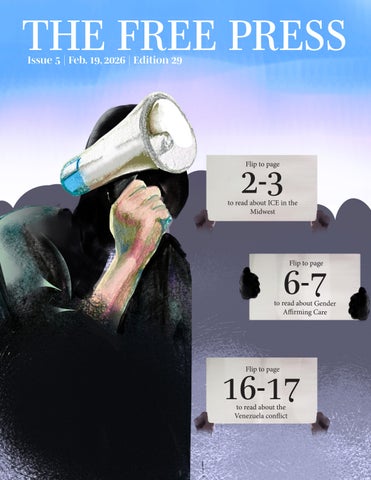
A person holding a megaphone serves as a symbol of speaking out against systems of power and control. The image represents resistance to policies surrounding immigration enforcement and access to gender-affirming care, reflecting broader conversations about our rights and identity within our community. As you flip through the pages mentioned in our cover, you’ll unfold the heroic efforts our students are participating in, and comprehend the hardship members of our community are facing. Design by Lucas Smith

SOCIALS MISSION STATEMENT




Curious Free State journalists will amplify voices, gather superior sources and tell pivotal stories of our community in a visually creative way in order to serve our audience and foster quality scholastic journalism in Lawrence, Kansas.
EDITORS-IN-CHIEF
Maria Mosconi
Evie Chancy
MANAGING EDITORS
Phoebe Morris
Rakshan Ossen
NEWS PLANNING TEAM
Stella Dorssom
Grace Mosconi
Kyla Meickle
DESIGN
EDITOR
Lucas Smith
ASST. DESIGN EDITORS
Bella Lylo
Abbie Veeder
PHOTO EDITORS
Julia Velasco
Nathan Kramer
ASST. PHOTO EDITOR AND CAPTIONS EDITOR
Ceci Bennett
COPY EDITORS
Meredith Shryock
Lauren Rosen
ONLINE
EDITOR-IN-CHIEF
Baila Love
ONLINE
MANAGING EDITORS
Kinley Gigous
Odelia Colvin
SOCIAL MEDIA
EDITOR-IN-CHIEF
Katie Campbell
ASST. SOCIAL MEDIA EDITOR
Julia Andrade
BUSINESS EDITOR
Piper Northrop
PHOTOGRAPHERS
Layla Afani
Miles Beaty
Sydney Brozik
Nora Greeson
Leona Randall
Nate Willems
REPORTERS
Stella Dorssom
Jonah Frye
Griffin McDonnell
Grace Mosconi
Kyla Meickle
Morgan Sponholz
DESIGNERS
Ceci Bennett
Hannah Billen
Harper Finck
Kinley Gigous
Celeste Jenkins
Allison McCall
Ariza Noscal
Rakshan Ossen
Jamie Stone
Ava Talbott
BUSINESS TEAM
Annika Lintecum
FREEZING MIDWEST
Immigration and Customs Enforcement present in the Midwest
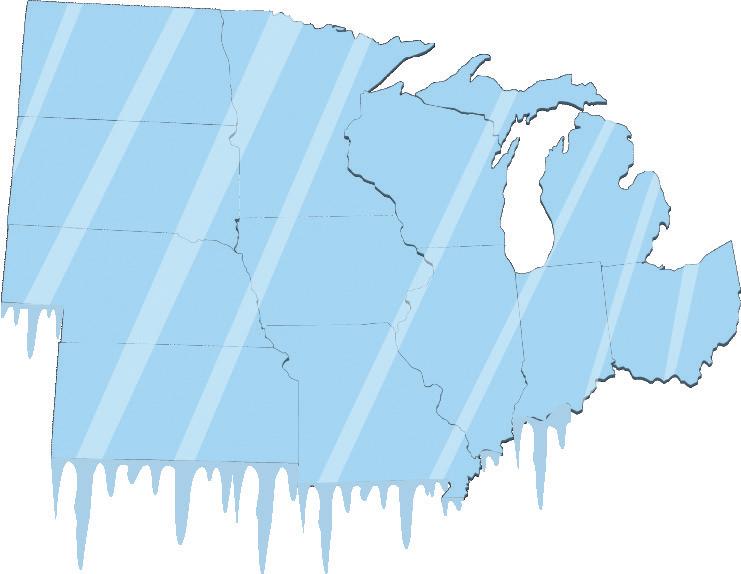
The Kansas City, MO, City Council placed a ban on detention facilities not owned by the city on Jan. 15, but that has not stopped Immigration and Customs Enforcement’s presence in Kansas.
According to KCTV News, arrests by ICE in Kansas City have more than tripled since January 2025. Club Sponsor of Students Demand Action, Sarah Podrasky, said that the problem of racial discrimination has been a part of U.S. history since the beginning.
“We can’t say that we have nothing to do with this, or point our fingers at another culture when our country was built on massacres of indigenous people and black and brown people,” Podrasky said. “It seems like a lot of white people are now saying, this is a problem, but black and brown people have been telling us it’s a problem for a long time. So why did it take white people getting killed for us to listen?”
According to Immigration and Customs Enforcement, ICE targets immigrants they suspect of a crime and aims to deport many of them. According to NPR News, before the Kansas City, MO City Council’s ruling, officials from the city validated that the U.S. Department of Homeland Security had been scouting a location for a detention center in the Kansas City area. Sophomore Alia León said ICE’s actions should not be normalized.
“This shouldn’t be something that we’re seeing daily in the news,
another person taken into custody or another family broken apart. That shouldn’t be normal,” León said.
According to The Star News, the council’s ruling has caused CoreCivic, a private prison operation company, to seek a permit to open an ICE facility. According to The Star News, Leavenworth’s planning commission voted 5-1 in favor of approving CoreCivic’s permit to open an ICE center that could host more than 1,000 immigrants. León said ICE’s presence in Kansas would be a source of fear.
“ “
I know a lot of legal immigrants here who are scared, because [having citizenship] doesn’t seem to matter to ICE. At this point, they are taking anyone who looks like they could be from Latin America, so I’m scared, León said.
Story by Grace Mosconi
Massachusetts Street every Sunday from 12 to 1 p.m. All said that she protests because she wants to make a difference.
“I hope that it shows the leaders of our state, of our country, that we are not going to rest until there’s change,” All said. “We need change, and how things are going right now is not okay… I think they’re starting to realize that.”
The deaths of Renee Good and Alex Pretti, both killed by ICE agents in Minneapolis in January, were followed by large-scale anti-ICE protests. All said ICE’s actions remind her of the Nazis.
“The fact that they’re not letting us use our First Amendment right. They’re attacking people when they’re using their First Amendment right. They are attacking people when they haven’t done anything wrong. I see so many similarities,” Good said.
Free State High School, alongside Lawrence High School and University of Kansas students, walked out of school on Jan. 27 to ICE. Senior Harper Graham went to the protest and said she went to support human rights.

Local protests occurred in opposition to ICE’s growing arrests in Kansas. Sophomore Penelope All has attended the protests at 9th Street and
“When I think about the immigration of people to America I believe that we as a country cannot approach it as keeping people out. Isolation is what kills a country, a culture, it would kill what has made America special in the past,” Graham said.
“Immigrants are our color and beauty, and we are so lucky to have a country where everyone you meet comes from a different background.”
SNOW DAY POLICY
Students and staff weigh safety and school resources as administrators follow policy to determine closures
As inclement weather conditions continue to disrupt travel to and from school, the district’s process for deciding when to call a snow day has drawn student attention.
When it snowed in early December last semester, senior Ebi Hegeman got into a car accident while driving on the icy roads. Hegeman said that a snow day would have prevented the accident.
“The roads weren’t safe enough for students to be driving on them, especially because not all of us have been driving long enough to know how to handle icy roads,” Hegeman said.
Hegeman said she thinks the district should add more specific requirements to its snow day policy to prevent accidents in the future.
“There should be a set standard
that can be influenced or changed,” Hegeman said.
“When there isn't specific criteria to go off of, it often ends up with people not calling a snow day when there should be one.”
Math teacher Mitchell Kibbe, who also got into a car accident on Dec. 1, said that a late start would have prevented the accident.
“I don't think the whole city was prepared for the roads to be cleared at that time,” Kibbe said.
District officials said there is no statewide protocol in Kansas for school cancellations, making snow day decisions a local responsibility.
Before calling a snow day,Superintendent Jeanice Swift and Deputy Superintendent Dr. Larry Englebrick evaluate weather conditions 48-72 hours in advance. Furthermore, this evaluation includes conferring with USD 497’s Facilities and Operations members to determine road conditions, as well as consulting the National Weather Service.
Michael Moore, driver of First Student’s Bus 37, said that the buses can’t be started until the temperature reaches zero degrees Fahrenheit, which can cause delays.
“I'm pretty good about being on time, but when it's that cold, any time kind of sucks,” Moore said. “Half my kids all rode with their parents, so I didn't have that many people.”
Story by Odelia Colvin
Assistant Principal Amanda Faunce said the decision to call a snow day can be very difficult because, while inclement weather can make driving dangerous, schools are still important as they serve as community resources.
“People are really upset
about that because their little ones might rely on breakfast and lunch being served to them at school because they don't have those resources at home.
On the flip side, you get here, and then a blizzard hits.
Faunce said.
Executive Director of Communications Jake Potter said that the decision to call a snow day is important to keep walkers and bus riders out of harsh conditions.
“The decision to close school, reschedule activities or impact the academic calendar in any way is never taken lightly,” Potter said.
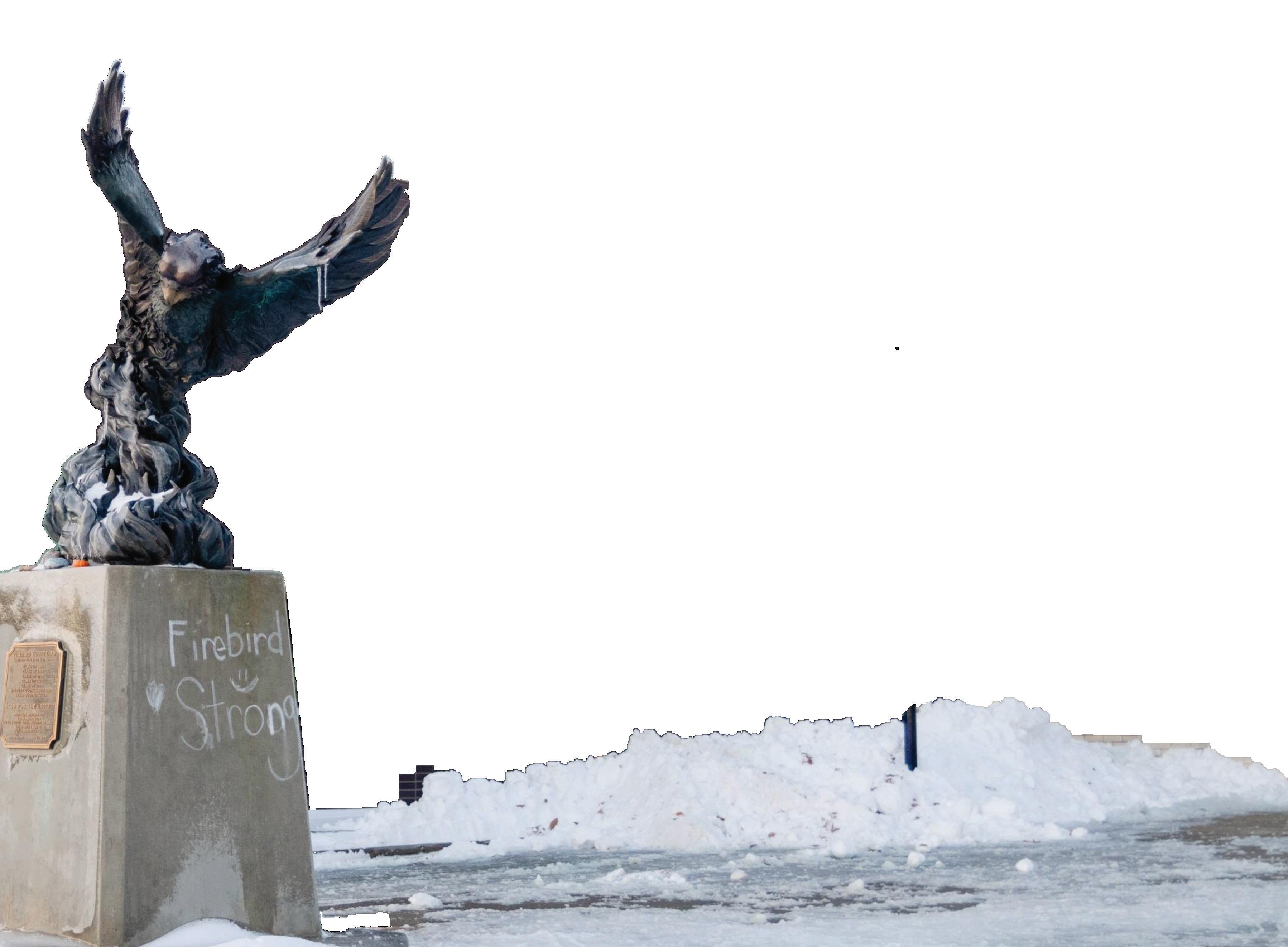
Standing alone, the firebird statue sits in the cold after school was canceled on Jan. 26 because of cold weather and lingering snow.
Photo by Nathan Kramer
ROADBLOCKS
ROADBLOCKS
Ninth Street’s construction closure has cut off local shops and restaurants from direct customer access, causing a shift in business and a job loss for junior Julia Johnson
According to an article from the Lawrence Times, income and customer traffic have been irregular for at least three businesses on Ninth Street, with one owner saying she saw about an 85% decrease in sales since the block was closed off.
This construction, which ranges from Indiana Street to Louisiana Street is part of the Jayhawk Watershed Project, which is intended to reduce flooding, improve safety along Ninth Street and replace aging sanitary sewers according to a memo from the city. The project is scheduled for completion in early 2027.
Jon Smiley, who operates the Ninth Street Cork & Barrel, said the business has been experiencing a decrease in customer traffic since the construction.
The biggest challenge has been communicating that customers can still get to us. As soon as any construction project starts, people usually try to avoid a certain radius around the area affected,
Smiley said.
As a result of fewer customers, some restaurants are having to lay off their employees. Junior Julia Johnson worked at Ninth Street Cafe before the construction started. However, she said that once
business started to slow down due to the construction, she received texts from her manager telling her there was not enough business for her to come into work. Johnson received these texts for two more weeks before she was not coming into work at all.
“It was already a little bit slow because we were a new business, and it was family owned, so we were already slow, but my job was fun, and there were like, enough people [who] would come to the shop,” Johnson said.
Jayhawk Watershed Project Project Manager Nick Hoyt said that the construction on Ninth Street was specifically limited during the football post-season because of the construction’s proximity to the football stadium.
However, Johnson said winter is not an ideal time to start a construction project on this scale, not only because the holidays are a difficult time for laid-off employees, but also because there are fewer pedestrian customers.
“Because it's so close to downtown, usually those small businesses can get enough people to keep running because people are walking. But when it's not summer, and it's not nice weather, it's harder,” Johnson said. “Since they're doing the construction now, it makes it even harder for these businesses to get any money, any revenue.”
Johnson said that the Ninth Street Cafe potentially will not recover financially after the construction, and the owner has mentioned that the restaurant may have to close its doors.
“The owner has been talking about how she [may have] to close because prior to the construction, we were really slow … There just wasn't enough revenue built up to keep it going through this construction,” Johnson said.
The city and project planners said they are aware of the effects that the construction can have on local businesses. To address this, Hoyt said that he has met with business owners
Ninth Street construction disrupts local businesses’ operations
Story by Maria Mosconi
over the past two years to ensure that their concerns are heard.
“The most consistent feedback we’ve received is that residents and business owners want the work completed as efficiently and safely as possible, given the long-term need for the storm water and utility improvements,” Hoyt said.
“Business owners have also emphasized the importance of maintaining customer access during construction, including parking availability.”
The city has responded to some of the needs of local businesses. Hoyt said that after hearing the most recent response to the construction, the city installed 13 temporary parking spots on Ninth Street to increase access to the businesses that are affected.
“I do feel like the city is listening, but there is only so much they can do. It's a large project that has to get done. It isn't possible to dig up an artery into downtown and not have a negative effect on business in the area,” Smiley said.
Smiley said that he believes Cork & Barrel will receive enough business to stay open during and after the construction.
“At this time, I think we will probably make it through the project. How battered and bruised depends on project delays, and customers continuing to shop at that location despite the impending hurdle to get to our business,” Smiley said.
To continue following construction updates, sign up for Weekly Travel Updates, which includes emails that have up-to-date information about closures for construction.

DENYING
GENDER-AFFIRMING CARE GENDER-AFFIRMING CARE
Over the last several years, the United States has had a surge in Senate and House Bills targeting transgender Americans. In Kansas, this included bills focusing on gender affirming care, bathroom use and legal definition of gender. The primary bills introduced in 2025 addressing transgender people include SB 63 and SB 244.
Timeline of Kansas House and Senate bills affecting transgender people that have gone or may go into affect
Reporting by Evie Chancy
Jan. 22, 2025
Senate Bill 63, or the “Help Not Harm Act,” was introduced to the Kansas senate. SB 63 proposed a ban on gender-affirming care for individuals under the age of 18. The bill read as: “restricting use of state funds to promote transitioning genders, prohibiting healthcare providers from providing gender transition care to children whose gender identity is inconsistent with the child's sex.”
Feb. 11, 2025

After it passed the Kansas House and Senate, SB 63 was forwarded to Kansas Governor Laura Kelly, who vetoed the bill. Upon making her decision, she releasing an official statement explaining her reasons, which said, “Infringing on parental rights is not appropriate, nor is it a Kansas value. As I’ve said before, it is not the job of politicians to stand between a parent and a child who needs medical care of any kind.”
Feb. 20-July 31, 2025
Even though the legislature was finalized, SB 63 was not put into effect until July 31, 2025. According to AP News, in the time between when the bill was passed and when it went came into practice, the average number of people changing their gender on their drivers license jumped up from 5.5 people a month to 27 people a month.

Senate Bill 63
Jan. 29-31, 2025
Along party lines, the Kansas Senate passed SB 63 with a 32-8 vote. Immediately after, SB 63 entered the Kansas House of Representatives for deliberation; In less than only 48 hours and only a couple of sessions, SB 63 was approved by the house with a 83-35 vote.

Feb. 18-20, 2025
To override the Governor's veto, both the state Senate and House had to reach a two-thirds majority, which they did so with a 31-9 vote in the Senate and an 84-35 vote in the House. Shortly after, on Feb. 20, 2025, the bill became law. With very little alterations from when the bill first entered the senate, SB 63 as a law makes it illegal for healthcare professionals to provide gender-affirming care; If violated, medical professionals are at the risk of fines and their license to practice.





of transgender and nonbinary youth nationwide reported seriously considering suicide in the past year.

according to the Trevor Project
according to the Trevor Project 46%
56% of young people have reported that they or their family have considered leaving Kansas due to LGBTQIA+ politics or laws

Feb. 3, 2026
Dec. 31, 2025
By Dec. 31, 2025, SB 63 requires all minors who had previously been receiving gender-affirming care from Kansas insurance or hospitals to cease any forms of treatment.
SB 244 was presented to Gov. Kelly and Kansas awaiting action as of Feb. 12. She can either sign the bill or veto it; If she vetoes the bill, it will be sent back for the House and the Senate to vote on again. Both the Senate and the House have to reach a two-thirds approval supermajority for SB 244 to pass. As the bill is being presented to Gov. Kelly now, individuals and governing bodies being held accountable for violations could be fined as much as twenty-five thousand dollars.
Senate Bill 244
Jan. 28, 2026
SB 244, a “bathroom bill,” was introduced to the House, proposing that bathrooms be only used by one biological sex. The bill read as: “requiring the designation of multiple-occupancy private spaces in public buildings for use by only one sex and imposing criminal and civil penalties for violations, defining the term "gender" to mean biological sex at birth for purposes of statutory construction.” SB 244 was passed 87-36 in the House and 30-9 in the Senate.
RHYTHM OF
THE LEGACY
Legacy of seniors performing in encore
Since the school’s opening, the choir department has put on an annual spring performance: Encore. In the months leading up to the performance, juniors and seniors form, rehearse and audition groups to be featured.
In Encore’s debut, an opener, a closer, a junior song and a senior song were featured and have remained tradition since then. Choir director Joshua East said that many students feel anxious to uphold these decades-long traditions.
“[Encore] is something that our students, the school and the community look forward to every year,” East said. “Since the spring of 1998, they did an Encore that included the opener that we still do every single year, same choreo, every single year, unbroken.”
One of these traditions is the senior song, where seniors gather at the stage and sing with a slideshow showing a baby and a current photo of themselves. East said that the senior song is an emotion-filled moment for him, the seniors and their families.
“[Ms. Henning and I] are lucky
Story by Lauren Rosen
enough that we get to sit and watch the show, and we're just bawling,” East said. “For many of those people, we've had them for four years, and not a lot of teachers get that experience. We feel really fortunate … It's very cathartic to see people put things together and have it be a success.”
Unlike other extracurriculars, the choir does not have a designated senior night, however East said Encore functions similarly to a senior night. Senior Kayla Lock said Encore highlights seniors and their years of hard work.
I feel like since it's senior year and there's a senior song, it more highlights seniors. It's so sad but it does act a lot as a senior night, “ “
Lock said.
Additionally, the seniors’ legacy continues through the juniors. East said that, with a year’s experience under their belts, seniors often organize the groups and teach the juniors the behind the scenes aspects of Encore.
“They will shepherd juniors that show excitement about Encore, and they'll invite them to join their groups,” East said.” After the auditions are over, the list gets posted; the juniors then see the preparation pay off.”
As the seniors prepare to pass the torch, East said they still act as leaders for the juniors. Junior Olivia Storey said that working with the seniors eased many of her worries, making her more excited to create the show with her friends.
“[My senior friends] have been able to give great advice and be super reassuring during this whole process,” Storey said. “I grew up alongside a lot of them, and many of us grew up going to Encore and waiting for the day when we would perform together, so that feeling of completion feels great.”
STARS ON THE STAGE
Photos of the two casts of winter play "Silent Sky"





At the end of Act II, sophomores Alexus Walker and Joshua Eason as Henrietta Leavitt and Peter Shaw confess their love in “Silent Sky.” Photo by Baila Love
Reading a letter from Henrietta, freshman Finley Aiken and senior Baila Love discover that Henrietta has figured out how to measure the distance of stars.
Photo by Kinley Gigous
Yelling at each other, sophomore Rachel Packard and freshman Charlotte Lamb from the Stars cast fight. Photo by Kinley Gigous
Working at the Harvard Observatory, sophomore Alexus Walker as Henrietta Leavitt writes her astronomy findings in her notebook. Photo by Baila Love
Putting on Peter Shaw’s hat, freshman Charlotte Lamb performs as astronomer Henrietta Leavitt. Photo by Kinley Gigous
CHARACTERS IN
A collection of Lawrence’s Black History figures
AStory by Stella Dorssom
CHANGE CHANGE
ccording to the National Park Service, Langston Hughes was raised in Lawrence for the majority of his childhood by his grandmother, Mary Langston, because his mother traveled for work. Through exposing Hugues to literature and stories, his grandmother played an essential role in shaping his career and legacy. Hughes went on to write various forms of literature, such as plays, poetry and newspaper columns. Within his work, Hughes is influenced by blues and jazz music and their unique rhythms. In 2000, the local Langston Hughes Elementary School was named after him to continue his legacy.
According to the Kansas Historical Society, Mamie Dillard was born in 1874 and raised in Lawrence. She attended Pinckney Elementary School, and graduated from Lawrence High School in 1892. Dillard was the only Black graduate in her class and delivered a speech at the ceremony about the American Women’s Christian Temperance Union that she was a part of. She was a major part of the University of Kansas’ Delta Sigma Theta sorority chapter that focused on programs for African Americans. Later in life, Dillard worked in many different Lawrence schools and taught Langston Hughes at Pinckney, encouraging him to further his writing skills.
According to the Lawrence Times, on June 10, 1882, Peter Vinegar, George Robertson and Isaac King were arrested and held at the Douglas County Jail. They were lynched after defending a young girl, Vinegar’s daughter, who was sexually assaulted. The lynching occurred on the Kansas River bridge as the three men were hanged over the side by an angry mob of white men. There is a memorial outside of the Lawrence city hall dedicated to these men and serving as a reminder of their legacy as well as the dangers of lynchings.
According to the Lawrence Times, Marla Jackson is a current Lawrence resident, known for her art pieces. Jackson was the owner of Marla Quilts, a nonprofit quilt museum and textile academy, formerly located on Haskell Ave., which recently closed. Her art pieces strive to tell neglected Black history stories and figures, showcasing bravery and resilience using both individual identities and more symbolic themes. Currently, her quilts are being showcased in an exhibition at the Lumberyard Arts Center in Baldwin City. Additionally, Jackson teaches programs for youth, such as “Beyond The Book” about quilting and untold stories.



How
Free State teachers approach teaching Black History
BLACK HISTORY TEACHING
Story
by Grace Mosconi
February was first officially recognized as Black History Month by President Gerald Ford in 1976. Black History Month has become a recurring celebratory month of African American history in the United States.
According to the National Park Service, Africans were unwillingly taken to the United States by Europeans in 1619. As a result, the Africans brought with them their unique cultures. Sophomore Lily Salmans said African American culture has played a big role in shaping modern day American culture.
“[African Americans] brought a lot of things to the United States … people should recognize the contributions that they made,” Salmans said.
According to NPR News, Carter G. Woodson was the first to celebrate Black History. He originally designated a single week in February to festivities in 1926, but celebrations have grown to the entire month of February. Sophomore Tenley Ginavan said Black History Month creates acceptance of other cultures.
“Learning perspectives from other people who are unlike yourself empathy in people,” Ginavan said.
“
It will help us better understand the situation of the past and our situations today, as our different races respect each other Ginavan said.
Free State offers a variety of social studies classes, many of which involve African American history. Ginavan said that people are at a risk of making false assumptions if they fail to listen to multiple opinions.
“If we think about our history classes, and who we are learning about, it’s not a minority at all,” Ginavan said. “It’s not Black people, it’s not Native American people, it's not Asian people. That’s a problem because we are only understanding history from our perspective.”
The African American community is not the only group with a dedicated history month, over six other ethnicities have months dedicated to their history in the United States. Salmans said knowing multiple standpoints will provide a more accurate view of history.
“It’s important to know the full story of what the U.S. was like,”
Salmans said. “How it’s changed, and how we can make it better still, because I still think we can improve a lot.”
Black History celebrations in the United States began before Black History Month, and are nearing their 100th year anniversary. Head of the Social Studies Department, Kellie Lang, said it is important to accurately teach all events tied to African American history.
“There is so much that’s been left out and whitewashed. We have to go back, and we have to teach the ugly history,” Lang said.
Lang said that being able to teach sensitive subjects requires teachers to be vulnerable. Lang said that despite the subjects being hard to teach, they are necessary lessons.
“It plays a role of a reminder of the past, and what mistakes we’ve made, and what progress we’ve made, and where we come from,” Lang said. “We have to learn from history, and these are lessons of the past.”
Lang said she places an emphasis on African American history throughout the school year, rather than focusing on a single month. Lang said one month is not appropriate to focus on African American history, but rather it needs to be included constantly.
“It’s wonderful that they have a month to recognize certain populations in history, but I don’t think it’s enough,” Lang said. “Why is it separate history? To me, Black history is American history.”



GALLERY PHOTO
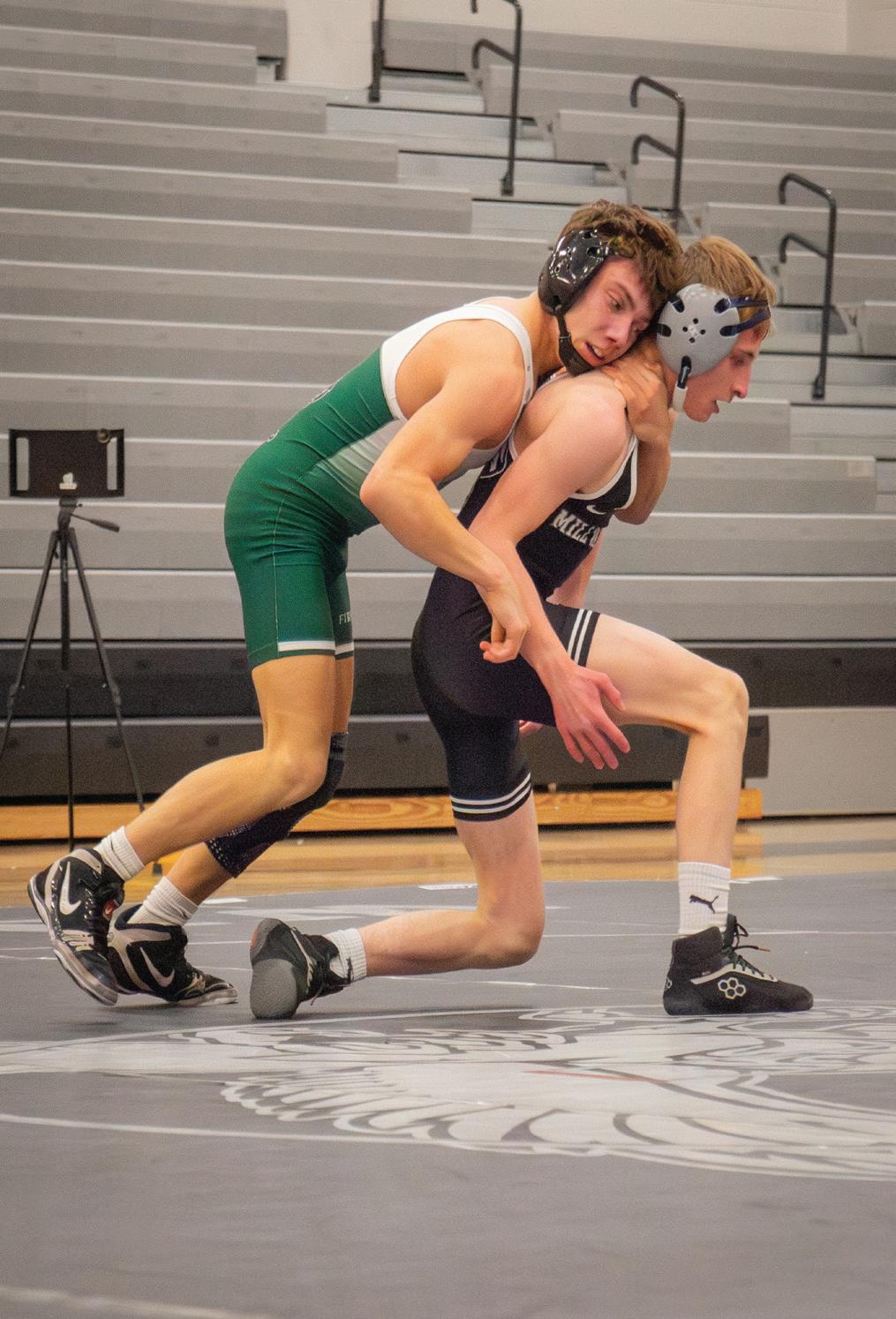


Pushing down his opponent, sophomore Damian Quick wrestles against Mill Valley on Feb. 4. Photo by Layla Afani Coburn
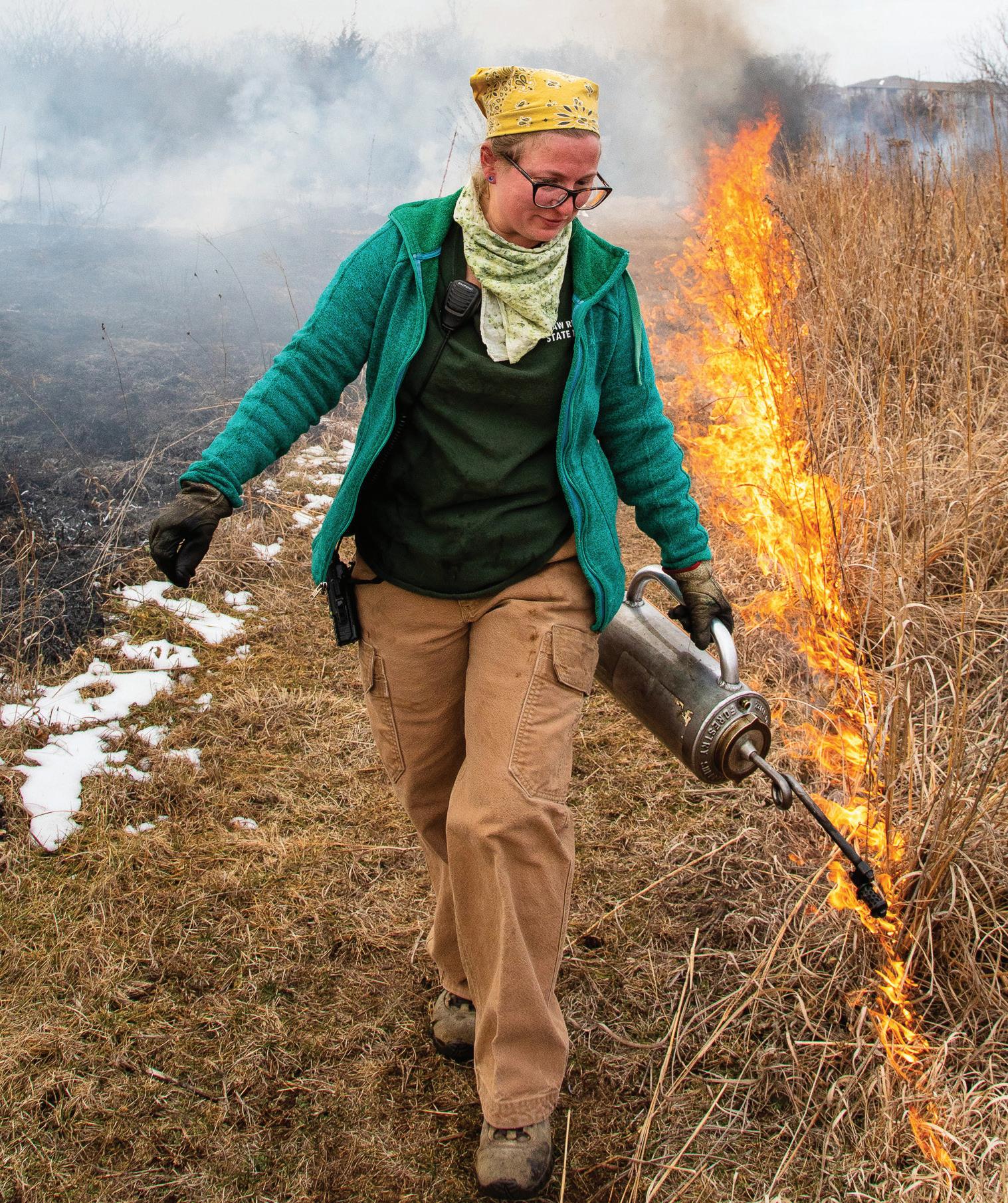
Using a drip torch, Courtney Masterson, an ecologist from Native Land Restoration Collaborative, burns the prairie on Feb. 4.
Photo by Nate Willems
Playing the violin, sophomore Harrison Leiszler plays at the MLK One Dream event. Photo by Nathan Kramer
by Ceci Bennett



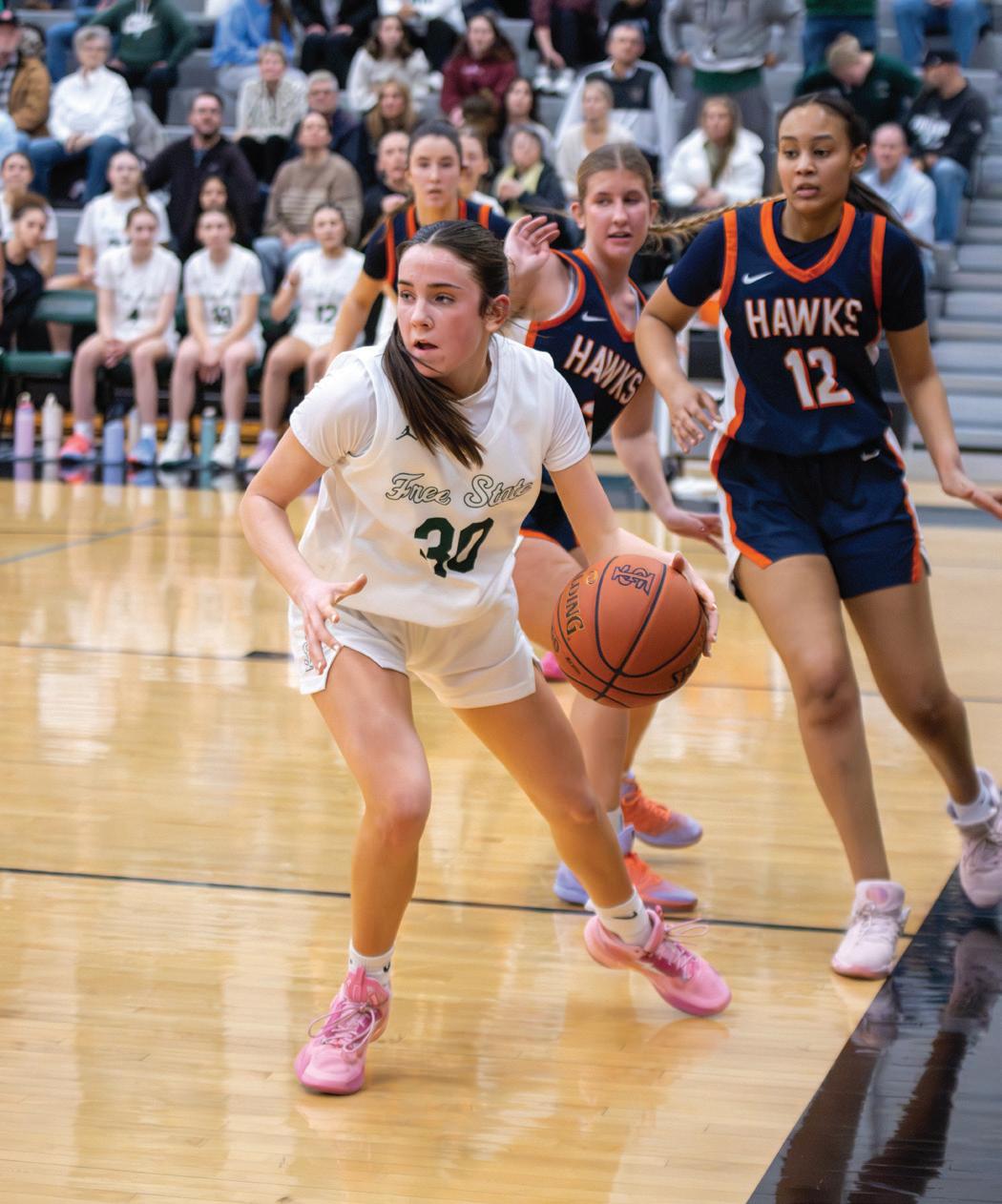

Scanning the court, Freshman Morgan McClorey plays in the basketball game vs Olathe East on Jan. 16. Photo by Leona Randall
Throwing the ball, freshman Sam Bauch plays in the annual game against Lawrence High on Jan. 3. The Firebirds won 4-2. Photo by Nathan Kramer
Throwing the ball, senior Aidan Murray plays in the varsity bowling meet on Jan. 16. Photo by Sydney Brozik
Playing their instruments, the orchestra performs to elementary school students on Jan. 20. Photo by Miles Beaty
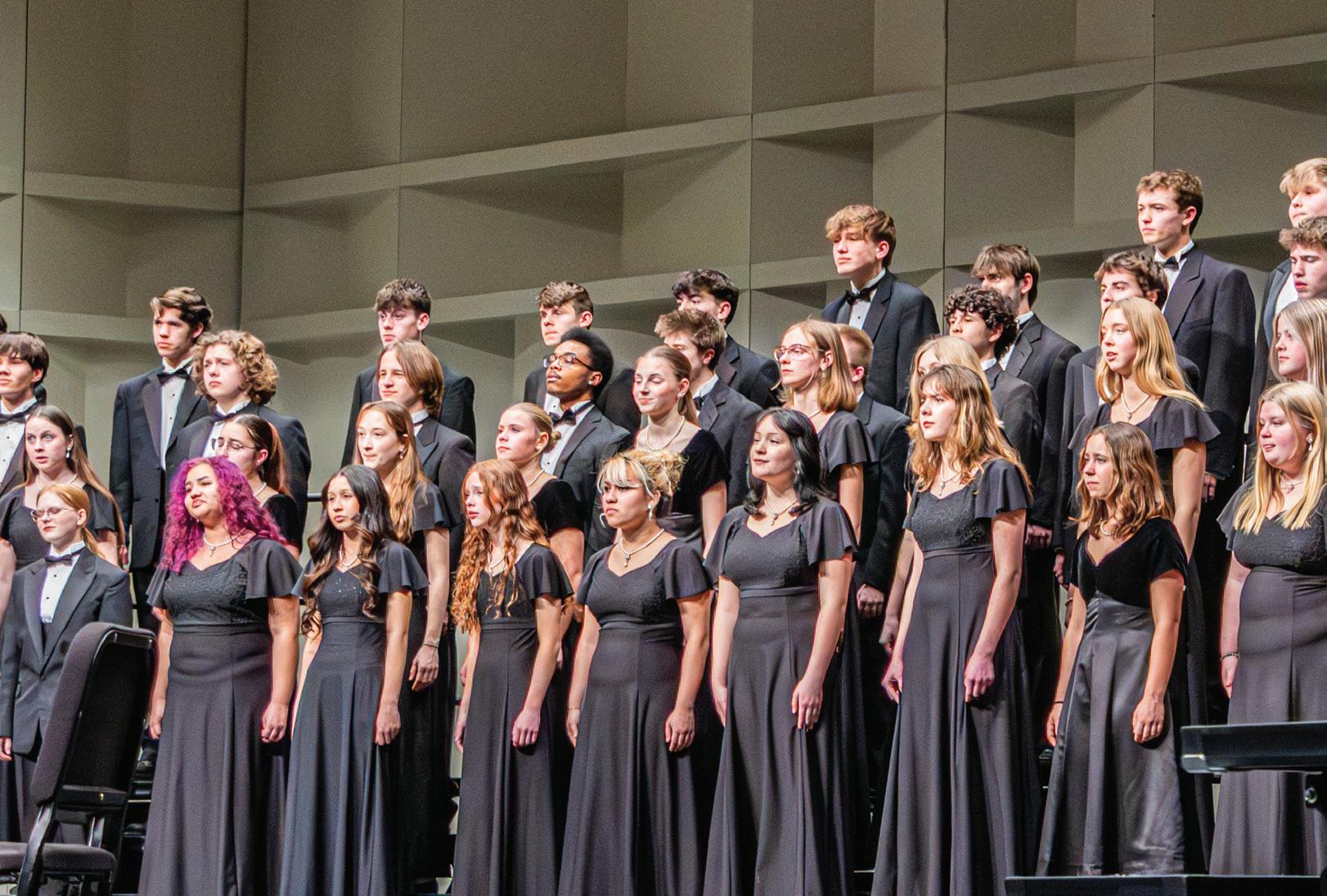
Standing together, the LHS and Free State choirs sing “On My Dreams” at the All City Choir Concert on Feb. 3. Photo by Ceci Bennett
CLUB
CLUB SCENE
Student-athletes extend their seasons through club sports
For many student athletes, the end of the high school season does not mean the end of competition. Instead, athletes often continue playing through club teams or other organized programs.
Senior volleyball player Meredith Claassen-Wilson, a member of Mavs KC 816, said that her experience with her club procured her to be the player she is today. She also said that club participation often requires a longer season and a greater time commitment than school sports, with practices and competitions extending year-round.
“I made a lot of friends through club volleyball, and I think it really taught me a lot of good life lessons, like how to be a leader and work as a team,” Claassen-Wilson said.
While playing for her club, Claassen-Wilson highlighted both the recruitment support and skill-development opportunities that come with club sports.
“I really like getting to travel, I’ll be going to Ne-
braska this year, and I’ve gone to Florida three times to be able to play volleyball, and I like going to showcases and playing for different college coaches,” Claassen-Wilson said.
Similar to Classen-Wilson, senior Brian Lin, who plays for the Kansas Rush Soccer Club, said the opportunity to develop as a player is far more than in high school. For example, Lin’s Rush coach invited players from the NAIA’s University of St. Mary to scrimmage against the team.
“Not only does it raise a level, but also allows us to see what the NAIA [College] level is like … those players will offer advice to the guys that want to play college soccer, Lin said.
“
Lin said that much of the team’s growth comes from the dedication of both his coaches and teammates. His club team, based in Olathe, draws players reaching as far as Topeka, KS, to practice and compete.
“Over half the team drives really far just to practice, and knowing that people drive that far just to be there really
Story by Rakshan Ossen
motivates everyone to make every practice worth it,” Lin said.
However, traveling can make balancing academics difficult. Between practices, games and the hours spent on the road, student-athletes often need to carefully manage their time to stay on top of schoolwork.
“It’s definitely a lot harder to find the time for homework and the motivation to do it, because by the time you get home, you still have to eat, shower, stretch and try to get enough sleep,” Lin said.
Beyond the challenge of time management,the financial cost of participating in club sports can also be significant. Fees for tournaments, travel and equipment can add up, though clubs often offer ways to help families navigate these barriers.
“It definitely can be a barrier, because you have to pay for jerseys, tournaments, travel, hotels and stuff like that, but I know there are workarounds, like clubs offering help, teammates sharing costs, or coaches telling you to reach out if you have money concerns,” Lin said.
Despite the challenge of travel, time and cost, club sports offer lessons that extend beyond the court or field. For student-athletes like sophomore Kayla Johnson, it provides a period to harness her skills just in time for the high school season.
“It showed me a lot of perseverance and teamwork skills, and when things get hard, not giving up, because if you put in the time and the effort, you get what you pay for,” Johnson said.
Illustration by Baila Love
SHORTAGE OF STRIPES
Lack of referees poses a problem in the state of Kansas
Kansas and the local surrounding areas have been dealing with a lack of officials for both youth and high school sports. The Kansas State High School Activities Association has registered over 10,000 officials, while only approximately 4,000 to 5,000 referees are active. The number of active referees continues to shrink, creating problems for fans, players and other active referees.
Having been a referee for over 20 years, assistant principal Matthew Renk said he has witnessed the problem firsthand while officiating high school football games. Renk said both varsity and sub-varsity teams are being affected due to the lack of referees available.
“ “
We are getting to a tipping point with officials. It will not be long before we will not have officials for sub-varsity games. We will also get to a point soon where varsity contests will be affected because we just don't have the officials out there to cover them, Renk said.
The problem is also affecting youth athletics. Sophomore
Henry Roberts, who officiates youth soccer, said he has seen games being refereed while short-staffed.
“When I first started, there was definitely a big shortage because we would be down referees during games,” Roberts said. “In the Lawrence area, and places like Olathe and Kansas City, they are definitely down on refs, because you'll see it when playing. Some games don't have as many as they should.”
There is no set reason why a shortage of referees is becoming an ongoing issue for the state, but experienced referees like Renk said the pressure from fans is one of the biggest factors.
"There have been times when I have experienced fans thinking that, because they bought a ticket, they believe they can yell negative and abusive things at the officials. We are human, and fans who think we will get every call correctly have never put on a shirt and blown a whistle," Renk said.
In an attempt to attract more referees, Roberts said that current referees are talking to players to interest them in becoming one, and with a good turnout in back-to-back years, the numbers could be turning in the right direction.
“We've had a couple of good classes back-to-back years,” Roberts said. “They're talking to players at the actual event, at the actual games and asking if they're planning on becoming refs in the future.”


During a time out, a referee consults a playback at the Free State vs. Lawrence High rivalry game on Oct. 23, 2025. Archive photo by Evie Chancy
ABSOLUTE
U.S. forces remove former Venezuelan President Nicolas Maduro from office
Story by Jonah Frye
RESOLVE
Tensions between the United States and Venezuela recently escalated on Jan. 3 when the U.S. government forcibly removed President Nicolas Maduro from office. According to Al Jazeera, the Trump Administration issued an attack in operation “Absolute Resolve” on Jan. 3 to prosecute Maduro under drug trafficking violations in the U.S.
This conflict marked an escalation in the strained relationship between the two countries, which began shortly after Maduro's 2013 election. The second Obama administration issued an executive order in 2015 declaring a national emergency because of civil rights concerns.
According to Time News, at roughly 2 a.m., U.S. air strikes struck Caracas, the capital of Venezuela. Special forces extracted Maduro and his wife from their mansion and flew back to the U.S. around 3:29 a.m. While the estimates on casualties vary, an article from AP News stated that 24 Venezuelan officials were killed, along with 32 Cuban military and police officers who were working to protect Maduro. AP News reported that more civilians were killed; however, the exact numbers aren’t clear.
During a family vacation on an island off the coast of Venezuela, freshman Owen Metz said he witnessed the attacks firsthand. Metz said finding out what he assumed were fireworks were actually missiles created a feeling of shock and uncertainty.
“At midnight or so, we could hear fireworks going off, but then I couldn’t fall back asleep after that. So somewhere around two in the morning, I heard a loud boom, and I looked out my window, and I could just see a flash,” Metz said.
After the strikes, Metz and his family were among the many visitors whose flights were delayed. Metz said his family was stuck for an extra couple of days, leading to increased stress and tension. He said his family stayed packed for several days, staying ready to leave at a moment's notice.
It was very nerve-racking to know that we were stuck there and that we didn’t have any control of if we were going to be able to leave soon or not, Metz said
Following the attacks in Caracas, Maduro and first lady Cilia Flores have been charged with weapon and drug smuggling in New York and are currently being held in the Metropolitan Detention Center.
According to a Jan. 3 Reuters article by Andrew Cawthorne, Raphael Satter and Tim Reid, President Donald Trump publicly said he would run Venezuela. However, the BBC reports that Vice President Delcy Rodríguez is serving as interim president.
"We will run the country until such time as we can do a safe, proper and judicious transition," Trump said during a press conference at his Mar-a-Lago resort in Florida, via Reuters. "We can't take a chance that someone else takes over Venezuela who doesn't have the interests of
UN Charter, Article 2(4)
“All
Venezuelans in mind."
Furthermore, the Reuters article said that some critics believe Trump’s focus on Venezuela’s natural resources, such as oil reserves, raises questions about the administration’s integrity.
In an article published on Jan. 14 by CBS News journalists Kathryn Watson and Sara Cook, an anonymous administration official said the U.S. completed the first sale of Venezuelan oil through a partnership with U.S. companies. The unnamed official said the sale was valued at $500 million.
Moreover, according to CBS News, after a meeting with oil executives, the White House has introduced a plan to sell Venezuela’s oil, splitting the proceeds between U.S.-based companies, the U.S. government and Venezuelans.
Additionally, in an article published in Al Jazeera, Richard Falk, an American Professor of international law, claims that the United States’ attack on the Venezuelan capital is a violation of the UN Charter, Article 2(4), because of the unprovoked nature of the strikes.
“The United States attack on Venezuela on Jan. 3 should be understood not simply as an unlawful use of force, but as part of a broader shift towards nihilistic geopolitics in which international law is openly subordinated to imperial management of global security,” Falk said in an opinion piece published in Al Jazeera.
Roughly one-third of American adults approve of the actions taken in Venezuela, according to a poll by Reuters/Ipsos. A BBC article stated that Venezuelans reacted to the removal of Maduro with cautious hope and continued fear.
Members shall refrain in their international relations from the threat or use of force against the territorial integrity or political independence of any State, or in any other manner inconsistent with the Purposes of the United Nations. ”
Aug 19, 2025 March 9, 2015
Three guidedmissile destroyers are deployed by the U.S. military to waters off the coast of Venezuela.
20, 2018
Maduro is re-elected, and the Lima Group, the United States, and the European Union have denounced the election as fraudulent according to the Electoral Integrity Project.
President Obama issues an executive order declaring a national emergency in Venezuela due to national security and foreign policy issues, according to White House Archives.
Sep 2, 2025 Oct 8, 2025
U.S. kills 11 people in a drone strike, the first of 35 strikes killing 115 people so far. President Donald Trump posts a video clip of the vessel exploding in flames.
Dec 10, 2025
U.S. seizes an oil tanker with two million barrels of crude, Venezuela’s government says it is “a blatant theft and an act of international piracy.”
April 14, 2013 3
Second strike
Senate Republicans vote down legislation that would have required congressional authorization to continue boat strikes.
Oct 31, 2025
UN Human Rights Chief Volker Türk calls for an investigation into the boat strikes.
Nicolas Maduro is elected president of Venezuela, defeating Henrique Capriles with a narrow margin, prompting the U.S. government to request a recount.
31, 2025 Jan 3, 2026
U.S. announces sanctions against four companies in Venezuela’s oil sector.
U.S. forces conduct air strikes in Caracas and escort Maduro and his wife to New York to face prosecution.
Collected by Jonah Frye



TCOLLEGE

he college admissions process often starts as early as July and extends over several months to January for high school seniors. While some apply to a select few schools, others dive in, submitting applications to over ten universities in search of the perfect fit. According to the Common App’s Deadline update, there has been a 7% increase in total applications, with students submitting to 5.94 schools on average during the 2025-2026 cycle.
On the eve of submitting her final applications, senior Olive Minor took a step back to reflect on the process and what it demanded of her. After weeks of balancing essays, deadlines and self-expectations, she said she realized the effort wasn’t just about getting into college.


Seniors share experiences applying to multiple schools
Story by Rakshan Ossen
for multiple schools,” Minor said. “Our education system could use a little bit more support instead of just putting a list of resources on a Google page and calling it good.”
Similarly, senior Drew Harrison, who applied to 15 schools, said that he experienced feelings of burnout and overload, and said that the application process was mentally exhausting and difficult to balance with other commitments.
manage stress, which is the strategy senior Jacob Wang implemented. Wang said breaking the work into smaller, manageable pieces helps him stay on track.
“If I finish this application it’s done. I don’t have to worry about it anymore. It’s one less brick on my shoulder, and having that step-by-step mindset really helped me get through the process,” Wang said.

“I realized I was doing it more to prove to myself that I could get in, and that just wasn’t worth it,” Minor said.
Even as she focused on schools she genuinely wanted to attend, Minor said she found certain aspects of the system confusing. Between emails, recruitment materials and scholarship offers, it was sometimes hard to know what to trust.

Minor said the pressure of college applications often piles on top of an already demanding school schedule. Between managing homework, extracurriculars and multiple application deadlines, she said it is daunting for students to be expected to navigate a process they’ve never encountered before.
“On top of all of our schoolwork, we’re expected to know how to do things we’ve never done before, and do them

Overall, there's just this feeling of, 'It'll never stop,' and 'Is it really worth it?' I just feel overloaded, and it kind of competes with everything else I do, Harrison said.
Additionally, Harrison said that the stress of completing so many applications adds up, but reduces once submitted; however, the workload can make students feel like much of their effort is wasted once decisions come out.

“You write all these applications for all these schools … and to be honest, if I’m only going to go to one school out of those 15 or 16, the rest of it seems like it’s going to waste,” Harrison said.
Some students approach the application process one step at a time to
Wang said that not every outreach from colleges influences a student’s decisions. Wang said he focuses only on schools that align with his goals and interests, and said he advises others to do the same.
“Unless they’re really a college I’m looking for, I kind of just push them away. Their reaching out to me isn’t going to decide whether I want to go there. I’m looking at my future and what I want to do,” Wang said.
As advice for managing the college application process for the upcoming senior class, Minor suggested starting the planning process as early as possible. She said beginning early allows students more time to reflect on their experiences and refine their writing, rather than rushing to meet deadlines. Minor said that spreading the work out over several months can help reduce stress and prevent the process from becoming overwhelming.


“Narrow it down and do incremental work, because sitting down and trying to write everything at once just doesn’t work, and make very clear deadlines for yourself,” Minor said.




CAN THEY GRADUATE?


Sophomore graduation requirements cause confusion
As the class of 2028 nears the halfway mark in their high school careers, many students face confusion regarding their graduation requirements. Starting with the class of 2028, students will now be required to take 3.5 credits of English, 1 STEM credit, 0.5 credits of communications, 0.5 credits of financial literacy and will have to complete two Post Secondary Assets, achievements or experiences that prepare students for higher education or the workforce. Assets include earning a 21 or higher score on the ACT, 95% attendance in high school, and earning the Seal of Biliteracy.
Sophomore Max Bolick said he and his peers are getting increasingly concerned about graduation, particularly the financial literacy credit. Counselor Marc Conover confirmed that Free State does not currently have a course to fulfill the credit, but they are working with the district to develop one.
“It's concerning that we don't have a class for a credit we're required to have,” Bolick said.
The change in graduation requirements comes directly from the Kansas Board of Education. Conover said he believes the Board added the communications and financial literacy credits because they felt students were leaving high school without sufficient knowledge in those areas. Previously, USD 497 students also had to fulfill a 0.5 credit of career and life planning, but that was recently removed.



Story by Morgan Sponholtz
Bolick said that communication from counselors regarding the requirements and their changes has been less than ideal, but he feels confident that if questions arose, counselors would be more than willing to help. Sophomore Ruth Yang said she also feels information is primarily being shared between students, not from counselors.


“That [credit] wasn't a state requirement; that was something our district wanted. That got changed, because–there's lots of reasons– but it wasn't quite working how they were wanting it to,” Conover said.








There's a lot of communication between peers regarding fulfilling requirements on your schedule, but there's less communication with administrators who might know more information, Yang said.
“ “
Conover said that staff are currently working with the district and tech department to create a system to track students’ PSAs. He also said that as the class of 2028 and beyond become upperclassmen, they will meet with students to ensure requirements are met.


“The counselors are currently meeting with district people and tech people to try to figure out how to track it [PSAs], either on Power School or via Xello, and they're developing this tracking system now…I would think at least by the end of the year, or starting next year, it should be in place,” Conover said.

Examples of Post Secondary Assets in addition to the 24 required credits: (Class of 2028 & Beyond)

AP Exam (3+)


Two or more high school athletics/activities
40 or more community service hours SAT score (1060 or higher) Eagle Scout or Gold Scout
According to Courses & Requirements on the Free State Freshman Enrollment page

According
to the World Health Organization, more than national and provincial authorities in the world
have implemented outright bans
or
FAN OF THE Fake TAN?
Fake tanning culture raises questions about cultural appropriation amongst students
Story
by Phoebe Morris
Once Coco Chanel accidentally caught the sun before a 1923 fashion show, tanning culture quickly popularized within the beauty industry, according to Organic Treatment Company; however, seniors Arianna Waller and Fiorella Leistner both said they feel that fake tanning is cultural appropriation.
Though Leistner, who is Uruguayan, said she enjoys the process of tanning — spending time out in the sun, getting vitamin D and developing a glowy, “sun-kissed” skin color. However, Leistner said she feels that natural features of women of color, like tan skin, have been commercialized by the beauty industry without giving recognition to who those trends came from.
“People underestimate how much influence Latinos have. With fake tanning culture, a lot of that comes from how black women and Latino women are.
restrictions on the use of sunbeds. 40 “ “
People are taking that inspiration from women of color, but they're not giving credit where credit is due, Leistner said.
Senior Kara Alexander, who spray tans at least once a month, was introduced to fake tanning at the age of 11 for a dance competition; now Alexander is an ambassador for local spray tanning business, Sunny Daze Sunless, and said she thoroughly researched her skin undertones to avoid an unnatural hue before tanning.
“There is a wrong and a right way to self-tan. If you are going and picking out the darkest color that you can, you're gonna look orange. Obviously, you might be able to tell that you're self-tanning, but when people go as far as orange, that's just a lot,” Alexander said.
Waller, who is also a dancer, said she finds it odd when people purposefully try to darken their skin color without acknowledging the historical setbacks people of color have faced for their darker skin. From a young age, Waller said she questioned why she felt discriminated for the color of her Afro-Latina skin, while her pale-skinned classmates would purposely spray themselves in products to tan their skin. She said she feels the natural tanning process is enjoyable, but the desire to deliberately self-tan to an unnatural tone is inappropriate.
“I've had people come up to me saying, ‘I'm as dark as you hahaha.’ No, you're not, you're orange, you're not black,” Waller said. “If you're trying to get to the color of me or trying to compare your skin tone to me, I find that disrespectful.”
Leistner said she doesn't necessarily mind modern beauty standards, such as lip fillers or fake tanning, being based on women of colors’ features; however, she said she thinks it’s important
According to Tiktok, #tan has million posts since Jan 15th. 1.4
to reiterate that those are natural features from different races that could have health consequences when people of a different race try to adopt them.
“The way I've always seen it is that: if you think that box braids are beautiful, you go get box braids, and if you think tanning looks beautiful, you go get a tan. But you have to be aware that white girls, if you get box braids, your hair is gonna fall out because you're not meant for that. If you go out into the sun without any sunscreen, or even go into a tanning bed as a really pale white girl, you're going to get skin cancer,” Leistner said.
Alexander said she understands how fake tanning could be seen as colorism, but when she fake tans, she does not have the intent to make women of color feel mimicked. Instead of tanning to mirror people's features, she said her main reason to fake tan is for dance, since she feels more confident on stage when tanned.
“It's very big in the dance world for you to get spray tans before competition. I occasionally think it elongates my lines a little bit … It's definitely become a thing where it's just a desire for everyone to be tan,” Alexander said.
Waller said that the only way to get rid of colorism of tanning culture is to embrace everyone's natural, individual skin color. She said that modern movements need to welcome every skin tone — light or dark.
“I've told people you need to embrace your skin color. It's always, ‘I'm pale this, I'm pale that,’ and I don't think that's ever going to change,” Waller said. “Embrace your skin tone, just like how I had to embrace mine when I was a kid.”
According to a FSJ Poll of 250 votes, 29% voted that they have fake tanned before. people who use tanning beds have a increase in melanoma skin cancer, and a increased risk if they are under the age of 35.
According to the World Health Organization, 20% 59%
According to PRnewswire, Global Sunless Tanners Market to Reach Billion in 2026. $1.8
Billen










CARDS TO CUT OUT