At Fryeburg Academy, we believe in our core values of community, respect, diversity, challenge, support, and growth. Our course of study embodies each of these values in the following ways:
COMMUNITY—We offer courses that engage students and apply to the real world. Our goal is to give you the opportunity and preparation needed for the next step of life and ultimately prepare you to be a contributing member of your community.
RESPECT— Our teachers, administrators, and staff respect that you come to the academy at different academic levels with various interests. Our course offerings are designed to meet all our students’ needs.
DIVERSITY— With more than 150 course offerings in semesters one and two and an additional 75+ during May Term, you have the opportunity to experience many different options. I encourage you to take advantage of our incredibly diverse course offerings.
CHALLENGE—Each of you will define challenges differently. No matter what that definition is, I encourage you to challenge the curriculum at Fryeburg Academy.
SUPPORT—When you take on a challenge, you may need support. We have many ways to support you here at the Academy. Don’t be afraid to ask for help when you need it.
GROWTH— Ultimately, we want you to experience growth during your time at the Academy. Taking on a challenge means getting out of your comfort zone — that is where growth occurs. Get out of your comfort zone during your time at our school — you won’t regret it.
Sincerely,
Joseph R. Manning Head of School
OUR MISSION+ VALUES
Fryeburg Academy serves students, the local and global community, and the future by providing diverse learning opportunities, fostering achievement and inclusivity, and cultivating responsible citizenship.
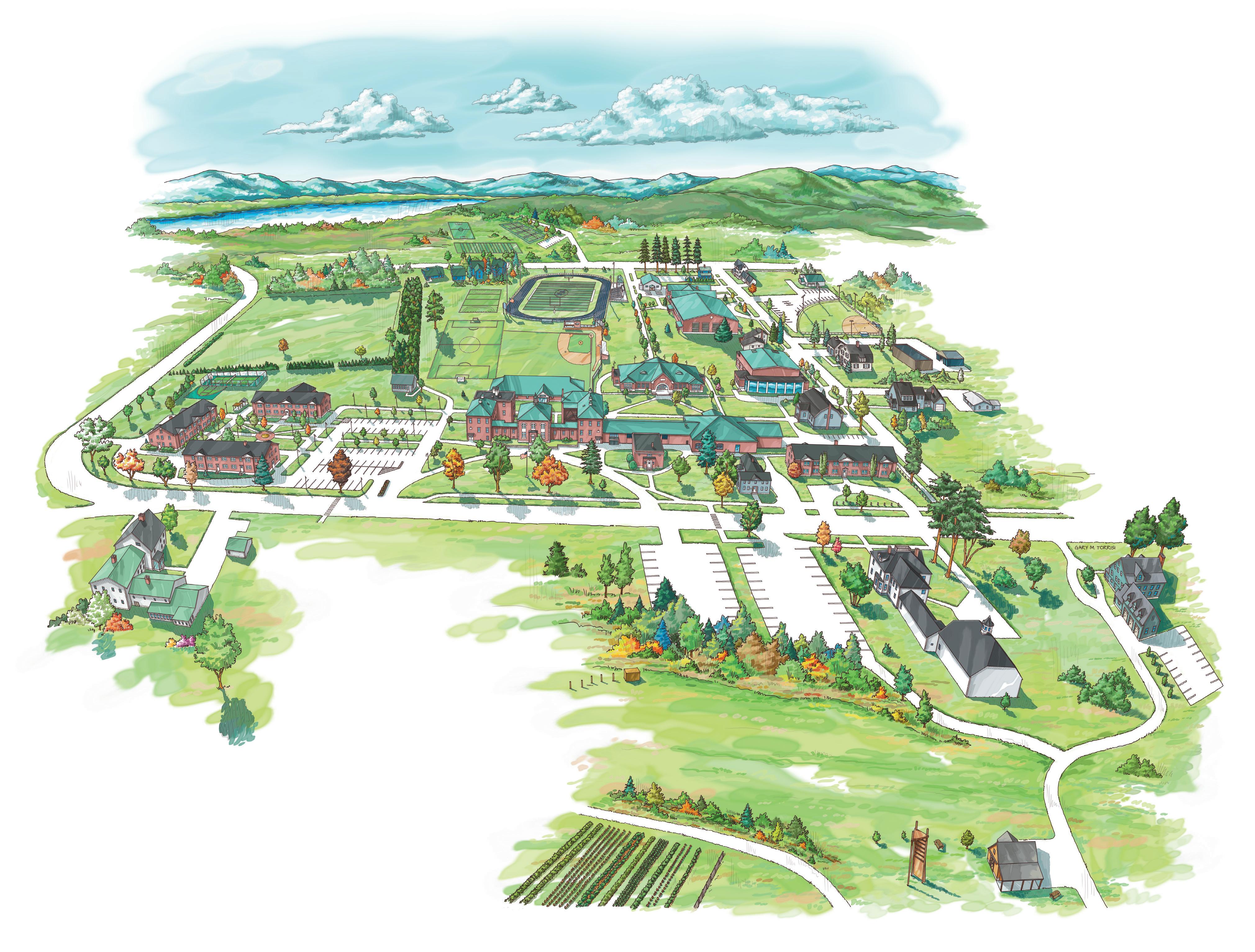
15. Walker Technical Arts & Electrical Technology Building Building
17. John H. Atwood Stadium & The Clarence E. Mulford Field
18. Manoriti Memorial Baseball Field
19. Converse Athletic Fields
20. Legion Softball Field
Center & Ada Cram Wadsworth Arena
22. Gordon Hall
23. Leura Hill Eastman Performing Arts Center
24. LaCasce Dining Room / Thomas D. Shaffner Hall
25. Theodor P. Blaich Post-Secondary Counseling Center
26. T. Scott Gamwell Student Union
Health & Wellness Center
28. Student & Event Parking
29. Admissions & Alumni Building / OLRC Hub
30. OLRC Challenge Course, Barn & Cross-Country Trails
31. School Garden 32. Howe Street Practice & Tennis Facility
33. True House
GRADUATION REQUIREMENTS
One Carnegie Credit is defined as two
Students must earn four credits to be sophomores, nine credits to be juniors, and 15 credits to be seniors. To receive a Fryeburg Academy diploma, students must finish four years with at least 21 credits. Additionally, 9th-11thgrade students must take at least three credits each semester, 12th-grade students must take 2.5 credits per semester, and complete four school years of English course work at Fryeburg Academy. The school does not approve requests for early graduation.
ACADEMIC PROGRAM
SEMESTERS I AND II
Our goal at Fryeburg Academy is to prepare students for success in higher education and the workplace. The Academy has identified standards to help students prepare for higher education, and school counselors work with parents, advisors, and teachers to assist students with their academic programs. We aim to create the best learning environment by forming small, evenly-sized classes. Therefore, we reserve the right to make final student placements and cannot accommodate requests for specific sections or teachers.
TRANSFER CREDIT FROM OTHER INSTITUTIONS
Fryeburg Academy only accepts credits from accredited institutions. Homeschooling work will receive credit if done under an accredited institution’s supervision, and a transcript is issued. Transfer credits from other institutions will be counted towards graduation requirements but will not affect GPA or class rank. The Director of Studies determines which courses are awarded credit and how they count towards graduation requirements.
Students will be accepted to a specific grade based on previous coursework. If the coursework is not from an accredited U.S. institution, the Academy may not transfer the credit, but it may be used to accept a student at a higher grade level. Students in 10th, 11th, or 12th grade have three-year, two-year, and one-year graduation requirements, respectively, as outlined in the curriculum bulletin. Middle school credits do not count toward graduation requirements except in limited circumstances.
For current students, Fryeburg Academy will transfer credit from accredited or approved institutions with pre-approval from the Director of Studies. These credits may count toward graduation requirements but will not affect GPA or class rank. The Director of Studies will determine the number and type of transfer credits students will be awarded and may limit the number of non-Fryeburg Academy credits that will count toward graduation.
GRADING
Grades are posted four times each semester as progress reports. The only grades that are recorded on transcripts are the final grades at the end of the semester. Additionally, May Term grades are included on the transcript and contribute to the GPA.
GRADE WEIGHTS/GPA
Course grades are weighted based on level. Level 1 and Level 2 classes receive no extra weight. Honors classes add 0.5 grade points to GPA, while Advanced Placement (AP) and College Level (CL) classes add 1.0 grade points. Only Fryeburg Academy courses and independent studies are included in GPA calculations.
COURSE CHANGES
Student or parent requests for specific sections or teachers cannot be honored.
Students can change most courses in the first two weeks of a semester by consulting with their class dean and school counselor. After that, they can drop or add a course by filling out a drop/add form with all necessary signatures, including parent consent.
Courses dropped before the end of the first progress grading will not appear on the transcript. Later in the semester, the same drop/add procedure applies, but a “W” (for Withdrawn) will be noted on the transcript.
HONOR ROLL/CLASS RANK
Beginning with the graduating Class of 2025, Fryeburg Academy will be replacing the decile ranking system with Latin designations to recognize academic excellence within specific GPA bands. This new system will use GPA bands to determine a student’s ranking, rather than their ranking in comparison to their peers. The Latin designations and their corresponding GPA thresholds are as follows:
• Summa Cum Laude: GPA ≥ 4.0
• Magna Cum Laude: 4.0 > GPA ≥ 3.8
• Cum Laude: 3.8 > GPA ≥ 3.67
To qualify for a Latin designation, students must complete two semesters at Fryeburg Academy. The number of students in each Latin designation group will vary based on individual performance and the curriculum’s grading system. These GPA thresholds will also serve as targets for students, allowing them to maintain or improve their Latin designation by continuing to excel academically.
CREDIT RECOVERY & ACQUISITION FROM NON-FRYEBURG ACADEMY COURSES
Fryeburg Academy recognizes pre-approved credit recovery and acquisition courses from BYU, Keystone, and Edmentum when appropriate. Courses from other accredited institutions will be considered on a case-by-case basis. These courses are treated as transfer credits. Students may earn no more than two (2) credits from recovery courses.
Online high school and Dual Enrollment college classes are also treated as transfer credits. The number of online courses that will count toward graduation will be limited to two credits (total, in combination with recovery courses; see above). In order to receive FA credit for online courses, students must receive approval from their school counselor and Director of Studies prior to enrollment in those courses.
Students taking APforME courses through the state of Maine system will receive the letter grades they earn through the course on their FA transcripts.
CHOOSING A CURRICULUM
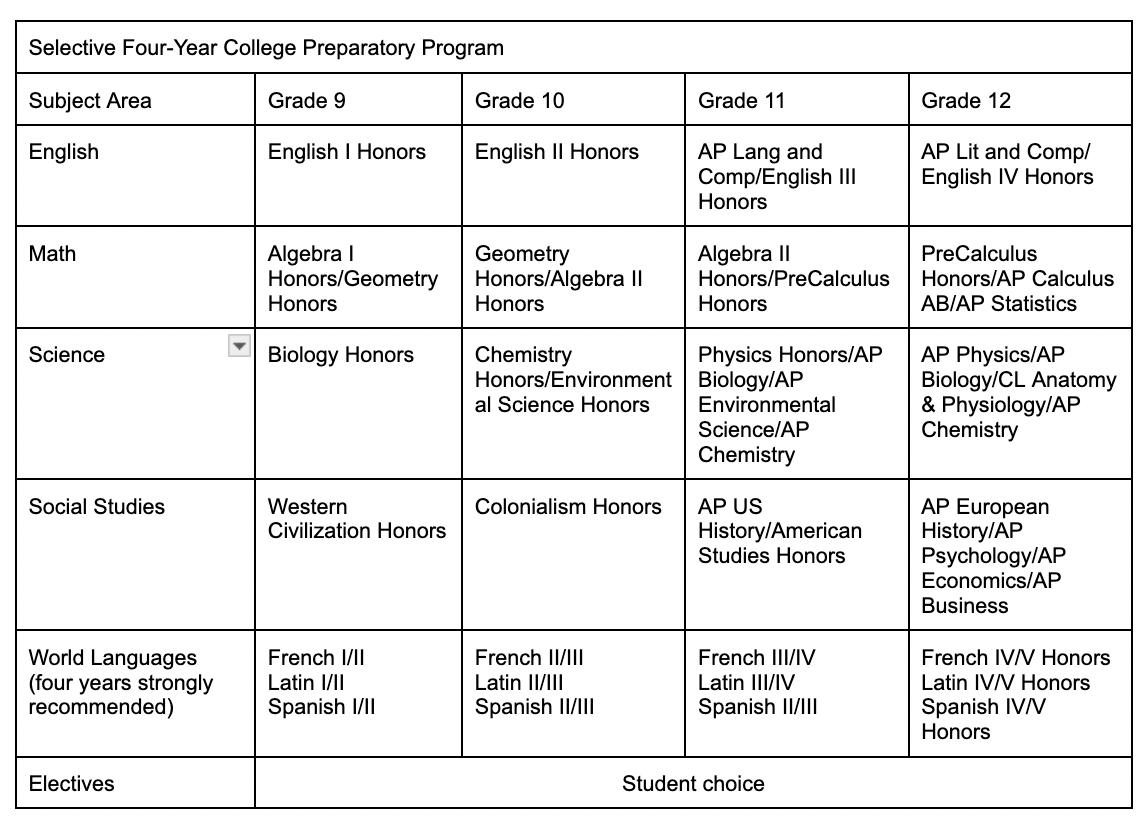
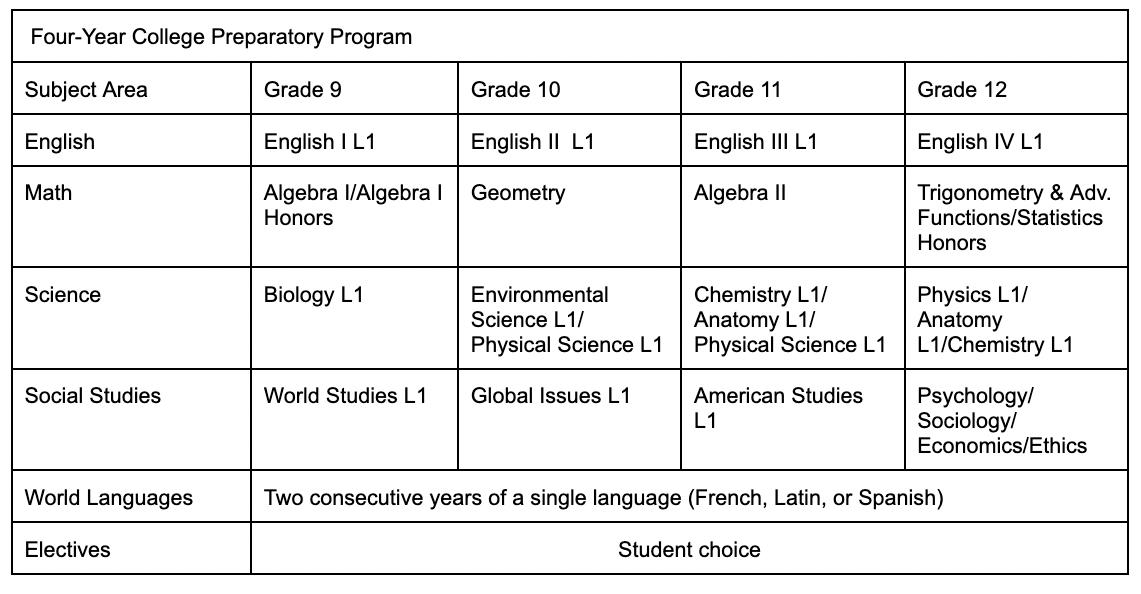
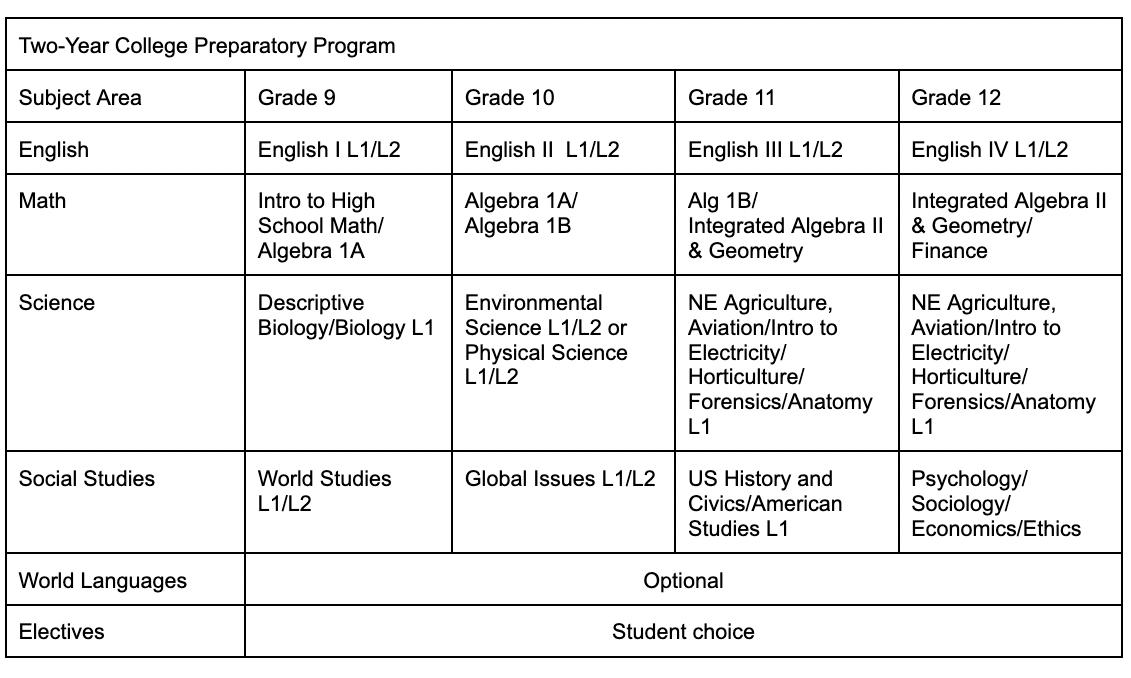
At Fryeburg Academy, we offer three general study curricula to meet various post-secondary needs. Students are placed in appropriate courses based on their individual needs and goals. The sample programs provided are for illustrative purposes only, and students’ programs should be tailored to their specific interests and post-secondary goals.
I. Selective College Curriculum
The selective college curriculum includes Honors, Advanced Placement (AP), and College-Level (CL) courses. It is designed to meet the requirements of the most highly selective colleges. Students should take four years of the same foreign language and as many honors and AP courses as possible and appropriate. This curriculum is considered “very demanding” or “most demanding” by competitive colleges
II. College Preparatory Curriculum
The college preparatory curriculum requires four years of English, mathematics, and science, and three years of social studies, including United States History. We recommended that students take at least three years of a foreign language to enhance their college application. This curriculum is considered “demanding” by four-year colleges.
III. Career & Technical Curriculum
The career and technical curriculum is tailored for two-year colleges or vocational/technical schools. Students need to complete four years of English, three years of mathematics, and other required courses. Enrollment in the Academy’s Applied Technology & the Trades program or Lake Region’s Vocational/ Technical Center is essential. After this curriculum, students can pursue further studies at a college like Southern Maine Community College, attend a technical school, or seek job placement. (see sugguested program examples on following page).
I. Selective College Preparatory Program
III. Two-Year College or Technical School Preparatory Program
GRADUATION REQUIREMENTS FOR INTERNATIONAL STUDENTS
I-Year Student: Must earn a minimum of 5 credits, including 1 English, 1 math, 1 science, 1 U.S. history, 1 elective
2-Year Student: Must earn a minimum of 10 credits, including 2 English, 2 math, 2 science, 1 U.S. history, 3 electives
GRADE WEIGHTS/GPA CHART
3-Year Student: Must earn a minimum of 15 credits, including 3 English, 3 math, 3 science, 1 U.S. history, 2 social studies, 3 electives
4-Year Student: Same as the graduation requirements outlined on page 6.
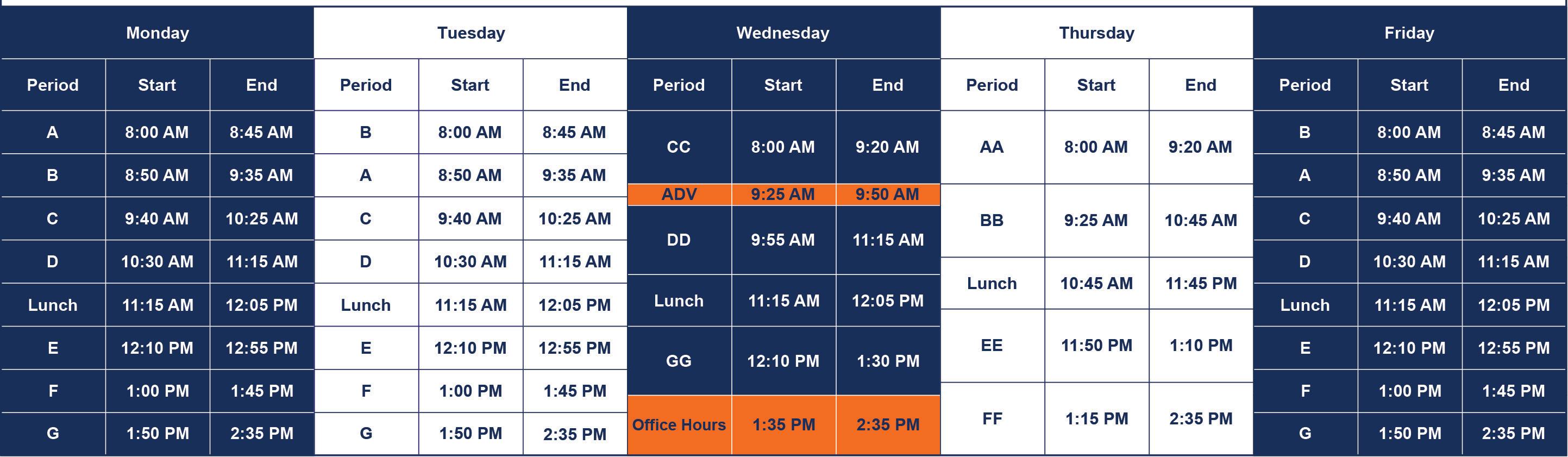
CLASS SCHEDULE 2026-27
SIGNATURE PROGRAMS
Fryeburg Academy offers a range of Signature Programs that provide students with unique, hands-on learning opportunities. Designed to enrich and expand the academic experience, these programs help students build the skills, confidence, and perspective needed for future success.
Advanced Course Work
AP, college-level, and honors courses at Fryeburg Academy are advanced classes designed to challenge students and prepare them for collegelevel work. They cover material in greater depth and at a faster pace than standard classes, requiring rigorous coursework and critical thinking skills. Successful completion may result in college credit or advanced placement in college courses.
Computer Science, Aviation, & Technology
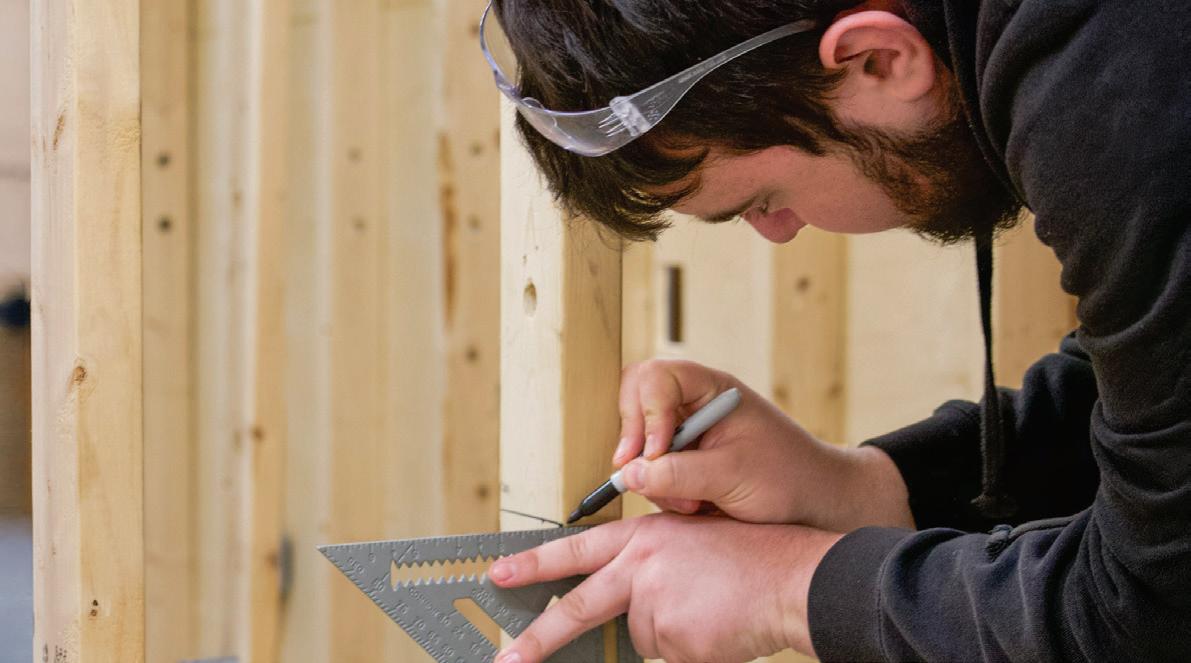
Today’s job market is competitive, so equipping students with the necessary skills is essential. The Computer Science, Aviation & Technology Program at Fryeburg Academy provides relevant and challenging learning experiences to prepare students for careers in machine fabrication, woodworking, aviation, electrical technology, and agriculture, meeting the needs of the Maine workforce.
Certificate of Arts
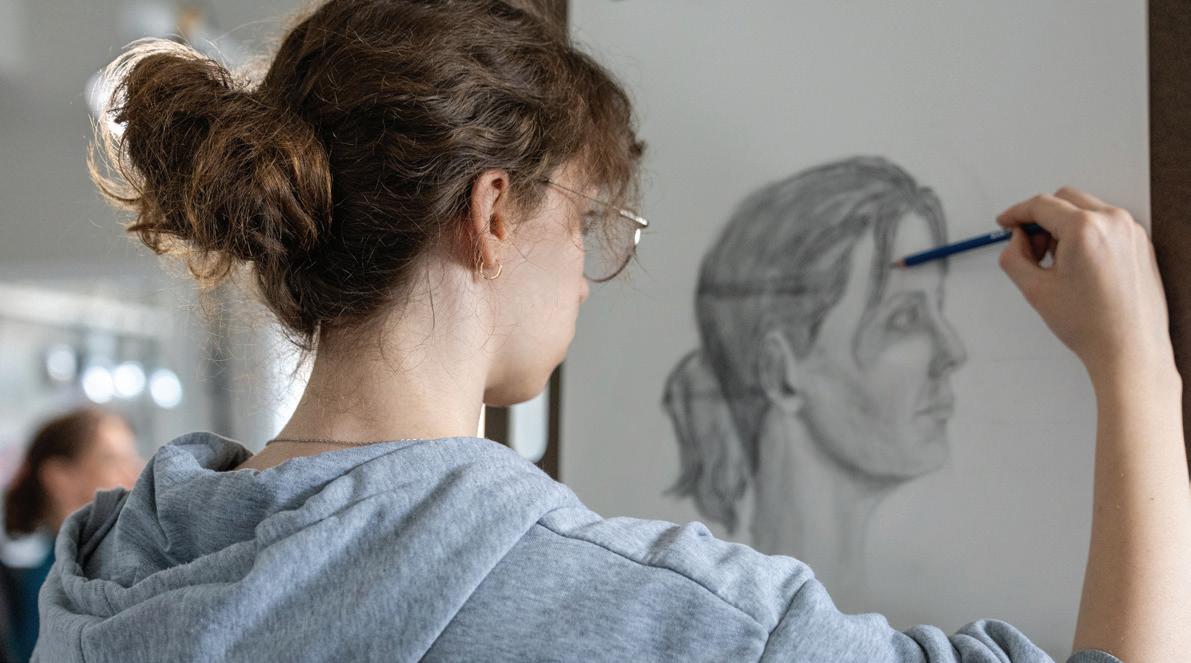
Our program offers a general arts certification for a more concentrated study in performing or visual arts. You will be paired with a faculty mentor who will guide you in your studies throughout your time here. Our program allows you to participate in coursework, independent studies, and capstone projects to showcase your skills.The program also gives you the chance to visit local galleries and meet artists and performers from the area, providing you with real-world experiences and a deeper understanding of what it takes to have a career in the field.
Center for International Students (CIS)
At Fryeburg Academy, international students receive comprehensive support through the Center for International Students (CIS). This program goes beyond ESOL and provides assistance in all aspects of academic and personal life. The CIS team, comprised of expert teachers and counselors, works closely with international students, offering personalized attention for scheduling, grades, classroom concerns, and cultural issues. Additionally, the CIS provides specialized college and social/emotional counseling for student success. The CIS chair oversees international student affairs to ensure that students receive the necessary support to thrive at Fryeburg Academy.
Internships
Discover your potential and gain real-world experience with our Internship program! The program offers junior and senior students a unique opportunity to gain hands-on experience in their field of interest. You’ll develop skills that will set you apart from others in the job market and broaden your knowledge of potential career paths. Upon completion, you’ll give a formal presentation and receive .25 credits, depending on your weekly time commitment. The program lasts for one semester, with the possibility of an extension.
May Term
May Term is the perfect opportunity for 9 -11th grade students to explore a variety of subjects that they might not have access to in other semesters. With over 80 interdisciplinary and experiential offerings, May Term is an authentic way to gain exposure to new topics and engage in hands-on learning. This three-week term is scheduled at the end of the school year, providing students with a unique chance to expand their horizons and deepen their understanding.
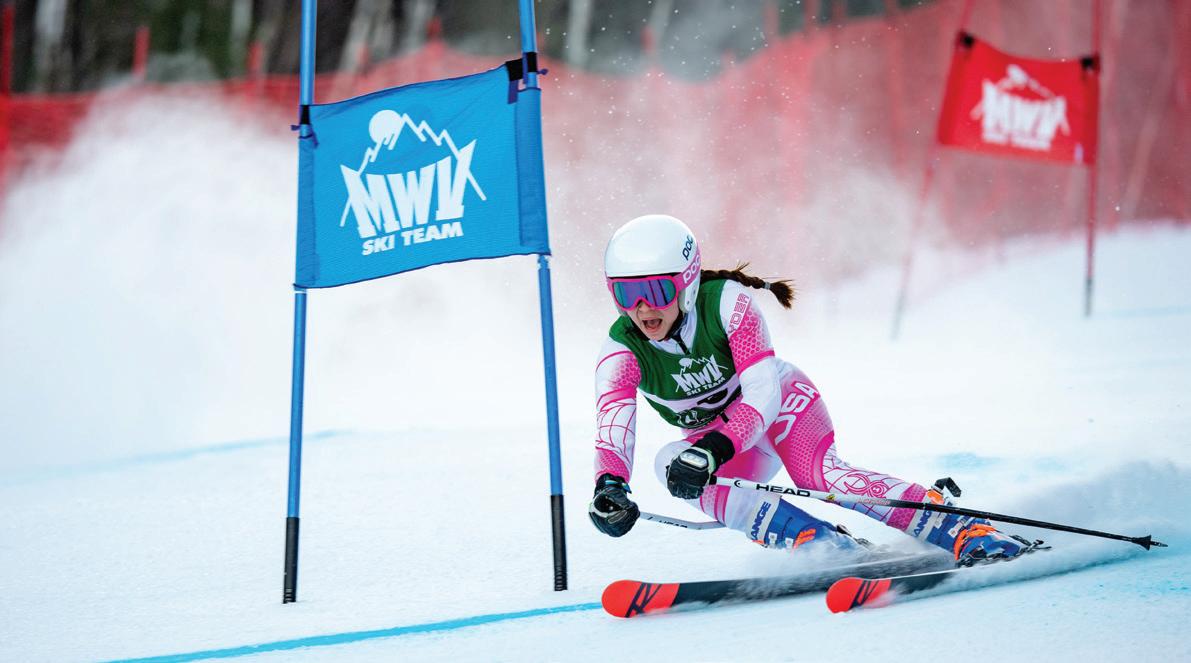
Ski & Study Program
The Ski & Study program allows athletes to train and race with the Mount Washington Valley Ski Team ( MWVST) while attending school and living at Fryeburg Academy, for all or part of the season. Take advantage of over 40 Honors, AP, and Dual Enrollment classes along with our individual Tutorial Support Program.
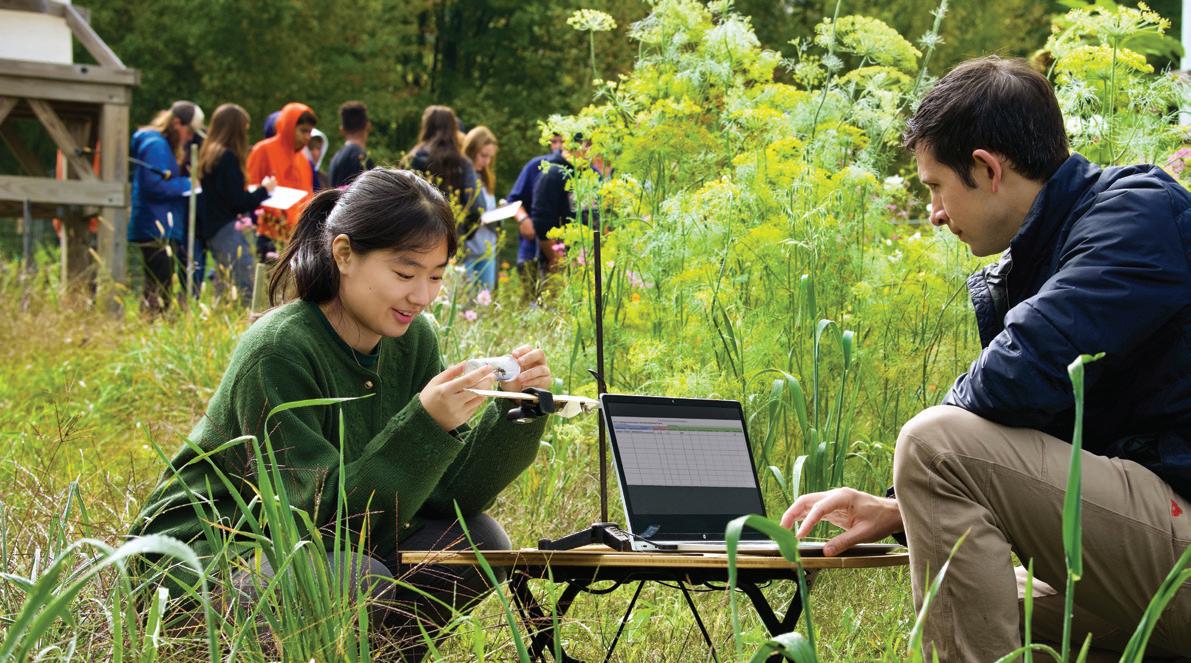
Outdoor Learning and Research Center (OLRC)
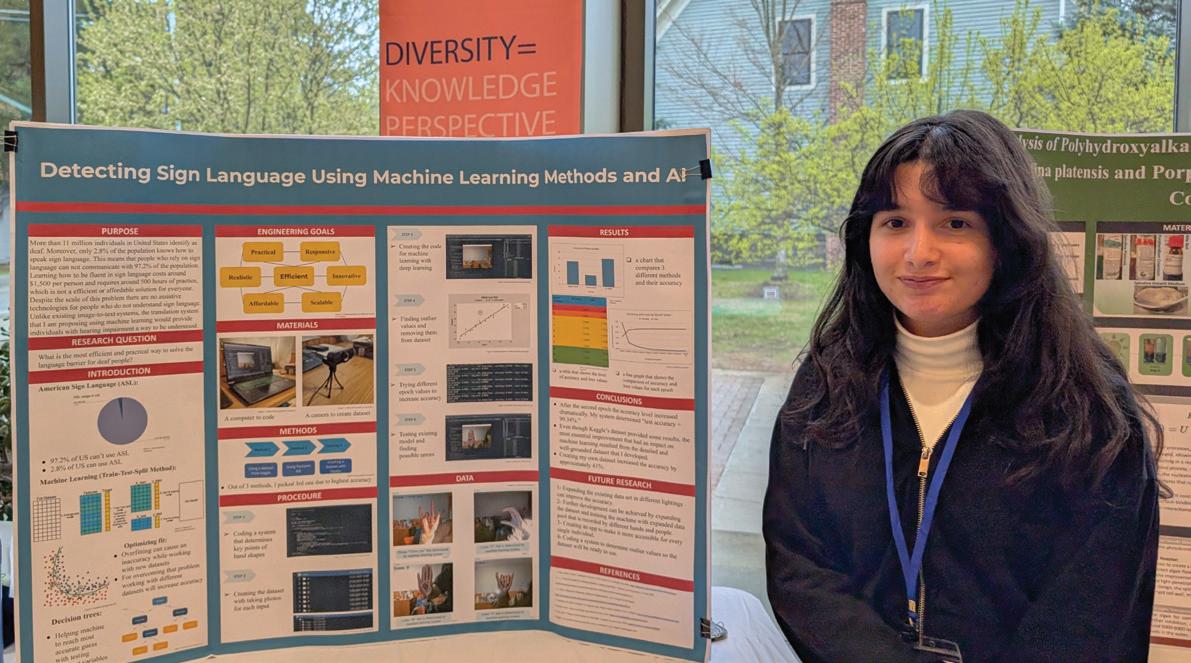
All Fryeburg Academy students experience the Outdoor Learning & Research Center (OLRC) through a ropes challenge course that fosters social -emotional and leadership skills. They also learn field research principles through a partnership with the FA Science Department, OLRC, and Tin Mountain Conservation Center. Students interested in field science or science fair projects can enroll in Honors Research Design courses and receive support. The school garden is integrated with the science department and extracurricular programs, providing hands-on experience in planning, growing, and preparing a garden and exposure to Maine agricultural disciplines like maple sugaring and forestry.
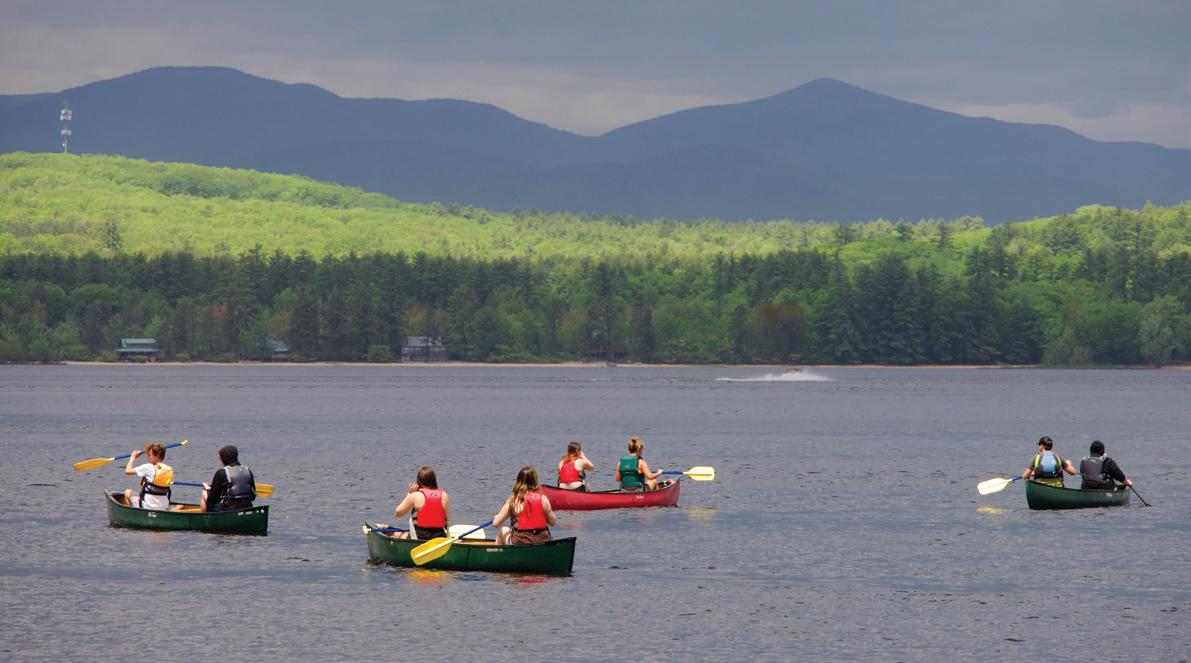
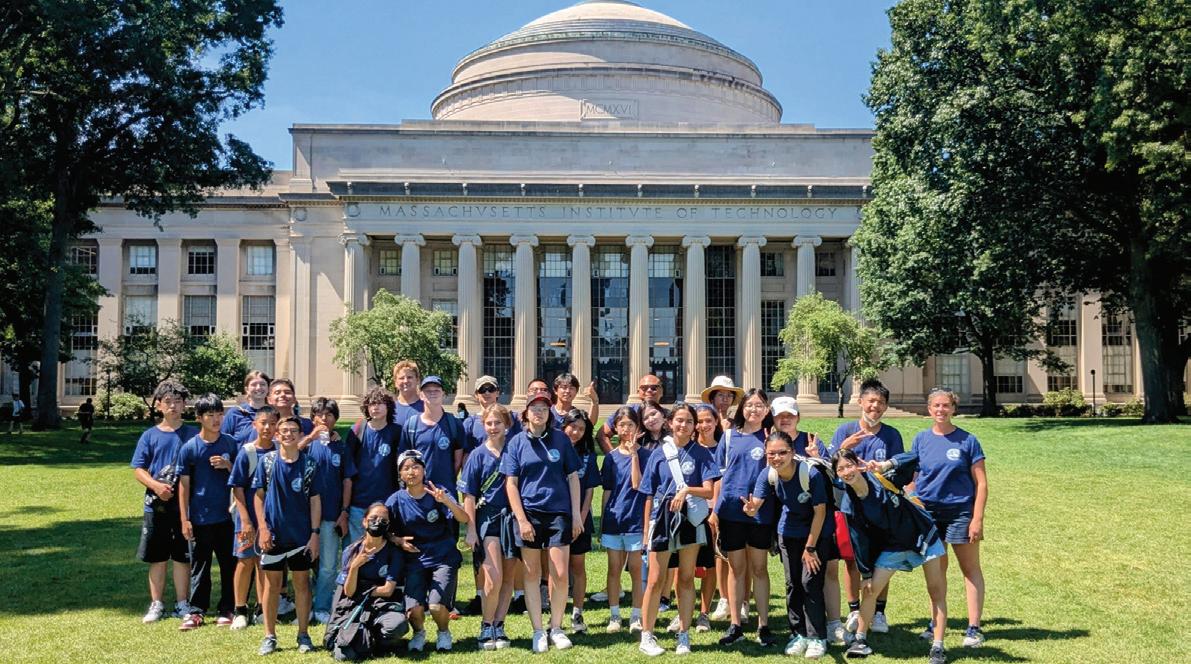
Summer Program
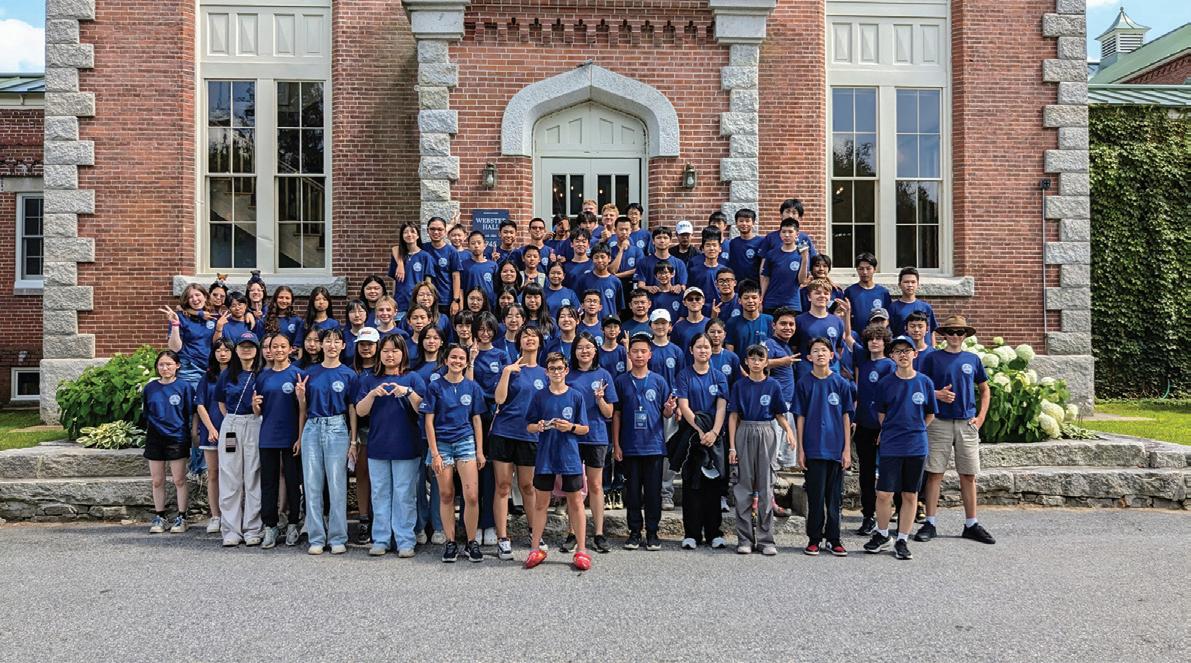
The program offers a perfect blend of academic and athletic activities, providing an opportunity to explore the beautiful outdoor landscape of the region. The morning sessions focus on five main areas of study: STEM, Business & Marketing, ESOL, Athletics & Conditioning, and the Arts, with a strong emphasis on academics while the afternoons are geared toward outdoor adventures.
ARTS
This advanced studio arts course is designed for upper level, selfmotivated artists who intend to pursue post secondary training at a four year art school, art academy, liberal arts college or university with a specialized art program and eventually a career in the creative arts. Any student not intending to go to art school or make a career in the arts but who has a deep passion for continuing their art training will also greatly benefit from and be welcome in this class. Students will produce and submit a portfolio to a jury of AP College Board Artists for college credit and college application submission. During this intensive course, each individual will create a body of work that demonstrates a high level of craftsmanship, conceptual development and consistent progression over time. This high quality portfolio is produced through disciplined studio practice while expanding on foundational skills and developing authentic and original concepts and a personal visual language. The ability to critique one’s own work as well as the work of other artists in constructive, comprehensive and relevant dialogue will play a major role in the student’s overall success in pursuing a creative path and connection to the canon of art history through the sensibilities of our contemporary art culture.
AP Music Theory
Prerequisite: (One or more of the following and the instructor’s permission) Guitar Theory, Piano Theory, Intro to Rock Band or two semesters of band or chorus.
Course duration: Yearlong
This full-year course is designed to expand aural, theoretical, and technical skills in music. Music composition, melodic practices, theory of harmony, sight singing, dictation and other musical concepts are studied, encompassing the Common Practice Period (1600-1900). Students in this course must take the AP examination given in May.
and ceramics (hand-building). Emphasis will be placed on creating work that communicates an understanding of fundamental principles of art using a variety of media, techniques and processes. Students will learn to use these elements to find solutions to specific visual arts problems and begin to use this vocabulary as a means of creating and evaluating works of art. Studio time will focus on “hands on” work as well as class discussions covering ideas and principles of art history, theory, ethics and the social impacts and implications of all art.
Art II
Course duration: One Semester
In this intermediate course, students build on skills from Art I, refining techniques in drawing, painting, composition, perspective, design, and color theory. Work in ceramics continues, with opportunities to expand hand-building skills and explore wheel-throwing . Emphasis is placed on creative problem-solving, craftsmanship, and developing a more personal artistic voice. Through hands-on studio work, critiques, and discussions of art history and contemporary practices, students strengthen their ability to analyze and communicate ideas visually.
Art Portfolio
Prerequisite: Art I
Course duration: One Semester
This is an upper level, self-directed course focused on two major aspects of the more serious and dedicated art student’s bodies of work. We will initially explore and investigate each individual’s focus and interests in their own visual arts language. This includes clarifying and expanding on past and present subject matter and materials that are of the greatest interest for the student in developing and clarifying their personal body of work. The second aspect of this course will focus on the preparation and
presentation of a portfolio for applications to post secondary education, including colleges, universities, four year art academies, and professional work in any visual art field. We will cover such things as properly photographing, editing, archiving, formatting, labeling and presenting one’s work for portfolio presentations in multiple formats, including digital and print. The final goal is to have each student prepared with a personal, impactful and unique body of work ready to present in any and all formats for both academic and professional pursuits.
This course may be taken multiple times for the more dedicated art student.
Band
Course duration: One Semester
(Can be taken multiple semesters for credit)
This performance course is open to instrumental students of all ability levels, and encompasses instrumental performance, theory, and ear training. The band performs standard concert band literature and marching band literature. Students participate in a variety of performances, including concerts in the Performing Arts Center, marching performances at the Fryeburg Fair, occasional appearances at home football games, and Fryeburg Academy events. Students in band are eligible to audition for Fryeburg Academy’s instrumental jazz ensembles. Honors credit can be earned by participating in a full semester of an extra-curricular musical ensemble at Fryeburg Academy, such as Vocal Jazz or Big Band.
Chorus
Course duration: One Semester (Can be taken multiple semesters for credit)
This performance course is open to vocal students of all ability levels, and encompasses vocal performance, theory, sight reading, solfege proficiency, and ear training. The chorus performs literature from a variety of cultures, languages, time periods, and genres such as classical, pop, and traditional. Students participate in a variety of performances, including concerts in the Performing Arts Center and the Fryeburg Fair. Students in chorus are eligible to audition for Fryeburg Academy’s vocal jazz ensemble. Honors credit can be earned by participating in a full semester of an extra- curricular musical ensemble at Fryeburg Academy, such as Vocal Jazz or Big Band.
CL Photoshop
Course duration: One Semester
This course is an introduction to Adobe Photoshop incorporating the basic principles of layout and design, presented in a project-based format. Students will utilize selection tools, layers, retouching tools, colorization techniques, and filters in the correction and manipulation of photographs. This course is a dual enrollment college level (CL) course offered through CMCC. Students earning a 70 or higher will receive 3.0 college credits.
Digital Art I
Course duration: One Semester
This course offers a world of digital possibilities for the modern artist! This class will focus on two main programs from Adobe: Fresco and Illustrator. Fresco is a drawing and painting program that uses a stylus on our touch screen computers, and Illustrator, which is graphic design focused, and typically uses a mouse. With these two programs, you will have the ability to create digital drawings, paintings, vector art, and even 3D image creation. We might even touch on Animation, which can also be done in Fresco. With this class, the digital art world will be at your finger-and stylus-tips.
Digital Art II
Prerequisite: Digital Art I Course duration: One Semester
Building on what they learned in Digital Art I, students in Digital Art II will continue to explore and refine their skills with Adobe Fresco and Illustrator while also being introduced to more animation and digital puppeteering with Adobe Animate and Adobe Character Animator, and 3D sculpting and design in Blender.
Digital Art III
Grades: 11, 12
Prerequisite: Successful completion of Digital Art II.
Course duration: One Semester
In this class, students will explore advanced topics in digital art, including animation and 3D sculpting. Students will work individually and in groups to create short cartoons using traditional animation methods, while also learning rigging techniques in programs such as Adobe Animate and Adobe Character Animator. Students will also explore a powerful free animation software called Blender to create 3D models. Also, students will have the opportunity to propose their own projects, so bring your internal motivation!
Film Workshop I
Course duration: One Semester
Film Workshop I enables students interested in television and film production to increase their knowledge and gain skills and experience in storytelling. This course will give students an overview of the many aspects of digital film history & production. Students will learn how to tell a story through the process of storyboarding, filming, lighting, sound, and editing in Adobe Premiere. It is designed for students who are motivated to improve their communication skills through visual media.
Film Workshop II
Prerequisite: Film Workshop I or prior experience/interview with instructor Course duration: Semester II Only
This is a practical, hands-on course for students who want to continue with more advanced film-making skills. Students will dive deeper into composition, lighting, sound, and editing with Adobe Premiere as they create their own short films. Students are encouraged to submit their finished films to be shown during the Fine Arts Festival at the Leura Hill Eastman Performing Arts Center.
Guitar Theory
Course duration: One Semester
This course is an introduction to playing guitar or bass. Students learn to play a variety of musical styles including rock, blues, jazz, and folk. In addition to learning to play guitar or bass, students will work together in four to five member rock bands. This allows the opportunity to try drums and keyboard as well. A student may repeat this course (to advance) with the permission of the instructor.
Intro to Rock Band
Course duration: One Semester
(Can be taken multiple semesters for credit)
This course provides a hands-on approach to learning guitar, bass, drums, voice or keyboard in the context of a band. The repertoire focuses on popular music such as rock, blues, pop, reggae, and allows students to experience song-writing and improvisation. Students choose each semester’s repertoire. No music experience is necessary to take this course, and instruments are provided.
Photo Workshop I
Course duration: One Semester
This course provides an introduction to digital photography. The shooting component of this course focuses on photographic composition techniques. The Photoshop component uses color corrections to enhance the image and how to use editing tools and make composite images.
Photo Workshop II
Prerequisite: Photo Workshop I
Course duration: One Semester
This course focuses on taking students’ photographic talents to a more advanced level. They will learn how to use manual camera settings to achieve desired results. The shooting focus involves thinking more creatively and pushing outside of the box. Photoshop skills will also be brought to the next level by focusing on quality of the final image.
Piano Theory
Course duration: One Semester
This course is designed to develop keyboard proficiency in the novice pianist and a knowledge of music theory. Students will progress from learning about pitches and rhythms, to intervals and scales, and finally to chords and simple harmonization. Keyboard technique will be acquired through playing scales, chords, and melodies in traditional and popular songs of the student’s choice, and becoming a functional musician through reading
ARTS
and writing musical notation and chord symbols. Students will learn how to compose a short melody and will end the semester by playing a song of their choice. No prior musical experience is required.
Sculpture & 3D Modeling
Course duration: One Semester
In this course, students will learn the basic principles and techniques of Sculpture and 3D Modeling, including such materials as wire, stone, plaster and clay (hand-building and pottery wheel throwing). Emphasis will be placed on creating work that communicates an understanding of fundamental principles of 3D art using a variety of media, techniques and processes. Students will learn to use these elements to find solutions to specific visual arts challenges focused on 3D aesthetics and functionality, and begin to use this vocabulary as a means of creating and evaluating works of art. Studio time will focus on “hands on” work as well as class discussions covering ideas and principles of 3D art history, theory, ethics and the social impacts and implications of all art.
Theater
Course duration: One Semester
This course is for students of any and all ability levels, and encompasses stage performance, theatrical design, theater research, and skit writing. During the semester students will participate in many creative projects that entail both on and off stage production. In the classroom students are expected to enhance self-expression through scenes, character analysis and improvisation. Experience is not necessary; one just needs a willingness to participate. Because the material is as varied as individual choice and skill, students can elect to take this course multiple times and receive credit.
Yearbook Publication
Course duration: Semester I Only (Can be taken multiple semesters for credit).
In Yearbook Publication, students will determine the theme of the yearbook. Students will design the cover and the layout for the inside pages. They will also help with photography, collection of data, and yearbook sales. There are several different jobs to do, and many new things to learn in the field of graphic design. This class will only run the first semester, but seniors in the fall semester may continue for the second semester in order to complete the pages of the book.
COMPUTER SCIENCE, AVIATION & TECHNOLOGY
ELECTRICAL TECHNOLOGY | Intro to Electricity
Course duration: One Semester
This course provides students with a foundational understanding of electrical principles, safety protocols, and practical skills for working with electrical systems. Students will explore key topics, including electrical theory, circuit design, power calculations, and modern technologies such as programmable logic controllers (PLCs) and Arduino. Emphasis is placed on hands-on learning through lab activities, real-world applications, and collaborative projects. The course also introduces career opportunities in the electrical industry and examines emerging trends in energy production and usage. By the end of the course, students will have gained valuable skills and insights to pursue further education or entry-level careers in the electrical field.
Applied Electrical Technology
Prerequisite: Students who have successfully completed a semester of Introduction to Electricity or other electrical theory class qualify for this course.
Course duration: Yearlong
This course provides students with a solid foundation in electrical technology, combining theoretical knowledge with hands-on experience. Emphasis is placed on residential wiring and commercial applications, giving students practical skills directly applicable to the field. Students will gain an understanding of fundamental electrical theory and principles, as well as the ability to interpret and apply the National Electrical Code (NEC). Through guided instruction and practice, they will develop competencies in electrical installation, maintenance, and troubleshooting while learning to use and maintain standard tools and equipment. A strong focus on safety protocols ensures that students are prepared to work responsibly in real-world electrical environments.
COMPUTER SCIENCE | AP Computer Science A
Grades: 11, 12
Course duration: Yearlong
AP Computer Science A is an introductory college-level computer science course. Students cultivate their understanding of coding by analyzing, writing, and testing code as they explore concepts such as modularity, variables, and control structures. Students learn to code in Java and focus on object-oriented
design. Basic English and Algebra skills, plus a strong work ethic, provide a distinct advantage in this class. Younger or less advanced students should take Intro to Programming or AP Comp Sci Principles before attempting this course. Students are required to take the AP exam in May.
Honors Game Design & Technology
Prerequisite: successful completion of a previous Technology department course or instructor recommendation to join this course.
Course duration: One Semester
This course offers a deeper exploration of technology and coding through game design and large project collaboration. Using current industrystandard tools such as Roblox Studio, Unreal Engine, and Unity in the Perry Creative Lab, students will design and implement their ideas while learning the value of patience, perseverance, curiosity, and adaptability in the world of computer science. Students should have a comfortable grasp of basic algebra.
Intro to CAD
Course duration: One Semester
Computers have forever altered the world of design and manufacturing. CAD is at the heart of it all, offering powerful design tools that allow creators to build and test designs virtually. In this class, students will learn product design using OnShape, a modern cloud-based CAD system primarily focused on product and machinery design. Students will design toys, parts, small machines, and custom creations, many of which will be printed on our fleet of ten 3D printers. No previous experience in computers or design is necessary, but fans of art, design, geometry, or computers will find this topic particularly useful.
Intro to Programming
Course duration: One Semester
Intro to Programming is a deep dive into the fundamentals of programming concepts and teaches text-based coding using Python. The class is predicated on the notion that learning about programming and computer science should be fun and engaging. In this course we expose students to graphics-based problem solving because it is visually engaging, allows for multiple correct solutions, and provides visual cues when a solution goes awry. This course also serves as an excellent foundation for students hoping to take AP Comp Sci A in the future.
Tech Fusion
Course duration: One Semester
Tech Fusion is a semester-long course that introduces students to digital tools for art, design, and introductory computer science. Designed for all skill levels, including beginners, the course explores software such as Pixel Art, Adobe Illustrator, Adobe Photoshop, and Tinkercad, along with additional introductory technology units.
Students complete both individual and collaborative projects, including pixel animations, vector design, surrealist photography, and basic 3D printing prototypes. The course also serves as an introduction to other FA technology offerings such as Digital Art, Programming, CAD, Robotics, and Digital Photography. By the end of the course, students will have developed foundational digital skills applicable to future creative and technical work.
AVIATION | Aviation I
Course duration: Yearlong
This course is the first year of a three-year, school-year-based program that introduces students to all aspects of aviation and aviation support, from careers to flight training, following the AOPA You Can Fly curriculum. This course is open to all students in grades 10 and above; no previous flight experience or aviation knowledge is required. This course can count as a science credit.
Intermediate Aviation
Course duration: Yearlong
This course will include topics such as: pilot and aircraft qualifications, principles of flight, aerodynamics, spin awareness, flight maneuvers, pre-flight and post-flight procedures, airport operations, regulations, safety, weather, aircraft systems, weight and balance, human factors, cockpit management, emergency procedures, night operations, aeronautical decision-making, cross-country flight planning, airspace, and other topics that help prepare students for the Federal Aviation Administration’s Private Pilot written exam.
Advanced Aviation
Grades: 11, 12
Prerequisite: Successful completion of Intermediate Aviation and instructor recommendation.
Course duration: Yearlong
Aviation III will prepare students to pass the FAA written exam for the private pilot license. Students will complete ground training in topics tested and apply their knowledge on flight simulators. Students will learn to complete detailed, accurate flight plans that take into account weather reports and federal regulations. Other topics include aircraft performance, weight and balance, flight instruments, aerodynamics, and communications. The course will end with practice tests for the FAA written exam.
TECHNICAL ARTS | Advanced Woodworking
Prerequisites: Beginning Woodwork and Furniture Construction
Course duration: One or Two Semesters
This advanced course in wood technologies will build upon the skills, techniques, and knowledge gained in previous courses and explore new, more advanced strategies and experiences. Areas of wood technology to choose from may include custom cabinetmaking, furniture construction, canoe and boatbuilding, clockmaking, and fiberglass technology/reinforced molding. The course is a very intense, self-motivating, hands-on experience culminating in the creation of a product of superior design, construction, and finish. Lab fee applies.
Beginning Metal Work
Course duration: One Semester
This course is based on product planning and manufacturing. The student will complete a scale drawing using technical drawing techniques and, using those specifications, produce the product on lab machinery. Students gain a better understanding of the importance of a quality working drawing and the role the metals industry has in their everyday lives. Units taught include types of metals, metal lathe and other machining processes, precision measuring instruments, and finishing metal products.
Beginning Woodwork
Course duration: One Semester
The course is designed to help beginners understand the tools and materials associated with the wood industry. The emphasis will be focused on the care and use of hand tools and machinery. Safety practices and good workmanship will be stressed at all stages of the process. All students construct the same product, allowing each to experience the processes used. Units of instruction include the science of wood, forest management and conservation, techniques of the past and present, construction and finishing applications, and related mathematics.
Furniture Construction
Prerequisite: Beginning Woodwork Course duration: One Semester
This course builds on the skills learned at the beginning level by introducing several new techniques useful to woodworkers. Each student will construct a small piece of furniture by using a set of plans. Interpreting drawings and an increased level of measurement skills are necessary. Units of instruction will be in furniture design, product planning, cost calculation, joinery techniques, finishing, and adhesives. Consumer knowledge and career opportunities are discussed to improve the understanding of the industry. Safety is emphasized at all times. Lab fee applies.
Machining & Fabrication
Prerequisite: Beginning Metalwork Course duration: One Semester
Given the employment opportunities in the metals industry, this course can be an important stepping stone to future work for many students. The course is designed to give the students a thorough understanding of the tools and processes used in the metals industry and enable them to use these tools to construct a product in the lab. Units include precision measurement and tolerances, welding practices including oxyacetylene and MIG, the metal lathe, the milling machine, and reading working drawings. Safety is stressed at all stages, and a good work ethic is emphasized as a skill necessary for employment. Lab fee applies.
Metal Design
Prerequisites: Beginning Metalwork and Machining & Fabrication Course duration: One Semester offered in fall and spring.
Designed for students who have completed previous metal courses and are considering careers in engineering or manufacturing, this course builds on skills and technologies from Levels I and II. Students will deepen their understanding of the use of tools and machines while focusing on engineering principles, design criteria, material selection, and computer-generated plans.
Projects may be completed individually or in groups and may include school-based fabrication or design challenges. Safety and environmental considerations are emphasized throughout the course. Lab fee applies.
Tech Arts Topics
Grade: 9
Course duration: One Semester
Technical Arts Topics provides a hands-on introduction to both wood and metalworking for 9th-grade students. This course can be taken in both semesters of 9th grade.
ENGLISH
AP English Language & Composition
Grade: 11
Prerequisites: Recommendation from sophomore English teacher, successful completion of testing essay, and completion of summer reading.
Course duration: Yearlong
This course is intended for those students who already exhibit a strong command of standard English grammar and the five-paragraph essay. The aim of this course is to teach students to write effectively in their college courses across the curriculum and in their professional and personal lives. Students will be engaged in becoming skilled readers of prose written in a variety of periods, disciplines and rhetorical contexts, and in becoming skilled writers who compose for a variety of purposes. Emphasis is on expository, analytical and argumentative writing that emerges from reading across the curriculum, rather than solely from personal experiences and observations. Students in this course learn to read primary and secondary source material carefully, to synthesize material from these texts in their own compositions, and to cite source material using conventions recommended by Modern Language Association (MLA). Ultimately, the goal of this course is to increase an awareness of writing and reading as interactions among a writer’s purpose, audience expectations, and subjects as well as the way generic conventions and the resources of language contribute to effectiveness in writing. Students will be required to take the AP exam in May.
AP English Literature & Composition
Grade: 12
Prerequisites: Recommendation from junior English teacher, B or higher in Honors or AP prior to senior year, successful completion of summer reading requirement.
Course duration: Yearlong
The Advanced Placement course is the equivalent of a first-year college course in literature and composition. Students will read a variety of literature from several different genres and from a wide range of time periods. This course has a heavy reading load and requires a great deal of writing, much of it on-demand (timed). Students will learn to compose sophisticated literary analysis, specifically focused on how literary devices work together to illuminate the meaning of a work as a whole. Students in this course are required to take the AP examination in AP Literature and Composition
(given in May) which determines whether a student may be eligible to receive college credit for the course.
English 176 L1
Course duration: Yearlong
English 176 is for international students and serves as a transition between ESOL III and English coursework. This class is not an ESOL class. It is a regular English class that focuses on reading literature, writing essays, and speaking publicly; but it is made up of only international students. This class is an intermediary step for second language learners as they move from small classes that focus on language learning to larger classes that assume language fluency.
English I Honors
Course duration: Yearlong
Work at the honors level requires high productivity and presents greater challenges than work in Level I English classes. Students who sign up for this level should read at grade level or higher. At this level, the emphasis is on reading classic literature. Class discussion and effective communication skills are emphasized. Expectations also include a higher sophistication both in writing and in critical analysis of literature. Students are required to complete the designated summer reading as it segues into the first literary unit in September. Students should also expect to be tested on the assigned summer reading.
English I L1
Course duration: Yearlong
This course emphasizes cooperative learning and communication skills, including learning and practicing effective interpersonal and group communication skills. Students read at least three full-length novels over the course of the year. They practice reading skills for a variety of situations and subjects; study vocabulary through word lists developed by the instructor and the students from their reading; and learn the elements of fiction and how to classify them in the texts they are reading. The writing curriculum consists of the basic organizations of descriptive, expository,
narrative and persuasive essays. Students learn to research using a variety of sources and references and complete a substantial research project in the spring semester. Grammar is a large part of the curriculum, with a focus on the basic structure of sentences and how to identify parts of speech in a sentence.
English I L2
Grades: 9
Course duration: Yearlong
This course is offered to freshmen who need to improve their fundamental English skills. The reading program includes contemporary writers, classics, and adolescent literature. The writing program includes instruction and guidance in the steps necessary for writing such as a research paper, expository writing, and personal essays, with an emphasis on the fundamentals of grammar. Students work to improve their organizational and study skills. Programs are adjusted to meet the abilities and needs of individual students.
English II Honors
Course duration: Yearlong
Skills addressed include strategies for analytical and interpretive reading, understanding the cultural backgrounds of the literature, and the nature and implications of the language used in the texts. Students will learn to glean appropriate information about the interpretations of the texts from analytical articles. Also, a major focus of the class will revolve around the process of writing and rhetorical applications. Standard English conventions will be addressed on a case-by-case basis. Class discussion and various presentations will focus on the process and delivery of speaking to an audience.
English II L1
Grades: 10
Course duration: Yearlong
This course is intended for sophomores who have every intention of applying to college. As such, the reading program features a diverse collection of writers, cultures, and genres, with an emphasis on increasing the students’ understanding of figures of speech, imagery, inference, symbolism, satire, and irony. Through writing multiple short essays, students become proficient in analyzing and interpreting textual evidence from primary and secondary sources. Longer essays hone the development and support of thesis statements. Research skills are refined and practiced in at least one research paper that requires multiple sources. Creative writing may include, but is not limited to, journal reflections, poetry, short stories, and one-act plays. At least one Shakespeare play is required. Vocabulary and grammar skills are studied as essential to reading, writing, and oral communication. Each student is required to deliver an original speech by the end of the year.
English II L2
Course duration: Yearlong
This course is designed for the student who requires extensive time and focus in reading comprehension and writing skills. The reading program features a diverse assortment of writers and genres, with an emphasis on increasing the student’s interest in and comprehension of various texts. Writing skills are addressed through multiple short essays to introduce the development and support of thesis statements, longer five-paragraph essays, creative writing, poetry, journal reflections and research. Vocabulary and grammar skills are studied as essential to reading, writing, speaking, and professional communication. Each student is required to deliver an original speech by the end of the year.
English III Honors
Course duration: Yearlong
This course is intended to be a demanding survey of American literature, emphasizing the American classics of poetry and prose. A variety of critical formats will be introduced, and students will be required to write frequent critical essays using those approaches to the literature. This class should be seen as preparation for AP Literature and Composition and will therefore develop the skills necessary for that course or for college English.
English III L1
Course duration: Yearlong
English III focuses on American literature. Relationships between literature and culture are studied by considering the original context of writings, informed by the students’ knowledge of American history. Topics of discussion will include the American dream and how it has changed over time. What has it meant to be an American in the past, and what does it mean now? Vocabulary exercises designed for SAT preparation are included in the curriculum. Speaking skills are integral to classroom work every day and are crucial to formal presentations and public speaking events. This is a rigorous, writing-intensive class requiring students to complete several essays and a research project by the end of the year.
English III L2
Course duration: Yearlong
This course is designed for the student who requires more time and focus in reading comprehension and writing skills. It will include the study of major American writers, a research paper and extensive review of English conventions. The program addresses the process of writing using analytical reasoning. Assessment is based mainly on four to six thesis-based essays written during the semester, reading comprehension quizzes, creative projects and skills development.
English IV Honors
Course duration: Yearlong
English IV Honors is a challenging adventure into the global and personal landscape of the written word through memoir, fiction, rhetorical analysis, journal writing, formal writing, and ending the year with a personal portfolio. The first semester is devoted to studying the language, author’s tone, purpose, as well as the themes of Holocaust memoirs and dystopian literature. Students examine the social, political, and cultural times in which the author is writing, and students will be expected to engage in intellectual discussion and written analysis of the author’s tone and purpose. The second semester is devoted to students finding their own voices in their writing through the writer’s workshop which includes rhetorical analysis, poetry, fiction, narrative, essay, book project, ending the semester with individual portfolio performances of their work.
English IV L1
Course duration: Yearlong
This survey course offers a focus in reading and writing intended to prepare students for college-level work. Through close reading of a wide variety of literature, students will hone their analytical and critical thinking skills. In addition, students will learn to write clearly and effectively. Emphasis will be on the writing process through drafting, revising, editing and peer review.
English IV L2
Course duration: Yearlong
This survey course offers a focus on reading and writing skills. Through a combination of independent and guided reading, students will hone their analytical and critical thinking skills. In addition, students will learn to write clearly and effectively. Emphasis will be on the writing process through drafting, revising, editing and peer review.
ESOL (ENGLISH FOR SPEAKERS OF OTHER LANGUAGES)
level also take ESOL content courses in Science and Social Studies for additional language support.
ESOL
II & III
Course duration: Yearlong
ESOL classes focus on the development of academic language skills and proficiency. Students are grouped together by communicative ability and skill level. All ESOL English classes integrate reading, writing, speaking, listening, and grammar directed at preparing students to succeed in FA mainstream courses as well as post-secondary studies. These two levels use the same series of textbooks which build vocabulary, reading comprehension and discussion skills. These courses also take a grammar based writing approach to developing sentence, paragraph and essay writing. Most students at these levels also take upper level Science and Social Studies courses in the ESOL department.
ESOL IV
Course duration: Yearlong
ESOL IV is our highest level language course in the ESOL department. This course is designed to provide students with near fluency in speaking and listening with full support to develop a strong ability to write essays in the literary tradition. Students will extend their reading skills to longer texts and think critically about an author’s purpose, audience, voice, and use of literary devices. This course has been added to bridge the gap between ESOL III and English 176 to allow students more time to develop writing skills as well.
skills. These topics serve as a vehicle for English language learners to develop reading, writing, speaking, and listening skills.
ESOL Foundations in Science/ Social Studies
Course duration: Yearlong
This course is our entry level course which includes mid to high beginners. The classes are limited to no more than six students so teachers can give individualized instruction and students can get extended practice in each class period. The course integrates reading, writing, speaking, listening while focusing on the content of Social Studies and US History. The course covers local and USA based geography, as well as American holidays, politics, religions, history and major wars. Students at this level also take ESOL 1 and an ESOL content course in Science for additional language support.
Global Studies: United Nations in a Divided World
Course duration: Yearlong
This course is an upper level ESOL Social Studies course that focuses on world history since WWII and the formation of the United Nations. We look at the history of the UN as well as topics the UN frequently tackles such as global language(s) use, viewing the world through maps, preservation of human culture, human rights, and conflict resolution. In the first term the final project is a country profile of these topics in magazine form. The second semester ends with a group Action Project, which involves a series of steps planning and producing an action to better our school community tied to the 2030 Sustainable Development Goals of the UN.
World History
Course duration: Yearlong
This course includes intermediate English language learners. The course integrates reading, writing, speaking, listening and aims to prepare students for success in FA mainstream courses. This course uses a textbook which is focused on teaching students general basics of World History, while giving them the language to discuss the topic and develop their writing skills in this content area. The course covers Ancient World History to the Age of Exploration and Imperialism. Students at this level also take ESOL II and an ESOL content course in Science for additional language support.
HISTORY & SOCIAL SCIENCES
American Studies Honors
Grades: 11, 12
Prerequisite: B in Colonialism Honors or an A in Global Issues, Level 1 Course duration: Yearlong
While covering all of the material included in American Studies, the honors sections will include more reading and interpretation of primary materials. Students will also be called on to interpret the views of American history throughout the development of the nation.
American Studies L1
Grades: 11, 12
Course duration: Yearlong
This course explores the development of America’s multicultural society. Using all of the social sciences, students will look at primary sources to study the processes that helped a nation come to terms with the many cultures that come to define it. Special attention will be paid to the emergence of the United States onto the global stage and how that contributes to the makeup of the world we live in today.
AP Business with Personal Finance
Grades: 11, 12
Prerequisite: prior successful completion of an Honors-level History & Social Sciences course
Course duration: Yearlong
The AP Business with Personal Finance course aligns closely with a collegelevel Introduction to Business course. Students explore the business disciplines of entrepreneurship, marketing, finance, accounting, and management through real-world business applications, case studies, and project-based learning. Students will develop and practice business decision-making skills by analyzing and discussing business cases throughout the course.
AP European History
Grade: 12
Prerequisite: AP U.S. History and/or teacher recommendation
Course duration: Yearlong
Beginning with the Renaissance, students will examine the development of western civilization and its impact on the rest of the world. Students will use primary and secondary research materials to assess, analyze and understand the major social, cultural, political, economic and intellectual movements that define Western culture. They will trace the development of a current major world event and predict the possible outcomes and demonstrate how domestic policy may impose constraints or obligations on the actions of nations in the world. Students will evaluate the benefits and difficulties of international cooperation. This course focuses on preparing students to take the required Advanced Placement examination.
AP Macroeconomics
Grades: 11, 12
Offered in alternating years with AP Microeconomics
Course duration: Yearlong
AP Macroeconomics is an introductory college-level macroeconomics course. Students cultivate their understanding of the principles that apply to an economic system as a whole by using principles and models to describe economic situations, predict and explain outcomes, and analyze data using graphs, charts, and other visual aids as they explore concepts such as economic measurements, markets, macroeconomic models, and macroeconomic policies.
AP Microeconomics
Grades: 11, 12
Prerequisite: prior successful completion of an Honors-level History & Social Sciences course; Offered in alternating years with AP Macroeconomics
Course duration: Yearlong
AP Microeconomics is a college-level course that introduces students to the principles of economics that apply to the functions of individual economic decision-makers. Through an understanding of economic principles that apply to the decision-making of individual consumers and producers, students will gain familiarity with the operation of product and factor markets, the distribution of income, market failure, and the role of government in promoting greater efficiency and equity in the economy. In addition, students learn to use graphs, charts, and data to analyze, describe, and explain economic concepts.
AP Psychology
Grades: 11, 12
Prerequisite: Successful completion of at least one Honors or AP course in the History and Social Sciences Department.
Course duration: Yearlong
Have you ever wondered why you act a certain way around different people? Or how your family and society influence your behaviors? In AP Psychology, you’ll learn the foundational concepts that detail how and why people think and behave the way they do.
AP US History
Grades: 11, 12
Prerequisites: Recommendation of previous instructor and satisfactory completion of summer work.
Course duration: Yearlong
Advanced Placement United States History is designed for students with a strong interest and aptitude in U.S. history. The course builds on the core curriculum through extensive use of primary sources and in-depth scholarly readings, emphasizing critical analysis and historical thinking skills. Students enrolled in the course are required to take the Advanced Placement exam in May for the opportunity to earn college credit.
Colonialism Honors
Grade: 10
Course duration: Yearlong
This course explores the global history of colonialism from the 15th century to the present, and offers a comparative study of European and non-European colonial policies. Discussion topics will include the ideologies of imperialism; forced and voluntary migration resulting from colonial occupations; modes of resistance to colonial powers; the movement to decolonization; development and globalization; and the legacy of colonization visible today. Students will gain knowledge of modern global interdependence and relations, and experience in cultural studies methods, theories, and concepts, such as the constructed nature of race, gender and nationalism.
Ethics
Grades: 11, 12
Course duration: One Semester
Designed to give students a forum in which to explore the complexities of ethical concerns confronting society today. Through readings, discussions, written assignments, and the use of both historical and current case studies, students will be asked to address issues such as what differentiates ethical from unethical behavior; whether there are universal values that establish guidelines for ethical behavior; and how these issues apply to their own lives.
Financial Literacy
Course duration: Yearlong
Master the essential skills for navigating your financial future. This course provides a practical roadmap for managing money in the real world, focusing on budgeting, saving, and the power of compound interest. Students will explore the mechanics of credit scores, debt management, and smart investing strategies.
Through hands-on simulations, you will learn to evaluate financial risks and rewards, preparing you to make informed decisions about college loans, housing, and long-term wealth building. Gain the confidence to take control of your financial destiny and thrive in a complex economy.
Global Issues
L1/L2
Grade: 10
Course duration: Yearlong
The course examines major events in the development of Europe, Asia, Africa, and the Americas since 1450. The course focuses on the historical processes that created a globalized, connected world. Through a study of colonization, world markets, government systems, geography, and human migration, students learn to examine the impact of cross-cultural exchanges, conflicts, and human rights issues on a local, national, and global scale. Emphasis is placed on critical thinking, source evaluation, and making connections between past and present.
Intro to Economics
Grades: 11, 12
Course duration: One Semester
Designed to give students a basic understanding of both macro and microeconomic theory. Students will be introduced to the fundamental concepts and workings of the market system, including scarcity, supply and demand, opportunity cost, and equilibrium GDP. Students will also study the relationships between business, households, and government as they relate to the functioning of the market system.
Psychology
Grade: 11, 12
Offered both semesters
Course duration: Yearlong
Psychology is a semester course for seniors and motivated juniors interested in an introduction to the fascinating world of behavior. We begin by gaining a firm understanding of the basics - a brief history of Psychology as a science and the hows and whys of research. A section on the psycho-biological mechanisms of behavior is followed by units on Sensation/Perception, Consciousness, Emotions and Motivation, Personality theories and more. Students will have an opportunity to explore a relevant topic of their choice as a culminating project.
Sociology
Grades: 11, 12
Course duration: Yearlong
Sociology is a one-semester course designed to explore human behavior in a social context. Students will learn about relationships within groups such as family and peers, and will explore human relationships within society at large. The course will focus on the current social issues and problems facing America today. Specific topics of study include issues of race, gender, equality, poverty and crime. Students will be required to research these and other topics as well as participate in a number of structured debates.
US History & Civics L2
Grades: 11, 12
Course duration: Yearlong
This course offers a chronological study of U.S. history from colonial times to the present, examining the forces that shaped the nation’s political, economic, and social institutions. Students explore changes in cultural values, government roles, and global involvement while developing an understanding of constitutional and democratic principles. The course also emphasizes civic responsibility, encouraging students to evaluate the impact of citizen participation on public policy.
Western Civilization Honors
Grade: 9
Course duration: Yearlong
This intensive world history course develops skills in historiography and historical inquiry through the analysis of primary sources. Students evaluate evidence, assess credibility, and explore causality as they interpret multiple perspectives across cultures and time periods. The course also examines how social and cultural values shape worldviews and are reflected in the historical record, preparing students for future AP study.
World Studies L1/L2
Grade: 9
Course duration: Yearlong
This course examines world history from early hunter-gatherer societies of the Paleolithic era to the 15th century CE. By examining history from a global and comparative perspective, students will develop a nuanced understanding of the diverse cultural, political, social, economic, and religious systems that emerged across the world. Students will explore the importance of place in shaping both change and continuity to better understand the universal aspects of social, political, and economic institutions. Students will develop skills in interpreting and applying both historiographies and primary sources in the study of history.
MATHEMATICS
and problem solving skills will be reinforced. Students will receive a thorough introduction to functions and function notation. Additionally, students will learn how to solve linear equations, including multi-step equations with multiple variables and equations involving decimals, as well as write a linear equation based on the graph of a line. Students will also be introduced to basic statistics, solving systems of equations, polynomial expressions and quadratic functions. Scientific calculator required.
Algebra I Honors
Course duration: Yearlong
The Algebra 1 Honors course covers the standard Algebra I material in greater depth with some additional topics involving higher levels of abstraction.
Algebra IA
Course duration: Yearlong
Algebra 1A is the first part of a two-year Algebra 1 sequence that focuses on mathematical problem solving using linear expressions, equations, and inequalities. Students will understand and apply operations with integers, percentages, rational numbers, and proportions. An emphasis will be placed on the algebraic manipulation of linear expressions; solving one-step, twostep and multi-step equations. Students will be introduced to operations with integer exponents, rational exponents and radicals. Problem-solving skills play a major role in this course and students will learn how to use mathematical processes to solve a variety of problems.
and inequalities with an emphasis on analyzing functions and their graphs. Students will be introduced to statistical functions including mean, median, mode, range, and probability. Students will also be introduced to quadratic equations, exponential growth/decay and solving systems of equations, polynomials and factoring.
Algebra II
Prerequisite: Geometry Level 1
Course duration: Yearlong
The Algebra II course is designed to apply the fundamental skills of algebra to such topics as functions, equations and inequalities, probability and statistics, exponential relationships, quadratic and polynomial equations, and matrices. Students will understand and apply operations with complex numbers, exponents and radicals. Additionally, students will use their algebraic skills to solve systems of equations and inequalities and interpret the solutions. This course introduces students to the composition of functions and inverse functions as well as inverse variation.
Algebra II Honors
Prerequisite: high school Geometry Honors
Course duration: Yearlong
The Honors Algebra II course covers the standard Algebra II material in greater depth with some additional topics involving higher levels of abstraction. Successful completion of Algebra II Honors will prepare students to take Pre-Calculus Honors.
AP Calculus AB
Prerequisite: Pre-Calculus Honors with a grade of A or B AND the May Term
Pre-Calculus course with a grade of A or B.
Course duration: Yearlong
The course covers the theory and application of the derivative and its interpretation as an instantaneous rate of change using numerical, graphical and analytical approaches. The theory of the definite integral and anti-derivatives is developed with strong focus on applications in geometry, physics and economics. The course follows the College Board curriculum in order to adequately prepare students to take the AP examination, which is required for the completion of the course. Texas Instruments (TI-83/84) calculator required.
AP Calculus BC
Prerequisite: AP Calculus AB or Instructor Permission
Course duration: Yearlong
This course begins with a review of basic Calculus concepts and skills, then continues to advanced integration techniques and covers applications of the integral, sequences, and series, working with polar and parametric functions, and vectors. Students will be required to take the AP Calculus BC examination. A Texas Instruments TI 83 or 84 (plus or CE is fine) calculator is required.
AP Statistics
Prerequisite: Successful completion of Pre-Calculus or grade of A/B in Algebra II Honors.
Course duration: Yearlong
The purpose of AP Statistics is to introduce students to the major concepts and tools for collecting, analyzing, and drawing conclusions from data. Emphasis will be placed on mathematical reasoning and communication. Probability and statistical concepts along with calculation will be covered. Students will be required to take the AP examination. Texas Instruments (TI-83/84) calculator required.
Finance
Grades: 11, 12
Course duration: Yearlong
This class promotes financial literacy by having learners study its topics through a mathematical and personal preferences lens. Topics examined include budgeting, credit cards, income taxes, investments, loans, and making major purchases such as buying a car or house. By the end of the year, students will possess essential skills such as how to balance a checkbook, understand their current credit score and how to improve it, assess different investment options, and distinguish between the different types of home mortgages. Furthermore, students’ numeracy skills will be consistently strengthened through the year through problem sets involving functions, the mathematical modeling process, and linear and exponential growth and decay. Assignments include online budgeting and investing simulations, projects involving investing or making a major purchase, and written reflections on how to apply course content into one’s life.
Geometry
Prerequisite: Algebra I
Course duration: Yearlong
Topics covered include the geometry of two- and three-dimensional spaces. Use of algebraic principles, probability, and other topics is integrated throughout the year. The relationships of shapes and their parts are studied through measurement and reinforced through problem-solving, proofs, and constructions. Proof also emphasizes the skills of mathematical decision -making. Discussion and use of real world models enhances learning throughout the year. Scientific calculator required.
Geometry Honors
Prerequisite: Grade of A in a high school Algebra I course, A/B in a high school Algebra Honors course or special recommendation.
Course duration: Yearlong
Standard Geometry material is covered in greater depth with some additional topics involving higher levels of investigation and abstraction. Scientific calculator required.
Integrated Algebra II & Geometry
Prerequisite: Algebra I or Algebra IB
Course duration: Yearlong
The Integrated Algebra and Geometry course is designed to reinforce the algebraic topics covered in Algebra I and introduce students to both the concepts covered in Algebra II as well as fundamental geometric ideas. The course provides students with an extensive review of linear functions and inequalities, including solving equations/inequalities, solving proportions, and solving systems of linear equations. Students will also study higher -order functions such as quadratic and exponential functions, with an emphasis on solving quadratic equations, interpreting quadratic graphs, and understanding exponential growth and decay as well as simple and compound interest. Data representation, basic statistics, and probability will also be covered.
Intro to High School Math
Grade: 9
Course duration: Yearlong
This course is for freshmen who need to improve their fundamental math skills before moving on to Algebra 1A. Students will understand and demonstrate computation skills with integers, fractions, decimals, and percents; measurement attributes; investigate and model the underlying mathematical principles behind their work; and develop their skills in algebra concepts such as variables, expressions, and one-step equations.
Precalculus Honors
Prerequisite: Geometry Honors and Algebra II Honors with a grade of A or B AND the May Term Algebra II Honors course with a grade of A or B.
Course duration: Yearlong
This course is available to students with a strong interest and proven ability in math and science. Students will explore quadratic, exponential, logarithmic, periodic, rational and polynomial functions graphically, numerically, analytically and verbally. Functions will be investigated as models of change and most of the examples and problems are given in the context of real-world problems. This course stresses a conceptual understanding of mathematical ideas and is designed to prepare students to learn calculus and other college level mathematics. Students are required to complete a summer assignment prior to the start of the school year.
Statistics Honors
Prerequisite: Algebra II Honors or Precalculus Honors
Course duration: Yearlong
The purpose of Statistics Honors is to introduce students to the basic concepts and tools for collecting, analyzing, and drawing conclusions from data. Emphasis will be placed on mathematical reasoning and communication. Probability and statistical concepts, including measures of central tendency, standard deviation, combinations/permutations, probability, sampling, and various distributions, will be covered. Scientific calculator required.
Trigonometry & Advanced Functions
Grades: 11, 12
Prerequisite: successful completion of Geometry and Algebra II, L1 or higher; Course duration: Yearlong
This introductory precalculus course focuses on the study of advanced functions (polynomial, rational, exponential, logarithmic, and trigonometric) and basic rate of change concepts, as well as the principles of right triangle and advanced trigonometry, including trig identities and laws, polar coordinates, and vectors. This course is intended for college-bound 11th and 12th-grade students who have already completed Geometry and Algebra II, whether at the college prep or Honors level.
SCIENCE
Anatomy & Physiology L1
Grades: 11, 12
Prerequisites: Successful completion of Level 1 Biology Course duration: Yearlong
This course focuses on an in-depth coverage of the major systems of the human body with special emphasis on the integumentary, skeletal, muscular, nervous, cardiovascular, and digestive systems. The remaining systems are referenced in coordination with the six covered systems. Lab components include cellular biology, histology, cardiopulmonary measurements, and dissections of a sheep heart, brain, cow eye, and domestic cat. Students learn to formulate, analyze, and justify ideas to make informed decisions about scientific situations and issues. It is good preparation for those interested in entering any medical profession that requires anatomy courses.
AP Biology
Prerequisites: B or higher in Honors Biology and Honors Chemistry class (which may be taken concurrently with AP Bio) Course duration: Yearlong
Students experience a rigorous academic year of discussion and labs involving detailed studies of several biological disciplines including molecular and cellular biology, cell energetics, genetics, evolution, biotechnology, and ecology. Students apply inquiry and problem-solving approaches in daily class activities and practice communicating scientific concepts and terminology in a variety of forms. This includes the writing of lab reports based on AP lab standards. Students are required to take the AP exam in May. Scientific calculator required.
AP Chemistry
Prerequisite: B or higher in Honors Chemistry and a teacher’s recommendation Recommended corequisite: Pre-Calculus Honors Course duration: Yearlong
Advanced Placement Chemistry is a course that follows the College Board’s curriculum and is the equivalent of a first-year college-level inorganic chemistry course. Topics of study build on principles learned in the general chemistry course with an emphasis on mathematical formulation and the integration of modern atomic and molecular theories, stoichiometry, kinetic
molecular and collision theories, thermodynamics, kinetics, chemical equilibrium, and electrochemistry. Concepts from each unit are applied in challenging laboratory experiments that incorporate techniques such as spectrophotometry, titration, gravimetric analysis, and graphical analysis. Students enrolled in this course are required to take the AP Chemistry exam in May. Calculators from Texas Instruments TI 36X Pro to TI 89 are appropriate.
AP Environmental Science
Prerequisites: B or better in Alg 2 Level 1 or concurrently taking Alg 2 Honors
Course duration: Yearlong
This college-level course is a fast-paced study of how the Earth’s systems work, how humans impact those systems, and the implications for us. We will also examine solutions to environmental problems. AP College Board Units for this course include: The Living World: Ecosystems and Biodiversity, Populations, Earth Systems and Resources, Land and Water Use, Energy Resources and Consumption, Atmospheric Pollution, Aquatic and Terrestrial Pollution, and Global Change. Readings from the textbook are important in this class and students should be able to read and assimilate one chapter each week. Class lectures and activities are designed to supplement the text material. Tests generally cover 2-3 chapters. Students will write Free Response Questions and complete Personal Progress Checks for each unit in preparation for the AP Exam. Students will write article reviews throughout the year to stay up to date with current environmental issues. Lab opportunities will include classroom and field work and will enrich chapter topics. Students should have math skills at the Algebra II level and a Chemistry and Biology background at the honors or AP level. Students are required to take the AP Exam in May.
AP Physics C: Mechanics
Prerequisites: Pre-calculus; completion of Honors Physics with grade of B or higher, or permission from the instructor
Corequisite: AP Calculus
Course duration: Yearlong
This course is an intensive study of mechanics, and prepares students to take the AP Physics C exam in. Students in AP Physics will study many of the same topics as Honors Physics, but in greater depth and more rigorous COURSE OF STUDY 2026-27 25
analysis techniques, including calculus. Emphasis will be placed on applying concepts to problem-solving, developing laboratory techniques, analyzing data, and computational techniques. Labs will be more open-ended, with students responsible for developing most of the experimental procedure. Students will compile a portfolio of lab reports to demonstrate understanding of experimental processes. Topics include mechanics, including motion in one, two, and three dimensions, graphical analysis, Newton’s Laws, planetary motion, energy, momentum, rotational motion, and simple harmonic motion. Students enrolled in this course will be expected to take the AP Physics C exam in May. Texas Instruments T1-84 calculator (any model) required.
Biology
Corequisite: Algebra 1A, 1B, or Level 1 Algebra
Course duration: Yearlong
Biology introduces students to the diversity and complexity of living things. Topics of study include classification, ecology, cells, biochemistry, genetics, evolution, bacteria, viruses, zoology, botany, photosynthesis, cellular respiration, protists, microscope use, and the use of the scientific method. Our approach includes group and individual class work, homework, lectures, tests, laboratory experiments, projects, and outdoor activities. Students will apply inquiry and problem-solving approaches in class activities. They will learn to formulate, analyze, and justify ideas to make informed decisions about scientific situations and issues. They will practice skills in communicating scientific ideas through the use of appropriate symbols and terminology in a variety of forms. Students will understand the historical, social, economic, environmental, and ethical implications of science and technology in the 21st century. Basic calculator required.
Biology Honors
Course duration: Yearlong
Students in Science Honors courses are expected to conduct research outside of class and compete in the annual Fryeburg Academy Science & Engineering Fair (FASEF).
Biology Honors is a challenging laboratory-oriented course that introduces students to the diversity among and connections between all living things past and present. Topics of study include: biochemistry; cell structure, processes, division and specialization; dormancy and phenology; biodiversity and classification; enzymes; photosynthesis and cellular respiration; genetics; and evolution. Students practice and develop laboratory skills through research, experimental design, use of technology, writing of lab reports, and application of the scientific method. Students are expected to be able to digest extensive new vocabulary, take detailed notes, read and understand a textbook, participate thoughtfully in classroom discussions, communicate ideas and information in well-organized formats, and regularly complete homework. In laboratory work, students are expected to follow detailed instructions and work independently. Students will apply inquiry and problem-solving approaches regularly, formulate and justify ideas to make informed decisions about scientific situations and issues. Students will understand the historical, social, economic, environmental, and ethical implications of science and technology in the 21st century. Basic calculator required. This is also a prerequisite for AP Biology.
Chemistry
Prerequisite: Algebra 1B or Level 1 Algebra Course duration: Yearlong
Chemistry is a college-preparatory course that introduces students to the structure of matter and the changes it undergoes through chemical reactions. Problem-solving methods are emphasized throughout the course through laboratory work, data analysis, and applications to real-life problems. Topics of study include unit analysis, measurements, atomic and molecular structure, periodicity, nomenclature, stoichiometry, acid-base chemistry, energy, light properties, gas behavior, as well as applications to biochemistry, energy, and the environment. Scientific calculator required.
Chemistry Honors
Prerequisite: Honors Algebra 1 and evidence of a strong foundation in mathematical problem-solving Course duration: Yearlong
This course covers the same topics as Chemistry but moves at a highly accelerated pace and explores topics in greater depth. Honors chemistry also challenges students to engage in independent inquiry-based topics.
Calculators from Texas Instruments TI 36X Pro to TI 89 are appropriate.
CL Essential Anatomy & Physiology
Grades: 11, 12
Prerequisites: B in Honors Biology and Chemistry
Course duration: Yearlong
This is a dual-enrollment course offered at FA during the regular school day in collaboration with Central Maine Community College. BIOL120W Human Biology is a two-semester course that is an enhanced anatomy/physiology class, similar to Fryeburg Academy’s existing anatomy/physiology classes, but with a more demanding workload in both the classroom and the laboratory. Upon successful completion of this class, students will receive 4 college credits at the college of their choice.
College Level Essentials of Anatomy & Physiology
Grades: 11, 12
Prerequisites: Students interested in taking this course must have a B in honors biology and honors chemistry.
Course duration: Yearlong
This course is an enhanced version of Fryeburg Academy’s existing anatomy & physiology classes, with a more demanding workload in both the classroom and the laboratory. Collaborating with CMCC offers a dual-credit program that can provide 3 college credits if a final grade of C or higher is achieved. It offers a foundational, laboratory-based class on the structure and function of the human body. Students study basic chemistry, cells, tissues, and the major organ systems—including integumentary, skeletal, muscular, nervous, endocrine, cardiovascular, respiratory, digestive, urinary, and reproductive—with an emphasis on how these systems work together to maintain health. Lab components include cellular biology, histology, cardiopulmonary measurements, and dissections of a sheep heart, brain, cow eye, and domestic cat. Students formulate, analyze, and justify ideas to make informed decisions about scientific situations and issues. This is an exceptional preparatory course for those interested in any type of medical profession.
Descriptive Biology
Course duration: Yearlong
Descriptive Biology is a laboratory-oriented course that introduces students to the diversity among and connections between all living things past and present. Topics of study include adaptation, evolution, biodiversity, classification, identification, biochemistry, cell structure, photosynthesis, cellular processes, and genetics. Students practice and develop laboratory skills through research, experimental design, use of technology, writing of lab reports, and application of the scientific method. Students in Descriptive Biology are expected to be able to memorize short lists of material, take classroom notes, read and understand a textbook, participate thoughtfully in classroom discussions, and take quizzes and tests. In laboratory work, students are expected to follow instructions and work safely without constant supervision. Students will apply inquiry and problem-solving approaches in class activities and laboratory work. They will learn to formulate and justify ideas to make informed decisions about scientific situations and issues. They will practice skills in communicating scientific ideas through use of appropriate symbols and terminology in a variety of forms. Students will understand the historical, social, economic, environmental, and ethical implications of science and technology in the 21st century.
Environmental Science Honors
Prerequisite: An A in Biology Level 1 or a B or above in Honors Biology Course duration: Yearlong
Students in Science Honors courses are expected to conduct research outside of class and compete in the annual Fryeburg Academy Science & Engineering Fair (FASEF).
This inquiry-based course introduces students to the concepts and systems governing the natural world. How do these systems work and how do humans impact natural systems? What are the implications for society and what can we do to solve environmental problems? The honors course is meant for highly motivated students who are prepared to be fully engaged in class and put in extra time completing assignments outside of class. Honors students will be held to high standards for completion of labs, writing assignments, and classwork, and will do extra projects and papers. Topics include environmental problems and solutions, ecosystems, biodiversity, wildlife conservation, water quality, human population growth, resource
extraction and use, forestry, soils and agriculture, renewable and nonrenewable energy sources, and global climate change. This course emphasizes the use of fundamental science skills such as developing explanations, designing investigations, creating and interpreting graphs, and writing lab reports. Students will also have the opportunity to enrich their own personal relationships with the natural world through outdoor activities and labs. Assessments could include homework, writing assignments, labs, projects, tests, quizzes, and a final assessment.
Environmental Science L1
Prerequisite: Successful completion of Biology or Descriptive Biology Course duration: Yearlong
This inquiry-based course introduces students to the concepts and systems governing the natural world. How do these systems work and how do humans impact natural systems? What are the implications for society and what can we do to solve environmental problems? This field of study includes Earth Science, Physical Science, Chemistry, Biology, and Ecology. The variety enables students to determine areas of interest before taking further science courses. Topics include environmental problems and solutions, ecosystems, biodiversity, wildlife conservation, water quality, human population growth, resource extraction and use, forestry, soils and agriculture, renewable and non-renewable energy sources, and global climate change. This course emphasizes the use of fundamental science skills such as developing explanations, designing investigations, creating and interpreting graphs, and writing lab reports. Students will also have the opportunity to enrich their own personal relationships with the natural world through outdoor activities and labs. Assessments could include homework, writing assignments, labs, projects, tests, quizzes, and a final assessment.
Environmental Science L2
Course duration: Yearlong
This inquiry-based course introduces students to the concepts and systems governing the natural world. How do these systems work and how do humans impact natural systems? What are the implications for society and what can we do to solve environmental problems? This field of study includes Earth Science, Physical Science, Chemistry, Biology, and Ecology. The variety enables students to determine areas of interest before taking further science courses. Topics include environmental problems and solutions, ecosystems, biodiversity, wildlife conservation, water quality, human population growth, resource extraction and use, forestry, soils and agriculture, renewable and non-renewable energy sources, and global climate change. This course emphasizes the use of fundamental science skills such as developing explanations, designing investigations, creating and interpreting graphs, and writing lab reports. Students will also have the opportunity to enrich their own personal relationships with the natural world through outdoor activities and labs. Assessments could include homework, writing assignments, labs, projects, tests, quizzes, and a final assessment.
Forensic Science
Grades: 11, 12
Course duration: Yearlong
Forensics encompasses many scientific disciplines, which are used to support the legal system. In our forensic science class, high school students will apply concepts of biology, organic and inorganic chemistry, physics, genetics, and anthropology. Students will learn to observe, collect, analyze, and evaluate evidence associated with criminal cases. Through scientific reasoning and critical thinking, students will evaluate the application of scientific principles to criminalistics and other life situations.
Horticulture
Grades: 11, 12
Course duration: One Semester
This elective horticulture course introduces students to the art and science of growing plants through hands-on exploration of basic botanical and horticultural concepts. Students study plant structure, adaptations, trees, propagation, landscape design, bonsai, and sustainable agriculture, with additional opportunities to explore foraging, aquaculture, and hydroponic systems. Emphasizing student interests and real-world applications, the course builds practical skills while fostering curiosity, stewardship, and an understanding of the role plants play in ecosystems and food production.
Introduction to Physical Science L1/L2
Prerequisite: successful completion of Algebra 1 or Algebra 1A
Course duration: Yearlong or Semester 1/ Semester 2
This inquiry-based laboratory course provides a foundational exploration of the laws governing the non-living world. Designed as a bridge to the study of chemistry and physics, this course challenges students to observe the world more closely and think critically about it. Through hands-on experimentation and data modeling, students develop scientific reasoning and mathematical literacy. By the end of the year, learners will be able to use basic algebra to predict physical outcomes and apply the scientific method to real-world phenomena. This course transforms “how things work” from a mystery into a measurable reality.
Areas of Focus Physics: This portion begins with the laws of motion and forces, then progresses to the study of energy in its various forms. Students explore both mechanical and electromagnetic energy and how energy is transferred and conserved in physical systems
Chemistry: This portion begins with the structure, properties, and patterns of matter, then progresses to the study of chemical reactions. Students investigate how substances interact, including applications involving solutions and gases.
New England Agriculture
Course duration: Yearlong
This course explores the basic methods and principles of agriculture in New England. With an emphasis on hands-on lessons, labs, and group research, this class interweaves scientific concepts and practical knowledge. Projects are selected by teachers and students, so course content varies but is likely to include an exploration of traditional, regional, and industrial agricultural methods. These comparisons may prompt inquiries into energy, technology, genetic modification, climate, systems theory, economics, or sustainability. To support these inquiries, students will take an ecological approach to the study of the soil, plant, and animal sciences as they pertain to agriculture. At the end of this course, students will have developed an understanding of the connections between scientific principles and agricultural practices, enabling them to analyze and communicate the fundamentals of agriculture.
Physics
Prerequisite: Algebra II
Course duration: Yearlong
Physics is an algebra-based course that introduces students to the fundamental principles governing the physical world and connects mathematical concepts to real-world applications. Students should be comfortable solving equations and applying logical problem-solving skills. Through labs, hands-on activities, and group challenges, students explore topics including mechanics, vectors, Newton’s Laws, energy, momentum, electrostatics, and electric circuits, with possible extensions into waves, optics, and magnetism. A basic calculator is required.
Physics Honors
Prerequisite: Successful completion of Algebra II Honors and at least one Honors-level science course.
Course duration: Yearlong
Students in Science Honors courses are expected to conduct research outside of class and compete in the annual Fryeburg Academy Science & Engineering Fair (FASEF).
Physics is an algebra-based introduction to understanding the natural world through mathematics. This course connects math skills to real-world applications through problem-solving, labs, and hands-on activities. Students should be comfortable solving equations and applying logical thinking. Topics include mechanics, vectors, Newton’s laws, energy, momentum, and waves. Honors Physics is recommended for students with strong math skills and an interest in science or engineering.
Advanced Fitness
Prerequisite: At least one semester of general fitness or teacher approval. Can be taken multiple semesters for credit.
Course duration: Yearlong
This is a fitness course for athletes. Students will learn and execute advanced sport-related lifts and exercises. The focus will be to improve the athlete’s overall strength, agility and fitness levels. Students will be tested in specific areas at the beginning and end of the course.
Fitness
(Can be taken multiple semesters for credit)
Course duration: Yearlong
This course teaches students the basics of physical fitness. Strength and conditioning and cardiovascular workouts are important aspects of this course. Students will learn the importance of lifetime fitness and how to develop a personal fitness routine. Appropriate clothing and sneakers are required.
Health
Course duration: Yearlong
A graduation requirement, this course provides information and teaches teenagers skills to effectively develop their personal, physical, mental, and social health. The discussion focuses on empowering students to develop positive attitudes toward their health responsibilities, the consequences of problems, and the concerns teenagers face in today’s society. The course covers such areas as mental health, stress management, nutrition, growth and development, human sexuality, prevention and control of disease, alcohol and drug abuse, and physical and emotional abuse.
Physical Education
Course duration: Yearlong
This class is designed to give students the opportunity to learn the fundamentals of traditional sports and recreational activities, along with the basic rules, so they can participate as adults after high school. The focus is on skill development, with an emphasis on teaching vocabulary rather than playing games.
Unified Sports
Course duration: One Semester; Semester II Only
Fryeburg Academy is dedicated to promoting social inclusion through shared sports training and competition experiences. Unified Sports joins people with and without intellectual disabilities on the same team. In Unified Sports, teams are made up of people of similar age and ability. That makes practices more fun and games more challenging and exciting for all.
French I
Course duration: Yearlong
A balanced development of the four basic language skills (listening, speaking, reading, and writing) is emphasized in these first courses. Fundamental vocabulary and workings of the language are presented in context and reinforced through oral and written presentations. Students read and write short selections to practice their new skills and become familiar with worldwide Franco cultural practices, products, and perspectives. These courses are offered to students at all grade levels.
French II
Prerequisite: Successful completion of French I, following the format of the first year of study; second-level courses continue the development of the four basic skills.
Course duration: Yearlong
Vocabulary growth and increasingly complex grammatical structures are emphasized. Written communication expands from sentence to paragraph formation. Supplementary readings reinforce these learnings and explore the history, geography, and customs of France with a view to cross-cultural connections and comparisons.
French III
Prerequisite: Successful completion of French II
Course duration: Yearlong
This course provides an intensive review and expansion of the basic vocabulary and workings of the French language. Particular emphasis is placed on person-to-person communication, both oral and written, in everyday household, school, and travel situations. Students learn about the Francophone regions of the New World and participate in outreach projects to deepen their awareness of historical and current cultural connections. They also explore cultural practices in holidays, cuisine, schooling, sports, and other pastimes.
French IV/V Honors
Prerequisite: Successful completion of French III
Course duration: Yearlong
This two-year sequence presents French language, culture, and current issues/
events through reading, listening, and viewing to develop an understanding of authentic short stories, articles, and films. In response, students explain and discuss main ideas, and express and support their viewpoints in oral and written presentations about what they have read and seen. Advanced vocabulary and the workings of the language are introduced and studied in context. Students also explore the Franco contribution to the arts, literature, and civilization in conjunction with a survey of French history. This course may be taken for two consecutive years or followed by an AP French course in place of the second year.
Latin I
Course duration: Yearlong
The Latin I course emphasizes basic vocabulary and the workings of the language. Reading and writing skills, as well as an understanding of English derivatives, develop as the year progresses. This course is offered to students at all grade levels.
Latin II
Prerequisite: Successful completion of Latin I
Course duration: Yearlong
Following a brief review, students in the first semester of Latin II continue studying the workings of the language. In the second semester, students are introduced to brief selections from various Latin authors and the cultural practices, products, and perspectives of Ancient Rome.
Latin III & IV Honors
Prerequisite: Successful completion of Latin II
Course duration: Yearlong
Students will study the advanced workings of the language and reading for understanding, supplemented by historical and mythological excerpts in translation, to explore cross-cultural connections and comparisons. Students will read selections from Ovid, Livy, Vergil, Cicero, Horace, and Catullus, as well as a variety of other ancient and medieval authors. This course may be taken in the second year for Honors credit.
Spanish I
Course duration: Yearlong
A balanced development of the four basic language skills - listening, speaking, reading, and writing - is emphasized in these first courses. Fundamental vocabulary and workings of the language are presented in context and reinforced through oral and written presentations. Students read and write short selections to practice their new skills, and are introduced to basic Hispanic cultures. These courses are offered to students at all grade levels.
Spanish II
Prerequisite: Successful completion of Spanish I Course duration: Yearlong
Following the first-year study format, second-level courses continue to develop the four basic skills. Vocabulary growth and increasingly complex grammatical structures are emphasized. Written communication expands from sentence to paragraph formation. Supplementary readings reinforce the linguistic skills and explore Hispanic culture through multiple perspectives.
Spanish III
Prerequisite: Successful completion of Spanish I and II Course duration: Yearlong
The third year of Spanish continues to strengthen and expand the vocabulary and linguistic skills studied in Spanish I and II. This course targets person-to-person communications as a goal for each student. Students explore Hispanic culture through reading and discussion of short stories, as well as oral and written presentations, which move the Spanish III student towards a more sophisticated level of communication.
Spanish IV/V Honors
Prerequisite: Successful completion of Spanish III Course duration: Yearlong
Spanish IV/V Honors provides the opportunity to refine advanced grammar and writing skills. Vocabulary is expanded thematically through reading stories, as well as listening and viewing for understanding. These authentic resources also give students the opportunity to gain a deeper understanding of Hispanic culture in comparison with their own.
LEARNING SUPPORT & OTHER PROGRAMS
Special Services
The Special Services Department at our school provides personalized instruction and support for students with disabilities. We believe in recognizing each student’s strengths and building on them to support their learning. Our aim is to help students develop self-esteem through successful learning experiences. We also emphasize building rapport and trust between teachers and students. Our goal is to help all students function effectively as members of society. Under the federal Individuals with Disabilities Education Act (IDEA), we are required to identify and evaluate students with disabilities and provide them with individualized education programs (IEP) for special education and related services based on a process specified in the law.
Tutorial Support Program
Fryeburg Academy’s Tutorial Support Program offers academic support services to residential and commuter day students.
The cost of our services is $5,500 and is designed to cater to students with diverse learning needs, whether diagnosed, documented, or not. The program aims to help students succeed academically by providing a range of transferable strategies for effective learning across different curricula.
The Tutorial Support Program at Fryeburg Academy offers several key features to help students with diverse learning needs reach their full potential.
Achievement Center (AC)
At Fryeburg Academy, student success is our top priority, and the Achievement Center (AC) is where that success begins to take shape.
The AC is a vibrant and welcoming space where every student can find the support, encouragement, and strategies they need to thrive academically. Whether you are seeking quick, focused help during a study hall or require more structured guidance during an assigned study period, the AC offers flexible, personalized options tailored to your goals.
Led by caring and experienced tutors, the Achievement Center helps students develop strong study habits, stay organized, manage their time effectively, and approach learning with confidence and a growth mindset. It is also the designated location for make-up tests and catch-up sessions, ensuring that no student falls behind.
More than just a tutoring service, the Achievement Center serves as a partnership in learning—a place where challenges become opportunities, and every student is supported in becoming their best and most capable self.
504 Services
A person is considered disabled under Section 504 when they have a physical or mental impairment that substantially limits one or more major life activities, have a record of such impairment, or are regarded as having such impairment.
Students who are disabled under Section 504 qualify for reasonable accommodations. The 504 team determines accommodations that must be relevant to the disability and necessary, without fundamentally altering or lowering the standard or expectations of the course, standard, or test.
It’s important to note that students who qualify for Section 504 are entitled to accommodations, not modifications. Accommodations deemed to compromise the integrity of the course are considered modifications.
Pequawket Valley Alternative School
The Pequawket Valley Alternative School (PVAS) at Fryeburg Academy is designed for 3rd and 4th-year students who haven’t thrived in traditional school settings. Our integrated curriculum focuses on individual learning styles and experiential education. Community service is a key part of our program. PVAS enrolls a maximum of 16 students per semester with two full-time teachers and follows Maine State guidelines for all curriculum requirements. In addition to earning a high school diploma, students receive guidance on post-secondary education planning and career choices. Students interested in learning more about this program should talk to their class dean or school counselor.
The Arrow Program
The Arrow program provides a safe and supportive learning and socialemotional environment for first- and second-year students. It offers courses in the four main academic areas (English, Math, Social Studies, and Science) that are taught in small groups with differentiated instruction. Additionally, students have the opportunity to access Arrow-specific electives or other non-Arrow electives.
Lake Region Program
The Lake Region program in Bridgton, ME offers a variety of two-year and one four-year programs designed to provide students with entry-level skills in specific occupational areas and prepare them for further career education and training. Students attending the Pre-Vocational Program and the Vocational Programs will receive four credits for a full year of work (2 credits per semester), with no additional credits awarded for the May term.
Work-Based Learning
Grades: 11,12
Course duration: Yearlong
Work-Based Learning (WBL) at Fryeburg Academy is a program that integrates real-world work experiences with classroom instruction, helping students develop both academic and practical skills. Through WBL, students learn important pre-career and on-the-job skills, supported by school-based and workplace mentors. Students can earn academic credits through work hours outside of school.
COLLEGE / UNIVERSITY ACCEPTANCES 2021-2025
Aberystwyth University
Adelphi University
Albright College
Alfred University
American University
Amsterdam Fashion Institute
Arcadia University
Arizona State University (Tempe)
Assumption University
Auburn University
Auburn University at Montgomery
Augustana College
Babson College
Bard College
Barry University
Bates College
Bath Spa University
Baylor University
Bellarmine University
Belmont University
Beloit College
Bennington College
Bentley University
Berklee College of Music
Binghamton University
Boise State University
Boston College
Boston University
Bowdoin College
Brandeis University
Bridgewater State University
Brigham Young University (Idaho)
Bryant University
California College of the Arts
California State Polytechnic University (Pomona)
Calvin University
Cape Cod Community College
Carroll University
Case Western Reserve University
Castleton University
Central Maine Community College
Champlain College
Clark University
Clarkson University
Clemson University
Cleveland State University
Coastal Carolina University
Colby-Sawyer College
College Name
College of the Atlantic
Colorado State University (Fort Collins)
Concordia College at Moorhead
Concordia University (Montreal)
Connecticut College
Constructor University
Cornell University
Cornish College of the Arts
Culinary Institute of America
CUNY Borough of Manhattan Community College
CUNY City College
CUNY Hunter College
CUNY John Jay College of Criminal Justice
Curry College
Daytona State College
Dean College
Denison University
DePaul University
DePauw University
Diablo Valley College
Dickinson College
Drew University
Drexel University
Duke University
Eastern Florida State College
Eastern Maine Community College
Eastern Michigan University
Eindhoven University of Technology
Elmira College
Elon University
Embry-Riddle Aeronautical University (Daytona Beach)
Emerson College
Emmanuel College
Emory University
Endicott College
Fairfield University
Fashion Institute of Technology
Fisher College
Flagler College
Florida Atlantic University
Florida Gulf Coast University
Florida Institute of Technology
Florida International University
Florida Southern College
Fordham University
Framingham State University
Franklin & Marshall College
Franklin College
George Mason University
George Washington University
Georgetown University
Georgia Institute of Technology
Georgia State University
Gettysburg College
Gonzaga University
Gordon College
Grinnell College
Hampshire College
Harding University
Haverford College
Hawai’i Pacific University
HEC Montreal
Hillsborough Community College
Hobart and William Smith Colleges
Hofstra University
Hope College
Horry-Georgetown Technical College
Hult International Business School (Boston)
Husson University
Illinois Wesleyan University
Indiana University (Bloomington)
Indiana University-Purdue University Indianapolis (CLOSED)
Iowa Wesleyan University
Ithaca College
Jacksonville University
James Madison University
Johns Hopkins University
Johnson & Wales University (Providence)
Johnson University Florida (Closed)
Kansas State University
Kean University
Keene State College
Kent State University
Kenyon College
Knox College
Lake Forest College
Lasell University
Lawrence University
Leeds Beckett University
Lesley University
Lewis & Clark College
Lindenwood University
Lipscomb University
Liverpool John Moores University
Louisiana State University
Loyola Marymount University
Luther College
Lynn University
Maine College of Art & Design
Maine Maritime Academy
Manhattanville University
Marian University
Marist University
Marshalltown Community College
Massachusetts College of Liberal Arts
Massachusetts College of Pharmacy and Health Sciences
Massachusetts Maritime Academy
McDaniel College
McGill University
Meredith College
Merrimack College
Miami Dade College
Miami University (Oxford)
Michigan State University
Middlesex University
Mississippi State University
Mitchell College
Montana State University
Mount Allison University
Mount Holyoke College
Muhlenberg College
Nazareth University
New England College
New Jersey Institute of Technology
New York University
Nichols College
North Carolina State University
North Park University
North Shore Community College
Northeastern University
Northern Arizona University
Northern Illinois University
Northern Vermont University (Johnson)
Northern Vermont University (Lyndon)
Norwich University
Nova Southeastern University
Occidental College
Ohio University (Main Campus)
Ohio Wesleyan University
Onondaga Community College
Ontario Tech University
Oregon State University
Otis College of Art and Design
Pace University (New York City)
Pacific Northwest College of Art at Willamette University
Pacific University
Palm Beach Atlantic University
Parsons School of Design at The New School
Paul Smith’s College
Penn State University (Harrisburg)
Penn State University (University Park)
Plymouth State University
Portland State University
Pratt Institute
Providence College
Purdue University (Main Campus)
Queen’s University
Quinnipiac University
Reed College
Regent’s University London
Regis University
Rensselaer Polytechnic Institute
Rhode Island College
Rhode Island School of Design
Ringling College of Art and Design
Rivier University
Roanoke College
Roberts Wesleyan University
Rochester Institute of Technology
Roger Williams University
Rollins College
Roosevelt University
Rose-Hulman Institute of Technology
Russell Sage College
Rutgers University (Camden)
Rutgers University (New Brunswick)
Rutgers University (Newark)
Saint Anselm College
Saint Joseph’s College of Maine
Saint Joseph’s University
Saint Joseph’s University (Long Island)
Saint Joseph’s University (New York)
Saint Leo University
Saint Louis University
Saint Michael’s College
Salem State University
Salisbury University
Salve Regina University
San Diego State University
Santa Barbara City College
Santa Monica College
Sarah Lawrence College
Savannah College of Art and Design
School of Jazz and Contemporary Music at The New School
School of the Art Institute of Chicago
School of Visual Arts
Simmons University
Smith College
South Dakota State University
Southern Illinois University (Carbondale)
Southern Maine Community College
Southern New Hampshire University
Springfield College
St. John’s University
St. Lawrence University
St. Olaf College
St. Thomas University
Stephens College
Sterling College
Stonehill College
Stony Brook University
Suffolk University
SUNY Buffalo State University
SUNY Maritime College
SUNY Polytechnic Institute
SUNY University at Buffalo
Susquehanna University
Sweet Briar College
Syracuse University
Temple University
Texas A&M International University
Texas A&M University
Texas Tech University
Thaddeus Stevens College of Technology
The College of the Florida Keys
The College of Wooster
The New School
The Ohio State University
The University of Alabama
The University of Manchester
The University of Montana
The University of Tampa
The University of Texas at Austin
The University of Texas at San Antonio
The University of West Florida
Thomas College
Toronto Metropolitan University
Towson University
Trinity College
Trinity College Dublin
Tufts University
Tulane University of Louisiana
Union College
United States Air Force Academy
University at Albany
University College Dublin
University of Akron Main Campus
University of Alabama at Birmingham
University of Alaska Anchorage
University of Alaska Fairbanks
University of Amsterdam
University of Arizona
University of British Columbia
University of Calgary
University of California (Davis)
University of California (Irvine)
University of California (Los Angeles)
University of California (Merced)
University of California (Riverside)
University of California (San Diego)
University of California (Santa Barbara)
University of California (Santa Cruz)
University of Central Florida
University of Cincinnati (Main Campus)
University of Colorado Boulder
University of Colorado Denver
University of Connecticut
University of Delaware
University of Denver
University of Derby
University of Evansville
University of Glasgow
University of Hartford
University of Hawaii at Manoa
University of Houston
University of Illinois at Chicago
University of Illinois at Urbana-Champaign
University of Indianapolis
University of Iowa
University of Kansas
University of Kentucky
University of Maine
University of Maine at Augusta
University of Maine at Farmington
University of Maine at Fort Kent
University of Maine at Machias
University of Manitoba
University of Maryland (Baltimore County)
University of Maryland (College Park)
University of Massachusetts (Amherst)
University of Massachusetts (Boston)
University of Massachusetts (Dartmouth)
University of Massachusetts (Lowell)
University of Memphis
University of Michigan
University of Michigan (Flint)
University of Minnesota (Duluth)
University of Minnesota (Morris)
University of Minnesota (Twin Cities)
University of Mississippi
University of Missouri (Columbia)
University of Nebraska (Lincoln)
University of Nevada (Las Vegas)
University of Nevada (Reno)
University of New England
University of New Hampshire (Main Campus)
University of North Carolina at Asheville
University of North Carolina at Charlotte
University of North Carolina School of the Arts
University of North Carolina Wilmington
University of North Dakota
University of North Florida
University of Oklahoma
University of Oregon
University of Pennsylvania
University of Pittsburgh (Pittsburgh)
University of Portland
University of Puget Sound
University of Rhode Island
University of Rochester
University of Roehampton
University of San Francisco
University of South Carolina
University of South Carolina (Aiken)
University of South Florida (Main Campus)
University of Southern Maine
University of the Pacific
University of Toronto
University of Utah
University of Vermont
University of Virginia (Main Campus)
University of Washington (Seattle Campus)
University of Wisconsin (Madison)
University of Wisconsin (Milwaukee)
University of Wisconsin (Stout)
Ursinus College
Utah State University
Utah Tech University
Valencia College
Vermont State University
Villanova University
Virginia Polytechnic Institute and State University