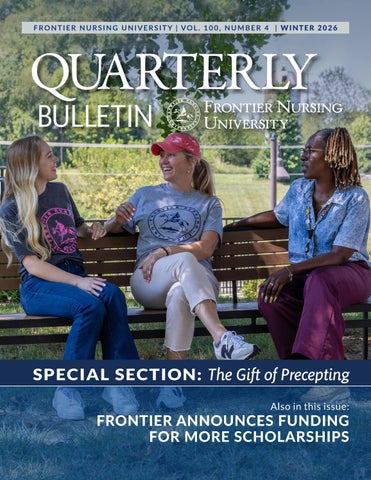
FRONTIER NURSING UNIVERSITY | VOL. 100, NUMBER 4 | WINTER 2026
QUARTERLY BULLETIN
SPECIAL SECTION: The Gift of Precepting Also in this issue:
FRONTIER ANNOUNCES FUNDING FOR MORE SCHOLARSHIPS
Become a Monthly Donor
TODAY!
By making a recurring gift to FNU, you are investing in the lives of Frontier students year-round. Giving monthly represents an ongoing commitment to Frontier Nursing University and student achievement. When you commit to even $5 per month, your gift will help with student scholarships, DEI programming, hands-on training materials, and so much more.
AMOUNT
NO. OF MONTHS
TOTAL GIFT TO FNU (per year)
$5
12
$60
$10
12
$120
$15
12
$180
Visit frontier.edu/give-to-fnu/, use the enclosed remittance envelope, or scan the QR code above to make your first monthly gift today!
President’s Cabinet Brooke A. Flinders, DNP, RN, APRN-CNM, FACNM President Shelley Aldridge, BA Chief Operations Officer Paula Alexander-Delpech, Ph.D., PMHNP-BC, APRN Dean of Student Success Kristin Ashford PhD, WHNP-BC, FAAN Dean of Nursing Marc Blevins, MS, CISA Chief Information and Digital Officer Bobbi Silver Chief Advancement Officer Kylie Waters, CPA, MBA Chief Financial Officer Jeffery Dobbins, DNP, PMHNP Regional Clinic Faculty (faculty representative) David Fritz Facilities Manager (staff representative) Academic Administration
Glossary of Credential Abbreviations In the Quarterly Bulletin, we often list the abbreviated credentials of the healthcare professionals featured in these stories. While space does not permit a comprehensive list of all these credentials, here are a few of the more common ones used in the Quarterly Bulletin and their meanings: CNEP: Community Based Nurse-Midwifery Education Program CNM: Certified Nurse-Midwife DNP: Doctor of Nursing Practice FNP: Family Nurse Practitioner MSN: Master of Science in Nursing PMHNP: Psychiatric-Mental Health Nurse Practitioner WHNP: Women’s Health Nurse Practitioner
Frontier Nursing University Quarterly Bulletin, ISSN 0016-2116, Copyright © 2026 by Frontier Nursing University, is published quarterly by Frontier Nursing University, 2050 Lexington Road, Versailles, KY 40383. Business and Editorial Offices: 2050 Lexington Road, Versailles, KY 43083. Accounting and Circulation Offices: Frontier Nursing University, 2050 Lexington Road, Versailles, KY 43083. Periodicals postage is paid at Versailles, KY, and additional mailing offices (if applicable).
Audra Cave, DNP, FNP-BC Department Chair of Family Nursing Khara’ Jefferson, DNP, APRN, FNP-C Doctor of Nursing Practice Program Director Laura Manns-James, Ph.D., CNM, WHNP-BC, CNE, FACNM Interim Department Chair of Women's Health Rachel Risner, Ph.D., DNP, APRN, C-FNP, CNE Associate Dean of Academic Affairs Kevin Scalf, DNP, APRN, PMHNP-BC, CNEcl, Department Chair of PsychiatricMental Health Eileen Thrower, Ph.D., APRN, CNM, CNE, FACNM Department Chair of Midwifery
Letter from the President
Contents From the President
1
News and Notes
2-11
The Gift of Precepting
12-18
Author's Frontier Inspired Novel
19-21
History Corner
22-24
Upcoming Events Alumni News & Notes Board of Directors Memorial Donations
25 26-28 29 29
Dear Friends, I want to wish you a belated happy New Year. We had a wonderful time celebrating the 100th anniversary of the founding of the Frontier Nursing Service last year, and I am encouraged about Frontier’s future. That said, I know that many of us share concerns about the current health and safety of our communities. As I think about the history of Frontier, I am reminded that we have a clear mission and vision that guides us to provide quality graduate nursing education to positively impact healthcare outcomes for all. Having such a clear-cut mission enables us to be nimble and responsive. Our focus has been and continues to be on providing accessible nursemidwifery and nurse practitioner education and preparing our students to be compassionate leaders in their communities. We understand these goals and what it takes to reach them. For example, we know that preceptors are essential to the preparation and training of our students. We call it the “gift of precepting” because precepting is one of the most important and generous ways in which our alumni give back to Frontier. You pay it back by paying it forward. For those of you who are preceptors, we are indebted to you for your time, expertise, and generosity. Others of you understandably might be uncertain about what precepting entails. If so, this is the Quarterly Bulletin for you. In our special precepting section, you will learn all you need to know from our survey data, a message from our Dean of Nursing, and a compelling story from one of our dedicated preceptors. I hope you will be inspired to become a preceptor and contribute to the preparation of the next generation of nurse leaders. I am particularly thrilled to share a major announcement about our expanded scholarship offerings. This, too, is in keeping with our mission and our vision and is only possible through the generosity of our donors and steadfast leadership of our Board of Directors.
2050 Lexington Road Versailles, KY 40383 FNU@frontier.edu frontier.edu
I hope that the good news and amazing accomplishments shared in this issue give cause for optimism, gratitude, and celebration. Thank you so much for your support and the invaluable role you play in the success of Frontier Nursing University and our students. With gratitude,
Dr. Brooke A. Flinders DNP, RN, APRN-CNM, FACNM
Frontier Nursing University • Quarterly Bulletin 1
News and Notes
Frontier Nursing University Unveils $20 Million Student Scholarship Investment
Scholarship increase to help educate nursemidwives and advanced practice nurses amid nationwide healthcare shortages. The Frontier Nursing University (FNU) Board of Directors has approved a proposal to utilize $20 million of the university’s unrestricted endowment funds for scholarships. The designation of these funds demonstrates the Board and university’s commitment to providing a high-quality education that prepares nurses to become
2 Frontier Nursing University • Quarterly Bulletin
competent, entrepreneurial, ethical, and compassionate nursemidwives and nurse practitioners, with an emphasis on rural and underserved communities.
“This commitment to more scholarship opportunities is a direct reflection of the Board of Directors’ enduring support for our students and our mission” — Dr. Brooke A. Flinders
In keeping with the university’s spending policy, the university will fund the scholarships by spending the annual yield from the $20 million unrestricted endowment funds. The yield is projected to be approximately $800,000 annually. “This commitment to more scholarship opportunities is a direct reflection of the Board of Directors’ enduring support for our students and our mission,” FNU President Dr. Flinders said. FNU maintains an average enrollment of 2,800 students from across the country. FNU’s programs lead to a Master of Science in Nursing (MSN), a Post-Graduate Certificate, or a Doctor of Nursing Practice (DNP). FNU also offers a Post-Master's DNP for certified nurse-midwives and nurse practitioners who already hold a national certification and want to pursue a DNP.
“Our students are already professional healthcare providers when they come to us,” Dr. Flinders said. “Their dedication to advance their knowledge and expertise to better serve their communities is impactful and inspirational. These scholarships support their goals by making advanced nursing education accessible.” A December 2025 report released by the Health Resources and Services Administration projected an 8% shortage of registered nurses in the United States by 2028. Additionally, the American College of Nurse-Midwives estimates the U.S. has a shortage of more than 8,000 nurse-midwives based on the World Health Organization's recommendation of no less than six nurse-midwives per 1,000 live births. “There is a growing demand for financial assistance,” Waters said. “Our existing scholarship program is substantial, and with this responsible use of our unrestricted endowment funds, we continue to demonstrate commitment to supporting our students. Frontier Nursing University is uniquely positioned to address the nursing shortage through our community-based, and distance education format. This investment will provide critical support to FNU’s students as they prepare to address healthcare challenges in their home communities across the country.”
Frontier Nursing University • Quarterly Bulletin 3 C
“This is a significant investment in support of our students, and one we are proud to champion,” said Marcus Osborne, Chair of the FNU Board of Directors. “On behalf of the Board, I want to express my gratitude for the work of our Chief Financial Officer Kylie Waters, and her team, as well as our finance committee, led by board member Michael Steinmetz. This was a comprehensive project to identify the best way to support our goal to provide accessible education.”
News and Notes
Dr. Brooke A. Flinders Receives Insight Into Academia Magazine’s 2026 Trailblazer in Higher Education Award On February 5, Frontier Nursing University (FNU) President Brooke A. Flinders, DNP, RN, APRN-CNM, FACNM, was named a recipient of Insight Into Academia magazine’s 2026 Trailblazer in Higher Education Award. This national honor recognizes senior leaders whose bold, strategic innovations have advanced institutional excellence, strengthened community and connectedness, and created meaningful, measurable impact for students, employees, and the broader academic system. “I am honored and humbled to receive the Trailblazer Award,” Dr. Flinders said. “This recognition reflects my dedication to advancing Frontier’s longstanding legacy of innovation and progress as we prepare our graduates to meet the evolving needs of the communities in which they practice.” Since beginning her presidency on August 1, 2024, Dr. Flinders has demonstrated a transformational yet servant‑leader approach that is already shaping a stronger future for Frontier Nursing University. Her vision, passion, integrity, and unwavering commitment to the success of students, faculty, and staff distinguish her as a true trailblazer in higher education. “We had great confidence when we selected Dr. Flinders as our new president in 2024, but she has vastly exceeded all expectations,” said FNU Board Chair Marcus Osborne. “She is a natural, visionary leader who never loses sight of the goal and the steps that must be taken to get there. She is a team‑builder who embraces and values the input of students, alumni, faculty, staff, and board members to ensure we all share the same vision for the university.” In her first 90 days, Dr. Flinders scheduled opportunities to meet with every employee to foster open dialogue and strengthen organizational alignment. She subsequently launched a nationwide
4 Frontier Nursing University • Quarterly Bulletin
listening tour, engaging directly with students, faculty, staff, preceptors, alumni, and clinical partners across the country. The tour spanned more than 10,000 miles and included visits to 17 alumni‑staffed or owned practice settings. “Dr. Flinders is the leader higher education needs in this time of uncertainty,” said Dr. Paula Alexander-Delpech, FNU Dean of Student Success. “She is bold enough to make unpopular ethical decisions, humble enough to listen and learn, and strategic enough to turn vision into sustainable reality." Dr. Flinders’ first year culminated in the unveiling of FNU’s new strategic plan during her September 2025 investiture. “The crossroads between higher education and healthcare are different today than they have ever been,” Dr. Flinders said. “We will continue to face our own unique challenges, and we will navigate them in new and innovative ways.” In less than two years as President, Dr. Flinders has advanced innovative strategies to expand access, strengthen academic excellence, promote student success, and address national workforce needs, particularly in rural and underserved communities. Her compassionate, mission‑driven leadership has elevated FNU’s impact and empowered the entire FNU community to thrive, solidifying her influence as a leader shaping the future of graduate nursing education. “Dr. Flinders inspires and influences student success as they enter the workforce by modeling servant leadership, fostering a culture of inclusivity and continuous improvement, and ensuring that the university remains responsive to the evolving needs of healthcare,” said Dr. Kristin Ashford, FNU Dean of Nursing. “Her commitment to empowering students through thoughtful listening, innovation in education, and advocacy for equity ensures that each graduate is not
The Investiture of Dr. Brooke A. Flinders as President of Frontier Nursing University was held on September 25, 2025.
only well-prepared clinically but also deeply grounded in compassion and community-minded leadership. In this way, her influence extends far beyond the campus, shaping future generations of nurses and healthcare professionals who are prepared to transform care for the better.” “Dr. Flinders leads Frontier Nursing University during an unprecedented convergence of challenges: a national nursing shortage, persistent healthcare inequities, increasing federal regulatory complexity, and the ongoing need to strengthen healthcare delivery in rural and underserved communities,” FNU Chief Operations Officer Shelley Aldridge said. Dr. Flinders solicited and personally supported the creation of FNU’s Faculty Learning Communities Fund to promote teaching excellence and leadership development among faculty. She also developed and implemented a President’s Academic Fellowship. This initiative creates a direct pipeline for emerging leaders to gain administrative experience, ensuring the institution is not just managed for today, but prepared for tomorrow.
strengthens the entire healthcare workforce pipeline serving America's most vulnerable populations.” “We believe the future of higher education depends on leaders who are willing to challenge convention and embrace bold, impactful innovation,” said Lenore Pearlstein, owner and publisher of Insight Into Academia magazine. “The 2026 Trailblazer honorees represent the highest levels of strategic leadership in the field, and we are proud to celebrate their extraordinary accomplishments.” Dr. Flinders was featured alongside 17 other distinguished honorees in the March 2026 issue of Insight Into Academia. For more information about the Trailblazer in Higher Education Award, visit insightintoacademia.com.
“Her leadership style is defined by inspirational motivation and individualized consideration,” said Chief Advancement Officer Bobbi Silver. “She actively identifies the unique strengths of faculty and staff, empowering them to step into roles they may not have envisioned for themselves. By modeling transparency, admitting mistakes and inviting feedback, she creates a culture of psychological safety where new leaders feel safe to take risks and grow.” “Rather than treating these separate challenges, she has positioned FNU as a comprehensive solution preparing advanced practice nurses and nurse-midwives who will directly address these interconnected crises. Her leadership doesn't just transform one institution; it
Frontier Nursing University • Quarterly Bulletin 5
News and Notes
Dean of Student Success Dr. Paula Alexander-Delpech Selected for Insight Into Academia Editorial Board Frontier Nursing University (FNU) Dean of Student Success Paula Alexander-Delpech, PhD, APRN, PMHNP-BC, FAANP, has been appointed to Insight Into Academia’s 17-member editorial board. Insight Into Academia is a leading publication serving the higher education community for over 50 years. Dr. Alexander-Delpech has over 25 years of experience teaching and leading in both undergraduate and graduate nursing programs. Her extensive experience and expertise will play a pivotal role in advancing the mission of Insight Into Academia to inform, inspire, and drive meaningful impact across the higher education landscape. “We are honored to welcome Dr. AlexanderDelpech to our editorial board,” said Lenore Pearlstein, Co-Publisher of Insight Into Academia magazine. “Her shared
commitment to advancing best practices and having a deep understanding of the challenges and opportunities facing higher education today will be invaluable as we continue to expand our platform and enhance our impact.” As a member of the editorial board, Dr. Alexander-Delpech will contribute strategic insights, thought leadership, and guidance on editorial direction and company growth. "I am honored to join the editorial board of Insight Into Academia at a time when higher education faces both unprecedented challenges and remarkable opportunities to transform student success,” Dr. AlexanderDelpech said. “Throughout my career, I have witnessed how intentional strategies around equity, inclusion, and student support can fundamentally change educational outcomes, particularly in graduate and
professional education. I look forward to contributing insights that help institutions not only support students from enrollment to graduation but truly prepare them to be leaders who will serve diverse communities. This platform offers an important opportunity to elevate conversations that drive meaningful change across the higher education landscape." With this appointment, Insight Into Academia continues to expand its board of nationally recognized educators and administrators whose collective expertise strengthens the publication’s role as a trusted source for advancing best practices, innovation, and collaboration in higher education.
Torica Fuller Selected to Participate in Loretta Ford Visionary Leadership Program FNU Clinical Transition Coordinator and Assistant Professor Dr. Torica Fuller, DNP, MSN, FNP-BC, FNP-C, WHNP-BC, CDP, CGRN, CPN, NRCME, has been accepted into the inaugural 2026 cohort of the Loretta Ford Visionary Leadership Program. This new program is offered by the American Association of Nurse Practitioners (AANP).
“Your selection recognizes your outstanding leadership potential and commitment to advancing the nurse practitioner role,” AANP stated in a message to those selected to participate in the program. “As a member of this distinguished group, you will engage in a professional development experience designed to cultivate visionary leadership, strategic thinking, and impactful advocacy within the health care landscape.”
6 Frontier Nursing University • Quarterly Bulletin
Dr. Fuller earned her bachelor’s degree in nursing from East Carolina University (ECU), her Master’s and FNP Post-Masters certification from Indiana Wesleyan University, and her DNP from ECU. She completed her Post-Graduate Women’s Health Care Certificate at FNU in 2023. Dr. Fuller joined FNU faculty in April 2023. She practices in North Carolina as a family nurse practitioner and a women's healthcare nurse practitioner.
NRHA Names Frontier Nursing University Associate Professor Dr. Joanne Keefe as 2026 Rural Health Fellow The National Rural Health Association (NRHA) has selected Frontier Nursing University (FNU) Associate Professor Joanne Keefe, DNP, MPH, FNP-c, CNE, as a member of the 2026 cohort of Rural Health Fellows. Following a competitive review process, 18 fellows were selected to participate in this yearlong program, which is designed to cultivate national leaders who can champion a clear and compelling vision for rural America. “We are very pleased to announce this new class of fellows as this program enters its nineteenth year,” said NRHA CEO Alan Morgan. “Once again, this class represents various levels of rural health expertise. With the successes achieved by the previous classes, we look forward to continuing the tradition of building rural health care leaders through this valuable program.” Dr. Keefe is a two-time graduate of Frontier Nursing University, earning her Family Nurse Practitioner and Doctor of Nursing Practice in 2013 and 2014, respectively. She
obtained her Bachelor of Science in Nursing from the University of Phoenix (1999) and Master’s in Public Health from the University of New Mexico (2005). Dr. Keefe has been a faculty member at Frontier since 2015 and is currently an Assistant Professor in the DNP program. She is a recipient of the Frontier Student Choice Award for Teaching Excellence (2018) and was presented with a DAISY Award in 2020. “I am truly honored to have been selected,” Dr. Keefe said. “Rural residents face significant challenges in accessing adequate healthcare coverage. This leads to poor outcomes, as supported by the data. I look forward to learning new strategies and making connections to share with both my home community and the FNU community.” Active in her community, Dr. Keefe is the director of Catron County Cares (CCC), a
non-profit organization intent on obtaining grant funding to improve healthcare in Catron County in New Mexico. Formed in January 2025, CCC works to find common sense solutions to healthcare access that are sustainable for the long-term. CCC offers free CPR and First Aid training to anyone in the community and is preparing to launch an initiative in which CCC Emergency Kiosks will be placed around the community. The kiosks will house an AED, first aid kit, pulse oximeter, naloxone, and other triage equipment. Dr. Keefe holds memberships in numerous nursing and health associations, including the American Association of Nurse Practitioners, the New Mexico Nurse Practitioner Council, the American Nurses Association, the National Organization for Nurse Practitioner Faculty, and the American Rural Health Association. She has also been an Accreditation Commission for Education in Nursing peer evaluator since September 2024.
Support the Faculty Learning Communities Fund Faculty Learning Communities offer structured, collaborative spaces where faculty engage in meaningful dialogue and professional growth, exploring best practices, addressing complex challenges, and supporting one another’s development. To honor our new president, we have established an opportunity to donate to our new Faculty Learning Communities Endowment Fund (FLC). Dr. Flinders is firmly committed to creating sustainable structures to foster faculty development. She believes that teaching and learning are interdependent and that student outcomes are directly impacted by their educators’ effectiveness.
Scan this code to make a donation.
Our goal is to raise $100,000. Frontier Nursing University • Quarterly Bulletin 7
News and Notes
Presidential
2025 President’s Tour Concludes with Fall Stops
T O U R
A trip to Baltimore, Maryland, in November marked the end of the 2025 President’s Tour for FNU President Dr. Brooke A. Flinders and other members of the Frontier faculty and staff. In all, the Presidential Tour included five different stops across the country, creating meaningful opportunities to engage with more than 400 graduates and their families. From visiting alumni in their practices to hosting FNU community events, these gatherings offered Dr. Flinders a firsthand look at the incredible work of FNU-trained providers. The tour served as a powerful reminder of the strength, compassion, and innovation within FNU's alumni network, and the deep pride that connects alumni across the country.
2025 PRESIDENT’S TOUR BY THE NUMBERS While numbers don’t measure the meaningful conversations that were had and life-long connections that were formed, this by-the-numbers review of the tour that demonstrates the volume and depth of this yearlong venture. • 10 states and 17 cities visited • 10 Community Events • 17 visits with FNU graduates in their clinic settings • 444 alumni attended events during the tour • Over 10,000 miles traveled • Countless amazing moments and memories made with our community
JOIN US IN CHICAGO! A pril 16, 2026 at Park and Field Chicago
6:00 pm Continuing Education Opportunity 7:15 pm Network Reception The FNU community are invited to join us in Chicago, IL, on Thursday, April 16, 2026, at Park and Field Chicago from for a special evening celebration and exclusive continuing education opportunity. Enjoy a campus update from FNU President Brooke A. Flinders and staff, refreshments, and meaningful time connecting with fellow members of our FNU community. The CE opportunity will be at 6:00 pm, and the reception will be from 7:15 – 9:00 pm. Please join us for one or both of the events held in the same location. Our exclusive and free CE, Empowered Prescribing: 20 Best Practices for APRNs, will highlight the most common prescribing challenges encountered across NP practice settings and provide practical, evidence‑based strategies to avoid them. We will explore high‑risk areas such as drug-to-drug interactions, appropriate dosing, monitoring, and pitfalls in antibiotic and controlled‑substance prescribing. Through real‑world examples, participants will strengthen their prescribing safety, confidence, and decision‑making. This topic is broadly applicable to providers across all specialties. All are welcome to attend! Use this QR code for quick access to registration information.
8 Frontier Nursing University • Quarterly Bulletin
Woodford NAACP Visits Frontier Campus
Members of the local Woodford County NAACP visited the Frontier Nursing University campus on December 10. The day included a tour of campus and informational sessions with FNU President Dr. Brooke Flinders, FNU Dean of Student Success Dr. Paula Alexander-Delpech, and Director of Student Engagement Chris Turley.
Five FNU Faculty to be Published in American Nurse Journal An article written by five members of the FNU faculty has been accepted for publication in the March 2026 issue of the American Nurse Journal. The article discusses the importance of creating psychologically safe learning environments for Advanced Practice Registered Nurse students, emphasizing the need for diversity and inclusion in nursing education. It identifies key components of a supportive learning atmosphere, such as permission to make mistakes and clear expectations, which enable students to grow and learn without fear. The authors highlight the negative effects of biases and microaggressions experienced by students during their clinical training, including feelings of frustration and powerlessness. To foster psychological safety, the article presents five actionable steps for preceptors, such as responding immediately to inappropriate behaviors and facilitating open communication to discuss incidents in a constructive manner. The ultimate goal is to improve patient care through a more diverse and culturally competent nursing workforce. The authors of the article are: • Katrevia Campbell, DNP, CNM, Regional Clinical Faculty • Eva M. Fried, DNP, CNM, WHNP, FACNM, Clinical Director for Nurse-Midwifery and Women’s Health Nurse Practitioner Programs • Dwynn Golden, DNP, CNM, NP, Assistant Professor • Martha Z. Harvey, CNM, MSN, FACNM, Clinical Faculty • Crystal N. Settle, DNP, APRN, CNM, Faculty
Katrevia Campbell
Eva M. Fried
Dwynn Golden
Martha Z. Harvey
Crystal N. Settle
Frontier Nursing University • Quarterly Bulletin 9
News and Notes
Meet Dr. Laura Manns-James On November 1, 2025, Dr. Laura Manns-James, PhD, CNM, WHNP-BC, CNE, FACNM, was named Frontier’s Interim Department Chair of Women’s Health. Dr. Manns-James is a two-time FNU graduate. She first earned her certified nurse-midwifery (CNM) certificate, then completed the post-master’s women’s health nurse practitioner program. She has been a faculty member at Frontier since 2004. Dr. Manns-James holds a Bachelor of Arts from the University of Toronto in women’s studies and cultural anthropology, and a Bachelor of Nursing from Saint Louis University’s accelerated option. In 2014, Dr. Manns-James was awarded the American College of Nurse-Midwives’ Foundation’s Fellowship for Graduate Education to support her doctoral work. In 2015, she received the March of Dimes graduate scholarship. She completed a PhD in nursing research in 2017. Recently, Dr. Manns-James took the time to answer a few questions to help the Frontier community to get to know her better: Please tell us a little bit about your childhood and upbringing. I grew up in a small college town in Ohio near Lake Erie, with about 8,000 permanent residents and 3,000 students. My mom was a social worker, and my dad was a music teacher, and I’m the elder of two kids. Midway through my childhood, I gained some wonderful stepparents and siblings. My husband also grew up in the same town, though we met as adults. Almost everyone in the area, from the town and the rural surrounding township, attends the same small, high-quality public schools, and it’s a very diverse place. I developed friendships with people from many different socioeconomic backgrounds and several countries. When my classmates and I get together now, we often talk about how special a place it was to grow up and how well it prepared us to connect with people from all walks of life. After living in Canada and several U.S. states, I returned to my hometown to raise our daughter, so she could have the same experience we did. What brought you to Frontier first as a student and since as a faculty member? Frontier was the ideal place for me to become a midwife and nurse practitioner.
I learned about the university from my nursing colleagues at the Cleveland Clinic who were Frontier students. I loved the flexibility and affordability Frontier offered and developed strong relationships with faculty and other students. Upon arriving on campus, I was inspired by the Frontier Nursing Service's public health model. When I learned a few years after graduation that there was an opening at FNS, I jumped at the chance to work with my former faculty in the FNS service area. While working in Clay and Leslie Counties, I began teaching at Clinical Bounds, and that’s how I discovered how much I loved to teach. What are you passionate about in higher education? There is nothing better than the “a-ha” moment when a particularly challenging concept finally clicks for a student. I love helping to make complex ideas more accessible by breaking them down into more manageable bits. More broadly, I know how critically important the role of the women’s health nurse practitioner is in improving public health across the U.S. and potentially globally, and I feel incredibly lucky to help increase the number of these crucial professionals. Our students are exceptional people who approach healthcare with a
10 Frontier Nursing University • Quarterly Bulletin
commitment to excellence, and my role is to help them thrive. We are facing a time when higher education and our public health infrastructure are under increasing pressure. Misinformation and disinformation abound. Our graduates can contribute more than ever to their communities by being a trusted source of health information. By continuing a steadfast commitment to high-quality, evidence-based practice, embracing culturally safe care, and most importantly, by listening to patients, they will improve health outcomes and health equity despite the many challenges we face. What are some of your plans and goals in your new position? What do you hope to achieve? I’m thrilled to lead the development of an independent department devoted to women’s and gender-related health education. I believe we already have a very solid program for WHNPs, yet this is only the beginning of what we can accomplish together. My goal is to increase our reach and reputation even further, so that every community benefits from FNU-educated WHNP care. Our role is broad and critical, including primary care, menopause, gynecologic and reproductive
Please tell us about an accomplishment or project you are most proud of. I’m proud that my scholarship has been focused on health equity. I think we often conceptualize racism as unfair treatment that impacts people’s feelings or opportunities in life, but its impacts through chronic stress pathways can also reach into cellular biology, and there is a growing body of literature supporting that understanding. I have been cited as the first researcher to link racial microaggressions to adiposity in Black women, by another researcher whose work I admire, and that is probably my most important contribution to date. I’m also proud that the book I’m co-editing, the 7th edition of Clinical Practice Guidelines for Midwifery and Primary Care, is in production and almost complete.
taK
Personally, I’m proud that I can ride a bike 100 miles in a day: riding my first century in 2024 was a big accomplishment. I’ve become more physically fit in middle age than I was before. I can do real push-ups for the first time in my life, and I am starting to identify as an athlete for the first time. Learning new skills instead of staying in my established lanes has been exciting and has made me want to continue growing in new ways as I get older.
What do you like to do in your free time? I love knitting, cycling, cooking, walking in the woods, playing with my dog, spending time with the people I love, and listening to recorded books. I also love to travel to experience new places, learn how others do things, and get a little out of my comfort zone to better understand the huge and small world we live in. What is your favorite part about Kentucky? I left part of my heart in Clay and Leslie counties. I loved how welcoming and resilient the people were despite the great hardships those communities face. I love the landscape and the mountains, and all the natural beauty. My daughter spent her first 6 years playing in Kentucky creeks and wandering in the hills, and our family has many happy memories of her early childhood there. Additionally, my grandmother was born in Ashland and my great-grandmother in Louisa. While my relatives moved to southern Ohio when my grandmother was a girl, I feel connected to Kentucky because many of my family’s values and history are rooted there.
energy, and money you are investing in your grad school education. On tough days, pull that reminder out, and remember that grad school is temporary, but the rewards are lasting. Keep at it. You’ll be glad you did. Describe your perfect day. I’ve been lucky enough to have had at least two perfect days that immediately come to mind. The first, I spent snorkeling in Cozumel and eating fish tacos, with the water looking like an aquarium the minute I stuck my face in: incredible fish and coral, just steps offshore. The second, I spent hiking with my family in the Dolomites at Seceda in Italy's Val Gardena. It was the best 10 miles I ever walked, complete with a picnic at about 9,000 feet, with an indescribable view. Anything else you want the Frontier community to know about you? I’m truly excited to get started. I look forward to connecting with our students, faculty, and alumni as we develop this new department.
What’s your best piece of advice for our students? Grad school is exhilarating and exciting, full of fascinating new knowledge and opportunities. It’s also truly tough at times. My best advice is to do what I did to get through my PhD program: on the days you feel like quitting, give yourself permission to do it—but not until 24 hours have passed. Invariably, by the next day, I was ready to keep at it. It also really helps to remember your “why”. This could be something you write down for yourself or an image that synthesizes why you are spending the time,
pmaC
care, pregnancy and postpartum care, sexual health, and care for chronic conditions. Nurse practitioners recently ranked #1 on U.S. News & World Report's list of best jobs, primarily due to the demand for our services. I hope to increase the percentage of NPs who are women’s health-focused, especially to meet healthcare needs in rural and underserved communities. We’re starting with an analysis of our current program and curriculum, and we will build from there.
Frontier Nursing University • Quarterly Bulletin 11
The Gift of Precepting
Why Precept? Just Ask Jen Garate! Jen Garate, CNM (Class 104) has more than enough to do to keep her busy. She was recently named the first midwifery manager at Banner Health, a healthcare system based in Arizona that operates 33 hospitals across six states. She is tasked with building the midwifery practice to be modeled at other Banner sites. This undertaking begs the question, where does she find the time to be a preceptor and why does she do it? Jen graciously provided the answer to those questions and more. Where are you from originally and when did you become interested in a career in healthcare? Arizona, born and raised. I knew I wanted to be in healthcare since early childhood. My mom kept a paper from elementary school where I said I wanted to be a baby doctor when I grew up. How did you hear about Frontier and what prompted you to come to Frontier? When I decided to become a midwife, I did my research. Frontier stood out as the leader in midwifery education, flexibility, and reputation for preparing their students for independent practice on day one. Please describe your experience at Frontier. While continuing to work full time as an L&D charge nurse, I attended FNU full time as well. My time with Frontier was far from easy. We lost loved ones, got married, and toured Europe for our honeymoon. All keeping on track with the flexible FNU schedule.
Please describe your work history and current practice. I knew the women being served in my community needed more options and support. I opened a private practice the day after I graduated in the same city I was born. I grew that practice from literally zero patients to the largest OB practice in our county. I was voted #1 medical provider! I consistently did the most births almost every month for the last two years I was in practice. This was a blessing and a curse. I had grown to a size not manageable by one CNM. At the time I was looking into my options, a midwife from a neighboring FQHC (Federally Qualified Health Center) asked if I would be interested in opening their newest clinic. I felt this was a sign and joined the FQHC, closing my practice just after five years, but bringing 100% of my current patients with me to the new clinic, over an hour away. I started at a new clinic, again with no patients, staff, or supplies. Over the course of the next six years, I grew that clinic to an efficient, evidence-based, highly sought out women's health center. Most recently, I joined Banner Health as their first midwife manager, building their flagship midwifery service line. The plan is to grow this program and then repeat this success in Banner Health locations across the US.
What prompted you to become a preceptor? If we don't teach the next generation, how will they ever become midwives? What do you find rewarding about precepting? Knowing that what I teach today will help mold their practice for years after they’ve graduated and moved on. What did you not know about precepting until you started doing it? What concerns or doubts did you have? It takes a lot of time, patience, and inner reflection and growth. It took a while before I felt “worthy” to teach someone else. Imposter syndrome is a hard battle to win. What would say to others who are unsure about precepting? Do it! You had one. Return the favor, pass it forward.
How many students have you precepted? I have not kept track! I took my first break from being a preceptor for 9 months last year. Other than that small break, I have had a student almost every week since my second year of practice.
12 Frontier Nursing University • Quarterly Bulletin
What are your current and future career goals? Building a midwifery service line that will be the foundation for midwifery practices across the country!
What Our Preceptors Say About Precepting We surveyed our preceptors from the past year. A total of 601 respondents told us about their experience as a preceptor for FNU students.
We asked our preceptors why they chose to precept for an FNU student or students. They were permitted to choose more than one answer for this question:
We also asked them to indicate their level of satisfaction as a preceptor for an FNU student. Over 90 percent of the 601 respondents indicated they were either “very satisfied” or “satisfied” with their experience as a preceptor for a Frontier student:
Frontier Nursing University • Quarterly Bulletin 13
The Gift of Precepting
Additional feedback included comments from our preceptors. Here are just a few that we received: “My student was a joy to work with.” “The students were well prepared. I like that they’ve completed their didactic prior to starting clinicals -- helps to know that students aren’t splitting their attention away from patient care.” “The student who was placed with me was very knowledgeable. I felt that she had adequate training prior to her clinical rotation with me. She was kind, compassionate, developed rapport, and was eager to learn.” “I found Frontier to be organized and easy to work with. I also appreciate the fringe benefits!” Note: FNU preceptors receive an honorarium based on the percentage of time spent precepting students. They also are granted free continuing education units (CEUs) and receive a 10% discount on all non-matriculating courses at FNU. “I had a positive experience as a preceptor for FNU. (The student’s) regional faculty was very present, and communicative. I always felt I had her close by as needed (but never needed her for anything worrisome!) The assessment tools were easy to use, as well.”
Our preceptors also supplied feedback regarding their experience with Frontier’s Regional Clinical Faculty (RCF). RCFs are located across the country and provide guidance and support to students and their preceptors in their respective geographic areas.
14 Frontier Nursing University • Quarterly Bulletin
We asked our preceptors their level of satisfaction with the ability of the MidCourse Development Assessment and End of Course Development Assessment Tools to capture the accuracy of their evaluation of clinical students. A total of 475 respondents shared their feedback:
Precepting Facts and Figures
Why Become A Preceptor
• In 2025, a total of 1,475 FNU students worked with 4,208 preceptors.
• Help expand access to quality, compassionate care to diverse, rural, and underserved populations.
• In 2025, a total of 841 FNU alumni precepted Frontier students: CFNP: 107 CWHCNP: 128 CNEP: 611 PMHNP: 72 • The average FNU student needs three clinical sites to complete all required experiences. • The need is great, and the competition for clinical sites is heavy. • The demand for preceptors is constant.
• Earn an honorarium based on the percentage of time spent precepting students. • Gain access to FREE CEUs, including sessions on pharmacology and other current topics. • Promote your profession through the education and guidance of your future peers. • Gain access to the latest clinical guidelines to stay current in practice. • Earn a 10% discount on all non-matriculating courses at FNU.
Frontier Nursing University • Quarterly Bulletin 15
The Gift of Precepting
Preceptor Profiles For Klakken Viramontes, precepting is more than just clinical instruction. It’s a way to give back, stay connected to evolving educational standards, and foster a collaborative spirit within health care. “We should not work in a silo,” she said. FNU Regional Clinical Faculty member Joseph McFadden said Klakken Viramontes is transformational in her work as a preceptor. He said he witnessed her mentor a student who was struggling and in danger of failing clinicals, only to witness that student transform into a confident, capable entry-level provider under her guidance. “She was a very personable, very welcoming preceptor,” McFadden said.
Cassandra Klakken Viramontes Fosters Collaborative Spirit in Health Care Through Precepting
While Klakken Viramontes has mentored students from multiple programs, she said Frontier students consistently stand out. “I am reminded every time how solid FNU programs are, and how the instructors have worked with the FNU students to prepare them for rural health care.”
FNU Preceptor Cassandra Klakken Viramontes, ARNP, FNP, provides care for area residents at the Grand Coulee Clinic in Washington. The clinic provides comprehensive health care, including family medicine, preventative care, and disease management, and is part of Coulee Medical Center, a 25-bed critical access hospital. Klakken Viramontes has precepted three Frontier Nursing University nurse practitioner students, along with multiple students from other universities. She said precepting is consistently enriching. “I always learn something from my students, which helps me be a stronger provider,” she said. Klakken Viramontes said her decision to become a preceptor stems from her passion for education and her commitment to the nursing profession. “My goal is to assist nurse practitioner students in successfully completing their programs and joining the much-needed ranks of family providers. I also feel it is important to be a reasonable, guiding hand to clarify things I have been challenged with in real practice that students don’t often learn about in school. And, ultimately, I love to teach.”
16 Frontier Nursing University • Quarterly Bulletin
In Serving Her Patients Deena Parsons Inspires the Students She Precepts In the world of healthcare, there are individuals who go beyond their job descriptions to make a lasting impact on their patients and the next generation of professionals. Deena Parsons, CNM, with TriHealth Associates in Ob-Gyn, is one such individual.
Based in Cincinnati, Ohio, Parsons has devoted more than a decade to serving women of all ages at her practice, from teens to postmenopausal individuals, providing compassionate care in all stages of their lives.
through her clinical work and through her role as a preceptor. At AdventHealth in Winter Haven, Florida, Gachette works primarily with underserved and low-income women and families, many of whom face barriers to consistent healthcare access.
Parsons also serves as a preceptor to midwifery students, like Brandi Pace, who recently earned her MSN from Frontier Nursing University. Pace was mentored by Parsons during her clinical experience.
In her practice, Gachette provides compassionate, culturally sensitive, and patient-centered midwifery care that includes prenatal, birth, postpartum, and gynecologic services. Her work helps bridge healthcare gaps, ensuring that every patient feels heard, respected, and supported throughout their reproductive health journey.
“I could not have been luckier in finding a preceptor,” Pace said. “Dee supported and encouraged me the entire way, and I have learned so much with her throughout my clinical time. She would make a phenomenal preceptor for any future student looking for placement in the Cincinnati area.” Pace said Parsons’ approach to midwifery care serves as a model for any student pursuing a career in midwifery. “She is so empathetic and understanding with patients of all ages and backgrounds and does a fantastic job making her patients feel comfor tab le and supp or te d .” “She encouraged me to be hands-on right away and her teaching style allowed me to increase my confidence as a future WHNP,” VanScoyoc said.
Going beyond her clinical work, Gachette said her decision to become a preceptor is rooted in gratitude and a desire to give back. “I am the midwife that I am today because several elder midwives decided to take me under their wings and guide me in my clinical experience,” she said. “I decided to become a preceptor in order to give that same gift to other students on the journey I once had to travel.” She said she is also motivated by a broader vision of the profession and its role in addressing maternal outcomes in the U.S. “Mentoring in this way allows me to help nurture the development of compassionate and culturally competent midwives of the future,” she said. “I also love to see how they bring themselves to midwifery; guiding them as they discover how to provide midwifery care while still showing up as their authentic selves." Lawrena Govan, a former student and now mentee of Gachette’s, said her mentor embodies the core values of midwifery: compassion, equity, and advocacy. “She is deeply committed to serving marginalized communities and goes above and beyond to ensure her patients receive respectful, holistic care,” Govan said. “As a role model and mentor, she not only uplifts her patients but also inspires future nurse-midwives through her dedication, skill, and unwavering belief in birth justice.”
Leatrice Gachette Guides Students in Discovering Their Power Frontier graduate Leatrice Gachette, MSN, APRN, CNM, exemplifies a strong commitment to education, mentorship, and service, both
Precepting, Gachette notes, is a reciprocal experience that continues to shape her professional growth. “Precepting can be as beautiful as birth,” she said. “Just as you serve as a guiding light to mothers as they discover and utilize their power to bring forth life, you guide students as they discover and bring forth their power to do the same.”
Frontier Nursing University • Quarterly Bulletin 17
w
The Gift of Precepting
Not Sure Where to Start? The Gift of Precepting Has All the Answers... for Free! This activity is approved for six contact hour(s) of continuing education (which includes 0 hour(s) of pharmacology) by Frontier Nursing University. Activity ID 2502-001. This activity was planned in accordance with ANCC Commission on Accreditation Standards and Policies. This course will provide the participant with information about the roles, responsibilities and expectations of the clinical preceptor in guiding and mentoring advanced practice nursing students in a variety of settings. It is divided into small segments to allow for learning at your own pace.
Integrating the Community of Inquiry theoretical framework, participants will explore teaching learning strategies that address adult learners, learn ways to create high-quality clinical experiences incorporating diversity, the existence of bias, and attention to techniques to assess student readiness to engage in clinical learning. Ways to effectively manage the clinical learning environment and evaluate student achievement of objectives will also be discussed. Legal and ethical issues regarding student and patient confidentiality that need to be considered when providing clinical learning experiences will be addressed.
FREE
Scan to visit the Gift of Precepting CE page.
The Gift of Precepting
Are You Qualified to Be a Preceptor? Let’s Check! FNU needs preceptors with the following credentials and qualifications: • Valid, unencumbered U.S. license to practice required • One year of relevant experience in an advanced practice role
We are seeking preceptors from the following specialties: • Nurse-Midwife • Family Nurse Practitioner • Women’s Health Care Nurse Practitioner • Psychiatric-Mental Health Nurse Practitioner
• Master’s Degree or higher in nursing related field (we do allow BSN for midwives, but an MSN is preferred) • MDs and DOs (clinical time % based upon program) • For PMHNP students: therapists with a master’s degree and licensure in the state of practice
Contact Us! To learn more about precepting,
contact The FNU Department of Clinical Outreach and Placement. Our staff will be happy to: • Answer questions about the process to become a preceptor
18 Frontier Nursing University • Quarterly Bulletin
• Provide support to preceptors when using the online preceptor profile portal • Answer questions regarding preceptor honorariums You can reach our department via email at ClinicalAdvising@frontier.edu
Author’s Frontier Inspired Novel
A Conversation with Janet Skeslien Charles, bestselling author of Miss Morgan’s Book Brigade By Anne Z. Cockerham
PhD, CNM, WHNP-BC, CNE, FACNM
Professor Course Coordinator, NM702 Care During Normal Pregnancy
in France set her on a course for the rest of her career. JSC: Yes. There was so much tragedy in her life, losing a husband and children. She could have just worn black for the rest of her life but instead, she dedicated her life to others. It's inspiring.
Janet Skeslien Charles (photo by Krystal Kenney)
As a lover of historical fiction, it was a privilege to talk recently with Janet Skeslien Charles, bestselling author of Miss Morgan’s Book Brigade. Published in 2024, Miss Morgan’s Book Brigade is a dual-timeline historical fiction novel featuring Mary Breckinridge as a major character in the novel. The 1918 portion of the novel is set in postWorld War I France and features the work of the American Committee for Devastated France (known as CARD for its French acronym). Philanthropist Anne Morgan hired Jessie “Kit” Carson to establish children’s libraries to help rebuild French villages and morale after the war. Nurses performed other crucial work for CARD, and Mary Breckinridge provided leadership and nursing care to the people CARD served.
Having enjoyed Miss Morgan’s Book Brigade, especially the scenes featuring Mary Breckinridge, I jumped at the chance to ask Janet Skeslien Charles questions about her research and writing processes and more. Here is our conversation, lightly edited for length and clarity. Anne Z. Cockerham: Thank you so much for taking the time to talk with me. Janet Skeslien Charles: Thank you for reading the work. Mary Breckinridge is incredible. What she accomplished with the English, French, and Americans was amazing, especially how she brought that knowledge home and created the first comprehensive healthcare system in America. AZC: I love historical antecedents and the ways that Mary Breckinridge’s experiences
AZC: I’m curious about the path that led you to include Mary Breckinridge so prominently in Miss Morgan's Book Brigade. JSC: As I did the research for the book, I discovered that she was an incredible person. She wanted to be a nurse, but at a time when her family and society expected her to get married rather than work. Her first husband died of appendicitis and then she divorced her other husband after losing her children. I was amazed at how she was able to pick up the pieces. Many of us would have been devastated, and those losses would have defined us. But she decided instead to help others and make sure that other women would not have the same losses that she experienced. Something that is amazing to me about Mary Breckinridge was how important facts were for her. In France after World War I, she weighed the babies. Instead of saying, “I think they're losing weight,” she had the facts, including babies’ weights over time.
Frontier Nursing University • Quarterly Bulletin 19
Author’s Frontier Inspired Novel
She used facts to reassure parents, and I found that inspiring. AZC: She built on Florence Nightingale’s work as a statistician, didn't she? JSC: Yes, in some ways, today we’ve lost sight of the facts and of how important medicine and research are. AZC: Mary Breckinridge is well-known in some circles and not in others. I’m curious if you have any thoughts about why that might be. JSC: Women’s history is often set aside. When I watch Peter Jackson’s documentary, They Shall Not Grow Old, and other films about World War I, I’m always disappointed that they don’t feature women. They feature trenches. When we don’t see women in these major war documentaries, we don’t learn about them and it's like they didn’t exist. For the staff of the American Committee for Devastated France (known as CARDs), the work was arduous and dangerous. CARDs received the Croix de Guerre (War Cross) Medal for their courage under fire, working just a few miles from the front. In one instance, the Army asked the CARD chauffeurs to evacuate all villagers, thousands of them, even the ones debilitated by war fatigue. That's why it's important to remember women and to restore them to their proper place in history. AZC: Miss Morgan’s Book Brigade is richly textured with major elements and small details about Mary Breckinridge, despite her CARD time not being as well-documented as her later years. One example of rich detail is “Breckie” as a nickname for Mary Breckinridge. What can you share about that? JSC: The CARD staff used diminutives and nicknames for each other such as “Kit” for Jessie Carson, after Kit Carson the explorer. When Mary Breckinridge was in France, she was still using her married name of Thompson, so they called her “Thompy.”
However, I didn't want to feature her in the book as Thompy because after leaving France, she petitioned to take back the Breckinridge name rather than be known as Thompson. Breckie was her little boy who passed away and she loved him so much. I came up with this solution to still have a diminutive but not a name that she herself did not want. Those choices are what writing a novel is all about. AZC: I appreciate how that decision conveys your respect for her. JSC: Something else I wanted to convey was the friendships the CARD members had with each other, and nicknames were part of that. This is similar to military settings. In many ways, CARD was influenced by the military with their uniforms and protocols. Also, they were really there for each other. The CARD experience helped Mary Breckinridge become more sure of herself and come into her own. We can see that in letters in the University of Kentucky collection that discuss how Mary Breckinridge and Jessie Carson dealt with a forward Frenchman. They did it with such grace and were actually worried about hurting his feelings. AZC: What, if any, challenges did you experience as you applied the historical fiction genre to Mary Breckinridge? JSC: For nonfiction, sticking to the facts is hard, because sometimes you don't have all the material that you need. With historical fiction, you can connect the dots or you can create the dots. One area in which I was able to connect the dots was the friendship that developed between Mary Breckinridge and Kit Carson. I found some discussions in Wide Neighborhoods about Kit and then I found a census document that shows Jessie Carson working as a librarian at Wendover. It was incredible to spend several years with Mary Breckinridge and to see what kind of person she was. I found that she prioritized putting other people at ease. For
20 Frontier Nursing University • Quarterly Bulletin
example, she went to a fancy Swiss boarding school and spoke French. But instead of communicating something like, “I speak 3 languages; I'm so intelligent,” she said, “I'm sure no girl ever spoke as badly as I did in 3 languages.” She wasn’t boastful even though she came from a wealthy and prominent family. AZC: One of the aspects of your books that I enjoy is that place is at the heart of what you write about. I'm curious if you have any impressions of the place in which Mary Breckinridge did her later work, eastern Kentucky. If you were to write about eastern Kentucky, how would you address place there? JSC: What comes to mind is the photo of the nurses on horseback, one of the most iconic photos I've ever seen. The terrain and transportation in eastern Kentucky are so different than what the CARD staff experienced in France. In France, they could go from place to place in motorized vehicles, even though the roads were destroyed and the roads damaged the tires. By contrast, for the FNS in eastern Kentucky, the terrain was so rough they couldn’t get where they wanted to go by car. If the horse stepped wrong in the rocky terrain, they were in a lot of trouble. That speaks to how brave the women were, to be on horseback and even transport babies on horseback. You can feel the pride, power, and devotion. That kind of land shapes who we are. The FNS nurses were tough. I have so much respect for everyone involved in the FNS. AZC: During your book tour for Miss Morgan's Book Brigade, did any discussion about Mary Breckinridge come up from any of the participants? JSC: People mentioned being impressed that the first comprehensive healthcare system in America started with a woman from Kentucky. On my book tour and doing Zoom talks, I show the stamp of Mary Breckinridge. Few people have their own stamp and it really is a badge of honor. When they see the stamp and they see the
them. Many people work together and put their hearts and souls into them so others can enjoy them and learn. In addition to the Parisian Chapter coming in May, one of my favorite things is my monthly newsletter where I write about the different CARD staff. I have photos, because the Réunion des Musées Nationaux, the national museum system in France, has amazing photos of the CARD staff but they aren't easily accessible online. I paid for the right to use about 150 photos on my website. In my newsletter, I focus on a theme like nurses, farming, or librarians, and every month I write something about the CARD staff. I find so much pleasure in writing a short piece because novels take me 10 years, but a newsletter article takes me a couple months. AZC: Is there anything else we haven’t talked about that you want readers to know about Mary Breckinridge’s story?
www
During a recent personal vacation to France, FNU Chief Advancement Officer Bobbi Silver (left) had the opportunity to visit Janet Skeslien Charles
nurses on horseback, they’re surprised to learn about the history. It’s important for people to know that the mortality rates were lower in Kentucky, where she worked, than the national rates at the time. It’s incredible to think about that rural area thriving, thanks to Mary Breckinridge. We can still learn a lot from her today, about the transformational power of learning internationally and sharing our knowledge. AZC: Was the juxtaposition of librarians and nurses purposeful in Miss Morgan’s Book Brigade? JSC: The only character I knew when I first started the book was Jessie Carson. Then to learn about Mary Breckinridge and the impact that she had not only in France, but in the United States, was incredible. That’s what I love about writing and reading, is how much you learn.
Teachers, nurses, and librarians are feminized professions, and they don’t earn as much as some other professions. But another way to look at it is they're in charge of what we learn and how we feel. Think about how many lives they change for the better, and that is powerful.
JSC: I want people to know about her time in France. She had so many interesting chapters in her life. I’m excited that people who might not be as familiar with Mary Breckinridge’s French chapter will get to know about her work there. AZC: It’s been a real pleasure to talk with you. Thank you!
AZC: I want to ask about your latest book, the Parisian Chapter, the third book in the trilogy. What can you tell us about that book? JSC: It will be published May 5, 2026, but it’s already out as an audiobook, recorded in 11 voices. The book includes Lily from the Paris Library. It’s set in about 1995 so it's a continuation of the other books but can be read as a standalone. I had been thinking about institutions like Frontier Nursing University and the American Library in Paris. The institutions are what we make
Frontier Nursing University • Quarterly Bulletin 21
History Corner Editors Note: In 2025, we celebrated the 100th anniversary of the forming of the Frontier Nursing Service. We shared many of the stories of the people and events that framed Frontier’s history and led the university to where it is today. Among the many lessons we learned from these stories was that we have many more to tell. Three FNU faculty members suggested the idea of a standing history column in the Quarterly Bulletin and graciously agreed to share their knowledge and expertise in writing these informative and engaging stories that are forever part of the fabric of FNU.
The Unsung Heros of the Frontier Nursing Service: The Horses Janet L. Engstrom, PhD, APRN, CNM, WHNP-BC, CNE Joanne M. Keefe, DNP, MPH, APRN, FNP-c, CNE Anne Z. Cockerham, PhD, APRN, CNM, WHNP-BC, CNE The nurses of the Frontier Nursing Service (FNS) have been widely celebrated for their commitment and courage in providing nursing and midwifery services in some of the most rugged, remote, and impoverished areas of southeastern Kentucky. However, much less has been written about the nurses’ partners in service, their horses. With almost no roads in the FNS service area, the nurses relied on their horses to navigate a network of rugged mountain trails to reach their patients. Traversing those isolated trails in challenging weather, day and night, required close collaboration between the nurse and her horse. The horses played an essential role in enabling the nurses to get to their patients and transport people in need to urgent services.
Recognition and Care of the Horses Although stories of the FNS nurses often overshadow the role of the horses, the nurses knew that the horses were essential and treated
The FNS Nurses and Their Horses
their beloved equines with great care and respect. Beyond providing transportation in a place where vehicles could not travel, the horse served as the nurse’s companion and partner in her work and was often the only company the nurse had for long stretches of time. The FNS needed horses with the stamina to glide smoothly and quickly for long periods of time through the mountain trails. They selected naturally gaited horses such as the Tennessee Walking Horse because they could be trained to use a running walk, often described as a smooth, gliding walk. The smooth walk was necessary to protect the medical supplies in the saddlebags and provide the most comfortable ride for both the nurse and the horse, who often spent hours a day on the trail. The smooth ride was particularly important
22 Frontier Nursing University • Quarterly Bulletin
Mary Breckinridge on her horse, Babbette.
when the nurses had to carry an infant or child on their horse and certain horses would ‘settle’ and move even more quietly whenever a child was in the saddle with a nurse. The running walk was also faster than the typical walk, which was important since many families lived miles away from the nursing center and when there was a woman in labor or a serious illness or injury, the nurses had to travel quickly. One of the best examples of the nurses’ love of their horses was Mary Breckinridge. Although she had broken her back while rolling off a runaway horse, she returned to riding when able. Her horse, Babbette, was well known for her ability to walk smoothly carrying a child or when carrying Mary Breckinridge after she recovered from her injuries. Breckinridge wrote that her back would give out after three hours in the saddle and she would tell Babbette, “The back has crashed, take it easy” and her horse would immediately switch to a gentle walk. Although the nurses guided the horses to where they needed to go, the horses knew their area, and the nurses had been taught that if they were ever lost, they should loosen their hold on the reins and let the horse ‘have its head’ and the horse take them home. The nurses were also closely tuned into their horse’s senses. If a horse stopped on the trail, the nurse knew that they sensed danger such as a snake, a stranger, smoke, an odd odor, or even something that was out of the ordinary. Whenever this happened, the nurse knew to proceed with caution or turn around and take another trail.
In addition to carrying nurses and supplies to where they were needed, the horses also had to wait while the nurse made her visits. Waiting while tied to a rail is difficult for horses, for any length of time. Indeed, there are several iconic FNS photos of a horse, tied to a rail, labeled ‘Waiting’. Although most visits were relatively short, when the nurse was attending a labor and birth or a serious illness or injury, the wait for the horses could be hours. Families always cared for the nurse’s horse providing fresh water and oats, but the horse still had to wait for their warm, comfortable stable and regular feed. Some of the horses knew that when they heard a baby cry, that meant they would be going home soon. At one birth, a horse named Commando was tied near the open window of a mountain home and when the baby cried, he put his head through the window and ‘whinnied joyfully’. But the nurse’s work was not done when the baby arrived. After a birth, the nurse had to wait to make sure that both the mother and baby doing well and then clean and repack her supplies in the saddlebags. When the nurse’s work was done, she would mount her horse and head for home, where she would unsaddle her horse, brush and rub them down, feed them, and secure them in their stable for a well-earned rest. The horses often faced significant risks in their service. Trails were ungroomed so the ground was uneven with rocks and tree roots, and some had precipitous drop offs. The horses also endured harsh conditions such as snow, and ice, which sometimes required the use of ‘ice nails’ in the horse’s shoes for traction. The ice nails did not hurt the horses; they stuck out of the horseshoe enabling the horse to get better traction. One midwifery student described the experience of following her supervisor to attend a birth on a moonless, cold winter night when the only thing that she could see were the sparks from her supervisor’s horse’s ice nails. The horses also had to ford rivers and occasionally encountered quicksand near the riverbanks. One of the trails was so steep that after a long climb up the mountain, the horse had to sit back on its haunches and slide down the trail on the other side. This maneuver was incredibly difficult for a horse and required a skilled rider and a well-trained, trusting horse. Horses were well cared for by many staff members. The FNS couriers provided most of the routine care of the horses. Farriers cared for the horses’ hoofs and replaced horseshoes. Many of the local people had extensive knowledge of caring for horses. Although few veterinarians were nearby, they could be consulted by telegram, letter, and later, telephone. Occasionally, horses had to be cared for by their nurse, especially when out on the trail or at the remote district nursing centers. When possible, the nurses sought consultation with someone who had veterinary expertise to provide a plan of care for the horse. But, if no consultation was available, the nurses treated the horses using the therapies and medications designed for their human patients and improvise as needed.
Frontier Nursing University • Quarterly Bulletin 23
History Corner How the Horses Cared for the Nurses Horses were assigned to each of the nurses. Mary Breckinridge personally oversaw the naming of horses and their assignment to individual nurses and staff members. The decision of which horse was
nurse did not have a horse. Some of the homes were hours away, so the journey was long. The darkness and quiet of the mountain trails had to be terribly lonely for the nurses, and the size, strength, and warmth of the nurse’s horse served as far more than transport.
FNS Couriers helped care for the horses.
FNS Nurse Rose Evans wrote this poem about the FNS horses.
assigned to which nurse was based on the nurse’s skill as a rider, her personality, and the horse’s personality. A horse assigned to a nurse was generally a permanent assignment so that over time, the horse and the nurse developed a deep, trusting relationship and knew each other’s signals and habits.
Legacy of the Horses
In addition to safe transportation, the horses also provided comfort to the nurses. Horses are known for their calming and therapeutic presence, and that quiet, calm presence was often needed after the nurse managed a difficult labor and birth, a serious illness or injury, or a death. The nurses almost always worked alone, providing the best possible care for a patient and supporting the family through the event. After a difficult encounter, the nurses had no colleagues nearby to talk to and no way to call a friend. But they had their horse. It must have been a tremendous comfort to be able to complete their work and come out and mount their warm, strong, calm horse to go home; it was the nurse’s turn to depend on someone else. The horses also had to be a comfort for the nurses when they were riding alone, especially at night. Although no person ever harmed a FNS nurse, and a family member almost always accompanied the nurse at night, sometimes the nurse had to ride ahead of the family member in an emergency or ride alone if the person summoning the
24 Frontier Nursing University • Quarterly Bulletin
Although horses are no longer part of the Frontier Nursing University’s daily work, their contribution to the FNS and the university endures, and the nurse on horseback remains at the center of Frontier Nursing University’s logo. The nurse on horseback symbolizes the bravery and determination to reach patients and provide excellent care regardless of the circumstances, qualities that we value to this day. Through a century of transformation of the original nursing service into a university, the logo remains unchanged because it depicts the innovation of using nurses with advanced training and horses who could safely move the nurses to where healthcare was needed. The image of the nurse and horse moving together demonstrates the FNS/FNU commitment to finding innovative methods of serving people in need and educating nurses who can meet those needs, regardless of where they live.
Footnote: During the writing of this column, Dr. Joanne Keefe’s beloved horse Deuteronomy (Deu) passed away. Deu inspired much of this column and provided an excellent model for the relationship between a nurse and her horse. Deu was spirited and strong-minded and even the simplest ride was a negotiation. Despite his tenacity, he would come up to Dr Keefe’s office window, waiting for carrots and eavesdropping on her conversations, just like the FNS horses of long ago.
Upcoming Events
Save the Date for the Fifth Annual Day of Giving We are excited to share an update about Frontier Nursing University’s Day of Giving. Beginning in 2026, we will be moving our Day of Giving to the spring: — May 5–6, 2026. This new timing will allow us to align the celebration with two meaningful occasions: National Nurses Week and the International Day of the Midwife. These dates honor the vital work of nurse practitioners and nurse- midwives everywhere, making it the perfect moment for the FNU community to come together. While the date is changing, our goal remains the same: to support FNU students, strengthen scholarships, and ensure future leaders in nursing have the resources they need to serve their communities with compassion and excellence.
Calling all Frontier Graduates! Together, we can make a difference — encourage your friends and colleagues to apply to FNU.
Scan the QR code for information on how to refer a friend or colleague.
For Good
For Good
If your referral applies to FNU, REJOICIFY! We will send you a special thank you gift!
Because of nurse-midwives and nurse practitioners like you, communities will be changed FOR GOOD.
Frontier Nursing University • Quarterly Bulletin 25
Alumni News & Notes Drs. Cassie Belzer and Rochelle Carlson to be Published in Journal
Dr. Cassie Belzer
Dr. Rochelle Carlson
A manuscript authored by Cassie Belzer, CNM, DNP (Class 24) and Rochelle Carlson, DNP (Class 49) has been selected for publication in an upcoming issue of the Journal of Gerontological Nursing. Their article is entitled, "Improving Delivery of an Age-Friendly Health System in a Geriatrics Primary Care Clinic: Mobility Focus”.
Joni Yarnell Receives Lifetime Achievement Award Joni Yarnell, CNM (CNEP Class 01), was awarded the Lifetime Achievement Award at the March of Dimes Awards Ceremony in November. Yarnell was presented with the award “in recognition of her decades of service, dedication to families, and commitment to advancing nursemidwifery.” A table full of nurse-midwives from the University of Arkansas Medical Sciences attended the ceremony in support and celebration of Yarnell’s award.
Maqsooda Bryant Opens New Maternal Healthcare Practice
Parkview Physicians Group Welcomes Katelyn Davis
Maqsooda Bryant, MSN, CNM (Class 194), recently opened Shaffina Health, a new maternal healthcare practice in Cleveland, Ohio. The name Shaffina derives from the Arabic root word “shaffa,” which means “to heal”. “Shaffina” translates to “heal us.” Bryant is also the founder of the podcast Melanin Mamas, which discusses topics such as Black motherhood, health disparities, and empowerment.
Katelyn Davis, MSN, WHNP (Class 208), recently joined the OB/GYN team at Parkview Physicians Group in Warsaw, Indiana. She provides comprehensive care, including well-woman care, gynecological and reproductive care, and prenatal and postpartum care.
Lights of Love Honors Jennifer Burgos Jennifer Burgos, DNP (Class 38), APRN, CNP, and her husband Dr. Joselito Burgos were named honorary chairpersons of the 40th annual Lights of Love ceremony held in Aitkin, Minnesota, on November 23. The couple was selected in recognition of their service to the community. In addition to providing healthcare, the couple also volunteers at local schools and lead public healthcare talks on topics such as colon cancer prevention and women’s metabolic health.
26 Frontier Nursing University • Quarterly Bulletin
Ashli Gibson Joins Lotus Center of Health Lotus Center of Health for Gynecology Care in Wilmington, North Carolina, recently welcomed Ashli Gibson, CNM, MSN, PMHNP (Class 205). She provides mental health support, including genderaffirming care.
Southcoast Health Family Medicine Welcomes Heather Ferreira Heather Ferreira, MSN, FNP (Class 163), recently joined Southcoast Health Family Medicine in Wareham, Massachusetts. Ferreira cares for patients of all ages, supporting their wellbeing throughout each stage of life.
Alyssa Fischer Part of New Nebraska Birth Center
WomanCare Welcomes Alisah Wesley to New Midwifery-Led Program
The Nebraska Medical Center in Omaha, Nebraska, opened its new Holistic Birth Place last Fall. On November 17, FNU graduate Alyssa Fischer, MSN, CNM (Class 134), helped deliver the birth center’s first baby. The Holistic Birth Place partners its midwives with expectant mothers seeking low-intervention, natural birth.
Alisah Wesley, MSN, CNM (Class 134), has joined a new midwifery-led program offered by WomanCare in Arlington Heights, Illinois. “Our patients should feel informed and supported so they can make great decisions about their own care,” said Wesley.
Lindsay Lachant Helping Launch New Birth Center
Brandi Milton Featured on Bravo’s “Married to Medicine”
Lindsay Lachant, DNP (Class 27), APRN, CNM, IBCLC, PMH-C is a Founder and Vice President of Green Mountain Birth Center in Waterbury, Vermont. Lachant and her five fellow founders have launched a fundraising campaign to build and support the birth center. Once opened, it will be the first freestanding birth center in Vermont. According to the birth center’s website, Green Mountain Birth Center will operate “as a freestanding, non-hospital birth center licensed by the Vermont Department of Public Health, we will provide families with a safe, accessible, and community-based option for maternity care.” Lachant has more than a decade of midwifery experience and co-founded the Vermont Birth Center Coalition.
Brandi Milton, FNP, PMHNP (Class 201), recently joined the cast of the reality show “Married to Medicine”, which airs on Bravo. Milton is the founder of Conqr Aesthetics and Wellness in Atlanta.
Jessica Reese Receives WaterWipes Pure Foundation Fund Award Jessica Reese, MSN, DNP (Class 2) was recently named one of the two recipients of the 2025 WaterWipes Pure Foundation Fund Award in recognition of her outstanding contributions to patient care. She was nominated by former patients for “her extraordinary commitment to providing compassionate and comprehensive
care throughout the pregnancy, birth, and postpartum experiences.” Reese received a Pure Foundation Fund plaque, a $500 gift card, a bulk donation of WaterWipes, and $5,000 for her department. Reese is a nurse practitioner at Woman’s Clinic and Main Street Family Medicine in Henderson, Tennessee. Serving both urban and rural communities, she is a powerful advocate for accessible, high-quality women’s health care. “I am honored to have been selected for the WaterWipes Pure Foundation Fund Award,” Reese said. “It is a meaningful affirmation of the work I’ve dedicated my career to and my passion as a healthcare provider.”
Caroline Riegel Delivers First Baby Born on U.S. Soil in 2026 Caroline Riegel, MSN, APRN, CNM, DNP (Class 60) made history on New Year’s Day when she delivered the first baby born on U.S. soil in 2026. Riegel lives and works in the Commonwealth of the Northern Mariana Islands (CNMI), a commonwealth of the United States. The baby was born at 4:09 a.m. in CNMI, which is 15 hours ahead of the eastern time zone in the United States. Riegel has resided in CNMI since 2023.
AdventHealth Welcomes Niki Romine Niki Romine, CNM, WHNPBC (Class 209), recently joined AdventHealth Medical Group OB/GYN
Frontier Nursing University • Quarterly Bulletin 27
Alumni News & Notes at Curtis Parkway in Calhoun, Georgia. Working collaboratively within the multidisciplinary team, she cares for women in all stages of life.
Tracy Ross Joins Sanford Jackson Clinic Sanford Jackson Clinic in Jackson, Minnesota, recently welcomed Tracy Ross, MSN, FNP (Class 181). As a family medicine provider, Ross provides women’s health care, acute care services, chronic disease management, well-child and well-baby visits.
Bethany Stough Opens Synergy Integrative Wellness In November, Bethany Stough opened Synergy Integrative Wellness in State College, Pennsylvania. In her practice, she “provides personalized, evidence-based integrative care.” She also offers care via telemedicine.
Grand Lake Health System Welcomes Justina Staroska Grand Lake Health System in St. Mary’s, Ohio, recently welcomed Justina Staroska, APRN, MSN, WHNP, CNM (Class 149) to Grand Lake OB/GYN. Staroska provides comprehensive women’s health and
midwifery services. Her areas of expertise include well-woman care, perimenopause and menopause management, and supporting women throughout pregnancy, labor, and delivery.
Ashley Stroot Helps Open New Birth Center In December, Quincy Medical Group opened the QMG Birth Center in Quincy, Illinois. Ashley Stroot, APRN, CNM, WHNP-BC (Class 200) is one of two nurse-midwives who will handle the dayto-day care of the center’s patients. Stroot said, “It’s a place where patients can receive personalized, evidence-based care in a way that feels calm, safe, and aligned with their needs.”
Fitzgibbon Mental Health Clinic Welcomes Sarah Wansing Sarah Wansing, PMHNP (Class 205), recently joined the Fitzgibbon Mental Health Clinic in Marshall, Missouri. Wansing provides comprehensive mental health care.
Aimee White Joins AdventHealth
28 Frontier Nursing University • Quarterly Bulletin
AdventHealth in Manchester, Kentucky, recently announced the addition of Aimee White,
MSN, CNM to its Primary Care Clinic Women’s Department. Her specialties include prenatal and postpartum care, perinatal and postpartum mood disorders, intrapartum care, vaginal deliveries, IUD insertion and removal, and well-woman care.
NOMS Healthcare Welcomes Brittany Workman Brittany Workman, APRN, CNM (Class 206), recently joined the OB/GYN team at NOMS Healthcare in Sandusky, Ohio. Workman has over 10 years of experience in labor and delivery, postpartum, and nursery care settings.
Kristine Zonka Appointed to Eastern Florida State College District Board of Trustees In October, Dr. Kristine Zonka, MSN, DNP (Class 32), was appointed to the Eastern Florida State College District Board of Trustees by Florida Governor Ron DeSantis. Zonka is the Administrator and Health Officer for the Florida Department of Health in Brevard County. She is a member of the Space Coast Health Foundation and the Health Council of East Central Florida Board and was previously elected as a Brevard County Commissioner.
Board of Directors CHAIR Marcus Osborne, MBA, Atascadero, CA
VICE CHAIR Kerri Schuiling, PhD, CNM, FACNM, FAAN Marquette, MI
SECRETARY Peter Schwartz, MD, Port St. Lucie, FL
TREASURER Emma Metcalf, RN, MSN, CPHQ, Louisville, KY
Board Members Elaine Bolle, BA, MBA, Chapel Hill, NC William (Bill) Corley, MHA, Carmel, IN Vernell DeWitty, Ph.D., MBA, RN, FAAN, Silver Spring, MD Jean Johnson, Ph.D., RN, FAAN, Cabin John, MD Tim Raderstorf, DNP, RN, FAAN, Columbus, OH Maria Small, MD, MPH, Durham, NC Michael Steinmetz, CPA, CMA, CSCA, Bellevue, WA
Foundation Board Members Peter Coffin, Chair, BA, Chestnut Hill, MA Derek Bonifer, MBA, BA, Louisville, KY Constance Brotherton, MA, BA, Lexington, KY Brooke A. Flinders, DNP, RN, APRN-CNM, FACNM, Lexington, KY
Memorial Donations
The Frontier Nursing University Office of Alumni Relations is here to support YOU! Our purpose is to offer helpful programs and services that support our graduates. Alumni are an integral part of FNU’s development because you demonstrate the excellence of FNU in everyday practice. You are also our primary recruiters and most loyal donors. We deeply appreciate your commitment to FNU. The Alumni Association is open to all graduates of FNU. We currently have more than 8,000 alumni in all 50 states and many countries around the world. We encourage you to explore the services, programs, and activities offered and become involved. There are several ways to stay in touch with friends and connect to FNU, including conference receptions, case days, e-newsletters, and the FNU Alumni Facebook Group. Please ensure we have your most recent contact information to take advantage of all member services.
Email us at alumni.services@frontier.edu.
The following people gave contributions to Frontier in memory of their friends or loved ones. The names in bold are the deceased. Michael Carter Betty Alsup Kitty Ernst Ann Arlene Abbott
Herbert C. and Virginia S. Meyer Deborah Fautsch Jan Weingrad Smith Deborah Weingrad
Frontier Nursing University • Quarterly Bulletin 29
Our mission is to provide a high-quality education that prepares nurses to become competent, entrepreneurial, ethical and compassionate nurse-midwives and nurse practitioners to work with all people, with an emphasis on rural and underserved communities.
2050 Lexington Road Versailles, KY 40383 FNU@frontier.edu • 859.251.4700
frontier.edu
Do you have a new mailing or email address? Please let us know. Simply email us at FNUnews@frontier.edu.
30 Frontier Nursing University • Quarterly Bulletin