COEX, SEOUL
Yagwang Break It Down 해체하는 야광
SEPTEMBER 2 – 5, 2 026
Collection Visit: Belinda Tanoto in Singapore 컬렉션 방문: 싱가포르의 벨린다 타노토
Po Po Finds His Center 포 포, 작업의 심부를 찾아서
COLLECTION N°5 샤넬 화인 주얼리에서 대담한 기술력과 독창적이고 자유로운 아이디어의 결합이라는 창의적 표현이 담긴 55.55 네크리스를 탄생시켰습니다. 이 네크리스는 N°5 향수병의 모든 코드를 재현한 디자인으로, 55.55캐럿이라는 인상적인 무게로 커팅 된 다이아몬드가 가운데 위치하며 700여 개의 다이아몬드가 주위를 감싸고 있습니다. 그 아이디어를 담아낼 수 있는 완벽한 다이아몬드 원석을 탐색하는 일. 더 크고 무거운 원석을 찾기보다 완벽한 퀄리티의 스톤을 찾는 것, 그 누구도 시도하지 않았던 접근법 입니다. 이 특별한 작품은 이제 샤넬 하우스의 유산 속에 남아 우리에게 다시금 확인 시킵니다. 샤넬의 창작물은 영원하다는 것을.
*WHITE GOLD WITH A THIN LAYER OF RHODIUM PLATING FOR COLOR
N°5 네크리스. 18K 화이트 골드*와 다이아몬드. 55.55캐럿 에메랄드 컷 DFL Type IIa 다이아몬드.
26_09_CDC_WOMEN_FRIEZE_DP_552.45x358.775.indd 1
2026. 7. 28. �� 2:32
26_09_CDC_WOMEN_FRIEZE_DP_552.45x358.775.indd 2
2026. 7. 28. �� 2:32
Blue Nude III bpk/ CNAC-MNAM / image Centre Pompidou, MNAM-CCI
몽블랑이 예술 거장들에게 바치는 오마주 | 색채의 시인, 앙리 마티스
HENRI MATISSE
MASTERS OF ART HOMAGE TO
리미티드 에디션 4810 앙리 마티스의 대표작. 블루 누드 III (Blue Nude III)를 모티프로 탄생한 에디션.
마티스의 대담한 블루 앤 화이트 구성의 <블루 누드 III>를 재해석해 담아냈습니다. 언뜻 보면 추상적인 색면의 조합처럼 보이지만, 배럴을 회전시키면 앉아있는 여성의 형상이 점차 드러납니다. 이는 과슈로 채색한 종이를 오려 유기적인 형상을 만들어낸 마티스 특유의 컷아웃(cut-out) 기법을 정교하게 구현한 디자인입니다.
Matisse in Tahiti (1930) Archives Henri Matisse, Issyles Moulineaux.
1930년 마티스의 타히티 여행은 그의 예술 세계에 새로운 창조적 전환점을 가져왔으며, 이후 작품 세계에 깊은 영향을 남겼습니다. 그는 타히티에서 마주한 자연의 풍경과 생동감 있는 색채를 그림과 사진으로 기록하며, 훗날 자신의 작품에 반영했습니다. 이 에디션은 마티스의 타히티 여정을 기리며, 파페이테(Papeete) 호텔 객실에서 바라본 나무와 배의 풍경을 3D 인그레이빙으로 표현했습니다. 또한 코코볼로 우드 위에 타히티 전통 타파 천의 기하학적인 패턴을 새겨, 조화로운 장인정신과 이국적인 아름다움을 예술적으로 구현했습니다.
리미티드 에디션 161 타히티를 여행하며 앙리 마티스가 발견한 이국적인 풍경과 영감을 담아낸 에디션.
Polynesia, The Sky (1946) Centre Pompidou, MNAM-CCI, Dist. GrandPalaisRmn/ Bertrand Prévost
프랑스 북부 보앙(Bohain)에서 유년기를 보낸 마티스는 어린 시절부터 직물에 깊은 관심을 가졌으며, 이는 그의 예술 세계 전반에 큰 영향을 미쳤습니다. 직물은 단순한 배경 요소를 넘어, 장식적 패턴과 조화로운 색채를 향한 그의 예술적 탐구의 핵심이 되었습니다. 이 에디션은 직물과 의상, 장식, 색채를 통해 표현된 마티스의 세계관에 경의를 표하며, 캔버스의 질감과 작품 속 주요 장식 요소를 정교하게 재해석했습니다.
리미티드 에디션 888 루마니아풍의 블라우스를 입은 여인(The Romanian Blouse)의 색채와 패턴을 담아낸 에디션.
The Romanian Blouse bpk / CNAC-MNAM / Philippe Migeat
미 래 를 위 한 기 억
M E M O R I E S F O R T H E F U T U R E E A R S O F H E R M S F O N D A T I O N M I S S
S A N G
Hermès Foundation Missulsang supports the next generation of artists leading Korea’s contemporary art scene. FONDATIONDENTREPRISEHERMES.ORG
FR IE ZE WE E K SEOUL
DIRECTOR’S LETTER
S EPTEMB E R 2– 5, 2 0 2 6
15
디렉터의 말
What makes Frieze Seoul unique? Firstly, it is a fair shaped by the depth and confidence of Korea’s art scene. This year’s edition brings that depth into focus through three curated sections, each with a distinct point of view. The new Spotlight section under Wonseok Koh, director of Line Cultural Foundation, gives a platform to underrepresented 20th-century artists. The new Material Practice section sees curator Hyeyoung Cho explore the consummate beauty and cultural influence of objects at the intersection of art and design. The Focus section, curated by Seolhui Lee, is open for the first time to the next generation of galleries from across the world, who are bringing their own perspectives to the fair: a quarter of the 16 artists in Focus this year are non-binary. The 2026 Film program has been devised in partnership with the 2026 Busan Biennial, while the winner of this year’s Frieze Seoul Artist Award – queer performance collective Yagwang – embodies the ways that contemporary Korean art is exploding conceptually and politically. Frieze Seoul is a space for conversations around identity, and new ways of seeing and understanding. Ultimately, though, what makes Frieze Seoul unique is Seoul, the heart of a country setting the agenda for contemporary art in Asia, which honors the past while challenging the present and shaping the future, pointing the way in everything from pop to beauty and evolving with dizzying speed while remaining characteristically itself. The fair sits in that space. This week, join collectors, curators and global experts and explore the best art from Asia in dialog with the best art from the rest of the world, then head out as Frieze’s Neighborhood Nights in Cheongdam, Eu-ljiro, Hannam and Samcheong (which now extends uphill into Seoungbuk) galvanize the streets and galleries of this extraordinary city.
프리즈 서울을 유일무이한 행사로 만드는 요소는 무엇일까? 우선 프리즈 서울이라는 아트페어는 한국 미술계의 깊이와 대담함을 고스란히 반영해 왔다. 올해는 각각의 핵심 주제를 가진 세 개의 큐레이티드 섹션을 통해 그 깊이를 더욱 선명하게 드러낸다. 새롭게 선보이는 ‘스포트라이트’ 섹션은 라인문화재단 고원석 디렉터의 기획으로 20세기 미술사에서 상대적으로 덜 조명되었던 작가들을 소개하는 데 주력한다. 독립 큐레이터 조혜영이 이끄는 신규 섹션 ‘머티리얼 프랙티스’는 순수미술과 조형 예술의 경계에 있는 오브제들이 지닌 미적 가치와 문화적 영향력을 탐구한다. 그리고 올해부터 아시아를 넘어 전 세계의 유망한 차세대 갤러리들과 함께하는 ‘포커스’ 섹션은 큐레이터 이설희의 기획 아래 아트페어에 한층 다채로운 시각을 더한다. 특히 이 섹션에서 소개되는 16명의 작가 중 25%가 논바이너리라는 점은 주목할 만한 대목이다. 올해 프리즈 필름 프로그램은 2026 부산비엔날레와 협력해 기획되었으며, 프리즈 서울 아티스트 어워드 수상자로 선정된 퀴어 퍼포먼스 시각예술 콜렉티브 야광은 동시대 한국 미술이 지향하는 개념적, 정치적 역동성을 집약적으로 보여준다. 이처럼 프리즈 서울은 정체성 정치에 대한 핵심적인 논의가 이루어지는 장이자 보기와 이해하기에 대한 새로운 실천을 제안한다. 하지만 다른 무엇보다 프리즈 서울을 유일무이하게 만드는 것은 바로 서울이란 도시 그 자체이다. 아시아 현대 미술의 흐름을 주도하는 핵심 도시이자 과거를 기리는 동시에 현재를 되물으며 미래를 개척하고 있다. K-팝부터 뷰티 산업까지 선도하며 놀라운 속도로 진화하면서도 이 모든 과정을 본연의 정체성을 잃지 않는 한국만의 방식으로 해내고 있다. 바로 이러한 곳에 프리즈 서울이 안착한 것이다. 아시아와 그 너머의 최정상급 미술이 국제적 담론과 어우러져 펼치는 찬란한 예술적 대화의 현장을 다양한 컬렉터와 큐레이터, 글로벌 전문가들과 함께 직접 확인해 보길 바란다. 그런 다음 프리즈의 네이버후드 나잇이 펼쳐지는 청담동, 을지로, 한남동, (성북동까지 포괄하는) 삼청동의 거리와 갤러리를 누비며 이 황홀한 도시의 활기 속에 빠져보길 바란다.
Patrick Lee, Director, Frieze Seoul
패트릭 리, 프리즈 서울 디렉터
Frieze Fairs
Frieze Week
Director, Frieze Seoul Head of VIP & Business Devt., Asia Fair & Program Manager Korean Editor Korean Assistant Editor Executive Director CEO Founders
Patrick Lee Minju Kweon Sei Yeon Ko Dayun Ryu Sara Liu Kristell Chade Simon Fox Amanda Sharp & Matthew Slotover
Editor & Creative Director, Frieze Studios Senior Editor Project Editor Creative Producer Studios Assistant Art Director Designer Picture Researchers Content Operations Manager
Matthew McLean Chris Waywell Sara Harrison Sherie Sitauze Rebeka Eleki Olena Slyesarenko Christopher Lacy Elettra Gotti & Heejo Kang Rosalind Furness
Above Patrick Lee Photograph: Young Min Lee
friezeofficial friezeofficial friezeofficial info@frieze.com www.frieze.com
Commercial Director Director of Partnerships Director of Frieze Studios Publisher
Emily Glazebrook Asya Capes-Bachelis Francesca Girelli Lisa Gersdorf
To advertise in Frieze Week, please contact: morenike.graham-douglas@frieze.com (Partnerships) andrew.cannon@frieze.com (Asia & Europe) charlotte.isaacs@frieze.com (Americas)
FR IE ZE WE E K SEOUL
S EPTEMB E R 2– 5, 2 0 2 6
18 Ritual Acts The newly expanded Focus section
18 Ritual Acts
17
CONTENTS
20 Remake, Remodel Curator Hyeyoung Cho on Material Practice 26 Po Po Finds his Center Reappraising the conceptual pioneer
새로 확장된 포커스 섹션
20 Remake, Remodel 조혜영
33
Frieze Week is printed in Seoul by Hyundae Color Printing and published by Frieze Publishing Ltd © 2026
선구자의 재발견
29 Double Exposure 올해의
33 Braque to the Future Pompidou Hanwha brings cubism to Seoul
전시로 서울에 출범한 퐁피두센터 한화
46
33 Braque to the Future 큐비즘
46 Finding a Focus 싱가포르 컬렉터 벨린다 타노토
62
62 Go Slow 케리
62 Go Slow Kerry J Dean’s portrait of Seoul youth
청년들의 초상
70 Park Seo-bo An interview from the frieze archive
프리즈 아카이브에서 발굴한 박서보
Global lead partner
All listings correct at time of printing.
26 Po Po Finds his Center 개념미술
프리즈 아티스트 어워드 수상자
Headline partner Frieze Seoul
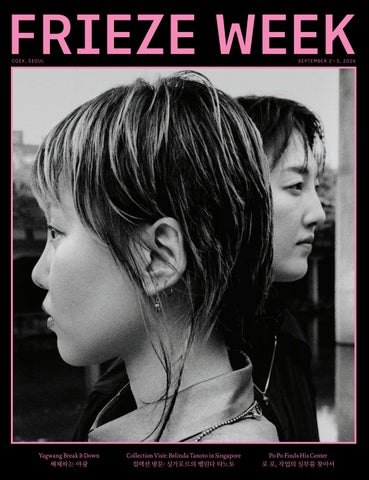
On the Cover Yagwang, 2026. Photography: Kerry J Dean
큐레이터의 머티리얼 프랙티스 섹션
29 Double Exposure This year’s Frieze Artist Award winners
46 Finding a Focus Singapore collector Belinda Tanoto
20
J. 딘이 담은 서울
70 Park Seo-bo
The views expressed in Frieze Week are not necessarily those of the publishers. Unauthorized reproduction of any material is strictly prohibited.
화백과의 인터뷰 Global partners
Official partner of Focus
Official partner of the Frieze Seoul Artist Award
Official partner Frieze Seoul partners of Material Practice
Global media partner
FRIE ZE WE E K SEOUL
S EPTEMBER 2– 5, 2 0 2 6
CURATED SECTIONS
18
큐레이티드 섹션
Across the fair’s newly reimagined Focus section, emerging artists are engaging with ritual, spirituality and ceremony. Is it a response to uncertain times, asks Emily Chun 젊은 갤러리와 작가들을 소개하는 기획 섹션 곳곳에서 의식과 영성, 제의를 주제로 한 프레젠테이션들이 돋보이는 가운데 에밀리 천이 묻는다. 어쩌면 불확실한 시대에 대한 다음 세대의 응답일까?
RITUAL ACTS This year’s Focus section at Frieze Seoul is expanding. Over the past four years, it has been Focus Asia, spotlighting innovative voices from the continent. Though Asia-based galleries still comprise the majority of the selected stands in Focus, this wider global framework encompasses emerging galleries from beyond Asia, including spaces from Budapest (Longtermhandstand), Stockholm (Coulisse Gallery), Rome (Matèria) and São Paulo (Yehudi Hollander-Pappi), among others. One consistent thread of this year’s Focus section, which is curated by Seolhui Lee, is contemporary interpretations of ritual, belief and religion. To take one example, Turin-based Mongolian artist Bekhbaatar Enkhtur’s solo presentation with Matèria features new beeswax lotus sculptures and drawings on sandpaper that reflect his ongoing exploration of Central Asian mythic iconographies. An anchoring reference in this body of work is Enkhtur’s memories of the domestic altar, where objects appear animated by invisible forces, as a site of exchange. Such recollections directly inform his drawing practice, in which repetitive gestures of marking and erasing on sandpaper generate ghostly images that seem to arise from beneath the surface. Enkhtur’s work forms a serendipitous dialog with Chinese artist Lilyjon’s mixed-media presentation with Cub_ism_ Artspace (Shanghai), which includes six works (from the “Box of Fallacy”, 2018– ongoing) placed on shelves that the artist calls “everyday altars.” These sculptures bring together banal objects alongside images of bodies, blurring boundaries between magic, religion and daily life. An accompanying video work, 12 Days and 12 Nights (2026), further explores this mysterious threshold where daily routines alchemize into sacred rituals. How does repetition become ritual? Artists like Enkhtur and Lilyjon give material form to this question, which feels especially pressing today in our atomized world where precarity reigns and time always seems to be running away. In his novel Citadelle (1948), Antoine de SaintExupéry characterizes rituals as temporal techniques of making oneself at home in the world. If that is the case, Enkhtur and Lilyjon posit ritual as a symbolic
technology that can transform the world into a reliable place, or as philosopher Byung-Chul Han writes in his book The Disappearance of Rituals (2019), transform “being-in-the-world” to “beingat-home.” Other artists in this year’s Focus section approach these questions from a more cosmic angle: Brazilian artist Ayla Tavares, showing with Londonbased LAMB, explores the symbol of the sun through an installation of a lantern sculpture surrounded by ceramics. Coinciding with her participation in the Brazilian pavilion at this year’s Gwangju Biennale, this presentation draws influence from Georges Bataille’s 1927 text “The Solar Anus” to flesh out celestial relations between body, matter and ritual. Even artists whose works do not explicitly engage concepts of ritual and religion take up these notions in oblique ways. Handwoven works by Korean artist Seungean Cha, in her presentation with Pipe Gallery (Seoul), critically engage our digitally disembodied and flattened world. In her new works, Cha employs the 0101 pattern of jacquard weaving (a binary code of “over, under, over, under”) to reanimate the image as a material object marked by ritualistic labor and time. The digital code of 0101, on the other hand, has been crucial in reducing images to replicable data, abolishing the specificity of locality and material presence. Rituals, sociologist Hartmut Rosa writes in his 2019 book Resonance, “produce sociological axes of resonance along which may be experienced three different kinds of resonant relationship vertical (e.g. to the gods, the cosmos, time or eternity), horizontal (within one’s social community) and diagonal (with respect to things).” This year’s Focus brings together presentations that rediscover ritual on all three registers and, in the process, hopefully render time a bit more habitable. In Focus at Frieze Seoul 2026, Cub_ism_Artspace presents Lilyjon (Stand F13); LAMB presents Ayla Tavares (F11); Matèria presents Bekhbaatar Enkhtur (F12); Pipe Gallery presents Seungean Cha (F09). Stone Island is the Official Partner of Focus. Emily Chun is a writer. She lives in New York, USA.
Right Omyo Cho, Nudi Haloid, 2025. © Omyo Cho. Courtesy: the artist and FOUNDRY SEOUL. Photo: Jeongkyun Goh Opposite page, clockwise from top left Botond Keresztesi, Times New Roman I, 2026. Courtesy: the artist and longtermhandstand, Budapest Lilyjon, Box of Fallacy: Origin, 2018. Courtesy: the artist and Cub_ism_ Artspace, Shanghai Geoffroy Pithon, “Forest,” 2026. Installation view at Chengdu Museum of Art. Courtesy: the artist and Maāt Gallery, Paris
FR IE ZE WE E K SEOUL
CURATED SECTIONS
올해 프리즈 서울이 ‘포커스(Focus)’ 섹션을 확장한다. 지난 4년간 해당 섹션은 ‘포커스 아시아(Focus Asia)’라는 이름 아래 아시아 지역의 혁신적인 목소리를 조명해 왔다. 여전히 아시아 기반 갤러리가 다수를 이루고 있지만, 올해는 국제적 관점을 더하여 부다페스트의 롱텀핸드스탠드(Longtermhandstand), 스톡홀름의 쿨리스 갤러리 (Coulisse Gallery), 로마의 마떼리아 (Matèria), 상파울루의 예후디 홀란데르-파피 (Yehudi Hollander-Pappi) 등 아시아 너머의 젊은 갤러리까지 폭넓게 아우른다. 이설희 큐레이터가 자문을 맡은 이번 포커스 섹션은 의식(rituals), 신앙, 종교를 둘러싼 동시대적 해석을 조명한다. 가령, 마떼리아의 솔로 프레젠테이션에서 소개되는 이탈리아 토리노 기반의 몽골 작가 베흐바타르 엔크투르(Bekhbaatar Enkhtur)는 중앙아시아의 신화적 도상에 대한 지속적인 탐구를 바탕으로 밀랍 연꽃 조각과 사포 드로잉 신작을 선보인다. 이 작품들의 심부에는 보이지 않는 힘에 의해 사물이 생동하는 듯 느껴지던 공간, 작가에게 교환의 장소로 기억되는 집 한편에 자리하던 불단이 있다. 이러한 기억이 드로잉 작업에 고스란히 녹아들어, 사포질을 통해 흔적을 남기고 지우는 행위를 반복하며 표면 안에서 솟아오르는 듯한 유령과 같은 이미지를 만들어 낸다. 엔크투르의 작품은 큐비즘 아트스페이스 (Cub_ism_Artspace, 상하이)가 선보이는 중국 작가 릴리존(Lilyjon)의 혼합 매체 프레젠테이션과 우연한 대화를 이룬다. 릴리존은 ‘일상의 제단’이라 이름 붙인 선반 위에 연작 《Box of Fallacy》 중 여섯 점을 배치하는데, 이 조각들은 평범한 사물과 신체 이미지를 결합하여 마법과 종교, 일상 사이의 경계를 흐린다. 함께 전시되는 영상 작품 〈12 Days and 12 Nights〉(2026)는 일상의 평범한 루틴이 신성한 의식으로 탈바꿈하는 신비로운 변환의 순간에 주목한다. 반복은 어떻게 의식이 되는가? 이 질문은 불안정성과 시간의 압박 아래 고립된 채 살아가는 시대에 더욱 절실하게 다가오며, 엔크투르와 릴리존 같은 작가들의 작업은 그 과정을 포착해 형상화해 낸다. 앙투안 드 생텍쥐페리(Antoine de Saint-Exupéry)의 소설 『성채』(1948)에 따르면, 의식은 시간을 매개로 세계 속에 안식처를 일구는 기술이다. 그렇다면 엔크투르와 릴리존이 제시하는 의식은 상징을 매개로 세계를 안심할 수 있는 장소로 만드는 기술, 혹은 철학자 한병철이 저서 『리추얼의 종말』(2019)에 적듯, ‘세계안에-있음’을 ‘집안에-있음’으로 전환하는 기술이라고 할 수 있다. 포커스 섹션을 구성하는 또 다른
S EPTEMB E R 2– 5, 2 0 2 6
큐레이티드 섹션
작가들은 같은 질문을 한층 우주적인 관점에서 바라본다. 램 갤러리(LAMB Gallery, 런던)의 브라질 작가 아일라 타바레스 (Ayla Tavares)는 도자로 둘러싸인 조명 조각 설치 작업을 통해 태양이 갖는 다양한 상징을 탐구한다. 올해 광주비엔날레 브라질관 개관과 시기를 같이 하는 타바레스의 솔로 프레젠테이션은 조르주 바타유(Georges Bataille)의 1927년 산문 「태양 항문」에 착안하여 신체와 물질, 의식 사이의 천상적 관계를 구체화한다. 의식과 종교의 개념을 전면에 드러내지 않는 작가들도 이를 간접적인 방식으로 끌어들인다. 파이프 갤러리(서울)와 함께 참여하는 한국 작가 차승언은 직조 작업을 통해 디지털 환경 속에서 차츰 희미해지는 몸의 감각과 세계의 입체성을 비판적으로 다룬다. 이번 신작에서 작가는 자카드 직조의 0101 패턴, 즉 ‘위로, 아래로, 위로, 아래로’ 교차하는 이진법 코드를 활용하여, 의식처럼 수행되는 노동과 시간이 아로새겨진 하나의 물질적 객체로서 이미지를 재탄생시킨다. 역설적이게도, 디지털 코드로서의 0101은 이미지를 복제 가능한 데이터로 환원함으로써 그것이 지닌 고유한 로컬리티와 물질적 존재감을 소멸시키는 데 결정적인 역할을 해 왔다. 사회학자 하르트무트 로자(Hartmut Rosa)는 2019년 저서 『공명』에서 의식이 “세 종류의 공명 관계, 즉 (예: 신, 우주, 시간 또는 영원과의) 수직적, (사회 공동체 내의) 수평적, (사물에 있어서의) 사선적 공명 관계를 경험할 수 있는 사회학적 공명 축을 생성한다”고 쓴다. 올해의 포커스 섹션은 이 세 가지 차원 모두에서 의식을 재발견하는 프레젠테이션을 한데 모으고, 그리하여 시간을 조금이나마 더 살 만한 곳으로 만들고자 바란다.
프리즈 서울 2026 포커스 섹션에서 Cub_ism_Artspace(스탠드 F13)는 릴리존을, LAMB(F11)은 아일라 타바레스를, Matèria(F12)는 베흐바타르 엔크투르를, Pipe Gallery(F09)는 차승언을 소개한다. 스톤 아일랜드(Stone Island)는 포커스 섹션의 공식 파트너이다. 에밀리 천은 미술 비평가이다. 현재 미국 뉴욕에 거주하고 있다. 영-한 번역: 한진이.
19
FRIE ZE WE E K SEOUL
S EPTEMBER 2– 5, 2 0 2 6
CURATED SECTIONS
20
큐레이티드 섹션
0
Material Practice
프리즈 서울 20 이 새롭게 선보이는 ‘머티리얼 프랙티스’ 섹션은 조혜영 큐레이터의 기획 아래 예술과 디자인, 공예, 전통 사이의 교류를 탐구한다. 예부터 재료를 중심으로 예술적 표현을 이어 온 한국이야말로 이를 위한 최적의 무대라고 샬럿 홀릭 교수는 말한다.
REMAKE, REMODEL This year, for its fifth edition, Frieze Seoul looks beyond its established focus on fine art by incorporating a broader range of practices and histories. This expanded vision is reflected in the introduction of two new sections, one of which, Material Practice, explores dialogs between contemporary art, design and craft. Material Practice is curated by Hyeyoung Cho, whose longstanding contributions to the South Korean art scene include serving as art director of the 2015 Cheongju Craft Biennale and, more recently, as secretary general of the Korea Craft and Design Foundation. Devoted to material-based artistic expression and interdisciplinary making, Material Practice caters to the growing international interest in such work. In a recent exchange, Cho explained that she hopes the section will “foster new conversations between regional and global perspectives, encouraging deeper engagement among collectors, curators, institutions and the public.” Cho describes South Korea as a “factory of creativity,” highlighting the seemingly boundless pool of artistic talent in the country. While it is challenging to define trends within this diverse and vibrant field, Cho suggests that contemporary Korean art is rooted in a deep commitment to mastering a skill, whether that be a technique or material. This emphasis on expertise may, in part, be attributed to the legacy of the Joseon dynasty (1392– 1910), when thousands of highly skilled craftsmen were appointed by the royal court to produce secular and ritual objects. Some specialized in a single medium, such as lacquer or horsehair; others manufactured specific objects, such as knives,
musical instruments or clothing. Painters who served the government in this capacity were referred to as craftsmen, rather than artists, having refined their skills over decades of rigorous training. This legacy of technical mastery continues to underpin South Korea’s rich tradition of material-based artistic expression. Recognizing the need to preserve traditional skills, in the early 1960s, the Korean government implemented the Cultural Protection Law centered on the preservation and safeguarding of historic sites as well as significant traditions and practices of making. Under this directive, selected skills, such as the making of horsehair hats (gannil), decorative knots (maedupjang), metal engraving (jogakjang) and embroidery (jasujang), among many others, are designated National Intangible Cultural Heritage, with their makers informally known as Living National Treasures (ingan munhwajae). The importance attached to Korean artistic heritage is reflected in the ways in which many contemporary artists incorporate traditional materials and techniques in their work. This can be seen in Kimsooja’s references to patchwork and Do Ho Suh’s fabric renditions of architectural forms, both of which are informed by traditional sewing techniques. Korea’s celebrated ceramic heritage continues to inspire today’s artists. This can be seen in contemporary appropriations of green-glazed celadon vessels of the Goryeo dynasty (918–1392), and the buncheong stoneware and white porcelain of the Joseon dynasty. Noteworthy are Park Young Sook and Kim Yik-yung’s large-scale moon jars in white
Opposite Hyeyoung Cho, 2026. Photography: Louis Lee
올해로 5회차를 맞는 프리즈 서울은 그간 순수 미술 중심이었던 시야를 넓혀 더 광범위한 실천과 역사를 끌어안는다. 이번에 신설된 두 섹션이 이러한 변화를 가장 잘 보여 주는 가운데, 그중 ‘머티리얼 프랙티스 (Material Practice)’ 섹션은 동시대 미술과 디자인, 그리고 공예가 서로 대화하는 지점을 탐색한다. 조혜영 큐레이터가 머티리얼 프랙티스 섹션을 이끈다. 2015 청주공예비엔날레 전시감독을 맡고 한국공예·디자인문화진흥원 사무처장을 지내는 등 한국 미술계에 오랫동안 공헌해 온 인물이다. 재료 중심의 예술적 표현과 경계 없는 예술 실천에 대한 국제적 관심이 높아지는 만큼 머티리얼 프랙티스 섹션 역시 그러한 흐름에 부응한다. 조혜영 큐레이터는 최근 인터뷰에서 이 섹션이 “지역적 관점과 세계적 관점 사이에 새로운 대화의 장을 열고, 컬렉터와 큐레이터, 전시 기관, 일반 대중이 더욱 깊이 교류하는 계기가 되기를 바란다”고 밝혔다. 조혜영 큐레이터는 한국을 “창의성의 공장”이라 표현하며 국내의 무궁무진한 예술 인재 층을 강조한다. 다채롭고 예술계의 흐름을 하나로 규정하기는 어렵지만, 그는 오늘날 한국 미술이 기법이든 재료든 어느 한 가지를 깊이 파고드는 태도에 뿌리를 두고 있다고 설명한다. 이 같은 전문성에 대한 강조는 조선 왕실(1392–1910)의 유산과 무관하지 않다. 당시 왕실은 수천 명의 숙련된 장인을 고용해 일상용·의식용 사물을 제작하게 했다. 어떤 장인은 옻칠이나 말총처럼 특정 재료를 전문으로 다뤘고, 또 다른 장인은 칼이나 악기, 의복처럼 특정 물품의 제작을 담당했다. 마찬가지로 관청에서 활동한 화가들 역시 예술가라기보다 오랜 수련을 통해 기술을 연마한 장인으로 여겨졌다. 장인 정신이라는 유산은 오늘날에도 한국의 재료 중심 예술과 그 풍요한 전통을 떠받치고 있다. 전통 기술 보존의 필요성을
인식한 한국 정부는 1960년대 초 문화재보호법을 제정해 역사 유적뿐 아니라 중요한 전통 기술과 제작 관행의 보존에 나섰다. 이 제도 아래 갓을 만드는 갓일, 장식용 매듭을 짜는 매듭장, 금속에 문양을 새기는 조각장, 자수를 놓는 자수장 등 다양한 기술이 국가 무형 문화유산으로 지정 되었으며, 이들 기술의 보유자는 흔히 인간 문화재로 불리게 되었다. 수없이 많은 동시대 작가가 전통 재료와 기법을 작업에 녹여 내는 방식에서 한국의 예술적 유산을 중시하는 인식을 엿볼 수 있다. 예컨대, 김수자는 천을 이어 붙여 보따리를 만들면서, 서도호는 건축 공간을 천으로 재현해 내면서, 각자의 방식으로 한국의 전통 바느질 기법을 계승한다. 한국이 자랑하는 도자 전통 역시 오늘날 작가들에게 영감의 원천이 된다. 고려시대 (918–1392)의 녹청자, 조선시대의 분청사기와 백자는 동시대 작가들의 작업 속에서 새로운 방식으로 변주된다. 대형 백자 달항아리 작업으로 주목받은 박영숙과 김익영에 더해, 제인 양-데엔(Jane Yang-D’Haene)과 이수경 같은 후속 세대 작가들은 한국의 오랜 도자 전통을 보다 추상적인 언어로 해석한다. 이수경의 연작 《번역된 도자기》(2002–)는 깨진 도자기 파편을 금박으로 이어 붙여 새로운 입체 형상을 만들어냄으로써 도자기를 바라보는 기존의 관념에 질문을 던진다. 실용적인 오브제도, 전통적 의미의 조각도 아닌 이수경의 작품은 도자라는 매체의 가능성을 전복하는 동시에 확장한다. 박종진은 물질이 하나의 상태로 굳어지기 전, 변화의 경계에 머무는 순간을 탐구하며 동시대 한국 작가들의 특징인 창의성과 기술적 세련미의 결합을 유감없이 보여 준다. 도예를 전공한 작가는 흙이 지닌 구조적 가능성을 실험하고, 이로써 재료에 대한 고정관념을 깨부수는 작품을 선보인다. 관람객은 박종진의 작품을 통해 도자의 시각적·촉각적 모호함을 새롭게 인식하게
FR IE ZE WE E K SEOUL
CURATED SECTIONS
porcelain, while younger-generation artists such as Jane Yang-D’Haene and Yeesookyung interpret Korea’s ceramic heritage in more abstract terms. In the latter’s “Translated Vase” series (2002–), the artist questions conventional approaches to ceramic vessels by creating three-dimensional forms from shards joined with a gold-leaf bond. Neither utilitarian objects nor conventional sculptures, her works both subvert and expand the possibilities of the ceramic medium. In his explorations of materiality in its most liminal state, Jongjin Park exemplifies the combination of creativity and technical sophistication that characterize works by contemporary Korean artists. Formally trained as a ceramicist, Park explores the structural possibilities of clay, encouraging viewers to question the visual and tactile ambiguities of ceramics by producing objects that defy material expectations. For example, his winning work in the 2026 Loewe Foundation Craft Prize, Strata of Illusion (2025), is constructed from multiple layers of paper towels dipped in ceramic slip. The partially collapsed rectangular shape challenges traditional perceptions of the strength and durability of fired clay, while his choice of materials and techniques broadens what is understood by ceramics. While ceramics continue to feature prominently in the contemporary Korean art scene, recent years have seen the emergence of artists who employ a diverse range of materials and artistic techniques. Their work is often distinguished by innovative reinterpretations of the country’s wider traditional art forms. A case in point is Dahye Jeong’s delicate woven baskets, which evoke the centuries-long Korean tradition of making men’s hats by painstakingly weaving and lacquering horsehair. These hats signify the robustness and steadfastness associated with the male scholar elite of the Joseon dynasty, but Jeong’s featherlight objects subvert this association through their fragile material presence. Similarly, Chung Haecho revitalizes Korean lacquer work in ways which are markedly different from traditional objects in both form and technique. Applying hemp fabric and lacquer over a carved Styrofoam base that is subsequently removed, Chung creates vessels that are contemporary in form and process while remaining grounded in this traditional medium. What these Korean artists have in common is not materials, technique or outcome, as much as a shared understanding of how all those things philosophically contribute to a work of art, an approach to making that—while not exclusive to South Korea—is derived from an awareness of traditions and influences that remain culturally prized in the country. The Material Practice section at Frieze Seoul 2026 offers visitors the opportunity to gain deeper insight into this enduring legacy, making it a fascinating addition to this year’s fair. At Frieze Seoul 2026, Material Practice features Admira Gallery, Art Space 3, Arumjigi Foundation, Bienvenu Steinberg & C, Charles Burnand Gallery, Gallery LNL, Marta, Gallery Sklo, Soluna Fine Art and Waterfall Gallery. LG Uplus is the Official Partner of Material Practice. Charlotte Horlyck is professor of Korean Art History and head of the School of Arts at SOAS University of London. She lives in London, UK, and Seoul, South Korea.
S EPTEMB E R 2– 5, 2 0 2 6
21
큐레이티드 섹션
된다. 2026년 로에베 재단 공예상 수상작인 〈착시의 층위〉(2025)는 흙물에 적신 키친타월을 겹겹이 쌓아 제작한 작품이다. 일부가 무너져 내린 사각 형태는 가마에 소성한 흙이 지닌 강도와 내구성에 대한 기존의 인식을 뒤흔들며, 재료와 제작 기법을 통틀어 도자의 개념을 한층 넓혀 보인다. 도자가 동시대 한국 미술계에서 여전히 중요한 위치를 차지하는 한편, 최근에는 더욱 다양한 재료와 예술적 기법을 활용하는 작가들이 등장하고 있다. 이들의 작업은 한국의 다양한 전통 예술을 혁신적으로 재해석한다는 점에서 특히 눈에 띈다. 대표적인 예가 정다혜의 직조 바구니 작업이다. 정다혜의 작품은 말총을 정교하게 엮어 옻칠하여 마감하던 수백 년 역사의 갓 제작 전통을 연상시킨다. 조선시대의 갓은 남성 사대부가 지닌 강인함과 지조를 상징했지만, 정다혜는 깃털처럼 가벼운
작품과 그 가냘픈 물질적 존재감으로 기존의 상징성을 뒤집는다. 마찬가지로, 정해조는 형태와 기법을 통틀어 전통적인 기물과는 확연히 구분되는 방식으로 한국의 옻칠 공예에 새로운 활력을 불어넣는다. 조각한 스티로폼 베이스 위에 삼베 천을 덧대고 옻칠을 입힌 뒤 내부의 스티로폼을 제거하는 방식을 통해, 전통적인 매체에 굳건히 뿌리를 두면서도 형태와 제작 과정 모두에서 극히 현대적인 오브제를 창조해 낸다. 이들 한국 작가는 특정한 재료나 기법, 혹은 결과물로 묶이지 않는다. 외려 이 모든 요소가 철학적으로 어떻게 이바지해 하나의 예술 작품을 이루는지에 대한 공유된 이해로 묶인다. 비단 한국에만 국한된 것은 아닐지라도, 이러한 예술관은 한국 땅에서 변함없이 존경받는 전통과 그 문화적 영향에 대한 인식에서 출발한다. 프리즈
서울 2026의 머티리얼 프랙티스 섹션은 관람객에게 부단히 이어져 온 위대한 유산을 깊이 들여다볼 기회를 선사하면서, 올해의 아트페어를 더욱 특별하게 만들어 줄 것이다. 프리즈 서울 2026의 머티리얼 프랙티스 섹션에는 아드미라 갤러리(Admira Gallery), 아트 스페이스 3(Art Space 3), 재단법인 아름지기(Arumjigi Foundation), 비앙브뉴 스타인버그 앤 씨(Bienvenu Steinberg & C), 찰스 버넌드(Charles Burnand), 갤러리 엘앤엘(Gallery LNL), 마르타(Marta), 갤러리 스클로, 솔루나 파인 아트(Soluna Fine Art), 워터폴 아트 앤 갤러리(Waterfall Art & Gallery)가 참여한다.
LG 유플러스는 머터리얼 프랙티스 섹션의 공식 파트너이다. 샬롯 홀릭(Charlotte Horlyck)은 런던대학교 동양·아프리카학대학(SOAS)의 한국 미술사 교수이자 예술대학 학장이다. 현재 런던과 서울을 오가며 활동하고 있다. 영-한 번역: 한진이
FRIE ZE WE E K SEOUL
S EPTEMBER 2– 5, 2 0 2 6
Galleries in Material Practice 2026
Marta, Los Angeles, USA (MP6) New York-based Korean artist Minjae Kim’s background in architecture and design informs his furniture/objects, which blur practicality, ornament and wit.
Waterfall Arts Foundation & Gallery, New York, USA (MP1) Over more than 35 years, Seung Hee Lee has expanded the boundaries of ceramic art, embracing painting, installation and experimental materials. Art Space 3, Seoul, Korea (MP2) Mihwa Park’s work spans clay, embroidery, painting and installation to explore life, death and regeneration through motifs such as plants, animals, the human figure and everyday objects. Soluna Fine Art, Hong Kong (MP3) Eight artists foregrounding process and detail: painters Kim Duck-Yong, Woo Jong-Taek, Seungtaik Jang and Kim Young-Hun, together with ceramicists Jongjin Park and Pyun Yae-Rin, fiber artist Dahye Jeong and marquetry artist Olly Fathers. Gallery LNL, Sydney, Australia (MP4) Moon jars and other works by Hunchung Lee, a leading Korean artist, are shown alongside contemporary artists exploring abstraction and materials in ceramics. Admira Gallery, Taipei, Taiwan-Hong Kong (MP5) Japanese artist Atsuro Miyako, a member of the collective Konel and organizer of the Alternative Design Studio AAAQ, merges art and design, while painter Tomoya Tsukamoto works primarily with airbrush.
Arumjigi Foundation, Seoul, Korea (MP7) For the past 20 years, the Arumjigi Foundation has sought to preserve and promote traditional Korean arts across architecture, clothing and food culture. Charles Burnand, London, UK (MP8) Six artists working across a variety of media: Fabrikr (Dongkyu Kim and Sungjo Kim), Inhye Ji, Kyeok Kim, Peter Lane, Fredrik Nielsen and Studio Furthermore (Marina Dragomirova and Iain Howlett). Gallery SKLO, Seoul, Korea (MP9) Sangho Shin, a pioneering figure in Korean ceramics, and founder of the Gyeonggi Ceramic Biennale and the Clayarch Gimhae Museum, presents his “Structure and Force” series. Bienvenu Steinberg & C, New York, USA (MP9) Jane Yang-D’Haene creates stoneware vessels informed by her Korean heritage, particularly traditional moon jars, reinterpreting ceramic traditions to create objects that are both functional and sculptural.
22
Above left Lee Seung Hee, Tao Moon 25, 2025. Courtesy: the artist Above right Park Jong-Jin, Artistic Stratum_Patch_ OGVBRW, 2026. Courtesy: the artist and Soluna Fine Art, Hong Kong
머티리얼 프랙티스 2026 참가 갤러리 워터폴 아트 앤 갤러리(Waterfall Arts Foundation & Gallery), 뉴욕, 미국 (MP1) 35년에 걸쳐 도자 예술의 경계를 넓혀 온 이승희는 회화와 설치, 실험적 재료를 아우른다. 아트 스페이스 3(Art Space 3), 서울, 한국 (MP2) 박미화의 작업은 흙, 자수, 회화, 설치를 넘나들며, 식물·동물·인체·일상적 사물 같은 모티프를 통해 생성과 소멸, 그리고 재생을 탐구한다. 솔루나 파인 아트(Soluna Fine Art), 홍콩 (MP3) 과정과 디테일을 전면에 내세우는 8인의 작가가 함께한다. 화가 김덕용, 우종택, 장승택, 김영헌, 도예가 박종진, 변예린, 말총공예 작가 정다혜, 그리고 마케트리 장인 올리 파더스(Olly Fathers)다. 갤러리 엘앤엘(Gallery LNL), 시드니, 호주 (MP4) 한국을 대표하는 작가 이헌정의 달항아리를 비롯한 작품들이, 추상과 재료를 탐구하는 동시대 도예 작가들의 작업과 함께 전시된다. 아드미라 갤러리(Admira Gallery), 타이베이, 대만 · 홍콩 (MP5) 콜렉티브 코넬(Konel)의 멤버이자 대안적 디자인 스튜디오 AAAQ의 운영자인 일본 작가 미야코 아츠로(Atsuro Miyako)가 예술과 디자인을 결합한 작업을, 화가 츠카모토 토모야(Tomoya Tsukamoto)가 에어브러시 작업을 선보인다.
마르타(Marta), 로스앤젤레스, 미국 (MP6) 뉴욕을 기반으로 활동하는 한국 작가 김민재는 건축과 디자인을 출발점으로 실용과 장식, 해학의 경계를 허무는 가구/오브제 작업을 선보인다. 재단법인 아름지기, 서울, 한국 (MP7) 재단법인 아름지기는 지난 20년간 건축, 의복, 식문화 등 한국의 전통문화 전반을 보존하고 알리는 데 힘써 왔다. 찰스 버넌드(Charles Burnand), 런던, 영국 (MP8) 다양한 매체로 작업하는 6인의 작가가 참여한다. 김동규와 김성조로 구성된 아티스트 그룹 패브리커, 지인혜, 김계옥, 피터 레인(Peter Lane), 프레드릭 닐슨 (Fredrik Nielsen), 마리나 드라고미로바 (Marina Dragomirova), 그리고 레인 하울렛(Lain Howlett)으로 구성된 스튜디오 퍼더모어(Studio Furthermore)다. 갤러리 스클로, 서울, 한국 (MP9) 한국 도예의 선구자이자 경기도자비엔날레와 클레이아크 김해미술관의 설립자인 신상호가 도자 조각 연작 《구조와 힘》을 선보인다. 비앙브뉴 스타인버그 앤 씨(Bienvenu Steinberg & C), 뉴욕, 미국 (MP9) 한국계 미국인 도예가 제인 양-데엔(Jane Yang-D’ Haene)은 한국의 문화유산에서 영감을 받아 전통 달항아리를 현대적으로 재해석한 도기 그릇을 제작하며, 도자 전통을 기반으로 실용성과 조형성을 겸비한 작품을 만들어 낸다.
FRIE ZE WE E K SEOUL
FAIR GALLERIES
S EPTEMBER 2– 5, 2 2 6
24
페어 참가 갤러리
Comparing the work of Amadeo Luciano Lorenzato and Hyun-Sook Song, Christopher Whitfield sees shared themes of displacement and homecoming, change and repetition 크리스토퍼 휘트필드는 아마데오 루치아노 로렌자토와 송현숙의 작품을 나란히 두고 살피며, 두 작가의 예술 세계 속에서 이주와 귀향, 변화와 반복이 갖는 의미를 짚어본다.
COMING HOME In 1948, after almost 30 years, Amadeo Luciano Lorenzato was done with Italy. Returning to Belo Horizonte, Brazil, the city of his birth, he set to work committing its trees, sky and houses to his canvas over and over again. It would be easy to read something pastoral into these works: the simple figures striding through boisterously colored landscapes—scenes which remained largely unchanged from the time of his prodigal return until his death in 1995. With its robust houses and purposeful figures, Sem Titulo (1993) looks like Sem Titulo (1976) looks like Sem Titulo (1950). But this repetition is more than stubborn nostalgia. As industry exploded and huge numbers of rural migrants surged into the cities to meet the demands of modern Brazil, each painting was a re-evaluation— the vivid progress of modernity assimilated into Lorenzato’s vision of his home: one man’s own beautiful horizon. When South Korean artist Hyun-Sook Song returned home from West Germany for the first time in 1984, she barely recognized the place. She found Muwol-li, the small village in Damyang County where she’d grown up breeding silkworms
with her grandmother, newly strung up with electricity, its young people absent, having followed the bright lights to the big cities. The tools of the town’s silk trade—the clay pots and wooden poles— lay discarded. She’s been painting them ever since. 5 Brushstrokes Over 1 Brushstroke (2011) takes one such pole, draping it in silk. Though her titles boast of her strict economy of marks, in her single-minded dedication to rediscovering the Muwol-li of her childhood, Song has made each brushstroke hundreds of times. Whereas Lorenzato welcomes the changing face of Brazil into his bold vision of his home, Song preserves a version of hers that the rest of the world left behind. But for both artists, their obsessive repetition is a homecoming staged again and again.
At Frieze Seoul, Amadeo Luciano Lorenzato is presented by Mendes Wood DM (Stand B08) and Hyun-Sook Song by Sprüth Magers (B22). Christopher Whitfield is a writer and educator. He lives between Bangkok, Thailand, and Stroud, UK.
Above left Amadeo Luciano Lorenzato, Untitled, 1992. Courtesy: the artist and Mendes Wood DM, São Paulo, Brussels, Paris, New York. Photo: EstudioEmObra Above right Hyun-Sook Song, 5 Brushstrokes over 1 Brushstroke, 2011. Courtesy: the artist and Sprüth Magers, Berlin, London, Los Angeles, New York. Photo: Timo Ohler
1948년, 아마데오 루치아노 로렌자토는 30년 가까운 시간을 보낸 이탈리아를 뒤로하고 고향 브라질로 돌아왔다. 벨루오리존치의 품으로 돌아온 그는 주변의 나무와 하늘, 주거 환경을 매일 관찰하며 화폭에 꾸준히 담아내기 시작했다. 활기찬 색채의 풍경과 그 사이를 거니는 인물들을 담은 소박한 화풍은 자칫 목가적으로 읽히기 쉽다. 작가가 귀향한 이후부터 1995년 세상을 떠날 때까지 이러한 구도는 큰 변화 없이 유지되었다. 견고한 집채와 저마다의 일상을 살아가는 사람들의 모습은 1993년의 〈무제〉, 1976년의 〈무제〉, 1950년의 〈무제〉에서 일관되게 등장한다. 그러나 이러한 반복은 단순한 향수를 넘어선 의미를 지닌다. 급격한 산업화와 농촌 인구의 도시 유입으로 사회가 빠르게 변모하던 브라질의 역동적인 시대상이 캔버스 곳곳에 고스란히 스며들어 있으며, 그 속에는 변화하는 세계를 향한 작가의 부드러운 시선을 엿볼 수 있다. 그것이 바로 로렌자토가 애정을 담아 그려낸 고향의 지평선이다. 한국 작가 송현숙은 1984년이 되어서야 서독에서 고국으로 돌아왔을 때, 고향을 단번에 알아보지 못했다. 어린 시절 할머니와 함께 누에를 기르며 지냈던 담양군 무월리 산골 마을에는 전기가 들어와 있었고, 젊은이들은 도시의 불빛을 따라 떠난 뒤였다. 한때 양잠 산업의 핵심이었던 항아리와
장대는 잊혀진 채 방치되어 있었다. 이후 작가는 줄곧 그 도구들을 그림으로 옮겨왔다. 〈5 Brushstrokes Over 1 Brushstroke〉 (2011)는 장대 하나를 비단으로 감싼 모습을 담고 있다. 제목은 마치 최소한의 붓질만으로 완성한 작업을 암시하지만, 한 획은 수백 번의 붓질을 나타내며 유년 시절의 기억이 깃든 무월리를 재발견하려는 작가의 집요한 노력이 고스란히 배어 있다. 로렌자토가 변화하는 브라질의 모습을 자신이 그리는 고향의 풍경 속으로 기꺼이 끌어안았다면, 송현숙은 세상이 뒤로한 고향의 모습을 온전히 간직하고자 한다. 그러나 분명한 것은, 두 작가 모두에게 집요한 반복은 고향으로 향하는 거듭된 발걸음이라 할 수 있다.
프리즈 서울에서 Mendes Wood DM(스탠드 B08)는 아마데오 루치아노 로젠자토를, Sprüth Magers(B22)는 송현숙을 소개한다. 크리스토퍼 휘트필드(Christopher Whitfield)는 미술 비평가이자 교육자이다. 현재 태국 방콕과 영국 스트라우드를 오가며 활동하고 있다. 영-한 번역: 고누리.
FRIE ZE WE E K SEOUL
S EPTEMBER 2– 5, 2 0 2 6
CURATED SECTIONS
26
큐레이티드 섹션
Spotlight
0
올해 새롭게 도입된 스포트라이트 섹션은 20세기 작가들의 프레젠테이션에 주력한다. 그중 기존 미니멀리즘의 서사를 확장하는 미얀마 작가 포 포의 인상적인 작품세계를 소개한다.
PO PO FINDS HIS CENTER In 1986, when Po Po was in his late 20s, he created the iconic work Red Cube. It features a tilted rectangular canvas painted in gradient shades of red; underneath it sits a pile of granite rocks. The aesthetics of Red Cube may have earned the artist the label of “minimalist” among observers outside his native Myanmar. In reality, however, the work has little to do with the art movement; due to decades of cultural and economic isolation imposed by the military junta which had ruled the country since 1962, artists like Po Po had no exposure to international art discourse. Instead, the conceptual piece was born from his own impetus to experiment with how to present the canvas, while the stacked stones took inspiration from the practices of Buddhist monks meditating in the jungle. “He’s like a philosopher, an artistthinker at core,” Caryn Quek, Ames Yavuz’s gallery director in Singapore, tells me. The gallery is presenting Po Po’s work in Spotlight, a new section debuting at Frieze Seoul 2026 that revisits art history beyond the Western canon, curated by Wonseok Koh from Line Cultural Foundation. Through the “meditative quality” of Po Po’s œuvre, whether it is paintings, sculptures, installations or performances, the artist addresses the “ultimate questions,” such as life, death, materialism and understanding of self, the gallerist explains. “Somehow he manages to create playful works that question the way we engage with semiotics,” she says, “and how we create meaning through these abstracted works. It is timeless and enduring.” Born Hla Oo in 1957 in Pathein, a rice-trading and production hub in southwestern Myanmar, Po Po began making
art soon after he graduated from Pathein College (now Pathein University) with a degree in botany in 1979. Developing his practice and artistic language in isolation from a global discourse, Po Po became a pioneer unknowingly. It wasn’t until 1987 that he held his first solo exhibition at the Myanmar Artistic Association Center in Yangon, at the time the country’s capital. There, he presented an extraordinary body of work—six sculptures and 31 abstract paintings—derived from his playful manipulation of semiotics drawn from Buddhist philosophy and a limited knowledge of Western mythology. The conceptual pieces earned him the label of the “bad boy” of the local art scene as they demonstrated his desire to break away from state-favored realism. For instance, Narcissus (1987–94), made of a silk bolster tied with rope laid on a mirror flat on the ground, is an abstract rendering of the Greek myth. Also on view was his landmark quartet Tejo, Vayo, Pathavi, Apo (1985), translating the four Buddhist elements into a triangle, circle, square and semicircle. In his second exhibition a decade later, he showed Controlled Tejo, Vayo, Pathavi and Apo (1991–97/2015), an installation of four wooden crates, each housing materials representing the four elements— fluorescent light tubes for fire, rubber for water, bricks for earth and a block of melting ice for wind. While Po Po’s works have been exhibited worldwide—he was one of the first Myanmar artists to have such international exposure—and are in the collections of the National Gallery Singapore, Mori Art Museum in Japan and MAIIAM
Right Po Po, Red Cube, 1986. Courtesy: the artist, National Gallery of Singapore and Ames Yavuz, London, Singapore and Sydney
FR IE ZE WE E K SEOUL
CURATED SECTIONS
1986년 당시 20대 후반이었던 포 포(Po Po)는 대표작 〈Red Cube〉를 발표했다. 바로 붉은색 그라데이션으로 채색된 직사각형 캔버스를 벽에 대각선으로 설치하고, 그 아래 화강암 돌무더기를 배치한 작업이다. 〈Red Cube〉의 절제된 미학은 해외 관객에게는 미니멀리즘으로 해석될 수도 있다. 하지만 작품의 실제 출발점은 서양의 미술 사조와는 궤를 달리한다. 1962년부터 이어진 군부 독재로 인해 미얀마는 수십 년간 문화적·경제적으로 고립되었고, 포 포를 포함한 당대 작가들은 국제 미술 담론을 접할 기회가 없었다. 따라서 〈Red Cube〉는 캔버스를 전시하는 방식을 실험하는 작가의 개념적 사고에서 비롯된 것이며, 그림 아래 쌓인 돌무더기는 밀림에서 명상하는 불교 승려들의 수행 방식에서 영감을 얻은 것이다. 갤러리 에임스 야부즈(Ames Yavuz)의 싱가포르 지점 디렉터인 캐린 퀙(Caryn Quek)은 포 포를 “철학자에 가까운, 사색하는 예술가”라고 소개한다. 에임스 야부즈는 프리즈 서울 2026의 ‘스포트라이트 (Spotlight)’섹션에서 포 포의 작품을 선보이는데, 이 섹션은 라인문화재단의 디렉터 고원석이 큐레이션을 맡아 서구 중심의 미술사를 확장하려는 취지로 올해 새롭게 도입되었다. 퀙은 포 포의 회화, 조각, 설치, 퍼포먼스 작품 전반에 내재된 ‘명상적 특성’에 주목하며, 그의 작업이 삶, 죽음, 물질주의, 자아에 대한 ‘근원적인 질문’을 다룬다고 설명한다. “포 포의 추상은 기호와 의미가 관계 맺는 방식을 유연하게 접근하며, 기존 기호학적 체계에 질문을 던진다”라며, “시대를 초월해 오래도록 유효한 작업”이라고 덧붙인다. 1957년 미얀마 남서부의 쌀 교역 및 생산 중심지인 파테인에서 흘라 우(Hla Oo) 라는 이름으로 태어난 포 포는 1979년 파테인 칼리지(현 파테인 대학교, Pathein University)에서 식물학 학위를 취득한 뒤 본격적으로 예술 활동을 시작했다. 국제적 담론과는 단절된 환경에서 자신만의
S EPTEMB E R 2– 5, 2 0 2 6
27
큐레이티드 섹션
예술관과 표현 방식을 발전시킨 포 포는 자신도 모르는 사이에 선구적인 존재가 된 것이다. 포 포는 1987년에 이르러서야 미얀마의 옛 수도 양곤에 위치한 미얀마 예술협회 센터 (Myanmar Artistic Association Center)에서 첫 개인전을 열었다. 이 전시에서는 불교 철학과 제한적으로 접한 서양 신화에 착안한 기호학을 재치 있게 변주한 조각 6점과 추상회화 31점을 통해 방대한 예술 세계를 펼쳐 보였다. 국가가 장려하던 사실주의에 저항하며 개념적이고 독창적인 예술적 실천을 감행한 그는 미얀마 미술계에서 ‘이단아’라고 불리기도 했다. 해당 전시에서 공개한 작품 가운데 〈Narcissus〉(1987–94)는 바닥에 평평하게 놓인 거울 위에 밧줄을 묶은 실크 베개를 배치한 형태로 그리스 신화를 추상적으로 재해석했다. 함께 선보인 회화 연작 〈Tejo〉, 〈Vayo〉, 〈Pathavi〉, 〈Apo〉(1985)는 불교의 네 가지 원소를 삼각형, 원, 사각형, 반원으로 각각 형상화했다. 10년 뒤 개최한 두 번째 개인전에서는 이 원소들이 특정 사물로 치환되어 네 개의 나무 상자에 담긴 설치 연작 〈Controlled Tejo〉, 〈Controlled Vayo〉, 〈Controlled Pathavi〉, 〈Controlled Apo〉 (1991–97/2015)로 이어졌다. 여기서는 불을 형광등으로, 물을 고무로, 땅을 벽돌로, 바람을 녹아내리는 얼음덩어리로 각각 표현했다. 포 포는 국제적인 주목을 받은 최초의 미얀마 작가 중 한 명으로, 그의 작품은 세계 각지에서 전시되었으며, 현재 싱가포르 국립 미술관(National Gallery Singapore), 일본 모리미술관(Mori Art Museum), 태국 마이암현대미술관(MAIIAM Contemporary Art Museum) 등에 소장되어 있다. 50년에 달하는 활동 기간 동안 개인전은 총 5회뿐이며, 그중 세 번은 싱가포르의 에임스 야부즈에서 열렸다. 또한 1988년 미얀마 민주화 항쟁 당시 군부의 잔혹한 탄압을 목격한 그는 깊은 충격과 환멸을 느껴 10년 동안 작품 활동을 중단하기도 했으나, 종이에 스케치하며 작품
Above Po Po, Negative Space #8, 2007. Installation view at the West Gate of Sri Ksetra, Pyay, Myanmar, 2017. Courtesy: the artist and Ames Yavuz, London, Singapore and Sydney. Photo: Myo Myint Swe
Contemporary Art Museum in Thailand, throughout his nearly five-decade career, he has held only five solo exhibitions, three of them at Ames Yavuz’s Singapore space. Myanmar descended into political chaos amid the nationwide protests against the junta in 1988. Traumatized and disillusioned by the brutal crackdown, the artist went on a ten-year hiatus from making art. However, he did not stop developing his ideas on paper, hence the “dual-date” of many works, reflecting their conceptualization and eventual realization. Recently, Po Po has been examining his catalog of works produced over the last four decades in order to create a digital archive. During the process, unexhibited drawings, sketches and “miniature paintings” created in the 1980s and 1990s have been uncovered, around a dozen of which are expected to be presented at Frieze Seoul. Quek hopes that Po Po’s Spotlight presentation will serve as a timely moment for conversations about artistic practice rooted in Myanmar, which has been through yet another major period of political turbulence in recent years. “Po Po is almost 70 now,” says Quek. “He’s coming to a time in his life where he’s thinking about what he has created, his practice and the history of that. This is his way of finding his center.”
In Spotlight at Frieze Seoul 2026, Ames Yavuz presents Po Po (Stand S10). For the complete list of Spotlight galleries and their presentations, visit: frieze.com/fairs/frieze-seoul/galleries Vivienne Chow is a journalist and writer. She lives in London, UK.
아이디어를 구상하는 일만큼은 결코 멈추지 않았다. 이렇듯 그의 작품 상당수에는 ‘두 개의 연도’가 병기되어 있는데, 이는 작품을 개념적으로 구상한 시점과 실제로 구현한 시점을 모두 기록하기 위함이다. 요즘 포 포는 디지털 아카이브를 구축하기 위해 지난 40여 년간의 작품 카탈로그를 검토하고 있다. 이 과정에서 발견된 1980– 90년대 미공개 드로잉, 스케치, ‘소형 회화 (miniature paintings)’ 가운데 엄선한 10여 점의 작품이 프리즈 서울에서 처음 전시될 예정이다. 퀙은 이번 프리즈 서울의 스포트라이트 섹션에서 선보이는 포 포의 작품을 통해 최근 또 다른 큰 정치적 격변을 겪고 있는 미얀마에 뿌리를 둔 예술적 실천에 대해 시의적절한 담론이 이어지기를 기대하고 있다. 그는 “포 포는 이제 일흔을 바라보고 있다”며, “지금까지 무엇을 만들어 왔는지, 작업 방식은 어떠했는지, 그리고 그 역사가 무엇을 말해 주는지 스스로 돌아보는 시기에 접어들었다. 작가가 자신의 중심을 찾아가는 과정”을 엿볼 수 있다고 전한다.
프리즈 서울 2026 스포트라이트 섹션에서 Ames Yavuz (스탠드 S10)는 포 포를 소개한다. 스포트라이트 섹션의 전체 참가 갤러리 명단과 프레젠테이션 정보는 frieze.com/fairs/frieze-seoul/galleries에서 확인할 수 있다. 비비엔 차우(Vivienne Chow)는 문화예술부 기자 및 비평가이다. 현재 영국 런던에 거주하고 있다. 영-한 번역: 고누리.
GIORGIO MORANDI
조르조 모란디
2026.11.21–2027.03.01
THE HYUNDAI SEOUL ALT.1 주최
후원
FR IE ZE WE E K SEOUL
FAIR PROGRAM
S EPTEMB E R 2– 5, 2 0 2 6
29
페어 프로그램
The winners of this year’s Frieze Artist Award, Seoul-based collective Yagwang—In Jeon and Terri Kim— discuss lesbian clubs, rejected fairground dummies and their refusal to be “ironed out” 올해 프리즈 어워드의 수상자, 전인과 김태리로 구성된 서울 기반의 시각예술 콜렉티브 야광이 레즈비언 클럽, 거부당한 귀신의 집 특수분장 더미들, 그리고 “다리미질” 되기를 거부하는 그들만의 예술관에 대해 말한다.
DOUBLE EXPOSURE
When I was young, I loved the Milky Way of glow-in-the-dark star stickers on my bedroom ceiling. During the day, this pale green constellation would blend into the pattern of the wallpaper as it quietly and unassumingly absorbed the sunlight filtering through the window. The stars looked rather peculiar—little more than a series of indistinct plastic lumps on the wall. But as night fell, and daylight slipped away, the story would begin a new chapter. One by one, the stars would come alive, their gentle illumination offering reassurance in the dark. So, while the Korean word yagwang—meaning glow-in-the-dark—has a certain vigor as it rolls off the tongue, for me, it carries comforting associations. “Yagwang” is the name of the artist collective consisting of In Jeon and Terri
Kim. Both born in the 1990s, the two artists have developed a practice that is in close dialog with their lived experiences. They began working together in 2021, formalizing their collaboration with their first solo exhibition “Lubricant” (2022) at Windmill, Seoul. Having majored in Asian painting and painting, respectively, the two artists were interested in expanding into video, installation and performance. In the process, their personal and creative lives seamlessly merged. Reflecting on their early motivations, Yagwang explain to me , “Most queer exhibitions revolved around cisgender men, so we wanted to make an exhibition that was overtly about lesbianism.” The works in “Lubricant” demonstrate this intention, not only through themes but also through their names. The exhibition title and all the
Above Yagwang, 2026. Photography: Kerry J Dean Lighting Assistant: Akira Trees
나는 어렸을 적 내 방 천장에 은하수를 그리던 야광별을 좋아했다. 한낮 동안, 창문으로 쏟아지는 빛을 아무 말 없이 머금는 연한 청록색 플라스틱은 벽지 패턴에 섞여 거의 보이지 않았다. 울퉁불퉁하게 반복되는 표면들이 오히려 기이했달까. 하지만 어둠이 내리고 모든 빛이 사라지면 이야기는 달라졌다. 그제야 빛을 천천히 내뿜는 그 별들은 내가 이 어두운 방 안에 혼자가 아니라는 위안이었다. ‘야광’이라는 단어가 가진 소리는 앞으로 마냥 뻗어가지만, 알게 모르게 마음 한편을 건드리는 이유가 이 때문일까. 오늘날 ‘야광’은 전인(b.1995)과 김태리(b.1993)의 시각예술 콜렉티브 이름이기도 하다. 1990년대생 두 작가가 그려온 작업의 궤적은 자신들이 살아온 삶과 맞닿아 있다. 2021년 콜렉티브를 결성한 이듬해 퍼포먼스 공간 윈드밀에서 열린 첫 개인전 《윤활유: Lubricant》는 이 둘의
협업이 본격적으로 수면 위로 떠오른 계기였다. 각기 동양화와 서양화를 전공했던 이들은 영상, 설치, 퍼포먼스로 매체를 확장하는 과정에서 일상을 공유하는 서로를 협업자로 선택했던 것이다. 당시의 방향성을 묻는 질문에 야광은 “시스젠더 남성 중심의 퀴어 전시가 대부분이었기에 레즈비어니즘을 대놓고 다루는 전시를 하고 싶었다”고 회고한다. 이러한 의도는 전시 전반에 선명히 드러난다. 전시명뿐 아니라 모든 작품명은 ‘L’로 시작한다. 2000년대 초 방영된 미국 드라마 《The L Word》의 모든 에피소드 제목이 ‘L’로 시작했듯이 말이다. 특히, 출품작 중 2채널 영상 〈랜턴 (Lantern)〉(2022)은 2000년대 초 레즈비언 콘셉트로 활동했던 러시아 밴드 t.A.T.u를 닮은 두 여성의 퍼포먼스와 페이크 다큐멘터리를 병치한다. 실제 전인이 3년간 바텐더로 일했던 경험은 레즈비언 클럽 문화를 차용한 영상 〈LATE(X)〉(2022)와
FRIE ZE WE E K SEOUL
FAIR PROGRAM
S EPTEMBER 2– 5, 2 0 2 6
30
페어 프로그램
featured works begin with “L”, a gesture toward the US TV series The L Word (2004–09), which follows the lives of a group of lesbian and bisexual women in Los Angeles, and all of whose episode titles begin with the letter L. The twochannel video Lantern (2022), for example, juxtaposes a mockumentary-style narrative with performance footage of two women cosplaying t.A.T.u, the early-2000s Russian pop duo known for their staged lesbian image. In several of the other works on view, including LATE(X) (2022) and Lick My Heart (2022), lesbian club culture serves as an important touchpoint for the collective, no doubt connected to the fact that Jeon worked as a bartender in a lesbian nightclub for three years. A review of the exhibition in Monthly Art described Yagwang’s conceptual thinking and stylistic choices as an attempt to “challenge non-visibility through hypervisibility,” an idea that has acquired broader resonance in the duo’s subsequent work. In Dark Ride (2025), presented as part of “Young Korean Artists 2025” at the National Museum of Modern and Contemporary Art in Gwacheon, they explore visibility beyond the realm of sexuality through horror. The single-channel video was prompted by the artists’ experience working as assistants on commercial film sets and K-pop music video shoots. Through this parallel strain within their creative practice they became interested in marginal spaces excluded from the camera frame. Tracing this peripheral area in the air with her hands during our recent conversation, Kim elaborates on what intrigues them about this: “all the messiness, labor, deliberations and mistakes that are edited out, as if deliberately rendered invisible, and the time spent trying to make everything look seamless.” Dark Ride opens with a birth sequence, reminiscent of a scene from the bodyhorror film The Substance (2024), before following three special-effects dummies that failed to make the final cut of a film and have been repurposed for a haunted house ride at Wolmido Theme Park. Featuring the often-unseen labor behind the attraction, this modern-day fable unfolds in supersaturated colors, over-thetop embellishments and clammy, slimecovered surfaces, evoking an uncanny sense of the horror that lurks in the reality beyond the frame. What makes Yagwang’s practice so compelling is not simply the critical subject matter they engage with, but what they draw from it and how they execute their work. Although they experiment with a wide range of media, latex is key to realizing their desired sensory excess. From their very first show through to the more recent presentation of The Siren of Doublespeak (2025–26) at the National Asian Culture Center in Gwangju this year, the material has featured prominently in their work both on screen and in physical exhibition spaces. The duo became familiar with it through commercial work on horror film productions, where they made prosthetic wounds and decaying flesh. Initially drawn by its affordability, Yagwang have continued to explore both its physical and conceptual properties. They are particularly drawn to its capacity to both pull and push: It has a sleek surface that clings tightly to whatever it touches, yet when metal is immersed in liquid latex, the two resist one another, with the polymer coagulating into a festering, skin-like layer.
Another recurring element in Yagwang’s work is the reconfiguration of time. Discussing Raw Proof (2024), a performance presented at last year’s Frieze LIVE program, Yagwang reflect, “In performance, time evaporates, whereas in video, it feels like an object, a solidified chunk that loops endlessly. We wanted to disrupt this distinction.” The performance reinterprets what appear to be activities on a film set, allowing behind-the-scenes processes to unfold in real time, in front of an audience. However, omissions and gaps are inevitable in live performance, given that no viewer can witness everything that is happening at once. On the one hand, performance in some ways can recover time that would otherwise be edited out and go unseen in video; on the other, each iteration itself produces a unique temporal experience. Yagwang construct a sense of time that resists linearity by layering these different rhythms and durations, an approach that loosely resonates with Paul B. Preciado’s notion of “queer temporality” in Testo Junkie (first published in Spanish in 2008). That this year’s Frieze Seoul Artist Award has been awarded to Yagwang feels, in many ways, like the triumph of the underdog. As the artists have noticed, conversations around sexuality have increasingly entered the mainstream of Korean contemporary art. Last year, Frieze and Art Sonje Center partnered for the Frieze LIVE program to introduce works by “Korea’s next generation of female, queer and intersectional artists,” and, earlier this spring, Art Sonje Center opened “Spectrosynthesis Seoul,” a major survey of contemporary queer art with a particular focus on the South Korean capital. Despite this shift, Yagwang refuse to be reduced to a single keyword, or, in their own words, “ironed out.” The forthcoming Frieze Seoul commission, Facade Zone (2026), promises to turn things on their heads, subverting the conventions of art fairs in the most Yagwang way possible. Last year’s performance gave the artists a chance to closely observe the art fair as a site of ephemerality—a polished environment that replicates the white cube of the permanent art gallery but exists only for a matter of days—as well as an embodied site involving myriad temporalities and forms of hidden labor. The duo’s intervention sheds a light on the systems of visibility and temporality at play to move beyond the confines of the conventional gallery stand. Like light that endlessly refracts and disperses as it passes through sheets of semi-transparent latex, Yagwang are forever shapeshifting, their glow spilling over from night to day.
The Frieze Seoul Artist Award is supported by Bvlgari. Hayoung Chung is a writer and curator, and currently Head and Curator of Space ZeroOne, New York, USA. She lives in New York, USA.
퍼포먼스 〈내 심장을 핥아라(Lick My Heart)〉(2022)에 녹아들며, 이들의 작업에서 섹슈얼리티가 중요한 출발점임을 다시금 상기한다. 당시 『월간미술』의 한 전시 평이 주목한 야광의 문제의식과 방법론, 즉 “비가시성을 하이퍼가시성으로 돌파”하려는 시도는 이후 작업에서 점차 다른 층위로 확장된다. 특히 국립현대미술관 《젊은 모색 2025: 지금, 여기》에 출품한 영상 〈다크 라이드〉(2025)는 호러라는 장르를 매개로 야광이 끄집어내고자 하는 비가시성이 단순히 섹슈얼리티의 영역에 그치지 않음을 시사한다. 이 작품은 광고, 상업 영화, 케이팝 아이돌 뮤직비디오 촬영 현장 등에서 어시스턴트로 일했던 이들의 실제 경험에서 비롯되었다. 화상 미팅으로 만난 김태리는 대화 중 손으로 렌즈의 가장자리를 그리며, 그들의 눈에 들어온 것이 다름 아닌 “마치 잘라낸 듯이 보이지 않는 지저분함, 노동, 말, 실수와 그걸 메꾸려는 시간”임을 강조했다. 보디호러 영화 〈서브스턴스〉(2024)의 한 장면을 방불케 하는 출산 장면으로 시작하는 〈다크 라이드〉는 고어 영화 촬영장에서 쓰이지 못하고 월미도 테마파크 귀신의 집으로 흘러들어 아르바이트생으로 일하게 된 세 개의 특수 분장 더미를 좇는다. 과포화된 장식성과 점액질의 기괴한 표면으로 가득 찬 이 기묘한 이 우화는 공포 체험이라는 엔터테인먼트 이면에 가려진 노동자를 조명하며 실제 삶에 도사린 공포의 조건들을 소환한다. 한편, 야광의 작업이 눈길을 끄는 이유는 단순히 이것이 내포한 문제의식뿐 아니라 이를 끄집어내 눈앞에 펼쳐내는 그들의 방식이다. 라텍스는 매체를 넘나들며 이들이 제공하는 감각적 과잉을 구성하는 축 중 하나다. 첫 전시부터 최근 국립아시아문화전당(ACC)에서 선보인 영상 설치 〈이중진술 사이렌〉(2025–26)까지 영상 속 화면과 전시 공간 곳곳에 반복적으로 등장하는 라텍스는 실제 그들이 고어 영화 촬영 현장에서 일하며, 썩거나 상처 입은 피부를 구현하기 위한 특수 분장에 빈번히 사용했던 재료다. 저렴한 가격 때문에 활용하기 시작했던 이 소재는 독특한 물성, 특히 서로를 끌어당기면서도 밀어내는 특유의 물성으로 야광을 사로잡았다. 말끔한 미감으로 한 번 달라붙으면 떨어지지 않기도 하지만 금속을 액체 상태의 라텍스에 떨어뜨리면 끝내 섞이지 못하고 마치 피부처럼 곪은 자국이 퍼져 나가는 야누스 같은 성질 말이다. 또 다른 하나의 핵심 축은 시간의 재구성이다. 지난해 서울의 프리즈 라이브 (Frieze LIVE) 프로그램에서 선보인 퍼포먼스 〈날 것의 증거(Raw Proof )〉(2024)를 짚으며, 야광은“퍼포먼스는 휘발되는 시간이고 영상은 완성된 형태로 계속 루프되는 덩어리와 같다. 이를 균열내고 싶었다”고 말한다. 마치 영상 속 한 장면이나 제작 과정을 연상시키는 행위를 다시 퍼포먼스로 소환하되, 그것을 관객의 눈앞에 한데 펼쳐놓는 방식이다. 그러나 이때, 모든 것을 한눈에 담을 수 없는 퍼포먼스의 특성상 또 다른 놓침과 공백이 발생한다. 영상에서 소거된 시간을 복원하는 동시에, 이 과정이 무한히 반복되어도 결국 관객에게 닿는 시간은 서로 다를 수밖에 없음에 주목하는 것이다. 선형적으로 정렬된 하나의 시간 대신, 서로 다른 리듬과 경험이 중첩되는 이러한 감각은 『테스토 정키』에서 폴 B. 프레시아도가 말한 ‘퀴어한 시간성’과도 느슨하게 맞닿는다. 나는 이번 프리즈 서울 아티스트 어워드가 야광에 돌아갔다는 소식에 일종의 언더도그를 응원하는 카타르시스를 느꼈다. 대화의 후반부 덧붙였던 작가의 말처럼 어쩌면 비가시적 섹슈얼리티는 어느새 한국 미술계 내 주류 담론으로 흘러 들어왔을지 모른다. 앞서 언급한 대로 작년 프리즈 라이브는 ‘차세대 한국 여성 및 젠더퀴어 작가들’의 작업을 소개한데 이어, 해당 프로그램에 협력했던 아트선재센터는 올해 봄 ‘동시대 퀴어 미술의 흐름을 서울이라는 장소를 중심으로 살피는’ 전시
《스펙트로신테시스 서울》을 야심 차게 개최했으니 말이다. 그럼에도 불구하고 야광은 그들에게 주어진 하나의 키워드로, 작가의 말을 빌리자면 “다리미질” 되기를 거부한다. 그보다 아트페어라는 시스템을 가장 야광스럽게 전복하려는 시도가 이번 커미션 신작 〈파사드 존(Facade Zone)〉 (2026)이리라. 작년 프리즈 서울 참여를 계기로 비로소 주의 깊게 들여다보게 된 아트페어 공간의 휘발성—화이트 큐브를 복제한 말끔한 형상이지만 며칠간의 행사를 위해 임시로 지어졌다가 사라지는 특성—과 그 이면에 숨겨진 수많은 관계자들의 노동과 시간들을 다시 한번 비춘다. 행사장 내 규격화된 부스에서 벗어나고자 하는 그들의 몸부림은 노출과 개입으로 번역된다. 불투명한 라텍스 조각 사이로 끊임없이 확산하고 굴절되며 움직이는 빛처럼 야광은 이제 밤이 아닌 낮에도 일렁이기 시작한다.
프리즈 서울 아티스트 어워드는 불가리(Bvlgari)의 후원으로 운영된다. 정하영은 미술 비평가이자 큐레이터로, 현재 뉴욕 스페이스 제로원의 큐레이터 및 헤드를 역임하고 있다. 뉴욕에 거주하고 있다.
Top Yagwang, Gelatin, 2024 Middle Yagwang, Raw Proof, 2024 Below left Yagwang, O, 2026 Below right Yagwang, Raw Proof, 2024 All images courtesy: the artists
FR IE ZE WE E K SEOUL
S EPTEMB E R 2– 5, 2 0 2 6
31
D AW N O F O U R S P I R I T Space S50, 50 Seongsui-Ro, Seongdong-Gu, Seoul, 2 – 6 September, 12 – 9pm
FR IE ZE WE E K SEOUL
EXHIBITIONS
S EPTEMB E R 2– 5, 2 0 2 6
33
전시
With a landmark exhibition of cubism on view, Yuna Park examines what the newly opened Pompidou Hanwha means for the growing South Korean art ecosystem 퐁피두센터 한화가 큐비즘 전시로 서막을 올린 가운데, 박윤아는 이 미술관의 출범이 한국 미술 생태계에 지닌 의미를 사유한다.
BRAQUE TO THE FUTURE
Once the location of one of the most beloved attractions in Seoul, the nation’s first and oldest aquarium, the 63 Building on Yeouido Island has fond memories for many of the city’s residents. But that was yesterday: the former aquarium space has now become part of the Centre Pompidou Hanwha—an outpost of the French museum that aspires to become a new cultural landmark for the South Korean capital. It is the first manifestation of the Pompidou’s “Constellation” project, aimed at expanding its global presence while its famous Paris headquarters undergoes long-term renovation. “We hope to present high-quality modern and contemporary art to the public through our partnership with the Centre Pompidou,” Lee Sung-su, chairman of the Hanwha Foundation of Culture, told the press on May 19, unveiling the space designed by French architect JeanMichel Wilmotte. Located in the annex of the 63 Building, the four-story museum reflects Wilmotte’s minimalist approach. Conceived as a translucent light box, it features curved glass panels designed to harmonize with the surrounding Han River landscape. Inside, two main galleries cover nearly 3,000 square meters, with a seven-meter-high double-height hall and a multi-level gallery. “Although Centre Pompidou Hanwha does not yet have its own collection, we plan to bring diverse content to Korea until it does,” Lee added. This partnership is the first major art initiative of the Hanwha
한때 서울 시민들에게 가장 사랑받는 명소 중 하나였던 63빌딩 수족관. 여의도에 자리한 국내 최초이자 가장 오래된 이 아쿠아리움은 많은 이들에게 아련한 추억으로 남아 있다. 하지만 이제 그 자리에는 새로운 이야기가 깃들었다. 옛 수족관 공간은 퐁피두센터 한화의 일부로 재탄생한 것이다. 한국의 수도에 새로운 문화 랜드마크를 세우고자 하는 프랑스 퐁피두 미술관의 해외 분관으로, 파리 본관이 대규모 리노베이션에 들어가는 동안 글로벌 영향력을 키우려는 퐁피두의 ‘콩스텔라시옹(Constellation)’ 프로젝트의 첫 번째 결실이기도 하다. 지난 5월 19일, 한화문화재단 이성수 이사장은 기자간담회에서 프랑스 건축가 장-미셸 빌모트(Jean-Michel Wilmotte)가 설계한 미술관을 처음 공개하며 “수준 높은 근현대 미술품을 한국에 소개하기 위해 해외 우수 미술관인 퐁피두센터와 손을 잡았다”라고 전했다. 63빌딩 별관에 자리한 4층 규모의 전시 공간은 빌모트 특유의 미니멀리즘을 고스란히 반영한다. 반투명 라이트 박스를 형상화한 이 건축물은 주변의 한강 풍경과 조화를 이루도록 설계된 곡면 유리 패널이 특징이다. 내부에는 약 3,000 제곱미터에 달하는 두 개의 대형 전시관이 있으며, 층고 7미터의 더블하이트 공간과 복층 구조의 전시실로 구성되어 있다. 이성수 이사장은 “퐁피두센터 한화가 아직 자체 소장품을 갖추지 못했지만, 그때까지 다양한 콘텐츠를 한국으로 가져올 계획이다”라며, 2007년 재단 설립 이후 첫 대규모 미술 사업인 이번 파트너십을 향후 여건에 따라 4년 이상으로 연장할 가능성도 시사했다. 개관 전시 《큐비스트: 시각의 혁신가들》은 43명의 작가와 91점의 작품을 한데 모아, 큐비즘이 탄생한 도시 파리를 중심으로,
Left Georges Braque, Le Viaduc à L’Estaque, 1908 © Georges Braque / ADAGP, Paris SACK, Seoul, 2026 © Centre Pompidou, MNAM-CCI/Georges Meguerditchan/Dist. GrandPalaisRmn
FRIE ZE WE E K SEOUL
EXHIBITIONS
S EPTEMBER 2– 5, 2 0 2 6
34
전시
Foundation of Culture, launched in 2007, and while slated to last four years, Lee said it would consider continuing if circumstances allow. The inaugural exhibition, “The Cubists: Inventing Modern Vision,” brings together 91 works by 43 artists to explore the development of cubism from its origins in Paris in 1907 over the two decades that followed. As Christian Briend, head curator of the modern collections department at the Centre Pompidou explains, “As the first avant-garde movement of the 20th century, [cubism] is essential to understanding the development of modern and contemporary art. Although it came to an abrupt halt with the outbreak of World War I, the exhibition shows how cubism evolved over two decades. It aims to present not only the radical early experiments of Picasso and Braque but also the diverse forms cubism took around the world.” The show has quickly been hailed as a rare opportunity to view a wide range of cubist works. “When it comes to masterpieces of Western art, Korean audiences have largely had to rely on exhibitions organized by local agencies in partnership with overseas museums, which have often focused on a limited range of subjects,” said Kim Chan-yong, a guide with 30 years of experience and the CEO of Talk About Art. “Compared with impressionism, which is popular in Korea, cubism has never been properly introduced here through original works.
This exhibition could offer an opportunity for people to broaden their artistic tastes at a time when interest in modern and contemporary art is growing in Korea.” Running in parallel at the new museum, “Korea Focus: Dream Maps Towards Modernity” explores how Korean art evolved in the 1920s and 1930s following the country’s exposure to Western avant-garde movements such as cubism. Composed largely of loaned works from Korean museums and private collectors in Korea, the exhibition underscores the Centre Pompidou Hanwha’s ambition to curate Korean art in the context of international narratives rather than just present exhibitions from the mothership in Paris. “The Cubists: Inventing Modern Vision” will be followed by an exhibition of Russian-born French artist Marc Chagall, with accompanying exhibitions focusing on Korean art planned. The Centre Pompidou Hanwha has also faced criticism. Hanwha is Korea’s leading defense manufacturer, and civic groups and artists have criticized its new cultural institution as “art-washing,” staging protests during the press preview and official opening. Questions also remain about where the museum fits into South Korea’s art ecosystem, with some observers raising concerns about its long-term direction. “From a traditional perspective, it is difficult to regard it as a museum because it does not yet have its own collection,” says Chung Joon-mo, a former chief curator at the National
1907년부터 약 20년에 걸친 흐름을 조망한다. 파리 퐁피두센터 근대 미술 컬렉션 총괄 큐레이터인 크리스티앙 브리앙 (Christian Briend)은 전시에 대해 다음과 같이 설명한다. “20세기 최초의 아방가르드 운동으로서 큐비즘은 근현대 미술의 흐름을 이해하는 데 필수적이다. 이번 전시는 제1차 세계대전의 발발과 함께 급작스럽게 막을 내렸던 큐비즘이 어떻게 태동하고 20년이라는 시간 동안 전 세계로 확산이 되었는지를 살펴본다. 피카소와 브라크의 급진적인 초기 실험뿐 아니라 큐비즘이 세계 각지에서 취한 다양한 양상을 입체적으로 선보이는 데 목적을 두었다.” 이 전시는 폭넓은 큐비즘 작품을 한자리에서 만날 수 있는 흔치 않은 기회로 빠르게 주목받고 있다. 30년 경력의 전시 해설가이자 문화예술 콘텐츠 회사 토커바웃아트의 김찬용 대표는 “서양 명화의 경우, 한국 관객은 대체로 해외 미술관과 제휴한 국내 기획사의 전시에 의존해 왔는데, 그마저도 특정 주제에 편중된 경우가 많았다”며 “국내에서 인기가 높은 인상주의와 달리 큐비즘은 원작을 통해 제대로 소개된 적이 없다. 근현대 미술에 대한 대중적 관심이 깊어진 만큼, 이번 전시는 관객들이 예술적 지평을 넓히는 좋은 기회가 될 것”이라고 분석했다. 같은 시기 이곳에서 병행되는 또 다른 전시 《Korea Focus: 모던 아방가르드를 향한 꿈의 지도》는 큐비즘을 비롯한 서구 아방가르드 사조가 유입된 이후 1920–30년대 한국 미술이 걸어온 변모의 길을 살펴본다. 국내 미술관과 개인 소장가들로부터 작품을 대여받아 구성된 이 전시는, 퐁피두센터 한화가 단순히 파리 본관의 전시를 들여오는 데 그치지
않고 국제적 미술 담론 속에서 한국 미술을 큐레이팅하겠다는 야심을 드러낸다. 《큐비스트: 시각의 혁신가들》에 이어 러시아 태생 프랑스 작가 마르크 샤갈 (Marc Chagall)의 전시를 선보일 예정이며, 한국 미술에 초점을 맞춘 동반 전시도 계획되어 있다. 한편 퐁피두센터 한화를 둘러싼 비판의 목소리도 존재한다. 한화가 국내 굴지의 방산 기업이라는 점에서, 시민단체와 예술가들은 이 새로운 문화 시설을 ‘아트워싱’이라 비판하며 프레스 프리뷰와 공식 개관일 당시 시위를 벌이기도 했다. 더불어 이곳이 한국 미술 생태계에서 어떤 위치를 점하게 될지, 장기적인 방향성에 대한 우려도 일각에서 제기되고 있다. 정준모 전 국립현대미술관 학예연구실장은 “전통적인 관점에서 보자면 자체 소장품이 아직 없기 때문에 미술관이라 보기는 어렵다”며 “국내에서는 미술관과 미술센터의 구분이 항상 명확하지는 않다. 퐁피두 컬렉션을 한국에서 접할 수 있다는 점은 교육적 가치가 있지만, 어떻게 지속 가능성을 확보할 것인지는 고민해봐야 할 문제”라고 짚었다. 서울 소재 미술 전문 변호사 캐슬린 김(Kathleen Kim)에 따르면, 퐁피두센터와 루브르 같은 주요 해외 미술관은 국제 파트너십과 브랜드 라이선싱을 통한 수익 창출에 점점 더 적극적으로 나서는 추세다. 퐁피두센터 한화는 한국에서 최초로 시도되는 이러한 형태의 미술관 프로젝트다. “프리즈 서울이 정착하면서 서울의 미술계가 탄력을 받고 있는 만큼, 이 파트너십은 양측 모두에게 이익이 된다”라고 그녀는 설명한다. “한화는 퐁피두라는 브랜드를 통해 문화적 입지를 강화하고, 프랑스 미술관은 추가 수익을 창출하는 구조”라는 것이다. 그러나
Left Robert Delaunay, La Ville de Paris, 1910–12. © Centre Pompidou, MNAM-CCI/Georges Meguerditchian/Dist. GrandPalaisRmn Right top Installation view of “The Cubists: Inventing Modern Vision,” 2026. © 2026 Hanwha Foundation of Culture Right below Park Rehyun, Open Stalls, 1956. Courtesy: National Museum of Modern and Contemporary Art, Seoul
FR IE ZE WE E K SEOUL
EXHIBITIONS
S EPTEMB E R 2– 5, 2 0 2 6
전시
Museum of Modern and Contemporary Art, Korea. “In Korea, the distinction between museums and art centers is not always clearly defined. The fact that people can see the Centre Pompidou collection in Korea has educational value, but how it can remain sustainable is a question to consider.” According to Seoul-based art lawyer Kathleen Kim, major museums such as the Centre Pompidou and the Louvre are increasingly looking at generating revenue through international partnerships and brand licensing. The Centre Pompidou Hanwha is the first museum project of its kind in Korea. “With Seoul’s art scene gaining momentum since the arrival of Frieze Seoul, the partnership is mutually beneficial,” she explains. “Hanwha strengthens its cultural presence through the Pompidou brand, while the French museum generates additional revenue.” However, Laurent Le Bon, president of the Centre Pompidou in Paris, highlights that “Nothing is copied and pasted from Paris,” Le Bon said. “Rather, each international location or exhibition is unique and tailor-made to the environment and stakeholders, creating a cultural offering that is finetuned and impactful for local audiences.” “The Cubists: Inventing Modern Vision” is at the Centre Pompidou Hanwha until October 4, 2026. For more shows in Seoul and a frieze critic’s guide, visit: frieze.com. Yuna Park is the culture reporter for The Korea Herald. She lives in Seoul, South Korea.
파리 퐁피두센터의 로랑 르 봉(Laurent Le Bon) 관장은 “파리에서 그대로 복사해 붙여 넣은 것은 아무것도 없다”며 “각 해외 분관과 전시는 그곳의 맥락과 이해관계자의 관심에 맞춰 세밀하게 기획되는 것으로, 현지 관객에게 인상 깊은 문화적 경험을 선사하는 것이 목표”라고 강조했다.
개관전 《큐비스트: 시각의 혁신가들》은 2026년 10월 4일까지 퐁피두센터 한화에서 열린다. 더 많은 서울 전시 소식과 프리즈의 전시 추천 가이드는 frieze.com에서 확인할 수 있다. 박윤아는 코리아헤럴드 문화부 기자이다. 현재 서울에 거주하고 있다. 영-한 번역: 류사라.
35
© Lucia Tallová. Photo: isonative
Deutsche Bank “Artist of the Year” 2026
From 10.9.2026 Unter den Linden 5, 10117 Berlin palaispopulaire.db.com
FR IE ZE WE E K SEOUL
S EPTEMB E R 2– 5, 2 0 2 6
37
주요 전시
0 드높인 목소리, 함께 나눈 경험, 아울러 만들어 가는 변화가 2026 부산비엔날레와 광주비엔날레를 가득 채운다.
SPEAKING OUT
This year’s Frieze Seoul coincides with two major art biennials held in the country. The Gwangju Biennale (September 5 – November 15), in the southwest, has become a mainstay of the international biennial circuit since it was founded in 1995. The Busan Biennale (August 29 – November 1), held in the hilly port city on the southeast coast, was technically established three years later, although its roots date back—via various precursors— to 1981. For 2026, Gwangju has invited Ho Tzu Nyen to assume the role of artistic director. The Singaporean filmmaker represented his country at the 2011 Venice Biennale and co-curated the 2019 Asian Art Biennial in Taiwan. Ho’s exhibition title, “You Must Change Your Life,” is taken from the final line of Austrian poet Rainer Maria Rilke’s 1908 poem “Archaic Torso of Apollo,” which considers how an artistic practice can act as a catalyst, not just for artists themselves, but for their wider communities. It’s a fitting theme for a city with a long history of seeking change through pro-democracy protests, with the Gwangju Student Independence Movement in 1929 and the Gwangju Uprising in 1980. “We imagine this exhibition moving viewers across different scales and speeds
of change,” Ho said in a curatorial statement. “Few cities embody the ideals and the experience of change more powerfully than Gwangju, whose history of democratic struggle continues to resonate globally. Here, change is not abstract—it is lived history.” The upcoming edition, hosted in the Gwangju Biennale Exhibition Hall, will present 43 international artists, among them Matthew Barney, Lygia Clark and South Korean duo Byungjun Kwon and Chan-kyong Park, whose new commission, Bullim, is inspired by the historical practice of Korean shamans collecting metal items from the community and melting them down to forge ritual weapons. In this new piece, the donated metal will become part of a vibrating sound installation that will act as a site for performances. The impact of the aural is also at the heart of the 2026 Busan biennial, whose theme is “Dissident Chorus.” As Korea’s largest port, and the first one to open to foreign visitors, the city is intrinsically linked to the movement and broadcasting of goods, influences and ideas, as well as having a long tradition of speaking out for the rights of workers and individuals. The show’s title refers to the power of sound—not only as one of our primary
Above Angela Goh, Sky Blue Mythic, 2021. Performance documentation: Hospital Hill. Courtesy: the artist and Fine Arts, Sydney
올해 프리즈 서울은 국내에서 개최되는 두 개의 주요 미술 비엔날레와 시기를 같이 한다. 호남 지방에서 열리는 광주비엔날레 (9월 5일–11월 15일)는 1995년 창설 이래 국제 비엔날레계의 주축으로 자리 잡았다. 영남 지방 해안가의 언덕진 항구 도시에서 열리는 부산비엔날레(8월 29일–11월 1일) 는 엄밀히 말하면 3년 늦게 출범했지만, 그 뿌리는 여러 전신을 거쳐 1981년까지 거슬러 올라간다. 2026 광주비엔날레는 싱가포르 출신의 미디어 아티스트이자 영화감독 호추니엔 (Ho Tzu Nyen)을 예술감독으로 초빙했다. 호추니엔은 2011년 베니스비엔날레에 싱가포르 대표 작가로 참여했으며, 2019년 대만 아시아아트비엔날레 공동 큐레이터를 지냈다. 호추니엔 예술감독이 내건 주제 《너는 네 삶을 바꿔야 한다》는 오스트리아 시인 라이너 마리아 릴케(Rainer Maria Rilke)의 1908년 시 「고대 아폴로의 토르소」 마지막 구절에서 따왔다. 릴케의 시는 예술적 실천이 예술가 개인을 넘어 더 넓은 공동체에도 변화의 촉매로 작용할 수 있는가를 묻는다. 1929년 광주학생독립운동과 1980년 광주항쟁 등 긴 시간 민주화 시위를 통해 변화를 모색해 온 역사를 지닌 도시, 광주에 걸맞은 주제다. 호추니엔 예술감독은 기획 의도를 설명하며 “이번 전시는 관람객들이 다양한 규모와 속도의 ‘변화’를 경험하는 여정이 될 것”이라고 밝혔다. 이어 덧붙이길, “광주만큼 변화의 이상과 경험을 강렬하게
보여주는 도시는 드물다. 광주가 지닌 민주주의를 향한 투쟁의 역사는 오늘날에도 전 세계에 깊은 울림을 주고 있다. 이곳에서 변화는 추상적인 개념이 아니라 살아 있는 역사다.” 광주비엔날레 전시관에서 열리는 이번 전시는 매튜 바니(Matthew Barney)와 리지아 클라크(Lygia Clark), 한국의 권병준· 박찬경 듀오 등 43명의 국내외 작가를 소개한다. 권병준·박찬경의 커미션 신작 〈불림〉은 무당들이 마을에서 쇠붙이를 모으고, 이를 녹여 무구를 만들던 한국 전통 무속 의례에서 출발한다. 해당 신작에서 시민들이 기부한 금속은 진동하는 사운드 설치 작업의 일부가 되며, 이내 퍼포먼스가 펼쳐지는 무대로 변모한다. 청각적 경험은 2026 부산비엔날레의 핵심이기도 하다. 올해 부산비엔날레의 주제는 《불협하는 합창》이다. 한국의 대표 항구도시이자 외국인에게 가장 먼저 문을 연 도시로서, 부산은 예로부터 물자, 영향력, 사상이 오가는 길목이자 노동자와 개인의 권리를 요구하는 목소리가 울려 퍼지던 역사적 현장이었다. 전시의 주제는 소리의 힘을 가리킨다. 소리는 가장 기본적인 소통 수단 중 하나일 뿐 아니라 국경과 시공간을 넘어 공명하는 ‘치유와 저항의 도구’다. 이번 전시는 공동 전시감독인 에블린 사이먼스(Evelyn Simons)와 아말 칼라프 (Amal Khalaf)가 선정한 작가 및 콜렉티브 44인(팀)을 소개한다. 2019년 터너상 수상자인 타이 샤니(Tai Shani), 2024년
FRIE ZE WE E K SEOUL
S EPTEMBER 2– 5, 2 0 2 6
38
주요 전시
forms of communication, but as a tool for resistance and healing that crosses borders and resonates across time and space. The exhibition will feature 44 artists and collectives selected by co-artistic directors Evelyn Simons and Amal Khalaf. International participants, including 2019 Turner Prize-winner Tai Shani and Julien Creuzet, who represented France at the 2024 Venice Biennale and won the 2019 Camden Art Centre Emerging Artist Prize at Frieze London, will join Korean artists such as Dew Kim, whose video art and installations center themes of queerness and sadomasochism, as well as the late painter and sculptor Suki Seokyeong Kang. The Busan Biennale x Frieze Film Seoul 2026 program is an off-site collaboration conceived as a Seoul-based extension of the biennale’s curatorial theme, “Dissident Chorus.” It brings together moving-image works by Umi Ishihara, Alison Nguyen, Bhenji Rha, Luiz Roque, Moe Satt, Brahim Tall, Tanat Teeradakorn and Natasha Tontey. The biennial has expanded its physical footprint for 2026, presenting across the Busan Museum of Contemporary Art, the former Busan Nam High School and Space OneZ, a restaurant and cultural space in a refitted marine
supplies warehouse that has more recently hosted underground club nights. The program will embrace live performance and music, underscoring the connection between rave culture and liberation struggles. Expect references to historical events such as the April Revolution, the Bu-Ma Uprising, the 2011 port of Busan sit-in from labor activist Kim Jin-Suk, and the candlelight rallies of the 2024 South Korean martial law crisis. “To gather in Busan is to stand on ground that has always known sound’s organizing power,” Simons and Khalaf said in a statement. “From work songs that built a nation to club sounds that forge temporary communities, these sonic practices are bound together by a common pulse: the refusal to be silenced.”
The 2026 Busan Biennale, “Dissident Chorus,” runs August 29 to November 1, 2026. The 2026 Gwangju Biennale, “You Must Change Your Life,” runs September 5 to November 15, 2026. Frieze Film 2026 is a collaboration with the Busan Biennale. Screenings take place at SONGEUN Art and Cultural Foundation. Sarah Cascone is an arts and culture writer. She lives in New York, USA.
베니스비엔날레 프랑스관 대표 작가이자 2019년 프리즈 런던에서 캠든아트센터 신진 작가상을 받은 줄리앙 크뤼제(Julien Creuzet) 등 해외 작가들이 퀴어성과 사도마조히즘을 주제로 영상 및 설치 작업을 선보여 온 듀킴, 화가이자 조각가인 고(故) 강서경 등 한국 작가들과 함께한다. 부산비엔날레 × 프리즈 필름 서울 2026은 비엔날레의 주제인 《불협하는 합창》을 서울로 확장하는 오프사이트 협업 프로그램으로, 이시하라 우미(Umi Ishihara), 앨리슨 응우옌(Alison Nguyen), 벤지 라 (Bhenji Ra), 루이스 호키(Luiz Roque), 모 셋(Moe Satt), 브라힘 탈(Brahim Tall), 타낫 티라다콘(Tanat Teeradakorn), 나타샤 톤테이(Natasha Tontey)의 무빙 이미지 작업을 한자리에 선보인다. 부산현대미술관과 (구) 부산남고등학교, 그리고 한때 선박 기자재 창고였다가 개조되어 언더그라운드 클럽 파티 장소로 쓰였던 레스토랑 겸 복합문화공간 스페이스 원지까지, 부산비엔날레가 2026년을 맞아 전시 장소를 한층 확장한다. 이번 기획은 라이브 퍼포먼스와 음악을 적극적으로 수용하며, 레이브 문화와 해방 투쟁 사이의 연결고리를 강조할 예정이다. 4·19 혁명에서부터 부마항쟁, 노동운동가 김진숙의 2011년 부산항 크레인 고공농성, 계엄령 사태에 맞선 2024년 촛불집회에 이르기까지, 역사적 사건들을 환기하는 작품들을 만나볼 수 있으리라 기대된다. 에블린 사이먼스와 아말 칼라프 공동
전시 감독은 “부산에 함께 모인다는 것은 소리가 조직하는 힘을 늘 알고 있었던 땅 위에 서는 일”이라고 말한다. “경제 발전의 토대를 닦은 노동요부터 일시적인 공동체를 형성해 내는 클럽 사운드에 이르기까지, 소리를 재료로 한 모든 실천은 공동의 리듬으로 엉킨다. 그것은 침묵을 거부하는 힘이다.”
2026 부산비엔날레 《불협하는 합창》은 2026년 8월 29일부터 11월 1일까지 개최된다. 2026 광주비엔날레 《너는 네 삶을 바꿔야 한다》는 2026년 9월 5일부터 11월 15일까지 개최된다. 프리즈 필름 2026은 부산비엔날레와의 협업으로 기획되었다. 상영 프로그램은 송은에서 관람할 수 있다. 사라 카스콘(Sarah Cascone)은 문화예술부 기자이다. 현재 미국 뉴욕에 거주하고 있다. 영-한 번역: 한진이.
Above Lee Dong-Keun, Three Island – Taiwan, 2026. Courtesy: the artist and Busan Biennale
SHINSEGAE LOUNGE Frieze Seoul COEX September 2-5, 2026
As the Official Headline Partner of Frieze Seoul 2026, Shinsegae Group invites guests to discover warmth, generosity and unexpected beauty woven through life’s familiar contours. Paul Cox, Diary 02 05 26, 2026. Gouache on paper. 21 x 29.7 cm.
100년 글로벌 금융 노하우로 완성하는 자산관리 1919년에 설립된 AIA 그룹은 100년이 넘는 역사를 보유한 세계 최대 규모의 상장 생명보험 그룹 중 하나로, 아시아·태평양 지역 18개 시장에 걸친 강력한 글로벌 네트워크를 구축하고 있습니다. 총자산 약 507조 원 ¹²을 보유한 AIA 그룹은 아시아 지역 수백만 고객에게 전문적인 생명보험 상품과 장기 자산관리 솔루션을 제공하고 있습니다. AIA 그룹의 한국 법인인 AIA생명은 1987년 한국 시장에 진출한 이후 고객과 함께 성장해 왔으며, 고객 중심 경영을 바탕으로 고객 개개인에게 맞춤화된 보장, 건강 및 자산관리 솔루션을 제안합니다. AIA Global Wealth는 이러한 역량을 한층 강화하며, AIA생명의 보험 상품과 함께 글로벌 투자 기회를 제공하고 있습니다. 세무 자문, 교육 컨설팅, AIA만의 특별한 경험 등 폭넓은 금융 생태계를 기반으로 종합적인 자산관리 및 재무설계 서비스를 제공합니다. 유영국 화백의 작품이 시간의 축적 속에서 깊이를 더했듯, AIA생명의 장기 적인 생명보험 및 자산 형성 솔루션은 변함없는 신뢰를 바탕으로 지속 가능 한 미래를 만들어갑니다.
YOO YOUNGKUK
¹ 2026.7.27 기준 환율(USD/KRW 1,469원) 적용 ² 총자산 기준일: 2025.12.31 ⓒ Yoo Youngkuk Art Foundation 유영국 작품 이미지에 대한 저작권은 (재)유영국미술문화재단에 있습니다.
FRIE ZE WE E K SEOUL
COLLECTING
S EPTEMBER 2– 5, 2 0 2 6
46
컬렉팅
From staging shows in schools to commissioning conversations, Singapore collector Belinda Tanoto 옛 학교 건물에서 전시를 주최하고 ‘대화’를 커미션하는 싱가포르 출신 컬렉터 벨린다 타노토가 미술 후원의 가능성을 재정의한다.
FINDING A FOCUS PAYAL UTTAM In 2024, you launched the Tanoto Art Foundation [TAF] in Singapore but you deliberately chose not to open a permanent space. Why? BELINDA TANOTO We saw that many private museums started with a building. We wanted to begin with people and ideas. When you establish a permanent space from the outset, a lot of your energy inevitably goes towards operating it and producing exhibitions. We felt it was important first to understand what role we could play within the ecosystem. So instead, we began with a symposium, a conversation series, curatorial workshops and research initiatives. Exhibitions remain important, of course. But we were interested in meeting audiences where they already are. That’s why earlier this year, we staged our inaugural exhibition in a former school assembly hall at New Bahru, a lifestyle complex in a residential neighborhood in Singapore. Contemporary art can feel intimidating for people who are encountering it for the first time. At New Bahru, you have children playing downstairs, residents passing through and people stopping for coffee. It creates a different relationship to art—one that feels open, informal and accessible.
More broadly, we see TAF as a platform for dialog, learning and experimentation. Starting without a permanent space has given us the flexibility to listen and grow organically alongside the communities we hope to serve. PU How has the art community and public responded to TAF? BT The response has been incredibly encouraging—from artists and curators to students, the broader public and government partners. What’s been most rewarding is that different people are finding value in different parts of what we do. Our conversation series, for example, has resonated strongly with younger audiences and students, who are often looking for opportunities to engage with contemporary art beyond the exhibition format. We often talk about being an organization with a soul. For us, that means listening as much as presenting. Being in close dialog with artists, curators, writers and practitioners across the region allows us to understand what is needed and where we can be most useful. That responsiveness is important to us, and perhaps distinguishes us from larger institutions that may be less nimble. PU Can you tell me about the your international programming? BT Last year, we presented Southeast
Right Belinda Tanoto at her home in Singapore with Stella Zhong, Trust the High Altitude, 2025. Photography: khoogi
파얄 우탐(Payal Uttam) 2024년 싱가포르에 타노토 아트 파운데이션 (Tanoto Art Foundation, 이하 ‘TAF’)을 설립하셨습니다. 별도의 상설 전시 공간 없이 시작하기로 하신 이유가 궁금합니다. 벨린다 타노토(Belinda Tanoto) 많은 사립 미술 기관이 전시 공간을 중심으로 출범하지만, 우리는 사람과 아이디어를 출발점으로 삼고자 했습니다. 전시 공간을 마련하면 그 공간을 운영하고 전시를 기획하는 데 많은 에너지를 쏟을 수밖에 없습니다. 먼저 미술 생태계 안에서 TAF가 어떤 역할을 할 수 있을지 이해하는 일이 중요하다고 생각했어요. 그래서 공간을 확보하기보다 심포지엄과 토크 프로그램, 큐레토리얼 워크숍, 리서치 프로젝트를 우선적으로 추진했습니다. 물론 전시는 미술에서 중요한 역할을 합니다. 하지만 우리는 사람들이 예술을 일상 속에서 자연스럽게 마주하고 경험하는 것을 지향합니다. 올해 초 첫 전시를 옛 학교 건물을 복합문화공간으로 리모델링한 ‘뉴바루(New Bahru)’의 강당에서 개최한 이유도 여기에 있습니다. 현대미술이 다소 어렵고 낯설게 느껴질 수 있지만, 뉴바루는 아래층에서 아이들이 뛰놀고 동네 주민들이 오가며, 커피를 마시러 들른 사람들이 머무는 공간입니다. 이곳에서 마주한 예술은 격식에 얽매이지 않고 더욱 개방적이고 부담 없이 접근할 수 있다고 생각합니다. 더 넓게 보면, TAF는 대화와 배움, 실험을 위한 플랫폼입니다. 고정된 공간 없이 시작했기에 우리가 함께하고자 하는
공동체의 목소리에 더 귀 기울일 수 있었고, 그들과 함께 유연하게 성장해 올 수 있었습니다. PU 지금까지 TAF에 대한 미술계와 대중의 반응은 어떠한가요? BT 미술 작가, 큐레이터, 학생, 일반 관객은 물론, 정부 기관에 이르기까지 폭넓은 호응을 얻고 있습니다. 무엇보다 보람을 느끼는 점은 서로 다른 배경을 지닌 사람들이 TAF의 활동에서 저마다의 가치를 발견하고 공감해 주고 있다는 것이에요. 예를 들어 토크 프로그램은 전시 형식을 넘어 동시대 미술과 보다 깊이 교류할 기회를 찾는 젊은 관객과 학생들 사이에서 큰 인기를 얻고 있습니다. 우리는 종종 TAF를 ‘영혼을 가진 조직’이라고 이야기합니다. 무엇을 보여주는지 못지않게 무엇을 듣는지가 중요하다고 믿기 때문입니다. 동남아시아 지역의 예술가와 큐레이터, 비평가, 미술 전문가들과 대화를 이어가며, 지금 무엇이 필요한지, 또 우리가 어디에서 가장 의미 있는 역할을 할 수 있을지를 늘 고민합니다. 규모가 큰 기관일수록 기민하고 유연하게 움직이기 어려울 수 있기에 이러한 긴밀함이야말로 TAF를 다른 기관과 구별 짓는 핵심이지 않을까 싶어요. PU TAF의 국제 프로그래밍에 대해서도 소개 부탁드립니다. BT 지난해에는 브라질 상파울루 비엔날레에서 쯔엉 꽁 뚱(Trương Công Tùng) 작가의 퍼포먼스를 비롯해 여러 동남아시아 작가의 작업을 소개하는 데
FRIE ZE WE E K SEOUL
COLLECTING
S EPTEMBER 2– 5, 2 0 2 6
48
컬렉팅
Asian artists at the São Paulo Biennial, including a performance by Trương Công Tùng. This year, we are supporting Ho Tzu Nyen’s project for the Gwangju Biennale through new commissions by Saodat Ismailova and Jacqueline Kiyomi Gork, alongside public conversations with both artists. I believe commissions and conversations are among the most important things an art foundation can support. A commission gives an artist the freedom to take risks and create something that might not otherwise exist. Conversations create the context that allows audiences to engage more deeply with the work. Together, they help generate new ideas, new knowledge and meaningful exchange across different communities and geographies. Saodat’s practice draws on Central Asian histories, mythologies and spiritual traditions to explore memory, while Jacqueline’s work investigates sound, perception and the ways we physically and emotionally experience space. Both artists expand how we think about storytelling, and it has been exciting to support their work and bring their perspectives into dialog with audiences in the region. PU Your collecting journey began relatively recently. Take us back to the
beginning. What inspired you to venture into the art world? BT I moved to Shanghai, China, in 2021, during the peak of COVID-19 for the family business. I realized that if I only understood China through boardrooms and factories, I had a very incomplete picture. I started visiting artists and talking to curators and writers and, before I knew it, I fell in love with art. PU Were there any studio visits or artists that made a lasting impression? BT I loved visiting the artist couple Hu Xiaoyuan and Qiu Xiaofei. I think Qiu Xiaofei is one of the best painters of his generation; he makes research-based work around Chinese myths and traditions. Hu Xiaoyuan has an amazing way with different types of material; she often incorporates raw silk and organic materials, like hair or bread, metal plates and a lot of found objects. It was memorable for me, because their work explores many issues that society faces but through a personal lens. PU Did you immediately buy their work? BT I wish I could have, but they were mid-career artists and China has a big collector base, so getting access to works wasn’t always easy. I was eventually able to acquire two of the works I had seen and liked in the studio. One was part of
주력했습니다. 올해는 싱가포르 출신의 호추니엔(Ho Tzu Nyen) 작가가 예술감독을 맡은 광주비엔날레에서 사오다트 이스마일로바(Saodat Ismailova)와 재클린 키요미 고크(Jacqueline Kiyomi Gork)의 신작 커미션을 지원하고, 두 작가의 토크 행사도 연계해서 진행할 예정입니다. 저는 TAF가 가장 의미 있게 기여할 수 있는 영역이 작품 커미션과 아티스트 토크라고 봅니다. 작품 커미션은 작가들이 새로운 도전에 나서도록 북돋우고, 그 기반이 없었다면 실현되지 못했을 과감하고 신선한 작품을 가능하게 하죠. 아티스트 토크는 관객이 작품의 배경과 맥락을 보다 깊이 이해하고 경험할 수 있는 소통의 장이 되어주고요. 이 두 가지가 함께할 때 새로운 아이디어와 담론이 탄생하고, 서로 다른 공동체와 지역을 잇는 의미 있는 교류도 이루어진다고 믿습니다. 사오다트 이스마일로바는 중앙아시아의 역사와 신화, 종교적인 전통을 바탕으로 기억을 탐구하는 작업을 꾸준히 이어오고 있습니다. 재클린 키요미 고크는 소리와 지각, 그리고 우리가 공간을 신체적이고 감정적으로 경험하는 방식에 주목합니다. 두 작가 모두 자신만의 방식으로 스토리텔링의 가능성을 확장하고 있다는 공통점을 지닙니다. 이들의 신작을 지원하고 더 많은 지역 관객과 만날 수 있는 계기를 만드는 데 함께할 수 있어 매우 뜻깊게 생각합니다. PU 컬렉팅을 시작하신 지는 비교적 오래되지 않은 것으로 알고 있습니다. 처음 미술계에 관심을 갖게 된 계기가 궁금합니다.
BT
2021년 코로나19 팬데믹 시기에 가족 사업을 위해 중국 상하이로 이주하게 되었습니다. 사무실과 공장만 오가며 중국을 단편적으로만 경험하고 있다는 생각이 들었어요. 그래서 중국에서 활동하는 작가들의 작업실을 직접 찾아가고, 큐레이터와 평론가들을 만나 이야기를 나누기 시작했습니다. 그 과정에서 어느새 예술에 깊이 빠져들게 되었죠. PU 그때 방문했던 작업실 중 특별히 기억에 남는 작가가 있을까요? BT 후 샤오위안(Hu Xiaoyuan)과 츄 샤오페이(Qiu Xiaofei) 부부 작가를 만난 경험이 특히 기억에 남습니다. 개인적으로 츄 샤오페이는 동세대를 대표하는 화가 중 한 명이라고 생각해요. 중국의 신화와 전통을 바탕으로 치밀한 리서치를 거쳐 자신만의 작업 세계를 구축해 왔죠. 한편, 후 샤오위안은 재료를 다루는 감각이 정말 뛰어난 작가입니다. 샤오(원사 실크), 머리카락, 빵 같은 유기적인 재료부터 금속이나 파운드 오브제까지 매우 다양한 소재를 활용하죠. 두 사람의 작업이 사회가 직면한 여러 문제를 지극히 개인적인 시선으로 풀어내는 방식이 깊은 인상을 남겼습니다. PU 두 작가의 작품을 바로 소장하셨나요? BT 그랬다면 좋았겠지만, 작품을 소장하는 과정은 생각만큼 쉽지 않았습니다. 두 작가 모두 오랫동안 활동해 온 중견 작가인 데다 중국에는 이미 넓은 컬렉터층이 형성되어 있어서 작품을 구하는 일이 수월하지만은 않았어요. 다행히 작업실에서 처음 보고
Above Sarah Sze, Random Walk Drawing (Aerial), 2011
FR IE ZE WE E K SEOUL
COLLECTING
S EPTEMB E R 2– 5, 2 0 2 6
49
컬렉팅
the inaugural exhibition that our foundation mounted earlier this year. PU Your collection has grown quickly. Has your approach shifted over time? BT At first, I collected instinctively. Over time, I became interested in what happens between works—how artists from different generations, geographies and histories can be placed in conversation with one another. I realized that, given my finite resources and bandwidth, I needed a focus. It’s really thinking about where we can make the most difference; it’s personal preference, but also about filling in the blanks and addressing underrepresentation. I support a lot of women artists, intergenerational and from different regions, as well as younger artists and those from the region. The collection is intended as a tool for advocacy and a platform for research. PU You have been collecting works from South America for some time now. How did you become interested in the region? BT I like thinking about transnational, regional and transregional connections. I see many similarities between Southeast Asia and South America: our architecture, our culture, our emphasis on the communal aspect of society. Art is about celebrating our shared humanity, and being able to tease out these connections is more important now than ever before. PU What are some of the newest additions to your collection? BT A set of silk paintings by Vietnamese artist Thao Nguyen Phan, from her “Brise Soleil” (2025–26) series. They are about tropical modernist architecture and are beautifully painted. This architecture is present all over Vietnam, but also in Nigeria, Brazil and here; it is common to many countries in the Global South. When I first spent time in Brazil, I was struck by how familiar certain things felt—the relationship between architecture and climate, the importance of public life, even the way memory and colonial history surface in artistic practice. I’m really drawn to artists who have this type of multilayered practice, where their artwork is deeply personal and poetic, but relatable to someone from a different context. I recently acquired works by two young Chinese artists, both born in the 1990s. One is Stella Zhong, who moved from China to the US when she was seven. She works a lot with architecture and urbanization, and makes these amazingly drawn, hand-plastered sculptures and installations. The other is Chen Ruofan, who lives in Shanghai; she explores concepts of labor and textiles. PU Have you always been drawn to tactile works which have this aspect of materiality and process? BT Yes, and I think unconsciously or subconsciously it reflects the influence of my mother who loved collecting textiles. Asia has a very diverse history and culture of craft and textiles, from batik to ulos to tenun—different Indigenous traditions. I have a number of textile works; I see them as a juxtaposition with the digital nature of the world that we live in. These labor-intensive, process-driven artworks encourage us to slow down. PU I’ve noticed that you are also drawn to performance. Do you own any performance works? BT I was just in Venice for the Biennale,
and I was captivated by the Belgian pavilion with the artist Miet Warlop. It was a performance-based, sound-based work. Performance, for a brief period, demands your complete attention. Also, there’s an element of urgency: it’s happening, and you must be there. I own a piece by the Indonesian artist Melati Suryodarmo. She studied under Marina Abramović. The work that I have is called Eins und Eins (2016) in which the artist vomits ink. It’s about how, as women, sometimes we suffer in silence and keep a lot of things inside us, but inevitably the pressure builds and they come out. I have a video documentation of it; it’s not very easy to collect performance. PU No, it isn’t. But you don’t shy away from challenging work. I recall seeing several large, unwieldy installations and sculptures in your private space. BT I spent a lot of time with older collectors and they really inspired me not to think about practicality but to focus on good works. I think it boils down to the purpose of the collection. Some of these harder-to-collect artworks are very important within the artist’s practice and within art history, and it would be a pity if nobody were to preserve them for future generations. It’s about stewardship. If an artwork matters historically,
Above Works from the collection of Belinda Tanoto including, from left Sonia Gomes, Noite, 2021, and Kim Yun Shin, “Vibration Series,” 2018
마음에 두었던 작품 두 점은 이후 소장할 기회를 얻었습니다. 그중 한 점은 올해 초 개최했던 TAF의 첫 전시에서 소개했고요. PU 짧은 시간에 컬렉션이 빠르게 커졌습니다. 컬렉팅을 이어오시면서 작품을 바라보는 기준이나 접근 방식에도 변화가 있었는지 궁금합니다. BT 처음에는 직관에 이끌려 작품을 수집했습니다. 하지만 시간이 지나면서 작품과 작품 사이에서 일어나는 관계에 더 관심을 갖게 되었어요. 서로 다른 세대와 지역, 역사적 맥락을 지닌 작가들의 작업을 한자리에 놓았을 때 어떤 대화가 가능해지는지, 그 안에서 어떤 새로운 의미가 만들어지는지에 관심이 옮겨갔습니다. 동시에 저에게 주어진 자원과 시간이 한정되어 있다는 사실도 점점 더 절실하게 느끼게 됐어요. 그러다 보니 무엇에 집중할 것인지, 분명한 방향성이 필요하다고 느꼈습니다. 결국 어디에서 어떻게 가장 큰 변화를 만들어낼 수 있을지에 대한 고민인 것이죠. 물론 개인적인 취향도 중요하지만, 아직 충분히 주목받지 못한 작가와 지역을 조명하고 비어 있는 지점을 채워가는 일 역시 컬렉터의 역할이라고 생각해요. 그래서 다양한 지역과 세대를 아우르는 여성 작가와 신진 작가, 동남아시아를 기반으로 활동하는 작가들을 지원하고자 합니다. TAF 컬렉션은 궁극적으로 이러한 가치와 신념을 실천하는 도구이자 연구를 위한 플랫폼이 되기를 바랍니다. PU 남미 작가들의 작품도 꾸준히 수집해 오고 계십니다. 특별히 이 지역에 관심을
갖게 된 계기가 궁금합니다. BT 저는 국가와 지역의 경계를 넘나드는 연결성을 살펴보는 데 관심이 많습니다. 동남아와 남미는 건축이나 문화뿐 아니라 커뮤니티를 중시하는 사회적 가치관에서도 의외로 닮은 점이 많아요. 예술은 우리가 공유하는 인간성을 일깨워주는 매개체라고 생각합니다. 이러한 연결고리를 발견하고 만드는 일이 지금 그 어느 때보다 중요하다고 느끼고요. PU 최근 컬렉션에 새롭게 추가된 작품이 있다면 소개 부탁드립니다. BT 최근에는 베트남 작가 타오 응우옌 판(Thao Nguyen Phan)의 연작 《Brise Soleil》(2025–26) 중 실크 회화를 소장했습니다. 열대 모더니즘(Tropical modernism) 건축을 주제로 한 연작인데, 회화적으로도 무척 아름답습니다. 모티프가 된 건축 양식은 베트남뿐 아니라 나이지리아, 브라질, 싱가포르 등 이른바 글로벌 사우스에서 흔한 풍경이기도 하죠. 브라질을 처음 방문했을 때 여러모로 낯설지 않다는 인상을 받았습니다. 열대 기후와 조화를 이루는 건축, 지역사회 중심적인 생활 방식, 그리고 식민의 역사와 기억을 다루는 미술까지 여러 면에서 친숙하게 느껴졌어요. 저는 개인적이고 시적이면서도 다른 문화권의 사람들에게도 공감을 불러일으킬 수 있는, 그런 다층적인 세계관을 가진 작가들에게 유독 마음이 갑니다. 이번에 1990년대생 중국 작가 두 명의 작품도 새롭게 소장했습니다. 일곱 살 때 미국으로 이주한 스텔라 종(Stella Zhong)은 건축과 도시 개발을 주요한 주제로 삼아 정교한 드로잉 작업부터 손으로 석고를 바르고 다듬는 조각 및 설치 작업을 선보입니다. 그리고 상하이를 기반으로 활동하는 루오판 첸(Ruofan Chen)은 노동과 직물을 개념적으로 접근하는 작업을 이어가고 있고요. PU 물성이나 제작 과정이 돋보이는 촉각적인 작품에 꾸준히 관심을 가져오신 것 같습니다. BT 돌이켜보면 텍스타일을 수집하시던 어머니의 영향이 컸던 것 같아요. 인도네시아의 전통 직물인 바틱, 울로스, 테눈처럼 아시아에는 각 지역의 고유한 전통과 역사를 품은 직물 문화와 공예가 남아 있습니다. 텍스타일 작품도 여러 점 소장하고 있는데, 우리가 살아가는 디지털 중심의 세계와는 다른 감각을 불러일으킨다는 점에서 매력을 느껴요. 오랜 시간과 수많은 손길을 거쳐 완성된 작업들인 만큼, 자연스럽게 긴 호흡으로 작품들을 감상하게 되는 것 같습니다. PU 퍼포먼스에도 관심이 많으신 것으로 알고 있습니다. 실제로 소장하고 계신 퍼포먼스 작품도 있나요? BT 몇 달 전 베니스 비엔날레에서 벨기에관의 미트 바를롭(Miet Warlop) 작가의 작업을 인상 깊게 봤습니다. 퍼포먼스와 사운드 기반의 작품이었는데, 퍼포먼스는 정해진 시간 동안 관객에게 온전한 집중을 요구하는 매체입니다. 무엇보다 현장에서만 경험할 수 있는 퍼포먼스 특유의 긴장감과 생동감이 있죠. 소장품 중 인도네시아 작가 멜라티 수료다모(Melati Suryodarmo)의 퍼포먼스 작품 〈Eins und Eins〉(2016)가 있습니다. 마리나 아브라모비치(Marina Abramović) 밑에서 공부한 작가로, 제가 소장한 작품은 작가가 잉크를 토해내는 퍼포먼스입니다. 여성으로 살아가면서 때로는 고통을 침묵 속에 감내하고 많은 감정을 마음속에 쌓아두지만, 결국에는 밖으로 분출될 수 밖에 없다는 이야기를 담고 있어요. 엄밀히 말하면 제가 소장한 것은 퍼포먼스의 기록 영상입니다. 퍼포먼스를 컬렉션에 포함시키는 과정은 다른 매체에 비해 쉽지만은 않습니다. PU 그럼에도 불구하고 주제나 매체 면에서 도전적인 작품을 주저 없이 소장해 오신 것 같습니다. 개인 공간에 대형 조각과 설치가 까다로워 보이는 작품을 여러 점
FRIE ZE WE E K SEOUL
S EPTEMBER 2– 5, 2 0 2 6
50
FR IE ZE WE E K SEOUL
COLLECTING
S EPTEMB E R 2– 5, 2 0 2 6
51
컬렉팅
questions of storage and conservation become practical problems rather than reasons not to collect it. PU Whose work are you most excited about at the moment? BT Two of my favorite artists are Gala Porras-Kim and Lee Bul. What I admire about both is that the visual experience draws you in, but the ideas keep unfolding long after you’ve left the exhibition. Gala is having a moment, presenting at the Venice Biennale, and it makes me genuinely happy when artists we’ve supported early in their careers receive wider recognition. Her practice asks fundamental questions about how museums and institutions assign meaning to objects—how classification, conservation and display shape our understanding of history. I love that she approaches these complex issues with such precision and sensitivity, often through drawing. Lee Bul has been an important artist for me for a long time. What I find remarkable is her ability to connect deeply personal experiences with much larger questions about society. Whether she’s working with the body, technology or architecture, she’s really asking how human beings imagine a better future— and what happens when those aspirations collide with reality. She never settles for easy binaries. Her work is optimistic and
skeptical at the same time. She’s interested in progress, but also in its failures; in beauty, but also its fragility. As a collector, these are the kinds of artists I keep coming back to—artists who are comfortable holding contradictions rather than resolving them.
Above Belinda Tanoto at her home in Singapore with Guan Xiao, FEET, V7V bow, 2023 Opposite page top Works from the collection of Belinda Tanoto, from left: Michaela Yearwood-Dan, If We Carry On We Will Fail, 2024; Nabuqi, Untitled (Eyelash No.2), 2013–22; Sheila Hicks, Prayer Rug, c.1966 Opposite page below Sonia Gomes, Noite, 2021 All images courtesy: khoogi
To find out more about the Tanoto Art Foundation, visit: tanotoartfoundation.org Belinda Tanoto is the founder and a trustee of the Tanoto Art Foundation. She lives in Singapore. Payal Uttam is a writer and editor. She lives in Hong Kong and Singapore.
봤던 것이 기억납니다. BT 그동안 선배 컬렉터들과 많은 시간을 보내며 조언을 들을 기회가 있었어요. 늘 실용성보다 작품 그 자체에 집중해야 한다고 강조하셨죠. 결국 중요한 것은 컬렉션의 목적이라고 생각합니다. 수집하기 어려운 작품 중에는 한 작가의 작품 세계는 물론 미술사적으로도 매우 중요한 의미를 지닌 경우가 많아요. 그런 작품들이 다음 세대를 위해 제대로 보존되지 못한다면 정말 안타까운 일이 아닐 수 없습니다. 저는 컬렉터의 역할이 작품을 보존하고 다음 세대로 이어주는 일이라고 생각해요. 따라서 어떤 작품이 미술사적으로 중요하다고 판단된다면, 보관이나 설치 같은 현실적인 문제는 수집을 포기해야 할 이유가 아니라 반드시 해결해야 할 과제가 되어야 합니다. PU 요즘 특별히 주목하고 계신 작가가 있나요? BT 경애하는 작가로 갈라 포라스-김(Gala Porras-Kim)과 이불을 꼽을 수 있습니다. 두 작가 모두 관람객을 매료시키는 강렬한 시각적 경험을 선사하며, 전시를 보고 난 뒤에도 긴 여운을 남기는 작업을 한다고 생각해요. 갈라 포라스-김은 현재 베니스 비엔날레에 참여하며 많은 주목을 받고 있습니다. 초창기부터 지켜봐 온 작가들이 더 넓은 국제무대에서 인정받는 모습을 볼 때마다 늘 기쁜 마음이 들어요. 그의 작업은 미술관과 제도가 사물에 부여하는 의미, 달리 말해 제도적 분류와 보존, 전시 방식이 우리가 역사를 이해하는 데 어떠한 영향을
미치는지에 대한 근본적인 질문을 던집니다. 이러한 복합적인 문제들을 드로잉이라는 매체를 통해 정교하면서도 섬세하게 풀어낸다는 점이 무척 인상적입니다. 저에게 이불은 오랫동안 중요한 작가였습니다. 개인적인 경험과 사회를 둘러싼 더 커다란 질문을 연결해 내는 능력이 놀라워요. 신체와 기술, 건축을 다루는 작업 모두 결국에는 인간은 더 나은 미래를 어떻게 상상하는지, 그리고 그 이상이 현실과 충돌할 때 어떤 일이 벌어지는지를 끊임없이 묻습니다. 이불의 작업은 단순한 이분법에 머물지 않고, 낙관적이면서도 동시에 회의적이죠. 진보를 이야기하면서도 실패를 함께 바라보고, 아름다움을 이야기하면서도 연약함 또한 외면하지 않죠. 컬렉터인 저 역시 모순을 해소하려 하기보다 그 모순 자체를 기꺼이 끌어안는 작가들을 다시 찾게 되는 것 같아요.
타노토 아트 파운데이션에 대한 자세한 내용은 tanotoartfoundation.org에서 확인할 수 있다. 벨린다 타노토(Belinda Tanoto)는 타노토 아트 파운데이션의 설립자이자 이사회 멤버이다. 현재 싱가포르에 거주하고 있다. 파얄 우탐(Payal Uttam)은 미술 평론가이자 편집자이다. 현재 홍콩과 싱가포르를 오가며 활동하고 있다. 영-한 번역: 고누리.
FR IE ZE WE E K SEOUL
AROUND TOWN
S EPTEMB E R 2– 5, 2 0 2 6
동네 가이드
올해 처음으로 ‘네이버후드 나잇’에 합류한 서울의 성북동. 그 고유한 매력과 역사에 대해 이정형 디렉터가 직접 들려준다.
HIGH CULTURE
53
FRIE ZE WE E K SEOUL
AROUND TOWN
S EPTEMBER 2– 5, 2 0 2 6
동네 가이드
Seongbuk is, in many ways, an unusual part of Seoul. Few places in the city allow you to encounter such a variety of venues that all sit within an hour’s walk: the Kansong Art Museum, contemporary art galleries, Buddhist temples, neighborhood bars, traditional hanok houses and newly opened cafés. Ancient fortress walls wind along the foot of Bukhansan mountain, while embassy residences and old villas sit atop the hills. Below lies the district of Samseon-dong and Hansung University. Running through these areas is Seongbukcheon Stream, a quiet waterway reflecting the changing seasons. Along its banks, small restaurants and independent cafés are tucked away like hidden gems. Gilsangsa Temple seems to embody Seongbuk. Originally Daewongak, one of Seoul’s most celebrated traditional entertainment houses, it was transformed in 1997 into a Buddhist temple. Today, it has an atmosphere of peace and tranquillity at one with the high stone walls and narrow streets that surround it. While many neighborhoods in the South Korean capital undergo constant reinvention, change happens at a slower pace in Seongbuk. It preserves different layers of time: old and new coexist here in a way that feels increasingly rare. Some people say the area has barely altered over the last decade. Large apartment complexes, a familiar sight across the city, are surprisingly scarce. The area’s hilly topography and conservation regulations surrounding the historic city walls limit new development. These restrictions have allowed Seongbuk to retain a character distinct from much of the rest of the city: spaces with strong identities and long histories have endured, and not fallen victim to the trendled development so prevalent elsewhere in the city. Artists, writers and collectors have always been drawn to the area. Close enough to the city center yet removed from its intensity, the relative calm allows creative work and daily life to coexist. The Kansong Art Museum, one of Korea’s most significant private institutions for cultural preservation, is located here. Founded in 1938 by the collector Jeon Hyeong-pil (1906–1962), better known by his pen name Kansong, the museum reflects his efforts to safeguard Korean cultural treasures during the Japanese colonial period. Nearby stand Choi Sunu’s House, once home to the renowned art historian Hyegok Choi Sunu (1916–1984), and Suyeonsanbang, the former residence of novelist Lee Tae-jun (1904–?), both preserved as traditional hanok. Today, Choi Sunu’s House hosts exhibitions and cultural events, while Suyeonsanbang welcomes visitors as a traditional tea house. The cultural life of Seongbuk is not confined to its museums, historic residences or famous landmarks. It is embedded in everyday life and continues to evolve. In recent years, commercial galleries have sprung up such as Jason Haam, which has presented exhibitions by international artists including Urs Fischer and Sarah Lucas, and BB&M, known for representing leading Korean artists such as Lee Bul. Alongside these sit experimental spaces such as This Is Not a Church (housed in a former church) which hosts exhibitions, performances and interdisciplinary projects by younger artists.
Perhaps the best way to understand the area is not by moving from one destination to another, but by wandering through the streets. You could spend a relaxing afternoon at Overstory, one of several cafés on Seongbuk-dong with sweeping views across the neighborhood below and, when hunger strikes, pick up bread from Milgotgan before heading to Yetnal Junggukjib, a longstanding restaurant famous for its fried pork. Alternatively, for dinner, you could try Saecheonnyeon Hof, a local favorite for old-style Korean fried chicken, or Chamnamu Daknara, known for its oakwood roasted chicken, where you will be surrounded by residents sharing food, drinks and conversation. Perhaps the most charming time of all to visit the neighborhood is the evening. As the sun begins to set, children spill out onto the paths around Seongbukcheon Stream to play, and locals of all generations take a walk or sit by the water enjoying a beer or eating at one of the bustling open-air barbecue restaurants. This tableau of lively and harmonious communal living has become increasingly rare elsewhere in Seoul. Ultimately, the appeal of Seongbuk is not in the spectacle of tourism. Rather, it lies in the coexistence of cultural heritage and contemporary art, old businesses and new spaces, mountain landscapes and everyday urban life. While many parts of Seoul seem anxious to reinvent themselves, Seongbuk evolves differently, adding new stories to old instead of overwriting them.
Frieze Seoul Neighborhood Nights take place August 31 – September 3, 2026. Seoungbuk is part of Samcheong Night on September 3. Chunghyung Lee is the director of Our Labour and This Is Not a Church. He lives in Seoul, South Korea.
54
FR IE ZE WE E K SEOUL
AROUND TOWN
S EPTEMB E R 2– 5, 2 0 2 6
55
동네 가이드
성북동은 여러모로 서울에서 보기 드문 동네다. 한 시간 남짓 걷는 거리 안에 이토록 다채로운 공간들이 공존하는 곳은 도시 전체를 놓고 봐도 흔치 않다. 간송미술관은 물론, 현대 미술 갤러리와 사찰, 동네 술집, 전통 한옥, 새로 문을 연 카페까지 한데 어우러져 있다. 북한산을 따라 성곽이 길게 뻗어있고, 언덕 위에는 대사관 관저와 오래된 별장들이 자리잡고 있다. 그 아래로 삼선동과 한성대학교가 있고, 그 사이를 흐르는 성북천은 사계절의 얼굴을 그대로 비추는 조용한 물길이다. 그 기슭마다 작은 식당과 독립 카페가 숨은 보석처럼 조용히 빛을 내고 있다. 길상사만 해도 성북동의 모든 것을 함축하고 있다. 본래 서울에서 손꼽히던 전통 요정 ‘대원각’이었던 이곳은 1997년 사찰로 탈바꿈했다. 지금의 길상사는 주변의 높은 돌담과 좁은 골목길과 어우러져 고즈넉하고 평온한 분위기를 품고 있다. 서울의 많은 동네가 끊임없이 변화를 거듭하는 동안, 성북동의 변화는 한 박자 느리게 흘러간다. 서로 다른 시간의 층위를 그대로 품고 있는 이 동네는, 낡은 것과 새로운 것이 드물게 느껴질 만큼 자연스럽게 공존한다. 지난 10년 동안 거의 달라진 것이 없다고 말하는 사람도 있을 정도다. 다른 동네라면 흔히 볼 수 있는 대규모 아파트
단지도 이곳에서는 좀처럼 눈에 띄지 않는다. 언덕진 지형과 역사적 성곽을 보존하는 규제 탓에 새로운 개발이 쉽지 않기 때문이다. 이러한 특정적 조건 덕분에 성북동은 다른 지역과 분명히 다른 성격을 유지할 수 있었다. 트렌드 중심적 도시개발의 희생양이 되지 않고 뚜렷한 개성과 긴 역사를 가진 공간들을 여전히 찾아볼 수 있는 이유다. 예술가, 문학가, 수집가들은 오래전부터 이곳에 이끌려 왔다. 도심과는 가깝지만 그 소음과는 적당한 거리를 두고 있어, 작업과 일상이 함께 어우러질 수 있는 여유가 있다. 그리고 바로 이곳에 한국의 가장 중요한 사립 문화재 보존 기관 중 하나인 간송 미술관이 위치하고 있다. 수장가 전형필 (1906–1962), 호칭 간송이 1938년에 설립한 이 미술관은 일제강점기 한국 문화재를 지켜내고자 했던 그의 노력을 고스란히 반영하고 있다. 근방에는 저명한 미술사학자 혜곡 최순우 선생(1916–1984)의 생가 ‘최순우 옛집’과 소설가 이태준(1904–?)의 가옥 ‘수연산방’이 개량한옥으로 보존되어 있다. 지금의 최순우 옛집에서는 전시와 문화 행사 프로그램이 운영되고, 수연산방은 전통찻집이 되었다. 성북동에서 체험할 수 있는 문화생활은 미술관이나 역사적 가옥, 유명한 랜드마크에만 머물지 않는다. 그것은 일상의 한가운데에 깃들어 있고, 여전히 진화하고 있다. 최근
몇 년 사이 상업 갤러리들이 하나둘 생겨났다. 우르스 피셔(Urs Fischer)와 사라 루카스 (Sarah Lucas) 같은 해외 작가의 전시를 개최해 온 제이슨함 갤러리나 이불 등 한국 원로 작가들을 다루는 BB&M 갤러리가 대표적이다. 그 옆에는 교회 건물을 개조한 실험적 전시공간 ‘This is not a church (TINC)’도 있다. 이곳에서는 젊은 작가들의 전시와 공연, 분야를 넘나드는 예술 프로젝트가 펼쳐진다. 어쩌면 이 동네를 이해하는 가장 좋은 방법은 이 목적지에서 저 목적지로 옮겨 다니는 것이 아니라, 골목을 천천히 거니는 일일지도 모른다. 가령 성북동의 몇 안 되는 카페들 중 ‘오버스토리’에서 동네 아래를 굽어보며 느긋한 오후를 보낼 수 있다. 배가 고파지면 ‘밀곳간’에서 빵을 사서, 고기튀김으로 유명한 오래된 가게 ‘옛날중국집’으로 향해도 좋다. 저녁에는 동네 사람들이 즐겨 찾는 옛날 통닭 가게 ‘새천년호프’나, 참나무 숯불 닭구이로 유명한 ‘참나무닭나라’에 들러 주민들 틈에서 음식과 술잔, 대화를 나누는 것도 좋은 선택이다. 성북동을 가장 매력적으로 즐기는 시간은 아마 저녁 무렵일 것이다. 해가 뉘엿뉘엿 질 무렵이면 성북천 주변 산책로로 아이들이 쏟아져 나와 뛰어놀고, 세대 구분 없이 많은 동네 사람들이 물가를 따라 걷거나 그 주변에 둘러앉아 맥주를 마시며, 북적북적한 야외
바비큐 식당에서 식사를 즐긴다. 활기차고 조화로운 공동체의 일상이 담긴 이 풍경은 이제 서울의 다른 곳에서는 점점 보기 어려워진 광경이다. 종국에 성북동의 매력은 트렌디한 관광에 있지 않다. 문화유산과 현대미술, 오래된 가게와 새로운 공간, 자연적 산의 풍경과 도회적 일상의 공존 그 자체에 있다. 서울의 많은 지역이 재개발에 매달리는 동안, 성북동은 다른 양상의 발전을 보여주고 있다. 낡은 것 위에 덧씌우는 대신, 오래된 이야기 위에 새로운 이야기를 겹쳐내는 방식으로 말이다.
프리즈 서울 ‘네이버후드 나잇(Neighborhood Nights)’ 프로그램은 2026년 8월 31일부터 9월 3일까지 진행된다. 성북동은 9월 3일 ‘삼청 나잇’ 일정에 포함되어 있다. 이정형은 OUR LABOUR와 This is not a church (TINC)의 디렉터이다. 현재 서울에 거주하고 있다. 영-한 번역: 류사라.
Previous page Seongbuk Stream, Seoul Opposite page, clockwise from top Cheonggyecheon Stream; BB&M Contemporary Art Gallery; Seongbuk Stream Fountain Plaza Above Choi Sunu House, Seongbuk All images courtesy: Jaemin Kim
THE i7 BAYERISCHE MOTOREN WERKE
Frieze Seoul_Frieze Week Magazine Ad_v5.pdf 1 2026-08-11 오후 6:05:33
Modern Korean Lounge
Jumak September 2-5, COEX
C
M
Y
CM
MY
CY
CMY
K
Founded by Seoul-born Rokh Hwang, ROKH makes clothes guided by a spirit of “artisan imperfection.” Shooting ROKH on the streets of Seoul, photographer Kerry J. Dean asks: In a city where “Bali Bali” can always be heard, what would it look like to stand outside the flow?
GO SLOW
서울 출생의 디자이너 록 황(Rokh Hwang)이 설립한 패션 브랜드 로크(ROKH)는 장인 기술의 ‘정교한 불완전함’을 기준 삼아 옷을 만든다. 서울 거리에서 로크의 화보 촬영을 진행하며, 사진가 케리 J. 딘(Kerry J. Dean)은 묻는다. 어디서나 ‘빨리빨리’를 외치는 이 도시에서, 흐름의 바깥에 선다는 것은 어떤 모습일까?
Photographer Kerry J Dean | Stylist Naomi Miller | Photographer’s Lighting Assistant Akira Trees | DoP Moving Image Akira Trees Hair Stylist Gwanghyo Yun | Makeup Artist Taeyoung Kim | Casting Director Mi Kim | Producer Mi Kim | Production Assistants Soy Lee and Sumin Park Stylist’s Assistants Sofia Piras and Minkyung Kang | Hair Assistant Hyejung Shin | Makeup Assistant Sangah Park | Clothes ROKH | Women’s Shoes Rejina Pyo Models Sumin Kim, Han Ji , Leehyun Kim, Seunghyun Lim, Chaeun Kim, Byung Man, Sylvia Yun,Minkyung Kang, Seoyoon Um and Wonjin Lee
FRIE ZE WE E K SEOUL
68
다이어리
COMING UP
DIARY
S EPTEMBER 2– 5, 2 0 2 6
Frieze Abu Dhabi November 19 – 22 A cornerstone of the local cultural landscape for 17 years, Abu Dhabi Art evolves in 2026 into Frieze Abu Dhabi, bringing a spirit of discovery, dialog and global perspectives to the home of the Gulf ’s most established art ecosystem. The fair will represent the international community with a particular focus on positions from West Asia, North Africa and South Asia and their diasporas, across both historical and contemporary practices. Curated sections, artist commissions and talks and events will respond to the cultural context of Abu Dhabi and the wider region. Frieze Los Angeles February 25 – 28, 2027 Focusing largely on contemporary art, Frieze Los Angeles celebrates the exceptionally dynamic culture of LA and its global contribution to the visual arts. The eighth edition of the fair, which returns to Santa Monica Airport from February 25 – 28, 2027, will feature approximately 100 international and local galleries, an expansive program of ambitious installations, collaborations with nonprofit organizations, and popups from some of Los Angeles’s most beloved restaurants. EXPO CHICAGO April 8 – 11, 2027 The 14th edition of EXPO CHICAGO will take place at Navy Pier’s Festival Hall from April 8 – 11, 2027. It showcases leading contemporary and modern art galleries, alongside a diverse and inventive program of talks, on-site installations and public art initiatives. Inaugurated in 2012, EXPO CHICAGO draws upon the city’s robust history as a vibrant international cultural destination, while highlighting the region’s contemporary arts community.
프리즈 아부다비, 11월 19일 –22일 지난 17년간 지역 문화 지형의 초석 역할을 해온 ‘아부다비 아트(Abu Dhabi Art)’가 2026년 ‘프리즈 아부다비(Frieze Abu Dhabi)’로 새롭게 거듭나며, 걸프 지역에서 가장 견고하게 구축된 예술 생태계에 신선한 시각과 담론, 글로벌한 관점을 더한다. 프리즈 아부다비는 역사와 동시대를 아우르는 예술적 실천 전반을 조명하는 동시에, 서아시아·북아프리카·남아시아 그리고 그 디아스포라에 특별히 초점을 맞춰 국제 미술계의 흐름을 반영할 예정이다. 또한 기획 섹션과 신작 커미션, 토크 프로그램, 각종 연계 행사는 아부다비를 기점으로 펼쳐지는 광범위한 지역의 문화적 맥락과 긴밀하게 조응하도록 구성된다. 프리즈 로스앤젤레스, 2027년 2월
25일 –28일
동시대 미술의 현주소를 집중조명하는 프리즈 로스앤젤레스(Frieze Los Angeles)는 미국 LA의 활기찬 문화 현장과 국제 미술계에 미쳐 온 영향력을 생생하게 확인할 수 있는 자리다. 2027년 2월 25일부터 28일까지 산타모니카 공항으로 돌아오는 제8회 프리즈 로스앤젤레스에서는 LA를 포함한 세계 각국의 주요 갤러리 100여 개가 참여하며, 야심 찬 대규모 설치 작품들을 비롯해 비영리 미술기관과의 협력 프로젝트, LA에서 가장 사랑받는 레스토랑들의 팝업을 아우르는 다채로운 프로그래밍을 선보일 예정이다. 엑스포 시카고, 2027년 4월 8일 –11일 제14회 엑스포 시카고(EXPO CHICAGO)는 2027년 4월 8일부터 11일까지 시카고 네이비 피어의 페스티벌 홀에서 개최된다. 엑스포 시카고는 세계 유수의 근현대 미술 갤러리들을 소개하는 아트페어와 함께, 토크 행사와 장소특정적 설치 작품, 공공미술 프로젝트 등 깊이 있는 기획 프로그램을 진행해 왔다. 2012년 출범한 엑스포 시카고는 역동적인 국제 문화 명소로서 시카고가 쌓아온 풍부한 역사적 기반 위에 미국 중서부 미술을 조망할 중요한 기회를 제공한다.
FR IE ZE WE E K SEOUL
DIARY
S EPTEMB E R 2– 5, 2 0 2 6
69
다이어리
MINJU KWEON’S GUIDE TO FRIEZE WEEK IN LONDON
즐겨 찾는 쇼핑 장소 55개의 룸을 갖춘 유럽 최대 규모의 에르메스 매장을 비롯한 모든 주요 패션 하우스의 부티크가 모여 있고 스푸르스 마거스 (Sprüth Magers)와 가고시안(Gagosian) 같은 갤러리들이 바로 인근에 자리한 본드 스트리트에서는 그저 아이쇼핑하는 것만으로도 호사스럽다. 개인적으로는 노팅힐에 보헤미안 감성의 매장을 둔 한국계 영국인 패션 디자이너 레지나 표도 무척 좋아한다. 선물로는 페어에서 비영리 단체들의 아트 굿즈를 선보이는 앨라이드 에디션스(Allied Editions) 스탠드가 있는데 스튜디오 볼테르(Studio Voltaire)의 안나 웨이언트(Anna Weyant) 디자인이 담긴 캐시미어 담요 같은 특별한 에디션을 만나 볼 수 있다.
My favorite place to stay There are so many wonderful hotels in London, from iconic classics like Claridge’s and The Connaught to newcomers like Raffles London at The OWO, which has Thierry Despont interiors in a palatial building, or The Hari, a wonderfully discreet and peaceful hideaway in Belgravia. For a young and fun atmosphere, there’s The Standard London—which has a rooftop bar with great views across the city. My favorite place to eat Across the two fairs, you can get anything from sushi to steak frites—and plenty of coffee from Illy. Last year, I had a wonderful lunch at Mount St. Restaurant, upstairs in The Audley Public House in Mayfair. It is actually owned by Hauser & Wirth and is filled with art: paintings by Lucian Freud and Andy Warhol, and a unique floor by Rashid Johnson. If you miss Korean food, you can go to Olle in Chinatown for barbecue; BTS went there when their tour came to London!
즐겨 찾는 미술 공간 셀 수 없다! 화이트 큐브는 버몬지 지구의 거대한 옛 창고를 개조한 공간을 포함해 두 곳의 아름다운 전시장을 운영하고 있다. 새빌로 거리 17번지에 있는 새디콜 HQ (Sadie Coles HQ)와 쇼디치의 유서 깊은 고택인 ‘클럭스 하우스(Clerk’s House)’에 자리한 에멀린(Emalin)은 영국 전통 건축 양식과 어우러진 전시 환경을 제공하며 오직 영국에서만 느낄 수 있는 이색적인 갤러리 분위기를 가지고 있다. 이 외에도 아시아 미술에 특화된 얀 두 프로젝트(Yan Du Projects), 한국인이라면 익숙할 신발을 벗고 입장하는 알렉산더 V. 페탈라스 (Alexander V. Petalas)의 아늑한 전시 공간 더 페리미터(The Perimeter) 등, 컬렉터가 이끄는 특색 있는 전시 공간들도 많다.
My favorite place to shop It’s always a luxury to window shop on Bond Street, where all the major fashion houses have boutiques—including the largest Hermès store in Europe, with 55 rooms—and galleries like Sprüth Magers and Gagosian are just a stone’s throw away. I also love Rejina Pyo, a KoreanBritish designer who has a boho store in Notting Hill. At the fair, you can pick up gifts from Allied Editions, which has art merchandise from nonprofits, like an Anna Weyant-designed cashmere blanket from Studio Voltaire. My favorite place to see art Too many! White Cube has two beautiful spaces, including a huge former warehouse in Bermondsey. Sadie Coles HQ’s 17 Savile Row and Emalin’s The Clerk’s House in Shoreditch are set in historic English interiors that are unlike anything we have in Korea. There are also many interesting collector-led spaces, like Yan Du Projects, dedicated to Asian art, and The Perimeter, which is in an intimate setting where founder Alexander V. Petalas has all visitors take their shoes off at the door, like we do at home. My favorite spot to see nature Luckily, Frieze London and Frieze Masters fairs are both located in The Regent’s Park, one of the city’s Royal Parks, which dates back to the 1800s. In October, all the trees start to come into color, and it’s quite beautiful. I really don’t know of any other art fair in the world with a setting quite like it. What I’m excited to see this year at the fair At Frieze Masters, I’m always amazed by the level of expertise and the range: this year, that includes historic central Asian silk textiles with the dealer Jacqueline Simcox, ceramics from the 1990s by Anish Kapoor at Galleria Continua, and masterpieces of Italian and Mexican design in the Reflections section. At Frieze London, in Artist-to-Artist, famous artists highlight others they value and admire; this year, Ayoung Kim participates by selecting Seoul-based Eusung Lee, and Gala Porras-Kim chooses the young Puerto Rican artist Jorge González.
자연을 즐기기 좋은 명소 멀리 찾아갈 필요 없이, 프리즈 런던과 프리즈 마스터스 모두 1800년대부터 이어져 온 왕립 공원 중 하나인 리젠트 파크에서 개최되고 있다. 10월이면 나무들이 하나둘 단풍으로 물들기 시작하는데, 그 풍경이 정말 아름답다. 이런 환경을 갖춘 아트페어는 세계 어디에도 없을 것이다.
A unique Frieze Week in London experience Every year during Frieze Week in London, Thaddaeus Ropac hosts “An Unexpected View” at the National Gallery, where contemporary artists talk about their personal interpretation of different historical paintings in this amazing collection. Then, some lucky guests are invited to a dinner held in the gallery itself. It’s a truly magical evening. London in three words Majestic, comforting, energetic!
Frieze London and Frieze Masters, The Regent’s Park, October 14 – 18, 2026 Minju Kweon is Head of VIP Relations & Business Development, Asia, at Frieze. She lives in Seoul, South Korea.
Above Interior of Mount Street Restaurant, London. Photo: Sim Canetty-Clarke Opposite page top Exterior view of Louvre Abu Dhabi. Photo: Mohamed Somji. Courtesy: Department of Culture and Tourism, Abu Dhabi Opposite page below Anish Kapoor, Untitled, 1994. Courtesy: the artist and Galleria Continua, San Gimignano, Beijing, Les Moulins, Havana, Rome, São Paulo, and Paris
권민주 총괄의 런던 프리즈 위크 가이드 즐겨 찾는 숙소 런던에는 근사한 호텔들이 무수히 자리하고 있다. ‘클라리지스(Claridge’s)’와 ‘더 코넛(The Connaught)’ 같은 상징적인 클래식 호텔부터, 궁전처럼 웅장한 건축물에 프랑스 건축가 티에리 데스폰트(Thierry Despont)의 인테리어를 더한 ‘래플스 런던(Raffles London at The OWO),’ 그리고 벨그라비아 동네 안에 숨겨진 평온한 안식처 같은 ‘더 하리(The Hari)’까지 다양하다. 젊고 활기찬 분위기를 원한다면 도시 전경이 시원하게 펼쳐지는 루프탑 바를 갖춘 ‘더 스탠다드 런던(The Standard London)’도 추천한다. 즐겨 찾는 레스토랑 프리즈 런던(Frieze London)과 프리즈 마스터스(Frieze Masters) 페어장에서는 초밥부터 스테이크 프리트까지 풍부하게 즐길 수 있으며, 일리 커피도 제공된다. 개인적으로는 작년에 메이페어 동네의 전통 펍 ‘디 오들리 퍼블릭 하우스(The Audley Public House)’에 자리한 ‘마운트 스트리트 레스토랑(Mount St. Restaurant)’에서 훌륭한 점심 식사를 한 적이 있다. 이곳은 하우저앤워스 갤러리 소유의 공간으로, 루시언 프로이드(Lucian Freud)와 앤디 워홀(Andy Warhol)의 회화는 물론, 라시드 존슨(Rashid Johnson)의 독창적인 대리석 바닥 디자인까지 공간 전체가 예술과 어우러져 있다. 한식이 그리울 땐 차이나타운 고깃집 ‘올레(Olle)’에 가면 된다. 런던 투어 당시 BTS도 다녀간 곳이다!
올해 페어에서 기대되는 것들 프리즈 마스터스를 방문할 때마다 작품들의 높은 수준과 방대한 스펙트럼에 경탄하게 된다. 올해는 아트딜러 재클린 심콕스 (Jacqueline Simcox)가 출품하는 중앙아시아 고대 실크 직물 컬렉션, 갤러리아 콘티누아 (Galleria Continua)에서 선보이는 아니쉬 카푸어(Anish Kapoor)의 1990년대 도자 작품들, 그리고 ‘리플렉션스(Reflections)’ 섹션의 이탈리아·멕시코 디자인 걸작들이 특히나 기대된다. 프리즈 런던의 ‘아티스트투-아티스트(Artist-to-Artist)’ 섹션에서는 저명한 작가들을 초청해 자신이 가치 있게 여기며 존경하는 다른 작가를 조명하는데, 올해는 서울 기반의 김아영 작가가 한국의 이유성 작가를, 갈라 포라스-김(Gala Porras-Kim)이 젊은 푸에르토리코 작가 호르헤 곤잘레스(Jorge González)를 선정해 참여한다. 프리즈 위크 동안에만 경험할 수 있는 런던 매년 프리즈 위크 기간이 되면 타데우스 로팍(Thaddaeus Ropac) 갤러리는 영국 내셔널갤러리에서 ‘Unexpected View (예기치 못한 시선)’라는 토크 프로그램을 주최한다. 이 자리에서는 동시대 작가들이 내셔널갤러리에 소장된 역사적 회화 작품들에 대한 심도 있는 해석과 감상을 나눈다. 그다음, 운이 좋은 일부 게스트들은 전시실 내에서 열리는 만찬에 초대받는데, 그야말로 마법 같은 저녁을 만끽하게 된다. 런던을 표현하는 세 단어 장엄, 안락, 활기!
프리즈 런던 & 프리즈 마스터스, 리젠트 파크, 2026년 10월 14일–18일 권민주는 프리즈 아시아 VIP & 사업개발 총괄이다. 현재 서울에 거주하고 있다.
FRIE ZE WE E K SEOUL
ARCHIVE
S EPTEMBER 2– 5, 2 0 2 6
70
아카이브
As a posthumous exhibition opens in Seoul, reflections from the legendary Park Seo-Bo, in the frieze magazine archive 거장 고(故) 박서보 화백의 사후 회고전을 앞둔 지금, 『프리즈』 매거진 아카이브에서 작가의 육성을 되돌아본다.
Q&A: PARK SEO-BO What was the first piece of art that really mattered to you? When foreign art journals and magazines were imported into Korea for the first time in the late 1950s, I saw Jean Fautrier’s series “Otages” (Hostages, 1942–45) in the Japanese magazine Bijutsu Techo. I still remember the shock I felt seeing those works. The specific painting I recall was an image of a dying member of the French Resistance rendered in white paint and mashed and smeared with a knife. The French writer André Malraux once called Fautrier the greatest painter to embody his time. Fautrier also won the International Grand Prize at the 1960 Venice Biennale. I don’t know if I would still feel the same unadulterated shock seeing that work now, but, at the time, this painting reminded me of the grim experiences of the Korean War. I still remember vividly how the weapons that were created to protect people were turned into tools of massacre. Reflecting on these experiences is how my series “Primordialis” (1960–65) developed. What images keep you company in the space where you work? I draw inspiration from anything that helps me empty my mind of desire
and ego. In my studio, I lay my canvases on the floor and I stand on an elevated platform to work. The physical sensation is like standing in the middle of a seesaw, and my body loosely moves up and down. I treat moments like these as opportunities for emptying my mind of all ideas. Art is no longer an act of fulfilment, but an act of emptying. If you could live with only one piece of art, what would it be? For me, it’s not about a singular artwork. My more recent color paintings express the vital attributes that are important for art. Everything in our 21st-century lives changes at such a rapid pace, and the stress we all feel becomes embodied by the city itself. To counterbalance this, I think color—which is organic—can be used as a tool for healing. Images dissolve; I believe in the power of color itself.
“Park Seo-Bo” is at Kukje Gallery, Seoul, from August 24 to October 18, 2026. At Frieze Seoul, Park Seo-Bo’s work is included in the presentations of Johyun Gallery (Stand A24) and Kukje Gallery (Stand A30). A longer version of this article appeared in frieze issue 178, April 2016. You can access the frieze magazine archive of more than 200 issues at: frieze. com/magazines/frieze-magazine
Above Park Seo-Bo, Ecriture No. 090711, 2009. © PARKSEOBO FOUNDATION Courtesy: White Cube, London, Hong Kong, Paris, New York and Seoul
처음 마음속 깊이 와닿은 작품이 있으신가요? 1950년대 말, 해외 미술 잡지와 도록이 처음으로 국내에 들어오기 시작했을 때예요. 일본 미술 잡지 『미술수첩(美術手帖)』에서 장 포트리에(Jean Fautrier)의 회화 연작 〈인질〉 (1942–45)을 처음 봤어요. 그 작품들을 보고 느꼈던 충격은 지금도 잊히지 않아요. 제 기억 속에 선명하게 남아 있는 건, 팔레트 나이프로 짓이기며 형태를 뭉개버린 거친 질감으로 죽어가는 프랑스 레지스탕스 대원을 묘사한 그림이에요. 프랑스 작가 앙드레 말로(André Malraux)는 포트리에를 가리켜 자기 시대를 가장 잘 체현한 화가라고도 했고, 포트리에는 1960년 베니스 비엔날레에서 국제 대상을 받기도 했어요. 지금 그 작품을 다시 본다면 그때와 같은 날것의 충격을 느낄 수 있을지 모르겠어요. 그런데 그 시절에는 내가 몸소 겪은 한국전쟁의 참혹함을 그대로 불러일으켰어요. 사람을 지키려고 만든 무기가 학살의 도구로 바뀌던 그 처참한 광경이, 아직도 눈에 선해요. 제 연작 〈원형질〉 (1960–65)은 그런 경험들을 되새기는 과정에서 나온 거예요. 작업하는 공간에서 곁에 두는 이미지가 있나요? 욕심과 자아를 비워내는 데 도움이 되는 그 무엇이든 영감의 원천이 됩니다. 작업실에서 캔버스를 바닥에 눕혀놓고, 높게 만든 발판
위에 올라서서 작업해요. 마치 시소 한가운데에 서 있는 것 같은 느낌처럼, 몸이 위아래로 자연스럽게 흔들려요. 저는 그런 순간들을 머릿속의 모든 걸 비워내는 기회로 삼아요. 예술은 더 이상 채워나가는 행위가 아니에요. 비워내는 행위예요. 단 한 점의 작품과만 살아야 한다면, 어떤 작품을 택하시겠어요? 저는 작품들을 개별적으로 보지 않아요. 최근 단색화들은 예술에서 본질적으로 중요한 것들을 담아내고자 하는 거예요. 21세기를 살아가는 우리의 삶은 너무나 빠르게 변하고, 그 속에서 쌓인 스트레스는 도시 공간 자체에 고스란히 배어들잖아요. 저는 그 반대편에서, 자연적인 색채가 치유의 수단이 될 수 있다고 생각해요. 이미지는 사라지기 마련이죠. 저는 색이 가진 고유한 힘을 믿습니다.
박서보의 대규모 개인전이 2026년 8월 24일부터 10월 18일까지 서울 국제갤러리에서 개최된다. 프리즈 서울에서는 국제갤러리(스탠드 A24)와 조현화랑 (A30)에서 박서보의 작품을 만나볼 수 있다. 이 글의 전문은 2016년 4월 『frieze』 178호에 처음 게재되었다. 200여 호에 달하는 『frieze』 매거진 아카이브는 frieze.com/magazines/frieze-magazine에서 확인할 수 있다. 영-한 번역: 류사라.
CULTIVATE HARMONY
Drink champagne responsibly